Bimonthly magazine - Registered with the Milan Commercial Registry under No. 178 on June 9, 2017 - Poste Italiane SpA Postal Subscription Service - Decree-Law 353/2003 - converted into Law 46/2004, Art. 1, Paragraph 1 - LOM /MI /2804. In the event of non-delivery, please send the publication to the Roserio post office for return to the sender, who agrees to pay the applicable postage.
N.06-2026 • ISS UE #63
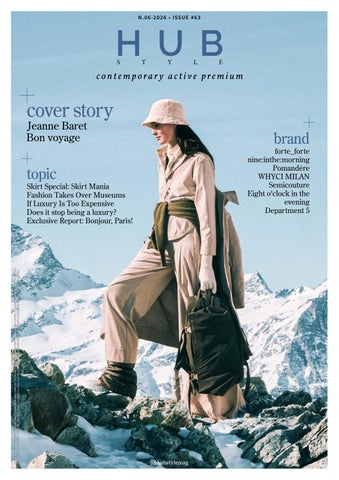
cover story
Jeanne Baret Bon voyage
topic
Skirt Special: Skirt Mania Fashion Takes Over Museums If Luxury Is Too Expensive Does it stop being a luxury? Exclusive Report: Bonjour, Paris! forte_forte nine:inthe:morning Pomandère WHYCI MILAN Semicouture Eight o'clock in the evening Department 5
brand
X X X X X
X X X X X X X
—2—
X X X X X
X X X X X X X
—3—
E D I T O R I A L
THERE ARE NO LONGER MID-SEASONS The climate changes observed in recent years are also profoundly altering the habits and trends of the entire fashion industry. From production to distribution including the planning of sales activities, which is becoming increasingly complex for stores all the way to the end consumer, who should be motivated to enter a store not only by the need to make a purchase but also by an emotional factor. It is now a well-established fact that winters are starting later and later and becoming shorter, which inevitably alters the timing of holiday shopping as well. Purchases are being pushed back, coming dangerously close to the discount season kicked off by Black Friday, with direct consequences for store profitability. Fall is thus reduced to a brief interlude, while spring seems to give way earlier and earlier to summer, which is becoming increasingly long and sweltering. This gradual upheaval of seasonality is reshaping consumer habits and calling into question traditional fashion calendars. A recent study by Federazione Moda Italia-Confcommercio shows that last September, sales fell by 4.7% in value compared to the same month the previous year. Just over half of the businesses surveyed reported stable or moderately growing sales, while the rest saw a decline. This result follows the trend of the summer sales, which got off to a strong start but then lost momentum and ended in substantial stagnation. The Italian retail sector remains one characterized by small, independent businesses grappling with sluggish and increasingly selective consumer spending. The Fashion Bank Observatory, which analyzes more than 41,000 retail locations, confirms the sector’s high level of fragmentation: 60% of stores have annual revenue of less than 250,000 euros, while maintaining a positive creditworthiness profile in more than 76% of cases. Amid ongoing promotions, the growth of e-commerce, and increasingly blurred seasonal patterns, the sector is poised to close the year with revenue of approximately 91.4 billion euros, limiting the decline to 1.6%. In such a complex landscape, broadening our perspective beyond national borders is becoming increasingly important for understanding the sector’s transformations and identifying new opportunities. That is why HUB Style continues on its path toward internationalization, which continues to garner positive feedback from readers. During the most recent Paris Fashion Week, we ventured beyond Italy’s borders with an in-depth exploration of international markets, featuring insights from some of the French capital’s most established and influential retailers. We asked the boutiques we interviewed to take stock of 2026 and outline the outlook for 2027. The survey focused on sales trends, changing shopping habits, emerging trends, and the top-performing brands that are proving most successful for stores in the City of Light. Among these, Italian brands are held in high regard and appear to play a key role in the offerings of boutiques across the Alps. The goal is to highlight the challenges and opportunities facing independent retailers in Europe, broadening our perspective and offering new food for thought and interesting points of comparison including with the data collected in our long-running survey, “100 Points of View.”
CRISTIANO ZANNI
follow us on hubstylemag hubstylemagazine
Publisher: MagNet S.r.l. SB Editor-in-Chief: ANGELO FRIGERIO Managing Editor: CRISTIANO ZANNI Editors: VALERIA ONETO, SARA FUMAGALLO, MICAELA PANZINI, ALESSANDRO MARRA Art Director: RICCARDO RECCAGNI Contributors: MARCO RIZZI, ANGELO RUGGERI, SIMONE COMI Editorial Offices: Via Tertulliano 68/70 - 20137 Milan - Tel: 02.87245180 Corso della Resistenza, 23 20821 Meda (MB) - redazione.hubstyle@mag-net.it - www.hubstyle.it Printed by: Ingraph - Seregno (MB). One copy for 1 euro Year 10 - No. 06 / 2026 Bimonthly magazine - Registered with the Milan Commercial Registry under No. 178 on June 9, 2017 - Registered with the ROC under No. 16155 on November 23, 2007 The publisher guarantees the strictest confidentiality of the personal data in its possession. This data will be used to manage subscriptions and to send commercial information. Pursuant to Article 13 of Law No. 196/2003, the data may be corrected or deleted at any time by writing to: MagNet S.r.l. SB Data Controller: Benedetto Sironi - Corso della Resistenza, 23 - 20821 Meda (MB) Chiuso in redazione il 23 ottobre 2026
—4—
Use the QR Code for the english version
X X X X X
X X X X X X X
—5—
T A B L E
O F
NEWS, COLLABO, CAPSULE & OPENING
08-12
COVER STORY Jeanne Baret: Have a safe trip
14-16
NEW TALENT Opposites attract
18
SKIRT MANIA A Matter of Skirts
20–24
RETAIL STORY IMARIKA: A Story That Breaks the Mold
26
MARKET Fashion Bank: What Is the True Price of Fashion?
28
ZOOM Blundstone: Making a Mark FROM FASHION Clothes, Art, and Provocations: Fashion Takes Over the Museums
C O N T E N T S
30–31 32
38-39
FOCUS ON Montecore: Outerwear, a contemporary classic Voile Blanche: The Soft Essence of Winter
40-42
RESPONSIBILITY Fashion from the Other Side Less bureaucracy, more substance
44-47
SHOWCASE And it takes the stage Born to wear
48-53
FOCUS SNEAKER What's happening in the sneaker market?
54
SNEAKER NEWS
55
SNEAKER SHOWCASE
ANALYTICS 34-35 If luxury is too expensive, does it stop being luxury? SPECIAL REPORT Hello, Paris!
ZOOM Invicta: Travel Light
SNEAKER TREND A Story of Shoes
36-37
14-16
20-24
34-35
54-58
COVER STORY
ANALYTICS
SKIRT MANIA
SNEAKER SECTION
—6—
56-57 58
X X X X X
X X X X X X X
—7—
N E W S ,
C O L L A B O R A T I O N S
&
L I M I T E D - E D I T I O N
C O L L E C T I O N S
THE RETURN OF ALPINE ICONS
Moncler rediscovers its heritage with Re/Icons 2026, a collection that reinterprets four archival models: Karakorum, Verone, Himalaya, and Tibb. Combining references to alpine expeditions with contemporary details, these iconic pieces are reimagined through technical materials, new color palettes, and modern silhouettes. For the first time, the collection expands to include ready-to-wear total looks and accessories, celebrating the brand’s pioneering spirit.
THE PENNY LOAFER TA K E S O N A N E W LO O K
THE COMFY LOAFER
To celebrate G.H.BASS’s 150th anniversary, the classic penny loafer meets KARL LAGERFELD’s rock-chic aesthetic in an FW 26 collaboration that reinterprets American heritage with a contemporary spirit. The stars of the collection are the Weejuns, featuring glossy black leather, black-andwhite contrasts, silver coins bearing the Karl logo, and all-over embossed patterns. The collection, designed for both men and women, also includes the Ranger Camp Moc. A dialogue between tradition and design.
JW ANDERSON and UGG present their first collaboration, reimagining two iconic silhouettes through the lens of the loafer. The collection introduces the Loafer Boot and the Loafer, styles that combine UGG’s functionality with Jonathan Anderson’s exploration of proportions and unexpected details. A rounded toe, box stitching, and the brand’s signature materials define a new take on everyday comfort. The unisex collection is available in Chestnut, Khaki, and Orange.
FA S H I O N H I TS THE RUNWAY GANNI and lululemon are joining forces in a collaboration that celebrates the joy of movement. The 22-piece collection blends the Canadian brand’s technical innovation with the Danish fashion house’s playful spirit, featuring animal prints, ruffles, and details inspired by 1980s dance. The stars of the “JOY IS A POWER MOVE” campaign are Jennifer Beals and METTE, celebrating movement as a form of self-expression.
TWO ICONS, ONE TIMELESS ELEGANCE
R O M A N TA I LO R I N G , NEW YORK SPIRIT
Lacoste and Mackintosh have joined forces for a capsule collection that blends sartorial elegance with technical innovation. Premiered at Roland-Garros, the collection reinterprets 12 wardrobe staples using Mackintosh’s iconic waterproof rubberized cotton. Featuring trench coats, ponchos, pleated skirts, and blousons, clean silhouettes and refined details celebrate the union of British heritage and the French sporting spirit.
Brioni celebrates Bergdorf Goodman’s 125th anniversary with an exclusive capsule collection that blends Roman elegance with New York identity. The collection reinterprets the house’s sartorial tradition through clean lines, luxurious fabrics such as cashmere and vicuña, and Art Deco details inspired by the department store’s historic Fifth Avenue facade. Key pieces include the Brunico jacket and the Virgilio tuxedo.
—8—
X X X X X
X X X X X X X
—9—
N E W S ,
C O L L A B O R A T I O N S
&
L I M I T E D - E D I T I O N
C O L L E C T I O N S
MOVEMENT BECOMES CINEMA What if sportswear became the star of an action movie? Zendaya and On are back with their second co-created collection, transforming movement into a story of energy, style, and freedom. Featuring cinematic sequences, contemporary silhouettes, and a bold python print, the collection blends performance with personal expression. Rounding out the story is the debut of the Cloudnova Moon Mary Jane, which reimagines the sneaker in a fresh new way. Because true style is the kind that moves with you.
THE ICON GETS A MAKEOVER
Timberland and Jacquemus are reimagining an icon, transforming the Authentic Boat Shoe into a limited-edition style with a bold personality. Crocodile-embossed leather adorns the silhouette in two versions, Brown Croc and Navy Croc, creating an unexpected dialogue between outdoor heritage and sophistication. The result? A timeless classic that dares to change its look without losing its identity.
30 YEARS OF STYLE IN A PEARL To celebrate its anniversary, Jimmy Choo pays tribute to one of the brand’s most cherished symbols with “Pearls of Wisdom,” a capsule collection designed by Creative Director Sandra Choi. Across shoes, handbags, and jewelry, pearls become sculptural details and contemporary accents, reinterpreted with wit and sophistication. A tribute to femininity and timeless charm, where every creation is designed to become a future object of desire.
THE LUXURY O F F E E L I N G AT E A S E Wolford and Woolmark redefine the concept of a “second skin” with a collection that combines certified Merino wool, technical innovation, and contemporary design. From purewool essentials to seamless designs, bodysuits, tops, and dresses naturally follow the body’s contours. A new vision of femininity, where sensuality stems from freedom of movement and the confidence that comes from feeling good in your own body.
W H E N T H E P E N A LT Y K I C K EXPERIENCE FLUIDITY
D E N I M M E E TS TA I LO R I N G What if workwear became a style statement? Gabriele Pasini has teamed up with Memory’s for a denim capsule collection that celebrates the value of the material and the nobility of craftsmanship. Five pieces reinterpret the workwear aesthetic through tailored construction, bold silhouettes, and an intense earth-toned wash. With structured jackets, handcrafted details, and contemporary silhouettes, denim reveals a new side of itself: authentic, textured, and deeply rooted in craftsmanship.
JIL SANDER and Oliver Peoples present their second eyewear collection, designed by Simone Bellotti, where modernist precision meets organic shapes and sinuous lines. Three new models, crafted from titanium and sculpted acetate, embody a minimalist aesthetic defined by architectural proportions and refined details. Handcrafted in Japan with Italian lenses, these eyewear pieces transform technical precision into a gesture of modern style.
— 10 —
X X X X X
X X X X X X X
— 11 — d-duno.it
O P E N I N G
M O N T B L A N C ' S M I L A N E S E S PA C E Montblanc is opening its renovated boutique in Milan’s Galleria Vittorio Emanuele II, a two-level space that celebrates the allure of writing through design, art, and craftsmanship. The highlights include the striking dark-wood spiral staircase, the installation “The Tree of Writing,” and “The Desk,” designed by Marco Tomasetta. In addition to its collections of leather goods, watches, and writing instruments, the boutique will host cultural events, calligraphy classes, and literary presentations.
THE DRUMOHR BOUTIQUE IN THE HEART OF GENOA Drumohr is strengthening its presence in Italy with a brand-new showroom in the heart of Genoa. Opened on October 8, the space embodies the brand’s spirit through a design by m²atelier, where refined materials, soft geometric lines, and pops of color create a contemporary and sophisticated aesthetic.
BARBOUR AFTER IN NAPLES, A UNO STORE IN THE GALLERIA UMBERTO I Barbour is opening its new store in the Galleria Umberto I, one of Naples’ most iconic landmarks. Distributed exclusively in Italy since 1984 by WP Lavori in Corso, the British brand brings its unmistakable heritage to the heart of the city, blending tradition, craftsmanship, and contemporary sensibility. This new space creates a dialogue between the brand’s identity and the energy of Naples, strengthening Barbour’s presence in Italy and furthering WP Lavori in Corso’s retail growth.
THE FIRST PA R I S T E X A S FLAGSHIP STORE IN MILAN
BORSALINO STRENGTHENS ITS PRESENCE IN THE CITY OF LIGHT
Paris Texas celebrated the opening of its first boutique in Milan with an event in the heart of the Fashion District. At Via Verri 4, guests and friends of the brand explored the new space, featuring granite, steel, and sophisticated details that reflect the brand’s dual character. Adding to the special occasion was an exclusive capsule collection dedicated to the opening, which reinterprets the iconic Lidia silhouette in three versions in the distinctive Rouge Noir shade.
Borsalino is strengthening its ties with Paris with a new boutique in the Triangle d’Or, at 24 Rue Marbeuf. Designed by architect Nicola Quadri, the space reinterprets the brand’s identity through its iconic check pattern, vintage furnishings, and textural details. This project blends Italian heritage with modern design, supporting the brand’s international expansion and celebrating a relationship with the French capital that spans over a century of history and culture.
— 12 —
X X X X X
X X X X X X X
— 13 —
C O V E R
S T O R Y
BON VOYAGE From the first woman to circumnavigate the globe to a brand that aims to break down the barriers between the outdoors and fashion. Fabio Campagnolo discusses Jeanne Baret’s philosophy, the challenges of positioning, and the prospects for growth by Sara Fumagallo
I
Fabio Campagnolo, CEO of F.lli Campagnolo
n a market characterized by an ever-expanding range of products and discerning consumers, the real challenge for companies is to transform industrial expertise into recognizable and desirable identities. Simply producing high-quality garments is no longer enough. And this is a transition that the F.lli Campagnolo Group understands well, finding in Jeanne Baret one of its most interesting expressions. Inspired by the explorer of the same name the first woman to circumnavigate the globe in the 18th century the brand, launched in 2023, occupies a cross-cutting market space between high-end sportswear and contemporary apparel, with collections that blend technical innovation with refined, everyday aesthetics. At its core is a versatile premium product designed for a dynamic and independent woman, free to move between different contexts. A distinctive positioning, yet not without its complexities, especially on the distribution front, where the distinction between outdoor and fashion channels remains a challenge. We spoke with Fabio Campagnolo to take stock of the label’s development, the opportunities offered by multi-brand retailers and international markets, as well as the Group’s performance and the strategies that will guide its growth in the coming years.
Jeanne Baret was launched in 2023 as part of F.lli Campagnolo, a group with a strong industrial and sporting heritage. How has the brand managed to forge its own identity? Jeanne Baret was created to dress the contemporary, dynamic, and independent woman who seeks an elegance that adapts naturally to the different moments of the day. A woman who travels, works, and loves to enjoy an aperitivo, without sacrificing style or practicality. Our vision stems from this need: to create garments that combine aesthetics and functionality, designed to accompany every movement and occasion. Clothes that don’t wrinkle and take up little space in a suitcase. We identified a largely unexplored niche in the market somewhere between fashion and function and chose to turn it into an opportunity. We did this by combining our proven expertise in technical products with the sensibility and creativity of seasoned professionals in the world of women’s fashion. Jeanne Baret is a new way of interpreting the contemporary wardrobe, where every piece is designed to be beautiful to wear, easy to live in, and ready to accompany women through every moment of their day.
A historic photo of “Casa della Lana,” the Campagnolo brothers’ first store, which opened in 1954 in Bassano del Grappa (VI) and some photos of the Group’s facility in Bassano del Grappa (VI) and of the production process
— 14 —
Jeanne Baret's Fall/Winter 26/27 Collection. A collection in which the exploration of multifunctional materials and technologies takes center stage
In a fashion landscape where everyone talks about freedom, authenticity, and women’s empowerment, there’s a risk that these words will lose their meaning. How do you translate these values into something concrete that goes beyond marketing? The story of Jeanne Baret offers us an important point of reference. In the 18th century, to join the expedition that would allow her to circumnavigate the globe, she had to overcome the conventions and limitations imposed on women of her time. Today, the barriers are different and often less obvious, but the desire to carve out one’s own space and to be able to make independent choices remains as relevant as ever. Our contribution is expressed through our products: garments designed to accompany women in their daily lives at work, on their journeys, and during their free time without imposing a predefined model on them. We don’t want to limit ourselves to merely promoting an ideal of independence; rather, we aim to offer a collection that aligns with the vision of a dynamic and curious woman. Fabio, you helped transform F.lli Campagnolo from a manufacturing company into a group focused on brandbuilding. What was and what is today the most complex challenge in the Jeanne Baret project? The challenge is to transform established industrial expertise into a value that consumers can recognize. Knowing how to create a quality product is essential, but building a brand also requires a clear vision, a distinctive positioning, and the ability to engage with the market. Today, the priority is to consolidate Jeanne Baret’s identity, make it increasingly recognizable, and translate that into consistent commercial growth. This means investing in the product, communication, and distribution. If the brand were to make an equally bold choice today, what would it be? To continue exploring a territory that transcends traditional clothing categories. The market often distinguishes between performance-oriented outdoor apparel and urban fashion, which is more focused on aesthetics. We believe these two
worlds can interact in a more sophisticated way. For Jeanne Baret, the challenge is to demonstrate that functionality doesn’t necessarily have to be visible and that technology can coexist with minimalist design. This means building a distinctive offering rather than following established models. In a market with an ever-expanding range of offerings, the boundaries between sportswear and fashion are becoming increasingly blurred. What territory does Jeanne Baret aim to occupy? Jeanne Baret positions itself as a premium brand in the sportswear world. It sits at the intersection of outdoor culture and contemporary apparel, with the goal of offering functionality that does not compromise aesthetic appeal. We don’t want to offer a purely technical product or limit ourselves to using outdoor elements merely as decorative details. Our expertise allows us to focus on the substance of the garment from materials to construction while the stylistic design translates these characteristics into silhouettes, proportions, and details suited to everyday life. It is this balance between performance and stylistic sensibility that we want to develop and make distinctive over time. The woman who wears the brand is a “daily explorer,” but exploring today doesn’t necessarily mean reaching remote places. How is this vision reflected in your wardrobe? Can a garment also convey emotions? Exploring means maintaining a curious attitude towards our surroundings: it can mean setting out on a journey, discovering a new place, or approaching a workday with a fresh perspective. A garment can certainly convey emotions through its color, fabric, fit, and the sensations it evokes in the wearer. In addition to meeting practical needs, it can contribute to personal wellbeing and become part of how each woman expresses her individuality.
— 15 —
C O V E R
S T O R Y
Preview della spring-summer 2027
The Fall-Winter 26/27 collection features high-performance membranes and practical solutions. What was the creative starting point, and what innovation do you consider most representative of your philosophy? The collection represents a natural evolution of the Jeanne Baret project. The creative starting point is our relationship with nature, interpreted through materials, colors, and surfaces that evoke a more refined and contemporary aesthetic. At the same time, membranes, padding, and construction techniques continue to play an essential role in the product’s quality. The concept that best represents this philosophy is “invisible performance”: technologies that guarantee protection and functionality without necessarily being visible in the garment’s exterior appearance. It’s an approach that allows us to put technical research at the service of a minimalist, versatile, and contemporary design. Today’s consumers are increasingly selective. What are the elements on which Jeanne Baret wants to build its perception of value, beyond the product itself? A brand’s value is built over time through consistency between what it promises and what it delivers. Product quality must be complemented by a recognizable identity, credible communication, and a consistent experience across all touchpoints with the consumer. For Jeanne Baret, we aim to build trust through the substance of our offering and the continuity of our brand vision. It’s not enough to simply spark interest in a collection; we need to give the public reasons to choose the brand and continue to identify with its values. What is Jeanne Baret’s main market today in terms of performance, and which new markets is the brand targeting? Italy is a key market for Jeanne Baret, while international expansion is a major driver of the brand’s growth. When selecting markets, we consider not only their size and sales opportunities but also the presence of an audience receptive to our offering and a distribution network consistent with our positioning. It is essential to identify partners capable of showcasing the product and communicating its features. We aim for quality growth, built on solid business relationships and long-term prospects.
One of the label’s goals is to expand its presence in multibrand stores with a stronger focus on the fashion world. Where do you stand in this process, and what feedback are you receiving from retailers? We are still in the process of refining our distribution network, precisely because we have chosen to target a new market segment that straddles the line between sportswear and contemporary apparel. In Italy, these two categories are still quite distinct, and finding the right niche for a brand like ours takes time and requires raising market awareness. However, we are confident in the project’s potential and convinced that there is room for growth in this direction. The goal is not to expand distribution indiscriminately, but to build a network of partners who understand and promote the Jeanne Baret identity. How did the Fratelli Campagnolo Group perform in 2026? The Group’s first half of the year closed on a positive note, with an increase of a few percentage points compared to the previous year. The year isn’t over yet, but forecasts indicate we’ll maintain the growth trend of recent years. Certainly, in terms of consumer spending, this is a delicate period, and we’re feeling the impact, albeit to a lesser extent. Looking ahead, what are your ambitions for the next five to ten years? Our ambition is to continue evolving as a Group, strengthening our ability to build brands with distinctive identities and an increasingly international growth outlook. Solidity remains a central element of our history, but we want to highlight it even more through projects capable of interpreting new needs and speaking to diverse consumers. For Jeanne Baret, this means consolidating a recognizable positioning, developing a coherent distribution strategy, and making its interpretation of the relationship between outdoor wear and contemporary apparel increasingly clear. I don’t believe growth can be defined solely in economic terms or by the number of markets reached. Of course, results are essential, but so is the quality of the journey. Building brands that can endure, evolve without losing their identity, and maintain a credible relationship with those who choose them.
— 16 —
— 17 —
N E W
T A L E N T
OPPOSITES ATTRACT What happens when two creative visions different in background but united by the same passion come together to create a fashion brand? The work of Saman Loira and Kittaty is a concrete example of this by Sara Fumagallo
SAMAN LOIRA Saman Loira’s story is one of contrasts, a theme that is further explored in *Tephra Vesuviana*, the latest collection in the trilogy inspired by the volcano, which began with *Ad Vesuvium* and continued with *Nympha Vesuviana*. “Naples isn’t simply the place where we were born and work, but a fundamental part of our identity,” the founders state. Behind the project are two creative minds, Francesco Corcione and Francesco Canessa, who with their different personalities and approaches have found one of the brand’s most recognizable balances precisely in the tension between creativity and pragmatism. Ash, fragments, and surfaces marked by time become the starting point for a collection built on transformation, where leather ripples and layers, volumes take on a sculptural quality, and sheer fabrics and flowing textiles lighten the silhouettes. samanloira.com IG. @saman_loira
KITTENS There’s always one accessory that makes all the difference in an outfit an element that “spices up” even the most ordinary look. The belt. With this in mind, between Varese and Milan, Andrea Zorzan and Carlo Maria Giorgetti have launched a project whose defining traits are experimentation and playfulness. Starting with the name, Kittaty, which comes from “acchittato” a phrase frequently used by the two founders. You may have seen their belts worn by artists such as Sayf, Tredici Pietro, and Salmo, or featured in reality shows like Netflix’s *Nuova Scena*. Handcrafted in limited editions in a small workshop, the belts are the brand’s core business, but its ambitions extend beyond that. The goal is to build a well-rounded fashion brand that explores new product categories without compromising its creative identity. IG. @kittaty.lab
— 18 —
— 19 —
S K I R T
M A N I A
A MATTER OF SKIRTS It’s redefining femininity and reclaiming the contemporary wardrobe. But beyond the runways, how significant is the skirt’s comeback, really? by Valeria Oneto
T
here’s more to the fashion world’s new obsession with skirts than just a passing trend. After several seasons in which pants seemed to have taken over every corner of the women’s wardrobe from formal occasions to everyday wear the balance is shifting, and with it, the way femininity is interpreted. Prada set the tone for this new direction when, for SS 27, it sent 63 looks down the runway, all built around the skirt. It was a statement of intent rather than a stylistic exercise: a garment as a starting point, a blank canvas on which to build diverse identities, far removed from pre-established codes. The numbers were already signaling that something was shifting. According to Lyst, searches for sheer skirts rose by 56% in January 2026, while Trendalytics reported a 104% year-over-year increase for flowing maxi skirts. And in the days following the Prada fashion show, eBay detected a 360% surge in global searches for “Prada skirt.” These are indicators of desirability not yet of sell-outs but enough to suggest that the phenomenon extends beyond the runways. The point, however, is not just what people are wearing, but why. The skirt is making a comeback at a time when fashion is seeking new forms of individual expression and seems intent on moving beyond both the rigidity of minimalism and traditional representations of femininity. Whether pencil, midi, maxi, flowing, or structured, today it pairs seamlessly with bomber jackets, oversized knitwear, sneakers, and menswear-inspired pieces. It doesn’t impose an image; it leaves room for the wearer. And it is perhaps this freedom, along with its versatility across occasions and seasons, that is making it commercially appealing once again. But how much of a gap exists between the desire fueled by fashion shows and consumers’ actual purchasing decisions? And above all, is the skirt really gaining ground on pants? To understand this, we reached out to eight Italian labels in the high-end premium segment: forte_forte, 8PM, nine:inthe:morning, Pomandère, Whyci Milano, Semicouture, Department5, and Justmine. These are independent brands, far removed from the logic of major fashion houses, chosen for their stylistic identity, their research into materials and construction, their connection to “Made in Italy,” and their engagement with an evolved multi-brand retail landscape. Eight different perspectives to determine whether the skirt’s comeback is merely a matter of style or a sign of a deeper shift in the contemporary wardrobe.
1
In the latest SS 27 fashion shows, the skirt has returned to center stage. When did you first start to notice that something was changing in consumer demand?
2. 3
How significant are skirts in your collections today? How many styles do you offer, and, if possible, what percentage do they represent of the total?
When it comes to styles, which ones are really working? Lengths, silhouettes, materials: what are customers looking for today, and what stays on the runway?
4 5
Are skirts gaining ground, or are they taking market share away from pants? Have you noticed a shift in sales between the two categories?
How has the way people wear it changed? Is it still a special-occasion piece, or has it become part of everyday life? And which pieces of your overall look pair best with it?
6
You are independent brands with deep ties to “Made in Italy.” How much does this identity influence the design of a skirt from the choice of materials to the construction and to what extent is it recognized today by buyers and customers?
— 20 —
worn on their own or over pants, in leather, envers satin, and silk printed or embroidered as seen in the new SS 27 collection.
3
For us, it’s not just a runway piece, but an essential, easy-to-wear garment that’s versatile and eclectic. The sales figures back this up: the winter scarfprint skirt and the fall sarong the stars of the look are selling very well.
4
forte_forte
I don’t think skirts and pants are competing for market share. For a century, pants have been a symbol of emancipation, while skirts were the garment from which to break free: today, both hold great appeal. In terms of sales, we’ve seen skirts return to the top spots, while pants remain forte_forte’s core business.
1
5
2
6
GIADA FORTE co-founder e creative director
For a few seasons now, we’ve noticed that skirts are making us fall in love with them all over again. One of the oldest items in the wardrobe, it has been around since Greek tunics, Renaissance portraits, and our grandmothers’ closets. It never went away it simply took on a new form. I still remember the gauze skirt I designed for our first summer collection and the pinstriped Thai skirt from our first winter collection.
The skirt is an iconic piece for forte_forte and accounts for 10% of the collection. We offer it in various styles and materials: knee-length pleated skirts in jersey, organza, or knitwear; mid-length skirts in silk, voile, and velvet; both solid-color and printed. We’ve also always offered sarong skirts, to be
The skirt embodies femininity, sensuality, and elegance in every form. A statement skirt, richly embellished with embroidery or sequins, paired with a cashmere sweater or a men’s-style shirt, can become a daytime outfit. A solid-color skirt is a versatile staple, easy to wear with low-top sneakers, or with boots or heels to make it cooler and more chic.
“Made in Italy” isn’t just a label it’s a network of relationships: weavers we’ve known for years, hands that preserve a tangible craft. We always tell our customers what goes into creating a garment. On Instagram, we showcase the manufacturing processes: watching a pleated skirt take shape is magical a manual art form much like origami.
3
The customer is looking for styles that combine femininity and versatility. Flowing fabrics, such as silk and cool wool, work well, as do more deconstructed silhouettes that accompany movement with lightness and elegance. The midi length remains popular because it adapts to different occasions. Structured skirts with dramatic volumes make a statement on the runway but have more specific uses. For us, the key is focusing on fabrics and finishes without sacrificing versatility, so the customer can personalize her look through styling.
UMBERTO VEDRAMIN ceo
nine:inthe:morning
1
Interest in skirts has grown thanks to their blend of femininity, comfort, and personality. It’s versatile, allowing you to experiment with volumes, fabrics, and proportions. Styling plays a key role: simply changing your accessories and shoes can transform the same skirt, shifting from a casual look to a more sophisticated one. This freedom of expression highlights authenticity and personal style for every occasion.
2
Pants remain our core business they’ve always been part of nine:inthemorning’s DNA. Skirts, however, are gaining ground: we’re adding more styles season after season, expanding the range of silhouettes, fabrics, and fits, as well as styling options and design interpretations.
4
Skirts are gaining ground as an alternative to pants, without replacing them or taking away from their sales. Pants continue to hold a solid position in the market.
5
We always suggest a coordinated total look, with a skirt and top made from the same fabric. You can go for a more relaxed look with an oversized shirt and sneakers, or opt for a more sophisticated style with a blazer or a slim-fit vest.
6
Independence and the “Made in Italy” ethos are at the heart of our project. They guide every stage, from the selection of tailored fabrics to the construction process, blending artisanal tradition with contemporary innovation. Buyers and customers recognize this authenticity, which is rooted in quality and “saper fare.” With the skirt, in particular, artisanal craftsmanship makes all the difference in fit and movement, transforming an everyday garment into an expression of excellence and durability.
— 21 —
S K I R T
M A N I A
1
Since last season, we’ve observed a growing interest in a garment that had taken a back seat in recent years. The skirt is once again seen as a central piece of the wardrobe versatile and capable of adapting to different styles. The SS 27 runway shows confirmed a trend we had already glimpsed in the increased focus on lengths and silhouettes.
2 CARLO ZANUSO founder e creative director
POMANDÈRE
Today, it accounts for about 15% of the collection, with about fifteen styles. We experiment with different lengths, volumes, and fabric details, seeking a balance between versatility, aesthetic innovation, and brand identity between femininity and contemporary style.
3
The midi skirt is particularly popular, reimagined with a new play of pleats that accentuates movement and volume. We offer it in cotton-wool flannel soft yet full of character ideal for winter. The color palette features warm, deep tones from burgundy to forest green and brown that are easy to pair and exude contemporary elegance.
4
Pants, along with shirts, remain one of our most established categories. Over the years, we have developed different styles and fits, focusing on leg volume, waist construction, and lengths. We have iconic pieces that keep our customers coming back. Skirts open up new ways to express oneself, without replacing the central role of pants.
5
Skirts are becoming more and more of an everyday staple, not just for special occasions. We like to style it in a casual yet feminine way, pairing it with warm wool sweaters for a comfortable, cozy look, or with a shirt our signature piece par excellence. This is how it becomes part of a cohesive total look, where comfort and femininity meet the brand’s identity.
6
“Made in Italy” means a focus on materials, details, and fit. When it comes to skirts, the
1
3
2
4
We interpret the return of the skirt as a desire for a more varied wardrobe, in which femininity is also expressed through volume and movement. For WHYCI MILANO, THis serves as an inspiration to explore the versatility of the garment and its relationship to the overall look.
PAOLO TURRI CEO
WHYCI MILAN
choice of fabrics and the careful consideration of proportions are essential for creating a feminine, comfortable, and versatile garment. Our independence allows us to remain true to our identity: a value built over time, reflected in the quality of our products, our research, and the relationship of trust we’ve established with buyers and customers.
In SS 27, we are presenting nine skirt styles, accounting for about 6% of the collection. The selection ranges from linen to striped cotton, from stretch poplin to embroidered cotton, to taffeta, GOTS-certified denim, and patterned fabrics.
— 22 —
We favor midi lengths and silhouettes that allow for freedom of movement: pleated skirts, slits, buttons, and a sarong-style version. The fabric gives character to the silhouette, from the freshness of linen to the structure of taffeta, to the fluidity of viscose. Our design philosophy is to make every style wearable and easy to pair with other pieces. We see this as a piece you can wear every day. We pair it with poplin shirts, polo shirts, T-shirts, and shirt jackets, playing with proportions. An embroidered or taffeta style can take on a more casual look with a simple top; a denim skirt can take on an elegant look with a shirt.
1
The shift was already evident before the SS 27 fashion shows: customers were looking for alternatives to pants without sacrificing practicality. For us, it’s not so much a return to the skirt as it is a new way of interpreting it one that’s freer and more contemporary.
2 CECILIA SGARBI brand manager
SEMICOUTURE
Skirts play an important role in the Semicouture collection, alongside pants, dresses, and knitwear. We work with a variety of silhouettes and lengths, maintaining a balance among the different categories of the wardrobe. Rather than focusing on quantity, we prioritize the versatility of each piece.
3
We’re seeing interest in midi lengths and flowing silhouettes, with designs that move with the body. What matters most is the lightness of the fabrics, comfort, and the ability to switch up your look with just a few different combinations. The most dramatic looks are inspiring, but the customer chooses what she can truly live in.
4
I wouldn't say that skirts are replacing pants. The two categories coexist and cater to different occasions. Skirts are expanding the possibilities of the wardrobe: it is this rather than a clear shift in sales that is the trend we're interested in.
5
It’s becoming less and less tied to special occasions. We like to imagine it paired with a T-shirt, a soft sweater, a shirt, or a relaxed-fit jacket. The contrast between feminine elements and everyday pieces is very much in line with Semicouture’s urban aesthetic.
6
For us, “Made in Italy” means, above all, a culture of the product: attention to the feel of the fabric, the proportions, the fit, and the details. With a skirt, just a few centimeters are enough to change the balance of a silhouette. It’s a craftsmanship that buyers and customers recognize when a garment is not only beautiful but also works well when worn.
5
The “Made in Italy” ethos is woven into the project through the selection of fabrics, the construction, and the attention to detail in the finishes. Every stage of the production process for our garments takes place in Italy. Even in a seemingly simple skirt, the feel of the fabric and the quality of the tailoring define its character. This is the value we want to convey to buyers and customers.
6
Il made in Italy entra nel progetto attraverso la scelta dei tessuti, la costruzione e la cura delle finiture. Tutte le fasi di lavorazione dei nostri capi sono realizzate in Italia. Anche in una gonna apparentemente semplice, la mano del materiale e la qualità della confezione ne definiscono il carattere. È questo il valore che vogliamo rendere riconoscibile a buyer e clienti.
— 23 —
S K I R T
M A N I A
3
The midi is our signature silhouette, crafted from refined materials and featuring special textures. I believe in the “statement” skirt, which can define an entire look. For winter, we’re also focusing on the ’60s-style mini skirt, coordinated with our outerwear fabrics. Extreme sheer looks remain more of a magazine trend: women are looking for personality, but they want to feel fully dressed and comfortable.
4 ANNA GIULIANA MARIANI creative director
8PM
1
After several seasons dominated by menswear-inspired tailoring, we sensed a desire for a freer, less rigid form of femininity. The skirt meets this need: it changes its look depending on how it’s styled and transitions seamlessly from day to night. This versatility is in 8PM’s DNA and in its name.
2
Its importance has grown significantly. We have rebalanced the collection, giving skirts more prominence than dresses. It is not yet a dominant category, but it is playing an increasingly strategic role.
It doesn't replace pants; it complements them. It expands the expressive possibilities of one's wardrobe; it isn't a competition between categories.
5
The skirt has broken free from the concept of a specific occasion: it has become part of everyday tailoring and pairs well with sweatshirts, knitwear, and oversized blazers hallmarks of 8PM. It is in the contrast between styles, in layering, and in styling that a new, more spontaneous, and personal femininity emerges.
6
“Made in Italy” is a core value, not just a label. For years, we have been manufacturers for fashion houses such as Giorgio Armani and Max Mara: an experience that has strengthened our product culture, from textile research to garment construction. This know-how is deeply rooted in 8PM, and it is recognized and appreciated by buyers and customers alike.
lengths to maxi styles, without overlooking midi skirts. These silhouettes combine femininity, movement, and versatility. Sheath dresses and miniskirts, on the other hand, are in more limited demand.
4
We have not observed any significant shift between the two categories. Pants sales remain stable and in line with supply, while skirt sales are gradually increasing, playing an increasingly significant role.
NICOLA SILVAGNI CEO DEPARTMENT 5
1
The skirt has always been a central feature of our collections, spanning various styles: from Vivienne Westwood’s punk aesthetic to the refined rock chic of the 1950s. In recent years, we have seen a steady increase in demand, season after season, a sign of an ever-growing interest.
2
Today, skirts account for 20% of sales, despite making up only 10% of our product lineup. This is a significant achievement, confirming their status as one of the top-performing categories in our collections.
3
Customers particularly favor wide skirts, ranging from below-the-knee
5
Today, the skirt is a versatile piece that can be adapted to different occasions and styles through various combinations. It offers great freedom in fit, accommodating a range of body types; it enhances femininity and can be more distinctive than pants, while remaining more versatile than a dress. In our total looks, we pair it with knitwear and leather, as well as with a jacket, for a contemporary elegance you can enjoy every day.
6
“Made in Italy” is fundamental to the choice of materials and the construction of the garment. Recognition of Italian quality is even stronger in people’s statements than in their purchases. Yet, our best-selling skirt style is also the most expensive. This proves that when a garment embodies an authentic identity and tangible quality, the market is willing to recognize its value.
— 24 —
— 25 —
R E T A I L
S T O R Y
Maximiliano Cattaneo, Owner
A STORY THAT BREAKS THE MOLD A selection free from conventions, an independent spirit, and an authentic relationship with customers. Maximiliano Cattaneo explains how IMARIKA has continued to evolve for over 40 years while remaining true to its vision by Sara Fumagallo
I
n a fashion landscape dominated by ever-faster trends and often cookie-cutter designs, there are those who continue to stand out by making innovation and identity their signature style. Such is the case with IMARIKA, a Milanese boutique founded in 1979 by sisters Benedetta and Maria Bevilacqua, which for over four decades has championed a vision of fashion free from convention. Today, under the guidance of Maximiliano Cattaneo, this family story continues to evolve while keeping its essence intact. Stepping into the boutique means discovering a selection of emerging designers alongside established names, finding a special appreciation for craftsmanship, and, above all, experiencing an authentic connection with the clientele. Maximiliano Cattaneo, the boutique’s owner, tells us the story and evolution of IMARIKA. Imarika is a long-standing Milanese retail brand with a highly recognizable identity. How did the project come about, and what values still guide your decisions today? IMARIKA was founded in 1979 out of the passion of my mother, Benedetta, and Maria Bevilacqua, with the idea of creating a space where fashion would be an expression of personality, innovation, and stylistic freedom. Today, I run the boutique alongside a team of women who help keep its identity alive. In over 40 years, the industry has changed profoundly, but our values have remained the same. We are guided by the desire to offer a personal style, along with the relationship of trust we cultivate with our customers. What criteria do you use when selecting brands, and what does a brand need to have to become part of the Imarika world? Research is at the heart of IMARIKA. We don’t stop at trends or a brand’s popularity: we look for a vision, a recognizable identity, and a story to tell. We’re interested in designers who are willing to experiment and who pay close attention to materials, craftsmanship, and details. We love discovering independent brands alongside established names, as long as they share our sensibility. Every brand must fit harmoniously into our selection, bringing something new to the table. It’s a complex task, but that’s precisely what makes it so stimulating.
OV E RV I E W Store Name: IMARIKA Founders: Benedetta and Maria Bevilacqua Owner: Maximiliano Cattaneo Address: Via Giovanni Morelli, 1 (20129) Milan Square meters: 110 Website: imarika.com Among the best-selling brands: anTIPAST, apuntob, Colomba Leddi, Daniela Gregis, Flabelus, Labo.Art, Maria La Rosa, Minina, Mira Mikati, Péro, Saloni, Siyu, Sofie D'Hoore, Tagliatore, Vivetta, Zilla
The IMARIKA boutique and a photo of Benedetta Bevilacqua, founder, and Maximiliano Cattaneo, owner
In recent years, the way people shop for fashion has changed. How has your customer base evolved, and what new needs have you identified? Customers are increasingly well-informed and discerning, but it is precisely this abundance of options that makes advice and curation even more valuable. We’re seeing a greater focus on thoughtful purchases, quality, and the longevity of garments. Women want to interpret fashion freely, without set rules especially our customers. Our greatest satisfaction comes from helping every woman find something she can truly identify with. What role does an independent boutique play today? An independent boutique offers what standardized retail can hardly guarantee: a personal vision, an authentic selection, and, above all, a human connection. IMARIKA is a place of discovery and connection, where we forge bonds between designers, curators, and customers. Digital technology is a valuable tool, but it cannot replace the in-store experience. Our value lies in our relationship with our customers. Looking ahead, what are the main challenges and opportunities for Imarika? Are there any new projects or directions you’re exploring? The challenge is to evolve without losing our identity, balancing stylistic exploration, careful management, and contemporary communication. Digital media offers an opportunity to reach new customers and better convey the work that goes into every decision we make. It’s an area in which we invest daily, with the goal of forging new connections. After all these years, IMARIKA still retains its curiosity and desire to surprise.
— 26 26 —
X X X X X
X X X X X X X
— 27 —
F A S H I O N
B A N K
WHAT IS THE TRUE COST OF FASHION? Amid promising starts and slowing consumption, the industry is grappling with an increasingly selective customer base. Fashion Bank’s summer review and winter outlook, featuring promotions and seasonless wardrobes
The Rubinacci Boutique in Milan
S
mall, independent, and with a strong focus on women. This is the profile of the Italian fashion store that emerges from Fashion Bank’s latest Fashion Observatory report. A survey of 41,072 retail locations representing nearly 30,000 companies reveals a retail landscape far more diverse than the constant warnings about the consumer crisis would suggest. Sixty percent of the stores analyzed have annual revenue of less than 250,000 euros, 63.5% are no larger than 100 square meters, and nearly one in two businesses is a sole proprietorship. Local multi-brand stores therefore remain a pillar of the Italian retail sector, and despite a market that is anything but straightforward, 76.3% of businesses have a positive solvency profile according to Fashion Bank’s parameters. Small, yes, but not all the same. The geographic disparity is, in fact, very evident: the South and the Islands account for nearly 38% of retail locations but have a median revenue of about 159,000 euros, compared to 225,000 in the Northeast. In stores larger than 1,000 square meters, the sales-to-purchases ratio reaches 1.69, compared to 1.41 in stores smaller than 50 square meters. What about the sales? Meanwhile, on the other side of the store window, consumers are changing the rules of the game. The Fashion Bank report, focusing on summer sales and the winter outlook, shows a season that began with a 3% increase in first-day sales compared to 2025 but soon slowed down. By mid-Ju-
ly, the apparel and accessories sector was down 0.4% in value, while foot traffic in brick-and-mortar stores fell by 2.4%. At the end of the season, the picture remains mixed: Confesercenti Padova reports a decline in revenue of about 10%, while Federmoda Confcommercio Veneto notes results largely in line with previous years. The pattern, however, seems to be the same. Purchases are concentrated in the first few days, then enthusiasm wanes. Clothing, footwear, and knitwear are the main items added to shopping carts, but purchasing decisions are increasingly driven by value for money, not necessarily the highest discount. According to Federconsumatori, only 36.6% of households took advantage of the sales 3.2 percentage points less than in 2025 while 28% reduced their shopping budget. And even discounts no longer seem to hold the same appeal as they once did. Black Friday primarily brings forward purchases that were already planned, e-commerce multiplies promotional opportunities, and the seasonal calendar is losing its traditional boundaries. And with the arrival of winter, caution does not seem set to disappear. Forecasts from the Observatory indicate that Italian fashion will see 2026 revenue of approximately 91.3–91.4 billion euros, down 1.6%. Meanwhile, in July, e-commerce grew by 2.4% in value and 1.6% in volume. And while price is the main criterion for Christmas shopping for 55% of respondents to the Sensormatic Shopper Sentiment Survey, brick-andmortar stores retain a significant advantage: 70% of consumers say they prefer them for holiday shopping.
— 28 —
X X X X X X X
— 29 —
markupitalia.it
X X X X X
Z O O M
MAKE A MARK Blundstone celebrates real-life stories and introduces the new Terrain series, blending an outdoor spirit, comfort, and adventures to share
T
here are adventures that leave their mark, just like the boots that accompany us along the way. Creases, scratches, and the passage of time become small fragments of life memories of places discovered and paths traveled. This idea gave rise to Well Worn, the project through which Blundstone celebrates the special bond between its footwear and those who wear it. A story that, 156 years after its inception, gains a new chapter with the launch of the Terrain series. To mark the occasion, in early October, the Australian brand brought its global community together for the first time in Poland, with 45 brand enthusiasts from 20 countries. The Well Worn Blundstone Bonfire was a journey of sharing and exploration, from Kraków to Zakopane at the foot of the Tatra Mountains, featuring hikes, workshops, local traditions, and alpine landscapes. It was an experience that centered on the people and stories that, step by step, have helped shape the brand’s identity. New Grounds, Same Spirit Part of the Fall/Winter 2026/2027 collection, the Terrain series reinterprets the iconic Chelsea boots with a more dynamic, outdoor-oriented design, without sacrificing the comfort that has always set Blundstone apart. The AVALON GECKO TPU outsole combines lightness, abrasion resistance, and traction on both dry and wet surfaces, while the Comfort Arch insole with XRD technology ensures support and cushioning. A col-
— 30 —
Some photos from the Well Worn Blundstone Bonfire event and the new Terrain collection for Fall/Winter 26/27
lection designed to accompany everyday life and outdoor adventures, adapting to different terrains and new routes. During the event in Poland, the pop-up shop in downtown Zakopane also offered workshops on boot care and the opportunity to customize the laces with embroidery by Tasmanian artist Lauren Weeks. The essence of Well Worn
celebrates the value of experiences and the beauty of lived moments, beyond the product itself. As Blundstone explains, it is precisely the marks left by time that make each pair unique, transforming it into a keeper of personal adventures. And if every journey begins with a first step, with Terrain, the next one is yet to be written.
— 31 —
F R O M
F A S H I O N
C L O T H E S , A R T, A N D P R O V O C AT I O N S . FASHION TAKES OVER THE MUSEUMS The must-see exhibitions of 2026 showcase a fashion world you won't want to miss: one that is increasingly free, spectacular, and eclectic by Angelo Ruggeri
F
exhibition avoids a simple chronological layout, instead taking the form of a conceptual time machine based on the theme of duality and continuous expressive metamorphosis. Open through November 22, 2026, the exhibition celebrates couture as both an art form and a vehicle for social reflection.
Dalí and Fashion: Surrealism on Stage In Milan, the first must-see event is at Palazzo Reale with “Dalí and Fashion,” an exhibition that explores the groundbreaking encounter between the Surrealist artist and the world of fashion. Through more than 200 works including garments, sketches, photographs, and art objects the exhibition highlights how Salvador Dalí’s imagination shaped the visual culture of fashion. The body becomes a canvas, clothing becomes a provocation, and accessories are transformed into statements. An immersive and visionary exhibition, open to the public through January 31, 2027.
The '90s: Art and Fashion: The Energy of a Decade The exhibition scene shifts to London with *The 90s: Art and Fashion*, an immersion in the decade that redefined British visual culture. Leading the narrative is curator Edward Enninful, a leading figure in contemporary publishing, who reinterprets the 1990s through his own sensibility. Photography, visual arts, design, fashion films, and music intertwine in a dynamic narrative centered on freedom and the dismantling of creative hierarchies. Photographs by Juergen Teller, David Sims, and Corinne Day engage in a dialogue with the works of Steve McQueen, Damien Hirst, Sarah Lucas, and Yinka Shonibare, while contributions from Vivienne Westwood, Alexander McQueen, and John Galliano bear witness to a fashion scene capable of interpreting and anticipating the spirit of the times.
Viktor & Rolf: Couture as Social Criticism Still in Milan, the 10 Corso Como concept store is celebrating its 35th anniversary with Viktor&Rolf. “Spectrum” is the first Italian exhibition dedicated to the famous Dutch duo Viktor Horsting and Rolf Snoeren. Curated by Alessio de’ Navasques, the exhibition brings together over 20 Haute Couture creations designed over the course of thirty years, selected from the most iconic moments of their career. The
Bvlgari Kaleidos: Architectures of Light in Shanghai Finally, the Power Station of Art in Shanghai is hosting “Bvlgari Kaleidos,” an exhibition that brings together over 300 pieces of fine jewelry and haute couture in a highly theatrical experience. The precious pieces transcend their decorative function to become color, architecture, and movement. A true kaleidoscope of expression where the Roman maison’s craftsmanship meets the theatricality of fashion.
ashion is no longer limited to the runway: today, it is explored, analyzed, and interpreted. It is increasingly finding a place in museums, where clothing, jewelry, and images become tangible traces of an era. Between 2026 and early 2027, major exhibitions dedicated to the fashion industry will multiply, elevating the wardrobe to a true cultural laboratory. Four key stops in Milan, London, and Shanghai showcase the extraordinary power of the dialogue between clothing, art, and society.
— 32 —
From the top, clockwise: *Three Young Surrealist Women Holding in Their Arms the Skins of an Orchestra*, 1936 (detail). Oil on canvas, 53 x 65 cm. Salvador Dalí, Fundació Gala-Salvador Dalí, Figueres, 2026. The Viktor&Rolf. Spectrum exhibition at 10CorsoComo in Milan. Young Pink Kate, London 1998, Juergen Teller
— 33 —
A N A LY T I C S
IF LUXURY IS TOO EXPENSIVE, DOES IT STOP BEING LUXURY? Between Gucci’s price cuts, new entry-level lines, and the Zara-Galliano collaboration, the fashion industry is discovering that raising prices is easy. Convincing customers that it’s (still) worth it, however, is much harder. by Angelo Ruggeri
F
A campaign image shot by Steven Meisel showcasing the Zara collection designed by John Galliano
or years, the luxury industry has followed a basic rule: the higher the price, the stronger the desire. A handbag would go from 2,000 to 2,500, then to 3,000 euros and it seemed to be worth more. The price tag had become a draw, an integral part of the myth. Today, however, the premium fashion industry faces a paradox: after a long period of price hikes used as a shortcut to growth, it must prove to the customer that the item is truly worth the asking price. It’s the fine line between ardent desire and hesitation at the checkout: “Are we serious?” Gucci Cuts Prices The Gucci case is emblematic. Following a prolonged strategy of positioning the brand at the high end of the market, reports of falling prices began to surface on social media, which were later confirmed by market surveys. Some sneakers priced at around 800 euros have dropped to between 560 and 595 euros; a polo shirt priced at 650 has dropped to 455, and a T-shirt priced at 550 has dropped to 385. The Mercato Tote Bag saw a price reduction of about 20%. This is not a fire sale, but rather a price adjustment that primarily affects
carryover products the commercial core of the catalog. The message is clear: prices are no longer untouchable, and even in the temple of high fashion, prices can come down. The Aspirational Customer Account According to EY, 62% of consumers have foregone at least one purchase in the past year due to price increases. McKinsey doubts that upward price adjustments can remain the primary driver of revenue. In its Luxury Client Index, KPMG draws a clear line: expand the value spectrum from ultra-luxury to the accessible segment while safeguarding quality, rarity, and allure. This is precisely the crux of the matter: the race to raise prices worked as long as it was accompanied by a perceived increase in craftsmanship, innovation, and prestige. When the price hikes began to appear as mere brand inflation, the mechanism ground to a halt. The risk is becoming expensive before even becoming desirable. Redefining the Entry Level Talking about entry-level prices is no longer taboo. Burberry is revitalizing its entry-level segment by expanding its scarf
— 34 —
The Gucci Mercato Bag
bars, with scarves priced between $450 and $1,050. Dior complements its handbags priced over 4,000 euros with a wide selection of accessories under 600: mitzah for 200 euros, eyewear for 390, and jewelry ranging from 450 to 580. Data from Data&Data shows that Dior leather goods priced under 4,000 euros account for 87% of the catalog. In the fashion house’s “See Now, Buy Now” spring collection, more than half of the women’s items cost less than 1,000 euros; in menswear, 86% are priced under 1,500. In the women’s “New In” collection, items priced under 1,000 euros rose from 31% in April 2023 to 50% in April 2026. Today's shoppers are more selective Luxury requires affordability because today’s consumers haven’t lost their purchasing power they’ve simply become more disillusioned. Even those with large budgets may view an additional handbag costing 3,500 euros as an ill-advised investment. The aspirational customer hasn’t disappeared they’ve simply learned to critically evaluate every price tag. Zara Hires Galliano While luxury houses are scaling back their price tags, Zara is making an even bolder move: it’s bringing John Galliano on board. Bringing together one of the most iconic figures in contemporary haute couture with the fast-fashion giant means breaking down decades of industry hierarchies. The collection has been dubbed “fast couture”: rapid turnaround and mass production, yet underpinned by extraordinary creative and symbolic capital. And with that comes a higher price tag. When it’s the designer’s name that sparks desire, just how high can the purchase price go? The Brand as a Raw Material This is where the real battle is fought. Haute couture doesn’t just sell fabrics it sells meaning; fast fashion seeks to appropriate that meaning. Through its partnership with Galliano,
Zara isn’t aiming to transform itself into a fashion house, but rather to assimilate the language of luxury, cloak itself in an aura of prestige, and reflect that in its prices. It’s the same question as with luxury, but phrased the other way around: how much perceived value can a big name inject? The Limits of Perception The market is poised to become more fluid and unpredictable. Luxury brands are trying to reposition themselves at lower price points without compromising their prestige, while mass-market giants are moving upmarket without losing momentum. In the middle is an informed consumer who compares, analyzes, waits for promotions, and puts brands’ aura into perspective. The strength of this evolution lies in greater clarity in the product offering, more transparent price structures, and a renewed focus on the relationship between product and value. The risk lies in overlap: if everyone moves up, down, or collaborates, exclusivity risks becoming a revolving door. Distance and Substance Without maintaining an adequate distance from the mass market, the luxury sector risks undermining its most precious asset: creativity. This is precisely where the paradigm shift lies. Price can no longer take the place of the product; it must once again become an indicator, a promise, and a threshold for entry. Behind it must lie true value: craftsmanship, stylistic innovation, service, rarity, and historical heritage. Customers haven’t stopped desiring luxury, but they’ve stopped buying it blindly. For an industry that for years equated value growth with rising price tags, this is a truth that is as uncomfortable as it is healthy. When T-shirts return to reasonable prices, handbags come back to sensible price points, and Zara collaborates with Galliano, the real question is no longer “how much does it cost?” but “how much is it really worth to me?”
— 35 —
E X C L U S I V E
I N V E S T I G A T I O N
HELLO, PARIS! Three multi-brand boutiques offer insights into the French market through a study aimed at to take stock of the year that is drawing to a close and look ahead to 2027. Let’s hear from the retailers by Sara Fumagallo and Cristiano Zanni
R
egular readers of HUB Style know that giving a voice to multi-brand boutiques has always been one of our publication’s strengths. We do this through “100 Points of View,” our exclusive series that explores market trends through the eyes of those who experience them firsthand every day: the retailers. This time, however, we’ve decided to broaden our horizons while staying true to the formula that sets us apart. After closely following international Fashion Weeks from New York to London, via Milan and Paris we’ve chosen to take our investigation beyond Italy’s borders. The first stop had to be Paris, one of the undisputed fashion capitals. This is where our journey begins, aiming to explore new markets with the goal of building an increasingly broad and detailed picture of the industry. For this first installment, we’ve partnered with three Parisian multi-brand boutiques, asking them to share not only their sales trends for 2026 but also changes in shopping habits, the trends set to take hold in 2027, the challenges and opportunities facing independent retailers, and, of course, the brands that are performing the best.
THE QUESTIONS
1 2 3
4
How would you describe the sales trend in 2026 compared to 2025? Have you noticed any significant changes in customer purchasing habits during 2026?
What product or style trends do you consider most relevant right now, and which ones do you expect to continue growing through 2027?
What is currently the biggest challenge facing multi-brand boutiques in Europe? And where do you see the greatest opportunities for the coming year?
5
Which brands are performing the best in terms of sales at your store?
ALAIN MARTINIÈRE SINCE 1977
VILLAGE ROYAL, 25 ROYAL STREET, 75008 - PARIS ALAIN MARTINIÈRE, OWNER
1
We recorded significant revenue growth, in the range of 25–26%, thanks to a more rigorous product selection, greater attention to the image of our collections, and strong sales performance, both during the Fall/Winter 2025–26 season and throughout the summer. We have prioritized brands capable of evolving and renewing their offerings, such as Herno and Moorer, or Gran Sasso, which stands out for the quality of its yarns and the durability of its garments. Our goal is not to carry every brand, but to choose the best products from each collection. It is this ability to select that has made the difference.
2
We have observed customers willing to make larger purchases, especially when it comes to products that stand out for their quality, style, and image. Personally, when I buy a collection, I never look solely at the price: I consider the quality of the craftsmanship, the fabrics, the style, and the product’s image. When these elements are present, price takes a back seat. For 2027, however, it is difficult to make predictions: the current uncertainty makes it impossible to know how price sensitivity will evolve and how consumers will react.
3
I believe it’s essential to focus on products with a strong identity ones that tell a story. Jean Bousquet, the founder of Cacharel, with whom I’ve worked, used to say that every retailer should stock between 5 and 10 percent of products they’ll probably never sell: those are the ones that build the store’s image and inspire people to dream. Otherwise, it’s no longer fashion it’s just
— 36 —
selling clothes. That’s why I believe in capsule collections, unique materials, and experimentation. I’m thinking of Avant Toi, extraordinary for its stylistic innovation, or Salvatore Santoro. Another example is Stone Island: when we worked with the brand, lines like Shadow Project and Ghost represented true innovation. I still remember Carlo Rivetti’s workshop in Ravarino, where they experimented with fabrics and treatments it felt like being in the movie *Back to the Future*. Today, in my opinion, that creativity has been lost. For me, a product without a story isn’t a real product. Research, identity, and innovation remain the most interesting directions for the future.
4
The challenge is to truly stand out. Today, in European cities, we find Saint Laurent and Gucci boutiques, as well as many other stores that all offer the same selection everywhere. Multi-brand stores must do the opposite: build a distinct identity through a recognizable and original selection. The future lies in relationships with manufacturers, capsule collections, unique materials, and customization. You don’t need to have everything you need to choose wisely. A retailer must know the market but also have the courage to offer something new. Store windows must attract, intrigue, and inspire dreams. This is the real opportunity for European multi-brand stores: to offer something you can’t find just anywhere. Otherwise, they risk losing their very reason for existing.
5
Men's Clothing: Gran Sasso, Herno, Moorer, Avant Toi, RRD, Salvatore Santoro Women's clothing: We do not carry this category Footwear: Premiata, Officine Creative Accessori: Portenco
BRAND BAZAR SINCE 2002
33 RUE DE SÈVRES, 75006 - PARIS
NATHALIE SAMSON FRIEDLANDER, OWNER
1
In 2026, we recorded a slight decline in sales on the order of 5% compared to the previous year primarily due to weather conditions.
2
We have seen a decline in foot traffic in our stores, though this has been offset by a significant increase in the average receipt amount. Customers are becoming increasingly selective: they aren’t necessarily looking for new items, but rather for high-quality products that can surprise them and make them fall in love at first sight. The trend is to buy less, but better. In this context, the shopping experience takes on a central role. Many women walk into our boutique without a specific idea in mind and rely on our advice to build a versatile, well-thoughtout wardrobe that aligns with their needs. Our approach goes beyond simply making a sale. We aim to build a relationship of trust by offering honest, personalized advice even when that means advising against a purchase. With a selection of approximately 120 brands, Brand Bazar also stands out for its intergenerational appeal. We dress daughters, mothers, and grandmothers, catering to different styles, personalities, and needs.
3
Today, the focus is on distinctive, high-quality garments with a strong stylistic identity. Customers want products that go beyond mere functionality ones that express their personality and fit seamlessly into their lifestyle. Our collection therefore centers on pieces with character, ones that are instantly recognizable and enhance any wardrobe. We don’t just sell individual items; we offer complete silhouettes and looks that embody a specific aesthetic and the spirit of Brand Bazar.
4
One of the main challenges is the increasingly aggressive and ongoing promotional strategies adopted by brands.
LE CIVETTE SINCE 2010
15 RUE DU CHERCHE-MIDI, 75006 - PARIS SOFIA PASCUCCI AND LUCILLA GREMIGNI, OWNERS
1
Slightly down compared to 2025, a year that was exceptional for us. As of today, we’re down 4%, but we may be able to recover by the end of the year.
2
We have a very loyal customer base that has always sought higher-quality products from us and consistently values “Made in Italy.” There have been no changes since 2025.
3
Le Civette is a boutique that generally carries more classic styles. This year, we’re seeing strong demand for denim, pleated pants, and skirts. We believe these trends will be even more prominent in 2027.
4
I’d say the best thing to do is to maintain high quality and promote “Made in Italy,” even if that means higher prices. However, I believe it’s essential and it makes no sense to try to compete with low-price chains: it’s definitely better to stand out for quality which customers always appreciate and strive to offer creativity and innovation.
5
Men's Clothing: We do not carry this category Women's Clothing: WHYCI MILANO, Kiltie, Rosso35, Peserico, Avant Toi Footwear: We do not carry this category Accessories: ÉPICE Paris, Altea, Grevi
— 37 —
The systematic use of discounts ultimately distorts consumers’ perception of a product’s value, making it difficult for them to recognize the fair price of an item and creating challenges for multi-brand retailers. To set ourselves apart, we focus on an offering that goes beyond the individual product which can easily be found elsewhere at more favorable prices. The added value lies in our selection of brands, personalized advice, and, above all, the relationship of trust we build with our customers.
5
Men's Clothing: We do not carry this category Women's Clothing: Agolde, Haikure, Siyu, Goldie, Susanne Bommer, Zenggi Footwear: Zorzetto, Strategia Shoes Accessories: Dragon Diffusion, A.P.C.
Z O O M
TRAVEL LIGHT Compact, functional, and versatile: the new Freeway S backpack embodies Invicta’s travel philosophy, designed for those who are always on the go, from the city to the farthest destinations
A few photos from Invicta's FW 26 collection
T
ravel light without sacrificing practicality or style. This is the concept behind Invicta’s travel collection, which focuses on versatile solutions that adapt to different lifestyles and needs. From daily commutes to weekend getaways and even longer trips, the brand offers backpacks, packable accessories like the Minisac, and lightweight garments designed to simplify every trip. The star of the collection is the Freeway S, a backpack that makes smart organization its strong point. With a capacity of 28.5 liters and dimensions of 40 × 30 × 20 cm, it features a compact design that fits under an airplane seat. It’s the details that make the difference: the clamshell opening allows for easy access to the contents, while the padded rear compartment accommodates a laptop up to 15.6 inches. The strap for attaching it to a trolley handle adds an extra touch of convenience, making travel smoother. With clean, minimalist lines yet packed with features, the Freeway S embodies Invicta’s vision of contemporary mobility, where performance and style come together. Because traveling smart also means having everything you need, always within reach.
38
15.6-inch Laptop Compartment A dedicated, padded compartment that is easily accessible from the back
Trolley Strap It attaches easily to the handle of your suitcase, giving you more freedom of movement
Clamshell opening Fully open to get everything right away right at your fingertips
Compact size. 28.5 L capacity in a 40 × 30 × 20 cm package: dimensions that fit under an airplane seat
— 39 —
F O C U S
O N
T H E C O AT, A C L A S S I C CONTEMPORARY Cashmere, fine wools, and high-performance fabrics redefine outerwear in Montecore’s winter collection
F
Montecore's Fall/Winter 26/27 Collection
or Fall/Winter 26/27, Montecore returns to explore the potential of outerwear, transforming a staple of the men’s wardrobe into a playground for experimentation at the intersection of tailoring, material research, and technical innovation. The starting point is once again “Beyond Time,” the project that embodies the brand’s philosophy: to create garments capable of accompanying everyday life, adapting to different situations and weather conditions, and maintaining their distinctive identity season after season. No revolution for its own sake, then, but a thoughtful evolution of shapes, materials, and construction, where aesthetics, comfort, and functionality strike a precise balance. The great classics of outerwear thus take center stage in a contemporary reinterpretation. Coats, peacoats, and carcoats retain the charm of tradition, while bomber jackets, parkas, and down jackets meet the needs of an increasingly versatile wardrobe. What sets them apart are the clean lines, the meticulously designed construction, and the ability to customize padding and functional elements to suit different climates and occasions without compromising on style. But it is above all on materials that the label focuses its research. Double-faced cashmere is one of the season’s standout materials, featured in coats, bomber jackets, and overshirts. This weave highlights the softness and texture of the fiber, combining lightness with warmth. This is complemented by double-faced wool and cashmere fabrics including herringbone weaves that add structure without sacrificing comfort. The collection is further enriched by premium fibers, including silk, cashmere, and yak, confirming an approach in which the quality of the material becomes an integral part of the
product’s identity. Wool plays an equally important role, explored through different qualities and weaves. Textures and fabric constructions help define the character of each style, creating a dialogue between sartorial precision, softness, and protection. On the innovation front, AēroTwill takes center stage a stretch fabric that replicates the look of wool while adding windproof properties and protection from the elements. This solution allows Montecore to move effortlessly between classic styles and more technical interpretations of men’s outerwear. Down fillings and removable components introduce functionality that stems directly from the design itself, rather than being left to simple accessory details.
“OUTERWEAR IS THE EMBODIMENT OF OUR DESIGN VISION. WE’RE INTERESTED IN WORKING ON STYLES THAT ARE PART OF THE HISTORY OF OUTERWEAR AND DEVELOPING THEM USING FABRICS AND CONSTRUCTION TECHNIQUES THAT MEET TODAY’S NEEDS.” FABIO PERONI, FOUNDER AND CREATIVE DIRECTOR OF MONTECORE
— 40 —
— 41 41 —
F O C U S
O N
THE GENTLE NATURE OF WINTER Suede, velvet, and metallic accents define Voile Blanche’s sneaker for Fall-Winter 26/27, blending comfort with contemporary femininity
V
oile Blanche reimagines INES, one of its most recognizable styles, through an exploration of materials that highlights enveloping textures, deep hues, and refined details. The result is a collection that interprets everyday life with natural ease, striking a contemporary balance between comfort and understated femininity. Clean lines and soft silhouettes define its identity, which evolves season after season without losing its signature style. For the Winter 26/27 collection, its character is defined above all by the interplay of surfaces: suede meets velvet, while laminated finishes introduce delicate reflections, creating sophisticated contrasts between matte and sheen. In some styles, fur linings add a warm and cozy touch, designed to keep you comfortable on the coldest days without sacrificing style. The color palette also captures the winter atmosphere through natural and intense shades. Brown, chocolate, and sand form a warm and versatile color base, enriched by accents of green and burgundy. These colors are easy to pair, effortlessly blending into the seasonal wardrobe and enhancing both minimalist looks and more sophisticated ensembles. Alongside the lace-up styles, the collection introduces the INES Mule, a more relaxed take on the model, which translates the same attention to materials into an open-heel silhouette that embodies a modern take on everyday comfort. With the Fall-Winter 26/27 collection, the brand reaffirms the value of a design that doesn’t need excess to stand out. It is, in fact, the proportions, textures, and attention to detail that give character to a sneaker perfect for accompanying the season with personality.
Some images from Voile Blanche's Fall/Winter 26/27 collection
— 42 —
— 43 —
R E S P O N S I B I L I T Y
FASHION SEEN FROM THE OTHER SIDE You turn your head, look for the label, read it, and question the price. From social media to stores, the new obsession with ingredients is taking Gen Z and others by storm. And it’s pushing brands to come to terms with increasingly demanding consumers
Image generated using artificial intelligence
by Valeria Oneto
F
irst you look at the style, then the price. And now you look for the label. Turning a sweatshirt inside out, finding that little square of fabric hidden in the seam, and reading the fabric composition is becoming almost a ritual. The craze started on social media, amid Reels and videos that comb through the shelves of fast-fashion stores and designer brands, and has caught on with Gen Z the very generation that grew up amid new drops, microtrends, and purchases just a click away. But the trend isn’t limited to the younger generation. Even adults are starting to ask themselves a question that has taken a back seat for years: What am I really paying for? What’s making headlines isn’t the discovery of labels which have always existed but the way they’re being used. The price tag no longer holds a monopoly on judgment; the logo is no longer enough; and the composition of a garment has become a topic of conversation, comparison, and sometimes even debate. Videos on social media make or break garments in a matter of seconds. An oversimplification? Sometimes. But it’s also a sign that consumers are less willing to rely solely on a brand’s promise. “Very often, we’ve been buying a name, a sense of belonging, or status,” observes Mattia Berveglieri, a fashion entrepreneur, founder of NUMB, and social media influencer, where he has become one of the most recognizable faces of this new approach to product awareness. His challenge is simple: look inside the garment before letting yourself be swayed by what’s on the outside. “We need to learn to do our research, get to know the companies, and ask questions. Our money is at stake, as is our awareness of what we’re buying.” Of course, a label isn’t a report card. The composition lists which fibers are present, not the quality of the yarn, the construction, or the product’s durability. And a synthetic fiber can be a functional choice in sportswear just as much as a natural fiber can mask subpar workmanship. Berveglieri himself admits this: “The composition label doesn’t tell the whole story.” The point, then, is not to replace the bias toward logos with a bias toward percentages, but to learn to demand more precise information. The direction is also regulatory: by 2027, the European Union plans to establish specific rules for the digital passport for textile products, intended to gradually expand the information available on the supply chain. For retailers, this shift represents a real challenge: sellers will need to be able to explain fibers, manufacturing processes, and value in addition to style. For brands, it means grappling with changing consumer demand. “People want to spend their money wisely,” says Berveglieri. What if, behind a simple social media trend, there lies a demand capable of finally changing the rules of the game?
— 44 —
Bristol Jacket.
bomboogie.com
uomo.pittimmagine.com @pittiuomo_official
Main Partner
— 45 —
Associated to
R E S P O N S I B I L I T Y
L E S S B U R E A U C R A C Y, M O R E S U B S TA N C E How are the new European regulations transforming sustainability from an administrative requirement into a driver of growth and corporate competitiveness? Less mandatory compliance, more voluntary responsibility. Here’s what has really changed by Sara Fumagallo and the ESG team
F
or years, sustainability was portrayed as a race to meet obligations: new directives, new standards, new deadlines, new reports. A complex, technical world, often perceived by companies as a maze of rules to follow rather than a driver of growth. Then something changed. Today, in 2026, a true Simplification Revolution is unfolding in Europe, and the question we must ask is no longer just, “What are we required to do?” but “How ready are we to demonstrate our sustainable value to the market?” The turning point is clear. European regulations have been streamlined; the Omnibus Package has literally rewritten the rules of the game, postponing certain deadlines and reducing the number of companies directly required to report on ESG by 90%, thereby cutting annual administrative costs by over 6 billion euros. Fewer companies are formally involved, meaning less bureaucracy and less administrative pressure. But this does not mean that sustainability has become less important. On the contrary, it is becoming more concrete, selective, and closely tied to business. Whereas this issue was once often viewed as mere regulatory compliance, today it is increasingly becoming a matter of competitiveness. It is no longer merely an environmental or reputational issue, but a matter of access to credit, supply chain resilience, investor confidence, brand positioning, and the ability to remain competitive in the market. Banks, retailers, investors, and supply chain partners continue to demand ESG data. If a large company needs to report its Scope 3 emissions, it will require data from its suppliers. If a bank incorporates ESG indicators into its risk assessment, it will request information from the companies it
finances. If a brand markets a product as sustainable, it must demonstrate that the claim is well-founded, verifiable, and not misleading. If an investor is looking for more transparent ESG (Environmental, Social, and Governance) ratings, they will seek robust, comparable, and credible data. This gives rise to a new landscape characterized by greater credibility, improved access to the supply chain, and reduced exposure to the risk of greenwashing. Greater competitiveness thanks to the Omnibus directive Until recently, the ESG landscape was viewed primarily through an ethical or purely environmental lens. Over the past 18 months, we have witnessed a complete paradigm shift in which sustainability has also become intertwined with economic security, European industrial autonomy, and competitive positioning vis-à-vis the giants of the U.S. and China. Geopolitical tensions over critical raw materials and the need to mitigate market volatility have made supply chain traceability and decarbonization crucial elements of risk management and cost efficiency. In the wake of the recommendations set forth in the Draghi Report on competitiveness and the subsequent Budapest Declaration, European lawmakers recognized that simplifying bureaucratic requirements was necessary to prevent European companies from losing ground. This led to the adoption of Directive (EU) 2026/470 (Omnibus I), published in the Official Journal of the European Union (OJEU) on February 26, 2026, and effective as of March 18, 2026. This new regulation has significantly raised the thresholds of the Corporate Sustainability Reporting Directive
— 46 —
THE RULES OF THE CURRENT LANDSCAPE ESG Ratings Become Transparent Effective July 2, 2026, Regulation (EU) 2024/3005 requires ESG rating providers to obtain authorization from ESMA, ensure methodological transparency (with separate scores for the E, S, and G pillars) and a clear separation between rating and advisory activities. A strong ESG profile thus allows companies to see their commitment recognized and to lower their cost of capital. The End of Greenwashing (ECGT Directive) Although the complex Green Claims Directive was suspended by the European Commission in June 2025, the ECGT Directive (Empowering Consumers for the Green Transition, Dir. 2024/825) has been fully applicable since September 27, 2026. It strictly prohibits the use of generic claims such as “green,” “eco,” or “climate neutral” based solely on carbon offsets rather than actual emissions reductions. It also prohibits self-assigned labels and imposes extremely severe penalties of up to 4% of revenue. The Digital Product Passport (DPP) Introduced by the Ecodesign Regulation (ESPR, Reg. (EU) 2024/1781), this regulation requires the traceability via QR code or NFC of product data regarding composition, origin, and recyclability, with the textile and fashion sectors at the forefront, as delegated acts are expected in 2027 and full implementation is scheduled for 2028. Without a passport, products in the affected categories will not be allowed to circulate in the European Union market. Deforestation Regulation (EUDR) It prohibits the placing on the EU market of products linked to deforestation for seven key raw materials (including cattle, cocoa, coffee, palm oil, rubber, soy, and timber), requiring geolocation and supply chain due diligence, with penalties of at least 4% of revenue and compliance deadlines for large and mediumsized enterprises set for December 30, 2026.
(CSRD), limiting the reporting obligation to companies with more than 1,000 employees and over 450 million euros in revenue. Consequently, the new simplified ESRS (European Sustainability Reporting Standards) reduces mandatory data points by 61% and makes sector-specific standards voluntary, granting SMEs below the threshold the legal right to refuse requests for data that exceed these voluntary parameters. The Chain of Custody Due Diligence Directive (CSDDD) has also been significantly streamlined: the requirement has been restricted to companies with more than 5,000 employees and €1.5 billion in revenue, with its final implementation postponed to July 26, 2029. Outside Europe, the situation is different While Italy and Europe are operating within an increasingly regulated ESG framework albeit one that is now more “streamlined” than in the past the landscape in the rest of the world is more fragmented. In the United States, there is a retreat at the federal level, offset, however, by the activism of certain states such as California and New York; China, on the other hand, is accelerating its reporting requirements and using the transition as a lever for industrial policy, bolstered by its leadership in solar, wind, electric vehicles, and batteries. For companies operating internationally, therefore, the main challenge is no longer simply “pursuing sustainability,” but understanding the regulatory and commercial landscape in which to operate: in Europe and Italy, the combination of compliance,
credit, and the supply chain carries significant weight; outside Europe, there are more deregulated markets, some very active countries, and others such as China where ESG requirements are becoming increasingly institutionalized. Responsibility as a driver of growth In this maze of looming deadlines and markets moving at different speeds, the real challenge for companies isn’t passive compliance, but the ability to transform regulatory complexity into a selling point and a strategic positioning asset. What is truly mandatory? What is useful and can generate value? What is urgent? The most in-demand services are precisely those that address these issues: ESG assessments, supply chain analysis, double materiality, carbon footprint, Scope 3 emissions measurement, voluntary reporting, certifications, audits of environmental and social claims, decarbonization plans, support for gender equality, ESG communication, sustainability reports, and B Corp certification pathways. And this is exactly where Green Media Lab Srl SB adds value. As a Benefit Corporation and a B Corp-certified company since 2018, it boasts solid credentials and deep experience in the field. The agency’s true competitive advantage lies in its “consulting + communication” formula: the only approach capable of building sustainability based on solid scientific data while, at the same time, communicating it to the market in a powerful and legally defensible way, thereby reducing the risk of penalties associated with the new era of the ECGT directive.
To learn more and stay up to date, please email: esg@greenmedialab.com
— 47 —
S H O W C A S E
–
S K I R T
O B S E S S I O N
AND IT'S ON STAGE
Whether mini, midi, or maxi, the skirt is back to setting the trends, but it leaves plenty of room for creative styling. For FW 26/27, it blends retro vibes, bold volumes, tailored cuts, and textures that beg to be touched. Pair it with an oversized, soft, and cozy maxi sweater, or with a men’s-style shirt for a more structured twist. On your feet, opt for knee-high boots for a sophisticated allure, ankle boots with a metropolitan edge, or sneakers to tone down even the chicest style. Because the beauty lies in mixing things up and changing your style depending on the occasion by Valeria Oneto and Micaela Panzini
THE ART OF PLEATING
THE FLOWING SATIN
Erika Cavallini plays with asymmetry, pleats,
Over D uses satin to capture the light, allowing
and layering, transforming the skirt into a small
the maxi skirt to glide over the body with a fluid,
manifesto of sartorial exploration. The result is a
natural movement. The luminous surface meets an
form of femininity that defies convention, where
elongated silhouette, transforming fluidity into a
imperfection becomes an exercise in style.
distinctive detail.
TO REDISCOVER ONESELF Avant Toi transforms fabric into an intimate ritual, where every fiber holds a memory and every texture tells a story of time. With “Rooted Ritual Paths,” the Fall-Winter 2026/2027 collection weaves together primal instinct and refinement, featuring mineral tones, weathered surfaces, and talismanic details. An invita-
THE RHYTHM OF THE FOLDS Markup plays with pleats and proportions, giving
tion to slow down and rediscover the most authentic form of luxury through touch.
ESSENTIAL, IN BOLD
the midi skirt an allure that straddles a college-in-
The flared cotton drill skirt with a center pleat is
spired vibe and modern sophistication. The belt
the star of the Bomboogie look. The tone-on-tone
accentuates the waist, while the flared silhouette
top and the soft, sand-colored leather jacket com-
moves with natural ease.
plete the outfit.
BEYOND THE CLASSIC Manuel Ritz
redefines
the codes of women’s fashion,
transforming
the skirt into a canvas for contrasts and new interpretations. His sartorial approach breaks free from convention and embraces a bolder, more assertive aesthetic.
— 48 —
AFTER THE LAST LIGHt There is a moment, after midnight,
when
even
shapes seem to reveal a new identity. MISENITHE translates this sense of suspension into a skirt with pure geometric lines, where the legacy of 1960s Italian design meets a new concept of lightness. The result is a minimalism that doesn’t merely strip away, but opens up new perspectives.
EXQUISITE WEAVES
FORMS TO LIVE IN
Twinset Milano adorns the midi skirt with eye-catching embroidery, transforming the
Gran Sasso reimagines the skirt through
fabric’s surface into a play of details and
flowing textures and shades inspired by
evocative elements. Rich ornamentation meets a
autumn landscapes, where the fabric
feminine, tailored silhouette. A skirt that makes
takes center stage. A balance of softness
detail its signature, letting the beauty of the
and clean lines that brings a touch of
craftsmanship speak for itself.
formal sophistication to everyday wear.
MEMORIES TO WEAR Justmine crafts a wardrobe like a collection of memories, where lace, velvet, and retro-inspired patterns come together in unexpected combinations. The skirt becomes a page in this eclectic story, blending the charm of bygone eras with a thoroughly contemporary sensibility.
TO BLOOM IN TRANSPARENCY
GRAPHIC INSTINCT
Essentiel Antwerp infuses the midi skirt
Patrizia Pepe captures the wildest spirit
with romantic charm, blending sheer fabrics
of the wardrobe through a zebra print
and delicate floral embroidery. It’s a balance
that transforms the black-and-white
of delicacy and character, where the details
contrast into pure visual expression. The
take center stage without being over the top.
sheath silhouette channels that energy,
Femininity blossoms unexpectedly, with a
creating a magnetic fusion of geometric
poetic touch.
precision and animal-inspired flair.
— 49 —
S H O W C A S E
–
D E N I M
F E V E R
BORN TO WEAR
Don't just call them jeans. For FW 26/27, denim is revamping your wardrobe with rich indigo, faded blues, washed blacks, distressed finishes, and coated textures. From classic five-pocket jeans to men’s shirts, tailored jackets, skirts, and outerwear. The dress code? Denim from head to toe, mixing washes and shades, or paired with oversized sweaters and impeccable blazers. Because blue goes with everything. Especially with more blue. by Valeria Oneto and Micaela Panzini
TWIST GLAMOUR Liu Jo and Gigi Hadid reinterpret denim as an expression of a personal, free, and uncompromising style. With unexpected details and a metropolitan attitude, every piece becomes a choice that tells the story of who we are. Because the true icon is the way you are.
BEYOND THE RULES Desigual reinvents the denim trench coat, transforming a timeless classic into a statement of personality. Bold silhouettes and tailored details meet the spontaneous character of blue
REFLECTIONS IN CHARACTER
in a combination that’s sure to turn heads.
Cycle reimagines the language of alldenim looks with a bold attitude, where the worn-in charm of the fabric meets metallic shimmers and decorative details. The result is a look with a magnetic personality, poised between rock spirit and sartorial sophistication.
ELEGANCE LOULOU'S "LIBERA" allure of Loulou de la Falaise, Yves Saint Laurent’s muse,
WITH A REBELLIOUS TOUCH
to express an eclectic femininity free from rigidity.
MOTHER reimagines the denim midi skirt
Refined denim, luxurious velvets, and vintage-inspired
with a flared silhouette and a laid-back vibe.
details come together in a wardrobe where sartorial
The medium blue wash with a distressed effect
precision and a bohemian spirit blend effortlessly.
meets the frayed hem an imperfect detail that
Shaft Jeans draws inspiration from the unconventional
adds character to the silhouette and transforms an everyday classic into a touch of originality.
A NEW STEP
Pence 1979 redefines the proportions of everyday wear with a culotte that defies the conventions of pants and hints at the freedom of a skirt. The high waist sculpts the silhouette, while the generous cut and deep blue create a timeless elegance that surprises without making a fuss.
— 50 —
URBAN SOUL GAS Jeans reimagines the denim jacket through the textural contrast of the Grid Jacket 10RO. Textured cotton meets nylon inserts, creating a bold balance between authentic workwear and avant-garde style.
THE CHARM OF DETAIL
AMERICAN NOSTALGIA, ITALIAN STYLE
AGOLDE reinvents the classic jeans with a straight cut and a dark, clean wash, exuding a casual elegance. The eye-catching feature
P.S. Don’t Forget Me harnesses the power
is the contrasting maxi cuff, a bold detail that
of denim to make a statement, blending
transforms simplicity into a statement of per-
vintage
sonality.
charm
with
a
contemporary
sensibility. Born in the heart of Italy’s “Jeans Valley,” the brand celebrates Made in Italy craftsmanship through pants with an authentic personality, where each cut embodies a different way of being a woman.
AUTHENTIC MEMORY
FREEDOM TO BE
With its “Blue Bell” collection, Wrangler rediscovers its
Guess Jeans
roots through a premium line that draws on the brand’s archives to reinterpret its heritage. Iconic silhouettes and denim culture come together in a narrative that preserves the charm of the past with a contemporary twist.
reimagines
HIGH Everyday Couture transforms denim into a canvas for creative expression, where geometric panels and contrasting stitching convey a beauty born of contrasts. In the “The Denim Composition” capsule collection, the worn-in charm of workwear meets sartorial precision, giving shape to an authentic, textural elegance.
— 51 —
pants
with loose fits and low waists, evoking the laid-back charm of the 2000s. Decorative stitching defines the silhouette and adds character to the fabric, creating a look that celebrates the freedom to express oneself without compromise.
FULL OF NEW IDEAS
denim
S H O W C A S E
-
F O L K
T A L E S
THE CITY: A DIFFERENT PERSPECTIVE
When temperatures change, style finds new ways to express itself. DUNO reinterprets the cold season with bold lines and modern elegance, designed to keep pace with the city’s rhythm. An outerwear piece with contemporary vibes that defines the wearer’s attitude.
LEATHER SOUL The leather jacket is one of the standout pieces in Blauer’s FW 26/27 men’s collection, alongside the iconic militaryand
workwear-inspired
outerwear.
An urban and contemporary wardrobe that combines character, refined materials, and functional details, without compromising on style.
NEW CODES STYLISH
Black is reimagined through texture and character in Tagliatore’s collection, which explores a bold, assertive elegance where hammered leather meets the precision of tailoring. A balance of contrasts that redefines the codes of the contemporary wardrobe.
BEYOND THE TRAIL
The call of nature meets the desire to explore. Satorisan’s Jagube Origin, in khaki, evokes wild landscapes and open horizons, with an aesthetic that celebrates the freedom to venture off the beaten path. For those who bring a spirit of adventure to their everyday lives.
THE CHARM OF NUANCES True character is forged in unexpected encounters. Caterina Lucchi’s Enna shopping
bag
captivates
with
its
soft hobo silhouette and pony-skinlike texture, where shades of brown intertwine to create a play of depth and sensual texture. Designed to accompany you every day with a distinctive flair.
TWO SOULS, ONE STEP There are shoes that don’t just keep pace they set the pace. ASH’s Breeze shoes play with contrasts, pairing the warm texture of brown suede with the magnetic sheen of metallic leather. Two distinct styles, one stylish statement: effortless,
WILD SPIRIT Puraai, an Italian sneaker brand that combines contemporary design, vintage '70s influences, and sustainability, brings a touch of irreverence to today's wardrobe with its cowhide-inspired patterns, black-andwhite contrasts, and earth-toned soles.
yet impossible to ignore.
— 52 —
S H O W C A S E
-
W O O L
M A N I A
CLOTHING MADE OF CANVAS
Arovescio places knitwear at the heart of its creative process, exploring the dialogue between form and material through artisanal techniques and ever-evolving treatments. Each garment tells a story that takes shape over time. A new chapter begins, with a more contemporary perspective and a renewed vision.
SOFT MOOD
PEOPLE OF THE MOON A
dark
aesthetic,
punctuated
by
Skills Milano celebrates the modern
metallic
woman with an eclectic, practical, and
highlights and craftsmanship that transforms
refined
knitwear into a statement of identity. With its new collection, Annapurna explores a universe
Inspired
by
Milanese
high-quality materials, and attention to
without gender boundaries, where black, layered
detail with a cosmopolitan spirit.
grays, and silver accents interact with irregular textures and worn-in details.
style.
elegance, the brand combines personality,
AUSTRALIAN ESSENCE EMU Australia’s winter collection is showcased through “BE MORE,” a campaign that reinterprets the brand’s heritage with a contemporary twist. For Italy, the Hayley PL from the Sharky line is now available featuring a more minimalist silhouette without the teddy finish, blending style and comfort.
SARTORIAL EVOLUTION
AUTUMN STORIES Warm shades of rust and burgundy meet
Paoloni’s winter collection reinterprets
jacquard patterns in Filippo De Laurentiis’s
the codes of Italian tailoring through
shawl-collar cardigan. The knitwear gains depth
relaxed silhouettes, refined textures, and
through an interplay of patterns and enveloping
new proportions. Burgundy sets the color
hues, evoking autumnal atmospheres and a
palette for FW 26/27, blending natural
retro-inspired elegance. A piece that stands out
shades with a contemporary elegance that
for its rich color palette.
has a timeless character.
— 53 —
F O C U S
S N E A K E R
WHAT'S HAPPENING IN THE SNEAKER MARKET? Nike and Air Jordan announce new strategies will the other industry giants follow suit? by Marco Rizzi
Elliott Hill, CEO of Nike, alongside Philadelphia Eagles star Jalen Hurts
E
xcerpts from Nike’s October 1 call with shareholders covering the first quarter of fiscal year 2027 are causing quite a stir. During the call, CEO Elliott Hill discussed at length Nike’s current situation, its market position, and certain actions that will be taken in the near future. During the call, the need for a sweeping restructuring of the company’s operations was discussed, along with cost cuts and potential layoffs, as well as a plan aimed at achieving $2.5 billion in cumulative savings by fiscal year 2031. The impact of these statements was immediate: in after-hours trading, Nike’s stock fell about 4%, dropping to its lowest levels since 2013. The following day, stock prices continued to be affected by the news, confirming the market’s strong reaction to the restructuring plans announced by the company. Setting aside the cold, hard numbers, the part of the announcement that drew the most public attention was the section regarding Air Jordan. Hill announced significant cuts to the production, distribution, and sales of Air Jordan Retro the lifestyle-oriented versions of the brand’s classic models. Similar measures are already underway for the Air Jordan 1 Hi one of the most sought-after models at the peak of mainstream interest in sneakers which has gone from over 20 variants released in 2021 alone (more than Air Jordan released in the first decade of the Retro line) to just 12 by 2026. For a long time, the company treated the heritage it had painstakingly built over decades as a cash cow, but ended up alienating collectors and enthusiasts, devaluing its historic models, and destroying their intrinsic value by inevitably sending them to the clearance racks. In short, the company has admitted to producing far more shoes than the market could absorb.
Perhaps out of hubris, perhaps influenced by sales reports whose numbers were inflated by a surge in public interest and a level of compulsive consumer spending never seen before. No mention is made, however, of the distribution and procurement policies the company has pursued over the past fifteen years, including cutbacks and a shift toward single-brand stores and online channels. Nor is there any discussion of the “shelf war” in which particularly in the case of large chains every new product added to the catalog takes up space and visibility that might otherwise go to a competitor. These tactics may not have yielded the desired results. In these situations, it has often been the large companies that have set the tone, with the rest of the industry following suit. Can we therefore expect some of Nike’s competitors to replicate its choices? It’s harder than ever to say; recent years have shown us that, in some situations, the resourcefulness of smaller brands ready to fill gaps in the market or meet the demands of a niche audience has paid off, so it’s not a given that everyone, without exception, will face the same challenges as a giant like Nike or be willing to scale back their ambitions to follow a trend. One thing remains certain: beyond passing fads, the winners are those capable of offering interesting, well-designed products that are communicated even better. A return to more measured distribution and harder-to-find products certainly won’t wipe out sneaker culture quite the opposite. The hope is that with fewer products to focus on, giants like Nike and Air Jordan can rewind the tape a bit, devote time and attention to each release, and try to offer a product that lives up to the expectations of their (undoubtedly demanding) most loyal customers. In short, something worth buying.
— 54 —
S N E A K E R
N E W S
A N T A B E C O M E S P U M A' S LARGEST SHAREHOLDER After months of rumors and speculation, Anta completed the purchase of 29.06% of Puma’s shares previously owned by Artemis SAS in early October. As a result, the Chinese giant has become the German brand’s largest shareholder, as part of a broader strategy aimed at restructuring the company. Arthur Hoeld, Puma’s CEO, not only thanked the former majority shareholder Artemis but also expressed enthusiasm about the opportunity to build a new partnership that can consolidate the strengths of both companies and support Puma on its journey to becoming one of the top three sports brands in the world.
NEW BALANCE PLAYS AROUND WITH ITS ADS For several years now, New Balance has established itself as one of the most effective companies in the field of communications, making the most of all the benefits that a hybrid storytelling approach combining social media and traditional media can offer. A prime example is what the brand did in recent weeks to unveil the 990v7, the latest generation of one of the most famous and best-selling running shoes in history. While people online were scrambling to scrutinize every photo in search of details about the new model, New Balance decided to take control of the situation but played a little game with its audience: it certainly revealed the upcoming 990s, but did so using a tiny photo in the center of a massive billboard in downtown Manhattan. The images were widely shared on social media, fueling curiosity about the upcoming model.
SHAI MOVES FROM CONVERSE TO NIKE
HERE'S THE SOCCER LINEUP: MBAPPÉ SIGNS WITH ON
As announced last spring, Shai Gilgeous-Alexander, star of the Oklahoma City Thunder and two-time reigning NBA Most Valuable Player, has moved from Converse’s roster of athletes to Nike’s, in a long-awaited move that is part of a series of changes in the basketball divisions of the respective companies. SGA signed a contract with Converse a company currently owned by Nike in 2020 with the promise of becoming the face of the brand in basketball. The iconic brand released the athlete’s first signature model, the Shai 001, in September 2025, achieving excellent sales results. Gilgeous-Alexander’s return to Nike comes at a time when rumors of a possible sale of Converse by Nike are growing increasingly persistent and, according to many, is aimed at maintaining a strong relationship with a top superstar for years to come.
With the World Cup in the United States now over, a major shakeup is underway in the world of soccer sponsorships. Kylian Mbappé, a forward for Real Madrid, captain of the French national team and the face of Nike’s soccer division with whom he signed his first contract at age 8 has unexpectedly ended his relationship with Nike to join the Swiss brand On, which has chosen him as the main ambassador for its newly launched soccer line. It’s a very unusual move that reminded many of a similar transfer: Roger Federer’s switch between 2018 and 2019. The main difference, however, is that “King Roger” was nearing retirement at the time, while Mbappé remains one of the world’s strongest active players today and still has a long career ahead of him.
GOLDEN GOOSE AND 545: A P O P- U P AT H A RVA R D The Milan-based brand 545 and Golden Goose are heading to one of the world’s most prestigious universities to unveil the third chapter of their partnership. To unveil their exclusive collection inspired by the aesthetic of U.S. Ivy League universities, they decided in late September to open a pop-up space in the Harvard Square area, in Cambridge, operated by the Cooperative Society an institution active since 1882 that welcomes students from Harvard University and nearby MIT every day. This one-of-a-kind popup store offered a preview of the products from the 545 x Golden Goose collection, which were subsequently available exclusively at the brand’s Milan store on Via Cusani.
— 55 —
S N E A K E R
S H O W C A S E
CLARKS AND G.H. BASS F O R A N U N P R E C E D E N T E D CO L L A B O R AT I O N 2025 was a very eventful year for Clarks Originals, which celebrated 200 years in business and solidified its leading role in the footwear industry. Among the highlights of the past year is a renewed creative spirit, which has given rise to numerous interesting collaborative projects such as the one this fall that saw Clarks join forces with J.H. Bass to create a special edition of the classic Weejuns Loafers, combining signature elements from both brands. Available in both men’s and women’s sizes, the Clarks and J.H. Bass loafers have been available since October 1 in two versions: one with a leather upper and one in classic maple suede.
J A E T I P S M A K E S I TS D E B U T W I T H N I K E
As has become tradition, the first weekend of October was dedicated to ComplexCon, the trade show organized by the New York-based multimedia powerhouse founded by Mark Eckō, which moved to Downtown Los Angeles in 2026 after several years in Long Beach. Among the highlights of the two-day event was undoubtedly Jae Tips, a rapper and artist who has firmly established his name with Saucony in recent years and is now making his debut as a collaborator with Nike Sportswear. Jae took advantage of the event’s media exposure to unveil a sneak peek of his first shoe featuring the Swoosh in collaboration with his brand, Savior: it’s a brand-new Air Bakin Low crafted in the now-familiar bold colorways seen in his previous collaborative projects. At the moment, there are no details regarding the release, but it’s likely to be scheduled for next spring.
A NEW MODEL FOR ADIDAS AND UP THERE Melbourne-based sneaker store Up There continues to be one of the most exciting players on the scene, renewing its partnership with adidas for a new release. After collaborating with the German brand to create the adidas Melbourne a brand-new model designed as a tribute to the ’70s classics so beloved by Three Stripes collectors the Australian store also had the opportunity to put its creativity to the test with a modern silhouette like the EVO SL ATR the outdoor version of one of adidas’ best-sellers for 2026 using a combination of trail-inspired materials and colors. Once again, this was a global exclusive for Up There, which helped bring significant visibility to the store and its current and past projects.
ARE KAWS AND AIR JORDAN SET F O R A CO M E B A C K ?
While there is discussion about possible cuts to the Air Jordan release schedule, rumors are growing stronger about a potential major return to store shelves next summer. In fact, some insiders have hinted that Air Jordan is planning a third installment of its collaboration with New York-based graffiti artist and designer KAWS, set to arrive in SS 27. The first releases two Air Jordan 4s launched in 2017 as extremely limited editions are considered classics by enthusiasts and collectors, and it appears that a third colorway of the Jordan 4, inspired by some of the prototypes developed for the first collection, may arrive in 2027. At the moment, no information has been leaked by the company and there has been no official confirmation, but it seems increasingly likely that this will be one of the major releases planned for next year.
E V E R Y O N E W A N TS S ATO S H I N A K A M O TO ' S V A N S
At the end of a year full of major successes, Vans captured the attention of many attendees at the latest ComplexCon, officially unveiling the new edition of the OTW Era 95 created in collaboration with Satoshi Nakamoto. This mysterious collaboration, initially released in a black colorway last spring, helped bring renewed attention to Vans and prompted the California-based company to expand its catalog with similar models including turquoise, distressed, and vintage-inspired styles to meet the enormous public demand. This second version in blue canvas dominated ComplexCon, with periodic drops taking place on both days of the California trade show. The very few pairs available have already reached sky-high prices on the secondary market, with some sizes fetching well over $1,000.
— 56 —
S N E A K E R
S H O W C A S E
S A U CO N Y R E A DY F O R T H E AT M O S - CO N
This year, Saucony was included on the list of brands participating in Atmoscon, the event organized by the Japanese retailer Atmos, which took place on October 31 and November 1 in Tokyo. The U.S. brand contributed by creating one of the many special releases scheduled for the weekend: a special version of the Progrid Omni 9 made with a mix of mesh and suede in various shades of pink and renamed “Pink Flamingo.” Only 600 pairs were produced, released exclusively during the event, and they quickly became one of the most sought-after sneakers as 2026 drew to a close.
M I U M I U A N D N E W B A L A N C E S T I L L TO G E T H E R
When it comes to the crossover between fashion and sneakers, the long-standing partnership between Miu Miu and New Balance is already a case study in its own right. This collaboration has been so successful that it has influenced the entire market, prompting several competitors to design, produce, and distribute shoes directly inspired by the looks presented by the American brand in partnership with Miuccia Prada’s label. During the latest Paris Fashion Week, the next chapter of the collaboration now in its fifth year made its debut on the Miu Miu runway: an RC150 with a more technical look than previous models, while retaining the double lacing system, achieved in this case through additional eyelets between the upper and the sole. We’ll see if this new model, set to launch in February as part of the SS 27 collection, can replicate the success of previous collections.
F O R F LO W E R M O U N TA I N T H E R E ' S T H E STA P L E L E G E N D Active since 2015 and currently manufactured in Italy, Flower Mountain is one of the most exciting independent sneaker brands on the scene. Drawing on Japanese influences and with roots in the look of ’90s trail running shoes, over the past 10 years, the brand has managed to get its products on the shelves of some of the most important sneaker stores in Europe and around the world, and can now add to its portfolio an official collaboration with an industry legend like Jeff “Staple” Ng, a New York-based designer and curator, who has applied his iconic “Pigeon” colorway to the Yamano 3, combining one of Flower Mountain’s most iconic models with a visual aesthetic recognizable to all enthusiasts.
H U M A N M A D E P R E S E N TS I TS F I R S T S N E A K E R S Having wrapped up the collaborative projects carried out over the years with adidas Originals and Nike Sportswear, Human Made recently launched its first line of sneakers designed and produced independently. The collection features three different colorways of the Duck Kick, a new model inspired by hiking and trail running shoes from the late ’90s and early ’00s, developed as always under the curatorship of legendary A Bathing Ape founder NIGO. For now, the Human Made Duck Kick has been released exclusively at the Human Made flagship store in Harajuku, Tokyo, and online via their website the only way to purchase them in Europe and the United States.
O F FS P R I N G R E L E A S E S A S A LO M O N X T- 6 G O R E - T E X The renowned London retailer Offspring has recently added Salomon to its already extensive portfolio of partners in the sneaker world. The store’s staff had the opportunity to design a custom colorway of the classic XT-6, featuring a Gore-Tex membrane an all-weather shoe perfect for the British capital’s unpredictable weather. Brown was chosen as the main color for the model, paired with white and silver for the side panels and pink for accents, such as the sole insert and the polka-dot elastic on the tongue. As is tradition, Offspring reserved the first pairs for its local clientele, continuing its many “community first” initiatives.
— 57 —
S N E A K E R
T R E N D
A STORY ABOUT SHOES KITH is celebrating its 15th anniversary with an exhibition in NYC, featuring thousands of pairs, including samples and best-sellers by Marco Rizzi
A
A photo from the exhibition organized by KITH to celebrate its 15th anniversary
t the end of September, KITH, the well-known New York retailer, marked its fifteenth anniversary and decided to celebrate this important milestone in grand style. After closing off an entire block of Lafayette Street last year to celebrate the opening of its long-awaited new flagship store in Manhattan with a fashion show, Ronnie Fieg and his team decided to look back on fifteen long years in business through what many enthusiasts and industry insiders consider their greatest strength: collaborative sneakers. To do so, KITH chose a breathtaking location: a sixth-floor room in a Brooklyn building overlooking the East River, with huge floor-to-ceiling windows and the Lower Manhattan skyline serving as the backdrop. Here, visitors can take a journey through the store’s history, with over 1,800 pairs of shoes on display, including exclusive releases, rarities, previously unseen projects, and never-before-seen prototypes. This is “KITH: the footwear archive,” the project through which Ronnie Fieg sought to pay proper tribute to the hard work, experiences, and long hours that he and his team have dedicated to the project. The exhibition was open to the public for just three days, but many of the pieces on display were captured by Tyler “Arab Lincoln” Mansour, KITH’s longtime photographer, in a book published by Assouline in two different editions: the first, priced at 120 euros, is already available on the app and in KITH stores worldwide; the second, featuring a leather case and a limited run of just 300 copies, was reserved for the store’s staff and friends, with the few remaining copies available at Assouline boutiques for 2,000 euros. Over the past 15 years, KITH has rewritten the industry’s rules, redefining the balance between companies, stores, and artists in collaborative projects and turning this type of release into a true marketing
tool. Many enthusiasts have viewed this trajectory as the end of the subcultural aspect of sneakers, in which small brands sought to collaborate with historic companies more to have a shoe bearing their name than to achieve global popularity. It is undeniable, however, that Fieg and his store set out from the very beginning with the goal of becoming a market leader, and after more than a decade, the results are plain for all to see: 25 stores across six countries and three continents. Partnerships with all the major sportswear brands, leading names in menswear and fashion, giants of the automotive and food & beverage industries, pop culture icons, and some of the most important sports powerhouses, such as the U.S. Olympic Committee. It all started with a sales clerk at his uncle’s store in Manhattan, who went on to become a buyer and later worked on the first commissioned collaborative projects. From there, a snowball effect took hold, and twenty years later, we see an international giant that has changed everything. Love it or hate it, KITH has always had a clear vision of its goals, and these results don’t happen by chance.
"KITH: The Footwear Archive," published by Assouline and available starting December 9
— 58 —
25-26 Nov. 2026
— 59 — © BOTTER / Photographer: Aliocha Boi / Stylist: Omaima Salem / Creative direction: Benjamin Grillon.
RECAST.
WITH
Superstudio più, milano
X X X X X X X
DENIM.
X X X X X
X X X X X
X X X X X X X
— 60 —