Bimonthly magazine - Registered with the Milan Commercial Registry, No. 178, June 9, 2017 - Poste Italiane SpA Postal subscription service - Decree-Law 353/2003, converted into Law 46/2004, Art. 1, Paragraph 1 - LOM/MI/2804. In the event of non-delivery, please send it to the Roserio post office for return to the sender, who agrees to pay the applicable postage.
N.05-2026 • ISS UE #62
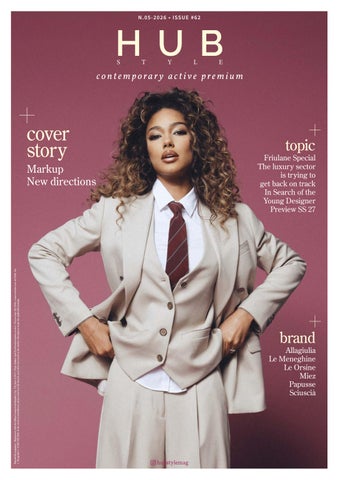
cover story
Markup New directions Friulane Special The luxury sector is trying to get back on track In Search of the Young Designer Preview SS 27
topic
Allagiulia Le Meneghine Le Orsine Miez Papusse Sciuscià
brand
X X X X X
X X X X X X X
—2—
X X X X X
X X X X X X X
—3—
E D I T O R I A L
NEW PERSPECTIVES BETWEE METAMORPHOSIS AND RESEARCH It was 2016, and at the historic Milan headquarters of SportPress (which had since become MagNet), a new editorial project called HUB Style was taking shape one we’d already been working on for several months and which was intended to be a platform serving as a crossroads (a “hub,” in fact) for ideas, inspiration, and initiatives in the fashion industry. The project emerged from the ashes of a historic magazine (Pointbreak), which for several years had been an innovative B2B publication in the world of action sports. At the same time, I represented the B2C side of the market with a publishing house which I founded and directed specializing in action sports. Around the 1990s, we had more than 10 publications distributed at newsstands, riding the wave of trends and fashions triumphantly. The famous “3 S’s Surf, Snowboard, and Skate were a major force, and enthusiasts had always been “fashion victims,” though they pretended not to be or not to know it. Thanks to this expertise, we were convinced that newsstands which were already showing signs of decline would collapse, as indeed happened in the years that followed. Skaters and surfers had realized this long before anyone else. HUB Style was therefore launched with a clear vision: it had to be simple and straightforward to use, integrating digital and print from the very beginning, and standing out for its innovative and research-driven features high-quality matte uncoated paper, a large format (since it wasn’t meant to be crammed onto newsstands alongside dozens of other magazines), a minimalist and rigorous graphic design, and evocative images aimed at portraying the fashion industry in a fresh and engaging way, with storytelling and in-depth features characterized by a clean and functional approach. This concept immediately paved the way for steady and remarkable growth. Having a clearly defined target audience (contemporary active premium) immediately gave us a fresher image that resonated with readers. We then officially launched with an issue presented at Pitti the following summer, giving space and visibility to an iconic brand like CP Company. It featured a groundbreaking, high-impact cover that is still remembered today. Over the years, HUB Style has remained true to itself, evolving and adapting while continuing to build an increasingly strong and solid connection with buyers, retailers, companies, showrooms, industry professionals, and fashion enthusiasts. Our surveys, which we have been conducting for several years with great dedication across 100 boutiques throughout Italy, provide a snapshot of market trends and the penetration of various brands by sector, season by season. For this reason, as part of the internationalization process we are currently implementing, we are also consulting with several leading European multi-brand boutiques, expanding our scope and enabling a more comprehensive comparison of market conditions across different countries. The exclusive in-depth reports we reserve for domestic retail locations have also been well-received by historic and highly appealing European stores, contributing to insights and comprehensive comparisons that are always of great interest. Just as our media has evolved over the years by increasingly integrating digital and social media as well as our international edition, we hope that exemplary retail stores which form the backbone of the Italian market will also be able to evolve by exploring new avenues. For independent retailers, the challenge is no longer simply to drive foot traffic into their stores, but to enhance the quality of each visit and improve conversion rates. Customers must be engaged and pampered; they must visit the store to experience firsthand interesting and engaging offerings carefully curated with foresight by a trusted retailer that has mastered the art of showcasing brands in innovative and unique ways within the store. For several years now, customers no longer simply “wander” through stores; instead, they must be intrigued and engaged by offerings that are perfectly tailored to their specific needs. The real question, then, is not “What will be the ‘winning trend’?” but rather how many functional and niche brands can be incorporated into and complemented within one’s product assortment. Finally, let’s remember that Italy, like Europe as a whole, is not a single, homogeneous market. For multi-brand retailers, the ability to understand regional differences remains crucial. This does not mean that independent neighborhood boutiques have lost their central role; on the contrary, they cannot compete on the same playing field as chains and must therefore focus on offerings that are well-suited to their specific context. The historical strength of multi-brand stores lies precisely in this: knowing the customer, interpreting the local context, and creating a product mix that no algorithm can perfectly replicate. The North and South, tourist cities and the provinces, beach resorts and urban centers all require different sales calendars, product weightings, and price ranges.
CRISTIANO ZANNI follow us on hubstylemag hubstylemagazine
Cover: Samira Lui x Markup
Publisher: MagNet S.r.l. SB Editor-in-Chief: ANGELO FRIGERIO Managing Editor: CRISTIANO ZANNI Editors: VALERIA ONETO, SARA FUMAGALLO, MICAELA PANZINI, ALESSANDRO MARRA Art Director: RICCARDO RECCAGNI Contributors: MARCO RIZZI, ANGELO RUGGERI, SIMONE COMI Editorial Offices: Via Tertulliano 68/70 - 20137 Milan - Tel: 02.87245180 Corso della Resistenza, 23 20821 Meda (MB) - redazione.hubstyle@mag-net.it - www.hubstyle.it Printed by: Ingraph - Seregno (MB). One copy for 1 euro Year 10 - No. 05 / 2026 Bimonthly magazine - Registered with the Milan Commercial Registry under No. 178 on June 9, 2017 - Registered with the ROC under No. 16155 on November 23, 2007 The publisher guarantees the utmost confidentiality of the personal data in its possession. This data will be used to manage subscriptions and to send commercial information. Pursuant to Article 13 of Law No. 196/2003, the data may be corrected or deleted at any time by writing to: MagNet S.r.l. SB Data Controller: Benedetto Sironi - Corso della Resistenza, 23 - 20821 Meda (MB) Close in the editorial office on 17 semptember 2026
—4—
Use the QR Code for the english version
X X X X X
X X X X X X X
—5— ADDRESS - CITY
T A B L E
O F
C O N T E N T S
NEWS COLLABO, CAPSULE & OPENING
08-12
PREVIEW Satorisan: Material Truth
COVER STORY New directions
14-16
ZOOM ASH: Travel Is a State of Mind
NEW TALENT Fresh minds
18
PREVIEW Skills Milano: Tailored Lightness
46
STEPPING OUT The Slipper That Took the Fashion World by Storm
20-23
RETAIL Invicta: A Long History Behind It
48
RETAIL STORY Pasí Milano: Quality First The Cross: Not Your Average Boutique
24-26
INSIDE THE SHOWROOM STUDIO ZETA: the art of scouting
50
ANALYTICS The luxury sector is trying to get back on track
28-30
PREVIEW Acanto: Salento Craftsmanship WHYCI Milan: A Natural Evolution
52-54
MARKET Less is more
32-33
56-61
ZOOM Puraai: A New Look
34-35
SHOWCASE SS 27 All the Facets of an Icon The woman edit
FROM FASHION In Search of the Lost Young Designer
36
PREVIEW Avant Toi: When Memory Becomes Matter
38
ZOOM Jeanne Baret: Urban Exploration
62
SNEAKER NEWS
63
SNEAKER TREND Hidden in Plain Sight
14-16
20-23
32-33
56-61
COVER STORY
MARKET
STEPPING OUT
PREVIEW SS 27
—6—
44-45
FOCUS SNEAKER Loans, Mortgages, and Sneakers
SNEAKER SHOWCASE
40-41
42
64-65 66
X X X X X
X X X X X X X
—7—
N E W S ,
C O L L A B O R A T I O N S
&
L I M I T E D
E D I T I O N S
CO M M O N AT T I T U D E , SAME SPIRIT
A capsule collection that brings together two iconic brands, created to accompany everyday life. Blundstone and Invicta present “Everyday Icons,” offering an urban take on the famous Chelsea boots and the Jolly backpack. Two pairs of ankle boots in Rustic Brown/orange and Rustic Black/blue and two versions of the 22-liter Jolly backpack embody a functional, durable, and contemporary aesthetic, designed for the pace of city life.
AESTHETIC RESEARCH
PA I S L E Y, F R I N G E S A N D W E ST E R N - STY L E D E TA I LS
Textile innovation and contemporary sensibility come together in the new capsule collection designed by K-Way for Soeur. The star of the collection is “2.1 Amiable” nylon, a water-repellent fabric made from 100% recycled fibers and developed by K-Way’s Research & Development department. The material is used to create three ultralight and versatile silhouettes: the Pradel trench coat, a cape with a removable hood, and a raincoat with feminine details. The Sesame and Chocolate color palette rounds out the collection with a minimalist and refined aesthetic.
BIRKENSTOCK and ETRO come together in a new collaboration that combines functionality and heritage. For the first drop, the iconic Boston and Gizeh silhouettes are reimagined through the Italian fashion house’s signature styles: paisley, fringe, Western-inspired details, and the famous Pegaso motif come together with the unmistakable BIRKENSTOCK anatomical footbed. A sophisticated collection designed to celebrate craftsmanship and a design that transcends trends.
BEYOND THE NOISE OF THE CITY Minimalism, mountains, and Japanese culture inspire the new collaboration between Moncler and Fragment by Hiroshi Fujiwara. The collection begins with the iconic varsity jacket, reimagined as a reversible piece featuring embroidery that traces the journey from Japan to Italy, and evolves into a lightweight wardrobe with clean, minimalist lines. Rounding out the project are the FRGMTmini capsule collection and the new Trailgrip Wallabee GTX, born from a collaboration with Clarks Originals: suede, GORE-TEX, and a Vibram outsole transform a footwear icon into a model designed for new adventures.
WHEN MUSIC BECOMES AN IMAGE
A MEMORY TO WEAR
Fashion, music, and photography come together in Blauer’s new FW 26/27 campaign, created by Bryan Adams. Shot in London, the series features three leading figures of the contemporary British music scene DYLAN, Cassyette, and Ben Kidson through images that highlight their personalities and styles. With iconic outerwear, urban silhouettes, and technical details, Blauer crafts a modern narrative where authenticity, individuality, and innovation harmonize with an international aesthetic.
The charm of Lake Como meets Italian craftsmanship in the third edition of the collaboration between L.G.R. and Grand Hotel Tremezzo. The star of the collection is the iconic Asmara II model, exclusively reimagined with a hand-polished Havana Tortoiseshell acetate frame and Brown Gradient mineral lenses. Shades inspired by nature and the hotel’s interiors define this sophisticated accessory, complemented by custom packaging.
—8—
X X X X X
X X X X X X X
—9—
N E W S ,
C O L L A B O R A T I O N S
&
L I M I T E D
E D I T I O N S
DINING IN STYLE Italian excellence is all about tailoring. Langosteria and Slowear are joining forces in a new partnership that brings the elegance of “Made in Italy” to the group’s restaurant dining rooms. Slowear has designed the new uniforms for dining room managers, featuring single-breasted and doublebreasted blazers made of wool and cotton. Rounding out the project is a collection dedicated to leisure destinations and a limited-edition scarf available in only 50 pieces.
THE SPIRIT OF THE HIGHLANDS
IRONY IN DENIM
KARL LAGERFELD JEANS has teamed up with Italian artist Pietro Terzini for a capsule collection that celebrates Karl Lagerfeld’s sense of humor and sharp wit. Four original phrases, reinterpreted through Terzini’s contemporary style, feature on T-shirts, hoodies, white shirts, and accessories. The collaboration also takes center stage in the Fall-Winter 2026 campaign, featuring Paris Hilton and Kit Butler. Available worldwide starting September 15, 2026.
Barbour and Paul Smith are renewing their partnership for a third season with a 38-piece capsule collection inspired by the Scottish Highland Games. British country heritage meets Paul Smith’s playful use of color through a reinterpretation of the Classic and Muted tartans, enlivened by shades of pink, orange, and yellow. Featuring iconic jackets, merino wool, corduroy, and waxed garments in new shades, the collection brings outdoor tradition into a more modern context.
WHERE SHINE DESIRES
Reversi and Pink Pampas have created “Cuore Stellato,” a pendant that combines fine goldsmithing with imagination. Born from the collaboration between the savoir-faire of Tiziano Reversi, a master engraver for over 40 years, and the symbolic universe of Pink Pampas, this piececrafted in enameled bronze and plated with 18-karat yellow gold features a midnight-blue heart dotted with golden stars. A small, contemporary talisman.
WHERE THE OCEAN MEETS THE CITY When the sea breeze meets the rhythm of the city, a new concept of movement is born. Voile Blanche and North Sails have teamed up for a capsule collection that blends nautical heritage, technical innovation, and urban flair. The star of the collection is the Club, reimagined with ocean-inspired hues and functional details: a sneaker designed to navigate both landscapes and everyday life, from the harbor to the skyline.
TA I LO R I N G A N D G LO B A L C R E AT I V I TY
Kiton and J Balvin combine Neapolitan tailoring with global creativity in a new men’s capsule collection, entirely handmade in Italy. Tuxedos, double-breasted suits, leather pieces, and outerwear showcase the fusion of the brand’s heritage and the Colombian artist’s contemporary vision. The project will also be featured in a traveling retail concept at Kiton boutiques across the United States.
— 10 —
X X X X X
X X X X X X X
— 11 —
O P E N I N G
1 0 CO RS O CO M O CO M E S TO TA I P E I From Milan to Taipei, 10 Corso Como opens another chapter in its international history. On August 28, 2026, the concept store opened its doors at the Breeze Center, bringing its vision which blends fashion, art, design, and lifestyle to Asia. The space is designed as a cultural experience that goes beyond retail, staying true to the DNA that has made the name 10 Corso Como iconic.
SEASE, ANOTHER ROUTE TO SEOUL A new chapter for SEASE, the lifestyle brand founded by brothers Franco and Giacomo Loro Piana. Since August, the brand has taken center stage on the sixth floor of Shinsegae Gangnam, a prestigious department store in Seoul. This space embodies the brand’s vision of contemporary luxury, featuring garments designed for life in the city, by the sea, and in the mountains striking a balance between sophistication and functionality. After Seoul, Monte Carlo, Portofino, and SaintTropez, the journey continues toward new destinations.
DUNO STRENGTHENS ITS PRESENCE IN GERMANY Starting in September, DUNO is launching a permanent pop-up store at Berlin’s KaDeWe, bringing a selection of its collections with a particular focus on outerwear to the famous German department store. Functionality, innovative use of materials, and modern design define the Italian brand’s offerings, thereby strengthening its presence in a strategic market. This new retail initiative is designed to cater to an international clientele and consolidate the brand’s position on the European scene.
FORTE_FORTE OPENS A NEW BOUTIQUE IN THE MARAIS
A FLAGSHIP STORE BOMBOOGIE IN BOLZANO
In the heart of the Marais, forte_forte is opening a new space at 49 Rue de Saintonge, complementing its flagship store in Saint-Germain-des-Prés. The boutique, measuring approximately 110 square meters, occupies a 1929 building with a distinctive triangular floor plan, reinterpreted through a design by Robert Vattilana and Giada Forte. Fabrics, sheer elements, and brass define a minimalist and intimate space, where authentic materials and contemporary details harmonize with the original architecture.
At Via dei Portici 66 in Bolzano, Bomboogie is opening a flagship store of approximately 180 square meters inside a 15th-century building, where traces of history meet a modern concept. Wood, stone, and contemporary details complement the original architecture, creating an authentic and welcoming atmosphere. This new opening targets the German-speaking market and strengthens the brand’s presence in the heart of South Tyrol.
— 12 —
X X X X X
X X X X X X X
— 13 — d-duno.it
C O V E R
S T O R Y
NEW DIRECTIONS Markup is leading AIRON into a new phase of growth, driven by international expansion, retail development and new categories, while keeping quality and versatility at its core and preserving the identity built over more than 20 years by Valeria Oneto
S
Massimo Bosso, ceo & founder
ome companies grow layer by layer. Others reach a point where they move to a whole new scale without losing sight of where they started. AIRON belongs to the latter. Founded in 2004 as a small knitwear manufacturer and now a €40 million business, the company has built its evolution on a very tangible skill: understanding the product before building an identity around it. According to Massimo Bosso, this manufacturing culture is the one thing that has never changed. “We are still factory people,” he says, pointing to quality, fit and value for money as priorities that come before any marketing exercise. The scale of the company, however, has changed drastically: from knitwear to total looks, from a single label to a multibrand group, and ultimately to an industrial structure that now combines technology, logistics and production control. 2026 marks another step forward. AIRON is strengthening its European presence through directly managed subsidiaries while looking towards new markets. Markup has now surpassed 1,800 points of sale worldwide and is further developing its womenswear project, which is becoming an increasingly important growth driver for the group. The brand’s vision is of a contemporary, dynamic and versatile woman an identity also embodied in its new collaboration with Samira Lui. Yet behind the expansion and the figures, there remains a deeply human side to the company. Bosso remembers AIRON’s first few rooms, machines running day and night and
the first complete collection hanging on rails, with the entire team gathered around it. In that shared moment, he says, everything the company would later become was already there: passion, pragmatism, the ability to learn and ambition. That same energy now drives a group looking beyond Italy while remaining closely connected to its roots. In just over 20 years, AIRON has grown from a small knitwear manufacturer into a €40 million group. What were the milestones behind that evolution, and what has remained unchanged? Ours is a story of constant evolution without losing sight of our origins. The first turning point came when we moved from being a small knitwear manufacturer working for third parties to developing our own brand, turning our technical expertise and product sensibility into an independent identity. We then expanded from knitwear into total looks and, in recent years, evolved from a single-brand company into a multibrand industrial group, investing in automated logistics and directly managed international subsidiaries. What has never changed is our respect for the product and for the customer. We are still “factory people”: yarn quality, fabric performance, fit and value for money come before marketing. We have also retained the pragmatism of our manufacturing district and our close relationships with customers and collaborators.
— 14 —
Today AIRON operates a portfolio of brands with different market positions. How has the management of the group evolved, and what role does each brand play? Building a multibrand group means addressing different market segments without creating overlap. We have centralized the “engine” of the business predictive logistics, technology, financial strength and production control while allowing each brand to retain its own creative and commercial identity. Markup is the cornerstone of the group: contemporary, dynamic and accessible total looks for men and women, designed for a fast-moving market. Hèskimo focuses on technical and metropolitan outerwear, combining material research with premium functionality. CLAQ offers an evolved interpretation of knitwear, with strong visual codes and contemporary silhouettes. Urban Ring and Blash cover the informal totallook and everyday casual segments. 2026 marks a new phase of international expansion, with subsidiaries in the Netherlands, Belgium, Switzerland, Greece and Portugal joining those already operating in Italy, Spain and France. What are you looking for in international markets today? Today, our goal is no longer simply to “export clothes”. We want to establish ourselves within each market. In the past, we relied on agency and distribution networks. Now we are moving towards direct control, with local subsidiaries that understand the language of each market, can provide effective support and communicate the identity of the group. In the Benelux countries and Switzerland, we find a sophisticated retail landscape that values punctuality, reliability and understated Italian style. Spain, Portugal and Greece have an even stronger affinity with the versatility of our collections. What we are looking for is a lasting presence, working with partners who see our brands as a source of healthy margins, continuity and service. Markup is now available in more than 1,800 stores worldwide and has over 50 shop-in-shops in Italy. How is your relationship with retail evolving? Independent multibrand retail is, and will remain, the backbone of our strength. Retailers are the ones who select the product and communicate its value. Our role is not to compete with them, but to give them the tools they need to succeed. That is where our soft-retail and shop-in-shop concepts come from. Rather than imposing rigid and expensive monobrand formats,
— 15 —
Samira Lui, with her effortless elegance and positive energy, is the face of Markup’s womenswear line. Left: selected looks from the brand’s SS 27 collection
C O V E R
S T O R Y
Two looks from Markup’s FW 26/27 collection
we create corners that strengthen the brand, provide visualmerchandising guidance and improve productivity per square meter. The key is to support traditional retail rather than replace it, offering fast replenishment, coordinated brand imagery and practical support. Markup was created around the idea of contemporary, accessible total looks. Today consumers are increasingly looking for quality, identity and versatility. How is the collection evolving? The meaning of “accessible” has changed. Customers are no longer simply looking for the lowest price; they are looking for value. An inexpensive garment that quickly loses its shape or personality is not a bargain it is a waste. That is why we have raised our quality standards, focusing on high-performance fabrics, natural yarns and more refined tailoring details. Versatility is equally important. A garment should work from the office to dinner and through to travel. The upgrade in fit and materials, combined with a direct and streamlined supply chain, allows us to maintain high standards at a fair price. Markup speaks to a dynamic woman whose life moves between work and leisure. What direction is the womenswear project taking? Womenswear is one of the fastest-growing areas of the company. With Markup Woman, we have applied our product-building expertise to a clearly defined feminine sensibility. We are not chasing short-lived trends. We look at a real, active woman someone who works, travels and wants to look impeccable without sacrificing comfort. Soft tailoring, versatile separates, fluid dresses and refined knitwear are at the heart of the collection. The segment is already driving revenue growth and opening the doors to increasingly high-profile multibrand retailers. Samira Lui is Markup’s new ambassador. What did you recognise in her, and what message do you want her to convey? We saw many of the brand’s values in Samira. She is modern, radiant and determined, with a very natural sense of elegance. She has an effortless charisma that communicates both warmth and authenticity. She represents the Markup woman: self-confident and professional, yet grounded in everyday life. Fashion should not be a distant kind of armour. It should be a way to enhance beauty and personality while still making you feel comfortable in your
own skin. Samira captures that spirit perfectly and represents an important step in building greater awareness of the brand. AIRON keeps design, product development and production control, as well as logistics, in-house. How important is supply-chain control today? It is both a differentiating factor and a competitive advantage. Many fashion businesses create the brand and outsource the entire process. We chose instead to keep these three pillars in-house, investing millions of euros in automation and digitalisation. Twenty years of AIRON mean intuition, mistakes, turning points and encounters. Which memory best captures the spirit in which the group has grown? I remember the early years: just a few rooms, machines running day and night and an endless amount of energy. The defining moment was the decision to bet on Markup. We had no guarantees only our product expertise and the belief that the market needed something honest and well made. I remember the first complete collection hanging on rails before the sales campaign began, with the whole team gathered around it. In the looks exchanged between the people designing the garments, sewing them and packing the boxes, everything that AIRON would become was already there: passion, the humility to learn from mistakes and ambition. That same energy is still very much alive today. The results for SS 27 tell the same story: +20% on a like-for-like customer basis and +35% overall. These are significant figures, although the financial position of some customers will make it difficult to convert the full increase in orders into revenue. Looking ahead, what will AIRON’s next evolution be? Which markets and projects are you working on? Our ambition is to establish AIRON as one of the leading independent groups in contemporary European fashion. After consolidating our position across Central and Southern Europe, we are now looking at high-potential markets beyond Europe. We are moving in two main directions. The first is to expand into accessories and complementary categories, building a broader lifestyle ecosystem around our brands. The second is to accelerate our technological and sustainability transition, with lower-impact processes, greater traceability and certified fabrics. Hèskimo and CLAQ will continue to maintain strong individual identities and significant growth potential.
— 16 —
— 17 —
N E W
T A L E N T
FRESH MINDS Season after season, a new generation of designers is shaping the future of fashion. Each with their own unique identity. Here are two names to keep an eye on by Sara Fumagallo
GIUSEPPE BUCCINNÀ Somewhere between technique and material, Giuseppe Buccinnà is developing a language that views fashion through a fresh lens. Design expertise and sartorial sensibility coexist in the career of this designer, who holds a degree in civil engineering from the Politecnico di Milano and a diploma in patternmaking from the Istituto Secoli. Thanks to this background, shapes, proportions, and structures are transformed into wearable volumes and become the key to understanding his work. For the summer season, Buccinnà takes this exploration even further, examining the body as a material to be fragmented and reassembled. The collection stems from an almost dystopian vision of memory, understood as a trace capable of withstanding the test of time and changing without completely losing its identity. giuseppebuccinna.eu IG. @giuseppebuccinnaofficial
NOELL MAGGINI There is a precise moment when the desert changes its appearance: it is 8:00 p.m., when the light fades and the sand holds onto the day’s last reflections. It is from this suspended image that Noell Maggini creates the collection “The Desert at 8:00 p.m.”, an intimate narrative that transforms the landscape into material and emotion. Rust, brown, and beige form a natural palette, while lightweight fabrics and textured materials convey the tactile dimension of a seemingly empty place. But Maggini’s desert is above all an inner space—one of solitude, silence, and a return to oneself. The collection thus emerges from the intersection of aesthetic observation and introspection, between the sunset of a landscape and the need to inhabit one’s own emptiness. noellmaggini.it IG. @noellmaggini
— 18 —
— 19 —
S T E P P I N G
O U T
THE SLIPPER THAT TOOK THE FASHION WORLD BY STORM From the heritage of the Friulian countryside to a new vision of elegance, the Friulian style transcends time and borders. A story of craftsmanship, transformation, and modernity, without ever losing sight of its roots by Valeria Oneto
F
or years, it remained on the fringes of the wardrobe, associated more with home life than with fashion, more with tradition than with desire. Today, the Friulian slipper—or “furlana,” if you will—has changed course. It has stepped out of the home, crossed cities and borders, and carved out a place for itself alongside ballet flats, loafers, and sneakers. This transformation speaks volumes about today’s fashion: comfort no longer comes at the expense of elegance, and the quest for authenticity makes items that preserve a history all the more desirable. Its story begins in the countryside of Friuli between the 19th and 20th centuries. It was a humble shoe, born of necessity and ingenuity: fabric scraps for the uppers, old inner tubes, and bicycle tires for the soles. Lightweight, durable, and quiet, it was handmade at home by rural women. Then came Venice, where gondoliers adopted it for the softness and silence of its sole, before it found its way into the homes of the aristocracy as a refined indoor slipper. Hence the international name “Venetian slipper,” although its roots remain deeply Friulian. A long way has been traveled since then. Today, it’s worn with denim and tailored pants, with a light dress, at the beach, and even on more formal occasions. It’s a shoe for the city, travel, vacations, and ceremonies, but also one you slip on without a second thought—and, for that very reason, end up wearing all the time. No longer just a slipper or a simple alternative to ballet flats, but a category that straddles the line between casual and elegant. And while the customer base remains predominantly female, male interest is also growing. The numbers, too, tell the story of a market on the move. Le Meneghine reports, compar-
1
5
Da calzatura della tradizione a protagonista del guardaroba contemporaneo: come sono cambiati utilizzo, occasioni d'uso e percezione di questo prodotto?
From a niche shoe to a coveted item: Who chooses “friulane” today, and what are they looking for in this product? Is there a men’s version as well?
6
Secondo la vostra visione come si indossa ma soprattutto come non si indossa la friulana?
How important is craftsmanship today? How can we preserve tradition while innovating in design, materials, and processes?
7
Pensate che possa diventare un classico del guardaroba contemporaneo, al pari di una sneaker bianca o di un mocassino? Perché?
8
Come immaginate il futuro delle friulane? Quali saranno le sfide e le opportunità per continuare a crescere senza perdere la propria identità?
With over a century of history, the “friulane” are enjoying their golden age. Why now, of all times? And what distinguishes an authentic “friulana” from one created simply to follow the trend?
2 3 4
ing 2025 to 2026 month-over-month, an average growth of 50%, with peaks of 400 pairs sold at a single event lasting about five hours. Papusse reaches approximately 30 countries through e-commerce, complementing its presence in select boutiques across Europe and the United States. Orsine reports an increasingly international online customer base, while Miez confirms growing cross-border demand, including through the hospitality industry and events. There is still no official statistical snapshot of the Friulana market, as these shoes are not tracked separately in the main footwear industry statistics. However, it is an increasingly visible reality, driven by e-commerce, social media, pop-up stores, and selective international distribution. And this is where the most interesting game is played. Because the authenticity of a “friulana” lies not only in its shape, but in what is often unseen: the rubber sole that is sewn rather than glued, the quality of the velvet, the construction, the handcrafted details, and the origin of the materials. The risk is that its aesthetic will be replicated faster than its history. The challenge for new brands, then, is to transform a shoe born out of necessity into a potential contemporary classic, without reducing tradition to a mere surface to be imitated. Because the true achievement of the Friulana is not simply that it has come back into fashion, but that it has changed its status without losing its identity. We asked allagiulia, Le Orsine, Miez, Papusse, Le Meneghine, and Sciuscià to tell us about this transformation: who wears it today, how the way it’s worn has changed, which markets it’s conquering, and whether a shoe born over a century ago can truly become a new wardrobe classic.
How is the Friulane market evolving? Which channels and markets are the most dynamic? If possible, please share some key data on business trends.
point to be adapted for everyday wear. Today, the market has recognized their potential. The friulana meets two contemporary needs: the desire to rediscover authentic items and the search for a simple, versatile, and effortlessly wearable shoe. For me, an authentic friulana is one that maintains a genuine connection to its origins, craftsmanship, and the “Made in Italy” tradition.
2
GIULIA CAMPEOL founder & creative director
allagiulia
1
When I founded allagiulia in 2010, Friulana shoes were still a niche product. My intuition was to view them not as an antique shoe, but as a starting
The audience has changed dramatically. While the “friulana” was once seen as a shoe for wearing at home, today it’s a versatile item, meant to be worn in everyday life—blending luxury with spontaneity. Customers are looking for something special, yet simple and comfortable: a shoe with its own identity that doesn’t dictate a particular look. The international appeal has also grown: for visitors to Italy, it’s an interesting way to take a piece of our country home with them—not a souvenir, but an item linked to Italian craftsmanship and style. It’s also perfectly suited for men, with variations in color, proportions, and styling.
— 20 —
3
Craftsmanship matters a great deal today, but it must be evident in the product, its construction, and the attention to detail. allagiulia was born from the idea of preserving a tradition while allowing it to evolve. Our Friù are handcrafted in Italy, but respecting tradition does not mean freezing it in time. In recent years, we’ve refined the shapes, proportions, comfort, and materials, introducing details such as fringed trim. The challenge is to preserve the artisanal craft without succumbing to nostalgia: it is in the balance between tradition and change that a Friulana continues to make sense.
4
The market has expanded enormously since 2010. What was once a niche category has become a recognizable brand even outside Italy, with a broader audience and greater competition. E-commerce allows us to reach an international clientele, while the physical store remains essential because Friù really comes into its own when it is seen and tried on. The boutique in Rome allows us to connect with
crease in interest from men. We live in a time when dress codes are becoming less and less rigid, and this has also allowed women in Friuli to explore new possibilities. Some choose them as an alternative to espadrilles during the summer, others use them as elegant house shoes, and still others pair them with contemporary outfits even in the city. This is precisely their strength: they adapt to a wide variety of styles and personalities.
ORSOLA AMATI co-founder & creative director
LE ORSINE
1
I believe the success of the “friulane” comes at a time when people are looking for a more relaxed elegance without sacrificing comfort. For years, heels were synonymous with elegance, but then sneakers took over the market. Today, people are looking for an alternative that’s just as practical but with a more refined aesthetic. The Friulana perfectly meets this need: it’s versatile, lightweight, comfortable, and can be worn at home, in the city, or on vacation. Furthermore, it is affordably priced compared to other handmade “Made in Italy” products, making it an excellent gift idea as well. An authentic “friulana,” however, is more than just a design. It is the result of Friuli’s manufacturing tradition, artisanal craftsmanship, and expertise that cannot be replicated simply by following a trend.
2
The market remains predominantly female, but in recent years we’ve also seen a significant in-
3
More than we ever imagined. Until a few months ago, we sold mainly online and through retailers. With the opening of our store, we realized just how much the end customer recognizes and appreciates the quality of the product when they can touch it with their own hands. We’re convinced that, as long as the price remains affordable, consumers are willing to invest in a handcrafted Italian shoe. In recent years, the market has been flooded with products inspired by the “friulana,” often manufactured using industrial processes or outside the region of origin. The risk is that only the aesthetic is replicated, while the quality of construction and that balance of proportions—which make the “friulana” a unique product—are lost.
mediately what it is, while continuing to highlight its true origins and Friulian tradition.
8
The challenge will be to continue reinventing this product without losing its identity. We believe that innovation and tradition can coexist. In recent years, we have introduced ballet flats inspired by the construction of the “friulana,” styles with ankle straps, new rubber soles, and water-based adhesives. At the same time, we adhere to a clear philosophy: we do not use materials of animal origin, and we strive to make our products increasingly sustainable without compromising on craftsmanship. We believe that the future of the “friulana” lies precisely in this balance between tradition, innovation, and values.
4
Italy remains our main market, but in recent years we’ve seen international interest grow significantly. When we launched our e-commerce site, orders came almost exclusively from Lombardy, Emilia-Romagna, and Lazio. Today, receiving orders from the United States, the United Kingdom, or other European countries has become the norm. Abroad, the product is still known primarily as “Venetian slippers,” a well-established term that we also use to convey im-
Italian and, above all, international customers. Future growth will not depend on being present everywhere, but on knowing how to choose where to be present and with whom.
5
Almost everything has changed, except for the essence of the shoe. The Friulana, which began as a simple and functional shoe, is now worn in the city, for travel, for evening wear, and even for more formal occasions. When I created allagiulia, I wanted people to envision it differently, without turning it into something it wasn’t. Today we see it paired with tailored pants, denim, skirts, evening gowns, and men’s suits. It can be elegant or casual. Its contemporary appeal lies in the absence of a rigid intended use.
6
I like to call Friù allagiulia “capricious” because it doesn’t follow any specific rules. You have to incorporate it into your wardrobe as if it had always been there, mixing it freely with the pieces you love. How could I not wear it? I’d avoid the “costume” ef-
— 21 —
fect: too many folkloric references, too much Venice, too much nostalgia risk robbing it of its modernity.
7
allagiulia has been working with Friulana jackets since 2010 and has seen them evolve from an almost secret product to a coveted item. For us, however, they’ve never been a trend: they’re our language. Perhaps this is the difference between a fad and a classic. A trend tells you that you must own an item right now; a classic finds its way into your wardrobe and continues to feel right even afterward. If we can preserve their quality and authenticity, the Friulana can belong to the latter category.
8
The future of this shoe will depend on its ability to remember where it came from without feeling compelled to stay there. This is the philosophy behind allagiulia: respect for tradition, but no nostalgia. Tradition gives us our roots; creativity must give us the freedom to go elsewhere—into the world of today and tomorrow—while always striving to remain “contemporary.”
S T E P P I N G
O U T
a surge in the consumption of affordable products from all over the world, but some of those who discovered Friulana shoes through fashion have come to appreciate a comfortable, elegant, and timeless product, becoming more discerning consumers. We also offer men’s styles, and we sell a lot of them: they’re worn instead of loafers for formal occasions, but also at the beach, at work, in the office, and at home.
3 ALBERTO PREZ AND GLORIA NADALIN founders
MIEZ
1
It all started with a trend, when some celebrities wore Friulane at events and public occasions, but that was just the beginning. The Friulana, in fact, embodies the broader trend of comfort and elegance in everyday life: that’s why it’s so popular right now. The traditional version is the result of centuries of sacrifice and creative upcycling by women in rural Friulian families, made with all the love mothers put into crafting a pair of shoes. Comfort, hand-stitching, upcycled materials, attention to detail, and origin make all the difference. The “friulana” embodies slowness, while fast fashion and the fashion industry follow exactly the opposite logic.
2
Today, there are two types of consumers of Friulana: those who follow trends and those who have always used it and will continue to do so. The evolution of the former is also linked to greater awareness: fashion has spurred
Artisanal craftsmanship is what sets the Friulana apart from the mass-produced goods found everywhere. It allows us to explore new solutions to improve comfort and support, seeking out fabrics and materials for applications that make it even more special. And we must not forget that it preserves the ancient traditions of Friuli and creates local jobs. Tradition must be preserved in its essence, so as not to distort the shoe’s character and to tell the story and preserve the memory of our people and our region. At the same time, innovation is necessary to adapt the shoe to the times and the demands of modern life. These two extremes must coexist, and this is where research into processes, design, and materials becomes crucial. We devote great attention to this.
Friulian shoes are a little-known gem of “Made in Italy.” Ten years ago, the idea was born to turn them into a brand and bring them to the world. Papusse was born out of a love for an authentic product, rooted in tradition, that had not yet realized its full potential. Social media and e-commerce have helped drive the project, which is based on the concept of a classic that is always contemporary. Papusse shoes are still handmade today in Friuli, with quality standards rooted in luxury craftsmanship—a quality that customers recognize.
2
I’ve never been a fan of brands that chase trends. I prefer products that prioritize the quality of materials and finishes, with a timeless style. Papusse has grown thanks to the trust of thousands of people who have chosen to buy them again and share their experiences with us. It’s a unisex product, and we’ve developed collections for everyone, in addition to the junior line.
7
I don't think the Friulana will ever replace a sneaker, because they're fundamentally different. Sneakers are inclusive—truly everyone wears them. The Friulana isn't. In terms of the type of customers who wear them, it's more comparable to a loafer.
8
At Miez, we see the Friulana as a starting point from which to develop other footwear styles. For example, we have deconstructed moccasins that draw on that construction but feature a men’s moccasin look: a product that’s very practical for everyday life. Furthermore, it always reminds us of Miez’s values: timeless elegance and absolute comfort, with an eye toward tradition.
5
Today, the Friulana is worn every day, from casual to formal occasions, whether at a ceremony or at home. It plays
4 1
We wear the Friulana with everything, but with respect. I’d avoid wearing it with sweatpants. Other than that, I don’t see any major restrictions.
4
3
PAPUSSE
6
The market for Friulane is growing. Italy has fully embraced this trend, and consumption is now gradually returning to normal, while growth continues abroad. The U.S., the U.K., France, and Spain are delivering strong results in the retail sector. There are also channels such as the hospitality industry and events, where the product appeals to a high-spending, sophisticated, and international clientele.
The traditional Friulana is lightweight and unstructured. Ours features a precise construction, designed to enhance its fit and comfort. Originally, it was made from fabric scraps and bicycle tires. We’ve focused on design and shape: Papusse shoes are not ambidextrous; they’re crafted on wooden lasts and feature an internal construction designed for comfort. The fabrics and soles are Italian and strictly made in Italy.
CARLOTTA MINUTO founder & ceo
a central role in every aspect of life, whereas in the past it was considered no better than a pair of slippers—or barely more.
A focus on craftsmanship and products that combine aesthetics and functionality has driven the market. For Papusse, digital has been central: e-commerce reaches approximately 30 countries, complemented by selective distribution in multi-brand boutiques in Europe and the United States. Today’s market is more complex, and for an independent brand, this means planning carefully. Rather than chasing quantitative growth, we aim for sustainable development.
5
The most interesting transformation concerns perception. The “friulana” began as a simple, functional shoe, long associated with home use. The insight was to take it out of that context and give it a rightful place in the wardrobe. Papusse accompanies you through different moments of the day, because today elegance doesn’t necessarily mean formality. I like to call it an everyday luxury: a well-made item that doesn’t have to wait for a special occasion.
6
Its strength lies in the freedom with which it can be interpreted. Paired with tailored pants, it becomes sophisticated; with jeans, it takes on a more relaxed vibe; and with a dress, it creates a contrast between elegance and casualness. Even the color changes the look. It shouldn’t be considered exclusively a summer or casual piece: we’ve worked to make it wearable
— 22 —
year-round. It has a strong personality but doesn’t need to be the center of attention.
7
Becoming a classic has been one of Papusse’s goals from the very beginning. A classic is something that continues to make sense even as trends change. Compared to a white sneaker or a loafer, the brand has a history deeply rooted in Italian artisanal culture. The real test is being able to imagine it 10 or 20 years from now without it seeming dated.
8
The challenge is to grow without losing authenticity. When a shoe becomes popular, there is a risk that it will be perceived as a trend and lose its connection to its history. The future lies in celebrating our origins and our ability to evolve. Technology can improve comfort, distribution, and communication without replacing the artisanal component. International expansion remains an opportunity: the “Made in Italy” label continues to attract consumers, and customers want to know how and where the products they buy are made. Transparency in the supply chain and the preservation of artisanal skills will become increasingly important.
quality without making it a niche product. There is also a men’s line, which is still niche but growing.
classic look. It shouldn’t be hidden away like a slipper—it should be shown off as a true style accessory.
3
7
Craftsmanship is central: sewing techniques and construction remain faithful to the original method, while designs, colors, and materials evolve. We work with contemporary color palettes and offer customization options such as embroidery, initials, and crests. Our relationship with customers has evolved through digital communication and direct channels, complementing the art of handcrafting.
ALBERTA DEL BONO AND VITTORIA MARTINELLI founders
LE MENEGHINE
1
Friulane shoes are enjoying their golden age partly because they’ve tapped into the popularity of ballerina flats and, more broadly, of flat shoes: comfortable, chic, and never overly elaborate. They embody a spontaneous elegance rooted in comfort and naturalness. Authenticity matters more and more in an era of disposable fashion. It stems from the repurposing of bicycle inner tubes, which Friulian women used as soles. The difference lies in the details: a stitched sole, high-quality velvet, and handcrafted construction. A true “Friulana” lasts for years and improves with wear. For Le Meneghine, it also means customizing it without compromising traditional craftsmanship.
2
According to our research, our audience falls into three categories: teenagers aged 14 to 20, women aged 20 to 30 who are looking for comfort and versatility, and women aged 50 to 60 who choose our shoes as an alternative to heels. Those who choose Le Meneghine are looking for personal style and an affordable price. Since we ourselves are in our twenties, we want to offer artisanal
4
The market is growing: comparing 2025 to 2026 month-over-month, we saw a 50% increase. During our events, we’ve sold as many as 400 pairs in five hours. Consumers aren’t just looking for a “Friulana”—they’re looking for a “Meneghina” and the sense of belonging created by the brand. We organize cocktail parties and DJ sets with other brands run by young female entrepreneurs: we want to build a community. Our most dynamic channels are e-commerce, Instagram, TikTok, pop-ups, and events. We’re expanding across Europe with a pop-up in Madrid, and our B2B business is growing with wedding favors, corporate gifts, and customized products.
6
The Friulana is worn with ease: that’s its strength. It looks great with jeans, flowing pants, and light dresses, even in elegant settings. You might even see it paired with a tuxedo: it can add an original touch to a
4
1
I believe that our current success stems from the desire for products that can reinvent themselves through different colors, materials, and interpretations, while still maintaining a recognizable heritage. An authentic Friulian product stands out first and foremost for its quality and its connection to the region: artisanal craftsmanship, traditional know-how passed down through generations, and respect for production processes that require time and expertise are an integral part of the product.
2
Today, Friulane shoes have won over a very diverse audience: children and adults, women and men, with different styles and needs. The men’s line is now an integral part of this world, as is the line for children, including matching styles for parents and children. It is a product that has transcended the boundaries of age and gender.
Let’s imagine a future in which the “friulana” cements its status as a contemporary classic and expands its international audience, while maintaining its artisanal identity as a non-negotiable element. The challenge is to grow without industrializing it. Customization, B2B, and gift-giving offer new opportunities. We must continue to explain why a handmade “friulana” costs more and is worth more, while remaining accessible and close to our customers.
Until a few years ago, it was seen as a pair of house slippers. Today, it’s a staple of everyday wardrobes, worn with jeans, light dresses, and loose-fitting pants as an alternative to ballet flats and sneakers. Generational perceptions have also changed: today, young women choose it for its authenticity, comfort, and character.
3
SCIUSCIÀ
8
5
Velvet remains our signature fabric, but our research leads us to explore ever-new patterns and textures. Animal prints, for example, continue to be highly popular: they can serve as the defining detail of a minimalist look or accentuate a bolder outfit. For us, innovation lies above all in these expressive possibilities, without altering the shoe’s construction.
CLAUDIA CENTRULLI co-owner & creative director
We believe it has everything it takes to become a contemporary classic. It combines comfort, versatility, and a distinctive identity. What’s more, it offers customization options, including patterns, velvets, double laces, and bows. It also embodies a rich heritage of craftsmanship and regional tradition.
The market has grown significantly, both in Italy and especially abroad, through e-commerce, boutiques, and social media. International consumers show a particular interest in products that are authentically “Made in Italy,” often in very selective contexts. This is an important sign, confirming that footwear rooted in our tradition can find a place even in distant markets.
5
The Friulana has now moved beyond being solely a casual shoe. It can be worn for everyday occasions as well as in the evening, taking on different looks depending on the details and how it’s styled. It is precisely this freedom of interpretation that has expanded its role in the wardrobe.
6
You can wear it with jeans, dresses, suits, and more sophisticated outfits. I don’t think there’s really a “don’t wear it” rule: the Friulana works when it retains that natural look that makes it instantly chic, without appearing too contrived.
7
The Friulana has transcended the status of a mere trend and has rightfully taken its place among contemporary footwear styles. It has its own distinct identity
— 23 —
and can be paired with a wide variety of styles, from loafers to sneakers. I believe it is precisely this identity that ensures its longevity.
8
The challenge will be to grow without losing our identity. Bringing Friulana to new markets and new generations means continuing to experiment, but also protecting what gives it its value: quality, history, and artisanal expertise. The future isn’t about changing our identity, but about opening up new possibilities for it.
R E T A I L
S T O R Y
Silvia and Patrizia Meggiarin, owners
QUALITY AT THE CORE
Founded in 2008 by Silvia and Patrizia, drawing on their experience in the world of fashion and textile manufacturing, Pasí Milano has built its identity around “Made in Italy,” through a selection process that eschews the logic of branding by Sara Fumagallo
T
hree generations with roots in fashion and textiles, followed by the decision to turn the experience gained in the family businesses into an independent venture. This is how Pasí Milano came to be a boutique founded in 2008 by sisters Silvia and Patrizia and built around a specific retail philosophy: showcasing high-quality, artisanal products primarily Italian prioritizing quality, materials, and character over brand recognition. In a market increasingly dominated by online retail and major brands, Pasí continues to focus instead on relationships, curation, and a deeply personal shopping experience. We spoke with the two founders, Silvia and Patrizia Meggiarin, about this. Pasí Milano has its roots in a family history tied to fashion and textile manufacturing that spans three generations. Tell us your story. We are two sisters, Silvia and Patrizia, and after many years of experience in our family businesses, we decided to launch our own project one that would bring together everything we had learned over the years. From the very beginning, we had a very clear vision: to offer high-quality Italianmade products, focusing on quality, innovation, and the product’s value rather than just the logo. That’s how, in 2008, Pasí Milano was born from the first letters of our names. At a time when the range of fashion options is increasingly broad and accessible even online what do you think is the true added value of an independent boutique? For us, shopping online is a bit like buying a book based solely on its cover. Walking into a boutique, on the other hand, means opening it, reading it, and fully experiencing the story and the emotions it evokes. These are two profoundly different ways of shopping. That’s another reason why we’ve chosen not to have an e-commerce site: we prefer that interested customers get in touch with us directly, either in-store or via Instagram. This way, we can maintain a more direct, personal, and authentic relationship. About 90% of your offerings are made in Italy: What do you look for in a brand or product today before deciding to include it in your selection? We prioritize Italian artisans and small businesses that best embody the values of “Made in Italy”: taste, quality, uniqueness, passion, elegance, and, at the same time, the ability to innovate. When we choose
OV E RV I E W Boutique Name: Pasí Milano Founders: Silvia and Patrizia Meggiarin Address: Piazza Risorgimento 10, Milan Square meters: 50 Website: pasimilano.it Among the best-selling brands: Alpe Piano, Aragona Cashmere, Balia 8.22, BaxLab Milano, D Dot Due, Destin, Guglielmo Rotta, ma’ry’ya, Mirror in the Sky, Phisique du Role, Pomandère, Trou Avenue, Via Masini 80
The Pasí Milano boutique at 10 Piazza Risorgimento
foreign companies, we do so because they represent a very specific kind of excellence in their field, as is the case with Tibetan cashmere or Japanese denim. You’ve chosen to focus not necessarily on the logo, but on quality, materials, and personality. Has the way your customers choose and purchase clothing changed in recent years? More than the way people shop, it’s the customers who have changed. Until a few years ago, we had a broader and more diverse customer base; today, our clientele is smaller in number but more homogeneous and focused on significant, informed purchases. At the same time, there has been a significant increase in American customers, who are increasingly interested in small businesses where Italian authenticity is genuine and recognizable. They’re looking for something different from the major brands and flagship stores now found in many cities around the world: places and products they can find only here. In this sense, Milan is experiencing a particularly favorable moment, thanks to the strong popularity it has gained in recent years among international audiences. What categories, styles, or products are currently attracting the most interest from your customers, and what do you expect to see in the coming seasons? One of the things that best defines us is the way we put together outfits, mixing more formal pieces with decidedly casual ones. The goal is to create a look that’s unique, but above all, personal. We like to bring out the personality of the woman in front of us: the outfit should enhance her, not transform or disguise her. At the same time, every season we try to introduce something new that refreshes our collection without losing that distinctive style that has become part of Pasí Milano’s identity over the years. Future plans? Our future projects will continue to focus primarily on research and experimentation. We are particularly interested in developing new collaborations and capsule collections featuring one-of-a-kind or exclusive pieces, designed to be available only at Pasí Milano.
— 24 —
PREMIUM YARNS KNITWEAR
SINCE 1967 INSPIRING VALUE AND BEAUTY
Kangra turns the world’s finest natural fibers into timeless expressions of elegance and authenticity. Each piece reflects the art of Italian craftsmanship, where material becomes emotion, and beauty endures — 25 —through time. KANGRA.IT
R E T A I L
S T O R Y
Sam Robinson, co-founder
NOT YOUR AVERAGE BOUTIQUE In the heart of Notting Hill, far from the more conventional norms of fashion, The Cross has been offering a vision of personal and independent style for 30 years by Sara Fumagallo
F
ounded in the summer of 1996 thanks to the vision of Sam Robinson and Sarah O’Keefe, The Cross has become a goto destination for an international clientele over time. Its identity is rooted in the bohemian atmosphere that characterized Portobello Road in the 1990s. A neighborhood teeming with markets, creatives, collectors, emerging designers, and vintage pieces hard to find elsewhere. It is precisely from this context that the store has built its own aesthetic language. An eclectic mix of colors, fabrics, artisanal craftsmanship, and unconventional details. From the very beginning, the selection has prioritized brands that stand out for their quality, authenticity, and innovation, appealing to a clientele seeking something different from the latest trends. A few special, well-made pieces built to last that’s its philosophy. Thirty years after its opening, The Cross continues to champion an independent, personal retail model deeply rooted in the local community. Cofounder Sam Robinson tells us more. Tell us the story of The Cross. The store opened in the summer of 1996 in Clarendon Cross hence the name based on an idea Sarah O’Keefe and I had. At first, we mainly organized pop-up sales in the Notting Hill and Portobello areas, selling mostly accessories, jewelry, and lifestyle products. Very often, the designers were friends who lived in the neighborhood. The boutique is located in the heart of Notting Hill. How has the neighborhood influenced its identity? From the very beginning, Portobello Road has had a huge influence on The Cross. In 1996, it was much less commercial than it is today, and it was easier to spend hours browsing the market stalls in search of rare vintage pieces and inspiring items. Back then, many designers, artists, and collectors had their own stalls at the market because it was very difficult for them to find stores willing to sell their creations. The atmosphere was perfectly in tune with the neighborhood’s bohemian spirit. During those years, there was a strong focus on color, vintage fabrics, trimmings, and feathers. All of this has helped shape the eclectic character of our store.
OV E RV I E W Nome boutique: The Cross Founders: Sam Robinson e Sarah O’Keefe Address: 141 Portland Road, London W11 4LR Website: thecrossshop.com Square meters: ground floor 366, sales floor 295, warehouse 173, fitting rooms 105 Best-selling brands: Diega, Dragon Diffusion, forte_forte, Hannoh, Jumper 1234, Matta NY, Mother Denim, Muzungu Sisters, Péro, Vanessa Bruno
Some photos of The Cross store in London
Who is the store's typical customer? Our typical customer is someone who isn’t into fast fashion and isn’t necessarily interested in chasing the latest trends. She prefers to buy one or two special pieces that are well-made and designed to last. As a neighborhood store, our clientele is primarily local, and fortunately, many of our earliest customers continue to shop with us to this day. We just celebrated our 30th anniversary, and over the years, The Cross has become a true destination, attracting customers from all over the world Between online and in-store, which channel performs best? We launched our e-commerce site only during the lockdown. While the online channel has certainly bolstered our business, the majority of our sales still come from our brick-and-mortar store. We’ve realized that many customers use our website to get a sneak peek at our collections before visiting us. We’re very proud of our customer service: we have a close-knit and welcoming team, and we truly believe that nothing can replace a visit in person to The Cross. If you had to describe The Cross in three words? Eclectic, inimitable, authentic.
— 26 —
X X X X X
X X X X X X X
— 27 —
A N A LY T I C S
THE LUXURY SECTOR IS TRYING TO GET BACK ON TRACK Kering, LVMH, Moncler, and Zegna paint a picture of a market that remains selective: the second quarter is not a major rebound, but the first sign that the slowdown appears to have eased by Angelo Ruggeri
Above is a preview of the new sneakers from Moncler Footwear
I
n the luxury sector, it’s not yet time to pop the champagne. But at least we can stop looking at the glass as half-empty for a few minutes. The results for the first half of 2026 paint a picture of a market that remains challenging and selective, but one in which the second quarter introduces a new development: the slowdown appears to have eased. It’s not a spectacular rebound, but rather a series of small improvements, with consumers becoming more cautious and companies forced to rediscover a rather unglamorous word: discipline. Kering: Desirability Comes First Kering is the most obvious example. In the second quarter, the group reported sales of 3.652 billion euros, up 1% at current exchange rates and 2% on a comparable basis. For the first half of the year, revenue fell 3% to 7.22 billion, but rose 1% on a comparable basis. Even more significant was the improvement in Fashion & Leather Goods: 2.9 billion for the quarter, stable on a comparable basis, following a more challenging first quarter. CEO Luca de Meo’s strategy focuses on desirability, identity, simplification, and efficiency. The group also reduced its debt to 3.3 billion euros, thanks in part to the sale of Kering Beauté to L’Oréal. The lesson is clear: chasing revenue alone is no longer enough. Growth must be of higher quality, sustainable, and profitable. LVMH: The Power of Resilience LVMH, on the other hand, confirms the strength of its business model. The half-year closed with 38.6 billion euros
in revenue, down 3% at current exchange rates but up 2% at constant exchange rates. In the second quarter, organic growth reached 3%, while recurring operating profit was 8.7 billion, with a margin of 22.5%. The regional picture remains favorable: the United States is accelerating, Asia (excluding Japan) is growing strongly, Japan remains in positive territory, and Europe is holding steady. In the Fashion & Leather Goods segment, however, the recovery is slower: -1% organic growth for the half-year and +1% in the second quarter. For founder Bernard Arnault, product and creativity remain the main drivers: in a more selective market, regaining desirability is the real challenge. Moncler: Growth Alone Is Not Enough Moncler closed the half-year with revenue of 1.28 billion euros, up 9% at constant exchange rates. But the result was slightly below expectations, and the stock reacted with a drop of about 7%. This is the paradox of the new luxury: even robust growth can be disappointing if the market expected more. Asia remains the strong point, with half-year revenue up 19% at constant exchange rates. EMEA, on the other hand, declined by 8% in the second quarter, penalized mainly by weaker tourist flows. The Americas grew by 6% in the first half at constant exchange rates, driven by local demand and direct-to-consumer sales. Zegna and the Bet on Retail The surprise comes from Zegna. In the second quarter, revenue rose 11% at constant exchange rates, exceeding
— 28 —
X X X X X
X X X X X X X
— 29 —
A N A LY T I C S
On the left, a look from Louis Vuitton's Fall/Winter 26/27 men's collection. On the right, actress Vicky Krieps is wearing a Bottega Veneta outfit
expectations, bringing the first-half organic growth to +9.3%. Direct-to-consumer sales grew by 17.3% in the quarter, while wholesale sales fell by 9.5%. This is not a contradiction but a strategic choice: less reliance on intermediaries, more direct control over pricing, the customer experience, inventory, and customer relationships. It is one of the most evident trends in the new luxury landscape: more stores aren’t necessarily needed, but better and more productive ones are. The Luxury of “Better” Kering, LVMH, Moncler, and Zegna have different sizes and challenges, but they point to a common direction: product,
creativity, identity, direct retail, financial discipline, and efficiency are becoming more important than mere volume growth. The phase of “more” more prices, more stores, more products, more distribution is giving way to the phase of “better.” The question for the second half of the year is therefore not whether the luxury sector has returned to growth, but whether this trend can become broader, more balanced, and more profitable. The second quarter of 2026 may not be remembered as the moment of the great comeback. Rather, it may be seen as the beginning of normalization: a market that isn’t running yet, but is starting to walk again. And after a very long night, even seeing the light come on is already a good start.
THE PREMIUM DOESN'T NEED TO WAIT FOR THE REBOUND While the luxury sector is searching for a path back to growth, some players in the menswear market seem to have already found it. Take Boggi Milano, for example, which closed 2025 with revenue of 364 million euros up 10% accompanied by an EBITDA margin of 17%. These figures demonstrate the strength of a premium positioning capable of capturing a still-selective demand without sacrificing growth. Not everyone, however, is heading in the same direction. Fred Perry’s 2024 fiscal year ended with revenue of 149.2 million pounds, equivalent to 172.3 million euros, down 3.18% from the previous year’s 154.1 million. But the decline in revenue did not prevent profitability from improving: the gross margin rose to 52.1% from 51.3%, while net income increased from 14.3 to 15.9 million pounds, despite a rise in tax expense from 4.1 to 5.6 million. This picture is interesting because it reveals another side of market normalization: when revenue growth slows, the quality of management once again becomes decisive. For Boggi, it’s growth with strong margins; for Fred Perry, it’s greater profitability despite a decline in sales. In both cases, the lesson is the same: in today’s premium market, simply selling isn’t enough. You need to know how much, where, and—above all—what return you’ll get.
— 30 —
— 31 —
M A R K E T
LESS IS MORE How is the women's multi-brand retail sector performing in Italy? What is the average purchase amount? A study by Fashion Bank provided answers to these and other questions, taking into account more than 17,000 retail locations throughout the country
The Salvatore Ferragamo FW 26 show. Photo: Daniele Schiavello / Gorunway.com
H
ow much revenue does a women’s fashion store actually generate relative to the space it occupies? This is the central question of the industry study conducted by Fashion Bank on the “Good, Best, and Premium” multibrand channel, based on a sample of 17,562 retail locations spread across 2,743 Italian cities. The indicator chosen is sales per square meter, which averages 3,475 euros across the network analyzed. At the regional level, excluding the non-representative case of Valle d’Aosta, Tuscany ranks first with €5,062 per square meter, followed by Marche (€4,426) and Lombardy (€4,072). Bringing up the rear are Sardinia (1,850), Calabria (2,163), and Friuli-Venezia Giulia (2,212). Although Lombardy is the region with the most retail outlets in absolute terms, it is not among those with the highest density relative to population. The network is densest in the Aosta Valley (56 stores per 100,000 inhabitants) and Trentino-Alto Adige (53.4). Urban size has an impact, but not in a linear fashion. Sales per square meter rise in cities with populations between 150,000 and 500,000, where they reach 5,747 euros, before dropping to 4,764 euros in metropolitan areas with more than 500,000 residents. Among the major cities, Florence stands out with €12,541 per square meter, while Rome—which ranks first in the number of stores with 736—tops out at €3,673. Location also matters. Retail spaces in historic city centers command €5,967 per square meter nearly three times the rate in outlying commercial areas, which stand at €1,974. Shopping
17.562
RETAIL LOCATIONS ANALYZED
2.743
CONNECTED CITIES
€3,475 mq
PURCHASE PRICE PER SQUARE METER (NETWORK AVERAGE)
— 32 —
2,90
MEDIUM-SIZED STORE DISPLAY CASES
The window display of the Chicchi Ginepri boutique at 23 Viale Murillo in Milan
centers, despite an average area of 297 square meters, reach 2,584 euros: more space, therefore, does not automatically mean greater efficiency. The same emerges from the correlation with floor area, which is negative (-0.17): as square meters increase, sales per square meter tend to decrease. The study also highlights that credit risk is the single factor most closely correlated with productivity: moving from class A2 to C1, sales per square meter drop from 4,327 to 2,107 euros. Storefronts, on the other hand, have a less predictable impact: adding a second storefront raises the figure from 3,025 to 3,573 euros per square meter, but a third storefront does not guarantee further improvement. The picture also varies depending on the legal structure. Public limited companies (S.p.A.) record the highest purchase price per square meter—6,743 euros—but also present a highto-medium risk; general partnerships (S.n.C.), on the other hand, exhibit the best risk profile in the network but are limited to 2,110 euros per square meter. The message that emerges is clear: in the women’s multibrand sector, profitability does not depend solely on size, but on the balance between location, store layout, and financial stability.
NETWORK DENSITY: STORES PER 100,000 RESIDENTS
TOP 10 CITIES BY NUMBER OF ONLINE STORES CITY REGION STORES €/SQ. M Rome Lazio 736 €3,673 Milan Lombardy 317 €8,061 Naples Campania 300 €5,913 Turin Piedmont 265 €3,859 Genoa Liguria 175 €3,165 Florence, Tuscany, 149, €12,541 Palermo, Sicily, 132, €4,868 Bologna, Emilia-Romagna, 120, €4,562 Bari, Puglia, 119, €5,063 Venice Veneto 77 €3,477
PURCHASE PRICE PER SQUARE METER, BY REGION (€/SQ. M)
Aosta Valley (71)
56,0
Tuscany
€5,062 per square meter
Trentino-South Tyrol (559)
53,4
Walk
€4,426 per square meter
Liguria (675)
43,0
Lombardy
€4,072 per square meter
Umbria (341)
38,6
Emilia-Romagna
€4,011 per square meter
Tuscany (1381)
37,6
The Campaign
€3,872 per square meter
Abruzzo (476)
36,4
Piedmont
€3,581 per square meter
Walk (559)
36,3
Apulia
€3,542 per square meter
Emilia-Romagna (1479)
34,1
Liguria
€3,452 per square meter
Apulia (1372)
33,9
Umbria
€3,355 per square meter
Basilicata (192)
33,2
Sicily
€3,869 per square meter
Sardinia (71)
30,7
Trentino-South Tyrol
€2.927/mq
Calabria (563)
28,7
Veneto
€2.873/mq
Friuli-Venezia Giulia (333)
27,3
Basilicata
€2.828/mq
Veneto (1324)
27,3
Abruzzo
€2.711/mq
Lazio (1477)
26,8
Lazio
€2.661/mq
Piedmont (1167)
26,7
The killer
€2.569/mq
The Campaign (1528)
26,5
Friuli-Venezia Giulia
€2.212/mq
Sicily (1216)
24,3
Calabria
€2.163/mq
Lombardy (2285)
23,5
Sardinia
€1.858/mq
Molise (70)
22,3
— 33 —
Z O O M
A NEW SKIN For the PE 27 collection, Puraai reimagines the Lizard its low-profile sneaker with new finishes, colors, and details, in a 2000s-inspired style. An evolution that looks to the present without succumbing to nostalgia
B
orn from the fusion of Italian sensibility and Japanese inspiration, Puraai has built its own aesthetic language around the concept of conscious design, where aesthetics, research, and attention to materials come together. This vision has led the brand to reinterpret the sneaker in a contemporary key, focusing on meticulous design and a creativity capable of infusing even the smallest details with personality. This is where its concept of “post-luxury” comes into play, understood as a different way of viewing the product and its value. For Spring/Summer 2027, this approach centers on Lizard, the low-top sneaker first introduced in PE 26. A silhouette that captures the return of the slim shapes and thin soles of the early 2000s, which have now reclaimed a specific place in the wardrobe. Puraai takes that aesthetic as its starting point but brings it into the present: no nostalgia, but rather new visual proportions, materials, and details that transform its character. Crafted from vegan leather, Lizard revisits some of the colorways from the first edition: black, silver, white, and red carry over into the new season. Among these, Moonkiss Silver stands out for its luminous surface and glossy finish, which accentuate the sneaker’s clean lines and highlight its fashion-forward side. The PE 27 also introduces new interpretations. Satin lends Lizard a more sophisticated aesthetic, in shades of black, silver, brown, and pink. The animal print, on the other hand, accentuates its bolder character with leopard and zebra patterns. Two distinct styles, both capable of elevating the silhouette
— 34 —
Some photos of the Puraai Lizard sneaker, which has been redesigned for PE 27
beyond the notion of a simple revival. One of the model’s most recognizable details has also changed: the charms on the laces. In addition to the mini pacifiers from the first season, there are now beads and new combinations with animal-print laces. This playful detail becomes more prominent, transforming from a small decorative element into a true statement piece. Lizard remains true to its low-profile spirit, but for the upcoming summer season, it truly sheds its skin. The shape remains the same as the original. It’s the textures, finishes, and details that reveal a new personality. And it is perhaps precisely here that Puraai finds its signature: taking a recognizable design code and giving it enough room to become something else.
— 35 —
F R O M
F A S H I O N
IN SEARCH OF THE YOUNG LOST DESIGNER
Between new appointments, contests, and Fashion Trust, the Italian fashion industry must once again invest in emerging talent. Because without a new generation coming up through the ranks, there is no future by Angelo Ruggeri
T
he Italian fashion scene is experiencing a truly electrifying season. The arrival of Loris Messina and Simone Rizzo as creative directors at Moschino marks a significant shift in direction, while rumors that Dario Vitale may be taking the helm at Emporio Armani open up fascinating possibilities. If confirmed, it would be a move capable of breathing new life into a brand whose creative heritage remains, in part, unexplored. Emporio Armani Can Make a Comeback Founded in 1981 as a young, experimental offshoot of the Armani universe, the brand has everything it takes to enjoy a second wind. In recent years, its archives have been rediscovered by younger generations through vintage shops, Vinted, and social media, demonstrating just how far ahead of its time the brand’s aesthetic was. Entrusting it to a designer like Vitale the driving force behind Miu Miu’s contemporary success would mean transforming that “flame hidden under a bushel” into one of the most powerful engines of Italian luxury. Where are the new big names? But this story reveals something even more important. Today, the real question isn’t just who will lead Emporio Armani, but where are the next Giorgio Armanis, Valentino Garavanis, or Miuccia Pradas? In recent years, major brands have often sought out established creative directors, moving them from one fashion house to another. It’s a self-perpetuating market,
but one that risks depleting the talent pool. If we don’t invest in the development of new designers, generational renewal becomes impossible. The Role of Contest and the Camera Moda Fashion Trust For this reason, contests, awards, and mentoring programs are not merely prizes, but strategic tools for the entire system. Camera Moda Fashion Trust has long understood this: through financial grants, mentoring, and management consulting, it provides tangible support to independent Italian brands, helping them transform creative talent into solid businesses. It’s not enough to simply applaud young designers during Fashion Week. We need to build pathways, create opportunities, fund research and production, and connect creatives with companies. Only in this way will “Made in Italy” continue to be a global benchmark. The Challenge of the Future Today’s appointments make headlines. Tomorrow’s designers, however, need to be discovered long before they become famous. Because the next Valentino Garavani or the next Giorgio Armani is probably still working in a small studio at an art school, in an artisan workshop, or behind a brand that no one knows. The real challenge is to find them, support them, and enable them in time and before the major French luxury conglomerates do, for example—to become the new leading figures of Italian fashion.
On the left, the designers of the brands Institution, Materia, and Act N°1, winners of the Camera Moda Fashion Trust 2026 grants On the right, Loris Messina and Simone Rizzo, Moschino's new creative directors
— 36 —
— 37 —
P R E V I E W
WHEN MEMORY BECOMES MATTER Along the ancient routes between the Alps and the Mediterranean, Avant Toi transforms the wear and tear of time and the imperfections of craftsmanship into a wearable sensory experience
A
Some images from Avant Toi's SS 27 collection
signature journey tracing the ancient salt trade routes, where the sea breeze meets the Alpine peaks and history leaves its mark on the fabric. It is against this borderland backdrop that “Tracce di Memoria,” the new SS 27 collection by Avant Toi, takes shape. The project serves as an aesthetic manifesto that conveys a primordial connection to our origins, translating the passage of time and sartorial craftsmanship into weathered surfaces, imperfect textures, and reliefs with a striking tactile quality. The stylistic narrative springs from the earth’s roots, guided by a color palette that draws its hues from the Mediterranean scrub. Notes of thyme, helichrysum, rockrose, rosemary, and periwinkle blend with clay, which serves as a veritable laboratory for unprecedented chromatic experiments. In this world of textures, the artisanal craft takes center stage. Raw-edged fabrics, mat-weave stitches, and direct brushstrokes on the fabric evoke a spontaneous aesthetic with an authentically handmade feel. Ribbed knits and cotton mouliné celebrate the value of handcrafted work, while lightweight cashmere gauze takes shape by drawing inspiration from the art of basket weaving, and floral raffia embroidery amplifies the visceral dialogue between nature and the highest level of savoir-faire. Venturing beyond the French border, the collection immerses itself in the blinding light of the Camargue, amid salt flats teeming with flamingos and windswept skies. In this ethereal landscape, the house’s textile research reaches a form of true alchemy: salt is used directly as a dye on knits and silks, capturing the light
and recreating the corrosive effect of the elements. Natural landscapes and rural scenes come to life in deliberately weathered Toile de Jouy prints on soft cotton knits, jackets, and flowing dresses, while classic Provençal-inspired floral patterns become the ideal canvas for painterly touches designed for sophisticated all-silk looks. The wardrobe then becomes light and airy, as if stirred by a sudden gust of the Mistral. Brushed cottons, hammered silks, and the crisp texture of white poplin alternate with embroidery reminiscent of Limoges porcelain and traditional Provençal broderies. Rounding out the collection are linen T-shirts in soft, nuanced tones and sheer silk tulle veils embellished with delicate crochet details. Rounding out this visual narrative is a color palette that spans shades of vanilla, cork, flamingo, periwinkle, and garden, extending to glass-like transparencies inspired by the masterpieces of artist Émile Gallé.
“THE NEW COLLECTION MOVES AWAY FROM STATIC PERFECTION TO TRANSFORM MEMORY INTO LIVING MATTER, IMPERFECTION INTO A CONTEMPORARY LANGUAGE, AND THE LANDSCAPE INTO PURE EMOTION” MIRKO GHIGNONE, CREATIVE DIRECTOR
— 38 —
P R E V I E W
Jagube Origin Estetica e funzionalità urbana ispirate alla natura
The Beauty of Truth - La bellezza dell'autenticità
— 39 —
Z O O M
URBAN EXPLORATION For Spring/Summer 2027, Jeanne Baret presents a women’s collection built on the interplay between nature and the city. Technical materials, lightness, and functionality come together to embody a new vision of contemporary travel
M
oving between natural landscapes and urban settings, without compromising on performance or style. It is from this vision of contemporary travel that the Spring/Summer 2027 collection by Jeanne Baret a premium sportswear brand of the Italian F.lli Campagnolo Group takes shape. The collection centers on a dynamic woman who sees movement as an expression of freedom. Nature and textile innovation thus become the two pillars of a collection built around high-performance materials, lightweight silhouettes, and a sophisticated, multifaceted color palette. A minimalist and versatile wardrobe Outerwear is one of the season’s focal points. Clean, functional silhouettes are paired with the new two-tone 3L laminated fabric, which is set to become one of the collection’s key pieces thanks to its balance of aesthetic design and technical performance. Alongside this, the collection features a 2L padded parka and a series of ultralight, reversible, and packable jackets, designed to adapt instantly to changes in weather, environment, and the rhythm of the day. The same logic guides the layering approach. Knitwear made from a nylon-blend yarn serves as a mid-layer, naturally hugging the body’s contours
A selection from Jeanne Baret's 2027 summer collection
— 40 —
while ensuring comfort and freedom of movement. Material innovation continues with Airdots, a technology based on an ultralight, elastic, micro-perforated fabric that enhances breathability and thermoregulation. This solution embodies the collection’s most active elements without sacrificing clean lines. On the more urban side, Jeanne Baret introduces technical drill fabric—a high-performance reinterpretation of the traditional cotton look—paired with the lightweight volumes of crinkle seersucker and parachute fabric. The latter, made of pure cotton, combines a refined surface with an easy-care construction, designed to provide practical support for daily activities. Finally, highlighting the dialogue between different worlds are the hybrid styles, in which the softness of interlock is combined with the greater structure of textured fabrics. Visual and tactile contrasts thus create a meeting point between an active spirit and material innovation. The result is a collection that uses materials, color, and functionality to convey a different way of exploring: more essential, mindful, and perfectly in tune with the rhythms of contemporary life.
— 41 —
P R E V I E W
MATERIAL TRUTH For Satorisan’s Spring/Summer 2027 collection, beauty moves away from perfection and celebrates materials and artisanal techniques that tell a story
T
here is a beauty that time does not diminish, but rather reveals. This is the starting point for “The Beauty of Truth,” the concept behind Satorisan’s SS 27 collection, which draws inspiration from Japanese culture to celebrate the authenticity of materials. Natural leather, hand-dyed fabrics, exposed stitching, and irregular details thus become defining elements, capable of developing their own character through use. At the heart of the new season is the debut of AHÖLA, a silhouette inspired by the Japanese philosophy of Boro, which is tied to the idea of care, adaptation, and respect for objects. The sneaker combines raw leather, linen, raw-edged seams, and Sashiko-inspired stitching, deliberately allowing the construction and craftsmanship to shine through. The roomy fit and signature SunKachina
construction complete a design crafted to blend comfort and personality. JAGUBE EVO also gets a refresh, taking the urban-outdoor aesthetic into a more functional and contemporary dimension. There are two versions: Air, which is lighter and more breathable, crafted from a blend of natural materials and technical fabrics made from recycled fibers and monofilaments; and Premium, in Gold LWG leather, featuring inverted stitching and a soft, textured construction. In both versions, material research becomes an integral part of the design: organic cotton linings, suede, and craftsmanship focused on comfort convey a new concept of luxury—one less tied to aesthetic perfection and more closely linked to the experience. Because, in Satorisan’s vision, what makes an object special is not its flawlessness, but its ability to become authentic over time.
Some photos of State Route 27 by Satorisan
— 42 —
invicta.it
The BackPack. From Invicta’s iconic details comes a fresh contemporary vision: bold colors, jacquard logo tapes, squared buckles, and the original logo—reimagined with a modern edge. A style that speaks of personality, freedom, and identity.
— 43 —
Z O O M
TRAVEL IS A STATE OF MIND Energy, intuition, and contemporary femininity. ASH’s new Fall-Winter 2026 collection explores movement through shapes, materials, and contrasts, blending vintage influences with an urban attitude
A
SH’s Fall/Winter 2026 collection draws inspiration from nature in its most instinctive form and translates it into contemporary fashion, defined by texture, contrasts, and character. The starting point is a clear concept: movement defines who we are. Natural tones and bolder shades coexist in a wardrobe that alternates between softness and character, comfort and personality. It’s a season that invites you to follow your intuition and move freely, transforming each piece into a unique interpretation of contemporary femininity.
Inside the Collection Among the standout pieces is BARKLEY, a loafer with a strong identity, presented in the Pony Horse Bronze version. The pony hair upper and animal print infuse new energy into a classic silhouette, striking a balance between comfort, playfulness, and urban flair. The JUSTINE bag gets a fresh look in mud-colored suede, featuring a crocodile print with a distressed finish. It’s a new take on this staple model, blending texture, softness, and a laid-back vibe. In a different vein is VIPER, the off-white/silver sneaker that embodies the sea-
A new take on the JUSTINE bag, crafted from crocodile-print suede, inspired by freedom, curiosity, and the beauty of imperfection
— 44 —
VIPER Off White/Silver, the FW 26 sneaker with a dynamic and contemporary vibe
son’s most dynamic side. Sporty proportions, layered details, and silver accents come together to create a luminous, contemporary sneaker designed to move with you and energize even the most minimalist looks. Its name also evokes one of the central concepts of ASH’s winter narrative: the instinct that precedes thought, the body that naturally finds its own direction. Rounding out the story is VORTEX STUDS, a style that draws on the aesthetic of
vintage sneakers and reinterprets it with a modern twist. The retro silhouette is updated with contemporary proportions, stud details, and—above all—an internal wedge, an element that alters the shoe’s construction without sacrificing its casual spirit. The result blends references to the past with a new vision of urban femininity, encapsulating the tension between heritage and experimentation that runs through the FW 26 collection.
VORTEX STUDS, a vintage-inspired sneaker reimagined with a modern twist and an internal wedge
— 45 —
P R E V I E W
TAILORED LIGHTNESS Unstructured silhouettes, natural fibers, and a Mediterranean color palette define Skills Milano’s SS 27 collection. A new vision of elegance free and natural inspired by the contemporary Riviera
F
Some photos from Skills Milano's Spring/Summer 27 collection
or Spring/Summer 2027, Skills Milano draws inspiration from the French Riviera and the attitude that has made the Côte d’Azur a style icon: spontaneous, radiant, and never ostentatious. This is not a nostalgic reinterpretation, but a vision brought into the present, where clothing accompanies a woman through the different moments of the day and evolves with her. The collection emerges from the intersection of tailoring and freedom of movement. The jackets, stripped of their linings, become more fluid and transform into modern shirt-jackets. The silhouettes alternate between broader shoulders and defined waists, creating a play on proportions that balances presence and dynamism. The construction remains precise but sheds all unnecessary rigidity. The exploration of materials continues, with fabrics chosen for their texture and ability to drape with the body. Gauze, linen, cotton-linen, linen-viscose, and silk-cotton muslin give shape to dresses and suits with a soft, impalpable texture. The interplay between woven and knit fabrics, organza inserts, and raw-edge finishes introduce textural contrasts and subtle accents of character. Mediterranean light is also reflected in the colors. White, cream, dusty gray, camel, and brown coexist with pastel shades that evoke the Riviera landscape. Denim becomes ultra-lightweight and unstructured, while leather features the softness of nappa and the perforated surface of suede. Prints, meanwhile, draw inspiration from nature, featuring stripes, geometric patterns, and botanical motifs. The result is a contemporary wardrobe, designed to be worn with ease. This is how Skills Milano interprets summer 2027: through well-constructed yet easy-to-wear pieces, where innovation and functionality come together in a personal elegance, without excess.
— 46 —
X X X X X
X X X X X X X
crafted in Italy
— 47 —
atalasport.it
R E T A I L
A LONG HISTORY BEHIND IT In the heart of Milan, Invicta celebrates 120 years of history with a new space featuring iconic models, pop colors, and fresh takes on its heritage
T
Above: a few photos of the pop-up store in Milan. Below: images from the Invicta collections
here are brands that belong to a single era, and others that, as they span multiple eras, end up becoming part of the collective memory like Invicta. To mark its 120th anniversary, the brand has chosen Milan to open its first pop-up store at Corso Garibaldi 73, transforming this location into a new chapter in its history. Through May 2027, the space will showcase iconic collections and new releases in an environment that bridges heritage and modernity. The design is based on a deliberate contrast, featuring light surfaces, neutral tones, and clean lines, set against an almost suspended backdrop. Here, the vibrant colors of the Icon Collection burst into the space, immediately taking center stage. Light guides visitors through the space and highlights backpacks and garments, creating a clean yet dynamic atmosphere. It’s a setting where the architecture doesn’t compete with the product it lets the product speak
for itself. And the story begins precisely with the items that have shaped the brand’s identity. The Heritage Collection features the return of the legendary Jolly, the Minisac, and other models that have accompanied generations, preserving intact the character that has transformed them into true status symbols. Alongside them, the Icon Collection looks to the present with the new Velba, Wasar, and Freeway products: silhouettes and designs crafted for a dynamic, urban everyday life. Rounding out the experience, the apparel line expands the brand’s universe beyond backpacks, bringing its spirit to everyday and outdoor wear as well. The pop-up store thus becomes a place for self-discovery and exploration. A balance between the past and the future, where color meets functionality. After 120 years, the real challenge isn’t to stay the same, but to remain recognizable while everything around us changes.
— 48 —
Designed to
EXPLORE
Discover more
— 49 —
I N S I D E
T H E
S H O W R O O M
THE ART OF SCOUTING A full 45 years of research and talent scouting have made STUDIO ZETA a leading player in the international fashion industry. Today, with offices in Milan and Paris, it is returning to its roots and focusing on “Made in Italy”
F
by Micaela Panzini
ounded in Florence in the early 1980s, Battista Giorgini in Florence on February 12, 1951, STUDIO ZETA has contributed to the the phrase “Made in Italy” has become a true discovery and growth of some of the brand, recognized worldwide as a symbol of most important names in fashion, excellence in craftsmanship. Everyone looks from Martin Margiela to Neil Barrett, from to Italy as a leader in lifestyle, and there is Antonio Marras to Giambattista Valli, and strong demand for fashion products made in including N°21 and MSGM. This journey, built Italy, but this also places a great responsibility on both designers and manufacturers, as over more than four decades of research, travel, Italian clothing must be of the highest quality. and relationships with buyers from around the Mauro Galligari, founder world, has enabled the showroom to develop a deep Through BRAVE FACTORY, she is developing a new understanding of international markets. Today, STUDIO distribution project focused on “Made in Italy,” while ZETA is opening a new chapter. For SS27, it is returning to its her role at CSM Camera Showroom Milano gives her a roots, focusing on “Made in Italy” a concept increasingly sought unique perspective on the industry. What is her vision after by international markets. From this new vision emerges for the future of showrooms and their role in the growth BRAVE FACTORY, a project that expands the showroom’s role, of Italian fashion? transforming it from a talent scout and sales venue into a true To answer this question, we must immediately consider AI—a incubator for Italian brands, capable of guiding them from design to distribution. We interviewed Mauro Galligari, founder technology that I believe will make a major impact on many of STUDIO ZETA and a curious, tireless observer of everything sectors of the fashion industry. Creativity and production, in happening in the world of fashion. He has a keen eye for spotparticular, will be largely replaced, while sales and communiting what’s new, extensive hands-on experience, and the abilication will still require human involvement. Showrooms will ty to anticipate changes before they become apparent. continue to fulfill their role and function in presenting collections for many years to come; this is because buyers still prefer Today, in a market that’s becoming increasingly crowdto interact directly with salespeople and, above all, want to see ed with options, what do you look for in a young designand touch the garments for themselves. This is a function that er or a new brand to determine whether it has an intershowrooms still perform in a way that remains irreplaceable. national future? First and foremost, you need talent, your own vision, and a OVERVIEW strong brand identity to stand out in a market that is now truly Name: STUDIO ZETA saturated with so many options. But these qualities alone aren’t Founder: Mauro Galligari enough; today, a new designer must be able to build a team of Address: Via Friuli 26, Milan (20135) professionals around them to address all four pillars necessary Square meters: 3,500 for a brand’s success: creativity, production, sales, and comWebsite: studiozeta.org munication. No one can tackle all these tasks alone; you need a Elenco marchi: 4Divot, Abal Fashionart, Aleksander Revas, team of people who know the business well. We organize fashAraal Kent, Arete’, Balestri, Blanchett Goose, Bluff World, ion shows, events, and presentations, and we collaborate with Bonjour Paulette, Bun, Celon, Coffioner, Costance C, ITS schools on teaching programs, because young people are Dadarlat, Daniela Uribe, Dulat, Elune Mode, Fabrizio Del the future of our industry. Carlo, F66Milano, Gaagii, Hamza, Jan Dillon, Katerina Kvit, After so many years of international experience, what are the characteristics that allow a “Made in Italy” brand to stand out today? Ever since the first fashion show organized by Giovanni
Katerini, Kokhia, Kris Major, Maison Maestoso, Maobymao, Mario, Mesh, Nil And Mon, Ooo Obdesign, Peter Taylor, Rephase, Reve D’Hiver, Richard Bruce, Sartoria74, Simon Scott, Sirivannavari, Spremberg, Teezy, Vsp, We Are 99
From left: the Studio ZetA SHOWROOM In Paris (2,000 square meters) and in Milan (3,500 square meters)
— 50 —
MILANO
PORTOFINO X X X X X
CASTELFALFI
X X X X X X X
W H YC I M I L A N O
MILAN SHOWROOM Via Pontaccio, 14 20121 Milano T. +39 02 89094977 info@ycmilano.it
@whycimilano www.whyci.it
— 51 —
P R E V I E W
SALENTO'S TRADITIONAL CRAFTSMANSHIP Acanto’s foundation is built on 35 years of experience in the production of luxury footwear for the international market. An independent project that brings together craftsmanship, local heritage, the “Made in Italy” legacy, and a more open-minded approach to product design
Photos from the Fall/Winter 26/27 collection
A
canto is a young brand, but its history goes back a long way. Behind it stands a family-owned company that has been crafting footwear for some of the biggest names in the international luxury sector for over 35 years. This wealth of expertise is now taking a new direction, evolving into a brand with its own identity. Salento is not merely the place where the shoes are produced, but the central theme of the entire project. Territory, craftsmanship, aesthetics, and self-expression are the four elements around which the label builds its identity. Above all, the focus remains on the materials. The brand uses leathers selected from Italian tanneries, chosen for their softness, texture, and technical characteristics. Each shoe is then crafted directly at the company’s Salento facility, where production is powered by solar energy. It is in the details, however, that Acanto seeks to best highlight its character. Stitching, color combinations, finishes, and construction all become part of the story, with the goal of creating soft, comfortable shoes without sacrificing a strong aesthetic and artisanal component. The next step? Milan. In September,
the new showroom at Via Pietro Calvi 15 will open: a space dedicated to the collections and the brand’s development. Summer in Three Styles The Spring-Summer 2027 collection applies this approach to footwear designed for both women’s and men’s wardrobes. Among the women’s offerings is Deco, a nappa leather and suede sneaker crafted using the Strobel construction method. Its identity is defined above all by the contrasting, hand-stitched square-stitch detailing and the interplay of colors that highlights the model’s most expressive feature. Lighter and more deconstructed is the Versilia Mesh, a moccasin made of mesh and soft nappa leather featuring an elastic construction that prioritizes practicality and comfort. The shoe can be completely flattened and easily stowed in a suitcase or bag, making it an ideal choice for travel and summer. For men, there’s the Positano, a Mediterranean-inspired boat loafer crafted from suede. The rope-colored details, laces, and herringbone stitching on the toe cap and upper evoke the nautical world without compromising the artisanal character of the design.
The new SS 27 collection includes: Versilia Mesh, a nappa leather loafer for women; Deco, a women’s sneaker made of nappa leather and suede; and Positano, a men’s boat shoe
— 52 —
X X X X X
X X X X X X X
— 53 —
P R E V I E W
A NATURAL EVOLUTION WHYCI Milano’s Italian story continues with the SS 27 collection. A collection that emphasizes natural materials, versatility, and tailored details
W
HYCI Milano’s story is a family story that began 80 years ago in the “Made in Italy” textile and apparel industry. Today, the brand carries on this legacy through a contemporary vision. The new summer collection, in fact, celebrates the idea of a modern wardrobe, built around women’s real needs and designed to accompany their daily lives with natural ease, eclectic style, and attention to detail. The new collection starts with natural materials and easy-to-wear silhouettes, striking a balance between comfort, quality, and sartorial craftsmanship. The result is a collection focused on pieces that effortlessly blend into the rhythm of everyday life, without sacrificing a distinct identity or a recognizable stylistic vision. Adding a more creative touch to the season is the new capsule collection of shirts: striped, embroidered, and hand-printed. This project highlights the brand’s artisanal side and introduces a more expressive aesthetic to the collection, featuring craftsmanship and details that enhance the uniqueness of each piece. The overarching theme remains “Made in Italy,” alongside values such as authenticity, quality, and responsibility. This latter commitment is a concrete one that extends to the selection of materials and production processes themes that are increasingly central to the choices of international consumers as well.
Some images from WHYCI Milano's SS 27 collection
— 54 —
KIRRA NEST. THE LOAFER, REIMAGINED.
DISCOVER THE NEW COLLECTION
— 55 —
@emuaustraliaitalia
S H O W C A S E
-
T H E
F R I U L A N
W O M E N
ALL THE FACETS OF AN ICON
Whether classic or reimagined, minimalist or ornate, faithful to tradition or venturing into new aesthetic territories: today’s Friulane speak a multifaceted language. A shoe with a deeply Italian history that, through its materials, colors, artisanal craftsmanship, and innovative interpretations, continues to reinvent itself, carving out an increasingly versatile place in the contemporary wardrobe by Valeria Oneto and Micaela Panzini
ONE STEP, ONE STORY
MATCHTY-MATCHTY
A shoe she came across in Venice, a trip all the way
LaVì reinvents the Friulana, transforming it into
to Friuli, and knowledge passed down through
a little ritual of togetherness between adults and
five generations. That’s how Ana Cerrato discov-
children. Handmade in Italy with velvets, denim,
ered the world of Friulane shoes, and in 2020,
and iconic details, each shoe embodies a special
Cayumas was born: a story of craftsmanship and
way of feeling close even without saying a word.
intuition.
Because the most beautiful style is the one you wear together.
A LOVE STORY YOU CAN WEAR Born between Venice and Seville, Gondolina is the meeting of two worlds united by a shared love of beauty and craftsmanship. Each shoe embodies the charm of authentic Venetian footwear, reimagined
BORN YESTERDAY, WANTED TODAY
with modern comfort. A story that began with a stroll and has found its way to the feet of those who love to travel, without ever forgetting where it all began.
The Friulian Gallo is a stylish choice that transcends
charm of handcrafted artistry and that natural elegance that makes every step unique. Because certain traditions never go out of style—they simply learn to express themselves in a new way.
Lis Furlanis revives the traditional “scarpez” shoes of Gonars and brings this tradition back to
the seasons: soft, authentic, and deeply rooted in Italian tradition. An everyday icon that retains the
UNIQUE FURLANE life through artisanal production, featuring hand-
CHIC AND TRENDY
stitching and recycled materials from fabric scraps
From its Friulian origins to its contemporary col-
reinterpreted with authenticity and uniqueness.
lection, the Friulian brand Scarosso reimagines an icon without losing its soul. Handcrafted in Friuli with lustrous velvet, grosgrain trim, and refined details, each pair embodies the uniqueness of artisanal craftsmanship.
— 56 —
to jute. This local craftsmanship is preserved and
BEYOND THE BORDERS Velasca brings the traditional Friulian shoe into contemporary everyday life, with velvet and suede styles handcrafted in Gonars, in the heart of Friuli. The rubber sole enhances their comfort, while the colors and materials broaden their versatility, from home to the city.
AUTHENTIC CARNIA
TRADITION COLLECTIBLE
Scarpetti certifies the authenticity of Carnic scarpets: shoes made entirely by hand in FriuliVenezia Giulia, following time-honored artisanal
MAR reinterprets Friulian style through
techniques. Made to measure, customizable, and
colors, velvets, and refined details, while
true to tradition, they preserve the most authen-
preserving
tic mark of their history in their characteristic
its
artisanal
spirit.
Each
model, handcrafted in Italy, is designed
hand-sewn insole.
to transcend seasons and, over time, becomes part of a collectible universe that blends savoir-faire, creativity, and contemporary taste.
SPRING ATTITUDE
La Tranquillina was born out of a love for Italian craftsmanship and reimagines the Friulian shoe as a lightweight, versatile everyday companion. Entirely handmade in small family-run Italian workshops, it retains the traditional stitching between the upper and sole, while offering a range of velvets, colors, and contemporary styles.
WEST HERITAGE
ITALIAN, WITH A SPANISH ACCENT
Fortela brings its workwear and heritage style to the friulana as well, reinterpreting
Momonì x Flabelus combines Italian textile
its silhouette with a more contemporary
craftsmanship and Spanish creativity in a capsule
and casual vibe, without compromising its
collection. The star of the collection is fabric
artisanal spirit. It’s a fusion of tradition
from Lanificio Paoletti, reimagined in Flabelus’s
and Western flair, reflecting the brand’s
iconic Mary Jane style and paired with two jackets
signature focus on authentic materials.
from the Momonì collection. A dialogue between craftsmanship, texture, and style, designed for versatile elegance, from day to night.
— 57 —
S H O W C A S E
S S
2 7
-
C O N T E M P O R A R Y
B L A Z E R
THE WOMAN EDIT
Spring/Summer 2027 redefines the codes of women’s fashion with a more spontaneous elegance that balances structure and freedom. The jacket takes on a contemporary look, the French Riviera becomes a lifestyle, romanticism sheds all traces of naivety, and activewear takes center stage. Four themes for a season that invites you to dress with more personality, lightness, and movement by Valeria Oneto and Micaela Panzini
TAILORING FOR WOMEN Manuel Ritz redefines tailoring with a free-spirited and radiant femininity. Blazers with updated proportions and suits designed to be reimagined portray a woman who navigates her day with natural sophistication, blending structure and lightness. A delicate color palette, enlivened by deep accents, complements a versatile wardrobe.
BEYOND SUMMER Pence1979 transports you to a summer
SILENCE OF SHAPES
suspended between the sophisticated
Over D presents a strong yet unpretentious
tranquility of Forte dei Marmi and the
woman, sculpted with generous proportions
vibrant freedom of Formentera. Denim,
and clean lines. The new collection seems to
leather, linen, and silk take on the colors
traverse a contemporary desert: bright light,
of the sun and the sea, giving life to a light
deep shadows, and earthy colors. A rarefied
and authentic wardrobe. An invitation to
luxury, where subtracting becomes the most
dress in lightness and set off, even with-
sophisticated gesture and simplicity transforms
out knowing exactly where you’ll end up.
into desire.
SUBJECT TRUE It is precisely when the sea is still calm and the scent of salt lingers on the skin that “Sea Salt,” Pomandère’s new collection, takes shape: a story of light in which every fabric, surface, and shade seems to come from that landscape,
transforming
the essential into something deeply personal.
SOFT POWER
TAILORING IS GETTING A MAKEOVER By day, he takes off his jacket; by night, he
Bomboogie reimagines the utility jacket with a fresh take: oversized proportions, a relaxed fit,
sheds his skin. With SS 27, Tagliatore breaks
and functional details come together in a contem-
the boundaries of tailoring and transforms
porary silhouette. Oversized pockets and clean
them into possibilities: a suit without lapels,
lines create a sophisticated balance between char-
a slip dress that hugs the body, an ensemble
acter and comfort. A garment designed to let you
that exudes sophistication. Everything is
move freely, without compromising on style.
more fluid and instinctive.
— 58 —
S H O W C A S E
S S
2 7
-
F R E N C H
R I V I E R A
PLAYING WITH ELEGANCE There comes a time when summer slows down, but doesn’t come to a halt. That’s when Gran Sasso envisions its woman for SS 27: between tennis courts and soft, caressable knitwear. Silk, linen, and cotton move in rhythm with her every step, while vibrant colors and sporty details redefine femininity.
WHEN LIFE GETS GOOD
THE FUTURE HAS AN ADDRESS
La Dolce Vita isn’t like in the movies—it’s
For Justmine, “Postcards from Tomorrow”
a long afternoon, the light on the walls, a
tells the story of a woman who sets out without
dress that hugs the body as the day shifts
a specific destination, letting herself be guided
in pace. ZONA20 MILANO gathers these
by curiosity, colors, music, and the emotions
little fragments of Italy and transforms
she encounters along the way. With denim,
them into fabric and movement through
jacquard, sheer fabrics, and the shimmer of lu-
silk, cotton, denim, and leather. Because
rex, the ’70s, ’80s, and ’90s come together in an eclectic and personal wardrobe.
beauty, sometimes, is simply having the
THE BEAUTY OF TIME
time to notice it.
Henry Beguelin views his archive as a story that is still
unfolding:
weathered
leather, stitches that look almost hand-drawn, and sunbleached colors become the vocabulary of a new season. A collection that does not celebrate the past but allows it to live on.
WHERE DOES THE HORIZON BEGIN? The sea isn’t a destination it’s an instinct: the urge to set out, change course, and follow the wind. For the PE 27 collection, Paul & Shark translates this freedom into pieces born from the fusion of innovation and artisanal expertise. A collection that embodies the spirit of adventure and the carefree attitude of those who know that the next horizon is always the one to reach.
AESTHETIC REFINEMENT Church’s RHEA reimagines the ghillie brogue inspired by traditional kilt shoes in a sophisticated blend of crochet and suede. The combination of ivory and coral accentuates the shoe’s
A GRAPHIC CAPSULE
silhouette, while the Bologna construction enhances its softness and natural flexibility. A true must-have for next summer.
EMME’s feminine, contemporary aesthetic and Mimì à la Mer’s sun-kissed imagery come together in a special, colorful collection. Here, the Mediterranean elegance of the new Italian summer creates a versatile wardrobe that transitions seamlessly between city life, the beach, and a contemporary lifestyle where colors, prints, and vintage vibes take center stage.
— 59 —
S H O W C A S E
S S
2 7
-
N E W
R O M A N T I C
A NEW SIGNATURE De Marquet looks ahead to Spring/Summer 2027 with understated luxury, featuring iconic shapes and new proportions. The Signature Day Cut and Signature Baby evolve to keep pace with contemporary life, blending effortless elegance with functionality. With a new, sophisticated color palette.
THE ALLURE OF REBELLION For the SS 27 collection, Giglio Tigrato celebrates a free and instinctive femininity, where sensuality and a rebellious spirit coexist
without
rules.
Sheer
fabrics,
movement, and bold volumes come together in a fluid, modern aesthetic that balances delicacy and provocation.
BORN TO SHINE Maman et Sophie looks up at the sky and captures its most authentic
LIGHT YOU CAN WEAR
essence: a single point of light, free and suspended, capable of leaving
A light texture, a metallic sheen, the sen-
a trail behind. “Diamante Cometa” was born this way, from the idea that true beauty lies not in perfection, but in the light that moves us. A piece of jewelry that becomes a desire, a memory, and a promise.
sation of summer gliding over the skin. Kangra interprets the season with that natural sophistication that stems from the materials and craftsmanship. The warm season, in its most exquisite form.
TIME WELL WORN From workwear icon to style icon, Red Wing brings decades of history, authenticity, and character to the Iron Ranger. Designed to last, the leather transforms over time, following your every step and telling an increasingly personal story. Because the best things don’t stay new.
THE SEA WITHIN
FREEWHEELING
For the Fall/Winter 27 collection, Romeo
There is a place where rules fade away,
Gigli transforms the sea into a meta-
colors burst forth, and imagination is
phor for what remains: anticipation and
set free once more: the garden. For SS
the bonds that endure across distance.
27, Pierre-Louis Mascia transforms it into
Designer Alessandro De Benedetti lets
a dynamic universe, where flowers become
stripes, sheer fabrics, and fluid shapes
art, prints resemble paintings, and fabrics
follow the irregular rhythm of the
float like petals. A journey where getting
waves, striking a balance between pre-
dressed still means dreaming.
cision and spontaneity.
— 60 —
S H O W C A S E
S S
2 7
-
A C T I V E
M O O D
EVERYDAY GEOMETRY
LABO.ART, founded by Ludovica Diligu, transforms art, architecture, and design precision into a wardrobe to be lived in one defined by precise proportions and shapes that leave room for the body. A fashion line designed to last, where the fabric defines the character and every detail seems to be exactly where it should be.
VOLUMES IN FREEDOm
BLUE MOOD
Kimonorain reimagines rainwear with a collection featuring bold proportions: from
EMU Australia takes the Kirra loafer beyond
an oversized black parka to a blush-colored
classic styles, crafting it from Washed Blue suede
hooded bomber jacket, to a rust-colored
and infusing it with a light, summery feel. A
kimono with a belt. Three interpretations,
soft and casual penny loafer, blending denim-
a new take on protection.
inspired touches with a coastal vibe, designed to move freely without losing its character.
ON FIRE, IN STYLE Jimmy Fairly brings a fresh perspective to eyewear, featuring clean silhouettes, contemporary proportions, and distinctive details. A precise balance between character and lightness, designed to become part of the face not just the look.
THE LUXURY OF SUBTRACTION D.A.T.E. reinterprets the essentials with a soft, deconstructed sneaker crafted from silver-laminated leather and ivory suede. An archival sportswear spirit meets a more sophisticated aesthetic in the details, from the flat cotton laces to the honey-colored sole.
BETWEEN INSTINCT AND PRECISION
UNCOMPROMISING LIGHTNESS
The new Blauer H.T. capsule collection, from
DUNO designs the SS 27 collection around
SS 27, takes functionality to a more fashionable,
a new concept of functionality: clean
minimalist, and contemporary level. Ultralight,
lines, technical materials, and contempo-
high-performance fabrics, clean silhouettes,
rary silhouettes that bridge the gaps be-
and urban color palettes define a versatile col-
tween city life, travel, and the outdoors.
lection designed to adapt to different rhythms
Four collections Timeless, Contemporary,
and occasions. Leading the creative project is
Attic, and Code (pictured) for a nomadic
Giuseppe D’Amore, a founding partner of FGF
wardrobe where performance meets un-
Industry alongside Enzo and Federica Fusco.
derstated ease.
— 61 —
F O C U S
S N E A K E R
LOANS, MORTGAGES, AND GYM SHOES What's Going On What about the prices of sneakers? by Marco Rizzi
A
The new New Balance 2040v5, coming to Europe in May 2027
mong the most hotly debated topics during this sweltering summer of 2026 in the sneakerhead community, one in particular caught my attention: Are sneaker “suggested retail prices” getting out of hand for companies? The catalyst was the unveiling of the new New Balance 2040v5, an ultra-premium model from the American brand that hit store shelves in the U.S. on August 20, with its global launch postponed to May 2027. What’s causing a stir is the retail price: $400. This is certainly nothing new for New Balance, which has made the (extremely expensive) U.S. production of its shoes a hallmark—a now-traditional element that has long been associated with high quality and exorbitant prices, dating back over 40 years ago when the 990 became the first running shoe with a “in the triple digits” (with $100 in 1982 equaling over $250 today) and the advertising slogan urging people to “mortgage their homes” to buy the new 1300s in 1985. As outlandish as it may seem, the price of the new 2040v5 is only partly an accurate barometer of the situation. New Balance has been manufacturing part of its product line in the United States for over 75 years and, over time, has built a sort of consortium of small local manufacturers from whom it purchases materials and semi-finished goods for the production of its shoes. Today, at least 70% of each shoe must be manufactured in the U.S. to be labeled as such by New Balance. Many of the company’s best shoes have rolled off the legendary “Super Team 33” assembly line at the Skowhegan, Maine, factory; the nearly artisanal production process, the use of high-quality materials and technologies licensed from other companies, tariffs resulting from the current political situation, and extremely high logistics costs all contribute to an exorbitant retail price—though it cannot be said that they fully justify it. Looking at the broader sports footwear landscape, the dizzying rise in prices we’ve witnessed in recent years is evident, but this trend could easily be extended to previous decades as well. Each price hike has been justified, time and again, by oil crises, rampant tariffs, and material supply issues. Then came COVID-19, inflation, conflicts, and the precarious political balances that govern global markets. Drawing on the StockX database, we can see how, for example, an Air Jordan 1 OG Hi cost $130 at launch in 2013, while the same model was priced at $180 in 2025, reaching as high as $250 for the premium “1985” versions. A U.S.-made New Balance 998 cost $150 in 2013, while the price for the reissue of the same model 10 years later was $220. It’s clear that there are many issues to consider and that sneakers are not a necessity. It’s equally clear that, yes, the pricing situation is getting out of hand for most companies and that this is having an impact on the market in general and on the shopping experience for everyday customers and enthusiasts.
— 62 —
S N E A K E R
N E W S
NIKE APPOINTS A NEW CFO At the end of June, Nike announced the transition from David M. Denton to Matthew Friend as the company’s chief financial officer. Denton officially assumed the role on August 17, while Friend remained part of the company’s team until September 4 to oversee the transition of such a critical position for the company and participate in the earnings call for the fourth quarter of fiscal year 2026. Denton has a proven track record in finance, having previously served as CFO and executive vice president at Pfizer beginning in May 2022 and in similar roles at Lowe’s, as well as serving on the boards of directors of Haleon and Tapestry.
W I S H AT L C LO S E S A F T E R 2 2 Y E A RS Lauren Amos took to the store’s official social media channels to announce the closure of Wish ATL, a long-standing Atlanta store that has become a landmark in Georgia and the southeastern United States over its 22 years in business. Amos announced that the store will close in December of this year, thanking the local community for its continued support over the past two decades. Unfortunately, this is yet another major name in the U.S. independent retail scene to join the list of closures, underscoring a period of widespread difficulty even among the most established, long-standing businesses.
NEW BALANCE LANDING ON THE WEST COAST New Balance has conquered the West Coast, opening its first flagship store in Los Angeles this summer. The brand chose a space of about 400 square meters spread over two levels inside The Grove, a renowned shopping center located within the historic Fairfax Farmers Market. As mentioned, this is the first single-brand store on the West Coast, a major milestone for the brand that was also facilitated by the presence in the city of Shōhei Ōhtani, the Japanese star of the Los Angeles Dodgers two-time defending MLB champions and the face of New Balance in Japan. New Balance closed out 2025 with $9.2 billion in revenue, up 19% from 2024 and triple the figure from 2020.
SNEAKERNESS RETURNS TO MILAN After a one-year hiatus, Sneakerness returns to Milan for its sixth edition. Europe’s premier event for sneaker collectors will take place on Saturday, October 24, and Sunday, October 25, at the Novegro Exhibition Park a new venue following three years at the East End Studios on Via Mecenate. The Sneakerness European tour will resume in late September in Amsterdam, one of the capitals of European street culture and one of the longest-standing host cities in the fair’s history. This year, we can expect many new developments in addition to the change of venue; all information regarding exhibitors and ticket sales will be shared through the event’s social media channels.
A BOOK TELLS THE STORY OF DEVIN BOOKER'S SNEAKERS "Devin Booker – in my shoes," a book published by Rizzoli New York, has been available for a few weeks now. It tells the story of the young Phoenix Suns star through his sneakers and his relationship with collecting and basketball. Booker is known as one of the most passionate NBA players; rare pieces from his collection have often been featured in photo shoots and interviews with leading fashion publications around the world. The book also chronicles his journey as a Nike pro athlete, from the models he wore in college at Kentucky to the first special editions he wore while playing for the Suns, all the way to the launch of his first pro model, the Nike Book 1, and the gold medal he won with Team USA at the Paris Olympics.
— 63 —
S N E A K E R
S H O W C A S E
S U P R E M E A N D N I K E R E T U R N TO T H E 2 0 0 0 S As has become tradition, the second half of August served as the backdrop for the official presentation of Supreme’s fall-winter collection and the first drops of the season. Exceptionally this year, as early as the second release, we saw the season’s first major collaborative project hit the shelves: the Nike Air Max 2001/Air Ecstasy. This marks the first official return of the classic running shoe, which debuted in the early 2000s as part of the futuristic Alpha Project. For the occasion, Supreme has curated three limited-edition colorways, all available exclusively online and at its flagship stores worldwide.
W E S TS I D E G U N N A N D S A U CO N Y TO G E T H E R A G A I N
After more than a year of spoilers, social media teasers, and much anticipation, Westside Gunn’s new Saucony Grid Jazz 9 sneakers were released in late August. This special edition, featuring a unique mix of tie-dye and animal print patterns and colors, was first worn by the Buffalo-based rapper last year during Paris Fashion Week. It is the third model designed by the American artist and the second to go on sale. Despite its very high retail price, the model sold out quickly and has already established itself among many enthusiasts and collectors as a serious contender for “sneaker of the year.”
THE WORLD CUP IS OVER? NOT FOR ADIDAS AND BAD BUNNY Thanks in part to the World Cup coming to North America, soccer was one of the main topics of the summer, frequently drawing inspiration from brands and companies that didn’t hesitate to use it as a source of inspiration for their new collections. Among them is adidas, which drew heavily from its vast archive to create a lifestyle version of its 2004 F50 cleats, designed in collaboration with Puerto Rican singer Bad Bunny. So far, three different colorways of the adidas F50 Ghost Sprint have been unveiled between late July and August, while anticipation is building for some of the versions of the silhouette that have appeared on social media but have not yet been officially confirmed.
REEBOK AND CÉLINE ARE SET TO M A K E T H E I R D E B U T Among the highlights of the latest Paris Fashion Week that attracted the most media attention was the new partnership between Reebok and Céline, unveiled for the first time during the SS 27 runway show curated by creative director Michael Rider. The French fashion house had the opportunity to reimagine the Freestyle, a classic ’80s fitness shoe with a leather upper that became a youth style icon even outside the gym. Not the usual low-top sneaker with two straps around the ankle, but a unique low-top version crafted from premium materials and, according to insiders, available in six different colorways. Although the Céline Reebok Freestyle is expected next spring, it appears that the first pairs will be in boutiques as early as September.
A $ A P R O C KY D E LV E S I N TO P U M A' S A R C H I V E S While the partnership between Puma and Rihanna has come to an end, the collaboration between the German brand and A$AP Rocky the Barbadian singer’s partner continues to thrive. In recent weeks, the New York rapper has been spotted several times wearing a new model from his collaboration with Puma called “Straycat,” a clever play on words that combines the shoe’s distressed look with the brand’s iconic mascot. The model is directly inspired by the Ouninpohja Explorador II, a trail running shoe produced by Puma between 2004 and 2005 that Rocky reportedly selected himself during a visit to the company’s archives in Herzogenaurach. The new Puma Straycat by A$AP Rocky is already available in two different colorways at some of the world’s best sneaker stores, priced at 150 euros.
— 64 —
S N E A K E R
S H O W C A S E
H E R E ' S T H E F I R ST N E W B A L A N C E BY ACTION BRONSON
Action Bronson is a unique figure: rapper, musician, pro wrestler, chef, and foodie. The combination of all these elements has made him one of New Balance’s most effective partners, capable of telling unique stories in the sneaker world and racking up one sell-out after another with his limited-edition shoes. As a reward for this tremendous success, the American brand decided to go all out, entrusting Bronson with his own pro model—an honor normally reserved for top athletes. Thus, the New Balance 2811 was born—a lifestyle model with a solid build, featuring lines inspired by the training and running models of the early 2000s. The “Heist” was the model’s launch colorway, sold exclusively at a pop-up event in New York City, but the artist has already teased the new colorways coming this fall on his social media profiles.
FKA TWIGS T R A N S F O R M S " O N C LO U D M O N S T E R " Over the past few years, On has established itself as one of the most innovative brands in the sportswear industry, gaining significant visibility and excellent feedback from the public. More recently, the German company has ventured into the lifestyle sector, seeking to incorporate the most recognizable aesthetic elements from its technical products into new collections. In this context, a partnership with FKA Twigs was announced two years ago: the British artist would serve not only as a brand ambassador but also as a guest designer for several collections. Among these is the capsule collection with which On launched the Mule version of the On Cloudmonster, featuring the upper of the famous running shoe modified by removing the heel and replacing the laces with an elastic strap. The new model by On and FKA Twigs is already available in select European boutiques.
A N O T H E R A S I CS K A Y A N O F O R U P T H E R E STO R E
Among the factors contributing to ASICS’s renewed success is undoubtedly the excellent work carried out by its Asia-Pacific division, which has successfully assembled a roster of top-tier stores and partners to collaborate with on special projects and partnerships. At the top of the list is Up There, an Australian store based in Melbourne that offers many sneakers prized by collectors and enthusiasts around the world. The latest release created with ASICS is a special edition of the GELKayano 20 designed to celebrate the unique relationship between the running shoe and the Australian sneaker community. Up There has chosen a high-impact color combination, using fluorescent yellow and green for accents—shades also featured in the technical mesh borrowed from another ASICS model, the GEL-Kinsei 4.
BEAMS IS WORKING ON THE HOKA BONDI 7 Beams and Hoka are joining forces once again to create two special colorways of the Bondi 7. Although the model was only introduced in late 2020, it is among the FrenchCalifornian company’s best sellers and was recently the focus of a major relaunch. That’s why Hoka decided to entrust the model to the Beams design team, which created two tone-on-tone colorways featuring a unique camouflage pattern inspired by the typical designs of Zen gardens. The Japanese retailer previewed the two sneakers on August 7 at its Harajuku store, followed by a second exclusive sale for the Japanese market the next day and a global launch in Hoka stores worldwide starting the following week.
T R I P L E CO L L A B O R AT I O N B E T W E E N CLARKS, MONCLER, AND FRAGMENT Hiroshi Fujiwara joins the already established partnership between Moncler and Clarks Originals with his brand, Fragment Design, to create a brand-new outdoor version of the classic Wallabee. Fujiwara is widely recognized as one of the most influential figures in the world of streetwear and has long been part of the exclusive list of designers involved in the Moncler Genius project. Through Fragment Design, he has helped create an exclusive edition of the Wallabee Trailgrip, a blend of Clarks’ traditional suede moc-toe and the Trailgrip part of Moncler’s footwear collection designed by the legendary Nathan Van Hook.
— 65 —
S N E A K E R
T R E N D
HIDDEN IN PLAIN SIGHT How has the role of women in the sneaker industry changed? by Marco Rizzi
A
Two promotional photos of Aya Brown's Nike Air Max '95s
ugust is usually a pretty slow month even in the sneaker world, typically lacking in new releases and interesting launches. This year, however, the two stunning Nike Air Max ’95s designed by New York artist Aya Brown were the exception. Born in 1995 and a native of Brooklyn, Brown is a visual artist who has focused her work on social issues, exploring the representation of African Americans and advocating for minorities and the queer community. Over the years, Nike has been deeply committed to providing a platform for small businesses and young creatives, and this release is no exception; the Swoosh and Aya Brown have created two different versions of the classic Air Max ’95: the first is promotional and not intended for sale, while the second is a limited-edition release that debuted at a special event in NYC. The beauty of the shoes and the difficulty in finding them helped draw significant attention to the project from enthusiasts and collectors, leading industry media to give extensive coverage to the release scheduled for August 15. In this case as well, however, the success of the release was ultimately reported with a sense of surprise, with some outlets highlighting the exceptional nature of a female designer creating a shoe that is coveted and sought after even beyond the female audience. In recent years, we’ve discussed at length how the role of women in the sneaker world has changed and how, finally, the industry has learned to appreciate and value not only the work of female designers and creatives but also the important role of
the female audience. The work of Aleali May and Nina Chanel Abney with Air Jordan, Danielle Cathari with New Balance and KITH, Sandy Liang with Salomon, Cecilie Bahnsen with Asics, Metagirl Studio with SaucoNY ANd Vans, Emily Oberg and Taqwa Bint Ali with adidas has amply demonstrated the enormous potential of female creativity in the sneaker world, underscoring—if any further proof were needed—that female designers should not be “relegated” to working solely on women’s projects. And these are just a handful of names from a long list of partners and collaborators who have worked on special projects with companies in the sneaker industry; in design offices, more and more women are getting the chance to work on major projects, create new models, and establish themselves as part of the new generation of designers. Some of the most significant, best-selling, and coveted releases of recent years have been created by women. Excellent ideas combined with adequate budgets translate into ambitious projects, which finally shine a spotlight on a long line of creatives deserving of attention. So the time has come to stop reacting with astonishment to the success and quality of these designers’ projects and, perhaps, to admit that the facts themselves demonstrate how the best creative inspiration comes from those who enthusiastically seize the rare opportunities offered by the industry, rather than from those who think they can achieve good results by capitalizing on the name of some bored designer or a somewhat declining brand.
— 66 —
CAMERA SHOWROOM MILANO X X X X X
X X X X X X X
CSM CSM èè un’associazione un’associazione autonoma, autonoma, libera libera ed ed indipendente. indipendente. CSM CSM èè dedicata dedicata aa tutti tutti gli gli showroom showroom multibrand multibrand di di Milano Milano più più rappresentativi rappresentativi del del fashion fashion ee con con una una forte forte vocazione vocazione internazionale. internazionale. CSM CSM ha ha tra tra ii suoi suoi obiettivi obiettivi fondamentali fondamentali l’esigenza, l’esigenza, resa resa ancor ancor più più forte forte dalla dalla recente recente situazione situazione congiunturale, congiunturale, di di fare fare squadra. squadra. CSM CSM ha ha concretizzato, concretizzato, grazie grazie alla alla collaborazione collaborazione con con Confartigianato Confartigianato Moda, Moda, importanti importanti attività attività durante durante le le Fashion Fashion Week Week di di Milano: Milano: ARTISANAL ARTISANAL EVOLUTION EVOLUTION ++ CSM CSM MEETS MEETS SUSTAINABILITY SUSTAINABILITY
CAMERA SHOWROOM MILANO ringrazia ringrazia
1ST 1ST FLOOR FLOOR 999 999 SHOWROOM SHOWROOM
PROGETTO PROGETTO MILANO MILANO RENZO RENZO VESENTINI VESENTINI MILANO MILANO
ARETE’ ARETE’ SHOWROOM SHOWROOM BOIOCCHI BOIOCCHI SHOWROOM SHOWROOM
S5 S5 SHOWROOM SHOWROOM SD SD SHOWROOM SHOWROOM
BRERAMODE BRERAMODE CASILE CASILE & & CASILE CASILE
SHOWROOM SHOWROOM A. A. FICCARELLI FICCARELLI SHOWROOM SHOWROOM DUNE DUNE
CONTINUO CONTINUO DANIELE DANIELE GHISELLI GHISELLI SHOWROOM SHOWROOM
SHOWROOM SHOWROOM JE JE T’AIME T’AIME SHOWROOM SHOWROOM PAPAVERI PAPAVERI
DMVB DMVB SHOWROOM SHOWROOM ELISA ELISA GAITO GAITO SHOWROOM SHOWROOM
SPAZIO SPAZIO 38 38 SPAZIO SPAZIO COLTRI COLTRI
FATTORE FATTORE KK MILANO MILANO GARAGE GARAGE MARINA MARINA GUIDI GUIDI
SPAZIO SPAZIO LIBERTY LIBERTY STUDIO STUDIO POGGIO POGGIO
K-LAB K-LAB MANNERS MANNERS
STUDIO STUDIO TATO TATO SOSSAI SOSSAI STUDIO STUDIO ZETA ZETA
MANUEL MANUEL MENCARELLI MENCARELLI SWOWROOM SWOWROOM MODERN MODERN SWOWROOM SWOWROOM
STYLE STYLE COUNCIL COUNCIL SHOWROOM SHOWROOM THE THE PLACE PLACE SHOWROOM SHOWROOM
PANORAMA PANORAMA MODA MODA PERCORSI PERCORSI OBBLIGATI OBBLIGATI
ZAPPIERI ZAPPIERI MILANO MILANO Thank Thank you you all! all!
CSM - PERCHÈ SENZA UNA VISIONE COMUNE, NON ESISTE FUTURO! — 67 —
W ooo ooo
X X X X X
X X X X X X X
— 68 —
ash.com