M I D D L E
E A S T ’ S
N O . 1
G O L F
M A G A Z I N E
EST
1999 SEPTEMBER
2026
BULGARIA'S HIDDEN GEM PRAVETS GOLF CLUB IS THE PERFECT GET AWAY
G
EQUIPMENT
TRAINING AIDS
EAR
TITLEIST GTS: THE DRIVER DOMINATING GOLF IN 2026
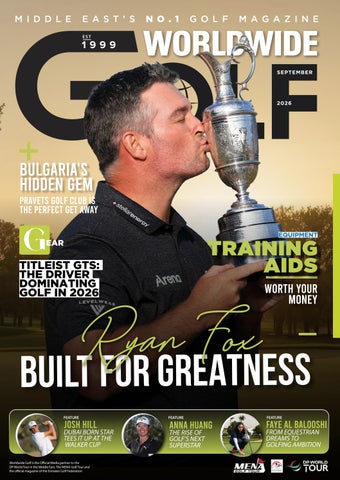
Ryan Fox
WORTH YOUR MONEY
BUILT FOR GREATNESS FEATURE
FEATURE
DUBAI BORN STAR TEES IT UP AT THE WALKER CUP
THE RISE OF GOLF’S NEXT SUPERSTAR
JOSH HILL
Worldwide Golf is the Official Media partner to the DP World Tour in the Middle East, The MENA Golf Tour and the official magazine of the Emirates Golf Federation
ANNA HUANG
FEATURE
FAYE AL BALOOSHI FROM EQUESTRIAN DREAMS TO GOLFING AMBITION
50% 50% CASH BACK ** IS IS NOW LIVE *Applicable *Applicableononeverything everythingin-store in-storeexcept exceptGTS GTSmetals, metals,meta metaglasses, glasses,golf golfballs, balls,gloves, gloves, Callaway, Callaway,and andTaylormade. Taylormade.Cashback Cashbackvalid validonona aminimum minimumspend spendofof1000 1000AED AEDand andredeemable redeemable ononyour yournext nextpurchase. purchase.Cashback Cashbackvoucher vouchervalid validfor for7 7days. days.Not Nottotobebeused usedininconjunction conjunctionwith with other otherpromotions/discounts. promotions/discounts.Cashback Cashbacktotobebeused usedand andredeemed redeemedatatthe thesame sameoutlet outletonce. once.
EDITORS PAGE
IS A CHANGE ON THE CARDS? Photography: Getty Images
By
Alex Gallemore, Editor, Worldwide Golf
Can We Please Play Golf a Bit Faster R
yan Fox has quietly done something remarkable this year. Not just winning a Major, though that’s rather good going too, but proving that professional golf does not require a committee meeting before every single shot. There’s plenty to admire about Fox’s game: the ferocious length, the long climb up from the Challenge Tour, the Major title now sitting on his mantelpiece. But it’s his pace of play that deserves its own headline. The man walks to his ball, has a look, has a quick word with his caddie, and hits it. Revolutionary stuff, apparently. No summit meeting. No forty seconds of staring into the middle distance like he’s forgotten where he left the car. No seven practice swings, no lengthy negotiation with a yardage book to determine whether the flag is a genuinely uncertain 147 yards away, or possibly the deeply treacherous 148. He just plays golf and after years of watching the professional game slow to a crawl, it’s a genuine relief. Somewhere along the way, golf mixed up “taking the game seriously” with “taking forever to play it.” Watch a tour pro over an eight-footer and you’d be forgiven for thinking he’s brokering peace in the Middle East rather than judging a bit of borrow. Look from behind the ball. Look from behind the hole. Look from the side, for good measure. Bring the caddie in for consultation. Then, just to be safe, look from behind the ball again, in case the hole has quietly relocated in the last thirty seconds. By the time he actually stands over the putt, everyone watching at home has grown a beard. The trouble is, we copy them. We buy their drivers, we wear their shoes, we absolutely nick their pre-shot routines, and sadly, more than a few of us have picked up their glacial pace too. You’ve seen it at your own club. Someone with a handicap in the high teens, 162 yards from the pin, water short, bunker right, launches into a full tactical review of wind direction, elevation, humidity and how many feet the ball might release on landing, despite never once in his golfing life having controlled a shot to within twenty yards of that number.
6
Mate. It’s the monthly Stableford. Hit the seven. Actually, hit the six, and let’s all go home before dark. Then there’s the practice swing, which club golf has somehow elevated into performance art. One is sensible. Two, fine, if the first felt a bit off. But four? If the first three were dreadful, there’s scant evidence the fourth is going to summon peak Scottie Scheffler. And if it happens to be the best swing of the lot, bad luck, you’ve just wasted it on a patch of rough. Here’s the quietly funny part: most of us would probably play better if we played faster. Nobody’s asking for speeddating with bunkers. But there’s a lovely rhythm to simply walking up, assessing, choosing a club, and getting on with it. Fox’s speed doesn’t make him look careless; it makes him look sure of himself. Decision, commitment, swing. Compare that to standing over the ball just long enough to mentally storyboard every conceivable disaster (the water, the fat contact, the duck hook) before the club has even started back. Tours have spent years wringing their hands over pace of play, with timing procedures, warnings, and the odd token penalty, and rounds can still drift past five and a half hours. Five and a half hours! That’s enough time to fly from Dubai to half of Europe. And it isn’t just an inconvenience; it’s part of why the game struggles to pull in newer, younger players who take one look at an eighteen-hole Saturday and decide life’s too short. Nobody’s suggesting a faster game fixes everything. But it certainly wouldn’t hurt. Play ready golf. Read your putt while someone else plays theirs. Work out the yardage before it’s your turn. Glove on before you reach the tee. None of it requires running, just requires being ready. Ryan Fox has shown us something worth celebrating: you can play fast and still play brilliantly. You can be decisive without being careless. And you can win on the game’s biggest stages without turning the selection of a nine iron into a full parliamentary debate. Golf is hard enough as it is. Let’s not make it longer too.
DISTANCE
YOURSELF
Contents S E P T E M B E R
-
2 0 2 6
24
16
15 PETE COWEN MENA Golf Tour opens new doors, Koepka won’t slow down, Abu Dhabi F1 gets the green light, and Rotherham finally needs a hosepipe.
16 COURSE: LAHINCH Ireland’s iconic links provides a spectacular Walker Cup stage as golf’s finest amateurs battle for glory on Ireland’s rugged west coast.
18 JOSH HILL From Dubai to a Walker Cup call. Josh Hill reflects on his journey through UAE junior golf and American college golf to reach the top.
18
24 RYAN FOX From New Zealand prodigy to global winner. Ryan Fox talks through the setbacks, the grit and the fearless golf that got him here.
30
30 WINNING LONG GAME Could the tours be better together? We examine what cooperation between golf’s leading tours could mean for the game’s future.
34 ANNA HUANG A young talent on the way up. We meet Anna Huang, already making rapid progress and turning heads on her way to the top.
ISSUE No.304 SEPTEMBER 2026 • Published in Dubai by: ProGraphix • PO Box 24677 • Dubai, UAE (Tel) +9714 340 3785 Publisher: Alex Gallemore • Production/Design: Contactless Media Ltd • Editorial Panel: Alex Gallemore, Pete Cowen, Richard Bevan, Alex Leyno, • Photography: Getty Images • June 2009 SSN 1- 46805671 • Approval UAE National Media Council: MLN:8328516/MF02-3471314 Trade License No. 123127 PROGRAFIX ADVERTISING • Worldwide Golf specifies that post-press changes may occur to any information given in this publication and takes no responsibility for goods or services advertised.
10
ARABIAN RANCHES GOLF CLUB | DUBAI
Saved on Average this year
AED 7,600*
THE TROON EXECUTIVE CARD EXCELLENCE IN EVERY ROUND
• • • •
Special Green Fee Rate Guest Rates 7-Day Booking Window Savings Tracker In App
• Event & Clinic Invites • Discounts on F&B and Merchandise** • 12 Month Validity
Terms and conditions apply. Valid at participating Troon locations. Card is valid for 12 months from the date of purchase. * Savings amount is based on the average savings on green fees, by the top ten golfers in a 6 month period from January 2026 to June 2026. **Discount on F&B and Merchandise at participating Restaurants and Golf Shops Terms and conditions can be found at - https://troon.com/card/troon-executive-card
2026 TICKETS
ON SALE NOW
05 – 08 N OVE MB E R 2026 | YA S LINK S, ABU DHAB I
Contents S E P T E M B E R
-
2 0 2 6
52
WHAT ARE THE TOP TRAINING AIDS? Practice with a purpose. Nine training aids that actually sharpen your swing, build consistency and make every session count.
38
44
Could the tours be better together? We examine what cooperation between golf’s leading tours could mean for the game’s future.
This simple rope drill encourages a consistent hand, arm and club path, helping golfers of every level build a repeatable swing.
BUILD A REPEATABLE SWING
ROOM TO GROW
46
48
ESCAPE SAND WITH CONFIDENCE
SPEED MEETS CONTROL
Master this simple bunker cheat code to improve contact, remove tension and escape the sand with confidence every single time.
Faster, tighter, more stable. We put Titleist’s new GTS driver through its paces to see if the performance matches the promise.
58
62
A golf escape worth the trip. We explore Pravets, where mountain scenery, a Peter Harradine course and a luxury resort come together.
From the saddle to the fairway. Faye Al Balooshi discusses her switch from competitive riding to golf, and her drive to grow the game.
CHANGING COURSE
BALKAN BEAUTY
13
PETE COWEN
THE OFFICIAL COLUMN
Photography: Getty Images
MENA Tour Opening Doors One of the hardest things for any young professional these days isn’t becoming good enough, it’s finding somewhere to prove you’re good enough. That’s why I was pleased to see the MENA Golf Tour expanding its Qualifying Schools this year, with two in the UK and another in America. There are an awful lot of talented golfers out there, but the pathways into the main Tours are becoming increasingly difficult to find. You can have all the talent in the world, but getting your foot through the door isn’t straightforward. Players need somewhere to compete, earn money, build confidence and ultimately create opportunities to move up the ladder. That’s where I think the MENA Golf Tour can really shine. I’ve always believed development Tours are incredibly important. Not everybody is going to come out of amateur golf and walk straight onto the DP World Tour or PGA TOUR. In reality, very few do. Most professionals have to learn their trade somewhere, and you only really learn how to become a tournament professional by playing tournaments. The MENA Golf Tour gives players that opportunity and having Qualifying Schools in Britain and America makes it far more accessible. It also opens the Tour up to a much wider pool of players. Golf needs those pathways. Give talented players somewhere to compete and you’ll soon discover who can actually play when there’s a scorecard in their hand and their livelihood depends on it.
Plenty of Golf Still to Come Brooks Koepka is certainly going to keep me busy over the next few weeks. He’s playing the Irish Open, the BMW PGA Championship at Wentworth and the Alfred Dunhill Links Championship in Scotland. I thought I might finally get a bit more time at home, but apparently Brooks didn’t get the memo. It will be great to have him back playing those events. The Irish Open always has a fantastic atmosphere, Wentworth remains one of the biggest weeks on the DP World Tour calendar and the Dunhill is always special, particularly with the links courses and everything that comes with playing in Scotland. The LIV Golf season might have finished, which frees up a little more of my time, but there’s certainly no chance of putting my feet up. I’ve still got Guido Migliozzi, Victor Perez and Padraig Harrington competing, along with Brooks, so there’s plenty of work to be done before the season is over. At this rate, I might get a week off around Christmas. Positive Signs for the UAE It’s also reassuring to see confirmation that the Formula 1 in Abu Dhabi will be going ahead this year. Golf and Formula 1 might be completely different sports, but major international events taking place sends an important message. For golfers, sponsors and visitors looking towards the UAE, it provides reassurance that things are getting back to business as usual. The UAE has become such an important destination for international sport and golf in particular. Hopefully we’ll now see plenty of positive
15
momentum heading into the winter and another strong season of tournaments across the region. Anyone Got a Hosepipe? For the moment, though, I’m back at the range in Rotherham and experiencing something I never thought I’d say in Yorkshire: we desperately need some rain. It’s as dry as I’ve ever seen it. Normally golfers spend fortunes on drivers, shafts and golf balls trying to find another five or ten yards. At Rotherham at the moment you don’t need any of that. Just hit it along the ground and wait. We’re getting about 100 yards of run. I’ve had players coming down convinced they’ve suddenly gained 20mph of clubhead speed. I haven’t got the heart to tell them the truth. Their numbers haven’t changed – Yorkshire has just temporarily turned into Dubai. Even the higher handicappers are walking around thinking they’ve discovered the secret to distance. I’m half expecting one of them to ring the PGA TOUR and ask for an invite. The only problem is trying to stop the ball. You can hit a lovely little pitch onto a green and watch it disappear somewhere towards Sheffield. So for probably the first time in my life, I’m standing on a golf range praying for rain. Knowing Rotherham, I’ll probably regret saying that by October.
Pete Cowen
Master PGA Professional
GEAR
COURSE
Photography: Provided
LAHI
the Course
A LINKS MADE FOR MATCH PLAY
T
here are links courses that test your swing and others that test your imagination. Lahinch’s Old Course manages to do both, which should make it a spectacular venue when the Walker Cup arrives on Ireland’s west coast on September 5–6. Founded in 1892, Lahinch has the fingerprints of two of golf’s greatest architects all over it. Old Tom Morris first harnessed the spectacular natural terrain before Alister MacKenzie redesigned the course in 1927, creating a
wonderfully unpredictable journey through towering dunes, valleys, humps and hollows. At 7,066 yards and a par 72 from the championship tees, this isn’t simply about length. The Atlantic wind can completely alter the character of holes from one day to the next, while firm links turf rewards creativity and the ability to control trajectory. The famous Klondyke fourth and Dell fifth provide two of Lahinch’s great talking points. Both retain the wonderfully eccentric
character of Old Tom Morris, with blind shots and dramatic dunes demanding commitment rather than caution. That’s why Lahinch feels perfectly suited to the Walker Cup. Match play encourages aggression and imagination, and this is a course where fortune can change in a single hole. With the Atlantic as a backdrop and some of the world’s finest amateurs going head-tohead, Lahinch should provide a Walker Cup every bit as memorable as its setting.
HOW THE WALKER CUP WORKS The Walker Cup is the amateur game’s equivalent of the Ryder Cup, bringing together 10 of the leading male amateur golfers from Great Britain & Ireland against 10 from the United States. The match takes place over two days. Each
morning features four foursomes matches, where two players share one ball and play alternate shots. Saturday afternoon features eight singles matches, while all 10 players from each team contest singles on Sunday. That produces 26 matches and 26 available points –
16
eight foursomes and 18 singles. A win earns one point and a match tied after 18 holes earns half a point. As defending champions, the USA need 13 points to retain the Walker Cup, while Great Britain & Ireland need 13½ points to win it back.
INCH 17
FEATURES
WALKER CUP
Photography: Getty Images
18
FROM UAE FAIRWAYS TO THE
Cup
JOSH HILL’S RISE TO THE TOP By Alex Gallemore
19
FEATURES
WALKER CUP
Photography: Getty Images
F
rom the fairways of Dubai to the biggest stage in amateur golf, Josh Hill’s rise has been remarkable. A MENA Tour winner at 15, a cut maker on the DP World Tour as a teenager, and now a 2026 Walker Cup selection for Great Britain & Ireland, Hill heads to Lahinch with one eye already on the professional ranks that await him afterwards. I caught up with Josh to talk about Dubai, America, and the journey so far, and he confirmed that, win or lose at Lahinch, Walker Cup week will mark his final act as an amateur before he turns professional. Josh, you grew up playing golf in Dubai and have gone from competing in junior events in the UAE to being selected for the Walker Cup. When you look back, how important was Dubai in shaping the golfer you are today? Looking back at my junior days in the UAE and how they’ve got me to here now, it’s been a huge part of my life. I don’t think I’d be where I am without it. Everything the UAE offers from a golf perspective is amazing, and it’s helped me get to where I am now and be on the Walker Cup team, through the facilities and through the tournaments they put on. It’s a huge part of why I’m here, and I’ll always look back at
“Everyone at Lahinch will have to adapt to something, but I feel it’s an edge for me because I’ve had to adapt constantly, another thing Dubai taught me early on”.
those junior days with gratitude for how much they helped me. You had access to some incredible courses growing up, but also a very competitive junior golf scene. What did playing against the likes of Toby Bishop and other leading UAE juniors do for your development? Playing against Toby, Arjun and all the other juniors growing up was huge for me, especially when I was younger, around 10 to 12. Looking up to the older guys really helped me develop as a golfer and become better on the competitive side. You have to be competitive to get better, and those guys really made me the person, and the competitor, I am today. You were still a teenager when you found yourself playing alongside some of the biggest names in the game at the Abu Dhabi HSBC Championship and Dubai Desert Classic. At that age, did you genuinely believe you belonged at that level, or were you still slightly in awe of it all? There’s always an element of awe at that age, because you’re right there with people you’ve looked up to since you were young and always wanted to play alongside. But I also had a genuine belief that I belonged there, and that one day I’d be there consistently with them. Those weeks were just another great stepping stone towards that goal. Making the cut in Abu Dhabi and then doing it again in Dubai was a huge statement. Looking back now with considerably more experience, what do you remember most about those two weeks? I remember a lot about those two weeks; they were both brilliant. Abu Dhabi especially, when I came back the next morning and finished strongly to make the cut. That was a big part of my journey to where I am today and gave me a lot of confidence at the time. Getting those opportunities was huge for
20
me and really shaped the person I’ve become. You also became the youngest player at the time to win an Official World Golf Ranking event when you won on the MENA Tour at Al Ain aged just 15. How important was competing against professionals so young in convincing you that professional golf could eventually become your career? Competing at professional events that young was really important. It convinces you that professional golf can actually be a thing: when you’re that age and competing with professional guys and holding your own, you think, “I can do this, I just need to keep working hard.” It was definitely a convincing factor in shaping my career path, and looking back,
it was such a great time and such an awesome achievement.
own pressure, and once you’ve experienced it, you learn how to handle it.
Leaving Dubai for the University of Tennessee was a massive change, both personally and in terms of golf. What was the biggest shock when you first arrived in America? There were a lot of big shocks. The way people live their life over there is completely different, and having been homeschooled, stepping into a school environment meant adjusting on a lot of different levels. Then, very early in college, I broke my foot and was out for a good while. When I came back, I really struggled with my game, which was a shock in itself. It wasn’t fun at the time, but fighting through it taught me a lot of valuable lessons that I think will keep putting me in good positions in the future.
The Walker Cup is one of those events every elite amateur knows about. When did representing Great Britain & Ireland become a serious personal goal rather than something that simply seemed a long way in the future? It became serious around 2022, right when I first got into the practice squad and was leaving for college. I couldn’t play much golf that summer because I had to focus on my grades, so I missed out on selection that time, which was disappointing but understandable. Then I went through the injury and wasn’t playing well enough to be considered. Now I’ve fought my way back into position to compete, and I’m proud of how I got here despite missing out a couple of times along the way.
College golf in America has a reputation for being incredibly competitive. What has it added to your game that you don’t think you would have developed had you stayed on the amateur pathway in the UAE or UK? One big thing it taught me was consistency, having to be prepared for tournaments that came thick and fast, much like professional golf. If you played a bad tournament, you didn’t have time to go home and fix things; you had to figure it out before the next one. I think that’s a really valuable lesson for professional golf: being consistent in what you do and learning, week by week, how to play good golf. You’ve experienced DP World Tour golf, elite amateur golf and NCAA Division I golf. Which environment has put you under the most pressure, and where have you learned the most about yourself? Each of those environments brings its own specific pressure, and you learn how to deal with each one. You have to be mentally tough. I’d say Division I golf taught me the most, just because of what I went through, especially early on, after coming back from injury. There were a lot of hard times where I had to dig deep, and I did a good job of that, coming out the other side much stronger. So I’d say NCAA Division I golf, from that angle, but they all bring their
What did it feel like when you finally received confirmation that you were in the team, and who was the first person you called? It was awesome hearing from Dean Robertson, the Great Britain & Ireland captain, that I’d made the squad. I’d actually had a message from him about three weeks earlier, after the South of Ireland, but I misread it. I thought it meant I hadn’t made it. When he called, I told him that, and he said no, that message had been about direct qualification from the tournament. He was thrilled to have me on the team, and I was out on the golf course, ecstatic and really happy. I think I called my parents first, and it was a great feeling, especially after thinking I’d missed out. You’ll arrive at Lahinch having grown up playing very different golf in Dubai before spending several years competing in America. How much of an advantage could that variety of experience be when you have to adapt to links golf and match play?
21
I think it’ll be a great advantage. My whole life I’ve had to adapt to different scenarios, whether in America, Dubai or the UK. Everyone at Lahinch will have to adapt to something, but I feel it’s an edge for me because I’ve had to adapt constantly, another thing Dubai taught me early on. You’ve already achieved things most golfers your age could only dream about, but the obvious question is what comes next. How close do you feel you are to being ready for professional golf, and what would success look like for Josh Hill over the next five years? What comes next is becoming the professional golfer I dreamed about as a kid. My time in America feels like it’s done, but it gave me a great learning experience to carry into this next step, and I do feel ready for it. As for what success looks like over the next five years, it’s easy to get trapped in results, but if I keep getting better day by day, the results will come. So success, for me, is being consistent with my daily routines and habits and letting the results follow from that, rather than chasing them directly.
FEATURES
GOLF’S RESILIENCE IN THE UAE
Photography: Provided
GOLF’S
RESILIENCE IN THE UAE: THE RISE OF THE RESIDENT GOLFER
T
he first half of 2026 presented the UAE golf industry with a challenge few could have anticipated. And what emerged was an engaged local market; golfers filled up tee sheets, membership enquiries continued to roll in and the community continuing to use Troon golf clubs as places to play and spend time together. Data from the Emirates Golf Federation illustrates the scale of the initial disruption, with a 76.2% decline in overseas golf rounds across the UAE from March to June. For an industry that has successfully established the UAE as one of the world’s leading winter golf destinations, the sharp reduction in international golf tourism could have left the golf courses quiet. But the response of the resident golf community quickly put an end to that notion. At Troon facilities across the country tee sheets continued to fill up and we saw an increase in inquiries for membership, uptake in academies and people finding that collective community at our clubs, visiting food and beverage outlets and
enjoy other off-course experiences. “There is a real appetite for the complete golf club experience, and that has helped the resident market remain remarkably resilient,” says DJ Flanders, Executive Vice President of Troon International. He also points to the changing role of golf clubs, with clubs increasingly becoming destinations that extend well beyond the traditional golfing experience. “Golf clubs are evolving into lifestyle and community destinations,” says Flanders. “It’s no longer just about playing 18 holes; dining, wellness, entertainment, family activities and social experiences are all becoming an increasingly important part of what our facilities offer.” Wider Audience This broader proposition is helping clubs attract a wider audience and strengthen their role within local communities, while also creating new opportunities for the region’s golf sector to continue growing. Periods of uncertainty reinforce the importance
22
of continuing to grow the game locally, a core value of Troon. Providing accessible entry points, coaching opportunities, junior development, compelling membership offerings and even more important, lifestyle experiences that encourage golfers to play more often. The UAE has invested enormously in positioning itself on the international golf map, from worldclass courses and tournaments to resorts capable of attracting golfers from across Europe, Asia and beyond. And international golf tourism will remain an important part of that success. But alongside it now sits an increasingly established local golf ecosystem: members who play regularly, residents discovering the game, juniors progressing through academies and non-golfers engaging in clubs as year-round lifestyle destinations. International demand can respond quickly to external events, but an engaged local golf community endures and even thrives. And perhaps that is the most important takeaway from an extraordinary few months: the UAE is not simply a destination where people travel to play golf. Increasingly, it is a market where golf has put down roots.
INTRODUCING ALL-NEW SM11 WEDGES SM11 is designed to produce cleaner contact, controlled flight, and the right amount of spin, delivering the predictability and precision to pull off the exact shots you envision.
FEATURES RYAN FOX
Photography: Getty Images
THE FAST TRACK TO THE CLARET JUG By Alex Gallemore
24
25
FEATURES RYAN FOX
Photography: Getty Images
Twenty two seconds.That is how long Ryan Fox took to strike the putt that won him The Open. Playing partner Sam Burns finished the hole. Fox was already over his ball. Twelve feet, downhill pressure, a Major championship on the line, and he barely paused to breathe. There are club golfers who take longer than that to mark a two footer. Fox looked. He committed. He rolled it in. That single moment, more than any statistic from his career, tells you who Ryan Fox is. At Royal Birkdale in July, this wonderfully uncomplicated New Zealander birdied the 72nd hole to win The 154th Open Championship by one shot from Cameron Young. He became only the second New Zealand man after Sir Bob Charles in 1963 to be crowned Champion Golfer of the Year, closing with a 68 to finish ten under par in one of the great weekend charges in recent Open history. Modern professional golf drags a small army behind it: swing coaches, putting coaches,
fitness coaches, psychologists, statisticians, nutritionists, and presumably someone paid solely to remember everyone’s passwords. Fox looks at the shot. Picks a club. Hits it. Next. “I was never methodical at anything, to be honest,” he says. “The less time I have to think about it, the less bad stuff can creep in there.” It might be the single most useful line any amateur golfer reads all year. But speed is only half the story. Fox is 39. He did not race up the rankings as a prodigy. He clawed his way there, one Challenge Tour event and one near miss at a time, and very nearly walked away from the game altogether before any of it happened. A Sporting Bloodline Ryan Fox was always going to be a professional athlete. The only mystery was which sport would claim him. His father, Grant Fox, is one of New Zealand rugby’s great names: 645 points in 46 Tests for the All Blacks, and a central figure in the side
26
The home coming Major champion
“HARD WORK
BEATS TALENT IF TALENT DOESN’T WORK HARD
that won the inaugural Rugby World Cup in 1987. His maternal grandfather, Merv Wallace, captained New Zealand at cricket. Ryan grew up in a house where international sport was simply the family business. Cricket came first. He spent childhood evenings in the garden as Wallace taught him to read spin from a bowler’s hand, and later played club cricket for around 15 years, representing Auckland at junior level.
Ryan Fox pictured after winning the 2022 Ras Al Khaimah Classic at Al Hamra Golf Club
27
He was, by his own admission, not built for patience. “I was always very good at getting to 30 very quickly then getting myself out in some way. T20 wasn’t around and that’s a shame, because I think it would’ve suited me quite nicely.” Rugby followed too, played at fly half, though being Grant Fox’s son made him a magnet for opposition forwards looking to make a point. Concussions eventually settled that question for him. Golf, oddly, arrived last. Fox did not play competitively until after school, taking it up properly around age 18 while at university, playing off a handicap of two. He abandoned law studies almost immediately and never looked back. “I absolutely loved it. I was hooked. I knew I wanted to be a golfer.” His father’s advice stuck with him from the start: “Hard work beats talent if talent doesn’t work hard.” Grant caddied for Ryan through much of his amateur career and early professional years, disagreements included, and helped him see the parallels between goal kicking and golf: routine, strike, trajectory, and the nerve to execute while everyone watches. That last lesson would matter enormously, decades later, on the 18th tee at Royal Birkdale. The Career That Nearly Ended Before It Began Turning professional in 2012, Fox spent his early years grinding on the PGA Tour of Australasia. It was neither glamorous nor lucrative and by 2013 the results simply weren’t coming, with missed cuts piling up and funds running low. But quitting was never on the table for Ryan; he just needed to rediscover why he’d started. Grant flew out to caddie at the Australian Masters and asked one simple question: why do you play golf? Set aside the rankings and the money worries, and the honest answer was that it was supposed to be fun. So that became the plan for the week. Forget the rankings. Just play. Fox finished fifth. It kept his career alive, almost by accident. Three years later, in Europe, disappointment struck again. Chasing promotion through the Challenge Tour, Fox missed his card by a single position. “One place. That was tough,” he recalled. It took him half a year to shake off. He went back and did it properly the following season, winning the Northern Ireland Open with a closing 62 and
FEATURES RYAN FOX
Photography: Getty Images
Ryan Fox pictured with his family and the trophy after winning the final round of the ONEflight Myrtle Beach Classic in 2025
earning his card comfortably. Looking back, he considers that detour one of the most important stretches of his career. “Getting through the Challenge Tour in 2016 and gaining my full European Tour card for the 2017 season was a defining moment. Getting on a major tour was a huge goal ticked off and set me on the path to where I am now.” It is easy to romanticise Fox’s rise now that he is holding a Claret Jug. At the time, it was closer to survival. Building Toward the Top, One Tour at a Time Fox’s first full European Tour season came in 2017, at 30, well past the age most modern professionals have already made their names. He adjusted quickly. “I really began to realise that I deserved to be out here and could compete with these guys.” The wins followed in stages. A first European Tour title in Perth in 2019. A breakout 2022 that included victories in Ras Al Khaimah and at the Alfred Dunhill Links Championship in St Andrews, four runner up finishes, a climb from outside the world’s top 200 into the top 50, and the Seve Ballesteros Award, voted by his fellow players. Then, in 2023, the BMW PGA Championship at Wentworth, the DP World
Tour’s flagship event, which also confirmed his path onto the PGA Tour. Out of all his wins Ras Al Khaimah mattered more than a line on the CV. “I certainly think it was a springboard,” Fox says. “I’d won in Australia in 2019 but in a different format, so winning over 72 holes in a traditional format was both satisfying and inspiring.” The Middle East has stayed a fixture of his calendar ever since, a stretch of the year he has come to value on its own terms. “I think we are very lucky to play in the region when it’s at its best. The courses are perfect and the weather is ideal.” He is characteristically unromantic about picking a favourite. “Golf course wise, I have played well in parts but haven’t really found any particular course that I would say suits me a lot more than the others.”
By 2025, in America at last and a rookie at 37, Fox won twice in four starts: the ONEflight Myrtle Beach Classic, holed out from off the green, and the RBC Canadian Open, a four hole playoff victory over Sam Burns worth $1.764 million. His father watched from home, characteristically understated. “All you want for your kids is for them to be happy and healthy and chasing their dream. I love the fact that he’s excelling in a sport different from mine.” Winner on both sides of the Atlantic. One thing still missing: a Major. Birkdale Fox arrived at Royal Birkdale in July this year with no top ten finish in 29 previous
“I was going to try to win the tournament, and I’d live with the consequences if I stuffed it up.”
Ryan Fox, Jordan Smith and Alexander Knappe pose with the trophy prior to the start of the 2016 NBO Golf Classic Grand Final at the Almouj Golf Club in Oman.
Major starts. After two opening rounds of 72 and 68, he sat level par, tied for 52nd. Then Saturday happened. Fox shot 62, equalling the lowest round ever recorded in a men’s Major, and suddenly he was in the tournament. Seven years earlier, at Royal Portrush, he had produced Open history’s first sub 30 back nine. When Fox gets hot, he gets hot fast. Sunday nearly went the other way. He was one over through 12 holes and appeared to be fading. Then came four birdies in his final six holes, dragging him level with Cameron Young at nine under, standing on the hardest hole of the week with a share of the lead and nothing to lose. A par would have forced a playoff. Fox had no interest in a playoff. “I said to my caddie, Dean, on the tee that we were going to take it on, that I was going to try to win the tournament, and I’d live with the consequences if I stuffed it up.” Drive down the middle. Approach to 12 feet. And then, twenty two seconds after Burns had cleared out of his way, Fox sent the putt on its way. In. Ten under. Champion Golfer of the Year. From 52nd after 36 holes to the Claret Jug, on the back of a 62 and a 68. The win was worth $3.2 million from a record $17.75 million purse, taking his career PGA Tour earnings past $12.47 million. Not bad for a man who once wondered if he could afford to keep playing. Why the Speed Actually Matters The way Fox won was as memorable as the
win itself. No hovering. No committee meeting over a six foot putt. Scottie Scheffler, paired with him in Phoenix earlier this year, described the experience bluntly: “It doesn’t even feel like you’re in the group. It just feels like we’re playing in a two ball; you hit so fast.” His caddie Dean Smith sees the method behind it. “People see it as, like, he’s flying around there, and he is in a way, but it takes any doubt out.” Fox is not rushing so much as refusing to waste time between seeing a shot and hitting it, a distinction that matters more than it sounds. His swing follows the same instinct: upright, unconventional, built by coach Marcus Wheelhouse into something that would never come out of a PGA coaching manual, but that Fox repeats without hesitation. Golf does not need to look perfect. It needs to work. Fox’s does. The Long Way Round It is tempting, after a Major win, to remember only the final putt. Fox’s story deserves the fuller picture. Without the PGA Tour of Australasia, there may have been no career at all. Without the Challenge Tour, no European Tour card. Without the DP World Tour, no Wentworth, no PGA Tour pathway, and quite possibly no Claret Jug. At a moment when professional golf increasingly fixates on its richest events and biggest names, Fox’s career is a quiet rebuttal: the development pathway still works, for those willing to walk it. It is a message he is happy to pass on. Golf in the UAE has developed enormously in recent years, with more juniors and young UAE-based
29
players now trying to follow the same route Fox took, through the Challenge Tour and DP World Tour toward the game’s top table. Asked what he would tell a talented young player here who feels they need to reach the PGA Tour as quickly as possible, his answer draws directly on his own long road. “There are many more pathways available to young players now, which I think is a good thing. The PGA TOUR and DP World Tour are getting younger, and the players arrive at Tour level ready to win. The obvious path is via a US collegiate system, but the MENA Golf Tour provides a platform in the region that I think is so valuable for any aspiring player at the start of their career.” He lost his card. Missed promotion by one spot. Went back and did it again. Graduated. Won. Moved up. Won bigger. And when the moment finally arrived, on the 18th tee at Royal Birkdale, he did exactly what he has always done, going back to childhood games trying to smash a cricket ball to the boundary. At 39, Ryan Fox now owns a piece of golfing history that stands comfortably alongside his father’s rugby legacy and his grandfather’s cricket career. Asked afterward whether he had finally carved out his own name within New Zealand’s sporting royalty, he allowed himself a rare moment of certainty. “I can plead a pretty good case for that.” He can. For years he was Grant Fox’s son. Now Grant Fox is the father of an Open champion. Fox took the long way to the top of the game. He just never wasted a second once he got there. n
FEATURES
THE OLD ORDER REASSERTS ITSELF
Photography: Getty Images
, E P A C S D N A L R U O T ’S F GOL SIX MONTHS ON WHY GOLF’S ESTABLISHED TOURS ARE WINNING THE LONG GAME Five years after LIV Golf tried to rewrite the sport’s rulebook, the traditional structure it set out to disrupt is quietly proving its staying power, and the players are starting to notice. By Alex Gallemore
30
31
FEATURES
THE OLD ORDER REASSERTS ITSELF
Photography: Getty Images
In July, the DP World Tour, PGA Tour and Asian Tour announced a new multi-year partnership running through at least 2029. It’s a reunion more than a new arrangement. The DP World Tour and Asian Tour go back to February 1999, when the Malaysian Open became the first tournament the two co-sanctioned together, a relationship that ran through a formal strategic alliance from 2016 to 2021, before the Asian Tour teamed up with LIV Golf. That’s the part worth remembering. LIV put roughly $300 million into the Asian Tour to build the International Series, ten events with purses of at least $2 million designed to feed players up into LIV Golf itself. For a while, it was a serious commercial proposition. Under the new deal, the DP World Tour goes back to co-sanctioning select Asian Tour events from 2027, and leading Asian Tour players will earn access to the DP World Tour or its developmental HotelPlanner Tour. Full details are expected in the autumn. “We feel the time is now right to collaborate with the DP World Tour and PGA Tour to enhance the Asian Tour for our members, fans and partners,” said Cho Minn Thant, the Asian Tour’s commissioner and CEO. For the DP World Tour, the significance goes beyond simply returning to a previous partnership. It reinforces its position at the centre of a more
connected global golf ecosystem, linking the PGA Tour with established tours and creating clearer pathways for players across different regions. It’s the clearest sign yet of where things are heading. The framework agreement the PGA Tour and Saudi Arabia’s Public Investment Fund announced back in June 2023 still hasn’t turned into an actual deal. Talks blew past a December 2025 deadline and have crawled along since. But away from that stalled negotiation, a few separate things have genuinely shifted the landscape this year: the Asian Tour coming back into the fold is one, and alongside it, the world ranking system has changed its stance on LIV, PIF is pulling its funding, and two well-known players have walked away from the league. Lack of Money LIV’s money story has dominated the year. In April, PIF confirmed it would stop directly funding the league after 2026. Chairman Yasir Al-Rumayyan stepped down around the same time. Since 2022, PIF is thought to have put more than $6 billion into LIV, and CEO Scott O’Neil has said before now that the league was still five to ten years from turning a profit. Then, in August, some news. O’Neil stood up at a press conference and said LIV had a signed agreement with a new lead investor, one who’d
32
carry the league into 2027. The deal was expected to close in September. He wouldn’t say who the investor was. More than a dozen other parties, he added, were interested in smaller stakes. Under the new structure, LIV players would become majority owners of the league itself, a first, he said, for a major global sports league. What that means for the actual schedule isn’t confirmed by LIV itself yet. The league has been pitching something it calls “LIV 2.0”: ten events in 2027, down from fourteen this year, split evenly between the US and abroad. Purses would fall too, from around $30 million to $10 million a tournament. None of it is official. Nor did the season end with much swagger. The planned finale in Michigan got scrapped. Indianapolis took its place as the last event of the year, and by the time it wrapped up, the investor deal still hadn’t closed, with a number of vendors still owed money. LIV says it’s carrying on regardless. Whether anyone, including its own players, actually knows what that looks like next year is another matter. Koepka and Reed, Two Different Roads Out Brooks Koepka and Patrick Reed both left LIV in January, though they didn’t take the same route. The PGA Tour had set up a “Returning Member
Program” for anyone who’d won a major or the Players Championship since 2022. Koepka used it, and made his first start back at the Farmers Insurance Open in late January. Jon Rahm, Bryson DeChambeau and Cameron Smith qualified too, but stayed put. Reed didn’t qualify. He left anyway, committing to a season on the DP World Tour, where he already held honorary lifetime membership, with the plan of rejoining the PGA Tour in 2027 as a past champion. It’s worked out well so far: two wins and a runner-up in his first three starts put him in the mix for the Race to Dubai title. Two players is not a stampede, and it would be a stretch to call it a trend on the strength of two
names. What’s fair to say is that both moves ran in the same direction, back toward the tours they’d left. LIV and the Rankings, Revisited One thing worth updating for anyone who’s assumed LIV still sits entirely outside the world ranking system: it doesn’t, not anymore. In February, the OWGR board reversed an earlier rejection and agreed to start awarding ranking points to LIV events from this season, the first time that’s happened in the league’s history. It came with strings attached, and LIV hasn’t been quiet about them. Points only go to the top ten finishers and ties at each event rather than the whole field, and a LIV win has generally been worth about what an alternate-event PGA Tour win is worth, not a full-field title. OWGR pointed to LIV’s smaller fields, no-cut format and closed pathway for entry as its reasoning. That distinction matters for the DP World Tour. Its established tournament structure, open competitive pathways and deep international schedule continue to provide players with opportunities to earn ranking points across a broad range of events. Where That Leaves Things Put it together and the picture is one of real change, not a resolved outcome. The Asian Tour is back with the established tours. PIF is stepping away as LIV’s funder. LIV says it has a new investor lined up but hasn’t closed the deal. A smaller schedule is being talked about but not confirmed. Two players have gone home, and the world rankings, after years of holding LIV at arm’s length, have let it partway in. At the same time, the DP World Tour has strengthened its position within the established global game. Its renewed partnership with the Asian Tour, closer alignment with the PGA Tour and ability to attract players such as Reed all point towards a tour that remains an important part of golf’s international structure. What none of this settles is the biggest question of all: whether LIV is still standing, in any recognisable form, this time next year? MAIN IMAGE: From breaking out on the Asian Tour Viyah Singh, Y.A Yang and K.J Choi went on to become Majors champions and win The Players Championship. ABOVE: Brooks Koepka back in action on the PGA TOUR. LEFT: Patrick Reed lifts the Hero Dubai Desert Classic trophy earlier this year having departed LIV Golf.
33
FEATURES
ANNA HUANG
Photography: Getty Images
Anna Huang By Antonia Smith
GOLF’S NEXT SUPERSTAR HAS ARRIVED
34
35
T FEATURES
ANNA HUANG
Photography: Getty Images
here is a 17 year old walking around European golf courses right now with four professional titles to her name, a habit of making eagle when it matters most, and a game that just went toe to toe with one of the most popular players in women’s golf and won. Her name is Anna Huang. If you haven’t heard of her yet, you’re about to. The moment that will make people sit up came at Centurion Club, in the final round of the 2026 PIF London Championship, with Charley Hull for company. Hull is one of the biggest draws in the sport, a proven winner with a big following and an even bigger reputation for holing the putt that matters. Huang arrived at the last hole one shot ahead, with $300,000 and a trophy on the line, and could easily have played it safe. Instead she made eagle, her fourth in four rounds on that hole, to win by two. “That was probably the most thrilling round of golf of my life,” Huang said afterwards, sounding less like a champion and more like someone who’d just got off a rollercoaster. “I have no words. I’m just so shocked.” She had earned the right to sound shaken. Hull had clawed back Huang’s overnight lead and briefly gone in front, before a four putt double bogey at the 17th handed the advantage back. A player still a couple of years off finishing school had just outplayed a major contender in a genuine slugfest, and made it look almost calm. Four Ladies European Tour titles, the youngest three time winner in the tour’s history, and a résumé that would look impressive on someone twice her age. Anna Huang has stopped being a “talented teenager with potential” and started being something rarer: a genuine contender for the title of next superstar in women’s golf. Ask her how she keeps doing this, winning, calmly, again and again, at an age when most of her peers are worrying about university applications, and the answer barely changes. “I tried to focus on each shot because anything can happen in golf, and I stayed in my own lane.” It’s become close to a personal motto. It’s also, on the evidence so far, true. THE MAKING OF A CHAMPION Huang was born in Vancouver in October 2008 and came up through the Canadian junior system before landing in Golf Canada’s NextGen programme, where she spent three years training alongside the country’s best young players. The junior résumé is long: a World Junior Girls team gold for Canada, its first since the event began in 2014, with Huang finishing second individually, plus a string of top five finishes across the American junior circuit through 2023 and 2024. What stood out to the people coaching her wasn’t just the scores, though. It was how little the moment seemed to affect her. Jeff MacDonald, head coach of Team Canada’s NextGen Girls, said at the time that her ability to perform under pressure was “notable,” and that she had “impressive skills beyond her years.” Watching her play down the stretch at Centurion, it’s hard to argue he was wrong. Two people have been with her for most of it. Grant Price, her coach since she first picked up a club, built the swing. Her father Alex has caddied for her from the start, including, now, on the biggest stage of her young career.
36
“
I tried to focus on each shot because anything can happen in golf, and I stayed in my own lane.”
TURNING PRO AT SIXTEEN Huang turned professional in January 2025, aged 16, after earning her card through Lalla Aicha Qualifying School in Morocco. There was no grand proclamation about becoming world number one, just thanks to her family, coaches and Golf Canada, and a rookie season that opened steadily rather than spectacularly: 11th in Johannesburg, 14th at the Amundi German Masters, a top ten in Switzerland. She qualified for the US Women’s Open and then, on a links course she’d barely seen before, shot 67 to top Final Qualifying for the AIG Women’s Open. “I don’t play links golf, so it took a couple of practice rounds to get used to it,” she said. “I think I handled it pretty well.” An understatement, as it turned out, since the real breakthrough was still a few months away. THE WEEK EVERYTHING CHANGED It arrived, unmistakably, at the 2025 La Sella Open in Spain, where Huang went from winless to champion inside four days. She opened with a bogey free 64, followed it with a bogey free 66, and by the time she finally made a bogey in round three she’d played 62 consecutive holes without one. Closing rounds of 69 and 69 sealed a seven shot win at 20 under. She was 16 years, 10 months and 22 days old. “Honestly, I’m really shocked right now! I can’t believe I just won,” she said, sounding it. A week later she won again, at the Lacoste Ladies Open de France, with rounds of 68, 64 and 65 for a two shot margin. Two titles in as many weeks changed how the tour talked about her. She wasn’t a promising kid anymore. She was someone opponents had to account for. Morocco, in May 2026, showed the other half of her game. Six shots behind Australia’s Kelsey Bennett going
into the final round of the Lalla Meryem Cup, Huang made six birdies and an eagle in a closing 66 to win by one. At 17 years, six months and 24 days, she became the youngest golfer in LET history to reach three career titles. This time the nerves showed a little more than usual. “I got a little nervous on the back nine, I mean, everyone would,” she admitted, laughing about it afterwards. “But I just kept playing my own game.” HANDLE WITH CARE Women’s golf produces a fresh teenage sensation more or less every year, which is exactly why it’s worth being a little careful here. Most of them don’t turn into what the hype suggested. Swings change, bodies change, the step up to a stronger tour exposes something the junior circuit never tested, and plenty of gifted teenagers quietly disappear from leaderboards by 21. Huang hasn’t played a major yet. She hasn’t tested herself weekly against the deepest fields in the game, on the toughest setups, with a full LPGA card and a full LPGA schedule bearing down on her. That step is its own test, and not everyone who looks ready for it actually is. What she does have, though, is a set of results that’s unusually hard to explain away as luck or a hot putter. She’s won from the front, from six back, in a sprint and in a genuine fight. La Sella was domination, France was momentum, Morocco was a comeback, London was a straight brawl with one of the most popular players in the sport, and she won all four before turning 18. There’s an ordinariness to her off the course, too, that suggests she isn’t being rushed into anything she can’t handle. After La Sella she talked about being swamped by congratulatory texts and admitted the attention felt “pretty overwhelming,” saying she was deliberately spending less time on her phone rather than more. She credits her friendships on tour, Singapore’s Shannon Tan in particular, who she says helped her through a rough patch in her rookie year and who she “looked up to a lot.” Behind the scorecards, there’s still a teenager working out how to live on the road. WHAT COMES NEXT The LPGA Tour and the majors are the obvious destination further down the line, and there’s no need to force the timeline. The LET is giving her exactly what a young player needs right now: different countries, different grasses, different kinds of pressure, and repeated practice at the hardest skill in golf, closing. She’s picked it up fast. First win inside eight months of turning pro. Youngest three time winner in LET history. A fourth title won by staring down Charley Hull and making eagle on the last, four days running. None of that guarantees anything about where she’ll be in five years. Golf rarely does. But it’s not potential anymore, either. It’s a body of work, and it keeps getting harder to explain away as a hot streak. Somewhere in Vancouver, a seventeen year old is probably replying to a stack of congratulatory messages on her phone, telling herself not to spend too long on it, already thinking about the next tee shot.
37
FEATURES UAE GOLF
Photography: Provided
DOES THE UAE NEED A
SHALLOW END? By Alex Gallemore
Nad Al Sheba 1993 38
The UAE has spent decades building some of the finest golf courses on the planet: immaculate conditioning, five-star clubhouses, designers whose names normally sit on trophies. But if the next phase is about growing the game from within, what it really needs isn’t another championship course. It needs somewhere affordable to learn. Where does a complete beginner actually go? Learning golf on a championship course is a bit like teaching somebody to swim by throwing them off the back of a yacht. THE PRICE OF PERFECTION This isn’t an argument against the UAE’s golf clubs or their pricing. Championship courses in the desert are expensive to operate: water, agronomy, machinery, staffing and constant maintenance all come at a cost, and that premium green fee becomes easier to understand once you factor in the level of service expected here. These courses also draw golfers from Britain and Europe every winter, and remain central to tourism . Golf tourism deserves to remain part of the UAE’s strategy, but tourism and participation aren’t the same thing, and recent regional uncertainty has underlined the importance of building the game from within. Visitors can disappear quickly when airlines change schedules or headlines turn unsettling. Residents don’t. So could the next great investment be something less glamorous than another championship layout? WHEN DUBAI GOLF WASN’T GLAMOROUS Older golfers in Dubai will remember a very different landscape. Dubai Country Club opened in 1971 after 150 members reportedly contributed AED 500 each, and the original course was built largely by members using borrowed machinery. There wasn’t much grass; golfers played from artificial mats across the sand and putted on oil-treated surfaces known as browns. It sounds ridiculous compared with modern Dubai golf, and it worked, because it gave ordinary residents somewhere to play without the fear of ruining a pristine fairway. Then came Nad Al Sheba, on the site associated today with Meydan, the Middle East’s first fully floodlit 18-hole course. Golf could suddenly fit around life: finish work, play nine holes under the lights. It was also playable, with space, limited rough and bunkers from which normal human beings could occasionally escape. That course closed in 2008 for the Meydan racecourse, and it would have been easy for that piece of Dubai’s golfing history to simply disappear. Instead it was rebuilt on the same plot by Peter Harradine, the architect behind Abu Dhabi Golf Club, Jebel Ali Golf Resort and Doha Golf Club, whose brief wasn’t another punishing championship test. Reborn as The Track, Meydan Golf, the rebuilt layout kept the floodlit format and multiple tees on every hole, so a beginner and a low-
39
FEATURES UAE GOLF
Photography: Provided
handicapper can genuinely play the same hole together, which is very likely why it has become one of Dubai’s more popular courses: it never lost the character that made the original worth saving. Neither course would match the spectacular ones the UAE enjoys today, but they provided the first rung of the ladder, and somewhere during the UAE’s journey towards championship golf, that rung became harder to find. GOLF’S BIGGEST ENEMY Golf has always had three problems: it is difficult, it takes a long time, and it can be expensive. Compare it with padel, where you can give somebody a racket and within half an hour they’re having a game. Golf isn’t like that; it requires patience, which means everything surrounding the learning process needs to be as easy as possible. Other golf markets are starting to offer useful lessons on how. AMERICA’S GOLF BOOM The United States is enjoying one of its strongest periods of golf participation in decades. According to the National Golf Foundation, 48.1 million Americans aged six and above participated in golf in 2025, yet only 29.1 million played on a golf course; another 19 million participated exclusively away from traditional courses. America also welcomed around 3.3 million beginners in 2025. Millions of people, in other words, are discovering golf without ever standing on the first tee of a championship course. Golf has traditionally assumed the course is where the journey begins; increasingly, it’s where the journey leads. Topgolf has shown how this works: no handicap, no clubs, not even much interest in golf required. Turn up with friends, order some food, hit golf balls. Some of those customers will never progress beyond that. Others will become golfers. DUBAI IS ALREADY LIVING THIS Dubai doesn’t need to look across the Atlantic to see this pattern; it’s happening on its own doorstep. Topgolf Dubai, at Emirates Golf Club since January 2021, welcomed more than 650,000 guests in a single recent year and saw 22.6 million balls hit, according to Dubai Golf CEO Chris May, an average of more than 60,000 a day, many struck by first-timers. The numbers aren’t just entertainment noise: Dubai Golf’s own tracking shows roughly a fifth of new golfers taking academy lessons had their first swing at Topgolf. A second venue is under construction on Yas Island in Abu Dhabi. Five Iron Golf tells a similar story. Its flagship venue at The Westin Dubai Mina Seyahi opened with 17 Trackman-powered simulators and has already expanded to a second site in Business Bay, aimed at time-poor professionals wanting a lesson or a round without booking a tee time. Between the two brands, Dubai now has thousands of people a week hitting golf balls who wouldn’t previously have called themselves golfers. That’s the encouraging part. The harder part is what happens next. A driving range bay or a simulator screen can teach somebody to strike a ball, but not how to actually play golf: reading a lie, choosing a club, managing a round. At some point, that Topgolf regular or Five Iron member needs an actual golf course to turn the swing into a score, and if the only next step is an 18-hole championship layout charging championship green fees, a lot of that new interest will simply stall at the range.
40
Nad Al Sheba
holding up single-figure golfers behind them. The established clubs would benefit too: today’s AED 100 beginner could become tomorrow’s club member, buying lessons, clubs, a handicap, membership, golf holidays. BUILDING A PYRAMID Think of it as a pyramid. At the top are the great championship courses, and they should stay there: aspiration, tourism, tournaments, global visibility. Underneath comes club golf, then nine-hole golf, short courses, driving ranges, simulators and junior programmes. Right at the bottom sits the most important level of all: someone hitting a golf ball for the first time. The wider that base gets, the stronger everything above it becomes. Golf has sometimes tried to grow by starting at the wrong end: showing beginners Rory McIlroy smashing a driver 330 yards, then sending them onto a 7,000-yard course. Give them a wedge and a 90-yard hole instead.
Dubai Country Club first opened in 1971 THE SHORT COURSE REVOLUTION Some of the most successful golf developments around the world have worked out that shorter golf isn’t inferior golf. At Pinehurst, alongside its championship courses, sits The Cradle, a nine-hole course measuring just 789 yards, and nobody thinks Pinehurst isn’t taking golf seriously. Bandon Dunes has its Bandon Preserve; Pebble Beach has The Hay. Sometimes people simply want to hit golf shots, and that philosophy could be powerful in the UAE, where it already has a foothold: the nine-hole, floodlit, multi-tee format Harradine built at Nad Al Sheba was doing this years before “short course” became a buzzword.
nine-hole course, multiple tees so a child and an accomplished golfer can play together, a floodlit range, rental clubs, affordable lessons and junior programmes. Golf without the intimidating bits, affordable enough to play every week rather than as an occasional luxury.
THE RESIDENT OPPORTUNITY The UAE has another advantage worth remembering: an enormous resident population drawn from countries where golf is established, from Britain and Ireland to South Africa, India, Korea and Japan. Many residents already understand golf; others are golf-curious. The Emirates Golf Federation and UAE clubs have DON’T MAKE THE GREAT COURSES already done considerable work developing CHEAPER juniors and new golfers. Support those initiatives The solution isn’t cheaper golf at the UAE’s existing with genuinely accessible facilities and the championship venues, which have businesses to numbers could get interesting fast. operate and are part of the premium image that A family might spend an evening playing makes UAE golf attractive internationally. Keep six holes rather than visiting a shopping mall. them, celebrate them, fill them with tourists. The Children could progress from putting to a opportunity is to build something underneath them: short course and eventually championship a public facility built around accessibility, with a golf. Adults could learn without feeling they’re
41
THE NEXT GREAT UAE GOLF PROJECT The UAE should be proud of what it has built. Few countries have developed a golf industry so quickly or successfully. The DP World Tour has made the Emirates central to its schedule, some of the world’s greatest golfers have competed here, and golf tourism has become part of the country’s winter appeal. None of that needs to change. But successful industries evolve, and the first great challenge for UAE golf, proving championship courses could be built in the desert, has been achieved. The next challenge is different: persuading more of the people already living here to actually play. Make golf easier to discover, quicker, less intimidating. And somewhere along the way, make the first step affordable. There’s something fitting about the idea that UAE golf’s future might borrow from its past. Dubai Country Club wasn’t immaculate. Nad Al Sheba wasn’t brutally difficult, and when Peter Harradine was handed the chance to rebuild it, he chose to protect that character rather than chase another 7,000-yard statement course, which is a large part of why golfers still choose to play there today. Neither venue needed to intimidate anyone; they gave people somewhere to fall in love with golf. That’s probably what the UAE needs again: not another course for the world’s best players, since there are already plenty of those, but one built for the world’s worst.
INSTRUCTIONS THE ROPE DRILL
Photography: Alex Leyno
The Rope Drill This month lets look at an effective rope drill to help I’ve found extremely beneficial for all levels of player. It simple encourages a repeatable hand, arm and club path during the swing
First place two alignment sticks approximately 12 feet apart with a rope attached between each stick around belt buckle high (Picture 1)
1
From here setup parallel to the rope with your hands around a club head width inside (Picture 2).
3
Backswing
2
4 Downswing
5 Through-swing
44
6
7
8
9
During this pattern of movement you’re effectively training a repeatable hand, arm and club path and correcting common faults such as picking the club up to early on the backswing (Picture 6), coming over the top or getting trapped on the downswing (Picture 7&8)and not matching the arms with your body turn on the way through (Picture 9) to name but a few.
Written by Stephen Deane Viya Head International Development Coach
Once you feel comfortable place a ball on a tee and clip a few shots away using the same controlled tempo. As you build confidence return to your normal tempo and eventually hit from the grass or artificial practice surface. I recommend you start with a pitching wedge or nine iron and gradually work your way through your set.
Stephen is an ambassador for Viya and coaches at they’re wonderful array of facilities whilst in Dubai. Stephen also spends a proportion of his time developing Professionals, Amateurs and VIPs Internationally.
45
INSTRUCTIONS AMY MILLWARD
Photography: Alex Leyno
AMY MILLWARD
OUR BUNKER CHEAT CODE THE SIMPLE TECHNIQUE TO ESCAPE WITH CONFIDENCE For many golfers, bunkers are one of the most intimidating parts of the course. The sight of sand can immediately create tension, leading to deceleration, overcomplicated technique, and the dreaded failure to escape first time. The good news is that bunker play does not have to be difficult. If you struggle from the sand, this simple “bunker cheat code” can help you make more consistent contact and take much of the fear away.
START WITH YOUR SETUP – (PICTURE 1) Your stance should sit somewhere between a chip shot and a traditional bunker shot. Position your feet slightly wider than you would for a chip, but not as wide as many golfers are taught for a conventional explosion bunker shot. This narrower setup promotes better movement and allows the body to rotate more naturally through the strike.
2
1
3
BALL POSITION – (PICTURE 2) Place the golf ball just forward of centre in your stance. Many players position the ball excessively forward, which often encourages the club to bottom out too early or slide underneath the ball. A slightly forward ball position allows the club to enter the sand in a predictable place and creates a much more consistent contact.
OPEN THE CLUBFACE, BUT ONLY SLIGHTLY (PICTURE 3) One of the biggest misconceptions in bunker play is that the clubface needs to be dramatically open. While this can be effective for certain high, soft shots, it often makes basic bunker shots unnecessarily complicated. Instead, open the clubface only halfway. This allows the bounce of the club to work without feeling as though the face is pointing toward the sky.
46
5
REDUCE EXCESSIVE WRIST ACTION (PICTURE 4 & 5) Many golfers attempt to create a dramatic wrist hinge on the backswing and a rapid release through impact. While this can produce spectacular shots when timed perfectly, it also introduces unnecessary variables. Think about keeping the arms and club working together. The swing should feel wider and straighter, with the body controlling the motion rather than excessive hand action.
4 PUSH THE SAND OUT – (PICTURE 6) The key image is not to hit the golf ball. Instead, imagine pushing a thin layer of sand out of the bunker underneath the ball. The club enters the sand just behind the ball, uses the bounce to glide through the surface, and carries the sandand the ballonto the green. This thought helps golfers stay committed to the strike and removes the fear of hitting the ball too cleanly.
6
THE TAKEAWAY If bunker shots have become a source of frustration, simplify the technique: ● Slightly wider than a chip stance. ● Ball just forward of centre. ● Clubface only moderately open. ● Minimal wrist hinge. ● Keep the swing wide and controlled. ● Push a thin layer of sand towards the target. Sometimes the best bunker shots come not from adding more technique, but from removing unnecessary complexity. Keep it simple, trust the bounce, and let the sand do the work.
47
GEAR
TITLEIST GTS
Photography: Provided
The
Titleist GTS TAKEOVER
Why Everyone Wants One Already
I’VE WATCHED A LOT OF DRIVER LAUNCHES COME AND GO, AND MOST OF THEM FOLLOW THE SAME TIRED ARC. NEW MODEL SHOWS UP, TOUR PROS SWITCH FOR A WEEK OR TWO OUT OF CURIOSITY, HALF OF THEM QUIETLY GO BACK TO THE OLD ONE ONCE THE HONEYMOON WEARS OFF, AND BY AUTUMN NOBODY’S TALKING ABOUT IT ANYMORE. THE GTS HAS NOT DONE THAT. IT’S BEEN ON SHELVES FOR ABOUT TWO MONTHS AND IT ALREADY FEELS PERMANENTLY LODGED IN EVERY CONVERSATION AT THE CLUB, EVERY YOUTUBE COMMENT SECTION, EVERY FITTING BAY. SO WHAT ACTUALLY HAPPENED HERE.
By Alex Gallemore
48
49
GEAR
TITLEIST GTS
Photography: Provided
WHY THE SCEPTICISM USUALLY WINS Every launch cycle says the same things. Longer. Straighter. More forgiving. Built by engineers whose job titles could fill a business card twice over, using simulations powerful enough to make you wonder why we still bother playing the sport at all. Tour pros love it, apparently they always do, and we’re told driving has changed forever. Then two years pass and somehow the next one is even better than the thing that changed everything. You’d be forgiven for tuning it out. I mostly do. Except Titleist wasn’t even chasing anything here. It came into 2026 as the most played driver brand on tour for the seventh season running, holding about 40 percent of the market per Darrell Survey, on the back of a Speed Project that had already turned the brand from “gorgeous clubs for scratch players” into a legitimate distance leader. The GT line only added to that. There was no obvious gap to fill, no ground to make up. THEY REPLACED IT ANYWAY. GTS2, GTS3 and GTS4 only reached shops on June 11, but pros had already been quietly gaming it for weeks. It first turned up at the Texas Children’s Houston Open in late March, and within roughly three weeks over 40 tour players had one in the bag. By the Valero Texas Open there were 34 GTS drivers on that range alone, more than every other manufacturer combined. Pros don’t make that switch for fun. Their pay packet depends on what happens when there’s water on the right and rough on the left, and if the old driver was working they’d have left it alone. They didn’t. JJ Van Wezenbeeck, Titleist’s Senior Director of Player Promotions, told the PGA Tour it comes down to fitting rather than hype. Simple as that sounds, it’s basically the whole thesis of this driver. IT WAS NEVER REALLY ABOUT BALL SPEED Manufacturers love selling speed because speed is an easy story. More yards, more fun, right up until the ball ends up forty yards further into somebody’s hedge than you intended. What Titleist actually seems to have chased with GTS is something less flashy and more useful: making the bad swings less catastrophic, rather than making the good ones marginally longer. Under the hood that comes from what they call the Split Mass Frame, a thermoform body built around their Proprietary Matrix Polymer. The GT line introduced that material at 13 grams. GTS doubles it to 26, covering nearly 60 percent of the clubhead while adding only 13 percent of its mass. That frees up real weight for engineers to place where
it counts, some low and forward for speed and launch, some pushed back for stability when you miss the middle. Those two goals usually fight each other inside a driver head. Titleist tried to give you both anyway. Stephanie Luttrell, who runs metalwood product development there, put it well when she said GT unlocked the door and GTS just swung it wide open. It reads like a marketing line until you notice sixty plus tour bags backing it up by late June. WHAT JUSTIN THOMAS ACTUALLY GAINED Thomas is a good test case because you don’t have to believe anyone’s marketing copy, the stats are just sitting there. After switching, his numbers moved in the right direction across the board against his 2025 season, strokes gained off the tee, total driving, distance and accuracy all improved. He picked up roughly 3.9 yards on average. Doesn’t sound like much until you remember his equipment was already about as finely tuned as anything on tour. Jordan Spieth’s story is similar. After moving into a GTS2 he gained distance and climbed more than 40 spots in strokes gained off the tee following the switch at the Cadillac Championship. Neither of these proves a driver fixes a golf swing, obviously nothing does that. What it shows is the gains held up under tournament pressure, not just on a launch monitor in a quiet fitting room. THE PART AMATEURS SHOULD ACTUALLY CARE ABOUT Here’s the thing nobody says loudly enough: this driver probably matters more for a bogey golfer than it does for Justin Thomas. A tour pro finds the middle of the face most of the time. The rest of us find the face, occasionally, on a good day. What an amateur actually needs is speed that survives a mishit, spin that doesn’t spiral
50
out of control, and a head that doesn’t twist violently the moment your intended draw turns into something the local air traffic controller would want to know about. That’s the GTS2’s whole job, and
early testing backs it up. It’s been singled out for stability, ball speed retention and forgiveness, and it’s shown up on Golf Monthly’s lists for both mid handicappers and slower swing speeds. The GTS3 trades some of that forgiveness for lower spin and more adjustability without becoming punishing, and GolfMagic called it both longer and more accurate than the old GT3. GTS4 pushes spin down further still, for players who want that without the usual harsh penalty for missing centre. Titleist hasn’t really built one driver here so much as a menu. Van Wezenbeeck called it a toy store for fitters, and honestly that’s a fair description. Whatever you’re chasing, there’s probably a version of this head built to get you there.
“Never in my wildest dreams did I think at my age I’d achieve a 170mph+ ball speed!” – Alex Gallemore
FITTING IS DOING MORE WORK THAN THE MARKETING SUGGESTS Buying a driver used to be a five minute conversation about loft and shaft flex. Now you’re dialling in lie angle, shaft weight, head weighting and centre of gravity until it feels like assembling a piece of aerospace equipment. GTS leans into that with its Dual Weighting System, giving fitters more precise control over launch, spin and shot shape than before. What Titleist gets right isn’t really the tech itself, it’s that the tech is built to serve the fitting process rather than requiring the golfer to become an engineer to understand it. Their tour fitting approach still comes down to three basic things, centre the contact, get the flight and spin right,
then dial in start direction and shape. That applies whether you’re Justin Thomas or a fourteen handicapper who plays twice a month, and honestly the second player probably has more room to gain from it. WHAT I FOUND IN EIGHTEEN MONTHS OF TESTING For the past eighteen months I have played both the GT3 and GT4 heads with an AD VF Tour X shaft, switching between them depending on how I was swinging. The GT3 was the one I reached for when I was not quite on point, missing the sweet spot toward the heel and low on the face. Ball speed held up surprisingly
well on those misses, though spin sat a touch high, averaging around 2900rpm. When I was properly dialled in I would switch to the GT4, which brought spin down to roughly 2400rpm and added a further ten yards, pushing my driving distance to just over 290. My swing speed sits close to 110mph, not bad for an old man, though I was always cautious about pushing it further. Any extra club speed tended to be cancelled out by the spin it created, so the gains never really stuck. What the fitting and new
51
tech in the GTS3 does is genuinely give you the best of both worlds. It is still forgiving, but it does not spin nearly as much, and that combination gave me the confidence to swing a bit harder without paying the usual penalty. The result has been the best driver I have ever played. Managing spin became far easier, and the jump in ball speed caught me off guard, it was not something I was expecting. My swing speed now averages 112mph but ball speed comes in at just over 170mph, numbers I have never come close to before. Carrying 280 yards is now the norm, and drives are consistently knocking on the door of 300. I have been testing drivers for more than two decades, and while plenty have lived up to their marketing hype at least in part, the GTS is the standout of all of them. There will always be another driver next year, built out of some material that used to only exist in a fighter jet, promising three more yards nobody asked for. That part of the industry never changes. What’s different about GTS in 2026 is that the speed shows up alongside real stability, and it’s being sold through an actual fitting philosophy instead of a slogan. If you’re already properly fitted into a GT2 or GT3, don’t expect this to hand you another fifteen yards on its own. Golfers coming off older TSR or TSi models are more likely to feel a real jump, and anyone who was never properly fitted in the first place stands to gain the most, not because GTS is magic, but because the fitting process finally has room to actually work. Titleist walked into this year already number one on tour for the seventh straight season, holding 40 percent of the market, and launched a replacement anyway. Within weeks, 40 plus tour players had switched. Then 60 plus. Thomas found nearly four extra yards. Spieth jumped 40 spots in strokes gained off the tee. And by June, the rest of us finally got a shot at buying one too. The pro wants three more yards. The rest of us just want the ball to stay on the golf course. This one seems to actually understand both of those wants at once.
GEAR
GOLF TRAINING AIDS
Photography: Provided
52
9 GOLF TRAINING AIDS
GOLFERS CAN’T STOP BUYING IN 2026
F
rom $40 putting gadgets to data-driven speed systems, we’re spending more than ever chasing improvement. But which of these actually earn a spot in your practice bag? Here is a fact about human nature that golf exploits better than any other sport: hit fourteen consecutive slices into a lake, watch one YouTube tutorial, then strike ball fifteen half-decently, and you’ll walk off the range convinced you’ve rebuilt your swing. You haven’t. You got lucky. But try telling yourself that. When the accidental good shot fails to become a habit, we do the only sensible thing left. We buy something. Manufacturers have understood this for decades, promising to fix the slice, kill the three-putt, and add
twenty yards, with the same relentless enthusiasm as people selling diets. But the game has genuinely changed. Biomechanics, sensors and real data have crashed into this market, and today’s kit would have looked like military hardware a decade ago. You can measure your wrists, follow a plan built from fifty million other swings, and turn your living room into something resembling a performance lab. Nobody audits total sales, so this isn’t a definitive top 9. It’s the stuff that keeps coming up with coaches, on ranges, and across the internet, often backed by numbers big enough to make you sit up. The question was never what’s popular. It’s what actually works.
By Alex Gallemore
53
GEAR
GOLF TRAINING AIDS
Photography: Provided
1
ORANGE WHIP
HELPS WITH: TEMPO, BALANCE, SEQUENCING, WARM-UP Most training aids these days come with an app, a subscription, or at least a charging cable. The Orange Whip has none of that, and it’s been around for years without needing any of it. It doesn’t look like much (a flexible shaft with a weighted orange ball on the end), but swing it a handful of times and the appeal becomes obvious. Try to muscle the downswing and it fights you. Let your body, arms, and the club work together instead, and suddenly everything flows. The company behind it says the combination of counterweight, flexible shaft, and weighted head gives instant feedback on tempo, plane, and balance,
and it’s not just a beginner’s toy. Orange Whip claims it’s used by hundreds of touring pros and has picked up “Number 1 swing trainer” honours from PGA and LPGA professionals over the years. For a product with no batteries and no software, that’s a remarkable run. Our take: It won’t turn a 16-handicapper into Scottie Scheffler (nothing will, sorry to break it to you), but for building a feel for rhythm and sequencing, it’s one of the more genuinely convincing aids on this list, and one you’ll still reach for years after buying it.
2 THESTACK
SYSTEM
HELPS WITH: CLUBHEAD SPEED, DISTANCE, STRUCTURED TRAINING Golf’s relationship with speed has flipped in the last decade. We used to be told to swing easy and trust the club. Now we know the uncomfortable truth: speed matters, a lot. TheStack sits at the premium end of the speedtraining boom. Instead of handing you a set of weighted clubs and telling you to swing hard, it pairs adjustable hardware with software that builds a training plan around your own numbers. ● 75,000+ Stackers in use worldwide ● 50 million+ swings analysed ● 2.5 million+ putts recorded ● 2 million+ wedge shots measured (These are TheStack’s own figures. There’s no independent audit behind them, but they’re consistent with what we’ve seen reported elsewhere.) The company also has serious credibility at the top level: U.S. Open champion Matt Fitzpatrick and twotime U.S. Women’s Open winner Yuka Saso are both associated with the brand. The real value isn’t the hardware itself, though. It’s the programming behind it. Log your sessions, track your speed gains, and the app adjusts your plan accordingly. It feels a lot closer to athletic performance training than traditional golf practice, and there’s something genuinely addictive about watching your numbers tick upward.
Our take: One of the smartest ways to train speed on the market. Just remember, you don’t buy speed, you build it. TheStack is simply a very well-designed map for getting there.
54
PUTTOUT PREMIUM PRESSURE PUTT TRAINER HELPS WITH: PACE CONTROL, STARTING LINE, PUTTING REPS Sometimes the simplest products win. PuttOUT’s Pressure Putt Trainer runs about $40 and fits in a golf bag, a suitcase, or a desk drawer without anyone noticing. Yet it outsells plenty of far more sophisticated products. 500,000+ units sold: that’s the figure PuttOUT puts on this trainer alone, and even allowing for marketing rounding, it’s a lot of plastic ramps. The idea is dead simple: putt up the ramp, and the ball rolls back toward you based on how hard you hit it. Nail the pace and it stops dead in a tiny target zone.
4
HACKMOTION HELPS WITH: WRIST ANGLES, CLUBFACE CONTROL, IMPACT POSITION
This is where training aids start getting genuinely technical. Coaches have talked about wrist position through impact for generations, but HackMotion is one of the first products to actually let you measure it. Wearable sensors track wrist movement throughout the swing and translate it into data that used to require a biomechanics lab to capture. That makes it particularly useful for better players and the coaches working with them. The wrists have an outsized influence on the clubface. If it’s badly open or shut at some point in the swing, the rest of the body usually starts compensating just to send the ball somewhere near the target. HackMotion takes the guesswork out of that and puts a number on it. Our take: The catch is that numbers without context can send a golfer down a technical rabbit hole they never climb back out of, and we’ve watched it happen. Paired with an actual coach who can interpret the data, though, this is one of the more powerful tools here.
55
That turns putting practice, normally the most tedious part of the game, into something closer to a game itself. Most golfers will happily hit drivers for an hour straight, but ask them to work on four-foot putts for that same hour and suddenly the garage needs cleaning. PuttOUT gets around that by gamifying practice without a single battery or app involved. Our take: $40, half a million sold, and it’s easy to see why. It makes putting practice competitive and slightly obsessive.
5.
GEAR
GOLF TRAINING AIDS
Photography: Provided
5 TOUR
STRIKER SMART BALL HELPS WITH: CONNECTION, ARM STRUCTURE, SEQUENCING
An inflatable ball on a lanyard doesn’t exactly scream innovation. But the Tour Striker Smart Ball has become one of the most recognisable aids in the game, and there’s a simple reason for that: it fixes a problem almost everyone has, a disconnection between the arms and body. Tuck it between your forearms and it becomes nearly impossible for your arms to swing independently of your torso. Start with small pitches and build up to fuller swings, and you’ll see variations of this exact drill on practice ranges at every level of the game, pros included. Our take: Training aids aren’t one-sizefits-all medicine, and borrowing a fix built for someone else’s fault won’t automatically help yours. But for golfers whose arms and body genuinely aren’t working as one, the feedback here is immediate and hard to argue with.
6
EYELINE PUTTING MIRROR HELPS WITH: EYE POSITION, ALIGNMENT, PUTTING SETUP No batteries. No sensors. No app. Just a mirror, and it’s still one of the more useful putting aids you can buy. Putting mirrors let you check eye position, shoulder line, and putter alignment at setup, and in doing so they expose something most golfers get wrong: what feels square usually isn’t. Set the mirror down and the
truth is right there staring back at you. Literally. Our take: Proof that improvement doesn’t always need technology behind it. It works because it focuses on fundamentals instead of trying to engineer some “perfect” stroke. If it turns out your eyes have never been where you thought, you’re in good company.
7 PERFECT
PRACTICE PUTTING MAT
HELPS WITH: REPETITION, STARTING LINE, HOME PRACTICE The putting mat has had quite the glow-up. What used to be a strip of green carpet with a plastic cup taped to the end has turned into a legitimate home-practice category, and Perfect Practice is one of the brands that pushed that shift. A good mat gives you a consistent roll, real alignment guides, and repeatable practice without a trip to the course, and that convenience matters more than people
56
give it credit for. If a putting mat sits ten feet from your couch, you’re far more likely to knock out fifty putts on a random Tuesday evening than if practice means a 25-minute drive to the club. Our take: Convenience is the real training benefit here. It’s excellent for starting-line work and stroke repetition. It won’t teach you how to read a 30-foot double-breaker at Augusta, but then again, neither was your living room floor.
8
ALIGNMENT STICKS
HELPS WITH: ALIGNMENT, BALL POSITION, SWING DIRECTION Probably the most successful “golf” training aid that was never designed to be one. Golfers figured out that basic driveway marker rods could be laid on the ground to check alignment, ball position, and swing path, and the golf industry, doing what it does best, promptly started selling golf-branded versions of the same sticks. You’ll be hard-pressed to find a professional practice range without a set lying around, and for good reason: alignment is
fundamental, and most golfers are genuinely bad at judging it on their own. Aim five degrees right, make a great swing, and watch the ball finish exactly where you pointed it. Then blame the swing anyway. Golf, in one sentence. Our take: The best value in golf training, full stop. Cheap, versatile, useful at every skill level. Dollar for dollar, alignment sticks might win this whole list.
9
PROSENDR
HELPS WITH: WRIST STRUCTURE, DELIVERY, CLUBFACE CONTROL The ProSENDR is a good example of where training aids are heading: hyper-specific tools built around one narrow piece of the swing. This one focuses on wrist and arm structure, helping golfers feel and rehearse positions through the delivery phase of the downswing. Its rise reflects a bigger shift in how golf is taught. High-speed cameras, launch monitors, and biomechanics research have given coaches a much clearer picture of how elite players control the clubface, and training
aids have followed that data. Instead of a coach just saying “release the club,” a golfer can now physically rehearse that motion and get real-time feedback on it. Our take: A genuinely strong training tool, but one we’d rather see used with a coach in the loop. If your wrist positions already work fine, changing them because of an Instagram drill could easily create a new problem instead of fixing an old one.
SO, WHICH ONE SHOULD YOU BUY? Here’s the uncomfortable answer: possibly none of them. The training-aid industry has gotten extremely good at selling solutions. The trap is that golfers often buy the solution before they’ve actually identified the problem. A player fighting an open clubface doesn’t necessarily need more speed. A golfer with excellent wrist mechanics doesn’t need to spend hundreds of dollars measuring something that
already works. And someone averaging 38 putts a round probably shouldn’t be on the range grinding through another bucket of driver. The best training aid is whichever one targets your actual weakness and gives you feedback you can understand. Which is exactly why the cheapest product on this list might do more for your game than the most expensive one. Alignment sticks could transform one golfer’s practice sessions overnight.
57
HackMotion might completely change how another understands impact. TheStack could hand someone the extra five miles per hour needed to finally reach a par five in two. And a $40 PuttOUT trainer might simply be the thing that gets someone to actually practise putting for fifteen minutes a night instead of skipping it entirely. All four of those would be money well spent
FEATURES
BULGARIA’S GOLFING SECRET
Photography: Provided / Alex Gallemore
Pravets
BULGARIA’S Golfing Secret Is Out By Alex Gallemore
WHERE MOUNTAINS MEET FAIRWAYS About 45 minutes by road from Sofia Airport, Pravets Golf Club and the Hyatt Regency Pravets Resort sit beside a lake, ringed by the Stara Planina, or Balkan Mountains. It is the sort of setting that makes you wonder, almost immediately, why more golfers have not already found it. The star of the show is Peter Harradine’s 18-hole, par-72 championship course, stretching to 6,470 metres from the back tees. It has hosted serious tournament golf, yet what struck me most was not its championship pedigree. It was simply how playable it is. That distinction matters. Plenty of courses spend four hours reminding you that you are, in fact, nowhere near Scottie Scheffler’s league. Pravets refuses to join in.
A COURSE WITH A SENSE OF HUMOUR, AND OPTIONS Harradine’s brief was an interesting one. The original site was largely flat, clay-based farmland easing gently down towards the lake, which is architect speak for not much to work with. His answer was to manufacture elevation, movement and character through clever planting and shaping, letting the landscape do the heavy lifting where it could. Harradine himself described his aim as creating a “challenging but fair test,” with the lake in view for much of the round and the mountains supplying a backdrop no amount of budget could otherwise buy. Having played it, fair feels like exactly the right word. Pravets does not set out to bully you. The fairways generally offer somewhere sensible to aim, though that is no excuse to switch your brain off entirely. Better players will soon find themselves thinking in angles
58
Championship golf, Balkan Mountain scenery, an upper upscale Hyatt resort and one of Europe’s most underrated capital cities under an hour away. Pravets is not yet on every golfer’s radar. Frankly, that is half the charm. There is a particular pleasure in finding a golf destination before the crowds do, rather like discovering a decent local pub just before it gets a Sunday roast review in the papers. Spain, Portugal and Turkey have the European golf break down to a science. You practically know the itinerary before the plane has left the runway. Bulgaria, on the other hand, tends to conjure images of skiing, Sofia weekends or the Black Sea coast long before anyone thinks to mention golf. Pravets may well change that.
rather than raw yardage. Take the bold line and there is usually a reward waiting. Play safe and you can still make par, though the next shot tends to ask a slightly trickier question. That, in short, is good design. From the forward tees, higher handicappers can simply get the ball moving and enjoy the view. Head back towards the championship markers and the very same holes suddenly turn considerably more demanding. At 6,470 metres, there is plenty of course left for anyone determined to find it. Space is another quiet luxury here. With the lake, mountains and hotel all taking turns to appear throughout the round, Pravets feels like a genuine resort course rather than a golf course with a hotel attached as an afterthought. Water inevitably comes into play, and there are enough bunkers and well placed hazards to keep
your attention honest, but Pravets never tips over into unfairness. Then there are the holes that stay with you. The par-three eighth, played to an island green, is the obvious photo opportunity and offers just enough jeopardy to make you second guess your club selection. The closing stretch asks rather more serious questions still, particularly if you are nursing a card worth protecting. Best of all is how the course gathers itself towards the clubhouse. The ninth and eighteenth greens sit beneath it, the lake stretching out beyond. Harradine originally conceived the two as one enormous double green complex, and the result is a properly dramatic finish. More usefully, the clubhouse terrace looks directly over both, which means your friends can watch you unravel on the final hole in comfort, drink in hand.
59
FEATURES
BULGARIA’S GOLFING SECRET
Photography: Provided / Alex Gallemore
PRACTICE, NOW WITH RATHER MORE TECHNOLOGY
Pravets is not relying on the course alone. Its Golf Academy offers extensive practice facilities and PGA instruction, but the real news for 2026 is the arrival of Toptracer Range technology. The covered driving range bays now let golfers track shot data, get instant feedback, play virtual courses and take part in games and challenges, with shot history stored through the Toptracer app. For serious golfers, that turns the range into somewhere you might genuinely spend an hour rather than somewhere you reluctantly hit twenty balls before teeing off. For families and beginners, the interactive games make golf a good deal less intimidating. It is a smart addition, because the best modern resorts have worked out that practice facilities need to entertain as well as instruct. Pravets has embraced the idea fully, with the club describing its Toptracer installation as a first for Bulgaria.
RATHER MORE THAN A GOLF HOTEL
The other half of the equation is the Hyatt Regency Pravets Resort itself. The property offers 244 contemporary rooms and suites, each looking out over either Pravets Lake or the Balkan Mountains, alongside four restaurants, extensive leisure facilities and a conference centre able to host up to 500 delegates. It is large enough to feel like a proper international resort, yet the setting stops it feeling anonymous. That matters, too, when travelling with someone whose enthusiasm for golf tends to evaporate somewhere around the fourth tee. The ORTUS Spa is a serious operation in its own right, with eight treatment rooms, a couples’ massage suite, a VIP spa apartment, a Floating Salt Pool and an Ottoman-style hammam complete with heated marble beds. There is also a 25-metre indoor swimming pool, plus two tennis courts outside for anyone who has not quite exhausted their competitive streak on the course. Food matters too, because no golf trip has ever been improved by a disappointing dinner. Lion & Rose takes the more distinctive route, built around Bulgarian culinary heritage, game, local produce and seasonal ingredients within an open kitchen supper club setting. Mercato is the relaxed all day option, blending Bulgarian, Mediterranean and Middle Eastern influences across buffet and à la carte dining, with a terrace looking out over Pravets Lake. That Middle Eastern influence is a small but useful detail for golfers travelling from the Gulf. Pravets feels distinctly European, but never unfamiliar.
DISCOVER BULGARIA WITHOUT REALLY LEAVING PRAVETS
There is also an unusual attraction virtually next door. The Bulgaria Land Cultural and Historical Park occupies a fourteen acre site beside the lake and recreates major Bulgarian cultural, historical and natural landmarks in miniature. More than fifty models represent attractions from across the country, including monasteries, monuments and natural landmarks, giving visitors an entertaining crash course in Bulgaria without committing to a week long road trip. The attraction opened in 2025 and includes a visitor centre and souvenir shop. For families staying at the resort, it is one more reason Pravets works as considerably more than a golf weekend.
60
TRAVEL FILE:
GETTING TO PRAVETS From the UAE Dubai to Sofia: Direct services operate between Dubai International (DXB) and Sofia (SOF) with flydubai, with a flight time of approximately five to five and a half hours. Abu Dhabi to Sofia: Wizz Air is scheduled to begin direct services between Abu Dhabi (AUH) and Sofia from 25 October 2026, adding another useful connection for UAE-based golfers. Sofia Airport to Pravets: Approximately 65km by road, with a typical driving time of around 45 minutes depending on traffic.
DIRECT EUROPEAN CONNECTIONS Sofia is exceptionally well connected for a golf weekend. Current direct routes include:
DO NOT FLY HOME WITHOUT SEEING SOFIA
The biggest mistake would be flying into Sofia, driving straight to Pravets and never actually setting foot in the capital. Sofia deserves at least a day of anyone’s time. It is one of Europe’s oldest capitals, and the architecture tells you immediately just how many chapters of history the city has lived through. Roman remains sit beside Orthodox churches, Ottoman influences, communist era buildings and a thoroughly modern scene of bars and restaurants, all within easy walking distance of each other. The obvious starting point is the enormous Alexander Nevsky Cathedral, one of Sofia’s defining landmarks. The Neo-Byzantine cathedral covers 3,170 square metres and can accommodate around 10,000 people, making it the largest cathedral in Bulgaria and not a bad opening statement for a first afternoon in the city. But Sofia’s real charm is contrast. You can spend
WHY PRAVETS WORKS
That, ultimately, is the appeal. Pravets does not ask you to choose between a golf holiday, a resort break and a city escape. You can quite comfortably have all three. Fly into Sofia, spend a night exploring the capital, head up into the mountains, play a Peter Harradine championship course, tinker with your numbers on the Toptracer range, disappear into the spa for an afternoon, then finish the day looking out across the lake from the clubhouse terrace with a drink in hand. And because Bulgaria remains relatively
the morning among churches, archaeological remains and museums, have lunch somewhere thoroughly contemporary, then look up to find Vitosha Mountain dominating the skyline. Few European capitals have a mountain of that scale practically on their doorstep. Vitosha is easily reached from the city and offers numerous hiking routes, mountain huts and recreational areas for anyone keen to stretch their legs beyond the eighteenth green. The food scene is another pleasant surprise, with traditional Bulgarian cuisine sitting comfortably alongside increasingly sophisticated modern restaurants, cafés and bars, and prices that still feel refreshingly sensible compared with Europe’s more established capitals. Sofia is also becoming easier to reach by the year. The airport now has direct links with dozens of European cities as well as the UAE, making Pravets a far simpler proposition than many golfers might assume.
undiscovered by travelling golfers, there is still the pleasant sensation of having found something, rather than simply following everyone else’s itinerary. The golf course is good enough for the serious player yet friendly enough for the holiday golfer. The resort keeps non golfers thoroughly entertained. Sofia adds culture, nightlife and history, while the Balkan Mountains provide a backdrop that no construction budget could otherwise manufacture. Pravets Golf Club calls its philosophy “Everyone Can Play.” On this evidence, it is only a matter of time before everyone does.
61
●
London Heathrow: British Airways and Bulgaria Air, approximately 3 hours 20 minutes
●
London Gatwick: direct services available
●
Manchester: direct services available
●
Frankfurt: Bulgaria Air and Lufthansa, approximately 2 hours 30 to 50 minutes
●
Munich: direct Lufthansa services
●
Vienna: direct services with Austrian and Ryanair
●
Paris: direct connections including Charles de Gaulle and Orly
●
Amsterdam: direct Bulgaria Air services, approximately three hours
●
Milan, Zurich, Dublin, Copenhagen, Berlin and numerous other European cities are also directly connected with Sofia
Flight schedules and frequencies are seasonal and should be checked before travel.
PRAVETS AT A GLANCE Golf
18-hole Peter Harradine designed championship course
Par
72
Championship length
6,470 metres
Practice
Golf Academy, extensive practice facilities and Toptracer Range
Hotel
Hyatt Regency Pravets Resort
Accommodation
244 rooms and suites
Dining
Four restaurants and dining venues
Wellness
ORTUS Spa, Floating Salt Pool, hammam and 25-metre indoor pool
Other activities
Tennis, fitness and Bulgaria Land Cultural and Historical Park
Setting
Pravets Lake and Balkan Mountains
From Sofia
Approximately 45 minutes
From Sofia Airport
Approximately 65km, 45 minutes by car
Best suited to
Golf breaks, couples, groups, families, corporate trips and combined golf/city breaks
FEATURES
FAYE AL BALOOSHI
Photography: Alex Leyno
62
FROM PAPER CONE HATS TO THE FAIRWAY:
THE RISE OF FAYE
T
AL BALOOSHI By Alex Leyno
here’s a version of this story where Faye Al Balooshi never picks up a golf club. In that version, she and her cousins tag along to Sharjah Golf and Shooting Club purely for the paper cups, the cone shaped ones that make perfect hats for American Girl dolls, and golf remains nothing more than the place her uncle went for lessons. Thankfully for the UAE golfing community, that’s not how things played out. “I wasn’t very interested, but my cousin told me they had paper cups shaped like cones that we could use as hats for our
dolls,” Faye laughs, recalling the day that unknowingly launched her career. “So we decided to go with the intention of just getting the cups. I didn’t realise that I’d actually enjoy playing golf.” A few years later, her father, sensing his daughter needed an outlet beyond the family’s deep roots in horse riding and show jumping, gave her a nudge that would prove life changing. “He said, ‘Faye, you need to play a sport. You should get some hobbies.’ So I decided, you know what, I’ll just play golf. Ever since then, I haven’t been able to stop.” That switch was not immediate. Faye actually spent three years competing in show jumping before moving into golf full time, taking part in national shows across Al Ain, Abu Dhabi, Sharjah, and Dubai, as well as the Sharjah Summer Tour, where she competed in the Novice and Children’s classes. She picked up a couple of wins along the way, but there is one she still speaks about with real pride. On 2 November 2019, riding her mare Lucy for the very first time, a 12 year old Faye won the Children’s Class in Al Ain. It remains a cherished memory from a chapter of her life that, while brief, clearly instilled the same discipline and competitive instinct now driving her golf career. Nineteen years old and playing off a scratch adjacent 0.3 handicap, Faye Al Balooshi has become one of the brightest names in Emirati women’s golf, a title she wears with visible pride, and one she’s determined to build into something much bigger.
63
EARLY MORNINGS, BIG LESSONS Ajman isn’t exactly overflowing with golf academies, so from the very start, commitment meant sacrifice. Faye would travel to Dubai for coaching, arranging lessons that began before the sun had properly risen. “I used to travel down to Dubai for lessons. Jamie McConnell and Claude Harmon were kind enough to schedule my lessons early, at 6 a.m. I’d leave the house at 4 in the morning, get to the golf club around 5 a.m., have my lesson at 6 a.m., and then head to school.” It’s the kind of routine that separates hobbyists from those chasing something more, and Faye credits both coaches, with McConnell working out of the Claude Harmon Academy at the time, for instilling fundamentals she still leans on today. “They really pushed and motivated me, and they taught me so much that I still use to this day.” BUILDING A TEAM, BUILDING A CAREER Ask Faye what’s driven her progress most, and the answer isn’t a swing tweak or a putting drill, it’s people. “My biggest takeaway is that I’ve realised how important it is to have a team around you, people who share the same vision and ambition, who you can work with, and ideally support each other.” Omar Bastaki, she says, has been particularly instrumental as both mentor and role model along the way. That team first mentality has paid dividends. Faye claimed the Ladies Order of Merit for the 2023 to 2024 season, won the 2023 Abu Dhabi City Gems International WAGR Tournament, and has
FEATURES
FAYE AL BALOOSHI
Photography: Provided
gone on to post podium finishes at regional level, including third in the Ladies Individual at the 2025 Oman GCC Championship and third at the 36 hole Etihad Ajman Golf Championship. Of all of them, the Order of Merit win means the most. “It was one of my major goals when I first started golf, and I did it during my senior year of high school. It taught me how to manage my time, balancing golf, playing tournaments almost every weekend, and keeping up with my schoolwork during my final year.” The competitive experiences abroad have sharpened her ambition rather than satisfying it. “There is always room for improvement, and an opportunity to learn. It’s made me want to go abroad, represent my country, and compete at the highest level. I know I can do that because I know I’m capable of it.” EYES ON THE LET ACCESS SERIES With her handicap already sitting at 0.3, Faye’s next target is clear: the Ladies European Tour Access Series. “To be able to play in it as an amateur will help build my experience and exposure to the game,” she explains, a pragmatic step on a path she
hopes leads to a full professional career. That ambition carries extra weight given the current landscape for athletes in the UAE. “Sport isn’t currently seen as a viable career option in the UAE the way it is abroad, but I hope, inshallah, that changes,” she says. “I really hope that one day I’ll be able to say that being an athlete and a golfer is my job.” FLYING THE FLAG National pride runs through every answer Faye gives. “I have so much pride in being able to represent my country and show that we, as Emiratis, are capable athletes,” she says, before turning the spotlight onto compatriots already blazing a trail, including Hamda Al Suwaidi and Alia AlEmadi. “There’s still so much room for more Emiratis to get into golf, and I’d love to see more Emiratis playing sports and being out there with us.” She’s equally clear eyed about what it will take to grow the women’s game specifically at home: visible success. “We need more role models. It would be amazing to see an Emirati woman winning golf tournaments and competing in more tournaments abroad at the professional level. I think that would really inspire the next generation.”
“There’s still so much room for more Emiratis to get into golf, and I’d love to see more Emiratis playing sports and being out there with us.” HEROES AND HEART When it comes to inspiration, Faye splits her admiration between the fairway and an entirely different arena. World number one Nelly Korda tops her list of golfing role models, “it’s so inspiring to watch her. It’s nice to think that one day I could be there too, standing on the same stage and competing,” while show jumper Abdulla Al Marri, who represented the UAE at the 2024 Paris Olympics, gets a special mention for the qualities she hopes to bring to her own game. “His grit and determination inspire me to work harder.” Away from the course, Faye keeps things refreshingly grounded, time with family, her siblings, and a good book top the list of off course pleasures. But make no mistake: golf sits at the centre of everything. “Golf is my everything. I wake up in the morning thinking about golf, and I go to sleep thinking about golf. This is what I want to do. This is where I see myself.” WHAT COMES NEXT For a golfer who once showed up at the club chasing paper hats, the ambitions now on the table are considerably loftier. “In the future, I’d like to be a role model for Emiratis. I’d like to see myself playing on the professional tours and representing my country on an international and global stage as a professional golfer.” Given everything she’s built by 19, the early mornings, the mentors, the trophies, and the relentless hunger to keep improving, it would be unwise to bet against her getting there.
64