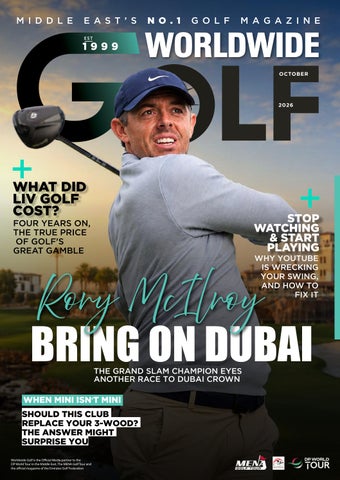
M I D D L E
E A S T ’ S
N O . 1
G O L F
M A G A Z I N E
EST
1999 OCTOBER
2026
WHAT DID LIV GOLF COST?
STOP WATCHING & START PLAYING
FOUR YEARS ON, THE TRUE PRICE OF GOLF'S GREAT GAMBLE
WHY YOUTUBE IS WRECKING YOUR SWING, AND HOW TO FIX IT
Rory McIlroy
BRING ON DUBAI THE GRAND SLAM CHAMPION EYES ANOTHER RACE TO DUBAI CROWN
WHEN MINI ISN›T MINI SHOULD THIS CLUB REPLACE YOUR 3-WOOD? THE ANSWER MIGHT SURPRISE YOU Worldwide Golf is the Official Media partner to the DP World Tour in the Middle East, The MENA Golf Tour and the official magazine of the Emirates Golf Federation
Not to be used in conjunction with other promotions/discounts.
DISTANCE
YOURSELF
VO ICE OF THE TOUR
WHY OUR FUTURE IS MORE GLOBAL THAN EVER Photography: Getty Images
By
Ben Cowan,
Chief Tournament & Operations Officer, DP World Tour
Why Our Future Is More Global Than Ever
I
n a world where sports leagues and tours increasingly compete for attention, talent and investment, differentiation has never been more important. For the DP World Tour, that differentiation is simple: we are golf’s global Tour. No other men’s professional golf tour takes the game to as many countries, cultures and communities as the DP World Tour. Our recently unveiled 2027 schedule, with a minimum of 42 tournaments in 24 countries, reflects the reality of modern golf: a sport with global talent, global fans and global opportunities. That is something we are incredibly proud of, and something we believe has never been more valuable for players, partners and spectators alike. National pride One of the most exciting aspects of our 2027 schedule is our continued emphasis on National Opens, something that has been a staple since our Tour originated over 50 years ago. These tournaments occupy a special place in golf, and also in the respective countries themselves, hence the reason we value them so highly. Whether it is local fans supporting home-grown talent, emerging stars taking their first steps on a global stage, or established names trying to replicate iconic past champions – they create a special connection that is unique within professional golf. That is why it is so exciting to welcome back tournaments such as the Deutsche Bank Singapore Open and the Open de Portugal, while continuing to strengthen many of the established National Opens that are already cornerstones of our schedule. In total, there will be at least 17 National Opens on the DP World Tour in 2027. Stronger together The catalyst for several of these additions is the partnership we enjoy with both the Asian Tour and the PGA Tour. Together, we are creating new pathways for players, new
8
commercial opportunities for tournaments and, most importantly, a stronger ecosystem for professional golf across Asia and the world. In particular, I congratulate Asian Tour CEO Cho Minn Thant for the collaboration he has shown with us at the DP World Tour in recent months to help make this a reality. The return of the Deutsche Bank Singapore Open next year as a co-sanctioned event on the DP World Tour and Asian Tour is a perfect example. It is one of Asia’s most prestigious National Opens and an event with deep heritage that stretches back to 1961. Bringing it back onto the DP World Tour schedule for the first time since 2012 demonstrates our commitment to showcasing world-class golf in every corner of the globe. Additionally, with an organisation of Deutsche Bank’s stature joining as title partner, the tournament has an exceptionally bright future. Seizing the moment As the global calendar evolves, every Tour must think carefully about where it can create the most relevance and impact. The revised PGA Tour structure for 2028, with a “Championship” and “Challenger” series running from February to August for example, creates a clear opportunity for us to further elevate many of our biggest events from September through January. The recent BMW PGA Championship at Wentworth illustrated that potential perfectly. It delivered high drama, international star power, record crowds and a champion in American J.J. Spaun who was embraced by fans throughout the week. Ultimately, creating moments that matter is the philosophy that underpins everything we do. We want to provide opportunities for players from every continent. We want to take world-class golf to both established and emerging markets. And we want fans to see our sport played on a diverse range of courses around the world. Our 2027 schedule is another important step on that journey.
Contents O C T O B E R
24 MCILROY BACKS GULF FINALE Rory McIlroy dismisses Gulf concerns as he targets a record-equalling eighth Race to Dubai title in Abu Dhabi and Dubai.
17 PETE COWEN MENA Golf Tour opens new doors, Koepka won’t slow down, Abu Dhabi F1 gets the green light, and Rotherham finally needs a hosepipe.
28
18 KOREA’S TOURNAMENT TEST Ireland’s iconic links provides a Woo Jeong Hills combines Dye design, demanding terrain and rich tournament history as Asia’s finest return for the $4 million Genesis Championship.
20 PATHWAY TO THE TOUR EGF’s European Tour partnership gives UAE golfers international starts, vital experience and a pathway towards competing on the DP World Tour.
23 GULF TAKES CENTRE STAGE Six GCC tournaments headline the 2027 DP World Tour schedule, including four consecutive events and the season-ending UAE Play-Offs.
28 WHAT DID LIV COST? LIV Golf promised to revolutionise the professional game, but four years on, questions remain over its impact on relevance and legacy.
32 FROM REBELS TO GENTLEMEN From banned Scottish pastime to global symbol of prestige, golf’s evolution reveals a game shaped by etiquette, exclusivity, integrity and belonging.
20
ISSUE No.307 OCTOBER 2026 • Published in Dubai by: ProGraphix • PO Box 24677 • Dubai, UAE (Tel) +9714 340 3785 Publisher: Alex Gallemore • Production/Design: Contactless Media Ltd • Editorial Panel: Alex Gallemore, Pete Cowen, Richard Bevan, Niamh McNamara Alex Leyno, • Photography: Getty Images, Alex Leyno • October 2009 SSN 1- 46805671 • Approval UAE National Media Council: MLN:8328516/MF02-3471314 Trade License No. 123127 PROGRAFIX ADVERTISING • Worldwide Golf specifies that post-press changes may occur to any information given in this publication and takes no responsibility for goods or services advertised.
12
DUBAI HILLS GOLF CLUB | DUBAI
SAVED THIS YEAR
AED 7,600*
THE TROON EXECUTIVE CARD EXCELLENCE IN EVERY ROUND
• Special Green Fee Rate: minimum 15% saving off BAR** • Guest Rates • 7-Day Booking Window • Savings Tracker In App
• Event & Clinic Invites • Discounts on F&B and Merchandise*** • 12 Month Validity
Terms and conditions apply. Valid at participating Troon locations. Card is valid for 12 months from the date of purchase. * Savings amount is based on the average savings on green fees, by the top ten golfers from January to June 2026 ** Minimum 15% saving valid on 18 holes only until 31st December 2026. ***Discount on F&B and Merchandise at participating Restaurants and Golf Shops Terms and conditions can be found at - https://troon.com/card/troon-executive-card
2026 TICKETS
ON SALE NOW
05 – 08 N OVE MB E R 2026 | YA S LINKS, ABU DHAB I
Contents O C T O B E R
42
WELCOME TO GOLF SCIENCE
We have become obsessed with data, technology and optimisation, but sometimes improving still comes down to simply hitting the bloody thing.
36
40
Michael Lane explains why golfers consume too much swing advice, chase perfect numbers and should focus instead on simple, effective improvement.
Stephen Deane reveals how controlling the club’s balance point can improve swing plane, sharpen transition and eliminate the dreaded over-the-top move.
46
54
Mini drivers are getting bigger, more forgiving and increasingly popular on Tour, creating a compelling new option between driver and 3-wood.
Former professional Ollie Ross reveals how Dubai has transformed his business, family life and his son Oscar’s rapidly developing golf journey.
50
58
GOLF’S YOUTUBE PROBLEM
FIND YOUR SWING BALANCE
WHEN MINI ISN’T MINI
GOLF, BUSINESS, FAMILY, DUBAI
FROM BEGINNER TO SEVEN Ilya Stroyev discovered golf just four years ago. Now a seven-handicapper, the Dubai businessman has scratch firmly in his sights.
15
GOLF’S ALTERNATIVE BUCKET LIST
From midnight golf in Norway to an 850-mile Australian round, discover seven of the strangest places on Earth to tee it up.
PETE COWEN
THE OFFICIAL COLUMN
Photography: Getty Images
IT COMES FROM WITHIN For the best players in the world, you can hit the ball as well as you like, but if the putter goes cold you’re going to struggle. Wentworth was another reminder of how much putting comes down to confidence, and why sometimes you have to find the answer yourself. The BMW PGA Championship at Wentworth was a really good tournament. The scoring was fairly low because the course was soft and there wasn’t much wind. At times it was almost like playing darts. The greens were a little tricky after the dry summer we’ve had, but overall the course was in great condition. What surprised me was the number of top players who missed the cut. Some very good players struggled around there. Wentworth is a good golf course, so if you’ve got the odd wild shot in your bag you’re going to find it tough. But if you’re not putting well, you’ll struggle anyway. With these players, a lot of the time it comes down to the short stick. Take Brooks Koepka, who missed the cut. If he starts putting well, he’ll be fine. It’s as simple as that. The difficult part is getting that confidence back when somebody of his ability starts struggling on the greens. Brooks is a five-time Major champion. If I asked him who told him how to putt when he had a sixfooter to win a US Open or a PGA Championship, the answer would be nobody. That comes from within, and that’s the important part. Most of it is confidence from within. Of course, you can go and see a putting coach.
Scottie Scheffler has worked with Phil Kenyon, and Phil has done a very good job with him. Sometimes players need that technical input. But there’s the mental side too, and often you need a bit of both. WHEN A FOUR-FOOTER BECOMES A PROBLEM It isn’t a case of having one good tournament and suddenly everything is fixed. If you start missing four-footers on a regular basis, it really gets into your psyche. Anybody can miss a four-footer. That’s golf. From eight feet you’re only going to hole a certain percentage anyway, but as you get closer the expectation changes. From six feet a top player expects to hole a very high percentage, from five feet even more, and from three feet virtually everything. But virtually everything still isn’t everything. There’s always a miss in there. For me, five feet and in is where you really see it when somebody has lost a bit of confidence. They expect to hole those putts, so when they start missing them it becomes difficult. That doesn’t mean short putting is the only statistic that matters. Look at Jordan Spieth when he was winning all those tournaments in 2015 and 2016. His numbers from 20 or 25 feet were ridiculous, and that’s one of the reasons he won so much. You watched him putt and it looked like he was going to hole everything. His quality of strike with the putter during that period was unbelievable, and his distance control was magnificent. For amateurs who struggle with their putting, I’d
17
keep it simple. Quality of strike is the key. If you’re not striking the ball properly with the putter, you’re going to have problems. After that, start line is everything. Can you start the ball on the line you’ve chosen? If you can’t, you’re going to struggle whether you’re three, four or five feet away. People make putting very complicated, but you have to be able to strike the ball properly and start it where you’re aiming. That’s the starting point. GOOD TO SEE THE TOUR BACK IN THE REGION It was also good to see the HotelPlanner Tour back in the region, playing in Al Ain. I played in the first Dubai Desert Classic, and the support for European professional golf here has never wavered since. Even when times have been difficult, the tournaments have carried on. Hopefully that continues as we finish the year with the big events in Abu Dhabi and Dubai. Whether I’m working with a Tour player or a club golfer at my academies in Dubai, it has always felt like a home from home. With the tournaments coming back, it won’t be long before we’re back to the hustle and bustle that makes the UAE so appealing to everyone.
Pete Cowen
Master PGA Professional
GEAR
COURSE
Photography: Getty Images
the
COUR WOO JEONG HILLS COUNTRY CLUB
F
ew courses in Asia have as much tournament history as Woo Jeong Hills. It opened in 1993, around 90 minutes south of Seoul. Perry Dye, son of Pete Dye, brought the family’s bold American tournament style to Korea, and the course was hailed as the country’s first authentic Westernstyle layout. It became home to the Korea Open in 2003. Past winners include John Daly, Vijay Singh, Y.E. Yang and a young Rickie Fowler, who won his first professional title here in 2011. This is a hilly, demanding course. Sloping greens and constant uphill and downhill lies make judging
distance difficult. The rough punishes stray drives, so hitting fairways is essential. The signature parthree 13th plays over water at up to 212 yards, and it famously ended Ernie Els’s challenge in 2004. In 2025, Dye Designs Group rebuilt all 18 greens, updating their size, contours and drainage. From 22 to 25 October, the par-71, 7,367-yard course hosts its second Genesis Championship. This tenth edition carries a US$4 million purse and is cosanctioned by the DP World Tour and the KPGA Tour. It is the last regular-season event before the Play-Offs. Last year, Lee Jung-hwan won here at 11 under par.
18
RSE
19
FEATURES
TRADING PLACES
Photography: Getty Images
TRADING PLACES
Ahmad Skaik on the federation arrangement that has sent 25 UAE players to 16 countries this year alone, and what those starts have taught him.
I
Ahmed Al Musharekh
n 2022 the Emirates Golf Federation and the European Tour group signed a partnership that runs until at least 2031, with a clear aim: to give UAE players regular access to tournament golf at the highest level, at home and abroad, and eventually to see an Emirati competing on the DP World Tour. From 2023 that the hosting of HotelPlanner Tour events every year in the country, with 30 places in each field allocated to the EGF. The Abu Dhabi Challenge, played for the third time recently at Al Ain Equestrian, Shooting & Golf Club, is the visible half of the arrangement. The less visible half is the more interesting element of the arrangement and the one which arguably benefits the UAE’s emerging talent more. The EGF swaps many of its places with federations in countries the HotelPlanner Tour visits. For example, a Czech, a Frenchman or an Italian tees it up in Al Ain, and in return an EGF player gets a start in that federation’s home event. This year alone, 25 different UAE players have competed in HotelPlanner Tour events across 16 countries as a result. For Ahmad Skaik, those starts have been the making of him. “It’s a great opportunity for all of us,” he says. “It’s always very good for us to have these spots, and it’s good
to travel and play different courses, because every course in Europe is different – the type of grass, the weather conditions. Most of the courses are very tight, so it’s good for us to challenge ourselves in those conditions.” Anyone who has only ever played desert golf will recognise the adjustment he’s describing. Wide corridors and firm, fast ground give way to tree-lined fairways, damp air and rough that punishes rather than nudges. Among those to have taken up starts abroad are EGF players Rayan Ahmed, winner of the Order of Merit, and Kayun Mudadana, the 2025 UAE Cup champion. Skaik has taken more from it than a set of travel stories. “It’s been very important for me. I’ve played many HotelPlanner Tour events. I did well in some and not so well in others, but the big part is I realised what I need to work on and what I need to improve to be able to compete with these guys.” That’s the unglamorous half of a development pathway, and it’s the half that matters. Players don’t improve by winning abroad. They improve by finding out where they fall short of people who do this for a living, then going home and working on it. The evidence that it works sits in Skaik’s own record. At the 2025 GCC Golf Championship he claimed individual and team gold for the UAE,
25 16
P L AY E R S
COUNTRIES
HOTELPLANNER TOUR
UAE
EUROPE
his 18-under-par total of 270 the lowest in the championship’s history. Later that year he became the first Emirati to make the cut in a European Tour group event, at the UAE Challenge at Al Zorah Golf & Yacht Club. In November he turned professional, at the MENA Golf Tour’s season opener in Portugal. The home weeks have their own value. “The more big events we have, the better for us and the more opportunities for our players,” says Skaik. He is one of two Emiratis who teed it up in the 2026 field at Al Ain, alongside one of Emirati golf’s elder statesman Ahmed Al Musharekh, who sees the wider effect the partnership is starting to have. “I think the partnership between the EGF and the European Tour group is a very positive thing for young Emirati golfers,” says Al
“
“
UAE
Musharekh. “It’s good to see the support they are bringing and hopefully that will encourage more Emirati golfers to want to play at a professional level.” General Abdullah Al Hashmi, President of the Emirates Golf Federation, puts it plainly. “By exchanging places with other federations, we are opening doors for our players at HotelPlanner Tour events around the world, which is a key part of their development. Ahmad’s journey from the National Team to the professional game shows what is possible when players are given these opportunities.” Skaik has watched the standard climb around him. “The level here is growing. We have many players who are really good or getting better, and it’s happening quicker than in the past few years.”
It’s good to see the support they are bringing and hopefully that will encourage more Emirati golfers to want to play at a professional level.” Ahmad Skaik
The more big events we have, the better for us and the more opportunities for our players,”
His advice to whoever comes next is direct enough. “Always work hard, and if your goal is to become a professional golfer, then do whatever it takes to make that happen. Keep at it and believe in yourself.” It would be easy enough for the EGF to fill all thirty of its places with UAE players every year and point to the numbers. The strategy is smarter than that. As Skaik says, every course and every country brings its own challenge, and the quickest way to develop a player is to put him in front of as many of them as possible. Twenty-five players in sixteen countries in a single season is what that looks like in practice.
FEATURES
GULF TO TEE OFF 2027
Photography: Getty Images
GULF TO TEE OFF 2027 IN STYLE THE GCC WILL STAGE SIX DP WORLD TOUR EVENTS NEXT YEAR – FOUR OF THEM IN CONSECUTIVE WEEKS TO OPEN THE SEASON – WHILE THE RACE TO DUBAI WILL ONCE AGAIN BE DECIDED IN THE UAE.
G
olf fans in the region can look forward to a month-long feast of tour golf at the start of 2027. The DP World Tour’s 2027 global schedule, unveiled in September, confirms that the GCC will host six tournaments: four back-to-back events in January and February, and two more in November when the season reaches its conclusion.
A TEAM AFFAIR TO START The Gulf swing opens with the Team Cup at Abu Dhabi Golf Resort from 15–17 January, bringing team match play to the very start of the calendar year. The Tour then heads to Emirates Golf Club for the 38th Hero Dubai Desert Classic from 21–24 January, the first Rolex Series event of 2027. The following week, the action moves to Royal Golf Club for the Bapco Energies Bahrain Championship (28–31 January), before the Qatar Masters at Doha Golf Club (3–6 February) completes the Middle East leg of the International Swing. A UAE FINALE The season then returns to the UAE for the DP World Tour Play-Offs. They begin with the Abu Dhabi Championship at Yas Links from 4–7 November and conclude with the DP World Tour Championship, Dubai, on the Earth Course at Jumeirah Golf Estates from 11–14 November, where the Race to Dubai will be decided. With the Hero Dubai Desert Classic, the Abu Dhabi Championship and the DP World Tour Championship all carrying Rolex Series status, three of the Tour’s five premium events will be staged in the UAE. The other two are the Genesis Scottish Open (8–11 July) and the BMW PGA Championship at Wentworth Club (23–26 September).
TOURNAMENT Team Cup
OLD FAVOURITES RETURN Across the wider schedule, at least 42 tournaments in 24 countries will count towards the Race to Dubai. Three historic events are back on the calendar: the Hong Kong Open, the Deutsche Bank Singapore Open and the Open de Portugal|Cascais-Lisboa. The Hong Kong and Singapore events will be cosanctioned with the Asian Tour as part of the new tri-partite partnership with the PGA Tour, agreed in July. The 2027 Ryder Cup, at Adare Manor in Ireland from 17–19 September, has also prompted new dates for the Amgen Irish Open, the FedEx Open de France and the BMW PGA Championship. Guy Kinnings, the DP World Tour’s Chief Executive, said: “The return of historic national Opens in Singapore and Portugal means 17 prestigious national Opens will feature on our 2027 global schedule, along with other popular international championships and events played around the world. “As Golf’s Global Tour, we are proud to provide this unique platform for our members to showcase their talents as they compete to put their own name alongside some of the iconic champions of our sport. It is a schedule that offers incredible international opportunities for existing and new players and one which will appeal to our fans globally.”
VENUE
DATES
Abu Dhabi Golf Resort
15–17 January
Hero Dubai Desert Classic*
Emirates Golf Club
21–24 January
Bapco Energies Bahrain Championship
Royal Golf Club
28–31 January
Qatar Masters
Doha Golf Club
3–6 February
Yas Links
4–7 November
Jumeirah Golf Estates (Earth Course)
11–14 November
Abu Dhabi Championship* DP World Tour Championship, Dubai* * Rolex Series event
23
FEATURES
RORY MCILROY
Photography: Getty Images
Rory
McIlroy’s Home From Home
Settled into a new house beside Wentworth and ahead of the DP World Tour’s finale, Rory McIlroy has made his own position clear: he loves the Middle East, and he cannot wait to get back.
24
25
FEATURES
RORY MCILROY
Photography: Getty Images
W
ith the DP World Tour season set to end in Abu Dhabi and Dubai this November, a few players have voiced quiet personal reservations about traveling given the wider regional situation. Rory McIlroy has none. Speaking to reporters at the BMW PGA Championship, where he finished tied for second, McIlroy was asked directly whether he shared those concerns. His answer was short. “Not for me,” he said.
“Not For Me”
He did not stop there. “I love the Middle East,” McIlroy added. “I have a lot of friends there, and I’m looking forward to going back for sure.” Asked to explain his reasoning further, he told reporters: “If the local governments feel like it’s safe to put on these events, they are not going to put their citizens or people visiting in harm’s way, I imagine.” He was careful to add that this is only his personal opinion and not a call for him to make on the tour’s behalf. A small number of players have taken a more cautious personal stance. Open champion Ryan Fox said he has some concerns but trusts the tour’s due diligence on the matter. McIlroy’s own view stands apart from that caution, and it comes from someone who knows the region well. It amounts to one of the sport’s biggest names publicly backing the two events that close out the golf calendar in the Gulf, and doing so with genuine affection for the place rather than obligation.
Why It Matters to His Season
There is also plenty riding on it for McIlroy personally. He is chasing an eighth Race to Dubai title, which would tie Colin Montgomerie’s record. “I can’t believe I’m sitting here with seven,” McIlroy said in his pre tournament press conference, reflecting on how far his career has come since his first title. He trails Patrick Reed in the season standings, though his tied second finish at Wentworth cut the gap to around 308 points after Reed withdrew midweek with a wrist injury. McIlroy wished Reed well, saying he hoped the American would be fit enough to “make it a good battle.” Before the Gulf finale, McIlroy plays
26
the DP World India Championship in the middle of October, and he has already confirmed his intention to keep pushing for the title all the way through the Abu Dhabi Championship at Yas Links and the season ending DP World Tour Championship at Jumeirah Golf Estates. Skipping those events was never really an option for him. The Gulf is where his year traditionally begins as well as ends. He is a regular at the Hero Dubai Desert Classic, where he has claimed the Dallah Trophy four times, and finished in the top five at the Dubai Invitational in January, extending a run of strong results in the region that stretches back years. With history on the line, McIlroy heads to Abu Dhabi and Dubai this November with genuine enthusiasm rather than reluctance, chasing a record that would put him level with Montgomerie and cement his standing as one of the tour’s era defining champions.
The Game Behind the Headline
McIlroy’s comfort with the Gulf comes at a moment when his form is trending the right way, even if the results have not always matched the golf. At Wentworth he opened with a 69, then a 67 on Friday, before a Saturday charge that ended with a four iron to two feet and an eagle on the final hole. “Harry joked to me that finally we got a good number,” McIlroy said of his caddie Harry Diamond, going to bed two shots off the lead. Sunday brought moments of real quality mixed with a putter that would not cooperate. Birdie looks from five, nine, twelve and fifteen feet slid by on the front nine, but McIlroy fought back with a recovery around a cluster of trees at the twelfth and birdies at the fourteenth and seventeenth to briefly share the lead. He closed with a 68 and a total of fifteen under, two behind champion J.J. Spaun, in a share of second with Manuel Elvira, Aaron Rai and Adam Scott. “I wish I had some of those putts back,” McIlroy admitted afterwards, “but I hit the best I hit it during the course of the week and am encouraged with the signs that my game is going.” It is the clearest form check since his Masters defence in April, a result that gave him a sixth major title. In between, a quieter stretch at the PGA Championship, a stuck in neutral week at Royal Birkdale where he finished one under, and
a scruffy tied for forty first while defending his Irish Open title had raised questions about where his game stood. Wentworth answered plenty of them, even without the trophy, and gave him a platform to build from heading into the closing months of the season.
A Home Advantage
Part of the story behind that week is one Worldwide Golf reported first. Back in May 2025, McIlroy confirmed to Telegraph Sport that he, his wife Erica and daughter Poppy would relocate from Florida to a newly built home on the Wentworth Estate once the U.S. Open was finished, having bought the plot in 2023. “Straight after Augusta we traveled over to see the house,” he told the paper at the time. Sixteen months on, that new home sits close enough to the club that his walk to the first tee at the BMW PGA Championship is barely longer than his walk to the kitchen. His relationship with Wentworth goes back further still. “I have so many great memories of Wentworth in general,” McIlroy told reporters this month, recalling a first visit as a ten year old to watch the World Match Play during half term. He won the club’s flagship event in 2014, the same summer he claimed the Open and the PGA Championship, and has finished runner up there three times since. He signed for a twelve under 60 in this year’s pro am, the kind of score that suggests the new commute is already paying off. He is also in good company on the estate, with fellow tour regulars Justin Rose and Ernie Els said to live nearby, part of what has long made Wentworth one of the most storied addresses in golf.
The Bottom Line
The story here is less about a runner up finish at Wentworth and more about what McIlroy said standing on English soil about a region he calls home for part of every season. He is settled in Surrey, striking the ball as well as he has all year, chasing a record eighth Race to Dubai title, and heading toward Abu Dhabi and Dubai this November with genuine enthusiasm rather than hesitation. For a season that still has its biggest events to come in the Gulf, that is exactly the news his fans there will want to hear.
27
FEATURES LIV GOLF
Photography: Getty Images
LIV Golf:
The Money Was Huge, But What Did It Cost the Game? LIV promised to revolutionise professional golf. Four years on, as the breakaway circuit enters bankruptcy restructuring, I ask what it achieved, and what the game lost along the way. By Alex Gallemore
28
I
have worked in golf for nearly three decades, and in that time I have watched the professional game transform. Prize money has soared, players have become athletes, television coverage has improved beyond recognition, and social media has created opportunities nobody imagined when Worldwide Golf launched in 1999. Change is usually healthy. But not all change is progress,
and that is ultimately how I feel about LIV Golf. When it arrived in 2022, LIV promised to shake up an order it claimed had grown stale: team golf, shotgun starts, 54-hole events, music on the course and, above all, enormous sums of money. It certainly shook things up. What I struggle to identify is how much of that disruption made golf better. Four years on, LIV has filed for Chapter 11 bankruptcy protection in the United States.
29
The filing estimates liabilities of between $500 million and $1 billion against assets of between $100 million and $500 million, and several of its best-known players are listed among its creditors. LIV insists this is a restructuring rather than an ending, and speaks of a smaller, more sustainable “LIV Golf 2.0”. Whatever emerges, this is a fair moment to assess the experiment. For me, the biggest casualty has been something money cannot easily buy back: legacy.
FEATURES LIV GOLF
Photography: Getty Images
EUROPE LOST PART OF ITS FAMILY The clearest examples are Lee Westwood and Ian Poulter, both of whom I watched become icons of European golf. Westwood reached World No.1, won around the globe and played in 11 Ryder Cups. Poulter became something rarer, a golfer whose Ryder Cup reputation transcended his individual record. Put him in a European shirt and something changed. The eyes widened, the chest came out, the crowd responded. Players like these might have been expected to stay central to European golf long after their best years: as captains and vice-captains, as
mentors, as elder statesmen at DP World Tour events. Instead, LIV separated them from the ecosystem that built those reputations. Both resigned their DP World Tour memberships amid the dispute over sanctions, which made them ineligible for Ryder Cup involvement under the regulations at the time. Rory McIlroy later argued they had become “too far removed” from the current generation to be realistic captaincy candidates.
I find that sad, and not because I think either man was wrong to maximise his earnings. Careers are finite, and the figures on offer were extraordinary. But decisions have consequences, and I wonder whether part of the price was a slice of long-term legacy. Twenty years from now, fans won’t remember the money first. They will remember Poulter’s Ryder Cup eyes, Westwood going toe to toe with Tiger Woods, and Sunday afternoons in blue. Yet the relationship with the Tour and the team that helped create those memories was fractured. That is one of LIV’s great losses.
consecutive missed cuts in the Majors dating back to 2024. It was a timely reminder that the talent is still there. Whether one good week in a Major marks a genuine return remains to be seen, but playing well and staying relevant are not the same thing, and Smith has managed more of the former than the latter. Jon Rahm is more complicated. Like Smith, he is a Major champion (two of them, in fact), and he remains an exceptional player, so it would be unfair to suggest otherwise. But he joined as the reigning
Masters champion and one of the two or three biggest draws in the sport, and he has since been absent from the PGA Tour’s weekly stage, with LIV events still carrying no Official World Golf Ranking points. For a player of his calibre, the Majors have become almost the only occasions on which the wider audience sees him. That made last week’s BMW PGA Championship at Wentworth all the more uncomfortable to watch. Rahm opened with a 6-over 78, tying his worst round on the DP World Tour, and followed it with a 77. He
THE CONTRAST: LUKE DONALD Luke Donald could easily have been remembered principally as an outstanding player and former World No.1. Instead, he has written another chapter. Europe won convincingly in Rome in 2023 under his captaincy. He returned for Bethpage in 2025, something modern European captains are rarely asked to do, and Europe won again. Now he has been named captain for a third successive Ryder Cup, at Adare Manor in 2027, the first European captain since Tony Jacklin to lead the team three times in a row, with the chance to become the first to win three consecutive matches. Donald is building a legacy that may eventually outstrip the one he created with a club in his hands. That is what staying connected to the traditional game can offer. It isn’t just about this week’s prize fund; it’s about what comes next: captaincy, mentorship, administration, broadcasting, leadership. Golf careers can last a lifetime if you remain part of the game’s fabric, and I think some LIV players underestimated what they were leaving behind.
STARS HARDER TO FOLLOW Cameron Smith is a player I look at and wonder what might have been. When he won The Open at St Andrews in 2022, he was one of the hottest properties in golf, a Major champion at the peak of his powers. Since then he has drifted from the weekly conversation, and he missed the cut in all four Majors in 2025. But it would be unfair to write him off. In May he finished tied for seventh at the PGA Championship at Aronimink, his best Major result in nine starts and one that ended a run of six
30
missed the cut and finished last among the 140 players in the field. It was one dreadful week, and Rahm has not said that the turmoil around LIV affected
him, so I wouldn’t read too much into it; he did, after all, tie for second at the PGA Championship in May. But when a player of that quality finishes bottom of
the field at the DP World Tour’s flagship event, it is hard not to wonder. LIV paid handsomely for stars. What it struggled to manufacture was relevance. BRYSON PROVED SOMETHING DIFFERENT Bryson DeChambeau is LIV’s most interesting case, because he actually became more popular. But I don’t think LIV deserves most of the credit. His 2024 Major season was superb, culminating in a magnificent U.S. Open win at Pinehurst. At the same time, something else was happening: YouTube. Bryson understood before most elite golfers that modern fans don’t necessarily want polished press conferences. They want access. His Break 50 series showed his personality, and by August 2026 his channel had around 2.8 million subscribers. Ironically, the supposedly revolutionary league wasn’t what made one of its biggest stars feel revolutionary. YouTube did. And when did you last talk about something Bryson did in a regular LIV event? It also complicates my own argument. I’ve suggested that relevance and legacy come from staying inside golf’s traditional institutions: the Tours, the Ryder Cup, the Majors. Bryson has built a following that exists largely outside any tour, LIV included. Whether that adds up to legacy in the way Donald’s captaincy does, I’m genuinely unsure. But it’s a reminder that LIV’s real competitor for relevance was never just the PGA Tour. It was a phone screen.
YOU CAN’T FAST-TRACK HISTORY I never had a problem with LIV trying something different. Golf should experiment. The team concept had potential, and Australia showed LIV could create tremendous atmospheres in the right market. The problem was that the product never justified the investment. Crushers, Majesticks, Fireballs and RangeGoats were meant to become franchises with genuine fan loyalty, but loyalty can’t be manufactured in a boardroom. Manchester United, Real Madrid and the New York Yankees mean something because generations of supporters have lived their histories. Golf has that history too: Augusta, St Andrews, the Ryder Cup, the Claret Jug, Wentworth, Pebble Beach. LIV tried to buy history rather than build it. The bigger cost was to the conversation around the sport itself. For years it stopped being about golf and became about lawsuits, ranking points, suspensions, defections and eligibility. Fans picked sides, players who had spent decades as colleagues found themselves on opposite sides of a divide, and the Ryder Cup became tangled in eligibility arguments.
Money was at the centre of it. Figures that once sounded extraordinary (two million, ten million, fifty million dollars) stopped registering at all as reported contracts reached the hundreds of millions. Sport works because money is the reward for achievement: win the Major, change your life. LIV frequently reversed that, so the life-changing cheque came first and the tournament after. That alters the emotional contract between athlete and spectator. Fans need jeopardy. They need to believe winning matters. TO BE FAIR TO LIV None of this means LIV achieved nothing. It took elite golf to Australia, Saudi Arabia, Singapore, South Korea and other markets the established tours had rarely prioritised, and by most accounts the atmosphere at those events was genuinely good. It pushed the PGA Tour to confront how the game’s revenue reached the players who generated it, and the Signature Events and larger purses that followed were a direct response. If LIV re-emerges as a smaller, sustainable team circuit rather than a rival to the establishment, some of that
31
legacy could yet be positive. My argument isn’t that LIV brought nothing of value. It’s that the value it did bring came at a cost to things golf can’t easily rebuild, and I don’t think that trade was made with open eyes. SO WHAT WAS IT ALL FOR? LIV reportedly spent billions in its attempt to reshape professional golf. I hope the game learns from the past four years. It needed evolution rather than upheaval: better pathways for young professionals, more investment beneath the elite level, greater international opportunity, better storytelling, more innovation. Imagine what even a fraction of that capital and attention could have done for developmental tours, women’s golf, junior golf and grassroots facilities. That, I believe, is the opportunity missed. Perhaps that is the lesson LIV never truly understood. Money can buy golfers, tournaments and enormous prize funds. It can’t buy history, relevance or legacy. Ultimately, those are the things that make sport matter. Opinion: the views expressed are the author’s own and not those of the DP World Tour.
FEATURES
A REBEL’S GAME
Photography: Provided
A
Rebel’s Game
H O W G O L F B E C A M E A S P O RT FIT FOR KINGS Scotland banned golf for being far too popular, and then its own kings took it up. From royal patronage to Gilded Age country clubs and the resorts of the Gulf, this is how a rebel’s pastime became the one sport that wears its status, and its manners, on its sleeve.
32
33
FEATURES
A REBEL’S GAME
Photography: Provided
O
n March 6, 1457, Scotland banned golf for being too popular. The country needed accomplished archers to defend against the English, but instead of practising with their bows, the men were out on the links hitting balls with crooked sticks. Needless to say, the ban did not work. It was repeated in 1471, and again in 1491. For more than thirty years the government told Scotland to stop playing golf, and Scotland kept playing. Even in its earliest incarnation, golf was as deliciously addictive as it remains today. Then something extraordinary happened. The same Crown that banned it started to play it. In 1502, King James IV paid his bow-maker to make him a set of clubs, the first recorded purchase of golf equipment. Golf began as a mainstay of the common man, with no green fees, no dress code and no membership required. It was played by anyone who could find a stick, until royal patronage turned a rebel’s pastime into an aristocratic one. Fast forward five centuries and golf requires 150 acres, a collared shirt and four uninterrupted hours.
The Etiquette
When golf moved from common land to the royal realm, it acquired rules, and they have always been
as much about conduct as about play. The thirteen rules of 1744, written by the Gentlemen Golfers of Leith for their annual silver club competition, are the earliest written code in the sport, and they were drafted by gentlemen, for gentlemen. In 1754, the Society of St Andrews Golfers was founded by 22 noblemen and gentlemen, and in 1834 it received royal permission to become the Royal and Ancient Golf Club of St Andrews. Exclusivity had become institutionalised. Golf also acquired a dress code earlier than most sports. From knee-length breeches, long stockings and frock coats to tweed jackets, starched collars, knickerbockers and argyle socks, clothing was designed not to enhance performance but to cue belonging. Golf understood early that what you wore signalled your level of refinement, and it never unlearned the lesson. The tailor and the club secretary were, in effect, working the same door. The etiquette mirrors the integrity of the game itself. At club level there are no referees or umpires; golf is self-scoring. That is what makes it the ultimate test, because it measures composure as well as skill. It is one of very few sports where you call penalties on yourself, where you have four unbroken hours to be scrutinised, and where how you lose matters as much as whether you win. Golfers innately understand that the game is watching even when no one else is.
The Gate
Scotland gave golf its soul, but America gave it its business model. It was not until the late nineteenth century that golf gained international popularity, spreading through the rest of the United Kingdom, then to the British Empire and the United States. It arrived
34
in America in the middle of the Gilded Age, when a new elite of fabulously wealthy industrialists complained of having nowhere refined enough to spend their money. In 1894, five charter clubs formed the Amateur Golf Association of the United States, which would become the USGA: Newport, St Andrew’s in Westchester, Chicago, Shinnecock Hills and The Country Club in Brookline. They began as extensions of elite social clubs already devoted to other outdoor pursuits. No other game demanded as much space as golf, and American business acumen set that need for acreage against crowded industrial cities. Golf became a game for a select few who valued scarcity and ritual, and having the time to play was the greatest luxury of all. Everything
about joining a club whispered exclusivity: the application, the waiting list, the locker room. People were not paying to play golf; they were paying to belong. The model was refined on the California coast. Samuel F.B. Morse’s Del Monte Properties acquired the Monterey Peninsula land in the 1910s, and when Pebble Beach Golf Links opened in 1919, the course existed to sell the land around it. Under Morse, Pebble Beach became a renowned resort for the wealthy and well-connected. The fairway was the advertisement; the lot was the product. The Scots may have spawned the game, but the Americans made a business of exclusivity.
The Handshake
“
TOM MORRIS
You might as well praise me for not robbing banks. There is only one way to play this game.”
Luxury recognised itself in golf immediately, but it was prestige that made them inseparable. Every luxury house claims craftsmanship, heritage and attention to detail as its foundation. In golf those are prerequisites: the handfinished club, the century-old clubhouse, the green jacket. And self-scoring is the whole point: a celebration of honour over gamesmanship and accountability over excuses. Bobby Jones made the point at the 1925 US Open at Worcester. On the 11th hole, his ball moved in the rough as he addressed it, seen by no one but him. He called a one-stroke penalty on himself, and that stroke ultimately cost him the title when he lost a playoff by a single shot. When he was praised for it, he replied, “You might as well praise me for not robbing banks. There is only one way to play this game.” In any other sport that would be exceptional. In golf it is expected. At every turn golf has functioned as a mechanism for signalling status, consolidating elite networks and converting land into something more valuable than land. What began as luxury became prestige, and in golf they have been one and the same ever since.
35
The Export
Few places show that formula more clearly today than the Gulf. Golf arrived in the region late by Scottish standards: the Emirates Golf Club opened in Dubai in 1988 as the Middle East’s first grass course, and the Dubai Desert Classic followed in 1989, putting the region on the professional map. Since then, the desert has proved an unlikely but willing host. Fairways are irrigated into existence, clubhouses are built to impress, and the villas that frame the holes are sold on the promise of the view. The tailoring is different, but the logic is familiar: land, ritual and belonging, packaged as an experience. It is a model the region has embraced with distinctly modern ambition. Championship courses carry the names of players and architects who anchor a destination. Membership remains a form of belonging, but the door is wider now: academies, junior programmes, and a new generation of players who found the game far from its Scottish home. Intissàr Rich discovered golf little more than a decade ago and became the first Arab woman to win the African Championship. That is the real tailoring in the tailored game. Golf has always fitted itself to whoever wanted in: the Scottish crown, the Gilded Age industrialist, the resort developer, the aspiring junior. Each generation cut the cloth a little differently, but the pattern held: a code of conduct, a signal of belonging, and a promise that how you play, and how you carry yourself while playing, will be noticed. The rebels who defied a king’s ban in 1457 would hardly recognise the collared shirt and the four-hour round. But they would recognise the compulsion. And they would understand why, five centuries on, the game still asks its players to keep their own score, and to be honest about it when the only witness is themselves.
FEATURES
MICHAEL LANE
Photography: Alex Leyno
MICHAEL LANE ON GOLF’S YOUTUBE PROBLEM From a language barrier baptism in Vietnam to Director of Instruction at Trump International Dubai, Michael Lane has coached golfers across three continents. He talks to Worldwide Golf about simplifying the swing, the myths YouTube keeps selling amateurs, and why he’d still rather argue with his dad on the range than anyone else.
36
37
FEATURES
MICHAEL LANE
Photography: Alex Leyno
Manchester to Vietnam and now Dubai is quite a journey for a golf coach. How did that happen, and which move changed you most as a coach? It’s been quite a journey. To get to Vietnam, I was a young coach who wanted to explore the world and different cultures, so I applied to a few countries, mainly in Southeast Asia, and fortunately landed a role in Da Nang. It’s a great spot for golf, if anyone’s thinking of going.
actually making a movement. In the West, you tend to get bigger, stronger athletes who try to muscle the ball and don’t always have that same flexibility. So it’s often the same underlying problem, just showing up in different ways depending on the golfer.
That move is probably what changed me most as a coach. There was a big language barrier between myself and the students; I was often working through translators, so information was being passed down through multiple people. That forces you to keep things clear and precise rather than overly technical. You learn to focus on the key points without overcomplicating the lesson, while still keeping it effective.
It depends. Part of our job as coaches is to dive into a player’s whole game, not just their swing; sometimes we need to look at every aspect to work out where they’re actually losing shots. If it’s purely a swing issue, like a slice, a ball flight problem or a strike issue, we can usually spot it quickly. Getting to the bottom of what’s costing them shots on the course is harder: that takes players opening up, giving us the right information, and us knowing how to draw that out of them.
You’ve coached golfers in very different parts of the world. Are golfers’ problems actually universal, or do you notice different habits and attitudes depending on where you coach? The problems are universal, but the tendencies differ. In Asia, players tend to be really flexible (you see that in their rotation and body control), but that flexibility doesn’t always translate into control when they’re
When a new pupil walks onto your lesson tee, how quickly can you normally identify what’s really costing them shots?
What’s the biggest mistake amateur golfers make when they try to improve their swing? Taking in too much information. There’s a lot of good content out there on social media and YouTube, but not all of it applies to the individual student; I’ve had lessons that were really just about dispelling myths people have picked up online. It’s about sticking with
38
a coach you trust to put you on the right path, rather than spending hours filling up on content that might not be relevant to you. Do you think golfers are becoming too obsessed with TrackMan numbers, launch conditions and having a technically perfect swing? Some can be; I’ve been down that rabbit hole myself, trying to get everything perfect. But there’s no such
thing as perfect in golf. At the end of the day, it’s all about what the ball does: your ball flight and your strike. TrackMan is great and gives coaches real insight, but it has to translate to the golf course. You don’t create scores by TrackMan. What’s one piece of conventional golf instruction you don’t particularly agree with? There are a lot of fads out there. One I don’t agree with is the idea that more rotation always means more clubhead speed; that gets talked about a lot online. If there’s a big disconnect between the body and the arms, it won’t create much speed. I see a lot of players spin out of the shot, especially faster players, and that’s a real issue. Everything has to match up in the swing; it’s about sequencing, not just turning as hard and fast as possible.
If you had an 18 handicap golfer for just one hour and your reputation depended on knocking shots off their game, what would you work on first? The easy answer would be putting, but for the long term, I’d focus on getting the driver on the fairway more often than not. Get that sorted, and everything else follows from there.
What separates the really talented juniors you’ve coached from the ones who actually go on to become successful players? The good ones are always practising, and they have the ability to score. They also stay focused on what they’re actually meant to be working on, rather than chasing something in the swing that looks better or produces better TrackMan numbers but isn’t relevant to them. Stick to the path with your coach; that’s how you see players improve. Scottie Scheffler is a good example: he’s had the same coach his whole life and stuck to the same principles. Stay on the same path while it’s working; only look elsewhere if it stops. Dubai golfers have fantastic facilities and year round access to coaching. What weaknesses do you repeatedly see in golfers here despite all those advantages? The courses here tend to be quite similar; quite American in style, so if you hit it high and bomb it long, you can usually do well, at least until the wind picks up. In England, you often have to play the ball a lot lower. So I’d say trajectory and shot shaping is something we don’t see enough of here; it’s become a bit of a lost art, and it’s pretty cool when someone can flight it low and hit a stinger when the situation calls for it. As Director of Instruction at Trump International Dubai, what do you want the academy to become known for, rather than simply being another place to have a golf lesson?
39
Quality. We’ve got a small team here (just four of us) compared to some of the other academies, but I’m confident every one of them delivers class coaching every time they step out onto the lesson tee. We’ve just revamped all the studios with new cameras and projectors, and we’ll keep adding to that technology so everyone gets a genuinely high quality lesson experience when they come to Trump. If you could spend a day coaching any player in the world, tour professional or otherwise, who would you choose, and what would you want to work on with them? My dad is the first person who comes to mind, purely for the fun of it; we’ve had plenty of arguments on the tee over the years about whatever idea he’s picked up from YouTube that week. But if we’re talking tour professionals, I’d love to spend a day coaching, or just watching, Rory McIlroy, picking his brain on how he plays different shots and his ideas on the swing. Give us one thing a golfer reading this can do the next time they practise that will genuinely make their practice more effective. Once you’ve had a lesson and know what you’re working on, stick to those swing thoughts on the range; and there should only be a couple of them. Don’t assume you’ve cracked it after five good shots and go looking for something else to fix. Stay with what you and your coach agreed on, get consistent with it, and only move on to the next stage once you’re ready.
INSTRUCTION
THE BALANCE DRILL
Photography: Alex Leyno
THE BALANCE DRILL
Every club in your bag has a balance point. It’s a simple piece of physics that most golfers never think about, yet it can be one of the most useful tools you have for moving the club correctly. Learn how to control that one point, lifting it as you coil and softly lowering it as you unwind, and you’ll find it much easier to keep the club on plane and stop coming over the top.
STEP 1 : Find the balance point 1
Take a mid-iron and rest the shaft across your index finger. Slide it back and forth until the club sits perfectly level without tipping either way. That’s the balance point. You’ll notice it sits much further down the shaft than you might expect.
Picture 1: Stephen finds the club’s balance point by resting the shaft across his index finger until it sits perfectly level.
Mark the spot on the shaft with a marker pen so you can see it clearly as you work through the drill. For an even clearer reference, place a training aid over your mark. It makes the balance point easy to see as it lifts and lowers during the swing. Picture 2: Stephen marks the club’s balance point with a marker pen, then places one of his training aids over the mark as a visual reference tool.
2
STEP 2: Build the arrow Lay three alignment sticks on the grass to form an arrow. One stick points 45 degrees in front of you and another 45 degrees behind you, forming the head of the arrow. A third stick runs down the middle to create the stem. This arrow is your reference for the rest of the drill. The key checkpoint comes in the downswing, when the balance point of the club should stay behind the stem of the arrow. Picture 3: Stephen builds the 45-degree arrow: one alignment stick angled 45 degrees in front, one 45 degrees behind, and a third running through the middle to form the stem.
3
40
STEP 3: Lift the balance point as you coil Before taking your normal grip, place your lead hand on the grip as usual and put one finger of your trail hand underneath the club at the balance point. Now make a backswing by coiling your body,
using that trail finger to lift the balance point as you coil. This gives you the correct sensation of the club’s weight being lifted as the body coils. Pay attention to what the balance point is doing.
You’re not pushing it laterally across your body, and you’re not coiling it around behind you. You’re simply lifting it as your body coils. Repeat this several times until the lifting sensation feels natural.
4 5
Picture 4: Stephen places a finger of his trail hand under the balance point while holding the grip with his lead hand, ready to lift the balance point as he coils his body to the top.
Picture 5: From the front and from behind, Stephen lifts the balance point with his trail finger as his body coils to the top. STEP 4: Let the balance point drop in transition This is the most important part of the drill. As you start the downswing, allow the balance point to lower, dropping down behind the stem of the arrow, before you unwind into impact. Let it fall softly rather than forcing it. This small move keeps the club on plane and prevents the classic over-the-top move that sends the club outside the line and causes pulls and slices. There’s a balance to strike here, and it’s fitting for a drill with this name. You don’t want the balance point dropping too far behind you, because that leaves the club stuck and gets you trapped, often leading to blocks and hooks. You simply want to let it drop down as you unwind. Behind the stem, not way behind you.
6
Picture 6: In transition, Stephen softly lowers the balance point so it drops behind the stem of the arrow before he unwinds into impact.
STEP 5: Take your normal grip Once you have the feel with your trail finger under the balance point, take your normal grip and make full swings using the same sequence. Feel the balance point lift as you coil to the top, then feel it drop behind the stem of the arrow as you begin to unwind. Rehearse the motion slowly at first, then add speed and start hitting balls.
THE KEY THOUGHT If you remember one thing from this article, make it this: lift the balance point as you coil to the top, then softly lower it as you unwind through to impact. It’s a simple image, but it organises the whole swing. The club goes up with your coil, drops into position in transition, and arrives at impact on plane without your hands and arms having to rescue it. Every club has a balance point. Learn to control it, and you’ll move the club better and improve your game.
41
Written by
Stephen Deane
Viya Head International Development Coach
Stephen is an ambassador for Viya and coaches at their wonderful array of facilities while in Dubai. He also spends a proportion of his time developing professionals, amateurs and VIPs internationally.
FEATURES
THE RISE OF THE GOLF NERD
Photography: Provided
42
The
Rise of the
Golf Nerd How did hitting a little white ball become so complicated? 43
FEATURES
THE RISE OF THE GOLF NERD
Photography: Provided
T here was a time when golfers worried about little more than keeping their head down, buying a new driver and remembering whether they had enough balls to finish the round. Now we’re discussing spin loft, dynamic lie, attack angle, ground reaction forces and whether our driver shaft has been tipped half an inch. Welcome to modern golf, where everyone has become a scientist. It used to be a simple game: fourteen clubs, though you only trusted about six of them, a rough sense of how far your 7-iron went, and the most sophisticated piece of technology in your bag was a pencil. If you hit your driver badly, somebody told you that you’d lifted your head. Slice, top or hook, it didn’t matter what the actual problem was. Golf instruction had been completed. Today the modern golfer can walk onto a driving range carrying a $600 driver, wearing a $500 GPS watch, and place a $20,000 launch monitor behind a bucket of balls before announcing that his spin loft is a little high. Dave, a 17-handicap accountant, is concerned that his dynamic loft is 16.2 degrees and his smash factor has dropped to 1.43. Dave has hit three balls. Welcome to the age of the Golf Nerd. WE HAVE THE NUMBERS Launch monitors have done more than anything else to change the language of golf. TrackMan, Foresight, FlightScope and their increasingly affordable rivals have given ordinary golfers access to information once reserved for tour professionals and club fitters: club speed, ball speed, launch angle, spin rate, carry, attack angle, club path, face angle, dynamic loft, spin axis, low point. Hit one terrible drive and you can now receive enough data to conduct a criminal investigation into it. But that’s the wonderful thing about golfers: give us a number and we immediately want to improve it. Ball speed, spin rate, carry distance — suddenly you’re no longer practising golf, you’re trading derivatives.
THE $5,000 EXTRA YARD Nothing demonstrates golf’s relationship with technology better than our obsession with distance. Manufacturers spend millions developing lighter crowns and faster faces, and we happily spend hundreds of dollars on the latest driver because testing suggests it might produce another four yards, roughly $150 a yard. The frightening thing is that modern fitting can genuinely work: change the loft, shaft or head and a golfer really can tighten dispersion. Unfortunately, this has also convinced golfers that somewhere in the world exists a magical combination of head and shaft capable of fixing their swing, and they’ll spend three hours trying combinations only to find the ball has travelled exactly the same distance and finished thirty yards right, delighted because the spin dropped by 180rpm. REGULAR OR STIFF? Buying a shaft has come to resemble an engineering degree — weight, torque, kick point, bend profile, tipping — before someone mentions PUREing or spine alignment, and you’ve spent $450 on a shaft for a driver that already cost $600. There are players who know the exact swing weight of every club in their bag but couldn’t tell you whether they can clear the bunker.
44
YOUR 7-IRON IS LYING TO YOU Distance has become a fresh source of confusion. Once, asked how far you hit a 7-iron, you’d say “about 150,” meaning anywhere from 135 to 165 depending on conditions and how generous you were feeling. Now we demand precision to the yard, even as the next five shots carry five different distances. Modern lofts haven’t helped: many contemporary 7-irons carry the loft of a previous generation’s 6-iron, producing one of retail’s great moments of false triumph when a golfer marvels at hitting the “same” club twelve yards farther. THEN WE DISCOVERED THE GROUND Force plates now measure how players push into the turf and how pressure shifts between their feet — fascinating science that has also handed amateurs a new category of numbers to fret over, even though a mid-handicapper at the monthly Stableford is not exactly launching a rocket. Tour players are using force plates and 3D motion capture to understand movement in genuinely useful detail, putting “keep your head down” under threat after a very long run. Notably, not every top coach has embraced the machines: Butch Harmon, considered one of the top golf teachers today, has said he does not use these devices, trusting instead that ball flight tells him everything he needs to know — a reminder that the data isn’t the only route to a good lesson.
Today the modern golfer can walk onto a driving range carrying a $600 driver, wearing a $500 GPS watch, and place a $20,000 launch monitor behind a bucket of balls before announcing that his spin loft is a little high. HAS ALL THIS ACTUALLY MADE US BETTER? Here’s the uncomfortable part. For all the sensors, apps and $20,000 simulators, the evidence that the average golfer is actually getting better is thin. Despite decades of increasingly high-tech instruction, the average handicap of golfers has not meaningfully improved, according to one longtime teaching body’s own assessment of the game — a fairly damning scoreboard for an industry built on the promise of measurable progress. Launch monitors have removed guesswork from fitting, GPS devices provide accurate distances, and shot tracking can expose genuine weaknesses. Equipment, information and fitting are all better than they used to be. The danger isn’t the technology; it’s believing more information must always produce better golf. Sometimes a golfer doesn’t need another number, they need to hit the green, and knowing your 7-iron launches at 18.4 degrees with 5,800rpm of spin may matter less than knowing to aim twenty feet left of a tucked pin. Perhaps that’s where golf’s next revolution will happen — not in collecting more data, but in understanding which data actually matters, because the game remains gloriously resistant to perfection. You can optimise your launch, MOI-match your irons, gap your wedges to the yard, measure your pressure trace and track every shot, then walk onto the first tee, put a fivedollar ball on a wooden peg, and have absolutely no idea where it’s going. And perhaps that’s exactly why we love it. For all the science and the ever-growing pile of numbers, golf still delivers one beautifully simple truth: eventually, you still have to hit the bloody thing. SPEED, SPEED AND MORE SPEED Golf spent decades telling players to swing smoothly, and now amateurs stand in garages swinging weighted sticks as hard as possible, celebrating personal bests on a whiteboard, because distance offers something golf rarely does: a number that goes up, when handicaps are complicated and course management is boring. WE’RE TRACKING EVERYTHING On-course tracking systems complete the picture, letting golfers see exactly where they gain or lose shots — and the data often tells us things we’d rather not know. You believed your putting was costing you shots; the data says it’s your approach play, and specifically the 8-iron you loved and trusted, now exiled to the garage. YOUTUBE UNIVERSITY YouTube has only added to the noise, offering infinite free instruction that contradicts itself from one video to the next, so a golfer can rebuild his swing six times before lunch without leaving the sofa, then shank the first ball at the range.
45
GEAR
MINI DRIVERS
Photography: Getty Images
PAST INSPIRES PROGRESS Fr o m w o o d e n h e a d s to titanium and beyond, the driver has always evolved. Now the mini driver is rewriting the stor y again.
A BIGGER PERSPECTIVE ON DISTANCE
46
WHEN DID MINI
DRIVERS STOP BEING MINI?
The mini driver has gone from niche experiment to one of golf’s hottest equipment categories. But the latest models are now topping 300cc, bigger than many full-size drivers from the 1990s. So maybe it’s time to ask: just how “mini” are they really?
TITLEIST GTS MINI DRIVER 300CC
TAYLORMADE R7 QUAD MINI DRIVER 305CC
TRADITION
47
|
TECHNOLOGY
TAYLORMADE BURNER PLUS DRIVER 150CC
|
PERFORMANCE
GEAR
G MINI DRIVERS
Photography: Getty Images
Golf equipment has a habit of going full circle. Long irons disappeared in favour of hybrids, only for utility irons to come roaring back. Loft vanished from drivers in the pursuit of low spin, before players started adding it back in. Even the compact, wooden-looking shapes of decades past have found their way into modern Tour bags. And nothing captures golf’s obsession with reinventing its own history quite like the mini driver. It started life as a specialist club, built to bridge the huge gap between a modern driver and a 3-wood. But it’s rapidly become a serious category in its own right. TaylorMade has probably driven that shift harder than anyone, and Titleist’s arrival (first with the GT280, now the new GTS300) confirms this is no passing fad. There’s just one problem: mini drivers aren’t really mini anymore. Titleist’s GTS300 has a 305cc head, up from the 280cc GT280 it launched in 2025. TaylorMade’s R7 Quad Mini is also 305cc. Put that in historical context and the irony is obvious: a 300cc driver would once have looked enormous. TaylorMade’s original Pittsburgh Persimmon, from 1979, was under 200cc. Even as titanium and oversized heads reshaped the market through the ‘90s, clubheads stayed well below the 460cc monsters we’re used to today. So here’s the odd situation golf finds itself in: a club marketed as a “mini driver” would once have been considered oversized. How did we get to 460cc? The answer lies in how radically driver design changed through the late ‘90s and early 2000s. As titanium construction took hold, manufacturers realised they could grow the clubhead without piling on weight. Bigger
standing over a 460cc head, anything around 300cc suddenly looked tiny. But historically, it isn’t. “Mid sized driver” might be the more honest name.
heads let engineers push mass further from the centre of gravity, boosting moment of inertia and making drivers far more forgiving on off centre strikes. Bigger became better. And bigger. And bigger again, until golf’s governing bodies stepped in. In 2004, the USGA and R&A capped driver head volume, and today’s Equipment Rules limit wood heads to 460cc (with a 10cc tolerance). That single rule effectively defined the modern driver’s dimensions. Most mainstream drivers now sit at, or close to, that ceiling; Titleist, for instance, puts its current driver range at roughly 430 to 460cc. Once golfers got used to
48
TaylorMade started something Variations on the idea go back decades (the old 2-wood is the obvious ancestor), but TaylorMade deserves most of the credit for building the modern mini-driver category. It launched the SLDR Mini Driver in 2014 (260cc), followed by the AeroBurner Mini in 2015 (253cc), then the Original One Mini Driver in 2019 (275cc). For a while, mini drivers looked like an interesting sideline rather than a real category. Then came the club that changed everything. The BRNR Mini Driver landed in 2023, pairing retro styling with genuinely useful modern performance, and Tour players took notice. Tommy Fleetwood became one of its most visible advocates, slotting the 13.5 degree BRNR in as an alternative to a conventional 3-wood. Adam Scott followed soon after, and usage spread quickly through the professional game. TaylorMade followed up with the R7 Quad Mini: the head grew again, to 305cc, and four movable weights let players dial in spin, trajectory and shot shape. The mini driver had stopped being a curiosity. It had become a genuine Tour level weapon. Then Titleist joined the party Titleist’s entry into the category was another turning point. The GT280 grew out of work with Tour players hunting for something between driver and fairway wood: a 280cc head, 13 degrees of loft, and a 43.5 inch shaft, slotted neatly between the two. (For comparison, a standard Titleist driver runs 430 to 460cc at around 45.5 inches, while its 3-woods sit closer to 170 to 200cc at roughly 43 inches.) But Tour feedback quickly pushed Titleist towards something bigger. For 2026, the GTS300 arrived, its name masking a 305cc head, shaped heavily by input from players like Justin Thomas and
Cameron Young. Titleist says the larger head and repositioned centre of gravity add roughly 15 to 20% more forgiveness than the GT280. Worth a grain of salt, admittedly: that figure comes from the manufacturer’s own testing, not an independent lab, and equipment brands rarely publish numbers that undersell their new product. Still, the direction of travel tells us something real. Mini drivers are getting bigger for exactly the same reason full-size drivers did: forgiveness. Why are Tour players using them? At first glance, it’s an odd club for the best players in the world to be carrying. Modern Tour pros already hit the ball a mile with a 460cc driver,
“
I am a mini guy, really. I feel like the mini driver is more reliable than a 3-wood and it goes further than a 3-wood, but shorter than the driver. The mini goes 300 and is still in the wide part on a lot of the courses we play. That’s what I look for.” Adam Scott
so why add another? Because distance isn’t always the goal. Control is. Take Tommy Fleetwood. His current PGA Tour stats show a driving distance of 304.8 yards and a fairway hit rate of 67.83%, good for 14th in driving accuracy: this is not a player who needs a smaller club because he can’t handle a full-size one. He’s one of the longer hitters on Tour, and he still chooses to carry a mini. That alone tells you this is deliberate strategy, not compensation. He’s explained the appeal well when talking about his BRNR: it produces ball speed around 3 to 4mph slower than his driver, with spin closer to 3,000rpm, enough to trim distance while giving him a club he trusts to hit straight. In effect, it builds a deliberate gap between driver and 3-wood, without forcing him to steer a full driver swing. TaylorMade’s Tour team has since said Fleetwood’s mini typically flies 10 to 15 yards shorter than his driver, with a shot shape he can turn over more easily. That’s genuinely valuable. A Tour player doesn’t always need a club that goes 300 yards; sometimes what they need is 280 to 290 yards with more control. A 460cc driver is exceptionally stable, but that same stability can make it harder to shape aggressively. A smaller head with a more forward centre of gravity is often easier to work. That trade off was especially visible at Augusta National. Ahead of the 2025 Masters, mini drivers were reportedly in play for holes like the 10th and 13th, where players need to shape the ball right to left but still want more distance than a 3-wood provides. TaylorMade’s Tour manager, Adrian Rietveld, pointed out that missing the wrong fairway at Augusta carries a real statistical cost: a 3-wood might find short grass but sacrifice too much yardage, while driver brings more trouble into play. The mini driver sits right in that gap. The numbers back it up Adoption on Tour tells its own story. Equipment tracking for September 2026 shows 36 PGA Tour players using one of nine mini driver models, with TaylorMade accounting for around 47% of those: 11 players on the R7 Quad Mini, another six on the BRNR. The list includes Fleetwood, Adam Scott, Rickie Fowler, Matt Wallace and Francesco Molinari, among others. Those numbers shift from week to week (not every player uses a mini every tournament), but the trend is clear, and it’s coming from players making their own equipment choices, not from a manufacturer’s press release. Why it makes even more sense for amateurs What works for Fleetwood for one reason works for club golfers for another entirely.
TOUR-TESTED: Cameron Young played a key role in Titleist’s mini-driver development, providing feedback on the original TSR 2W prototype that eventually evolved into the GT280. His input, alongside other Tour players, helped Titleist refine the concept of a club designed to offer greater control from the tee while remaining versatile enough to hit from the fairway.
49
Most amateurs don’t strike a 3-wood with much consistency. Its head is small, typically 170 to 200cc, with a shallow face and a longish 43 inch shaft, and while it’s a great club when struck well, performance falls off fast when the contact isn’t centred. Swap that for a 280 to 305cc mini driver head and there’s suddenly far more room for error. Pair that with a shorter shaft, usually 43 to 44 inches versus a driver’s, and it becomes easier for a lot of golfers to find the middle of the face. That’s really the secret behind the mini driver boom. It isn’t a smaller driver, and it isn’t a bigger 3-wood; it’s its own category entirely. For a powerful golfer who struggles with driver dispersion, it’s a fairway finder off the tee. For someone who rarely hits 3-wood off the turf anyway, it replaces a club that wasn’t earning its place in the bag. And for golfers on tight courses or links layouts where a full driver brings too much trouble into play, it opens up another option altogether. So is 305cc really “mini”? Depends what you’re comparing it to. Next to a 460cc driver, sure: a 305cc head is roughly a third smaller by volume. Next to a modern 3-wood, it looks enormous. And next to most drivers from golf’s past, calling it “mini” is almost a joke. Yet that might be exactly why the category works. Manufacturers spent decades making drivers bigger and more forgiving until they hit the 460cc ceiling, and now they’ve found a market for reversing course. Not all the way back to the tiny drivers of old, but far enough to create something more workable and versatile. TaylorMade spotted the opportunity early. Titleist has since taken the idea and, tellingly, made its second generation model even bigger. That alone might be the clearest sign of where this category is headed. The mini driver started as an alternative. Then it became a 2-wood in all but name. Now it’s starting to look suspiciously like the driver a lot of us grew up playing, just dressed up with 30 years of carbon crowns, adjustable weighting, high speed faces and modern fitting tech. So maybe the real question isn’t whether the mini driver is here to stay. It’s whether we should still be calling it “mini” at all.
FEATURES
THE FOUR-YEAR ITCH
Photography: Alex Leyno
The
Four50
-Year Itch 51
FEATURES
THE FOUR-YEAR ITCH
Photography: Alex Leyno
I
lya Stroyev picked up golf in 2022. Four years on, he’s a seven-handicapper with scratch in his sights, and no plans to stop there. Worldwide Golf sits down with the Dubai businessman to find out how a few rounds with friends turned into a full-blown addiction. Every golfer remembers the shot that ruined them. Not the bad ones, the good one. The first time you catch it flush, the ball rockets off the clubface and climbs into a blue sky, and for one deceptive moment the whole game looks easy. That’s the hook. For Stroyev, it sank in fast. The Dubai-based entrepreneur didn’t touch a club until 2022, introduced to the game by a friend almost as an afterthought. Four years later he’s talking tempo, course management and putting stats like a club pro, sitting on a seven handicap with scratch firmly in his crosshairs. Some hobby. “At first, it was simply a great way to have fun and spend time with friends,” Stroyev says. “But after a while, you start getting addicted. You want to improve, lower your scores and understand it better. What I really like about golf is that the progress is limitless. No matter how good you become, there is always something you can improve.” Which is exactly the trap. Golf never says you’re finished.
FROM BUSINESS TO BIRDIES Stroyev didn’t need golf to teach him about chasing improvement. He’d already spent 13 years doing that in business, building his Yeti Car Rental company in Dubai after moving to the city for university. The venture grew out of his own frustrations renting cars locally, and he’s since leaned hard into automation, software and AI to keep sharpening it. Maybe that explains why golf got its hooks in so quickly. Entrepreneurs are wired to hunt down problems and fix them, and golf hands you seventy of them before you’ve even reached the turn. “I think golf caught my attention because it’s much more than just a physical sport, it’s a mental game,” he says. “Every round is different, and you’re constantly competing with yourself, trying to improve your focus, decision-making and consistency.” Taking the game seriously is one thing. Shaving your handicap down to seven in four years is another. Most weekend golfers spend that long finding new ways to miss the same green. Stroyev won’t credit any single lesson or lightbulb moment. He calls it a process, not a breakthrough. “What really matters is understanding the right concepts and building your game around them,” he explains. “We’re also very fortunate in Dubai to have access to the best coaches in the world, who can help you understand the game properly and
52
make progress much faster.” The obsession itself took hold almost instantly, a couple of months, by his own account. Once the scores started dropping, curiosity took over, and golf rewards curiosity by opening another rabbit hole every time you close one. Why did that seven-iron carry further today? Why’s the driver spinning like that? Why does a four-footer feel routine on a Tuesday evening and terrifying with your card on the line Saturday morning? Before long you’re debating launch angles at dinner and rewatching swing videos in slow motion on your phone. Sound familiar? FOUR BALLS, FOUR PENALTIES Rapid improvement hasn’t spared Stroyev the game’s favourite party trick: total humiliation. Ask him for his most grounding moment and he doesn’t hesitate. “I hit four shots from the tee and got four penalties because I simply couldn’t get the ball onto the fairway,” he laughs. “It was definitely a humbling moment.” Every golfer’s been there, though not many manage four-for-four. For Stroyev, the takeaway went beyond the scorecard. “Golf teaches you acceptance,” he says. “Bad shots and bad holes will happen, you have to accept them quickly and move on. Moments like that help you learn how to do it, not only in golf but in life.” It’s a lesson he sees mirrored in business, where
“
I think getting to scratch is less about making huge changes and more about eliminating unnecessary mistakes and becoming better in those small areas that can save a few shots every round.”
the old mistake stops mattering the moment the next decision arrives. You can pick it apart afterwards. You can’t undo it. “You can’t change the shot you’ve already hit, so you have to accept it, stay positive and focus on the next one,” he says. “Every next shot is another opportunity to get the ball into the hole.” THE SEVEN-HANDICAP PROBLEM There’s a particular torment reserved for single-figure golfers. At 27, you know roughly why you shot 99. At seven, you can name the exact three shots that stood between you and 72. Stroyev is deep in that phase now, and the easy improvements have dried up. “Tempo is a big thing for me at the moment. And of course, putting: at this level, so much comes down to what happens on the greens,” he says. “I think getting to scratch is less about making huge changes and more about eliminating unnecessary mistakes and becoming better in those small areas that can save a few shots every round.” His relationship with the course has shifted too. Beginners see a flag and swing at it. Better players see everything standing in the way of that being a good idea: lie, wind, slope, trouble, pin position, yardage, even Dubai’s humidity. “The more you play and improve, the more naturally and automatically you start processing all of these factors,” he says. “You think less about hitting the perfect shot and more about making the right decision for the shot you want to play.” It might be the clearest sign of how far he’s come: golf, for him, has stopped being about the swing and started being a game of percentages. FOUR HOURS TELLS YOU A LOT Handicaps aside, Stroyev’s favourite thing about golf doesn’t show up on a scorecard at all: the people. “You can go and play almost anytime without needing to find a partner, and it gives you the opportunity to meet so many new people,” he says. “You can spend four or five hours on the course with someone you’ve just met, and golf helps you
53
understand a person better, their character, attitude, patience and how they deal with pressure.” It’s an old idea, but a true one. Four hours, a couple of double bogeys and a bad bounce reveal more about someone than most business meetings ever will. Being based in Dubai hasn’t hurt either. With toptier professional golf regularly rolling through the city, Stroyev’s been able to study the best in the world up close, and it’s the contrasts between them, not any single idol, that keep him watching. “Every player has their own unique swing and their own way of playing the game,” he says. “I enjoy watching all of them because you can learn something from every player, especially in person during tournaments. We’re lucky in Dubai to have several major tournaments where you can get close to the action.” THE SCRATCH MISSION So where does it end? Scratch? Club events? Something bigger? Stroyev isn’t putting a ceiling on it. “I think it’s important to always set ambitious targets for yourself,” he says. “Scratch is definitely one of my goals, but I don’t see it as the final destination. Who knows, maybe one day I’ll be capable of competing in some big tournaments.” Given he’s gone from complete beginner to seven handicap in four years, betting against him would be unwise. If there’s one thing he’d change, it’s where he spent his time early on. Like most new golfers, he fell in love with the swing, chasing extra yards, cleaner strikes, that one magic move that would make it all click. His advice to 2022 Ilya is simpler. “Spend more time on putting,” he says. “When you first start playing golf, it’s easy to become obsessed with hitting the ball better and further. But eventually you realise how much of your score is decided on the greens.” He’s not wrong. He’s also not going to listen to himself, not really. Next weekend he’ll still be on the range hunting five extra yards, same as the rest of us, chasing a game that was never going to let him finish anyway.
FEATURES OLLIE ROSS
Photography: Alex Leyno
A tee time can be as valuable as a meeting room OLLIE ROSS
Location Trump International Golf Club, Dubai
54
d n o c e S
NATURE THE ROSS PLAYBOOK FOR GOLF, BUSINESS, AND LIFE IN DUBAI
Ollie Ross treats the golf course like others treat the boardroom: a place where things actually get done. He zips towards the first tee at Trump International Golf Club Dubai in his buggy, breakfast wolfed, kitchen door still swinging behind him, knowing his next round will double as half a dozen conversations before the ninth hole. It’s become second nature here, where a tee time can be as valuable as a meeting room, and where Ross, by his own admission, has built much of his finance business this way.
PEOPLE PLACES PERSPECTIVE
55
FEATURES OLLIE ROSS
Photography: Alex Leyno
H
stage of their own move to the UAE. “She is not a traditional salesperson, which I believe is important when helping someone make such a significant decision,” Ollie says. “People warm to her because she is a mother who has made the move herself, understands the process first-hand, and knows exactly what families need.”
SECOND HOME Ollie swapped a small Hertfordshire village for Dubai in early 2025, arriving with his wife Emily, their four children, Oscar, Louie, Tillie, and Freddy, and golden retriever Barnaby in tow. “We had been visiting Dubai for nearly 15 years and had always dreamed of living abroad,” Ollie says. “Golf in the UAE certainly influenced our decision, particularly because I want the children to become involved in the game I love. The climate and year-round facilities will play a significant part in their development.” Golf runs deep in Ollie’s own history. At 14 he was selected for England Schools; by 15 he’d joined his club’s scratch team and gone on to represent Hertfordshire County. He turned professional at 18, playing West Region PGA events and three seasons on the Euro Pro Tour before qualifying for the Welsh Open on the European Tour in 2005, a formative taste of golf at the highest level. He later returned to amateur status, going on to set a course record of nineunder-par 63 at his former Hertfordshire club. Today, that grounding shows up in how he
A TOOL, NOT A TARGET Then there’s the invisible business partner: the golf course itself. In Dubai, Ollie explains, flexible working hours and world-class courses minutes from the business districts mean golf never has to compete with the working day. Nine holes, or a round under floodlights, slots in without losing an afternoon. “I have never built my business through cold calling or by being confined to an office,” he says. “Dubai is an exceptional place to network and conduct business in a more natural environment.” One of his clients first made contact through an Instagram message inviting Ollie to play. The pair are now working together to refinance his UK property portfolio. “Without golf, I do not believe I would have built the same depth of relationship with that client,” Ollie says. Even ARVA itself was set up through a connection made on the course. “The saying ‘your network is your net worth’ genuinely reflects how business works in Dubai,” Ollie says. “People are extremely welcoming, and rarely a week passes without an invitation to play at another course. I
is eldest son has already picked up the rhythm. Fourteen-year-old Oscar only took up the game properly after the family moved to Dubai and has gone from new starter to a 15 handicap in a matter of months, with no intention of slowing down. For the Ross family, golf isn’t just business, it’s the family business.
does business. Ollie’s company is built around wealth, relocation, and interiors. As a specialist finance broker and Head of ARVA Wealth, Ollie works with banks and funders all over the globe, advising on everything from UAE mortgages to complex cross-border finance. “I have a genuine passion for complex cases,” he says, “and have helped finance boats, yachts and several more unusual assets along the way.” He also advises clients on property investments in the UAE, his finance background instilling a numbers-driven approach and keen eye for the real estate market. “People are amazed by what is achievable from a mortgage and property perspective, and I’m happy to show them,” he adds. “We aim to be the first call for clients who need help finding a practical solution to a financial requirement.” While Ollie handles the numbers, Emily runs the relocation side, guiding clients through every
“The summer months would have been manageable, but once the evenings drew in, regular golf would have become almost impossible,” 56
cannot accept them all, but the community looks out for one another and is always willing to help when needed.” NEXT GENERATION Dubai has become the backdrop for Oscar’s own golf story. Being home-schooled, his routine is built around the game: academic work through the hottest part of the day, then out to practice, the family buggy giving him the freedom to come and go as he pleases. He’s often found in the garden at night, still working on his swing. “For Oscar, golf is a seven-day-a-week commitment,” Ollie says. “But he genuinely loves it.” And it seems the commitment is paying off. “I can see [his handicap] falling much further, very quickly, provided he keeps practicing and doesn’t become too distracted by his PlayStation,” Ollie quips. It’s a routine that simply wouldn’t survive a Hertfordshire winter. “The summer months would have been manageable, but once the evenings drew in, regular golf would have become almost impossible,” Ollie says. “Oscar has never had to put on waterproofs and hit balls in conditions so cold he could barely feel his fingers.” Ask about Oscar turning pro, and Ollie is quick to correct the assumption. “Oscar’s ambition is to become a club fitter. He’s been fortunate enough to go behind the scenes at several golf events here and see players like Rory McIlroy and Tommy Fleetwood up close. A good friend of mine is one of the best club fitters in the world, and Oscar would like to follow in his footsteps.” Ollie has deliberately held him back from competing until after the summer, wanting him to first understand the etiquette, course management, and how the golfing world works. The same opportunity extends beyond Oscar. Ask Ollie about junior golf in the UK and he shares an experience that still stings. “I remember taking Louie, my middle son, to our old club when he was about three. He had a plastic club in his hand but was told he could not hit balls because he was not wearing a
collared shirt,” he says. “Here, every club seems to have a dedicated junior programme and genuinely wants young players on site. Juniors have a recognised place and standing within the clubs, which is excellent for the future of the game. It is wonderful to see so many young people playing here. UK clubs are undoubtedly improving, although the overall junior offering still does not compare with the UAE.” Golf, business, school: Dubai has clearly delivered. But ask Ollie what the move has cost and the answer isn’t about opportunity at all. “The greatest trade-off is undoubtedly being away from close family and friends,” he admits. “When I travelled for golf earlier in my life, I often became homesick — even on trips to Portugal with friends, I sometimes ended up booking an early flight home.” He pauses on what’s changed. “Interestingly, I have not felt homesick once since moving to Dubai, although I do miss the people we left behind.” It’s advice he’s now in a position to give. Just last week, he found himself talking through the same decision with a UK family weighing up their own move. “My advice would be simple: do it,” he says. “The lifestyle is exceptional, the safety of the UAE is a major advantage, and there’s a genuine culture of wanting other people to succeed, because so many of us have moved here with similar ambitions.” Ask most people what they love about Dubai and invariably the weather will be mentioned. Ollie’s answer runs a little deeper. “From a business perspective, the greatest benefit for me is the networking, the calibre of people you meet, and the shared determination to succeed. I have yet to meet anyone here who seems consistently angry or
Location Trump International Golf Club, Dubai
57
“
The lifestyle is exceptional, the safety of the UAE is a major advantage, and there’s a genuine culture of wanting other people to succeed, because so many of us have moved here with similar ambitions.” unhappy.” From a family perspective, he adds, it’s been just as rewarding. “The children absolutely love it, we spend most weekends at a beach somewhere, and the sense of safety is invaluable. It is a beautiful place in which to watch them grow up.” For the Ross family, playfulness and focus are never mutually exclusive. They just need the right course to prove it. Follow Ollie on Instagram @the_finance_broker_ Oscar on TikTok @rossgolf.26
TRAVEL
18 HOLES YOU WON´T BELIEVE EXIST
Photography: Provided
Holes You Won’t Believe Exist
Forget pristine fairways and perfectly raked bunkers. From golf beneath the midnight sun to holes scattered across hundreds of miles of Australian Outback, we go in search of the strangest places on Earth to tee it up.
T
here are certain places every golfer is “supposed” to want to play: the Old Course, Pebble Beach, Royal County Down, Pinehurst, Cape Kidnappers. They’re magnificent, obviously. They’re also predictable. So we started wondering what happens when you forget the traditional bucket list altogether. What if your dream round involved driving hundreds of miles between holes? What if you could tee off at midnight without needing floodlights? What if oxygen, rather than your handicap, became your biggest concern? Or your round involved a boat, a volcano, a racetrack or the occasional kangaroo? Welcome to golf’s alternative bucket list. These aren’t necessarily the world’s greatest golf courses, some barely resemble golf courses at all, but they’re certainly the ones you’ll remember every single shot of.
58
59
TRAVEL
18 HOLES YOU WON´T BELIEVE EXIST
Photography: Provided
THE 850 MILE ROUND
Nullarbor Links, Australia
There are slow rounds of golf, and then there’s Nullarbor Links. Forget complaining about the fourball ahead taking five hours: here, completing 18 holes can take several days. Nullarbor Links stretches roughly 1,365 kilometres (around 850 miles) across southern Australia, following the Eyre Highway between Ceduna in South Australia and Kalgoorlie in Western Australia. Rather than sitting neatly beside one another, the holes are scattered along one of Australia’s great road trip routes: play a hole, get back in the car, drive to the next town or roadhouse, pull the clubs out again. Golf becomes an expedition. Fairways can be distinctly Australian, the rough really is rough, and the wildlife hazard isn’t necessarily marked on the scorecard. Kangaroos, emus
60
and wombats make considerably more interesting playing partners than Dave from accounts. The concept was partly created to encourage travellers crossing the Nullarbor to stop at communities along the highway rather than just driving through them, arguably making it golf’s greatest road trip. Players pick up a scorecard and get it stamped as they cross the country, at holes with names like Border Kangaroo, Wombat Hole, Nullarbor Nymph and Golden Horse. Suddenly, losing a Pro V1 doesn’t seem quite so important. WWG verdict: A five day round across an entire continent. If your golf trips have started to blur together, this one won’t.
THE COURSE WITH A VOLCANO Merapi Golf, Indonesia
Most golfers have a mental checklist before travelling. Passport? Yes. Golf shoes? Yes. Glove? Yes. Active volcano? Maybe not. Merapi Golf sits in the shadow of Mount Merapi on the Indonesian island of Java, one of Indonesia’s most active volcanoes. Which certainly puts that plugged lie in the greenside
MIDNIGHT TEE TIME Lofoten Links, Norway
bunker into perspective. The course’s elevated position delivers spectacular views, but it’s Merapi that dominates the experience. Course designers spend fortunes creating dramatic backdrops; here, nature did the job for free. There’s something slightly surreal about lining up a
putt while glancing at a live volcano, suddenly checking the wind direction feels a lot more interesting. WWG verdict: Shout “it’s getting hot out here” after a three putt and someone might actually call for help.
“Fancy a game tonight?” “Sure. What time?” “Midnight.” At most golf clubs, that conversation would suggest somebody had spent too long in the clubhouse. At Lofoten Links, it’s perfectly reasonable. Set on the island of Gimsøy in Norway’s Lofoten archipelago, north of the Arctic Circle, the course barely sees darkness in summer, which means golf doesn’t have to stop either. Imagine standing on the first tee approaching midnight, the Norwegian Sea crashing against the shoreline, mountains towering behind you, and sunlight still on the fairways. Few golf experiences come close. The course was never a novelty act, it’s earned
an international reputation for its dramatic, ocean hugging holes. But the midnight golf is what turns it into something extraordinary. There’s something wonderfully rebellious about finishing breakfast, exploring Norway all day, having dinner, and only then thinking about your tee time. The biggest problem? Your body has absolutely no idea what’s going on. You can find yourself walking down a fairway at 2am convinced it’s late afternoon. Who needs jet lag when golf can confuse you just as well? WWG verdict: The world’s most spectacular fix for slow play, when the sun won’t set, nobody’s rushing you off the tee.
61
TRAVEL
18 HOLES YOU WON´T BELIEVE EXIST
Photography: Provided
DON’T LOOK DOWN Mustang, Nepal
Golfers spend fortunes trying to make the ball travel further: new drivers, lower spin shafts, faster balls. There’s another option: climb a mountain. High in Nepal’s Mustang region sits one of golf’s most extraordinary locations, played at an altitude of more than 4,600 metres, around 15,000 feet. At that height, thinner air means less aerodynamic drag on the ball. Good news for your driver. Potentially less good news for the golfer trying to walk after it. The scenery is unlike almost anywhere else in golf. Instead of manicured resort landscaping, you’re surrounded by the vast, rugged Himalayas, golf stripped back to its most basic ingredients: club, ball, hole, mountains. Lots of mountains. We’d love to say we’d be focused on course strategy, but we’d probably spend most of the round wondering whether our 7 iron had suddenly gained 15 yards. Which raises one important Worldwide Golf question: if you finally hit your 7 iron 180 yards at 15,000 feet, are you allowed to tell everyone back home that 180 is now your stock yardage? We say absolutely. Just don’t mention the altitude. WWG verdict: The only golf trip where acclimatisation matters more than anything you’d work on at the range.
GOLF INSIDE A RACETRACK. Brickyard Crossing, Indianapolis, USA
Golfers are used to hearing “Fore!” They’re less accustomed to hearing racing engines. Brickyard Crossing sits alongside one of the most famous venues in world motorsport, the Indianapolis Motor Speedway, and four of its holes are actually inside the circuit. The course crosses underneath the racetrack before golfers play through an infield section ringed by the famous oval. It’s wonderfully bizarre. One minute you’re weighing up a 6 iron or a 7 iron; the next you’re remembering that some of motorsport’s greatest names have circled the tarmac around you at more than 200mph. Golf tends to seek peace and tranquillity. Motorsport tends to seek horsepower and noise. Somebody decided to put them together, and somehow it works. WWG verdict: Take your golf shoes. Leave the racing helmet at home
62
EUROPE’S HIGH ALTITUDE ESCAPE Golf Soldeu, Andorra
During winter, people arrive here carrying skis. During summer, they bring golf clubs. Golf Soldeu sits high in the Pyrenees at around 2,250 metres above sea level, part of the Grandvalira mountain resort, one of Europe’s more unusual golfing experiences. Once again, altitude becomes part of the entertainment: the ball flies differently, the temperature shifts, the scenery is enormous. The whole experience feels more like a mountain adventure with golf attached than a conventional round. Recent additions even include a floating green challenge on the mountain lake, because apparently playing more than two kilometres above sea level wasn’t unusual enough. WWG verdict: Finally, somewhere you can legitimately blame your yardages on altitude rather than your swing.
ARRIVE BY BOAT Île aux Cerfs, Mauritius
There are golf club entrances. And then there’s arriving by boat. Île aux Cerfs Golf Club occupies its own island off the east coast of Mauritius. Designed by Bernhard Langer, it’s surrounded by turquoise water, white beaches and the kind of scenery that usually shows up in honeymoon brochures. But there’s something special about loading the clubs onto a boat before you’ve even reached the first tee, it turns a round of golf into an adventure before it’s begun. The course winds through tropical vegetation with the Indian Ocean appearing throughout the round, which is precisely the problem: concentrating on golf becomes increasingly difficult. Miss a green? Look at the ocean. Double bogey? Look at the beach. Three putt? You’re in Mauritius, get over it. This might be the ultimate course for golfers travelling with a partner who doesn’t play. “I’m off for a quick round.” “Where?” “That tropical island over there.” Hard to argue with. WWG verdict: The only real danger is abandoning the scorecard halfway round to go and find the beach.
FORGET THE BUCKET LIST
Perhaps golf travel has become a little too predictable: beautiful hotel, beautiful course, beautiful dinner, repeat. There’s nothing wrong with that, give us a five star hotel overlooking the 18th green and we’ll happily unpack the suitcase. But sometimes travel should produce stories. Stories about driving across Australia looking for the
next tee. About hitting balls beneath a midnight sun. About discovering your 7 iron suddenly goes miles in the Himalayas. About taking a boat to the first tee, or playing golf inside one of the world’s most famous racetracks. Golf is wonderfully adaptable. Give it 18 perfectly manicured holes beside a luxury hotel, and it works. Give it a patch of Australian Outback, a Norwegian
63
island or the side of a Himalayan mountain, and somehow, it still works. Maybe that’s the real alternative bucket list. Don’t ask “What’s the best course you’ve ever played?” Ask: “Where’s the strangest place you’ve ever hit a golf ball?” The answer will almost certainly make for a better story.
FEATURES
JA THE RESORT
Photography: Provided
JA The Resort
SEASON TICKET
W
ith temperatures dropping, the golf course at JA The Resort has launched unlimited midweek packages, new lessons and a stay offer for golfers who want to make a trip of it. October is when golfers in the UAE start filling up the tee sheet again, and JA The Resort has put together a line-up of offers to match. For anyone who hasn’t played it, the course has more history than most. Designed by Peter Harradine in 1998, it hosted 10 Challenge Matches alongside the Dubai Desert Classic, with Tiger Woods, Greg Norman, Nick Faldo and Seve Ballesteros among those who teed it up. Harradine came back in 2018 to redesign the
is when our members “October and visitors really start
playing again. The off-peak packages give regular golfers unlimited access through the week, and with Yasin and Adam at the academy, there’s plenty of help on hand for anyone wanting to get their game in shape for the season.” opening three holes around the new JA Lake View Hotel, and the layout is now a par 35. The headline for regular golfers is the new Off-Peak Golf Packages, offering unlimited golf from Monday to Thursday. Packages run from two months at AED 2,500 up to 12 months at AED 10,000, with a cart or trolley included and
unlimited use of the driving range and practice facilities. Sign up for the full year and it works out at under AED 850 a month. The benefits go beyond the golf course. Package holders get 20% off across restaurants and bars, 30% off all 60-minute massages and beauty treatments at Calm Spa, 30% off pistol shooting at JA Sports & Shooting Club, 10% off in the golf retail shop, and preferential rates for private lessons at JA Golf Academy. Tee times can be booked up to 12 days in advance. Players need an official handicap, a playing certificate or sufficient on-course experience to play the course, while beginners are welcome to use the range and practice facilities. That’s where the academy comes in. Certified professionals Yasin Ali and Adam Carpenter offer individual lessons from AED 285 for a 30-minute session, with six and ten-session bundles for those looking for a longer-term fix. Group lessons start at AED 595 for three to six players, dropping to AED 100 per person for groups of seven or more, and a nine-hole on-course playing lesson is AED 995. Stuart Gibb, Group General Manager at JA Sports & Shooting Club, said: “October is when our members and visitors really start playing again. The off-peak packages give regular golfers unlimited access through the week, and with Yasin and Adam at the academy, there’s plenty of help on hand for anyone wanting to get their game in shape for the season.” For those who’d rather stay on site, the Stay, Play & Dine offer at JA Lake View Hotel puts guests right on the course, with views over the greens and lakes. It includes complimentary daily breakfast, 30% off tee times, the shooting range, tennis and padel, 20% off at restaurants and bars, and late check-out until 4pm. JA DISCOVERY members also save 20% on stays. For golf packages and lessons, contact +971 4 814 5023 or golf.academy@jaresorts.com. Stays can be booked at jaresortshotels.com.
64
OFF-PEAK GOLF PACKAGES Unlimited golf, Monday to Thursday 2 months 3 months 6 months 9 months 12 months AED 2,500 AED 3,600 AED 6,500 AED 8,900 AED 10,000 ● Unlimited access to the golf course, including a golf cart or trolley ● Unlimited access to the driving range and practice facilities ● 20% savings across restaurants and bars ● 30% savings on all 60-minute massages and beauty treatments at Calm Spa ● 30% savings on pistol shooting at JA Sports & Shooting Club ● 10% savings at the golf retail shop ● Preferential rates for private lessons at JA Golf Academy Unlimited golf is available Monday to Thursday, excluding public holidays. Players must hold an official golf handicap, a playing certificate, or have sufficient on-course experience. GOLF LESSONS With Yasin Ali and Adam Carpenter Individual 30-minute session 60-minute session Six 30-minute sessions Six 60-minute sessions Ten 60-minute sessions
– – – – –
Group (60 minutes) 3 to 6 participants 7 or more participants
– AED 595 – AED 100 per person
Playing lesson 9-hole on-course lesson
– AED 995
AED 285 AED 495 AED 1,600 AED 2,800 AED 4,500
STAY, PLAY & DINE AT JA LAKE VIEW HOTEL ● Complimentary daily breakfast ● 20% savings on stays for JA DISCOVERY members ● 20% savings at restaurants and bars ● 30% savings on tee times, shooting range, tennis and padel ● Late check-out until 4pm Book at jaresortshotels.com
BUY TICKETS NOW
05 - 15 NOVEMBER