M I D D L E
E A S T ’ S
N O .1
G O L F
M A G A Z I N E
EST
1999 J A N U
2026
A R Y
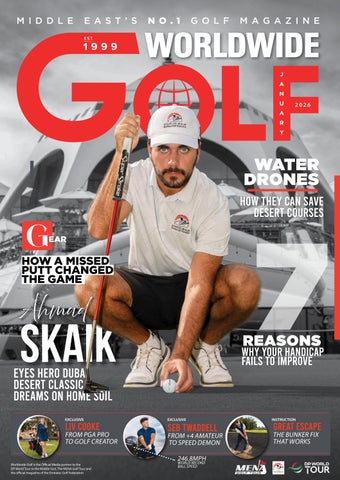
WATER DRONES
G
HOw THEY Can SaVE dESERT COURSES
7
EAR
HOW A MISSED PUTT CHANGED THE GAME
Ahmad
SKAIK
REASONS
wHY YOUR HandICaP FaILS TO ImPROVE
EYES HERO dUbaI dESERT CLaSSIC dREamS On HOmE SOIL EXCLUSIVE
LIV COOKE
FROM PGA PRO TO GOLF CREATOR
Worldwide Golf is the Official Media partner to the DP World Tour in the Middle East, The MENA Golf Tour and the official magazine of the Emirates Golf Federation
EXCLUSIVE
SEb TwaddELL
FROM +4 AMATEUR TO SPEED DEMON 246.8MPH WORLD RECORD BALL SPEED
INSTRUCTION
GREaT ESCaPE THE BUNKER FIX THAT WORKS
DRIVE TO THE UAE’S No.1 GOLF SUPERSTORE
OUR LOCATIONS
MALL OF THE EMIRATES
UMM SUQEIM STREET, DUBAI
YAS MALL
EMIRATES HILLS
www.golfsuperstore.ae
4
5
VOICE OF THE TOUR
SCAN FOR
Jamie Hodges
HOTELPLANNER TOUR CONFIRMS EXCITING 2026 SCHEDULE
L
ast week, it was exciting to be able to announce our official 28-tournament schedule for the 2026 HotelPlanner Tour season, after months of hard work, planning and preparation. It’s going to be another busy year as we visit 19 countries across three continents, and we are delighted that we can offer a prize fund of €9 million for the second successive year - something that wouldn’t be possible without the support of HotelPlanner who came on board as our Title Partner back in January. In 2026 we will be heading back to several familiar countries and venues, while breaking new ground, with Estonia set to become the 52nd country to host a HotelPlanner Tour event since the Tour’s inception in 1989. For a sixth year in a row, we will begin our season in South Africa. We first visited in 2020 and have built a strong partnership with the Sunshine Tour, who we co-sanction our events with. Another partnership we’ll continue to build on in 2026 is with the Emirates Golf Federation, as we will return to the United Arab Emirates in April. The EGF’s long-term partnership with the DP World Tour has made that possible, and we’re looking forward to back-to-back events in the country for the fourth year in a row. We want to play our part in developing golf in this region, and the Abu Dhabi Challenge, taking place at Al Ain Equestrian, Shooting & Golf Club, and the RAKBANK UAE Challenge at Al Zorah Golf & Yacht Club, will help to do just that. Beyond their importance on the international calendar, both tournaments play a significant role in supporting the growth of the game locally by providing a high-level platform for emerging talent. This was evident earlier this year at the UAE Challenge, where Akram Skaik became the first UAE-born golfer to make the cut in a 72-hole professional event - a landmark achievement that highlighted the progress being made and offered an encouraging sign of further success to come for
players from the region. In total, 30 spots in each event in 2026 will be allocated to the EGF to help create playing opportunities and provide a pathway for the best Emirati golfers. We arrive in Europe for the first time in May, with a run of 19 tournaments in 20 weeks, spanning 16 countries, before heading to China for back-to-back events and finally the season-ending Rolex Grand Final supported by The R&A in Spain. At the season’s conclusion, 15 players will earn one of the lifechanging DP World Tour cards on offer. Each year, the HotelPlanner Tour schedule is prepared with the aim of giving those who receive one of the coveted DP World Tour cards, the best chance of success. We want them to be as ready as they can be to not only play, but to compete and win on Golf’s Global Tour. It’s a proud thing for me to say that we’ve seen that in abundance in recent years, and never more so than in the last 12 months. Pathway success Since our Tour’s first official season in 1989, our mission has been to produce future champions on the DP World Tour and PGA TOUR, Major Champions and Ryder Cup players, and in recent years we have consistently delivered on that. At the time of writing, 234 former HotelPlanner Tour players have won on the DP World Tour, amassing 624 wins between them. Our most recent cohort of graduates accounted for four of those victories in 2025, with Kristoffer Reitan, Nicolai von Dellingshausen, John Parry and Martin Couvra all winning on the 2025 Race to Dubai. There was added reason to celebrate with Kristoffer, John and 2024 Road to Mallorca Number One, Rasmus Neergaard-Petersen, earning dual membership with the PGA TOUR following their exceptional performances. Also on the DP World Tour, Marco Penge, who won our Rankings in 2023, was arguably one of the stories of the year. He won three times, ended the year second on the Race to Dubai and also earned one of the ten PGA TOUR cards. Tommy Fleetwood, who won our Rankings
6
back in 2011, continued to climb the Official World Golf Rankings by becoming a winner on the PGA TOUR for the very first time. He has always been a strong advocate of how his experiences on the HotelPlanner Tour prepared him for the next step in his career, so it was great to see him win the TOUR Championship. Tommy was also heavily involved in Team Europe’s victory in the Ryder Cup at Bethpage Black. It says a lot about our Tour that six of the 12 players in Luke Donald’s European team were HotelPlanner Tour alumni, with Rasmus Højgaard becoming the 35th player from the Tour to play in a Ryder Cup. A groundbreaking year With the success of our graduates on the DP World Tour and the PGA TOUR, and their contributions at the Ryder Cup, on the course it has been another outstanding year. We also celebrated the first 20 graduates of the HotelPlanner Tour era, with a mix of DP World Tour winners making their way back to Golf’s Global Tour, and the next generation of up-and-coming stars beginning to forge their own path. I have no doubt that several of the players that gained promotion this year will win on the DP World Tour in the nottoo-distant future. Off the course, the first year of HotelPlanner’s Title Partnership has also been incredibly positive. Their investment has not only improved prize funds - which reached record heights this year - but it is making the week-to-week tournament experience better for our members. I’m proud of the work we are continuing to do, and also of the schedule we have for 2026, which I truly believe will best-prepare the next generation of stars for success.
2026 TICKETS FOR MORE INFORMATION AND TICKETS, VISIT WWW.DPWTC.COM
Jamie Hodges HotelPlanner Tour Director
J U M E I R A H G O L F E S TAT E S , D U B A I , U A E | 1 2 - 1 5 N O V E M B E R 2 0 2 6
BRING OUT THE PLAYER IN YOU. A high-launching,
players-style design that combines shot-making precision with score-saving forgiveness. Engineered for the best players in the world. Custom fit and custom built for you. © PING 2025
DISTANCE & CONTROL
PLAYER PREFERRED
FORGIVENESS WITH FEEL
Lower CG for increased ball speed and higher launch.
Sized and shaped for trajectory control.
Game-improvement forgiveness; softer feel, pleasing sound.
GET FIT. GET OPTIMISED.
Contents J A N U A R Y
-
20
2 0 2 6
14
14
TOUR NEWS Looking ahead to the 2026 Dubai Invitational; Bahrain Championship and the Qatar masters.
PORTUGAL
20
AHMAD SKAIK The UAE’s rising golf star opens up on turning professional, expectation, and facing the Hero Dubai Desert Classic at home.
EGYPT
26
GET SET FOR CLASSIC DRAMA As the Hero Dubai Desert Classic turns 37, McIlroy chases history and Johnson debuts as the strongest field assembles Majlis.
MOROCCO
36
50
15 OF OUR GREATEST GOLFERS OF ALL TIME Ranking golf’s all-time greats is asking for trouble—Majors, dominance, longevity and influence all collide, and everyone’s list will differ.
JORDAN
50
BUILT FOR SPEED DESTINED FOR GREATNESS From +4 amateur to full-throttle speed merchant, Seb Twaddell is now chasing ball speeds that belong on motorways, not fairways.
UAE
ISSUE No.296 JANUARY 2026 • Published in Dubai by: ProGraphix • PO Box 24677 • Dubai, UAE (Tel) +9714 340 3785 Publisher: Alex Gallemore • Production/Design: Contactless Media Ltd • Editorial Panel: Alex Gallemore, Pete Cowen, Richard Bevan, Alex Leyno, • Photography: Getty Images • June 2009 SSN 1- 46805671 • Approval UAE National Media Council: MLN:8328516/MF02-3471314 Trade License No. 123127 PROGRAFIX ADVERTISING • Worldwide Golf specifies that post-press changes may occur to any information given in this publication and takes no responsibility for goods or services advertised.
10
www.menagolftourcom
Contents J A N U A R Y
-
2 0 2 6
Presented by
40
40
30 HOW A MISSED PUTT CREATED GOLF’S ICONIC BALL One missed putt, an X-ray, and a stubborn engineer. How Phil Young’s curiosity accidentally created Titleist— and changed golf forever.
39
40
RULES YOU’RE GETTING WRONG
HOW TO FIX YOUR HANDICAP ISSUES
You play every week, but are you sure you know the rules? Common mistakes costing club golfers shots, arguments, and the odd DQ.
You’ve got the new driver and the big promises—so why’s the handicap still stuck? Seven hard truths every mid-handicapper avoids.
42
46
The bunker preset drill: a simple setup tweak that delivers cleaner contact and far more reliable escapes from the sand.
From PGA pro to content creator—how one golfer is carving out a new career in the game, post by post.
THE GREAT ESCAPE
LIV COOKE
58
62
The CH3 coach on building confidence, growing community, and pushing the women’s game forward across the Middle East.
Drones, bacteria and fewer chemicals—why a Portuguese golf course might be showing the Middle East how to future-proof fairways.
AMY MILLWARD
WATER DRONES TO THE RESCUE
13
COURSE COURSE
ROYAL GOLF CLUB
Photography: Getty Images
Royal Golf CLub
N I A R H BA
WHY IT SHOULD BE ON YOUR MIDDLE EAST GOLF BUCKET LIST
When you think of Colin Montgomerie’s greatest achievements, eight European Tour Order of Merit titles or his Ryder Cup legacy usually spring to mind. But one of his most impressive accomplishments sits quietly in the Bahraini desert. In 2006, Montgomerie partnered with European Golf Design to transform what was essentially an industrial wasteland into the Royal Golf Club Bahrain. Reworking the original Riffa Golf Course, he set out to create something entirely different: a links-style layout in the Middle East. On paper it sounded unlikely. In reality, it works superbly. Rather than relying on the aerial, target-golf formula common to desert courses, Montgomerie designed wide approaches and heavily contoured short grass that reward imagination and bump-and-run shots. The ground game is central, and subtle undulations mean local knowledge quickly becomes an advantage. The greens are the course’s defining feature. Multi-tiered and boldly contoured, they demand precise approach play and punish hesitation with awkward two- and three-putts.
14
15
Measuring 7,102 yards from the championship tees, the par-72 layout winds through the Riffa Views community, just 20 minutes from Manama, with palms and native planting now thriving across the site. A proven championship venue, Royal Golf Club Bahrain hosts the DP World Tour’s Bahrain Championship and even offers floodlit night golf on the back nine. It’s not just another luxury desert course—it’s a genuinely distinctive test, and that alone earns it a place on any Middle East golf bucket list.
FEATURES
DPWT PREVIEWS
Photography: Getty Images
Dubai Invitational 2026: McIlroy Returns for Redemption Against Fleetwood
T
he Dubai Invitational returns to Dubai Creek Resort from January 15-18, 2026, promising a compelling rematch between two European Ryder Cup heroes after their dramatic showdown at the inaugural event two years ago. Rory McIlroy headlines a stellar field, returning with unfinished business after narrowly missing out on victory in 2024. The world number two, fresh from being crowned BBC Sports Personality of the Year, finished runner-up to his close friend and Ryder Cup teammate Tommy Fleetwood, who claimed victory with a stunning birdie on the final hole. The Northern Irishman is determined to start his 2026 campaign on a winning note as he chases further glory following a remarkable 2025 season. McIlroy’s enthusiasm for the tournament is evident in his recent comments to the DP World Tour. “I’m excited to be starting my year in Dubai,” he said. “The UAE is a place where I’ve enjoyed a lot of great weeks, and I’m sure this will be no different. Dubai Creek Resort was a fantastic host venue two years ago, and Abdulla and his team put on an incredible event. I came very close to winning that week, so I’m hoping 2026 will be another really good year for me - and to start strong in the Middle East would be the perfect way to get it underway.” Tournament host Abdulla Al Naboodah
16
welcomed McIlroy’s return, stating: “It is an honour to welcome career grand slam winner Rory McIlroy back to the Dubai Creek Resort for the 2026 Dubai Invitational. His participation is a significant addition to our world-class field, and we look forward to delivering another exceptional week of competition and hospitality for players, partners, and spectators.” McIlroy will be looking to avenge that narrow defeat, particularly after what proved to be costly errors during the inaugural tournament’s final round. He found water twice and three-putted from inside three feet on the 14th hole, mistakes that proved decisive when Fleetwood capitalized with back-to-back birdies on the 17th and 18th holes. Defending champion Tommy Fleetwood returns to defend his title after that memorable victory, which ended a yearlong drought in the winner’s circle. The Englishman produced nerveless golf under pressure, notably an exceptional bunker shot on the 10th hole that helped maintain his momentum. His victory speech reflected the magnitude of the moment: “It was great watching one of the world’s best golfers in Rory, the way that he was playing the back nine, the way that he attacked the back nine. Winning, it’s important. It’s a great feeling. Gives you confidence to know that you can do it the next time you’re in contention.”
17
The biennial tournament features a unique format with 60 professional DP World Tour golfers competing alongside 60 amateurs in the first three rounds, before Sunday becomes a professionals-only showdown. This pro-am element adds distinctive character to the opening event of the Race to Dubai’s International Swing. Other key contenders include recent additions Rasmus Neergaard-Petersen and Ryan Fox, while South African Thriston Lawrence will be eager to improve on his third-place finish from the inaugural event, where he finished level with McIlroy. The Dubai Invitational serves as the perfect appetizer for the prestigious Hero Dubai Desert Classic the following week at Emirates Golf Club, giving players back-toback opportunities in the UAE. McIlroy, a four-time Dubai Desert Classic champion, will hope to build momentum across both events. With a $2.75 million prize fund and 3,500 Race to Dubai points available, the stakes are significant. General admission tickets remain free, underlining Dubai’s commitment to growing golf’s accessibility in the region. After the drama and heartbreak of 2024, all eyes will be on whether McIlroy can finally claim the Dubai Invitational trophy, or if Fleetwood can repeat his remarkable finalhole heroics.
FEATURES
DPWT PREVIEWS
Photography: Getty Images
Bapco Energies Bahrain Championship 2026: Major Champions Lead Strong Field to Royal Golf Club
“
Commercial Bank Qatar Masters 2026: Can Li Repeat Last Year’s Heroics in Doha?
Earning my spot through years of dedication and competing on the very course where I first learned golf adds a special significance. I’m thrilled to face world-class players and honoured to represent Bahrain on home soil.”
T
he DP World Tour’s International Swing continues its Middle Eastern stretch from January 29 to February 1 as Royal Golf Club hosts the third edition of the Bapco Energies Bahrain Championship, with an increasingly impressive field demonstrating the tournament’s rapid ascent on the schedule. Major champions Pádraig Harrington and Jimmy Walker headline the field, bringing significant tournament pedigree to the Colin Montgomerie-designed layout. Their presence underscores how quickly the Bahrain Championship has established itself as a meaningful stop on the tour’s calendar, attracting elite international talent alongside regional stars. Defending champion Dylan Frittelli returns following his breakthrough 2024 victory that ended a six-year winless drought. The South African’s two-shot triumph was particularly poignant given he had contemplated retirement during a difficult 2023 campaign after losing his PGA Tour playing privileges. His victory propelled him to the DP World Tour Play-Offs and has clearly reignited his competitive fire, evidenced by a top-ten finish at the recent Hero Dubai Desert Classic. Danish veteran Thorbjørn Olesen and Spain’s Jorge Campillo add further depth to the international contingent. Both multiple DP World Tour winners, they bring extensive experience of Gulf conditions and understand
the strategic demands of the Royal Golf Club course, which favours accuracy and course management over pure distance. However, the tournament’s significance extends beyond the established stars. As Daji Khalifa, Vice President of the Bahrain Golf Association, noted: “It’s nice to see the Bapco Energies Bahrain Championship becoming a popular stop in the DP World Tour’s International Swing and attracting top players including former Major champions in a very short time. The championship is a huge opportunity for our players to compete alongside some of the best in the game.” Yaseen Le Falher carries local hopes as the highest-ranked Bahraini qualifier, having earned his place through the Bahrain Amateur Open and King Hamad Trophy. His journey is particularly compelling given his connection to the venue. “Qualifying for the Bahrain Championship on the DP World Tour is a dream realised,” Le Falher said. “Earning my spot through years of dedication and competing on the very course where I first learned golf adds a special significance. I’m thrilled to face worldclass players and honoured to represent Bahrain on home soil.” Fellow Bahraini Ali Al Kowari also secured his berth through the qualification process. “I’m grateful that I have this chance to play in such a big event with many top professionals from around the world,” Al Kowari commented. “It
18
wasn’t easy earning the spot but with hard work and preparation I managed it. I’m really looking forward to competing with players on a whole different level.” Pakistan’s Aadam Syed and England’s Tom Sloman, who won a playoff at the King Hamad Trophy, round out the regional representation, adding to the tournament’s distinctive character within the International Swing. Championship Director Freddie Schmeisser emphasised the dual purpose of the event: “The Bapco Energies Bahrain Championship is not only about showcasing world-class golf but also about providing opportunities for emerging talent from the region and beyond. This event is a platform where rising stars can compete alongside some of the best in the game, gaining invaluable experience and exposure.” With a $2.75 million prize fund and 3,500 Race to Dubai points available, the stakes are significant. General admission remains complimentary throughout the week, with premium hospitality options including the Championship Chalet offering elevated viewing and entertainment on the 18th hole. As the third edition approaches, the Bahrain Championship continues to establish its credentials as an important fixture in the DP World Tour’s expanding global footprint.
T
he DP World Tour’s Middle Eastern swing wraps up from February 5-8, 2026, as the Commercial Bank Qatar Masters returns to Doha Golf Club for what promises to be another compelling chapter in the tournament’s 28-year history. Haotong Li heads back to Qatar as defending champion, and what a defence it is. The Chinese star’s victory last year ranks among the most dramatic finishes you’ll see anywhere. Standing over a 15-foot birdie putt on the final hole with Rasmus NeergaardPetersen breathing down his neck, Li calmly rolled it in to win by one. The emotion afterwards said everything—roaring, fist-pumping, and openly weeping with his caddie. This wasn’t just another win. “I never thought I could come back in this position,” Li admitted afterwards. Remember, this was a player ranked 300th in the world at the time, nearly three years removed from his last victory. “I’m just so pleased I made that putt on the last. I’m guaranteed to celebrate this one nicely.” You’d imagine so. That single putt changed everything for Li. He rocketed up to 154th in the world rankings and his subsequent performances—including fourth at The Open Championship—earned him a PGA Tour card through the top-ten Race to Dubai pathway. Not bad for someone who looked destined to fade from the elite level just months earlier. The stage for Li’s coronation couldn’t be more fitting. Doha Golf Club has hosted 26 of the tournament’s 28 editions since 1998, and Peter
Harradine’s 7,374-yard layout remains one of the Middle East’s premier grass courses. Built to USGA specifications, it’s a proper test that rewards smart play over brute force—the sort of course where experience and nerve matter as much as distance. The trophy cabinet speaks for itself. Paul Lawrie, Adam Scott and Branden Grace have each won it twice, while the likes of Ernie Els, Henrik Stenson, Thomas Bjorn and Sergio Garcia have all lifted the distinctive Mother of Pearl Trophy. It’s proper company to keep. Ben Cowen from the DP World Tour put it simply: “The event has been a staple on the DP World Tour schedule for over 25 years and we must thank Commercial Bank, Doha Golf Club, the Qatar Golf Association and the Qatar Olympic Committee for their support in making this event what it is today.” Hassan Nasser Al Naimi, President of the Qatar Golf Association, was pleased to see the tournament back in its traditional early-season slot: “The longstanding appearance on the DP World Tour schedule continues, and with a date change to the start of the season to fit in with the International Swing. We look forward to welcoming the players, golf fans and our valued sponsors to Doha Golf Club for another edition of world-class golf.” Hussain Al Abdulla from Commercial Bank emphasized the tournament’s wider reach: “The Commercial Bank Qatar Masters stands out as one of Qatar’s cherished annual sporting occasions, providing diverse experiences for players, golf
19
19
“
The event has been a staple on the DP World Tour schedule for over 25 years and we must thank Commercial Bank, Doha Golf Club, the Qatar Golf Association and the Qatar Olympic Committee for their support in making this event what it is today.” fans, and families alike. This event contributes to positioning Qatar as a significant participant in the sports industry and serves as a valuable platform for Qatar’s promising golf talents to share the field with the global elite.” There’s $2.75 million on the table and 3,500 Race to Dubai points up for grabs as the International Swing reaches its conclusion. Players will be keen to finish strongly before the tour heads to Africa, while Li faces the challenge every defending champion knows— doing it all again when everyone expects you to. Can he pull off another final-hole birdie to retain the Mother of Pearl Trophy? After last year’s theatrics, you wouldn’t bet against him.
FEATURES AHMAD SKAIK
Photography: Alex Leyno
Ahmad Skaik From Amateur to Pro THE UAE’S RISING GOLF STAR OPENS UP ABOUT TURNING PROFESSIONAL, THE WEIGHT OF EXPECTATION, AND PREPARING TO COMPETE AT THE HERO DUBAI DESERT CLASSIC ON HIS HOME COURSE—WHERE FAMILIARITY MEETS A WHOLE NEW LEVEL OF CHALLENGE
20
21
FEATURES AHMAD SKAIK
Photography: Alex Leyno / House
“
A
hmad Skaik looks relaxed when we meet, which is quite something for a young golfer who’s just made one of the biggest calls of his sporting life. Last month, he turned professional on the MENA Golf Tour, closing the chapter on a solid amateur career and opening one that he hopes will lead to far bigger things. The timing was deliberate. “I always wanted to turn pro,” he says. “I wanted to do it before, but I spoke to my team and my father and decided to do it after the Asian Pacific Championship.” He pauses, and there’s a flicker of what might have been. “Obviously, if I had won, I would have stayed amateur to play the Masters, but I didn’t— so I turned pro, and here we are.” It’s a straightforward take on a decision many young golfers wrestle with for ages. But Skaik seems at peace with how it’s played out.
Augusta can wait. Right now, he’s dealing with the reality of professional golf—all the pressure, all the opportunity, all the uncertainty that comes with it. Going from amateur to pro isn’t just a matter of ticking a box. The stakes change overnight. Money matters now. Tournament results carry weight beyond the scoreboard. Yet when we ask about the biggest adjustments, Skaik keeps it simple. “Off the course, I’m trying to do more media stuff,” he says, gesturing vaguely at our conversation. “But on the course it’s the same. I’m just trying to treat every tournament like it’s another tournament. Nothing changes—amateur or pro, you still have to hit the shots, you still have to make the putts. So yeah, keep practicing, keep getting better, keep playing tournaments, and see where we get to.” There’s wisdom in that approach. The swing
22
mechanics don’t care whether you’re playing for prize money or a trophy. A tricky downhill putt is tricky regardless of your status. Where things get complicated is between the ears, and that’s where Skaik’s real test begins. CARRYING THE WEIGHT OF EXPECTATION Being one of the UAE’s top golf talents means Skaik isn’t just chasing his own dreams. In a country where the game is booming but elite local players are still relatively rare, he’s carrying something bigger. It’s not quite the weight of a nation, but it’s not far off either. “There’s always going to be pressure and nerves,” he admits without hesitation. “I always want to do well, and if there are nerves, it means you care. I’ll just go out there, try my best, hit the best shot I can, and focus on the process.” That last bit—the process—keeps coming up
when he talks. It’s sports psychology language, sure, but it’s also practical. When everything feels like it’s riding on the next shot, focusing on the immediate task is often the only way through. The MENA Golf Tour has given him a useful testing ground. He mentions playing in Portugal, where he made the cut in his second event as a pro. On paper, it might not sound like much. To Skaik, it was huge. “That gave me a lot of confidence that I can play even as a pro,” he explains. “Thinking now as a pro, there’s a lot of pressure—I’m one of the only pros in the UAE—so to be able to make the cut there in different conditions is a real confidence booster.” Being among the first isn’t easy. In places like the US or Australia, young pros have dozens of peers going through the same thing. They compare notes, share the struggle, learn together. For Skaik, the path is a bit lonelier. Every result becomes part of a bigger narrative about Emirati golf’s future, which adds another layer to an already complicated situation.
MAKING PEACE WITH THE MAJLIS If there’s one course that’ll define Skaik’s early pro career, it’s the Majlis at Emirates Golf Club. He’s played it countless times as an amateur, but knowing a course doesn’t always mean loving it. “It used to test me a lot off the tee—I didn’t like it, it never suited my eye,” he admits with a grin. “But I practiced a lot on it for the Asian Pacific and started liking the course. I feel like we started building a bond, me and the course, and hopefully we can take that into the Hero Dubai Desert Classic.” Golf’s funny like that. A course that feels like your enemy one year can become an ally the next. For Skaik, the shift came through hours of work—figuring out the lines, understanding where to attack and where to play safe, building familiarity until it became comfort. Playing the Hero Dubai Desert Classic as a professional is different territory entirely. He played it once as an amateur, but turning up with tour status changes everything.
23
That gave me a lot of confidence that I can play even as a pro,” he explains. “Thinking now as a pro, there’s a lot of pressure—I’m one of the only pros in the UAE—so to be able to make the cut there in different conditions is a real confidence booster.”
FEATURES AHMAD SKAIK
Photography: Alex Leyno
“ “It would be amazing,” he says, though you can tell the word doesn’t quite capture it. “Of course, there’s going to be more pressure, more nerves, and excitement. It’s something that scares me a little, so it will make me practice more and try to prepare as much as possible.” The Majlis has seen some serious talent over the years. Tiger, Rory, Ernie—the champions’ list reads like a greatest hits of modern golf. For a young Emirati stepping onto that stage, the symbolism isn’t lost. We ask him to imagine that first tee shot on Thursday morning. He thinks about it for a moment. “Of course there’s excitement and nerves, but I’m going to look at it as: this is what I want my future to be, and these are exactly the events I want to be playing. I’m going to enjoy the moment and stick to the process.” Process again. When the gallery’s watching and your heart’s racing, it’s the thing that keeps you steady. HOME SOIL, DIFFERENT GAME You’d think playing at home would give
Skaik an edge. Local knowledge, friendly faces, sleeping in your own bed. But he’s quick to manage expectations about what “home advantage” actually means at this level. “I wouldn’t say it’s a big advantage,” he cautions. “The layout, yes—but the course conditions are very different when you play the Hero Dubai Desert Classic. The greens are much firmer, which we’re not used to, and the rough is very, very thick. It plays like a completely different golf course, but I’m sure I’ll be ready to play.” It’s a reminder that professional tournament golf is a different animal. The course regular members play on Tuesday morning bears little resemblance to what the field faces during a championship. The setup changes everything— tighter fairways, lightning-fast greens, rough that can swallow a golf ball whole. What doesn’t change is the support. Friends and family will be out there watching, which Skaik clearly appreciates. “It’s good to have people come out and watch,” he says, brightening up. “You saw at
24
It’s good to have people come out and watch,” he says, brightening up. “You saw at the Asian Pacific—I had a lot of people come out to support me, which was great. I really enjoyed it, especially after the round; if you play well, you see all of them come and give you hugs. Hopefully, I can put on a good show for them.”
the Asian Pacific—I had a lot of people come out to support me, which was great. I really enjoyed it, especially after the round; if you play well, you see all of them come and give you hugs. Hopefully, I can put on a good show for them.” Nobody makes it alone in professional sport, and Skaik’s quick to acknowledge the people who’ve helped him get here. When we ask who’s been most important, he doesn’t pick one person. “It’s a mix of everything—the coaches, my family, my team, and the Emirates Golf Federation all played a very big role. I feel like it’s a big team, and each person has their own input.” It’s the right answer, really. The time on the range, the mental work, the physical conditioning, the strategy—none of it happens without a solid team around you. SETTING TARGETS AND LEADING BY EXAMPLE Skaik’s got clear goals for his first season. Top of
the list is getting his Asian Tour card through Q School, which is about as tough as qualifying processes get. “I’m playing the Q School final stage for the Asian Tour, so hopefully this is a big goal for me—to get my Asian Tour card,” he says. “And for the Hero Dubai Desert Classic, of course, making the cut would be very good.” The goals make sense. He’s not talking about winning majors or breaking into the world’s top fifty. He’s focused on the next logical steps—get the card, make some cuts, build from there. It’s ambitious enough to matter but realistic enough to actually achieve. As one of the few Emirati pros out there, Skaik knows younger players are watching what he does. It’s a responsibility he takes seriously, though he’s not overthinking it. “Yeah, I usually just do my thing. I practice, I work hard, I try to play big events, and I try to do well. All of this inspires the younger generation, and I try to be the best version of myself on and off the golf course.” Then he gets a bit more thoughtful. “People
25
should see it this way: never be arrogant, never be cocky, whether you win a tournament or not, because at the end of the day, we’re nothing. So there’s no point in that. I just try to be the best person I can, on and off the golf course.” It’s a grounded philosophy from someone who’d be forgiven for having a bit more swagger. He’s just turned pro and is about to play against some seriously good golfers. But maybe that humility is exactly what’ll serve him best going forward. As Ahmad Skaik gets ready for his professional debut at the Hero Dubai Desert Classic, he’s doing it with realistic expectations and a clear head. He knows it won’t be easy. He’s ready for the pressure. And he’s sticking to what got him here in the first place. The amateur days are behind him now. What comes next will define whether he’s just another hopeful or something more. Based on how he’s handling things so far, Emirati golf might just have found someone worth watching.
FEATURES
DESERT STORM
Photography: Getty Images
DESERT M R STO
AS THE HERO DUBAI DESERT CLASSIC ENTERS ITS 37TH YEAR, THE TOURNAMENT THAT LAUNCHED A THOUSAND CAREERS PREPARES TO WELCOME THE STRONGEST FIELD IN ITS STORIED HISTORY. FROM RORY MCILROY’S QUEST FOR A RECORD FIFTH TITLE TO DUSTIN JOHNSON’S EMIRATES GOLF CLUB DEBUT, JANUARY’S ROLEX SERIES OPENER PROMISES DRAMA ON AND OFF THE MAJLIS COURSE.
BY RICK BEVAN
26
27
FEATURES
DESERT STORM
Photography: Getty Images
T
here are few tournaments in world golf that can claim to have shaped the landscape of the professional game quite like the Hero Dubai Desert Classic. When the European Tour first pitched up at Emirates Golf Club in 1989, the notion of championship golf in the
Arabian Peninsula was still in its infancy. Three-and-a-half decades later, the Dubai Desert Classic stands as not merely the oldest professional golf event in the Middle East, but as a tournament that has consistently attracted the very finest players on the planet.
From 22-25 January 2026, the iconic Majlis Course will once again play host to a field that reads like a Who’s Who of modern golf. As the first Rolex Series event of the new Race to Dubai season, the stakes could hardly be higher.
AN AMERICAN ICON ARRIVES Perhaps the most intriguing storyline surrounds Dustin Johnson, who will make his debut at a DP World Tour event in Dubai. The two-time Major champion – winner of the 2016 US Open and the 2020 Masters – spent 135 weeks as World Number One. At the 2021 Ryder Cup at Whistling Straits, Johnson became the first American player in over 40 years to achieve a perfect 5-0 record. “I’m really looking forward to playing the Hero Dubai Desert Classic for the first time,” said Johnson. “When you look at past champions like Seve, Tiger and Rory, you know it’s a really prestigious tournament with incredible history.” A LIVING LEGEND RETURNS Few players can match the Major championship pedigree of Pádraig Harrington. The Irishman, inducted into the World Golf Hall of Fame in 2024, won back-to-back Open Championships in 2007 and 2008 before adding the PGA Championship later that summer. Now 54, Harrington continues to compete at the highest level, adding two senior Major championships in 2025. “The Hero Dubai Desert Classic holds special memories for me – I finished runner-up here back in 2001 alongside Tiger Woods, and I’ve always loved competing on the Majlis Course,” said Harrington. THE NEXT GENERATION Beyond the established stars, the 2026 Hero Dubai Desert Classic showcases emerging global talent. Chile’s Joaquín Niemann arrives as one of
THE RORY FACTOR No player is more synonymous with the Hero Dubai Desert Classic than Rory McIlroy. The Northern Irishman’s relationship with the tournament stretches back twenty years to when, as a fresh-faced 16-year-old amateur, he first walked the fairways of Emirates Golf Club in 2006. By 2007, McIlroy was making his first professional cut anywhere in the world on the very same course. Two years later, at just 19 years of age, he claimed his maiden professional victory, edging Justin Rose by a single stroke to lift the famous Dallah Trophy. McIlroy has since added three more Dubai Desert Classic titles to his collection – in 2015, 2023 and 2024 – making him the most successful player in the tournament’s history. His 2024 triumph was particularly memorable: having trailed by ten shots entering the weekend, he produced a stunning Saturday 63 before completing the comeback on Sunday. Now, fresh from completing the career Grand Slam by winning the 2025 Masters at Augusta National – becoming only the sixth player in history to achieve the feat – McIlroy returns to Dubai in search of a record-breaking fifth Dallah Trophy. It will be his 16th appearance at the event.
Emirates Golf Club looking to claim a second Dallah Trophy. The Englishman’s triumph in January 2025 was built on four rounds of relentless consistency. “I’m delighted to be heading back to Emirates Golf Club to defend my title,” said Hatton. “It’s a golf course that has really suited my game over the years.” Both McIlroy and Hatton were key members of Luke Donald’s European Ryder Cup team that
triumphed at Bethpage Black in September. Viktor Hovland, the 2022 Dubai Desert Classic champion and 2023 FedEx Cup winner, returns eager to add a second Dallah Trophy. Shane Lowry, the 2019 Open Champion who holed the crucial putt that secured Europe’s Ryder Cup triumph, also features. FedEx Cup champion Tommy Fleetwood, a Dubai resident making his 15th consecutive appearance, adds further firepower. the hottest players in world golf. The 26-year-old recorded five individual victories across the 2025 LIV Golf season, from Adelaide to Singapore to the UK. A two-time PGA Tour winner, Niemann impressed with a tied-fourth finish on his Hero Dubai Desert Classic debut in 2024. Danish star Nicolai Højgaard, a member of Europe’s victorious 2023 Ryder Cup team and winner of the 2023 DP World Tour Championship in Dubai, brings further quality. New Zealand’s Ryan Fox, the 2022 DP World Tour Player of the Year who added two PGA Tour victories in 2025, brings power and precision to an already stacked field. Tom McKibbin, the 22-year-old Northern Irishman from the same Holywood Golf Club as McIlroy, impressed with a tied-sixth finish at the 2025 Dubai Desert Classic and returns with high expectations. “Last year was a very good week for me on a difficult golf course,” said McKibbin. “I love the challenge of the Majlis Course and the atmosphere in Dubai is always incredible.”
A FIELD FIT FOR THE OCCASION While McIlroy’s pursuit of history provides the headline storyline, he faces stern competition from a field brimming with Major champions, Ryder Cup heroes and exciting young talents. Defending champion Tyrrell Hatton returns to
28
BEYOND THE FAIRWAYS The Hero Dubai Desert Classic has evolved into far more than a golf tournament. Under the stewardship of Executive Tournament Director Simon Corkill, the event has transformed into a complete ‘festival of golf’. “The 2026 Hero Dubai Desert Classic is shaping up to be one of the strongest fields in our 37-year history,” said Corkill. “To have so many of Europe’s Ryder Cup heroes confirmed alongside Major champions, former World Number Ones and the brightest young talents on Tour is incredibly exciting. But this event has always been about more than just the golf – it’s a celebration that brings people together.” Tournament Town, open daily from 10am to 11pm, has doubled in size for 2026 and promises live music across multiple stages, comedy performances and family-friendly activities. The brand-new ‘Eat Street’ brings together over 25 food and beverage outlets. Family Friday features FamilyBeatz – Dubai’s first family-friendly rave – from 3pm to 6pm. The popular Social on Sixteen hospitality experience returns double the size, offering premium views of the iconic par-three 16th hole. LEADING THE WAY The Hero Dubai Desert Classic continues to set the standard for sustainable sporting events. As the first golf event in the Middle East to achieve GEO Certification® – now held for three consecutive years – the tournament has implemented initiatives that balance world-class entertainment with environmental responsibility. Solar panels power key facilities, while free filtered
29
water refill stations have saved over 120,000 singleuse plastic bottles since 2022. There is no public parking on-site, with the Dubai Metro providing direct access via Al Fardan Exchange station – making Emirates Golf Club arguably the only golf course in the world with a metro stop at its gates. The Mental Fitness & Recovery Zone, introduced in 2024, returns for 2026. The first-of-its-kind wellbeing space on the DP World Tour features sleeping chambers, VR meditation tools, brain-boosting nutrition and dedicated relaxation facilities. A JANUARY ESSENTIAL With a USD $9 million prize fund, a field bursting with star quality and a tournament experience that extends well beyond the ropes, the 2026 Hero Dubai Desert Classic has all the ingredients for a week to remember. Whether it’s McIlroy cementing his status as the King of Dubai, Hatton defending his crown, Johnson making his mark on his Emirates Golf Club debut, or a new star emerging from the pack, the Majlis Course will provide the stage for golf’s next great chapter. General admission is free on Thursday and Friday (with a registered ticket), while weekend tickets are available from AED 100. Children aged 17 and under attend free across all four days. For those seeking the ultimate experience, the signature Dallah Lounge hospitality packages start from AED 2,100, while Social on Sixteen offers premium views from AED 695. Thirty-seven years after the Dubai Desert Classic first captured the imagination of the golfing world, the tournament that helped put Middle Eastern golf on the map continues to write new chapters in its remarkable story. This is one you won’t want to miss.
GEAR
ICONIC BALL
Photography: Provided
HOW A MISSED PUTT CREATED GOLF’S MOST
IC NIC Ball 30
31
GEAR
ICONIC BALL
Photography: Provided
I
“IF IT DOESN’T WORK, HE WILL TAKE IT APART TO FIND OUT WHY, AND IF IT DOES WORK, HE WILL TAKE IT APART TO FIND OUT WHAT MAKES IT WORK.”
n 1930, Phil Young stood on the 18th green at the Country Club of New Bedford, staring in disbelief as his short putt veered wildly off line. Most golfers would’ve cursed, maybe tossed their putter, and headed to the bar. But Young was an MIT Class of 1909 graduate with “an innate curiosity” and zero patience for unexplained failures. So naturally, he did what any selfrespecting engineer would do—he convinced his playing partner, Dr. Bonner, to open his office so he could X-ray the golf ball. What Young discovered was equal parts fascinating and infuriating. His ball, along with several others, had cores that were wildly offcenter. His was out of round and asymmetrical. “No wonder it hooks and slices,” he told Dr. Bonner, adding with characteristic confidence, “If I could make a round ball with a stable core, I could sell a few.” That missed putt would change golf forever. Young had founded the Acushnet Process Company in 1910, initially focused on deresinating latex and supplying rubber to American industries. But after his X-ray revelation, he split the company into two divisions—Rubber and Golf. The Golf division, established in 1932, would become Titleist, and Young’s engineering philosophy would echo through nearly a century of innovation. A colleague once said of Young: “If it doesn’t work, he will take it apart to find out
why, and if it does work, he will take it apart to find out what makes it work.” That relentless curiosity wasn’t just talk. In 1935, Young invented a golf-ball driving machine that could be transported across the country. Here’s the kicker: Acushnet’s first patent in 1936 wasn’t for a golf ball at all—it was for that dual pendulum testing machine. Young understood something profound: before you could build the best ball, you needed to build the best tools to test it. THE VEGAS MIRACLE Flash forward seventy years to October 2000, and the stage was set for one of golf’s most dramatic equipment shifts. The Invensys Classic in Las Vegas was just another fall tournament on the PGA Tour, but what happened there would become legend. Billy Andrade arrived in Vegas in rough shape. At 36, he’d missed the cut in 18 of his 28 tournaments that year. For the first time since 1988, he was headed back to Q-School— professional golf’s version of purgatory. Then he hit Titleist’s new Pro V1 during a practice round. “I’m 100 percent using it this week,” Andrade declared. “That’s how good it is.” He wasn’t alone. Forty-seven players in the field switched to the Pro V1 that week—the
32
largest pluralistic shift of equipment at one event in golf history. Andrade shot 6767-63-67-68 to win by one stroke, saving his season and jump-starting an entire second phase of his career. The Pro V1 delivered something players had always wanted but assumed was impossible: a solid construction ball that gave you both distance AND feel. The wound balls offered feel but lacked distance. The solid balls offered distance but felt like rocks. The Pro V1 did both, thanks to its revolutionary solid core, multi-layer construction, and cast urethane cover. What followed was nothing short of a phenomenon. In early 2001, scoring records fell like dominoes. Brad Faxon at the Sony Open. Mark Calcavecchia at the Phoenix Open. Davis Love III at Pebble Beach. All playing Pro V1s. By March 2001, it became the best-selling ball in golf, and it hasn’t relinquished that position for a single month in twenty-five years. THE 100-MAN MARCH But Vegas didn’t happen by accident. Behind that historic week was what insiders call “the 100-Man March”—one of the gutsiest validation campaigns in sports equipment history. In summer 2000, Titleist’s leadership knew they had something special. But they needed confirmation from the world’s best players under
real tour conditions. So CEO Wally Uihlein, along with Bill Morgan, Mac Fritz, Mary Lou Bohn (now President of Titleist Golf Balls), and Fordie Pitts III did something remarkable: they walked. Day after day, week after week, they walked practice round fairways with nearly 100 PGA Tour and LPGA Tour players. Their pitch was simple: “Hit this new Pro V1, compare it to your current
ball, and tell us what you think.” The response was overwhelming. Since that Vegas victory, players using Pro V1 models have won more than 4,000 tournaments across all worldwide professional tours and 47 men’s major championships. THE NERDS TAKE OVER Today, the Pro V1’s continued dominance is owed to what Courtney Engle, manager of mechanical engineering at Titleist, calls the R&D department’s mantra: “We might have something good, but how can we make it better?” “It’s the only thing we think about,” said Mike Madson, Vice President of Golf Ball Research and Development. The 2025 Pro V1 and Pro V1x—the 14th iteration—has been in development for more than two years. Engineers test, fine-tune, re-test, tweak, scrutinize, and re-test again. They might build a hundred prototypes a year. None reach PGA Tour players until they meet rigid standards set by Titleist’s testing robots. “We have to make it and break it,” the engineers say. It’s painstaking work that thrills the 75+ associates in Titleist’s Golf Ball R&D department, who proudly call themselves “nerds.” Madson refers to Engle as a “super nerd”—a badge of honor she wears with a brilliant smile, especially when discussing optimized edge angles of dimple configurations.
33
“THIS JOB CALLED ME,” SHE SAID. Everything happens within an 11-mile radius in Massachusetts. Titleist designs and builds the cavities for the proprietary urethane covers. They build and own the robots and launch monitors. As Rich Daprato, Director of Testing, puts it: “We make the tools in our toolbox.” Fordie Pitts III, who started as a club fitter 30 years ago, now connects ball-makers with players at nearly three dozen PGA Tour events annually. He’s still out there walking practice rounds, gathering feedback, listening. Because in an age of Zoom calls and text messages, Pitts knows the magic happens face-to-face. One Missed Putt, Endless Excellence There’s a beautiful symmetry to this story. Phil Young’s engineering philosophy—if it works, take it apart to find out why—lives on in every Titleist engineer who asks, “How can we make it better?” The Pro V1 is proof of that. One missed putt led to an X-ray. An X-ray led to a company. A company led to a philosophy. And that philosophy led to a golf ball that has dominated the sport for twenty-five years and counting. The 2025 Pro V1 has arrived, continuing a story that began with curiosity on a putting green ninety-five years ago. Titleist engineers don’t build endings—they only build better beginnings. And it all started because Phil Young refused to accept a missed putt without an explanation.
BUILT FOR SPEED. Drivers come in all shapes and sizes with claims of more of everything, but unless it’s optimised to your game, your expectations and drives will come up short (and in the rough). In the new G440 drivers, multiple technologies, including a lighter overall system weight and longer shaft, help bring you more ball speed for more distance, more forgiveness and more fun.
GET FIT. GET OPTIMISED.
©PING 2025
LOWEST CG EVER
LIGHTER OVERALL SYSTEM
FAST, FORGIVING FACE
Mass savings from the Free Hosel help optimise the CG, aligning it with the force line for more distance and fairway-finding forgiveness.
Composite crown contributes to lighter overall system, delivering faster speeds for more distance and a pleasing sound.
Shallow, thin face increases flexing to ensure high-launching results for consistent ball speed on off-centre hits.
FEATURES
15 GREATEST GOLFERS
Photography: Provided
The 15 Greatest Golfers of All Time:
A DEFINITIVE RANKING The history of golf spans centuries, producing legendary players who have shaped the sport through their extraordinary skill, competitive spirit, and lasting impact. Narrowing down the greatest golfers to just 15 names means focusing on those who truly transcended the game. This ranking weighs major championship victories, overall win totals, longevity, dominance during their era, and influence on how golf evolved.
1. JACK NICKLAUS
The Golden Bear stands alone at the top with 18 major championships—a record that still hasn’t been touched. Nicklaus won six Masters titles, five PGA Championships, four U.S. Opens, and three Open Championships between 1962 and 1986. His 73 PGA Tour victories and 19 runner-up finishes in majors show just how consistently he performed when it mattered most. What set Nicklaus apart wasn’t just his talent but his strategic thinking and mental toughness, qualities that redefined what it meant to be a champion.
2. TIGER WOODS
Woods didn’t just win 15 majors and 82 PGA Tour events—he changed golf forever. That stretch from 2000 to 2001 when he won four straight majors remains unmatched in the modern game. He held all four major titles at once and spent 683 weeks as world number one. Beyond the trophies, Woods brought golf to audiences who’d never cared about the sport before, dramatically raising prize money and inspiring millions to pick up clubs.
3. BEN HOGAN
Hogan’s nine majors would likely have been far more if a near-fatal car crash in 1949 hadn’t
nearly ended his career. His 1953 season was extraordinary—he won the Masters, U.S. Open, and Open Championship, the only three majors he entered that year. Hogan’s obsessive approach to perfecting his swing and ball-striking set a new standard. His instructional book remains essential reading for anyone serious about understanding the golf swing.
4. BOBBY JONES
In 1930, Jones did something that seemed impossible—he won all four major championships of his era in a single year. He captured 13 majors in just seven years before retiring at 28 to practice law. What makes his achievements even more remarkable is that he never turned professional, never accepting prize money. Jones also cofounded Augusta National and created the Masters, giving the sport one of its most cherished traditions.
5. ARNOLD PALMER
Palmer’s seven majors only tell part of his story. His fearless, attacking style and genuine warmth brought golf into living rooms across America during the 1960s television boom. He won 62 PGA Tour events and became the first true superstar of
36
televised golf. Palmer’s influence helped build the modern tour and made golf accessible to everyday people, not just country club members.
6. GARY PLAYER
majors and that beautiful, effortless swing became legendary. What’s truly remarkable is that Snead won tournaments across four decades, competing successfully even in his 60s. His adaptability as the game evolved proved his greatness transcended any single era.
most dominant stretch anyone has ever had in professional golf. His 52 PGA Tour victories and five majors came during a relatively short career. Nelson’s smooth, repeatable swing became a model for future generations, and his influence on teaching the game continues today.
9. WALTER HAGEN
12. SEVE BALLESTEROS
Hagen’s 11 majors dominated the 1920s, but his flamboyant personality did something equally important—it elevated the status of professional golfers. He won five PGA Championships, four Open Championships, and two U.S. Opens while demanding that pros be treated with the same respect as club members. Hagen’s showmanship brought entertainment to golf and helped establish it as a legitimate profession.
The Spanish maestro’s five majors and creative shot-making sparked a European golf renaissance. Ballesteros won three Open Championships and two Masters with an imagination and flair that made golf thrilling to watch. His passionate Ryder Cup performances transformed that event into the premier team competition in golf. Seve played with his heart on his sleeve, and fans loved him for it.
10. GENE SARAZEN
13. RORY MCILROY
The Black Knight won nine majors across three decades, showing remarkable dedication and longevity. Player completed the career Grand Slam and collected majors spanning six decades. His 165 worldwide victories and pioneering commitment to fitness changed how golfers approached their bodies and training. Player also helped make golf a truly international sport, competing everywhere and breaking down barriers.
Sarazen was the first to win all four modern major championships, completing the career Grand Slam. His seven majors are impressive, but he also invented the sand wedge, fundamentally changing how golf is played. That famous albatross at Augusta’s 15th hole in 1935 remains one of the sport’s most talked-about shots nearly 90 years later.
7. TOM WATSON
11. BYRON NELSON
Watson’s eight majors, including five Open Championships, prove his mastery of links golf. His battles with Nicklaus in the late 1970s produced some of the most thrilling moments in golf history. Watson won 39 PGA Tour events and dominated throughout the 1970s and 1980s with a complete game that worked in any conditions.
8. SAM SNEAD
Slammin’ Sammy’s 82 PGA Tour victories are tied with Woods for the most ever. His seven
Lord Byron’s 1945 season—18 tournament wins including 11 straight—represents the
Conclusion These 15 golfers represent more than just impressive statistics—they each changed how the game is played, taught, or perceived. Their influence extends beyond their playing days, inspiring generations of golfers who
McIlroy’s journey to completing the career Grand Slam reached its emotional conclusion at the 2025 Masters, ending years of near-misses at Augusta National. With five major championships now to his name—the 2011 U.S. Open, 2012 and 2014 PGA Championships, 2014 Open Championship, and the 2025 Masters—he joins the elite group who’ve conquered all four majors. The Northern Irishman’s influence on modern golf extends far beyond his trophy collection. His prodigious driving distance and athletic
followed. Looking at today’s game, Scottie Scheffler is building a resume that could see him join this list someday. His dominant performances and major championship victories suggest he has the talent and temperament to become one of the all-time
37
approach have redefined what’s possible in the contemporary game. With over 25 PGA Tour victories and multiple accomplishments on the European Tour, McIlroy has been the face of professional golf for the current generation. His perseverance in finally claiming the green jacket, after several heartbreaking close calls, only adds to his legacy as one of the game’s most talented and resilient champions.
14. NICK FALDO
Faldo’s six majors came from an almost obsessive dedication to perfecting his swing. His three Masters and three Open Championships were won through precision and an unshakeable mental game. Faldo completely rebuilt his swing mid-career, showing the kind of commitment that separates good players from great ones. His methodical approach influenced how the game is taught today.
15. HARRY VARDON
Vardon’s six Open Championships set the standard in early professional golf. The overlapping grip he popularized—sometimes called the Vardon grip—is still how most golfers hold the club today. His influence on swing mechanics and course strategy helped shape golf as it transitioned into the modern era.
greats. If Scheffler completes the career Grand Slam and maintains his current form, he could well stand alongside McIlroy as one of the defining players of this era, perhaps even forcing a rethink of where the boundaries of this exclusive club truly lie.
FEATURES
FIVE GOLF RULES
Photography: Provided
THE FIVE GOLF RULES THAT TRIP UP EVEN EXPERIENCED PLAYERS
D
espite golf’s recent efforts to simplify its rulebook, many club golfers still struggle with fundamental regulations they encounter every round. A surprising number of players, even those competing regularly, demonstrate basic misunderstandings that can cost them strokes or, worse, lead to disqualification. These aren’t obscure scenarios—they’re situations that arise frequently on courses everywhere. UNDERSTANDING IMMOVABLE OBSTRUCTIONS The most common error involves taking relief from immovable obstructions like sprinkler heads, drainage covers, or cart paths. Many golfers believe they only get relief when their ball physically touches the obstruction. This is incorrect. Players are entitled to free relief under Rule 16.1 whenever an immovable obstruction interferes with their stance, swing, or the lie of their ball. The bigger issue is how relief is taken. Players must remember the golden phrase: nearest point of relief, not nicest point of relief. You must identify the nearest spot where the obstruction no longer interferes, measure one club-length from there (no closer to the hole), and drop within that area. Taking complete relief is essential—if the path still affects your stance after dropping, you haven’t properly taken relief.
38
BUNKER CONFUSION AFTER RULE CHANGES The 2019 rules revision brought welcome relaxation to bunker play, yet confusion persists. Players can now touch the sand in several situations without penalty—resting on your club while waiting, placing an extra club on the sand, or accidentally touching it during your backswing. However, two critical restrictions remain unchanged: you cannot ground your club directly behind the ball at address, and you cannot touch the sand with practice swings. These violations still incur penalties, yet they occur regularly in club competitions. THE PROVISIONAL BALL PROBLEM Hitting a provisional ball seems straightforward, but many golfers get it wrong. The key concept is “known or virtually certain.” When your ball heads toward a penalty area marked with red or yellow stakes, you cannot hit a provisional if you’re virtually certain (at least 95% sure) it entered the hazard. In such cases, you must proceed under penalty area relief options. If there’s genuine doubt about whether your ball reached the hazard, you may hit a provisional. However, you must clearly announce it as such before playing. Simply saying “I’m hitting another
39
one” isn’t sufficient. Additionally, if you find your original ball in an undesirable location, you cannot simply switch to your provisional— you must either play the original or take an unplayable lie penalty. PENALTY AREA RELIEF OPTIONS Taking relief from red and yellow stakes causes widespread confusion. Red stakes offer lateral relief—you can drop within two club-lengths of where the ball last crossed the penalty area margin, no nearer the hole. Measure with your longest club except the putter. Yellow stakes don’t permit lateral relief but share two other options with red: returning to where you played your previous shot, or taking back-onthe-line relief extending indefinitely from the hole through the crossing point. All options carry a onestroke penalty. THE THREE-MINUTE SEARCH Finally, remember that search time was reduced from five minutes to three in 2019. Time begins when you or your caddie start searching. If playing partners arrive first and begin looking, that benefits you—the clock starts with your search. Always time your searches and inform playing partners when time expires.
FEATURES
SEVEN REASONS
Photography: Provided
S E S R A ON
NN VEE SEV SE
YOU’RE STILL PLAYING OFF THE SAME HANDICAP
L
et’s be brutally honest here. You’ve bought the latest driver, you’ve watched countless YouTube swing tips, and you’ve promised yourself this is the year you’ll finally get down to single figures. Yet somehow, you’re still hacking it round in the same mid-handicap wilderness you’ve occupied for what feels like forever. Sound familiar? The truth is, most golfers plateau not because they lack ability, but because they’re making fundamental mistakes that sabotage their progress. Here are the seven biggest culprits keeping you stuck in handicap purgatory. 1. YOU DON’T ACTUALLY PRACTICE (NO, THE RANGE DOESN’T COUNT) Rocking up to the range once a fortnight and leathering fifty balls with your driver whilst chatting to your mate about last night’s football isn’t practice. It’s glorified entertainment.
Real practice means dedicating time to your weaknesses, working with purpose, and probably doing things that aren’t particularly enjoyable. That dodgy mid-iron contact? The chunked chips around the green? They won’t fix themselves whilst you’re bombing drivers into the sunset trying to relive your glory days. 2. YOUR SHORT GAME IS EMBARRASSINGLY BAD (AND YOU KNOW IT) Here’s a sobering statistic: the average 15-handicapper will miss more greens than they hit. Yet how much time do you spend working on your scrambling? Be honest - when was the last time you spent an hour just chipping and putting? The pros spend 70% of their practice time within 100 yards of the hole. You spend about 7%. There’s your problem right there.
40
3. YOU’RE EQUIPMENT OBSESSED That new £500 driver with the latest AI-designed face technology isn’t going to cure your slice, Geoffrey. Golf manufacturers have convinced us all that we’re one purchase away from greatness, and we’ve fallen for it hook, line, and sinker. The bloke at your club who plays off 8 with a mismatched set he bought second-hand in 2008? He’s living proof that it’s the Indian, not the arrow. Get fitted properly once, then put your wallet away and work on your swing. 4. YOU NEVER PLAY IN PROPER COMPETITIONS Knocking it round with your mates for a fiver is lovely, but it bears about as much resemblance to competitive golf as crazy golf does to the Open Championship. Competition golf – real, card-inyour-hand, handicap-on-the-line competition – exposes every weakness in your game. The pressure
reveals what actually works under stress. If you’re serious about improving, you need to be entering monthly medals, not just playing friendly fourball knockabouts where gimmees from inside the leather are liberally distributed. 5. YOU’VE NEVER HAD A PROPER LESSON (OR YOU HAD ONE FIVE YEARS AGO) “I don’t want to mess with my swing” is the most self-delusional phrase in golf. Your swing needs messing with. That’s the point. One lesson with a qualified PGA pro will identify flaws you’ve been grooming for years. But here’s the kicker – you need regular lessons, not one isolated session. Golf instruction isn’t a vaccination; you can’t get jabbed once and be sorted for life. A good coach provides accountability, progression, and expertise you simply cannot get from YouTube or your mate Dave who “used to play off 4.”
6. YOUR COURSE MANAGEMENT IS ABYSMAL Why are you trying to thread a 5-iron through a six-foot gap from 190 yards when there’s trouble everywhere and you only hit that shot successfully once in recent memory? Your handicap won’t drop through heroic shot-making; it’ll drop through making fewer bogeys. That means laying up sometimes. It means aiming for the fat part of the green rather than tucked pins. It means accepting that par is a bloody good score and you don’t need to birdie every hole to shoot well. Play within yourself and watch your scores tumble. 7. YOU DON’T ACTUALLY TRACK YOUR STATS “I just need to hole more putts” says every golfer ever, despite having no idea how many putts they actually took or from what distances. Without data,
41
you’re operating on vibes and selective memory. Start tracking your fairways hit, greens in regulation, scrambling percentage, and putts per round. The numbers don’t lie, and they’ll quickly reveal where you’re actually hemorrhaging shots. Spoiler alert: it’s probably not where you think it is. The uncomfortable truth is that improving at golf requires genuine effort, honest self-assessment, and usually some degree of professional guidance. It means confronting weaknesses rather than avoiding them, practicing with intent rather than entertainment, and making smart decisions on the course rather than playing like you’re Rory McIlroy when you’re actually more Rory from accounts. So, are you ready to actually do something about that handicap, or are you content to keep blaming your clubs whilst insisting you “just need to practice more” before promptly doing nothing about it? The choice, as they say, is yours.
INSTRUCTION
BUNKER PRESET DRILL
Photography: Alex Leyno
BUNKER PRESET
Drill This simple drill allows us to create a consistent impact whilst playing bunker shots.
42
43
INSTRUCTION
BUNKER PRESET DRILL
Photography: Provided
The concept is based on allowing the club face to return square at impact without excessive shaft lean or drive.
Phase 4
Phase 1
Impact you’ll allow the club shaft and grip to return to your lead side. You’ll notice the face is perfectly square and the forearms have returned to there natural position (Picture 4) During the actual bunker shot you’ll initiate this position by impacting the sand two to four inches prior to the ball. The downward club sand impact is what naturally allows the the initial shaft lean preset to recede and return the face square. With practice you’ll start to enjoy the consistency of this shot and gain control of initial start direction and spin.
Grip your sand wedge towards the club head whilst keeping the face square and allowing the shaft and grip to rest against your lead side (Picture 1)
Phase 2
Preset the shaft/face to 45 degrees by coiling your lead forearm approximately 45 degrees on top and your trail forearm approximately 45 degrees under (Picture 2). For higher shots experiment with how much coil you can set in the forearms!! During this phase you’ll notice the shaft will move forward creating shaft lean and a gap will appear between the club shaft/grip and your lead side. You’ll also feel the trail elbow fold (Picture 2.1).
How it looks when playing!! Picture 5
Written by Stephen Deane
Phase 3
Get a feel for the backswing by allowing the continuation of the elbow fold and the setting of the wrists . You’ll notice the butt end of the grip points towards to middle of the stance. This is enough set and fold in the elbow and wrists for a basic shot. For longer shots you can add more body coil. (Picture 3)
44
Head International Development Coach for Dubai Golf Stephen is an ambassador for Dubai Golf and coaches at they’re wonderful array of facilities whilst in Dubai. Stephen also spends a proportion of his time developing Professionals, Amateurs and VIPs Internationally. He has a passion for coach education and sharing knowledge and ideas with his colleagues and students.
45
FEATURES
BEYOND THE FAIRWAY
Photography: Alex Leyno
Beyond THE Fairway LIV COOKE’S JOURNEY
THE PGA PROFESSIONAL TURNED CONTENT CREATOR IS REDEFINING WHAT IT MEANS TO WORK IN GOLF—ONE POST, ONE BROADCAST, AND ONE INSPIRED FOLLOWER AT A TIME
46
47
FEATURES
BEYOND THE FAIRWAY
Photography: Provided
T
he PGA professional is carving out a unique path in the MENA region—one that combines coaching, content creation, and a passion for making golf more accessible to the next
Today, Liv has become one of the most recognizable faces in Middle Eastern golf, but you’re more likely to see her behind a camera or microphone than on the practice range. Through her social media (@livcooke_golf on Instagram and @Livgolfs on YouTube, brand deals, end recent jump into professional presenting, she’s carved out a career that didn’t really exist in golf a decade ago.
generation Four years ago, Liv made a decision that would reshape her career: she packed her bags and moved to Dubai. For the British PGA professional, it wasn’t a leap into the unknown—it was a homecoming of sorts. The UAE had been calling her back ever since her family’s stint there in 2006, when a young Liv spent countless hours on the par-3 course at Emirates Golf Club and The Montgomery. “From that time on, I always knew that when it came to pursuing my career, Dubai was where I wanted to be,” she says. Today, Liv has become one of the most visible advocates for women’s golf in the Middle East, building a career that extends far beyond the fairways. Through her social media presence (@ livcooke_golf on Instagram and @Livgolfs on YouTube), coaching work, and recent ventures into presenting, she’s showing a new generation what’s possible in the modern golf industry. A Foundation Built on Family Liv’s golf story began at age four, introduced to the game by her father. “As my parents had two daughters, I was always the sporty one growing up, like the
48
“Seeing people like myself and other advocates has inspired so many, and it’s amazing to see how much the women’s side of the sport continues to grow—largely thanks to social media.”
son they never had,” she recalls with a laugh. Golf quickly consumed her life, and by 16, she was attending golf college with a clear vision: she wanted to build a career in the industry. Her path through PGA training led to work across the UK before Emirates Golf Club came calling with a teaching professional position—the opportunity that would bring her to the UAE. When asked about her biggest influences, Liv doesn’t hesitate. “Without a doubt, my dad has been my biggest influence. He introduced me to the game at a very young age and has played a huge role in shaping the golfer—and person—I am today.” She pauses before adding with a grin, “And of course, Tiger Woods—simply because he’s the GOAT.” The Dubai Advantage What keeps Liv in Dubai goes beyond nostalgia. The UAE’s investment in golf infrastructure has created an environment unlike anywhere else she’s experienced. “The facilities here are absolutely outstanding—among the best I’ve experienced anywhere,” she explains. “Growing up, I didn’t have access to anything like this, and it’s clear that young players here are already one step ahead.” It’s not just the pristine course conditions or world-class clubhouses that impress her. The integration of advanced technology accessible to golfers of all abilities, combined with unmatched hospitality,
creates an ecosystem where the sport can thrive. “Honestly, I can’t imagine being anywhere else,” she says. Strength in the Game Step into Liv’s world and you’ll quickly discover that her passion for golf is matched only by her dedication to fitness. She’s in the gym seven days a week, with strength training as her foundation. “I’m really passionate about fitness and actually do a little personal training along with some personal golf coaching in Dubai,” she says. “I like to connect golf and fitness because I believe strength is such a key part of the game, especially for women.” For Liv, this isn’t just personal philosophy—it’s practical advice she gives to every golfer looking to improve. “We all need distance and speed, and the only way to achieve that consistently is through proper training,” she emphasizes. Her approach reflects a broader shift in women’s golf, where athleticism and power are finally getting the recognition they deserve. Building a Brand, Inspiring a Generation Liv’s social media journey started simply: documenting her transition from amateur to professional, her move to Dubai, her coaching work. What evolved was something far more significant. “Along the way, it’s helped me build my personal brand and showcase who I am, not just as a golfer but as someone confident speaking on camera and communicating effectively,” she explains. That confidence has opened doors to brand partnerships and, more importantly, created a
platform for advocacy. “I truly believe platforms like these have played a huge role in encouraging more women to take up the game,” Liv says. “Seeing people like myself and other advocates has inspired so many, and it’s amazing to see how much the women’s side of the sport continues to grow—largely thanks to social media.” In the Middle East, where visibility for women in sports can still be limited, Liv sees social media as particularly powerful. “In this part of the world especially, visibility matters,” she notes. “Seeing women actively playing, coaching, and working within golf helps normalize their presence in the sport and encourages the next generation to get involved.” The Human Side of the Game Liv’s openness extends to discussing the challenges that even professionals face. Her mental game, she admits candidly, isn’t always her strongest suit—part of why she doesn’t compete in as many tournaments as she once did. “I do get quite anxious,” she acknowledges. “The main advice I’d give is to stay persistent on the tough days. Golf is such a fluctuating game—some days will be better than others—so the key is to focus on the shot in front of you.” This vulnerability has become part of her appeal. “I try to show that it’s normal to have challenges and that even pros make mistakes,” she says. “Honestly, I’d say I’m a better coach than a player, but that perspective allows me to connect with others and make the game more approachable.” With a substantial following watching her journey, Liv feels a responsibility to keep it real.
49
“I feel a responsibility to make golf seem both fun and relatable. It’s not always easy—golf can be stressful and frustrating—so I try to show that it’s a journey.” A New Chapter: Behind the Microphone The newest evolution in Liv’s career might be the most exciting yet. She’s recently stepped into presenting, fulfilling a long-held dream. “When I started my social media, part of the goal was to create a portfolio to showcase how I come across on camera and how I interact with people,” she reveals. Every celebrity collab on Youtube, every interview she filmed, every piece of content—it was all building towards this. She was essentially creating her own showreel, proving she could handle herself in front of a camera and make people feel comfortable.. Now she’s presenting on the Legends Tour and recently interviewed players at the Abu Dhabi HSBC Championship. “I have some very exciting opportunities coming up within the sporting industry around the world,” she says. “Honestly, I never imagined I’d be at this point today, and I’m excited for what’s next.” The Future of Women’s Golf When asked what changes she’d like to see in women’s golf, Liv’s answer is straightforward. “I’d love to see women’s golf become more visible and celebrated, both regionally and globally. Ultimately, it’s about creating an environment where women feel welcome, inspired, and supported to grow in the sport—and where golf becomes a game that truly belongs to everyone.”
FEATURES
SEB TWADDELL
Photography: Alex Leyno
Built for Speed, Destined for Records
WORLD RECORD HOLDER 246.8MPH BALL SPEED 169.9MPH CLUB SPEED
SEB TWADDELL WENT FROM +4 AMATEUR TO WORLD-CLASS SPEED DEMON. NOW BASED IN THE UAE, THE 6’7” AUSTRALIAN IS CHASING NUMBERS THAT SOUND MORE LIKE HIGHWAY SPEEDS THAN GOLF STATS
50
51
51
FEATURES
SEB TWADDELL
Photography: Alex Leyno
A
t 6’7”, Seb Twaddell looks like he was engineered in a lab specifically to annihilate golf balls. But here’s the thing: up until he was 19, the Australian was averaging a decidedly mortal 270 yards off the tee, swinging around 110mph, and grinding his way through amateur tournaments with dreams of Q-School dancing in his head. Then came the transformation—proper training, proper nutrition, and a body that suddenly understood what it was capable of. The drives stretched to 350 yards. The swing speed jumped to 133mph. And while most golfers would celebrate that leap and call it a career milestone, Twaddell just shrugged. “To be honest, at the time that just felt normal to me.” Normal? Try again. After his first speed session put him straight into the top five fastest in the world, Twaddell ditched his DP World Tour ambitions entirely and committed his life to becoming the fastest golfer on the planet. Now based in Dubai, surrounded by world-class facilities and year-round sunshine, he’s not just chasing records—he’s rewriting
Not long after, I met my best mate and training partner Matt Stubbs, my coach Craig Parker, my mentor Bradley Charles Stubbs, and my club builder Chris Ra, and together we turned that into reality.” Do you remember the first time you knew your ‘normal’ drive wasn’t actually normal? “Up until about 19, I was only averaging around 270 yards off the tee and swinging at roughly 110mph. Once I started learning about proper training and nutrition, I was able to completely transform my body, which allowed me to start hitting it 350 and averaging around 133 miles per hour on the course. To be honest, at the time that just felt normal to me.” Only 270 yards. Sure, Seb. At 6’7”, people say you’re built for long drive — how long did it take to really learn how to use that height and leverage properly? “I would say that I’m yet to unlock my peak potential for speed. I’m constantly working with my team to maximise what I’ve been born with.”
the same time period.” How important has your traditional golf background been when it comes to handling pressure in long-drive competition? “Having a high-level golf background helped me a lot in terms of how I move my body and how I strike the ball. When it comes to handling pressure in competition, that really came from the work I’ve done with my mindset coach and mentor, Bradley Charles Stubbs.”
FROM AUSSIE RANGES TO THE WORLD STAGE
What was your first proper long-drive event like — nerves, adrenaline, and the moment you realised you belonged there? “I knew I belonged eight months before I ever stepped onto the grid at my first World Long Drive event at the 2022 World Championships. Actually, not only did I know I belonged, I knew I
Instagram where H.H. Sheikh Mohammed bin Rashid was being interviewed and he was asked why he wanted Dubai to be the fastest and the biggest. I will never forget his answer. He said, ‘Why not? I want Dubai to be number one.’ That frequency and level of belief is what produces the greatest results, which is clear with everything in Dubai and the UAE, so it made complete sense for me to move to a country where its leaders openly live by it.” Be honest — how much easier is it to train for speed when you’re not dealing with cold mornings and heavy air? “It is great. Let’s just say it cuts my warm-up in half because my body is already warm before I even start. That means instead of needing five balls to get to +160mph club speed, I can do it in two or three.” What’s been the single biggest performance gain since basing yourself in Dubai? “Having access to the training facilities and golf courses over here which in my opinion are the best
swing at these record-breaking speeds while still having control over the strike, trajectory, and ball flight.” What’s the biggest mistake amateurs make when they try to chase club-head speed? “I always see golfers talking about lag and trying to ‘feel’ it. That’s actually the worst thing for speed. Real speed comes from arm width.”
WHAT’S NEXT?
Looking ahead, what does the future hold for you — bigger numbers, bigger stages, and Dubai as home base for the long haul? “When I become the first person to break +250mph ball speed, I’ll jump straight back into training and start chasing +260mph. +250mph will just be another benchmark. I still have a lot more speed to unlock, all right here in Dubai, my new home. I expect people will see that when you commit your life to achieving a certain result and living at your highest state, there is no ceiling to how high you can go and nothing you can’t achieve. Long drive is my vessel to show that.”
“I WOULD SAY THAT I’M YET TO UNLOCK MY PEAK POTENTIAL FOR SPEED. I’M CONSTANTLY WORKING WITH MY TEAM TO MAXIMISE WHAT I’VE BEEN BORN WITH.” the physics of what’s possible when you put a golf club in the hands of someone who works 70 to 80 hours a week perfecting the most violent swing in the sport. Before long drive became the focus, what kind of golfer were you growing up — scorecard grinder or range rat who loved hitting it miles? “I was a high-level amateur golfer, playing off +4 and competing on the Australian circuit and a few international events. I’d grind on the range every day, chipping and putting until the sun went down. Golf was my life.” So long drive wasn’t always the plan? “I actually had the intention of eventually entering Q-School for the DP World Tour and working my way up through the professional ranks. That changed after my first ever speed session where my numbers put me straight into the top five fastest in the world. From that point on I committed my life to becoming the fastest golfer in the world.
Did being tall ever cause technical challenges early on, like posture or consistency? “There’s never been a challenge. With my coach Craig Parker we have always worked to get 1% better every day with what we have at our disposal. My height and wing span has always been an advantage in long drive.” How much of your power today is natural athleticism, and how much comes from structured training and sequencing? “My natural athleticism has been an advantage but the speeds I have achieved have only happened due to consistent training with the best team over a long period of time. I’ve spent more time training for long drive than anyone else in
52
was going to change the game, and that is exactly what I did and what I am continuing to do. You always get adrenaline when you step onto the grid, so experiencing that for the first time was big. I later learned how to harness and how to use that adrenaline from my team which allowed me to secure wins in my debut season.” That’s not confidence. That’s certainty.
WHY DUBAI?
What convinced you that moving to Dubai was the right step for both your lifestyle and your performance? “Everything that is considered the greatest ends up in Dubai. I remember seeing a video on
in the entire world. I am excited to see golf and long drive in the UAE lead the way for the rest of the world.” Which tee shot or course in the UAE have you enjoyed opening the shoulders on the most? “I’ve driven a lot of par fours out here in Dubai and Abu Dhabi, but one that really stands out is the par five 18th on the Earth Course at Jumeirah Golf Estates. From the back tees, I’m usually left with about 100 yards for my second.” A 100-yard approach. On a par five. From the back tees. Casual.
THE SPEED SCIENCE
Long-drive swings look wild to most golfers — what’s the one thing you do that would surprise people with how controlled it actually is? “Long drive swings are extreme, which is why I put in around 70 to 80 hours a week to make sure I can
53
WHAT’S IN THE BAG?
Walk us through the clubs in your bag. “I carry about 6-7 drivers in my bag, 6 of those being long drive heads with 2.5° of loft and 48” shafts ranging from senior to regular flex. I also have a normal gamer driver, 7° with a 46” X-stiff shaft. You can never have too many drivers. The rest of my bag is a 3-wood, 3-hybrid, and 4-PW. My wedges are 52°, 54°, and 58°, and I carry a blade putter. Being tall, all my shafts are 1 1/3” over standard and have kangaroo leather JumboMax grips. They’re thicker and super tacky, which are great because they allow me to never worry about the club slipping or flying out of my hands. For context, I see a 3-5mph club speed difference if I have slippery grips.” Seb Twaddell isn’t just chasing records. He’s rewriting what’s physically possible with a golf club in your hands. And he’s doing it from the desert, where the sun never stops shining and neither does he.
FEATURES RUUD GULLIT
Photography: Provided
Ruud Gullit paid a visit to the DP World Tour Championship on Wednesday Gullit also played in the tournament’s Pro-Am
RUUD
GULLIT “Golf is a mind game. There’s a monkey on your shoulders all the time”
Ruud, let’s start at the beginning. How did you get into golf? I had to visit a Milan club around Italy, somewhere close to Milan, with fans, and they gave me a bag of clubs. Jack Nicklaus MacGregor clubs, the most difficult ever. Persimmon woods. A leather bag as well. So that stayed there for a while. Then I went on a holiday and there was a golf course close by. I went there and got a lesson from an English teacher. I met him later on in a pro-am in Holland for the senior tour. It was funny. I didn’t even recognise him anymore.
THE AC MILAN LEGEND AND 1987 BALLON D’OR WINNER TALKS PERSIMMON WOODS, HITTING SHOTS AT MILANELLO, AND WHY GOLF IS HARDER THAN FOOTBALL
And that was it? You were hooked? If you hit one shot with a persimmon driver and it went well, you were hooked forever. Oh, it was difficult. If you compare it with the Big Bertha that came later, which was a huge club in those days, and compare it with what you have now – not comparable anymore.
INTERVIEW BY: RICK BEVAN
54
You were at AC Milan at the time, one of the greatest teams ever assembled. Did you get much chance to play? Oh yeah, we did. We always played. We had Thursdays. We always had a friendly match and it was always like 45 minutes or something like that instead of a training. And then before that, we always played nine holes. We loved it. We even hit shots at Milanello (AC Milan’s training ground). The groundsman was not very happy with us. Not very happy. You play off five now. Have you ever had proper lessons? Yes, of course, later on, but to get rid of bad things is the worst thing. I taught myself a little bit to get rid of flaws and that’s very difficult. I didn’t always have the time to go for lessons. So certain things I can’t get out of my system. You keep going back to that initial swing. All the time. That’s the worst thing.
55
Is golf harder than football mentally? Golf is a mind game. Much more than football. Of course, you need to be technical, but it’s a mind game. There’s a monkey on your shoulders all the time talking to you. And that makes it so hard. I’ve played with so many pros, pro-ams, 500, 600. The tournament starts and all of a sudden – what happened? It’s in your head. So, I feel for them. I understand them. If I see on television a player that is in difficulty, I can’t watch it. I put it off. I feel exactly what he feels. That’s horrible. You’ve been playing the Dunhill Links for years now. What makes it so special? That is for us the summit, because you really play with a pro. I am always nervous when I stand on the first tee. There are some people standing there. And I’ve played for 100,000 people! And then my name is announced: ‘On the tee, Mr Gullit.’ And I’m standing there thinking: please,
FEATURES RUUD GULLIT
Photography: Provided
please, please – good shot. Please. But once the first ball is played, the tension falls away. Then you just play a tournament. Any standout memories from the Dunhill? I played the first time when Europe won the Ryder Cup and I played with Lee Westwood and Darren Clarke. Oh my God. So, I was already nervous. There were some people there standing there. And then they walked all with us. I was like, ‘Oh my God, I have to play with all these people around me.’ But they were so happy. They won the Ryder Cup. They had a blast, they enjoyed themselves. So that was intimidating with the crowd, but also very nice to have these players around you. Do you raise your game playing alongside the pros? Sometimes you do, yes. Sometimes you feel that you are not in good shape. And the most difficult part is that we’re not used to playing three or four days in a row in a good way. You play once and then maybe the other day. But you don’t play four days in a row. You’re not used to it. And that is difficult to keep all your concentration. That’s when you realise, you find respect for these guys. Consistency required. It’s mentally very, very difficult. You played in our Swing Against Cancer series at Emirates Golf Club back in 2019. Your wife couldn’t make it I recall? My wife didn’t even want to play because she was so tired. She stayed in the hotel. We had to go through Oman to get here. We couldn’t go straight. But we loved it. It’s a great event. Raised a lot of money as well, so that was really good. And now you’ve played the DP World Tour Championship Pro-Am for the first time with fellow countryman Joost Luiten. How was it?
I’ve been here three times already watching the Race to Dubai, so I know the last four holes. The rest I didn’t know, so I was going to see it for the first time playing it. Joost is great, I’ve known him for a long time, so it’s good to see him here. It’s my first time playing in the Pro-Am here. I’ve been here a lot of times watching the final day, but now to play it, it’s a totally different experience! Are there enough bunkers here? My goodness! I played well, I really did. Too many pars, but I made a couple of birdies, so I’m happy with that. You won Nearest the Pin on the 6th... Yes! That was nice. Tell us about this AC Milan Golf Collection. How did that come about? They asked me to come over to play this tournament and I thought Milan, of course, and to play this is lovely. It’s wonderful. Fantastic. Milan has always stood for elegance and innovation, and you feel that same spirit in this collection. Golf today is culture as much as sport. Dubai is the perfect place to show how AC Milan connects both – a city that understands performance, lifestyle and global style. I’m looking forward to being back here and sharing the AC Milan story with our fans in the region. You were out supporting the Dubai Fitness Challenge as well. What do you make of it? The Dubai Fitness Challenge is a great initiative – they should do it everywhere around the world. You need to understand keeping active must be the same as brushing your teeth – it must be something you do regularly to keep your body fit. You only have one body for as long as you live, so you must take care of it. It’s much easier to be lazy than active, but once you get active, you get a sort of dopamine in your
57
body that makes you feel happy – you can only do that by exercising, so get out there and do it. Let’s talk equipment. What’s in the bag? I am a Callaway man. I love the Callaways. I love the equipment that they have. I have the Elyte driver, the triple diamond Max. Very good. I like that. What’s the hardest thing about equipment for amateurs? The right shaft. What shaft do you need? That’s the most difficult part because you just take a shaft from the shelf and there can be irregularities. Even if it’s all regular or it’s all stiff, sometimes it’s not really stiff. There are irregularities. That has always been a moment of searching to find something that suits me. Because even though I’m a big guy, I don’t hit that hard. It’s about speed. But then sometimes they give me shafts and I think to myself it’s too heavy, that’s too difficult for me. With Callaway they always find a way to get me the right shaft. What about fitting? Fitting is very key, yes. But fitting is also a momentum thing. You have a moment when you are in good shape and a moment when you are not. So when is the right time to get fitted? As an amateur, it’s very difficult to pinpoint when you are in good shape in order to see what you can do. What are your favourite courses here in the UAE? Ernie’s course, The Els Club. Dubai Creek is nice. Thanks Ruud. One last thing – any advice for amateur golfers fighting those same demons on the first tee? The monkey never goes away. You just have to learn to live with him.
FEATURES
AMY MILLWARD
BREAKING BARRIERS
Photography: Alex Leyno
58
Amy
Millward’s MISSION TO GROW WOMEN’S GOLF IN DUBAI THE CH3 TEACHING PROFESSIONAL ON BUILDING COMMUNITY, CREATING CONFIDENCE, AND CHAMPIONING THE WOMEN’S GAME ACROSS THE MIDDLE EAST
59
FEATURES
AMY MILLWARD
Photography: Alex Leyno
hen Amy Millward first visited Dubai seven years ago, she had no intention of staying. A holiday trip to see the sights turned into a career-defining moment when she stumbled upon the Claude Harmon Academy. What started as a casual conversation evolved into a job offer she couldn’t refuse, and the Shropshire native has been making her mark on the region’s golf scene ever since. As a CH3 Teaching Professional, Millward has become one of the leading voices for women’s golf in the UAE, introducing hundreds of players to the game and helping transform the landscape for female participation across the Middle East. Her journey from a six-year-old picking up her first club to becoming a champion for women’s golf offers insights into both the challenges and opportunities facing the sport in this rapidly growing market. FROM PLAYER TO PASSIONATE COACH Millward’s love affair with golf began early. “I’ve been playing since I was around six years old,” she recalls. But it wasn’t the competitive side of the game that ultimately captured her imagination—it was the profound satisfaction of helping others discover their potential. “I loved helping people get better and seeing them build their confidence and have that moment where
it all just clicked into place,” she explains. “For me, it was about seeing someone improve and knowing I’ve helped them. That made a big difference and made me feel really fulfilled. I still get that feeling every time now.” That sense of fulfilment has driven her through seven years of pioneering work in Dubai, where she’s witnessed the women’s game transform from a niche interest into a thriving community. The growth has been remarkable: what began with small classes has evolved into programs with waitlists, corporate group initiatives, and school activations designed to introduce young girls to golf. BUILDING FROM THE GROUND UP When Millward arrived in Dubai, women’s golf participation was still in its developmental stages. Today, the landscape looks dramatically different. “The most rewarding part has been growing women’s golf from the ground up,” she says. “When I arrived, women’s participation was still developing, and
60
now to see packed classes, waitlists, and golfers who started with me hitting milestones—there’s nothing more satisfying.” Dubai’s unique position as an international hub has played a significant role in this growth. The city’s diverse, globally minded community has provided fertile ground for building an inclusive golf culture. “Dubai is such a unique international community, and being able to create a welcoming, fun environment for women to learn and love the game has been a privilege,” Millward notes. But perhaps the most encouraging development has been the depth of engagement among participants. “It’s more about the cultural shift we’re seeing,” she observes. “People aren’t just playing golf, they’re becoming golfers. They’re buying golf clubs, getting the gear, joining golf clubs, and playing in tournaments. That’s a big shift we maybe haven’t seen in this region before.” SIMPLICITY AS STRATEGY Millward’s coaching philosophy centres on making golf accessible and, crucially, fun. Rather than overwhelming beginners with technical minutiae, she focuses on fundamentals that build confidence quickly. “My priority is strike, so making sure people can get the ball in the air is the first priority for beginners,” she explains. One of her go-to drills involves simply brushing the grass—an exercise that helps students understand low point and rhythm without getting bogged down in swing mechanics. “It takes out too many of the technical aspects that we can sometimes get caught up in when talking about the golf swing,” she says. “The more they can understand and let the club do the work, the bigger the difference it makes.” This emphasis on simplicity reflects a broader understanding of what draws people to golf and, more importantly, what keeps them coming back. For many of Millward’s students, particularly women new to the sport, the social dimension proves as important as the technical instruction. “The key to encouraging more women to pick up
“
“
W
It takes out too many of the technical aspects that we can sometimes get caught up in when talking about the golf swing,” she says. “The more they can understand and let the club do the work, the bigger the difference it makes. and play golf has been making sure their environment is welcoming, fun, and pressure-free,” she emphasizes. “Women need to feel supported, not judged, and have a space where they can learn at their own pace. Community is a big part of this—many join for golf but stay for the friendships they make.” LEARNING FROM THE BEST Working at the Claude Harmon Golf Academy has provided Millward with exposure to some of the game’s top coaching talent. The collaborative environment has shaped her development as an instructor. “Working with such a high calibre of
coaches has really helped me learn new concepts and think about how to teach differently,” she reflects. “I think that has had a positive influence on my own coaching style and the way I give lessons here at the academy.” This continuous learning mindset has proven essential in an evolving market where participation patterns and student expectations are constantly shifting. The ability to adapt approaches and incorporate new teaching methodologies has helped Millward stay at the forefront of women’s golf development in the region. DRIVING SYSTEMATIC CHANGE Beyond her day-to-day coaching work, Millward has taken an active role in advancing women’s golf at the institutional level. She played a key part in getting CH3 to sign the R&A Women in Golf Charter, an initiative designed to promote female participation and ensure golf facilities are welcoming to women. “Initiatives like the Women and Golf Charter are key for accountability and momentum, making sure the women’s game keeps growing,” she explains. “It’s not just about one club. The Women and Golf Charter means that the development of the women’s game is happening across the region, making sure everyone is on the same page. It’s about the whole region pushing the game forward, not just one individual golf club.” This commitment to systematic, region-wide progress reflects an understanding that sustainable growth requires more than isolated success stories. By creating frameworks that hold clubs accountable and establish standards for female inclusion, initiatives like the Charter help ensure progress continues even as individual coaches and administrators move on.
61
LOOKING AHEAD For aspiring female golfers in the Middle East, Millward’s advice is straightforward: just start. “Golf is for absolutely everybody,” she insists. “The more people play, the better. It’s about finding a supportive coach you get along with and the right community. Especially for women, I’ve seen that friendship is huge, so if you can find the right coach and the right group, you’ll want to stay involved.” Looking ahead to the next five to ten years, Millward sees enormous potential for continued growth. “I believe women’s golf in the UAE is only just getting started. It’s definitely on an upward rise, and I continue to see it growing, probably with participation doubling. I think more women will become members, they’ll be playing more, and there will be more junior girls golf pathways as well, really aiming at the next generation of golfers.” Her own role in that journey remains clear: creating and maintaining welcoming environments where women can discover golf on their own terms. “I hope my role is to stay at the forefront of that, growing it and making sure there’s always a welcoming environment at the Claude Harmon Golf Academy where they can learn, develop, and feel comfortable, so that golf becomes the best sport to play every time.” From that chance holiday encounter seven years ago to her current position as a leading advocate for women’s golf in the region, Amy Millward’s story illustrates how individual passion and systematic commitment can drive meaningful change. As women’s golf continues its upward trajectory in the UAE, her emphasis on community, confidence, and accessibility offers a blueprint for sustainable growth—not just in Dubai, but wherever the game seeks to expand its reach.
FEATURES
FLYING GREENKEEPER
Photography: Getty Images
FLYING GREENKEEPERS
HOW DRONES COULD SAVE GOLF IN THE DESERT
P
icture this: it’s 3am in Dubai, and while you’re sleeping, a fleet of drones is silently gliding across your favourite golf course, armed not with cameras or delivery parcels, but with billions of microscopic allies that could revolutionise how courses survive in one of the world’s harshest climates. Sound like science fiction? It’s already happening in Portugal, and it might just be the answer to one of Middle Eastern golf’s biggest headaches. Amendoeira Golf Resort in the Algarve has become the world’s first course to go full sci-fi with its maintenance programme, combining AI-powered drones with something called “microbiological agriculture.” Before your eyes glaze over at the jargon, here’s what matters: they’re using tiny robots and even tinier bacteria to slash chemical use by up to 80% whilst keeping the course in pristine condition. For golf courses across the Gulf—where a single 18-holer can guzzle over a million cubic metres of water annually and summer temperatures regularly hit 45°C—this isn’t just clever. It could be a lifeline. WHEN YOUR COURSE DRINKS MORE THAN A SMALL TOWN Let’s talk about the elephant in the clubhouse: water. Or rather, the lack of it. Golf has always had a complicated relationship with H2O, but in the Middle East, that relationship has gone from “it’s complicated” to “we need to talk.” Between climate pressure, government scrutiny, and members who increasingly care about sustainability (yes, even the ones driving Range Rovers), courses are under the microscope like never before. The traditional approach hasn’t helped. Dump chemicals on the grass, water like crazy to compensate, repeat. It’s a vicious cycle that costs a fortune and makes environmentalists reach for their pitchforks. More chemicals damage the soil’s natural ability to hold water. That damaged soil needs more irrigation. More irrigation means more fertiliser gets washed away. More fertiliser means more chemicals. You get the picture. What if you could break that cycle entirely?
THE BILLION-STRONG MAINTENANCE CREW YOU CAN’T SEE Here’s where it gets properly interesting. Instead of fighting nature with chemistry sets, Amendoeira is working with it. They’re introducing specialised bacteria and fungi into the soil—think of them as microscopic greenkeepers. These little critters do several remarkable things. First, they break down organic matter and release nutrients slowly and naturally, which means the grass doesn’t get those growth spurts that guzzle water. Second, they actually restructure the soil from the inside, improving drainage whilst—and this sounds impossible—
Amendoeira has deployed two types of drones that work as a tag team. The first is essentially a flying doctor with X-ray vision. This multispectral imaging drone sees the course in wavelengths invisible to the human eye, spotting problems before they become disasters. Water stress? The thermal sensors catch it before the grass starts looking thirsty. Nutrient deficiency? Spotted. Early-stage disease? Identified whilst it’s still treatable with minimal intervention. Pest activity? Located down to the square metre. For Middle Eastern courses, this is gamechanging. When temperatures are extreme, turf
also helping it retain moisture better. The Plant Growth-Promoting Rhizobacteria (catchy name, right?) encourage roots to grow deeper, sometimes metres deeper than normal. Deeper roots mean the grass can access water from lower down, rather than depending entirely on sprinklers soaking the surface six times a day. It’s elegant, really. Healthier soil holds water better. Deeper roots need less irrigation. Natural nutrition means no chemical-induced growth spurts. The turf becomes genuinely resilient rather than artificially pumped up on the golf course equivalent of energy drinks.
can go from “looking a bit dry” to “completely dead” in hours. Catching problems early isn’t just good practice—it’s survival. Then comes drone number two: the applicator. Using the prescription maps created by its imaging partner, this one delivers treatments with surgical precision. Not to entire fairways or greens, but to specific patches measured in square metres. It’s the difference between giving everyone in town antibiotics versus treating only the people who are actually sick. The results? Up to 80% less product used. Dramatically less water needed. And because these drones can fly at night when evaporation is minimal and the course is empty, they don’t interfere with play whilst working in optimal conditions.
EYES IN THE SKY But here’s where the real magic happens, and why this matters for courses from Dubai to Doha.
62
63
MORE SPEED
FEATURES
FLYING GREENKEEPER
Photography: Provided
Oh, and zero soil compaction, because obviously they’re not driving heavy machinery across your pristine fairways. THE MIDDLE EAST OPPORTUNITY Now, you might be thinking: “That’s great for Portugal, but the Algarve isn’t exactly Death Valley.” Fair point. But that’s precisely why this technology is potentially even more valuable in extreme climates. Consider the challenges facing courses in the Gulf. Irrigation water is often treated effluent or desalinated seawater—expensive and sometimes salty. Summer heat is brutal. Government regulations are tightening. The UAE wants netzero emissions by 2050. Saudi Arabia’s Vision 2030 includes serious environmental commitments. Water restrictions are becoming more common, not less. Traditional greenkeeping in these conditions is like trying to maintain a lawn on Mars. You’re fighting the environment every single day with
massive inputs of everything. The Amendoeira model flips the script. Instead of fighting, you’re building resilience. Those deeper root systems? Crucial when surface moisture evaporates in minutes. That improved soil structure? Essential when irrigation windows are restricted. That 80% reduction in chemicals? It means healthier soil biology that can actually survive extreme heat. And the precision aspect becomes even more valuable. In Portugal, blanket irrigation might be wasteful. In Dubai, it could be the difference between meeting government quotas and facing restrictions. THE THREE-YEAR REALITY CHECK Let’s be honest: this isn’t plug-and-play technology. Amendoeira is working with specialists from SMARTSOIL, DataCoLab, and Smart Farm CoLab, and they’re anticipating a three-year transition period. That’s three years of data collection, protocol refinement, and learning what works and what doesn’t.
64
For Middle Eastern courses, there would be additional challenges. Extreme heat affects microbial populations differently than Portuguese sunshine. High-salinity irrigation water behaves differently than fresh water. Members accustomed to certain playing conditions might need time to appreciate slightly different turf characteristics as the course develops more natural resilience. But here’s the thing: those three years of learning could slash operating costs significantly, especially as water prices continue climbing across the region. They could future-proof courses against restrictions that are almost certainly coming. They could transform a course from environmental liability to sustainability showcase—increasingly important for hosting tournaments and attracting environmentally conscious members. WHY THIS MATTERS NOW You don’t have to be a tree-hugger to appreciate what’s happening here. The economics alone are compelling. Water isn’t getting cheaper. Chemical regulations aren’t getting looser. Insurance premiums for environmental liability aren’t going down. But beyond the spreadsheets, there’s something bigger at play. Golf in the Middle East has always been about achieving the seemingly impossible—creating lush parkland in the desert. This technology suggests we can keep doing that whilst actually working with the environment rather than against it. Amendoeira isn’t being secretive about this, either. They’re actively inviting course managers to visit, learn, and potentially collaborate on adapting the technology for different climates. For Middle Eastern courses, that’s an opportunity to access cutting-edge expertise whilst contributing to protocols specifically designed for extreme conditions. The future of golf in water-stressed regions isn’t about doing the same things more efficiently. It’s about doing entirely different things. Things that involve flying robots, microscopic bacteria, and AI-powered precision that would have seemed absurd a decade ago. The only question is whether you want to lead that change or get dragged along by it when you no longer have a choice. Either way, the future is taking flight. And it’s happening at three in the morning whilst you sleep.
MORE CONTROL 65
GOLF’S FINEST 15 - 18 JAN UARY, 2026 DU BAI CR E E K R E SORT, DU BAI, UAE
TICKETS ON 66 SALE NOW