Image credit: Photosport
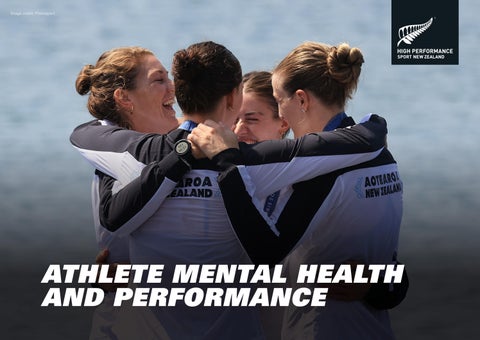
ATHLETE MENTAL HEALTH AND PERFORMANCE
CONTENTS
The mental health and wellbeing of everyone in high performance sport is a priority focus and is one of the biggest challenges facing our sector. Raelene Castle ONZM Chief Executive Sport New Zealand Group
P. 2
3
Foreword
4
Introduction
5
Athlete Mental Health and Performance Approach
6
What is mental health
7
Te Whare Tapa Whā
8
How common are mental health issues
9
The Mental Health Continuum
10
What all this means for our athletes
11
Athlete Circle of Support
Athlete Mental Health and Performance / High Performance Sport New Zealand
FOREWORD Modern society is increasingly demanding and challenging for young people and continues to result in a growing incidence of mental health issues.
Our goals for the wellbeing and mental health of New Zealand’s high performance athletes are both ambitious and essential.
High performance athletes are not immune to this and experience mental health issues at a rate comparable to the general population. In the case of elite athletes, the additional pressures of international competition may magnify emotions. If associated emotional and psychological factors are ignored, this is likely to impact performance and could lead to compounding health issues.
Achieving the goals of this Athlete Mental Health and Performance approach will require NSOs, athletes and HPSNZ to jointly recognise the challenge, and endorse and adopt the approach presented here. Supporting that process is a priority for HPSNZ.
We believe this Athlete Mental Health and Performance approach is key to transforming the management of athlete mental health and wellbeing in New Zealand’s high performance sport sector. It is a critical element of HPSNZ’s wider Wellbeing Framework and Guidelines. Importantly, the approach has been developed with input from a broad range of people. We would like to thank all those who have contributed from throughout the sector including athletes, via the Athlete Leaders Network (ALN).
Raelene Castle ONZM Chief Executive Sport New Zealand Group
Our goals for the wellbeing and mental health of New Zealand’s high performance athletes are both ambitious and essential.
P. 3
Athlete Mental Health and Performance / High Performance Sport New Zealand
INTRODUCTION
A HIGH PERFORMANCE SPORT MENTAL HEALTH APPROACH IS ESSENTIAL TO OPTIMISE ATHLETE POTENTIAL AND ENHANCE THEIR ABILITY TO THRIVE IN SPORT AND LIFE. Sport inspires a nation. It unites people in a common purpose and builds communities founded on belonging and connection. These factors run deep in the culture and history of New Zealand and are visible in athletes as they represent their country on the world stage. New Zealand’s 2032 High Performance System Strategy highlighted the importance of a holistic approach to athletes’ development, combining wellbeing, health (mental and physical) and performance. This Athlete and Mental Health Performance approach sits within HPSNZ’s Wellbeing Framework and is underpinned by its principles of transparency, inclusion and continuous growth. The design concept outlined in this document is based on a systems approach to mental health and performance, founded on the fundamental belief that these elements are essential for optimising people and performance in high performance sporting environments.
Athlete Mental Health and Performance: A System Approach 2024-2028 This document summarises Athlete Mental Health and Performance: A Systems Approach 2024-2028, which provides a best practice approach for HPSNZ and its NSO partners. Athlete Mental Health and Performance: A Systems Approach 2024-2028 aims to guide the planning and implementation of mental health promotion, prevention programmes and healthcare services delivered across the high performance sport sector and presents an overview of the principles and strategies which can be used to help navigate the mental health of people in the high performance sport community. View document
To provide context, it is clear an athlete’s readiness to perform relies on the intricate balance between their physical and mental state. Sporting environments have traditionally addressed these as separate entities rather than two halves of a whole. The result has been the continuation of stigma around mental factors with psychological influences poorly understood, not valued or addressed.
P. 4
Athlete Mental Health and Performance / High Performance Sport New Zealand
ATHLETE MENTAL HEALTH AND PERFORMANCE FRAMEWORK This Athlete Mental Health and Performance approach is prevention focussed. NSO leadership and engagement with athletes with HPSNZ support will be critical to the success of the Athlete Mental Health and Performance Approach and to meeting its four objectives.
Objective 1
Objective 2
Objective 3
Objective 4
LEADERSHIP
AWARENESS
EVALUATION
RESPONSE
Prioritise effective leadership and governance of mental health within sporting environments
Implement mental health awareness, health promotion and risk prevention strategies
Use athlete-based evidence to improve evaluation of mental health
Ensure comprehensive, integrated and responsive mental health services
LEADERSHIP
AWARENESS AND EDUCATION • • • • • •
P. 5
MH literacy Bespoke training programmes Individual skill acquisition MH promotion Accessible resources Wellbeing in environments
EVALUATION • • • •
RESPONSE
Timely data collection MH Screening Early detection and intervention Tailored and targeted support
• Rapid access • Early intervention • Specialist MH care
Athlete Mental Health and Performance / High Performance Sport New Zealand
WHAT IS MENTAL HEALTH?
Image credit: Getty Images
The World Health Organisation has defined mental health as:
a state of wellbeing in which the individual realises their own abilities, can cope with the normal stresses of life, can work productively and fruitfully and is able to make a contribution to their community.
HPSNZ acknowledges there are many cultural models and has aligned with the Te Whare Tapa Whā model, originally designed to be applied to health settings but increasingly relevant and appropriate as a wellbeing framework for sectors such as high performance sport. The use of Te Whare Tapa Whā in the context of sporting environments is a holistic approach to recognising the factors that influence an athlete’s wellbeing and similarly impact on their ability to perform on the world stage. Importantly, both international and local definitions recognise that mental health is about wellness, not just the absence of illness, which is essential for a person to thrive in life. This can be effectively applied to the high performance sport system.
P. 6
Athlete Mental Health and Performance / High Performance Sport New Zealand
TE WHARE TAPA WHĀ HPSNZ’s Wellbeing Framework and Guidelines and this Athlete Mental Health and Performance approach are grounded in Te Whare Tapa Whā which describes the four walls of a whare (house), each wall depicting one of the four dimensions of physical (tinana), spiritual (wairua), family (whānau) and emotional and mental (hinengaro) wellbeing.
TAHA WHĀNAU
TAHA WAIRUA
FAMILY HEALTH
SPIRITUAL HEALTH
The capacity to belong, to care and to share where individuals / collectives are part of wider social systems
The capacity for cultural belief systems, faith and wider communication
Taha Whānau underscores the coaches or athlete’s support network. Strong family bonds, camaraderie with teammates, and a sense of belonging within the high performance community provides the vital foundation for emotional stability, encouragement, and shared achievement.
This dimension determines who and what we are, where we have come from, and where we are going.
TAHA HINENGARO
TAHA TINANA
MENTAL AND EMOTIONAL HEALTH
PHYSICAL HEALTH
The capacity to communicate, to think and to feel
The capacity for physical growth and development
Elite sports demand a robust mental and emotional resilience. Taha Hinengaro encompasses mental fortitude, emotional balance, and stress management.
Taha Tinana emphasises the body’s vitality, health, and balance. Proper care, exercise, and nutrition are central to optimising physical condition, allowing individuals and collectives to engage fully in daily life and pursue their aspirations.
We must develop strategies to handle pressure, cope with high-stakes situations, and maintain a positive mindset for consistent peak delivery and performance.
P. 7
Taha Wairua involves cultivating a strong sense of purpose, mental resilience, and alignment with our personal, organisational and sport’s core values. Connecting with a deeper sense of meaning can fuel motivation, aiding coaches and athletes alike in overcoming setbacks and maintaining focus.
Diagram of Te Whare Tapa Whā as applied to Wellbeing in the high performance sport system (taken from HPSNZ Wellbeing Framework and Guidelines, 2023).
Athlete Mental Health and Performance / High Performance Sport New Zealand
HOW COMMON ARE MENTAL HEALTH ISSUES? According to the World Health Organisation: • Globally, one in seven 10 to 19 year olds experiences a mental disorder, accounting for 13% of the illness and disease in this age group • Depression, anxiety and behavioural disorders are among the leading causes of illness and disability among adolescents • Suicide is the fourth leading cause of death among 15 to 29 year olds • Up to 50% of mental health issues in adults emerge before 14 years of age • The consequences of failing to address adolescent mental health conditions extend to adulthood, impairing both physical and mental health and limiting opportunities to lead fulfilling lives as adults.
We want everyone to feel comfortable speaking openly about mental health and mental health conditions, without fear of stigma and discrimination.
Image credit: Hamish Kerr
Evidence shows mental health conditions have more successful outcomes when help is sought early, though it is never too late to seek treatment. This has helped inform this Athlete Mental Health and Performance approach, which provides a strong focus on education and awareness as key to a risk prevention approach.
Did you know… • 1 in 5 New Zealand youth will experience a mental health problem before the age of 25, almost twice the average rate • New Zealand has the second highest youth suicide rate in the developed world • In 2022, analysis of 400 elite athletes within the New Zealand high performance system found 7% were suffering from moderate to extremely severe symptoms of depression and/or stress and 17% reported moderate to severe symptoms of anxiety • In this same 2022 study, anxiety was two times more common in New Zealand’s female athletes
P. 8
Athlete Mental Health and Performance / High Performance Sport New Zealand
THE MENTAL HEALTH CONTINUUM
What becomes of critical concern is if an athlete becomes stuck in the red zone.
The presence of stressors is not uncommon and can impact an athlete’s ability to train. Symptoms can be temporary or may develop into more lasting or severe conditions that need professional intervention. Like the general population, elite athletes are not immune to mental health burdens and their impacts on their sporting and non-sporting lives. The Mental Health Continuum is a useful way to understand how mental health changes in response to increased stressors. Athletes, like most people, move in either direction on the continuum in response to the normal ups and downs of daily life. What becomes of critical concern is if an athlete becomes stuck in the red zone.
MENTAL HEALTH CONTINUUM MODEL H E A LT H Y • • • • • • •
Normal fluctuations in mood Takes things in stride Good sense of humour Consistent performance Physically and socially active Confident in self and others Drinking in moderation
ACTION: Nurture support systems
REACTING
INJURED
ILL
• • • • • • • • •
Nervousness, irritability Sadness, overwhelmed Displaced sarcasm Procrastination Forgetfulness Trouble sleeping Low energy Muscle tension, headaches Missing an occasional class or deadline • Decreased social activity • Drinking regularly or in binges to manage stress
• Anxiety, anger • Pervasive sadness, tearfulness, hopelessness, worthlessness • Negative attitude • Difficulity concentrating • Trouble making decisions • Decreased performance, regularly missing classes/deadlines, or over work • Restless, disturbed sleep • Avoidance, social withdrawal • Increased use of alcohol - hard to control
• • • • • • • • • • •
ACTION: Recognise limits, take breaks, identify problems early, seek support
ACTION: Tune into own signs of distress Talk to someone, ask for help Make self-care a priority Don't withdraw
ACTION: Seek professional care Follow recommendations
Excessive anxiety Panic attacks Easily enraged, aggressive Depressed mood, numb Cannot concentrate Inability to make decisions Cannot fall asleep/stay asleep Constant fatigue, illness Absent from social events/classes Suicidal thoughts/intent Unusual sensory experiences (hearing or seeing things) • Alcohol or other addiction
Adapted from Nash (2011)
P. 9
Athlete Mental Health and Performance / High Performance Sport New Zealand
WHAT ALL THIS MEANS FOR ATHLETES As athletes enter and progress through their NSO’s high performance pathway, they may feel the competition getting harder and the opportunities fewer. Adding to the pressure, this can be played out very publicly as they become recognised at the top of their game. Selection, non-selection, injury and illness can arrive unexpectedly and bring a range of feelings, from relief and satisfaction to disappointment and despair. The emotions can be all consuming, and it can be challenging to retain a sense of regular life at these times. Understanding how to cope with the highs, the lows and the unexpected is fundamental to athlete wellbeing and its critical role in ensuring athletes continue to thrive, learn and progress in their lives and in sport.
SUPPORT FOR ATHLETES As an athlete you will have access to resources and expertise to help you understand the way the brain functions and what can be done to optimise brain performance, not just during the tough times but also to manage distractions, to focus on applying your sporting skills and achieving your best potential.
Resources • You can track your own mental health, either formally with a doctor or psychologist or individualised through an app on your phone. • You can use the Mental Health Continuum (see page 8) which identifies common symptoms experienced by many people. • If you feel stuck in one part of the continuum, reach out, talk and seek expert support to help get you back on track. • If your sport has a Medical Director or Lead Psychologist, they should be your first point of contact if you need help. • If your sport does not have a Medical Director or Lead Psychologist, or if you would prefer to seek help outside your support team, you can access a number of external support resources. Athlete EAP Habit Health 0800 327 669 Online bookings: eap.habit.health Dr John P. Sullivan Clinical Sport Psychologist Head of Psychology High Performance Sport New Zealand Email: john.sullivan@hpsnz.org.nz National helpline Lifeline 0800 543 354 (0800 LIFELINE) or free text 4357 (HELP)
P. 1 0
Athlete Mental Health and Performance / High Performance Sport New Zealand
ATHLETE CIRCLE OF SUPPORT It is important to balance the four dimensions of Te Whare Tapa Whā wellness – family, mental and emotional, spiritual, and physical. In sport, there is often a heavy focus on physical elements while other dimensions are ignored. It is important to remember that each aspect contributes to wellbeing and performance. One of the ways we can do this is by establishing a trusted circle of support to help achieve the balance in and out of sport that helps athletes thrive.
Coaches Parents Physiotherapists Partners
Sport Psychologists
Primary caregivers
Siblings
Y
&
F
DS
PE
Nutritionists
RF
O
R
CE
FA
M
AN SUPP
Lawyers
O RT
LEGAL & C
Agents
Performance Life
M
IL
Friends
N RIE
Psychiatrists
Athlete
OM
M
R
E
Sponsors
CI
AL
N IO O R G A N I S AT
Tech Managers
A
L
Medical Doctors / General Practitioners Sport Scientists Strength & Conditioning Specialists Other health providers
NSOs NZOC/PNZ HPSNZ IFs
P. 1 1
ACC
Athlete Mental Health and Performance / High Performance Sport New Zealand
HIGH PERFORMANCE SPORT NEW ZEALAND N AT I O N A L T R A I N I N G C E N T R E 1 7 A N TA R E S P L A C E , M A I R A N G I B AY, A U C K L A N D 0 6 3 2