SPARTANBURG PHILHARMONIC
Volume 97, Spring 2026
Non-profit, Faith-based, Senior Solutions
Retirement is a Symphony— And You’re the Composer.
Living at RoseCrest blends comfort, connection, and care into a harmonious lifestyle where every note matters. Now, you can design your own masterpiece— we’re building custom dream homes tailored to your ideal retirement, with elegant finishes and personalized touches that reflect your unique rhythm.
With faith as our foundation and you as our inspiration, your days unfold like a beautiful score—filled with moments of joy, purpose, and community. Whether you’re enjoying the quiet rhythm of nature or the vibrant energy of shared experiences, your next act awaits on a stage set for living well.
Independent Homes & Apartments | Assisted Living & Memory Care | Post-acute Rehab | Long-term Care
The spotlight is on you—orchestrate your perfect retirement! 864.599.8600 or CareSolutionsUpstate@LHomes.org
200 Fortress Dr. | Inman, SC 29349 | RoseCrest.org
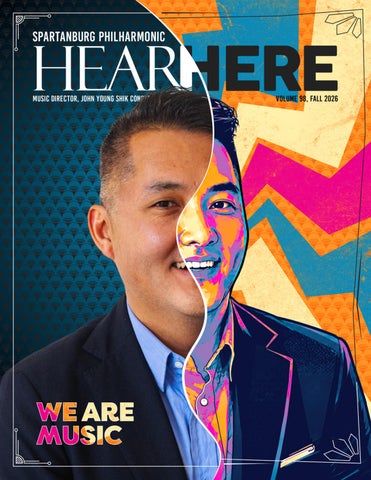
Volume 98, Fall 2026
200 East Saint John Street Spartanburg, SC 29306 864.948.9020
INFORMATION
CONCERTS
Calendar of Events . . . . . . . . . . . . . . . . . . . . . . . . . 4
Music Sandwiched In . . . . . . . . . . . . . . . . . . . . . . . 20
Your Visit to the Philharmonic . . . . . . . . . . . . . . . . . . 5
Bluegrass Spartanburg . . . . . . . . . . . . . . . . . . . . . . 31
Ticket Information . . . . . . . . . . . . . . . . . . . . . . . . . . 5 Spartanburg Philharmonic Board of Directors . . . . . . . .7 John Young Shik Concklin, Music Director . . . . . . . . . . 9 Spartanburg Philharmonic Staff . . . . . . . . . . . . . . . . 10
Spartanburg Philharmonic Orchestra Committee . . . . 11 Corporate Partners & Funders . . . . . . . . . . . . . . . . . 14
Spartanburg Phiharmonic Annual Fund . . . . . . . . . . . 16
Espresso Series . . . . . . . . . . . . . . . . . . . . . . . . . . . 29
Zimmerli Series: American Heroes . . . . . . . . . . . . . . .43 Zimmerli Series: Red, White, and Shades of Blue . . . . . 51
Youth Orchestra: Fall Concert . . . . . . . . . . . . . . . . . .60
Zimmerli Series: Hub City Holiday . . . . . . . . . . . . . . . 67
The Nutcracker . . . . . . . . . . . . . . . . . . . . . . . . . . . . 71
Joanna Mulfinger, Concertmaster . . . . . . . . . . . . . . 39
Spartanburg Philharmonic Musicians . . . . . . . . . . . .40
Youth Orchestra: Conductors . . . . . . . . . . . . . . . . . . 61 We are Music Education . . . . . . . . . . . . . . . . . . . . . 82 Advertiser Index . . . . . . . . . . . . . . . . . . . . . . . . . . .84
ARTICLES From the Board President & Executive Director . . . . . . . 6 A Legacy of Leadership: Karen Parrott . . . . . . . . . . . . 12 Music Educator of the Year: Janet Kuntz . . . . . . . . . . . 23
Authors
Sartanburg Music Trail: Honoring Two New Inductees . . 24
Ruta Allen Mark E. Britt Kathryn Boucher John Young Shik Concklin Molly Cribb Sharon Doyle
Photographers Kavin Bradner Chandler Crawford Jimmy Gibson Peter B. Kay
Joshua Miller Katherine Poss Ashlyn Scheuch Hannah Simpson Chris Vaneman Kelly Vaneman
The Musical Roots of the Spartanburg Philharmonic . . 26
Communication, Collaboration, and Community . . . . 32
Music Lovers' Luncheon . . . . . . . . . . . . . . . . . . . . . .35
Donor Spotlight: Phyllis & Robert Frank . . . . . . . . . . . .36 Welcome to the Scene: Intermezzo . . . . . . . . . . . . . . 62
SCMEA Performance . . . . . . . . . . . . . . . . . . . . . . . 63 Beyond the Music Stand: A Musical Journey . . . . . . . .64
Collective Effervescence . . . . . . . . . . . . . . . . . . . . . 73 Conductors from Every Angle . . . . . . . . . . . . . . . . . 76
Mark Olencki Avery Owens Katherine Poss
Design
Peter B. Kay
Connect with the Spartanburg Philharmonic!
See photos and video of the symphony on stage, backstage, and behind the scenes. Learn more about music and musical life, and stay up-to-date about our upcoming events. Like, Follow, Watch, and Listen! facebook.com/SpartanburgPhil instagram.com/SpartanburgPhilharmonic tiktok.com/@SpartanburgPhilharmonic youtube.com/SpartanburgPhilharmonic
HearHere: Fall 2026
3
CALEN DAR O F E VENTS
FALL 2026
Zimmerli Series (page 43)
Youth Orchestra (page 60)
Espresso Series (page 29)
Music Sandwiched In (page 20)
Bluegrass Spartanburg (page 31)
Event
Date
Venue
August Wirewood
Wed 8/12
Spartanburg County Library
Windjammers
Wed 8/26
Spartanburg County Library
Absinthe Minded
Wed 9/9
Spartanburg County Library
American Heroes
Sat 9/12
Twichell Auditorium
Bluegrass Spartanburg
Wed 9/23
Spartanburg County Library
ContraBand Bootleg Jazz
Wed 9/30
Cyrill-Westside Library
Music from the Age of Enlightenment
Fri 10/2
Chapman Cultural Center
Foothills Oompah Band
Wed 10/7
Spartanburg County Library
Lonesome River Band
Fri 10/9
Chapman Cultural Center
Trio Radieuse
Wed 10/21
Spartanburg County Library
Red, White, and Shades of Blue
Sat 10/24
Twichell Auditorium
SPYO: Fall Concert
Sun 10/25
Twichell Auditorium
Spartanburg High School Chorus
Wed 11/4
Spartanburg County Library
Fayssoux McLean
Wed 11/18
Spartanburg County Library
Music from the Information Age
Fri 11/20
Chapman Cultural Center
Arbor Wind Trio
Wed 12/2
Spartanburg County Library
Hub City Holiday
Sat 12/5
Twichell Auditorium
The Nutcracker
Fri 12/11
Twichell Auditorium
The Nutcracker
Sat 12/12
Twichell Auditorium
The Nutcracker
Sun 12/13
Twichell Auditorium
Philharmonic Brass
Wed 12/16
Spartanburg County Library
Wayne & Kristin Scott Benson and Friends
Thurs 12/17
Chapman Cultural Center
September
October
November
December
4
SpartanburgPhilharmonic.org/Events
TIC K E T I N FO RMATIO N SpartanburgPhilharmonic.org/box-office-venues
Twichell Auditorium
at Converse University Box Office Hours 10:00 AM - 2:00 PM, M-Th 10:00 AM - 1:00 PM, F
Chapman Cultural Center Box Office Hours 10:00 AM - 5:00 PM, T-Th 10:00 AM - 2:00 PM, F Closed Mon
(864) 596-9018 580 East Main Street Spartanburg, SC 29302
(864) 583-2776 200 East Saint John St. Spartanburg, SC 29306
Zimmerli Series & Youth Orchestra Individual Tickets
Espresso & Bluegrass Series Individual Tickets
Spartanburg Philharmonic Administrative Offices 9:00 AM - 5:00 PM, M-F
(864) 948-9020 200 East Saint John St. Spartanburg, SC 29306 Season Tickets
YO U R VIS IT TO TH E PH I L Restrooms: Restrooms in Twichell Auditorium
are located off of the first floor lobby and next to the handicap accessible entrance in the auditorium. Restrooms at the Chapman Cultural Center are located to the left and right of the main entrance lobby.
Seating: Twichell Auditorium uses a reserved seating
system for our Zimmerli Series concerts, so please keep your ticket with you at all times to verify section and seat specifics should there be any confusion. Chapman Cultural Center also uses a reserved ticket system for Bluegrass Spartanburg. For our Espresso Series, Chapman uses a General Admission system and does not reserve seating.
Late seating: For the listening pleasure of our
audiences, late arriving patrons will not be seated while music is being performed. Latecomers will be seated at the first appropriate pause in the program (typically during applause). Additionally, we ask that patrons who must leave prior to the end of a performance exit only between selections if at all possible.
Ticket donation: We are unable to issue refunds
for unused tickets. However, if you are unable to attend a concert, we encourage you to donate your tickets back or give them to a friend. When you donate your tickets to the Spartanburg Philharmonic, you not only receive a donation tax receipt, but you also share your seat with another music lover. If you would like to give in this way, please notify our ticket office at least 24 hours prior to the performance. If a concert is canceled or rescheduled due to inclement weather, a tax letter will be provided for any ticket returned within 24 hours after the original concert date.
Accessibility: The Spartanburg Philharmonic
is committed to providing an environment that is welcoming and inclusive to all patrons. Persons requiring assistance are encouraged to call the respective box offices for direct assistance in purchasing the appropriate tickets. Please note that Twichell Auditorium does not currently have an elevator for balcony seats. Wheelchair accessibility is located at the side entrance of the auditorium. The Chapman Cultural Center is fully ADA compliant, and the theater has state-of-the-art hearing assistance technology. In addition to traditional amplification devices, such as headphones, the theater is equipped with “The Loop” technology.
Food/Beverage: No food or drink, other than bottled water, is allowed in Twichell Auditorium.
Cameras, cell phones, recording devices, watch alarms, and similar devices: To ensure a quality experience for everyone, the use of flash-photography or video/audio recording equipment is strictly prohibited. Patrons are asked to turn off or mute (not just turn to vibrate) all personal electronic devices prior to the performance.
In Case of Emergency: Prior to the
performance, we request that you familiarize yourself with the locations of all exits in case of an emergency. If the power to the building should be interrupted for any reason, generators will begin within 10 seconds for lighting.
The Mission of the Spartanburg Philharmonic is to enrich, inspire, and educate people of all stages and walks of life hrough live performances of high-quality music.
5
Welcome to the Spartanburg Philharmonic! We are thrilled you’re here. As we enjoy live music together, the audience is just as important to the experience as the performers on stage. Time and again, our guest artists tell us that Spartanburg is a joy because of its warm, enthusiastic, and engaged audiences. For that, we are deeply grateful to you. Personally, I look forward to serving as your new Board President during this particularly exciting chapter in the Philharmonic’s history. We are uniquely positioned for the future through the outstanding leadership and collaboration of our Music Director, Executive Director, musicians, staff, and Board of Directors. Our 2026–2027 season offers an incredible range of music for our community. As we continue celebrating America’s 250th anniversary, we’ll showcase the breadth and depth of American music and its many influences. From the Zimmerli Masterworks Series to Espresso’s intimate chamber music performances and our nationally recognized Bluegrass Series, the Spartanburg Philharmonic offers something for everyone.
6
Spartanburg Philharmonic
Our Spartanburg Philharmonic Youth Orchestra will kick off its 8th season with energy and enthusiasm! Now featuring three ensembles—Symphony, Intermezzo, and Prelude—the program brings together talented middle and high school students from across the Upstate and even beyond South Carolina. We also look forward to celebrating the holidays with our Hub City Holiday concert, conducted by Dr. Bill Scott, as well as our beloved partnership with Ballet Spartanburg for the can’t-miss performances of The Nutcracker. There is simply no better way to celebrate the season than by experiencing these wonderful performances with our community. This season is guaranteed to be ICONIC. Thank you for your continued support as we embark on another remarkable season together. I look forward to sharing the music with you.
John Cribb
President of the Board of Directors
Kathryn H. Boucher Executive Director
Spartanburg Philharmonic Board of Directors
John Cribb
President
Dr. Chandra Hopkins
Vice President
Perrin Dent Patterson
Vice President
David Smart
Treasurer
Charles Clementson
Sharon Doyle
Ross Hammond
Dr. David Ike
Bob Ireland
Marshall Jordan
Kay Maddox
Greg Murphy
Marilyn Nguyen
Amy Oakes
James A. Reese
Claudia Albergotti Ruffin
Myrella Samuels
Dr. Bill Scott
Betsy Neely Sikma
Switi Thakkar
Sarah Tignor
Kathy Zimmerli Wofford
Dr. Sidney Fulmer Lifetime Board Member
Karen Parrott Lifetime Board Member
Cabe Loring
Past President
Samantha Larkins
Vice President
Chris Strickland
Vice President
Francisca Yanez
Secretary
HearHere: Fall 2026
7
Welcome! We are thrilled to welcome the Philharmonic’s two new Board members to our team (see page page 7). Their expertise, passion for music, and commitment to our mission will be invaluable as we work together to enrich our community through the power of music. CHARLES CLEMENTSON
Charles Clementson is a Vice President - Financial Advisor & Trust Officer at Colonial Trust Company in Spartanburg. His professional investment background includes over 25 years of experience in investment services. Before joining Colonial Trust in 2021, Charles was a Vice President and Wealth Advisor with BB&T/Truist Wealth in Spartanburg. Charles completed a two-year term as Chair of the Charles Lea Center Foundation in June 2025 and served over 8 years with the organization. He and his family are active members of First Presbyterian Church in Spartanburg. Charles is a graduate of Wofford College, as is his wife Blair, a local dermatologist. Charles and Blair have three children and his daughters have participated in Spartanburg Philharmonic Youth Orchestra for the past 4 years.
BETSY NEELY SIKMA
Betsy Neely Sikma is the Senior Director of Brand & Communications and Marketing Operations at Milliken & Company, where she leads the company’s global brand strategy, communications, and marketing operations. Since joining Milliken in 2019, she has helped guide the company’s communications through significant transformation while advancing initiatives that strengthen its reputation, culture, and community impact. Before joining Milliken, Betsy held leadership positions with OneSpartanburg, Inc. and Accion, where she led strategic communications, fundraising, and community engagement initiatives. Earlier in her career, she directed communications and development for organizations focused on public policy, higher education, and nonprofit leadership. A Spartanburg native, Betsy is deeply committed to strengthening her community through civic and cultural leadership. She currently serves on the boards of the Spartanburg Academic Movement and the Spartanburg Philharmonic Orchestra and is a past board member of both the Chapman Cultural Center and the Women’s Rights & Empowerment Network. Betsy holds a bachelor’s degree from Furman University and a master’s degree from Vanderbilt University. Betsy and her husband, Jason, are lifelong music lovers and the proud parents of two young musicians, Wren Clare and Rowan Sikma.
8
Spartanburg Philharmonic
John Young Shik Concklin
MUSIC DIRECTOR, SPARTANBURG PHILHARMONIC John Young Shik Concklin, conductor, is the tenth Music Director of the Spartanburg Philharmonic. He began as a violist in the Philharmonic, made his conducting debut in 2018 to wide acclaim with two John Williams concerts, returned as a Music Director Finalist in 2022, and came in at the last moment as a substitute conductor later that year. He is praised for his clear beat, strong sense of rhythm, inviting gravitas, and innovative mind. Concurrently, John serves as Music Director of the Hendersonville Symphony Orchestra and Conductor with the Atlanta Music Project. For the 2023/24 season, he was also a Music Director Finalist with the Walla Walla Symphony in Washington State. John was National Finalist for the 2019-2020 American Prize in Conducting, has competed internationally at the Almaty Conducting Competition, the Nino Rota Conducting Competition, and as the only American in the Città di Brescia Conducting Competition, and has appeared numerous times to cover conduct the Atlanta, Nashville, and Kansas City Symphony Orchestras.
Previous positions include Associate Conductor of the Georgia Symphony, Assistant Conductor of the Cleveland Pops Orchestra, and faculty appointments at Vanderbilt, Clemson, Furman and Converse Universities He has been a fellowship conductor at the Aspen Music Festival, a teaching assistant at the Brevard Music Center, and a finalist at the New World Symphony and Debut Orchestras. A flexible musician, John has also performed at the Super Bowl Halftime Show and has collaborated with Monica, a Grammy-winning R&B artist. John studied at Vanderbilt and Yale Universities and the Cleveland Institute of Music. His mentors include David Zinman, Carl Topilow, Shinik Hahm, and Robin Fountain. He received further training from Lorin Maazel and Michael Tilson-Thomas. John and his wife, Lauren Maxwell, co-founded Mozart for a Cause, an annual fundraising event for local causes.
www.JohnConcklin.com
HearHere: Fall 2026
9
The Spartanburg Philharmonic Staff
Kathryn H. Boucher Executive Director
Katherine Henderson Poss Development Manager
Dr. Peter B. Kay
Director of Artistic Operations & Composer in Residence
Robert G. Borden
Orchestra Librarian & Youth Orchestra Operations Manager
Dr. Joshua Miller
Youth Orchestra Intermezzo & Prelude Conductor 10
Spartanburg Philharmonic
Hannah Simpson
Director of Education & Community Engagement
Ashlyn Scheuch
Patron Services Coordinator & Youth Orchestra Site Coordinator
Andrew Merideth
Orchestra Personnel Manager
SpartanburgPhilharmonic.org/Staff
Ian Bracchitta
Principal Bass
Alvoy Bryan, Jr.
Principal Viola
Rosalind Buda
2nd Bassoon
Michele Tate Cockram
Violin
John Holloway
Principal Tuba
Theresa Jenkins Russ
Violin
Spartanburg Philharmonic Orchestra Committee The goal of the Spartanburg Philharmonic’s Orchestra Committee is to amplify our musicians’ voices throughout the organization and ensure that communication runs smoothly among musicians, staff, and board members. The committee provides musicians with a clear point of contact for questions, feedback, and concerns that may affect their work. By maintaining an open dialogue with the orchestra, committee members can identify recurring issues, clarify policies, and help address problems before they become larger challenges. Committee members provide a musician’s perspective on operational issues as well as artistic policies, such as outlining a new process for selecting the next concertmaster. They also mediate complaints and conflicts among musicians and staff, working toward solutions that support both individual musicians and the organization as a whole. Some members serve on multiple committees—including two who served on the recent Music Director Search Committee—to facilitate communication among groups and ensure that musicians are represented during important organizational transitions. At least one member of the Orchestra Committee attends each board meeting to convey the considerations and concerns that are unique to the world of working musicians. This participation gives
board members a clearer understanding of how organizational decisions may affect the orchestra and ensures that musicians are part of decision-making at the highest level of the organization. Orchestra Committee members are elected from among the core musicians of the orchestra— those who have earned their positions through a competitive audition process. Current members represent most of the instrument families, including strings, brass, and woodwinds. Collectively, they have experience performing with more than a dozen orchestras across the region, which helps them remain current with professional standards and best practices in the field. Their day jobs range from college professor and middle school orchestra director to financial advisor and more. These varied professional and musical experiences bring a range of perspectives to the committee’s discussions and decisions. Committee members are proud to represent the musicians of the Spartanburg Philharmonic and are deeply grateful for the tremendous support of the community, board of directors, and staff, whose efforts have kept the organization financially and operationally sound. They look forward to continuing to support their fellow musicians as the orchestra makes fantastic music this season and for many seasons to come.
HearHere: Fall 2026
11
A Legacy of Leadership: Karen Parrott Named Lifetime Board Member The Spartanburg Philharmonic is proud to recognize Karen Parrott as a Lifetime Board Member, one of the highest honors our organization can bestow. Reserved for only a select few individuals, Lifetime Board Membership recognizes those whose extraordinary leadership, unwavering dedication, and enduring service have helped shape the Philharmonic’s future. Karen’s years of commitment, generosity, and thoughtful leadership have strengthened not only our organization but also the cultural fabric of the Spartanburg community. Karen’s impact on the Spartanburg Philharmonic extends far beyond attending meetings or serving on committees. Throughout her tenure, she has consistently stepped forward whenever the organization needed a leader. As Board President, she helped guide the Philharmonic through one of the most pivotal moments in its history—the search for the organization’s 10th Music Director. Leading a diverse committee of musicians, board members, staff, and community representatives, Karen helped oversee a comprehensive two-year national search that ultimately resulted in the appointment of Music Director John Young Shik Concklin, a milestone that continues to shape the artistic future of the Philharmonic. Her leadership has always been grounded in a deep belief that music has the power to enrich lives and strengthen communities. Whether championing fundraising efforts, advocating for educational
12
Spartanburg Philharmonic
initiatives, welcoming new audiences, or supporting the musicians who bring each performance to life, Karen has led with humility, vision, and a genuine love for the arts. Those who have served alongside Karen know that her greatest contributions often happen behind the scenes. She is a trusted mentor, a thoughtful listener, and a tireless advocate whose influence can be seen in countless initiatives, partnerships, and moments of organizational growth. Her willingness to invest her time, talent, and resources has inspired others to do the same, creating a legacy that will continue to benefit the Philharmonic for generations. Lifetime Board Membership is not awarded lightly. It recognizes not only years of service, but a lasting legacy of leadership and commitment. Karen embodies these qualities in every way. On behalf of our musicians, Board of Directors, staff, volunteers, patrons, and supporters, we extend our heartfelt gratitude to Karen Parrott for her extraordinary service to the Spartanburg Philharmonic. Her passion, leadership, and generosity have helped ensure that great music will continue to enrich, inspire, and educate our community for years to come. Please join us in congratulating Karen Parrott on this well-deserved honor and thanking her for the remarkable legacy she has created.
In Tune with Our Clients
We take pride in listening to and responding to our clients’ needs for comprehensive insurance solutions. And, we team with top carriers like Selective that strike the right chord with superior products and responsive service.
TowneInsurance.com | 864-585-2256 | Insurance products offered through Towne Insurance, a subsidiary of TowneBank, are Not a deposit, Not FDIC-Insurance, Not guaranteed by TowneBank, Not insured by an federal government agency, and May go down in value.
© 2025 Selective Ins. Group, Inc., Branchville, NJ. Products vary by jurisdiction, terms, and conditions and are provided by Selective Ins. Co. of America and its insurer affiliates. Details at selective.com/about/affiliated-insurers.aspx.
CO RPO R ATE PARTN ERS
When arts and businesses partner, everyone profits. With corporate partnerships, our concerts and events provide invaluable exposure to prospective and current clients, educate the public about your business initiatives, offer networking opportunities with clients, and provide benefits for employees. For full details regarding our Corporate Partnership packages, please contact: Kathryn Boucher, Executive Director kathryn@spartanburgphilharmonic.org
F O U N D A T I O N
FU N D ERS
Arkwright
Balmer
F O U N DAT IO N F O U N DAT IO N
14
Spartanburg Philharmonic
S PARTAN BU RG PH I LHARM O N IC AN N UAL FU N D
Spartanburg Philharmonic Annual Fund We gratefully acknowledge the following donors who made generous commitments to the Spartanburg Philharmonic. This list reflects gifts received July 2025 through June 2026.
Benefactor ($25,000+) Balmer Foundation Mr. and Mrs. William Barnet III Mr. and Mrs. George Dean Johnson, Jr. Mr. and Mrs. Glen Warner Mrs. Nelly Zimmerli Maestro ($10,000-$24,999) Dr. Barry Bodie and Ms. Laurel D. Johnson Mr. and Mrs. Stephen P. Parrott The Joe R. & Joella F. Utley Foundation Virtuoso & Podium ($5,000-$9,999) Mr. and Mrs. Andrew Babb Mrs. Joan B. Gibson Mr. and Mrs. Roger Habisreutinger Dr. and Mrs. David Ike In Memory of CRI, MD Elbert W. Rogers Foundation Dr. and Mrs. Caleb Loring IV
Mrs. Betty Luce Mr. and Mrs. John S. McBride, Jr. Mr. and Mrs. V. C. McLeod III Mr. and Mrs. Thomas P. Nederostek Mrs. Corry W. Oakes III Dr. and Mrs. Rick Orr Ms. Anna Rickell
Baton ($2,500-$4,999) The Arkwright Foundation Mr. and Mrs. Halsey Cook Mr. and Mrs. John Cribb Mr. Reed Cunningham Allen and Sharon Doyle Phyllis and Robert Frank Ms. Laura Henthorn
16
Spartanburg Philharmonic
Dr. Leslie W. Howard, Jr. Clint and Samantha Larkins Mr. and Mrs. Paul Lehner Mr. E.T. McLean Don and Mary Miles Mrs. Walter Montgomery, Jr. Lawrence Butka and Gregory Murphy Mr. and Mrs. Wiley North
SpartanburgPhilharmonic.org/GiveNow
David and Jennifer Smart Ms. Switi Thakkar Mr. and Mrs. H. Peter Theiler Mr. and Mrs. Peter Weisman Mr. and Mrs. Geoffrey Wilson Ms. Kathy Zimmerli Wofford Dr. and Mrs. Auburn Woods
Principal ($1,000-$2,499) Mrs. Sarah Evans Allen Mrs. Ruta Allen Mr. and Mrs. Stanley Baker Mrs. Susan H. Baker Mr. and Mrs. Tom Barnet Ms. Karen E. Bjelland Ms. Harriet Bolen and Mr. Jim Brown Ms. Kathryn H. Boucher Ms. JoAnn Bristow Cathy and Jim Burchfield Mr. Jason Bynum Mr. Mark Carlson Mr. James Cheek Mr. Charles Clementson and Dr. Blair Clementson Mr. and Mrs. Leland Close Mr. and Mrs. Jerry Cogan Mrs. Celia Cogdell Dean and Pam Davis Mr. and Mrs. Frederick B. Dent, Jr. Mr. and Mrs. Ray Dunleavy Mr. and Mrs. David Ellis
Dr. and Mrs. Mark Ferguson Mr. and Mrs. Michael Ferguson Mici Fluegge and Leah Kent Dr. and Mrs. Charles M. Fogarty Mrs. Elaine T. Freeman Mr. and Mrs. Kenneth R. Frick Mr. Peter Grzan Mr. and Mrs. William U. Gunn Mr. and Mrs. Ross Hammond Drs. Chandra and Boone Hopkins Ms. Maureen Johannigman Sue Johnsen Carter and Geordy Johnson Katie and Marshall Jordan Mr. Patrick Kay Cindy and Keith Kelly Dr. and Mrs. Louis Knoepp, Jr. Dr. Curt Laird Mr. and Mrs. Lindsay Little Col. and Mrs. Robert N. Maddox Mr. and Mrs. William C. Mayrose Mr. John McAllister and Dr. Katee Castleman
Dr. and Mrs. Donald H. McClure Ms. Judy McCravy Mr. and Mrs. Boyce Miller Belle and John Montgomery Mrs. Paula Morgan Music Club of Spartanburg Mr. and Mrs. Robert Parmenter Dr. Olin Sansbury Jr. Mr. and Mrs. G. Garrett Scott Dr. Bill Scott Dr. and Mrs. Peter Sereque MG(R) Edwin E. Spain III and Mary B. Spain Mr. and Mrs. E. Donald Stevens Brand and Laura Stille Michel and Eliot Stone Mr. and Mrs. Chris Strickland Mr. and Mrs. Mark Van Geison Mr. and Mrs. Marshall T. Walsh Mr. and Mrs. Donald Wildman James C. and Judy Wilson
Mr. and Mrs. James Glenn Mr. and Mrs. Brandt Goodwin Dr. and Mrs. John A. Harrill, Jr. Ms. Mary Ann Hipp Dr. and Mrs. David A. Holt Mr. and Mrs. Robert Houston Rear Admiral and Mrs. Stephen Johnson Dorothy C. Josey Kristi and Kim Keith Beth and Andy Lancaster Mr. and Mrs. Mack McKeithan Mr. Jeffrey Nye Joy and Walter Oates
Mr. Scott Parris Katherine Henderson Poss Dr. and Mrs. Jan H. Postma, Jr. Mr. and Mrs. James A. Reese Mr. and Mrs. Richard H. Rhodes Ms. Joy Shackelford Mr. Richard Spiers and Ms. Johanna Lewis Richard and Norwood Strasburger Donna and Jody Traywick Mr. and Mrs. Robert Troup Mr. and Mrs. W. Burnham Uhler Robert and Francisca Yanez
Fellow Musician ($500-$999) Laura Allen and Roger Sullivan Britta Anderson Dr. Joel Atance and Ms. Kara Bui Mrs. Dianne Bagnal Mr. and Mrs. James Bagwell Martha and Clarke Blackman Dr. and Mrs. Ernest Camp III John Young Shik Concklin and Lauren Maxwell Mr. and Mrs. Paul Cote In Memory of Elizabeth H. Floyd Mr. Lawrence Flynn III Mr. and Mrs. Randy Foster Stephen and Vicki Fowler
SpartanburgPhilharmonic.org/GiveNow
HearHere: Fall 2026
17
Patron ($250-$499) Patty and C. Mack Amick Orin and Beth Beach Diana and Alden Berti Mr. and Mrs. Louie W. Blanton Mr. and Mrs. Thomas Blexrud Mr. and Mrs. W. Waller Caldwell, Jr. Mr. and Mrs. Jan Caldwell Mr. and Mrs. Dexter Cleveland Mr. Bill and Mr. Martin Cooper-Meek Mr. and Mrs. William V. Cummings Dr. Jean Dunbar Col. (Ret.) James D. and Jackie George Linda and Bruce Greenberg Patricia and David Davis Mr. and Mrs. Ken Henderson
Nancy S. and John M. Holmes Leon Russ and Dr. Theresa Jenkins Russ Ms. Jane Johnson Mrs. Nancy Zoole Kenney Dr. Thomas N. and Janet E. Kias Mr. and Mrs. Thomas N. King Claire Klatchak in memory of Michael Klatchak Dr. and Mrs. Bert Knight Mr. Thomas G. Lewis II Mr. and Mrs. Horace C. Littlejohn, Jr. Mr. and Mrs. Robert Lyle Lynda Mellor Ms. Cabell Mitchell Dr. David Mitchell
Mr. and Mrs. John P. Moore Mr. and Mrs. John R. Murphy Kam and Emily Neely Marilyn Nguyen Mr. and Mrs. Jim Patterson Mr. Dwight F. Patterson, Jr. Mr. and Mrs. Daniel R. O'Connell, Jr. The Rev’ds Richard and Emily Proctor Claudia and Stuart Ruffin Ms. Sarah Tignor and Dr. Kevin DeLapp Mr. Arnie Tuttle Phyllis and Greg Valainis Douglas and Rita Weeks Ms. Linda Sangster West Libbo Wise Steven and Charlotte Zides
Mr. Jerome Glassman Mr. Mark Jason Haddox Mr. and Mrs. Stuart Hansen Mr. and Mrs. Peyton Harvey Mrs. Patricia Garst Hevener Mr. and Mrs. John R. Holloway Wilson Hoyle Mr. and Mrs. Robert E. Hyatt Mr. and Mrs. Pickney Irwin Mrs. William A. James Ms. Kathleen Jones Dr. Peter B. Kay and Ms. Jennifer Bonner Ms. Ellen H. King Mr. James M. Kunkle Ms. Phyllis LaPlante Ms. Cornelia Linder Mr. and Mrs. George Loudon, Jr. Mr. and Mrs. Kingsley Martin Thorne and Harrison Martin Ms. Cynthia Howe and Mr. Daniel McBride Ms. Diana Mcgraw Mr. and Mrs. John N. McNamara Ms. Bonnie-Lee Mizzell
Dr. and Mrs. Mark Monson Linda and Clint Montgomery Ms. Hazel Morgan Carlin and Alexander Morrison Dr. and Mrs. W. Harold Nixon Ms. Jean W. Ogden Mr. and Mrs. W. Gerald Palmer Mr. and Mrs. George Peters Dr. Terry O. Pruitt Senator Glenn G. Reese Ms. Elizabeth Refshauge Ms. Myrella Samuels Dr. and Mrs. Wilson P. Smith, Jr. Mr. and Mrs. Ray Sturm Mr. and Mrs. William Tolstedt Malinda and Charles Tulloh Ms. Sandra G. Turner Mr. and Mrs. Gregory Wade Dr. and Mrs. Lawrence N. Warren, Jr. Mr. and Mrs. Paul D. Weaver Maryela and Frank Weihrauch Lucy and David Williams Mr. Grantham Wood William Woodroof Ms. Sheila Worley
Members ( $100-249) Mr. David Anderson Mrs. Margaret Baughman Frank and Joy Baumgartner Cyndi and David Beacham Thomas Bedenbaugh Mr. Russ Blackburn II Mr. and Mrs. Tim Brannon Mrs. Susan Britanisky Dr. and Mrs. William W. Burns Mr. Charlie Burns Deanna Butler Ms. Rachel Chalmers and Mr. Hayden Raabe Chalmers Mr. and Mrs. John Thomas Claggett Randall K. and Sarah P. Chambers Ms. Barbara Colvin Vickie Corbitt Mr. and Mrs. James C. Curry Mr. and Mrs. Michael Dangelewicz Ms. Lisa Davis Ms. Lynda Davis Mr. and Mrs. Andrew Donnan Ms. Susan Duncan Mrs. Sharon Free Gerald and Hanh-Trang Ginocchio
18
Spartanburg Philharmonic
SpartanburgPhilharmonic.org/GiveNow
Recognized nationally. Caring locally. 19
MUSIC SANDWICHED IN Celebrating 30 years of Music Sandwiched In, Spartanburg Philharmonic is proud to present an exciting line up of performers for its popular series at the Spartanburg County Public Library Headquarters! MSI is on-going throughout our season, and all concerts are free and open to the public. All are welcome!
BARRETT ROOM
Spartanburg County Public Library, Headquarters 151 South Church Street W E D N ES DAY S
12:15 - 1:00 PM
FALL
Aug. 12 . . . . . . . . . . . . . . . . . . . . . . . . . . . Wirewood Aug. 26 . . . . . . . . . . . . . . . . . . . . . . . . . Windjammers Sept. 9 . . . . . . . . . . . . . . . . . . . . . . . Absinthe Minded Sept. 23 . . . . . . . . . . . . . . . . . . . Bluegrass Spartanburg Sept. 30 . . . . . . . . . . . . . . . . . ContraBand Bootleg Jazz Cyrill-Westside Library
In Partnership with:
Oct. 7 . . . . . . . . . . . . . . . . . . . . Foothills Oompah Band Oct. 21 . . . . . . . . . . . . . . . . . . . . . . . . . . Trio Radieuse Nov. 4 . . . . . . . . . . . . . . Spartanburg High School Chorus Nov. 18 . . . . . . . . . . . . . . . . . . . . . . . Fayssoux McLean Dec. 2 . . . . . . . . . . . . . . . . . . . . . . . . . Arbor Wind Trio
Read more online:
Dec. 16 . . . . . . . . . . . . . . . . . . . . . . Philharmonic Brass
Programs subject to change. All timings are approximate.
20
Spartanburg Philharmonic
SpartanburgPhilharmonic.org/MSI
Because finding a home should feel like a symphony, not a solo. Trusted local real estate helping you move with the right ‘key’.
25 Years Combined Real Estate Sales & Marketing Experience Deeply Rooted Spartanburg Residents Katie & Marshall Jordan, REALTORS® (864) 266-8308 • mjordan@cbcaine.com (864) 918-9772 • kjordan@cbcaine.com
T
S. REEL ROBERTSON
Certified Public Accountant 721 E. Main Street Spartanburg, SC 29302
(864) 583-2450
Fax: (864) 582-7332 reel@sreelrobertsoncpa.com
551 e main street
Left: Janet Kuntz accompanied by fellow educators and Spartanburg Philharmonic Board Members; Right: former student of Janet Kuntz, Master Seargent James Miller, U.S. Army
Music Educator of the Year: Janet Kuntz The Spartanburg Philharmonic is proud to announce Janet Kuntz as the 2026 Music Educator of the Year, recognizing her outstanding dedication, leadership, and impact in music education. Janet Kuntz has demonstrated an unwavering commitment to fostering musical excellence and inspiring students of all ages. Her influence extends beyond the classroom, strengthening the broader arts community and cultivating a lifelong appreciation for music among her students. Janet Kuntz has been a public-school music educator for 41 years. She received her Bachelor of Music Education degree from Furman University in 1985. Janet received her Master of Music degree in flute performance at the University of South Florida in Tampa, FL in where she was the student of Kim Stirzaker McCormick. Janet is a National Board Certified Teacher and has enjoyed teaching symphonic band, jazz band, marching band, color guard, as well as chorus and show choir groups. She has also received training in First Steps in Music and taught this curriculum to pre-school children for many years. Janet conducted the South Carolina Band Director’s Association Region Three Junior Concert Band in 2007 and was the 2008-2009 Teacher of the Year at Ewing Middle School in Gaffney, SC. Janet is currently the band director at McCracken Middle School and has led the program in receiving the South
Carolina Band Director’s Association Outstanding Performance Award for the past two years. She is also an active member of Phi Beta Mu International Bandmasters’ Fraternity, and Delta Kappa Gamma professional honorary society for women educators. The award was presented to Janet Kuntz at McCracken Middle School on March 25, 2026 at a “National Music in our Schools Month” assembly held for all music students. Also in attendance was Master Sergeant James Miller, a former student of Janet Kuntz and current member of The United States Army Band “Pershing’s Own” who performed for the crowd ahead of the award ceremony. In MSG Miller’s words: “Mrs. Kuntz embodies what it means to be a music educator and mentor. She always showed up, even after long, exhausting workdays of her own. … Mrs. Kuntz exemplifies the highest standard of teaching through her integrity, compassion, and selflessness, and I would not be the flutist, educator, or person I am today without her generosity and unwavering belief in me.” The Spartanburg Philharmonic’s Music Educator of the Year Award is dedicated to honoring outstanding music educators in Spartanburg County. This prestigious award celebrates the exceptional dedication, creativity, and passion of local music teachers who inspire and cultivate a love of music in their students.
Nomination Deadline: January 31, 2027
SpartanburgPhilharmonic.org/Educators Announcement: March 2027
HearHere: Fall 2026
23
Left: Miles Hoffman's family pictured with his former students; Right: Kristin Scott Benson and Wayne Benson.
The Spartanburg Music Trail Honoring Two New Inductees
The Spartanburg Philharmonic hosted the Unveil the Trail celebration on Thursday, June 11, 2026 at the Spartanburg County Public Library, welcoming two new inductees to the Spartanburg Music Trail: acclaimed violist, broadcaster, and music educator Miles Hoffman and award-winning bluegrass banjoist Kristin Scott Benson. The event celebrated their extraordinary musical achievements and lasting connections to Spartanburg, recognizing the diverse impact both artists have made on the national music landscape. Their induction adds two more remarkable stories to the Spartanburg Music Trail, which honors musicians with deep ties to the community and preserves the region’s rich musical heritage for future generations.
Miles Hoffman (1952—2023): Violist Miles Hoffman was the founder of The American Chamber Players. Currently Distinguished Visiting Professor of Chamber Music at the Schwob School of Music of Columbus (GA) State University, he made his New York recital debut in 1979 at the 92nd Street Y and appeared frequently around the country in recital, as chamber musician, and as soloist with many orchestras. His solo performances on YouTube have received well over 650,000 views. In 1982 he founded the Library of Congress Summer Chamber Festival, which he directed for nine years, and which led to the formation of the American Chamber Players. His musical commentary, “Coming to Terms,” was heard weekly throughout the United States for thirteen
24
Spartanburg Philharmonic
years – from 1989 to 2002 – on NPR’s Performance Today, and as Classical Music Commentator since 2002 for NPR’s flagship news program, Morning Edition, he was regularly heard by a national audience of nearly 14 million people. His radio essays, "A Minute with Miles," produced by South Carolina Public Radio, are broadcast throughout North and South Carolina and in a number of other states. Mr. Hoffman was the author of The NPR Classical Music Companion, now in its tenth printing from Houghton Mifflin Harcourt, and Inside the World of Classical Music: 205 Illuminating Mini-Essays. He was a graduate of Yale University and the Juilliard School, and in 2003 he was awarded an honorary Doctor of Humane Letters degree from Centenary College of Louisiana in recognition of his achievements as a performer and educator.
SpartanburgMusicTrail.com
NO Kristin Scott Benson (1976— ):
MI
Kristin Scott Benson is the seven-time International Bluegrass Music Association’s Banjo Player of the Year, recipient of the 2018 Steve Martin Prize for Excellence in Banjo and Bluegrass, and 2024 inductee into the American Banjo Hall of Fame.
NA TE !
Since 2008, she has been a member of Grammynominated and two-time IBMA Entertainers of the Year, The Grascals. Kristin is one of the nation’s top bluegrass banjo players, exhibiting impeccable taste, timing, and tone. With an attentive ear to back-up, she is known and respected as a true team player among her peers. In 2022, Kristin became the newest endorser for Deering Banjos. Benson now plays a Custom Deering Golden Wreath model with a curly maple neck and speed finish. This banjo came about after trying a number of different Deering banjos and is an amalgamation of all the different models in Deering’s Golden Series - the Golden Wreath, Golden Era, and Rustic Wreath. Kristin’s newest release is a unique project. Under the artist name Benson, the 2023 album Pick Your Poison was released by Mountain Home Records and is a collaborative effort between two of bluegrass music’s most treasured instrumentalists: Kristin and her husband, mandolinist Wayne Benson. With decades of experience in top-tier bands, both have established themselves as stalwarts in the community. After years of paving separate musical paths, the two finally decided it was time to integrate their identities and create something new together. Benson is their first combined effort, despite having been married for over 20 years. Kristin has been featured on The Grascals’ albums since 2008. As part of the Grascals, Kristin’s media performances include The Tonight Show with Jay Leno, Fox & Friends, The Late Late Show with Craig Ferguson, and CBS’ The Talk, among others. The band has also performed for Presidents George W. Bush and Barack Obama, as well as accumulating over 200 performances on The Grand Ole Opry.
NOMINATE a MUSICIAN
The Spartanburg Philharmonic is the custodian of the Spartanburg Music Trail, and we welcome nominations for future inductees. The Music Trail honors people from the Spartanburg area who have made a national or international impact in the world of music. We generally induct new members every two to three years. Please use the form online to nominate honorees. We are grateful for all suggestions and will consider every nominee. The Music Trail Committee of the Spartanburg Philharmonic makes the final selections of Music Trail inductees.
SpartanburgMusicTrail.com
Nominations for the next round of honorees are due by
January 31, 2028
25
The Musical Roots of the Spartanburg Philharmonic Molly Cribb
Contributing Author
Spartanburg’s affectionate nickname, “Hub City,” arose from its converging railroads, but early Spartanburg was also a crossroads for music. Despite its small size in the twentieth century, Spartanburg had such a profound impact on America’s musical landscape that it came to be known as “The Musical Mecca of the South.” Today, the Spartanburg Philharmonic enjoys widely acknowledged success and admiration, and it is no wonder that Spartanburg’s musical origins helped pave the way for the Philharmonic’s establishment. We know something of the history that led to the orchestra’s formation thanks to the Spartanburg County Library and the careful stewardship of Joella Utley. Joella, former Spartanburg Philharmonic board president and local musicologist at Converse University, produced a lengthy thesis on the history of concert music in Spartanburg. Spartanburg’s musical past is deeply rooted in its textile and railroad industries. The town had
26
Spartanburg Philharmonic
always been something of a crossroads, and as its mills expanded along the railroad corridor, more people began to pass through the area. Though the Spartanburg Township boasted of little more than 3,000 permanent residents in 1880, the state legislature granted its request to change its official status from town to city. Around the same time, a downtown Opera House was constructed to host visiting performers and encourage a flourishing of local music and culture. Schools began emphasizing music in the classroom, and many musicians’ clubs formed. Spartanburg’s history is not really complete without mentioning Dexter Edgar Converse, one of the most prominent local mill owners and a pillar of the Spartanburg community. When, in 1889, word spread that Converse was thinking about relocating his family to Washington D.C. for his daughter’s college education, the city responded with alarm. As Mr. Converse was too important a businessman to lose, leading citizens came up with a daring plan to
convince him to stay. They decided to build a women’s college, the future Converse University, and employ highly respected academics to teach there.
Festival Orchestra continued to guest-star each year, along with visiting artists as famous as Giuseppe Campanari, baritone of the Metropolitan Orchestra.
With community support and Dexter Converse’s generous donations, the Converse School of Music was established and began to attract significant faculty members, including Dr. R. H. Peters. Originally from England, Dr. Peters held a Doctor of Music from Trinity University, Toronto, and was an associate member of the College of Organists in London. Peters was brilliant, industrious, and full of ambition. According to author and historian Lillan Adele Kibler, “He envisioned Spartanburg as a great musical center and with unflagging zeal converted his dream into a reality.”
Throughout the 1910’s, Spartanburg hosted many great musicians and was home to a highly respected choral group, but it still lacked a formal orchestra. Converse College violin professor Julia Klumpke generated great interest in string instruments by organizing the beginnings of an orchestra, which gave its first concert on February 9, 1914, under the direction of Harry A. Ross while Klumpke traveled abroad. The orchestra came to be known as the Spartanburg Concert Orchestra, and included both Converse students and faculty as well as local Spartanburg musicians.
Peters was named director of the Converse Music Department in 1893, and he quickly set about strengthening Spartanburg’s musical reputation. He established the Mozart Club, a choral group open to Converse students. In 1895, Peters merged the town members of the Spartanburg Musical Association with the Mozart Club to create the Converse College Choral Society. The new Choral Society was open to both Converse students and town members, and it immediately began rehearsal for Peters’ next great achievement—the Spartanburg May Festival.
Meanwhile, the Music Festivals were continuously held until 1930 with the exception of its suspension in 1918 and 1919 due to World War I. The festival was renamed “The Spartanburg Music Festival” in 1915, and it became so wildly popular that ticket sales increased to an unheard of $15.00, with ticket lines winding their way down the street. Carlos Moseley, a Spartanburg native who led a 24-year career as managing director, president, and chairman of the New York Philharmonic, fondly remembered his childish excitement for the annual Music Festivals: “When I was a small child I heard, for example, my first Verdi Requiem at the festival. Years later, I remember Nina Morgana, who sang often opposite Caruso at the Met, saying she, too, would never forget a Messiah that she sang there …They did have the fabled artists—Schumann-Heinck, Gigli, Rosa Ponselle, Louise Homer, to name some examples—an array that I would give my eye-teeth to hear again right this instant. People came from Atlanta, they came from all over that part of the southeast. It really was a pioneering kind of festival.”
Spartanburg’s May Festival debuted May 22-24, 1895. It was an overnight success, opening with an organ recital performed by Dr. Peters, and closing with a 125-voice performance of The Holy City by Alfred R. Gaul. The following two years witnessed similar May Festivals, with voice and organ performances, but as of yet no orchestra. This would soon change. In 1898, the Spartanburg May Festival was rechristened as “The South Atlantic States Music Festival.” The newly revised music event featured the Boston Festival Orchestra, conducted by the famous Emil Mollenhauer. Now the festival, already an annual local highlight, began to explode in popularity. Ticket prices rose from $1.25 to $3.00. Each successive festival continued to feature acclaimed visiting artists, a wider range of instruments, and eventually an annual opera performance. By 1902, the festival spanned three days and consisted of five concerts, including one “Popular Concert,” an “Artist’s Night,” a symphony concert, an oratorio, and an opera in concert form. The Boston
Of all the early twentieth-century music festivals held across America every year, Spartanburg’s ranked in the top three, alongside that of Worcester, MA, and Cincinnati, OH. Only the catastrophic Great Depression managed to put an end to the festivals. By that time, however, Spartanburg’s appreciation for great music had taken deep root, and the community’s aspirations to found their own official orchestra would be realized in 1928, when the first Spartanburg Philharmonic was born.
HearHere: Fall 2026
27
HubCityBud.com
ESPRESSO SERIES Kick-start your weekend with a short shot of music! Join us for complimentary light appetizers, wine, and craft brews during our pre-concert social-hour. Then enjoy our Friday evening, one-hour Espresso concerts with programs that span genres and sounds. From the beautiful and enduring music of the past to popular hits from today—there is something for everyone!
Music from the Age of Enlightenment F R I DAY
Oct. 2, 2026
5:30 PM Happy Hour Mixer 6:30 PM One-hour Concert @ the Chapman Cultural Center
Step into the Age of Enlightenment for an evening of music that sparkles with wit, elegance, and energy. From the grandeur of Handel’s Water Music and the playful brilliance of Haydn to the virtuosity of Joseph Bologne, Chevalier de Saint-Georges, the program captures a century alive with new ideas and irresistible music. Along the way, spirited arrangements of 18th-century Scottish bagpipe tunes bring a lively folk tradition into the concert hall. Info & Tickets Online:
Music from the Information Age F R I DAY
Nov. 20, 2026
Info & Tickets Online:
5:30 PM Happy Hour 6:30 PM One-hour Concert @ the Chapman Cultural Center
Bold, rhythmic, and unexpectedly familiar, this program explores the soundtrack of a world transformed by machines, media, and an endless flow of information. The Information Age: where technology and popular culture reshape the sound of the concert hall. Steve Reich’s Radio Rewrite and Philip Glass’s hypnotic Etude No. 2 capture the pulse of modern life, while inventive arrangements of Radiohead’s Everything in Its Right Place and Laurie Anderson’s iconic O Superman blur the boundaries between classical music, electronic experimentation, and pop.
SpartanburgPhilharmonic.org/Espresso
HearHere: Fall 2026
29
Mobile Meals delivers more than 300,000 meals each year across Spartanburg County — all funded by local gifts and powered by hundreds of volunteers. Whether you give an hour of your time or a donation, you’re helping neighbors live with dignity and independence.
864-573-9254
MORE THAN A MEAL. A LIFELINE.
Join the Mission
Volunteer - Drive a route on weekdays. Give - Every dollar makes a difference.
mobile-meals.org | (864) 573-7684
YOUR COMMUNITY, OUR COMMITMENT.
Curiosity looks Curiosity looks good good on everyone. on everyone. Support and compassion, from us to you. Contec isn’t just a place to find work-life harmony. It’s also a company driven by community-focused values and giving back. Find out more at contecinc.com/careers
30
Discover something new at www.spartanburgsciencecenter.org
BLUEGRASS SPARTANBURG
Bluegrass Spartanburg welcomes a variety of bluegrass bands that span from traditional to contemporary, bringing their down-home roots mixed with rock-infused jams for all to enjoy. Hear award-winning talent and the hottest bands in the industry right here in your own backyard!
Lonesome River Band F R I DAY
Oct. 9, 2026
Info & Tickets Online:
8:00 PM @ the Chapman Cultural Center
Since its formation decades ago, Lonesome River Band continues its reputation as one of the most respected names in bluegrass music. Five-time International Bluegrass Music Association (IBMA) Banjo Player of the Year, and winner of the Steve Martin Prize for Excellence in Banjo and Bluegrass, Sammy Shelor leads the group that is constantly breaking new ground in acoustic music. With two stellar lead vocalists, Jesse Smathers (guitar) and Adam Miller (mandolin), and the impressive talents of Mike Hartgrove (fiddle) and Kameron Keller (bass), the band seamlessly comes together, performing the trademark sound that fans continue to embrace.
Wayne & Kristin Scott Benson and Friends T H U R S DAY
Dec. 17, 2026
Info & Tickets Online:
8:00 PM @ the Chapman Cultural Center
Celebrate the holiday season with local bluegrass heroes Wayne & Kristin Scott Benson, bringing IBMA award-winning bluegrass, festive favorites, and special guests. Wayne and Kristen, both known for their innovative instrumental techniques, have shared the stage with legends Charlie Daniels, Michelle Branch, Dolly Parton, and many more. And this year, they’ve invited their friends to join them in this one-night only performance!
Bluegrass Spartanburg is made possible by support from: Mr. and Mrs. Andrew Babb Mr. Lawrence Butka and Mr. Gregory Murphy Pam and Dean Davis Cathy and Garrett Scott Michel and Eliot Stone
Cathy and Jim Burchfield Mr. Jason Bynum Mici Fluegge and Leah Kent Brand and Laura Stille
Syd and Butch Harris Don and Kay McClure
SpartanburgPhilharmonic.org/Bluegrass
HearHere: Fall 2026
31
Communication, Collaboration, and Community Sharon Doyle
Contributing Author
When two of the oldest organizations in Spartanburg collaborate on programming, something very special happens. Bluegrass Spartanburg and The Music Club of Spartanburg shared an evening of memories, history, and celebration around a common denominator of both organizations – their genuine love of music and the wish to share it with others. Both of these groups are eager to welcome not only members, but guests as well to promote the power of music for our community. The Music Club of Spartanburg was first organized in 1904 as The Woman’s Music Club, later renamed The Music Club of Spartanburg, and has been recognized as the oldest music club in South Carolina. From the beginning, a high standard of informative and entertaining programs was established. In 1921, the club became part of the South Carolina Federation of Music Clubs and held its first convention in March 1922 at Converse College. Since 1914, the club has awarded scholarships to gifted Spartanburg students for study at Converse College (now Converse University), the Lawson Academy, the Spartanburg Philharmonic Youth Orchestra program, and to
32
Spartanburg Philharmonic
Summer Scholarships recognized by the South Carolina Federation of Music Clubs. As a volunteer organization, the club is dedicated to fostering development of music in the youth of the community and takes an active part in civic and philanthropic events. It is also a member of the Spartanburg County Foundation. Bluegrass Spartanburg was established in 2015 by a small group of bluegrass fans living in our town. Their goal was to bring nationally recognized and awardwinning bluegrass entertainment to our community. Today, Bluegrass Spartanburg welcomes a variety of bluegrass bands that span from traditional to contemporary, bringing their down-home roots mixed with rock-infused jams for all to enjoy. In addition to the formal programs as part of the Spartanburg Philharmonic offerings throughout the year, Bluegrass Spartanburg presents Bluegrass Jams! These are open to fellow pickers, strummers, and fiddlers every third Monday of the month for a good ole’ fashioned jam session. These members also provide entertainment and education through performances like The Music Club of Spartanburg events and at the public library.
You might be asking, what is a bluegrass jam? A bluegrass jam is an informal, moderately structured, and collaborative ensemble performance of instrumental and vocal musicians. Participants usually are seated in a circle so that visual cues and other communication can be made. Various bluegrass repertoire can be played, with each musician having an opportunity to play/sing the lead melody during each song, and each musician having an opportunity to select a song and direct/lead the group through that song. A jam setting provides musicians of various levels of ability an opportunity to develop playing and singing skills, gain experience playing with and in front of others, and learn songs that are common in the bluegrass repertoire. Many developing (and experienced) musicians find the relatively informal jam framework to be comfortable for learning techniques and songs and for building confidence performing. The sessions are free of charge and open to interested musicians ages 7 and older. Typical bluegrass instruments include guitar, banjo, mandolin, fiddle, upright bass, and dobro. The collaboration titled: Bluegrass and Blue Jeans was held at McCracken Middle School last Spring and proved to be one of the most educational and entertaining for the entire year of club meetings. Michael Ferguson led the group of musicians and the audience on a musical history journey of the connection of Bluegrass to all other genres of music and its growth through America that continues today. Other members joined in and included: Chris Strckland, Jim Burchfield, Walker Copley, Ray Dunleavy, and Peter Grzan. Comments from the collaboration included: “We didn’t know about the music club and how old it was, we didn’t know about Bluegrass Spartanburg and the jam sessions, let’s book them every year for a comeback performance, we need to do more collaborations like this one, I didn’t realize the importance of Bluegrass to our history and the musicians involved”, and it continued throughout the evening. The energy in the room was incredible. Our hour-long meeting lasted into the evening with conversations, questions, and old-fashioned enjoyment. It doesn’t get better than that.
Season Lineup Quarter Page 3.75x5 1
7/27/26 2:29 PM
Dr. Caleb Loring IV Licensed Psychologist
www.DrCalebLoring.com
Phone: 864.641.6979 Fax: 864.278.0136 324 East St. John Street Spartanburg, SC 29302
Thank you to the Spartanburg Philharmonic staff for achieving 100% participation in the Annual Fund. Your generosity and unity show how deeply you believe in our mission. The Board is grateful for your example and the spirit you bring to this work.
33
The Next Sweet Note
Calendrier Moonphase
From Caroline’s Cakes INTRODUCING OUR NEW S M A L L- B AT C H I C E C R E A M .
864-582-3028 TUE-FRI 9:00 TO 6:00 HILLCREST SPECIALITY ROW | 1040 FERNWOOD GLENDALE RD, SUITE 48 | SPARTANBURG
Petal & Pomp
Floral Design
864-804-0069 petalandpomp@gmail.com @petalandpomp
Petal & Pomp
117 floral Rosewood Boutique designLane to help you Spartanburg, SC 29302 celebrate everything!
925 BEAUMONT AVENUE | 888-801-CAKE CAROLINESCAKES.COM B A K E D I N S PA R TA N B U R G , S H I P P E D N AT I O N W I D E .
E AT C A K E ( A N D I C E C R E A M ) . B E H A P P Y. 34
Petal & Pomp
Floral Design
Mary-Stewart Loring
864-804-0069 petalandpomp@gmail.com @petalandpomp
Music Lovers' Luncheon
Hosted by The Piedmont Club of Spartanburg Did you know that during the week preceding a Zimmerli Concert, the Spartanburg Philharmonic hosts a delicious lunch at the Piedmont Club? You are invited to join us for a delectable meal and learn more about the fantastic pieces you will hear at Saturday evening’s performance. The icing on the cake (and yes, you do get to visit the fan-favorite Piedmont Club dessert bar), is hearing directly from Music Director John Young Shik Concklin about the pieces which will be performed on Saturday night at the Zimmerli Series Concert. In addition to having lunch, this event is a wonderful way to become educated about and familiar with the pieces being performed at the upcoming concert. “Learning about the composers’ lives and what they were experiencing at the time they wrote the pieces is so interesting. I find when I attend the Zimmerli Concert after attending a Music Lovers’ Luncheon, I gain much more from my experience at Twichell. I find myself listening to hear certain themes and messages from the composers while the pieces are performed,” said Charlene Lyle, a Music Lovers’ Luncheon regular.
“I like meeting the conductor and getting to know him personally. After chatting with him, I feel like I’m watching a friend on stage and feel so proud to see him delivering a wonderful concert!” Oftentimes, in addition to our Music Director John Young Shik Concklin attending Music Lovers’ Luncheon, the featured soloists will also attend and offer an excerpt of their performance. The intimate size of this audience offers attendees an opportunity to ask questions of the conductor and of the soloists. It’s a truly special offering, and one we urge you to attend. Fall Dates:
• Friday, Sept. 11 • Friday, Oct. 23
Piedmont Club members should RSVP to the Club. Non-Piedmont Club members contact Hannah Simpson at: hannah@spartanburgphilharmonic.org (864) 612-5018
HearHere: Fall 2026
35
A Childhood Filled with Music Phyllis’s love of music began early. Her father adored opera, and she fondly remembers standing on his feet as he danced her around the room to soaring arias. It was a home where music wasn’t just background noise — it was part of the family’s heartbeat. In fifth grade, Phyllis’s mother insisted that every child should learn to read music as an intellectual exercise. Phyllis’s brother tried the trumpet for a month, but Phyllis gravitated toward the cello. She carried her three quarter size instrument nearly a mile to school each day, a determined young musician with a deepening love for the art.
Spotlight: Phyllis & Robert Frank Katherine Poss
Development Manager
Phyllis and Robert Frank arrived in Spartanburg in 2022, settling into Summit Hills after spending their lives in California. From the moment they arrived, their curiosity, warmth, and enthusiasm for culture made them shine. A former elementary and junior high school teacher, Phyllis brings energy and openness to every conversation. She is a natural storyteller; the kind of person who can make a simple memory feel like a scene from a novel. She always has a book going, and she’s never shy about sharing a recommendation. Robert, who also keeps a steady reading list, spent more than 35 years as an English walnut grower on the California Coast. As a graduate from Cal Poly San Luis Obispo with a degree in business, Robert managed and tended 90-acres of magnificent trees with meticulous care. There’s even a photo to prove it — a reminder of a life rooted in patience, dedication, and the quiet rhythms of nature.
36
Spartanburg Philharmonic
By high school, pencil skirts made cello playing a challenge, and the choral director successfully wooed her into choir. With her strong music reading skills, Phyllis discovered a true passion for vocal performance. She played Aunt Eller in her senior production of Oklahoma! — a role she remembers with pride and fondness. Later, at USC (the one in California), she joined the choir and continued to nurture her musical gifts.
A Love Story — and a Musical Education Music, however, was not yet part of Robert’s world. In fact, in his childhood home, baseball was the soundtrack. He tried drums in second grade but lacked rhythm, and in seventh-grade choir, his instructor gently suggested he move his lips rather than sing. He spent choir class setting up chairs — a humorous memory he still shares with a smile. Phyllis and Robert’s first “official” date was at a hockey game in Los Angeles, and love followed soon after. But ten years prior, the two were chemistry partners in high school and it’s there they ignited their friendship. They went off to college, Phyllis to USC and Robert to Cal Poly, and Robert served four years in the Air Force, stationed at RAF Lakenheath as a crew chief for an F100, the first nuclear fighter jet. Phyllis was determined to introduce Robert to the world of music she so loved. And she succeeded. When they lived in San Luis Obispo on California’s central coast, Phyllis sang with a choir that placed
second at the Eistedfed competition in Wales. Their competition travels took them to Russia, where they performed a hymn in Red Square that had not been sung there in 85 years. They sang at Canterbury Cathedral, where Phyllis recalls the reverberation of the first note as a full mind and body experience — one of those rare moments when music feels almost spiritual. The choir performed in Poland and even in a Russian salt mine chapel carved from the earth. Robert served as the touring choir’s manager, attending concerts, producing programs, and taking in every sight and sound the road had to offer. Through Phyllis, he discovered not only music but the joy of experiencing it as part of a community.
Finding a Cultural Home in Spartanburg
A Thrilling Connection to the Philharmonic Both Phyllis and Robert agree that watching John Young Shik Concklin conduct is a thrilling experience. They find him “simply stupendous” — both at the podium and in his engaging audience addresses. His energy, clarity, and passion resonate deeply with them, making each performance feel like a shared celebration. The Franks embody the spirit of the Spartanburg Philharmonic: curiosity, joy, community, and a lifelong love of learning. Their journey — from opera-filled childhood memories to international choir tours to discovering a vibrant arts scene in Spartanburg — reminds us how music connects us across time, place, and experience.
When the Franks moved to Spartanburg, they were delighted — and surprised — by the richness of the local arts scene. They became regulars at the Spartanburg County Public Library, always updating their book lists and attending Chautauqua events whenever possible. It was there that they discovered Music Sandwiched In, a program that quickly became part of their routine. As fate would have it, the Spartanburg Philharmonic offered a complimentary Zimmerli Series ticket to anyone who attended three Music Sandwiched In performances. Phyllis and Robert punched their cards just in time to attend the Broadway concert in the spring of 2024 — and they were hooked. Since then, they’ve attended nearly every Zimmerli and Espresso concert, missing only for illness or travel. They also sponsor Spartanburg Philharmonic cellist Franklin Keel, whom they met backstage last spring. Supporting a cellist feels especially meaningful to Phyllis, given her own early musical journey. Their most memorable concert was the Season Finale in 2025, featuring Peter B. Kay’s The Moons, narrated by Lauren Maxwell. Phyllis was deeply moved by how the Philharmonic wove together community elements: students, the library system, and even NASA imagery. It was a performance that reminded them why they love the arts — because music has the power to bring people together in unexpected and beautiful ways.
Meet: Sparkle! When the Franks went to the shelter to adopt a rescue, they had already decided on names: if the dog was female, she would be called Sparkle, after “Sparkle City.” If they had chosen a male, he would be named Hub after "Hub City." And this is Sparkle, their adorable rescue pup!
HearHere: Fall 2026
37
A printing or design project got you in treble? Don’t fret, we think outside the Bach. 864.582.7289 488 North Church Street southeasternprinting.com
Francie Little, REALTOR®
864.580.8448
flittle@cbcaine.com
Meet: Joanna Mulfinger Concertmaster
Joanna Mulfinger is a native of Greenville, SC. She graduated from Bob Jones University and continued her education at the Peabody Conservatory in Baltimore, MD, receiving a Masters Degree under the tutelage of renowned Russian pedagogue Victor Danchenko. While at Peabody, she was awarded the J.C. van Hulsteyn Prize for Outstanding Musical and Academic Contributions. She has pursued additional summer music studies at the Juilliard School in New York, the Hanns Eisler Hochschule Fur Musik in Berlin, Germany, and other festivals in France, Italy, Germany, Switzerland, and Canada. Since returning to Greenville she has developed a large studio of private students, and has been on the faculty of several local universities. Joanna appreciates learning about all kinds of music. In 2016 she learned and performed a new work for erhu, a stringed instrument of Chinese origin. And, in 2017, as a result of her interest in Baroque violin playing, she started a Baroque String Ensemble at Anderson University, which she led for four years. Professionally, she has performed with Baroque ensembles, including The Sebastians in New York and New Jersey, and is currently a member of Early Music New York. Joanna is active at the Peace Center in Greenville, where she enjoys playing with National Tours of
Broadway shows such as Disney’s Lion King, Chicago, Phantom of the Opera, My Fair Lady, White Christmas, Something Rotten, Motown, Newsies, Porgy and Bess, The Producers, Young Frankenstein, Evita, West Side Story, and Wizard of Oz, among others. She is also in demand to accompany local performances of popular touring artists such as Smokey Robinson, Celtic Woman, Trans-Siberian Orchestra, Josh Groban, Mannheim Steamroller, Anne Murray, Wayne Newton, and Johnny Mathis. As a chamber musician, Joanna is a member of several local ensembles including the Mulfinger String Quartet, Trio Tapestry (guitar, cello, violin), Tryptich Musica (piano, horn, violin), and Steve Eager and Friends, a band that covers pop and Broadway tunes. She is an active orchestral musician. From 20072019 she was Assistant Concertmaster and then Concertmaster of the Spartanburg Philharmonic and returned in 2022, first as Interim Concertmaster and then on a permanent basis after the new Music Director was announced in 2023. She has been Principal Second Violin of the Greenville Symphony Orchestra since 2003. Joanna performs on a 1653 Nicolo Amati violin, a violin she inherited from her mother.
HearHere: Fall 2026
39
Spartanburg Philarhmonic Orchestra Members and Section & Chair Sponsors as of August 2026
VIOLIN I
VIOLIN II
Joanna Mulfinger, Concertmaster
Simone Beach, Interim Principal
Mr. and Mrs. George Dean Johnson, Jr.
Mr. and Mrs. William Barnet III
Endowed by the Dr. Jerrie Lucktenberg Concertmaster Endowment
Mr. and Mrs. Peter Weisman
Courtney LeBauer, Associate Concertmaster
Mrs. Elaine Freeman
Robin Hague Els
Ann Buttimer
Allen and Sharon Doyle
Abigail Inafuku
Randolyn Emerson Emily Kirkpatrick
Amber Berthume
Emily Riessers
Diana Maley Berti
Theresa Jenkins-Russ*
Katy Martin
Jessica Martin
Emma Smoker
Allison Key
Michael Weaver
Alice Skaar
Emily Poole
Stacy Wiley
Daphne Bickley
Mr. and Mrs. Wiley North
Mr. and Mrs. Geoffrey Wilson
Jeanette Kuhn
In Memory of CRI, M.D.
Mr. and Mrs. Halsey Cook
Tim McMurray
Ms. Kathryn H. Boucher
Mrs. Walter Montgomery, Jr.
Libby Miller
Mrs. Cecilia Cogdell
Mr. and Mrs. Ray Dunleavy
Christin Penney
Dr. and Mrs. Auburn Woods
Kathy Zimmerli Wofford
Endowed by friends and family in honor of Wallace Epps Johnson
Michele Tate Cockram*
Mr. and Mrs. Leland Close
Mr. and Mrs. John Cribb
Alvoy Bryan*, Principal
Arthur Ross, Interim Assistant Principal
Mr. E.T. McLean, in honor of Samantha Larkins
Mr. and Mrs. Chris Strickland
Dr. Barry Bodie and Ms. Laurel D. Johnson
March Moody
Col. and Mrs. Robert N. Maddox
Ms. JoAnn Bristow
VIOLA
Mr. James Cheek
Mr. and Mrs. William C. Mayrose Mr. Peter Grzan
Carter and Geordy Johnson Don and Mary Miles Cindy and Keith Kelly Ms. Switi Thakkar Clint and Samantha Larkins
Cameron Rehberg
Mr. Mark Carlson
Kathleen Robinson
Mr. and Mrs. David Ellis
Adriana Stamile
Mrs. Sue Johnsen
CELLO
BASS
Mr.a nd Mrs. Roger Habisreutinger
The Balmer Foundation
Ismail Akbar, Principal
Franklin Keel
Ian Bracchitta*, Principal
Kathy Foster, Assistant Principal
Meredith Keen
Matthew Waid, Assistant Principal
Benjamin Smith
Zack Bammann
Rich Harbison
Eric Scheider
Katie Hamilton
Andrew Cody Williams
Mr. and Mrs. Stalney Baker Arkwright Foundation
Drs. Chandra and Boone Hopkins Dr. and Mrs. Peter Sereque
Phyllis and Robert Frank MG(R) Edwin E. Spain and Mary B. Spain Mr. and Mrs. Robert Parmenter Mrs. Betty Luce
Mr. and Mrs. Andrew Babb Ms. Laura Henthorn
Mr. and Mrs. Jerry Cogan Cathy and Jim Burchfield
Sponsoring a musician's chair or an instrument section is just one of the many benefits of annually donating $1,000 or more to the Spartanburg Philharmonic. Ask us about more opportunities to see your gift in action. Musician chair sponsorship from $1,000. Section sponsorship from $5,000.
40
Spartanburg Philharmonic
SpartanburgPhilharmonic.org/our-musicians
Flute & Piccolo
SAXOPHONE
Rhea Jacobus, Principal
Tom Wright
Caroline Ulrich
HORN
Mr. and Mrs. John S. McBride, Jr. Mrs. Susan H. Baker
Dr. and Mrs. Donald H. McClure
Jessica Sherer
Dr. Curt Laird
Lauren Remmers
Katie and Marshall Jordan
Jennifer Dior
Lawrence Butka and Gregory Murphy
OBOE
Dr. and Mrs. Rick Orr
Kelly Vaneman, Principal
Michele and Eliot Stone
Mary AllyeB Purtle
David and Jennifer Smart
Michelle Moeller
Mr. and Mrs. Tom Barnet
Leah Bedard
Karen Bjelland
Hannah Wetherholt
Ms. Harriet Bolen and Mr. Jim Brown
CLARINET
Mrs. Joan B. Gibson
Karen Hill, Principal
Dr. and Mrs. Louis Knoepp, Jr.
Chip Hill
Sarah Allen
Kyra Zhang
Mr. and Mrs. Frederick B. Dent, Jr.
Ryan Reynolds
Mr. Jason Bynum
BASSOON
EWR Foundation
Frank Watson, Principal
Dr. and Mrs. Caleb Loring IV
Rosalind Buda*
Ms. Judy McCravy
Stephanie Lipka
The Music Club of Spartanburg
Jake Fowler
Mr. Charles Clementson and Dr. Blair Clementson
Mr. and Mrs. Thomas P. Nederostek
Mr. and Mrs. Stephen P. Parrott
Andrew Merideth, Principal
Dr. and Mrs. David Ike
Chris George
Mr. and Mrs. William U. Gunn
Tim Bedard
Mici Flugge and Leah Kent
Jeanette Schlimgen
Dr. and Mrs. Charles M. Fogarty
Joshua Wood
Mr. Patrick Kay
Tyler Goodwin
Mr. and Mrs. Ross Hammond
Ericka Grodrian
Mrs. Paula Morgan
Darian Washington
Dr. and Mrs. Mark Ferguson
TRUMPET
The Joe R. and Joella F. Utley Foundation
Tyler Jones, Principal
Ms. Maureen Johannigman
Ken Frick
Dr. Bill Scott
Bruce Cox
Mr. and Mrs. G. Garrett Scott
Chris Imhoff
Mr. and Mrs. Boyce Miller
Cody Beard
Belle and John Montgomery
Buddy Deshler
Dr. Olin Sansbury, Jr.
TROMBONE
TUBA
John Holloway*, Principal
Mr. and Mrs. Donald Wildman
TIMPANI
Patrick Lowry, Principal
Mr. and Mrs. E. Donald Stevens
PERCUSSION Ms. Anna Rickell
Adena McDaniel, Co-Principal
Mr. Reed Cunningham
Matt McDaniel, Co-Principal
Dr. Leslie W. Howard, Jr.
Del Burton
John McAllister and Katee Castleman
Wesley Strasser
Brand and Laura Stille
Gary Robinson
Mr. and Mrs. Mark Van Geison
HARP
Mrs. Betty Luce
Emily Waggoner, Principal
Mr. and Mrs. Kenneth R. Frick
Lydia Scoggins
Mr. and Mrs. Marshall T. Walsh
Piano / Organ
Mrs. Nelly Zimmerli
Brennan Szafron
Mr. and Mrs. Paul Lehner
Steven Graff
Dean and Pam Davis
Aidan O’Donnell
Mr. and Mrs. Lindsay Little
John Moody
James C. and Judy Wilson
Mr. and Mrs. Glen Warner
Mark Britt, Principal
Mr. and Mrs. V.C. McLeod III
John Grodrian
Mrs. Corry W. Oakes III
Rienette Davis
Mr. and Mrs. H. Peter Theiler
Eric Henson
Mr. and Mrs. Glen Warner
SpartanburgPhilharmonic.org/our-musicians
* Orchestra Committee Member HearHere: Fall 2026
41
Proud Sponsor of the Spartanburg Philharmonic thejohnsongroup.com
Jessie Montgomery Hymn for Everyone
Leonard Bernstein Chichester Psalms I.
II. III.
12 min
20 min
Psalm 108:2; Psalm 100 Psalm 23; Psalm 2:1-4 Psalm 131; Psalm 133:1
INTERMISSION
Philip Glass
Symphony no. 4, "Heroes" I. II. III. IV. Twichell Auditorium
Sept. 12, 2026 7:00 PM
V. VI.
40 min
Heroes
Abdulmajid
Sense of Doubt
Sons of the Silent Age Neuköln
V2 Schneider
Aaron Harp, Chorus Master
Online:
Programs subject to change. All timings are approximate. HearHere: Fall 2026
43
Hymn for Everyone
Jessie Montgomery (1981-)
PREMIERED
2022
INSTRUMENTATION
2 flutes/piccolo, 2 oboes/ english horn, 2 clarinets, 2 bassoons/contrabassoon, 2 horns, 2 trumpets, 2 tenor trombones, bass trombone, tuba, timpani & percussion, and strings
APPROXIMATE DURATION
12 minutes
44
Spartanburg Philharmonic
To call Jessie Montgomery “in demand” in recent years is to engage in truly comic understatement. In the past four years she’s been Musical America’s Composer of the Year, Performance Today’s Classical Woman of the Year, Composer-in-Residence at the Chicago Symphony, has won a Grammy Award, had commissions from the orchestras in Boston, Los Angeles, New York, London, and Berlin, and is currently completing a work for the Metropolitan Opera. And this is someone who began her composition career not much over a decade ago, when she completed her Master’s at NYU in 2012. Montgomery grew up on the Lower East Side of Manhattan, the daughter of a musician and a theatre artist. That neighborhood was edgy and scruffy in those days, with avant-garde artists of all kinds sharing apartment buildings with New York’s urban poor. A talented and dedicated violin student, she was a freshman at Juilliard when she began working with the Sphinx Organization, a non-profit dedicated to integrating racial minorities into the world of classical music. Grant support from Sphinx eventually enabled her to pursue a compositional career, and her star rose quickly. Her music – which stirs aspects of the popular, Jazz, and Latin musical
elements of the Lower East Side into what she calls the “melting pot” of the classical tradition has met with immediate success among performers and critics, and affection from audiences around the world. Chris Vaneman
Hymn for Everyone is based on a hymn that I wrote during the spring of 2021 that was a reflection on personal and collective challenges happening at the time. Up until that point, I had resisted composing “response pieces” to the pandemic and social-political upheaval, and had been experiencing an intense writer’s block. But one day, after a long hike, this hymn just came to me — a rare occurrence. The melody traverses through different orchestral “choirs”, and is accompanied by the rest of the ensemble. It is a kind of meditation for orchestra, exploring various washes of color and timbre through each repetition of the melody. Jessie Montgomery
Leonard Bernstein was, without a doubt, the best-known classical musician America has ever produced. Respected worldwide as a conductor and composer, he was an out-and-out media celebrity in the 1960’s and 70, appearing regularly both on network TV and in the pages of supermarket tabloids. West Side Story, his 1957 musical retelling of the Romeo & Juliet story, was so culturally pervasive that, as a child in the early 1980’s, I wondered briefly if the federal government had simply issued copies of its soundtrack LP to all respondents of the 1970 census, since every grownup I knew had a copy in his or her record collection.
And the Chichester Pslams, for all their worshipfulness, show more than a little theatre music in their DNA. They were commissioned in 1965 by Rev. Walter Hussey, Dean of Britain’s Chichester Cathedral and a man who would go on to become a close friend of the Bernstein family. Hussey was a big fan of the jazzy and Latin elements in West Side Story, and he urged the composer to incorporate as many such elements into the choral work as he could; thus we have a setting of Psalms from the Hebrew Bible that at times uses music adapted from the sketches for West Side Story and On the Town.
Bernstein burst into the spotlight as a young man when, in 1943, he substituted at the last minute for the ailing New York Philharmonic director Bruno Walter. Bernstein brought down the house and won the affection and admiration of the Philharmonic players, a thickskinned lot of ever there was one, and he was the Philharmonic’s Music Director though most of the 1960’s (perhaps surprisingly, at the time he was the first American to lead one of our country’s top orchestras). He introduced the orchestra to millions of Americans on innumerable nationally-broadcast TV programs, and his animated, telegenic presence and earnest articulateness on matters cultural and political made him both an icon and an easy target for satire.
Bernstein’s playfulness didn’t stop there, though – he enjoyed inserting secret in-jokes with his children into his music, and I may as well apologize right now for letting you in on the fact that the first movement’s setting of Psalm 100 (“Make a joyful noise unto the Lord”) makes repeated reference to the awesomely catchy theme song of the TV show “The Flintstones.” Once you’ve heard it, you can’t un-hear it.
But it is as a composer that Bernstein is remembered best today. He wrote music for the concert stage and the theatre; his great compositional gift, and his overriding passion, was to unite America’s vigorous popular music traditions with “serious” classical music. Despite his three symphonies and his many wonderful concert works, he himself harbored “a deep suspicion that every work I write, for whatever medium, is really theatre music.”
Each of the piece’s three movement features a setting of a full psalm (in the first movement the aforementioned Psalm 100, in the second the familiar Psalm 23 (“The Lord is my shepherd”), and in the third Psalm 131 (“Lord, Lord, my heart is not haughty”); each movement also includes, by way of commentary or contrast, a verse from another psalm. They progress, then, from simple joy, through anguish and consolation, to a heartfelt plea for peace and understanding. And they show the many sides of their composer: exuberantly and playfully theatrical, sincere in his Jewish faith, and a committed humanist. And, also, an appreciator of good cartoon theme songs..
Chichester Psalms Leonard Bernstein (1918-1990) PREMIERED
1965
INSTRUMENTATION
3 trumpets, 3 trombones, timpani & percussion, 2 harps, strings, and chorus APPROXIMATE DURATION
20 minutes
Chris Vaneman
HearHere: Fall 2026
45
Bernstein continued
Psalm 108, verse 2
ה ָרּוע, ;רֹוּנ ִכ ְו ל ֶב ֵּנ ַהAwake, psaltery and harp: ש ה ָריִעָא ָ ּ ׁ רַח. I will rouse the dawn! Psalm 100
ה ָוהיַל ּועי ִרָה, ץ ֶרָא ָה־ל ָּכ. ;ה ָח ְמִׂש ְּב ה ָוהְי־ת ֶא ּודְבִע ֹ וי נָ ָפְל ּוא ּב, ה נָ נָ ְר ִּב. ּוע ְּד-- ה ָוהְי י ִּכ, םיִה ל ֱֹא אּוה: ש ָע־אּוה ׂ ָ ּונ, ּונ ְח נַ ֲא )ֹולְו( אלו-ֹוּמ ַע, ֹותיִע ְרַמ ןא צ ְֹו. ֹ וי ָרָעְׁש ּוא ּב, ה ָדֹות ְּב-;ה ָּלִה ְת ִּב וי ָתר ֵֹצ ֲח ֹול־ּודֹוה, ֹומְׁש ּוכ ְר ָּב. ה ָוהְי בֹוט־י ִּכ, ;ֹוּדְס ַח םָלֹועְל ד־דַע ְו ֹ ּ ר ד ָֹו ר, ֹות ָנּומ ֱא.
Make a joyful noise unto the Lord all ye lands. Serve the Lord with gladness. Come before His presence with singing. Know that the Lord, He is God. He made us, and we are his. We are His people and the sheep of His pasture. Come unto His gates with thanksgiving, And into His court with praise. Be thankful unto Him and bless His name. the Lord is good, His mercy everlasting And His truth endureth to all generations.
Psalm 23
יִע ר ֹ ה ָוהְי, ֹ רָס ְח ֶא א ל. א ֶׁש ֶּד תֹוא ְנ ִּב, ַ;יִנ ֵצי ִּב ְרי לַע-יִנ ֵל ֲה נַ ְי תֹוח ֻנ ְמ י ֵמ. ַ;ב ֵבֹוׁשְי יִׁשְפ נ ַק ֶדֶצ־יֵל ְ ּג ְע ַמ ְב יִנ ֵח ְנ י, ֹומְׁש ן ַע ַמְל. ְךֵל ֵא־י ִּכ ם ַּג ת ֶו ָמְל ַצ אי ֵג ְּב, ֹ ע ָר א ָריִא־א ל-;יִד ָּמִע ה ָּתַא־י ִּכ ָך ֶּת ְנ ַעְׁשִמּו ָךְט ְבִׁש, יִנ ֻמ ֲח נַ ְי ה ָּמ ֵה.
The Lord is my shepherd, I shall not want. He maketh me to lie down in green pastures, He leadeth me beside the still waters, He restoreth my soul, He leadeth me in the paths of righteousness, For His name's sake. Yea, though I walk Through the valley of the shadow of death, I will fear no evil, For Thou art with me. Thy rod and Thy staff They comfort me.
Psalm 2, verses 1-4
ה ָּמָל, ;םִיֹוג ּוׁש ְג ָר םי ִּמ ֻאְלּו, ֶקי ִר־ּוּג ְה י. ּוב ְ ּצ יְַתִי, ץ ֶרֶא־י ֵכְל ַמ-דַח ָי־ּודְסֹונ םיִנ ְזֹורְו:
46
Spartanburg Philharmonic
Why do the nations rage, And the people imagine a vain thing? The kings of the earth set themselves, And the rulers take counsel together
ה ָוהְי־לַע, ֹוחיִׁשְמ־לַע ְו. הָק ְּת נַ ְנ, ;ֹומי ֵתֹורְסֹומ־ת ֶא ֹומי ֵת ב ֹ ֲע ּוּנ ֶּמ ִמ ה ָכיִלְׁש נַ ְו. ש ַּב ב ֵׁשֹוי ָ ּ ׁ םִי ַמ ק ָחְׂשִי: י נָ ד ֲֹא, ֹומָל־ג ַעְלִי. י נַ ָפְל ְך ר ֲֹע ַּת, ן ָחְל ֻׁש-;י ָר ְר צ ֹ דֶג ֶנ ש ִּד ַ ּ ׁ יִׁשא ר ֹ ן ֶמ ֶּׁש ַב ָּת ְנ, ה יָ ָו ְר יִסֹוּכ. ְךַא, דֶס ֶח ָו בֹוט יִנּופ ְּד ְרִי-- ;י ּיָ ַח י ֵמ ְי־ל ָּכ שְו ַ ׁ ה ָוהְי־תי ֵב ְּב י ִּת ְב, םיִמ יָ ְךֶר א ְֹל.
Against the Lord and against His anointed. Saying, let us break their bands asunder, And cast away their cords from us. He that sitteth in the heavens Shall laugh, and the Lord Shall have them in derision!
Bernstein continued
Thou preparest a table before me In the presence of my enemies, Thou anointest my head with oil, My cup runneth over. Surely goodness and mercy Shall follow me all the days of my life, And I will dwell in the house of the Lord Forever.
Psalm 131
ה ָוהְי, ֹ י ִּבִל ּה ַב ָג־א ל-;י ַניֵע ּומ ָר־א ל ְֹו י ִּת ְכ ַּלִה־א ל ְֹו, תֹוא ָלְפ ִנ ְבּו תֹול ד ְֹג ִּב י ִּנ ֶּמ ִמ. ל־ם ִא ֹ יִתי ִוִּׁש א, י ִּת ְמ ַמֹודְו-ַיִׁשְפ נ: לֻמ ָג ְּכ, ;ֹוּמ ִא יֵלֲע יִׁשְפ נַ יַלָע לֻמ ָּג ַּכ. ַל ֵא ָר ְׂשִי ל ֵח י, ה ָוהְי־ל ֶא-ה ָּת ַע ֵמ, םָלֹוע־דַע ְו.
Lord, Lord, My heart is not haughty, Nor mine eyes lofty, Neither do I exercise myself In great matters or in things Too wonderful for me to understand. Surely I have calmed And quieted myself, As a child that is weaned of his mother, My soul is even as a weaned child. Let Israel hope in the Lord From henceforth and forever.
Psalm 133, verse 1
בֹוּט־ה ַמ ה ֵּנ ִה, םיִע ָּנ־ה ַמּו-םיִחַא ת ֶב ֶׁש דַח ָי־ם ַּג
Behold how good, And how pleasant it is, For brethren to dwell Together in unity.
HearHere: Fall 2026
47
Quick: name an American composer who, while still relatively unknown to the classical music establishment, rented the Metropolitan Opera house to stage his own radically different four-hour opera, sold out the hall for both performances and in so doing permanently established international fame, but came out of the experience $90,000 in debt, so that, even as he was featured in international newspapers and magazines, he had to return to his earlier career – namely, driving a taxicab.
Symphony no. 4 “Heroes”
Philip Glass (1937 -)
PREMIERED
1996
INSTRUMENTATION
piccolo, 2 flutes, 2 oboes, 2 clarinets, bass clarinet, 2 bassoons, 3 horns, 3 trumpets, 2 tenor trombones, bass trombone, tuba, percussion, harp, piano, celeste, and strings
APPROXIMATE DURATION
40 minutes
48
Spartanburg Philharmonic
Yes, that’s correct: Philip Glass! Good job! OK – now, name another. That really is the story of Philip Glass. The son of a Baltimore record store-owner, Glass studied flute as a child and entered the University of Chicago at age 16. He progressed from there to Juilliard and was building a solid career for himself, when at 26 he decided he needed a change of direction. He took himself to Paris where he studied with the legendary composition teacher Nadia Boulanger, whose students had included everyone from Aaron Copland way back in the 1920’s to Qunicy Jones, the jazz great who got rich as the producer and arranger of Michael Jackson’s “Thriller” LP. Boulanger took Glass back to the basics: “Solfege, counterpoint, and analysis, all day long,” as he put it later, with special emphasis on the music of J. S. Bach. In Paris, he also came deeply under the influence of the Indian sitar master Ravi Shankar, best known in the West for introducing the Beatles’ George Harrison to the instrument. Glass was hired to transcribe Shankar’s traditional Indian ragas for Western instrumentalists, and in so doing was immersed into the complex world of Indian music theory. What fascinated Glass was that Western music historically approached time by dividing it into smaller and smaller units (a melody being divided into measures, in which
whole notes are divided into half notes, half notes into quarters, and so on), but Indian music took the opposite approach: in it, small rhythmic cells are added together to create larger units, then those larger units are arranged in repetitive cycles to create still larger units of form. He returned to the States determined to create his own, utterly new style of music: using simple tonal harmonies and clear textures, he would add together and repeat small melodic units, cycles of wheels within wheels, all unfolding very slowly and creating a hypnotic effect where small musical changes could feel very dramatic. The 1975 opera Einstein on the Beach was Glass’s first large-scale exploration of these ideas, and – because an established opera company wouldn’t have even thought of presenting anything so weird – the composer was forced to become entrepreneurial, renting theatres and staging it himself. The aforementioned Met show was America’s introduction to it all, and the effect was seismic. Two of my professors were there, and they both reported that, while it was hard to see the stage from the balconies through the thick haze of marijuana smoke (seats throughout the theatre were still fitted with tiny ashtrays in those days), they were aware that something that would profoundly change the direction of American classical music was happening onstage. Eventually the commissions that followed Einstein enabled Glass to quit the cabdriving business, and by the end of the 80’s he may have been America’s most in-demand composer. He has been as popular among experimental pop musicians as anybody, and the 1996 Symphony No. 4, Heroes, uses as its material music by his friends David Bowie and Brian Eno. Glass writes:
Heroes…is based on the work of Bowie and Eno. In a series of innovative recordings made in the late 70’s, David and Brian combined influences from world music, experimental avant-garde, and rock and roll and thereby redefined the future of popular music. The continuing influence of these wors has secured their stature as part of the new ‘classics’ of our time. Just as composers of the past have turned to music of their time to fashion new works, the work of Bowie and Eno became an inspiration and point of departure of symphonies of my own.”
Glass’ symphony is made of six sections, each more or less directly inspired by a track from Eno and Bowie’s 1977 album Heroes. Their material is seen through the trademark Glassian kaleidoscope of repeating melodic fragments and cascading arpeggios, and the lush, neoRomantic orchestration that became a feature of his late 90’s music only adds to their immediate and visceral appeal. Chris Vaneman
Aaron Harp CHORUS MASTER
Dr. Aaron Harp serves as Associate Professor of Music and Director of choral and vocal studies at Wofford College. He conducts Wofford Singers and Women’s Choir, teaches private voice lessons, and teaches vocal diction, music theory and music appreciation courses. In addition to his conducting and teaching, Aaron is active as a professional soloist and choral singer. Praised by the Dallas Morning News for his “appealingly rich baritone” and “sensitive singing,” Aaron Harp has built a reputation around the nation. He specializes in early music, particularly the music of Bach, and has performed as a soloist in all of Bach’s major choral works and many of his cantatas. He has sung with noted professional choral ensembles across the country, including Santa Fe Desert Chorale, The Thirteen, Houston Bach Society and Colorado Bach Ensemble. Prior to his doctorate, he taught choir at the secondary level in Texas for five years. Away from Wofford, Aaron enjoys spending time with his wife and four daughters, mountain and road biking, hiking, snow skiing, playing board games, reading and trying to pull the perfect shot of espresso..
www.AaronHarp.com
HearHere: Fall 2026
49
proud sponsor of the
Spartanburg Philharmonic 2026 - 2027
Duke Ellington
Black, Brown, and Beige I.
II. III.
25 min
Black (A Work Song)
Brown (Come Sunday) Beige (Light)
John Moody Open Road
10 min
Joe Davidian, piano
INTERMISSION
Chris Brubeck
Confluence: Double Concerto for Classical Guitar, Blues Guitar & Orchestra 25 min I. II. III. Twichell Auditorium
Oct. 24, 2026 7:00 PM
Sunrise; Streams of Consciousness Adagio in Blues Cross Currents
Thomas Flippin, guitar Christopher Mallett, guitar
George Gershwin An American in Paris
16 min
Online:
Programs subject to change. All timings are approximate. HearHere: Fall 2026
51
“There are simply two kinds of music: good music, and the other kind.” Duke Ellington wrote this in 1963, and Ellington’s vast, five-decade career both testifies to and demonstrates that assertion. Ellington’s 20,000 performances, his output of 3,000 songs, pieces and arrangements – they all point to that one crucial fact.
Black, Brown, and Beige Duke Ellington (1899-1974)
PREMIERED
1943
INSTRUMENTATION
2 flutes/piccolo, 2 oboes, 2 clarinets, 2 bassoons, 2 horns, 2 trumpets, timpani & percussion, piano, and strings
APPROXIMATE DURATION
25 minutes
Edward Ellingon’s maternal grandparents had been enslaved, but he grew up in middle-class stability in segregated Washington, D. C. On the family piano his father played the latest ragtime hits when his mother wasn’t playing operatic arias, and not long after beginning piano lessons at seven the boy was given the nickname “Duke” thanks to his precocious poise and dignity. He was playing professionally in less than a decade, and turned down collegiate scholarship offers in art to build his musical career. By his mid-twenties he was a respected songwriter and bandleader as well as a pianist, and a five-year run as music director at Harlem’s fame Cotton Club made him one of America’s best-know musicians. By the time he left the Cotton Club in 1932 in order to tour Europe with his band, Ellington’s sophisticated arrangements and compositions had gone a long way to transforming jazz from a steamy vernacular music of illegal gin joints to the broadly respected art it is today. His innovations in orchestration and form, like his group’s virtuosity and polish, made jazz at home in the concert hall as well as the nightclub. By 1943 Ellington had pushed onto the classical concert stage, and while he continued to write for and lead his big band, much of his creative energy in the next decades was devoted to blurring the
52
Spartanburg Philharmonic
distinction between “classical” and “jazz” – in effect, to recreate in the minds of the world the happy musical cohabitation of his parents as they shared the family piano. He and his band became the US State Department’s go-to goodwill ambassadors, performing thousands of concerts all over the world. During his life, he was awarded both the French Legion of Honor and the American Presidential Medal of Freedom; after his death in 1974, he was depicted on the face of a commemorative quarter and a USPS postage stamp. Black, Brown, and Beige was in fact the very piece that represented Ellington’s leap onto the classical stage. Composed for a much-hyped 1943 concert at Carnegie Hall that numbered among its audience Eleanor Roosevelt, Frank Sinatra, Langston Hughes, Leopold Stokowski, Count Basie, and Marian Anderson, Black, Brown, and Beige is a three-movement piece that traces nothing less than the history of African Americans. Black, its first movement, begins by depicting the forced labor of the Africans brought to this country as slaves and ends with the gospel of a Sunday church service. Brown depicts the service of African-Americans in wars for their country, from the Revolutionary to WWII, and ends with a Blues that laments their continuing struggle for equality. Beige finally celebrates the cultural and economic progress as seen in the Harlem Renaissance of the 1920’s and 30’s. “Beyond genre” was the phrase Ellington lived by, and it is embodied in the glorious paean to his people that is Black, Brown, and Beige. Chris Vaneman
The Open Road bridges classical structure and jazz improvisation, drawing inspiration from the vibrant sounds of the 1970s and 80s rather than the traditional swing or bop eras. The piece opens with an extended introduction driven by a rhythmic ostinato in fifths and a powerful bass line. Upon the piano trio’s entry, the piano states the main theme—its repetitive, driving nature channeling the feeling of the open road. This motif builds and expands through rhythmic augmentation, giving way to an improvised piano solo. While the solo begins with just the trio, the orchestra gradually re-enters, layering in a reharmonized version of the opening bass theme. At the height of this musical dialogue, the orchestra takes the reins, leading to a final restatement of the main theme and a wild, climactic crescendo to the end. John Moody
John Moody lives in Spartanburg, SC where he taught AP Music Theory and Music Tech at Spartanburg High School. John received his undergraduate and Master’s degrees from the University of South Carolina where he studied with Fred Teuber and Gordon “Dick” Goodwin, and his Doctorate from Boston University where he studied with Marjorie Merryman and John Harbison. In addition to teaching and composing John is an active jazz pianist in the upstate of South Carolina. He has received several commissions from Wind Ensembles, Chamber Ensembles and Choirs. This piece, The Open Road, was originally written for Wind Ensemble and Jazz Piano and can be found on the recording “The Speed of Heat”, by the United States Air Force Academy Band.
Open Road John Moody (1961-)
PREMIERED
2012
INSTRUMENTATION
piccolo, 2 flutes, 2 oboes, 2 clarinets, bass clarinet, 2 bassoons, 4 horns, 4 trumpets, 2 tenor trombones, bass trombone, tuba, timpani & percussion, piano, and strings APPROXIMATE DURATION
10 minutes
HearHere: Fall 2026
53
Confluence
Chris Brubeck
(1952-)
PREMIERED
2023
INSTRUMENTATION
2 flutes, 2 oboes, 2 clarinets, 2 bassoons/contrabassoon, 4 horns, 3 trumpets, 2 tenor trombones, bass trombone, timpani & percussion, piano, electric bass, drum kit, and strings
APPROXIMATE DURATION
25 minutes
While composing the first movement of Confluence, entitled “Sunrise; Streams of Consciousness,” I had an image in mind... a lazy shaft of light glides through the trees and reflects off the still backwaters of the Mississippi. Bit by bit the current increases and the music starts flowing downstream, picking up tempo and attitude as it wanders towards a more “citified” destination. A rhythmic pulse is gradually introduced and the more Classical music styles and textures are left upstream as more urban and contemporary beats emerge. I was encouraged by a member of the commissioning orchestra to insert into the musical parts and score a description of what I was feeling and envisioning. Some traditional Italian musical terms like “Misterioso,” and “Tranquillo” are written in the orchestral parts at the top of the peaceful introduction. But later on, completely nontraditional musical terms are inserted in the parts; descriptive phrases like “transitioning from a fancy nightclub to a funky neighborhood bar.” Not exactly a phrase coined by Verdi. The second movement, “Adagio in Blues” has this note written in all the parts: “Imagine a nightclub at 2 a.m., last call, and 2 soulful guitarists.” I know this terminology seems a bit odd but fortunately my compositions have resonated with audiences and performers even though they are, or perhaps because they are, stylistically eclectic. This piece is no exception. The concerto culminates in a
fiery third movement where odd metered Funk (7/8) and Jazz, plus a demanding Classical guitar cadenza form a musical whirlpool with the Blues to reflect the title; “Cross Currents.” When the premise of this new work was presented to me by Memphis Symphony conductor Robert Moody, he asked me to write a double guitar concerto for Classical guitar and Blues guitar. That request was asking for stylistic duality right off the bat. The contrast between these two styles is dramatic. Some sections of this piece could only be played by a masterful Classical guitarist. Other parts are written to feature a Blues master and are designed to turn the player loose, bringing all prior Blues knowledge into their improvisations. I come from a Jazz background, and I know there is nothing like the thrill (for the performer and the audience) of hearing a musical idea come to life for the first time right on the stage. In 1960 my father pioneered this kind of music (Classical balanced with Jazz, or written music integrated with spontaneous composition), with none other than Leonard Bernstein and the New York Philharmonic “backing” the Dave Brubeck Quartet at Carnegie Hall. So, I grew up knowing this so called “Third Stream” music was possible and powerful. Nowadays Third Stream has evolved into a mighty river of sound, Soul and Swing. Chris Brubeck
PROUD SPONSOR OF
SPARTANBURG PHILHARMONIC 54
Spartanburg Philharmonic
By the time Ellington premiered Black, Brown, and Beige at Carnegie Hall in 1943, that building had already come to stand for much of what it does now – not just the best in American classical music, but conservative, old-money, upper-class taste in all things cultural and musical. When it was built in 1891, however, Andrew Carnegie intended it to be a refuge from the upper class. Carnegie and his family, like other newly-rich industrial barons, were looked down upon as pushy arrivistes by the blue-blooded families who made up New York’s cultural aristocracy; accordingly, the Carnegies were made to feel unwelcome at the city’s concert halls, given the cold shoulder during intermissions and refused the most desirable seats. Finally growing tired of enduring such snobbery at concerts, Carnegie decided to just build his own concert hall, and it’s that very hall that had already come to seem so significant when Ellington took its stage in 1943. All this to say that if patrons have ever been made to feel foolish or selfconscious at some other concert of classical music, well, you’re not the first. More, even, than Europeans, Americans have used classical music as a sort of class delineator, way of separating those of breeding and description from the great unwashed masses. Likewise for much of the 20th Century many highbrows tried to keep Classical music “pure,” untainted by the corruption of Jazz and popular music. These decidedly elitist conceptions of the value and meaning of classical music still linger, but the best – and, not coincidentally, the most beloved – of American composers have always kicked back against them. Exhibit A? George Gershwin. The younger son of Jewish immigrants from Eastern Europe, Gershwin began teaching himself piano around the age of seven, when his parents arranged for an upright instrument to be hoisted into a window of their apartment so his older brother Ira could study it. Ira was a more literary
turn of mind, though, and was relieved when George hogged the instrument so continuously that Ira was permitted to stop his lessons. By the age of 16 George had dropped out of school to begin working as a song plugger. “Song plugger” is a profession that, alas, the IRS no longer sees so much on its tax forms. A song plugger was a young pianist who offered continuous live demonstrations of newly-published sheet music for music store patrons; there were so many song pluggers working the music stores on 28th Street in New York that it became known as Tin Pan Alley, because with so many pianos playing popular songs all it once, it had the effect to passersby of hearing tin pans crashing together. Gershwin sold his first song, for the princely sum of 50 cents, to a music publisher at age 16, had a ragtime hit at 17, and by 20 had written a Broadway musical that immediately spawned one the most popular songs in the country. But even as he wrote hit after hit in the world of popular music, Gershwin aspired to master the complex, longer forms of classical music. He sought out lessons from both Ravel and Stravinsky: both refused, with the former asking, “Why become a second-rate Ravel when you’re already a first-rate Gershwin?” and the latter, on hearing what Gershwin had earned in songwriting royalties the previous year, exclaiming, “You should be teaching me!”
An American in Paris George Gershwin (1898-1937) PREMIERED
1928
INSTRUMENTATION
3 flutes/piccolo, 2 oboes, english horn, 2 clarinets, bass clarinet, 2 bassoons, soprano saxophone, alto saxophone, tenor saxophone, baritone saxophone, 4 horns, 3 trumpets, 2 tenor trombones, bass trombone, tuba, timpani & percussion, celeste, and strings APPROXIMATE DURATION
16 minutes
While Ravel refused to teach Gershwin, he did become the American’s good friend, and it was Ravel’s hosting of the young American in 1926 that inspired An American in Paris. An American in Paris was the third of Gershwin’s successful forays onto the Classical concert stage, after the smash success of Rhapsody in Blue in 1924 and its followup Concerto in F a year later. An American in Paris was composed in 1928; as he wrote in Musical America, “An American in Paris is intended to portray the impression of an American visitor in Paris as he
HearHere: Fall 2026
55
Gershwin continued
strolls about the city, listens to the various street noises, and absorbs the Parisian atmosphere.” Gershwin’s dedication to capturing those street noises is immediate – he carried four Parisian taxicab horns back to New York to capture their distinctive sound in the piece’s premiere, and they make an appearance within seconds. A loosely structured symphonic poem, the work
proceeds from each of its five sections to the next one on Gershwin’s unerring musical instincts. Audiences loved it immediately, and when Vicente Minelli used it in its entirety for Gene Kelly’s extended dance sequence in the 1951 Best Picture Oscar winner of the same name – well, in a sense, Gershwin’s vision was perfectly realized. Chris Vaneman
Joe Davidian GUEST ARTIST, PIANO
Born into a family of musicians and brought up on Black American Music, NYC jazz pianist Joe Davidian has always held a deep affinity for feel-good rhythms and strong melodies, nurtured throughout his childhood years in his classical piano studies all the way through the completion of his Master’s degree at the University of Miami. Since graduating college, Davidian has performed all over the world with some of the greatest musicians in jazz, including his own trio. In addition to performing as a sideman on dozens of recordings, Davidian has released five albums under his own name: “For the Birds” (1999), “JD3: Live” (2003), “Silent Fire” (2008), “Live at the Jazz Cave: Volume One” (2013), and “Live at the Jazz Cave: Volume Two” (2017). The latter two document the best of his trio’s live performances at the Nashville Jazz Workshop. In 2019, Davidian won first prize in the Jacksonville Jazz Piano Competition, an accolade that deemed him an undeniable voice in the world of jazz piano. He currently lives in NYC, where he maintains an extensive private lesson studio and performs at top NYC jazz clubs, including Smalls, Mezzrow, Dizzy’s, and Birdland. His 20-year-old trio, The Lost Melody (with bassist Jamie Ousley & drummer Austin McMahon), has released two albums: the first an album of original music entitled “New Songs for Old Souls” (2020), and most recently an album of standards, “I’ll See You Again” (2022), which pays tribute to their great mentor and professor, the late Vince Maggio. Davidian continues to tour internationally, teach private lessons, and pursue new opportunities for collaboration, personal growth and creative development.
www.JoeDavidian.com 56
Spartanburg Philharmonic
Thomas Flippin GUEST ARTIST, GUITAR
THOMAS FLIPPIN is an original and versatile voice in the world of contemporary music. Whether premiering new works with his pioneering classical guitar ensemble, Duo Noire; performing avant-garde art songs on the theorbo as part of Alicia Hall Moran’s Motown Project; playing otherworldly electric guitar in Heartbeat Opera’s The Extinctionist; or plucking the banjo in the American Repertory Theater’s The Black Clown, Flippin’s playing has been hailed as “lovely” (New York Times), and “spectacularly precise” (St. Louis Post-Dispatch). Recent concert highlights include: premiering a new double concerto for classical and blues guitars by Chris Brubeck with the Memphis Symphony Orchestra, performances at Carnegie Hall with Alicia Hall Moran and Jason Moran, Lincoln Center’s Mostly Mozart Festival with the American Repertory Theater, the 2022 Guitar Foundation of America Convention, National Sawdust, The Metropolitan Museum, The Cleveland Orchestra, Beijing’s Peking University, the Art Institute of Chicago, and Duo Noire premiering Held Together by GRAMMY-nominated composer Nathalie Joachim. Flippin’s 2018 Duo Noire album, Night Triptych, was released on New Focus Recordings as the culmination of a 2015 project he launched through the Diller Quaile School of Music to address the lack of women composers programmed in classical guitar concerts. Featuring new works exclusively by accomplished women composers, it was praised for being a “truly pathbreaking recording” (AllMusic), that is “astounding” for its “sheer musicality” and “goldmine of ideas and feelings” (Stereophile). It was named Editor’s Choice for classical music albums that year by both All Music and I Care if You Listen. As a composer, recent commissions include a string quartet for the Composing Inclusion joint project by Juilliard, the New York Philharmonic, and the American Composers Forum; the Guitar Foundation of America; The Cleveland Classical Guitar Society in partnership with the Cleveland Orchestra; a guitar orchestra piece for the Peabody Institute of Johns Hopkins University; the Yale School of Music Guitar Department; and the New York City Classical Guitar Orchestra. As a student, Flippin studied composition in courses by David Lang, Martin Bresnick, and Michelle McQuade DeWhirst, with
additional lessons with Ingram Marshall and John Anthony Lennon. Flippin graduated with honors from the University of Chicago, where he received the undergraduate composition prize. He then earned Master of Music and Artist Diploma degrees in guitar performance from the Yale School of Music. His primary guitar teachers were Benjamin Verdery, Denis Azabagic, and Dr. Julie Goldberg. Currently, Flippin is on the guitar faculty at Vassar College in New York, and Gateway Community College in New Haven. He plays Glenn Canin and Martin Blackwell guitars.
www.ThomasFlippin.com HearHere: Fall 2026
57
Christopher Mallett GUEST ARTIST, GUITAR
Christopher Mallett is an American classical guitarist and educator based in the San Francisco Bay Area. Soundboard Magazine has described him as “Virtuosic,” and he was dubbed a “trailblazer” by the St. Louis Dispatch. His performances have taken him to some of America’s finest concert halls. Guitar societies, and festivals, including the Kravis Center in Palm Beach, Florida, The Sheldon Concert Hall in St. Louis, the 92nd St. Y in New York, the Guitar Foundation of America’s Convention (GFA) in Indianapolis, the New York Guitar Society, the Austin Guitar Society, The Cleveland Guitar Society, and more. He also performed throughout Asia, with performances in Beijing, Singapore, Indonesia, Malaysia, and Thailand. Mallett’s work with Duo Noire has been called “truly pathbreaking” by All music, and their most recent album, Night Triptych, was named one of the best classical albums in 2018 by both All Music, and I Care If You Listen. Mallett has commissioned new works by over a dozen composers, including Clarice Assad, Gity Razaz, Gabriella Smith, Courtney Bryan, Javier Farias, Ray Lustig, Mary Kouyoumdjian, and more. Mallett recently recorded several videos of the music of 19th century African American classical guitarist and civil rights activist Justin Holland for the Austin Marie Guitar Collection on period instruments..
www.ChristopherMallett.com
TJC Gallery | 154 W. Main Street | Spartanburg, SC | Wednesday – Saturday | 12 – 4 PM
OFFERING "ART FOR ALL" WITH ROTATING EXHIBITIONS AND PROGRAMMING FREE OF CHARGE
58
Spartanburg Philharmonic
July 16-25, 2027
SEASON 2026/2027 spartanburglittletheatre.com
Soon Hee Newbold
The Wild Western Frontier
Doug Spata Hunter's Moon
4 min
Brian Balmages Sunset Suspended
4 min
Chris Bernotas
Fall Concert Oct. 25, 2026 4:00 PM
Strings of Fire
2 min
Brian Balmages Critical Impact
3 min
Piotr Ilyich Tchaikovsky, arr. Richard Meyer Conductors
Joshua Miller & Stephan Fillare
Romeo & Juliet Overture
Robert Sheldon
Appalachian Morning
Richard L. Saucedo Into the Clouds!
Aaron Copland Outdoor Overture
Soul of Remembrance
Amy Beach
Symphony in E minor “Gaelic" II.
American Salute
Spartanburg Philharmonic
4 min 2 min
6 min 8 min
Alla siciliana; Allegro vivace
Morton Gould
60
6 min
9 min
Mary D. Watkins Program Online:
2 min
5 min
Programs subject to change. All timings are approximate.
Joshua Miller
PRELUDE & INTERMEZZO CONDUCTOR Although he didn’t originally set out to become a teacher, he received his Bachelor of Music degree in Music Education from Furman University. While in college, his plan was to become a dentist until he finally listened to the encouragement of those around him to consider teaching. The choice to become an orchestra teacher turned out to be one of the greatest decisions of his life. After graduation, Dr. Miller began his career in Anderson School District One teaching orchestra for grades 5-12. In 2016, he moved back to his hometown and joined the faculty at Spartanburg School District Two. As a music educator, he holds two main philosophies: kids who trust you can learn anything, and fundamentals are key to musical success. He currently serves as an Assistant Principal at Roebuck Elementary School in Spartanburg County School District 6. In 2021, he was selected by his peers and administration to serve as Teacher of the Year. He received the honor of being the WYFF News 4 Teacher of the Year. During his years as an orchestra teacher, his performance groups have earned numerous awards. Dr. Miller and his wife (Raven) currently reside in Inman, SC, with their son (Asher) and daughter (Ayla). He enjoys watching as much Netflix as possible and spending time with his family.
Stephan Fillare
GUEST SYMPHONY CONDUCTOR Stephan Fillare believes the most memorable orchestral performances are born from trust. His work as a conductor is shaped by the conviction that when every musician feels invested in a shared artistic goal, an ensemble becomes more than the sum of its parts—listening more deeply, communicating more freely, and discovering new possibilities together. Stephan Fillare serves as Director of Orchestral Activities at Furman University, where he conducts the Furman Symphony Orchestra and Furman Chamber Orchestra and collaborates with the Furman Oratorio Chorus and Sarah Reese Lyric Theatre. During his tenure, he restored the Furman Chamber Orchestra following a four-year hiatus and has championed programming that connects audiences with both beloved repertoire and new voices, including the South Carolina premiere of Jennifer Erickson’s To Serve With Honor. An active guest conductor, educator, and adjudicator, Fillare has appeared with ensembles throughout the United States and internationally. He was the inaugural Harmony Conducting Fellow with the New Haven Symphony Orchestra and has held assistant conducting appointments with the International Summer Opera Festival of Morelia and the Berlin Opera Academy. Originally from Orlando, Florida, Fillare holds a Bachelor of Music in Violin Performance from Stetson University and a Master of Music in Conducting, where he studied with Maurice Peress. He pursued doctoral work in Orchestral Conducting at the University of Cincinnati College-Conservatory of Music under the mentorship of Mark Gibson.
HearHere: Fall 2026
61
Welcome to the Scene: Intermezzo Hannah Simpson
Director of Education & Community Engagement
The Spartanburg Philharmonic Youth Orchestra is pleased to announce the addition of our newest ensemble: Intermezzo! Intermezzo is designed to be a meaningful bridge between our strings-only ensemble, Prelude, and our advanced ensemble, Symphony. Intermezzo is an intermediate-advanced full orchestra, which includes strings, brass, woodwinds, and percussion. If you’ve been following our SPYO story over the years, you may remember that last season we piloted this middle level group. We called it “Prelude Honors”, and it was a wonderful expansion step. Heading into 20262027, we have over 190 students in our program representing all seven Spartanburg County School Districts, charter schools, private schools, and homeschooled students. SPYO’s continued growth is a testament to the strong foundation and support of music education throughout Spartanburg County. Outstanding school music educators, dedicated private instructors, invested families, and a community that values the arts have created an environment where young musicians can flourish. Together, we are creating a pathway for young musicians to continue growing, challenging themselves, and reaching their full potential. We remain committed to growing alongside our Spartanburg students with programs that meet their needs and celebrate their achievements. Thank you for your support!
The Youth Orchestra Ensembles: SYMPHONY Advanced Full Orchestra Guest Conductor: Stephan Fillare Instruments: flute, oboe, clarinet, bassoon, horn, trumpet, trombone, tuba, percussion, and strings (violin, viola, cello, and bass)
INTERMEZZO Intermediate-Advanced Full Orchestra Conductor: Dr. Joshua Miller Instruments: flute, oboe, clarinet, bassoon, horn, trumpet, trombone, tuba, percussion, and strings (violin, viola, cello, and bass)
PRELUDE Intermediate Ensemble Conductor: Dr. Joshua Miller Instruments: strings only (violin, viola, cello, bass)
62
Spartanburg Philharmonic
South Carolina Music Educators Association Performance Joshua Miller
Prelude and Intermezzo Conductor
Having concluded my third season with the youth orchestra, this summer has been a time of reflection. As I looked back on SPYO’s performance at the South Carolina Music Educators Association Conference in February, three words came to mind: pride, perspective, and potential. February 2026 brought winter weather that had us all preparing for what many believed could become our most significant weather event since Hurricane Helene. The general consensus was to prepare for the worst and hope for the best, and the youth orchestra was no exception. Reflecting on how our students, staff, and families were able to deliver such an inspiring performance after more than a month of canceled rehearsals filled me with an overwhelming sense of pride in everything SPYO represents and has accomplished. Initially, we viewed this performance as an opportunity to showcase the talent our students bring to rehearsals and concerts each season. However, my greatest sense of pride came from witnessing the collective efforts of our students, staff, and families as they overcame uncertainty to create such a memorable experience. That sense of pride also led to a moment of perspective and clarity of purpose as I considered the question: What is our primary goal as a youth orchestra? Is our purpose simply to present outstanding performances? Is it to provide students with another opportunity to develop their musical skills? Both are certainly worthwhile goals. Yet perhaps
our greatest purpose is something even more meaningful: to demonstrate the resilience of our community and the unwavering commitment of our students, staff, and families to creating an enriching experience for everyone involved. Ultimately, the pride and perspective I experienced left me with a renewed vision of the youth orchestra’s potential. As we rode back to Spartanburg from Columbia, I found myself resting in the satisfaction of a job well done. At the same time, the experience affirmed that this is only the beginning. Our organization has not yet reached its ten-year milestone, yet the possibilities ahead are limitless. In its relatively short history, SPYO has already accomplished so much. During the three seasons I have been blessed to serve as a member of this team, its growth and potential have been nothing short of remarkable. I never miss an opportunity to share what this youth orchestra means to me as a conductor, musician, and educator, as well as the joy and fulfillment it has brought to my life. This performance, along with every performance that came before it, serves as a constant reminder of the extraordinary value our community provides to the families we serve and of the commitment to excellence our young musicians demonstrate. They are preparing not only for the next concert, but for a future that will one day be theirs. To our students: all of us at the Spartanburg Philharmonic Youth Orchestra will always be grateful for you.
HearHere: Fall 2026
63
Beyond the Music Stand
A Musical Journey through Austria, France, Germany, and Switzerland
Ashlyn Scheuch
Patron Services Coordinator & SPYO Site Coordinator
For young musicians, growth is often measured in rehearsals attended, hours practiced, and concerts performed. Yet some of the most meaningful musical lessons cannot be learned from a music stand alone. The music students perform is more than notes on a page; it is the product of centuries of history, culture, and human experience. This summer, members of the Spartanburg Philharmonic Youth Orchestra stepped beyond the pages of their music and into the world that inspired it. Through a journey across Austria, France, Germany, and Switzerland, students experienced the places, traditions, and artistic heritage that have shaped classical music for generations, gaining a deeper understanding of the art form they study and a renewed appreciation for the power of music to connect people, places, and time. Across the four countries, students encountered the history, culture, and traditions that have influenced generations of composers, performers, and audiences. Nowhere was this more evident than in Vienna, often regarded as one of the world’s great musical capitals. Music is woven into the city’s identity, from its historic concert halls and monuments to the melodies heard throughout its streets and public spaces. For students who spend countless hours rehearsing classical repertoire, Vienna provided a unique opportunity to experience firsthand the environment in which much of that musical tradition was born.
64
Spartanburg Philharmonic
One of the most memorable experiences was a visit to Mozart’s House, where students explored the life and work of one of classical music’s most influential composers. Encountering original manuscripts, historical instruments, and the spaces where music was created offered students a vivid connection to history in a way that textbooks and rehearsals alone cannot. The composers whose names appear at the top of students’ sheet music suddenly became real people with stories, homes, and lives. By connecting the music they perform to the individuals who created it, students gained a deeper appreciation for the artistry and humanity behind the notes. In addition, students explored the art of the Viennese Waltz, one of the world’s oldest forms of ballroom dance and a tradition deeply connected to Vienna’s cultural heritage. Through this experience, students discovered that music has never existed in isolation. Dance, social gatherings, and musical performance have long been intertwined, each influencing the other. Experiencing the waltz firsthand provided insight into how music was intended to be experienced by the societies that created it, demonstrating how tempo, style, and expression serve a purpose beyond the printed page. Another highlight of the journey was a classical performance that combined music, dance, and theatrical elements. The experience showcased the collaborative nature of the arts and demonstrated
how music can serve as a foundation for storytelling and artistic expression. For many students, it broadened their perspective on the many ways music can engage audiences and communicate ideas beyond the concert stage. Throughout the trip, students were immersed in music in a variety of forms. Whether hearing musicians perform in public spaces, experiencing local traditions, or simply observing the role music plays in daily life, students learned that some of the most important lessons in music come not from playing, but from listening. Exposure to different performance styles, cultural traditions, and artistic environments broadened their understanding of what it means to be a musician in a global community. Among the most impactful experiences were visits to historic churches and sacred spaces throughout the region. Beyond their architectural beauty, these spaces offered insight into the environments for which much of the classical repertoire was originally written and performed. The acoustics, atmosphere, and history of these centuries-old buildings provided a deeper understanding of the role music has played in worship, community life, and cultural preservation throughout Europe. In Salzburg, students further explored the connection between place and artistic inspiration. Through experiences such as the Sound of Music tour and visits to historic landmarks, students gained a greater appreciation for how geography, culture, and history can shape creative expression. The city served as another reminder that music does not emerge in a vacuum; it is influenced by the people, places, and experiences that surround it. Ultimately, the international trip served as an extension of the rehearsal hall. While students returned home with photographs and memories, they also returned with something less visible but equally important: a deeper understanding of the world behind the music they study. Through cultural immersion, historical exploration, and artistic discovery, students experienced firsthand that musical growth does not happen only during rehearsals. The most meaningful lessons often come from stepping beyond the music stand and into the world that inspired the music itself.
HearHere: Fall 2026
65
66
Spartanburg Philharmonic
Hub City Holiday Twichell Auditorium
Dec. 5, 2026 7:00 PM
William Scott, Guest Conductor Aaron Harp, Chorus Master Special Guests:
Wayne Pope Matias Mariani Simone Mack-Orr and choral students from:
Wofford College Dorman High School & Spartanburg High School
Online:
Gus Levene, arr. Ryan Murphy Ring Those Christmas Bells
3
Lucas Richman Ho! Ho! Ho!
2
Debney, arr. Grassi Theme from Elf
3
James Pierpont, arr. Peter B. Kay Jingle Bells
3
Lucas Richman Hanukkah Festival Overture
7
Bill Holcombe Twas the Night Before Christmas
9
Traditional, arr. Paul Scott El Noi de la Mare
3
Adam Adolphe, arr. Arthur Luck O Holy Night
5
Elaine Hagenberg Wexford Carol
5
George F. Handel Hallelujah Chorus
4
Leroy Anderson Bugler's Holiday
I NTERMI SSI ON
3
Jerry Herman, arr. Paul Scott We Need A Little Christmas
2
Alan Silvestri, arr. Jerry Brubaker The Polar Express
6
Walter Kent, arr. Paul Scott I'll Be Home for Christmas
3
arr. Paul Scott Christmas Medley
7
Kantor arr Ferguson Night of Silence
4
J. Fred Coots, arr. Paul Scott Santa Claus is Coming to Town
3
Lucas Richman Presents from Santa
4
John Finnegan Sing a Long
7 Programs subject to change. All timings are approximate. HearHere: Fall 2026
67
William Scott GUEST CONDUCTOR
During his 22-year tenure as Orchestra Coordinator for Spartanburg School District No. 7, the orchestra program became one of the most prestigious in the Nation. Under his direction, the Spartanburg High School Symphony performed for former President George Bush, former Prime Minister Margaret Thatcher, and General Norman Schwarzkopf. He initiated and conducted opera programs in the public schools in cooperation with the University of South Carolina Opera Theater. As the administrator and conductor of seven international concert tours, he has conducted concerts in Australia, New Zealand, England, Scotland, France, Germany, Austria, Switzerland, Holland, Hungary, Poland, and the Czech Republic. From 1995 to 2003, Scott served as Music Director and Conductor of the Spartanburg Philharmonic. Under his leadership the orchestra transitioned from all volunteer to the fully professional Spartanburg Philharmonic. In 1997, they were the featured orchestra on national television for Kathy Lee Gifford’s “We Need A Little Christmas.” Masterworks concerts, under Scott’s direction, have included such internationally known artists as Mark O’Connor, Chick Corea, Sharon Isbin, and Jon Nakamatsu and have been featured on NPR’s Carolina Concerts. In 2003, Scott was named as the Baker Professor of Music at Western Kentucky University, and from 2003 to 2016, he was the Music Director and Conductor of the WKU orchestra. Scott has a bachelor’s degree in Music Education from the University of Wisconsin Superior and master’s degrees in String Development and Orchestral Conducting from the University of Wisconsin, and a doctorate in Orchestral Conducting from the University of South Carolina.
68
Spartanburg Philharmonic
We create spaces that inspire, motivate & engage. Young Office brings design, furniture, flooring, modular walls, technology and project expertise together to create spaces that support people and move organizations forward.
Your Workplace. Fully Integrated. For more than 73 years, Young Office has helped clients shape better environments for work, learning, healing, government, and hospitality. As an Authorized Steelcase Dealer, we bring together design insight, trusted products, and seamless execution across every phase of your project.
Furniture
Flooring
Modular Walls
Audiovisual & Technology
Design
Project Management & Installation
Better spaces begin with the right partner. www.youngoffice.com
(888) 281-9500
Young Office – Work in Harmony
Serving South Carolina, North Carolina & Georgia
70
Piotr Ilyich Tchaikovsky, arr. Golan Nutcracker, op. 71
86 min
Overture ACT 1
The Nutcracker December 11-13, 2026 3:00 PM & 7:00 PM
Tableau I: I. Lighting and Decorating the Christmas Tree II. March of the Toy Soldiers III. Little Gallop of the Children & Entrance of the Parents IV. Dance Scene (Arrival of Drosselmeyer) V. Grandfather’s Dance VI. Clara and the Nutcracker VII. The Battle
Tableau II: VIII. A Pine Forest in Winter IX.
Waltz of the Snowflakes
INTERMISSION ACT 2 In Partnership with:
Online:
Tableau III: X. The Magic Castle in the Land of Sweets XI. Clara and the Nutcracker Prince XII. Divertissment a. Chocolate b. Coffee c. Trepak d. Dance of the Reed-Pipes e. Tea f. Neapolitan Dance g. Mother Ginger and the Polichinelles XIII. Dance of the Flowers XIV. Pas de deux a. Sugar Plum Fairy and Her Cavalier b. Variation I: Tarantella c. Variation II: Dance of the Sugar Plum Fairy d. Coda XV. Final Waltz and Apotheosis Programs subject to change. All timings are approximate. HearHere: Fall 2026
71
TAILORED LEGAL PLANNING Composing Legal Solutions in Harmony with Your Life. Estate Planning Elder Law Medicaid Planning Special Needs Planning Guardianship & Conservatorship Probate Special Education Advocacy
World-Class Music on Wofford’s Stage T H E B E N JA M I N B . D U N L A P C H A M B E R M U S I C S E R I E S
MOISÉS MOLINA, CELLO | CYNTHIA SWICEGOOD, PIANO SEPT. 29, 2026
THE TALLIS SCHOLARS DEC. 10, 2026
CALLISTO QUARTET MARCH 1, 2027
TRIO CONFERO APRIL 8, 2027
WO F F O R D . E D U/C H A M B E R M U S I C All performances will be held in Leonard Auditorium, Main Building.
has a story about “that time our school chorus performed the Fauré Requiem” or “that part in the marching band show when everyone started belting out the tune to Godspell.” Yes, we all spend so many (so many!) hours alone in the practice room, learning our music and our instruments and our selves, but the magic almost always happens when we’re making music with other people. There’s a joy in communal creation that just can’t be replicated by oneself.
Collective Effervescence Kelly Vaneman Principal Oboe
Hallelujah, hallelujah, hallelujah, hallelu-u-u-jah. Maybe you were there that night, the night last April that Vijay Gupta first performed Samuel Barber’s ethereal Violin Concerto and then gave us the beautiful gift of an encore: a rendition of Leonard Cohen’s “Hallelujah.” I was sitting right in the middle of the orchestra (one of the reasons I really love being in the oboe section) and the moment is one of those that will stick with me forever. Vijay started playing and I started smiling; like most, I love this song. And then he really leaned into the music, and I leaned in with him. And then he invited us to sing along—and the room transformed. In that moment, the concert was suddenly not about the “official performers” on the program. It was about us. Everyone in the room. Together. Much is written today about the fragmentation of modern society. We spend too much time watching screens. We inhabit our specific political bubbles. We walk into the CVS, find our product, go through the self-check-out, and leave without ever speaking to another human (guilty as charged, I’ll admit). But music magically brings us together. When we’re sitting in the Twichell balcony we’re not worried about which team the folks next to us root for—we’re all on Team Music. And in those rare, special moments when someone on stage invites us in—invites us to join them in making the magic happen—we are transformed. This is the magic of the music ensemble. Most professional musicians I know chose their path because of group performance experiences. Everyone
I’m a longtime fan of singer-songwriter Sara Bareilles (you probably are, too, but you just don’t know that she’s the singer of that song that you enjoy), and I spent a fair amount of time listening to her songs this summer. She has a new album titled Good Grief, which is about, well, Grief. And how it can be Good. Now, I know that this article is about Joy, not Grief, but stick with me for a minute. Sara makes the case that grief is best assuaged by sharing it with others. Her new song “Home” says that one of life’s holiest lessons is that “what is broken cannot heal until it’s known and loved by name—So tell me your story, I’ll tell you mine.” And I would add that there is a type of Joy that, like Grief, is only whole when it’s known, and loved, and shared. When Vijay played “Hallelujah” for us—no, with us—I can guarantee that every single person in the Philharmonic was tired. It was April. We’d rehearsed long hours on hard music all week, in addition to actually working at our full-time day jobs during a super-busy time of the year. We were all a little bit broken—a brokenness referenced throughout the verses of Cohen’s song. But I saw my colleagues’ faces as we moved from sitting to listening to singing, and so many of them were just beaming with sheer delight. And they caught each other’s eyes and beamed even a little bit brighter, because we all felt the healing of singing together that most profound of words, “Hallelujah.” So, tell me your story, and I’ll tell you mine. And the next time you find yourself drawn in to a music-making that you hadn’t expected, lean in to it and allow yourself— and the community around you—to be transformed. Joyfully.
Watch Vijay's encore on YouTube: HearHere: Fall 2026
73
In Perfect Harmony: Affordable Education, Unmatched Support, Built-In Career Readiness. At Spartanburg Methodist College, students get a real chance to succeed. Many earn two degrees, finish college with less debt, and enter the workforce with the skills employers want.
Learn more at www.smcsc.edu/TheWayCollegeShouldBe
Spartanburg Methodist College The Way College Should Be
PETRIE SCHOOL OF MUSIC PRESENTS THE
CARLOS MOSELEY CHAMBER MUSIC SERIES
PACIFICA QUARTET | 9.28.2026
Experience world-renowned musicians and support the arts! These Monday evening concerts are followed by intimate receptions with champagne, hors d’oeuvres, and post-concert conversations where you can meet the performers.
CHANTICLEER | 1.25.2027
PACIFICA QUARTET September 28, 2026
CHANTICLEER January 25, 2027
DANÚ | 3.8.2027
DANÚ
March 8, 2027
TRIO KARÉNINE April 12, 2027
TRIO KARÉNINE | 4.9.2027
Don’t miss MoseleyNext! Family-friendly, hour-long concerts on Friday evenings, featuring a casual setting, earlier start time, and happy hour before the concert. APRIL SINGS, KONRAD SWINGS 10.9.2026
For tickets, visit: converse.edu/box-office/carlos-moseley-series
SPUTTER BOX 11.13.2026
Converse University | 580 East Main Street, Spartanburg, SC 29302 | 864.596.9000 | converse.edu
Former Spartanburg Philharmonic Music Director Bill Scott
Conductors from Every Angle Ruta Allen is a proud member of the Thursday Study Club, founded in 1930. The Club’s constitution beautifully states that its purpose is “the pursuit of study as a means of general knowledge.” The group meets from October through May on the first Thursday of each month and currently includes 30 active members. Each year, the program chair selects a theme, and members volunteer to present papers inspired by that topic. For the 2015–16 season, the chosen theme was The Symphony Orchestra. Ruta’s connection to the topic runs deep: She played cello with the Spartanburg Symphony Orchestra (now the Spartanburg Philharmonic) from 1979 to 1984. Music has always been part of her life — she grew up with a piano at home, took lessons through high school, and later rediscovered her love for music after moving to Spartanburg and studying cello with Hans Schmettau at Converse College.
76
Ruta, her husband, and their children moved to Spartanburg in 1976. They soon began attending Spartanburg Symphony performances and, over the past 50 years, she has enjoyed countless memorable programs under several gifted conductors. Last fall, John Concklin and Katherine Poss welcomed Ruta Allen to the Piedmont Club for a drink. Over a lively and engaging conversation, Ruta mentioned she had written an article about conducting. John immediately expressed interest in reading it and suggested it might be a wonderful addition to a future edition of HearHere. That idea becomes reality as we share excerpts from Ruta’s reflections on conducting, paired with insights from two musicians in our own community — John Young Shik Concklin and Mark Britt.
Former Spartanburg Philharmonic Music Dirctor Stefan Sanders (Beethoven Symphony no. 9, April 2019)
Conductors: A View from the Audience Excerpts from the Thursday Study Club
Ruta Allen
Contributing Author
A friend asked me, “Does a conductor really make a difference?” She said that unless she was listening to a major symphony versus a local one, the only thing she focused on was the piece of music. Was it pleasing to her? I think that is what most of us would say. When I put the question to Miles Hoffman, he said, “not much, really.” We’ll see. My paper explores the history of conductors, their affect on orchestras, their interpretations of music, rehearsals, conductors’ techniques and the changes of conductors’ roles in modern orchestras. Orchestras began to evolve in the last half of the 1600’s, the middle baroque period. Think about the music of Bach as an example. The earliest instrumental groups had no conductor. A violinist would usually lead ensembles with gestures and tapping sounds from their bow. Bach advocated leading instrumental ensembles from the keyboard, especially if the composer of the piece was a keyboardist. Mozart, who was prolific at the violin as well as the piano, when playing one of his concertos would “conduct” with his head.
The discussions of who would lead an ensemble began to coalesce around the principal violinist. Some violinists chose to roll up a score of music and use that to conduct rather than use their bow. A few adopted the baton before the end of the 1700s but many orchestras resisted it. Louis Spohr (1784-1859) claimed to have introduced the baton to the London Philharmonic when he was invited to be the guest leader in 1820. Spohr (with very little modesty) writes in his autobiography, “My turn came to direct at one of the Philharmonic concerts, and I created no less a sensation than with my solo playing.” He goes on to describe that, during a rehearsal, he drew his conducting stick from his pocket and quite alarmed the orchestra with his novel approach. I’ve already mentioned that most conductors also play a musical instrument at a high level. It develops physical coordination, discipline, a good ear, and the ability to create a performance. A knowledge of musical theory and musical history is also part
HearHere: Fall 2026
77
of every conductor’s informational base. Harmony, counterpoint (sounds that are harmonically interdependent yet independent in rhythm. Again, think of Bach’s fugues), composition, orchestration, form and musical style. We probably underestimate how much a conductor has to study. When a conductor knows a piece so well that it is part of him, his heart, mind and hands feel inhabited by the music. That way a conductor can have almost constant eye contact with his musicians and guide them in his interpretation of the music. Traditionally, the right hand holds the baton and keeps the beat. One of the main jobs of the conductor is to indicate the right tempo but the conductor is not “a metronome in a tuxedo.” Most good orchestras don’t need anyone to “keep time,” but the conductor also uses the baton to shape the sound quality of the various parts of the orchestra. The baton movements closely match the music’s character. Is it delicate or bold? So, what are the mechanics of the podium dance performed by conductors? Concert goers listen to the music, but they watch the conductor. One conductor described it this way, “if you imagine trying to talk to someone in a totally foreign language, and you wanted to express something to that person without the use of language, how would you do that?” What does the left hand do? One conductor describes it this way, “If the right hand sketches the outlines of the painting, the left fills in the colors and textures. The right hand creates the chocolate shell of a bonbon, and the left hand fashions the filling. It’s main practical use is to give cues to sections or individual players when to enter and when to cut off.” Some conductors will make jabbing motions, curl their hand, make a fist, give palm out or palm down. Far too many motions to explore. It’s noted that professional players don’t need to be told when to come in, simple eye contact provides a cue. Some conductors say the eye should be the most telling in musical intent. Eye contact communicates not only when to play but how to play. To a sensitive musician it can communicate expression, style, and mood. This is another reason that conductors memorize music and fill pages with their own notations.
78
Spartanburg Philharmonic
Former Spartanburg Philharmonic Music Dirctor Henry Janiec
The program planning for the season is another job of a conductor as well as the artistic administrator. Planning a season involves many factors: chief conductors feel very strongly about the works they want to perform but the audience needs a “balanced diet” of music, a good mix of genres and style. Also, the musicians and their ability must be considered. An orchestra and all of its moving parts is, after all, a business. Working regularly with the same orchestra is the ideal. In cities large and small, the community regards its conductor as an ambassador for its orchestra. The public wants to feel he belongs in their town rather than flying in the day before the performance and flying out the day after. Unfortunately, that can’t always be the case. Orchestras are largely dependent on private financial support, so a conductor needs to be involved in the fund raising process. When people donate, they are buying into an organization and will support it with their attendance. To further enhance the feeling of “we’re all in this together”, the conductor and musicians ideally should have some occasional contact with their supporters. Radio interviews, media coverage, school performances are all part of the orchestra’s success with attendance. Developing a cordial and good working relationship with the management and board is vital. It is better if everyone works in harmony.
Former Spartanburg Philharmonic Music Dirctor Sarah Ioannides
Conducting: A View from the Stage Mark E. Britt
Principal Trombone (since 1995)
“Make sure your pants are pressed and your shoes are polished”! Sage advice I received from one of my conducting professors when I was in graduate school. It may seem peculiar to many of us, but the audience stares at a conductor’s backside the entire concert! The last thing an audience wants is to be distracted by wrinkled clothing and scruffy footwear:) The musicians on stage have different vantage points from what the audience sees and experiences in any performance. Audiences see the hands guiding and shaping the sound, while the musicians watch the conductor’s eyes....looking for facial expressions, if you will, that tell us we are on the right path or have ventured astray. (We do watch the hands too, but most of us are loath to admit it!) Much of the information we need is relayed in posture and facial expressions. A reassuring glance, an expression of approval when a difficult passage goes well, a raised eyebrow to alert us of an upcoming entrance, or a set of eyes rolled back into the sockets when mistakes occur, are what keeps the train on the track! These critical interactions,
most of which the audience never sees, allow the ensemble to thrive in a performance. Admittedly, some modern concert halls do allow audience members to sit behind the orchestra where they can have a direct view of the conductor. If you are not overly concerned with the sonic impact of being behind the sound, then those are the seats for you! There you can experience the constant exchange of real-time guidance and persuasion as the orchestra responds to the conductor. It is interesting that both the audience and performers put their trust in the only musician on stage who makes no sound whatsoever during a performance. It is as if there is sign interpreter for people who can hear! The conductor’s gestures and body positioning do direct the audience to focus on a particular group of instruments.....alerting them to what may be the most important line being played at a given time. As a trombonist who plays one of the shiny, loud, things located at the back of the orchestra, I am used to being told my line is NOT the most important. Some
HearHere: Fall 2026
79
years ago, I was fortunate in graduate school to play under the highly influential conductor, Robert Shaw. Later in my career I served as the Principal Trombonist in the final Robert Shaw Choral Institute. Before EACH work, Maestro Shaw would look directly at the trombones and give us “the hand”. It was a forward-facing palm intended to convince us to play as softly as possible.....we interpreted that as “play with a square attack!” For a conductor to show such reverence for our sound even before we had played a single note was edifying...as least that was our interpretation:) Nonetheless, we must affirm the interaction players need from the conductor is not the same as what the audience observes. For us, the conductor must be a multi-tasker with enough personalities to make even Mr. Hyde turn green with envy! Conductors are expected to be a bus driver, a traffic cop, a cat herder, or even a hunter/gatherer when one of us gets lost or makes a confident entrance that is blatantly in the wrong place (not that it would ever happen in the Spartanburg Philharmonic!). As performers, what we crave from the conductor is inspiration, pacing, guidance, and a relentless insistence on musical mastery. We need a reassuring look when we are faced with a gnarly passage, or a reaffirming nod when we deftly navigate said gnarly passage. When those testy solo passages are delivered with aplomb, the observant audience member will notice the musicians seated closely around the soloist swoosh their feet on the stage floor or use their hand to tap a soft ovation on the side of their leg. This oftenundetected support from both the conductor and the musician on stage is an essential component of the ensemble culture and often what keeps us encouraged for the next gnarly passage that is certain to come! Keep your eyes and ears open for the foot swooshes.....they go by quickly! Audience members should note that as much as we need a conductor, there are times a conductor can get in our way! If you, as an audience member, see the conductor stop conducting....it does not mean he or she is lost.....they are essentially getting out of the way! Things on stage are going so well a conductor is not needed for the musicians to play the passage at hand. When the orchestra begins to gel in ways that often defy explanation... breathe as one, move as one,
80
Spartanburg Philharmonic
articulate as one, and sense the direction of the music as one.....it is a beautiful thing! The critical element when this happens is that the conductor relinquishes their grip on the steering wheel, finds a place in the figurative front seat to watch what is happening, and lets the orchestra “drive the bus”! These magical moments are what the performers live for. Knowing when to “let go of the steering wheel” is certainly more art than science for any conductor but it is one of the most admired attributes from the player’s perspective. At other times the audience may observe a conductor motioning in what appears to be continuous circles. One of two things has happened....the orchestra is dragging the tempo, or the conductor is lost. The circles will stop when one of those two things is corrected! Likewise, audiences may observe the orchestra members bury their heads in the music stands and appear to not watch the conductor at all. That is undoubtedly a valid observation. If a passage is too difficult, too awkward, or too fast for the players to look up from the stand, we “dig in” and come up for the proverbial air when the passage is over. In some intricate passages certain patterns or gestures we see from the podium can distract us from successfully traversing a given phrase or musical passage. When those times occur, the players will affectionately scribble a “DLU!” (Don’t Look Up) on their part and the audience will see us raise our heads once the crisis has passed! To be sure, performers do not focus on what the audience sees from their “rear-view mirror.” What the players see is a silent, benevolent, dictator who spends a week of rehearsals convincing us that their way is THE way! And we buy it! Once the conductor and orchestra earn each other’s respect, music making is the easy thing! That week-long exchange of ideas and negotiations is the performance an audience experiences each time they attend a Spartanburg Philharmonic concert. Performers do not even mind if a conductor’s concept of a passage is at odds with how we think it should be played. Our job as performers is to reflect the conductor’s vision, not ours, while bringing our own personalities and experience to the final product; that aural envelope of sound so deftly shaped by our silent partner with the shiny shoes!
Former Spartanburg Philharmonic Youth Orchestra Conductor Susana Lalama
Conducting: A View from the Podium John Young Shik Concklin
Music Director
Early in my career, my teacher passed the definition of conducting to me, as it was to him from his teacher, and from his teacher before that. Conducting is the communication of musical ideas through silent gesture. Each time I revisit this phrase, I find it exceedingly elegant in its simplicity. It streamlines the mechanics of conducting, simultaneously leaving space for all the other things that we sense are happening, though are not easily determined. Conducting is arithmetic in a sense. The physical gestures are the most efficient means of relaying information - tempo, pace, articulation, volume, feeling. X motion gets Y sound. Many of the fundamental movements have been developed and standardized over six centuries. I like to imagine that my physical language was spoken by Leonard Bernstein, Gustav Mahler, Felix Mendelssohn, and all the way back to Jean Baptiste Lully (the first documented conductor, who died from an injury sustained while conducting!). On the face of it, successful execution of these movements should lead to successful performances. Though if this were solely true, then every conductor would look the same and every performance would be equally compelling which is certainly not the case. Additionally, if you were to ask ten different people about the one conductor, you’d walk away with fifteen different opinions. Yet, when the conditions are right, there is an intangible essence to successful conducting that is not fixed. It is a bit mysterious and counterintuitive. However, there are moments in which conducting transforms from the physical and blossoms into a
beautiful geometry. It is the place where 1+1 no longer equals 2; it becomes 3. It defies logic, yet is undeniably truthful. It can transport us from the physical to the liminal space on the edges of perception. It taps into something deeper. Though, as a conductor, I admit to you that conductors are only part of this miracle. The orchestra and audience are equally meaningful participants. It’s a lifelong search for how this works. One of the greatest conductors, still alive today, puts it like this: there is sacredness in the shared and focused attention toward the singular goal that is a concert. If we take that to be true, which I do, then successful conducting relies on the gathering of people’s attention toward an idea: beauty, togetherness, grief, love, joy, or any feeling or feelings thereof. Everyone - staff, orchestra, audience - must be involved and engaged, not just the conductor. It is the conductor who commands this attention, who holds this conjured responsibility. I’ve done enough to realize that successfully capturing this mercurial summit comes from alchemizing a combination of the musical and nonmusical: influence, technique, knowledge, persuasion, administration, management, emotional intelligence, charm, creativity, and communication, among others. Concert to concert, piece to piece, orchestra to orchestra, audience to audience - the combination changes. Immense treasure locked behind a fluctuating dial. There are few roles like it in this world and, perhaps for that reason, it is an intoxicating feeling when it all comes together.
HearHere: Fall 2026
81
WE ARE USIC EDUCATION W
SpartanburgMusicTrail.com SpartanburgPhilharmonic.org/msi The "Music Sandwiched In" program features 22 free concerts each year held in the Barrett Room of the Spartanburg County Downtown Library. This 30 year partnership enriches the lives of the intergenerational population of attendees. Over its span, thousands of individuals have enjoyed many genres of music including jazz, bluegrass, classical, and rock. During "Music Sandwiched In" the doors of the Barrett Room are left open, and the 105,000 square foot library is filled with music, laughter, and applause. Attendees are encouraged to bring their own lunch to enjoy the concert or to purchase a lunch on site. All are welcome! (see page 20 for more details)
82
Some cities celebrate their war heroes, others their sports stars, but in Spartanburg, it’s all about our musicians. Head out on the Spartanburg Music Trail, a 30-minute outdoor walking tour of the city’s incredibly robust music history. With your GPS enabled smartphone, you’ll be directed to each colorful marker to learn about the artists and hear the music that lifted them onto the national stage. You’ll also discover opportunities for side trips to further explore our musical heritage. The Spartanburg Music Trail honors musicians from Spartanburg who have made a national or international impact in the world of music. The stops highlight artists in such genres as country, gospel, soul, rock ‘n’ roll and more. Ultimately, the trail will circle the downtown as new inductees are added.
SpartanburgPhilharmonic.org/linkup For more than 15 years, the Spartanburg Philharmonic has partnered with Carnegie Hall's Weil Institute to present Link Up, a program that works with local communities to explore orchestral repertoire and fundamental musical skills, including creative work and composition, through a hands-on music curriculum. Link Up addresses the urgent need for music instruction and resources by providing a free, high-quality, yearlong curriculum that teachers can implement, along with classroom materials, online video and audio resources, and the professional development and support necessary to make the program an engaging experience for youth. The Spartanburg Philharmonic utilizes Link Up to provide a music curriculum to all 4th graders in Spartanburg County. This means over 4,000 youth join the Philharmonic in Twichell Auditorium each Spring for a participatory concert like no other!
SpartanburgYouthOrchestra.org The Spartanburg Philharmonic Youth Orchestra was founded in 2019 to bring together the best young players from across the Upstate as a core education program of the Spartanburg Philharmonic. Now composed of three high performing ensembles, the SPYO serves over 190 students in grades 6th through 12th each year. The Youth Orchestra provides a place where musicallyinclined students learn to master their instruments and collaborate with others to produce three highquality performances each year. Working with the SPYO challenges talented young musicians to grasp difficult repertoires and perform at a higher level than what is possible in their school orchestras. (see page 60 for more details)
83
ADVERTISER INDEX Adair Family Dentistry . . . . . . . . . . . . . . . . . . .30
Angela W. Hayes, C.P.A. . . . . . . . . . . . . . . . . . .44
Lawson Academy O F T H E A RTS
Ballet Spartanburg . . . . . . . . . . . . . . . . . . . . .33
Budweiser of Spartanburg . . . . . . . . . . . . . . . .28
Carlos Moseley Series . . . . . . . . . . . . . . . . . . . 75 Caroline's Cakes . . . . . . . . . . . . . . . . . . . . . . 34
Chapman Cultural Center . . . . . . . . . . . . . . . . 15 Contec . . . . . . . . . . . . . . . . . . . . . . . . . . . . 30 Dr. Cabe Loring IV . . . . . . . . . . . . . . . . . . . . . .33
Ethridge Law Group . . . . . . . . . . . . . . . . . . . . 72 Fifth Third Bank . . . . . . . . . . . . . . . . . . . . . . . 85
Francie Little, REALTOR . . . . . . . . . . . . . . . . . . .38 Hyde Law Firm . . . . . . . . . . . . . . . . . . . . . . . .54
Imagination Station . . . . . . . . . . . . . . . . . . . .22 Judy McCravy, REALTOR . . . . . . . . . . . . . . . . . . 59 Katie & Marshall Jordan, REALTORS . . . . . . . . . . . 21 Lawson Academy of the Arts . . . . . . . . . . . . . .84
Little Larks . . . . . . . . . . . . . . . . . . . . . . . . . . . 59
Milliken . . . . . . . . . . . . . . . . . . . . . . . . . . . . .50 Mobile Meals . . . . . . . . . . . . . . . . . . . . . . . . .30
Needlepoint Lane . . . . . . . . . . . . . . . . . . . . . .38 Petal & Pomp . . . . . . . . . . . . . . . . . . . . . . . . 34
DISCOVER MORE! converse.edu/LawsonAcademy
Reel Robertson, C.P.A. . . . . . . . . . . . . . . . . . . .22 RoseCrest Lutheran Homes . . . . . . . . . . . . . . . 2
Rufus D. Lewis Jeweler . . . . . . . . . . . . . . . . . . . 13
Southeastern Printing . . . . . . . . . . . . . . . . . . .38
Since 1944, Lawson Academy of the Arts has offered music and dance lessons in Spartanburg and the surrounding communities.
Instrumental Lessons Vocal Lessons Musikgarten Dance Classes Childbloom© Guitar
Spartanburg | Greer ENT . . . . . . . . . . . . . . . . . 68 Spartanburg Day School . . . . . . . . . . . . . . . . .86 Spartanburgh Regional Healthcare System . . . . 19
Spartanburg Little Theatre . . . . . . . . . . . . . . . . 59 Spartanburg Methodist College . . . . . . . . . . . . 74 Spartanburg School District 2 . . . . . . . . . . . . . . 53
Spartanburg School District 7 . . . . . . . . . . . . . .65 Spartanburg Science Center . . . . . . . . . . . . . .30
The Johnson Collection . . . . . . . . . . . . . . . . . .58 The Johnson Group . . . . . . . . . . . . . . . . . . . . 42 TNB Financial Services . . . . . . . . . . . . . . . . . . 74
Towne Insurance . . . . . . . . . . . . . . . . . . . . . . 13
Wade's Restaurant . . . . . . . . . . . . . . . . . . . . .28 Watch Works . . . . . . . . . . . . . . . . . . . . . . . . .34
Wofford College Arts . . . . . . . . . . . . . . . . . . . 72 Young Office . . . . . . . . . . . . . . . . . . . . . . . . . 69 Interested in advertising with the Spartanburg Philharmonic? Please contact Kathryn Boucher: kathryn@spartanburgphilharmonic.org (864) 278-9670
580 E. Main Street, Spartanburg, SC 20302
This is banking a ® Fifth Third Better
Fifth Third Bank, National Association. Member FDIC.