SPECIAL SECTION SUNDAY, NOVEMBER 1, 2026
COLLEGE BASKETBALL 2026-27
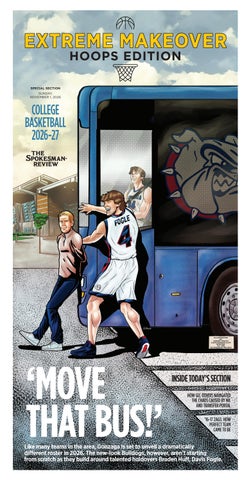
‘MOVE THAT BUS!’
INSIDE TODAY’S SECTION HOW GU, OTHERS NAVIGATED THE CHAOS CAUSED BY NIL AND TRANSFER PORTAL ’16-17 ZAGS: HOW PERFECT TEAM CAME TO BE
Like many teams in the area, Gonzaga is set to unveil a dramatically different roster in 2026. The new-look Bulldogs, however, aren’t starting from scratch as they build around talented holdovers Braden Huff, Davis Fogle.
T2 • Sunday • November 1, 2026
THE SPOKESMAN-REVIEW
THE SPOKESMAN-REVIEW
November 1, 2026 • Sunday • T3
COLLEGE BASKETBALL 2026-27 COVER STORY
EXTREME MAKEOVERS How area teams navigated the combination of NIL, the transfer portal and the “five-for-five” eligibility rule in building their rosters for 2026-27:
GONZAGA MEN
With just three returnees, Zags rely on transfers to build another nationally ranked team. PAGE 3
TYLER TJOMSLAND/THE SPOKESMAN-REVIEW
‘THE OBSTACLE IS THE WAY’ Gonzaga head coach Mark Few takes the floor during Kraziness in the Kennel on Oct. 3 at McCarthey Athletic Center.
Behind the scenes of Gonzaga’s chaotic, unprecedented offseason By Theo Lawson
THE SPOKESMAN-REVIEW
Even in the offseason, college basketball coaches are inundated with recruiting calls, player evaluations, high school camps, summer workouts and other tasks that characterize the nonstop, 24/7/365 profession. There’s not as much downtime as the average fan would think but it does exist, usually in small pockets. On July 10, Gonzaga assistant Stephen Gentry used one such window to take his son, Gunnar, to a screening of “Monsters & Minions.” The animated comedy wouldn’t have been Gentry’s first selection from the catalogue of motion pictures, but it was more about the father-son bonding time not always guaranteed to a college basketball assistant in 2026. Ninety minutes you can’t put a price on. Ninety-ish, it turned out. Midfilm, Gentry felt a buzz in his pocket. He ignored the initial phone call, but vibrations persisted. Subtly, Gentry slid the device out of his pocket and read the notification: “two missed calls from Mark Few.” Probably should go see what that’s about, he figured. With Gunnar still locked in on “Monsters & Minions,” Gentry left the theater and stepped into a hallway. He dialed Few and immediately learned why his boss was desperate to reach him, and on a Friday no less. There had been whispers, murmurs about Mario Saint-Supery’s potential exit from the program, but this was Gonzaga’s coach formally delivering the news that would shake an offseason unlike any the Bulldogs have had since they planted their flag on the national stage three decades ago. In mid-July, after completing offseason workouts in Spokane and sitting in on Domantas Sabonis’ jersey dedication ceremony just 24 hours earlier, Gonzaga’s starting point guard was leaving to play for Spanish ACB club Valencia. The search to replace him might as well have started yesterday. “I should’ve taken the phone call earlier,” Gentry said. “What an awful movie.” Nearly 1,000 miles south, the longest-tenured member of Few’s staff – and the man in line to replace Gonzaga’s newly-minted Hall of Famer when he steps down – was handling one of those aforementioned offseason tasks. It was Friday morning and Brian Michaelson was roaming the Las Vegas Convention Center on a 110-degree day in Sin City, skipping from one court to the next inside
the oversized conference hall-turnedbustling basketball venue. Gonzaga point guard commit Dooney Johnson and hundreds of high school prospects were competing at Nike EYBL AAU from July 8-13. Zags assistant Zach Norvell Jr. had been in the day prior for evaluations. Friday’s slate of EYBL games wrapped before Michaelson got wind of Saint-Supery’s decision, but he was scheduled to return the next morning. It devolved into a chaotic Saturday – Michaelson juggling live evaluations at the convention center while simultaneously fielding phone calls from agents and high school/AAU coaches feeding him intel on replacement point guard options. “I felt like that week, 10 days after that my phone was dead before lunch,” Michaelson said. “Especially I remember that week in Vegas, truly trying to charge my phone wherever I possibly could for like a minute or two so I could get a little more.” Roughly a month later, Gentry was out at dinner with his wife, Leah, when he made the astute observation that Gonzaga’s frenetic offseason, with extreme twists and turns seemingly every week, could probably be distilled into a non-fiction novel. “I think we got up to nine, where I could write a book about the last nine weeks where it was just every week, it was something,” Gentry said. “It was some sort of curveball with Jack (Kayil) and Mario. But I think in a lot of ways it really strengthened our staff and program. I think it just forced us to have our backs against the wall, forced us to communicate even more, to have even more of a plan. “It’s the old adage, the obstacle is the way.” Many believed Saint-Supery was on the precipice of a breakout sophomore season. The savvy Spaniard navigated bumps as a freshman, but those were anticipated from someone making the often-difficult basketball and lifestyle transition from Europe to the U.S. at the age of 19. Saint-Supery’s closing stretch in 202526, coupled with the improvement those close to the program raved about through the early stages of the offseason, had coaches and teammates optimistic about what the point guard’s next act could look like. Add in expectations around the player projected to be Saint-Supery’s running mate. Last November, Gonzaga signed prized German prospect and 19-yearold Alba Berlin pro Jack Kayil, a combo guard they figured would pair seamlessly
with Saint-Supery in the starting lineup and handle on-ball responsibilities when the Spaniard was on the bench. The running theory was Kayil would test NBA draft waters, attend the combine, collect feedback from NBA workouts and ultimately withdraw his name to play in college. Some mock drafts had Kayil pegged higher than others, but the consensus was he was a second-round prospect who still needed to fill out his frame and improve on the defensive end – two of the reasons a young prospect might choose to spend multiple years at Gonzaga. Instead, the outcome with the lowest odds prevailed. Kayil, who reportedly got first-round NBA feedback, kept his name in the draft and went No. 39 overall (ninth pick of the second round) to the Houston Rockets, who traded him to the New York Knicks on draft night. Without a roster spot available, the reigning NBA champions declined to designate Kayil to the G League and instead stashed the guard in Europe. In August, he returned to Alba Berlin on a five-year contract. “I think any college coach you talk to would say offseasons have been crazy and hectic ... I think ours was probably exacerbated by the two guys we felt last spring when you and I would’ve talked were going to be our starting backcourt,” Michaelson said, characterizing their departures as “fairly late in the cycle,” and “definitely after the transfer portal, right?” By the time Saint-Supery visited Gonzaga’s coaching offices on July 11 to meet with Gentry before returning to Spain – “a good chat, but also you can’t relish on it,” the sixth-year assistant said – Few’s staff had already started assembling names, with limited avenues available to them. Bubbling with options in the spring, the transfer portal had become desolate by the middle of the summer. College basketball players have a three-week period from April 7-21 to submit their names in the portal, but top-end transfers often have a destination in mind before the window opens and make their choice by the end of the month. Case in point, Gonzaga’s top portal targets, guard Isiah Harwell (Houston) and center Massamba Diop (Arizona State), announced commitments on April 12 and 29, respectively. There’s typically a few stragglers in May and early June, “but once you get past that, the options aren’t as plentiful and they’re not as straightforward,” MiSee OFFSEASON, 5
WSU MEN
After exodus, Cougars pick up 14 newcomers to tackle challenging rebuild in new Pac-12 Conference. PAGE 11
GONZAGA WOMEN
Zags stick to a familiar plan, manage to bring back talented, experienced group of players. PAGE 13
WSU WOMEN
No makeover needed as Cougars welcome back their top six players in search of rebound season. PAGE 14
EASTERN WASHINGTON With solid core of returnees, Eagle men and women able to fill needs rather than rebuild. PAGE 17
IDAHO
Coming off NCAA Tournament appearances, both men and women forced to retool. PAGE 19
T4 • Sunday • November 1, 2026
THE SPOKESMAN-REVIEW
COLLEGE BASKETBALL 2026-27
GONZAGA
BULLDOGS
Zags adjust on the fly after unexpected roster changes with big additions
GETTY IMAGES
Gonzaga’s Izan Almansa drives to the basket while being fouled by Arkansas defender Davion Thompson at Bud Walton Arena on Oct. 24 in Fayetteville, Ark.
By Theo Lawson
THE SPOKESMAN-REVIEW
Anyone trying to get a feel for what Gonzaga’s strengths and weaknesses will be in 2026-27 may feel slightly better knowing the highly qualified coaches observing and analyzing practices inside the Volkar Center still aren’t totally sure, either. “It’s wild that I can’t tell you on Oct. 21, because there’s still some uncertainty,” assistant Brian Michaelson said when asked about the group’s identity two weeks ago. Will the Zags be an improved perimeter shooting team after posting the lowest 3-point percentages of the Mark Few era in consecutive seasons? Probably a safe bet, but it could depend on the eligibility of fifth-year transfer Chauncey Wiggins, a tall, smooth-shooting forward who made 157 3s during ACC stops at Clemson and Florida State. “He’s far and away our best shooter and we could’ve used some 3s tonight,” Few said after watching the Zags miss 11 consecutive 3s and finish 6 of 28 during an exhibition loss to Arkansas. “I think that’s why I feel encouraged.” Will the Zags have a stable of point guards that runs as deep as any in the country? Potentially, but it could require two more court decisions – one involving Florida transfer Xaivian Lee, another involving Dayton transfer Javon Bennett – swinging in their favor. If not, Frenchman Nathan De Sousa, the only point guard guaranteed to be eligible through March, will take on a significantly bigger load, raising more questions about one of the most important positions in Few’s system. But while we’re on the topic of “whatifs,” consider this one: What if the Zags only require marginal depth and role talent around a Big Four of Braden Huff, Davis Fogle, Massamba Diop and Isiah Harwell in order to sustain a top-15 ranking, capture a Pac-12 championship and march back to the Sweet 16 after second-round exits each of the last two years? Most notably, Huff is back in the fold after missing the final two months of his junior season with a left knee injury. Early signs suggest there’s been no drop-off in the crafty forward’s conditioning or low-post game and he led all scorers with 19 points against Arkansas. Huff will be paired next to Diop, the towering Arizona State transfer who chose Few’s program at Gonzaga over
Last season: 14-4 WCC, 24-10 overall. Key players: Before a season-ending
TYLER TJOMSLAND/THE SPOKESMAN-REVIEW
Gonzaga guard Xaivian Lee moves the ball in the paint during Kraziness in the Kennel on Oct. 3 at McCarthey Athletic Center. Rick Pitino’s at St. John’s in a high-stakes portal bidding war between Naismith Hall of Fame coaches. Diop isn’t nearly as refined around the basket as Huff’s previous running mate, Graham Ike, but he offers a level of rim protection the Zags haven’t had since Chet Holmgren and could thrive as a lob threat when opponents look to double Huff. “Graham and B-Huff are both big guys, but obviously Massamba’s just 7-foot-plus, so to have legitimate size and strength at both those positions is something we’re really excited about, something we really wanted,” Michaelson said. “Then I do think their skill sets will complement each other. They’re both unselfish players, B-Huff is obviously a bigtime, big-time scorer. Massamba’s ability to run the floor, Massamba’s ability to be a lob and shot-blocking threat. They can both drive the ball, they can both make an outside shot. “You can post one and the other can be off the ball. You can ball-screen with one and the other can be off the ball, they can have a skill overlap that fits together.” If Huff isn’t leading the Zags in scoring average at the end of the season, that honor will likely go to Fogle, an attack-minded wing who can hurt opponents at all three levels. Fogle averaged 10.9 points once he became a full-fledged member of GU’s rotation last season and opened a few more eyes with a blistering 30-point
performance – in only 20 minutes of game action – at Kraziness in the Kennel. The slender 6-foot-7 sophomore worked to add more muscle this offseason and fine-tuned his 3-point shooting stroke – a change that was evident at Kraziness, when he connected on 6 of 7 shots from behind the arc. “He’s got such an awesome love for the game, a high care factor, he’s super passionate about his craft that if he wants to be here extra, he wants to be in here,” assistant coach Stephen Gentry said. “It’s part of what makes him awesome and so great is his drive and love for the game of basketball and competing.” The biggest X factor could be Harwell, a five-star high school prospect thought to be a NBA lottery pick candidate before injuries and inconsistent offensive play hindered his freshman year at Houston. Harwell has the potential to be Gonzaga’s most effective two-way player as a bigger two-guard who can manufacture his own shots on offense and simultaneously handle the top assignment at the other end of the floor. After making 27.1% of his 3s at Houston, Harwell believes he’s rediscovered the 3-point accuracy that made him one of the nation’s top recruiting prospects a year ago. There’s already proof, too. Harwell went 5 of 7 from beyond the arc and See GONZAGA, 5
knee injury, Braden Huff was leading college basketball in made field goals and shooting at a 66.2% clip. Davis Fogle may be on the cusp of a breakout season and excitement around the sophomore wing only heightened after he scored 30 points in 20 minutes at Kraziness in the Kennel. Opponents may have to decide which of those two they’d prefer to limit this season, because most won’t have the personnel to stop both. Others to watch: C-Massamba Diop, 7-1, So, 13.6 ppg, 5.8 rpg; G-Xaivian Lee, 6-4, Sr, 11.6 ppg, 3.7 apg; G-Isiah Harwell, 6-6, So, 3.6 ppg, 2.0 rpg. Strengths: Stop us if you’ve heard this before: Gonzaga boasts one of the top frontcourts in the nation and, for the first time since 2021-21, should have a legitimate rim protector in coveted Arizona State transfer Massamba Diop (2.1 blocks per game). Question marks: Lingering eligibility questions could test Gonzaga’s depth, at least through the first two months of the regular season. Prediction: 14-2 Pac-12, 24-5 overall.
2026-27 schedule
Nov. 2: vs. North Dakota State, 6 p.m. Nov. 6: vs. Idaho, 6 p.m. Nov. 8: vs. UC Riverside, 2 p.m. Nov. 13: at Grand Canyon, 5 p.m. Nov. 15: at Stanford, 2 p.m. Nov. 18: vs. Montana, 6 p.m. Nov. 21: at Hawaii, 4 p.m. Nov. 23: vs. California in North Shore, Hawaii, 2 p.m. Nov. 29: at Eastern Washington, 2 p.m. Dec. 4: vs. Yale, 6 p.m. Dec. 6: at Arizona State, 1 p.m. Dec. 10: vs. LMU, 6 p.m. Dec. 19: vs. Michigan State in Palm Springs, Calif., 11 a.m. Dec. 30: vs. South Dakota State, 6 p.m. Jan. 2: vs. St. Thomas, 2 p.m. Jan. 6: vs. Oregon State, 6 p.m. Jan. 9: at Fresno State, TBD Jan. 13: vs. Texas State, 6 p.m. Jan. 16: at Boise State, TBD Jan. 21: at San Diego State, TBD Jan. 28: vs. Utah State, 6 p.m. Jan. 31: vs. Fresno State, 2 p.m. Feb. 3: at Colorado State, 7 p.m. Feb. 6: vs. San Diego State, 8 p.m. Feb. 11: at Oregon State, 8 p.m. Feb. 17: at Washington State, 7 p.m. Feb. 20: vs. Boise State, 2 p.m. Feb. 24: vs. Colorado State, 7 p.m. Feb. 27: at Utah State, TBD March 3: at Texas State, 5 p.m. March 6: vs. Washington State, 7 p.m.
THE SPOKESMAN-REVIEW
November 1, 2026 • Sunday • T5
COLLEGE BASKETBALL 2026-27 OFFSEASON Continued from 3
chaelson said. And, mind you, this was July 11. Right around the same time, a handful of college athletes, coaches and agents started kicking the tires on a new idea. The NCAA had recently introduced its 5-in-5 eligibility model. Five years to play as many seasons as you can squeeze into that firm window. Every class moving forward would benefit, but the NCAA took a hard stance on the high school class of 2022, asserting last year’s seniors would not be grandfathered in. It rubbed some the wrong way, particularly in a climate where highly compensated college basketball players can earn more from revenue sharing and name, image and likeness in a single season than they might over five years in the G League or overseas. The high school classes of 2023, 2024, 2025 and 2026 would capitalize from 5-in-5. The class of 2021 had a onetime waiver to play five seasons due to the COVID-19 pandemic. Why should 2022 be excluded? “It’s really unfortunate they’re taking this stance,” Few said after Kraziness in the Kennel last month. “Classes before all these guys have gotten five, six, seven years. Now with our new rule, the classes after them. So I’m not sure why we’re sticking to targeting this one specific group.” On July 9, one day before Saint-Supery’s defection, an all-conference point guard from Dayton named Javon Bennett was listed among the plaintiffs in the first of many lawsuits filed against the NCAA from class of 2022 graduates seeking relief. A judge ruled in favor of Bennett and others, granting an injunction that cleared the group to pursue a fifth year of eligibility. With a new door opened and, in many ways, a new life extended to Gonzaga’s coaching staff, Few’s assistants started drafting lists. They’d assign players to “buckets,” determining which ones might be the best fit from a system and culture fit, but also which ones were most likely to make it through the legal process to suit up in 2026-27. “We made a bunch of buckets of potential routes to go, potential avenues, and we knew nothing about the possible fifth-year bucket
GETTY IMAGES
Gonzaga’s Isiah Harwell steals the ball from Arkansas’ Davion Thompson at Bud Walton Arena on Oct. 24 in Fayetteville, Ark. on that day one,” Michaelson said. “But it was a bucket that had to be discussed.” Nobody on Few’s staff carries a Juris Doctor diploma in their back pocket, but Gonzaga’s coaches had to be somewhat versed in the legal terminology and ongoing court procedures to assess which players had the best chance of earning injunctions and temporary restraining orders. Semi-educated throws at the dartboard, more than anything else. “We did have to try to – I’m far from an expert – become somewhat knowledgeable with what might happen, what could happen, different routes of that,” Michaelson said. Michaelson continued to phone agents, AAU coaches, high school coaches and others to discuss options, ideally looking for players who could meet all six of his designated check marks, but at least four or five of them. “You probably need to lean on the guy that has six check marks, not the guy that has one,” he said. “Hey, this guy’s got three. This (other) guy has three, but three different ones. Which three do we like
better? The public’s seeing it play out now. It was really, really complicated and we’re still dealing with that on a day-to-day basis.” The result? Gonzaga picked up commitments from two fifthyear point guards – Bennett and Florida’s Xaivian Lee – to fill the Saint-Supery/Kayil voids and one wing, Florida State’s Chauncey Wiggins, who’d bring elite outside shooting and size on the perimeter. Three months later, there’s still not a firm answer as to whether all three, none of the three or some combination of the three will be eligible by the time Gonzaga opens its inaugural Pac-12 Conference schedule in January. Recent court decisions allowed Lee, who has an injunction in California, and Bennett, who’s eligible through a stay from the Ohio Supreme Court, to suit up in Gonzaga’s preseason exhibitions while Wiggins was forced to sit out after a verdict in his Georgia lawsuit. The situation remains fluid with the effect unlcear for Gonzaga. All three players could be one legal ruling from getting a green light to play the rest of the season, or from returning their Gonzaga uniforms
and spending the next five months on the sideline. Coaches, pundits and sports lawyers who’ve closely monitored the cases are bracing for a reality where certain fifth-year seniors are able to play in 2026-27 and others aren’t, solely based off how judges in different jurisdictions view the situation. “Credit to them, I don’t know how they do it every day coming in, putting the work in, just keeping their heads down when some of them don’t even know if they’re going to be eligible,” sophomore forward Parker Jefferson said. “It’s a big credit to them, it’s a credit to the culture we have here.” The next few chapters of the novel Gonzaga started writing in the offseason could be even more compelling than the first ones. The Zags open the season Monday with a high-caliber showdown against Purdue in Las Vegas (4:30 p.m., TNT). Fans should probably buckle up for a season where Gonzaga’s starting unit changes night-to-night, week-toweek or month-to-month depending on how court rulings shake out. Bennett’s eligibility status, for example, has already flipped three times and could change again. Few and other coaches have pressed the NCAA to extend a blanket waiver to the class of 2022, but the regulatory body hasn’t budged since making its initial stance. Gonzaga’s coaches are ready to leave a chaotic offseason in the rearview mirror, but they also insist they’re better off from the unique circumstances the last seven months lobbed their way – often multiple at a time and sometimes on the same day. Their roster may be better off, too. “I think it really strengthened our staff and our program in a lot of ways and obviously we’re still navigating those curveballs and everything but I think golly, we upgraded at so many spots this offseason which is amazing to think with the curveballs and the situations we were in,” Gentry said. “But we feel like we totally upgraded at guard spots and actually came out of this with a better, stronger roster. We think not only the pieces individually upgraded, but I think the pieces fit together extremely well.” It should make for a thrilling story, or novel, or movie. At least one Gentry will be happy to watch all the way through the final credits.
GONZAGA Continued from 4
finished 10 of 14 from the field in his first two public outings wearing a Gonzaga uniform (Kraziness and Arkansas). “I feel like I lost a little bit of confidence in myself coming from Houston,” Harwell said. “Staying in the gym and working on it day and night with B-Mike and Snacks (assistant Zach Norvell Jr.) really helped me. Repetition and getting that confidence back that I was a good shooter.” Gonzaga’s depth will be dictated by the ongoing, unpredictable 5-in-5 lawsuits. If eligible, Lee presumably slides into the starting point guard role, pushing De Sousa to the bench, where he could be joined by Wiggins and Bennett – veteran players with 2,533 career points and three NCAA Tournament appearances between them. The bench unit will also feature Izan Almansa, an experienced Spanish forward who gives the Zags a rebounding presence they lack elsewhere in the frontcourt. Twenty-four hours after learning he was eligible, Almansa was an instant-impact player against Arkansas, scoring 12 points with six rebounds off the bench. If the Zags get bad news on the eligibility front, they’ll either tighten up their rotation or turn to a younger group of reserve players. Freshmen wings Luca Foster and Juwan Ekanga showed flashes of potential during preseason scrimmages/exhibitions. Sophomore forward Parker Jefferson and freshman center Sam Funches will be GU’s emergency bigs, but won’t expect to see much time behind the trio of Huff, Diop and Almansa. Theo Lawson can be reached at 509-459-5584 or theol@spokesman.com.
WE’RE DOING IT AGAIN! We care about you...
not just for you.
Since
1997
Locally Owned and Operated
Services:
Memory Care
Assisted Living
Personalized Care Plans
Meal Services
Centrally Located- Near Churches, Shopping, Hospitals and Dining
1617 N. Calispel, Spokane, WA 99205
Call
509-325-7339
www.fairviewassistedliving.com
T6 • Sunday • November 1, 2026
THE SPOKESMAN-REVIEW
COLLEGE BASKETBALL 2026-27 Mark Few, Brian Michaelson reminisce on building Gonzaga’s 2016-17 roster, magical season
‘IT WAS THE PERFECT MIX’
SPOKESMAN-REVIEW PHOTO ARCHIVES
Gonzaga forward Johnathan Williams, middle, gets some love from teammates Jordan Mathews and Silas Melson during a 2017 Sweet 16 game in San Jose.
By Jim Meehan
THE SPOKESMAN-REVIEW
Early in the 2016-17 college basketball season – Game 2, to be exact – No. 14 Gonzaga led by as many as 30 and hammered fellow West Coast power San Diego State 69-48. The postgame was probably more interesting than the beatdown on the McCarthey Center court. “Coach (Steve) Fisher told me right after the game, ‘You’re good enough to go to a Final Four,’ and I was, ‘C’mon coach, it’s our first real game,’ ” Gonzaga coach Mark Few recalled. “He was like, ‘No, no, no, you are.’ That guy knows, he’d been there (with Michigan) and he was a guy I looked up to. I’ve always remembered that.” Fisher no doubt took notice of GU’s tall, talented and experienced roster that limited the Aztecs to 29% shooting, 24% on 3-pointers, won the glass, snagged 13 steals and swatted eight shots. Those would become seasonlong defensive traits as Gonzaga broke through to reach its first Final Four. Even with GU enduring a rare subpar shooting performance (39%), the offensive balance was evident. Eventual leading scorer Nigel Williams-Goss had just 10 points, but Cal transfer Jordan Mathews delivered 17. Super subs Zach Collins and Killian Tillie combined for 23 points and 18 boards to offset uncharacteristic quiet nights from Przemek Karnowski and Johnathan Williams. Those four would form one of the nation’s finest frontcourts. Gonzaga’s impressive collection of players was five years in the making, from Few and then lead assistant coach Tommy Lloyd traveling to Poland to land the 7-foot-1 Karnowski to Mathews transferring in at the end of June – late in the 2016 recruiting cycle, not so much today. “That roster came together about as well as we could have possibly hoped for, not only talentwise, but depthwise,” assistant coach Brian Michaelson said. “Ten years later, that’s what sticks out to me. It was the perfect mix of new guys, transfers and guys that had been in the program.” With an interesting set of backstories accompanying many of the key players.
several treatment options but his condition deteriorated, He was finally diagnosed with a staph infection and promptly sent to the hospital. Doctors removed one disc, fused two others together, bracing the procedure with two screws and a plate. Karnowski’s basketball career was in jeopardy, but he made methodical progress, received a medical redshirt year and was ready for the season opener against Utah Valley. He had 14 points and seven rebounds in that game and erased any doubts about his health when he torched No. 16 Arizona with 18 points in a December win at the Staples Center. Few rarely joined international recruiting ace Lloyd on trips overseas, but the two ventured to Poland and then on to France to watch another recruit. They found a wonderful pizza place near Karnowski’s home. Shortly after, Few remembered staying in France at “kind of a hostel that anybody could just wander into your room. I’m not in Tommy’s league on those trips.” They came back with a gentle giant who possessed a soft touch, elite passing ability, high basketball IQ and dominating presence on defense. “I remember seeing him the first time and was like ‘holy moly’ with how big he was and how he moved for someone that size,”
Few recalled. “He was coming off some really rough stuff (with his back). He was certainly a huge part of it (in 2016-17). He was a force.” Karnowski only played 23 minutes per game but won the Kareem Abdul-Jabbar Center of the Year award after averaging 12.2 points, 5.8 rebounds and nearly two assists per game.
On second thought
Williams-Goss earned AllPac-12 recognition in each of his first two seasons at Washington, but the Huskies were just 33-30 overall and 14-22 in conference play. He considered entering the draft before deciding to transfer in search of a program capable of making the NCAA Tournament. The Zags barely made his list and weren’t close to the top. A candid conversation with Few and a recruiting visit altered Williams-Goss’s and Gonzaga’s future. “I got on the phone with him and told him I’m not here to be your best friend,” Few said. “I’m 30 years older than you. You were known as a winner in high school. You have a real chance here. Why don’t you focus on stuff that really matters. “I’ll be here for you and I’ll love you like I love the others that are here, but I’m not here to be your best friend.”
Williams-Goss was fully convinced during his recruiting visit, witnessing firsthand how the players got along, the program’s culture and the likelihood of experiencing the Big Dance for the first time in his career. He quickly became a team leader. He set the tone defensively with a West Coast Conference-leading 64 steals and directed the offense with team-highs of 16.8 points and 4.4 assists. He was second in rebounding (6.0), sandwiched between Williams (6.4) and Collins (5.9). The Oregon native was the primary option in crunch time – those were few and far between with most games decided by early in the second half – and routinely came though. He scored 24 of his 33 points in the second half – 11 in a row at one point – as Gonzaga held off BYU in Provo and posted three 20-point games in the NCAA Tournament. He tagged Washington with 23 points, five boards and five assists in a 27-point blowout. Few pinpointed Williams-Goss’s communication skills. “He really understood how important that is,” Few said. “(Recently) at practice, I was lecturing our current team about it. I don’t talk about Nigel as often now, I usually mention LeBron James (Few was an assistant on the USA’s gold-medal team at the
Home far from home
Williams, a bouncy 6-9 forward, as well as Collins and Tillie, gave Gonzaga well-rounded options in the frontcourt anchored by Karnowski. ‘J3’, as he was referred to by teammates and coaches, collected rebounds like his scholarship depended on it and was a capable scorer and versatile defender. Williams, like Williams-Goss and Jeremy Jones, who was a two-sport athlete (basketball and football) at Rice before coming to GU, benefited from NCAA rules that required transfers to sit out one year. GU’s track record with redshirts was established with the success stories of Kelly Olynyk and Kyle Wiltjer. Williams and Williams-Goss added their names to the growing list. Williams had fine stats in his first two seasons at Missouri, but the Memphis native wanted to expand his game and line up in March Madness. Luckily for Gonzaga, his transfer options regionally were restricted by the SEC and Missouri so he studied schools far from home. “Just initially I made a cold call,” Michaelson said. “We knew Wiltjer would be leaving that year (Williams) sat out (2015-16). J3 knew more about Gonzaga basketball than I expected and being able to sell that development program helped. Right away, he was receptive.” That year, Williams and Collins shut down Arizona star forward Lauri Markkanen and South Dakota State scoring machine Mike Daum.
Mathews, Daniels connection
The final piece to the roster puzzle was Mathews, a proven 3-point shooter with 102 games under his belt in three seasons at Cal. The 6-3 guard, eligible immediately as a grad transfer, had options, but Gonzaga had a huge head start. Mathews and his dad Phil, who faced GU for years as San Francisco’s coach from 199604, were close to then-Zags assistant Donny Daniels. Mathews fit seamlessly. Argu-
Healthy Karnowski
The biggest question mark was Karnowski’s health after his 201516 season lasted just five games due to a serious back injury. The 285-pound center tried
Paris Olympics) because he was incredible with it. That 2017 team talked better than any team I’ve had.” Same goes for defending. “The size, rebounding and defense were real,” Michaelson said. “Those guys brought it every night to not have ups and downs.”
GU’s Killian Tillie slam dunks against Washington on Dec. 7, 2016, at the McCarthey Athletic Center.
See ZAGS, 7
THE SPOKESMAN-REVIEW
November 1, 2026 • Sunday • T7
COLLEGE BASKETBALL 2026-27 ZAGS
Continued from 6 ably the team’s best pure shooter, he thrived in GU’s inside-out system, hitting a teamhigh 85 3s with 39.2% accuracy. The team made 38.2% on triples with Williams-Goss the lowest in the rotation at 36.8%. Mathews delivered one of the biggest shots in program history, a 3-pointer with just under 1 minute left to spur the Zags past West Virginia in the Sweet 16. “Jordan ended up being the ideal fit because he’s a coach’s kid and he was just a Zag,” Few said. “Just what we needed.”
Keeping their guards up
Perkins, who made his GU commitment live on a Denver TV station’s morning show in Aug. 2013, and Melson were major contributors to the 2017 Zags. Perkins started at point guard in 2015-16 before shifting to more of a combo guard with Williams-Goss as the main ballhandler. Perkins hit nearly 40% of his 3-point attempts and added 3.1 assists per game. He also started the sequence that led to Mathews’ clutch 3, rejecting 6-9 forward Nathan Adrian’s shot at the other end. “Crazy Perk,” Few said with a chuckle. “He hit some big shots, he was a heck of a point guard. I used to always get on him, ‘You’re not a shot blocker, you’re going to have to take charges and strip guys down there.” Melson often locked down one of the opponent’s top perimeter threats and chipped in points (7.2), assists (1.5) and 3-point shooting (39.1%). Michaelson raved about Melson’s “defense, outside shooting and unselfishness.”
Freshmen phenoms
Gonzaga’s 2015-16 season could have been derailed by Karnowski’s injury but Wiltjer and Domantas Sabonis didn’t let that happen. The two forwards logged heavy minutes and combined to average 38 points and 18 rebounds as GU made the Sweet 16 and nearly the Elite Eight before stumbling late against Syracuse. “With the uncertainty surrounding Przemek, the lack of bodies we had in the 2016 season and Domas and Wiltjer leaving, we knew the freshmen class had to be special,” Michaelson said. Special might not be a strong enough word to describe the Zags’ incoming class: Collins, Tillie, Rui Hachimura, Zach Norvell and Jacob Larsen. Collins was the headliner as a five-star addition. Collins and junior guard Melson typically were the first ones off the bench in an eight-man rotation that included the versatile Tillie. Collins was fearless on the court in his first and only season as a Zag, He led the
SPOKESMAN-REVIEW PHOTO ARCHIVES
Gonzaga guard Nigel Williams-Goss relaxes in the locker room in March 2017 after defeating Xavier in an NCAA Elite Eight game in San Jose. WCC with 69 blocks despite averaging just 17.3 minutes. Collins cemented his draft status as a lottery pick with a 14-point, 13-rebound, 6-block effort in a Final Four win over South Carolina. Tillie gave GU another skilled big and he dropped in two free throws with 2.2 seconds left to seal the win over the Gamecocks. Hachimura, early in the process of learning English and NCAA basketball, showed his enormous potential in blowouts. Norvell was sidelined with a knee injury. Larsen eventually left the program. “How competitive those practices were was another thing I remember,” Michaelson said. “High level, big bodies going at it every day. The scout team had guys like Rui, Tillie, ‘Snacks’ (Norvell), Jones, Ryan Edwards, ‘BA” (Alberts). The last two went on to start (after transferring). We had great walk-ons (Rem Bakamus, Dustin Triano) that practiced hard and brought positivity and energy.”
Milestones and memories
Few and Michaelson knew Gonzaga had a quality team, but that came into sharper focus after the Zags edged Florida and No. 21 Iowa State in close games to win AdvoCare Invitational in Orlando and handled Arizona, Washington and Tennessee, the latter in Nashville.
“Orlando kind of made you go, ‘OK, we beat some nice teams, we could be somebody that is on the way to a high seed,’ ” Few said. Gonzaga stacked up 29 straight wins, rising to No. 1 in late January, before falling to BYU in the regular-season finale. The Zags shook off that home loss with their third win over ranked Saint Mary’s, 74-56, for the WCC Tournament title. Driven by an efficient offense and a stingy defense that ranked first nationally in field-goal percentage (36.5%) and 10th in scoring (61.5 per game), the Zags marched all the way into April with five NCAA Tournament wins, including tight victories over Northwestern, West Virginia and South Carolina. But the win over South Carolina came at a cost as Williams-Goss tweaked an ankle injury and Karnowski battled blurry vision after getting poked in the eye. In the title game, Williams-Goss scored GU’s last points, including a bucket that put the Zags ahead 65-63 just inside the two-minute mark. He rolled his ankle about 30 seconds later. The Tar Heels scored the game’s final eight points for a 71-65 win. “Going back and watching some of those foul calls, almost in some ways both ways,” Few reflected. “North Carolina had a great front line, too. I don’t know who got the
idea to start fouling everybody out. For Zach Collins … if he plays 10 more minutes in that game we win, I’m not going to say easy, and he picked up some of the cheapest ones. “On my son Joe’s iPad, he had a picture of the Carolina guy (Kennedy Meeks with 50 seconds left) laying on the ball out of bounds on there for five years or something. I’d have to walk by it. Good lord, do I have to look at that (missed call) all the time?” Gonzaga didn’t cut down the nets, but reaching the Final Four and national championship game validated the program’s place among the nation’s elite. “I’m not a receipt kind of guy, but it was for my own sanity or just looking back with all the opportunities I had,” he said. “I tried to explain to people on the other side of the phone that I think we can win a national championship, go to a Final Four. And they’d look at me like I was kind of crazy. “It made me feel like I wasn’t crazy.” Crazy might be an apt description of the difference between assembling the 2017 roster and the process in today’s NIL, transfer-heavy landscape. “It’s just a whole new world,” Few said. “It was more about who was patient enough to redshirt and sit and wait their turn. That’s not happening in this day and age.”
T8 • Sunday • November 1, 2026
THE SPOKESMAN-REVIEW
COLLEGE BASKETBALL 2026-27
NEW LANDSCAPE Rebuilt Pac-12 Conference should provide stiff challenges, hostile road arenas for opposing teams
PAC-12 MEN’S PREVIEW By Theo Lawson
THE SPOKESMAN-REVIEW
On Sept. 16, Utah State announced the school had sold out tickets for Gonzaga’s inaugural trip to Dee Glen Smith Spectrum. That wouldn’t necessarily be news – certainly not Gonzaga’s first time drawing a standing room-only crowd on the road – but the announcement arrived two full weeks before the Pac-12 Conference released its schedule, meaning more than 10,000 fans purchased tickets without knowing a concrete date for the Jan. 21 matchup. Gonzaga can expect bigger crowds and more robust challenges in the new conference, which should test the Bulldogs top-to-bottom in a way the West Coast Conference didn’t and help Mark Few’s avoid the resume dings that were often inevitable in January and February. The reimagined Pac-12 may not be ready to compete with the SEC, Big Ten, Big 12, ACC and Big East on Selection Sunday, but this new group of nine isn’t lacking credentials. Gonzaga and San Diego State bring three combined national championship appearances over the last nine years with 31 combined NCAA Tournament victories sprinkled in during that span. Utah State is in the middle of the school’s best run, punching six NCAA tickets over the last eight seasons, including each of the last four. Boise State made three straight March Madness trips before recent misses and Colorado State has been exceptional in its own right, qualifying in 2022, 2024 and 2025. Oregon State and Washington State both made semirecent NCAA appearances under the Pac-12’s old flag. This new-look Pac-12 might have been a candidate to get three teams into the previous NCAA Tournament, but the expanded 76-team bracket provides a pathway to one or two additional bids. Regardless, college hoops fans out West should have plenty of dates to circle on the new Pac-12 calendar – not just the one taking place Jan. 21 in Logan, Utah.
1. Gonzaga
Coach: Mark Few (772-156), 28th year at Gonzaga 2025-26 record: 31-4. WCC: 16-2, tied-first Key newcomers: C Massamba Diop (7-1, 230), G Isiah Harwell (6-6, 220), G Nathan De Sousa (6-2, 192), F Izan Almansa (6-10, 200/eligibility pending), G Xaivian Lee (6-4, 185), F Chauncey Wiggins (6-11, 225/eligibility pending), G Javon Bennett (5-10, 165/eligibility pending) Key losses: F Graham Ike, G Tyon Grant-Foster, G Jalen Warley, F Emmanuel Innocenti, G Mario Saint-Supery, G Adam Miller, G Braeden Smith, C Ismaila Diagne Outlook: Despite the various curveballs this offseason has tossed their way, the Zags are still the favorites – considerable favorites, maybe – to capture a Pac-12 crown next spring. They’ve assembled one of the country’s top frontcourts, blending Braden Huff’s offensive touch with Massamba Diop’s rim protection. This should be a second-weekend team with a Final Four ceiling if Xaivian Lee, Javon Bennett and Chauncey Wiggins stay/become eligible.
2. Utah State
Coach: Ben Jacobson (397259), 1st year at Utah State 2025-26 record: 29-7. Mountain West: 15-5, first Key newcomers: Dallin Hall (6-4, 200/eligibility pending), Connor Turnbull (6-11, 225), AJ Bates (6-4, 200), Solomon Callaghan (6-2, 195), Will Hornseth (6-9, 235), Collin Mulholland (611, 240) Key losses: G MJ Collins Jr., G Drake Allen, G Kolby King, F Garry Clark, F Adlan Elamin, G Elijah Perryman Outlook: Constant coaching turnover hasn’t impacted the Aggies, who’ve been to four con-
GETTY IMAGES
Gonzaga center Massamba Diop drives to the basket Saturday against Arkansas defender Miikka Muurinen at Bud Walton Arena in Fayetteville, Ark. secutive NCAA Tournaments under three different coaches. Utah State has a solid chance to get there again under Ben Jacobson, who made five NCAA appearances over 20 seasons at Northern Iowa. The Aggies will lean heavily on veteran forward Mason Falslev, the favorite to earn Pac-12 MVP honors if the award doesn’t go to a Gonzaga player. Frontcourt mate and reigning Mountain West Sixth Man of the Year Karson Templin is another solid all-conference candidate.
3. San Diego State
Coach: Brian Dutcher (22079), 10th year at San Diego State 2025-26 record: 22-11. Mountain West: 13-6, second Key newcomers: G Chance Gladden (6-4, 192), G Isaiah Sy (6-6, 200), F Bear Cherry (6-10, 270), G David Torresani (6-2, 168), G Zach White (6-5, 208), F Luca Vincini (6-10, 242) Key losses: F Magoon Gwath, F Pharaoh Compton, G Miles Byrd, G BJ Davis, G Taj DeGourville, G Reese Dixon-Waters, F Miles Heide Outlook: This won’t be Brian Dutcher’s strongest roster on paper, but we’ll give the benefit of the doubt to a coach who’s been part of four Mountain West regular-season or tournament
championships and six NCAA Tournament appearances since taking over for Steve Fisher. Elzie Harrington, the team’s only returning starter, is a proficient 3-point shooter, but the Aztecs may also require a lot from transfers Chance Gladden (Boston U), Bear Cherry (Sacramento State) and Isaiah Sy (Oregon State), especially in the wake of Nick Anderson’s offseason knee injury.
4. Oregon State
Coach: Justin Joyner (0-0), 1st season at Oregon State 2025-26 record: 17-16. WCC: 9-9, tie-fourth Key newcomers: F Jackson Rasmussen (6-9, 211), G Legend Smiley (6-5, 188), G Daniel Freitag (6-2, 192), F DeShawn Gory (6-6, 169), C Xavion Staton (7-1, 224), G Chris Johnson (6-5, 189), C Dennis Evans (7-2, 231) Key losses: F Isaiah Sy, G Dez White, F Johan Munch, C Yaak Yaak, F Jorge Diaz Graham, F Olavi Suutela Outlook: Justin Joyner, a national title-winning assistant with years of experience building scouting reports for Gonzaga, takes over Oregon State’s program after Wayne Tinkle’s tenure ended. Joyner lacks head-coaching experience, but he’s assembled a roster that
looks talented enough on paper to compete with the top half of the Pac-12. Program veteran Josiah Lake II brings leadership and ball-handling, while transfers DeShawn Gory (Fresno State) and Daniel Freitag (Buffalo) have a chance to lead the Beavers in scoring. Similar to the Michigan team Joyner worked for last season, OSU should be massive up front with three 7-footers on this roster.
5. Colorado State
Coach: Ali Farokhmanesh (21-13), second season at Colorado State 2025-26 record: 21-13. Mountain West: 11-9, seventh Key newcomers: G Justin Menard (6-3, 185), F Jaden Ghoreishi (6-9, 215), Amondo Miller Jr. (6-7, 195) Key losses: F Brandon Rechsteiner, G Jevin Muniz, F Augustinas Kiudulas Outlook: The Rams lose their top scorer from a year ago, but return players who ranked second, third, fourth, sixth and seventh in points per game. It’s a level of retention that’s hard to come by in the current college basketball climate and one of the primary reasons Ali Farokhmanesh’s group might be a step ahead of others in the Pac-12 when the regular season begins. Marist
transfer Justin Menard slides into the starting lineup next to a quartet of returners that includes three double-digit scorers in Kyle Jorgensen (11.5 ppg), Carey Booth (10.7 ppg) and Josh Pascarelli (10.2 ppg). Spokane’s Jaden Ghoreishi could see minutes off the bench as a freshman.
6. Boise State
Coach: Leon Rice (336-189), 17th season at Boise State 2025-26 record: 20-12. Mountain West: 12-8, tie-fifth Key newcomers: F Dovydas Butka (6-9, 225), G Ty Rodgers (6-6, 205), G Lamar Washington (6-4, 210/eligibility pending), G Damari Wheeler-Thomas (6-0, 190). Key losses: F Javan Buchanan, F Drew Fielder, G Dylan Andrews, F Andrew Meadow, F Dominic Parolin Outlook: Former Gonzaga assistant Leon Rice faces a tall task replacing Boise State’s four double-digit scorers from a year ago, especially after an offseason injury to Ty Rodgers sidelined the Illinois transfer indefinitely. Campbell’s Dovydas Butka is a nightly double-double threat while North Dakota State transfer Damari Wheeler-Thomas is expected to take on primary See PAC-12, 9
THE SPOKESMAN-REVIEW
November 1, 2026 • Sunday • T9
COLLEGE BASKETBALL 2026-27 PAC-12
Continued from 8 ball-handling duties. Returning reserves Julian Bowie and Aginaldo Neto both had 20-plus point performances in recent exhibitions against Idaho and Washington. If eligible, 5-in-5 Georgia Tech transfer Lamar Washington has a chance to be one of Boise State’s top scorers, rebounders and facilitators.
7. Texas State
Coach: Terrence Johnson (107-81), seventh season at Texas State 2025-26 record: 19-13. Sun Belt: 11-7, tie-second Key newcomers: G Quel’Ron House (6-0, 180), G KJ Younger (6-4, 218), F Ronald Jessamy (6-8, 220), G Caleb Steger (6-5, 180) Key losses: G Franck Emmou, G Jaelyn Lee, C Tay Knox, G Deke Thompson, F Isaiah Barganier, G Cameron Simpson Outlook: DJ Hall is one of the best-kept secrets in midmajor basketball and should be at the top of every Texas State scouting report this season after averaging 15.6 points, 7.7 rebounds and 1.4 steals as a freshman. The Bobcats have continuity beyond Hall, though, and managed to bring back second-leading scorer Mark Drone (14.2 ppg), assists/steals leader Kaden Gumbs (3.0 apg, 1.9 spg) and guard Dimp Pernell, who made 40.6% of his 3-pointers before a season-ending injury. Southern Illinois transfer Quel’Ron House will have a chance to be one of Texas State’s top two-way players.
8. Washington State
Coach: David Riley (93-73), third season at Washington State 2025-26 record: 12-20. WCC: 7-11, eighth Key newcomers: G Lazerek Houston (6-0, 155), F Ronnie Harrison (6-8, 210), F Fraser Roxburgh (6-7, 215), G Sebastian Akins (6-2, 175), F Ladji Dembele (6-8, 255), G Jaylen Harrell (6-5, 210), F Tyler Kropp (6-9, 230), G Jamari Phillips (6-4, 190), G R.J. Jones, 6-2, 189 (2.6 ppg, 0.4 rpg). Key losses: G Ace Glass, G Rihards Vavers, F ND Okafor, F Eeemeli Yalaho, G Tomas Thrastarson, G Jerone Morton,
GEOFF CRIMMINS/THE SPOKESMAN-REVIEW
Washington State head coach David Riley leads a practice on Oct. 8 in Pullman. Riley will have almost a completely new roster this season. F Emmanuel Ugbo, G Kase Wynott, G Adria Rodriguez, G Parker Gerrits. Outlook: The Cougars lost 98.9% of their scoring from 2025-26 – only Dio Blakely’s 0.8 points per game return – and are easily the most challenging team to handicap a year later. With an all-new starting lineup and rotation, it’s wise not to read too deeply into WSU’s 9264 exhibition loss at New Mexico, but also means David Riley’s squad could face growing pains through a challenging nonconference schedule that sends the Cougs outside of Pullman 11 times in November and December. Division II standout Lazerek Houston and East Texas A&M Ronnie Harrison both hit double digits on efficient shooting in the exhibition loss, with Harrison scoring 23 in Sunday’s 84-80 exhibition win at Washington.
9. Fresno State
Coach: Vance Walberg (33-
80), third season at Fresno State 2025-26 record: 13-19. Mountain West: 7-13, 10th Key newcomers: G Dragos Lungu (6-6, 180), G Ross Candelino (6-5, 198), F Bradey Henige (7-0, 240), G Brian Amuneke (6-5, 184), C Baye Fall (6-11, 205), G Quentin Rhymes (6-6, 195), G KJ Perry (6-3, 180) Key losses: G Jake Heidbreder, F Deshawn Gory, F Jac Mani, G David Douglas Jr., C Wilson Jacques, G Zaon Collins, G Cameron Faas, C Gasper Kocevar, G Bastien Rieber Outlook: Washington State and Fresno State face the biggest rebuilds and not surprisingly are the teams occupying the final two spots in our predictions. But there could be a sizable gap between the Cougars and Bulldogs, who are separated by 60 spots in Ken Pomeroy’s preseason ratings. Fresno State lost every contributor from last year and could rely heavily on guards Dragos Lungu, a 13.8 ppg scor-
GETTY IMAGES
San Diego State head coach Brian Dutcher and Elzie Harrington meet during a Nov. 24 game against Oregon at Michelob ULTRA Arena in Las Vegas. er at UT Martin, and Ross Candelino, who averaged 11.2 ppg at Libscomb to lead them in the scoring column. The Bulldogs
will have to turn things around after settling for a 19-45 record over Vance Walberg’s first two seasons.
T10 • Sunday • November 1, 2026
THE SPOKESMAN-REVIEW
COLLEGE BASKETBALL 2026-27
WASHINGTON STATE
COUGARS
David Riley, WSU enter rebuilt Pac-12 with immense roster turnover
ANDREW BURKE-STEVENSON/SEATTLE TIMES
Washington State forward Ronnie Harrison dunks during an exhibition game against Washington at Alaska Airlines Arena in Seattle on Oct. 25.
By Greg Woods
THE SPOKESMAN-REVIEW
PULLMAN – When he looks back, David Riley realizes that in his first pair of years as Washington State’s head coach, he hasn’t let his players scrimmage each other in practice as much as he should have. In those days, he ran his guys through all kinds of drills, all manner of concepts. That approach may have helped in its own right, but as Riley prepares for his third season with the Cougars, he wants to put players in more live situations. He wants to learn what makes each one tick, create more pressure situations. After all, Riley figures, what happens if the first adversity WSU faces comes in its Nov. 2 season opener against Davidson? “That’s a problem,” Riley said. In their first season of the rebuilt Pac-12, the Cougars will try to avoid the ones that plagued them in their previous two years under Riley, whose teams couldn’t avoid turnovers or guard well enough. This year, with 14 newcomers and nine from the transfer portal, WSU has a chance to turn those around in a convincing way. The Cougars opened the season with two exhibition matchups, a road loss to New Mexico and a road win over rival Washington, the latter of which can provide a window into how this team might operate. The key cogs in this group will involve East Texas A&M transfer wing Ronnie Harrison, whose twoway acumen figures to make him a weapon on both ends of the court, as well as Oregon transfer guard Jamari Phillips and Central Missouri (D-II) transfer guard Lazerek Houston, all of whom scored in double figures in their team’s win over UW. This WSU team features only two returners, forward Dominik Robinson and walk-on guard
GEOFF CRIMMINS/THE SPOKESMAN-REVIEW
WSU guard Jamari Phillips, middle, talks with forward Tyler Kropp, forward Mohamed Sankhe, guard RJ Jones and forward Brayden Kyman during a practice on Oct. 8 in Pullman. Dio Blakely, which means most of the minutes will belong to transfers. Coaches had to hit the transfer portal to replace key players from last year’s team, including guard Ace Glass (Vanderbilt), forward ND Okafor (Mississippi State) and wing Ri Vavers (Memphis), plus guards Jerone Morton (Kentucky) and Tomas Thrastarson (Seattle U), forward Eemeli Yalaho (NC State) and key reserve Parker Gerrits (Wyoming). So how will the Cougars’ new group mesh? That much will depend on Harrison, Phillips and Houston, as well as Providence transfer wing Jaylen Harrell, Northwestern transfer big man Tyler Kropp, Wake Forest transfer guard Sebastian Akins and UNLV transfer forward Ladji Dembele. Former Eastern Washington wing Casey Jones, who spent the last two years on a church mission, is also back playing for Riley. “There definitely is some differences when you have guys that have played in your system before and you know what’s returning, how to build around that,” Riley said. “For us, I think that’s the beauty of how we play. We’re pretty versatile. We’ve had teams that have been really good with guards, with
bigs, with wings. I think being multidimensional is really important for us, and getting that physicality was something that we really wanted to embrace. I think we did that. Now it’s time to figure out how it all gels.” The Cougars won’t get much of an easy on-ramp into the season. Including its season opener, a Nov. 2 home matchup with Davidson, WSU plays only four Division-I nonconference home games, the program’s fewest since the 1973-74 seasons. It highlights the way coaches like Riley have to keep the team budget in mind when building schedules, trying to generate revenue via buy games that can be used in a multitude of ways. Here’s a sample of WSU’s nonconference schedule: at High Point on Nov. 7, at Duquesne on Nov. 10, against Duke in California on Nov. 21, at Murray State on Nov. 30, at Weber State on Dec. 9 and at LSU on Dec. 28. The Cougs will be away from Pullman more than this program ever has been since the ’70s. Couple that with the team’s new-look roster and you understand the challenges facing the Cougars. And that’s to make no mention of the reimagined Pac-12, whose best sport might be men’s
hoops. The Cougs will host No. 15 Gonzaga in early January, during their university’s winter break, and a February road stretch against Gonzaga and San Diego State will prove tough. WSU also has a road date with Utah State set up for late January. If it’s not a gauntlet, it’s something close. It’s not easy for any team, let alone one like WSU, which has turned over its entire starting five each of the last two seasons. “I’d say that was probably the biggest thing for us in the off-season – we had so many new guys,” Kropp said. “We just saw what a team like New Mexico with so many returners, how valuable it is and how valuable that chemistry is. That was just a big focus for us in the off-season. As soon as we got on campus, we made sure, as often as we could, whenever we had an off-day, we were together.” To turn things around from last season, when the Cougars went 12-20 overall and 7-11 in their second and final season as West Coast Conference affiliate members, they will have to shore up two things most of all: Defense and turnovers. A year ago, WSU turned it over on about 18% of its possessions, which ranked No. 292 nationally. That group also allowed opponents to register an effective field goal percentage of 53%, which was No. 248 in the country. So what’s the key to reversing those fortunes? Riley likes to say it involves identifying selfless players. “I think that starts in the recruiting process, is getting guys who want to play this kind of basketball, who want to play a team style offensively and defensively, want to be physical and disruptive, and I think we did a good job of that,” Riley said. “We’re getting guys that understand the importance of that, and like I said earlier, I think once you really understand how we play, it’s impossible to do it alone.”
Last season: 7-11 WCC, 12-20 overall.
Key players: WSU will lean heavily
on Harrison, who profiles as an athletic wing who can knock down the 3 and guard the other team’s best players, as well as Houston, a shorter guard who can fill it up on offense. Others to watch: G-Jamari Phillips, 6-4, Jr., 2.7 ppg, 0.9 rpg; F-Jaylen Harrell, 6-5, rs-fr., 3.7 ppg, 0.7 rpg. Strengths: The Cougars profile as an offensively tilted group, playing to Riley’s strengths as a coach, so look for them to fill it up on the scoreboard. Question marks: Can WSU defend at a high enough level to make it matter? And can the Cougs avoid turnovers in Riley’s motion offense? Prediction: 8-10 Pac-12, 18-16 overall.
2026-27 schedule
Nov. 2: vs. Davidson, 6 p.m. Nov. 7: at High Point, 2 p.m. Nov. 10: at Duquesne, 4 p.m. Nov. 14: vs. Northwest (Wash.), 10 a.m. Nov. 18: vs. Hawaii in Everett, Wash., 7 p.m. Nov. 21: vs. Duke in Palm Springs, Calif., 8 p.m. Nov. 24: vs. Sam Houston, 6 p.m. Nov. 27: vs. Idaho, 5 p.m. Nov. 30: at Murray State, 5 p.m. Dec. 3: at Southern Illinois, 5 p.m. Dec. 6: vs. North Dakota State, 1 p.m. Dec. 9: at Weber State, 11 a.m. Dec. 12: vs. UNLV in Henderson, Nev., TBD Dec. 19: vs. Seattle U at Climate Pledge Arena, 4:30 p.m. Dec. 22: vs. EWU at Numerica Veterans Arena, TBD Dec. 28: at LSU, 5 p.m. Jan. 3: at Fresno State, 1 p.m. Jan. 6: vs. Gonzaga, 6 p.m. Jan. 13: at Boise State, 6 p.m. Jan. 17: vs. San Diego State, 1 p.m. Jan. 21: at Colorado State, 7 p.m. Jan. 23: at Utah State, 3:45 p.m. Jan. 27: vs. Oregon State, 7 p.m. Jan. 30: vs. Fresno State, 5:30 p.m. Feb. 6: vs. Texas State, 6 p.m. Feb. 10: at Oregon State, 7 or 8 p.m. Feb. 13: vs. Colorado State, 4:45 p.m. Feb. 17: at Gonzaga, 7 p.m. Feb. 20: at San Diego State, 1:30 p.m. Feb 25: vs. Boise State, TBD Feb. 27: at Texas State, 11:15 a.m. March 6: vs. Utah State, 4:45 p.m.
THE SPOKESMAN-REVIEW
November 1, 2026 • Sunday • T11
COLLEGE BASKETBALL 2026-27
TOTAL REBUILD
How Riley’s Cougars adjusted after another mass exodus last season
PHOTOS BY GEOFF CRIMMINS/THE SPOKESMAN-REVIEW
Washington State guard Lazerek Houston, left, looks for a way around guard Jamari Phillips and forward Tyler Kropp during an Oct. 8 practice in Pullman.
By Greg Woods
THE SPOKESMAN-REVIEW
PULLMAN – After David Riley wrapped up his second season at the helm of Washington State’s men’s basketball program in April, he may have felt like he was having deja vu. For the second straight year, his entire starting five had departed. For the second straight year, he would have to rebuild an entire roster from scratch. He’d have to do it all via the transfer portal, which had claimed each of the top scorers from his first two WSU teams. So headed into his third season, the Cougars’ basketball roster looks almost entirely brand new, as it has each of the two years that preceded it. Gone are Ace Glass and ND Okafor, two staples of last year’s WSU team, as are all but two players from that team. Riley spent much of the spring and summer constructing the roster for this 2026-27 team, which kicks off its season Monday at Davidson, one of the Cougs’ litany of road nonconference games to open the season. Before that happens, though, let’s revisit how Riley’s third WSU team came together, the players, the fits and how it all rounded into shape for the Cougars. The good news for Riley: In late March and early April, before the transfer portal officially opened, many of the WSU players who planned on leaving announced their plans to do so. The Cougars knew the players they would have to replace and had more time to scour the portal for new fill-ins. That stands in stark contrast to last spring, when the players leaving WSU didn’t make that decision until after the portal opened, leaving coaches with less time to find their replacements. WSU’s team includes 14 newcomers, including nine from the transfer portal: Texas A&M transfer wing Ronnie Harrison, Northwestern transfer forward Tyler Kropp, Providence transfer wing Jaylen Harrell, Central Missouri (D-II) transfer guard Lazerek Houston, TCU transfer guard RJ Jones, Wake Forest transfer guard Sebastian Akins, Manhattan transfer forward Fraser Roxburgh, UNLV transfer forward Ladji Dembele and Oregon transfer guard Jamari Phillips. Riley’s third roster also includes wing Casey Jones, who last played for Riley at East-
ern Washington before taking the next two years off for a church mission, as well as Spanish guard Pedro Sancho Moraga, French forward Mohamed Sankhe Golden State Prep product Roman Stathis, freshman Brayden Kyman and returners Dominik Robinson and Dio Blakely. “We’ve got a lot of new faces, and so it’s been a really busy preseason for us, trying to get in some concepts,” Riley said in late October. “I think we simplified a few things to make sure that we’re able to play together and play hard, and I think that’s something that just takes time. And I think we’re learning those lessons. I think we have more aggression, a little more
confidence than last year.” The Cougars’ first commitment of the offseason came courtesy of Roxburgh, who came over from Manhattan College in New York City, where he started in 31 of 32 games, averaging 11 points and 5.8 rebounds per game. Roxburgh also shot 44% from the field, including 32% from beyond the arc on four attempts per game. He figures to play a stretch four role, not unlike that of former forward Simon Hildebrandt, who played for last year’s WSU team. In Roxburgh’s commitment, it became clear that Riley and coaches value some versatility at their small forward or power forward spots. “I think when I was still at
Eastern, we were looking at him more as a three-four,” Riley said in the spring. “He’s another guy who just brings a ton of versatility to the game. Can pass, can think the game.” WSU coaches’ second addition of the offseason came from Houston, who lit up the Division II ranks last season, averaging 20.8 points, four rebounds and five assists on 46.2% shooting, including 37% from 3-point territory. A quick ball-handler and crafty finisher, Houston’s finalists included one of WSU’s future Pac-12 opponents, Boise State. “On my visit, it kinda felt like a family,” Houston said. “Just talking to the coaches, it wasn’t awkward. I didn’t feel like I
Washington State forward Brayden Kyman, left, guards forward Fraser Roxburgh during an Oct. 8 practice in Pullman.
gotta portray myself as somebody else. I felt like I could be myself, talk to them, and I just felt like it was like a good community. And I wanted to be a part of that.” Around the same time, Riley picked up commitments from two other players who figure to play cornerstone roles on this team, Akins and Harrison. Akins started his career at Denver before playing last season at Wake Forest, where he averaged 5.3 points in 15.2 minutes per game, starting in eight games. Harrison started his career at Tarleton State before spending last season at East Texas A&M, where he averaged 14.7 points and 6.1 rebounds in 30 minutes per game, starting 28 of 30 games. He also shot an efficient 53% inside the arc. “Ronnie is a guy that’s super talented,” Riley said. “Bigger than he looks on film. He came up on his visit, and just a big body, strong, really just a confident player that can do a little bit of everything.” That’s also around the same time when Riley secured a commitment from Kropp, a transfer from Northwestern, where fans seemed disappointed to lose him. Starting 10 games that season, he averaged 3.1 points and 2.1 rebounds per game. Other staples on this WSU team figure to include Phillips and Dembele, who joined Kropp, Houston and Harrison in the Cougars’ starting lineup for their exhibition opener, a 92-64 loss to New Mexico in October. Phillips profiles as a scoring guard, while Dembele provides some physicality underneath and some upside around the arc, where he can shoot it from 3. Can that group help Riley put a forgettable season in the rearview mirror? It might help that over the offseason, his brother, Noah, gave David a hard time. “Riley teams are soft,” he would tell him. Whether or not that’s true, what can David do to turn around that perception this season? “I think it starts in practice,” Riley said. “With our teams in the past that have won championships and won a lot of games, there’s been chippy practices, and it’s uncomfortable. And you walk away from practice with just a little bit of uncomfortableness because someone had to lose. I think that’s something that we’ve taken away this year.”
T12 • Sunday • November 1, 2026
THE SPOKESMAN-REVIEW
COLLEGE BASKETBALL 2026-27
GONZAGA
BULLDOGS
Loaded Zags return all five starters, will be team to beat in new Pac-12
JESSE TINSLEY/THE SPOKESMAN-REVIEW
Gonzaga guard Allie Turner takes part in the 3-point shooting contest at Fanfest on Oct. 10 at McCarthey Athletic Center.
By Greg Lee
THE SPOKESMAN-REVIEW
The Gonzaga women’s basketball team should discover that many hands make lighter work this season. Like 10 sets of hands – and maybe a couple more sets depending on the impact of transfers and a freshman. All five starters return from a team that finished 24-10 and advanced to the NCAA Tournament. Truth is the Bulldogs have seven players capable of starting. And the other three will likely give coach Lisa Fortier pause when it comes to doling out playing time. The Zags’ abundance of talent begins with 6-foot-3 forward Lauren Whittaker, who broke onto the scene last year as a redshirt freshman and was a force that West Coast Conference teams couldn’t contain. She was named the WCC Player of the Year and Freshman of the Year. Whittaker is listed as a junior on this year’s roster. Gonzaga is being compliant with the NCAA’s new eligibility rules. Whittaker, who has exhausted a redshirt and used a medical waiver, can play three more years. She led the Zags with 19.1 points and 10.2 rebounds per game less than a year after having knee surgery. There’s no telling what Whittaker can do with a second year of strength added to her knee. “It’s been so nice not to rehab anything,” Whittaker said. “I’ve gotten to work a lot on my fitness and stamina. I didn’t really get a summer workout session (last year) because I was just rehabbing the whole time.” Floating on the perimeter and causing opponents frustration is junior guard Allie Turner, who will start for a third straight season. An All-WCC first-team selection, Turner was the second-leading 3-point shooter in the nation last season and key to Gonzaga finishing as the top 3-point shooting team, a spot ahead of powerhouse UConn. Turner shot 47.1%, making 89 of 189. The Zags converted 39.2% (244 of 623). Turner averaged 14.8 points, second best, and 3.5 assists per game. It was thought Gonzaga would need to replace just one starter. But guard Ines Bettencourt, who graduated last spring, has been granted a fifth season through the NCAA’s new 5-in-5 eligibility model. Bettencourt and 70 other player plaintiffs in the California-based Glancey vs. NCAA lawsuit were granted a preliminary injunction by a California Superior
Last season: 14-4 WCC, 24-10 overall. Key players: For a second straight
Gonzaga forward McKynnlie Dalan, right, looks for a way around teammate Lauren Whittaker during the blue-white scrimmage at Fanfest on Oct. 10 at McCarthey Athletic Center in Spokane. Court judge. She’s still potentially awaiting final clearance from the courts. A transfer from UConn, Bettencourt, one of Gonzaga’s best defensive players, averaged 6.3 points, 3.4 rebounds and 3.1 assists per game. Bettencourt became a strong voice among teammates last season. That should continue this season. She’ll get some assistance from Whittaker and Turner. The Zags’ other two returning starters, seniors Taylor Smith (forward) and Zeryia Aokuso (guard), had flashes of brilliance last season. Smith should be much more effective and dangerous teaming with Whittaker in the high-low sets, and watch for Aokuso to play the point at times and create offense with her ability to get to the rim. Forward Jaiden Haile, who was named the WCC’s Sixth Woman of the Year as a freshman last year, and junior guard Teryn Gardner played key roles off the
bench. They would start for many teams, and don’t be surprised if either steps into a starting role at some point this year. Senior forward McKynnlie Dalan, junior guard Christabel Osarobo and sophomore Julia Wilson round out the 10 returners. They will be fighting for minutes off the bench. Joining the Zags are junior transfer guards Emmy Roach (Rider) and Jocelyn Medina (Denver) and freshman forward Abby Lusk, from Pocatello, Idaho. All three had solid minutes at FanFest. “We have players who can make plays, who can make shots, who can rebound,” Fortier said. “We’re going to be able to play a lot of them and a lot of them are gonna be able to make an impact.” With a team loaded with experience, preseason practices have allowed the Zags to pick up where they left off. See GU WOMEN, 13
year, Lauren Whittaker and Allie Turner are expected to lead the Zags. Whittaker capped an amazing debut by being named West Coast Conference Player of the Year and Freshman of the Year. Whittaker is being listed as a junior on the roster this year to be NCAA compliant. She has three more years of eligibility. She’s heavily favored to be the Player of the Year in the refurbished Pac-12. Turner will be her lethal self from 3-point range, where she finished second in the nation last year. She will anchor a solid perimeter attack. Others to watch: 6-2 senior forward Taylor Smith; 5-10 senior guard Zeryhia Aokuso; fifth-year guard Ines Bettencourt. Strengths: GU starts three guards and two forwards, and the Zags have plenty of depth at all positions. Expect them to have the ability to score and score often – from anywhere on the court. Question marks: The obvious question mark is whether Gonzaga can take better care of the ball this season. With 10 returners, there should be more maturity and better decision making. They also need to play better defense. Prediction: 14-2 Pac-12, 27-4 overall.
2026-27 schedule
Nov. 2: vs. North Dakota State, 6 p.m. Nov. 6: vs. Idaho, 6 p.m. Nov. 8: vs. UC Riverside, 2 p.m. Nov. 13: at Grand Canyon, 5 p.m. Nov. 15: at Stanford, 2 p.m. Nov. 18: vs. Montana, 6 p.m. Nov. 21: at Hawaii, 4 p.m. Nov. 23: vs. California in North Shore, Hawaii, 2 p.m. Nov. 29: at Eastern Washington, 2 p.m. Dec. 4: vs. Yale, 6 p.m. Dec. 6: at Arizona State, 1 p.m. Dec. 10: vs. LMU, 6 p.m. Dec. 19: vs. Michigan State in Palm Springs, Calif., 11 a.m. Dec. 30: vs. South Dakota State, 6 p.m. Jan. 2: vs. St. Thomas, 2 p.m. Jan. 6: vs. Oregon State, 6 p.m. Jan. 9: at Fresno State, TBD Jan. 13: vs. Texas State, 6 p.m. Jan. 16: at Boise State, TBD Jan. 21: at San Diego State, TBD Jan. 28: vs. Utah State, 6 p.m. Jan. 31: vs. Fresno State, 2 p.m. Feb. 3: at Colorado State, 7 p.m. Feb. 6: vs. San Diego State, 8 p.m. Feb. 11: at Oregon State, 8 p.m. Feb. 17: at Washington State, 7 p.m. Feb. 20: vs. Boise State, 2 p.m. Feb. 24: vs. Colorado State, 7 p.m. Feb. 27: at Utah State, TBD March 3: at Texas State, 5 p.m. March 6: vs. Washington State, 7 p.m.
THE SPOKESMAN-REVIEW
November 1, 2026 • Sunday • T13
COLLEGE BASKETBALL 2026-27
STURDY FOUNDATION
How GU women have bucked the revolving door trend in new era
AUGUST FRANK/THE SPOKESMAN-REVIEW
Gonzaga forward Lauren Whittaker slaps hands with teammate as she’s introduced before an exhibition game against Westmont on Oct. 27 at McCarthey Athletic Center
By Greg Lee
THE SPOKESMAN-REVIEW
In a time when a premium is placed on player retention and roster rebuilding, we give you the antithesis: Gonzaga women’s basketball. At the same time college basketball seems to shift with each change in wind direction, Gonzaga coach Lisa Fortier longs for the old days. Back when building a roster began and ended with high school freshmen. COVID-19 and the recent 5-for-5 eligibility change has thrown wrenches into the formula in which Gonzaga was built on. Gonzaga desires that its foundation includes high school players. When the program started making a name for itself in the mid-2000s, the Zags were signing high school players. Before Fortier and continuing during her watch, Gonzaga has followed that formula. Recruit and sign high school athletes, take time to develop them and ultimately reap the benefits. “We recruit uniquely,” Fortier said. “We’ve never been the group that just amasses talent. We’ve tried to find the right pieces to fit in together. And there is some movement … you can only control so much of that. But we take good care of them. We surround them with people you want to hang out with.” Fortier has seen it up close for two decades. She’s beginning her 13th season as the Zags’ head coach and 20th overall. It’s not a coincidence that many programs across the nation have had to eschew the once-traditional means of developing and sustaining their teams – through the signing and development of high school players – for quick fixes brought on by graduation or losses in the transfer portal – in hopes of remaining competitive and not falling behind the winning curve. Gonzaga has stayed ahead of the curve. Go back two decades when Gonzaga came on the mid-major scene and started giving teams from power conferences all they could handle. The Bulldogs had an occasional transfer back then, but the bedrock of their success has always been homegrown talent. Along came COVID-19 followed by name, image and likeness – all of which threw recruiting cycles out of whack. Now comes the initiation of the 5-in-5 eligibility model. “We used to write out on a whiteboard four or five seasons (rosters) and what that looks like,” assistant coach Craig Fortier said. Gonzaga doesn’t do that anymore. “What Lisa promotes is ‘Let’s bring in
GU WOMEN Continued from 12
“We’re still gonna play with two forwards, we’re still gonna run the floor, we’re still gonna shoot a bunch of 3s,” Fortier said. “But within that context it does afford us an opportunity to wiggle a little bit and tinker.”
JESSE TINSLEY/THE SPOKESMAN-REVIEW
Gonzaga guard Ines Bettencourt darts past her teammates during the blue-white scrimmage at Fanfest on Oct. 10 at McCarthey Athletic Center. great people that can get better,’ ” Craig said. “And if we can keep them, then they will get better. We’re always going to be excited to have them as long as we can have them. We never want to have somebody that we’re kind of happy when they head out the door.” Four of five starters on Gonzaga’s Super Seniors team in 2023-24 were prized high school recruits, developed over four or five years. Interestingly, though, it created some roster consternation. The last two recruiting classes have brought in four freshmen, one of whom transferred out this spring. The 2026-27 roster features one freshman. And the Zags have one commitment for the 2027 class. How many more players Gonzaga will need to bring in next year depends on how many seniors exercise a fifth-year option created with the new eligibility format. Seniors Taylor Smith, Zeryhia Aoku-
Gonzaga won’t have any difficulty scoring, and the Zags will look to push the pace whenever they can. But they must cut down on turnovers and improve defensively. “Defensively we can be a lot better,” Turner said, pointing the finger squarely at herself. The Zags were ranked 49th by Bart Torvik, whose analyt-
so and McKynnlie Dalan – each of whom transferred to Gonzaga – may opt to play another year, transfer for their final season or walk away from basketball. This year’s roster features six juniors who could play three more seasons including this season. Junior Lauren Whittaker, who was listed on the roster as a redshirt freshman a year ago, is now listed as a junior to be in compliance with the new eligibility rule. Seven of Gonzaga’s 13 players are transfers. No previous roster has had more transfers. Thankfully most of Gonzaga’s transfers over the years have had at least two years of eligibility and in some cases three and maybe four. Of the current group of transfers, Dalan could end up playing four at Gonzaga after spending her freshman season at the University of Minnesota. Former Mead threesport standout Teryn Gardner could spend
ical data is similar to the KenPom rankings in men’s basketball. No other non-Power Four school was represented in Torvik’s top 50. Gonzaga is heavily favored to win the Pac-12 Conference in its first year in the rebuilt league. It’s likely just the Pac-12 Tournament winner will earn a berth to the NCAA Tourna-
four years with the Zags. Fifth-year guard Ines Bettencourt, who hopes a temporary injunction granting her another year eligibility holds up this season, transferred from UConn to Gonzaga two years ago. This year’s transfers – junior guards Emmy Roach (Rider) and Jocelyn Medina (Denver) – could spend three seasons at Gonzaga. “So they’ve started to become our guys in our culture because we’ve had them for a while,” Craig Fortier said. “No matter if they’re a transfer or a freshman, the pattern is always going to be development. The more time you get with them, the better generally you’re gonna do. But we’re also trying to be effective and efficient with whatever amount of time we have with them in getting people up to speed with how we want to play and how we think we can help them be the best versions of themselves. That’s always evolving.” Technically, the Zags have two scholarships available by NCAA rule. But Gonzaga has never had 15 on scholarship at one time. Gonzaga has a commitment from Gonzaga Prep point guard Aylah Cornwall, who will sign during the early signing period in November. She will essentially fill Bettencourt’s scholarship. Lisa Fortier says she and her staff continue to recruit for the class of 2027. That’s largely because it’s not known who will exercise a fifth-year option or perhaps transfer. Fortier always wants to have a scholarship in her back pocket. “We aren’t done with (the 2027 class) yet,” Fortier said. “Most coaches right now are not just taking any high school kid. They have to be a really good fit or a really talented player.” Gonzaga coaches have been out and about recruiting this fall. The Zags just offered AnnaClaire Bugbee, a 6-2 forward from Mandan, North Dakota, a position in the class of 2028. Bugbee posted a photo of herself with Gonzaga’s coaches on social media recently. Fortier and her staff are recruiting players for 2028 and 2029. “We’re recruiting all the time – it never stops,” Fortier said. “Our best players were high school recruits. They are homegrown. That’s a recruiting model we’re comfortable with. It’s hard to place a value on those program kids. You can point to programs like ours where you grow them up, take good care of them and you coach them well. And when they stay they’ll give everything. That’s the kind of people you want on your team – as many of them as you can.”
ment. The conference doesn’t have the credentials that the men’s teams have at this point. The Zags don’t want to just get to the NCAA Tournament, though. They want to do something no other Gonzaga team has done – get to the Elite Eight, if not further. “Win the conference tournament, make it to postseason and
then hopefully get further than a game there this year,” Turner said. Said Whittaker: “Everyone got a taste of what it’s like to be at the (NCAA) Tournament and everyone wants more. So it’s just elevating from what we had last year. We’ve built that foundation. No excuses. We’ve been together for a year.”
T14 • Sunday • November 1, 2026
THE SPOKESMAN-REVIEW
COLLEGE BASKETBALL 2026-27
BUILDING BLOCKS
How a quiet spring allowed the WSU women to focus on continuity
By Greg Lee
THE SPOKESMAN-REVIEW
PULLMAN – For Washington State women’s basketball coach Kamie Ethridge, the word continuity has a significant meaning this fall. Two years removed from losing six players to the transfer portal and having to do a roster makeover, the Cougars welcome back all their starters and even a sixth who started 20 games. The Cougars may not have the seasoning that Gonzaga’s returning five starters possess, but they believe there will be significant improvement in 2026-27. Washington State showed it was heading in the right direction at the end of last season, winning four of its final five to finish 9-25 – the worst season under the ninthyear coach. Ethridge and the Cougars are focused on wiping the sour taste of last year out of their mouths. “I really feel good about this team,” Ethridge said. “The leadership of our older players has been unbelievably good.” Ethridge spent less time in the transfer portal last spring, bringing in one player – 6-foot-2 sophomore forward Elizaveta (Lizzie) Filchagina, who spent a year at SMU. The quiet spring was a respite considering the chaos that was created with six departures the year before. “Now it’s so much about, can you get buy-in from your team and can you get players who are willing to just really live in the process,” Ethridge said. Ethridge said it will be interesting to see how the new 5-in-5 eligibility format plays out. In the past, coaches used redshirt
GEOFF CRIMMINS/THE SPOKESMAN-REVIEW
Washington State guard Charlotte Abraham gestures to a teammate during a practice on Oct. 6 in Pullman. seasons to allow new, raw players time to adjust and develop. Now the eligibility clock is running as soon as freshmen arrive on campus. Players on rosters before the eligibility change get an extra year if they haven’t used a redshirt season previously. “The process may mean you don’t get to play much your freshman year,” Ethridge said. “The fear is still out there that they’re not gonna wait and they’re gonna be impatient and they’re gonna leave after one year
when they don’t get exactly what they want. So it’s still so much about, can we prove ourselves as coaches and as a program and that we really show we can develop players and that they’re getting better year after year.” Ethridge has a different recruiting strategy, panning for players internationally. Nine of 12 players on WSU’s roster are internationals. It has become a more attractive avenue to find players because of the name, image and likeness element. She has no problem
paying players within reason after they have proven their value. And if WSU can’t match what players may acquire elsewhere then the door is open for them to do so. Ethridge wants players who buy into her culture. “We have to make sure our culture is growing in a real positive way to make sure people want to be in this program,” Ethridge said. Player retention in the offseason tells Ethridge her program is headed in the right direction after the hiccup two years ago.
Two of WSU’s three seniors arrived as freshmen – guard Eleonora Villa from Lissone, Italy, and post Alex Covill from Missoula. The third senior, guard Mackenzie Chatfield, transferred from Western Kentucky last year. Her eligibility is over after this season because she used a redshirt after enrolling at WKU from Auckland, New Zealand. WSU brought in three freshmen, one from Belgium and one from Argentina, and one from Oregon. A redshirt freshman
hails from France. Sophomores Malia Ruud, from Pasco, and Tanja Valancic, from Slovenia, arrived last year and earned starting time. Sophomore Malvina Haziri (Kosovo) saw limited minutes last year. The lone junior, Charlotte Abraham (France), started last year. The Cougars have commitments from two more internationals in the class of 2027. Ethridge continues to tap into that pipeline, something she hopes will serve WSU well in the rebuilt Pac-12.
Experienced, talented Gonzaga women — even in rebuilt league — remain championship favorites
SHARPENING THEIR TOOLS PAC-12 WOMEN’S PREVIEW By Greg Lee
THE SPOKESMAN-REVIEW
Pac-12 women’s basketball most likely will be divided into three tiers in the reconditioned conference. Gonzaga and San Diego State should occupy the top two spots by season’s end. Third through sixth – featuring Washington State, Colorado State, Oregon State and Boise State – will be highly competitive but could finish in any order. And the three lowest places should be decided between Utah State, Fresno State and Texas State. If Gonzaga plays as advertised, though, the Zags could make it a solo run to a conference championship, creating a fourth tier. The Zags are expected to carry over their West Coast Conference dominance into the Pac-12. Gonzaga is ranked No. 49 in the Bart Torvik preseason analytical data – the highest ranking for a non-Power Four conference school. Oregon State is 69th, Colorado State 80th and San Diego State 97th. Here’s a look at the predicted order of finish: 1. Gonzaga. Easy, easy choice here. None of the nine conference teams bring back a roster as deep as the Zags. Junior forward Lauren Whittaker, who dominated in the WCC and was named the Player of the Year and Freshman of the Year last season, is expected to pick up where she left off. She’s the runaway pick as the Pac-12’s Player of the Year. Whittaker has plenty of support down low. Couple that with a perimeter that features the top 3-point shooting team in the nation a year ago and opponents will have to pick their poison in what they try to defend. 2. San Diego State. The Aztecs cruised to the Mountain West regu-
JESSE TINSLEY/THE SPOKESMAN-REVIEW
Gonzaga guard Ines Bettencourt, center, fights through a screen while chasing Zeryhia Aokuso, left, during the blue-white scrimmage at Fanfest on Oct. 10 at McCarthey Athletic Center in Spokane. lar-season championship last year, stumbling once in 20 games. They were upset in the conference tournament, but extended their season in the WBIT where they were eliminated in the quarterfinals. SDSU has four of five starters back and add four transfers and three freshmen. The Aztecs finished 27-6 overall, tying
the record for most wins in a season. 3. Oregon State. The Beavers can match up with any guards in the conference, but they sorely lack an experienced inside presence. OSU returns WCC All-Conference First Team picks Jenna Villa and Kennedie Shuler, both senior guards. Shuler was named the WCC Defensive Player of the
Year and is arguably the best point guard in the conference. Villa, a transfer a year ago from Washington State, averaged 14.9 points in a breakout season. 4. Colorado State. The Rams won the MW Tournament last year, advancing to the NCAA Tournament where they showed well in a 65-62 loss to Michigan State and finished 27-8. CSU returns just one starter and bring in eight players including five transfers. The Rams have thrived in recent seasons on transfers. 5. Washington State. The Cougars have much to prove, but have a strong foundation. They return five starters – six if you count Malia Rudd, who started 20 games as a freshman. Leading the way is senior 5-8 guard Eleonora Villa, a second team All-WCC selection. The Italy native averaged a career-high 16.5 points and 3.6 assists while playing 34.8 minutes a game. 6. Boise State. The Broncos were highly competitive in the MW a year ago, finishing 25-9 overall and 14-6 in league. They must replace four starters. Coach Gordy Presnell begins his 39th season as a head coach, 21st at BSU. He’s six wins shy of 800 (794-392). The retooling will include three transfers and four freshmen. 7. Fresno State. The Bulldogs have much work ahead. They bring back one starter from a team that finished 15-18. The Bulldogs have brought in eight transfers and three freshmen. They get the nod here over Texas State based on playing in a tougher conference previously. 8. Texas State. The Bobcats have the lone new head coach in Chris Kielsmeier. He was previously a head coach at Cleveland State, Wayne State College and Howard Payne. Texas State brings back two starters. Kielsmeier signed eight transfers. 9. Utah State. The Aggies might as well be starting from rock bottom. They lost 18 straight to end last year after a 6-6 start. They return two starters, but wholesale changes are expected with six transfers.
THE SPOKESMAN-REVIEW
November 1, 2026 • Sunday • T15
COLLEGE BASKETBALL 2026-27
WASHINGTON STATE
COUGARS
Villa-led Cougs ready for bounce-back season in new Pac-12
PHOTOS BY GEOFF CRIMMINS/THE SPOKESMAN-REVIEW
Washington State guard Eleonora Villa drives around a defender during a practice on Oct. 6 in Pullman. Villa, a senior guard, is one of the Cougars’ key returners this season.
By Greg Lee
THE SPOKESMAN-REVIEW
PULLMAN – Kamie Ethridge expects her Washington State University women’s basketball team to be much improved in 2026-27. Whether that’s enough to put a 9-25 record last year in the rearview mirror remains to be seen. Count senior point guard Mackenzie Chatfield as one thoroughly motivated by what transpired a year ago. When asked what drove her during the offseason, Chatfield cracked, “Losing 30 games. That probably hit me really hard.” A slight exaggeration but point well made. “Last year was last year,” Chatfield said. “I have to be better for this group, be better for my teammates. We were here all summer and we grinded it out together. Knowing that this is my last year and I only have one more shot at it, I’m gonna give it my all no matter what.” Chatfield said being with this team makes it easy to want to change things. “You want to go to war with these girls, and they’re so capable of great things,” Chatfield said. Including Chatfield, who transferred from Western Kentucky last year. But a strange thing happened to her near the end of her time there. She lost all confidence in her 3-point shooting – not because of a fundamental flaw in her shooting touch but because of a shoe that caused nerve damage to a foot, Ethridge said. Chatfield made 28 of 80 shots behind the 3-point line (35%), but she only attempted one last season for the Cougars. She spent the offseason retraining herself. “It’s something that I have worked really hard on,” Chatfield said. “It’s all mental. Like when you’re able to do something in your sleep and you can’t do that again and then you have to try to relearn something. I don’t know how many hours me and Laurie (Koehn, assistant coach) have spent together. So just trusting the process and trusting the work. I don’t want that to be solely what I’m capable of. I want to still be able to play in multiple ways.” She averaged 4.6 points, 3.5 rebounds and 3.3 assists per game. Those are numbers that should increase mea-
Last season: 6-12 WCC, 9-25 overall. Key players: It’s been said that the foundation
Washington State head coach Kamie Ethridge talks with her team during a practice on Oct. 6 in Pullman. surably this season. Chatfield will have lots of help. The Cougars return all five starters and a sixth when counting Malia Ruud, who had 20 starts as a true freshman last year. Senior guard Eleonora Villa, an AllWest Coast Conference second-team pick, led WSU with 16.5 points. Senior Alex Covill, who missed 14 games dealing with a foot injury, averaged 10.8 points and 4.5 rebounds. At 6-foot-6, Covill will be expected to have more of a scoring presence inside and on the boards. The other returning starters are junior guard Charlotte Abraham (10.3 ppg, 6.2 rpg) and sophomore forward Tanja Valancic (3.3 ppg, 3.2 rebounds), who started 25 games. Ethridge is thankful for the experience. “It’s amazing what a year forward means,” Ethridge said. “There’s a lot of comfort in the older players. All the older players got better and I feel very secure about them.” The biggest question marks are among the six new names to the roster. Most of the new blood comes in the form of three freshmen – four when including a redshirt freshman. The four freshmen and two sophomores, including 6-2 SMU transfer forward Elizaveta (Lizzie) Filchagina, will battle for minutes off the bench. Ethridge has noticed three specific
things in preseason practices that are encouraging. “We are a little more balanced,” she said. “We are a little more physical than we’ve been in years past. We communicate better than we have in the past.” Still, Ethridge knows consistent offense will cure a lot of ills. “It’s still a shot-making game and a decision-making game,” Ethridge said. “We are really good some days and maybe not as good other days.” Villa and Covill will command much attention from opponents. Villa scored a career-high 560 points last season, reaching double figures in 30 of 34 games. Covill, who has struggled with injuries throughout her career, says she’s healthy and ready to go. “We have learned a lot of lessons from the years before, especially last year, and the returners have come into this year wanting to change some things and create a new dynamic,” Covill said. “And we’re thankful we have newbies coming in as well. They’re following along and want to work hard and get better every day.” Said Ethridge: “It’s (early). With the pieces that we have, we have a chance to be pretty good in January, February. But we’ve got to grow them fast and need everybody bought in and believing in what we’re doing here.”
of a successful basketball team begins with a point guard and post. The Cougars have both in senior guard Eleonora Villa and 6-6 senior post Alex Covill. Villa has been the picture of consistency in Pullman since arriving from Italy as a freshman. Covill has shown glimpses of her potential – as a shot blocker, rebounder, defender and scorer inside – but has been nagged each year by injuries. It would be interesting to see what Covill could do with an injury-free season. Others to watch: 6-0 junior guard Charlotte Abraham, 6-0 sophomore forward Tanja Valancic, 5-9 point guard Mackenzie Chatfield. Strengths: All starters return including a sixth, 6-2 forward Malia Ruud, who had 20 starts as a freshman, mostly filling in for Covill. The cohesiveness of a seasoned starting unit will be critical as WSU buys time to develop role players off the bench. Villa and Covill will be key to the leadership piece. A second-team all-conference pick a year ago, Villa most likely will lead the Cougars offensively this season. Question marks: Too many to list. The critical ones involve rebounding and defense. The Cougs were outrebounded too often last year and opponents averaged 73.2 points per game. If WSU improves in both areas it will bode well. Prediction: 7-9 Pac-12, 18-14 overall.
2026-27 season
Nov. 2: at California, 7 p.m. Nov. 6: at Oregon, 7 p.m. Nov. 9: vs. Idaho, 11 a.m. Nov. 13: vs. Southern Utah, 6 p.m. Nov. 17: vs. Washington, 7:30 p.m. Nov. 26: vs. Kansas in Cancun, Mexico, 1 p.m. Nov. 27: vs. Missouri State in Cancun, Mexico, 1 p.m. Dec. 1: at Nevada, 6 p.m. Dec. 5: vs. Portland, 2 p.m. Dec. 8: vs. Eastern Washington, 6 p.m. Dec. 12: vs. Arizona State in San Diego, 3:30 p.m. Dec. 13: at San Diego, 1 p.m. Dec. 16: vs. UNLV, 6 p.m. Dec. 20: vs. Liberty in Philadelphia, 11 a.m. Dec. 21: vs. St. Joseph’s / Holy Cross in Philadelphia, TBD Dec. 30: vs. Cal State L.A., 6 p.m. Jan. 9: vs. Texas State, noon Jan. 14: at Boise State, 5:30 p.m. Jan. 17: at Oregon State, 1 p.m. Jan. 20: vs. Colorado State, 6 p.m. Jan. 23: at Utah State, 11 a.m. Jan. 28: vs. Fresno State, 6 p.m. Jan. 31: at Texas State, noon Feb. 3: vs. San Diego State, 6 p.m. Feb. 7: vs. Oregon State, 1 p.m. Feb. 14: at. Colorado State, 10:30 a.m. Feb. 17: vs. Gonzaga, 7 p.m. Feb. 21: at San Diego State, 1 p.m. Feb. 24: at Fresno State, 6:30 p.m. Feb. 28: vs. Boise State, 11 a.m. March 3: vs. Utah State, 6 p.m. March 6: at Gonzaga, 7 p.m.
T16 • Sunday • November 1, 2026
THE SPOKESMAN-REVIEW
COLLEGE BASKETBALL 2026-27
EASTERN WASHINGTON
EAGLES
MEN
Last season: 11-7 Big Sky, 14-19 overall.
Key players: The return of
guard Andrew Cook gives the Eagles a go-to scorer who can create. The presence of Alton Hamilton IV provides the Eagles with a consistent inside presence (13.5 ppg, 5.7 rpg). Cook missed last season with an ankle injury but led the Eagles in scoring two years ago (15.8 ppg). Others to watch: F-Emmett Marquardt, 6-10, R-Jr., 5.5 ppg, 35.8% 3s; F-Jamil Miller, 6-6, R-So., 6.8 ppg, 4.8 rpg (Kennesaw State, 2024-25). Strengths: Five regulars are in at least their fourth season of college basketball, and a bevy of young talent should give the Eagles depth. Question marks: Four of their top five 3-point shooters graduated; there is no clear No. 1 sharpshooter ready to take their place. Prediction: 15-5 Big Sky, 19-13 overall.
2026-27 schedule
STEVE CONNER/THE SPOKESMAN-REVIEW
Eastern Washington senior forward Alton Hamilton IV is one of the Eagles’ top returners this season.
Eastern Washington expects to ‘win games late in March’ despite fresh roster By Dan Thompson
THE SPOKESMAN-REVIEW
Eastern Washington’s three-game exhibition schedule this season took on more significance than usual, largely because two of the Eagles men’s basketball team’s key contributors are returning from layoffs that spanned not just one offseason, but two. “I was nervous, but I was more excited,” fifth-year guard Andrew Cook said after Eastern’s 71-65 victory over Cal State Bakersfield on Oct. 18. “I feel like I’ve worked super hard to get back here.” For Cook, that exhibition – the first of three the Eagles played before the regular season that starts Nov. 2 at Stanford – was a landmark day. The last basketball game he played in was on March 8, 2025, when Northern Arizona eliminated the Eagles from the Big Sky Conference Tournament. Cook led the Eagles with 24 points against Bakersfield, something the Eagles will look for him to do regularly as they begin a season of high expectations. Cook’s return is a significant reason for the Eagles’ optimism, but so is the return of senior Alton Hamilton IV. Cook and Hamilton were named preseason all-Big Sky Con-
ference selections. As a team, the Eagles were predicted to finish third in the 11-team league by coaches and media members. “The expectations for this team are to win games late in March,” Hamilton said in September. “And to get off to a faster start than we did last year.” Eastern didn’t get its third win last season until Jan. 10. By then it had lost 13 games, including two in conference play. But the Eagles won 10 of their next 15 games after that, earning the No. 3 seed in the Big Sky Tournament, where they lost in the semifinals to No. 7 seed Idaho. Of the seven players who logged the most minutes for the team last year, just one returns. That’s Hamilton, who in his first season of Division I basketball averaged 28 minutes, 13.5 points and 5.7 rebounds per game. That might seem like a recipe for a rebuild, but the return of Cook – the team’s leading scorer in 2024-25 at 15.8 points per game – gives them a proven scorer to pair with Hamilton. And the Eagles will rely on a core of returners and a handful of newcomers to backfill the production they graduated off last year’s team. Redshirt junior forward Emmett Marquardt, the program’s longest-tenured play-
er, is back after averaging 5.5 points and 2.8 rebounds last season. Sophomore guard Cole Scherer, who appeared in 29 games (and started 12) as a freshman, will likely see an increased role. Hamilton, Cook and Marquardt started against Bakersfield and were joined by senior transfer Jalen Griffith and redshirt sophomore Jamil Miller, another transfer who played at Gonzaga Prep who stepped away from basketball last season after playing for Kennesaw State in 2024-25. Griffith may be the Eagles’ most proven 3-point shooter and its best distributor. He made 47 of 114 3s last season at Western Michigan, where he averaged 22.9 minutes, 11.9 points and 3.4 assists. Eastern’s nonconference schedule tilts, as usual, toward road games against power conference opponents. The Eagles will play at Stanford, Oregon, Oregon State and Utah in November, sandwiched around their home-opener against Corban on Nov. 13. It’s the sort of stretch that has hurt Eastern’s overall record in years past but has also prepared them well for the rigors of the Big Sky schedule: Over the last 12 years, the Eagles have finished with a winning record in league play 11 times.
Eagles ready to take next step with four returning starters By Dan Thompson
THE SPOKESMAN-REVIEW
Kourtney Grossman was still a recruit, not a roster member, when the Eastern Washington women’s basketball team went to the NCAA Tournament in 2024. But she recognizes that she has benefited from what trickled down from that year’s Eagles team. “It was definitely the culture that they left,” she said. “They had a culture of accountability. It was fun to see how that works inside and out, and knowing that even though we’re different players, it’s the same system.” Grossman is now in her third year in that system under sixthyear EWU head coach Joddie
STEVE CONNER/THE SPOKESMAN-REVIEW
Eastern Washington forward Kourtney Grossman is one of four returning starters for the Eagles this season. Gleason. Picked by the media and coaches to finish fourth this season in the 11-team Big Sky Conference, the Eagles are looking for their first winning season since that 2023-24 tournament team. With four returning starters from last year’s squad that went
15-18 overall and 7-11 in Big Sky play, the Eagles are confident they will take the next step forward as a program. “We’re approaching (this season) with quite a bit of fire, knowing we have a lot of people returning,” Grossman said. “Every team is optimistic, but for us,
focusing on what we can do for the team is a big emphasis.” Grossman’s most notable contribution has been in rebounding. She had 415 last year, a Big Sky single-season record and the most by an Eagles player since 1979, when Maria Loos grabbed a program-record 422. Along with Grossman, the Eagles return four of their top five scorers, led by sophomore Elyn Bowers, who averaged 14.8 points last season. Junior Jaecy Eggers (11.4 ppg, 7.7 rpg) and redshirt junior Caitie Gingras (4.6 ppg, 30% on 3s) are all expected back as starters. The Eagles also return junior Emily McElmurry and Madeline Gibbs, two rotation players a year ago who should see increased roles. “We lost a good core group of seniors last year: four who were here for four years, and that’s unique in this day in age,” Gleason said. “But it’s exciting to see (this group’s) leadership. It’s cool to see the reins get handed over to them. Now it’s their program and they can put their stamp on it.”
Nov. 2: at Stanford, 7 p.m. Nov. 6: at Oregon, 3 p.m. Nov. 9: at Oregon State, 6:30 p.m. Nov. 13: vs. Corban, 6 p.m. Nov. 17: at Utah, 5:30 p.m. Nov. 23: at UNLV, 7 p.m. Nov. 25: at LMU, 6 p.m. Nov. 29: at Wyoming, noon Dec. 3: at Portland State, 7 p.m. Dec. 5: at Northern Colorado, 1 p.m. Dec. 8: vs. Northwest, 6 p.m. Dec. 13: at Portland, 2 p.m. Dec. 17: vs. Seattle Pacific, 6 p.m. Dec. 22: vs. Washington State in Spokane, TBD Dec. 31: vs. Southern Utah, 6 p.m. Jan. 2: vs. Utah Tech, 2 p.m. Jan. 7: vs. Northern Arizona, 6 p.m. Jan. 14: at Montana State, 6 p.m. Jan. 16: at Montana, 3 p.m. Jan. 18: vs. Idaho State, 6 p.m. Jan. 23: at Idaho, 2 p.m. Jan. 25: vs. Weber State, 6 p.m. Jan. 28: vs. Northern Colorado, 6 p.m. Jan. 30: vs. Portland State, 2 p.m. Feb. 4: at Utah Tech, 6 p.m. Feb. 6: at Southern Utah, 5:30 p.m. Feb. 11: vs. Montana, 6 p.m. Feb. 13: vs. Montana State, 2 p.m. Feb. 20: at Northern Arizona, 5 p.m. Feb. 22: at Idaho State, 6 p.m. Feb. 27: vs. Idaho, 2 p.m. March 1: at Weber State, 5 p.m.
WOMEN
Last season: 7-11 Big Sky, 15-18 overall.
Key players: Preseason
all-league selections Kourtney Grossman (13.8 ppg) and Elyn Bowers 914.8 ppg) started all 33 games last season, when they finished among the league’s top 10 in minutes played. Grossman set a Big Sky record with 415 rebounds and is on pace to reach 1,000 in her career. Others to watch: F-Jaecy Eggers, Jr., 11.4 ppg, 7.7 rpg, 50 blocks; G-Caitie Gingras, R-Jr., 4.6 ppg, 30% 3s. Strengths: Four of the team’s five regular starters are back from a team that ranked third in the Big Sky in scoring and second in rebounding. Question marks: Last season the Eagles allowed the fourthmost points in the Big Sky and struggled to force turnovers, finishing with the league’s second fewest. Prediction: 13-7 Big Sky, 19-13 overall.
2026-27 schedule
Nov. 3: at Utah, 5 p.m. Nov. 6: UC Davis, 1 p.m. Nov. 8: at Oregon State, 2 p.m. Nov. 13: vs. Walla Walla, noon Nov. 15: vs. UC Irvine, 2 p.m. Nov. 22: at Southern Utah, noon Nov. 24: vs. Whitworth, 6 p.m. Nov. 29: vs. Gonzaga, 2 p.m. Dec. 3: vs. Portland State, 6 p.m. Dec. 5: vs. Northern Colorado, 2 p.m. Dec. 8: at Washington State, 6 p.m. Dec. 12: at Cal Poly, noon Dec. 18: vs. Chicago State in Puerto Rico, 7 a.m. Dec. 20: vs. Cleveland State in Puerto Rico, 7 a.m. Dec. 31: at Southern Utah, 5:30 p.m. Jan. 2: at Utah Tech, noon Jan. 7: at Northern Arizona, TBD Jan. 14: vs. Montana State, 6 p.m. Jan. 16: vs. Montana, 2 p.m. Jan. 18: at Idaho State, 6 p.m. Jan. 23: vs. Idaho, 2 p.m. Jan. 25: at Weber State, 5 p.m. Jan. 28: at Northern Colorado, 11 a.m. Jan. 30: at Portland State, 2 p.m. Feb. 4: vs. Utah Tech, 11 a.m. Feb. 6: vs. Southern Utah, 2 p.m. Feb. 11: at Montana, 6 p.m. Feb. 13: at Montana State, 1 p.m. Feb. 20: vs. Northern Arizona, 2 p.m. Feb. 22: vs. Idaho State, 6 p.m. Feb. 27: at Idaho, TBD March 1: vs. Weber State, 6 p.m.
THE SPOKESMAN-REVIEW
November 1, 2026 • Sunday • T17
COLLEGE BASKETBALL 2026-27
SOLID BLUEPRINTS
How returning talent allowed Eagle men, women to avoid total rebuilds
By Dan Thompson
THE SPOKESMAN-REVIEW
After a 71-65 exhibition game victory last week over Cal State Bakersfield, Dan Monson offered a droll assessment of his Eastern Washington men’s basketball team’s performance. “They look like I’ve got job security,” the third-year Eagles head coach said. “It looked like they need some coaching.” But then Monson pivoted to an observation that got to the heart of the difference between the program he leads and its opponent, which was playing under a first-year head coach with an almost entirely new roster. “We won that game because we had more veterans and guys back,” Monson said. It was a simple, accurate reflection on how the offseason ended up for both the EWU men’s basketball team and the EWU women’s team. Regardless of how each program got to its 2026-27 roster, both are relying on a core of returners, augmented by newcomers brought in to fill current needs and by freshmen who could form a nucleus in future seasons. “We have a unique situation where we have seven players with a ton of college experience and then seven that haven’t played a minute of college,” EWU women’s basketball head coach Joddie Gleason said. “It’s a strange dynamic.” This will be Gleason’s sixth year in Cheney, and the Eagles’ current roster testifies to her track record of keeping players in the program. Juniors Kourtney Grossman, Jaecy Eggers
SPOKESMAN-REVIEW PHOTO ARCHIVES
Eastern Washington will get a boost from the return of Andrew Cook, who missed last season with an ankle injury. and Emily McElmurry have been contributors since their freshman seasons – especially Grossman, the Big Sky Conference’s Freshman of the year in 2024-25. Like they have in previous offseasons, the Eagles added an experienced upperclassman this year in Alyse Aby, a senior who played her previous three seasons at Idaho State. She started 28 games for the Bengals last season and averaged 6.8 points per game. Aby grew up in Laurel, Montana, just outside Bill-
ings, Grossman’s hometown. They trained together in high school. “As soon as the season ended we had our eyes out waiting to see if she was going to enter the portal,” Grossman said. Aby is expected to start this season alongside the trio of juniors and sophomore Elyn Bowers, who started all 33 games as a freshman last season. Gleason said the NCAA’s new 5-in-5 rule, which allows players five years of eligibility over a five-year span, has made it more
difficult to plan out rosters much more than a year in advance. But the Eagles have still been committed to bringing in true freshmen: They have four of them this season. “If someone is good enough and they earn the spot, we’re not afraid to play freshmen,” she said. “That’s something we do, and it really helps them in the future to have that experience.” On the men’s side, the Eagles added three true freshmen of their own, and there is plenty of ex-
citement internally about redshirt freshman forward Alan Gballou. Gballou is one of eight returners for the Eagles, who also added three true freshmen and five transfers with varying degrees of experience. Senior Jalen Griffith, a 5-foot-9 guard who started the exhibition game against Bakersfield, is with his fourth college program. The Eagles also added guard Tavi Jackson, a senior who previously played at Division I programs Colorado State and Southern Utah.
Sophomore Ayden Hamilton played at Life Pacific University last season but is now playing with older brother Alton Hamilton IV. Sophomore guard Isak Homelius, originally from Sweden, transferred to EWU from Western Texas College in Snyder. And then there is Jamil Miller, a Gonzaga Prep graduate who is back in the region after playing the 2024-25 season at Kennesaw State and taking last season away from basketball. “I really just wanted to come close to home,” Miller said. “I am super connected to my family. It was hard for them to get down to where I was (in Georgia).” But the biggest wrinkle in the offseason for the Eagles was the drawn out, wait-and-see legal process of senior guard Andrew Cook, who was injured last preseason and missed the entire year. His appeal to get that year back kept Cook – and his roster spot – in limbo until late summer. “(The NCAA) has its rules and everything, but his was a very unique situation. It wasn’t like the things that a lot of people are going through right now,” Monson said. “(Cook’s) was a one-person case, and we’re really happy he was able to get the year back that he lost last year for a horrific injury. On the court today, it was great to have him back.” Cook’s presence in the exhibition game was just another example of how the Eagles are relying on continuity this season, amidst a college basketball landscape that continues to change.
BIG SKY PREVIEW
RAISING THE CEILING
Eastern Washington men, Idaho women among favorites for league championships By Dan Thompson
THE SPOKESMAN-REVIEW
Men’s Big Sky
Five years ago, when Southern Utah last played in the Big Sky Conference, the top teams in the league standings were Montana State, Weber State, Northern Colorado, Montana and Eastern Washington. The Thunderbirds were right there, too, sitting in second place in the 2021-22 men’s basketball standings behind first-place Montana State. This year’s preseason polls look much the same as the way the league finished five seasons ago, though the Thunderbirds – back in the Big Sky this year, along with first-time member Utah Tech – appear to have some work to do. Southern Utah is 10th in the polls; Utah Tech is seventh. Long a one-bid NCAA Tournament league, the regular season in the Big Sky only means so much; the big prize is a league tournament title. In three of the last five seasons, a team other than the regular-season champion went on to represent the Big Sky in the NCAA Tournament. Here are the favorites, the underdogs and the builders in the Big Sky: Favorites: Eastern Washington, Portland State, Northern Colorado, Montana State Jed Miller, Montana State’s fifth-year guard, is the star here, leading a Bobcats team favored by coaches and media to win the league. Matt Logie, now in his fourth year as MSU’s head coach after successful runs at Point Loma and Whitworth, has already won a Big Sky Tournament title, though he has yet to win a regular-season championship. Northern Colorado is led by Langston Reynolds, who is back with the Bears after spending last season at Minnesota. He led the Golden Gophers with 150 assists. Steve Smiley, now in his sixth season as the Bears’ head coach, has won the Big Sky regular season title once and finished in the top half
of the league three other times. Portland State has improved its record each year since 2022 under head coach Jase Coburn, who has earned a reputation for tenacious, scrappy teams that wear down opponents. But the Vikings are still looking for their first NCAA Tournament appearance since 2009. Eastern Washington won back-to-back league titles in 2023 and 2024, but in both years it failed to reach the NCAA Tournament. Under third-year head coach Dan Monson, the Eagles are looking to improve on an 11-7 finish last season. Underdogs: Weber State, Montana, Idaho, Utah Tech Montana is the Big Sky program that most recently won an NCAA Tournament game; that was back in 2006. Head coach Travis DeCuire is looking for his fourth NCAA Tournament berth, having led the Grizzlies there in 2018, 2019 and 2025. Idaho represented the Big Sky at the NCAA Tournament last year after winning the league tournament as a No. 7 seed. Utah Tech finished 11-7 in the Western Athletic Conference last season. Weber State finished 10-8 in the Big Sky last year and is now led by Kaleb Canales, who last season was the associate head coach for Troy, which reached the NCAA Tournament. Builders: Idaho State, Southern Utah, Northern Arizona The Bengals and Lumberjacks finished in the bottom two spots of the league standings last season; the Thunderbirds finished 6-12 in the WAC.
Women’s Big Sky
After winning its first Big Sky regular season title since 2019, the Idaho women’s basketball team is trying to do something it has never done as a program: win it again. It’s a feat three other Big Sky programs – Montana State, Idaho State and Montana – have accomplished at some point over the last 20 years. Recently, though, the Big Sky has been a
GEOFF CRIMMINS/THE SPOKESMAN-REVIEW
Idaho women’s basketball coach Arthur Moreira and his Vandals will be one of the favorites to win the Big Sky Conference championship this season. league of parity. Since the 2017-18 season, seven different programs have reached the NCAA Tournament; only Montana State has qualified multiple times over that span. It makes predicting a Big Sky champion more difficult, though this year there are a couple clear favorites: Favorites: Montana State, Idaho The Bobcats are coming off a 2025-26 when they finished 16-2 in league play, one game behind first-place Idaho (17-1). No one else in the league had fewer than five losses. Reigning Big Sky Player of the Year Taylee Chirrick returns for Montana State, which has finished no worse than fourth in the league over the last seven seasons. Since Tricia Binford became head coach in 2005, the Bobcats have finished with a losing record in league play just once – and that was in Binford’s first season. Idaho returns preseason all-Big Sky selection Hope Hassmann, who averaged 14.2 points per game last season. Ana Pinheiro is also back after earning all-conference defensive team honors last year. Challengers: Eastern Washington, Northern Colorado, Idaho State The Eagles return four starters under sixth-year head coach Joddie Gleason, who won a Big Sky championship in 2024.
Entering their sixth season under head coach Kristen Mattio, the Bears won 13 Big Sky games last year, seven more than they did the season before. They went 23-11 overall, the program’s second-most wins since it joined the Big Sky in 2006. Seton Sobolewski is in his 19th season at Idaho State, where he has a 305-248 overall record that includes three Big Sky regular season championships. Underdogs: Montana, Southern Utah, Northern Arizona Southern Utah is back in the league for the first time since 2022, when it finished with a 14-6 record in Big Sky games. Last season in the Western Athletic Conference, the Thunderbirds went 11-7. Montana is looking to rebound from a 5-13 Big Sky record last season, the program’s worst since it went 4-14 in 2016-17. Northern Arizona won at least 10 Big Sky games from 2022 to 2025 but is looking to find its footing after a 6-12 finish last year under first-year head coach Laura Dinkins. Builders: Weber State, Utah Tech, Portland State The Wildcats and Vikings last won a league title more than 15 years ago, and Utah Tech is making its Big Sky debut. Each still has a ways to go toward achieving that goal.
T18 • Sunday • November 1, 2026
THE SPOKESMAN-REVIEW
COLLEGE BASKETBALL 2026-27
IDAHO
VANDALS
‘Culture carriers’ hope to lead Vandals back to NCAA Tournament
from the gate quickly, Kristian Gonzalez and Kase Wynott could be the reason why. They are in line to contribute offense early. Sustain that through the season, and get buy-in from a largely new team, and although the Vandals were only picked to finish sixth in the Big Sky in a preseason coaches’ poll, Idaho could challenge for both the regular season championship, as well as the league tournament title again. Others to Watch: G Miles Klapper, 6-3 Sr., 3.7 ppg, .7 assists per game; F Mo Diao, 6-9 Jr., 11.4 ppg, 7.3 rpg. Strengths: Backcourt size will cause matchup problems, and a commitment to aggressive rebounding and defense will challenge opponents all season. Question marks: The Vandals who won the Big Sky Conference tournament last year have largely graduated or transferred. Idaho has talent, but its biggest test will be turning 12 new players and only four returners into a team. Prediction: 13-7 Big Sky, 22-10 overall.
By Peter Harriman
THE SPOKESMAN-REVIEW
Alex Pribble became the University of Idaho head basketball coach in 2023 and brought with him a philosophy that how the team did things, even when it wasn’t getting desired results, would eventually lead to success. “Trust the process,” he repeatedly said. Last March, Pribble’s vision came to fruition. The Vandals, 21-15 in the regular season, stormed through the Big Sky Conference Tournament as a No. 7 seed and won the league’s automatic bid to the NCAA Tournament. Now, a new group of Vandals, with a few key returners, will see if last season was a unique occurrence or if trusting the process will lead this version of Idaho to similar success. In Kristian Gonzalez, 6-3 senior guard, Seth Joba, 6-9 senior forward, Miles Klapper, 6-3 senior guard and Will Jensen, 6-9, redshirt sophomore, “we have our culture carriers,” Pribble says. “These four are enough to carry our culture forward.” The Vandals made major strides on defense and rebounding last year, according to Pribble. They should not only sustain those gains but continue to improve, he said. “We are bigger and stronger this year. “Where we were at the end of last year is who we want this team to be, a physically dominant team,” Pribble said. Outrebounding Boise State in an October exhibition is a hopeful sign in that direction. “Going into every game this year, we want to have a positive differential on the glass,” Pribble says. It all starts with Gonzalez. After leading Idaho with 18 points in the opening game against Washington State he missed the rest of the season with an ankle injury. But two years ago, he averaged 11.4 points per game and made 17 steals and blocked six shots. Gonzalez plays with headlong ferocity at both ends of the court. If teammates emulate it, Idaho has a formidable identity. This season “he’s bigger and stronger,” Pribble says. Idaho’s guard rotation will include Gonzalez, St. Thomas junior transfer Ryan Lafferty, 6-5, who starred in high school at Mt. Spokane, and Klapper. “Lafferty and Klapper are the two biggest point guards in the league. These are two guys we can even post up at times,”
2026-27 schedule
GETTY IMAGES
Idaho guard Miles Klapper shoots against Houston during the first round of the NCAA Tournament at Paycom Center on March 19 in Oklahoma City. Pribble says. “Ryan is also a fantastic leader. He just makes people around him better.” The Vandals have a dozen new players this season. Figuring out rotations and how to meet Pribble’s high expectations might dominate the early and mid-season. But talent shouldn’t be an issue. Kase Wynott, a 6-6 junior transfer from WSU, who set Idaho high school scoring records at Lapwai, will team with Gonzalez, Pribble predicts. Together, they “are a powerful weapon on the perimeter.” As a shooter, Wynott “has earned the green light. He can really get hot,” Pribble says. Senior Diego Trejo-Delgado, 6-7, and junior Hudson Ward, 6-7, will be wearing Idaho uniforms for the first time. But they bring a ton of experience to the front court. Trejo-Delgado averaged 15.2 ppg and 6.9 rebounds per game for Division II St. Martins in the Saints’ program-tying 26-game winning season last year. Ward is well-traveled. Following a suc-
cessful high school career at two high schools in western Canada, he appeared in eight games for Penn State as a freshman. He transferred to Western Michigan as a sophomore where he averaged 4.5 ppg and 3.4 rpg. Joba, Jensen and junior Mo Diao, 6-9, who averaged 11.4 ppg and 7.3 rpg for McCook Community College in Nebraska last season, should give Idaho a presence in the paint. Pribble, in particular, points to Diao as a successor to 6-11 Brody Rowbury, who gave Idaho 7.7 ppg and 5.2 rpg and blocked 19 shots and made 13 steals in his lone season as a Vandal. Diao also played with junior transfer guard Brady Kennison, 6-1, two years ago at North Platte Community College. Idaho is also building for the future with six freshmen: 6-7 TJ Wal, 6-3 Jalen Williams, 6-6 Nolan Newman-Gomez, 6-3 Zuby Toms, and a pair of new Vandals from Gonzaga Prep, 6-3 Ryan Carney and 6-4 Dylynn Groves.
Idaho women ready to build on last season’s run to NCAA Tournament By Peter Harriman
THE SPOKESMAN-REVIEW
Last season will be talked about forever. The University of Idaho women advanced to the NCAA Tournament, finishing a stellar 29-6 overall and 17-1 in the Big Sky Conference. Five players are back from that team, most notably the backcourt of all-Big Sky and 2026 Big Sky Tournament MVP guard Hope Hassmann (5-foot-8, 14.2 points per game, 4.1 assists per game), Ella Uriarte (5-foot-8, 6-2 ppg and 2.9 rebounds per game), All-conference defensive player Ana Pinheiro (6-foot, 10.4 ppg, 6-1 rpg) and Ana Beatriz Passos Alves da Silva (5-foot-11, 6.2 ppg and tops in the league in field goal percentage at 42.9%). “Those players make practice go smoothly, and they make the new players accountable,” Idaho coach Arthur Moreira said. Idaho lost two dominant post players to graduation in Debra dos Santos and Lorena Barbosa. However, while the Vandals may be more perimeter-ori-
MEN
Last season: 10-9 Big Sky, 21-15 overall. Key Players: If the Vandals break
ented early in the season, they have potential replacements inside. Senior Keanna Salave’a, a 6-foot-2 transfer from Sacramento State, is described by Moreira as physical, strong and a competent 3-point shooter. “She is an incredible passer, and one of the smartest players I have ever had,” he said. He says of Aniyah Riddell, a 6-foot junior from Central Arizona College, “I love her potential. Having somebody like that can be huge for us. “She can score on the block better than any big I have ever had. She has amazing footwork and is an offensive rebounder,” Moreira said. Alexia Dagba, a 6-1 junior transfer from Georgetown, is an intriguing work in progress, according to Moreira. “In practice, I see her do things where I think ‘I have never seen a Big Sky player do that.’ I also see her where I wonder ‘have you ever played basketball before?’” Moreira said. “She is a project, but she maybe has the biggest upside on our roster.” Idaho also lucked out in
Nov. 2: vs. George Fox, 7 p.m. Nov. 6: at Colorado State, 6 p.m. Nov. 8: vs. Lincoln (Calif.), 2 p.m. Nov. 13: vs. Cal Poly, 6 p.m. Nov. 18: at Nevada, 7 p.m. Nov. 20: vs. CSU Bakersfield, 6 p.m. Nov. 23: vs. Dickinson State (N.D.), 6 p.m. Nov. 27: at Washington State, 5 p.m. Dec. 3: at Northern Colorado, 5 p.m. Dec. 5: at Portland State, 2 p.m. Dec. 8: vs. North Dakota State, 6 p.m. Dec. 12: at South Dakota State, TBD Dec. 18: vs. Northwest Indian College, 6 p.m. Dec. 23: at Arizona State, 5 p.m. Dec. 31: vs. Utah Tech, 6 p.m. Jan. 2: vs. Southern Utah, 2 p.m. Jan. 9: vs. Northern Arizona, 2 p.m. Jan. 14: at Montana, 6 p.m. Jan. 16: at Montana State, 1 p.m. Jan. 18: at Weber State, 5 p.m. Jan. 23: vs. Eastern Washington, 2 p.m. Jan. 25: vs. Idaho State, 6 p.m. Jan. 28: vs. Portland State, 6 p.m. Jan. 30: vs. Northern Colorado, 2 p.m. Feb. 4: at Southern Utah, 5:30 p.m. Feb. 6: at Utah Tech, 5 p.m. Feb. 11: vs. Montana State, 6 p.m. Feb. 13: vs. Montana, 2 p.m. Feb. 18: at Northern Arizona, 5 p.m. Feb. 22: vs. Weber State, 6 p.m. Feb. 27: at Eastern Washington, 2 p.m. March 1: at Idaho State, 6 p.m.
WOMEN
Last season: 17-1 Big Sky, 29-6 overall. Key players: Big Sky all-
conference and league tournament MVP Hope Hassmann has been there and done that. The senior is like a dictionary, encyclopedia and search engine for the Vandals. Anybody wants to know how it’s done, check out Hassmann and look it up. “She has taken the next step as a leader,” coach Arthur Moreira said. Ana Pinheiro is the Vandals’ stopper. “She can guard one through five. We can put her on (an opponent’s) best player, regardless of the team. She’s a beast.” Others to Watch: F-Keanna Salave’a, 6-2 sr. 6.4 ppg, 5.9 rpg, 27 blocks, 22 steals; F Alexia Dagba, 6-1 jr. 53.3% FGs, 66.7% 3-pointers. Strengths: Perhaps even more physically talented than last year’s champions. The Vandals can play fast, score and play defense. Question marks: Idaho lost two of the Big Sky’s best posts to graduation. The Vandals have potential inside, but it has yet to be realized. Prediction: 17-3 Big Sky, 28-4 overall.
2026-27 schedule
GETTY IMAGES
Oklahoma guard Aaliyah Chavez drives against Idaho defender Hope Hassmann during the first round of the NCAA Tournament at Lloyd Noble Center on March 20 in Norman, Okla. signing sophomore transfer guard Brynna Pukis, 5-6. She played at Long Beach State as a freshman, but “her coach stepped down after the portal closed,” and the Vandals were able to pick her up late. She is a sniper, Moreira says. “In practice, she shoots 55 to 60% every week. Some weeks
it is in the 70s.” Overall, he expects the Vandals to play fast and outside-in. They are also good defenders. It’s a big assertion, but Moreira says this year’s team may be even more physically talented than last year’s Big Sky regular season and tournament champions.
Nov. 2: vs. Saint Martin’s, 11 a.m. Nov. 6: at Gonzaga, 6 p.m. Nov. 9: at Washington State, 11 a.m. Nov. 15: vs. Walla Walla, 2 p.m. Nov. 20: at Nevada, 6 p.m. Nov. 22: vs. Northwest Indian College, 2 p.m. Nov. 27: at California Baptist, noon Nov. 28: vs. CSUN in Riverside, Calif., 2:30 p.m. Dec. 3: vs. Northern Colorado, 6 p.m. Dec. 5: vs. Portland State, 2 p.m. Dec. 9: at Long Beach State, 6 p.m. Dec. 12: at Wyoming, noon Dec. 16: vs. Utah State, 6 p.m. Dec. 21: vs. Seattle U, 2 p.m. Dec. 31: at Utah Tech, 1 p.m. Jan. 2: at Southern Utah, 1 p.m. Jan. 9: at Northern Arizona, 11 a.m. Jan. 14: vs. Montana, 6 p.m. Jan. 16: vs. Montana State, 1 p.m. Jan. 18: vs. Weber State, 6 p.m. Jan. 23: at Eastern Washington, 2 p.m. Jan. 25: at Idaho State, 6 p.m. Jan. 28: at Portland State, 7 p.m. Jan. 30: at Northern Colorado, 1 p.m. Feb. 4: vs. Southern Utah, 6 p.m. Feb. 6: vs. Utah Tech, 2 p.m. Feb. 11: at Montana State, 6 p.m. Feb. 13: at Montana, 1 p.m. Feb. 18: vs. Northern Arizona, 6 p.m. Feb. 22: at Weber State, 5 p.m. Feb. 27: vs. Eastern Washington, 2 p.m. March 1: vs. Idaho State, 6 p.m.
THE SPOKESMAN-REVIEW
November 1, 2026 • Sunday • T19
COLLEGE BASKETBALL 2026-27
WORK IN PROGRESS
How Vandal men, women managed roster churn following NCAA success
By Peter Harriman
THE SPOKESMAN-REVIEW
Assembling a competitive team has always been a valuable skill for college basketball coaches. More than ever, though, it has become a vital one since unlimited transfers and the opportunity for big pay days means careers at many schools, like Idaho, are compressed into a season or two before players look to move up, and one-and-done transfers the Vandals have plucked out of the transfer portal conclude their careers and graduate. Vandals’ men’s coach Alex Pribble and women’s coach Arthur Moreira showed they could put together championship teams last season as the men won the Big Sky Conference Tournament, and the women won the regular season championship and the league tournament to advance to the NCAA’s March Madness. Both Idaho rosters have turned over. The women have five returning players and nine newcomers. The men have four players returning and 12 newcomers. Three key members from last year’s men’s team, Jack Payne (Long Beach State) Jackson Rasmussen (Oregon State) and Kolton Mitchell (Ohio University) have transferred to pursue more lucrative financial deals. Ewan Steele (Stonehill College) Titus Yearout (Lewis Clark State University) Trevon Blassingame (William and Mary) and Talon Jenkins (Salt Lake Community College) have also moved on. Now Moreira and Pribble must do it again in
STEVE CONNER/THE SPOKESMAN-REVIEW
Idaho head coach Alex Pribble celebrates with his team after a victory over Montana in the Big Sky Conference Tournament championship at Idaho Central Arena in Boise. an era when identifying undiscovered talent and quickly developing young players for as long as they have them can be the difference between winning and losing. Moreira says he and Pribble, whose offices are about 30 feet apart, share insights on how to build a team. “Alex and I talk a lot about it, our recruiting strategy. We need to understand where we are and what we are,” he says. One thing they are not is wealthy. Idaho’s men played Boise State in an exhibition in October. Pribble estimated nine
BSU players individually made more than Idaho’s entire name, image and likeness budget for basketball. This is current reality. “The portal itself is just a tool,” Pribble says. “You run the risk of losing players if the fit is no longer right.” Rassmussen and Mitchell, Pribble says, “make life-changing money” by transferring. “If it’s only about the money, we can’t match it,” he says. The Vandals are chasing dollars with dimes. It will probably always be that way. Instead, Pribble says what Idaho offers is an ex-
perience, a chance to play and enjoy basketball. “A lot of bigger programs play you how they pay you. For us, it’s a meritocracy,” he says. Moreira points to Idaho’s dramatic ICCU Arena, a nutrition program and travel arrangements that have improved, a supportive Moscow community and a university where “I wish I would have gone to school.” If the Vandals can get players to visit, he says, they have a good chance of signing them. However, “there’s always a number that is going to trump experience.
That’s the way it is,” he acknowledges. “Is $100,000 worth being miserable for five years, $200,000, $300,000?” He has an interesting perspective on how money has colored recruiting. Schools with generous player compensation packages often want to spend for production rather than potential. They look for experienced players in midmajor leagues seeking to move up, he says. What it means for a place like Idaho is that talented high schoolers are less highly recruited. Young players Idaho would have found difficult
to attract in the past will now consider the Vandals, he says. Pribble and Moreira highlight the need to not only evaluate talent but to project if players can quickly fit into a team that has its identity radically changed virtually every season as rosters turn over, and to envision if those new players can thrive in Moscow and at the UI. Pribble says the Vandals do not merely chase players with gaudy statistics. His analogy is while other schools look to the portal “with a big fishing net, we go in with a sniper rifle.” One of Moreira’s first jobs in basketball after graduating from Sonoma State was assisting the NBA’s Philadelphia 76ers with scouting. In that role, he says, he contacted the janitor at a school where the team was looking at a player to inquire how that player treated him. Moreira says the experience impressed upon him the value in doing a deep dive into players’ character. Beyond that, he says, “I look for toughness and competitiveness. That’s non-negotiable. I would rather have someone who is raw but is tough and competitive.” Both coaches say the current state of putting together a team is not only a series of unending problems but also a real challenge. “Adapt or die,” Moreira says. “I feel comfortable. I have recruited the portal so long.” Adds Pribble: “We’re problem solvers. Adjust and adapt. It makes a championship more valuable.”
FOR COUGS BYCOUGS
SINCE 1998.
DR. CLAY DAMON DR. PAUL DAMON
FASTER TREATMENT FEWER APPOINTMENTS
More Than Straight Teeth Northside 509-484-8000 South Hill 509-448-2600 Spokane Valley 509-924-9860
DAMON-ORTHODONTICS.COM
T20 • Sunday • November 1, 2026
THE SPOKESMAN-REVIEW
COLLEGE BASKETBALL 2026-27
WHITWORTH
MEN
PIRATES
Whits face tall task of integrating new starting five this season By Ethan Myers
THE SPOKESMAN-REVIEW
Any plans Damion Jablonski had for a relaxing offseason quickly left the picture. The Whitworth men’s basketball coach had a busy summer, not only looking to rebuild a roster that lost nine players, including five of the six highest scorers, but also hiring a new top assistant. Jablonski, largely by himself on the recruiting trail, landed four junior college transfers and a large freshman class – 11 new players in total. He is pleased with the results. “We got a combination of young talent and some experience under the belt,” Jablonski said. “We’re also looking for the returners to take a step forward and we’ve had some really great signs of that in this preseason.” Replacing an entire starting five and over 1,400 field-goal attempts from last season is no simple task, especially since graduating all of the size and length that defined last season’s deep and competitive roster. “I think we did a good job filling in and in some ways, we’re adding some things that we didn’t quite have before,” he said. The transfers are expected to contribute right away, and there are plenty of shots to go around. Greg Piotrowski, from Yuba College, and Angus Lourey, an Australian coming from Butte College, will help bolster a
COURTESY OF WHITWORTH ATHLETICS
Whitworth senior guard Kobe Parlin averaged over 10 points per game for the Pirates last season. new-look frontcourt. Jake Skaggs, from Cañada College, and Blaine Granberg, from Skagit Valley College, offer some versatility and athleticism on the perimeter. Jablonski has high hopes for the returning players – a handful of guards and wings that played bench roles last year. They will be asked to step into bigger roles with more responsibility. Kobe Parlin, a scrappy guard with defensive prowess and a shooting ability, is the most notable returner from last season’s roster. Parlin aver-
aged over 10 points per game last season for Whitworth and played in many crucial moments down the stretch of the season. Ben Fried, a West Valley graduate, could be tasked with point guard duties after playing a smaller role in both of his first two seasons with the Pirates. Jablonski pointed to Fried’s improved poise as a ball handler. Dylan Westermeyer could be the Pirates’ top shooter from deep if he is able to improve his efficiency. Nate Krohn’s versatility will likely earn him
Pirate women return conference’s leading scorer, add new coach By Ethan Myers
THE SPOKESMAN-REVIEW
The Whitworth women’s basketball team will have a unit that looks similar to last year’s team, with one big change at the top – a new head coach. Alecia Parker, a former assistant for the Pirates who spent the last eight seasons as the head coach at Pacific, took over in May and inherited much of the same roster that had some intriguing pieces but ultimately struggled to close out games last season. “I think we have some talented players to build around,” Parker said. “I think it’s about simplifying the game and working on boxing out, taking care of the ball, do-
COURTESY OF WHITWORTH ATHLETICS
Whitworth junior guard Ashlyn Peterson led the Northwest Conference in scoring last season at nearly 17 points per game. ing the little things and they’re buying into that really well right now. We’re excited to build on that.”
Last season: 14-2 NWC, 22-6 overall.
Key players: Kobe Parlin, the most
minutes in the rotation as well. “They all understand the culture and they all understand the expectations,” Jablonski said. He also identified their growth as leaders and taking in the newcomers. Jablonski would also not rule out the possibility of getting contributions from a class of seven freshmen as well. Last year’s group, which took the Northwest Conference title before falling in the first round of the NCAA DIII Tournament, relied on its size, length and versatility to take down other teams. Jablonski has different expectations this season for how the Pirates can expect to play. “We’re a little bit quicker than last year’s group,” he said. “I think they’re a little bit better on the ball. I think we’re sharing the ball really well and that’s been exciting to see, for a new group to be playing connected already.” Jablonski constructed another challenging nonconference schedule, which features a number of competitive DIII programs and a handful of cross-country trips to help simulate a postseason tournament game. After a couple exhibition games, the regular season will begin on Nov. 6 when Whitworth visits Mary Hardin-Baylor, which narrowly beat the Pirates last year. With plenty of room to grow, Jablonski is eager to see what his revamped roster is able to handle. “I’m really excited about this group,” Jablonski said. “It’s the most change that we’ve had since I’ve been at Whitworth, but that’s really exciting. Being able to translate the culture that we’ve had and the expectations that we have on the regular, is a really fun process.”
Over the past two seasons, the Pirates leaned heavily on the dynamic offense of Ashlyn Peterson, who broke out as a freshman and led the Northwest Conference in scoring last season at nearly 17 points per game. But she also took over 30% of the team’s field goal attempts as a sophomore. “I think her leadership and her skill and all of that is going to be so beneficial for our program,” Parker said of Peterson. “I think it’s really just trying to get her teammates to make some shots and believe in themselves, and that’s going to open up things for Ashlyn.” Parker plans to go deeper into the bench, ramp up the defensive effort and focus on good shot selection. Addyson Gallatin, the 5-foot-11 versatile post player and 3-point shooter, guard Ava DePew, who led the team in rebounds and assists, and guard CC Size all figure to play key roles again this season. The season tips off Nov. 14 against Cal Tech in Pasadena, Calif.
significant returner, will look to pick up where he left off at the end of last season by making impactful plays on both ends of the floor. Transfer forward Jake Skaggs averaged a double-double at his last stop, and brings much needed size and length to this new-look roster. Others to watch: G-Dylan Westermeyer, 6-6, Jr, 12 ppg, 2 apg; F-Angus Lourey, 6-7, Jr, 8 ppg, 6 rpg; G-Ben Fried, 6-1, Jr, 8 ppg, 5 apg. Strengths: The Pirates will have a faster and more athletic roster than last season, and if they shoot well from outside, they could compete with a competitive Northwest Conference that returns many of its top players at other programs. Question marks: While being smaller and quicker, the Pirates may give up some size in the paint that could hurt them on the glass. Prediction: 11-5 NWC, 16-9 overall.
2026-27 schedule
Nov. 6: at Mary Hardin-Baylor, 5 p.m. Nov. 7: at Concordia (Texas), 6 p.m. Nov. 13: vs. Northwest (Wash.), 11 a.m. Nov. 20: vs. Pomona-Pitzer, 6 p.m. Nov. 21: vs. Pomona-Pitzer, 6 p.m. Dec. 4: vs. Lewis & Clark, 5:30 p.m. Dec. 5: vs. Linfield, 3 p.m. Dec. 12: vs. Hope, 6 p.m. Dec. 20: at Aurora, 3 p.m. Dec. 22: at Carthage, noon Dec. 30: vs. Northwest Indian, 5 p.m. Jan. 5: vs. Whitman, 5:30 p.m. Jan. 8: at Pacific (Ore.), 5:30 p.m. Jan. 15: vs. George Fox, 5:30 p.m. Jan. 16: vs. Willamette, 3 p.m. Jan. 22: at Puget Sound, 5:30 p.m. Jan. 23: at Pacific Lutheran, 3 p.m. Jan. 29: at Linfield, 5:30 p.m. Jan. 30: at Lewis & Clark, 3 p.m. Feb. 2: at Whitman, 5:30 p.m. Feb. 6: vs. Pacific (Ore.), 3 p.m. Feb. 12: at Willamette, 5:30 p.m. Feb. 13: at George Fox, 3 p.m. Feb. 19: vs. Pacific Lutheran, 5:30 p.m. Feb. 20: vs. Puget Sound, 3 p.m.
WOMEN
Last season: 4-12 NWC, 5-20 overall.
Key players: Ashlyn Peterson
returns as the top scorer in the Northwest Conference and will look to lead the Pirates to more victories under first-year coach Alecia Parker. Addyson Gallatin offers some much-needed size and rebounding in the front court, while also being the Pirates’ best outside shooter. Others to watch: G-Ava DePew, 5-9, Soph, 7ppg, 8rpb, 4apg; G-CC Size, 5-7, Sr, 8ppg, 4 rpg. Strengths: As a smaller team once again, the Pirates could play fast and if they share the ball well, they will be a threat from beyond the arc. Question marks: The guardheavy Pirates may struggle rebounding against bigger teams in the Northwest Conference. Prediction: 8-8 NWC, 12-14 overall.
2026-27 schedule
Nov. 14: at Caltech, 2 p.m. Nov. 15: at Occidental, 1 p.m. Nov. 17: at La Verne, 1 p.m. Nov. 24: at Eastern Washington, 6 p.m. Nov. 30: vs. Northwest Indian, 6 p.m. Dec. 4: vs. Lewis and Clark, 7:30 p.m. Dec. 5: vs. Linfield, 5 p.m. Dec. 13: vs. Northwest (Wash.) Dec. 20: vs. Wisc.-Whitewater in Santa Cruz, Calif., 3 p.m. Dec. 21: at UC Santa Cruz, 2 p.m. Dec. 29: vs. Chapman in Las Vegas, TBD Dec. 30: vs. Saint Mary’s (Ind.) in Las Vegas, TBD Jan. 5: vs. Whitman, 7:30 p.m. Jan. 8: at Pacific (Ore.), 7:30 p.m. Jan. 15: vs. George Fox, 7:30 p.m. Jan. 16: vs. Willamette, 5 p.m. Jan. 22: at Puget Sound, 7:30 p.m. Jan. 23: at Pacific Lutheran, 5 p.m. Jan. 29: at Linfield, 7:30 p.m. Jan. 30: at Lewis & Clark, 5 p.m. Feb. 2: at Whitman, 7:30 p.m. Feb. 6: vs. Pacific (Ore.), 5 p.m. Feb. 12: at Willamette, 7:30 p.m. Feb. 13: at George Fox, 5 p.m. Feb. 19: vs. Pacific Lutheran, 7:30 p.m. Feb. 20: vs. Puget Sound, 5 p.m.
Area small-school programs have differing experience levels entering season By Justin Reed
THE SPOKESMAN-REVIEW
As the NCAA battles roster churn unseen in Division I, junior colleges across the country are accustomed to turnover. For Spokane men’s basketball, that means recruiting the right players who don’t need much molding. “They figure out real quick how we do things and how things are run and set up,” head coach Jeremy Groth said. “We set that tone and everyone definitely understands right away what it’s all about.” Last season, Spokane missed the NWAC Tournament for the first time in 10 years and for the second time under Groth. The previous time Spokane responded with a Northwest Athletic Conference title. Groth said his two or three returners understand the impact of what happened in 2025. The Sasquatch were 10 seconds away from making the tournament. “The tone has been set,” Groth said.
The two top returners are sophomores Jack Del Mese and Javonte Boles. Del Mese, who graduated from University High School, started every game last season. Groth expects great things this year from him. Boles, a 6-foot-7 forward, was an all-league player in 2025. Expected to have a role is Avi West who transferred from Edmonds College. He was a 2025 Northwest Christian graduate. Other locals to watch out for include freshman guard Nash Dunham, a Mead graduate, and West Valley’s Noah Willard. Gonzaga legend Dan Dickau’s son Luke, a Mt. Spokane grad, is also on the roster. Spokane’s first game takes place in the Pierce College Tournament on Nov. 20.
North Idaho men
If Spokane is adjusting to changes, the Cardinals are returning a collection of players with a lot of experience. Head coach Corey Symons was also happy with his staff’s recruiting efforts.
“That’s going to be our strength, we have a lot of guys that can play, so our depth is going to be a big key,” Symons said. “Some years in the past, (the lack of depth) has kind of hurt us.” NIC has a 17-man roster in 2026. The Cardinals tip off their season on Nov. 4 against Pacific Northwest.
Spokane women
Youth will be on full display for the Sasquatch this season as only three of the 14 on the roster are second-year players. Head coach Brittany Kennedy said while the learning curve will be a lot for her team, she’s excited to see her women compete at the college level. Even with the youth movement, Kennedy said Spokane’s length will cause problems for opposing teams as three of her players are over 6-feet tall. And of those three sophomores, one is 6-foot-2 Karis Santucci, a Mt. Spokane grad. Her post finishing is what sets her apart
Kennedy said. The other returning player is Macy Cummings from Lakeside. She is the primary ball handler who has a smooth shot. There are six players from the Spokane area on the roster, and the Sasquatch begins their season on Nov. 15 against Peninsula Community College.
North Idaho women
For the first time since 2021, the Cardinals will have a new man in charge on the bench. Louie Vargas was named the interim head coach on March 28 after Nathan Covill resigned on March 25. Vargas has been with the program since 2022 and was previously an NIC men’s assistant coach from 2020-22. He’ll lean on Karsyn Freemna, a sophomore from Adna, Washington. The roster comprises four sophomores, two redshirt freshmen and nine true freshmen. NIC’s season begins Nov. 5 against Cochise College.