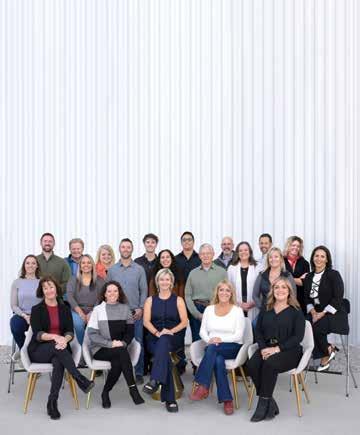
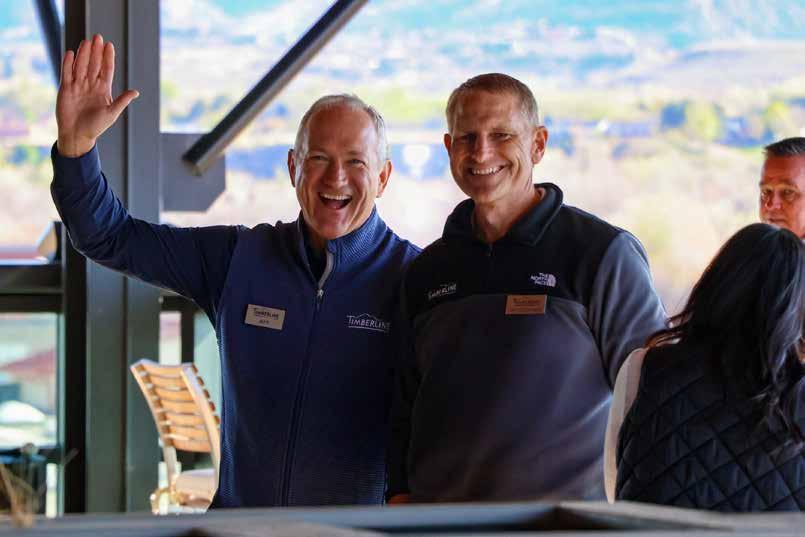
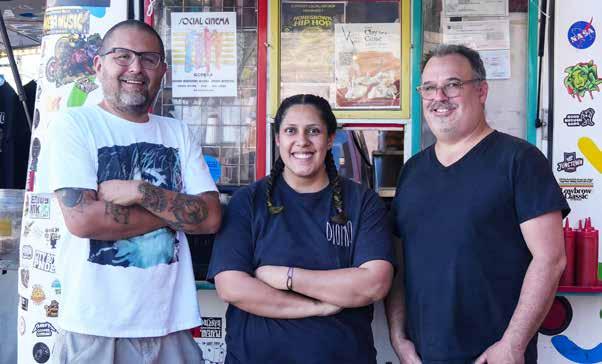
Your neighbors at Alpine Bank have the tools and knowledge to help your business grow.
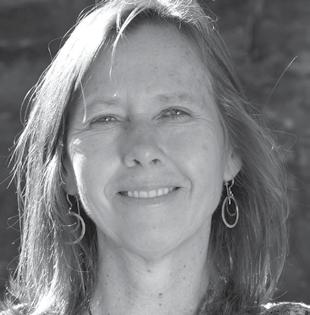
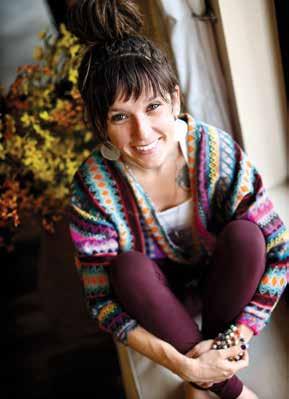
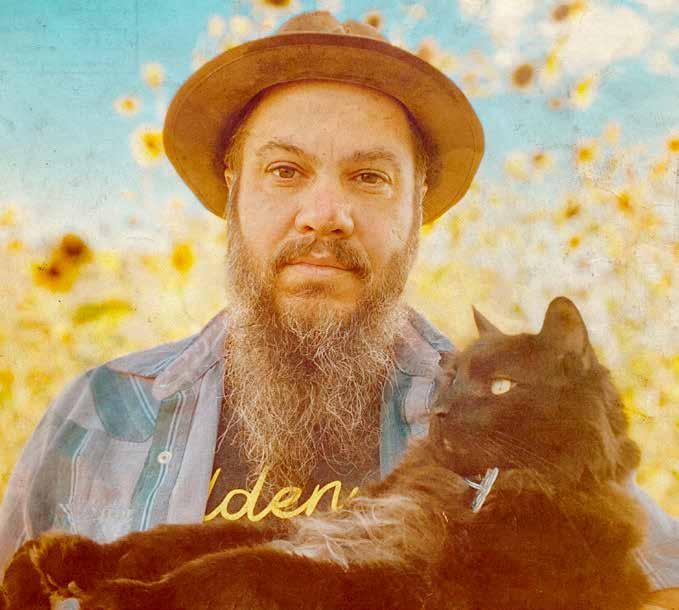
Victor Rung Banking O cer
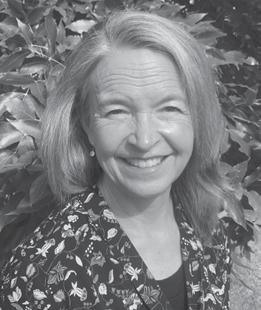
Nathan Knoll Branch President
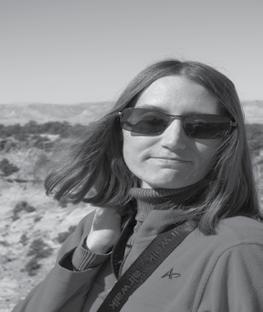
Tom Oliver Senior Vice President
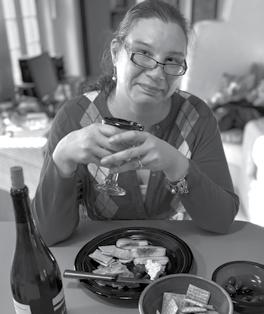
Nikki Clark Banking O cer
Jerry Gryglak Vice President
Howard Head Sports Medicine helps people of all ages and abilities get back to the activities they love. Working with the world’s top orthopaedic doctors and researchers, our patients benefit from innovative physical therapy techniques, state-of-the-art equipment, and experienced physical therapists.
HOWARDHEAD.ORG/RIDE
AVON | BASALT | BEAVER CREEK | BRECKENRIDGE
DILLON | EAGLE | EDWARDS | FRISCO | GYPSUM | VAIL
RideBelong Thrive
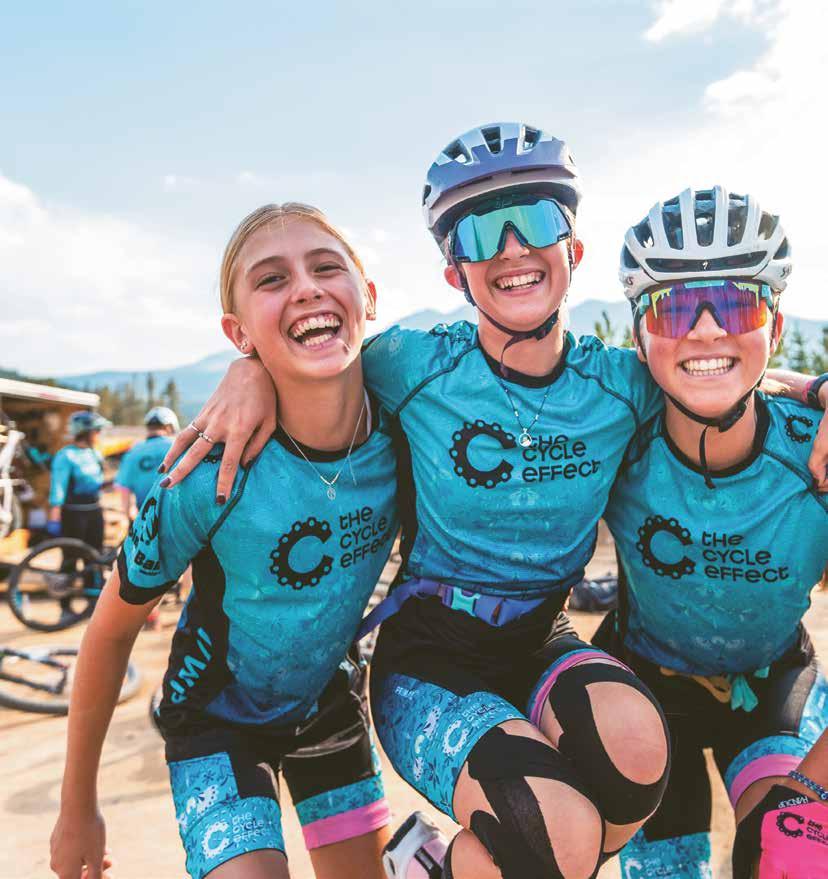
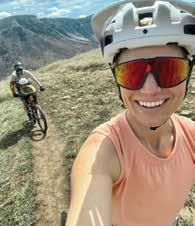
Every journey has its challenges and triumphs. By learning to overcome the difficult times we become stronger. Like everyday life, mountain biking is a series of peaks and valleys, of intense effort and exhilarating reward. The Cycle Effect provides a safe space to experience life’s ups and downs, so you can rise above anything that comes your way. Learn more about how you can get involved by visiting TheCycleEffect.org
Photo Credit: Curtis DeVore
Building What Matters
BOA BUILDERS AND THE FUTURE OF COMMUNITY ON THE WESTERN SLOPE
In a region shaped by landscape and lifestyle, homes carry a deeper role. They are places to return to after long days outside, to gather with neighbors and to settle into the rhythm of Western Colorado. For BOA Builders, that understanding has been decades in the making.
With roots in the Grand Valley dating back to the early 1980s, BOA has grown alongside the community it serves. Now led by Wendi and Charlie Gechter, who took over from her father, Tom, the company continues to build with a long view. These are not speculative projects, but homes created for neighbors in a place they know well.
That perspective is evident in the design. On the Western Slope, life moves easily between seasons and pursuits, from skiing and hiking to exploring nearby wine country. BOA reflects that with homes that blur the line between indoors and out. In Chipeta Hollows, open living spaces flow directly into private courtyard patios, creating a seamless connection to the outdoors.
Materials are chosen with the same intention. Stucco exteriors and high-end interior finishes are built for durability and ease, while services like snow removal and landscaping allow homeowners to spend less time on upkeep and more time enjoying where they live.
That philosophy comes into focus at Chipeta Hollows, Grand Junction’s first amenity-rich 55+ community. Designed in partnership with Epcon, the neighborhood goes beyond low-maintenance living to prioritize connection. Outdoor spaces, shared amenities and thoughtful planning encourage
residents to gather, engage and build relationships, addressing a growing need for community at this stage of life.
BOA’s approach to “building better” underpins it all. Homes are constructed beyond minimum code, with energy efficiency, comfort and long-term performance considered from the start. The result is a living experience defined by consistency, lower maintenance and lasting value.
As the region evolves, BOA continues to respond to what the community truly needs, from affordable housing partnerships to homes designed for aging in place. At the same time, design offerings have expanded to reflect more personal style, with options to add upstairs bonus suites, sitting rooms, customizable accents and a forthcoming design center at Chipeta Hollows.
In a changing market, BOA Builders remains focused on what matters most: creating homes that support the way people live. On the Western Slope, that means connection, durability and a strong sense of place.
COMMUNITY STYLE
Ecosystems Enlarged: Finding Hidden Details in Western Colorado With Macro Photography
MAKER
Elemental Wellness Shop: Blending Plant Wisdom + Personal Healing to Simplify Modern Wellness
ART
Three Sisters Theatre Company: Giving Voice to Women’s Issues and Forming Resistance Singing Group
MUSIC
The Scotch Blossom: A Spiced Scotch Cocktail With Apricot + Ginger
Kyle Harvey’s Creative Life: A Renaissance Path in Fruita FOOD
The Scoop on Ouray’s Favorite Ice Cream Lady: Dawn Glanc of Brown Chicken Brown Cow
SPOKE
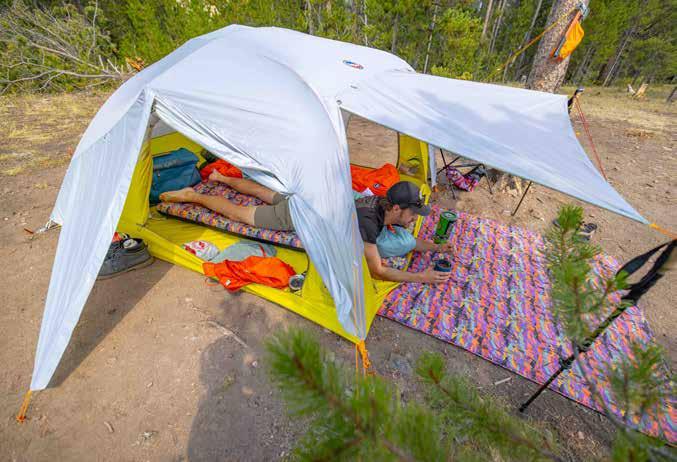
25 Years of Sleeping Under the Stars: Q+A With Bill Gamber, Co-Founder + President of Big Agnes
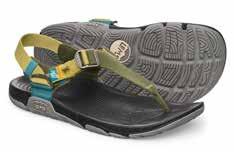
SPOKE Gear for the Season
SPOKE
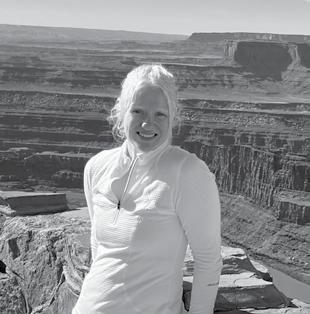
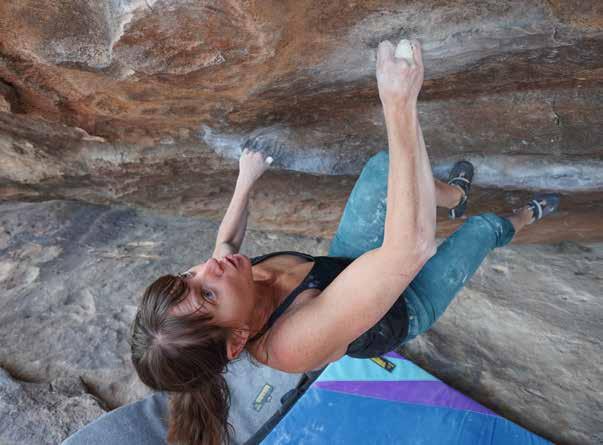
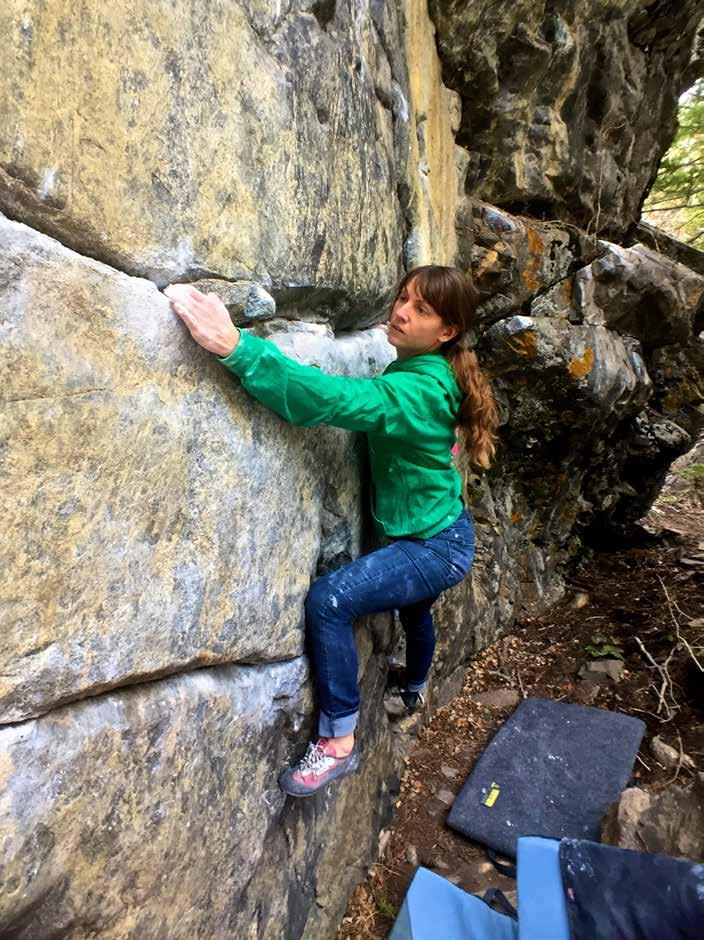
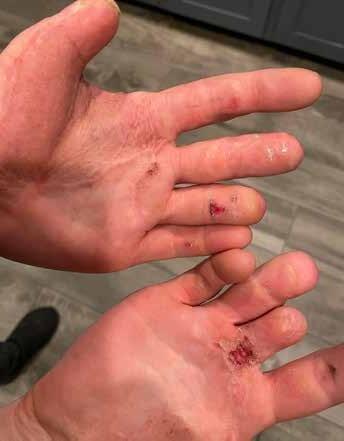
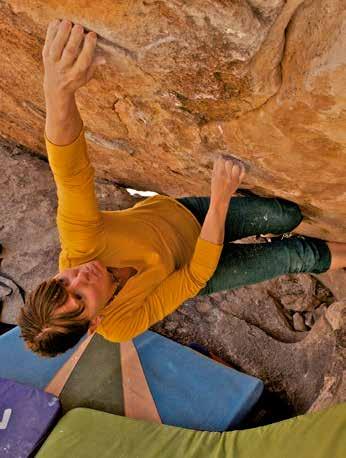
Athlete Profile: Melissa Strong A Memoir on Climbing Through Adversity
5 Adventure Basecamps You’ve Probably Never Heard Of
Smart Design Meets Community Goals: Grand Mesa Nordic Council’s Skyway Station
SADDLE UP Heritage at The Heart of Western Colorado Rodeos
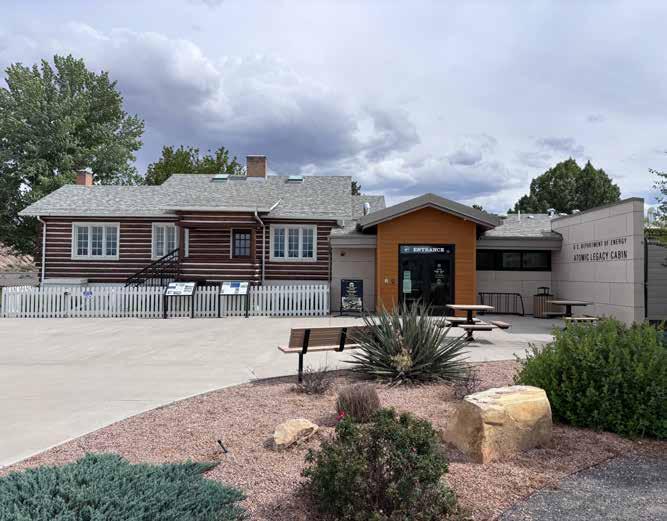
ATOMIC LEGACY CABIN
Shining a Light on History + Science in Grand Junction
EVERY DROP COUNTS In the Arid West, Water is Precious and Increasingly Critical
HERITAGE
Some things stay with us long after we leave them.
A recipe made from memory. A story retold around a dinner table. The energizing rhythm of summer events, the familiar feel of a favorite trail or the instinct to make something meaningful by hand. This issue explores the idea of heritage, and the threads that connect us to people, places and traditions. I’ve been reflecting on Spoke+Blossom as its own capsule of this from what is now 36 editions — how every headline and byline, every story, image and design has become part of the publication’s own evolving legacy. Together, it all creates a record not only of where Western Colorado has been, but of what S+B has been alongside it.
These pages explore the many ways heritage leaves its mark. Sometimes it appears in places that hold history. Sometimes it lives in traditions repeated year after year. Other times, it reveals itself through people adding their own perspective to something larger than themselves. From Western Colorado rodeos and community landmarks, to artists, makers and winemakers shaping what comes next, the stories in this issue remind us that heritage is never fixed. It continues to evolve.
Perhaps heritage is not simply what we inherit, but what we choose to carry forward. The values, stories and practices that continue to shape us, along with the responsibility to leave something meaningful behind.
And when you’ve turned the final page and closed the book on this season, we hope you carry something with you. Better yet, we hope you find something worth passing along.
Kim Fuller with Bobby L’Heureux + Emery, along for the ride
Publishers of Spoke+Blossom Founders of Jaunt Media Collective
Keep in touch with us between issues! Check out our website, spokeandblossom.com, for updates and events, and follow us on social media.
Scan this QR code with your smart phone to be taken directly to our website.
This magazine is shareable and recyclable. Please don’t throw it in the trash.
For advertising, contact ads@spokeandblossom.com 815.414.9642
Get in touch! We would love to hear from you. Please send your comments to letters@spokeandblossom.com.
KYLEA HENSELER
Kylea is a freelance journalist and reporter for the Montrose Daily Press. She enjoys writing about the outdoors, travel, culture and local business, and in her free time can be found in the gym or on the slopes.
SHARON SULLIVAN
Sharon is an award-winning journalist who writes for various newspapers, magazines and nonprofit organizations. In her free time she enjoys hiking on Colorado’s beautiful public lands.
URSULA NIZALOWSKI
Ursula graduated from Colorado Mesa University with a bachelor’s degree in English in 2015. Since then, she has written “YouTube and Me: A Troubling Relationship” in the Green River Anthology, “YOLO” in CMU’s publication The Literary Review and journalistic pieces for the Beacon Senior News and Spoke+Blossom
MITCH KOROLEV
KRISTEN LUMMIS
Kristen is a writer based in Western Colorado. With a background in public policy, raising boys and wrangling dogs, Kristen founded the award-winning snowsports website braveskimom.com in 2010. She is co-author of a book documenting the history of Colorado Mesa University which will be released in summer 2025.
Mitch is a nature photographer and environmental scientist based out of Grand Junction. He seeks to bridge science and art through his engaging imagery of landscapes, wildlife and scientific research. His previous work includes documenting climate change research in the Amazon rainforest.
MAUREEN MCGUIRE
Maureen (Kelly) is a teacher in Grand Junction. Her love of the culinary arts stems from spending her childhood in her grandmother’s kitchen and sharing her interests and talents with others. She was born and grew up on the Western Slope, and continues her efforts to strengthen our community for future generations. She and her husband, Ira, love gardening.
HERITAGE
HERITAGE IS THE THREAD THAT CONNECTS US TO THE PAST — THE TRADITIONS, STORIES AND CRAFTS THAT SHAPE WHO WE ARE TODAY. IT’S THE TEXTURES, FLAVORS AND RITUALS WE CARRY FORWARD, HONORING THE PEOPLE, PLACES AND PRACTICES THAT MADE US.
We Asked These Western Slope Locals to Weigh in on This Topic Compiled by S+B Staff
COURTNEY KIEL
Owner of The Blue Beryl Winery
“I’m a firm believer that memories hold weight where they take place, and the Western Slope has a rich history of not only struggle, but passion as well. As a fourth-generation local, it’s been a beautiful experience to see how others continue our heritage through entrepreneurship and storytelling. Here at The Blue Beryl Winery, our location sits at the base of the Gearhart Mine, where my great-greatgreat-grandfather worked. Our branding honors the hard work of my ancestors, who helped build the Western Slope into what it is today. It’s an honor to share these stories with passersby as they experience the fruits of our generational labor and passion.”
ANNA “ACE” HARTSOCK General Manager of The High Lonesome Ranch
“To me, heritage is the thread that connects us to the original stewards of this rugged landscape. Following the Pine Gulch Fire, it became clear that true heritage is found in the humility to return to Indigenous ranching methods — practices that prioritize the health of the earth above all else. It is the quiet work of restoration and the pride of nourishing our neighbors with grass-finished beef. Heritage means healing the land by listening to its history and leaving behind a legacy of resilience that honors the wisdom of the past.”
Eagle River Jamboree Event Organizer
“Heritage is the cultural roots of the generations before us who left a lasting legacy — one that continues to live through traditions, values, music, stories and community. It reminds us that we are part of something bigger than ourselves. Every day, through our actions, we contribute to the heritage we leave behind for future generations. The question is: what are we building for our communities that will have a lasting impact? Whether through art, service, leadership or connection, I believe heritage is created when we invest in people, strengthen community, inspire others and leave the world better than we found it.”
ZACH GILLIAM
what's up in the west
A PLACE FOR CREATIVES TO ‘LEARN, CONNECT, CREATE — TOGETHER’
THE ARTERY
Words + Photo by Sharon Sullivan
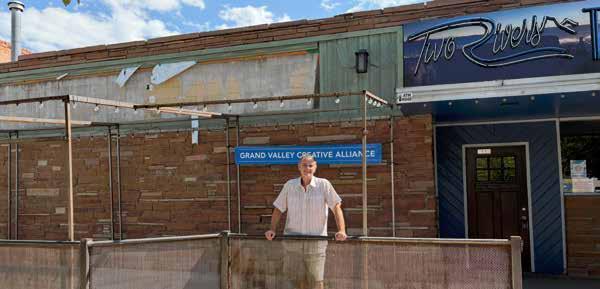
Anew creative hub in downtown Grand Junction is set to open this June, thanks to the Grand Valley Creative Alliance (GVCA), a nonprofit whose mission is to cultivate and promote the Grand Valley’s creative community.
The ARTery is located at 539 Colorado Ave., where renovations have been underway since the GVCA purchased the property a year ago. A brick-and-mortar presence will enhance the organization’s impact while advocating for the arts, notes Chip Walton, GVCA executive director.
The ARTery will include three professional working studios for ceramics, fiber arts and printmaking, and a fourth that Walton calls the “community studio” — a space that connects to an outdoor patio area — that will be able to serve multiple functions, like hosting classes and workshops, individual artist shows and other small events, as well as provide a working studio space.
“Artists and nonprofits without their own space will be able to use the ARTery studios,” Walton says. “It is designed to be a hangout place for artists.”
The ARTery will offer multiple levels of membership, including single-day and drop-in passes. Hours of availability will depend on a person’s level of membership, Walton says.
To access the potter’s wheel and other specialized equipment, reservations and training on the machinery will be required, adds Julia Croscetto, ARTery studio manger for fiber and printmaking.
At some point, art classes and workshops will be offered at The ARTery. “There are several pottery studios in town with completely full classes,” Walton says. “There’s a growing demand for good pottery classes.” There’s also an interest in fiber arts and printmaking.
Robbie and Chuck Breaux, longtime champions of the arts, donated $1 million to get the project off the ground. Robbie is GVCA board chairperson and has been central to the vision of this project from the beginning, says Walton. :
For more information, visit gvcreates.org/the-artery.
Chip Walton, Grand Valley Creative Alliance
THE NEXT CHAPTER OF THE STATE’S WINE STORY
COLORADO CRU
Words by Lexi Marshall |
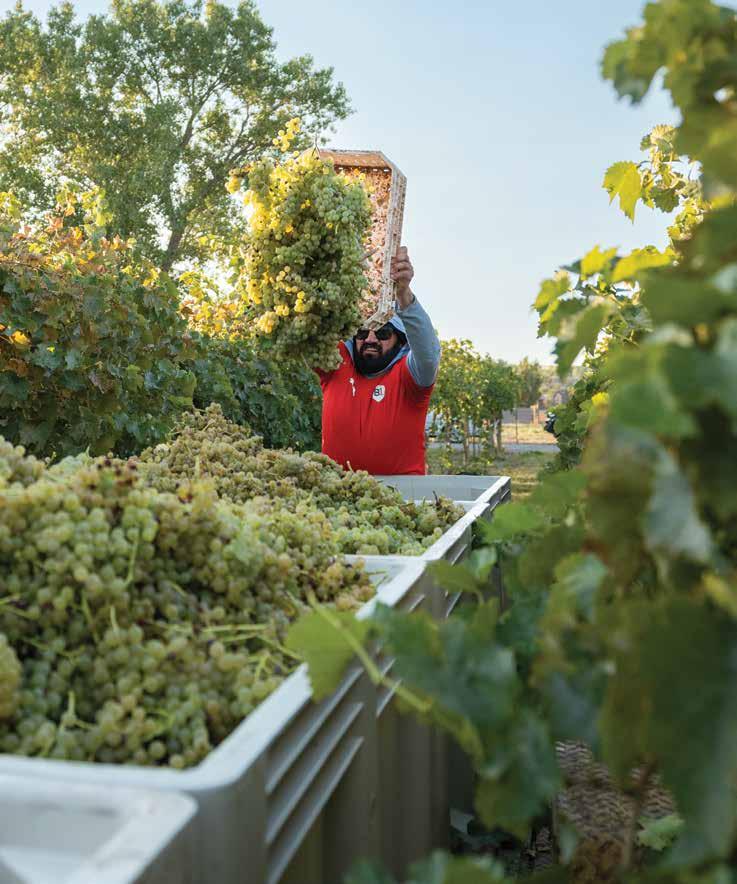
Colorado’s wine industry has long existed just outside the national spotlight — quietly producing expressive, high-altitude wines shaped by a landscape that’s anything but ordinary. Now, a new initiative is giving that story sharper definition, grounding it in place, people and purpose.
Launched by the Colorado Association for Viticulture & Enology (CAVE), Colorado Cru is a new designation designed to highlight the state’s
by Kim Fuller
distinct growing regions and elevate awareness of its unique terroir. It arrives alongside the Drink Colorado Wine app, a free, statewide platform that connects consumers directly with Colorado wineries, events and experiences. Together, they offer something the industry has been building toward: a clearer, more cohesive identity.
Colorado Cru invites wineries to craft blends that reflect both the character of the land and
Photo
their own winemaking style. The goal is not strict standardization, but a shared framework that helps articulate what makes Colorado wine distinct.
“The launch of Colorado Cru marks an exciting step forward for the Colorado wine industry,” says Cassidee Shull, executive director of CAVE. “It allows us to more clearly define and celebrate the unique characteristics of our growing regions, while giving consumers a deeper, more connected experience with Colorado wine.”
To guide that identity, Colorado Cru focuses on a select group of grape varieties identified through grower input, vineyard data and research from Colorado State University. Cabernet franc, syrah, chambourcin, riesling, traminette and chardonnay were chosen for their ability to thrive in Colorado’s varied conditions and produce high-quality wines. These grapes form the foundation, but interpretation is left to the winemakers, allowing each bottle to reflect both regional character and individual approach.
A growing number of producers are already helping define the Colorado Cru designation. On the Western Slope, Carlson Vineyards delivers a bold take with its 2022 NSFW red, and Peachfork Orchards & Vineyard showcases versatility through both its 2024 dry white wine blend and 2023 dry red wine blend.
The Drink Colorado Wine app brings that exploration to life. The app features a comprehensive, easy-to-navigate listing of all CAVE member wineries across the state, giving users a streamlined way to discover wines, view food pairings and build personalized wine trails. It’s a practical tool, but also an invitation to explore more deeply and experience Colorado wine as a connected, place-driven story.
In a state better known for craft beer and outdoor adventure, Colorado wine continues to define itself. Colorado Cru doesn’t rewrite that story, it sharpens it. Here, heritage is being shaped in real time, vintage by vintage. :
theblueberylwinery.com
winecolorado.org
Located at the base of Mt. Garfield, The Blue Beryl Winery serves traditional dry wines — estate grown and made — with a local Palisade twist. Enjoy the wine and the view.
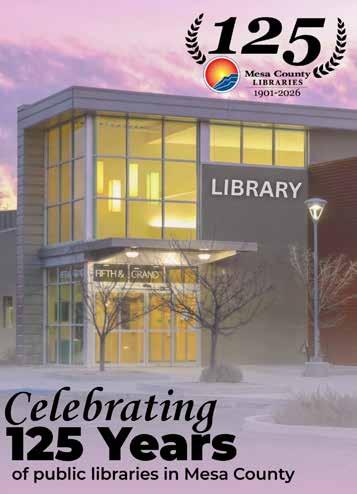
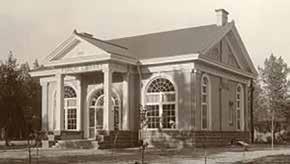
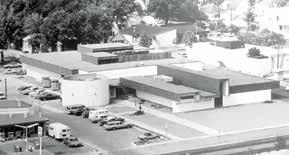
THE HERITAGE OF MESA COUNTY PUBLIC LIBRARY AT 125
STILL CLIMBING
Words by Nickolas Paullus | Photos courtesy of Mesa County Libraries
1901 was one heck of a year. William McKinley was assassinated, Queen Victoria died — marking the end of the Victorian era, Australia officially became a nation and the first Nobel Prizes were awarded in Sweden and Norway. It also marks the year the first Mesa County Public Library (MCPL) opened its doors.
The Grand Junction Public Library, the first Carnegie Library in Mesa County, opened to the public on July 25, 1901 following a grant from the Carnegie Corporation. Andrew Carnegie believed libraries were “the ladders upon which the aspiring may climb,” and 125 years later, that mission still resonates with MCPL.
Michelle Boisvenue-Fox, the executive director of the library, recognizes a continued commitment to serving the community. “In 1901, there was little to no access to the K-12 school structure,” says Boisvenue-Fox. “And so, Carnegie suggested libraries were a path to elevate the community.” As ever, there are haves and havenots, and in a stratified society, the library fills a much-needed gap in learning and community.
At storytime, human connection guides the way as parents meet other caregivers — a vital touchstone in an increasingly isolated society. The library offers volunteer opportunities to serve that community, a discovery garden where “people make connections with their hands in the dirt” and staff whose mission is guided by relationship with community.
And that community is broadening. One of the values — and challenges — of a library, “is that a library is supposed to serve the entire community,” suggests Boisvenue-Fox. With ever-diversifying demographics, the scope of the library has broadened in response. “We are here, 125 years later, because we didn’t stay the same,” she says.
The Adult Learning Center is over 35 years old. The 970West Studio offers a unique opportunity to engage with technology in its collaborative studio. There are also rotating art exhibitions. Broader resources to serve broader communities.
It’s no wonder, then, that the MCPL was a finalist for the National Medal for Museum and Library Services in 2024, an award rooted in community service.
To celebrate 125 years, MCPL has partnered with Whitewater Hill Vineyards to offer “Library Wines,” a collaboration that celebrates
connection through local wine. The blends — “Well Read” and “Grape Expectations” — are available at Whitewater Hill’s tasting room, with proceeds benefiting the Mesa County Library Foundation.
On July 24, 2026, the Grand Junction Chamber of Commerce will celebrate the library with a ribbon cutting ceremony to recognize the role the library has played in the community.
The most tangible way the patrons have shown that love is through a collection of some 70 community videos which were recorded throughout 2025. On display across the library’s
social media, the videos offer a glimpse at what makes the library so vital to Mesa County.
The stories are diverse, reflecting the breadth of the experiences the library has to offer. There is one throughline, however: the MCPL, and all libraries, enrich the lives of the patrons — and so too, the entire community. :
Original Carnegie Library, 1901, at 7th St. and Grand Ave.
MCPL moved to 5th St. and Grand Ave. in 1974.
A SOLAR SHIFT AT THE STORM CELLAR IS PROVING THAT THE FUTURE OF FARMING RUNS ON SUNLIGHT
FROM VINES TO VOLTS
Words by Jennifer Weintraub | Photos by Jayme Henderson
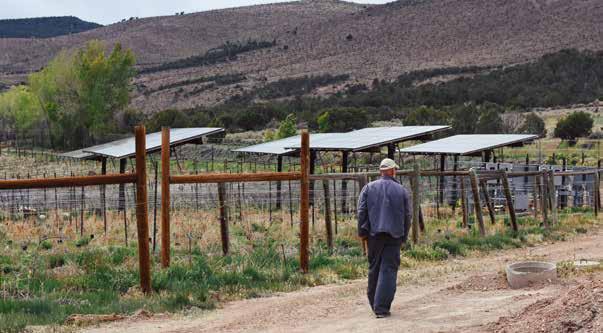
Rows of wine grapes stretch across The Storm Cellar’s property on a hillside outside of Hotchkiss in one of the highest wine-growing regions in the world. The scorching Western Colorado desert sun beats down on the highaltitude grapes, but now, it’s not just part of the scenery; it’s reshaping an industry.
The Storm Cellar recently integrated a stateof-the-art solar system that doesn’t just power the winery — it changes how rural agriculture thinks about energy altogether.
THE PARTNERSHIP THAT SPARKED A POWER SHIFT
Like many good stories in wine country, a conversation about solar power started over a glass of wine.
Solar had long been on the radar for The Storm Cellar co-owners Jayme Henderson and Steve Steese, but it lived in the realm of future plans. That changed during the winery’s annual Sip into Spring festival, when they met
Isaac Ketcham of Atlasta Solar Center, based in Grand Junction.
What followed wasn’t just a partnership; it was alignment. “I realized that their vision to provide solar power to rural areas coincided identically with our need for a more sustainable energy solution,” Henderson explains.
Over the next year, Ketcham collaborated with the winery and an electrical engineer to design a system that would ultimately earn a $100,000 grant from the Colorado Department of Agriculture, not just for using solar, but for reimagining how it could work.
CRACKING THE POWER CODE
Many rural farms face the same problem: they operate on single-phase power, which is simpler, cheaper and, for most modern farming equipment, increasingly limiting.
Most of today’s agricultural and wine-making equipment is built for three-phase power, the global standard. This electrical mismatch can
strain systems, reduce efficiency and wear down equipment faster. Upgrading to three-phase electrical service through traditional utilities is expensive upfront — and even more painful month-to-month.
Ketcham had a better solution. “The real trick of what we’re doing is a three-phase micro grid meter behind the existing single-phase meter. This allows them an unlimited power supply source, plus, they’re able to use and take back excess energy into the single-phase grid in a compliant fashion.”
Translation? The winery gets the power capacity it needs without the costly utility overhaul.
Even more impressive, Ketcham proved that solar and backup battery storage without a government tax incentive was cheaper than a traditional utility upgrade and the resulting electricity bill. That insight helped secure the state grant and positioned the project as a model for rural innovation.
SMARTER FARMING
The effects of the new system ripple through nearly every aspect of the winery.
Previously, watering required manual effort, carefully sequenced across zones. Now, a dual-pump system allows multiple zones to run simultaneously via drip irrigation, reducing runoff and increasing efficiency.
The result isn’t more water use — it’s better water use.
“We’re in the process of replanting our entire vineyard,” Henderson says. “We can’t replant as fast as possible because you have to water new vines. With this increased water delivery system, we can replant our vineyard faster, which will directly affect our bottom line.”
Beyond the vines, storage, the tasting room and critical operations are supported by battery backup, ensuring consistency during peak summer heat. “There’s always the fear of losing power in the middle of summer. If the power doesn’t come back on, it can ruin a crop,” explains Steese.
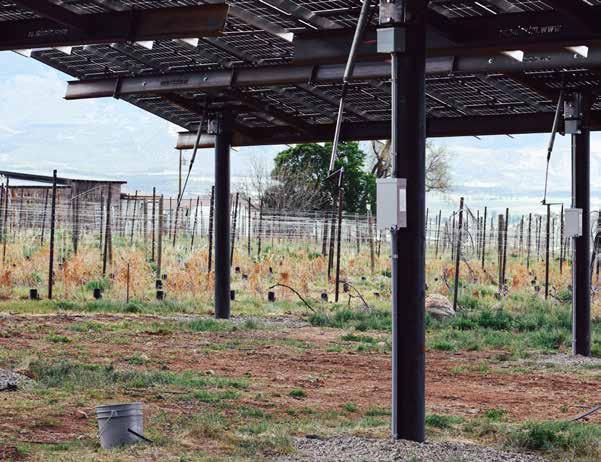
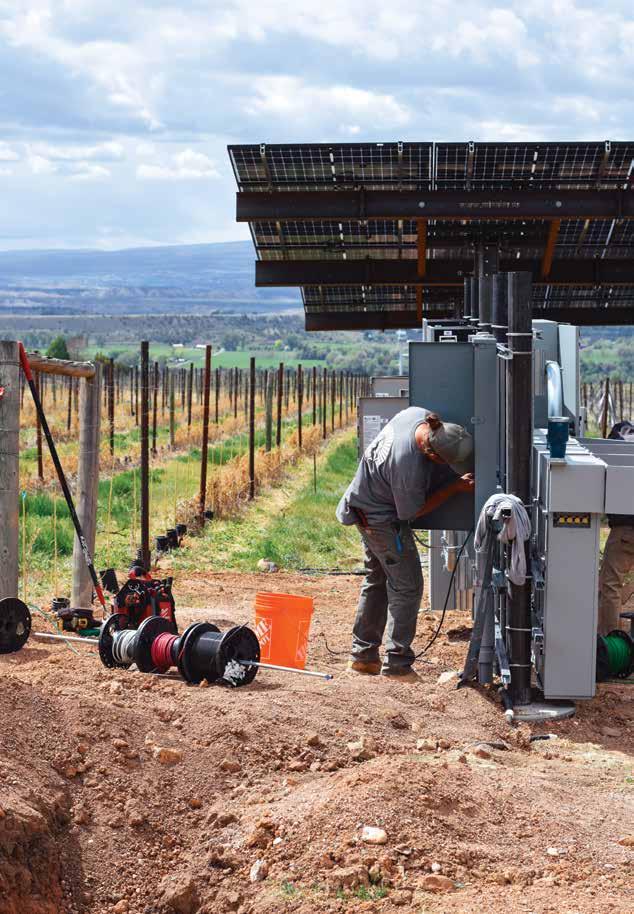
The frames and racking system are fully adjustable, allowing the angle to be modified based on the sun’s position. They also double as shade for people and future crops.
Previously, watering required manual effort, carefully sequenced across zones. Now, a dual-pump system allows multiple zones to run simultaneously via drip irrigation, reducing runoff and increasing efficiency.
In an industry where a missed irrigation day or power outage can jeopardize an entire crop, reliability is survival. What the system ultimately delivers isn’t just energy — it’s peace of mind.
UNEXPECTED PERKS OF GOING SOLAR
The benefits don’t stop at electricity.
The American-made steel frames and racking system are fully adjustable, allowing Steese and Henderson to modify the angle based on the sun’s position to capture more energy than a fixed roof mount. They also double as shade, protecting both crops and people from the blazing desert sun. Beneath them, the winery is experimenting with agrivoltaics, growing vegetables in filtered light while creating a naturally shaded space for outdoor gatherings.
Then there’s the broader impact. During winter months, when the winery’s energy use drops, excess power flows back into the grid, supporting nearby homes during peak heating demand.
“Energy flows on a path of least resistance,” Ketcham explains. “When excess energy generated goes to the grid, it flows to the next house and then the next. They’re powering the region this way.”
A BLUEPRINT FOR THE FUTURE OF FARMING
Farming has always been a negotiation with finite resources. The Storm Cellar leans into what Western Colorado is most abundant in: year-round sunshine. This model opens doors for rural farms to pursue energy independence. And, it offers something rare in agriculture: a glimpse of stability in an unpredictable industry.
“Every farm dreams of electrical independence,” says Steese. “The technology and implementation of this solar system will break barriers for people in rural areas and make it more accessible for farmers.”
The Storm Cellar is proving that the future of farming might not just depend on the land beneath our feet, but on the energy above it. :
HOW PASSIVE HOUSES ARE RESHAPING DESIGN CHOICES
BUILT TO WITHSTAND
Words by Jennifer Weintraub
On the Western Slope, building a home isn’t just about the structure: it’s about the land it sits on. But our climate is changing that landscape. Longer dry seasons, more volatile weather and the ever-present threat of wildfires are forcing a recalibration. The question isn’t just how will this home look, but how will it hold up?
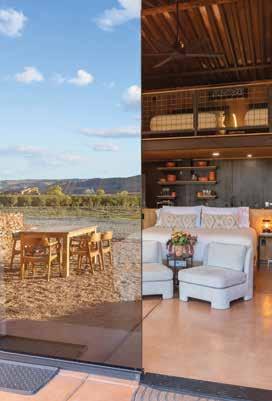
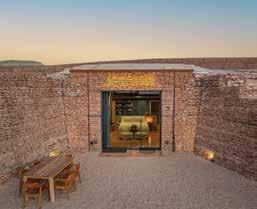
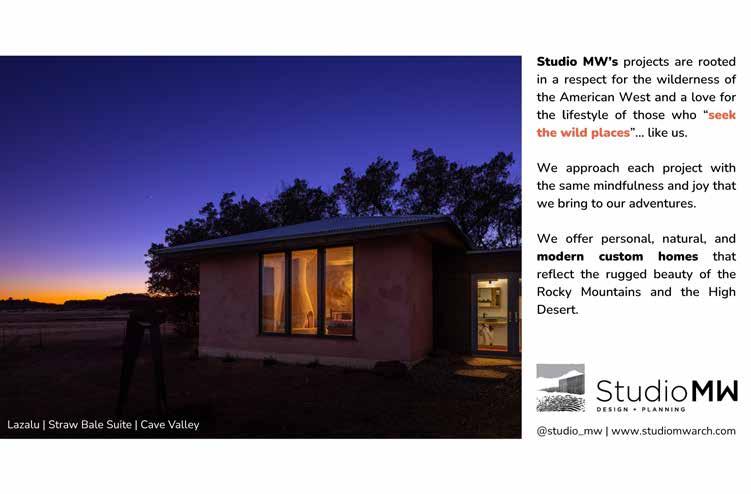
These days, building a sustainable or beautifully designed home isn’t enough. “As an architect, you’re not doing good design if you’re not creating an energy-efficient home. That’s just baked in,” explains Molly Wheelock, principal at Studio MW in Paonia. “Now, we’re seeing more of a healthy house.”
At the highest level of a healthy home is a Passive House design.
BEYOND BEAUTIFUL: THE RISE OF A HEALTHY HOME
A healthy home does more than shelter its occupants — it protects them.
At the core of Passive House design is a tightly sealed building envelope that keeps out pollutants, moisture and smoke. But unlike older airtight homes that felt stuffy, these designs incorporate controlled ventilation systems that continuously filter and refresh indoor air.
The result? A home that feels consistent, comfortable and clean while using significantly less energy.
Passive House design takes it a step further. What started as a rigorous energy-efficient standard in Germany has evolved into a global benchmark for performance, health and resilience.
And on the Western Slope, it’s catching on for another reason: peace of mind. Passive House design is not just energy-efficient; it’s more fire-resistant.
THE SCIENCE OF SMARTER BUILDING
“There are five principles of Passive House design,” explains Parker Moessner of Emu Passive, a certified Passive House training company for builders and architects.
It starts with a super-insulated, continuous building envelope that minimizes heat loss. Every aspect of the home is designed to eliminate weak points, especially around windows and doors — the most vulnerable areas. High-performance options like triple-pane windows dramatically improve insulation and maintain structural integrity under extreme conditions, including intense heat from wildfires.
Extreme air sealing creates a controlled environment that reduces energy while maintaining exceptionally high air quality. Drafts are eliminated and replaced by mechanical ventilation systems such as an energy recovery ventilator (ERV) and a heat recovery ventilator (HRV). Together, these systems constantly exchange stale indoor air for fresh air. By using outgoing warm air to temper incoming air, Passive House design requires little to no additional heat. These systems are a smarter way to allow your home to breathe.
A BREATH OF FRESH AIR
If there’s one feature that resonates most in the West right now, it’s air quality.
“As fires become more common and there are more poor-quality air events, your Passive House becomes a fresh air sanctuary,” says Moessner. “People are drawn to Passive House design for its energy efficiency, but there are numerous other benefits.” The real value: resilience and occupant health.
With tightly sealed construction and filtered ventilation, Passive Homes can significantly
reduce the amount of smoke and airborne pollutants from entering the interior. Even during poor air quality events, indoor air remains clean.
After the devastating Marshall Fire that swept through Louisville, Colorado in 2022, a Passive House retrofit proved remarkably resilient. Inside, the home sustained almost no ash or smoke damage, even as surrounding homes were severely damaged.
It’s not just about direct threats. Wildfire smoke can travel hundreds of miles, affecting indoor environments even when they’re far from the flames. Passive House design helps mitigate that risk — protecting both the home and the people inside it. By keeping contaminated air out, these homes can avoid the costly and invasive cleanup that follows smoke exposure.
Energy efficiency, it turns out, is also your best line of fire defense.
BUILT TO BEND, NOT BREAK
Resilience is at the core of Passive House design. “Resilience is a bit contradictory,” explains Wheelock. “A resilient home should be strong enough to last for generations, but also be flexible and adaptable, almost like water.”
Passive House design embraces that duality. Built with high-performance materials and
fewer structural vulnerabilities, these homes are more durable. Their airtight construction limits moisture intrusion, reducing the risk of mold. Their energy efficiency allows them to maintain livable temperatures longer during power outages.
When it comes to wildfire risk, these high-performance details matter. The tightly sealed envelope reduces the chance of embers infiltrating the home, one of the most common ways houses ignite.
In short, these homes aren’t just efficient — they’re built to endure.
A SMARTER WAY TO BUILD IN THE WEST
The idea of a home on the Western Slope is evolving. Beauty still matters, but it’s no longer the main headline. Performance, health and resilience are becoming the true mark of thoughtful design.
Passive House design represents a broader shift in thinking. Homes are not just static structures; they’re dynamic systems.
In a landscape defined by extremes, the homes that last won’t be the biggest or boldest — they’ll be the ones designed to withstand, built from the inside out for whatever comes next. :
A SPICED SCOTCH COCKTAIL WITH APRICOT + GINGER
THE SCOTCH BLOSSOM
Words + Photos by Jayme Henderson
Iclearly remember my 5-year-old self jumping up onto my dad’s lap when he got home from work. He would sometimes pour himself two fingers of Scotch whisky and silently recount the day’s moments. The intense, smoky, sometimes bandage-like smell was off-putting to me, and I didn’t develop a taste for the Scottish spirit until my 30s. It took a trip to Scotland, where I toured the coastal distilleries throughout the country, to give me a true appreciation of the history and culture that surrounds Scotch. It’s still not my first go-to for an evening sip, but whenever I do pour myself a dram, I’m reminded of my dad and those quiet moments when I’d smell his cocktail glass, smugly turn up my nose, and tell him how “totally gross” his drink of choice was.
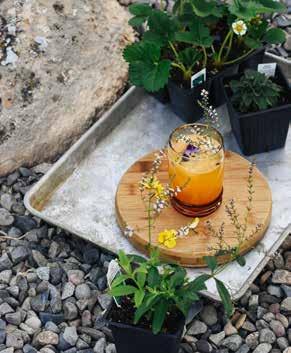
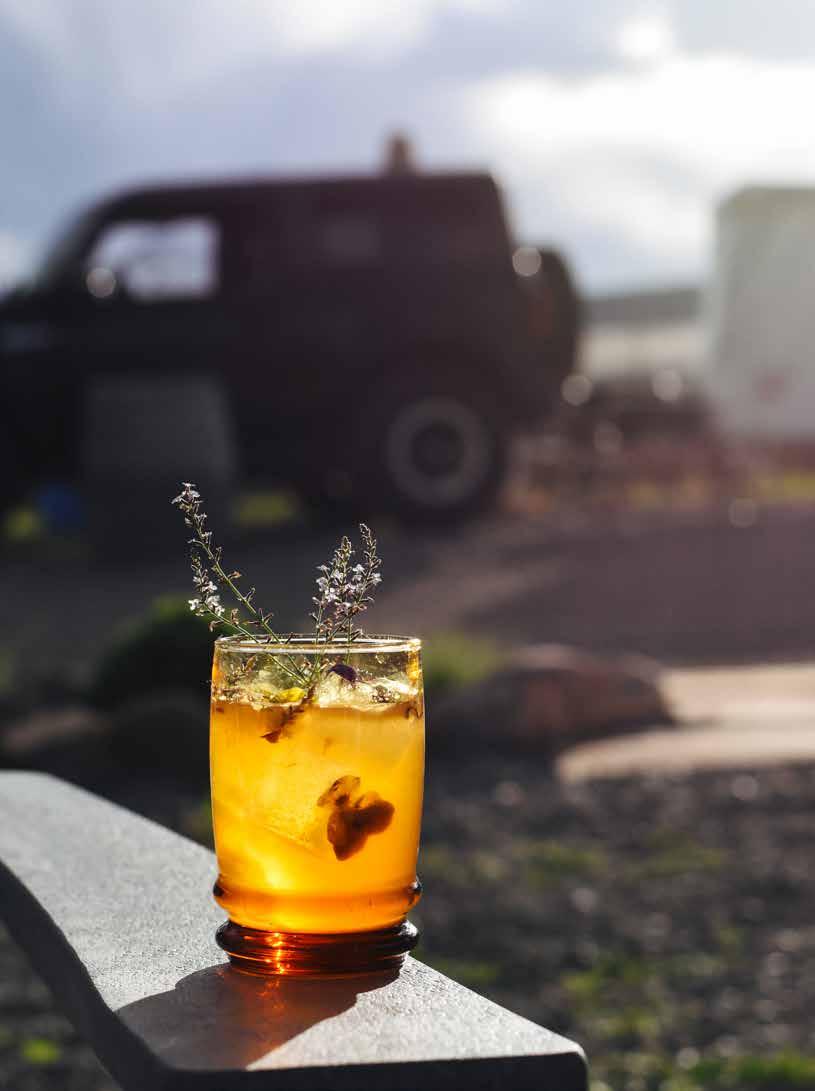
Similar to how I enjoy mezcal, I find that I most enjoy Scotch integrated within a cocktail, especially when I use a blended version of Scotch. I love how the smokiness that’s often present in the spirit matches with fruits like apricot that benefit from a little char. When creating this cocktail, I wanted to incorporate some of the orchard fruit from here in the North Fork Valley that I hoarded and froze last summer. Foraging through my freezer and finding these sealed-up “flavor time capsules” is especially bittersweet this year, as our valley’s orchards were wiped out by a crippling late-April frost.
Making this cocktail was a meditation for me. Yes, it’s a reminder of my family’s Scottish heritage, but it’s also a reminder to savor the moments we have at hand. No moment or person — or fruit — is permanent or guaranteed to return. Learning to embrace this concept has helped me to become more focused on the joys I find in the present. I don’t see my dad as often as I’d like, our relationship is a little rocky, and while he no longer clearly remembers the details of those moments he shared with me,
whenever I open up a bottle of his beloved spirit, it surprisingly brings both of us right back to those slow evenings together, long ago.
Sure, you could use your fancy, aged single malt whisky in this cocktail recipe, but I recommend going for a blended version. It’s oftentimes easier on the wallet and better suited for using in a cocktail format. In this cocktail, I used Monkey Shoulder, one of my favorite blended malt Scotch whiskies. This whisky is floral and subtly fruit-driven, with notes of orange blossom and honey, making it a suitable complement to the apricot and spice tones the other ingredients contribute. The cocktail is loosely inspired by a twist on the modern classic Penicillin cocktail that I tasted at Tales of the Cocktail, back in 2017, at one of my favorite New Orleans bars, Seaworthy.
And the cocktail is fittingly dedicated to my dad, Captain Jim, who was decidedly seaworthy, himself. :
1. Prepare the Spiced Apricot Syrup at least 30 minutes before making the cocktail. See recipe below.
2. Add ice to a cocktail glass and set aside.
3. In a mixing tin, combine the blended malt Scotch whisky, Spiced Apricot Syrup, lemon juice and ginger liqueur.
4. Add ice, shake well and strain into the prepped cocktail glass.
5. Garnish with edible flowers, such as violas, or sprigs of herbs, like lemon verbena or anise hyssop.
SPICED APRICOT SYRUP
½ cup fresh or frozen chopped apricots
½ cup sugar
½ cup water
1 star anise pod
2-3 cracked cardamom pods
1. In a small saucepan, combine all ingredients and heat to a simmer over medium-low heat, stirring along the way.
2. In about five to seven minutes, once the apricots have broken down and the sugar has fully dissolved, remove the pan from the heat and let the spices steep until the mixture reaches room temperature.
3. Strain the solids and store in the refrigerator for up to two weeks.
Dedication to Heritage
The orchard farms in Colorado’s North Fork Valley, which grow fruit in the towns of Hotchkiss, Paonia, Crawford and nearby Cedaredge, have been hit hard this year. Folks have lost jobs, families have been forced to pivot their businesses, and an entire year’s worth of revenue has been eradicated from one night of harsh, cold temperatures, impacting not only the local economy but also the surrounding businesses that coexist alongside the farming community. How can you help? Reach out to your favorite fruitgrowing families and ask if there is a way to show support or consider volunteering your time, work and expertise.
What better way to show your dedication to the heritage of Colorado’s orchard-fruit farms?
SUMMER RECIPES
SMALL INSPIRATIONS
Words by Maureen McGuire | Photos by Cat Mayer
Ifound the best mango I ever had two days before I made these recipes for dinner. The outside was crimson and emerald, and the flesh perfectly smooth and sweet. Not only was it the perfect mango, it was also on sale. I was so inspired by this fruit that I took a picture and showed it to everyone at work. I dreamt about this mango. I even came up with a number of possible preparations for mangos that week for something I had never made before, and certainly outside of my comfort zone. It is interesting and a little scary for me to cook things outside of the style I grew up with — Midwest Irish-American meets Western Colorado, with a dash of the American South. I don’t remember having a mango in a savory dish, and the inspiration of this perfect mango overcame my reticence about trying something new. And if a mango that cost a dollar was the inspiration for trying something new, I am better for it.
In my family, we have the traditional go-to dishes that are on easy rotation that everyone likes. But the real tradition is using what’s available, quality and economical to create joy! Joy is the real heritage in my kitchen — passed down through memories and conversations, cookbooks and gadgets, learning new skills and trying new combinations.
I hope we can all find joy in an everyday task — nourishing oneself and others — and
in trying something new every so often, and maybe add something to the usual routine. After this experiment, I will definitely add these recipes to my cooking rotation. My husband said it was the best thing I made all week. :
TERIYAKI SALMON (OR CHICKEN) SERVES 4
1-1½ pounds salmon or chicken
Half of the teriyaki sauce recipe Sesame seeds, for sprinkling Mango sesame salad, for garnish
1. Preheat the oven to 325 degrees Fahrenheit.
2. Dry the salmon or chicken and brush with half the teriyaki sauce. Sprinkle with sesame seeds.
3. Bake until done.
4. Garnish with mango sesame salad and serve.
TERIYAKI SAUCE/GLAZE
MAKES ABOUT 1/3 CUP (DOUBLE IF DESIRED)
1 Tbsp neutral oil
1 heaping Tbsp garlic, minced
1 heaping Tbsp fresh ginger, minced
2 Tbsp honey (or brown sugar)
¼ cup soy sauce
1 tsp cornstarch mixed with 1 tsp water (optional, to thicken)
1. In a small saucepan, heat the oil over medium heat. Add the ginger and garlic and sauté until fragrant.
2. Add the honey and soy sauce and stir until combined. Let simmer until all ingredients are well incorporated.
3. If the sauce is too thin, you can thicken it using a cornstarch slurry, or continue simmering until it reaches your desired consistency.
MANGO SESAME SALAD
SERVES 2-4
One medium mango, diced (make sure it’s ripe)
2-3 green onions, sliced
2 Tbsp black sesame seeds
¼ tsp chili flakes
A sprinkle of sesame oil
1 tsp rice wine vinegar
Pinch of salt
Toss all ingredients together until combined.
MANGO QUINOA PILAF
SERVES 4
2 cups water
1 cup uncooked quinoa
2 Tbsp neutral flavored oil
1 large mango, diced
2 bell peppers (I used yellow and red), diced
½ small red onion (about ½ cup), diced
Half of the teriyaki sauce recipe
¼ tsp chili flakes
1. Cook the quinoa in the water according to package directions.
2. In a large skillet, heat the oil and sauté the onion, bell peppers and chili flakes until softened.
3. Add the mango and sauté for a few more minutes.
4. Add the cooked quinoa and the sauce and stir to combine until hot.
From Fire to Future
THE HIGH LONESOME RANCH AND THE POWER OF REGENERATION
On Colorado’s Western Slope, heritage is often defined by endurance. At The High Lonesome Ranch, that idea took on new meaning in 2020, when the Pine Gulch Fire swept through the region, leaving behind a dramatically altered landscape and a defining moment for the ranch’s future.
“For decades, The High Lonesome Ranch has stood as a sprawling testament to the wild beauty of Western Colorado — a sanctuary of mountain forests and alpine mesas where the spirit of the West felt etched into the landscape,” shares Ace Hartsock, ranch services manager. “In the aftermath [of the fire], we stood at a crossroads. We could be defined by the devastation, or we could be inspired by it. We chose the path of regeneration.”
That decision marked a turning point. What had long been a working ranch rooted in tradition evolved into something more intentional: a living laboratory for ecological restoration. The shift reframed how the land, the animals and the broader mission all work together.
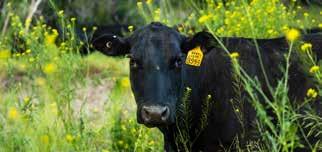
Today, cattle are not simply part of the operation. They are an essential tool in rebuilding it. Through regenerative grazing practices and the ranch’s Audubon Conservation Ranching certification, The High Lonesome Ranch approaches land management with a “beyond organic” mindset, focused on restoring soil health, increasing biodiversity and supporting long-term resilience.
“Our legacy starts in the soil,” says Travis Brooks, general manager. “And every management decision we make is focused on restoring the land so it can remain productive for generations to come.”
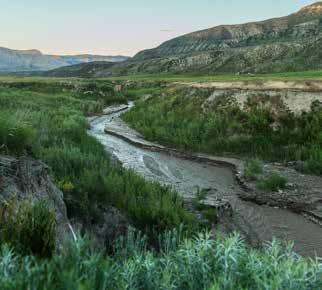
The results are visible across the landscape. Native plants have begun to return, wildlife patterns are
reestablishing and riparian areas are showing renewed life. Elk and deer move steadily through the terrain, while beavers once again shape waterways that support a healthier ecosystem.
“This isn’t just ranching,” Hartsock says. “It’s a commitment to resilience.”
As the land has recovered, so too has its character. That transformation is reflected in the ranch’s 100% grass-finished beef, where the quality is directly tied to the environment it comes from. High-altitude forage, clean water and healthy soil contribute to a product that carries the imprint of its place.
“We realized our product is more than a meal,” Hartsock says. “It’s the literal expression of the ranch reborn.”
For consumers, that connection runs deeper than the plate. Choosing The High Lonesome Ranch beef is an opportunity to participate in a broader story, one that links food to land stewardship and long-term ecological health. It is a direct relationship, built on transparency and shared values.
“Thoughtful management is the foundation of everything we do, and we see our livestock as partners in improving the landscape and restoring a healthy, functional ecosystem,” Brooks says. “We believe that the story of our beef is inseparable from the landscape it comes from.”
That connection extends beyond the ranch itself. Regenerative practices create what Hartsock describes as a “multiplier effect,” supporting a network of local businesses and partners across the Western Slope. From regional processors to local spice makers and artisans, each piece of the system contributes to a more resilient, place-based economy.
The story of The High Lonesome Ranch is no longer defined by the fire that once reshaped it. Instead, it is a story of what came next: a commitment to restoration, a reimagining of ranching and a belief that the land and the people connected to it can thrive together.
On the Western Slope, heritage is not static. It evolves, shaped by challenge, guided by care and carried forward by those willing to rebuild with purpose.
Locally, The High Lonesome Ranch offers weekly complimentary delivery to residents in Mesa and Garfield counties, along with a regular presence at farmers markets in Fruita, Palisade and Glenwood Springs.
For those beyond the Western Slope, their online shop makes it easy to order from anywhere, with options ranging from individual cuts to bulk shares. The platform also includes clear, user-friendly guides to help customers navigate ranch-direct purchasing.
GRAND JUNCTION’S FAR-OUT FAST FOOD
PRONTO BRONTO
Words by Kristen Lummis | Photos by Lisa Kral for the Business Incubator Center
There’s fast food, and then there’s far-out fast food. Pronto Bronto, a Grand Junction food truck currently ensconced as the food truck-inresidence at Ramblebine Brewing Company, proudly tips toward the “far-out.” With its distinctive retro-futuristic graphic footprint, the Pronto Bronto food truck catches the eye. But what sets this culinary collaboration apart is a creative menu that toggles between old-school burgers, sandwiches and hot dogs done up fancy, and inventive vegetarian alternatives that strive to be just as satisfying as the options for carnivores.
Pronto Bronto was founded in 2022 when Kenny Levad and Andrew Watson were working together at Hot Tomato in Fruita — a fortuitous stop in the long cooking careers of both men. While Watson’s background is in graphic design
with a specialization in music posters, Levad is a wordsmith with an English degree. But for both, “cooking always paid the bills,” says Levad. So when a food truck became available, Levad and Watson seized the moment to stamp their personal mark on the Grand Valley’s culinary scene.
“Our goal was to be fun and inviting and offer food for anyone. We’re building a reputation as having the best burger in the valley, that’s what people say,” shares Levad. “We don’t try to be super fancy, but we do try to be inclusive,” he adds, noting that those with dietary restrictions will find plenty from which to choose.
Sourcing local meat from Mountain Meat Packing ensures taste and freshness, and the truck’s signature burger, the Bronto burger, definitely tilts toward the traditional with
American cheese, pickles, onion, lettuce and tomato. Brioche buns elevate the experience, while Bronto Sauce serves as the, ahem, secret sauce. Other burgers include a bespoke patty melt, the Matty Melt, a beef chili burger called the Western Slop and two portobello mushroom burger options. Looking for something more far out? Check out the weekly special. When we visited in March, it was The Spam Jam: a burger with grilled Spam, blueberries and maple jam.
Pronto Bronto’s hot dogs are also locally made, and toppings range from sauerkraut to pickle cream cheese, slaw, bacon and portobello mushrooms. Sandwiches include the BLT-REX and a grilled balogna, alongside vegetarian yummies like the Ruby, made with smoked beets, and others incorporating chickpea and jackfruit “chick’n” salad.
In addition to Levad and Watson, Pronto Bronto has a third partner, Angelica Jestrovich, who runs the business side and “keeps us in line,” according to Watson. Additional support comes from the local commercial kitchen housed at the Business Incubator Center (BIC), which provides licensed and permitted food prep space and storage for culinary businesses. The BIC also offers parking for food trucks, and numerous classes including business plan coaching and
marketing support, as well as a loan fund to help entrepreneurs get started.
Mike Ritter, the BIC’s director of economic development, is a Pronto Bronto fan. “Their creativity has captured a niche in our community where they almost have a cult following. That wouldn’t happen if their food wasn’t stellar,” he says. “But it’s also because they’re just great guys, and they really understand the Grand Valley and fit it like a glove.”
This makes sense because the Grand Valley community acts as Watson and Levad’s greatest inspiration, starting with their business name. “We were looking for something that meant speed,” explains Levad, “but also had a local connection via paleontology.”
Pronto Bronto will celebrate its third anniversary on August 29 with a community market featuring local vendors, live music and, of course, far-out food, which by this time will be served from their new, larger food truck. Look for them at Ramblebine Brewing Company, 457 Colorado Ave., in downtown Grand Junction. Pronto Bronto is open 3-8 p.m. Wednesday and Thursday, and 12-8 p.m. Friday and Saturday. :
prontobronto.com
Kenny Levad, Angelica Jestrovich and Andrew Watson
Dig
for Real
Dinosaur Fossils
This Summer With Dinosaur Journey
Join expert paleontologists for hands-on adventures, from halfday digs to multi-day expeditions! Explore quarries, uncover fossils and experience the science behind the discoveries. Perfect for families, explorers and lifelong learners.
Book your adventure at mowc.co.
5th Annual Bighorn Gravel
June 20, 2026
Take on Colorado’s premier gravel adventure in Gypsum. Conquer epic alpine climbs, rugged backcountry roads and wild Rocky Mountain terrain. Big mountains, bigger views. These aren’t just rides — these are the days you’ll remember. bighornevents.com
Wet Dreams River Supply
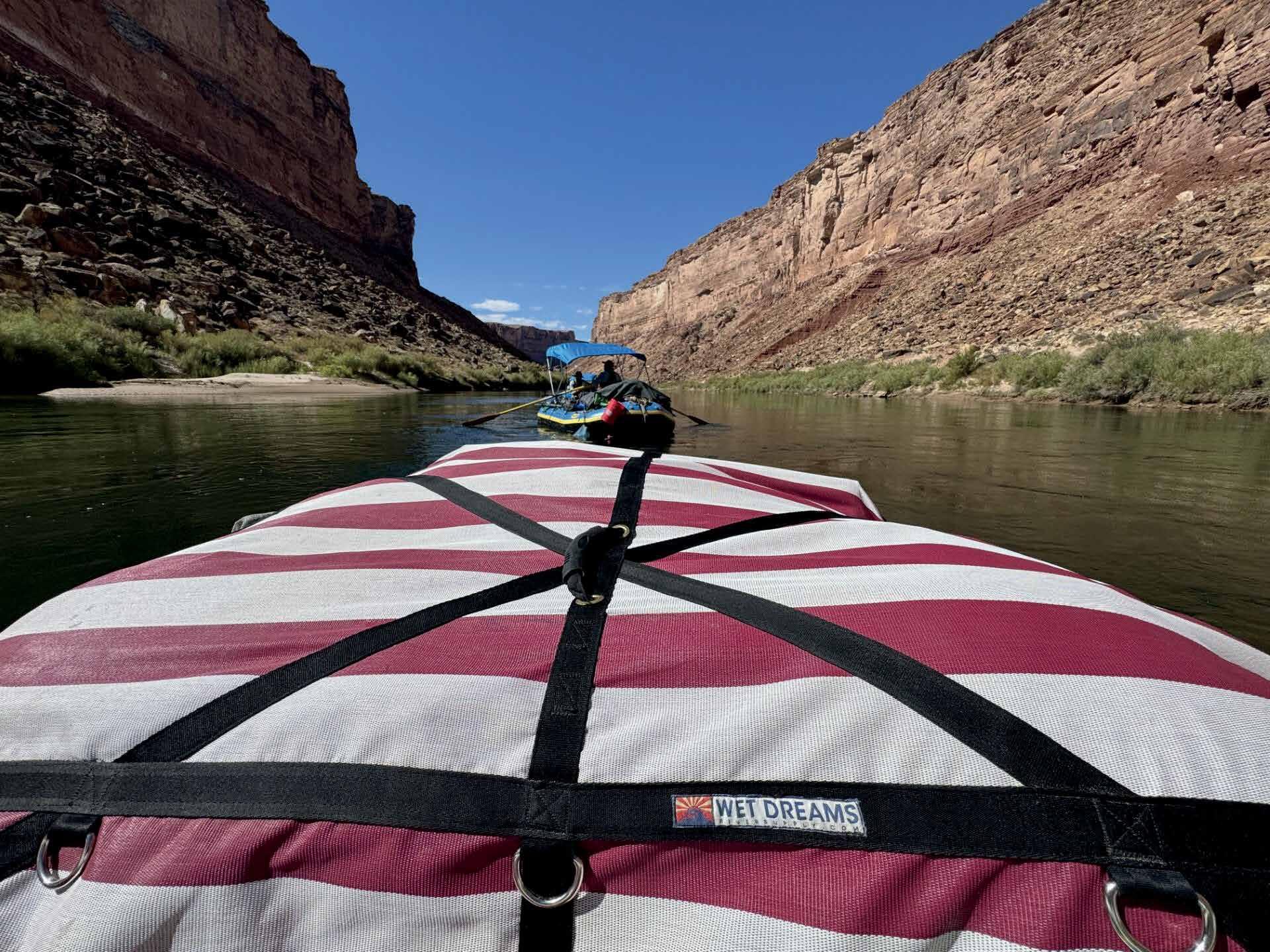
Grand Junction and the Western Slope’s only dedicated river and paddle sports retailer, offering whitewater and fishing rafts, kayaks, inflatable SUPs, accessories and house-made expedition gear tested by outdoor enthusiasts and professionals around the world.
wetdreamsriversupply.com
2026 VAIL TRAIL RUNNING SERIES
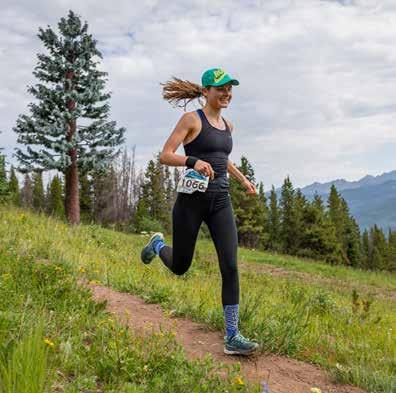
Experience high-alpine trail running in and around Vail, Colorado! The 2026 Vail Trail Running Series features seven diverse mountain courses across the Vail Valley, including the 50th Anniversary of the iconic Vail HillClimb. Enjoy flowing singletrack, unforgettable views and post-race celebrations with custom t-shirts, great raffle prizes, podium awards — and Northside Kitchen donuts!
Races are open to a variety of ages and abilities, making the series a fun challenge for both seasoned trail runners and newcomers alike. Sign up for individual races or the whole series!
Plus, don’t miss the Cougar Ridge Classic 26K from Vail to Minturn during the height of leaf peeping season on Saturday, Sept. 26 — now featuring the NEW Cougar Cub 14K option.
Head to vailrec.com for race details and to register!
APEX
MOUNTAIN SCHOOL
ELEVATE YOUR SUMMER ADVENTURE
Trade the usual routine for something unforgettable. Apex Mountain School is ready! Expertly-trained guides will take you out for:
• Rock Climbing + Rappelling: Scale granite cliffs, or feel the rush of rappelling rock walls.
• Mountain Biking: Enjoy world-class single and doubletrack with local guides who know the best trails and help you to elevate your riding ability.
• Mt. Elbert Summits: Stand on top of the Rockies with a guided trek up Colorado’s highest peak.
• Guided Hikes: Explore pristine alpine trails and hidden valleys away from the crowds.
• Corporate and Large Group: Get your group out for a team building activity and enjoy all that Colorado has to offer with our customdesigned outings.
Peak season is here and the calendar fills up fast. Book your adventure today!
This August 8–9, the Eagle River Jamboree brings together everything we love about life on the Western Slope — live music, mountain adventure, river culture, camping under the stars, local beer and community. Spend your days floating the Eagle River, exploring trails, fishing, biking, off-roading or soaking in the beauty of Eagle County before dancing the night away with an incredible lineup of national and regional artists.
Produced by the Colorado Music Foundation, the festival also helps support Colorado artists and expand access to music education across the state. Every ticket purchased helps strengthen Colorado’s music community and create opportunities for the next generation.
If your ideal weekend includes dirt on your tires, fresh mountain air, cold local beer and live music under the stars, you’ll fit right in here. Plan your adventure at eagleriverjamboree.com.
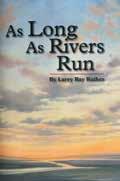
TAS LONG AS RIVERS RUN
BY LARRY RAY RATHER
he Ute tribe named Colorado “the land of the Great Spirit.” It is a rare soul who explores this wilderness of mountains, valleys, lakes and rivers without sensing others who have led the way, long before.
Fourth generation Colorado native, rancher and author Larry Ray Rather shares this insatiable curiosity about his ancestors who inspired his engaging novel, As Long As Rivers Run. His grandfather first visited Colorado at age 12 on a cattle drive, then returned to Oklahoma to eventually marry a Ute woman.
“She died in childbirth and my grandpa, now a cattleman, headed north toward Alaska for a new start with a buckboard wagon and two mules. He never made it. In Durango, he met my grandma at a local dance and soon married again … I grew to appreciate the genuine Utes and their rich, humanistic culture, not bombarded by Hollywood’s vision of savagery. That was so important to express to my readers,” Rather says.
Indeed, Rather’s understanding of the climate of white culture and his reverence for the Ute ways create the foundation for his work. His personal relationships and experiences lend vivid credibility to his diverse characters and settings. Tom Dunagan, a white Civil War veteran and widower, leads his courageous teenage daughter, Brooke, into wild 1891 Western Colorado to mine new beginnings and fortune. During a bear attack, they save Yellow Bear Ute leader, Bow River, and a tenuous friendship develops. Other Utes including Water Bird, Strong Horse, Star Flower, Stone Calf, Rose Creek, Blue Jay and Badger Heart play prominent roles in building bonds of respect and love.
As Long As Rivers Run took Rather almost as long to complete. He wrote a first draft in 1991. He lost the original 150-page handwritten manuscript, accidentally leaving it behind in a roadside cafe, but started over five years later.
“It gave me time to study how to write a novel,” he admits. “I narrowed it down. I wrote mostly during the winter months with more time. Originally, I planned to feature the Meeker Massacre from a Ute’s perspective. Then one day, driving up the Roaring Fork, I imagined what it must have been like for Tom and Brooke, pulled by fate, to adapt to such a unique life and often perilous circumstances. Slowly I knit my ideas together. I chose to selfpublish, and I love the cover art contributed by Basalt artist Tania Dibbs.”
Rather’s book blends historical fiction, Western adventure and romance, and its wisdom echoes the Great Spirit.
“Walk beside me that we may be as one.”
THE BEVERAGE COLORADO CELLARS CHOKECHERRY WINE
Drawing from Rather’s careful research and vivid storytelling, As Long As Rivers Run weaves in authentic Ute-inspired flavors, including a celebration featuring elk roast, biscuits and chokecherry juice. It’s a natural pairing that Rather favors a wine rooted in the same regional fruit.
Colorado Cellars
Chokecherry Wine is semidry and distinctly bittersweet. This unique fruit wine captures the character of wild chokecherries found throughout the West. Best served chilled, it pairs unexpectedly well with barbecue, Chinese cuisine and rich chocolate desserts — or enjoyed simply on its own. :
Words + Photos by Sandy Ferguson Fuller
INSTAGRAM + PODCAST PICKS
@felinaactionmovie
Documenting the making of a feature-length action film shot in Grand Junction, the Felina Instagram page offers a behindthe-scenes look at Colorado’s growing independent film scene. The project highlights local talent both on and off screen, with Colorado Mesa University students and community members helping bring the film to life.
Wiser World Podcast
Hosted by former world history teacher Alli Roper, Wiser World makes history feel approachable, relevant and deeply connected to modern life. The podcast explores the people, cultures and events that continue to shape today’s headlines — offering curious listeners a smarter way to understand the world.
Compiled by S+B Staff
@coloradoriverdistrict
Since 1937, the Colorado River District has served as a leading voice for Western Colorado’s water, advocating for the communities, agriculture and ecosystems that depend on the Colorado River Basin. The account offers an essential look at the history, stewardship and future of one of the region’s most vital resources.
WKRP Montrose Podcast
Part community spotlight, part local variety show, WKRP Montrose captures the voices, stories and spirit of Western Colorado. The Montrose-based podcast blends interviews, local news, entrepreneurs and community conversations into a lively weekly listen rooted in the people and culture shaping the region.
@edibledenver
Recently revived, Edible Denver continues its longtime mission of celebrating the Front Range food scene through the lens of sustainability, community and place. From seasonal recipes to stories spotlighting local farmers, chefs and makers, the publication honors the people and traditions shaping Colorado’s evolving culinary heritage.
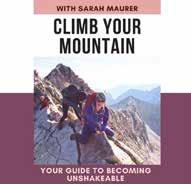
Climb Your Mountain Podcast
Hosted by life coach, mountaineer and ultra runner
Sarah Maurer, Climb Your Mountain blends endurance training advice with honest conversations around mindset, aging and self-belief. With a refreshing, no-nonsense approach, the podcast encourages listeners to pursue big goals — on the trail, in the mountains and beyond.
FINDING HIDDEN DETAILS IN WESTERN COLORADO WITH MACRO PHOTOGRAPHY
ECOSYSTEMS ENLARGED
Words + Photos by Mitch Korolev
As the forester and environmentalist Baba Dioum once said, “In the end, we will conserve only what we love; we will love only what we understand; and we will understand only what we are taught.” We are fortunate to have a wealth of natural beauty in Western Colorado, but its smaller inhabitants — the insects, the reptiles, the humble plants — are often overshadowed by its grander features. This is a shame, for they are as much a part of this land’s heritage as the towering San Juans or the orderly rows of orchards in Palisade.
It is understandable that we so often miss the fine details. We humans are quite large compared to most living organisms — so much so that visualizing smaller parts of the natural world poses a challenge. Not so with macro photography, which magnifies small subjects to fill the entire frame with striking detail. I hope these images inspire you to take a closer look at the natural world around you, even in more confined spaces like a backyard or a city park. The more we connect with smaller life forms, the more likely we are to care for them. :
This pea plant is lucky to have what amounts to a bodyguard at the macro scale. Ladybugs’ voracious appetite for aphids makes them natural pest controllers. They’re also pollinators, but they’re not quite as efficient as bees or butterflies.
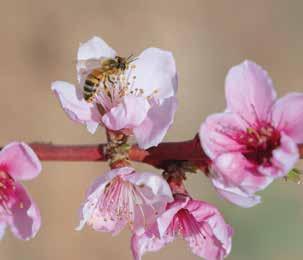
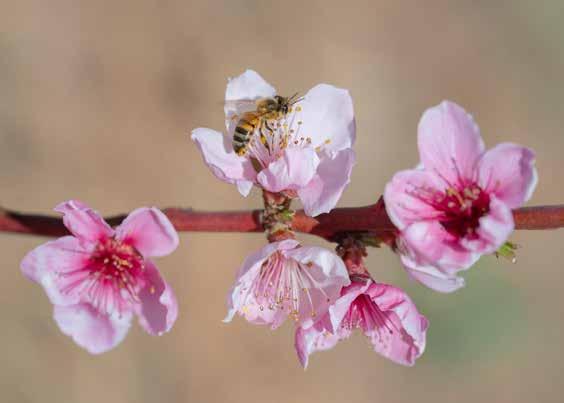
A bee collects pollen from a peach blossom near Orchard Mesa in search of the nectar stored inside. This symbiotic relationship between pollinators and flowers is one of the most important for Western Coloradans, as most crops grown here require pollination to reproduce. Peaches are one of the few that are self-fertile, but a little boost from pollinators never hurts.
Two rival colonies of pavement ants fight for territory near the entrance to my home. Not only do ants serve as food for many larger species, but their behavior is beneficial to the surrounding ecosystem. They aerate soil, decompose plant and animal material, and disperse plant seeds.
These are scales from an Engelmann spruce cone. When exposed to moisture, the cones close up — a clever adaptation that protects the seeds inside from decay and ensures they aren’t released until there are dry conditions, which maximizes the likelihood that they will travel far.
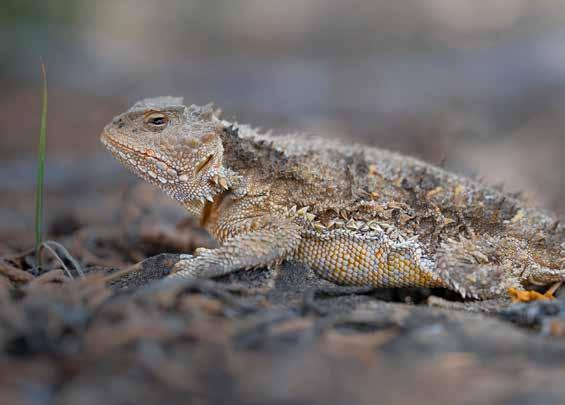
Speaking of ants, this horned lizard relies on them for more than half of its diet. Horned lizards are masters of camouflage: their flat bodies blend in seamlessly with rocks and soil. They squirt blood from their eyes when threatened, which has a foul taste against feline and canine predators.
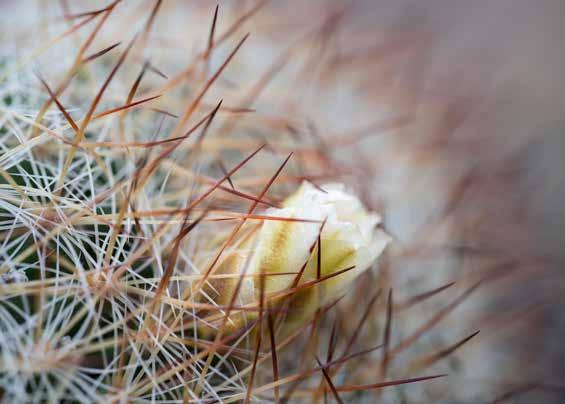
A single flower emerges between the spines of a mountain ball cactus. Like many cactus species, mountain ball cacti use CAM (Crassulacean Acid Metabolism) photosynthesis, an evolutionary adaptation that splits the photosynthetic process across time. Instead of doing everything at once during the daytime, mountain ball cacti gather and store carbon dioxide at night. This reduces water loss — a high priority for plants in arid environments. The stored carbon dioxide, along with water and sunlight, are the ingredients that allow plants to generate usable energy in the form of glucose.
These blazing red tendrils are modified leaves, called bracts, of an Indian paintbrush plant. While these plants can photosynthesize, they also parasitize nearby plants by stealing nutrients through their root systems. Their roots absorb selenium, making the entire plant toxic to humans if ingested.
BLENDING PLANT WISDOM + PERSONAL HEALING TO SIMPLIFY MODERN WELLNESS
ELEMENTAL WELLNESS SHOP
Words by Chloe Wasserstrom | Photos courtesy of Rebecca Paisley DeLia
Every product from Elemental Wellness Shop is crafted to inspire a return to the slower, more rhythmic ways of living. Humans come from a long heritage of plant wisdom, where people relied on the earth to maintain health and balance. Rebecca Paisley DeLia, Ayurvedic practitioner and herbalist, is the founder and owner of Elemental Wellness Shop in Rifle, where each item is made by hand in small batches. Although there is currently no storefront, she partners with retailers across the Grand Valley to offer organically sourced, plant-based and handmade body care, herbal teas, tinctures, probiotic skincare, essential oils, yoga mat cleaners, castor oil packs, tooth powder and more.
Elemental Wellness Shop prioritizes organic, sustainably harvested ingredients. The herbs are thoughtfully selected for their potency and traditional use. When possible, DeLia incorporates locally grown and sourced ingredients. The lavender flowers, hot peppers and mushroom powders are all sourced from Western Colorado. All of the packaging is either fully recyclable or compostable.
THE STORY BEHIND THE SHOP
DeLia’s mission is to help people reconnect with their bodies in a way that feels simple, supportive and sustainable. “Every product is created from the lens: not to override the body, but to support it,” she says.
The backbone of the brand is the belief that the body is designed to heal when it’s truly understood. This is personal to DeLia because as a teenager and young adult, she struggled with heroin addiction along with mental and physical health challenges. After DeLia found sobriety and began rebuilding her life, she still struggled in her body.
“The deeper I dug, the more I realized my mind and body weren’t broken — it had just never been truly supported,” DeLia shares. “Everything I experienced — stress, substance use, emotional trauma — it all had an impact, and my body was still trying to process and communicate that.”
DeLia dug deep. She nourished and learned about herself through meditation, yoga and connecting with nature. Her journey led to a life living off the land. She was gardening, canning and preserving most of her own food when she began making soap in 2017. What began as a few bars of soap for her home quickly turned into custom requests from friends and family. This led her to incorporate herbalism into her daily life and to develop a desire to create cleaner, non-toxic necessary products for herself and loved ones. Elemental Wellness Shop was later established in 2022.
REAL PEOPLE, REAL NEEDS
Over time, new products emerged through DeLia’s work as a private health coach and after seeing gaps in the wellness market. When multiple clients experience the same struggle or ask for specific support, it often sparks the creation of something new. DeLia says her offerings have and will continue to grow this way: organically, guided by real needs from real people.
“I’m not interested in overcomplicating wellness,” DeLia says. Every product is designed to be both rooted in tradition and easy to integrate into a daily routine, so people can stay consistent and see results.
“Whether it’s candles that support mindfulness, yoga mat cleaners that enhance a yoga practice, herbal blends that nourish the body or skincare that supports rather than depletes, everything is designed to make these practices accessible in a modern routine,” DeLia emphasizes.
SUMMER WELLNESS ESSENTIALS
Summer in Western Colorado brings heat, sun exposure, travel and shifts in routine. DeLia recommends investing in products that support the body during the season.
DeLia says customers often reach for the All Natural Bug Spray and Pit Paste — a natural deodorant — to help keep the skin protected, balanced and smelling fresh through every outdoor adventure. She also recommends supporting the nervous system during travel, social activity or shifts in routine with the Chill Out Herbal Tincture and the Stay Well Herbal Tincture.
Elemental Wellness Shop also aims to educate and empower through herbal workshops across the region. This is a hands-on invitation to reconnect with ancient traditions.
“Remember that this knowledge isn’t out of reach, but something we can all learn, practice and integrate into our daily lives,” DeLia says. “It’s not just about using a product. It’s about knowing nature holds all that we need and that taking care of the body can feel simple.” :
elementalwellnessshop.com
Rebecca Paisley DeLia
GIVING
VOICE TO
WOMEN’S RIGHTS AND FORMING A RESISTANCE SINGING GROUP
THREE SISTERS THEATRE COMPANY
Words by Sharon Sullivan | Photo by Randie Lemons
When the new Three Sisters Theatre Company performed Herstory Retold in April 2025, it brought to life women’s historical struggles and successes via poetry, skits and stories. The inaugural show’s two performances sold out both nights.
“It was so popular we had to add a third show,” says Amanda Jackman, Three Sisters Theatre Company co-founder and musical director . “It was a powerful piece, and funny.”
Since Herstory Retold, the grassroots theatre company has continued to perform plays and variety shows before packed audiences — including a three-day run of The Vagina Monologues, which took place in February 2026.
People waited in line outside the door in case someone with a ticket didn’t show up, Jackman recalls.
“The Vagina Monologues went over really well,” she says. “We even heard from the playwright, V (formerly known as Eve Ensler), after she heard about the show on Colorado Public Radio.”
‘UNABASHEDLY FEMINIST’
The idea of forming a feminist theatre company came about while Jackman and her friend Julie Matthews were hanging out with their toddlers at the library one day, during which they talked about pursuing passions outside of motherhood.
Alexandria Allerheiligen, Cat James, Elizabeth Paroni, Brielle Farrell and Sienna Hayes perform in “Feminist Horror Stories,” October 2025.
Jackman, who is musically talented, and Matthews, with her business skills, along with Sabrina Jackman, founded Three Sisters Theatre Company in 2024.
“We are unabashedly feminist, and absolutely political,” Jackman says. “We’re a safe space theatre company. We work with individuals with lived female experience,” including trans and nonbinary folks, too. Male supporters work behind the scenes.
So far, about 50 community volunteers have been involved with Three Sisters, Jackman says. Anyone aligned with its mission to “uplift the voices of marginalized communities engage in community activism, and provide a safe space for our cast and audience members,” is welcome, she says.
“I’m always blown away by these shows, and how talented all these people are, and how they put their heart and soul into this work,” says Heather Nicholson, who met Amanda and Sabrina Jackman while all three women were performing for another Grand Junction theatre company that Nicholson founded, called Geek Parties. Nicholson has performed for, as well as attended as an audience member, Three Sisters Theatre productions. Every show brings forth both tears, and laughter, she notes.
ADULT THEATER CAMP
Three Sisters Theatre Co.’s first two productions were free to attend. Although the shows garnered enough donations those evenings to allow the purchase of stage lights.
Performances take place in the sanctuary at the Unitarian Universalist Congregation of the Grand Valley, 536 Ouray Ave., where Amanda Jackman also serves as the music director. The church donates the space for both rehearsals and performances.
Tickets for The Vagina Monologues in February were $10, which went toward purchasing the licensing rights to the play. All proceeds from the show’s Sunday matinee ($1,200) were donated to Hilltop Community Resources Latimer House, an organization that provides services for survivors of domestic violence.
In October 2025, the group performed three nights of Feminist Horror Stories — where cast members told ancient folklore stories, but changed the narrative to give power back to women.
The theatre company’s spring schedule included an evening of storytelling titled “Sisterhood of Motherhood,” a collaboration with the Colorado Birth Collective; and the Beltane Women’s Market, a local women-owned business event with vendors, food trucks and informational booths.
Three Sisters Theatre Co.’s big summer project is a theater camp for grownups, July 21-26, which includes four days of instruction, plus workshops in improv, movement, acting, historical research for characters, music and musical theater. The week will culminate in a showcase on Saturday, followed by a fun camp-style cast party.
And in August, the group will hold auditions for a variety production to be held in December.
SINGING RESISTANCE GRAND VALLEY
Last winter, Three Sisters Theatre Co. added a singing group to their repertoire of activism. In October 2025, several cast members performed songs on a makeshift stage at the No Kings rally in Grand Junction. By January, community members were asking for a way to get together to sing on a regular basis as a form of protest, Jackman recalls.
“Our mission is to practice what we preach, she says. “This felt like a calling for us — to take on this project. So, we created the Grand Valley Justice Choir” — since renamed Singing Resistance Grand Valley to align with the grassroots national singing movement.
Approximately 40 choir members performed uplifting songs, in three-part harmonies, during Grand Junction’s third No Kings rally on March 28. After three songs, the group joined the protest march through Las Colonias Park. “It’s a singing resistance group that protects people,” Jackman says. “The choir is open to anyone, of all abilities.” :
threesisterstheatreco.com
A RENAISSANCE PATH IN FRUITA
KYLE HARVEY’S CREATIVE LIFE
Words by Ursula Nizalowski |
Renaissance man — this term originates from the Renaissance, a period of rapid artistic and scientific expansion in Europe. It describes figures like Leonardo da Vinci, whose talents spanned art, science and engineering. Today, the phrase is used to describe someone who excels across multiple disciplines.
It’s an apt way to describe someone like Kyle Harvey. Originally from Omaha, Nebraska, Harvey now helps run the Lithic Bookstore & Gallery in Fruita, alongside owner Danny Rosen, and contributes graphic design work for Lithic Press, also founded by Rosen. Beyond the shop, Harvey’s creative reach is wide — he’s a
Photo courtesy of Kyle Harvey
professional musician, has worked on films and writes poetry. All of this unfolds alongside a full home life: married, with three children, a dog and four cats, at 45 years old.
“Back when I was in seventh or eighth grade was when I got my first bass guitar … And I did take four or five bass lessons from someone back in Omaha,” Harvey says. “But for the most part, it’s been self-taught — just things I’ve learned from playing with other people.”
As for the kinds of music he plays, that, too, has evolved over time. Early on, “in eighth or ninth grade, we loved Nirvana, so we were trying to do stuff that sounded like that,” he says. After graduating high school, Harvey did solo shows on acoustic guitar while playing in multiple bands, bartending and taking college courses in graphic design and creative writing. Among the bands he joined, the most lifechanging experience was playing bass for It’s True!, an indie-rock band that formed in 2008.
“We made an album, and did quite a bit of touring,” Harvey describes. “Played at the South by Southwest … and NPR listed us as one of the top 100 bands to see.” After It’s True! broke up, Harvey married his wife, Veronica, and the two moved to Moab, Utah, where she had accepted a job.
After six months, Harvey and his family moved to Fruita in 2012 where he met Rosen and became friends with him before being hired to work for Lithic Bookstore. “One cool thing at Lithic is that it affords me some time to work on my own stuff here and there,” he says. “Danny’s really supportive of me as an artist.”
Currently, Harvey creates experimental electronica under the moniker When Light,
and released a folk- and country-leaning album under his own name last year titled Anywhere But Here. Alongside his music, he has also published several poetry collections including There Without Being There, also released last year. As for his filmmaking, “I was always interested in film, but I never thought I was going to be a filmmaker,” Harvey reflects. “But when our friend Jack Mueller was in the hospital, I said, ‘I would like to make a film.’ He said, ‘Okay, you can do it.’”
Mueller was part of the Beat Generation of poets, alongside figures like Allen Ginsberg and Jack Kerouac. “So, I borrowed a friend’s video camera and flew out to San Francisco. I learned the basics of how to use the camera before I went,” Harvey says. This became the documentary Portolano: A Film About Jack Mueller that came out in 2018 after Mueller passed away the year prior. He later directed It’s Nice To Be With You Always: A Film About Neeli Cherkovski, a cinéma vérité-style documentary on another Beat poet that premiered at the 2020 Omaha Film Festival.
“I can’t imagine not making things,” Harvey says. “It’s what brings me joy.”
Looking ahead, he’s scheduled to perform at the Grand Mesa Songwriter Festival in Cedaredge, Colorado, from June 5-7, 2026, with hopes of also appearing at Porchella in Grand Junction this fall. :
For more information on his music, films and published work, Harvey directs readers to his website, kyleharveypoet.com, and he can also be reached through the Lithic Bookstore.
DAWN GLANC OF BROWN CHICKEN BROWN COW
THE SCOOP ON OURAY’S FAVORITE ICE CREAM LADY
Words by Kylea Henseler
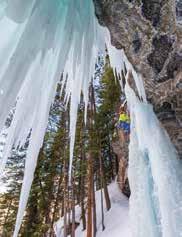
Dawn Glanc spent much of her life with crampons on her feet and an ice tool in each hand, pushing her limits as a professional ice climber and helping clients push theirs as a guide.
Members of the climbing community, especially in Ouray, where she lives, know her for her accomplishments and dedication to the sport. But now, everyone in town knows Glanc for a different reason.
“I’ve embraced this new role as being the ice cream lady,” she says.
On any given day, Glanc may be spotted on Main Street handing out free samples or serving
special flavors at events with a big smile on her face. After all, having fun is what her company Brown Chicken Brown Cow is all about. And, she says, it’s not the kind of fun you feel after an energy-sapping climb that’s tough in the moment and fun when you look back. It’s just fun, and it’s for everybody.
A SWEET PIVOT
COVID-19 changed the rules of the climbing business, as it did for many industries, giving Glanc time to pursue other passions. As she puts it, “Like everyone, I was in the midst of a mid-life crisis.”
Brown Chicken Brown Cow Ice Cream tops a peach tart at Taste Ouray on Main Street.
COURTESY OF DAWN GLANC
With life moving at a slower pace, she signed up for an online cooking class, giving her a chance to explore her lifelong interest in the food industry. Ironically, while Glanc was never an ice cream lover herself, a simple no-churn recipe from her dessert module became the dish that changed everything.
Just a few ingredients form the base of the ice cream, but once Glanc started bringing it to parties, she realized the possibilities were endless. (She won’t give the secret away so easily, but her ingredients are listed on the products as required by law.)
It started with a request for ginger snap from her husband, and the rest is history.
By late 2022, Glanc perfected her base and a few flavors, and was ready to go commercial. Kami’s Samis at 636 Main St. gave her the boost she needed by providing her commercial kitchen space and a spot to sell her products.
GROWING ONE SCOOP AT A TIME
Glanc tackles ice cream making with the precision of an ice climber, specializing in a smooth, flawlessly creamy base, occasional chunky add-ins and thoughtful seasonal flavors. And, of course, staples like Ginger Snap, which became an early favorite and remains on shelves under possible penalty of Glanc being tarred and feathered.
Just over three years after selling her first cups in Kami’s, Glanc’s signature blue and green packaging can be found in over 15 freezers throughout Ouray, Montrose and San Miguel counties. Ouray Grocery, Ridgway Mountain Market and Bluecorn Cafe & Mercantile in Montrose are just a few spots to score the goods.
After securing so many customers, Glanc was able to build an FDA-approved kitchen in her home last summer. With the extra time and space, she can put even more of a personal touch on each flavor, baking mix-ins like cookies and carrot cake from scratch. Even so, she says, “It’s still a one-woman show.”
Though Glanc loves to see the business grow, she has two non-negotiables for how it does so. Brown Chicken Brown Cow will always be based in Ouray, and Glanc won’t hire anyone until she can provide a stable position with a fair wage.
She remains an active part of the city and climbing communities, and she’s known to offer free samples or special flavors at local events, and sponsors a small team of athletes with a sweet supply of ice cream and stickers.
“It’s been a different way to be part of the community,” she says.
And the products are for everybody, as Glanc makes vegan and other dairy-free options to meet all her customers’ needs.
When she started selling ice cream, Glanc opted for distributing 5-ounce and 16-ounce disposable containers to partner locations as a matter of necessity; opening her own shop seemed out of reach. Luckily, Glanc is a climber. After seeing how much people enjoy her ice cream, her new goal is to open a colorful storefront downtown where she can be the “ice cream lady” behind the counter and deliver smiles with every scoop. :
Dawn Glanc fills her signature blue and green packaging with ice cream.
DIRECT PRIMARY CARE ON THE WESTERN SLOPE
Words by Kylea Henseler
Most doctors want to spend their careers caring for people, not typing out billing codes and filing referrals. But, once insurance companies get involved, patients can be reduced to numbers while providers are pushed to see as many as possible to maximize profits.
Dr. Craig Gustafson, a family medicine physician in Grand Junction, describes the system as a “hamster wheel” that doesn’t function in the best interests of patients or physicians — particularly in primary care. So, he got off the wheel, and he’s not the only one.
After a decade working in an insurancebased practice, Gustafson started Appleton Clinics in Grand Junction in 2014, one of the first direct primary care (DPC) practices in Western Colorado. Now, there are plenty to choose from.
PRIMARY CARE, WITH EMPHASIS ON THE ‘CARE’
Under the DPC model, there is no guesswork, no insurance and no BS. Patients pay a flat monthly fee for clinic membership and receive primary care from a doctor who is easy to reach, readily available and focused on care — not billing.
Dr. Katherine Stephens is a family medicine doctor in Montrose.
KYLEA HENSELER
“I work for the patient in front of me, not their insurance carrier,” Gustafson says.
Primary care doctors are often the first line of defense in healthcare, managing everything from acute infections and injuries to prescriptions and chronic illness. But with thousands of patients to juggle, insurance-based practices often can’t provide the timely, in-depth appointments patients need.
While every clinic is a little bit different, DPCs generally manage a much smaller patient panel, allow longer and more frequent appointments, and make their doctors easily available to clients.
“People like it because they know that they’re getting high quality, accessible care,” says Dr. Katherine Stephens, a family medicine doctor in Montrose. She recently opened Cimarron Family Practice, where she allows patients unlimited visits and calls during office hours and has an app where they can also message her with questions.
Stephens began her medical career in the United Kingdom, where she practiced in both the public and private sectors before moving to
the U.S. After working in private practice in both countries, she decided to start her own business as a DPC so she could focus on spending more time with her patients and less on her computer.
“My main aim is to give patients the attention they need without burning out myself,” she shares.
TO DPC OR NOT TO DPC?
While DPC may not be the most common model, it’s growing rapidly. According to a Harvard study, the number of concierge and DPC practices in the U.S. increased by 83% between 2018 and 2025, while the number of clinicians grew by 78%.
Gustafson notes that DPC and concierge care aren’t quite the same thing. Concierge practices are often seen as a luxury — billing insurance on top of a retainer fee — while DPC, he says, is for everybody.
“I can’t think of anyone who wouldn’t be an ideal candidate,” Stephens agrees. Her practice charges single adults $125 per month or $1,250 per year, with special pricing for couples, children
and employers, though as with many direct primary care practices, a one-time registration fee also applies. Appleton, for another example, costs $99 per month, with discounts for paying a full year in advance and for children, and also charges a one-time enrollment fee.
In a nutshell, the prices aren’t crazy, but they aren’t nothing.
Gustafson explains that patients without health insurance may see DPC as a more affordable option to get some of their needs met, while patients with health insurance may see the value in fast, transparent care.
His practice, like many DPCs, offers extras such as annual well-woman exams, procedures like lesion removal, casting and stitching, and discounted imaging like MRIs and ultrasounds. Of course, some things still call for an ER or specialist visit — Gustafson acknowledges it has its place for major interventions like open heart surgery.
Stephens advises patients considering DPC to read reviews and meet their potential doctors, and says, “Don’t feel bad if it’s not a good fit.”
“Trust your gut,” she says. After all, building a relationship with a doctor you can trust is what this model is all about. :
To find a DPC near you, check out online resources such as mapper.dpcfrontier.com and dpcalliance.org/find-a-dpc-physician.
Appleton Clinics in Grand Junction
Q+A WITH BILL GAMBER, CO-FOUNDER + PRESIDENT OF BIG AGNES
25 YEARS OF SLEEPING UNDER THE STARS
Words by Kim Fuller | Photos by Noah Wetzel
Twenty-five years ago in Steamboat Springs, a small idea centered on making nights outside more comfortable sparked what would become one of the outdoor industry’s most recognizable brands. Since then, Big Agnes has helped shape the way people camp, proving that lightweight gear and livability do not have to exist at opposite ends of the trail. As Big Agnes marks its 25th anniversary, Bill Gamber, Big Agnes co-founder and president, reflects on the early days, the evolution of outdoor gear and what still inspires him after a quarter-century of helping people get outside.
Big Agnes is celebrating 25 years this year. When you look back at the early days in Steamboat, what stands out most about how the brand began?
When we launched Big Agnes, we had no idea what the company could become. We started with sleeping bags and pads, and the simple idea
of helping people be more comfortable when they were camping and backpacking. A big part of that was keeping a bag and pad together so people weren’t sliding off in the night. That idea started to take off, and from there we expanded into tents and eventually into a much broader camping collection.
What stands out most is that every day was fun. Our customers and staff were all super psyched on camping and the outdoors, and that enthusiasm has always driven us. Camping is fun, and we want to keep it that way.
Over the last two decades, outdoor gear has become noticeably more versatile, livable and design-forward. Where do you feel Big Agnes helped shift the conversation or industry expectations?
We’ve always been focused on making gear that our team and our friends would actually want to use out there. Keeping the camping
experience comfortable while still pushing the limits of weight and packability has always been the challenge we come back to. Doing that well means using the best materials we can source and being thoughtful about every design decision.
I think Big Agnes helped show that lightweight gear could still be comfortable, livable and easy to use. You shouldn’t have to give up a good night’s sleep or a functional shelter just because you’re trying to keep your pack weight down. We still think of ourselves as a scrappy outdoor gear company with a staff that would rather be outside testing gear than sitting at a desk, and that attitude has pushed us to make better products year after year. At the end of the day, we’re trying to make the best gear we can and get it into as many people’s hands as possible.
Colorado and mountain-town culture have always felt tied to the brand’s identity. How has Steamboat shaped the philosophy and personality behind Big Agnes over the years?
Big Agnes was born and raised here in Steamboat Springs, a town with great access to year-round
outdoor recreation and just a short drive from the Continental Divide Trail. Our team gets outside in different ways all across Colorado and neighboring states, which makes this a great place to put gear through its paces across different environments.
We like to think our people define the culture more than the location does, but the two go hand in hand when you’re based in a mountain town. Steamboat has shaped us, but so has the team who shows up here every day excited to make gear and then go use it.
Sustainability and durability have become increasingly important in the outdoor industry. How has Big Agnes approached that evolution while continuing to innovate?
Gear that lasts is gear that stays out of a landfill, and that thinking runs through everything we do, from how we build our products to how we support them after the sale. Our repair program is a huge part of that commitment. We would rather help someone fix a torn mesh or a worn
This image is from the company’s early days. Big Agnes helped show that lightweight gear could still be comfortable, livable and easy to use.
The Big Agnes mission is to inspire people to get outside and be comfortable and happy out there.
The Why Not Picnic Blanket extends a tent’s living space.
zipper and keep that gear in the field than see it replaced before its time.
Our approach has always been to find materials and construction methods that are genuinely better than what came before. HyperBead is a good example of that. Rather than swapping one DWR treatment for another, we developed a proprietary fabric technology that is inherently waterproof at a molecular level, with no added DWR treatments or coatings. It also happens to be lighter and stronger than traditional tent fabrics. That is the standard we hold ourselves to: if we are going to make a change, it should be a real improvement across the board.
We’re applying that same thinking across our entire line, from recycled materials in our sleeping bags and pads to bio-based foams and circular product concepts designed with end-of-life recyclability in mind. There is still plenty of work ahead, but we are committed to doing it right.
After 25 years of building the brand, what still excites and inspires you most about helping people get outside?
I still get jazzed when I pull up to a campsite somewhere off the beaten path and see a well-used Big Agnes tent at a neighboring site. Or when someone lights up telling me how impressed they are with a piece of gear they’ve had for years. Stories like that never get old, whether it’s someone raving about their gear or telling me how our repair team helped sew up a tear in their mesh from a dog that made a break for it in the night. Those are the things that remind me why we do this.
Our mission is to inspire people to get outside and be comfortable and happy out there, so anytime I hear a story about how we played even a small part in that, it gives me motivation and keeps me excited to keep doing what we do. :
Bill Gamber
SHOP VISIT ENJOY DOWN TOWN Today
GEAR FOR THE SEASON
Compiled by S+B Staff
Gregory Quadro Pro Hardcase 22”
Built for adventurers who refuse to slow down, this carry-on’s ActiveShield compartment keeps wet and muddy gear separated from clean clothes, while the scratch-resistant shell and four-wheel system handle everything the journey throws at it. TSA-approved locking and AirTag integration mean less time worrying, more time exploring. $279.95 gregory.com
Kari Traa Linnea Sports Top + Mija Training Shorts
Longer days call for gear that keeps up. These pieces are light, breathable and built to move, creating a kit that feels as good on a slow restart as it does mid-training block. Clean, comfortable and made for repeat wear, they’re the kind of staples you’ll reach for all season. Top $45 | Shorts $60 karitraa.com
Baloo Living Daydreamer Weighted Lap Blanket
Whether you’re recovering after a long day on the trail or winding down at camp, this compact weighted blanket delivers the kind of deep, grounding comfort your body craves. Tiny glass beads wrapped in breathable organic cotton conform naturally to your shape without trapping heat, so you stay comfortable without overheating. $88 balooliving.com
Lem’s Switchback Knit Sandal
A lightweight update to a fan favorite, this sandal pairs breathable knit comfort with a streamlined, adjustable fit built for movement. Designed for everything from river days to daily wear, it features a secure strap system, quick-drying knit tongue and grippy outsole for slick surfaces. $125 lemsshoes.com
Helinox StringTrees
This lightweight, packable game brings a playful mix of shuffleboard-style strategy and outdoor fun to camping trips, park hangs and backyard gatherings. Players toss rings toward scoring zones or knock competitors off the line to gain an edge. At just 8.5 ounces packed, it’s easy to bring along. $59.95 helinox.com
Snow Peak GigaPower Tabletop Lantern
Equal parts practical essential and ambient centerpiece, this camp lantern’s sunrise and sunset color modes cast a natural glow across your site while white LED and candle flicker modes keep things functional when needed. IPX4 waterproofing and up to 68 hours of runtime make it a light you can count on. $99.95 snowpeak.com
This flexible, microadjustable belt updates an everyday essential with a magnetic buckle that clicks securely into place with one hand. Stretch webbing offers all-day comfort, while durable construction and recycled yarn add performance-minded appeal. Equally suited to the trail, travel days and daily wear. $49.95 arcadebelts.com
LifeStraw Peak Series Solo Water Filter System
One kit, every scenario. This water filter system is a true 3-in-1 setup — use it as a straw for quick sips, a squeeze bottle for on-the-go refills or a gravity system at camp. Ultralight and built for long-haul performance, it delivers fast flow, durability and reliable filtration in a streamlined design that adapts wherever you are.
$64.95 lifestraw.com
Patagonia Capilene Cool Sun Hoody Light, breathable and built for long days in the sun, this piece is a go-to layer for everything from trail miles to river days. Made with recycled fabric, it wicks, dries fast and delivers 40+ UPF protection that won’t wash out — an easy, all-season staple when coverage and comfort matter most.
$89 patagonia.com
Adidas Sport Eyewear Anemos Light
Built for runners and cyclists, this lightweight style pairs a streamlined frame with HD optics for clear visibility in changing conditions. Anti-fog ventilation helps maintain airflow, while mirrored and photochromic lens options adapt to shifting light. Available in two sizes and compatible with a prescription clip-in. $163/$213 photochromic adidas.com
ATHLETE PROFILE
MELISSA STRONG’S STORY
A MEMOIR ON CLIMBING THROUGH ADVERSITY
Words by Chloe Wasserstrom | Photos courtesy of Melissa Strong
Melissa Strong’s story is one of resilience, recovery and the courage to live her truth. In her debut memoir, Climbing Through: A Courageous Story of Grit, Healing, and Second Chances, she reveals an unbreakable spirit shaped by hardship and hope. The book begins with Strong’s life story to April 2, 2017: the day when Strong “died a little bit and came back to life.” While literally taking her dream to open a restaurant into her own hands, the avid and sponsored climber found herself in an electrocution accident that resulted in partial hand loss in her home.
Each page is grounded in authenticity and candor as Strong shares her deeply personal journey as a climber, restaurateur, woman, wife, daughter and sister, and how these roles intersect. With multifaceted strength at its core, her perspective on life offers something meaningful for every reader. Strong advocates for finding something that brings you joy, emphasizing that in the wake of adversity, the lessons learned through joy can carry you through the moments you need them most.
“We can discuss how each sport offers different rewards and triggers different emotions, but it all comes down to enjoyment,” Strong writes. “It’s not about standing on top of a cliff or a boulder. It’s the process. It’s how you get
First climb
Carnage photo by Melissa (in mouth on timer)
Melissa in her Estes Park restaurant
there that captivates me.” Readers will quickly learn that everything Strong has accomplished in life, and every life lesson in between, has prepared her for the day and the days following when her hands, the parts of her that allow her to climb rock formations and serve plated dishes to customers, changed forever.
Reading Strong’s words feels as if she is sitting across from you, simply telling you a story. As though you’re splitting a crisp bottle of rosé on the patio of her Estes Park, Colorado establishments, Bird & Jim and Bird’s Nest, surrounded by Colorado pines, refreshing mountain air and Strong herself.
“We humans can do amazing things that we’d never dream possible,” Strong says. “Tragedy taught me that some of the tools I required to get through were already with me. I had to dig deep, be open to the light, acknowledge the good and turn away from the darkness.”
Her story lingers long after the final page, inviting readers to meet their own challenges with grit, grace and an open heart. :
GET AWAY IN STYLE AND COMFORT AT THESE ELEVATED (AND BEAUTIFULLY OFF-RADAR) MOUNTAIN RESORTS AND LODGES
5 ADVENTURE BASECAMPS YOU’VE PROBABLY NEVER HEARD OF
Words by Lisa Blake
Fewer things are more satisfying than sweating outside all day doing something you love and falling happily exhausted into plush beds knowing that bountiful rest and nourishment are yours for the evening.
Hikers, bikers, river enthusiasts and rock climbers — these are the Colorado inns and lodges to book when you want easy access to adventure followed by cozy accoutrements.
TUMBLING RIVER RANCH
Nearest town: Grant, CO
Go for: Front door Pike National Forest and Mount Evans Wilderness hiking and biking.
Skip the cooking, camp clean-up, bears and bugs and feel taken care of at this inclusive historic ranch just south of Guanella Pass. Tumbling River Ranch first opened in 1946 and, following an $8 million facelift, reopened in February
2026. By day, explore the rare geographic sweet spot where million-acre Pike National Forest meets rugged Mount Evans Wilderness. Roll out of your cabin to a vast network of forest roads and gravel bike routes. Tap into preferred local outfitters for a guided rock climbing experience on nearby Keyes Rock. Hike Guanella Pass’ Square Top Lakes or check easily accessed 14er Mount Bierstadt off your list.
Spend the evening oscillating between riverside cedar hot tubs, a barrel sauna and the cold plunge, then gather around the communal fire pit before indulging in a Colorado farmsourced, family-style feast.
“Our ranch is the perfect private hideaway to come back to after an adventurous and exhilarating day of exploration,” says owner Jasen Mark. “Here you will unwind in the tranquility of the ranch while nourishing your soul with shared moments by campfire, dining
EAGLE
RIVER INN
in our grand lodge or relaxing in our wellness area under a canopy of trees along the river.”
EAGLE RIVER INN
Nearest town: Minturn, CO
Go for: Fly-fishing and top-of-the-world hiking with an unbeatable kid- and dog-friendly homebase.
During winter months, this stylish 13-room adventure inn sits at the end of the Minturn Mile, spitting backcountry skiers out from their Vail Back Bowl journey onto Minturn Saloon barstools for celebratory margaritas. In the summer, guests hike the Minturn Mile (a.k.a. Game Creek Trail) from the Eagle River Inn’s parking lot up and over to Vail’s green slopes with an optional gondola ride down to the village base area.
Those who favor two wheels or a fishing rod are in luck — Meadow Mountain’s Everkrisp Trail and trout-filled waters lie just outside. Cast from the edge of the property, bike the paved rec path to Vail or zip over to the Minturn Bike Park with the kids.
Eagle River Inn will store equipment and bikes when you’re not using them. They’ll
feed you a complimentary European-style continental breakfast. And staff will gladly set you up with guided whitewater rafting May through July. Traveling with your own ducky or kayak? Use the on-property Eagle River put-in. Don’t miss Jeep access up the road in Red Cliff or the Saturday Minturn Market, held June through September.
MONUMENT GLAMPING
Nearest town: Monument, CO
Go for: Relaxed creekside cabins and safari tents a short distance from Pike National Forest, popular lakes and Ford Amphitheater concerts.
This glamping spot sits just outside of historic downtown Monument, Palmer Lake and Manitou Springs, and bills itself as the perfect middle ground for couples with varying definitions of “roughing it.” Compromise is found in fluffy pillows and queen- and king-sized beds, lounge chairs, electricity and speedy Wi-Fi alongside 6.5 peaceful hillside acres.
Walk the property, taking in lungfuls of fresh piney air, dip your toes in cool Monument Creek or cast a line into the clear waters. Take off for a day of hiking in Pike National Forest, tackle
the Manitou Incline and marvel at Garden of the Gods’ red rock formations. At night, rest tired bones in creative accommodations that span a safari tent with a private bathroom and memory foam bed to a tiny home with a sitting deck and hot tub. Late check-outs, waived pet fees, soft robes and ice service come standard.
OUTSIDE INN NATURE HOTEL
Nearest town: Salida, CO
Go for: Easeful tiny home vibes on 35 acres just a stone’s toss from famed Arkansas River recreation and legendary mountain biking.
When we’re in urban environments, we can experience sensory overload, tension and mental fatigue. Natural settings help minds and bodies relax, reduce cortisol and lower heart rates and blood pressure. Outside Inn Nature Hotel founder Ben Cherrey shares these National Library of Medicine stats on his homepage, urging visitors to take care of themselves by booking one of his dozen natureinspired dwellings.
Well-appointed cabins, a greenhouse, an A-frame, a chalet with a stargazing sleep loft and hammock-style abodes are wrapped in comforts nestled against the San Isabel National Forest. A Scandinavian-inspired wellness area beckons with a custom-built sauna, cold plunge, hot tubs and a bathhouse, connecting guests to nature through thoughtful design. A onemile nature trail snakes through the property
GATEWAY CANYONS
for get-up-and-go hiking, while hundreds of miles of mountain biking zig-zag across the land. Nationally acclaimed whitewater rafting awaits on the Arkansas River through Browns Canyon with more mellow stretches flowing east of Salida.
Nearby, the Rainbow Trail’s continuous singletrack runs along the base of the Sangre de Cristo Mountains for roughly 100 miles from Salida towards Westcliffe. Guests tick off bucketlist Monarch Crest mountain bike rides and return to Outside Inn for quiet, star-studded recovery time.
GATEWAY CANYONS RESORT & SPA
Nearest town: Gateway, CO
Go for: Access to remote red rock hiking and biking on the gorgeous zero-crowds ColoradoUtah border paired with delicious southwest cuisine.
When you want seclusion and pampering, point your compass towards Gateway Canyons. Former owner Discovery Channel founder John Hendricks dreamt up this luxe Colorado red rock family resort in 2005 after falling for the beauty of the Unaweep Canyon. Gateway Canyons feels like a secret hideaway, sitting on 500 acres at a comfortable 4,500 feet. The Uncompahgre Plateau, Piñon Mesa and La Sal Mountains open up to a vast outdoor playground where guests are encouraged to ride horses, hike or mountain bike in the high-desert ponderosa pine or get deep into the backcountry on an offroad ATV tour.
Spend afternoons lounging poolside and indulge in the onsite specialty coffee bar, al fresco cantina and southwest-influenced grill.
Luxurious rooms and suites in the Kiva Lodge or Kayenta Lodge feature custom Peruvian furnishings while spacious casitas reveal vaulted ceilings and stone tile outdoor showers. Take in views of the majestic palisade rock formation rising over 2,000 feet above the small community of Gateway and drink in some of the clearest night skies in the state.
Colorado’s First Legal Bourbon Since Prohibition
GRAND MESA NORDIC COUNCIL’S SKYWAY
STATION
SMART DESIGN
MEETS COMMUNITY GOALS
Words by Kristen Lummis | Photo by James Lummis
For more than 30 years, the Grand Mesa
Nordic Council (GMNC) has operated a system of cross-country skiing trails atop Grand Mesa in Delta and Mesa counties. The trails are free to use, and as a nonprofit, GMNC relies on donations from its loyal community. Over the years, this support has allowed GMNC to add trails, upgrade grooming and build a permanent warming hut and operations space called Skyway Station.
Located on the northern edge of the Skyway parking lot, this new building is multipurpose, with a gathering space on the main floor. The building’s large basement includes operations facilities and an indoor garage for a snowcat.
Christie Aschwanden, GMNC’s executive director, calls Skyway Station “a game changer.”
“This is something we’d been talking about and dreaming about. It’s been percolating for a long time,” she shares. “When we decided to build a permanent structure, we wanted to create a building that would solve all of our needs. We had one chance to do it right.”
And do it right they did. Volunteer project manager Dan Tille, previously a GMNC board member, took on the job of working with Mesa County and the U.S. Forest Service (USFS) to make sure the structure met all building code requirements, as well as meeting the diverse needs of the Nordic Council. Partners in this effort include Chamberlin Architects of Grand Junction and Cristee-Meade Building Company of Cedaredge.
Building at more than 10,000 feet presents many challenges, and the Grand Mesa environment can be punishing. Temperatures well below zero, heavy snowfall and winds gusting to 100 mph or more were key concerns.
Add the increasing risk of wildland fire across Colorado, and the design needed to be smart.
Because GMNC’s snowcat needs to be plugged in on frigid nights, power was a necessity. Solar power was the logical choice, but the panels had to be designed to withstand 150 mph winds. Plus, depending upon the severity of winter weather, solar might not always work, so a battery backup system (complete with its own fire-resistant room and fire suppression system) became part of the design.
The building also needed to be energy efficient, so it was framed utilizing a double stud method with spray foam insulation that prevents heat loss. Heat is provided by a pellet stove on the main floor with heat pump and propane as backup sources. Roll down exterior shutters protect the large front windows and onsite security monitors the building year-round.
Wood-framed buildings in fire zones can be problematic, so while the interior of the gathering space features tongue-and-groove
paneling and other wood elements, the exterior is fully clad in metal to protect against fire. Defensible space also reduces fire risk, so GMNC, in cooperation with USFS, cleared a minimum of 30 feet around the building, extending to 50 feet in some areas.
“This building is like an onion,” Tille says. “The more layers you peel, the more everything is tied together. It seems like a really simple building, but the deeper you go, it’s actually quite complicated.” The project was challenging, and Tille expresses gratitude for USFS staff who helped bring it to completion, specifically district ranger Bill Edwards and recreation staff officer Tim Wise.
All in, Skyway Station had a $1.6 million budget, which was met through several large grants and numerous individual contributions. While the building is largely complete, a few remaining items are still being funded by GMNC. These include exterior landscaping, fencing the solar panels and one “big ticket” item: a mini-track machine for snow management and maintenance.
While Aschwanden called it “a scary leap” to fundraise for the project, she was gratified by the outpouring of community donations, many of which benefited from a 25% Enterprise Zone tax credit. This tax credit for donations exceeding $250 remains available until Skyway Station is fully complete in summer 2026.
“It feels good that it is such a community sponsored project,” says Aschwanden. “This is what distinguishes GMNC from other trail systems. It’s not a resort. It’s a community, a place to come together with friends and belong.” :
Skyway Station will open with the beginning of skiing in late fall 2026. GMNC skiing operations run from November 15 to April 15 annually. Additional GMNC information can be found at gmnc.org. For more information on the Mesa County Enterprise Zone and tax credits, visit gjincubator.org/mesacounty-enterprise-zone.
OH-BE-JOYFUL TRAIL
Oh-Be-Joyful — the aptly-named trail says it all! This beautiful wilderness trail just north of charming Crested Butte will fill the bucket of outdoor enthusiasts of all levels. From novice short-day hikers to seasoned backpackers and hikers, the Oh-Be-Joyful out-and-back trail lets you choose your journey length and difficulty. Whatever distance you opt for, there are plenty of waterfalls, wildflowers, meadows, forests and towering mountains to go around.
The trail follows Oh-Be-Joyful Creek, which has 16 tributaries, meaning at any one point a person can see three or four waterfalls cascading hundreds of feet. The creek itself offers stunning waterfalls in a canyon that cuts and serpentines through black granite.
The variety of awe-inspiring settings throughout Oh-Be-Joyful Trail makes it one of
the most pristine trails out there. Slow down, take your time, look all around, smile, sigh — and, oh, be joyful.
THE TRAIL
Because of its accessibility and trailhead campground, Oh-Be-Joyful Trail can be popular with locals and visitors alike. But with hikers of various abilities spread out over miles of scenic stops, it’s hardly noticeable. The trail begins flat on an old mining road along the Slate River before gaining moderate difficulty after a right turn, following Oh-Be-Joyful Creek and its valley.
Near the 1-mile point, the trail crosses into the Raggeds Wilderness Area and changes from the old jeep road into a more primitive singletrack that alternates between meadows, ponds and patches of forest. Eventually the trail
Words + Photos by Melanie Wiseman
traverses a long, open stretch of valley. At 3.9 miles, the trail passes a lone green gate where the peaks forming the ridgeline around the upper basin come into view.
As the trail makes its final climb to the basin and its intersection with Daisy Pass Trail, a creek crossing and steeper ascent await. The main trail to the basin below Oh-Be-Joyful Peak (12,420 feet) is approximately 11 miles round trip, with the option of extending the hike another 1.5 miles to Blue Lake, for a total of roughly 13-14 miles.
Hiking in June during the runoff gave us spectacular waterfall views, but snow did prevent us from hiking higher than the basin. The last 1.5 miles to Blue Lake are very steep and strenuous. Elevation gain to the basin is roughly
2,000 feet, and add another 1,000 feet if you hike to the lake. Mt. Owen (13,064 feet) towers above.
The best wildlife viewing opportunities are during the twilight hours when deer, elk and bears are the most active. Dogs are welcome, though leashing is recommended when wildlife or free-range cattle are present.
GETTING THERE
From Crested Butte, follow Gothic Road (CO 317) north for 0.9 miles and turn left onto Slate River Road (CR 734). After 4.6 miles, turn left at OhBe-Joyful Campground. The parking area is 0.4 miles on the left. A trail sign is located next to the restrooms. :
TEACHING KIDS SIMPLE, LIFELONG PRACTICES FOR PEACE + SELF-REGULATION
THE MINDFUL TOOLBOX
Words by Kaitlin Emig
Jessica Noll believes she can help heal families by teaching children mindfulness habits. She does this through The Mindful Toolbox, her business based in Crested Butte, Colorado. Noll partners with local schools and offers out-of-school programming to teach mindfulness lessons that are approachable for young children. The children gain healthy habits that they can call upon at any time and will last a lifetime.
Noll says she was a kid with big emotions. “My mother didn’t know tools to help me,” she says. During her 20s, she found yoga and did yoga teacher training. “This was the first time I found peace in my body,” she recalls. Noll went on to graduate from college with a degree in family studies, human development and special education. After college, she worked
for Asanas for Autism, a special needs program that gave her the framework to build The Mindful Toolbox.
Once moving to Crested Butte, she started a kids yoga program at Thrive Yoga Crested Butte and began incorporating mindfulness practices into their lessons. From there she began to grow her own business over the past six years. Today, she teaches all ages — from local preschoolers to middle schoolers — about strategies from The Mindful Toolbox. Noll runs after-school, summer camp and school breaks programs in Crested Butte and Gunnison for youth. “My camps and programming are all about building connections,” Noll says.
“My goal is to teach a wide range of tools and then let children choose which tool fits well in their toolbox,” she adds. “I’ll take things that
KAITLIN EMIG
I learn from my mindfulness practice and from my everyday life, then translate that into kid land.” She enjoys incorporating fun things the children are into — like Pokémon or animals — into applicable practices. “The tools become a digestible way for kids to interact with yoga philosophy and mindfulness,” she says.
Some key elements to The Mindful Toolbox are practices like balloon breath, which is the first exercise Noll teaches children. She has even taught this tool to children as young as one and a half years old. Another practice that teaches
In the “Peace Begins With Me” finger meditation, the child holds their hands out and touches their thumb to each finger while saying each word of the phrase “peace begins with me.”
ANNA BORNER
concentration and allows children to slow down their emotions is called “Peace Begins With Me” finger meditation. The child holds their hands out and touches their thumb to each finger while saying each word of the phrase “peace begins with me.” Lastly, a favorite practice by all of Noll’s students is developing their comfy cozy time, which is lying in savasana pose, or supine on one’s back, with a stuffed animal on their belly. Now the students take their stuffy for a balloon ride by controlling their breathing.
Noll suggests mindfulness habits can be brought into the home through simple exercises that use yoga foundations with a childlike twist. For example, doing a sun salutation but calling it a yoga dance. Or walking around with a stuffy on your head and not allowing it to fall. Exercises such as these teach body awareness and balance. “By teaching where their body is in space, they learn mindfulness as a somatic practice,” Noll says.
“The goal is to teach children how good peace feels, and then as adults they will know peace is a non-negotiable to their own practice,” Noll says. “By creating small habits that are implemented in 30 seconds of calm time, they will be able to access that habit during a situation of being scared or hurt.” These tools help children navigate conflict and provide selfregulation skills. “We have to start new from this generation by teaching them these strategies from a young age so they can learn ways to act, not react,” she says.
Noll believes if a generation is empowered to know peace within themselves, they can create a greater world that knows peace. :
LONG WEEKEND IN LODO: HISTORY, FLAVOR + FAMILY TIME
WHERE DENVER’S PAST AND PRESENT COME TOGETHER
Words + Photos by Kim Fuller
Weekend trips used to begin with reservations and plans, with thoughts about where we wanted to eat first or what we hoped to fit into the day. Traveling with our son, Emery, has shifted the pace in ways I never expected. Suddenly the moments that stay with me happen in between the plans. Tiny hands pressed against windows. Unexpected stops. Lingering a little longer somewhere simply because curiosity says to.
WHERE DENVER BEGAN
As we pulled into Denver’s Lower Downtown, better known as LoDo, I found myself thinking about its heritage. Long before LoDo became one of Denver’s most walkable districts of
restaurants, boutiques and cultural spaces, this was where the city began to take shape. Rail lines and warehouses transformed into the center of a growing city, with Union Station acting as Denver’s front door for generations of travelers. While many historic districts can feel frozen in time, LoDo has done something different. It has managed to preserve its character while continuing to evolve.
That reinvention is perhaps most obvious at Denver Union Station itself. Walking into the Great Hall feels a little like stepping into another era, though not in a nostalgic way. Beneath soaring arches and historic architecture, people move in every direction. Travelers roll suitcases across the floor, locals settle into corners with
Emery, Pepper and Bobby approaching Union Station
A sunny outdoor brunch at Tamayo
The Vintage Label, an upscale boutique
The Crawford Hotel, tucked within Union Station Affogatos at Milkbox Ice Creamery
coffee and friends meet for cocktails beneath oversized windows. Following a major refresh completed last year, the station feels softer and more welcoming, balancing its grand scale with intimate spaces designed for gathering and lingering. The Crawford Hotel, tucked within the station itself, also underwent a redesign inspired by the golden age of train travel. Jewel tones, vintage details and thoughtful touches make it feel less like checking into a hotel and more like stepping into a story.
Our first evening started at The Cooper Lounge. Cocktails arrived alongside views of the Great Hall below and downtown framed through towering windows. There was a feeling of old-world travel that made us want to slow down and stay for another round. Just a short jaunt from our happy hour, dinner at Ultreia continued that sense of discovery, with Spanishinspired dishes that encouraged sharing and conversation.
FAMILY IN THE CITY
For us, Union Station became something of a living room for the weekend. Emery was fascinated by the movement around him. He watched trains arrive and people come and go while Bobby and I sat nearby with coffee in hand,
realizing we had nowhere urgent to be. There is something comforting about places built around arrivals and departures. You can stay still and somehow still feel part of the energy.
Our first morning led us toward Larimer Square, where historic brick buildings and string lights create one of Denver’s most recognizable streets. We ducked into Little Blue Pigeon, a new bookstore and community space that felt like the sort of place every neighborhood hopes to have. Shelves held stories for every age while Emery happily pulled books within reach and sat with other kids at the coloring table, making himself at home.
Nearby, vintage shops and coffee stops pulled us naturally from one doorway to the next. We simply followed what caught our attention. A sunny outdoor brunch at Tamayo, the modern Mexican mainstay of the area, gave us time to sip and savor with a front-row seat to watching other people take their Saturday strolls on Larimer Square. After enchiladas and a spicy margarita, I slipped away to Sway Wellness Club for a 50-minute massage.
Once I peeled my very relaxed self from the massage table and reunited with my family, our easy pace continued along the newly revitalized
Cocktails at The Cooper Lounge
16th Street promenade. As we wandered back to Union Station we stopped in to The Vintage Label, an upscale boutique filled with pieces that felt collected rather than merchandised. The shop carries a mix of vintage finds alongside its own collection of clothing and accessories, and browsing became part treasure hunt, part time capsule.
Every afternoon, affogatos at Milkbox Ice Creamery somehow felt essential, but that seems to have become a tried-and-true travel tradition for Bobby and me. Now with Emery, ice cream stops are even sweeter.
Our favorite dinner of the weekend was a classic. Jax Fish House & Oyster Bar feels like stepping into one of those neighborhood institutions that have quietly earned their place over time. Since opening in LoDo in the mid1990s, Jax has become woven into the fabric of the area, bringing fresh seafood to a state far from the coast. We settled into the familiar energy of a lively dining room, slowing down over oysters and shared plates while Emery took in some first-ever tastes.
TAKING IT ALL IN
Sunday morning invited a walk to Dairy Block — a collection of reimagined historic buildings where alleyways, boutiques and cafés create an
atmosphere that feels intimate and unexpectedly tucked away amid the energy of downtown Denver. We were at LoDough as soon as they opened, filling a box with fresh pastries to last the day while a line formed behind us.
That afternoon, we joined a stream of fans in purple and black as we walked to Coors Field for the Colorado Rockies game. After an impromptu carrier nap en route, Emery woke to the elevated energy of a baseball game. For him, it was just as much about watching people and taking in the atmosphere as what happened on the field.
Cities often ask us to move quickly. They encourage checking boxes and fitting in one more thing before the day ends. LoDo seemed to welcome a little more reason to wander without a strict agenda. Somewhere between bookstores and baseball games, sips of evening cocktails and tiny hands pressed against train station windows, the weekend felt less about coming and going and more like a collection of moments that we’ll carry with us. :
Emery takes an impromptu carrier nap at Coors Field.
Dinner at Jax Fish House & Oyster Bar
A MOTHER-DAUGHTER WELLNESS JOURNEY AT 1 HOTEL HANALEI BAY
FINDING BALANCE IN KAUAI
Words by Lexi
The morning light filters through the floorto-ceiling windows at 1 Hotel Hanalei Bay, painting Kauai’s emerald mountains in a soft, golden hue. My mom and I sit in silence, sipping fresh coconut water and watching the waves roll into Hanalei Bay. It’s our first morning on the island, and already I feel a kind of stillness I’ve been chasing for years.
As a seasoned travel writer with an anxious mind, I’ve made a career out of moving — collecting stamps in my passport, itineraries in my inbox and too many half-finished meditation apps on my phone. But here, on Hawaii’s oldest island, I came not to chase anything — but to pause.
THE SETTING
Nestled in Princeville on Kauai’s North Shore, 1 Hotel Hanalei Bay stands at the edge of one of
the most breathtaking landscapes in the world: where towering cliffs meet turquoise waters at the end of the fabled Nāpali Coast. The property is the flagship of the 1 Hotels brand — known for its sustainability ethos — and features 252 rooms, each designed with reclaimed materials, native greenery and views that pull the outside in.
From the moment we arrived, everything felt intentional. The filtered water station in our room, eliminating single-use plastic, became one of my favorite small details. My mom admired the organic cotton linens, while I was struck by how quiet the room felt, as though the building itself had learned how to breathe.
The property’s sustainability credentials are remarkable: a 7,400-gallon rainwater harvesting system irrigates the gardens, saving roughly 3.5 million gallons each year, while about 70%
Marshall | Photos courtesy of 1 Hotel Hanalei Bay
MIKKEL VANG
of the resort’s landscaping features native plants — restoring 28% of the site, or nearly 96,000 square feet, with native and adapted vegetation. It’s one thing for a hotel to claim it cares about the environment; it’s another to see that commitment flourishing right outside your window.
A SANCTUARY FOR BODY + SOUL
The Bamford Wellness Spa became our refuge. Created in partnership with organic pioneer Carole Bamford, the spa’s 18 treatment rooms
and holistic menu blend modern technology with Hawaiian healing traditions.
Before my treatment, curiosity led me to the spa’s ocean float therapy room, where I spent 30 minutes suspended in a private saltwater vessel. For someone whose nervous system runs on high alert, the experience was profoundly calming — a rare invitation to fully let go and a reminder that wellness can be both ancient and cutting-edge.
My main event, the Intuitive Herbal Ritual, was customized by an extraordinary massage
Princeville Makai Golf Club
ANNE MENKE
MIKKEL
VANG
therapist who immediately sensed my anxiety about lying flat on my stomach. She thoughtfully pivoted, adjusting everything with such care. She incorporated warmed noni leaves on areas of tension (my stomach) and used traditional Hawaiian techniques alongside Bamford’s organic oils to support relaxation without ever forcing it. I truly felt seen and cared for in that moment. When I left the room, I felt lighter and grounded.
MOVEMENT WITH MEANING
Many mornings began at the 10,000-squarefoot fitness center, which was so impressive my mom and I agreed we’d happily pay the (surely steep) membership fee if we lived on the island. The space draws an unmistakably Californiaesque crowd: effortlessly stylish, sun-kissed and committed to health as a way of life. The vibe is aspirational, yet still inviting.
We especially enjoyed the daily movement schedule, which ranged from mindful to highenergy. We both loved the myofascial release class, a guided stretch and recovery session that felt like physical therapy meets meditation. The yoga sculpt class delivered a satisfying burn, while sunrise movement — a morning yoga and breathwork class often held outdoors facing the ocean — became our favorite ritual of the week. Moving in rhythm with the waves felt like a fullbody reset.
Guests can also stop by Vitality Kauai, the resort’s on-property hub for IV therapy and medical aesthetics. I decided to try the bioavailable B12 infusion, and despite some initial jitters at the sight of the (surprisingly painless) needle, I was delighted by the surge of energy it brought to my day. A B12 boost post-yoga and pre-beach, all with a fresh-squeezed juice in hand? In Hawaii? Honestly, it was heaven.
NOURISHMENT FROM NATURE
Across the property, food and drink are treated as natural extensions of wellness. Each of the six food and beverage venues celebrates Hawaii’s abundance with ingredients sourced from local farmers and fishers — a feat that’s harder to accomplish on the island than many realize.
For light bites and drinks, we gravitated toward Welina Terrace, where open-air seating and sweeping ocean views made even a bowl of edamame feel elevated. Japanese-inspired shared plates were the perfect first taste after a long day of travel from Denver, but it was the creative mocktails that stole the show — bright blends of tropical fruits, herbs and botanicals that tasted like sunshine in a glass.
Dinner at 1 Kitchen was one of the most memorable meals of our trip. The restaurant’s farm-to-table philosophy shines in every dish, with many ingredients sourced from its rooftop organic garden of native canoe crops, herbs and citrus trees. Each morning, we also indulged in the insanely good breakfast buffet: a colorful spread of island fruit, fresh-pressed juices and made-to-order favorites that made it easy to linger a little longer over coffee. We’d heard mixed feedback about service speed, but our own experience was seamless — attentive, gracious and every bit five-star.
A PLACE THAT TEACHES BALANCE
When we weren’t exploring or in class, my mom and I spent lazy afternoons by the water. From our cabana, we read books and talked about everything and nothing at all. For once, time didn’t feel like something to manage.
Kauai is known for adventure, and during our stay, we often overheard fellow guests trading stories of Jurassic Park-style helicopter rides and epic boat tours along the coast. We chose a gentler pace, venturing off-property for a guided hike, a stroll through the Waipā Farmers Market and a playful golf cart tour at Princeville Makai Golf Club, where we caught one of the most breathtaking sunsets I’ve ever seen.
As we packed our rental car to leave, I realized that Hanalei Bay had quietly rewritten my understanding of wellness. It isn’t found in perfection — it’s in balance. In morning light and ocean rhythm. In sitting next to your mom and realizing that for the first time in a while, you don’t feel the need to be anywhere else. :
SADDLE UP
Words by Kylea Henseler
Nearly 160 years ago in 1869, ranch hands from the small town of Deer Trail and the surrounding areas gathered up their toughest horses to see which bronc breaker could hang on the longest.
“These were real working cowboys on real ranch horses — no arena polish, just skill, grit and determination,” says Carly Bowling, a volunteer with the Deer Trail Rodeo.
The eastern Colorado town is among a handful of locales to claim the honor of hosting the first-ever organized rodeo. Meanwhile, informal contests went down throughout the West as cowboys came together to put their skills to the test.
Over a century and a half later, the tradition they started has grown exponentially and is still going strong throughout the state. Rodeo has become a sport all its own, with higher-caliber athletes than ever at the professional level, and has spread across the nation and the world.
But, it remains deeply entrenched in Western heritage, and Colorado rodeos bring families and communities together every summer to keep the spirit alive.
THE START OF RODEO
Formal and informal events that eventually morphed into today’s rodeos started popping up in Western towns soon after the Civil War.
HERITAGE AT THE HEART OF WESTERN COLORADO RODEOS
Some of the first occurred as a result of the late 19th century cattle drives from Texas to Kansas, according to Megan Winterfeldt, exhibits and collections coordinator for the ProRodeo Hall of Fame and Museum of the American Cowboy in Colorado Springs. During this time, cowboys drove millions of longhorns across state lines to meet northern beef demand, and things got fun when they were finally paid in the Sunflower State.
“You got all these guys that had to learn how to rope and to ride horses and drive cattle,” Winterfeldt explains. After the long trip, they were highly skilled, happy for a payday and ready to show off. Before long, townspeople were coming to watch and gamble on the spectacle as well.
Soon, as promoters recognized their entertainment value, cowboys began appearing as part of circus acts and Wild West shows, while contests in other communities continued emerging over the years.
They tested skills athletes acquired on the ranch or the long cattle drive, like roping and saddle bronc riding.
According to Winterfeldt, “It is the only sport to have evolved from a working lifestyle.”
“A lot of the stuff that you see at a rodeo will get done on a ranch,” she says.
Colorado, she adds, has a “very rich rodeo history,” and rodeos in communities like Gunnison and Meeker were already running around the turn of the 20th century.
True Western Roundup’s Ultimate Bull Fight event will be held this year on July 3.
Eagle County Fair & Rodeo
Trick rider Bailey Bauer started her career performing at True Western Roundup in Durango.
Though the cattle drives ended by this time, Winterfeldt says, towns were taking note of the “cowboy contests” and incorporating them into events like local festivals and Fourth of July celebrations, with the goal of highlighting Western heritage.
As Bowling notes, there were no “arena polish” and no stadium lights for the first rodeos. But even in the early days, she says of the Deer Trail event, “It was as much a community gathering as a competition.”
The lights, of course, would come later.
RIDING STEADY
Over the years, rodeo has become a sport in its own right, and competitors at the highest level are often no longer ranch hands but full-time athletes, according to Winterfeldt.
Western culture is still alive and well at these events, which preserve old traditions and welcome new and lifelong fans year after year. There are still opportunities out there at local
rodeos for cowboys and cowgirls of all levels, and plenty to see for those in the stands.
As the years went on, rodeos grew to include not just more events, but traditions like royalty awards, mutton-busting for the kiddos and showcases like the Western Slope-based San Juan Sparkles & Spurs performance team between competitive events.
Across the Western Slope, rodeo fans can find action in communities ranging from Steamboat Springs to Montrose to Mesa and Ouray counties. In some, the rodeo is just one part of a special community celebration, and many are tied to local fairs or special events.
Deer Trail, for example, hosts a concert each year as part of the festivities, while Eagle adds a carnival.
Down in Durango, producer Pam Petrie is working hard to make sure one of the state’s newest rodeo series, the True Western Roundup, offers a genuine and exciting experience for fans whether it’s their first rodeo or 100th.
The series hosts events on Wednesday nights throughout the summer, and Petrie explains founder Al Harper started it simply because Durango didn’t have its own rodeo, even though events have come and gone throughout the years.
Now in its 13th season, Petrie says True Western Roundup is all about community and local heritage, including respecting the diversity of the area.
“It’s important that our Western heritage stay alive,” she says. “We accomplish that by building community and authenticity.”
The Roundup does so with flair, adding a little bit of spice to the weekly events by mixing some new with the old on special occasions. For example, Petrie has collaborated with the Four Corners Motorcycle Rally for a unique rodeo that will return this September, as well as hosting a variety show that harkens back to the Buffalo Bill Days.
“We will often throw something different in,” she says, and one of her favorite moments was bringing the San Juan Symphony to perform in
the arena, accompanied by cowgirls performing acrobatics on horseback.
“It was beautiful,” she says, and served to celebrate Western culture while exposing audiences to something they may not have seen before.
While rodeo has expanded over the years, and each community may celebrate theirs a little differently, they still have plenty in common.
The events cowboys and cowgirls compete in still focus on skills they may need on the ranch, and Winterfeldt notes even attire is regulated, as athletes must compete in the traditional boots, jeans and a cowboy hat.
“No competing in tennis shoes,” she says.
“Even with all that growth, a lot has stayed the same,” Bowling adds.
“The rodeo plays an important role in keeping Western heritage alive and accessible to everyone in the community,” she says. “It’s known as a very family-friendly event where spectators are close to the action, kids can run in races and everyone can truly feel like part of it, rather than just watching from the sidelines.” :
ATOMIC LEGACY CABIN
Words by Kristen Lummis | Photos courtesy of U.S. Department of Energy
On March 23, 1943, U.S. Army Corps of Engineers Second Lieutenant Philip C. Leahy arrived in Grand Junction after a two-day rail journey from Chicago. A civil engineer, Leahy was part of a nationwide effort code-named the Manhattan Project. He had recently been tasked with moving the world’s first nuclear reactor from the University of Chicago to a secret location in rural Illinois. Having completed that job, he headed west to a small town on the edge of the Uncompahgre Plateau in Colorado. His mission? To establish a clandestine uranium milling facility to produce materials needed to fuel an atomic bomb.
Years later, Leahy admitted to Bob Silbernagel, a reporter with the Grand Junction Daily Sentinel, that throughout his work with the Manhattan Project, he operated on a need-to-know basis. “I didn’t know what the material was needed for,” he said. “They just told me to go get it.”
So while Leahy didn’t know exactly why he was procuring uranium for the government, he did know that he was undercover. Posing as a representative of the U.S. Vanadium Corporation, he scouted the local area for a mill site.
Vanadium, along with radium and uranium, is a valuable mineral found in carnotite ore. Carnotite ore is abundant in the Uravan Mineral
SHINING A LIGHT ON HISTORY + SCIENCE IN GRAND JUNCTION
Belt south of Grand Junction. Until the 1930s, uranium was disposed of as a mostly worthless by-product, with radium and vanadium being the valuable components. Used to harden steel, vanadium had many domestic and military uses: think automobiles and battleships. So no one in Grand Junction would have taken notice of a businessman looking to increase local refining capacity.
In August 1943, Leahy purchased a 55acre parcel along the Gunnison River, near the confluence with the Colorado River. Located below the municipal cemetery on the outskirts of town, this quiet location was home to a gravel pit and a small log cabin that served as a family home and office. It also had a very useful rail spur. After securing the property for $10,500, work began and a few months later, a uranium and vanadium refinery, a laboratory and a warehouse were built on the site.
Today, the site’s cabin is the Atomic Legacy Cabin, a museum and educational facility standing in its original location between the Department of Energy’s Office of Legacy Management (LM), which monitors and manages uranium mill tailings storage facilities, and the local Business Incubator Center.
“The Atomic Legacy Cabin isn’t just a log cabin turned museum,” says Paul Kerl, a supervisory engineer with the Office of Legacy Management. “It’s a direct link to a huge part of American history that happened in Western Colorado. It started as a secret uranium processing site for the Manhattan Project and is now a recognized historical landmark. The Cabin helps us understand how scientists of the past impacted our country’s history, and how the work of LM’s scientists affects our community today.”
Opened in 2019, the Atomic Legacy Cabin offers free admission and a fascinating trip back
Mary Young, Office of Legacy Management site manager, shows her birdwatching technique during an ecology demonstration at the Atomic Legacy Cabin’s annual Girl Scout Day.
in time, highlighting many components of the region’s mining and energy development history. World War II and the Manhattan Project are a primary focus and the history reads like a novel.
Other topics include geology, early uses of vanadium and radium (which at one point was much more valuable than gold) and the impact of mining and the Manhattan Project across the Colorado Plateau and the Four Corners region.
The transition from World War II to the Cold War, the development of atomic energy, the uranium boom that began in the late 1940s, and the cleanup and environmental restoration following mineral extraction and processing are highlighted, bringing the story to the present day.
Interpretive staff are on-site to answer questions and share additional details and facts.
Tours for groups of 10 or more are available with advance notice, as are on-site educational history and science explorations for students in grades K-12.
“For kids and families who love to learn, the Atomic Legacy Cabin offers a look into the unique story of the Colorado Plateau through science, technology, engineering and math (STEM) programs,” shares Shawn Montgomery, an LM STEM coordinator. “Trained interpreters use hands-on activities to teach about the big discoveries of the nuclear age, cleaning up the environment and how nature has changed at over 100 former project sites. They make these important topics easy to understand and exciting for everyone.”
Montgomery’s colleague, Sara Woods, an LM site manager, adds that “experts in history,
The Atomic Legacy Cabin, which opened in 2019, is a museum and educational facility standing in its original location between the Department of Energy’s Office of Legacy Management and the local Business Incubator Center.
Girl Scouts make a splash during an outdoor STEM activity at the Atomic Legacy Cabin.
rocks, water, nature, chemistry and building things are here to inspire young minds in classrooms and through engaging talks, helping everyone better understand our past and what’s possible for the future.”
In addition to programs at the cabin, off-site presentations can be arranged, including walking tours of Las Colonias Park, an area which was central to the sugar beet industry, then home to a uranium processing mill, and now serves as one of the Grand Valley’s most popular cultural assets with an outdoor amphitheater. Historical presentations are not limited to students and can be arranged for groups of all ages.
Living in Western Colorado, many residents have a general awareness of the region’s atomic contributions. A visit to the Atomic Legacy Cabin — exploring interactive displays and exhibits, studying photos and listening to oral histories — rounds out the story with fascinating characters and unforeseen consequences. This is a history that includes Madame Marie Curie’s
use of Western Colorado radium in her research, the application of radioactive materials in household goods and the sobering use of local uranium in atomic weapons. It is also a history in which prospecting fortunes were made and lost, communities founded and abandoned and science was pushed to its limits.
If Second Lieutenant Philip Leahy’s role in the Manhattan Project makes him adjacent to a character in a novel, the regional history as presented at the Atomic Legacy Cabin is a compelling plotline that is definitely worth discovering. :
The Atomic Legacy Cabin is open Monday through Friday, excluding federal holidays, from 10 a.m.4 p.m. For more information, visit energy.gov/lm/atomic-legacy-cabin or call 970.248.6251.
Students from the city of Grand Junction’s summer camp program learn about the history of uranium milling and mining on a tour of the Atomic Legacy Cabin.
IN THE ARID WEST, WATER IS PRECIOUS AND INCREASINGLY CRITICAL
EVERY DROP COUNTS
Words by Lu Snyder | Photos courtesy of Eagle River Water & Sanitation District
Colorado’s (lack of) snowpack made national news this winter. When 2026 dawned with our mountains dressed only scantily in white, we chalked it up to a dry start. Surely the snow would come, right? But what storms passed through in the following months were stingy with the snow they offered and this winter’s unseasonably warm temperatures — the warmest on record in more than 100 years — were quick to compromise the snow that fell.
By early March, most, if not all, Colorado ski resorts still did not have the snow necessary to fully open their terrain.
At first, it was the skiers and snowboarders who prayed to the snow gods. Some attempted superstitious rituals like putting trail maps in the freezer and ice cubes down the toilet. By winter’s halfway point, everyone was watching the weather. Water and fire experts reviewed and updated emergency protocols. Suddenly, the lack of snow had much larger implications: extreme drought. And with it, increased threat of forest fires and water shortages.
A SEASON DEFINED BY SCARCITY
Colorado is no stranger to drought. As an arid state, we’re constantly cycling through various levels of drought. But water and fire experts say this winter’s lack of snow has put the Western Slope in extreme drought.
“Even if we’re lucky enough to have significant precipitation [this summer], it won’t necessarily be enough to get us out of the persistent drought we’ve been in for the last 10 years,” says Hannah Olson, Summit Fire and EMS wildland specialist, speaking on Colorado as a whole.
The Eagle Valley is the mountain region along the Eagle River in Eagle County, anchored by the town of Eagle, and known as a headwaters region. As the snow in the mountains above melts, it feeds rushing streams that flow downstream into rivers, like the Eagle, that then feed into the Colorado River, which carries water through six states after ours.
Water experts measure the snowpack in terms of its snow water equivalent (SWE),
which means how much water that snow would produce.
“We are at a record low, statewide,” says Tony LaGreca, stewardship manager with Colorado Water Trust. “We would have to get well above average for the remainder of the year just to get back to median.”
By the end of
By the end of February, the Eagle River SWE was at 6.3 inches, he explains. That’s nearly half the average SWE of 11.8 inches and substantially below the previous recorded low of 8.1 inches. Each day, each week and each month that passes without significant snowfall or precipitation, the more that is necessary to recover — and the more unlikely our current drought situation will turn around any time soon.
This affects each and every one of us, whether we live here full- or part-time, or are here as visitors. We can add to the problem or be a part of the solution.
“The environmental impacts are vast,” says Shawn Bruckman, board president for the Eagle County Conservation District. Not only do severe drought and water shortages affect our ecosystems, but the impacts go “all the way up the food chain, all the way to our fisheries, wildlife and our food systems. It impacts everything.”
LaGreca compares low water in a river to a pot of water on the stove. The less water in the pot, the quicker it boils. “Rivers work the same way,” he says.
As water temperatures increase, dissolved oxygen drops, which puts stress on cold water fish, like trout. Low water and high temperatures can threaten fish survival, as well as the insects and macroinvertebrates they depend on for food. In extreme cases, rivers can dry up.
“If you have the river dry up, then anything that requires water to live dies,” LaGreca explains. “That’s a sad picture to imagine. These effects are not a season long. We’re talking about long-term effects on river health.”
THE DOWNSTREAM REALITY
Low water in our rivers also means potential shortages among all of us who use it.
Water in the West is allocated by rights. When there is a shortage, senior water users get priority over those with a junior right. Take the Shoshone Hydroelectric Generating Plant in Glenwood
Canyon, for example. If there is not enough water in the river for the power plant, the state will shut off water to any junior users upstream — farmers, ranchers and municipalities included.
In February, already anticipating shortages this summer, the Eagle Water and Sanitation District (ERWSD) updated its water shortage response plan, with clearly defined emergency stages (similar to the various levels of fire bans) and a penalty structure that increases with each stage, according to the amount of water usage.
The ERWSD uses snowpack as well as the drought index, low and peak stream flows and reservoir levels to determine its response strategy. Fortunately, local reservoirs are nearly full heading toward summer, but “those reservoirs are kind of on the lag, so what happens in 2026 will definitely impact 2027,” explains David Norris, ERWSD director of business operations. “If we don’t do extreme conservation measures in 2026, then we will more likely be looking at a situation in 2027
Honey Rock Landing Cave Suites — Rooted in Nature
where we might have to declare an emergency. In an emergency, there is no outdoor watering.”
The organization started its “Live Like a Local” campaign to help residents and visitors understand what it means to live where water is such a precious — and often unpredictable — resource.
“That means embracing native landscaping and respecting our water,” says Lauren Snyder, ERWSD public relations manager.
ERWSD groups its residential customers in five tiers, by water use, and is working to get all customers within the first two tiers. The higher the tier, the costlier the fines. Homeowners in tiers four and five average more than 30,000 and up to 150,000 gallons per month during summer’s irrigation season.
“This is egregious,” Norris says.
LEARNING TO LIVE WITH LESS
Water experts stress it is not only the wasteful water users that must change their habits.
“The Colorado River system, in general, has been operating well below storage in our biggest buckets — Lake Powell and Lake Mead — for a very long time,” LaGreca says. “We’re getting close to critical levels where there’s going to be some pretty drastic and mandatory water cuts.”
Bruckman agrees. “We don’t anticipate that the [water] demand or the dryness will go away, so we need to be continuously changing our perception [toward water] and trying to build our resilience as a community,” she says.
Our current situation may improve, but the hope is that we each take this year as an opportunity to examine our water use and make long-term changes.
“If you already try to reduce your water use, try even further,” LaGreca advises. “Try to raise the bar for yourself this year, because every drop is going to count. It’s all one big watershed. What we do in Colorado matters and affects what happens through much of the western United States.” :
SUMMER 2026
JUNE
Business Incubator Center
40th Kickoff Event
Grand Junction, CO
June 4
Celebrate 40 years of Grand Junction’s Business Incubator Center (BIC), the longest-standing incubator in the state, at Ramblebine Brewing Company. Enjoy a personalized brew in branded pint glasses. Community members, local businesses, alumni and dignitaries will be in attendance to begin a six-month stretch of events commemorating BIC’s mission and commitment to helping businesses launch and thrive.
gjincubator.com
GoPro Mountain Games
Vail, CO
June 4-7
Adventure enthusiasts unite at this mountain-lifestyle event. Participate in biking, kayaking, running, hiking, disc golf and yoga while surrounded by brilliant music and art. This is guaranteed fun for active, mountain-loving people, including spectators and children.
mountaingames.com
Palisade Bluegrass & Roots Festival
Palisade, CO
June 5-7
Palisade has been picking, fiddling and two-stepping under the Colorado sun for over a decade. This beloved festival brings together top bluegrass acts and emerging Colorado artists for
Compiled by Chloe Wasserstrom
nonstop, family-friendly tunes, good vibes and riverside revelry at the Riverbend Park in Palisade. palisademusic.com
Ragnar Trail Snowmass
Snowmass, CO
June 5-6
The 24-hour relay race returns for another gritty trifecta along the most scenic trails Mother Nature has to offer in the West Elk Mountain Range. Each trail loop begins and ends at Ragnar Village in Snowmass Town Park. Teams of eight run relay style, rotating through three loops, varying from easy to difficult. gosnowmass.com
Nature Journaling in the Field
Montrose, CO
June 10
Explore Ouray County wildflowers and natural settings with Mary Menz and Sandra Dick, Colorado native plant masters. In this session, you will sit in quiet spots and draw what you see to help you hone instructional design skills. Learn about plant characteristics and their historical uses. Participants will receive small sketchbooks. montroselifestyle.com
Mountainside Music Festival
Snowmass, CO
June 11-13
Mountainside Music Festival is a new, free, three-day festival in Snowmass Village. Taking place on the Fanny Hill Stage, host of the Snowmass Free Concert Series, this new festival features three evenings of openers, headliners,
vendors and stunning sunsets. Tune into the array of genres, including folk, pop, country and alternative. gosnowmass.com
Bubbles and Brims Hat Making Workshop
Palisade, CO
June 12
Awaken your creativity at this stylish, hands-on hat-making experience hosted at Carboy Winery with Laredo Hat Bar. Sip Carboy wine and design a stunning, high-quality hat that’s uniquely yours — perfect for wine country days, festivals and everything in between.
carboywinery.com
Ouray International Film Festival
Ouray, CO
June 18-21
Lights, camera, mountain magic! The Ouray International Film Festival features thought-provoking independent films, engaging panel discussions with filmmakers and activists, plus lively parties. Watch movies that challenge and inspire in the historic Wright Opera House. ourayfilmfestival.com
Aspen Ideas: Health
Aspen, CO
June 22-25
As the opening segment of the renowned Aspen Ideas Festival, join the event shaping the future of health, medicine and science. The health-centered four days are designed to introduce you to extraordinary innovations in the charming, luxury mountain town.
Take part in morning yoga sessions, guided nature walks at the Maroon Bells, opportunities to network, delicious meals and more. aspenideas.org
Telluride Yoga Festival
Telluride, CO
June 25-28
Spend a long weekend deepening your connection and inspiration with yourself and your surroundings. The esteemed annual event features over 100 offerings in yoga, meditation, hiking, stand-up paddleboarding yoga, music, wellness and wisdom talks, social gatherings and more. Attendees are guided by worldrenowned scholars, creatives and teachers. tellurideyogafestival.com
Colorado Lavender Festival
Palisade, CO
June 26-28
Immerse yourself in the 15th annual Colorado Lavender Festival, a celebration of nature’s healing power. From self-guided farm tours to seminars and cooking demos, workshops and vendors, the festival draws lavender lovers and growers from around the state. coloradolavender.org
Summer Jam at Cobble Creek
Montrose, CO
June 27
A lively event featuring live music, a variety of food trucks, shopping vendors, yard games throughout the property, a special appearance from the Black Canyon Classic Car Show and a refreshing drink tent. This free family-friendly event is open to the public from 5- 9 p.m. montroselifestyle.com
JULY
Paonia Cherry Days
Paonia, CO
July 3-4
Since 1947, the community has been celebrating independence with Paonia Cherry Days. Neighbors gather for competitions like the cherry pit spit, baking contest, cornhole tournaments, skate competitions and a wood splitting contest. Nothing says summer like dunk tanks, a beer and wine garden and the Cherry Days Parade. paoniacherrydays.com
Cattlemen’s Days
Gunnison, CO
July 9-11
Saddle up for the Cattlemen’s Days, the longest running rodeo in Colorado and the fourth longest in the country. Celebrate ranching culture and tradition with horse shows, concerts, cowboy poetry, barrel races and a carnival. cattlemensdays.com
Black Canyon Quilt Show
Montrose, CO
July 10-12
The 29th annual Black Canyon Quilt Show will feature 150+ quilts, assorted vendors, handmade boutique items for purchase and a raffle quilt at the Montrose Pavilion. Raffle tickets for the quilt, designed by quilt artist Edyta Sitar, may be purchased online or at the show for $5 each or five tickets for $20. blackcanyonquiltshow.com
Crested Butte
Wildflower Festival
Crested Butte, CO
July 10-19
Frolic in the heart of Colorado as you immerse yourself in stunning, natural wildflower landscapes. Choose to fill your days with 200 workshop options, including painting, photography,
culinary arts and guided hikes. Celebrate and protect these precious blooms as the nonprofit organization champions wildflower preservation and fosters appreciation for our natural habitats. crestedbuttewildflowerfestival.org
Ranch Week at Anderson Ranch Arts Center
Snowmass, CO
July 13-18
A fundraiser at heart filled with performances, conversations and gatherings that support and celebrate Anderson Ranch Arts Center and its long-standing impact on contemporary art. The week gives community members and supporters a chance to honor the recipient of the International Artist Award, which is given annually to globally recognized artists who demonstrate the highest level of artistic achievement and whose careers have fundamentally influenced contemporary art. andersonranch.org
Mesa County Fair
Grand Junction, CO
July 14-18
Experience the timeless charm of a classic county fair in Mesa! Enjoy a family-friendly night out with classic carnival rides, circus performers including stilt walking, juggling and aerial acrobatics, delicious food and live animal shows.
mesacountyfair.org
Moors & McCumber Concert
Palisade, CO
July 16
The sound of Moors & McCumber is adventurous, eclectic and endlessly creative. Borrowing from rock, pop, blues, folk and world music, the two multi-instrumentalists defy common logic and embrace spontaneity to bring their stories
and songs to life. Enjoy evocative songwriting and an overall mesmerizing experience at Restoration Vineyards. visitgrandjunction.com
Montrose County Fair & Rodeo
Montrose, CO
July 17-25
Montrose County Fair & Rodeo has been keeping tradition alive for 140 years. Celebrate community, agriculture and Western heritage. Enjoy rodeo action, livestock shows, exhibits, family-friendly events and more for all ages. montrosecountyfairandrodeo.com
Eagle County Fair & Rodeo
Eagle, CO
July 22-25
Giddy up at the Eagle County Fair and Rodeo! Arrive early to experience carnival games, rides, 4-H livestock exhibits and kids’ crafts before witnessing professional rodeo events. This annual tradition draws hundreds of people from across the country for a long weekend of competition and camaraderie. eaglecountyfairandrodeo.com
Audi Snowmass
50 Mountain Bike Race
Snowmass, CO
July 25
Pedal through 25 miles of some of the best singletrack trails in the state. Choose from a one-loop, 25mile solo race; a two-loop, 50-mile solo race; or a 50-mile team race, where each rider completes one 25-mile lap. Enjoy the course across high desert sage meadows and through dark and loamy forests. aspensnowmass.com
AUGUST
Buena Vista Pack Burro Race
Buena Vista, CO
August 2
At the Buena Vista Pack Burro Race, runners team up with burros, small donkeys, to race a 7.3-mile course or 13.1-mile course through mountain terrain. Participate in this high-energy event that blends endurance, heritage and smalltown spirit with or without a burro partner.
packburroracing.org
Vail Wine Classic
Vail, CO
August 6-8
Sip, swirl and savor wine from over 100 vineyards around the world at the Grand Tasting. Or, take your passion to new heights with wine hikes, educational seminars and perfectly paired lunch and dinner events at top restaurants in Vail.
vailwineclassic.com
Leadville Boom Days
Leadville, CO
August 7-9
Celebrate the old west and mining heritage with burro races, mining skill contests and a street fair with over 100 food and craft booths. Join locals and visitors for three days of fun, food, arts, crafts and family activities. Come to Leadville and enjoy the beauty of the Sawatch and Mosquito ranges, and learn about the fascinating history of the gold and silver boom. leadvilleboomdays.org
Fun on the Uncompahgre (FUNC) Fest
Montrose, CO
August 7-8
Make a splash at the 2026 FUNC Fest! This free, family-friendly festival returns, bringing two
action-packed days to the Montrose Water Sports Park on the scenic Uncompahgre River. The City of Montrose is partnering with the Montrose Summer Music Series this year to bring the Montrose community together for a free concert on Friday, August 7 at the Montrose Rotary Amphitheater. visitmontrose.com
Up in the Sky Music Festival
Aspen, CO
August 7-8
Returning for a second year after a smashing debut in 2025, Up in the Sky Music Festival is a twoday music festival that brings live performances to the base of Buttermilk Ski Area. Performers include John Summit, Empire of the Sun, Dom Dolla, Parcels and more.
upintheskyfestival.com
Women’s Whitewater Rafting Yoga & Music Trip
Vernal, UT
August 13-16
Cradled between two steep and beautiful red canyon walls, this section of the Green River winds through the Uinta Mountains and features some of the best beaches in the country’s west. The expert river guides and chefs prepare your meals to keep your body and mind fueled for this holistic retreat. You’ll be joined on this trip by yoga instructor Jenny Palmer and singer-songwriter Emily Hicks. bikeraft.com
Taos Mountain Wellness Festival
Taos, NM
August 14-16
Previously known as the Taos Mountain Yoga Festival, these transformative three days emphasize self-care, mindfulness, the power of holistic wellness and outdoor movement. The purpose
of the festival is to focus on wellness as a whole and wellness as a lifestyle, while you enjoy the beauty of the Sangre de Cristo Mountains.
taosskivalley.com
Palisade Peach Festival
Palisade, CO
August 21-22
A vibrant celebration of Palisade’s world-famous peaches and the town’s rich history as the peach capital of Colorado. Participate or spectate the Peach Days Parade, the Just Peachy 5K and 10K and the Lions Club Pancake Breakfast. palisadecoc.com
Life Time Leadville
Trail 100 RUN
Leadville, CO
August 22
In 1983, 45 tough-minded runners braved 100 miles of high-altitude, extreme Rocky Mountain terrain —
starting at 10,200 feet, climbing to 12,500 feet and running into global endurance history. Today, the Life Time Leadville Trail 100 RUN is one of the oldest, most storied endurance running events in the world, with two climbs on the crux of the course.
leadvilleraceseries.com
The Mane Event
Snowmass, CO
August 23
Celebrate the long-standing tradition of horsemanship in the Roaring Fork Valley as this equestrian-themed event returns to the Snowmass Rodeo Grounds. Spend time with the animals of the Smiling Goat Ranch, watch equestrian demos, shop the marketplace filled with fresh farm finds and activities for the kids. gosnowmass.com
San Juan Brewfest
Durango, CO
August 28-29
Over 40 breweries offer unlimited craft beer and cider tastings at the San Juan Brewfest. Live music is on tap nightly. Designated drivers can pay $25 or $50 to access the “DD Lounge” where there is a shaded seating area, mocktails and more. sanjuanbrewfest.com
CYCLING GAVE HIM COMMUNITY, NOW HE’S GIVING BACK
JAKE WELLS
Words by Lu Snyder | Photo courtesy of Jake Wells
Multiple-time U.S. cyclocross national champion Jake Wells’ cycling career spans cyclocross, cross-country mountain and gravel biking, and some of the nation’s toughest endurance events — including the 200-mile Unbound Gravel and the Leadville 100.
Now 47, Wells is focused on giving back to the cycling community through coaching, gravel camps and the annual Bighorn Gravel (June) and Road (September) cycling events in Gypsum.
A personal trainer, Wells opened his own fitness studio, FORM Attainment Studio, in Edwards in 2013, where he single-handedly offered personal training, coaching and bike fitting. The studio moved to a new and bigger space in Avon in October 2025, allowing room for additional trainers — with a variety of sport backgrounds — as well as bike classes.
“Everything is one-on-one,” Wells explains. “There’s not a membership — bike classes aside, you’re booking time with a trainer or coach. I think people really appreciate that.”
Wells co-founded the Bighorn Gravel and Road events with fellow cyclist Mike Brumbaugh. The two wanted to spotlight the trails and terrain around Gypsum that even some of the locals had not yet explored, but also “to stretch participants and push them in a way that is going to challenge them, but in a way that they felt supported enough to say ‘yes.’”
Wells knows first-hand how endurance events provide a unique opportunity for growth.
“I think what’s really valuable about endurance sport is it teaches you about yourself,” Wells says. “It teaches you how to persevere, how to figure it out on the fly and lean on your fellow competitors for support and knowledge. That’s probably the best way to navigate through life.”
“Jake wants to inspire people to go beyond what they think is possible for themselves,” says his wife, Linda. “He’s incredibly passionate about cycling as an avenue to find confidence and freedom and adventure — and find that limit in yourself.” : who