A free magazine from Spokane Public Library
Fall 2026
THE GIVING ISSUE Spokane River Salmon: Past. Present. Future. More Reasons to Love the Library Thanks to Community Giving Water, Like Humanity, is All Connected: A Conversation with Author Laurie Frankel The Power of Giving: Andrew Carnegie & Spokane Public Library
1
CONTENTS 1 More Reasons to Love the Library Thanks to Community Giving 2 Spokane River Salmon: Past. Present. Future. 4 The Power of Giving: Andrew Carnegie and Spokane Public Library Lilac City Local A Spokane Public Library Publication Editor-In-Chief
6 Water, Like Humanity, is All Connected: A Conversation with Laurie Frankel, Spokane Is Reading’s 2026 Featured Author 8
Take Time for a New Experience
9
Leveling the Playing Field for Spokane Businesses
Amanda Donovan
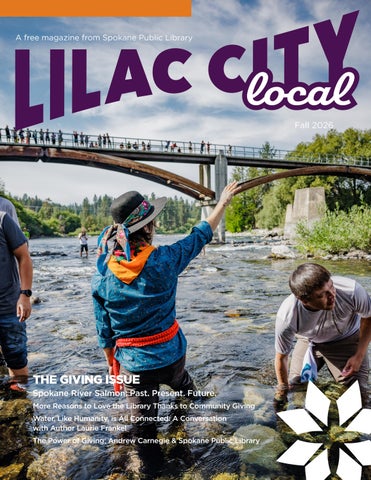
On the cover: Salmon are released into the Spokane River at the 2022 Adult Salmon Release. (Credit: Nick James.)
Managing Editor Alina Murcar Copy Editor Skyler Noble Contributing Writers Alina Murcar Amanda Donovan Laurie Frankel Megan Warren Sharma Shields Skyler Noble
Executive Director Andrew Chanse Board of Trustees Alexi Castilla Danielle DeJaegher Kris Dinnison Shelby Lambdin Mari Margil spokanelibrary.org
CENTRAL
SHADLE PARK
SOUTH HILL
SPOKANE PUBLIC LIBRARY LAND ACKNOWLEDGMENT All Spokane Public Library buildings sit on the traditional homelands of the four bands of the Spokane Tribe of Indians: sntútʔulixʷi, snxʷmeneʔi, s̓qesciłni, and slʕʷotéw s̓i (Upper Band, Middle Band, Lower Band, and Chewelah Band). Since time immemorial, the Spokane Tribe of Indians has lived and cared for these grounds. Identifying themselves as “sqélixʷ,” or “Flesh of the Earth.” We pay our respects to their Elders—past, present, and emerging. We show gratitude to the land, river, and peoples who have been fishing, hunting, harvesting, and gathering here for generations. May we learn from one another’s stories so that we may nurture the relationship of the People of the Spokane Tribe and to all those who share this land.
More Reasons to Love the Library Thanks to Community Giving
M
any library services begin with the question: What is the community need and how can the library remove barriers for that? Thanks to support from the Friends of the Library, the Spokane Public Library Foundation, and community and philanthropic grants, the library can turn those ideas into opportunities for our community. This funding brings new experiences to the library, in a time when we all know dollars are tight. In 2025, Spokane Public Library Foundation, Friends of the Spokane Public Library, and other grant funding contributed $128,534, or about 0.8% of the library’s budget. While modest in size, this support makes a meaningful difference in what the library can offer.
Spokane Public Library Foundation funds the Museum and Culture Pass program, giving people the opportunity to explore Spokane’s cultural organizations or attend sporting events for free. The Foundation, and other community partner donations, paid for the transformation of an open space at Indian Trail Library into a beautiful and educational Bird Garden and Pollinator Meadow. Every year, the Foundation helps the library connect our community with local music by paying Spokane musicians to include their albums in Lilac City Records. And the Foundation, in partnership with the Spokane Tribe of Indians, is also providing funding for this fall’s exhibit at Central Library: Spokane River Salmon: Past. Present. Future. The Friends
of the Spokane Public Library makes Summer Reading more engaging by supporting Beanstack (an app to track your reading), purchasing prize books to inspire kids to keep reading all summer long, and providing snacks for events and programs. The Friends even donated 9 boxes of books to distribute to families affected by the Spokane Complex Fires, bringing a small token of normalcy in a difficult time. Grants can help the library try something new, respond to a community need, support a creative partnership, or bring an idea to life that might not otherwise be possible. Thanks to community giving, we’re making the library more than a place to find a book. We’re creating more ways for Spokane to discover what’s possible.
Check out these titles about the power of giving
Art Corner: Copper Coil by Melissa Cole
Multi-media artist Melissa Cole shared about this piece, “These are sockeye or Kokanee salmon (landlocked sockeye). They used to swim up the Spokane River and were an important food and cultural source for the Spokane Tribe. The eagles in Lake Coeur d’Alene gorge on them in the fall/winter. When Brandon and I first got married (30 years ago) we worked on an article about swimming with salmon in the Adams River in British Columbia. It was one of the most amazing experiences of my life to have those large coppery red fish swirling around me in coils. Whenever I have “artist block” I use salmon as a touchstone and paint images of them, which allows me to move forward with other subjects.” Find this piece, part of the library’s permanent art collection, at Central Library, by the Main Avenue entrance on the 1st Floor.
1
By Alina Murcar, Marketing and Communications Manager, Spokane Public Library; Sharma Shields, Writing Education Specialist, Spokane Public Library; Megan Warren, Outreach and Education Specialist, Spokane Tribe of Indians’ Anadromous Program
F
or thousands of years, salmon have been central to tribal people’s way of life, providing nourishment while molding cultural and spiritual practices and connections to the land and water.
Historically, this relationship between people, water, and animals was documented through oral storytelling traditions. These stories have been passed down for generations and are still told today, best narrated by descendants of the tribe. Tribal Member and local artist George Hill grew up hearing tales of how his people interacted with the river and salmon. Many of these stories inspire the art Hill creates. One of Hill’s watercolors depicts a Spokane Tribal Member spearing salmon on horseback (shown at right). Hill says, “I heard a story about how one young man spearing in the river was surrounded by so many fish that they knocked him down. He went under and almost drowned, so from then on he fished from horseback.” Local writer and natural historian Jack Nisbet has spent much of his
2
adult life studying our shared history and the period of first contact between white settlers and the tribes of the Plateau. When he first encountered Hill’s artwork years ago, Nisbet was struck by the way Hill’s sculptures and images merged specific moments with people, salmon, and the river itself. In time, he wondered whether this kind of vision might inform best practices for restoring salmon to the Spokane River. The demise of Spokane River salmon began far downstream more than 150 years ago. By the 1870s, commercial fish wheels along the lower Columbia River harvested huge numbers of salmon, including spring Chinook headed for the upper Columbia and its tributaries. Although the city of Spokane advertised a strong sport fishing scene into the early 1900s, tribal people were well aware that fewer salmon were reaching the Spokane River. The construction of Washington Water Power’s Little Falls Dam in 1907 further impacted the environment, blocking salmon from reaching the upper Spokane River after the dam’s wooden
fish ladder failed to work as intended. Salmon fishing continued below the dam, but the loss of upstream spawning grounds caused the runs to steadily decline. In 1942, the completion of Grand Coulee Dam—with no fish ladder—cut off access entirely, bringing an end to the great salmon runs of the upper Columbia and lower Spokane River drainage. Fast forward to today, where both Spokane Tribal members and many other local residents yearn for the return of salmon to the Spokane River. Salmon are a keystone species, meaning their impact on the environment is wide-ranging in its benefits. According to
of Chief Joseph, Grand Coulee, and the Spokane River dams since 2022. Spokane Public Library is pleased to host an exhibit, Spokane River Salmon: Past. Present. Future., and corresponding events that highlight the work of George Hill and the Spokane Tribe’s Anadromous Program. The exhibit is curated by Jack Nisbet and his wife Claire, who have partnered in many writing and interpretative projects over the years. The exhibit, displayed on the third floor of Central Library, September 19–November 30, 2026, will feature George Hill watercolor paintings, pen-and-ink drawings,
a Department of Natural Resources report, the presence dioramas, and replica fishing tools. The exhibit will of a healthy salmon population can feed as many as also showcase texts and photographs from the Inland 137 species, ranging from caddisflies to orcas. It is a Northwest Special Collections, as well as tools and federal responsibility to protect salmon populations in photos from the Spokane Tribe’s Anadromous Program. the region–the Endangered Species Act requires the “Salmon are a totem for the Columbia Basin and the federal government to protect animals that are in danger entire Northwest,” said Nisbet. “Their story reaches back of extinction. Since 1991, fourteen species of salmon and thousands of years, which is what gives their continued steelhead in Washington State are at risk of extinction. presence—and their decline—so much weight. For This is where the important work of the Spokane Tribe’s Indigenous communities in particular, that connection Anadromous Program comes into play. Around the world, is impossible to forget. The exhibit offers a chance for anadromous fish hatch in freshwater rivers, streams, or viewers to reconnect with that history, imagine the rivers wetlands. After gaining size and strength, they swim of the past, and consider what the presence of these downstream to the ocean. When mature, they return resilient fish might mean for their future.” to their mother river, seeking the place of their birth to SALMON EVENTS AT CENTRAL LIBRARY spawn. The Spokane Tribe’s Anadromous Program is the Tribe’s leading initiative in returning salmon to the river. The program conducts fisheries research, develops fish production and passage facilities, and builds partnerships that support the return of salmon to Spokane Tribal waters. Much of this work is done in collaboration with the Upper Columbia United Tribes, Confederated Tribes of the Colville Reservation, and the Coeur d’Alene Tribe. Collectively, these tribes have released approximately 10,000 adult summer Chinook salmon and hundreds of thousands of juvenile salmon into waters upstream
Spokane River Salmon: Past. Present. Future. Exhibit Opening Reception September 19, 1pm, nxʷyxʷyetkʷ Hall A Conversation with Spokane Tribal Artist George Hill October 1, 10:30am, nxʷyxʷyetkʷ Hall Spokane River Salmon: Where Are We Now? Where Are We Going? October 6, 5:30pm, nxʷyxʷyetkʷ Hall A River Full of Fish: Early Visions of the Spokane Watershed October 15, 11am, Events A
33
The Power of Giving: Andrew Carnegie and Spokane Public Library By Amanda Donovan, Director of Marketing & Communication, Spokane Public Library
M
any American libraries exist today because of Andrew Carnegie. In fact, he funded four of the original Spokane Public library buildings which formed the foundation of
the library system you know and love. This year, we’re reflecting on Andrew Carnegie’s impact on libraries across the nation while celebrating a grant we received from the Carnegie Corporation of New York.
$350 million dollars (equivalent to $6.9B in today’s dollars). Much of the focus of his charitable giving was the establishment of libraries. He believed that public libraries are a never-ceasing foundation of good. He described libraries as “cradles of democracy” that “strengthen the democratic idea and the equality of the citizen.” Between 1883 and 1929, Carnegie funded the construction of more than 1,600 libraries across the country, creating the framework for the modern American library system. While none of our current libraries are housed in Carnegie buildings, Andrew Carnegie’s donations formed the foundation for Spokane Public Library.
“There is not such a cradle of democracy Who was Andrew as the free Carnegie? Andrew Carnegie public library.” Andrew Carnegie
Correspondence from July 1913 between George Fuller (Spokane Public Library) and the Carnegie Corporation of New York. 4
was a steel magnate who amassed a fortune in the late 1800s. In June of 1889 he wrote an essay titled The Gospel of Wealth. In this essay, he called on the rich to use their wealth to improve society. Carnegie proposed that the best way to address wealth inequality was for the wealthy to “use their surplus means responsibly and thoughtfully.” During the last 18 years of his life, he gave away
The Early History of Spokane Public Library The Spokane Public Library system began to take shape in 1891 when it opened with a membership fee. In 1894, the City of Spokane took over the library, removed the membership fee, and the library became a free public library supported by taxes. By the early 1900s, the library needed more space, and Spokane sought the assistance of Andrew Carnegie to fund the construction of a new library. In total, Carnegie gifts amounting to $155,000 funded four libraries in Spokane.
In today’s dollars, that’s equivalent to nearly $6 million. Spokane’s First Libraries Spokane received two Carnegie grants about a decade apart. These funds built four libraries in Spokane.
Main Library located at 10 S Cedar; operated between 1905-1962. In 1903, Spokane requested and received $85,000 to build the Main Library at 10 S Cedar Street. Spokane resident AB Campbell (you may know of him from the Campbell House at the Northwest Museum of Arts and Culture) donated the land. This library operated between 1905-1962, then
Building (the current building was constructed on this location in 1994, thanks to a voter-approved bond). By the 1910s, Spokane was growing and needed more library services. The library board sent another request to Andrew Carnegie, requesting funds for three more libraries. In 1912, Carnegie donated an additional $70,000 to build three more libraries: the Heath Branch, the Eastside Branch, and the North Monroe Branch.
North Monroe Branch at 925 W Montgomery; operated between 19141964. Spokane’s Carnegie Buildings Today
East Side Branch at 25 S Altamont; operated between 1913-1954. the library moved to the current location on the corner of Lincoln and Main in the Sears Comstock
Spokane Public Library no longer operates out of these original Carnegie libraries, but they still stand and hold offices for businesses in our community. Fun fact: Integrus Architecture, the firm behind several of our new innovative library spaces, is headquartered in Spokane’s original Carnegie Library at 10 S. Cedar Street. Integrus designed many of our modern awardwinning libraries, including The Hive, Hillyard Library, and Liberty Park Library—a meaningful connection between Spokane’s library history and its future.
Heath Branch located at 525 E. Mission; operated between 1914-1983. Celebrating Carnegie’s Legacy Today Carnegie’s legacy shaped the foundation of our nation’s libraries and cultural institutions, and his impact is still felt today. In fact, this year Carnegie Libraries across America (including Spokane Public Library) each received a $10,000 gift from Carnegie Corporation of New York, the foundation established by Andrew Carnegie. The award is part of Carnegie Libraries 250, a special initiative celebrating the upcoming 250th anniversary of the signing of the Declaration of Independence. This grant will be used to further develop the local archives in the Inland Northwest Special Collections. Many of the photographs, letters, and historical materials featured here are preserved in the Inland Northwest Special Collections at Central Library. The collection contains thousands of archival items documenting Spokane’s history, including materials related to Spokane Public Library, local neighborhoods, businesses, community organizations, and everyday life in the Inland Northwest.
55
Water, Like Humanity, is All Connected A CONVERSATION WITH LAURIE FRANKEL, SPOKANE IS READING’S 2026 FEATURED AUTHOR
Laurie Frankel’s acclaimed novel One Two Three is Spokane Is Reading’s 2026 selection. A starred review in Shelf Awareness describes the book as, “A heartbreaking yet heartwarming novel of a town destroyed by chemical pollution and its fight for justice, led by an unforgettable family of heroines.” The teenage narrators of the book are triplets, each with their singular voices, challenges, and abilities. Frankel will visit Spokane on October 7th for two events, the first at the Spokane Valley Library and the latter at Central Library. Books are available for checkout at both Spokane County Library District and Spokane Public Library locations, as well as for sale at Auntie’s Bookstore. Spokane Is Reading chair Sharma Shields (also the Writing Education Specialist for Spokane Public Library) recently reached out to Laurie Frankel over email with some questions about One Two Three, and here are Frankel’s captivating responses. The interview has been edited slightly for clarity. Spokane Is Reading (SIR): How did the subject of One Two Three occur to you? Laurie Frankel (LF): I read an article in the New York Times Magazine in January 2016 about a town in West Virginia downstream from a chemical plant. The plant had been dumping toxins into their water supply to catastrophic effect,
6
and there was a class-action lawsuit that their citizens had been engaged in for a decade-and-a-half and counting. Horrific. And I couldn’t stop thinking about it. I couldn’t stop thinking about it for long enough that I started looking into what seemed to me to be a really remarkable story, but as soon as I did, I realized what was remarkable about it was the tenacity of the town and their lawyer, not, unfortunately, the willful pollution this company was perpetrating despite knowing full well the extraordinary harm they were causing. That proved to be not remarkable but remarkably common. Researching it took nothing more than picking up a newspaper every day. But newspapers are reporting on current events. What I wanted to know was what happens to the next generation. That’s where the seeds of this got planted for me. SIR: In the novel you’ve introduced not just one but three wonderfully complex and relatable narrators. How did you approach
crafting and distinguishing these engaging voices? LF: Thank you for saying so. I love these girls. It was my first time writing multiple first-person narrators, and it was not at all clear to me at first how to do so. The short answer to your question is revision. Lots and lots of revision. I knew you had to be able to pick up this book and turn to any page and know at once whose chapter it was. These girls are very different from one another. They navigate the world differently from one another, so they needed entirely distinct voices. At first, they all sounded like me. Then, as I edited, they started to sound more like teenagers, but they all sounded alike. Eventually — and I mean after several hundred drafts — their voices started to come clear. I also had rules. Each girl gets her own storyline, even as you need all three to tell the overarching plot. Not one of them on her own can save the day or ruin everything or have the adventure or fall in love or escape or
solve the mystery or reveal the secret — they can only do any of that by doing it together, not in a sappy way, but literally. SIR: I appreciated so much the novel’s centering of people with disabilities. What was the research like as you wrote from Monday’s and Mirabel’s perspectives? LF: Voluminous. I did a ton of research. Some of it was traditional research — books, newspapers, journals, and the like — but much of it was less traditional. I talked to people. I talked to people who use Augmentative and Alternative Communication (AAC) devices like the one Mirabel uses, people whose disabilities are similar to hers. And I used AAC devices to talk to people. I downloaded the app she uses on her iPad to my own and endeavored to use it myself. It’s also true I spent a lot of years in the classroom — mostly teaching first-year college students — so I’ve worked with lots of teenagers with a wide and varied range of abilities and disabilities. SIR: There is so much to be said in One Two Three about the ongoing fight for social justice, a fight that happens slowly, maddeningly, against forces that feel too large to topple. How do you balance handling the gravity of this fight while offering readers—and yourself—much-needed hope? LF: Good question. Some mornings — many mornings — I just don’t know. But I think the answer is character. This is true when you’re making things up for the page, and it’s true in real life as well. The statistics are overwhelming, the trends maddening, the headlines enraging (and also overwhelming). But individuals? Individuals are hopeful. They’re trying (in both
senses). They’re flawed and working on — or in spite of — their flaws. They’re conflicted and living with unknowns, insufficient information, and too few choices. No one’s life is black and white. We live in the grays. This is true of protagonists and antagonists, good guys and bad guys, lead players and bit parts. Once you dive into character and the relationships between characters, you get love and hope and ambiguity. It doesn’t erase the madness, but it’s a way to talk and think about it, and I truly believe that talking and thinking about it is what the world needs. SIR: One of the many reasons the Spokane Is Reading committee chose One Two Three is found in its discussion of rivers and waterways, as the Spokane River and Little Spokane River are so important to our population (there are awesome organizations such as Spokane Tribal Fisheries and Spokane Riverkeeper advocating for the waterways here). What rivers and waterways have had the greatest impact on you in your own life? LF: Ooh, I love this question, and in the five years since the book was published, I’m not sure anyone’s ever asked it. I’ve spent so many happy hours of my life — the happiest, probably — in a wide variety of bodies of water. Seattle’s most attention-grabbing waters are more lake and sound than river, but to my mind, that’s actually the point here. I live in the city right by a drawbridge, the water underneath which is canal which connects to lake which flows to bay which opens to sound which runs to straight which empties to sea which turns to ocean. Water, like humanity, is all connected. We forget it (on both fronts) to our enormous peril.
Meet Laurie Frankel Read the book, then join a conversation with the author.
Wednesday, October 7 1pm at SCLD’s Spokane Valley Library 7pm at Spokane Public Library’s Central Library Laurie Frankel is The New York Times bestselling, award-winning author of six novels, including her latest, Enormous Wings, as well as Family Family, One Two Three, and the Reese’s Book Club pick, This Is How It Always Is. She is the recipient of the Washington State Book Award and the Endeavor Award. One Two Three narrates the story of the Mitchell triplets— Mab, Monday, and Mirabel—and their fight for justice after an unscrupulous company knowingly poisons their small town. The three unforgettable narrators tell a spellbinding story with wit, wonder, and deep affection about how expanding our notions of normal makes the world a better place for everyone and how when days are darkest, it’s our daughters who will save us all. Spokane Is Reading is presented in partnership with Spokane County Library District (SCLD), Spokane Public Library, and Auntie’s Bookstore.
Learn more at spokaneisreading.org
77
Get access to Mobius Discovery Center, Northwest Museum of Arts and Culture, Spokane Velocity FC, Spokane Symphony, Spokane Civic Theatre, Cat Tales Wildlife Center, and Spokane Chiefs Hockey all for free using your library card! By Skyler Noble, Marketing and Communications Manager, Spokane Public Library
T
he library is well-known for lending books and materials but you may not know that we’ve become hubs for lending “experiences” as well.
rising costs are barriers to Spokane citizens, we should all be able to experience the pleasure of
This fall, library cardholders can access Spokane Chiefs hockey passes to attend any of the regular season home games in the 20262027 season.
Local arts, culture, and sporting events may come at a cost, but they offer incredible experiences that unite our community, amplify the incredible talent that thrives in our city, and expand our worldview. With Spokane Public Library’s Museum and Culture Pass program, you can “borrow” experiences using your library card without the added obstacle of paying for entry tickets.
“The Spokane Chiefs are incredibly excited to partner with Spokane Public Library and join the Museum and Culture Pass Program. The library system is an integral resource for our community, fostering growth and learning opportunities for everyone,” said Alex Costanzo, director of marketing and public relations for the Spokane Chiefs. “We are thankful to the Library Foundation for purchasing Spokane Chiefs season tickets and making them available for library cardholders and their families to attend Chiefs games throughout the upcoming season.”
The Museum and Culture Pass program offers resident cardholders opportunities to visit established institutions like the Northwest Museum of Arts and Culture, Mobius Discovery Center, Spokane Velocity FC, Spokane Symphony, Spokane Civic Theatre, Cat Tales Wildlife Center, and the newest addition of Spokane Chiefs Hockey. Made possible with grant funding from Spokane Public Library Foundation and a generous donation of tickets from Cat Tales Wildlife Center, Spokane Public Library can provide these experiences at no cost to you. “In a time where inflation and
8
the cost of these passes as we come together as a community to share these experiences.”
arts, learning, and sports without breaking the bank,” said Jens Larson, president of the Spokane Public Library Foundation. “The Spokane Public Library Foundation is honored to cover
Library cardholders can visit spokanelibrary.libcal.com/ passes to see when passes are available. Museum and culture passes are available on a first come, first served basis for specific dates. All passes are available 30 or 60 days before the scheduled performance, match, or visit date and have various limitations.
LEVELING THE PLAYING FIELD FOR SPOKANE BUSINESSES By Alina Murcar, Marketing and Communications Manager, Spokane Public Library
S
tarting and growing a business takes more than a good idea. It takes information: Who are your customers? Where are they? Who are your competitors? What markets are growing? Where can you find funding?
LivePlan, Candid, PolicyMap and Udemy, as well as other technology and web development. For Business Research Librarian Mark Pond, making these resources freely available is about more than convenience—it’s about equity.
potential investors, develop business plans, understand communities and find funding opportunities. Mark sees the library as uniquely positioned to make high-quality information accessible to everyone.
For many small businesses, “It’s a competitive disadvantage if “The library is perfectly positioned answering those questions can you don’t have access to the same to be an equitable place for mean paying thousands of dollars level and quality of tools that your knowledge and informationfor specialized research tools. competitors might,” Mark says. sharing,” he says. “You don’t have Through StartUp Spokane, those to pay a membership fee to have same resources are available to the The library has been providing access to this information.” business research resources for community at no cost. decades, with Mark guiding And the toolbox isn’t set in stone. A recent grant from the Health the business community in his If there’s a research resource you Sciences & Services Authority role since 2006. Throughout his think would benefit Spokane’s of Spokane County (HSSA) is tenure, Mark has accessed dozens business community, Mark wants helping expand the library’s of incredible research databases; to hear from you. business research toolbox. The but one of his favorite tools is These resources are available grant supports resources that a recent addition to the StartUp to everyone in Spokane County strengthen Spokane County’s Spokane lineup. Placer.ai provides through StartUp Spokane, a bioscience ecosystem and provide location and foot-traffic data that partnership between Spokane widely accessible tools that can can be especially valuable to Public Library and Spokane contribute to economic growth. businesses that rely on customers County Library District. Explore The funding has helped support visiting physical locations. Other StartUp Spokane and access access to resources including resources can help entrepreneurs free business research tools at IBISWorld, PitchBook, Placer.ai, research industries, identify startupspokane.com.
9 9
SUPPORT THE LIBRARY ON
DECEMBER 1 Your donation... ...makes museum & culture experiences free & accessible ...supports community reading initiatives ...contributes to library programs for all ages ...invests in the future of the library for generations to come
THERE ARE TWO WAYS TO GIVE
spokanelibraryfoundation.org 10
spokanelibrary.org/friends