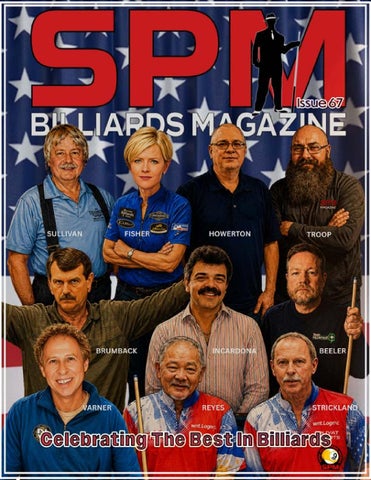
SPM BILLIARDS MAGAZINE ISSUE 67
CONTENTS
INSTRUCTION ARTICLES
THE MENTAL BLUEPRINT —BY ANTHONY BEELER TRUST THE PROCESS —BY STEVE JENNINGS POOL CHURCH’S TRICKNOLOGY—BY THE MICHIGAN KID THREE CUE BALL CENTERS—BY STAN SHUFFETT THREE PARTS TO A TRUE POOL PLAYER —BY DR. DOMINIC ESPOSITO ONE DAY YOU’LL PLAY YOUR BEST —BY TANNER PRUESS NINEBALL CAN BE MORE CREATIVE THAN ... —BY CHIP KLEIN
BILLIARD NEWS & REVIEWS
TALLMADE SUITCASE REVIEW —GARRET TROOP THE BEST IN BILLIARDS —BY NEIL ROBERTS VIKING SIEGE CARBON FIBER SHAFT REVIEW. —BY DAKOTAH SCHMIDTKNECHT A SHARED VISION BALABUSHKA CUE CO. —BY JEREMY SOPER TRIPLE 60 SATELLITE JUMP CUE REVIEW... —BY DAKOTAH SCHMIDTKNECHT VENOM MAKES HISTORY WITH PHILADELPHIA DOUBLE —WPA PRESS RELEASE
18 06 14 30 34 40 53 68
10 18 41 45 49 59
44
FROM THE EDITOR
Welcome to Issue 67 of SPM Billiards Magazine. This issue is packed, and I think it’s one of our strongest yet.
6
We open with the mental game. Anthony Beeler’s “The Mental Blueprint” looks at how what happens between your ears shapes what happens on the table. Steve Jennings follows with “Trust the Process,” a reminder that real improvement comes from commitment and patience, not shortcuts. Dr. Dominic Esposito breaks down “Three Parts to a True Pool Player,” and Tanner Pruess offers encouragement to every player still grinding in “One Day You’ll Play Your Best.” There’s plenty here for students of technique too. Stan Shuffett returns with “Three Cue Ball Centers,” and The Michigan Kid brings his flair to “Pool Church’s Tricknology.” Chip Klein makes the case that nine-ball has more room for imagination than most people think in “Nineball Can Be More Creative Than...”
30
Our News & Reviews section is just as full. Garret Troop puts the Tallmade Suitcase through its paces. Dakotah Schmidtknecht reviews two pieces of equipment, the Viking Siege Carbon Fiber Shaft and the Triple 60 Satellite Jump Cue. Jeremy Soper takes us behind the scenes at Balabushka Cue Co. in “A Shared Vision,” Neil Roberts brings us “The Best in Billiards,” and we close with the WPA’s report on Venom making history with the Philadelphia Double.
BILLIARD NEWS
Whether you want to sharpen your mindset, refine your stroke, or find your next piece of gear, there’s something in these pages for you. Thank you to all of our contributors, advertisers, and readers. You keep this magazine going. Enjoy the issue, and we’ll see you at the table. Kat Brown Day Editor, SPM Billiards Magazine
SPM BILLIARDS MAGAZINE
3
4
SPM BILLIARDS MAGAZINE
SPM BILLIARDS MAGAZINE
5
H
ave you ever wondered why you can run rack after rack while practicing alone, yet suddenly struggle with shots you normally make when you are playing an important match? You know you can make the shot. You have made it hundreds, perhaps thousands, of times. But now it is hill-hill. People are watching. Your opponent is sitting ten feet away. Maybe there is money on the line, or perhaps you are playing for a championship. You get down over the cue ball, and something feels different. Your grip tightens. Your backswing doesn’t feel quite as smooth. You begin thinking about your elbow, your bridge, your stroke, the object ball, the cue ball, and what happens if you miss. Suddenly, a shot you normally shoot almost automatically has become incredibly complicated. That is the difference between having a skill and being able to access that skill under pressure. After decades of playing, teaching, and coaching
6
SPM BILLIARDS MAGAZINE
pool, I have become convinced that this distinction separates many good players from great competitors. At a certain level, improvement isn’t always about learning another aiming system or making another mechanical adjustment. Sometimes the player already possesses the physical skills necessary to perform at a much higher level. The real challenge is learning how to get out of your own way. Think about your pool game as a computer. Your fundamentals, stance, alignment, bridge, grip, stroke, and delivery are the hardware. Your knowledge of patterns, position play, speed control, and strategy represents additional programming. But your mind controls how effectively all of those systems operate. A player can have excellent mechanics and still perform poorly if the mental program controlling those mechanics breaks down under pressure. That is why I have seen players hit hundreds of balls trying to correct something that wasn’t really a
mechanical problem. They miss an important ball and immediately assume something must be wrong with their stroke. They begin experimenting. Maybe they move their grip hand. Maybe they change their stance. Maybe they alter their bridge length. Before long, they are consciously controlling movements that previously occurred naturally. That’s when paralysis by analysis begins.
tighten. Attention narrows or jumps from one thought to another. Unfortunately, pool requires extremely precise motor control. A small increase in grip pressure can affect cue delivery. A rushed transition can change timing. A player who normally remains perfectly still may suddenly jump up because the mind is desperate to see whether the ball went into the pocket.
There is an important distinction between learning your stroke and using your stroke. During practice, there are times when technical analysis is necessary. You may need to consciously work on alignment, delivery, or another fundamental component. Competition is different. Once you have made your decisions and lowered yourself into the shooting position, your job should primarily be execution. You cannot simultaneously trust your stroke and micromanage it.
This creates an important lesson: you don’t defeat pressure by pretending you aren’t nervous. You learn to perform while nervous. One of the simplest tools is breathing. Before an important shot, slow everything down. Take a deliberate breath. Allow your shoulders and grip hand to relax. Give your eyes sufficient time to process the shot. Then commit. The purpose isn’t to eliminate every butterfly in your stomach. The purpose is to keep those butterflies from controlling your stroke.
Every poolroom has what I call the “practice champion.” This is the player who runs racks practicing by himself. His stroke looks terrific. He makes difficult shots look easy. Then tournament night arrives and suddenly everything changes. Why? The pockets didn’t get smaller. The balls didn’t get larger. The table didn’t suddenly become longer. What changed was the consequence attached to the shot.
One of the greatest mental mistakes in pool occurs when players become obsessed with results. “I have to make this.” “I can’t lose to this guy.” “If I win this match, I’ll cash.” “Everyone is watching.” None of those thoughts helps you pocket the ball. In fact, they direct your attention toward things you cannot completely control. You cannot control whether your opponent plays flawlessly. You cannot control a bad roll. You cannot control the bracket. And once the cue ball leaves your tip, you cannot control what has already happened.
During casual practice, missing a ball costs almost nothing. You simply set it up and shoot it again. During competition, that same miss may cost you the rack, the match, or the tournament. The physical shot may be identical, but psychologically it has become completely different. That is why serious players must eventually learn to practice performance, not simply execution. If all your practice is consequence-free, you shouldn’t be surprised when your mind reacts differently once consequences appear. Create drills in which failure matters. Establish goals that must be completed before you quit. Keep score. Play races against yourself. Introduce situations where one miss means starting over. You are teaching yourself something beyond pocketing balls. You are teaching yourself how to perform when the shot matters. The goal isn’t to make practice miserable or create unnecessary anxiety. It is to make pressure familiar enough that your mind doesn’t treat every important tournament situation as something completely new. Pressure isn’t imaginary. When players become nervous, physical changes occur. Heart rate may increase. Breathing can become shallow. Muscles
What you can control is your process. That means selecting the correct shot, establishing your intended cue-ball path, aligning properly, completing your pre-shot routine, and delivering the cue as you have trained yourself to do. Great players learn to become almost stubbornly committed to process. The score may change. The opponent may change. The pressure may change. The routine remains. Your pre-shot routine should serve as a bridge between thinking and performing. While standing, make your decisions. Where am I aiming? Where does the cue ball need to go? What speed is required? What spin am I using? Once those decisions have been made, commit to them. Then transition into execution. Get into your stance, establish your visual focus, complete your warm-up strokes, and deliver the cue. The exact routine varies from player to player, but the important word is repeatable. A good routine creates familiarity in unfamiliar circumstances. The tournament may be different. The opponent may be stronger. There may be SPM BILLIARDS MAGAZINE
7
hundreds of spectators instead of five people sitting around the poolroom. But you have performed your routine thousands of times. That familiarity becomes an anchor. Instead of allowing the importance of the situation to dictate how you shoot, you allow your routine to dictate how you shoot. Of course, you are still going to miss. I don’t care how good you become. The greatest players who ever lived missed balls. What separates champions isn’t an absence of mistakes. It is often how efficiently they recover from them. Many amateurs effectively miss the same ball three times. First, they physically miss the shot. Second, they mentally replay the miss while sitting in the chair. Third, they carry the frustration into their next opportunity and miss another ball because they are still thinking about the previous one. One mistake has now become two. Give yourself a short period to evaluate what happened. Learn from it if there is something useful to learn, and then release it. The next shot deserves your complete attention. A player who can consistently return to neutral after mistakes possesses an enormous competitive advantage. You cannot change the previous shot, but you can prevent it from influencing the next one. Players frequently tell me, “I just need to get my confidence back.” The problem is that they treat confidence like weather. They wait for it to arrive. Real competitive confidence is built differently. It comes from preparation. If you have practiced the shot, tested yourself under pressure, developed a reliable routine, and repeatedly demonstrated that you can execute correctly, you have accumulated evidence. That evidence creates confidence. This is why I prefer earned confidence over positive thinking. Standing in front of a mirror telling yourself you’re a great pool player won’t replace preparation. Confidence becomes powerful when your mind can say, “I’ve done this before.” You aren’t hoping that
you can perform. You have accumulated enough successful experiences to know that you can. Technical instruction is essential, particularly when a genuine mechanical flaw exists. But there eventually comes a point where constantly changing mechanics produces diminishing returns. Advanced players can become especially vulnerable to this because they possess enough knowledge to diagnose themselves endlessly. Every miss becomes evidence of another problem. Sometimes you didn’t miss because your stroke is broken. Sometimes you simply missed. The ability to distinguish a technical error from a performance error is enormously important. If the same problem repeatedly appears during practice and competition, investigate the mechanics. But if you execute beautifully during practice and consistently deteriorate only when pressure appears, another stroke adjustment may not be the answer. You may need to train your competitive mind. The ultimate objective isn’t to create a pool game that works only when you’re comfortable. You want a game that travels. You want fundamentals that survive different equipment, unfamiliar rooms, strong opponents, bad rolls, television lights, spectators, money matches, and hill-hill situations. That requires more than hitting balls. You must train decision-making. You must train emotional control. You must train routines. You must train recovery. Most importantly, you must practice trusting the skills you’ve already developed. The next time you find yourself facing an important shot, don’t try to manufacture a perfect stroke. Make your decision. See the shot. Take your breath. Commit to your routine. Then allow yourself to play. Ultimately, the mental game of pool isn’t about learning how to think more while you’re shooting. Quite often, it’s about learning when to stop thinking and start performing.
Anthony Beeler is the current Billiards Instructor of the Decade and is a former BCAPL National Champion. He has numerous “Top 25” national finishes and is the primary author of the ACS National Billiards Instructor’s Manual. He has also authored the book Unstoppable! Positive Thinking for Pool Players. Anthony currently has the highest established Fargo Rating of any Master Instructor. He has won over 300 tournaments and has defeated numerous professional players in tournament competitions. 8
SPM BILLIARDS MAGAZINE
SPM BILLIARDS MAGAZINE
9
A Game-Changer for Traveling Pool Players: The TallMade Suitcase by Pagulayan Products By Garret Troop
F
or decades, traveling pool players have faced the same frustrating challenge: how do you safely transport your cues while still carrying everything needed for a tournament weekend or extended trip? Traditional luggage protects your clothes but leaves your cue case as a separate item to manage. Cue cases protect your equipment but don’t help with your travel essentials. The result has always been a juggling act of multiple bags, extra baggage concerns, and the constant worry that your most valuable equipment could be damaged, misplaced, or separated from you during travel. The TallMade Suite Case from Pagulayan Products changes that equation completely. Designed specifically for the traveling cue sports athlete, the TallMade Suite Case is more than luggage—it is a purpose-built travel system that combines cue protection, organization, convenience, and durability in one professional-grade package. After spending time with this innovative product, it quickly becomes clear this isn’t just another suitcase trying to appeal to pool players. It is a thoughtfully engineered solution created by people who understand exactly what life on the road looks like for competitive players. The first thing that stands out is the incredible amount of storage space. The TallMade Suite Case is intelligently designed to hold a full-sized cue case with your primary playing cue, break cue, jump cue,
10
SPM BILLIARDS MAGAZINE
extensions, shafts, and accessories, while still leaving plenty of room for clothing and personal items. For players attending multi-day tournaments, regional tours, league championships, or international events, this level of versatility is invaluable. The spacious main compartment easily accommodates enough clothing for a five-day tournament trip without feeling cramped or overstuffed. Multiple zippered compartments and storage pouches provide dedicated space for toiletries, electronics, chargers, medications, documents, and all of the small essentials that tend to get lost in conventional luggage. Everything has a place, so players can stay organized and focused instead of digging through bags to find what they need. What truly separates the TallMade Suite Case from conventional travel solutions is the peace of mind it provides. Every serious pool player understands the value of their equipment. Many players travel with cue setups worth thousands of dollars. Beyond the financial investment, there is also the personal connection to the equipment. A cue is not just a tool—it is an extension of the player. Players carefully select it, maintain it meticulously, and trust it under pressure in competition. The thought of a cue being damaged, lost, or mishandled during travel is enough to create anxiety before an event even begins. The TallMade addresses those concerns by creating
a secure and dedicated environment for your cue case within your travel luggage. Instead of managing separate pieces of luggage and constantly keeping track of multiple bags, players can consolidate their gear into one organized travel solution. This dramatically reduces stress during airport check-ins, hotel transfers, loading a rental car, and tournament arrivals. For frequent travelers, convenience is everything. Anyone who has navigated crowded airports with a cue case, backpack, and rolling suitcase understands how exhausting travel can be before competition even starts. The TallMade streamlines that experience. Its upright design keeps everything balanced and accessible, while the smooth-rolling wheels glide effortlessly through terminals, convention centers, and hotel corridors. The sturdy telescoping handle feels solid and reliable, making transportation comfortable even when the case is fully loaded. Durability is another area where the TallMade excels. Tournament players put their travel gear through extreme conditions. Cases are rolled across parking lots, loaded into vehicles, dragged through airports, stored in hotel rooms, and subjected to the inevitable bumps and impacts of frequent travel. Pagulayan Products clearly understood these realities during the design process.
The TallMade is constructed from high-quality materials that inspire confidence from the moment you handle it. The exterior feels robust and built to last, while the reinforced construction helps protect the contents inside. Every zipper, seam, compartment, and moving component seems designed for longevity. This isn’t disposable luggage for occasional vacations. It is travel equipment built for players who spend significant time on the road year-round. Another aspect worth highlighting is the case’s professional appearance. Whether you’re arriving at a local tournament, a major professional event, or an international competition, the TallMade presents itself as a premium product. Its sleek design reflects the professionalism of the modern cue sports athlete and reinforces the idea that serious players deserve travel solutions specifically tailored to their needs. What makes the TallMade particularly special is that it was clearly designed by people who understand pool players. Every feature feels purposeful. Every storage compartment serves a practical function. Every design decision appears rooted in real-world travel experience. This isn’t a generic suitcase with a billiards logo attached. It is a genuine innovation developed specifically for the unique demands of cue SPM BILLIARDS MAGAZINE
11
sports competitors. At a retail price of $395, the TallMade Suite Case represents exceptional value. When you consider the protection it provides for valuable equipment, the convenience of consolidating multiple bags into one organized system, and the durability required to withstand years of tournament travel, the investment becomes easy to justify. For many players, protecting a cue collection worth several thousand dollars alone makes the purchase worthwhile.
12
SPM BILLIARDS MAGAZINE
Most importantly, the TallMade allows players to focus on what matters most: competing. Traveling to tournaments already comes with enough challenges. The last thing players should worry about is whether their cues are safe, whether they packed everything they need, or how they’ll manage multiple pieces of luggage while moving between airports, hotels, and tournament venues. The TallMade removes those concerns and delivers confidence every step of the journey.
Pagulayan Products has created something genuinely unique with the TallMade Suite Case. It successfully bridges the gap between premium luggage and specialized cue transportation, providing a solution that pool players have needed for years. It is practical, durable, thoughtfully designed, and remarkably versatile. For serious competitors, league players who travel frequently, touring professionals, and anyone who values protecting their equipment while traveling efficiently, the TallMade Suite Case is not merely a luxury—it is quickly becoming an essential piece of gear. Highly recommended. https://pagulayancues.com/pages/tallmade
Trust the Process
W
hy do some players seem so comfortable and confident at the table, while others seem uncertain and uncomfortable when shooting? Well, experience is certainly one factor. But even new players can reach that level of play when they learn one simple thing. Focus and trust in the process! Ask yourself this question. What do you think about when you are down and ready to shoot your shot? If you said making the shot, you’re getting ahead of yourself. You are no longer thinking in the moment; you’re thinking about the result. And that takes your focus off the process. And the process is where your full attention needs to be when you shoot. So what exactly is this “process”? Our process is simply the small steps in your routine that bring you to the point where you make your final stroke. I hope it is something you focus on during practice. But you first need to build your own process. To give you an idea of your process steps, I will outline the steps in my personal process. “While standing, decide where my aim line is. 14
SPM BILLIARDS MAGAZINE
Decide what speed and spin I need to execute the shot correctly. STOP THINKING. Drop down while bringing my cue into shooting position directly on my aim line. Verify my tip position on the cue ball with 2 warm-up strokes. Stop with my tip within ½ inch of the cue ball in my set position. Lock my eyes on my target aiming point. Execute a slow, smooth backstroke. And smoothly transition to my forward stroke. Deliver my forward stroke straight through to my finish point. Freeze to evaluate and get feedback. At this point, I allow myself to stand up and see the final results of my shot.” Notice that nothing in that process involves thinking about the results of the shot. When I focus only on the process and do it correctly, the outcome should be what I planned. You need only to concern yourself with trusting your process. Your process will deliver the results. The the and
more you practice your process, more dependable it becomes the easier it becomes to trust
it. Does this mean I never miss? Of course not! We are all human, and we aren’t perfect. If I miss, it’s because I did something wrong with my process. But if I execute my process correctly, my odds of success increase greatly. Remember, the balls on the table only respond to what you do. Your process is only designed to address what you do. Your results will tell you how well you followed your process. Put your trust in your process and your success rate will improve. Not overnight, but as you continue to make it automatically part of your routine with every shot. There is no such thing as an easy shot or a difficult shot. They all deserve the same consideration. Follow your process for every shot. Until next time Steve Jennings ACS/SPF/PBIA Master Instructor Playing Pool since the age of 10, first learning on a table at home and then in Pool rooms a few years later, I won several base championships while in the service. After my discharge, I continued to play recreationally and in several regional tour events. I started coaching and teaching game strategies in the 90s. I worked with several Master instructors and reached Master instructor status in 2015. Now Director of Training for the Southeastern Billiard Academy, I teach classes as often as I can. I train/certify new instructors and look forward to helping every player achieve their fullest potential.
SPM BILLIARDS MAGAZINE
15
THE BEST IN BILLIARDS CELEBRATING THE PLAYERS, TEACHERS, INNOVATORS AND INSTITUTIONS THAT DEFINED AMERICA’S FIRST 250 YEARS OF BILLIARDS By Neil Roberts
What Does It Mean to Be the Best?
E
very poolroom has one. Maybe it is the player sitting quietly in the corner while everyone else is talking. Maybe it is the road player whose reputation arrived in town before he did. Maybe it is the local champion with 80 first-place trophies sitting at home. Eventually, someone points across the room and says, “That’s the best player around here.” It is one of the oldest conversations in sports. Who is the best? We debate it in poolrooms, stadiums,
18
SPM BILLIARDS MAGAZINE
barbershops and living rooms. We compare championships. We remember performances. We tell stories about players we saw when we were young. We defend the heroes of our generation and sometimes dismiss the ones who came before them. But being the best in a room is one thing. Being the best in a city is harder. Being the best in a state is extraordinary. Being the best in a nation puts someone among an incredibly small group of people. But then there is another question altogether: Who was the best of all time? Those six words change everything. Suddenly, you are no longer comparing one player with the person standing across the table. You are comparing careers separated by decades. You are comparing different equipment, different rules, different tournaments and different generations. The people being compared may never SPM BILLIARDS MAGAZINE
19
have met. One may have competed under television lights while another built his reputation in poolrooms before most matches were ever recorded. One may have traveled the country by automobile looking for action while another boarded airplanes to compete in international championships. Somewhere between those eras, the cloth changed. The balls changed. The cues changed. The tables changed. The tournaments changed. Even the games Americans played changed. But greatness remained. Imagine walking into a poolroom where time no longer exists. At one table stands Willie Mosconi, methodically moving through a rack of straight pool. At another is Minnesota Fats telling a story to anyone willing to listen; and probably a few people who aren’t. Across the room, Earl Strickland is firing balls into pockets at a pace that makes the game look impossibly easy. Nick Varner is studying a layout. Efren Reyes is smiling at a shot nobody else in the building has seen yet. John Brumback is banking a ball that most players would never consider attempting. Allison Fisher is preparing for the next shot with the same precision that made her one of the most dominant champions in cue-sports history. In another part of the room, cues are being built, tables are being leveled, tournaments are being organized, articles are being written, matches are being broadcast and students are learning how to play. Now imagine being asked one simple question: Who was the best?
Hustlers played it. World champions played it. For generations, Americans gathered around green cloth and ivory; and later phenolic resin balls. The game moved from elegant parlors into neighborhood poolrooms, from private clubs into bowling centers, from smoky back rooms onto national television and eventually from television screens onto phones, tablets and computers around the world. The game changed, but the pursuit of excellence never did. As the United States celebrates its 250th anniversary in 2026, Best in Billiards set out to look across that enormous span of history and recognize the people, products, publications and institutions whose contributions truly rose above the rest. The project was designed to move beyond popularity, personal relationships, organizational politics and the kind of “good old boy” system that has too often influenced recognition within the sport. The goal was not to reward familiar names simply because they were well connected or currently in favor, nor was it to determine who happened to be the best at one particular moment. Instead, selections were based on a broader historical evaluation that considered championship achievement, historical significance, innovation, influence, reputation, longevity and lasting contribution.
Determining the best of a single year is relatively simple. There are standings, tournament results and championship trophies. Determining the best across generations is something entirely different. It requires asking not simply, “Who won?” It requires asking: Who mattered? Who changed the game? Who dominated it? Who influenced the people who came afterward? Whose accomplishments survived the passing of time? And perhaps most importantly, if the story of American billiards could be told through a handful of names, whose names would have to be included?
What followed became one of the most ambitious and unusually far-reaching recognition efforts ever undertaken in pocket billiards. The Best in Billiards Awards did not confine themselves to one tournament, one professional organization or one competitive season. They attempted to look across the broad sweep of American billiards history and identify excellence in playing, instruction, manufacturing, equipment, promotion, journalism, broadcasting, entertainment and craftsmanship. The recipients represented an extraordinary crosssection of the sport: world champions, Hall of Famers, legendary personalities, instructors, manufacturers, broadcasters, publishers and innovators.
That was the challenge behind the inaugural Best in Billiards Awards.
National News
250 Years in the Making In 1776, the United States began a journey that would span generations, transform a continent and create traditions that became distinctly American. Billiards traveled alongside that history. Presidents played it. Soldiers played it. Businessmen played it. 20
SPM BILLIARDS MAGAZINE
The announcement quickly traveled far beyond the Best in Billiards organization itself. A national announcement distributed through news platforms, including Yahoo Finance and StreetInsider, while leading billiards news outlets AZBilliards and SPM Billiards Media also published the announcement. The recognition introduced the honorees—and the
historical case made for their selections—to readers far beyond traditional billiards circles. Governmental Recognition Then something even more unusual happened. The recognition moved from poolrooms and billiards publications into the halls of government. In Kentucky, where several of the honorees have deep ties, the Best in Billiards selections attracted recognition at the highest levels of state government. Governor Andy Beshear formally recognized each Kentucky native honored by Best in Billiards for their achievements and contributions to the sport. The recognition reached an especially notable moment during the Governor’s weekly Team Kentucky Update, when Beshear named Owen County native John Brumback the week’s Team Kentucky All-Star following his selection as the Best Bank Pool Player in American History. The moment carried significance far beyond Brumback’s individual achievement. During an official gubernatorial briefing, a lifetime devoted to excellence in billiards was celebrated alongside other accomplishments and matters of importance to the Commonwealth, giving the sport a rare and meaningful place on one of Kentucky’s most prominent public stages. Additional governmental recognition followed. Best in Billiards honorees received recognition associated with the Kentucky House of Representatives and Kentucky State Senate, and honorees also received correspondence recognizing their achievements from the Office of the Governor.
the conversation after the next generation arrives is something more. And to have your name considered when someone asks who was the greatest across the entire history of the game? That is immortality of a different kind. Eventually the crowds go home. The tournament room becomes quiet. The television cameras are turned off. The trophies collect dust. Records are broken. Companies come and go. Another young player walks into a poolroom believing nobody has ever played the game quite like he does. Time has a way of testing every reputation. Some names slowly disappear. Others somehow become larger. Those are the names Best in Billiards attempted to identify. Not simply the great. Not simply the champions. The best. Nick Varner — Best All-Around Player When the question became who best represented excellence across multiple disciplines of American pool, one name rose to the top: Nick Varner. Few players have ever demonstrated his remarkable versatility. Varner was selected as the Best AllAround Player because his championship résumé extends across virtually every major American pool discipline. An eight-time world champion, Varner captured world titles in five different games: 9-ball, 8-ball, straight pool, one-pocket and bank pool.
The resulting group crosses generations. Some of the winners competed before many of today’s players were born. Others continue to shape the sport today. Some became household names. Others earned their reputations largely within the billiards world. But each accomplished something exceedingly rare: they separated themselves not merely from their contemporaries, but from generations of people who pursued the same craft. Think about the magnitude of that. Millions of people have played competitive pool. Countless individuals have taught it. Companies have manufactured cues and tables for generations. Promoters have staged tournaments across the country. Writers have covered the sport. Broadcasters have described its greatest moments. Craftsmen have spent lifetimes perfecting their work. To rise above everyone in your own generation is remarkable. To remain in
That versatility is extraordinary. Pool history contains specialists who dominated individual disciplines and champions who accumulated tremendous records in one particular game. Varner demonstrated something different; the ability to adjust his style, strategy and thinking to whatever game was being played. His career produced more than 80 tournament championships and elite-level success spanning approximately three SPM BILLIARDS MAGAZINE
21
decades. His accomplishments included collegiate national championships, world straight-pool titles, tremendous success in professional 9-ball and major victories in both bank pool and one-pocket.
9-ball champions. Few have left a larger footprint on the discipline than Earl Strickland.
Varner was inducted into the Billiard Congress of America Hall of Fame in 1992, yet statistics tell only part of his story. He became equally respected for professionalism, sportsmanship and an ability to represent the game with dignity. He proved that greatness did not require sacrificing humility. In a sport filled with specialists, Nick Varner became the ultimate all-around champion.
Long before 9-ball became the dominant professional game in America, straight pool was the championship discipline—and Willie Mosconi was its king. Known as “Mr. Pocket Billiards,” Mosconi dominated an era when 14.1 continuous was widely regarded as the ultimate examination of a player’s ability. Between 1941 and 1957, Mosconi won the World Straight Pool Championship 15 times.
Willie Mosconi — Best Straight Pool Player
Earl Strickland — Best 9-Ball Player If there is one player whose career became almost inseparable from American 9-ball, it is Earl “The Pearl” Strickland. At his peak, Strickland possessed an explosive combination of shot-making, break power, confidence, speed and competitive intensity. When everything was working, few players in history could make the game appear easier.
His record supports the legend. Strickland won the WPA World 9-Ball Championship three times—in 1992, 1993 and 2002—and captured the U.S. Open 9-Ball Championship five times. His professional career produced more than 100 tournament victories, and he was named Billiards Digest Player of the Year five times. He entered the BCA Hall of Fame in 2006. Strickland’s greatness, however, extends beyond a list of titles. He helped define what elite American 9-ball looked like during the sport’s modern television era. His aggressive playing style, unforgettable personality and willingness to attack difficult situations made him one of pool’s most recognizable competitors. Generations of players watched Earl and saw what was possible when extraordinary talent was combined with complete competitive commitment. There have been many great American 22
SPM BILLIARDS MAGAZINE
His control, pattern play, precision and ability to navigate racks became legendary. Mosconi approached the table with a level of technical discipline that helped establish a standard for generations of straight-pool players. Then there was the run. On March 19, 1954, during an exhibition in Springfield, Ohio, Mosconi pocketed 526 consecutive balls. For more than six decades, 526 remained one of the most famous numbers in billiards. Mosconi was among the inaugural inductees into the BCA Hall of Fame in 1966. His importance also reached beyond competition. Through exhibitions, books, television appearances and his association with the film The Hustler, Mosconi became one of the sport’s most recognizable ambassadors. For championship dominance and his enduring association with 14.1, Willie Mosconi stands as Best in Billiards’ choice for the greatest straight-pool player. Efren Reyes — Best One-Pocket Player Some players master a game. Efren “Bata” Reyes seemed capable of seeing possibilities within onepocket that other players did not know existed. Known throughout the world as “The Magician,” Reyes brought creativity, imagination, kicking ability, cueball control and strategic brilliance together in a style
that made even other champions stop and watch.
His American one-pocket record is extraordinary. Reyes won the Derby City Classic One-Pocket division six times, including four consecutive victories from 2004 through 2007. Against the strongest specialists in a discipline built around patience, moving, banking, creativity and tactical intelligence, Reyes repeatedly found solutions.
His combination of banking knowledge, cue-ball control, competitive temperament and sustained success established him among the greatest bank players the sport has produced. In Kentucky, where bank pool has been passed from generation to generation, Brumback’s success carries additional historical meaning. His career represents a continuation of one of America’s richest regional Perhaps that is the defining characteristic of his billiards traditions. greatness. Reyes did not merely execute established strategies exceptionally well; he expanded players’ The recognition of Brumback also produced one of understanding of what could be done on a pool table. the most remarkable moments connected with the A difficult kick became an offensive opportunity. A Best in Billiards program. On July 16, 2026, Kentucky seemingly defensive position suddenly contained a Governor Andy Beshear recognized Brumback during shot. A pattern invisible to everyone else somehow his official Team Kentucky Update and named him the appeared obvious once Reyes demonstrated it. The week’s Team Kentucky All-Star following his selection Philippines gave the world one of its greatest cue- as the Best Bank Pool Player in American History. It sports champions, but American pool—and American was an extraordinary intersection of billiards and one-pocket in particular—became an essential public recognition: a lifetime spent mastering one of part of the Reyes legend. For his accomplishments pool’s most demanding disciplines being celebrated and profound influence on the way the game is by the governor of his home state. understood, Efren Reyes was selected as the Best One-Pocket Player. Allison Fisher — Best Female Player John Brumback — Best Bank Pool Player Bank pool occupies a special place in American billiards history, particularly in Kentucky, and few players have represented that tradition better than John Brumback. The Owenton, Kentucky native developed a reputation as one of the most feared bank-pool competitors of the modern era. Great banking requires considerably more than knowing where to aim. Speed changes angles. English changes paths. Table conditions matter. Position must be considered while simultaneously calculating the bank itself. At the highest level, those decisions must be made repeatedly against opponents waiting for the smallest mistake. Brumback turned that demanding discipline into his specialty.
Allison “The Duchess of Doom” Fisher accomplished something exceedingly rare: she became a legend in two different cue-sports disciplines. Before dominating American women’s pool, Fisher had already established an extraordinary snooker résumé, winning 12 world snooker championships, including four doubles championships. Then she crossed the Atlantic and built another Hall-of-Fame career. Fisher captured the WPA World 9-Ball Championship in 1996, 2001 and 2002 and won more than 50 WPBA Classic Tour events. Her consistency, preparation, precision and professionalism made her the standard against which other elite female players were measured. She was inducted into the BCA Hall of Fame in 2009. SPM BILLIARDS MAGAZINE
23
Minnesota Fats transformed poolroom mythology into mainstream entertainment. American billiards would be considerably less colorful without him. Anthony Beeler — Best Pool Instructor
Fisher also helped raise expectations for women’s professional pool. Her approach demonstrated that a champion could combine extraordinary competitive performance with preparation, professionalism and longevity. Her legacy transcends nationality. She became an integral figure in American professional pool and inspired countless women to pursue the game competitively.
Great players preserve the game through performance. Great instructors preserve it through knowledge. Kentucky instructor Anthony Beeler was selected as the Best Pool Instructor in American History following an in-depth evaluation of his more than three decades of accomplishments as an instructor, educator, competitor, author and innovator. A PBIA Master Instructor, ACS Level 4 Master Instructor and member of the ACS National Instructors Board, Beeler has taught more than 31,000 students from all 50 states and 102 countries, establishing an instructional reach that spans the globe.
Minnesota Fats — Best Entertainer Championships are important, but billiards history was also built by personalities, and no personality was bigger than Minnesota Fats. Born Rudolf Walter Wanderone Jr., Fats became arguably the most colorful showman American pool ever produced. He could tell stories, promote himself, entertain a crowd and make the simple act of walking into a poolroom feel like an event.
Whether every story was precisely accurate almost became beside the point. Fats understood entertainment. He understood publicity. Most importantly, he understood that pool needed personalities capable of reaching people who might never watch a conventional tournament. His appearances on television introduced billiards to enormous audiences, and his rivalry with Willie Mosconi provided a perfect contrast: Mosconi the polished champion and Fats the flamboyant hustler. 24
SPM BILLIARDS MAGAZINE
Beeler is widely recognized as the “Father of Online Billiards Instruction” and was honored as one of the first two recipients of the ACS Doctor of Online Billiards Instruction distinction. Having pioneered the online pool-school model long before remote coaching became commonplace within the sport, Beeler helped redefine how billiards could be taught. Through the creation of the Virtual Billiard Academy and his extensive online instructional programs, he transformed the traditional concept of a pool school into a worldwide classroom, combining structured curricula, individualized video analysis, personal feedback and long-term coaching. His work demonstrated that serious billiards instruction no longer had to be limited by geography and helped establish a model that would become increasingly important to the way modern players learn the game. His influence extends well beyond online instruction. Beeler has been a prolific instructional author whose work has appeared in Billiards Digest, Billiards Buzz, SPM Billiards Magazine and literally every major
billiards publication, covering everything from stroke mechanics and aiming to strategy, practice, mental toughness and performance psychology. He has coauthored the American CueSports Alliance National Instructor’s Manual, developed training tools and educational resources, and mentored several instructors who later earned instructor of the year awards. His honors include SPM Billiards Instructor of the Year and Instructor of the Decade for 2010– 2020, while his competitive résumé includes a BCAPL National 9-Ball Championship, Kentucky BCAPL State 9-Ball Championship, six regional championships and five Top-25 national finishes. What distinguishes Beeler’s legacy is the combination of education, competition, innovation and reach. With decades of professional experience as an educator, he brought structured curriculum development, assessment and individualized feedback into a sport historically taught largely through informal instruction. From pioneering online billiards education to teaching tens of thousands of players around the world, publishing an extensive body of instructional work and developing future instructors, Beeler helped transform how pool is taught in the modern era. His selection as Best Pool Instructor in American History recognizes a career devoted not simply to teaching people how to play better pool, but to fundamentally changing how billiards instruction is delivered, understood and shared around the world.
For more than a week, champions, road players, amateurs, instructors, fans and industry figures occupy the same environment. Official tournaments are only part of the experience. There are challenge matches, after-hours action, reunions, equipment displays and conversations between people from every corner of the sport. Perhaps most importantly, Derby City has preserved games deeply connected to American pool history while presenting them alongside modern professional competition. It is simultaneously tournament, convention, reunion and celebration. Diamond Pro-Am — Best Pool Table A great tournament requires a great playing surface, and Diamond Billiard Products has profoundly influenced the modern American poolroom. The Diamond Pro-Am was selected as Best Pool Table. Built with demanding competitive play in mind, Diamond tables have become fixtures at major tournaments and serious poolrooms throughout the country.
Derby City Classic — Best Billiards Event
Their influence extends beyond manufacturing. By supporting tournaments and building equipment around the needs of competitive players, Diamond helped establish expectations for how professional American pool should play. The Pro-Am has become instantly recognizable and closely associated with serious competition. McDermott — Best Billiards Cue If someone wanted to experience the culture of American pool concentrated into one place, the Derby City Classic would be difficult to beat. Created by Diamond Billiard Products founder Greg Sullivan, the event brings together bank pool, one-pocket, 9-ball and all-around competition while maintaining the atmosphere of a massive poolroom gathering.
Few pieces of sporting equipment become as personal as a pool cue. McDermott Cues earned recognition as Best Billiards Cue after decades of American cue manufacturing and innovation. Founded in 1975, McDermott developed a reputation for craftsmanship, distinctive designs and technological advancement while remaining a familiar name SPM BILLIARDS MAGAZINE
25
among professionals, instructors, league players and recreational competitors.
SPM Billiards Media — Best Instructional Publication This recognition is especially meaningful within these pages. Garret Troop and SPM Billiards Media were selected for Best Instruction and Community Publication. SPM traces its origins to the Sneaky Pete Mafia community established in 2014. From those beginnings, it evolved into a multimedia platform dedicated not only to champions and major events but also to instructors, regional players, junior competitors, room owners, photographers, promoters and many others who form the foundation of the billiards community.
The company’s longevity is especially significant in an industry that has changed dramatically. McDermott successfully carried traditional American cue-making values into the modern era while continuing to develop new shaft technologies and equipment. For countless players, the McDermott name has become synonymous with American production cues. Billiards Buzz — Best Billiards Magazine The way billiards is covered has changed dramatically during the digital era, and Billiards Buzz, associated with Mike Howerton and AZBilliards, has helped document that transformation. Billiards Buzz was selected as Best Billiards Magazine for its continued coverage of professional competition, players, industry developments and instructional material.
That distinction matters. Professional champions deserve coverage, but billiards is much larger than the professional tour. Every week, thousands of league players, tournament competitors, instructors, room owners and fans keep the sport alive. SPM has provided those people with a voice. Its emphasis on instruction and community demonstrates that billiards media can do more than report who won. It can help people improve, recognize deserving individuals and strengthen the relationships that sustain the sport. Bill Incardona — Best Billiards Broadcaster
Digital publishing allows billiards journalism to reach readers throughout the world immediately, creating a historical archive while simultaneously covering the current game. At a time when traditional print media faces increasing challenges, publications such as Billiards Buzz demonstrate that dedicated billiards journalism remains both possible and important. 26
SPM BILLIARDS MAGAZINE
There is an art to explaining championship pool. A commentator must understand what the player sees without overwhelming the audience. He must anticipate patterns, recognize tactical decisions and explain complex situations quickly enough that viewers can appreciate what is happening before the next shot.
handcrafted product designed to safeguard cues that can themselves represent significant financial and personal value. Over the years, the company’s distinctive designs, construction methods and customization have made Whitten cases immediately recognizable throughout the billiards world.
Bill Incardona has spent decades doing exactly that. An accomplished player himself, Incardona brought genuine competitive knowledge into the broadcast booth. His understanding of one-pocket, rotation games and high-level strategy allowed viewers to hear not simply what happened, but why. For generations of fans, his voice became part of the experience of watching major pool. That ability to translate elite-level knowledge into language viewers can understand earned Incardona recognition as Best Billiards Broadcaster. Whitten Cases — Best Pool Case A great cue deserves protection worthy of the craftsmanship that went into creating it, and few names in the industry have become more closely associated with premium cue protection than Whitten Cases. Founded by Dan Whitten in 1987 and now led by Joe Whitten, the company earned recognition as Best Pool Case for nearly four decades of craftsmanship, durability, innovation and reputation among serious players and collectors.
Perhaps the strongest measure of the company’s legacy is the reputation the Whitten name has earned across generations of players. From professionals and serious competitors to cue collectors protecting valuable custom equipment, Whitten Cases has remained associated with quality at the highest level. Its selection as Best Pool Case recognizes not simply a product, but a family craftsmanship tradition that has spent decades protecting some of the most treasured equipment in the game. The Meaning of Being the Best The real significance of the Best in Billiards honorees becomes apparent when the recipients are considered together. Varner represents versatility. Strickland represents competitive fire. Mosconi represents classical mastery. Reyes represents imagination. Brumback represents American bank-pool tradition. Fisher represents excellence and professionalism. Minnesota Fats represents personality and promotion. Beeler represents education and instruction. The Derby City Classic represents competition and community. Diamond represents the playing surface. McDermott represents American cue manufacturing. Billiards Buzz and SPM represent different dimensions of modern billiards media. Incardona represents the voice that helps audiences understand the game. Whitten represents craftsmanship and protection of the equipment players treasure. Together, they demonstrate that billiards history was never created by players alone. Someone had to manufacture the equipment. Someone had to build the tables. Someone had to organize the tournaments. Someone had to teach the next generation. Someone had to write the stories. Someone had to explain the matches. Someone had to entertain the public. And, of course, someone had to step beneath the lights, take a cue in hand and perform when everything was on the line.
Whitten Cases built its reputation by treating the cue case as more than a piece of luggage. Each case combines protection and functionality with meticulous attention to detail, offering players a
Two hundred and fifty years from now, billiards may look different again. The equipment will almost certainly evolve. New champions will emerge. Records once thought impossible will fall. New tournaments will be created, new methods of instruction will be SPM BILLIARDS MAGAZINE
27
developed and technology will continue changing Someone else will disagree. how people learn and watch the game. And just like that, the argument will begin all over again. But somewhere, there will still be a poolroom. There will still be a table beneath the lights, the familiar sound of balls breaking, and two people debating the same question that players have argued about for generations. Eventually, one of them will point toward a champion at the table—or perhaps toward a faded photograph hanging on the wall—and say with absolute certainty:
Perhaps that is the greatest measure of being the best of all time. Long after the final match has been played, the trophies have been put away and the crowds have gone home, people are still saying your name. And maybe that is exactly how it should be.
“He was the best.”
NICK VARNER 28
SPM BILLIARDS MAGAZINE
ANTHONY BEELER
JOHN BRUMBACK MCDERMOTT CUE MFG
SPM BILLIARDS MAGAZINE
29
30
SPM BILLIARDS MAGAZINE
T
o quote Marvel’s Stan Lee, “Hello True Believers,” and welcome to my column, “Tricknology.” My name is Jason “The Michigan Kid” Lynch, and I am a 23-year veteran of Artistic Pool. I have traveled the world shooting Artistic Pool and Trick Shots for ministry and competition. This is the first of many instructional articles on one of my favorite pastimes, Artistic Pool. I love instructing on how to do Artistic Pool or Trick Shots almost as much as I love shooting them. I have trained many Trick Shot Artists over the years, and I love seeing them succeed. SPM’s own Brian “Superman” Pauley was one I helped a bit early in his career,, but the student is now catching up with the master, as he placed 4th in this year’ss WPA World Artistic Pool Championship. He has been my road partner and one of my best friends for over a decade. He is now a force to be reckoned with as he has put the time and effort into becoming one of the top Artistic Pool Players on the planet. I might need to schedule a lesson myself. Shot Name and history: Well, let’s get to the shot for this month. I chose one of the most well-known and easily identifiable shots of all time for our first dip into the Artistic Pool. It is called “The Just Showing Off Shot,” and the one and only Steve Mizerak made it famous. You may remember it was shot in a Miller Lite commercial many years ago. Items Needed: You will need the solids 1-5, the 9 ball, and of course a cue ball. Also grab a square chalk cube for spacing. Ball Setup: As you place each of the balls that follows, you will lightly tap the ball with another ball to keep it in place. We SPM BILLIARDS MAGAZINE
31
start by placing the 2 ball near the side pocket ‘E’ as shown, approximately a chalk cube’s width from the side pocket point. Take the 1 ball and freeze it to the 2, pointing straight out from the rail. Place the 3 ball 1/8”-3/16” off the side rail, hanging to the left center of the pocket as shown. Freeze the 4 ball to the 3, pointing straight out from the pocket. The last ball in the cluster is the 5, which you place frozen to the 4, pointing at the right pocket point of pocket ‘A’. The 9 ball is hanging near pocket ‘C’. Place the Cue ball at about 12” from the 2 ball and the same distance off the rail.
Objective: Here’s where the showing off starts. Aim to hit the 2 ball ¼ of a ball on the right side. You will use a tip of top left to allow the cue ball to take the 3 rail path after the hit. The 2 ball will put force into the 1 to bank it cross side into pocket ‘B’ and then carom off the 4 into the side pocket “E’. The 4 ball hits the 3 ball into pocket ‘E’ and hits the 5 ball into corner pocket ‘A’. The 4 ball runs down the rail, falling into pocket ‘F’. The cue ball runs three rails and pocket the 9 ball into pocket ‘C’ for the finish. Miss?: If you miss, normally the culprit is either the 5 ball not throwing enough to find pocket ‘A’ or the cue ball missing the three rail kick. Watch the 5 ball and adjust accordingly, or hit the 2 ball thicker or thinner to help the three-rail kick. Get excited: When the shot goes in, give a little yell. Trick Shots are for fun, so show it! Until next time, here’s hoping my bit
32
SPM BILLIARDS MAGAZINE
SPM BILLIARDS MAGAZINE
33
A
t the turn of the century, Hal Houle came onto the pool scene with a body of finite information known as Center-to-Edge Aiming ( CTE ). Houle gave the pool world its first taste of CTE by publishing a three-line aiming document on the internet. That document was more than just another man-made aiming system. His two-page writing about how to really align to cue ball-object ball relationships represented a free education from the greatest aiming guru of all time.
Cue-Ball Center Number One: The Conventional Center
Unselfishly, Houle had dedicated ten years of his life to solving aiming. From our personal conversations, I can tell you this much: his work was never intended for use by pool hustlers to relieve the working man of his hard-earned cash. Houle’s heart was in the right place. All he really wanted was to share an aiming phenomenon that would help educators, instructors, and players around the world realize that our game was being taught and played the wrong way. Instead of getting the red carpet treatment, Houle’s discovery was shunned and mocked by pool thinkers who could have really made a difference. Houle’s claim about aiming was promoted by his critics as being outrageous. The negativity didn’t bother Houle, though. His experiences had led him to true knowledge, thus the truth. With the entire pool world locked into the existence of only one cue ball center, for years Houle was in the background on his workroom workbench, coming face-to-face with the fact that there are actually three cue-ball centers to reckon with and not just one center as the entire pool community believed. Let’s take a look at those three cue-ball centers that would certainly have been a key chapter in a Hal Houle CTE curriculum. 34
SPM BILLIARDS MAGAZINE
The conventional alignment center for the four-inch wide cue ball disc occurs exactly at the two inch division. This depiction seems like the only possible way to align to center. This is where things go haywire. The exact center as depicted in the image is not the professional center to align to, and that is precisely at the core of why our game is generally being taught the wrong way.
For the image one setup the center is shown to be exactly in the middle and directly between the two cue ball edges. This is the center that students of the game have always been directed to align to. That’s an amateur center. With the center of the cue ball as the premium for a given shot, the indisputable standard of our pool industry was to move straight down to align with an intent to split the cue ball into perfect halves. Houle came to understand that instructors of our game were teaching alignment the wrong way. (Alignment is the most important aspect of stroke.) Aligning to the center directly between the two cue ball edges was not what was happening with the top players in the world. Houle was in possession of knowledge that would result in a brand new standard. Houle had no intention of keeping his discovery to himself. His goal was to effect a free education for everyone so that amateur players could consciously have the very same alignment knowledge as the elite players of the day. Cue Ball Center Number Two: The Sight Line Center
For the image two setup, the cue ball-object ball relationship must be seen as a perception so that the cue ball covers exactly half of the object ball. To correctly see a CTE perception such as the 30 in the above image, the cue ball must not be directly looked at. The player must focus on the object ball sight point at the outer edge of the object ball while seeing the cue ball center in a peripheral manner. The optimal position to sight from is just inside the half of the cue ball. A great way to get the eyes into the proper sighting position is to turn the nose just to the inside of center toward the cutting edge of the cue ball. For the most part, professional players are not aware of the four CTE perceptions, but they’re there to be seen. There’s an education to be had. However, seasoned CTE players can consciously see a CTE perception should they choose. There is a huge advantage in knowing what there is to see for cue ball-object ball relationships. Pros have hit their million balls, and while doing so, most all of them have naturally evolved into subconscious CTE cue ball-object ball gearing and half-cue ball alignments. Every professional player should seek this phenomenal perceptual information. Players who would like to have a leg up on their opponents can do no better than by getting a CTE education. Cue Ball Center Number Three-The Half-Ball Shot Line Center
The exact center for the sight line center on the cue ball cannot be known. This one center emanates as a perception. The sighting center is simply perceived. CTE players learn how to sight for seeing exact cue ball-object ball geared perceptions. SPM BILLIARDS MAGAZINE
35
The alignment to center for this CTE 30 right cut results in a center that does not split the cue into perfect halves. The outside half is lighter and more narrow, measuring at 1 15/16ths inches, with the inside being heavier and wider, measuring at two and one sixteenth inches. Hal Houle said that the top 200 players in the world used his system. He certainly did not mean that they used CTE, Three Angle Aiming, in a conscious manner. He simply meant that all good players move toward one cue ball edge or the other when aligning to center, resulting in aligning to a half of the cue ball. Half-cue ball alignments are unique in that they do not seek to split the cue ball into two perfect halves. In fact, most center cue ball alignments result in two unequal halves. A discrepancy exists. The alignment standard for our industry is to align to the absolute center of the cue ball, when in reality, at the professional level, something different is occurring. No pool player will ever reach his/her full potential without consciously understanding the visual phenomenon known as CTE that unfolds on all 2 : 1 regulation surfaces. Stan Shuffett is the world’s foremost authority on Center-to-Edge Aiming. In 2011 and 2013, Stan produced two top-shelf CTE videos: “Stan Shuffett Presents PRO ONE and Basic Center-to-Edge” and “Stan Shuffett’s CTE PRO ONE: The Final Chapter”. In 2021, Stan authored “Center Pocket Music: Using CTE PRO ONE to Improve Your Pool Game”. Shuffett is a master instructor and has been with the PBIA since its beginning in 1992. He specializes in individual instruction at his private teaching facility in Greensburg, Kentucky. Stan’s website is www.justcueit.com.
36
SPM BILLIARDS MAGAZINE
THREE PARTS TO A TRUE POOL PLAYER
T • • •
he Pearls of Wit and Wisdom. We’ve all heard many of them. Here are a few of favorites. • Happiness is not a goal, it is a by-product. • Confidence is contagious, so is the lack of it. An opportunity is never missed, somebody else will get it. There’s only one problem with common sense, it’s not common. When you find peace within yourself, you become the kind of person who can live at peace with others.
Our world is filled with thousands of pearls of wit and wisdom like these. We only need take time to search them out. The problem is not so much finding them as it is knowing what to do with them when you do. I promise this lesson is a real pear—a real find. I will unvail the parts of what makes a true pool player. You must decide what you’re going to do about what I reveal to you? That being said, the parts that comprise the total player are these: 1. Physical (Fitness and Nutrition) 2. Mental (Spiritual and Practical Knowledge) 3. Practical (Offensive and Defensive Executions) Just picture what these parts of a pool player by thinking of a three legged stool. All three legs are needed to make the stool stable. Likewise, all three parts are critical to make the pool player stable and capable of playing their best pool. Think of the three supporting legs as the Mental, Physical, and Practical components of The Complete Player. What happens when one leg gets knocked out? Right, either you’re doing a senseless balancing act. Sooner or later you’re going down. Many players’ pool playing skills don’t progress for this very reason. The Player’s game always strains having to balance on a unstable (missing) stool leg and sooner or later they crash. SPM BILLIARDS MAGAZINE
37
What does the PHYSICAL leg really mean? It’s made up of two parts. The first being fitness and the second nutrition. Before opening up what I want to teach you, we need to start with an honest evaluation. If you want to play better pool, you need to balance what’s going on both in front and behind the cue ball. So, with an open mind, consider working with my here. Personal Honesty Assessment: 1. I am basically over weight? ___Yes ___No 2. I am basically out of shape? ___Yes ___No 3. I would love to lose some weight? ___Yes ___No 4. I would love to be in better shape? ___Yes ___No 5. I would like to loose this many pounds _____lbs. 6. I would be willing to try two simple life style change ideas ___Yes ___No Before I give you my two simple plan staps that will help you loose the weight and get in better shape, you must accept and agree to these two basic facts. Fact 1. I believe any plan will work if I would get to work and stick with it? ___Yes ___No Fact 2. I honestly care enough about myself to start getting healthy today? ___Yes ___No Physical Health Drills: 1. At work and shopping, start parking your car at the end of the parking lot and walk the longer distance to the building. 2. Take the stairs instead of the elevator when possible. 3. When you are watching TV, first do sit-ups during the first set of commercials. Do push-ups during the next set of commercials. Alternate each exercise at least three times while you are watching TV. Plan to do this for 30 days and see what happens. Nutrition Health Drills: 1. No more food or drinks after 7PM or 4 hours before bed. 2.
Cut out all drinks with ANY KIND of sugar — real or fake.
3.
No 2nd helpings for six days of the week.
Write down your starting weight and weigh yourself every day for one month. If you like the results you get, think about one more way you can increase your Physical and Nutritional drills and add that for the next month. One final thought, you’re committed to maintaining all three legs of your stool—life, right? Well, the quality of your physical and nutritional health should become a regular part of your lifestyle. Here I am as fat as ever at the 2016 Super Billiard Expo, and I thought I was just fine. 10 short years later, I’ve lost w100lbs off all meds, and love how I look and feel. Here’s a before and after pics 10 years and 100lbs apart. No One Can Do It For You! You have to want to be a better healthy person. If you want help, call me for One-On-One coaching and mentorship. I’ll coach you to the best heath and game you’re willing to work to achieve. With my direction, support and encouragement, you’ll be better equiped for this holliday season. Until then, Aim Straight, Shoot Straight, Eat Right, Exercise, Pray. Without Ceasing and Love Life!
38
SPM BILLIARDS MAGAZINE
SPM BILLIARDS MAGAZINE
39
VIKING SIEGE CARBON FIBER PERFORMANCE SHAFT REVIEW BY Dakotah Schmidtknecht Viking Enters the Carbon Fiber Arena with a those shafts may excel in pure performance Shaft That Balances Modern Technology and metrics, they sometimes sacrifice the feedback Traditional Feel that many experienced players rely upon. The Siege takes a different approach. From the first The carbon fiber shaft market has become one rack, the shaft delivers a familiar, confidenceof the most competitive segments in cue sports. inspiring feel. The long pro taper creates an Nearly every major manufacturer has entered exceptionally smooth bridge experience, allowing the race to produce a shaft that delivers lower the shaft to glide effortlessly through your stroke. deflection, increased consistency, improved Players who prefer a longer taper will immediately durability, and the performance characteristics appreciate how natural the shaft feels during modern players demand. With so many options delivery. The overall construction feels premium, available today, a shaft needs something truly and the fit and finish match what players expect special to stand out from the crowd. from Viking products. Everything about the shaft suggests quality craftsmanship and attention to Viking has long been known for producing detail. quality American-made cues that combine craftsmanship, reliability, and playability. Their Hit and Feel reputation comes from decades of success in the traditional cue market. Still, many players Perhaps the Siege’s most impressive characteristic have asked in recent years whether Viking could is its hit. Carbon fiber manufacturers often translate that same formula to a modern carbon struggle to balance stiffness and feel. Some fiber platform. The answer is the Viking Siege. shafts become so rigid that they lose any sense of feedback, while others soften the hit so much that For this review, I spent considerable time with the players lose confidence in their cue-ball contact. 30-inch radial pin version equipped with a 12.5mm tip diameter and a Kamui Black Soft tip. After The Siege occupies a very appealing middle extensive table time in a variety of situations— ground. The hit is best described as soft yet firm. from center-ball shot making to heavy spin and It delivers the crisp energy transfer players expect power shots—the Siege proved itself as a serious from carbon fiber while retaining enough feedback contender in the premium carbon fiber category. to keep the cue feeling alive in your hands. That feedback is one of the shaft’s strongest attributes. First Impressions Every shot communicates clearly through the The first thing that stood out to me about the cue. Whether you’re playing delicate touch shots Siege was how comfortable it felt in my hands. around the pocket or powering through long draw shots, the Siege consistently provides the Many carbon fiber shafts can feel overly rigid, information necessary to understand exactly what sterile, or disconnected from the cue ball. While the cue ball is doing. This creates a connection SPM BILLIARDS MAGAZINE
41
between player and cue that many carbon fiber one of the highest compliments any performance shafts struggle to achieve. shaft can receive. Rather than feeling mechanical or lifeless, the Siege feels responsive. It feels engaged. Most importantly, it feels like a performance shaft designed by people who understand what players actually want to experience on the table. Low Deflection Performance
Kamui Black Soft: A Perfect Match The Viking Siege was fitted with a Kamui Black Soft tip, and in my opinion, it is an outstanding pairing. Kamui has earned a reputation as one of the industry’s premier tip manufacturers, and the Black Soft continues to live up to it. The tip complements the Siege beautifully. Spin generation is effortless. The cue ball seems to grab instantly, allowing players to apply English with confidence and precision. Whether executing inside spin, outside spin, draw, follow, or delicate finesse shots, the combination of the Siege and Kamui Black Soft inspires confidence. The added grip at the tip enhances accuracy and lets players fully exploit the shaft’s performance. The result is a setup that feels both powerful and controlled.
The modern player expects carbon fiber shafts to deliver low-deflection performance, and the Siege certainly delivers. Throughout testing, the shaft demonstrated excellent cue-ball accuracy and predictability when applying side spin. Adjustments were minimal, and the shaft consistently delivered the cue ball to the intended target line. Now, is it the absolute lowestdeflecting shaft I have ever tested? No. A handful of ultra-low-deflection models currently on the market may move the cue ball slightly less under Sound Characteristics extreme side-spin conditions. One observation worth mentioning involves the However, what the Siege may sacrifice in pure shaft’s acoustic characteristics. During normal laboratory-style deflection numbers, it more than play, the Siege sounds and feels excellent. makes up for in feel, feedback, and energy transfer. However, during a simple drop test or tapping test And for many players, that tradeoff is well worth it. outside of actual gameplay, you can hear a slight After all, the lowest-deflecting shaft in the world is resonance. This is not uncommon among carbon meaningless if a player struggles to connect with fiber shafts and had absolutely no negative its feel. The Siege finds an impressive balance impact on performance during actual use. Once between modern low-deflection technology and on the table, the feedback and hit characteristics traditional shot feedback, creating a package far outweigh any minor acoustic observations. In that is both highly playable and highly effective. practical terms, most players are unlikely to notice it during normal play. Energy Transfer and Cue Ball Control Value and Market Position One area where the Siege truly excels is energy transfer. The shaft seems remarkably At approximately $500 on Viking’s website, efficient at converting stroke energy into cue- the Siege enters a highly competitive price ball action. Shots require very little effort to category. Fortunately for Viking, the shaft generate speed, spin, or movement. The cue belongs in that conversation. The pricing places ball responds quickly and predictably, making it directly alongside many of the industry’s position play feel almost effortless. This most recognizable carbon fiber offerings, and characteristic became especially noticeable performance-wise, it absolutely deserves to during draw shots and power follow shots. be compared with them. With its construction quality, excellent hit characteristics, strong cueThe cue ball seemed eager to respond. The shaft ball feedback, and dependable low-deflection transfers energy cleanly and efficiently, allowing performance, the Siege offers solid value for players to achieve impressive cue-ball movement players seeking a premium carbon fiber upgrade. without feeling like they have to force the shot. It is not a budget shaft. Nor does it attempt to be. This efficiency contributes significantly to overall Instead, it positions itself as a serious performance consistency and can help reduce unnecessary product designed for players who demand highstroke tension during competition. Simply put, level results. the Siege makes shot-making feel easy. And that’s 42
SPM BILLIARDS MAGAZINE
Final Thoughts The Viking Siege Carbon Fiber Shaft represents one of the strongest product releases Viking has produced in recent years. Rather than chasing trends, Viking created a shaft that blends modern carbon fiber technology with the feel and feedback players have traditionally loved about their equipment. The long pro taper provides exceptional comfort. The hit is responsive and confidence-inspiring. The energy transfer is outstanding. The cue-ball control is excellent, and the overall performance package is more than capable of competing with the biggest names in the carbon fiber market. While a few shafts may produce slightly less deflection on paper, very few offer the complete balance of performance, comfort, feedback, and playability found in the Siege. For Viking enthusiasts, adding a Siege to their arsenal is
an easy decision. For players who have never considered Viking before, this shaft provides a compelling reason to take a closer look. Bottom Line The Viking Siege Carbon Fiber Shaft is not simply Viking’s answer to the carbon fiber revolution— it’s a genuinely impressive performance shaft that stands on its own merits. Combining excellent feedback, efficient energy transfer, low-deflection characteristics, and premium construction, the Siege delivers a playing experience that feels both modern and familiar. It may not chase the absolute lowest deflection numbers on the market, but it excels where it matters most: helping players pocket balls, control the cue ball, and play with confidence. For those seeking a premium carbon fiber shaft with substance beyond the spec sheet, the Viking Siege deserves serious consideration.
To check Viking Siege Carbon Fiber Go to https://www.vikingcue.com/siege-carbon-fiber/ SPM BILLIARDS MAGAZINE
43
A Shared Vision for the Future of Billiards: Balabushka Cue Company & Hooked and Hidden By Jeremy Soper
I
n the long and storied tapestry of cue sports, George Balabushka stands as a defining pillar of modern billiards history. Widely revered as the “Stradivarius of Cuesmiths,” Balabushka single-handedly elevated the billiard cue from a simple wooden instrument into an exquisite fusion of precision engineering, artistic beauty, and unmatched playing dynamics. His legendary craftsmanship revolutionized cue construction—pioneering structural innovations in forearms, points, joints, and delicate ring inlay work that permanently altered how cues are built and how players experience the game. His profound contributions did not merely refine equipment; they raised the standards of cue making worldwide, establishing a benchmark of perfection that remains unmatched to this day.
Driven by an absolute passion to grow the game, Mallen views the Balabushka name not as a static relic of the past, but as a catalyst for future community expansion. Her vision stems from a belief that preserving history requires active stewardship— breaking barriers, building alliances, and bringing high-caliber billiards directly to players at every
While his original handcrafted masterpieces are hailed as priceless treasures among collectors and hall-of-famers, the modern Balabushka Cue Company carries forward his iconic legacy with equal reverence and ambition. Balabushka’s name is not merely an artifact of billiard history; it is a living, breathing crusade dedicated to expanding and sustaining cue sports for generations to come.
Leadership & Vision: Peggy Mallen’s Driving Force At the helm of this modern crusade is Peggy Mallen, owner and CEO of The Balabushka Cue Company. Serving as the brand’s guiding force for over two decades, Mallen has dedicated her leadership to both honoring George Balabushka’s groundbreaking craftsmanship and charting a forward-thinking direction for the sport.
PEGGY MALLEN WITH A BALABUSHKA CUE PHOTO PROVIDED BY JEREMY SOPER SPM BILLIARDS MAGAZINE
45
level. It is Mallen’s dedication to grassroots growth and community connection that fuels the company’s investments in junior athletes, backing of the Billiard Education Foundation (BEF), and innovative ambassador initiatives worldwide.
The “Grow the Game Initiative”: A PurposeDriven Partnership Under Peggy Mallen’s strategic direction, The Balabushka Cue Company launched the “Grow the Game Initiative” to bring this vision directly onto the felt. To execute this mission on the ground, Mallen aligned the brand with the dynamic five-member ambassador team known as Hooked and Hidden. “The Grow the Game Initiative is not just about placing cues in hands—it is about instilling pride, elevating technical mastery, and sharing the legendary story of George Balabushka with every player who steps up to a table.”
the sport from the fundamentals up. He conducts structured youth clinics and adult coaching sessions where technical mastery meets billiard history; every student is taught not only proper stance and stroke mechanics, but also the historical significance of George Balabushka’s structural innovations in cue balance and joint engineering. Beyond hands-on instruction, Jeremy orchestrates high-quality live tournament broadcasts. Through these streams, he gives rising local talent a professional platform to gain visibility, while integrating historical spotlights and equipment discussions that educate a global audience on the enduring standard of Balabushka quality. Joshua Gniazdowski — Equipment Technician & Craft Specialist
Tasked with bringing Mallen’s and Balabushka’s vision directly to local halls, regional tournaments, youth clinics, and live broadcasts, Hooked and Hidden serves as the frontline force driving player growth and community outreach. Composed of five dedicated cue sports advocates, the team brings a comprehensive, multi-faceted approach to advancing billiards from the grassroots level up.
Meet Team Hooked & Hidden: Pillars of the Initiative Jeremy Soper — Founding Member, PBIA Recognized Instructor & Live Streaming Coordinator
Serving as the team’s instructional anchor, Jeremy Soper uses his Professional Billiard Instructors Association (PBIA) coaching credentials to build 46
SPM BILLIARDS MAGAZINE
Maintaining cue precision and peak performance is essential for every player’s growth, and Joshua ensures players never have to settle for compromised equipment. Providing comprehensive cue maintenance, tip replacements, and shaft reconditioning across the Delmarva region (Delaware, Maryland, and Virginia), Joshua treats every repair as an educational opportunity. While servicing equipment at regional venues, he engages players in direct discussions about cue maintenance, weight distribution, and wood care—drawing direct parallels to the meticulously high construction standards established by George Balabushka himself. By restoring local gear to professionalgrade standards, Joshua reinforces the link between superior maintenance, player confidence, and historical craftsmanship.
Adrian Rowe — Merchandise Manager & Gear through exceptional sportsmanship, competitive Specialist drive, and accessible ambassadorship. In between tournament matches, Lyle and Aidan proactively engage with opposing players, junior competitors, and spectators—offering hands-on demonstrations with their equipment, answering questions about cue performance, and sharing stories of George Balabushka’s impact on modern billiards. Their open, welcoming approach demystifies high-level competitive play and inspires the next generation of players to take their game to the next level.
Guiding players as they transition from casual enthusiasts to dedicated competitors, Adrian serves as the team’s Merchandise Manager and gear consultant. He works directly with advancing players to select equipment, accessories, and gear upgrades tailored precisely to their skill level and playing style. Adrian uses these consultations to advocate for quality, teaching players how modern Balabushka production carries forward the signature design cues, aesthetics, and playability of George’s original creations. By matching players with equipment that Connecting the Past to the Future fits their game while highlighting the legacy behind the brand, Adrian helps players build pride in their Every member of Hooked and Hidden is bound by gear and a deeper connection to the sport’s traditions. a shared passion: actively executing Peggy Mallen’s vision and educating the billiard community on the Lyle Ihmann & Aidan McIntosh — Regional profound historic impact and iconic story of George Balabushka. By pairing modern digital coverage with Competitors & Brand Ambassadors certified coaching, regional equipment support, and competitive representation, the “Grow the Game Initiative” bridges cue sports’ golden era with its bright future. Through their tireless dedication alongside Peggy Mallen and The Balabushka Cue Company, prospective and active players are discovering that billiards is far more than a recreational pastime—it is a discipline, a thriving global community, and a legendary tradition. Driven by Mallen’s leadership and commitment to international growth, the spirit of craftsmanship and devotion that George Balabushka gave to the world of pool lives on stronger than ever . Expanding the Vision: Global Connectivity & “My As active tournament competitors representing Next Rack” Hooked and Hidden on the regional circuit, Lyle and Aidan bring the Balabushka name to life directly on Looking toward the horizon, the combined vision of the felt. Competing in official sponsored apparel and The Balabushka Cue Company and Hooked and playing with Balabushka cues, they lead by example Hidden goes beyond regional outreach—it aims to unify SPM BILLIARDS MAGAZINE
47
the global pool community. The goal is to break down geographical barriers, eliminate the friction of finding competitive play, and connect players, tournament directors, and room owners across the country and around the world into a single, vibrant network.
enthusiasts an instant way to find a table and connect with other players.
Streamlined Event Hosting & Visibility: Provides
tournament directors, pool halls, and organizers a direct pipeline to showcase their events, draw wider To turn this grand vision into a daily reality for fields, and build sustained engagement within their players everywhere, we are leveraging digital local and regional scenes. innovation through “My Next Rack”—a platform designed specifically to power the next generation Multi-Discipline Support: Caters to every corner of cue sports, ensuring that players of all formats—from of billiard connectivity. grassroots handicap events to open tournaments— Key Features of “My Next Rack”: can locate their preferred game in seconds. Event & Tournament Discovery: Allows players to find upcoming tournaments, local leagues, and By pairing the timeless legacy of George Balabushka’s casual action anywhere in real time, filtered by game craftsmanship with cutting-edge tools like My Next type (8-Ball, 9-Ball, 10-Ball, One-Pocket, Bank Pool, Rack, Balabushka Cue Company and Hooked and Straight Pool, Snooker) and location. Hidden are ensuring that every player—no matter where they are in the world—is only one click away Nationwide & Global Player Connectivity: from their next game, their next community, and their Seamlessly bridges players across regions, next rack. giving travelers, regional competitors, and local
48
SPM BILLIARDS MAGAZINE
SPM BILLIARDS MAGAZINE
49
50
SPM BILLIARDS MAGAZINE
TRIPLE 60 SATELLITE JUMP CUE REVIEW By Dakotah Schmidtknecht
I
A Lightweight Precision Weapon That Redefines Modern Jump Cue Performance
n today’s game, the jump cue is no longer a luxury item reserved for professional players. It has become essential equipment for competitors at every level. As patterns become tighter, safety play becomes more sophisticated, and players continue to elevate their strategic knowledge, the ability to escape difficult situations efficiently can often mean the difference between winning and losing. Over the years, I’ve tested a wide variety of jump cues, from budget-friendly options to high-end customs designed for elite-level performance. Some excel at short-distance jumps but struggle with longer shots. Others provide tremendous power but sacrifice accuracy and cue-ball control. Finding a jump cue that performs consistently in every situation is far more difficult than many players realize. Enter the Triple 60 Satellite 3-Piece Jump Cue. At first glance, the Satellite immediately stands out from the crowd. It doesn’t try to imitate every other jump cue on the market. Instead, it embraces a design philosophy that focuses on speed, efficiency, balance, and playability. After spending significant time with this cue in a variety of real-world situations, one thing became abundantly clear: The Satellite isn’t just another jump cue. It’s a purpose-built performance machine. First Impressions The first thing players will notice when picking up the Satellite is its unique profile. The cue features a remarkably slim butt section paired with a stout 14mm shaft. This combination creates a distinctive feel that is
noticeably different from many traditional jump cues currently available. The overall length measures 57 inches, providing plenty of versatility whether you’re performing close-range jump shots or attempting longer-distance clearances across the table. What immediately impressed me was how comfortable the cue felt in my bridge hand and stroke arm. The slim handle creates a natural feel that lets the cue move effortlessly through the delivery. It feels quick, agile, and responsive—almost like an extension of your arm rather than a separate tool. Many jump cues can feel bulky or awkward to set up. The Satellite does not suffer from this issue. Instead, it feels sleek, streamlined, and incredibly easy to maneuver. The cue simply wants to move. And when a jump cue feels natural in your hands, confidence follows. Construction and Specifications The Satellite comes standard with a Vikingstyle 5/16x18 quick-release pin, a proven joint configuration that provides a secure fit while allowing rapid assembly and disassembly. The fit and finish are exactly what players should expect from a premium cue in this category. Every component threads together smoothly, and the build feels reassuringly precise throughout. Nothing feels loose. Nothing feels rushed. Nothing feels like an afterthought. Every piece appears to have been designed with performance as the primary objective. The cue’s 14mm shaft diameter provides an excellent platform for generating the upward force needed for successful jump shots while maintaining enough feedback for precise cue-ball control. Topping everything off is the Horo White Storm tip. This tip deserves special recognition because it plays a major role in the cue’s overall performance. The Horo White Storm Tip The tip is where the cue ultimately meets the cue ball, SPM BILLIARDS MAGAZINE
51
and in many ways it serves as the engine of any jump cue. The Horo White Storm tip delivers exceptional responsiveness. Whether attacking a close-range jump over a blocker or attempting a full-table escape, the tip transfers energy efficiently and consistently. What impressed me most wasn’t simply the height I could achieve. It was the control. Many jump cues can launch the cue ball into the air, but not all let players dictate where it lands afterward. The White Storm tip delivers excellent feedback and accuracy, helping players stay confident when executing difficult shots under pressure. The cue ball comes off the tip cleanly and predictably. That consistency builds trust. And trust is everything when you’re facing a mustmake jump shot in a tournament match. Performance: The Real Story Specifications are important. Construction matters. Materials matter. But at the end of the day, performance is what separates good cues from great ones. This is where the Triple 60 Satellite truly shines. To put the cue through its paces, I tested jump shots from virtually every practical distance imaginable— short jumps. Medium-distance jumps. Long jumps. Full-table jumps. Rail-adjacent jumps. Ball-width jumps. Tournament-pressure style setups. The results were remarkably consistent. The Satellite handled everything.One of the most impressive aspects of this cue is how little effort it requires to produce successful jumps. Players who utilize a pendulumstyle jumping stroke will especially appreciate the Satellite’s characteristics. The cue naturally wants to elevate the cue ball with minimal effort. Instead of forcing the shot, the cue seems to work with you. The energy transfer is incredibly efficient. Shots that normally require additional power simply happen. The cue ball rises quickly, clears obstacles cleanly, and lands with surprising control. Even players who struggle with jumping may find immediate success because the cue is so forgiving. Short-Range Jumping Excellence Perhaps the most difficult test for any jump cue is the ultra-short jump. These are the situations where only a single ball—or even less than a ball’s width—separates the cue ball from the obstacle. This is where many jump cues become inconsistent. Not the Satellite. The combination of its lightweight design, responsive tip, and balanced construction lets players elevate the cue ball almost effortlessly. Repeatedly, the Satellite cleared blockers that would challenge many 52
SPM BILLIARDS MAGAZINE
competing jump cues. These are the types of shots that can instantly change a match’s momentum. Having confidence in these situations is invaluable. Long-Distance Capability While short jumps are impressive, what surprised me most was the cue’s long-range capability. Many jump cues excel at one area while sacrificing another. The Satellite seems to refuse that compromise. As distances increased, the cue kept delivering. The cue ball launched cleanly, maintained its intended path, and provided enough control to execute offensive shots after the jump, not just make legal contact. That’s a significant distinction. At higher levels of play, successful jumping isn’t simply about hitting the object ball. It’s about controlling the outcome. The Satellite provides players with that opportunity. Balance That Defies Expectations Balance is one of the most overlooked aspects of jump cue design. A poorly balanced cue can feel awkward, inconsistent, and difficult to control. The Satellite, however, may possess one of the best-balanced configurations I’ve experienced in a jump cue. Everything feels centered. Everything feels intentional. The cue never feels tip-heavy. It never feels butt-heavy. Instead, it creates a sensation of effortless acceleration through the shot. That balance contributes directly to the cue’s remarkable consistency. An Unexpected Comparison The most surprising part of my testing came when I compared the Satellite with a custom lightweight break cue specifically configured for jumping. On paper, the custom cue should have been highly competitive. In practice, the Satellite outperformed it. Jumping was easier, and results were more consistent. The cue ball came off cleaner. Control improved. Success rates increased. That was the moment I realized the Satellite wasn’t merely good. It was exceptional. The One Minor Criticism No review is complete without discussing potential drawbacks. If I had to identify one area where some players might need an adjustment period, it would be the longer handle configuration when using a dart-style stroke. Players who rely heavily on dart jumping may
initially find the cue feels slightly different from shorter, dedicated dart-style jump cues. However, this concern is minor. After spending time with the cue, the performance advantages overwhelmingly outweigh any adjustment period. In fact, many players may ultimately prefer the added versatility that the longer configuration provides.
or launching over blockers from across the table, the Satellite performs with confidence-inspiring consistency. It is lightweight without feeling fragile. Powerful without feeling uncontrollable and forgiving without sacrificing precision. Most importantly, it makes difficult jump shots feel easier. That’s the highest compliment I can give any jump cue.
Value and Pricing
For players who prefer a slim handle, lightweight feel, and maximum jumping performance, the Triple 60 Satellite deserves serious consideration. After extensive time on the table, I can confidently say it has earned a permanent place among the very best jump cues I’ve ever used.
Premium jump cues often carry premium price tags. Some models exceed $1,000 and still fail to deliver truly elite-level performance. That makes the Satellite’s pricing particularly noteworthy. At the time of this review, the cue is listed on the Triple 60 website for $599. Considering its construction quality, performance capabilities, and versatility, that price represents outstanding value. In fact, after extensive testing, I can honestly say that if this cue carried a four-figure price tag, I would still seriously consider purchasing another one. That’s how strongly I feel about its performance. Final Verdict The Triple 60 Satellite 3-Piece Jump Cue is one of the most impressive jump cues I have tested in recent memory. It combines effortless jumping ability, outstanding balance, premium construction, exceptional cue-ball control, and versatility across virtually every jumping scenario imaginable. Whether you’re navigating a ball-width obstacle
SPM Billiards Magazine Rating: 9.7/10 Pros * Exceptional jumping performance * Outstanding cue-ball control * Excellent balance * Lightweight, comfortable design * Performs from short and long distances * Premium fit and finish * Strong value for the price Cons * Longer handle may require adjustment for some dart-stroke users. Bottom Line: The Triple 60 Satellite isn’t just a great jump cue—it’s a serious tournament weapon that can elevate any player’s escape game to the next level. More Info: https://triple-60.com/products/triple60-satellite-jump-cue SPM BILLIARDS MAGAZINE
53
ONE DAY YOU’LL PLAY YOUR LAST MATCH BY TANNER PRUESS
O
ne day… whether you realize it or not, you’ll play your last match. You won’t know it’s the last one while you’re standing at the table. You won’t know that the tournament you’re playing in, the teammate sitting beside you or the opponent across from you will eventually become part of your memories rather than your routine. That’s why I think it’s important to appreciate more than just the results. We spend so much time chasing the next tournament, the next title, the next rating milestone or the next level of our game that we can forget to enjoy what is happening right in front of us. The road trips, late nights, teammates, friendships, laughs between matches and the people we’ve met along the way are often the things we’ll remember long after we stop remembering the score. Of course… compete hard. Chase your goals. Take your game seriously and see how far you can take it. But don’t let the pursuit of becoming a better pool player prevent you from enjoying being a pool player. Take the picture. Stay for the extra conversation. Appreciate the people sitting around you. Enjoy the tournament… even when you’re not at the table. Because one day, you’ll play your last match. And when that day comes, I doubt you’ll wish you had worried more about your Fargo Rating or obsessed over one more missed ball. You’ll probably wish you had appreciated the people, the experiences and the moments a little more while you were living them. Pool is a game. The memories are what you get to keep. SPM BILLIARDS MAGAZINE
55
56
SPM BILLIARDS MAGAZINE
SPM BILLIARDS MAGAZINE
57
58
SPM BILLIARDS MAGAZINE
SPM BILLIARDS MAGAZINE
59
60
SPM BILLIARDS MAGAZINE
SPM BILLIARDS MAGAZINE
61
62
SPM BILLIARDS MAGAZINE
SPM BILLIARDS MAGAZINE
63
64
SPM BILLIARDS MAGAZINE
Nine-ball Can Be More Creative Than Most Players Ever Imagine IF YOU LOVE THE GAME, READ IT TO COMPLETION
D
uring a clinic and exhibition in Chicago, this into the dead 8-6. scenario came up. I looked, looked again, and smiled. When you play the 1, the 9 may go straight in or funnel off the 4. I told the crowd, this is exactly why I say nine-ball is the king of all games. The possibilities are endless You may miss everything and the opponent is hooked. because of no called balls, it stretches the imagination I explained all this to the players present. and I believe trains you for any other game you play! Just stop and think about how complex this shot You will find complexity in one pocket (yes there are is and how much practice it takes for players to see terrific and complex strategies in onepocket but rarely these possibilities, not just once but often. like this) and it is most often moving balls to your hole and protecting the cueball. RESULT: I made the 1, made the 9 off the 4, made the 3, had a shot on the 2 if the 9 didn’t go. PERFECT! This multitude of possibilities is rarely played in any other game. Jaws dropped and one guy started applauding and then others. Another says you did everything you said Only a true student of the game would see this and could happen! take it to the extreme. (I got lucky to see it and took the reasoning to a pinnacle). Players said I opened their eyes to the possibilities and some players said they would never have thought Play the 1 off the 9 into the side. about those multiple possibilities and played safe. Many strong nine-ballers would see this. If you miss, you may make the 3. CJWiley, one of the greatest to ever play recently said If you make the 1 & 3, you have the 2 but if you miss the game is being lost by todays rules and we see the 1 and make the 3 you have a jump combination 1 these shots, moves, and strategies fading. I agree. 66
SPM BILLIARDS MAGAZINE
SPM BILLIARDS MAGAZINE
67