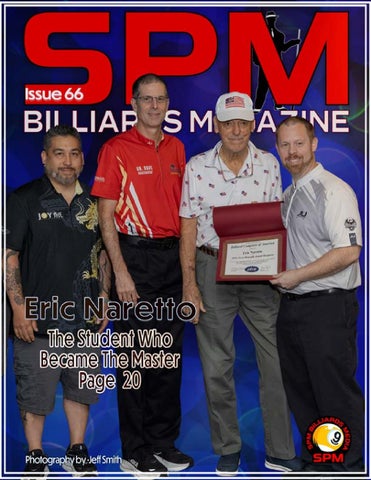
SPM BILLIARDS MAGAZINE ISSUE 66
CONTENTS
INSTRUCTION ARTICLES
POOL IS A GAME OF GIVE AND TAKE —BY ANTHONY BEELER WHAT DO YOU DO ABOUT LOSING? —BY MARK FINKELSTEIN SMOOTH SAILING—BY STEVE JENNINGS THREE AIM LINES CAN HANDLE NEARLY ALL SHOTS —BY STAN SHUFFETT IDENTIFYING COMPLEX CLUSTRERS —BY DR. DOMINIC ESPOSITO DOES STANCE MATTER IN POOL? —BY CHIP KLEIN
20 06 14 16 34 40 68
BILLIARD NEWS & REVIEWS
COMING HOME TO A MILESTONE —KAT BROWN DAY THE STUDENT WHO BECAME THE MASTER —BY KIM THE DRAGON YOUNG BEYOND THE POOL HALL WHY CUESPORTS DESERVES... —BY PHILLIP TAY TACTIQ CUSTOM HANDLE GRIP REVIEW —BY GARRET TROOP THE BAYOU BULLET REACHES THE SUMMIT AFTER... —BY BRIAN PAULEY THE FELT NEVER FORGETS —BY PATRICK SAMPEY FINDING THE SWEET SPOT: THE MID-DEFLECTION —BY GREG BUSH
10 20 38 44 48 52 56
16
FROM THE EDITOR Hey Pool Afficionados, From the Editor-in-Chief
It feels very special to be back with SPM Billiards Magazine for my first issue since Issue 50. Over the years, I’ve had the privilege of writing about remarkable people in our sport — from my first big interview with April Larson through my last cover story on Dennis Hatch, and so many unforgettable stories in between. Every interview has given me the chance to learn a small piece of someone’s life and share it with the billiards world, and that is something I’ve never taken for granted.
6
This summer brought another special moment for SPM: the Best in Billiards Awards named us the Best Billiards Instructional Publication of America’s first 250 years. You can read the full story, and a look back at our early video cover days, on page 10. SPM has always been more than tournament results and rankings to me — it’s about the players, instructors, photographers, room owners, promoters, writers, juniors, and everyday people who make up this community. I love this magazine, and I’m proud to once again be part of telling those stories. Thank you to everyone who reads, contributes, teaches, competes, or simply turns the page. I’m happy to be back, and I can’t wait to see where the next chapter takes us.
52
Till next time!
MORE 2026 INTERNATIONSL HEYBALL OPEN —BY JAYSON LYNCH
Keep Growing the Sport we all Love!
60
SOUTH DAKOTA’S TANNER PRUES NAMED 2026 ACS OUTSTANDING INSTRUCTOR OF THE YEAR—BY PRESS RELEASE
66
Happy Shooting, Kat Brown Day Editor in Chief and Content Creator
BILLIARD NEWS
SPM BILLIARDS MAGAZINE
3
4
SPM BILLIARDS MAGAZINE
SPM BILLIARDS MAGAZINE
5
6
SPM BILLIARDS MAGAZINE
POOL IS A GAME OF GIVE AND TAKE
O
ne of the biggest mistakes players make is believing there is a perfect solution to every situation on the table. Pool is often a game of compromise. The best players in the world understand that every adjustment requires another adjustment. Every advantage comes with a tradeoff. In other words, pool is a game of give and take. The sooner you learn to recognize these tradeoffs, the more consistent your game will become. Let’s start with bridge length. Many players assume that a longer bridge automatically creates a more powerful stroke. It typically does, but when you use a longer bridge, you are trading away valuable accuracy. A longer bridge increases the distance your cue travels before reaching the cue ball. That added distance can create more movement and more opportunities for error. Sometimes you may be positioned with a shot where you must reach a great distance to get to the cue ball. If you find yourself using a longer bridge, consider shortening your stroke length. By reducing the length of your backswing, you regain some of the control that may have been lost through the longer bridge. You give a little and take a little. Likewise, if a shot requires a longer, more powerful stroke, slow your backswing down dramatically. Most players make the mistake of increasing both stroke length and stroke speed. That’s a recipe for inconsistency. A longer stroke can be beneficial, but only if it remains controlled. Slowing the backswing allows the cue to stay on line and gives your body more time to remain stable during the delivery. The same principle applies to aiming. When faced with a long shot, many players stand higher and try to visualize the object ball into the pocket. Instead, get lower. The lower your eyes are to the cue, the easier it becomes to track the line of the shot. Getting lower means less eye movement. I also prefer using high center cue ball on many long shots. High center also reduces unnecessary eye movement. The simpler the picture, the easier it is to execute. Even bridge selection involves compromise. Sometimes a rail bridge is too long, and a conventional open or closed bridge is too short. In those situations, I often use what I call a “Tweener Bridge.” The Tweener Bridge combines elements of a rail bridge and a closed bridge to create a bridge length somewhere in the middle. Many players force themselves into one option or the other. The better solution is often found between the extremes. Many times, you might see a pro player take practice strokes with 3-4 different bridges before they find the one that suits them best. It’s all about giving up what might look good to gain something that works best. Decision-making works the same way. Whenever you face a difficult choice during a runout, don’t rush. The pressure to make quick decisions often leads to poor ones. Great players understand that the table isn’t going anywhere. Take a few extra seconds. Walk around the table. Consider your options. A poor decision executed perfectly is still a poor decision. The best players are often not the fastest thinkers. They’re simply the most thorough thinkers. SPM BILLIARDS MAGAZINE
7
This becomes especially important after ball-in-hand. One of the most overlooked moments in pool occurs immediately after receiving ball-in-hand. Many players become so excited about having control of the cue ball that they casually place it somewhere and continue shooting. That’s a mistake. The first shot after ball-in-hand is often the most important shot of the entire rack. Get extra close to your first object ball. Simplify the shot as much as possible. Create a natural angle that leads to an easy position on the next ball. Remember that position play tends to become more difficult as the rack progresses. Small errors accumulate. Angles change. Traffic appears. If things are likely to go downhill from there, make sure you start from the highest point possible. In other words, make your first shot a great one.
Anthony Beeler is the current
Another example of give-and-take occurs when choosing between offense and defense. Many players become so focused on making balls that they ignore the percentages. Suppose you have a difficult shot to win the game, but realistically, it’s only a 20% shot. At the same time, a lockup safety is available that is 99% effective and likely to give you another opportunity at the table. The inexperienced player often fires at the low-percentage shot because it’s exciting.
Billiards Instructor of the Decade
The experienced player understands that winning pool isn’t about making the spectacular shot—it’s about making the smartest choice. Sometimes you must give up the chance to be a hero in exchange for a much greater chance to win the game. Pool is ultimately a game of choices and compromises. The player who consistently makes the highest-percentage decision usually comes out ahead in the long run.
is the primary author of the ACS
Pool rewards players who understand balance. Sometimes you give up power for accuracy. Sometimes you sacrifice speed for control. Sometimes you trade a more aggressive route for a more reliable one. The strongest players aren’t always the ones who can do the most. They’re the ones who know what they can afford to give up to gain something more valuable. Pool is a game of give-and-take. Learn the tradeoffs, and you’ll begin making better decisions, executing more consistently, and winning more matches.
and is a former BCAPL National Champion. He has numerous “Top 25” national finishes and
National Billiards Instructor’s Manual. He has also authored the book Unstoppable! Positive Thinking for Pool Players. Anthony currently has the highest established Fargo Rating of any Master Instructor. He has won over 300 tournaments and has defeated numerous professional players in tournament competitions.
8
SPM BILLIARDS MAGAZINE
SPM BILLIARDS MAGAZINE
9
Coming Home to a Milestone By Kat Brown Day
B
efore anything else, I have to start with a thank you to Jake Sovey. Right out of college, fresh off earning my Master of Arts in New Media Journalism from Full Sail University, Jake was the one who got me started on this magazine as Editor in Chief and Content Creator. I worked alongside him for a year before moving on to work with Garret. I started with this magazine on Issue 22, back when it was still known as Sneaky Pete Mafia Magazine, with a cover on Jackie Karol I remember those angel wings! My next assignment was Issue 23, with Wonder Boy. From there I stayed on through Issue 50, closing out that run with a cover story on Dennis Hatch — and now I’m back, starting fresh with Issue 66. Welcome to the ride. Somewhere in between, I’ve had the privilege of sitting down with some of the most talented people in our sport and bringing home a small piece of their story to share with the billiards world. My first big interview was with April Larson, and since then I’ve had the honor of writing cover stories on Mika Immonen, Mike Panozzo, Sofia Mast, Sam “Ryno” Henderson, Pia Filler, Kelly Fisher, Ko Ping Chung, Ko Pin Yi, and Brandon Jacoby on the making of the winning cue The Medusa, among so many others. I wrote about Darren Appleton’s comeback after his heart attack, and told the stories of Alex Pagulayan, Jackie Karol, and Mary Avina. Every one of those conversations has been a privilege and mony more. some touching the heart heart a little more than others.
A Name Change, and a Mission That Never Did Somewhere along the way, the magazine progressed from Sneaky Pete Mafia Magazine into SPM Billiards Magazine. Some folks weren’t crazy about having “Mafia” in the title, so we rebranded 10
SPM BILLIARDS MAGAZINE
down to the initials — even though, letters aside, it never had a thing to do with the Mafia! The name changed. The mission never did.
Our Video Cover Era Long before video covers were common, SPM was already experimenting with them. As best I can recall, it began with Issue 17 and Eric Roberts — our first video cover — and that run continued through issues featuring Charles Lakey and April Larson before wrapping up with Issue 26 and Gloria Jean. At the time, it felt like a small experiment. Looking back now, it was the beginning of something SPM would become known for: using every tool available, print or digital, to tell the fullest version of a player’s story.
Thank You to the People Who Helped Me Grow None of this happens alone, and there are a few people I want to thank for my own growth in the billiards world, and for helping make SPM what it is. First, Garret Troop, the CEO of SPM Billiards Media, who I have stuck with through thick and thin. Garret is an avid pool fan and is remarkably knowledgeable about every product in this game, from his product reviews to his years playing and living in it. His passion for billiards is unconditional, and SPM is his dream and his life. It has been my pleasure to have a part in producing this magazine and creating content alongside him. Second, Dominic Esposito, known as The Drill Instructor, who puts out a weekly show called The CLINIC. I’ve helped Dominic with his social media along the way, and in return I’ve learned an enormous amount about the game from him.
And third, Patrick Sampey, a writer & friend who has helped me and opened doors to different pro players — and who has been my confidant in the wee hours of the morning, talking with me while I worked to get the magazine out while the rest of the world was asleep. Over the years, Garret, Dominic, Patrick, and I have teamed up at various times to interview pro players together for SPM TV — sometimes it was Dominic and me, sometimes Garret and me, sometimes Patrick and me. And I have to mention Mark White as well, who has also been a big help throughout the years. Mark does his own interviews for SPM TV, and I’ve had the pleasure of joining him for a few of those along the way. Along with so many other people I’ve met along the way, these four have played a large part in my growth in the billiards community.
Fourth of July, the Best in Billiards Awards announced their honorees, celebrating the greatest players, instructors, products, manufacturers, publications, and contributors in American billiards over the past 250 years. SPM Billiards Magazine was proud to be named Best Billiards Instructional Publication. Here is what they had to say about us:
The Award
SPM Billiards Magazine has been selected as the Best Billiards Instructional Publication of America’s first 250 years, honoring its commitment to player development, instructor recognition, community storytelling, emerging talent, and the continued growth of the game. SPM Billiards Media traces its roots to the Sneaky Pete Mafia community established in 2014 by Garret Troop. Its original mission was to use social media to bring pool players and billiards enthusiasts together, with the organization later developing into SPM Magazine and a broader multimedia platform.
Now, back to the Best in Billiards Awards. Around the
Since its creation, SPM has developed a distinctive
SPM BILLIARDS MAGAZINE
11
place within billiards journalism by focusing not only on professional champions and major tournaments, but also on the instructors, junior players, regional competitors, room owners, photographers, promoters, inventors, and industry personalities who form the foundation of the sport. The magazine has produced dozens of digital issues, featuring internationally accomplished players such as Mika Immonen, Kelly Fisher, Ko Ping Chung, Ko Pin Yi, Jeffrey De Luna, Tony Robles, and Alex Pagulayan. Its extensive archive demonstrates a sustained commitment to documenting both established champions and important contributors who may receive less attention from traditional sports media.
and supporting the game at the local level. What separates SPM from other billiards publications is its emphasis on participation and community — it recognizes instructors, introduces promising players, shares personal journeys, promotes educational content, highlights charitable and grassroots efforts, and helps individuals throughout the industry tell their stories.
Instruction has remained one of SPM’s defining strengths. Its issues have regularly featured educational material from respected billiards instructors and writers, including Anthony Beeler, Dominic Esposito, Steve Jennings, Rick Prince, Jackie Karol, and other contributors. These articles have addressed fundamentals, banking, aiming, strategy, practice methods, mental performance, and the technical development of players. SPM has also distinguished itself by formally recognizing excellence in billiards instruction, with honors including Pool Instructor of the Year and Pool Instructor of the Decade, helping instructors receive meaningful public recognition for their teaching, innovation, professional service, and influence on students.
We Weren’t the Only Ones!
The publication has embraced digital innovation throughout its history. SPM introduced interactive features, instructional videos, multimedia content, and what it described as the first digital billiards magazine to feature a video cover. This approach expanded the traditional magazine format by allowing readers to see instruction, interviews, and demonstrations rather than relying entirely on printed words and still photography. Its commitment to multimedia later expanded through SPM TV, created to share interviews and stories involving professional players, instructors, promoters, billiards businesses, and community figures from around the world, with a stated mission of strengthening the billiards community and sharing the stories of the people who contribute to it. SPM has also provided significant exposure to junior players, women competitors, regional tours, independent instructors, emerging professionals, and billiards entrepreneurs, helping readers understand that the future of billiards depends not only on major championship winners, but also on the people teaching, organizing, promoting, 12
SPM BILLIARDS MAGAZINE
As the United States celebrates 250 years since its founding, the Best in Billiards Awards proudly recognize SPM Billiards Magazine as the finest billiards instruction and community publication in American billiards history.
SPM shared the stage with some of the biggest names in the game. Here is the full list of America’s 250th Best in Billiards honorees: Best 9-Ball Player — Earl Strickland Best All-Around Player — Nick Varner Best Straight Pool Player — Willie Mosconi Best One Pocket Player — Efren “Bata” Reyes Best Bank Pool Player — John Brumback Best Female Player — Allison Fisher Best Entertainer — Minnesota Fats Best Pool Instructor — Anthony Beeler Best Billiards Event — Derby City Classic Best Billiards Cue — McDermott Cues Best Pool Table — Diamond Pro-Am Best Billiards Magazine — Billiards Buzz Best Billiards Instructional Publication — SPM Billiards Magazine Best Billiards Broadcaster — Bill Incardona Best Pool Case — Whitten Cases (Full list at bestinbilliards.org) This magazine has never just chased the biggest names or the latest tournament results. It has always been about the instructors, the junior players, the room owners, and the everyday people who keep this game alive at the local level — and I’m proud to have played a small part in that mission. It is a billiards magazine that I love, and I am proud to help create and put out. P.S. Thank You, Anthony Beeler, for the nudge!
WHAT DO YOU DO ABOUT LOSING?
How to bridge the gap between practice and performance! Does this scene seem familiar? You lose a set 3-2 and missed a long back cut that cost you a game. The next day (or hour), you shoot that shot 50 times and think you finally have it. But what you did not look at was the bad position that left that hard shot, the break that you scratched on, and the three poor safeties that let your opponent back to the table. All those “little” errors add up, and in most cases we rarely, if ever, practice those “unimportant” things.
For example, what is the most important shot in Nine Ball? You would say the break. And how do we decide who will break? We lag! Yet how many of you practice the lag? Not enough of you, for sure. In this article, I want to look at a tool that will help you decide to go for the shot or play safe. I am sure most of you are taking on shots that have a low percentage for you, only to sell out and lose the game or match!
14
SPM BILLIARDS MAGAZINE
First to consider is your expectations. A lot of what we watch on YouTube is curated to show only the best! We do not get to see all the misses and bad positions. We get a false sense of what is doable. This article will help you decide when to play safe and when to go for the shot. The tool we will use to make this determination is called progressive practice. Here is a shot that many people have a problem with: Instead of shooting this shot, missing a lot, and getting frustrated, start with a much easier shot. If you make this shot, move back a half diamond. If you miss, move a half diamond closer. At the end of 15 shots, you know the distance you can comfortably make the shot, and the distance where your accuracy breaks down! This knowledge is valuable in two ways. First, knowing where your shot-making breaks down is crucial for deciding when to play it safe and when to go for the shot! I try to play no-miss pool, meaning I take shots I know I can make most of the time, and when I do not feel comfortable, I play a lockdown safe to keep control of the table. The next important thing is that you now know where you must start working to improve your skill! Winning games and matches are not only related to your skill set, but also the choices you make given the skill set you have while you are playing. Progressive practice helps you make better decisions during competition and improves your skill set over time!
SPM BILLIARDS MAGAZINE
15
M
Smooth Sailing
ost of my time in the military was spent on a ship in the Atlantic Ocean. One thing you learn very quickly is that a ship’s motion depends on how smooth the water’s surface is; it affects how the ship rides. Smooth water provides a gentle, easy rolling motion. But when the waves get bigger, the ride gets rougher. So what does that have to do with pool, you might wonder? Just as waves on the water can make for a rough boat ride, waves of emotion can disrupt a smooth, controlled pool game. Emotions not only disrupt your mental process, but also affect you physically. Positive emotions release dopamine, which can lead to overexcitement. The euphoria of making a great shot can cause overexcitement and take you out of your rhythm. Frustration or anger can give you a jolt of adrenaline and cause muscles to tighten. Neither of these is helpful to your pool game. The good news is that your body can also release serotonin, which helps counteract other chemicals and smooth out those waves. So how can you help yourself maintain that calm when you’re playing a match that can frequently 16
SPM BILLIARDS MAGAZINE
create those emotional waves? The number one weapon is your own mindset. You need to keep your composure at all times. The way you react to a shot is important. Whether or not a shot went well, you need to stay calm. Jumping up with an excited fist pump is almost as destructive to the calm as losing a match because of one bad shot. They might miss an easy 8-ball and let it carry over into the next game, resulting in more mistakes. That’s when things start to snowball, and that one rogue wave becomes a serious storm. The best plan is to always put your last shot behind you. You can’t be focused on your current shot if you’re still thinking about your last shot. And about that serotonin thing: it’s the chemical that has a calming effect. It helps make those big disruptive emotional waves settle down. It’s not that difficult to activate it on demand. The key is to pause and take 4 or 5 deep breaths. When you feel your emotions rising, this is the best way to bring yourself back to a more controlled mental and physical state. Successful pool playing requires clear thinking. Emotions can sidestep clear thinking. We all need to be aware of our emotions in competition
and work to keep them under control. It’s not always easy, but it’s necessary if you want consistency in your pool game. You can have textbook mechanics and tons of knowledge about pool, but your mental state can cost you losses that otherwise might have been wins. Many of us put in long hours on the practice table. Few players spend as much time training our minds to work at a higher level. Those who do will find a higher level of more consistent, successful competition. Keep your emotions in check, stay focused on the next shot, and let your mental game support your physical game. Until next time. Steve Jennings ACS/SPFPBIA Master Instructor Playing Pool since the age of 10, first learning on a table at home and then in Pool rooms a few years later, I won several base championships while in the service. After my discharge, I continued to play recreationally and in several regional tour events. I started coaching and teaching game strategies in the 90s. I worked with several Master instructors and reached Master instructor status in 2015. Now Director of Training for the Southeastern Billiard Academy, I teach classes as often as I can. I train/certify new instructors and look forward to helping every player achieve their fullest potential. SPM BILLIARDS MAGAZINE
17
THE STUDENT WHO BECAME THE MASTER A CELEBRATION OF ERIC NARETTO AND HIS HISTORIC MILESTONE OF BEING THE FIRST AND ONLY INSTRUCTOR TO HOLD BOTH PBIA AND ACS INSTRUCTOR OF THE YEAR AWARDS SIMULTANEOUSLY Interview by Kim “The Dragon” Young
The Jerry Briesath PBIA Instructor of the Year Award celebrates the elite coaches shaping the future of cue sports worldwide. Named after the legendary “Father of Billiard Instruction,” this annual honor by the Professional Billiard Instructors Association (PBIA) recognizes individuals who demonstrate exceptional dedication 20
SPM BILLIARDS MAGAZINE
ERIC NARRETTO AT THE PBIA CONFERENCE PHOTO BY JEFF SMITH
to growing the game, refining player fundamentals, and mentoring the next generation of players. I had the opportunity to talk with this year’s award winner on what makes this award the highest honor in cue sports instruction and why he earned it. SPM BILLIARDS MAGAZINE
21
22
SPM BILLIARDS MAGAZINE
Shaping the Game: Inside the PBIA Instructor of the Year Award Every sport has its architects—the masterminds who work behind the scenes, breaking down complex physics into smooth, repeatable human motion. In the world of pool and billiards, some of those architects belong to the Professional Billiard Instructors Association (PBIA). And once a year, the organization honors one standout teacher with its highest accolade: The Jerry Briesath Instructor of the Year Award.
SAMM DIEP , VIDAL, KIM YOUNG, DR-DAVE ALCIATORE JERRY BRIESATH, ERIC NARETO, PHOTO COURTESY OF KIM THE DRAGON YOUNG AND USA CUE SPORT
A Legacy of Excellence amed in honor of BCA Hall of Fame inductee Jerry Briesath—a man who dedicated over half a century to N codifying billiard instruction—the award is not merely about who has the most advanced students. It is about impact. he selection committee looks for instructors who embody Briesath’s passion: building the sport from the T ground up, innovating training techniques, and expanding the game’s footprint globally. From local pool rooms to international training academies, the recipients of this award represent the gold standard of cue SPM BILLIARDS MAGAZINE
23
sports mentorship. What it Takes to Win Earning the title of Instructor of the Year requires a resume that transcends basic mechanics. The PBIA sometimes evaluates nominees on several key pillars which look beyond the worsted cloth: outh Development: A heavy emphasis Y is placed on growing the sport among junior players. Past winners, such as South Africa’s Galiek Saville and standardbearers like Samm Diep and Roy Pastor, have been widely praised for their work at
the Billiard Education Foundation (BEF) Junior Nationals and bringing structured programs into schools. ommunity Impact: Instructors who use billiards as a tool for social good, such as providing positive outlets C for youth in underserved or high-risk communities, providing free instructional clinics to promote billiards education, and donating to deserving organizations to heighten the sport overall. echnical Innovation: Developing new training materials, embracing digital coaching platforms, or T published instructional guides that make the game accessible to the masses.
24
SPM BILLIARDS MAGAZINE
The Ripple Effect on Cue Sports hy does this award matter so much to the industry? Because good coaching alters the trajectory of the W entire sport. H istorically, pool was a game passed down through folklore, trial-and-error, and occasionally bad habits. The PBIA—and the elite instructors recognized by this award—have changed that narrative. By implementing rigorous, video-analyzed, and biomechanically sound training methods, they are turning casual hobbyists into precise competitors. When a PBIA instructor is honored, it isn’t just a win for their personal Who is Eric Naretto? Q: This interview is focused on your accolades as an instructor of course, but I know you are many things to many people. So, outside of being an award winning instructor and state/regional/ national champion player, who are you or what would you like people to know about you? A: I am a father to my two wonderful children. Maeve is my daughter, she is 5 and Lance, my son, is 2 and a half. I have been married to my wife Amanda for 7 years and together for 11. I teach Health and P.E. at a local Jr. High School. I coached Baseball for 18 years and I also have a Social Studies degree. Q: What pool organizations are you affiliated with and what certifications do you hold? A: Since 2013 I have been affiliated with the American Cuesports Alliance (ACS) where I serve on 3 committees. I am a level 4 instructor with the ACS as well. Last year, I received the inaugural ACS Outstanding Instructor Award. In 2021 I joined the PBIA and became a Master Instructor there in 2023. I am 1 of 23 instructors in the country endorsed to teach CTE Pro One. I am endorsed through SPF, coined by PBIA original instructor Randy Goettlicher. I am also one of 2 Instructors in the country certified to teach the UK SightRight program. The other is you! Q: SightRight is definitely exciting, my students are achieving things they previously couldn’t for sure. Speaking of international ideas, we were just together in Dubuque, IA at the 2026 International Certified Instructors Summit–man what a great event that was–and you did an outstanding job as the Master of Ceremonies. You also gave an acceptance speech in which you shared gratitude to many people both on and off the table for helping you on your journey, and you got a little emotional when thinking about some of those people who aren’t with us anymore. It was really a beautiful moment that most of the readers of this magazine weren’t there to hear or see. Can I put you back into that space for just a moment to once again share your sentiments? A: A lot of emotion there. I told myself that I wasn’t going to cry. My mom passed away in March of this year and it has been very difficult for me. Even when she didn’t agree with the things I was doing, she was still so supportive of my goals. I wanted so badly to bring her this award to show her that I did what I set out to do. But unfortunately her time came before it could happen. I know she was there, I just would have loved to see her smile. The other person’s name was George Sweitzer. George was my first mentor in the game back in 2006. Great guy. He was there for me in ways I didn’t even realize. He straightened me out as a teenager and was the honorary best man at my wedding. He passed away in 2019. When I met George he was 68 years old. SPM BILLIARDS MAGAZINE
25
Not many young people could say that one of their best friends were in their 70s. I miss him, and my mom every day. Q: You’re being honored at the pinnacle of your career but as a young instructor and student of the game, there is no doubt that you haven’t peaked yet and I’m excited to see what else the future holds for you. What sorts of things are you doing to continue improving yourself as a player and instructor? A: I try to take a lesson from someone different every 6 months. One lesson as a player and one lesson as an instructor. I am currently seeking training in other countries to further my education and ability. The Big Picture & The Award Q: What does it mean to you personally to receive an honor named after a legend like Jerry Briesath? A: Jerry is the original American Instructor. He laid the foundation for generations of American Instruction. To know that my name is even in the same universe as him is something that I haven’t fully wrapped my head around yet. I see so many people that are worth of this award, and to know the people I stand with currently is a blessing that I don’t take lightly. Q: Last year you were honored with a similar award, the 2025 ACS Outstanding Instructor of the Year. Not only were you the first ever recipient of that award, but with this year’s 2026 PBIA Instructor of the Year award you became the first--and so far only--to ever hold both accolades. How does this make you feel? A: Blessed. I work hard. I always have. I’have always felt that not many people out there can “outwork” me. The ACS is my home. It is where I got my start. It is where I received my.state and national championships. Im happy the ACS saw how hard I was working and am glad I could be recognized by the organization I started my career in. Q: Most great instructors have a turning point where they transition 26
SPM BILLIARDS MAGAZINE
Photos for article provided by Kim Young & Eric Naretto
their primary focus from being a great player to a great teacher. When did that shift happen for you, and what sparked it?
have some crossover there into billiards instruction and maybe coach your players into proper nutrition, exercise, sleep, etc? What does that look like?
A: It happened when Lance was born. I realized that with 2 kids, I needed to be present, and traveling all over the place while my wife stayed home with our kids was not the best choice. My love of my family made me realize that I enjoyed teaching more than playing. I have more freedom teaching and teaching is 1,000% more rewarding.
A: 100%. Those things are completely overlooked in this sport. I am constantly and respectfully looking out for my players health and sometimes may be a little too blunt. I have built nutrition plans as part of my students training that includes sleep routines and exercise.
Q: When you look at the banner of past recipients, what do you think defines this specific era of billiards instruction and why do you think you were chosen to be awarded this honor? A: Personally, I feel like it was time for some young blood. I am the youngest person to ever receive the Jerry Briesath PBIA Instructor of the Year Award. But in that young blood. My mind is combined with many old spirits and great minds. I think I was chosen because of my constant need for information. I never settle. My motto has always been you don’t know what you don’t know. The best teachers are the best students. Teaching Q: You mentioned earlier being a middle school physical education teacher. Is it safe to assume you
Q: Billiards is famously as much a mental game as it is physical. How do you integrate mental performance and mindset coaching into a player’s physical routine? A: Pre-shot and post-shot routines are crucial. Humans are creatures of habit, except in pool apparently haha. We have to constantly teach a routine. There is even a routine to follow when you’re in the chair while the other person is at the table. A strong routine helps keep a calm mind. Q: What is the single biggest misconception amateur players have about developing a consistent, repeatable stroke? A: Hitting 1,000 balls will make you better. The only thing hitting 1,000 balls will do is reinforce the habits you have created while making some shots every once and a while. SPM BILLIARDS MAGAZINE
27
Q: With the rise of online learning, video analysis, and digital tools, how do you balance cutting-edge technology with traditional tableside, hands-on instruction? A: I use a lot of pictures and videos but I also use mirrors. Instructors and teachers must find out how each student learns and use any of what you described above to connect to that learning style. I am constantly changing my lessons to match my students’ learning styles. Some get that technology, others don’t because they won’t learn well using it. Q: You know me, my knowledge, and my teaching style pretty well. Please try to teach me something you think I don’t know, with the understanding there’s a good chance most of the readers will learn something from it too: A: This game is so hard to go at it alone and raise yourself. The people who are putting people in the box (gambling) are NOT putting you in the box to help you’re mental game. They are doing it to make a buck. If you
can’t play hard for free and have to play for money to get “serious”, that is a mental problem and you have told yourself its not. Tournaments or gambling, you get the same game with me. Pool is pool. Train your mind to be the impossible dream and learn how to give 100% for absolutely no reward. Those players are the best players. Player Development & Legacy Q: You coach players of all levels, from beginners to advanced competitors. How do you adapt your communication style when a student hits a frustrating development plateau? A: The college degree kicks in. Sometimes I say “Give me a few minutes to think of a different way to help you.” Its okay for the teacher to take a break. He’ll, if they aren’t, I argue they try and push the same format on you just slower. It is my job to adapt my teaching to the needs of the student. Q: Have you ever had a student who you felt like you couldn’t help, and if so, what did that look like and how did you and they handle it? 28
SPM BILLIARDS MAGAZINE
A: No. With that being said I have had students who have told me they couldn’t help me. I have also fired students before because they wouldn’t put in the time to practice or had a poor work ethic. I’m not here to waste my time and I don’t want you to waste your money. I am here to genuinely work with you to better your pool game. Q: What is the most rewarding breakthrough you’ve witnessed in one of your students recently? A: I had a player who had never broken and ran a rack in league take 1 SightRight course with me and the following night in league he broke and ran two racks of 8-ball. Q: Looking forward, what do you see as the greatest challenge—and the greatest opportunity—for the next generation of pool instructors? A: The greatest challenge is in the parents of the people they will teach. Parents have opinions that they pass on to their kin. We are in a generation currently of many people who think they know everything. The younger kids are showing that as well. They are going to grow up.and have kids of their own and many of them will be difficult and don’t even know it. Because of this, we need more educators in our instruction. The greatest opportunity is to breed a new American player. Coaching is becoming more accepted in our culture now here in the US. That’s good for our future.
SPM BILLIARDS MAGAZINE
29
Rapid Fire Q: If a player only has 30 minutes a day to practice, only 3 days a week, what would you want their practice session to look like to maximize and maintain improvement? A: Stroke training. 1 day on the spot with no cue ball working a straight line. 1 day with a cue ball shooting only the cue ball into the pocket while working a straight line. 1 day working a cue ball, object ball relationship while still working a straight line. Q: What is the best piece of advice you were ever given about the game? A: If you aren’t shaking, you don’t care. Never lose the shakes. Q: Fill in the blanks: “A great pool player..., but a great pool instructor...” A: A great pool player executes what’s necessary, but a great pool instructor guides the player to make the proper decisions to execute what’s necessary. Q: What is your ultimate mission as a billiards instructor? A: To gather as much information as I can, make sure I can explain it, and use that knowledge to guide players on a bell high bell curve of improvement.
Q: What do you enjoy more about being an instructor than a player? A: The gratification of other players enjoying the game as I once did. Q: Reverse question, what do you enjoy more about being a player than an instructor? A: I don’t anymore. You finally got me to admit it! But if I have to say something, its seeing the people I like that I don’t see very often. Q: What would you like people to know about billiards instruction as a whole? A: The majority of us always have the students’ best interest at heart. We want to see you improve and many of us truly have tools to help you do so rapidly. Q: What would you like people to know about getting billiards instruction from you? A: I take the lessons so you don’t have to. I travel the country seeking info, so you don’t have too. If you have questions, I have answers, and if I don’t… I’m going to find the answer. If you want 30
SPM BILLIARDS MAGAZINE
an instructor that truly wants nothing more than your success and your smiles, look me up. We can get you where you want to be… together. I feel incredibly honored that SPM Magazine asked me of all people to interview and write this article on Eric.
One thing I think all great coaches have in common is that we care more about our student’s successes than we do about our own achievements. Beyond being a great colleague, Eric and I have been close friends for several years and he is one of the finest graduates of my school Dragon Billiards Instruction, having earned both his Advanced and Master certifications here. Last year I was overjoyed to be the recipient of the 2025 Jerry Briesath Instructor of the Year Award. Today I am even more proud to celebrate his success than I was of my own, because I know my “grand-students” are in great hands with Eric and I encourage anyone who hasn’t tried professional billiards instruction yet to give Eric a try! Kim “The Dragon” Young. MPM PBIA Master Instructor, 2025 PBIA Instructor of the Year ACS Level 4 Instructor, Doctorate of Online Billiards Instruction SightRight Accredited Coach, Senior Instructor at Billiard University Train Better. Do Better. Shop Better. DragonBilliardsInstruction.com Photos for article provided by Kim Young & Eric Naretto SPM BILLIARDS MAGAZINE
31
H
al Houle shook up the pool world nearly three decades ago when he stated online that three aim lines can handle nearly all shots. What I can tell you about Houle’s remarkable claim is that the top pool thinkers of that time were not prepared to entertain anything of the sort. Upon seeing Houle’s aiming declaration, the academic minds of the day were quick to tag his claim as impossible and nothing more than fantasy and foolishness. Aiming had long been recognized as all feel, with three exceptions: zero-angle cue-ball-object-ball relationships, half-ball aiming, and edge-to-edge alignments. The floor was simply not open to further discussion concerning aiming. Minds were made up that aiming belonged to the feel domain. In response to man’s conclusion that aiming was practically all feel, Hal Houle let loose with one of his favorite words, “Hogwash!” Houle will go down as a giant in the world of aiming. He did not accept the premise that aiming had to be an exercise of feel. Houle was armed with mindbending motivation to solve aiming and free it of its “subjectivity” label. Houle emerged from his extensive study with a realization that a mere trio of aim lines could handle nearly all cue ball-object ball relationships on a 2 : 1 surface. The unthinkable materialized. Houle had solved aiming!
A Bit of Center-to-Edge Aiming History When Center-to-Edge Aiming (CTE) first came onto the pool scene, it was very misunderstood. Houle purposefully portrayed CTE as a one-perception system in which a half-ball visual alignment, followed by a pivot to the center of the cue ball, 34
SPM BILLIARDS MAGAZINE
would make nearly all shots into the center of the pocket. He was correct. One perception can handle nearly all cue ball-object ball relationships to a rightangle location. But there was a problem. His oneperception alignment would almost always lead to a pocket, but quite often not to the desired pocket. That approach was just not suitable for professional play. To use a half-ball perception for all shots, a player would have to execute an inordinate amount of bank shots. It would be an extreme challenge for a professional player to run nine balls with a single perception, in this case, the half-ball visual known as the 30. Houle knew that for a player to truly understand Center-to-Edge Aiming, it was essential to grasp how a half-ball perception connects to the right angles of a regulation table. Houle was aware of the limitations of using a single visual, which is why he published his Three Angle Aiming document online. He had purposefully separated the perception domain from the aiming domain to stir up a bit of controversy. I was the first instructor to combine Houle’s Centerto-Edge perceptual information with his three-angle aiming work. Combining the visual domain with the aiming domain completes the framework for the ultimate professional system that makes nearly all shots objectively into the center of a pocket. His aiming and perception information are now indelibly linked, never to be separated again. The 15-, 30-, and 45-degree angles will forever be known for their split personalities. On the one hand, each of those numbers, as a component of CTE, has definable, objective aim lines, while on the other hand, each of those numbers refers to a perfect perception that can be seen by gearing a cue-ball-object-ball
relationship. You can start your journey in CTE with a bit of three-angle aiming.
A cue ball has two edges for aiming, and they’re always located in the same place. There are three aim points on the object ball to aim at. Those three aim points always face the cue ball, not the pocket. The three aim points on the object ball are located at the two quarters and the center.
Directions For Simple Three-Line Aiming: For left cuts, aim the left edge of the cue ball to one of the object ball aim points. For right cuts, aim the right edge of the cue ball to one of the object ball aim points. Shots that appear to be straight-in are always solved by using an A or C aim point. For very thin cut shots, aim either the left edge or the right edge of the cue ball to the appropriate one-eighth side of the object ball. For extremely thin-cut shots, aim one of the two edges of the cue ball near or to the cutting edge of the object ball.
Left Cue Edge to Object Ball Aim Point A (15)
At first, three-line aiming is best implemented while standing. Stand like you always do, but turn your nose very slightly toward the cutting edge of the cue ball. To aim, visually gear the appropriate cue ball edge to the desired aim point on the object ball. Your outside vision line will reveal the shot line solution. Then just fall into full stance like you always have and shoot. The previously noted directions for three-line aiming are for getting your feet wet only. The scope of this writing is limited to the aiming component of the Center-to-Edge phenomenon. It’s important to emphasize that the quintessential center-to-edge visual, the “30,” cannot serve as a one-perception alignment approach. The following cue ball-object ball relationship sets the stage as to why a perceived sight line from the center of the cue ball to the outer edge of the object ball cannot be employed as a viable one-perception professional system.
Right Cue Ball Edge to Object Ball Aim Point B (30) SPM BILLIARDS MAGAZINE
35
The cue ball is on the foot spot, and the object ball is on the center spot. A 30 inside is the solution for the cut shot to the upper left corner pocket. A 30 outside pockets the ball as a one-rail bank to the lower left corner pocket. That’s it for the 30s unless the shots are mirrored for the right side of the table. Consider the following two shots. To pocket the object ball as a left cut two-rail bank to the upper left corner, a 15 outside is a necessary solution. To pocket the ball as a left cut three-rail bank to the lower left corner pocket, a 45 inside is required. The 30 is a powerhouse of a visual, but to use it full-time would require too many adjustments for a player of any magnitude.
The Professional Way! Three Aim Lines!
The orientation of the aim-point letters is always left-to-right: A, B, and C. The balls in the yellow group are 15s. Each shot is solved with a cue ball edge aimed at the object ball aim point A or C. The balls in the green group are 30s. Each shot is solved with a cue ball edge aimed to object ball aim-point B. The balls in the red group are 45s. Each shot is solved by aiming the left cue ball edge to the object ball aim point C.
Stan Shuffett is the world’s foremost authority on Center-to-Edge Aiming. In 2011 and 2013, Stan produced two top-shelf CTE videos: “Stan Shuffett Presents PRO ONE and Basic Center-to-Edge” and “Stan Shuffett’s CTE PRO ONE: The Final Chapter”. In 2021, Stan authored “Center Pocket Music: Using CTE PRO ONE to Improve Your Pool Game”. Shuffett is a master instructor and has been with the PBIA since its beginning in 1992. He specializes in individual instruction at his private teaching facility in Greensburg, Kentucky. Stan’s website is www.justcueit.com.
36
SPM BILLIARDS MAGAZINE
A
sk a parent in Singapore what comes to mind when they hear “billiards” or “pool,” and you’ll rarely hear the word “sport.” More often, it’s a smoky hall, idle teenagers, and a way to kill time — not somewhere you’d enroll an eight-year-old for structured development. That perception isn’t entirely unearned; it’s the image cuesports inherited from decades of recreational play in bars and social clubs across Asia. But it’s also decades out of date, and it’s costing children a genuine opportunity.
The sport was always there — we just didn’t see it Cuesports has a governing body, a national team, and a competitive ladder in almost every country that plays it seriously. In Singapore, Cuesports Singapore has overseen the discipline since 1892, making it one of the oldest sporting bodies in the country. It selects national players to represent Singapore internationally, in exactly the same institutional structure that badminton, table tennis, and swimming operate under. This isn’t a fringe activity waiting for legitimacy — it already has it. What’s been missing is a way for parents to see that legitimacy, because the sport was never packaged for them the way youth football or swimming lessons are. The results speak for themselves at the highest level, too. Singapore’s own Aloysius Yapp has reached worldchampion status in pool — proof that a pathway from a local table to global recognition genuinely exists, not just in theory but in practice.
What the game is actually training Set aside the table and the balls for a moment, and look at what a child is doing during a genuine cuesports lesson: calculating angles and predicting the physics of spin and momentum before every shot, holding total concentration across a single frame that can run twenty minutes or longer, and absorbing visible failure — a missed shot, in full view of an opponent — without losing composure. That combination of spatial reasoning, sustained attention, and emotional regulation is precisely the profile that chess and Go academies have used to win over Asian parents over the last decade. Cuesports offers the same cognitive workout, with an added physical dimension: fine motor precision. Cueing is a repeatable, controlled hand-eye movement refined over hundreds of hours, closer in demand to archery or golf than to anything associated with “hobby” status. 38
SPM BILLIARDS MAGAZINE
This is the case we make to parents directly: cuesports is not competing with chess for a child’s time — it’s offering the same mental training, plus motor skill development chess doesn’t touch.
The real competitor isn’t another sport — it’s the screen Here’s the more urgent argument, and the one that resonates fastest with parents today. The realistic alternative to a structured activity isn’t usually another sport — it’s a phone or a console. Screen time is solitary, sedentary, and built to reward reflex over patience. A cuesports lesson asks for the opposite: a child standing, moving around a table for the full session, working alongside a coach and a peer group, and being rewarded for planning and restraint rather than speed. Framed this way, a well-run cuesports academy isn’t asking parents to choose a niche pastime for their child. It’s offering a screen-free, socially engaged alternative that still holds a child’s attention — arguably the hardest thing to find for this age group right now.
Removing the stigma requires more than a rebrand Changing minds takes more than better marketing; it requires visibly different structure. That means youthonly class times, entirely separate from adult recreational play. It means certified coaching against a defined curriculum, not informal instruction picked up ad hoc. It means a written code of conduct, a dress code, and a training floor that is alcohol- and smoking-free during every academy hour. And critically, it means a graded pathway — tiers a child can be assessed against and progress through — so a parent can answer the question that any serious sport should be able to answer: where does this lead? For cuesports, that answer already exists: through structured tiers of technical development, toward interschool recognition where available, into national junior ranking events, and — for those with the talent and dedication — toward the same national squad pathway that produced a world champion.
A sport worth taking seriously The negative image of cuesports in Asia was built by circumstance, not by the sport itself. Strip away the poolhall setting and what’s left is a discipline with real governance, a real competitive ladder, and a genuine claim to building focus, precision, and composure in a generation of children who are otherwise spending that time on a screen. Parents don’t need to take a leap of faith to believe that. They need to see the structure — and once they do, the case makes itself. Phillip Tay 2026
SPM BILLIARDS MAGAZINE
39
Identifying Complex Clusters
M
ore often than not ever game of pool has balls get clustered. When you know what to do about them, you have a powerful advantage over your opponent.
Just waiting until you can’t make a ball is not the time to think you’re on defense. You’re too late and being late to know when you’re on defense can easily cost you that game and possibly the match.
Cluster can be used as blockers to play defense. They determine which suite of balls to choose playing 8 Ball. Some clusters give advance notice when a rack can or can’t be run out. Clusters can reveal patterns to play. Depending on your knowledge base from both training and experience, clusters can be helpful and they can be frustrating.
You have to say “YES” to all five questions to remain on the offensive.
This month, I want to teach you to identify Complex Clusters “CCs” and show ways to use a CC to determine when you should be on offense or defense. Playing 8 Ball. After the break, look over the table and answer the following 5 questions.
Eventually, you’ll see the table and answer the 5 questions in seconds. Remember, when you say “NO” to any one of the 5 questions, shift your playing strategy to shoot a defensive shot and get better control of the table and your opponent. This is a way to get ball-in-hand when you come back to the table. It is not necessary to make a ball every time you are shooting to win the game. It is NECESSARy is to always be CONTROLLIng THE TABLe AND YOUR OPPONENT.
Let’s focus on the first of the 5 questions, is the table is clear of complex clusters? It is so common to overlook CCs when you don’t know how to see 1. Is the table clear of Complex Clusters (CC)? 2. Is the 8-ball open to a pocket or accessible to win? them all. Additionally, if you always try to run out and miss a CC after it’s too late, your opponent can 3. Do I have a clean open first shot? take advantage by having more balls on the table 4. From that first shot, do I see a pattern to run out and force you into giving up ball-in-hand through a the game? series of blocking safeties. 5. Do I have the confidence that I can run out that pattern to win? The table shown illustrates some often-overlooked CCs along with comments about the game they are If you answer “NO” to any one question, you’re on likely to show up in. defensive. The 5 Questions are:
40
SPM BILLIARDS MAGAZINE
CCs can be balls that are close in proximity or spread-out diamonds apart. Sometimes it’s a ball that’s obstructing a path to the pocket, i.e., a stripe ball blocks your solid ball. In a rotation game a numbered ball obstructs the one ball that is in play. A combination shot in one game is a CC in another. Clusters happen in many ways, and you can be sure they come up in any competitive game . When playing 8-Ball, before every shot ask the 5 questions. Remember, when you see that a CC hinders you from running out, you’ll have the advantage form knowing how to plan in advance your defensive play. In short time, you’ll learn to scan the table, see any CCs, and answer the 5 questions in seconds. For now however, every inning you come to the table start with all 5 questions until it becomes second nature to you. Look at these four ball layouts and read the notes to each one understanding how you can determine if a layout would be classified as a CC. Notice how what qualifies as a CC for an 8-Ball game may not qualify for a 9 or 10 Ball game. The entire collection of drills, shots, and strategies from The Drill Instructor in Table Layouts, Drill videos, and Technical Training classes are NOW available on DI-TV. Go to the website https://thedrillinstructor.us/ and check it out. The Drill Instructor, aka, Dr. Dominic Esposito
SPM BILLIARDS MAGAZINE
41
TACTIQ CUSTOM HANDLE GRIP REVIEW BY GARRET TROOP When Maximum Control Matters Most
It is the shot that sets the tone for the entire rack.
In today’s billiards market, players are constantly searching for the next breakthrough—whether it’s a low-deflection shaft, a high-performance tip, or a technologically advanced break cue capable of generating explosive cue ball speed. Yet one of the most overlooked aspects of cue performance is also one of the most important: the player’s connection to the cue itself.
A powerful, controlled break can determine whether a player starts with an open table and offensive opportunities or immediately finds themselves playing from behind. Modern professional pool has elevated the importance of the break to the point where players invest thousands of dollars in specialized break cues, premium tips, and advanced shaft technology—all in pursuit of generating a few extra miles per hour and improved cue ball control.
That connection begins and ends with the grip. After spending considerable time with the TACTiQ Custom Handle Grip, it’s clear that this isn’t simply another accessory designed to add visual appeal to a cue. Instead, it is a purpose-built performance upgrade designed to improve traction, control, and confidence when delivering powerful, highspeed shots.
Yet many players overlook one simple factor: maintaining complete control of the cue throughout the acceleration zone. That is where the TACTiQ grip earns its place. Built for Performance
The first thing players will notice is the grip’s unique And nowhere is that more important than on rubberized construction. Unlike traditional wraps the break. that primarily focus on appearance and comfort, the TACTiQ grip is designed with traction as the priority. The Importance of Grip in Modern Pool The material provides an immediate sense of security Every player understands the significance of a quality in the hand without feeling overly tacky or restrictive. stroke. We spend years developing timing, rhythm, Instead of forcing your grip pressure to increase and consistency. However, all of that technique during power shots, the textured surface allows the ultimately transfers through one point of contact— cue to remain stable naturally. our hand on the cue. During testing, the grip consistently provided a Under normal playing conditions, a traditional linen confident, locked-in feel without sacrificing stroke or leather wrap may provide all the grip a player fluidity. Whether breaking, jumping, or executing needs. But when the intensity increases and players powerful draw shots, there was never a sense that the begin generating maximum cue speed, particularly cue might shift or rotate unexpectedly in the hand. during break shots, the demands placed on that connection become significantly greater. This may seem like a subtle advantage, but experienced players understand that confidence The break is not just another shot. often translates directly into performance. 44
SPM BILLIARDS MAGAZINE
When you trust your equipment, you commit more Modern breaking techniques place tremendous fully to the shot. demands on equipment. Players are accelerating faster than ever before, chasing optimal rack spreads Three Thickness Options for Personalized Feel and controlled cue ball movement. Every component of the cue system matters. One of the strongest aspects of the TACTiQ system is its availability in three distinct thicknesses. The TACTiQ grip provides an extra layer of confidence precisely when players need it most. Rather than forcing players into a one-size-fits-all solution, TACTiQ allows users to tailor the feel of During power breaks, the enhanced traction allows their cue handle to their individual preferences. players to focus entirely on timing, acceleration, and cue ball contact rather than maintaining control of the 0.02” Thickness cue. The grip remains secure even under aggressive For players who prefer a traditional cue diameter and acceleration, helping create a more connected feeling want the least amount of change to their existing throughout the entire motion. setup, the thinnest option offers enhanced grip while maintaining a familiar feel. That additional security may seem minor on paper, but anyone who has competed under pressure 0.05” Thickness understands that small advantages often produce This middle-ground option will likely appeal to the meaningful results. widest range of players. It adds a noticeable amount of cushioning and grip without significantly altering The grip also helps dampen some of the vibration the overall handle diameter. generated during hard breaks. While it doesn’t eliminate feedback entirely—and shouldn’t—it softens 0.07” Thickness the impact enough to create a more comfortable The thickest option delivers the most substantial feel overall experience. in the hand. Players who prefer a fuller grip or those seeking maximum traction during aggressive break Simply put, the harder you break, the more you’ll and jump shots may find this version particularly appreciate what this grip brings to the table. appealing. Final Verdict The ability to choose between these options makes the product accessible to virtually any playing style The TACTiQ Custom Handle Grip addresses a and hand size. need many players don’t realize they have until they experience it firsthand. Professional Installation, Professional Results It doesn’t claim to add miles per hour to your break The installation process is straightforward for an or magically improve your fundamentals. Instead, it experienced cue maker, and once installed, the grip enhances one of the most critical yet often neglected integrates seamlessly into the cue’s handle section. aspects of cue performance: the connection between The finished appearance looks clean, professional, player and cue. and intentional—more like a factory-installed component than an aftermarket addition. With excellent traction, multiple thickness options, quality construction, and a feel that inspires What stands out most is how naturally the grip confidence during high-power shots, the TACTiQ becomes part of the cue. There are no distracting grip represents a thoughtful and practical upgrade transitions or awkward edges. Instead, it provides for serious players. a refined look that complements the performancefocused design. While traditionalists may still favor linen or leather for everyday play, players looking to maximize control on Where the TACTiQ Grip Truly Excels a break cue should take a close look at what TACTiQ has created. While the grip can certainly be used on a playing cue, I believe its greatest value comes when paired with a Because when the outcome of a rack can be dedicated break cue. influenced by a single shot, having a little extra grip SPM BILLIARDS MAGAZINE
45
isn’t just a convenience. It’s an advantage. SPM Billiards Media Rating: 9/10 TACTiQ has developed a product that delivers tangible performance benefits without unnecessary gimmicks. For players who demand maximum confidence when unleashing the most important shot in pool, this grip deserves serious consideration.
To check out more about the Tatiq Custom Handle Grip Check out their Website, Go to: https://tactiqbilliards.com/collections/accessories 46
SPM BILLIARDS MAGAZINE
From June 12th to June 14th, The League Room in Parkersburg, West Virginia, once again hosted the US National Artistic Pool Championships. This year featured a second tournament in the US National Freestyle Artistic Pool Championships. An artistic pool tournament (known in the sport as a book event) and a freestyle artistic pool event (known in the sport as a freestyle event) both test players’ skills and creativity, but in different ways. June 12th and 13th were the book event, while June 14th was the freestyle event. This event was structured similarly to the Derby City Classic, where there was a winner for each format of artistic pool.
the cue ball multiple rails to make other balls. Precision setup and shot execution are key for this discipline. Special Arts are speed-and-timing shots. These shots will test your patience, nerve, and speed control. Trick and Fancy was won by the 2023 US National Artistic Pool Champion Steve “The Blue Shark” Markle with a score of 35 out of a possible 40 points. Special Arts was won by the defending US National Artistic Pool Champion and current WPA #1 ranked player, Tim “The Dragon” Chin, with a perfect 40 out of 40 points. Round two pairs Draw and Follow together, and Steve and Tim traded these disciplines’ titles as well, with Steve winning Draw (39 out of 40) and Tim winning Follow (34 out of 40). It’s no surprise that the previous two winners of this event would score high in the prelims and trade discipline titles. Round three pairs Bank and Kick with Stroke. Tim kept his winning ways by winning Bank and Kick (32 out of 40) while veteran player Dan “The Spear Thrower” Hosier won the stroke title with a score of 37 out of 40. The final round features the ever-popular disciplines of Jump and Masse. Tim Chin showed why he is the number one-ranked player and won both titles with a near-perfect 39 out of 40 in jump, and bested Steve Markle in a Masse tiebreaker, with both players scoring 29 out of 40. It took three tiebreaker shots for Tim to get past Steve. With prelims and day one over, the bracket for the playoff rounds was set.
For those not familiar with a book artistic pool event, it is broken down into two sections: the preliminary round and the playoff round. During the prelims, players shoot five shots each from the eight disciplines of artistic pool. Each discipline has five degrees of difficulty ranging from a six-point shot to a ten-point shot. Players have a maximum of three attempts per shot. The point value drops per attempt. A player scores zero points if they do not make the shot in the allotted three attempts. Each degree of difficulty has three different shots to pick from. There is a total of fifteen shots per discipline to choose from, but a player only shoots 5 during their preliminary round. Shot selection is key to scoring high. The player that scores the highest in each discipline wins that event’s discipline title. Players are seeded into a single- The playoff round matches are similar to a game of elimination bracket based on their preliminary round H.O.R.S.E. Players will lag to see who leads off in scores, then go head-to-head in the playoff round. the match. The match is separated into two parts: the discipline round and the wild card round. In the The prelims are grouped into four rounds with each discipline round, the players will go through each of round pairing two disciplines together. Round one the eight disciplines, alternating who shoots first. A pairs Trick and Fancy and Special Arts. Trick and player will either lead off in disciplines 1, 3, 5, 7 or 2, Fancy are elaborate setup shots where a player will 4, 6, 8. Each player picks four shots and rebuts four pocket several balls at once while potentially sending shots. After this section, each player has a total of 48
SPM BILLIARDS MAGAZINE
4 additional shots to choose from. They pick from any of the shots in the 120-shot program without duplicating a shot that was previously played in the match and not duplicating a discipline. Players must be very strategic in what shots they choose. The match ends when a player is mathematically eliminated. Since Steve Markle was the number-one-seeded player, he got a bye into the semi-final round. Match one of the quarter-finals saw veteran player and the previous event runner-up Jimmy “The General” Glanville (5) beat new player Mike “Big Spinnin” Stephens (4) in a close match 41-37. Tim Chin (2) bested Andrew “The Driver” Sozio (7) 61-15. The last match of the quarter-finals was the closest of the event. Dan Hosier (3) took on long-time player Jamie “The Bayou Bullet” Moody (6) in a nail-biter. The match was tied at the end of regulation, so the match went to sudden-death shots. It took two sudden-death shots, but Jamie Moody advanced to the semifinals with a 67-61 win. The first semifinal match was a rematch of the semifinals from the previous nationals with Steve Markle (1) taking on Jimmy Glanville (5). Steve exercised his demon and defeated Jimmy 76-67. The other semifinal match also had some history with Tim Chin (2) taking on Jamie Moody (6). In previous years, Tim usually got the better of Jamie in playoff matches. A couple of years ago, Jamie finally got the monkey off his back and defeated Tim. Would Tim get back to his winning ways against Jamie, or would Jamie get another match against Tim? When the smoke cleared, Jamie emerged the winner 56-44 in a grinder of a match. Both players missed a couple of shots they normally don’t, but Jamie grinded out a win and a chance in the finals. Both Jamie and Steve are veterans of the sport but have never gone head-to-head in a playoff match before. After a handful of shots, Jamie jumped out to an 8-point lead, then a 14-point lead, which is essentially a two-shot lead. There are a couple of strategies when playing with a lead. One strategy is to hit some big shots that hopefully your opponent can’t make and get a big lead. The downside to that is you can find yourself behind if you miss any of those big shots while your opponent makes one. Another strategy is to play easier shots with a high make rate. This way you keep the lead even if your opponent makes the shot. Keeping the lead will force your opponent to play bigger shots, which are not always guaranteed. Jamie picked shots that he knew he could make. Steve lowered the deficit to 7 points, but Jamie extended the lead back to 13 points. With each
player only having one shot left, Steve had to attempt a 10-point shot to have any chance at winning. Steve unfortunately missed all three attempts. Jamie had the last shot of the match, but since he was up by 13 points, Steve couldn’t catch him, giving Jamie his first Artistic Pool win in 17 years of competing. “These championship wins are very hard to come by because there’s so much talent in the sport. Part of me thought I would never win because of the level of competition I always faced. Most pool players have no idea the amount of time that goes into practicing these shots and knowing all the adjustments. I guess that’s why this one is so special.” -Jamie Moody With the book tournament done, it was then time for the inaugural US National Freestyle Artistic Pool Championships. Freestyle is very similar to the same format used for ESPN Trickshot Magic. It’s all head-to-head matches with double elimination. There is a condensed shot book that players can pick from, but the added feature is that players submit their own shot creations. The scoring is one point for a make, no matter the degree of difficulty. There are some added tricks, such as a player being able to skip a shot picked against them as well as a wildcard pick, which is a shot that is not in the program or a player-submitted shot. It is completely out of the blue. The play-in match saw Andrew Sozio defeating Mike Stephens. The two matches left in the winner’s bracket saw Steve Markle defeat Jimmy Glanville while newly crowned US National Artistic Pool Champion Jamie Moody beat out Andrew Sozio. This put Steve against Jamie for the hotseat. While Steve and Jamie waited for the hotseat match, the B-side matches began. Jimmy Glanville advanced from the B side play-in match with a win against Mike Stephens. This set up a match that pitted Jimmy Glanville against Andrew Sozio, with Jimmy coming out the victor. That put Jimmy in the finals of the B side of the bracket. Steve and Jamie went to battle again, with Steve coming out the winner this time and solidifying a place in the finals. Jamie went over to the B side to tangle with fellow veteran player and friend Jimmy Glanville. It was a hard-fought match with Jamie winning and returning to the finals, once again against Steve Markle. Both players had a win against each other, and the tiebreaker would determine the Freestyle champion. And that is exactly what was needed to win. Steve and Jamie went shot for shot, wowing the crowd with such close play. After both players attempted all the allotted shots, they were tied. The tiebreaker in Freestyle gets the crowd involved. An audience member picks two balls out of the table. Once the ball determines which discipline the shot SPM BILLIARDS MAGAZINE
49
will be in, the other ball determines which shot in that discipline is the tiebreaker. A classic Trick and Fancy shot was picked: a 10-point book shot. Steve went first and made the shot on his third attempt. If Jamie made the shot on either his first or second attempt, he would win back-to-back titles. If he made the shot on his third attempt, he and Steve would do another tiebreaker shot. Jamie got inches away from the shot but unfortunately missed all three attempts, giving Steve the first Freestyle ranking tournament win.
Both tournaments were filled with amazing shotmaking, close matches, and good sportsmanship amongst friends and peers. That is what makes Artistic Pool, in all its forms, so special.
JAMIE MOODY SHOWING HIS WINNING PLAQUE PHOTO PROVIDED BY BRIAN PAULEY
50
SPM BILLIARDS MAGAZINE
The Felt Never Forgets By Patrick Sampey
Efren Reyes Photography by Robert Ross
Sunday, August 2nd, 2026 – Somewhere, Panhandle, Emerald Coast, Florida. Seems like a lifetime ago now. Garrett Troop had put out an ad on Facebook: Looking for writers, submit an article. I wrote the opener I still stand by to this day: Efren Reyes: The Greatest To Ever Wield A Cue. Certainly, Reyes stands above the din, all to himself. The GOAT. Undisputed. The man who made a $500,000 shot look like he was raking leaves. 1999 52
SPM BILLIARDS MAGAZINE
Camel Pro 9-Ball. Z-kick on the 3. Caroms the 9. Florida. Earl Strickland throws his cue. You were there or you saw the tape. Either way, you felt it. That’s religion. That’s pool. Pool has run the whole gambit in that time. Tips, from Elk Master to LePro to Kamui Clear to How Titan Medium. Chalk, from Master green that caked your tip, to Blue Diamond, to Magic Chalk, to Taom V10 and Pyro that doesn’t leave a mark on the cue ball. Carbon fiber shafts that don’t deflect: Revo, Cynergy, Cuetec, Becue, GO Customs. Break cues
that sound like .22 rifles: BK Rush, Breach, Air Rush. Custom woods from Southwest, Scruggs, Searing, Black Boar, Lambros, that cost more than first cars. Jump cues. Extensions. Kamui glove. Tiger bridge. Custom everything. Pool players have seemingly unlimited products they can use, play the game with, enjoy. The evolution has been awesome to witness. Joe Rogan talking straight-pool on air with Tony Robbins, breaking down pattern play like it’s Jiu-Jitsu. It’s all about angles and leverage, man. Emily Frazer steering Matchroom’s ship, prize funds doubled since 2021, WNT rankings, 850-point majors in Vietnam, Poland, Hanoi. UK Open at Telford. European Open at Fulda. World Pool Masters. Reyes Cup launching 2023. ESPN back on deck. Sky Sports. DAZN. Viaplay. Billiards is steaming along now, all hands on
deck. And certainly, it is a wonderful thing. The game alive. 9-ball, the American way, now a world phenomenon. It seems like eons since the USA brought the world the game back in the early 1990s, right when Jordan began hanging banners in the NBA. The Camel Pro Billiards Series. ESPN at 2 AM with Buddy Hall commentary. Strickland vs. Reyes in Color of Money II at Chelsea Piers, 1997. Back before that, it was the stories of Walter Tevis, The Hustler, 1959. The Color of Money, 1984. No bigger movie star than Tom Cruise back then. Or any other time in human history. Paul Newman handing him the Balabushka. You gotta be smart to be a hustler. Keith McCready in the flesh, dealing truth: It’s like a nightmare isn’t it. It just keeps getting worse and worse. All of it. What a wild pool ride my life has been.
EARL STRICKLAND PHOTO BY KATHRYN DAY
Having met and hung out with Mark Wilson himself, although he may be upset with me presently, a true billiards ambassador and man of honor, as I wrote in my article on the man, the myth, the legend. The man who rebuilt Lindenwood University billiards into a dynasty, who coached Team USA Mosconi Cup
2014-2019, who told SVB before the hill-hill shot: Shoot it. Author of Play Great Pool. If pool had a Marines manual, he wrote it. So many awesome pool stories logged in the SPM annals of time. Covering the game, the players SPM BILLIARDS MAGAZINE
53
being the game: Reyes, SVB, Strickland, Mosconi, Greenleaf, Gorst, Filler, Shaw, Hatch, Williams, Kennedy, Hall, Varner, Fisher, Yapp, Appleton, Van Boening, Woodward, Deuel, Morris, Orcullo, Biado, Alcaide, Ouschan, Kaci, FSR, Chua, Ruiz, Kazakis, Zielinski, Ko Pin-Yi, Ko Ping-Chung, Wu Jia-Qing, Chang Jung-Lin. So many great world champions.
COVID. Players barred from countries. Prize money withheld. We’re still here. Still banging. And still hitting these balls and loving this game we all support as billiards aficionados. I personally love the way the game has been propelled forward by the support of Barry Hearn and Matchroom. Steadily pushing the game forward these past several years. A sustained effort, led by Emily Frazer, a windfall boon to the game itself. A perfect spokesperson for the sport. She took over Matchroom Multi Sport CEO in 2022 and the prize money hasn’t stopped climbing. From $200K total in 2021 to $1M in 2026. That’s leadership.
And the numbers don’t lie. It was March 19, 1954, in Springfield, Ohio. 8:30 PM at the East High Street Billiard Room. Willie Mosconi, age 40, on a 4x8 Brunswick Centennial with 5 1/8 inch corner pockets, 860 Simonis cloth, clay balls, and a 13mm LePro tip, ran 526 straight balls without a miss. 36 racks plus 14. An exhibition. Witnessed by 35 people. Affidavit signed by a lawyer. A record that stood unchallenged Johnny Archer has come back into the game. for 65 years. Untouchable. The Babe Ruth of billiards. Commentating with Karl Boyes. Coaching juniors. He died in 1993 thinking it’d never fall. Legends from the past, Varner, Sigel, Mizerak, Hopkins, Rempe, Davenport in spirit, their Until recently. fingerprints all over today’s swings. A game rich with names, figures, characters, and icons. Very dynamic Now. The high-run game is nuclear. John Schmidt, and diverse, down to one-pocket gurus such as grinding for 8 months in a private room at Easy Scott Frost, Tony Chohan, Alex Pagulayan, Roberto Street Billiards, Monterey, on a 9-foot Diamond Pro- Gomez, Justin Hall. Some say one-pocket is the chess Am with 4 1/2 inch pockets, posted 626 on May 27, of pool. Others say it’s where bankrolls go to die and 2019. Video, witnesses, BCA certified. 43 racks plus men find out who they are. 2. Broke the barrier. Jayson Shaw, Earl Strickland’s protégé turned Scottish monster, has posted 714 in Many may know these games only from legends of practice at OB Cues, caught on stream. 51 racks flat. old, though hopefully they try other games outside of And in 2022, records went orbital. Ruslan Chinakhov 9-ball, which has become the world game more so in with 832 in St. Petersburg. Unverified practice runs recent times it would appear. from European killers, FSR, Kaci, Zielinski, now pushing 900, 1,000 plus. 2025: rumors of 1,123 in Banks. One-pocket. 14.1 straight pool. 8-ball. 10Poland. Mosconi’s 526 is still the official exhibition ball. Chinese 8-ball, Heyball on 3 1/4 inch pockets. benchmark. But the ceiling. Gone. Blown off by Blackball. Snooker. 3-cushion. It’s all cue sports. carbon fiber, Revo 12.4 shafts, 760 Simonis, Cyclop It’s all war on felt. Derby City Classic every January. balls, humidifiers set to 48 percent, Tefco break cloths, DCC. One-pocket, banks, 9-ball. 400 plus players. Predator Arc racks, and obsessive athletes who treat 24-hour action. The smell of chalk and cigarette straight pool like CrossFit and sleep 4 hours. smoke and sweat and money. Sure, worldwide the game is soccer. Or fútbol, if you prefer. 3.5 billion fans. World Cup. But pocket billiards, namely world 9-ball, is on the rise. 128-man fields in Hanoi paying $250K to win. Matchroom’s World Pool Championship at $1,000,000 total, winner takes $250K. The Reyes Cup: Asia vs. Europe. The Mosconi Cup: USA vs. Europe selling out Alexandra Palace in 18 minutes. 2,500 screaming fans. USA. USA. vs. Europe. Europe. That’s a wonderful thing to see after all these years working with Troop.
For anything, there needs to be coverage. I believe Troop and SPM have provided a great catalog of pool articles and coverage all these years. Player profiles. Tournament recaps. Gambling stories. Road stories. Ghost stories from Hard Times, Bellflower. California Billiards. Griffs. The Rail. It’s great to have been a part of it, up or down. It all averages out. I’d say, like Drake said, If they ain’t been a part of it, at least they got to witness.
And life is messy. Things haven’t always gone perfect. Readers wanted. The game lives. Keep hitting Banned players. Politics. WPA vs. Matchroom them balls. sanction wars, 2023-2025. Promoters ghosting. Streams crashing at hill-hill. Venues shutting down. 54
SPM BILLIARDS MAGAZINE
FINDING THE SWEET SPOT: THE MID-DEFLECTION ADVANTAGE HOW BALANCING LOW-DEFLECTION ACCURACY WITH TRADITIONAL FEEL CAN CREATE A MORE PLAYABLE SHAFT. BY GREG BUSH So, what is mid deflection shafts? Why are they not called low deflection or high deflection? What would be the benefits? What performance increase would I get or how will it change my game? Let’s take a look into the bell curve and see if we can’t get a simple understanding of how this curve and the characteristics you get are different or a blend and why it makes adjustments easier. To do this we will look into both benefits of high deflection and the benefits of low deflection and how which way you squee a mid-deflection shaft might make for a better playing shaft for your style. They can be squeed to both the high and low side to get different characteristics and still be in the mid-range because it shows characteristics of both. First let’s look into Low Deflection: You get less cue ball squirt when your using side spin or English. You get more accurate aiming with left and right English. There is an easier transition between center ball and side spin shots. Reduces the amount of compensation needed on shots with English. Often preferred for consistency when shooting. They can also make the learning curve for advance spin shots easier. Second let’s look at High Deflection: With high deflection you often get a softer more natural feel and feedback from the hit of the cue ball. Can produce a smoother stroke as the path of the cue ball can be used to compensate naturally for squirt. Squirt can be used to make shots a straight on shot can not achieve. A favorite for many who use natural wood cues growing up playing with the traditional cues often available. They are usually less expensive than that or the materials low deflection are often made of. 56
SPM BILLIARDS MAGAZINE
Now let’s look at Mid deflection and the benefits: Mid deflection can be squeed in either direction perhaps for specific functions such as playing and breaking. They can lean to either side of the center line to get the desired effect for the style you are trying to create and still being beneficial with the combination of both low and high deflection shafts and can allow manipulation of a shot that can not be done with just one of the other types of shafts. This creates a more playable shaft because of shot ability. A mid deflection shaft can reduce squirt by up to 50% when compared to high deflection. They still allow the player to feel the cue ball in the shot. They require less adjustment than a traditional shaft or low deflection shaft if your transition between the two. Less of a learning curve in either direction. You won’t feel the disconnect between your stroke and shot from some of the other shafts. So, let’s get into Mid deflection and look into squeeing to both the High and Low side: Mid Deflection on the high side you get the following benefits of a natural shaft while a slightly less benefit of a low deflection. There is more natural cue ball squirt feedback while still similar to that of the low deflection zero squirt. Often there is easier speed control for a lot of players. A more familiar feel for the players who love and are use to the old trusty maple or wood shaft. Greater shaft feedback and flex. Definite advantage for the players that use feel over compensation systems. Mid Deflection on the low side you get the following benefits of a low deflection shaft and slightly less benefit of a high deflection. You’ll get a more predictable cue ball path. There is less adjustment
than a traditional shaft. More feedback than a traditional low deflection shaft. Easier transition between wood and carbon shafts. A Balanced spin and power stroke. Reduced aiming compensation without it feeling dead. So, what would the ideal shaft combination be to achieve the best benefits of both the high and low deflection. A rough estimate would be about 55% to the low and 45% to the high. This combination gives most of the accuracy benefits of a low deflection shaft. Most of the feel and feedback benefits of a traditional shaft. This also gives a benefit and balance of spin, touch, power, consistency, and reduced squirt. This gives players a shaft that answers both arguments of high/Low and produces playability that is just recently available on the market today. Try one you will not be disappointed.
SPM BILLIARDS MAGAZINE
57
58
SPM BILLIARDS MAGAZINE
2026 International Heyball Open By Jason Lynch
Jordfon Shepard the champion with George Xu the Honorable President of the Chinese Businesses of New York Photo by Jason Lynch
T
o quote Stan Lee “Hello True Believers”, My name is Jason Lynch and I am also known as “The Michigan Kid”, a professional pool player and billiards evangelist. As some of you know, I occasionally stray from my Artistic Pool roots and compete in conventional pool events. I have played in the Us Open 9 ball, Derby City, World Blackball events and the Grandmasters Heyball held in China. This trip was my latest excursion courtesy of an invite from the Joy Billiards American group to attend the 2026 Heyball International Open U.S. Stop. The event was held from July 29th – August 3, 2026. The first day of my trip was full of airport shenanigans as my flight was delayed over and over again but I was finally able to get to the hotel around 4:30am. I had a good nights rest and went down to the newest pool hall in New York, Joy Billiards. Let me tell you, the trouble in the airport was worth it 60
SPM BILLIARDS MAGAZINE
as the room is beautifulwith 12 Heyball tables and Hui Li 9-4 over Yuepeng Nan this week as I write this, 3 snooker tables are being Stephen Ellis 9-0 over Ira Lee installed. Joy Billiards, along with its President Mr. Qiao, has made its main goal to bring Heyball to the Olympic stage, and I truly believe if the professionalism shown here is any indication, they will meet their goal and that is good for the whole industry. Joy Billiards awarded 50,000 dollars in prize money to competitors. Entry fee was wallet friendly as teenage players and female players were free and the men had a 50 dollar fee. Tournament was slated for 128 but 8 more players were added to a single elimination first round to get into the 128. That round was race to 9, 120 minute limited match. The 128-64 round was a race to 7 and was limited to 100 minutes. The cream rose to the top as the players with a more accurate stroke and snooker backgrounds seemed to be ruling the day. Thorsten Hohmann survived the first match as well as travel companions Jordan Shephard and Stephen Ellis from the UK. Other notables that won their first round matches were Roland Garcia, John Francisco and Elvis Robriguez of In The Bx.
John Dubicki 9-5 over RongLong XueWe were now down to 16 players with representatives from all different aspects of cue sports; Jake Jackson from the junior players, Thorstan Hohmann, Roland Garcia, Stephen Ellis and Jordan Shephard from professional backgrounds. The larger margin of victories in some of the matches would do well to predict the future as most of the lopsided victory winners continued on the same way. Jake Jacksn proved that the future of cue sports is in good hands as he was able to make the top 8 with a 7-6 victory over Jason Williams.
Veterans Jake Jackson 7-6 over Jason Williams Ernesto Djoni 9-2 over Hussein Feisal Seif Jordan Shephard 9-4 over Boris Ivanovski Roland Garcia 9-3 over Chew Kok Hwa Ricky Christoph Neumeyer 9-5 over Di Yang
The tournament matches from 64 all the way down Thorsten Hohmann 6-5 over Hui Li to the top 8 was a race to 9, 120 minute time limit. Stephen Ellis 6-5 over Jicheng Ren We saw much of the same level of play with some incredible shot making from seasoned pros and John Dubicki 9-3 over Jose Estevez amateurs alike. The top 16 saw nail biters such as: We were now down to 8 with some great match Jake Jackson 8-5 over Shun (Sean) Zeng ups seeing veterans Roland Garcia and Thorsten Hohmann fall in a couple of close matches/ Ernesto Djoni 7-5 over Zhizhu Chen Hussein Feisal Seif 7-6 over Xiaodan Guan Ernesto Donji 9-6 over Jake Jackson Boris Ivanovski 7-6 over Clalmer (Mhet) Vergara Jordan Shephard 9-6 over Roland Garcia Jicheng Ren 6-5 over Wei Chen Christoph Neumeyer 7-6 over Thorsten Hohmann Jose Estevez 5-4 over Kang Lee Stephen Ellis 9-2 over John Dubicki
A number of matches were run away victories Final 4 saw Ernesto Djoni facing Jordan Shepherd suchas: which should be no easy task as every one of his matchups were convincing. His path to the finals Jason Williams 7-0 over Qui Lin came by defeating Yong Yang 7-0, Xiaoyan Chen Jordan Shephard 9-1 over Jin Li 7-2, Mingxuan Zhang 9-2, Jin Li 9-1, Boris Ivanovski 9-4 and Roland Garcia 9-6. Match number two Roland Garcia 9-2 over LuzHou Sha was Jordan’s travel partner also from the UK, Chew Kok Hwa Ricky 9-3 over AKM Amanuzzaman Stephen Ellis. Who, after one close match earlier in the tournament, looks unstoppable. His opponent Di Nang 9-1 over Dongjie Chen was to be Chritoph Neumeyer who survived a close Christoph Neumeyer 9-4 over Lihua Chen match with Thorsten Hohmann to reach the finals. The final match was set as both Jordan Thorsten Hohmann 9-4 over Sharma Nitin SPM BILLIARDS MAGAZINE
61
Shepherd and Stephen Ellis defeated their opponents in a timely fashion Shepherd over Djoni 11-2 and Ellis over Neumeyer 11-3. Jordan jumped out to an early lead 6-0, Stephen Ellis won his first game but could not slow the momentum from Jordan. Jordan continued his winning ways, tacking on game after game until it was 11-4. Stephen managed a late surge to bring the score 12-7. In the last rack, Jordan played a safety, Ellis missed the kick and Shepherd ran the last two balls to clench the win 13-7 taking home the title and a check for 15,000 dollars. Jordan Shepherd and Ernesto Djoni split the 400 dollar high clearance award. The sponsors that made this happen were Joy Billiards International, Joy Billiards USA Libre Cloth and IN The Bx. This was an official WPA event. Payouts: 1= 15000 2= 7000 3/ 4 = 3500 each, 7000 total 5= 1750 each, 7000 total 9= 900 each, 7200 total 1= 400 each, 6400 total 1 Clearance 400 total Total Prize Money = 50.000
L-R Ernesto Djoni, Stephen Ellis, Jordan Shepherd, and Christoph Neumeyer Photo by Jason Lynch
62
SPM BILLIARDS MAGAZINE
SPM BILLIARDS MAGAZINE
63
South Dakota’s Tanner Pruess Named 2026 ACS Outstanding Instructor of the Year
DUBUQUE, Iowa — Tanner Pruess of Rapid City, South Dakota, was named the 2026 ACS Outstanding Instructor of the Year at the International Certified Instructors Summit held in Dubuque, Iowa.
accomplished competitor, and author of the Pool Confidence Guide, Tanner has built a reputation for helping players bridge the gap between practice and performance. He specializes in helping students improve not only their mechanics, but also their confidence, decision-making, and execution under pressure. Through custom online training programs, private instruction, and the Pool Confidence Guide, he works with players of all skill levels to develop skills that hold up in real competition.
The award recognizes excellence in cue sports instruction and is presented annually to an instructor who has demonstrated exceptional commitment to student development, teaching, and advancing the profession of billiards instruction. Tanner received the honor before a gathering of certified instructors from “It is incredibly humbling to be recognized by a group across the United States and around the world. of instructors that I have looked up to and learned from,” said Pruess. “Some of the most rewarding An ACS Level III & Advanced PBIA Instructor, moments in instruction are not tournament victories, 66
SPM BILLIARDS MAGAZINE
but seeing a student accomplish something they once thought was out of reach. Helping others grow and succeed is what makes this work meaningful.” In addition to his instructional work, Pruess is a two-time VNEA World Singles Champion and has earned numerous city, state, and regional titles throughout his competitive career. His unique perspective as both a high-level competitor and instructor has made him a sought-after instructor for players looking to improve their performance in competition. During this year’s Summit, Tanner also presented a featured session titled “Execution Under Pressure: 10 Lessons From a Competitor,” sharing lessons learned through years of competition and instruction on how players can perform more consistently when it matters most. Pruess credits much of his success to the support of his family, students, mentors and fellow instructors who have contributed to his growth throughout his career. Tanner is sponsored by Jam Up Apparel, Keith Hanssen Kues and Breakroom Billiards in Rapid City, SD. The International Certified Instructors Summit brings together instructors from a variety of cue sports disciplines to share knowledge, advance teaching standards and promote excellence in player development worldwide.
Photos of Tanner Pruess Photography by Savannah Cameron SPM BILLIARDS MAGAZINE
67
DOES STANCE MATTER IN POOL? STUDENT ASKS:
my legs and lean my body out in a ridiculous distorted position, and I’ll fire balls in.
Does my stance really matter that much? I go to a new stance, and it seems I play better for a week or How? two, and then it stops working. Because my stick, just like a rifle, is on the proper line! CHIP KLEIN: I can find that proper line, even if I have a foot on top of my head or am standing on one leg. Placebo effect. I have proven this many times. Your alignment comes from the grip hand in line with your I had one strong student who argued with me about vision center. I can’t tell you how many times I had foot position. He shot 100 balls and made 88 with his students come to me and say their stance is wrong: A perfect stance. pro player told them so. I said Now shoot them again, but I will tell you how I immediately tell them to stop thinking about their to stand. Many different stances. For every ball you foot position. make, I will deduct $5 from your lesson. He made 92. $460 off a $1,000 full-day lesson. Wascally wabbit! Get your baseline from your grip hand to the line of shot. The success is immediate. Many instructors He said I will never focus on stance again: only perfect that teach foot position are unknowingly correcting stick alignment and being comfortable. alignment of the players’ STICK. This is why it appears as though the stance was the secret. YOUR Had he not performed this experiment, he would STICK GIVES YOU FOOT POSITION, as taught in have erroneously gone around telling people “this snooker, a pretty tough game!? one way to stand is it!” If he missed, he would actually be correcting the wrong thing. The table is constantly pulling your feet and leg position out of alignment every time you’re reaching IT IS NOT FOOT POSITION! or on the wrong side of the table where you can’t Your body is different. reach comfortably. Your perception is different. Ligaments, tendons, muscles and biological degrees What about your perfect foot position then? of tension are different. For some of my students that insist that stance is You are not sheep to be told only this works! everything, I’ll stand on one leg and consistently fire balls in from all over the table. I’ll go into a spread- Foot position matters (stand comfortably) but is not eagled stance and consistently fire balls in. I’ll cross the end-all solution to your pursuit of high level play. 68
SPM BILLIARDS MAGAZINE
Your job as a player is to find your alignment with your stick and pull back slowly, controlled and then forward through the ball.  Remember, everything is theory, opinion, and can be different from person to person. I’ve had countless students from around the world tell me that when they stopped worrying about foot position and stance, their games improved tremendously.
SPM BILLIARDS MAGAZINE
69