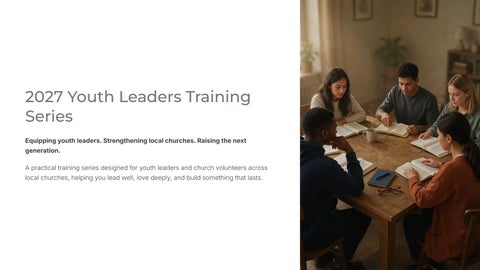
2027 Youth Leaders Training Series Equipping youth leaders. Strengthening local churches. Raising the next generation. A practical training series designed for youth leaders and church volunteers across local churches, helping you lead well, love deeply, and build something that lasts.
Why This Series Exists The Challenge
The Opportunity
Youth leaders across local churches are navigating complex
By gathering leaders from different churches, we create something
conversations, growing their teams, and trying to make disciples,
greater than any one congregation can offer alone: shared wisdom,
often with little formal training and limited support beyond their own
honest conversation, practical tools, and a network that continues well
church walls.
beyond the training night itself. This series is not a lecture series. It's a learning community.
Ten Training Streams The series draws from ten rich areas of youth ministry. Every topic has been chosen because leaders are already wrestling with these questions week to week.
Discipleship & Retention
Bible Teaching & Small Groups
Evangelism & Apologetics
From school leaver to young adult leader
Preparing, writing and leading well
Equipping teenagers to share their faith
Difficult Conversations
Parents, Pastors & Church
Culture, gender, sexuality and grace
Building healthy partnerships
Building Friday Night
Camps, Events & Socials
Leadership Skills
Practical sessions for immediate use
Planning programs that transform
Leading teams, self and volunteers
Communications & Technology
Strategic Questions
Social media, AI, and digital tools
Big-picture thinking for healthy ministry
Let the Leaders Choose Rather than locking in the four topics now, the series becomes far stronger when leaders themselves choose what they most need. Present 25–30 shortlisted topics to every pastor, youth leader, and potential leader, and invite each person to select their top five priorities. Then build the four training dates around the highest-voted topics. This ensures the series addresses real, felt needs; not just assumed ones.
When leaders have a say in shaping the series, they arrive already invested and the conversations are richer for it.
A Possible Four-Night Structure Based on likely priorities, a sample series might look something like this. These are illustrative — the actual topics will be determined by the leaders' own votes.
Term 1
1
From Year 12 to Young Adult — Keeping and Developing the Next Generation. Transitions, leadership pipelines, and preventing the post-school drop-off.
2
Term 2 Bible Studies That Work — Preparing, Writing and Leading.
Term 3
3
Practical skills every leader can use the very next Friday night.
Hard Conversations — Gender, Sexuality, Apologetics and Culture. Holding biblical convictions with truth and genuine grace.
4
Term 4 Building a Thriving Youth Ministry — Leaders, Camps, Socials, Evangelism and Church Integration. The bigger picture of sustainable, fruitful ministry.
Stream 1: Discipleship, Leadership & Retention This is the heartbeat of youth ministry — helping young people grow as disciples and take their place as leaders in the local church.
From Year 12 to Young Adult
Building a Leadership Pipeline
How do we transition school leavers into university-age ministry
Creating a deliberate pathway: attendee → disciple → servant →
without losing them? This is one of the most pressing questions
leader. Identifying and releasing emerging leaders before they
facing local churches today.
leave school.
Discipleship That Actually Works
Sustainability & Succession
Moving beyond Friday-night attendance to genuine spiritual
Preventing leader burnout, building teams where responsibility is
growth — including one-to-one discipleship and giving teenagers
shared, and planning for ministry that outlasts any individual
opportunities to lead Bible studies themselves.
leader or pastor.
Stream 2: Bible Teaching & Small Groups Every youth leader teaches — whether they feel ready or not. This stream builds genuine confidence and practical skill.
Preparing and Writing
Leading the Room
How to lead a great Bible study
Asking better questions, getting
Writing a study from scratch
teenagers talking
Preparing well without spending five
Handling silence without filling
hours doing it
every gap
Turning a sermon or passage into a
Managing the dominant voice in the
youth Bible study
group
Training teenagers to read the Bible
Leading across different ages and
for themselves
spiritual maturity levels Single-sex vs mixed small groups, when each works best
Stream 3: Evangelism & Apologetics Teenagers are already being asked hard questions by their friends. Youth leaders need to be equipped — and to equip the young people they lead.
Sharing Faith Naturally
Answering Hard Questions
Running Evangelistic Events
Teaching teenagers to talk about
Does God exist? Can we trust the
Should local youth groups run
Jesus in a way that feels authentic, not
Bible? Why does a loving God allow
evangelistic nights? How to plan and
scripted and helping Christians
suffering? Science, creation, and other
run them well, follow up visitors
actually bring their friends along.
religionspreparing leaders for the
without awkwardness, and respond
questions teenagers actually ask.
when a young person says they no longer believe.
Stream 4: Difficult Cultural & Pastoral Conversations This is potentially the most valuable stream in the series, because leaders are already having these conversations, whether they feel prepared for them or not.
The Topics Leaders Face
How Leaders Respond Well
Gender, transgender questions and Christian discipleship
Responding to difficult questions without panicking
Sexuality and the Christian faith
Truth and grace; holding convictions while genuinely loving those
Pornography and young people
who disagree
Dating, relationships and Christian boundaries
Knowing when to involve the pastor or parents
Social media, identity and self-worth
Understanding the difference between pastoral conversation and
Alcohol, drugs and party culture Bullying and social exclusion
counselling
For mental health, abuse, self-harm and safeguarding topics, qualified specialists will lead sessions focused on recognition, boundaries, escalation and referral; not turning leaders into counsellors.
Stream 5: Parents, Pastors & the Wider Church Youth ministry doesn't happen in isolation. The most effective leaders build strong relationships with the parents and pastors around them.
Parents Are Partners, Not the Enemy Building healthy relationships between youth leaders and parents; including how much parents should know, managing confidentiality, and communicating difficult issues sensitively.
Pastors and Youth Leaders Working Together What does the senior pastor need from the youth ministry? How do youth leaders serve the whole church ; not create a church within a church?
Getting the Congregation Behind Youth Ministry Connecting youth ministry with Sunday church, helping the congregation understand and champion youth work, and helping parents disciple their teenagers at home.
Stream 6: Building a Great Friday Night These are some of the most immediately practical sessions in the series — leaders will be able to implement ideas the very next week.
Planning & Structure
Games & Community
Growth & Culture
How to plan a great youth night
Games that actually work
Making newcomers feel genuinely
How much structure is too much?
How to explain and run games properly
welcome
Balancing Bible teaching, games, food
Food as ministry; why eating together
Creating traditions that build group
and social time
matters
identity
Building a youth calendar for the year
Creating space for genuine socialising
Making Friday night the place teenagers want to bring their friends What to do when numbers are small or very large
Stream 7: Camps, Events & Social Calendar Few things shape a young person's faith more than a well-run camp. This stream equips leaders to plan, execute and follow through on events that count.
1
2
3
Plan It Well
Run It Well
Follow It Up
From start to finish, camp program, roles,
Managing camp leaders, running Bible
What happens after camp? Turning spiritual
responsibilities, and a camp program that
studies and discussion groups, and creating
momentum into ongoing discipleship and
balances great teaching with genuine fun.
the conditions for genuine spiritual
using camps to develop future leaders.
breakthrough.
The stream also covers the broader social calendar: day trips, sports nights, dinners, and knowing how many social events your group can sustain well.
Stream 8: Leadership Skills Youth leaders are leaders and leadership is a skill that can be learned, practised and developed. This stream is as practical as it gets.
Leading People
Leading Well
What makes a great youth leader?
Running effective youth leader meetings
Leading when you're only a few years older than the youth
Giving and receiving feedback with grace
How to lead a team of volunteers
Handling conflict between leaders and between young people
Delegation without losing control
Building accountability among leaders
Creating clear roles within a leadership team
The spiritual life of the youth leader
Leading different personalities
Prayer and dependence on God in youth ministry
Stream 9: Communications, Social Media & Technology Communication is more complex — and more important — than it's ever been. This stream gives leaders practical tools without the overwhelm.
Social Media That Works
Messaging and Groups
AI and Emerging Tools
Instagram for youth ministry; what to
WhatsApp, Messenger and group
Where tools like AI can genuinely help
actually post. Communicating with
chats; boundaries and best practice.
youth leaders and where leaders need
teenagers without becoming cringe.
Communicating with parents
to be thoughtful and careful. Using AV
Using social media for evangelism.
effectively. Building a communication
and video effectively in youth talks and
Privacy, photography and young
calendar that keeps everyone
events.
people online.
informed.
Stream 10: Bigger Strategic Questions These sessions work especially well as discussion-based evenings involving experienced ministers and youth leaders together — asking the questions most groups never make time for.
1
2
Why Does Our Youth Group Exist?
Are Numbers a Good Measure of Success?
Are we making disciples or running events? What does a genuinely
How do we measure spiritual growth? What should we stop doing?
healthy youth ministry actually look like?
Are we building for the short term or the long term?
3
4
Reaching Those Outside the Church
Collaboration and Scale
How do we reach teenagers who have never been to church —
How do small churches build sustainable youth ministries? Should
and the friends of our existing youth? Why do young people leave,
churches combine youth groups? What is better done at presbytery
and what can we do about it?
level than locally?
Format: More Than a Lecture Each training night is designed to be genuinely useful not a 60-minute presentation followed by a long drive home. The format creates space for learning, conversation and connection.
Dinner & Networking
30–40 Minute Training
Practical Workshop
Q&A & Prayer
This structure gives youth leaders from different churches the chance to learn from each other as much as from the presenter. The conversations over dinner are often as valuable as the session itself.
The Bigger Opportunity Beyond Four Training Nights
What a Network Looks Like
If the 2027 series works well, it need not stop at December. The four
Sharing Bible study materials and camp programs
nights could become the foundation of an ongoing youth ministry
Pooling leadership experience across churches
leadership network; churches not just meeting for training, but actively sharing throughout the year.
Collaborative evangelistic events and presbytery-wide camps A shared culture of mutual encouragement and accountability Resources and ideas circulating all year, not just on four nights
Why Young People Stay At the heart of everything this series addresses is a single question: what makes young people stay? Not just stay in the youth group — but stay in the faith, stay in the local church, and eventually take their place as the next generation of leaders.
Genuine Relationships
Meaningful Ownership
Young people stay where they are known, loved and missed when
Young people stay where they have a real role to play — not as
they're absent. Discipleship happens in the context of real
passengers, but as contributors to the life of the church.
friendship.
Honest Answers
A Culture Worth Belonging To
Young people stay where their hard questions are taken seriously,
Young people stay where Friday night is the place they genuinely
and where the Bible is taught faithfully and without embarrassment.
want to bring their friends — because something real is happening there.
Next Steps Here's how to move from concept to confirmed series — with leaders already invested before the first night runs. 01
02
03
Share the Shortlist
Gather Votes
Confirm the Four Topics
Distribute the 25–30 shortlisted topics to all
Ask each person to select their top five
Build the four training
pastors, youth leaders and potential leaders
priorities. A simple online form or paper ballot
across the presbytery.
works well. Allow two to three weeks for responses.