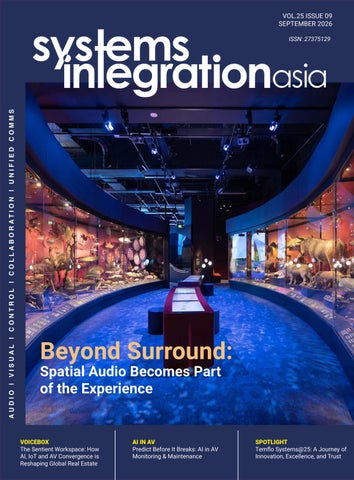
VOL.25 ISSUE 09 SEPTEMBER 2026
A U D I O | V I S U A L | C O N T R O L | C O L L A B O R AT I O N | U N I F I E D C O M M S
ISSN: 27375129
Beyond Surround: Spatial Audio Becomes Part of the Experience
VOICEBOX The Sentient Workspace: How AI, IoT and AV Convergence is Reshaping Global Real Estate
AI IN AV Predict Before It Breaks: AI in AV Monitoring & Maintenance
SPOTLIGHT Temflo Systems@25: A Journey of Innovation, Excellence, and Trust
One cable. Infinite possibilities. The Genelec Smart IP family of active PoE loudspeakers blends premium sound quality and networked convenience. With audio, power and management delivered via a single CAT cable, all models combine easily to create flexible systems offering clarity, intelligibility and uniform coverage – enabling scalable, future-proof installations. genelec.com/smart-ip
CONTENTS Volume 25 Issue 09: SEPTEMBER 2026
56 SPECIAL REPORT | The Cathay Becomes a Canvas for Southeast Asian Storytelling VOICEBOX 06 The Sentient Workspace: How AI, IoT and AV Convergence is Reshaping Global Real Estate
SPOTLIGHT 40 Temflo Systems@25: A Journey of Innovation, Excellence, and Trust
INTERVIEW 10 Dave Labuskes: Fourteen Years, One Transformative Journey
FEATURE 44 Beyond Surround: Spatial Audio Becomes Part of the Experience 45 Immersion Within Reach: Spatial Audio 12 Amy Zhou, Sales Director at Magewell: Moves into the Mainstream Bridging Today’s AV with Tomorrow’s Workflows 48 Invisible by Design: Spatial Audio Becomes Part of the Architecture 15 NEWS 51 Sound That Follows the Story: Building Immersive Experiences with TiMax 27 SOLUTIONS UPDATE AI IN AV 32 Predict Before It Breaks: AI in AV Monitoring & Maintenance SHOW PREVIEW 37 XR Asia Summit 2026 PUBLISHED BY:SPINWORKZ PTE LTD 207A Thomson Road, Goldhill Shopping Centre, Singapore 307640 TEL:(65) 63162716
INSTALLATION 60 CHINA: Christie Jazz Series Projectors at Suzhou Science and Technology Museum 63 AUSTRALIA: From Icebergs to The Bergs: Reimagining an Icon with Smarter AV 66 JAPAN: Hikarie Hall Rebuilds Sound Around Flexibility 70 SINGAPORE: Gospel Light Church Embraces LED
From the Publisher
Thomas Richard Prakasam Publisher/Editorial Director thomas@spinworkz.com
In this issue’s Feature column, we explore how spatial audio is moving beyond specialist studios and high-budget productions to become an essential element in museums, visitor attractions and interactive environments. As immersive visuals grow more sophisticated, audio must deliver an equally convincing sense of movement, localisation and realism while respecting architectural aesthetics. Aki Mäkivirta, Chief Technology Officer, R&D, Genelec; Lorenzo De Poi, Brand Manager, K-array; and Rik Kirby, Commercial Manager, TiMax, share their perspectives on the technologies driving this evolution. Our AI in AV column examines the shift from reactive technical support to predictive maintenance. In mission-critical environments, waiting for equipment to fail is no longer acceptable. Utelogy explains how predictive analytics and intelligent diagnostics can help AV and IT teams identify, anticipate and prevent problems before users are affected. Also in this issue, outgoing AVIXA CEO David Labuskes reflects on an era of industry growth, Asia’s rise, AI’s transformative potential and the personal encounters that made his journey memorable.
Meet The Team
EDITOR, INDIA AND ME Ram Bhavanashi ram@spinworkz.com
DIRECTOR INDUSTRY ENGAGEMENT Andy Tan
ADMIN & CIRCULATION Julie Tan
admin@spinworkz.com
andytan@spinworkz.com
MEDIA REP CHINA,HONG KONG, TAIWAN Judy Wang Worldwide Focus Media +86-13810325171
DESIGN & LAYOUT Hazel Gundaya
judywang2000@vip.126.com
PUBLISHED BY Spinworkz Pte Ltd 207A Thomson Road, Goldhill Shopping Centre Singapore 307640 Tel: (65) 63162716
Disclaimer: Systems Integration Asia is published 12 times a year. All rights reserved. No part of this magazine is to be reproduced, whether mechanicalor electronic without the prior written consent of the publisher. Views expressed in this magazine do not necessarily reflect those of the editor or the publisher. Unsolicited contributions are welcome but the editor reserves the discretion to use them. Whilst every care is taken to ensure the accuracyand honesty in both editorial and advertising content at press time, the publisher will not be liable for any inaccuracies. Please be informed that products and company names mentioned in this publication may be protected with tradenames, trademarks or registered trademarks of their respective owners. Our non inclusion of such symbols is not an indication of us not recognising the copyright but rather to have a common look across our articles. Misuse of tradenames, trademarks or registered trademarks is strictly prohibited. It is the obligation of our readers to check if company names and products are protected with tradenames, trademarks or registered trademarks.
From retail to culture and sports
Ledman transforms spaces with powerful visual experiences
Indonesia Shopping Mall Living World Kota Wisata
500 ㎡ Powered by LEDMAN Outdoor N Series and Indoor X Series
Philippines Museo Galleon
1,200 ㎡ Powered by LEDMAN Fixed Transparent Display Solution
Malaysia Sultan Ibrahim Stadium
300 ㎡ Powered by LEDMAN N Series Outdoor LED Display solution
www.ledman.com marketing@ledman.com
VOICEBOX
SEPTEMBER 2026
The Sentient Workspace: How AI, IoT and AV Convergence is Reshaping Global Real Estate By Christopher Isak GPA
What does a person feel when they step into your office for the very first time? Can they seamlessly find their way around, or are they left wandering the halls looking for meeting room XYZ? Did an automated system notify their host, giving them time to bring out a fresh coffee? Or is the guest left awkwardly standing at a highly polished but completely useless reception desk? Now, flip that perspective to your own team. What does your staff feel when they scan their badge on a Monday morning? Are they inspired to be there, or would they much rather work from home because the physical office provides absolutely zero tangible value to their workflow or creativity outside of a strict corporate mandate? 6
WWW. SYSTEMSINTEGRATION ASIA.COM
The traditional corporate physical space is broken, and simply buying more screens will not fix it. We are entering an era where technology must act as a continuous service to bridge the gap between human experience and facility management.
The Illusion of the Seamless Experience Before stepping into my global core team role at GPA, I spent significant time in the tech trenches working on the convergence of smart buildings and Pro AV. As a large global AV system integrator, GPA supports clients on this journey to a well-connected and useful workspace with a great user experience and high impact.
VOICEBOX
SEPTEMBER 2026
IoT Tech Lab Assets - Smart Building AV. Part of GPA's programme for its members.
During my time in those trenches, we built pioneering pilot projects that connected environmental sensory data directly to room booking platforms. If you want to know what true workspace frustration looks like, watch a team try to find a collaborative space while three 'booked' rooms sit empty. Solving this is not about installing a basic display panel. Hardware is simply a means to an end; today, the focus must start with understanding customer challenges and building a global community. Despite global geopolitical challenges, there is strong growth momentum and a high appetite for Pro AV solutions. Yet, no single global AV integrator currently holds more than 1% of the total market share. This demonstrates a massive opportunity for growth and market expansion, but only if integrators pivot to outcome-based design and act as a beacon and catalyst for industry-wide growth.
The Rise of the Sentient Room We are currently witnessing a massive shift toward what we identify as the 'Frontier Workplace'. Artificial intelligence in the AV
industry is still in its infancy. Still, it is finally graduating from a buzzword into functional tools for meeting automation, automated notetaking, and camera tracking. AI is ultimately an 'Enabler' for workforce capability and customer service. Think about the concept of zero-touch spaces. The future of meeting room automation goes far beyond a simple 'one-touch join' button. We are moving toward environments that instantly recognize meeting hosts, auto-start sessions upon entry, and require strict cross-platform interoperability so users do not have to toggle between disparate software tools. A shift toward long-term managed services and preemptive support heavily supports this invisible experience. When an overlay management platform detects a failing microphone and a remote technician fixes it before the end-users experience a disruption, the technology works. However, to maintain this, system integrators must bridge the AI skills gap over the next three years, investing heavily in human capital, continuous workforce training, and AI literacy for internal coding and process automation. WWW. SYSTEMSINTEGRATION ASIA.COM
7
VOICEBOX
SEPTEMBER 2026
Global Standards Meet Local Realities
allows corporate strategists to make space optimization decisions based on hard, evidence-based data rather than anecdotal Delivering this sentient experience across borders requires a massive shift in procurement feedback. Modern workplace technology is no longer viewed as an IT cost center, but and governance. Multinational enterprises as a crucial, strategic asset for employee are rapidly abandoning localized, country-bycountry AV purchasing. Instead, the trend points connectivity, hybrid productivity, and workflow strictly toward centralized procurement models efficiency. that drive global consistency, focusing on longterm value over initial low-bid pricing. The Return to Human Connection With Asia contributing roughly 60% of global GDP growth, rapid digital transformation initiatives are accelerating across all enterprise sectors. This presents a unique challenge: balancing centralized standards with coordinated regional execution. Local expertise paired with structured regional coordination is essential for delivering consistent quality across diverse Asian markets.
Let us go back to that first-time visitor and your Monday morning staff. When the physical office removes every technical barrier, it stops being a mandated prison. It becomes a destination. The meeting room is ready, the navigation is intuitive, and the environment adapts to the people inside it. Of course, there are some costsaving aspects to all of this as well, but who doesn't love a great experience as a side effect?
To achieve true global consistency, enterprises are focusing on three critical operational pillars:
When the technology handles the complex logistics flawlessly in the background, your staff finally has the mental space to do what they actually came to the office to do. They can sit down, share that coffee, and create something brilliant together. Your guests and your staff deserve an impressive space that supports them and not obstructs them.
• Standardizing platform footprints globally to reduce deployment complexity, speed up installation, and simplify ongoing support. • Acting as an East-meets-West technology bridge, combining established Western UC standards with innovative regional platforms to ensure local adoption. • Increasing reliance on in-room automation and ecosystem partnerships, trusting sustained collaboration among clients, integrators, and technology vendors.
Data is the New Real Estate Currency A space that nobody uses is a massive financial liability. Modern room platforms are essentially sensory hubs that aggregate utilization metrics, occupant counts, and environmental air quality data. Finally, you can make data-based decisions and act on them rather than making educated guesses. Even if your dashboards disappear and become agentic AI, this deep level of insight 8
WWW. SYSTEMSINTEGRATION ASIA.COM
Chris Isak is the Digital Marketing Specialist for GPA. GPA is a global provider of enterprise audiovisual and collaboration solutions, helping multinational organisations create consistent and connected workplace experiences across regions. Through almost 30 regional business units, more than 170 offices and over 6,000 AV and unified communications professionals, GPA delivers consulting, integration, deployment and lifecycle support in more than 50 countries. Its unified global model combines standardised processes and a single point of contact with local expertise, enabling organisations to scale workplace technology efficiently while accommodating regional requirements.
THE POWER BEHIND THE VIDEO WALL
Secure, simple and reliable. The award-winning VSN series, powering any video wall size imaginable.
datapath.co.uk
INTERVIEW
SEPTEMBER 2026
Fourteen Years, One Transformative Journey As he prepares for his next chapter, AVIXA CEO David Labuskes reflects on a defining era of industry growth, the rise of Asia, AI’s transformative potential and the personal encounters that made the journey memorable. During your 14-year tenure as AVIXA’s CEO, which organisational milestones or achievements give you the greatest sense of pride? There are so many achievements that I’ve had the privilege of being a part of over these past 14 years. It really is difficult to identify them. I remember the first AVIXA Women’s Council meeting in India and the great sense of pride in the power and courage in that room. I remember the many months of work by our team in advance of selecting and then announcing the rebranding of the association from InfoComm International to AVIXA.
and control systems. All of them have been impactful and significantly increased the value of our industry. But the pace of adoption and impact from learning machines and softwareenabled communications enhancement that AI enables is truly transformative. And that’s amazing for us in this industry.
I continue to be in awe of the talent that the AVIXA Board of Directors continues to attract and deliver in service of this amazing industry. Every ribbon cutting, every celebrated certification achievement and every show launch has had an impact on me professionally and personally. It’s been a great and memorable ride!
As the “brain” of our corporate knowledge infrastructure becomes more adept at processing signals and information, it will become more and more dependent upon its inputs. And those inputs (cameras and microphones and control systems) are what AV has been doing for decades. They are our core technologies.
Of the technologies that emerged or matured during your tenure, which do you consider truly transformational—and why?
We are the eyes and ears of AI and that makes us mission critical to enterprises. And beyond corporate, every industry vertical, educational institution, retail and hospitality enterprise, house of worship – they all are more foundationally leveraging and building on offerings that we deliver. It’s a great time for AV!
That’s an easy one – artificial intelligence. And it follows pretty recently among much of what we had already experienced as advancements in display technology, AV over IP, and immersive audio along with other networked signal
10
WWW. SYSTEMSINTEGRATION ASIA.COM
SEPTEMBER 2026
INTERVIEW
dancing and singing and celebration. Industry award ceremonies can sometimes seem less than meaningful but this one in particular jumped out at me as a truly authentic reflection of our industry and in particular the Indian Well, I touched on this to some extent in my first community within our industry. answer but I’ll build on it now. Let’s just start at I remember an experience following the first the macroeconomic level.The region continues to be the fastest growing segment of the global post-pandemic InfoComm in Orlando. It was Saturday evening, the (albeit much smaller economy and has been for nearly the entire than typical) crowds had left town and my wife time I’ve been in this role. We’ve seen shifts in the geo-political landscape, of course, but what and I were enjoying a quiet dinner together in the hotel restaurant. After dinner, the chef, we haven’t seen is any reduction in a massive the wait staff and all of the employees on hunger for what our industry has to offer. shift at the hotel gathered to thank me (and AVIXA) for bringing them back to work after so As the market has grown, we’ve begun to see a many months of furlough. It was an amazing greater definition of and value in segmentation reminder that what we do counts far beyond across multiple categories. We’ve moved from what we see in the near term. “technology” discussions to infrastructure, audio, visual, digital signage, UCC, venues, I remember meeting Thomas from this lighting and staging as well as from Asia, magazine, for the first time in a Singapore to China, India, ASEAN, and now even more hotel lobby for our interview about my new detailed geographic and technological slices. position and my attempt at sounding like I knew what I was doing in a role I’d held for about 3 This is a natural progression of growth and months and a jet-lagged fog of an initial trip to maturation. AVIXA has been not only a discover AV in Asia. I remember Kelvin Ashbyparticipant in this, but in my humble opinion, I believe a catalyst of this. Our shows, education, King lecturing me for hours (literally) about the expectations of the region for our association standards and certifications have been wholeheartedly adopted by the industry and the and promising him I’d do what I could to correct any wrongs and enable a brighter future. professionals within it as fundamental paths I remember Bharath Kumar offering every toward sustainable commercial success. resource possible from Kramer to help us in a journey to educate and advance the regions I think back to some of my early conversations professionals…and then acknowledging the in Asia and the sense of unfulfilled hunger work yet to be done on our way back down to for AVIXA and I look today at our expanded the car in a tiny elevator in Bengaluru. presence across all of the region and all of our offerings and I can’t help but feel a sense What are you most looking forward to in the of both pride and anticipation for what comes next chapter of your life? next! Asia’s professional AV industry has grown significantly over the past 14 years. How have you seen the region evolve, and where do you see its greatest future opportunities?
Beyond the major organisational achievements, which personal encounters or memorable moments from your time at AVIXA will stay with you?
Writing and discovering what that chapter will be with hopes to have all those I hold dear near me.
One of SI India’s early award programs in Mumbai had a Bollywood performer that brought the room to life and there was real WWW. SYSTEMSINTEGRATION ASIA.COM
11
INTERVIEW
SEPTEMBER 2026
Bridging Today’s AV with Tomorrow’s Workflows As professional AV moves towards IP-based, softwaredefined and cloud-managed environments, organisations need flexible migration paths that preserve existing investments while preparing them for what comes next. Amy Zhou, Sales Director at Magewell, discusses how the company is connecting traditional AV infrastructure with emerging technologies through reliable, interoperable hardware and software. She also explores the growing adoption of production technologies across new sectors, the importance of open ecosystems and why successful video workflows must be designed around practical needs rather than technical specifications alone. The industry is increasingly moving towards software-defined and cloud-managed AV infrastructures. How is Magewell balancing dedicated hardware with software apabilities, and what role do you see cloud management playing in future deployments? We see software-defined and cloud-managed AV as an evolution rather than a replacement for dedicated hardware. Reliable hardware will continue to play a critical role at the edge, where low-latency media processing, signal conversion and dependable operation are essential. What is changing is how these devices integrate with the rest of the workflow. Increasingly, hardware serves as an intelligent bridge between on-premises AV systems and cloud-based platforms through open protocols such as SRT and RTMP. Rather than replacing hardware, the cloud adds value through centralized management, monitoring, orchestration and scalable services. At Magewell, our approach is to provide reliable, technology-agnostic hardware that works 12
WWW. SYSTEMSINTEGRATION ASIA.COM
seamlessly with a wide range of software platforms and cloud ecosystems. This gives customers the flexibility to adopt the workflows that best meet their needs today while remaining ready for future developments. AV professionals today work across NDI, SRT, SMPTE ST 2110, USB, HDMI and many other protocols. Rather than asking customers to choose one ecosystem, how is Magewell helping integrators build truly interoperable systems that can evolve over time? Infrastructure is not built overnight. Organisations need to bridge their existing systems to future workflows as their needs and technologies evolve. Many people first came to know Magewell through our video capture devices. Today, we do much more than help professionals bring AV signals into software. Our encoders and decoders are also being used to address AV-over-IP and streaming challenges. Rather than asking customers to standardize on a single protocol or ecosystem, Magewell provides trusted solutions in flexible form
SEPTEMBER 2026
factors that help bridge and connect AV signals, IP streams, software and displays. This allows integrators to focus on the workflow they need to build, while Magewell helps fill the gaps between technologies. Our philosophy of making products reliable, easy to use and interoperable also gives integrators the confidence to adopt new technologies without having to start from scratch. For example, French technology company Careprod uses Magewell products to bring diverse signals into its system, including wired AV sources and NDI HX streams, and then deliver video as an RTMP stream. That is the kind of interoperability we aim to provide: connect the technologies they already have with the technologies they want to adopt next. Live production technologies are now being adopted across corporate communications, higher education, healthcare and houses of worship. What trends are you seeing in these sectors, and how are they influencing Magewell's product development priorities? Technologies and products that were once primarily chosen by broadcasters are increasingly being evaluated and adopted by corporate, education, healthcare, and houses of worship. These users want to achieve broadcast-grade production quality, but they also need solutions that are cost-effective and easy to deploy. At the same time, they have existing infrastructure and equipment that they want to preserve rather than replace entirely. That creates a strong need for products that can bridge what they have today with the new ecosystems and workflows they are moving toward. For Magewell, this means developing products that are both cost-effective and future-proof. We want customers to feel confident making an investment today, knowing that their products can continue to evolve through firmware updates, new features, and integrations
INTERVIEW over time. Compatibility and interoperability are therefore key priorities in our product development. For live production in particular, we offer everything from multi-channel capture cards to encoders and decoders that can become building blocks for more comprehensive solutions incorporating third-party equipment and technologies. At the same time, we recognize that not every user wants to build a production system from individual components. That’s why we developed the Director family for smaller-scale productions and teams. Many organisations are modernising their AV infrastructure gradually rather than replacing everything at once. What advice would you give to system integrators planning this transition, and how can Magewell help bridge legacy and next-generation technologies during that journey? We see many successful new installations benefiting from a gradual migration from traditional AV-centric designs to AV-overIP workflows. For system integrators and organisations considering this transition, our advice is that there is no need to replace everything at once or commit to a single technology. Instead, start by identifying the pain points in the existing infrastructure and then consider where IP-based technologies can deliver greater flexibility, scalability and manageability. This means looking beyond simply adding an encoder or decoder. It is about building network-based workflows where endpoints can communicate across the LAN or even over the internet, selecting the right products and form factors for each installation, and using APIs, plugins and software tools to integrate with central management platforms. A successful transition also requires close collaboration between AV and IT teams, particularly as AV infrastructure becomes increasingly networkbased.
WWW. SYSTEMSINTEGRATION ASIA.COM
13
INTERVIEW Magewell is committed to helping integrators make this transition with trusted solutions that connect AV signals, IP streams, software and displays across both standalone and rackmount form factors. At the same time, we provide APIs, plugins and software tools that support integration, centralized management and maintenance, helping integrators reduce deployment complexity and build systems that can evolve over time without requiring a complete infrastructure replacement. If you could identify one common mistake organisations make when designing modern video workflows, what would it be? Conversely, what differentiates the most successful AV integrators and deployment partners that Magewell works with around the world? One common mistake we see is organisations spending too much time debating which AVover-IP technology is better than another. They compare video quality, bandwidth, latency and other technical specifications. These are important considerations, but sometimes other equally fundamental factors get overlooked— particularly interoperability and product availability. Interoperability can have a direct impact on what products and solutions are actually available to an organisation. A technology may look ideal on paper, but if it cannot work with the rest of the infrastructure or there are limited product choices available, it may not be the most practical solution. The most successful AV integrators we work with are not obsessed with finding the “best” technology in isolation. Instead, they take a practical, system-level approach. They focus first on the problems their customers need to solve today, while designing workflows that remain flexible, interoperable and manageable as requirements evolve. Ultimately, a successful AV workflow needs to make sense not only technically, but 14
WWW. SYSTEMSINTEGRATION ASIA.COM
also operationally and logistically. The best integrators understand that the goal is not simply to choose the most impressive technology, but to build a solution that works reliably today and gives their customers room to adapt tomorrow. Magewell has built a reputation for producing dependable technologies that quietly "just work." As customer expectations continue to evolve, how do you intend to maintain that reputation while continuing to innovate in an increasingly competitive professional AV market? New industry trends and evolving customer expectations inevitably bring new challenges for manufacturers. At Magewell, three principles— Simplicity, Reliability and Innovation—will continue to guide our product development. Innovation should never come at the expense of user experience or reliability. For us, maintaining our reputation for products that “just work” means making sure new technologies are not only powerful, but also practical and dependable in real-world deployments. That goes beyond making video capture products compatible with a wide range of video inputs and computers. As workflows evolve, it means developing product lines that interoperate with a broader range of streaming protocols and network environments, integrate smoothly with different technology ecosystems, and provide the flexibility to scale as customer needs grow. Ultimately, our goal is not to innovate for innovation’s sake. It is to apply new technologies in ways that make professional AV workflows more reliable, interoperable and easier to use. That is how we intend to keep delivering the dependable solutions customers have come to expect from Magewell, while continuing to move forward. Magewell
SEPTEMBER 2026
NEWS
FORTÉ Acquires Vega Global, APAC’s Largest Systems Integrator, Expanding Global Reach GLOBAL: FORTÉ, a leader in communication and collaboration solutions designed for the modern workplace, announced its acquisition of Vega Global, APAC’s largest systems integrator and a leading provider of workplace technology and audiovisual solutions serving corporate, education, government and other market segments. With this acquisition, FORTÉ adds to its international presence, including established office locations in Hong Kong, Mainland China, India, Japan, Taiwan, Thailand, Singapore, Korea, Vietnam, Australia, Philippines, Malaysia, Macau, New Zealand, Indonesia, and United Arab Emirates. With its headquarters in Minneapolis, Minn., FORTÉ also has operations in the U.S., Ireland, Germany, Sweden, the United Kingdom, and Mexico. “Multinational organisations need strategic partners who can deliver consistent communication and collaboration experiences wherever their people work and do business,” said Jeff Stoebner, Chairman and CEO of FORTÉ. “With Vega Global now part of FORTÉ, we provide customers with the scale, speed and local expertise they require to enhance productivity across the globe.” FORTÉ now has professional staff in 22 countries – delivering audiovisual solutions including integrated meeting room technologies, digital workplace solutions, mission-critical systems, and managed services to customers in more than 70 major markets worldwide – the largest global footprint in the industry. With the addition of Vega Global and its 750-
plus professional staff led by Steven Medeiros, the acquisition furthers FORTÉ’s ability to serve global customers with unparalleled delivery and support capabilities. “Joining FORTÉ is a strategic opportunity to expand what we can offer customers around the world,” said Medeiros, who will serve as CEO of FORTÉ Asia. “Equally important, FORTÉ shares our commitment to customer service, innovation and people-first collaboration, making this a strong cultural fit and the right decision for our employees, customers and partners.” As organizations increasingly standardise meeting room solutions used for collaboration across offices, campuses and regions, FORTÉ is positioned to help customers deploy reliable and scalable solutions with greater speed and consistency. Since its founding in 1974, FORTÉ has set the bar for how modern workplace technology solutions are designed, delivered and supported. FORTÉ delivers solutions with agility, while providing problem-solving innovations that are flexible, customizable and instrumental to daily operations and employee productivity. FORTÉ provides unparalleled customer service and support, helping people in workplaces, classrooms, government agencies, and commercial venues collaborate more effectively and achieve their goals through engagement and enhanced communication.
WWW. SYSTEMSINTEGRATION ASIA.COM
15
NEWS
SEPTEMBER 2026
LOGIC Launches LOGIC classroom modules designed to help educators integrate emerging technologies into their lessons while improving classroom productivity Academy for Smart and student engagement. Classroom Educators The platform includes dedicated AI-in-the-
Commenting on the initiative, Pankaj Bellad, Chief Business Officer, Online Instruments (India) Limited, said, "LOGIC Academy was developed in line with the National Education Policy (NEP) 2020's emphasis on the effective integration of technology in education. It reflects LOGIC's vision of empowering teachers through practical training that addresses the challenges they face in using classroom technology and helps ensure that investments in digital infrastructure translate into better teaching and learning outcomes."
INDIA: LOGIC, the flagship audio-visual solutions brand of Online Instruments (India) Limited, has introduced LOGIC Academy, a dedicated training platform designed to help educators make more effective use of interactive classroom technology. As schools continue to invest in Interactive Flat Panel Displays (IFPDs) and smart classroom infrastructure, many educators face challenges in integrating these technologies effectively into everyday teaching. LOGIC Academy addresses this gap through structured, selfpaced training programmes designed to equip teachers with the skills to use interactive displays, AI-powered teaching tools and collaborative classroom applications with confidence, creating more engaging and effective learning experiences. Developed in alignment with the vision of the National Education Policy (NEP) 2020, which emphasises the effective use and integration of technology in education, LOGIC Academy offers a comprehensive curriculum ranging from introductory modules on IFPDs to advanced courses covering interactive collaboration and device connectivity. It also provides Device Management System (DMS) training for IT administrators. 16
WWW. SYSTEMSINTEGRATION ASIA.COM
Unlike conventional one-time product demonstrations, LOGIC Academy provides continuous learning through on-demand, selfpaced courses and school-wide, instructor-led training sessions. Every participant receives a free certificate upon course completion, recognising their digital teaching competencies and supporting their professional development. The curriculum also evolves alongside LOGIC's product portfolio, helping educators stay updated as new technologies, applications and solutions are introduced. To date, LOGIC Academy has trained more than 60,000 teachers across 5,000 educational institutions, helping schools derive greater value from their smart classroom investments while creating more interactive, visual and technology-enabled learning environments. LOGIC Academy is available free of cost to educators and educational institutions, making digital training more accessible to schools looking to strengthen technology-enabled teaching and build future-ready classrooms. Online Instruments (India) Limited
NEWS
SEPTEMBER 2026
Clear-Com Selects Venuetech to Drive Market Expansion MIDDLE EAST: Clear-Com has officially appointed Dubai-based Venuetech LLC as its main Partner for the Middle East. The partnership expands Clear-Com’s regional presence and brings its portfolio of professional intercom and communication solutions to Venuetech’s established network of customers and system integrators across the region. Venuetech is a professional audiovisual solutions distributor serving markets throughout the Middle East, with expertise spanning professional audio, video, lighting, conferencing, control and networking. Through the new partnership, Venuetech will support the distribution, demonstration and adoption of Clear-Com solutions, backed by its regional technical expertise, systemintegrator relationships and customer support capabilities. Venuetech will introduce Clear-Com’s portfolio to customers throughout the region, with products also set to be showcased at the company’s Dubai showroom. “The Middle East continues to be an important market for Clear-Com, and we wanted a partner with the regional reach, technical capability and customer relationships to support our continued growth,” said Samer Mouwanes, Regional Sales and Business Development Manager, Middle East, Africa, Turkey, Greece and Cyprus, Clear-Com, an HME Company. “Venuetech brings extensive experience across the professional AV market and a strong understanding of the customers and applications we serve. We are very pleased to welcome the team as our partner and look
forward to working together to expand access to Clear-Com solutions and support customers throughout the region.” Venuetech’s multidisciplinary team provides system design support, product demonstrations, technical training, after-sales service and maintenance to AV professionals and system integrators across the Middle East. The company supports projects across corporate, education, entertainment, hospitality, houses of worship, government and other large-scale venue environments. “Clear-Com has built an exceptional reputation in professional communications, and its technology complements many of the markets and customers we already support across the region,” said Alice Macaluso, Audio Brand Manager, Venuetech. “We see a real opportunity to combine Clear-Com’s technology and experience with the relationships, technical knowledge and regional presence that Venuetech has developed over the years. We are investing for the long term and are very excited about what we can build together.” The partnership represents a long-term investment by both companies in expanding access to professional communication technology throughout the Middle East. ClearCom and Venuetech will develop a series of product, customer and market initiatives in the coming months to introduce the portfolio and demonstrate its applications across the region. Clear-Com WWW. SYSTEMSINTEGRATION ASIA.COM
17
NEWS
SEPTEMBER 2026
TR Electro Stereo Takes on HK Audio Distribution MIDDLE EAST: HK Audio has appointed TR Electro Stereo as its new distribution partner for Israel. Formed in 1986 and based in Tel Aviv, TR Electro Stereo has built a strong reputation as one of Israel’s leading distributors of sound systems, smart home and DJ equipment. Effective immediately, the company will be responsible for the distribution and support of HK Audio’s portfolio, providing dealers, integrators and end users with access to the brand’s renowned sound reinforcement solutions, backed by dedicated technical expertise and customer service. “We’re delighted to welcome Bar, Kobi and the entire team at TR Electro Stereo as HK Audio’s new distribution partner in Israel,” said Isabelle Wear, Head of Sales MEA & APAC at HK Audio. “Their market expertise, technical knowledge and customer-focused approach make them an excellent fit for our brand and our ambitions in the region. “We would also like to thank Shalmon Music for their dedication and commitment in representing HK Audio over the past years. Their contribution to developing the brand in the Israeli market has been greatly appreciated. Looking ahead, we are excited to work alongside TR Electro Stereo to further strengthen HK Audio’s presence and deliver even greater value to customers and partners.” TR Electro Stereo sees the partnership as an opportunity to expand access to one of professional audio’s most respected brands. “We are proud to become HK Audio’s official
18
WWW. SYSTEMSINTEGRATION ASIA.COM
distribution partner in Israel,” said Bar Ben Yehoshua, Vice President of TR Electro Stereo. “HK Audio’s reputation for innovation, performance and reliability makes it a natural addition to our professional audio portfolio. We see significant opportunities for HK Audio in the Israeli market and look forward to expanding the brand’s presence across the professional audio, installation and live sound sectors and are confident this partnership will create new opportunities and deliver exceptional solutions for our dealers, integrators and customers.” HK Audio
NEWS
SEPTEMBER 2026
Forté and GPA Announce Strategic Transition GLOBAL: GPA and FORTÉ have agreed to conclude their current partnership effective 31 December 2026, to pursue their respective strategic priorities and growth initiatives. Since 2020, the relationship between GPA and FORTÉ has contributed to the successful delivery of audiovisual projects and programs designed to enhance communication and collaboration for customers worldwide. During this time, both organisations have worked together to support global enterprises through innovative technology solutions, strong customer relationships and a shared commitment to deliver excellence. As both businesses continue to evolve, GPA and FORTÉ have agreed that their future strategies are best advanced independently. The decision reflects the natural progression of two successful organisations pursuing distinct opportunities for growth while remaining committed to the values and relationships developed through their partnership. Most importantly, both organisations are committed to ensuring continuity for customers, partners and stakeholders throughout the transition process. Existing projects, active engagements and customer commitments will continue to be supported through agreed transition arrangements, with a focus on maintaining the high standards of service, collaboration and delivery that customers have come to expect. “Our relationship with FORTÉ has been an important part of GPA’s journey, and we are grateful for the contribution the FORTÉ team has made to our organisation and our customers over many years,” said James Shanks, Managing Director of GPA. “As we
James Shanks Managing Director of GPA
Jeff Stoebner Chairman and CEO of FORTÉ
move forward, GPA remains committed to delivering exceptional outcomes for customers through our global network and strengthening our position as the world’s leading provider of global AV and collaboration services.” “Our journey with GPA this past six years has been one of the most rewarding experiences for FORTÉ, and we are proud of what we’ve accomplished together in support of our customers around the world,” said Jeff Stoebner, Chairman and CEO of FORTÉ. “Further developing global delivery for our customers has been critical, and GPA accelerated this capability. We will cheer for GPA well into the future.” GPA will continue to focus on supporting global customers through its extensive network of Regional Business Units and strategic partners, while FORTÉ will continue to pursue its vision and growth objectives. Both companies remain committed to innovation, customer success and the continued development of their respective businesses. While this announcement marks the conclusion of one chapter, it also represents the beginning of new opportunities for both organisations. GPA and FORTÉ look forward to building on the foundations established through their longstanding relationship and continuing to serve customers with the same dedication, expertise and professionalism that have defined their success. WWW. SYSTEMSINTEGRATION ASIA.COM
19
NEWS
Han Dohmen to Lead Global Vendor Partnerships for PSNI Global Alliance
GLOBAL: PSNI Global Alliance has appointed Han Dohmen as Director of Global Vendor Partnerships, reinforcing its focus on expanding strategic manufacturer relationships and further developing its Preferred Vendor Partner (PVP) programme. Dohmen brings more than three decades of international experience in business development, sales strategy, channel management and global partnerships. During his career, he has held senior leadership roles with Biamp, L-Acoustics and Sennheiser, helping manufacturers grow their international presence, strengthen strategic accounts and build relationships with systems integrators across Europe and beyond. Most recently, as Head of Business Development Europe at Biamp, Dohmen led global account strategies for major international integration organisations, including PSNI Global Alliance. In his new role, Dohmen will oversee the strategic direction and continued development of the Alliance’s Preferred Vendor Partner programme, working with technology manufacturers and PSNI’s global network 20
WWW. SYSTEMSINTEGRATION ASIA.COM
SEPTEMBER 2026
of Certified Solution Providers (CSPs) to strengthen collaboration and create new business opportunities. “Throughout my career, I’ve worked with global integrators and technology manufacturers, but PSNI has always stood apart,” said Dohmen. “As business becomes increasingly global, customers need partners that can deliver consistent experiences across regions. That’s what makes PSNI so compelling. It isn’t simply the Alliance’s global reach—it’s the combination of scale, professionalism, and collaboration. With more than $6 billion in combined global revenue represented across its Certified Solution Providers, PSNI has built the industry’s largest and most capable global integration network.” “Having previously worked with PSNI as a Preferred Vendor Partner, I experienced firsthand the strength of the relationships the Alliance creates between manufacturers and its global network of CSPs. Those relationships extend far beyond product discussions, connecting vendors with executive leadership, engineering, sales, and marketing teams around the world.” “I’m incredibly grateful for the trust the entire PSNI team have placed in me. Together with our CSPs and Preferred Vendor Partners, I’m excited to help take the program to its next stage of growth while creating even greater value for all stakeholders inside of the Alliance.” Chris Miller, Executive Director of PSNI Global Alliance, said Dohmen’s experience gives him a unique understanding of both the manufacturer and integrator perspectives. “Han is uniquely qualified for this role because he understands our Alliance from both sides of the partnership,” said Miller. Adding, “He has spent his career helping manufacturers grow through stronger relationships with systems integrators, and he’s experienced firsthand the value our Alliance creates for both vendors and Certified Solution Providers,” Miller said.
NEWS
SEPTEMBER 2026
Currently PSNI's Certified Solution Providers are located in 250+ locations globally.
“As more organisations look beyond their home markets, our Preferred Vendor Partner program plays an increasingly important role in helping manufacturers and Certified Solution Providers build stronger global relationships, identify new business opportunities, and deliver consistent customer experiences around the world. Han understands that opportunity better than most, and his leadership, global perspective, and collaborative approach make him the ideal person to help shape the next chapter of our vendor partnership strategy.”
PSNI’s PVP programme connects technology manufacturers with its global network of more than 120 Certified Solution Providers spanning the AV, IT and unified communications, strengthens partner engagement and continues developing the Alliance’s global collaboration network. PSNI Global Alliance
WWW. SYSTEMSINTEGRATION ASIA.COM
21
NEWS
SEPTEMBER 2026
Uniguest Puts Its Growing Technology Portfolio Under One Hub GLOBAL: As professional AV and digital engagement technologies increasingly converge, the challenge for technology providers is no longer simply building more solutions, but making increasingly broad portfolios easier to understand. Uniguest is addressing that challenge by bringing three of its established technology platforms under a single brand architecture. Effective immediately, Tripleplay becomes Hub AV, eStream becomes Hub Media, and pCare becomes Hub IPS. The three legacy brand names will be retired, joining Uniguest’s existing Hub Digital Engagement Platform under a common identity. The move represents the next phase of Uniguest’s broader Hub strategy, following the relaunch of Otrum as Hub at ISE 2025. It also reflects the evolution of a company whose portfolio has expanded through a combination of organic development and acquisition. Rather than introducing new technology, however, the rebrand is intended to make the technology Uniguest already has easier to navigate. For customers, the change is largely cosmetic. The underlying platforms, product roadmaps, expertise and support teams remain in place. Under the new structure: • Hub AV, formerly Tripleplay, provides IPTV, digital signage and video distribution technology for enterprise, hospitality, sports, corporate and other professional environments. 22
WWW. SYSTEMSINTEGRATION ASIA.COM
• Hub Media, formerly eStream, provides media management, enterprise video and content delivery capabilities. • Hub IPS, formerly pCare, focuses on interactive patient experiences for healthcare providers. Alongside these platforms sits Hub, Uniguest’s Digital Engagement Platform, which provides a unified environment for managing and delivering digital experiences across hospitality and other markets. The strategy reflects a wider issue facing technology companies with increasingly diverse portfolios. As businesses acquire specialist platforms and expand into adjacent markets, customers can end up navigating a collection of familiar but disconnected brands, even when those technologies sit within the same corporate ecosystem. James Keen, EVP Marketing at Uniguest, said: “Tripleplay, eStream and pCare have built incredibly strong reputations in their respective markets, and we recognise the trust and recognition associated with those names. While those names are changing, the technology, expertise and relationships behind them remain. Bringing the platforms together under Hub gives us a clearer, more unified identity for the future.
NEWS
SEPTEMBER 2026
The move also points to an increasingly integrated view of digital engagement, where IPTV, digital signage, video, content management and interactive experiences are less often treated as standalone technologies and more as components of a broader digital ecosystem.
“Moving to Hub AV, Hub Media and Hub IPS makes it much easier to understand how our platforms fit within the wider Uniguest portfolio. The technology, people and commitment our customers know remain exactly the same, but we now have a unified family of platforms that better represents who Uniguest is today and where we are heading.”
Uniguest’s Hub portfolio now spans hospitality, sports and entertainment, enterprise, education and healthcare. By placing its flagship platforms under one identity, the company aims to create greater alignment across its technologies while giving customers and partners a clearer route through its expanding portfolio. The new Hub names have already taken effect. Uniguest
WWW. SYSTEMSINTEGRATION ASIA.COM
23
NEWS
SEPTEMBER 2026
Kaira Connect 2026 Makes its Mark in Singapore
Kaira, TurtleAV, ViewSonic, NETGEAR team with guests from the afternoon session.
SINGAPORE: Kaira Technologies Pte Ltd successfully staged its inaugural Kaira Connect event in Singapore on 14 August at PARKROYAL COLLECTION Pickering. Designed to engage different segments of the professional AV community, the event featured a morning session for key customers, including end-users and consultants, followed by an afternoon programme for systems integrators. The programme brought together presentations from Turtle AV’s Pawal Bybel, Co-CEO, and Jason Bock, APAC Channel Manager; Chaw Foo Hong, Country Manager at ViewSonic; and Jason Tay, Senior Territory Account Manager at NETGEAR. Opening the event, Rajesh Attal, Co-Founder and CEO of Kaira Technologies, delivered a simple yet powerful message: “We are here to serve.” Expanding on this commitment, Rajesh explained how Kaira Technologies helps systems integrators overcome common operational challenges. 24
WWW. SYSTEMSINTEGRATION ASIA.COM
“We ensure that we maintain just-in-time inventory. By making stock readily available, we enable systems integrators to fulfil their projects efficiently. We complement this with rapid troubleshooting whenever support is required. At the same time, we minimise potential issues by representing well-designed products backed by strong technical support. This allows us to protect the reputation of the brands we represent while giving systems integrators greater confidence when deploying their solutions.”
SEPTEMBER 2026
NEWS
Snapshots from the event. WWW. SYSTEMSINTEGRATION ASIA.COM
25
NEWS
SEPTEMBER 2026
The opening address was followed by a presentation from Turtle AV, which appointed Kaira Technologies as its distributor in April 2026. Pawal Bybel noted that although Turtle AV only began operations on 15 January 2025, the company has already earned several industry awards and launched 33 products. He then introduced the audience to the company’s expanding portfolio of professional AV solutions.
NETGEAR’s Jason Tay pointed out to the audience an important milestone, highlighting that 2026 represents the tenth anniversary of NETGEAR AV and a decade of developing network solutions purpose-built for the professional AV industry. In addition to reviewing the company’s key achievements, he outlined the various partner programmes available to strengthen collaboration between NETGEAR and its channel community.
ViewSonic’s Chaw Foo Hong used his presentation to challenge the long-standing perception of ViewSonic as primarily a projector and desktop monitor company. Today, the company’s business is built around four core pillars: IT Solutions, Education, ProAV and Industrial.
Periodic lucky draws added an element of excitement throughout the event, which concluded with the NETGEAR AV Partnership Excellence Awards. The awards were presented by Surajit Sen, Head of Enterprise Business for APAC at NETGEAR.
Chaw also highlighted ViewSonic’s platform compatibility with a range of AV brands, enabling simpler integration across professional AV ecosystems. One solution that attracted particular attention was the ViewSonic LDS Foldable Series—a 136inch Direct View LED display designed for convenient deployment and mobility. 26
WWW. SYSTEMSINTEGRATION ASIA.COM
Reflecting on the event, Rajesh said: “We had a fantastic turnout. I would like to thank my team for all their hard work in bringing the event together, as well as our manufacturer partners for helping to make it a success. As our first Kaira Connect event in Singapore, it exceeded my expectations.” Kaira Technologies ViewSonic
Turtle AV NETGEAR
SEPTEMBER 2026
SOLUTIONS UPDATE NEWS
Extron Bridges Broadcast and Pro AV with New 4K SDI and HDMI Scalers
Extron is expanding the toolkit for hybrid AV environments with the immediate availability of two new 4K/60 scalers designed to bring broadcast-style connectivity into professional AV workflows. The DSC 12G HD A and DSC HD 12G A support SDI-to-HDMI and HDMI-to-SDI conversion, giving system designers greater flexibility when integrating broadcast and production equipment with conventional AV infrastructure. Both models are powered by Extron’s Vector 4K scaling technology and support 12G SDI, 6G SDI, 3G SDI and HD SDI formats. The new scalers expand system design options for integrating broadcast-type equipment into professional AV environments, combining Vector 4K scaling technology with flexible audio capabilities and support for a range of applications.
Both models provide audio embedding and deembedding, seamless transitions for upstream switching, aspect ratio control and logo image display. Configuration is also designed to be straightforward, with front panel controls, intuitive on-screen menus, Ethernet and USB connectivity, EDID management tools and internal test patterns. Housed in compact 1-inch half-rack enclosures, the new scalers are suited to applications where broadcast connectivity, flexible signal management and space-efficient system design need to coexist. Their arrival reflects the growing convergence between professional AV, broadcast and live production, where systems increasingly need to accommodate different signal formats and equipment without adding unnecessary complexity. Extron/DSC 12G-HD A & DSC HD-12G A
WWW. SYSTEMSINTEGRATION ASIA.COM
27
SOLUTIONS UPDATE
SEPTEMBER 2026
CODA Audio Unveils APSi-Pro for HighPerformance Fixed Installations
CODA Audio has expanded its installation portfolio with APSi-Pro, a high-output progressive line source platform designed for permanent installations requiring predictable coverage, high sound pressure levels and costefficient deployment. Developed for stadiums, indoor sports arenas, nightclubs and fixed entertainment venues, APSi-Pro adapts the acoustic performance of the touring-focused APS-Pro Series into a lighter, cleaner design optimised for installation. Developed in response to demand from system integrators, APSi-Pro retains the acoustic characteristics of its touring counterpart while eliminating hardware associated with touring applications. Flexible weather protection ranges from durable outdoor finishes to full marine-grade treatment, with custom colours also available. The modular platform comprises APSi-Pro-D and APSi-Pro-S elements, providing 10° and 30° vertical coverage respectively. Combining these elements into curved line source arrays enables precise coverage and consistent performance, while horizontal configurations are also supported. CODA 28
WWW. SYSTEMSINTEGRATION ASIA.COM
Audio's magnetic Instafit APS-Couplers provide directivity control, with 60°, 90° and 120° coverage options, alongside asymmetrical dispersion of 75°, 90°, 100° and 105°. Lowfrequency extension is provided by the APSi-SUB. Universal fixing plates supplied with every APSi loudspeaker enable enclosures to connect to other APSi elements or directly to the flying frame without bespoke hardware. The optional Array Keeper (AK) metal frame further simplifies servicing by allowing individual elements to be removed without disturbing the remainder of a flown array. APSi-Pro incorporates dual 10-inch lowfrequency drivers mounted on CODA Audio's aluminium Dynamic Airflow Cooling (DAC) baffle, improving heat dissipation, power handling and low-frequency headroom while reducing power compression. Each cabinet delivers 1,400W AES power, 144dB peak output (A-weighted) and 50Hz (-6dB) low-frequency extension, within a 27kg enclosure. CODA Audio
SOLUTIONS UPDATE
SEPTEMBER 2026
Biamp Unveils Redesigned VenuePolar Plugin
Biamp has redesigned VenuePolar Plugin for EASE Focus 3. The VenuePolar Plugin guides any integrator or consultant through every critical decision, so fully custom-steered systems are accessible to all and guaranteed to perform. The redesign of the Biamp VenuePolar Plugin makes custom steered coverage self-service for the first time. Any acoustical consultant or integrator can now design exact venue coverage in minutes — no specialist required. VenuePolar guides every designer through cabinet configuration, system EQ, and beam optimization automatically, delivering a streamlined workflow that integrates directly with EASE Focus 3 from AFMG. Biamp also unveiled its next-generation Community LVH-900 loudspeaker system, now available in two simplified models (the LVH-906 and LVH-909) with colour and weather resistant variations. The enhanced Community LVH-900 puts fully steerable line array performance into an architecturally elegant point source —opening up, for the first time, point source simplicity and fully steerable line array precision to medium-sized venues, where acoustics and aesthetics must coexist. “Customers want great sound and a beautiful space, but it’s difficult to get both within
budget, especially in medium-sized venues. Our new VenuePolar plugin gives customers exactly what they want from the LVH-900 — the performance of a line array in a smaller, point source footprint making it easier to design, install, and support,” said Joe Andrulis, Executive Vice President, Corporate Development, Biamp. Equally significant, the company’s proprietary finite impulse response (FIR) processing now delivers a fixed six milliseconds of system latency regardless of configuration. This breakthrough opens the LVH-900 to live performance monitoring and broadcast applications for the first time, enabling lip-sync accuracy previously impossible with FIRmakerbased steering systems. The integration of redesigned software and proven hardware innovation solves complex acoustic challenges while simplifying commissioning, improving project profitability, and eliminating factory specialist dependency. The result is predictable modelled performance, architectural acceptance, and consistent coverage quality across houses of worship, performing arts centres, auditoriums, stadiums, arenas, and educational venues. Biamp WWW. SYSTEMSINTEGRATION ASIA.COM
29
SOLUTIONS UPDATE
Barco Expands I-Series with I65 4K UHD Projector
Barco has expanded its I-series with the I65, a smartline projection platform designed to deliver reliable 4K UHD performance across a broad range of applications. Positioned alongside the I600, the I65 targets more budget-conscious use cases, while the I600 remains suited to multichannel applications. All I-series projectors support ILD lens compatibility, providing an interchangeable lens range from ultra-short-throw to longthrow applications. A newly developed 0.35 snorkel ultra-short-throw lens further expands deployment flexibility in spaceconstrained environments, while allowing users to standardise lens requirements across multiple setups. The compact, lightweight I65 is designed for straightforward transport and installation, including deployments with limited staff. Barco Pulse Lite software provides setup and control, while Barco Auto-alignment simplifies precise image positioning. Target applications include museums, houses of worship, educational institutions, corporate meeting rooms and rental workflows. The projector also features an integrated Intel Smart Display Module (SDM) and supports IPMX (Internet Protocol Media Experience), providing additional flexibility for networked projection environments. Barco 30
WWW. SYSTEMSINTEGRATION ASIA.COM
SEPTEMBER 2026
RCF Unveils MMR 30T Loudspeaker RCF has announced the release of the MMR 30T full-range wall-mount speaker that has been designed for a wide range of indoor and outdoor applications and to blend into any architectural setting. Sporting a 3-inch transducer, 10W RMS power handling and 101dB max SPL, the speaker also comes with an integrated transformer for connection to 70V/100 V constant-voltage lines. With a 200Hz–20kHz frequency range and 130° conical constant directivity, it offers consistent coverage for both background music and speech. Removable 2-pole screw terminals are said to facilitate simple and secure connection; while the included wallmount bracket is said to provide swivel and tilt adjustment for precise orientation. The MMR 30T is also said to integrate smoothly with compatible RCF amplifiers using onboard presets. Available in black RAL 9005 and white RAL 9003, the speaker comes in a lightweight ABS enclosure with an aluminium grille. RCF
SOLUTIONS UPDATE
SEPTEMBER 2026
AV Stumpfl Launches Online Projection Screen Configurator
AV Stumpfl has launched an online screen configurator designed to simplify specification across its projection screen portfolio, supporting MONOBLOX, MONOCLIP, MONOLYTE, VARIO, VARIOCLIP and FULLWHITE families in both metric and imperial versions. The browser-based tool guides users through screen selection, dimensions, transport options and accessories while automatically building a complete configuration. A real-time 3D model can be viewed from different angles, repositioned and exported as a 3D model or screenshot.
An integrated augmented reality preview allows users to generate a QR code on desktop and transfer configurations to a smartphone, where the selected screen can be viewed at full scale within its intended environment. Completed configurations generate a parts list for quotation requests, while projects can be saved and shared with colleagues or clients. A Best Match option also provides guidance for users during the specification process. AV Stumpfl
WWW. SYSTEMSINTEGRATION ASIA.COM
31
AI IN AV
SEPTEMBER 2026
Predict Before It Breaks:
AI in AV Monitoring & Maintenance
For years, the standard approach to AV support has been largely reactive: a device fails, a user reports the problem, and a technician begins investigating. In mission-critical environments, however, waiting for something to break is no longer acceptable. Meeting rooms, control centres, teaching spaces and operational facilities increasingly depend on interconnected AV, UC, network and workplace technologies. A fault in one component can disrupt an entire room, delay an important meeting or affect business-critical operations. As these environments grow in scale and complexity, organizations need to identify emerging problems before users experience them. Utelogy sees predictive analytics and intelligent diagnostics as fundamental to this transition— helping AV and IT teams move from responding 32
WWW. SYSTEMSINTEGRATION ASIA.COM
to incidents towards anticipating and preventing them.
Turning Operational Data into Early Warning Signals Most equipment provides some indication that its performance is deteriorating before it fails. The challenge is recognizing those signals among the vast amount of data generated across an AV estate. A single change may not be significant. A gradual increase in device temperature, for example, could reflect changing environmental conditions. When that increase is combined with more frequent connection losses, rising error rates, and a history of similar incidents, it becomes a much stronger indicator of an emerging fault.
SEPTEMBER 2026
AI-supported analytics can continuously examine these relationships and identify patterns that would be difficult for a human operator to detect manually. Instead of relying exclusively on fixed thresholds—such as issuing an alert when a device reaches a predefined temperature- the system can establish a baseline of normal behaviour and recognize when performance begins to deviate from it. This distinction is important. Traditional monitoring tells teams when something has crossed a limit. Predictive monitoring helps them understand whether a combination of small changes is likely to lead to future service interruptions. Utelogy’s approach is to bring real-time monitoring, historical performance data, and operational context together so that teams can move beyond isolated alerts and build a clearer picture of device and room health.
The Indicators That Matter Most The value of predictive diagnostics depends on the quality, consistency, and context of the available data. Useful indicators can include: • Device temperature and changes over time • Signal quality and latency • Connection stability and repeated disconnections • Hardware and software error rates • Usage hours, restart frequency and power cycles • Firmware versions and configuration changes • Peripheral availability and status • Network-port and Power over Ethernet performance • Historical incidents and previous remediation actions
AI IN AV None of these metrics should be considered in isolation. A device that has accumulated a high number of operating hours is not necessarily close to failure. However, high usage combined with rising temperatures and intermittent signal loss may justify inspection or replacement before the device affects a live session. Context also changes the meaning of an alert. The same fault has a different operational impact in an infrequently used huddle space than it does in an executive boardroom, lecture theatre or emergency operations centre. Intelligent diagnostics must therefore consider not only the technical condition of the equipment, but also the importance and current use of space.
From More Alerts to Better Decisions One of the unintended consequences of largescale monitoring is alert fatigue. If every minor status change generates a notification, support teams can quickly become overwhelmed. Important warnings are then at risk of being lost among hundreds of low-value alerts. AI can help by correlating events across the complete technology chain. Consider a meeting room in which the display, video conferencing system, and control interface all appear to lose connectivity at approximately the same time. A conventional monitoring system may create three separate incidents. An intelligent system can recognize the relationship between them, identify the network switch or shared connection as the probable root cause, and present the support team with a single prioritized incident. This is a key area of focus for Utelogy: turning large volumes of device and room data into actionable intelligence. By providing a unified view of the AV and UC environment, the Utelogy Platform helps teams investigate related events together rather than treating every symptom as a separate problem.
• Room occupancy, booking information and patterns of use
WWW. SYSTEMSINTEGRATION ASIA.COM
33
AI IN AV Alerts can then be prioritized according to: • The likelihood of complete failure • The number of devices or spaces affected • The operational importance of the room • Whether a meeting is currently in progress or due to begin • The availability of alternative equipment • Whether remote remediation is possible • The potential impact on users and business operations
SEPTEMBER 2026
across mixed-brand technology estates. Predictive AI capabilities, developed in collaboration with Intel, introduce anomaly detection and predictive-maintenance intelligence to help organizations identify potential issues before they affect users. Utelogy also gives teams the ability to combine device data with room, location, and usage of information. This additional context helps organizations understand not only what is happening, but where it is happening, how frequently it occurs, and what the likely operational impact will be.
The objective is not to remove human expertise. It is to give technicians clearer evidence, reduce diagnostic time, and allow them to focus on the incidents where their knowledge has the greatest value.
These capabilities are most valuable when they form part of a wider operational strategy—not when AI is treated as a standalone feature.
Mixed-brand Visibility is Essential
Predictive monitoring also changes the commercial model for integrators and managed service providers.
Predictive maintenance becomes more difficult when operational data is fragmented across multiple manufacturer portals. Most enterprise AV estates contain equipment from numerous vendors, often deployed at different times and managed through separate applications. A fault that appears to originate in a video conferencing endpoint may be caused by a display, USB peripheral, network connection, or control component from another manufacturer. Without visibility across the complete environment, teams can see individual symptoms but struggle to understand the wider chain of events. Vendor-agnostic monitoring platforms can provide a unified operational view by bringing data from AV, UC, network, and workplace systems into a common environment. This creates a more complete foundation for analysis and enables patterns to be recognized across devices, rooms, buildings and regions. This principle underpins the Utelogy Platform and its extensive AV and UC driver ecosystem. U-Manage provides centralized monitoring, analytics, alerting and remote management 34
WWW. SYSTEMSINTEGRATION ASIA.COM
Enabling Condition-based Maintenance
Under a traditional break-fix arrangement, service activity begins after a failure has occurred. Preventative maintenance improves this approach, but scheduled inspections can still result in technicians visiting fully functioning rooms or replacing equipment solely because it has reached a certain age. Condition-based maintenance uses actual performance and health data to determine when intervention is required. A device is inspected because its behaviour indicates deterioration, not simply because a date has appeared on a maintenance calendar. For service providers using a platform such as Utelogy, this creates an opportunity to offer outcome-focused services built around availability, room readiness and user experience. Instead of measuring success only by the number of tickets closed or site visits completed, providers can demonstrate how effectively they have prevented disruption and maintained agreed service levels.
SEPTEMBER 2026
Remote monitoring and diagnostics can also help service teams arrive with a clearer understanding of the problem, the equipment involved, and the likely remedial action. This makes it easier to allocate the right technician, prepare the necessary replacement parts, and improve the likelihood of first-time resolution.
The Operational Benefits When implemented effectively, predictive monitoring can deliver benefits across the technology lifecycle: • Reduced downtime through earlier intervention • Fewer unnecessary site visits and scheduled inspections • Faster diagnosis and improved first-time resolution • Lower maintenance and support costs • Better prioritization of technical resources • Longer equipment life through timely maintenance
AI IN AV
• More informed repair-versus-replace decisions • Improved room readiness and user confidence • Stronger evidence for future technology investment With Utelogy, the goal is to help customers and service providers translate these capabilities into measurable operational improvements. Monitoring is not valuable simply because more data is available; its value comes from using that data to make faster, better-informed decisions and improve service outcomes.
From One Incident to Estate-wide Learning Imagine a global organization experiencing intermittent display failures across several meeting rooms. The individual incidents initially appear unrelated and are resolved through device restarts. By analysing historical performance across the estate, the monitoring platform identifies that the incidents share a common pattern: the displays are running the same firmware
WWW. SYSTEMSINTEGRATION ASIA.COM
35
AI IN AV version, connection errors increase after extended periods of operation, and each failure is preceded by a similar sequence of signal interruptions. Using a centralized platform such as Utelogy, the organization can identify the widely affected device population, test a firmware update, and schedule remediation before further rooms fail. What began as a series of reactive tickets becomes an estate-wide preventative action. This type of intelligence also becomes more valuable over time. Each incident, diagnostic action, and successful resolution contributes to a stronger operational knowledge base. Patterns can be compared across rooms and locations, allowing organizations to apply what they learn from one event across their entire estate.
SEPTEMBER 2026
Rather than simply reporting that a device has failed, the objective is to identify the conditions that indicate failure is becoming more likely. Utelogy Predict can support organisations by: • Detecting abnormal device or system behaviour • Identifying patterns that may precede equipment failure • Supporting earlier investigation and preventative action • Improving device performance and operational reliability • Helping uncover potential vulnerabilities or unusual activity • Reducing the cost and disruption associated
Prediction is the Next Step—But Not the with emergency repairs Final One The direction of travel is clear. AV management is moving from reactive support to proactive monitoring, and from proactive monitoring towards predictive and increasingly autonomous operations.
• Providing predictive insight across large, distributed estates Utelogy Predict has also been optimized for Intel architecture using Intel’s oneAPI AI tools. This technical foundation matters because predictive intelligence must operate quickly and efficiently across potentially vast quantities of operational data. If analysis is too slow, an early warning may arrive only after the service has already been affected.
The most mature systems will not only recognize that failure is becoming more likely. They will determine the probable cause, assess the operational impact, recommend the appropriate response, and, where it is safe to do so, initiate an automated remediation workflow. Success will depend on more than an AI algorithm. It will require high-quality device data, broad interoperability, operational context, Utelogy Predict has been designed to apply trusted automation, and clearly defined service AI-driven predictive maintenance and anomaly processes. detection to AV, UC and IoT operations. It continuously analyses operational data to identify emerging issues, predict potential failures, and help organizations intervene before services are disrupted.
The solution builds on the Utelogy Platform’s monitoring and management capabilities, using the data generated by connected devices to provide a more forward-looking view of system health.
36
WWW. SYSTEMSINTEGRATION ASIA.COM
For organisations responsible for missioncritical AV, the question is therefore changing. It is no longer simply: “How quickly can we respond when something fails?” It is: “How much disruption can we prevent from happening at all?” Utelogy
SEPTEMBER 2026
SHOW PREVIEW
From Demo to Deployment: What Happens After the Wow?
The first time someone puts on a VR headset, something almost universal happens. They look around. They reach out. They smile. Sometimes, they even instinctively take a step back. For a few moments, technology has convinced the brain that somewhere else is real. That moment of wonder is powerful. But it also raises a bigger question:
What Happens After the Wow?
Extended reality (XR) has spent years proving that immersive technology can capture our attention. The next chapter is about proving
that it can earn a place in the real world — helping people create, learn, prepare, work and connect in ways that were previously difficult or impossible. This shift from demo to deployment is at the heart of XR ASIA SUMMIT 2026 (XRAS2026), taking place 1–3 December at MITEC, Kuala Lumpur. Across six high-impact industries, XR is increasingly being shaped not around what technology can show us, but around what immersive experiences can help people actually do.
WWW. SYSTEMSINTEGRATION ASIA.COM
37
SHOW PREVIEW
SEPTEMBER 2026
When Watching Becomes Experiencing
It is not simply about making production faster.
In broadcast and sports, the goal isn't simply to put more graphics on a screen. It is to bring audiences closer to the moments they care about.
It is about giving creators more freedom to imagine.
Real-time XR, immersive storytelling and AIpowered sports insights can transform how a match or live event is experienced — creating a stronger sense of presence even when the viewer is thousands of kilometres away. The technology matters. But the emotion is the point: the feeling of being there.
When Imagination Becomes a Place
When Practice Can Happen Before the Stakes Are Real In healthcare, learning through experience can carry enormous value. A medical student can practise. A surgeon can rehearse. A healthcare professional can encounter a difficult scenario in a controlled environment before facing it in reality.
Immersive simulation, medical visualisation and AI-driven role-play are creating new ways for healthcare professionals to learn and For filmmakers and content creators, virtual production is changing the relationship between prepare. Emerging applications such as ORXR (Operating Room XR) are also exploring how imagination and physical reality. immersive technology can support experiences within the operating room itself. LED volumes, real-time rendering, digital humans, AI-assisted workflows and emerging 3D technologies can bring ideas into immersive XR-enabled training is not replacing human expertise. It is giving people more opportunities environments where they can be explored, to prepare for moments that matter. changed and created in real time. 38
WWW. SYSTEMSINTEGRATION ASIA.COM
SHOW PREVIEW
SEPTEMBER 2026
The same principle applies in aviation and defence. A pilot can rehearse an emergency. A crew can experience a difficult situation. A maintenance team can learn through guided immersive simulation. Because when the real moment arrives, there may be no second chance to practise. When the Invisible Becomes Understandable Industrial environments can be incredibly complex. Machines, processes and systems that are difficult to understand from a manual or screen can become more intuitive when experienced spatially. Digital twins, spatial computing and immersive visualisation can help workers see how systems behave, understand processes and practise maintenance or safety procedures before acting on physical equipment. The value isn't the digital twin itself. It is the confidence it can give the person using it.
When Learning Becomes Something You Remember Perhaps nowhere is the human side of immersive technology more apparent than education. There is a difference between reading about an ancient civilisation and standing inside one. Between memorising how a machine works and safely taking it apart. Between hearing about a situation and actually experiencing it. Immersive classrooms, spatial learning, vocational simulation and AI-enabled roleplay can make learning more experiential, collaborative and personal. Because sometimes the best way to understand something is not to be told. It is to experience it.
Beyond the Wow Across these industries, the technology may look different. The human needs are remarkably similar. We want to feel connected. We want to create. We want to learn. We want to practise before we fail. We want to understand the world around us. And ultimately, we want technology to help us do things better. That is why the next phase of XR cannot be measured by how impressive a demonstration looks. A spectacular demo may capture attention for five minutes. A successful deployment can change how someone works, learns, creates or prepares for years. XR ASIA SUMMIT 2026 brings these conversations together — connecting AI, spatial media, real-time XR and immersive technologies with the people and industries putting them into practice. Because the future of XR isn't really about making us say “wow.” We've already done that. The bigger opportunity is making us say: “I can actually use this.”
Want to take the conversation further? XR ASIA SUMMIT 2026 brings together technology providers, industry leaders, creators and decision-makers exploring the real-world applications of AI and XR. Interested in getting involved? Get in touch: Tamilarasan Muniandy, Event Director tamil@xr-summits.com | +60 12-797 2907 1–3 December 2026 · MITEC, Kuala Lumpur www.xr-summits.com WWW. SYSTEMSINTEGRATION ASIA.COM
39
SPOTLIGHT
SEPTEMBER 2026
Temflo Systems@25:
A Journey of Innovation, Excellence, and Trust A manifestation of moulding from modesty to multi-discipline solutions mastery
Spandan Sarovar Water Screen project by Temflo.
Ghaziabad, NCR-based multi-disciplinary technology solutions firm Temflo Systems Pvt Ltd recently achieved the prideful milestone of completing 25 years of successful business in professional audio visual and automation industry. The company has earned reputation of executing some of the most unique AV installs in North India- the most recent one being the Waste Management Experience Centre in Moradabad, first-of-its-kind project in India. SI Asia caught up with B M Maheshwari, one of the two Founding Directors of the company to find what made them what they are up today. Excerpts:
40
WWW. SYSTEMSINTEGRATION ASIA.COM
(L-R): Temflo Founder Directors Vijay Anthwal and BM Maheshwari.
Upfront, congratulations on completing 25 years of business existence. How does this proud moment feel? It’s indeed a proud moment for all of us at Temflo. A very prideful achievement made
SEPTEMBER 2026
possible by dedicated hard work and sheer perseverance. While being very humble in our beginning and approach to business, we worked sincerely even as we built our strengths, and stayed focussed. As we celebrate this Silver Jubilee achievement, it certainly energizes us to continue to work towards yet another Jubilee. Tell us about Temflo genesis and growth Temflo was founded by me along with my college friend Vijay Anthwal; it was born from a simple belief - that technology should solve real-world challenges and create meaningful experiences. When we started in 2001, we were a small team, but driven by passion, integrity, and a desire to deliver quality solutions. Over the years, that vision evolved into a trusted organization serving clients across diverse sectors. What began as a modest system integration company has today grown into a multidisciplinary technology organization delivering complex projects in audio-visual systems integration, museums, experience centres, command & control centres, and data centres, light & sound shows, industrial automation like PLC, SCADA, distributed control system, early warning systems, and flood forecasting solution. Looking back, the journey has been challenging yet immensely rewarding. Most start-ups have humble beginning. How has Temflo transformed over the years? The biggest transformation has been our ability to continuously reinvent ourselves. Technology has changed dramatically over the last 25 years, and we have evolved with it. From traditional AV solutions, we moved into immersive multimedia experiences, digital museums, smart control rooms, automation systems, and mission-critical infrastructure.
SPOTLIGHT Alongside technological growth, our team's capabilities, project scale, and geographic reach have expanded significantly. However, one thing has remained constant— our commitment to quality and customer satisfaction. What were the biggest challenges that tested your determination? Nothing happens just off the cuff. It is still tough in a competing world; so, every milestone was accompanied by challenges. In the early years, establishing credibility against larger and more established competitors was difficult. As we grew, managing resources, cash flows, talent acquisition, and technology transitions presented new challenges. The COVID-19 period was, perhaps, one of the toughest tests. Projects turned standstill, uncertainty was all over the space. In those testing conditions, we chose resilience over retreat. Those difficult periods strengthened our resolve, our organization and reinforced our belief that challenges are opportunities in disguise. What domains does Temflo serve today? Today, Temflo operates across multiple technology domains: • Audio Visual & Collaboration Systems • Museums & Experience Centres • Command & Control Centres • Data Centres & Critical Infrastructure • Light & Sound Shows • Water Laser & Multimedia Attractions •Industrial Automation & • PLC , SCADA , Distributed control system, Early warning systems, Flood forecasting solution We primarily operate in the premium segment where engineering excellence, reliability, and innovation are valued more than merely the lowest cost. WWW. SYSTEMSINTEGRATION ASIA.COM
41
SPOTLIGHT Which segment drives the business and which is the most challenging? Our core strength lies in enabling integrated technology solutions where multiple systems will work together seamlessly. Museums, Experience Centres, and Multimedia Visitor Attractions are among our most exciting as well as challenging domains. These projects require a unique combination of storytelling, creativity, engineering, software integration, and flawless execution with clinical precision. Every project is unique in their own right, which makes the work both demanding and highly satisfying. What is your view about India's AV Industry today? We believe the Indian AV industry is entering its most exciting phase. The convergence of technology, digital transformation, smart infrastructure, tourism, and experiential communication are creating enormous opportunities. It’s no longer selling products; it’s rather proposing a solution, and further customizing them to create the required, and often new experience to the customer. Simply because today, they seek experiences, not mere combo of products. This shift is driving innovation and raising industry standards. Could you do a quick SWOT analysis of Indian AV today? That’s a nice one, and a difficult one too to do. Strengths- Indian AV industry today is capable of rapid technology adoption, and building strong core teams for enabling that capability. An increasing availability of engineering talent is complementing the strengths while fast and widely expanding investments infrastructure creation is acting as a powerful catalyst. Weaknesses- primarily, it is price-driven procurement mindset while limited emphasis 42
WWW. SYSTEMSINTEGRATION ASIA.COM
SEPTEMBER 2026
on lifecycle support, and gaps in skills for specialized technologies compound to aggravate the weakness intensity. Having said that, there are immense opportunities shaping up from the fast emerging domains of SmartCities, museums and experience centres, data centres and control rooms, digital education, tourism infrastructure, and early warning systems. In fact, these domains, in a way, are also driving technology development and customization expertise. And for threats- the biggest one is rapid technology obsolescence. Coupled with it are the increasing competition both locally, and globally which is often marked by margin pressures. How can weaknesses become strengths? The best thing that can address this is investing in people, research and innovation. We need to focus on skill development, standardization, value-based procurement, and lifecycle support. Companies have already began moving from being product suppliers to solution partners which is commendable, but the need is so vast that current pace has much space still to cover. If we embrace continuous learning and indigenous innovation, today's challenges can become tomorrow's competitive advantages. Where is Temflo positioned today? By our sheer perseverance for precision service and perfection business, today, Temflo is recognized as a trusted technology integration partner capable of delivering complex turnkey projects. We bring integration skills with domain expertise to the table. Our strength lies not only in technology but also in our ability to understand customer objectives and transform them into practical, reliable solutions.
SPOTLIGHT
SEPTEMBER 2026
(L-R) Temflo team members: Vijay, Ved, Joshi, Maheshwari and Vivek.
More than projects, we take pride in the longterm relationships we have built over the last two-and-half decades.
transformation, automation, data centres, and AI-enabled solutions. We will be investing in developing our own solutions.
25 years of business is really some exciting journey. Any regrets for anything or missed opportunities?
Most importantly, we will continue investing in our people because sustainable growth is built on strong teams.
An entrepreneur always feels that some opportunities could have been pursued earlier or more aggressively. However, we do not view them as regrets.
Any final thoughts?
Every missed opportunity taught us something valuable and helped shape our decisions for the following ones. The lessons learned have often proved more valuable than the opportunities themselves. That’s a big gain, and thus no room for regrets. What is Temflo’s roadmap towards 2030? The next phase of our journey is about scale, innovation, and leadership. We see tremendous opportunities in immersive experiences, smart infrastructure, digital
BM MAHESHWARI: A company's success is, and can, never an achievement of one individual. It is the outcome of collective effort, trust, and shared vision and purpose. As we celebrate 25 years of business success, I express my gratitude to our customers, employees, partners, and well-wishers who have been part of this remarkable journey. I am especially thankful to our leadership team— Vijay Ji, Ved Ji, Joshi Ji, and Vivek Ji—whose dedication and vision have played a vital role in shaping Temflo's growth. Temflo
WWW. SYSTEMSINTEGRATION ASIA.COM
43
FEATURE
SEPTEMBER 2026
Beyond Surround:
Spatial Audio Becomes Part of the Experience Genelec, K-array and TiMax reveal how compact loudspeakers, intelligent spatial processing, real-time tracking and open integration are transforming museums, attractions and experiential environments
Melbourne Museum featuring Genelec speakers. Photo courtesy of Genelec.
Spatial audio is rapidly moving beyond specialist studios and high-budget productions to become an integral part of museums, visitor attractions and interactive environments. As immersive visuals become increasingly sophisticated, audio must deliver the same sense of movement, localisation and realism without compromising architectural aesthetics. In this feature, Aki Mäkivirta, Chief Technology Officer R&D, Genelec; Lorenzo De Poi, Brand Manager, K-array and Rik Kirby, Commercial Manager, TiMax share their perspectives on the technologies driving this evolution. 44
WWW. SYSTEMSINTEGRATION ASIA.COM
From Genelec’s networked loudspeakers and acoustic calibration to K-array’s discreet architectural audio and beam-steering solutions, and TiMax’s integrated spatialisation, playback, tracking and show control, the three companies demonstrate how immersive sound is becoming more accessible, adaptable and responsive. They also explore the growing importance of interoperability, AI-assisted system design and personalised, realtime experiences in creating soundscapes that support the visual narrative, respond to audience movement and become an inseparable part of the visitor experience.
FEATURE
SEPTEMBER 2026
Immersion Within Reach:
Spatial Audio Moves into the Mainstream Advances in networked loudspeakers, object-based audio, automated calibration and binaural technology are making immersive sound easier to design, deploy and experience across an expanding range of applications. AKI MÄKIVIRTA Chief Technology Officer R&D, Genelec
Together, these technologies are lowering the technical and financial barriers surrounding immersive content creation.
Designed for Experiential Environments
Immersive audio is no longer confined to specialist studios or high-budget productions. Developments in loudspeaker technology, spatial processing and system-design software are making it increasingly practical for studios, museums, visitor attractions, educational institutions and experiential venues. Object-based formats such as Dolby Atmos and Sony 360 Reality Audio have helped generate commercial momentum, while scalable monitoring systems now allow users to begin with stereo and gradually expand into more sophisticated immersive configurations. Genelec’s Smart Active Monitoring systems, for example, can scale up to a full 9.1.6 Dolby Atmos environment. Its GLM software automatically calibrates monitoring systems of different sizes, while the GRADE reporting tool translates room-acoustic measurements into actionable information. Aural ID, meanwhile, supports binaural headphone monitoring, enabling spatial productions to be developed without continuous access to a large immersive studio.
Museums, exhibitions and visitor attractions present requirements that differ considerably from those of a conventional control room. Their audio systems must be discreet, durable and easy to manage, while accommodating changing content, multiple zones and complex architectural conditions. Genelec’s Smart IP loudspeakers integrate directly into AV-over-IP infrastructures, simplifying installation, power, management and control across large or multi-zone environments. In-wall and in-ceiling models also allow designers to minimise the visibility of the technology, ensuring that attention remains focused on the exhibit and the overall visitor experience. Integrated acoustic calibration enables each loudspeaker to be optimised for its particular environment, even when dealing with irregular architecture or difficult acoustics. This helps speech, music and media content remain clear and consistent throughout the attraction. Aural ID further extends this flexibility by allowing designers to develop and evaluate complex immersive presentations on a desktop. This can reduce dependence on expensive studio facilities during the content-creation process. WWW. SYSTEMSINTEGRATION ASIA.COM
45
FEATURE
SEPTEMBER 2026
Melbourne Museum featuring Genelec speakers. Photo courtesy of Genelec.
Creating Immersion Beyond the Sweet Spot
“This helps ensure coherence in level, timing and frequency response throughout the space.”
One of the principal challenges in an experiential space is that visitors do not remain in a fixed listening position. They move freely through an exhibition, making it essential for the system to maintain tonal consistency, localisation and intelligibility across a broad area.
Modern spatialisation techniques such as Vector Base Amplitude Panning (VBAP) can also strengthen localisation across wide floor or seating areas. When VBAP is used with a sufficiently distributed loudspeaker system, controlled directivity and accurate calibration, it can produce stable and convincing spatial imaging beyond a narrowly defined sweet spot.
Architecturally striking venues can introduce additional complications. Hard surfaces, high ceilings and irregular geometries may contribute visually to an attraction but frequently work against sonic clarity. Careful loudspeaker placement, combined with controlled-directivity designs, can help maintain a consistent listening experience as visitors move through the space. However, calibration is equally important. “Precise acoustic calibration integrated into the loudspeakers enables integrators to measure and correct for the room’s impact rather than relying on assumptions,” Genelec explains. 46
WWW. SYSTEMSINTEGRATION ASIA.COM
The objective is not simply to surround visitors with sound, but to ensure that audio objects appear to originate from credible and consistent positions as people move through the experience.
Integration Creates a Cohesive Experience Immersive environments rarely depend on audio alone. Sound must operate alongside lighting, video, interactive content and show-control platforms to create a unified presentation.
SEPTEMBER 2026
FEATURE
Interoperability and open standards are therefore becoming increasingly important, particularly because museums and attractions evolve over time. Exhibits are refreshed, content changes and additional technology may be introduced to meet new creative or operational requirements. The continued migration of audio, video, lighting and control onto IP networks supports closer integration while potentially reducing infrastructure and operational costs. Systems based on open, Melbourne Museum featuring Genelec speakers. Photo courtesy of Genelec. widely supported standards also provide customers with greater freedom when selecting products or expanding their installations. realistic experiences through mobile phones, headsets and other personal devices. “Open standards ultimately protect the client’s investment as content and technology evolve,” A significant development will be the ability to Genelec states. carry an experience smoothly between different playback environments. Content initially Smart IP loudspeakers align with this experienced on a mobile device could adapt development by supporting industry-standard automatically when the listener enters a vehicle communication over conventional IP networks. or home equipped with a compatible audio Widely adopted content formats can provide system. similar benefits. Dolby Atmos productions, for example, may be transferred between suitably Position and orientation tracking will make equipped venues with less need for costly these experiences even more responsive. redesign or reworking. Combined with binaural reproduction and headrelated transfer functions, tracking technology From Shared Spaces to Personal can adjust a soundscape according to the listener’s movements, creating a stronger and Experiences more convincing sense of presence. Over the next five years, artificial intelligence, For Genelec, the continued growth of spatial real-time tracking and personalised audio are audio reflects something fundamentally human: expected to reshape both the creation and immersive sound is not an artificial way of consumption of immersive content. listening, but the natural way people experience the world. The technologies now emerging AI is likely to become an everyday production are bringing reproduced audio closer to that tool for sound and media engineers, reality—across professional studios, public accelerating content synthesis and helping attractions and increasingly personalised designers work more efficiently. At the same listening environments. time, immersive audio will increasingly converge with 360-degree video to deliver Genelec WWW. SYSTEMSINTEGRATION ASIA.COM
47
FEATURE
SEPTEMBER 2026
Invisible by Design:
Spatial Audio Becomes Part of the Architecture Compact transducers, intelligent spatial processing and open integration are enabling immersive sound systems that deliver precise, adaptive experiences without compromising the visual character of a space LORENZO DE POI Brand Manager, K-array
Together, these developments are shifting immersive audio beyond one-off spectaculars and into museums, visitor attractions, interactive exhibitions and other permanent environments.
Audio That Is Heard, Not Seen
Immersive audio once demanded large, visually intrusive loudspeaker arrays, complex processing systems and teams of specialist acousticians. While these requirements could be accommodated in high-budget productions, they often made spatial sound impractical for permanent commercial and experiential installations. That situation is changing rapidly. The convergence of ultra-compact, high-output loudspeakers with increasingly intuitive spatial software has made immersive audio easier to design, integrate and operate. The miniaturisation of transducers now allows designers to distribute a high density of acoustic sources throughout a venue without overwhelming its interior architecture. At the same time, object-based panning and spatialprocessing platforms have become more accessible. Edge-processing capabilities within amplifiers and support for open communication protocols have further reduced installation and configuration time. 48
WWW. SYSTEMSINTEGRATION ASIA.COM
In experiential design, audio technology must frequently remain invisible. Architects and exhibition designers may spend months developing the lighting, visual language and spatial character of an environment. Conventional loudspeaker enclosures can disrupt that carefully planned aesthetic. “At K-array, our design philosophy revolves around invisible audio and multisensory integration,” the company explains. “The audio should be heard and felt, but never seen.” Ultra-slim and adaptable loudspeaker formats allow systems to be incorporated into locations that cannot accommodate traditional enclosures. K-array’s Anakonda flexible line arrays can follow curved architectural surfaces or be concealed within sets and display structures. Its slim column loudspeakers can similarly merge into architectural shadows or become part of the surrounding design. KSCAPE takes this integration a step further by combining architectural lighting and audio within a single-track system. This reduces ceiling clutter while providing the dense distribution of loudspeakers required to create convincing spatial effects.
SEPTEMBER 2026
Such an approach gives architects, lighting designers and AV integrators greater freedom to develop a cohesive environment. Instead of treating the audio system as a collection of boxes that must be hidden after the space has been designed, sound can be considered as part of the architecture from the outset.
FEATURE than another visitor positioned farther away. Line-array behaviour provides a flatter soundpressure-level reduction over distance, helping maintain more comfortable and consistent coverage across the space.
Steering Sound with Greater Precision
Overcoming Difficult Acoustic Conditions
Some environments require audio to be directed towards clearly defined listening areas or away from highly reflective surfaces. For Museums and attractions are rarely acoustically these applications, Electronic Beam Steering provides independent control over the individual neutral. Glass display cases, marble floors, transducers within an array. concrete walls, high ceilings and other reflective surfaces can cause sound to bounce throughout the space. These reflections reduce By adjusting the behaviour of those transducers, designers can shape and steer the intelligibility and weaken the localisation cues that allow visitors to identify where a sound acoustic beam towards designated audience zones. This can improve uniformity across appears to originate. a listening area, accommodate challenging architectural conditions or prevent excessive Visitor movement introduces another sound from reaching neighbouring exhibits. complication. Unlike an audience seated in a theatre, guests walk freely and unpredictably through an exhibition. The audio system must Immersion, however, depends on more than directional accuracy. The definition and physical therefore deliver consistent coverage and stable localisation without depending on a impact of the entire frequency spectrum also narrowly defined listening position. influence whether a sound field feels credible. K-array addresses unwanted reflections through its Pure Array Technology, using controlled vertical dispersion to direct energy towards the listeners rather than towards ceilings and floors. By limiting unnecessary interaction with reflective surfaces, the system can maintain greater clarity and more accurate spatial localisation. Creating smooth movement between sound objects also requires a sufficiently high density of loudspeaker nodes. Compact sources can be positioned closer together, enabling sounds to transition naturally as visitors move through the environment. However, placing loudspeakers closer to an audience can create uncomfortable variations in volume. Someone standing beside a conventional point-source speaker may experience a substantially higher level
Technologies inherited from Powersoft, including MM-Force and Spixel, apply advanced electromagnetic transducer principles to address some of the traditional limitations of compact loudspeaker design. MM-Force delivers controlled, well-defined low-frequency reproduction from comparatively small enclosures, while Spixel applies related principles to compact full-range transducers. These developments allow designers to achieve greater frequency extension and precision from smaller devices—an important advantage when the technology must remain visually unobtrusive.
One Integrated Experiential System Audio cannot operate as an isolated component within a contemporary attraction. If an image moves across a 360-degree LED display or a WWW. SYSTEMSINTEGRATION ASIA.COM
49
FEATURE
SEPTEMBER 2026
visitor activates an interactive floor sensor, the accompanying sound must respond immediately and follow the visual action convincingly. Interoperability is therefore fundamental to a cohesive experience. K-array develops its ecosystem around an open-architecture approach, supporting networked audio and media protocols including Dante, AES67 and NDI. OSC and dedicated API integrations allow the audio system to connect with show-control and automation platforms such as Q-SYS, Crestron and AMX. “Integrators need the freedom to connect sound systems directly with lighting cues, video servers and interactive content engines,” the company states. “The goal is a unified showcontrol matrix in which audio is as dynamic, programmable and responsive as lighting and video.” This level of integration enables an entire experience to be controlled as one system. Sound, light, video and interactive elements can respond simultaneously to a programmed timeline, an operator’s command or a visitor’s actions. Open integration also gives museums and attractions greater flexibility to update their exhibits. New content, sensors or visual platforms can be introduced without requiring the entire audio infrastructure to be redesigned.
The Rise of Adaptive Acoustic Environments The next stage in spatial audio will move beyond predetermined soundscapes towards environments that respond continuously to their occupants. Real-time tracking could allow audio objects to follow individual visitors, guide them through 50
WWW. SYSTEMSINTEGRATION ASIA.COM
Truth Traveler 5-D Immersive Experience, USA. Photo courtesy of K-array.
a narrative or react to their location and movements. Sound systems may also adjust according to crowd density, adapting coverage and level as people gather in different parts of an attraction. Advanced beamforming and architectural micro-arrays are expected to support highly localised “acoustic bubbles”. Two visitors standing only a short distance apart could hear different languages, instructions or soundscapes without using headphones and without significantly disturbing one another’s experience. Artificial intelligence will make these environments more responsive. AI-assisted systems could monitor changing acoustic conditions and automatically adjust equalisation, reverberation control and spatialpanning parameters. As a gallery fills with visitors and its acoustic behaviour changes, the system could recalibrate itself to preserve intelligibility, localisation and spatial clarity. The result will be a new generation of living acoustic environments—spaces in which sound is concealed within the architecture, closely integrated with visual and interactive content, and capable of adapting in real time to every visitor. K-array
FEATURE
SEPTEMBER 2026
Sound That Follows the Story: Building Immersive Experiences with TiMax From museums and fashion exhibitions to performances with moving audiences, spatial audio is becoming an essential storytelling tool—bringing sound, visuals and visitor movement together within one cohesive experience RIK KIRBY Commercial Manager, TiMax
each morning, run through its programmed cues and shut down at the end of the day. Equally important is its flexibility. SoundHub can work with professional loudspeakers from different manufacturers and accommodate venues of almost any size, shape or configuration. This allows designers to adapt the audio system to the building rather than designing the room around the processor. Museums and visitor attractions are moving beyond static displays towards experiences that invite audiences to participate in the story. Technologies such as 360-degree projection and augmented reality are making visual presentations more dynamic, but convincing immersion cannot be achieved through imagery alone. A sophisticated visual environment can quickly lose its impact if its soundtrack is delivered through a conventional pair of loudspeakers placed in the corner. When audio carries accurate directional information, however, it reinforces what visitors see and strengthens the illusion created by the exhibit. This alignment serves an important commercial objective: increasing visitor engagement. TiMax SoundHub has been designed to make spatial audio practical within these environments. Its “show-in-a-box” functionality integrates spatialisation, playback and show control into a standalone system that does not require an attached computer for daily operation. An exhibit can start automatically
Turning Sound into Part of the Scene Within TiMax SoundHub, spatialisation, localisation, playback and show control operate as one integrated process rather than four separate functions. Live inputs and recorded content are treated as individual audio objects. SoundHub maps the physical space and loudspeaker arrangement to create reference points known as Image Definitions. Each contains a specific set of level and delay values for the loudspeakers within the system. An audio object can then be positioned among these reference points so that it appears to originate from the location towards which the visitor is looking. Because TiMax uses arrivaltime differences as well as level, the sound remains anchored more convincingly across the room instead of merely being panned between the nearest loudspeakers. Playback and show control are housed within the same 2U unit. SoundHub is available in licensed 32×32 or 64×64 configurations with WWW. SYSTEMSINTEGRATION ASIA.COM
51
FEATURE
SEPTEMBER 2026
David Attenborough Natural History Museum featuring TiMax tracking. Photo courtesy of TiMax.
Dante or MADI connectivity, carrying either 32 or 64 onboard audio tracks. Spatial movements and their associated content can therefore be programmed on one timeline without requiring a separate media server or external cue engine. Where coordination with other technologies is needed, SoundHub communicates with video, lighting and media-control systems through open protocols such as OSC and LTC timecode. This synchronisation helps ensure that the audience’s eyes and ears receive the same narrative information.
Fashion Brought to Life Through Sound The India in Fashion exhibition at Mumbai’s Nita Mukesh Ambani Cultural Centre demonstrates how this approach can work within a large, multi-zone attraction. The system used two 64-I/O TiMax SoundHub-S64 units, with each unit managing one half of the exhibition. Spatial music and soundscapes were reproduced through 128 Genelec 4430 IP loudspeakers distributed across 15 zones. The entire presentation faded up automatically at 10am and faded out at the end of the day without operator intervention. Simplified 52
WWW. SYSTEMSINTEGRATION ASIA.COM
controls were made available through a TouchOSC iPad interface for each SoundHub, allowing the client to adjust master and individual zone levels during VIP visits, press interviews and other out-of-hours activities without altering the programmed show. According to Kapil Thirwani of Munro Acoustics, which delivered the installation, the system operated for the exhibition’s entire twomonth run without any issues. The result was an experience in which visitors heard the exhibit and the surrounding environment, rather than becoming conscious of the loudspeakers producing it.
Designing for Audiences in Motion A freely moving audience exposes the limitations of conventional stereo. Only a small proportion of visitors will occupy the ideal listening area, while those positioned elsewhere may hear a mix that has collapsed towards one side. Spatial audio can provide useful directional information across a much larger area, although this introduces two practical considerations. The first is loudspeaker quantity: convincing
FEATURE
SEPTEMBER 2026
David Attenborough Natural History Museum featuring TiMax tracking. Photo courtesy of TiMax.
coverage generally requires multiple acoustic sources distributed throughout the space. The second is aesthetics, as those loudspeakers must be incorporated into an environment that may already have been carefully designed by architects, curators and exhibition specialists. TiMax addresses these challenges through its combination of amplitude and arrival-time localisation. SoundHub dynamically morphs a delay matrix rather than relying solely on levelbased panning between nearby loudspeakers. As a result, sound positioning can remain convincing for visitors located well away from the centre line. It can also operate across systems in which the loudspeakers are neither symmetrical nor evenly spaced. This flexibility is particularly valuable in heritage buildings, galleries and unconventional attractions where ideal loudspeaker positions may not be available. A relatively sparse or irregular system can still deliver effective localisation, allowing the loudspeakers to be placed where the architecture will accept them. TiMax Scaling Surfaces extends this adaptability by allowing a spatial show file to be resized for a venue with different dimensions, geometry or ceiling height without reconstructing the design from the beginning.
This has clear benefits for touring exhibitions and venues that regularly reconfigure their spaces.
Managing Sound Between Open Zones Sound bleeding between neighbouring zones is another recurring challenge. The India in Fashion exhibition contained no walls separating its individual displays, making some acoustic overlap inevitable. During commissioning, the team auditioned every zone on site, moving through the exhibition with a laptop and fine-tuning the system according to what visitors would hear. The composers, Sandunes, also created all 15 soundscapes in the same musical key, ensuring that overlapping content would not clash. This highlights an important aspect of immersive design: technology alone cannot guarantee a cohesive result. Content creation, system programming and on-site listening must work together, particularly when neighbouring experiences share the same acoustic environment.
Following Performers in Real Time Paraorchestra’s The Nature of Why, presented at Hong Kong’s No Limits Festival, placed WWW. SYSTEMSINTEGRATION ASIA.COM
53
FEATURE even greater demands on localisation. Up to 250 audience members shared a 15-metre circular performance area with approximately 20 musicians, singers and dancers, with almost everyone in continuous motion. Each performer wore a wireless tracking tag, while six overhead TiMaxTrackerD4 sensors followed their positions. TiMax SoundHub used this information to generate individual, real-time localisation for every performer across a ring of seven loudspeakers. TiMaxTrackerD4 employs ultra-wideband RF rather than infrared technology, so its operation is not disrupted by daylight, rooflights or theatrical lighting. The system can track tags in three dimensions to an accuracy of within 10cm, with only two sensors requiring sight of a tag at any one time. Every microphone was routed individually over Dante without subgroup mixing. This gave each source its own amplitude and delay relationship with the loudspeaker system, providing the positional information and separation demanded by the production. Performers could hear themselves clearly while moving, while audience members were able to locate and follow individual soloists through the crowd by listening.
AI Accelerates Spatial System Preparation Real-time tracking and integration with lighting, video and media-control systems are already established parts of the TiMax ecosystem. Looking ahead, however, artificial intelligence is expected to influence both the experiences being produced and the process of designing their audio systems. Augmented reality and AI-generated media are raising expectations for more responsive content. Audio will increasingly need to react to visitor position, visual events and changes within the surrounding environment.
54
WWW. SYSTEMSINTEGRATION ASIA.COM
SEPTEMBER 2026
AI is also beginning to reduce the time required for technical system preparation. TiMax MCP introduces native support for the Model Context Protocol, an open standard that enables compatible AI assistants to interact with software tools. A designer can connect a supported assistant, describe the requirements of the production and build an initial show file through naturallanguage conversation. Loudspeaker layouts can be imported from Martin Audio DISPLAY, ArrayCalc and EASE files. Loudspeakers and their positions, Image Definitions, Subspaces, Scaling Surfaces and Output Labels can then be created or modified through the same conversational workflow. According to TiMax, preparation that would typically require four or five hours can be reduced to approximately 30 minutes. The capability forms part of the standard TiMax2 SoundHub software for Mac and PC and does not require an additional licence. Importantly, the technology is deliberately limited to system setup. It does not take over the creative design, deployment, live cue path or operation of the show. Every item it produces appears as a conventional TiMax object that the designer can inspect, change or reverse. AI therefore handles much of the preliminary data entry while the spatial designer retains creative and technical control. Programming an effective immersive production remains a skilled discipline; the technology simply allows that skill to be focused more fully on the experience itself. As attractions become more interactive, sound will have to respond with the same intelligence and precision as their visual systems. When localisation, playback, tracking and show control operate as one, audio no longer feels like a separate technical layer. It becomes an inseparable part of the story. TiMax
POWERING IMMERSIVE AI★XR ACROSS HIGH-IMPACT INDUSTRIES
XR is moving beyond enterainment and into the industries shaping our world
ECOSYSTEM. COUNTLESS POSSIBILITIES. Connect with the organisations and innovators turning AI and XR into real-world applications.
1-3 DEC MITEC, KUALA LUMPUR EXPO · CONFERENCE · MASTERCLASS · XR AWARDS · ESPORTS · AI FILMMAKING · HACKATHON
SHAPE WHAT'S NEXT WITH US
Partnerships · Exhibting · Speaking · Collaboration
SPECIAL REPORT
SEPTEMBER 2026
The Cathay Becomes a Canvas for Southeast Asian Storytelling Singapore’s First Projection Mapping Competition draws entries from across Southeast Asia Epson’s 30,000-lumen laser projection technology brought the inaugural MALAM Projection Mapping Competition to life, transforming one of Singapore’s most recognisable landmarks into a powerful platform for emerging digital artists. As darkness descended over Singapore’s Bras Basah.Bugis precinct, the historic façade of The Cathay took on a new identity. Colour, movement and imagination swept across the building as digital artists from Southeast Asia presented their stories at architectural scale. The spectacle marked the inaugural MALAM 56
WWW. SYSTEMSINTEGRATION ASIA.COM
Projection Mapping Competition, introduced as part of the seventeenth edition of the Singapore Night Festival organised by HeritageSG. Supported by Epson, the competition attracted close to 50 entries from across Southeast Asia, reflecting both the depth of creative talent in the region and the growing appeal of projection mapping as a storytelling medium. More than a new festival programme, MALAM was conceived as a platform through which emerging artists could experiment, reach wider audiences and contribute to the future direction of the Singapore Night Festival.
SPECIAL REPORT
SEPTEMBER 2026
“
As Singapore Night Festival enters its seventeenth edition, we felt it was time to go beyond presenting great works and start nurturing the next generation of creative talent,” explains Qazim Karim, Festival Director. “Inspired by festivals across the region, we created MALAM to give artists a platform to experiment, connect with wider audiences and help shape the festival’s future. It also supports our vision of growing Bras Basah.Bugis as Singapore’s creative district.”
A Landmark Made for Storytelling The Cathay was deliberately selected as the canvas for the competition. With its distinctive façade and deep association with Singapore’s cinematic history, the landmark provided both a visually commanding projection surface and a meaningful connection between traditional and contemporary storytelling. “Choosing The Cathay was very intentional,” says Qazim. “It has always been a place where stories come to life. In the past, those stories unfolded on the silver screen; today, the building itself becomes the screen—a living canvas for contemporary artists. “It is a way of honouring The Cathay’s legacy while showing that, even as technology evolves, the power of storytelling remains unchanged.” Projecting onto an architectural façade of this scale, however, requires more than creative content. The system had to contend with ambient city light, extended projection distances and the architectural characteristics of the building while preserving the colour, detail and movement within each artist’s work. The projection also needed to remain bright, consistent and visually cohesive throughout
the experience. Any loss of brightness, colour accuracy or alignment could have weakened the artists’ intended impact—particularly when multiple projectors were being used to create a unified image across a large surface.
High Brightness for a Demanding Environment Epson EB-L30000UNL laser projectors, paired with interchangeable zoom lenses, were deployed to project the competition entries across The Cathay’s façade. EB-L30000UNL delivers 30,000 lumens of white and colour brightness using Epson’s 3LCD laser projection technology. This high light output was critical to producing vivid, clearly defined images within a challenging outdoor environment, where the projections had to compete with surrounding illumination. The projectors feature a native WUXGA resolution of 1920 × 1200 and Epson’s 4K enhancement technology, helping reproduce the fine details, textures and movement within the artists’ work with greater clarity. An exceptionally high contrast ratio of more than 5,000,000:1 also supported the presentation of deeper blacks and more pronounced visual detail.
WWW. SYSTEMSINTEGRATION ASIA.COM
57
SPECIAL REPORT
SEPTEMBER 2026
“
“Every artist has a distinctive creative vision, expressed through colour, detail and movement,” says Alex Chua, Manager - Visual Product at Epson Singapore. “Our highbrightness laser projectors reproduce those elements with the accuracy and clarity they deserve—even when the artwork is projected across the entire façade of The Cathay.
The projectors’ 3LCD architecture delivers equally high white and colour light output, helping retain the vibrancy of the artists’ chosen palettes rather than allowing colours to appear washed out on the building surface. This was particularly important for a competition featuring different artistic approaches, each requiring its own visual character to be communicated faithfully.” “Large-scale outdoor projection presents several challenges, including ambient light, long projection distances and expansive building surfaces,” Alex adds. “Epson’s high-brightness laser projectors deliver the powerful and consistent performance needed to keep the images vibrant, clear and impactful throughout the experience.”
Flexibility for Architectural Projection The EB-L30000UNL also incorporates features developed for complex, multiprojector installations. Its geometry-correction tools allow images to be adjusted to suit unconventional surfaces, while edge-blending and tiling capabilities enable multiple projected images to be combined into a single large-scale composition. An integrated camera supports automatic colour calibration and geometry correction, helping maintain visual consistency between projectors. With works containing constantly
58
WWW. SYSTEMSINTEGRATION ASIA.COM
changing colours and movement, close alignment between all three projected images was essential to creating the impression of one continuous digital canvas. The laser light source offers up to 20,000 hours of maintenance-free operation under specified conditions, supporting dependable performance during demanding event applications. The projector can also be installed with 360-degree rotation and adjustable tilt, providing further flexibility for temporary installations where projection positions may be restricted. “Bringing projection mapping to life on this scale requires both creative ambition and strong technical capabilities,” says Qazim. “Epson’s projection technology and expertise gave us the confidence to present the artists’ works at the scale and quality they deserved. “Its support also enabled other projection experiences across the festival, helping artists realise ambitious ideas and giving audiences new ways to experience digital art.”
Building a Regional Creative Platform The response to MALAM’s first edition demonstrated the appetite among Southeast Asian digital artists for opportunities to showcase their work publicly and at
SPECIAL REPORT
SEPTEMBER 2026
architectural scale. “For its inaugural edition, MALAM attracted close to 50 entries from across Southeast Asia,” says Qazim. “That response reflects the region’s vibrant community of digital artists and their desire for more opportunities to share their work.” The ambition is for MALAM to develop beyond a competition into an established platform for collaboration and cultural exchange— connecting artists across Southeast Asia while introducing their stories to international audiences. For Epson, the partnership also demonstrates how projection technology can serve as a creative enabler rather than simply a display medium. “Epson and the Singapore Night Festival share a passion for creativity and innovation,” concludes Alex. “Through this partnership, we hope to empower artists, inspire new forms of visual storytelling and create memorable experiences that bring art, technology and the
The projectors enclosed to protect them from the weather and the public.
community closer together.” By transforming The Cathay from an architectural landmark into a living digital canvas, the inaugural MALAM Projection Mapping Competition created a bridge between Singapore’s storytelling heritage and a new generation of regional artists. Powered by highbrightness projection, their ideas moved beyond the screen and became part of the city itself. Singapore Night Festival 2026 organised by HeritageSG Epson Singapore WWW. SYSTEMSINTEGRATION ASIA.COM
59
INSTALLATION
SEPTEMBER 2026
CHINA
Christie Jazz Series Projectors Bring Extinct Species to Life at Suzhou Science and Technology Museum Shanghai Qingying Digital Technology transforms Suzhou Science and Technology Museum’s immersive exhibition with high-impact Christie projection technology
Dinosaurs, mammoths and trilobites may have disappeared millions of years ago, but at the Suzhou Science and Technology Museum, they are making a vivid return. Nearly 30 Christie Jazz Series 1DLP laser projectors are powering the museum’s new “Zoo of Extinction” exhibition, transforming a 12-meter-high (39foot) hall into an immersive journey through Earth’s vanished worlds. Opened for trial operations in March 2026, “Zoo of Extinction” has quickly become the museum’s core immersive gallery. Designed 60
WWW. SYSTEMSINTEGRATION ASIA.COM
around the themes of discovery, understanding, renewal and coexistence, the exhibition combines lifelike digital imagery with interactive storytelling, extended reality (XR) and mixed reality to give visitors a new perspective on species that once inhabited the planet. The installation comprises 15 Christie 4K1600JS and 13 4K2100-JS projectors, delivering detailed, high-impact visuals throughout the expansive exhibition space. Shanghai Qingying Digital Technology provided end-to-end project
INSTALLATION
SEPTEMBER 2026
FACT FILE Project Name: Zoo of Extinction Project Location: Suzhou, China Project Segment: Hospitality Systems Designers and Integrators: Shanghai Qingying Digital Technology AV Highlight: An immersive multi-projector projection transforms a 12-metre-high exhibition hall into a journey through Earth’s vanished worlds Key AV Brand: Christie
support, including system design, equipment selection and the complex multi-projector installation.
Recreating Lost Worlds with Precision “The ‘Zoo of Extinction’ project places stringent demands on projection equipment,” said Yueyi
Wu, General Manager of Shanghai Qingying Digital Technology. “The Christie 4K1600-JS and 4K2100-JS projectors, with their ultra-sharp 4K UHD+ resolution, high brightness, and high contrast, perfectly blend digital imagery with real-world scenes. Their low latency and high refresh rate ensure precise alignment across multiple projectors, audio-visual systems, and WWW. SYSTEMSINTEGRATION ASIA.COM
61
INSTALLATION
interactive devices. Furthermore, the Jazz Series operates with low noise and is backed by a five-year warranty, fully meeting the stringent standards for uninterrupted 24/7 operation in cultural and tourism venues.” The project also builds on Christie’s established presence at the Suzhou Science and Technology Museum. More than 50 Christie Inspire Series DWU760-iS 1DLP laser projectors have already been installed across multiple galleries, supporting a range of visual experiences throughout the facility.
Projection at the Heart of the Experience “Suzhou Science and Technology Museum’s ‘Zoo of Extinction’ demonstrates the growing role of advanced projection in shaping nextgeneration science and cultural venues,” said Gene Wang, Senior Director of ProAV sales for China, Christie. “Our Jazz Series projectors provide the brightness, image precision, and installation flexibility required for a variety of applications. Working closely with partners like Shanghai Qingying Digital Technology, we ensure these solutions are deployed seamlessly 62
WWW. SYSTEMSINTEGRATION ASIA.COM
SEPTEMBER 2026
to create engaging, high-impact experiences for audiences.” Powered by a new 0.8-inch HEP DMD, Christie Jazz Series projectors combine enhanced colour performance and improved contrast with efficient thermal management. The series delivers brightness levels of up to 23,750 lumens and 4K UHD+ resolution in a compact chassis weighing less than 30 kilograms (65 lbs.). Interchangeable lenses provide additional installation flexibility, while built-in warping and blending with Christie Twist and compatibility with automated alignment tools such as Christie Mystique support precise multiprojector configurations. For “Zoo of Extinction,” these capabilities come together to create more than a collection of projected images. They help transform the museum environment itself, immersing visitors in lost ecosystems and bringing the story of extinction and the importance of coexistence to life. Christie Digital
SEPTEMBER 2026
INSTALLATION
AUSTRALIA
From Icebergs to The Bergs:
Reimagining an Icon with Smarter AV JBL Professional, Crown and BSS solutions transform The Bergs into one of Sydney’s most versatile hospitality and events venues
Few venues are as instantly recognisable as Bondi Icebergs. Overlooking the Pacific Ocean and home to its world-famous ocean pool, the Sydney institution has long been synonymous with coastal dining and community. Now, following an extensive multi-stage redevelopment, the venue has entered a new era under a new identity: The Bergs. More than a refurbishment, the project reimagines the venue as a modern hospitality and events destination designed to host everything from casual dining and private functions to live entertainment, often all at the same time. Making that possible
is a completely redesigned audiovisual infrastructure delivered by Showtime Production Services in collaboration with MadisonAV built around solutions from JBL Professional, Crown and BSS by HARMAN Professional. The redevelopment introduces new bars, expanded dining spaces, upgraded amenities and dedicated function areas, all supported by an AV platform engineered for flexibility. The goal was not simply to improve sound quality, but to create a venue capable of adapting quickly to changing event requirements without adding complexity for staff. WWW. SYSTEMSINTEGRATION ASIA.COM
63
INSTALLATION
SEPTEMBER 2026
FACT FILE Project Name: The Bergs Project Location: Sydney, Australia Project Segment: Hospitality Systems Designers and Integrators: Showtime Production Services and MadisonAV AV Highlight: To provide outdoor intelligible, immersive and full-coverage audio without spilling to the neighbours Key AV Brand: JBL, Crown and BSS
“On a typical Friday or Saturday, we’re turning over spaces every couple of hours while running multiple functions,” said Cassie O’Brien, General Manager of Bondi Icebergs. “One area might be general trade with sport and background music, another a private function with images streamed to screens, and elsewhere a live band performing. The upgrade allows us to create very different experiences within one venue.” Future-proofing became a central design objective from the outset. Showtime Production Services worked alongside MadisonAV from the initial specification through commissioning to ensure the system could evolve alongside the venue’s programming. 64
WWW. SYSTEMSINTEGRATION ASIA.COM
“In registered club environments, change is inevitable,” explained Scott Masters, Director at Showtime Production Services. “The AV system needed to be flexible, intuitive for staff, and designed so the venue can expand or adapt without major rework. MadisonAV played a key role in helping us align the right technology to that goal.” At the heart of the installation is a distributed multi-zone audio network built around BSS BLU signal processors, giving staff the ability to combine or isolate spaces as events change
INSTALLATION
SEPTEMBER 2026
throughout the day. Whether accommodating background music, corporate presentations, DJ performances or live entertainment, the venue can quickly adapt its audio routing to suit each scenario. JBL Control Series loudspeakers have been selected to meet the acoustic needs of each environment. JBL Control 424 in-ceiling loudspeakers provide discreet, consistent coverage throughout reception and dining areas, while JBL Control 25AV surface mount models serve general hospitality spaces. Higher energy zones utilise JBL Control 29AV loudspeakers, complemented by a JBL ABS6112B subwoofer to deliver the lowfrequency impact required for DJs and live performances. Powering the system is a combination of Crown CDi and CSA Series amplifiers, providing dependable performance across the venue’s multiple audio zones. Local audio sources, from background music to visiting performers, are easily connected through the BSS BLU-100
signal processor, giving staff straightforward control without sacrificing system capability. “Modern hospitality venues need systems that deliver consistent sound quality across multiple zones while remaining easy to operate and robust enough for constant use,” said Nick Screen, VP & GM of HARMAN Professional Solutions, APAC. “The JBL, Crown and BSS ecosystem used at Bondi Icebergs supports that balance, allowing venues to shift seamlessly between use cases without compromising the guest experience.” The transformation of Bondi Icebergs into The Bergs demonstrates how modern AV design has become an essential part of hospitality strategy. By combining adaptable infrastructure with intuitive operation, the venue is now equipped to support a diverse calendar of events while maintaining the guest experience that has made it one of Australia’s most iconic destinations. HARMAN Professional WWW. SYSTEMSINTEGRATION ASIA.COM
65
INSTALLATION
SEPTEMBER 2026
JAPAN
Hikarie Hall Rebuilds Sound Around Flexibility Bestec Audio equips Tokyo’s Hikarie Hall with a flexible L-Acoustics platform that adapts to everything from corporate events to high-profile fashion shows
Since the upgrade to an L-Acoustics sound system, Hikarie Hall has been able to accept bookings it once wasn't equipped to serve.
For a venue hosting everything from corporate conferences to major fashion events, a onesize-fits-all audio system can quickly become a limitation. Tokyo’s Hikarie Hall has taken a different approach, building a flexible L-Acoustics platform that can adapt to the demands of two very different spaces and scale up when the event gets bigger. Located on the ninth floor of Shibuya Hikarie, directly above Tokyo’s busy Shibuya Station, Hikarie Hall has become one of the district’s sought-after event venues. Its two spaces, 66
WWW. SYSTEMSINTEGRATION ASIA.COM
Hall A and Hall B, accommodate a wide range of productions, including corporate events, receptions and around half of the runway shows held during Rakuten Fashion Week Tokyo. That variety was becoming increasingly difficult to support with the venue’s ageing sound system. For Pacific Art Centre, which oversees sound management at Hikarie Hall, the problem was not simply that the system was old. It was restricting the types of events the venue could confidently take on.
INSTALLATION
SEPTEMBER 2026
FACT FILE Project Name: Hikarie Hall Project Location: Tokyo, Japan Project Segment: Entertainment Systems Designers and Integrators: Bestec Audio AV Highlight: To allow for two halls to adapt to different event formats and scale up for larger productions Key AV Brand: L-Acoustics
Hikarie Hall staff with new L-Acoustics sound system.
At larger and noisier events, particularly receptions, the existing system could struggle to deliver sufficient volume and clarity. Temporary speakers had been added to supplement the permanent installation, but even that approach was no longer providing enough headroom. The venue turned to L-Acoustics Certified Partner Bestec Audio to rethink the system. The resulting installation combines permanent L-Acoustics Kiva II and A Series systems in both halls with a mobile inventory of A Series enclosures and KS21 subwoofers.
The result is less about installing a single powerful system and more about creating an adaptable audio platform that can be reshaped around the event.
A System Designed Around the Venue The decision followed side-by-side demonstrations of several manufacturers. Performance was obviously critical, but aesthetics also mattered. Hikarie Hall wanted a system that would blend into its architectural environment rather than WWW. SYSTEMSINTEGRATION ASIA.COM
67
INSTALLATION
SEPTEMBER 2026
L-Acoustics delivered the performance and transparent sonic signature best suited to the hall's diverse range of uses while meeting its aesthetic requirements.
dominate it. The dark grey-brown finish of the L-Acoustics enclosures offered a softer visual profile than the solid black systems the team had considered. More importantly, the demonstrations showed that the system could deliver the sonic performance required across the venue’s varied programming. Hall A uses a permanent Kiva II system, with two enclosures at centre and four on each side. Twenty flush-mounted X8i coaxial speakers provide distributed coverage while keeping the visual impact of the system to a minimum. Hall B takes a different approach, using two A10i Wide enclosures as the main system, supported by two X8 units for side fill and 15 flush-mounted X8i speakers. The two rooms therefore have systems tailored to their individual requirements, while sharing a common L-Acoustics platform.
Scaling Up Per Event The real flexibility comes from the mobile system. For larger productions, Hikarie Hall can deploy eight A10 Focus and four A10 Wide enclosures, together with eight KS21 subwoofers. Seven LA12X amplified controllers and five LA4X units provide system drive and processing. 68
WWW. SYSTEMSINTEGRATION ASIA.COM
That means the venue does not have to permanently install its largest possible system simply to accommodate occasional highdemand events. Instead, it can scale the system when required. For Pacific Art Centre, that has opened up new possibilities. Since the upgrade, Hikarie Hall has been able to accept bookings it once wasn’t equipped to serve. “We can now take on events requiring high volume levels that we would previously have had to decline,” said Ayaka Oyama of Pacific Art Centre. “Since installing the L-Acoustics system, we feel we’re able to accommodate almost every request that comes our way.”
Putting the Venue Team in Control The upgrade has also changed how the venue approaches system preparation. Bestec Audio designed the system using L-Acoustics Soundvision and trained the Pacific Art Centre team to handle day-to-day configuration themselves. That has given the venue greater autonomy, particularly when event layouts change. Settings can be prepared on a laptop ahead of an event and loaded when the production
INSTALLATION
SEPTEMBER 2026
Bestec Audio designed the system using L-Acoustics Soundvision software, then trained the Pacific Art Center team to run it themselves.
arrives. Even when the room is reconfigured from its usual lengthways orientation to a widthways layout, the team can adjust the amplifier settings while maintaining the intended sound coverage. That flexibility proved particularly useful ahead of Rakuten Fashion Week Tokyo in March 2026, when Oyama used Soundvision simulations to prepare the hall for the show. The workflow also simplifies handovers. Because the system configuration can be prepared and recalled, external production teams can take over with less explanation, while angle-adjustable enclosures make both flown and ground stacked configurations easier to manage.
From Fashion Shows to Conferences, Adaptability is Key For Hikarie Hall, the biggest change is not simply louder sound. It is the ability to approach each event according to its requirements
rather than forcing every production into the limitations of a fixed system. The permanent installations provide a consistent foundation across both halls, while the mobile A Series and KS21 inventory provides additional coverage and low-frequency extension when required. As venues increasingly compete to host a wider range of events, that kind of flexibility is becoming an important part of the infrastructure itself. Hikarie Hall’s upgrade demonstrates the value of designing an audio system around how a venue actually operates: two rooms, constantly changing configurations and clients who expect the space to accommodate everything from corporate gatherings to high-profile fashion productions. For the venue team, the objective is straightforward: make the sound system adaptable enough that the answer to a client request is increasingly “yes.” L-Acoustics
WWW. SYSTEMSINTEGRATION ASIA.COM
69
INSTALLATION
SEPTEMBER 2026
SINGAPORE
Gospel Light Church Embraces LED Seven Clair Illumination LED walls across three auditoriums deliver brighter, sharper visuals while integrating seamlessly with the church’s existing production infrastructure
The main auditorium.
From humble beginnings in 1987, when just 30 worshippers gathered in a hotel function room, Gospel Light Christian Church has grown into a thriving congregation serving thousands from its purpose-built facility on a 3,000-squaremetre site. To support its expanding ministry and improve the visual experience across its services and events, the church recently replaced its ageing projector systems with seven LED walls. Designed and installed by SL Pro Group Pte Ltd, the manufacturer of Clair Illumination displays, the upgrade covered three spaces: the Gospel Auditorium on Level 2, the Light Auditorium on Level 3 and the Shine Auditorium on Level 4.
70
WWW. SYSTEMSINTEGRATION ASIA.COM
Addressing the Limitations of Projection The decision to transition to LED was driven by the recurring cost and maintenance demands associated with the church’s projectors. Frequent lamp replacements, declining image quality and difficulties sourcing dependable replacement components had made the existing systems increasingly impractical. “Our existing projector systems had become increasingly challenging to maintain due to declining lamp quality and the limited availability of reliable replacement parts,” explains Willy Dumo of Gospel Light Christian Church.
SEPTEMBER 2026
INSTALLATION
FACT FILE Project Name: Gospel Light Christian Church Project Location: Singapore Project Segment: Houses of Worship Systems Designer and Integrator: SL Pro Group AV Highlight: Upgrade to LED displays for better and clearer visibility for worshippers Key AV Brand: Clair Illumination LED displays
Beyond reducing maintenance concerns, the church wanted to achieve better sharpness, brightness and overall image quality. The team therefore evaluated the long-term cost and performance benefits of continuing with projection against investing in LED. Unlike projection systems, which generally perform best under controlled lighting, the new LED walls remain clear and vibrant under the church’s stage and ambient lighting conditions. This allows the production team to use higher stage-lighting intensities without compromising the visibility of the displayed content. The screens support the full range of visual material used during worship services and other events, including song lyrics, sermon presentations, live camera feeds, videos and graphical backgrounds.
Selecting the Right Pixel Pitch Clair Illumination GOB P1.86 LED displays were installed in the Gospel and Light Auditoriums, while an SMD P2.5 solution was selected for the Shine Auditorium. Each screen was configured as closely as possible to a 16:9 aspect ratio, making it suitable for commonly used presentation and video formats. The selection of pixel pitch was guided principally by the height and placement of each screen, as well as the distance between the display and the nearest audience members. The
P1.86 screens accommodate minimum viewing distances of approximately two metres, while the P2.5 solution is viewed from at least three metres away. The GOB, or glue-on-board, construction also provides greater protection for displays installed closer to ground level, where the LED surface may be more susceptible to accidental contact. Careful consideration was given to existing sightlines, furnishings and architectural conditions. As the church remained fully fitted and operational, SL Pro developed installation methods that avoided unnecessary alterations and additional infrastructure costs.
Following the Architecture One of the project’s most distinctive elements is the curved LED installation in the Shine Auditorium. Rather than working against the auditorium’s existing curved wall, SL Pro proposed a display that followed its architectural form. The resulting LED wall creates a seamless visual feature that blends naturally into the space while giving the auditorium a more refined and contemporary appearance. “During our initial brief, SL Pro added value by recommending aesthetically pleasing curved LED walls for the Shine Auditorium, as well as WWW. SYSTEMSINTEGRATION ASIA.COM
71
INSTALLATION
SEPTEMBER 2026
The other auditorium featuring two LED displays.
a glue-on-board solution to better protect the walls installed near ground level,” says Melvyn Chia, also from Gospel Light Christian Church. “Their advice regarding screen sizing and positioning was spot-on.” The proposed mounting methods allowed the displays to be installed without structural reinforcement. No significant power, ventilation or infrastructure modifications were required, and the project proceeded without major technical or logistical obstacles.
Seamless System Integration A key requirement was to retain the church’s familiar production workflow. SL Pro specified LED processors capable of accepting either SDI or HDMI signals, depending on the available outputs from the existing video switchers. The LED walls were integrated with the church’s established video and presentation systems, allowing each screen to receive and display independent content when required. As the existing signal workflow was already 72
WWW. SYSTEMSINTEGRATION ASIA.COM
compatible with the new displays, there was no need to introduce major operational changes. “The systems integrated well with ours and are so user-friendly that anyone can operate them after a brief orientation,” adds Melvyn. This familiarity was especially important for a church environment in which systems may be operated by staff members and volunteers with varying levels of technical experience. Since the upgrade improved the display technology without fundamentally changing the workflow, the technical team was able to adapt quickly.
Keeping the Church Operational The seven LED walls were installed between 15 June and 16 July 2026. As the church’s auditoriums needed to remain available for Saturday activities and Sunday services, work was carried out on weekdays and implemented in phases. “SL Pro delivered the LED wall installations across our three auditoriums on schedule,
INSTALLATION
SEPTEMBER 2026
implementing the upgrade in phases to accommodate our weekly church services and minimise disruption,” says Willy. According to Melvyn, the project was completed ahead of schedule despite the need to work around the church’s regular activities. He also notes that SL Pro’s competitive pricing helped address the church’s initial concerns about potentially unforeseen costs. “Their pricing was competitive, dispelling our initial fears of hidden costs. Overall, our experience with SL Pro has been overwhelmingly positive,” he says. Although a separate redundant display system was not included, the installation is supported by SL Pro’s warranty and after-sales service, including maintenance assistance and the replacement of LED modules or other components when required.
A Clearer and More Flexible Visual Experience
The upgrade has significantly improved visual clarity throughout the three auditoriums, enabling worshippers to view content more comfortably while giving the production team greater freedom in its use of stage lighting. The enhanced displays also support activities beyond weekly worship, including conferences, concerts, youth programmes and community events. Their brightness and versatility allow the auditoriums to accommodate a wider range of content and production requirements without the environmental limitations previously associated with projection. “The new LED walls have significantly enhanced visibility and presentation quality during our services and events,” concludes Willy. By carefully matching the LED technology to each auditorium’s viewing distances, architecture and existing production systems, Gospel Light Christian Church has achieved a substantial visual upgrade without disrupting the workflows familiar to its staff and volunteers. The result is a brighter, more engaging and more dependable platform capable of supporting the church’s worship and community activities for years to come. Gospel Light Christian Church SL Pro Group
During our initial brief, SL Pro added value by recommending aesthetically pleasing curved LED walls for the Shine Auditorium, as well as a glue-on-board solution to better protect the walls installed near ground level. Their advice regarding screen sizing and positioning was also spot-on. Melvyn Chia
Gospel Light Christian Church
The curved LED fits perfectly with the curved background. WWW. SYSTEMSINTEGRATION ASIA.COM
73