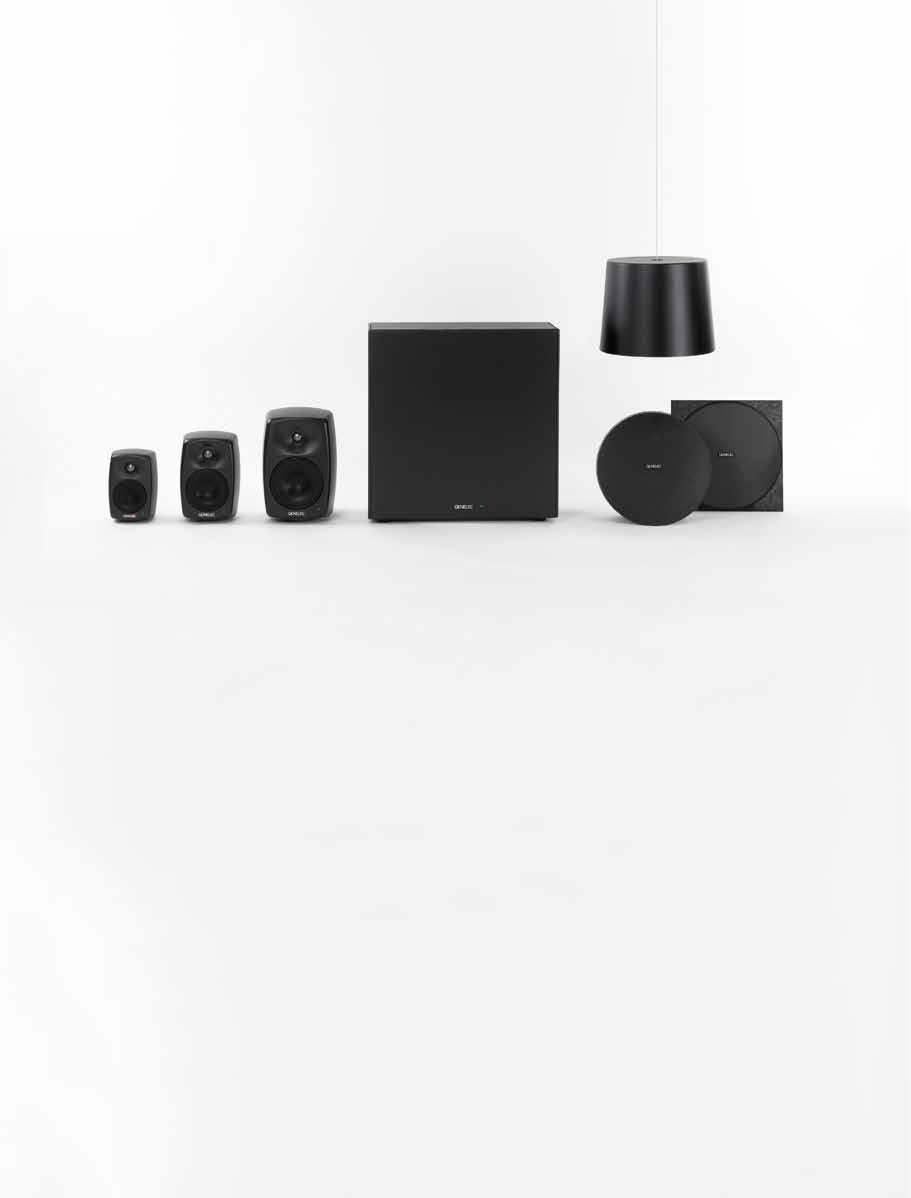
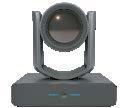
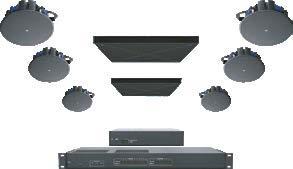
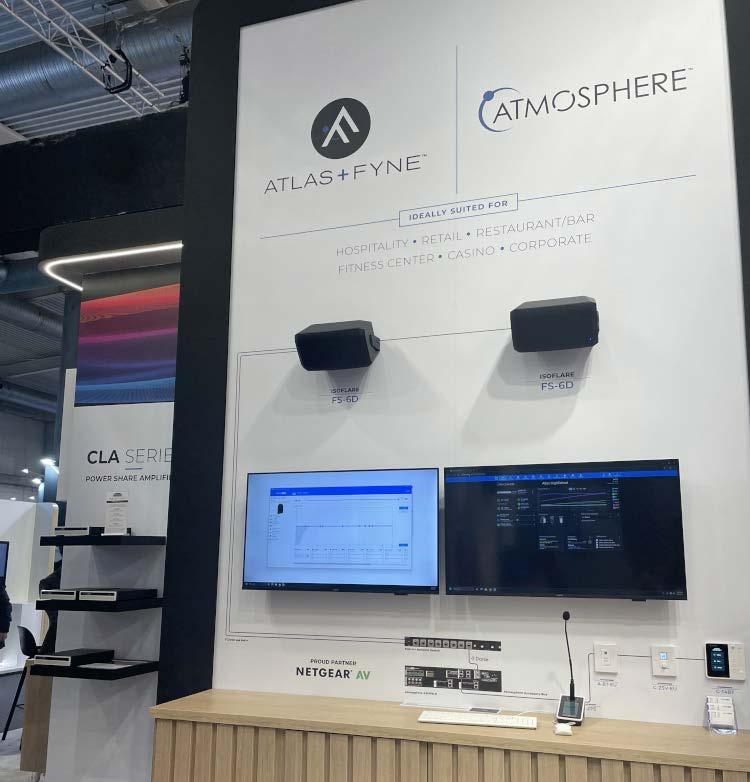
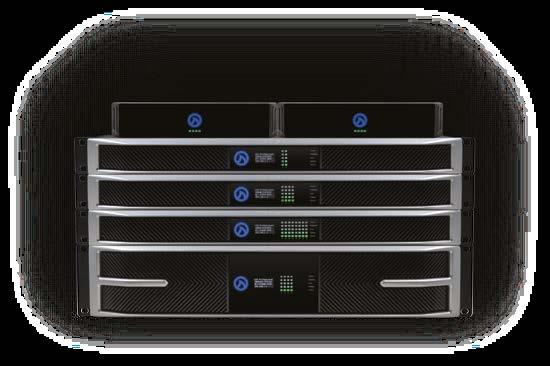
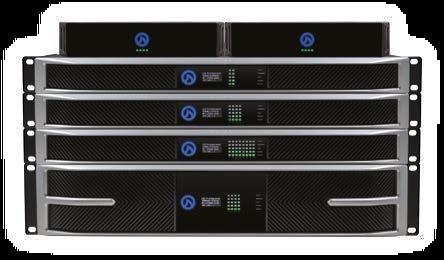
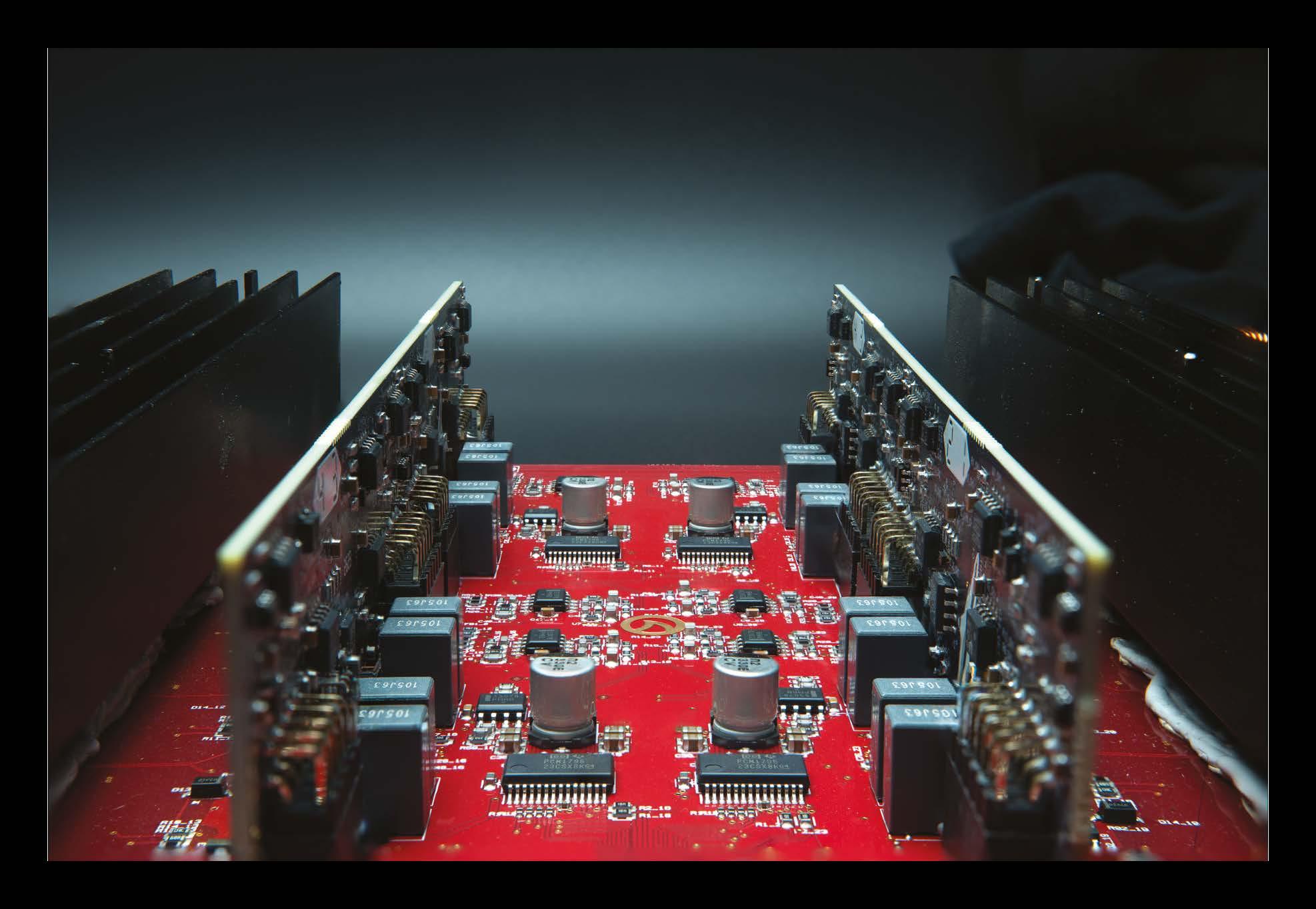
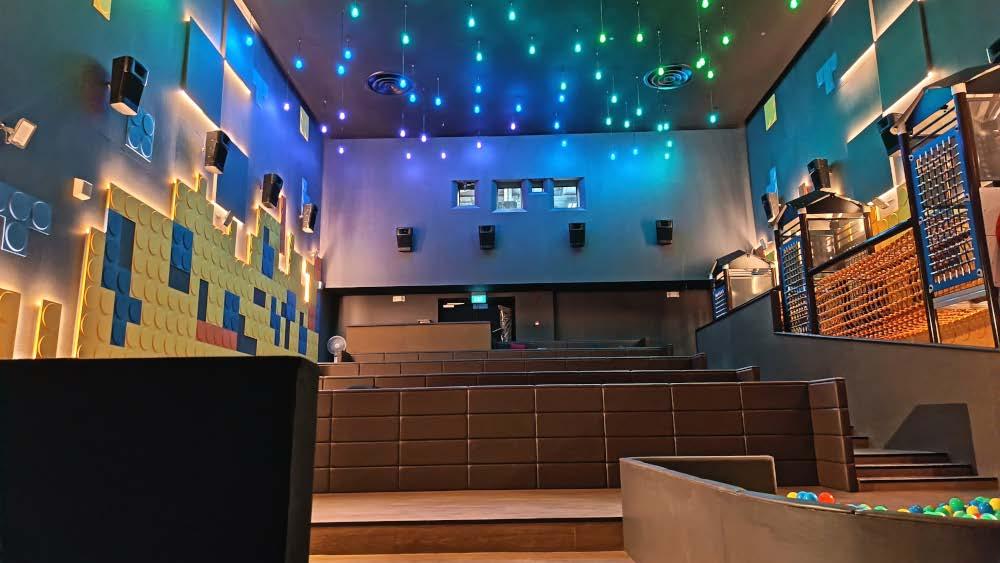
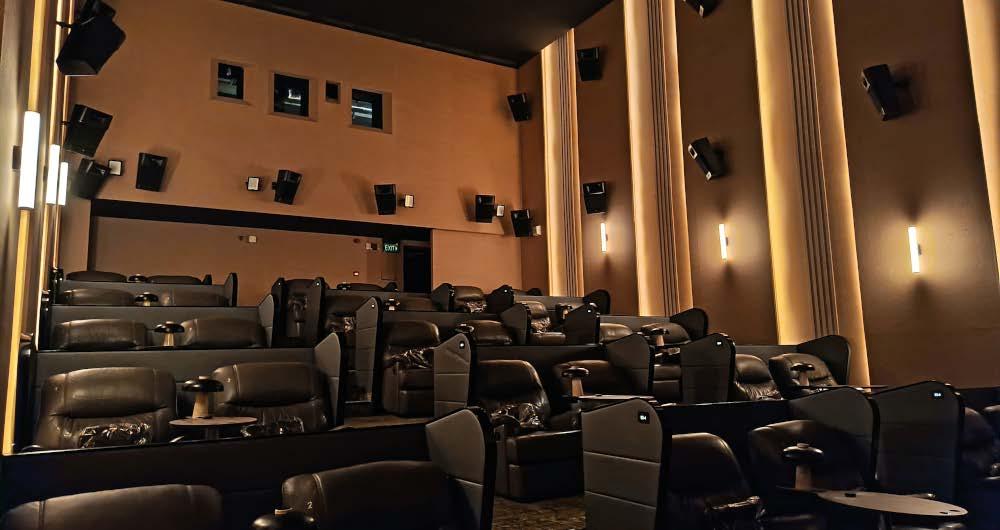
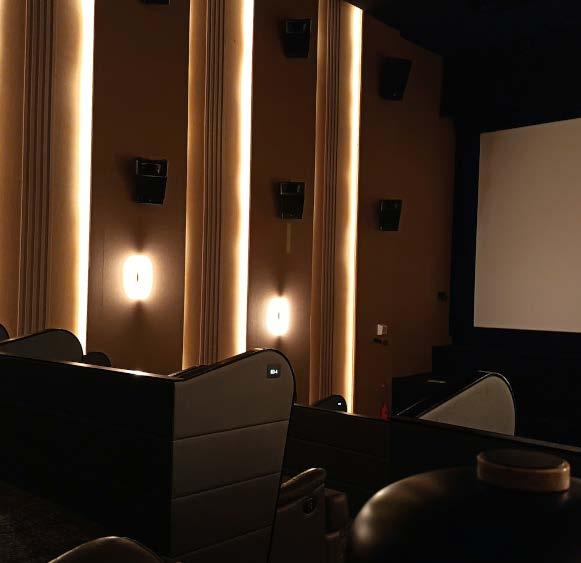
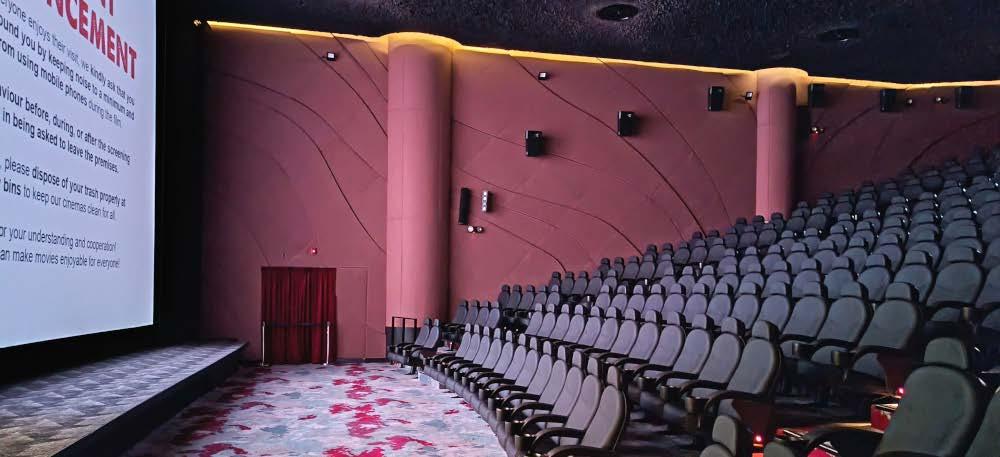
The Genelec Smart IP family of active PoE loudspeakers blends premium sound quality and networked convenience. With audio, power and management delivered via a single CAT cable, all models combine easily to create flexible systems offering clarity, intelligibility and uniform coverage – enabling scalable, future-proof installations.
genelec.com/smart-ip
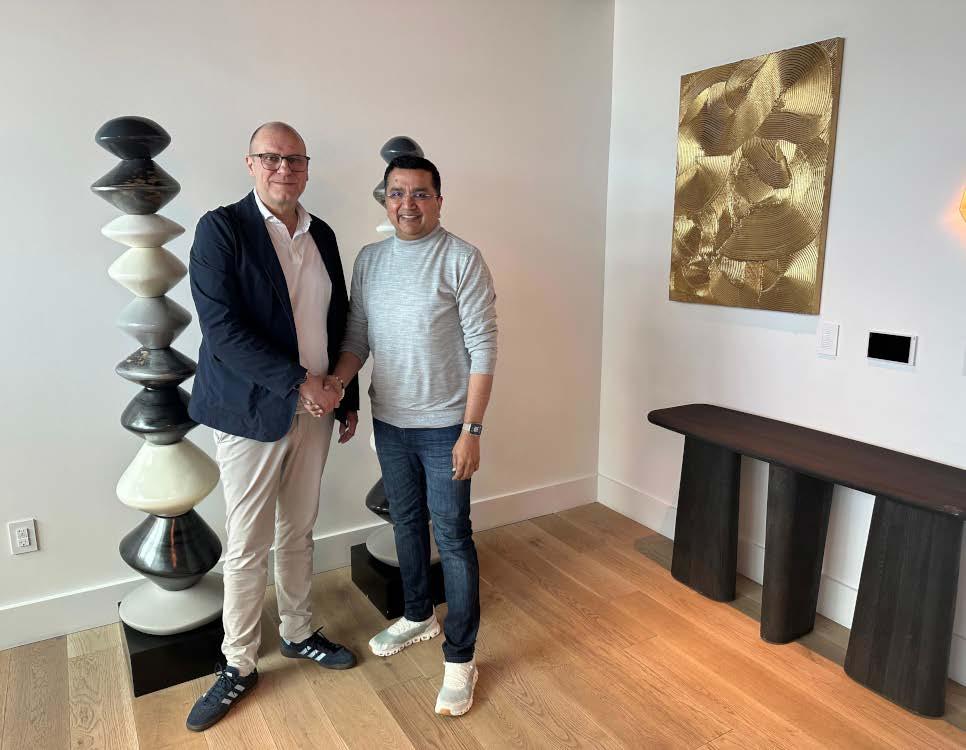
Andrew Tan, Regional Sales Director, Asia, Ross Video
From the Publisher
Thomas Richard Prakasam Publisher/Editorial Director thomas@spinworkz.com
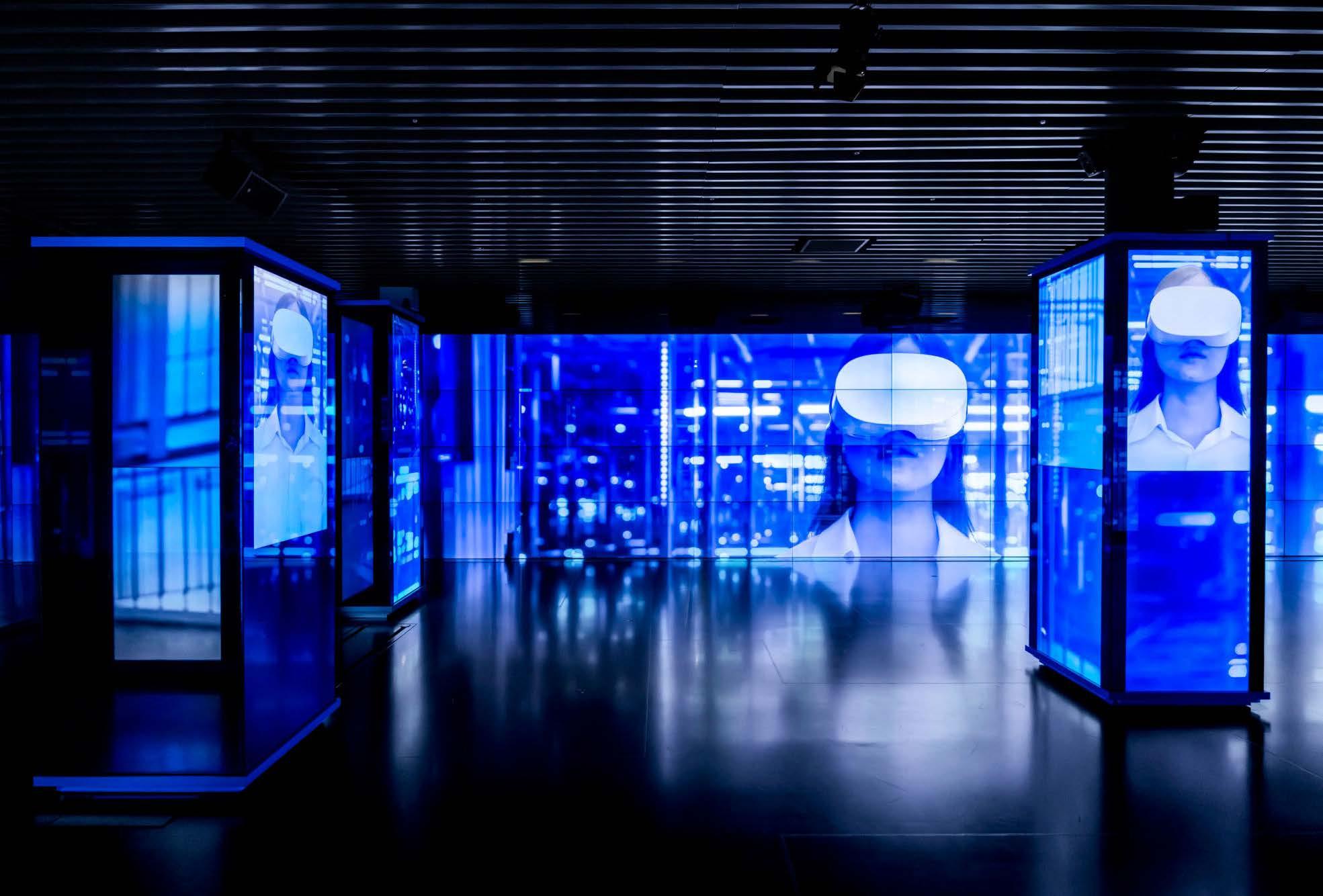
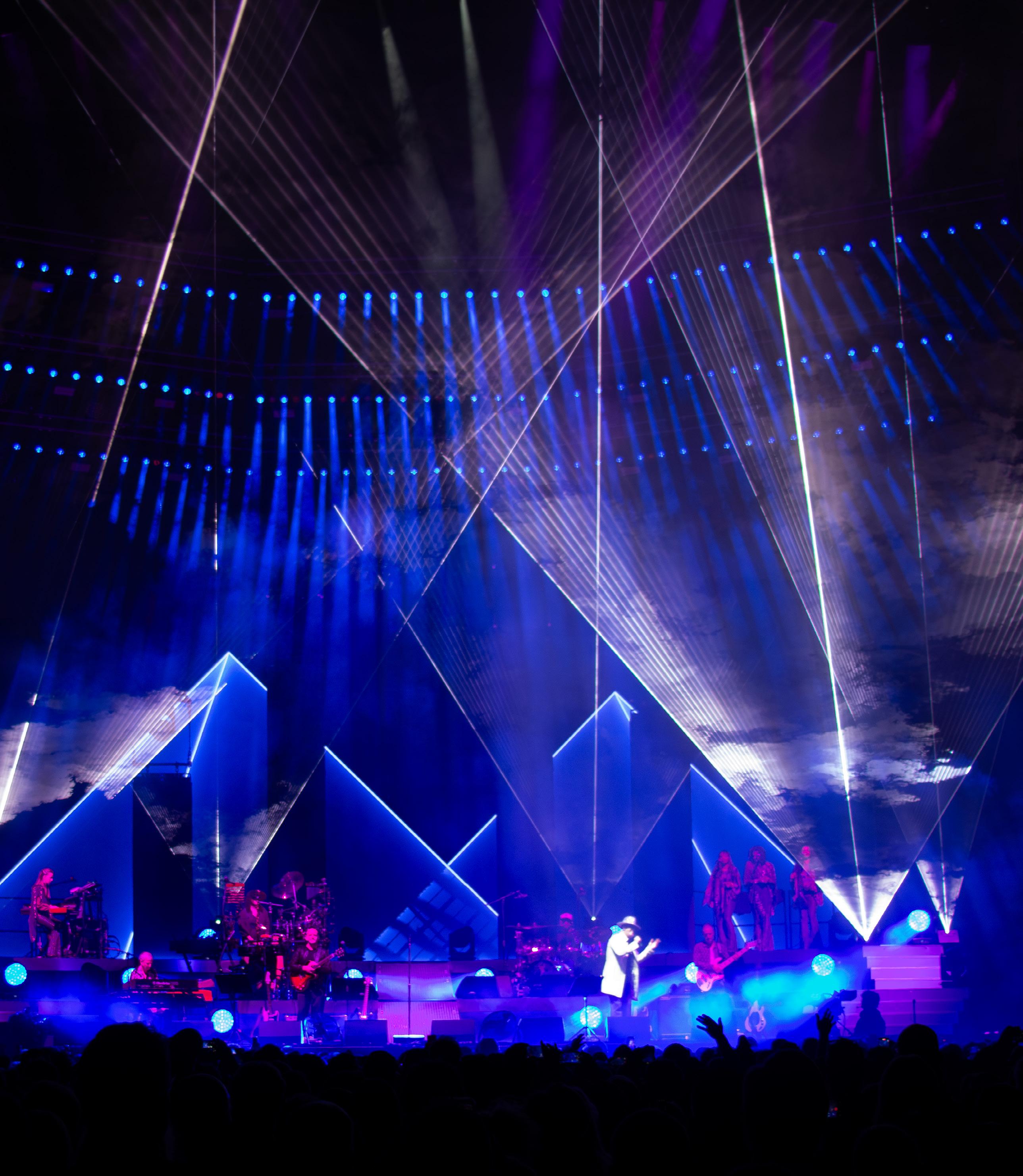
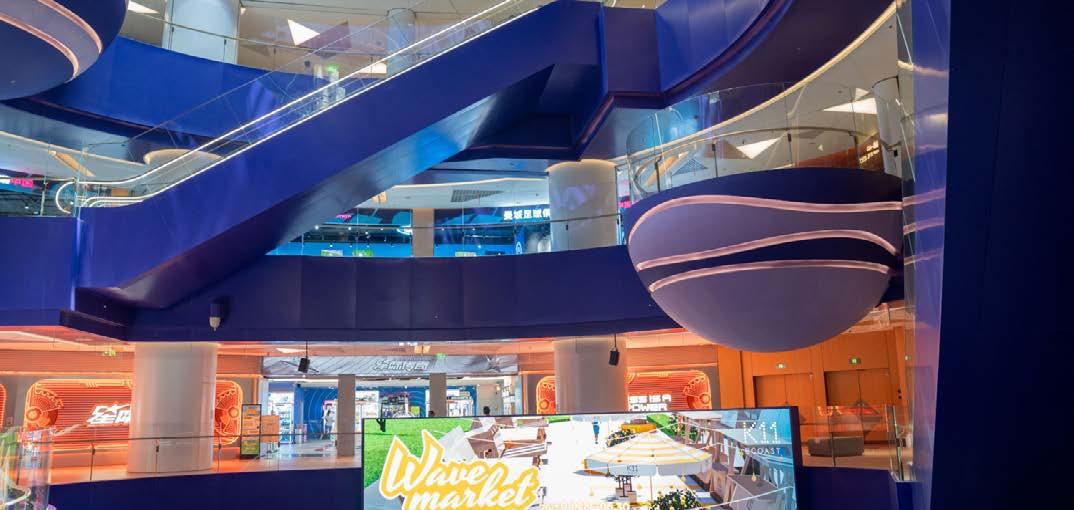
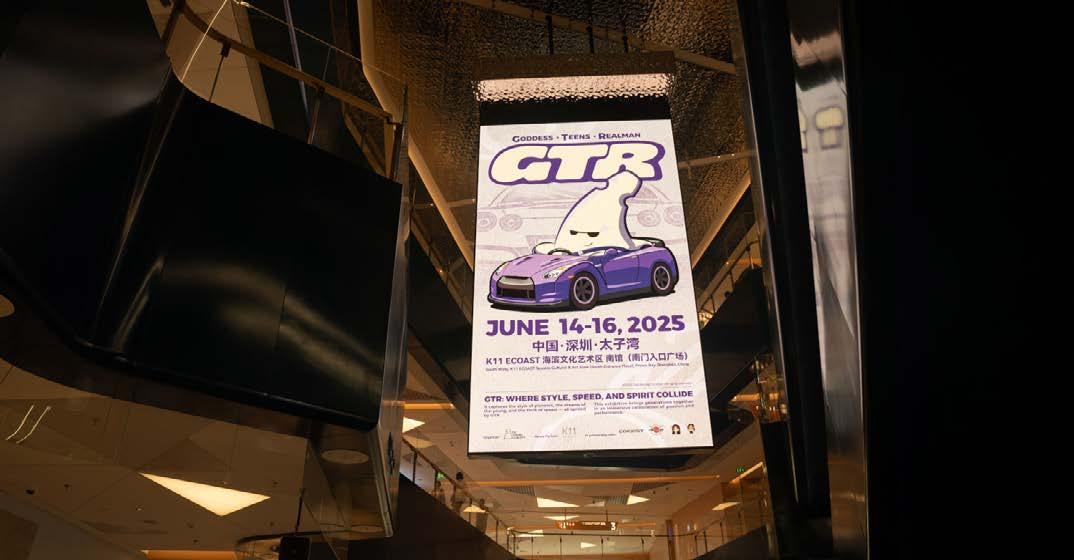
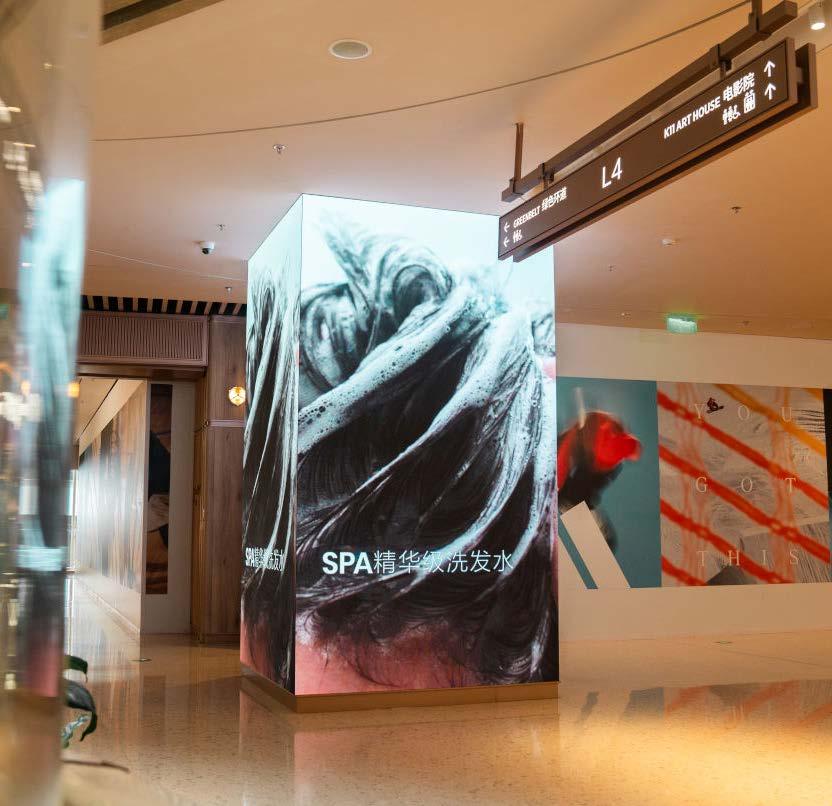
According to a recent Cushman & Wakefield report, APAC’s retail market stands out for its young consumer base, rapid urbanisation, and openness to new retail concepts. Rather than simply following global trends, the region is often leading them. “Retailtainment” — the fusion of shopping, entertainment, and social experiences — continues to thrive through in-store cafés, exclusive lounges, live-streamed demonstrations, and interactive brand activations. In this Feature column, SI Asia speaks with Ross Video, Epson, and Absen about shaping next-generation retail experiences.
In our VoiceBox column, Mitul Shah, Senior Principal Consultant at 3CDN Workplace Tech, discusses how corporate AV Event space is converging with broadcast-grade thinking.
In our AI in AV column, Sachin Jain, Director of PLAY Technology, highlights that with AI also now embedded into the devices, the necessity for system integrators to go beyond physical connections and develop skills on application level implementation is critical and mandatory.
There is so much more in this issue for you to explore. Enjoy the read.
Meet The Team
EDITOR, INDIA AND ME
Ram Bhavanashi
ram@spinworkz.com
MEDIA REP
DIRECTOR
INDUSTRY ENGAGEMENT
Andy Tan andytan@spinworkz.com
CHINA,HONG KONG, TAIWAN
Judy Wang
Worldwide Focus Media
+86-13810325171
judywang2000@vip.126.com
ADMIN & CIRCULATION
Julie Tan
admin@spinworkz.com
DESIGN & LAYOUT
Hazel Gundaya
207A Thomson Road,
Shopping Centre Singapore 307640
Tel: (65) 63162716
Disclaimer: Systems Integration Asia is published 12 times a year. All rights reserved. No part of this magazine is to be reproduced, whether mechanicalor electronic without the prior written consent of the publisher. Views expressed in this magazine do not necessarily reflect those of the editor or the publisher. Unsolicited contributions are welcome but the editor reserves the discretion to use them. Whilst every care is taken to ensure the accuracyand honesty in both editorial and advertising content at press time, the publisher will not be liable for any inaccuracies.
Please be informed that products and company names mentioned in this publication may be protected with tradenames, trademarks or registered trademarks of their respective owners. Our non inclusion of such symbols is not an indication of us not recognising the copyright but rather to have a common look across our articles. Misuse of tradenames, trademarks or registered trademarks is strictly prohibited. It is the obligation of our readers to check if company names and products are protected with tradenames, trademarks or registered trademarks.
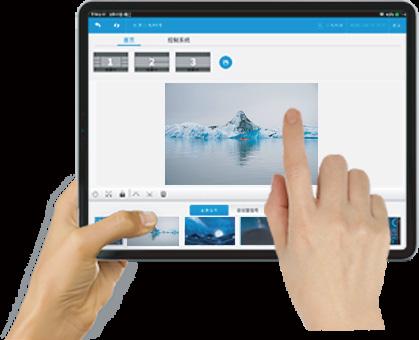
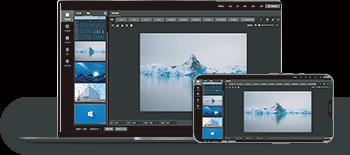
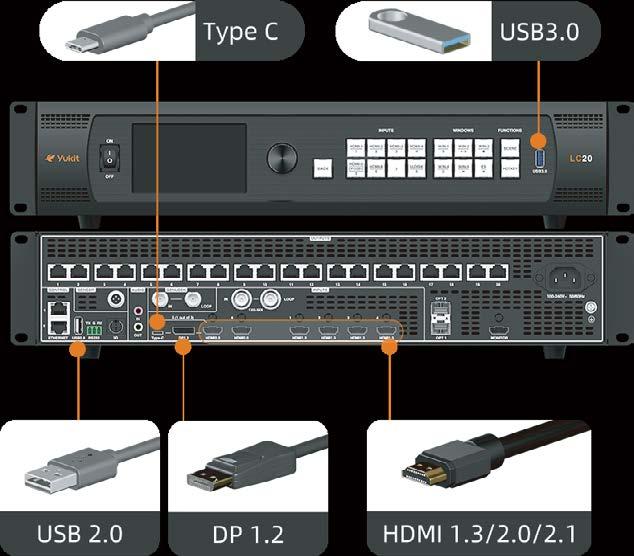
2-in-1 LED Controller www.digibirdtech.com
12-Layer Layout Visual Control Versatile Interfaces
Corporate AV: Broadcast Adjacency
How corporate AV is converging with broadcast-grade thinking
by Mitul Shah
The corporate Event Space is at the centre of a quiet but significant technology transition. Companies are asking their flagship rooms to do things that, not long ago, only a broadcast studio could do — stream a global all-hands to thousands of remote viewers, run a live multicamera production for a leadership summit, and switch back to a 200-person town hall by afternoon. The physical room is the same. The expectation has changed entirely.
For Pro-AV professionals, this is familiar ground on the surface. We have been through a significant adjacency shift before — the AV-IT convergence that rewrote how infrastructure was designed, procured, and managed. What is happening now is the next step. The boundary between professional AV and broadcast is dissolving, and the technology enabling that — IP-based workflows such as SMPTE ST 2110, NDI, and IPMX — is already appearing in corporate specifications.
Event Spaces and podcast rooms are the beachhead. If you have delivered a large-scale live event in a corporate environment in recent years, you have already been working at this boundary. The question worth asking is whether the design and specification behind it reflected broadcast-grade thinking — or whether it applied standard Pro-AV methodology to a fundamentally different problem.
Two industries, Two Mindsets
The distinction between Pro-AV and broadcast is not primarily about equipment. It is about discipline and philosophy — and understanding that distinction is essential before any equipment conversation begins.
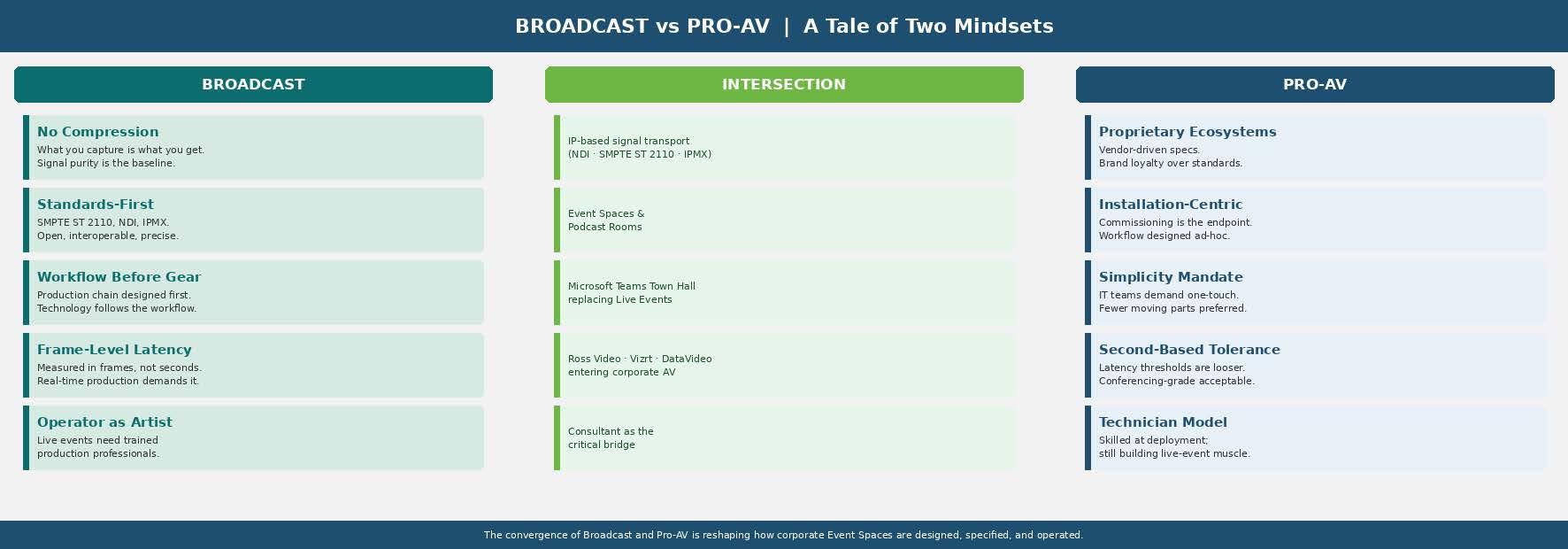
Broadcast operates from a set of principles that are worth examining carefully:
• What you capture is what you get — No compression, no compromise
• every link in the production chain is held to the same standard — Signal integrity is nonnegotiable
• real-time production has no tolerance for drift — Latency is measured in frames, not seconds
• the production chain — from camera to switcher to output — is designed first — Workflows are defined before gear is specified
• SMPTE ST 2110, NDI, IPMX — open, interoperable, and rigorously maintained — Standards are the foundation
Pro-AV, by contrast, has historically been built around proprietary technology ecosystems. Vendors have shaped the conversation, integration has often followed commercial relationships, and workflow design has frequently been treated as a commissioning detail rather than a design input. Neither approach is wrong in its own context — but applying Pro-AV methodology to a broadcastgrade brief will produce a result that falls short of what the brief actually demands.
For consultants, this matters at the point of engagement, not at handover. Workflow must be designed before a single product is specified. How signals move through the space, where they are switched, what redundancy exists, and how the production team will operate the room on event day — these decisions should drive the technology list, not follow from it.
What Clients are Asking for — and What Platforms are Signalling
The requirements showing up in corporate briefs today would have been considered broadcast territory a few years ago. Immersive collaboration rooms, broadcast-quality video aligned with global UC standards, multiplatform live streaming, real-time room analytics, integrated stage lighting and stage machinery — these are no longer exceptional requests. They are becoming the baseline expectation for any well-specified Event Space.
Platform vendors are reinforcing this direction. Microsoft has retired Teams Live Events and replaced it with Teams Town Hall — a purposebuilt architecture for large-scale, broadcaststyle enterprise events. This is not a routine product refresh. It is a clear signal from one of the most influential platforms in corporate AV that enterprise events are now a broadcast problem, and that the infrastructure supporting them needs to be designed accordingly.
For those of us specifying rooms and systems, that signal has direct practical consequences. The UC platforms that enterprise clients standardise on are evolving toward broadcastgrade production capability. The spaces in which those platforms run must be designed to match.
A Signal from the Manufacturers
The movement is not only coming from clients and platforms. Broadcast equipment manufacturers are entering the Pro-AV and corporate events market with clear strategic intent.
Ross Video, Vizrt, and DataVideo — each with deep roots in broadcast production — have been building dedicated teams and go-tomarket approaches aimed at the corporate AV segment. These are structural investments, not exploratory experiments. They reflect a considered view that demand for broadcastgrade production capability in enterprise environments is real, growing, and worth building for.
This creates new territory for AV consultants and integrators. Broadcast product roadmaps, vendor relationships, and commercial frameworks differ significantly from standard AV procurement. Support structures, firmware cycles, and service models are different. Understanding how to specify, procure, and integrate broadcast-grade infrastructure within a corporate project context is a capability that needs to be built — and building it now, while the market is in early formation, is the position worth being in.
Broadcast vs Pro-AV: contrasting principles and the convergence zone shaping today's corporate Event Spaces.
The Capability Gap that Needs an Honest Conversation
There is an important reality at the centre of this transition that is not always discussed directly: most traditional Pro-AV engineers are not trained for live event production in the broadcast sense.
Installing and commissioning a system is a fundamentally different competency from operating it during a live event. In broadcast, the operator is a production professional — someone who understands signal flow under pressure, can make real-time decisions about camera switching, audio mixing, and graphics, and knows how to respond when something goes wrong during a transmission. That skillset does not develop through AV installation experience alone.
This gap needs to be addressed at multiple levels. At the consulting stage, it means recommending appropriate operator training, staffing models, and managed service arrangements as part of the design deliverable — not as an afterthought at project close. At the integration level, it means investing in broadcast-literate engineers. And for clients, it means helping them understand that a broadcast-grade Event Space is a managed operational capability, not an installation that runs itself.
The Pull of IT Simplicity — and How to Work with it
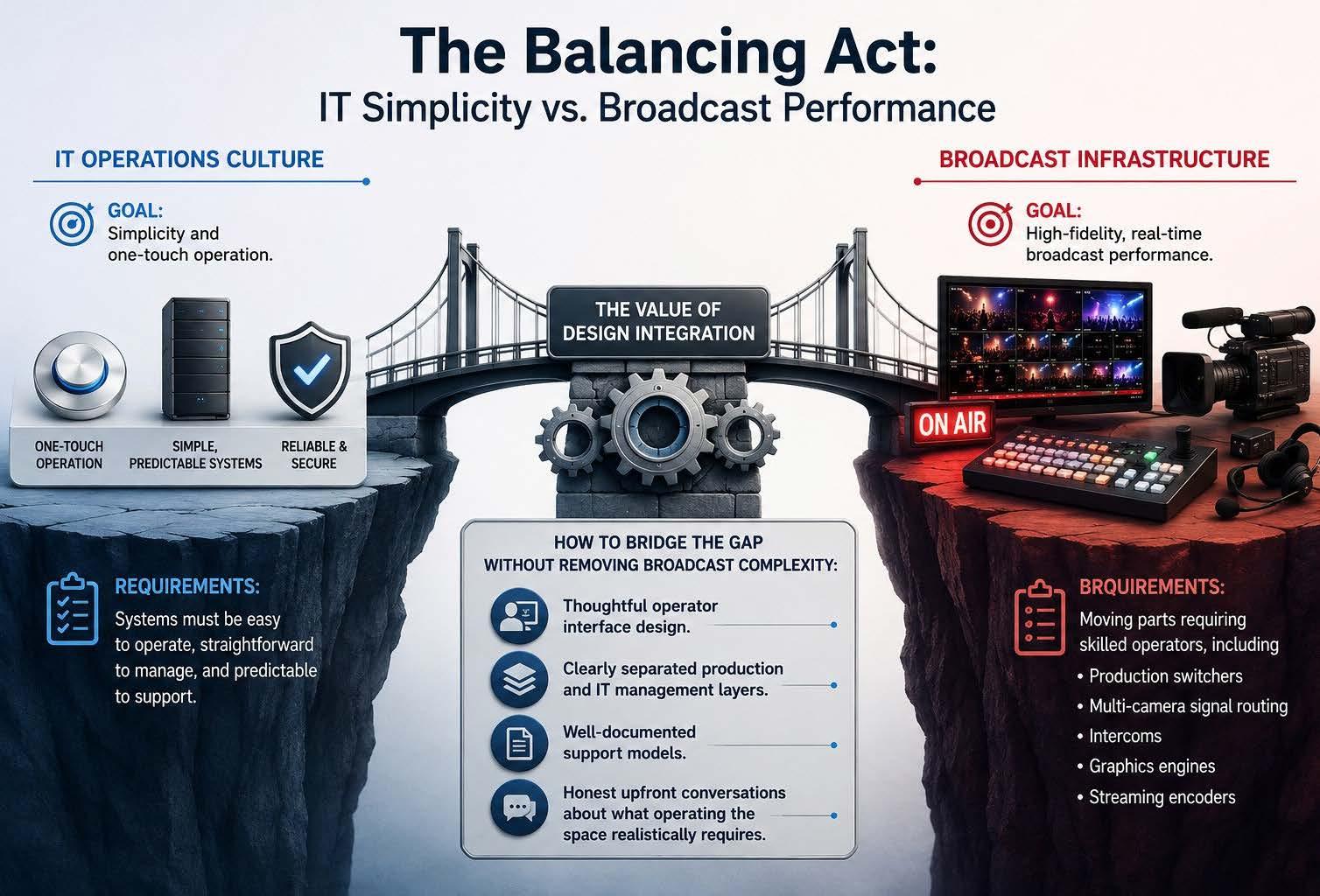
Broadcast infrastructure and IT operations culture are, in many ways, pulling in opposite
directions. IT teams have a reasonable and well-established preference for simplicity — systems that are easy to operate, straightforward to manage, and predictable to support. One-touch operation is the aspiration. Broadcast design is inherently more complex: production switchers, multi-camera signal routing, intercom, graphics engines, streaming encoders, and monitoring infrastructure all involve moving parts that require skilled people to manage.
This tension is one of the most practically significant design challenges in this space, and resolving it is where experienced consulting creates genuine value. The answer is not to remove broadcast complexity — that defeats the purpose of the investment. The answer is to design for broadcast performance while engineering for IT-friendly operation: thoughtful operator interface design, clearly separated production and IT management layers, welldocumented support models, and honest upfront conversations with clients about what operating this kind of space actually requires.
Getting this balance right — between what the space needs to deliver and what the organisation can realistically sustain — is the design problem that defines whether a broadcast-grade corporate Event Space succeeds in practice or sits underused after commissioning.
What this Means for How We Work
The forward integration shift reshaping how managed workspace operators and GCC platforms approach AV procurement
It is a clear signal from one of the most influential platforms in corporate AV that enterprise events are now a broadcast problem, and that the infrastructure supporting them needs to be designed accordingly.
has a direct consequence for how we think about Event Spaces. These are not standard environments. They are high-visibility, highexpectation spaces where the gap between a well-designed system and a poorly specified one is immediately visible — to leadership, to guests, and to the thousands of remote participants on the other side of the stream.
AV consultants and integrators who build broadcast literacy — who understand production workflows, who can navigate the broadcast vendor landscape, who can bridge the gap between broadcast ambition and IT operational reality — will be well-positioned for the most demanding mandates in this segment. Those who apply standard Pro-AV methodology to broadcast-grade briefs will find the results falling short of what clients have come to expect.
The brief has expanded. It now runs from the huddle room all the way to the broadcast studio. The discipline needed to respond to it has expanded too.
About the Author
Mitul Kishor Shah is a Senior Principal Consultant at 3CDN Workplace Tech Pvt. Ltd., a leading workplace technology design and consulting firm specialising in AV, ICT, Smart Building, and Acoustics. He carries over 15+ years of experience in the AV / Multimedia industry, delivering large projects for clients such as Siemens, Deutsche Bank and Aditya Birla Group, among others.
3CDN Workplace Tech
A Tale of Two Cities, in Tech Terms & Terrain
Ambitious initiatives by two Telugu States in India promise new high AI-led future
By Ram Bhavanashi
Make no mistake. This is no Charles Dickens’ story; neither this retells the twisty 2024 Bollywood flick; this is rather a story of two Telugu States from South India who have launched super ambitious initiatives that only rival each other, with their haughty stakes and promises.
While the 19th century British novelist depicted a contrast of sorts between London and Paris, this story is about (contrastingly) high tech future that the cities of Hyderabad in Telangana, and Vishakhapatnam in Andhra Pradesh want to journey, apparently paved and powered by AI.
One is an aptly named Future City, to be built by a consortium while the other in Vizag (other name for Visakha) is India AI Hub shaped by none other than Google.
SI Asia presents an account on the ambitious tech mapping tale of these two cities.
The Story of One AI City – Tarluvada, Vizag
On 28 of April, (last month), at Tarluvada, a very picturesquely lush green and serene village – some 40 km north of Visakhapatnam city centre in Andhra Pradesh – an event happened that turned otherwise quiet countryside into a cynosure of global technology world attention.
For, the 2500-odd population hamlet had suddenly acquired the celebrated status of siting the ground-breaking ceremony for India’s first gigawatt-scale, national AI-powered industrial ecosystem to shape Vikasit Bharat (Developed India) by 2047.
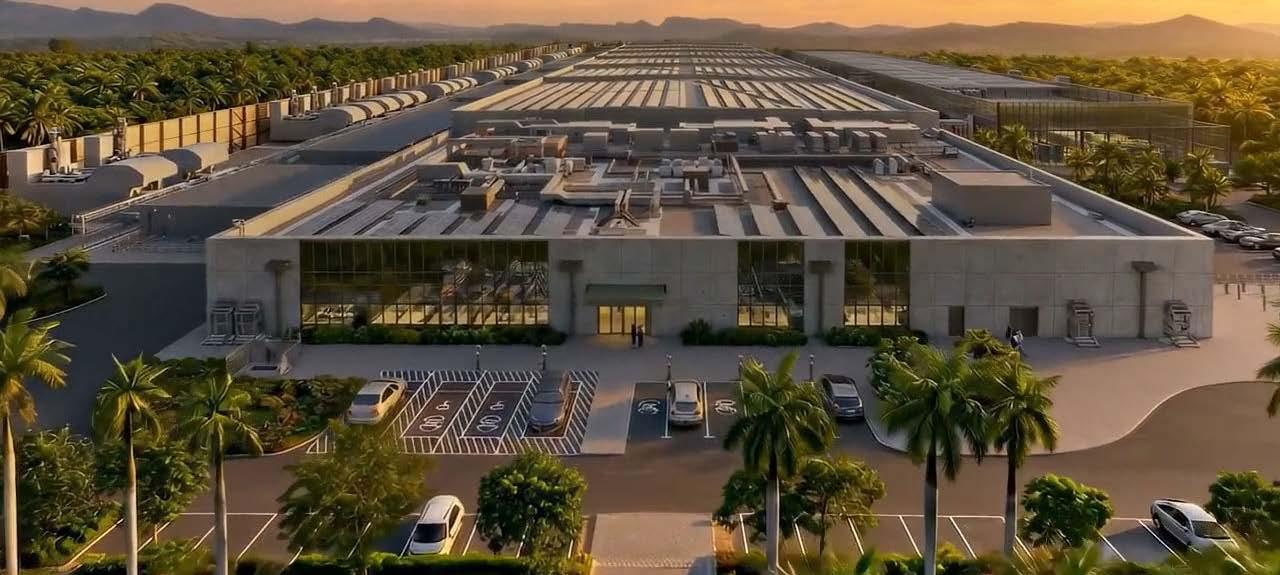
Artist impression of the AI Hub. Image courtesy: Google Cloud press.
The event – though – had a much fanfarecoloured ceremony with some of the most highprofile dignitaries descending on the site for the big technomic thing.
They included Laura Williams, U.S. Consulate General; Thomas Kurian, CEO, Google Cloud; Bikash Koley, Vice-President of Google Global Infrastructure, Google Cloud; Ashwini Vaishnaw, IT Minister, Government of India; N. Chandrababu Naidu, Chief Minister of Andhra Pradesh; Nara Lokesh, Minister for HRD, ITC&E and RTG, Government of Andhra Pradesh; Jeet Adani, Director-Adani Group; Karan Adani, Managing Director of Adani Ports & SEZ Gopal Vittal, and Executive Vice-Chairman, Bharti Airtel.
The cornerstone of the supposed gigantic project is the India AI Hub, launched by Google in tune with its ambitious US$15 billion (>₹1.41 lakh crore) investment – its largest billing in India till date – for a five-year roadmap from 2026-2030.
Planned in strategic partnership with AdaniConneX (a hyperscale data centre service provider division of India’s largest private infrastructure behemoth Adani Group); and Nxtra by Airtel India’s largest private sector telecom provider), the AI Hub – fondly hailed as AI City of India – is being developed over 600 acres of land of the village, with three large data centre campuses together making for a 1-gigawatt facility, which are, in turn, expandable to 2-gigawatt capacity.
The mega project is significant in more ways than one. Consider this:
• It will be Google’s largest AI hub in Asia, and also the largest AI facility outside the US
• It will develop a new international subsea gateway from the US to India through a
America-India Connect initiative of fiber-optic network
• Beyond cloud infrastructure, the facility engages in AI research, AI compute (GPU/TPU), making it the key AI hub for South Asia
• It will create anywhere between 5000 and 6000 high-performance technology jobs directly, and some 30,000 approx jobs indirectly (some reports claim creating as many as close to two lakh jobs)
• Through this workforce, the AI Hub aims at delivering high-performance, low-latency services that businesses and organizations need to build and scale their own AI-powered solutions, accelerate R&D
As an expansion of job creating initiative in the hub, Google will introduce Skills Trade and Readiness (STAR) programme to create sustainable career paths for local talent while developing a home grown workforce ready to drive India’s AI Literacy Mission en route to digital acceleration.
In tandem, IT behemoth is also partnering with Chennai-headquartered ICT Academy to train 1,200+ local students and educators to gain access to specialized tracks in cloud computing and generative AI.
The eventual objective is to help India secure its place as a global leader in the AI-powered future.
An initiative of such a massive scale in the technology domain of AI can be anybody’s imagination as to how much AV it would involve from time to time, and even after its full scale operations. Imagine how many meeting rooms, boardrooms, huddle rooms, training rooms, learning rooms, collaboration spaces, NOCs, visitor presentation studios, work statons, and more…how vast are the stakes for the AV world…
The Story of the Other Future City –Mucherla, Hyderabad
Even as the grand plans for the AI City of India were shaping to break ground at Vizag, just
two days before it happened, i.e. on 26 April, an equally, if not more, ambitious initiative broke ground near Hyderabad, the capital of Telangana.
The Telangana Chief Minister Revanth Reddy laid the Foundation Stone for building Future City Police Commissionerate near Meerkhanpet village, some 38 km from Hyderabad, and 30 km from Shamshabad international airport.
The event, while comparatively smaller than the one at Vizag AI City, is in reality part of a much larger initiative called Bharat Future City that had its ground breaking ceremony in September last year.
Claimed to be India’s first net-zero greenfield Smart City, envisioned as a model for sustainable urban development powered by technological innovation- the Future City is hyped to rival global cities of Seoul, Singapore, Tokyo, Dubai and New York in terms of AIcentric use of advanced technology, for business and living.
To be developed at Mucherla – an otherwise ordinary village but for a potentially high real estate value (owing to its proximity to happening Hyderabad) – the Future City vision spreads over an overwhelmingly large 30,000 acres of land, and stands at an overall outlay of nearly ₹one lakh crore, (US$10.5 billion approx.) with AI-centric technology as its backbone.
Consider this:
• A dedicated AI City serving as special zone for R&D in AI
• A 100 MW AI-ready Data Centre to be set-up by UPC Volt, a joint-venture between two Dutch AI solutions providers UPC Renewables Group and VOLT Data Centers (an MoU was signed during a high-level delegates meeting at the World Economic Forum in Davos recently)
• AI Centre of Excellence to be set up in partnership with Australia’s Deakin University focusing on advanced skilling, research, and industry applications, which will operate within the planned AI University of the Future City
• AI-centric Young India SKills University and National Academy of Construction to come up
Besides AI, the Future City will also have speciality zones for life sciences, fintech, and Smart Technology domains- all powered by AIcentric technology solutions.
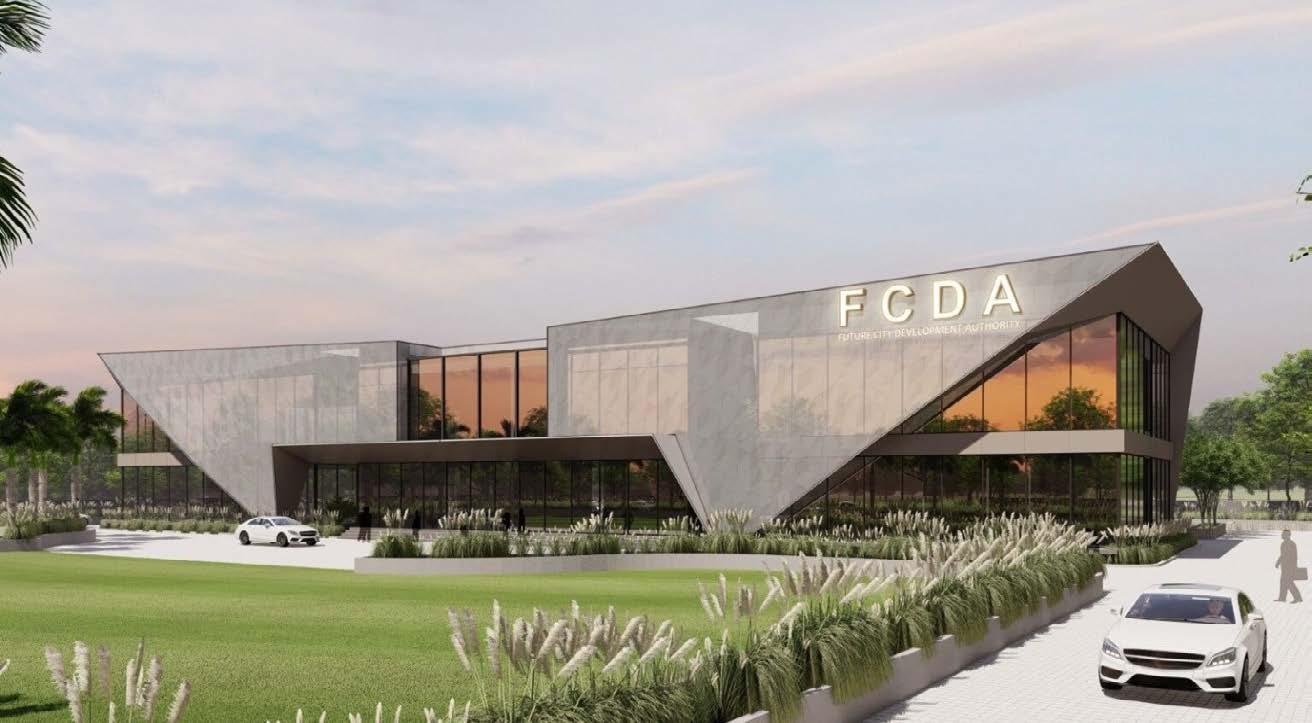
The State Government has set up a dedicated administrative body called the Future City Development Authority last year. Construction of its office went underway simultaneously, and it is slated for inauguration shortly.
Now, again, while the completion of all the proposed/publicized projects is subject to a wide variety of factors, the immensity of the prospects for AV is imaginable- NoCs and Command Control Rooms, video surveillance, conferencing and collaboration spaces, LED video walls, meeting rooms and training rooms, besides many others.
This tale of two cities in India, therefore, for AV prospects is as exciting as it can get. While it is only time that can tell how much of it translates into real gain, the visibility of those prospects is the current driver.
Artist impression of the Future City Development Authority Building in Hyderabad.
AV Integration: Context Engineering
No Data Science, no Cloud Architecture, it is an AI-aware job
AV integrators are no longer mere hardware suppliers and installers. Software driven application layers built on top of hardware require AV system integrators to do much more than connecting cables and turning on the power of devices. With AI also now embedded into the devices, the necessity to go beyond physical connections and develop skills on application level implementation is critical and mandatory.
However, the systems integrator cannot be expected to be a data scientist or cloud architect; the role remains grounded in system design and implementation, says Sachin Jain, Director of PLAY Technology.
In our continuing series of technical feature on AI vis-à-vis AV, this issue we bring you yet another masterly thought lines provided by the PLAY Tech chief.
AV manufacturing OEMs have some time been creating and enhancing their features on a range of products. Cameras use AI to provide speaker tracking, group framing, active speaker detection. DSPs use AI for audio tuning, speech enhancement, etc. The list of devices and AI enabled features just keep adding up.
The OEMs may be creating a powerhouse within their products using AI. However, it’s the AVSI who needs to ensure that these features are configured and customised for the client’s space. Just like in a LLM model such as ChatGPT or Gemini you need to be accurate in your prompts for more specific and better results, the AI features in AV solution needs to be setup accurately for the intended results. AI when not prompted for specifics will still behave in a semi-intelligent manner in standard mode giving better than regular results. However, specialised configuration will drive enhanced experiences.
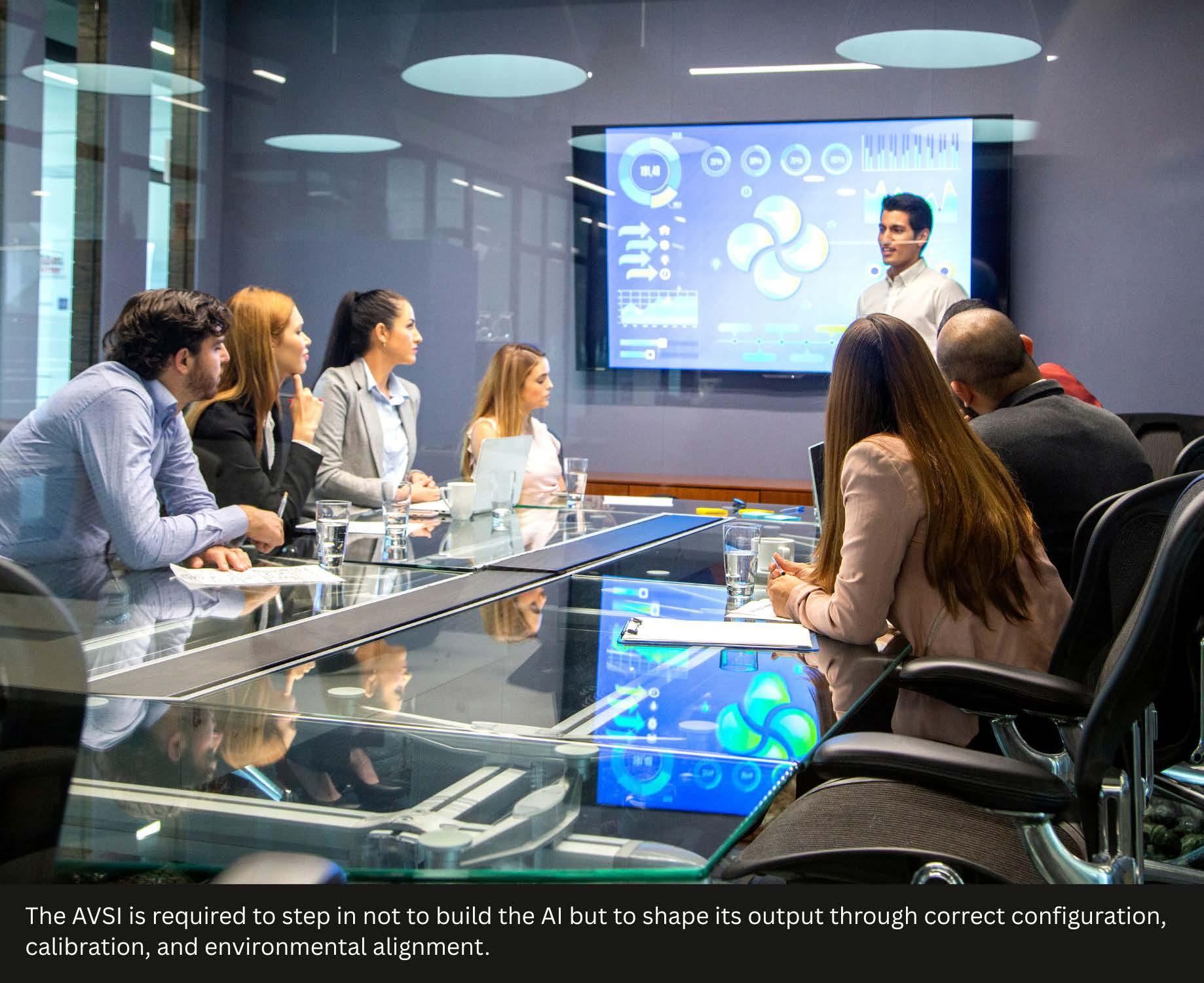
What this also means is that design intent is no longer limited to hardware selection and placement. The AVSI must now define how the system behaves under different real world conditions. A camera with auto-framing capability may work out of the box, but in a boardroom with reflective surfaces, variable seating positions, and inconsistent lighting, default behaviour often falls short. The AVSI is required to step in not to build the AI but to shape its output through correct configuration, calibration, and environmental alignment.
This introduces a new layer of responsibility: context engineering. The performance of AI features is highly dependent on the environment in which they operate. Camera angles, mounting height, room geometry, acoustic treatment, background noise, and even furniture layout influence how effectively AI performs. The AVSI must therefore design not just for coverage, but for AI effectiveness. A poorly positioned device can render even the most advanced AI feature ineffective.
Further, AI features across devices do not operate in isolation. A typical meeting room today may include AI-enabled cameras, DSPs, and unified communication platforms, each making independent decisions. If not carefully aligned, these systems can create conflicting outcomes. For example, a camera may track one participant while the audio system enhances another, resulting in a disjointed experience. The AVSI’s role is to ensure coherent system behaviour across multiple AI engines, even when they originate from different OEMs
This is where the shift from integration to orchestration becomes evident. The AVSI must map user workflows and align device behaviours accordingly. A meeting is no longer just a connection of audio and video; it is a sequence of interactions. Entry into the room, meeting initiation, speaker transitions, content sharing, and meeting closure must all trigger predictable and seamless responses from the system. AI features support these workflows, but they do not define them. That responsibility remains with the AVSI.
While meeting rooms are the most immediate and widely adopted examples of AI-enabled AV systems, the same principles extend across other types of spaces such as auditoriums, museums, and customer experience centres (CEC). In these environments, AI does not simply automate predefined actions, but introduces systems that interpret, predict, and respond based on data inputs. This fundamentally changes how AV systems behave and, in turn, how they must be implemented.
In auditoriums, AI-enabled systems such as presenter tracking, transcription, translation and summaries based on voice signature of the speaker or automated camera direction do not operate on fixed logic. Their performance depends on how accurately the system can interpret movement, voice, identify subjects, and prioritise focus. Variations in stage design,
lighting conditions, number of participants, and audience interaction directly impact these outcomes. The AVSI must therefore configure these systems with a clear understanding of how the underlying models respond to different inputs. This includes defining tracking zones, tagging voice signatures with names, sensitivity thresholds, and behavioural priorities so that the system produces stable and predictable results despite changing conditions.
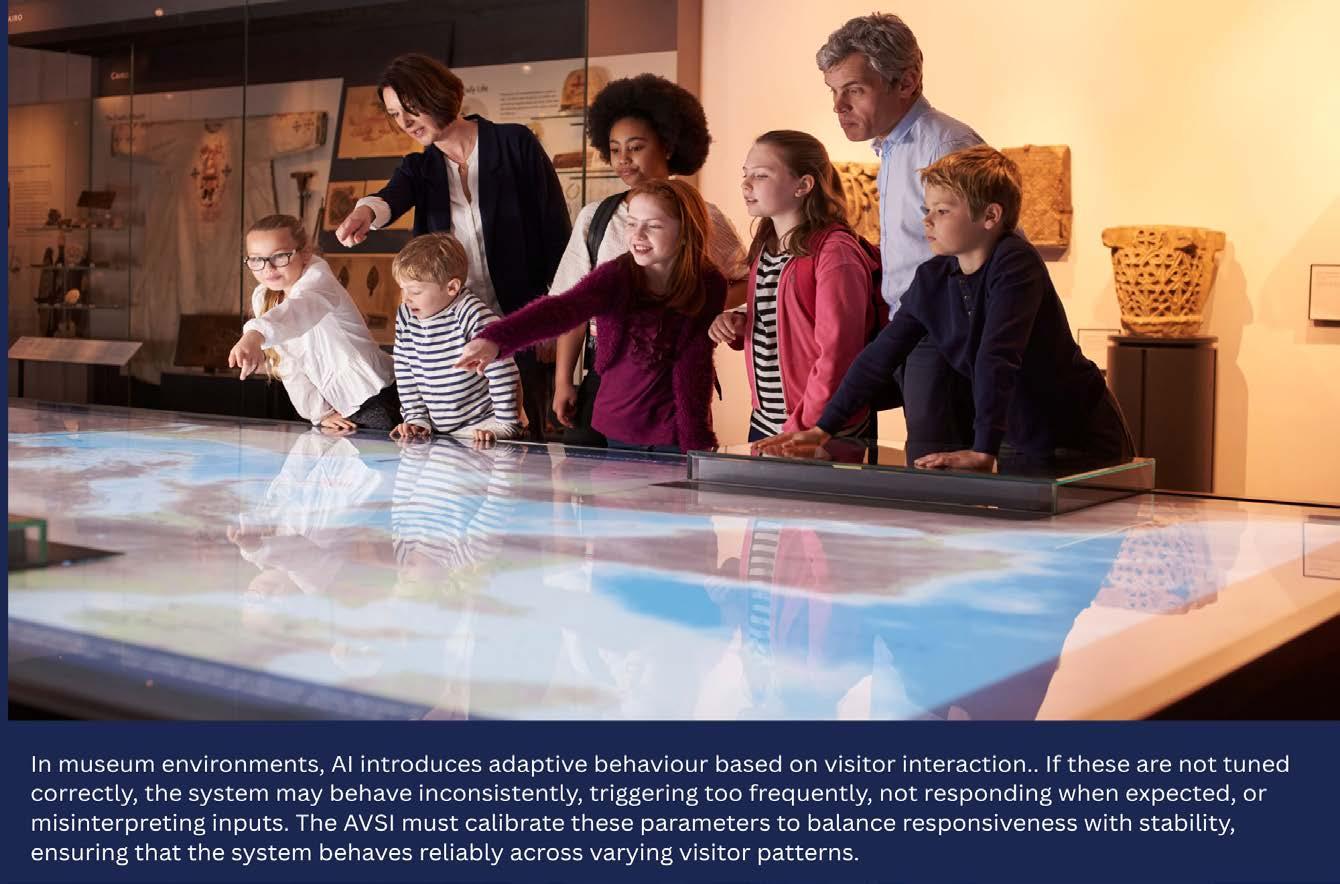
In museum environments, AI introduces adaptive behaviour based on visitor interaction. Systems may respond to presence, movement patterns, or engagement levels. However, unlike show-control or automation systems, AI-driven responses are influenced by probabilities and confidence levels. If these are not tuned correctly, the system may behave inconsistently, triggering too frequently, not responding when expected, or misinterpreting inputs. The AVSI must calibrate these parameters to balance responsiveness with stability, ensuring that the system behaves reliably across varying visitor patterns.
CECs further highlight the role of AI in interpreting user intent rather than executing predefined commands. Systems may adapt content, adjust presentation flow, or personalise interactions based on detected inputs. These behaviours are dependent on data quality and contextual relevance. The AVSI must ensure that inputs to these systems, whether visual,
audio, touch or environmental; are accurate and consistent. Poor input quality leads directly to poor AI outcomes, regardless of the capability of the underlying system.
Across all these spaces, AI introduces a level of non-determinism that is fundamentally different from traditional AV systems. The same input may not always produce identical outputs, and system behaviour may evolve over time as models are updated or refined. The AVSI must therefore shift from expecting fixed responses to managing acceptable ranges of behaviour. The focus moves from ‘whether the system works’ to ‘does the system behave within expected limits’.
Another critical aspect is testing and commissioning. Traditional commissioning involved verifying signal flow, device response, and control logic. Instead of setting fixed parameters, the AVSI must tune systems iteratively; observing how AI features respond in real conditions and adjusting thresholds, zones, and priorities accordingly. In an AI-enabled environment, commissioning must extend to validating behaviour under dynamic conditions. Multiple participants speaking simultaneously, movement within the room, varying noise levels, and changes in lighting must all be tested. The AVSI is no longer validating whether the system works, but whether the experience remains consistent across scenarios. Commissioning becomes a process of refinement rather than validation, requiring multiple test scenarios to achieve consistent performance.
Another critical factor is input dependency. AI systems rely heavily on the quality of data they receive. Camera placement, field of view, lighting uniformity, microphone pickup, and background noise all directly influence how effectively AI models perform. The AVSI must ensure that these input conditions are optimised during design and implementation. Even the most
In museum environments AVSI must calibrate various parameters to balance responsiveness with stability and reliability across varying visitor patterns.
advanced AI feature will underperform if the input conditions are not aligned with its operating requirements.
This introduces a continuous optimisation requirement that goes beyond traditional maintenance. In addition, AI-enabled systems are not static. Firmware updates, feature enhancements, and algorithm improvements continuously change how devices behave. These updates can alter system behaviour, sometimes improving performance and at other times requiring re-tuning. This introduces a lifecycle component that AVSI teams must be prepared to manage. Post-installation support will increasingly involve reconfiguration, fine-tuning, and optimisation of AI features rather than only troubleshooting hardware faults. The AVSI must be prepared to revisit configurations post-deployment, ensuring that system behaviour remains aligned with the intended outcome. The system delivered on day one will not remain identical over time, and the AVSI must take ownership of maintaining performance standards.
In these environments, the role of the AVSI is not to define logic, but to tune behaviour. AI provides the capability to interpret and respond, but it does not guarantee correctness in every scenario. The AVSI must bridge this gap by configuring, calibrating, and refining the system so that it performs reliably within the context of the space.
It is equally important to clarify that while AI introduces new dimensions, the systems integrator is not expected to become a data scientist or a cloud architect. The role remains grounded in system design and implementation. However, there is a clear expectation to be AIaware to understand what the features do, what inputs they depend on, and how configuration impacts output. This awareness allows the AVSI to collaborate effectively with OEMs and IT teams without overstepping into their domains.
Ultimately, the shift is not about replacing existing AVSI skills, but about building on them.
Fundamentals such as acoustics, sightlines, system design, and user experience remain critical. AI amplifies the importance of getting these fundamentals right. A well-designed room enhances AI performance, while a poorly designed one limits it.
The requirement to understand and tweak AI configurations is a skill set that AVSI team will need to develop. AVSI will need to invest in upskilling their current teams with knowledge on IT and AI. These skill which was confined to a certain section of the current teams will be required to percolate down to the junior technicians as well in the upcoming years.
The requirement is to build practical, implementation-level understanding of how AI-enabled features behave within AV systems. Teams will need to understand how inputs influence AI outcomes. The ability to identify why an AI feature is not performing as expected, and to correct it through configuration and environmental adjustments, will become a core competency. Teams must be trained to test systems under varying conditions. Understanding how AI systems respond under these conditions, and how to stabilise that response, will be critical to delivering a consistent user experience.
The AVSI of today is therefore evolving into a system behaviour designer who ensures that technology does not just function, but functions intelligently, predictably, and in alignment with user expectations.
PLAY TECHNOLOGIES
The author is Director at PLAY TECHNOLOGIES, one of the leading AV design consultancy and systems integration firms from Mumbai, with presence across IMEA regions. He can be contacted at Sachin.jain@ playtechnologies.in
NETGEAR Introduces Tiered Support System and New Professional Services
customers and partners to deploy, operate, and optimise networks with confidence. It also accelerates our vision as a comprehensive B2B solutions leader dedicated to seamless, end-toend network performance.”
A Structured Approach to Network Support
SINGAPORE: NETGEAR, Inc. has launched its new Premium Support offering and comprehensive Professional Services portfolio, reinforcing its commitment to MSPs and SME customers with a complete, lifecycle-driven services strategy. This comprehensive suite of service tiers and expert-led engineering solutions delivers greater network confidence to MSPs and their customers.
“As networks become mission-critical to business operations, from cloud applications to AV over IP deployments, organizations face increasing pressure to ensure uptime, performance, and scalability,” commented Massimo Mazzeo Ocello, Vice President of Global Systems Engineering, Customer Support and Services at NETGEAR. “NETGEAR’s new services portfolio addresses this need by combining structured, SLA-backed support with expert-led, outcome-driven services, enabling
At the core of the announcement is NETGEAR’s Premium Support portfolio, a tiered framework designed to support enterprises with predictable service levels and measurable outcomes.
Key Premium Support tiers include:
• Sprint: Essential, value-driven support for day-to-day operations, including 24/5 access to engineers and advance hardware replacement
• Overdrive: 24/7 priority performance assurance with guaranteed responsiveness, featuring fast-track escalations and next-business-day hardware replacement for environments where downtime has a direct business impact
• Fastlane: A fully customised, high-touch engagement model, offering tailored SLAs, direct access to senior engineers, and dedicated resources for complex or missioncritical environments
This structured approach allows organisations to align support investment with operational criticality, reducing downtime, accelerating issue resolution, and ensuring predictable network performance.
From Support to Full Lifecycle Services
Complementing Premium Support, NETGEAR is introducing a comprehensive Professional Services portfolio, designed to support customers and partners across the entire network lifecycle.
Professional Services offerings range from deployment support to ensure production-ready networks from day one; event services; and a health check and optimisation to enhance performance, through to interoperability, staging and migration services and tailored training programs to empower internal teams.
NETGEAR is also offering a high-touch, fully customizable partnership model with engineering resources. Together, these services provide end-to-end coverage, enabling organisations to reduce deployment risk, accelerate time-to-value, and maintain peak performance over time.
A Partner-Centric Value Proposition
With this new portfolio, NETGEAR enables partners to expand the scope and value of their engagements, moving beyond deployment to deliver more predictable, outcome-driven
By combining structured support tiers with expert-led services, partners can simplify postdeployment operations, reduce risk on complex projects, and strengthen long-term customer relationships.
This launch reflects NETGEAR’s commitment to its partners and further strengthens the NETGEAR Drive Partner Success Program, extending its value beyond enablement and incentives into delivery and lifecycle services.
Designed to complement and elevate partner expertise, this services framework provides access to advanced engineering capabilities, greater operational predictability, and the ability to scale with confidence, while preserving full ownership of the customer relationship.
NETGEAR Drive Partner Success Program
Level Up Your Content Production and Presentations
Director Plus
Input everything: four HDMI, two USB, ten IP streams, web pages, phone cameras, media files and more
Extensive IP format support: NDI ® High Bandwidth, NDI HX3, SRT, RTMP, RTSP and more
Elevate your productions: combine up to six 4K/60FPS sources or up to sixteen 1080p HD sources
Unbreakable connectivity: integrated 5G modem*, 2.5Gbps Ethernet and Wi-Fi
Combining switching, graphics, replay and streaming in one portable device, Director Plus is ideal for creating engaging live streams, meeting presentations and more. It builds on the rich features of earlier Director models with expanded inputs and outputs; 4K/60FPS streaming and recording; enhanced connectivity and much more. Learn more at www.magewell.com/director-plus
Booth N7736
SDVoE Alliance Expands AV-overIP Ecosystem with WaveSplitter Partnership
GLOBAL: SDVoE Alliance has welcomed WaveSplitter Technologies as a new Adopting Member, strengthening the Alliance’s growing ecosystem of companies focused on advancing high-performance AV-over-IP and Ethernetbased signal distribution technologies.
Headquartered in Taipei, Taiwan, WaveSplitter Technologies has built a strong presence in optical networking and high-speed signal transport since its founding in 1996. The company develops optical transceivers, networking modules, and video distribution technologies designed to support reliable, real-time data transmission across enterprise networking, telecommunications, and professional AV environments.
By joining the SDVoE Alliance, WaveSplitter aligns itself with a broader industry push toward standardised Ethernet-based AV infrastructures capable of supporting uncompressed video, zero-latency transmission, and scalable system deployment over standard network architecture.
WaveSplitter’s expertise in optical networking positions the company to play a growing role in the evolution of bandwidth-intensive AV systems, particularly as demand increases for real-time video processing, flexible signal routing, and large-scale networked AV deployments across corporate, education, broadcast, and live event environments.
“We’re excited to become a member of the SDVoE Alliance,” said Perry Lin, Chief Financial
Officer for WaveSplitter Technologies, Inc.
“Joining the Alliance gives us the opportunity to contribute to a unified approach for delivering uncompressed, real-time video over Ethernet while continuing to innovate in high-speed signal transport.”
“WaveSplitter brings expertise in optical networking and the underlying infrastructure that makes high-bandwidth AV-over-IP possible,” said Stephane Tremblay, President of the SDVoE Alliance. “Their experience in enabling reliable, high-speed data transmission strengthens the SDVoE ecosystem and supports the growing demand for robust, network-based AV systems.”
Built around its “Power of 10” framework, the SDVoE platform uses 10 Gbps Ethernet architecture to deliver uncompressed video, zero latency, and highly scalable AV distribution. The addition of WaveSplitter highlights the continued momentum behind Ethernet-driven AV workflows as manufacturers and infrastructure providers work to support more complex, high-bandwidth professional AV applications.
SDVoE Alliance
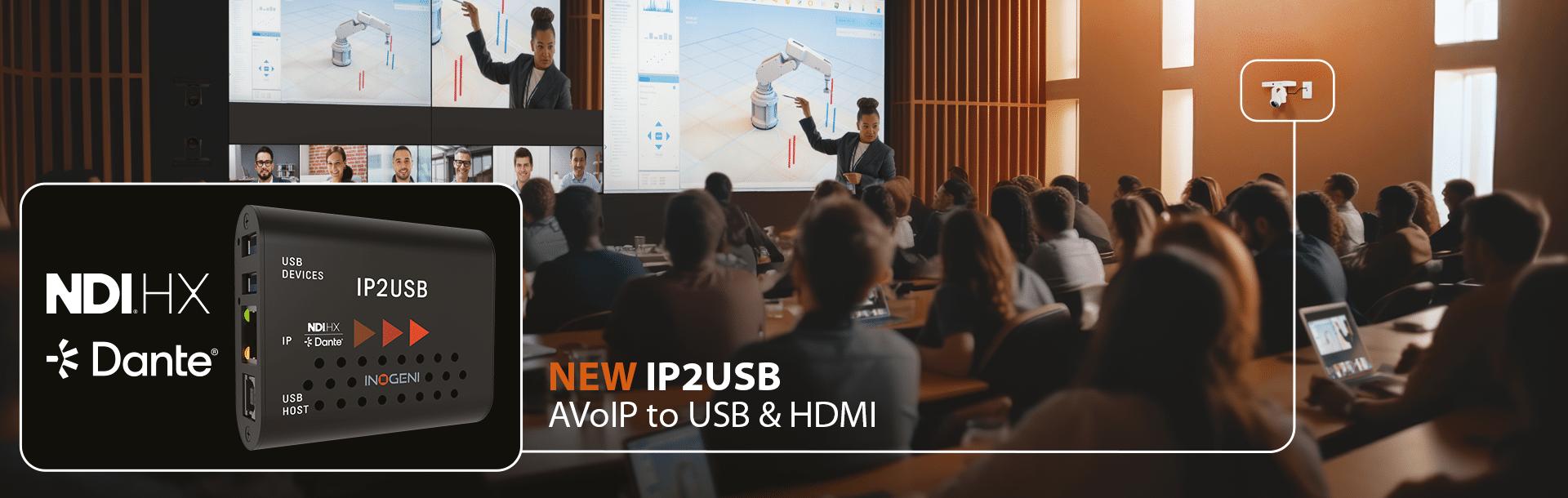
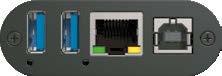
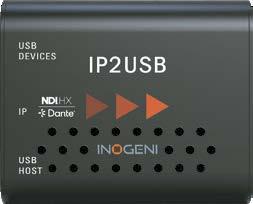
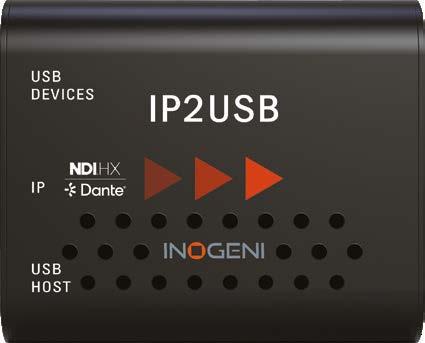
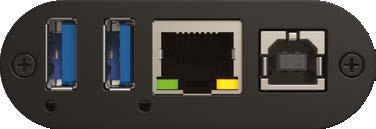
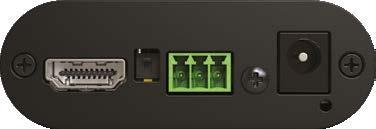
IP2USB
Network AV to USB Bridge (NDI & Dante audio)
• Convert IP to USB and HDMI across multiple AVoIP standards, including NDI, NDI HX and RTSP
• Instantly switch between multiple cameras via the device web interface, API, or third-party control
• USB host: 1x USB 2.0 Type-B for host PC connection
• Supports NDI® HX/HX2/HX3 (1080p60 in H.264/H.265), and RTSP streaming. The NDI® HQ (1080p30 in I-frame, low latency) will be available with the next Firmware update.
• UVC 1080p30 MJPEG video output
• UAC audio I/O support: Facilitates bidirectional audio via USB
• Dante audio integration with easy routing via Dante Controller
• Audio processing: Supports HDMI and USB-based audio routing.
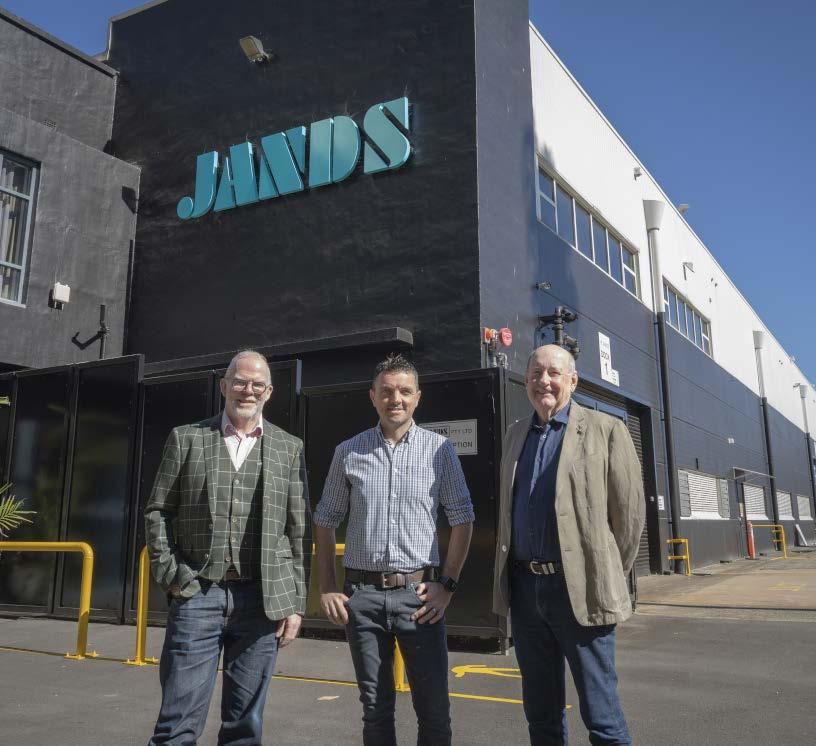
Jands and Meyer Sound Unite to Power the Next Era of Professional Audio
AUS/NZ: Jands Pty Ltd has been appointed exclusive distributor for Meyer Sound across Australia and New Zealand, formalising a relationship decades in the making and bringing together two of the region’s most respected names in professional audio.
The partnership signals a major strategic move for both companies, combining Jands’ deep market presence and technical expertise with Meyer Sound’s globally recognised reputation for sonic innovation and system performance.
The roots of the relationship stretch back to Jands’ early years in professional audio, when the company first encountered Meyer Sound’s iconic MSL-4 loudspeaker systems during a landmark theatrical production, an experience that would help shape the company’s future direction.
“We are incredibly proud to be appointed as the Meyer Sound distributors for Australia and New Zealand, a partnership that continues a relationship spanning decades,” said Paul Mulholland, Executive Chairman at Jands. Jands began as a rental company, building our own speaker cabinets, until a major theatrical production led us to Meyer’s MSL-4 systems, a decision that helped shape our business. Meyer Sound stands out for its innovation, integrity and community focus, values we share. Now formally representing Meyer Sound feels natural and meaningful, and we look forward to supporting our customers and growing the market together.”
Under the agreement, Jands will oversee sales, market development, technical support, and service for Meyer Sound’s complete product portfolio throughout Australia and
New Zealand. The partnership is expected to strengthen support for customers across live touring, performing arts, hospitality, entertainment venues, and large-scale installation projects.
”Demand for Meyer Sound across Australia and New Zealand has never been stronger,” noted Meyer Sound Sales Manager, APAC, Owen Ironside. “As the market continues to grow, it’s clear that we need a robust and futurefocused distribution partner to ensure we can support our customers at the highest level. Jands is an icon of the industry, established internationally as a benchmark for distribution. Our shared commitment to quality, innovation, and customer experience makes it an ideal fit for Meyer Sound, and we are delighted to have the opportunity to now work side by side.”
The move also positions both companies to further expand Meyer Sound’s footprint across the region while reinforcing support for its established dealer network through Jands’ extensive infrastructure and industry relationships.
Jands has officially begun representing Meyer Sound, with customers able to engage directly with the Jands team for demonstrations, technical support, and product enquiries.
G&D and CT Square Establish Joint Venture to Expand Mission-Critical Control Room Technology
INDIA: Guntermann & Drunck GmbH (G&D), a Panoptec Technologies Group company and leading global manufacturer of highperformance KVM solutions for mission-critical control rooms, and CT Square, led by control room technology expert Chandresh Shah, have agreed to establish a new joint venture company in India.
The new company will serve as the exclusive distribution platform for G&D and VuWall solutions across India, bringing advanced KVM, video wall management, visualisation, and control room technologies closer to one of the world’s fastest-growing infrastructure and technology markets.
The agreement was concluded during NAB 2026 in Las Vegas and takes effect immediately. The formal establishment of the
joint venture office in New Delhi is expected to be completed in the coming months. A dedicated location for the future showroom and office has already been secured.
With this strategic move, G&D and VuWall are significantly strengthening their presence in India and creating a local platform to support customers, consultants, system integrators, and partners working in mission-critical environments, including energy, transportation, public safety, broadcast, government, defence, utilities, and industrial control rooms.
“India is one of the most dynamic and promising markets for mission-critical control room technology worldwide,” said Thorsten Lipp, CEO, Panoptec Technologies Group. “With CT Square and Chandresh Shah, we have found a highly experienced partner who understands the market, the technology, and the operational requirements of control room customers. This joint venture is an important milestone in our international growth strategy and a strong commitment to India.”
The joint venture will provide customers with local access to G&D’s high-performance KVM solutions and VuWall’s video wall management and visualisation solutions, along with expert consulting, product demonstrations, technical support, and project-specific solution design. By combining G&D’s German engineering excellence, VuWall’s expertise in AV-over-IP control room visualisation, and CT Square’s regional market knowledge, the new company is positioned to become a trusted technology partner for mission-critical control room projects in India.
“Establishing this joint venture is a decisive step in our international growth strategy,” said Eric Hénique, CRO of G&D and VuWall. “India is a market with exceptional momentum, and we are committed to supporting our customers and partners there with the full depth of our technology portfolio, local expertise, and longterm commitment.”
Thorsten Lipp with Chandresh Shah.
In addition to its focus on India, CT Square will also act as a preferred partner for G&D and VuWall in the Middle East. For these activities, CT Square will leverage the existing Panoptec Group showroom and office in Dubai, creating an immediate regional hub for demonstrations, customer meetings, and project support.
Chandresh Shah brings extensive experience in control room technology, with particular expertise in KVM systems and mission-critical infrastructure. His market knowledge and technical expertise will play a central role in positioning the joint venture as a trusted
AtlasIED Announces Partnership with NETGEAR AV
GLOBAL: AtlasIED has partnered with NETGEAR AV to strengthen its ecosystem of technology partners and deliver best-in-class networked AV solutions. The collaboration aligns AtlasIED’s expertise in intelligent audio and security solutions with NETGEAR’s leadership in managed network switching and AV-over-IP infrastructure.
“Interoperability is key to unlocking the full potential of AV over IP,” said John Henkel, Product Marketing Director at NETGEAR AV. “We’re looking forward to this collaboration with AtlasIED to showcase how our solutions work together to deliver powerful, scalable, and easy-to-deploy systems for integrators.”
At the core of the partnership is a focus on optimising audio deployments over highperformance networks. By pairing AtlasIED's Atlas+Fyne POE++ loudspeaker solutions with NETGEAR AV managed switches, customers benefit from simplified installation, reduced
platform for customers and partners across the region.
“I am delighted to join forces with G&D and VuWall to bring world-class control room technology to the Indian market,” said Chandresh Shah, CEO, CT Square. “Together, we are creating a powerful offering for customers who require reliable, secure, and future-ready control room technology. This is an exciting moment for India, for the Middle East, and for the entire control room community.”
Guntermann & Drunck GmbH
infrastructure complexity, and consistent audio performance across a wide range of commercial environments.
“As AV systems continue to converge with IT networks, it is critical that manufacturers work together to ensure reliability, performance, and ease of deployment,” said Dan Saenz, Senior Product Manager at AtlasIED. “Our partnership with NETGEAR reflects a shared vision of delivering validated, end-to-end solutions that empower integrators and end users alike.”
AtlasIED
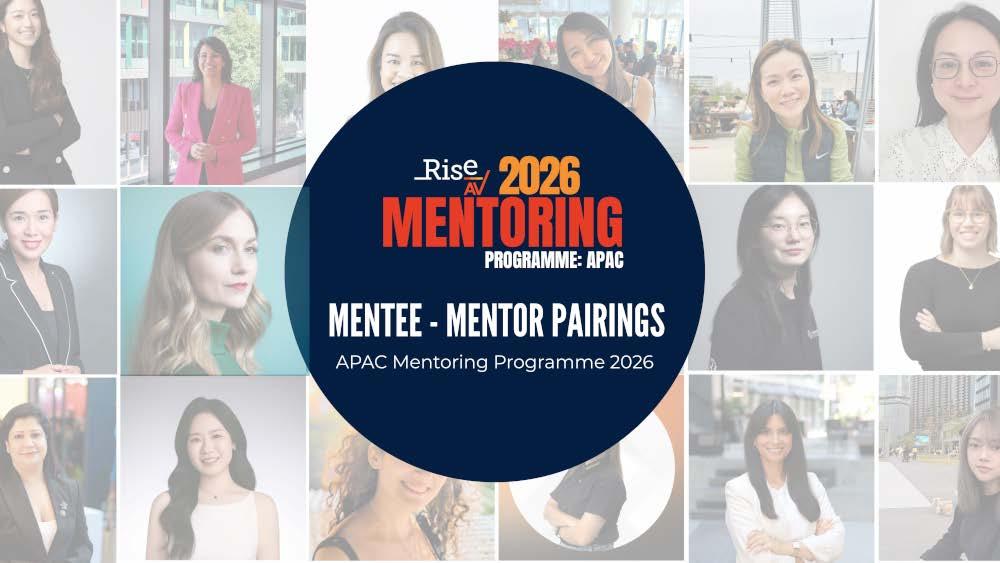
Rise AV Announces Mentor–Mentee Pairings for Inaugural 2026 APAC Mentoring Programme
GLOBAL: Following the success of its UK launch in January 2025, Rise AV, the global notfor-profit initiative dedicated to supporting and advancing women in AV, is proud to announce the mentor–mentee pairings for the inaugural 2026 Rise AV APAC Mentoring Programme.
The launch of the APAC programme has been made possible through the vital support of Rise AV’s Global Headline Sponsor, QSC, whose commitment has enabled the initiative to expand into the region and deliver meaningful mentorship opportunities for women across APAC.
Duncan Savage, VP and GM, Q-SYS APAC at QSC, said, “The launch of Rise AV in APAC is an important step for the industry. The region continues to demonstrate active growth and innovation across the AV landscape. Through our involvement in the Rise AV regional council, QSC is pleased to participate in and support local collaboration focused on skills development and inclusion across the AV community.”
We are also grateful to our Silver Sponsors, Lightware and ROE Visual, whose continued support helps the organisation provide impactful development opportunities and drive positive change across the global AV sector.
Marking a significant milestone in the organisation’s global expansion, the APAC programme has been launched in response to growing demand across the region. With the support of Rise AV’s esteemed Regional
Council, the initiative has successfully reached professionals across Asia-Pacific, with applicants predominantly based in Hong Kong, Australia, Singapore, and India. 31 mentees have been paired with 31 mentors, demonstrating both the need and enthusiasm for structured mentorship opportunities in these markets.
This year’s APAC cohort brings together an inspiring mix of emerging female talent and experienced industry leaders from across a wide range of disciplines, including sales, engineering, marketing, events, project management and beyond. Mentors from globally recognised organisations such as JLL, MGM Macau, JPMorgan, and Meta are playing a key role in shaping the programme and supporting participants. Reflecting the geographic diversity of the region, the programme has been designed with a flexible, primarily virtual format, ensuring accessibility while maintaining meaningful engagement.
Over the course of six months, participants will benefit from a comprehensive development framework, including:
• One-to-one mentorship, providing personalised guidance and support
• Virtual networking opportunities to foster cross-regional collaboration
• A blend of global and region-specific training sessions, covering areas such as public speaking, active listening, personal branding, and LinkedIn training
• Culturally tailored workshops addressing local nuances across APAC markets
• Select in-person networking opportunities and industry engagement, including partnering with key user events in Australia and Singapore, participation at InfoComm Asia, and exclusive site visits such as MGM Macau
The 2026 Rise AV APAC Mentor and Mentee pairings are as follows:
• Aditi Bansal, Samsung Australia, will be mentored by Pujan Doshi Dowsett, IAG
• Cassie Fong, AVI-SPL Hong Kong, will be mentored by David McKinney, Generation AV
• Chenxi Li, Samsung Asia, will be mentored by Cong Wei, QSC
• Chermaine Gan, Kayreach System, will be mentored by Azrina Abdullah, Midwich Asia
• Chris Pang, AVI-SPL Hong Kong, will be mentored by Vivian Zhao, L-Acoustics
• Cora Xue, Brompton Technology, will be mentored by Dina Menon, Electronics & Engineering
• Cynthia Chiu, QSC, will be mentored by Priscilla Chang, The Noise People / WOW! Media Resources.
• Hannah Hung, AVI-SPL Hong Kong, will be mentored by Peter Hunt, Hewshott
• Iris Teong, PTS Consulting Singapore, will be mentored by Leslie Goh, Samsung Asia
• Ivy Leong, Ideal Systems Singapore, will be mentored by Jason Tay, Netgear
• Jennifer Chuang, Samsung Asia, will be mentored by Sujith Sivaram, ESCO
• Jude (Xiuzhu) Lin, Brompton Technology, will be mentored by Darren Kopas, MGM Grand
• Kate Tang, Lightware Visual Engineering, will be mentored by Yun Leu, JLL
• Lauren Addison, DBS Consulting, will be mentored by Maureen Aw, Marina Bay Sands
• Lauren Hansom, University of Sydney, will be mentored by Ngaire O’Leary, Sydney Catholic Schools
• Mandy Tsui, Kinly, will be mentored by Piyanut Boonkhun, sAVe
• Marisa Macedo, Pro AV Solutions, will be mentored by Shanelle Stokes, Sony
• Marta Stanke, Electro-Voice, will be mentored by David Seow, Ideal Systems Singapore
• Mei Ying Ong, ESCO, will be mentored by Candice Siow, Lightware
• Melody Bilegt, Ideal Systems, will be mentored by Mavis Leung, Crestron
• Oleksandra Fil, Samsung Electronics, will be mentored by James Sheridan, Igloo Vision
• Penny Chang, LG Electronics Australia, will be mentored by Eamon Drew, Turtle AV
• Pooja Dhir, Sharp Business Systems India, will be mentored by Praveen Chandola, Talendor People Consulting
• Priscilla Ho, ESCO, will be mentored by David Claringbold, Claringbold Consultants
• Pui Kuan Hon, MGM Macau, will be mentored by Carla Sepulveda, Show Spectrum
• Rachel Jacob, Munro Acoustics, will be mentored by Mohan Subramaniam, META
• Rucha Deo, Intart Tech Solutions, will be mentored by Prashant Govindan, Generation AV India
• Scarlett Wang, Sennheiser Electronics Asia, will be mentored by Kagi Lau, Kinly
• Susie Yin, QSC, will be mentored by Alexis Figueiras, JPMorgan
• Vivi Chiang, Brompton Technology, will be mentored by Adrash Mohan, Vstream Asia
• Vruchi Satra, Generation AV India, will be mentored by Mustafa Rampurawala, Solutions India Systems
Christie and VistaPHX
Cease Negotiations
GLOBAL: Christie Digital Systems USA, Inc. has announced that it and VistaPHX LLC https:// www.vistaphx.com/, have ceased negotiations on the previously announced agreement in principle to sell Christie’s Broadcast and Professional Video group’s assets, including intellectual property and operational infrastructure, to VistaPHX.
Peter Hunt, Chairperson, Rise AV APAC Regional Council, said, “Launching the APAC Mentoring Programme marks an exciting step forward in our mission to support women globally across the AV industry. The level of interest across the region has been incredible, and with the support of our Regional Council and global partners, we are proud to deliver a programme that reflects the diversity, ambition, and unique cultural landscape of APAC. By combining global best practices with local insight, we are creating meaningful opportunities for women to grow, connect, and lead.”
Rise AV is actively seeking additional sponsors across APAC and globally to support future cohorts and expand programmes into new regions. Sponsorship directly funds our programmes, enabling us to deliver mentoring, training, and development opportunities. Rise AV cannot exist without this vital support.
By partnering with Rise AV, organisations play a direct role in developing the next generation of AV talent, benefitting from more confident, skilled, and engaged professionals. Sponsors also strengthen their own leadership pipelines, improve retention, and foster greater diversity of thought and innovation across the industry.
Rise AV
As a result, Christie will retain its image processing and compositor product lines: Spyder, Terra, Hedra, Phoenix, and Mastering Gateway, along with the operations supporting them, while the company evaluates future opportunities. Christie is committed to supporting customers, partners, and ongoing business activities tied to these products.
No additional details regarding the negotiations will be disclosed.
Christie Digital
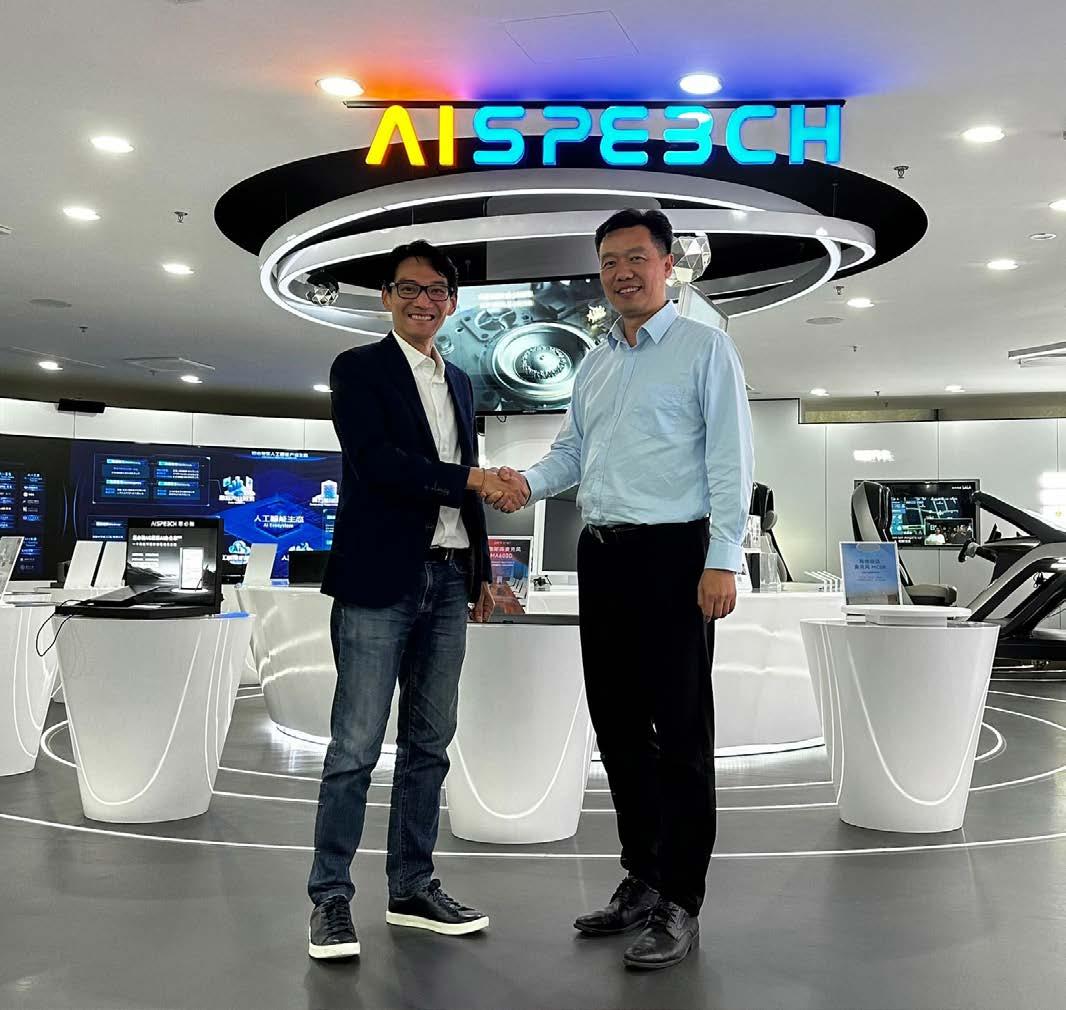
AISpeech Welcomes Vince Tan as Vice President, Global Sales
GLOBAL: AISpeech, a leading enterprise provider of conversational artificial intelligence and AI-powered audio technology, has announced the appointment of Vince Tan as Vice President, Global Sales. In this newly created role, Vince will spearhead AISpeech’s international sales organisation, forging strategic partnerships to expand the company’s reach across key global markets.
Vince brings an exceptional track record spanning more than three decades in the Professional AV industry. Most recently, he served as Vice President, Sales APAC – Professional Audio at Sennheiser, where he drove channel growth and business development across the Asia-Pacific region. His appointment as VP APAC in 2019 followed a career-long progression at Sennheiser that began in 1999, during which he held a range of roles spanning Sales, Marketing and Technical departments.
Throughout his career, Vince has cultivated deep roots across the APAC distribution network, building strategic partnerships that have generated sustained revenue growth year on year. A passionate people leader, he is known for fostering high-performance cultures grounded in a competitive, winning mindset — empowering teams through hands-on coaching and talent development to achieve collective success. He approaches Change Management as an opportunity to strengthen organisational capability.
Vince thrives in collaborative, entrepreneurial environments and brings excellent communication skills across diverse APAC cultures. His instinct for anticipating challenges has consistently enabled the organisations he works with to navigate uncertainty and seize emerging opportunities ahead of the curve.
“Vince’s depth of experience across APAC and Pro AV markets, combined with his proven ability to build and lead high-performance sales teams, makes him the ideal person to take AISpeech’s international expansion to the next level. His understanding of how technology meets customer needs in diverse markets will be invaluable as we continue to grow.”— Ping, Deputy General Manager of AISpeech.
Commenting on his appointment, Vince said: “AISpeech is at a truly exciting inflexion point — combining cutting-edge AI with transformative audio experiences for enterprise and professional environments. I look forward to working with partners and customers globally to bring AISpeech’s solutions to market and help organisations reimagine the way they communicate and collaborate.”
Based in Singapore, Vince will report directly to AISpeech’s senior leadership and collaborate with regional teams worldwide to execute the company’s global commercial vision.
AISpeech
SDVoE Alliance Expands API Capabilities for Agentic AI-Assisted
AV-over-IP
Workflows
GLOBAL: The SDVoE Alliance is expanding the capabilities of the SDVoE API to support AIassisted workflows for AV-over-IP deployment, programming, monitoring and troubleshooting.
The SDVoE API already enables manufacturers, developers, and system integrators to create and manage advanced AV-over-IP applications, including video walls, multiview systems, and instant switching without dedicated processing hardware or complex external control layers. By combining the SDVoE API with AI agentic control architectures, including MCP Servers and Agent Skills, users can now interact with systems through natural-language prompts and automated software tools. The approach reduces dependence on specialised API expertise and simplifies the creation and operation of SDVoE systems across a range of professional AV environments.
“The SDVoE API was designed to give developers and integrators flexibility to build sophisticated AV-over-IP applications,” said Stephane Tremblay, President of the SDVoE Alliance. “AI-assisted workflows represent the next stage of that evolution by making system deployment, configuration and support more accessible and more efficient.”
The SDVoE Alliance’s AI-assisted and agentic workflows can significantly reduce the time required to create working system configurations, integrations and control interfaces. Instead of manually programming complex routing, video wall or multiview
functions, or building custom integrations and user interfaces from scratch, users can generate configurations and control workflows using conversational prompts that automate much of the underlying development and programming process.
The workflow also improves troubleshooting and operational support by allowing AI tools and agents to analyse logs, interpret system behaviour, and identify issues more quickly than traditional manual diagnostics. Because the SDVoE API supports cloud-connected monitoring and remote management, operators can monitor system performance and manage complex tasks remotely in an IT-friendly environment.
DVIGear is among the first SDVoE adopters to demonstrate a working implementation of AI-assisted workflows through its DisplayNet® platform with DisplayNet Connect for AI Agents. DisplayNet Connect is an MCP Server that allows for direct integration between DisplayNet’s SDVoE management server and AI platforms, such as Claude, OpenAI Codex, and Gemini CLI. DisplayNet Connect enables application development and automated log analysis with natural-language prompts across large-scale SDVoE deployments. By leveraging agentic AI tools with SDVoE, users can create integrated system configurations and user interfaces in minutes, reducing the difficulty previously required to work directly with AVover-IP control APIs.
Built on a hardware and software platform for AV extension, switching, processing and control, SDVoE technology combines interoperability, security and zero-latency performance for professional AV applications. The SDVoE Alliance includes more than 50 members delivering over 700 interoperable solutions for AV distribution and processing across commercial and enterprise environments.
SDVoE Alliance
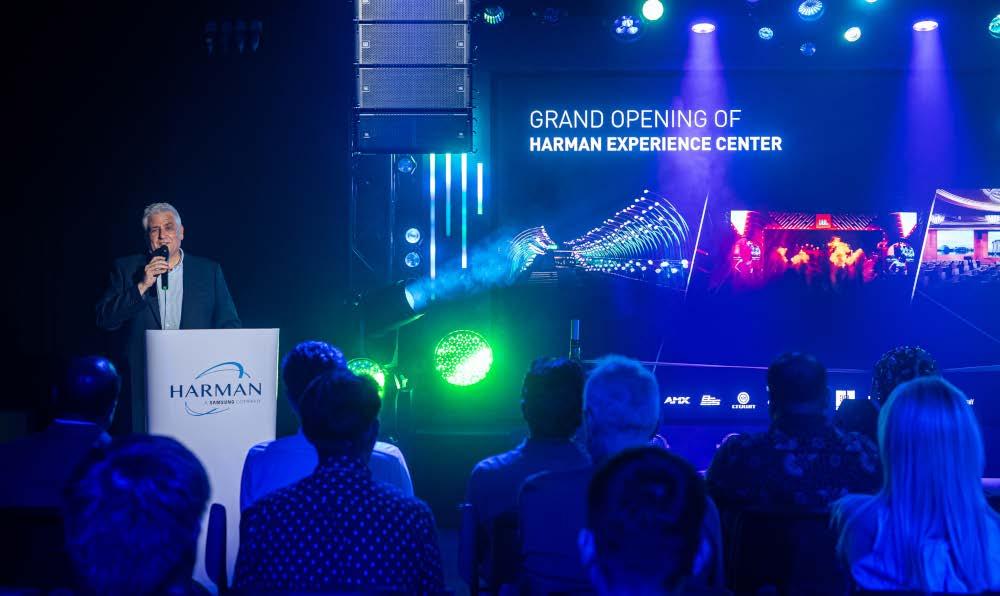
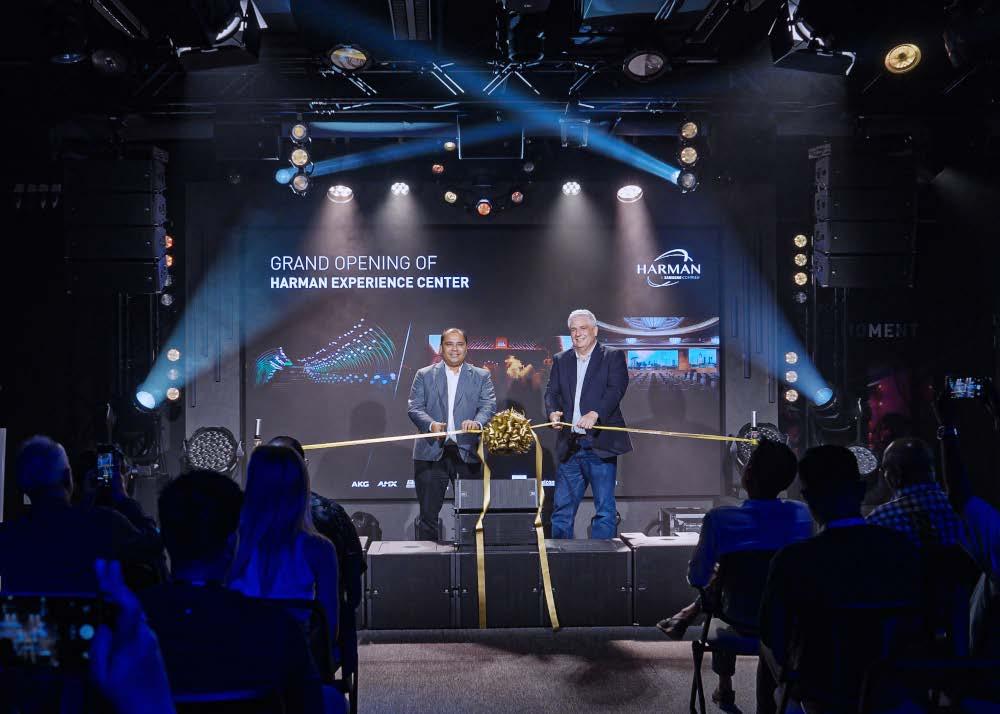
HARMAN Professional Opens New Experience Center to Elevate Customer Engagement
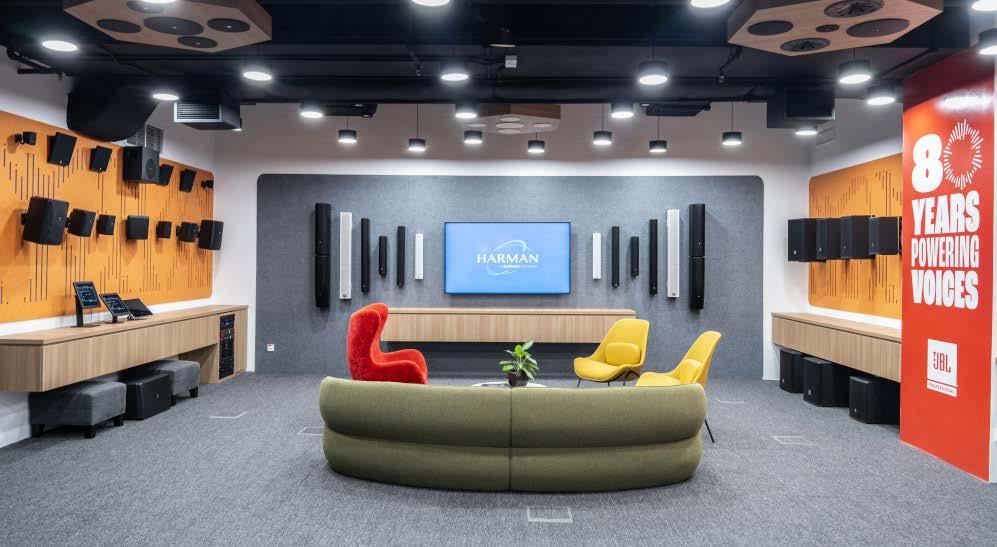
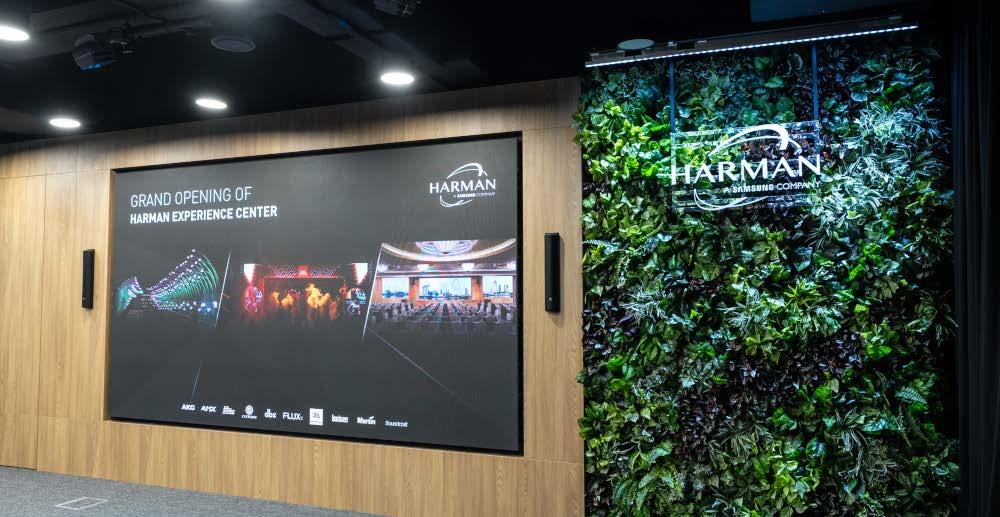
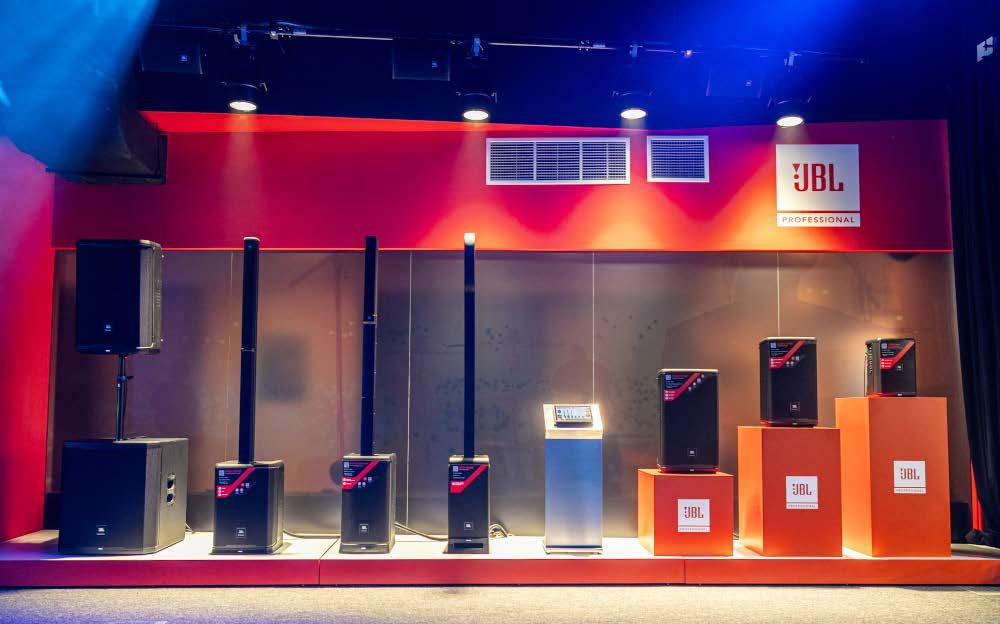
SINGAPORE: HARMAN Professional Solutions has officially opened its newly revamped Experience Center in Singapore. Designed as a purpose-built business Experience Center, the space demonstrates how HARMAN Professional solutions address customer needs across multiple vertical markets through real-world applications and collaborative engagement.
More than a traditional showroom, the space has been reimagined as a platform for solution exploration, co-creation, and executive engagement, reflecting the evolving ways B2B organisations navigate technology amid increasing complexity in today’s business environment.
“As customer needs and decision-making processes continue to evolve, we saw an opportunity to rethink how we engage,” said Nick Screen, VP & GM, HARMAN Professional Solutions, APAC. “Our new experience center immerses customers and partners in realworld scenarios—where they can touch, test, and co-create solutions tailored to their environments. It’s all about empowering more informed decisions with confidence. Bringing
together JBL, FLUX:: and Martin in this space lets us showcase fully integrated, immersive experiences that truly demonstrate what our Professional Solutions portfolio can achieve.”
From Products to Business Outcomes
The revamped showroom brings together industry-specific use cases, hands-on demonstrations and collaborative spaces that reflect how customers evaluate solutions today. Designed to support engagement from early discovery through validation and implementation, the Experience Center enables deeper, more meaningful experiences beyond traditional product displays.
Visitors can experience:
• End-to-end solution scenarios across key industries
• Interactive demonstrations aligned with real business challenges
• Immersive, experiential showcase of audio and lighting technologies
• Dedicated spaces for customer workshops and partner co-creation
• Executive briefing areas for strategic discussions
“Experience-led engagement has become essential in modern B2B environments,” said Atul Ghaisas, Director Channel Sales & Install Solutions, HARMAN Professional Solutions, APAC. “The Singapore Experience Center— along with our global network of HARMAN
Professional Experience Centers—helps customers move beyond specifications to truly understand value, outcomes, and scalability, while strengthening collaboration across our global ecosystem.”
Built for Collaboration and Partnership
The Experience Center also plays a key role in partner engagement, providing a shared platform for joint solution design and integrated demonstrations. By bringing together customers, partners, and subject-matter experts in one space, HARMAN Professional aims to accelerate innovation and deliver more tailored business outcomes.
The opening ceremony welcomed customers, partners, media, and senior leadership and included guided tours highlighting how the Experience Center supports real-world decisionmaking and collaboration.
A Platform for Ongoing Engagement
Located at 108 Pasir Panjang Road, #02-08 Golden Agri Building Singapore 118535, the HARMAN Experience Center will host customer briefings, partner sessions and industryfocused workshops throughout the year.
“This is a long-term investment, not just a one-time launch”, added Nick Screen. “We see this Experience Center as a living environment
where ideas are tested, partnerships are strengthened, and future-ready solutions are shaped together with our customers.”
For more information or to book a visit to the Singapore Experience Center, please reach out to HPro.APAC@harman.com
HARMAN Professional Solutions
ESCO Unveils ESCO Care360 – an AI Platform Redefining Enterprise AV Systems
ESCO Pte. Ltd. has launched ESCO Care360, a cloud-based platform that applies AI, automation, and real-time observability to enterprise audiovisual (AV) environments – an area long underserved by modern IT tooling.
As organisations scale hybrid work and smart office deployments, AV systems have quietly evolved into distributed, mission-critical infrastructure. Yet unlike cloud, network, or endpoint environments, AV remains fragmented, reactive, and difficult to manage at scale. ESCO Care360 aims to change that.
Bringing “DevOps Thinking” to AV Operations
ESCO Care360 introduces a model familiar to IT and platform engineering teams: centralised observability, automated remediation, and continuous optimisation—but applied to physical AV environments.
Instead of relying on manual checks and onsite troubleshooting, the platform delivers:
• Real-time telemetry across devices, rooms, and locations
• AI-driven anomaly detection and root cause analysis
• Automated workflows for incident response and resolution
• Remote lifecycle management across multivendor ecosystems
A Unified Layer Across Fragmented AV Ecosystems
Most enterprise AV environments are built on heterogeneous stacks: multiple vendors, proprietary systems, and siloed tools. ESCO
Care360 introduces a unified control plane that abstracts this complexity.
The platform enables IT teams to:
• Manage multi-brand AV devices from a single interface
• Enforce standardised policies and compliance controls
• Integrate AV operations into broader ITSM and enterprise workflows
• Maintain a full audit trail for governance and reporting
This positions ESCO Care360 as not just an AV tool, but an extension of enterprise IT infrastructure management.
From Reactive Support to Autonomous Operations
A key differentiator is ESCO Care360’s embedded AI engine, which continuously learns from device behaviour and usage patterns.
Capabilities include:
• Predictive issue detection before user disruption
• Context-aware recommendations for faster resolution
• Automation of repetitive troubleshooting tasks
• Continuous improvement based on real-world operational data
Quantifying the Impact
Early deployments indicate significant operational gains:
• 50–80% reduction in on-site interventions (“truck rolls”)
• 30–47% faster mean time to resolution (MTTR)
• 30–60% increase in technician capacity
• Up to 27% cost savings for enterprise clients
These efficiencies align with broader enterprise priorities: cost optimisation, resilience, and scalability.
Why This Matters Now
The launch taps into several converging trends:
• The rise of hybrid work and distributed collaboration spaces
• Increasing demand for smart buildings and IoT-enabled workplaces
• Pressure on IT teams to do more with fewer resources
• A shift toward platform-based, data-driven operations
Despite these shifts, AV has lagged, creating a gap that ESCO Care360 is designed to fill. With over three decades of AV and ICT experience, ESCO Pte. Ltd. is leveraging its integration expertise to move up the stack –from deployment to continuous, intelligent operations.
ESCO/ESCO Care360
NTECKSYSTEMS Brings to India
INOGENI’s U-Bridge USB-C
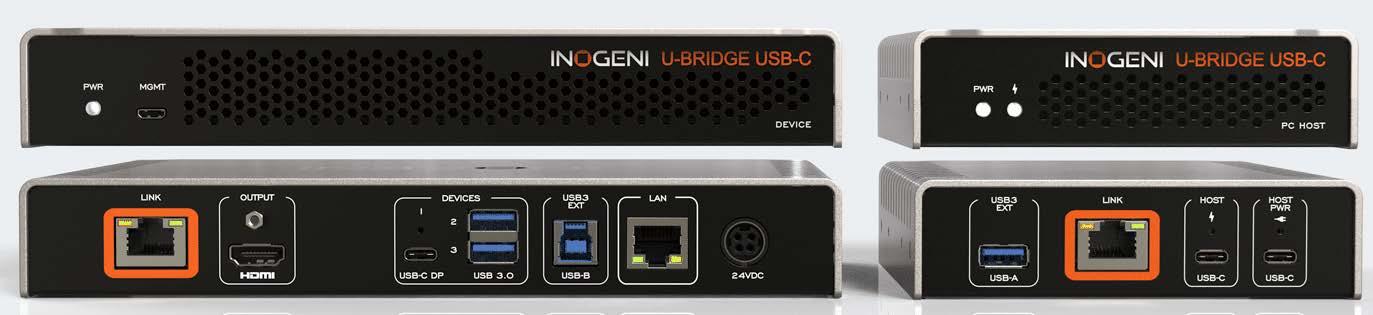
Bengaluru-based AV conferencing collaboration solutions distribution major NTECKSYSTEMS LLP has brought to Indian market a very fascinating product from its Canadian conferencing solutions principal Inogeni- the U Bridge USB-C.
U-BRIDGE USB-C is a purpose-built extender that extends full USB-C functionality including USB 2.0, power, and DisplayPort Alternate Mode and Ethernet, from laptop to USBC-equipped videobar or CODEC. With the capability to extend connections up to 70 meters (230 feet) over a single CAT6A cable via HDBaseT proven technology, it guarantees reliable performance and high-quality, uncompressed video at 4K60 HDMI output. It extends the videobar’s UVC/UAC interface (camera and audio) and simultaneously sends video content to the in-room display.
Both 100W laptop charging and full USB-C extension—including USB 2.0 and DisplayPort Alternate Mode. It is ideal for extending USB-C laptops to videoconferencing equipment, for room displays, and with networks in modern meeting spaces. The extender can connect to an all-in-one videobar that supports BYOM. Designed to extend USB-C connectivity far beyond standard cable limitations, U-BRIDGE enables effortless BYOM (Bring Your Own Meeting) experiences in medium- and largesized videoconference rooms. With a single USBC connection to the laptop, users instantly gain access to the room’s professional camera,
microphone, speakers, and display—making highquality meetings as simple as plugging in the devices.
High-performance audio/video connectivity and 100W charging
• USB-C extension over CAT6A U/FTP cable up to 70m, uncompressed video signal via HDBaseT® proven technology and USB-C power supply enables 100W laptop charging
• 2x USB 3.0 device ports
• 4K60 HDMI output, Compatible with HDCP 2.3, HDMI 2.0b, and DVI 1.0
• Advanced video processing with 4:4:4 and 4:2:2 chroma subsampling
Versatile USB and video extension
• Supports all USB peripherals, including webcams, videobars, audio devices, and HID
• Ideal for systems with USB-C connectivity, such as Lenovo Core Gen 2, Cisco Room Bar Pro, Cisco Room Kit EQ, Poly G62, Logitech MeetUp 2 and ClickShare CX50 Gen 2
“The U-Bridge USB-C is a high-performance and one of the fast-moving solution from the Inogeni stable,” says Nataraju Upputuri, Founder-CEO of NTECKSYSTEMS LLP. “Given the demanding scale that Indian ProAV segment has been growing, particularly the conferencing domain, the U-Bridge USB-C is a great product on the rack.”
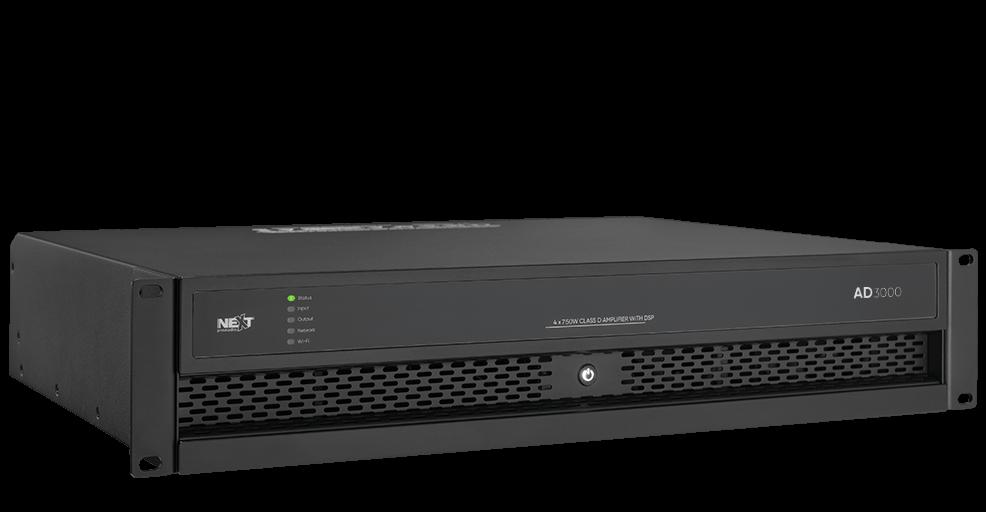
NEXT Audiogroup Targets Smarter Multi-Zone Installations with New AD3000 DSP Amplifier
NEXT Audiogroup has unveiled the NEXT Audiocom AD3000, a new smart full-matrix DSP Class D amplifier designed to simplify complex installed audio projects while giving integrators greater flexibility, control, and system scalability.
Built for modern commercial and professional AV environments, the AD3000 delivers 4 × 750 W of power in a compact 2U rack format and supports both low impedance loudspeakers and 70 V / 100 V distributed systems, including mixed impedance configurations within the same installation. With software-selectable operating modes covering Normal Low-Z, Bridge Low-Z, and Bridge Hi-Z, the amplifier is positioned as a versatile solution for multi-zone audio deployments across hospitality, retail, corporate, and public venues.
At the centre of the platform is an integrated full matrix DSP engine that removes the need for additional external processing hardware. Users can manage multiple audio sources, configure up to four independent zones, apply room correction, and optimise loudspeaker performance directly within the amplifier. By combining DSP and amplification in a single architecture, NEXT Audiogroup says the AD3000 enables tighter system integration and more responsive dynamics control.
Remote deployment and system management are also central to the AD3000’s design. Integrators can configure and monitor the amplifier over Ethernet or through its builtin Wireless Access Point, while a browserbased control interface provides access to routing, DSP processing, monitoring, and
amplifier management from PCs, tablets, or smartphones without requiring dedicated software installation.
The AD3000 also supports digital system expansion through SPDIF digital I/O connectivity, allowing integration with compatible digital audio equipment or bridging between multiple amplifiers. Five programmable GPIO ports further extend system control capabilities, supporting functions such as remote volume adjustment, mute, standby, and power management.
Powered by an active PFC power supply with universal AC mains support, the AD3000 is engineered for a wide range of installed sound applications, including hotels, conference facilities, museums, fitness centres, houses of worship, theatres, restaurants, auditoriums, and large-scale commercial venues.
With the AD3000, NEXT Audiogroup is continuing its push toward integrated, network-enabled audio platforms that combine advanced DSP processing, flexible amplification, and streamlined remote control for today’s evolving installation market.
NEXT Audiogroup/AD3000
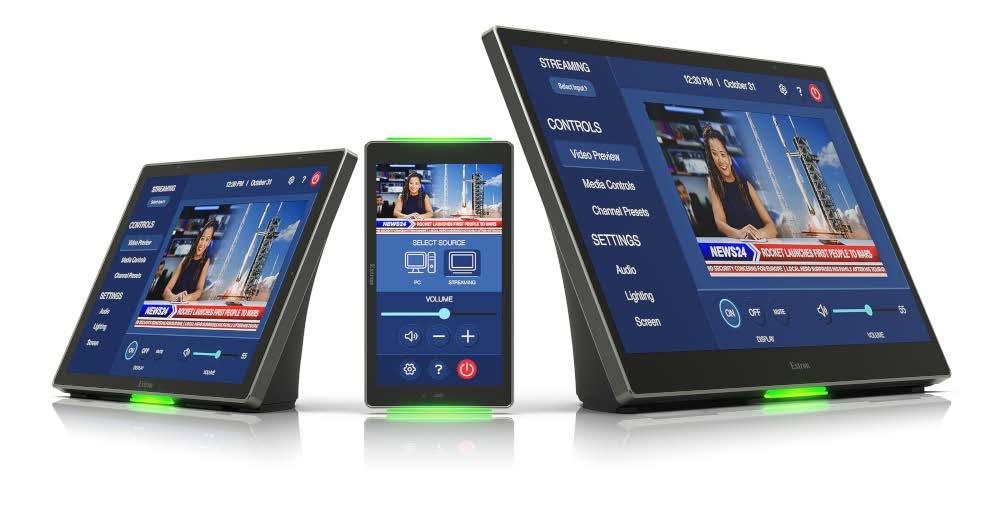
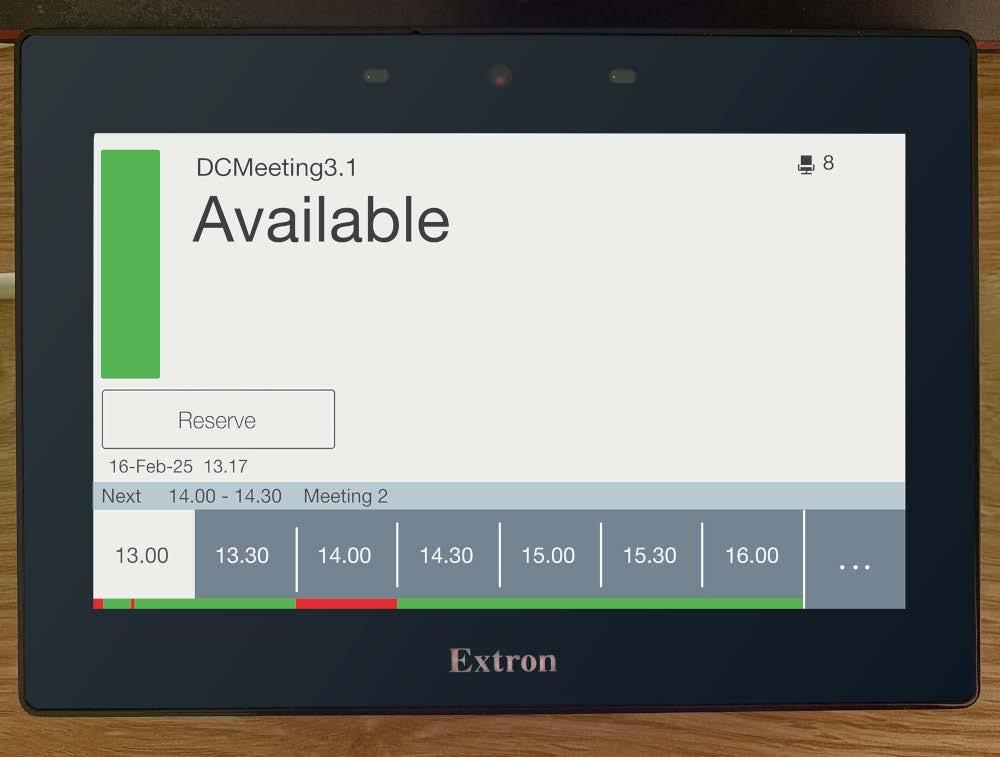
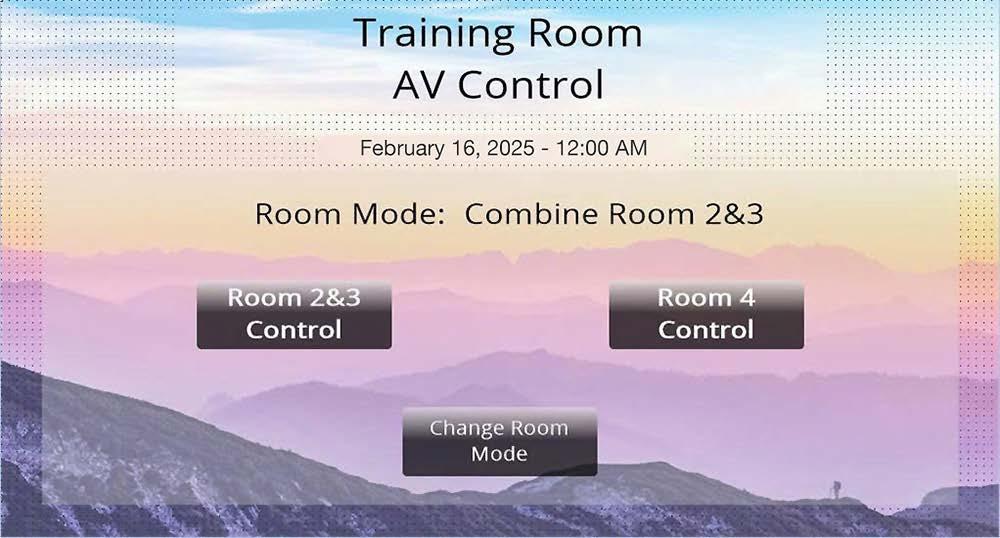
Extron Now Shipping its Most Advanced Touchpanels
Extron is now shipping the TouchLink Pro 35 Series touchpanels. This series introduces the latest Extron control technology, blending sophisticated features with refined elegance. Continuing a strong legacy of reliability and ease of use, the new TouchLink Pro touchpanels deliver powerful and precise control you can rely on. They come in four sizes with multiple configuration options. All models feature advanced IPS technology, delivering vibrant colour reproduction along with improved contrast, brightness, and wide viewing angles.
The TLP Pro 35 Series touchpanels use a modern web stack built on HTML and other browser technologies, ensuring more consistent and reliable onscreen rendering. This provides a user experience consistent with Extron Control’s mobile and webbased applications. The web engine also enables support for H.264 video streaming and lays the groundwork for future capabilities such as dynamic images and real-time widgets.
TLP Pro 535, TLP Pro 835, and TLP Pro 1035 touchpanels can be transformed into standalone control systems using LinkLicense for TLP Control Processor and an optional TLCA 2 – TouchLink Control Port Expansion
Adapter. This approach simplifies system design and reduces the hardware footprint by eliminating the need for a separate control processor. It is ideal for installations where space is limited or cost efficiency is a priority.
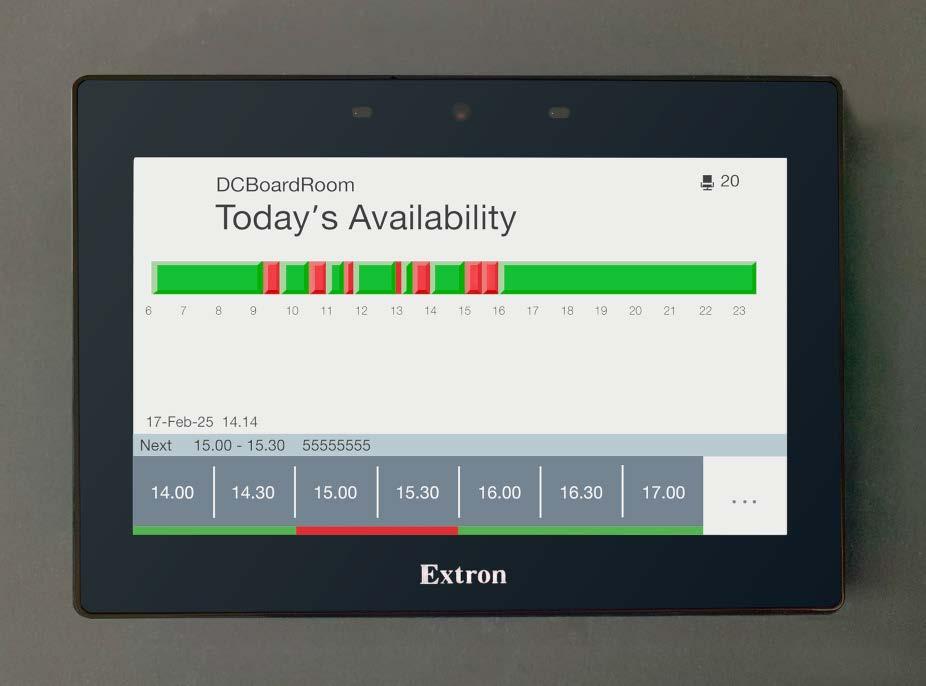
Multi-colour status indicators provide immediate visual feedback for system states, alerts, or room availability, allowing users to quickly identify room status or system conditions without navigating menus. The feature includes 10 default colours with predefined options that make setup fast and intuitive. The indicators can show a broad spectrum of colours and also support custom HEX colour values for precise colour matching, enabling alignment with corporate branding or application-specific requirements.
The TLP Pro 35 Series includes touchpanels in four sizes, including 5.5”, 8”, 10.1”, and 15.6” models. They are available in a variety of configurations, including tabletop, wall mount, and Cable Cubby options, with finishes in either black or white. All wall mount models except the 15.6″ can be mounted in either portrait or landscape orientations, making them ideal for environments where space is limited or specific viewing angles are required.
Extron/TLP Pro 35 Series
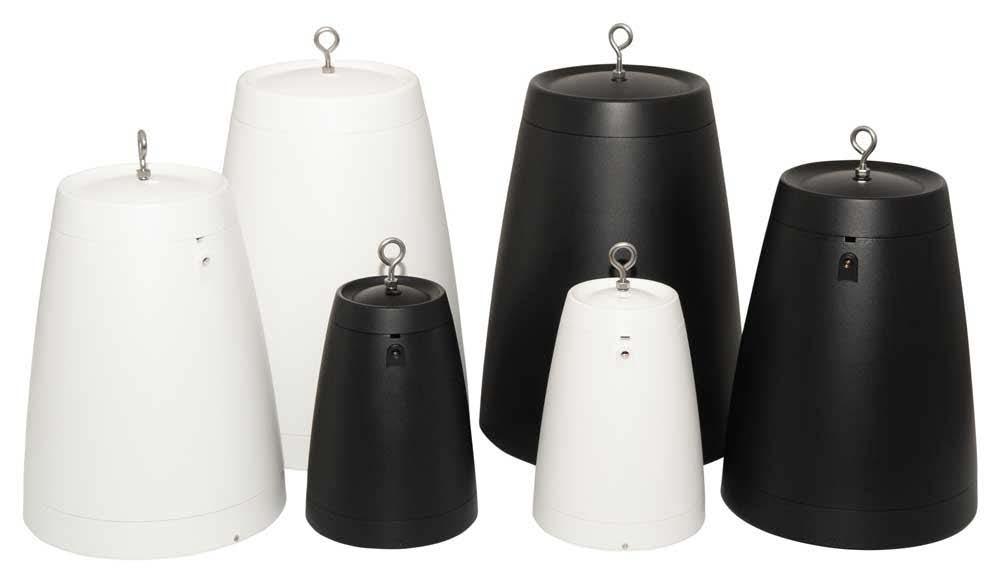
Peavey Introduces Impulse Pendant Speaker Series for Commercial Installations
Peavey Electronics’ new Impulse Pendant Speaker Series is a trio of commercial-grade pendant loudspeakers designed for high-ceiling environments where sound clarity, architectural aesthetics, and installation flexibility are equally critical. Available in black or white, the Impulse P8, Impulse P6.5, and Impulse P4 combine clean, modern design with reliable performance for retail spaces, hospitality venues, and openceiling commercial interiors. By using pendant mounting rather than traditional wall or ceiling cutouts, the series preserves architectural integrity while suspending the loudspeaker closer to the listening area to improve coverage, intelligibility, and overall acoustic comfort.
The Impulse P8 is the largest model in the series, featuring an 8-inch polypropylene cone woofer paired with a 1.1-inch silk tweeter in a two-way passive, bass-reflex enclosure. Rated at 60 watts and capable of delivering peak sound pressure levels up to 112 dB, the Impulse P8 offers extended low-frequency performance with a frequency response down to 55 Hz (-3 dB). It supports both 70V
and 100V distributed audio systems with selectable transformer taps of 7.5W, 15W, 30W, and 60W, as well as an 8-ohm bypass. The speaker provides a nominal 90° x 90° coverage pattern and is housed in a flame-retardant polypropylene enclosure with a matte black finish, weighing 11 pounds.
The Impulse P6.5 is designed to balance output capability and compact form, using a 6.5-inch woofer and a 1-inch silk tweeter in a two-way passive configuration. Rated at 60 watts, the P6.5 delivers peak SPLs of up to 112 dB and offers a frequency response extending to 70 Hz (-10 dB). Like the P8, it supports 70V and 100V operation with selectable transformer taps at 3.75W, 7.5W, 15W, and 30W, along with an 8-ohm bypass. The enclosure features a bassreflex design, flame-retardant polypropylene construction, a 90° x 90° coverage pattern, and a net weight of 7.7 pounds, making it wellsuited for medium-sized commercial spaces. The most compact model in the series, the Impulse P4, is built around a 4-inch woofer and a 0.75-inch silk tweeter in a two-way passive design. Rated at 30 watts, the P4 achieves
peak SPLs of up to 108 dB and delivers a frequency response down to 77 Hz (-10 dB). It supports both 70V and 100V systems with selectable taps at 3.75W, 7.5W, 15W, and 30W, as well as an 8-ohm transformer bypass. With its compact dimensions and 5.5-pound weight, the Impulse P4 provides a discreet yet capable solution for smaller commercial environments while keeping the same aesthetic and installation advantages as the larger models.
Across the entire Impulse Pendant Speaker Series, Peavey incorporates a consistent set of professional features, including two-way
passive designs, bass-reflex enclosures, flameretardant polypropylene cabinets, Euroblock input connectors, and support for both 70V and 100V distributed audio systems. Each model includes dual suspension points and safety cables for secure overhead installation, along with a minimalist matte black finish favoured by architects and designers. The pendant format eliminates the need for wall or ceiling modifications, preserves usable space, and allows greater freedom in interior layout.
Peavey Electronics/ Impulse Pendant Speaker Series
Visionary Expands 5 Series Lineup with New E5000 AV-over-IP Encoder
Visionary has announced the latest addition to the company’s 5 Series: the E5000, a compact, cost-effective AV-over-IP encoder. Purposebuilt for projects that prioritise streamlined functionality and exceptional value, the E5000 delivers Visionary’s trusted performance and reliability in an economical, space-saving form factor.
Designed for AV-over-IP installations that require essential encoding capabilities without the overhead of advanced features, the E5000 features a simplified I/O configuration that
includes a single HDMI input, one PoE Ethernet port, and RS232 control. By delivering the core performance capabilities of Visionary’s E5100 encoder, including native AES67 audio support, the E5000 offers an ideal balance of functionality, scalability, and cost efficiency.
The E5000 is especially well-suited for education, corporate, government, hospitality, digital signage and large venue deployments, where scalable AV distribution and audio interoperability are critical, but more advanced encoder I/O options are unnecessary.Built on Visionary’s cinema-quality, ultra-low-latency, sub-frame-visual-lossless 4K UHD over IP platform, the E5000 empowers integrators and enterprise AV teams to deploy highperformance video distribution across modern IP networks while optimising project budgets. Like all Visionary 5 Series endpoints, the E5000 is designed to eliminate the constraints of traditional matrix switching systems, replacing fixed infrastructure with the flexibility, scalability, and long-term advantages of standards-based IP networking.
Visionary/5 Series
Vaddio SpeakerVIEW: Intelligent Camera Automation That Keeps the Focus on the Speaker
As hybrid meetings and remote learning continue to evolve, keeping remote participants engaged has become a growing challenge. One of the biggest frustrations in conference rooms and lecture halls is when cameras fail to follow the conversation, causing viewers to miss important discussions or speaker interactions.
To address this, Vaddio has introduced SpeakerVIEW, an intelligent camera automation solution designed to automatically track and frame the active speaker in real time using directional audio technology.
Rather than relying on complex AI vision systems or dedicated camera operators, SpeakerVIEW uses ceiling microphone arrays to determine where sound is coming from and instantly directs compatible Vaddio PTZ
cameras toward the active speaker. The result is a more natural, engaging, and professional meeting or learning experience with minimal setup complexity.
Audio-Driven Intelligence for Smarter Camera Control
SpeakerVIEW works by leveraging directional audio data captured through supported ceiling microphone arrays. As conversations move around the room, the system automatically switches between cameras and adjusts framing to ensure the current speaker remains in focus. This audio-based automation eliminates the need for manual camera operation while ensuring smooth transitions during meetings, presentations, lectures, or classroom discussions.
The solution also includes intelligent controls that allow administrators to customise room behaviour, including:
• Prioritising a main presenter or lecturer
• Automatically widening camera shots when remote participants speak
• Managing simultaneous speakers or brief interruptions
• Defining camera behaviour during silent periods
This flexibility enables SpeakerVIEW to adapt to different meeting styles, classroom layouts, and collaboration environments.
Flexible Deployment Options
SpeakerVIEW has been designed to support both new and existing Vaddio installations.
Organisations can deploy the dedicated SpeakerVIEW Controller, a compact PoEpowered hardware device capable of supporting larger spaces with up to eight ceiling microphone arrays.
For customers already using the Vaddio EasyIP ecosystem, SpeakerVIEW can also be enabled through a free firmware update for:
• EasyIP Mixer (supports up to two microphone arrays)
• EasyIP Dock (supports up to four microphone arrays)
This provides existing users with intelligent camera automation capabilities without the need to purchase additional hardware.
Designed for Modern Corporate and Education Spaces
SpeakerVIEW is particularly well suited for:
• Corporate conference rooms where remote participants need an equitable meeting experience
• University lecture halls and classrooms where instructors and students move throughout the space
• Hybrid learning environments that require consistent speaker visibility
• Training rooms and collaboration spaces that demand professional AV automation without dedicated operators
By ensuring cameras consistently focus on whoever is speaking, the system helps improve communication clarity, engagement, and overall meeting quality.
Broad Compatibility Across Platforms
Because Vaddio switchers output standard USB video and audio to room PCs, SpeakerVIEW integrates seamlessly with major video conferencing platforms and hardware room systems already in use.
At launch, SpeakerVIEW supports:
• Shure MXA920
• Shure MXA910
• Sennheiser TeamConnect Ceiling Medium (TCCM)
Additional microphone compatibility is expected in future updates.
The solution also works with a range of Vaddio camera systems, including RoboSHOT, RoboFLIP, IntelliSHOT, and EasyIP cameras.
Availability
The SpeakerVIEW Controller is available now, while firmware updates for the EasyIP Mixer and EasyIP Dock can be downloaded at no cost through the Vaddio website and Deployment Tool.
All deployments require compatible Vaddio PTZ cameras, supported Shure or Sennheiser ceiling microphone arrays, and a PoE+ network switch. Legrand AV SpeakerVIEW
Ledman: Redefining the Future of Visual Experiences Through Micro LED Innovation
As the display industry moves beyond resolution and brightness into a new era of intelligent, immersive, and sustainable visual experiences, Ledman is positioning itself at the forefront of this transformation. Through advancements in Micro LED, COB packaging, AI-powered display ecosystems, and energy-efficient cool-screen technologies, the company is redefining how screens interact with people, spaces, and digital environments. From corporate collaboration and smart education to home cinema walls and digital city initiatives, Ledman is evolving beyond standalone display products to create integrated visual ecosystems designed for the next generation of ultraHD communication, interaction, and content experiences.
SI Asia speaks with Ledman about the innovations, sustainability strategies, and technological advancements driving its leadership in the evolving LED display industry.
Ledman has positioned itself at the forefront of Micro LED and COB innovation—but beyond the technology itself, how does Ledman define the company’s role in shaping the future of visual experiences?
Ledman’s role in leading the future of visual experience is essentially about redefining the relationship between “screen and people” and “screen and space.” Breakthroughs in COB and fine-pitch technology transform “a display” into “an interactive, humanized, and sustainable visual space,” enabling display
technology to truly integrate into architecture, homes, and cities, becoming a seamless interface between the digital and physical worlds. Ledman leverages its foundational technologies—such as COB packaging, coolscreen technology, glass-based PM drivers, and other core innovations—to break down barriers across different scenarios. The company has already built a full-scenario Micro LED product matrix covering professional, commercial, and residential applications, precisely to extend the ultra-HD experience from engineering-focused use cases to a wider range of commercial and home environments.
Ledman has built a broad ecosystem spanning UHD displays, interactive systems, home cinema walls, and lighting solutions. How important is this shift—from standalone products to integrated platforms—in staying competitive in today’s market?
Platformization and ecosystem building are essential long-term strategies. Scenariobased solutions plus an ecosystem platform are at the core of Ledman’s differentiation strategy to break through the red ocean of competition. Customers no longer just buy screens — they need a full-link experience that integrates "Display + Interactivity + AI + Content + Operation & Maintenance." By reusing technologies across scenarios, Ledman builds a formidable technological moat, avoiding the trap of low-end price-based competition. Platform capabilities enable us to quickly enter high-growth sectors such as household video wall, smart meetings/education, digital twins and metaverse, unlocking the second and third growth curves.
Micro LED is often positioned as the next frontier in display technology. In practical terms, where is Ledman seeing as the most meaningful adoption today, and what still needs to happen for it to scale more widely?
From a practical implementation standpoint, Micro LED currently achieves its highest penetration and most prominent value in professional engineering scenarios such as command and control centers, security monitoring, and high-end commercial displays. These scenarios demand the ultimate in image quality, reliability, and seamless splicing—requirements that align naturally with the technical advantages of Micro LED. 2026 is hailed as a pivotal year for Micro LED technology, marking its transition from “technical validation” to “industrial application,” and the industry is now at a commercial tipping point.
To achieve wider adoption, especially entering the trillion-dollar home market, three major bottlenecks must still be overcome: first, cost—manufacturing costs need to be further reduced; second, the industry has yet to standardize pixel pitch, operation and maintenance standards, and installation specifications; third, the maturity of the industrial chain—issues such as chip quality and mass transfer yield still need improvement. Ledman has already made strategic deployments in areas such as the PSE coolscreen technology roadmap, mass transfer processes, glass-based PM drivers, MIP, and
other innovative solutions, actively exploring the balance between performance and cost.
Ledman operates across corporate environments, education, home entertainment, and digital city initiatives. How does Ledman approach innovation when its solutions must perform across such diverse and evolving use cases?
With the continuous development of COB display technology, Ledman has persistently pursued technological innovation while establishing an extensive patent portfolio. Dozens of Ledman’s COB PSE technology patents have been granted intellectual property certifications in multiple countries and regions, including Europe, Australia, Japan, and Canada, America and so on. The innovation-driven system behind the company’s diverse business lines is built on “core foundational patented technologies + scenario-based customized iteration.” Micro LED and COB technologies give rise to different product forms across various scenarios: in office/education settings, they evolve into smart all-in-one conferencing displays; in living room scenarios, they become UHD home giant-screen walls; in the digital city domain, they penetrate indoor and
outdoor smart display systems—vertically extending mature professional COB cool-screen technology capabilities into multiple scenarios.
With AI increasingly shaping how content is created and delivered, how is Ledman integrating AI-powered capabilities into its display solutions—and what new possibilities does this unlock for users?
AI is profoundly transforming the logic of human-computer interaction and content distribution. Ledman has already integrated AI capabilities into its display ecosystem: its PSE technology has achieved disruptive innovation in Micro LED pixel arrangement and algorithms, resolving the contradiction between cost reduction and display resolution enhancement, and has been recognized with multiple patents and industry awards. Additionally, by leveraging AI tools to improve content quality and support natural voice interaction and emotional feedback, the company enhances the emotional companionship and value of its home giant-screen products. The integration of AI with ultra-HD display technology will deliver an entirely new experience for customers—from intelligent content generation to seamless interactive upgrades.
With technologies like Ledman’s PSE EnergySaving Cool Screen, how is sustainability influencing product development at Ledman— and does Ledman see ESG becoming a core differentiator in display technology?
Energysaving, eyefriendly coolscreen technology is essentially a tangible manifestation of the ESG trend at the commercial application level. Take the thirdgeneration household giantscreen wall equipped with Ledman’s proprietary coolscreen technology and patents: its power consumption is controlled below 100W/m², surface temperature stays under 30°C, and energy consumption is reduced by 50% compared to similar products. At the same time, the product fully integrates ESG principles into its design and manufacturing. Thanks to its outstanding performance, it has been honored with the “Display Industry Top 10 Breakthrough Achievement Award” by the Society for Information Display (SID). Among all LED display companies, Ledman is the sole recipient of this highly prestigious award—demonstrating that Ledman has been continuously leading the entire industry in core technology roadmaps and product innovation.
As LED deployments grow larger and more complex—from corporate installations to large-scale public displays—what are the key challenges around standardisation, maintenance, and long-term reliability?
Lack of Standardization: Inconsistent interface protocols, control standards, and installation
guidelines mean products from different brands rarely work seamlessly together, resulting in high integration costs and challenging maintenance.
Operational Complexity: Large-scale LED displays involve numerous modules spread across extensive areas. Traditional manual inspections are time-consuming, costly, and slow to respond, making efficient operations difficult.
Long-Term Reliability Challenges: Outdoor environments—extreme temperatures, humidity, and salt exposure—combined with prolonged high-brightness indoor operation, can lead to color shifts, dead pixels, brightness degradation, and structural loosening, all of which compromise visual quality and reduce lifespan.
As the industry moves beyond resolution and brightness, what does Ledman believe will define the next phase of LED display innovation—and where is Ledman placing its bets for the future?
The Three Core Innovation Tracks for the Next Phase of LED Display: Green and LowCarbon (ESG): Transitioning from “high energy consumption” to “ultra-energy-efficient, eyefriendly, and sustainable” solutions. PSE coldscreen technology is setting a new industry benchmark for energy efficiency.
Micro LED Scale-Up (COB-MIP-Glass Substrate): Moving from “high-end niche” to “mass adoption.” Cost reduction, improved yield, and standardization are opening up a trillion-yuan market opportunity.
Consumer-End (C-End) New Blue Ocean: The ultimate application of Micro LED technology and products is in home mega-wall displays. This 500-billion-dollar market is currently ten times the size of the traditional LED industry. Consumer displays increasingly emphasize perception, interactivity, decision-making, and content creation, redefining the full-spectrum visual experience.
Ledman’s Future Strategy Laidout:
Parallel Technology Roadmap: COB + MIP + Glass Substrate to build full-spectrum Micro LED capabilities. Focus on deepening COB technology, continuously optimizing PSE coldscreen solutions, and expanding commercial,
consumer, and outdoor market share. Leverage patented technologies to serve ultra-fine pitch high-end markets.
Glass Substrate Breakthrough: PM-driven glass substrate technology replaces traditional PCB substrates, reducing costs by 30%+ and improving yield by 20%+, laying the foundation for mass adoption of Micro LED.
Consumer-End (C-End) Expansion: The second growth curve focuses on home display. Over the next 3–5 years, the main focus will be home mega-wall displays, reusing B-end product technologies for consumer scenarios to maximize technical value.
Sustained Leadership in Green Technology: Continue leading in energy-efficient solutions, setting the industry ESG benchmark and helping customers achieve carbon neutrality goals.
Global Ecosystem Deployment: Transforming from a “Chinese brand” to a “global brand.” Deepen presence in Europe, North America, the Middle East, and Southeast Asia by establishing localized showrooms, service centers, and supply chains to enhance responsiveness and customer experience.
Ledman
Retailtainment Reimagined: How AV is Transforming Shopping into Immersive Experiences
Shopping centres are no longer just destinations for transactio ns — they are becoming destinations for experiences
As consumer expectations evolve, retail environments are being challenged to offer something e-commerce cannot replicate: emotional engagement, social interaction, immersion, and memorable live experiences. This evolution has given rise to what many now describe as retailtainment — the convergence of retail, entertainment, hospitality, and experiential technology. At the heart of this transformation is professional AV technology.
From immersive LED environments and interactive digital storytelling to AI-driven personalisation and orchestrated multi-zone experiences, AV is redefining how shopping centres, flagship stores, themed restaurants, and lifestyle destinations engage audiences. According to Andrew Tan, Regional Sales Director, Asia, Ross Video, the future of retailtainment will not be defined by having “more screens,” but by how intelligently and seamlessly experiences are orchestrated across an entire environment.
Moving Beyond Displays to Experience Orchestration
Retailtainment is rapidly shifting from isolated digital displays to fully coordinated environments where content, timing, lighting, audio, graphics, and interactivity work together as one cohesive experience.
Andrew highlights, “The challenge is no longer simply about delivering content to screens. It is about ensuring the right content appears in the right place, at the right time, and in the right context — reliably and repeatedly.” In large, high-traffic venues, the perceived quality of an experience often depends less on the technology itself and more on how seamlessly everything works together behind the scenes. When video, graphics, control systems, and experiential triggers are orchestrated as a unified ecosystem, the result feels immersive, intentional, and effortless.
This is increasingly critical in modern shopping centres where visitors move fluidly between retail stores, themed dining concepts,
entertainment zones, event spaces, and social gathering areas. Consumers no longer view these as separate destinations — they expect one continuous experience.
The Rise of Context-Aware Personalisation
One of the biggest shifts shaping retailtainment is the move toward context-aware personalisation.
Rather than relying on static playlists or generic messaging, retail environments are beginning to adapt content dynamically based on where visitors are in their journey — from entry points and browsing zones to dwell areas, transaction points, and social spaces.
This evolution is being enabled through integrations with anonymised footfall analytics, loyalty programmes, event schedules, and behavioural data signals. The objective is not invasive personal tracking, but creating environments that feel more relevant and responsive without disrupting the customer experience.
In practice, this could mean digital content changing depending on crowd movement patterns, time of day, live events, or audience demographics within specific zones. The result is an experience that feels curated rather than programmed.
Importantly, the most effective implementations are operationally invisible. Customers simply experience environments that feel naturally aligned with their journey.
Immersion Becomes the New Baseline
Immersive environments are also becoming a defining expectation across retail and lifestyle destinations.
From themed restaurants and experiential brand stores to interactive pop-ups and entertainment precincts, consumers increasingly expect environments that tell stories rather than simply display products.
However, true immersion requires far more than visual spectacle.
According to Andrew, the difference between an immersive experience and an overwhelming one lies in orchestration. Video, audio, lighting, graphics, and environmental controls must work together cohesively so transitions feel intentional and emotionally engaging.
This is particularly important in shopping centres where multiple spaces coexist simultaneously — anchor tenants, event stages, food courts, retail activations, and hospitality zones all contribute to the overall atmosphere.
The challenge for operators is ensuring these immersive experiences remain repeatable and easy to manage. Retail environments operate with changing staff, varying technical expertise, and demanding daily schedules. As a result, the technology powering these spaces must simplify operations rather than complicate them.
The future belongs to platforms that allow staff to trigger sophisticated scenes, sequences, and themed experiences with minimal technical intervention.
Interactivity and Gamification Drive Participation
Another major trend reshaping retailtainment is the growing importance of participation.
Consumers increasingly want to engage with experiences rather than passively observe them. Interactive prompts, gesture-led exploration, themed challenges, gamified activations, and social-media-friendly experiences are becoming essential tools for increasing dwell time and emotional connection.
What has changed in recent years is scalability. Previously, interactive experiences were often treated as one-off marketing stunts that required significant technical support. Today, interactivity is increasingly being integrated directly into the operational design of retail environments.
The most successful implementations use lightweight, intuitive participation models that feel natural and accessible rather than overly complex. Customers should not need to “learn” the technology — the interaction should feel instinctive.
More importantly, these experiences must be repeatable and sustainable for day-to-day operations. Shopping centres and retailers are looking for systems that work consistently across staffing shifts, promotional cycles, and evolving campaigns without requiring specialist operators on-site.”
Retailtainment as a Complete Experience System
Andrew believes the future of retailtainment lies in what can best be described as “experience systems.”
These are environments where AV infrastructure, data intelligence, immersive storytelling, and operational simplicity converge into one integrated ecosystem.
In this model:
• Data informs relevance and timing
• AV systems coordinate immersive storytelling
• Interactivity encourages participation
• Automation reduces operational complexity
• Experiences remain scalable and repeatable
The ultimate goal is not technological excess, but operational elegance.
The venues that succeed will not necessarily be the ones with the largest displays or most advanced gadgets. Instead, the winners will be the environments where experiences feel seamless, emotionally engaging, and consistently “on” regardless of operational pressures.
Real-World Retailtainment Applications
While many retail and automotive brands remain private about experiential deployments, several existing models already demonstrate how these concepts are being applied at scale.
One emerging model is the “retail district” approach — environments that function as interconnected lifestyle ecosystems rather than isolated venues. A strong analogue can be seen in The Battery Atlanta and Truist Park, where multiple zones, screens, and experiential elements are centrally orchestrated to create one cohesive destination experience.
Another important trend involves extending experiences beyond the physical venue itself. Flagship activations and showroom experiences are increasingly designed not only for live visitors but also for content distribution across digital and social channels. In this
model, the physical experience becomes the catalyst for a much larger content lifecycle.
Premium EV flagship showrooms also offer insight into where retailtainment is heading. These spaces are evolving into curated “brand worlds” that combine storytelling, hospitality, immersive visuals, and optional interactivity to create emotional engagement rather than transactional sales experiences.
In these environments, technology succeeds when it enhances discovery naturally without feeling like a technology demonstration.
AI’s Growing Role in Retail Environments
Artificial intelligence is also beginning to play a significant role in the evolution of retailtainment.
Andrew sees AI functioning primarily as a “sense-and-assist” layer — helping environments become more responsive while reducing operational friction.
In practical terms, AI can help:
• Surface the most relevant content automatically
• Simplify operational decision-making
• Adjust experiences dynamically in real time
• Improve consistency across multiple zones
• Reduce manual workload for venue operators
Importantly, the value of AI in retail environments is not about replacing people. Instead, its greatest potential lies in improving productivity and enabling teams to manage increasingly sophisticated experiences more efficiently.
When combined with anonymised behavioural signals and loyalty integrations, AI can also
support scalable personalisation strategies that adapt experiences throughout the day without requiring constant manual intervention.
The Future of Shopping is Experiential Retailtainment represents a fundamental shift in how physical spaces create value.
As online commerce continues to dominate convenience-based purchasing, physical retail environments must deliver what digital platforms cannot: immersion, emotion, participation, social connection, and memorable experiences.
Professional AV technology is rapidly becoming the infrastructure layer that enables this transformation.
Andrew concludes, “Whether through immersive storytelling, AI-driven responsiveness, gamified engagement, or orchestrated multi-zone experiences, the future of retail lies in creating environments that feel alive, responsive, and emotionally engaging.
Ultimately, the next generation of retail destinations will not simply be places people visit to shop.
They will be places people visit to experience.”
Ross Video
“ The venues that succeed will not necessarily be the ones with the largest displays or most advanced gadgets. Instead, the winners will be the environments where experiences feel seamless, emotionally engaging, and consistently “on” regardless of operational pressures. “
Turning Malls into Destinations: Epson and the Rise of Retailtainment in Southeast Asia
by Tan May Lin, Regional Director – Visual Products, Brand & Co mmunications and Service Infrastructure Support at Epson Southeast Asia
Across Asia, retail is being redefined by a simple reality: consumers are no longer visiting malls purely to shop. Instead, they’re trying new cafes, meeting friends and exploring pop-ups. As tourism rebounds and urban consumers seek more experiential destinations, shopping centres are evolving into hybrid lifestyle spaces where retail, entertainment and social engagement converge.
Audiovisual (AV) technology is central to this shift. It enables malls and brands to continuously refresh their environments,
turning static retail spaces into programmable, immersive experiences that encourage visitors to keep returning and spending more time there.
Siam Paragon’s NEXTOPIA in Bangkok illustrates this transformation. Spanning 15,000 sqm, the space blends retail showcases with digital art and sensory installations, powered by Epson’s high-brightness large-venue projectors, including the EB-L30000U and EB-PU2220B. From a dynamic ceiling display to a 16-metre indoor waterfall, projection technology brings
Nextopia.
visual consistency and vibrancy across changing lighting conditions in a high-traffic retail environment.
Crucially, retailtainment depends on agility. Campaign cycles are becoming shorter, and brands increasingly expect spaces that can adapt quickly to seasonal launches, pop-ups and activations. Epson’s compact high-lumen projectors support faster deployment and reconfiguration without extensive infrastructure changes, allowing mall operators to refresh experiences more efficiently while lowering the barrier for global and regional brands.
Reliability is equally important in environments that run for long hours daily. Downtime can directly affect tenant performance and visitor satisfaction. Laser-based projection with extended maintenance cycles and remote monitoring capabilities helps reduce operational disruptions and total cost of ownership, allowing operators to focus on programming rather than upkeep.
At NEXTOPIA, the Epson EB-PU2220B projector, powered by a 20,000-hour virtually maintenance-free laser light source,
also helped reduce troubleshooting and maintenance demands.
Beyond spectacle, AV technology increasingly supports shared, social experiences that differentiate physical retail from e-commerce.
At Jurassic World Bangkok in Asiatique, The Riverfront, Epson’s large-venue projectors, including the EB-PU2216B, power immersive storytelling within a retail setting, drawing families and fans into a collective journey that extends beyond shopping. Here, visitors and fans alike are treated to an immersive indoor walkthrough with life-sized animatronic dinosaurs, bringing the movie to life. These moments of shared engagement are what differentiate physical retail from e-commerce.
As Asia continues to adopt experiential retail formats, AV technology will remain a key enabler. By combining visual experiences with operational flexibility, retailers and mall operators can move beyond one-off attractions to create sustained, evolving environments that keep consumers returning.
Epson
Jurassic World Bangkok.
Lighting up the Future of Retail with Immersive Display Technology
Over 600m2 of LED displays redefining the visual experience at one of Shenzhen’s landmark retail destinations.
The Absen K11 ATELIER and the Shenzhen Qianhai Smart Screen Matrix are reshaping digital visual experiences in commercial spaces. A prime example is the 300m2 outdoor LED display, which is weather-resistant designed for reliable outdoor performance with high brightness and energy-efficient operation. It achieves over 50% energy savings compared to traditional outdoor screens, significantly lowering operational costs while capturing visitor attention and bringing city visuals to life. As a result, brand advertisements see a conversion rate increase of over 30%.
Key applications include escalator canopy LED displays, where flowing light connects different floors and draws commuters’eyes upward to engage with brand stories; atrium doublesided LED displays, which enable dual highdefinition synchronized playback and extend customer dwell time by over 40%; and curved LED displays, which deliver immersive visuals that attract foot traffic from multiple angles. Additionally, interactive experiences such as parent-child AR treasure hunts and naked-eye 3D brand films further prolong consumer dwell time by over 40%.
With a strong focus on data, decision-making, and growth, retail store LED displays present dynamic advertisements and brand narratives, while column-wrapped LED displays feature four-sided high-definition screens that offer 360-degree, no-blind-spot ad exposure. Ultimately, lighting up a commercial future with Ultimate True Display.
Absen
15-17 July 2026
Bangkok, Thailand
Experience Asia’s Vision for the Future of Pro AV
SEE IT
Experience AI-embedded, future-ready Pro AV solutions across the show floor — immersive displays, smart classrooms, intelligent video, AVoIP, extended reality & more.
LEARN IT
Gain expert insight across the Summit tracks covering AI, Digital Signage, Broadcast AV, Live Events, Education & more.
CONNECT IT
Network with decision-makers, integrators, and innovators from 50+ countries. Curated networking events, executive exchanges, roundtables, and the Invited Guest Programme — structured supplier-buyer matchmaking. The flagship annual gathering of the AVIXA (Audiovisual and Integrated Experience Association) community across Asia.
BUILD IT
Source the next generation of Pro AV technologies. Form partnerships across the AV and IT channel. Grow your business across Asia’s most dynamic markets.
Why Attend?
15–17 July 2026 | Queen Sirikit National Convention Centre, Bangkok, Thailand
InfoComm Asia is where Asia’s Pro AV industry comes to do business. Three days of unmatched product discovery, expert-led learning, and high-value networking — connecting the region’s most influential buyers, integrators, and innovators in one place.
What You Can Experience
Exhibition Hall
200+ global & emerging AV brands across immersive demo environments
Curated Networking
Executive exchanges, roundtables, mixers and guided tech tours
AI-Powered Solutions
Auto-tracking cameras, intelligent signage, smart classrooms, AVoIP & more
AVIXA Certification
CTS training and professional development programmes
Solutions On The Show Floor
• Interactive Digital & Advertising Displays
• AI-integrated Digital Signage
• Intelligent Video Solutions
• AI+LED Virtual Production
• Immersive Projection Mapping
• Extended Reality (AR / VR / XR)
• Unified Communications & Collaboration (UCC)
• AVoIP & Network Signal Distribution
Summit Sessions
Expert-led tracks on AI, live events, broadcast AV, enterprise, education & sustainability
Regional Reach
Connect with buyers from Vietnam, Indonesia, the Philippines, India, Thailand, Laos, and Cambodia & beyond
• Smart Classroom Solutions
• Smart Control Rooms & Command Centres
• Pro Audio & Immersive Sound
• Building & Facility Management Systems
Explore all Exhibitors and Products and so much more!
The 2026 Summit
Opening Keynote — The Invisible Revolution
How AI is Rewriting the Rules of Human Experience
AI isn’t just a technology question — it’s a business decision, and most leaders are making it without the full picture. This opening keynote confronts a reality every C-suite is facing but few have fully mapped: AI is reshaping how humans experience everything around them — with profound consequences for how organisations compete and lead.
InfoComm Smart Tech Stage
Three days. One focused track. The conversations defining the next 12–24 months in Pro AV — AI & Emerging Trends, Digital Signage, Broadcast AV, Live Events & Immersive Technologies, Higher Education, and Audio. Every session led by practitioners already doing the work. No theory, no brochures — just real projects and the context you can’t get from a demo floor.
AVIXA Xchange Live — Where The Community Meets
The Pro AV community, in real life. Six dedicated meetups across three days — InfoComm Asia 101: Navigating Your First Experience, AV/IT, AVIXA Women’s Council, CTS, and Sustainability. Fireside chats, frank discussions, and the chance to meet the people behind the problems you’re trying to solve.
NEW! Connect After — Your Post-Session Meet Up
Connect After is where the real conversations begin. Held at the end of each session track, these informal meetups bring together professionals from the same niche — from Digital Signage and Broadcast AV to Higher Education and Live Events — to connect, exchange ideas, and build meaningful industry relationships. No presentations, no agenda — just the right people in the room.
Who Should Attend
Channel
System Integrators, Consultants, Distributors, Resellers
Channel
IT Integrators, Network Specialists, Managed Service Providers
The 2026 Summit programme is shaped with leading industry associations and consultancies — the people setting the standards and writing the playbooks across digital signage, learning, live events, and beyond. Meet the partners curating each track.
Summit Programme
Wednesday, 15 July 2026
Smart Tech Stage Xchange Live & Connect After (Community Building)
10:30 – 11:30 AM
Opening Ceremony & Main Forum
12:00 – 1:00 PM Emerging Trends & AI
1:00 – 2:30 PM Learning Solutions
4:00 – 6:00 PM Welcome Networking Reception
Thursday, 16 July 2026
12:00 – 1:00 PM InfoComm Asia 101: Navigating Your First Experience
2:30 – 3:00 PM Connect After: Higher Education
3:00 – 4:00 PM AVIXA Women’s Council Meet Up
Smart Tech Stage Xchange Live & Connect After (Community Building)
10:30 – 11:15 AM Emerging Trends & AI
11:15 AM – 12:00 PM Broadcast AV
12:00 – 12:30 PM
TPQI Professional Audio Certification Ceremony
1:00 – 2:30 PM Digital Signage
3:00 – 5:00 PM Live Events & Immersive Technologies
Smart Tech Stage Xchange Live & Connect After (Community Building)
10:30 – 11:15 AM Audio
11:00 AM – 12:00 PM Sustainability Community Meet Up
Hear From Our Past Attendees
See what some of our past attendees and exhibitors had to say about their experience at InfoComm Asia 2025.
“We see a good influx of visitors at InfoComm Asia. We met with buyers from the Philippines, Vietnam, Indonesia, Singapore, Malaysia, and even those from China. We also attended to customers from Australia, South Korea and about ten times more customers from Japan.
Marthesh Nagendra, Senior Director, Enterprise APAC from Netgear
“ We came to check new products and new technologies that we can incorporate to our system and bring back to our projects and distribution in the Philippines. The technology we see here is advanced, such as the ultra-thin LED screens that can be installed on glass. That’s one of the many advanced technologies we are looking for at the show.
“Jeffrey Beloro, AV Technical Manager, AV Beyond Innovations
“ As creative technologists, we rely on both our artistic instincts and technology. Things are evolving at bullet-train speed — that’s why events like InfoComm Asia are so important. They help us keep up, connect, and stay ahead.
Linda Lim, CEO & Co-Founder, Studio X Beyond Thailand
I think next year will be even more fantastic, especially with the expansion into a separate hall. That’s exciting for us as audio manufacturers, since we hear there’ll be dedicated space for audio playback too.
Hui Ming Tan, Bose
“There are plenty of innovations here that matter to our industry today — and plenty more that show where things are headed. Whether you’re a consultant or an end user, understanding what these technologies can do helps you make the right investment decisions. AV professionals shouldn’t miss this. This is the place to be.
Anand Hariharan, Cisco
The Machines Behind the Magic
Understanding the technical ecosystem of projection mapping where hardware matters
Projection mapping, simply said, is a magic. A magic that bends, lends, and blends images, light, and music and voice. It’s indeed a magical combo whose objective is to mesmerize the audiences into a transcendental experience. Anew, every time. However, this magic needs machines with minds working from behind.
In our continuing series of technology features on projection mapping, we have discussed how different projection palates subtly negotiate with optics, material scale and size, and how designers do it all…this time – in the first part of this two-part feature III – we talk about the magic that machines are rendered with. It is an orchestra with an astonishingly complex ecosystem of technologies working together in fragile harmony, says Avijit Samajdar, Founder & CEO of Axis Three Dee Studios.
By now, projection mapping has travelled far beyond the novelty of images on buildings. The world has largely moved on from the collective gasp of, “Oh wow… the wall is moving.”
Today, audiences expect more. They expect immersion. Emotion. Precision. Participation… And somewhere beneath those breath-taking few minutes that spectators finally witness… lies an astonishingly complex ecosystem of technologies working together in fragile harmony.
Projection mapping, contrary to popular belief, is not a projector. It is an orchestra. An intricate convergence of content pipelines, optical sciences, audio engineering, media servers, synchronization protocols, lighting ecosystems, networking architecture, power conditioning, environmental management, rigging systems, installation discipline… and the not-sooccasional… sleep deprivation.
The projector itself is often merely the visible ambassador of a much larger invisible world.
And like all orchestras… when even one instrument slips out of tune… the audience may not know what went wrong… but they will certainly feel it.
Content – the Invisible Foundation
Long before a single lumen touches a façade… projection mapping begins inside the digital realm. This is where one of the greatest misunderstandings about immersive experiences quietly exists. Many still assume projection mapping content is simply “video content” stretched onto a structure.
In reality, projection mapping content is less about video… and more about spatial behaviour. Traditional film-making was designed for rectangles. Projection mapping is designed for geometry.
Projection Mapping is an orchestra with an astonishingly complex ecosystem of technologies working together in fragile harmony. Teamlabs Borderless. Photo copyright: Karsten Gohm, Unsplash.
Walls bend. Domes curve. Columns interrupt. Sculptures absorb light differently across varying depths and materials. Bronze reacts differently from sandstone. Matte black behaves differently from polished marble. Every surface becomes a collaborator… and occasionally, a very harsh adversary.
Modern content workflows therefore rely heavily on highly accurate three-dimensional digital replicas of physical structures. LiDAR scanning, photogrammetry, point cloud generation and UV unwrapping allow creators to virtually reconstruct entire buildings and environments with astonishing precision before a single projector is installed onsite. Earlier generations of projection mapping often depended on laborious manual correction workflows. Artists would physically align visuals projector by projector… corner by corner… often from scaffolding towers at impossible hours of the night.
Today, advanced workflows employ cameraassisted calibration systems, real-time geometric correction, AI-assisted masking, reprojection pipelines and geo-conformal remapping systems capable of achieving subpixel accuracy.
Content itself has evolved enormously as well. Older playback systems relied heavily on pre-rendered linear media. Modern pipelines increasingly integrate procedural systems, generative graphics, real-time particle simulations and hybrid rendering workflows powered by game engines and GPU acceleration. In many ways, content no longer merely plays. It behaves, as it had been calibrated to.Projection mapping has long evolved from displaying visuals into designing how light itself interacts with architecture.
Or perhaps more accurately… it is the moment when light learns to belong.
Projectors: From Boxed Volcanoes to Benign Lasers
If content is the soul of projection mapping… projectors are the nervous system through which that soul finally enters physical space. And what a remarkable evolution that journey has been. The early eras of largescale projection were dominated by CRT systems, slide projectors and later xenon-lamp projectors. These systems were enormous, temperamental, heat-generating beasts requiring constant maintenance, precise alignment and significant cooling infrastructure.
* Lamp failures were common.
* Brightness degraded rapidly.
* Colour consistency drifted unpredictably.
And alignment often involved one exhausted engineer suspended from a scaffolding… armed with a spanner, a walkie-talkie and insane amounts of optimism, that bordered almost on the spiritual.
The arrival of Digital Light Processing technology fundamentally changed the landscape. Modern DLP laser systems brought dramatic improvements in:
* brightness stability
* contrast performance
* colour consistency
* thermal efficiency
* operational lifespan
* reduced maintenance cycles
Today’s professional systems comfortably deliver outputs once considered almost unimaginable for live applications.
The evolution of optics has perhaps been even more transformative. Earlier projection systems largely relied on fixed lens architectures with limited flexibility. Modern projectors now employ interchangeable lens systems featuring:
* ultra-short throw optics
* long throw precision lenses
* dome projection lenses
* folded optical systems
* motorized zoom and focus
* remote lens memory
* sub-pixel geometric correction
This optical precision has allowed projection mapping to escape the limitations of traditional frontal projection and enter increasingly impossible architectural environments. The whole entirety of temple complexes, cathedrals, dams, industrial structures, domes and sculptural monuments can now be mapped with astonishing accuracy. The projector is no longer simply throwing light. It is negotiating with space.
Media Servers – The Unsung Notes of the Orchestra
Hidden quietly behind many spectacular immersive productions lies a category of hardware audiences rarely see… yet without which the show would collapse almost instantly. The media server.
Modern immersive environments depend heavily on advanced playback and synchronization systems, to name just a few, such as: WATCHOUT, Disguise, Pandoras Box, Resolume, Hippotizer, Screenberry, Vioso These systems are no longer mere “video players.”
They increasingly function as:
* synchronization engines
* render management systems
* real-time compositing environments
* network control hubs
* interactive processing systems
Modern media servers communicate continuously with audio consoles, lighting
systems, sensors, interactive engines and environmental controllers through protocols such as:
* SMPTE
* Art-Net
* DMX
* Dante
* NDI
* OSC
* MIDI
In large immersive ecosystems, thousands of individual events may need to occur in synchronization down to milliseconds. A lighting cue triggers. An audio swell rises. A particle system explodes. A building surface fractures digitally. A moving light pivots. A subwoofer array responds. A sensor detects audience movement.
And somewhere quietly in the background… the media server ensures civilization itself does not collapse.
Interactive Immersive Systems – When Spaces Begin Responding Back
Traditional projection mapping asked audiences to observe. Interactive immersive systems ask audiences to participate.
This marks one of the most profound shifts occurring within the industry today. For decades, immersive environments largely functioned as fixed time lines. Pre-rendered media played back across predetermined sequences.
Modern immersive ecosystems increasingly behave less like presentations… and more like responsive organisms.
The rise of real-time rendering platforms such as:
One of the most globally recognizable examples of large-scale reactive immersive architecture today is Sphere - where ultra-high-resolution LED architecture, spatial audio ecosystems and synchronized media systems blur the line between building and media organism.
Similarly, immersive art collectives such as teamLab have fundamentally redefined public understanding of interactive environments through installations where projected ecosystems dynamically respond to human movement, presence and behaviour. These environments are no longer “playing content.” They are continuously negotiating with human presence.
Particles react to movement. Architectural surfaces morph based on audience interaction. Interactive floors illuminate beneath footsteps. Digital ecosystems evolve differently depending on audience behaviour.
The content no longer waits patiently inside a timeline. It has now begun to behave more like a living ecosystem.
Modern interactive installations employ increasingly sophisticated sensor ecosystems:
* LiDAR systems
* depth cameras
* infrared tracking
* skeletal tracking
* pressure sensors
* AI vision systems
* motion capture pipelines
* capacitive interfaces
* ultrasonic sensing systems
A child enters an LED tunnel… and galaxies bloom around them. A dancer moves across a stage… and projected architecture responds kinetically in real time. A visitor pauses before an installation… and the surrounding soundscape subtly changes emotional tonality.
In large experiential museums and immersive centres across Japan, Singapore, China and the United Arab Emirates, such responsive systems are increasingly becoming standard expectations rather than futuristic novelties.
Modern immersive systems are now capable of tracking movement with astonishing precision… that occasionally they seem more aware of human posture than humans themselves.
And yet… despite all this technology… the greatest challenge remains unchanged. Human beings. Because unfortunately…audiences refuse to move in predictable ways. As such:
* Latency spikes occur.
* Tracking drift appears.
* Sensors become occluded.
* Networks misbehave.
* GPUs overheat.
* Children run enthusiastically into places designers never anticipated.
Interactive immersive design therefore requires not merely technological sophistication… but behavioural understanding.
The future of immersive storytelling is steadily moving away from presentation. It is entering the era of conversation.
In the second part of this feature III – next issue – we shall discuss about audio, lighting, LEDs and more of the machinery that makes projection mapping speak and act.
(To be Continued in next issue)
Avijit Samajdar is the Founder & CEO of Axis Three Dee Studios… an internationally acclaimed creative technologist and projection designer, behind many best known and prestigious Indian and global immersive projects. A polyglot, and an avid musical enthusiast, Avijit integrates optics, colour science in visuals, and concepts like Schumann resonances in sound- transforming architecture into living, breathing, immersive narratives of audio visual experiences. He can be contacted at avijit@axis3dstudio.com
Highlands Development Center Elevates Training and Collaboration with Integrated Extron AV Ecosystem
Extron AV upgrade improves collaboration efficiency and day-to-day workplace performance
For Highlands Development Center, upgrading its workplace technology was not simply about adding new AV equipment. It was about creating a more connected, flexible, and efficient environment that could support the next stage of the company’s growth.
As part of Viet Thai International, the parent company behind Highlands Coffee, Highlands Development Center plays an important role in supporting one of Vietnam’s most recognisable café brands. With business operations
continuing to expand, the organisation needed training and meeting spaces that could keep pace with modern workplace expectations while remaining simple and intuitive for everyday users.
To achieve this, Highlands Development Center partnered with AV integrator Duy Hoa Phat Corporation to deliver a fully integrated AV upgrade at its office in Thu Duc City, Ho Chi Minh City. Powered by Extron technologies, the project modernised three training rooms and
Training Space.
Project Name: Highlands Development Center
Project Location: Thu Duc City, Ho Chi Minh City
Project Segment: Retail
Systems Designers and Integrators: Duy Hoa Phat Corporation
AV Highlight: To create more connected, flexible training and meeting spaces, delivering seamless routing, clear speech audio, intuitive control, and smart scheduling
Key AV Brand: Extron
two meeting spaces, transforming them into flexible, user-friendly environments designed for collaboration and productivity.
At the centre of the installation is the Extron DXP 88 HD 4K PLUS matrix switcher, allowing any HDMI source to be routed to any display regardless of room configuration. This flexibility was especially important for the training spaces, which needed to support different layouts and teaching formats throughout the day.
Audio performance was equally critical. Extron DMP 128 Plus C AT and DMP 64 Plus C AT digital signal processors were deployed to deliver clear speech intelligibility and smooth audio routing across training and meeting
spaces. Featuring Acoustic Echo Cancellation and Dante audio networking, the systems help ensure presentations and discussions remain clear for both in-room participants and hybrid collaboration environments.
To simplify operation, Extron IPCP Pro 350 xi control processors and TLP Pro 725M TouchLink Pro touchpanels were installed throughout the facility, giving trainers and staff direct access to audio, video, microphone, and room configuration controls through an intuitive interface. The result is a streamlined user experience that reduces setup time and minimises reliance on technical support.
On the third floor, Extron TLS 725M Room
Scheduling Panels were introduced outside
Meeting Space.
each meeting room to improve workplace efficiency and booking management. Integrated through Extron Room Agent software, the panels provide real-time room availability and scheduling information, helping employees quickly locate available meeting spaces and avoid delays.
Behind the scenes, the entire AV ecosystem was designed around reliability, scalability, and long-term operational value. By integrating switching, DSP, control, and scheduling into a unified platform, Highlands Development Center now benefits from a system that is easier to manage while remaining ready for future expansion.
“Our goal was to deliver a seamless AV experience that would support both the operational needs and long-term vision of Highlands Coffee,” said Tran Chu Thuan, Chief Executive Officer of Duy Hoa Phat Corporation. “Extron’s integrated solutions gave us the performance, reliability, and control flexibility we needed to make that possible.”
Completed over three months, the project has already improved how teams conduct training, host meetings, and collaborate across departments. Trainers can now manage room settings quickly and confidently, while employees benefit from meeting spaces that
are more intuitive, efficient, and responsive to the needs of modern business operations.
For Highlands Development Center, the upgrade represents more than a technology refresh. It reflects a broader commitment to collaboration, professionalism, and creating workplace environments that are ready for the future.
Room Scheduling.
Extron
Touchpanel for AV Control.
Equipment Rack.
SINGAPORE
Shaw Theatres Elevates Cinema Experiences with LEA Professional Amplifiers
New system delivers clearer sound, compact installation benefits, and remote monitoring through cloud-enabled management tools for consistent performance
Cinema comes in many shapes and sizes, but one constant that transcends genres, directors, and venues is audio. It’s the invisible force that carries emotion, builds tension, and brings stories to life. Yet without high-quality audio, even the most visually stunning film can fall flat. Since 1928, the Shaw Theatres has set the standard for cinematic excellence in Singapore — a legacy built on exceptional experiences that keep audiences coming back.
Today, Shaw Brothers is one of Singapore’s oldest and most trusted cinema brands,
operating eight locations that offer a diverse range of viewing formats. More than just destinations to watch the latest releases, these cinemas are carefully engineered environments where picture and sound work in perfect harmony. For Shaw, the moviegoing experience is multifaceted, from what you see to what you hear to how it makes you feel.
Shaw Theatres Lido and Shaw Theatres JEM, two of the most popular Shaw Theatres locations, decided it was time to upgrade their audio systems and contacted Lee Chew Kai,
Project Name: Shaw Theatres
Project Location: Singapore
Project Segment: Entertainment
Systems Designers and Integrators: Goldenduck Asia Pte. Ltd.
AV Highlight: To enhance immersive cinema audio across 19 screens
Key AV Brand: LEA Professional
Director/Business Leader, Goldenduck Asia Pte. Ltd. to select and install new amplifiers to support the individual theatres at both locations. Since the LEA Connect Series of two-, four-, and eight-channel amplifiers is the most feature-rich in the industry, Lee recommended them to help the cinemas achieve their goal of immersive audio.
“LEA’s advanced performance and technology offer the best experience to cinema goers,” said Lee. “Space constraints are also a common challenge in boothless cinema setups, so LEA’s compact footprints are another benefit that helps us significantly reduce rack space without compromising performance.”
Goldenduck installed 9 Connect Series 354, 49 Connect Series 704, and 19 Connect Series 1504 amplifiers to power the 19 theatres across both locations.
The CS354 is a 4-channel amplifier with 350 watts per channel, while the 4-channel CS704 offers 700 watts per channel, and the 4-channel CS1504 provides 1500 watts per channel. All amplifiers in the Connect Series are professional-grade, IoT-enabled smart amplifiers suitable for installations of any size. They support both Hi-Z (70V or 100V) and Lo-Z, selectable by channel, eliminating the need for separate amplifiers to handle different speaker impedances, while streamlining installations and reducing equipment costs. The Connect
Series also includes 96kHz DSP as a standard feature, providing a range of benefits that greatly enhance audio performance and system versatility.
Goldenduck's team used LEA's free SharkWare software to configure a base profile and push it to all pre-staged LEA amplifiers. SharkWare includes amplifier grouping, offline design, granular user access control levels, locked speaker tunings, and a graphical EQ. SharkWare also allows users to monitor the status of every amplifier connected to the network, as well as the status and performance of individual channels. In addition, the software allows users to view and adjust channel settings, including input settings, signal generator, crossover, equaliser, limiter, and load monitoring, for all LEA Professional Connect Series amplifiers. The Connect Series delivers an industry-first professional amplifier family to feature cloud connectivity, a revolutionary advancement, and a significant benefit for anyone maintaining the systems. With LEA Cloud, AV teams like Goldenduck can remotely control and monitor amplifiers from anywhere, at any time, and with no subscription model or hidden costs. It’s completely free to use.
WebUI functions as a simple on-site control interface, offering integrators and end users an easy-to-use platform to view and adjust channel settings, ranging from load monitoring to EQ adjustments, through any standard web browser. For AV companies like Goldenduck, WebUI streamlines on-the-spot testing and modifications, enabling efficient system setup and fine-tuning during system installation.
Since upgrading to LEA amplifiers, audiences have enjoyed enhanced sound quality with clearer, more immersive audio at every screening. With real-time monitoring capabilities, the team can actively track system performance to ensure the consistent, highquality sound that movie-goers expect.
“Our audiences expect the best, and LEA Connect Series delivers exactly that — advanced performance and rock-solid reliability that keep every theatre sounding flawless," said Terence Heng, Vice President, Innovation at Shaw Theatres. "It was the clear choice for elevating audio across our cinemas."