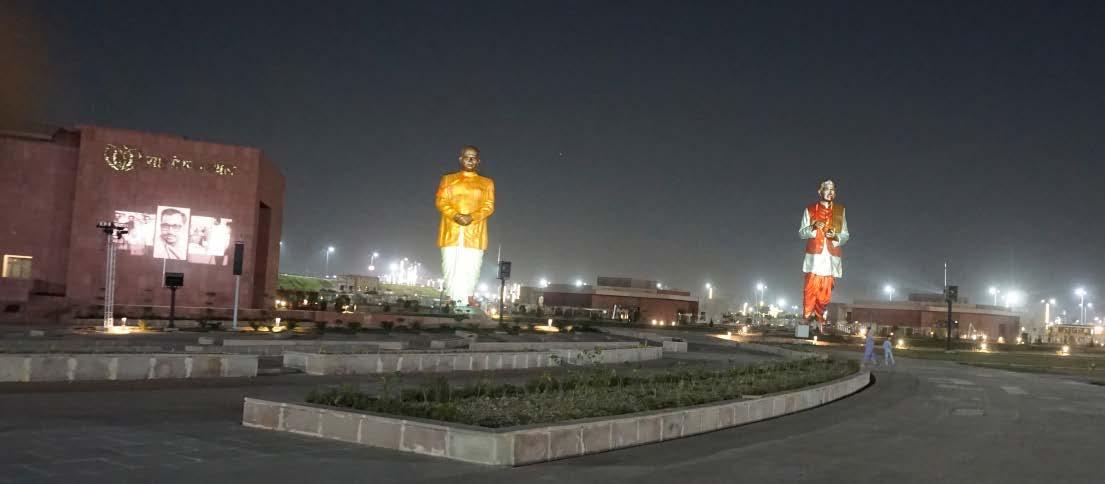
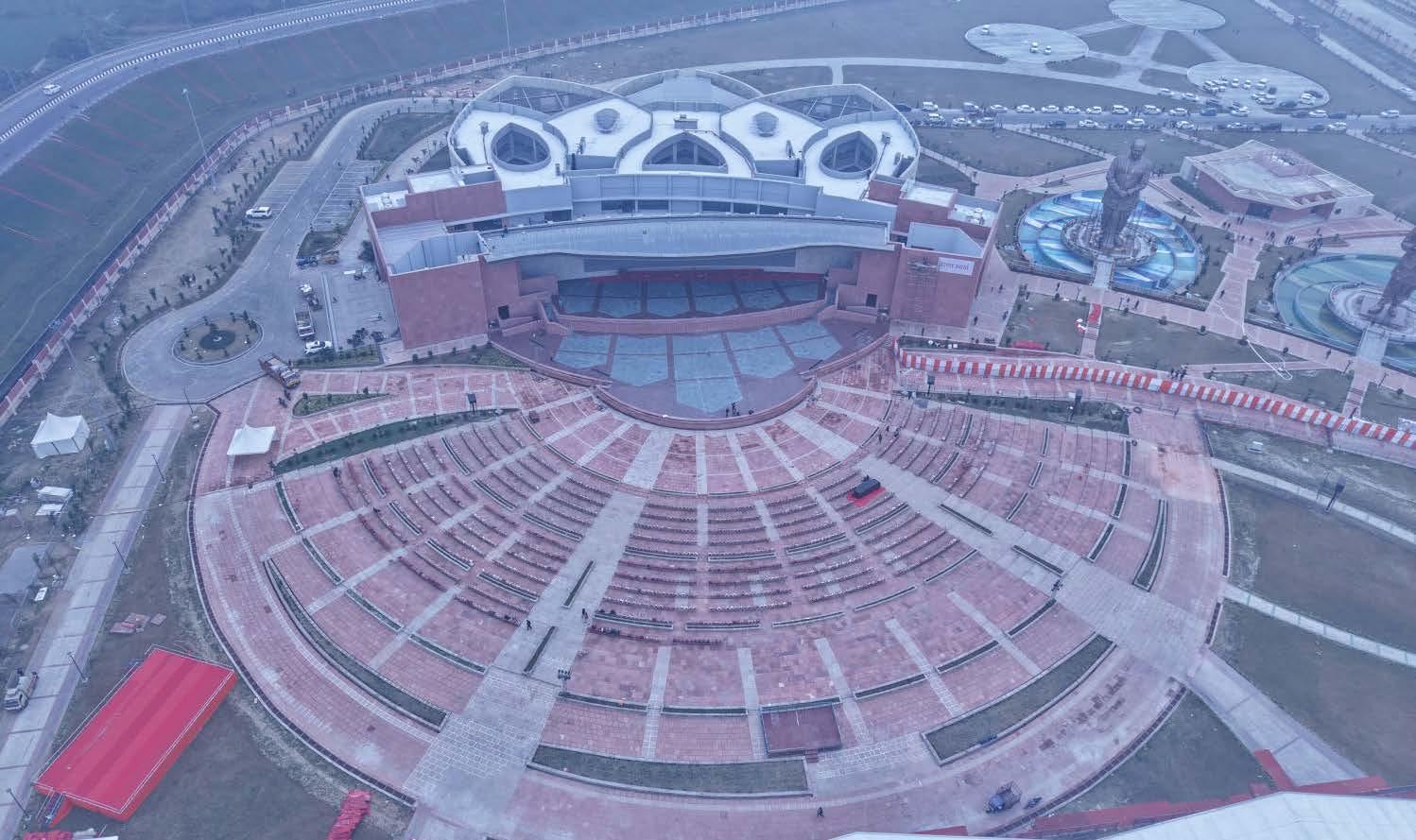
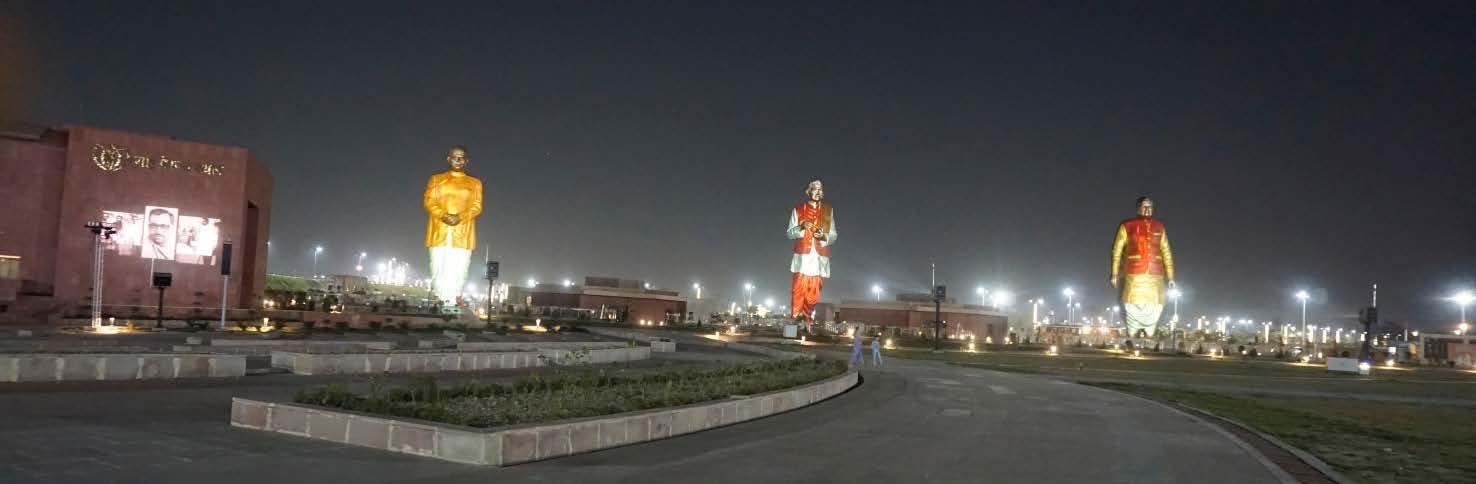
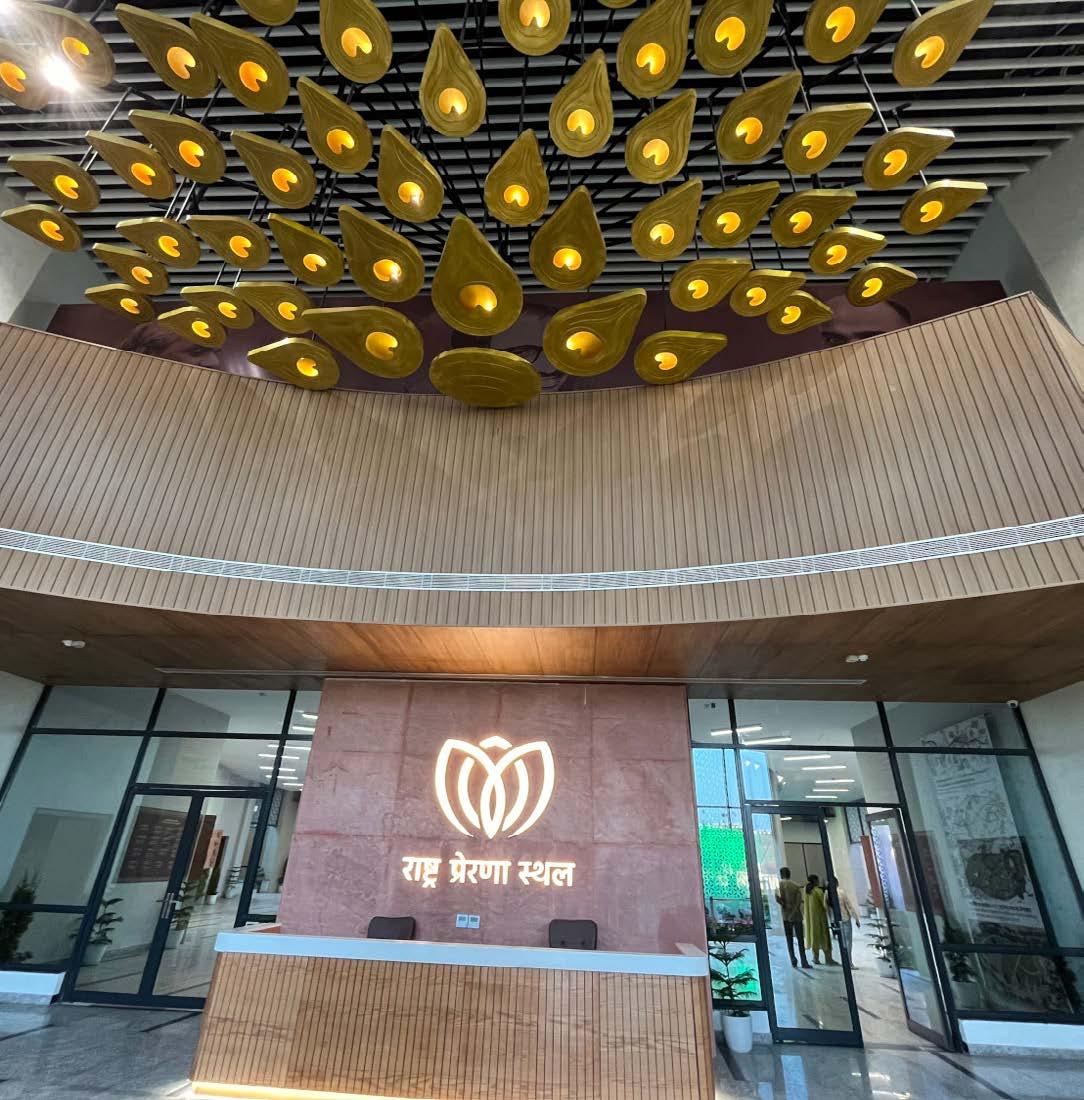
70 INSTALLATION | INDIA: The Rashtra Prerna Sthal Museum - A Colossal National Inspiration
06 Breaking Barriers, Building Connections: Williams AV's Vision for Accessible Communication
10 Who Is Accountable When the Room Decides?
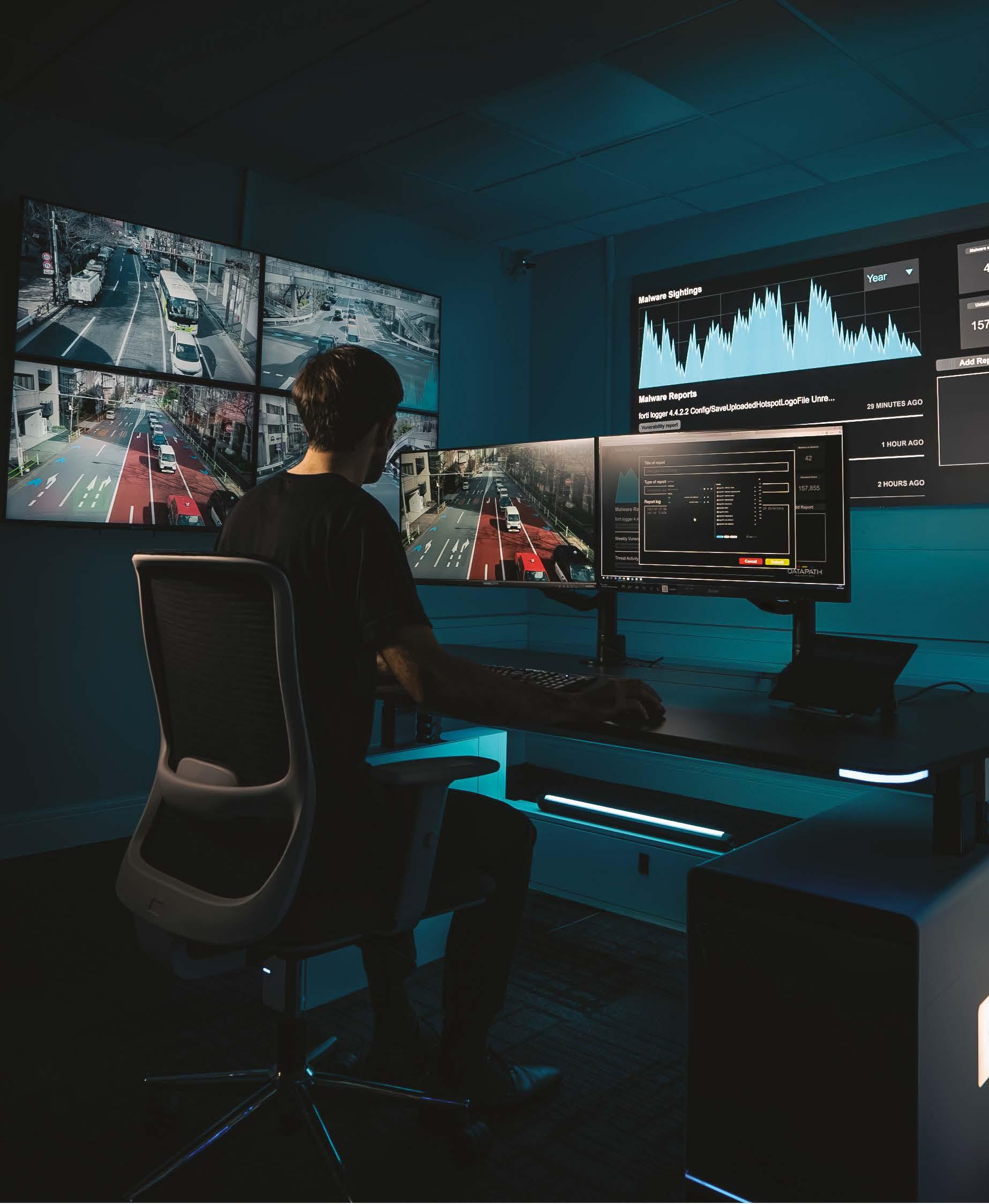
14 Beyond the Video Wall: How Datapath and VITEC Are Reshaping Mission-Critical Visualisation
18 VEGA Elevates Industry Standards with APAC’s Largest CTS Training for Workforce
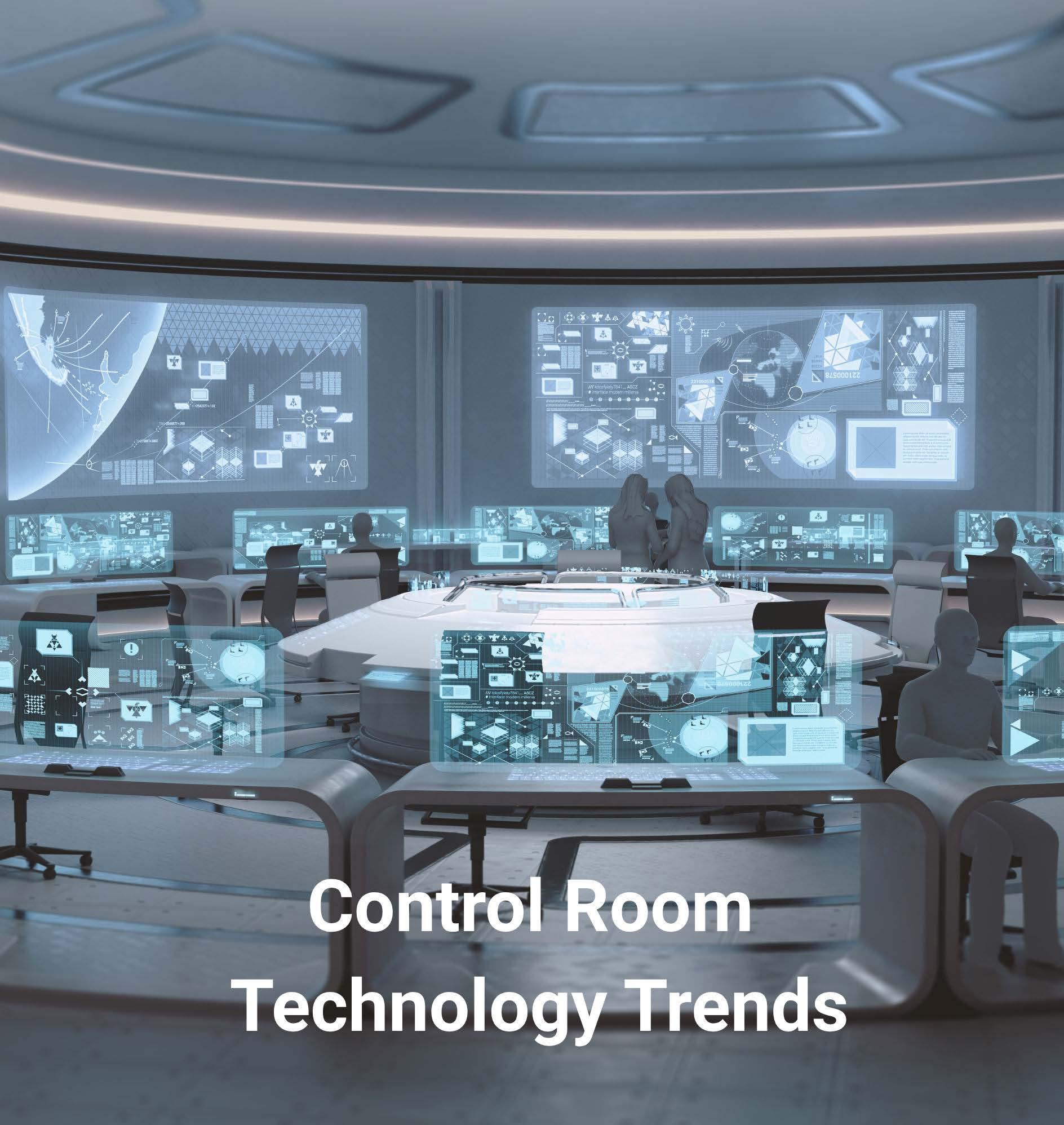
56 Control Room Technology Trends: What AV Integrators and Operators Need to Know
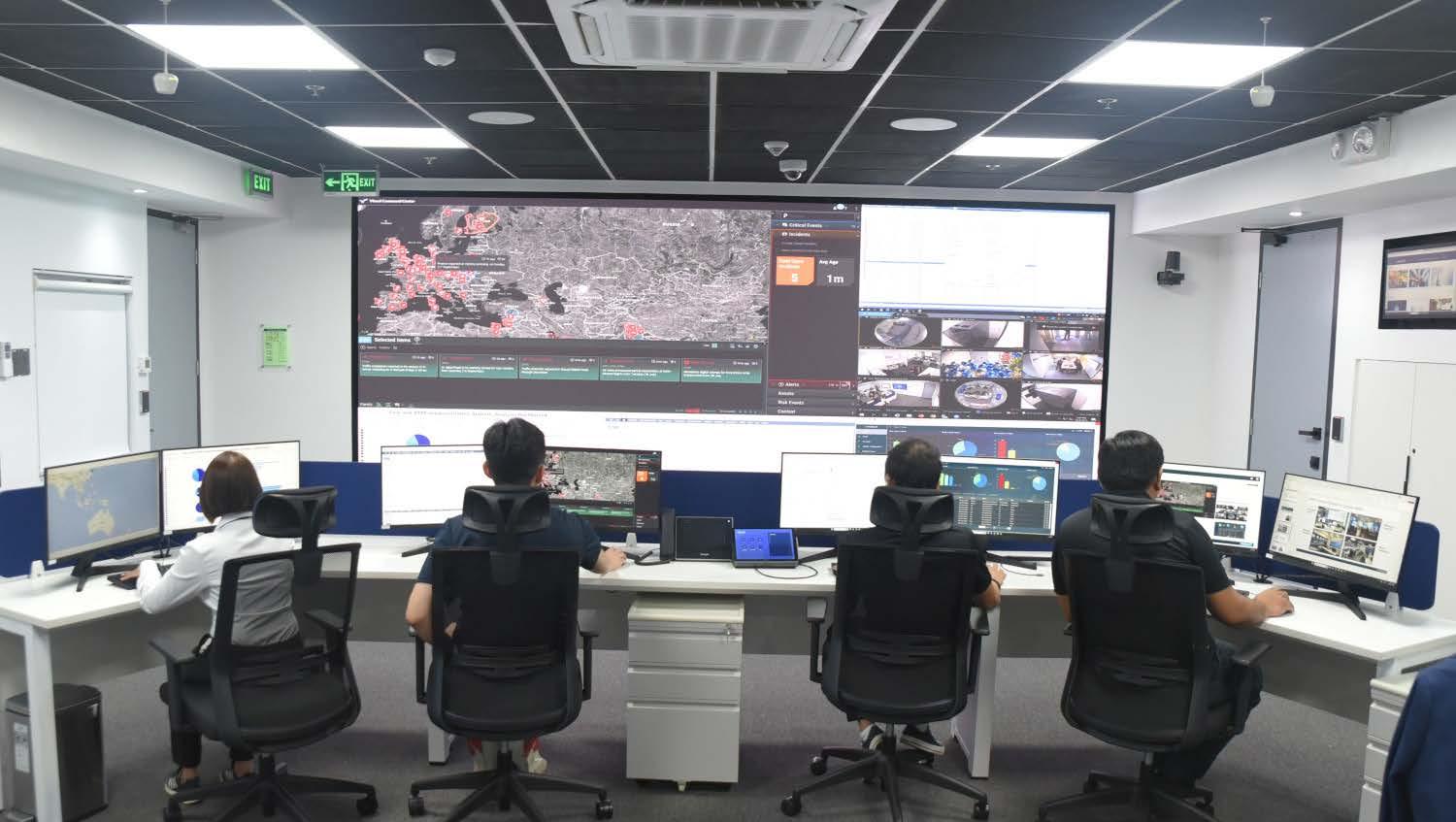
61 Command Centres Reimagined: From Video Walls to AI-Driven Decision Making
DESIGN DECODE
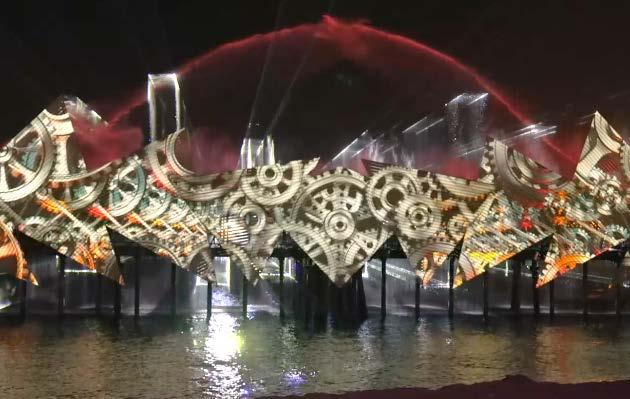
65 The Machines Behind the Mapping Magic
INSTALLATION
74 SAUDI ARABIA: Aura Vision Delivers Integrated LED Display Solutions Across Prince Mohammad Bin Fahd University
“For AV integrators and end users alike, the challenge is no longer selecting individual technologies. It is creating an infrastructure that can adapt to changing operational requirements while remaining resilient, secure, and scalable for years to come.”
From the Publisher
Thomas Richard Prakasam Publisher/Editorial Director thomas@spinworkz.com
As smart cities continue to emerge across the region, Command and Control centres have become critical to enabling safer, smarter and more responsive operations. In this issue, Datapath explores the latest technology trends shaping this sector, while systems integrator Convergint offers its perspective on the future of command and control environments. Interestingly, both arrive at remarkably similar conclusions on future design decisions.
In our VoiceBox column, Williams AV explains how innovations such as Auracast Bluetooth are taking assistive listening beyond accessibility compliance, unlocking new possibilities for language interpretation, hybrid collaboration, entertainment and immersive experiences.
Our AI in AV column sees Marc A. Rémond argue that ethics in the intelligent room is no longer optional, but a governance imperative that every systems integrator and end-user must embrace, regardless of budget or project size.
Finally, we spotlight VEGA Global and its remarkable commitment to CTS certification, driven by a philosophy of investing in people to elevate industry standards.
Meet The Team
EDITOR, INDIA AND ME
Ram Bhavanashi
ram@spinworkz.com
MEDIA REP
DIRECTOR
INDUSTRY ENGAGEMENT
Andy Tan andytan@spinworkz.com
CHINA,HONG KONG, TAIWAN
Judy Wang
Worldwide Focus Media
+86-13810325171
judywang2000@vip.126.com
ADMIN & CIRCULATION
Julie Tan
admin@spinworkz.com
DESIGN & LAYOUT
Hazel Gundaya
Tel: (65) 63162716
Disclaimer: Systems Integration Asia is published 12 times a year. All rights reserved. No part of this magazine is to be reproduced, whether mechanicalor electronic without the prior written consent of the publisher. Views expressed in this magazine do not necessarily reflect those of the editor or the publisher. Unsolicited contributions are welcome but the editor reserves the discretion to use them. Whilst every care is taken to ensure the accuracyand honesty in both editorial and advertising content at press time, the publisher will not be liable for any inaccuracies.
Please be informed that products and company names mentioned in this publication may be protected with tradenames, trademarks or registered trademarks of their respective owners. Our non inclusion of such symbols is not an indication of us not recognising the copyright but rather to have a common look across our articles. Misuse of tradenames, trademarks or registered trademarks is strictly prohibited. It is the obligation of our readers to check if company names and products are protected with tradenames, trademarks or registered trademarks.
THE POWER BEHIND THE VIDEO WALL
Secure, simple and reliable. The award-winning VSN series, powering any video wall size imaginable.
Breaking Barriers, Building Connections: Williams AV’s Vision for Accessible Communication
As organisations worldwide place greater emphasis on accessibility, inclusion and user experience, assistive communication technologies are moving from the margins to the mainstream. New innovations such as Auracast Bluetooth are expanding the possibilities of assistive listening beyond compliance-driven applications, creating opportunities in language interpretation, hybrid collaboration, entertainment and immersive experiences. In this interview, Per Persson, VP International Sales & Product Management at Williams AV, shares his insights on the evolving accessibility landscape, the growing role of AI and Auracast, and the opportunities that lie ahead for the AV industry across Asia and beyond.
For nearly five decades, Williams AV has been helping people overcome communication barriers. What began in 1976 with founder Jerry Williams developing one of the first assistive listening systems for large venues has evolved into a comprehensive portfolio of assistive communication solutions spanning listening assistance, language interpretation, wireless communication systems, classroom technologies, and AI-powered accessibility tools.
Today, as accessibility moves from a compliance requirement to a broader conversation about inclusion and user experience, the industry is witnessing a fundamental shift in how communication technologies are deployed and valued.
According to Per Persson, VP International Sales & Product Management at Williams AV, the momentum behind accessibility has never been stronger.
“It is exciting to see more emphasis being placed on accessibility around the world,
including many parts of Asia,” says Per. “Sometimes this is driven by legislation, but we also see assistive listening solutions being implemented as a standard by multinational organisations in markets where legislation is still lagging behind.”
He notes that organisations are increasingly recognising accessibility not merely as a legal obligation but as an essential component of creating inclusive environments.
“Many houses of worship are installing assistive listening solutions to assist congregants with hearing loss,” he explains. “They are fulfilling a mission rather than adhering to government standards, similar to how Williams AV got its start back in 1976 in churches before accessibility legislation was implemented in the United States.”
Navigating a Complex Accessibility Landscape
As awareness grows, organisations are faced with a wider range of assistive communication
technologies than ever before. From induction loop and infrared systems to FM, Digital RF, WiFi audio distribution and the emerging Auracast Bluetooth standard, selecting the right solution can be challenging.
“There are many different assistive listening technologies available, and they all have different strengths and challenges from an end-user, venue and integrator perspective,” says Per. “This can be slightly overwhelming for someone who is new to the space.”
Compounding the challenge is the rapid evolution of hearing aid technology itself.
“More and more hearing aids are incorporating Auracast technology, while T-coils are becoming less prevalent in many parts of the world,” he explains. “Venues want to consider which system will be most helpful to the greatest number of users over time. Ideally, they want to install a future-proof solution that is also backwards compatible.”
Auracast Opens New Possibilities
Among the most significant developments reshaping the assistive communication market is Auracast, the new Bluetooth-based broadcast audio technology that is attracting attention far beyond traditional accessibility applications.
Per believes Auracast represents a major leap forward for wireless audio distribution.
“Auracast really offers very exciting possibilities,” he says. “Most legacy systems either only support assistive listening or require all users to borrow a receiver. With Auracast’s multi-channel capabilities and BYOD connectivity to third-party headphones, earphones, hearing aids and other devices, it opens up many new opportunities.”
Those opportunities extend well beyond hearing assistance.
Williams AV is seeing Auracast deployed for language interpretation, neurodivergence support, audio description services, museum and gallery experiences, stadium commentary channels, silent discos and immersive entertainment applications.
“Since it is a true stereo, low-latency technology with high audio quality, it lends itself well to applications beyond traditional assistive listening,” Per notes. “Once a system is installed, we also see visitors with normal hearing using it to focus better on content or to achieve a better listening experience in challenging acoustic environments.”
This broadening of use cases is helping redefine assistive communication as a technology that benefits everyone rather than a niche audience.
Meeting the Demands of a Hybrid World
The rise of hybrid work, hybrid learning and increasingly multilingual environments is creating new expectations for communication technologies across corporate, education, healthcare and worship sectors.
For Williams AV, language interpretation has been part of its DNA for decades.
“We have worked with language interpretation and multilingual communication almost since our founding 50 years ago,” says Per. “With increased mobility and awareness, we see higher demand for interpretation solutions across Asia and globally.”
The challenge today is ensuring that communication systems support both physical and remote participants equally.
“In an increasingly hybrid world, it is important to consider both near-end and far-end audio content for assistive communication and interpretation systems,” he says. “We are receiving more and more design support requests for systems that must accommodate both in-person and remote participants.”
Interoperability Becomes Essential
As AV ecosystems become increasingly networked, interoperability is emerging as a critical requirement for integrators and end users alike.
“Interoperability is very important,” Pers emphasises. “As the industry continues down the AV-over-IP path, integrators and venues prefer equipment that is easy to integrate into their existing ecosystem.”
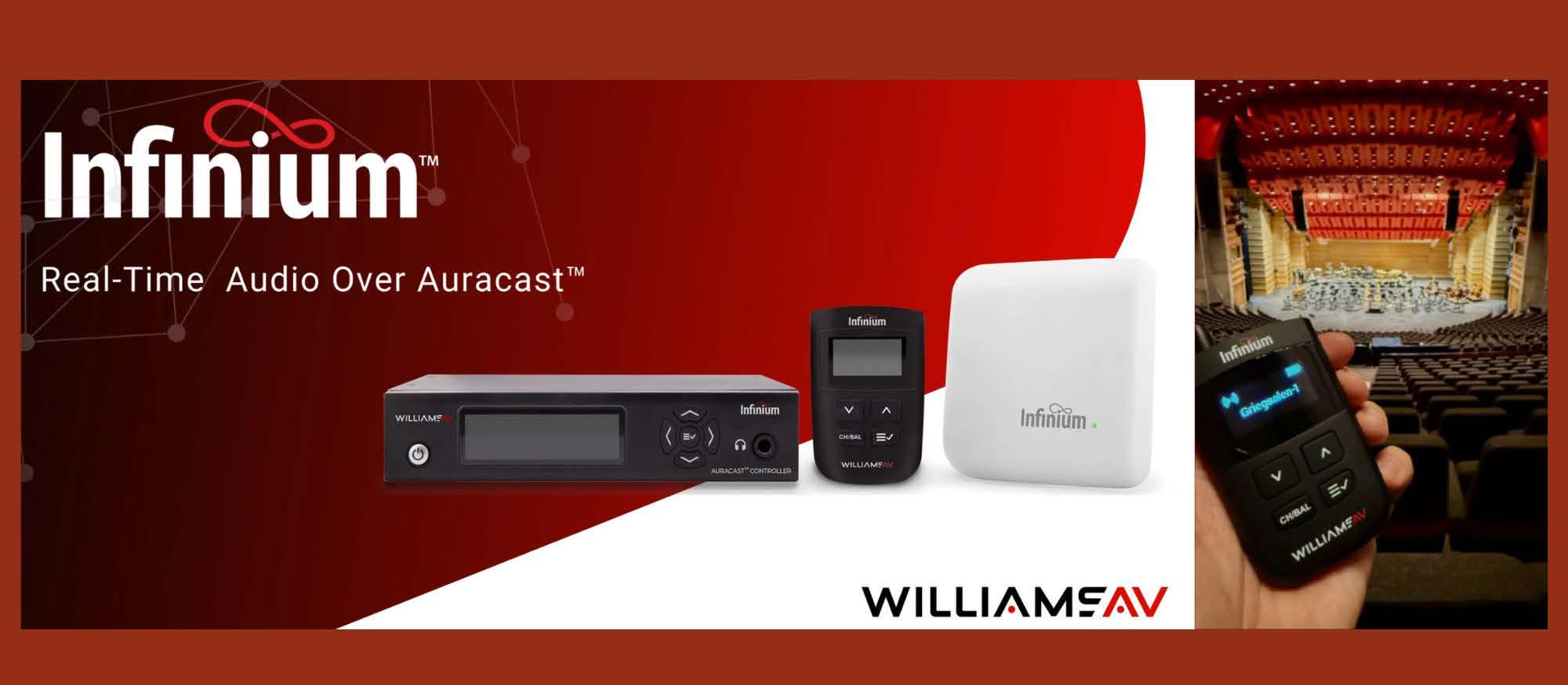
This thinking influenced the design of Williams AV’s Infinium Auracast platform.
“We made some important design decisions for Infinium. It is based on Dante and AES67 and is compatible with standard IP network infrastructure.”
By embracing open standards and networkbased architectures, manufacturers can help customers protect investments while simplifying deployment and scalability.
AI’s Growing Role in Communication
Artificial intelligence is also beginning to reshape accessibility and multilingual communication.
Williams AV entered the AI translation space more than five years ago, providing the company with an early view of both the technology’s potential and limitations.
“We were a bit too early in terms of where the technology was back then, and market acceptance was not quite there yet,” Per recalls.
Today, however, rapid advances in AI-powered translation, captioning and speech processing are creating new opportunities.
“This is certainly an area that is very interesting and developing rapidly,” he says. “Human interpreters provide an incredibly important service for overcoming language barriers, and this is something that can be further augmented by AI capabilities.”
Rather than replacing human expertise, Per sees AI as a tool that can enhance accessibility and improve communication across increasingly global audiences.
Future-Proofing Mission-Critical Spaces
For environments such as courtrooms, transportation hubs, museums and houses of
worship, reliability remains non-negotiable. While new entrants are introducing Auracast products into the market, Per cautions that consumer-focused solutions often fail to address the operational requirements of professional deployments.
“Designing a product for a consumer is very different from designing a receiver that someone may only use once at an interpretation event with very minimal instructions,” he explains.
Professional users increasingly evaluate communication systems based on long-term scalability, ease of deployment, security and interoperability.
“Scalability, interoperability and future readiness are factors that we try to take into account when developing new products because they are key considerations for organisations across Asia and around the world.”
Asia’s Next Growth Opportunity
For Williams AV, Asia represents one of the most dynamic growth regions, albeit one characterised by varying levels of accessibility awareness and regulation.
“Accessibility legislation varies widely across Asia,” says Per. “While markets such as Singapore and parts of the GCC have legislative requirements and awareness levels similar to the US, Europe and Australia, that is not yet the case across the entire region.”
Yet he believes Auracast presents a unique opportunity to accelerate adoption.
“Auracast helps widen the concept of assistive communication beyond assistive listening to include interpretation, audio description for the blind, focus systems for neurodivergent individuals and the general public.”
At the same time, entertainment and experiential applications are opening entirely new markets.
“We also see more entertainment opportunities with this new technology for applications such as silent discos, concerts and wireless content delivery,” he adds.
As accessibility, inclusivity and user experience continue to converge, Williams AV sees assistive communication becoming an increasingly integral part of the modern AV ecosystem.
For Per, the future is about more than simply helping people hear better.
It is about ensuring that everyone can connect, participate and engage fully—regardless of language, hearing ability or environment.
Williams AV
“In an increasingly hybrid world, it is important to consider both near-end and farend audio content for assistive communication and interpretation systems,”
Who is Accountable When the Room Decides?
Ethics in the intelligent room is not a luxury but a governance practice for every budget and every space
By Marc A. Rémond
Years ago, visiting Samsung's headquarters in Korea, I noticed something I did not fully weigh at the time. Supplier and customer meetings did not happen in the rooms employees used. External visitors were received in spaces set apart from the main office floor, deliberately, as a matter of how the building was organised. A decade in workplace technology later, I understand it was neither. It was governance, expressed in architecture.
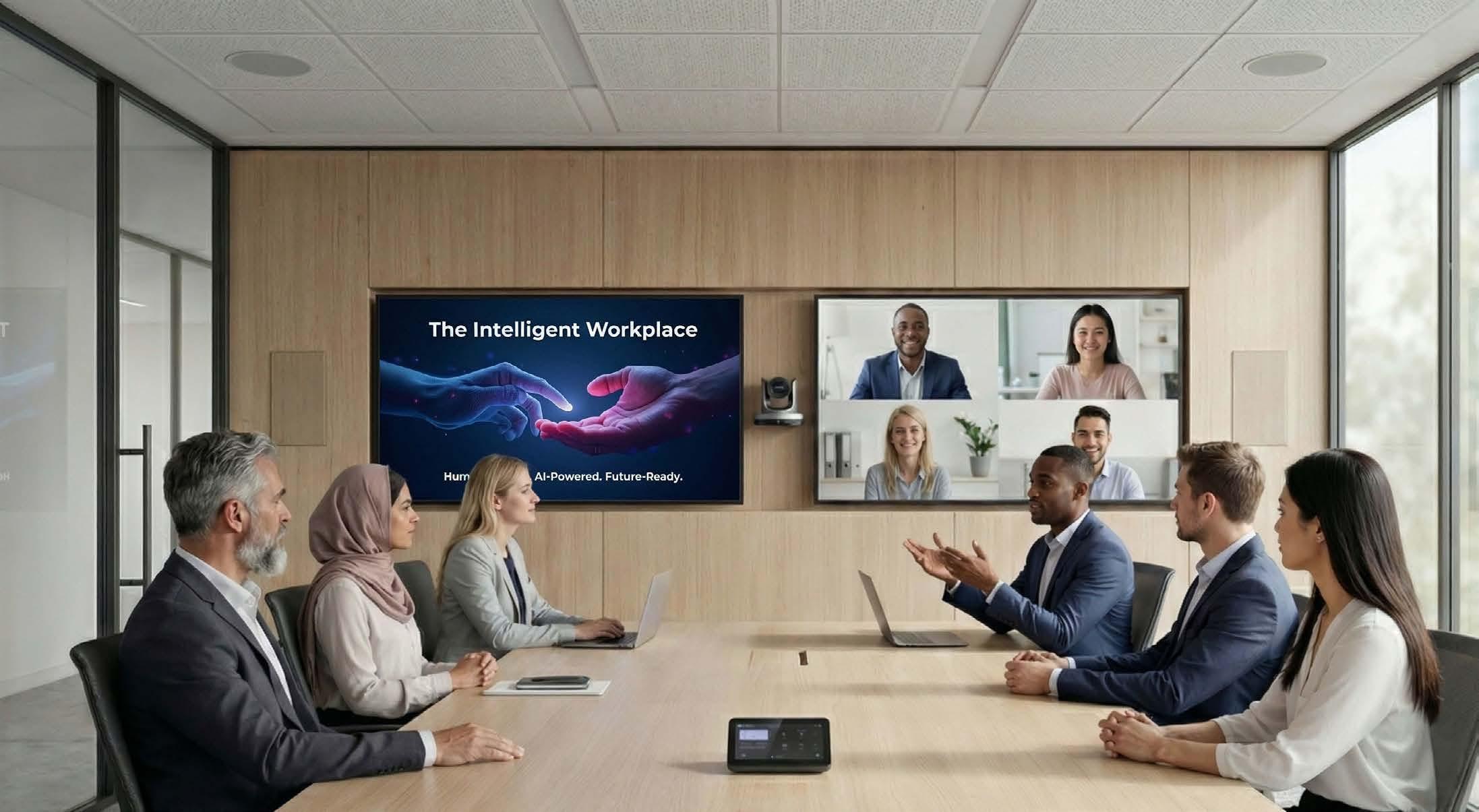
I have spent that decade watching meeting rooms grow intelligent. They now sense occupancy, track who is present, transcribe what is said, attribute statements to speakers, and increasingly interpret attention and engagement. The platform analyses what you
post under terms you accepted. The voice assistant on the phone in your pocket listens for a wake word you switched on, and earlier this year Apple agreed to a 95 million dollar settlement over allegations that Siri captured conversations through accidental activations, recordings a contractor was hired to review. And the room itself, the one you walked into as a guest, adds its own layer of capture on top.
None of this is covert. That is the first thing the industry tends to get wrong. The fear that animates most writing about ethics in intelligent environments imagines a hidden microphone, a secret listener, a breach to be discovered. It scans the room for a villain. But there is no villain, and that is precisely the
problem. You consented to almost all of it. You accepted the building's terms at the front desk. You accepted the device's terms when you set it up. You accepted the platform's terms years ago without reading them. The surveillance, if that is even the right word, is disclosed. It is contractual. And consent, once given, feels like the end of the matter.
It is not, and the reason runs deeper than most of the ethics conversation has reached. Something has changed about the room itself, and our instincts have not caught up. For most of its history the meeting room was a tool. It held a table, a screen, a microphone, and it did what tools do: it sat there until a person used it. We label them, we set policies for their use, we assign them to a department. The intelligent room is no longer that. When a system moves from recording to interpreting, from capturing to deciding who is amplified, who is attributed, what is summarised and surfaced to whom, it stops being furniture and becomes a participant in the meeting. It makes calls. And our governance instincts, every one of them built for tools, do not transfer to a participant. The visitor badge governs a tool. It does not govern an actor that makes decisions about the people in the room.
That is the shift the fear narrative misses entirely. It is still looking for a hidden device when the real change is that the disclosed device started making judgements. And here is the distinction the industry has skipped over as a result: consent is a disclosure event, a single moment, but the room now decides continuously, in every meeting, indefinitely. The room interprets repeatedly. Governance is the only thing that operates on the same timescale as the capability. Consent is a snapshot. Governance is the standing function that matches the room's standing behaviour. Treating the first as if it satisfies the second is the central failure.
We already know how to do disclosed capture with named accountability, because we do it everywhere else without anxiety. When you join
an organisation, you agree to terms governing the monitoring of company systems, and there is a named data controller, a policy, a grievance process. When you buy a concert ticket, the fine print tells you your image may be recorded and used, and there is a venue operator whose name is on that policy. When you register as a visitor and hand over your identification, sometimes signing a form, the organisation receiving you is accountable for what it does with that data. In each case the consent is disclosed and the owner is identified. Someone answers for the consequence.
The AI-enabled meeting room copied the consent and dropped the owner. The visitor consented to being a visitor. They never consented to being interpreted, because no one in the chain decided that they were. The original equipment manufacturer built the capability. The integrator tuned its behaviour for the site. The enterprise deployed it into the room. Three capable parties, and not one of them holds the question of who is accountable when the room acts on what it heard. It said nothing about the intelligence in the room.
What Samsung did, in the practice I observed, was refuse that gap before it opened. By receiving external parties in spaces set apart from the employee environment, the organisation made an explicit decision about where interpretation could occur and who could be subject to it. Someone owned that decision. That is what accountability looks like when it is designed in rather than discovered after an incident.
The leadership implication is not that every organisation must build a dedicated visitor floor. Most cannot, and they should not conclude they are therefore exempt. Spatial segregation is one implementation of the principle, not the principle itself. Samsung had the real estate to solve it with architecture. The same governance is available to an organisation with eight meeting rooms and no spare floor, through mechanisms that cost
far less and that already sit inside functions someone owns today.
There are two of them, and they map cleanly onto two different buyers. The first is lobby registration, and it belongs to the facilities leader. Visitor flow, physical access, the front desk and the badge are already theirs. Extending what the badge discloses, so that a guest entering an AI-enabled space is told what the room captures and acknowledges the policy that governs it, is a facilities decision made by the person who already owns the door.
The second is calendar-invite acceptance, and it belongs to the IT leader. In Microsoft 365 and Google Workspace, the invitation already names the location, and a booked room is a resource with its own identity, distinct from an online meeting or an unequipped space. The system therefore already knows whether a meeting lands in an AI-enabled room. An organisation can configure the acceptance of such an invitation to carry a disclosure: this meeting takes place in a room equipped with AI capture, and by accepting you acknowledge the data policy that governs it. The disclosure is delivered at the precise moment of consent, tied to the act of acceptance, owned by the function that already owns the tenant and the room resources. It catches the participant who joins from their own office and would never have passed a front desk.
These are not competing answers to one question. They are addressed to two surfaces and two owners. The facilities leader controls the physical threshold; the IT leader controls the calendar. Sold together, they close the whole gap, the in-person visitor and the remote participant, the lobby and the invitation, with neither leaving the other's blind spot uncovered. What both share is the thing the room was missing: a named owner who answers for the disclosure. A capability distributed across a chain is a capability no one owns. Accountability does not survive being shared between three parties. It has to land on a role.
For the integrator, this is the part worth sitting with, because it is not a burden. It is a deliverable, and it adapts to whoever is across the table. You cannot sell most clients a separate building for guests. You can build room-tier classification, entry disclosure, and capture-and-retention specification into the deployment as a standard part of the work, and you can pitch it to the owner who controls the relevant surface. Selling to facilities, the answer is lobby disclosure, owned where access is already owned. Selling to IT, the answer is calendar disclosure, owned where the tenant is already owned. Often the answer is both. Governance becomes a line item rather than a building project, and an accountable specification rather than an afterthought the enterprise discovers when something goes wrong.
The strategic insight is this. Ethics in the intelligent room is neither a moral panic nor a luxury reserved for organisations with campuses to spare. It is a governance practice with an implementation tier for every budget and a named owner for every surface. The room that interprets, predicts, and arbitrates is not a tool that captured too much. It is a participant we never decided to govern. The threat is not the listening. It is deploying a decision-maker into the room while mistaking the consent you collected at the door for the accountability you never assigned. The organisations genuinely exposed are the ones that confused having no dedicated space with having no obligation. Name the owner, and the fear resolves into something you can actually build.
Marc A. Rémond is the founder of Strategic Pathways and writes on the intelligent workplace at intelligentworkplace.ai.
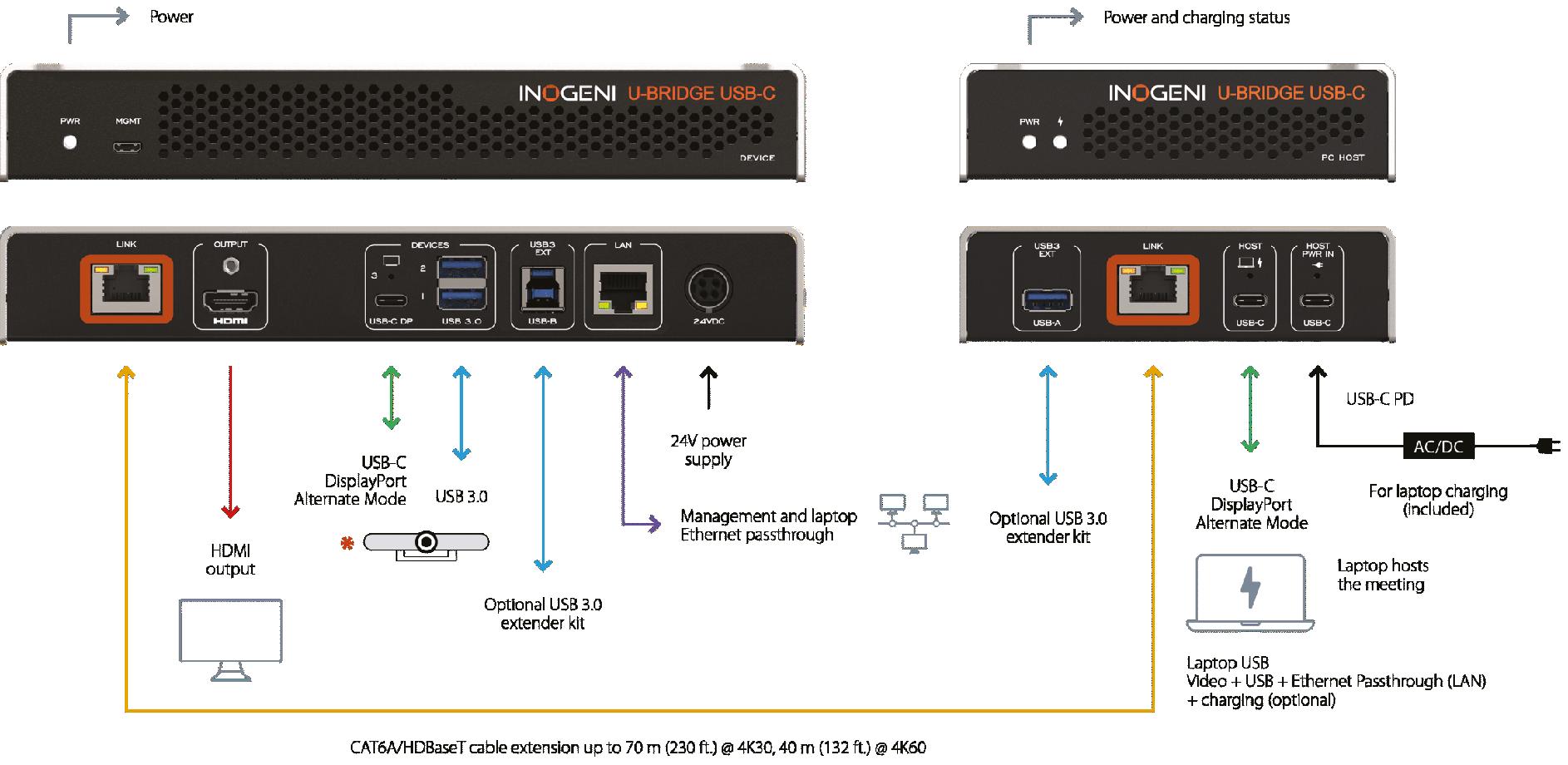
U-BRIDGE USB-C
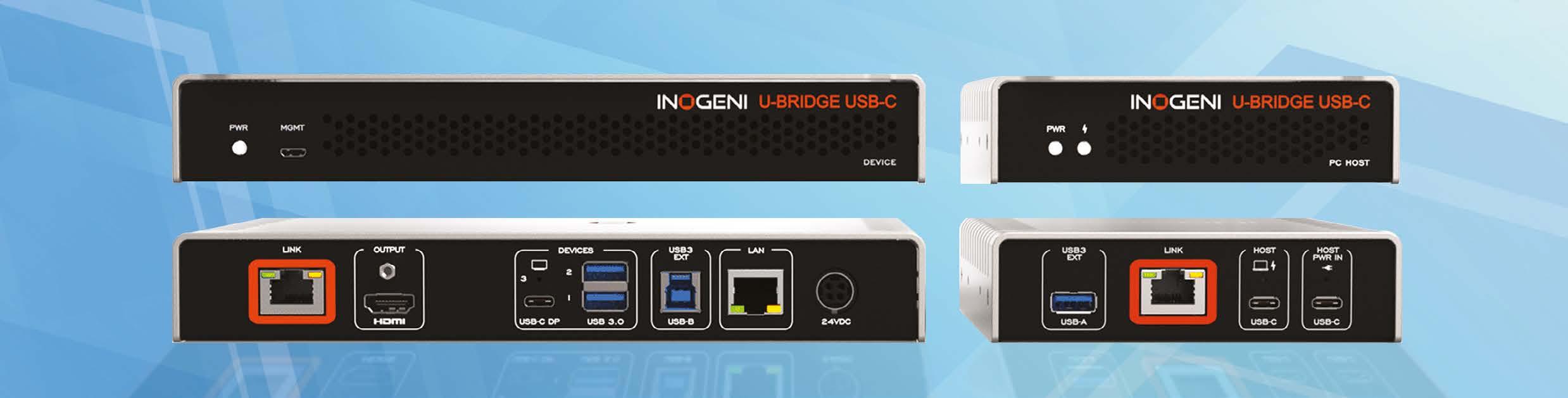
4K60 USB-C extender (USB and DP Alt Mode) up to 40 m over CAT6A
Next-level BYOM exibility with USB-C for AV extension
High-performance audio/video connectivity and 100W charging USB-C extension over CAT6A U/FTP cable up to 70 m (230 ft.)
2x USB 3.0 device ports
4K60 HDMI output
Advanced video processing with 4:4:4 and 4:2:2 chroma subsampling
Versatile USB and video extension
Supports all USB peripherals, including webcams, videobars, audio devices, and HID IP interface with DHCP/static IP support for control and network bridging
Ideal for systems with USB-C connectivity, such as Lenovo Core Gen 2, Cisco Room Bar Pro, Cisco Room Kit EQ, Poly G62, Logitech MeetUp 2 and ClickShare CX50 Gen 2.
Plug-and-play compatibility with Windows, macOS, and Linux—no drivers required Full-featured integration and simple deployment
Beyond the Video Wall: How Datapath
and VITEC are Reshaping
Mission-Critical Visualisation
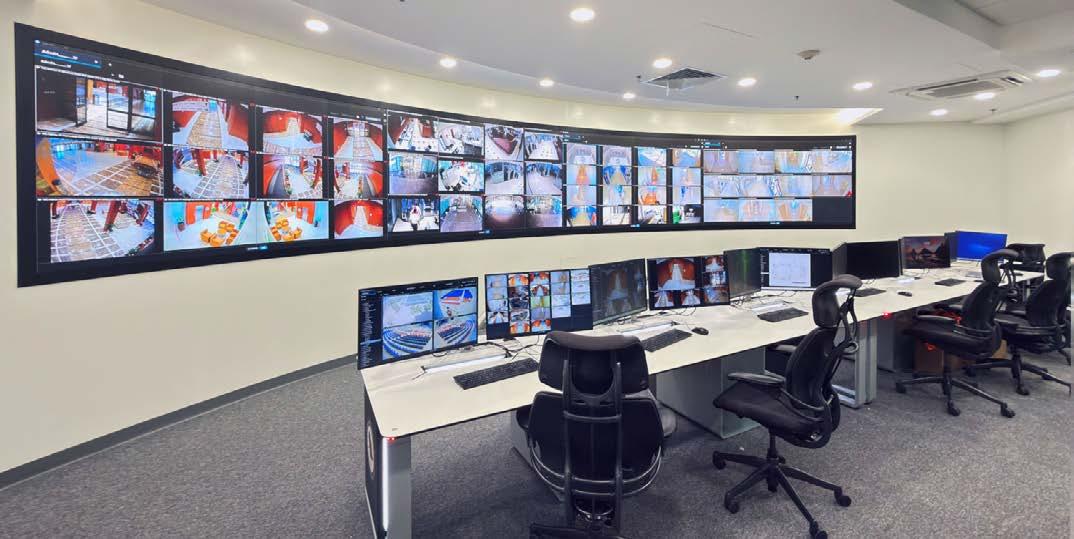
The demands placed on today’s control rooms have never been greater. Operators are expected to process growing volumes of real-time information, collaborate across geographically dispersed teams, and make faster, more informed decisions in increasingly complex environments. At the same time, organisations are looking to simplify system architectures while ensuring their technology investments remain scalable and future-ready.
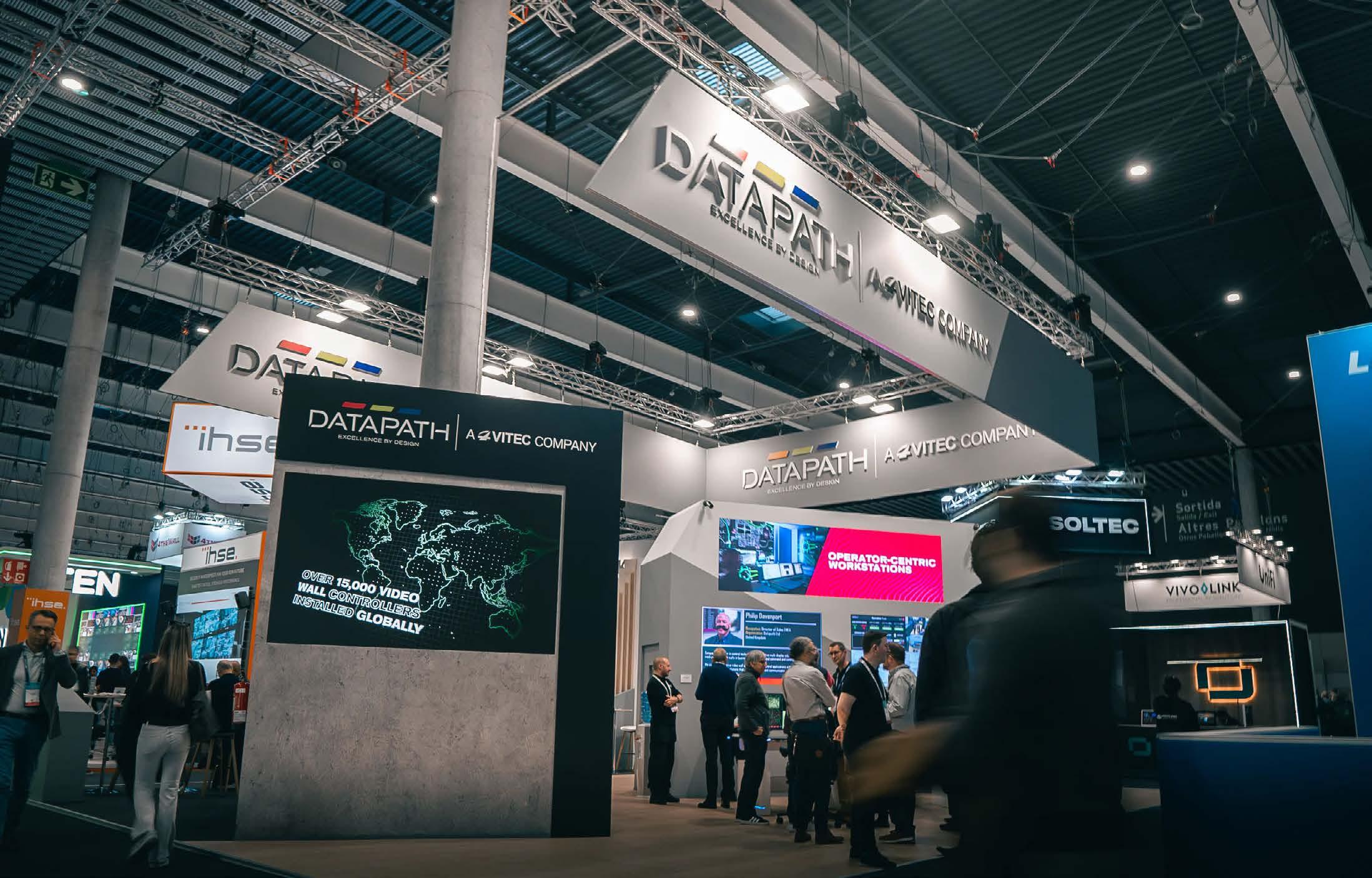
Against this backdrop, Datapath’s acquisition by VITEC marks a significant milestone. By combining Datapath’s expertise in video wall processing, KVM and AV-over-IP with VITEC’s strengths in IPTV, streaming and content distribution, the combined organisation is creating an end-to-end video ecosystem that spans the entire workflow—from content capture and distribution to visualisation and operator control.
In this interview, Michael Austin, Director of Channel Management, APAC, Datapath, shares how the integration is strengthening Datapath's value proposition, the trends shaping the next generation of control rooms, the growing opportunities across Asia, and why softwaredriven platforms such as Aetria are helping organisations move beyond simply displaying information to delivering actionable intelligence.
Datapath has long been recognised for its expertise in video wall management and control room solutions. How does becoming part of VITEC expand the value proposition you can now offer to customers and partners?
Datapath has built a global reputation for video wall processing, control room solutions, AVover-IP and KVM technologies. By joining VITEC, Datapath can now offer customers and partners
a more complete end-to-end video ecosystem that spans content capture, IPTV distribution, streaming, visualisation and operator control.
The combination strengthens Datapath’s engineering resources, global support network and product portfolio, which enables us to deliver more integrated solutions, while continuing to invest in innovation. Customers benefit from greater capability, while partners gain access to a broader range of technologies from a single trusted provider.
The combination of VITEC's IPTV and streaming technologies with Datapath's video wall and KVM capabilities creates a unique portfolio. What new opportunities does this open up for system integrators and end-users in mission-critical environments?
Together, VITEC and Datapath are able to deliver a seamless video workflow, from content capture and distribution to visualisation and operator interaction. This creates new opportunities for system integrators to offer more comprehensive solutions while reducing integration complexity.
For end users, particularly in transportation, utilities, defence and public safety, it means improved situational awareness, faster decisionmaking and more efficient operations through a unified technology platform.
Aetria received a Best of Show award at ISE 2026. What specific industry challenges is Aetria solving today, and how has customer feedback influenced its development roadmap?
Control rooms are managing more information than ever before, often across multiple systems. Aetria addresses this by bringing video walls, workstation management and source control together within a single platform, simplifying operations and reducing complexity.
Customer feedback has been fundamental to its development. Many new features and enhancements have come directly from conversations with operators, consultants and integrators, ensuring Aetria continues to evolve around real-world needs.
Control rooms are evolving rapidly, with increasing demands for collaboration, situational awareness, and remote operations. What trends are you seeing that will shape the next generation of control room environments?
We're seeing a shift towards more connected, collaborative and software-driven environments. Organisations want to unify data, video and communications while enabling teams to work seamlessly across multiple locations.
Remote operations, AV-over-IP, cloud-enabled services and AI-assisted decision support will all play an increasing role. The focus is moving from simply displaying information to delivering actionable intelligence that helps operators respond faster and more effectively.
The replica control room and side-by-side demonstration of Aligo and Aetria workstations attracted significant attention at ISE. What were some of the most common challenges visitors
discussed with your team, and how are your solutions addressing them?
The biggest challenge we heard was about complexity. Many organisations are managing multiple systems and struggling to provide operators with a simple, efficient user experience.
Aetria and Aligo address this by creating a combined and integrated environment for video wall management, workstation control and collaboration. Together, they simplify workflows, improve flexibility and help organisations operate more effectively both locally and across distributed sites.
Beyond traditional command-and-control applications, where do you see the greatest growth opportunities for Datapath's technologies in sectors such as corporate workplaces, higher education, transportation, and digital signage?
As organisations become increasingly datadriven, we don’t envisage any change with the need to visualise and manage information effectively extends far beyond traditional control rooms.
We see significant growth opportunities in corporate operations centres, higher education, transportation and digital signage. Across all of these sectors, to us it’s clear that delivering the right information to the right people at the right time to support better decisions and stronger engagement.
In relation to Asia, how has the company's journey in the region evolved, what unique challenges has Datapath encountered across diverse Asian markets, and where does Datapath see the greatest growth opportunities emerging in the years ahead, in Asia?
Asia has become an increasingly important region for Datapath, driven by strong partnerships and growing demand for advanced
visualisation technologies. The diversity of markets across the region requires an adaptable approach, with solutions tailored to local requirements and infrastructure.
Looking ahead, we see significant opportunities in transportation, smart cities, critical infrastructure and security operations. Continued investment in digital transformation across the region is creating strong demand for scalable, reliable and future-ready solutions.
As Datapath and VITEC continue their integration journey, what can customers, channel partners, and system integrators expect to see from the combined organisation over the next 12 to 18 months?
Customers and partners can expect continuity, investment and innovation. Datapath's products and expertise will remain at the heart of the business, while benefiting from VITEC's broader resources, technologies and global reach.
Over the coming months, we'll focus on deeper integration across our portfolios, accelerated product development and expanded support capabilities. Our goal is to make it easier for organisations to capture, distribute, visualise and act on critical information through a more powerful and connected technology platform.
Datapath
The biggest challenge we heard was about complexity. Many organisations are managing multiple systems and struggling to provide operators with a simple, efficient user experience.
VEGA Elevates Industry Standards with APAC’s Largest CTS Training for Workforce
With more than 90 professionals currently in CTS-training with the aim of being CTS-certified, VEGA is investing in people, standards, and industry leadership—setting a new benchmark for professional AV integration across Asia Pacific.
As audiovisual technology becomes increasingly intertwined with IT infrastructure, cloud platforms, cybersecurity, and enterprise collaboration ecosystems, the need for skilled and certified professionals has never been greater. For global systems integrator VEGA, professional development is not simply an employee benefit—it is a strategic investment in quality, consistency, and industry leadership.
Today, VEGA has more than 90 employees who are training for AVIXA's Certified Technology Specialist (CTS) certification, with VEGA also investing in the next stage of putting them through the examination to be CTS certified. Furthermore, the company plans to continue expanding knowledge through structured quarterly training programmes. The initiative reflects the company's belief that professional certification is fundamental to delivering predictable outcomes, maintaining technical excellence, and elevating standards across the AV industry.
To understand the significance of this investment, Systems Integration Asia spoke with Pang Yee Loy, Senior Director – Asia Pacific at AVIXA, and Steve Medeiros, CEO of VEGA, about the company's certification journey, the challenges of upskilling at scale, and how a highly certified workforce could help establish a new gold standard for professional AV services across APAC.
Certification as a Strategic Investment
For VEGA, the decision to invest heavily in CTS training and certification was driven by a desire to create a unified, standards-based approach across an organisation spanning 17 countries and 28 cities.
"As the largest AV systems integrator across APAC, consistency at scale is critical to our success," explains Steve. "Our investment in CTS certification is driven by a clear objective: to create a consistent, standards-based operating model across the entire organisation."
He likens CTS to the role that ITIL has played within the IT industry—a globally recognised framework that promotes consistency, professionalism, and predictable outcomes.
By aligning teams under a common certification standard, VEGA aims to ensure that clients receive the same level of technical rigour and service quality regardless of project location.
Pang believes the initiative reflects a deeper understanding of what truly drives success.
"VEGA clearly understands that its people are its strongest asset," he says. "Their commitment to training over 90 of its workforce for CTS, directly translates into delivering unparalleled quality and consistency across all projects while building deep trust throughout the region."
According to Pang, the investment establishes a common technical language across regional teams, validates capability through independent certification, and reinforces a culture that values professional growth and excellence.
The Challenge of Upskilling at Scale
Training and certifying more than 90 professionals across multiple countries is no simple undertaking.
For Pang, one of the biggest hurdles lies in balancing professional development with ongoing project commitments.
"Upskilling more than 90 professionals across diverse regions is a massive logistical and operational puzzle," he notes. "Engineers and technical staff are constantly managing highpressure projects, making it a delicate act to balance rigorous study without disrupting project delivery."
Steve agrees, identifying time as the biggest challenge. "Our engineers are already operating in high-demand, project-driven environments, so finding the space for structured learning and certification requires real commitment and discipline."
However, VEGA discovered that culture can be a powerful enabler.
The company created collaborative learning environments through Microsoft Teams,
allowing employees to share notes, ask questions, exchange experiences, and support one another throughout the training journey.
"We deliberately built a collaborative training environment where individuals can support one another," says Steve. "That peer-to-peer engagement has made a significant difference in sustaining momentum across regions."
Recognition also became an important component of the programme.
"We've placed a strong emphasis on celebrating graduating cohorts and acknowledging those who complete the certification journey," he adds. "That creates positive reinforcement and helps build a culture where achievement is visible and contagious."
Enhancing Technical Excellence and Customer Confidence
While the certification programme strengthens technical skills, both Pang and Steve emphasise that its impact extends far beyond technical knowledge.
Pang believes the CTS curriculum introduces a disciplined and standardised approach to project delivery.
"Embedding the ethical and standardised principles of the CTS curriculum naturally elevates project documentation, engineering drawings, and commissioning processes," he explains. "It introduces a refined discipline to client handovers."
Certification also empowers engineers to engage more confidently with increasingly sophisticated stakeholders.
"It gives the team a massive confidence boost when engaging with IT directors and enterprise stakeholders," says Pang. "Speaking the structured, universal language of the CTS programme allows engineers to
clearly articulate complex technical choices, establishing immediate credibility and trust."
Steve agrees with Pang. "CTS introduces a level of discipline and accountability that elevates how our teams plan, document, and execute projects," he says. "It creates a more structured and predictable delivery model, which is something clients value immensely."
Perhaps most significantly, certification enables engineers to move beyond technical discussions and focus on business outcomes.
"They're able to communicate complex solutions more clearly and align those solutions to business outcomes, not just technical specifications," Steve adds.
Why Certification Matters More Than Ever
The growing convergence of AV and IT is fundamentally reshaping the skills required of AV professionals.
"The traditional silos between AV and IT have completely dissolved," says Pang. "Today, AV endpoints live on the corporate network, demanding a deep understanding of IP protocols, network security, bandwidth management, and cloud architecture."
As a result, standardised knowledge and professional certification are becoming increasingly important.
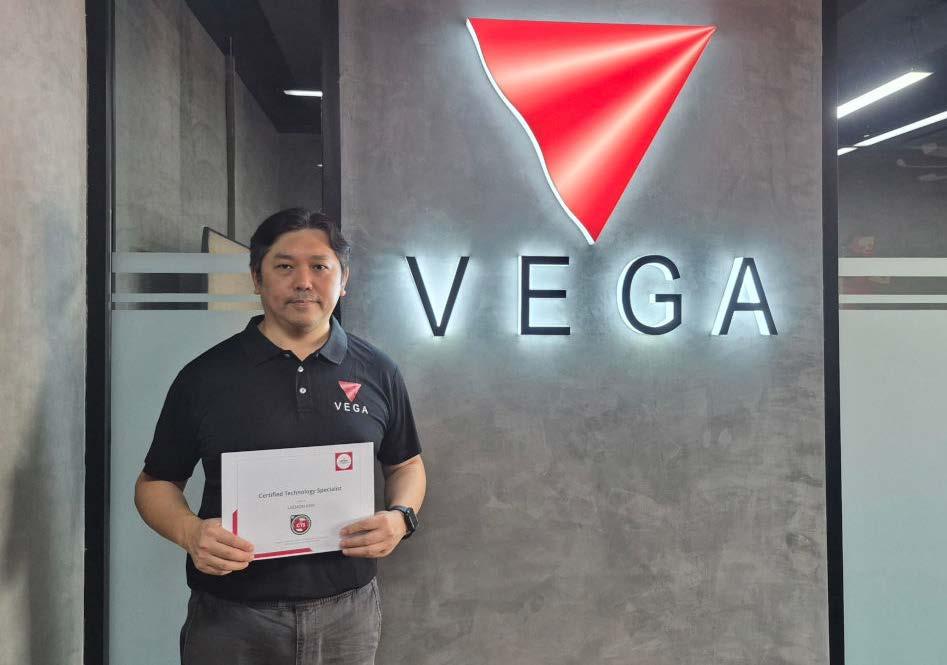
Laemon Kew of VEGA Malaysia with his CTS Certification.
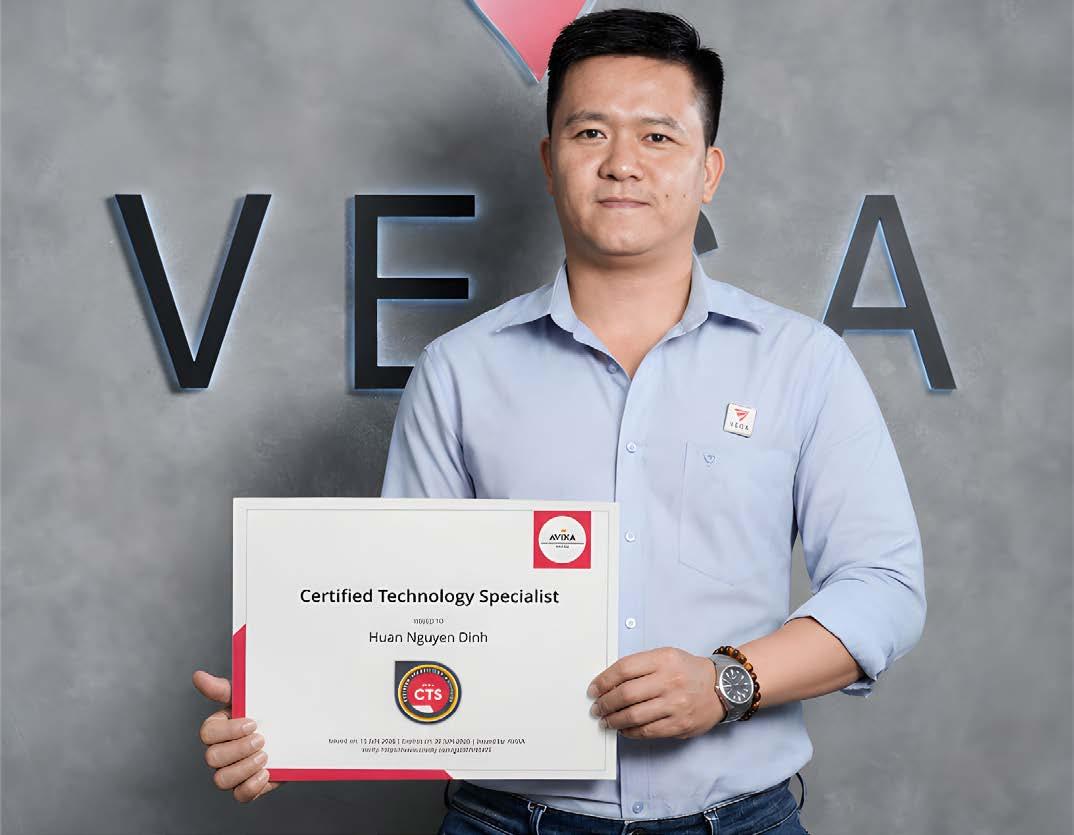
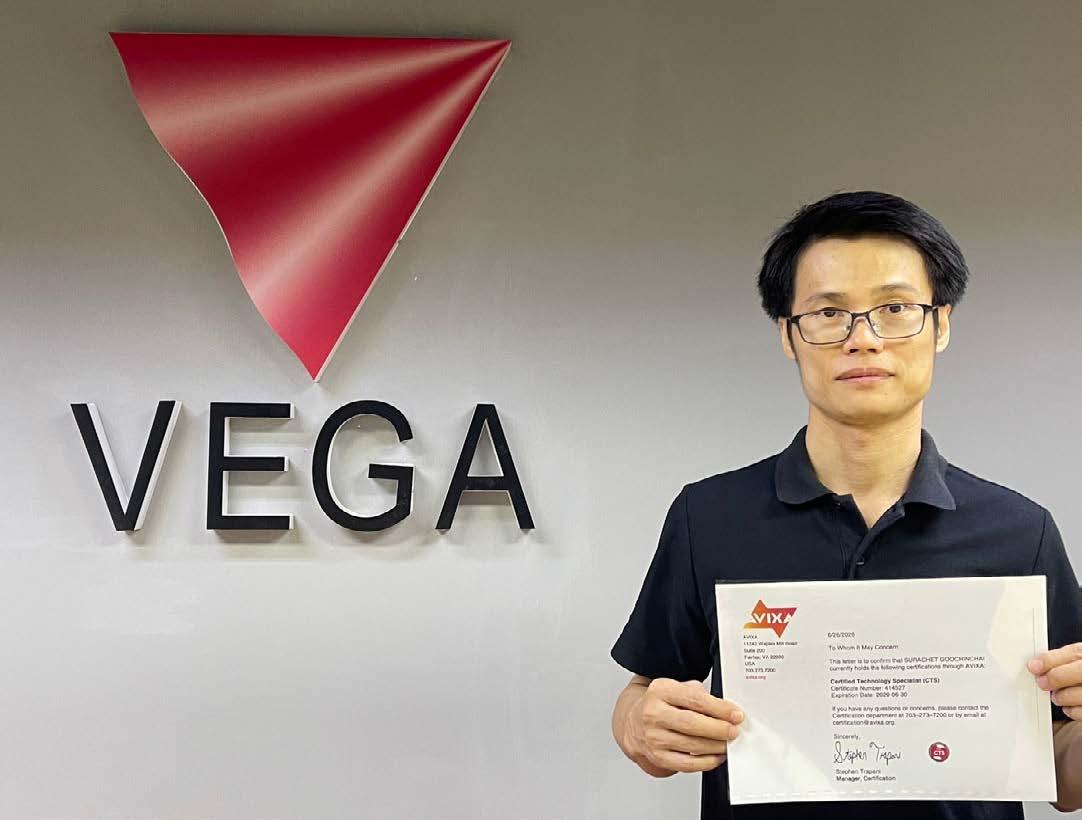
Ryder Nguyen of VEGA Vietnam with his CTS Certification. Surachet Goochinchai of VEGA Thailand with his CTS Certification.
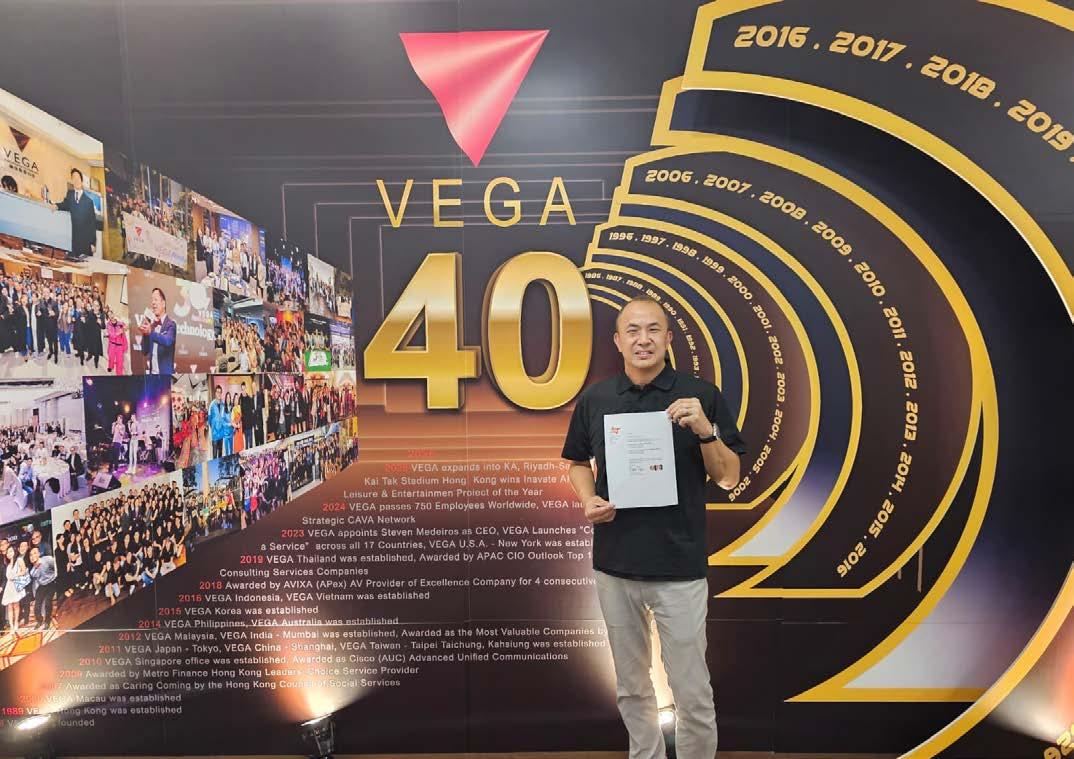
Raymond Ng of VEGA Hong Kong with his CTS-I Certification.
"In this converged environment, a lack of standardised knowledge introduces significant risks to network integrity and project quality," Pang warns.
Steve is even more direct. "AV is IT—full stop," he states.
"As AV becomes fully embedded within enterprise networks, cloud platforms, and collaboration ecosystems, certifications are no longer optional—they are essential."
He argues that the industry must now operate with the same discipline expected of engineering and computer science professions
. "The reality is that AV is no longer confined to boardrooms. It sits on every desktop, mobile device, and collaboration space across an organisation," he explains. "That makes it one of the most mission-critical platforms in business today."
For Steve, professional certification provides the common language, competency framework, and accountability required to deliver predictable outcomes at scale.
Setting a New Benchmark for APAC
Looking ahead, both AVIXA and VEGA believe that the impact of certification extends well beyond a single organisation.
"VEGA is truly leading the APAC region by example," says Pang. "By scaling a highly certified technical workforce, they are actively elevating the entire regional ecosystem rather than just raising their own internal bar."
He believes that clients who experience the benefits of standardised delivery will increasingly expect certified expertise from all service providers, ultimately raising standards across the industry.
Steve shares that vision. "At VEGA, we see the expansion of CTS-certified professionals as a critical lever in shaping a more consistent and higher-performing AV industry across APAC."
The company's next phase of development will extend beyond technical certification to include project management and advanced delivery competencies through the VEGA Academy.
"This is important because true industry leadership isn't just about technical skills—it's about consistency in execution, governance, and client outcomes."
Ultimately, VEGA believes that combining deep certification, regional scale, and disciplined delivery will help define what excellence looks like in the modern AV industry.
"We believe the combination of deep certification, regional scale, and disciplined delivery will help establish a new benchmark for what 'best-in-class' AV looks like across APAC," he concludes.
As AV continues its evolution into a fully networked, business-critical technology platform, organisations that invest in people will be best positioned to succeed.
VEGA's commitment to developing one of the region's largest CTS-certified workforces demonstrates that professional certification is no longer simply about individual achievement—it is about creating a culture of excellence, ensuring consistent project delivery, and helping shape the future standards of the AV industry across Asia Pacific.
VEGA AVIXA CTS
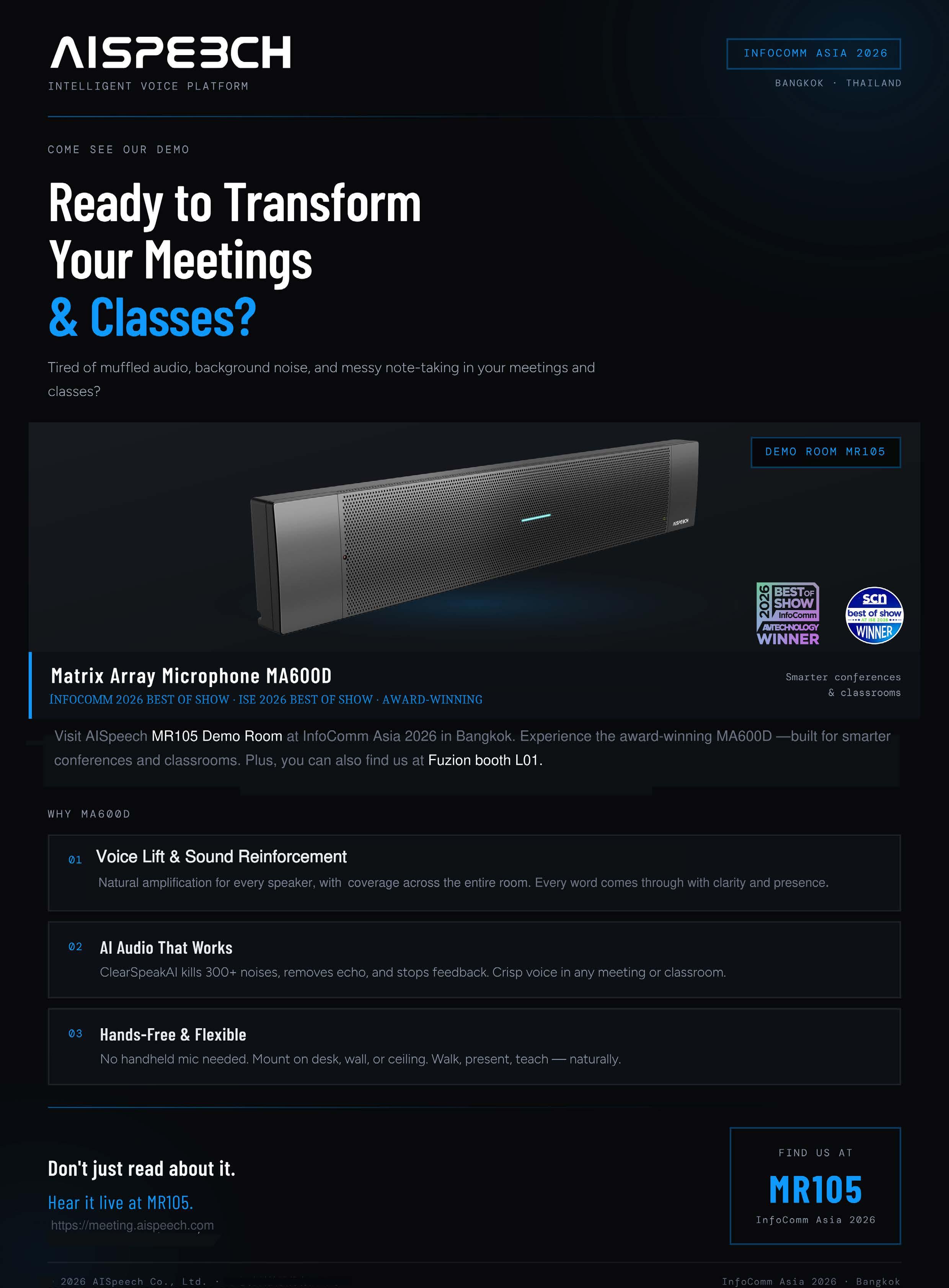
AISpeech Powers APEC 2026 with AI-Driven Meeting Technology for 700 Global Delegates
CHINA: AISpeech, one of China’s leading conversational AI innovators, demonstrated the capabilities of its intelligent meeting solutions on an international stage as a special technology supporter of the 32nd APEC Trade Ministers’ Meeting in Suzhou, China.
Held along the shores of Jinji Lake, the prestigious gathering brought together nearly 700 delegates from 21 APEC member economies. To support the complex communication requirements of a high-level multinational event, AISpeech deployed its flagship Matrix Microphone MA600D and AI Office Tablet X5 Pro, delivering a seamless blend of crystal clear audio, multilingual transcription, and intelligent meeting management.
Tackling the Challenges of Global Communication
International summits present unique audio and communication demands. Formal sessions require consistent voice reinforcement across large venues, while open discussions often involve multiple participants speaking simultaneously in different languages and accents.
AISpeech’s Matrix Microphone MA600D was designed to meet these challenges head-on. Featuring a circular array of eight omnidirectional microphones and powered by the company’s proprietary AI-driven sound reinforcement technology, the system provides 360-degree voice pickup with coverage extending up to 10 metres.
The microphone’s advanced AI noise suppression and adaptive beamforming technologies continuously filter out distractions such as keyboard clicks and HVAC noise while focusing on active speakers. Even during dynamic multilingual exchanges involving multiple participants, the system accurately separates and enhances individual voices, ensuring every contribution is captured with exceptional clarity.
AI Enhancing Every Stage of the Meeting Experience
Beyond audio capture, AISpeech also showcased its AI Office Tablet X5 Pro in a dedicated experience zone, allowing delegates to explore how artificial intelligence can streamline modern meeting workflows.
Designed for government and enterprise environments, the X5 Pro combines an eight-microphone array with advanced noise-reduction technology to achieve accurate far-field voice pickup at distances of five to eight metres. The device supports real-time transcription across 25 foreign languages and 19 Chinese dialects, helping bridge communication gaps in multilingual environments.
At the heart of the platform is a specialised meeting-focused large language model capable of understanding 42 distinct meeting scenarios. The system automatically generates structured meeting summaries, transforming lengthy discussions into concise conclusions, key decisions, and actionable next steps.
Importantly, all processing is performed directly on the device, ensuring sensitive discussions remain secure and confidential without relying on cloud-based processing.
To further support the event, AISpeech deployed an on-site technical team that provided personalised multilingual transcription and minute-taking services for delegates, earning positive feedback for the platform’s efficiency, accuracy, and security.
Chinese AI Steps onto the Global Stage AISpeech’s successful deployment at one of the region’s most significant diplomatic gatherings highlights the growing maturity of Chinese AI technologies and their readiness to support mission-critical international events.
With expertise spanning intelligent voice processing, natural language understanding, and multimodal interaction, AISpeech continues to expand its presence across smart office, smart mobility, and smart IoT applications. Today, its technologies serve more than one billion users worldwide.
The APEC deployment not only demonstrated the company’s technical capabilities but also underscored the increasing role AI is playing in enabling more productive, inclusive, and efficient global collaboration.
AISpeech
Midwich Asia Expands Networking Portfolio with
NETGEAR for Indonesia and Vietnam
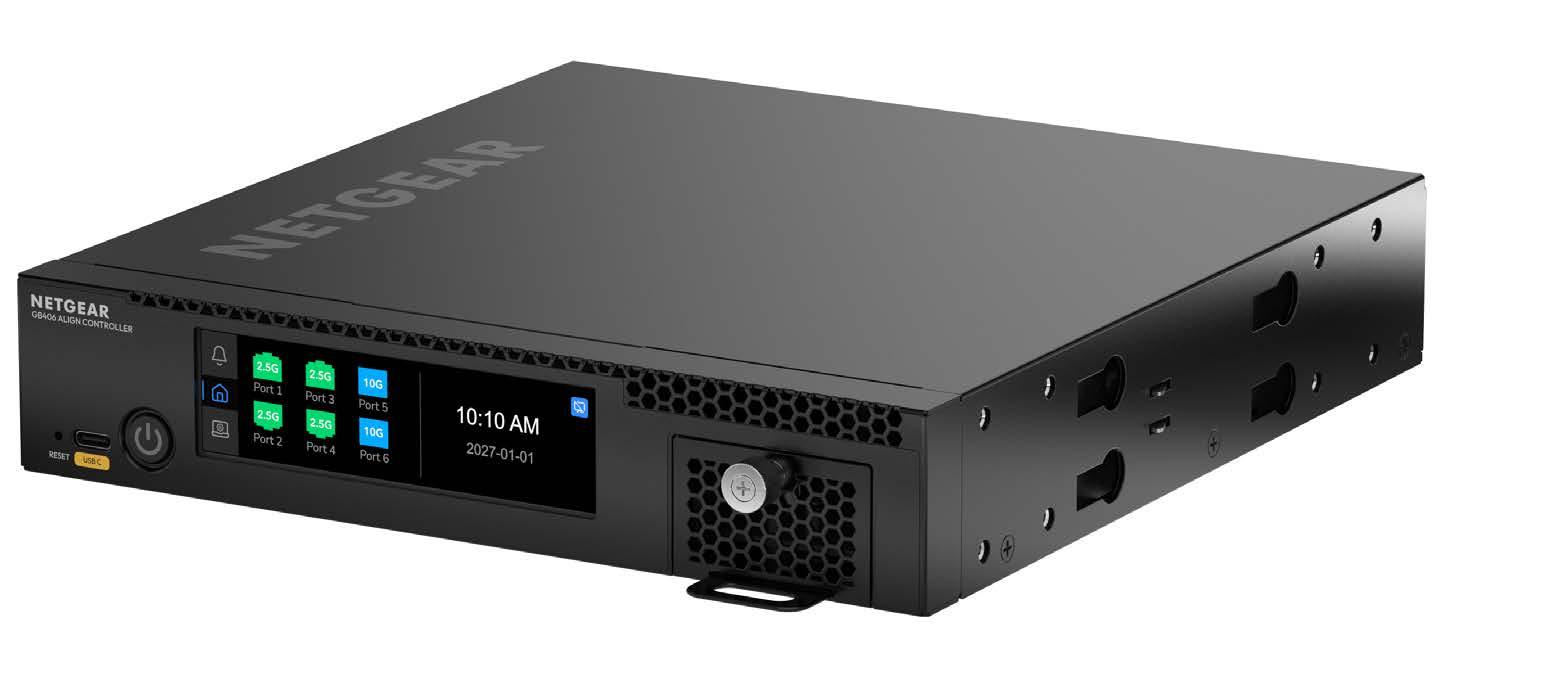
SEA: As AV, collaboration and workplace technologies become increasingly reliant on network performance, Midwich Asia has announced a strategic distribution partnership with NETGEAR, expanding access to advanced networking solutions across Indonesia and Vietnam.
The partnership marks a significant step in Midwich Asia’s strategy to help channel partners address growing demand for scalable, cloud-managed and AV over IPready infrastructure, as organisations across Southeast Asia continue to invest in smarter and more connected environments.
With industry forecasts suggesting AV over IP will account for 65% of AV deployments by 2030, up from 38% in 2025, network infrastructure is rapidly becoming one of the most critical components of modern technology deployments. From corporate offices and educational institutions to hotels, retail spaces and government facilities, reliable
networking is now essential for delivering seamless user experiences.
By adding NETGEAR’s portfolio of managed switches and cloud networking solutions to its offering, Midwich Asia is strengthening its ability to support partners in building highperformance systems that can scale with evolving business requirements.
“Networking is no longer a supporting layer; it is now central to how modern AV and connected workplace ecosystems perform. With NETGEAR, we are expanding how we support partners across the region, delivering infrastructure built for scale, control, and modern AV environments,” said Alex Kemanes, Managing Director MESEA, Midwich.
The collaboration goes beyond product availability. Midwich Asia plans to invest heavily in partner enablement through a range of education and support initiatives designed to help integrators and resellers maximise the potential of AV over IP technologies.
These programmes will include technical training, network design guidance, switch configuration support, cloud management workshops and deployment best practices, helping partners build the expertise needed to deliver increasingly sophisticated networked solutions.
“NETGEAR gives our partners confidence to build stronger connected workplace infrastructures from the ground up. Our focus will be on enabling the channel with the design knowledge, switching best practices, and cloud workflows needed to deploy at scale,” said Will Fenby, Director –Business Operations SEA, Midwich Asia.
The partnership also reflects a broader shift in the role of distribution. Rather than simply supplying products, Midwich Asia aims to provide a consultative approach that helps partners navigate the complexities of modern networked environments. Technical workshops, live demonstrations and targeted market development programmes will form a key part of the strategy, supporting channel partners as they transition towards fully integrated network ecosystems.
For NETGEAR, the collaboration provides an opportunity to strengthen its presence in one of the world’s fastest-growing technology markets.
“Southeast Asia is one of the fastest-growing regions for connected technologies, with increasing demand for simple, scalable, and
high-performance networking solutions,” said Jason Tay, Sr AV Territory Account Manager, NETGEAR. “By partnering with Midwich Asia, we are accelerating our regional expansion and enabling partners to deliver powerful, nextgeneration connected experiences.”
As demand for connected workplaces, hybrid collaboration and AV over IP continues to accelerate, Midwich Asia and NETGEAR are positioning themselves at the centre of the region’s digital transformation journey, helping organisations build the robust network foundations needed to support the technologies of tomorrow.
Midwich Asia
G&D Reshapes Middle East Strategy with New Regional Representative
MIDDLE EAST: G&D has updated its sales structure in the Middle East, appointing CT Square as an authorised regional representative as the company looks to strengthen its local presence and support capabilities across the region.
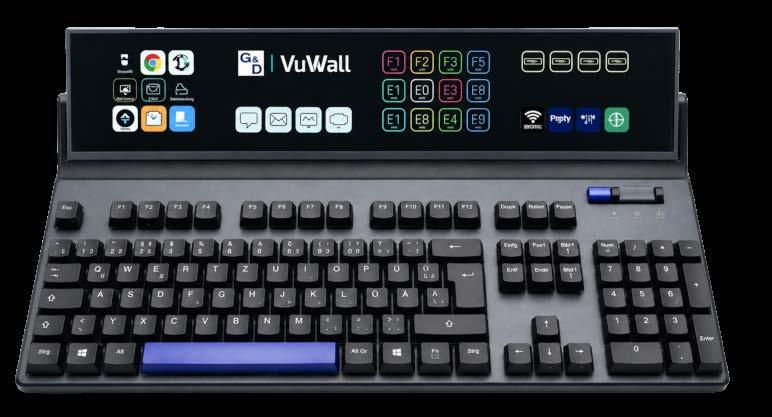
Under the new arrangement, CT Square will represent the G&D brand throughout the Middle East, providing sales and application engineering services. The company will also support the deployment and design of VuWall solutions through application engineering services, working alongside G&D’s existing direct sales organisation.
The appointment follows a change within G&D’s regional team, with the company confirming that Tamby Alasker is no longer employed by, or representing, G&D. Customers and partners have been assured that existing projects, agreements, pricing structures and warranties remain unaffected.
According to G&D, sales activities and project support will continue to be coordinated through its German headquarters and VuWall Germany, ensuring continuity for customers throughout
the transition. The company has emphasised that all authorised channels will remain closely aligned, allowing customers to engage directly with headquarters or work through regional representatives depending on their requirements.
Importantly, the established sales structure for VuWall in the Middle East remains unchanged. Haroutioun Ohannessian will continue serving as the company’s dedicated VuWall contact for the region, maintaining continuity for existing customers and channel partners.
For regional integrators and end users, the changes are intended to provide greater access to local expertise while retaining direct links to factory-backed support. As projects become increasingly complex and demand for integrated control rooms and visualisation environments continues to rise, manufacturers are placing greater emphasis on combining regional presence with global technical resources.
• VuWall: Haroutioun Ohannessian, Sales VuWall, ME h.ohannessian@vuwall.com
G&D
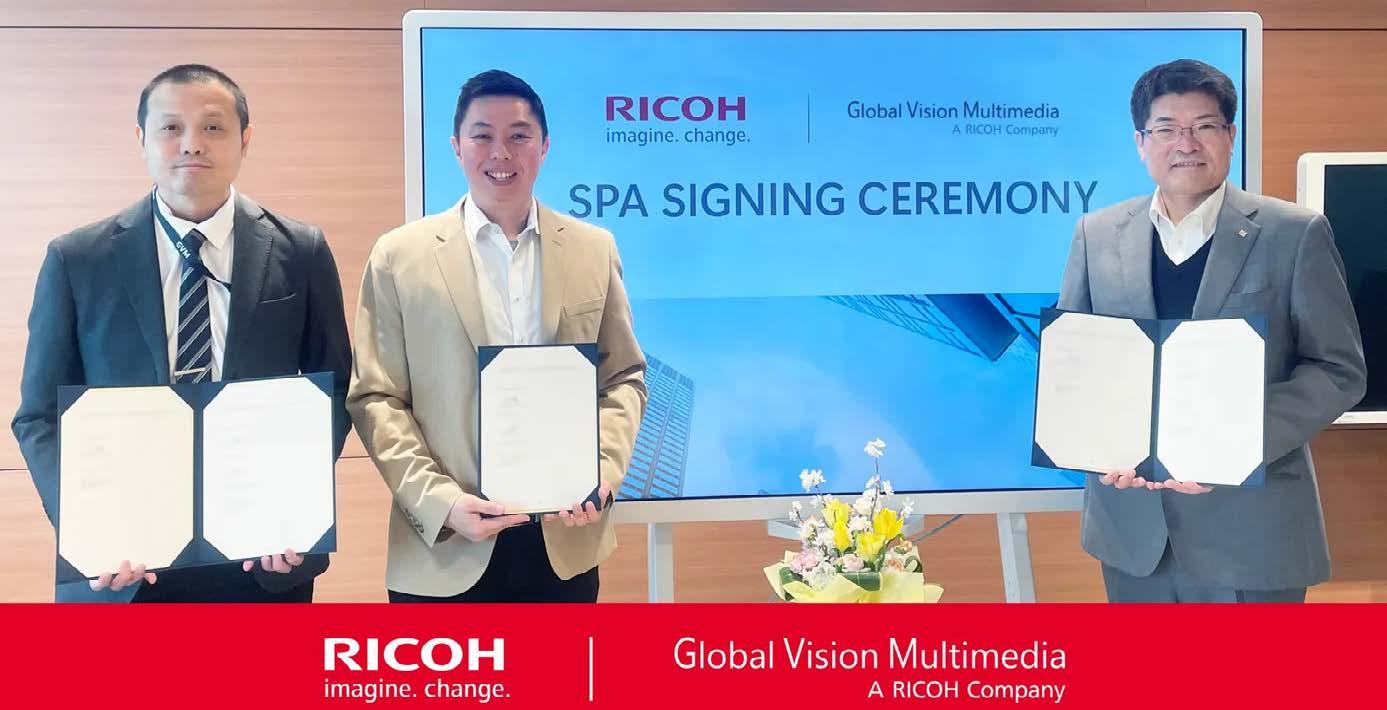
Ricoh Asia Pacific Acquires Global Vision Multimedia
By integrating Global Vision Multimedia’s strong regional track record and complementary capabilities with Ricoh’s global workplace services portfolio, Ricoh further strengthens its position as a global integrator, meeting the needs, challenges and ambitions of customers across the Asia-Pacific region.
APAC: Ricoh Company, Ltd. and Ricoh Asia Pacific Pte. Ltd. have acquired Global Vision Multimedia Group, a specialised provider of audio-visual and multimedia integration services with deep expertise across the AsiaPacific region – the final stage in a strategic partnership discussion that began in January 2026.
The acquisition by Ricoh Asia Pacific Pte. Ltd. accelerates Ricoh’s expansion of its workplace services portfolio and service delivery footprint in the region, reinforcing Ricoh’s global strategy to support customers’ evolving needs by elevating their workplace experience through more seamless and scalable services.
Founded in 2016, Global Vision Multimedia brings end-to-end services spanning design, integration and ongoing support for AV and multimedia solutions and over 140 experts across the region. Global Vision Multimedia serves multinational corporations and leading regional enterprises across multiple industry sectors, supported by deep local expertise and the ability to centrally manage complex, multicountry projects, ensuring consistent, highquality service delivery across the region.
“Customers across Asia-Pacific are looking for workplace services that are consistent across markets and grounded in local execution,” said Kei Uesugi, Managing Director of Ricoh Asia Pacific. “Bringing Global Vision Multimedia into Ricoh strengthens our ability to deliver exactly that — combining their regional track record and specialist capability with the scale and reach of Ricoh’s global workplace services portfolio. This is about giving our customers a partner who can meet their needs wherever they operate.”
Kenny Liow, Director of Global Vision Multimedia, added, “Joining Ricoh is the next chapter for Global Vision Multimedia. Our team has built a strong reputation across the region for delivering complex, multi-country AV and multimedia projects, and Ricoh’s global platform now gives us the scale to do more of that, for more customers, in more markets. What stays the same is our commitment to the quality, attention to detail and partnership our customers expect from us.”
Ricoh continues to make investments globally to deliver enhanced meeting experiences and workplace experience solutions for organisations worldwide, including the acquisition of Cenero (US), DataVision, Pure AV, AVC (EMEA), Videocorp and Go2neXt (Latin America), ET Group (Canada).
Ricoh Asia Pacific Pte. Ltd
Martin Audio Strengthens Enterprise AV Ambitions
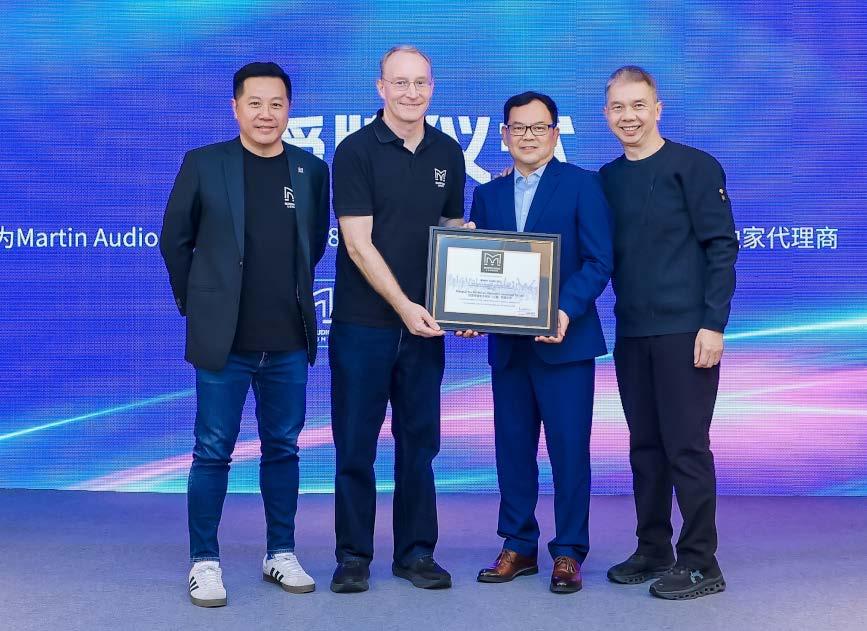
CHINA: Martin Audio is expanding its footprint in China’s fast-growing enterprise AV sector through a new distribution partnership with Shanghai Univision (You Shi Wei Xin), a move that further strengthens the company’s ability to support consultants, system integrators and end users across the corporate, education and government markets.
The appointment adds another layer to Martin Audio’s established distribution network in China, joining Sino Huifeng and Guangzhou Guidance. By bringing in a specialist distributor with deep expertise in AV and IT integration, Martin Audio aims to accelerate the adoption of its professional audio solutions in largescale commercial and institutional projects throughout the country.
Under the agreement, Shanghai Univision has been appointed the sole distributor for Martin Audio’s Wavefront Precision WPS series, TORUS 820 constant curvature array and O-Line modular micro line array. These solutions have been selected for their suitability in enterprise, commercial and integrated AV environments where flexibility, speech intelligibility and consistent coverage are critical requirements.
The partnership reflects growing demand for sophisticated audio solutions across China’s enterprise landscape, where organisations are increasingly investing in technology that enhances communication, collaboration and user experiences.
Commenting on the appointment, David Wong, Director of Sales at Generation AV
(Martin Audio’s APAC representatives) states, “Shanghai Univision has a proven track record of success in the Enterprise and AV installation market in China. We are excited about our new partnership and look forward to providing our full support to the Univision team.”
Headquartered in Shanghai with additional regional hubs in Beijing and Shenzhen, Shanghai Univision has built a strong reputation as a specialist AV and IT distributor, providing the technical expertise and support required for complex system deployments. Its nationwide reach and extensive experience in enterprise projects make it well-positioned to introduce Martin Audio solutions to a wider audience of consultants, integrators and end users.
Frank Xiao, General Manager of Shanghai Univision, stated, “We are delighted to partner with Martin Audio in China. As a worldrenowned UK brand & manufacturer, Martin Audio is dedicated to delivering state-of-the-art products, top-tier performance, and unmatched service.
“Our team is eager to collaborate with Martin Audio and Generation AV. By integrating the Wavefront Precision WPS series, TORUS 820 constant curvature array, and O-Line modular micro line array into our portfolio, we will provide a more comprehensive total solution to vertical markets across China. We look forward to working alongside other partners to build upon Martin Audio’s legendary success and legacy in the region.”
The partnership was officially introduced to the market during a recent customer event in Beijing attended by more than 100 consultants, system integrators and dealers. Shanghai Univision also showcased the Martin Audio portfolio at Prolight + Sound Guangzhou, providing visitors with a closer look at the technologies now available through the new distribution arrangement.
For Martin Audio, the partnership represents another important step in strengthening its
position within one of the world’s largest and most dynamic AV markets.
Dom Harter, Managing Director of Martin Audio, commented, “Over the years, Martin Audio has built a strong reputation in China for high-performing audio solutions across many vertical markets. The technical expertise within the Shanghai Univision team is second to none, and we are confident they will have many successful Martin Audio installations coming soon across China.”
Martin Audio
RCF and DirectOut Announce Strategic Technology Partnership
GLOBAL: RCF and DirectOut have announced a strategic technology partnership aimed at developing tightly integrated audio solutions for RCF’s professional sound systems portfolio.
Under the agreement, DirectOut will bring its extensive expertise in audio networking, signal conversion, processing, and redundancy technologies to support and enhance RCF’s system architectures. The collaboration is designed to deliver fully integrated solutions aligned with the RCF ecosystem, ensuring high performance, reliability, and seamless operation across a wide range of professional audio applications.
By working at a deep technological level, the two companies aim to simplify system design and deployment while meeting the rigorous requirements of live sound, installed sound,
and other mission-critical environments where RCF systems are deployed.
Fausto Incerti, Managing Director of RCF, commented: “DirectOut’s technologies and engineering approach complement our system design philosophy. This partnership enables us to further strengthen our system offerings by integrating proven audio networking and signal management solutions that align perfectly with RCF’s performance, reliability, and usability standards. Over the past years, DirectOut has emerged as a global leader in the solutions we are now incorporating into our packages, enhancing the value we provide to our customers.”
“Our collaboration with RCF is centred on bringing DirectOut audio networking and signal management technologies directly into RCF system solutions,” said Luca Giaroli, CEO of DirectOut. “This focused approach allows us to support RCF in delivering integrated, robust, and future-ready systems that provide clear benefits to system designers and end users. We are proud to partner with a company that has such a significant global presence and a rich history spanning decades, with impressive revenues worldwide.”
The partnership reflects a shared commitment to technological excellence and long-term collaboration, intending to provide customers with innovative, high-quality solutions that offer greater operational confidence within the RCF ecosystem.
Further details on the integrated solutions resulting from this collaboration will be announced in the coming months.
RCF
Meyer Sound Opens New Manufacturing Facility to Serve Growing Demand
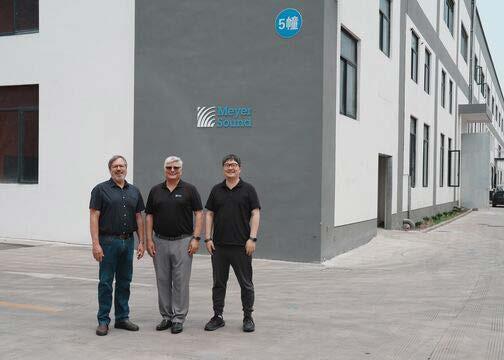
CHINA: Meyer Sound has opened a new manufacturing facility and office in Shanghai, China. The wholly owned subsidiary will produce the company's top-selling loudspeaker products exclusively for the Chinese market. The move reflects growing demand across China, particularly for performing arts centres, theatres, and live venues in rapidly growing cities outside major metropolitan areas.
Built to Meyer Sound Standards
The Shanghai facility spans 4,500 square meters in the western part of the city and will initially employ staff across product assembly, quality control, and finance functions. All products will be assembled following the same processes and quality control standards used in Berkeley, CA. The Shanghai team will be supported by Meyer Sound staff from its global headquarters, who will lead initial training and ensure assembly and testing processes align with our globally celebrated standards.
On the Ground in China
The Chinese live sound market has seen strong growth in recent years, driven by a proliferation of live music venues, a thriving festival circuit, and continued investment in performing arts infrastructure across the country. China is already Meyer Sound's largest market for PANTHER™ line arrays outside the United States, with robust sales led by distributor Shanghai Broad Future (SBF).
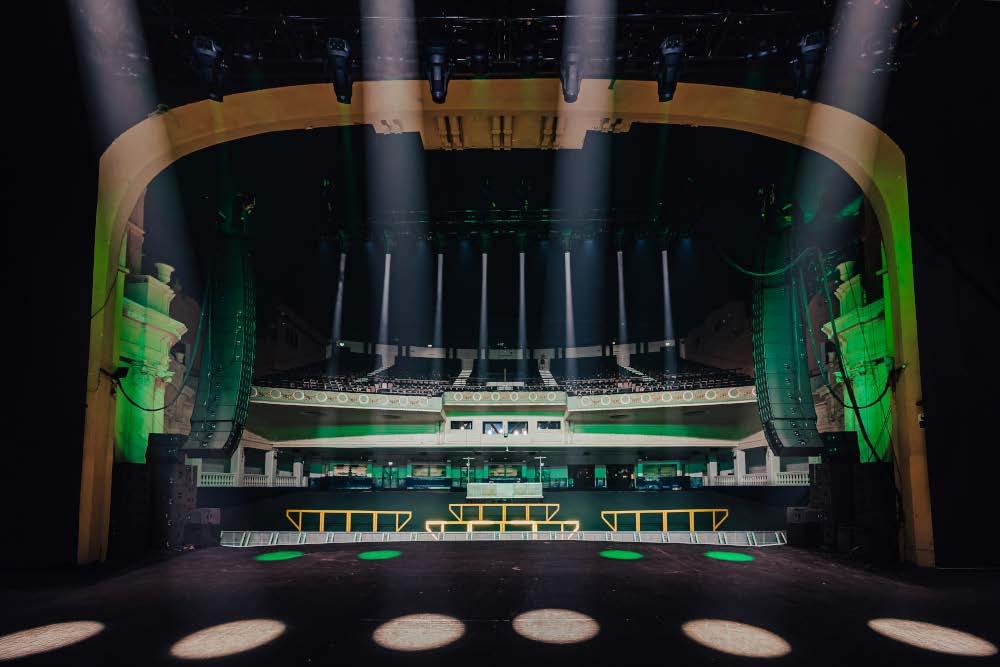
The Shanghai facility will produce many of Meyer Sound’s top products, including PANTHER and the 2100-LFC™ low-frequency control element, adding the new TIGRA™ line array and 1800-LFC™ later this year.
“The new factory will significantly accelerate Meyer Sound’s momentum in one of the world’s most active markets for live sound and the performing arts,” said Senior Vice President John McMahon. “This facility is about supporting the next phase of that growth.”
Meyer Sound
NTECKSYSTEMS
Brings Acroname to Indian ProAV Market
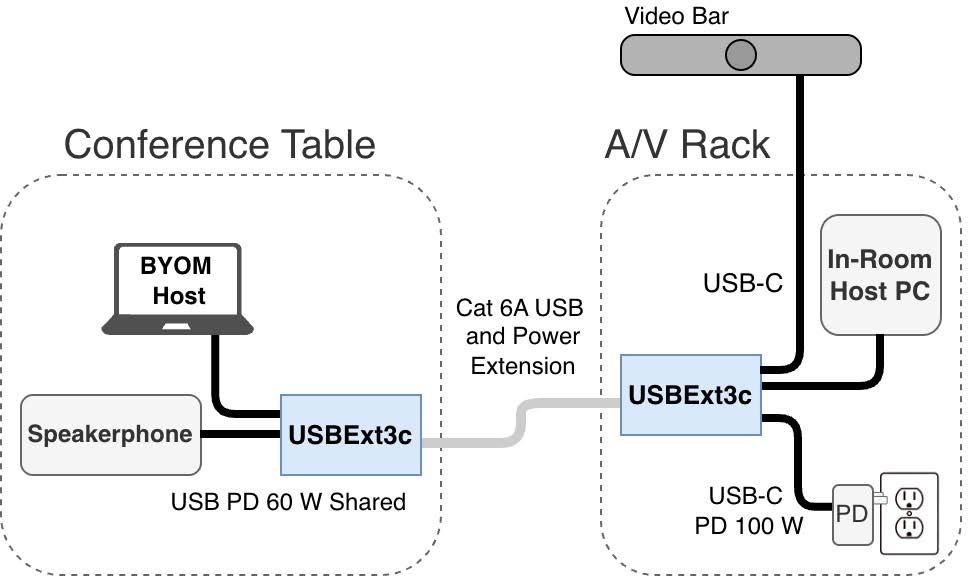
peripherals, and peripherals can connect to both extenders.
Local USB links of up to 10 Gbps and a 5 Gbps extension link over up to 100 m / 325 ft of Cat 6A cable provide flexible connectivity for 4K cameras and high bandwidth devices. Ports provide up to 60 W USB-PD shared output per device when powered over Cat cable and 90 W when locally powered.
INDIA: Bengaluru-based NTECKSYSTEMS while expanding its wide range of product portfolio still wider, is bringing to India what is claimed as the world’s first programmable, industrialgrade high performance managed USB-C hub from Acroname to Indian market aimed at highspeed, zero-latency data networks.
USBExt3c – as it is called – the new device system is a complete hub coming with integrated bidirectional USB and power extension and automatic host switching from either end of the extension. This extension kit incredibly simplifies power, connectivity, and device management, eliminating all unnecessary complexities in the network.
Identical USBExt3c devices connect to each end of a CAT 6A cable and can interchangeably act as senders or receivers. Any port on either unit can be dynamically configured as upstream facing (UFP) to connect to a host or downstream facing (DFP) to connect to
USBExt3c uses HDBaseTUSB3 technology based on Valens VS6320 to provide USB 3.1 , 2.0, and legacy 1.0 extension over standard category cable. Cameras up to 4K, DisplayLink, and both isochronous and bulk transfer modes are supported. Supports direct connection to HDBaseT-USB3 cameras and devices. Nataraju Upputuri
“This new device system from Acroname has a wide range of applications,” explains Nataraju, Founder & CEO of NTECKSYSTEMS. According to him, its application areas range from BYOM and BYOD work flows in high-end corporate AV conference room environments to high bandwidth 4K transmissions in live productions, broadcasting, and lecture hall or auditorium environments fed with 4K PTZ camera systems etc.
It automatically switches room peripherals (cameras, speakerphones) between a permanently installed room PC and a guest user’s laptop, while also charging the guest’s laptop.
The Security Event Asia Returns for its Second Edition; Visitor Registration Now Open
propel emergency response and public safety forward, and Pro Integration Future Asia (PIFA). Together, the five co-located events are expected to attract over 13,000 trade professionals from across the security, safety, emergency response, workplace, and professional audio, visual and lighting industries.
SINGAPORE: Following a highly successful debut, The Security Event Asia (TSEA) returns from 10–12 November 2026 at the Sands Expo & Convention Centre, Singapore, bringing together the technologies, insights and industry leaders shaping the future of security across Asia Pacific. With visitor registration now open, the region’s security professionals are invited to be part of three days of innovation, networking and expert-led discussions at what is fast becoming the must-attend event for the security industry.
A Showcase of Next-Generation Security Technologies and Solutions
As part of the Safety & Security Asia (SSA) portfolio, TSEA 2026 will be co-located with The Fire Safety Event Asia (FSEA), The Health & Safety Event Asia (HSEA), the newly launched Emergency Services Show Asia (ESSA) — APAC’s premier emergency services event where technology and learning
TSEA will once again bring together leading global manufacturers, solution providers, distributors, integrators and end users to showcase the latest advancements in domains such as access control, perimeter protection, AI-driven security technologies and integrated command systems. Brands include Advancis Software, Alarm.com, AMAG Technology, Commend UK, ESOSG, Firebytes, Gallagher Security, HID Asia Pacific, Zulu Consulting, ZKTECO and more.
Visitors can expect unrivalled opportunities to discover emerging technologies, connect with leading solution providers, gain practical insights from industry experts and explore strategies to address evolving security challenges across the region. A limited number of exhibition opportunities remain available for companies seeking to engage with key buyers and decision makers from across the Asia Pacific.
Learning Programme and Live Demonstrations
Developed with industry partners, the Learning Programme addresses key challenges across workforce transformation, technology adoption, operational resilience and emerging threats through expert-led sessions, panels and live demonstrations.
The Security Leaders’ Summit returns with the Security Industry Conference led by Strategic Partner Temasek Polytechnic –
Security Industry Institute (TP-SII), focusing on innovation, emerging threats and workforce transformation.
Faizal Zainal, Head of Security Industry Institute, Temasek Polytechnic (TP-SII), commented: “The Security Industry Conference at TSEA 2026 will continue to address the evolving challenges and opportunities facing the sector, from workforce transformation and skills development to adoption of emerging technologies. Through meaningful dialogue, we aim to equip professionals with the capabilities needed to thrive in an increasingly complex operating environment. We are pleased to work with the organiser, who has delivered strong outcomes for the industry and exceeded our expectations. We are delighted to once again be part of the programme and to co-host the Skills for Security Competition Asia for another series and introduce the inaugural Fire Category this year.”
New for 2026, Transported Asset Protection Association (TAPA-APAC) will host a dedicated workshop focused on supply chain logistics and security resilience, bringing together experts to discuss risk mitigation, cargo protection and best practices shaping the future of secure logistics across the region.
Expanding the event’s content offering further is the launch of the Women in Protective Services (WiSP) Series, taking place across two days. The first day will focus on Leadership, spotlighting influential women driving change across the industry, while the second day, themed Next-Gen, will explore mentorship, talent development and empowering the future generation of professionals entering the protective services sector.
Mel Migrino, Chairman and CEO at Women in Security Philippines, commented: “Platforms like The Security Event Asia are essential in bringing together diverse voices across the industry to inspire innovation, strengthen partnerships and nurture the next generation
of leaders. I’m especially excited to see initiatives like the Women in Security creating meaningful conversations around leadership, inclusion and the future of the profession, while also reinforcing the growing importance of cybersecurity across all industries.”
With the strong support of Strategic Partners including Security Solutions Association Singapore (SSAS), Security Association Singapore (SAS) and Temasek Polytechnic –Security Industry Institute (TP-SII); and leading organisations including ASIS International (Asia Pacific Chapter), ASIS International (Singapore Chapter), Association of Certified Security Agencies (ACSA), British Security Industry Association (BSIA), Indonesian Security System Industry Association (AISKINDO) and more, TSEA 2026 continues to strengthen its position as a key platform for industry collaboration, innovation and thought leadership across the APAC security landscape.
Building on the momentum of its inaugural edition, The Security Event Asia 2026 is set to deliver an even stronger platform for business exchange, networking, thought leadership and innovation — further cementing Singapore’s position as a strategic hub for the safety and security industries in the Asia Pacific.
Tristan Norman, Group Managing Director at Nineteen Group, commented, “The return of The Security Event Asia for its second edition reflects the strong growth we’re seeing across the APAC security market. With major infrastructure projects, urban development and increasing security requirements across the region, there is a clear need for the industry to come together, share knowledge and build new partnerships. TSEA provides that opportunity, bringing manufacturers, distributors, integrators, consultants and end users together under one roof to explore new technologies, discuss emerging challenges and support the projects shaping the future of the region.”
An elevated experience, where one pass provides access to five co-located shows— unlocking greater opportunities for learning, product discovery and international networking, and reinforcing its position as a strategic hub for the safety and security industries across Asia Pacific.
Visitor registration for The Security Event Asia 2026 is now open, with a limited number of exhibition opportunities still available. Visitor registration is now open.
• Click here to register for your complimentary visitor pass
• View participating companies here
The Security Event Asia 2026
Blue Alchemy Labs Becomes AsiaPacific’s First ISAAC Expert
APAC: Blue Alchemy Labs (BAL) has been named an ISAAC Expert by Smart Monkeys, Inc. the company behind the ISAAC platform used across themed entertainment, museum, and live event AV systems worldwide. BAL joins US-based Forward Thinking Designs and UK-based JP ShowSystems as the first three partners in the newly launched program, and is currently the only Expert based in the AsiaPacific region.
ISAAC Experts are independently certified consultants, designers, and integrators authorised to deliver ISAAC consultation, system design, commissioning, and official training within the markets where they operate. For BAL’s clients across Australia and the broader region, that means direct access to certified ISAAC support without routing requests through Smart Monkeys’ Miami base.
“It fits really well with how we work,” said Mike Ross, founder of Blue Alchemy Labs. “Helping clients connect the creative idea, the technical design and the operational reality before things become harder, slower or more expensive to fix. We’re excited to support Smart Monkeys in bringing more localised ISAAC expertise, consultation, commissioning and training to clients across our region.”
The certification adds to BAL's existing creative-technical alignment work, giving clients running ISAAC-based systems on attraction, exhibition, and entertainment a single point of contact for both strategic advisory and handson platform expertise.
Blue Alchemy Labs
Optoma India Expands GeM Presence
INDIA: Optoma Technology India Pvt. Ltd. has announced the expansion of its portfolio on the Government e-Marketplace (GeM) with the listing of new projectors and Interactive Flat Panel Displays. The move strengthens the company’s presence across the education and government segments while supporting Digital India and Make in India initiatives through accessible, future-ready visual display technologies.
Optoma’s latest product lineup is manufactured in India under the Government of India’s Make in India initiative. Currently available on GeM are Optoma’s Projectors and Interactive Flat Panels, with All-in-One Direct View LED displays and 24×7 Professional Non-Touch Displays to be added in the coming months. Designed for classrooms, training centres, meeting rooms, and collaborative workspaces, the expanded portfolio provides government institutions, public sector enterprises, and educational organisations with easier access to advanced AV solutions through the GeM platform.
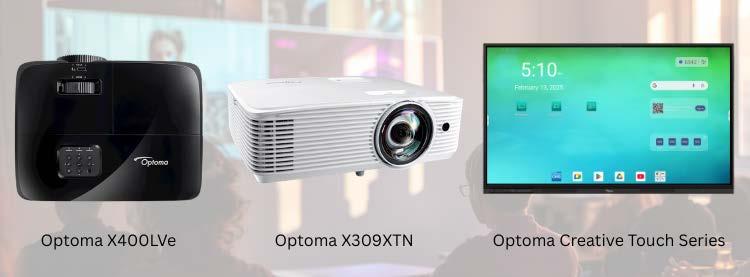
The new additions strengthen Optoma's projection portfolio with solutions tailored for education, government and public sector environments. The X400LveN, W400LveN, and EH338N projectors deliver bright and reliable perfor-
mance for classrooms and meeting rooms, offering high brightness, Full HD, XGA/WXGA resolution, extended lamp life, multiple connectivity options, built-in speakers, and USB power for easy installation and operation. Expanding the range further, the X309STN short-throw projector is designed for space-constrained settings, enabling large-screen projections from a short distance while maintaining excellent image quality and brightness.
Expanding its interactive display portfolio, Optoma has introduced the Made-in-India Creative Touch 3 Series Gen 3, available in 65″, 75″, and 86″ sizes. Designed to support digital transformation across government offices, educational institutions, training centres, and collaborative workspaces, the series enables seamless presentations, interactive learning, and efficient team collaboration. With integrated productivity tools, secure device management, and Google ecosystem compatibility, the displays help organisations enhance engagement, streamline operations, and deliver more effective communication in modern public-sector environments.
Commenting on the development, Vijay Sharma, Managing Director, Optoma Technology India, said,” At Optoma India, we are immensely proud to announce that our cutting-edge visual solutions are now officially available on the Government e-Marketplace (GeM). This landmark achievement coincides with a pivotal milestone for our brand: our transition to local manufacturing.
By registering our ‘Make in India’ certified products on GeM, we are reinforcing our alignment with the Government of India’s vision of Aatmanirbhar Bharat (Self-Reliant India). This step allows us to seamlessly serve the public sector, educational institutions, and government enterprises with world-class display technologies that are engineered for reliability and proudly manufactured locally.
This integration represents more than just market expansion for Optoma; it is our commitment to fostering a digital-first India by providing robust, localised procurement solutions that drive
Iris Unveils New Angekis and Bolin Integrations at InfoComm 2026
GLOBAL: Iris, the award-winning, softwarebased platform for PTZ camera control from Audinate, highlighted new OEM partnerships with Angekis and Bolin at InfoComm 2026. These partnerships will bring native Iris technology directly into the firmware of select PTZ camera models from the two brands.
With a simple free upgrade to the latest firmware on the Angekis Saber X and Bolin B2 camera lines, customers can instantly link their now Iris-Enabled cameras to the Iris platform. This unlocks a suite of features accessible through a single browser or app window with no additional hardware required.
The announcement reflects Iris's mission to simplify video production through unified control, intelligent automation, and interoperability with existing gear and workflows. Through Iris, users can remotely manage cameras with low-latency control,
efficiency and transparency across government workflows. We look forward to powering India's public sector infrastructure with innovation made right here at home."
The newly listed products are now available for procurement through the GeM portal, enabling government departments, educational institutions, and public sector enterprises to access Optoma’s latest display and projection technologies through a streamlined procurement process.
Optoma India
collaborate across teams and locations, and leverage AI-powered tools for framing, preset creation and recall, and more. This is all done without the complexity of traditional hardwarebased systems.
These new partnerships strengthen Iris’s growing ecosystem of camera manufacturers and reinforce its commitment to interoperability. The Iris platform supports more than 400 camera models and integrates with leading switchers, IP controllers, and production software, allowing organizations to modernize operations while preserving existing infrastructure investments. In addition, Angekis and Bolin now join eight other brands that have Iris-Enabled devices, allowing those cameras to connect to the Iris platform directly without needing a network bridge device.
Iris
L-Acoustics Introduces Digital Construction for Accurate As-Built
Venue Capture
Every sound system design starts with a model of the space, and that model is only as accurate as the information behind it. In many venues, the architectural drawings used to build the model are incomplete, out of date, or never matched the finished building. Renovations, retrofits, and years of small modifications widen the gap between what appears on paper and what exists on site. When a design rests on inaccurate geometry, the cost shows up late: coverage that behaves differently than predicted, rigging that does not fit the structure, and changes that have to be resolved during installation.
L-Acoustics now addresses this with Digital Construction, a new service that captures a venue exactly as it is built and delivers a verified geometric model ready for use in Soundvision.
Digital Construction includes an on-site scan carried out by an expert L-Acoustics Application Engineer that includes stage areas, balconies, and the spaces that connect them,
using handheld LiDAR. The method records the room in high resolution, far faster than manual measurement and captures detail that less advanced methods like hand drafting or P2P laser can miss. It is built for the scale of professional venues, where the short-range scanners found in consumer devices, limited to roughly five meters, cannot cover the space. The result is a true-to-life record of the room as it actually stands.
From Point Cloud to Soundvision-Ready Geometry
Each scan is verified and processed through a standardised workflow with quality checks at every stage, so results stay consistent from a small club to a stadium bowl. Clients receive two deliverables: a detailed pointcloud file of the venue for their own reference, and a simplified, Soundvision-ready model for acoustic simulation and system design. Post-processing scales with the size and architectural complexity of the venue, and the
L-Acoustics team works with each client to set a realistic timeline before work begins.
A Reliable Foundation for the Installation Market
Digital Construction strengthens the first step of every design by making sure the model reflects the real room before any loudspeaker is specified. It works alongside the Soundvision tools and Architectural Drafting services that L-Acoustics teams and partners already use, giving Certified Providers, AV consultants, and venue owners an accurate as-built reference. The benefit is clearest in renovations, older buildings, and venues without reliable documentation, where verified
geometry reduces the risk of late surprises, such as unexpected ceiling structures, rigging constraints, or sightline conflicts.
As the only loudspeaker manufacturer to offer as-built LiDAR capture at full venue scale within its design workflow, L-Acoustics ensures that the precision of Soundvision begins with accurate venue geometry.
An accurate model of a venue also outlives a single project. The same as-built data supports future upgrades, clearer communication between stakeholders, and the growth of the L-Acoustics venue database that designers draw on worldwide.
AUDIOFOCUS has announced the arrival of two fixed installation loudspeakers in its mediumthrow ARRoCC constant curvature system.
The new passive cabinets are the wide coverage CC210Wix and narrow dispersion CC210Nix. These latest additions to the ARRoCC series use a minimal rigging system and concealing plates to achieve a clean,
understated appearance suited to installation in live venues, theatres, clubs, sports stadiums, conference venues, and houses of worship.
CC210Wix and CC210Nix employ the same paired 10” LF transducers with Tetracoil double voice coil technology that form the foundation of Audiofocus’ ARRoCC, ELIZ and EDGE ranges. A large 4” titanium diaphragm HF compression driver allows a lower crosspoint, resulting in better dispersion and control down to lower frequencies. Both cabinets achieve a frequency response of 55Hz – 19kHz, with the wide and narrow versions attaining a peak SPL of 133dB and 135dB, respectively.
The new loudspeakers are supported by the 118SG ground-stacked 18” subwoofer and A series rack amplifiers. CC210Wix and CC210Nix are available to order now and are built in birch plywood at Audiofocus’ headquarters in Belgium.
AUDIOFOCUS/ARRoCC Series
ETC Expands Foundry Portfolio with Standalone DIN Relay 12 for Custom Applications
ETC has expanded its Foundry product family with the launch of the Foundry DIN Relay 12, bringing the proven relay technology at the heart of its Foundry Switch Panel to a wider range of installation and integration projects.
Designed and manufactured in Europe, the new standalone module gives system integrators, consultants, and facility managers greater flexibility when designing custom power control solutions for lighting and building systems.
The Foundry DIN Relay 12 takes the reliable relay engine used in the Foundry Switch Panel and packages it as an independent DIN rail-mounted solution. This allows it to be integrated directly into custom control cabinets, production panels, and facility management infrastructures where tailored switching functionality is required.
Built as a cost-effective, relay-only power switching platform, the Foundry DIN Relay 12 supports a broad range of applications
beyond traditional lighting control. It is suitable for work lights, house and lobby lighting, architectural loads, and LED lighting systems, offering dependable remote switching performance across commercial, entertainment, and public space environments.
The new module also integrates seamlessly with ETC’s Paradigm, Mosaic, and Echo control platforms while remaining compatible with third-party AV and building management systems. This flexibility makes it an attractive option for projects where power switching must be incorporated into a larger ecosystem of control technologies.
By making its proven Foundry relay technology available as a standalone component, ETC is providing integrators with a new level of design freedom, enabling customised solutions without compromising reliability, performance, or ease of deployment.
ETC/Foundry DIN Relay 12
AthenaSpace Introduces a Unified Platform for Space Operations
AthenaSpace has launched AthenaSM (Space Management), a unified platform designed to simplify and centralise space operations for organisations of all types, including workplaces, healthcare facilities, educational campuses, and other managed environments.
Platform Features and Capabilities
AthenaSM (Space Management) integrates room booking, desk reservation, visitor management, and digital wayfinding in a single platform. It is accessible on web, mobile, and on-site devices, allowing organisations to manage spaces, bookings, and visitors in one system. Real-time room and desk availability is displayed through visual floor maps, enabling users to find and reserve spaces quickly.
Check-in and check-out features improve occupancy tracking, while configurable booking rules help administrators enforce policies, capacity limits, and role-based permissions. The platform supports visitor management from pre-registration and QR check-in to arrival tracking and host notifications. Integrated
wayfinding helps users navigate office environments, improving coordination and flow within spaces.
Operational Control and Flexibility
AthenaSM (Space Management) is designed to operate within the realities of day-to-day space usage, where schedules change, priorities shift, and exceptions are common. The platform supports structured yet flexible workflows that respond to different situations without requiring manual intervention.
From managing priority bookings to handling last-minute changes and unplanned visitor arrivals, AthenaSM ensures that space operations remain consistent and controlled. The platform supports organisational policies while accommodating real operational needs in different environments, including corporate, healthcare, and institutional settings.
Tags: AthenaSpace
AthenaSpace/AthenaSM
Optimal Audio Ships Column Series with Complete Installation Kit
Optimal Audio has announced the launch of the Column Series, a pair of passive column loudspeakers designed for indoor and outdoor commercial installations. Column 8 and Column 16 extend the brand’s versatile loudspeaker range centred on three things integrators have asked for: a complete installation kit in the box; an IP54 rating as standard; and native integration with the wider Optimal Audio ecosystem.
Column 8 features eight 2.2″ full-range drivers in a slim cabinet 610mm in length, delivering 150-degree horizontal by 7-degree vertical dispersion, making it ideal for even coverage without spill onto ceilings or floors. Column 16 steps up with sixteen drivers in a 1.1m cabinet for larger and more acoustically demanding spaces, with a tighter 5-degree vertical pattern for improved control. Both models are passive, 8 ohm, with 70V and 100V transformer taps, and both are rated IP54 when fitted with the rear panel connector cover, included in the box.
Both models are available in black and white, and both are paintable to match the surrounding architecture. Each model also ships with the complete installation kit as standard: a pan-and-tilt wall bracket, metal safety strap, rear panel connector cover, and spare grille cloth for use when painting cabinets. The Column Series is fully compatible with Optimal Audio’s Zone and WebApp, with factory-tuned Speech and Music DSP presets available – giving integrators a known and proven starting point for voicing, rather than a blank EQ in the room.
Optimal Audio/Column Series
NETGEAR Unleashes its First AV Platform
NETGEAR, Inc. has announced NETGEAR Align, NETGEAR’s first AV platform. It offers a hardware foundation designed to consolidate AV infrastructure services, host applications such as the network management platform NETGEAR Engage, and serve as the open layer on which future AV tools can run. After years as the manufacturer of a preferred switching infrastructure on which AV-over-IP runs, NETGEAR is now building the layer above it, turning AV infrastructure into an open, cloudmanaged application platform.
NETGEAR Align makes the AV edge intelligent and programmable: plug-and-play to deploy, manageable from anywhere, and open to third-party apps running securely alongside NETGEAR’s own. It is also the answer to the most requested feature since Engage launched, making it securely accessible from anywhere.
As AV networks continue to grow in scale and complexity, integrators are increasingly expected to go above and beyond simple deployment. Customers want ongoing performance assurance, remote support, and guaranteed uptime across environments that are becoming ever more business-critical. Until now, meeting those expectations required assembling solutions from separate
components, such as clocking hardware, network service appliances, and management platforms, that were never designed to work together. The result was often unpredictable latency, clock drift, and service conflicts that were hard to trace and even harder to fix.
The Align Controller changes that.
Rather than assembling a patchwork of separate components, integrators get a single purpose-built appliance that handles precision timing, core network services, and AV management in one compact, rackready unit. It can plug straight into a switch using PoE++ with no dedicated power circuit required, and it’s ready to run from the moment it’s connected. There is also a backup power supply included if needed.
Most significantly, the Align Controller makes remote AV network management with Engage a reality. It enables secure, remote access for up to five concurrent users, allowing integrators to monitor system health, troubleshoot issues, and support clients without being on-site.
For the first time, the full power of Engage, NETGEAR’s AV network management platform for designing, configuring, and managing deployments, is accessible from anywhere. The platform is designed to support additional features in the future, making it a foundation that evolves with the installation rather than a single-purpose appliance with a fixed shelf life.
NETGEAR/NETGEAR Align Controller
Christie Unveils XP Series LED for Mission Critical Applications
Christie is announcing the launch of its new Christie XP Series LED, backed by an industryleading 10-year warranty, and engineered for environments where image accuracy and operational reliability are non-negotiable.
Designed for government installations, immersive entertainment spaces, and missioncritical operations, XP Series LED helps customers deliver exceptional image quality, dependable operation, and efficient long-term ownership. Powered by Christie VividLife the fully integrated platform combines lifelike colour reproduction, advanced grayscale performance, intelligent processing, and flexible deployment options to deliver consistently accurate, high-impact visuals.
Christie XP Series LED delivers vibrant P3 colour reproduction, and a 7,680 Hz high refresh rate for smooth, flicker-free visuals, helping ensure sharp imagery for both fastmoving content and prolonged viewing. Built using flip-chip technology, XP Series
LED delivers strong visual performance with reduced energy consumption, lowering the total cost of ownership across the life of the installation. With Christie VividLife, the platform also supports advanced low-brightness rendering, precise grayscale control, and colour and brightness uniformity across the display, helping maintain clear, consistent imagery in both brightly lit and low-light environments.
The new lineup includes a range of pixel pitches from 0.9 mm to 3.8 mm, supporting both flat and curved installations. The TAA-compliant platform gives customers the flexibility to tailor displays to a wide range of spaces and applications while meeting procurement requirements for government and other regulated environments.
Christie/XP Series LED
G&D and VuWall Launch Operator Control Unit That Runs Without a Network Connection
Guntermann & Drunck (G&D) and VuWall have announced the CommandKeyboard-Advanced, a new operator keyboard that executes control tasks in mission-critical control rooms without requiring a network connection or active software on the host system.
The CommandKeyboard-Advanced combines a keyboard, local configuration storage, and a built-in touch display in a single operator interface. The device features an integrated System-on-Chip (SoC) running an embedded Linux OS, along with a 1,920 × 291-pixel touch display for direct access to key functions without the need for a separate computing unit.
Reducing Complexity at the Operator Station
In modern control rooms, operators must coordinate IT infrastructure, communication platforms, video surveillance, and visualisation systems simultaneously from a single workstation. Routine actions — such as selecting a source, changing a layout, or issuing a system command — can require multiple manual steps. In environments where network separation is a security requirement, many conventional control devices are fundamentally
unsuitable because they depend on network connectivity or active host software.
Flexible Control for Different Deployment Needs
The device operates in one of three modes depending on requirements. In HID Offline Mode, button keys are configured with hotkeys, macros, and control sequences stored directly in onboard memory — this mode requires neither a network connection nor software on the connected system. In Webpage Mode, any web-based interface can be displayed and operated via the touch display. The device can also be connected directly to a VuWall TRx Server: via VuWall Dynamic Control, operators can then manage sources, destinations, scripts, and video wall previews directly from their workstation.
The CommandKeyboard-Advanced integrates into existing KVM and IT infrastructure; configuration changes can be made without interrupting ongoing operations.
Availability
The CommandKeyboard-Advanced is available in multiple country-specific keyboard layouts and is expected to ship in Q4 2026. Datasheets are available for download here Demos can be booked remotely or on-site at the ControlCenter-Xperience Showroom in Siegen, Germany.
G&D/CommandKeyboard-Advanced
Matrox Video Launches Paradigm Shift with Maevex MGX Series
Matrox Video has launched the Matrox Maevex MGX Series, a new lineup of IPMX-ready video encoders and decoders with USB support that is engineered to deliver 4K60 AV-overIP distribution at one twentieth the bitrate of virtually all other ProAV codecs, significantly reducing network complexity and cost.
Designed for enterprise AV, control rooms, and medical environments where network efficiency is critical, the Maevex MGX Series enables organisations to achieve pristine image quality and industry-leading ultra-low-latency performance while using far less bandwidth. This helps reduce network congestion, simplifies infrastructure, enables 20x the streaming capacity on the same network, and avoids costly network upgrades.
The Maevex MGX Series brings a high degree of flexibility to AV-over-IP deployments. It supports both IPMX and Matrox IQ Mode, which can be
used independently or simultaneously to meet different workflow requirements. The Maevex MGX Series achieves up to one twentieth the bandwidth of standard AV-over-IP encoders while maintaining the same visual performance. When used between compatible Matrox Video devices, Matrox IQ Mode enables latency as low as one frame.
With Maevex MGX, a single input can be streamed simultaneously to multiple outputs and formats, including IPMX, RTSP, MPEG-TS, and SRT, enabling versatile distribution and simplified system design. Single- and dualchannel models, including the Maevex MGX E1 and E2 encoders and Maevex MGX D1 and D2 decoders, provide deployment flexibility. Multiview and compositing capabilities are available on the Maevex MGX E2, D1, and D2, enabling users to combine and manage multiple sources on both the encoding and decoding sides.
Image quality and responsiveness remain central across all use cases. The Maevex MGX Series supports H.265 4:4:4 for high-fidelity 4K60 video with accurate colour reproduction and fine detail, while also supporting H.265 4:2:0 and H.264 4:2:0 to accommodate a broad range of AV-over-IP workflows and network requirements. Industry-leading ultra-low-latency ensures real-time interaction and precise control in demanding environments.
Integrated USB support for keyboard, mouse, and webcam connectivity extends the MGX Series beyond traditional streaming. It enables remote workstation access, desktop capture,
and interactive collaboration workflows, allowing users to not only distribute content but also interact with it in real-time.
The Maevex MGX Series is ideal for control rooms, enterprise video distribution, medical environments, and unified communication and collaboration environments where performance, efficiency, and interoperability are critical.
The Matrox Maevex MGX Series is now available for order and shipping worldwide.
Matrox/Maevex MGX Series
Magewell Levels-Up All-in-One Content
Production with Launch of New Director Plus
Magewell, a developer of innovative, highperformance video I/O and IP workflow solutions, will debut its new Director Plus
portable 4K production and presentation system at InfoComm 2026 in Las Vegas. As the third offering in the Director line of products,
Director Plus builds on existing models’ rich features with expanded HDMI I/O and IP inputs; 4K/60FPS recording and streaming; and enhanced network connectivity, including an integrated 5G modem and 2.5Gbps Ethernet.
Designed for portability but ideal for a wide range of environments and applications, Director Plus is a broadcast-grade, all-in-one 4K production and presentation system for endto-end live video workflows. Users can flexibly ingest live AV feeds and media assets from a wide range of devices, networks, and third-party software platforms. With the ability to switch and composite a high number of sources plus powerful production features including telestration and instant replay, creators can produce visually engaging content for sports, worship, medical applications, enterprise communications, education, podcasts and more.
In line with Magewell’s “any source, anywhere” mantra, Director Plus features industry-leading AV and IP input flexibility, including four HDMI
inputs, two USB inputs, up to ten live IP sources (including SRT, RTMP, RTSP, NDI® High Bandwidth and NDI® HX3), HTML web pages, file-based media assets and mobile cameras. Director Plus can simultaneously combine up to six 4K/60 sources (two HDMI, one USB, and three IP) or up to 16 1080p60 HD sources (four HDMI, two USB, and ten IP). For output, Director Plus offers two HDMI and one USB-C interface, as well as supporting NDI HX3 and streaming formats.
With enhanced network connectivity, including the ability to aggregate 5G cellular connectivity, Wi-Fi and 2.5 Gbps Ethernet, Director Plus can receive and transmit multiple network streams while ensuring high-quality live streaming performance even in challenging or low-bandwidth environments. Its built-in 7” touchscreen, free Director Utility mobile app, plugins, and API support for third-party systems provide users with control options to suit their needs.
Magewell/Director Plus
Audinate Adds to Dante AVIO Install Line
Audinate, the creator of Dante AVoIP, has announced three new additions to its Dante AVIO Install adapter series: Dante AVIO Install 4-Ch Analogue Input, 4-Ch Analogue Output, and 2-Ch In/2-Ch Out Analogue adapters, all featuring dual switched Ethernet ports that allow up to four units to share a single network drop via daisy chaining.
Designed for AV integration, Dante AVIO Install adapters provide a compact, costeffective way to convert analogue audio to Dante for both new and existing installations. Euroblock terminals support the fixed wiring that permanent installations demand, while an included bracket and Dante AVIO ClickGrid system give integrators the flexibility to mount adapters wherever they are needed under shelves, on rack rails, or secured to posts.
The new models allow for higher channel density when connecting to amplifiers, line mixers, DSPs, and other analogue installed AV equipment, reducing the number of adapters needed to convert multiple channels to Dante or handle bidirectional audio at a single endpoint. They are suited to applications ranging from single conference rooms and classrooms to audio distribution across buildings,
campuses, and zones with centralised device management.
By sharing a single network drop across up to four adapters, the new daisy-chaining functionality significantly reduces the number of switch ports and cable runs required across an installation. This lowers overall network infrastructure costs and makes it easier and more cost-effective to deploy multiple adapters as systems grow.
As part of the Dante platform, all Dante AVIO Install adapters work with familiar Dante tools. Audio routing and configuration are handled in Dante Controller, while Dante Director and Dante Domain Manager add advanced capabilities including remote monitoring, logging and alerts, user access control, and more.
Pre-orders for the new Dante AVIO Install adapter models are now open exclusively through Midwich in the United States, with units expected to ship in late June 2026. Global distribution will be announced at a later date.
Audinate/ Dante AVIO™ Install adapter series
AtlasIED Announces Atmosphere AZP Amplifiers
AtlasIED is focused on engineering and manufacturing products with long-term viability and relevance through hardware and software evolution, based on field feedback. AtlasIED has announced the expansion of its Atmosphere digital audio platform with the introduction of the Atmosphere AZP Amplifier Series.
AZP amplifiers feature onboard DSP with integrated speaker tunings, flexible matrix mixing, and loudspeaker management tools, including EQ, crossovers, and limiters. A builtin message player further enhances system functionality for paging and announcements. Power share technology allows total amplifier power to be allocated across channels in 5W increments, extending system design options.
Dual network ports provide flexible deployment options for control, monitoring, and Dante audio, while streamlining system integration and configuration. The AZP series also includes full sound-masking capabilities, with onboard signal generation, scheduling, and commissioning tools, along with CAT-based speaker connectivity for simplified installation of AtlasIED sound-masking loudspeakers.
Nestled in a 1RU form factor, 4- and 8-channel configurations are available in 150W or 300W (selectable LoZ or HiZ) per channel. The AZP lineup provides scalable, high-performance amplification for a variety of applications, including hospitality, corporate, and educational environments.
AtlasIED/Atmosphere AZP Amplifier Series
Extron Streamlines Workspace Management with New TLS 35 Series Scheduling Panels
Extron’s new TLS 835M and TLS 1035M scheduling panels are now available. These new panels deliver a streamlined, scalable solution for smarter workspace management as part of a complete Extron scheduling system. They work seamlessly with Extron Wayfinding, status indicators, and control systems to provide a unified view of room availability and AV status across the enterprise. Users can easily book, check in, release, or extend meetings directly from the touchpanel or a wide selection of Extron devices, while viewing and scheduling meetings up to one week in advance. They integrate directly with popular calendar systems, support viewing and booking spaces up to seven days ahead, and require no ongoing fees.
The TLS 835M and TLS 1035M support simple installation and are designed for enterprise-grade security and performance. They offer reliable operation and an intuitive user experience that helps optimise any environment. The high-resolution capacitive IPS touchscreens with optically bonded Gorilla® Glass lens ensure enhanced brightness, wide viewing angles, and precise touch accuracy, while integrated red and green LED indicators provide clear, at-a-glance room status. Finally, PoE combines power and data into one cable, minimising cable clutter and streamlining installation.
Extron/Scheduling Panels
Barco Brings Reliable 4k UHD to More Applications
Barco has launched the I65, a new smartline projection platform built to bring reliable 4K UHD performance to a broader range of applications and to support today’s budgetconscious environments without compromising on performance. Combining image quality with flexibility and ease-of-use, the I65 expands Barco’s I-series portfolio, offering a complementary solution alongside the I600.
Extension of the I-series family
The I-series family is designed to make Barcoquality projection more accessible across a wide range of use cases. The I600 remains the go-to choice for multi-channel applications and scenarios requiring premium image quality, superior colours, higher refresh rates and Barco SuperShift® resolution. The I65 complements the portfolio by addressing more budget-conscious use cases while maintaining the reliability and performance expected from Barco projection.
All I-series projectors, including the new I65, support ILD lens compatibility, which offers a complete interchangeable lens range, from ultra-short throw to long throw applications. A newly developed 0.35 snorkel ultra-short throw lens extends the platform's capabilities even further, opening new possibilities in spaceconstrained environments. This flexibility allows users to standardise on one lens series across multiple setups, helping simplify logistics while optimising long-term value.
Built for simplicity in the field
Ease-of-use plays a central role in the I65 design. Its compact and lightweight form factor supports straightforward transport and
installation, even with limited staff. Barco Pulse Lite software provides intuitive setup and control, while Barco Auto-alignment capabilities help ensure precise image positioning with minimal effort. Together, these features make it easier for teams to deploy and operate projection systems efficiently, regardless of technical expertise.
Designed for use in museums, houses of worship, educational institutions, corporate meeting rooms, and rental workflows, the I65 enables customers to deliver engaging visual experiences while keeping operational complexity and costs under control.
A smart platform for modern projection needs
With integrated Intel® Smart Display Module (SDM) – a first within Barco’s projection portfolio – the I65 also opens the door to expanded functionality and future-ready workflows, including the ability to leverage IPMX (Internet Protocol Media Experience) in projection environments.
Barco/I65
K-array Debuts Keystone and Dragon
K-array introduced two new products at InfoComm 2026 – the Keystone KST110 ultraslim architectural subwoofer and the Dragon KX2 ultra-compact point source loudspeaker.
The two new products address distinct challenges in the architectural audio market. The Keystone KST110 brings meaningful lowfrequency performance to premium spaces where conventional subwoofers are too deep, too visible or too invasive, while the Dragon KX2 delivers professional-grade audio from an enclosure small enough to disappear into almost any interior.
The Keystone KST110 is built around a challenge that has long confronted integrators working in high-end architectural environments – how to deliver genuine low-frequency performance in spaces where depth is limited, cabinetry is precious and structural vibration is unacceptable.
The KST110 addresses this through a moving magnet motor architecture based on Powersoft's recently launched patented MMForce® technology. Thanks to its inertially balanced architecture, MM-Force virtually cancels the structural effect of its moving masses, eliminating vibration transfer into the cabinet.
The KST110 boasts up to 119 dB peak SPL and low-frequency extension down to 40 Hz, in a 6.6 kg enclosure that integrates flush to a wall or within it. Available in both on-wall and in-wall variants, its all-aluminum chassis is engineered for long-term durability, with optional marinegrade resistance for yachting and exterior environments. Standard finishes are black and white, with full RAL customization available for demanding specifications.
Target applications include luxury residential projects, marine and yachting environments, hospitality spaces, executive corporate rooms and any premium installation where lowfrequency extension is required without the visual or mechanical footprint of a conventional subwoofer. In Keystone, K-array has created a subwoofer specifically for discreet, premium and design-sensitive environments – making powerful bass possible where it simply wasn’t previously.
Dragon KX2 – ultra-compact point source loudspeaker
The Dragon KX2 is K-array’s most compact point source loudspeaker in the Dragon family, allowing for integration into any architectural environment without compromise. Based on Powersoft’s new patented high efficiency fullrange driver Spixel™, Dragon KX2 is a full-range 2.5” speaker paired with dual 2.5” passive radiators, packaged in an IP65-rated enclosure and weighing under one kilogram. With a peak
SPL of 116 dB and a frequency response extending down to 110 Hz, it is pushing the boundaries of what a speaker of its dimensions can deliver.
The 100° x 100° conical dispersion pattern ensures consistent sound distribution across the listening area, while IP65 weather resistance extends the Dragon KX2’s reach to covered outdoor environments as well as interior installations. Applications include premium hospitality venues, corporate boardrooms and offices requiring high speech intelligibility with minimal visual impact, and luxury residential spaces where audio integration must be effectively invisible.
K-array
Ashton Bentley Strengthens Cisco Collaboration with New MX Replacement Solution
Ashton Bentley, a Kramer company, has launched its new ABMX Display Mount range, strengthening its collaboration with Cisco and expanding its portfolio of meeting room solutions optimised for Cisco collaboration technology.
Experience how Ashton Bentley & Cisco are working together to solve your meeting and collaboration problems at Cisco Booth C5107 & Cisco Partner Lounge N256 at InfoComm.
The new range has been designed to provide a structured upgrade path for organisations moving from legacy Cisco MX Series deployments to next-generation collaboration spaces built around Cisco Room Bar and Cisco Room Kits.
ABMX systems are based on Ashton Bentley’s Cisco Certified Display Mount Chassis platform available in single and dual display configurations supporting displays from 43” to 115”. Compatible with Cisco Room Bar,
Room Bar Pro, Room Kit EQ and Quad Camera, the systems include integrated mounting brackets, cable management, region-specific power distribution and magnetic front panels for easy service access. Unlike traditional AV installations, these tool-less systems can be assembled in hours with no complex building work, reducing deployment time, cost and complexity.
The Ashton Bentley architecture supports floorto-wall, freestanding and mobile configurations, with the structural load carried by the floor rather than the wall. This allows deployment in glass-walled offices, listed buildings and other environments where wall loading is restricted.
The Ashton Bentley Display Mount platform is also approved for Cisco deployments with Microsoft Teams Rooms in accordance with the
Microsoft Express Install solution guidelines. Together, this joint solution means customers can future-proof their investments and costeffectively standardise their meeting spaces for any collaboration platform.
The latest Cisco Room devices, based on RoomOS 27, offer flexible support for Webex, Microsoft Teams, Zoom, and Google Meet environments. Optional AV infrastructure is available through Ashton Bentley’s TX2/DX2 two-box system, which replaces traditional rack-based AV equipment with a simplified architecture supporting uncompressed 4K video, USB-C and HDMI extension, BYOD connectivity and integration with the Cisco Room Navigator.
Ashton Bentley
Control Room Technology Trends: What AV Integrators and Operators Need to Know
Several key technology trends are now defining the future of control room environments
Control room technology is evolving faster than at any point in the past two decades. The convergence of higher-resolution displays, IP-based infrastructure, artificial intelligence, cybersecurity demands, and increasingly complex data environments is reshaping how mission-critical facilities are designed and operated.
From utility network operations centres and transportation hubs to public safety command facilities and broadcast monitoring suites, modern control rooms are no longer simply spaces where information is displayed. They have become intelligent environments where vast
amounts of data must be collected, prioritised, visualised, and acted upon in real time.
For AV integrators and end users alike, the challenge is no longer selecting individual technologies. It is creating an infrastructure that can adapt to changing operational requirements while remaining resilient, secure, and scalable for years to come.
The New Reality of Control Room Operations
Today’s control rooms aggregate information from dozens—or even hundreds—of
simultaneous sources. IP cameras, IoT devices, industrial sensors, GIS mapping systems, SCADA platforms, network monitoring tools, social media feeds, and enterprise applications all compete for operators’ attention. The result is an information-rich environment where success depends not only on visibility, but also on how effectively information is organised and presented.
As operational complexity increases, technology decisions made during system design have a direct impact on operator efficiency, decision-making speed, and overall organisational resilience.
Several key technology trends are now defining the future of control room environments.
Fine-Pitch LED Becomes the Display Technology of Choice
Display technology remains one of the most visible areas of innovation within the control room sector.
For years, rear-projection cubes and LCD video walls dominated command-and-control environments. While both technologies remain in service in many facilities, new projects are increasingly turning to fine-pitch LED displays as the preferred solution.
Pixel pitches of 0.7mm and below are now becoming common in mission-critical environments. These displays provide exceptional image quality while eliminating one of the long-standing limitations of LCD video walls: bezels.
A seamless viewing surface allows operators to visualise large datasets, maps, dashboards, and surveillance feeds without content being interrupted by panel boundaries. As manufacturing efficiencies continue to reduce costs, fine-pitch LED is becoming viable for a broader range of projects beyond flagship command centres.
For integrators, this shift also places greater emphasis on selecting video wall processing platforms capable of handling native LED workflows and high-resolution content management.
4K Is the New Baseline
As display technologies advance, resolution expectations are increasing alongside them.
The days when Full HD was considered sufficient for control room applications are rapidly fading. Operators today frequently work with highly detailed mapping systems, network visualisation tools, transportation dashboards, and surveillance feeds where readability from a distance is critical.
4K processing has therefore become the baseline specification for most new control room deployments.
More importantly, organisations are beginning to evaluate how their infrastructure will accommodate future 8K requirements. While widespread 8K adoption remains some distance away, specifying systems with a clear roadmap toward higher-resolution processing helps protect investments and extend infrastructure lifecycles.
For mission-critical environments, futureproofing is no longer a luxury—it is a necessity.
AVoIP Redefines Signal Distribution
Perhaps the most significant infrastructure transformation in modern control room design is the migration toward AV over IP (AVoIP).
Traditional signal distribution architectures relied heavily on dedicated point-to-point cabling and matrix switching systems. While effective, these designs often required extensive physical infrastructure and could become difficult and costly to scale.
AVoIP fundamentally changes that model.
By leveraging standard network infrastructure, audio and video signals can be routed dynamically through software rather than physical rewiring. This enables organisations to expand, reconfigure, or repurpose spaces with minimal disruption.
The benefits extend beyond flexibility.
AVoIP naturally supports multi-room and multi-site deployments, allowing content to be shared between operations centres, executive briefing rooms, emergency response facilities, and backup command centres. It also enables KVM-over-IP functionality, allowing computer hardware to be relocated away from operator workstations, reducing heat, noise, and maintenance challenges within the control room itself.
For organisations seeking scalable architectures, AVoIP is increasingly becoming the foundation upon which future control room infrastructure is built.
The Growing Importance of Video Wall Processing
While displays often attract the most attention, the real intelligence behind a control room lies in the video wall controller.
Modern video wall processors must handle multiple simultaneous inputs, manage complex display configurations, perform pixel mapping across varied resolutions, and allow operators to dynamically manipulate content in real time.
Operators increasingly expect the ability to move content effortlessly between desktop monitors, individual displays, sections of a video wall, or the entire wall itself. This flexibility is no longer viewed as a premium feature—it has become a standard operational requirement.
Solutions such as Datapath’s VSN Series and X-Series processors illustrate how video wall technology is evolving to support both structured command-and-control applications and more complex visualisation environments where content layouts must adapt rapidly to changing operational priorities.
Centralised Management Becomes Essential
As control room ecosystems grow more sophisticated, managing individual hardware components separately becomes increasingly impractical.
This has accelerated demand for unified software platforms that centralise control of video walls, source routing, operator permissions, workstation management, and KVM operations.
Modern management platforms provide operators and supervisors with a single interface from which they can view, organise, and distribute content across an entire facility.
In organisations operating multiple sites, centralised management becomes even more valuable. Supervisors gain visibility across geographically distributed operations while maintaining consistent workflows and governance policies.
Remote administration, once considered a convenience feature, is now an expected capability for modern control room deployments.
AI Moves from Experimentation to Operational Support
Artificial intelligence is rapidly transitioning from an emerging technology discussion to a practical operational tool within command-andcontrol environments.
Importantly, AI’s role in the control room is not to replace operators. Rather, it is to help them manage growing volumes of information more effectively.
Modern AI and machine learning systems can filter alerts, prioritise incidents, identify unusual activity, and surface relevant information based on contextual understanding and historical patterns.
This reduces cognitive overload and helps operators focus attention on events that require human judgment.
As organisations continue to face increasing data volumes, AI-assisted decision support is likely to become a core component of future control room workflows.
The most successful deployments will be those that strike the right balance between automation and human oversight.
Building for Resilience
Reliability remains one of the most critical design considerations in any control room environment.
Whether supporting emergency services, utilities, transportation networks, or security operations, downtime can have significant operational consequences.
As a result, resilience must be engineered into the system from the outset.
Redundant power supplies, failover processors, backup network paths, and hardware designed for continuous 24/7 operation are becoming standard specifications rather than optional enhancements.
Organisations are also increasingly adopting distributed operational models, enabling secondary facilities to assume responsibility should a primary site become unavailable.
The objective is straightforward: maintain operational continuity regardless of circumstances.
Cybersecurity Takes Centre Stage
As control rooms become more interconnected, cybersecurity has moved from an IT concern to a fundamental system design requirement.
Every networked device—from encoders and decoders to KVM endpoints, management servers, and monitoring platforms—represents a potential attack vector.
Consequently, security must be embedded into every layer of the architecture.
Enterprise-grade AES encryption protects content as it moves across the network, while TLS-secured API communications safeguard interactions between platforms and devices.
Continuous monitoring of network activity provides visibility into potential threats, while AI-driven anomaly detection can help identify unusual behaviour before it escalates into a security incident.
For integrators, cybersecurity considerations should be addressed during system design and specification—not retrofitted after deployment.
Designing Around the Operator
Despite the rapid pace of technological innovation, one constant remains: the operator is still the most important component in the control room.
Technology should enhance human performance, not create additional friction.
This places renewed emphasis on ergonomics, user experience, and human-centred design.
Console layouts, lighting conditions, display positioning, interface responsiveness, and
workflow simplicity all contribute directly to operator effectiveness.
Poorly designed environments can increase fatigue, reduce situational awareness, and ultimately compromise decision quality.
The most successful control room projects therefore balance technological sophistication with a deep understanding of how operators actually work.
Looking Ahead
The future control room will be more connected, more intelligent, and more distributed than ever before.
Fine-pitch LED displays, 4K and 8K-ready processing, AVoIP infrastructure, AI-assisted decision support, centralised management
platforms, and cybersecurity-first architectures are rapidly becoming standard expectations rather than emerging trends.
For AV integrators, this means designing systems that prioritise flexibility, scalability, and resilience from day one.
For operators and facility owners, it means investing in platforms capable of evolving alongside operational requirements rather than becoming constrained by them.
Ultimately, the control rooms that perform best in the coming decade will not simply be those equipped with the latest technology. They will be the environments designed to adapt continuously as technology, data, and operational demands continue to evolve.
Datapath
Command Centres Reimagined: From Video Walls to AI-Driven Decision Making
A Systems Integrator’s Point of View. As command and control environments evolve to manage increasingly complex operations, technology is no longer simply about displaying information—it is about enabling faster decisions, improving collaboration, and delivering actionable intelligence. To understand the trends shaping next-generation command centres, SI Asia spoke with Mohan R, Solution Architect Manager – AV at Convergint, who shared insights into the growing role of AVoIP, AI, data integration, video wall technologies, and operator-centric design in mission-critical environments.
According to Mohan, the command centre of the future will be defined not by individual technologies, but by how seamlessly people, processes, and systems work together to support operational objectives.
AVoIP Emerges as a Defining Technology
For many organisations modernising their command and control environments, Audio Visual over IP (AVoIP) has become a strategic enabler.
Mohan believes AVoIP is fundamentally changing how command centres are designed and operated by delivering unprecedented flexibility and scalability.
“AVoIP is transforming the way modern command centres are designed and operated,” he explained. “It provides significantly greater flexibility by allowing virtually any source to be displayed on any screen across the environment.”
Unlike traditional matrix-based architectures, AVoIP enables organisations to expand systems without major infrastructure changes while leveraging existing IT network investments. It also introduces benefits such as centralised management, remote accessibility, and enhanced operational resilience.
However, Mohan cautions that successful deployment depends heavily on a well-designed network architecture.
“If the network is not properly planned, issues related to bandwidth, latency, or reliability can impact performance. When implemented correctly, AVoIP represents a major step forward in flexibility, scalability, and operational efficiency.”
Having delivered multiple AVoIP-based command centre projects across different
SOC
Centre
sectors, Convergint views the technology as a critical building block for future-ready operations.
Customers Want More Than Displays
Over the past three to five years, customer expectations have changed dramatically.
According to Mohan, command centre operators are no longer seeking standalone display solutions. Instead, they require secure, integrated environments capable of supporting mission-critical operations.
“Customers now expect solutions that are secure, easy to use, and capable of supporting mission-critical operations,” he said.
Cybersecurity has become a major consideration as command centres become increasingly connected. Organisations are also seeking deeper integration between operational technologies and enterprise platforms, including video management systems, analytics tools, security platforms, and business intelligence applications.
Another major trend is the demand for unified situational awareness.
Many organisations now want security, operational, business, and intelligence data consolidated into a single environment. At the same time, remote access capabilities and regional operating models are becoming increasingly important, allowing Security Operations Centres (SOCs) and operational teams to collaborate effectively across multiple locations.
“Customers are looking for solutions that enable faster decision-making, improve operational efficiency, and enhance overall resilience,” Mohan noted.
The Video Wall Remains the Centrepiece
Despite the emergence of advanced analytics and AI-driven workflows, the video wall remains the visual focal point of most command centres.
What is changing, however, is the technology powering these displays.
Convergint’s
Experience
in Manila, featuring a 4.8m LED video wall.
Mohan points to the growing adoption of Direct View LED (DVLED) and bezel-less tiled LCD solutions as organisations seek seamless visual experiences, higher brightness levels, improved contrast ratios, and longer operational lifecycles.
“DVLED and bezel-less tiled LCD video wall platforms are becoming increasingly popular due to their seamless appearance, higher brightness, improved contrast, and long operational lifespan,” he explained.
Higher resolutions, including 4K and 8K, combined with finer pixel pitches, are also enabling operators to visualise greater amounts of information with improved clarity.
End-users today prioritise reliability, 24/7 operational performance, low maintenance requirements, and flexibility in content presentation. There is also growing interest in immersive and curved display environments designed to improve situational awareness and operator engagement.
Designing Around the Operator
As command centres become increasingly data-rich, operators face greater cognitive demands than ever before.
Mohan believes the industry is moving towards operator-centric design, where technology is simplified to reduce complexity and support faster decision-making.
“Operators today are required to process more information and make decisions faster than ever before,” he said.
Rather than managing multiple applications and control systems, operators increasingly expect a unified operational environment where critical information can be accessed through a single interface.
Integrated KVM systems, automation workflows, intelligent alert management, and pre-configured workspace layouts are helping
organisations streamline operations while reducing fatigue and cognitive overload.
“Successful command centre design is all about supporting the operator, enabling them to focus on decision-making rather than managing technology.”
Collaboration Without Borders
The rise of distributed operations has made real-time collaboration an essential component of command centre design.
Whether responding to major incidents, coordinating security operations, or managing critical infrastructure, teams increasingly need to work together regardless of physical location.
Platforms such as Microsoft Teams, Zoom and Webex have become integral communication tools, while video walls, shared dashboards, and KVM over IP technologies provide access to a common operational picture.
According to Mohan, integrated collaboration workflows are helping security, operations, IT, and executive teams improve coordination and accelerate response times during critical events.
AI Moves from Concept to Reality
Artificial Intelligence is increasingly transitioning from an emerging technology to a practical operational tool within command centres.
Mohan highlighted AI-powered video analytics as one of the most impactful applications currently being deployed.
“AI-powered video analytics can identify unusual activity, detect potential threats, and reduce false alarms by providing more intelligent event filtering,” he explained.
Beyond security applications, AI is helping organisations prioritise alerts, correlate
information across multiple systems, and uncover critical insights that may otherwise be overlooked.
The technology is also being applied to operational data analysis, enabling organisations to identify patterns, improve situational awareness, and support predictive decision-making.
As AI capabilities mature, its role is expected to expand beyond monitoring and alerting towards providing proactive operational intelligence.
Integration Remains the Biggest Challenge
While organisations increasingly seek a single operational view, integrating diverse data sources remains one of the most complex aspects of command centre design.
“Data integration is one of the most important aspects of a modern command centre because it brings together information from multiple systems into a single operational view,” Mohan explained.
The challenge often lies in connecting legacy systems with newer technologies that use different protocols, data formats, and architectures. Cybersecurity, governance, and interoperability requirements add further complexity.
Mohan emphasised that successful integration requires careful planning, stakeholder alignment, and a phased implementation approach.
By focusing on open and scalable architectures, organisations can maximise the value of existing technology investments while creating a foundation for future growth.
Defining a World-Class Command Centre
While advanced technologies continue to reshape the industry, Mohan believes the defining characteristic of a world-class
command centre is not the technology itself, but how effectively it supports operational objectives.
“A world-class command centre is about far more than deploying the latest technology,” he said. “It is about creating an operational environment that enables people, processes, and technology to work together seamlessly in support of critical business and security objectives.”
Reliability, usability, resilience, and interoperability remain essential. Systems must integrate smoothly, minimise downtime, and provide operators with immediate access to critical information.
Equally important are the human factors— workspace design, user experience, operational workflows, and incident management processes.
“A truly world-class command centre starts with a deep understanding of the mission it supports,” Mohan added.
Whether supporting a Security Operations Centre (SOC), Network Operations Centre (NOC), Emergency Operations Centre (EOC), or an integrated command environment, success depends on aligning technology with the way people work.
For Convergint, that alignment is where the real value lies. By combining expertise in command centre technologies with deep understanding of security ecosystems, video management, access control, analytics, and operational workflows, the company helps organisations create environments that enable faster, betterinformed decisions when they matter most.
As command centres continue to evolve, the future will belong to organisations that can effectively integrate information, empower operators, and leverage technologies such as AVoIP and AI to transform data into decisive action.
Convergint
The Machines Behind the Magic
Understanding the technical ecosystem of projection mapping where hardware matters
In our continuing series of technology features on projection mapping, we have discussed how different projection palates subtly negotiate with optics, material scale and size, and how designers do it all…this time – in the second part of this two-part feature III – we talk about the magic that machines are rendered with.
It is an orchestra with an astonishingly complex ecosystem of technologies working together in fragile harmony, says Avijit Samajdar, Founder & CEO of Axis Three Dee Studios.
Audio - That Half Which People Feel, But Rarely See
Projection mapping without sound often resembles fireworks viewed underwater. Spectacular perhaps… but emotionally incomplete.
Audio remains one of the most underestimated aspects of immersive storytelling.
Some of the world’s most advanced immersive venues today increasingly rely on spatial audio ecosystems capable of positioning sound dynamically across three-dimensional space.
Large venues such as Sphere have demonstrated how audio itself can become architectural - where thousands of individually controlled speaker channels create highly localized sonic experiences synchronized precisely with immersive visuals.
Meanwhile, immersive museums and experiential environments across Japan, China, Singapore and now even in India, increasingly employ directional beamforming systems and object-based audio environments to create personalized acoustic immersion zones within shared spaces.
Unlike indoor environments, outdoor audio must negotiate constantly with:
* wind drift
* atmospheric absorption
* environmental reflections
* architectural echo behaviour
* synchronization latency across large physical distances
Indoor immersive systems present entirely different challenges. Modern environments increasingly employ:
* 5.1 surround
* 7.1 surround
* object-based spatial audio
* immersive ceiling arrays
* directional beam speakers
* psychoacoustic zoning systems
Sound is no longer treated merely as accompaniment. It is architecture. Carefully tuned frequencies can alter perceived spatial depth, emotional response, audience pacing and environmental immersion dramatically.
In sacred or meditative immersive environments, low-frequency resonance systems and harmonic tonal structures are increasingly being explored to create deeply contemplative emotional states.
But alongside artistic beauty lies brutal technical reality.
Humidity damages drivers. Dust destroys ventilation systems. Amplifiers overheat. Improper impedance matching quietly destroys entire systems over time.
Audio engineering therefore remains both science and survival.
Lighting - Where Photons Learn Discipline
Modern lighting systems have evolved into extraordinarily sophisticated instruments of spatial storytelling.
Earlier generations relied heavily on incandescent and discharge lamp technologies with limited efficiency, colour accuracy and mechanical precision. Today’s LED ecosystems have transformed the industry completely.
Modern lighting fixtures now include:
* RGB systems
* RGBW systems
* RGBA systems
* RGBAL systems
* tunable white fixtures
* pixel-mapped luminaires
Attractions such as Adiyogi Divya Darshanam showcase how projection mapping and immersive audio work together to enhance storytelling and create a compelling experience for audiences.
* laser systems
* architectural grazers
* profile fixtures
* moving heads
* beam fixtures
* wash systems
* Lasers
The optics themselves have become astonishingly precise:
* narrow beam optics
* flood wash lenses
* elliptical optics
* framing shutters
* gobos
* Fresnel systems
* profile lenses
Modern fixtures can now achieve extraordinary positional repeatability, remote diagnostics, colour consistency and pixel-level control once unimaginable two decades ago.
Entire facades can behave as dynamic lowresolution media surfaces.
Light is no longer illumination. It is choreography.
LED Walls - The New Architecture Of Light
As projection mapping evolved… another giant quietly entered the immersive ecosystem.
The LED wall.
Modern LED systems now encompass:
* SMD panels
* COB technology
* flexible LED surfaces
* transparent LED systems
* mesh LED structures
* XR virtual production environments
Key considerations now include:
* pixel pitch
* refresh rates
* brightness values
* viewing distances
* calibration systems
* IP ratings
* thermal management
Perhaps nowhere is the evolution of architectural LED integration more dramatically visible than in locations such as Times Squarein New York or The Burj Khalifa- in Dubai, where media façades have effectively become part of the urban identity itself.
In Shanghai and Seoul, massive urban LED ecosystems increasingly merge commercial architecture, public art and immersive media into unified visual environments.
Meanwhile, experiential retail environments across South Korea and China are now deploying ultra-fine pixel pitch LED systems combined with real-time tracking technologies to create responsive retail spaces that adapt dynamically to customer movement and interaction.
Projection mapping transforms existing architecture. LED walls increasingly become architecture.
This distinction is important. Projection remains unmatched in its ability to preserve the integrity of heritage structures, sculptural environments and temporary transformations.
LED ecosystems, however, increasingly dominate permanent immersive architecture due to brightness consistency, environmental stability and modular scalability.
The future will likely belong not to one replacing the other… but to increasingly sophisticated hybrid ecosystems where projection, LED, lighting and interactive systems operate together seamlessly.
Power - The God No One Notices, Until He Leaves
No immersive ecosystem survives poor power infrastructure. None...!
And yet… power systems remain one of the most neglected aspects of large immersive installations. Modern immersive environments require careful consideration of:
* grounding systems
* UPS architectures
* clean power distribution
* isolation transformers
* surge suppression
* load balancing
* generator synchronization
* phased power sequencing
* redundancy planning
One poorly grounded distribution box can dismantle a multi-million dollar immersive production far faster than creative disagreements ever could.
Electricity is wonderfully democratic that way. It punishes everyone equally.
Installation - Where Theory Meets Gravity
The most beautiful design drawings in the world eventually encounter reality. But reality usually arrives wearing a hard hat.
Installation remains one of the most demanding phases of immersive production because this is where theoretical precision collides with environmental unpredictability.
Key considerations include:
* rigging safety
* wind load calculations
* thermal ventilation
* waterproofing
* scaffold discipline
* cable management
* lens maintenance
* environmental sealing
* alignment sequencing
* redundancy planning
Heritage structures introduce even greater complexity:
Many immersive systems fail not because the technology was inadequate… but because installation discipline was.
Maintenance - The Most Neglected Art Form
Few topics generate less excitement during project planning.
Few topics generate more panic later…!
Maintenance remains one of the least glamorous… yet most critical aspects of immersive infrastructure.
Modern systems require:
* optical cleaning schedules
* filter maintenance
* thermal inspections
* humidity management
* firmware updates
* recalibration cycles
* connector inspections
* colour correction reviews
* environmental sealing checks because:
- Projectors drift
- Colours shift
- Dust accumulates
- Fans degrade.
- Humidity infiltrates
Wings of Time, Singapore (2023), illustrates how lasers, lighting, immersive audio, and projection mapping come together to create memorable experiences for audiences.
Nature, unfortunately, possesses a deeply sarcastic sense of timing.
Rain arrives precisely during alignment night. Dust storms discover freshly cleaned optics with supernatural accuracy. Humidity develops emotional attachment toward electronic systems. And power fluctuations often appear moments before VIP arrivals… as though personally invited.
And unfortunately… immersive installations themselves do not remain sentimentally grateful merely because a ribbon was cut and inaugural photographs were successfully captured.
Left unattended, they are fully capable of rewarding even the most well-intentioned teams with recurring technical surprises… operational anxiety… and enough collective heartburn to keep antacid manufacturers in excellent financial health.
Many spectacular installations deteriorate rapidly not because the technology failed… but because maintenance budgets quietly
disappeared immediately after ribbon-cutting photographs were completed.
The Future
Projection mapping began as an attempt to place moving imagery onto physical surfaces.
It is now evolving into something far more profound:
* Responsive environments.
* Adaptive architecture.
* Real-time generative ecosystems.
* AI-assisted calibration.
* Emotion-responsive installations.
* Mixed reality integration.
* Spatial computing environments.
* Intelligent immersive systems.
Increasingly, the boundaries between projection, LED architecture, interactive systems, lighting ecosystems and computational environments are dissolving into one unified immersive language.
Walls increasingly sense. Spaces increasingly respond. Architecture increasingly participates. The future of immersive storytelling may no longer lie merely in what we watch… but in environments that begin watching us back.
Avijit Samajdar is the Founder & CEO of Axis Three Dee Studios… an internationally acclaimed creative technologist and projection designer, behind many best known and prestigious Indian and global immersive projects. A polyglot, and an avid musical enthusiast, Avijit integrates optics, colour science in visuals, and concepts like Schumann resonances in sound- transforming architecture into living, breathing, immersive narratives of audio visual experiences. He can be contacted at avijit@axis3dstudio.com
INDIA
RPS: A Colossal National Inspiration
A transformation of a gigantic landfill into a grandiose landmark
By Ram Bhavanashi
the lotus-shaped
the
and
Museum design in India, of late, has been gaining new spatial dimensions – moving beyond just being informational to inspirational – of national, historical and cultural tenets, yet communicating in most modern and expressive modes. The Rashtra Prerna Sthal museum in Lucknow, the capital of Uttar Pradesh State in India, is one latest and, perhaps, the most imposing statement.
Apparently, driven by the vision of none other than the country’s Prime Minister Narendra Modi to honour the legacy of luminaries of Independent India, the Rashtra Prerna Sthal is a tribute to the life, ideals, and enduring legacy of three of India’s most revered statesmen, whose leadership left a profound impact on the nation’s democratic, political, and developmental journey.
Gigantic, as its size and scale makes it, SI ASIA presents the immensity of the grand museum AV in two parts. Here we go with the Part-I.
Key AV Brands in Install: Val Audio- speakers, Digital Projection- High brightness laser projectors, LG Interactive Displays, Samsung Displays, Delta Video Wall, Watchout – Show control and synchronized multimedia playback.
The Project Brief
Shaped like a lotus – India’s national flower – symbolizing purity and resilience; spread over 98,000 square feet; created as a tribute to three of India’s most influential statesmenDr. Shyama Prasad Mukherjee, Pandit Deen Dayal Sharma, and Atal Bihari Vajpayee; across five distinct galleries, and 12 interpretation murals, replete with sophisticated multimedia technologies.
Museum faces three 65-feet-high bronze statues of Shyama Prasad Mukherjee, Deen Dayaal Sharma and Atal Bihari Vajpayee. The whole complex, spread over 65-acre expansive land that was actually transformed from a gigantic landfill site
Project Highlights
* Projection-based thematic galleries
* Integrated multimedia show control system, centralized AV control room
* Interactive learning modules with real-time user engagement interface
* Network-based AV infrastructure for centralized communication and control
* Real-time content triggering and synchronized media playback across multiple galleries
* Interactive touch displays, Holographic display systems, zonal/directional audio, synchronized playback architecture, digital interpretation systems for heritage and historical storytelling, and Stone mural illumination integrated with synchronized audio guide systems
The Rashtra Prerna Sthal (RPS) – standing for national inspirational place in English – in Lucknow takes the domain of museum design to a new high. Not just by its sheer structure and texture, but the very vision, mission and passion running as its central architecture, and the inspiration that it seeks to spread.
A transformation of what was once one of the largest landfill dumps in the city – stretching over 6.5 lakh tonnes of municipal waste, with the heaps raising up to 25 feet – the museum servers as a colossal national inspiration in more ways than one.
motifs
Consider this:
* The whole museum design is envisioned as a lotus – India’s national flower, and a sacred symbolization from its Vedic heritage – with its petals, stem and leaves forming all the core and primary lanes of thought
* The lotus is actually adopted as the logo of the museum to holistically symbolise – besides the cohesive structure it possess – the sacred immensity it connotes with Indian heritage and
culture; the ceiling of the Reception area is treated with suspended lotus petals to instil the profundity of Indian culture and heritage
* As its very quintessential feature, the museum is designed with five open courtyards, symbolizing five basic elements of Mother Nature (earth, water, fire, air and ether/space)
* The museum features as many as 12 interpretation walls – rather sand stone – including the double-height walls in the Reception area expressively communicating the depth and beauty of Indian identity via a very diverse combination of grand sculptural motifs from ancient India
* While the central Courtyard features as its national theme by means of a grand sculpture of Bharat Mata (Mother India), it is surrounded by five galleries of intense and exquisite display of multimedia technologies that trace the lives, struggles and sacrifices, and nation building leadership ideals of the three most illustrious personalities of Independent India- Shyama Prasad Mukherjee, Deen Dayal Sharma, and Atal Bihari Vajpayee.
Developed by the Lucknow Development Authority – Government of UP – the museum creation is a fruition of intense and hardpressed efforts of three design firms from New Delhi- The shell design and interiors have
The Reception. Notice the lotus petal
on the ceiling.
The bronze statues of the three statesmen glow in illumination. On the left is the one of the two LED screens installed on the rear side of the museum.
been designed by Aadharshila Designs Pvt. Ltd. while the entire AV design and build, besides acoustics have been executed by Pan Intellecom Ltd, and the content creation for the mega project had been rendered by Magcial Theatre.
“Rashtra Prerna Sthal has been envisioned as a place of inspiration where visitors can connect with the values, vision, and legacy of our great leaders,” declares Harbir Singh, Managing Director of Pan Intellecom. “We hope this museum instils pride and motivates future generations.”
Pan’s Project Manager for this prestigiously mega project Sankalp Srivastava asserts “this project is a tribute to the leaders who shaped modern India, and our job was to create a space that inspires learning about these illustrious statesmen.”
Endorses Arunima Shankar Deb, curator from Magical Theatre: “As curators, our objective was to bring history alive through immersive storytelling and thoughtful design. Every gallery was created to inspire, engage, and evoke pride in the nation’s legacy.”
Going a little deeper into the galleries…
• Gallery 1 takes the visitors through an orientation journey via a variety of audio-visual presentations and orientation films setting the historical context of India’s inspiring leadership legacy
• Gallery 2 traces the initial political transitions, specifically mapping out the formation, early struggles, and growth of the Bharatiya Jana Sangh.
• Gallery 3, dedicated to the BJS founder Dr. Syama Prasad Mookerjee, showcases his education, and evolution through Indian politics of the time, struggles he staged, ideals he stood for- all presented via mannequins, displays, interactive touch screens, video walls, and projector-powered multimedia.
• Gallery 4 – expanded into 4A & 4B - presents the life and philosophy of Pandit Deendayal Upadhyaya – literally showcasing his concepts of integral humanism, organizational work, political writings, and teachings on self-reliant nation-building- again via projector-powered multimedia, mannequins, and interactive touch screens, besides wall-length photographic presentations.
• Gallery 5 – a grand tribute to Atal Bihari Vajpayee – showcases his ideals of life, poetry, and governance exploring his journey from early political life to the seat of Prime Minister. Rich in multimedia content, this gallery highlights his major contributions to India’s strength as a nation include the Pokhran atomic tests, diplomatic efforts, his famous speeches, and a collection of his hand-written poems.
And, there are more to it….To be Continued in Part-II (August issue)
Pan Intellecom
Aadharshila Designs
SAUDI ARABIA
Aura Vision Delivers Integrated LED Display Solutions Across Prince Mohammad Bin Fahd University
Enpro and VenueTech LLC deliver LED display solutions tailored to each environment
One of the lecture halls featuring a 4.88 by 2.7 metres Aura Vision COMET 0.9 fine-pitch LED display.
Prince Mohammad Bin Fahd University (PMU) in Saudi Arabia has expanded its use of Aura Vision LED display technology with a series of installations designed to support teaching, campus communication and security operations.
Working alongside system integration partner Enpro and distributor VenueTech LLC, Aura Vision supplied a range of LED display solutions across the university, each selected to meet
the specific requirements of its environment. From lecture theatres and campus information displays to the Security Command Centre, the installations demonstrate how different applications benefit from technology designed around the way each space is used.
Within the University's two main lecture halls, Aura Vision supplied COMET-C 0.9 finepitch LED displays, providing lecturers and students with seamless visual platforms
Project Name: Prince Mohammad Bin Fahd University
Project Location: Saudi Arabia
Project Segment: Education
Systems Integrator: Enpro
AV Highlight: LED Display solutions designed to support teaching, campus communication and security operations.
Key AV Brand: Aura Vision
for presentations, teaching and academic events. Measuring 4.88 metres by 2.75 metres, each display delivers detailed image quality, intelligent pixel-to-pixel colour calibration and reduced blue light technology to support comfortable viewing during extended teaching sessions.
Elsewhere on campus, COMET-G LED banner displays were installed within circulation areas and outside classrooms, providing a modern digital signage platform for announcements, timetables and campus information. Positioned in high-traffic locations, the displays help improve day-to-day communication with students, staff and visitors while maintaining clear readability across a range of viewing distances.
Aura Vision also delivered a custom curved COMET-C 1.2 videowall for the University’s Security Command Centre, providing operators with a seamless platform for monitoring CCTV feeds and managing campus security. Designed specifically around the geometry of the control room, the installation combines a custom curved support structure with Flip Chip COB technology to maintain consistent viewing angles and detailed image quality across the operator positions.
Ricardo Teixeira, Technical Director at Aura Vision, said, “At PMU, each space had its own operational requirements, so we selected technology that reflected how it would be used
from teaching and communication through to continuous security monitoring.”
Ali Saab, Video Division Manager at VenueTech LLC, added, “One of the strengths of the project was being able to use Aura Vision’s LED portfolio across different environments while selecting the most appropriate solution for each application. Having confidence in the performance of the product range meant we could focus on specifying the right solution for each space, knowing it would meet the University’s operational requirements.”
Together, the three installations demonstrate Aura Vision’s application-led approach to LED display design. By selecting technology that reflects the operational requirements of each environment, PMU has created a connected visual experience that supports teaching, communication and security across the campus.
Aura Vision | Enpro | VenueTech
The curved COMET-C 1.2 videowall at the Security C&C.