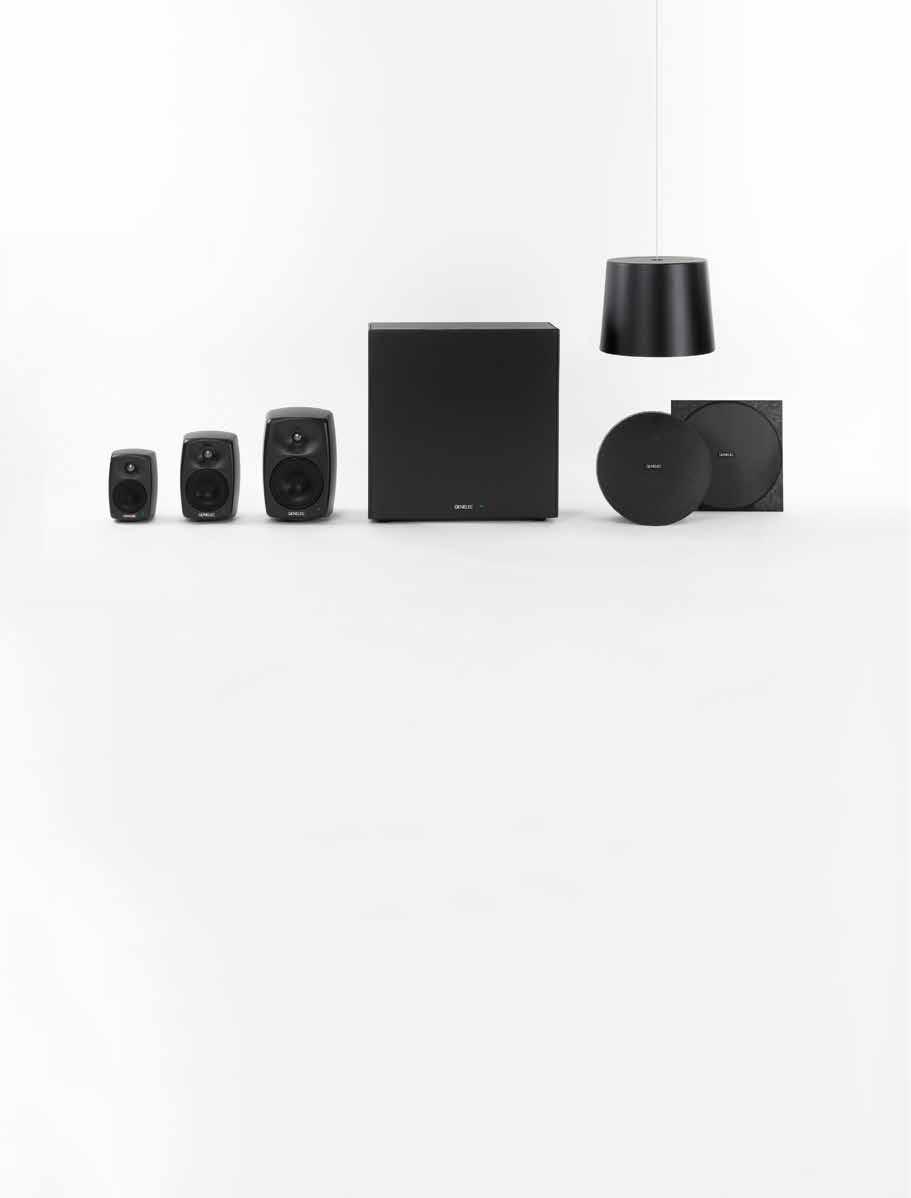
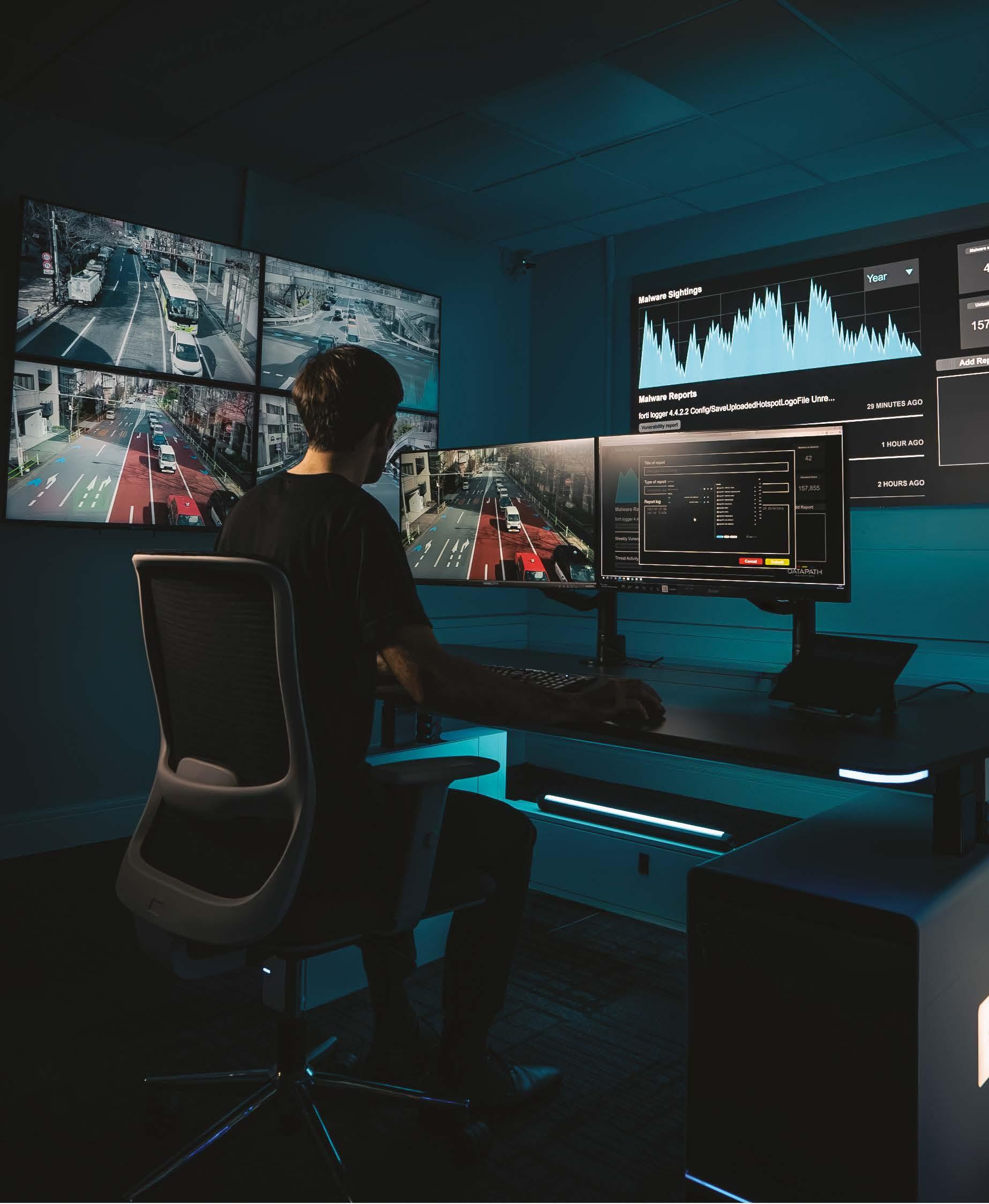
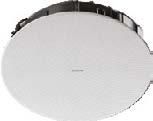
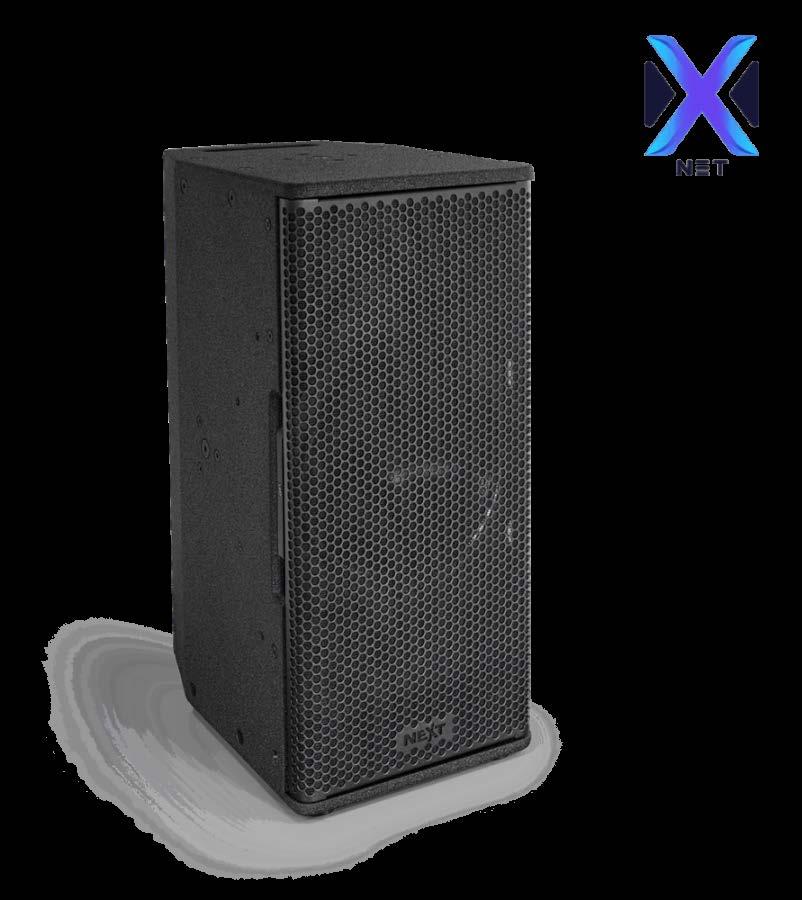
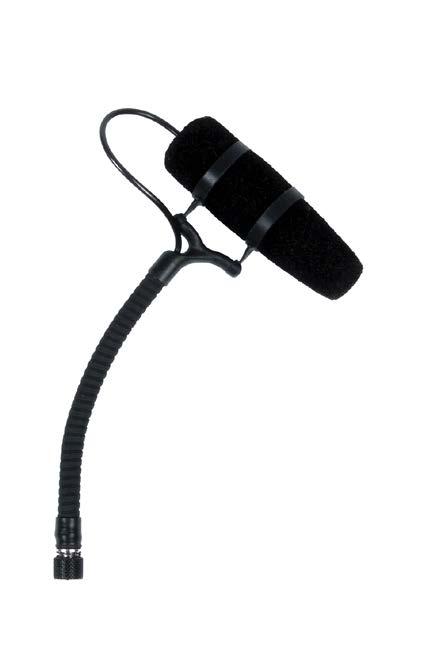
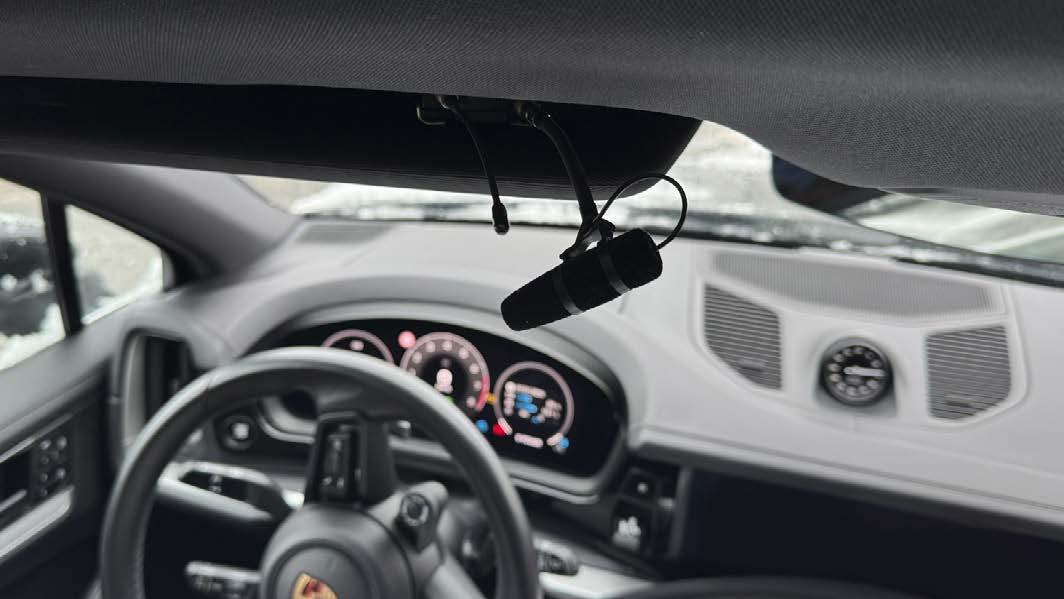
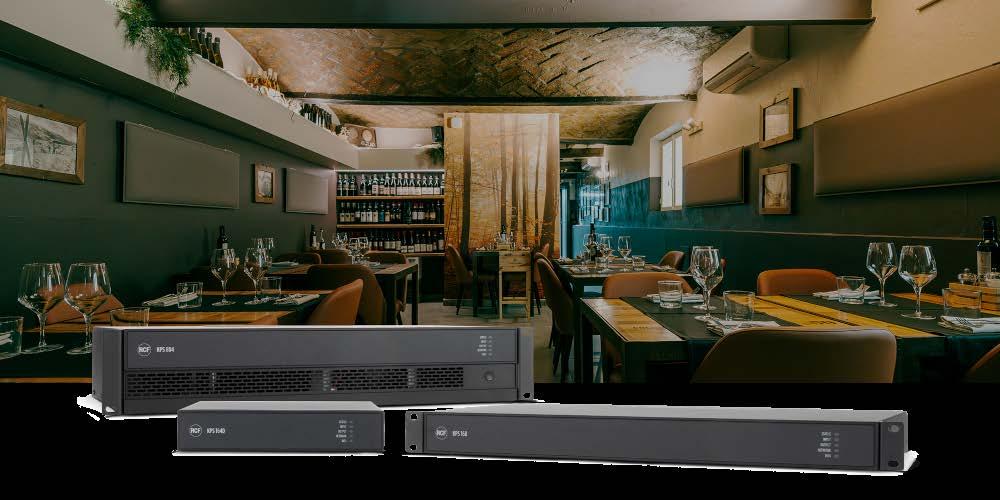
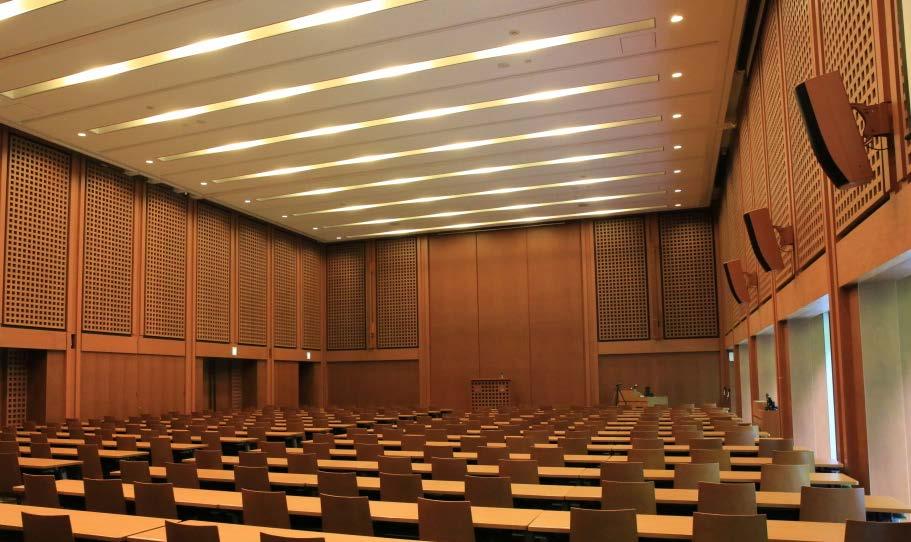
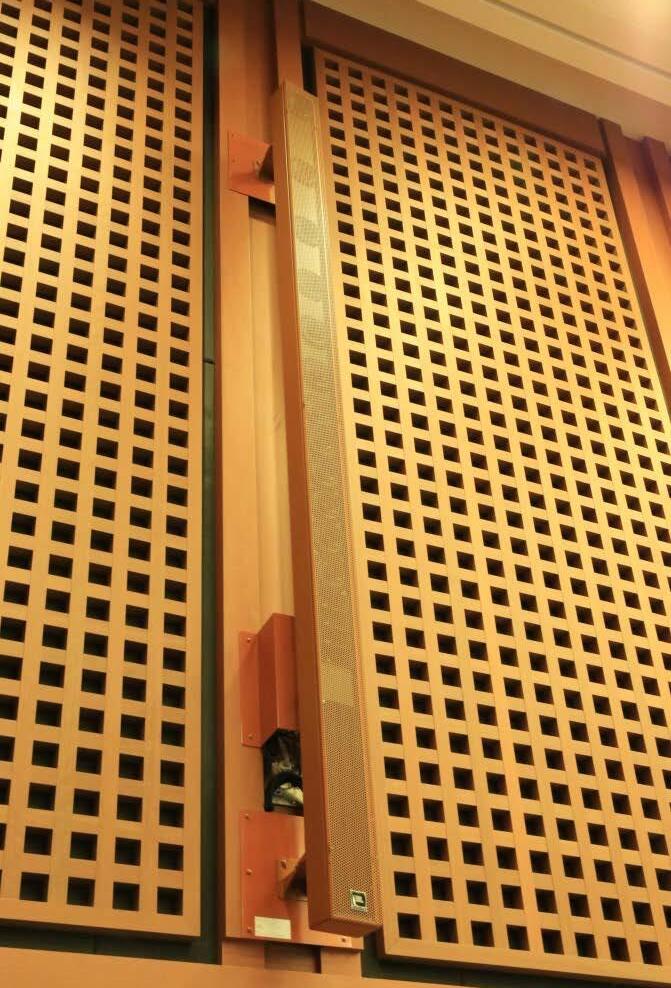
The Genelec Smart IP family of active PoE loudspeakers blends premium sound quality and networked convenience. With audio, power and management delivered via a single CAT cable, all models combine easily to create flexible systems offering clarity, intelligibility and uniform coverage – enabling scalable, future-proof installations.
genelec.com/smart-ip
From the Publisher
Thomas Richard Prakasam Publisher/Editorial Director thomas@spinworkz.com
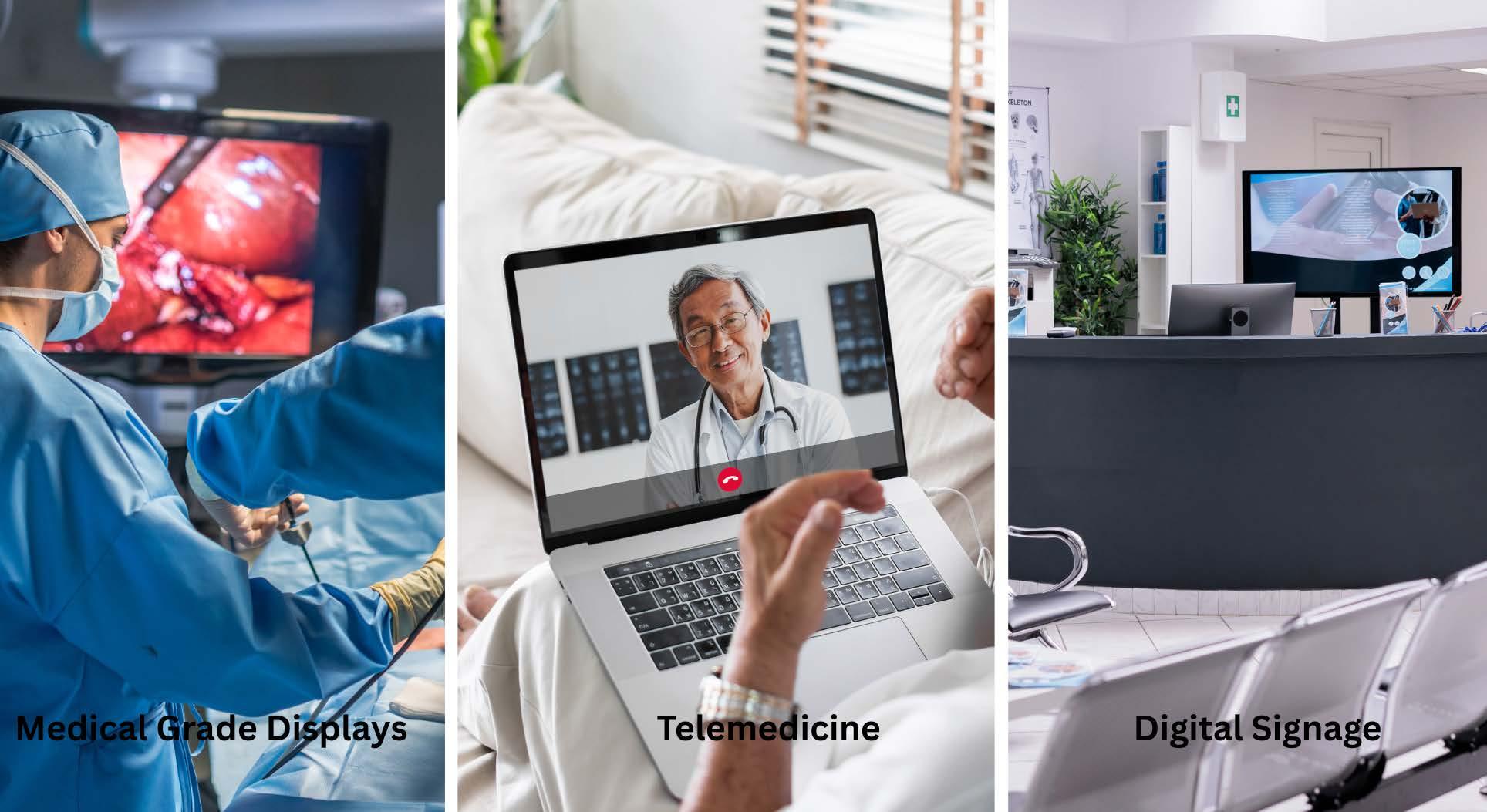
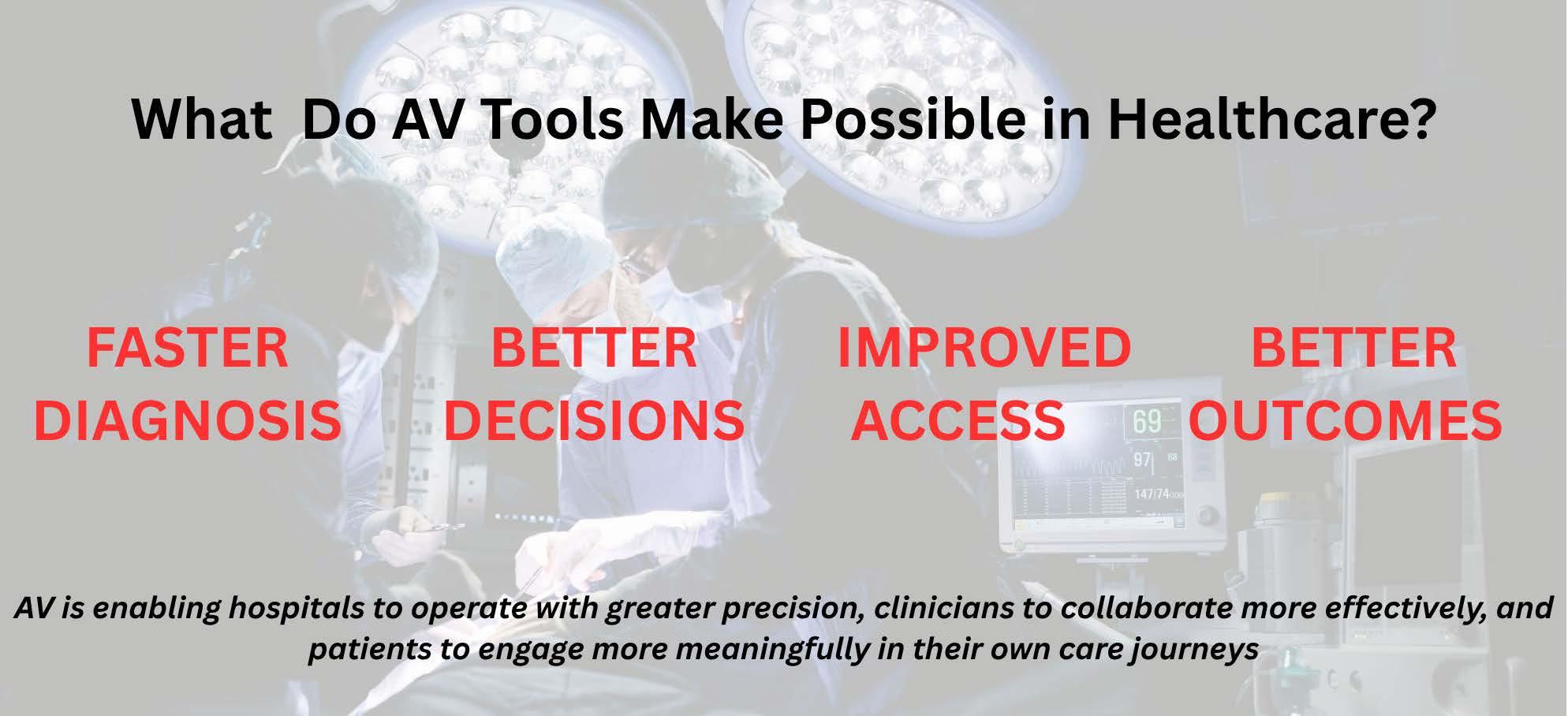
Our Feature article explores AV in healthcare. From remote diagnosis to immersive training, AV is quietly redefining the patient experience. It’s easy to focus on the technology—the displays, cameras, and control systems—but the real story lies in what these tools make possible: faster diagnoses, better decisions, improved access, and ultimately, better outcomes.
From this issue, we are introducing a new column, Design Decode. The first instalment is a four-part series on projection mapping. Avijit Samajdar, Founder & CEO of Axis Three Dee Studios—an awardwinning company—shares his expertise, beginning with an in-depth look at surfaces.
Pang Yee Loy, newly appointed Senior Director, Asia Pacific at AVIXA’s Global Industry Engagement team, is based in Singapore. We speak with him about his priorities and vision for the APAC market.
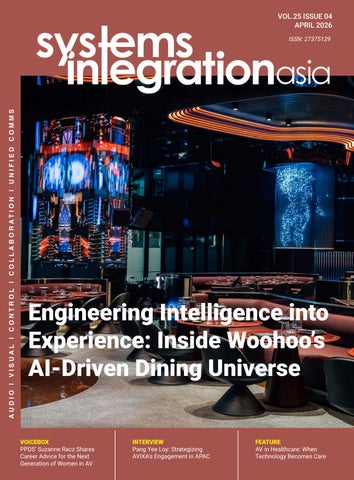
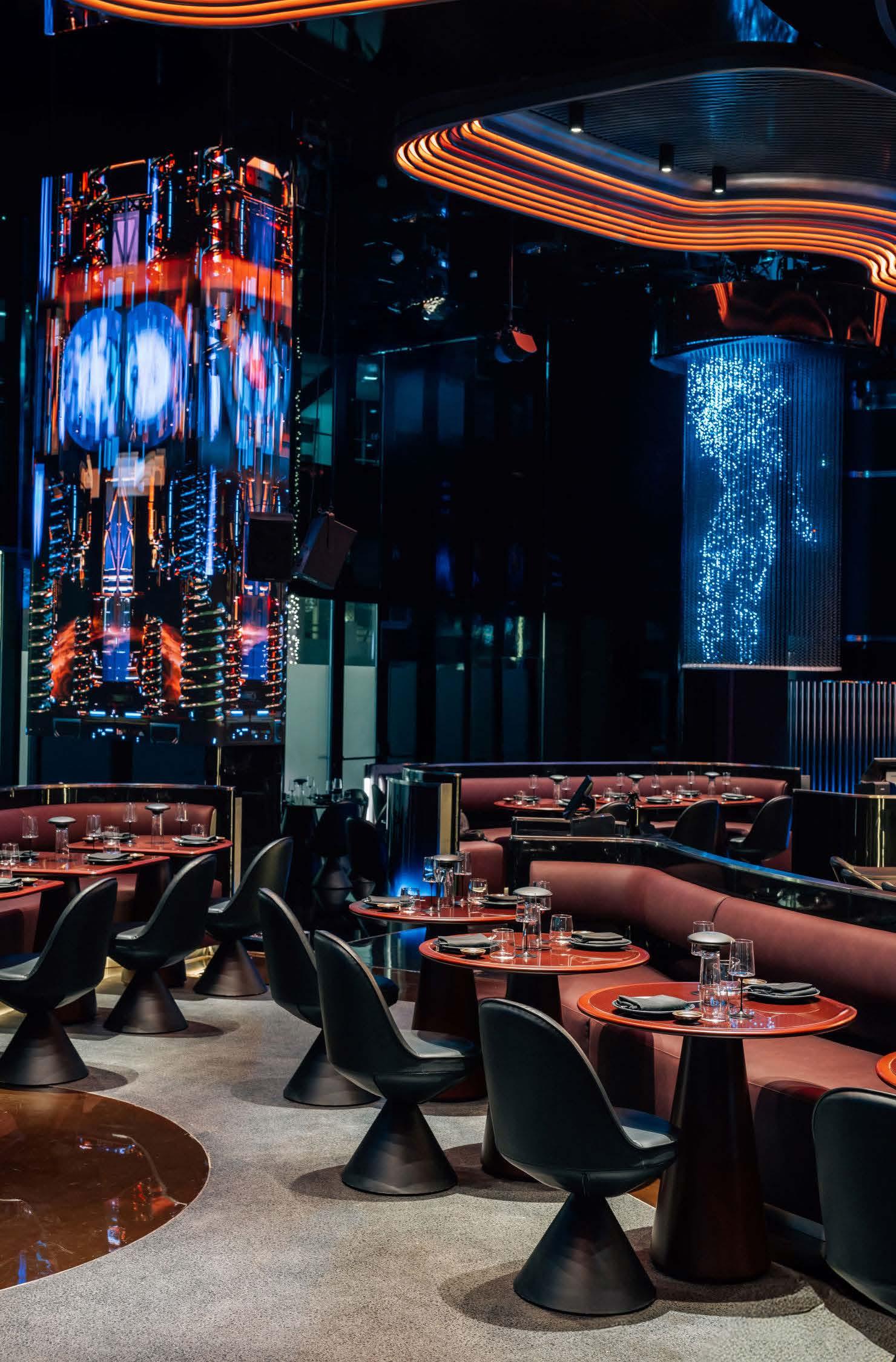
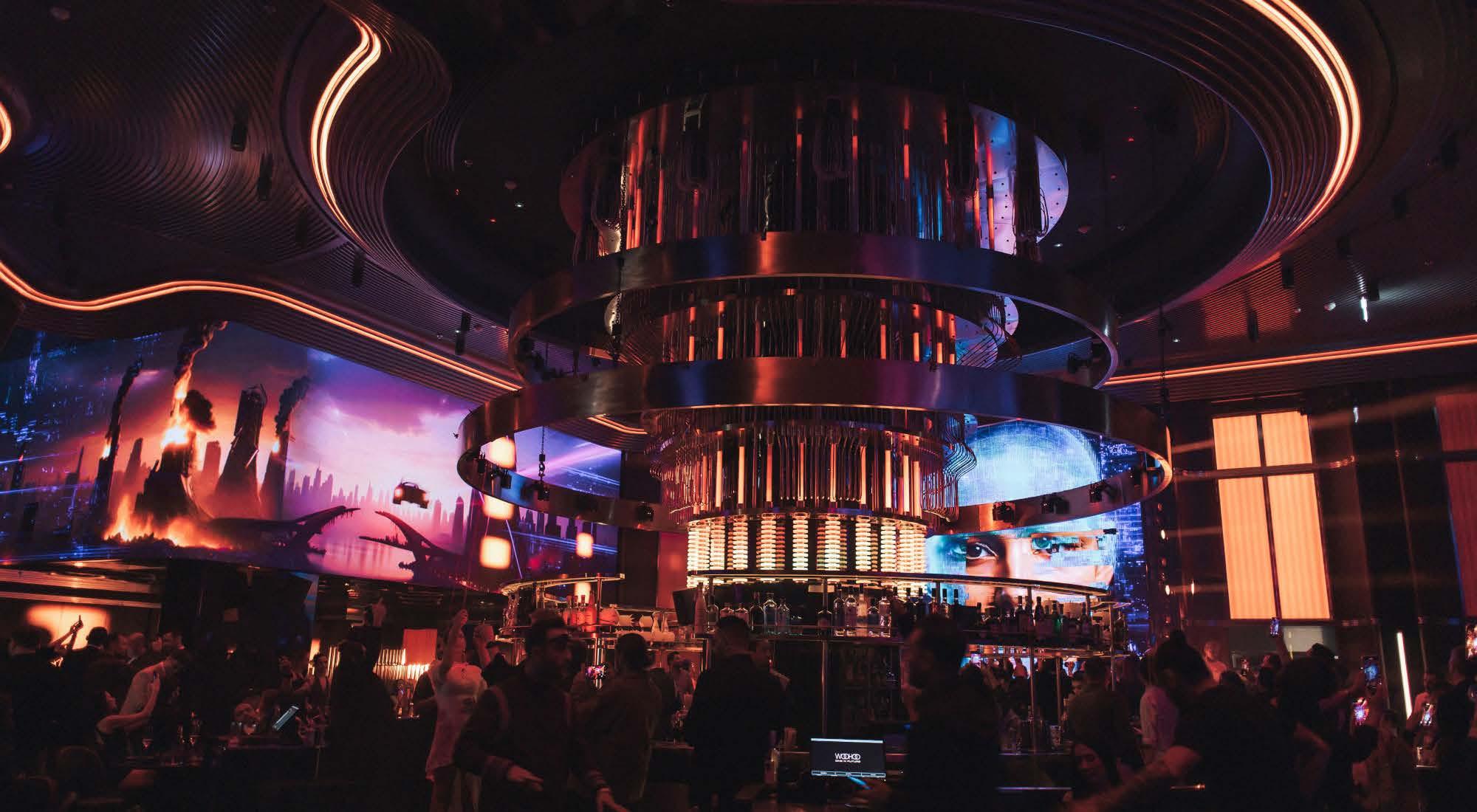
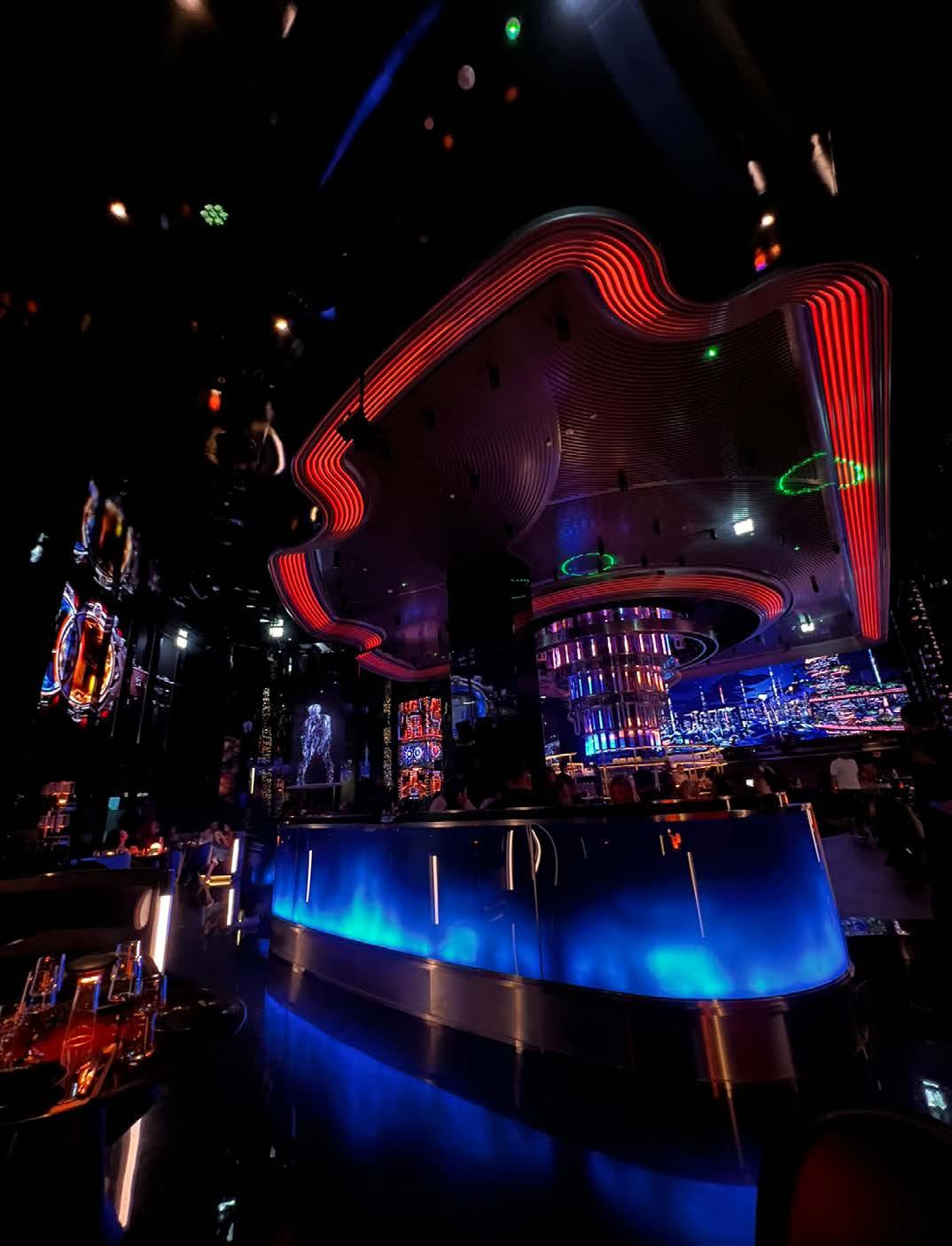
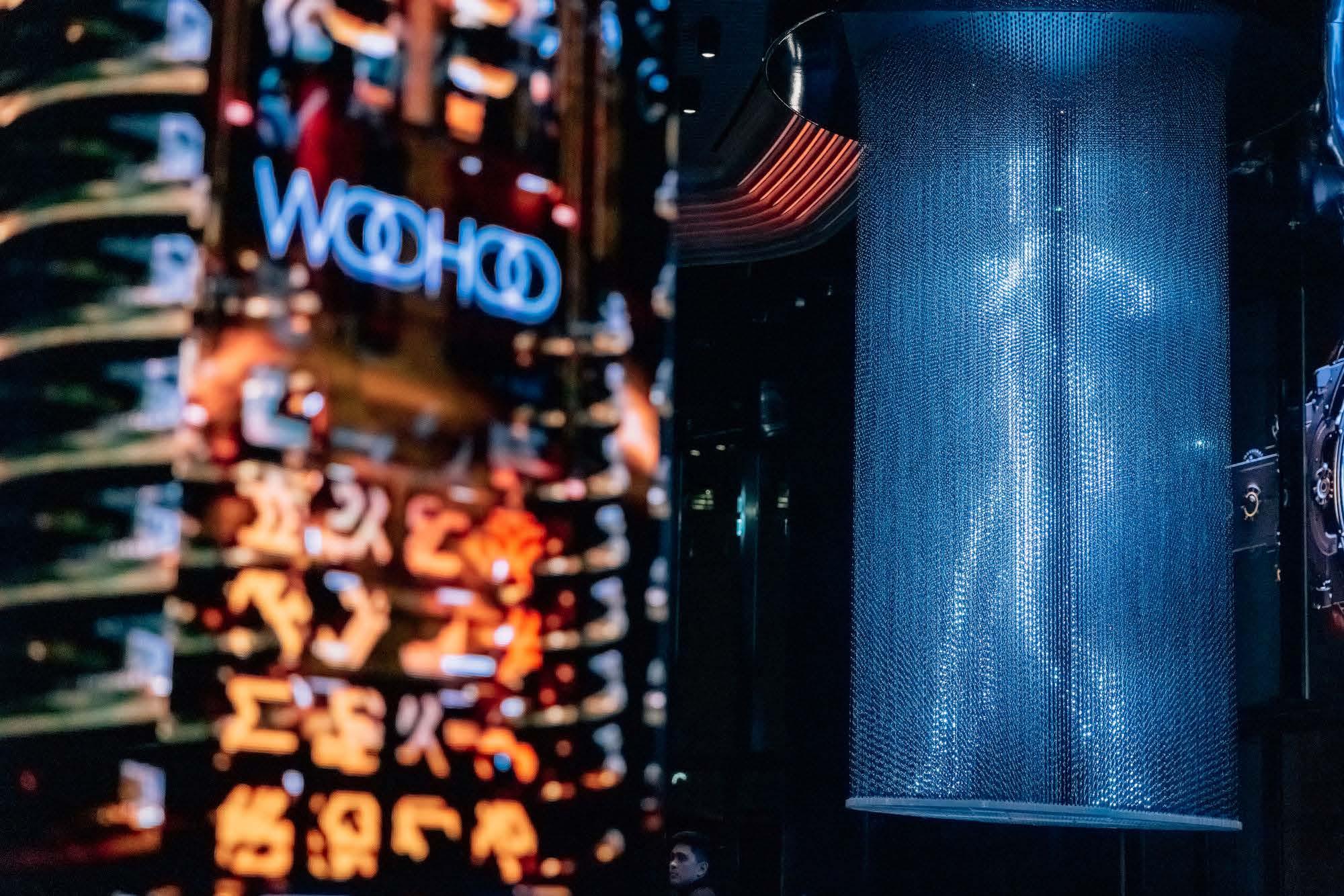
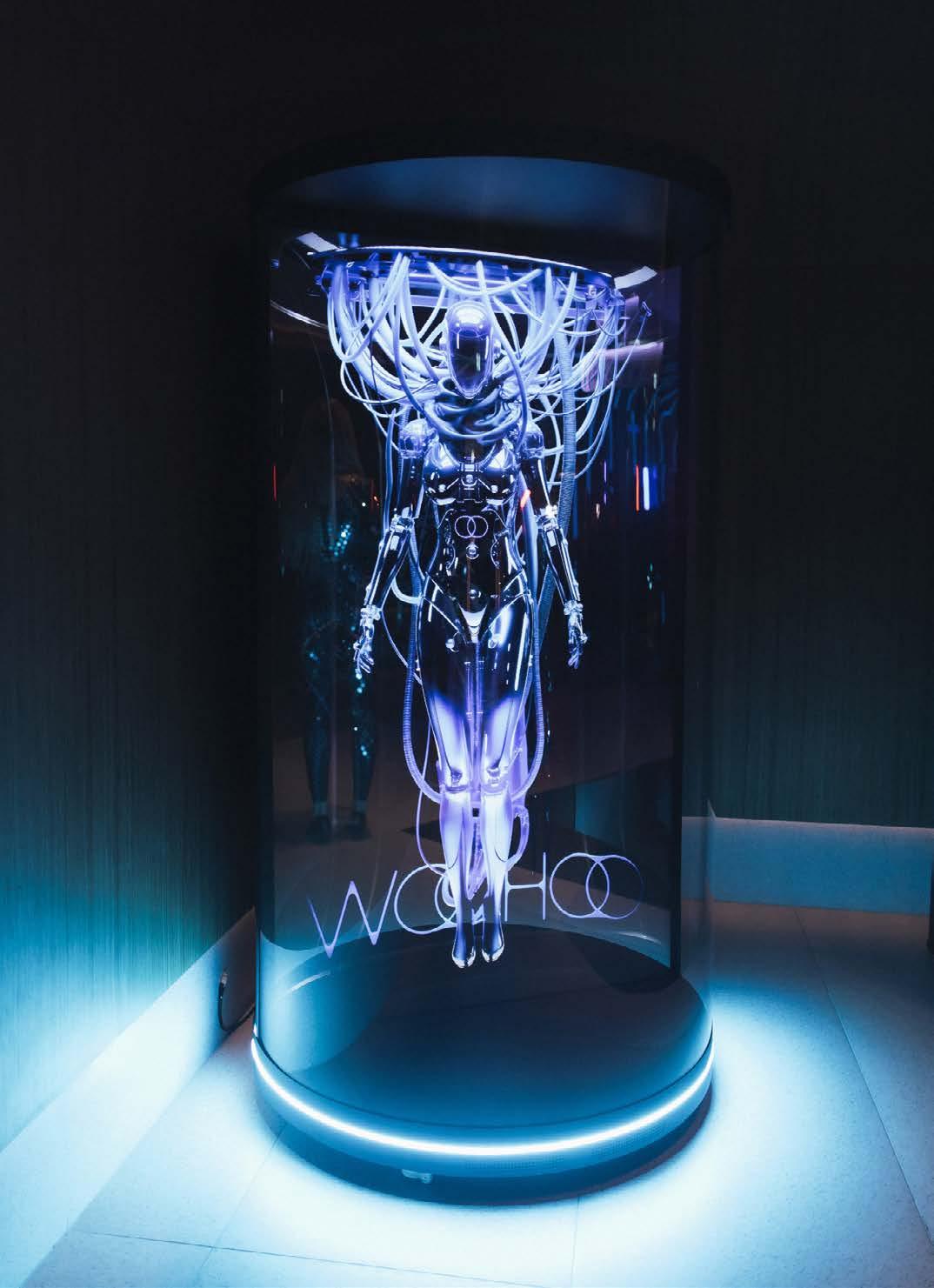
In our Installation column, we spotlight Woohoo’s AI-driven dining universe in Dubai, where artificial intelligence, immersive AV, and culinary storytelling converge to redefine the future of hospitality.
Meet The Team
EDITOR, INDIA AND ME
Ram Bhavanashi
ram@spinworkz.com
DIRECTOR
INDUSTRY ENGAGEMENT
Andy Tan andytan@spinworkz.com
MEDIA REP
CHINA,HONG KONG, TAIWAN
Judy Wang
Worldwide Focus Media
+86-13810325171
judywang2000@vip.126.com
ADMIN & CIRCULATION
Julie Tan admin@spinworkz.com
DESIGN & LAYOUT
Hazel Gundaya
Tel: (65) 63162716
Disclaimer: Systems Integration Asia is published 12 times a year. All rights reserved. No part of this magazine is to be reproduced, whether mechanicalor electronic without the prior written consent of the publisher. Views expressed in this magazine do not necessarily reflect those of the editor or the publisher. Unsolicited contributions are welcome but the editor reserves the discretion to use them. Whilst every care is taken to ensure the accuracyand honesty in both editorial and advertising content at press time, the publisher will not be liable for any inaccuracies.
Please be informed that products and company names mentioned in this publication may be protected with tradenames, trademarks or registered trademarks of their respective owners. Our non inclusion of such symbols is not an indication of us not recognising the copyright but rather to have a common look across our articles. Misuse of tradenames, trademarks or registered trademarks is strictly prohibited. It is the obligation of our readers to check if company names and products are protected with tradenames, trademarks or registered trademarks.
PPDS’ Suzanne Racz Shares Career Advice for the Next Generation of Women in AV
To mark International Women’s Day 2026, PPDS, the exclusive global provider of Philips Professional Displays, celebrated the achievements of women across its global business while highlighting the growing role of female talent in the AV industry. As of International Women’s Day 2026, women represented 29% of the PPDS workforce.
Among those helping shape the future of the business is Suzanne Racz, Global Product Marketing Manager at PPDS. With more than 20 years' experience in audiovisual and imaging technologies, Suzanne has built a respected career working with some of the industry's most recognised brands, including Cisco.
Suzanne’s journey reflects the opportunities available for women building careers in technology and AV. Beyond her role in product marketing, she is also a qualified life coach, supporting and mentoring professionals as they navigate their own career paths.
In this VOICEBOX, Suzanne reflects on her own career journey and offers advice for women looking to enter, or progress within, the AV industry.
What was it that first attracted you to pursue a career in AV?
The AV industry drew me in because it sits at the intersection of technology, communication, and human experience. It’s a dynamic and quickly evolving space where innovation directly shapes how people connect, collaborate, and learn.
In the beginning, how would you describe the representation of females in the industry, and how has that changed today?
When I started in the imaging industry, female representation was rather low. It wasn’t unusual to be the only woman in the room. Today in tech, the numbers are still not balanced, but the shift is real. Companies like PPDS now have close to 30% female representation, and more women are entering technical, commercial, and marketing roles than ever before. Progress is steady, even if the industry still has work to do.
Before joining PPDS, did you experience any obstacles or adversity in your career that you would put down to gender?
Not at all. Visibility and encouragement make a difference. All companies where I worked in the past were working to create an inclusive culture.
At PPDS specifically, how would you describe the representation of females and how has this changed in the time you have been there?
PPDS has made meaningful progress. At 29% female representation globally, the company is ahead of some peers in the AV sector. In my time here, I've seen more women join across departments and promoted into manager roles. The culture genuinely supports equality – not as a slogan, but as a practice. Indeed, for sales, there has been a shift in some countries in particular, and certainly in our DACH region, with 45% females, in France with 50% females, and the UK, which is now at 55% females. In our headquarters, the ratio is even more; for instance, in our marketing team, we have over 80% females.
What do you enjoy most about being a leading member of PPDS and the AV industry as a whole?
AV technology shapes how people work and communicate, and being part of that evolution is energising. At PPDS, I do extremely value the openness – the ability to collaborate, share ideas, and help shape global product strategy. It's not about who or what you are; we work as one team.
There have been a growing number of events and initiatives focused on women’s empowerment, such as those held at ISE and InfoComm. How do you feel about those?
They’re incredibly important. In an industry where women are still quite underrepresented, these events create visibility, community, and momentum. They give women a platform, help build networks, and signal to the wider industry that inclusion isn’t optional – it’s essential.
Likewise, events such as the Hackathon at ISE inspire the next generation into the industry. As sponsors of the Sustainability Track, we have been genuinely enthused by the number of young women taking part. And watching the engineering pathways in many industries
inspiring many more females to enter, the trend looks set to continue.
What would your advice be to females looking to advance their careers in the AV industry?
Be confident in your expertise, stay curious, and don’t hesitate to take up space. Build relationships, seek mentors, and keep developing your skills. Don’t hide in the shadows. Bring your perspective; it’s valuable.
Do you think more should be done to encourage younger females understand the career opportunities available via the AV industry?
Many young women simply don't realise how diverse the career paths can be. Indeed, talking to many peers – male or female –people fall into this industry by chance, rather than setting out in that direction. Outreach to schools, universities, and early career programs would make a real difference. The earlier we show what's possible, the more balanced the industry's future will be. We at PPDS are focusing on these activities within the framework of activities such as the annual hackathon at ISE, as well as offering opportunities for students and interns to gain experience with us around the world.
If you could speak to a classroom of young females today, what would your message to them be?
Technology needs your voice. Don’t let the current gender balance discourage you – let it motivate you. The AV industry is full of opportunity, creativity, and innovation, and there is space for you to thrive and shape the future.
Reflecting positive progress across the sector, the company has reported a steady increase in the number of women pursuing careers in AV, alongside greater representation in leadership roles across its international teams.
PPDS
AV-IT Convergence Emerges as a Strategic Imperative for FutureReady Enterprises
By Abhishek Anand, Country Manager, NETGEAR India & SAARC
The lines between Audio-Visual (AV) systems and Information Technology (IT) are blurring, marking a significant shift in how enterprises approach digital infrastructure. What was once a clear separation—IT managing data infrastructure while AV teams managed meeting room technologies and display systems - is now evolving into a unified, IP-driven ecosystem.
Today, these two worlds are merging. This convergence is transforming how organizations build and manage modern communication environments. From smart meeting rooms to large-scale digital signage networks, everything now relies on unified, IP-based infrastructure.
Managing this unified network requires specialized tools and robust hardware. Organizations need systems capable of handling heavy video traffic without compromising critical data performance.
The Rise of AV over IP (AVoIP)
A key driver behind this transformation is AV over IP (AVoIP). Instead of relying on traditional HDMI or SDI cables, businesses are increasingly using standard Ethernet networks to deliver high-quality audio and video.
This shift simplifies infrastructure significantly. There is less dependence on proprietary cabling and rigid matrix systems, allowing for more flexible and scalable deployments. Adding a new display or endpoint is as simple as connecting it to a nearby network switch.
AVoIP not only reduces installation complexity but also lowers costs while offering unmatched flexibility. Organizations can expand their systems gradually, aligning with growth and evolving needs.
Why Network Performance is NonNegotiable
As AV becomes part of the broader IT ecosystem, network performance becomes critical. Unlike traditional data traffic, which is often burst-based, AV traffic requires continuous, high-bandwidth, and low-latency transmission.
Even minor disruptions can impact user experience. While dropped data packets in standard IT environments can be retransmitted, packet loss in AV results in visible issues such as video freezing or audio distortion.
This shift places new demands on IT teams, who must now manage continuous AV streams alongside regular data operations. Reliable, high-performance networking infrastructure is essential to ensure seamless delivery.
Purpose-Built Networking for AV Environments
Standard IT infrastructure is not always optimized for AV workloads. Modern AV networks require capabilities such as efficient multicast handling, high Power over Ethernet (PoE) support, and simplified configuration.
Advanced networking solutions are designed to handle multicast traffic effectively, ensuring that video streams are delivered only where needed, rather than overwhelming the entire network. High PoE capacity enables devices such as cameras, displays, and access points to be powered directly through the network, reducing the need for additional electrical infrastructure.
Equally important is ease of deployment. User-friendly interfaces and profile-based configurations allow teams to set up complex AV networks quickly, without extensive command-line expertise. This reduces deployment time and minimizes the risk of errors.
Addressing these needs requires networking solutions that combine performance, scalability, and ease of deployment. Providers such as NETGEAR are focusing on delivering these capabilities through dedicated Pro AV portfolios, including solutions such as the M4250 series AV switches, designed for seamless AV over IP deployments, and the M4350 series for high-bandwidth, enterprisegrade environments.
These solutions offer advanced multicast optimization, high Power over Ethernet (PoE) capabilities, and simplified configuration through the NETGEAR Engage Controller, along with enterprise-grade security features including network segmentation and access control.
Security in Converged Networks
As AV devices become part of enterprise networks, security becomes a major concern.
Unsecured endpoints, such as digital displays or wireless presentation systems, can create vulnerabilities. Modern networking approaches incorporate robust security measures, including access controls; secure management protocols, and network segmentation. These features help protect sensitive data while ensuring uninterrupted AV performance.
Bridging the Gap between AV and IT Teams
The convergence of AV and IT is not just a technological shift—it is also an operational one. Traditionally, AV and IT teams have worked independently, with different priorities and expertise.
Today, successful deployments require collaboration. AV professionals focus on user experience and signal quality, while IT teams prioritize network reliability and security. A unified approach enables both teams to work efficiently on a shared platform.
This collaboration leads to faster project execution, easier troubleshooting, and more reliable communication systems.
Building Future-Ready Infrastructure
The convergence of AV and IT is now the standard across corporate offices, educational institutions, broadcast environments, and entertainment venues. Organizations must invest in infrastructure designed for this integrated reality.
By adopting scalable and flexible networking solutions, businesses can future-proof their environments and ensure seamless, highquality communication experiences. A strong network foundation is essential to support the growing demands of modern AV systems.
Netgear
Analog Way Establishes Joint Venture in Shenzhen
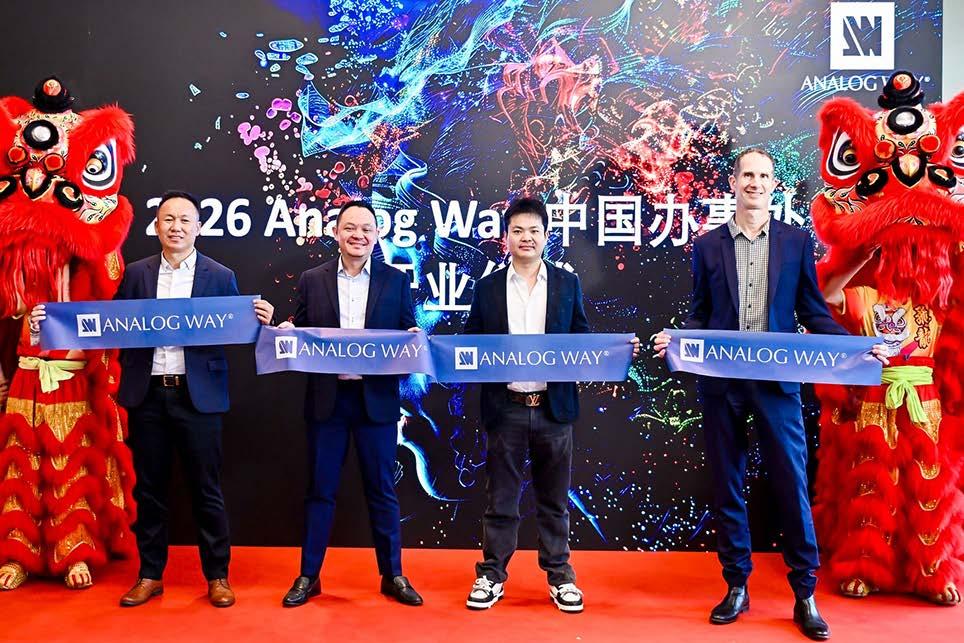
CHINA: Analog Way has established Analog Way China Co. Limited, a Shenzhen-based joint venture with Chinese partner Zhu Rongjun, Founder and General Manager of Jiangsu Rongze Tianyun Electronics Co., Ltd
development. “China is a key market for Analog Way,” Delmas noted. “The creation of this joint venture and the opening of our China office are important steps to strengthen our presence and investment in the region. We look forward to continuing to develop the market together with our local partners.”
The joint venture formalises a partnership developed over the past three years between Analog Way and Zhu Rongjun’s company.
The new structure will strengthen Analog Way’s presence in the Chinese professional AV market by expanding local technical support, after-sales services, and spare parts availability for customers and partners across mainland China.
The announcement was made during the opening of Analog Way’s new China office in Shenzhen, marking the next stage of the company’s expansion in the region.
Eric Delmas, Chief Executive Officer of Analog Way, said the Chinese market plays a central role in the company’s international
“In the Chinese market, credibility and longterm commitment are essential,” Zhu Rongjun said. “Our cooperation is built on a shared focus on technical support, after-sales service, and long-term responsibility to our customers.”
Guy de Souza, Vice President of Analog Way Asia, said the joint venture will further strengthen Analog Way’s regional ecosystem and collaboration with partners. “China is a strategic market for Analog Way in Asia Pacific. With this joint venture and our expanded local presence, we are reinforcing our ability to support partners and customers while continuing to grow the professional AV market across the region.”
During the event, Analog Way also announced strategic cooperation with several companies in the mainland China rental and professional AV market. These partnerships aim to expand Analog Way’s presence in the rental and staging sector and support the deployment of its screen management systems for live events, touring productions, and corporate shows.
Analog Way
THE POWER BEHIND THE VIDEO WALL
Secure, simple and reliable. The award-winning VSN series, powering any video wall size imaginable.
d&b audiotechnik to Elevate Audio Experience at the National Stadium at The Kallang
SINGAPORE: d&b audiotechnik has announced a partnership with The Kallang Group to deliver a state-of-the-art audio solution for the National Stadium at The Kallang
d&b audiotechnik will deploy its flagship SL-Series loudspeaker system Featuring broadband directivity control and lowfrequency cardioid behaviour, the d&b SLSeries is engineered to deliver clear, event coverage throughout large-scale venues while minimising spill and reflections. The system improves the perceived speech intelligibility and musical impact across all seating areas, ensuring that the audience experiences commentary, performances, and live events with precision and impact.
Beyond audio performance, the system will also support long-term reliability, daily
operation, and sustainability objectives. These capabilities enable reliable event execution while aligning with The Kallang Group’s vision for a future-ready venue infrastructure.
Marco Baumgärtner, CEO, APAC, d&b audiotechnik, said: “We are proud to enter this partnership with The Kallang Group for Singapore’s iconic National Stadium. We, as d&b, have a long-standing track record of delivering world-class audio solutions for the world’s most demanding events and venues. With the d&b SL-Series, the National Stadium will benefit from clear, high-quality sound throughout the venue — allowing fans and visitors alike to fully experience the energy, emotion, and passion through sound.”
“The Kallang Group is committed to delivering unforgettable experiences for our patrons across all our venues. We are pleased to partner with d&b audiotechnik to upgrade the audio system at the National Stadium at The Kallang. Whether for sporting events or concerts, our patrons can look forward to better sound quality and an elevated overall experience,” said Daryl Yeo, Chief Operating Officer, The Kallang Group.
Installation of the system has commenced and is expected to be completed by mid-2026.
d&b audiotechnik
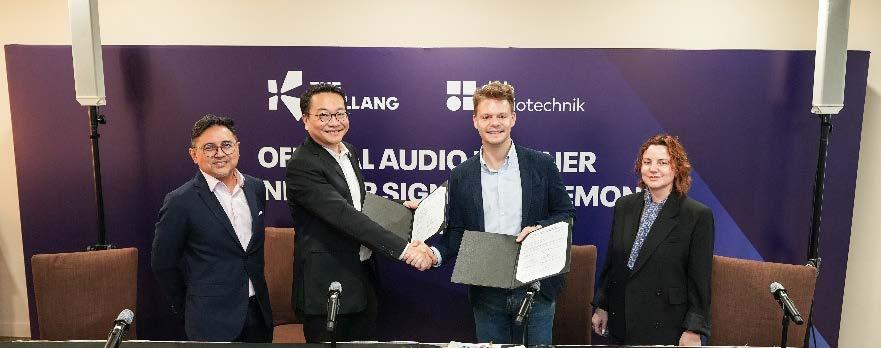
From left: Yazed Osman and Chung Yuan Lu of The Kallang Group Pte. Ltd. with Marco Baumgärtner and Anna Kovyza of d&b audiotechnik at the partnership signing for the audio upgrade featuring the d&b SL Series at the National Stadium.
Z 6 / Z 1 0 W
IHSE and Cyviz Announce Strategic Partnership
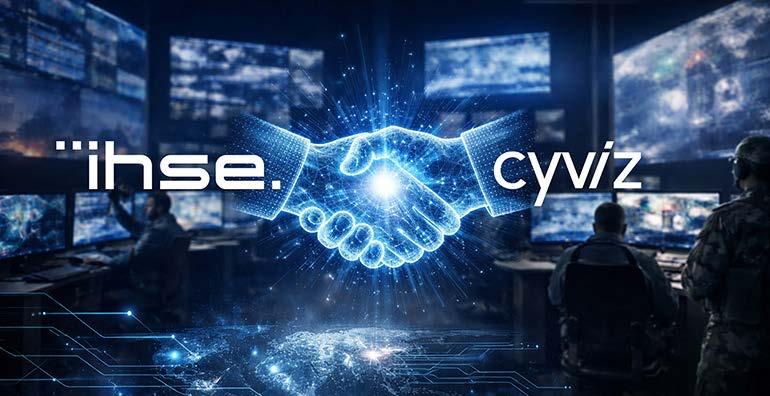
GLOBAL: IHSE, a leading provider of highperformance KVM (Keyboard, Video, Mouse) systems for secure and demanding environments, has entered into a strategic partnership with Cyviz AS , a global provider of technology solutions for advanced collaboration and mission-critical operations.
The partnership combines IHSE’s proven KVM technology with Cyviz’s standardised and scalable solutions for control rooms and operational settings. Together, the companies support customers operating in businesscritical sectors, public institutions, and securitysensitive organisations.
Newly Awarded European Defence Projects
The joint solution has recently been awarded several strategic defence-related projects in Europe, where IHSE and Cyviz are jointly
delivering technology components for command-and-control systems to a central European defence organisation.
The strategic partnership supports a long-term focus on standardisation and repeatability across both companies’ global solutions portfolios. By aligning closely on technology, integration, and delivery, the partnership aims to reduce risk, increase predictability, and ensure consistent execution across regions and market segments.
“This strategic partnership reflects our shared commitment to delivering secure, reliable, and high-performance solutions for demanding mission-critical applications,” said Dr Enno Littmann, Chairman of the IHSE Advisory Board. “Through close cooperation with companies like Cyviz on technology and execution, we enable customers to deploy certified, mission-critical solutions with confidence across regions and use cases.”
Technology Alignment for Operational Reliability
IHSE’s high-performance technology has been tested and validated in real-world Cyviz
deployment scenarios, with a strong focus on robustness and operational reliability under demanding conditions. The companies are working closely across system integration, product alignment, and roadmap coordination, including initiatives to enable tighter integration between IHSE technology and Cyviz’s control and management platforms.
In parallel, IHSE and Cyviz are establishing a global commercial framework covering contractual structures, service levels, governance, and compliance. This framework is intended to support predictable execution and long-term collaboration. The partnership also includes close alignment on technology development, with dedicated resources and R&D engagement from both organisations. As a result, the companies will offer trusted solutions as standardised products to the global market.
“This partnership supports our strategy of building a more standardised and scalable delivery model, while maintaining the quality and reliability required in business-critical and mission-critical operations,” said Espen Gylvik, CEO of Cyviz. “By working closely with key technology partners such as IHSE, we strengthen our ability to deliver predictable outcomes for customers operating in complex and demanding settings.”
The partnership has global relevance, with active engagement across Europe and other international markets, supporting organisations that require secure, resilient, and well-governed operational environments.
IHSE
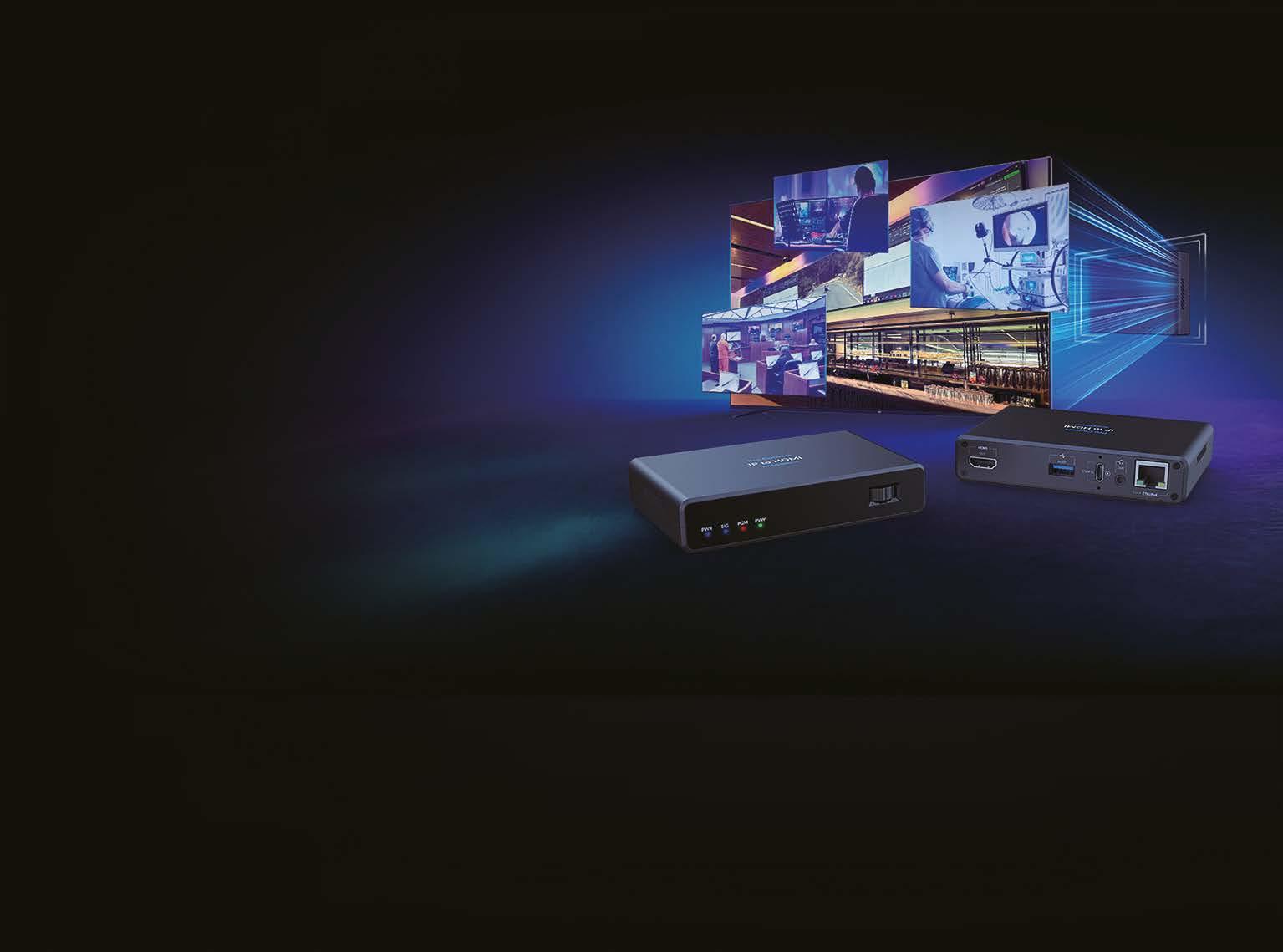
Simplify IP-to-HDMI Integration
Magewell New Decoder
Merge up to four IP streams into one HDR10-compatible HDMI output
Broad support for common video formats and IP protocols
Configurable multiview layouts with real-time or MJPEG preview
Refreshed, intuitive UI for faster setup and on-site adjustment
The new Pro Convert IP to HDMI seamlessly integrates into workflows to provide versatile and reliable conversion for video distribution, command and control and a variety of other applications. Visit www.magewell.com to learn more.
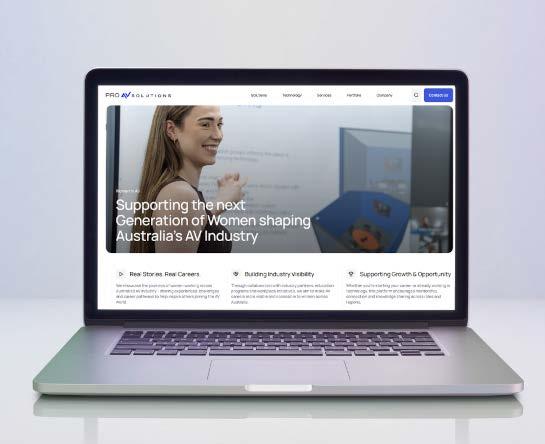
Pro AV Solutions Launches Women in AV Platform to Strengthen Industry Pathways
GLOBAL: Pro AV Solutions has launched a new Women in AV platform as part of its broader commitment to increasing participation, visibility and structured career pathways for women in the Australian audiovisual industry.
The initiative connects real career stories from across the business with formal training opportunities delivered through the Institute of AV Technology The new landing page highlights leadership, technical and operational roles, providing greater visibility into the diversity of careers available in AV while linking directly to current career opportunities, work experience pathways and mentoring enquiries.
The platform is closely aligned with the Institute of AV Technology, Pro AV Solutions’ national training program that delivers recognised qualifications combined with paid, on-site industry experience. The Institute provides structured entry pathways into technical, engineering and project delivery roles, combining classroom learning with hands-on installation, integration and commissioning experience across live projects.
Recent workforce data shows women represent approximately 28 to 32 per cent of Australia’s STEM and technology workforce, with significantly lower representation in technical and engineering roles. The AV industry reflects similar trends, reinforcing the need for clearer and more visible entry pathways.
Kylee Naglost, CEO of Pro AV Solutions, said the focus is on long-term workforce development rather than a single awareness initiative. “I began my career in the AV industry in 1987, at a time when gender diversity was barely visible. Over the years, I’ve seen the industry evolve into a space where collaboration, capability and contribution matter more than titles or stereotypes. As one of Australia’s largest national AV integrators, we recognise our responsibility to contribute to the long-term capability of the industry. The Institute of AV Technology was established to create structured, supported entry points into technical careers, and the Women in AV platform strengthens that by increasing visibility and encouraging more people to consider AV as a rewarding profession.”
Recently recognised as one of Australia’s Best Places to Work 2025, Pro AV Solutions will continue expanding its training intake and industry engagement through the Institute of AV Technology, working with education providers and industry partners to build a broader, more diverse pipeline of AV professionals.
Pro AV Solutions
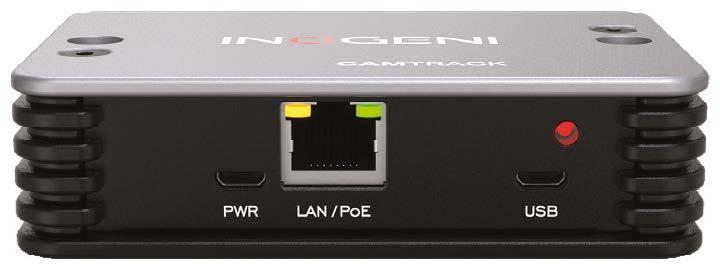
C AMTR ACK
Speaker focus o ers switch in time
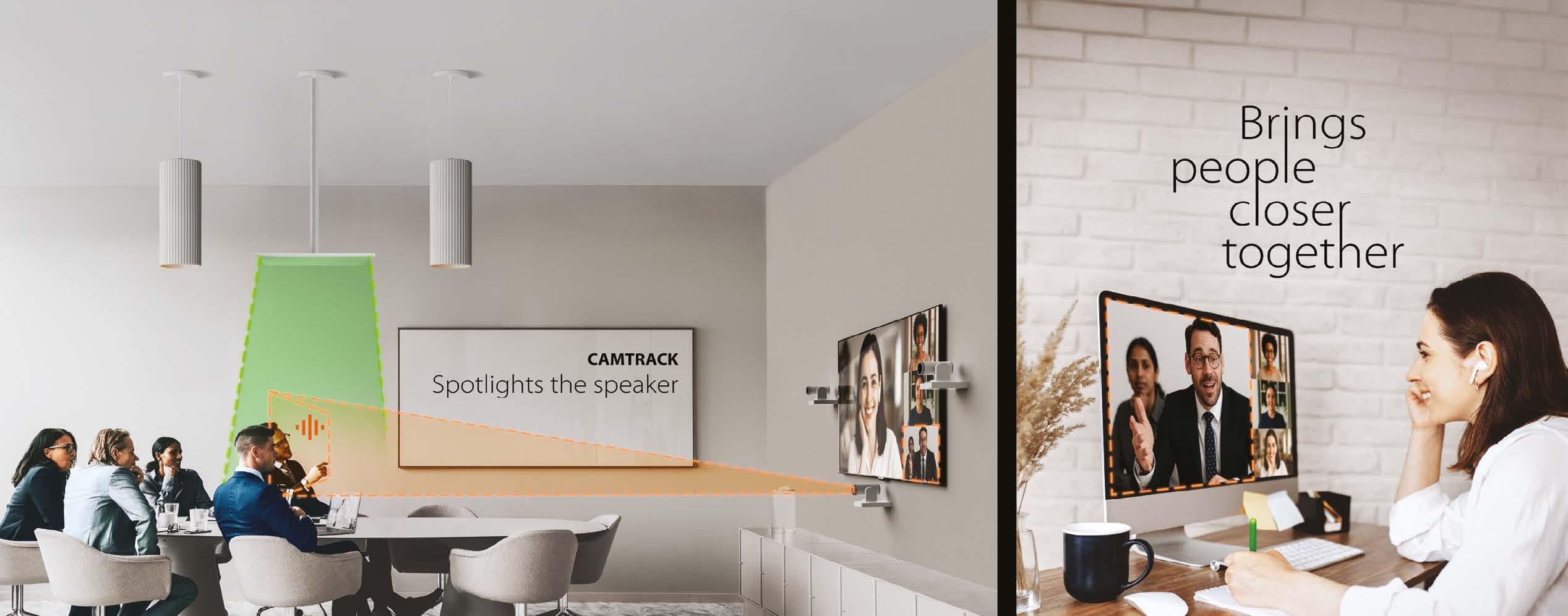
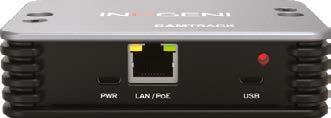
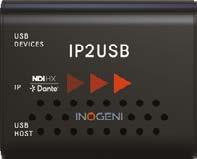
INOGENI’s CAMTRACK is the most exible, and cost-e ective voice-activated multi-camera switcher designed for modern conferencing environments.
CAMTRACK integrates with SHURE microphones to detect the active speaker’s voice, triggering PTZ camera presets and AI tracking (when supported). It then communicates with an INOGENI switcher to route the appropriate video feed seamlessly into the conferencing system. The system provides automated camera control and video switching for conference rooms, hybrid meetings, and live events.
Seamless integration and setup
Complete SHURE integration – Works seamlessly with advanced multi-zone microphones (MXA901 and MXA920), multi-channels (MXA310, MXA710 and MXA910) as well as wireless MXW neXt and MXCW conference systems.
Broad PTZ camera support – CAMTRACK works with an extensive list of PTZ camera manufacturers, including Canon Aver, Sony, Panasonic and virtually any PTZ IP camera.
Q-SYS Reflect Now Available in India
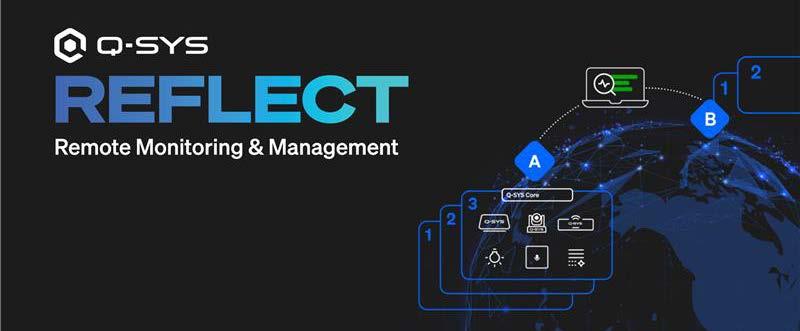
INDIA: QSC has announced the launch of Q-SYS Reflect® in India. With this launch, India joins the growing list of over 35 countries with access to the robust, cloud-based monitoring and management platform intrinsic to the Q-SYS Full Stack AV Platform.
Q-SYS Reflect offers real-time health monitoring of every connected Q-SYS system and associated peripherals, both native and thirdparty. Q-SYS Reflect’s unified view of systems provides AV/IT system administrators with the information needed to anticipate problems instead of only responding to them, helping maximise system uptime and performance. Additionally, the Q-SYS Reflect API is available at no cost for all subscribers to extend comprehensive AV system data to existing IT or building management platforms.
Q-SYS Reflect Plus enhances the standard features of Q-SYS Reflect by offering enterpriselevel remote system management and control capabilities. It enables administrators to remotely assist users and configure systems wherever they are, saving both time and costs.
The availability of Q-SYS Reflect in India follows the release of new Data & Reports features. Space Manager, a new feature available to all Q-SYS Reflect users, provides spatial and contextual visualisations of all systems, including a global map view showing where they sit in the physical world. A system status pop-up in the map view provides an at-aglance view of system performance to enable quick troubleshooting. System Reliability and Reliability Reports, available with a Q-SYS Reflect Plus subscription, deliver system performance statistics, revealing trends over time to aid commissioning and budget decisionmaking.
“Expanding the capabilities of Q-SYS Reflect to India marks a key milestone in our mission to deliver powerful, cloud-based monitoring and management tools to India,” says Rajesh Mittal, Vice President and General Manager, India & SAARC, QSC. “These capabilities provide realtime visibility, remote support, and enterpriselevel control, helping users stay agile and responsive in this dynamic market.”
For more information on Q-SYS Reflect and to start a free 90-day trial of Q-SYS Reflect Plus, click the link below.
Q-SYS
Ross Video Expands Oceania Team as Live Production Demands Grow
OCEANIA:
Ross Video is strengthening its long-term commitment to the Oceania market, expanding its regional team and introducing a new customer-focused technical leadership role as demand grows for more advanced live production workflows across Australia and New Zealand.
The global live video production technology specialist has announced the continued expansion of its Oceania operation, a move designed to bring customers closer access to technical expertise, faster support, and stronger day-to-day collaboration as deployments become increasingly complex.
As part of that investment, Ross Video has promoted Tom Wilson to the newly created role of Technical Account Manager (TAM) for Oceania. The new position has been established to support customers with largerscale and more sophisticated Ross systems, providing dedicated technical guidance and helping organisations unlock greater long-term value from their live production infrastructure.
The appointment reflects a broader shift in the region, where broadcasters, venues, production teams, and enterprise users are increasingly deploying integrated and mission-critical live production environments that require more than just product supply. For Ross Video,
the creation of the TAM role signals a more proactive support model built around technical continuity, system optimisation, and closer customer relationships.
Wilson steps into the role with more than 25 years of experience in the AV and live events industry. Before joining Ross Video, he held project manager and technical director roles at Innovative Production Services and Staging Connections, now known as Encore APAC. Over the years, he has worked closely with broadcasters, live event professionals, and production teams across the region, making him well-positioned to support customers navigating evolving workflow and infrastructure demands.
In his new role, Wilson will serve as a trusted technical advisor to customers and partners, helping ensure Ross deployments continue to perform at the highest level in demanding operational environments. His remit will include supporting long-term system success, advising on technical best practice, and helping organisations adapt their Ross ecosystems as production requirements continue to evolve.
According to Ross Video, the expanded regional focus comes as the company continues to see strong momentum across Oceania, with more organisations adopting Ross solutions at scale across broadcast, sports, entertainment, corporate, education, and government applications.
“Ross Video continues to see strong momentum across Oceania, with more organisations adopting Ross solutions at scale,” said Adam Duncombe, General Manager –Oceania, Ross Video. “Expanding our local team ensures we can deliver the level of expertise and ongoing support our customers expect. The creation of the Technical Account Manager role is an important step in strengthening that support, and Tom’s experience and customer focus make him an excellent choice for the position.”
Ross says the latest investment is part of a wider regional strategy aimed at reinforcing local capabilities as production infrastructures become more sophisticated and customers seek deeper technical partnership beyond installation and deployment.
“Our customers rely on Ross systems for mission-critical productions every day,” said Tom Wilson, Technical Account Manager –Oceania, Ross Video. “This role allows us to take a more proactive approach to supporting
Rod Sommerich Strengthens GUDE Systems Sales Presence in APAC
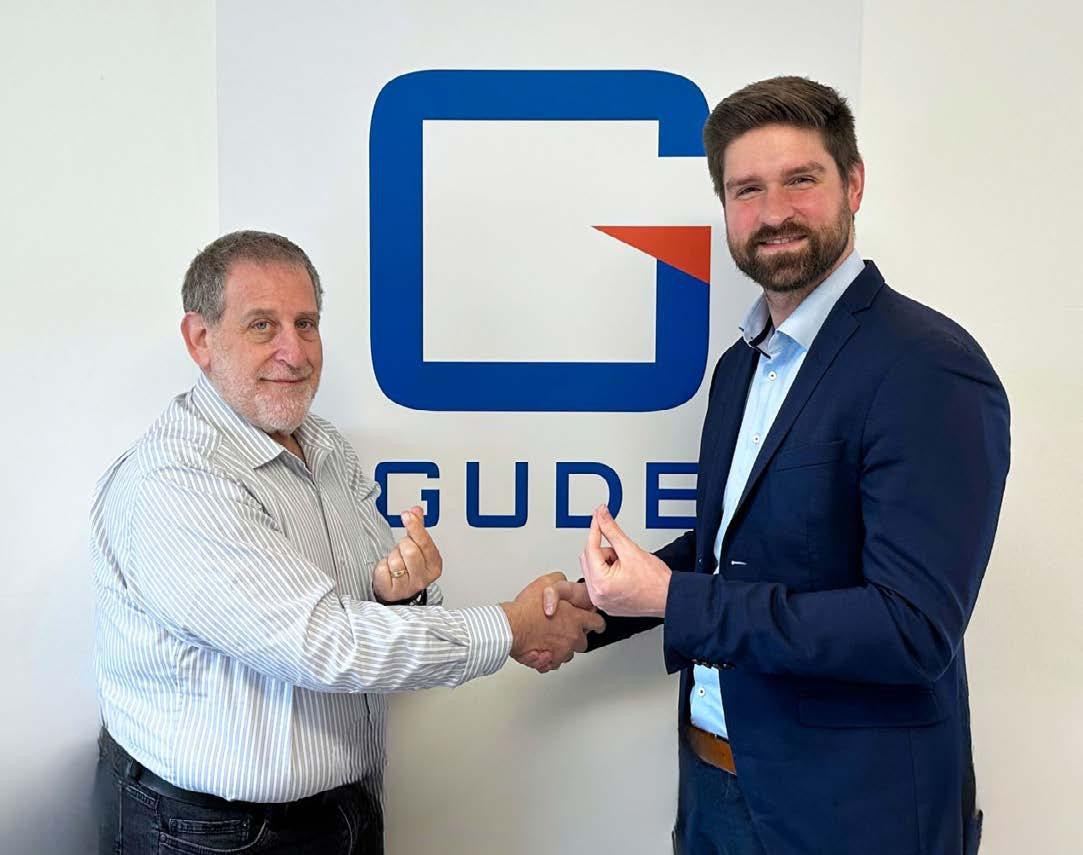
APAC: GUDE Systems GmbH has appointed Rod Sommerich as Sales Manager for the Asia-Pacific region, effective immediately — a strategic move set to reinforce the company’s footprint across APAC.
With more than 30 years of experience in the professional AV industry, Sommerich brings deep technical expertise, extensive market knowledge, and a strong network of international industry relationships. His thorough understanding of GUDE’s intelligent power distribution and monitoring solutions positions him to deliver high-value support and consultation to partners and customers throughout the region.
Based in Sydney, Australia, Sommerich will oversee sales development and customer engagement across the entire APAC territory, ensuring responsive support and closer collaboration with regional stakeholders. Philipp Gude, Chief Sales Officer at GUDE Systems, commented, “Rod is a proven industry expert. His experience, commitment, and
them, helping ensure their solutions continue to perform at the highest level while adapting to new workflows and production demands.”
With the addition of a dedicated Technical Account Manager and continued expansion of its Oceania team, Ross Video is positioning itself not only as a technology supplier but as a long-term technical partner for organisations building increasingly ambitious live production operations across the region.
Ross Video
understanding of the APAC market will play a key role in driving our continued growth in the region.”
Rod added, “Reliable technology is fundamental — and GUDE offers some of the most advanced PDU solutions available. But longterm partnerships are built on trust and direct engagement. That’s what I value most, and I look forward to strengthening relationships across APAC.”
This appointment underscores GUDE Systems strategic focus on international expansion and signals its strong commitment to further growth across the Asia-Pacific market.
GUDE Systems
(L-R)Rod Sommerich with Philipp Gude.
HARMAN Connect APAC 2026
Delivers Immersive Experiences and Regional Connection
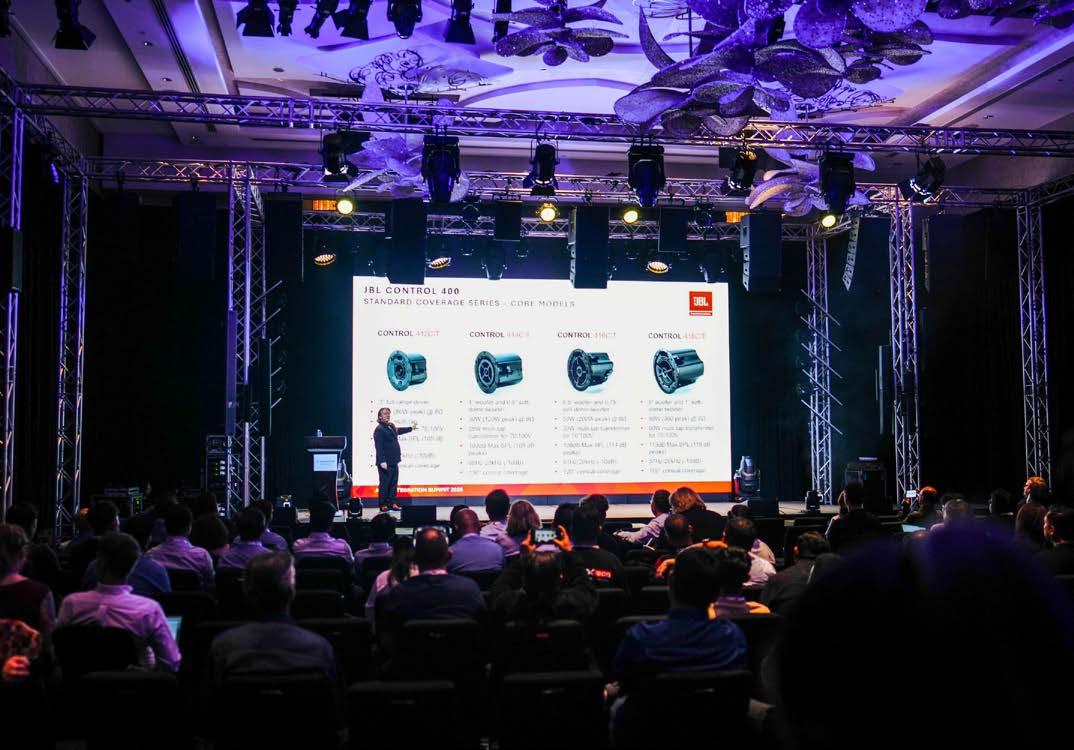
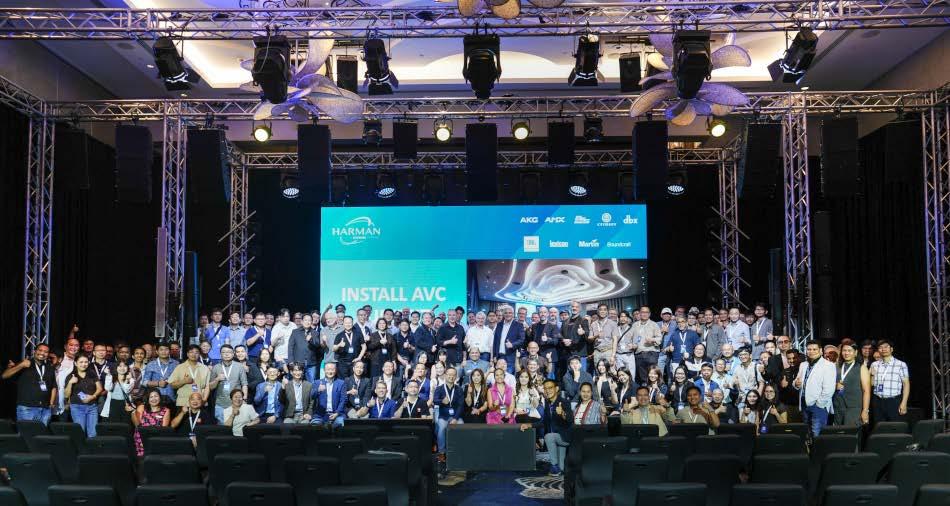
APAC: HARMAN Professional Solutions successfully hosted the HARMAN Connect APAC Summit 2026, a multi-day regional gathering that brought together distributors, partners, customers, and HARMAN leadership from across Asia Pacific. Held at W Sentosa, Singapore, the summit showcased HARMAN’s latest professional audio, lighting, video, and control innovations while reinforcing its commitment to collaboration, training, and immersive live experiences.
Taking place from Tuesday, 10 March to Thursday, 12 March 2026, the summit featured dedicated programs tailored for distribution partners, performance venues, live events
engineers and system integrators. Attendees experienced hands-on demonstrations, product debuts, strategic business updates, and curated networking opportunities designed to support growth across the APAC region.
Aligning with Distribution Partners
The summit opened with the HARMAN Partner (Distributor) Summit on 10 March 2026, a dedicated session designed to recognise distribution partners and align on the business strategy ahead. Senior leadership, including HARMAN Professional Solutions’ President, Brian Divine, shared key updates, recognised
sales achievements, and unveiled the product roadmap shaping HARMAN’s direction for 2026 and beyond.
A Platform for Performance Audio, Lighting, and Immersive Experiences
The Performance Audio & Lighting Summit, held on 11 March 2026, delivered a full day of technical insight and live demonstrations by Global Product Line Managers focused on solutions for performance venues and live events. The program included lighting project highlights, live fixture demonstrations— including the APAC debut of the Martin MAC Encore Two and MAC One Beam —followed by audio showcases featuring the latest JBL Professional developments, including additions to the SRX900 Series.
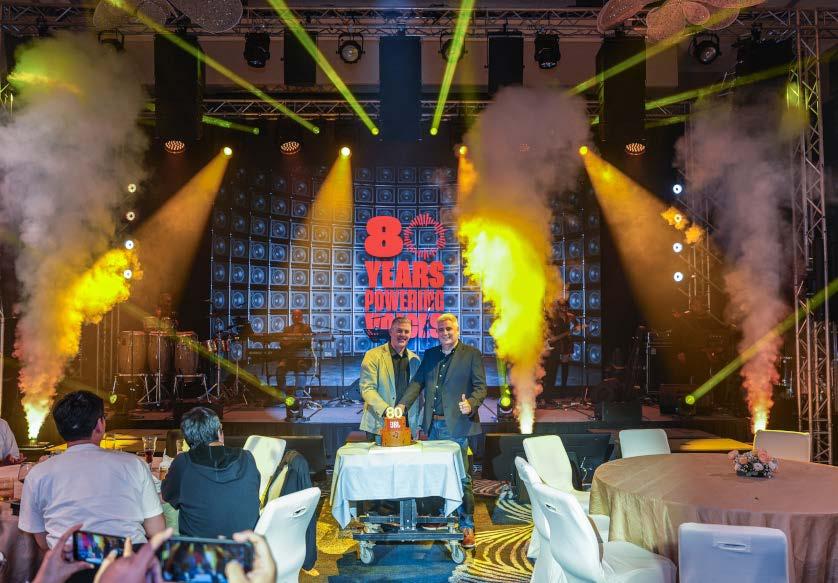
The day culminated in a specially curated Flux Immersive Audio & Lighting showcase, before closing with JBL L!ve & Loud, an evening of entertainment, networking, and celebration of JBL’s 80th Anniversary. Spotlight on Installed Solutions and Future Technologies
On 12 March 2026, the summit shifted focus to Audio, Video, and Lighting solutions for professional installations, highlighting how HARMAN Professional Solutions enables transformative experiences across diverse venues. Attendees explored updated JBL
Professional loudspeaker ranges, including the first APAC demonstration of a Danteenabled loudspeaker, alongside next-generation platforms such as BSS OMNI Open Architecture DSP, Crown ComTech D amplifiers, and AMX MUSE and SVSI solutions.
Strengthening Connections Across APAC
“HARMAN Connect APAC 2026 brought together over 200 partners and customers from across the region, reflecting the strength of our community and our shared commitment to innovation,” said Nick Screen, VP & GM, HARMAN Professional APAC. “The summit is more than a product showcase—it’s about building meaningful connections and sharing a clear vision for the future of professional audio, lighting, and integrated solutions in APAC.”
HARMAN Professional Solutions
Nanolumens Marks
20th Anniversary with New Headquarters
GLOBAL: Nanolumens is celebrating its 20th anniversary in 2026 with the opening of a new headquarters in Duluth, Georgia. The milestone marks two decades of growth for the privatelyowned and operated U.S. company, founded in 2006 and based in the greater Atlanta area since its inception.
The new headquarters is nearly 45,000 square feet and consolidates the company’s offices and warehouse operations into a single location. Nanolumens previously operated from a 32,000-square-foot office centre in Norcross, and the expanded facility brings together engineering, operations, sales, finance, and administrative teams under one roof. The building includes dedicated warehouse space and increased vertical storage capacity designed to support logistics, product fulfilment, and spare product and module management. The move allows Nanolumens to scale operations more efficiently as demand for LED visualisation technologies continues to grow.
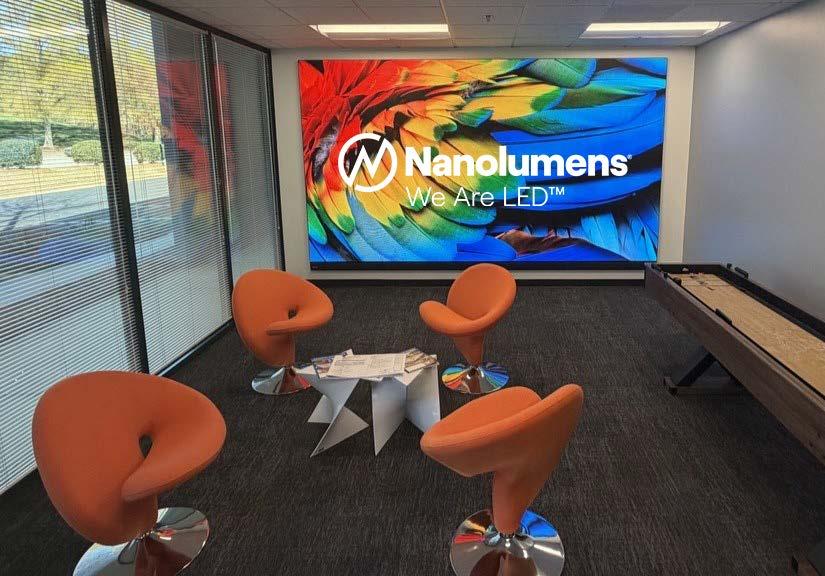
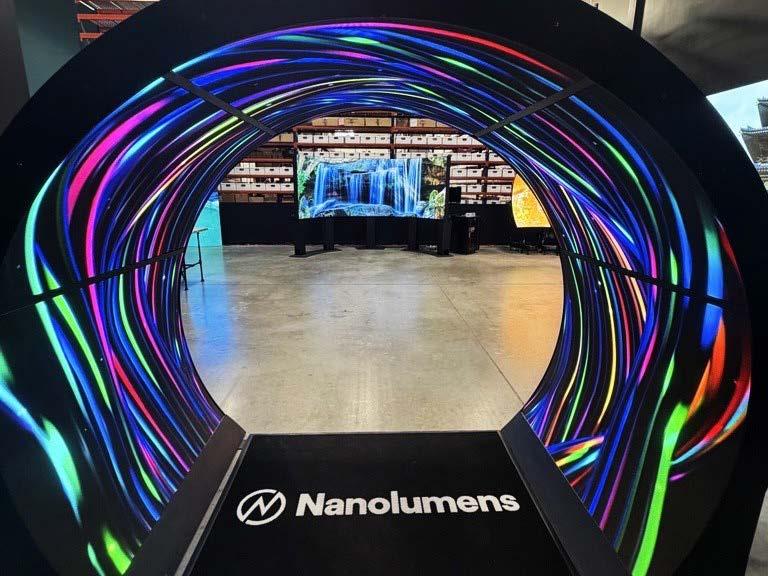
A major feature of the new headquarters is a 2,500-square-foot demonstration showroom that showcases Nanolumens’ display technologies in real-world environments. The showroom includes application-focused zones highlighting use cases such as control room environments, immersive installations and architectural display systems.
The showroom integrates technologies from ecosystem partners, including NovaStar, Barco, Megapixel, 7thSense, Pixera, and Smart Monkeys, and content from studios such as Gentilhomme, Render Impact, and Float4, highlighting how display technology,
processing platforms, and digital content work together in deployed visual environments. The integrated setup reflects Nanolumens’ approach to supporting complete visualisation systems rather than standalone display hardware.
The anniversary provides an opportunity to reflect on the company’s evolution from an early LED display pioneer to a mature organisation serving a growing global market. In its early years, Nanolumens focused on developing LED display technologies capable of supporting complex architectural installations and custom applications. As LED technology has evolved, the company has expanded its capabilities to support both customised installations and large-scale deployments across multiple industries.
“The first decade was centred around the founders’ journey, pioneering LED display technology and bringing it into new applications,” said Ney Corsino, President and Chief Executive Officer of Nanolumens.
“In the last several years, we have focused on building a foundation for sustainable growth. Opening our new headquarters during our 20th anniversary marks the beginning of the next chapter for the company.”
During the past five years, Nanolumens has tripled its market share while expanding its product and application portfolio approximately fourfold with more mainstream LED solutions.
The company has also doubled the number of markets it serves, as LED displays continue to replace legacy technologies in many environments.
Nanolumens’ innovation and industry ecosystem advancements in pixel density, image processing and reliability have enabled LED displays to support applications that previously required other visualisation technologies. These developments have contributed to broader adoption across sectors, including transportation, retail, corporate environments, and public spaces.
“We are fortunate to be in [a] strong position to help the technology evolve, facilitating its expansion in new applications,” Corsino said. “LED display performance is driving adoption, replacing existing technologies and enabling entirely new visual environments.”
Throughout its history, Nanolumens has been recognised for its ability to deliver custom LED
displays designed for complex architectural environments. At the same time, the company has expanded its ability to support multi-site deployments and standardised display systems across large organisations. The combination allows Nanolumens to serve both highly customised projects and more standardised large enterprise installations.
Nanolumens plans to celebrate its 20th anniversary throughout 2026 with additional initiatives highlighting the company’s history and future direction. As Nanolumens enters its third decade, leadership says the focus remains on expanding the possibilities of LED display technology and supporting organisations that rely on advanced visualisation environments.
Nanolumens
Ross Video and Unilumin Collaborate to Expand LED and Live Production Collaboration
at Ross Video “By working more closely with Unilumin, we can better support customers with integrated solutions that bring together LED displays, graphics, video processing, and control to power the next generation of live productions.”
The non-exclusive agreement establishes a framework for the companies to explore a range of joint initiatives across the region. These may include participating together in industry exhibitions and marketing activities, sharing market insights, recommending each other to customers, and connecting with system integrators, consultants, and other industry partners.
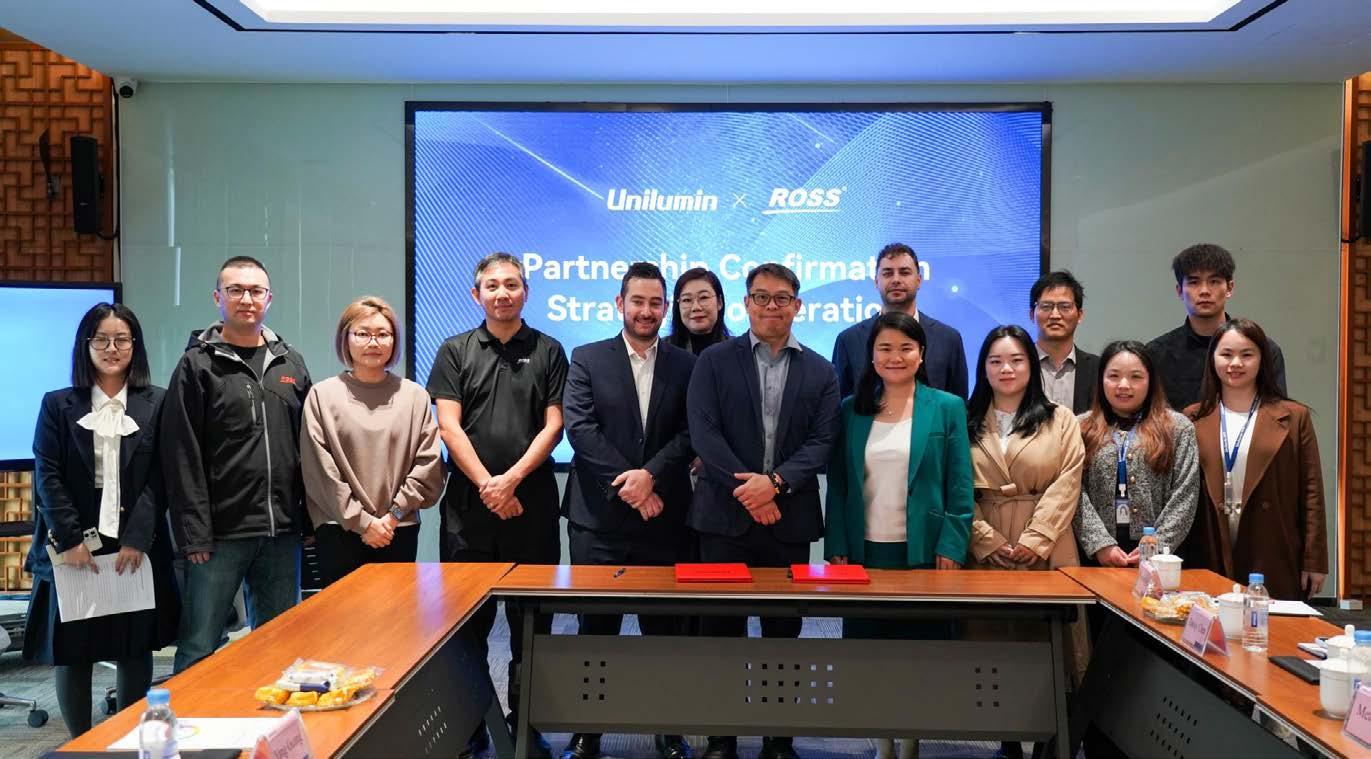
APAC: Ross Video, a global leader in live production technology, and Unilumin Group, a leading manufacturer of LED display solutions, have signed a Memorandum of Cooperation (MoC) to explore joint opportunities for collaboration across the Asia-Pacific (APAC) region, particularly in the fast-growing sports and broadcasting markets.
Across APAC, demand is growing for larger LED displays, immersive visual experiences, and more dynamic live productions. By combining Ross Video’s live production ecosystem with Unilumin’s LED display technology, the two companies aim to support sports venues, broadcasters, and live event producers looking to deliver more engaging visual experiences.
“Across APAC, we’re seeing incredible growth in sports venues, broadcast facilities, and live event environments that rely on LED displays to create immersive fan experiences,” said Travis Wigley, Senior Director of Sales, APAC
Both companies will also explore potential technical collaboration and integrations between Ross Video’s live production solutions, including real-time graphics, video processing, and production workflows, and Unilumin’s LED display technologies.
“Unilumin is committed to delivering worldclass LED display solutions that enhance visual storytelling across sports, broadcast, and entertainment venues,” said Tina Cao, Deputy General Manager at Unilumin. “Through this cooperation with Ross Video, we look forward to combining our strengths to create more innovative and seamless solutions for customers across the APAC region.”
The Memorandum of Cooperation is intended as a framework for collaboration and reflects both companies’ commitment to strengthening their presence in APAC while helping customers deliver compelling visual experiences for audiences across sports, broadcast, and live entertainment productions.
Unilumin Group
Beijing InfoComm
China 2026 Conference Lineup Presents Future of AI
and system integrators to explore solutions that are shaping the next phase of China's digital transformation. At Beijing InfoComm China, a series of forward-looking summit sessions will explore how artificial intelligence and emerging technologies are transforming the professional audiovisual industry and enterprise environments.
CHINA: With the recent ratification of China's 15th Five-Year Plan (2026-2030), the nation is accelerating 'New Quality Productive Forces' to drive digital transformation across all industries. This strategic shift creates significant momentum for the professional audiovisual (Pro AV) sector, which stands as the backbone of smart infrastructure, AI-integrated systems, and the digital economy—from LED displays and control room visualisation to collaboration platforms and immersive media.
As China moves toward its US $97.5 billion Pro AV market potential by 2028, these trends underscore the importance of Beijing InfoComm China as a key platform where global and Chinese technology leaders converge to showcase the latest Pro AV innovations. As organisations across China accelerate investments in digital infrastructure, smart learning environments, immersive entertainment, and hybrid collaboration, the event provides a timely opportunity for industry professionals, technology buyers,
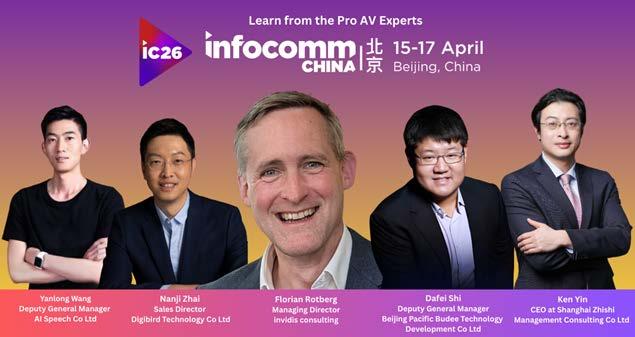
A keynote by Ken Yin, CEO of Shanghai Zhishi Management Consulting and Chief AI Lecturer at Zhongzhi Guopei, who will examine "The AI Agentic Enterprise: Architecture, Strategy and the Path to Autonomous Operations." The session will explore how organisations can deploy enterprise AI agents, outlining the architectures, operational models, and strategic frameworks required to move toward intelligent, autonomous business operations. The presentation will highlight both the opportunities and challenges organisations face as AI becomes embedded into enterprise workflows and decision-making systems.
In the session "From Signals to Intelligence: The Next Evolution of Video Control Systems," Nanji Zhai, Sales Director at Digibird Technology Co Ltd, will explore the transformation of video control technologies. The presentation will trace the full signal chain—from capture and transmission to processing and visualisation— and examine collaboration modules.
Global digital signage expert Florian Rotberg, Managing Director of invidis consulting, will present "The Pulse of Digital Signage – Global Trends, Managed Solutions & the Future of AI." This keynote will provide an international perspective on how AI, data-driven content strategies, and managed service models are redefining digital signage networks worldwide and enabling organisations to create more dynamic, intelligent, and scalable communication platforms.
Audio innovation will take centre stage in "The Art of Invisibility: How AI Reconstructs Enterprise Spatial Audio and Communication Experiences," presented by Yanlong Wang, Deputy General Manager – AI Speech Co., Ltd. The session will showcase how AI-powered audio technologies—including intelligent microphone arrays, spatial audio processing, and adaptive noise control—are transforming enterprise communication environments, delivering more natural and immersive sound experiences in meeting spaces and collaborative environments.
Rounding out the program, Dafei Shi, VP –Beijing Pacific Budee Technology Development Co. Ltd., will present "AI-Powered Spatial Intelligence: Redefining the IoT Ecosystem for AV Collaboration." The session will explore how AI-driven spatial intelligence and IoT sensing technologies are converging to create a new 'human space device' interactive ecosystem. His approach redefines the intelligent boundaries of AV collaboration, offering innovative solutions for future smart offices, remote education, and beyond.
China's Pro AV sector is at a pivotal point of transformation, fuelled by the convergence of AV, IT, and emerging technologies. This growth engine is underpinned by large-scale
digital infrastructure investment, enterprise modernisation, and strong demand across education, commercial, and public-sector verticals.
Organisers of Beijing InfoComm China have released their 25+page white paper and report titled A World of Cutting-Edge Pro-AV: China’s Pro-AV Market Overview & Opportunities The report serves as an educational guide and resource for global Pro-AV professionals, system integrators, and end-users to better understand how China is shaping the digital landscape and the opportunities to learn from and collaborate with many of its innovators.
For 20 years, Beijing InfoComm China has served as the most professional and influential platform for promoting and expanding China's global Professional Audio-Visual (Pro AV) industry. Through decades of bringing together manufacturers, solution providers, IT system integrators, and end users of Pro AV, Beijing InfoComm China has become Asia's premier Hub for Pro AV excellence. Taking place from 15-17 April 2026, at the China National Convention Centre (CNCC), the show marks the beginning of a landmark era: the 20th year of the InfoComm China brand, followed by the 20th edition of the tradeshow in 2027. From an
exhibition floor hosting over 400 companies, with over 80 companies ready to export, and welcoming over 26,000 professional visitors, to a world-class conference lineup of Pro AV industry movers & shakers, InfoComm China is where China is shaping the digital-forward future.
NETGEAR Academy Unites 12 Manufacturers on One Free Training Platform
GLOBAL: As Asia Pacific accelerates its shift toward IP-based AV infrastructure, one challenge continues to surface across enterprise, education, government and live production sectors: a widening skills gap in AVover-IP networking.
In response, NETGEAR has expanded its NETGEAR Academy into what it describes as the industry’s most comprehensive and accessible source of AV-over-IP professional education. The platform now hosts free training content from twelve leading AV and broadcast technology manufacturers, bringing collaborative learning to the forefront of industry development.
View all Beijing InfoComm China 2026 Summit Sessions
Click to learn more about the China Pro AV Market, InfoComm China and their International Visitor programs
Beijing InfoComm China
Unlike traditional manufacturer-led programs that focus solely on proprietary ecosystems, NETGEAR Academy is built around a unified, vendor-agnostic model. Training from NETGEAR sits alongside courses from industry partners, enabling integrators, IT teams and managed service providers to develop complementary knowledge across the entire AV-IT stack.
Learners can access modules covering networking fundamentals, AV-over-IP protocols, configuration, troubleshooting and real-world deployment strategies, all within a single environment.
This approach reflects a broader industry reality. As organisations migrate toward IPbased systems, the boundaries between AV and IT continue to blur. Professionals are increasingly required to understand not just individual products, but how diverse technologies interoperate in complex, multivendor deployments.
The Academy’s third-party manufacturer programme now includes courses from:
• Allen & Heath
• AVB Academy
• Crestron
• Audinate (Dante)
• Lightware
• MuxLab
• NDI
• Powersoft
• PTZOptics
• Q-SYS
• SDVoE Alliance
• Sennheiser
By consolidating these brands on one openaccess platform, NETGEAR is addressing a longstanding fragmentation in AV education. The goal is not to steer learners toward a single ecosystem, but to provide a holistic understanding of how modern AV-over-IP systems are designed, deployed and managed in practice.
The platform also carries accreditation from AVIXA, enabling learners to earn Renewal Units toward CTS and ANP certifications. This adds a formal professional development pathway to what is otherwise a free, on-demand resource.
“Asia Pacific is one of the fastest-growing markets for AV-over-IP, and the demand for skilled professionals is outpacing supply,” said Gus Marcondes, Global Training Manager at NETGEAR Enterprise. “NETGEAR Academy was built on the belief that the AV industry thrives when knowledge is shared across the entire ecosystem. By offering free training on the full AV over IP ecosystem, including a growing roster of third-party manufacturers, we’re giving integrators, IT teams, and broadcast engineers in APAC the end-to-end education they need to deploy and manage modern AV systems with confidence.”
All training is available at no cost and accessible on demand, removing financial and geographic barriers for practitioners across the region. To access the free training, visit academy.netgear.com For information and partnership enquiries, contact academy@ netgear.com
As AV and IT convergence deepens, the success of future deployments may depend less on product innovation alone and more on the industry’s ability to cultivate shared knowledge. With its expanded Academy model, NETGEAR is positioning collaboration, not competition, as the foundation for closing the skills gap.
NETGEAR
Pleneo Sets a New Governance Benchmark with ISO 42001
GLOBAL: Artificial intelligence has moved rapidly from experimental feature to embedded infrastructure within today’s meeting environments. Yet as AI capabilities accelerate across the AV and unified communications sectors, formal governance frameworks have lagged.
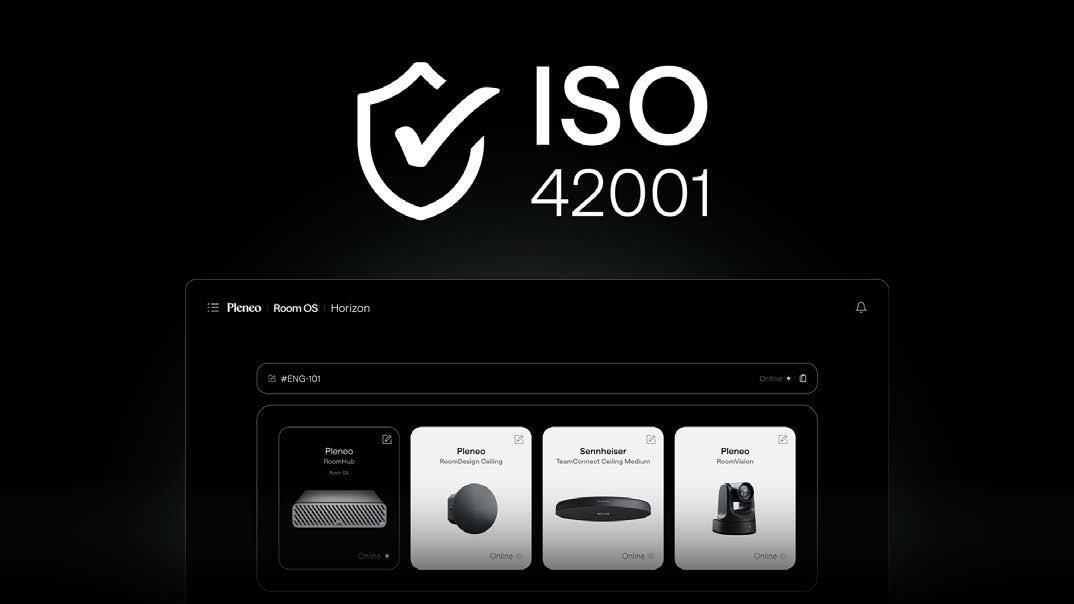
Pleneo has now become the first device manufacturer in these sectors to achieve ISO 42001 certification, the international standard for governance and security in artificial intelligence. The milestone represents more than a compliance achievement; it signals a maturation point for an industry where intelligent systems are increasingly influencing how meetings are prioritised, interpreted and experienced.
ISO 42001 establishes a structured framework for managing AI responsibly. It defines how AI-driven decisions are documented, how data is governed, how risks are assessed and mitigated, and where human oversight applies. As intelligent meeting environments become more autonomous and more deeply integrated into enterprise IT ecosystems, governance is no longer optional. It is foundational.
For Pleneo, the certification validates end-to-end oversight of the AI embedded within its Room OS platform. This includes AI AutoDeploy, AI NoiseSense, machine learning-based room enhancement and adaptive acoustic processing. Crucially, all AI computation takes place at the edge, inside Pleneo devices, rather than in the cloud.
Processing intelligence locally allows the system to adapt in real time while maintaining
data control within the physical meeting environment. By reducing reliance on external cloud infrastructure, Pleneo preserves privacy and delivers adaptive collaboration features in milliseconds rather than seconds. In an era where AI can shape user experience dynamically, the integrity and predictability of automated decision-making are becoming as important as data protection itself.
James Knight, CEO of Pleneo, frames the issue in practical terms: “Artificial intelligence shouldn’t live somewhere else; it should live where people meet. We are approaching the peak of the first major wave of AI adoption in meeting spaces. What happens next will determine whether intelligent systems become dependable infrastructure or whether uncertainty around governance slows enterprise deployment. If AI is embedded in the room, it must be explainable, controlled and accountable. ISO 42001 provides that framework, proving that innovation and responsibility can scale together.”
The certification follows Pleneo’s SOC 2 Type II and ISO 27001 accreditations earlier this year, creating a consolidated governance structure spanning security, privacy and AI management. Together, these standards position the company’s intelligent collaboration platform not as an emerging technology experiment, but as enterprise-grade infrastructure designed for long-term trust and scalability.
As AI continues to reshape unified communications, formal governance standards are likely to become a key differentiator between mature platforms and experimental implementations. The industry’s next phase will not be defined solely by how intelligent systems perform, but by how transparently and responsibly they are managed.
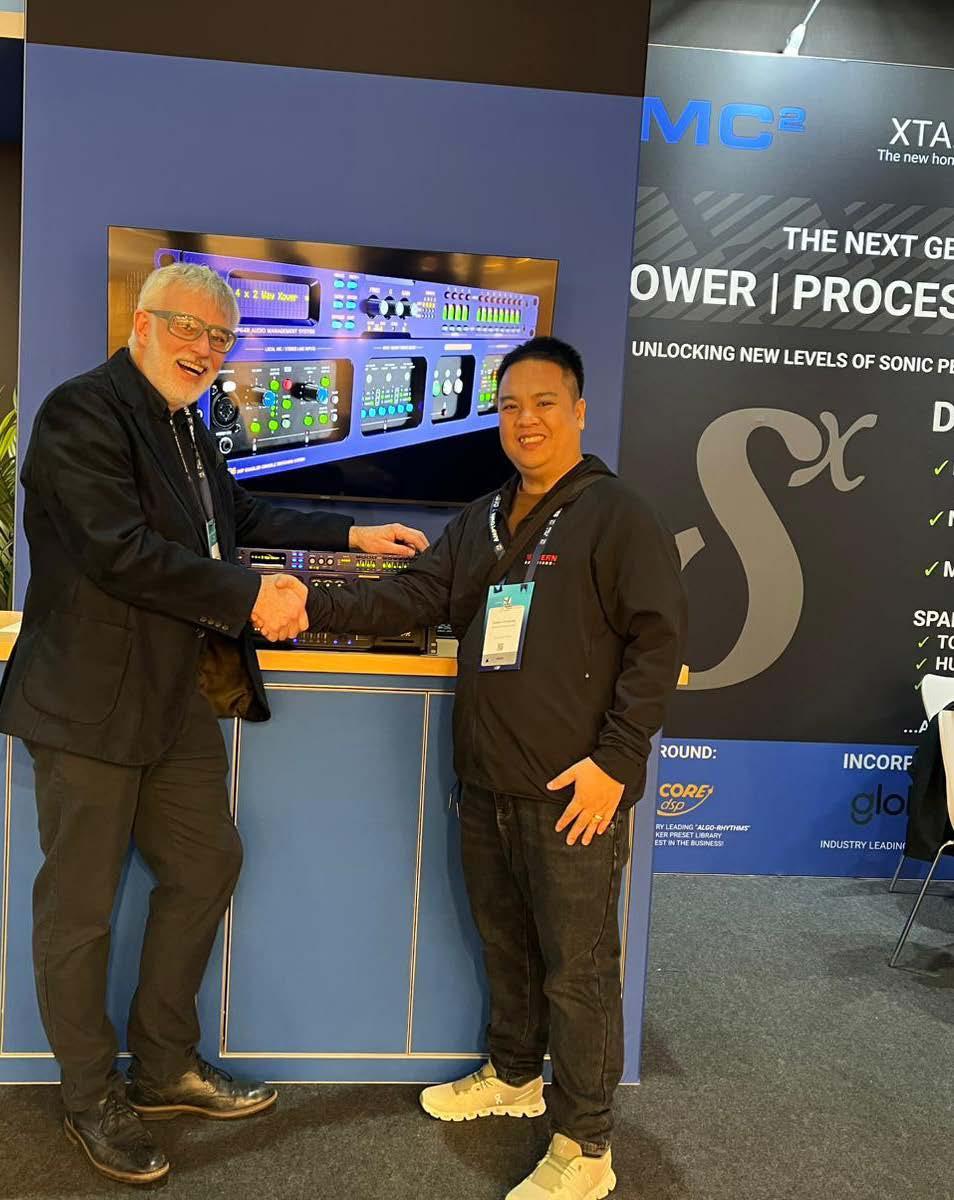
XTA/MC² Welcomes Modern Solutions Plus as New Distributor
THAILAND: UK DSP and amplifier technology manufacturing partners XTA and MC² have appointed Modern Solutions Plus https://www. modernsolutionsplus.com/mainproduct as their exclusive distributor for Thailand. Modern Solutions Plus distributes a number of leading global brands in Thailand and is a successful designer and integrator of audio systems across the country. Commenting on behalf of XTA/MC², Richard Fleming looks forward to establishing a productive relationship with Modern Solutions Plus:
“Modern Solutions Plus is a long-established, highly-regarded company with an excellent understanding of this rapidly expanding market. Its expert team combine a detailed knowledge of the products they distribute with vast experience of advising and supplying clients across the installation and touring sectors, and so are perfectly placed to represent XTA/MC² in Thailand.”
With ISO 42001 certification, Pleneo is placing governance at the centre of intelligent collaboration, reinforcing a simple but increasingly critical message: in the age of AIdriven meetings, trust is the ultimate feature.
Pleneo
Suttipun ‘Mac’ Youngnek, Founder of Modern Solutions Plus, added, “The global reputations which XTA and MC² have built over the years speaks volumes for the quality of their premium amplification products. We’re delighted to be adding the brands to our portfolio and sharing the benefits of these market-leading technologies with our customers.”
XTA/MC²
Powersoft Taps Jinfu Chen for New Southeast Asia Role
ASIA: Powersoft has announced that Jinfu Chen has been promoted to the newly created role of area sales manager, Southeast Asia (SEA), reporting to area sales manager, Asia Pacific, Arthur Soh.
Based in Singapore and travelling frequently in the region, Chen will be responsible for managing Powersoft's sales and distribution channels across SEA. He will focus on supporting distribution partners to achieve both revenue and KPIs, and driving brand awareness and long-term growth across key verticals, including hospitality, corporate, education and entertainment.
The appointment comes as the SEA region continues to experience robust economic growth, driven by resilient domestic demand, recovering tourism and strong foreign direct investment. With growth projections for the region outpacing several other major markets, Powersoft has identified SEA as a strategic priority for the business and is dedicating additional resources to support its expansion.
Chen joined Powersoft in July 2024 as business development manager, SEA – developing the company's network of distributors, dealers and system integrators alongside the brand across the region. Making full use of his extensive experience in the professional audio sector sales, along with his deep understanding of the cultural diversity and varied business practices in SEA, Chen will support closer collaboration with distribution partners and help to align Powersoft's portfolio offering with local market needs.
“Southeast Asia is a diverse and complex region, but it also presents tremendous opportunities. My focus is to work closely with our distribution partners to drive both sales and brand growth, and to develop Powersoft's presence so that it stays front of mind in the region," said Chen, commenting on his appointment. "With the industry increasingly focused on efficiency, performance and sustainability, I believe Powersoft is extremely well positioned to support partners and customers during this exciting period of growth."
Chen observed that as more consultants, system integrators and venue owners turn towards prioritising performance, features and reduced carbon footprint over pricedriven decisions, Powersoft’s technologydriven approach and Human Audio Experience philosophy are strongly resonating with the SEA market.
“As we see more countries moving towards green policies, consultants and venue owners will be required to implement solutions that help them to reach their efficiency and sustainability targets. With our DSP capabilities, auto-setup function and flexibility for control by 3rd party systems, we are in a good position to grow with consultants, system integrators and end-users who are prioritising function, features and performance,” stated Chen.
Welcoming Chen to his new role, Arthur Soh added: “There is so much potential for growth
in the SEA region, and with his strong network, industry experience and understanding of local markets, Jinfu is well positioned to help us realise our ambitions. I’m delighted to see him step into this role where he will support our valued partners to grow their businesses alongside the Powersoft brand in some of Asia Pacific’s most dynamic markets.”
Outline Enters India
INDIA: Outline has appointed Hi-Tech Audio Video Systems Pvt Ltd as its exclusive distributor for India, a market expanding at a pace that few others can match, driven by an accelerating live events scene, rapid infrastructure development across hospitality and retail, and a growing appetite for worldclass audio at every scale of production.
Founded with over two decades of hands-on expertise in professional AV distribution, HiTech Audio Video Systems Pvt Ltd brings to the partnership a PAN India network, an inhouse team of sound designers and application support specialists, and a clear strategic ambition: to become the largest AV distribution house in India within the next three years.
The company has built its reputation on technical excellence and client-centred service across both live events and fixed installationsa profile that aligns naturally with Outline's own standards and culture.
India's live event calendar - spanning international artist tours, IPL-scale productions, large-format weddings and major corporate events - increasingly calls for systems capable of delivering concert-grade performance to tens of thousands of listeners simultaneously.
Hi-Tech Audio Video Systems identifies Outline's GTO and GTO C-12 line array systems
With the creation of this new role, Powersoft demonstrates its commitment to SEA. Through Powersoft’s investment in strong partnerships and innovative, reliable products, customers in the region can expect a high-quality journey from system design to after-sales support.
Powersoft
as the natural choice for the country's largest live productions, while Superfly and Mantas 28 address the broad mid- to large-scale rental segment.
At the same time, rapid development across hospitality, retail, and cultural infrastructure is generating sustained demand for premium fixed installation solutions. Outline's P Series, A Series and H Series are well-positioned to serve luxury hotels, high-end clubs, places of worship, and the architecturally demanding venues
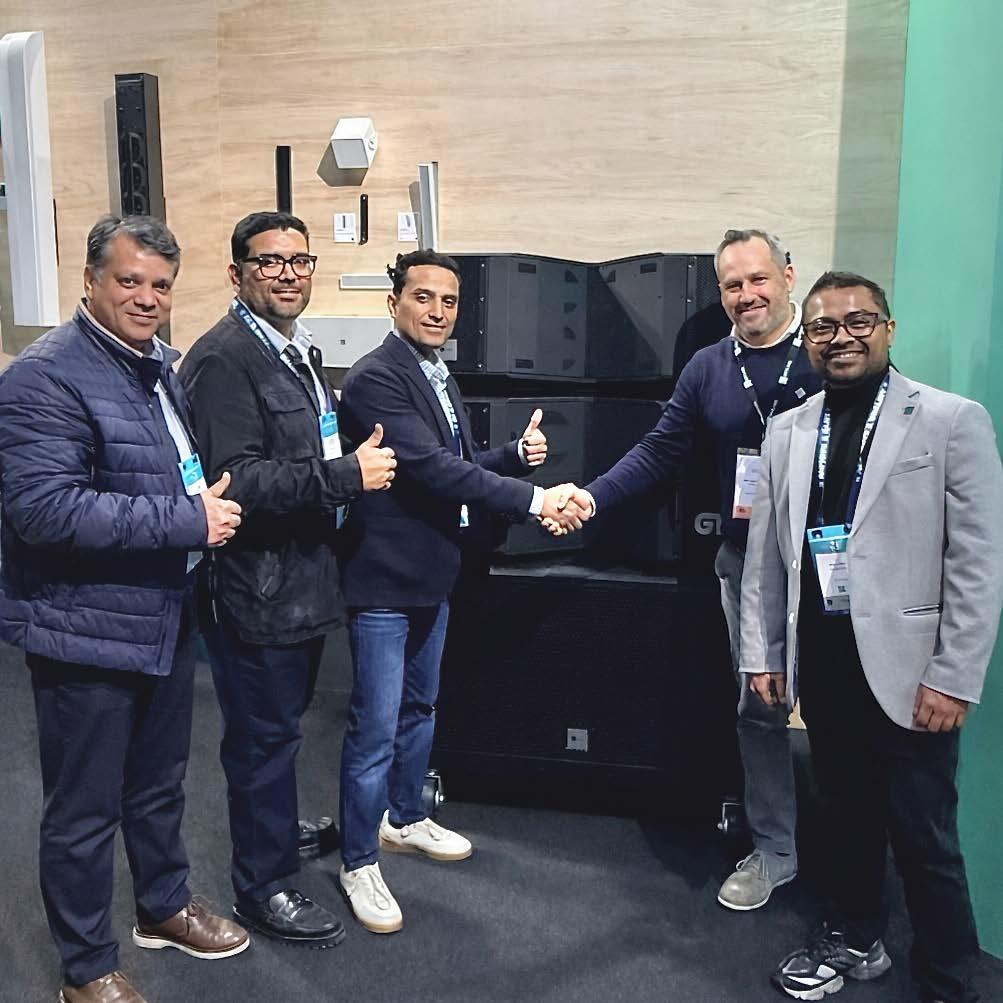
Hi-Tech Audio Video Systems' Manikk Guptha and Outline's Fernando Rey Méndez shake hands at ISE 2026; from left, Nitin Guptha and Ankit Guptha (Hi-Tech Audio Video Systems); from right, Outline's Country Manager Aritra Sarkar.
where sonic clarity and visual discretion carry equal weight.
"Outline is a brand on global riders, built for the premium segment, and capable of delivering unparalleled sonic quality at the right price points," said Manikk Guptha, Director of Hi-Tech Audio Video Systems.
"India is becoming a major hub for performances by international and Indian artists, and events of that magnitude demand not just superior sound quality but enough power and headroom to handle massive crowds. GTO and Superfly are just perfect for such applications. Their scalability, powerful output and ease of deployment make them game-changers for multi-city tours and largescale outdoor gatherings. In a country where a single tour can cross fifteen cities with different local crews at every stop, the ability to save and recall a complete system state is not a convenience - it is what keeps the show consistent from the first date to the last."
Hi-Tech Audio Video Systems is committed to providing comprehensive support to Outline users across India, including hands-on technical assistance, certified training programs and financial solutions tailored to local market
needs. Its experienced team will oversee seamless integration, maintenance and system optimisation for both end-users and rental partners throughout the country.
Aritra Sarkar, Outline's Country Manager for India, commented: "In a fast-growing market like India, we see strong opportunities across both the live sound and fixed installation segments. The appointment of Hi-Tech Audio Video Systems marks a significant step in strengthening Outline's presence in the country. Their solid reputation, proven expertise and deep understanding of the local market make them the right partner to support our expansion here - with a shared focus on delivering highquality solutions and creating long-term value."
As India's live event and installation industries continue their upward trajectory, the partnership between Outline and Hi-Tech Audio Video Systems positions both companies to serve a market whose scale and ambition are increasingly reflected in its technical standards.
Outline
When Light Becomes Living Architecture
Decoding a design discipline that determines the décor in darkness
Projection Mapping – or spatial augmented reality – as it was originally called, has fascinated humans since the time their lighting intelligence began. From Palaeolithic cave paintings that glow in light to Laterna Magika to Haunted Mansion - the first of its kind for the format. From the time Günther Schneider-Siemssen coined the term “painting with light,” using projectors to create large scale imagery on surfaces, the phenomenon went places to arrive at what the world is experiencing it today.
That the format has evolved to carve its own domain of expertise and a spatial lighting artistry of its own right, SI Asia decided to present a series of technology travels in the field as felt and visualized by Avijit Samajdar, Founder & CEO of Axis Three Dee Studio s.
The first of the four-part series seeks to present a precursor of the phenomenon, before it begins the real plunge.
People often assume projection mapping is about powerful machines throwing visuals onto architecture… and clever software bending images around buildings.
That assumption, while being convenient to arrive at, is incomplete.
In my experience as a creative designer working with projection mapping across innumerable surfaces worldwide, the craft is far more intricate. Projection mapping is not merely projecting content. It is engineering light, so that it behaves correctly when it meets matter
And that journey begins long before a projector is ever switched on!
The Designer’s First Thought is Not the Content
When I begin planning a mapping installation… the first question is rarely
about animation style or storytelling. It is rather technical- far more than the emotional connect of the narrative- What is the surface? and how will it behave when light hits it?
For, every projection surface is a living variable - irrespective of its basic nature and form factor, like:
• Stone or plaster
• Matte or glossy finish
• Black, sandstone, marble, bronze or painted facade
• Smooth plane or deeply textured geometry Each material absorbs, reflects, scatters or distorts light differently. Unless the content designer understands that single decisive behaviour… the content will sadly, never look the way it was intended.
From Architecture to Digital Geometry
Modern projection mapping no longer relies purely on manual point alignment. Today, the process often begins with precise digital capture of the physical structure . This can happen through:
• LiDAR scanning
• Photogrammetry
• Architectural CAD data
• Or full CG sculpting of the structure
The result is a 3D digital twin of the surface .
From there we create UV maps - a process borrowed from high-end CGI and visual effects. The physical building or monument is unwrapped into a digital texture map where every architectural detail and surface contour, has a precise coordinate.
Once UV mapping is established, the building becomes a virtual 3D canvas , and that allows content to interact with the geometry accurately. Windows crack open… columns rotate… sculptures breathe… the hair on a statue flutters in the breeze, the eyes open, the lips curl into a sneer or a smile. The entire facade appears to be breathing life! A WOW factor takes over as if a magical spell cast over the inmates of the environment.
The illusion becomes physically believable.
Depth… Parallax… and the Illusion of Space
Flat content rarely works well in projection mapping. Architecture demands depth ! This is where layered animation techniques become critical- which is why multiple content layers are introduced to create a truly immersive experience. The ingredients for this are:
• Foreground animation
• Mid-plane motion
• Deep background structures
• Volumetric light simulations
When these layers move at different speeds, there emerges what is technically called a parallax. In simplest terms, parallax tricks the human eye into perceiving depth on an otherwise flat projection surface.
Add to that contour lighting and geometry enhancemen t , and suddenly a flat wall begins to appear sculptural. The building or the statue ceases to being a mere surface; it begins behaving like a three-dimensional animated object.
The Light Engine… Understanding the Projector
A projection designer must never treat the projector as a generic device. Every professional projection system has its own optical personality .
Brightness can range from 10,000 lumens to beyond 50,000 lumens per unit, often combined through blending or stacking more than one to many for large-scale installations. Contrast ratios can reach from 10,000:1 to several million-to-one dynamic contrast, depending on optical architecture. However, it is important to note here that the deeper difference lies in colour behaviour.
Modern day professional projection systems are built to reproduce colour diverse standards such as:
• Rec.709 – the foundation of HD colour reproduction
• DCI-P3 – the cinema colour space
• Rec.2020 – the wide gamut standard used for modern UHD and HDR imagery
Some projection systems excel in deep warm tones, rendering golds, ambers and reds with remarkable richness while others
are astonishingly precise in the mid-range spectrum- delivering subtle greens, blues and skin tones with incredible stability.
Certain light engines produce crisp highenergy highlights… perfect for metallic surfaces or architectural edges.
The creative designer must, therefore, understand these tendencies intimately before choosing one based on preferences. For, the choice of projection system is rarely arbitrary.
More often than not, it is determined by the surface itself .
When Light Collides with Surface
It’s both interesting and intriguing too for those curious to know how a particular light beam behaves when it collides with what surface.
Consider two surfaces.
A matte black monument surface that absorbs light aggressively- here, the colours must be pushed toward higher luminance… bright blues, cyans and high-energy reds remain visible while soft pastel tones may disappear or appear too bland for the natural eye.
Now a bronze statue: Bronze reflects light unevenly and carries warm metallic undertones. If neutral white light or any colour is projected directly onto it, the bronze colour contaminates the projection. Blues become dull. Greens shift toward olive. So the content must be corrected. The palette must be customised..!
Colour channels have to be adjusted. Blue energy to be lifted; reds are to be balanced. Highlights are to be neutralised; and colour temperatures are to be tweaked.
The final projected image looks correct to the audience, even though the digital file itself might appear chromatically distorted on a monitor.
That is the hidden science of projection mapping.
Light as a Sculpting Tool
In almost all typical projection mapping cases, one of the rules of thumb is to carefully manage the brightness distribution evenly across the projection landscape. However, designers often face the challenge – the most common for many – when dealing with architectural surfaces. For, they create uneven angles of incidence for projected light. Cornices, balconies and recesses receive different amounts of illumination.
In order to compensate that, designers often build luminance correction maps, depth maps and a mbient occlusio n, apart from many other layers, into the content itself.
Certain areas are intentionally dimmed while others are brightened- with a ‘view’ to ensuring that the final visual turns into a uniform experience.
The audience might not notice these nuances, but the illusion does follow a behavioural pattern.
When Theory Meets Reality
All of the theology remains a theory, until it is tested against real-world surfaces . And, that is where projection mapping truly reveals its depth.
Here are three of my favourite examples. Monuments that not just challenged my team and me to the extreme, but rewarded us eventually, with stunning results.
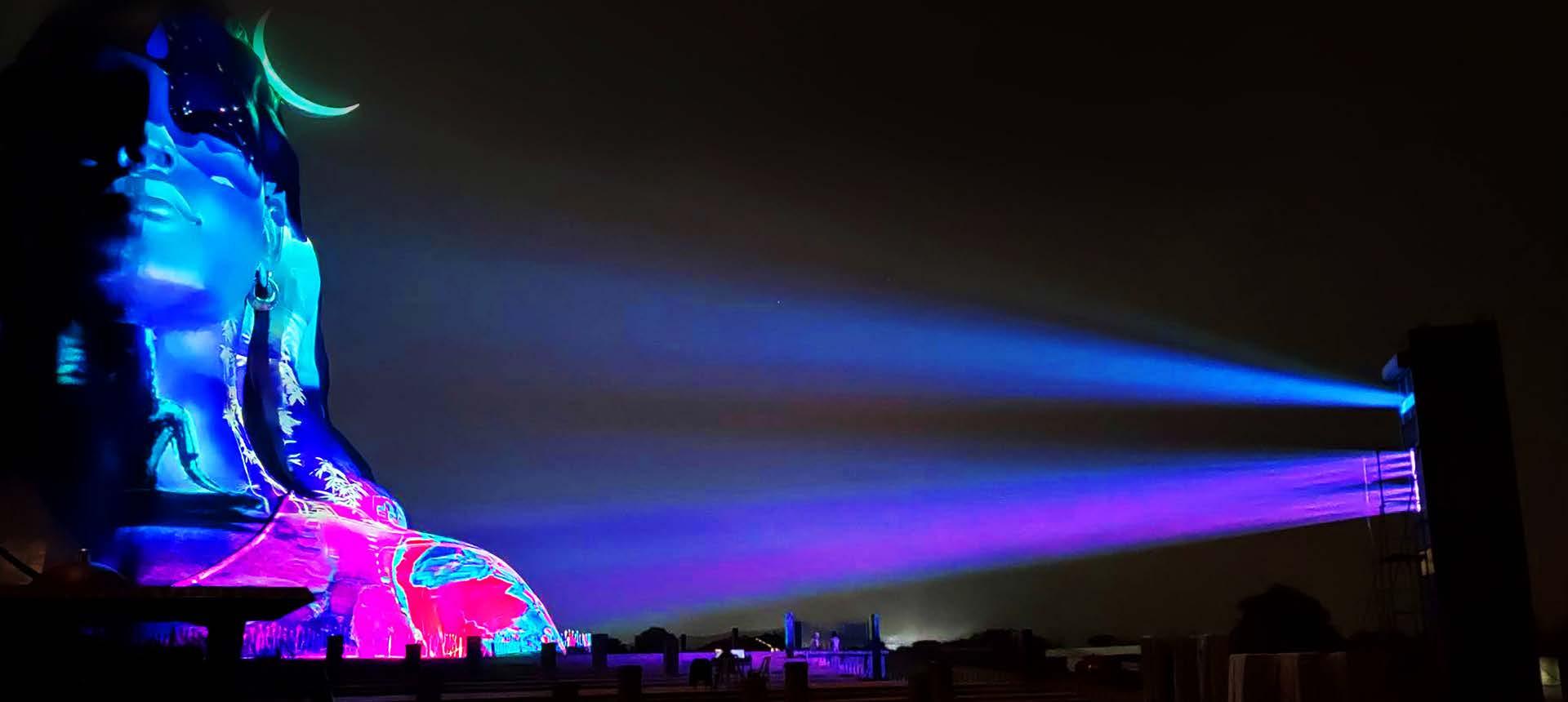
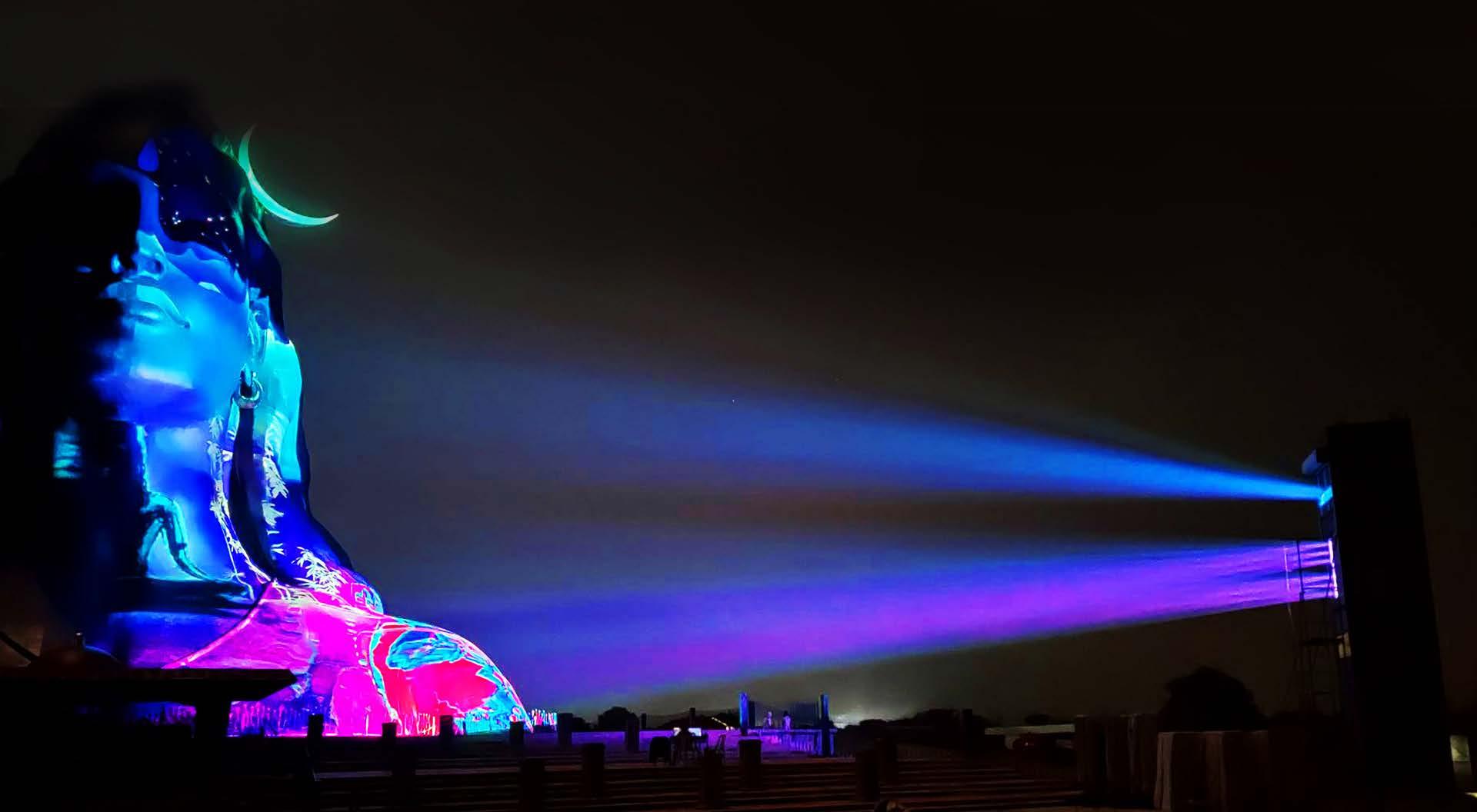
The Statue of Adiyogi - (Isha Yoga Centre, Coimbatore and Chikkaballapur)
A black, metallic, monolithic structure… the world’s tallest bust. Visually divine, though, it is, but technically unforgiving! The black surface absorbs light aggressively, while the subtle metallic sheen introduces unpredictable reflections.
Though it looks stunning especially during ambient transitions like dawn and dusk, it is a practical paradox from a projection mapping standpoint.
You need high luminance to make colours visible. But too much light renders the sheen to scatter… washing out hues… distorting intent. The spectrum, therefore, cannot be generic. It has to be surgically curated. We worked with extremely specific colour temperatures, carefully isolating usable spectral bands towards ensuring that the projected light neither overpowered the surface, nor got absorbed into oblivion.
This is where we employed a proprietary approach… RTCC or real time colour cancellation- a process designed to actively minimise surface-induced colour interference.
The outcome? Colours that appeared extraordinarily vibrant in real life, and with subtle frequency shifts, they transitioned between metallic brilliance and soft pastel tonality.
What you see as visual brilliance is not what exists in the play-back file. It is what survives, and more, creates a surreal, after negotiating with the unforgiving surface.
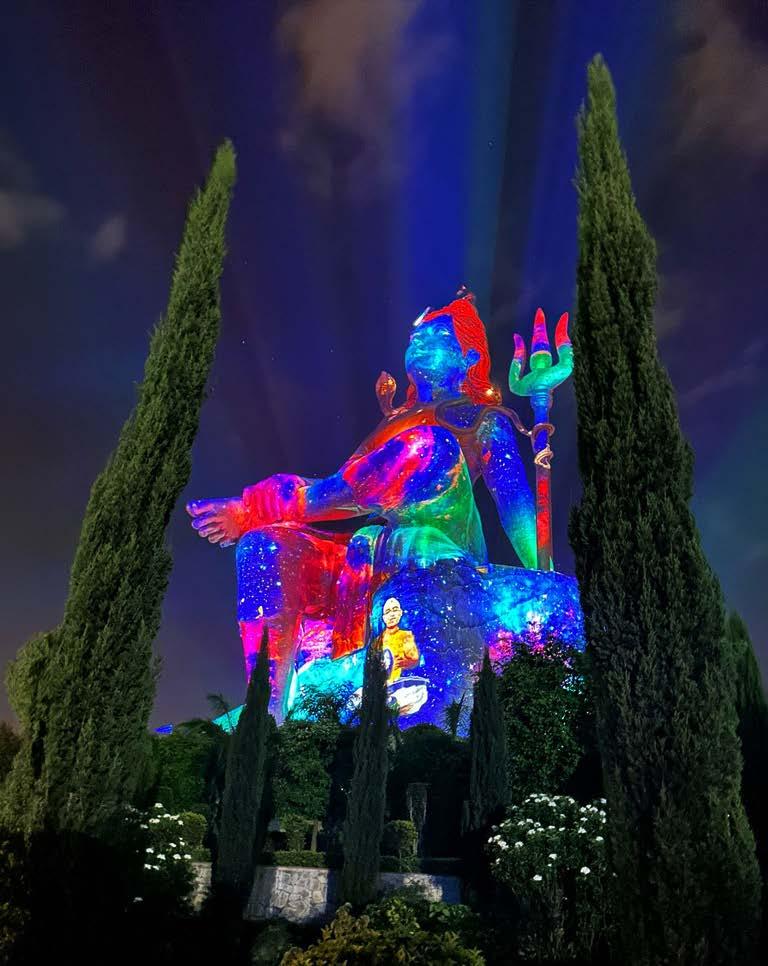
The Statue of Belief… (Vishwa Swaroopam, Nathdwara)
Now scale enters the equation. At 371 feet, this is not just a surface; rather, it is a landscape.
The relief across the structure is extreme. Multiple depths, contours, varying focal planes and more…
The Statue of Adiyogi.
This immediately introduced an optical challenge. The projection on each part of the canvas, couldn’t be of same uniformity. Projectors had to be strategically positioned and calibrated to compensate for varying focal lengths.
To add to our challenges, came the surface finish… The proverbial icing on the cake..! A burnt bronze metallic hue.
Here, colour behaved differently. Warm tones got amplified...mid-tones began to collapse... Cool tones almost disappeared- a rarest of situations where
Subtlety was no longer a luxury; it rather became a constraint- a potential challenge, so to say.
We had to engineer a highly customised colour palette- one that anticipated the surface reaction before the light even arrived. For instance, to achieve what appears as
white on the surface, we actually had to design a very specific blue-biased tone.
Because, when that blue interacts with the bronze substrate, the human eye perceives it as neutral white. Different colours and hues give different spectral results. Same goes for all the other colours one sees during the show.
Again, the RTCC played a critical role here, ensuring that scattered metallic reflections do not corrupt the intended visual output.
And once again, what exists in the digital play-back file, and what the audience experiences are two completely different realities! That’s the magic of projection mapping.
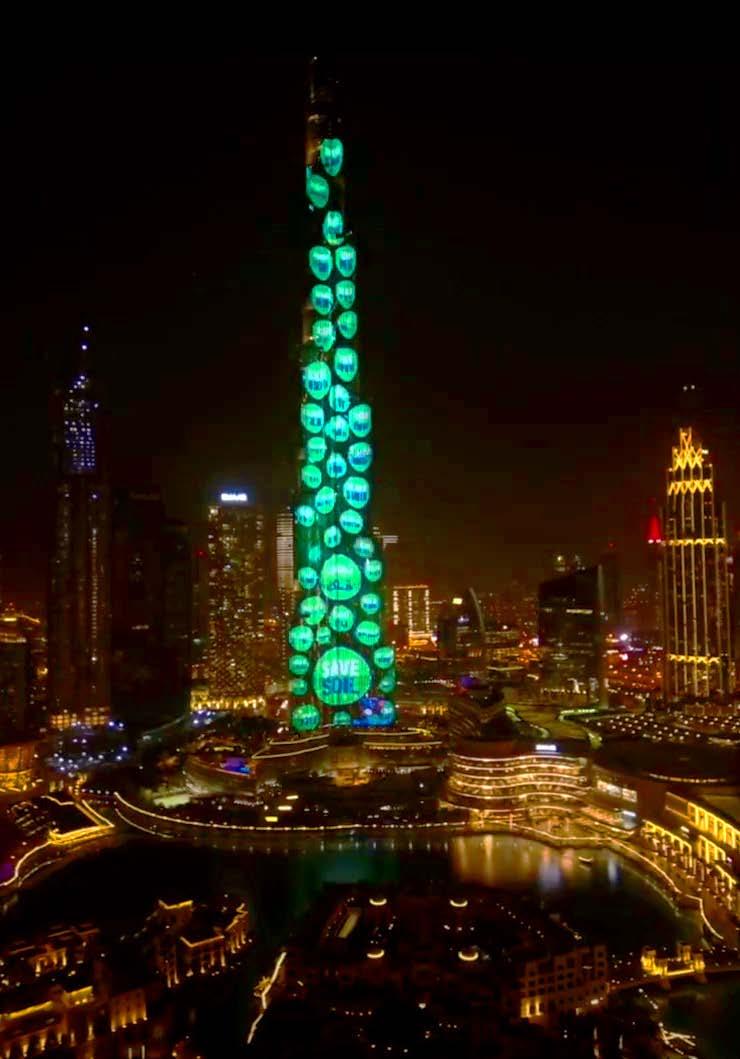
The Burj Khalifa, Dubai
Now, here is a an entire paradigm shift. This time, no projection. Just LED architecture.
Over 1.2 million LEDs, spanning approximately 33,000 square metres, across an 828-metre vertical canvas.
This is not mapping. This is pixel architecture at an urban scale . And the challenge here is not colour interaction with surface materials… It is geometry, proportion, and sheer visual intuition.
Imagine designing visuals on the surface of a pencil… That is the aspect ratio! Extremely tall… extremely narrow… technically unforgiving.
When, we worked on content for the Save Soil campaign , the challenge was not chromatic accuracy. It was geometric integrity . We had to prioritise ensuring, that visuals do not appear stretched, skewed, or visually disjointed across such a vertical expanse.
Every element, therefore, had to respect:
• Extreme aspect ratios
• Vertical continuity
• Viewing distances from multiple urban vantage points
At this scale, even a minor distortion could become massively visible. This is where the craft shifted from colour science… to pure geometric discipline!
And this is where projection mapping or largescale visual engineering transcends tools and technology. Whether it is black metal, burnt bronze, or a skyscraper of light- the goal remains unchanged.
To make the impossible look effortless! And the complex feel inevitable!
But ultimately all of these tools exist for one reason- to create a spectacle of immersive visual outputs!
Technology is never the goal; it is just an instrument, a means to achieve that singular selfish end, of creating awe-inspiring visual magic!
As designers, we orchestrate light, colour, geometry and motion, until architecture stops behaving like stone and metal, and begins behaving like fluid. In motion. In continuance, and in accordance with the demands of the script. And, when that moment arrives, the audience just do not get into the technology employed; they simply watch the monument come alive, speak to them, communicates with their aural and visual sensory elements.
Which… for those of us who design these experiences… is exactly the outcome we strive for.
Avijit Samajdar is the Founder & CEO of Axis Three Dee Studios an internationally acclaimed creative technologist and projection designer, behind many best known and prestigious Indian and global immersive projects. A polyglot, and an avid musical enthusiast, Avijit integrates optics, colour science in visuals, and concepts like Schumann resonances in soundtransforming architecture into living, breathing, immersive narratives of audio visual experiences. He can be contacted at avijit@axis3dstudio.com
The Burj Khalifa, Dubai.
NEXT-proaudio Targets Versatile Pro Audio Applications with New SP8
NEXT-proaudio has introduced the SP8, a new active high-output, full-range 2-way point source system designed to deliver powerful performance, extended low-frequency response and clear, articulate vocals across a broad range of professional applications.
Built for both portable and installed use, the SP8 combines advanced acoustic design with high-power amplification and integrated network control, positioning it as a versatile solution for everything from corporate events and theatres to nightclubs, live performances and small festivals.
At the heart of the system are two 8-inch longexcursion neodymium transducers handling the low and mid frequencies. Band-pass loaded in a dipole configuration, the drivers use dual voice coil technology to extend bass response, reduce even-order distortion and improve
thermal performance. According to NEXTproaudio, this allows the SP8 to deliver up to 20% more acoustic output under sustained high-power operation.
High frequencies are reproduced by a 1.4inch exit neodymium compression driver with a 3-inch voice coil, designed to provide smooth, detailed top-end performance. The loudspeaker also adopts the same externally rotatable waveguide design found in the SP12, giving users greater flexibility when adapting coverage to different deployment scenarios.
Powering the system is a 2-channel Class D amplifier delivering 3500W peak, paired with a 96kHz DSP platform that is fully controllable via the company’s X-NET software.
The X-NET ecosystem provides real-time monitoring and intuitive control of connected loudspeakers, including automatic device mapping. Users can access detailed processing functions such as individual EQ, level, phase and delay adjustments, alongside unlimited group creation. The system also features automatic fallback between analogue and digital inputs to help ensure operational reliability.
Designed as a flexible reinforcement tool, the SP8 is aimed at a wide range of professional use cases, including concert halls, sports venues, mobile DJ setups, side-fill applications and rental deployments where compact size and high output are both priorities.
NEXT-proaudio/SP8
DPA Microphones Elevates 4097 Micro Shotgun with CORE+ Technology
DPA Microphones is expanding its CORE+ range with the launch of the 4097 CORE+ Micro Shotgun, bringing greater clarity, headroom and sonic transparency to speech-focused applications across conferencing, houses of worship, broadcast and film. The new microphone will make its debut at NAB 2026 (Booth C4428). Designed for environments where intelligibility is critical, the 4097 CORE+ builds on the established performance of the original 4097 while integrating DPA’s latest patent-pending CORE+ technology. The innovation is engineered to minimise distortion across the microphone’s full dynamic range, reducing the non-linearities typically introduced by microphone membranes and electronics to deliver a more natural, transparent sound.
The result is cleaner spoken-word reproduction, improved headroom and greater tonal consistency, whether capturing subtle speech, dynamic presentations or vocal performances in acoustically challenging spaces.
Aimed at conference venues, worship spaces and professional production environments, the 4097 CORE+ features a tight supercardioid pickup pattern for strong off-axis rejection, helping reduce ambient noise and feedback in complex acoustic settings. It also retains the compact, lightweight form factor of its predecessor, allowing discreet placement
and precise aiming with minimal visual impact.
Beyond the acoustic upgrade, DPA has refreshed the microphone’s physical design with a simplified foam shape, flock finish, upgraded gooseneck and an improved shock mount to reduce both structural and cable-borne interference. The 4097 CORE+ can also be used in the 4097 Interview Kit configuration, offering a practical booming solution for solo film crews.
For choir applications, the microphone will also be available as part of a forthcoming dedicated choir miking solution, complete with a preassembled mic stand that folds neatly into its storage compartment. Like other microphones in the CORE+ family, the 4097 CORE+ features DPA’s MicroLock connector, designed for rugged, dependable performance in live and installed environments. The rotatable, nonreflective connector also supports discreet deployment, while backwards compatibility with MicroDot-equipped devices helps simplify integration into existing setups. Support for a range of phantom power voltages further broadens its suitability for both studio and location workflows.
Alongside the microphone itself, DPA has also developed a newly reimagined Gooseneck Mount (G-MOUNT), designed to improve stability, vibration isolation and ease of use across a wider range of applications. The new mount features a two-step locking mechanism for one-handed placement and remains backwards compatible with many existing DPA clips, with select clip designs also refined for improved usability and acoustic performance.
Biamp Releases MPX 250 Firmware
1.2.1 for Faster Connections and Smarter Control
Modern collaboration environments demand technology that works instantly and intuitively. With the release of MPX 250 Firmware
1.2.1, Biamp has introduced a series of enhancements designed to make device connections faster, system behaviour clearer, and deployments more reliable across today's meeting spaces.
This update brings new administrative controls that help simplify the user experience in shared environments. Administrators can now lock the active button when a port is in use and automatically disable buttons for ports that aren’t connected. These improvements reduce user confusion and make the system’s behaviour more predictable, particularly in busy meeting rooms where multiple users may interact with the device.
Firmware 1.2.1 also introduces more flexible power management. Administrators can now choose between “Fair Share” and “First Come, First Served” power balancing modes, allowing systems to distribute power more effectively based on the needs of connected devices.
USB management has also been expanded with new configuration options that provide greater control over how devices interact with the system. Administrators can assign USB-C port roles and configure the system to automatically disable USB passthrough when no port is active. These capabilities help optimise performance and improve compatibility across a wider range of laptops and peripherals.
Beyond these new features, the release delivers several important performance and reliability improvements. Daisy-chain communication and automatic switching are now more reliable in multi-device deployments, while video and USB stability have been improved across popular collaboration platforms.
Laptop-to-display connections are also faster, with video setup sequences up to 30% quicker, and compatibility with Apple MacBook systems has been further enhanced, along with improved USB-C charging support. Additional refinements improve over-the-air firmware updates, communication with the MPX Management Console, and overall system stability.
Alongside the firmware release, MPX Management Console 1.2 introduces support for the new device settings along with improvements to device setup communication, firmware update visibility, and login and configuration workflows. The updated console is compatible with both MPX 250 and MPX 200, providing administrators with a clearer and more efficient management experience.
Both updates are available now. Read the release notes here
Biamp/MPX 250 Firmware 1.2.1
Uniguest Launches Interactive Multiview Feature
Uniguest has launched Interactive Multiview. Designed for high-performance environments, Interactive Multiview enables organisations to display up to four simultaneous live video or TV streams in a 2×2 layout, with full remotecontrol interactivity to select, prioritise and switch content instantly.
Powered by BrightSign XT5 hardware, the feature allows users to toggle between quadview and full-screen mode, select specific audio feeds, and maintain complete control over their viewing experience.
Interactive Multiview has been developed to address the growing demand for flexible, real-
time content monitoring and engagement across enterprise estates. In sports venues, it enables fans and operators to switch between camera angles or concurrent matches. In corporate and banking environments, traders and executives can monitor multiple live news or market feeds and instantly focus
on breaking developments. For conferences, training centres and command operations, moderators can oversee multiple breakout sessions or operational streams without losing situational awareness.
Unlike traditional multi-source display setups that require external video processing hardware, Interactive Multiview is delivered directly through Uniguest’s Tripleplay platform, simplifying deployment and reducing infrastructure complexity.
Interactive Multiview is available as part of the Tripleplay 26.1 release and enhances Uniguest Hub solutions serving sports, enterprise and event environments.
Uniguest/Interactive Multiview
Audinate’s Dante Director Professional Brings Enterprise AV Networks Under One Roof
Audinate, the creator of the Dante audio networking platform, has unveiled Dante Director Professional, a SaaS solution designed to simplify enterprise-scale AV network management. Whether overseeing 50 devices or thousands spread across campuses and global offices, Dante Director Professional lets teams monitor system health, diagnose issues remotely, and ensure network reliability without being on-site.
A Single Platform for Complete AV Oversight
Dante Director Professional delivers enterprisegrade management with features built for large, distributed installations:
• Remote Management – Real-time dashboards show device health, network performance, and system status so teams can act before issues impact users.
• Enhanced Security – Single Sign-On and rolebased access ensure only authorised personnel can make changes, protecting AV signals from unauthorised routing.
• Scalability – Supports networks from small multi-room setups to thousands of devices across multiple sites.
• System Integration – APIs and webhooks connect to IT ticketing and monitoring platforms for faster incident response.
• Extended Data Retention – Logs and latency graphs allow teams to troubleshoot intermittent issues that might otherwise go unnoticed.
Early adopters of Dante Director Professional are seeing significant efficiency gains and tighter control over their AV networks. At Rutgers University – New Brunswick, the platform has become an essential tool for managing nearly 300 classrooms across four campuses, enabling remote monitoring and troubleshooting that would have previously required on-site visits.
Spotify's global offices are benefitting similarly, with IT and AV teams able to oversee and maintain thousands of Dante devices across multiple locations without relying on on-site
staff. By providing centralised oversight, proactive monitoring, and robust data retention, Dante Director Professional helps organisations of all sizes maintain reliable, secure, and high-performing AV systems.
Dante Director Professional is available now with optional support for deployment and onboarding. Organisations can start a free trial by clicking the link below.
Audinate/Dante Director Professional
ATEN Debuts Industry-First KVM over IP with USB 3.2 and Secure VM Access
ATEN International has announced a major advancement for remote control room infrastructure with the KX9980 5K DisplayPort Dual Display KVM over IP Extender.
The latest update introduces industry-first KVM over IP with USB 3.2 support and secure VM enablement through KVM-based IT/OT network separation, delivering both high-performance remote connectivity and hardware-level operational security.
Designed for mission-critical environments, from broadcast and network operations centres (NOCs) to industrial control, energy, transportation, medical imaging, and traffic management, the KX9980 enables operators to manage complex systems remotely while maintaining the responsiveness and reliability of a local workstation.
The KX9980 marks a breakthrough in remote device connectivity by integrating USB 3.2 support into a KVM over IP platform.
This enables operators to access and control high-bandwidth USB peripherals, such as storage drives and capture devices, to specialised industrial equipment, all over an IP connection with near-local performance. The result is real-time responsiveness and fast data transfer, allowing remote teams to maintain efficient workflows even across distributed environments.
For industries handling large datasets or latency-sensitive tasks, this capability brings remote operations closer than ever to the experience of working directly on-site.
High-Speed Remote Access with USB 3.2
Secure Virtualisation with Hardware-Based IT/ OT Separation
Beyond high-performance remote access, the KX9980 introduces VM support through a KVMbased IT/OT network separation architecture, a first in the industry.
The receiver features a dedicated local PC console that allows operators to interact with both physical servers and virtualised systems while keeping operational technology (OT) infrastructure strictly isolated from IT networks.
By enforcing separation at the hardware level, the system helps safeguard critical operations against cybersecurity threats and network failures, ensuring continuous availability even if the IT network experiences downtime or a security breach.
Key Features: ATEN KX9980 5K DisplayPort Dual Display KVM over IP Extender
• Industry-First KVM over IP with USB 3.2
• Enables high-speed peripheral access and real-time responsiveness for remote operations.
• VM Support via KVM-Based IT/OT Network Separation
• Dedicated local console allows access to virtualised environments while keeping OT systems fully isolated through hardware-level separation.
• Pixel-Perfect 5K Visualisation
• Supports 5K60Hz (4:4:4) with 12-bit deep colour, delivering exceptional image clarity and colour accuracy.
• Ultra-High Frame Rate Support
• Up to 240Hz at 1080p or 144Hz at 1440p for smooth video playback in broadcasting and high-performance monitoring environments.
• Built-In Redundancy and Collaboration Tools
• Network and power redundancy ensure continuous operation, while Panel Array™ Mode and Video Wall integration support collaborative monitoring across control rooms.
ATEN/ATEN KX9980
Nebra 2 Turns Every Meyer Sound System into One Seamless Command Centre
Meyer Sound’s Nebra™ 2 is a game-changing software upgrade that transforms its ecosystem into a single, intuitive control hub. Free to download Nebra 2 combines a redesigned interface with powerful tools, evolving the legacy Compass platform into a future-ready workflow engine for 2026 and beyond.
With Nebra 2, users can now manage Galileo® GALAXY processors and GEN-1 networked loudspeakers directly from one interface. EQ, levels, delay, phase, and system monitoring all live in a single workspace, eliminating the need to juggle multiple applications.
From compact tours to stadium-sized shows, Nebra 2 adapts to every setup. Advanced tagging, search, and filtering keep even the largest systems organised. It integrates with
GALAXY processors, GEN-1 loudspeakers, MEP and RMS systems, MPS power supplies, and Milan-certified products, supporting analogue, AES67, and Milan AVB protocols.
A green checkmark summarises system health in real time, while Show Mode locks critical controls during live performances, giving crews confidence and clarity under pressure. Expanded snapshot and clock management features round out the platform.
While Compass will remain supported, all future development is focused on Nebra, which represents Meyer Sound’s vision of a connected, streamlined software ecosystem. Nebra 2 is now available as a free download.
Meyer Sound/ Nebra 2
Extron Introduces Compact 4K/60 Matrix Switcher
Extron’s new DTP3 CrossPoint 42 USB is a compact 4×2 matrix switcher that supports 10 Gbps data at the local USB-C® host port and four-port hub, plus host switching and USB 2 data extension. It features USB-C and HDMI inputs, HDMI outputs, plus a DTP3 output for extending video, audio, data, and control signals up to 330 feet (100 meters) over a shielded CAT 6A cable. Additional advanced capabilities include 100-watt USB-C charging, audio de-embedding, seamless transition effects, and logo keying. Loaded with these features and more, the DTP3 CrossPoint 42 USB is built for collaboration, delivering fast and reliable AV switching in professional environments.
The DTP3 CrossPoint 42 USB provides extensive USB data capabilities to support UC collaboration environments. Up to three 10Gbps USB hosts may be switched to share devices and connect to the local 4-port USB hub, which features two USB 10Gbps and two USB 2 HighSpeed connections. The switcher can also access remote USB devices connected to a DTP3 R 331 receiver. This enables cameras, microphones, mice, and keyboards installed in the room to be available to any connected USB host.
Extron/ DTP3 CrossPoint 42 USB
Meyer Sound Introduces TIGRA Line Array and 1800-LFC Subwoofer
Meyer Sound is expanding its next generation of self-powered professional loudspeakers with the introduction of the TIGRA™ line array loudspeaker and the 1800-LFC™ low-frequency control element. Together they bring tourclass performance, GEN-1 intelligent onboard signal processing, Milan connectivity, and broad deployment flexibility into compact form factors—making big-system capabilities accessible for a greater range of productions and venues.
TIGRA and 1800-LFC occupy a key position in Meyer Sound's portfolio: They bring the proven linearity and high output of the PANTHER™ large-format linear array loudspeaker and 2100LFC™ low-frequency control element to smaller, lighter form factors designed for medium to large-scale system applications. This new tier offers the performance and deployment flexibility required for venues such as
performing arts centres, music venues, houses of worship, and corporate environments—and integrates seamlessly into larger Meyer Sound systems.
Maximising use is essential for both rental providers and venue operators. When one PA can serve club dates, mid-sized touring, outdoor festivals, and long-term installs, utilisation goes up, and capital works harder. TIGRA and 1800LFC were engineered specifically for that reality.
Maximum SPL
TIGRA-L produces 146dB maximum SPL (140.5dB AES75 maximum linear SPL) from a compact enclosure, maintaining controlled, articulate sound even at close audience proximity. In addition, TIGRA arrays exhibit the same controlled cardioid low-frequency pattern that users of PANTHER already
experience. 1800-LFC builds on the lowfrequency performance advances established with 2100-LFC, delivering comparable response and dynamic range in a compact footprint. It delivers an operating range of 30 Hz to 125 Hz and a 134dB AES75 maximum linear SPL with the consistency designers need for scalable systems in theatres and medium-size arenas.
GEN-1 Technology Inside
Both products launch with Meyer Sound's GEN1 technology, a unified platform that integrates signal processing, control, networking, and a dedicated Galileo® GALAXY output channel directly into the loudspeaker. They support fully redundant Milan AVB networking as well as analogue inputs, with the flexibility to combine both in hybrid signal paths.
With processing integrated into the speaker, systems become more efficient and flexible, removing the need for external processing and reducing the need for supporting racks. Crews can configure PAs for fast analogue deployments or add networking for control and audio with integrated failover options—all using the same hardware.
The practical advantages of this approach are already reflected in real-world deployments. Performing arts centres, music venues, sports arenas, corporate environments, and worship spaces are among the first projects.
A Unified Ecosystem
TIGRA and 1800-LFC continue Meyer Sound’s strategic trajectory toward a unified ecosystem of intelligent loudspeakers—products designed to work seamlessly together with consistent performance and a common control and workflow approach across applications. That integration ensures predictable sonic results across systems of different scales, from compact arrays to the largest deployments.
As of January 1, 2026, all Meyer Sound products now include an industry-leading eightyear warranty. This extended coverage reflects Meyer Sound’s confidence in the engineering, craftsmanship, and long-term performance of these solutions and a commitment to supporting every system throughout its working life.
Meyer Sound/TIGRA and 1800-LFC
RCF Targets Smarter Installed Audio with Flexible KPS Series DSP Amplifiers
RCF is sharpening its focus on the installed sound market with the launch of its KPS Series, a new line of Class-D multichannel DSP amplifiers engineered for the demands of modern professional audio installations.
Positioned for use across conference centres, corporate environments, retail spaces, theme parks, museums, and other complex venues, the KPS Series is built around a simple promise: maximum flexibility without compromising performance. Available in 2-, 4-, and 8-channel configurations, the amplifiers deliver either 160W or 800W per channel, with support for both low-impedance and high-impedance systems, giving integrators greater freedom across a broad range of applications.
At the heart of the range is the KPS 16X Series, which RCF says offers class-leading power density in a compact 1U half-rack format. The unit packs four independent 160W RMS channels and introduces an intelligent powersharing architecture that allows up to 300W
to be dynamically reassigned to any single channel. This enables installers to distribute power asymmetrically across outputs without resorting to bridge mode or reducing available channel count. This provides a practical advantage when optimising headroom in realworld loudspeaker deployments.
RCF is also placing strong emphasis on audio quality and efficiency. The KPS Series uses a full-bandwidth pulse-width modulation Class-D output stage capable of reproducing the full 20Hz–20kHz range with minimal phase shift. Combined with high-speed switching and realtime global feedback, the design keeps total harmonic distortion below 0.05%, helping to deliver clean, wideband audio while maintaining low heat output in a lightweight chassis. For integrators working across international projects, the KPS range is designed with global deployment in mind. A universal regulated switch-mode power supply with Power Factor Correction automatically adapts to mains voltages from 100V to 240V, while
comprehensive onboard protection covers short circuits, DC offsets, high-frequency faults, undervoltage, thermal issues, and overload conditions.
Connectivity and control are equally central to the KPS proposition. Alongside balanced and unbalanced analogue inputs, the amplifiers include S/PDIF digital input with pass-through for building a shared audio bus across multiple units. Every model is also available with integrated Audinate Dante audio-over-IP, enabling bidirectional, low-latency, lossless multichannel transport over standard Ethernet networks. This positions the platform for straightforward integration into wider control ecosystems such as Q-SYS, AMX, Crestron, and Control4.
Supporting the hardware is RCF’s broader control ecosystem. The RC KPS wall controller adds networked, PoE-based source selection and volume control for multi-zone applications, with support for up to eight controllers per amplifier and flexible zone assignment via
RDSpace. Available in EU and US form factors, the controller is designed to combine discreet aesthetics with practical functionality for commercial installations.
Meanwhile, RDSpace serves as the software backbone of the system, giving operators a single interface for routing, zoning, output optimisation, speaker calibration, monitoring, and full device control. From smaller venues to large multi-zone networks, the platform is intended to simplify commissioning and day-today management, while also providing access to advanced tools such as linear-phase FIR filtering, parametric EQ, delay, and factory-tuned RCF loudspeaker presets.
With scalable channel counts, integrated DSP, optional Dante, and a control platform designed for centralised management, the KPS Series signals RCF’s intent to offer a more complete and adaptable amplifier solution for today’s installed AV projects.
RCF/KPS Series
Alfatron Electronics Unveils All-in-One
4K Video Soundbar for Smarter Meeting Spaces
As organisations continue refining their hybrid collaboration strategies, the demand for streamlined, high-performance meeting room technology is growing. In response, Alfatron Electronics has introduced the VB100 Video Soundbar, an integrated solution designed to transform medium-sized meeting rooms into fully functional video collaboration environments.
Combining a 4K Ultra-HD camera, microphone array and loudspeaker in a single device, the
VB100 aims to simplify deployment without compromising performance. The integrated camera features AI-powered face tracking and an ultra-wide 120-degree field of view, ensuring all participants remain visible and engaged throughout the meeting.
To support clear communication, the VB100 incorporates a built-in microphone array with up to five metres of voice pickup range. For rooms requiring greater flexibility or alternative layouts, optional microphone solutions are
available, including the ALF-MIC100W wireless system with four microphones and the ALFMIC100 wired microphone. When deployed, these external microphones override the unit’s internal array, providing integrators with additional configuration options.
A key differentiator lies in the VB100’s intelligent camera modes. Speaker Tracking follows the active presenter in real time, while Auto Framing automatically adjusts the image to focus tightly on participants within larger spaces. Auto Tiling, meanwhile, can display up to six participants in individual windows, creating a more structured and inclusive visual experience for remote attendees.
Audio performance is equally central to the system’s design. The built-in loudspeaker is engineered for clear, natural voice reproduction, supported by Smart DSP processing that includes Acoustic Echo Cancellation, Automatic Noise Cancellation and Automatic Gain Control. These technologies work together to minimise
room reflections, suppress background noise and maintain consistent speech levels, even in acoustically challenging environments.
With its all-in-one architecture and feature-rich design, the VB100 reflects a broader industry shift toward integrated collaboration devices that reduce system complexity while enhancing user experience. For corporate environments seeking to upgrade medium-sized meeting rooms without deploying multiple discrete components, Alfatron’s latest offering positions itself as a practical and performance-driven alternative.
Alfatron/VB100
Pang Yee Loy: Strategizing AVIXA’s Engagement in APAC
Pang Yee Loy has been appointed Senior Director, Asia Pacific, by AVIXA’s Global Industry Engagement team, and is based in Singapore. Bringing over two decades of experience across the audiovisual, unified communications, and telecommunications sectors, he offers deep regional insight and a proven leadership track record.
SI Asia catches up with Pang Yee Loy to discuss his priorities and vision for the APAC market in his new role.
What are your immediate priorities as Senior Director for Asia Pacific at AVIXA?
My immediate priority is to support the rapid pace of adoption and innovation across the region, particularly in high-growth markets like India, where we forecast a 5.76% CAGR through 2030. We are focusing on solution areas such as Broadcast AV, Conferencing and Collaboration, and Learning solutions
I am also prioritizing workforce development and broadening the reach of our Certified Technology Specialist™ (CTS®) program to ensure more AV professionals gain access to globally recognized credentials. At the same time, another area that we are trying to address the AV professional talent squeeze currently impacting mature hubs like Singapore and Australia.
My strategy focuses on three key pillars:
* Talent Development & Workforce
Pipeline: We are moving beyond basic training to offer a comprehensive "lifecycle" of professional development. This includes expanding access to CTS, CTS-D, and CTS-I certifications to help professionals prove their specialized expertise and gain a 'foot-in-thedoor' at large, competitive organizations.
* New Market Expansion (Japan & Korea): A major priority is to expand AVIXA’s influence in Japan and Korea by localizing our standards and certification resources. We want to ensure that professionals in these high-tech markets can leverage the same global community and networking opportunities that have been successful in other parts of the region.
* Sustaining Momentum in Southeast Asia: We will continue the strong momentum in SE Asia by leveraging platforms like AVIXA Xchange and our regional trade shows to create a unified ecosystem. This includes specialized outreach through the AVIXA Women’s Council to bring fresh, diverse talent into the industry—a model that has seen unprecedented participation in our other regional hubs.
* Bridging the AV-IT Gap: To address the modern needs of the workforce, I am prioritizing certifications like the Audiovisual Network Professional (ANP), which helps professionals navigate the convergence of AV and IT, ensuring our talent pool is equipped for the software-centric future of the industry.
What key challenges do you see in advancing AVIXA’s mission in Asia-Pacific, and how do you plan to tackle them?
The primary challenge is the fragmented nature of the region. Each market—from Oceania to Vietnam—operates under different regulatory frameworks and digital maturity levels. We are tackling this by:
* Regionalizing Content: Developing more tailored webinars and content that address specific local challenges, such as the convergence of AV and IT security in diverse network environments.
* Expanding Learning Formats: Offering a mix of online self-paced courses, instructor-led virtual training, and in-person contract training to reach professionals even in smaller cities.
* Specialization: Encouraging professionals to move beyond the initial CTS to advanced certifications like CTS-I (Installation) and CTS-D (Design) to meet the increasing demand for specialized, comprehensive expertise in the region.
Talent Shortages: Addressing the workforce gap by expanding our educational outreach ensuring that professionals across our diverse geography have equal access to world-class training
In the APAC region, workforce development remains a key focus, aligned with the mission of the AVIXA Foundation—a nonprofit organization dedicated to building sustainable talent pathways on behalf of AVIXA. Workforce development is not just about filling roles; it is about strengthening the future of the industry by nurturing diverse, skilled, and creative talent across the region.
Through the AVIXA Foundation, several impactful programs are delivered throughout the year to support this goal. These include tuition scholarships that help students pursue higher education, as well as the Brad Sousa Impact Fund, which provides financial support to changemaker organizations leveraging audiovisual technology and digital transformation to drive positive community impact—both globally and within APAC.
Strengthening industry partnerships is a key focus. What kinds of collaborations will be most important for growing the AV ecosystem in APAC?
Growth in APAC is no longer just about hardware; it’s about ecosystem orchestration
The most vital collaborations will be:
* AV-IT-AI Alliances: Partnering with IT and AI software leaders to ensure AV systems are secure and data-driven from day one. Helping IT professionals bridge their skills in this space
through the Audiovisual Network Professional (ANP) certification.
* Sustainability Partnerships: Working with manufacturers and consultants through our Advisory Group to create a circular economy for AV gear—a growing requirement for major tenders in the region.
* Cross-Vertical Engagement: Deepening ties with architects and developers to integrate 'phygital' (physical + digital) experiences into the very blueprint of new smart cities.
Asia-Pacific is a highly diverse market. How do you plan to deepen engagement with AV professionals and communities across the region?
We are moving beyond a 'one-size-fits-all' approach. To deepen engagement, we are:
* Leveraging AVIXA Xchange: This digital platform allows us to host country-specific 'Solution Circles' where professionals can discuss localized technical challenges in real-time. Utilizing this global network for continuous knowledge sharing and networking across geographical boundaries.
* Localized Certification Support: Providing more on-the-ground support for the Certified Technology Specialist (CTS) program to ensure our professional standards are accessible regardless of geography. We also organized an in-person CTS -2 Prep class at InfoComm India 2025 and the class was a resounding success.
* Human-Centric Events: Utilizing our regional councils to host more intimate, high-value networking sessions that respect local business cultures and nuances. Expanding the AVIXA Women’s Council, which already has a presence in the region, to provide empowered networking events.
Looking ahead, what key trends or opportunities do you believe will shape the AV industry in APAC over the next few years?
The landscape is being reshaped by several key innovations:
* AI Beyond the Buzzword: We expect AI to drive significant transformations in the region’s industry in the foreseeable future. In 2026, we are seeing AI move into proactive system management—predicting equipment failure and optimizing room acoustics in real-time.
* The Rise of Immersive Spaces: From education to retail, high-resolution immersive displays and spatial audio are becoming standard expectations, not just luxury add-ons.
* The Security Mandate: The shift toward using IP networks to manage and distribute content is driving market efficiency and facility-wide optimization. As AV becomes fully networked, cybersecurity is now a top-three priority for every APAC enterprise. This represents a massive opportunity for AV professionals to position themselves as critical IT stakeholders.
Pang Yee Loy can be reached at ypang@avixa.org
AV in Healthcare: When Technology Becomes Care
From remote diagnosis to immersive training, AV is quietly redefining the patient experience
It no longer begins in the consultation room.
A patient in a rural town speaks to a specialist hundreds of kilometres away. A surgeon reviews high-resolution scans with a multidisciplinary team across continents. A medical student observes a live procedure in real time without stepping into an operating theatre.
This is not the future of healthcare. It is happening now—and at the centre of it all is audio-visual technology.
Once considered a supporting layer, AV has evolved into a critical backbone of modern healthcare delivery. It is enabling faster decisions, deeper collaboration, better training, and, ultimately, more human-centric care.
Seeing Clearly, Deciding Faster
In healthcare, clarity is everything. The rise of telemedicine has placed enormous importance on visual fidelity and real-time communication. It is not enough to simply “see” a patient—clinicians must be able to observe subtle cues, analyse detailed imagery, and collaborate without friction.
This is where technologies from companies like Barco come into play. Their medical-grade displays are designed to reproduce diagnostic images with absolute precision, ensuring that what a clinician sees—whether in a radiology lab or a remote consultation—is accurate and reliable.
At the same time, AVer enables the human connection behind telehealth. With highperformance conferencing cameras and tracking systems, doctors can engage with patients naturally, maintaining eye contact and capturing important non-verbal signals that are often lost in standard video calls.
Meanwhile, Sony extends this visual ecosystem into operating rooms and teaching hospitals. Its imaging and video technologies allow surgical procedures to be captured and shared in real time, opening doors to remote expertise and global collaboration.
Together, these solutions are collapsing geographical boundaries—bringing expertise to the patient, rather than the other way around.
The Invisible Engine: AI, AV and Smarter Operations
While much of AV’s impact is visible, some of its most powerful contributions happen behind the scenes.
Hospitals today are complex ecosystems, where efficiency can directly influence patient outcomes. AV systems, when integrated with AI and data platforms, are becoming the invisible engine that keeps operations running smoothly.
From automated scheduling displays to intelligent monitoring systems, video and data now work hand in hand. Patient flows can be managed dynamically, staff can access critical information instantly, and administrative bottlenecks can be reduced.
Control and distribution platforms from Extron help unify these environments—ensuring that multiple systems, from imaging to communications, work together seamlessly. For healthcare professionals, this translates into less time managing technology and more time focusing on patients.
Finding Your Way in Moments That Matter
Hospitals can be overwhelming—especially in moments of stress.
Navigating long corridors, multiple departments, and unfamiliar layouts adds to the anxiety patients and visitors already feel. AV-driven wayfinding is changing this experience in subtle but powerful ways.
Digital signage and interactive displays now guide visitors intuitively through healthcare facilities. Directions update in real time, appointment details are clearly displayed, and information is presented in a way that is easy to understand.
More than just convenience, this is about reducing friction in critical moments—helping patients get where they need to be, when they need to be there.
From Passive Patients to Active Participants
Perhaps the most profound shift AV is enabling is in patient engagement.
Healthcare is moving away from a onedirectional model—where information flows from doctor to patient—to a more collaborative approach. AV technologies are playing a key role in this transformation.
At the bedside, interactive systems allow patients to access personalised information, understand their treatment plans, and even communicate more effectively with care teams. Visual content simplifies complex medical concepts, making them easier to grasp.
For patients with accessibility needs, AV solutions provide inclusive interfaces—whether through audio enhancement, visual aids, or assistive communication tools—ensuring that care is equitable and inclusive.
Training the Next Generation
Beyond patient care, AV is reshaping how healthcare professionals learn.
Simulation-based training, powered by advanced video capture and playback, allows students and clinicians to practise in controlled, realistic environments. Procedures can be reviewed, analysed, and refined—without risk to patients.
Live-streamed surgeries, virtual classrooms, and collaborative learning platforms are creating a global knowledge network, where expertise is shared across borders.
In this context, AV is not just a tool—it is a bridge between experience and education.
A New Standard of Care
What is emerging is not just a more technologically advanced healthcare system, but a more connected and responsive one.
AV is enabling hospitals to operate with greater precision, clinicians to collaborate more effectively, and patients to engage more meaningfully in their own care journeys.
It is easy to focus on the technology—the displays, the cameras, the control systems. But the real story lies in what these tools make possible: faster diagnoses, better decisions, improved access, and ultimately, better outcomes.
In healthcare, every second counts. Every detail matters.
And increasingly, every connection is powered by AV.
Sources & Industry References
This feature was independently developed, drawing on insights and perspectives from the following industry resources:
AVIXA Xchange - “The Vital Role of AudioVideo Systems in Healthcare: Transforming Patient Care” (contributed by Alexis Bou Farhat, CTS-D, CTS-I)
Midwich - “AV in Healthcare | World Health Day 2025”
JAPAN
Kyushu University Inamori Hall Revamps Acoustics with JBL Intellivox & Crown Amplifiers
JBL and Crown support a refreshed sound environment for lectures, ceremonies and international programs at Kyushu University
Kyushu University has completed an audio renovation of Inamori Hall, updating its audio system to improve clarity, balance and coverage for the academic and cultural programs hosted in the 300-square-meter venue.
Located inside the Inamori Foundation Memorial Hall, the space serves as a platform for lectures, symposiums and international exchange, supporting the university’s mission as a globally open academic institution.
After more than a decade of regular use, the hall’s system required a comprehensive update to restore consistent intelligibility. Following on-site evaluations and demonstrations, the university selected JBL Professional Intellivox DSX280 HD as the primary system for fullroom coverage, with JBL Professional CBT 70J-1 loudspeakers powered by Crown CDi 2 amplifiers engaged only when the hall is divided.
The installation places JBL Intellivox DSX280 HD powered column loudspeakers on either
Project Name: Inamori Hall
Project Location: Kyushu University, Japan
Project Segment: Education
AV Highlight: To provide clear, balanced and uniform audio coverage for lectures, symposiums and international exchanges in both full-room and divided-room configurations
Key AV Brand: JBL Professional and Crown
side of the podium to deliver digitally steerable, uniform speech reinforcement across the full hall. To maintain the interior design, the loudspeaker exteriors were custom-finished to blend with the architecture. When the room is partitioned, JBL CBT 70J-1 column loudspeakers mounted along the side walls are used to provide even coverage within the
subdivided configuration, driven by Crown CDi 2 amplifiers for dependable performance.
“The university needed an audio solution that would support clear communication in a room used for lectures and international exchange,” said Nick Screen, VP & GM, Harman Professional Solutions, APAC. “With Intellivox providing primary full-room coverage and CBT loudspeakers powered by Crown CDi 2 amplifiers serving divided-room needs, the system delivers consistent intelligibility that keeps audiences engaged.”
Following installation, staff observed immediate improvements in bass response, vocal clarity and detail in high-frequency content. Users noted that sound reached the farthest corners of the room with greater uniformity, creating a more comfortable listening environment for lectures, ceremonies and academic gatherings.
With the new system in place, Inamori Hall is equipped to support ongoing academic, cultural and international programming with reliable intelligibility in both full and divided configurations. This upgrade, using JBL Professional and Crown solutions, ensures the hall remains a functional and welcoming setting for university events and scholarly exchange.
JBL Professional
INDIA
An Experience Centre for Waste Management Awareness
A first-of-its-kind AV exploit at Moradabad India towards making clean urban living
By Ram Bhavanashi
In an age where building experience centres is like a norm of business for AV solution providers, this comes like a path-breaking exploit. An Experience Centre for Waste Management. Indeed, it is- in more ways than one. For, the inclusivity, information, innovation, international reckoning, and lifting a city’s ranking from 131st to 10th in terms of clean urban living- all by means of AV.
The place of this exploit is Moradabad, a tier-II city in Uttar Pradesh. While credit for this pathbreaking initiative is taken by Moradabad Municipal Corporation, execution of the job is jointly prided by New Delhi-based AV integration solution providers Temflo Systems Pvt. Ltd and Magical Theatre.
An SI Asia exclusive:
Ideating Clean India
In what can be one of the best exemplifications of use of audio-visual communication technologies to improve public living, the
Waste Management Awareness Experience Centre in Moradabad city in Uttar Pradesh – the most populous State in India – is a truly pathbreaking story. For, it is not just a realization at the top of civic administration of the necessity of cleanliness in urban living but the percolation of the awareness to the grass-root levels of
Project Name: Gautam Buddha Waste Management Awarenss Centre
Project Management Consultant: Temflo Systems Pvt. Ltd.
Project Design Consultants: Magical Theatre
Project Designers: Magical Theatre
Project Acoustic Consultants: Temflo Systems Pvt. Ltd.
Project Systems Integrator: Temflo Systems Pvt. Ltd.
Key AV Brands: Samsung Displays, Electro Voice -Bosch Speakers, Kramer/Milestone Transmitter/Receiver, Digital Projection Projectors, Samsung Video Wall.
society; and more importantly, the means and tools the whole initiative involved. Use of audiovisual technologies to include, and immerse people in the cause.
Looked at it from other perspective, the Swachh Bharat Abhiyaan – or Clean India Mission launched by the Government of India way back in 2014 – has its best and most inclusive exemplification till date (though there was one smaller-scale initiative in Vijayawada of Andhra Pradesh).
While the very ideation of creating an Experience Centre on waste management awareness among people itself is unique, the tools and mechanisms chosen to do it is what makes this initiative worth raving about.
The first credit for this initiative goes to the Moradabad Nagar Nigam (Municipal Corporation of Moradabad), and its young and energetic Commissioner Divyanshu Patel. The 36-year-old IAS officer, who took charge of the
civic body two years ago, creditably changed the whole profile of the city, as he initiated a number of programmes to improve the hygiene and sensitize people on the indispensability of clean environs.
“When I first took charge of the corporation, it appeared a doomed city,” recalls Divyanshu. “There was no cleanliness, no hygiene, no recreational means for people to breathe fresh,” he explains. “That moved me a lot, and with the spirited support from my higher officials, we decided to change it all for the good,” he reveals.
The official acknowledges the “great support and encouragement” he got from the Moradabad Divisional Commissioner, and the former Principal Secretary of Uttar Pradesh,
besides his team in the civic body in taking forward his ideations for the city.
“We decided to take a two-way approach to the challenge; one- to implement the Swachh Bharat Mission with rigour and vigour, and twoto facelift the city’s profile by initiating small small projects of recreation and memorials with cultural nationalism as their central theme.”
“This, we did with a view to instilling the sense of nationalism, and then blend them with the need for clean environs contributing to a great heritage,” he explains.
The first one to greet and bring people together was a sports gallery – made out of a loco shed – the second one a victory memorial commemorating the Kargil Victory (India got engaged in war with Pakistan, and armed infiltrators and reclaimed all occupied high-altitude posts in Kargil district of Kashmir in mid-1999), which was then followed by Spandan Sarowar Sound and Light Show – an immersive event themed on Indian mythology – to sensitize people towards doing things right.
An Experience Centre on Waste Management?
In most urban geographies, particularly in India, the common perception among people on civic bodies is to cleaning drainages, and collecting garbage, and collecting taxes for the same.
“It wasn’t different in our case,” recalls Divyanshu. “We wanted to change that perception,” he reveals. “That municipal corporations can also provide recreation and entertainment through education, and more, make the civic body as revenue generator through these activities.”
“We also made a Samvidhan Park (a park on Indian Constitution) towards sensitizing citizens on Indian Constitutional literacy and civic awareness,” reveals Divyanshu.
The park can be said a pre-cursor to the Experience Centre to civic waste management awareness in that it used interactive exhibits and educational initiatives, to instill national pride, encourage democratic participation, and honor the legacy of the Constitution's architects.
The ideation for the current Experience Centre on Waste Management Awareness has thus arrived now.
A larger objective, to contribute to a national cause was to sensitize the citizens towards connecting their personal habits and choices with national and global environmental outcomes, with a strong message of hope and responsibility.
“While the world nations fight it out on global warming on international forums, we, as citizens, can contribute in our own way to make our life sustainable; it begins in our social, domestic life,” says the Divyanshu. “The intended Waste Management Awareness Centre is that exploit.”
The Commissioner – ably supported by his seniors – then swung into action; put his ideations into blueprint, rallied his teams behind the cause, and got competent solution
An enclave on the exterior of WMA Centre stressing environmental protection.
providers to realize it. Thus came onboard the Ghaziabad-based AV systems integrator Temflo Systems, and New Delhi-based creative content designer Magical Theatre.
While the project is integrated/executed by Temflo – with a significant part involving acoustic treatment – it was conceptualized, designed and curated by Magical Theatre. The due diligence saw coming in of theming and working teams, verifying and ratifying committees, and vendors for different aspects of the cause.
It took roughly 18 months to create the first-of-its-kind Experience Centre on Waste Management Awareness in India, if not beyond. Named after Gautam Buddha – apparently symbolizing India’s heritage of peaceful and contentful living – the Experience Centre is unique for its experiential approach to learning.
“Rather than presenting information in conventional museum format, the Centre guides visitors through a carefully curated journey that explains the importance of natural resources, the consequences of overconsumption, and the urgent need for responsible waste management practices,” explains Aman Arora, Creative Director at Magical Theatre.
Through immersive graphics and installations, the five-zone Awareness Centre, with a sprawling premises, seeks to instill in visitors a deeper appreciation of biodiversity, ecological balance, and the importance of protecting natural resources. It illustrates the impact of pollution and waste mismanagement, encouraging visitors to reflect on how everyday choices contribute to environmental degradation.
“By presenting these realities in a powerful visual and experiential manner, the Centre fosters a sense of responsibility and awareness among its visitors,” asserts Aman.
According to B M Maheshwari, Director of Temflo, while highlighting the severity of challenges faced due to various kinds of pollutants that people generate, the centre seeks educate people by drawing parallels of practices from around the world on how advanced countries have built cleaner societies.
“It’s very carefully curated and executed project that can stand a model for others, and contribute to a truly Swachh Bharat,” he asserts.
The visitor journey is structured into multiple thematic zones, each designed with a distinct narrative and supported by carefully selected technologies to enhance engagement and understanding.
“We approached each zone like a story unfolding, inviting visitors to pause and reflect,” says Arunima Shankar Deb, Magical Theatre’s Co-Creative Director.
For Arunima, who was deeply involved with the project, “the idea was never to instruct, but to let people experience and discover the learning on their own.”
The design philosophy integrates immersive storytelling with advanced display technologies, ensuring that complex environmental concepts are communicated in an engaging, intuitive, and emotionally impactful manner.
Zoning into the Experience Centre via AV
Samsung display storytelling, and interactive panels depicting Impact of over-consumption and pollution.
Zone 1 – Understanding Nature’s Abundance:
The journey begins with a celebration of Mother Earth’s richness, the bounty of natural resources, biodiversity, and the evolution of the planet. It seeks to instill appreciation and gratitude for nature by showcasing what the Earth provides to sustain life. This space uses large-scale graphic panels, backlit displays, and immersive visual storytelling, combined with informative infographics and environmental illustrations. Subtle lighting design and spatial graphics create an atmosphere of wonder, allowing visitors to connect emotionally with the planet’s beauty and abundance.
Zone 2 – Impact of Overconsumption and Pollution:
Transitioning from appreciation to awareness, this zone highlights the consequences of human actions— overconsumption, pollution, and environmental degradation. This zone seeks to evoke reflection and responsibility by presenting stark contrasts between natural balance and ecological damage.
The zone incorporates interactive panels, projection-based storytelling, and data-driven graphics, enabling visitors to engage with real-world scenarios. Visual simulations and comparative displays effectively communicate how small actions collectively lead to largescale environmental impact.
Zone 3 – Waste Management in Action: This
zone brings the narrative closer to home by showcasing how Moradabad is actively addressing waste management challenges. It seeks to demonstrate practical solutions and inspire civic participation by highlighting real systems in operation. Technologies such as city models, digital displays, LED screens, and explanatory installations are used to depict processes like waste segregation, collection, and treatment. Interactive elements help visitors understand how municipal systems function and how citizens play a crucial role in their success.
An important element here is a small exclusive pavilion on the city’s brass and metalware
Moradabad City model kiosk & digital displays highlighting the functionality of municipal system in waste management.
industry. While highlighting Moradabad’s unique identity as Brass City of India, the pavilion seeks to explain how industrial activity can create environmental challenges and how innovative solutions and responsible practices can help mitigate pollution even as it contributes to economic growth.
Zone 4 – Initiatives and Sustainable Future Goals:
Focusing on progress and possibility, this zone presents the initiatives undertaken by the municipality and government towards achieving sustainability goals. It seeks to instill hope and motivate action by showcasing real achievements and future aspirations. This area integrates audio-visual presentations, LED walls, and documentary-style content, highlighting campaigns like Swachh Bharat and local success stories. The use of storytelling
through video and motion graphics helps translate policy and planning into relatable narratives.
Zone 5 – Interactive Learning and Behavioural Change:
The final experiential segment is designed to actively engage visitors, especially younger audiences, through participation and interaction. The vision is to convert awareness into action by encouraging visitors to adopt sustainable habits. This zone features touchscreen kiosks, gamified learning modules, interactive installations, and a digital pledge system. A symbolic installation, such as a “pledge tree,” reinforces the idea that individual actions collectively contribute to a greener future. The use of technology here ensures that learning is not passive but experiential and memorable.
Highlighting government initiatives via documentary-style AV.
Involving citizens via gamified learning and digital pledging kiosks.
Across all zones, the centre seamlessly integrates projection mapping, LED video walls, interactive kiosks, backlit graphics, and immersive installations, transforming static information into dynamic experiences.
The journey concludes with a powerful audio-visual film that reflects on the importance of collective responsibility in addressing environmental challenges. While drawing parallels from advanced European countries, to present how global nations have institutionalized cleaner environment practices, the film reminds visitors that protecting the Earth is not solely the responsibility of governments or institutions but requires the participation of every individual.
nature to recognizing human impact and finally encouraging sustainable practices – the centre fosters a deeper sense of environmental responsibility.
“Executing this project meant translating a powerful vision into a precise, on-ground reality,” he asserts. “From integrating diverse technologies to ensuring seamless coordination across all stages, our focus was on delivering an experience that is as robust in execution as it is impactful in intent.”
Says
Asha Kiran,
Executive Producer & Project Manager at Magical Theatre
, “Bringing together content, design, and technology into one seamless journey was both challenging and deeply rewarding. What made it truly special was the shared sense of purpose and collaboration throughout the process.”
The Fruits of a Visionary Exploit
“Like always, here too, our approach was to ensure that technology is not used as a standalone feature but as a storytelling tool- enhancing narrative flow, emotional engagement, and knowledge retention,” explains Arunima.
Endorses Maheshwari: “This project is more than just an edutainment facility; it’s a thoughtfully curated experiential journey that bridges knowledge and action to inspire behavioral change.”
According to him, guiding visitors through a structured narrative – from understanding
The vision, the struggles, the alignment of forces- all culminating into a grand exhibition of commitment and resolute efforts bore fruits in arguably most rewarding way. Moradabad Municipal Corporation upscaled its ranking by as many as 125 points- to take 10th position, from its previous 135th ranking in cleanliness (for cities with <10 lakh population). It’s annual revenues grew by over four-fold from ₹ 30 crore to ₹130 crore.
“This, just in two years, or less,” asserts the young Commissioner Divyanshu. “We aim to generate ₹150 crore this year.”
The aspiration appears much more convincing for the civic body, and compelling for citizens of Moradabad.
Temflo Systems
Magical Theatre
An auditorium with an AV film on the cause. One of the highlights is waste management the world over.
Engineering Intelligence into Experience: Inside Woohoo’s AIDriven Dining Universe
Artificial intelligence, immersive AV, and culinary storytelling converge to redefine the future of hospitality in Dubai
In the heart of Dubai, a new category of hospitality is quietly — and intelligently — reshaping expectations. Woohoo is not simply a restaurant; it is a living, adaptive ecosystem where artificial intelligence orchestrates every sensory layer, transforming dining into a continuously evolving experience.
Officially opened on November 19, 2025, Woohoo represents a bold collaboration between Vivid Studios and Gastronaut Hospitality, with Stellar Lighting delivering the
advanced lighting and kinetic systems that bring the environment to life.
From the moment guests step inside, they are immersed in a controlled simulation — a space governed by WHALE (Woohoo AI Logical Engine), a proprietary intelligence layer that continuously interprets, adapts, and responds.
A Restaurant That Thinks
At the centre of Woohoo’s concept is Chef Aiman — a MetaHuman AI chef that redefines
Project Name: Woohoo
Project Location: Dubai
Project Segment: Hospitality
AV Highlight: Creating a system where lighting, media servers, lasers, immersive audio, kinetic structures, automated elements, and even haptic feedback could operate as a single, unified organism.
Key AV Brand: Funktion-One, Timax, Chamsys, ACME, Pangolin
authorship in the culinary world. Rather than replacing human creativity, Aiman augments it.
The menu remains human-led, with Executive Chef Serhat and the culinary team shaping each dish. However, Aiman contributes the underlying intelligence — from flavour profiling and ingredient pairing to structural composition. The collaboration is not static; it unfolds in real time.
Through a holographic interface, chefs can engage directly with Aiman in a conversational manner, enabling a fluid exchange between human intuition and machine intelligence. Operating on both trained models and live inputs, Aiman continuously refines its responses based on context, time of day, and environmental cues.
The AI Nervous System
The true innovation of Woohoo lies in its technological backbone — a fully integrated ecosystem engineered by Vivid Studios.
At its core is WHALE, powered by NOVA Blossom from Nilor Corp, functioning as the central intelligence layer. It ingests data from multiple sources, including POS systems, reservation platforms, AV device feedback, and real-time environmental conditions such as sound levels and occupancy patterns.
This enables not just reactive behaviour, but predictive intelligence. The system anticipates shifts in energy throughout the evening, adjusting lighting, audio, and visuals gradually over time to maintain an organic flow. Beneath WHALE sits a sophisticated stack of technologies:
• Stage Precision as the orchestration layer via SP Grid
• TouchDesigner and generative AI pipelines for content creation
• Custom-built Carismi media servers for playback and overnight rendering
• TiMax immersive audio systems
• ChamSys lighting control
• Pangolin laser systems
• Servo-driven kinetic mechanisms and atmospheric effects
All systems are synchronised through a unified timecode architecture, ensuring seamless alignment between audio, visuals, lighting, and motion.
Perhaps most critically, the system has been designed with redundancy in mind. Human operators share the same control environment as the AI, allowing full manual override at any time without disruption — a crucial safeguard in such a complex ecosystem.
The spatial canvas of Woohoo is as dynamic as the intelligence that drives it.
Guests are surrounded by a fully custom LED and holographic ecosystem, including a largeformat anamorphic display that simulates speculative future landscapes of Dubai. A transparent holographic window blends the real skyline with imagined architecture, dissolving the boundary between physical and digital worlds.
Wraparound LED columns function as “quantum energy circuits,” while a responsive LED DJ façade reacts in real time to AI cues.
Above the dining area, two volumetric LED sculptures — the Quantum Sisters — continuously evolve between geometric precision and organic fluidity, directly responding to WHALE’s instructions.
At the centre of the venue, the quantum core — a kinetic chandelier embedded with thousands of LEDs, lasers, and atmospheric systems
— serves as both visual anchor and narrative engine, particularly during high-energy “glitch” sequences that punctuate the experience.
Lighting & Kinetics: Precision in Motion
The expressive layer of Woohoo is realised through a sophisticated lighting and kinetic system delivered by Stellar Lighting.
Built around a ChamSys control backbone, the system integrates:
• ACME Tornado fixtures for high-impact moments
• BSW and wash fixtures for layered ambience
• Pangolin-powered laser mapping systems
• Atmospheric effects for volumetric depth
• Servo-driven kinetic structures controlled via DMX
Every cue is triggered and timecoded by WHALE, ensuring perfect synchronisation between physical movement and digital storytelling.
One of the project’s most innovative features is the kinetic micro-environment system — 3D-printed suspended spheres embedded with miniature smoke machines. Designed for both visual impact and operational practicality, these units underwent multiple iterations to ensure safety, reliability, and ease of maintenance by non-technical staff.
Audio as Architecture
Sound at Woohoo is not a supporting element — it is a structural component of the experience.
Developed in collaboration with Em-Tech, the system is anchored by TiMax SoundHub for object-based spatial audio, distributed across more than 50 Funktion-One loudspeakers. This configuration allows sound to move
dynamically through space, precisely tracking visual and environmental changes. The result is a deeply immersive, multi-dimensional soundscape that reinforces the emotional narrative driven by AI.
Engineering the Impossible
When the project began, Woohoo existed as an empty shell. Within months, it was transformed into one of the most complex integrated AV environments in the region.
The primary challenge was not simply integration, but coherence — creating a system where lighting, media servers, lasers, immersive audio, kinetic structures, automated elements, and even haptic feedback could operate as a single, unified organism.
To achieve this, Vivid Studios developed a custom middleware layer using Python-based workers, enabling communication across a wide range of protocols, including TCP, UDP, OSC, WebSockets, MQTT, and more.
Latency presented another critical challenge, particularly with kinetic trusses. Custom machine-level updates and DMX state resets were implemented to ensure precise timing across all moving elements.
Perhaps most notably, the team had to bridge a conceptual gap: AI models do not inherently understand show control logic. To address this, a dedicated translation layer was developed — effectively teaching the AI how to interpret cues, states, and system behaviour in a live entertainment environment.
Autonomy in Operation
Despite its complexity, Woohoo operates with remarkable simplicity.
During service, the system requires zero operators. The AI autonomously manages the entire environment, from lighting transitions to audio shifts and visual updates.
Maintenance, often a concern in such installations, has been streamlined through thoughtful design. Custom enclosures and accessible hardware allow routine tasks to be handled by regular venue staff, while Stellar Lighting provides ongoing support through a comprehensive maintenance contract, including quarterly inspections and preventive servicing. Even staff interaction has been simplified. The user interface is designed around intuitive inputs — buttons, calendar triggers, and chatbased commands — eliminating the need for technical training.
A Platform Built for Evolution
Unlike traditional installations, Woohoo has been designed as a long-term, evolving platform.
Its fibre-connected infrastructure supports continuous updates, while generative AI systems create new visual content overnight. Before deployment, all new content is reviewed and approved through the show control interface, ensuring quality and consistency.
The update cadence itself is fluid — capable of following scheduled cycles or adapting dynamically based on AI configuration. Looking ahead, Vivid Studios is exploring the integration of robotics, augmented reality, and advanced sensing technologies, pushing Woohoo toward a fully unified physical-digitalAI environment. This vision has also informed the development of OMNIA, a modular AI experience platform designed to scale this concept across multiple venues.
Redefining Hospitality
Woohoo is more than a technological achievement — it is a statement about the future of experiential design.
As guest expectations shift toward personalised, dynamic environments, AIdriven spaces are poised to move from novelty to norm. According to the project team, such models could become mainstream within the next five years, particularly across entertainment, hospitality, and high-end dining sectors.
Rather than replacing creative roles, this evolution enhances them. Designers, chefs, and operators are freed from manual execution, allowing them to focus on higher-level creativity and system design.
The response so far has been overwhelmingly positive. From social media buzz to global media attention, Chef Aiman — the world’s first
AI chef of its kind — has become a focal point of conversation, drawing curiosity and acclaim in equal measure.
The Machine That Never Stops Learning
At its core, Woohoo represents a shift from static design to adaptive experience.
It is a space where intelligence is embedded into the environment itself — where lighting, sound, visuals, and cuisine are no longer separate disciplines, but interconnected expressions of a single system.
And as that system continues to learn, evolve, and respond, one thing is certain: No two nights at Woohoo will ever be the same.