FEATURE: Beyond Pixels: How Next-Generation LED Display Technologies Are Rewriting the Rules of Visual Storytelling
LIVE: Sennheiser Spectera Redefines RF Workflow on Ed Sheeran’s ‘The Loop’ Tour with Axient Digital PSM
FEATURE: Beyond Pixels: How Next-Generation LED Display Technologies Are Rewriting the Rules of Visual Storytelling
LIVE: Sennheiser Spectera Redefines RF Workflow on Ed Sheeran’s ‘The Loop’ Tour with Axient Digital PSM
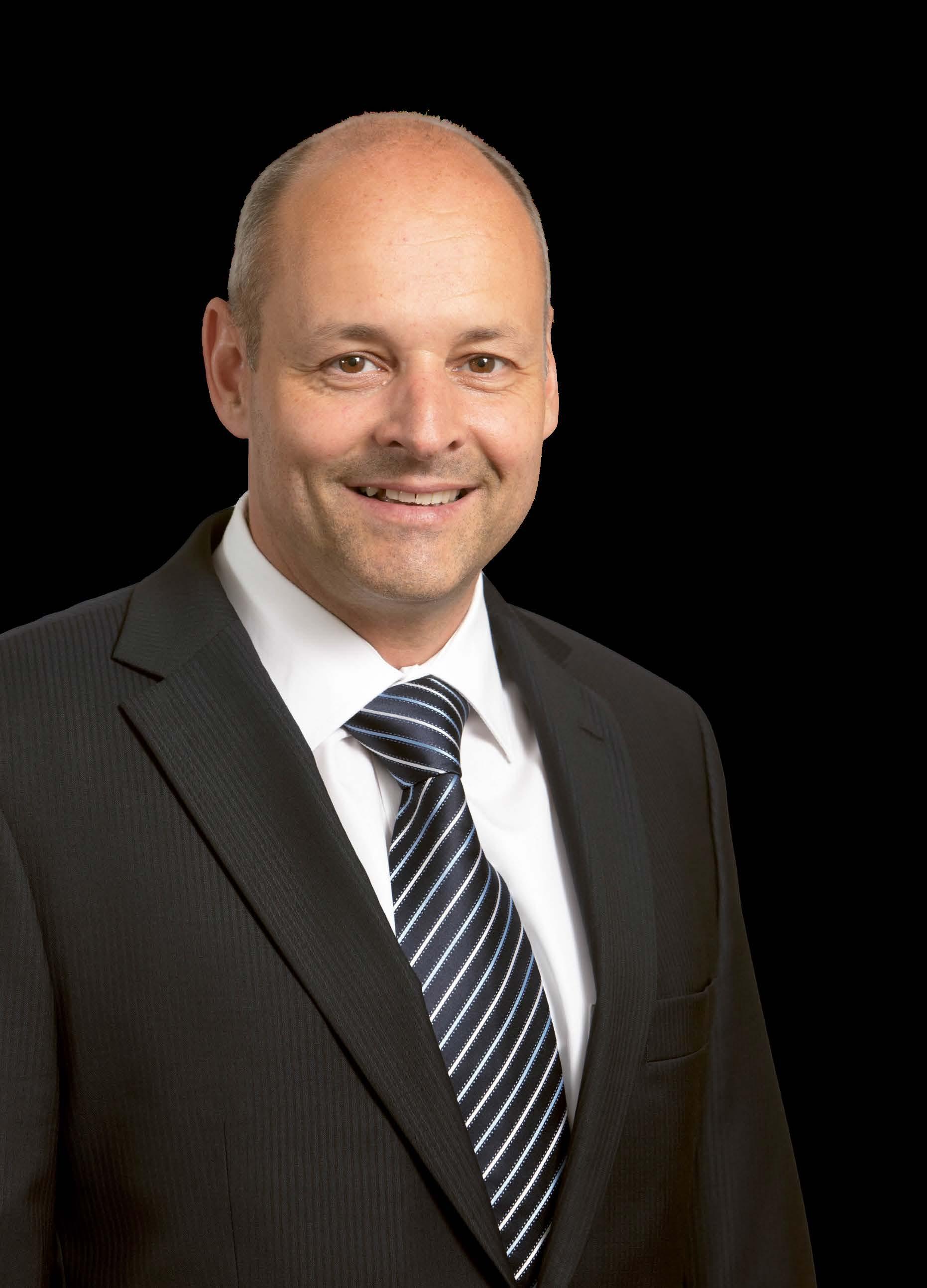
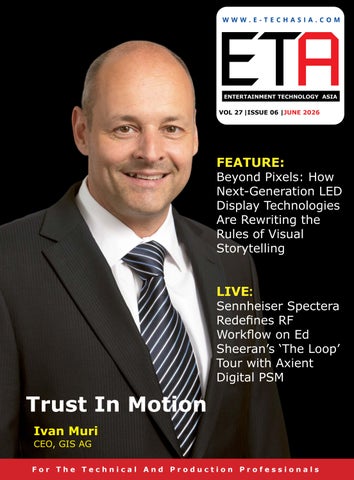
Ivan Muri CEO, GIS AG
44 FEATURE- Beyond Pixels: How Next-Generation LED Display Technologies Are Rewriting the Rules of Visual Storytelling
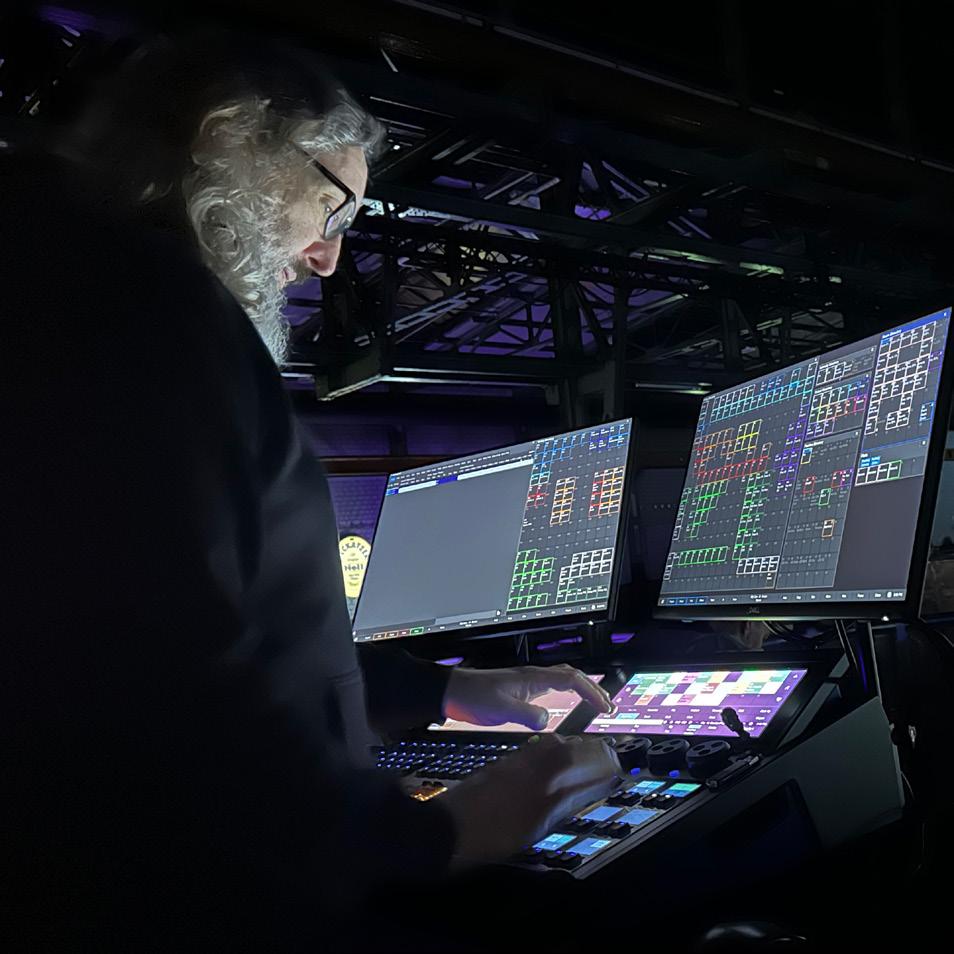
60 CHINA: grandMA3 Commands RecordBreaking King Pro League Grand Finals
63 INDONESIA: Peavey and Crest Audio Power Jakarta Death Fest’s Relentless Sonic Assault INSTALLATION
66 SINGAPORE: NEXO Delivers Refined Rooftop Audio Experience at Iconic Lantern Bar
68 CHINA: The Grand Lisboa Palace Becomes Asia’s First Venue to Deploy L-Acoustics Ambiance
51 SOUTH KOREA: ETC’s Tour Hog and Hog OS Drive The Lighting Spectacle Behind BTS’ Massive Seoul Comeback Concert
53 INDIA: Claypaky Ignites Sixth Sense Festival
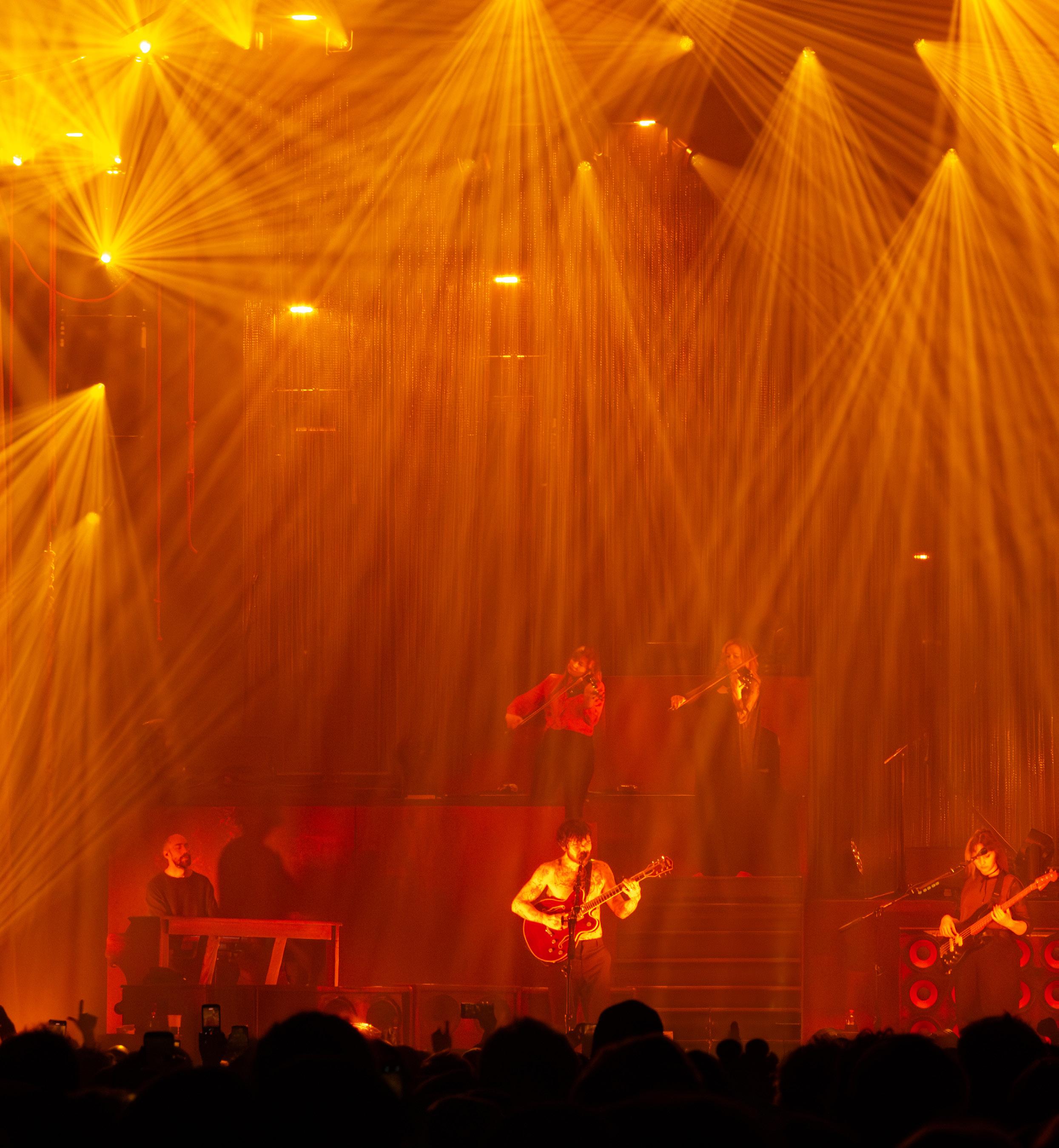
56 ANZ: Sennheiser Spectera Redefines RF Workflow on Ed Sheeran’s ‘The Loop’ Tour
72 VIETNAM: Martin MAC Viper XIP Modernise Vietnam-Soviet Friendship Palace of Culture and Labour
75 AUSTRALIA: EAW Powers Seamless Multi-Level Soundscape at Maison Bâtard
78 CHINA: Christie Soars to New Heights at “Flying By Changbai Mountain” Dome Attraction

Recent projections linked to InfoComm Asia 2026 place the APAC Pro AV opportunity at nearly USD 151.4 billion by 2030, with Southeast Asia emerging as one of the industry’s most strategically important growth corridors. Thailand, for example, is a focal point for this momentum; with Bangkok preparing to host more than 8,000 business visitors and over 200 exhibiting companies from 50+ countries at InfoComm Asia 2026 — reinforcing the region’s growing influence on integrated experiences, immersive environments and next-generation AV deployment strategies. Coupled with mega cultural developments such as Tomorrowland’s first-ever Asia edition in Pattaya, the message is unmistakable: Southeast Asia is the definitive proving ground for pro AV brands to make or break their connection with industry doyens.
A similar pursuit of precision and long-term trust sits at the heart of our Cover Story, where GIS CEO Ivan Muri reveals the philosophy and technical discipline behind lifting systems designed to never fail; proving that true innovation is meaningless without reliability engineered into its very core. The conversation naturally expands into our Feature, which explores the new era of visual storytelling through evolving LED display technologies that are transforming production workflows worldwide as they continue to power virtual sets, real-time effects and immersive environments that redefine creative possibility itself.
All this and much more inside the June 2026 issue of ETA –developments that may very well influence the direction of the global industry; sooner rather than later. Happy reading!
Elton Noronha Editor elton.s.noronha@hotmail.com
PUBLISHED BY 207A, Thomson Road, Goldhill Shopping Centre, Singapore 307640. Tel: (65) 6316 2716 www.spinworkz.com





Thomas Richard Prakasam Publisher / Editorial Director thomas@spinworkz.com
Andy Tan Director Industry Engagement andytan@spinworkz.com
Julie Tan Admin & Circulation admin@spinworkz.com
Hazel Gundaya Design / Layout
Rosalind Tan Website Management Wizard PV Anthony Server and IT Security Guru
To subscribe to Entertainment Technology Asia click here: https://www.e-techasia.com/subscribe
Disclaimer : Entertainment Technology Asia is published 12 times a year. All rights reserved. No part of this magazine is to be reproduced, whether mechanical or electronic without the prior written consent of the publisher. Views expressed in this magazine do not necessarily reflect those of the editor or the publisher. Unsolicited contributions are welcome but the editor reserves the discretion to use them. Whilst every care is taken to ensure the accuracy and honesty in both editorial and advertising content at press time, the publisher will not be liable for any inaccuracies.
Please be informed that products and company names mentioned in this publication may be protected with tradenames, trademarks or registered trademarks of their respective owners. Our non inclusion of such symbols is not an indication of us not recognising the copyright but rather to have a common look across our articles. Misuse of tradenames, trademarks or registered trademarks is strictly prohibited. It is the obligation of our readers to check if company names and products are protected with tradenames, trademarks or registered trademarks.

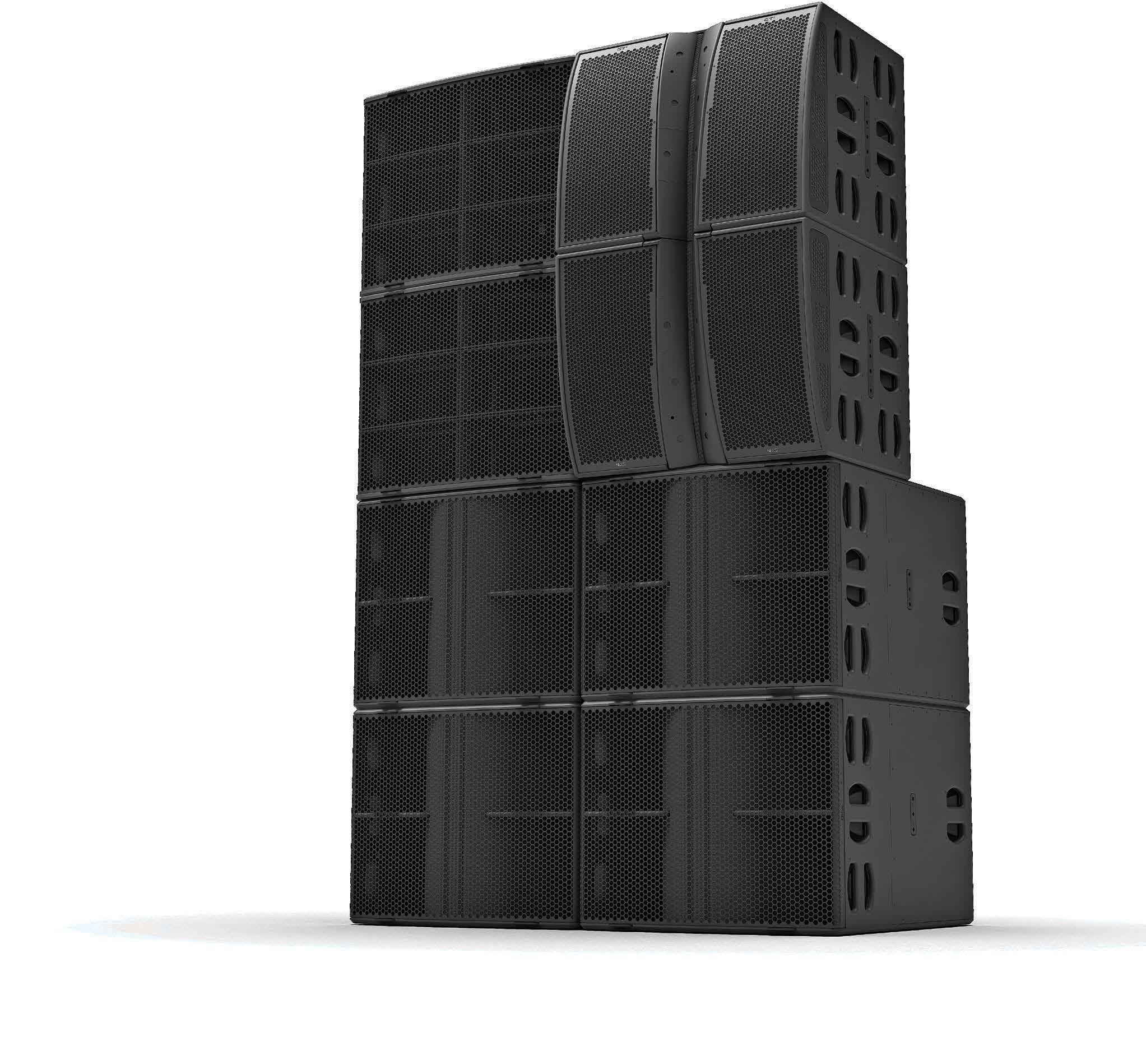
Three decades on and NEXO Alpha systems are still thrilling live music audiences and clubbers with their characteristic power and presence. Now we’ve drawn on the spirit of that ‘90s classic to create Alpha +, a ‘three-box’ FOH system that combines the benefits of line source coupling with the easy deployment of point source speakers.
Stacked on a mid-sized festival stage or installed in a club, it’s all Alpha, reimagined for the modern age.

nexo-sa.com
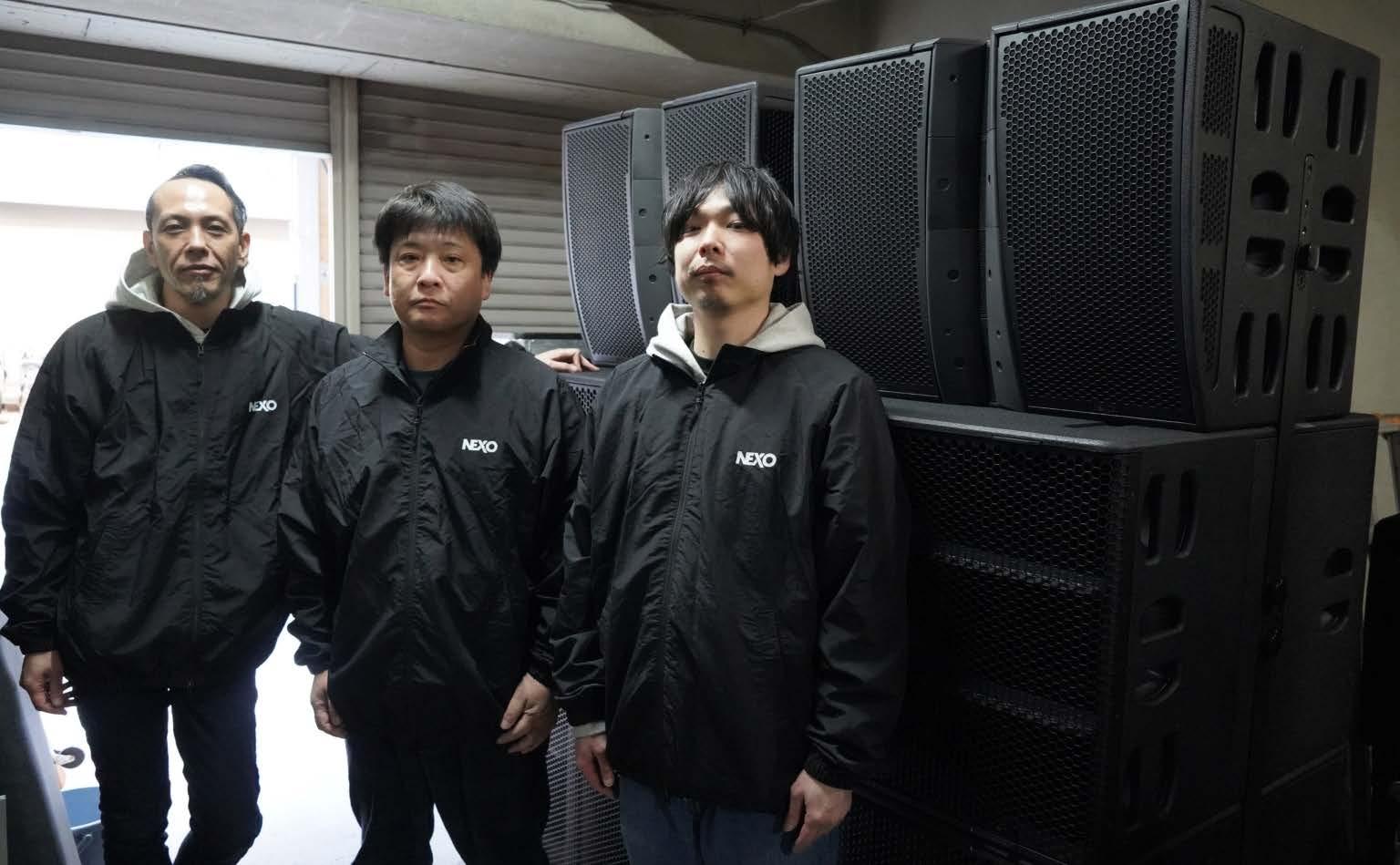
Osaka-based sound reinforcement specialist Tsugawa Pro Co., Ltd. has become the first rental company in Japan to deploy NEXO’s new Alpha+ hybrid source sound reinforcement system, marking an important milestone for the latest evolution of one of the company’s most iconic loudspeaker platforms. Operating from Kita-ku, Osaka, the company is led by second-generation representative Kengo Ide and maintains a compact but highly agile team focused on flexible deployment capabilities across varying venue environments.
“We currently operate two line array systems but, since we pride ourselves on our agility, we introduced the Alpha+ system as a new option so that we can still accept new projects even when all our line array systems are out. Back in the day, Alpha
was everywhere, so I used it a lot. I still remember my first impression of it; I was surprised that something of that size could produce such volume. I thought ‘wow, that’s incredible sound pressure’” reports Mr. Ide.
According to the company, the decision to adopt Alpha+ followed an extensive demo session conducted in a large hall environment, where the new system immediately evoked the sonic characteristics associated with the original Alpha platform. “I had a demo of Alpha+ in a large hall last fall, and the first listen immediately brought back the impression of the previous Alpha model,” says Mr. Ide. “I really liked the nuances of the subwoofer range, and I thought, ‘This is definitely Alpha!’ I’m always checking out new speakers, but I felt that this speaker was
exactly the system we were looking for to broaden our options.”
Fellow Director Mr. Takeshi Yagi echoed those sentiments, noting that the system’s balance and musicality distinguished it from many contemporary high-output reinforcement solutions; as he notes, “I really loved it too. In a word, it’s a speaker that lets you get as much sound out as you want. I hadn’t even considered introducing new speakers until I auditioned the Alpha+. I thought it was a well-balanced speaker, different from Alpha in a good way, and I was reminded once again that this system has a truly musical sound.”
A major factor in the adoption decision centred around deployment flexibility in venues where flown line array systems are not practical due to infrastructure limitations, rigging restrictions, or budget considerations. “In the projects we handle, there are many situations where flying is not possible due to venue equipment limitations that prevent the suspension of line arrays, budget constraints, etc.,” explains Mr. Ide, as he concludes “The Alpha+ M210’s soundstage and reach are reminiscent of a line array system and the bass from the cabinet configuration of L20 and B218 is particularly excellent. Because it’s a ground stack system, installation time is also reduced. Once it’s unloaded from the truck, moved to its designated location, and wired up, mixing can immediately begin. I feel that the hybrid source concept is incredibly logical. The ‘Alpha+’ that we introduced this time is a concept that makes perfect sense for our company.”





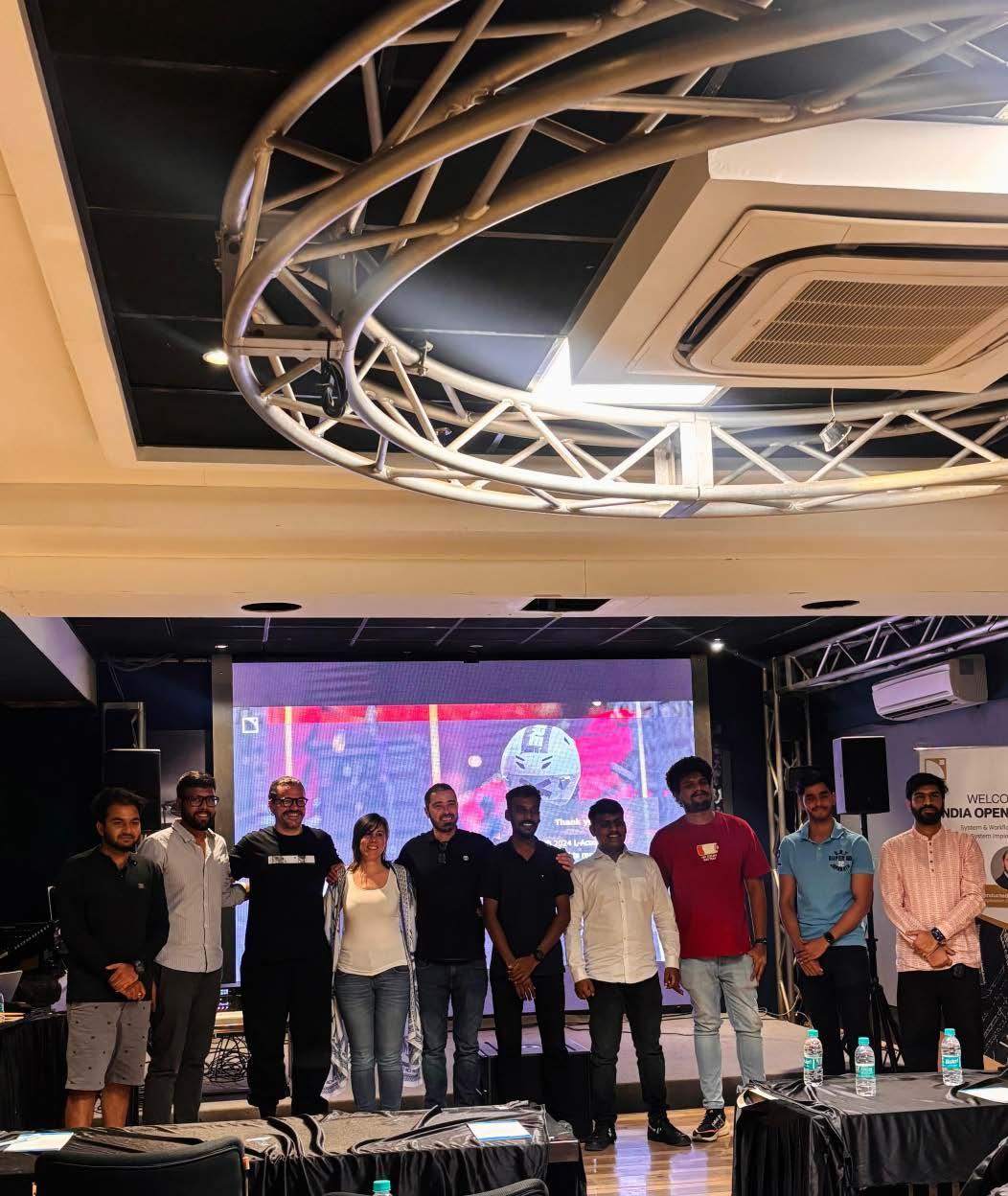
L-Acoustics recently marked a significant milestone in its engagement with the Indian professional audio market with the successful completion of its first Open Training programme in India, hosted by New Delhibased distributor Hi-Tech Audio & Image Held on April 27 and 28, 2026, the two-day technical programme brought together audio professionals from across the country for an in-depth exploration of L-Acoustics systems, workflows, and real-world deployment practices.
The programme was led by Luke Brookes and Katerina Panagopoulou from L-Acoustics, with sessions structured to provide both theoretical understanding and
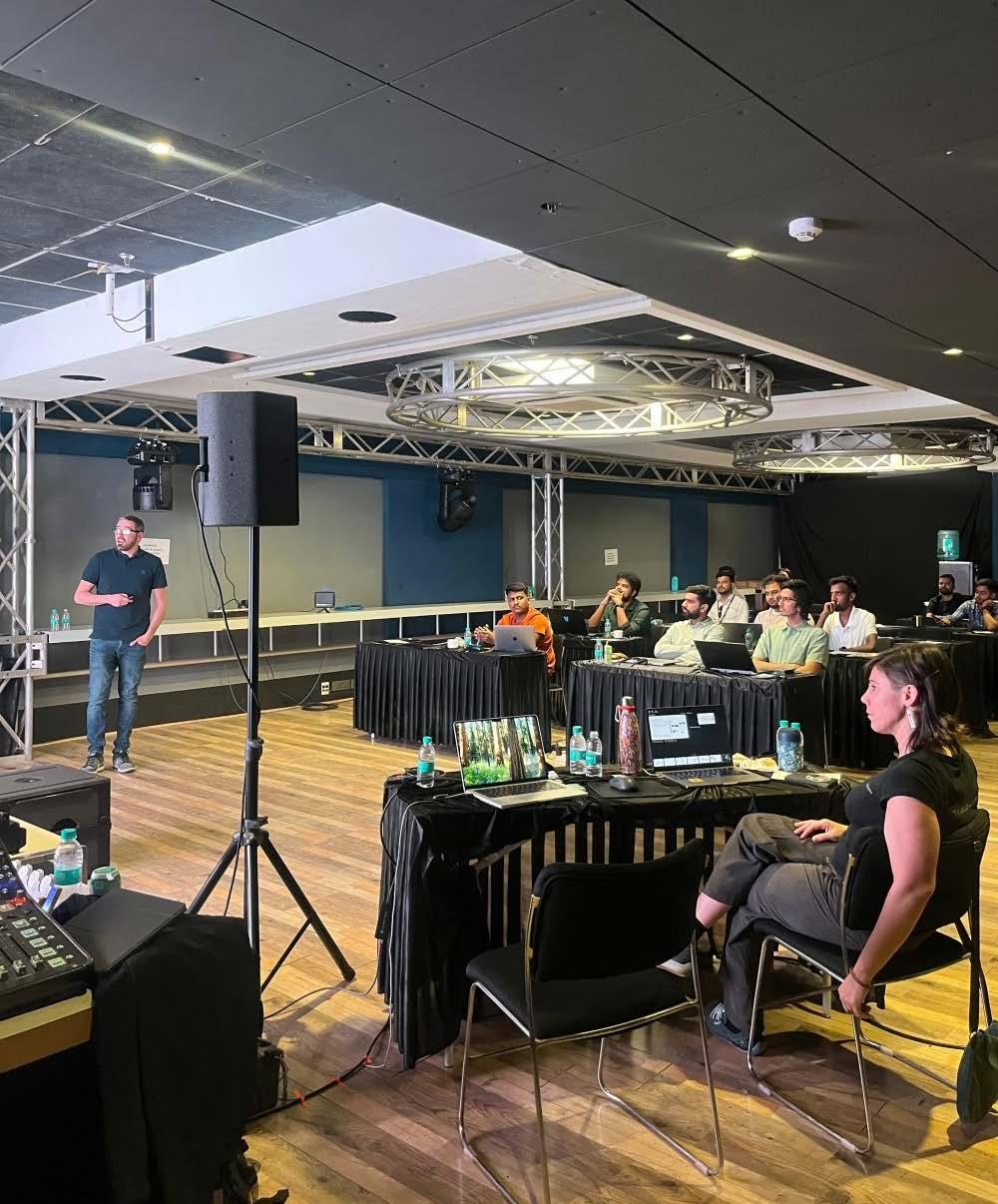
practical implementation experience across a range of L-Acoustics system environments. Luke Brookes guided participants through the sessions with a strong focus on practical application and workflow understanding, drawing from extensive field experience with L-Acoustics systems globally; as he shared, “India has a talented and enthusiastic community of audio professionals. It was a genuinely rewarding experience engaging with them, and we hope to build on this further.” On the other hand, Katerina Panagopoulou contributed to the technical sessions and helping ensure broad coverage of system architecture, optimisation, and deployment workflows.
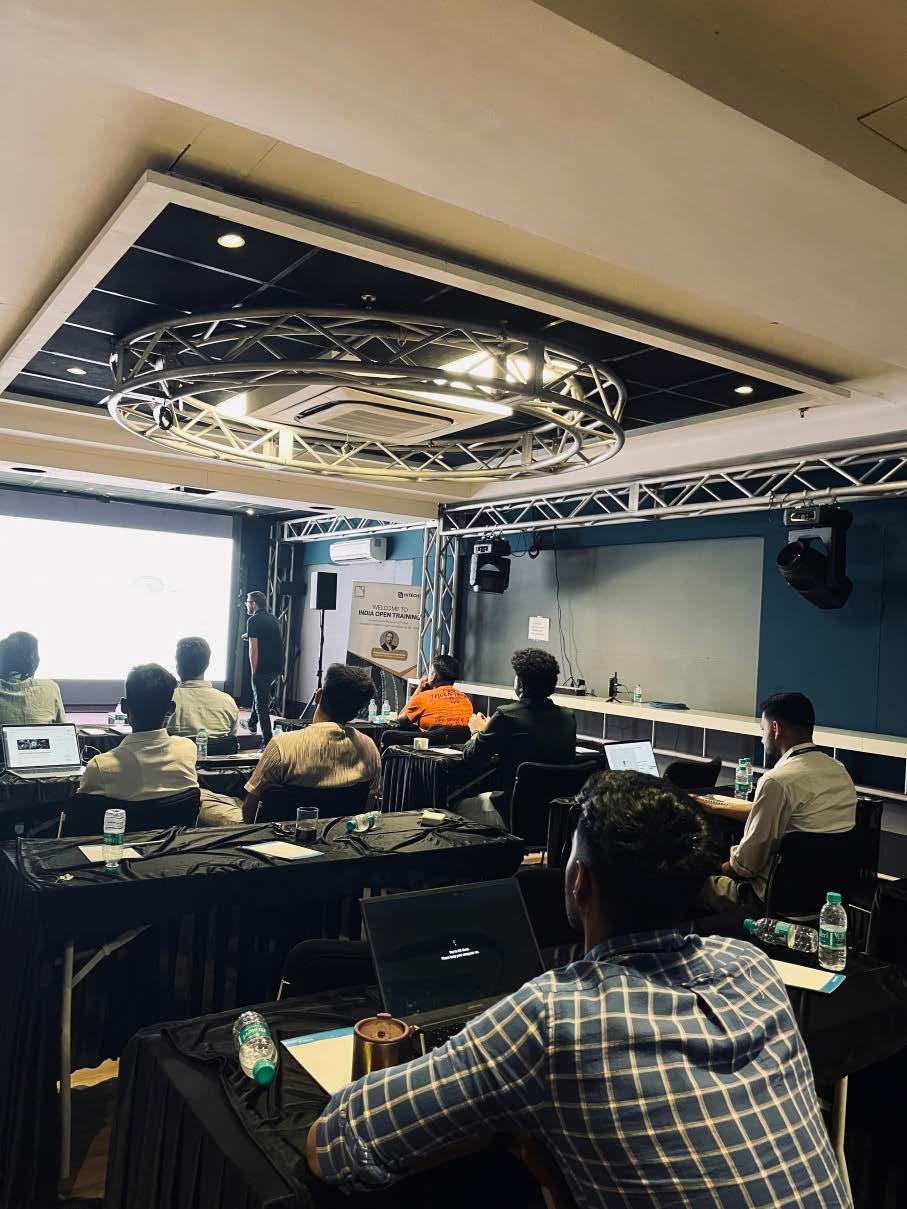
The first day of the programme focused primarily on system architecture and operational workflows, covering how L-Acoustics systems are structured, configured, and optimised across varying applications and venue environments. Building upon that technical foundation, the second day transitioned into practical system implementation, giving participants hands-on exposure to real-world L-Acoustics deployment scenarios and allowing them to directly apply concepts introduced during the earlier sessions.
Gupta, Founder & CEO,
Audio & Image, highlighted the broader importance of the initiative for India’s professional audio sector; commenting “L-Acoustics represents the highest standard in professional audio, and their commitment
to training and knowledge-sharing reflects a brand that genuinely invests in its professional community. We are proud to have facilitated this programme and to have provided a platform for India’s audio professionals to deepen their expertise with one of the world’s leading systems.”
Nirdosh Aggarwal, Managing Partner at Hi-Tech Audio & Image, emphasised the value of direct manufacturer engagement with the local market; stating “Having L-Acoustics engage with Indian professionals directly through a hands-on programme like this - makes a real difference. It builds familiarity and confidence with the systems, and that benefits everyone involved - from the professionals in the room to the clients they work with.”
The sessions attracted a diverse crosssection of professionals from across India, with discussions throughout the programme reportedly remaining highly interactive and technically detailed. Participants explored a broad range of subjects relating to system design, optimisation, architecture, and deployment, with feedback from attendees described as overwhelmingly positive. And perhaps most notably, several participants reportedly expressed strong interest in seeing similar programmes conducted on a quarterly basis; a reflection of both the demand for advanced technical education within India’s professional audio sector and the positive reception received by the inaugural Open Training initiative.
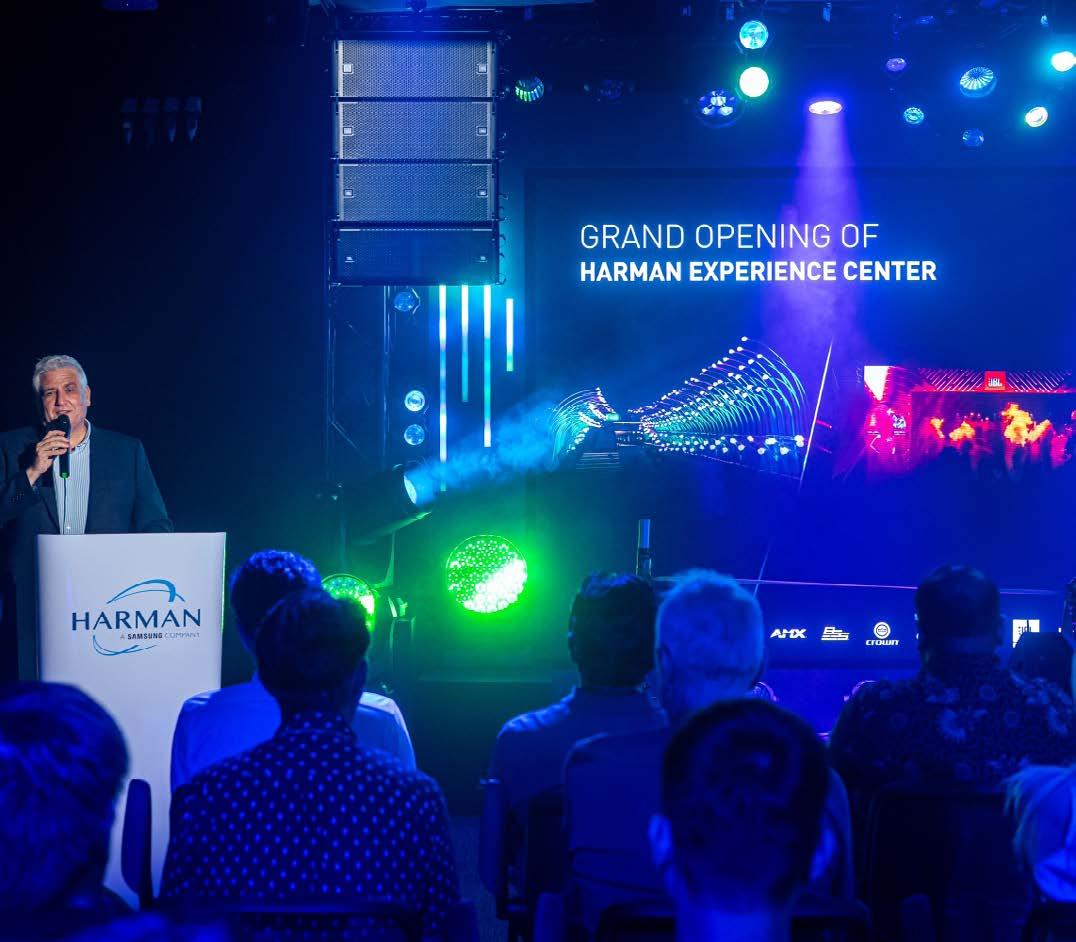
HARMAN Professional Solutions has officially opened its newly revamped Experience Center in Singapore. Designed as a purposebuilt business Experience Center, the space demonstrates how HARMAN Professional solutions address customer needs across multiple vertical markets through realworld applications and collaborative engagement. The space has been reimagined as a platform for solution exploration, cocreation, and executive engagement, reflecting the evolving ways B2B organizations navigate technology amid increasing complexity in today’s business environment.
“As customer needs and decisionmaking processes continue to evolve, we saw an opportunity to rethink how we engage,” said Nick Screen, VP & GM, HARMAN Professional Solutions, APAC. “Our new experience center immerses customers and partners in real-world scenarios — where
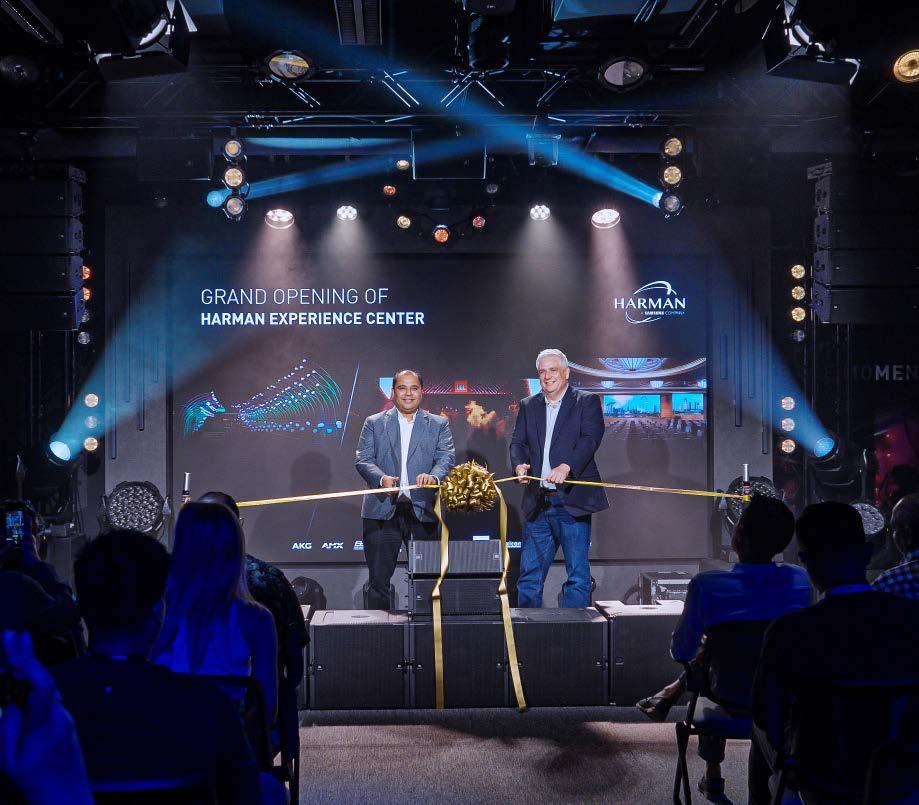
they can touch, test, and co-create solutions tailored to their environments. It’s all about empowering more informed decisions with confidence. Bringing together JBL, FLUX:: and Martin in this space lets us showcase fully integrated, immersive experiences that truly demonstrate what our Professional Solutions portfolio can achieve.”
The opening ceremony welcomed customers, partners, media, and senior leadership and included guided tours highlighting how the Experience Center supports real-world decision-making and collaboration; with the revamped showroom bringing together industry specific use cases, hands-on demonstrations and collaborative spaces that reflect how customers evaluate solutions today. Designed to support engagement from early discovery through validation and implementation, the Experience Center enables deeper, more meaningful experiences beyond traditional product displays.
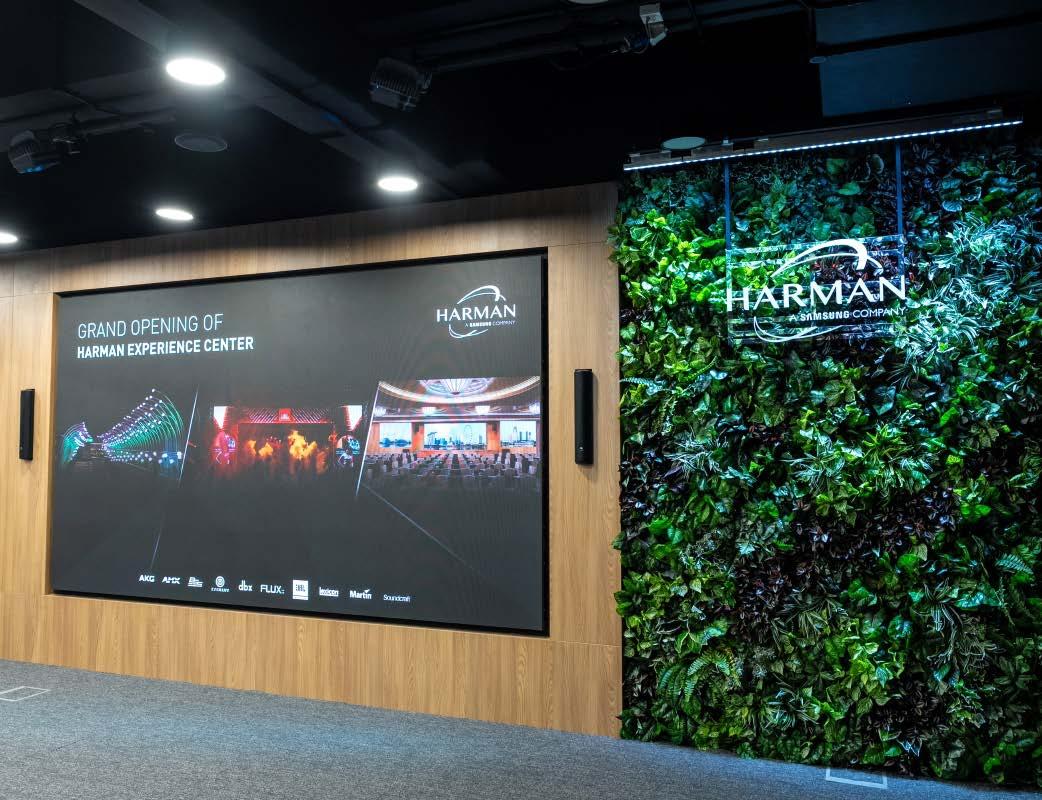
Visitors can experience:
• End-to-end solution scenarios across key industries
• Interactive demonstrations aligned with real business challenges
• Immersive, experiential showcase of audio and lighting technologies
• Dedicated spaces for customer workshops and partner co-creation
• Executive briefing areas for strategic discussions
“Experience led engagement has become essential in modern B2B environments,” said Atul Ghaisas, Director Channel Sales & Install Solutions, HARMAN Professional Solutions, APAC. “The Singapore Experience Center—along with our global network of HARMAN Professional Experience Centers— helps customers move beyond specifications to truly understand value, outcomes, and scalability, while strengthening collaboration across our global ecosystem.”
The Experience Center also plays a key role in partner engagement, providing a shared platform for joint solution design
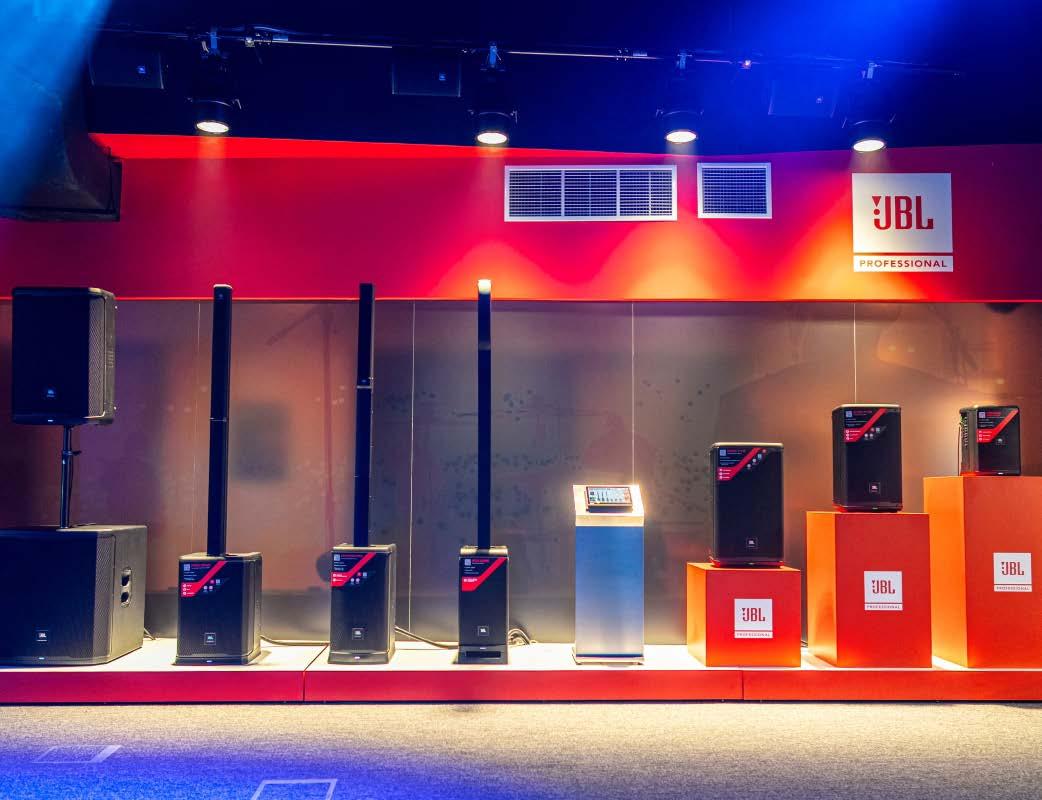
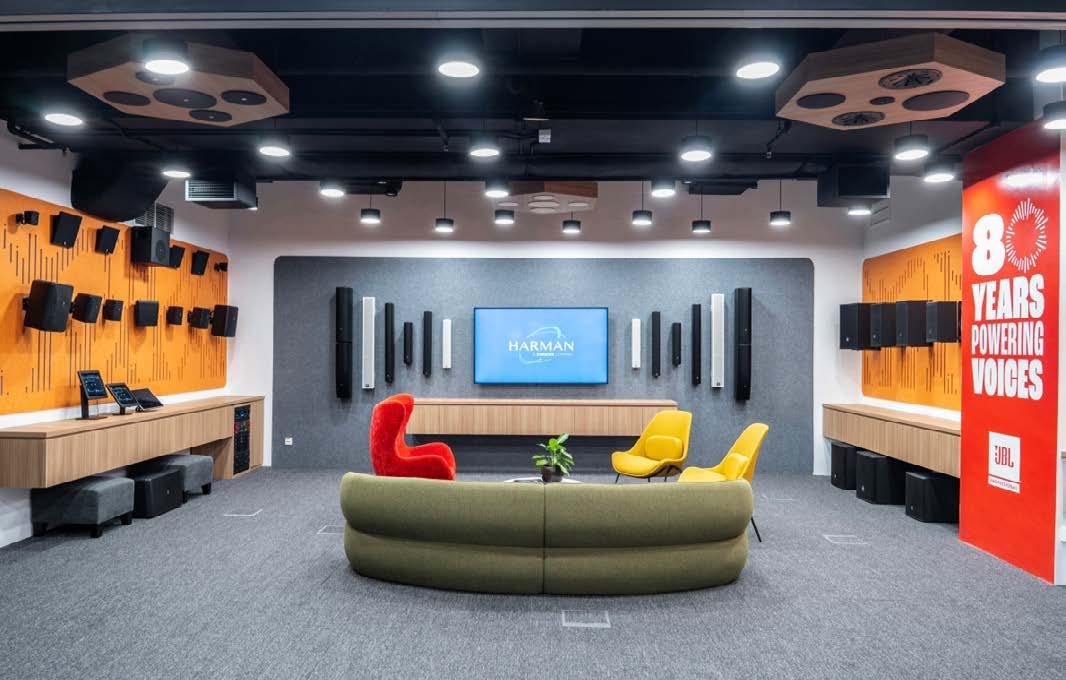
and integrated demonstrations. By bringing together customers, partners, and subjectmatter experts in one space, HARMAN Professional aims to accelerate innovation and deliver more tailored business outcomes. In tow, the brand also confirms that the HARMAN Experience Center will host customer briefings, partner sessions and industryfocused workshops throughout the year. “This is a longterm investment, not just a one-time launch” added Nick Screen. “We see this Experience Center as a living environment where ideas are tested, partnerships are strengthened and futureready solutions are shaped together with our customers.”
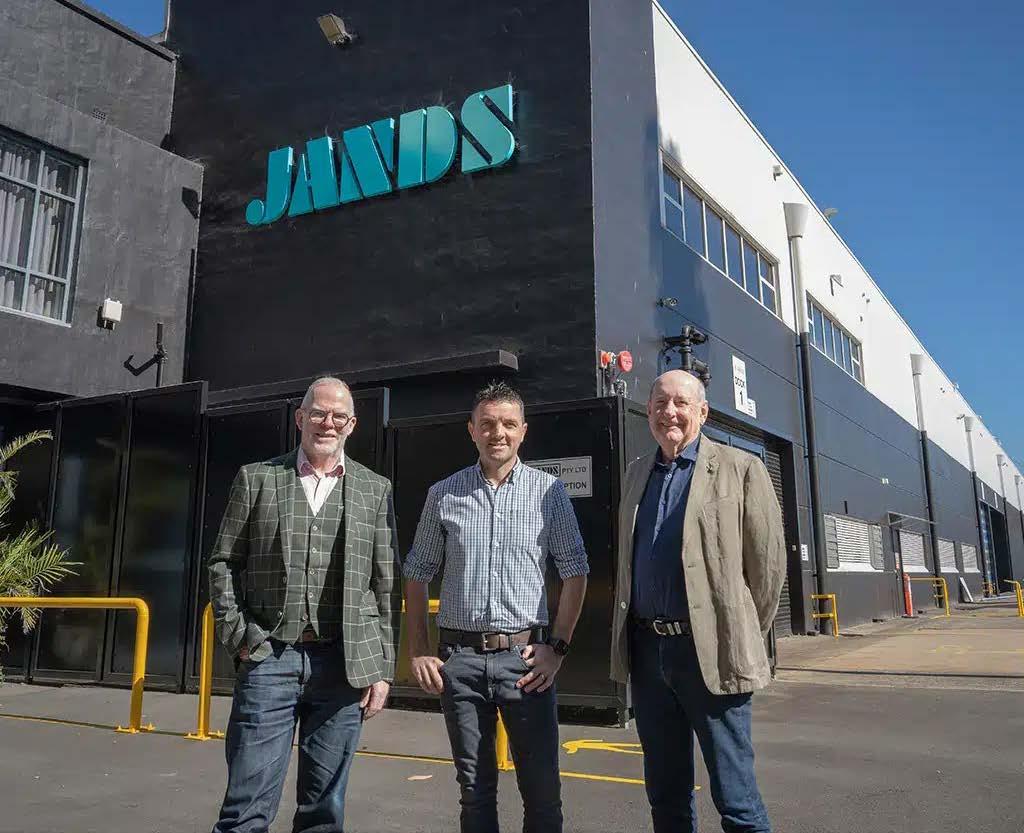
Meyer Sound has appointed Jands Pty Ltd as its exclusive distributor for Australia and New Zealand, marking a significant development for the professional audio landscape across the region. The appointment sees Jands taking responsibility for market development, sales, technical support, and service for Meyer Sound’s complete product portfolio across both territories. The partnership will support customers operating throughout the entertainment, live touring, venue, performing arts, and hospitality sectors, as demand for premium professional audio solutions across Australia and New Zealand continues to grow.
“Meyer Sound stands out for its innovation, integrity and community focus, values we share. Now formally representing Meyer Sound feels natural and meaningful, and we look forward to supporting our customers and growing the market together. We are incredibly proud to be appointed as the Meyer Sound distributors for Australia and New Zealand, a partnership that continues
a relationship spanning decades,” says Paul Mulholland, Executive Chairman at Jands; as he continues, “Jands began as a rental company, building our own speaker cabinets, until a major theatrical production led us to Meyer’s MSL-4 systems, a decision that helped shape our business. Meyer Sound stands out for its innovation, integrity and community focus, values we share. Now formally representing Meyer Sound feels natural and meaningful, and we look forward to supporting our customers and growing the market together.”
“Demand for Meyer Sound across Australia and New Zealand has never been stronger,” adds Meyer Sound Sales Manager, APAC, Owen Ironside. “As the market continues to grow, it’s clear that we need a robust and future-focused distribution partner to ensure we can support our customers at the highest level. Jands is an icon of the industry, established internationally as a benchmark for distribution. Our shared commitment to quality, innovation, and customer experience makes it an ideal fit for Meyer Sound, and we are delighted to have the opportunity to now work side by side.”
Jands will officially begin representing Meyer Sound across Australia and New Zealand from May 18, 2026, with customers able to engage directly with the company for product enquiries, demonstrations, technical support, and related services. “This new direction enables us to take the brand to the next level across Australia and New Zealand while strengthening the excellent work of our established dealer network, now supported through Jands,” concludes Ironside.
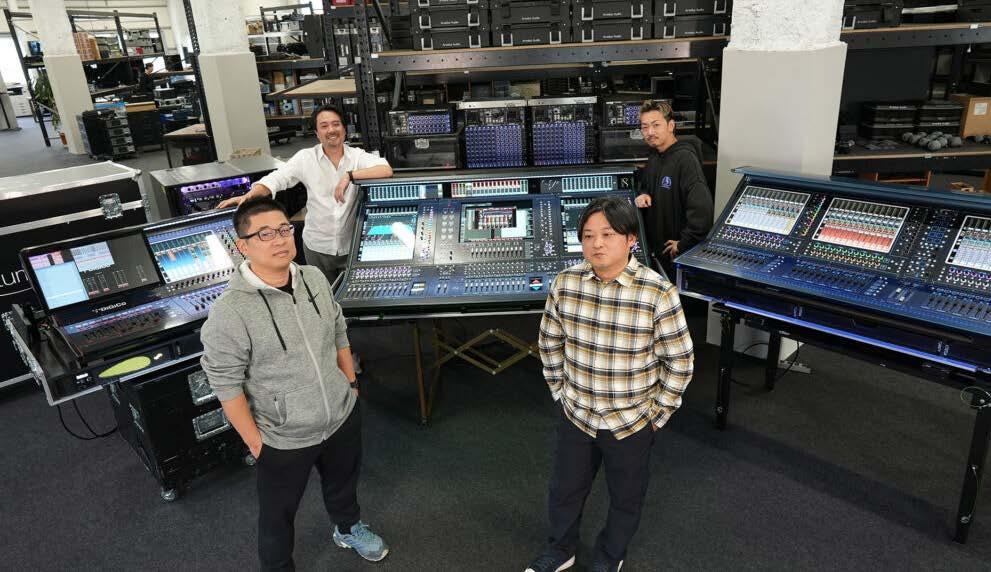
Arxiduc Audio Co has become the first company in Japan to introduce DiGiCo’s flagship Quantum 852 console, marking a significant milestone both for the Tokyobased sound reinforcement specialist and for the Japanese live production market. The acquisition further strengthens the company’s growing investment in DiGiCo’s Quantum ecosystem, expanding its capabilities for high-end touring, live entertainment, and large-scale production applications across the region.
For Arxiduc Audio CEO Hirohide Kobayashi, the investment reflects the company’s long-standing philosophy of balancing technical performance with application-specific flexibility and clientfocused system design. “The adoption of the DiGiCo Quantum range is a direct extension of this thinking,” explains Kobayashi. “By combining the highly reliable DiGiCo platform with scalability and intuitive operation alongside the expertise of our staff, we
at Arxiduc Audio ensure consistently high-quality service.”
Arxiduc Audio has also positioned itself as an early adopter of immersive audio monitoring workflows through the integration of KLANG systems into its operational ecosystem. Coinciding with the introduction of the Quantum 852, the company has additionally implemented the Fourier transform.engine platform, further expanding its software-based processing flexibility while enabling faster responses to increasingly sophisticated sound design and sonic quality demands from the market. And engineers within the company have been actively deploying KLANG immersive in-ear monitoring solutions to create more natural and less fatiguing monitoring environments for performers, helping improve on-stage performance experiences during complex live productions.
“The introduction of the Quantum 852 marks both a milestone and a new beginning for Arxiduc Audio,” concludes Kobayashi. “By pursuing a synergy between cutting-edge technology and the human expertise required to maximise it, the company intends to deepen its relationships with engineers, production companies, and partner firms worldwide. As a leading DiGiCo user, Arxiduc Audio continues to strive for further service excellence and business expansion.”
Bluesound Professional has expanded its strategic footprint across Asia through a new sales representative agreement with Singapore-headquartered Generation AV a move designed to accelerate the brand’s regional growth and broaden deployment opportunities for its networked audio solutions across commercial, professional, and residential markets.
Under the new arrangement, Lenbrook Asia will continue serving as the official distributor for Bluesound Professional products, while Generation AV takes on regional sales representation responsibilities aimed at expanding market visibility and strengthening customer engagement throughout Asia.
“We’re excited to partner with Bluesound Professional to showcase their innovative hardware and software,” says David McKinney, Managing Director of Generation AV. “At Generation AV, we
pride ourselves in supporting top-tier brands that redefine auditory experiences, and Bluesound Professional’s high-performance networked audio solutions are an ideal fit. From retail spaces and bars to restaurants and hotels, we’re eager to introduce their technology to even more environments across the Asia region.”
“Partnering with Generation AV is a key step in expanding our presence in Asia,” comments Graeme Harrison, Vice President & General Manager of Bluesound Professional. “The team’s enthusiasm, expertise, and experience will be invaluable as we continue to drive strong sales growth in the Asia region, solidifying our position as leaders in networked audio. On a personal note, it’s great to be working with David again, and we’re excited about what we can achieve together.”



Queen Sirikit National Convention Center
Bangkok, Thailand 15-17 July 2026
Powersoft and Bose Professional have renewed their long-standing technology partnership, reinforcing a collaboration that has already delivered a shared amplification platform tailored for the professional installed sound market. The extended agreement ensures that Bose Professional will continue to market the PowerShareX four-channel amplifier series — comprising the PSX1204D, PSX2404D, and PSX4804D — built on Powersoft’s advanced amplification technology.
At the core of the partnership is a platform designed to balance efficiency, control, and power density within a compact footprint. The PowerShareX series integrates high energy efficiency with precise audio signal management, enabling performance consistency across a wide spectrum of installed sound applications. Designed to operate seamlessly within the Bose Professional ControlSpace ecosystem, the amplifiers contribute to a unified environment where amplifiers, processors, and loudspeakers are managed through a single software platform—simplifying deployment while maintaining system-wide coherence.
“Powersoft has been an exceptional engineering partner, and together we have created an amplifier platform that truly reflects the performance and reliability our customers expect,” says Matt Calhoun, Chief Operating Officer at Bose Professional. “The PowerShareX line is the result of deep technical collaboration, combining Powersoft’s amplification expertise with our commitment to seamless integration within the ControlSpace ecosystem. This partnership enables us to continue delivering powerful, efficient and highly integrated solutions that help our AV customers design better systems with greater confidence.”
“Bose Professional is one of the most trusted names in professional installed sound, and renewing this partnership reflects a shared commitment to delivering amplification solutions that perform reliably within complex, integrated AV environments,” says Luca Lastrucci, Chief Executive Officer of Powersoft. “The PowerShareX range is the product of genuine technical collaboration, and we look forward to continuing to build on that foundation, providing integrators and their customers with the performance and confidence they need.”

www.prointegrationfuture.asia
Latest avl & ict Innovations
Thought leader seminars
Networking opportunities register your interest








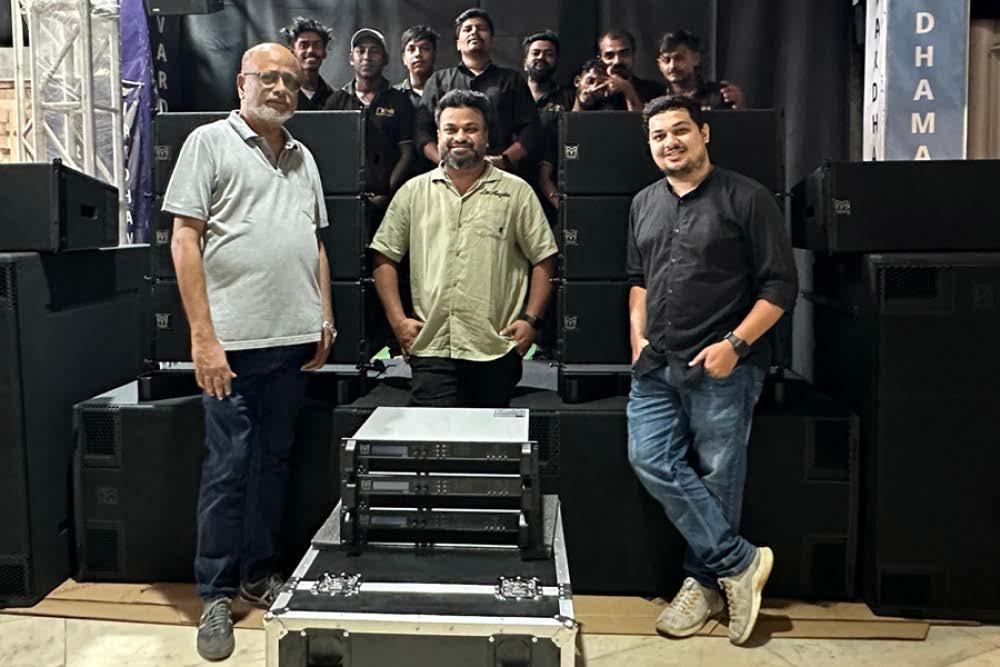
Mumbai-based Neo Entertainment has further strengthened its professional audio capabilities with a new investment in Martin Audio’s TORUS constant curvature array platform. The latest addition follows the company’s earlier investment in a Martin Audio Wavefront Precision WPC system in 2024, acquired through Vardhaman MegaTech (VMT) Martin Audio’s distribution partner in India.
The new system comprises eight Martin Audio TORUS T1215 loudspeakers, four Martin Audio Blackline X218 subwoofers and two Linea Research 44M10 amplifiers. The T1215 system delivers controlled coverage and focused clarity across audience areas, while the X218 subwoofers provide substantial low-frequency reinforcement suited for highenergy live productions. System control and processing are handled via Linea Research amplification and onboard DSP management.
“Adding Martin Audio TORUS to our inventory has helped us raise the standard of sound we deliver at our events,” says Neo Entertainment Director Betson Carvalho. “The system performs with excellent clarity and control, making it easier to handle varied venues and audience sizes while maintaining a professional and consistent result.”
“We have seen Neo Entertainment achieve remarkable success since their initial WPC investment, and it is a pleasure to see them continue that growth with TORUS,” comments Jeff Mandot, Director of Sales at VMT. “As the production landscape continues to evolve, the combination of premium audio performance and logistical flexibility is essential. By diversifying their Martin Audio inventory, Neo Entertainment are now equipped to deliver uncompromising sound quality across an even broader range of applications. We are delighted to support them as they continue to raise the bar for production standards in India.”
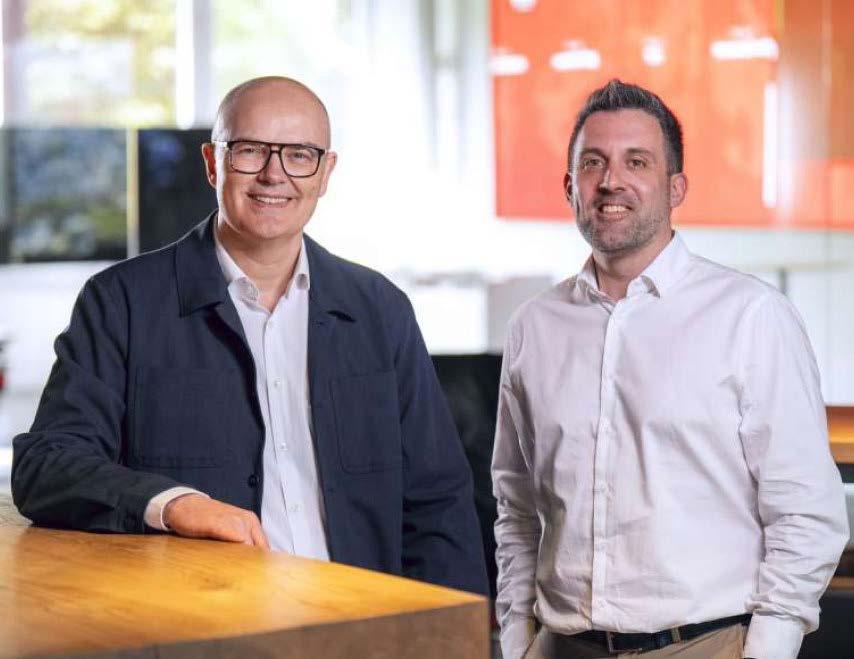
Riedel Communications has announced a significant expansion of its leadership structure, introducing new executive responsibilities aimed at strengthening both operational management and long-term strategic alignment across the wider Riedel Group. As part of the restructuring, Marc Engroff has been appointed Chief Financial Officer of Riedel Communications, while Frank Eischet transitions into the newly expanded role of Chief Operating Officer of the Riedel Group, where he will focus more heavily on overarching group strategy, operational scalability, and cross-functional coordination.
In his new role as CFO, Engroff will oversee finance, controlling, mergers and acquisitions, global purchasing, and IT operations, while supporting the company’s continued international growth and long-term financial development. And with Engroff now assuming operational financial leadership responsibilities within Riedel Communications,
Eischet will shift greater attention toward strategic priorities spanning the wider Riedel Group; as he continues to serve as Managing Director of Riedel Communications alongside Thomas Riedel.
“Frank has been instrumental in building the structures that have enabled Riedel’s growth over the years,” said Thomas Riedel. “With Marc, we are appointing a highly capable and trusted leader from our own ranks who combines strong financial expertise with a proven ability to translate data into strategic direction.”
Engroff adds, “I take on this responsibility with humility, supported by my outstanding team, which has been with me along the way, and by many great colleagues across the organisation. Looking ahead, I am excited to continue shaping Riedel’s development while ensuring we support its growth in a sustainable and resilient way.”
Reflecting on the transition, Eischet noted, “Riedel’s success has always been a team effort. I am proud of what we have achieved together over the past years and grateful to have been part of this journey. With Marc taking on the CFO role, we are strengthening our operational foundation even further. I look forward to focusing more on the broader development of the Riedel Group and driving the next phase of our growth.”
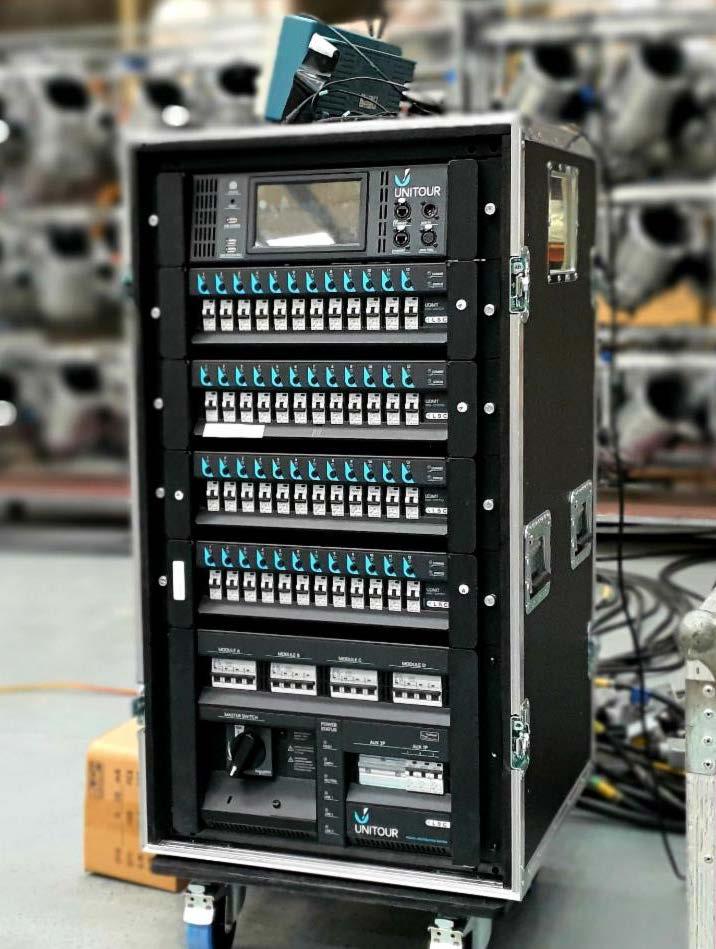
LSC Control Systems has announced a substantial extension of its standard product warranty—from 2 years to 5 years—signalling a heightened commitment to durability and long-term performance across its portfolio.
“Our products have always been designed to provide value in demanding, professional environments,” says LSC Product Manager Richie Mickan. “We know from long experience that, for our customers, performance, durability, and long-term confidence are not optional extras – they are essential.”
The extension of the warranty policy serves as both a practical enhancement and a symbolic gesture; underscoring the brand’s confidence in the integrity and longevity of its engineering. “Increasing our standard product warranty from 2 years to 5 years is a sign of our confidence in the quality, engineering, and long-term dependability of our products. It’s also a clear and tangible reinforcement of something our customers already appreciate – when you choose LSC, you are choosing solutions that last the test of time, and are backed by a team that stands behind them,” Mickan adds.
Beyond the headline figure, the move resonates across the entire value chain; offering integrators, dealers, and end users an added layer of assurance at every stage of deployment. “We feel it adds confidence at every stage, from specification and purchase through to installation, operation, and ongoing support,” concludes Mickan. “It’s more than a policy update: it’s a clear statement about the way we build, support, and stand by our products.”
Christie has confirmed that negotiations with VistaPHX LLC regarding the previously announced proposed sale of Christie’s Broadcast and Professional Video group assets have officially ceased, with the company now retaining ownership of the division’s product portfolio and operational infrastructure.
Since both parties have now ended negotiations without completing the deal; Christie will continue managing and supporting its existing image processing and compositor product lines internally, including Spyder, Terra, Hedra, Phoenix, and Mastering Gateway, alongside the operational
teams and infrastructure supporting those platforms.
The company stated that it remains committed to supporting customers, partners, and ongoing business activities tied to the retained product ecosystem while it evaluates future opportunities for the division. And although Christie did not disclose further details regarding the decision to discontinue negotiations, the announcement ensures continuity for customers and integration partners currently deploying or supporting Christie’s professional video processing technologies across live events, broadcast, virtual production, and large-scale visualisation environments.
L-R: HIVE’s co-founders Dave Green (CTO) and Mark Calvert
Panasonic Projector & Display Corporation has announced the acquisition of UK-based media technology company HIVE Media Control Ltd. Through the acquisition, Panasonic has secured 100% ownership of HIVE, further accelerating its transition from a hardwarecentric manufacturer into a broader visual solutions ecosystem provider spanning projection, displays, software, workflow infrastructure, and integrated media delivery technologies. By integrating HIVE’s media server and control technologies into its wider portfolio, Panasonic strengthens its position within fast-growing sectors including immersive attractions, museums, themed entertainment environments, and large-scale permanent installations.
Importantly though, HIVE will continue operating as an independent business while maintaining its vendor-neutral market philosophy. Panasonic confirmed that HIVE will preserve its open ecosystem approach
and continue supporting existing customers and partners, including deployments involving third-party projector and LED display brands beyond Panasonic itself.
“This is a strategically important step for Panasonic as we continue to evolve our business beyond a hardware-oriented model toward broader visual solutions and workflow value,” said Yousuke Adachi, CEO of Panasonic Projector & Display Corporation. “Under MEVIX, our visual solutions brand, we have been clearly articulating our commitment to contribute to customers across the total workflow, not just at the hardware endpoint. This acquisition is a major step in that direction and an important step forward in growth guided by the spirit of the MEVIX brand. HIVE brings proven expertise in media playback and control, and when combined with our projector and display portfolio, we believe it can create meaningful customer
value through simpler deployment, greater flexibility and a better end-user experience. At the same time, we fully respect HIVE’s position as a standalone business open to working with the wider market, and we look forward to the synergies from HIVE’s continued growth also creating value for Panasonic.”
HIVE Co-founder and CEO Mark Calvert adds, “We are inspired and honoured by the opportunity to work with Panasonic, while continuing to grow HIVE as an open and independent ecosystem,” said Calvert.
“In nature, the most powerful systems are interconnected, adaptive and free to evolve – a philosophy that sits at the heart of HIVE. This partnership gives us the scale to accelerate our vision while preserving the openness and platform-agnostic approach our customers rely on. I would also like to thank my co-founders, Dave Green and Trey Harrison, and our incredible HIVE team –whose belief and dedication mean we move into this next chapter together.”

Brompton Technology has announced the appointment of Jude Lam as Regional Sales Manager for Mainland China, Hong Kong and Macau, further strengthening its APAC sales team and reinforcing its long-term commitment to the region. In her new role, Lam will support Brompton’s customers and partners across her territory, helping to deepen the company’s presence in the market and build on its existing relationships across the region.
“Jude is already well known to many in the LED market, and we’re delighted to welcome her to the team,” says Sebastian Kanabar, Head of Sales APAC at Brompton Technology. “She brings valuable experience, a strong understanding of the region, and a proven ability to support ambitious LED projects across multiple territories. As we continue to invest in this important market, Jude will play an important role in strengthening our local presence and further developing our network there.”
Lam is excited to be joining Brompton at such an important point in the company’s growth in APAC. “Brompton is a brand I’ve known and respected for many years, both for its technology leadership and for the close working relationships it has built across the industry,” she says. “I’m thrilled to be joining the team and look forward to working closely with Brompton’s customers and partners across Mainland China, Hong Kong and Macau, helping them unlock new opportunities and deliver outstanding results with Brompton’s LED processing solutions.”
FaitalPRO has joined forces with VMT as its exclusive distributor for India, reinforcing its strategic focus on one of the fastest-growing professional audio markets globally.
According to the brand, India is being treated as a critical growth territory within its global roadmap; with the collaboration designed to accelerate ecosystem development through deeper market engagement and technical alignment. VMT’s understanding of local requirements, coupled with its engineeringled approach, is expected to play a key role in expanding adoption across OEM manufacturers, system integrators, and loudspeaker cabinet builders.
Under the agreement, VMT will exclusively handle the distribution of FaitalPRO’s complete portfolio across India, ensuring improved product accessibility, faster turnaround times, and more responsive customer engagement. Beyond distribution,
the company will provide a comprehensive suite of technical services aimed at supporting manufacturers throughout the product development cycle. These include cabinet design, application engineering, CNC documentation, crossover design and tuning, as well as end-to-end development support.
FaitalPRO believes the collaboration reflects a broader strategic intent to move towards a more integrated solutions approach. By combining high-performance transducer technology with localised design and tuning expertise, manufacturers are expected to achieve faster development timelines while maximising system performance. On the other hand, for VMT, the appointment marks a significant addition to its portfolio, enabling it to deliver both advanced loudspeaker components and the engineering support required to develop high-performance, market-ready audio systems tailored to the evolving demands of the Indian market.
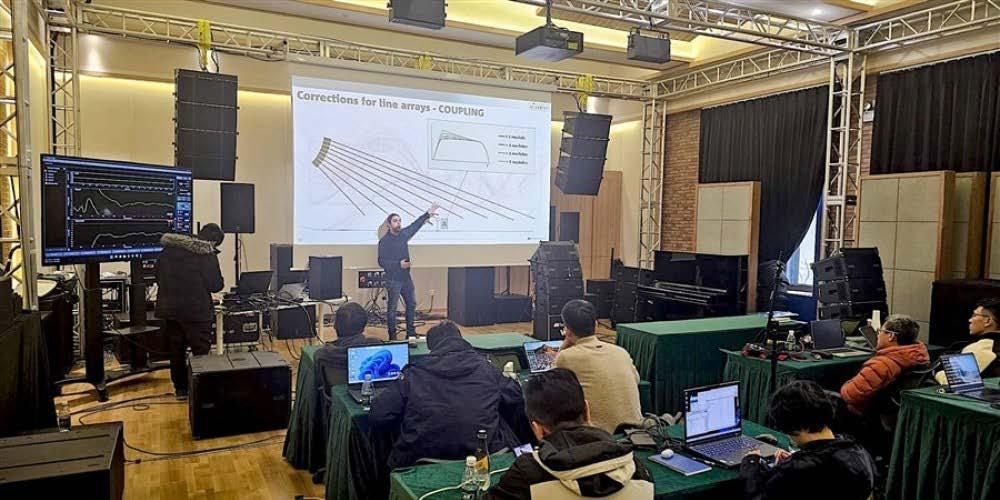
dBTechnologies recently partnered with its official Chinese distributor Digital Media Technology (DMT) to host exclusive VIO Operator Level 1 and Level 2 training courses in Beijing, offering local audio professionals direct access to advanced system knowledge and hands-on learning.
Led by Marco Cantalù, Head of Education at dBTechnologies, the sessions provided an immersive and highly practical training environment for technicians looking to deepen their expertise with the brand’s flagship VIO series. Designed to go beyond standard product familiarisation, the courses enabled participants to explore the technology in detail, master advanced operational techniques, and engage directly with fellow professionals in a dynamic and collaborative setting.
The training focused on equipping operators with the technical confidence required to fully unlock the VIO system’s capabilities across real-world applications. From system understanding to advanced deployment strategies, the programme reflected dBTechnologies’ broader vision of supporting users not just through products, but through continuous professional development. Upon successful completion of the course, participants received official certification recognising their expertise in operating dBTechnologies’ advanced VIO systems—an important step in strengthening technical standards and fostering a highly skilled local operator base.
GIS AG CEO Ivan Muri reveals the philosophy, discipline, and technical thinking behind systems designed to never fail; as he explains how GIS AG continues to build lifting technologies where innovation, safety, and long-term trust coexist flawlessly.
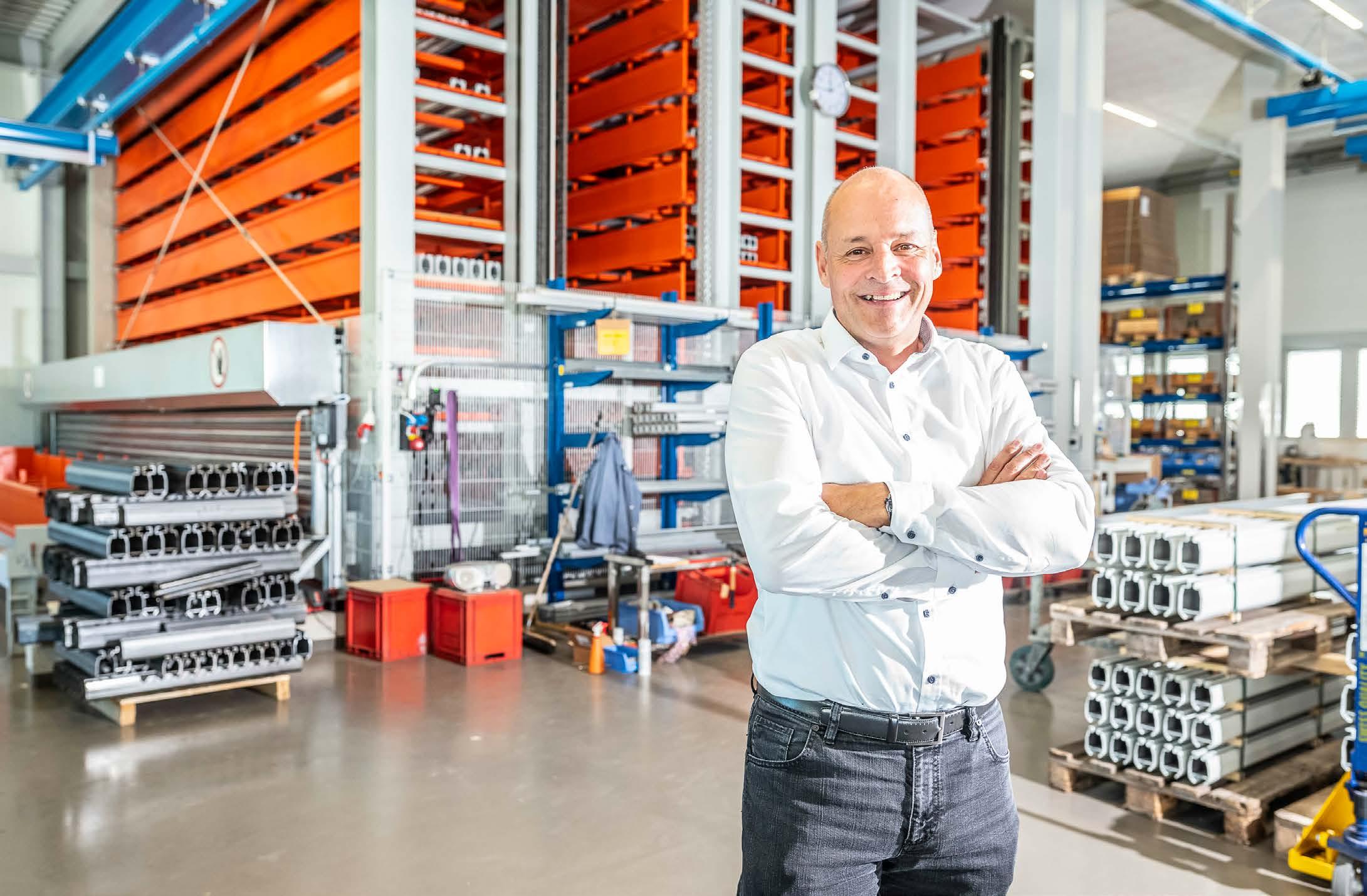
There are certain technologies within the entertainment and industrial ecosystems that audiences rarely notice; but whose absence would make entire productions, infrastructures, and workflows impossible. Lifting technology belongs firmly to that category. Hidden above stages, integrated into rigging systems, or operating silently within industrial environments, these systems
carry far more than physical weight; they carry responsibility, trust, and, in many cases, human safety itself.
For Swiss manufacturer GIS AG, that responsibility has defined the company’s engineering philosophy for decades. Known globally for its electric chain hoists and crane systems, GIS has quietly built a reputation
around precision, durability, and long-term dependability; qualities that have become increasingly valuable in a world where many technologies are evolving faster than their operational lifecycles can sustain.
Under the leadership of CEO Ivan Muri, however, the conversation around lifting technology is expanding beyond mechanical functionality into something more nuanced: how engineering integrity, modular innovation, sustainability, and user trust intersect in an era of increasingly ambitious live productions and rapidly shifting industrial expectations.
Ivan’s perspective is particularly compelling because it is rooted not in abstract executive theory, but in engineering itself. Having risen through the technical ranks before assuming leadership of the company, his approach reflects a rare combination of operational pragmatism and long-term strategic thinking. His career has been deeply intertwined with product development and technical innovation — something that becomes immediately apparent in the way he speaks about responsibility, decision-making, and customer trust.
What emerges in this conversation is a leadership philosophy shaped by precision rather than performance. Ivan speaks candidly about the evolving demands of entertainment rigging, the importance of modular engineering, the ethics of durability, and the careful balancing act required to expand globally without compromising the principles that built GIS’ reputation in the first place. In many ways, this is less a discussion about lifting technology itself, and more an exploration of what it truly means to build systems designed to be trusted. Silently, consistently, and without fail.
ETA: Having risen through the technical ranks before taking the helm at GIS, how has your personal journey shaped the way you define responsibility, precision, and trust—both as an engineer and as CEO?
IVAN MURI: With products such as our electric chain hoists and crane systems, our focus is not just on functionality, but also on ensuring that users can rely on them completely in every situation. My previous roles in engineering and development have naturally helped me to develop a strong sense of responsibility. Thanks to my technical background, I am able to demand this level of trust and actively help to shape it, as I can trace the impact of every decision right down to the product level.
ETA: How do you reconcile the contrasts between the industrial engineering and live entertainment sectors when shaping product philosophy, ensuring that your systems remain equally dependable on a factory floor and beneath a live stage carrying human expectation?
IVAN MURI: The fundamental function of an electric chain hoist remains similar whether it is used in industrial manufacturing or in the entertainment industry. Our chain hoists are designed to meet essential requirements such as safety, robustness and durability in both sectors. The differences lie more in the specific areas of operation and applicable standards than in the technology itself.
It is also crucial to correctly interpret the needs of the various markets and implement them in a targeted manner. Thanks to the modular design of our electric chain hoists and our in-house development and production capabilities, we can deliver customised solutions quickly and flexibly.
ETA: The role of lifting technology is quietly evolving from infrastructure to enabler of creativity. From your perspective, how is GIS reimagining its role in this transformation? Also, please feel free to name two products from GIS’ portfolio that best supports your own personal approach to “technological innovation"; especially considering the fact that safety can never be compromised in your line of work?
IVAN MURI: As a manufacturer of electric chain hoists, we see ourselves as a component supplier within an overall project. Our aim is to provide the necessary hardware and suitable interfaces to enable our customers to implement their concepts and projects as simply, safely and efficiently as possible. In doing so, we have observed a clear trend towards the increased use of monitoring and measurement systems. We want to make the integration of these functions as straightforward as possible for those in charge.
Accordingly, we are continuously developing entire product ranges, not just individual products. A good example of this is our LPL electric chain hoist series, which was originally designed for D8 applications — that is, for holding loads with secondary safety in the rigging sector — with a focus on achieving an optimal load capacity-to-dead weight ratio. For around a year now, the LPL series has also been available for D8+ and C1 applications, opening up a significantly broader range of possibilities, including moving loads above people
ETA: What is your view on the concept of “long-term value” in mechanical systems? Is durability still a competitive advantage, or has it become a deeper statement about sustainability, responsibility, and engineering ethics?
IVAN MURI: Durability and reliability often go hand in hand. For us, they are not optional extras, but fundamental requirements for our products, and remain a key quality feature. This is particularly true of electric chain hoists, which are often used for decades. In these cases, factors such as the availability of spare parts and ease of maintenance are just as important as a design aimed at a long service life.
We don’t just develop high-quality, durable products to promote sustainability. It’s because this mindset is firmly embedded in our corporate identity. At the same time, we are continuously working in other areas to become more sustainable. For instance, at our production site in Switzerland, we have installed a new heating system that will save around 110,000 litres of heating oil each year.
ETA: As GIS strengthens its global footprint, particularly through strategic integrations and market expansion, what are your thoughts regarding the Asia Pacific market?
IVAN MURI: GIS is headquartered in Switzerland and has subsidiaries in Germany, the United Kingdom and the United States. Global sales are handled by independent distribution partners, many of whom have worked with us for many years.
We continue to see great potential in the Asian market. The same principle applies there as for our international growth in general. We strive for sustainable and healthy growth, selecting our partners very carefully. Long-term cooperation, technical expertise, and a shared understanding of quality and service are our top priorities.
GIS
BARCO’s CFO Ann Desender, CHRO Lien Meuleman, Sustainability Lead Dries Vanneste, and the team behind many of the brand’s sustainability initiatives talk about how sustainability gradually became part of the organization, and the next steps the brand is taking.
APAC’s Largest JBL VTX A Series Theatre System at NZICC
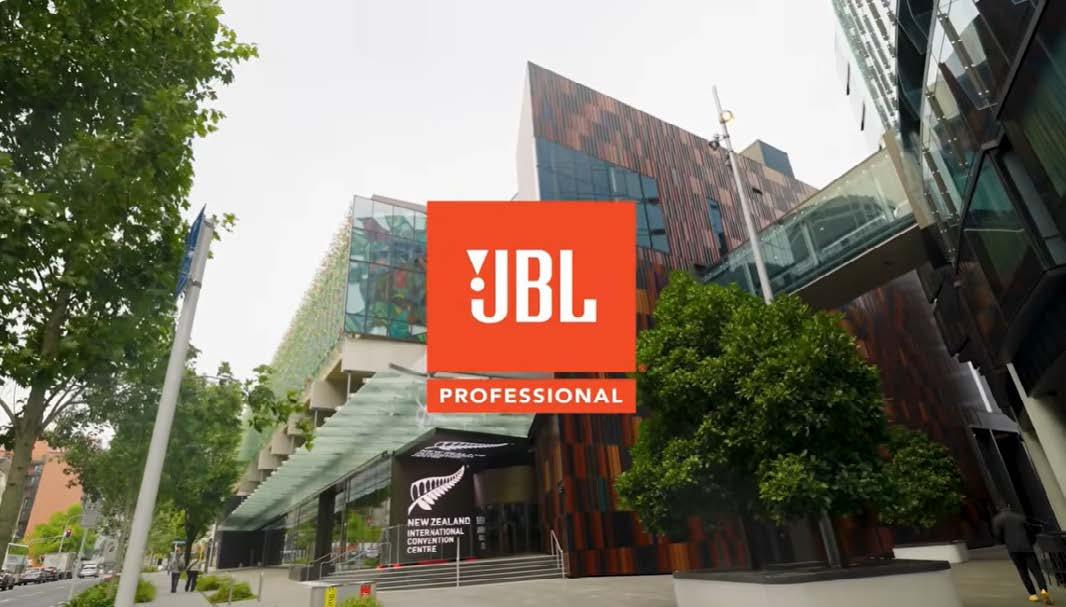
The New Zealand International Convention Centre (NZICC) is set to become one of the most advanced event venues in the AsiaPacific region — and at its core is the largest JBL VTX A Series theatre installation in APAC; facilitated by JPRO, working alongside Vega Global.
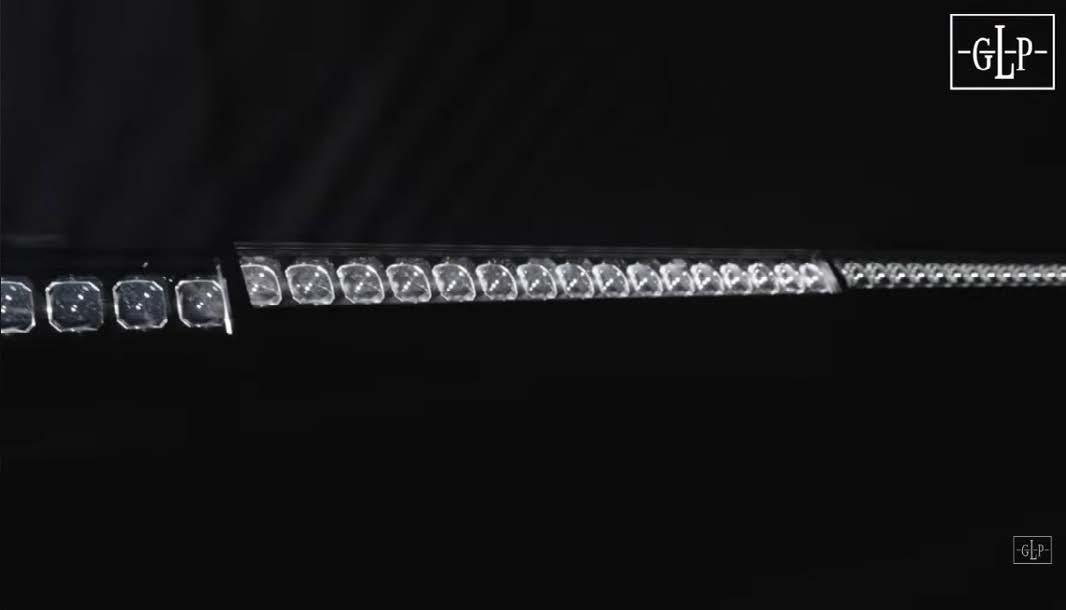
GLP’s new WildBar 16 is a high-performance LED tilt bar designed for demanding live events, touring, and outdoor productions; engineered to deliver high performance with exceptional light output, versatility, and durability.
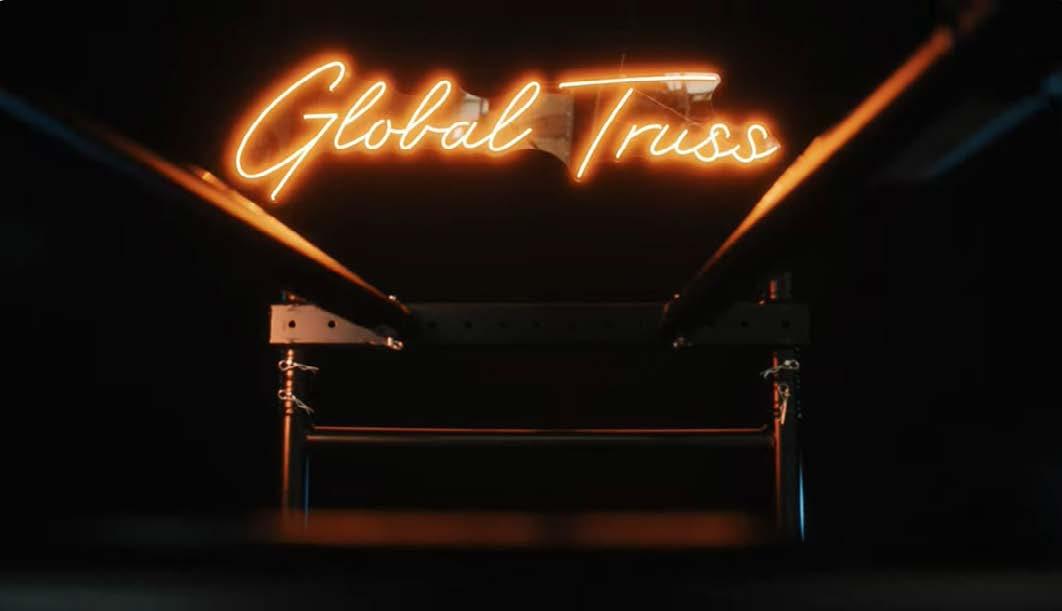
The Global Truss Lighting Rack combines a transport dolly and pre-assembled stage element in one modular solution. Sized for truck transport, it supports secure equipment storage with expandable configurations, flexible truss mounting, reinforced stability, and extensive accessory compatibility for touring productions.
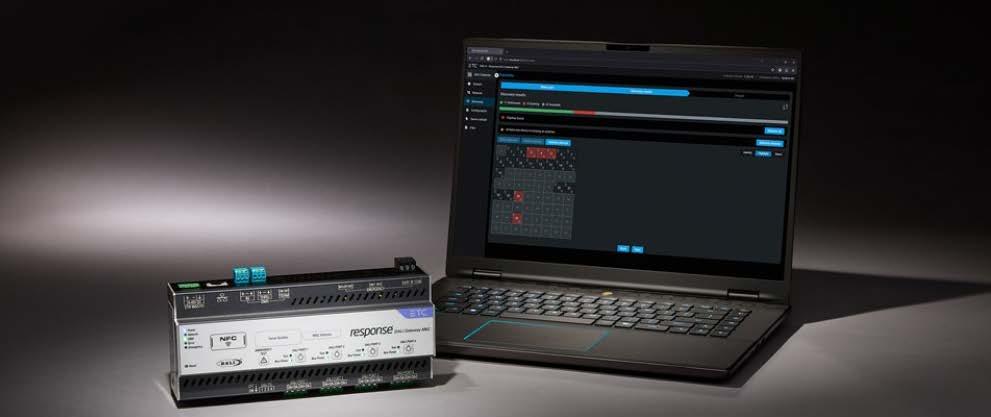
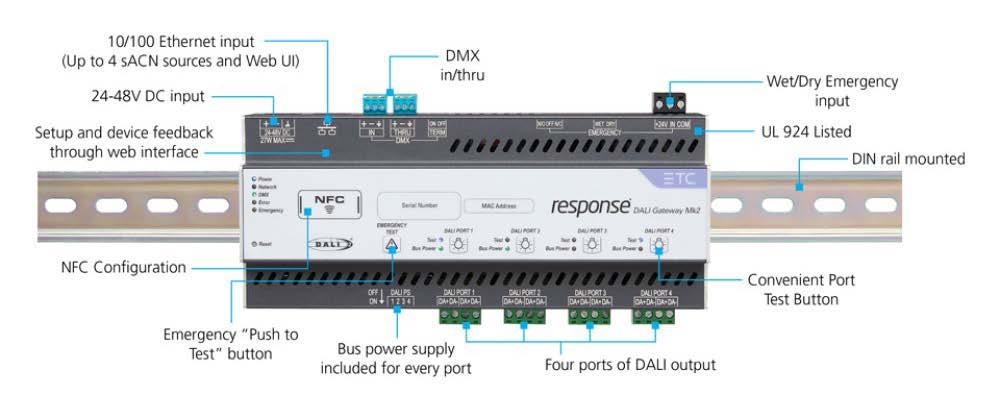
ETC has introduced the new Response DALI Gateway MK2, a DALI-2 certified gateway solution developed to address growing adoption of DALI-based lighting control infrastructures across North America and international architectural markets. Designed for integration within modern commercial and architectural environments, the DIN-mounted gateway converts DMX or sACN signals to DALI while offering streamlined configuration, expanded scalability, and simplified system management.
The Response DALI Gateway MK2 supports four individual DALI ports — or subnets — each featuring an integrated bus power supply. Configuration and ongoing device management are handled through a webbased interface designed to simplify setup procedures and provide quick visibility into fixture and device status across connected systems.
Unlike analogue dimming systems that rely on fluctuating voltage signals, DALI operates using digital communication protocols, enabling fixtures and drivers to receive
consistent, precise commands. This digital approach allows improved colour consistency, smoother low-end dimming performance, reduced flicker, and greater long-term reliability across large-scale lighting installations.
ETC positions DALI not simply as a technological upgrade, but as a broader operational improvement for building environments ranging from hospitality venues and residential towers through to schools, airports, offices, healthcare facilities, and commercial developments.
Beyond lighting performance itself, DALI’s infrastructure advantages extend into installation and maintenance efficiencies. A single DALI control bus can support up to 64 drivers and multiple control groups, reducing wiring complexity, conduit requirements, and labour demands — particularly as project scale and zoning complexity increase. According to ETC, these efficiencies become increasingly significant in larger projects where flexible grouping and scalable control are essential.
Long-term operational visibility also forms a major part of DALI’s appeal. DALI-enabled systems are capable of reporting fixture or driver failures directly to facility teams, enabling faster maintenance response and improving system oversight across large buildings and multi-zone environments. ETC additionally emphasises the importance of DALI’s open-standard architecture. As a DALI-2 certified solution, the Response DALI Gateway MK2 supports interoperability
between compliant devices and controllers through third-party verified integration standards. This aligns closely with ETC’s longstanding focus on open ecosystems and flexible customer choice within lighting control infrastructures. The company sees DALI continuing to expand within architectural and commercial environments where intelligent building integration, scalability, and operational longevity are becoming increasingly important.
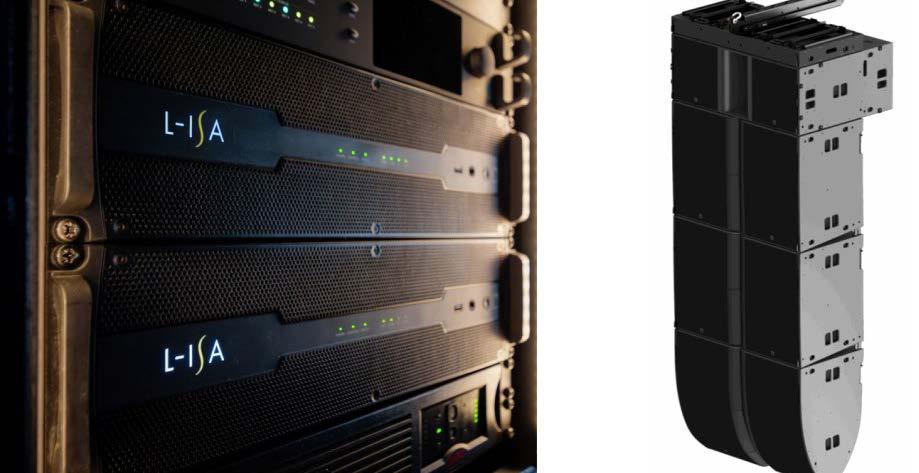
L-Acoustics has unveiled one of its most ambitious technology launches to date, introducing the new L1 large-format line array system, the companion CS1 cardioid subwoofer, and the proprietary Source Intelligence voice-separation platform. Officially launched during L-Acoustics Keynote 2026 at the Hollywood Bowl — where the technologies also marked their first permanent deployment in a custom white architectural finish — the announcement positions the company firmly at the forefront of both large-format sound system engineering and real-time AI-assisted audio processing. The keynote performance featured The War on Drugs, offering attendees a first-hand demonstration of the technologies in a live environment.
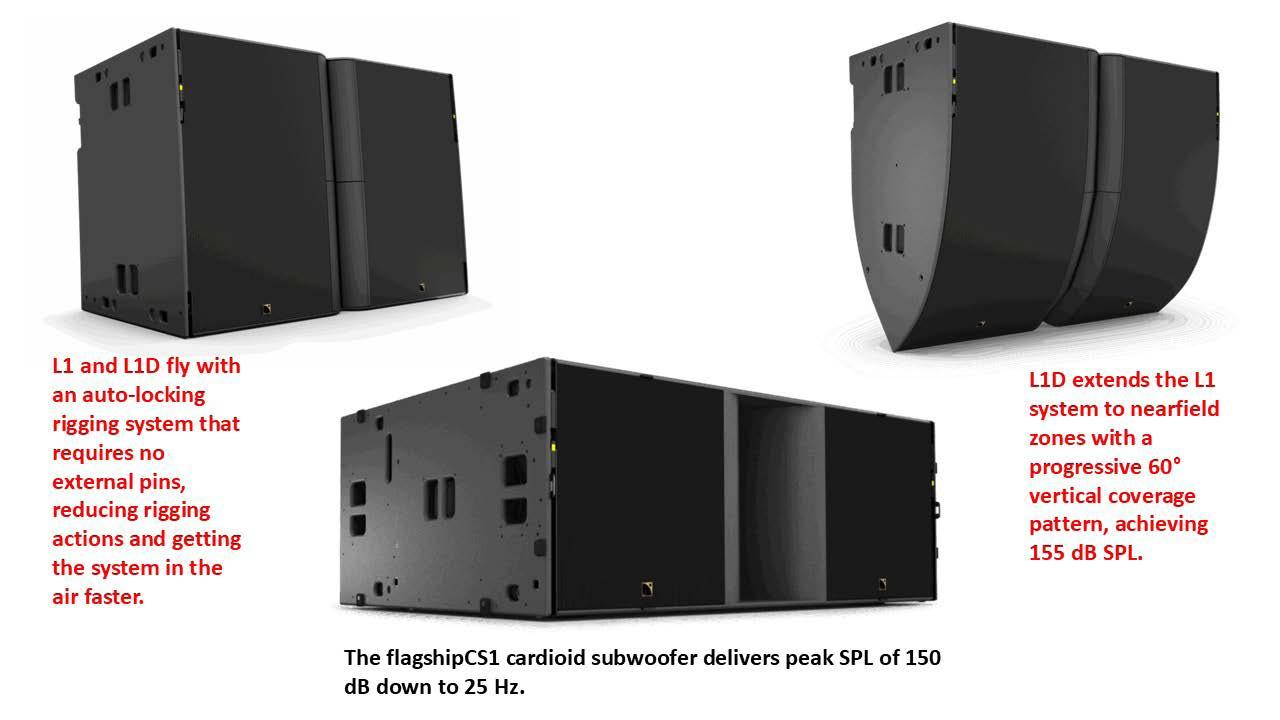
At the centre of the launch is the new L-Acoustics L1, the flagship model within the L Series platform and the company’s most advanced expression yet of its patented Progressive Ultra-Dense Line Source (PULS) technology. Already deployed across several major global tours and festival stages during
its pilot phase, the system has been trusted on productions including Bruno Mars’ North American tour with Clair Global, Harry Styles’ Together tour with Solotech, and Joker Xue’ world tour with MRT, alongside high-profile appearances at the Brit Awards in London and major festival stages including Coachella and Ultra Music Festival.
Where conventional large-format systems have traditionally relied on larger quantities of array elements to achieve scale and output, L1 dramatically increases transducer density within a more efficient physical footprint. Each enclosure integrates two 18-inch lowcardioid transducers, four front-facing 15inch low-frequency drivers, eight 8-inch mid-frequency drivers, and six coaxial 4-inch plus 2.5-inch high-frequency compression drivers. The resulting system achieves a maximum SPL of 160 dB per enclosure across a bandwidth spanning 35 Hz to 20 kHz.
“L1 represents the highest expression of power, bandwidth, and pattern control ever achieved in line array technology,”
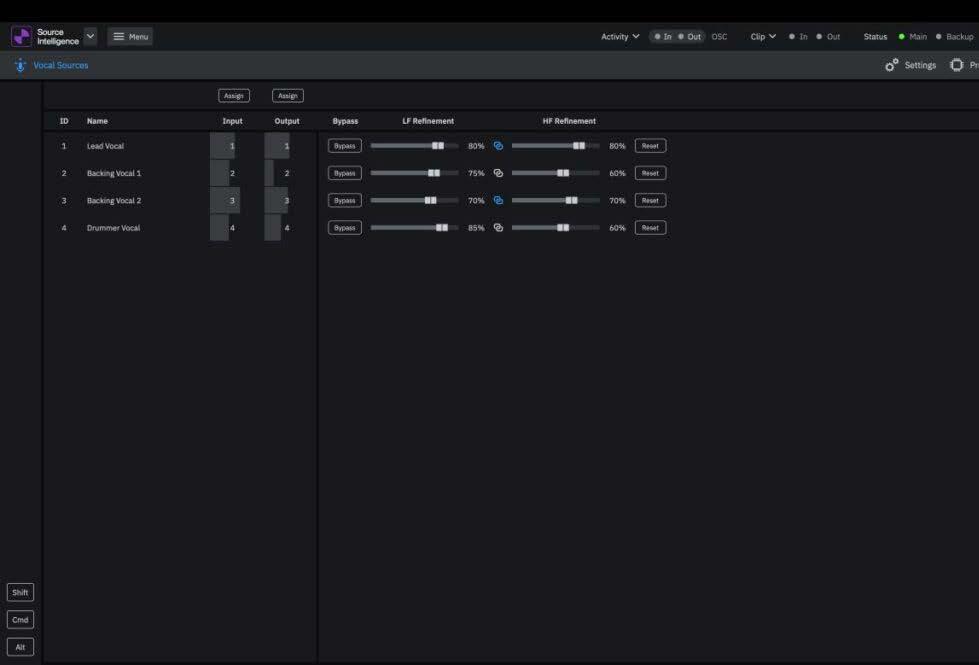
L-Acoustics Source Intelligence runs on the L-ISA Processor II as a licensed software subscription, requiring no threshold setting, no ongoing adjustment, and no changes to existing console workflow or signal routing.
said Germain Simon, Director of Product Management, Loudspeakers at L-Acoustics. “With PULS taken to its ultimate expression, we have broken every performance benchmark we set for largeformat line source. L1 is a genuine turning point for the industry.”
Supporting the system is the new L-Acoustics CS1, featuring four 21-inch transducers
configured in a cardioid topology capable of delivering peak SPL up to 150 dB while extending low-frequency performance down to 25 Hz. The combination of L1 and CS1 places significant emphasis on low-frequency directivity and environmental control — an increasingly critical requirement for large productions operating within urban environments, multi-stage festivals and noise-sensitive venues.
The side-mounted low-cardioid transducers within L1 deliver up to 18 dB of rear rejection between 20 Hz and 250 Hz, while rejection below 80 Hz exceeds 26 dB. Engineers can select between cardioid and supercardioid operating modes depending on the acoustic demands of the environment.
L-Acoustics has further expanded this capability through its next-generation Autofilter algorithm integrated within Soundvision software. The platform shapes low-frequency beam control in three dimensions without introducing additional latency, enabling a shorter L1 array to achieve low-frequency behaviour comparable
to; and in some configurations surpassing substantially larger conventional systems.
For touring applications, the company claims major gains in deployment efficiency and logistics. A system configuration comprising two CS1 subwoofers, four L1 enclosures and one L1D element reportedly delivers equivalent acoustic performance to a traditional 21-box K1 configuration while requiring 66 percent fewer rigging actions, fewer cables and a significantly smaller footprint. Weight reductions are equally notable, with five enclosures reportedly performing the work of fifteen conventional boxes while reducing total rigged weight by approximately 20 percent.
The new architecture also introduces autolocking rigging systems without external pins, simplified SC32 cabling, and dedicated LA7.16 amplified controllers delivering sixteen discrete DSP and amplification channels per enclosure. Combined with MilanAVB networking and LA-RAK III touring racks, the ecosystem is designed to streamline both deployment and control at scale. Alongside the loudspeaker launch, L-Acoustics also introduced L-Acoustics Source Intelligence, a machine learning-driven voice-separation technology designed to dramatically improve vocal intelligibility and gain-before-feedback performance in live environments.
Running exclusively on the L-ISA Processor II platform, Source Intelligence supports handheld, headset, lapel and distantpickup microphones, processing up to four simultaneous channels with end-to-end latency remaining below 8.5 milliseconds over MADI; as it continuously identifies and isolates vocal content within a microphone signal while removing unwanted stage bleed,
PA spill, room reverberation and ambient noise in real time. Unlike traditional feedback management approaches that rely on notch filters, expanders or restrictive staging practices, the system operates transparently within the signal chain while preserving the natural tonal character of the source.
“For decades, engineers have been solving the PA bleed and feedback problem with compromises like notch filters that color the sound, expanders that can be unpredictable, or staging layouts that pull performers away from the audience,” explained Ryan John, Director of Product Management, Software at L-Acoustics. “Source Intelligence removes that trade-off entirely. The machine is continuously listening and continuously working, so the engineer can focus on the mix instead of fighting feedback, and the performer can own the whole stage.”
According to L-Acoustics, blind listening tests consistently ranked Source Intelligence highest for voice quality against competing approaches, with the technology capable of removing up to 40 dB of non-voice signal content. The platform has already seen deployment across major touring productions, Broadway shows and large-scale house-ofworship environments since Spring 2025, including tours for Benson Boone and Rosalía, as well as the Broadway production Dog Day Afternoon.
Together, L1, CS1 and Source Intelligence underline a broader strategic direction for L-Acoustics — one where loudspeaker design, immersive processing, machine learning and system-wide workflow integration increasingly converge into a unified ecosystem aimed at redefining both the technical and creative possibilities of largescale live sound reinforcement.
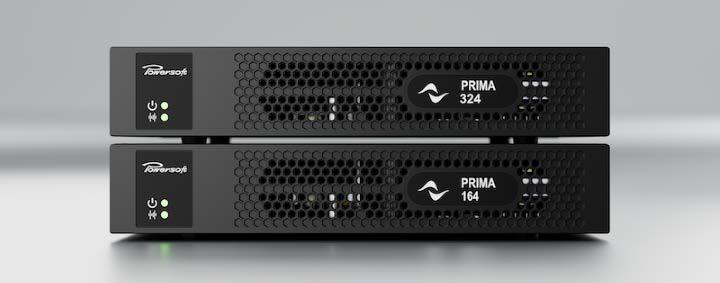
Powersoft has introduced the PRIMA Series, a new compact 4-channel professional amplifier range for installed audio systems requiring reliable low-to-mid-power amplification without unnecessary complexity. Available in two versions differentiated by power output, PRIMA 164 and PRIMA 324 are designed specifically for applications where signal processing is already handled upstream or where DSP is not part of the system architecture. The range sits between entrylevel commodity amplifiers and fully featured DSP-integrated platforms, making it the right choice where practical system fit matters more than feature count.
Both PRIMA models support Hi-Z and Lo-Z operation, with each output channel independently configurable to suit the connected load. Auto Setup automatically optimises the amplifier’s operating parameters on first start-up, reducing commissioning time and simplifying on-site deployment. The unit uses a fixed diagonal matrix routing architecture with each input
feeding its corresponding output channel, keeping signal flow clean and predictable. A dedicated connector also enables 1-to-all routing, feeding a single input source to all output channels, which is particularly useful in distributed audio applications. Power Sharing technology allows available power to be distributed across channels according to system requirements, while Eco Mode, Auto Standby, and low-consumption operation help reduce the energy footprint of the installation over time.
The compact half-rack form factor means PRIMA can be deployed in a variety of ways, including as a standalone unit, behind a display, or beneath a conference table. This enables discreet, space-efficient installation in environments where visible equipment is undesirable On-board gain trimmers, status and signal LEDs, and straightforward rearpanel controls allow for quick adjustment and system monitoring without requiring dedicated software or additional configuration layers.
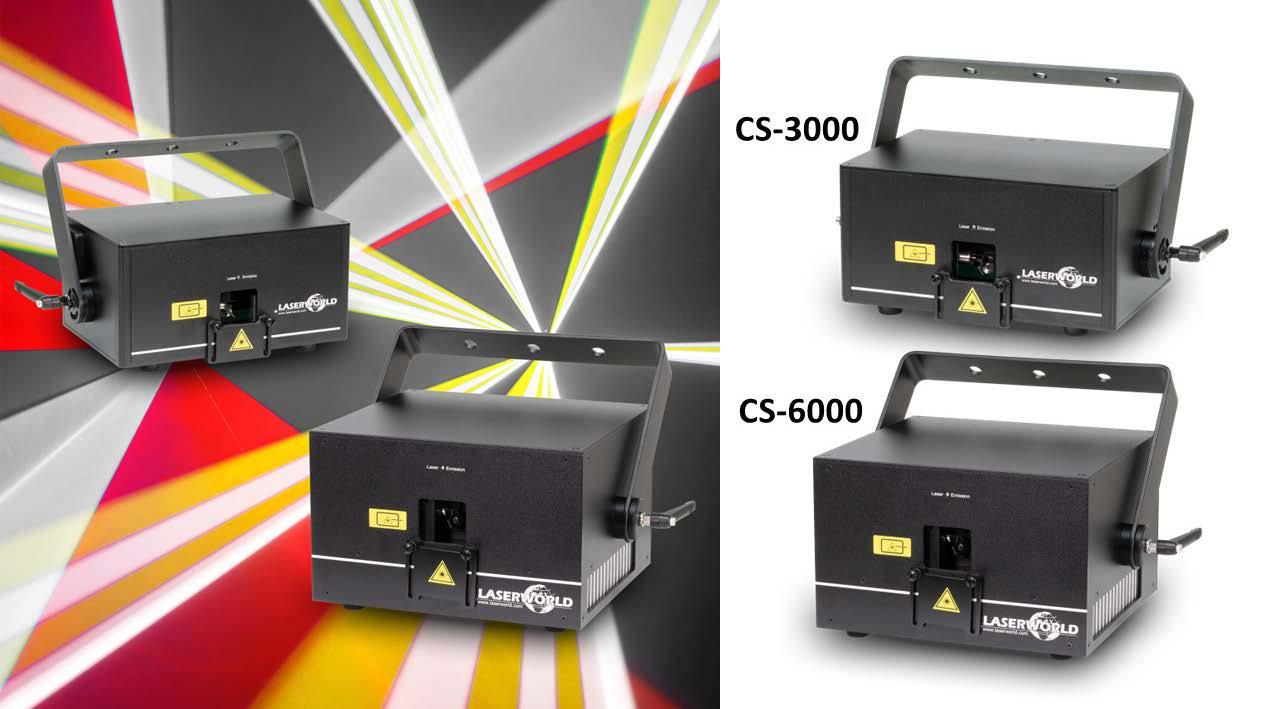
The new CS-3000 micro and CS-6000 micro from Laserworld focuses on affordability with a feature set for the masses: DJs, entertainers, bars, nightclubs, even concerts use Laserworld Club Series products, and the CS-3000 micro and CS-6000 micro follow the general trend in the laser show industry: more power, more affordability.
The Club Series micro devices come with all the features that are needed for basic and semi-professional use: Automatic operation, sound-to-light mode, as well as DMX, are implemented through the versatile mainboard. Besides that, the CSunits are equipped with ILDA connectors so they can be controlled by laser software in a professional way. Most people who decide to go for professional computer
control with the Club Series units bundle a Laserworld ShowNET interface with their laser, which opens the whole feature set and controllability options of the ShowNET environment.
With their graphics capable scanners, the new Club Series devices are suitable for a variety of use cases, including basic graphics or logo display. The analog color modulation allows for displaying thousands of different color shades. The Laserworld CS-3000 micro is specified with a guaranteed power at aperture of 2.5 W, whereas the Laserworld CS-6000 micro has a guaranteed power of 5.8 W at aperture.
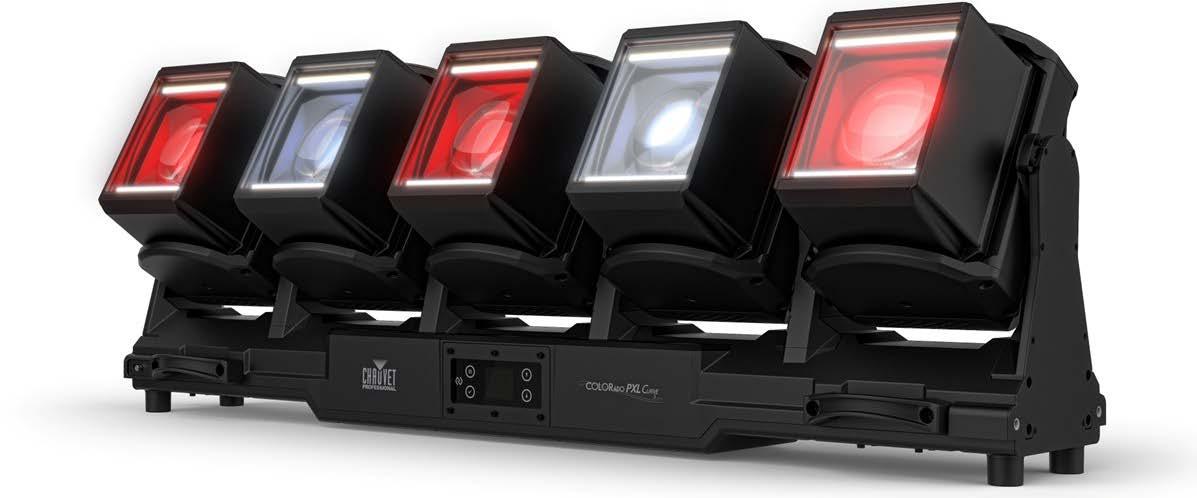
CHAUVET Professional has expanded its internationally acclaimed COLORado PXL series with the introduction of the new COLORado PXL Curve 5, further extending the company’s growing ecosystem of motorised battens designed for immersive, large-scale visual environments. Engineered to deliver sweeping motion, pixel-mapped effects, and scalable creative flexibility, the new fixture introduces an arced five-head configuration with individually controllable 120W LED heads aimed at enabling more fluid and dynamic lighting compositions. Fully compatible with other fixtures in the PXL series, the IP65-rated fixture enables designers to combine multiple units into scalable visual structures capable of moving seamlessly between architectural looks, layered scenic designs, and large-format immersive lighting effects.
Designed for applications ranging from pixel-mapped runway effects and sweeping festival-stage visuals to immersive scenic layering and linear architectural compositions, the fixture incorporates motorised 200-degree pan and 60-degree tilt functionality, alongside a wide zoom range extending from 5.7 degrees to 36.3
degrees. Designed specifically for continuous multi-fixture deployment, the system maintains consistent pixel pitch alignment when multiple units are combined together, ensuring visual continuity across large-scale arrays and pixel-mapped environments.
At the core of the fixture is a colourmetrically matched RGBW LED engine designed to maintain consistent colour reproduction both within the fixture itself and across the broader COLORado PXL ecosystem. Expanding its creative flexibility further, the COLORado PXL Curve 5 integrates a combination of warm white and cool white LED heads alongside its RGBW sections, enabling designers to create more nuanced tonal environments and layered visual textures. The fixture also incorporates eight independently controllable sections for its warm white and cool white strobe cells, with full pixel-mapping support available across all cells. Control options include DMX, sACN, and Art-Net protocols, alongside full RDM compatibility for streamlined configuration and integration into complex lighting networks.
Cameo has expanded its OTOS series with the launch of two new IP65-certified linear fixtures — the OTOS LC12 and OTOS L16 — built around the brand’s “Shape Spaces. Create Motion” philosophy.
While the OTOS LC12 focuses on organic, kinetic light images and adaptable front light effects through its individually tiltable heads, the OTOS L16 is designed for cleaner lines, symmetrical movement patterns, and tightly controlled beam looks. Used independently or combined with each other — and alongside other OTOS Wash models — the moving bars introduce a distinctly linear layer to the OTOS creative ecosystem. The IP65 moving bar features twelve individually tiltable and zoomable 50 W moving heads, each equipped with an RGBL colour mixing system. With up to 206° tilt per head, an individual zoom range of 3.3° to 40.5°, an integrated FX strip, and a CCT range spanning 1,800 to 10,000 Kelvin, the fixture is suited for everything from kinetic beam effects and striking visual accents to atmospheric colour washes and refined white light applications.
Complementing this is the OTOS L16, an equally IP65-certified LED moving bar developed for precision beam looks, symmetrical effects, and seamless cluster deployment. Featuring 16 x 50 W RGBL LEDs, the OTOS L16 delivers a total output of 9,000 lumens. Two independently controllable zoom segments—each consisting of eight lenses with a zoom range of 4.6° to 37°—combine with a motorised tilt range of 208° and an integrated FX strip to create dynamic zoom effects, fluid light patterns, and visually powerful accents that extend well beyond the
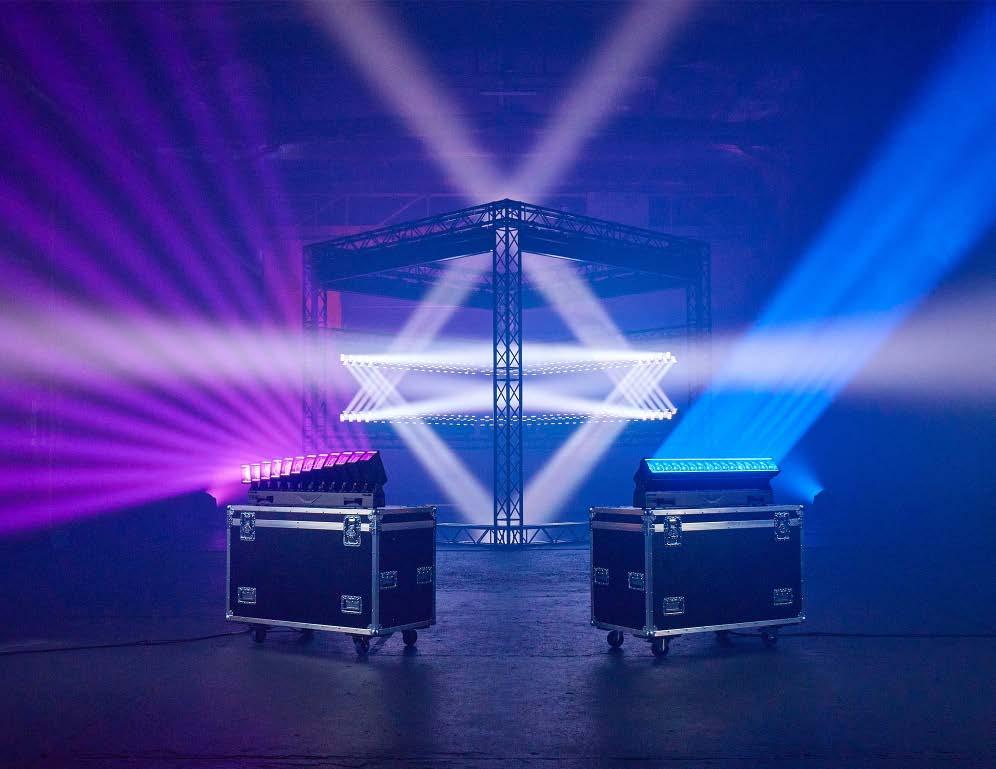
capabilities of traditional static LED bars. For additional design flexibility, optional filters including circular, asymmetrical, dark, and diamond structure variants are also available.
Through uniform RGBL colour mixing, both the OTOS Wash and OTOS Linear fixtures deliver consistent colours, balanced whites, and harmonious three-dimensional effects across multiple fixture types. And when combined with FX-Strip, FX-Ring, and Single Pixel Control, this enables lighting designers to create coherent, high-impact visual environments with exceptional continuity.
The OTOS LC12 and OTOS L16 feature robust strategically positioned handles for fast and comfortable handling, plus a quick-lock mechanism for efficient rigging. Seamless Clustering further allows multiple units to be combined without visible interruption, creating smooth transitions across scalable lighting systems for live stages, festivals, television productions, corporate events, and architectural installations. To support transport and protection, Cameo also supplies the OTOS LC12 with a Tilt Lock Cover, securing all twelve tilt heads safely during transit.
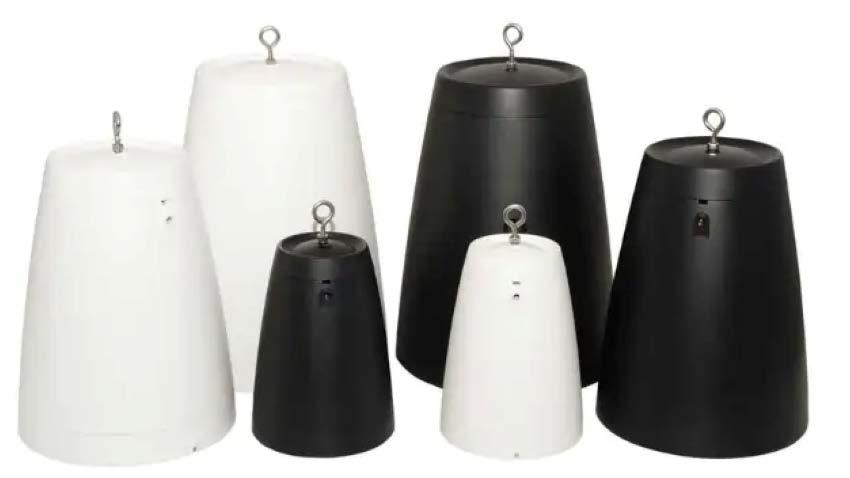
Peavey Electronics’ new Impulse Pendant Speaker Series is a trio of commercial-grade pendant loudspeakers designed for highceiling environments where sound clarity, architectural aesthetics, and installation flexibility are equally critical. Available in black or white, the Impulse P8, Impulse P6.5, and Impulse P4 use pendant mounting to preserve architectural integrity while suspending the loudspeaker closer to the listening area.
The Impulse P8 features an 8-inch polypropylene cone woofer paired with a 1.1-inch silk tweeter in a two-way passive, bass-reflex enclosure. Rated at 60 watts and capable of delivering peak sound pressure levels up to 112 dB, the Impulse P8 offers extended low-frequency performance with a frequency response down to 55 Hz (-3 dB). It supports both 70V and 100V distributed audio systems with selectable transformer taps of 7.5W, 15W, 30W, and 60W, as well as an 8-ohm bypass. The speaker provides a nominal 90° x 90° coverage pattern and is housed in a flame-retardant polypropylene enclosure with a matte black finish, weighing 11 pounds.
The Impulse P6.5 is designed to balance output capability and compact form, using a 6.5-inch woofer and a 1-inch silk tweeter in a two-way passive configuration. Rated at 60 watts, the P6.5 delivers peak SPLs of up to 112 dB and offers a frequency response extending to 70 Hz (-10 dB). Like the P8, it supports 70V and 100V operation with selectable transformer taps at 3.75W, 7.5W,
15W, and 30W, along with an 8-ohm bypass. The enclosure features a bass-reflex design, flame-retardant polypropylene construction, a 90° x 90° coverage pattern, and a net weight of 7.7 pounds, making it well suited for medium-sized commercial spaces.
Lastly, the Impulse P4, is built around a 4-inch woofer and a 0.75-inch silk tweeter in a two-way passive design. Rated at 30 watts, the P4 achieves peak SPLs of up to 108 dB and delivers a frequency response down to 77 Hz (-10 dB). It supports both 70V and 100V systems with selectable taps at 3.75W, 7.5W, 15W, and 30W, as well as an 8-ohm transformer bypass. With its compact dimensions and 5.5-pound weight, the Impulse P4 provides a discreet yet capable solution for smaller commercial environments while keeping the same aesthetic and installation advantages as the larger models.
Series, Peavey incorporates a consistent set of professional features including two-way passive designs, bass-reflex enclosures, flame-retardant polypropylene cabinets, Euroblock input connectors, and support for both 70V and 100V distributed audio systems.
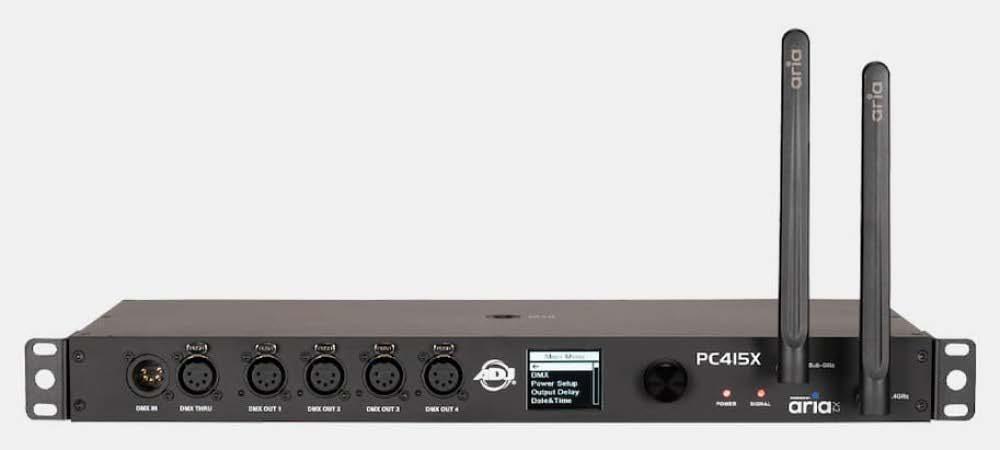
ADJ has unveiled the new PC415X, a multifunctional rack-mountable device designed to consolidate power distribution, wireless DMX transmission, and signal management into a single compact platform aimed at modern touring, live event, and installation applications.
At the centre of the PC415X is a hybrid architecture that incorporates a four-output power distribution centre, a built-in Aria X2 wireless DMX transceiver, and a four-output DMX/RDM splitter. By merging these functions into a single chassis, ADJ aims to simplify system deployment, minimise rack space requirements, and reduce cable management demands across fast-paced production environments.
The unit features an OLED display paired with push-button encoder wheel navigation, providing access to a menu-driven interface for configuration and system monitoring. Additional onboard status LEDs offer quick visual confirmation of power and DMX signal activity.
For power management, the PC415X incorporates one IP65 locking power input alongside four individual IP65 locking power output sockets, each protected via dedicated
15A resettable breakers. Located on the rear panel alongside the master power switch, the system supports total loads of up to 16A and accommodates a wide 100–240V input voltage range, allowing deployment across varying international power infrastructures.
The DMX distribution section supports full RDM compatibility and includes five-pin DMX input and thru connectors, complemented by four additional five-pin output sockets positioned on the front panel for simplified access during live operation. The PC415X can additionally be controlled remotely via DMX, enabling users to switch individual power outputs directly from a lighting console or control system. Four selectable channel modes are available, including grouped and independent output control configurations.
Further extending its automation capabilities, the unit integrates an onboard event scheduler accessible through the OLED interface, allowing users to program up to eight timed events assigning specific power outputs to switch on or off according to selected days and schedules.
Wireless functionality is handled via the integrated Aria X2 transceiver, enabling cable-free DMX transmission using ADJ’s proprietary Aria X2 mesh networking protocol. The system supports both 2.4GHz and Sub-GHz wireless operation, alongside Bluetooth connectivity intended for future app-based configuration workflows. Dual 5G JT SMA antennas are included to strengthen wireless stability and transmission reliability in dense RF environments, while over-the-air update capability provides ongoing platform expandability.
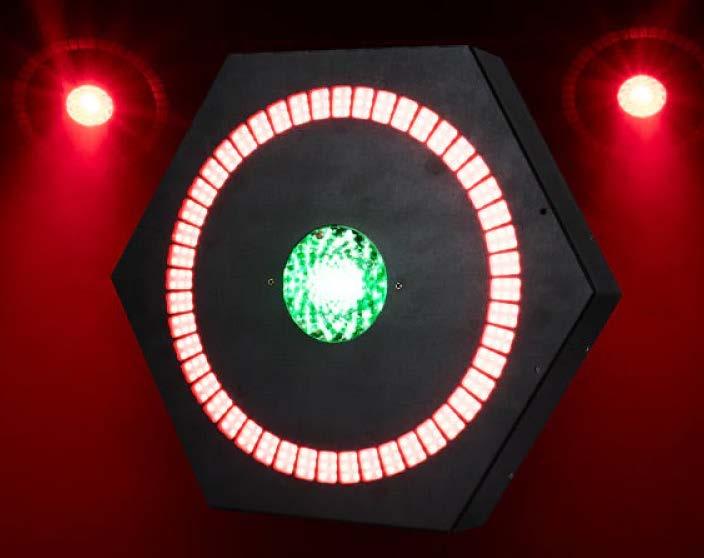
Eliminator Lighting has expanded its effects lighting portfolio with the launch of the new Fantasy FX; a compact dual-effect fixture designed to deliver vibrant visuals, dynamic chase effects, and versatile performance across a wide range of entertainment applications. Developed for DJs, nightclubs, bars, roller rinks, and family entertainment centres, the fixture combines beam, wash, and pixel-style effects within a single lightweight housing aimed at maximising creative flexibility while simplifying deployment.
At the heart of the Fantasy FX is a 40W RGBW colour-mixing LED positioned behind a kaleidoscopic lens system designed to generate both focused wash effects and animated visual projections. Surrounding the central optics is a circular halo comprising 288 x 0.5W RGB LEDs arranged into 48 individually controllable groups of six LEDs
each, enabling a wide range of multicolour chase effects and animated pixel-style sequences.
The fixture ships with 128 built-in programs, providing users with immediate access to a broad selection of looks and effects without requiring extensive programming. For more advanced operation, the Fantasy FX supports multiple control modes including DMX, standalone sound active operation, and primary/secondary linking for synchronised multi-unit playback. An onboard LCD display provides simplified navigation and addressing functionality, while three selectable DMX channel modes — 7, 15, or 148 channels — allow the fixture to scale from simple plug-and-play deployments to more detailed pixel-mapped programming environments.
Designed with both portability and operational reliability in mind, the Fantasy FX features smooth 0–100% dimming, strobe effects of up to 20 flashes per second, and convection cooling for silent operation in noise-sensitive environments. Weighing just 3.1 kg, the fixture is engineered for easy transportation and installation, while locking power input and output connectors enable multiple units to be daisy-chained together for larger system deployments. Despite its visual output capabilities, the fixture operates at a maximum power consumption of just 100W.
How Next-Generation LED Display Technologies Are Rewriting the Rules of Visual Storytelling Across Live Events, XR, and Immersive Entertainment
The modern live event is no longer defined by the stage alone. Today, the world’s biggest concerts, festivals, corporate launches, immersive attractions, broadcast productions, esports tournaments, and hybrid experiences are being driven by an entirely new visual language; one powered by rapidly evolving LED display technologies that are transforming screens into dynamic storytelling ecosystems. What was once considered display technology has now evolved into an intelligent visual ecosystem that actively shapes the language of entertainment itself. And the momentum behind this transformation is impossible to ignore.
According to multiple industry analysts, the global LED video display market continued its upward trajectory through 2025, recording a 6.2% year-on-year growth driven heavily by live events, entertainment environments, public spaces, retail experiences, and virtual production applications. Simultaneously, advancements in MicroLED, MiniLED, MIP packaging technologies, and cameraoptimised processing are enabling finer pixel pitches, higher efficiency, and vastly improved visual consistency for both live audiences and broadcast environments.
These developments have become particularly evident across the APAC and
ME regions, with landmark deployments rapidly redefining what large-scale immersive environments can achieve. For example, in South Korea, StudioCube Daejon’s massive virtual production facility showcased a 94.7-million-pixel LED volume engineered specifically for advanced cinematic workflows. Meanwhile in China, Dawa Studio’s Yongchuan virtual production facility expanded aggressively with new LED-powered stages designed to position Western China as a hub for technology-driven filmmaking. Similarly, Malaysia’s FINAS ICVFX Studio marked another significant regional milestone in virtual production infrastructure, integrating high-performance LED processing and camera synchronisation technologies to support next-generation filmmaking. And the Middle East too embraced this transformation with great enthusiasm; particularly visible in the UAE’s Web3TV facility which recently launched with one of the region’s largest XR and virtual production capabilities featuring avant-garde integrated LED volume solutions.
The touring and live entertainment sectors too entered a new era of convergence between physical and digital performance environments. For example, South Korea’s virtual K-pop phenomenon PLAVE recently delivered an arena-scale production at Seoul’s Gocheok Sky Dome where massive LED canvases, live streaming infrastructure, synchronised media workflows, and immersive content pipelines operated as one cohesive visual ecosystem for more than 35,000 attendees.
These developments are a direct reflection of the global appetite for immersive visual experiences, which continues to surge with each passing day. From AI-powered media workflows and real-time rendering engines to advanced LED calibration systems and camera-synchronised processing
technologies, the conversation has evolved far beyond traditional specifications such as pixel pitch and brightness. And today, the industry’s leading manufacturers are increasingly focused on emotional engagement, workflow integration, sustainability, creative flexibility, and camera realism.
For years, LED conversations revolved almost entirely around specifications. Higher brightness. Finer pixel pitch. Greater resolution. But according to industry leaders, those metrics alone are no longer enough to satisfy the expectations of modern audiences and content creators.
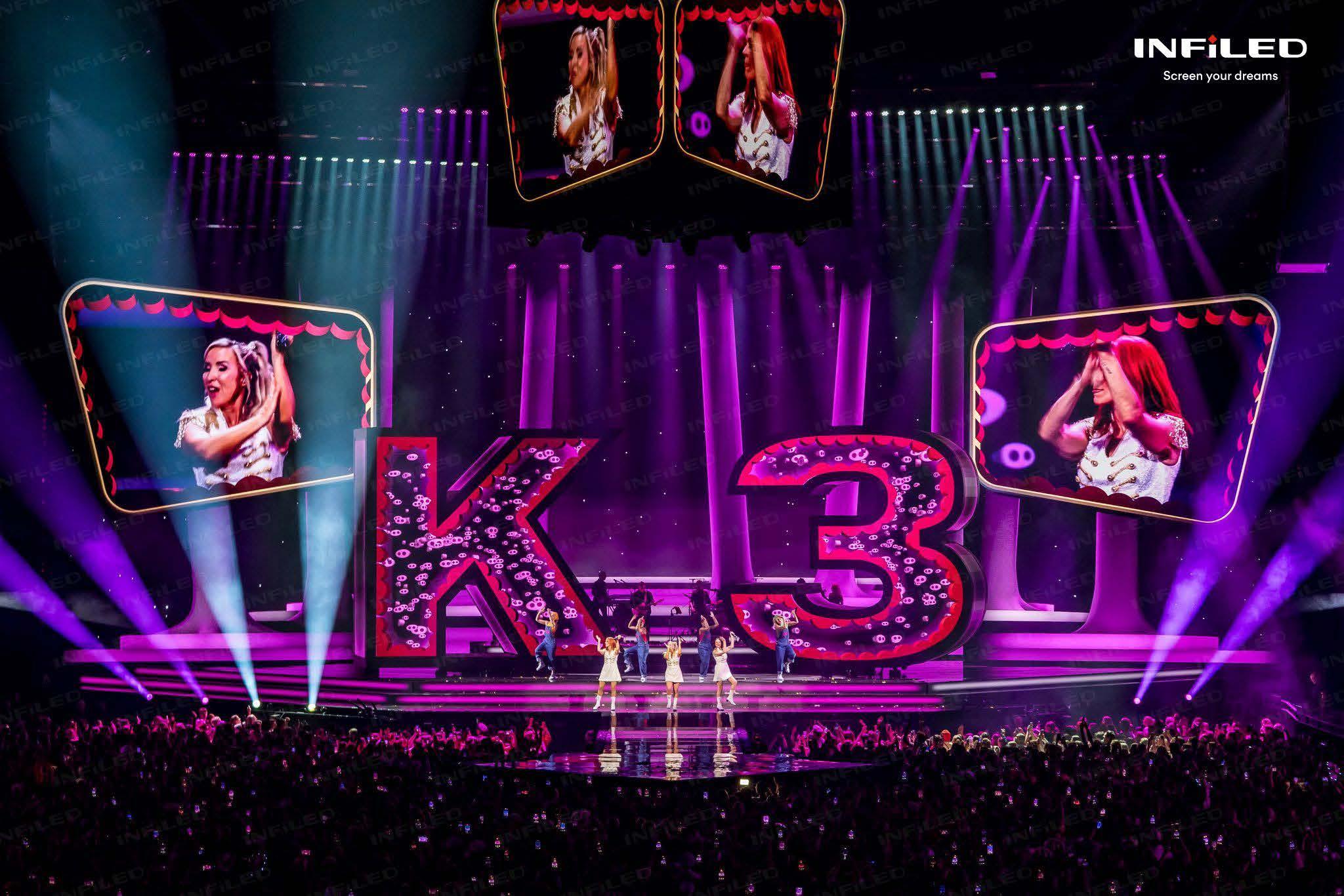
INFiLED believes the industry is entering an era where LED displays are becoming integral to the storytelling process itself. The company notes that audiences today expect experiences that feel emotional, immersive, and unforgettable rather than simply visually sharp. Whether deployed within concert stages, festivals, or permanent installations, displays are increasingly shaping atmosphere, energy, and audience engagement in ways that transcend traditional screen functionality. They further emphasise that visual performance today must be “felt” by audiences through ultra-smooth motion, precise colour accuracy, deep contrast, and camera-friendly visuals optimised equally for live attendance and digital consumption across social media and broadcast platforms. The company also highlights growing demand for transparent LED systems, curved installations, immersive stage environments, and unconventional screen formats that allow event designers greater creative freedom and stronger emotional impact.
Unilumin similarly argues that the future of LED lies in making the technology itself disappear so that audiences remain immersed entirely within the experience. The company points towards innovations such as its U-Shield durability solution, integrated across the UPADIV and URMIII series, which dramatically improves impact resistance while reducing lamp damage by over 90%. By eliminating concerns around physical durability during load-ins, touring cycles, and rapid deployment schedules, production teams can focus entirely on content and creative execution. Unilumin also identifies MIP technology as a major leap forward for visual immersion, combining MicroLED chiplevel packaging with COB surface treatment to achieve exceptional pixel-level colour consistency and wider viewing-angle stability. According to the company, these advances soften the perceived boundary between display and content itself, allowing visuals to feel more organic and experiential rather than screen-based.

Meanwhile for Planar International the emphasis has shifted towards understanding how visuals are actually perceived by audiences, cameras, and surrounding environments rather than simply measured technically. Jason Lim, Sales Director, APAC, Planar International, explains that the company sees strong future importance in intelligent brightness control and AI-driven sensing technologies capable of adapting dynamically to changing lighting conditions during live productions. He stresses that synchronisation between stage lighting, display content, and camera systems has become absolutely critical in maintaining immersion.
“Immersion breaks the moment visuals fall out of sync. That is why precise engineering across video controllers, signal distribution, and cabling are fundamental to delivering seamless, lifelike experiences” Lim explains, highlighting why low latency engineering, advanced signal distribution, and precision synchronisation have become central to modern LED system design. He also notes that flat screens alone are no longer sufficient to create visual impact, with customisable forms, bold geometries, and scalable architectural integrations now transforming LED surfaces into active design elements that elevate narrative and emotional engagement. “Creating a true wow factor requires the ability to customize displays into bold shapes and scalable forms, turning LED surfaces into design elements that draw attention and elevate storytelling,” says Lim. “Ultimately, Planar designs display not just to be seen, but to be felt as quiet performers in the background that deliver emotion, immersion, and clarity.”
As live entertainment continues diversifying across corporate events, touring productions, immersive brand activations, festivals, esports, broadcast environments, and hybrid experiences, manufacturers are under increasing pressure to deliver LED systems that combine flexibility, speed, durability, and scalability within a single ecosystem.
INFiLED observes that modern event environments demand display systems capable of transitioning seamlessly between vastly different production scenarios. One week, a screen may serve a premium corporate launch; the next, it may form part of a large-scale touring festival setup.
To address these demands, the company has focused heavily on lightweight cabinet designs, rapid-locking mechanisms, curved configurations, seamless right-angle integration, and simplified deployment workflows that reduce production complexity without limiting creative flexibility. INFiLED also points out that different event types require distinctly different visual priorities; with corporate environments typically demanding refined presentation quality and close-viewing comfort, while concerts and festivals prioritise durability, bold visual impact, and flawless camera performance for live streaming and broadcast applications. The company further highlights increasing market demand for multifunctional LED ecosystems supporting hybrid productions, immersive staging concepts, and highly customised display designs.
partners and production crews to streamline training, inventory management, and deployment workflows across vastly different event scales. Simultaneously, Unilumin positions its UPADIV series as a bridge between live event production and virtual production workflows, where high-fidelity performance specifications allow the same display platform to transition effortlessly between corporate applications and XR-driven content environments.
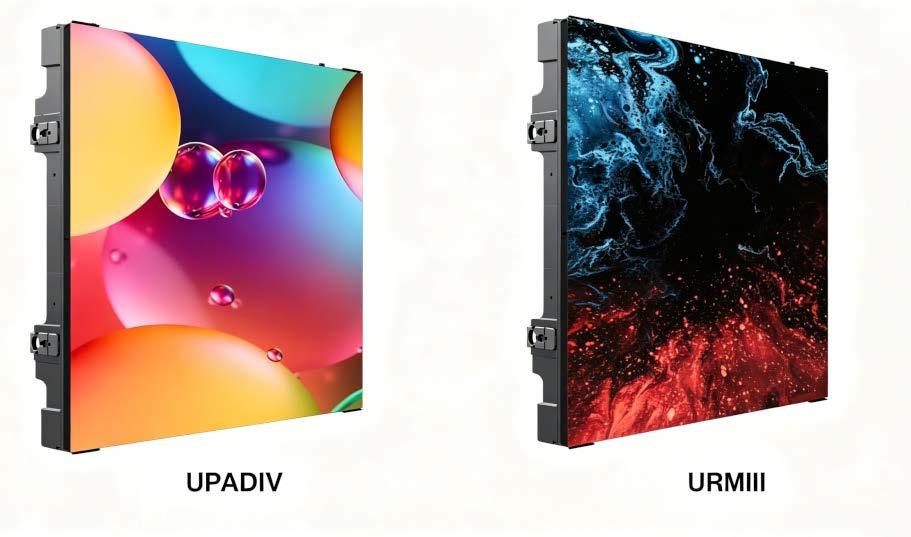
Unilumin approaches flexibility through modular ecosystem thinking. The company explains that its URMIII platform is designed around a strong foundational architecture that can evolve through purpose-built variants, modular attachments, and ecosystem integrations. The same core system can therefore support an indoor conference environment before scaling into a wind-resistant outdoor festival structure or transforming into curved and creative geometries using specialised S and C variants. This standardisation allows rental
Planar also identifies modularity and lightweight engineering as essential pillars of modern event display design. Jason Lim explains that Planar intentionally develops scalable architectures that enable AV companies and rental providers to deploy the same platform across multiple event categories without investing in entirely separate inventories. Fast-locking mechanisms, front-serviceability, and standardised component systems are all engineered to reduce setup times, simplify logistics, and improve operational efficiency for touring and rental workflows. At the same time, Planar prioritises configurational flexibility across screen size, shape, resolution, and pixel density to ensure optimal performance regardless of venue scale, viewing distance, or creative requirements.
Perhaps the most transformative shift within the LED display landscape is the rapid convergence between display technologies, media servers, camera tracking systems, real-time rendering engines, and virtual production workflows. What was once a
straightforward display pipeline has evolved into an extraordinarily interconnected ecosystem where timing, calibration, synchronisation, and visual consistency determine whether an immersive illusion succeeds or collapses.

Brompton Technology describes virtual production as an environment where every component — from LED processors and media servers to render engines, synchronisation hardware, tracking systems, and cameras — must operate as a single unified workflow. Cesar Caceres, Product Lead at Brompton Technology, explains that the LED processor effectively becomes the bridge between creative intent and what the camera ultimately captures. He notes that even the highest-quality LED panels remain fundamentally dependent on the processing infrastructure driving them, while weaknesses elsewhere in the workflow can undermine the entire illusion. He elaborates, “Timing, calibration, synchronisation and colour management must remain consistent across every stage of the pipeline to create believable in-camera visual effects. In VP studios, issues that may be invisible to the human eye can quickly become apparent on camera. Small inconsistencies in brightness, colour reproduction, frame timing or synchronisation between the LED wall and the camera shutter can introduce artefacts that disrupt the illusion and cost valuable production time. This is why technologies such as accurate calibration, high frame rate support, low latency processing and advanced camera synchronisation are so important, not as isolated features, but as part of a complete system working together seamlessly. As VP
workflows continue to evolve, productions increasingly rely on close integration between all technologies involved to deliver stable, repeatable and creatively flexible results on set.”
INFiLED echoes this sentiment, observing that LED displays today are no longer operating independently but have become embedded within broader real-time creative ecosystems spanning XR, immersive experiences, broadcast production, and virtual production environments. The company identifies high refresh rates, stable grayscale reproduction, low latency performance, and accurate colour calibration as critical requirements for ensuring both camera fidelity and live audience consistency. INFiLED also notes that XR and virtual production are rapidly extending beyond film studios into corporate environments, education, experiential marketing, and interactive live events, positioning LED technology as an active creative participant rather than merely the final visual output.
Unilumin believes LED displays are evolving from passive representative surfaces into interactive portals that actively blur the boundary between physical and digital realities. The company highlights how innovations such as U-Shield’s flip-chip LED architecture deliver wider viewing angles and improved visual consistency across XR environments, enabling large-scale interactive experiences where every audience perspective remains visually coherent. Simultaneously, the company’s UPADIV VPfocused variants — particularly the 15,360Hz refresh-rate-enabled 1.5 VP model — are engineered to support highly demanding virtual production workflows involving live camera tracking, digital avatars, and realtime rendering pipelines with exceptional stability and consistency.
Jason Lim reinforces Planar’s idea that displays remain central to the delivery of creative messaging even as content ecosystems become increasingly sophisticated. He emphasises that Planar invests heavily in engineering around refresh rates, synchronisation precision, and low-latency operation specifically because these characteristics are essential for broadcast environments, XR stages, timecode-driven systems, and interactive content workflows. “These capabilities are especially important for XR studios, which we have deployed for many TV stations across APAC. One of our main focuses is stability and predictable performance that content designers and event owners can rely on. We support industry-standard control platforms without limiting creative boundaries. Think of our black box as a canvas where it allows creativity to run wild” he notes.

As the scale and technical ambition of live productions continue expanding, sustainability has rapidly become one of the industry’s most pressing engineering challenges. Increasingly, event organisers, venues, broadcasters, and system integrators are demanding solutions that reduce energy consumption, extend product lifecycles, minimise material waste, and improve operational efficiency; all without sacrificing visual impact.
INFiLED approaches sustainability primarily through durability, efficiency, and lifecycle optimisation. The company explains that designing products capable of surviving demanding touring and rental environments
significantly reduces replacement cycles, maintenance requirements, and operational waste. INFiLED specifically highlights technologies such as ColdLED and ArmorLED as major contributors towards more sustainable event infrastructures. ColdLED improves thermal management and power efficiency by reducing heat generation while maintaining strong visual performance, thereby lowering cooling requirements and extending product lifespan. ArmorLED, meanwhile, focuses on strengthening module durability against repeated transportation, installation stress, and physical handling damage common within fast-paced touring environments. Combined with lightweight cabinet construction and modular serviceability, these technologies help improve both environmental efficiency and long-term operational sustainability.
Planar, on the other hand, sees sustainability rapidly transitioning from a voluntary consideration into a core engineering requirement. Jason Lim notes that many projects now specify carbon reduction goals and power consumption limitations directly within project briefs and procurement criteria. In response, Planar has intensified focus on improving power efficiency across both module and system levels through optimised LED drive technologies, thermal
management, and intelligent power distribution architectures. Crucially, Lim stresses that efficiency improvements cannot come at the expense of performance and longevity. “Through robust mechanical design, quality component selection, and serviceable system architectures, we extend product lifespan and reduce unnecessary replacement. Modular repairability allows individual modules or components to be replaced instead of entire screens, supporting more sustainable ownership and rental models while minimizing material waste. From manufacturing through deployment, we’ve always aimed to balance performance requirements with responsible resource use, which is why we maintain that sustainability has always been a part of Planar’s engineering principle” he concludes.
Experts believe the next evolution of LED technology will not be defined by higher resolution or brighter panels; it will be defined by intelligence, invisibility, and integration. And many affirm that the
industry is rapidly approaching a point where LED displays will cease to behave like standalone hardware and instead function as adaptive, real-time creative ecosystems that respond dynamically to content, cameras, audiences, and environments simultaneously.
Over the next few years, one can expect AI-driven optimisation, virtual production convergence, transparent and architectural LED surfaces, and fully synchronised XR workflows becoming standard expectations rather than premium innovations; as the line between physical staging and digital storytelling continues to fade at astonishing speed.
In the near future, the most powerful LED technologies may well be the ones audiences never consciously notice; because by then, the display itself will have become the experience. And so, what lies ahead will not merely be an evolution of display technology. It will be an evolution of perception itself; where the boundary between physical space, digital content, and human emotion grows increasingly indistinguishable.
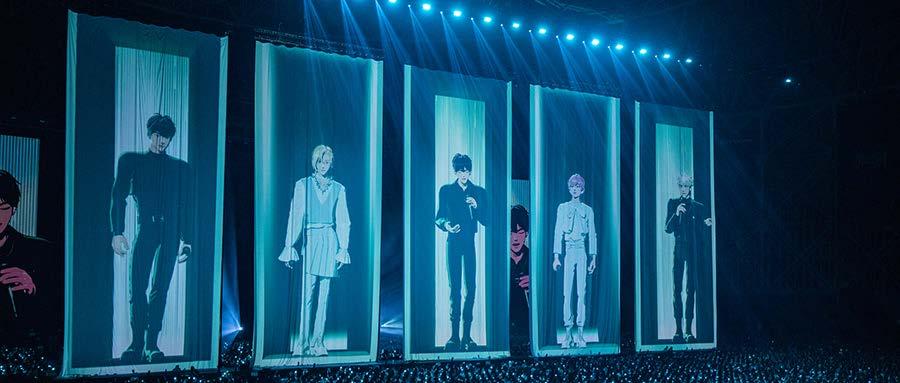
PLAVE recently delivered an arena-scale production at Seoul’s
ETC’s Tour Hog and Hog OS Drive The Lighting Spectacle Behind BTS’ Massive Seoul Comeback Concert
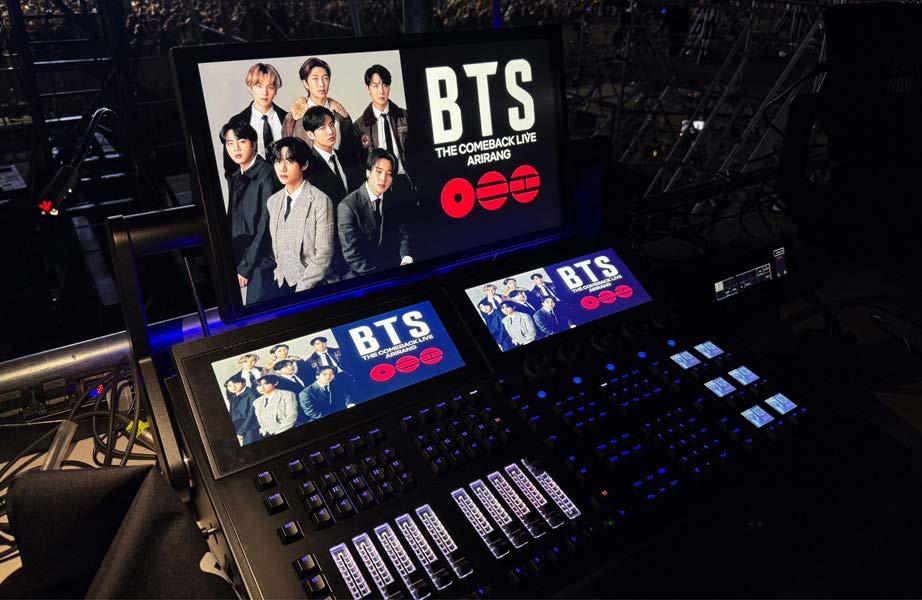
ETC’s Hog family found itself at the centre of one of 2026’s biggest live entertainment productions as Korean Pop sensation BTS returned to the stage for their first performance in four years with “The Comeback: ARIRANG” in Seoul. With an estimated audience of 100,000 fans alongside a worldwide Netflix broadcast, the large-scale production relied on ETC’s Tour Hog console and Hog OS to control the extensive lighting system illuminating the band, dancers, and immersive concert environment throughout the show.
At the core of the production was the Tour Hog console, deployed to manage more than 230 fixtures while ensuring every lighting cue and visual transition remained perfectly synchronised across both the live audience experience and the globally streamed broadcast. Designed as a compact all-in-one console for demanding live environments, Tour Hog delivers 64 universes of output as standard, offering the scale and flexibility required for modern arena productions and broadcast-driven concert workflows.
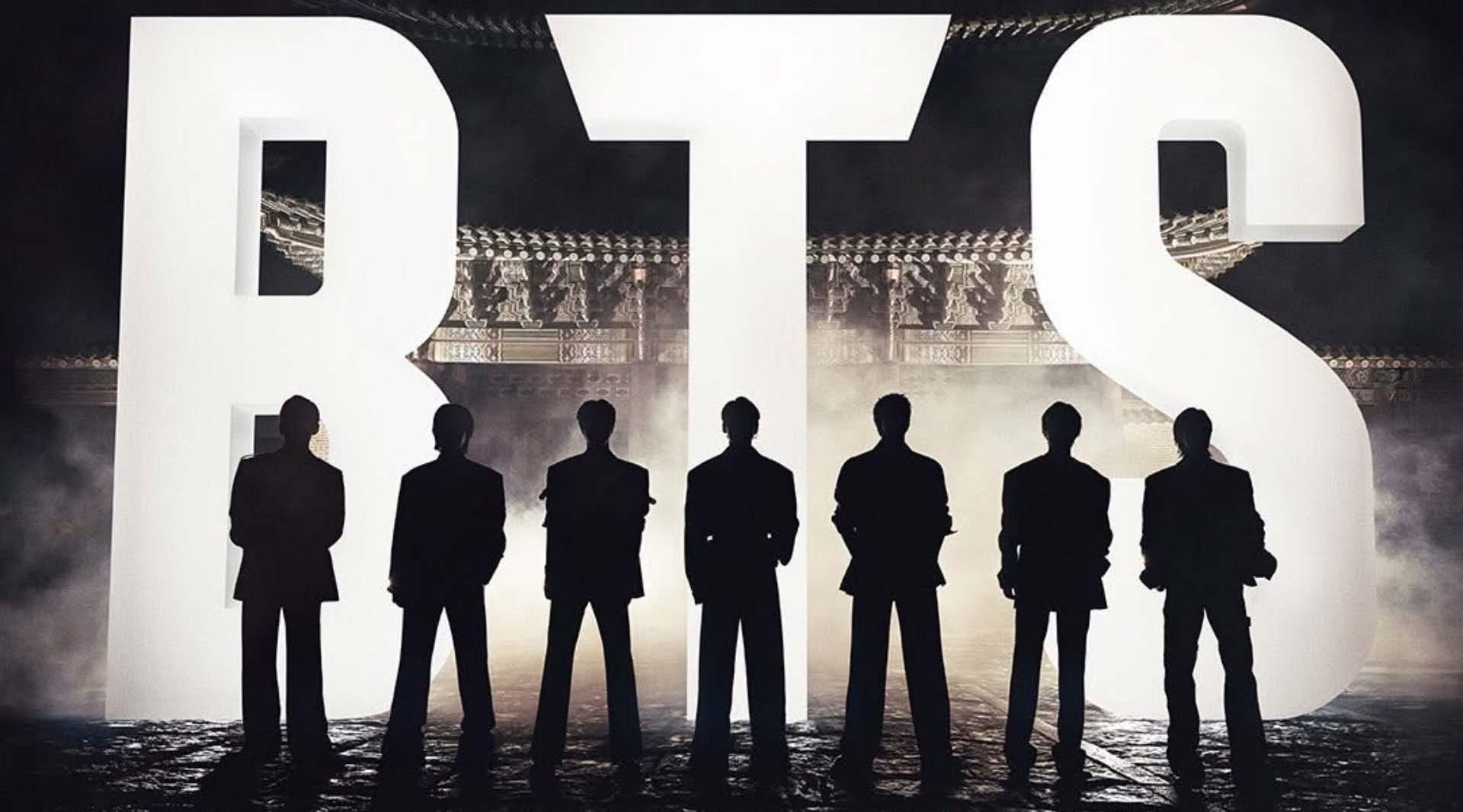
The console’s feature set includes RGBbacklit keys, motorised faders, five highquality encoders with assignable wheel buttons, customisable user and function keys, dual multitouch dashboard displays, and an articulating 24-inch high-resolution multitouch display, providing programmers with extensive control capabilities for complex live productions.
Lighting Director Ross Williams highlighted the seamless transition to the next-generation Hog platform while reflecting on the concert experience: “Tour Hog truly played an intrinsic role in enhancing the concert’s lighting experience. This was my second time using Tour Hog, as I had previously worked only with the legacy Hog 4 hardware. Thankfully, the transition felt incredibly smooth, and having access to 64 universes straight from the console was a game changer. We used most of that capability during the concert, which was a wonderful experience.”
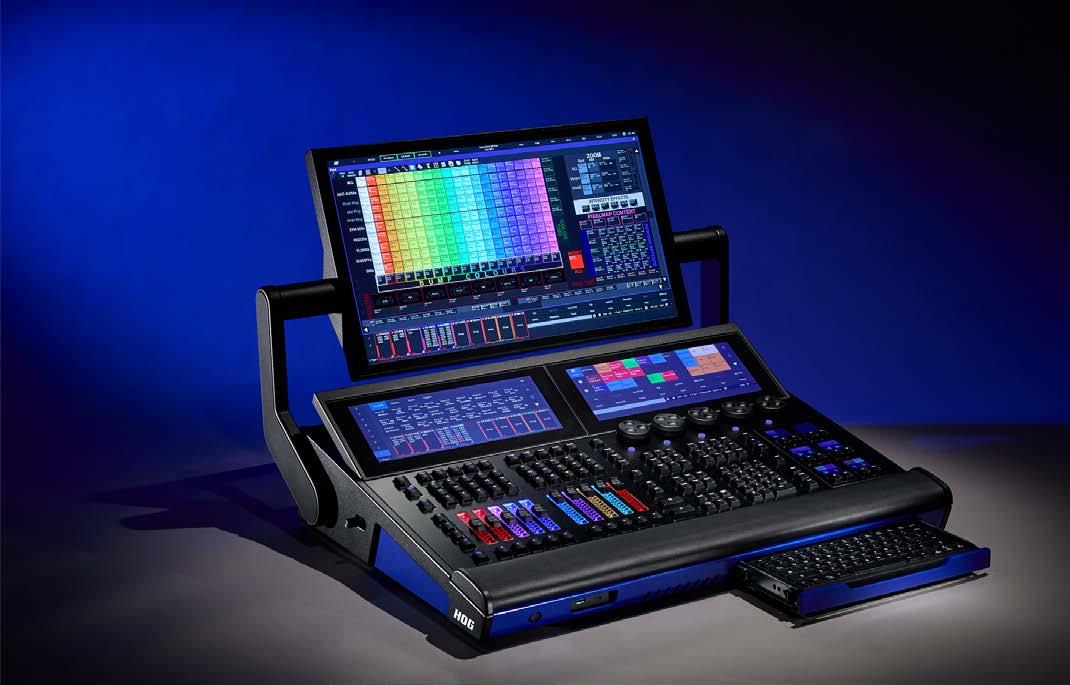
With the production pushing significant fixture counts and requiring precise cue execution across a globally visible broadcast environment, the deployment once again demonstrated Hog’s position within largescale touring and live event applications. Combining its road-proven hardware platform with the flexibility of Hog OS, the system delivered the scalability, familiarity, and operational reliability demanded by one of the year’s most high-profile concert productions.
Claypaky Ignites Sixth Sense Festival with Immersive Banyan Tree Spectacle in Bengaluru
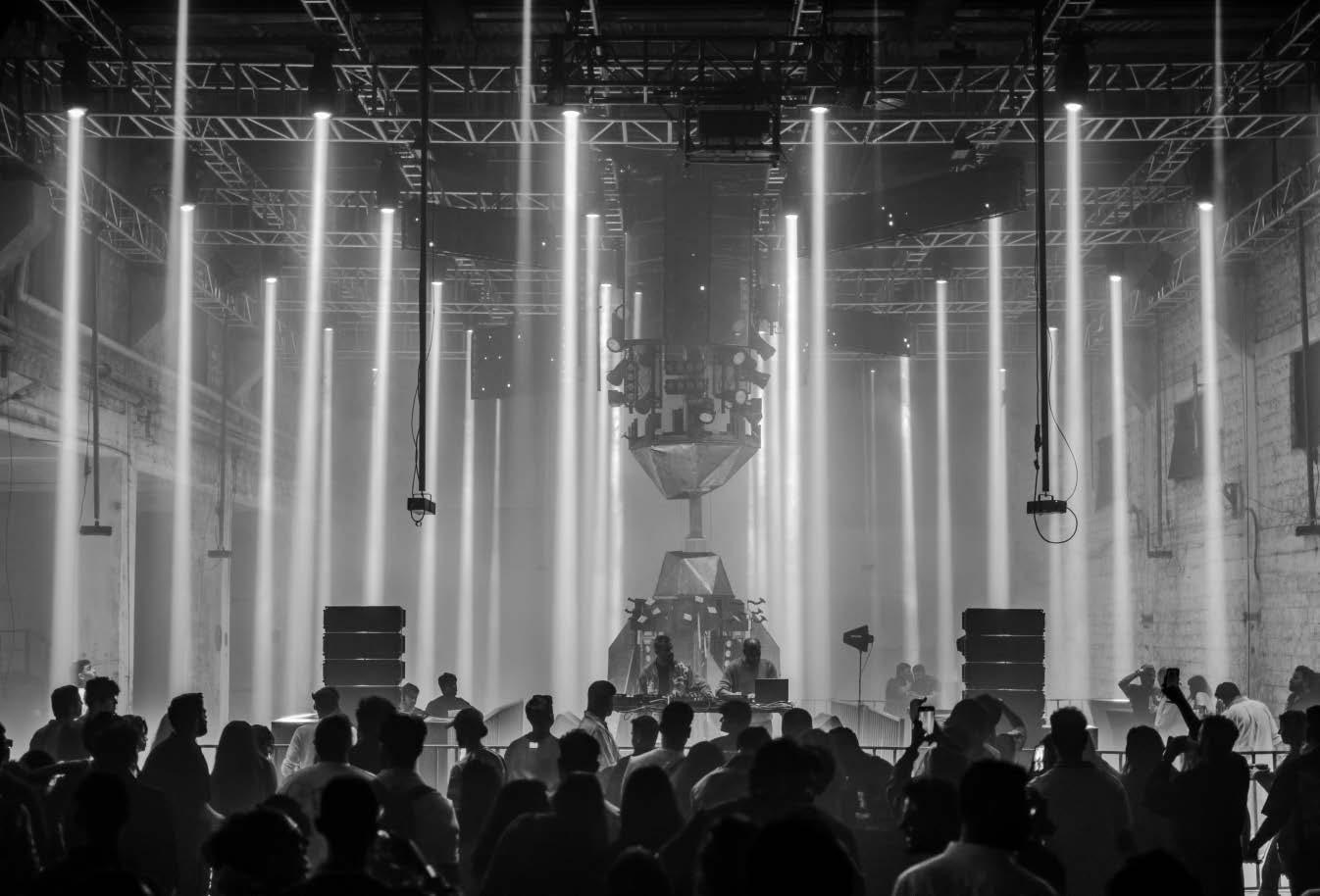
A striking array of Claypaky lighting fixtures took centre stage at The Banyan Tree installation during the Sixth Sense Festival in Bengaluru, India, transforming a centuryold glass factory into a breathtaking multisensory environment where light, sound, technology, and audience interaction merged into one immersive experience.
Produced by Swordfish Events & Entertainment Pvt. Ltd., the multi-day festival marked India’s first and largest multidisciplinary immersive experience, with The Banyan Tree serving as one of its
most captivating centrepieces. Designed by Production Designer Stephen Bontly, the site-specific installation explored themes of mutual relationships and symbiosis, using windows, mirrors, lights, smoke, and lasers to create a stylised high-tech tree that invited visitors to step inside and become part of the story.
Known as The King of Trees and a powerful cultural symbol in India, the Banyan Tree installation was designed not only as an interactive art piece but also as a dynamic stage backdrop for the live performances
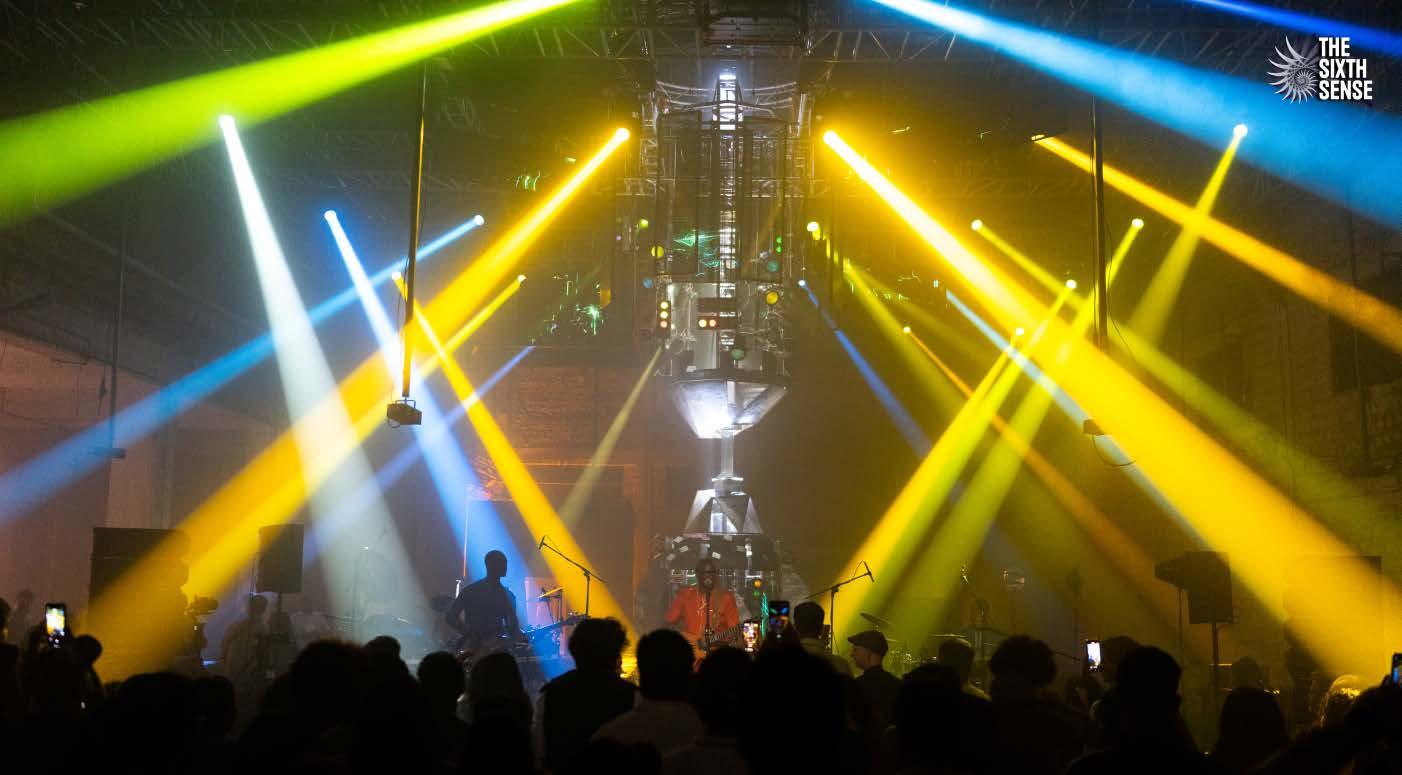
surrounding the exhibition. Lasers traced the tree’s perimeter, converging into a core of mirrors, prisms, and glass, while lidar sensors allowed visitors to directly influence the environment; triggering mirror and light panel movements, activating LED screens, redirecting lasers, and filling the space with atmospheric smoke.
“I used lidar sensors to track the audience; they were placed around the room to trigger sounds and voice messages. The audio then communicated to software I built to trigger lighting effects throughout the tree,” Bontly says. “The piece was actually controlled by the visitors, and no one moment was the same during the interactive show. In between, a timecoded story highlighted all the features on the tree just to make sure everyone got to see its full potential. I couldn’t let it stop there, The Banyan Tree was also able to switch into live mode giving the control to my team and I during the live performances.”
To realise this ambitious vision, Bontly deployed a broad selection of Claypaky fixtures including Tambora Flashes, Tambora Battens, Panify 2 motorized lighting platforms, B-EYE K15s, Valero Waves, and Sharpy X Frames; each selected for both visual impact and functional precision.
Eighteen Tambora Flashes formed the core of the tree, delivering the larger bulb, short bar fixture profile required for the centrepiece. “Even running them at 5 percent they delivered quality color,” Bontly points out.
Eight Tambora Battens were arranged around the structure, chosen specifically for their tight beams from the longer bars rather than their uniform tilt.
The Panify 2 motorized lighting platforms played a pivotal role in shaping the installation’s kinetic visual identity, holding clusters of prisms through which lasers were projected. “The tree was actually two parts: a flown element that was the tree canopy and top of the trunk plus a groundsupported trunk,” he explains. “This allowed
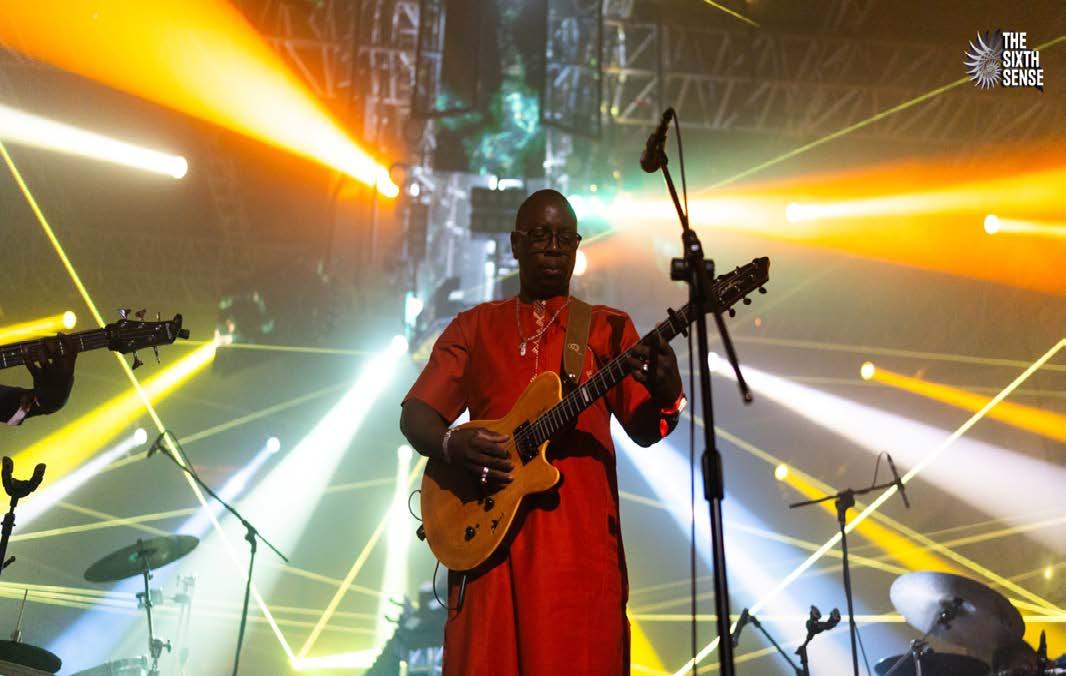
me to stack the Panifys vertically, facing one another” using a custom steel plate Bontly designed. Four Panifys formed the canopy, while two were positioned in the trunk, creating dynamic prism movements and beam redirection. “With total control of the direction of the prisms, we had a lot of fun just spinning them around and redirecting beams of light,” he recalls.
Five B-EYE K15s were aligned within the trunk structure — two facing upward and three positioned downward from the canopy. “With the washes’ zoom set to 0%, they lit up the center quite well and did wonders for chase effects,” says Bontly. “The two closest to the center illuminated the Panify elements so well – they were honestly the two most important lights of the piece. These core lights really illuminated the structure of the piece, which was important for the overall concept.”
An additional four K15s were installed on the ground for concert use. “During the shows, we really got into the pixel engine on the K15s, giving us another level of detail not easily obtained with simpler fixtures,” he adds. Six Valero Waves were also ground mounted to support the live performances. The 36 Sharpy X Frames served both as a symbolic and atmospheric design element. Reflecting the Banyan Tree’s descending
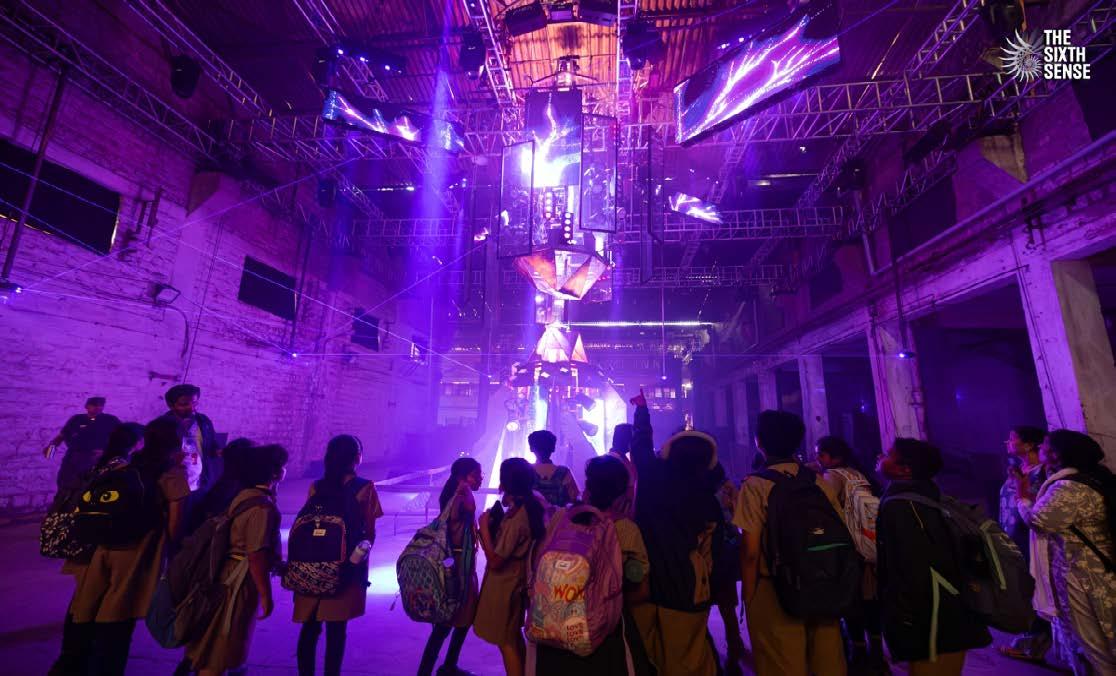
root structure, they illuminated the floor as visitors approached, reinforcing the installation’s interactive nature. “As far as the look, I always love the uniform grid arrays over a large space. It really makes the space super dynamic and fun, running chases across a warehouse will never get old, especially from the dance floor.”
Bontly also notes the strong colour consistency across the fixture family. The Tambora product line colour matched seamlessly, while the K15s “fell in line with the Tamboras with almost zero difference. We landed on a good, synchronized look.”
And with the Panifys reserved for the defining visual peaks of the show; “all the lights out, fog on, lasers at the core, Panifys spinning”; the installation delivered moments of pure theatrical impact that left a lasting impression.
Bontly credits Mumbai-based production company Light N Light and Sahil Phodkar for support, noting that “the Claypaky fixtures worked flawlessly.” He also acknowledges Swordfish and Bharath Muniram, his Production Manager, for “holding the project together and funding the dream. I could not have done it without these teams. We built [the installation] for three weeks, and they kept it maintained for another ten days.”
Sennheiser Spectera Redefines RF Workflow on Ed Sheeran’s ‘The Loop’ Tour

As Ed Sheeran launched his highly anticipated The Loop tour with a major run of stadium shows across New Zealand and Australia — ahead of dates in South America and the United States — Sennheiser’s next-generation Spectera platform has taken centre stage, transforming RF workflow, system scalability, and sonic performance across one of the world’s most demanding live productions.
Dave White, who has worked with Sheeran since 2014, the evolution to Spectera represents the latest chapter in a longstanding relationship with Sennheiser’s wireless ecosystem. Over the years, the
touring setup has progressed through multiple generations — from the 2000 Series to Digital 9000, and later Digital 6000 — each bringing incremental gains in sound quality, efficiency, and form factor.
“We’ve gone through quite a few generations of Sennheiser products over the last 12 years,” White recalls. “We always keep updated to get the best sound quality we can and work with new equipment as and when it’s appropriate. Over the years, we’ve moved from Sennheiser’s 2000 series to Digital 9000, before switching to Digital 6000 for the ‘Mathematics’ tour.”
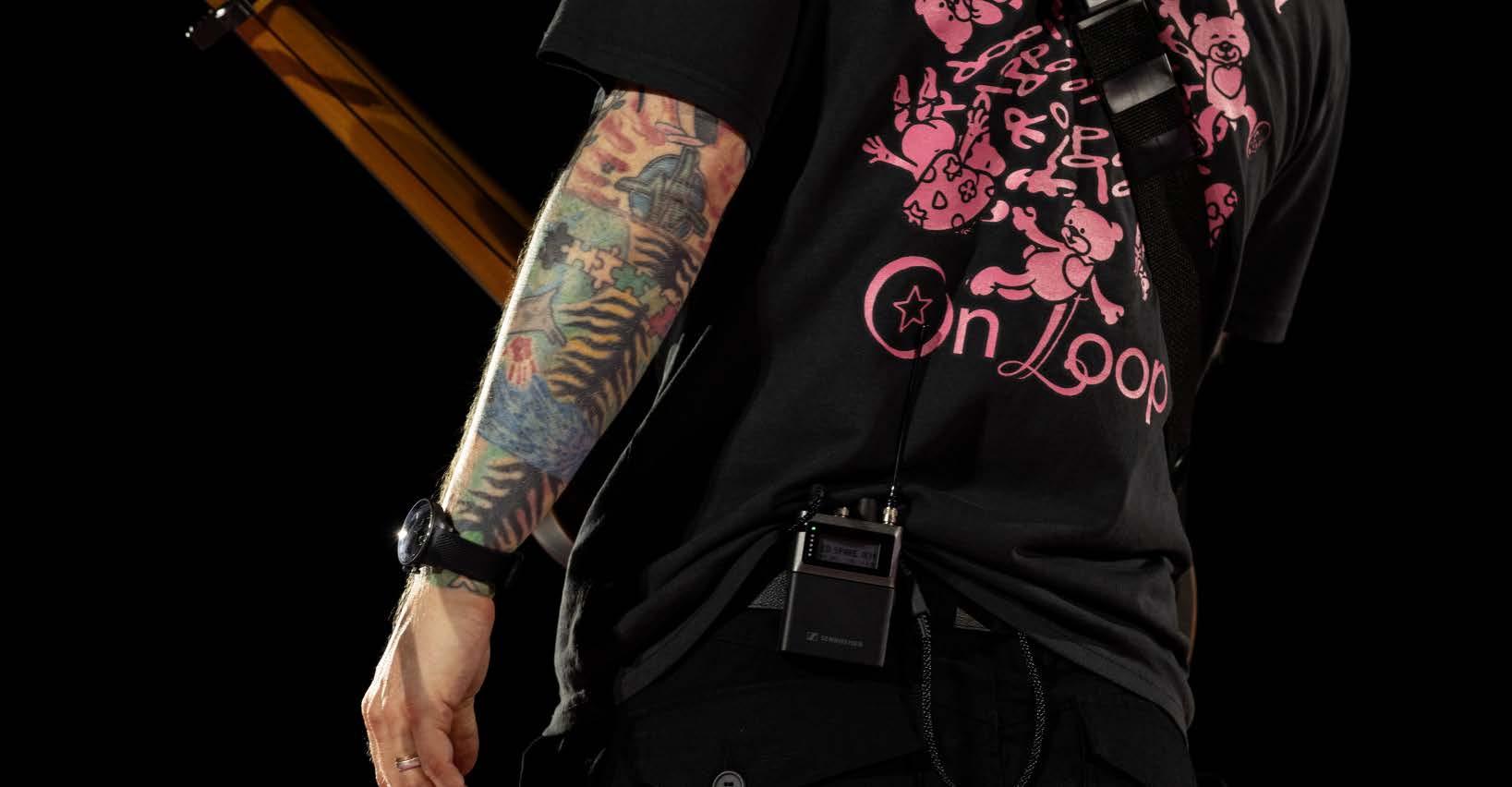
However, the scale and complexity of The Loop tour — with its expansive stage design, dual-stage configuration, and growing number of performers — introduced new RF challenges that conventional narrowband systems would struggle to address efficiently. Spectera’s wideband, bidirectional architecture offered a fundamentally different approach.
“We had seen some small demos and I knew, with the stage design of ‘The Loop’, that Spectera would be perfect for us,” says White. “We are covering such a large area; Ed is on the main stage and then seamlessly transitions through to a B stage. If we were managing that with standard analogue IEMs, it would be quite a complicated system with lots of switching and over-gaining amplifiers to get even coverage. It can be done, but with Spectera, everything is off-the-shelf and designed for the job.”
At the heart of Spectera is a wideband RF system that significantly reduces the complexity of frequency coordination. Instead of managing individual channels and intermodulation calculations, engineers can allocate a single block of spectrum— dramatically simplifying setup. “I must admit, when they released the technology, I felt a little bit like my RF coordination knowledge was obsolete,” White notes. “If you have 30 channels, for example, with a standard narrowband system, you would have to calculate and tune each one individually. With Spectera, you select a centre frequency, and it does all of them for you. You don’t need to worry about intermodulation… wireless is massively simplified.”
The impact on workflow has been immediate. White reports that RF coordination time has been reduced from around 30 minutes to just seven minutes — even when working conservatively — allowing more time to focus
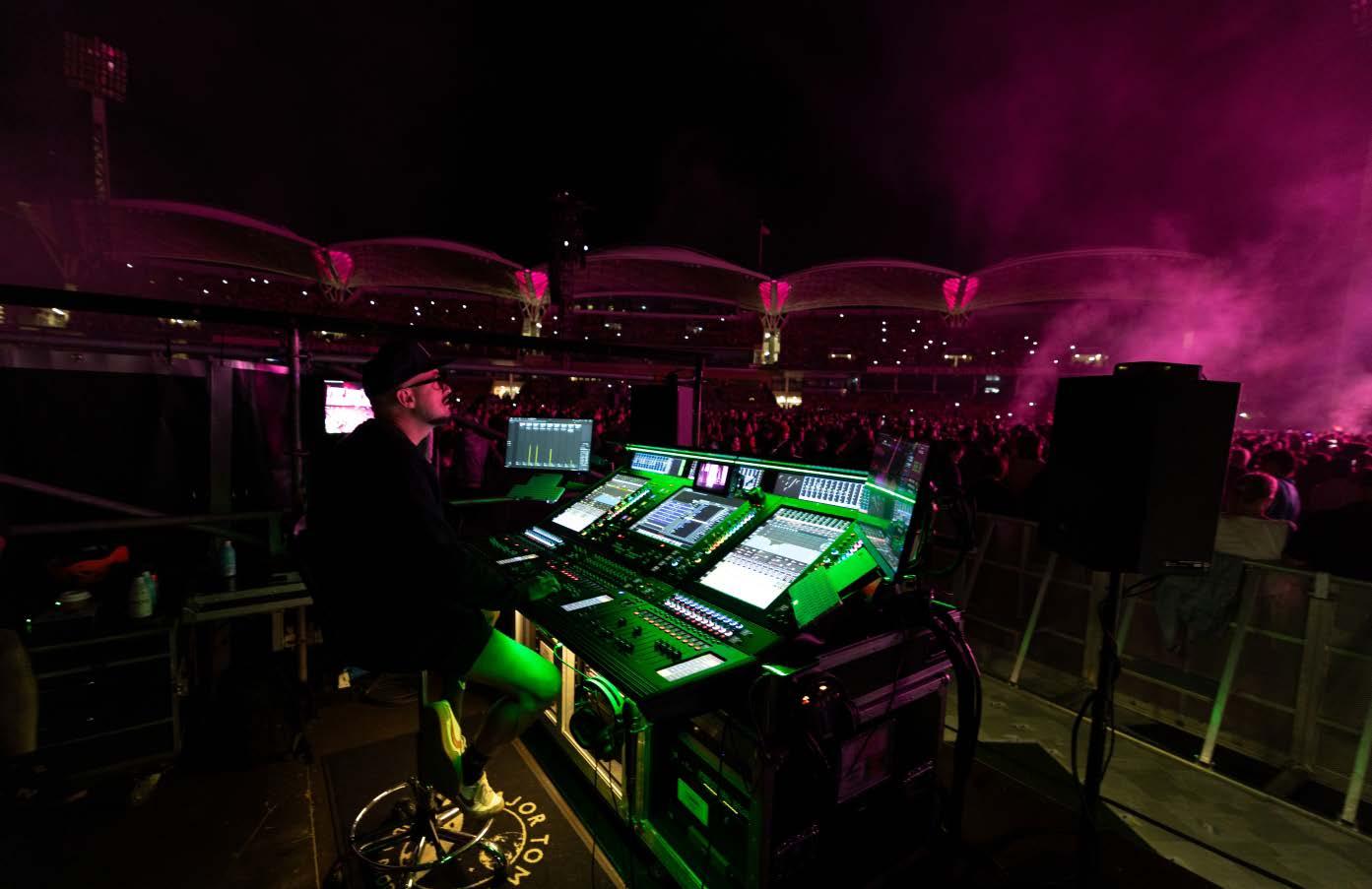
on system optimisation and performance refinement. And beyond efficiency, the system has also delivered a noticeable improvement in audio quality, particularly in dynamic range and clarity. “The big difference with Spectera is that even though on paper the dynamic range and volume response should be the same, it’s not,” White explains. “You audibly get far more depth of dynamic range… the techs are happy, too, and said, ‘we can actually hear things now’. There’s definitely a depth and a clarity we didn’t have before.”
This sentiment is echoed at Front of House by Engineer Simon Kemp, who highlights the impact on Sheeran’s highly exposed performance style; sayss “Working with Spectera has been great so far. Moving from 6000 to Spectera has been a real sonic
improvement. The sound of Ed’s guitars has become even more transparent, and the dynamic range has really helped him move from very quiet, gentle songs to loud, inyour-face moments.” Kemp also notes the system’s ability to handle the percussive nature of Sheeran’s playing, where the guitar often doubles as a rhythmic instrument. Combined with the MM 445 capsule, the fully digital signal chain delivers consistent, high-clarity vocals across stadium-scale environments.
Reliability has also proven exceptional under extreme conditions. From torrential rain in Auckland to intense heat across Australian stadiums, Spectera has maintained uninterrupted performance. “The packs have been extremely resilient,” says White. “The rain was biblical; it just didn’t stop… we
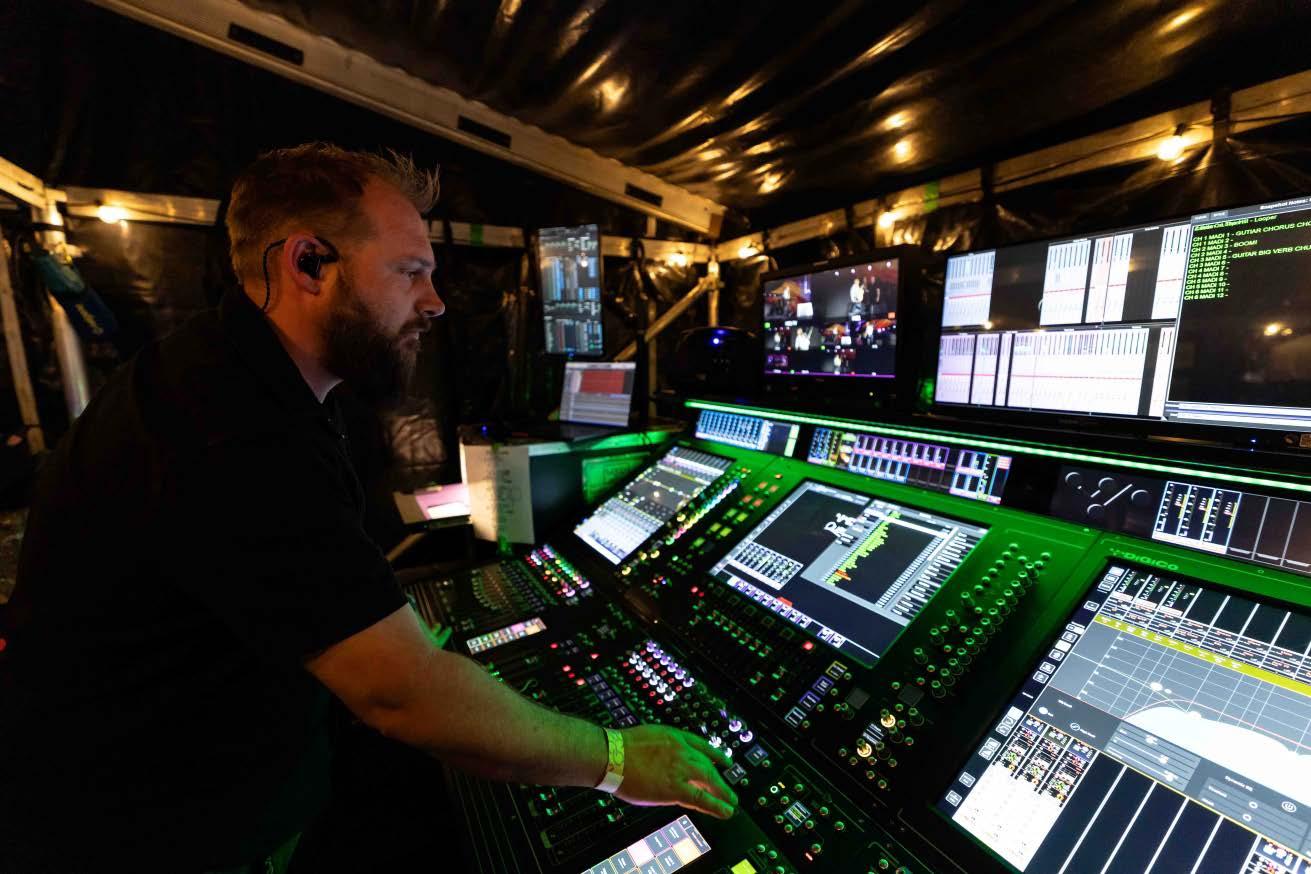
didn’t have any failures at all with any of the handhelds or the bodypacks. You don’t really get much of a harsher environment than out here in Australia.”
To ensure seamless RF coverage across the expansive stage design — which includes a 50 by 18-metre LED video wall — White deployed 11 Spectera antennas across multiple zones, including stage left, stage right, and the B stage. This configuration enables uninterrupted coverage from backstage areas through to the audience, with seamless hand-offs throughout.
Spectera’s bidirectional transceiver design has also reduced hardware requirements, allowing each bodypack to handle both
IEM and instrument signals. This has streamlined the overall system, reduced freight requirements, and enhanced flexibility for performers; including collaborators such as Beoga, whose hybrid acousticelectronic setup benefits from fully mobile signal routing. Alongside, monitoring and control are handled via Sennheiser’s WebUI, providing real-time access to key parameters including RF status, battery levels, and signal integrity; an essential capability for a production of this scale.
“Spectera has truly made my life in RF so much easier and more manageable, and reduced freight costs,” White concludes. “It’s cut down on rack space and made everything more streamlined, which is exactly the way the industry should be going.”
grandMA3 Commands Record-Breaking King Pro League Grand Finals at Beijing’s Bird’s Nest
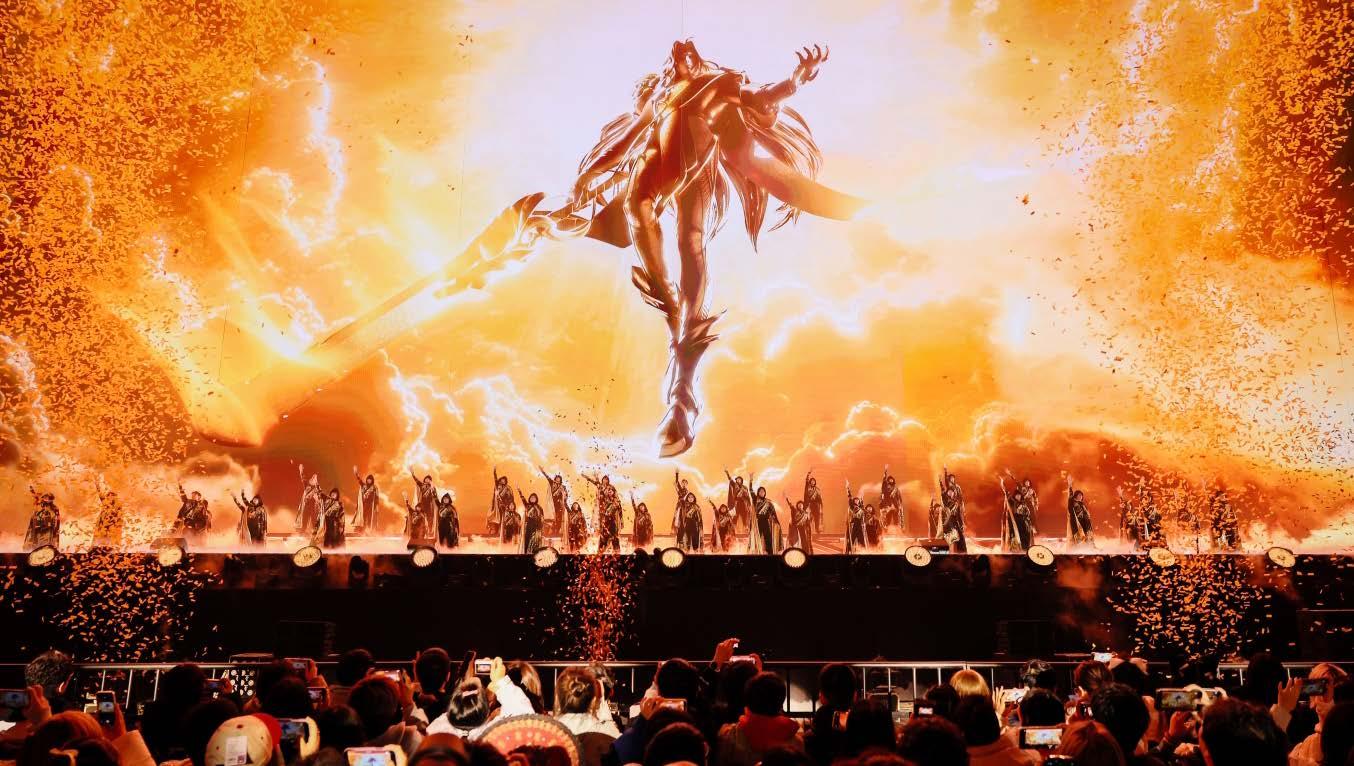
When the Honor of the Kings Grand Finale took over Beijing’s iconic Bird’s Nest Stadium, it wasn’t just an esports championship; it was a full-scale visual spectacle that fused live performance, choreography, massive LED architecture, lighting design, and Augmented Reality into one of the most ambitious stadium productions the industry has seen. At the heart of this extraordinary integration was MA Lighting International’s grandMA3 system, delivering the networked control backbone for an opening ceremony featuring 10 giant LED screens and more than 5,000 luminaires. Hosted before more than 62,000 attendees, the event not only delivered an unforgettable live experience, but also secured a Guinness World Record for the largest ever live esports audience.
Lighting design, supply, and stadium-wide systems integration were executed by leading entertainment technology specialist and MA Lighting distributor ACE using grandMA3 to unify every visual layer across the enormous production. The show centred around a massive main stage with an LED floor spanning over 3,500 square metres, while 10 huge double-sided LED screens suspended above could dynamically shift between gameplay visuals, live performances, and ceremonial content. Surrounding the stadium were over 5,000 lighting fixtures, including more than 1,800 moving head luminaires, alongside LED strips, lasers, and foggers. grandMA3’s centralised show control integrated seamlessly with media servers and
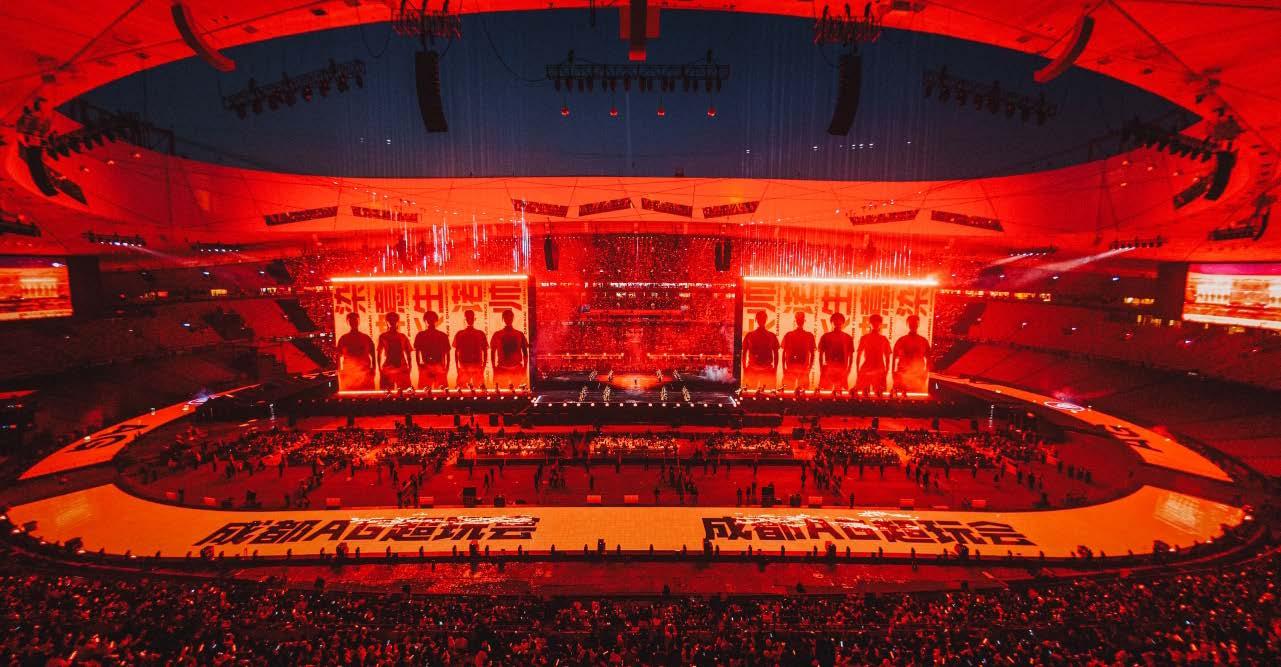
timecode to synchronise lighting, screens, and effects across the venue-scale canvas.
To manage the production’s immense 180,000 parameters, three experienced lighting design directors i.e. Zheng Zhaoliang, Bei Wen, and Liu Yanyang, worked alongside a team of programmers and assistants using a grandMA3 system comprising six full-size consoles, six grandMA3 processing units XL, and 32 grandMA3 processing units M for parameter expansion.
For Lead Designer Zheng Zhaoliang, who has worked with MA Lighting systems since 2010 and transitioned from grandMA to grandMA2 in 2011, this production marked his very first use of grandMA3. “I wasn’t entirely familiar with the system, and that did affect my programming speed, but the access to new programming features compensated for that initial unfamiliarity.”
“Lighting design is an innovation-driven profession,” says Zhaoliang, explaining the choice of grandMA3, “and we need to use
new control equipment to maximise and enrich our visuals capability. Having used grandMA2 for many years, and with some of ACE’s shows already using grandMA3, this was an excellent opportunity for us to use it on a large-scale event – and we felt confident in mastering it after preliminary training.”
Beyond stability and parameter management, the platform significantly streamlined preprogramming workflows — critical when on-site programming windows were limited. “It helped us to avoid dividing effect programming among multiple designers and to present lighting visuals more efficiently and centrally within one system,” says Zheng Zhaoliang.
The design workflow was built in WYSIWYG before being imported into grandMA3 and visualisation software via the MVR (My Virtual Rig) file format. “Support for MVR gives seamless data import, significantly reducing labour and allowing more focus on artistic creation,” he explains.
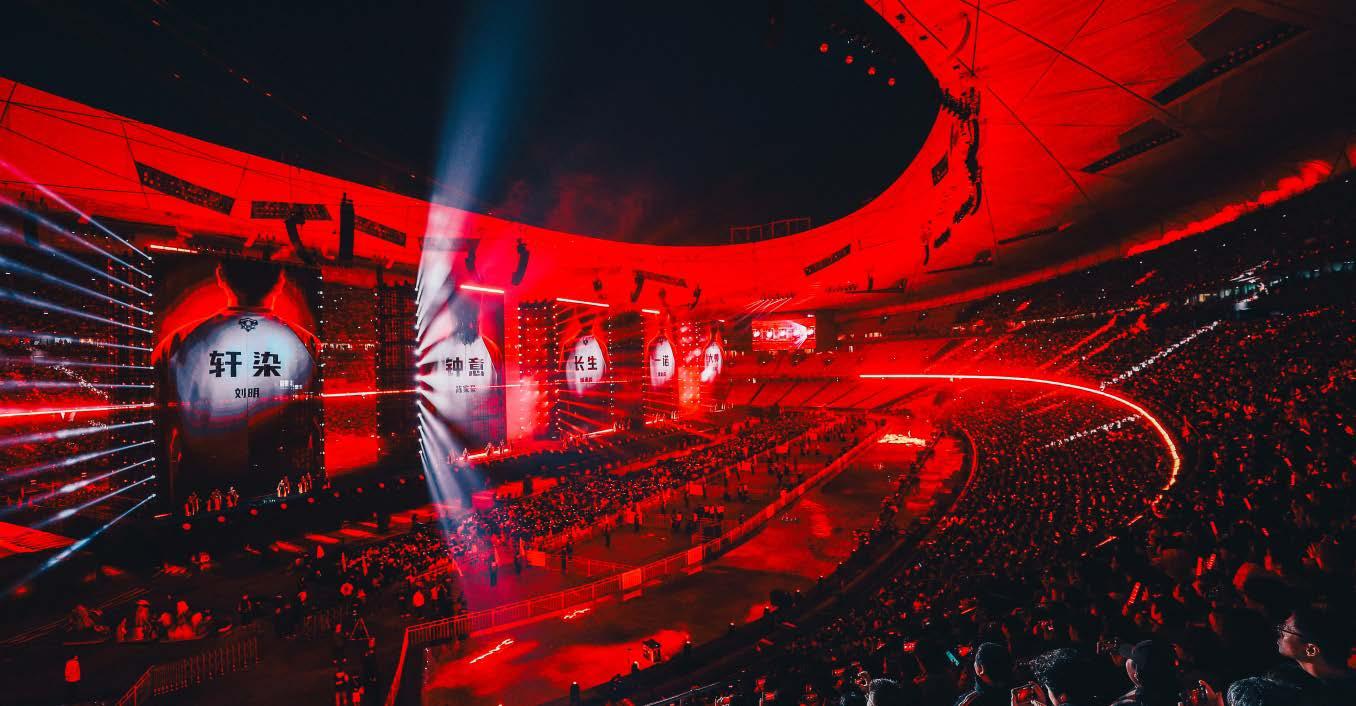
The team also made extensive use of the grandMA3 viz-key, enabling connection to visualisation software without additional hardware. “This enables programming and rehearsal in a virtual environment,” says Zheng Zhaoliang, “without relying on physical fixtures and stages. It saves significant hardware preparation time and costs in the early stages of the project.”
Among the most impactful creative tools was the Phaser effect engine and its new multidimensional effects concept. “Through the intuitive interface, we can finely adjust each characteristic of an effect, like operating an audio equalizer,” Zhaoliang explains. “The Phaser effect engine is more like an intelligent effect factory, breaking down complex effects into intuitive parameter dimensions. It allows us to create more complex, organic dynamic effects with fewer steps.”
He also highlights the Selection Grid and Generator functions. “The Selection Grid helps with managing multi-instance fixtures
– like pixel lights – allowing us to quickly select, group, and control any part of a fixture matrix, which greatly improves pixelmapping efficiency. Also, the Generator function enriches effects for pixel fixtures through algorithms, enhancing both variety and controllability.”
One standout example was the deployment of 1,028 pixel strobe bars installed to create a controllable ring of light throughout the stands, delivering unprecedented pixel effects driven entirely by grandMA3. And reflecting on the scale of the achievement, Zhaoliang concludes: “Despite the vast scale and complexity of the show, our aim was to treat the stadium as an expanded version of a theatre – and the grandMA3 facilitated that integration for us. We received excellent support from the ACE team throughout the entire process, from initial preparation and pre-programming to on-site rehearsals and the live performance itself.”
Peavey and Crest Audio Power Jakarta Death Fest’s Relentless Sonic Assault
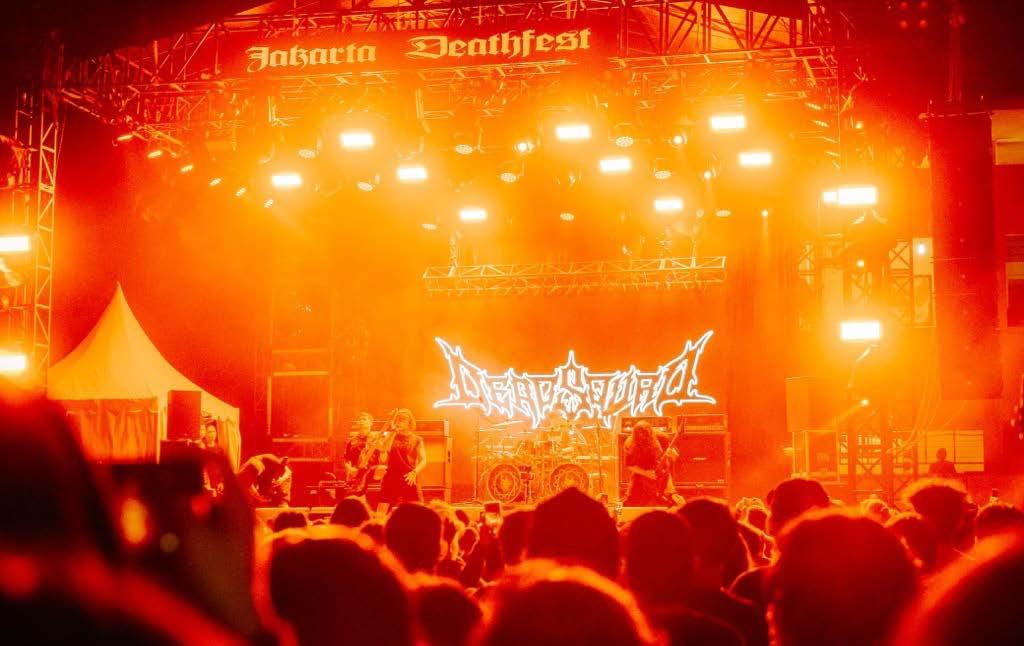
When Jakarta’s underground metal scene gathered for the explosive return of Jakarta Death Fest, the expectations were nothing short of brutal. As one of Indonesia’s most anticipated extreme metal festivals, the event transformed South Jakarta’s Bulungan venue into a high-pressure arena of distortion, aggression, and relentless live performance; demanding an audio system capable of far more than just raw volume.
To deliver the sonic intensity required for such an uncompromising lineup, organisers turned to the combined strength of Peavey Electronics and Crest Audio with rental specialist Delight Sound entrusted with front-of-house operations and full system deployment.
Curated by artist Stevie Item from Andra and the Backbone, Jakarta Death Fest carried the theme “One Nation, One People”—a message reflected not only in the diversity of the lineup, but also in the scale and cohesion of the production itself. And at the core of the deployment was a Crest Audio system built around the Versarray Pro platform, chosen to ensure consistent coverage, high SPL output, and controlled dispersion across the venue. A combination of Versarray Pro 112, Versarray Pro 215, and Versarray Pro 218 Pro elements formed the backbone of the main system, delivering the low-frequency authority and mid-high clarity essential for extreme metal performance.
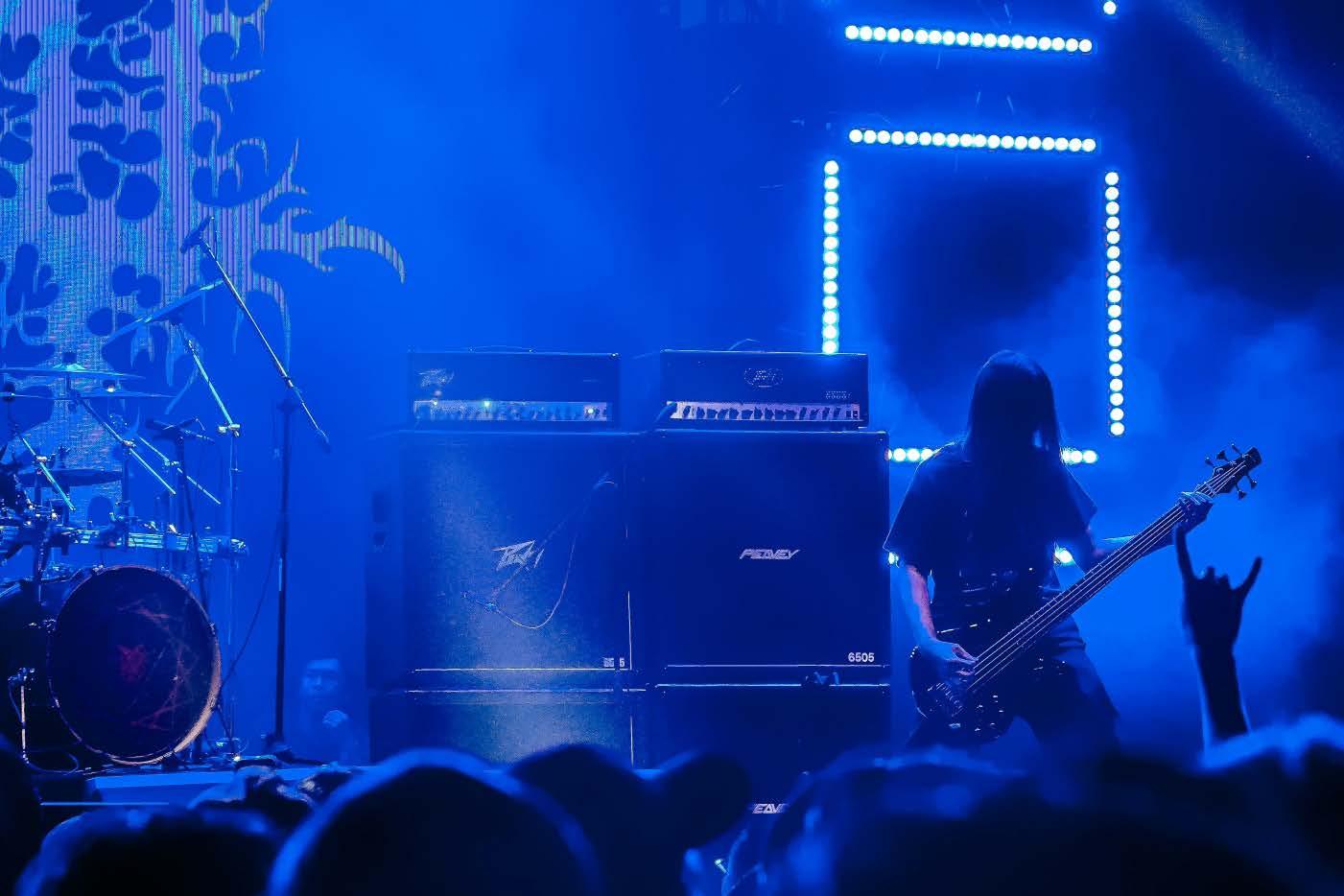
Additional reinforcement came from CPL 15+ and CPL 12+ loudspeakers, integrated to provide extended coverage flexibility and maintain uniform sound pressure and tonal balance throughout the audience area. System optimisation and real-time control were handled via the Crest Audio Tactus platform, allowing precise tuning in a fastmoving live environment where consistency was critical.
On stage, Peavey equipment played an equally important role in shaping the artists’ performance experience. The brand’s renowned amplifier lineup, including the Invective and 6505 heads, alongside the legendary HP2 guitars, delivered the tonal aggression and reliability demanded by the performers, while AQ 15 monitors provided clear, high-output stage monitoring to ensure performers retained complete control over their sound despite the intense SPL levels.
Events of this scale bring unique technical challenges; rapid changeovers, varied artist requirements, and sustained highvolume performance over long operating hours. Delight Sound’s FOH team relied on the flexibility of the Crest Audio system to maintain consistency throughout the festival, carefully balancing sheer power with articulation so that every act translated clearly and impactfully to the audience.
“As live music continues to return at scale across Asia Pacific, events like Jakarta Death Fest demonstrate the importance of robust, high-performance audio systems that can deliver both power and precision,” said Akshay Vaidya, Director APAC Peavey Electronics. He added: “Jakarta Death Fest exceeded expectations on every level - from the scale of attendance to the energy of the performances and the consistency of the audio experience throughout the day.”
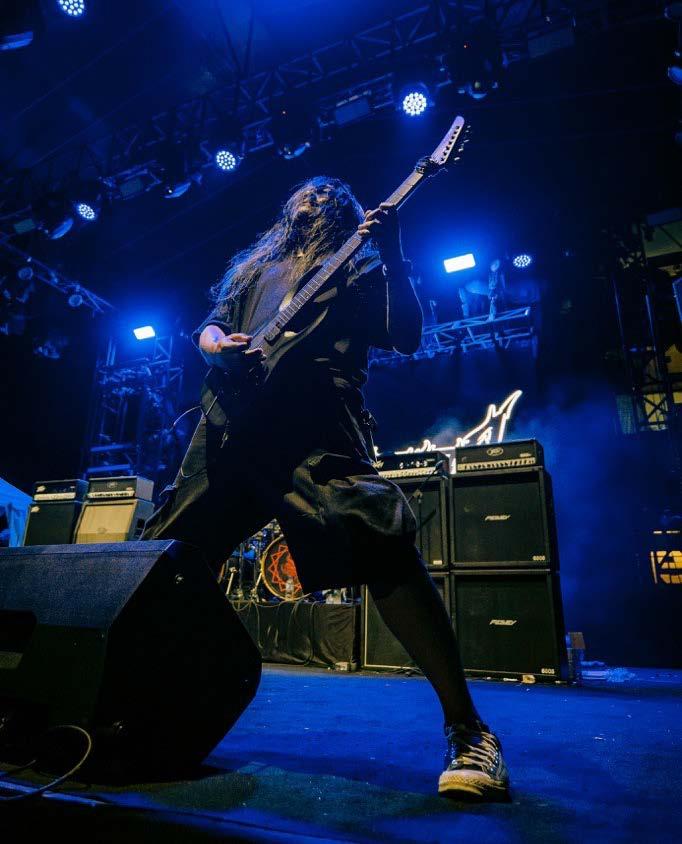
Beyond the technical success, Jakarta Death Fest represented something larger for Indonesia’s heavy music community, a powerful symbol of live music’s resurgence and the continued strength of the country’s extreme metal culture. Accessible ticketing and a strong sense of community transformed the event into what organisers described as a “sea of distortion and circle pits,” reinforcing its status as both a cultural statement and a musical landmark.
Reflecting on the festival’s significance, Organiser Stevie Item shared: “I decided to step in and help organize the festival because I feel this is the perfect time for both me and the band to give something back to the community by bringing back a Death Metal Festival, especially while so many other music festivals are happening around the city. I’m very happy to be part of this and to help keep the festival alive. I’ve also received great support from many friends, and Peavey
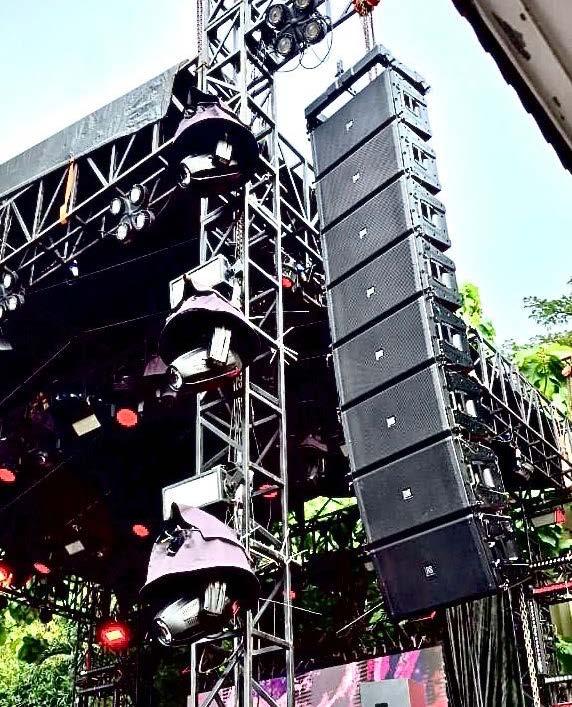
Electronics has been a great part of this festival as well. For us Death Metal fans, this means a lot.”
By delivering an audio system capable of matching the sheer scale and ferocity of the performances, Peavey and Crest Audio played a defining role in the festival’s success; supporting not only the sound of the event, but also the continued growth and visibility of Indonesia’s extreme music scene.
Vaidya concluded fittingly: “The system delivered exactly what an event of this intensity demands: uncompromising power, clarity under pressure, and absolute reliability. It enabled every act to connect with the audience exactly as intended, and ultimately helped create an event that not only celebrated Indonesia’s metal community, but set a new benchmark for live sound performance in the region.”
NEXO Delivers Refined Rooftop Audio Experience at The Fullerton Bay Hotel’s Iconic Lantern Bar
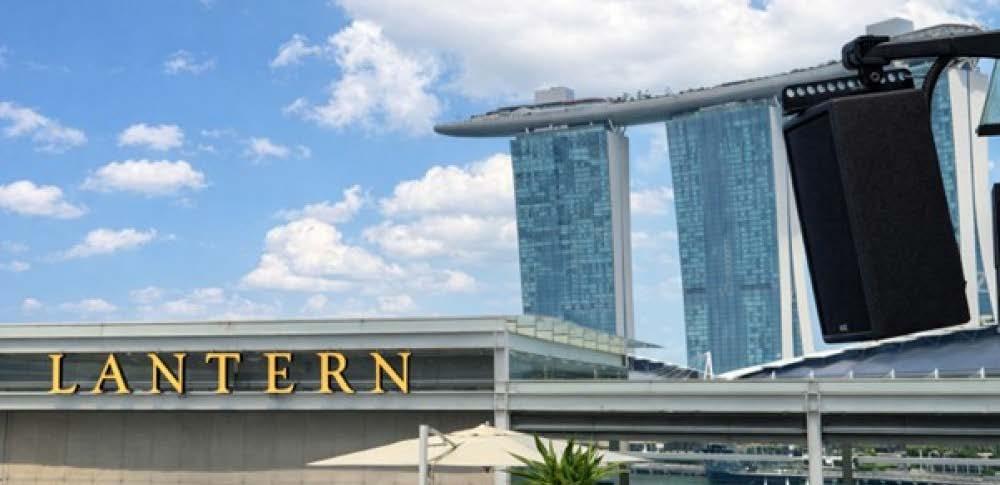
Perched above Singapore’s Marina Bay with sweeping views of the city skyline, Lantern Bar at The Fullerton Bay Hotel has long positioned itself as one of the city’s premier rooftop hospitality destinations. Now, a recent audio upgrade featuring NEXO loudspeaker systems is helping elevate the venue’s immersive guest experience even further, combining high-quality sound reinforcement with discreet aesthetics and long-term outdoor reliability.
Named after the historic Chinese name for Singapore’s iconic Clifford Pier, Lantern occupies the sixth floor of the five-star hotel, blending lush greenery, open-air seating, covered lounge areas, and panoramic waterfront views into a sophisticated rooftop garden environment. Hosting everything from relaxed sunset sessions to energetic
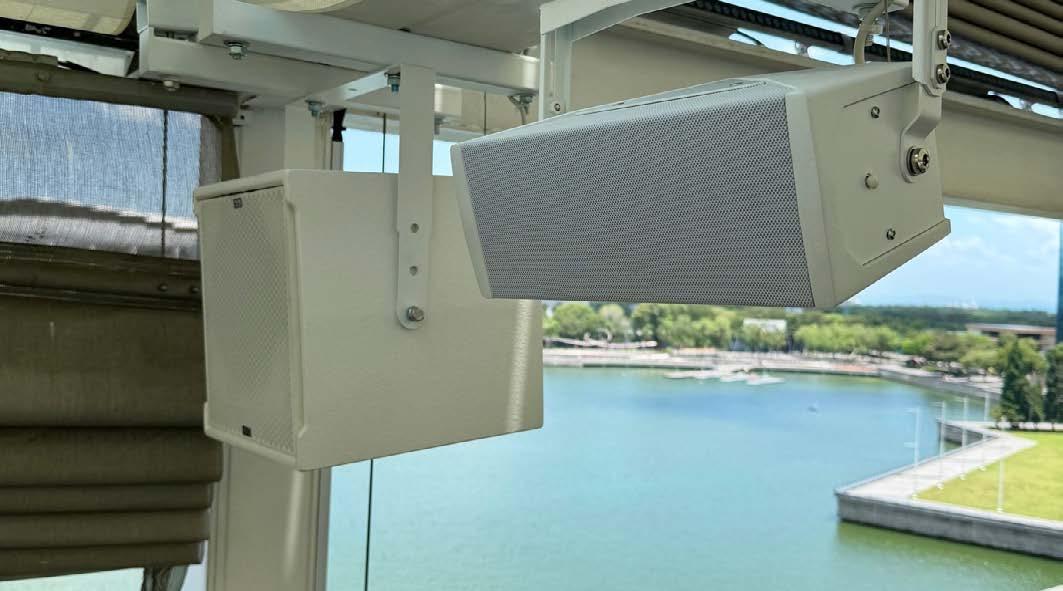
DJ-driven nightlife experiences, the venue required an audio solution capable of delivering consistent sonic performance throughout the expansive terrace without disrupting its premium visual identity.
Working alongside local systems integration partner Electro-Acoustics Systems Pte. Ltd., (EAS) Yamaha Music Singapore proposed a
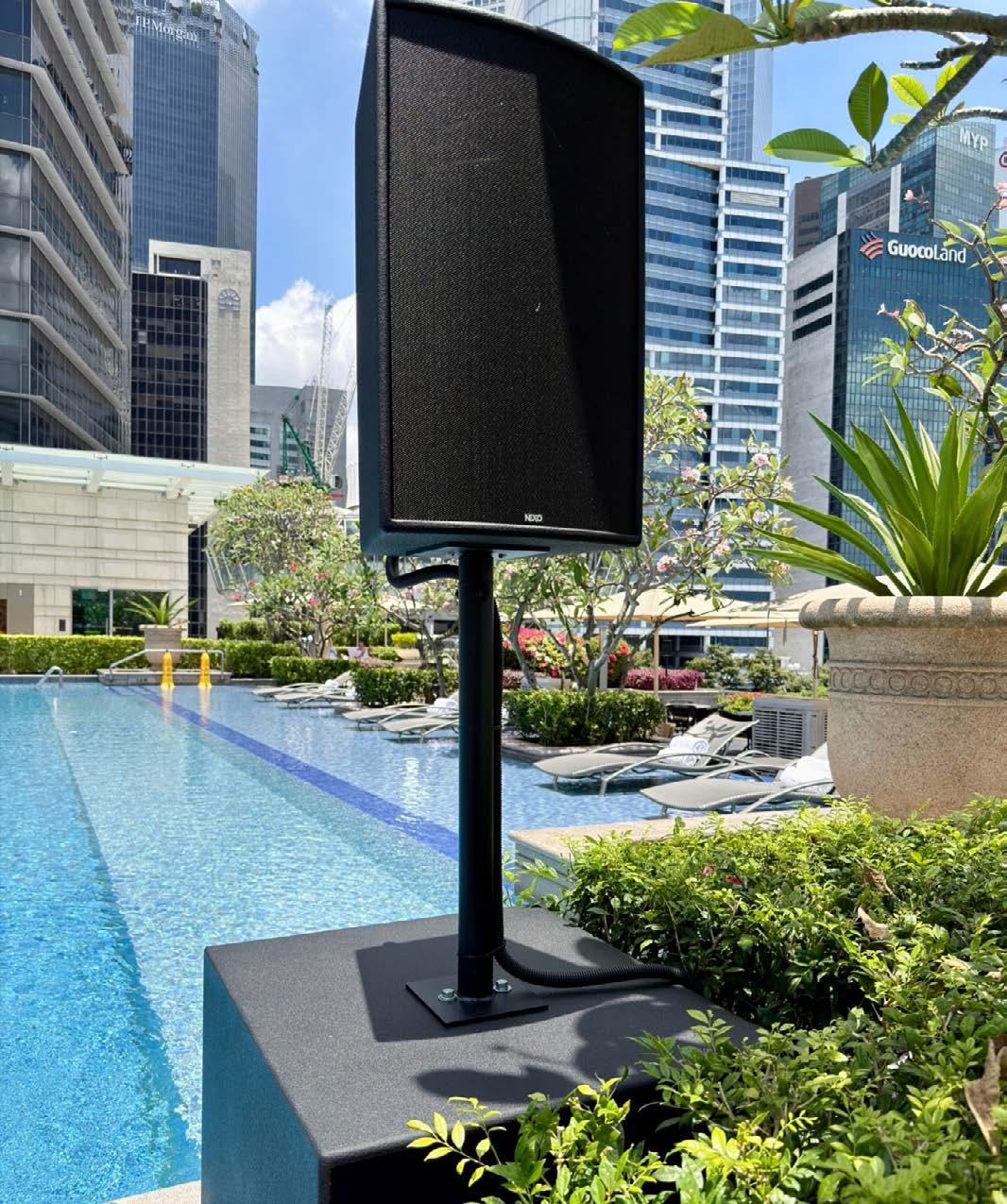
NEXO solution centred around loudspeakers from the EN54-rated ePS Outdoor range, complemented by compact ID Series loudspeakers deployed as in-fill systems across the venue’s seating zones. The system was specifically designed to provide even audio coverage throughout the bar while maintaining compliance with local noise control requirements.
“The system is carefully configured and tuned to provide even distribution of audio, eliminating hotspots and dead zones across the bar while complying with noise control requirements,” reports Joseph Edward from the Professional Audio Product Sales and Marketing Division at Yamaha Singapore
The installation also addressed one of the most critical challenges facing luxury outdoor hospitality environments in Southeast Asia — environmental durability without compromising audio performance or aesthetics. With Singapore’s humidity, heat,
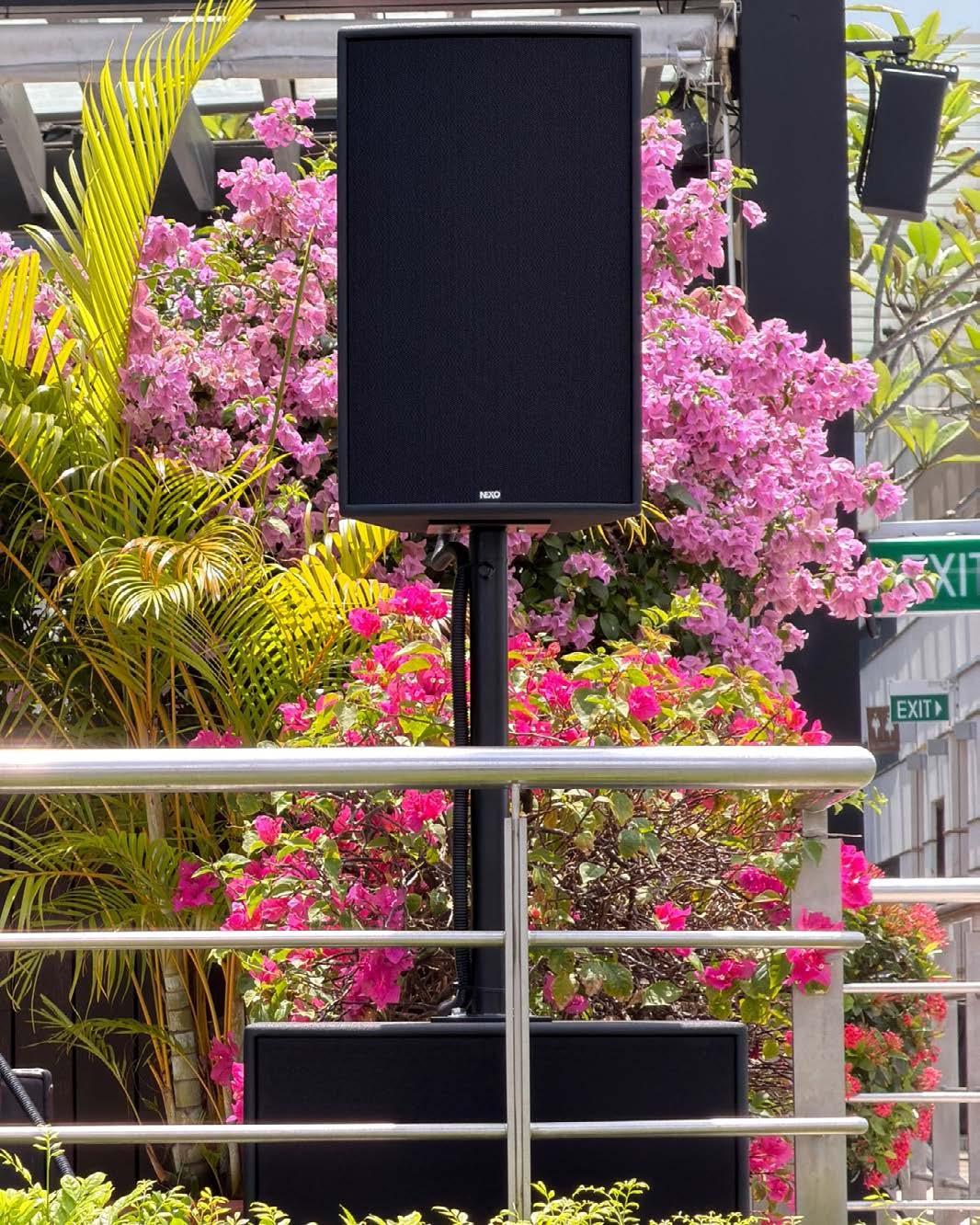
and frequent rainfall creating demanding operating conditions, the outdoor-rated NEXO components were selected to ensure longterm reliability while integrating seamlessly into the venue’s refined architectural design.
“From chill sunset sessions to high-energy evenings, the system adapts effortlessly, delivering clear vocals, tight bass, and immersive music,” adds Edward, as he concludes, “With outdoor-rated components, the system offers long-term reliability despite humidity, heat, and rain exposure and the speakers were integrated with minimal visual impact, preserving the luxurious and sophisticated design of the Lantern Bar. In premium hospitality venues, audio is not just background, it defines the atmosphere. This installation demonstrates how the right combination of technology and design can enhance brand perception and elevate overall guest experience.”
As Asia’s First Venue to Deploy L-Acoustics Ambiance; The Grand Lisboa Palace Pairs Adaptive Acoustics with Immersive Spatial Audio Across A Transformative Five-zone Event Environment
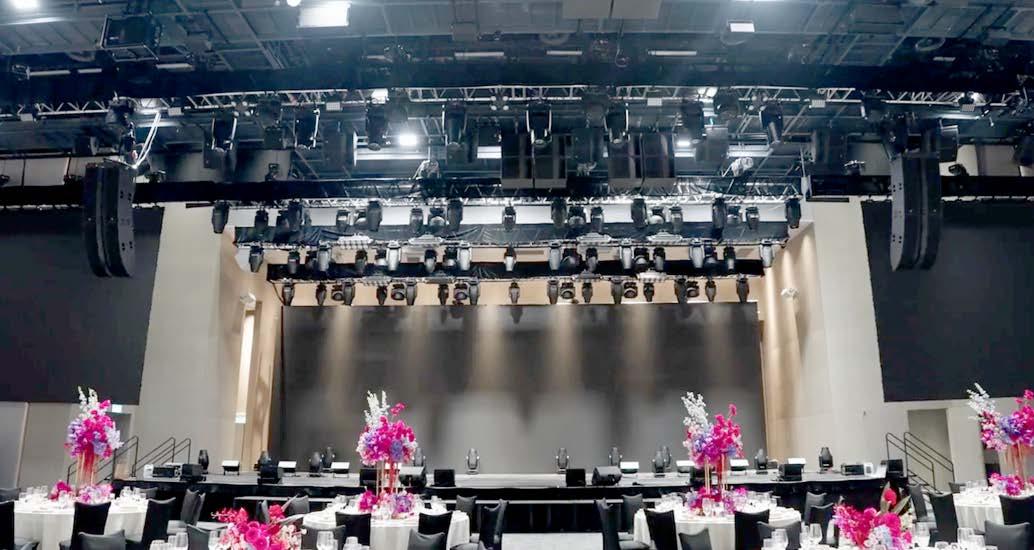
The Grand Hall at Grand Lisboa Palace Resort in Macau has emerged as a landmark project for Asia’s live entertainment and integrated resort market, becoming the first venue in the region to deploy the L-Acoustics Ambiance hybrid acoustic enhancement system. Designed as a highly flexible 2,200-capacity multipurpose venue, the space combines L-Acoustics Ambiance active acoustics with L-ISA Hyperreal Immersive Sound technology, enabling the venue to dynamically transform its acoustic character to suit vastly different applications ranging from intimate classical performances and corporate conventions to high-energy live concerts and immersive experiential events.
Entertainment audio-visual consultants Nova Range oversaw the extensive installation, integrating the technologies into a sophisticated five-zone audio infrastructure capable of operating either as one unified environment or as five independently controlled acoustic zones. The approach gives the Grand Hall a level of operational versatility rarely seen in the region, allowing simultaneous events, partitioned venue rentals, or highly customised acoustic adjustments across different sections of the hall while maintaining consistent spatial audio coverage throughout every configuration.
Located on Macau’s competitive Cotai Strip, the venue was conceived over a four-year
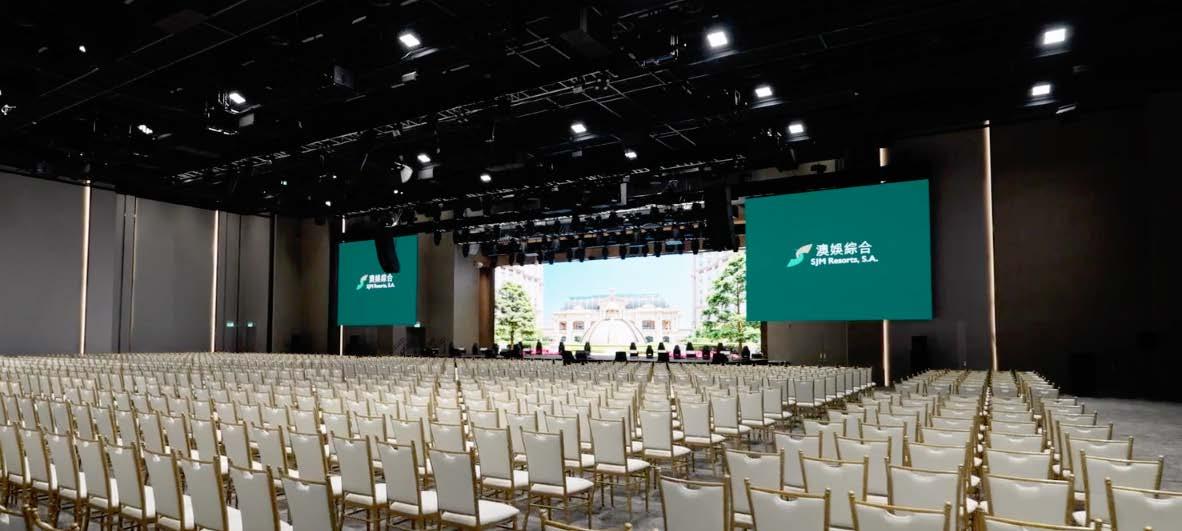
collaborative design process between Nova Range and Grand Lisboa Palace management, with the goal of creating a flexible mid-sized event destination capable of differentiating itself within one of Asia’s most competitive hospitality and entertainment markets.
“Grand Lisboa Palace already had a traditional ballroom,” explains Sand Leung, Managing Director of Nova Range and Project Director for the Grand Hall. “Now, the venue was looking to create a larger space that could host medium-sized programs and stand out among Macau's competitors. The venue needed to handle fashion shows, concerts, conventions, and more with different layouts. A fixed stage was definitely not in the plans.”
Nova Range evaluated several manufacturers during the selection process, but ultimately selected L-Acoustics due to the ability to deploy both L-ISA immersive audio and Ambiance active acoustics from the same loudspeaker infrastructure.
“We found that L-Acoustics is consistently advancing both technologies,” says Leung. “The client wanted tour-level live audio backed by an ideal acoustical environment for all seats. No other system could deliver that combination with such technical efficiency.”
At the heart of the Ambiance system is a network of strategically positioned microphones capturing the room’s natural acoustic energy, with signals processed via 11 L-Acoustics P1 processors operating over a Milan-AVB network. Julien Laval, L-Acoustics Application Project Director for Acoustics Solutions, worked closely with the venue team to calibrate dedicated acoustic signatures for different event types and usage scenarios.
“The key advantage of Ambiance in multipurpose venues is the ability to change room acoustics instantaneously,” explains Laval. “We worked closely with Grand Lisboa Palace to understand what each type of event needed acoustically—whether that's the warmth and reflection required for classical music or the clarity and control needed for
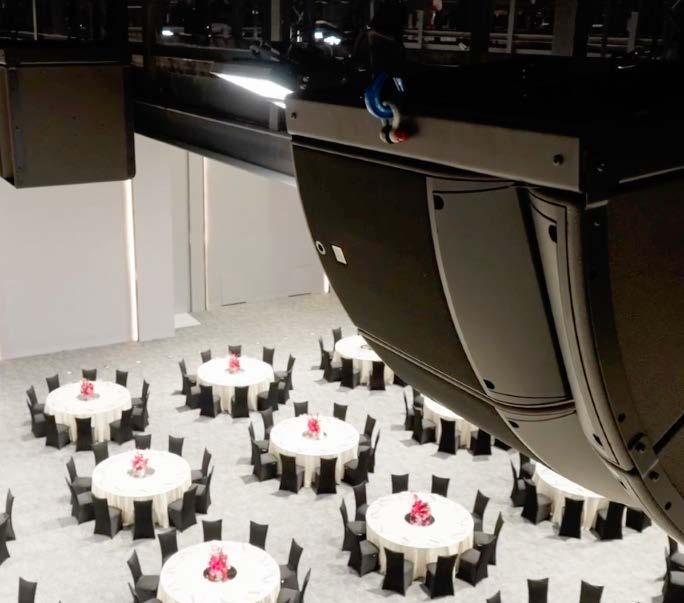
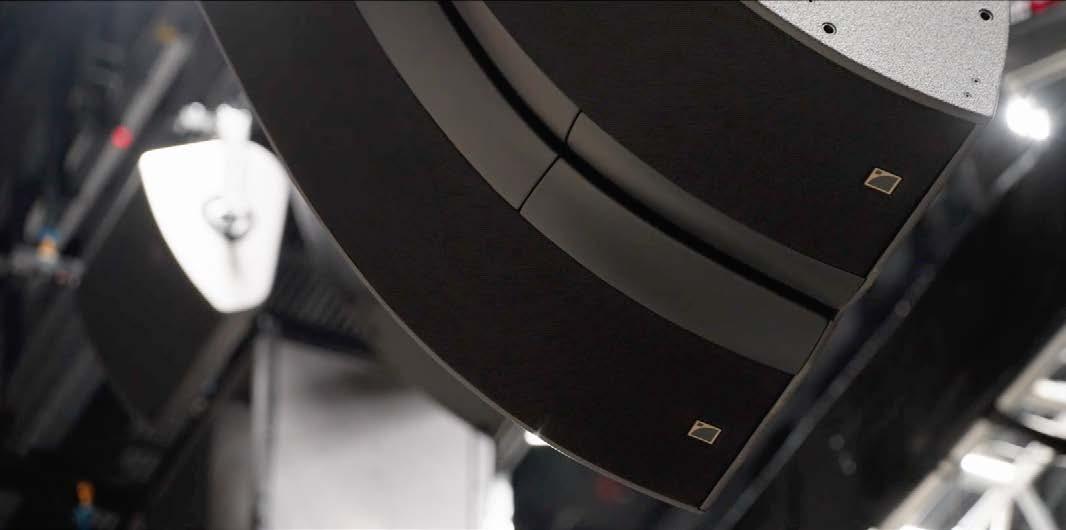
L-Acoustics Certified Provider Rightway Audio Consultants (RAC) Hong Kong supplied components for multiple L-ISA system designs accommodating four main stage configurations.
similar seven-point scene system, this time supported by two hangs of KS21i subwoofers. Out-fills comprise one A15 Focus and one A15 Wide enclosure per side, alongside six X12 delay speakers and ten X8 front-fill loudspeakers.
amplified shows. Because Ambiance uses the same loudspeaker infrastructure as L-ISA, both systems can run simultaneously, creating an immersive spatial audio experience within an acoustically optimized environment.”
The venue’s infrastructure has been designed around multiple permanent and portable system configurations. The permanent concert mode deploys a seven-hang scene system comprising two A15i Wide enclosures per hang, supported by four hangs of dual KS21i subwoofers flown centrally for lowfrequency reinforcement. Out-fill coverage is handled via two A15i Wide enclosures per hang on either side of the hall, while eight A15 Wide loudspeakers form the front-fill system across the stage edge. Delays are provided by seven X12 enclosures rigged mid-hall, with four A10i Wide loudspeakers delivering rear coverage.
A separate plenary mode positions the stage to the left side of the hall while retaining a
For centre-stage applications, the venue deploys four L/R systems using two A15i Wide enclosures per hang on each side of the hall, complemented by centrally flown KS21i subwoofers, dedicated X8 front-fills, and A10i Wide loudspeakers for south-side coverage.
Portable L-Acoustics L Series systems further extend the venue’s capabilities for concert and plenary configurations, using LCR deployments featuring L2 and L2D enclosures alongside flown KS28 subwoofer arrays. Overhead and surround arrays using X8 and X12 loudspeakers, together with Syva Low subwoofers, complete the immersive infrastructure. Several loudspeakers were also custom colour-matched to satisfy the venue’s architectural and aesthetic requirements.
L-Acoustics Certified Provider Rightway Audio Consultants (RAC) Hong Kong supplied components for the various L-ISA system configurations deployed throughout the venue.
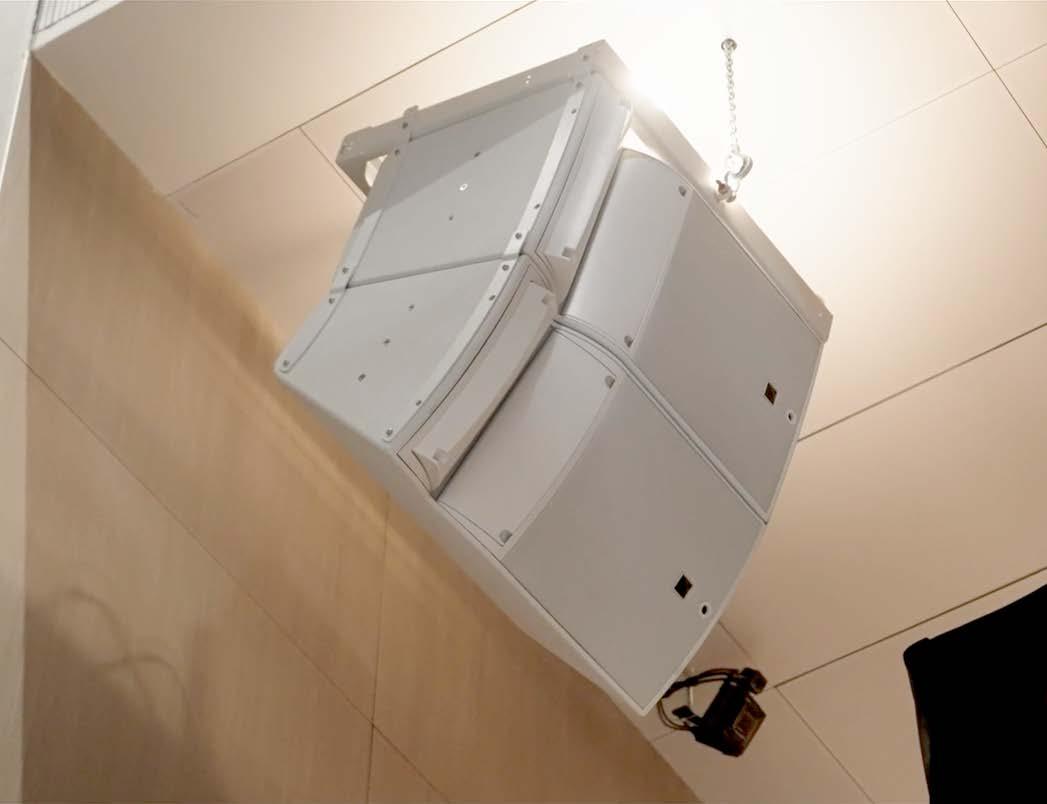
Some of the L-Acoustics loudspeakers feature custom colours to meet the venue’s aesthetic requirements.
According to Nicholas Kirsch, Nova Range’s audio system designer responsible for the L-ISA system design, the immersive audio deployment dramatically expands audience coverage compared to conventional stereo or LCR approaches.
“With L-ISA, that area can be expanded to 70 percent or even more. A well-designed L-ISA configuration expands the system's coverage area dramatically,” explains Kirsch.
Leung also highlighted the artistic and experiential benefits created by the combination of immersive sound and adaptive acoustics. “Ambiance allows the audience to experience more—for example, when performing classical music or music focused on specific instruments, it creates a significantly deeper atmosphere,” observes Leung. “From the performer's perspective on stage, the results are excellent. Artists hear clarity, leading them to be more engaged in their performances.”
Beyond conventional concerts and corporate events, the system’s flexibility has also opened the door to more experimental and interactive applications. “With so many sound
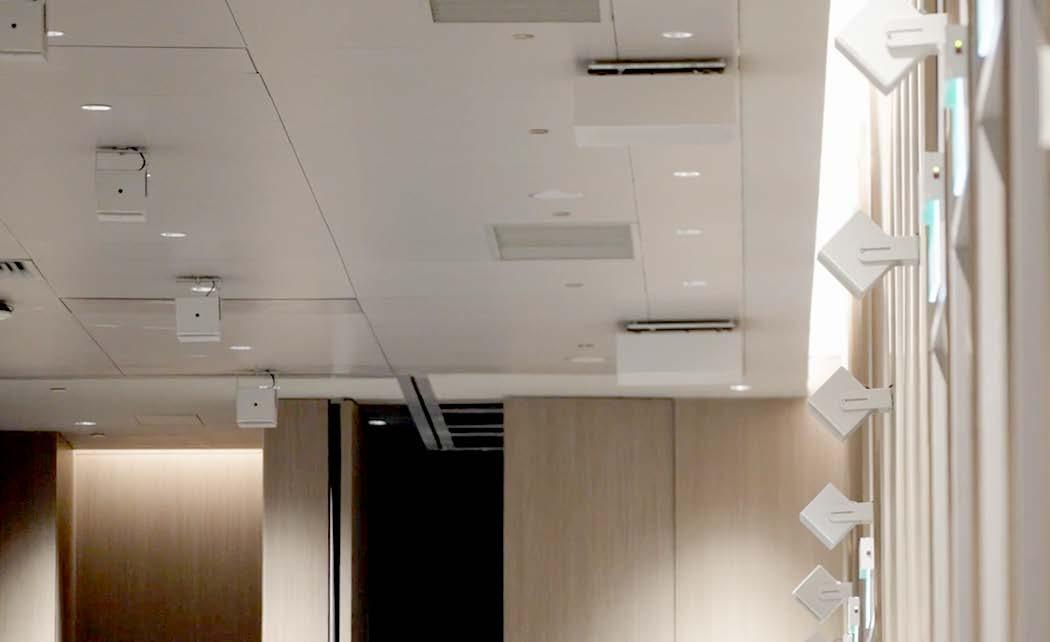
Since installation, the multi-system approach has opened creative possibilities beyond traditional concert applications.
sources and rigging points available, it's now possible to create very new and original interactive programs,” says Leung. “People might come in for a large meditation and yoga event, with sound surrounding them, making them feel as if they are in another dimension.”
Since opening, the Grand Hall has already hosted several live concerts, with organisers reportedly responding positively to both the venue’s spatial coverage and the seamless integration of the custom-specified, colour-matched loudspeaker systems. And L-Acoustics Application Engineer Frieda Lee, alongside the wider L-Acoustics APAC applications team, played a key role during the integration and optimisation process across all five acoustic zones and venue configurations.
Leung also acknowledged the long-term technical collaboration that supported the project through its multiple development phases. “Whether during the design and calibration phases, or when we needed modifications and adjustments, both teams at L-Acoustics and RAC provided invaluable support. We greatly appreciated their expertise, and even now, after delivery, they continue providing technical support.”
Martin MAC Viper XIP Modernise Vietnam-Soviet Friendship Palace of Culture and Labour in Landmark Theatre Installation
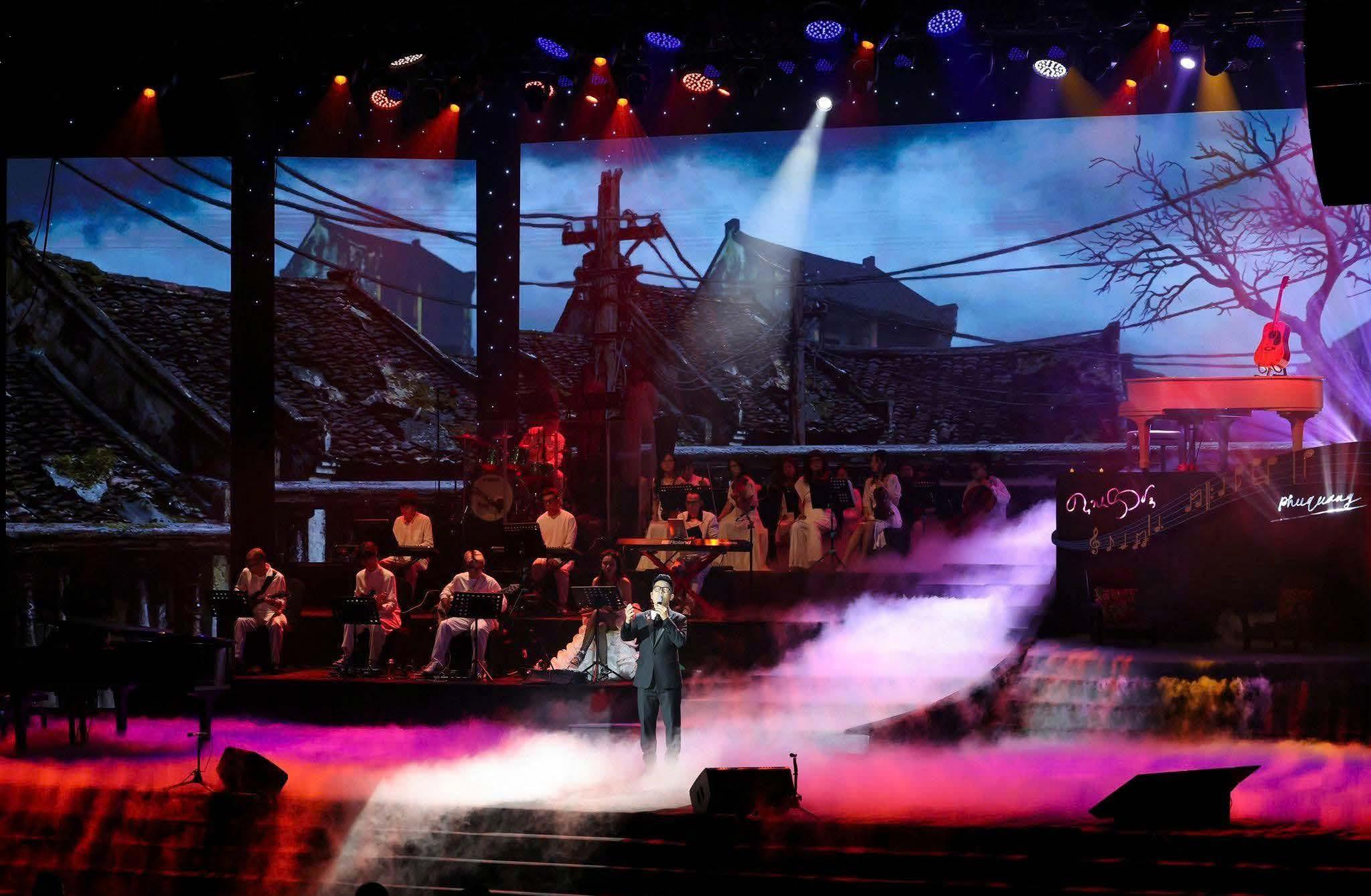
One of Vietnam’s most historically significant performance venues has entered a new technological era following a major stage lighting upgrade centred around Martin Professional’s MAC Viper XIP moving-head fixtures. Delivered by Stage Professional Company Limited as both distributor and system integrator, the project marks the first permanent large-scale theatre installation of the Martin MAC Viper XIP in Vietnam.
Located in central Ha Noi, the Vietnam-Soviet Friendship Palace of Culture and Labour has served as a key destination for artistic
performances, national conferences, and cultural events since opening in 1985. But as the venue’s production requirements evolved to accommodate increasingly sophisticated artistic productions and large-scale events, the Palace sought a modern lighting system capable of delivering greater visual performance, operational reliability, and longterm durability.
The project brief focused heavily on improving stage brightness, colour accuracy, movement precision, and coverage consistency across the theatre’s expansive
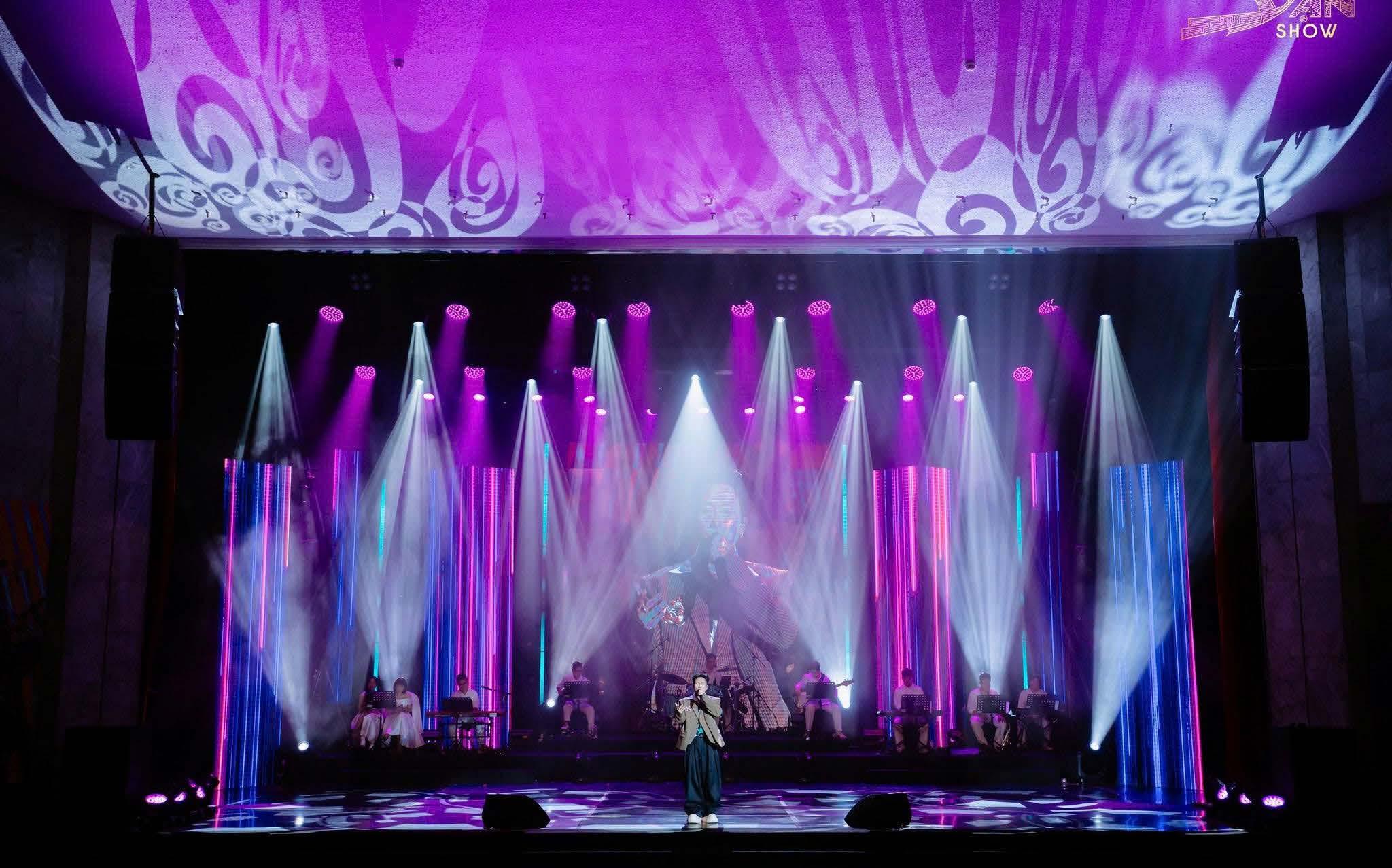
stage environment, while simultaneously reducing maintenance demands for a venue operating continuously throughout the year. And following extensive optical surveys and technical evaluations, Stage Professional proposed a system built around 10 Martin MAC Viper XIP fixtures. According to the integration team, the fixture’s combination of performance output, precision optics, and rugged environmental protection made it particularly suited for permanent deployment within a demanding theatrical environment.
“Our goal was to deliver a future-proof lighting system that meets the exceptionally high technical and artistic standards of the Vietnam-Soviet Friendship Palace of Culture and Labour,” said Dinh Viet Hung, CEO of Stage Professional Company Limited.
“The Martin MAC Viper XIP offered the ideal balance of power, precision, and durability for a permanent installation of this scale.
By integrating these fixtures, we’ve not only enhanced visual performance on stage, but also ensured long-term reliability and ease of operation for a venue that supports nationallevel events throughout the year.”
A major factor in the fixture selection process was the MAC Viper XIP’s IP54-rated enclosure, designed to provide enhanced resistance against dust and environmental stress; a particularly important consideration for a venue hosting continuous productions and operating under varying thermal conditions. The installation additionally represents a broader shift within Vietnam’s performing arts sector toward the adoption of high-performance IP-rated lighting technologies within flagship cultural venues.
The implementation process included detailed fixture positioning, system calibration, and programming optimisation to ensure
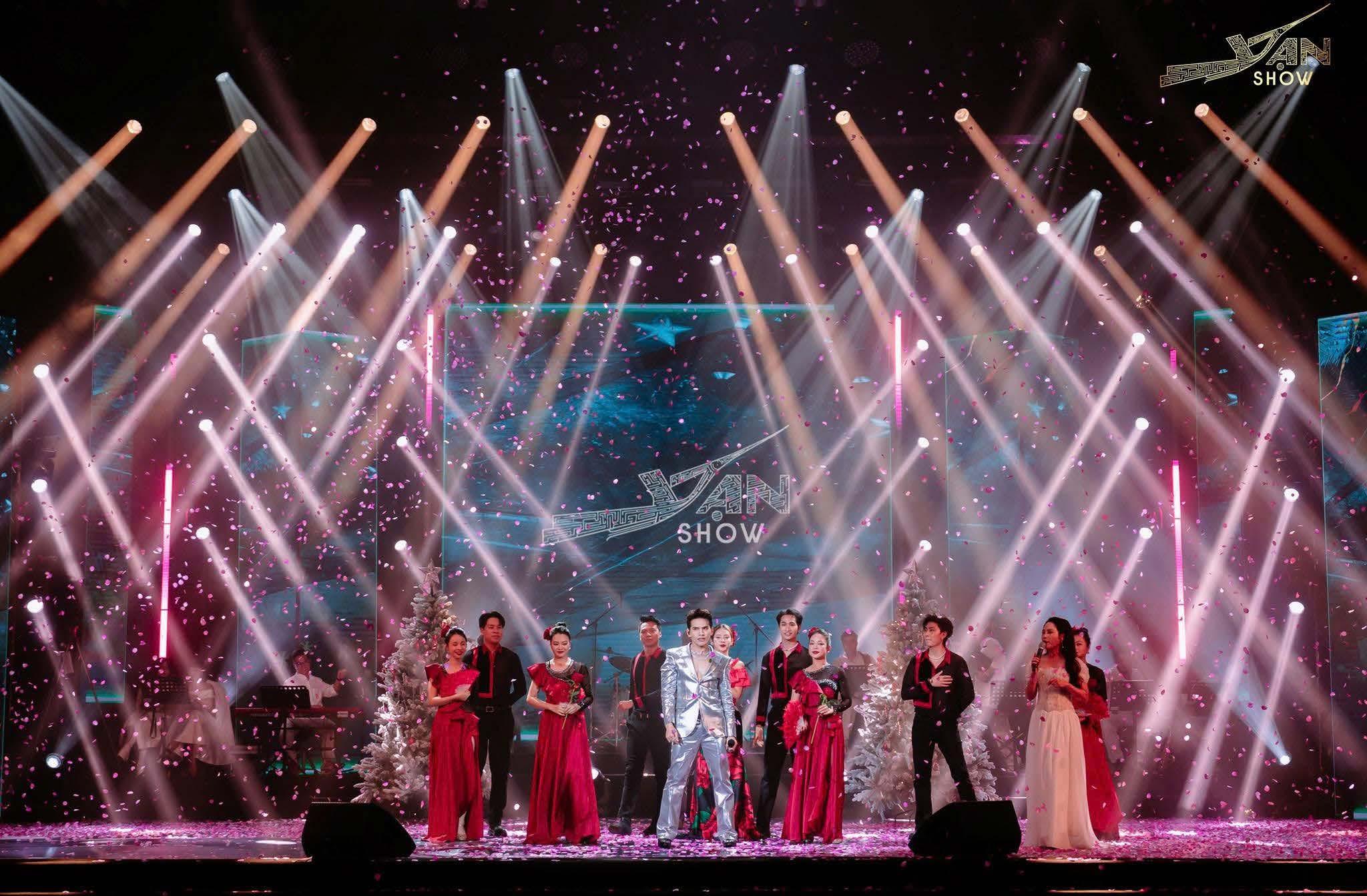
smooth integration with the theatre’s existing infrastructure. Stage Professional worked closely with the venue’s technical team to fine-tune brightness levels, movement characteristics, and colour performance across both theatrical productions and live event applications.
The completed system now delivers significantly expanded creative flexibility for lighting designers and performers while simplifying operational workflows for the venue’s technical staff through stable and intuitive day-to-day control.
“The upgraded stage lighting system with the Martin MAC Viper XIP has brought significant improvement to the quality of performances at the Vietnam-Soviet Friendship Palace of Culture and Labour,” shared Pham Tuan Anh, Director of Vietnam-Soviet
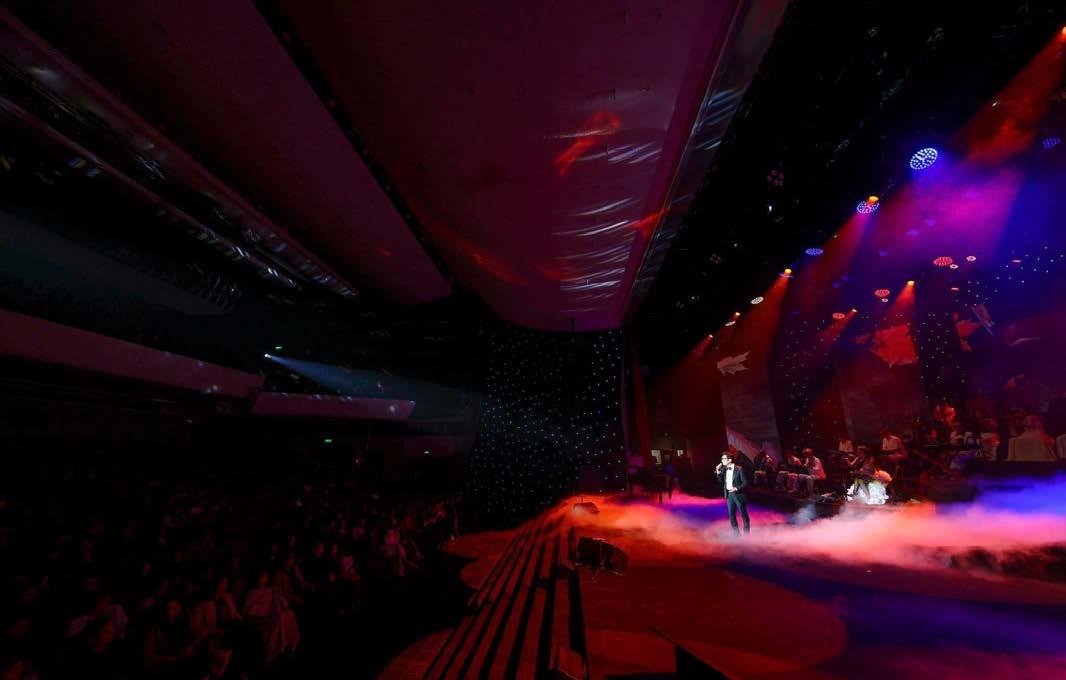
Friendship Palace of Culture and Labour.
“With powerful brightness, accurate colors, and flexible operation, the system enables us to host a wide range of large-scale artistic programs and high-level events. It not only raises our technical standards but reinforces our position as a leading venue for national and international performances.”
EAW Powers Seamless Multi-Level Soundscape at Maison Bâtard
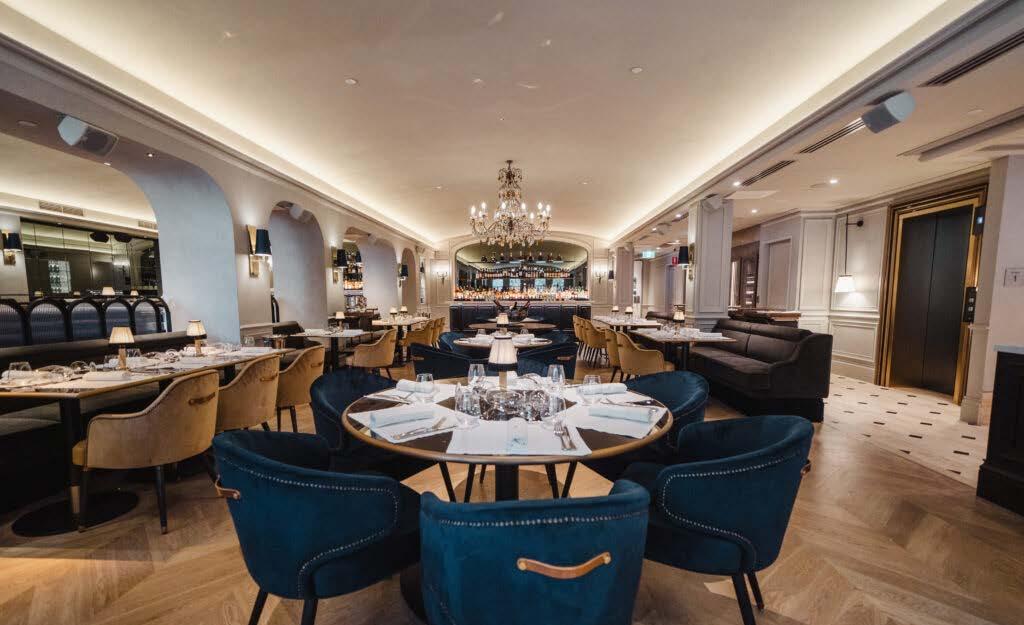
Creating a venue that effortlessly transitions from refined daytime dining to high-energy nightlife is no small feat — particularly when the audio must adapt in real time without disrupting architectural elegance. At Maison Bâtard in Melbourne, that balance has been realised through a fully integrated, venuewide sound system built on Eastern Acoustic Works (EAW) loudspeakers, delivered by Melbourne-based AV specialist Zelo Group
Positioned in the heart of the city, Maison Bâtard spans four distinct levels — from its main restaurant floors to the intimate basement supper club, Le Club, and the rooftop bar and dining space, La Terrasse —
each demanding its own sonic identity while remaining part of a unified experience. Zelo Group approached the project as a complete concept-to-install solution, designing, modelling, engineering, and deploying a bespoke system that allows each space to operate independently or in sync, depending on the venue’s operational needs.
“Maison Bâtard is a very large venue for a restaurant, especially in Melbourne, and every level has its own identity,” says Stephen Sokolowski, Design Manager at Zelo Group. “The system was designed so that each floor can operate independently or together. If there’s a performance in the
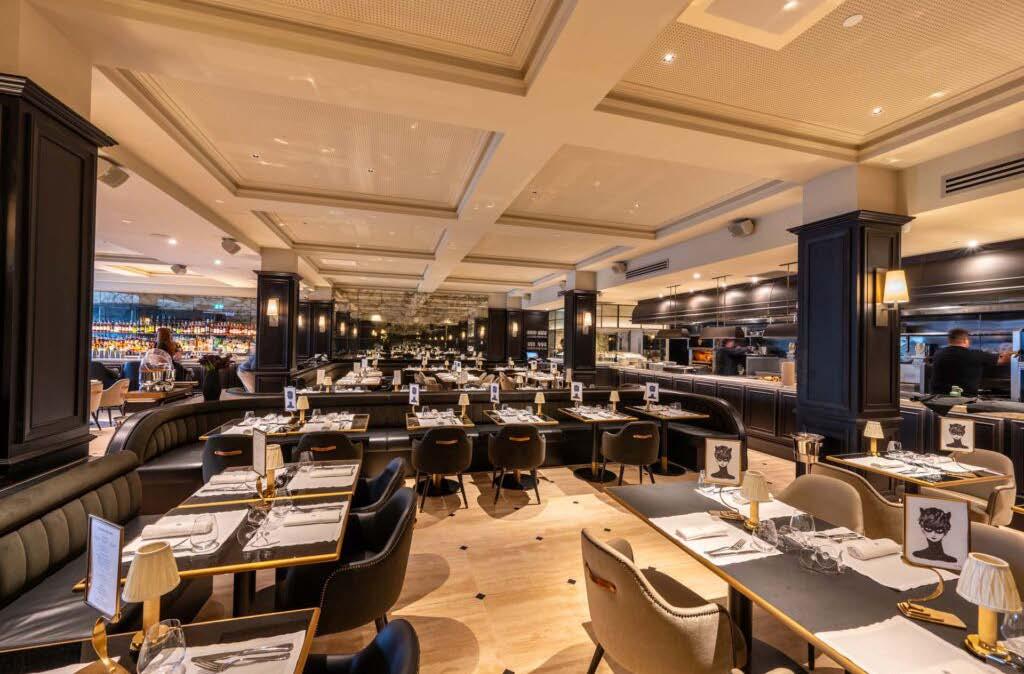
basement club, that audio can be routed throughout the building, or each level can host its own entertainment.”
At the core of the installation is EAW’s MKC Series, deployed extensively for foreground music coverage across the venue. The compact loudspeakers were selected for their ability to deliver premium sound quality while maintaining a strong value proposition — an essential consideration in hospitality environments where scalability and performance must go hand in hand. Their consistent sonic character ensures a cohesive listening experience, even as the atmosphere shifts throughout the day.
The basement-level Le Club serves as the venue’s most dynamic performance environment, designed to accommodate
everything from live bands and DJs to cabaret acts and private events. Each level of the venue is reinforced with dedicated subwoofer support, effectively transforming the entire building into a collection of interconnected performance spaces capable of adapting to a wide range of programming.
Delivering this level of performance while preserving the venue’s high-end aesthetic presented a significant challenge. Working closely with architects and designers, Zelo Group ensured that the technology remained virtually invisible. Subwoofers were concealed within architectural elements, while loudspeakers were colourmatched to their surroundings — requiring physical disassembly, custom finishing, and reassembly to achieve a seamless visual integration.
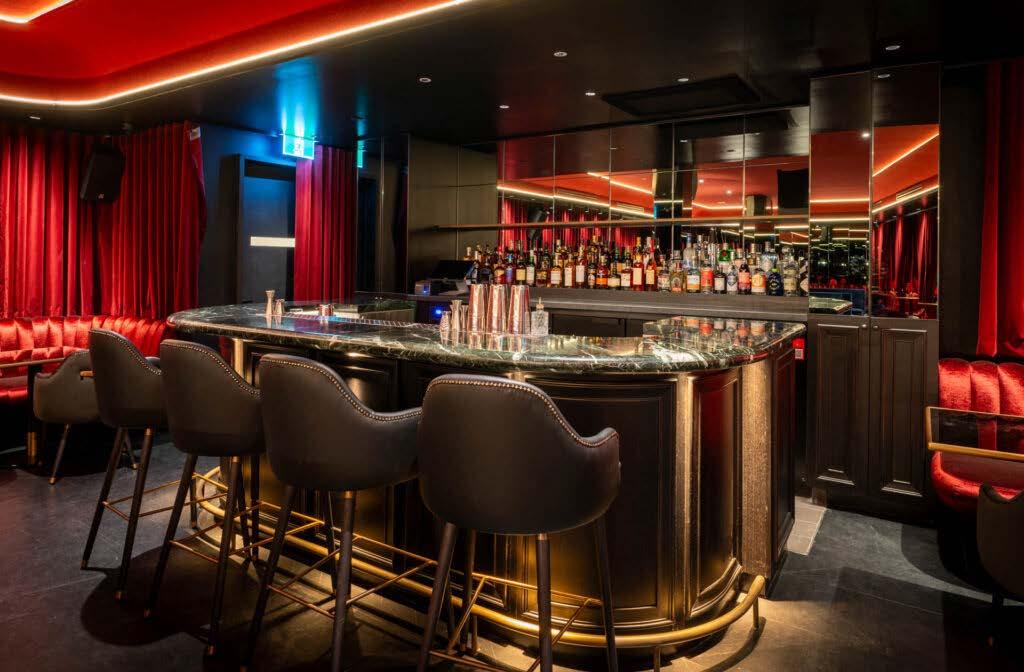
To achieve precision at every stage, Zelo Group undertook extensive Building Information Modeling (BIM) and acoustic simulation, spending nearly a year refining the system design before installation. Using EAW’s Resolution software alongside other modelling tools, the team validated speaker placement, system coverage, and performance, enabling informed design decisions and clear communication with the client throughout the process.
Beyond simulation, real-world listening demonstrations played a crucial role in aligning the system’s performance with the client’s expectations. The objective was clear: to create an evolving atmosphere that supports guests throughout the day
— from breakfast meetings to late-night entertainment — without any perceptible compromise in audio quality.
Operating as a long-term hospitality technology partner rather than a conventional contractor, Zelo Group worked closely with Lucas Restaurants across the entire project lifecycle, from concept development through to commissioning and ongoing support. This collaborative approach, built over more than a decade, ensured that Maison Bâtard’s audio environment not only meets but enhances its ambitious experiential vision.
Christie Soars to New Heights in China Through Major Projection Upgrade at “Flying By Changbai Mountain” Dome Attraction
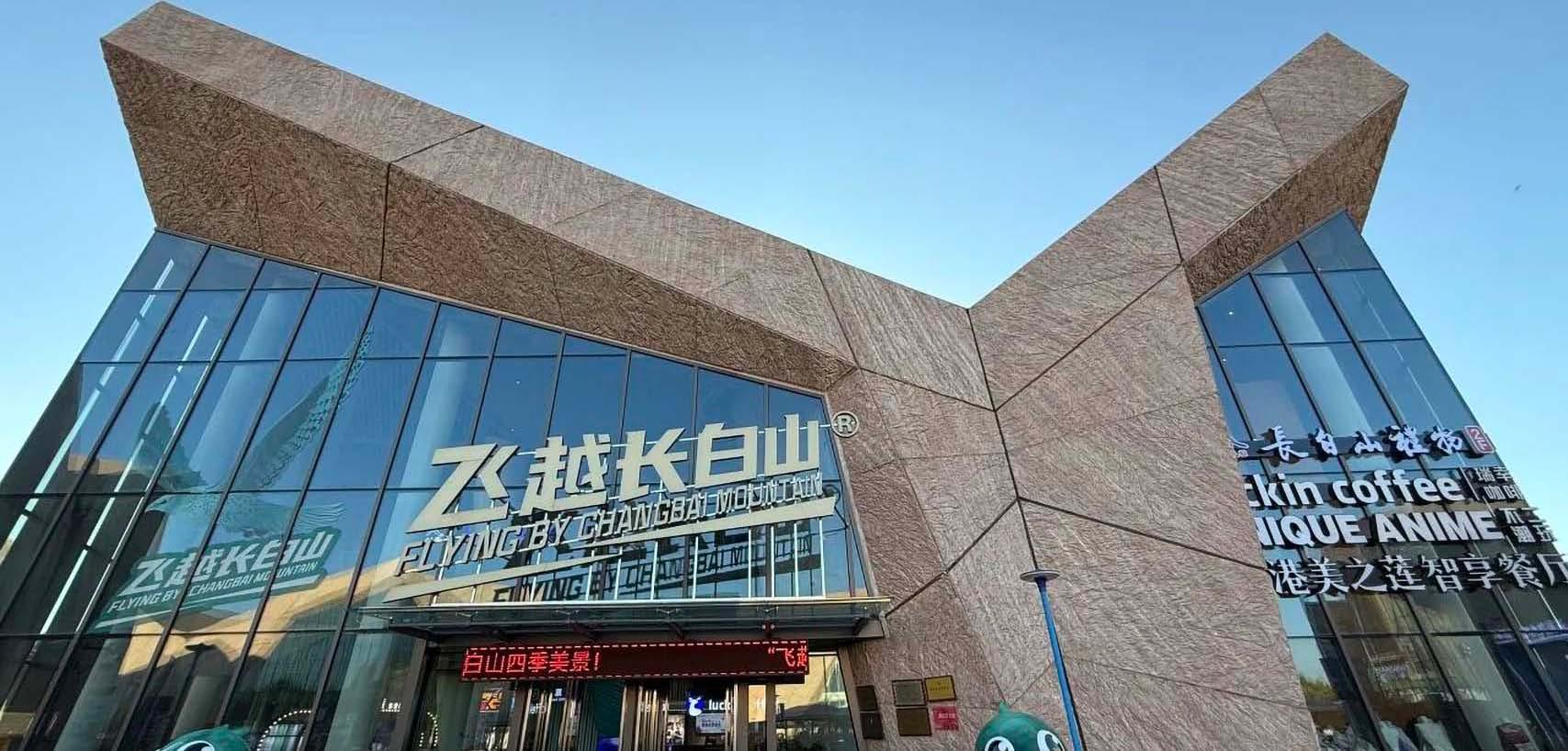
China’s immersive attraction landscape continues to evolve at pace, with operators increasingly demanding higher visual fidelity, simplified system architecture, and more impactful audience experiences. At Changbai Mountain Legend International Resort in Jilin Province, that ambition has now taken shape through a major projection upgrade at the resort’s flagship “Flying By Changbai Mountain” flying dome attraction, where Christie and Wincomn Technology have delivered a high-performance visual overhaul centred around the Christie Griffyn 4K50-RGB projector.
Located at the base of Changbai Mountain’s northern scenic area, the attraction blends projection, motion simulation and local cultural storytelling into a large-scale immersive experience designed to place visitors inside the region’s landscapes and legends. The upgraded system now drives visuals across a 20-metre dome screen using a single Christie Griffyn 4K50-RGB pure laser projector — a significant shift from previous multi-projector requirements.
The attraction’s suspended motion cabin accommodates up to 70 guests per session and moves through six degrees of freedom,
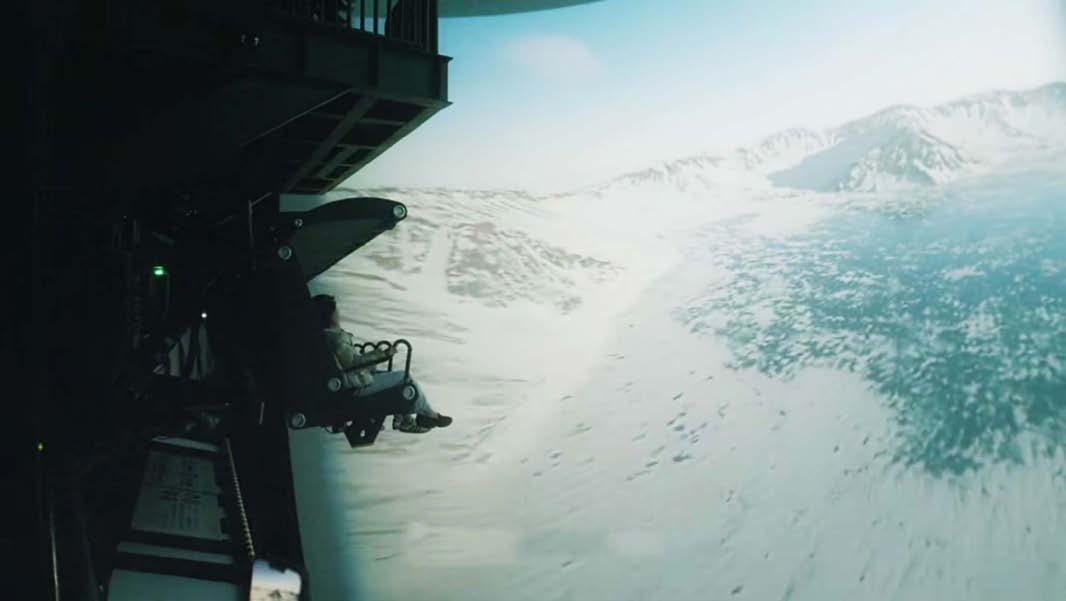
The “Flying By Changbai Mountain” flying dome theatre has upgraded its projection system to enhance visuals for visitors (Images courtesy of Wincomn Technology)
while environmental effects including wind and mist are synchronised with the visuals to heighten immersion. Guests experience an aerial journey across Changbai Mountain’s forests, snow-covered peaks and Tianchi Lake from the perspective of the mythical Manchu sea eagle, creating a panoramic simulation that combines physical movement with largeformat dome projection.
“For a flying dome theatre, achieving the right balance of brightness, color fidelity and visual impact is critical,” said Tony Chen, General Manager, Wincomn Technology. “With the Griffyn 4K50-RGB, we succeeded in meeting these requirements using a single projector—a remarkable achievement considering that multiple units were previously necessary. This simplified system design and installation reduced overall costs for the client, and delivered the immersive visual performance the experience demands.”
According to Chen, several technical capabilities of the Griffyn 4K50-RGB proved decisive in the system specification process, including its 50,000-lumen brightness output, native 4K resolution, omnidirectional operation, and pictureperfect colour alignment capabilities. The projector’s support for high frame rates of up to 120Hz at 4K in 3D environments also

Mesmerizing visuals of Changbai Mountain’s various seasons and landscapes.

helped maintain smooth motion continuity throughout the fast-moving flight sequences projected across the curved dome surface.
Beyond image performance, the installation also benefited from the projector’s built-in warping and blending capabilities, flexible installation options, wide colour gamut reproduction and quiet operational profile — all critical factors in immersive attraction environments where visual consistency and operational reliability remain paramount.
“This project highlights the value of close collaboration between system integrators and technology partners,” said Gene Wang, Senior Director of ProAV Sales for China at Christie. “We are pleased to work with Wincomn Technology on this immersive attraction, combining their expertise in domebased experiences with Christie’s projection solutions. Together, we helped the resort realize its creative vision while simplifying the overall system and delivering a compelling experience for visitors.”