National Agenda: Reorganising border defence Page 10
`55.00 (India-based buyer only)
SP’s
mai An SP Guide Publication
www.spsmai.com
ONLY Fortnightly on
Military aerospace internal security
Vol: 4 Issue 12 ❚ June 16-30 • 2014
FDI in defence – Welcome move PAGE 8
PAGE 5
Prime Minister’s day at sea PAGE 11
DELENG/2010/34651
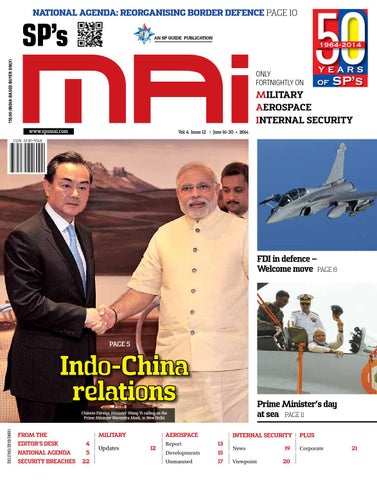
Chinese Foreign Minister Wang Yi calling on the Prime Minister Narendra Modi, in New Delhi
From the
military
editor’s DESK
4
national agenda
5
security breaches 22
Updates
INTERNAL security
AEROSPACE 12
Report
13
Developments
15
Unmanned
17
News Viewpoint
19 20
PLUS Corporate
21
SPOTLIGHT NATIONAL AGENDA: REORGANISING BORDER DEFENCE PAGE 10
`55.00 (INDIA-BASED BUYER ONLY)
Defence Minister visits forward areas in Uri sector
SP’s
mai www.spsmai.com
D
ONLY FORTNIGHTLY ON
Cover:
MILITARY AEROSPACE INTERNAL SECURITY
Amidst the race among big powers to get closer to the new Prime Minister Narendra Modi, China tried to steal the show by dispatching its Foreign Minister Wang Yi to New Delhi on June 8. The Chinese FM had wide-ranging discussions with Sushma Swaraj, External Affairs Minister, and the Prime Minister.
Vol: 4 Issue 12 ❚ June 16-30 • 2014
FDI in defence – Welcome move PAGE 8
PAGE 5
Indo-China relations
Prime Minister’s day at sea PAGE 11
Chinese Foreign Minister Wang Yi calling on the Prime Minister Narendra Modi, in New Delhi
DELENG/2010/34651
efence Minister Arun Jaitley, who on his twoday tour to the Kashmir Valley June 14-15, visited the forward post on the line of control (LoC) in Uri sector. He was accompanied by General Bikram Singh, the Chief of Army Staff, Lt General D.S. Hooda, Northern Army Commander, Lt General Gurmit Singh, Chinar Corps Commander, and other senior officials of Army and the Ministry of Defence (MoD). The Defence Minister was briefed about the trends in infiltration of the terrorists and the Counter Infiltration grid established by Army along the LoC. He also interacted with the troops deployed on the LoC.
AN SP GUIDE PUBLICATION
FROM THE 4
SECURITY BREACHES
1_SP's MAI Cover 12-2014.indd 1
5 22
Updates
INTERNAL SECURITY
AEROSPACE
MILITARY
EDITOR’S DESK NATIONAL AGENDA
12
Report
13
Developments
15
Unmanned
17
News Viewpoint
19
PLUS Corporate
21
20
17/06/14 6:27 PM
Cover images: PIB, Dassault Aviation
Publisher And Editor-in-Chief
Jayant Baranwal Assistant Group editor
R. Chandrakanth SR Technical Group EditorS
Air Marshal (Retd) B.K. Pandey Lt General (Retd) Naresh Chand Lt General (Retd) V.K. Kapoor R. Adm (Retd) S.K. Ramsay SPECIAL Contributor
Lt General (Retd) P.C. Katoch Chairman & Managing Director
Jayant Baranwal planning & business development
Executive Vice President: Rohit Goel ADMIN & COORDINATION
Bharti Sharma design & LAYOUT
Creative Director: Anoop Kamath Designers: Vimlesh Kumar Yadav, Sonu Bisht Research Assistant - Graphics: Survi Massey SALES & MARKETING
Director: Neetu Dhulia General Manager Sales: Rajeev Chugh
SP’s websites
Sr Web Developer: Shailendra P. Ashish Web Developer: Ugrashen Vishwakarma © SP Guide Publications, 2014 Subscription/ Circulation
Annual Inland: `1,320 • Foreign: US$ 325 E-mail: subscribe@spguidepublications.com subscribe@spsmai.com LETTERS TO THE EDITOR
editor@spsmai.com
FOR Advertising details, contact:
advertise@spsmai.com neetu@spguidepublications.com rajeev.chugh@spguidepublications.com SP GUIDE PUBLICATIONS PVT LTD
A-133 Arjun Nagar (Opposite Defence Colony) New Delhi 110 003, India.
Tel: +91 (11) 24644693, 24644763, 24620130 Fax: +91 (11) 24647093 E-mail: info@spguidepublications.com Representative Office
204, Jal Vayu Vihar Kalyan Nagar Bengaluru 560043 Tel : +91 (80) 23682204 MOSCOW, RUSSIA
LAGUK Co., Ltd, Yuri Laskin Krasnokholmskaya, Nab., 11/15, app. 132, Moscow 115172, Russia. Tel: +7 (495) 911 2762, Fax: +7 (495) 912 1260
PhotographS: Defence PRO
Owned, published and printed by Jayant Baranwal, printed at Kala Jyothi Process Pvt Ltd and published at A-133, Arjun Nagar (Opposite Defence Colony), New Delhi 110 003, India. All rights reserved. No part of this publication may be reproduced, stored in a retrieval system, or transmitted in any form or by any means, photocopying, recording, electronic, or otherwise without prior written permission of the Publishers.
Back in Srinagar, Arun Jaitley attended the special security review meeting held at Sher-e-Kashmir International Conference Centre, attended by Chief Minister Omar Abdullah, the Chief of Army Staff, the Northern Army Commander, the Chinar Corps Commander and other official of state and civil administration. Security related issues were discussed during the meeting. SP
www.spguidepublications.com Issue 12 • 2014 SP’S MAI 3
From the
Editor’s Desk
Engaging China
I
ndia has two difficult neighbours on either front. Engaging both Pakistan and China requires more than diplomacy, even while India guards her territory. The new Prime Minister, Narendra Modi, has shown early statesmanship by concentrating on the neighbourhood as to ensure peace and development in the region. After his fruitful talks with the Pakistan Prime Minister, Nawaz Sharief, he has turned his attention to China which in fact dispatched its Foreign Minister Wang Yi as the Special Envoy of the President Xi Jinping to New Delhi on June 8. China is a global power and it was kind of reaching out to the Modi-led NDA Government. The meeting of the two External Affairs Ministers, though exploratory in nature, has significant geopolitical ramifications. The bonhomie now should translate to positive forward movement between these countries and there are signs that they will soon have a liberalised visa regime, improving people-topeople relations. We all know about ‘Stapled Visas’ and hope that it is a thing of the past. These are indeed early steps in the ‘thousand-mile’ journey. Lt General (Retd) P.C. Katoch writes that the prospects of industrialisation in both countries are gigantic, as is the scope of Chinese investments in infrastructure in India. Time is indeed ripe for both countries to resolve all outstanding issues and give a development fillip. In another article, General Katoch opines that though resolution of the line of actual control (LAC) is a complex issue, there can be no excuse why we have not been able to resolve our border with Myanmar and Bangladesh, demarcated it, and established effective measures to guard against illegal immigration, smuggling of narcotics, arms and fake currency. The new government needs a lot of catching up to do to rectify the neglect and the follies of the last decade. India’s new leadership under Narendra Modi is pushing the development agenda on the fast-track. One of the bold decisions it is going to take is to allow 100 per cent foreign direct investment (FDI) in defence. The previous government had put a cap of 26 per cent (49 per cent in exceptional cases) but there were murmurs amongst original equipment manufacturers (OEMs) that for true technology transfer the cap had to be increased. The industry is eagerly looking 4 SP’S MAI Issue 12 • 2014
forward to further liberalisation of processes if the modernisation of the armed forces has to truly take place. June 14 was a red-letter day in the annals of the Indian Navy when the Prime Minister dedicated INS Vikramaditya to the nation. It is the largest warship acquired by India at the staggering cost of $2.3 billion. It is indeed a proud moment as the Prime Minister described and went on to say that it would add tremendous might and strategic power to our Navy. While India does not aim to threaten other countries, neither will it “ever bow down” before anyone. The tidings seemingly appear to be positive, it is for India to capitalise on the leadership and push for more development. We at SP’s M.A.I. hope the early momentum will gather speed in the benefit of the nation.
Jayant Baranwal
Publisher & Editor-in-Chief www.spsmai.com
NAtional Agenda
India China – first step in the thousand-mile journey?
External Affairs Minister Sushma Swaraj with her Chinese counterpart Wang Yi in New Delhi
[ By Ranjit Kumar ]
PHOTOGRAPH: PIB
A
midst the race among big powers to get closer to the new Narendra Modi-led NDA Government in India, China tried to steal the show by dispatching its Foreign Minister Wang Yi as the Special Envoy of the President Xi Jinping to New Delhi on June 8-9. The special gesture from China, who in recent times has been very aggressive in relations with its maritime and land neighbours, surprised the strategic circles and the Indian External Affairs Ministry went out of the way to extend a warm welcome to him. The Chinese Foreign Minister had extensive discussions with the Indian External Affairs Minister Sushma Swaraj on the first day of his visit and he stayed in Delhi for the next day to hand over the special message of the Chinese President Xi Jinping to Prime Minister Narendra Modi and later met President Pranab Mukherjee. This was the first substantive engagement between the two for-
eign ministers at the first available opportunity as the new Modi Government in India had just taken over. And well before the Americans or the Japanese or the Russians leaders could drop in the Chinese Foreign Minister set his foot on Indian soil. But the two sides still seem to be on the level of knowing and understanding each other. There was no major announcement on how to reduce or remove the trust deficit between the two countries but the Chinese Foreign Minister did indicate before his departure to Beijing that both the countries are on the anvil of signing a liberalised visa regime which will improve people-to-people relations. Perhaps this was the first step in the new thousand-mile journey, as stated by the Indian spokesman of the Ministry of External Affairs quoting a Chinese proverb. Undoubtedly, the two countries have to travel a long distance, which is fraught with many dangers. Indian believes that engagement with the neighbours is the best way to reduce areas of differences while at the same time developing normal economic and people-to-people relations. But Issue 12 • 2014 SP’S MAI 5
Photograph: PIB
NAtional Agenda The dilly-dallying attistrategic observers feel that tude of Chinese leadership India has always been on on the early resolution of the receiving side. boundary issue accompaAccording to Shashank, nied by continuing incidents India’s former Foreign Secof incursions and transgresretary, China is keen on sions on the 4,000-kmimproving bilateral trade long line of actual control and investment relations (LAC) irks Indian people and they are also interested and a democratic governin establishing industrial ment in India cannot afford parks, but while indulging to be ignoring them. The in economic cooperation we practice adopted by Chishould not lose sight of new nese government to issue strategic imperatives, and Staple Visa for the residents we have to be careful. of Arunachal Pradesh and In view of the continuJammu and Kashmir has ing spat between Japan cast a shadow on Chinese and China on the territointentions, though Wang Yi rial claims over Senkaku clarified that Staple Visa for or Diayou islands and the Wang Yi with President Pranab Mukherjee the Arunachal residents was Americans announcing a at Rashtrapati Bhavan in New Delhi a goodwill gesture. new Rebalancing Asia policy Though the Chinese earlier known as the Pivot to Asia policy, Chinese moves to woo India and India’s reciprocal officials have stopped issuing Staple Visa for the residents of Jammu moves are being closely watched by the international community. and Kashmir the Chinese Government has never announced and Interestingly India has been indirectly warning China on its unilat- acknowledged them publicly. The heavy imbalance in bilateral eral territorial claims over the large portion of the South China Sea trade of $65.47 billion in 2013 is also a matter of serious concern for and has been repeatedly issuing statements regarding the need to India. China also hesitates in committing support for Indian claim respect the international law of the sea and freedom of navigation for permanent membership to the United Nations Security Council. The Chinese objections to India’s right to be recognised as the in the oceans. According to Chintamani Mahapatra, Professor at Jawaharlal nuclear state at par with the other declared nuclear powers and the Nehru University (JNU), it is very significant that the Chinese gov- Chinese objections to Indian membership to the various nuclear ernment had been more proactive in improving ties with India. bodies like the Nuclear Suppliers Group also irritates India. The Chinese also provide nuclear and ballistic missile technolChina made it a point to send Foreign Minister to India even before ogy to Pakistan, it is an all-weather friend, at the US had started talking to India. It is significant cost of India. The kind of military support Pakithat even before Obama invited Modi, the stan gets from China puts strategic pressures on Indian Prime Minister invited Chinese PresiHowever, in spite of India. The Chinese have also initiated building dent to India. Referring to Modi Government’s India’s concerns on huge road and rail network via the territory priorities Mahapatra observed, it looks like under Pakistani control of the Indian state of new government is going to focus on immesome of the Chinese Jammu and Kashmir, ignoring India’s sensitividiate neighbourhood to improve difficult ties. On the other hand, China objects to Indian but strategic relations with China. The Modi policies affecting India, economic activities in the exclusive economic Government is giving priority to manage this the bilateral economic zone of Vietnam in the South China Sea. kind of relationship. It is quiet likely Modi may However, in spite of India’s concerns on visit China and try to sort out different issues relations have moved some of the Chinese policies affecting India, the between China and India. at a very fast pace, bilateral economic relations have moved at a The Modi Government’s expectations very fast pace, though at the cost of Indian marfrom the Chinese Government was very well though at the cost of ket. The cheap Chinese goods have adversely articulated by Sushma Swaraj, when she impacted on Indian small-scale manufacturing reminded Wang Yi of China’s assertion of Indian market. The sector, while restricting Indian pharmaceutiOne China Policy and India’s desire to obtain cheap Chinese goods cal and software exports to China. The Chinese similar expressions of intent by China for One India Policy. However, the Indian External have adversely impacted Foreign Minister promised to look into ways to reduce the huge trade deficit. Affairs Ministry spokesman was evasive in his on Indian small-scale Promises apart, India does not feel comreplies when asked about a number of issues fortable either in political or economic or strawhich cast shadow on India-China relations. manufacturing sector, tegic arena in its relations with China. Only The spokesman merely stated that all issues of solace is that 4,000-km-long undemarcated mutual interest were discussed. Though, India while restricting Indian border remains largely peaceful and stable, has a long list of complaints against China pharmaceutical and which gives space for the two countries to which results in generating negative mindsets maintain warmth in bilateral relations and among Indian people and leaders. This in turn software exports to also work together in multilateral forums like leads to the widening of trust deficit between China. BRICS, climate change issues, etc. SP the two countries. 6 SP’S MAI Issue 12 • 2014
www.spsmai.com
NAtional Agenda
Lt General (Retd) P.C. Katoch
President Xi Jinping is visiting India later this year. That would be the right time to cement a new dawn provided the Indo-China border issue is settled and India’s strategic interests are accommodated. Prospects of industrialisation in both countries are gigantic, as is the scope of Chinese investments in infrastructure in India.
Energising India-China relations
T
he Chinese Foreign Minister Wang Yi visited India on June 8-9 as the Special Envoy of President Xi jinping. He met Prime Minister Narendra Modi, Foreign Minister Sushma Swaraj and called on the President also. He brought President Jinping’s message for PM Modi that conveyed “under your leadership, India will achieve greater development and progress. Let us work together for benefit of our two people.” Mr Modi responded, “We are looking forward to working with the Chinese leadership to expand our partnership”, while also accepting Premier Li Keqiang’s invite for early visit to Beijing. The Ministry of External Affairs (MEA) spokesperson said that “all perennial” Sino-Indian issues were discussed in a frank manner including the need to resolve the border dispute. Talks were productive, useful and substantial and both sides agreed there was untapped potential for growth of economic ties. In May 2014, Chinese Ambassador Wei Wei had spelt out China’s hopes for economic cooperation with India, more specifically: one, increased Chinese investments in manufacturing sector with Chinese resources and experience; two, Chinese investors developing industrial parks in India; three, partnership in developing infrastructure especially efficient transportation between inland cities and ports, improving freight transportation, easing energy shortage in India, accelerating production and improving competitiveness of Indian products; four, combining China’s “Open to the West” with India’s “Look East Policy” to achieve better connectivity with a Sino-Indian railway apart from the Bangladesh, China, India and Myanmar (BCIM) economic corridor, since China has commenced constructing the Trans-Asian high-speed railway connecting southwestern China to East Asian countries. The India-China Strategic and Cooperative Partnership for Peace and Prosperity envisions: one, exploring prospects of a bilateral Regional Trade Arrangement (RTA), two, review negotiations on the Regional Comprehensive Economic Partnership (RCEP) and expedite framework agreement for establishing industrial zones to provide platforms of cluster type development for enterprises of both countries; three, review progress of the India-China Study Group on the BCIM Economic Corridor and further discussions on concepts and alignment of
the economic corridor; four, Special Representatives exploring framework of settlement of the IndiaChina boundary question to continue efforts in that direction; five, recognition of peace and tranquillity on the India-China border as an important guarantor for the development and continued growth of bilateral relations – BDCA strengthening maintenance of stability on the border; six, defence exchanges and military exercises in building greater trust and confidence to continue as agreed to mutually; seven, appreciation of signing MoU on strengthening cooperation on trans-border rivers, plus agreement to exchange flood-season hydrological data and emergency management, etc; eight, facilitating greater people-to-people contacts and exchanges, supported by sister-city relationships that have been concluded initially on a pilot basis; nine, in addition to marking 2014 as a Year of Friendly Exchanges, India and China to discuss with Myanmar commemoration of 60th anniversary of Panchsheel; and ten, coordination and cooperation in multilateral forums including Russia-India-China, BRICS, and G-20 to jointly tackle global issues such as climate change, international terrorism, food and energy security, and to establish a fair and equitable international political and economic system. The BDCA has been operationalised and China is participating in the fourth India-China joint exercise India during November 2014. Both countries have exchanged a number of delegations in recent years. A 60-member Indian services sector delegation participated in the 3rd China International Fair for Trade in Services (CIFTIS) in May 2014. Services sector is one of the key areas that India is pressing China to open up its markets, especially IT products, to address the trade deficit stretching to $35 billion in China’s favour. China is sponsoring visit by a group of Indian journalists to China in June. President Xi Jinping is visiting India later this year. That would be the right time to cement a new dawn provided the Indo-China border issue is settled and India’s strategic interests are accommodated. Prospects of industrialisation in both countries are gigantic, as is the scope of Chinese investments in infrastructure in India. Time is ripe to resolve all outstanding issues and give a fillip to the relationship that would benefit both countries and the region. SP Issue 12 • 2014 SP’S MAI 7
NAtional Agenda
FDI in defence – Welcome move BAE Systems M777 howitzer
[ By Ranjit Kumar ]
Photograph: US Army
T
hough the new Defence Ministry under the Narendra Modi-led NDA Government will take time to decide on raising the foreign direct investment (FDI) limits in Indian defence sector, industry circles are gradually mentally adjusting to the new policy regime of liberalised FDI in defence. They now seem to be enthused over the prospects of foreign arms majors setting up their independent facilities in India for fulfilling the long term contractual obligations of the Indian armed forces. In May, 2010, when the Department of Industrial Policy and Promotion (DIPP) had first come out with the proposal for raising the FDI cap, the Confederation of Indian Industries (CII) and the Federation of Indian Chambers of Commerce and Industry (FICCI) had expressed apprehensions over the move, and now they have welcomed the proposal by the Commerce Ministry. President of CII Ajay Shriram welcomed and fully endorsed the latest move to raise the limit on FDI in defence. The other industry chamber FICCI, welcoming the move, said that FICCI sees this proposal in the light of increasing the share of manufacturing in the GDP to 25 per cent as enshrined in the national manufacturing policy. Nikhil Gandhi Chairman Pipavav Defence, reacted positively to the move saying that “unless there is 100 per cent FDI in defence, foreign companies will not bring in technology. There should be equal opportunity for them to earn money from India.” 8 SP’S MAI Issue 12 • 2014
When the new Defence Minister Arun Jaitley reacted positively to the fresh DIPP proposal, which is in accordance with Narendra Modi’s vision to revitalise the manufacturing sector in the country, the chambers had maintained silence. Perhaps the industry chambers fear losing ground to the multinational defence companies, but they deliberately forget their lack of technical expertise in manufacturing the state-of-the-art systems on their own or even in a joint venture mode with foreign companies. Even the previous government allowed 49 per cent equity participation, but no multinational company came forward to set up their facilities in India. Since the Indian armed forces are expected to acquire arms and ammunitions worth over $100 billion in the next one decade, the country will have to devise policy framework to encourage the international companies to manufacture their systems in India itself either with 49 or 74 or 100 per cent equity participation. In spite of India developing a vast network and huge infrastructure of defence manufacturing facilities over the last six decades in almost every area of weapon systems, the country still remains a major importer of arms and ammunitions. Since they all belong to the public sector, their bureaucratic style and culture of working perhaps were responsible for India continuing to import over $8 billion worth of arms since 2007 every year and the country has emerged as the top ten arms importer. This trend will continue and India will remain dependent on imports if the policy makers of the country remain mired in cold war mindset of security leaks and www.spsmai.com
NAtional Agenda Talk of security outsourcing centre for threats. Though in recent years the governdefence-related spare ment has encouraged private sector to enter concerns have become parts, which will provide a into defence sector in a big way but the ecosysvery long-term business to tem needed for a flourishing defence industry irrelevant and the the India-based facilities. They can also export was never created. The Ministry of Defence has government must their weapon systems from the facilities they also in recent years adopted Defence Procuremay establish in India. On the other hand the ment Policy with special emphasis on offset think of developing Indian defence facilities were never able to rules which compels the foreign arms majors to self-dependency in export defence systems worth annually more source at least 30 to 50 per cent of the total deal than `250 crore. The eight defence public secfrom India, if it is over $300 million. However, weapon systems by tor undertakings and over 40 ordnance factosince Indian private sector in defence is still in ries are assisted by over 40 defence research its infancy, they have not yet developed enough providing an enabling laboratories, but they are only able to fulfil expertise to take advantage of compulsorily environment and about 30 per cent of India’s defence imports. meeting the requirement of offset provisions. These defence facilities have set up a huge The foreign supplier also finds it difficult to find congenial ecosystem infrastructure and have over the years genera suitable local partner who can help source at ated a very good trained human resources. If to foreign partners to least 30 per cent of the deal from India. the DIPP proposal is put into practice, these In this backdrop it has become more be able to establish strengths of Indian defence sector can be utithan necessary to create an enabling policy lised by either Indian defence companies or regime which can attract the international defence facilities in by any foreign partner who can either set up arms majors to set up their shops in India India. a joint venture or work in technology transfer itself, which would not only bring their high agreement to produce systems in India under technology and management practices but an agreement. This will enable Indian armed also locally make available their high technology products, which otherwise may be subject to sanctions in case forces to acquire latest defence systems made in India and which bilateral relations goes sour. The DIPP has said in its 15-page note will also reduce the dependency on imports. Whenever there is a move or proposal from an official agency to the Defence Ministry that the proposed 49 per cent limit in FDI should be allowed in case of no technology transfer and 74 per cent or private sector to increase the FDI limit to 74 or even 100 per cent, if the international company agrees to transferring its technology to concerns have been expressed relating to security and an ignorant the Indian partner. The DIPP has also proposed the 100 per cent or Defence Ministry leadership develop cold feet and the proposals are no-cap proposal for those defence systems who will offer to bring kept in abeyance. But in today’s transparent world nothing remains their state-of-the-art technology. According to Ajay Sriram, “CII is secret. During the cold war days the defence companies of one block very keen to see very high-tech and highly complex systems integra- could have exported their products only to their partner countries. tion work being done in India and Indian industry is ready to take But today two rival nations like India and Pakistan get their supthis challenge and opportunities. Opening up various sectors have plies from the same country and even same company. So the talk of security concerns have become irrelevant and the government must helped Indian industry grow and become globally competitive.” Experts believe that if the foreign arms majors come to India think of developing self-dependency in weapon systems by providwith their latest technology it will result in India becoming a major ing an enabling environment and congenial ecosystem to foreign hub of arms production and will also help India emerge as major partners to be able to establish defence facilities in India. SP
PHOTOGRAPH: Dassault Aviation
Dassault Aviation’s Rafale fighter aircraft
Issue 12 • 2014 SP’S MAI 9
NAtional Agenda
PHOTOGRAPH: Indian Army
Lt General (Retd) P.C. Katoch
Resolution of LAC is a complex issue, but there can be no excuse why we have not been able to resolve our border with Myanmar and Bangladesh, demarcated it, and established effective measures to guard against illegal immigration, smuggling of narcotics, arms and fake currency.
Reorganising border defence
O
ver the last decade, government apathy towards border defence resulted reportedly in loss of territory, impression of India went from soft to pulp and illegal infiltration increased considerably, besides serious cross border incidents both along the LoC and LAC. The 26/11 Mumbai terrorist attackers came unchecked by sea. So, the decade witnessed intrusions by China, Pakistani army going berserk (cross border raids, beheadings and ceasefire violations), Bangladesh firing across the border, Iran arresting our merchant ship, Prachanda caroling “ultimate fight will be with Indian Army”, a belligerent Maldives, Sri Lanka and Pakistan arresting our fishermen, and even Myanmar intruding into Indian territory. Along the LAC, development of our border infrastructure has remained woefully inadequate despite the Border Roads Organisation being directly under the Ministry of Defence (MoD). Never a need was felt by the Centre to accord operational priority against stonewalling by states on mundane grounds like treecutting, nor was allotment of adequate resources and monitoring done. Of the overall 73 strategic roads planned, only 17 have been completed to date. There is little change to the shocking revelations made by the Standing Committee of Defence in February 2014: only one out of 27 ITBP roads have been completed; detailed project report for 18 roads have not even been prepared: deadline for completion of all 27 roads range from March to October 2014; 14 strategic railway lines proposed by MoD in 2010 and 2012 along the China border are still on paper; after a three-year delay, contracts for six advanced landing grounds in Arunachal Pradesh have been awarded; no direct response from MoD pinpointing what difficulties were faced on account of poor infrastructure. Since we have not developed our border infrastructure and China has done so intimately, China is using this communication infrastructure not only to maintain own troops but also to shower largesse (rations, kerosene, money) to the sparse population on the Indian side, who ironically are grossly ignored by our administration. Chinese are doing so for intimidation (as relevant), perception management, smuggling and developing contacts for infiltration and special operations. Indications of this have been available in Ladakh, East Sikkim and Arunachal but our system remains paralysed.
10 SP’S MAI Issue 12 • 2014
Then is the issue of loss of territory to China though former Defence Minister A.K. Antony told Parliament not an inch had been lost. But the same Defence Minister also lied in saying that terrorists wearing Pakistani army uniforms beheaded our soldiers – but soon had to eat crow. Significantly, the Shyam Saran report submitted to the government on August 10, 2013, reportedly talked about some 654 sq km territory surrendered to China over the years, over and above Aksai Chin and Shaksgam. Then we have former Ambassador P. Stopden who hails from Ladakh and is categorical that over 400 sq km territory has been lost to China over the years in Eastern Ladakh alone. There was also the case of the 19-km-deep intrusion in Depsang, which even MEA acknowledged was far beyond the Chinese claim of LAC, and yet the Chinese withdrew only after we agreed to dismantle our cameras at Chumar where too the Chinese are claiming some 85 sq km of our territory. There have been many intrusions in the past that have been hushed up and similar may have been the case in the eastern theatre. The previous dispensation even acquiesced to Chinese in not hosting the Tricolor in open at Demchhok in Eastern Ladakh and stopping development work in border village Koyul in Leh. Our responses along the LAC are slow not only because of poor road communications but also because of poor surveillance and signal communications, as compared to the Chinese. On top of this Central Armed Police Forces have been deployed in sensitive areas, without putting them under command the local army unit or formation, resulting in disjointed response. Resolution of LAC is a complex issue, but there can be no excuse why we have not been able to resolve our border with Myanmar and Bangladesh, demarcated it, and established effective measures to guard against illegal immigration (we already had some 40 lakh Rohangiyas come through Bangladesh and Myanmar by 2010), smuggling of narcotics, arms and fake currency. Swami Vivekananda had said, “We are responsible for what we are, and whatever we wish ourselves to be, we have the power to make ourselves. If what we are now has been the result of our own past actions, it certainly follows that whatever we wish to be in future can be produced by our present actions; so we have to know how to act.” The new government needs a lot of catching up to do to rectify the neglect and follies of the last decade. SP www.spsmai.com
MILITARY Report
Prime Minister’s day at sea Dedicates INS Vikramaditya to the nation [ By Rear Admiral (Retd) Sushil Ramsay ]
I
n his first visit to an operational military formation after assuming office, the Prime Minister Narendra Modi dedicated the country’s new aircraft carrier INS Vikramaditya to the nation on June 14. The Prime Minister embarked the aircraft carrier at sea off Goa, which was operating in the company of ten other frontline warships of the Indian Navy’s ‘Sword Arm’ – the Western Fleet. Congratulating the officers and sailors on board in fully operationalising INS Vikramaditya in a short period of time, the Prime Minister said the aircraft carrier will significantly enhance the ‘Blue Water’ capability of the Indian Navy. “The country’s economic prosperity and development were deeply linked to maritime power, security and infrastructure. This is a proud moment for India. INS Vikramaditya will add tremendous might and strategic power to our Navy,” he said while dedicating the newly acquired carrier to the nation. While India does not aim to threaten other countries, neither will it “ever bow down” before anyone, he added. The Prime Minister was accompanied by the Chief Minister of Goa Manohar Parrikar, the Minister of State for Defence Rao Inderjit Singh, the National Security Advisor Ajit Doval, the Chief of Naval Staff Admiral R.K. Dhowan and the Defence Secretary R.K. Mathur. He was received onboard INS Vikramaditya by the Commanderin-Chief, Western Naval Command Vice Admiral Anil Chopra, and Fleet Commander, Western Fleet, Rear Admiral A.K. Chawla. During the day, the Prime Minister witnessed ‘Air Power Demonstration’ by various naval aircraft including MiG-29K, Sea Harriers, P-8I long range maritime patrol anti-submarine warfare aircraft, TU 142M, IL 38 SD, Dorniers, Kamov and Sea King helicopters. He also witnessed high speed manoeuvres by Western Fleet ships including the other aircraft carrier INS Viraat, Delhi class destroyers Mysore and Mumbai, stealth frigates Tarkash, Talwar and Teg, guided missile frigates Betwa and Godavari and fleet tanker Deepak amongst others. Significantly, for the first time the dedicated naval communication satellite, Rukmini, was most effectively used to tele-
Photograph: PIB
Key facts INS Vikramaditya: Commissioned on November 16, 2013, at Severodovinsk, Russia Aircraft Carrier capacity: 34 aircraft such as MiG-29K and Kamov 31 helicopters Displacement: 44,500 tonnes, the largest carrier in India’s fleet Overall length and width: 284 metres and 60 metres, measuring over three football fields Crew: 110 officers and 1,500 sailors Speed: Over 30 knots on the strength of her eight boilers Shaft horsepower: 1,80,000 Operational: Take-off and landing of MiG-29K naval combat aircraft
Prime Minister Narendra Modi on the deck of INS Vikramaditya in Goa. The Chief of Naval Staff Admiral R.K. Dhowan is also seen
cast live the events onboard INS Vikramaditya. Again for the first time the live telecast took place from a moving platform. June 14, 2014, was indeed a red-letter day in the annals of the Indian Navy when the Prime Minister dedicated INS Vikramaditya the largest warship ever to be acquired by India at the staggering cost of `15,000 crore ($2.3 billion). It is the largest, biggest and the costliest military platform. It was indeed of huge historic significance to India when the Prime Minister who himself is seen now as a strong leader with global aspirations to make the dedication his first military event, after assuming office. The aircraft carrier is seen as India’s most potent instrument of maritime power projection. This dedication was meticulously planned to demonstrate the emerging prowess of the Indian Navy, armed to the teeth to boldly discharge its primary responsibilities. This was the classic setting for the Prime Minister of India to be received onboard to do the honours of dedication, in a formidable maritime power environment. SP Issue 12 • 2014 SP’S MAI 11
MILITARY Updates Chief of Singapore Navy visits India
R
ear Admiral Ng Chee Peng, Chief of Navy, Republic of Singapore Navy, called on Admiral R.K. Dhowan, Chief of the Naval Staff, recently. The visit intensified the cooperation between both navies and strengthened historical ties between both navies. Incidentally, 2014-15 marks the 50th anniversary of diplomatic relations between India and Singapore. The interaction between the armed forces of the two countries has been historic, since both countries operated together in various campaigns during World War II. Presently, Singapore has a Defence Cooperation Agreement besides a Comprehensive Economic Cooperation Agreement with India. The two Chiefs discussed issues of cooperation between both navies and regional maritime security. The visiting Naval Chief also interacted with the COAS, CAS and the Defence Secretary. SP
Chinese Navy admirals visit headquarters of Eastern Naval Command
R
PhotographS: Indian Navy, Indian Army
ear Admiral Han Xiaohu, Commander PLAN Training Ship Task Group, and Rear Admiral Li Jianjun, Assistant Chief of Staff and Political Commissar of PLA Dalian Naval Academy, visited the Headquarters, Eastern Naval Command on May 19, 2014. The Flag Officers of the PLA Navy called on Vice Admiral Anil Chopra, Flag Officer Commanding-inChief, and held discussions on issues of mutual interest. They were accompanied by the Ambassador of People’s Republic of China to India, Wei Wei, and the Defence Attache of China to India, Major General Cai Ping. The Flag Officers are embarked onboard PLA Navy ships Zhenghe and Weifang that are on a four day visit to Visakhapatnam. During their stay here, the officers and crew of the ship visited ships of the Eastern Fleet and the Kursura submarine museum. Ships of the PLA Navy were also open to visits from the Indian Naval personnel and their families. The PLA Navy Band performed alongside the Indian Naval Band at a concert held at Samudrika Naval auditorium, to an appreciative audience of personnel from both the Navies. Performances by the two bands were followed, befittingly, by a collective rendering of the World Community song, ‘A Small World After All’. In addition, the PLA and Indian Navy teams engaged in friendly matches on the sports field. SP
Commander-in-Chief of Strategic Forces Command appointed
L
t General Amit Sharma, has been promoted as Army Commander and appointed Commander-in-Chief, Strategic Forces Command. Born on July 4, 1956, in Mumbai, Lt General Sharma was commissioned in 45 Cavalry in December 1976. Over the years, he has held numerous command, staff and instructional
12 SP’S MAI Issue 12 • 2014
appointments in all operational sectors including counter insurgency areas. During early years of service he has been the ADC to Governor, Bihar, General Staff Officer (Grade-1) of an Armoured Division and Directing Staff at the prestigious Army War College, Mhow. Later, he had the unique distinction of having served as Colonel Administration of an Infantry Division in Jammu and Kashmir, Colonel General Staff of a Mountain Division in the Eastern Sector and Brigadier General Staff of a Strike Corps. Lt General Sharma has also served as Director Long Term Force Structuring, Headquarters Integrated Defence Staff and was the Defence Attaché at Embassy of India in Paris where he was responsible for Army and Naval cooperation with France, Belgium, the Netherlands and Luxembourg. He has commanded an Armoured Regiment, an Independent Armoured Brigade in the Western Deserts, an Infantry Division in a Strike Corps and the Strike Corps in the Southern Theatre. SP
10 Weststar GS cargos for Timor-Leste
I
n a concentrated move to broaden the Weststar Group of Companies’ horizon and exert more presence abroad, Global Komited Sdn Bhd, a subsidiary of Weststar Group of Companies, signed a contract worth RM2.2 million for the supply of 10 initial Weststar General Service (GS) cargo military vehicles with the Defence Forces of Timor-Leste. Delivery of the vehicles is due to be completed within four months of the contract signing. Following months of negotiations and trials, the defence forces of Timor-Leste has agreed to procure the Weststar GS Cargo utility vehicle as part of its military vehicle line-up expansion exercise. The initial batch of 10 units is part of the 50 units to be delivered in the pipeline later this year. The total worth of the contract is estimated to amount to about RM11 million. Designed to facilitate a wide range of security and defence roles, the Weststar GS Cargo is available in various configurations that include hard and soft tops as well as manual and automatic transmissions sturdily put together to meet military-specific requirements for rigorous land base applications. In addition, the 750 kg low maintenance utility vehicle, built off the base model of a civilian chassis boasts a generous volume capacity, which can carry up to ten soldiers with full gear and cargo. Further, the 2.5L engine vehicle operates efficiently on road and cross-country operations, hence offering a robust operational flexibility. SP www.spsmai.com
Aerospace Report
Exercise Garuda V –
Strengthening strategic partnership
IAF Su-30 carrying out aerial refuelling off a C-135 FR tanker aircraft of the French Air Force during Exercise Garuda V
[ By Air Marshal (Retd) B.K. Pandey ]
Photographs: IAF, MoD
T
he 400-year-old relationship between India and France and the over six decades of partnership between the Indian and French military aviation, witnessed the flagging of another significant milestone with the successful completion of the Indo-French air exercise “Garuda” held at Indian Air Force (IAF) station, in Jodhpur from June 2 to 13 this year. Conducted after a recess of every two to three years, this particular series of exercises between the Air Forces of France and India codenamed as “Exercise Garuda”, has been held alternately in India and France at different locations. The most recent exercise held early June 2014, was the fifth edition in the series and the previous four editions were held as under: • February 2003. Exercise Garuda I, the first exercise in the series was held at IAF Station at Gwalior. This was the first exercise between the IAF and a foreign air force involving combat aircraft. The exercise was witnessed by the French Chief of Staff. • June 2005. Exercise Garuda II held at the French Air Force Base, Istres, France. This was the first exercise involving the IAF that was held in Europe. • February 2007. Exercise Garuda III was held at the IAF airbase at Kalaikunda in Eastern India. • June 2010. Exercise Garuda IV conducted at Istres, France, was the first exercise in which cross refuelling on each other’s tanker aircraft was practised. For the first time, this exercise also included the Republic of Singapore Air Force making it a trilateral effort.
Objectives of Exercise Garuda
The aims and objectives of the Garuda series of Indo-French exercises is to provide mutual benefit from the interaction, to develop a better understanding of each other’s operational capabilities and to imbibe professional skills available with both the participating air forces as well as to enhance interoperability and cooperation between them. Such a joint exercise enables both the air forces to validate their capabilities and help them in appreciating the intricacies of planning and conduct of combat missions through simulation of an operational environment. On a higher plane, the aim of such an exercise is to enhance defence cooperation between India and France.
Participating Forces
For Exercise Garuda V, the French Air Force had deployed at IAF Station Jodhpur, four of the frontline omni-role combat aircraft—the Rafale from their No 3/30 Fighter Squadron based at Lorraine and one C-135 FR flight refuelling aircraft from the 2/91 Air Refuelling Group located at Bretagne. A total of 94 French Air Force personnel were also deployed including nine Rafale aircrew and 27 technical hands from the Rafale fleet. Rafale aircraft of the French Air Force have had an excellent track record of their role and performance combat operations in Afghanistan, Libya and Mali in the recent years. Participation by the IAF involved assets of the two major operational commands namely the South Western Air Command based at Gandhi Nagar and the Central Air Command located at Bamrauli, Allahabad. The participating assets consisted of aircraft from its frontline fighter fleet that included four each of Sukhoi-30MKI, MiG-27 Issue 12 • 2014 SP’S MAI 13
Aerospace Report
(From top left, clockwise) French Air Force pilot being received by an IAF official on his arrival at Jodhpur for Exercise Garuda V; Indian and French Air Force pilots at a mission briefing during the exercise; IAF Su-30MK-I and MiG-27 aircraft along with two French Air Force Rafale aircraft carrying out manoeuvres; French Air Force’s Rafale soaring in the sky during the exercise.
UPG and MiG-21Bison. In addition, one of each type of the latest force multipliers that have been inducted into the IAF such as the Ilyushin Il-78 flight refuelling aircraft and the Ilyushin Il-76 Airborne EarlyWarning and Control System (AWACS) aircraft, also participated.
Conduct of the Exercise
General Denis Mercier, Chief of the French Air Force, accompanied by Francois Richier Ambassador of France in Delhi and Group Captain Benedict Smith the French Defence Attaché from France in the French Embassy at Delhi, arrived at Jodhpur on June 2, 2014, to participate in the fifth edition of the Indo-French air exercise Garuda V. Also arrived on the scene to grace the occasion was Air Chief Marshal Arup Raha, Chief of the Air Staff (CAS), IAF. To kick off the exercise, General Denis Mercier, the French Air Force Chief, flew in an IAF Su-30MKI on a simulated combat mission and in turn, Air Chief Marshal Arup Raha, CAS, IAF, spearheaded a similar mission flying a French Rafale. The two Air Force Chiefs interacted with the pilots and technicians of both the Air Forces. This indeed was an inspiring demonstration of the spirit of teamwork by the leadership of both the air forces and was undoubtedly the main attraction of the day. During this fortnight long exercise, both the air forces undertook missions based on their operational philosophy to cope with a wide range of challenging scenarios appropriately simulated. The missions included the complete range of air defence and strike, duly supported by in-flight refuelling of aircraft during sorties undertaken by them. During the exercise, the participants flew mul14 SP’S MAI Issue 12 • 2014
tiple missions, including close combat engagement of large forces and practised protection of high value aerial assets at the strategic airbase located near the Indo-Pak border. It is noteworthy that this was the first time that the Rafale combat aircraft that has been selected as the preferred platform for the medium multi-role combat aircraft (MMRCA) contract for the IAF, participated in an air exercise in India. To that extent, the timing of the exercise was significant. Of course the Indian public has had the occasion earlier to witness display by the Rafale at the Aero India international air show held at IAF Station Yelahanka on the outskirts of Bengaluru. With a new and dynamic administration at the helm of affairs of the nation, the IAF is optimistic about the speedy finalisation of the tender for MMRCA that has been inordinately delayed and award of contract. Induction of the fleet of 126 Rafale combat aircraft will not only provide the much needed relief to the IAF and reverse the rapid erosion in its operational capability, but will also propel the two nations to new levels of cooperation in the regimes of defence, technology and industrial activity. While Garuda V is an air exercise that was conducted in a professional and friendly spirit contributing significantly to the camaraderie between the units involved, it will strengthen the bond between the air forces of France and India. But equally importantly, successful completion of the exercise signifies forward movement in the attainment of a new level in the strategic partnership agreement between the two nations forged in 1998. The strategic partnership is founded on cooperation in the regime of defence, nuclear energy, counter-terrorism and space technology. SP www.spsmai.com
Aerospace Developments Boeing delivers fourth P-8I to India
B
oeing has delivered the fourth P-8I maritime patrol aircraft to India on schedule, fulfilling the first half of a contract for eight aircraft. The aircraft departed from Boeing Field in Seattle and arrived May 21 at Naval Air Station Rajali, where it joined three P-8Is currently undergoing operational evaluation. “This marks an important milestone – the halfway point for P-8I deliveries to India,” said Dennis Swanson, Boeing Defense and Security and SDS Vice President in India. “The programme’s success the past year is really a testament to the great work between Boeing, the Indian Navy and industry.” Based on the company’s Next-Generation 737 commercial airplane, the P-8I is the Indian Navy variant of the P-8A Poseidon that Boeing has developed for the US Navy. “The Indian Navy is putting the first three P-8Is through their paces operationally, and the P-8I delivered today will begin flight trials in the coming months,” said Leland Wight, Boeing P-8I Program Manager. The P-8I incorporates not only India-unique design features, but also India-built subsystems that are tailored to the country’s maritime patrol requirements. In order to efficiently design and build the P-8I and the P-8A, the Boeing-led team is
Boeing multiintelligence tactical aircraft surpasses 1,000 flight hours
PHOTOGRAPHs: Boeing
B
oeing’s reconfigurable airborne multi-intelligence system (RAMIS) aircraft has flown for more than 1,000 hours, demonstrating the reliability of the platform and systems that can be adapted for many missions. Boeing has also demonstrated the system’s intelligence collection during several US Government exercises. RAMIS is a Boeing-owned and operated King Air 350 extended range aircraft modified for plug-and-play reconfiguration. The aircraft’s sensor suite can be tailored between sorties, enabling low-cost insertion of new technology as capabilities are developed or acquired. “What makes our airborne multi-intelligence offering unique is our ability to eas-
using a first-in-industry, in-line production process that draws on the company’s Next-Generation 737 production system. The P-8I features open system architecture, advanced sensor and display technologies, and a worldwide base of suppliers, parts and support equipment. P-8I aircraft are built by a Boeing-led industry team that includes CFM International, Northrop Grumman, Raytheon, Spirit AeroSystems, BAE Systems and GE Aviation. SP
ily change out cameras, sensors and radars to meet customers’ needs without intensive modifications to the aircraft,” said John Rader, Boeing Vice President of Electronic and Sensor Solutions. “That modularity has enabled us to rack up many demonstration hours with this aircraft. We can spend more of our time testing our systems in flight rather than in the hangar making modifications.” The aircraft, which has the Federal Aviation Administration supplemental type certification, is Boeing’s latest entrant in a family of airborne tactical intelligence, surveillance and reconnaissance systems that includes the P-8 Poseidon and the maritime surveillance aircraft. SP
Embraer opens assembly hangar for KC-390
E
mbraer recently held the opening ceremony of the final assembly line of the KC-390 military transport. The event occurred at Embraer’s plant in Gavião Peixoto, São Paulo, and was attended by Brazil’s President, Dilma Rousseff, the Governor of the State of São Paulo, Geraldo Alckmin, and other dignitaries. On the occasion, Embraer and the Brazilian Air Force signed the series production contract of the KC-390, thus marking the beginning of a new phase of the project, which began to be developed in 2009.
The contract provides for the purchase of 28 aircraft over a period of ten years, with the first delivery scheduled for the end of 2016. Besides the aircraft, the contract provides for supplying a logistical support package, which includes spare parts and maintenance. The KC-390 is a joint project of the Brazilian Air Force with Embraer to develop and produce a tactical military transport and aerial refuelling airplane that is a significant advance in terms of technology and innovation for the Brazilian aeronautics industry. This is an aircraft designed to establish new standards in its market category, with a lower operating cost and the flexibility to perform a variety of missions: cargo and troop transport, cargo deployment, aerial refuelling, search and rescue, and combating forest fires. “We are very happy to achieve another great landmark in this challenging project,” said Jackson Schneider, President and CEO of Embraer Defense & Security. “Few countries in the world can experience the pride of operating aircraft that were specified, developed and manufactured on their own soil, and once again, the partnership between the Brazilian Air Force and Embraer is generating a product that promises to be an outstanding worldwide success.” The contract for developing the KC-390 was signed in 2009. Besides the order by the Brazilian Air Force, there are currently intentions to purchase 32 aircraft by other countries. SP Issue 12 • 2014 SP’S MAI 15
Aerospace Developments IAF warehouse at HAL, Nasik inaugurated
A
ir Chief Marshal Arup Raha, Chief of the Air Staff has said that Indian Air Force, Department of Defence Production, MoD and HAL are working together as one entity towards meeting the defence preparedness of the country. He visited HAL’s Nasik facility along with G.C. Pati, Secretary (Defence Production). Dr R.K. Tyagi, Chairman HAL and S. Subrahmanyan, Managing Director (MiG Complex). HAL officials made a presentation, highlighting special and new technologies in Su-30MKI manufacturing programme, level of technology absorption, contribution of private vendors, status on establishment of facilities for Su-30 ROH and the road map for indigenisation. The focus was also on actions taken and support being provided to IAF by HAL for enhancing the serviceability of Su-30MKI fleet. The Chief of the Air Staff also inaugurated the warehouse for storing aggregates and spares of Su-30MKI aircraft and handed it over to Airforce Liaison Establishment, Nasik. The warehouse is built by HAL, Nasik with all the modern facilities required for storing all types of aggregates and spares. The Air Chief visited the indigenisation cell, state of the art manufacturing facilities for 4.5 generation aircraft, newly established repair and overhaul facilities, final assembly of Su-30MKI aircraft and flight testing hangar. The extent of technology absorp-
New batch of Su-34 transferred to Russian Air Force
PHOTOGRAPHs: HAL, Antonov, Sukhoi
O
n June 10, Sukhoi Company transferred to the Russian Air Force the first batch of serial Su-34 front-line bombers under the 2014 State Defense Order. The aircraft took off the airfield of the Novosibirsk aircraft plant and headed to the place of their deployment. The new bombers were delivered according to the 2012 state contract for a large batch of Su-34s. The five-year state contract for Su-34s signed in 2008 was fulfilled last December. The large government contracts for Su34s were signed with the Ministry of Defense 16 SP’S MAI Issue 12 • 2014
tion, indigenisation and the confidence level to take up ROH of Su30MKI aircraft by HAL was appreciated by Chief of the Air Staff. Presently HAL is manufacturing the aircraft from raw material phase and till date has produced 150 aircraft. HAL has manufactured approximately 43,000 components in airframe and 6,300 components for engines. Twenty six special technologies have been absorbed and mastered. With this, 70 per cent components are now made in India by HAL with 100 per cent technology absorption as per the contract in airframe and engine. SP
of the Russian Federation in 2008 and 2012. Those are the largest orders for combat aircraft under the state armaments programme for the years 2011-2020. Their fulfillment guarantees a stable work load of the Sukhoi Company and its partner-companies in the long run. The Su-34 aircraft currently in service with the Air Force demonstrate high performance. The features of the new generation frontline bomber include, in particular, an increased up to 4,000 km flight range, a maximum speed of up to 1900 kmph, eight tonnes payload. The Su-34 has a new weapon system and an air refueling system. SP
Antonov AN-70 passes long-distance tests
A
ntonov continues working on programme of the AN−70 wide−body medium military STOL transport. Having passed tests the aircraft began performing long−distance flights. Among other flights there was one on the route: Kyiv – Odesa – Kharkiv – Lviv – Ivano−Frankivsk – Kyiv with duration of eight hours and eight minutes. The flight was performed by joined crew of the Antonov Company and State scientific-testing centre of the Armed Forces of Ukraine (SSTC AF of Ukraine), the crew was headed
by Colonel Oleksandr Pakholchenko, mayor test pilot of SSTC AF of Ukraine. The AN−70 crossed thunderheads many times. Thus, it gave an opportunity to test operation of radar complex on detection and recognition of dangerous airborne moisture targets that received a high appraisal. Besides, the AN−70 successfully passed test in natural icing conditions. All the systems were operating in standard mode. During the flight temperature fields, levels of vibration and noise at the crew members’ working places and cargo compartment were under control. Thus, the AN−70 confirmed all declared characteristics and was highly appreciated by the test crew of the Ministry of Defense of Ukraine. SP www.spsmai.com
Unmanned Updates Schiebel Camcopter S-100 maritime capabilities for Brazilian Navy
S
chiebel’s dedication to the maritime domain and its ability to respond to the evolving unmanned systems requirements lead to a series of trials for the Brazilian Navy from June 2 to 5 near San Pedro, Brazil, from the Brazilian Amazonas class ship APA. Schiebel’s unmanned helicopter Camcopter S-100 convinced representatives of the Brazilian Navy and Ministry of Defense of its outstanding capabilities as a VTOL UAS, after series of sorties were flown from the sea near San Pedro, Brazil. In support, a number of presentations were given over four days to the attending officers, covering the unique maritime capabilities of the S-100. The demonstration flights were conducted using scenarios agreed with the Brazilian Navy and designed to evaluate the capabilities of its payloads: L3 Wescam MX-10, Selex ES SAGE ESM, Selex PicoSAR Radar and AIS (automatic identification system), highlighting the extensive portfolio of available payloads for the Camcopter S-100. All trials were carried out during both day and night at ranges out to 44 nautical miles with target detection out to 90 nautical miles. The programme successfully demonstrated the Camcopter S-100 capability to meet the operational needs of maritime commanders in such complex, dynamic environments. SP
Elbit Systems for Swiss UAS programme
PHOTOGRAPHS: Schiebel, Elbit Systems
E
lbit Systems has beaten compatriot IAI to win the competition for Switzerland’s new UAV, which will replace the Ranger UAVs currently in service at a cost of about 250 million Swiss francs. The ADS 95 Ranger drone system operated by the Swiss Army since 2001 is expected to be replaced by the end of this decade. The selection of the replacement system will form the basis of the annual armaments message. The replacement of the current drone system, which is nearing the end of its service life, can be prepared under Armaments Programme 2015 or in subsequent years. In order to ensure the timely replacement of the Ranger, a new model of drone has been selected so that the basis for the Armaments Message to Parliament can be established.
The Hermes 900 HFE unmanned aircraft system produced by the Israeli company Elbit Systems has been selected. This unarmed reconnaissance drone system won the competition against the rival Super Heron made by Israel Aerospace Industries. The Hermes 900 HFE system was chosen because it had the best overall result of all evaluation criteria. Both systems had demonstrated that they were capable of fulfilling all the requirements during the preliminary evaluation. The Hermes 900 HFE system is a system of unarmed drones that can be engaged in all weathers and has more flexibility, greater autonomy and a greater range than the current system. The new drones are not armed. UCAVs are not currently, and will not in the near future, be considered for operation by the DDPS. SP
RQ-4 Global Hawk arrives at Misawa
T
he first-ever RQ-4 Global Hawk to touch down in Japan arrived at Misawa Air Base May 24. The remotely-piloted system was brought to Misawa AB to support US intelligence, surveillance, and reconnaissance missions and contingency operations throughout the Pacific theatre, and is scheduled to operate from Misawa AB between May and October. A team of around 40 support and operations personnel from the 69th Reconnaissance Group, Detachment 1 also arrived on station
and will remain here to support the Global Hawk mission during operating months. According the detachment’s director of operations, the temporary rotation of the Global Hawk to Japan was decided, in part, as a result of the adverse impact of inclement summer weather on ISR operations in Guam. Given the number of sorties lost due to typhoons and thunderstorms, the need to look for alternate summer basing options arose. The director explained that comprehensive studies were conducted weighing a variety of factors that ultimately determined Misawa AB to be the most ideal relocation site. He said factors including weather patterns, available facilities, ISR priorities, contingency operation requirements, and costs—among other issues—were taken into consideration. “Our relationship with Japan is very important, so being here reinforces the strong partnership our country has with the Japanese government,” he said. “We’re confident these operations benefit both parties.” The Global Hawk was requested to support relief efforts within 48 hours of the disaster, prompting crews to prepare and launch aircraft only nine hours after official notification. While airborne, the Global Hawk was able to identify passable roads and territories to enable first responders to plan routes in and out of disaster areas. It also identified emergency landing zones in hazardous areas while providing uninterrupted coverage. Using long-range and infrared cameras, the remotely piloted aircraft provided commanders with more than 3,000 images of the disaster zone. SP Issue 12 • 2014 SP’S MAI 17
Unmanned Updates Improved Gray Eagle flies with SIGINT Pod and Hellfire missiles
G
eneral Atomics Aeronautical Systems, Inc. announced the successful second endurance flight of the US Army’s improved Gray Eagle (IGE) prototype unmanned aircraft system (UAS), an advanced derivative of the mission-proven Gray Eagle UAS that has accumulated over 1,00,000 flight hours since 2008. The flight of IGE lasted 36.7 hours, taking off on January 17 and landing on January 19 at the company’s El Mirage Flight Operations Facility in Palmdale, California. “Improved Gray Eagle is a significant capability leap forward, providing for longer UAS endurance, enhanced payload carriage, and increased reliability”, said Frank W. Pace, President, Aircraft Systems, GAASI. “We are pleased that this long-endurance flight was executed seamlessly, with all objectives met.”
Airbus Group’s Quadcruiser validated in flight tests
PHOTOGRAPH: GA-ASI
A
n innovative electric unmanned aerial vehicle (UAV) developed in a cooperative Airbus Group effort has entered a new phase of flight testing, validating the concept’s ability to take-off, land and hover as a quadcopter, then fly with speeds of a fixed-wing aircraft. The Quadcruiser made the first transition last week from VOTL (vertical takeoff and landing) and hover modes to vertical flight, validating its stability and controllability. The proof-of-concept Quadcruiser demonstrator was displayed in the Airbus Group Innovations section of the Airbus Group’s ILA Berlin Air Show exhibition pavilion. Quadcruiser is a joint effort of Airbus Group Innovations – the research and development arm managed by the Airbus Group Corporate Technical Office, with the Airbus Defence and Space business unit. Also included in the project team is Steinbeis Flugzeug- und Leichtbau GmbH (SFL), which built the 10-kg class demonstrator aircraft displayed at ILA Berlin, and being used for the ongoing testing in Germany. The Quadcruiser’s VTOL and hover flight is achieved with the four vertically-oriented electric lift motors, enabling it to perform like the well-known quadcopter-type remotelycontrolled vehicles. During transition to fixed-wing aircraft mode, Quadcruiser’s rear pusher propeller accelerates the aircraft
18 SP’S MAI Issue 12 • 2014
Following this test, IGE will receive software updates that will allow its operation from the US Army’s One System Ground Control Station (OSGCS) and future Universal Ground Control System (UGCS). The Army plans to flight test the upgrade this summer. An updated version of the US Army’s Gray Eagle, IGE was developed by GA-ASI on Internal Research and Development (IRAD) funds, with its maiden flight taking place last July. In addition to the prototype aircraft currently undergoing flight test evaluation, the company has committed to manufacturing an additional “production first article” aircraft. IGE has a max gross takeoff weight of 4,200 pounds, utilising the 205HP Lycoming DEL-120 engine. The aircraft’s deep belly design and 500- pound centerline hard point allows for 850 pounds of internal fuel load, with an optional external fuel pod that can accommodate an additional 450 pounds. Use of this extra fuel would allow for RSTA missions in excess of 50 hours. SP
until its wings provide sufficient lift. The lift motors are then stopped, and their propellers adjusted to a low-drag position. Before landing, Quadcruiser transitions back to the quadcopter mode using its four lift motors. The application of electric motors – which are powered on the current Quadcruiser demonstrator by an 18.5 volt battery – benefitted from the growing expertise in e-aircraft and their systems at the Airbus Group Corporate Technical Office and Airbus Group Innovations. The proof-of-concept Quadcruiser demonstrator is capable of up to 50 minutes of horizontal flight in the fixed-wing aircraft mode. This demonstrator vehicle represents a baseline for incremental developments that would see increases in size, complexity, level of autonomy and cost. Larger Quadcruiser versions could become hybrid aircraft, with an internal combustion engine incorporated to recharge the electric batteries for longer-duration flights. SP
Airbus, Dassault Aviation and Alenia Aermacchi joint approach to nextgen drone
E
urope’s Industry is ready to develop a next generation advanced European unmanned aerial system (UAS). After their call for the development of a European drone at last year’s Paris Airshow, the three most relevant European aeronautical com-
panies have now agreed on further details for a joint approach. Airbus Defence and Space, Dassault Aviation and Alenia Aermacchi (a Finmeccanica company) delivered a proposal for further defining a European UAS to the Ministry of Defence of France, Germany and Italy. The offer proposes a definition phase which has been prepared by joint development teams of Airbus Defence and Space, Dassault Aviation and Alenia Aermacchi and which is backed by an industrial agreement on work-share and a cooperative agreement to start the MALE 2020 programme. The definition phase foresees that the three nations define and adjust their requirements for a European UAS development together with their armed forces and the European industry. The definition phase also serves to avoid costly additional developments during production and to reduce financial and development risks to a minimum. A commitment by the nations on the further development of the European UAS has then to be made after finalising this definition phase: the plan of the Industries leads to an affordable and certifiable solution ready by 2020. The time frame of the decision to launch the European UAS is now critical in order to meet this goal. Europe’s largest manufacturers for military aircraft thereby continue the common path for a UAS MALE programme as proposed during Paris Airshow 2013. The three partners are confident in the value of their proposal and are ready to move forward. SP www.spsmai.com
internal security News Home Minister reviews LWE situation
T
he Union Home Minister Rajnath Singh reviewed the security situation including left-wing extremism (LWE) in the state of Chhattisgarh. Singh asked the Ministry of Home Affairs to coordinate and integrate efforts escalating its involvement in tackling LWE in the affected states. Raman Singh, Chief Minister of Chhattisgarh, Kiren Rijiju, Minister of State (Home), and representatives of the Planning Commission, Intelligence and Security agencies, Department of Telecommunication, Ministry of Surface Transport, Ministry of Environment and Forest were present during the meeting. SP
Security review of Jammu and Kashmir
S
enior officers of the Department of Jammu and Kashmir Affairs briefed Rajnath Singh, Union Home Minister, and Kiren Rijiju, Minister of State for Home, on different issues relating to the State of Jammu & Kashmir. Some of the important issues taken up during the briefing included security situation, infiltration from across the border, strengthening of fence along the border, rehabilitation of surrendered militants, different migrant groups staying in Jammu and Kashmir and the Kashmiri migrants who have been displaced from the valley, developmental projects and the Prime Minister’s Reconstruction Plan taken up in Jammu & Kashmir were also discussed. Schemes such as ‘Udaan’ for skill upgradation of the youth for improving their employability were discussed in detail during the briefing. Rajnath Singh asked the officers to ensure that the measures taken up for checking the infiltration are further strengthened and also desired the Ministry to take the Kashmiri migrants into confidence and work on the measures that should be taken up for their return to the Valley. SP
Modernisation of Central Armed Police Forces
R
ajnath Singh, Union Home Minister, and Kiren Rijiju, Minister of State, were briefed on the Central Armed Police Forces (CAPFs) and the modernisation of CAPFs and police forces in the country. Senior Officers of the Ministry of Home Affairs highlighted the immense contribution made by the CAPFs in internal security as well as border guarding duties in the country. The challenges being faced by the CAPFs which need to be addressed on priority were also discussed. The Home Minister reviewed the raising plan of the forces along with the vacancy position in each force. Rajnath Singh emphasised that steps should be taken for time-bound raising and recruitment of the forces. Some of the core challenges and issues like housing, enhancement of allowances for CAPFs especially in the leftwing extremism (LWE) affected areas, rotational training in CAPFs because of the overstretching of the forces were also highlighted and discussed in the meeting. Rajnath Singh desired to pursue the proposal of 35 additional Indian Reserve Battalions to help the state governments in fighting the menace of left-wing extremism, insurgency especially in LWE and North Eastern states and Jammu and Kashmir. The Home Minister appreciated the proposal on setting up the CAPF Institute of
Medical Sciences and desired that it should be completed in a time bound manner on priority. Police reforms and reports of Police Commissions were discussed in the meeting. The Home Minister asked the officers to ensure that the best quality of training and equipment is provided to the CAPFs and police personnel. He also asked the Ministry to take up with the Ministry of Finance, a proposal for the doubling of the budget allocation of police modernisation of `1,500 crore during the current financial year. SP
Airport security review
T
he Union Home Minister Rajnath Singh held a meeting in New Delhi recently to review the security arrangements for airports in the country, especially in the light of the terrorist attack on Karachi airport, Pakistan on June 8. The meeting was attended by heads of all concerned security agencies, including National Security Advisor (NSA), Director Intelligence Bureau, Central Industrial Security Force (CISF), National Security Guard (NSG), Bureau of Civil Aviation Security, as well as the Secretary, Civil Aviation, the Union Home Secretary and other senior officers. Government of India has put all airports on heightened alert to guard against any terrorist attack on any Indian airport. The number of CISF quick reaction teams has been increased and all security personnel have instructed to enhance their level of alertness. Steps to tighten access control at the airports and to strengthen perimeter security have been taken. Anti-hijacking units at the airports are carrying out mock exercises. It was also decided to complete the security audits at all airports with a view to strengthen the security at the airports. SP
New Additional Secretary Appointed
B
raj Kishore Prasad, IAS, has joined as Additional Secretary in the Ministry of Home Affairs. Prasad is assigned the work of Foreigners Division, Police Modernisation, Freedom Fighters & Rehabilitation, Coordination & Public Grievances Divisions including Judicial Division. SP
Karachi airport attacked
A
round 10 gunmen attacked a security checkpost outside Pakistan’s Karachi airport recently. The terrorists were exchanging fire with troops, a day after a siege by the Taliban left 37 dead. The attack raises further questions about authorities’ ability to secure key facilities in the face of a seemingly resurgent enemy, as a nascent peace process with the Pakistani Taliban lies in tatters. The checkpost is located at the entrance of an ASF camp some 500 metres away from the main airport premises, or one kilometre from the passenger terminal. Rangers, police and army commandos arrived at the camp, which has little by way of cover and took up positions to engage the militants in an open field. The assault came as Pakistan launched air strikes on a militantinfested tribal district, killing 15 people in apparent retaliation for June 9 assault. Ten Taliban fighters, some dressed in military uniform and armed with machine guns, grenades and rocket launchers launched the attack on June 8. Their main objective “was to destroy the aircraft on the ground but there was only minor damage to two to three aircraft,” Interior Minister Chaudhry Nisar Ali Khan said. The Taliban had vowed the first attack was just the beginning as they sought to avenge the death of their former chief Hakimullah Mehsud. SP Issue 12 • 2014 SP’S MAI 19
internal security Viewpoint
Lt General (Retd) P.C. Katoch
US and China will continue to be ‘friends’ and ‘cyber enemies’ at the same time and this will be the new exemplar of global relations, also applicable in India’s international environment.
Cyber prowess
T
wo incidents in the recent past once again highlighted the vital role of cyber prowess in today’s world. The effect of cyber attack on government sites in Maldives on June 1 was so massive that no less than 117 websites were defaced albeit they had been hosted on a single server because of cost considerations, ignoring security considerations. Logically, even if these websites were hosted on the same server, they should have been properly secured individually. The defacing was apparently done after accessing the sites and gaining elevated privileges. Though Maldives was able to restore the websites within 24 hours, possibility remains of an exploit code having been loaded that can remain dormant till activated and is difficult to be detected, compromising these websites when required to exploit advantage over individuals, organisations and government of Maldives. The cyber attack was likely executed by a Syrian anti-war group. Significantly, a second Maldivian radical was killed in Syria on May 25 this year fighting alongside Jabhat Al Nusra, Al-Qaeda affiliated fighters in Syria. Minivan News of Maldives says individual sites had been hacked in the past by a group calling itself ‘Syrian Revolution Soldiers’, leaving messages that the site has been backed because of ongoing massacres in Syria. The second incident was the first time indictment of five officers of China’s People’s Liberation Army (PLA) for cyber spying by the US. It is not the first time that US has accused China of cyber spying. China has been accused in the past of stealing the US F-16 B1 Bomber, US Navy’s quiet electric drive and US W-88 miniaturised nuke used in Trident missiles, to name a few. However, the indictment for stealing US corporate trade secrets significantly escalated the cyber espionage battle – despite strong economic linkages. Though China denied any cyber spying and termed the episode as US hypocrisy, a US official maintained that the indictment was to drive home to the Chinese that the source and the individuals could well be fully identified in this case. The episode indicates a new paradigm of engaging in open cyber espionage in the
20 SP’S MAI Issue 12 • 2014
defence and commercial sectors, coupled with bland denial by the attacker. So, US and China will continue to be ‘friends’ and ‘cyber enemies’ at the same time and this will be the new exemplar of global relations, also applicable in India’s international environment. Vulnerabilities to cyber attacks in India is no different from the rest of the world. However, despite our technological and knowledge prowess, we continue to import bulk hardware and critical software, telecommunication equipment, and have no facilities to check for malware and embedded vulnerabilities, and ‘bot’ infected computers are multiplying at alarming rate. Absolute cyber defence being a misnomer, there is no other way to defeat cyber attacks and ensure strategic defence other than building adequate deterrence through developing offensive cyber warfare capabilities. If we want to deter adversaries from attacking us in cyberspace then we must have following abilities with respect to our adversaries/potential adversaries: one, stop them from accessing and using our critical information, systems and services; two, ability to stealthily extract information from their networks and computers including vulnerabilities, plans and programmes of cyber attack/ war; three, ability to penetrate their networks undetected and stealthy insertion of dormant codes, to be activated at opportune time for thwarting cyber attacks; four, ability to manipulate and doctor radio transmissions; five, ability to destroy their computer networks, if and when necessary; and six, ability to manipulate their perceptions, in line with ongoing global research on the issue. While hardening of critical infrastructure is being looked at we need to develop ‘stealthy’ offensive cyber security capabilities to establish credible cyber deterrence, which though meant for covert use, may have to be selectively demonstrated in order to establish capability. An important adjunct would be the incorporation of deception measures to lead the adversaries/hackers effectively down the garden path. Our cyber security strategy should ensure the government, military, economy, industry, business and citizenry enjoys full benefits of a safe, secure and resilient cyber space. SP www.spsmai.com
CORPORATE News New Rolls-Royce UK discs facility
R
olls-Royce marked the official opening of its new £100 million advanced aerospace disc manufacturing facility with a ceremony conducted by Deputy Prime Minister Nick Clegg and Business Secretary Vince Cable. When fully operational in 2016, the 18,000m2 facility in Washington, Tyne and Wear will have the capacity to manufacture 2,500 fan and turbine discs a year. These discs will feature in a wide-range of Trent aero engines including the world’s most efficient aero engine the Rolls-Royce Trent XWB. Fan Discs and Turbine Discs are at the heart of the engine, operating in extreme conditions providing the engine’s thrust.
Northrop Grumman, Diamond Aircraft collaboration
N
orthrop Grumman Corporation is collaborating with Diamond Aircraft Industries, Inc., to deliver new intelligencegathering aircraft capabilities to Canadian and international markets. As part of this effort, Northrop Grumman will establish a presence in Ontario, near Diamond Aircraft’s production facility at London International Airport. By leveraging proven technologies from each company, products will be delivered more affordably and in less time. “Collaborating with Northrop Grumman is a great opportunity to bring high-value work to Southern Ontario and to develop new Canadian products for domestic and international markets,” said Peter Maurer, President and Chief Executive Officer of Diamond Industries, Inc. (Canada). “We’re very excited to move forward in this long-term relationship.” SP
AgustaWestland and Havelsan MoU on training
A
gustaWestland and Havelsan have signed a memorandum of understanding (MoU) to collaborate and jointly market and sell their complementary training products and capabilities. Witnessed by the Turkish Undersecretary for Defense Industry, Dr Ismail Demir, the MoU was signed by Sadik Yamac, CEO of Havelsan and Ross Kelly, AgustaWestland Head of Region for Turkey. Havelsan is an established supplier of simulation and synthetic training systems and information management solutions to customers around the world. AgustaWestland is one of the world’s leading manufacturers of advanced rotorcraft and supplier of rotorcraft training and support solutions. This MoU will allow both parties to collaborate and enhance their businesses through the joint development of training solutions, including training systems and training centres, for a wide range of customers. SP
Kale, Pratt & Whitney engine facility inaugurated in Turkey
K
ale Group and Pratt & Whitney celebrated the opening of a new factory in the Izmir Aegean Free Zone, which will specialise in manufacturing hardware for the F135 engine powering the F-35 Lightning II fighter aircraft. Kale Pratt & Whitney is a joint venture between Turkey-based Kale Group, and US-based Pratt & Whitney, a division of United
Tony Wood, Rolls-Royce, President - Aerospace, said: “Rolls-Royce is committed to investing for future growth in order to deliver for our customers. We invested £687 million in facilities and equipment around the world last year. This facility will use ground-breaking manufacturing techniques to produce discs for our Trent engines including the world’s most efficient aero engine, the Trent XWB.” There are two types of disc manufactured at the Washington plant: fan discs and turbine discs. Located at the front of the engine, the fan disc holds the fan blades. There are typically 20 blades in each engine. They rotate about 2,700 times per minute and move 1.25 tonnes of air per second, the equivalent of the volume of air in a squash court. The fan discs remain in service for over 20 years. SP
Technologies Corporation. The joint venture established in 2010 with Pratt & Whitney marks another significant milestone for Kale Group’s involvement in the programme. Kale Group, which owns 51 per cent stake in the new joint venture, and Pratt & Whitney, which owns 49 per cent, invested $75 million into the new 13,600-square-metre facility. The facility will use state-of-the-art technologies critical to the production of the F135 engine. Kale Pratt & Whitney anticipates the facility will employ several hundred employees as production for the F-35 programme expands. SP
Thales acquires IMARCS
T
hales has expanded its product portfolio by acquiring the Integrated Maritime Coordination and Surveillance System (IMARCS) from Austal. IMARCS is a maritime command and control system which integrates Automatic Identification Systems (AIS), GPS and radar into a single picture of the operational environment. This situational awareness picture can be shared end to end – from small boat to patrol vessel to headquarters in a single, real time network. The acquisition also signifies a closer working relationship between Thales and Austal for the delivery of the Australian Customs Cape class patrol boats programme, and subsequent synergies regarding the Royal Australian Navy’s Armidale class patrol boat fleet and their replacements. SP
Airbus and NCS to establish a Centre of Excellence in Singapore for safe city solutions
A
irbus Defence and Space together with NCS will establish a Centre of Excellence (CoE) in Singapore for the research, development and the commercialisation of safe city solutions in Asia. Technologies and solutions like data fusion and predictive analytics, video content analytics and crowd simulation will better support emergency services and operations in an urban environment, allowing data sharing between the various city stakeholders. Thus, preventive measures can be taken early to allow each involved agency to respond in an appropriate manner. “The establishment of the CoE paves the way for a better, safer and smarter way of life for city dwellers. We share the strength of each organisation’s expertise in Safe City solutions and look forward to working closely with NCS to strengthen our industrial capabilities through this partnership,” said Johan Pelissier, Managing Director of Airbus Defence and Space in Singapore. SP Issue 12 • 2014 SP’S MAI 21
Internal Security Breaches England footballers passport details on Twitter
I
t has been reported in the media that the passport numbers of members of the England Football squad have been accidentally tweeted out by the team’s official sponsor. The information was included on an official FIFA team sheet, shared with members of the press one hour before the English team played a friendly match against Ecuador at the Sun Life Stadium in Miami. Unfortunately England’s corporate sponsor Vauxhall clearly didn’t realise that the passport numbers might be sensitive, and excitedly tweeted out a smartphone photo of the line-up to ardent soccer fans. The photograph showed the names, dates of birth, and passport numbers of England’s starting line-up of eleven players and the seven substitutes. Vauxhall quickly realised its blunder, and deleted its tweet. SP
FIFA ignored ‘high risk terror’ warning with Qatar bid
A
security briefing ordered by FIFA less than a month before it awarded Qatar the 2022 World Cup found the Gulf state was a “high risk” target for terror attacks during the tournament, the Sunday Times has reported. The British newspaper accused members of football’s world governing body of having “ignored its own terror alert” in choosing Qatar in a secret ballot in December 2010, in a third week of revelations raising questions about the decision. The security review of bid countries, ordered by FIFA Secretary General Jerome Valcke in mid-November 2010, reportedly found that Qatar would find it “very difficult to deal with a major incident” during the World Cup. SP
Britain’s nuclear stations breached
T
he Scottish National Party has raised concerns over reports that security at Britain’s nuclear power stations is being breached eight times every month. An investigation by the Sunday Post revealed there had been almost 400 security breaches at nuclear power plants in the UK since 2010. A Freedom of Information request by the newspaper revealed that there were 42 breaches recorded last year. In 2012 there were 121 incidents, there were 116 in 2011 and 145 in 2010. Commenting, SNP Energy spokesperson Mike Weir said: “These revelations of 398 security breaches since 2010 at nuclear power plants across the UK are of great concern – as is the fact the information has only come to light through Freedom of Information requests. 22 SP’S MAI Issue 12 • 2014
According to the paper, there are fears that the number of breaches could be even higher after the Office for Nuclear Regulation (ONR) changed the definition of what constitutes a security risk. The ONR has refused to release details of hundreds of incidents, claiming that to do so could lead to attacks from terrorists. Weir added: “Wherever nuclear power is concerned, safety must be paramount at all times – there is no excuse for security oversights as any breach could have potentially fatal consequences. The Office for Nuclear Regulation must now set the record straight on this by publishing the full details of security breaches and making it clear what is being done to address safety and security concerns as a matter of urgency.” SP
Hacking expert cracks government website in four minutes
T
he man who appeared before Congress recently to explain the security pitfalls of HealthCare.gov took to Fox News to explain just how easy it is to penetrate the website. Hacking expert David Kennedy told Fox’s Chris Wallace that he determined he could gain access to 70,000 personal records of Obamacare enrollees via HealthCare.gov within about four minutes — and it required nothing more than a standard browser. “And 70,000 was just one of the numbers that I was able to go up to and I stopped after that,” he said. “You know, I’m sure it’s hundreds of thousands, if not more, and it was done within about a four minute timeframe. So, it’s just wide open. You can literally just open up your browser, go to this, and extract all this information without actually having to hack the website itself,” he said. Kennedy testified before Congress that HealthCare.gov was “100 per cent” insecure. SP www.spsmai.com