viewpoint: Defence procurement – Foreign firms allowed Agents Page 6
`55.00 (India-based buyer only)
SP’s
mai An SP Guide Publication
Vol: 6 Issue 13 ❚ July 1-15 • 2016
www.spsmai.com
ONLY Fortnightly on Military aerospace internal security
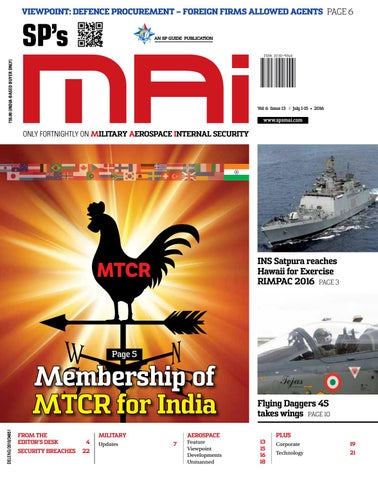
INS Satpura reaches Hawaii for Exercise RIMPAC 2016 PAGE 3
Page 5
DELENG/2010/34651
Membership of MTCR for India From the editor’s DESK
4
security breaches 22
military Updates
7
Aerospace Feature Viewpoint Developments Unmanned
Flying Daggers 45 takes wings PAGE 10 13 15 16 18
PLUS Corporate
19
Technology
21
“In a country like India with limited support from the industry and market, initiating 50 years ago (in 1964) publishing magazines relating to Army, Navy and Aviation sectors without any interruption is a commendable job on the part of SP Guide “ Publications. By this, SP Guide Publications has established the fact that continuing quality work in any field would result in success.” Narendra Modi, Hon’ble Prime Minister of India (*message received in 2014)
spotlight VIEWPOINT: DEFENCE PROCUREMENT – FOREIGN FIRMS ALLOWED AGENTS PAGE 6
`55.00 (INDIA-BASED BUYER ONLY)
INS Satpura reaches Hawaii for Exercise RIMPAC 2016
SP’s
Vol: 6 Issue 13 ❚ July 1-15 • 2016
www.spsmai.com
ONLY FORTNIGHTLY ON MILITARY AEROSPACE INTERNAL SECURITY
I
Cover:
INS Satpura reaches Hawaii for Exercise RIMPAC 2016 PAGE 3
India successfully became a full member of the Missile Technology Control Regime on June 27, 2016.
Page 5
Membership of MTCR for India DELENG/2010/34651
n pursuance of India’s ‘Act East Policy’ and demonstration of India’s commitment to peace and prosperity of Indo-Pacific region, Indian naval ship Satpura arrived at Hawaii, United States, on June 30, 2016, to participate in the 25th edition of Exercise RIMPAC. Exercise RIMPAC is the largest multilateral naval exercise in the world and is held biennially in the Western Pacific Ocean. Indian Navy’s association with Exercise RIMPAC commenced with participation as an ‘Observer’ in 2006, 2010 and 2012. In 2014, Indian naval participation was enhanced with deployment of INS Sahyadri in the 24th edition of the exercise. The current edition of the exercise is scheduled off Hawaii from June 30-August 4, 2016, and is likely to be attended by 27 countries. Indian naval participation in Exercise RIMPAC-2016 provides a platform for multilateral operational interactions aimed at increased interoper-
mai AN SP GUIDE PUBLICATION
FROM THE EDITOR’S DESK
4
SECURITY BREACHES
1_SP's MAI Cover 13-2016.indd 1
22
MILITARY Updates
7
Flying Daggers 45 takes wings PAGE 10
AEROSPACE Feature Viewpoint Developments Unmanned
13 15 16 18
Cover images: Anoop Kamath, Indian Navy, Indian Air Force
PLUS Corporate Technology
19 21
02/07/16 3:36 PM
Publisher And Editor-in-Chief
Jayant Baranwal
Assistant Group editor
R. Chandrakanth
SR Technical Group EditorS
Air Marshal B.K. Pandey (Retd) Lt General Naresh Chand (Retd) Lt General V.K. Kapoor (Retd) R. Adm S.K. Ramsay (Retd) SPECIAL Contributor
Lt General P.C. Katoch (Retd) Chairman & Managing Director
Jayant Baranwal
planning & business development
Executive Vice President: Rohit Goel ADMIN & COORDINATION
Bharti Sharma
Asst – Admin, HR & Infra
Pooja Tehlani
Photograph: PRO Indian Navy
design & LAYOUT
ability and development of common understanding of procedures for maritime security operations. The professional exchanges in harbour and diverse range of activities at sea, including complex surface, subsurface and air operations would enable sharing of best practices and honing of operational skills. INS Satpura, an indigenously built guided missile stealth frigate, part of the Eastern Fleet, will participate in the exercise. At the helm of the ship is the Commanding Officer, Captain A.N. Pramod, who is assisted by a team of professional and highly motivated men of the Indian Navy. Participation in Exercise RIMPAC-16 is another significant milestone in Indian Navy’s efforts towards strengthening mutual confidence and interoperability, as well as sharing of best practices with other navies of the region. Indian Navy’s participation in the exercise will support maritime security in the Indo-Pacific region, and contribute to peace and stability of the global commons. SP
Creative Director: Anoop Kamath Designers: Vimlesh Kumar Yadav, Sonu Bisht Research Assistant - Graphics: Survi Massey SALES & MARKETING
Director: Neetu Dhulia General Manager Sales: Rajeev Chugh
SP’s websites
Sr Web Developer: Shailendra P. Ashish Web Developer: Ugrashen Vishwakarma © SP Guide Publications, 2016 Subscription/ Circulation
Annual Inland: `1,320 • Foreign: US$ 325 E-mail: subscribe@spguidepublications.com subscribe@spsmai.com LETTERS TO THE EDITOR
editor@spsmai.com
FOR Advertising details, contact:
advertise@spsmai.com neetu@spguidepublications.com rajeev.chugh@spguidepublications.com SP GUIDE PUBLICATIONS PVT LTD
A-133 Arjun Nagar (Opposite Defence Colony) New Delhi 110003, India.
Tel: +91 (11) 24644693, 24644763, 24620130 Fax: +91 (11) 24647093 E-mail: info@spguidepublications.com Representative Office
204, Jal Vayu Vihar Kalyan Nagar Bengaluru 560043 Tel : +91 (80) 23682204 MOSCOW, RUSSIA
LAGUK Co., Ltd, Yuri Laskin Krasnokholmskaya, Nab., 11/15, app. 132, Moscow 115172, Russia. Tel: +7 (495) 911 2762, Fax: +7 (495) 912 1260
Owned, published and printed by Jayant Baranwal, printed at Kala Jyothi Process Pvt Ltd and published at A-133, Arjun Nagar (Opposite Defence Colony), New Delhi 110003, India. All rights reserved. No part of this publication may be reproduced, stored in a retrieval system, or transmitted in any form or by any means, photocopying, recording, electronic, or otherwise without prior written permission of the Publishers.
www.spguidepublications.com Issue 13 • 2016 SP’S MAI 3
From the
Editor’s Desk
India joins MTCR, next NSG?
I
ndia’s march in the comity of nations continues on different fronts. While its bid to get into the Nuclear Suppliers Group (NSG) was blocked by neighbour China, India was successful in joining as a full member of the Missile Technology Control Regime (MTCR) in Paris. Since the conclusion of the Indo-US Civil Nuclear Deal between President George Bush and Prime Minister Dr Manmohan Singh nearly a decade ago, India has been making efforts to be a part of these two export control regimes as also of the Australia Group and the Wassenaar Arrangement that together regulate the conventional, nuclear, biological and chemical weapons and technologies. In this issue, Air Marshal B.K. Pandey (Retd) analyses how India’s membership of the MTCR would help strengthen global non-proliferation objectives. India’s entry into the MTCR is expected to remove or reduce impediments for the nation to export high-tech missiles such as BrahMos to other countries as well as purchase the Predator unmanned combat aerial vehicles from the US. However, fresh policy framework would have to be drawn up and implemented. Air Marshal Pandey states that the major diplomatic challenge before India would be to negotiate the next round of negotiations for entry into the NSG without further escalating animosity with China. In another article, Air Marshal Pandey has hailed the first squadron of home-grown light combat aircraft (LCA) Tejas which became a reality with the induction of two aircraft into the Indian Air Force (IAF) after a wait of over three decades. The Hindustan Aeronautics Limited handed over two LCA Tejas Mk I. The new squadron has been christened the ‘Flying Daggers 45’. While commissioning of the Flying Daggers 45 will go down in the history of IAF as a milestone to be cherished, the LCA Tejas has still a long way to go. In the article on Defence Procurement Procedure (DPP) 2016, Lt General P.C. Katoch (Retd) writes about how the government is allowing foreign entities to engage agents for defence deals under a
4 SP’S MAI Issue 13 • 2016
strict set of conditions, which includes giving the Defence Ministry (MoD) access to company accounts. What the Defence Minister and the MoD need to ensure is that military equipping is not delayed at any cost considering the poor state because of extreme neglect over the past decade. We have an article on the C295 military transport aircraft which will be the first project wherein a military transport aircraft will actually be manufactured in India by an original equipment manufacturer from abroad. The Airbus-Tata Advanced Systems Limited joint venture company will virtually become the proverbial ‘Jewel in the Crown’ for Prime Minister Narendra Modi’s ‘Make in India’ scheme. From aerospace to space is one big leap which India has been taking. Though much hard work lies ahead for developing the final space shuttle, what ISRO (Indian Space Research Organisation) has demonstrated over the years is a remarkable sense of dedication and progress in the space arena at minimal costs. From space to technology, we have eRider robotic vehicle from Safran which combines a multi-mission platform and drone capabilities. This and more in this issue and we look forward to your feedback! Happy reading!
Jayant Baranwal
Publisher & Editor-in-Chief www.spsmai.com
MILITARY Viewpoint
Air marshal b.k. pandey (Retd)
Membership of MTCR for India The aim of the MTCR is to restrict the proliferation of missiles, complete rocket systems and unmanned air vehicles capable of carrying weapons of mass destruction
illustration: SP’s Design
W
hile the nation was in the process of coming also focuses on any equipment, software or technology that can to terms with the disappointment of failure of enable a nation to produce such systems. MTCR partner nations the high-profile and vigorous diplomatic effort encourage all countries to observe guidelines promulgated by the by the NDA Government to become a part of regime on transfers of missiles and related technology as a contrithe Nuclear Suppliers Group (NSG), on June bution to common security. A country can choose to adhere to the 27, 2016, came the somewhat encouraging news from Paris that guidelines without being obligated to join the group and a number India had been successful in joining the Missile Technology Con- have done so. The partner nations of the regime welcome opportrol Regime (MTCR) as a full member. Since the conclusion of the tunities to conduct broader dialogue on proliferation issues with Indo-US Civil Nuclear Deal between President George Bush and such countries. In June 2015, India had applied for membership of the MTCR Prime Minister Dr Manmohan Singh nearly a decade ago, India has been making efforts to be a part of these two export control with support from the US and France. The application was considered in the 29th plenary sesregimes as also of the Aussion of the MTCR that was tralia Group and the Washeld in Rotterdam in October senaar Arrangement that 2015. However, India’s maiden together regulate the conattempt at that time to be a ventional, nuclear, biologipart of the MTCR had not succal and chemical weapons ceeded. It is generally believed and technologies. As per the that the successful entry into Ministry of External Affairs, the MTCR will pave the way it is believed that India’s for India getting membership membership of the MTCR of the NSG. would help strengthen global However, attempts at non-proliferation objectives. entry by India into the NSG India’s entry into the MTCR is may be laced with hurdles as expected to remove or reduce China is seeking similar status impediments for the nation for Pakistan. Strangely, this is to export high-tech missiles despite Islamabad’s persistent such as BrahMos to other and consistent record in both countries as well as purchase nuclear and missile proliferathe Predator unmanned tion. India faced stiff oppocombat aerial vehicles from sition from China and a few the US. However, fresh policy The major diplomatic other countries and the fact that it is not a sigframework would have to be drawn up and to the Nuclear Non-Proliferation Treaty implemented. challenge before India natory was a major issue. It was used by these nations Established in 1987, the MTCR is an inforfor thwarting India’s bid at the Seoul meeting mal and voluntary partnership that with the would be to negotiate despite the strong backing by the US. However, entry of India now consists of 35 countries. The the next round of the nation need not lose hope as there will be aim of the MTCR is to restrict the proliferation of missiles, complete rocket systems and negotiations for entry fresh opportunities in not too distant a future for entry into the NSG. However, the major dipunmanned air vehicles (UAVs) capable of carinto the NSG without lomatic challenge before the nation would be rying weapons of mass destruction. In particuto negotiate the next round of negotiations for lar, the regime keeps a check on transfer of misfurther escalating entry into the NSG without further escalating siles and UAVs capable of carrying a payload of animosity with China. SP at least 500 kg to a range of 300 km. The group animosity with China Issue 13 • 2016 SP’S MAI 5
MILITARY Viewpoint
Defence procurement: Lt General P.C. Katoch (Retd)
Foreign firms allowed agents
PHOTOGRAPH: PIB
U
nder the Defence Procurement Procedure (DPP) 2016, indulge in unethical practices; three, no fees linked to the progress of issued on June 8, 2016, foreign entities have been the contract would be allowed; four, no success fee or penalty linked allowed to engage agents for defence deals under a strict to success or failure of contract permitted; five, all payments made to set of conditions, which includes giving Defence Minis- agents in past year to be disclosed – annual report of payments made try access to company accounts. It may be recalled that to be submitted to MoD; six, vendor to allow MoD inspection of on December 31, 2014, media had reported that a new government financial documents regarding agents at any time, and; seven, MoD policy legalising middlemen in arms purchases will be put in place will have authority to reject or fire agent at any time. Violation of the soon. Defence Minister Manohar Parrikar had then said, “The mid- conditions would invite penal action but the policy does not state the dle men have to be declared and their commission cannot be linked exact nature of punishment. The new DPP also does not mention any policy on blacklisting to the outcome of negotiations”, adding that Ministry of Defence (MoD) will announce a more liberalised export regime centred on of firms, which as per a MoD official will be announced separately Prime Minister Narendra Modi’s ‘Make in India’ vision and that “pri- as it is still being worked upon. With reference to above-mentioned vate companies must be allowed to export defence equipment made conditions for employing agents, the provision about MoD having authority to reject or fire the agent at any time has been instituted to in India, and for that rules will be changed.” Middlemen or defence agents were banned for years after the keep out undesirable persons out of the procurement loop based on multimillion-dollar scandal in the 1980s involving alleged kick- past dealings or controversy. In fact the new DPP specifically says, backs paid to politicians and officials in purchases. This move came “MoD reserves the right to inform the vendor at any stage that the because of poor response to the regulatory role on agents that MoD agent so engaged is not acceptable whereupon it would be incumbent on the vendor either to interact with MoD had acquired for itself in conjunction stringent directly or engage another agent. The decision of guidelines issued in year 2001 – that had proved MoD on rejection of the agent shall be final and counterproductive. be effective immediately.” Interestingly, the government in 2001 had In 2014, Defence Minister Parrikar had said lifted the blanket ban on agents, which had been middlemen can be permitted to charge expenses in force since 1987 after the infamous Bofors from parent companies for representing them in guns and HDW submarine scandals. But this bid the country and that government should be in a to inject some transparency did not really work position to have a very clear cut policy by January since the stringent norms laid down for agents 2015 and on blacklisting including a raft of meawere considered unrealistic, with the governsures to ensure transparency and at the same ment even declaring it would determine the scale time speeding up such purchases to modernise of commission to be paid to them. Consequently, the armed forces. This is not a new idea and has almost no one came forward to be registered as come up time and again, with many experts recan agent. Defence Minister Parrikar had said in What the Defence ommending its institutionalisation. December 2014, “We will allow company repThe new policy authorising agents with strinresentatives. They will be middlemen”. InterestMinister and the gent conditions is a good idea. But what needs to ingly, while middlemen or defence agents were MoD need to ensure be acknowledged that while globally hardly any banned for considerable number of years followarms deal has taken place without involvement ing exposure of bribes to politicians and officials is that military of an agent even when not officially authorised, in 1980s, they are now being officially permitted ways are found to circumvent overt account when the kickbacks in the AgustaWestland Heliequipping is not books to show bribes paid – AgustaWetland bribcopter deal has made headlines following an delayed at any cost ery scandal being just one example. Bribes can Italian court order, and which is presently under find the routes like NGOs, even under pretext of investigation in India. considering the poor CSR and more. What the Defence Minister and However, the DPP 2016 announced on June state because of the MoD need to ensure is that military equip8 outlines a number of conditions for employping is not delayed at any cost considering the ing agents; one, details of agents to be disclosed extreme neglect over poor state because of extreme neglect over the within two weeks of engagement; two, agents past decade plus. SP would not be engaged to manipulate contracts or the past decade plus 6 SP’S MAI Issue 13 • 2016
www.spsmai.com
MILITARY updates Defence Minister addresses Unified Commanders’ Conference in New Delhi
T
he Defence Minister Manohar Parrikar has stressed on the need for jointness of the three Services to optimise resources and enhance cost effectiveness so that maximum funds can be made available for modernisation of the armed forces. Addressing the two-day Annual Unified Commanders’ Conference (UCC) of Tri-Services Commanders which got underway, in New Delhi, Parrikar said, “By virtue of our dominant, geographical location, India is poised for a predominant role in the volatile region around us.” The Minister stated that hence there is a requirement to exploit this advantage by developing joint capabilities. In order to achieve self-reliance, he emphasised on ‘Make in India’ initiative and indigenisation of defence production. To keep in tune with India’s ‘Act East Policy’, Parrikar urged the armed forces for conduct of joint exercises involving more than one Service with our friendly foreign countries specially in South East Asia. He commended the armed forces for their devotion to duty and the stellar role played by them in safeguarding the country’s unity and integrity. The Minister also paid homage to all valiant soldiers, sailors and air warriors for their supreme sacrifice in honour of the nation. Earlier, opening remarks were given by the Chairman Chiefs of Staff Committee & Chief of Air Staff Air Chief Marshal Arup Raha covering Tri-Services issues. The Chief of the Army Staff General Dalbir Singh and the Chief of the Naval Staff Admiral Sunil Lanba addressed the conclave highlighting the major issues pertaining to their respective Services. A report covering major achievements on
Exercise Jalrahat: A joint initiative by Assam Government and armed forces for flood relief
Photographs: PIB, Indian Army
T
he much awaited event, Exercise Jalrahat commenced at Narangi Cantt. Taking the leaf from the latest National Disaster Management Policy (NDMP) 2016 and the call given by the Prime Minister urging the enhanced cooperation and involvement by armed forces in mitigating disasters, the Exercise Jalrahat is a joint initiative taken by the Assam State Government and the armed forces that is being led by Gajraj Corps with full support from HQ Eastern Command. The exercise commenced with the opening address delivered by Lt General D. Anbu, AVSM, YSM, SM, GOC Gajraj Corps who stressed upon the need for integrating the key facets of the NDMP 2016 guidelines to include understanding and strengthening disaster risks, governance to manage disaster risks, investing in disaster risk reduction and enhancing disaster preparedness. Thereafter, the Chief Secretary V.K. Pipersenia commended the ASDMA and the armed forces for taking the unique initiative, first of its kind to
Defence Minister being received by the three Service Chiefs at the Annual Unified Commanders’ Conference for Tri-Services Commanders’ in New Delhi
key Tri-Services issue was presented by Officiating Chief of Integrated Defence Staff to Chairman Chiefs of Staff Committee Air Marshal A.S. Bhonsle. During the two-day-long conference, key security issues facing the nation and important strategic, operational, logistical, administrative aspects pertaining to Tri-Services were deliberated upon. The function was attended by Minister of State for Defence Rao Inderjit Singh, Deputy National Security Advisor Dr Arvind Gupta, Secretaries of the Government of India and senior officials of Services and the Ministry of Defence. SP
spread awareness amongst various stakeholders about each other’s role, tasks and capabilities. Proceedings thereafter followed a series of presentations and brainstorming sessions with Syndicates co-opting different agencies responsible for disaster management. Healthy discussion pursued with syndicates deliberating upon issues ranging from preparation, planning, early warning and immediate response to relief and rehabilitation measures. The keen interest and participation of the stakeholders adequately displayed that this exercise is heading on to become an epitome in the field of planning and preparation for taking on the menace of urban flooding head on with the firm resolve to build resilience in the society to stand up to such a calamity and come out victorious. It is pertinent to mention that in addition to Exercise Jalrahat based on flood relief in an urban setting, Indian Navy will be carrying out Exercise Prakampana based on relief and assistance in case of a super cyclone at Vizag, Andhra Pradesh, in August 2016 and Indian Air Force will be undertaking Exercise Sahayta based on relief and assistance in case of a major earthquake at Bhuj, Gujarat. All these will be joint exercises like Exercise Jalrahat. The exercise spread over three days will witnessed the outdoor display and demonstration on June, 29, 2016, before terminating with lessons learnt on June 30, 2016. SP Issue 13 • 2016 SP’S MAI 7
MILITARY updates Defence Minister hands over Varunastra torpedo to Indian Navy
T
he Defence Minister Manohar Parrikar handed over Varunastra – a ship-launched heavyweight torpedo, also known as underwater missile to the Indian Navy in a befitting ceremony in New Delhi on June 29, 2016. Speaking on the occasion Manohar Parrikar congratulated the Defence Research and Development Organisation (DRDO) for the achievement and appreciated the efforts made in this regard. He asked the DRDO to ensure its participation in the production process and to keep adequate quality control of their products so that it can meet the international standards. The Minister also stated that in these high technology areas, DRDO’s contribution with 95 per cent of indigenous content is an apt example of Indigenously Designed Developed and Manufactured (IDDM) category. The Chief of the Naval Staff, Admiral Sunil Lanba, termed the occasion as momentous and described it as yet another feather in the DRDO’s cap. He applauded DRDO and Naval Science and Technological Laboratory (NSTL) for rendering yeomen service to the nation in achieving self-reliance in defence and underwater technologies. He said the Navy’s partnership with DRDO laboratories has strengthened and matured over the years. “The fact that three of the premier DRDO labs—NPOL, NMRL and NSTL—carry the prefix ‘Naval’ in their names highlights the close relationship between the Indian Navy and the DRDO in our joint efforts,” Admiral Lanba stated. Secretary, DD R&D and DG DRDO Dr S. Christopher in his address described the induction ceremony of Varunastra as a proud moment for the nation as India has joined in the elite group of only a handful of countries. He commented that the development of submarine launched heavyweight torpedo is in advanced stage for user trials. Dr. Christopher mentioned that Varunastra, the ship-borne anti-submarine torpedo has got the goodwill of Navy as a user which has decided to produce 73 of them, immediately. He briefly mentioned that last year Mareech advance torpedo defence system, was handed over to Indian Navy. He also highlighted the
Indian warships visit Vladivostok, Russia
Photographs: PIB, MoD
I
n a demonstration of India’s commitment to long-standing IndiaRussia Strategic Partnership and Indian Navy’s increasing footprint and operational reach, Indian naval ships Sahyadri, Shakti and Kirch under the Command of the Flag Officer Commanding Eastern Fleet, Rear Admiral S.V. Bhokare, YSM, NM have arrived at Vladivostok on a four-day visit (June 27-July 1, 2016), as part of deployment of the Eastern Fleet to the South China Sea. During the visit, the Indian Navy ships will have professional interactions with the Russian Navy aimed at enhancing cooperation between the two forces. In addition, calls on senior government and military authorities, sporting and cultural interactions and sharing of best practices, aimed at strengthening ties and mutual understanding between the two navies, are also planned. The visiting Indian Navy ships are also likely to conduct exercises with the Russian Navy, aimed at enhancing interoperability in communication as well as search and res-
8 SP’S MAI Issue 13 • 2016
DRDO developed LCA Tejas, the first squadron of which is being raised by IAF on July 1, 2016. The AEW&C is also striding towards induction into IAF this year. Recently, another milestone has been achieved by BrahMos, a joint venture of DRDO which successfully demonstrated captive trials with Su-30 aircraft, he stated. Varunastra has been developed by NSTL, a premier DRDO laboratory based at Visakhapatnam. The Bharat Dynamics Ltd has been associated as a production partner in concurrent engineering mode. Varunastra, a versatile naval weapon which can be fired from the Rajput class destroyers, Delhi class and all future anti-submarine warfare (ASW) ships capable of firing heavyweight torpedoes and is capable of targeting quiet and stealthy submarines both in deep and littoral waters even in intense countermeasure atmosphere. The function was also attended by Defence Secretary G. Mohan Kumar, Secretary (Defence Production) A.K. Gupta, Scientific Advisor to Raksha Mantri Dr G. Sateesh Reddy and senior functionaries of the Ministry of Defence, Indian Navy, DRDO, Production & Industry partners. SP
cue procedures, post departure from Vladivostok. INS Sahyadri is commanded by Captain K.S. Rajkumar, INS Shakti is commanded by Captain Gagan Kaushal and INS Kirch is commanded by Commander Sharad Sinsunwal. Bilateral relations between India and Russia are characterised by time-tested bonds of friendship based on cooperation and interactions in fields of culture, trade and economy, science and technology, and most importantly defence. Other significant areas of collaboration between the countries include space technology, hydrocarbon exploration and peaceful use of nuclear energy. India-Russia military technical cooperation has evolved from a simple buyer-seller framework to one involving joint research, development and production of advanced defence technologies and systems. The Indian Navy and Russian Navy have forged enduring linkages with each other, beyond commonality of weapon systems and equipment, overcoming barriers of distance and language. The two navies engage with each other annually through the Indra Navy series of maritime exercise in addition to reciprocal visits by training teams, high-level delegations and ships. SP www.spsmai.com
MILITARY updates Defence Ministry nod to buy ultralight howitzers worth `5,000 crore from US
T
he Defence Acquisition Council (DAC), chaired by Defence Minister Manohar Parrikar has approved the much-delayed purchase of 145 ultralight howitzers, worth about `5,000 crore, from the US and also the bulk production of 18 Dhanush artillery guns. While 25 guns will come to India in a fly-away condition, the rest will be assembled at the proposed assembly integration and test facility for the weapon system in India in partnership with Mahindra. The howitzers that can be heli-lifted were first proposed to be bought from BAE about 10 years back. DAC has approved progressing of ongoing case of procurement of 145 ultralight howitzers through the foreign military sales (FMS) route from US. DAC directed independent progressing of offset. The DAC has also shortened the supply period of the guns, with a strike range of 25 km, sources said though the exact period could not be known. Dhanush, a towed howitzer with a strike range of 38-km, has
PhotographS: US Army, PIB
Defence Minister dedicates DCN to the nation
T
he Defence Minister Manohar Parrikar dedicated the Defence Communication Network (DCN) to the nation in New Delhi on June 30, 2016. Addressing the event, Parrikar complimented the three Services on putting in place a communication system to facilitate jointmanship. The Minister also stressed on the need to keep the network secure. The DCN is a strategic, exclusive, secure and state-of-the-art communication network. Implementation of DCN is a proof of
been developed by the Ordnance Factory Board (OFB), Kolkata, after going through the design and voluminous documents running into more than 12,000 pages which were delivered to India under the first phase of transfer of technology as part of the Bofors gun deal in late 1980s. “While three guns would be delivered for user exploitation by June 30, three more will be handed over by September end. DAC also cleared bulk production of 18 guns to enable better exploitation and setting up of indigenous production,” the officer said. Costing about `14 crore a piece, Dhanush is comparable to most current generation weapons systems which are in use by different countries. Along with electronic gun-laying and sighting systems and other features, the indigenous gun has an enhanced 11-km range as against the gun range of 27-km of the imported Bofors. The plans to acquire such guns were first mooted under Army’s Field Artillery Rationalisation Plan (FARP) formulated in 1999. Meanwhile, the DAC also reviewed the ongoing procurement case of SRSAM and Very Short Range Air Defence (VSHORAD) System. “It was decided to keep on the ongoing acquisition process going in a multi-vendor situation”, the officer said. SP
strength of the Indian industry and has reaffirmed the emphasis of the government on ‘Make in India’ programme. The DCN is a major step towards ensuring network-centricity across the three Services, Integrated Defence Staff and Strategic Forces Command. The network provides converged voice, data and video services to the three Services based on secured system with adequate redundancy. The event was attended by the Chairman Chiefs of Staff Committee and Chief of the Air Staff Air Chief Marshal Arup Raha, Chief of the Army Staff General Dalbir Singh, Chief of the Naval Staff Admiral Sunil Lanba and senior officers from the three Services SP Issue 13 • 2016 SP’S MAI 9
aerospace Viewpoint
Air marshal b.k. pandey (Retd)
Flying Daggers 45 takes wings Indian Air Force’s first squadron of home-grown light combat aircraft Tejas became a reality with the induction of two aircraft into the force on July 1, 2016
photographS: IAF, PIB, HAL
Officials from the Indian Air Force, HAL and ADA pose in front of the LCA Tejas at Aircraft Systems & Test Establishment in Bengaluru
A
fter a wait of over three decades, on Friday, July 1, 2016, the Indian Air Force (IAF) was finally handed over by the Hindustan Aeronautics Limited (HAL) two light combat aircraft (LCA) Tejas Mk I in the initial operational clearance (IOC) configuration to raise the first squadron of this type. This new squadron has been christened by the IAF as the ‘Flying Daggers 45.’ The induction ceremony was held at the Aircraft Systems & Test Establishment at the HAL airport in Bengaluru in the presence of Air Marshal Jasbir Walia, Air Officer Commanding-in Chief, Southern Air Command. The Flying Daggers 45 will be based in Bengaluru for the first two years after which it will be relocated at Air Force Station Sulur near Coimbatore in Tamil Nadu. 10 SP’S MAI Issue 13 • 2016
The Tejas is a single-engine, lightweight, highly agile, multirole supersonic combat aircraft, reported to be the smallest in its category in the world. Conceived as a MiG-21 replacement, the aircraft has been designed and developed by Aeronautical Development Agency (ADA) and produced by the Hindustan Aeronautics Limited (HAL). It is to the credit of its designers, manufacturer, technicians and test crew, that LCA has flown more than 3,000 sorties/2000 hours till date without any accident. Capable of achieving a speed of up to Mach 1.4, the platform that has a ‘Tail-less Delta’ plan form with shoulder-mounted wings has been developed as a single-seat fighter aircraft and also has a two-seat trainer version. The aircraft is fitted with Martin Baker www.spsmai.com
aerospace Viewpoint
Glimpses of induction ceremony of LCA Tejas. Group Captain Madhav Rangachari is the Commanding Officer of Flying Daggers. He flew the inaugural flight of LCA in 45 Squadron during the induction of LCA Tejas.
zero-zero ejection seats. The airframe is crafted with lightweight materials, including aluminium, lithium and titanium alloys as well as carbon composites. The ribs in the wing structure is made of composites with a carbon fibre-reinforced plastic skin. In respect of its speed, acceleration, manoeuvrability and agility, the design features of the LCA Tejas have been configured to meet with the challenges of modern aerial combat in future warfare scenarios. HAL is currently working on the establishment of facilities to scale up production initially to eight aircraft per year and then progressively raising the annual output to 16. As per the existing plan, the IAF will induct a total of 120 LCA Tejas, the first 40 of the Mk I and the remaining 80 of the significantly
improved version, the Mk IA. Of the initial order of 40 aircraft, the first 20 will be inducted in the IOC configuration and the next batch of 20 will be with final operational clearance (FOC) that will have some new features and marginally improved capabilities. The Mk IA, the upgraded version of Tejas, will be equipped with Active Electrically Scanned Array (AESA) radar, unified electronic warfare suite, midair refuelling capability and the capability to carry advanced beyond visual range (BVR) missile. As for its other notable attributes, the Tejas incorporates stateof-the-art technologies such as a quadruplex fly-by-wire digital flight control system, advanced digital cockpit, multi-mode radar, integrated digital avionics system and night vision compatible glass Issue 13 • 2016 SP’S MAI 11
aerospace Viewpoint ‘Induction of the indigenously made Tejas fighter jet into the Air Force fills our hearts with unparalleled pride & happiness.’ ‘I laud HAL & ADA on the induction of Tejas fighter jet. This illustrates our skills & strengths to enhance indigenous defence manufacturing.’ —Prime Minister Narendra Modi on Twitter ‘Moment of national pride. Indigenously developed Tejas fighter jet inducted into Air Force. Tejas will take our air strength to new heights.’ ‘Congratulations to HAL & ADA for successful induction of the indigenously developed Tejas fighter jet.’ —Defence Minister Manohar Parrikar on Twitter
The Chief of the Air Staff Air Chief Marshal Arup Raha flew on LCA Tejas on May 17, 2016; he is seen with HAL CMD T. Suvarna Raju after the sortie.
cockpit. Its navigation suite includes Sagem SIGMA 95N ring laser the starboard air intake. The aircraft can be armed with air-to-air, airgyroscope inertial navigation system with an integrated global posi- to-ground and anti-ship missiles, precision-guided munitions, rocktioning system. The pilot has the facility of helmet-mounted display ets and bombs. These aircraft are also capable of dropping unguided and sight (HMDS) while the hands-on throttle and stick (HOTAS) bombs with much higher accuracy due to highly advanced indigenous mission computer. Electronic warfare, tarcontrol system minimises pilot workload and geting, surveillance, reconnaissance or training maximises situational awareness. The aircraft’s While commissioning pods can be carried on the hard points. electronic warfare suite has been developed by While commissioning of the Flying Daggers the Bengaluru-based Advanced Systems Inteof the Flying Daggers 45 will go down in the history of the IAF as a milegration and Evaluation Organisation (ASIEO) 45 will go down in stone to be cherished, the LCA Tejas has still a long and includes a radar warning receiver, jammer, way to go. It is indeed heartening that of the 50-odd devices for laser and missile approach warning the history of the IAF deficiencies observed initially, most have been as also and chaff and flare dispenser. cleared and the remaining too should be resolved The aircraft has eight external hard points as a milestone to be with the Mk IA. Hopefully, this success will inspire for the carriage of weapon load and drop tanks. cherished, the LCA the Indian aerospace industry to move forward These are located three under each wing, one on and achieve greater heights of glory with the Tejas the centre fuselage and one installed under the Tejas has still a long Mk II and subsequently with the fifth-generation air intake on the port side. A 23mm twin-barrel way to go. combat platform that is on the drawing board! SP GSh-23 gun is installed in a blister fairing under 12 SP’S MAI Issue 13 • 2016
www.spsmai.com
aerospace Feature
Building the Airbus C295 in India This option (C295) has the potential to enhance the order for the C295 aircraft by another 100 at the very least. Besides, the Airbus-TASL joint venture company will virtually become the proverbial ‘Jewel in the Crown’ for Prime Minister Narendra Modi’s ‘Make in India’ scheme.
photographs: Airbus D&S
[ By Air Marshal B.K. Pandey (Retd) ]
I
n the middle of May last year, the Defence Acquisition Council (DAC) finally cleared the long awaited project initiated by the Indian Air Force (IAF) for the acquisition of 56 medium-lift military transport aircraft to replace its obsolescent fleet of Hawker Siddeley HS-748 twin turboprop transport aircraft whose induction into the IAF had commenced as far back as in the early 1960s. In the process of evaluation of the three contenders that responded to the global tender, the Airbus C295 was selected against others namely the C-27J Spartan manufactured by Alenia Aeronautica of Italy and the An-32 offered by Antonov of Ukraine. Both these aerospace firms had joined the race with Airbus Defence and Space for the contract in response to the request for proposal (RFP) floated in mid-2013.
Emergence of an Indian Player
As per Airbus, the contract for 56 aircraft, which is valued at around $2 billion, was expected to be signed within two years after the preferred platform was identified. However, this is yet to happen. This particular tender has clearly two unique features. Firstly, this will perhaps be the first project wherein a military transport aircraft will actually be manufactured in the country by an original equipment manufacturer (OEM) from abroad, Airbus Defence and Space in this case, through a joint venture partnership with an Indian company Tata Advanced Systems Limited (TASL). This is a wholly owned subsidiary of Tata Sons and is located on the outskirts of Hyderabad. Secondly, this is also the first major project wherein the state-owned Indian aerospace major Hindustan Aeronautics Limited (HAL) has not been allowed to participate in the bidding process and instead, Issue 13 • 2016 SP’S MAI 13
aerospace Feature doors have been flung open to the Indian aerospace industry in the private sector. This hard decision was taken despite the fact that HAL is the only aerospace company in India that has any experience in building military aircraft even though primarily under licence. On the other hand, the Indian aerospace industry in the private sector, relatively speaking, has very little experience and is generally regarded as being practically a novice in the field. However, in just five years, TASL has evolved into a significant player on account of its notable contribution to the global aerospace industry. The company has become an important manufacturing partner for global OEMs delivering over 1,00,000 parts in a year to various end customers all over the world. Partners of TASL in the global aerospace industry include Sikorsky Aircraft Corporation for whom it makes cabins for the S-92 helicopters, Lockheed Martin Aeronautics for whom the company manufactures airframe components for the global supply chain of the C-130J Super Hercules military tactical transport aircraft. Other aerospace firms that TASL has partnered with are Pilatus Aircraft Ltd of Switzerland, Cobham Mission Equipment and RUAG Aviation. The company has developed capabilities across the entire value chain of the aerospace industry from design to full aircraft assembly. There ought to be no doubt that this company in the private sector of the Indian aerospace industry is poised to emerge as a major player in India in this sector. It is also the first company in the private sector of the Indian aerospace industry to be certified by the Indian airworthiness authority, Centre for Military Airworthiness and Certification (CEMILAC) to ‘AS 9100: Rev B Standard’ stipulated for the design of airframe structures.
repeat orders. In the last one year alone, the company has received orders for 20 aircraft from five countries.
Potential Market for the C295
The fleet of 56 C295 aircraft that have been ordered to replace the ageing Avro fleet, will be employed for carriage of military personnel and cargo routinely as also for airborne assault operations during war. The Indian paramilitary forces such as the Border Security Force (BSF) and the Indo-Tibetan Border Police (ITBP) are likely to acquire a few aircraft to meet with their transportation needs. In addition to the cargo and passenger carrying versions, the aircraft is available in a number of other variants as under: Airborne early warning with Israeli AESA radar Maritime patrol/anti-submarine warfare Gunship AC-295 Waterbomber for fighting forest fires As the aircraft can be made available through local manufacture by the joint venture company in India in a number of variants, there would, in all likelihood, be a decent potential market in the country itself. The IAF could in due course consider induction of the airborne early warning and the gunship variants. The Indian Navy could well consider the maritime patrol/anti-submarine warfare version instead of looking at sources abroad for such platforms. The Indian Coast Guard too could acquire these platforms modified for maritime patrol. But perhaps the largest potential for demand within the country lies with the IAF. Today, the IAF operates a fleet of over 100 An-32 twin turboprop tactical transport aircraft that would have to be retired from service in another 15 years or so. A project to develop a medium-lift military transport aircraft jointly by HAL and United Aircraft Corporation (UAC) of Russia with a payload capability of 20 tonnes was initiated in 2009. The aircraft designated as multi-role Economy of Scale As per Domingo Ureña Raso, Vice President Military Aircraft, Airbus transport aircraft (MTA) was being developed to replace the An-32 Defence and Space, the C295 is clearly the best aircraft to replace the fleet. The initial order for the IAF was pegged at 45. However, seven Avro fleet of the IAF. Also, Airbus is of the view that TASL is the “cream years after the project was conceived, reports in the media indicate of the Indian private aerospace sector” and that the OEM has entered that the project appears to have hit a roadblock that seems to be into the best possible partnership arrangement available in India for insurmountable. The issue of contention appears to be the power building the C295 aircraft. However, one issue that could of concern plant. The IAF is seeking a modern engine with FADEC which the is the size of the order for the IAF. Apart from the first 16 aircraft that Russian partner is not willing to provide as it would take many years the OEM is to supply in fly-away condition directly from the factory to develop one and the associated cost escalation. As per reports in Spain, the requirement of the IAF has been currently pegged at emanating from Russia, UAC is prepared to go ahead with the development of the MTA and dump the Indian partmere 40 platforms that would be manufactured ner. In this situation it makes little sense for the in India. This number is much too small to proThe C-295 will nation to continue to remain associated with vide the benefit of economy of scale that the the project as it can no longer be regarded as joint venture company would like to have to perhaps be the first ‘Joint Development.’ The decision to withdraw justify the sizeable investment both the partners project wherein a from the MTA project ought not to be difficult would have to make for creation of infrastructure especially as a readymade solution by way of as well as for building up a cadre of specialist military transport the locally manufactured Airbus C295 that has a human resource. The answer to this dilemma payload capacity of just over nine tonnes, would lies quite obviously in enhancing the orders from aircraft will actually be available to replace the An-32 fleet which has the Indian armed forces and possibly from the be manufactured in a payload capacity of seven tonnes. This option civilian segment for some specialised tasks. Over has the potential to enhance the order for the and above the demand from within the country, the country by an C295 aircraft by another 100 at the very least. it would also be necessary to access the global original equipment Besides, the Airbus-TASL joint venture company market which the OEM should be quite capable will virtually become the proverbial ‘Jewel in of providing. Airbus already has a well estabmanufacturer from the Crown’ for Prime Minister Narendra Modi’s lished presence in the global market with orders ‘Make in India’ scheme. SP from 19 countries, several of which have placed abroad 14 SP’S MAI Issue 13 • 2016
www.spsmai.com
aerospace Viewpoint
Lt General P.C. Katoch (Retd)
Kickstarting space shuttle – A major milestone
Photograph: ISRO
E
ven as the Indian Space Research Organisation (ISRO) has per flight. It is estimated that once the RLV is fully developed it could launched 20 satellites from a single mission in June 2016, bring down launch costs 8 to 10 times. It may be recalled that in January 2007, ISRO launched a 555-kg on May 23, 2016, ISRO successfully launched its prototype space shuttle that splashed down as planned in the Bay of space capsule aboard PSLV-C7 that remained in orbit for 12 days Bengal, some 450 km from Sriharikota. The launch was before re-entering the atmosphere and crashing into the Bay of of the winged reusable launch vehicle (RLV), overall cost being `95 Bengal. Again in December 2014, ISRO carried out the Crew Modcrore. After a successful lift on board a HS9 rocket booster that lasted ule Atmospheric Re-entry Experiment, sending a heavy payload to 91.1 seconds to a height of about 56 km, the RLV-TD separated from a height of 126 km on the inaugural experimental flight of GSLV-Mk the HS9 booster and further ascended to a height of about 65 km, III, an advanced launch vehicle still under development. The paythen descended at about five times the speed of sound till splash- load separated and re-entered the atmosphere, and fell into the Bay down to the defined landing spot. The vehicle was tracked during its of Bengal after a nearly 21-minute flight. However, both these reentries were meant to result in crash landings. flight from ground stations at Sriharikota and a The vehicle could be recovered but not reused. ship-borne terminal; validating critical technolThe cost advantage of a reusable vehicle ogies like autonomous navigation, guidance and can become evident only over several launches control, and reusable thermal protection system. because development cost of a RLV far exceeds The flight duration from launch to splashdown the manufacturing cost of an existing launch was some 770 seconds. vehicle of one-time use. While ISRO spent some While ISRO has undertaken tests of RLV `95 crore to develop the prototype RLV, this technology twice in the past, several nations would obviously go up over the next decade and private space entities have experimented when the final version is developed. It may be with this technology. NASA had closed its 1981 more than the average cost of a PSLV and GSLV at initiated space shuttle programme in 2011 after `120 crore and `170 crore respectively. But then using its reusable vehicles Discovery, Endeavour, what is expected is overall savings depending Columbia and Challenger, to launch the Internaupon how many times the RLV is reused. tional Space Station and the Hubble Telescope. The winged RLV prototype was structured difInterestingly, the DRDO had conducted a conferently to enable it making a soft landing like an cept study in 2001 termed ‘Avatar’, acronym for airplane, and thus much more challenging. The Aerobic Vehicle for Transatmospheric Hyperactual RLV, when it is developed, would have to sonic Aerospace Transportaion; concept being land on a runway. ISRO plans a five-km runway at unmanned single-stage reusable space-plane Sriharikota for the Indian space shuttle. The 6.5capable of horizontal take-off and landing. But Though much hard metre RLV weighed some 1.7 tonnes was worked this remained a study only and is not linked to work lies ahead upon by some 600 scientists for five years. ISRO’s RLV-TD launch on May 23 this year. The May 23 test was historic in ISRO underISRO’s objective of developing the reusfor developing the taking the maiden flight of a fully indigenous able system is to bring down the costs of satelfinal space shuttle, prototype space shuttle with delta wings that lite launch, and to increase the frequency of glided onto the Bay of Bengal. Though much launches as satellites and scientific instruments what ISRO has hard work lies ahead for developing the final need to ride on rockets to go into space. Reusable rockets would save costs of building a new vehidemonstrated over the space shuttle, what ISRO has demonstrated the years is a remarkable sense of dedicacle for every launch besides saving on manufacyears is a remarkable over tion and progress in the space arena at minimal turing time and enable more frequent launches. costs. In fact, had scientist in DRDO worked with Without RLV technology, vehicles launched into sense of dedication the same zeal, India would have been self-sufspace either fall into the sea or add to the flying and progress in ficient in meeting defence requirements indigdebris in space. enously to a very large extent, like China. With Currently, it costs `6,00,000 to `8,00,000 to the space arena at ISRO, India is confident in achieving every possend a one kg payload into a low earth orbit. The sible success in space. SP PSLV and GSLV carry payloads of 1,000-2,500 kg minimal costs Issue 13 • 2016 SP’S MAI 15
Aerospace Developments Historic flight of Su-30MKI with BrahMos missile
T
he first carriage flight of Su-30MKI aircraft with BrahMos missile was successfully achieved at HAL Airport in Nashik on June 25, 2016. The aircraft was in the air for 45 minutes and was flown by Wg Cdr Prashant Nair and Wg Cdr M.S. Raju, both flight test crew of ASTE. “It is a perfect example of ‘Make in India’ and an engineering marvel in aviation history of India. It proves that when all agencies come together with one mission, there is nothing like impossible”, said T. Suvarna Raju, CMD, Hindustan Aeronautics Limited (HAL). The first modified aircraft was airborne in one year and the second aircraft in the second year. This is the second project where HAL presumed the role of OEM and modified the airframe of licence build aircraft. Sudhir Kumar Mishra, CEO & MD, BrahMos Aerospace Pvt Ltd (BAPL), said it is the first time in the world that such a heavyweight (2,500 kg) supersonic cruise missile has been integrated on fighter aircraft. “The world did not believe us that we could do it and thanks to the vision of late President A.P.J. Abdul Kalam, we could achieve this today and history is made”, he added. SP
Samtel-HAL JV delivers 1,000 multi-function displays for Sukhoi30MKI
is the only company to receive the type approval from Centre for Military Airworthiness and Certification. It may be noted that apart from Samtel, ‘ruggedisation technology’ is available only with six to seven companies worldwide. This successful indigenisation has reaped major benefits for the country; some of which include competitive price; significant reduction in turnaround time; reduction in field defects; considerable reduction in lifecycle MRO cost; and continuous improvements of these MFDs as per IAF needs. SP
Russia overcomes import dependence on helicopter engines
Photographs: HAL, Russian Helicopters, PR Agency
I
n a major milestone for ‘Make in India’ and indigenisation programme in the defence sector, Samtel HAL Display Systems (SHDS), a joint venture between Samtel Avionics Ltd and the Hindustan Aeronautics Limited (HAL), has accomplished the landmark of supplying 1,000 units of indigenously manufactured multi-function displays (MFDs) to HAL for induction into frontline Sukhoi-30MKI aircraft. The proud accomplishment implies that now out of a planned fleet of 272 Sukhoi aircrafts with the Indian Air Force (IAF), 143 would be flying with India-made MFDs – a critical component of an aircraft cockpit. It may also be known that SHDS
16 SP’S MAI Issue 13 • 2016
T
he United Engine Corporation (UEC) has started a serial production of new engines TV7-117V developed by JSC ‘Klimov’ for helicopters Mi-38. Turboprop engine modifications can be also used on the aircraft IL-114 and IL-112V. The emergence of TV7-117V engines allows to carry out a complete import substitution of production in this segment. “In terms of efficiency, resources, reliability the engine is among the world’s top samples in this class,” announced the official UEC representative Anastasia Denisova to Izvestia. “By 2020 it is planned to produce totally at least 200 different modifications (for helicopters and planes). Earlier our engines for civil and military vehicles
were made only in Ukraine. Now TV7-117V engines are made of details and engine components, that are entirely mastered in the country. The peculiarity of TV7-117V engine family is to ensure helicopter’s safety in extreme situations. “Before 2020 we plan to release more than 200 engines of TV7-117V engine family. Today the corporation has fully expanded the serial production of engines TV7-117V.” Major supplier of components for the final engines’ assembly will be companies that are part of UEC JSC ‘V.V. Chernyshev MME’, JSC ‘SPC Gas Turbine Salute’, as well as other enterprises. The developer claims that TV7-117V is better than PW127T/S in almost all characteristics: it has a higher power on mode, the best indicators of mass perfection and fuel economy. In addition, TV7-117V engine can operate in any climatic conditions — in the tropics and in the Arctic. These advantages will ensure Mi-38 an impressive export potential. SP www.spsmai.com
Aerospace Developments Second launch of MRSAM successful
A
medium range surface-to-air missile (MRSAM) was successfully test-fired from the Integrated Test Range off Odisha coast on June 30, 2016. The MRSAM is jointly developed by Defence Research and Development Organisation (DRDO) and Israel Aerospace Industries Ltd (IAI) of Israel for the Indian Air Force. The missile guided by a radar system and on-board avionics successfully hit a pilotless target aircraft. Many Indian industries like the Bharat Electronics Limited (BEL), Larsen & Toubro (L&T), Bharat Dynamics Limited (BDL), Tata group of companies besides other private industries have contributed to the development of a number of subsystems which have been put into use in this flight test. The MRSAM system provides reliable air defence at medium ranges. Both, Indian and Israel teams participated in the launch campaign. The Defence Minister Manohar Parrikar congratulated DRDO and the industry partners for successful demonstration of the air defence capability. Secretary, Department of Defence, R&D and DG DRDO Dr S. Christopher declared the launch as a major milestone for the IAF towards air defence. SP
First military trials for the FAB’s future transport aircraft
KC-390 was the Commander of the Airborne Rescue Squadron (EAS), known as PARASAR, Major Anderson Oliveira Schiavo. With him, 17 other military personnel of the Brazilian Air Force and Brazilian Army performed a free-fall jump from 12,000 feet (over 3.5 km), using both the rear ramp and the side doors to exit the fuselage. During the next few days, hooked jump tests will take place. SP
Lockheed Martin and Israel celebrate rollout of Israel’s first F-35 ‘Adir’
Photographs: MoD, Lockheed Martin, Embraer
T
he inhabitants of Campo Grande (MS) have followed unusual movement in the city’s skies: since June 13, the KC-390 transport/tanker aircraft is deployed at the city’s airbase for a trials campaign that will continue until July 9. One of the most eagerly anticipated tests, the first drop of paratroopers, took place on June 21 and was considered a success by those involved. “There were major concerns about the paratroopers’ exit from the fuselage because there is an aerodynamic flow around a new airframe. Fortunately, the feedback we received from the military was very positive, they reported that the exit was very smooth,” said Colonel Claudio Evangelista, the Força Aérea Brasileira’s (FAB) Technical Manager of the KC-390 programme. The first paratrooper to jump out of the
T
he Israeli and US Government leaders joined Lockheed Martin to celebrate the rollout of the first Israeli Air Force (IAF) F-35A Lightning II, marking a major production milestone for the future of Israel’s national defence. “Israel is proud to be the first country in the area to receive and operate it,” said Avigdor Liberman, Israel’s Minister of Defense. “The F-35 is the best aircraft in the world and the choice of all our military leadership at its highest level. It is clear and obvious to us and to the entire region that the new F-35, the Adir, will create real deterrence and enhance our capabilities for a long time.” Brigadier General Tal Kelman, IAF Chief of Staff, said, “As a pilot who has flown more than 30 years in a great variety of aircraft, I had the privilege of flying the F-35 simulator in Fort Worth and it was like holding the future in my hands. The unique combina-
tion of split-edge technology, lethality and the amazing man-machine interface will lead the world to the fifth-generation.” “We’re honoured to partner with Israel and help strengthen the deep and lasting partnership between our two nations,” said Marillyn Hewson, Lockheed Martin Chairman, President and CEO at the ceremony. “The F-35 will help Israel remain a beacon of strength and stability in the region and support a safe and secure homeland for generations to come.” Israel’s programme of record is 33 F-35A conventional take-off and landing (CTOL) aircraft, acquired through the US Government’s foreign military sales (FMS) programme. Israel’s contribution to the F-35 programme includes Israel Aerospace Industries F-35A wing production; Elbit Systems Ltd. work on the Generation III helmet-mounted display system, which all F-35 pilots fleet-wide will wear; and Elbit Systems-Cyclone F-35 centre fuselage composite components production. SP Issue 13 • 2016 SP’S MAI 17
Unmanned Updates Another first for the nEUROn
E
urope’s nEUROn unmanned combat air vehicle demonstrator was presented in flight at an air meet at Istres organised by the French Air Force. It is the first time in world aeronautical history that a stealth aircraft controlled from the ground has flown in public. The event – which was prepared by teams from Dassault Aviation, along with the French defence procurement agency DGA and the French Air Force – was able to take place thanks to the reliability and safety demonstrated by the nEUROn since the start of testing in 2012. “This formation of three aircraft illustrates the technological expertise necessary for tomorrow’s aeronautical projects. It also contributes to the centennial celebrations of our Group, which has been designing, building and supporting civil and military aircraft since 1916,” declared Dassault Aviation CEO Eric Trappier. In March 2014, the nEUROn became the world’s first unmanned combat air vehicle to fly in formation with other aircraft (a Rafale and a Falcon 7X). Furthermore, outside the United States, the nEUROn team is the first in the world to have designed, built and flown a stealthy unmanned combat air vehicle demonstrator and the first to have submitted it to a comprehensive test programme, including tests involving operational detection systems (radar and infrared) and
IAI’s Drone Guard system increasing sales
PHOTOGRAPH: Dassault Aviation
T
he Israel Aerospace Industries (IAI) is viewing a steadily increasing demand for its Drone Guard detection and disruption counter unmaned aerial vehicle (UAV) system, for both military and civilian applications. The recently unveiled system has already been purchased by several customers for critical asset and personnel protection. Numerous potential customers have already attended dedicated demonstrations of the system versus various drone threats, with more demonstrations anticipated for the coming months. The use of small drones has increased dramatically over the years, making them a potential threat to critical infrastructures, other aircraft and homeland security (HLS), due to their small size, low speed and low flight altitude. IAI’s subsidiary and group, ELTA Systems Ltd., is offering specially designed 3-dimensional (3D) radars and existing electro-optical (EO) sensors for detection and identification, as well as dedicated electronic attack (EA) jamming systems for disrupting drone flight. Nissim Hadas, IAI Executive Vice President and ELTA President, said: “We have managed to pack high grade military radar and jamming capabilities into a compact, 18 SP’S MAI Issue 13 • 2016
launch of a weapon from an internal bay at high speed. nEUROn is a European programme for an unmanned combat aerial vehicle (UCAV) technology demonstrator, conducted by Dassault Aviation as prime contractor under the authority of French defence procurement agency DGA. It heralds tomorrow’s defence programmes, since it federates expertise from across Europe (France, Italy, Sweden, Spain, Greece and Switzerland). SP
effective and affordable drone protection system. Since unveiling the Drone Guard system earlier this year we are experiencing steadily growing sales and demand of the system for military, HLS and civilian protection tasks”. To detect low signature, low-level and low-speed airborne targets, ELTA has adapted to this specific mission its 3D radars, which include the ELM-2026D, ELM-2026B and ELM-2026BF for short (10 km), medium (15 km) and long (20 km) ranges, respectively, with special drone detection and tracking algorithms, as well as adapting them with EO sensors for visual identification of the target. In order to disrupt the hostile UAV, ELTA has developed advanced adaptive jamming systems which can be used in concert with its detection and identification sensors, or as a continuously operated stand-alone system. The jamming disrupts the drone’s flight and can either causes it to return to its point-of-origin (‘Return Home’ function) or to shut down and make a crash landing. SP
Rosoboronexport to strengthen global market for UAVs
R
osoboronexport (part of the Rostec State Corporation) will strengthen Russia’s position in the international market for unmanned aircraft systems
(UAS) by promoting new models. Among them are Takhion and Granat-4E. “For many years, we have been trying to catch up with the world’s leading manufacturers of unmanned aircraft systems. However, Russian developers have managed to reverse the situation, and today more and more models that are quite competitive with their best foreign counterparts are becoming available. “We are currently in substantive negotiations with a number of countries on the possible supply of Russian UAS, and there is a growing interest,” said Sergey Goreslavsky, Rosoboronexport’s Deputy Director General. Along with marketing the Takhion and Granat-4E UAS, Rosoboronexport is promoting the Orlan-10E, Granat-1ZH, Skat Superkam S-100, Skat Superkam S-640, Eleron-3, Eleron-10, as well as the mBPV-37 and BPV-500 helicopter-type UAS suitable for law enforcement applications. In particular, Rosoboronexport offers the delivery of advanced Russian UAS in the framework of its new Integrated Security Systems marketing project. “We note the keen interest of foreign partners in the Orlan-10E, which has excellently proved itself during Russian Air Force operations against ISIS in Syria. We expect that the new unmanned aircraft systems Takhion and Granat-4E, which are actively used by Russia’s armed forces, will also attract the attention of our partners,” said Sergey Goreslavsky. SP www.spsmai.com
Corporate News Thyssenkrupp contract with India for Harpoons on SSK submarines
S
trengthening the cooperation between India and Germany, Thyssenkrupp Marine Systems has signed a key contract worth 35 million Euros (approx. `250 billion) for the upgrade of Indian Navy’s two Shishumar class submarines to fire Harpoon anti-submarine counter measure missiles. The retrofit of the new weapon suite will be carried out in two of the four SSK submarines (INS Shishumar, Shankush, Shalki and Shankul) at the Naval Dockyard in Mumbai and is backed by a training package to support and operate the system. Dr Gurnad Sodhi, Managing Director of Thyssenkrupp Marine Systems’ operations in India, said, “It is a key milestone in our long-standing commitment towards India. We have the capacity to integrate any weapon system that is selected by the Indian Navy onto our submarines. We have successfully carried out such integration on similar boats for other navies across the world. We are happy to take on this project to now integrate the harpoon missiles in two of the four SSK submarines.” Dr Sodhi said that Thyssenkrupp is also ready to integrate any weapon system, including BrahMos onto the latest 214 class Submarines for the upcoming project P-75(I) project. “We fully support the ‘Make and Made in India’ policy which would encompass inter-alia transfer of technology (ToT), training and meeting all offset obligations. We are awaiting the government’s decision on the Strategic Partner chapter of the new DPP 2016, after which we will begin our negotiations with an Indian shipyard for the P-75(I)”, he added. Cooperation between the Indian Navy and Thyssenkrupp dates backs to more than three decades. The existing HDW class
Rossell Techsys awarded Supplier of the Year recognition by Boeing
PhotographS: Thyssenkrupp, Boeing
R
ossell Techsys (division of Rossell India Limited) has been recognised as Supplier of the Year 2015 in the Pathfinder Category by the Boeing Company. Rossell Techsys was one of 12 companies honoured on the evening of April 13, 2016, at the Washington State Convention Center, Seattle, for outstanding performance in working with Boeing. Achieving the Supplier of the Year distinction is an acknowledgement of its superior performance and puts Rossell Techsys in the best of the best class of winners, amongst the 13,000-odd active suppliers of Boeing. This selection was based on stringent performance criteria for quality performance, delivery performance, cost, environmental initiatives, training and learning initiatives, customer service and technical expertise. Rossell Techsys is also one of only 107 Gold rated companies, amongst the 13,000-plus active suppliers, to receive the Boeing Performance Excellence Award (BPEA) which rewards consistent performance excellence. Rossell Techsys has consistently achieved a Gold rating in quality and delivery, consistently over two years. “What they have done has built a company culture that has resulted in 100 per cent on time and quality and has met our expectations, especially
HDW class 209/1500 submarine for the Indian Navy undergoing sea trials
209/1500 submarines have been performing well, without any inherent problems; and the Indian Navy has been satisfied with their performance, despite their vintage. The German submarine manufacturer has been providing full, uninterrupted logistics support to the Indian Navy for the same, in terms of spares and components for these boats. SP
for a company that has been around two years. It is kind of unheard of to have a company go from start up to ‘Supplier of the Year’ this quickly”, said Phil Ament, Boeing Director – International Supplier Management, Boeing Defense, Space and Security. “We have made focused investments in infrastructure, people and processes, to offer best in class manufacturing services, with commitments to be a trusted and reliable partner for Boeing. Receiving this global accolade validates our partnership with Boeing and vindicates the faith and trust that Boeing has put in Rossell Techsys”, said Rishab Gupta, Executive Vice President, Rossell India Limited. “This award further reinforces our commitment to be a strong partner to companies like Boeing and to set benchmark standards in quality, time and cost objectives”, said Prabhat Bhagvandas, Chief Executive Officer, Rossell Techsys. Rossell Techsys is currently working with Boeing on a number of airborne military platforms that include the F/A-18, the F-15, the AH-64, the H-47, the KC-46 Tanker and the P-8 platforms. Rossell Techsys has also been the first company to partner with Boeing in its skilling initiatives in India, and has completed the first ever industry sponsored, year long, aerospace domain specific post diploma course that has enabled 30 trained students to obtain global standard skill and experience to be gainfully employed. The Rossell Techsys Training Infrastructure has been recognised by Boeing for its state-of-the-art training facilities and curricula. SP Issue 13 • 2016 SP’S MAI 19
Corporate News / Appointments UPES all set to develop payload prototype for C-130J Super Hercules
U
niversity of Petroleum and Energy Studies (UPES) is developing a payload prototype for military aircraft C-130J Super Hercules with the help of a research grant of $40,000 from Lockheed Martin. The payload will be used towards improved humanitarian aid support, disaster relief operations, medical evacuation and environmental/weather missions. The payload being developed by UPES will help in ensuring prompt response during extreme situations and saving initial response time which is usually spent in setting up working headquarters from where relief teams can operate in case of a disaster occurrence. Speaking about the development, Utpal Ghosh, CEO & President, UPES, said, “We are extremely proud of this achievement by our students, supported by our faculty members. This is a fitting testimony of the technical competencies developed by the students during the course of their studies, our focus on R&D and industry-academia interface”. Currently, in relief operations during disaster situations facilities like water purification system, sanitation facilities, electricity and powerhouse, etc., are set up separately, which eats up significant amount of crucial ‘golden hours,’ i.e. first 72 hours after a disaster occurrence. The payload being developed by UPES team will help in saving considerable set-up time when every second counts.
Dr Kamal Bansal, Dean, College of Engineering Studies (CoES) at UPES explains, “In disaster situations and during relief operations a lot of initial response time is spent in setting up working headquarters from where relief teams can operate. Our winning payload structure and its internal architecture has been developed to reduce initial response time as much as possible, technologically. We aim to finish this project by next year and look forward to developing ideal headquarters for large-scale relief operations”. The team developing the prototype is backed by technology giants Lockheed Martin, Tata Advanced Systems, DRDO, IAF officials and NDRF. This is also being developed keeping in mind the in-depth understanding of ground-zero realities to make it suitable for scenarios like airdrop and long storage period. Additionally, UPES students have been part of Indian and global missions and competitions in the past. Smiti Maini, a student of 2006-10 aerospace engineering batch at UPES, was part of mission control team for the launch of India’s Mars Orbiter Mission (MOM) in November 2013 and Mars Orbit Insertion in September 2014. She worked on spacecraft control systems design, analysis and simulation, and also designed the thruster failure detection, isolation and reconfiguration (TFDIR) for autonomous functioning of the spacecraft. SP
Appointments Lt General M.K. Unni takes over as the new DGAFMS
PhotographS: Lockheed Martin, PIB
L
ieutenant General Manoj Kumar Unni assumed the charge of Director General Armed Forces Medical Services (DGAFMS) on July 1, 2016. A graduate from the Armed Forces Medical College (AFMC), Pune, he was commissioned in the Army Medical Corps on February 27, 1977. He trained as a paratrooper and has served with the Special Forces as a Regimental Medical Officer of the elite 9 Para Commandos. During his illustrious service career of over 39 years, the General Officer, apart from specialist duties, has also held important staff and command appointments. He was Major General Medical Northern Command. He commanded the prestigious Army Hospital (Research & Referral), Delhi Cantt before becoming Director General Medical Services (Army). The General Officer has received several commendations and awards during his career. He has received two Presidential awards, VSM and AVSM. He was elected Colonel Commandant of the Army Medical Corps in 2014. Lt General Unni was appointed Honorary Surgeon to the President of India on July 1, 2015. SP 20 SP’S MAI Issue 13 • 2016
Lt General Velu Nair takes over as DGMS (Army)
L
ieutenant General Velu Nair took over as the Director General Medical Services (Army) on July 1, 2016. The General Officer is an alumnus of Armed Forces Medical College (AFMC), Pune, and was commissioned into the Army Medical Corps in March 1978. The officer is a haematologist of international repute and a recognised teacher and examiner at postdoctoral level. During his illustrious career of 38 years in Armed Forces Medical Services, he has held various key clinical and administrative appointments. He has held the appointment of Professor and Head of the Department of Internal Medicine, AFMC, Pune, and Army Hospital (Research & Referral), Delhi Cantt. The General Officer is a keen academician and an avid researcher. He has held the appointments of Dean, Army College of Medical Sciences, New Delhi, and Dean and Deputy Commandant of AFMC, Pune. The General Officer has the unique distinction of having held the key appointments of Senior Consultant (Medicine) in DGAFMS and Deputy Chief of Integrated Defence Staff (Med). SP www.spsmai.com
Technology Report
eRider: An innovative robotic vehicle concept from Safran Safran’s eRider concept combines a multi-mission platform and drone capabilities
Photograph: Safran Electronics & Defense
I
n the recently concluded leading defence trade show, Eurosatory (June 13 to 17, 2016) in Paris, Safran showcased the eRider robotic vehicle, fully reflecting Safran’s research and innovation strategy. The eRider project which was unveiled at this show calls on Safran Electronics & Defense’s strong technology heritage, with expertise in the architecture of complex systems, onboard electronics, optronics, inertial systems, mission planning and secure communications/C2 systems. Following in the wake of drones, land robots are becoming an operational reality. Looking ahead, they will provide an even more decisive advantage in terms of intelligence, support and logistics. Safran, the European leader in tactical drones, has the core competencies needed to meet this new challenge. In 2013, it teamed up with the French auto parts giant Valeo to develop tomorrow’s mobility solutions. The autonomous eRider robot is one of the results of this teamwork. eRider is in fact a fourwheel drive, hybrid vehicle in the light strike vehicle class, with multi-mission capability and reconfigurability (2 seat or 4 seat). Highly manoeuvrable and featuring low observability, the eRider can be conventionally driven, but it also has the intrinsic capabilities needed to carry out missions with partial or total autonomy. Safran’s Research & Technology (R&T) teams called on their multiple skills, most represented at Eurosatory, to develop this new project. A comprehensive systems approach is used, encompassing equipment for autonomous operation and missions, leading to a rationalised, robust and cost-effective architecture that fits a wide range of platforms and also has major links with the auto market. Thierry Dupoux, head of R&T at Safran Electronics & Defense, explains: “The technologies offered by Safran Electronics & Defense are pivotal to autonomous mobility and our company’s business sectors. Since we already understand and apply all critical functions, land robots give us a new market opportunity, and the partnerships we have already formed will allow us to capitalise on cross-sector synergies, while leveraging a number of dual technologies. “Safran Electronics & Defense wants to use the eRider concept to show the concrete advantages of autonomous platforms and functions deployed by armed forces, in particular by analysing
the improvement in operational efficiency and the benefits of not exposing soldiers to avoidable danger. This innovative approach, based on a driven vehicle, should considerably shrink the logistics footprint and the cognitive workload on the platform, making it possible to gradually introduce autonomy functions. The overall systems approach being proposed should significantly improve continuity between mounted and dismounted infantry (as heralded by the FELIN system and vehicles in the Scorpion programme, while paving the way to real collaborative actions). “It’s also worth noting that this project uses the same approach as the Patroller programme, meaning the ‘dronisation’ of a piloted platform, which incorporates the critical mobility and mission functions offered by Safran Electronics & Defense. From the production standpoint, we could draw a parallel with the Patroller Cluster consortium. On the eRider, we have partnerships not only with major corporations like PSA and Valeo, but also with innovative small businesses, as well as academia, especially the Ecole de Mines engineering school. The dual technologies involved fall within the scope of the road map for the autonomous civil vehicle and military land robotics, which entail their own restrictions that impact the design.” Of course, all that still leaves the central question of how to deploy a new-generation robot in a theatre of operations. The link between technologies and troop expectations is therefore a key to the design approach used by Safran. “Any new system concept must be the result of an ongoing dialog with our partners – French defence procurement agency DGA and the armed forces – to offer mature, robust and competitive solutions that perfectly meet their operational requirements,” says Thierry Dupoux. “Our eRider project must therefore provide concrete inputs, and above all build up the experience that is needed for tomorrow’s programmes. The current generation of robots is dedicated to specific missions, and most are still remotely controlled. “Safran is not seeking to replace these products; we are using a complementary approach, inspired by the auto industry, which entails the rational and gradual introduction of autonomy functions. This approach can be applied to any modern transport, intelligence or combat platform.” SP Issue 13 • 2016 SP’S MAI 21
Internal Security Breaches
Air India’s loyalty scheme hacked
I
f you fly frequently with Air India and are unable to redeem your air miles, it is possible that hackers have taken a bite out of your reward points. Delhi Police’s cyber experts are probing a scam in Air India’s Flying-Returns scheme, under which a passenger can earn loyalty points by travelling with the national carrier and later redeem them. A first information report (FIR) has been filed against unknown people after Air India’s Vigilance Department detected a racket using high-tech methods to steal frequent-flyer miles. According to an internal probe, a gang generated 20 e-mail IDs and diverted reward points earned by passengers, with possible help from some airline employees. The month-long investigation revealed that about 170 tickets were purchased by unfair means using driving licences as ID, while many of them had the same signature, according to Dhananjay Kumar, Air India Senior Manager. He said that as boarding passes were issued directly in these instances and driving licences are not considered valid proof, the likelihood of insider involvement is strong. Tickets worth almost `16 lakh have been sold on the basis of the stolen miles, say sources, adding that the probe may have merely scratched the surface as almost 20 lakh passengers are beneficiaries of AI’s Flying-Returns programme. The loot was first noticed this month during the verification of ‘Know Your Customer’ documents uploaded by a member. The passenger submitted a driving licence as identity proof, which is not legitimate, but the account was still approved. According to AI, all user IDs were checked and at least 20 were found to be suspect. The IDs were also hacked to gain unauthorised access to members’ accounts. “On further investigation it was found out that these suspect user IDs had hacked various membership accounts and redeemed miles of genuine Flying-Returns members. The details of the number of miles redeemed from each such account as well as the tickets issued along with ticket number, name has been given,” Air India said in its complaint. SP
Google CEO Sundar Pichai’s Quora account hacked
Illustration: Anoop Kamath
G
oogle CEO Sundar Pichai seems to have been the latest target of Ourmine, the group who claimed responsibility for hacking into Mark Zuckerberg’s social media accounts earlier this month. The group made several posts to Pichai’s Twitter account, broadcast to his 5,08,000-plus followers, from his Quora account, and claimed to have hacked into both. However, unlike the Zuckerberg hack, where entry was gained into his accounts using a password obtained from the massive leak of LinkedIn data, access to Pichai’s Quora account seems to have been via a vulnerability on the question-and-answer website’s end. Ourmine claims to have reported this vulnerability to Quora, with no response, according to The Next Web. SP
22 SP’S MAI Issue 13 • 2016
Mirror reporter exposes security concerns at Euro
T
he Mirror has exposed a terrifying security breach at England’s Euro 2016 base in France, where fear of terror strikes are at an all-time high. Mirror’s chief reporter Andy Lines managed to climb on board the team bus unopposed and sit in the driver’s seat. He also clambered into the baggage hold. The coach was meant to be closely guarded by armed security personnel 24 hours a day as ISIS jihadis have made no secret of the fact France is a target for further bloodshed following last year’s Paris massacre. But just two days before England’s first game, they were nowhere to be seen. And the shocking ease with which the Mirror was able to get inside was a matter of security concern. SP www.spsmai.com