Quick change aerialist. King Air ® 350ER. With airline-style seating and nacelle fuel tanks for extended range and unparalleled endurance, this remarkable performer gets 11 people up to speed and down to business. And, whether your destination is a major airport or unimproved runway, this rugged, versatile, reliable and easily reconfigurable King Air quickly converts to haul a total payload of 7,080 pounds — easily accessible via a large cargo door with built-in airstair. Looking for the power to respond in real time to changing mission requirements? Bring it on.
EMEA +44.1244.893851 | Sanjeev Choudhary +91.99582.00918 | Beechcraft.com ©2015 Beechcraft Corporation. All rights reserved. Beechcraft and King Air are registered trademarks of the Beechcraft Corporation.
table of contents
vol 18 ISSUE 8 • August • 2015
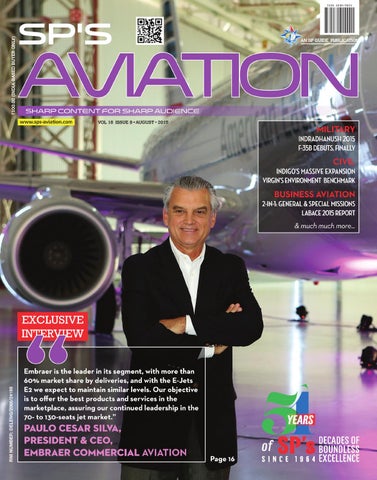
Cover IMAGE: Paulo Cesar Silva, President and CEO, Embraer Commercial Cover image by: Embraer
Viewpoint 6 IndiGo
Mammoth Order for Airbus A320 by IndiGo
7
F-35B Debuts, Finally
SPACE 9 Space-X Falcon 9
Failure of Space-X Falcon 9
military/viewpoint 12 Exercise Indradhanush
Need Pure Professionalism
Civil 23 Airlines
Highs & Lows of India’s Airlines
27 Environment
Virgin’s Exemplary Carbon Footprint Record
www.sps-aviation.com
forging ahead: If there is one company that is clearly in the lead globally in the domain of regional jets it is Embraer of Brazil. Beginning with the Embraer ERJ 145 that was the first regional jet developed in the early 1990s, the company has delivered almost 900 regional jets worldwide. In a candid interview, Paulo Cesar Silva, President and CEO, Embraer Commercial, speaks to Jayant Baranwal, Editor-in Chief, SP’s Aviation, on the company’s plans to forge ahead.
Business Aviation 30 Special Missions
Doubling Up
Show report 33 LABACE
Challenges for Latin American Aviation
regular Departments 3 A Word from Editor-in-Chief
page 16
exclusive interview GALLOPING AHEAD IN REGIONAL AVIATION Interview with Paulo Cesar Silva, President and CEO, Embraer Commercial
4 News With Views Export Order for JF-17 Thunder 36 Hall of Fame William Powell Lear (1902-78) 37 News Digest
Applied for NEXT ISSUE
40 Last Word
IAF Special
HAL—An Asset or a Liability?
ISSUE 8 • 2015
1
table of contents Keeping up with the Path of Partnership...We are the Official Media Partner of India Aviation in 2016.
23
Highs & Lows of India’s Airlines
Publisher And Editor-in-Chief Jayant Baranwal senior Editor Air Marshal B.K. Pandey (Retd) Assistant Group editor R. Chandrakanth Senior Technical Group Editor Lt General Naresh Chand (Retd) Contributors India Group Captain A.K. Sachdev (Retd) Group Captain Joseph Noronha (Retd) Europe Alan Peaford USA & Canada LeRoy Cook
27
Virgin’s Exemplary Carbon Footprint Record
Chairman & Managing Director Jayant Baranwal Planning & Business Development Executive Vice President: Rohit Goel ADMIN & COORDINATION Bharti Sharma design Holistic Directions: Jayant Baranwal Creative Director: Anoop Kamath Designers: Vimlesh Kumar Yadav, Sonu Singh Bisht Designer (3D animation): Kunal Verma Research Assistant: Graphics Survi Massey DIRECTOR: SALES & MARKETING Neetu Dhulia SALES & MARKETING General Manager Sales: Rajeev Chugh
SP’s websites Sr Web Developer: Shailendra P. Ashish Web Developer: Ugrashen Vishwakarma © SP Guide Publications, 2015 Subscription/ Circulation Annual Inland: `1,200 • Foreign: US$320 E-mail: subscribe@spguidepublications.com subscribe@sps-aviation.com LETTER TO EDITOR editor@sps-aviation.com expert@sps-aviation.com FOR Advertising details, contact: neetu@spguidepublications.com rajeev.chugh@spguidepublications.com SP GUIDE PUBLICATIONS PVT LTD A-133 Arjun Nagar (Opposite Defence Colony) New Delhi 110003, India. Tel: +91 (11) 24644693, 24644763, 24620130 Fax: +91 (11) 24647093 E-mail: info@spguidepublications.com Representative Office BENGALURU, INDIA 204, Jal Vayu Vihar, Kalyan Nagar Bengaluru 560043, India. Tel: +91 (80) 23682204 MOSCOW, RUSSIA LAGUK Co., Ltd., (Yuri Laskin) Krasnokholmskaya, Nab. 11/15, app. 132, Moscow 115172, Russia. Tel: +7 (495) 911 2762 Fax: +7 (495) 912 1260
Member of:
Follow us on
www.spguidepublications.com 2
ISSUE 8 • 2015
Owned, published and printed by Jayant Baranwal, printed at Kala Jyothi Process Pvt Ltd and published at A-133, Arjun Nagar (Opposite Defence Colony), New Delhi 110003, India. All rights reserved. No part of this publication may be reproduced, stored in a retrieval system, or transmitted in any form or by any means, photocopying, recording, electronic, or otherwise without prior written permission of the Publishers.
www.sps-aviation.com
A word from editor-in-chief
While the large order for [Airbus] aircraft indicates IndiGo’s plans for expansion, it is also a signal that the prospects of growth of the Indian airline industry are bright
o
On the civil aviation scenario, this issue carries an interview of Paulo Cesar Silva, President and CEO, Embraer Commercial Aviation, on the company’s ‘New Metrics of Success’ which essentially devolves around operating the right size of airliners to obtain the best returns on the assets deployed. Paulo Cesar Silva elaborates on the philosophy behind the development of the next-generation E2 Jets to succeed the E-Jets family of airliners. But what is making waves in the Indian airline industry is the huge order for 250 Airbus A320neo airliners by the leading budget carrier IndiGo Airlines. While this large order indicates that IndiGo has grandiose plans for expansion, it is also a clear signal that the prospects of growth of the Indian airline industry are bright. R. Chandrakanth of SP’s Aviation has carried out a detailed analysis of the performance of Indian carriers and is of the view that with competition increasing and passengers becoming more demanding, performance of airlines will come under greater scrutiny. Chandrakanth also describes how global business aircraft manufacturers are increasing focus on the growing demand for special mission aircraft which is becoming a niche market. In another article, Chandrakanth looks at the leadership role that Virgin Atlantic is addressing the global challenge of climate change. Ever since the tender for 126 Rafale combat jets from Dassault Aviation was formally cancelled, the Indian aerospace industry especially in the private sector has been anxiously looking forward to a final decision by the Government of India on the alternative course of action for the acquisition of fighter jets. The deal with the Government of France to procure 36 Rafale combat jets in a flyaway condition initiated during the visit of the Prime Minister of India to France in April this year will only provide partial relief to the Indian Air Force (IAF). The IAF needs to acquire the balance of 90 combat jets urgently to arrest the alarming erosion in its operational capability. The gravity of the situation has been further accentuated by the failure on the part of the Indian aerospace major Hindustan Aeronautics Limited (HAL) to deliver the light combat aircraft Tejas Mk I in a combat ready state despite the lapse of over three decades since the commencement of the project. The performance of HAL has indeed been rather uninspiring and the possibility of this behemoth delivering 90 fighter jets to the IAF under the ‘Make in India’ scheme does not appear to be in
www.sps-aviation.com
the realm of possibility. Somewhat disappointed with the quality standards of their products, even Boeing has cancelled ongoing contracts with HAL for components. That should send a clear message to this mammoth defence public sector undertaking and the department of the Central Government in charge. A high profile event on the international stage in which the IAF participated in the recent past was the fourth edition of Exercise Indradhanush, a joint air exercise with the Royal Air Force (RAF) of the United Kingdom held at Coningsby in Lincolnshire. While the IAF would certainly have imbibed useful lessons in the joint air exercise, the event was somewhat marred by some unwarranted comments in the Indian media by representatives of the IAF after the exercise was completed. One important lesson for the IAF to learn would be to avoid such embarrassment in joint air exercises with foreign air forces in the future. This issue of SP’s Aviation carries a report on Exercise Indradhanush. An event of significance to the global aerospace industry in the recent past has been the grant of the long-delayed initial operational clearance for the F-35B, the Marine Corps version of the Lightening II Joint Strike Fighter. While this flags a major milestone in the development of what has been described as “the most expensive weapon platform so far”, the aircraft still has a long way to go before it is fully combat ready. All these apart from the regular features in this issue of SP’s Aviation. Welcome aboard and happy landings!
Jayant Baranwal Publisher & Editor-in-Chief
ISSUE 8 • 2015
3
News
with views NEWS: Export Order for JF-17 Thunder Pakistan has been successful in securing the first ever export order for its JF-17 Thunder fighter aircraft on the very first day of the Paris Air Show in June this year. Air Commodore Khalid Mahmood of the Pakistan Air Force (PAF) dealing in sales and marketing said: “A contract has been signed with an Asian country.” However, the name of the country was not disclosed and deliveries are likely to
begin in 2017. The latest models of the jets, which are locally produced in collaboration with China, are lightweight multi-role aircraft capable of flying at twice the speed of sound and has an operational ceiling of 55,000 feet. In comparison, the Indian Air Force (IAF) is struggling with its light combat aircraft Tejas, which will take another year to become ready for combat.
Photograph: ASDS Media
VIEWS: News of Pakistan having attained a level of capability in her aerospace industry to be in a position to export combat aircraft manufactured in the country has understandably generated a wave of curiosity and even raised eyebrows among experts and analysts alike in India. The news is bound to be perplexing and reflects a contradiction in terms especially as Pakistan is a nation that has often been described as a ‘failed state’ or perched on the verge of it. Given the perpetual confrontation and rivalry between the politico-military establishments of both India and Pakistan, it is only natural that this visible success of the aerospace industry of the latter is immediately compared with what the Indian aerospace industry has been able to deliver so far in the same category of military hardware for the Indian Air Force (IAF). Quite expectedly, the comparison veers round to the home-grown light combat aircraft Tejas programme. The aerospace industry in Pakistan is centred around Pakistan Aeronautical Complex (PAC) located in Kamra in Attock district. Founded in 1971 by the Pakistan Air Force (PAF), PAC is engaged in the design, development and production of aircraft and avionics systems for both military and civilian application. Since its inception, PAC has been involved with four aircraft projects for the PAF. These are Project Sabre II, K-8 Karakoram, MFI-17 Mushshak and the JF-17 Thunder. Project Sabre II, which was to be a redesigned version of the Chengdu F-7, Chinese version of the Russian MiG-21 combat aircraft, was to be jointly developed by Pakistan, China and Grumman Aerospace. This project was to be executed by the Aircraft Manufacturing Factory (AMF) of the PAC but to their misfortune was abandoned in 1987. The MFI-17 Mushshak is a piston-engine basic trainer aircraft, a version of the MFI-15 Safari from Saab of Sweden, produced under licence by PAC. The K-8 Karakoram is a Pakistani version of the Chinese Hongdu-8 intermediate jet trainer from the Aviation Industry Group of China. However, in this case the AMF manufactured only some components of the aircraft with the platform being assembled in China. A contract between China and Pakistan to jointly develop and manufacture in Pakistan, the Chengdu FC-1/Super 7 was signed in June 1999. A full-size mock-up was displayed at Air
4
ISSUE 8 • 2015
Show China in November 2002. With production commencing in September 2002, the first prototype rolled out on May 31, 2003. Incidentally, it has a remarkable resemblance with the F-16 from Lockheed Martin of the US. The project was to be a 50:50 partnership with the air forces of both countries committed to placing large orders for the aircraft. PAF has a requirement of 200 of these platforms to begin with. In 2003, the aircraft was re-designated as Joint Fighter-17 (JF-17). The JF-17 Thunder is intended to replace the older fleets of combat aircraft in PAF other than the F-16. So far just over 50 of the order of 200 have been delivered. From the preceding it should be abundantly clear that despite the fact that Pakistan has been a staunch ally of the US for a long time, its aerospace industry is controlled totally by China. As regards the first customer for the JF-17, though not disclosed by Pakistan, indications are that it is Sri Lanka that has ordered 14 of these jets. The other possible customer could be Myanmar. In fact, on being invited by the PAF, the Chief of Myanmar Air Force had paid a four-day visit to Pakistan at the end of May this year. Apart from these two, there are a number of potential buyers for the JF-17, lured by the price tag that is under $30 million. While the Pakistani aerospace industry may be given due credit, comparison with the Indian Tejas programme would not be in order. The JF-17 Thunder, a product of the Sino-Pak collaboration, is similar to the Indo-Russian collaboration for licensed production of the MiG-21 in India. The difference is that in the agreement with the USSR, India did not have the privilege to export the aircraft for political considerations or perhaps lack of ready market. In the regime of indigenous development, the Indian aerospace industry had recorded a major success with the development of the HF-24; but the opportunity to build on the experience was squandered with the premature grounding of the fleet and closure of the programme. Even though it has taken 32 years for the Tejas to get initial operational clearance, it is essentially an indigenous product and unlike the JF-17, is not controlled by a foreign benefactor. SP —By Air Marshal B.K. Pandey (Retd)
www.sps-aviation.com
COCKPIT B50 THE ULTIMATE PILOT’S INSTRUMENT Aviation enters a new era with a multifunction chronograph delivering unprecedented performance. At the heart of this high-tech feat beats a (COSC) chronometer-certified SuperQuartzTM movement specially developed by Breitling for aviation. Equipped with a sturdy and light titanium case, the Cockpit B50 innovates with its huge range of functions, extreme user friendliness, rechargeable battery and an ultra-legible high-intensity display mode. Reliable, accurate, efficient: the ultimate pilot’s instrument.
B R E IT L IN G . C O M
Viewpoint
INDIGO
Mammoth Order for AIRBUS A320 by IndiGo IndiGo Airlines has always enjoyed a cherished relationship with Airbus and stands out for large orders for airliners with the original equipment manufacturer
Photograph: Airbus
T
The Indian airline industry is abuzz with the reports in merged to form National Aviation Company of India that placed a the media released on August 17, 2015, that the nation’s lead- combined order for 111 airliners from Boeing and Airbus. Once again in January 2011, IndiGo signed a memorandum ing low-cost carrier IndiGo Airlines has finalised a deal with the European aerospace major to purchase 250 Airbus A320neo of understanding with Airbus for 180 Airbus A320 aircraft for airliners. The move to place orders for a large number of air- $15 billion. One of the largest orders of its kind in commercial craft was initiated in October last year but could be finalised aviation history till date, the order included 150 of the costonly now. The single largest order in terms of number of aircraft effective and eco-friendly A320neo version for which IndiGo and second largest in value, the deal is reported to be worth was one of the launch customers. Deliveries of the A320neo are expected to commence only by the end of this year. With more than $26 billion at list prices. Airlines however, do benefit from attractive discounts in such these large orders, in the Asian region, IndiGo was competing large orders. This deal is particularly significant for the Indian against Lion Air of Indonesia that had ordered a total or 464 airline industry as it signals the possibility of rapid growth in aircraft in the years 2012 and 2013, a mix of Airbus A320neo and Boeing 737. The air travel in the country. other competitor though Assessment by experts of of lower intensity, was the growth of annual pasAirAsia that in 2011, had senger traffic in India from placed an order for 200 around 190 million to 450 Airbus A320neo aircraft. million and predictions for Apart from plans for the country to consequently substantial growth and emerge as the third largcost advantage, one of the est aviation market in the reasons why the airline world by 2020, seems to be places large orders for well within the realms of airliners is to phase out possibility. from its inventory aircraft Established in 2006 that are more than six by InterGlobe Enterprises, years old. Some of the airbudget carrier IndiGo that craft received against the commenced regular operainitial order for 100, have tions in August that year, already been retired from is the fastest growing and service. This philosophy also the largest airline in of inventory management India and leads with a has helped the airline to market share of 35.8 per keep the average life of cent as recorded in July IndiGo firms up 250 A320neo aircraft the fleet low and conse2015. The airline has an quently relatively free of impeccable record of ontechnical problems. This time-performance and as reported in the media, this is the only Indian carrier that has in turn contributes to higher levels of air safety. The order for 250 aircraft, which on the face of it appears consistently been in profit. Currently, the airline has a fleet of 97 Airbus A320 aircraft on its inventory and operates only a single unduly large for an Indian budget carrier, seems to be well-timed type of aircraft both in the domestic and international segments. to boost sentiment before the airline goes from a private enterThe airline has always enjoyed a cherished relationship prise to become a public limited company through the issue of with Airbus and stands out for large orders for airliners with IPO (initial public offering). The airline hopes to raise $400 milthe original equipment manufacturer. At the Paris Air Show in lion through the sale of its shares up to 12 per cent. In any case 2005, IndiGo made waves by placing an initial order for 100 the large orders are unlikely to become a financial burden for Airbus A320 aircraft for $6 billion. This was the largest single the Indian budget carrier as the airline can always pass on their order recorded at the Air Show and deliveries against this order bookings to other needy international carriers and rake in some was completed in late 2014. This record set by IndiGo was super- profit in the process. SP seded in 2006 when the state-owned Indian Airlines and Air India —By Air Marshal B.K. Pandey (Retd)
6
ISSUE 8 • 2015
www.sps-aviation.com
Viewpoint
F-35B
DEBUTS, FINALLY Grant of initial operational clearance has definitely flagged a major milestone for the F-35 programme as it has been declared technically ready for operational deployment
Photograph: Lockheed Martin
BY Air Marshal B.K. Pandey (Retd)
M
Media Reports in the recent past indicated that the marine version of the F-35 Lightening II Joint Strike Fighter (JSF) designed and developed by Lockheed Martin Corporation of the US, was likely to make its debut in the near future. These reports had emanated on the basis of statements by some senior functionaries of the US Marine Corps. The head of the Aviation Wing of the US Marine Corps had stated that the version of the aircraft meant for the Marine Corps, i.e. the F-35B, which is designed for short take-off and vertical landing, had been subjected to a complete operational readiness inspection at the first F-35B squadron by the competent authority and that the aircraft had passed all tests. He felt that as
www.sps-aviation.com
the aircraft had met all the requirements stipulated for a declaration of combat readiness, it was expected that the F-35B would soon be granted initial operational clearance (IOC). If and when this does happen, out of the total of 13 customers for the F-35, the US Marine Corps will be the first to operationalise the aircraft. This view was reinforced when another General of the Marine Corps who is slated to take over command of the force had said: “The F-35 is incredibly impressive and the Marine Corps is eagerly awaiting the arrival of the aircraft”. Though seven years behind schedule, the Lockheed Martin F-35B fighter jet has finally been granted IOC which means
ISSUE 8 • 2015
7
Viewpoint F-35B is granted IOC this year, it may not be in a position to undertake several of its core missions for quite some time, possibly years even after further sizeable investments in retrofits.” A former Secretary of Defence of the UK described the programme as “one of the biggest white elephants in history” and felt that chances of the F-35 becoming combat ready prior to 2018 was very low. Over the last 10 years, the F-35 JSF had suffered a series of hardware malfunctions and software glitches that delayed the programme for more than three years apart from the steep escalation of cost. In 2014, the entire fleet of F-35s was grounded following an engine fire that entailed a modification in the engine that proved costly. There were also setbacks at key milestones, including the start of the flight test programme, delivery of the first production aircraft and testing of critical missions systems, according the GAO. However, the plane’s prime contractor, Lockheed Martin, has said it believes the majority of difficult technical problems are in the past. The F-35B Lightning II fighter jet was expected to make its international debut at around the same time in the year 2014 at the Royal International Air Tattoo at RAF Fairford in GloucesA Troubled Programme The fifth-generation F-35 programme was conceived at the tershire as also at the Farnborough International Airshow, UK. turn of the century and the platform has been under devel- Unfortunately on account of an incident of fire on the runway on opment in three versions for a decade-and-a-half. This weap- June 23, 2014, while the aircraft was on the take-off run at the ons system has been projected as the most advanced in the Eglin Air Force Base, Florida, United States, the entire fleet of F-35 world today. Some of the features that give it this status are aircraft was grounded till such time the technical investigations advanced stealth capabilities, supersonic cruise, extreme agil- into the incident was over and the cause determined. On account of safety concerns, the F-35B aircraft thus ity and state-of-the-art sensor fusion was not granted clearance to undertake its technology. However, what was initially first transatlantic flight to the UK. This epitouted as an affordable next-generation sode was just another in the series of probweapon system for the US Air Force, the As per the aircraft lems with the controversial programme US Navy and the US Marine Corps, has manufacturer Lockheed that has been plagued by major redesign now turned out to be the most expensive issues and technical problems. As per an weapon system acquisition to date. As Martin, the majority expert in a think-tank in the UK, the F-35 the F-35 programme has been constantly of difficult technical programme is not only way too expensive, afflicted with delays and cost overruns, it is technically and operationally flawed its total financial outlay has escalated sigproblems are in the past and the likelihood of it entering operational nificantly and has nearly doubled from service in the desired time frame appears $233 billion in 2001 to over $400 billion somewhat remote. In fact the F-35B for the now for 2,457 aircraft. As per the Government Accountability Office (GAO), to operate and maintain Marine Corps that is reportedly heading for IOC will not be able to the JSF programme over the course of its lifetime, the Pen- integrate its full range of weapons. As and when the F-35A destagon will have to incur an expenditure of nearly $1 trillion. tined for the US Air Force reaches the IOC stage, it is very likely The GAO has gone further and warned of further delay in the that it will not be fitted with the synthetic aperture radar known programme as well as of the resulting cost escalation. So far as ‘BIG SAR’ or be able to deliver all types of bombs. 140 of the projected 2,457 jets ordered by the US military have been delivered. In addition, five aircraft have been delivered to Aerial Combat Capability other nations that are partners in the programme. But what has surprised the global military aviation community Apart from the cost factor, the programme has perhaps been the most is the fact that the fifth-generation F-35 has been outone of the most controversial as well. This fact has been openly performed in a mock aerial combat by the F-16 Fighting Falcon acknowledged by the OEM Lockheed Martin. The history of the that has the technology of the mid-1970s. The dogfight, which programme was characterised by controversy especially in the was staged in January near Edwards Air Force Base, California, early stages of development during the early and mid-2000s, was designed to test the F-35’s ability in close-range combat at when programme managers made overly optimistic assump- altitudes between 10,000 feet and 30,000 feet. The pilot of the tions about its testing and production schedule. Unfortunately F-35 aircraft participating in the exercise has revealed that in for the programme, the state it is in, does not inspire confidence the mock aerial combat, the performance his aircraft was defieven now. The aircraft continues to suffer from serious flaws and nitely inferior to that of his opponent, the F-16. He said that the deficiencies. There have been problems with engine reliability, F-35 was not able match the F-16 in climb rate and manoeuissues with software controlled systems and difficulties integrat- vrability and even went on to declare that the F-35 was not ing different weapons systems into the different variants. As per suitable for close combat. observation by a representative of the Democratic Party from However, as per the OEM, the F-35 has been given the California, Jackie Speier, “The F-35’s logistics system is largely capability to pick up targets at well beyond visual range, unreliable, its engine stability is extremely poor and electron- engage and destroy enemy aircraft with long-range guided ics in the individually sculpted $4,00,000 pilot’s helmet is cur- missiles. The F-35 is unlikely to ever encounter a situation rently unable to distinguish friend from foe. Even if the aircraft involving close combat. SP that the platform has been officially approved by the US Marine Corps as being ready for combat. Grant of IOC has definitely flagged a major milestone for the F-35 programme as it has been declared technically ready for operational deployment. After the debut of the F-35B for the Marine Corps, the F-35A meant for the US Air Force will follow suit a year from now, i.e. in August 2016. There are however a few challenges that lie ahead for the programme. As per the original equipment manufacturer (OEM) Lockheed Martin, the F-35 will be able to deliver revolutionary capability to the armed forces of the US and the allied nations that are committed to participating in the programme, for a long time to come. The nine countries that are partners in the programme are the United States, Australia, Canada, Denmark, Italy, the Netherlands, Norway, Turkey and the United Kingdom. Suppliers in each of the partner countries are producing components for the entire fleet of the F-35 and not only for the lot that will be supplied to them.
8
ISSUE 8 • 2015
www.sps-aviation.com
SPACE
SpaceX FALCON 9
FAiLURE OF SPACEX Falcon 9 The catastrophic failure of SpaceX Falcon 9 rocket on launch is a reminder that spaceflight is an incredible challenge
Photograph: NASA
BY Air Marshal B.K. Pandey (Retd)
B
Barely had the scientific community involved in space exploration recovered from the Progress M-27M unmanned space vehicle launched by Russia from the Baikonur cosmodrome in Kazakhstan on April 28, 2015, came the news of another disaster in space. A $60-million Falcon 9 rocket owned by SpaceX and carrying the unmanned Dragon cargo space vehicle on a logistic support mission to the International Space Station (ISS), exploded shortly after its launch from Air Force Station at Cape Canaveral on June 28, 2015. A mere two-and-a-half minutes after the liftoff, even before its first stage of the Falcon 9 rocket had shut down and separated,
www.sps-aviation.com
the rocket exploded 43 kilometres above the surface of the Earth, blowing itself and the Dragon cargo vehicle to smithereens, scattering its remnants and the supplies on board on to the Atlantic Ocean off the coast of Cape Canaveral. It is noteworthy that both the missions that ended in disaster in quick succession in a period of two months, were launched on the same day of the month i.e. the 28th. This may only be a mere coincidence but one that is bizarre indeed! There was a similar failure in October 2014 when an Antares rocket built by Musk’s cargo competitor Orbital Sciences, exploded just six seconds after lift-off from the launch pad.
ISSUE 8 • 2015
9
SPACE SpaceX FALCON 9 failed attempts to resupply the ISS, on July 3, 2015, a Progress capsule carrying more than three tonnes of supplies was launched without a hitch by the Russian Space Agency aboard a Soyuz rocket from Russia’s Baikonur cosmodrome in Kazakhstan. The Progress supply vessel docked successfully on July 5, 2015, much to the relief of all the stakeholders. The supplies now made available by the Progress cargo space should make the crew aboard the ISS comfortable till at least the end of November this year. Meanwhile, the next logistic support mission to the ISS planned is a robotic Japanese resupply capsule from Orbital ATK. This vehicle is scheduled for launch from Cape Canaveral in August this year, about a year after its most recent attempt ended in a rocket explosion in October last year. While NASA has been able to redeem the situation and has successfully obviated a crisis on board the ISS at this point in time, maintaining uninterrupted supply to the ISS is emerging as a new challenge. NASA has been dependent on SpaceX and Orbital Sciences Corporation for resupply missions to the ISS. For some time now, following the failure last year, The recent failure missions by Orbital had been placed of the Falcon 9 will on hold and is planned to be resumed in August this year. SpaceX will be able definitely impinge on to resume resupply missions only after the ambitions of SpaceX investigations into the June 28 disaster is completed and problems with the in the regime of space Falcon 9 resolved. Meanwhile, the Euroexploration. As recently pean Space Agency is no longer availDetermined to Bounce Back as in May 2015, SpaceX able to provide resupply missions in While a full and comprehensive invesspace. Effectively, as on date, only Rustigation into the mishap is expected to won certification from sian and Japanese Space Agencies are take time, possibly several months, prethe US Air Force to available to undertake resupply missions liminary assessment by SpaceX points to into space and should there be problems “Excess pressure in an upper-stage liquid carry national securitywith resupply missions launched by oxygen tank as causing an explosion less related payloads, paving these two agencies, it could have serious than three minutes after lift-off as the first the way for the company implications for the ISS, for the ongoing stage of the Falcon 9 rocket was nearing long duration experiments as also for point of separation”. While the commuto garner a sizeable the other space stations to be set up in nity of space scientists are perplexed at piece of a multibillion the future. In the worst case scenario, the episode, the response from Charles if the supplies vital for the survival of Bolden, the Administrator of NASA, was launch market. astronauts on board the ISS cannot be somewhat reassuring for the community assured, the astronauts would have to be when he said, “We will work closely with evacuated and the ISS abandoned. That SpaceX to understand what happened, fix the problem and return to flight. This incident is a reminder unfortunately will go down as perhaps the worst catastrophe that spaceflight is an incredible challenge, but we learn from in the history of space exploration. each success and each setback.” Although the concerned agencies have confirmed that even Implications for SpaceX with the loss of the Dragon cargo carrying space vehicle the The recent failure of the Falcon 9 will definitely impinge on crew on board the ISS will not be deficient of essentials such the ambitions of SpaceX in the regime of space exploration. As food, water and oxygen as they have adequate reserves to last recently as in May 2015, SpaceX won certification from the US them till October this year, the SpaceX disaster will prove costly Air Force to carry national security-related payloads, paving the in some other ways. One vital piece of cargo that has been way for the company to garner a sizeable piece of a multibillion destroyed in the explosion of the Falcon 9 rocket was the first of launch market. In this context, the failure of the Falcon 9 on a pair of International Docking Adapters (IDA) that was on board June 28 this year has definitely come at the wrong time as it the Dragon capsule. The IDA which was built and supplied by will impact adversely the company’s national security business Boeing, was meant to connect to the Harmony module of the ISS at least in the foreseeable future. The incident could also stretch and was to serve as the attachment node for a range of private the timeline for SpaceX’s first manned spaceflight. Under a crew vehicles that are scheduled to begin flying in 2017. NASA contract, the company has been developing a version of its Dragon spacecraft designed to carry up to seven crew members that could ferry astronauts to and from the space station. Emerging Challenge The sudden and unexpected failure of the SpaceX Falcon 9 The first flight could now be pushed back as SpaceX remains has made it necessary for NASA to explore alternative options preoccupied in ascertaining the cause of the failure of the Falurgently for timely resupply to the ISS. Fortunately, after two con 9 and take appropriate steps to enhance reliability. SP Failure at Launch Failure in space missions in neither a new nor is a surprising event. A review of the history of failure of rockets launched on space missions reveals that this adage is true for the Falcon series of rockets as well. The very first in the series, the Falcon 1 which was a small expendable orbital carrier rocket developed by SpaceX, undertook its maiden flight on March 24, 2006, from the SpaceX launch site on Omelek Island in the Marshall Islands. However, in less than 60 seconds after the launch, the Falcon 1 developed a fuel leak that resulted in a fire that was followed by an explosion. The mission thus ended in a failure. The second and the third launch of the Falcon 1 also met with a fate similar to the maiden launch. The failed launch on June 28 was the 19th mission of the Falcon 9 rocket since the Falcon 9 programme began in 2010. Of the total of 19 missions undertaken so far, 18 have been successful. This year alone, SpaceX has successfully launched five Falcon 9 rockets and has orders for another 36. In addition, the company has signed a contract to deliver five of the Falcon Heavy rockets that are of the generation beyond the Falcon 9. Without doubt, the record by all standards has been impressive. But the recent failure of the Falcon 9 is likely to impede, albeit even temporarily, the company’s ambitious launch programme of the future.
10
ISSUE 8 • 2015
www.sps-aviation.com
Exercise INDRADHANUSH
Photographs: IAF
military
12
ISSUE 8 • 2015
www.sps-aviation.com
military Exercise INDRADHANUSH
opposite page: (t0p) An IAF Su-30MKI flying over North Sea during the joint Exercise; (bottom left) IAF Su-30 MKI and RAF Typhoon flying in a formation during the Exercise; (bottom right) Contingent Commander of IAF, Group Captain A. Shrivastava (left) presenting a memento to his RAF counterpart Wing Commander Chris Moon (Right), Commanding Officer of 3 (Fighter) Sqn, at Royal air Force (RAF) Coningsby, United Kingdom; (above left) IAF contingent poses for a photograph in front of the Sukhoi-30 and the Typhoon at RAF Coningsby, United Kingdom; (above right) Group Captain A. Shrivastava (Centre) with Wing Commander Chris Moon (1st from Right)
VIEWpoint
need pure professionalism The unwarranted public statement by the IAF team leader was not only inelegant, irrelevant and politically inappropriate, it has caused considerable dismay amongst the participants in the exercise from the RAF and relegated the critical issue of lessons learnt into oblivion. BY Air Marshal B.K. Pandey (Retd)
T
The fourth edition of the Indo-UK bilateral air exercise code named Indradhanush was conducted jointly between the Indian Air Force (IAF) and the Royal Air Force (RAF) at the latter’s base at Coningsby in Lincolnshire in the United Kingdom (UK) from July 21 to 31, 2015.The air elements of the IAF that took part in the air exercise were the Su-30MKI, IL-78 flight refuelling aircraft, C-17 Globemaster III and C-130J Super Hercules transport aircraft. Participating elements from the RAF included the Eurofighter Typhoon, the Voyager tanker, C-17 and the C-130J. In addition to the aircraft, the Indian Garud commandos participated alongside their British counterparts, the RAF Regiment of the Special Forces. Admittedly, the IAF has been a late starter as far as exercises with air forces of foreign countries are concerned. In the first five decades after independence, the IAF had remained isolated not having engaged with any air force in the world in a tactical air exercise. Interaction with foreign air forces had been limited to activities such as training of IAF personnel on new aircraft or
www.sps-aviation.com
equipment under induction, specialised courses of instruction, deputation of instructors abroad or training of personnel of foreign forces in the training establishments of the IAF in India. The exposure of IAF personnel to foreign air forces thus had remained somewhat limited and restricted to the non-operational segment of activities. There was no tactical flying involved in such interaction. There was however, one international air exercise in 1963 that may appear to militate against the observation that the IAF was not a participant in any international exercise for five decades after independence. This was a multinational air exercise held at Kalaikunda codenamed Exercise Shiksha. This air exercise involved the United States Air Force (USAF), the RAF and the Royal Australian Air Force (RAAF). But the nature of this exercise was different from what is regarded as a joint air exercise, as coming soon after the Sino-Indian conflict of 1962, the purpose of Exercise Shiksha was Continued on page 15...
ISSUE 8 • 2015
13
military Exercise INDRADHANUSH
(top) Two IAF Sukohi-30 MKI being refuelled by an IAF IL-78 aerial refuelling tanker during the transit from Jeddah to India; (above left) IAF Special Forces Garud Commandos onboard an RAF C-130 Hercules aircraft before the para drop over a DZ in the United Kingdom; (above right) Parachutes of IAF Special Forces Garud Commandos opening up on exit from the RAF Hercules.
14
ISSUE 8 • 2015
www.sps-aviation.com
military Exercise INDRADHANUSH VIEWPOINT ...continued from page 13 joint air exercises to display support for and solidarity with and lessons highIndia to counter expansionist moves in lighted in debriefs the future if any by Communist China. As the IAF has been a after the air exerthere was no tactical interaction with the late starter as far as cise, help to widen horizons and contribIAF, this cannot be regarded as a joint air exercises with air forces ute to overall professional growth of air exercise meant to benefit the IAF by way of warriors and consequently enhance the a learning experience of any significance. of foreign countries overall operational capability of the IAF. However, since the year 1999, interare concerned. In the national air exercises have become a fairly routine affair for the IAF. In the last Unwarranted Controversy first five decades after decade-and-a-half, the IAF has had the Unfortunately, Exercise Indradhanush has independence, the IAF had opportunity to participate in joint air exergot embroiled in an ungainly and needless remained isolated not cises with a number of leading air forces controversy following an interview with of the world. The first formal air exercise Indian television on return to India on having engaged with any held abroad in which the IAF was a particcompletion of the air exercise. During the air force in the world in a ipant was in South Africa in the year 1999. televised interview, the leader of the IAF Codenamed Exercise Blue Crane, this was contingent claimed a resounding 12-0 victactical air exercise. a multinational exercise involving a numtory over the elements of the RAF particiber of African nations and was structured pating in the air exercise. Claiming that the on UN Peace Keeping Operations. The IAF performance of the pilots of the IAF was had a modest representation in the exercise by way of just one “exceptional”, he said that the Su-30MKI of the IAF had the upper IL-76 and no combat aircraft of the IAF were involved. The IL-76 hand in close-range aerial combat when pitted against the supposaircraft of the IAF carried out para-drop and simulated insertion edly superior and far more advanced Eurofighter Typhoon combat of Special Forces. Even while there was no competition with any platform of the RAF even when outnumbered by the latter. elements from other nations participating, the air exercise was The view from the RAF is that air exercise Indradhanush proa good learning experience for the IAF and helped elevate confi- vided an excellent opportunity to their fighter pilots to operate dence levels in its transport fleet. against the Su-30MKI in simulated combat exercises. In view of Following the initial baptism in South Africa, the IAF has par- the escalating tension with Russia over Ukraine, the RAF could ticipated in a number of exercises conducted jointly with foreign well find itself confronting Russian combat aircraft should the sitair forces both in India and abroad. These air exercises have uation in the Baltic escalate into a wider and full-fledged conflict. involved the complete range of platforms including combat air- In this context Exercise Indradhanush was of special significance craft, helicopters as also support elements such as flight refuel- to the RAF. ling aircraft and airborne warning and control system (AWACS) For the IAF too, Exercise Indradhanush provided a good aircraft. The list of air exercises includes the Cope series with the opportunity for learning and the team leader ought to have USAF, the Garuda series with the French Armée de l’Air or the focused on that instead of proclaiming victory. The comments by French Air Force, Indradhanush series with the RAF of the UK the team leader were inappropriate as in an air exercise under and Exercise Avia Indra 2014 with the Russian Air Force. There controlled conditions; there are no winners or losers. Besides in have been a few other air exercises with the air forces of other any competition in any discipline meant for training or otherwise smaller nations such as the Republic of Singapore Air Force and where there can be winners or losers, neither of the participants the Royal Air Force of Oman. Indradhanush held in July 2015, can pass judgement on the final outcome of the exercise in terms was the fourth joint air exercise between the IAF and the RAF. of victory or defeat. This responsibility must necessarily be vested The two air forces have been sharing locations in each other’s in an independent and neutral third party that would have no territory and the last time that the IAF was deployed for such an vested interest. In the case of Exercise Indradhanush, there was exercise in the UK was in the year 2007. no requirement of an umpire as the air exercise was not about one of the participants emerging as victorious. The unwarranted public statement by the team leader was Aim and Objectives of Joint Air Exercises The aim of such joint exercises between or amongst air forces is not only inelegant, irrelevant and politically inappropriate, it has to provide air warriors with a wider exposure in both the strate- caused considerable dismay amongst the participants in the exergic and tactical domain which would include varying operational cise from the RAF and relegated the critical issue of lessons learnt philosophies, new and novel concepts in the employment of air into oblivion. The RAF on its part has even gone to the extent of power, new tactics and techniques in aerial warfare which would dismissing the claims of victory by the IAF as ‘comical,’ not very include the employment of advanced weapons platforms as well as complimentary for the IAF. This sordid episode has also been weapon systems, employment of the latest avionics, sensors and equally embarrassing for the IAF. While the IAF is in the damage electronic warfare systems, more efficient methods of integration control mode and is making all efforts to downplay the controof the different components of the Air Force and so on. The joint versy, what the IAF needs to ensure for the future is that those air exercises are focused on exchanging ideas on the rapidly evolv- participating in such joint air exercises with foreign air forces ing dynamics of air warfare and concept of operations as also to have their perspectives correctly oriented and are briefed to scruimbibe lessons and strengthen interoperability should the need pulously avoid scoring brownie points in the media in matters that ever arise. Through joint air exercises, air warriors of the IAF have are purely professional. SP an opportunity to observe the best practices of other air forces, are exposed to different operating environments and enhance mutual The author retired as the Air Officer Commanding-in-Chief, understanding with other air forces. The experience gained in such Training Command, of the Indian Air Force.
www.sps-aviation.com
ISSUE 8 • 2015
15
EMBRAER COMMERCIAL
EXCLUSIVE INTERVIEW
PRESIDENT & CEO
PAULO CESAR SILVA PRESIDENT & CEO, EMBRAER COMMERCIAL AVIATION
GALLOPING AHEAD IN REGIONAL AVIATION Photographs: Embraer
If there is one company that is clearly in the lead globally in the domain of regional jets it is Embraer of Brazil. Beginning with the Embraer ERJ 145 that was the first regional jet developed in the early 1990s, the company has delivered almost 900 regional jets worldwide. In a candid interview, Paulo Cesar Silva, President and CEO, Embraer Commercial, speaks to Jayant Baranwal, Editor-in Chief, SP’s Aviation on the company’s plans to forge ahead. 16
ISSUE 8 • 2015
www.sps-aviation.com
EMBRAER COMMERCIAL PRESIDENT & CEO Silva: First and foremost, Embraer Jayant Baranwal (JB): Can you briefly trace the history makes a huge effort to understand the of Embraer and the company’s record of manufacturing needs of its customers. The reasons lie regional jets with specific reference to the E-Jets family at the core of our values. In a nutshell, of airliners? Paulo Cesar Silva (Silva): The first regional jet developed by it’s about vision and the integration beEmbraer was the ERJ 145 family, in the early 1990s. That family tween commercial and product develachieved great success, starting in North America and spread to opment teams. The commercial aviation industry is very cash other parts of the globe like Europe and China. Even today, this intensive and with long cycles, we have to get it right from day family of aircraft still plays an important role in mature markets, one – we need to understand what airlines will want in the fuin hub-and-spoke operations, and is helping to build connectiv- ture and deliver accordingly. That means we are close to our ity in emergent markets, like Asia and Africa. Since 1996, almost customer base, put in a lot of effort anticipating their needs, and make sure we deliver a great product and excellent support. 900 aircraft of this family were delivered worldwide. Regarding the E-Jets, when Embraer launched the family, in 1999, we realised there was a gap and an opportunity in the jet JB: Kindly explain the essence of ‘The rule of 70 to 110’ as market between 70 and 110 seats. So, we introduced a whole propagated by the company when the E-Jets were launched new family of aircraft, along with the right-sizing concept, offer- over a decade ago. From 70 to 110, the seat pitch now ing a seamless comfort for passengers in this category of aircraft, has gone up to 70-130; do you think there will be further redefining the entire segment of regional aircraft, even creating a upward revision of seats as markets mature? When do you think this will happen? new one, which we call the E-Jets segment. Silva: The essence of the rule of 70 to I believe the hallmark of Embraer’s success 110 was based upon maximising profits lies in the fact that around 70 airlines in 50 “Compared to the by right-sizing fleet in the untapped (at countries are flying that family of aircraft. the time) 70 to 110 seat market. Our viIn my opinion, that is a statement that the current generation sion at the time was that airline industry market embraces Embraer’s vision set E-Jets, the E2 family will rules were being re-written. We had admore than 15 years ago. Also, the E-Jets dressed four big issues that airlines were have been selected by many of the world’s offer opportunities to facing at that time and some are still facleading aircraft lessors. Since 2004, over increase revenue with an ing today. 1,100 E-Jets were delivered by us and even more comfortable • The need to adequately match capacmore than 1,600 units were ordered. ity demand. cabin and at the same • Right-size fleets. JB: What in your view are the reasons time achieve significant • Explore new markets. for the phenomenal success of the Em• Replace ageing fleets. braer E-Jets family of airliners? cost reduction” Riveting Work in the Fuselage of e-jet
www.sps-aviation.com
ISSUE 8 • 2015
17
EMBRAER COMMERCIAL PRESIDENT & CEO At that time, airlines had no choice but to use the aircraft available in the market and there was room to further optimisation. Embraer identified the need to ‘tap the gap’ from 70 to 110 seats, creating then the E-Jets family. More recently we identified a change in the centre of gravity of narrow body orders shifting upwards in capacity mainly to the lack of efficient product in the 130-seat segment. So, when we defined the E-Jets E2 capacities, it was natural to use the E-Jets platform to tap that gap as well. JB: In the airline business, there is room for large, regional and small aircraft, and accordingly the aircraft are deployed. Do you believe the deployment of wrong aircraft in regional aviation leads to a bad business sense? Can you share an example of a specific airline which later replaced its aircraft (whichever it may be) with the ‘right size’ aircraft and became a profitable venture? Silva: Recent history has shown us that airlines are most profitable when the industry is disciplined with capacity deployment. Let’s take the US carriers as an example. Capacity discipline has been around for five years and is one of the underlying reasons behind the great earnings North American carriers have been enjoying recently. As a matter of fact according to IATA (International Air Transport Association), 53 per cent of the airline earnings worldwide in 2015 will come from North American carriers. EJets were a piece of that history in North America, where regional jets play an important role in feeding passengers to hub systems allowing them to connect to world. We also have a strong presence in high density, high frequency markets, called shuttle markets, where frequency and comfort are rewarded with high premiums.
smile of confident leadership
It makes sense to avoid overcapacity, improve unit revenues and earnings and therefore make a great use of the assets — which happens when airplanes have the right-size for the market they serve.
The E2 family is Changing the Way the World Flies
18
ISSUE 8 • 2015
www.sps-aviation.com
EMBRAER COMMERCIAL PRESIDENT & CEO JB: What has been the safety record of the Embraer E-Jets family of airliners since its entry into service 13 years ago? Silva: Since the first E-Jet unit entered service, in 2004, two E190s were involved in fatal accidents. In both cases the investigation authorities detected NO problems with aircraft design. JB: What are the salient features of E2 which give them competitive edge over other aircraft? How does the Embraer E-Jets E2 compare with the E-Jets? What are the major upgrades in the new generation aircraft? What is the position of orders for the Embraer E-Jets E2? Silva: Since we launched the programme, we decided to invest more than a simple re-engine programme. The application of advanced technologies for engines, wings, and avionics distinguishes the E-Jets E2 by providing airlines with maximum efficiency gains and no compromises. This allows us to offer more benefits to our customers, exploring all the advantages of the new engines, new wings and fly-by-wire, but still avoiding the inherent risks of a 100 per cent new design. In addition, we maintain commonality with current E-Jets, which makes the E-Jets E2 appealing to current E-Jets operators. The currently E-Jets E2 backlog has 267 firm orders plus 373 options and purchase rights. JB: What is the percentage of composites in the construction of the airframe of the E2 Jets? Silva: E-Jets E2 will continue to be a mostly metallic aircraft with some composites structures such as the wing fuselage fairing, radome and control surfaces (flaps, spoilers, ailerons, rudder and elevator), representing 12 per cent of the total aircraft structural weight. We did several studies and aluminum was
clearly the most cost effective low risk alternative for the E-Jets E2, considering the aircraft sizes and mission ranges. For short range/midsize aircraft and a non-disruptive fuel price, composites represent higher risk and higher costs. JB: What will be status of the first-generation Embraer E-Jets after the arrival on the scene of the E2? Will their production continue and if so for how long? Silva: The current generation of E-Jets will continue to be delivered at least 2020, when the latest model of the second generation comes into operation, the E175-E2. However, it is difficult to determine a date, as this ultimately depends on market demand. This year, for example, we are getting orders for aircraft of both current as second-generation. JB: For what reasons do you feel that the E2 family of airliners will provide better return on aircraft assets (ROaA) as compared to the E-Jets family? Silva: The ROaA measures the amount of annual profit in relation to its value as an asset. Compared to the current generation E-Jets, the E2 family will offer opportunities to increase revenue with an even more comfortable cabin and at the same time achieve significant cost reduction. Those two movements combined leads to higher profits and ultimately to higher return on aircraft asset. JB: Could you explain how reduced life-cycle cost has been brought about and if you could quantify the same? What
e2 cabin Designed for Supreme Comfort
www.sps-aviation.com
ISSUE 8 • 2015
19
EMBRAER COMMERCIAL PRESIDENT & CEO measures have been adopted to achieve significant reduction in life-cycle cost in respect of the E2 Jets over the E-Jets? Silva: The E-Jets E2 will have up to 25 per cent saving in maintenance costs. This will come from the engine’s longer time on wing and lower maintenance costs, from the aircraft longer maintenance intervals and lower check costs, and from improved systems for higher reliability and components cost reduction. In terms of the innovations, Embraer is investing in the e-Solutions platform of web-based tools on the FlyEmbraer website, which is a single connecting point for Embraer’s customers to find a digital portfolio of services any time, on any device. It is designed to maximise flight duration and avoid unnecessary operating costs and delays, serving as both corrective and preventive maintenance. One example is the eSRM web application based on SRM (structural repair maintenance) approved data to allow E-Jets operators to increase damage assessment reliability, reduce structural repair costs, and to more quickly and conveniently perform repair management and traceability. The AHEAD-PRO (Aircraft Health Analysis and Diagnosis) system analyses and diagnoses aircraft health by continuously monitoring the E-Jets performance, in real time,
while increasing the fleet availability. The E2 Jets will also feature onboard maintenance computers. The Honeywell Primus Epic 2 integrated avionics system on the second-generation of E-Jets will be an evolution of the existing Primus Epic on current generation E-Jets. The continuous Embraer effort to provide the best maintenance service drove to a redesigned central maintenance computer (CMC) even more capable, precise and powerful. This CMC includes health-monitoring, which is designed to improve/speed-up troubleshooting. E-Jets E2 will be a more e-enabled aircraft for maintenance, flight operations and passenger entertainment. JB: Please give an example of a start-up airline which exclusively flies your aircraft and has been doing financially well. Silva: Since the E-Jets entered into service, in 2004, many airlines discovered the potential of the segment from 70 to 130 seats. Azul, in Brazil, started their operations with two E190s, back in late 2008, and now has more than 80 E-Jets in its fleet, and is now one of the top three in the country. Another good example is Fuji Dream Airlines in Japan. The airline started in 2009 with two E170s and nowadays operates an all E-Jets fleet with eight aircraft, growing very carefully and managing
E-Jets customer base evolution commercial airlines and Leasing co.
1,668 1,668 Accumulated Firm orders
876
947
619 343 110
1999-2000
2
118
2001-2002
4
2003-2004
14
Source: embraer (june 2015)
20
ISSUE 8 • 2015
2005-2006
27
2007-2008
50
2009-2010
55
2011-2015
67
costomers / operators
www.sps-aviation.com
EMBRAER COMMERCIAL PRESIDENT & CEO the capacity. JetBlue from US uses the E190 to explore new markets with lower risk and greater profitability. This is a good example of how the E-Jets helps airlines, right-size and complement larger narrow bodies, as JetBlue does. About 45 per cent of E-Jets fleet is deployed in markets complementing or replacing larger aircraft. JB: In May 2011, Embraer announced that it was considering building a larger airliner than the E-jets, with fiveabreast seating. What is the current status of that plan? Silva: At that time, we didn’t see a sound business case to launch a larger-capacity clean-sheet aircraft. At this stage, we are committed to maintain leadership in segment of jet up to 130-seats. Our strategy is to concentrate in our core market and make sure we have the best products in the segment we are in. In this regard, the second-generation of E-Jets will be a significant step in Embraer´s commitment to continuously invest in this line of commercial jets. JB: Embraer has so far focused largely on the regional aviation market. Do you have any plans to foray into the mainline commercial aviation market and compete with the
major global players such as Airbus and Boeing? Silva: We assess the market all the time, looking out for future trends, but, as I answered in the previous question, we don’t see, at this moment, any sound business case to build a larger aircraft. JB: What is your perception of the global commercial aviation market over the next two decades and the prospects for investors in the highly volatile business environment that overshadows the airline industry? Silva: Specifically related with our segment, from 70 to 130-seats, we project deliveries of 6,350 jets in the next two decades. The 70- to 130-seat jet world fleet-in-service will increase from the current 2,590 aircraft to 6,490 by 2034, the fastest growing among all aircraft seat segments. Replacement of ageing aircraft will represent 39 per cent of new deliveries and 61 per cent will represent market growth. One of the drivers for this growth will be the capacity discipline strategy. We’ve seen how too much capacity and a strategy to capture more market share can, in some cases, be a tradeoff for
E-Jets Family order Book
commercial aviation as of june 30, 2015
Firm Orders (1,668)
Deliveries (1,137)
Firm Backlog (531)
Embraer 170
193
188
5
Embraer 175
459
291
168
Embraer 190
584
518
66
Embraer 195
165
140
25
E175-E2
100
–
100
E190-E2
77
–
77
E195-E2
90
–
90
Source: embraer
www.sps-aviation.com
ISSUE 8 • 2015
21
EMBRAER COMMERCIAL PRESIDENT & CEO weak yields and low return on assets. The airline business is very capital intensive which makes it all the more imperative to have a business model that is sustainable since short-term strategies may carry undue risk. We welcome the emerging trend among airlines to focus on generating return on shareholder-invested capital as their main goal. It’s one of the reasons why we continue to see new opportunities for the 70- to 130-seat jet segment. Across the globe, there is a continuous need for more network connectivity and frequency: the tremendous traffic growth in Asia, greater disposable income among a rising middle class in Africa and Latin America, continued strength in the United States and economic recovery in Europe. Planning for the future is always a tough challenge. Not only do airlines need to estimate their capacity requirements far in advance, they must also ensure that their investment in new equipment earns an acceptable return on those assets. Understanding how 70- to 130-seat aircraft influence that return is critical, especially as we enter a period of new growth. JB: The ‘New Metrics of Success’ begins with Warren Buffet’s statement on how investors have lost money in airlines, yet Embraer is confident that airlines can make money. Could you substantiate how? Silva: First of all, the airline business is no longer a hobby, it’s a complex, sensitive and cash intensive business which sells the most perishable good there is – an airline seat. Mr. Buffett’s claim is due to the fact that few companies can get it right, and it is hard to keep a good streak going. For many years, the industry’s return on invested capital has been lower than cost of capital, therefore eroding shareholder value. For the first time in 2015, this has changed as some airlines started to pay more attention and have more concrete actions towards a better return on invested capital, simply being profitable was no longer enough, and airlines had to create shareholder value, as any other business. Our hope is that as airlines improve return in invested capital by managing capacity correctly, avoiding overcapacity and low profitability it brings, airline investors will achieve superior returns. JB: You have advocated a switch in the investment criteria from a cost per seat perspective to profit per seat, could you explain this in layman’s terms? Silva: We advocate a wider perspective – look at higher profits, which is a combination of higher revenues and lower costs. Look at both costs and profits, not only costs. When there’s overcapacity, there’s a limit for cost savings, but no limit to how low fares can go, therefore profits can suffer. JB: Can this ‘Metrics’ be deployed in mature Western European markets where there is substantial traffic density and higher capacity requirements? If yes, please substantiate with examples? Silva: The concept works very well in the US, and there is no reason not to work in Europe. It works in Brazil with Azul, and there is no reason not to work in other emerging markets. It is a matter of business strategy, focused on creating shareholder value – it works in any business. The E-Jets operate in high and low density markets, complementing, adjusting or even exploring new markets. See the cases of KLM Cityhopper and BA CityFlyer, in Europe, two airlines that explore the most of its geographical locations of the airports were they operates, the infrastructure available and their fleets (E-Jets) to bring convenience and connectivity for passengers and generate value to shareholders.
22
ISSUE 8 • 2015
JB: How can this ‘Metrics’ beat the economics of a turboprop on a short to medium haul sector, particularly in emerging economies such as India where the passenger traffic from smaller towns is yet to be developed? Silva: Jets have a superior revenue potential than turboprops. As emerging economies develops there is a trend for more competition among airlines and a desire for more convenience by passengers. The clear preference for jets against turboprops generally commands higher revenues and profits. JB: You have mentioned that special attention has been given to leasing company requirements for a very liquid asset. Could you explain the same? Silva: We have four pillars of the liquidity of the E-Jets: • Flexibility – different business models. • Global reach and customer base – around 70 airlines some 50 countries in all continents. • Market confidence – support from the leasing/financial community. • Sustainability – customer support structure supporting the fleet (more than 45 years of experience). Some examples that reflect this philosophy in the product; minimising transition costs; are: predefined structural and electrical provisions for the most common options, modular cabin monuments and a first-class staggered-seating option that uses the same bins and seat tracks as the economy class. JB: In an Embraer aircraft where there is no middle seat, airlines cannot really unbundle seat selection to make revenue as passengers are comfortable sitting anywhere (mostly). Do you think this could mean ‘no additional revenue’ from seat selection option when we are talking of increasing profit per seat? Silva: It is quite the opposite! With the E-Jets you can introduce the economy plus, which is a trend in many airlines, therefore being able to charge a premium for these seats, offering more space and amenities for passengers – being an excellent source of ancillary revenues. JB: Who are your competitors in the regional aviation segment of the global commercial aviation market? Silva: Embraer is the leader in its segment, with more than 60 per cent market share by deliveries, and with the E-Jets E2 we expect to maintain similar levels. Our objective is to offer the best products and services in the marketplace, assuring our continued leadership in the 70- to 130-seats jet market. The closest competitors to the E175-E2 in the 70- to 90-seats market are the CRJ700/900, MRJ90, ATR 72 and Q400. The closest competitors to the E190-E2 and E195-E2 in the 90- to 130-seat market are the CS100, SSJ100, ARJ21 and CRJ1000. JB: What is the role of ‘Ancillary Revenues’ in the currently prevailing market dynamics of low-cost carriers? Silva: Ancillary revenues have been a strong driver for airlines to growth, even outstripping scheduled revenues. However, the segment has slowed significantly since most everything that can be charged extra for is already being monetised. To build customer loyalty there are appropriate strategies of bundling ancillaries, offering packages according to the passenger or the market profile. Airlines are building smarter revenue strategies, and despite the growth in ancillary revenues, many of them recognise that ticket revenue still is the most important source of revenue. SP
www.sps-aviation.com
Civil
airlines
towering performance: IndiGo continues its aggressive expansion plans, riding high on its market success
Highs & Lows of India’s Airlines The first half of 2015 shows towering performance by IndiGo that carried 145.80 lakh passengers from January to June, registering a leading market share of 37.5 per cent
Photograph: SP Guide Pubns
BY R. Chandrakanth
S
Since the new millennium, civil aviation in India has been witnessing growth despite the many impediments and failing airlines. Industry-friendly policies, efficient management practices and the general surge in air transportation are likely to propel aviation business to higher levels. Passenger traffic has been significantly strong and the projections are highly encouraging. In financial year 2015, the total passenger traffic stood at 190.1 million, increasing by 12.47 per cent over the previous year. With
www.sps-aviation.com
rising incomes, low air fares due to fierce competition, enhanced regional connectivity, improved infrastructure and rapid urbanisation, passenger traffic has expanded at a compounded annual growth rate of 11.16 per cent in the period 2006 to 2015. The development of the civil aviation sector has a multiplier effect on the economy. According to a study by the International Civil Aviation Organisation (ICAO), the output multiplier and employment multiplier indices are 3.25 and 6.10 respectively. In
ISSUE 8 • 2015
23
Civil airlines other words, every 100 rupees spent on air travel would result in 325 rupees worth of total benefits and every 100 direct jobs in aviation would result in 610 jobs overall. Passenger and cargo traffic, airport development are all on a high-growth trajectory. India is presently the ninth largest civil aviation market in the world with a market size of around $16 billion and is likely to be among the top three markets in the near future. “The world is focused on Indian aviation – from manufacturers, tourism boards, airlines and global businesses to individual travellers, shippers and businessmen. If we can find common purpose among all stakeholders in Indian aviation, a bright future is at hand,” said Tony Tyler, Director General and CEO, International Air Transport Association (IATA). Market Size In the second quarter of 2015, domestic air passenger traffic surged 19.2 per cent to 20.3 million from 17 million in the corresponding period a year ago. Over the next five years, domestic and international passenger traffic are expected to increase at an annual average rate of 12 per cent and eight per cent respectively, while domestic and international cargo traffic are estimated to rise at an average annual rate of 12 per cent and 10 per cent respectively. Consultancy firm CRISIL has pointed out that Indian carriers will have a collective operating profit of `8,100 crore in fiscal 2016. India’s potential is largely untapped and the initiatives been taken by the government and the industry per se are going to prop the aviation sector.
Performance Parameters How are airlines in India doing in such a scenario where opportunities exist? We look at Indian airlines on parameters such as passenger growth, passenger load factor, compliance of route dispersal guidelines, and on-time performance. Passenger Growth Passengers carried by domestic airlines during the period January to June 2015 were 388.33 lakh as against 324.11 lakh during the corresponding period of previous year thereby registering a growth of 19.81 per cent. IndiGo, the Runaway Market Leader The first half of 2015 shows towering performance by IndiGo, the runaway market leader. The airline carried 145.80 lakh passengers from January to June, registering a leading market share of 37.5 per cent. IndiGo is the only airline to touch the three digit mark. IndiGo is followed way behind by Jet Airways with a market share of 19.35 per cent having carried 75.12 lakh passengers. Air India carried 64.95 lakh passengers with a market share of 16.8 per cent; SpiceJet 40.93 lakh passengers with a market share of 10 per cent; JetLite 14.87 lakh passengers with a market share of 7.8 per cent; GoAir 33.98 lakh passengers with a market share of 8.75 per cent; AirAsia India 5.14 lakh passengers with a market share of 1.3 per cent; Air Costa 3.82 lakh passengers with a market share of only one per cent; and Air Pegasus which started operations in April this year
Passenger growth
Pax carried (in lakhs)
388.33 (2015)
Growth:YoY = +19.81% MoM = +16.03%
324.11 (2014)
56.89 (2014)
Year Over Year (YoY)
66.01 (2015)
Month Over Month (MoM)
Source: DGCA
24
ISSUE 8 • 2015
www.sps-aviation.com
Civil airlines
on-time performance (OTP) of scheduled domestic airlines OTP (%) at four metro airports 99.0
Air Pegasus*
95.6
Vistara Air Costa*
87.3
Air Asia*
87.2 82.6
IndiGo Jet Airways + JetLite Go Air*
78.6 76.8 75.7
Air India (Dom) 60.2
Spicejet
*Note: Operations of GoAir only at BOM, BLR, DEL; Operations of Air Costa only at HYD, BLR; Operations of AirAsia only at DEL and BLR; Operations of Air Pegasus only at BLR. Source: DGCA
has carried 9,000 passengers with a market share of 0.01 per cent. IndiGo continues its aggressive expansion plans, riding high on its market success. On its ninth birthday recently, it firmed up its last year’s commitment and ordered 250 A320neo family aircraft on India’s 69th Independence Day. Aditya Ghosh, President of IndiGo, said, “This new order further reaffirms IndiGo’s commitment to the long-term development of affordable air transportation in India and overseas. The additional fuel-efficient A320neo aircraft will enable us to continue to bring our low fares and courteous, hassle-free service to more customers and markets and will create more job opportunities and growth. The IndiGo team is even more energised and excited than ever before to herald this new phase of our growth for many years to come.” IndiGo placed an order in 2005 for 100 A320s which have all now been delivered. In 2011 IndiGo became the first Indian operator to commit to the A320neo bringing their total to 280 Airbus aircraft. With this announcement, IndiGo has ordered 530 A320 family aircraft with Airbus. Passenger Load Factor For the first six months of 2015, the passenger load factor of airlines has been: Air India 78.66; Jet Airways 83.98; JetLite 84.05; SpiceJet 87.33; GoAir 83.93; IndiGo 85.73; Air Costa 76.81; AirAsia India 77.61; Vistara 59.21; and Air Pegasus 70.50.
Passenger load factor (june 2015) 100.0
93.2
90.0 83.6 80.0
77.7
86.6
84.0 79.2
78.1
73.1
73.5 Pax load factor (in %)
70.0 59.3
60.0 50.0 40.0 30.0 20.0 10.0 0.0 Air India
Jet Airways
JetLite
Spicejet
Go Air
IndiGo
Air Costa
Air Asia
Vistara
Air Pegasus
Source: DGCA
www.sps-aviation.com
ISSUE 8 • 2015
25
Civil airlines
Month-wise seat factor of scheduled operators in 2015 (PLF in %) Month
Air India (Domestic)
Jet Airways
JetLite
SpiceJet
GoAir
IndiGo
Air Costa
AirAsia
Vistara
Air Pegasus
January
82.4
87.0
87.4
80.0
79.2
85.2
76.5
76.3
45.4
—
February
83.3
89.5
89.7
85.6
85.9
88.0
77.9
77.9
58.6
—
March
73.9
86.6
87.8
83.4
80.0
77.0
69.2
71.7
53.6
—
April
78.5
82.0
81.9
88.7
85.5
85.7
76.9
74.4
67.3
—
May
80.4
81.1
79.4
93.1
89.4
91.9
81.2
81.4
71.1
78.0
June
73.5
77.7
78.1
93.2
83.6
86.6
79.2
84.0
59.3
73.1
Market share of schedules domestic airlines (January to June 2015) Month
Air India (Domestic)
Jet Airways
JetLite
SpiceJet
GoAir
IndiGo
AirCosta
AirAsia
Vistara
Air Pegasus
January
18.7
19.6
4.5
9.4
8.9
36.4
1.0
1.3
0.2
—
February
17.8
19.8
4.5
9.2
8.9
37.1
1.0
1.2
0.5
—
March
16.9
20.7
4.7
9.7
8.8
36.4
1.0
1.1
0.8
—
1st quarter
17.8
20.0
4.6
9.4
8.8
36.6
1.0
1.2
0.5
—
April
16.2
19.6
3.5
10.8
8.8
37.8
1.0
1.1
1.2
—
May
15.8
18.3
3.2
11.7
8.6
38.9
0.9
1.3
1.3
0.1
June
15.3
18.3
2.8
12.1
8.7
38.4
1.0
1.9
1.3
0.1
2nd quarter
15.8
18.7
3.2
11.6
8.7
38.4
1.0
1.4
1.3
0.1
Source: DGCA
On-Time Performance This is a key parameter for discerning customers who have tight schedules, who don’t like waiting at airports and who value time. Airlines have been making efforts to improve their on-time performance (OTP) and airline officials know that a quick turnaround of aircraft is good for business too. OTP of scheduled domestic airlines has been computed for four metro airports, viz. Bengaluru, Delhi, Hyderabad and Mumbai by the Directorate General of Civil Aviation. IndiGo’s OTP for the first six months was 81.18; GoAir 75.81; Jet Airways (including JetLite) 77.39; Air India 72.91; SpiceJet 72.01; AirAsia 89.12 (for four months); Vistara 96.8 (for three months) and Air Costa 85.73 (for three months) and Air Pegasus 96.25 (for two months). The high OTP by the last three named airlines is due to the fleet size with Air Pegasus just one aircraft; Air Costa four; and Vistara five. Cancellations The overall cancellation rate of scheduled domestic airlines for January was 2.21 per cent and this high cancellation rate is attributed to low visibility conditions at airports located in North India. IndiGo has had amazing performance with very low cancellation rate. For the first six months of 2015, the overall cancellation rate of IndiGo has been 0.28, the lowest for any airline. The highest cancellation rate has been that of Air Costa which had two bad months – April and May – wherein technical reasons for cancellation have been given. Air Costa cancellation rate was
26
ISSUE 8 • 2015
3.28 for six months with the highest cancellation been in May at 12.36. The cancellation rate for other airlines are: SpiceJet 1.52; JetLite 1.17; Air India 1.52; AirAsia 0.95; Jet Airways 0.96; GoAir 0.66; Vistara 0.75; and Air Pegasus 1.01 (for two months). Technical reasons for cancellations was the No. 1 reason in the first six months at 34.81 per cent; closely followed by weather at 31.61; miscellaneous 24.45; operational 6.73; and commercial 0.96 per cent. Passenger Complaints The number of complaints per 10,000 passengers carried was highest for SpiceJet at 3.41 and the lowest for Vistara 0.40. IndiGo continued its amazing performance by few complaints and it was 0.85 per 10,000 passengers. The other airlines – GoAir 2.73; Air India 1.88; AirAsia India1.53; Jet Airways and JetLite 1.43; and Air Costa 0.75. The newest regional airline – Air Pegasus had the highest complaints in June at 28.9. Passenger complaints were varied but were related mostly to flight delays, baggage, customer service, fare, refund, catering, staff behaviour, facilities for disabled, etc. The star performer among Indian carriers certainly is IndiGo which has posted consistent profits and has shown the airline industry how to perform on various parameters. With competition increasing and passengers becoming highly demanding, performance of airlines will come under greater scrutiny. Those who measure up to that will achieve profitability, goodwill of the passengers and emerge winners or stay winners, as the case may be. SP
www.sps-aviation.com
Civil
environment
Co2 down. And still going
VIRGIN’S EXEMPLARY CARBON FOOTPRINT RECORD Illustration: Sp guide pubns / Virgin atlantic
"Reducing carbon emissions and making a profit can go hand in hand." —Richard Branson, founder of Virgin Group BY R. Chandrakanth
A
Aviation is a catalyst for growth, a vital conduit for world trade and a major global employer. Nearly 57 million jobs and $2.2 trillion in global GDP are supported by aviation. Aviation plays a key role in promoting sustainable development. With these benefits comes an impact on the environment. In 2012, aviation produced 689 million tonnes of CO2 or around two per cent of the global total. The aviation sector recognises the need to address the global challenge of climate change and is playing its part. In 2009, it adopted an ambitious set of commitments for the short to
www.sps-aviation.com
medium and long-term, including that of carbon neutral growth from 2020 contingent upon critical aviation infrastructure and technology advances achieved by the industry and government. ICAO Goals In 2010, the 37th Session of the International Civil Aviation Organisation (ICAO) Assembly adopted the following goals for aviation: • A global annual average fuel-efficiency improvement of two per cent until 2020 and an aspirational global fuel effi-
ISSUE 8 • 2015
27
Civil environment ciency improvement rate of two per cent per annum from 2021 to 2050. • A collective medium-term global aspirational goal of keepng the global net carbon emissions from international aviation from 2020 at the same level (CNG2020). Emissions are produced by the burning of fossil fuels, which power aircraft jet engines. There are also suggestions that because the majority of these emissions are released at a high altitude during a flight, these emissions may have a bigger impact than if they had been released on the ground. Virgin Atlantic Leading from the Front It is for the entire aviation industry to galvanise efforts to reduce carbon footprint. One of the airlines leading from the front is Virgin Atlantic, thanks largely to its mercurial leader Richard Branson who has set several trends in airline business. One of them certainly is reducing carbon emissions. Virgin Atlantic recently released its efforts in this direction and Richard Branson has said “Reducing carbon emissions and making a profit can go hand in hand. I’m pleased to share the latest progress Virgin Atlantic is making towards improving our environmental impact.” Change is in the Air “As the wonderful ‘Change is in the Air Sustainability Report’ illustrates, reducing greenhouse gas emissions does not have to
be at the expense of cutting profits. In 2014 we operated more flights and carried more people than any year since 2007. Our absolute carbon footprint was 12 per cent down since this baseline,” added Branson. How the airline is going about this, Branson explains: “The investment, delivery and rollout of our new fuel and carbon-efficient Airbus A330-300 and Boeing 787-9 fleets are at the heart of this progress. We had taken delivery of our first two Dreamliners end last year and at least 15 more are on the way. These are already proving to be about 30 per cent more efficient than the aircraft they have replaced. Reducing aircraft noise is another priority for Virgin Atlantic. Last year, we cut average noise output per aircraft movement by over 2dB after becoming the first airline to set itself noise targets and implement an Aircraft Noise Management Strategy. It was great to receive the Quiet Mark certification to recognise this achievement. We also managed to cut energy use across all UK sites by 23 per cent since 2008-09, while innovative waste management solutions have enabled us to divert 92 per cent of ground waste from landfill.” Branson stated: “Being committed to reducing carbon emissions has been at the heart of the Virgin Atlantic brand for many years and is something we care deeply about.” Reaffirming the vision, Branson added: “We are by no means being complacent about this progress – it is a small step forward on a long journey. We are moving steadily towards our
Sustainability in action Through better building management and behaviour change, we’re smashing our target to reduce UK ground energy use by 20 per cent from 2008-09 to 2020-21 having already reduced by 23 per cent by 2014-15.
On the ground we've been installing water saving taps to help reduce our water usage. It's helped us reduce our total UK water usage by 2 per cent since 2012.
We've taken delivery of our first few 787s (AKA Dreamliners). They're going to help us reach our target to reduce CO2 as they're about 30 per cent more fuel and carbon efficient than the aircraft they're replacing.
Graphic: Sp guide pubns / Virgin atlantic
Ever wondered what we carry in the hold? We've been working with conservation groups to help re-introduce the mountain chicken frog to its natural habitat in the Caribbean.
We recycle, or otherwise divert from landfill, 92 per cent of our UK ground waste. We like to be creative, so this could be recycling aircraft seat foams into carpet underlay or holding staff sales to raise money for Free The Children.
28
The fuel-efficiency of our ground transport fleet has increased by 60 per cent and CO2 emissions have decreased by 32 per cent since 2009. We have also introduced telematics to encourage smarter driving.
ISSUE 8 • 2015
Not only is the 787 better on fuel, it also has a whopping 60 per cent smaller noise footprint than similar-sized aircraft.
Through our partnership with Free The Children we support eight communities in some of our destinations (past and present). We also have a UK school’s programme to help inspire the next generation “to be the change they want to see in the world.”
www.sps-aviation.com
Civil environment target of achieving 30 per cent savings in CO2 for every tonne of passengers and cargo flown between 2007 and 2020. But there is a long way to go. We will share as much as possible as we move forward on this journey together.” Young and Fuel-Efficient Fleet Virgin Atlantic has a young and fuel efficient fleet that are operated to best practice standards. The airline is working with an independent emissions verification specialist to audit the carbon footprint of its fleet and will be publishing biannually on its website, a report on progress against emissions efficiency targets. Ambitious Targets The target is to achieve a 30 per cent improvement in fuel-efficiency per revenue tonne kilometre between 2007 and 2020. Revenue tonne kilometre (RTK) is a standard aviation industry measure of efficiency. In simple terms, Virgin wants to achieve a 30 per cent reduction in the amount of fuel needed and therefore emissions generated, to carry each tonne of passengers and cargo over one kilometre. This will be made possible through a fleet renewal programme. Virgin is investing in fuel-efficient aircraft best suited to the airline’s operational model. Virgin recently ordered 15 Boeing 787-9 Dreamliners, which burn around 27 per cent less fuel per flight than the A340-300s they will replace. “We’re on our way to reach our target to reduce our CO2 per revenue tonne kilometre by 30 per cent from 2007-20. Thanks to our fuel-efficient A330s and 787-9s we’ve already seen a 10 per cent reduction. We’re also gearing up for a proving flight with our sustainable fuel partner, LanzaTech. This will be a vital step towards certification and commercialisation of this innovative sustainable fuel,” said Branson. Virgin Atlantic has an internal fuel panel which is made up of pilots, engineers and other technical experts from its flight operations team. They meet every month to ensure that the airline achieves its goal through initiatives such as engine compressor washing which allows the aircraft engines to operate more efficiently and educating pilots on more fuel-efficient procedures for take-off and landing. Reducing Weight Virgin has a cross-company group of experts who meet monthly to identify where the airline can make weight savings. Each tonne of weight removed from just one of Virgin’s aircraft saves over 420 tonnes of carbon dioxide emissions per year. Key to this challenge is working with the aircraft interior manufacturers to deliver lightweight high quality products that have a good maintenance life-cycle on all the new aircraft. “Through better building management and behaviour change, we are smashing our target to reduce UK ground energy use by 20 per cent from 2008-09 to 2020-21 having already reduced by 23 per cent by 2014-15.”The fuel-efficiency of Virgin’s ground transport fleet has increased by 60 per cent and CO2 emissions have decreased by 32 per cent since 2009. The airline has also introduced telematics to encourage smarter driving. On the ground the airline has been installing water saving taps to help reduce water usage. It has helped to reduce the total UK water usage by two per cent since 2012. Indian Scenario Carbon emissions from Indian and foreign airlines rose 1.57 per cent in 2013 to 15.63 million tonnes, although down from 16.33 million tonnes in 2011 when India’s civil aviation regulatory authority, the Directorate General of Civil Aviation (DGCA), first started measuring the sector’s carbon footprint. The total
www.sps-aviation.com
last year represents less than one per cent of the country’s anthropogenic emissions, significantly lower than the corresponding global total of two to three per cent. Despite the increase in emissions, the carbon efficiency of Indian scheduled passenger airlines improved from 0.99 kg of CO2 per revenue tonne kilometre in 2012 to 0.96 in 2013, which compares to a global average for the sector of 0.95 last measured in 2011. The DGCA estimates emissions may nearly double to 28 million tonnes by 2020 in the absence of further efficiency improvements, given the rapid growth of the Indian air transport market. Performance of Six Airlines Emissions data for the 2013 report came from six Indian scheduled carriers — Air India, Jet Airways, JetLite, IndiGo, SpiceJet and GoAir—plus four joint venture airports at Bengaluru, Delhi, Hyderabad and Mumbai. Together with a seventh new start-up airline Air Costa, the airlines were responsible for the transportation of more than 61.4 million domestic passengers in 2013. In accordance with reporting international emissions separately, those from Indian scheduled passenger airlines, as well as foreign scheduled airlines, to international destinations from India for 2013 reached 64,72,000 tonnes of CO2, a small decline of around one per cent compared to 2012 and a 1.89 per cent fall from a peak of 65,97,000 tonnes recorded in 2011. The overall rise in reported emissions in 2013 over the previous year is partly explained by a 3.61 per cent increase in aircraft movements, which was offset by a decrease in carbon emissions per aircraft movement of 0.22 per cent. Passenger numbers in 2013 grew by 6.42 per cent over 2012, although average carbon emissions per passenger decreased by 2.86 per cent from 158.3 kg to 153.8 kg. According to the DGCA, the best performing airline in terms of improving fuel and carbon efficiency was Jet Airways, with smaller improvements by SpiceJet, GoAir and Air India. Small performance declines by IndiGo and JetLite were also recoreded. Some Indian scheduled passenger airlines are below the global average, while others are above, suggesting there is room for further improvements in efficiency. The DGCA attributes the recent improvements to newer, more fuel-efficient aircraft joining Indian fleets, such as the Boeing 787 with Air India and the Bombardier Q400s operated by SpiceJet, along with the fitting of fuel-saving devices such as sharklets and winglets on narrow-body Airbus and Boeing aircraft. Other initiatives noted in the report include engine washing by Air India, single-engine taxi procedures by Blue Dart, onboard weight reductions by Jet Airways and fuel management improvements by SpiceJet. DGCA Proposals Given the substantial growth expected in Indian aviation and the accompanied growth in CO2 emissions, the DGCA has proposed a number of measures including further development of the annual carbon footprint report, the dissemination of information and reporting on emissions and the holding of regular workshops for operators of airlines and airports. The development of annual carbon footprints, dissemination of information/ reporting and delivery of relevant workshops, will underscore India’s commitment to addressing the challenge of aviation and climate change in a comprehensive and effective manner and safeguard the industry’s potential to grow. SP
ISSUE 8 • 2015
29
Business aviation
Special Missions
UNITED STATES AIR FORCE G550 from gulfstream
Doubling Up Special missions operations is a niche market and business aircraft manufacturers are increasing focus on this segment as the user agencies are seeing the benefits of configured business aircraft
Photograph: Gulfstream
BY R. Chandrakanth
S
Special mission aviation began in the military and now has gone into civilian applications too on a fairly large scale. While in the military, special mission aircraft are generally designed to support and enhance the effectiveness of aircraft, naval and ground forces engaged in combat operations against the enemy, in recent times, they are widely used for maritime patrol, disaster relief operations, border patrol surveillance, medical evacuation, aerial surveillance and VIP transport. In civilian and paramilitary applications, large aircraft are generally not used for special missions. The right fit has been business aircraft both jets and turboprops, which are easily configurable for civilian applications. Special missions operations is a niche market and business aircraft manufacturers are increasing focus on this segment as governments and other organisations are seeing the benefits of configured business aircraft. The best part of these aircraft is
30
ISSUE 8 • 2015
that they double up for both private use and special missions, of course, with modifications for the mission. Almost all the business aircraft manufacturers are players in this segment. Gulfstream Adaptable Platforms Gulfstream claims that for mission-critical operations, no other civilian aircraft has served as long or as capably as Gulfstream. Nearly 200 Gulfstream aircraft in 37 countries operate in support of government and military service special missions, including roles as head-of-state transports, airborne early warning systems and in support of international atmospheric data collection that had never been possible before a specially modified Gulfstream G550 went into service. Since 1967, Gulfstream has been serving all five branches of the US military and other government agencies. Gulfstream aircraft have been used to train astronauts to fly the space shuttle and Navy A-6 crews
www.sps-aviation.com
Business aviation Special Missions
Photograph: Textron Aviation
cessna caravan is an ideal platform for special mission applications
as navigators as well as platforms to help hurricane hunters track storms. Gulfstream aircraft provide on-demand dependability, speed and range, configurations for role flexibility and capability to operate under extreme conditions. These performance attributes for decades have made Gulfstream aircraft the unequalled choice for special missions platforms. Gulfstream aircraft account for the majority of all large-cabin business jets delivered to the US Government since 1967. Gulfstream has long maintained a Special Missions Programme Office, staffed with programme managers and project engineers with a unique understanding of and expertise in fulfilling the most demanding requirements, whether from domestic and international governments or defence contractors. Gulfstream’s ability to modify airframes to unique special mission specifications is the result of decades of experience—the platform matters. Gulfstream looks into details such as acoustics, vision systems, composites, etc, to ensure that the aircraft are the quietest possible and also provide situational awareness and other information for special missions operations. Gulfstream Special Missions aircraft are expertly outfitted to fulfil various missions such as airborne early warning, open ocean/coastal surveillance, search and rescue, medical evacuation, high altitude atmospheric research, government executive transport, transportation of priority personnel and cargo, fisheries patrol, hurricane research and tracking, tactical/optical reconnaissance, etc. From the large-cabin, ultra-long-range Gulfstream G550 to the mid-cabin, high-speed Gulfstream G150, the fleet offers the highest performance transportation and special missions platform solutions for government and military applications worldwide. The Gulfstream G650 ER has the highest cruise speed on longer ranges.
www.sps-aviation.com
Textron’s Line-Up of Products Textron Aviation Inc, a Textron Inc company, has an entire product range of Beechcraft and Cessna aircraft with special mission configurations. All 20 current production aircraft including a Special Mission Beechcraft King Air 350ER, fit numerous mission profiles, including aerial survey, air ambulance, flight inspection, aerial surveillance, training and utility transport. “With the combination of the Beechcraft and Cessna products with Textron Aviation, we now offer the largest proposition of special mission platforms in the industry,” said Dan Keady, Vice President, Special Missions to SP’s Aviation at the recently concluded Paris International Air Show. “We have seen a significant growth in special mission activity around the globe and anticipate this market will continue to grow across our aircraft platforms. From our piston-engine Beechcraft and Cessna products up to the largest Citation business jets, we are able to offer our customers an aircraft for just about any mission requirement.” Beechcraft products, particularly the King Air turboprops, are utilised around the globe in a number of roles including air ambulance, intelligence, surveillance and reconnaissance (ISR), maritime patrol and pilot training. Cessna product line lends itself to multiple special mission roles from piston-engine trainers, to the multi-purposed Caravan operating in an air ambulance, cargo, parachute and float plane platforms. The Citation jets are also used in training, flight inspection and air ambulance roles throughout the world. “There have been a number of factors fuelling the special mission business,” Keady said. “Two key factors include advances in onboard technology, which means aircraft such as our turboprops can be used for missions previously requiring larger, more expensive military aircraft. In addition, more
ISSUE 8 • 2015
31
Business aviation Special Missions
(Left) Embraer’s Medevac version of the Phenom 300 jet which was delivered to Amil Resgate Saúde; (Right) Bombardier’s Challenger jet’s configuration allows for multiple missions at once.
Photographs: Embraer, Bombardier
organisations are looking to use their business aircraft for multiple roles, which could include using a King Air for executive or utility transport while having the ability to quickly adapt it to an air ambulance configuration, for example.” Phenom 300 for Medevac In 2011, Embraer came up with the first medical evacuation version of the Phenom 300 executive jet. Amil Assistencia Medica was the first customer of the new special mission version of the Phenom 300 which was equipped with the traditional patient-loading utility system (PLUS), manufactured by LifePort. The jet is a veritable aerial semi-intensive care unit for patients, with 10-hour oxygen autonomy, 1,000 watts for vital equipment, a compressed air system and space for a ventilator, medical injection pump, defibrillator, IV poles and a neonatal incubator. Embraer integrates all of the equipment with the aircraft which includes redesigning the interior, gaining additional certification from aviation authorities and assembly. The cabin configuration has space for a horizontal stretcher and four seats for medical personnel and attendants as well as a private aft restroom. All seats have swivel mechanisms so that those closest to the stretcher can face the patient, thus facilitating medical procedures needed during the flight. The Phenom 300 is an appropriate aircraft for medical evacuation. It has the lowest cabin pressurisation in the lightjet category, which is an important parameter for patients who must be kept at sea level atmospheric conditions. The access door of the airplane is the largest in its class, facilitating the entrance and exit of stretchers. Furthermore, the aircraft is fast, economical, can operate from short runways and offers a comfortable and spacious cabin, characteristics that make it an excellent option for medical transportation operations throughout the world. Falcon Effective in Maritime Patrol Dassault Aviation has maritime patrol versions of its Falcon 2000 and 900 executive aircraft. According to Olivier Villa, Senior Vice-President Civil Aircraft, “Ten per cent of the Falcon fleet are special-mission aircraft and there were 41 aircraft in service with the US Coast Guard.” Falcon MPAs are in use
32
ISSUE 8 • 2015
in France and Japan. “The Falcon 2000 and 900 both have a very long range, maximum cruise speed of Mach 0.85 and have good handling characteristics at low speeds. They can reach the operating area quickly and then loiter for a long time. They are also cheap to operate with 30 per cent lower fuel burn when compared with the competitiors and they are easy to maintain.” The Falcon 2000 MRA multi-mission ‘Maritime Multi-role Aircraft’ is equipped with dedicated systems fulfilling the needs of navies worldwide. This version is developed for missions such as surveillance, reconnaissance, anti-surface attack, electronic warfare or training. It demonstrates remarkable performanceacross all phases of flight and allows high operational flexibility. The Falcon 2000 MRA offers a very light logistical footprint. It can be easily deployed for overseas missions or to remote and isolated airfields. In March 2015, the Japan Coast Guard selected the Maritime Surveillance Aircraft (MSA), a variant of the Falcon 2000 to renew their fleet. Bombardier’s High-Performance Platforms The Canadian aerospace major offers the widest selection of high-performance platforms, from light and ultra long-range jets to turboprops and amphibians for special missions. The aircraft are the Global 6000/5000, Challenger 300/605/800, Learjet 60XR/70/75 and the Q Series. These special mission veterans deliver the right combination of speed, range, payload, endurance, agility and reliability to meet any special mission requirement. Bombardier works with the world’s leading providers of special mission equipment to develop fully integrated packages that meet customer requirements. From radar to forward-looking infrared (FLIR), counter-measures and secure communication systems, Bombardier’s proven aircraft can be modified to integrate the most complex systems. Bombardier Specialized Aircraft has delivered over 300 aircraft to government agencies around the world for a full range of specialised mission applications such as C4ISR, maritime patrol, search and rescue, executive transport, logistics support, flight inspection, aircrew training, medevac and flight tests. Since 1996, Bombardier Specialized Aircraft has addressed the specific needs of governments around the world. SP
www.sps-aviation.com
Show Report LABACE Embraer’s Legacy 450 Executive Jet awarded Brazilian certification
Challenges for Latin American Aviation “2015 would turn out to be a challenging year, to say the least.” —Eduardo Marson, ABAG Chairman
Photograph: Embraer
BY R. Chandrakanth
T
The 12th edition of the Latin American Business Aviation Convention and Exhibition (LABACE) which was held in São Paulo, Brazil, from August 11 to 13, was a fairly successful show, with enthusiasm remaining high even though participation may have been affected due to strained economic reasons. This edition had fewer aircraft on display than prior years. Two years ago the number of aircraft was 68 and the number had come down to 48 this time. However there was a strong rallying by the Brazilian business aviation the community. In an open-
www.sps-aviation.com
ing session address, the Chairman of the Association of Brazilian Aviation General (ABAG), Eduardo Marson, noted that when he assumed chairmanship four years ago, Brazilian general aviation (GA) was growing at an annual rate of five to six per cent, above a world average of three per cent, and “last year we were down to the world average. 2015 would turn out to be a challenging year, to say the least.” The current Brazilian crisis, he said, is like a storm, but “we’ll come out the other side and once again be flying in blue skies.” The previous two editions were affected by rain.
ISSUE 8 • 2015
33
Show Report LABACE Pinning Hopes on 2016 Olympics It is hoped that the 2016 Olympics in Rio de Janeiro would give substantial boost to GA though Marson felt that there could be dampener in terms of strict operational restrictions on the use of business aircraft. ABAG Director General Ricardo Nogueira at press conference said that the forthcoming Olympics look to be at least as much of a disappointment for the business aviation community as last year’s World Cup soccer championship. “Years ago, when I was in the Air Force managing air traffic, there was a controllers’ slowdown, a protest about safety and I said ‘You’ve achieved safety. There’s nothing that makes air traffic safer than keeping all the planes on the ground,’” he said. “Well, for the World Cup there was maximisation of safety, achieved by minimising GA. It will be worse in August of next year,” he predicted, before divulging that at a recent meeting with Brazil’s Civil Aviation Secretariat he was shown plans for air space control for the Olympics, to which he commented, “You’re taking Rio off the map!”
2,083 feet). Embraer expects to receive FAA certification for the Legacy 450 in the ‘coming weeks,’ with EASA approval to follow soon thereafter. Production of the Legacy 450 has already begun and the first delivery is scheduled for the fourth quarter. Gulfstream debuts G650ER At LABACE, the Savannah-based business jet manufacturer Gulfstream debuted its 7,500 nautical-mile G650ER (extended range). Gulfstream claims that it is the market leader in largecabin jets in Latin America. Gulfstream has improved its fleet in Brazil from 14 in 2009 to over 40 in 2015 and the company expects further improvement on that with G450 and G550 and the midsize G280 holding their own dominant positions.
LABACE Holds On Be that as it may, Marson said that Brazil’s economic downturn has not dented what he said is Latin America’s main GA event. “All the big companies are here, all the manufacturers are here, all the big service providers are here. Brazil is the world’s second largest GA market.” This year there were 154 brands and 48 aircraft on display. Marson remarked that many companies had slashed their marketing budgets. “This year was difficult for the economy and for aviation. Everyone knows sacrifices need to be made. But all the big manufacturers and service providers were here. They may be less festive, they may be less in the mood to celebrate, but they are here.”
Photographs: gulfstream, Bombardier
Second Largest GA Fleet Brazil has the second largest GA fleet in the world after the US, according to the third-annual Brazilian Yearbook of GA released by ABAG. At the end of last year, the Brazilian general and business aviation fleet totalled 13,965 aircraft worth $13.4 billion. Business aviation fleet in Brazil grew 6.7 per cent last year, with long-range jets and helicopters representing the biggest growth areas at 16 per cent and 14 per cent, respectively. Of this total, 84 per cent was for private use, although 75 per cent are conventional pistonengine GA aircraft as opposed to jets, turboprops or helicopters and with an average age of 30 years. The overall fleet in Brazil is younger and there has been a shift towards corporate aviation. Embraer Going Strong Embraer received type certification for its new ‘mid-light’ Legacy 450 from Brazil’s civil aviation agency, Agência Nacional de Aviação Civil (ANAC), during a ceremony at the LABACE. The company also announced that the twinjet had exceeded many of its guaranteed performance specifications. “We are especially thrilled with the Legacy 450 certification, delivering on our commitment to reach this milestone just one year after the Legacy 500,” said Humberto Pereira, Embraer Vice President for Engineering and Technology. The two aircraft share 95 per cent commonality, Pereira said. Two Legacy 450s participated in the certification effort, the first with flight-test instruments and the second with a production-conforming interior. ANAC Deputy Director Dino Ishikura said the agency spent a total of 12,000 man-hours to process data and paperwork during the aircraft’s certification exercise. Embraer Executive Jets President and CEO, Marco Túlio Pellegrini, called the Legacy 450 a “game changer in the mid-light segment,” noting that the final version has better range (2,575 nm versus 2,500 nm) and field performance (take-off distance is 175 feet less, at 3,825 feet and landing distance is 217 feet shorter, at
34
ISSUE 8 • 2015
(top) Gulfstream G650ER; (above) Global 6000 from Bombardier
At LABACE, Gulfstream announced that it had resumed flight testing on G500 after a short break. The company is preparing large cabin, long range business jets for flutter tests. The G500 underwent a number of modifications, says Gulfstream, including the installation of winglet and horizontal flutter vanes and the aircraft’s attitude recovery chute. “During the modification period, Gulfstream used simulators to help our pilots prepare for the flutter tests,” it adds. The G500 and the G600 are also undergoing tests with more than 36,000 hours completed to date. The aircraft are packed with advanced technologies including full fly-by-wire flight controls. Bombardier Showcases Three Jets Bombardier Business Aircraft showcased three business aircraft from its leading portfolio – Learjet 75, Challenger 350 and Global
www.sps-aviation.com
Show Report LABACE 6000. “LABACE is gaining momentum every year and once again we are proud to participate in full force with aircraft from our three product families,” said Stéphane Leroy, Regional Vice President, Sales, Latin America. “Our customer base in the region is constantly expanding and Bombardier is in a strong position with the perfect product line-up to cater to the needs of our customers in Latin America.” Bombardier is currently the market leader with over 1,900 aircraft in the region. Over the next decade, Bombardier Business Aircraft forecasts over 850 business jet deliveries valued at $24 billion for the overall business aviation industry in Latin America. The fleet in the region is expected to grow at a compound annual growth rate (CAGR) of three per cent over this period. With the industry’s most comprehensive product portfolio
performance, comfort, fuel efficiency and overall fit and finish.” The company recently expanded sales of the world’s most advanced light jet to South America and appointed Líder Aviação as the exclusive dealer to provide sales, service and support for the HondaJet in Brazil. Based in Belo Horizonte, Líder operates more than 23 fixed base operations (FBOs) throughout Brazil. A production HondaJet was on static display. Honda and Líder conducted a demonstration tour to showcase the aircraft’s performance capabilities to Brazilian customers. “There is strong market potential in Brazil, and Honda Aircraft Company is committed to creating a higher standard for the light jet market in South America,” said Fujino. Demand for Bell Helicopters Bell Helicopter, a Textron Inc company, headlined the show with the Bell 429WLG, the Bell 407 GX and the Bell 505 Jet Ranger X mock-up para-public configuration. Bell Helicopter said that demand for the Bell 505 is intensifying around the world, with nearly 350 letters of intent worldwide and 35 from customers throughout Brazil. Interest also continues for the Bell 429 with nearly 60 aircraft operating in Latin America, while the Bell 407GX has more than 200 aircraft in the region configured for a range of operations including corporate, para-public and general/utility. “Bell Helicopter is a major player in the Latin American region and we continue to make investments to support our current and future customers,” said Jay Ortiz, Bell Helicopter’s Vice President, Commercial Sales in Latin America. “Our commitment to this market is evident by our growing local presence of personnel.” Cessna and Beechcraft in Full Flow Textron Aviation also had on display its nearly clean-sheet design Cessna Citation Latitude business jet, as well as its upgraded Citation CJ3 Plus business jet and Beechcraft King Air 250. “Since our appearance at LABACE last year, we have demonstrated our leadership in certifying and bringing new products to market, which is evidenced by the debut this year of the Citation Latitude, Citation CJ3 (Plus) and Beechcraft King Air 250 with Pro Line Fusion,” Bob Gibbs, Textron Aviation Vice President, Sales for Latin America and the Caribbean.
Photographs: Textron aviation, Dassault Aviation
(Top) Cessna Citation Latitude from Textron Aviation; (above) Falcon 2000LXS
and a commitment to customer satisfaction, Bombardier Business Aircraft continues to grow its leadership position in key regions around the world. HondaJet First Public Appearance The HondaJet, the world’s most advanced light jet, made its first public appearance at LABACE 2015. The HondaJet was met with an enthusiastic welcome from business and private jet users with Honda Aircraft Company receiving multiple orders for the HondaJet after the first day. “We are extremely pleased with the early response to the HondaJet by customers in South America,” said Honda Aircraft Company President and CEO Michimasa Fujino. “In addition to receiving multiple orders, many more individuals at LABACE have expressed interest in the HondaJet, saying they are impressed with its class-leading
www.sps-aviation.com
Dassault Features Falcon 7X Dassault Aviation featured the top-of-the-line Falcon 7X and the new Falcon 2000LXS/Falcon 2000S twinjet at the show. “The long-range Falcon 7X is the most popular large-cabin business jet in Brazil, with 15 units sold,” said John Rosanvallon, President and CEO of Dassault Falcon Jet. “We’ve also seen very strong demand for the Falcon 8X in Brazil since we first announced the programme just over one year ago with three of the first 20 aircraft scheduled to be delivered in here. That’s given Dassault a great deal of confidence in the future of the Brazilian market.” Brazil remains one of the largest markets for the Falcon 7X which can connect São Paulo with Los Angeles or Paris while the Falcon 8X will reach Seattle or Moscow. Additionally, the Falcon 2000 family remains a category leader in Brazil with more than 20 aircraft in operation. The performance of the Falcon 2000 is especially appreciated in Brazil and South America where short airfields, elevated runways and high temperatures are common. Though all GA manufacturers have pegged their hopes on the market reviving, they are right now cautious in their marketing strategies. Brazil like other emerging economies hold a lot of promise as the economies open up. SP
ISSUE 8 • 2015
35
hall of fame
W
When the Learjet burst on the scene in 1963, it set off a veritable revolution in business aviation. William Lear was the visionary American inventor and businessman who first spotted the potential of business jets and founded the Learjet Corporation to manufacture these sleek machines. They soon became a ‘must have’ for any rich and successful businessperson. But apart from business jets, Lear invented a host of useful devices and applications – many in the field of aviation and others totally unrelated to flying. His approach was simple. If he came across a product that he felt was defective or that lacked some feature, he would devote his energies to improving it. Having done so, he would quickly turn to something else. Among over 150 patents he was awarded were the car radio and the eighttrack stereo tape player. Once he began to fly, he turned his attention to enhancing aviation safety and developed an accurate and reliable autopilot, arguably one of the greatest advances in aviation technology. He also developed the first fully automatic aircraft landing system, navigational radio and a radio direction-finder for aircraft. All this from a person who was educated only till the eighth grade. William Powell ‘Bill’ Lear was born on June 26, 1902, in Hannibal, Missouri. He was the only child of a poor immigrant family. When he was six, his parents divorced and Lear was left in his mother’s care. He joined the US Navy and served as a radio operator during World War I. But Lear’s first love was aviation. And in this he was not alone: America in the first half of the 20th century was fascinated with aircraft and captivated by anything to do with flying. In 1931 Lear bought a Fleet biplane and needed just two-and-a-half hours of airborne instruction to take-off on his first solo flight. Some time later, on his first cross-country trip to New York, he got into all sorts of navigational difficulties and decided that he must do something to improve navigational aids. He did not do too much flying thereafter, preferring to concentrate on making money from aviation. During World War II, Lear’s aviation company earned about $100 million for its products. In 1949, he was awarded the Collier Trophy for developing the F-5 autopilot, the first autopilot that had
36
the ability to land aircraft even in ‘zerozero’ weather. By 1956, over 1,00,000 F-5 autopilots had been built and fitted on a variety of planes of all sizes including the French Caravelle, the world’s first commercially successful passenger jet. A Caravelle equipped with the F-5 autopilot made aviation history by doing a series of completely blind landings. For this, Lear was awarded the Great Silver Medal from the City of Paris. But Bill Lear’s greatest triumph was still in the future. In 1960 he moved to Switzerland and turned his attention to the growing market for business aircraft. Lear
WILLIAM POWELL LEAR (1902-78) Lear was admired for his creativity and inventiveness. He never shrank from business challenges even if there were possibilities of failure.
was unimpressed with piston-powered planes. Instead, he conceived the idea of a revolutionary small private jet that would feature the same performance characteristics and advantages as a passenger jet – in effect a mini jet airliner – but at a fraction of the cost. He was particularly inspired by the Swiss FFPA P-16 fighter-bomber, a design that had been discarded but which he felt had potential as a business jet. However his company’s board members were ada-
ISSUE 8 • 2015
mantly opposed to the proposal. Their reasoning was simple – since no other aviation company was working on the idea it probably had no market appeal. So convinced was Lear about his idea that he sold his stake and founded his own company to work on the new plane which he christened the Learjet. A factory was set up in Wichita, Kansas, home of competitors Cessna and Beech. The Learjet was made using Swiss machine tools, then the finest in the world. The first flight of the Learjet 23 took place on October 7, 1963, and the first aircraft was delivered on October 14, 1964. By then the jet had already secured 72 firm orders. It was quiet, comfortable, smooth and easy to fly and could take four to six passengers. Powered by two 12.7 kN General Electric CJ610-4 turbojets, it had excellent climb performance, reaching 40,000 feet in only seven minutes and a maximum cruise speed of 850 kmph. With a range of 2,660 km, the Learjet 23 was economical to operate. Seeing the Learjet’s success Cessna, Dassault and other manufacturers scrambled to produce their own designs; but Lear enjoyed complete monopoly for some years. His gamble had paid off. However, other impulsive decisions like rapidly expanding the product line proved to be unwise. The company eventually sold about 740 Learjets of various models. Lear was admired for his creativity and inventiveness. He never shrank from business challenges even if there were possibilities of failure. Neither was he afraid to try new ways of doing things. For instance, when time was running short and it was proving difficult to work inside the slender fuselages of the first Learjets, he brought in a team of dwarfs from California to do the job. He also had a legendary sense of humour. When somebody complained that he couldn’t stand up in his Learjet, Lear retorted, “You can’t stand up in a Cadillac either.” While stressing the need to reduce the Learjet’s weight he declared, “I’d sell my grandmother to save one pound.” And he proclaimed his belief in the importance of attractive design thus: “If it looks good, it will fly good.” That aptly sums up the elegant Learjet. William Lear died at the age of 75 on May 14, 1978. SP — Joseph Noronha
www.sps-aviation.com
News Digest Military Asia-Pacific Russian Defence Ministry Plans Induction of Su-35 Jets
of the Indian Negotiating team with the French side have commenced and should be concluded in a weeks time. However it is reported that although Dassault has reduced the cost by 25 per cent, the modalities for offsets are yet to be finalised. Meanwhile the request for proposal (RFP) issued earlier for procurement of 126 medium multi-role combat aircraft has been withdrawn.
Tu-160M2 to Upgrade its Avionics
The local media has reported that the Russian Defence Ministry and the United Aircraft Corporation (UAC) will sign a contract for the delivery of 48 Sukhoi Su-35 aircraft (NATO reporting name Flanker-E) at the MAKS-2015 air show in late August. It is also reported that the contract may amount to 100 billion roubles (about $1.6 billion). According to military expert Konstantin Makienko cited by Vedomosti, this deal will be the largest one for the Russian Air Force since 2012, when it signed contracts for the delivery of 92 Su-34 bombers and 60 Su-30SM fighter jets.
China’s J-16 Fighter May Be Operational Soon
It is reported that China’s J-16 fighter is very close to being made operational and to joining the fleet. Designed and manufactured by China’s Shenyang Aircraft Industry Group, the J-16 fighter is a multi-role fighter/bomber variant based on the J-11BS with longer range and upgraded avionics. From its images it is inferred that the J-16 fighter is equipped with WS-10 turbofan engine, uses indigenous avionics and can fire a variety of domestic airlaunched weapons.
Purchase of Rafale Fighter Aircraft by India – an Update
As per the Indo-France joint statement issued by the two countries during the Prime Minister Narendra Modi’s visit to France, it was decided to acquire 36 Rafale jets in flyaway condition as early as possible. The two leaders agreed to conclude an InterGovernmental Agreement for supply of the aircraft on terms that would be better than conveyed by Dassault Aviation earlier. A negotiating team has been constituted to negotiate the terms and conditions of the procurement of 36 Rafale jets and recommend a draft agreement. The meetings
www.sps-aviation.com
Russia’s elite Tupolev Tu-160M2 strategic bomber (‘White Swan’) is capable of carrying cruise and nuclear missiles.In addition to a new engine will also receive cutting-edge avionics, said Vladimir Mikheev, the advisor of the deputy head of Russia’s Radio-Electronic Technologies Concern, according to Rossiyskaya Gazeta. It is further reported that design and documentation of battle performance characteristics and technical specifications of the avionics upgrade, are currently underway. It has been codenamed Blackjack by NATO. The new avionics system is currently being tested on the Sukhoi PAK FA Tu-50, Russia’s fifth-generation fighter. The Tu-160M2’s advanced upgrade is likely to double its effectiveness.
PAK-FA/T-50 for India
QuickRoundUp
Airbus
China Eastern, the country’s No. 2 airline by market value, plans to acquire 15 Airbus jets for about $3.6 billion to meet booming demand for air travel. Airbus is scheduled to deliver seven A330s in 2017 and a further eight in 2018.
Airbus Defence and Space
Sferion, the most advanced pilot assistance system from Airbus Defence and Space, has proven its capabilities to protect helicopters in restricted visibility conditions during a series of live flight maneuvers, carried out on a Bell 206 platform, during the German Army Aviation’s Helicopter Forum.
BAE Systems
India is reported to be finalising a deal with BAE Systems for 20 additional Hawk Mk-132 trainer jets. The procurement of the Hawks was cleared by India in 2010, with the country originally contracting for a fleet of 66 Hawks in 2004 which included options for 40 aircraft more, with the majority of the Indian fleet assembled by the Hindustan Aeronautics Ltd.
Bahrain
Bahrain has requested follow-on support for its fleet of 22 F-16 Fighting Falcon fighters ordered from the US through two foreign military sale contracts carried out in the late 1990s/early 2000s. The proposed $150 million programme follows a similar logistics support contract requested in July 2005. A prime contractor for this latest proposed contract has not yet been selected. The IAF has reportedly reduced by half their requirement of PAK-FA/T-50 fighters to approximately 65 aircraft. The joint Russo-Indian project is not having a smooth sailing. India is now looking to sign a research and development contract worth approximately $11 billion, with this having been kept on hold since 2013. The IAF is pressing for an off-the-shelf procurement, which would allow for speedier delivery than under the proposed R&D contract route, which would see delivery take place in around eight years’ time. The Defence Ministry is now reportedly looking to undertake both options simultaneously, with a reduced number of aircraft procured to fulfill IAF demand whilst eyeing future manufacturing opportunities through the parallel R&D contract.
BrahMos-II (K)
India will redesignate its hypersonic missile to BrahMos-II (K), a tribute to the late President A.P.J. Abdul Kalam who had led the nation’s missile programme.
Brazil
Brazil’s Federal Senate has approved the renegotiated financing deal agreed with Sweden in late July, authorising a loan of $4.6 billion from Sweden’s Export Credit Corporation. The funds will facilitate the procurement of 36 Gripen E/F fighters from Saab, the winner of Brazil’s FX-2 competition, which beat rival bids from Boeing and Dassault Aviation.
CIT Aerospace
CIT Aerospace has chosen the GEnx-1B engine to power its four Boeing 787-9 Dreamliners. This engine order will boost CIT’s GEnx-1B-powered Boeing 787 Dreamliner fleet to a total of seven aircraft. The new GEnx engine order is valued at more than $200 million at list prices.
ISSUE 8 • 2015
37
News Digest Americas QuickRoundUp
Strategic Bombers for USA
Denel Dynamics
South African firm Denel Dynamics will reportedly conduct flight testing of the company’s Marlin beyond-visual-range air-to-air missile later this year, as the company looks to test technologies to integrate with the A-Darter missile for forming an advanced multi-role aerial weapon. The active radar missile is also intended to operate in a surface-to-air missile capability.
DSCA
The US State Department has made a determination approving a possible foreign military sale to the Kingdom of Saudi Arabia for Patriot Advanced Capability-3 (PAC-3) missiles and associated equipment, parts and logistical support for an estimated cost of $5.4 billion. The Defense Security Cooperation Agency has delivered the required certification notifying Congress of this possible sale.
Egypt
During July 30-31, the United States has delivered eight F-16 Block 52 aircraft to Cairo West Air Base as part of ongoing American support to Egypt and throughout the region. Built in Fort Worth, Texas, the eight fighter jets have been flown in directly from the United States and will be immediately integrated into the Egyptian Air Force.
Embraer
On July 30, 2015, Brazilian’s Embraer SA stated that it will delay the development of a military cargo jet and forgo $300 million of revenue this year due to Brazil’s weaker currency and defence spending cuts. Embraer now plans to deliver its first KC-390 cargo aircraft to the Brazilian Air Force in the first half of 2018 rather than at the end of 2016.
European Space Agency
The European Space Agency and Airbus Safran Launchers have signed a $2.7-billion contract covering the development of the Ariane 6 launcher in its two versions, Ariane 62 and 64.
Indian Air Force
Braving adverse weather, Indian Air Force helicopters from Leh rescued 21 British nationals and one French national between August 6 and 7, 2015, in a challenging casualty evacuation mission at high altitude. After five days of continuous downpour, all major rivers like Indus, Nubra, Shyok and their tributaries in Ladakh region were flowing above their danger mark. The road and telephone communications were also cut-off. On August 6 the IAF pressed into service its strategic airlift platforms, the C-17 Globemaster III and the C-130J Super Hercules, to send about 100 tonnes of food and medicines to the Republic of the Union of Myanmar, which was reeling under floods and landslides due to unprecedented rains.
38
Show Calendar 16-17 September Military Flight Training Marriott Hotel, Regents Park, London, UK www.smi-online.co.uk/defence/uk/military-flight-training 17 September NBAA Regional Forum St. Louis Downtown Airport (CPS), St. Louis, Missouri, USA www.nbaa.org/events/forums/2015CPS
A US Government Accountability Office report, released at the end of July, has detailed how US Government expenditure on strategic bombers is expected to reach $58 billion over the next 10 years. This figure is projected to be split between the development and manufacture of the Air Force’s new strategic bomber, the long-range strike bomber (LRS-B), and upgrading of two in-service platforms, the B2 Spirit and B-52 Stratofortress. The LRS-B programme is expected to cost $33.1 billion over the 2015-24 period, whilst the upgrading of the B-2 and B-52 fleet is expected to total $24.4 billion. The LRS-B programme is due to announce a contract decision in September 2015, slipping from a previous timetable of a June or July announcement. The report also forecast $1.3 billion spend on new tail kits for the B61-12 nuclear bomb, which was successfully flight-tested in mid-July 2015.
Unmanned Cargo Helicopters
The US Marines are getting closer to their acquisition programme for unmanned cargo helicopters, with two KMAX UAVs headed for the Corps’ VMX-22 test squadron by the end of September 2015. The optionally-manned helicopters will be used to develop the cargo UAS (CRUAS) concept of operations, building on a three-year Afghanistan demonstration tour involving two K-MAX aircraft. Despite other firms offering CRUAS solutions to the Marine Corps, including the Aerial Reconfigurable Embedded System and the Autonomous Aerial Cargo/Utility System, both of these are in flight demonstration phases, making the K-MAX the most probable recipient of a production contract planned to begin in 2022.
US Air Force’s Scientific Advisory Board Leverages UAVs
The Air Force’s Scientific Advisory Board (SAB) has recommended adding new sensors, weapons and countermeasures to MQ-9 Reaper and RQ-4 Global Hawk
ISSUE 8 • 2015
22-23 September MilSatCom Latin America Maceio Atlantic Suites, Brazil www.smi-online.co.uk/defence/southamerica/conference/MilSatCom-Latin-America 6-8 October Helitech International Excel London, London, UK www.helitechevents.com 13-15 October MRO Europe 2015 ExCeL London, London, UK http://mroeurope.aviationweek.com/ euro15/public/enter.aspx 14-15 October CEPA Expo 2015 Prague Castle, Prague, Czech Republic www.cepaexpo.com 15-19 October China International General Aviation Convention (CIGAC 2015) Xi’an, Shaanxi, China www.gashow.net 8-12 November Dubai Airshow Dubai World Central, Dubai, UAE www.dubaiairshow.aero 17-19 November NBAA Business Aviation Convention & Exhibition (NBAA 2015) Las Vegas Convention Center, Henderson Executive Airport, Las Vegas, Nevada, USA www.nbaa.org/events/bace/2015 UAVs to increase survivability and lethality in contested airspace. The SAB is also pushing for Manned-Unmanned Teaming, something already incorporated into the latest iteration of the AH-64E Block III Apache operating alongside MQ-1C Gray Eagle and getting target data and surveillance from it.
www.sps-aviation.com
News Digest appointments
BOEING
On August 3, 2015, Boeing Defense, Space & Security appointed Gena Lovett as Vice President of Operations. On August 13, 2015, the Board of Directors of Boeing, elected Lynn Good, CEO of Duke Energy, as the new Director.
RAYTHEON
On July 30, 2015, Raytheon Company announced the appointment of Wesley D. Kremer as President, Integrated Defense Systems, effective immediately.
NORTHROP GRUMMAN
On July 24, 2015, Northrop Grumman Corporation appointed Bruce Walker
The MQ-9 Reaper UAV, once called ‘Predator B,’ is somewhat similar to the famous Predator except for its size or weapons. It is called ‘Reaper’ as it packs the same surveillance gear but is much more of a hunter-killer design. Some have called it the first fielded unmanned combat air vehicle (UCAV). The Reaper UCAV will play a significant role in the future USAF, even though its enhanced capability makes the MQ-9 considerably more expensive than MQ-1 Predators. Given these high-end capabilities and expenses, one may not have expected the MQ-9 to enjoy better export success than its famous cousin. Nevertheless, that’s what appears to be happening. MQ-9 operators currently include the US, Britain and who use it in hunter-killer mode. Several other countries are expressing interest, and the steady addition of new payloads are expanding the Reaper’s advantage over competitors.
Industry Asia-Pacific Boeing Ends Contract with HAL
It has been reported that Boeing has terminated a contract with state-run Hindustan Aeronautics Limited (HAL) for component supplies to the former’s war and commercial planes being inducted into the Indian Navy. Boeing’s decision came after repeated reminders to HAL about its ‘poor quality’ of production, sources said, adding that the US company’s move underlined the need for better strate-
www.sps-aviation.com
as Vice President, Homeland Security, Civil, Regulatory and International Affairs.
GULFSTREAM
QuickRoundUp
On July 23, 2015, Gulfstream Aerospace Corporation added three Field Service Representatives to its Customer Service Team in Latin America. Alexandre Nunes Pereira and João De Toni are based in São Paulo and Gerardo Tellez is based in Toluca, Mexico.
Insitu
Insitu will build six Small Tactical Unmanned Aircraft Systems, RQ-21A Blackjack systems for the US Navy and Marine Corps at a cost of $78 million. This Low Rate Initial Production contract is the latest event in the programme’s progression towards the initial operational test and evaluation phase.
BOMBARDIER
Effective August 10, 2015, Bombardier Inc appointed John Di Bert as Senior Vice President and Chief Financial Officer.
Israeli Air Force
gies by India’s policymakers in order to bolster the order books of defence PSUs. Boeing has over the last few years shifted its component sourcing requirements in India to private companies — Tata Group, Dynamatic Technologies, Rossell Techsys and others. Boeing is interested in setting up a manufacturing base in India under the ‘Make in India’ programme. It has recently inked a framework agreement with Tata Advanced Systems to collaborate in aerospace and defence manufacturing.
Indo-US Joint UAV development
Israel has completed nine years of upgrade work on its fleet of 23 CH-53 helicopters. These Sikorsky-manufactured helicopters are now reportedly capable of flying up to 2025. The aircraft were upgraded by the Israeli Air Force at approximately $2 million per unit, reportedly a fraction of the cost that outsourcing the work would have entailed.
Israel
Israel has opened up the possibility of procuring a different design other than the KC-46A to replace its fleet of Boeing 707 refuelling tankers. The pricey US design is now pitted against the IAI K-767 MMTT, which recently won an export order to Brazil. Colombia also operates one aircraft. The Israeli design is now competing against the KC-46A owing to schedule slippages in the US Air Force-funded programme, as well as its high per-unit cost.
Raytheon
Raytheon Missile Systems, Arizona, has been awarded a $97,75,608 competitive cost-plus-fixed-fee contract for the multi-object kill vehicle. Under this new contract, the contractor will define a concept that can destroy several objects within a threat complex by considering advanced sensor, divert and attitude control and communication concepts. A similar contract has been awarded to Lockheed Martin Space Systems Co., California, for $96,79,107.
An Indian firm Dynamatic Technologies is partnering with AeroVironment to develop a new small UAV based on its Raven and Puma models. The development was outlined as a planned collaborative project in January 2016 and formally announced as part of the bilateral Defence Technology and Trade Initiative programme. Dynamatic Technologies jointly with AeroVironment will develop a land and maritime-capable UAV, known as the Cheel, which will operate from a Ground Control Station and also compatible with other AeroVironment systems.
Russia
Russia has reportedly delivered six MiG-31 Foxhound interceptors to the Assad regime in Syria, with Turkish media first reporting the delivery. It is also understood that they have also signed a contract for the aircraft in June 2007, with Russia previously supplying Syria with significant quantities of military hardware, including deals for Yak-130 light attack jets and MiG-29 fighters.
Teal Group
Teal Group’s 2015 market study estimates that UAV production will soar from current worldwide UAV production of $4 billion annually to $14 billion, totalling $93 billion in the next 10 years. Military UAV research spending would add another $30 billion over the decade.
ISSUE 8 • 2015
39
Last word
Illustration: Anoop Kamath
HAL - An Asset or a Liability? Reports in the media in the recent past indicate that the even a basic jet trainer and as it cannot wait indefinitely for aerospace and defence major of the United States — Boeing HAL to oblige, it is exploring other options to procure the IJT Defense, Space & Security—has terminated its contract with from abroad. Similarly, even after 32 years of effort, the indigthe Indian aerospace major, the state-owned Hindustan Aero- enous light combat aircraft Tejas Mk I is not yet fully operanautics Limited (HAL), to manufacture components for both tional. In fact the government is considering handing over the civil and military aircraft produced by the former. Boeing’s Tejas Mk II project to the private industry. The story of the basic trainer aircraft for the IAF is not any contract with HAL was a part of the offset obligations the different. The HPT-32 piston engine basic trainer aircraft was company was obliged to fulfil. Specifically, one of the military platforms produced by Boeing grounded, albeit somewhat prematurely, by the IAF in July that is in question is the Boeing P-8I long-range maritime patrol 2009. There were far too many cases of engine failure in flight aircraft ordered for the Indian Navy. As per Boeing, the decision on the HPT-32 reportedly on account of a design flaw in the to cancel the contract with HAL was literally forced upon them routeing of the fuel pipelines leading to the engine. Unfortuby the quality of the products delivered by HAL which the com- nately, despite all effort, the HAL could not solve the problem. pany found was consistently below acceptable levels. Last year, Six years have passed since the grounding of the HPT-32 fleet, Boeing had taken up this issue with HAL, but was rather disap- but there is no sign of its replacement dubbed by HAL as the pointed with their indifferent response. As HAL failed to meet HTT-40, being a reality. Having given up hope, the IAF had with the laid down quality standards, Boeing opted to switch no option but to procure the Pilatus PC-7 Mk II from Switzerover to Indian aerospace companies in the private sector. The land. More recently, even the fleet of Hawk 132 advanced jet companies that now manufacture components for the US aero- trainer manufactured under licence by HAL has come under space major are the Tata Group, Bengaluru-based Dynamatic the scanner following engine failure in flight during a training sortie that resulted in the loss of a relatively new aircraft. Technologies, Rossell Techsys as well as others. But Boeing is not the only one to be disenchanted with But it is not only trainer aircraft from HAL that have been HAL as recent reports in the media suggest that the Indian plagued with problems, the fleets of licence-built combat jets Air Force (IAF) has asked HAL to discontinue with the project such as the MiG-21, MiG-27 and even the most modern fourthto build the intermediate jet trainer (IJT) Sitara. Launched 15 generation plus Su-MKI have also been afflicted with quality issues resulting in loss of a large years ago, the IJT project had a number of expensive platforms promising start, but tragically, it and precious lives. floundered soon after for a variBut perhaps the most tellety of reasons. The aircraft has ing commentary on the qualalready missed three deadlines ity standards at HAL has been for initial operational clearance the disastrous end to tender for (IOC) and the time frame for its 126 Rafale medium multi-role availability to replace the ageing combat aircraft that hit a wall fleet of HJT-16 Kiran jet trainprimarily on account of an inflexers, continues to be uncertain. ible position adopted by the OEM And now it transpires that the Dassault Aviation of France. The airframe of the IJT has serious OEM refused to stand guarandesign deficiencies and would tee for quality of product and need to be redesigned. As to delivery schedule if the French how long this process would aerospace major was compelled take cannot be predicted with to partner with HAL. After eight any degree of certainty. For years since the request for prothe IAF, the non-availability of posal (RFP) was issued, the tenthe IJT is perhaps as serious a der has formally been called off. dilemma if not greater than that Unless issues related to qualof the fading dream of procurity standards are addressed seriing the medium multi-role comously, effectively and in a respectbat aircraft (MMRCA). It should able time frame by HAL, an asset not be surprising that the IAF Unless issues related to quality created by the Indian Governhas decided that it would prefer ment with humongous investnot to squander both time and standards are addressed seriously by ment will turn into a liability. SP money any more waiting for the HAL, an asset created by the Indian elusive Sitara from HAL. The IAF Government with humongous investment seems to have lost all confidence —By Air Marshal will turn into a liability. in the ability of HAL to produce B.K. Pandey (Retd)
40
ISSUE 8 • 2015
www.sps-aviation.com
E-JETS
It’s time for fresh perspectives on airline fleet strategies. We’ve just published “The New Metrics of Success.” It’s a fresh perspective on fleet strategies based upon our premise that shareholders benefit more from a return-on-investment emphasis than a unit-cost-centric view focused on a fight for market share. Visit newmetricsofsuccess.com to learn more. Because at Embraer we don’t just build airplanes – we help build our industry.
1,100+ E-JETS. 70 AIRLINES. 50 COUNTRIES.