A Supplement to SP’s Aviation 2/2016
the official media partner – india aviation 2016 visit us at hall ‘A’ Booth 27-28
Volume 2 • issue 1 www.sps-aviation.com/bizavindiasupplement
PAGE 7
exclusive: rendezvous with Union Minister of Civil Aviation, P. Ashok Gajapathi Raju p4
2016 Crucial Year for Indian Civil Aviation p 14
MAX SPEED: MACH 0.885 • MAX RANGE: 6,750 NM • MAX ALTITUDE: 51,000 FT
AIR of CONFIDENCE When the demands of world travel become daily business, the Gulfstream G550™ is ideally suited to deliver. The aircraft can fly from Mumbai to London in 9 hours and 10 minutes or New Delhi to Sydney in 11 hours and 50 minutes. The distance will fly by as you relax in a handcrafted cabin of meticulous design. The G550—proving that life is as much about the journey as the destination. For more information, visit gulfstreamg550.com. +91 98 182 95755
– ROHIT KAPUR rohit.kapur@arrowaircraft.com | Gulfstream Authorized Sales Representative
TOLL FREE 1800 103 2003
+65 6572 7777
– JASON AKOVENKO jason.akovenko@gulfstream.com | Regional Vice President
All cruise performance is based on the NBAA IFR mission profile, standard en route conditions, and eight passenger payload. Actual performance will be affected by ATC routing, operating speed, weather, outfitting options and other factors. Flight durations are estimated at best cruise speed and account for 85% annual winds conditions.
Contents Volume 2 • issue 1
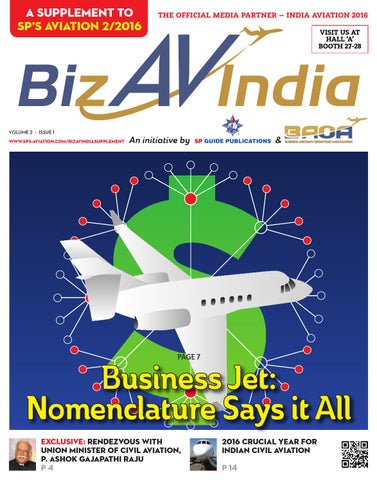
On the cover: An office in the sky. Functional interior of a Airbus Corporate Jet. Cover illustration by Anoop Kamath
messagE 3 from Jayant Nadkarni President, Business Aircraft
9 Essential Business Tool 10 Tool for Inclusive
Growth drivers Sectors Driving Business 18
12 Executive Jets are a
Public-Private Partnership Revisit PPP Model for 20
Economic Growth or Rich Man’s Toy?’
Operators Association (BAOA)
Business Person’s Best Partner
exclusive
rendezvous 4 civil aviation minister open to discussions
economic tool 7 Business Jet: Nomenclature Says it All
aviation policy 14 2016 Crucial Year for Indian Civil Aviation
Jets Market
Airports
News news at a glance 22
regular economic impact departments 16 Aviation Catapults Raigarh from the editor’s desk to Next Level 2
www.sps-aviation.com/bizavindiasupplement
BizAvIndia • ISSUE 1 • 2016
1
from the editor-in-chief Publisher And Editor-in-Chief Jayant Baranwal Assistant Group editor R. Chandrakanth Advisory Board Jayant Nadkarni, President, BAOA Group Captain R.K. Bali (Retd), Managing Director, BAOA Chairman & Managing Director Jayant Baranwal Planning & Business Development Executive Vice President: Rohit Goel ADMINstration & COORDINATION Bharti Sharma design Creative Director: Anoop Kamath Designers: Vimlesh Kumar Yadav, Sonu Singh Bisht Research Assistant: Graphics Survi Massey SALES & MARKETING Director: Neetu Dhulia General Manager Sales: Rajeev Chugh SP’s websites Sr Web Developer: Shailendra P. Ashish Web Developer: Ugrashen Vishwakarma © SP Guide Publications, 2016 Advertising neetu@spguidepublications.com rajeev.chugh@spguidepublications.com SP GUIDE PUBLICATIONS PVT LTD A-133 Arjun Nagar, (Opposite Defence Colony) New Delhi 110003, India. Tel: +91 (11) 24644693, 24644763, 24620130 Fax: +91 (11) 24647093 E-mail: info@spguidepublications.com Owned, published and printed by Jayant Baranwal, printed at Kala Jyothi Process Pvt Ltd and published at A-133, Arjun Nagar (Opposite Defence Colony), New Delhi 110 003, India. All rights reserved. No part of this publication may be reproduced, stored in a retrieval system, or transmitted in any form or by any means, photocopying, recording, electronic, or otherwise without prior written permission of the Publishers.
Angst in business aviation circles, time for government to act Dear Readers, Though the Civil Aviation Ministry seems to have begun in right earnest on reforming the sector, there still exists a lot of frustration among the many aviation stakeholders as cutting into the bureaucratic red tape is next to impossible. The perception in government circles that business aviation is for the rich man and does not contribute to economic development is a factor which is a major stumbling block in the growth of business aviation. But one thing for sure, all the experts in the industry are stating that, first and foremost, the perception about business aviation, that it is a rich man’s toy, has to go. It is a business productivity tool. Unless this gets drilled into their heads, the policies and execution will continue on the path it has been going on and this does not augur well for anyone. Expressing angst is the former President of the BAOA, Rohit Kapur who has seen the functioning of the bureaucracy from close quarters. In an article on how this year would be crucial for civil aviation, Kapur is candid when he says “nothing could be more deceptive than to feel that the state of the industry is healthy”. Airlines may be returning to profitability, riding on low fuel prices, but there is a lot that these airlines and the sector needs to get it right, while the government should create an ecosystem for growth. “A nurturing approach with sensible policies will take us right up to the sky. On the other hand, if the government does not do right now, we can stare at another wasted decade, as the last decade has been.” This is indeed ominous. Similarly, we have in this issue Group Captain R.K. Bali (Retd) asking for a relook on the public-private partnership (PPP) model for the airports in Delhi and Mumbai, if these airports have to act as facilitators to the airline, general aviation and business aviation sectors. We hope that saner sense will prevail and the sector flourishes. And mind you, the winner will also be the government which can see business aviation’s tangible contribution to the economy. The India Aviation event happening at the Begumpet Airport, Hyderabad, from March 16 to 19 is expected to set the tone for things to come. Welcome aboard and do visit us at Booth 27-28 in Hall ‘A’ at India Aviation 2016 !
J. Baranwal Editor-in-Chief
2
BizAvIndia • ISSUE 1 • 2016
www.sps-aviation.com/bizavindiasupplement
RELENTLESS JOURNEY OF EXCELLENCE SINCE 1964
message from President, BAOA
president
Business Aircraft Operators Association
MESSAGE It's that time of the year again. BizAvIndia Conference and Awards time! Being held on March 15, 2016, in Hyderabad. These events are still quite young – this is just the second BizAvIndia yet. But given the feedback received after the maiden event held last year in Bengaluru, this year’s BizAvIndia promises to be an even more exciting and informative event. As most of you know, BizAvIndia consists of twin events—a Conference (focused on business aviation affairs) and an Awards Evening (focused on recognising excellence and achievements by operators and individuals). We also get together as an industry and instil the feeling of camaraderie that we’re all in it together. Indeed, there is no other platform in India so focused towards business aviation as BizAvIndia is. At the risk of repeating myself, I would like to say that BAOA stands by its commitment to keep evolving to include the concerns of all personnel involved in business aviation in our country. Give us time for this. How old are we after all? Well, BAOA is five years old this March! Our formation was in March 2011. Ever since then we have come a long way, although we fully agree that we still have a long way to go. To that end, we are constantly soul-searching and course correcting ourselves. Please also feel absolutely free to e-mail your suggestions and comments to us at feedback@baoa.in and they will be looked into. One big moment, or rather small moment, for us has been February 29 when the Union Budget completely overlooked us. We had worked hard with the Ministry of Civil Aviation, but now realise that this effort needs to be more broad based across ministries. The need of the hour is not to lose heart. We still have the new National Civil Aviation Policy under formulation. Although, it’s quite possible that we will be ignored again (despite the strongest representations from BAOA). We do have a very receptive and open Ministry of Civil Aviation, however clearly, the big optics for the government is to address the 5/20 rule (where rival airline groups are slugging it out in full media glare), getting the remote connectivity mechanism in place, enabling MROs to take root and so on…the big optics! But one thing is for sure—that once these bigger priorities get addressed, it will be our turn next. In the meantime, we will utilise every platform and channel available to change the perception of business aviation, and to show to the government that they need not also wait. They can easily usher in high growth in business aviation, which will only further create growth, jobs and give a booster dose to the economy. Indeed, these effects will not just be within business aviation, but across sectors such as trade, tourism and myriad benefits to local economies. So the final beneficiary is also the common man! That’s not so intuitive to grasp. But that is the perception we all need to change. More on these efforts will be seen by you in the coming days. Watch this space. I would like to end by congratulating SP’s Aviation for bringing out this excellent publication– BizAvIndia, which is proving to be a great platform to air our views! Happy landings.
Jayant Nadkarni President, Business Aircraft Operators Association
www.sps-aviation.com/bizavindiasupplement
BizAvIndia • ISSUE 1 • 2016
3
exclusive
rendezvous civil aviation minister
Industry is welcome: Union Minister of Civil Aviation, P. Ashok Gajapathi Raju during the interaction
PHOTOGRAPH: Neetu Dhulia / SP Guide Pubns
Open to Discussions Jayant Baranwal, Editor-in-Chief of BizAvIndia (accompanied by Neetu Dhulia) had an exclusive rendezvous with the Union Minister of Civil Aviation, P. Ashok Gajapathi Raju, during the second half of January this year. The interaction included wide ranging subjects pertaining to India’s civil aviation scenario. Some of them were the general and business aviation,regional connectivity and MRO industry. Excerpts:
4
BizAvIndia • ISSUE 1 • 2016
www.sps-aviation.com/bizavindiasupplement
OUR SIGHTS ARE SET HIGHER B U S I N E SSAI RCR AF T. BO M BAR DI E R .CO M
Bombardier, Learjet, Challenger, Global and The Evolution of Mobility are trademarks of Bombardier Inc. or its subsidiaries. Š 2016 Bombardier Inc. All rights reserved.
rendezvous civil aviation minister mro will bring industry to india
Baranwal: I believe the draft policy sounded very friendly to the industry – what all have been the plans to enable the growth in the MRO segment? Minister: MRO is one place where India has a lot to benefit. If we are able to bring in the policy, we will get the industry into India. Right now $700 million of Indian business is going to Singapore, Dubai, Sri Lanka and when you interact with them they are giving few things, one is the service tax and customs for the Government of India. We interacted with the finance and customs; they wanted time for spare parts to be changed to three years instead of one year right now. Currently, they get it, and if they consume it within one year and they don’t have to pay the duty. They are asking for three years time and in informal consultations, they seem to understand the problem. Also, the states will have to come out with their VAT problem, so if the Government of India does that, then probably this industry might move to states which are friendly. In Delhi, everyone is trying to bring down the ATF, the Delhi Government has hiked it to five per cent. So like that you do have things happening. MRO will help us to get back business to our country, with it our ‘Make in India’ will become more vibrant, we are working on that. ga/ba open to discussions
Baranwal: It will save lot of money outflow from the country. Regarding general aviation and business aviation, the industry still feels that they are being treated as a stepchild?
Minister: Why not if they can raise anything and I am sure we will look into it. Dhulia: Could we be instrumental in bringing them together for a discussion? Minister: If you are willing to send the ideas across we can try to understand them and then if we find it necessary we can always interact, after all we are Indians, we are not different countries warring with one another. So general aviation feels like a stepchild, why is that I need to know? GA/BA taxation
Baranwal: The level of taxation they say on the aircraft is very high unlike any country in the world. Minister: Yes, that must be there, because generally scheduled airlines are given benefit because they are understood to be the common man’s way of transport. General aviation has probably given this impression that it is only rich man’s transport and that impression stays. So anyway whatever it is, they might be having other applications also, and we need to look at that. Baranwal: Yes other applications, the business expansion, moving from one point to the other, like a business tool, contributing back to the economy. Minister: Ultimately, aviation benefits from the economy. It also gives back to the economy. In that sense, aviation in general terms is
General aviation has probably given this impression that it is only rich man’s transport, and that impression stays... they might be having other applications also, and we need to look at that (issues such as taxation).
Minister: General aviation is interesting; we got some of their reactions. Why is it that, what is it they want, what is it we can do? Like if they say I want parking in a place like Mumbai, it is already congested. Like they say I don’t mind parking in a place like Bhopal, for instance, you have 12 aircraft you can park simultaneously, no problem 12 big ones. What is this they exactly want? Neetu Dhulia (Dhulia): If they come up with requisite solutions, would you be open to it? Minister: My god! I will welcome everybody. Why should I say no for it? Dhulia: Would you welcome if the industry jointly wants to come and voice their thoughts? Minister: You see voicing is okay, I even put the draft policy on the Internet and requested, please respond whether we agree or disagree. We can always agree on something and disagree on another thing, but we have to understand your problem. Dhulia: If they raise the problem and seek support, would the government look into it addressing the issues?
6
BizAvIndia • ISSUE 1 • 2016
that. Because, the economy appears to have behaved, your growths are there, otherwise it would not have been. the `2,500 cap
Minister: Regarding “Regional Connectivity”, I told you already that this one is in the manifesto, we are kind of looking at it like a sacrosanct thing. That is why it’s in the policy we are looking at the certain suggestion which excited the thinking of many people, won’t it be possible to pay for an hour of flying at `2,500. Baranwal: There has been some debate on that `2,500 cap. Minister: It’s not a cap, it’s not a floor, it’s a suggestion. Caps and floors are dangerous. Regional connectivity is what you are thinking. The Airports Authority of India (AAI) itself has about 30 airports unserved, even today. Now how do you start a service there? Otherwise, it’s a non-performing asset; we want them to become performing assets because they will contribute to the economy. How to do that, that’s the thing anyway, the work is going there. BAI
www.sps-aviation.com/bizavindiasupplement
RELENTLESS JOURNEY OF EXCELLENCE SINCE 1964
ECONOMIC TOOL
Business Jet: Nomenclature Says it All There is a perception among many, particularly those in government circles that business jets are for the rich and famous with no contribution to the economy. This is far from the truth
ILLUSTRATION: Anoop Kamath
By R. Chandrakanth
www.sps-aviation.com/bizavindiasupplement
BizAvIndia • ISSUE 1 • 2016
7
Economic tool
A
luxury yacht or a Lamborghini are certainly a rich man’s toys. They do not add any business value in any way to either the individual or the business enterprise. They are personal choices. A business jet also is a personal choice of an individual or a corporate entity, but it certainly adds value to the individual or to the business enterprise, as the case may be. By its nomenclature, ‘business jet’ it is self-explanatory. Nevertheless, there is a perception among many, particularly those in government circles that business jets are for the rich and famous with no contribution to the economy. This is far from the truth. This perception exists even in the United States which has the highest concentration of business jets and the most number of exclusive general aviation airports in the world. So one can imagine, how those in the government in India could be reacting to jet ownership. While it is true that the aviation industry in general and business aviation in particular has cracked the market by first targeting the rich, but over the years has extended its reach to the vast middle class. While commercial airlines, with proliferation of low-cost airlines, have almost shed that image, business aviation is still strapped with this perception, though there are umpteen surveys which have shown how they (business jets) are in fact business tools. Misconception
Sanjay Julka, Vice President of Business Aircraft Operators Association (BAOA), in a blog has aptly stated that it is indeed ironic that an industry where a `100 spend on aviation can result in `325 worth of total benefits for the country or where 100 direct jobs in aviation can result in 610 jobs overall (source: draft National Civil Aviation Policy 2014-15) is today facing a negative growth in the business aviation sector. The misconception, he writes, is also the prime reason why, despite positive pre-budget indications, the Minister of Finance Arun Jaitley in the last hour, failed to cut customs duties on private aircraft and give tax benefits to MROs. “Had he delivered on the market sentiment, almost all woes of this lagging industry would have fallen into place. The pilot project of the new government, ‘Remote Area Connectivity’ would have also taken off in the right earnest. Yet again, the misconception – business aviation for the elite ruled over.” Various industry associations have been using several platforms to drive home the point that business aviation is part of an economic activity. In fact, it is not that these law makers do not know about it. Many of them use general aviation/business aviation during elections or when they have to go to places quick and fast and where scheduled airlines may not have connectivity. But yet, when it comes to backing the general aviation/business aviation sector they hesitate. It is the case everywhere. The President and CEO of the US National Business Aviation Association (NBAA) Ed Bolen has in an article mentioned how it is important for stopping the political gamesmanship and mischaracterisations when it comes to business aviation and to give US companies every tool in their arsenal to compete globally.
Reaching multiple locations easily
“For many companies, having a business aircraft means the ability to quickly fly non-stop to virtually any destination in the country or the world, reach multiple locations in much shorter periods of time and use the time in between productively. Even in the Internet age, face-to-face communication is still the most effective way to open markets and solidify business relationships. That is particularly true in certain emerging markets. And, by necessity, the airplane has become not only a flying office but also sleeping and eating quarters since employees are expected to arrive prepared to jump directly into meetings with their counterparts. “As a result, for businesses, an aircraft is as much of a necessity as a computer. That’s why when a company buys its own aircraft it depreciates in the same way as other comparable business investments, including cars, trucks, bulldozers and computers. “Yet some in Washington are trying to score political points by characterising business aviation as a convenience, or even a luxury, rather than a necessary tool for competitiveness.” The US general aviation manufacturing industry is responsible for 1.2 million jobs and having more than $150 billion in economic impact. In India, the business aviation sector is not as gigantic as in the US, but it certainly has created thousands of jobs and has contributed in its own way to economic development. Outperform non-aviation users
NBAA studies have indicated that companies that utilise business aircraft outperform non-aviation users in several important financial measures, including annual earnings growth, stock and dividend growth, total share price, market capitalisation and other financial yardsticks. From an environment perspective, business aviation has a small carbon footprint and an exemplary environmental record. Aviation emissions are only a tiny fraction of all transportation emissions, and business aircraft emissions are a small portion of those. The industry has a long history of continually leveraging technology to minimise noise and emissions, while improving safety and efficiency. The NBAA study pointed out that only about 3 per cent of the approximately 15,000 business aircraft registered in the US are flown by Fortune 500 companies, while the remaining 97 per cent are operated by a broad crosssection of organisations, including governments, universities, charitable organisations and businesses – large, medium and small. Business aviation reaches 10 times the number of US airports (over 5,000 public-use facilities) than the airlines do. The majority of US airline flights only go to and from 70 major airports, and the total number of US destinations served by air carriers has declined. Business aircraft flights account for just 4 per cent of the total traffic at the busiest airports used by the commercial airlines. In India, there are 476 airports of which only 70 are in use and the general and business aviation sector has been asking the government to open up these airports for them by providing adequate infrastructure. However, the government’s priorities are first commercial airlines and now they are talking about regional airlines.
By necessity, the airplane has become not only a flying office but also sleeping and eating quarters since employees are expected to arrive prepared to jump directly into meetings with their counterparts
8
BizAvIndia • ISSUE 1 • 2016
www.sps-aviation.com/bizavindiasupplement
Economic tool
RELENTLESS JOURNEY OF EXCELLENCE SINCE 1964
Essential Business Tool Bombardier Business Aircraft is confident that with India’s growing economy, the business community will rely on private aviation as an essential tool to their continued success and development
B
aircraft, maximising their productivity ombardier Business Aircraft while en route to their destination. (BBA) has been campaigning In many instances, business aviain different countries on how tion is the most suitable transportabusiness jets help in growth tion solution for smaller communities, of businesses, whether it is a opening the door to global commerce by large corporation or a start-up. Studies linking them directly to larger populahave indicated how business jets rather tion centres and manufacturing facilicontribute constantly to the economic ties. The ability to easily access smaller growth of a country, one by connecting airports in regions not served by large regions under-served or un-served by commercial airlines allows travellers to scheduled airlines. fly directly or as close to their destinaBombardier Business Aircraft is Bombardier Global 5000 tion as possible, cutting down on ground confident that with India’s growing transportation, lengthy layovers and economy, the business community will connections in busy aviation hubs, and costly rely on private aviation as an essential tool to overnight stays in hotels. their continued success and development. With these advantages, business aircraft further enhances Bombardier states that business aviation is an essential part of national transportation systems around the world. It is also key to the diversity and growth of regional economies, such as in India, the success of corporations, both large and small, thereby contribut- which has shown a commitment to private aviation through its investment in infrastructure and by its efforts to reduce regulatory ing to the growth of global economies. Private aviation provides a flexible and cost-effective solution hurdles. Efforts are on among civil aviation authorities and groups, that connects people and businesses locally and around the world. such as the Business Aircraft Operators Association (BAOA), to With commercial air travel becoming increasingly demanding, busi- create a favourable environment for the sector’s growth, ensuring ness aviation offers the flexibility to commute efficiently and with better coordination among industry stakeholders, regulatory auease. Business jet travellers can meet, plan and work aboard the thorities and the government. BAI
PHOTOGRAPH: Bombardier
Transporting men and material
Business aircraft have a safety record that is comparable to that of the major airlines. Business aviation enables companies to safely transport tools and materials that cannot be carried aboard airlines. The sectors that can easily transport equipment, though not huge, along with passengers are mining, pharma, etc. It is interesting to note how business aviation is flourishing in the US, though there are efforts to tax them unduely. Reports indicated that about 59 per cent of the companies operating business aircraft have fewer than 500 employees and seven in 10 have less than 1,000 employees. Business aircraft users have a dominant presence on ‘best of the best’ lists for the most innovative, most admired, best brands and best places to work, as well as dominate the lists of companies strongest in corporate governance and responsibility, revenue growth and market share, indicating that business aviation is the sign of a well-managed global company.
www.sps-aviation.com/bizavindiasupplement
Many companies use business aircraft to transport personnel and priority cargo to a variety of far-flung company or customer locations, including sites overseas. Business aircraft often are used to bring customers to company facilities for factory tours, product demonstrations or sales presentations. Companies and individuals, such as salespeople and doctors, use business aircraft to cover regional territories within several hundred miles of their home bases. While the overwhelming majority of business aircraft missions are conducted on demand, some companies have scheduled operations, known as ‘shuttles.’ NBAA has listed the reasons why organisations use business aviation to meet their transportation challenges include: Saving employee time: Efficient employee scheduling and employee time-savings are possible because business aircraft Continued on page 13
BizAvIndia • ISSUE 1 • 2016
9
economic tool
Tool for Inclusive Economic Growth or Rich Man’s Toy? The government has to appreciate the fact that a business aircraft is owned not because of the money one has but due to the undisputed need to do one’s business efficiently in the remote areas of the nation By Group Captain R.K. Bali (Retd) Managing Director, Business Aircraft Operators Association
B
usiness Aviation (BA), whether undertaken through private ownership (FAA Part 91) or through non-scheduled ‘on demand charters’ as part of public air transportation segment (FAA Part 135), has always been considered as enabler of sustainable and inclusive economic growth in developed countries. The United States has remained the leader in BA around the world and, continues to maximise its benefits to remain the leading economy of the world with efficient hinterland connectivity. In fact, it is air connectivity through a strong BA industry, and not so much the road/rail connectivity that has been the reason for the super economic power that US is today. Air connectivity is much simpler to achieve than road or rail connectivity. Just a small strip of 3,000 to 5,000 feet would connect a remote location with the rest of the world and that too by the most flexible, efficient and faster means of transportation. The US policy planners understood the importance of BA more than half a century back and the nation today has over 60 per cent of the total number of BA aircraft in the whole world. The robust BA industry of the US would make sure the country retains its position as the dominant economic power of the world for decades to come.
BA in Big Economies of Asia
Geographically, the importance of air connectivity in India and China is comparable to the US. Both are big economies with large land mass. In the beginning of the current century, BA developed faster in India compared to China. However, notwithstanding the Chinese army’s firm control over airspace in China, there has been much faster growth of BA there since 2007. Whereas, in India the misplaced perception, in some minds, that ‘business aircraft is a rich man’s tool’ led to imposition of unfair and illogical customs duty on aircraft import for BA industry. It was not surprising, thereafter, to witness the plummeting number of business aircraft in India coupled with the nation’s economy growing at 7-8 per cent and struggling to achieve its potential of 9-10 per cent growth. While the infrastructure for BA at major cities would take five to 10 years of time to get addressed, the irrational customs duty should not be continued due to wrong perceptions in some minds.
10
BizAvIndia • ISSUE 1 • 2016
Growth of Remote Areas due to BA
While Alaska in the United States is a shining example of how BA can contribute to the growth of a region, there are cities in India’s less developed states of Chhattisgarh and Jharkhand which owe their industrial development to BA. The draft National Civil Aviation Policy (NCAP 2015) rightly emphasises on development of regional/remote connectivity and cites ICAO’s study on output multiplier and employment multiplier effects of 3.25 and 6.10 respectively. However, its focus remains within the narrow boundaries of ‘affordable air travel for masses’. It is important to understand that demand for passenger traffic would only grow after industrialisation and development of the regional/remote areas. In fact, if BA growth is facilitated in the remote areas, the proposed viability gap fund (VGF), to be provided by the government, would be needed for much less period than 10 years mentioned in the draft NCAP 2015. Rural development being given the main thrust in the recent union budget, it is the high time for the government to look at BA through the prism of industrialisation and development of remote areas rather than the misconceived perception of rich businessman’s toy. BA not just for Industrialists
It is not at all fair to consider BA being used for movements of just the owners of big business houses. BA today is being used worldwide to facilitate modern commercial practices. The problem with airlines of ‘big cities connectivity’ and ‘fixed schedule’ aside, business aviation offers companies the quickest, most flexible and reliable means to transport parts and personnel at a very short notice. Even in India today some of the most utilised BA aircraft are those assigned to corporate shuttle duty. At times operated on a schedule these aircraft provide skilled employees’ quick, easy and efficient access to company’s facilities with minimal disruption to a workday. It is also well known that many big industrialists travel between metros and big cities by scheduled airlines due to convenience and reliability. They do not find it worthwhile to use business aircraft at metro airports due to restrictions imposed on take-off/landing slots and parking. Finally, the government has to appreciate the fact that a business aircraft is owned not because of the money one has but due to the undisputed need to do one’s business efficiently in the remote areas of the nation. BAI
www.sps-aviation.com/bizavindiasupplement
SAFETY FIRST Jet Aviation Maintenance and Refurbishment Services You can count on Jet Aviation’s 50-plus years of industry experience whether you need a routine inspection, heavy maintenance and repair, refurbishment, or the technical expertise of our round-the-clock AOG team. Strategically located around the world, our repair stations are staffed by technicians trained in all major airframes. Keeping your aircraft safe and operational is our No.1 priority at every Jet Aviation facility. You can count on us.
Visit our global MRO locations: Basel, Boston/Bedford, Dubai, Geneva Hong Kong, Jeddah, Moscow Vnukovo Singapore, St. Louis, Vienna www.jetaviation.com/maintenance
ECONOMIC TOOL
Executive Jets are a Business Person’s Best Partner Embraer Executive Jets is committed to India’s business aviation sector and has a solid customer support and services network Claudio Camelier, Vice President, Sales in Asia-Pacific and the Middle East, Embraer Executive Jets
A
s India’s economy grows and its business aviation sector develops, Embraer Executive Jets is ready to provide the broadest portfolio of jets in the world to meet every need of India’s business community. Executive jets provides business people the added mobility they need to help them travel when they need to, when they want to. In respected forecasts, reports and analysis, it is acknowledged that a confluence of regulatory acceptance, commitments to strengthen the country’s aviation infrastructure and a revival in economic growth will result in an unprecedented boost to India’s business aviation sector. Using Embraer’s home country as an example, the business aviation sector developed in Brazil because business people and corporations saw the importance of being able to com-
mute within the vast lands of Brazil and the region efficiently and effectively. It is important to note that this growth will not be restricted to the rich and famous. Rather, like the mature business aviation markets in North America and Europe, the main beneficiaries of this success will be small, medium and large-sized companies—entities that will be the chief contributors to the economic growth expected in the coming years. We also need to consider the positive effects a growing business aviation sector will have to businesses that support it. As a business productivity tool, executive jets offer an unrivalled efficiency and are able to directly reach markets across India in much shorter transit times than commercial airplanes, trains or automobiles. Executive jets also provide a flexibility and convenience that
PHOTOGRAPHs: Embraer
Embraer Executive Jet fleet
12
BizAvIndia • ISSUE 1 • 2016
www.sps-aviation.com/bizavindiasupplement
economic tool allows individuals to travel where they want to and when they want to, providing individuals the ability to have more time at home with their families. Embraer has an understanding of business aviation that combines its Brazilian heritage with expertise as one of the world’s leading manufacturers of commercial jets. In 2016, we mark our 11th year into the executive jets business, leveraging on our 46-year manufacturing history, and we are fast approaching our 1,000th executive jet delivery this year. Our understanding of this business jets industry is clearly illustrated by our portfolio of seven executive jets types we offer – from the entry-level Phenom 100E to the ultra-large Lineage 1000E. Across these categories, our aircraft are designed to reflect traits that time-pressed individuals view as important in an executive jet: reliability, performance, ease of maintenance, design, largest cabin and baggage space in each category. We tick all these boxes, and these are
RELENTLESS JOURNEY OF EXCELLENCE SINCE 1964 affirmed not just by us, but by our customers too. Embraer Executive Jets is committed to India’s business aviation sector and has a solid customer support and services network consisting of multiple Embraer Authorised Service Centres, Field Support Representatives based in India and Embraer’s Customer Support and Services organisation in Singapore – Embraer AsiaPacific’s regional headquarters. There is also a Regional Distribution Centre in Singapore that manages the inventory of spare parts and distributes it to locations where it is needed. On top of that there is a 24-hour Customer Contact Centre at Embraer’s headquarters in Brazil that is always ready to ensure Embraer’s customers receive prompt and comprehensive support. We believe in the potential of India’s business aviation sector and we are committed to providing them a reliable business productivity tool that can help our customers flourish and drive India’s economy forward. BAI
Continued from page 9 have the ability to fly on demand and non-stop between smaller airfields that usually are closer to a traveller’s destination than a major airport. Increasing traveller productivity, safety and security en route: When travelling on business aircraft, passengers can meet, plan and work in a secure office environment, free from interruptions and distractions, which enables them to discuss proprietary information without fear of eavesdropping, industrial espionage or physical threat. Travellers can strategise before meetings and debrief afterwards or conduct meetings en route. Also, many aircraft are outfitted with advanced communications technologies – including phones, e-mail and Internet access – that enable travellers to remain in constant contact throughout their flight with colleagues on the ground. Most importantly, business aircraft are engineered and built to the highest standards and are typically flown by two-person professional crews, all of which has enabled business aviation to achieve a safety record comparable to that of the major airlines. Reaching multiple destinations quickly and efficiently: Companies that need to reach multiple destinations in a single day use business aviation because that type of mission is nearly impossible to accomplish using any other mode of t ransportation. Accessing communities with little or no airline service: Business aviation serves 10 times the number of US airports (more than 5,000) than commercial airlines (about 500). The ability to use smaller, less congested airfields located closer to one’s final destination is a vital part of the utility and flexibility of business aviation aircraft. It means companies can stay or establish plants or facilities in the growing number of small towns or rural communities with little or no commercial airline service. Scheduling predictability: About 3 per cent of all commercial airline flights are cancelled, but nearly one quarter more are delayed. If a commercial flight cancellation or delay causes passengers to miss an airline connection, the odds of getting on the next flight are substantially reduced. Also, some companies are located in towns with very low frequencies of airline flights, leaving company employees with few or no alternatives if a flight is cancelled. These types of con-
www.sps-aviation.com/bizavindiasupplement
cerns over delays or cancelations are virtually non-existent on business aircraft. Supporting the travel needs of many types of company employees: Surveys in the US have indicated that over 70 per cent of passengers aboard business airplanes are non-executive employees. Companies often send teams of employees to a given destination on a business aircraft because it is the most cost-effective means of transport. Moving vital equipment: When companies need to immediately ship sensitive, critical or outsized equipment, business aviation is often the best solution. Exercising management control over scheduling: The neartotal scheduling flexibility inherent in business aircraft – even changing itineraries en route – can be a powerful asset. Business aircraft can arrive and depart on the passengers’ schedule, typically waiting for them in the ordinary course of business. Thus, meetings can be moved up, back or extended without penalty, risk or unnecessary scheduling pressures. In today’s business environment, companies need to be nimble. Business aviation provides flexibility for companies that need to ensure employees can respond quickly to changing demands and circumstances. Minimising non-business hours away from home: Business aircraft enable flexible scheduling and quick and easy access to meeting locations, thereby minimising time away from home and office. Providing a return to shareholders: Studies have confirmed that companies that use business aviation to solve their transportation challenges return more to shareholders than companies in the same industry that do not utilise business aviation. Supporting humanitarian and charity efforts: Business aviation supports people and communities in crisis by flying people with illnesses to centres for treatment, transporting blood and organs to hospitals, connecting military veterans with their families, and providing emergency relief services to victims of natural disasters. Indeed, it is time that the powers that be looked at the various benefits mentioned and give business aviation the necessary impetus like any other industry without any discrimination. BAI
BizAvIndia • ISSUE 1 • 2016
13
AVIATION POLICY
2016 Crucial Year for Indian Civil Aviation What is being seen today is the result of a windfall of low global oil prices, the spillover effect of Kingfisher’s demise, and an overall increase in economic activities, getting more number of people to fly By Rohit Kapur
I
f there is one thing the entire Indian civil aviation industry awaits, it is the announcement and the implementation of the new National Civil Aviation Policy (NCAP) 2016. This has been ‘work in progress’ for so long, that it’s possible that some of the key functionaries have even forgotten as to why it was needed to start with! We do have an aviation industry that is growing at a CAGR of approximately 15 per cent for the past two years, so all seems to be well with the industry. We keep hearing statements as to how India will be third largest aviation market by 2020, or the largest by 2030, depending on which industry body is saying it. However, nothing could be more deceptive than to feel that the state of the industry is healthy. It would be a huge folly on part of the government to be carried away by stated numbers and pat themselves on the back for a job well done. And here are my reasons why.
PHOTOGRAPH: KARTHIK KUMAR
Macro environment status quo
Balance sheet of all airlines do not reflect any increase in efficiency, or any change in the macro environment to show any fundamental shift towards sustained profitability. What is being seen today is the result of a windfall of low global oil prices, the spillover effect of Kingfisher’s demise, and an overall increase in economic activities, getting more number of people to fly. One small air pocket will get them into a tailspin of losses again. No long-term plan seems to be emerg-
14
BizAvIndia • ISSUE 1 • 2016
ing for Air India, and it still continues to be in heavy losses (`2,500 crore for 2015-16, as per some news items) and the last choice for flyers, who have the option of flying something else (read non-government employees!). With the advent of new airlines such as Vistara and AirAsia, competition is going to increase, especially if the NCAP allows them international flying rights, thereby putting pressure on the bottom line of most airlines. Delhi and Mumbai Airports in trouble
The two main private airport operators, that is DIAL (Delhi International Airport Limited) and MIAL (Mumbai International Airport Limited), continue to be under severe financial stress and are heavily leveraged. Despite Indian airports being one of the most expensive in the world, these companies have not been able to reign in their inefficiencies to become profitable companies. The Airports Authority of India (AAI), which is a minority stakeholder for both the Delhi and Mumbai airports, continues to be a silent partner, interested only in getting its share of the profit, and with no further responsibility towards these airports. Going forward, the day is not far away when these companies will need major government bail outs to keep the airports operating, and the government will not have any other choice at that stage. A longterm policy for making these airports efficient and increasing their revenue stream, without increasing the cost of flying is the need of the hour. I don’t see any serious discussion happening on this.
www.sps-aviation.com/bizavindiasupplement
RELENTLESS JOURNEY OF EXCELLENCE SINCE 1964
AVIATION policy Secondary airports
Mumbai’s secondary airport at Navi Mumbai is a paradox which I do not know who can answer for? Despite the present government being in the saddle for almost two years, and also with a favourable government in Maharashtra, this decision is still nowhere near. By past experience, the tendering process can take years and execution several more. Even if things move now, this new airport is not going to be available for the next five-seven years to say the least. Meanwhile, the city is choking for want of more space at the airport. Similar case is of the second airport in Delhi. While we keep discussing the ridiculous 150 km rule, we fail to understand that planning for the new airport needs to be done at least five to seven years before this airport reaches congestion, rather than after it does that. Has anyone done some number crunching to figure out as per present growth figures, when DIAL will reach its congestion? I fail to understand as to how we can dream of becoming a major aviation industry, without having airports where we can operate out of. Regional connectivity in India is an idea which is about two decades over due. Despite following the failed Route Dispersal Guidelines (RDG) for airlines for decades now, the government policy has failed to develop a healthy regional network due to poor infrastructure, high costs and unfriendly policies towards regional players. The policy of coercing major airlines to also connect intra cities has not worked at all, and it is time that the government encourages the smaller and regional airlines to carry this out. The NCAP addresses this issue to a large extent, but there are still too many gaps to make it viable for small players who are going to risk their capital to do this. The state governments also need to step in with tax holidays, interest free capital and guarantees of underwriting of seats in the formative years. The establishment of the Regional Connectivity Fund is a great idea. However, it need not be charged as a cess to all travelling passengers. Surely, if the national carriers are released from their obligation of flying on unprofitable routes, they can definitely be told to contribute towards this fund. The state governments cannot be absolved of their share of contributions too. There are ways and means to find the resources, once the decision is made. Long-term infrastructure planning for aviation is still lacking. It was heartening to hear the Finance Minister speaking of developing 150 to 160 airports for improving regional connectivity. However, this needs careful planning and execution to ensure that the airports that are developed are also put to use for improving connectivity. AAI has to work in close coordination with the state governments, and develop airports only in those states where the state government is willing to extend all concessions to encourage regional connectivity. But besides development of these airports, we hear of no plans for developing the heliport infrastructure in the country. One Pawan Hans’ helipad at Rohini in Delhi and another one in Juhu, Mumbai, is all that we have to boast of after 68 years of independence. Helicopters are one of the biggest economic enablers in most countries. Besides promoting tourism, connecting remote areas, saving lives
and increasing efficiencies in utility roles, it adds to the GDP of the country. It is not understood as to why the government continues to remain apathetic towards this segment. The mindset of most government bodies still remains as per the year when the Aircraft Rules were last written, that is, in 1937. Indian aviation is one of the most overregulated industries in the world, besides probably some African countries. For any industry to grow, it needs to be set free from outdated shackles, and the ‘Inspector Raj’ under which is presently suffocating. It still takes eight months to buy an aircraft, and probably another six months to make it operational. The Directorate General of Civil Aviation (DGCA) oversight is fully subjective and manual, and susceptible to individual whims and fancies of inspectors and officials. The monetary stress of operators is of no concern to them, and unless this mindset changes, we cannot progress. We need to decide whether we are mature enough to be the third largest aviation industry in the world by 2020, or whether we are not mature enough to go there yet. If we want to grow, a collaborative approach needs to be adopted by the regulator to ensure that the operator is able to fly safely and profitably. Both have to go hand in hand. The Civil Aviation Authority, which was mooted by the previous government, seems to have died a natural death, even though everyone agreed that it was the need of the hour. Unless, civil aviation is steered by people who have domain knowledge, we will continue to bumble along, waiting for the next US Federal Aviation Administration (FAA) downgrade to happen. My last point is on the much discussed 5/20 rule. Except a few airlines who stand to have increased competition, there is no one who doesn’t agree that this needs to go. It is a restrictive and biased rule, which probably had its use when it was implemented, but in today’s time is totally out of sync with modern aviation. The Prime Minister and Minister of Civil Aviation are both on record to say that it will be replaced. What is disappointing that it has been allowed to simmer for too long and a decision has not been taken. We still continue to debate on it, and allow various vested interests to assign ‘reasons’ to why it should stay. The government must revoke this rule urgently and allow free market forces to decide who wants to fly where. Restrictions can be laid down on new airlines to ensure that major percentage of their aircraft are dedicated to the domestic market in the initial few years, gradually allowing them increased forays into international destinations. It doesn’t seem rocket science to me. And even it is rocket science, even that has experts, right? To sum up, I would like to state this is a very crucial period as to how the Indian aviation industry will develop over the next few decades. A nurturing approach with sensible policies will take us right up to the sky. On the other hand, if the government does not do the right thing now, we can stare at another wasted decade, as the last decade has been. I hope it is the former. BAI
Except a few airlines who stand to have increased competition, there is no one who doesn’t agree that 5/20 rule needs to go. It is a restrictive and biased rule, which probably had its use when it was implemented, but in today’s time is totally out of sync with modern aviation.
www.sps-aviation.com/bizavindiasupplement
Rohit Kapur is Managing Director, Arrow Aircraft and former President of Business Aircraft Operators Association.
BizAvIndia • ISSUE 1 • 2016
15
economic impact
Aviation Catapults Raigarh to Next Level The Indian Railways brought industrialisation. Aviation can bring economic supremacy. By Sanjay Julka Vice President, Business Aircraft Operators Association
ILLUSTRATION: Anoop Kamath, Google Earth
Attracting healthy investment: By virtue of its airport, Raigarh was quick to showcase the investment opportunities to visiting foreign investors and dignitaries, attracting investment
16
BizAvIndia • ISSUE 1 • 2016
www.sps-aviation.com/bizavindiasupplement
RELENTLESS JOURNEY OF EXCELLENCE SINCE 1964
economic impact
H
that distinguishes one from another, is the availability of a 6,500 sq ft airfield in Raigarh. Though a private airfield, the Raigarh population at large uses it. Many other industrialists have chosen to start their business and open factories within the Raigarh district due to the accessibility that the airport provides. In the year 2012, at least five new industries acquired land to establish their factories, giving rise to thousands of jobs. The district administration has also used this airport to their strategic advantage and benefited from the quick connectivity this airport provides, helping them effectively carry out their responsibilities. Growth comparison of Raigarh with the neighbouring JanjgirChampa district and town is given below. While the industrialisation and growth of Janjgir Champa has restricted to along railway line and river, in the case of Raigarh, the growth is far spread out to 10 to 15 km away. By virtue of its airport, Raigarh was quick to showcase A view from the sky: A satellite view of Raigarh city the investment opportunities to visiting foreign investors and dignitaries, attracting healthy investment. The government needs to replicate the Raigarh model at other locations in India, by promoting the growth of business aviation. “One mile of railway track contributes in connecting one mile on earth whereas one mile of airstrip contributes in connecting 1,000 miles on the earth. BAI
istorically, natural factors such as mineral resources, source of clean water, etc. were the major influencers in the growth of a town. Among the man-made factors, industry is the biggest factor that promotes growth of an economy, bringing with it related benefits such as electricity, better schools, improved amenities, etc. Industrial development in India was triggered when the British set up the railway system to improve transportation. The impact of connectivity was multi-fold and this impact has since become the primary reason why railways and roadways are considered to be the biggest infrastructure industries of India. Traditionally, government policies have been designed to support these aforementioned sectors. However, the aviation industry which also deserves an ‘infrastructure status’ has been largely ignored and underestimated.
Raigarh
Raigarh town is one of the oldest and important towns of Chhattisgarh state. It is situated on the Howrah-Mumbai main line of the South-Eastern Railway. On this very line, in between Raigarh and Raipur, (the capital of Chhattisgarh), is situated another district, the Janjgir-Champa. Raigarh and Janjgir-Champa are both equally rich in minerals, and while being located on the same railway line next to each other and having adequate water (both towns are located on river banks), the only factor
Brief industrial profile of Raigarh and Janjgir-Champa by MSME Development Institute, Raipur, Ministry of MSME, Govt of India (Year 2012) Raigarh District Area Adiministration
Janjgir-Champa District
5,431 sq km
3,672 sq km
5 Subdivisions, 9 Tehsils, 1 Sub-Tehsil, 9 Panchayat Samitis, 702 Gram Panchayats and 1,457 Revenue Villages
5 Subdivisions, 10 Tehsils, 232 Patwari circles, 9 Panchayat Samitis, 576 Gram Panchayats and 913 Revenue Villages
Urban population
14,93,627
16,20,632
Main district highway in km
1,546
981
Beds in allopathic hospitals
908
430
54
10
2,209
1,847
25
16
Commercial banks Primary schools Colleges Technical university
1
0
Total industrial units
9,699
1,296
Total micro and small enterprises
9,735
1,226
74
90
Potential for new MSMEs (micro, small and medium enterprises)
www.sps-aviation.com/bizavindiasupplement
BizAvIndia • ISSUE 1 • 2016
17
GROWTH DRIVERS
Sectors Driving Business Jets Market After air charter companies, it is the infrastructure and construction sector which owns quite a number of aircraft and has become a key driver of private aircraft sales in India By R. Chandrakanth
ILLUSTRATION / Photograph: Anoop Kamath
Key driver of private aircraft sales: Infrastructure and construction sector owns quite a number of aircraft
18
BizAvIndia • ISSUE 1 • 2016
www.sps-aviation.com/bizavindiasupplement
GROWTH DRIVERS
T
he Bellary-Koppal region in Karnataka is a dusty region. But at one time, it was known for three things – mining, jeans manufacture and private jets. And all the three have taken a hit. Mining is in doldrums and mine owners, who at one time showed off their Land Rovers and private jets are in deep trouble since the government banned illegal mining in Karnataka some years back. At one time the region had two private airports, eight helicopters and six aircraft. Only MSPL, iron ore mining company, is holding on to its P-180 Avanti II aircraft and Santosh Lad has a Fokker 50. The mining baron Janardhan Reddy had his assets seized including his helicopter. At one time it was called the ‘private aircraft capital’ of India. That is a thing of the past. Be that as may, but these private aircraft were needed for these companies as they were located in backward regions which had poor connectivity by road and rail. These companies ferried in buyers, investors and others to the mining sites in their private jets. Mining, like the oil and natural gas sector, remained one of the drivers for private aircraft, be it a fixed-wing or a rotary. For the offshore drilling, helicopters are a must. The Oil and Natural Gas Corporation (ONGC), the public sector enterprise, uses extensively aircraft to ferry its executives, VIP visitors, and others to the drilling sites on sea. ONGC, which has a stake of 49 per cent in Pawan Hans Ltd, uses helicopters.
RELENTLESS JOURNEY OF EXCELLENCE SINCE 1964 of time is wasted on transit,” he said. The aircraft is not a luxury but a necessity since it helps save time. More companies which have their businesses spread out and invariably in backward regions with poor transportation connectivity are looking at owning private aircraft. One of the advantages they find in having an aircraft is that it meets their travel needs and when the company is not using it, they also outsource their aircraft, thus making money from idle time. The President of Business Aircraft Operators Association (BAOA) Jayant Nadkarni states that businesses such as automotive, pharma, mining and construction sectors are buying aircraft and giving it to thirdparty operators for operations. Awaiting liberal policies
Right now the business aviation segment is awaiting for a push in reforms such that aircraft acquisition becomes easier. Rohit Kapur
Infracon is major buyer
But now after charter companies, it is the infrastructure and construction sector which owns quite a number of aircraft and has become a key driver of private aircraft sales in India. Take B.G. Shirke Construction and Technology it has one King Air C90; two Hawker 800XP; one Bell 407 and one Super King Air B200. The housing giant DLF has a Gulfstream GIV and Agusta AW 139; GVK Projects has one Agusta 109E and Falcon 2000DX; GMR Group has one Falcon 2000E, Bell 412 and Hawker 750; Hiranandani has one Sikorsky 76C; L&T Aviation has two Hawker HS125 900XP; Punj Lloyd has one Gulfstream G200; SKB infracon has one King Air C90A, Mandke & Mandke Infrastructure has one Robinson R; Sobha Puravankara has Gulfstream G200 and there are few more such buys. In the the steel sector there is Jindal Steel and Power Limited which has one Cessna 560XL; Indian Metals and Ferro Alloys Ltd has one Cessna Citation CJ2. The Reliance group owns one ACJ319115CJ; two Falcon 900EX; Global Express BD700 Global 6000 and two Sikorsky S76C. Flying to tourist destinations
The tourism sector is one which is also finding renewed interest from vendors of private jets and helicopters. The Taj Group has got three jets – Falcon 2000; Falcon 2000LX and Piaggio P180 Avanti II; the East India Hotels (Oberoi group) has one Hawker 850XP; and Bharat Hotels (Lalit) has one Beechcraft Super King Air B300 and one helicopter Agusta 109S Grand. Jewellers picking up planes
Another trend we witness is that major jewellers are looking at private jets. The big jewellery retail chain of Joyalukkas (Joy Jets) has one Phenom 100 and a Phenom 300. Also from Kerala is Kalyan Jewellers which has acquired three aircraft – Phenom 100, a Bell 427 helicopter and now an Embraer Legacy 650 executive jet. The Chairman and Managing Director T.S. Kalyanaraman said on these acquisitions, “Most of the towns where we have showrooms and places where we are planning to open stores, don’t have direct flights and lot
www.sps-aviation.com/bizavindiasupplement
Phenom 100E owned by jewellery retail chain Joyalukkas
former President of BAOA and Managing Director of Arrow Aircraft Sales & Charters Pvt Ltd, has pointed out how one has to navigate a minefield before one really gets to acquire an aircraft in India. In fact at this point of time, there is a wee bit of interest in the private jet market after having gone through turbulent times in the recent past. The reverse was happening when private aircraft from India were getting sold outside. Rohit Kapur mentions that in financial year 2015, about 10 private jets and helicopters were sold and the previous year too, about 19 aircraft were sold outside India. The buys were few. With the present government there is hope that it will ease policies such as to boost the business aviation segment which hitherto has received stepmotherly treatment. BAI
BizAvIndia • ISSUE 1 • 2016
19
Public-Private Partnership
Revisit PPP Model for Airports The mandatory 10 years review time has arrived and there are good reasons to thoroughly review the Master Plans at the Delhi International Airport Limited and Mumbai International Airport Limited on a case to case basis, to ensure success of MoCA’s ambitious plans on regional connectivity scheme as stated in the draft National Civil Aviation Policy. By Group Captain R.K. Bali (Retd) Managing Director, Business Aircraft Operators Association
photograhs: GVK, Anoop Kamath
General Aviation Terminal at Chhatrapati Shivaji International Airport, Mumbai
20
BizAvIndia • ISSUE 1 • 2016
www.sps-aviation.com/bizavindiasupplement
RELENTLESS JOURNEY OF EXCELLENCE SINCE 1964
public-private partnership
I
tion at Indian airports for SCA. It is n the year 2006, the two hoped that the Master Plan review of busiest airports in India were DIAL would be closely scrutinised by restructured through the joint MoCA and AAI to ensure that develventure route for modernisation opment of infrastructural requireand development. The Operaments for RCS and GA/BA are duly tion, Management and Development taken care of in a pragmatic and costAgreement (OMDA), as approved by effective manner. the then Union Cabinet was signed between the Airports Authority of India (AAI) with the major partner Infrastructure for RCS & GA/ in the joint venture company (JVC). BA at MIAL OMDA, in para 8.3.5, provides for Contrary to existing adequacy of submission of the initial Master Plan land at Delhi, MIAL’s constraints by JVC, within six months of execuon land availability are well known. Interior view of Delhi International Airport tion of the OMDA, through AAI for its At the time of signing the OMDA in review and comments by the Minis2006, the alternate international try of Civil Aviation (MoCA). OMDA further states, in the same para, airport at Navi Mumbai was expected to come up by 2017. Howevthat the Master Plan must be updated and resubmitted to the AAI for er, this second major airport near Mumbai is still a distant dream. its information and to the MoCA for its review and comments peri- Therefore, it is important that the existing scarce land at MIAL is opodically, every ten years. There is even a mention of more frequent up- timally and flexibly utilised to ensure that reasonable infrastructure dates at shorter intervals based on traffic growth or any other reason- is available for RCS and GA/BA operations. MoCA and AAI need to able cause. The mandatory 10-years review time has arrived and there scrutinize MIAL’s existing Master Plan to further reduce the already are good reasons to thoroughly review the master plans at the Delhi grossly inadequate infrastructure for GA/BA there. While there International Airport Limited (DIAL) and the Mumbai International would be challenges ahead at Mumbai till Navi Mumbai comes up, all Airport Limited (MIAL) on a case to case basis, to ensure success of the stakeholders need to aim at revising the Master Plan at MIAL in MoCA’s ambitious plans on Regional Connectivity Scheme (RCS), as a transparent and business-like manner. stated in the draft National Civil Aviation Policy (NCAP 2015).
Importance of DIAL & MIAL for RCS & GA/BA
The Way Forward
The MoCA plans to promote growth of Scheduled Commuter Airlines (SCA) for efficient regional connectivity. Though metro to metro flights won’t be part of the RCS, metro to any designated regional/ remote destination would be operated by SCA to meet its obligation as regional/remote airline. Growth of passenger traffic at DIAL and MIAL being the highest during the last ten years, it is natural to expect many RCS flights to originate from Delhi or Mumbai. Further, Delhi being the national capital and Mumbai the commercial capital, General Aviation/Business Aviation (GA/BA) flights would operate in greater numbers in the coming years from DIAL and MIAL, given the projected economic growth figures of India as being the highest amongst large economies. Therefore, the 10-year review of Master Plan, due now, for DIAL and MIAL, should pragmatically consider providing for focused development of infrastructure for RCS and GA/BA at both these major metros. However, there is a need to carefully consider the availability of land and prevailing circumstances separately at these airports. Development of RCS & GA/BA infrastructure at DIAL
In the coming years, DIAL should be able to provide adequate infrastructure for the expected number of RCS and GA/BA flights. While it important to optimally use and develop all land resources in India, DIAL has adequate land for the projected growth of scheduled and nonscheduled traffic. The draft NCAP 2015 states that MoCA would coordinate with airport operators and AAI to ensure adequate space alloca-
www.sps-aviation.com/bizavindiasupplement
The Kelkar Committee report on revisiting and revitalising the public-private partnership (PPP) model for infrastructure projects rightly pitches for pragmatism, transparency and a business-like approach for all the stakeholders. The idea that PPP contracts, like OMDA, must focus on service delivery rather than fiscal benefits and, further that we need improved fiscal reporting practices, is spot on. In tandem, we need better monitoring and constant review of the projects to ensure these achieve the real purpose conceived behind PPP model. The Kelkar Committee also noted that airports have garnered much PPP resources and suggested a unified regulatory structure for the sector notified. Specifically in aviation sector, it is important to clearly distinguish between all aeronautical and non-aeronautical services. The OMDAs of DIAL and MIAL, drafted for the first time for airports, caused some unnecessary and unexplained confusion in private airport operators’ mind on difference between aeronautical and non-aeronautical services at the airport. However, the subsequently enacted Airport Economic Regulatory Act (AERA) in 2008 has clearly defined the aeronautical services at an airport. The 10-year review is the right time for the government to, once for all, remove this confusion, especially for hangars ‘used for carrying out maintenance operations to ensure continuous airworthiness of the aircraft’ by the operators and ‘ground handling’ (GH) services, in accordance with provisions at para 2(vii) of AERA Act. We need to ensure OMDAs remain aligned with the stated purpose and spirit behind PPP model in infrastructure sector for ensuring optimal growth of aviation industry as a whole. BAI
We need to ensure OMDAs remain aligned with the stated purpose and spirit behind PPP model in infrastructure sector for ensuring optimal growth of aviation industry as a whole
BizAvIndia • ISSUE 1 • 2016
21
news at a glance
Embraer Phenom 300, most-delivered business jet for three years in a row
T
he Embraer Phenom 300 was the most-delivered business jet in the world in 2015 for the third consecutive year, with 70 aircraft received by customers around the globe. “We would like to thank our customers for their confidence and continuing relationship, which has enabled the Phenom 300 to enjoy successful acceptance worldwide since its launch,” said Marco Tulio Pellegrini, President & CEO, Embraer Executive Jets. “The Phenom family’s design was based on the highest industry requirements, combining the attributes of a best-in-class aircraft. To have the most-delivered business jet in the world for the third consecutive year is a true recognition that we have achieved our commitment to design game-changing products to meet operators’ needs.” Recognised as one of the most desirable light jets by fractional programmes, charter services, corporate flight departments and owner-pilots, 320 Phenom 300s are in operation in 28 countries. To date, the fleet has accumulated close to 3,00,000 flight hours. The Phenom 300 also was the most-delivered business jet in 2013 and 2014. The General Aviation Manufacturers Association recently released its 2015 worldwide year-end aircraft shipment and billing report, which showed Embraer Executive Jets’ market share had grown to 17 per cent in terms of unit deliveries. In 2015, Embraer’s executive aviation division delivered 120 aircraft, including jets in the Phenom, Legacy and Lineage families, the highest number in five years. The Phenom 300 performs among the top light jets, with a high speed cruise of 453 knots and a six-occupant range of 1,971 nautical miles (3,650 km) with NBAA IFR reserves. With the best climb and field performance in its class, the Phenom 300 costs less to operate and maintain than its peers. The aircraft is capable of flying at 45,000 feet (13,716 metres), powered by two Pratt & Whitney Canada PW535E engines with 3,200 pounds of thrust each.
The Phenom 300 offers a spacious cabin, designed in partnership with BMW Designworks USA, and the largest baggage compartment in its category. The largest windows in the class deliver abundant natural lighting in the cabin as well as in the private lavatory in the back of the aircraft. The comfort of the seats, with recline and full movement capability, is enhanced by the best pressurisation among light jets (6,600 ft. maximum cabin altitude). The Phenom 300 features distinct temperature zones for pilots and passengers, a wardrobe and refreshment centre, voice and data communications options, and an entertainment system. BAI
Textron Aviation launches PowerAdvantage for Beechcraft King Air and Cessna Caravan turboprops
Photograph: Embraer
T
extron Aviation has expanded its PowerAdvantage engine support programme to Beechcraft King Air and Cessna Caravan turboprop platforms. Part of the company’s ProAdvantage suite of support programmes, PowerAdvantage offers owners and operators comprehensive PT6A engine coverage with predictable costs for both routine and most unscheduled engine maintenance events. “ProAdvantage programmes are the leading support programmes in the industry and have been designed to provide customers lower, predictable ownership costs, while enhancing aircraft values through comprehensive factory-direct maintenance. Through PowerAdvantage, customers receive a cost-competitive support solution and are easily able to forecast costs related to en-
22
BizAvIndia • ISSUE 1 • 2016
gine maintenance,” said Brad Thress, Senior Vice President, Customer Service. “The combination of PowerAdvantage, ProParts and ProTech creates a powerful support solution for our King Air and Caravan customers, further enhancing their ownership and operating experience.” Customers enrolled in PowerAdvantage pay a competitive hourly rate per engine operating hour and receive coverage for line maintenance parts, scheduled and most unscheduled engine events, all parts and shop labour for hot section inspection (HSI) and overhaul, and can include coverage for life limited components and repairs by Textron Aviation’s industry leading mobile response teams. The programme also provides rental engines for overhauls and most unscheduled events. BAI
www.sps-aviation.com/bizavindiasupplement
news at a glance
RELENTLESS JOURNEY OF EXCELLENCE SINCE 1964
Gulfstream airborne support completes 5,000th mission
G
ulfstream Aerospace Corp recently completed its 5,000th airborne support flight, achieving the milestone more than 13 years after Gulfstream launched business aviation’s first airborne maintenance and support service in May 2002. The Gulfstream Field and Airborne Support Teams, otherwise known as FAST, use two dedicated aircraft to deliver flight-essential parts and technicians to operators in North America, Central America and the Caribbean. The service, which has accumulated more than 16,600 flight hours and 8 million nautical miles since its inception, operates 24 hours a day, seven days a week. The airborne support element of FAST comprises two G150 aircraft, more than 50 technicians and pilots and a support team of more than 230 people. FAST also includes support vehicles throughout the US and Europe, including a 74-foot (22.6-metre) tractortrailer based in Savannah, seven custom-equipped trucks and a custom-equipped van. Along with the airborne unit, which went on more than 580 missions and accumulated 2,378 flight hours in 2015, FAST has a ground unit that includes 12 dedicated maintenance engineers who can be dispatched by airplane, train, automobile or
van from their bases in Europe, Asia and the Middle East to resolve maintenance issues. BAI
PhotographS: Gulfstream
JETNET names Gulfstream as top business aviation brand in Asia-Pacific
G
ulfstream Aerospace Corp today announced at the 2016 Singapore Airshow that its Asia-Pacific fleet continues to grow, reflecting the company’s position as the top-rated brand in the region. JETNET’s latest iQ Report, published quarterly, lists Gulfstream first in its Brand Reputations of Aircraft Manufacturers survey for Asia-Pacific. “Our brand reputation in Asia-Pacific is second to none and that is reflected in our fleet, which has doubled in size from 142
www.sps-aviation.com/bizavindiasupplement
aircraft in 2010 to 289 at the end of 2015,” said Roger Sperry, Regional Senior Vice President, International Sales, Asia-Pacific, Gulfstream. “That’s an average of more than 29 deliveries a year. We continue to welcome new customers who want to leverage the performance, comfort and reliability of our aircraft to expand their business interests around the world.” The company’s fleet in South East Asia has doubled over the past five years to more than 60 aircraft. Nearly 25 of those aircraft are based in Singapore. As sales in the region increase, Gulfstream continues to invest in regional support and services for operators while also realigning the resources it’s had in place for several years. “There is considerable Gulfstream expertise and knowledge among the staff at Jet Aviation Singapore and the US-based Gulfstream technicians we rotate through there,” said Mitch Choquette, Vice President, Customer Support, Gulfstream. “This enhanced partnership with Jet Aviation benefits customers throughout the region, giving them a world-class service resource in South East Asia.” Approximately $65 million in parts are positioned in Singapore, Hong Kong and Beijing. Thirty-one-year-old company veteran Jim Gallagher, who recently joined the Asia-Pacific support team as Director, Customer Support, said parts distribution in Asia-Pacific has been a focus of the organisation. Gulfstream’s Asia-Pacific presence also includes companyauthorised service centre Jet Aviation in Hong Kong and companyauthorised warranty facilities Metrojet in Hong Kong; ExecuJet in Sydney and Melbourne, Australia; JAMCO in Sendai, Japan; and Air Works in Mumbai, India. BAI
BizAvIndia • ISSUE 1 • 2016
23
news at a glance
Cessna Citation Latitude obtains EASA certification
C
essna Aircraft Company, a subsidiary of Textron Aviation Inc., a Textron Inc. company, announced its Cessna Citation Latitude midsize business jet has received certification from the European Aviation Safety Agency (EASA) with deliveries underway in the region. “We are thrilled to offer the Citation Latitude to our European customers,” said Kriya Shortt, Senior Vice President, Sales and Marketing. “This aircraft is ideally suited for this market and can provide customers non-stop access to key destinations throughout the continent as well as North Africa and the Middle East. Customer input was a key driver in the development of the Latitude, which brings the amenities of large cabin aircraft at a midsize acquisition price and best-in-class operating costs. With a maximum range of 5,278 km (2,850 nautical miles), the Latitude can easily fly non-stop from locations throughout Europe such as London to St. John’s or Lisbon to Moscow. It also recently received certification to operate into and out of La Mole Airport – a popular European vacation destination in St. Tropez, France. The Latitude joins a short list of aircraft able to operate at La Mole, which requires this special authorisation due to the strict aircraft performance requirements, dense terrain and heavy airport traffic at the airport. Throughout the past year, three Latitude demonstrator aircraft have been on a worldwide tour, travelling to more than 20 countries and stopping at major industry trade shows such as the European Business Aviation Convention & Exhibition (EBACE), Latin American Business Aviation Conference & Exhibition (LABACE), the Dubai Airshow and most recently the Business Aviation Convention and Exhibition in Las Vegas.
With a flat floor and six feet of cabin height, innovation abounds with unique features designed throughout the aircraft. Cessna’s wireless cabin-technology system provides connectivity and entertainment to each passenger through their personal electronic devices. Improving cabin comfort for passengers and crew alike, the Latitude features a new cabin cooling system and a new pressurisation system, which provides a 5,950-foot cabin altitude at the aircraft’s maximum operating altitude of 45,000 feet. With standard seating configurations, the Latitude can comfortably accommodate up to nine passengers. BAI
Jet Aviation continues to grow aircraft management fleet in Asia
J
PhotographS: Textron Aviation, Jet Aviation
et Aviation has grown its aircraft management fleet in Asia to 31 aircraft, noting steady growth in the region. Jet Aviation’s aircraft management in Asia now stands at 31 aircraft, including four Gulfstream G650, nine G550, seven G450 and two G200; one Bombardier Global Express, three Global 6000, two Global 5000 and a Challenger 605; a Dassault Falcon 900LX and a Falcon 7x. “Our fleet is growing at a stable, manageable rate including an increasing number of longer-range aircraft,” says Daniel Helfenstein, Managing Deputy and Director of Key Accounts for the company’s aircraft management operation in Hong Kong. “With the opening of Jet Aviation’s new MRO operation in Macau midyear complementing our locations in Hong Kong and Singapore, we are now able to offer our managed customers more options to better serve their needs.” Jet Aviation’s 24/7 aircraft management and charter operation in Hong Kong was honoured at the inaugural Asian Business Aviation Association (AsBAA) 2015 Gala Awards event in November 2015, where it received AsBAA’s Best Management Company Industry Award. BAI
24
BizAvIndia • ISSUE 1 • 2016
www.sps-aviation.com/bizavindiasupplement
“In a country like India with limited support from the industry and market, initiating 50 years ago (in 1964) publishing magazines relating to Army, Navy and Aviation sectors without any interruption is a commendable job on the part of SP Guide “ Publications. By this, SP Guide Publications has established the fact that continuing quality work in any field would result in success.” Narendra Modi, Hon’ble Prime Minister of India (*message received in 2014)
Rethink Convention.