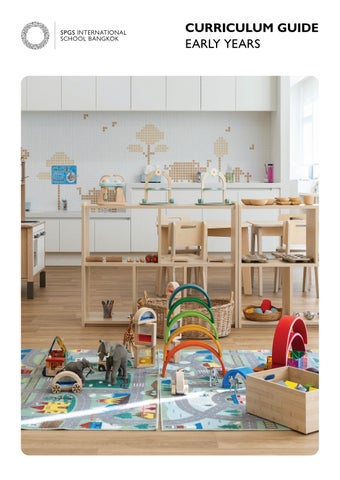
CURRICULUM GUIDE EARLY YEARS
VISION An Education Rich in Meaning and Possibility
MISSION We nurture a deep respect for diverse people, perspectives, and cultures, grounded in the Thai values that shape our school. Our students develop their own passions and strengths as they learn the importance of teamwork, integrity, leadership, and community, so that they can build a more sustainable and peaceful world. A lifelong love of learning is cultivated through a rich, expansive curriculum with opportunities for meaningful scholarship and co-curricular engagement. Our students learn to think independently, act with compassion, and approach personal and global challenges of tomorrow with creativity, resilience, and confidence, whilst caring for themselves and others.
CORE VALUES
Our values shape every aspect of school life, from the way students learn and lead, to how they treat one another and engage with the world beyond the classroom. Rooted in the ethos of St Paul’s Girls’ School, and thoughtfully interpreted for an international community, these values provide a shared language and a strong moral compass, guiding students as they grow into confident, principled and compassionate young people. At SPGS International School Bangkok, values are explicitly taught and lived by everyone in the community. You will see them in the words and actions of our students and staff rather than as words displayed on classroom walls.
KINDNESS AND COMPASSION
PATIENCE AND PERSEVERANCE
Kindness is shown in both large and small acts without the expectation of anything in return. It is underpinned by thoughtfulness and empathy. Compassion comes from a deeper understanding of the situation of others and a wish to make the school community and the world a better place.
In an impatient world, we sometimes need to wait, to take our time, and to remember that some things take time to do well. Mistakes and failure are a vital part of learning, so students are given the strength to keep going when things are difficult. It is when patience and perseverance are combined that real success becomes possible.
RESPECT AND HUMILITY
CREATIVITY AND CURIOSITY
Respect is a broad concept that extends to people, places and ideas. Students learn the value of respect for everyone in a community and how to disagree with courtesy and integrity. With this comes the humility to accept that we are not always right and that with success comes responsibility.
Curiosity ensures that we ask good questions, explore ideas and never take anything for granted. Creativity is celebrated not only in the arts, but in problem-solving, innovation and intellectual risk-taking in all areas, nurturing a lifelong love of learning and discovery.
CONTENTS Junior School Welcome From The Head of Junior School Junior School Overview How We Live and Learn
6 7 8
Early Years Welcome from the Head of Early Years Learning in The Early Years Learning in The Early Years Characteristics of Effective Learning Areas of Learning and Development Curriculum Structure and Organisation Preparing for Key Stage 1
10 11 13 14 15 17 18
Life in the Early Years A Typical Day A Typical Week Specialist Learning Learning Enrichment Wellbeing and Pastoral Care
20 21 24 27 26
Assessment and Reporting Assessment for Learning Reporting to Parents Home Learning
28 29 30
Enrichment Enrichment Through the Curricular Learning Enrichment
32 33
JUNIOR SCHOOL
5
WELCOME FROM THE HEAD OF JUNIOR SCHOOL
JAY THOMPSON Head of Junior School
It is my pleasure to welcome you to SPGS International School Bangkok, a truly people-centred community where learning is limitless, inspiring, and deeply connected to both heart and mind. Our school is shaped by 120 years of St Paul’s Girls’ School excellence, ensuring that every child benefits from a world-renowned culture of intellectual curiosity, creative self-expression, and exceptional pastoral care. At the heart of our Junior School is a belief that every child is unique and capable of shaping the world around them. We provide a learning environment where individuality is valued, relationships are prioritised, and children are encouraged to explore their interests, express themselves with confidence, and develop growing independence. A rich co-curricular programme, alongside thoughtful daily structures and strong pastoral support, helps every child to feel connected, supported, and inspired to participate fully in school life. Our curriculum is designed to foster curiosity, agency, and deep understanding. Beginning with play-based learning in the Early Years and developing into an inquiry led, concept driven approach in the Junior School, children are supported to become active participants in their learning. Through rich learning experiences that spark imagination and creativity, students are encouraged to ask questions, make connections, and think critically about the world around them. Learning is carefully designed to provide both challenge and support, enabling all children to develop resilience, independence, and a lasting love of learning.
Our teachers build strong relationships with each child, enabling a deep understanding of their academic, social, and emotional development. This allows for a responsive and personalised approach, ensuring that all students feel supported, challenged, and known. We believe that children thrive when they feel safe, valued, and genuinely understood, and we are committed to creating an environment where every learner can flourish. Our aim is to create a community where every child feels a strong sense of belonging and is inspired to grow with confidence, purpose, and curiosity. I look forward to working in close partnership with families to nurture each child’s learning journey and to support every student to thrive both within and beyond the classroom. As you explore this guide, I hope you gain a meaningful sense of the warmth, ambition, and care that define our Junior School community and the rich learning experiences that shape life at SPGS International School Bangkok.
6
JUNIOR SCHOOL OVERVIEW The Junior School welcomes children from Pre-Nursery to Year 6, aged 2 to 11, and includes the Early Years, Key Stage 1 and Key Stage 2. In the Early Years, children develop confidence, independence and curiosity through exploration and relationships. In Key Stages 1 and 2, students follow an enhanced English National Curriculum, adapted to our international context. Learning is ambitious and inquiry focused, encouraging children to think deeply, ask thoughtful questions and make meaningful connections.
Age (on 31 August)
Year
2
Pre-Nursery
3
Nursery
4
Reception
5
Year 1
6
Year 2
7
Year 3
8
Year 4
9
Year 5
10
Year 6
Phase
Every student is known, valued and supported as an individual. We create a caring and inclusive environment where children feel a strong sense of belonging and are encouraged to grow in confidence, independence and curiosity. Through thoughtful challenge and ongoing guidance, we empower students to think deeply, question bravely, act ethically and use their learning to make a positive contribution to the community around them. Children are allocated to year groups according to their age on 31 August. Classes are carefully balanced by gender, attainment, nationality and character, and are reorganised at the end of Reception, Key Stage 1 and Key Stage 2. Location
School Division
Early Years
Early Childhood Centre (ECC) Junior School
Key Stage 1
Key Stage 2
Main Building
Key Contacts
7
JAY THOMPSON Head of Junior School
VICKY MEREFIELD Deputy Head Learning & Teaching
BEN GIRLING Deputy Head Pastoral
EMILY LUKE Head of Early Years
jay.thompson @spgsibangkok.ac.th
vicky.merefield @spgsibangkok.ac.th
ben.girling @spgsibangkok.ac.th
emily.luke @spgsibangkok.ac.th
HOW WE LIVE AND LEARN The SPGSI WAY The SPGSI Way underpins our approach to behaviour and helps promote a positive, compassionate, and respectful school culture. It is a shared code of conduct that all members of our community strive to follow. The SPGSI Way reflects the values that guide how we learn, work, and treat one another, and is referred to regularly throughout the school day to support and reinforce expectations. The 'I' in our SPGSI Way reminds each of us that we have a personal responsibility for the choices we make and the part we play in creating a positive school community.
S
P
G
S
SHARE KINDNESS
PRACTISE PERSEVERANCE
GROW CURIOUS
SHOW RESPECT
Scholar Habits Our Scholar Habits are linked to the school values and represent the attitudes and behaviours that help develop confident, independent learners. They are developed through everyday learning experiences, with the aim that all students learn to think deeply, question bravely and act ethically.
How Our School Values Shape The Scholar Habits Kindness & Compassion
Respect & Humility
Patience & Perserverance
Creativity & Curiosity
Act with care and responsibility
Think critically and listen thoughtfully
Embrace challenges as a pathway to growth
Explore deeply and think beyond the obvious
We consider the impact of ideas and actions on others
We express ideas clearly, listen carefully and disagree respectfully
We use knowledge to contribute positively to our community and the wider world
We evaluate evidence, recognise bias and are willing to revise our thinking
We persist when learning is difficult, refine our work and strive for excellence
We connect ideas across subjects, see patterns and understand how parts influence a whole
We reflect on how we learn and adapt our strategies to improve
We ask thoughtful questions, challenge assumptions and explore new possibilities
8
EARLY YEARS
9
WELCOME FROM THE HEAD OF EARLY YEARS
EMILY LUKE Head of Early Years
It is a pleasure to welcome you to the Early Years at SPGS International School Bangkok, where every child begins with curiosity, connection and a strong sense of belonging. The Early Years forms the foundation of the Junior School, and these first experiences of education are both powerful and enduring. During this time, children develop not only essential knowledge and skills, but also the confidence, independence and curiosity that shape how they approach learning for years to come. At SPGS International School Bangkok, We view each child as a capable and active learner. Our approach is rooted in meaningful play, rich communication and purposeful exploration, supported by highly skilled educators who understand how to extend thinking, nurture relationships and respond to each child’s individual needs. Through this, children are encouraged to question, investigate and take ownership of their learning. Our environments are intentionally structured to be calm, inviting and inspiring. They provide a balance of structure and flexibility, allowing children to explore independently while feeling secure and supported. We place great importance on creating a ‘home from home’ atmosphere, where children feel safe, valued and ready to engage fully in their experiences.
A strong connection to the natural world is embedded throughout our Early Years provision. Through regular outdoor learning and Forest School experiences, children develop resilience, confidence and a growing awareness of their relationship with the environment. These experiences support physical development and emotional wellbeing, while encouraging curiosity and exploration. We are also mindful of preparing children for an everevolving world. Alongside hands-on experiences, technology is introduced thoughtfully and purposefully to enhance learning and creativity. This enables them to explore, create and communicate with increasing confidence, while ensuring that learning remains grounded in meaningful, play-based experiences. At the heart of everything we do is a strong partnership with families. We value open communication and collaboration, recognising that children thrive when home and school work together. Through these relationships, we build a shared understanding of each child’s development and ensure that every child feels supported both in and beyond the classroom. We look forward to welcoming your child into our Early Years community, where they will be encouraged to explore, think deeply and develop a lifelong love of learning.
10
LEARNING IN THE EARLY YEARS In the Early Years, we place equal importance on what children learn and how they learn. Our approach is informed by research into child development and high-quality early education, recognising that young children learn most effectively when experiences are active, meaningful and supported by skilled adults. Children learn through purposeful play, exploration our and carefully planned teaching, all within an safe, stimulating and environment. Our approach balances child-initiated learning with intentional adult guidance, ensuring that learning responds to children’s interests while remaining ambitious and guided by clear educational goals. Play is central to our curriculum. Through play, children investigate ideas, solve problems, test theories and make sense of their experiences. They are given time to revisit their learning, develop their ideas and make meaningful connections across different areas of the curriculum. Throughout the day, children are encouraged to ask questions, reflect on their experiences, persevere when learning is challenging and take appropriate risks. Mistakes are valued as an important part of the learning process.
Skilled adults play a vital role in extending children’s thinking. By observing closely, listening carefully and responding thoughtfully, teachers provide the right balance of support and challenge. Purposeful questioning, rich conversation and sustained shared thinking introduce new vocabulary, deepen understanding and encourage children to explain, adapt and refine their ideas. Our carefully designed indoor and outdoor environments promote curiosity, independence, creativity and collaboration. Open-ended resources invite children to explore, make choices and take increasing ownership of their learning. Calm routines and secure relationships help children feel confident and ready to engage, while opportunities to solve problems and make decisions support the development of resilience, confidence and a strong sense of agency. Language underpins every aspect of learning in the Early Years. Through storytelling, conversation, role play and shared experiences, children develop the communication skills needed for academic learning, positive relationships and confident self-expression. By combining continuous provision, purposeful teaching and meaningful real-world experiences, our ambitious curriculum enables children to develop secure knowledge, skills and learning behaviours across all areas of development. This provides strong foundations for future learning and supports children in moving confidently into Key Stage 1.
11
Progression Through The Early Years Children’s development in the Early Years is supported through a carefully sequenced curriculum that builds in complexity, independence and depth over time. While each child’s journey is individual, the experiences provided across Pre-Nursery, Nursery and Reception are designed to ensure clear progression in learning and development. In Pre-Nursery, the focus is on building security, relationships and early communication. Children begin to explore their environment, engage in sensory experiences and develop confidence through supported interaction and play. In Nursery, children develop greater independence and sustained engagement. They begin to explore ideas in more depth, engage in collaborative play and use language more confidently to express their thoughts and make connections. In Reception, children demonstrate increasing confidence, independence and the ability to think more critically. They engage in sustained lines of inquiry, begin to organise their thinking and apply their knowledge across different areas of learning, preparing them for the transition into Key Stage 1.
Lines of Inquiry Learning in the Early Years is responsive to children’s interests and emerging ideas, which are developed into meaningful lines of inquiry over time. These inquiries are carefully guided by adults to ensure that learning remains purposeful and aligned with curriculum goals. Rather than following fixed topics, children explore ideas through investigation, discussion and hands-on experiences. These lines of inquiry allow children to revisit and deepen their understanding, supporting sustained engagement and meaningful learning. Examples of how inquiry may develop include: • Exploring water through pouring, transporting and investigating movement • Investigating building and construction through different materials and structures • Exploring living things through observation, care and discussion • Developing role play scenarios that reflect real-life experiences and social understanding These experiences support children in developing curiosity, problem-solving skills and the ability to make connections across their learning.
12
LEARNING THROUGH NATURE Learning in the Early Years has a strong connection to the natural world, which forms an integral part of children's learning and development. Outdoor environments are not viewed simply as an extension of the classroom, but as a dynamic space where children can explore, take risks and engage more deeply in their learning Outdoor spaces offer open-ended and often unpredictable experiences that require children to think flexibly, solve problems and collaborate with others. Through building, transporting and creating with natural materials, children develop resilience, perseverance and growing confidence. They learn to manage uncertainty, adapt their thinking and respond to challenges with increasing confidence and independence. Our Forest School forms a key part of this approach, providing sustained opportunities for children to engage deeply with the natural environment. Through weekly sessions, children develop practical skills, learn to assess and manage risk, and build a strong sense of capability and self-belief. These experiences support both physical development and emotional growth, while encouraging curiosity and exploration. Nature also provides a powerful context for inquiry. Children observe patterns, notice change and ask questions about the world around them. Through first-hand experiences, they begin to understand natural processes and relationships, making meaningful connections across their learning. Time spent in natural environments also supports wellbeing. Outdoor learning provides space for reflection, regulation and calm, helping children to develop focus and emotional resilience. It fosters a sense of connection, both to the environment and to others, which underpins a balanced and positive approach to learning. Through this approach, children gain not only physical skills and confidence, but also a lasting appreciation for the natural world and their place within it.
13
CHARACTERISTICS OF EFFECTIVE LEARNING The Characteristics of Effective Learning describe how children engage with experiences, approach challenges and develop as learners. These are not separate from the curriculum, but underpin everything that children do, shaping how they think, explore and make sense of the world. We recognise that learning is not defined solely by what children know, but by how they approach learning itself. Through intentionally structured environments and high-quality adult interaction, children are supported to develop the habits and dispositions that enable them to engage deeply and confidently with their learning.
Playing and Exploring Children develop curiosity and a willingness to engage with new experiences. They investigate, explore and show interest in the world around them, drawing on their senses and prior knowledge to make connections. Through this, they begin to initiate their own learning and make increasingly independent choices.
Active Learning Children develop peserverace focus and motivation. They learn to sustain attention, overcome challenges and experience a sense of achievement. Over time, they begin to understand the value of effort and develop the confidence to keep going, even when learning feels challenging.
Creating and Thinking Critically Children develop the ability to think flexibly, make connections and solve problems. They explore different approaches, test ideas and begin to reflect on their thinking. With support, they learn to plan, evaluate and adapt their ideas, building the foundations for deeper and more complex thinking. The characteristics of effective learning are closely aligned with our SPGS Scholar Habits. In the Early Years, children begin to: • Think Deeply through exploring ideas and making connections • Question Bravely through expressing curiosity and engaging in sustained shared thinking • Act Ethically through developing empathy, respect and positive relationships They allow children to develop not only knowledge and skills, but also the attitudes that will enable them to engage thoughtfully and confidently with future learning.
1214
AREAS OF LEARNING AND DEVELOPMENT Our Early Years curriculum follows the Early Years Foundation Stage (EYFS) Framework, which sets out seven areas of learning and development that support children’s progress during these important early years. Together, these areas provide a broad foundation for children’s learning and prepare them for the English National Curriculum in Key Stage 1.
Communication and Language Communication and language underpin all aspects of learning in the Early Years. Children are supported to develop listening and attention skills, understand increasingly complex language and express ideas with confidence and clarity. Through high-quality interactions, storytelling, discussion and role play, children develop vocabulary, sentence structure and the ability to engage in meaningful conversation. Adults model language thoughtfully, extending children’s thinking and supporting them to articulate their ideas with increasing precision.
Areas of Learning and Development
Learning Topics
Prime Areas Personal, Social and Emotional Development
• Making Relationships • Sense of Self • Understanding Feelings
Physical Development
• Moving and Handling • Health and Self-care
Communication and Language
• Listening and Attention • Understanding • Speaking
Specific Areas Literacy
• Reading • Writing • Understanding Feelings
Mathematics
• Mathematics
Understanding the World
• People and Communities • The World • Technology
Expressive Arts and Design
• Creating with Materials • Being Imaginative and Expressive
Personal, Social and Emotional Development Children develop a strong sense of self, confidence and emotional awareness. They learn to build positive relationships, manage their feelings and understand the perspectives of others. Through consistent routines, supportive relationships and carefully guided interactions, children develop resilience, independence and a sense of responsibility. These experiences support children in becoming confident learners who feel secure in their environment and able to engage fully in their learning.
Physical Development Physical development supports children in building strength, coordination and control, enabling them to move confidently and safely in a variety of ways. Through both indoor and outdoor experiences, children develop gross motor skills such as running, climbing and balancing, alongside fine motor skills required for writing and manipulation. Opportunities for movement, exploration and practical activity are embedded throughout the day, supporting both physical development and overall wellbeing.
15
Literacy Early literacy focuses on developing a love of reading, alongside the foundational skills required for writing. Children engage with a wide range of high-quality texts, stories and rhymes, fostering imagination, comprehension and enjoyment. Phonics is taught through the Monster Phonics programe progressive approach supporting children in developing early reading and spelling skills. Alongside this, children are encouraged to mark-make, draw and write for a purpose, developing confidence in how written language communicates ideas.
Mathematics Mathematics in the Early Years focuses on developing strong number sense, pattern recognition and an understanding of mathematical relationships. Through practical, hands-on experiences, children explore number, quantity, shape, space and measure. They are encouraged to notice patterns, compare quantities and solve simple problems, developing confidence and enjoyment in mathematics.
Understanding the World
Expressive Arts and Design
Children develop an understanding of the world around them through exploration, observation and discussion. They learn about people, communities, the natural world and how things work. Through real-world experiences, investigation and inquiry, children begin to recognise patterns, notice change and make connections. These experiences lay the foundations for later learning in science, humanities and technology.
Children explore creativity and self-expression through a wide range of artistic and imaginative experiences. They engage in drawing, painting, music, movement and role play, developing both creative skills and confidence in expressing their ideas. Through open-ended materials and opportunities for exploration, children are encouraged to experiment, take risks and develop their own ideas. These experiences support imagination, creativity and the ability to think flexibly.
16
CURRICULUM STRUCTURE AND ORGANISATION Learning in the Early Years is carefully planned while still remaining responsive to children’s interests, questions and ideas. Teachers observe children closely and use what they notice to plan meaningful learning experiences. They help children explore their ideas more deeply and connect their interests to important knowledge and skills. Planning is both structured and flexible. Teachers use their knowledge of child development, the Early Years curriculum and each child’s progress to decide what children should learn next. Learning builds gradually over time, but teachers can also adapt their plans when children show a strong interest in a particular idea or topic. Children may explore an idea or question over several days or weeks. These extended areas of learning are sometimes called lines of inquiry. They encourage children to ask questions, investigate possibilities, make connections and develop their own ideas. This provides an early foundation for the concept-based learning children will experience in Key Stage 1.
Continuous Provision Continuous provision refers to the learning areas and resources that are available to children each day. These may include areas for construction, creative work, role play, reading, writing, mathematics, investigation and outdoor learning. The environment is carefully organised so that children can make choices, explore ideas and practise important skills independently. Teachers regularly add new resources or challenges based on curriculum goals and the children’s current interests. Children can return to activities and ideas over time. This allows them to practise skills, test different approaches and deepen their understanding. Adults support learning by observing, asking thoughtful questions, introducing new vocabulary
Child-Initiated and Adult-Led Learning A balance between child-initiated and adult-led learning is fundamental to our approach. During child-initiated learning, children choose how and where they would like to learn. They can follow their interests, make decisions and explore ideas that are meaningful to them. This supports independence, creativity, problem-solving and concentration. Adult-led learning is planned and guided by a teacher or teaching assistant. It may include a whole-class session, a small-group activity or focused support for an individual child. These experiences allow adults to introduce new knowledge, model important skills and help children make progress across all areas of learning. Together, child-initiated and adult-led experiences ensure that learning is enjoyable and appropriately challenging.
17
PREPARING FOR KEY STAGE 1 The Early Years provides a strong foundation for children’s transition into Key Stage 1. Through a balance of play, exploration and direct teaching, children develop the confidence and learning behaviours needed to engage successfully in Year 1. By the end of Reception, children are increasingly able to: • • • • • • •
communicate their ideas, thoughts and feelings with growing confidence engage in sustained learning and maintain focus on tasks and activities work both independently and collaboratively with others approach challenges with resilience, curiosity and creativity solve problems, ask questions and think critically begin to reflect on their learning and respond to feedback manage routines and everyday tasks with increasing independence
These important skills ensure that children transition smoothly into Key Stage 1 as confident and capable learners, ready to engage more deeply with future conceptual and inquiry-led learning.
18
LIFE IN THE EARLY YEARS
19
A TYPICAL DAY Each day is carefully structured to provide a balance of child-initiated exploration, focused group learning, targeted adult-led experiences, outdoor play, storytelling, routines and opportunities for reflection. Consistent routines and consistent routines help children feel secure and confident, while flexible learning experiences allow teachers to respond to children’s interests, needs and emerging ideas throughout the day. Children experience a combination of continuous provision, adult-led teaching, shared group experiences and outdoor learning, ensuring a balance of independence, collaboration and focused learning. Opportunities for conversation, movement, creativity and play are embedded throughout the day, supporting both wellbeing and development across all areas of learning. Continuous provision forms a central part of learning across the Early Years. Children access both indoor and outdoor learning environments throughout the day, allowing them to explore, investigate, create, move and develop independence across all areas of learning. Within these extended periods of exploration, children engage in experiences including communication and language, early literacy, mathematics, creative arts, construction, sensory exploration, role play, physical development and understanding of the world. Skilled adults support and extend children’s thinking through purposeful interaction, questioning and shared exploration.
20
A TYPICAL WEEK The structure of each day provides children with a reassuring sense of consistency and security, helping them to understand routines, anticipate transitions and engage confidently in their learning. At the same time, our timetables remain intentionally flexible so that teachers can respond to children’s emerging interests, develop meaningful lines of inquiry and make the most of seasonal opportunities, special events and experiences within the wider school community. This balance allows learning to remain purposeful and well organised without becoming overly rigid. The timetables on the following pages provide an overview of how each day and week is typically organised in each year group. Specialist sessions and weekly experiences may vary slightly between classes and year groups, and adjustments may be made where this supports children’s learning, development and wellbeing.
Pre-Nursery In Pre-Nursery, the day is centred around secure relationships, exploration, and routines. Long periods of uninterrupted play allow children to develop confidence, independence and curiosity within a calm and nurturing environment. Children regularly access both indoor and outdoor learning environments throughout the day, including opportunities for sensory play, movement and outdoor exploration.
Time
Monday
Tuesday
Wednesday
Thursday
Friday
8.30 - 8.50
Soft Start
Soft Start
Soft Start
Soft Start
Soft Start
8.50 - 11.15
Indoor & Outdoor Learning Snack Time
Indoor & Outdoor Learning Snack Time
Indoor & Outdoor Learning Snack Time
Indoor & Outdoor Learning Snack Time
Indoor & Outdoor Learning Snack Time
11.15 - 11.30
Singing & Group Time
Singing & Group Time
Singing & Group Time
Singing & Group Time
Singing & Group Time
Calm Time & Storytelling
Calm Time & Storytelling
Lunch
11.30 - 12.00
12.00 - 12.30
Calm Time & Storytelling
Calm Time & Storytelling
Calm Time & Storytelling
Children move flexibly between indoor and outdoor environments throughout the morning, engaging in play-based learning and adult-supported experiences. Snack opportunities are embedded within the morning session to support social interactions and self-help skills.As children settle into school life, they will engage with a wider range of enriching experiences including movement and physical development and outdoor learning.
21
Nursery In Nursery, children continue to learn through play, exploration and social interaction, while gradually engaging in longer shared experiences and specialist learning. Children access a balance of indoor and outdoor provision throughout the day, supporting physical development, creativity, communication and inquiry across all areas of learning.
Time
Monday
Tuesday
Wednesday
Thursday
Friday
8.15 - 9.30
Soft Start, Snack & Focused Group Time
Soft Start, Snack & Focused Group Time
Soft Start, Snack & Focused Group Time
Soft Start, Snack & Mandarin
Soft Start, Snack & Focused Group Time
9.30 - 10.10
Physical Education
Drama
Thai
Music
Art & Design
10.10 - 10.30
Singing & Storytelling
Singing & Storytelling
Singing & Storytelling
Singing & Storytelling
Singing & Storytelling
10.30 - 11.20
Outdoor Exploration & Play
Outdoor Exploration & Play
Outdoor Exploration & Play
Outdoor Exploration & Play
Outdoor Exploration & Play
11.20 - 12.00
Lunch
12.00 - 13.00
Rest, Wellbeing and Play
Rest, Wellbeing and Play
Rest, Wellbeing and Play
Rest, Wellbeing and Play
Rest, Wellbeing and Play
13.00 - 13.40
Thai
Sensory Play
Sensory Play
Movement Studio
Forest School
13.40 - 14.15
Afternoon Snack Reflection & Home Time
Afternoon Snack Reflection & Home Time
Afternoon Snack Reflection & Home Time
Afternoon Snack Reflection & Home Time
Afternoon Snack Reflection & Home Time
22
Reception In Reception, children experience a balance of continuous provision, focused group learning and specialist teaching, supporting increasing independence and preparing children for the transition into Key Stage 1. Children continue to access both indoor and outdoor learning environments throughout the day, applying and extending their learning through play, inquiry and purposeful exploration. Time
Monday
Tuesday
Wednesday
Thursday
Friday
8.00 - 9.30
Soft Start, Snack & Focused Group Learning
Soft Start, Snack & Focused Group Learning
Soft Start, Snack & Focused Group Learning
Soft Start, Snack & Focused Group Learning
Soft Start, Snack & Mandarin
9.30 - 10.10
Thai
Music
Art & Design
Physical Education
Drama
Outdoor Exploration & Play
Outdoor Exploration & Play
Transition time
10.10 - 10.20 10.20 - 11.10
Outdoor Exploration & Play
Outdoor Exploration & Play
Outdoor Exploration & Play
11.10 - 11.45
Lunch
11.45 - 12.00
Transition time
12.00 - 12.20
Focused Group Learning
Focused Group Learning
Focused Group Learning
Focused Group Learning
Focused Group Learning
12.20 - 13.00
Inquiry & Learning Through Play
Inquiry & Learning Through Play
Inquiry & Learning Through Play
Inquiry & Learning Through Play
Inquiry & Learning Through Play
13.00 - 13.40
Movement Studio
Physical Education
Sensory Exploration
Forest School
Thai
13.40 - 14.30
Storytelling & Afternoon Snack
Storytelling & Afternoon Snack
Storytelling & Afternoon Snack
Storytelling & Afternoon Snack
Storytelling & Afternoon Snack
Morning free flow and snack opportunities support independence, communication and social development, while teachers adapt experiences to children’s interests and emerging ideas. Focused learning sessions may include early phonics, mathematical thinking, communication and language and collaborative discussion. Key: Specialist Teacher
23
SPECIALIST LEARNING In Nursery and Reception, specialist teaching enriches the curriculum by providing children with opportunities to explore new areas of learning through expert guidance. These experiences are carefully designed to be developmentally appropriate, engaging and aligned with the broader Early Years approach. In Pre-Nursery, children do not take part in formal specialist lessons. Instead, learning is enriched through carefully planned experiences within the classroom, shaped by specialist knowledge and guidance. Specialist teachers support the design of the curriculum and provide input into teaching and learning, ensuring that experiences such as music, movement, language and creative exploration are developmentally appropriate and purposeful. These experiences are led by the class team and are play-based, flexible and responsive to children’s needs, ensuring that learning remains rooted in exploration, interaction and secure relationships. In Nursery and Reception, specialist experiences become a more regular part of the week. These experiences extend children’s learning into new contexts, allowing them to apply and deepen skills developed within the classroom. Specialist learning complements classroom provision, enabling children to develop skills, confidence and enjoyment across a range of disciplines while maintaining a strong emphasis on exploration, creativity and participation.
Physical Education (PE) Physical Education supports the development of coordination, balance and overall physical confidence. Through a range of structured and exploratory activities, children develop fundamental movement skills such as running, jumping, balancing and throwing. Lessons encourage participation, cooperation and enjoyment of movement, supporting both physical development and wellbeing. Swimming is an important part of our PE curriculum, where children build water confidence and learn essential skills such as floating, breathing and water safety.
Forest School Forest School provides regular opportunities for children to learn through direct engagement with the natural environment. Through hands-on experiences such as den building, exploring natural materials and observing seasonal change, children develop resilience, independence and a sense of responsibility. These sessions support physical development, problem-solving and collaboration, while also fostering a deep connection to nature. Children learn to assess risk, work together and reflect on their experiences, developing confidence and a strong sense of capability.
24
Music
Art
Music provides opportunities for children to develop rhythm, listening skills and creative expression. Through singing, movement and the use of instruments, children explore sound, pattern and performance. These experiences support language development, memory and confidence, while fostering a sense of enjoyment and creativity.
Art enables children to explore a range of materials, techniques and creative processes. Through drawing, painting, modelling and construction, children develop fine motor skills and the ability to express their ideas visually. Open-ended exploration is encouraged, allowing children to experiment, take creative risks and develop confidence in their own ideas.
Drama Drama supports children in developing confidence, communication and imagination. Through storytelling, role play and performance, children explore characters, emotions and narratives. These experiences enhance language development, social understanding and the ability to express ideas through both verbal and non-verbal communication.
25
WELLBEING AND PASTORAL CARE Children’s emotional wellbeing is central to their ability to learn. In the Early Years, we believe that children flourish when they feel safe, valued and genuinely connected to the adults and environment around them. Nurturing relationships form the foundation of our practice. Through responsive interactions, consistent routines and a carefully considered environment, children are supported to develop emotional regulation and a strong sense of belonging within the school community. Adults play an active role in helping children to recognise and express emotions, navigate social situations and develop positive relationships with others. We recognise that emotional development is deeply connected to learning, and we place high importance on creating an atmosphere where children feel secure enough to explore, take risks and develop independence. Where additional support is needed, teachers work closely with families and specialist staff to ensure that every child feels, supported and able to engage successfully in school life.
26
ASSESSMENT AND REPORTING
27
ASSESSMENT FOR LEARNING Assessment in the Junior School reflects our non-competitive academic ethos. Its purpose is to develop a clear understanding of each child’s learning, recognise their strengths and identify the next steps that will support continued progress. Assessment focuses on individual growth rather than comparison with others. In the Early Years, children’s development is monitored across all areas of learning. Teachers use assessment information to plan appropriate learning experiences, identify next steps and ensure that each child receives the support or challenge they need. This helps teachers build a clear picture of each child’s learning journey, while recognising that development in the Early Years does not always follow a steady or predictable path. Assessment is ongoing and takes place in a variety of ways. Some of the main approaches are outlined below.
Observational Assessment Teachers regularly observe children during play, conversations, interactions and planned activities. These observations help them build a well-rounded picture of each child’s interests, strengths, development and learning needs. Teachers use what they notice to inform planning and provide experiences that are appropriate, engaging and suitably challenging. As assessment takes place throughout the day, teachers can adjust their teaching and the learning environment in response to children’s needs.
In-the-Moment Assessment In-the-moment assessment takes place as children are learning. Teachers respond immediately to children’s ideas, questions and actions, using conversation, modelling and carefully chosen questions to extend their thinking. This responsive approach allows adults to adapt their support as learning unfolds. Feedback is immediate and forms a natural part of play, conversation and shared experiences. This helps children make connections, develop their ideas and deepen their understanding in ways that are meaningful and appropriate for their stage of development.
Parent Engagement We provide regular opportunities for families to engage directly with their child’s learning through stay-and-play sessions, workshops and school events. These experiences enable parents to observe classroom practice, understand our Early Years approach and participate meaningfully in their child’s learning. Families can also follow learning as it develops through photographs, observations and updates shared in each child’s learning journal on the Toddle App. This provides a valuable window into children’s experiences, interests and progress throughout the year.
28
REPORTING TO PARENTS Strong communication with families is an essential part of our approach. Parents are kept informed about their child’s learning, development and wellbeing through regular updates, parent–teacher conferences and written reports.
Parent-Teacher Conferences Parent–teacher conferences provide dedicated time for families and teachers to discuss each child’s learning, development and wellbeing. Teachers share observations, celebrate progress and explain the next steps that will support continued growth. Families are also encouraged to share their own insights, questions and observations from home. This two-way conversation helps teachers and parents develop a shared understanding of each child and work together to support their confidence, happiness and progress. Reporting Throughout The Year Term 1
Term 2
Term 3
Parent-Teacher Conferences (PTC) Settling-in Report
Parent-Teacher Conferences (PTC)
End of Year Report
Written Reports Written reports provide a clear and balanced picture of each child’s learning, development and wellbeing. They reflect our Early Years philosophy by celebrating individual strengths, recognising progress over time and identifying meaningful next steps, rather than comparing children with one another. Written Reports Settling-in Reports
End of Year Reports
Attendance & Punctuality
Attendance & Punctuality
How your child has settled into the environment and routines
A teacher comment on learning, development and engagement
How your child is approaching learning
Outcomes and next steps across the areas of learning
An overall teacher comment
Key strengths and areas for development
Next steps to support ongoing development
29
HOME LEARNING We work closely with families to support learning beyond the classroom through meaningful everyday experiences at home. Guidance and ideas are shared to help parents support language development, early reading, independence and curiosity in natural and enjoyable ways. This approach ensures that learning is reinforced in a natural and supportive way, helping children to build confidence and make connections between home and school.
Reading and Language Development Reading and language development are a key focus within the Early Years. Children benefit greatly from regular shared reading experiences, conversations, storytelling and singing, which support vocabulary, comprehension and communication skills while also fostering a lifelong love of books and language. Parents are encouraged to engage in conversation, storytelling and language-rich interactions, supporting children in developing vocabulary, comprehension and confidence in communication.
Independence and Life Skills Children are supported to develop independence through everyday routines and activities both at home and at school. Opportunities such as dressing independently, tidying belongings, helping with simple tasks, using the toilet confidently and making choices all contribute to the development of confidence, responsibility and self-help skills. We encourage families to support children in developing these skills at home, as independence plays an important role in children’s wellbeing, confidence and ability to engage successfully within the school environment. These everyday experiences help children to become capable, resilient and independent learners.
30
ENRICHMENT
31
ENRICHMENT THROUGH THE CURRICULUM In the Early Years, enrichment is embedded within the daily curriculum, ensuring that children experience a rich and varied range of opportunities as part of their regular school day. Rather than offering a formal co-curricular programme, we focus on providing meaningful experiences that enhance learning, broaden children’s understanding of the world and support their overall development. Children engage in a wide range of experiences that extend beyond the classroom, including creative projects, collaborative activities and opportunities for investigation. These experiences are carefully planned to complement and enrich the curriculum, supporting children in making connections and discovering new interests.
Experiences and Events
Learning Beyond the Classroom
Throughout the year, children take part in special events, themed experiences and celebrations that reflect both the school community and the wider world. These may include workshops, performances, seasonal celebrations, cultural experiences and immersive learning opportunities that inspire curiosity, creativity and excitement for learning. Such experiences help children develop a strong sense of belonging within the school community.
Where appropriate, children are given opportunities to explore learning beyond the immediate classroom environment. This may include outdoor learning, using specialist spaces across the school and engaging with the wider environment in meaningful ways. These experiences support children’s curiosity and sense of discovery, while encouraging them to apply learning in different contexts.
32
LEARNING ENRICHMENT We believe that every child is capable of making strong progress when provided with high-quality teaching, appropriate challenge and the right level of support. Learning Enrichment is therefore a shared responsibility across the whole school. Every teacher plays an important role in recognising individual strengths and needs, adapting teaching where appropriate and creating an inclusive classroom where every student can thrive. Our Learning Enrichment Team works in close partnership with class teachers, specialist teachers, Learning Assistants and families to ensure that students are identified early and supported effectively. Through ongoing observation, assessment and collaboration, support is carefully planned to remove barriers to learning while promoting confidence, independence and a positive sense of self. Most support takes place within the classroom through high-quality teaching, carefully planned adaptations and inclusive learning experiences. Where additional support is required, students may benefit from personalised learning plans, targeted interventions, small-group or individual programmes, or guidance from specialist staff. Provision is flexible and regularly reviewed to ensure that support remains responsive to each student's changing needs. We believe that every child should feel valued, included and able to participate fully in all aspects of school life. By working together, teachers, specialists and families ensure that every student receives the support, encouragement and challenge they need to flourish both academically and personally.
English as an additional language (EAL) We carefully identify students who may still be developing their English language skills and provide additional support where needed. This may include targeted small-group teaching, in-class support, pre-teaching key vocabulary and structured opportunities to develop speaking, listening, reading and writing. Our EAL specialist works closely with class teachers and families to monitor progress and ensure that students can access the curriculum with confidence, participate fully in learning and continue to develop their independence as English language learners.
33
AN EDUCATION RICH IN MEANING AND POSSIBILITY
spgsibangkok.ac.th
18