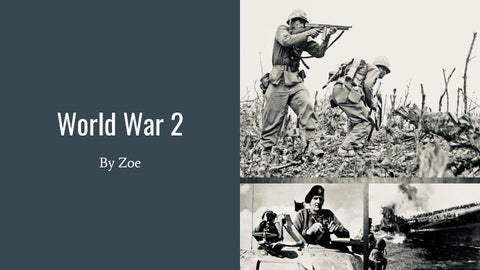
World War 2 By Zoe
Contents The Outbreak of War……………pg.1
Key Leaders………………..pg.8
-The Treaty of Versailles………….pg.1
-Arthur Neville Chamberlain………..pg.10
-The Worldwide Economic Depression…pg.2
-Winston Churchill………………….pg.11
-The Failure of Appeasement……….pg.3
-Joseph Stalin……………………..pg.12
-The Rise of Militarism in Germany & Japan...pg.4
-Franklin Delano Roosevelt………..pg.13
-The League of Nations……………….pg.5
-Harry S Truman…………………..pg.14
The WW2 Timeline…………...pg.6
-Charles de Gaulle…………………..pg.15
-Adolf Hitler…………………..pg.17 -Benito Mussolini………………….pg.18 -Hideki Tojo………………….pg.19
The Blitz……………..pg.20 The Homefront…………….pg.21 Women In WW2………….pg.22 Children In WW2………...pg.23
WW2 Personality: Eleanor Roosevelt.……pg.24 -The UDHR………………………..pg.26
My Personal Enquiry: Rationing…………….pg.27 -Foods That Were Rationed……………….pg.28 -Rationing Books………………………..pg.29
Evaluation………………….pg.30 Bibliography………………….pg.31 Glossary………………..pg.32
The Outbreak of War The Treaty of Versailles There were many reasons why WW2 began, this includes the impact of the Treaty of Versailles on the Germans. The Treaty is what ended WW1 between Germany and the Allies. Seeing as Germany was the one who lost the war, the Treaty was extremely severe to Germany. Germany was compelled to accept responsibility of the war damages, they had to pay large amounts of money. The Germans wanted a war because the Treaty left Germany’s economy in ruins, people were starving and the government was in chaos.
pg.1
The Worldwide Economic Depression Before WW2, it was a time of great economic suering throughout the world. Many people were out of work and struggling to survive. In a short period of time, world output and standards of living dropped suddenly. As much as one quarter of the labour force in industrialized countries were incapable of ďŹ nding work in the early 1930s. This made governments unstable and the world confused, which led to WW2. Because of the Great Depression, many countries encountering powerful fascist and communist movements, including France and Great Britain, became initial to the war.
pg.2
The Failure of Appeasement After WW1, Europe were tired and did not want another war, but countries like Italy and Germany became aggressive and started trying to take over their neighbours and build up armies. Britain, France and some other countries made an attempt to keep peace through an appeasement. They tried to make Germany and Hitler happy rather then stop them. Hoping that if they met his demands, Hitler would then be satisďŹ ed and war would not be needed. Unfortunately, the appeasement backďŹ red, as it only made Hitler bolder. It gave him time to build up his army and also make plans.
pg.3
The Rise of Militarism in Germany & Japan Japan
Germany
In the period before WW2, Japan was growing rapidly. However, as an island, the country did not have the land or natural resources to sustain growth. Japan therefore began to look for a new way to gain resources, and quickly turned to war. They invaded Manchuria and China in the 1930’s and then joined WW2.
In Germany, Hitler and the Nazi Party were also growing. The Germans were desperate for someone to turn their economy and restore the pride. Hitler offered to help and soon became Germany’s dictator. Hitler despised the restrictions put on Germany by the Treaty of Versailles, and he began to rearm Germany. He allied Germany with Mussolini and Italy and he first took over Austria in 1938. The League of Nations did nothing to stop him and, bolder, he soon took over Czechoslovakia a year later.
pg.4
The League of Nations The League of Nations was the ďŹ rst worldwide intergovernmental organisation whose job was to maintain peace between the world. The Nations failed because it lacked an armed force of its own and depended on the great Powers, Britain and France, to enforce resolutions, which they were unwilling to do. The council was made up of four permanent members, France, Italy, Japan and the UK. Germany had joined in 1926 but left nine years later. One crisis that may or may not of sparked WW2 was when France and Belgium invaded Ruhr, one of Germany’s most important industrial zones. Here were two League members breaking League rules and nothing done about it.
pg.5
The WW2 Timeline
pg.6
pg.7
Key Leaders The Key Leaders are the people who led their country in the war. For some countries, there have been more then one key leaders. Some have been successful and some of failed. From the Allies, the key leaders were Arthur Neville Chamberlain (United Kingdom), Winston Churchill (United Kingdom), Joseph Stalin (Soviet Union), Charles de Gaulle (France), and Franklin D. Roosevelt and Harry S. Truman (United States). The Axis Powers were led by Adolf Hitler (Germany), Benito Mussolini (Italy), and Hideki Tojo (Japan).
pg.8
The Allies
pg.9
Arthur Neville Chamberlain Arthur Neville Chamberlain was Prime Minister of Great Britain From September 1939 to May 1940. He resigned when he realised a National Government would not be possible if he was the leader. Members of the House of Commons thought of him as an uninspiring leader and blamed him for the loss of Norway to the Germans. In May 1940, when he proposed the National Government because he discovered it was mandatory for all the political parties, the Labour Party and the Liberal Party refused to serve. He was replaced by Winston Churchill soon often he resigned. Fun Fact:
Photo from Google Advanced Search
pg.10
Chamberlain and his Secretary of State, Malcolm MacDonald made an agreement to give treaty ports back to Ireland, but hoped that British warships might use them in the war. This agreement, together with a plan to limit the number of Jewish people moving into Palestine made Chamberlain unpopular with many people.
Winston Churchill Prime Minister Winston Churchill was leader of Britain for most of WW2. He was the one who led Britain to victory. During the war, his speeches inspired and boosted the morale during some of its Photo from Pixabay darkest moments and he is still famous for the speeches he gave and his quotes. He also helped forge the alliance of Allied Powers with the Soviet Union and the United States. Some of his quotes are: Fun Fact:
“You were given the choice between war and dishonour. You chose dishonour, and you will have war.” “I have never accepted what many people have kindly said, namely that I have inspired the nation. It was the nation and the race dwelling all around the globe that had the lion heart. I had the luck to be called upon to give the roar.” pg.11
The reason the portrait of Winston Churchill looks grumpy on the £5 note is because the photographer had just snatched the cigar out of Churchill’s mouth.
Joseph Stalin
Fun Fact: 22,000 Polish prisoners of war who were executed by the Soviet secret police in April and May 1940. The Soviet Union blamed the Nazis for the killings and it wasn’t until 1990 that it admitted it was them. . pg.12
Photo from Google Advanced Search
Joseph Stalin was extremely brutal. In the years before WW2, Stalin murdered or imprisoned almost all of Russia's senior military officers, and millions of other Russian citizens, in a paranoid and wave of political terror. He was the Communist dictator of Russia and, although Winston Churchill didn’t like him, Churchill knew he needed the Allies to fight Germany so he forged an alliance between them.
Franklin Delano Roosevelt
Photo from Google Advanced Search
Franklin D.Roosevelt was President of the United States from 1933 till 1945. In 1941. When Japan bombed Pearl Harbour, Roosevelt asked the congress to declare war on Japan. Declarations against Germany and Italy followed. Roosevelt took his job as Commander in Chief seriously during WW2. He plotted military strategy, appointed key field commanders and authorised the secret development of the atomic bomb. He formed partnership with Winston Churchill and Joseph Stalin and the “Big Three” discussed strategies for war and peace. It was also Roosevelt’s idea to start the United Nations. He died from a stroke when he was being sketched for a portrait. Fun Fact: Franklin D.Roosevelt was the first President to fly in a plane. Roosevelt flew to Chicago in 1932 to accept the Democratic nomination for president. pg.13
Harry S Truman
Fun Fact: This ‘S’ in Harry S Truman does not stand for anything, it is merely just a middle initial, and does not stand for a middle name. His parents just put it there in honour of their parents, whose first names both started with S
pg.14
Photo from Google Advanced Search
Harry S Truman became president after the sudden death of Franklin D.Roosevelt. Soon, WW2 ended in Europe and Truman decided to use a secret weapon, the atomic bomb, to stop the intense fighting that continued with Japan. He hoped this would spare the lives of American soldiers and end war quickly without having to invade Japan. Thousands of Japanese died instantly in attacks at Hiroshima and Nagasaki before Japan agreed to stop fighting. After the war, Truman supported the creation of the United Nations, favoured the formation of Israel, used the Marshall Plan to rebuild Europe, US and Canada and sought to discourage the expanding influence of the Soviet Union.
Charles de Gaulle
Photo from Google Advanced Search
Charles de Gaulle was a French General and statesman who led the French Resistance in their fight against Germany. The French Government wanted to surrender but Gaulle wanted to keep fighting. He fled to Britain and set up his own government called Free France. After war, he became the President of France for ten years till he retired in 1969 and died a year later.
Fun Fact: Gaulle had many nicknames, including “Big Charles”, “Le Coloner Motor” and the “Great Asparagus. “
pg.15
The Axis
pg.16
Adolf Hitler
Fun Fact: Hitler never took his coat o, no matter how hot it got. pg.17
Photo from Google Advanced Search
Hitler served in the Bavarian army during WW1 and rose to become the leader of Nazi Germany during WW2. The Nazis and Adolf Hitler sought to make Germany the most powerful empire in the world and exterminate all they viewed as inferior. In pursuit of this, he ordered the extermination of over 11 million people, the majority of them Jewish, but also including Roman Catholics, Gypsies, Jehovah's Witnesses, the physically and mentally handicapped, and any others who did not meet Hitler's standards for "racial purity." This mass killing is known as the Holocaust. When the war was nearly over and it looked like the Germans were deďŹ nitely going to lose, Hitler retreated to a bunker with his mistress, Eva Braun. Is it believed that Eva poisoned herself and Hitler killed himself with a pistol shot on 30th of April, 1945.
Benito Mussolini
Fun Fact: Mussolini was known as a bully as a child and was once expelled from school for stabbing a classmate
pg.18
Photo from Google Advanced Search
Mussolini looked to build up Italy's military strength. In 1936, Italy invaded and occupied Ethiopia. He felt that Italy should soon rule much of Europe. He also allied himself with Adolf Hitler and Nazi Germany in an alliance called the "Pact of Steel." But when they joined, Italy was not prepared for such a large war. Soon the Italian people wanted out of the war. In 1943, Mussolini was removed from power and put in prison. However, German soldiers were able to break him free and Hitler put Mussolini in charge of Northern Italy, which was controlled by Germany at the time. By 1945, the Allies had taken over all of Italy and Mussolini ed for his life. As Mussolini tried to escape from the Allied forces, he was captured by his own Italian soldiers. On April 28, 1945 they executed Mussolini and hung his body upside down at a gas station for all the world to see.
Hideki Tojo Hideki Tojo was Prime Minister of Japan during World War II. He believed firmly in a strong role for Japan in world affairs, demonstrated by his authorization of the attack on Pearl Harbor. Hideki Tojo who was found guilty of several war crimes and was executed. Actions that are considered war crimes include actions such as killing or mistreating prisoners of war, killing civilians, bombing cities and towns with no military objective, and killing hostages. Photo from Google Advanced Search
Fun Fact:
According to one story, Tojo got a doctor to put a charcoal mark on his chest to indicate the right place to shoot himself in the heart and fired a shot into his body, but somehow the bullet missed his heart and ended up in his stomach. According to another, he fired four shots at himself without success. Lying bleeding profusely when the military police and accompanying journalists burst in, he was heard to murmur a polite apology for taking so long to die. pg.19
The Blitz The heavy and frequent bombing attacks on London and other cities was known as the ‘Blitz.’ Blitz is a shortened form of the German word 'Blitzkrieg', which means lightning war. Night after night, from September 1940 until May 1941, German bombers attacked British cities, ports and industrial areas. London was bombed every day and night for 11 weeks and about one third of it was destroyed. Other cities and towns that were heavily bombed include Swansea, Cardiff, Bristol, Southampton, Plymouth, Birmingham, Coventry and Liverpool. During the Blitz, 32000 civilians were killed and 87000 were seriously injured. One devastating raid on Coventry in November 1940 was the biggest air-raid the world had ever seen. 4330 homes were destroyed and 554 people killed. At one point during the night, 200 separate fires burned in the city
pg.20
The Homefront
pg.21
Photo from Pixabay
Britain was the ‘home front’ because they felt like they were part of the war. The war affected everyone whether they were on the front line or on the home front. The home fronts’ job was to help. They were encouraged not only to plant vegetables on any spare land they had to help rationing, but were also recruited into a variety of necessary positions, such as Air Raid Wardens and the Home Guards. The homefront was important because, without the homefront, the forces in the field would quickly stop functioning active units. The home front was the production of food and war materials and the expansion of production allowed the nation to keep up with demand
Before the Second World War, women were expected to be housewives or do certain 'women's jobs', such as nursing or being a domestic servant or shop assistant. The war changed the world of work for women forever. When men went to fight, women were called upon to fill their jobs, including many jobs that were thought unsuitable for women before. The jobs included mechanics, engineers, tank drivers, building ships, working in factories making bombs and aircraft parts, air raid wardens, driving fire engines, plumbers, ambulance drivers, WRVS volunteers and nurses. Women doing ‘men’s jobs’ made it a lot easier for the men to focus on fighting pg.22
Photos from Google Advanced Search
Women In WW2
Children In WW2
Photo from Google Advanced Search
Children always had to carry their gas masks just in case of a gas attack. Many of the younger children were sent to the countryside to stay safe because the countryside was less likely to get bombed. Nearly two million children were evacuated from their homes at the start of World War 2. Children had to deal with rationing, gas mask lessons and living with strangers. They made up one tenth of the deaths during the Blitz of London and 1.5 million children died in total.
pg.23
WW2 Personality: Eleanor Roosevelt My WW2 Personality is Eleanor Roosevelt, an American political ďŹ gure and activist. She served as the First Lady of the United States from March 4, 1933, to April 12, 1945, during her husband President Franklin D. Roosevelt's four terms in oďŹƒce, making her the longest-serving First Lady of the United States. She has advocated for expanded roles for women in the workplace, the civil rights of African Americans and Asian Americans and the rights of World War II refugees. She wrote a daily newspaper column called My Day and met weekly with women reporters. Once war started, she focused on that, touring factories, launching battleships and visiting troops from around the world. Following her husband's death in 1945, Roosevelt remained active in politics for the remaining 17 years of her life.
pg.24
'Where, after all, do universal
Photo from Google Advanced Search
As the chair of the United Nations Human Rights Commission, human rights begin? In small Eleanor Roosevelt was the driving force in creating the 1948 charter places, close to home - so close and so small that they cannot be seen of liberties which will always be her legacy: The Universal on any maps of the world. Yet they Declaration of Human Rights (UDHR). In 1948, representatives from are the world of the individual the 50 member states of the United Nations came together under the person; the neighbourhood he lives in; the school or college he attends; guidance of Eleanor Roosevelt to devise a list of all the human rights the factory, farm, or oďŹƒce where that everybody across the world should enjoy. Eleanor Roosevelt was he works. Such are the places where every man, woman, and heavily involved in championing civil rights and social activism. She child seeks equal justice, equal was appointed chair of the UN Commission on Human Rights which opportunity, equal dignity without discrimination. Unless these rights drafted the UDHR. have meaning there, they have little meaning anywhere. Without concerted citizen action to uphold them close to home, we shall look in vain for progress in the larger world.'
pg.25
Eleanor Roosevelt, 1958
The UDHR The traumatic events of the Second World War brought home that human rights are not always respected. The extermination of almost 17 million people during the Holocaust, including 6 million Jews, horrified the entire world and, after the war, governments worldwide made an effort to foster international peace and prevent conflict. This resulted in the establishment of the United Nations in June 1945. The 30 rights and freedoms set out in the UDHR include the right to asylum, the right to freedom from torture, the right to free speech and the right to education. It also includes civil and political rights, like the right to life, liberty, free speech and privacy and economic, social and cultural rights, like the right to social security, health and education. The Universal Declaration of Human Rights is a historic document that was adopted by the United Nations General Assembly at its third session on 10 December 1948 as Resolution 217 at the Palais de Chaillot in Paris, France. pg.26
My Personal Enquiry: Rationing Rationing was a means of ensuring the fair distribution of food and commodities when they were scarce. It began after the start of WW2 with petrol and later included other goods such as butter, sugar and bacon. Eventually, most foods were covered by the rationing system. There were no supermarkets, so people had to visit dierent shops to buy meat, vegetables, bread and other goods. When war was declared in September 1939, the British government had to cut down on the amount of food it brought in from abroad as German submarines started attacking British supply ships. When people wanted to buy some food, the items they bought were crossed o in their ration book by the shopkeeper. Rationing of food lasted for 14 years and ended on July 4, 1954, continuing after the war ended. . pg,27
Photo from Google Advanced Search
Butter, bacon and ham, margarine, sugar, meat, milk, cheese, eggs, tea, jam, dried eggs, sweets, meat, biscuits, breakfast cereals, lard, milk, canned and dried fruit were rationed during the war. Some fruit and vegetables were not rationed because many people grew them themselves. Fish, bread and potatoes were also not rationed.
pg.28
Photo from Google Advanced Search
Foods That Were Rationed
Rationing Books
Photo from Google Advanced Search
When people wanted to buy some food, the items they bought were crossed o in their ration book by the shopkeeper. Every person in Britain was given a ration book and had to register and buy their food from their chosen shops. Another major part of rationing was the implementation of a coupon system. Rationing operated through a points system. There were 66 points for clothing per year but in 1942 it was cut to 48, in 1943, it was cut again to 36 and in 1945 to 24. Each person has 24 points per four weeks for food. Every month, each person was allowed 16 points to use on any food item they wished for.
pg.29
Evaluation WW2 is an interesting topic and I have learnt a lot during this project. I liked how we were able to do research by ourselves and have our own topic that we wanted to know more about. I am happy with what I have done because I have written down facts about each speciďŹ c topic in a clear way, handed it in on time and tried hard to make everything detailed, although next time I would like to be able to have more than one personal enquiry because there is so much to learn about!
pg.30
Bibliography ❖ ❖ ❖ ❖ ❖ ❖ ❖ ❖ ❖ ❖ ❖ ❖ ❖ ❖ ❖
“Axis Powers and Leaders” Ducksters. Online “Causes of WW2” Ducksters. Online “War Crime Trials” Ducksters. Online “Benito Mussolini” Ducksters. Online “Adolf Hitler” Ducksters. Online “Winston Churchill” Ducksters. Online “Charles de Gaulle” Ducksters. Online “World War Two Leaders” Primary Homework Help. Online “Rationing” Primary Homework Help. Online “Women During WW2” Primary Homework Help. Online “Children During WW2” Primary Homework Help. Online “What Was The Homefront?” Primary Homework Help. Online “What Was The Blitz?” Primary Homework Help. Online “The Second World War” Curriculum Visions. Online Anne Bausum. Our Country’s Presidents. 1973 pg.31
Glossary ❖
❖ ❖ ❖ ❖ ❖ ❖ ❖ ❖
Air Raid Wardens- Their main purpose of Air Raid Wardens was to patrol the streets during blackout and to ensure that no light was visible. If a light was spotted, the warden would alert the person/people responsible by shouting something Allies- The Allies of World War II, called the United Nations from the 1 January 1942, were the countries that together opposed the Axis powers during the Second World War Appeasement- The action of pacifying or placating someone by acceding to their demands Asylum- the protection granted by a state to someone who has left their home country as a political refugee. Axis- The alliance of Germany and Italy formed before and during the Second World War, later extended to include Japan and other countries. Bunker- A reinforced underground shelter, typically for use in wartime. Charter of LibertiesCivilians- A person not in the armed services or the police force Communist- A person who believes in a theory or system of social organization in which all property is owned by the community and each person contributes and receives according to their ability and needs pg.32
❖
❖ ❖ ❖ ❖ ❖
❖ ❖ ❖ ❖
Congress- a national legislative body. The US Congress, which meets at the Capitol in Washington DC, was established by the Constitution of 1787 and is composed of the Senate and the House of Representatives. Dictator- A ruler with total power over a country, typically one who has obtained control by force Domestic- Relating to the running of a home or to family relations Economy- The state of a country or region in terms of the production and consumption of goods and services and the supply of money Ethiopia- A country located in the horn of North Africa Fascist- Fascism is a form of extreme nationalism that promotes the interest of one state of people above others combined with the notion of national rebirth characterized by dictatorial power, forcible suppression of opposition, as well as strong regimentation of society and of the economy which came to prominence in early 20th-century Europe. First Lady- The wife of the president of the US or other head of state Gypsies- A member of a travelling people traditionally living by itinerant trade and fortune telling. Gypsies speak a Romany that is related to Hindi and are believed to have originated in South Asia. Handicapped- A person having a condition that markedly restricts their ability to function physically, mentally, or socially Home Guards- The Home Guard was an armed citizen militia supporting the British Army during the Second World War pg.33
❖ ❖ ❖
❖ ❖ ❖ ❖ ❖
❖
Industrial- Relating or characterised by economic activity concerned with the processing of raw materials and manufacture of goods in factories. Industrialised- Develop industries in a country or region on a wide scale Jehovah's Witness- A member of a Christian movement the Watch Tower Bible and Tract Society founded in the US by Charles Taze Russell (1852–1916). Jehovah's Witnesses deny many traditional Christian doctrines and refuse military service and blood transfusion on religious grounds. Key Leaders- The main leaders in WW2 Labour- Work, especially physical work Liberty- The state of being free within society from oppressive restrictions imposed by authority on one's way of life, behaviour, or political views. Manchuria- A region in China now called Dongbei, it consists of the three provinces of Heilongjiang, Jilin, and Liaoning Marshall Plan- The Marshall Plan, also known as the European Recovery Program, was a U.S. program providing aid to Western Europe following the devastation of World War II. It was enacted in 1948 and provided more than $15 billion to help finance rebuilding efforts on the continent National Government- A coalition government, especially one subordinating party differences to the national interest in a time of crisis pg.34
❖
❖ ❖ ❖ ❖ ❖ ❖
Pact of Steel- DescriptionThe Pact of Steel, known formally as the Pact of Friendship and Alliance between Germany and Italy, was a military and political alliance between Italy and Germany. The pact was initially drafted as a tripartite military alliance between Japan, Italy and Germany Soviet Union- The Soviet Union, officially the Union of Soviet Socialist Republics (USSR), was a federal socialist state in Northern Eurasia that existed from 1922 to 1991 Terms in Office Treaty Ports United Nations Human Rights Commision Warships WRVS Volunteers- The Royal Voluntary Service from 1938 to 1966; Women's Royal Voluntary Service (WRVS) is a voluntary organisation concerned with helping people in need throughout England, Scotland, Wales and Northern Ireland Definitions from Oxford Languages and Wikipedia
pg.35