Year 5 Curriculum outline Summer 2021
Year 5 Curriculum Outline Summer 2021
Ocean Adventure ~ Technology-Friend or Foe?
Humanities - Social Understanding Year 5 pupils will be taken on an Ocean Adventure during the first half term, where they will learn to recognise the differences in marine environments and to identify a range of geographical features in oceans. Their journey will take them to the unexplored depths of the oceans to discover the weird and wonderful creatures that inhabit this unique environment and to understand why it is so difficult to explore these areas. In addition to learning about what lies beneath the sea, the pupils will also gain an understanding of climate zones and currents and the relationship that humans have with the sea. During the second half term the pupils will look at how technology has changed over time and its impact on society. In RS we will continue to learn about the world’s major faiths. Pupils at Dame Bradbury’s will study the history and key beliefs of Islam. We will discover where and when Islam originated, look at where Muslims worship and learn how their beliefs affect their daily lives. We will look at important Muslim festivals including the Hajj pilgrimage, Ramadan and Eid. At Rosedale House we will study Hinduism. Pupils will learn about the origins of and key beliefs of Hinduism. Pupils will show understanding of major festivals, gods and goddesses, how and where Hindus worship and their beliefs related to life and death. They will consider how a family may choose to worship one of the Hindu Gods and what being a Hindu means in everyday life.
Language and Communication In English, during the first half term pupils will read persuasive brochures and promotional material. They will consider techniques for engaging readers and consider their target audience when advertising. Pupils will also study stories with flashbacks and flashforwards. After half term, pupils will read extracts from science fiction texts and write their own science fiction extracts using the key features of this genre. They will then consider the power of imagery in poetry - identifying and using metaphor, simile and personification. In Modern Languages developing good oral communicative skills remains core to our lessons, with use of written cues to help with pronunciation, comprehension and vocabulary consolidation. Linking to the thematic learning topics, pupils will explore the language; discovering patterns in words and structures, noticing where adjectives go in a sentence, or what sounds letter combinations make and then spotting the sound in new words, noticing pronouns and basic verbs in reading and written passages. In Spanish, they will talk about what they like and will explore the verb ‘gustar’, using a fun song to help them remember. In French, pupils will extend their knowledge of basic sports and hobbies, giving opinions. On a cultural level, they will find out about Le Tour de France and one particular painting by Monet, linking in with the sea and coastal theme. Pupils will draw their ideas together towards the end of term in a short presentation about what they like to do in the holidays.
Mathematical Understanding In Maths Year 5 will start the term by focusing on number, specifically solving problems involving numbers up to three decimal places. They will also multiply and divide whole numbers and those involving decimals by 10, 100 and 1000, while using all four operations to solve problems involving measure and scaling. The next topic is geometry when pupils will learn how to identify 3D shapes, including cubes and other cuboids, from 2D representations and use the properties of rectangles to deduce related facts, find missing lengths and angles. Next they will be asked to distinguish between regular and irregular polygons based on reasoning about equal sides and angles, and take a deeper look at the rules of angles including estimating and comparing acute, obtuse and reflex angles, drawing given angles, and measuring them in degrees. The final topic of the term will be measurement, Year 5 will study position and direction whilst identifying, describing and representing the position of a shape following a reflection or translation. Measurement will involve converting units; understanding and using approximate equivalences between metric units and common imperial; and solving problems involving converting between units of time. Finally the focus will be on volume and using all four operations to solve problems involving measure.
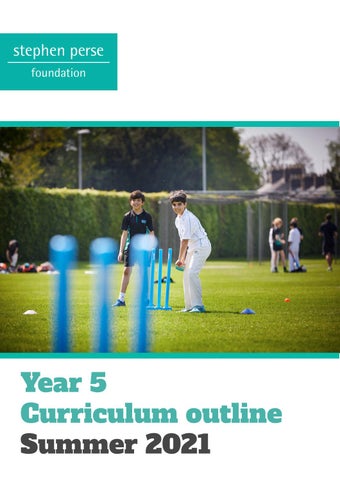
Physical Education and Well-being In PE and games lessons cricket, tennis and athletics will be the focus. In cricket, pupils will continue to develop the skills needed to play, as well as the basic and more complex rules of the game. They will also begin to apply tactics into their game play and take responsibility for organising positions within a game situation. In athletics, the children are taught a variety of track and field events and will have time for reflection, decomposition and refinement of technique. In tennis, pupils will develop and improve the consistency of their groundstrokes and service technique. If your child has a sporting interest, encourage them to join a club outside school and any clubs within school time. Encourage your child to engage in a healthy lifestyle by eating the correct food and participating in sport. Play a mixture of team and individual sports with your child to develop their basic motor skills. In PSHEE pupils will cover two topics this term. In our Family and Friends unit the pupils will consider the special people in their networks and to recognise how their networks have changed and developed. They will look at how friendships develop and can be maintained, particularly during times of change. They will recognise and value differences between people and how that can be a positive aspect of their friendships. Pupils will also recognise
and learn strategies for managing some of the pressures in relationships and how to get support from people they trust and how they can support other people. In the second half term pupils will have their relationships and sex education (RSE) unit where they will learn about the male and female sexual parts alongside the appropriate terminology for use in different situations. They will learn about the physical changes that take place at puberty, why they happen and how to manage them and that physical change happens at different rates for different people. They will consider how the media, families and friends can influence attitudes to their bodies and will also learn about personal hygiene.
Creative and a Performing Arts Each week in Music the pupils will practise their own instruments or use the keyboard on Garageband to develop their instrumental technique and expand their repertoire. With this regular practice (which will support the students’ instrumental tuition), they will build their confidence and fluency with reading staff notation alongside learning how to convey expression and more detailed musical markings. As part of this process, students will be encouraged to add their own creative ideas and interpretations into their performances, and we will explore the various stylish options that are available. Students will regularly submit or perform finished performances for feedback, evaluate and reflect upon their own work, and there will be some opportunities to provide feedback for one another. This process of identifying aspects of their performance which could be improved/refined and then honing in to work on these aspects encourages active listening and increasingly mature musical awareness. During the Summer term, the students will be taken on a whistle stop tour of some of the most famous works in the Classical music canon by engaging with the ‘BBC 10 Pieces Trailblazers’ repertoire. This is a fantastic project designed by the BBC which “challenges students to rethink orchestral music through considering ten trailblazing composers and their compositions. This set of pieces showcases works that have helped expand our musical horizons, pieces that have introduced new cultures and sound worlds into the orchestra, and composers whose lives and works have made them pioneers.” This topic really captures the fact that “Orchestral music is a living, evolving art form, and these pieces help to tell that ever-changing story.” Most of all, pupils will enjoy putting together their class and year group performances for our grand Summer Concert, a musical showcase of the children’s hard work. In Drama, Dame Bradbury’s students will rehearse and film their Year 5 production. Rosedale House students will explore the topic Ocean Adventure by developing movement sequences to convey status and use movement to ‘travel’ in character. Skills will be developed in the areas of acting, movement and music as well as teamwork and cooperation. Students will then go on to the theme of ‘Technology, Friend or Foe.’ Students will explore the world of the internet by bringing it to life. We will investigate how changing technology has impacted upon theatre by exploring sound and lighting. Students will develop skills in the areas of devising and characterisation.
With a focus on marine life, Create, Design and Engineer (CDE) sessions will spend time immersed in exploring texture, colour and tone, using print work as an initial focus on texture and shape. Watercolour skills will be used to create a natural palette of observed hues, combining interesting arrays of shades and tints. Fine brush work will come into play as we move on to design clay sculptures of sea urchins and under the water scapes. Rolling, joining, shaping and extruding qualities will be considered as we produce a clay tile.
Scientific Understanding This term in Science, pupils will start by learning about materials and their properties, looking at the properties of solids, liquids and gases, how these affect their practical uses and how they change from one state into another. We will look in some detail at the Earth’s atmosphere and its role in protecting life on this planet. We will then boldly go beyond the atmosphere, with a topic on Earth and Space, in which pupils will gain a wider perspective on the place of the Earth in the wider Universe, starting with the rotation of the Earth on its axis and its orbit around the Sun, the phases of the Moon and why we have seasons, and moving out to look at the wider Solar System. How you can help: Visit local museums, such as the Sedgwick Museum of Earth Sciences, Saffron Walden Museum and Cambridge Science Centre. These institutions have extended their online resources during lockdown, as has BBC Bitesize Science. Look out also for science programmes on TV.
Digital
The Inner Wheel With the Google apps at the heart of digital curation our pupils use Google Classroom to complete work digitally and hand in work that is produced in a variety of ways. We have identified 7 main apps, our EverGreen apps, that help to showcase our pupils’ learning. An animation, movie or annotated piece of work provides richer feedback for the teacher and ultimately helps to make greater progress. Explain Everything www.explaineverything.com Green Screen www.doink.com Stop Motion www.cateater.com Strip Design www.vividapps.com/Strip_Designer/ Notability www.gingerlabs.com Book Creator www.bookcreator.com Puppet Pals www.polishedplay.com The Outer Wheel We have a number of apps that we use consistently throughout our curriculum that lend themselves to our creative approach. We avoid apps that are specific to a particular outcome, preferring content free apps that can help to enhance our pupils work and understanding. Some examples are: Minecraft, iMovie, KeyNote, Pages and Padlet.
Coding Another aspect of our digital curriculum is the coding/programming skills that are embedded in all subjects or taught discretely in Years 5 and 6. We have identified a progression of apps that help to develop our pupils ability to code. The apps provide variety and challenge and help to develop the computation skills that are crucial learning in our digital work. We combine the coding experiences with physical output. Using Spheros, BBC Micro:Bits and Ozobots provides visual outcomes that bring our code to life. As our pupils develop further they transition on to written code.
Thinking Toolkit Alongside and underpinning our curriculum we ensure that our pupils are developing as active learners and active thinkers. Throughout each subject area pupils are encouraged to use their range of thinking tools and reflect on when and how they are using them. Pupils are encouraged to reflect on how their thinking tools underpin all aspects of their learning and not just in the more obvious ways. How are they creative in maths? How do they enquire in English? How are they critical in Music? How do they think computationally in PE?
Inclusion This curriculum map outlines the core curriculum for each year group each term but at the heart of our wheel is the individual learner. Each subject area has a progression of skills which enables staff to stretch or support individuals as and when they need a little help, a bit of a push or a just a different way in. Within our classrooms through planning, teacher knowledge and interactions work is differentiated to suit the needs of each individual.