ALEXANDER S, MAY 2020
World War 2 portfolio By Alexander S
1
Content 1. How did the War Start?
1. Page 3
2. Timeline of the War
2. Page 4
3. The Blitz
3. Page 5
4. The Home Front
4. Page 6
5. Children in the War
5. Page 7
6. Women in the War
6. Page 8
7. Jobs in the War
7. Page 9
8. The Main Leaders
8. Page 10
9. Winston Churchill
9. Page 11
10. Who were Joseph Stalin and F.D. Roosevelt
10. Page 12
11. Bibliography
11. Page 13
12. Evaluation
12. Page 14
2
How did WW2 Start? The war started when Hitler and Germany invaded Poland after promising not to. On the 3rd of September (2 days after Hitler invaded) the English PM, at the time Neville Chamberlain, declared war on Hitler. The Soviet Union then invaded Poland from the east making the job of the British really hard; Chamberlain promised to help Poland if it was to be invaded.
3
Please click the text to find out more
The Timeline of the War I have had to add a password to this padlet otherwise it wouldn’t let me let you see it. The password is Portfolio 4
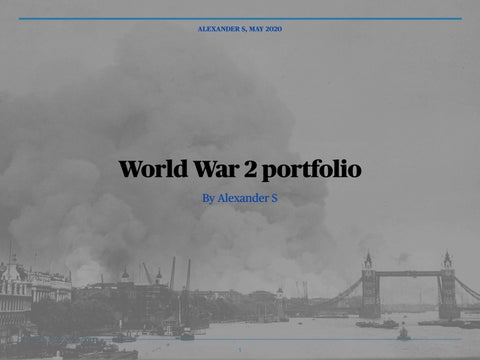
The Blitz The Blitz was the period of time where the Germans were massively bombing the British cities. The attack on London on the 7th September 1940 marked the opening of the Blitz period. The word ‘Blitz’ comes from the German word Blitzkrieg meaning ‘Lightning War’. While most of the bombing attacks were at night, the Germans soon realised that Britain was prepared so they switched to nighttime.
According to Britannica, 43 000 British civilians were killed and another 139000 were wounded. 79 of the London Underground stations were used as bomb shelters. Over 170 000 people slept in them every night during the bombings. Over 15 000 people were killed by the bombs. 9 people in Cambridge were killed during one of the first air raids on Cambridge. They were believed to be the first civilians killed in Britain!
In November 1940, Coventry was hit hard and there was a lot of destruction happening; 509 Bombs were dropped, 380 people were killed and 865 people injured. In 1941 the Germans persuaded Adolf Hitler to focus on trying to damage Britain’s ports. 46 raids took place on Plymouth, Swansea, Bristol, Portsmouth, Merseyside, Belfast, Hull and Clydeside!
The Blitz ended when Hitler decided to invade the Soviet Union in May 1941 because the Luftwaffe didn’t have enough planes and soldiers to manage 2 fronts so planes were deployed to the eastern front. The final raid (10 May 1940) was the deadliest in the sense that 1364 people were killed and 1616 were wounded.
5
The Home Front The ministry of Labour could order anyone in the UK “to perform any service required in any place”. This meant that you could be sent to work in any factory where it was needed. As said in ‘Women in the War’ (see next slide), the women took the jobs that were supposed to be done by the men which were at war. Some of these jobs included: mechanics, engineers, munition workers, air raid wardens and drivers. All of the members of public in England, were told to (only if possible though) plant fruit and veg to help the rationing and to support the community. This was called ‘Dig for Victory’.
The Home Guard was also a part of the Home Front. It was set up and people joined to help protect the country. They were in charge of defending 5 thousand miles of coastline if the Germans attacked. It was a volunteer-led organisation so no-one was forced to join them. There were more than 1,000,000 men enrolled in the Summer of 1940! They received military training and donated weapons. Some of the Guard made their own weapons. Interestingly, they were first called the ‘Local Defence Volunteers (LDV)’ but later changed it to ‘The Home Guard’ due to a suggestion made by Winston Churchill. They were also known as Dad’s Army. They were nicknamed so because most of them were too old for the military. The official closing date of the Home Guard was in 1957.
Not just the food was rationed - petrol, clothing and furniture were on the list as well. The rationing continued until 1954 at which point the UK was back to the normal amount of imported food. During the war the amount of food imported fell to 12 million tonnes; 55 million tonnes was the amount imported before the war. The civilians actually ate healthier during the rationing than during normal times. Much like today, everyone was told to stay at home for the holidays.
6
Children in the War A viewpoint from the front (Great Grandmother Alexandra who was 11-15 in the war)
As the war began and the bombings grew worse, the government decided to send 2 million children to the countryside where they would be safer than in the city. A label was attached to them so that everyone knew who they were and where they went. They didn’t know who went with them and when they were going to come back.
In Russia, most of the children helped the adults but the children up to 6 years old stayed at home. The 7-10 year olds made a big difference by cleaning the house and looking after the young. They also worked in the garden. While all of the children helped, the 11-15 year olds worked the hardest on the farms in groups of 50 and they also were responsible to obtain the food for the household. There was a special association which was made to give out ration books with which the family could obtain their food (see next slide for more information)
They were taken to school in the countryside where they had regular gas drills and bombing drills.
7
Women in the War The women were very important during the War. Like men, they were conscripted to join the war effort. They could choose to work in the factories or to join the one of the three Auxiliary Services. These consisted of the Women’s Auxiliary Air Force (WAAF), the Women’s Royal Naval Service (WRNS) and the Auxiliary Territorial Service (ATS).
At home, women were in charge of making the bunkers and keeping the family alive. The bunker was 2 meters tall and 1 meter wide with a length depending on the family. To help finance the family, in their free time, women made clothes because there were none in the shops. They also sold them to earn extra money.
In the UK, there were 8 million women fully employed. 2 million of those were working in arms factories and 500,000 were working in non combat roles in the armed forces.
Everyone was given a rationing book. This rule was enforced after the Government started worrying that the poor might not get any food and the selfish might take the food for themselves. If they went to the shops and bought something, the shopkeeper would cross the item out in their ration book.
The Auxiliary Territorial Service was formed in 1938 to help free up Royal Air Force personnel front line duties. At first, the only jobs available were clerks, cooks, store woman and drivers. Later, they expanded the ATS so that is could cover over 100 different jobs. 250,000 women served the ATS.
8
Winston Churchill Sir Winston Leonard Spencer Churchill was born on the 30th November 1874 at Blenheim Palace. His father was a British politician and his American mother an heiress.
He becomes English prime minister for the first time (from the 10th May 1940 through to 1945). He took over from Neville Chamberlain. Despite his age and poor health (he had a heart attack and pneumonia), he worked a lot and kept the spirits of the people very high.
He started his career as an officer in the military and a war reporter in Cuba, India, Sudan and South Africa! In the second Boer war he was captured and held prisoner in South Africa. He then escaped, travelling 300 miles to be rescued and it was at this point in time where he became famous.
In July 1945, he was defeated in the general election by the Labour Party leader Clement Attlee but remains the leader of the Conservatives. He then regains his position as PM in 1951 leading the country through to 1955. He remained an MP until 1954!
He was first elected into House of Commons in October 1900 as a Conservative. In 1904, he crossed the floor and became a member of the Liberals. Interestingly, he became a member of the Liberal Government. He was next voted out of the House of Commons in 1922 but he rejoined the Conservative party in 1924 and became the MP for Epping!
Although a really important member of the British empire, Churchill also wrote his war memoirs which earned him the Nobel Literature Prize in 1953. He revived a knighthood in 1953 by Queen Elizabeth II (Queen from February 1952 - present). He sadly died in 1965 being 90 years old! He received a state funeral!
9
Who was Joseph Stalin and F.D. Roosevelt? Joseph Stalin
F.D. Roosevelt
Joseph Vissarionovich Stalin was born on the 18 December 1871 and died on the 5 March 1953. He was the leader of the Soviet Union for about 2 decades. Although his name was Iosif Vissarionovich Dzhugashvili when he was born he was later known as Joseph Stalin. Interestingly, his father was a normal cobbler and his mother a washerwoman. He was treated cruelly by the children at school but he actually did very well in school. As WW2 began, Hitler and Stalin declared peace between the 2 countries. Little did Stalin know that Hitler was only preparing to attack. When he did, it left a part of the Soviet Union devastated leaving thousands dead. Stalin was so “distraught� by the attack, he hid in his office for a few days before coming out again.
Franklin Delano Roosevelt was born on the 30 January 1882 and died on the 12 April 1945. He was the President of the United States, the Governor of New York and the Senate of the US. Unlike Stalin, Roosevelt was brought up in luxury in his house which was in Hudson River. He was educated privately until the age of 14. He married his distant cousin in 1905 Elenor Roosevelt. He was sadly infected with Polio which meant that he had to stay in a wheelchair for the rest of his life.
10
The Key Leaders of the War The Allies
The Axis Power
United Kingdom: Neville Chamberlain and Winston Churchill
Germany: Adolf Hitler Japan: Hideki Tojo and Emperor Hirohito
United States: F.D. Roosevelt and Harry Truman
Italy: Benito Mussolini
France: Charles de Gaulle Soviet Union: Joseph Stalin Canada: William King Australia: Robert Menzies New Zealand: Michael Savage
11
Bibliography 1. My Great Grand Parents
• Wikipedia, Google Advanced Search and Flickr were used for some Image sources.
2. Primary Homework Help 3. Encyclopaedia Britannica
• Susie Dent, Brewers Dictionary of Phrase and Fable, 19 Edition, first published 1870
4. ducksters.com 5. historyhit.com
• Terry Deary, Horrible Histories Woeful Second World War, First published 1999
6. biography.com 7. nationalarchives.co.uk
• R.G Grant, Ann Kay, Michael Kerrigan and Philip Parker, DK History of Britain and Ireland. The Definitive Visual Guide, first published 2011
8. bbc.com 9. https://bbc.in/36vtJIX 10. iwm.org.uk
12
The Evaluation of my Project I think that generally my portfolio went very well. I feel so because I have spent more time editing my portfolio than actually writing it so that there are no mistakes. I have luckily had a few meetings with my Great Grandparents (90 and 93 years old(!)). This helped me to develop a view of what it was like to be there during the war. They mostly helped with the section ‘Children in the War’ as they were children. I have learned to manage my time doing about an hour of work every day in the holidays. I really hope that I have mastered my project and that you have enjoyed it. I also hope that I have achieved my writing target (to use a range of punctuation correctly) and that I get a new one soon.
13