GCSE Co u r s eI nf o r ma t i o n 2 0 1 9 2 0
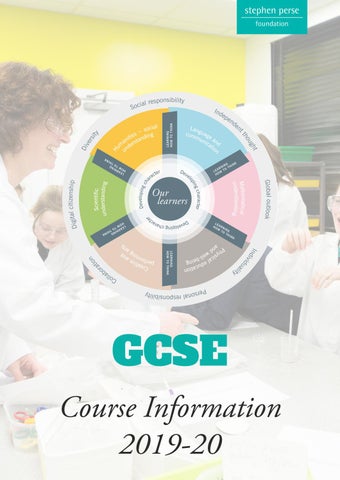
Our Learning Wheel explained
Our learners Our schools are small enough to ensure that each learner is known. By placing our learners at the centre of our approach, we create an education that allows individuality to flourish.
Developing character Fostering a secure bedrock of self-esteem and a sure moral compass is essential preparation for a future in a complex world.
Learning segments We group our subjects together into six curriculum areas. We teach subjects in an integrated way, because the future belongs
to those who can think way beyond narrow subject boundaries.
Learning to think Education is not just about imparting knowledge. It’s about teaching young people how to think for themselves: critically, creatively and collaboratively.
Outer circle We prepare young people to blaze a trail in whatever field they choose. They leave us equipped with a breadth of skills, ready to become responsible global citizens.
Stephen Perse curriculum model Our curriculum for Years 10 and 11 provides the best possible platform for study at a higher level, prior to university entrance, and gives you an enriched and stimulating learning experience.
“ We teach subjects in an integrated way, because the future belongs to those who can think way beyond narrow subject boundaries” T ricia Kelleher, Principal We group our subjects together into six curriculum areas, teaching subjects in an integrated way as shown within our Learning Wheel. I n addition to the subjects leading to (I)GCSE courses, you will take a non-examined core programme in order to add to your portfolio of knowledge, skills and interests. We prepare you to blaze a trail in whatever field you choose, making sure you are equipped with a breadth of skills, ready to become responsible global citizens.
The Non-examined Core Enrichment Our enrichment activities provide the opportunity for you to have new experiences and to build on existing interests. Enrichment activities happen at various times throughout the week through the clubs and activities timetable and through timetabled Enrichment lessons, most of which are open to Years 10-13. Many are the initiative of individual students and new ideas are always welcome. Being involved in enrichment activities gives you the opportunity to participate in local community events, to be active, creative, engage with international issues and work with others. The Enrichment course is modular and there are a combination of compulsory and optional modules so you can compile a programme of study which complements your GCSE/IGCSE choices and your interests. Some enrichment opportunities from the 2018/19 programme: ● ● ● ● ● ● ● ● ● ● ● ● ● ● ● ● ● ●
Algorithms and Problem Solving Badminton Basic Russian Beginners Chinese Bridge Club Coding Cricket Debating Drama Economic Finance EES Film Studies Fitness Football Hockey Jewellery Making Mobile Digital Course MUN
● ● ● ● ● ● ● ● ● ● ● ● ● ● ● ● ●
Music Netball Peligraph/Online Blog Psychology for non-Psychologists Psychopathology Reading Group Rowing Science Self Defence Squash Stem Club Ted Ed Club Thinking through Drawing Touch Rugby Uncreative Arts Yogalates Zumba
Non-examined Teaching As in Year 9, the Non-Examined courses in Years 10 and 11 are there to give you the opportunity to study something which might not otherwise appear in the school curriculum. Courses are typically half a term in length and you will rotate between the different teachers offering the Non-Examined courses. Course content varies according to the interests and
specialisms of the teachers running the courses but - as an example - this year’s courses have included a study of Photojournalism, Feminism in the 21st century, Ancient Greek Philosophy and Philosophers, British Politics, Linguistics, Political Cartoons, and American Politics. Year 10 students also receive training in research and data analysis skills throughout the Autumn term. They then put these to use during the Spring term in a quantitative and collaborative project of their own choice.
Inspire and Guide The aim of the course is to support the academic programme and provide the guidance you will need in order to make fully informed choices for the next stages of academic study and the world of work. The careers element of the personal, social and health education programme is delivered through this course. In addition, highlights include talks from visiting speakers about aspects of university course choices and careers, and workshops designed to enable you to compile your own portfolio of qualifications, skills and experiences in preparation for advanced study and employment. The Year 10 programme includes sessions which are designed to make you think and to expand your horizons, sometimes by considering issues of current affairs. These are complemented by talks from visiting speakers, sometimes jointly with Year 11. The Year 11 programme is a mix of talks, discussions and workshops led by visiting speakers, together with input from our own teaching team and with assistance from our Sixth Form students when it comes to helping you to make your subject choices. Work experience is discussed and you are given help to formulate your CV and to make applications for internships and other such opportunities. Our biennial careers fair is another opportunity for you to have an insight into all the different paths available in the modern world.
OTHER ACTIVITIES Clubs, Support and Enrichment We have over 140 lunchtime and after school clubs, support and enrichment sessions, many of which are open to students in Years 10 and 11. These are updated regularly on the clubs area of the website.
Adventure Learning Building on our structured programme of adventure learning trips and activities for Years 7, 8 and 9, we run Bronze Duke of Edinburgh expeditions for Year 10 students at the start of the academic year, and Silver training and expeditions the following summer. Through our partnership with the Exploration Society, we are also developing an exciting programme which runs into the 6th Form, and includes challenging trips around the globe.
Art and Design GCSE Edexcel 1ADO, Grades 9-1 The GCSE in Art and Design is a broad and flexible course that requires you to develop an appreciation of the creative process through a practical response, using a variety of two-dimensional and three-dimensional media, materials, techniques and processes. You will explore critically how artists, craftspeople and designers from diverse cultures, times and societies have arrived at solutions and communicated meaning using the formal elements and will use this knowledge when developing new ideas, recording observations and creating outcomes which fully realise your personal intentions. Course Requirements
This GCSE Art and Design qualification requires students to: ● actively engage in the creative process of art, craft and design in order to develop as effective and independent learners, and as critical and reflective thinkers with enquiring minds ● develop creative, imaginative and intuitive capabilities when exploring and making images, artefacts and products ● become confident in taking risks and learn from experience when exploring and experimenting with ideas, processes, media, materials and techniques ● develop critical understanding through investigative, analytical, experimental, practical, technical and expressive skills ● develop and refine ideas and proposals, personal outcomes or solutions with increasing independence ● acquire and develop technical skills through working with a broad range of media, materials, techniques, processes and technologies with purpose and intent ● develop knowledge and understanding of art, craft and design in historical and contemporary contexts, societies and cultures ● develop an awareness of the different roles and individual work practices evident in the production of art, craft and design in the creative and cultural industries
Course Structure You will have four 40 minute periods of Art per week with an expected minimum of one hour of homework to accompany this. On this course you will follow the Art, Craft and Design Edexcel (2016) Specification for which you will produce a Personal Portfolio (worth 60%) in response to a given theme, which is currently ‘Identity’.
Year 10 You will study three interlinked projects, each exploring aspects of Fine Art (painting and printmaking), Art Textiles (felt making, heat processes, surface design and applique work with material), and Digital Art (animation, photography and moving image). Each project brief is designed to develop your skills, knowledge and understanding when using different techniques, enabling you to experiment and explore the work of other artists in relation to your own. Most work will take the form of practical workshops in lessons and research, drawing and note making using a sketchbook. In this specification, drawing is given a special emphasis. Please note that you are not required to demonstrate technical mastery of drawing skills unless this is relevant to your area of study.
Drawing is at the heart of art, craft and design – from initial sketches and detailed observations to wild mark-making and expressive lines – and forms a core element of the practice of artists, craftspeople and designers. You will be made aware that drawing takes many forms, from two-dimensional mark-making to lines made using materials to define three-dimensional space, and you will be taught how to develop a range of drawing techniques and processes in order to communicate developing ideas clearly.
Year 11 During your second year you will be encouraged to build upon skills and techniques learnt in order to produce a more considered body of coursework with supporting work. The emphasis is more on personal independent creative work, supported by regular tutorials and guidance. For this year you will remain with a single tutor, working in the medium and techniques you have shown the most skill and interest in. The final assessment consists of an Externally Set Assignment (external examination worth 40%). This will be set in the Spring Term, usually just before the half term in February. The exam theme is launched by the exam board and released to students in January. You are given a set starting point or theme and then asked to produce preparatory work that will be taken into the examination. Preparation time is at least eight weeks and following this there will be a 10-hour examination to produce a piece of work.
Exhibition and Digital Portfolio All students will be expected to build a digital portfolio over their course, using a variety of online platforms to promote and store images of their work. Students find this useful for applications and work experience placements as well as in gaining job interviews and commissions in the creative industries. At the end of the summer term, all students will be expected to present a professional exhibition of their work for public viewing at the Visual Arts Centre. The external moderator will visit this in the year of the student’s’ graduation to moderate the marks awarded by their teacher.
Assessment All students must create a portfolio of work which covers evidence of the four assessment objectives:
Assessment Objective (AO1)
develop ideas through investigations, demonstrating critical understanding of sources
% in GCSE 25
(AO2)
refine work by exploring ideas, selecting and experimenting with appropriate media, materials, techniques and processes
25
(AO3)
record ideas, observations and insights relevant to intentions as work progresses
25
(AO4)
present a personal and meaningful response that realises intentions and demonstrates understanding of visual language
25
Total
100
AO1 %
AO2 %
AO3 %
AO4%
Total for all assessment objectives
Component 1: Personal Portfolio
15
15
15
15
60%
Component 2: Externally Set Assignment
10
10
10
10
40%
25%
25%
25%
25%
100%
Component
Total for GCSE
Assessment Objectives
Further Opportunities By selecting an enjoyable course designed to promote high levels of visual literacy, you will gain excellent transferable skills in investigation and research, presentation of ideas and complex concepts to an audience, and immense pride in the sense of having created your own unique pieces of work. You will gain invaluable skills in time management, working to deadlines and collaboration with your peers. Careers related to Britain’s creative industries are numerous but some might include: Advertising and Marketing Communications, Animation, Fashion and Textiles, Film, Games, Photo Imaging, Publishing, Radio, Television, and Visual FX.
Design GCSE Edexcel 1TDO, 9-1 Design is a very rewarding and creative process which leads to varied outcomes from solving specific problems to providing opportunities for self-expression. Designers can produce real or abstract objects, processes, graphics, laws and even ways of communicating. Through design, you can become a critical and informed user of products, an innovator and creative thinker. This course has been designed to encourage you to express original ideas and to develop an adventurous and enquiring mind. You will be inventive with materials and examine the relationship between form and function. You will learn about the circular nature of the design process from concept, formulation and analysis of a brief, research, experimentation to final outcome. There will be interaction with professional designers, local visits, plus a study trip to a major city.
Course Content Workshop and design sessions using a range of modern materials such as wood laminates, alloys, acrylics and ceramics will be used to create your individual portfolio and final piece of practical work. In Year 10 you will be taught, in small groups, a wide range of skills through focused practical tasks. This will be an opportunity for you to experiment with a range of materials and processes and to start to build a portfolio of work. Through these hands-on exercises, you will be expected to develop a detailed knowledge and understanding of two of the following three areas of study: ● Architectural, Environmental and Interior Design: relationship between space and human interaction (ergonomics); study of the built environment, aesthetics, function and green issues; modelling using mixed media such as acrylic, plywood and foam board. ● Product Design: product design ideas, drawing skills, CAD, modelling and making skills in mixed materials, shaping, joining and finishing processes. ● Jewellery Design: working with a range of materials and processes such as forming, embellishing, cutting, bending, casting, enamelling and soldering; understanding the connections between jewellery designs and the work of others. For these areas of study you will be encouraged to research widely the work of influential architects, artists and environmental, interior and product designers. You will respond creatively to your own design ideas and present your work with a range of techniques and models. A healthy interest in modern media and using the rich selection of books in the library, alongside personal study of your surroundings using photography, are encouraged. Towards the end of Year 10, you will be asked to focus on an area of study and to build on your portfolio of work through into Year 11. During the final two terms, you will work on your Set Examination Task where you will produce a portfolio of work and a final piece.
3D Design is an Art and Design qualification will follow the Edexcel GCSE Art & Design Specification Three-Dimensional Design (ITDO). Please see Art and Design entry above for more details of the assessment structure.
Assessment ● ●
Portfolio (60%): 45 hours of work from the two year course presenting one or more 3D pieces Set task (40%): A 10-hour examination and a small portfolio of preparation work
Please note that, owing to timetabling and resourcing constraints, this option will be limited to 14 students. It is usually possible to accommodate students who submit their options form by the due date but places for late entries cannot be guaranteed.
Examples of recent work
Classical Greek GCSE OCR J292, 9-1 This course is a two year accelerated course: no prior knowledge of Greek is required, and by the end of the course you will have GCSE standard language skills and you will have read some original Classical Greek literature. The course is fast-paced, and if you are keen for a stimulating challenge then this could be the course for you.
Course Content In Year 10 you will work mainly on your knowledge of Classical Greek vocabulary and grammar. Greek is a fascinating language, and - through studying it - you will come across concepts which you may not yet have thought about, and you will practise using codes and information in a logical and accurate way. You will practise translating from Greek into English and from English into Greek, and throughout this year you will improve your understanding of the structures of language. You will work to a programme of regular learning and consolidation tests: the aim is to build a confident and accurate grasp of the language. In Year 11 you will start to read original Greek texts. These will include an extract from one of Homer’s great epic poems: these date from nearly 3000 years ago and are the oldest existing works of Western literature. In addition to this you will read an extract from a prose text; this could be a law court speech or an extract from Ancient History, and through this study you will gain direct access to the remarkable world of Classical Greece.
Assessment The GCSE syllabus is equally divided between language work and the study of original texts. For the language papers you will be expected to translate from Greek into English and to be able to answer some grammatical questions about the passage you are translating. The literature papers will test your knowledge, understanding and appreciation of the texts you have studied in class. There is no coursework.
Drama IGCSE CIE 0994, 9-1 The IGCSE Drama course is very practical. It will enable you to build on your performance skills and develop your understanding of how theatre is created. You will collaborate with other members of the group to create and perform in a number of different pieces of theatre, both script based and devised. Although you will take the role of performer in the pieces, you will also be encouraged to consider other aspects of creating theatre, such as the lighting and sound, the set and costumes and the role of the director. You will also develop your individual performance skills to perform a monologue.
Course Content All lessons take place in the Drama Studio or Hall and have a very practical focus. Each term you will take part in workshops to develop your performance skills and to introduce you to different styles of theatre. You will be set performance-based projects in small groups and you will either be given a piece of script or asked to create your own piece of original theatre from a stimulus. In each case you will work with your group to decide how to develop your ideas into a polished piece of theatre and you will then spend several weeks rehearsing. Your teachers will work with you and advise you on how to improve your work. In order to enrich and inspire your performance work, you will take part in a number of external workshops and theatre trips throughout the two years, including a short residential trip to either London or Stratford-Upon-Avon.
Assessment Written assessment (40% of final mark) At the end of the course there is a 2½ hour written paper in which you will answer questions on two pieces of theatre you have created during your course, one scripted and the other devised. In preparation for this you will learn how to analyse and evaluate your own performance work and develop the skills needed to write about other aspects of theatre, such as the devising process, the role of the director, the costumes, set and lighting. Practical components (60% of final mark) Towards the end of each term you will perform a finished group piece with sound, lighting, set, costume and props (as appropriate) a nd two of these marks will count towards your final grade. You will also prepare and perform a monologue from a published play and this mark will count towards your final grade. Each of these components is assessed by your teachers but may be externally moderated.
English Language IGCSE CIE 0990, 9-1
English is an essential part of all schools’ core curriculum. It is compulsory at Key Stage 4 and at the Stephen Perse Foundation is taught in an integrated course with IGCSE English Literature. Success in any subject studied in the 6th Form requires competent written English as well as the analytical skills it fosters. As a candidate for IGCSE English, you will: ● develop your understanding of the spoken word and your ability to express yourself clearly and logically ● read and respond to all types of writing ● develop your writing skills
Course Content You will read a variety of texts in non-fiction genres, such as newspaper reports, websites, travel reports and biographies. You will look analytically at the language used by writers for
their audience and compare different texts, assessing their effectiveness. You will also develop your own awareness of an audience and your own persuasive, creative and descriptive writing skills.
Assessment Assessment takes place through two examinations. The first tests your responses to unseen non-fiction passages while the second examination tests your own writing. Each examination is worth 50% of the total mark.
English Literature IGCSE CIE 0992, 9-1 Studying English Literature will encourage you to develop a love of reading. You will have the chance to read and respond to many kinds of literary texts and to express your own critical responses to them in discussion as well as in your written work.
Course Content You will study a selection of literary texts from each of the genres of drama, poetry and prose, for example Arthur Miller’s T he Crucible, a selection of poems from the S ongs of Ourselves Cambridge University Press poetry anthology and a novel, such as George Orwell’s Nineteen Eighty-Four. You will also study approaches to unseen literary texts through reading a variety of texts during the course.
Assessment Assessment takes place through three examinations. In the first, you will write one essay on each of two literary texts that you have studied in class (poetry and prose). In the second examination, you will write one essay on a drama text which you have studied. In the third, you will write one essay on an unseen literary text, either a modern poem or extract from a novel. The first two examinations (on the set texts) are worth 75% of the mark. The examination on the unseen material is worth 25%. There is no coursework component. “Because it is my name! Because I cannot have another in my life! Because I lie and sign myself to lies! Because I am not worth the dust on the feet of them that hang! How may I live without my name? I have given you my soul; leave me my name!”
Geography GCSE AQA 8035, 9-1 Geography is an academic subject that will enhance your global outlook. It creates an important link between other subjects, whether Maths, English or Science by applying many of their elements to the real world. It develops knowledge and understanding and shows you how you can contribute to a future that is both sustainable and inclusive. After developing an appreciation of what humankind is doing to harm the planet you will also study the possible solutions that can be put in place to make this planet sustainable, whether economically, socially or environmentally.
This course encourages you to be an inspired and motivated learner with an emphasis on developing essential skills that will enable you to become a reflective, analytical thinker with an enquiring mind. These qualities are highly regarded by both universities and employers as they enable you to be an independent thinker who has skills that transfer across the arts and the sciences.
Course Content There are three key component areas which focus on a wide range of examples from around the world and the United Kingdom. You will develop your understanding and knowledge of these areas through discussion, enquiry, research, analysis and fieldwork. Component 1: Living with the physical environment. ● The challenge of natural hazards ● The living world ● Physical landscapes in the UK Component 2: Challenges in the human environment. ● Urban issues and challenges ● The changing economic world ● The challenge of resource management Component 3: Geographical applications ● Issue evaluation (based on one of the six units above) ● Fieldwork
Assessment ● ● ● ●
Paper 1: 1 hour 30 minutes; 35% of the qualification (88 marks) Paper 2: 1 hour 30 minutes; 35% of the qualification (88 marks) Paper 3: 1 hour and 30 minutes, 30% of the qualification (76 marks) There is no coursework (fieldwork is assessed in Paper 3)
History IGCSE CIE 0470 9-1 History is a people-centred subject. The study of how people behaved in the past provides an endless source of fascination. IGCSE History gives you the opportunity to study some of the major events of the 20th century. History encourages you to reflect upon the world around you and make links between the problems you see today and the topics you discuss in the classroom. The focus of lessons is firmly on discussion and debate, and even disagreement, encouraging you to form your own opinion on the historical events that continue to shape the world that you live in. IGCSE History enables you to develop the skills that will be invaluable in your future, such as the capacity to think independently, overcome thought-provoking intellectual challenges and construct your own viewpoint. It hones your ability to think critically and gives you the personal confidence to challenge existing interpretations. These skills are very highly regarded by universities and employers and History maintains a strong reputation as a valuable qualification. This is a challenging, but highly rewarding course with a real focus upon enabling you to think for yourself.
Course Content The course covers aspects of the development of the modern world, focusing on the period 1905-1970s. The core content will focus on International Relations since 1919. We will explore how it was possible that another global conflict started only twenty years after the First World War, examining the ‘roaring twenties’ and the historical significance of dictators such as Hitler in the 1930s. You will also study the Cold War, a period when the world stood at the edge of nuclear destruction. You’ll learn about the historical context of the Vietnam War that inspired films such as ‘Forrest Gump’. The History department is committed to a cross-curricular approach to learning. Visits to the battlefields and graveyards of Ypres and Somme at the end of Year 9 provide the opportunity to consider first-hand the impact of World War One and to reflect on contrasting approaches to remembrance and commemoration. The department also organises trips to Berlin so that events studied in the classroom can be considered in their actual context.
Assessment Coursework makes up 27% of your final grade, where you will work on one piece of extended writing. You will take two written papers at the end of Year 11, one focusing on factual content and short essays and the other primarily focusing on the critical evaluation of historical evidence, both of which account for the remaining 73% of your grade.
Latin GCSE OCR J282, 9-1 GCSE Latin is an exciting progression from the work you are doing in Year 9. The GCSE course will help you sharpen and deepen your understanding of grammatical structures and rules, and it will also give you the opportunity to read extracts from original Latin texts, which are ranked among some of the greatest Western literature ever written.
Course Content In Year 10, translation work is the main focus, and you will work on increasingly complex Latin sentences and constructions. As you develop your understanding of Latin, you will also improve your understanding of English and of the structures of language in general: you will learn to think about how we build sentences and the options that are available for expressing ideas in different ways. A programme of regular learning and consolidation tests will help you build the confidence and accuracy with which you approach translation work. In Year 11 you will start to read some original Latin texts: these are likely to include an extract from Virgil’s great epic poem - The Aeneid - and you can expect to engage with interesting questions arising from this poem, such as the role of an individual within a society, or how best to handle our emotions. You will improve your ability to identify nuance within a written text and your appreciation of poetic styles. You will study a prose text too - such as extracts from letters written by Pliny.
Assessment The GCSE syllabus is equally divided between language work and the study of original texts/materials. For the language papers you will be expected to translate from Latin into English and to be able to answer some grammatical questions about the passage you are translating. The literature papers will test your knowledge, understanding and appreciation of the texts you have studied in class. There is no coursework.
Mathematics GCSE Edexcel 1MA1, 9-1 Mathematics is an important subject, both for many university courses and for the workplace. It is therefore important to have a firm foundation in the subject. You will be encouraged to develop your numerical, algebraic and spatial skills and to appreciate the use of Mathematics in other fields of learning. The Mathematics course teaches you to think and communicate in a precise, logical and creative way, selecting appropriate mathematical techniques and applying your knowledge when solving problems.
Course Content You will learn topics relating to number, algebra, geometry and statistics. They will encourage you to think in a flexible way and to recognise relationships in Mathematics, for instance, using ratio and proportion as well as algebraic structures to solve problems. You will be introduced to numerical concepts ranging from exact expressions to approximations, and algebraic applications, such as common functions and their graphs, and various types of sequence. You will also study geometrical reasoning, including trigonometry and circle theorems, as well as statistical observations and probability theory.
Assessment You will take three exam papers at the end of Year 11. Each of the papers is one-third of the overall assessment. Paper 1 is a non-calculator paper. Calculators are allowed for papers 2 and 3. There is no coursework.
Additional Mathematics OCR 6993, A-E
You may be given the option to study for the Free Standing Mathematics Qualification (FSMQ) in Additional Mathematics alongside your GCSE in Mathematics but this will be dependent on your performance in the GCSE course and will take into account your other subjects and interests, too. If you take the Additional Mathematics course then both the GCSE and FSMQ assessments take place at the end of year 11.
Course Content You will develop topics from the GCSE course, giving you an introduction to the power and elegance of advanced mathematics. The topics give you an experience of the directions in which the subject is developed post-GCSE and the opportunity to explore applications of mathematics relevant to other areas of study.
Assessment You will take one exam paper at the end of Year 11. Calculators are allowed for this paper.
Modern Languages French IGCSE - CIE 7156, 9-1 German IGCSE - CIE 7159, 9-1 Mandarin Chinese GCSE - AQA 4670, 9-1 Spanish IGCSE - CIE 7160, 9-1 Through the study of modern languages, you will understand and appreciate other cultures and peoples. You will enjoy exploring similarities and differences and relating these to your own experience. Studying languages is as important as ever in the modern world and the Stephen Perse Foundation has a long tradition of success in language learning. If you wish to study languages at university, to use them at work, to travel, having two languages at GCSE is a definite advantage. The Modern Languages Department offers the opportunity to take two languages to IGCSE/GCSE. In Years 10 and 11 you will consolidate the basic structures of language that you have learned and develop your communication skills, discussing topics such as health, travel, the environment around you and hobbies. The teachers place importance on the teaching of grammar and accuracy both in speaking and in written work, and on the customs and culture of the countries, comparing them with our own. Exchanges, study visits and activities such as Les Joutes Oratoires are arranged during the course. This experience strengthens your knowledge of the language, increases your confidence in speaking and raises your awareness of the culture. We consider these visits to be a most beneficial and worthwhile experience.
Assessment for IGCSE French, German & Spanish The four key skills of reading, writing, listening and speaking are assessed at the end of Year 11 and each paper carries 25% of the final mark. ● The listening paper lasts 45 minutes and students listen to a number of recordings and answer multiple-choice and matching questions. ● The reading paper lasts 1 hour. Students read a number of texts and answer multiple-choice and matching questions as well as questions requiring short answers. ● The speaking test is conducted by a member of staff and lasts 10 minutes. Students complete one role play and conversations on two topics ● The writing paper lasts 1 hour and students complete one form-filling task, one directed writing task and one task in the format of an email/letter or article/blog
Assessment for GCSE Mandarin Chinese The four key skills of reading, writing, listening and speaking are assessed and all papers are equally weighted at 25%. The speaking test is conducted by your teacher and marked externally.
Guten Tag! Bonjour! ¡Buenos Días! 你好!
CARTAGENA SPANISH TRIP 2018
GERMAN EXCHANGE TO MUNICH 2018
CHINA - CHINESE STUDY TRIP - OCTOBER 2018
MUSIC IGCSE CIE 0978, 9-1 This IGCSE course builds on the skills and knowledge that you have gained in your individual instrumental or singing lessons and the Key Stage 3 Music curriculum. It has a strong practical and creative emphasis, which can provide a good contrast to your other subject choices. Whether you see Music purely as a hobby, or are considering further study in the 6th Form, you should find this course very rewarding.
Course Content The syllabus focuses on the core musical components of Listening, Performing and Composing. In the Listening course you will explore a wide variety of music as a means of developing your aural perception skills. You will learn about the main historical periods in western music, as well as exploring music from around the world. You will focus in detail on a set work. For the Performing component, you will play or sing a solo piece and offer an ensemble performance. The two pieces can be on the same instrument, but you may use two if you wish. In your Composing lessons you will be introduced to a variety of approaches so that you develop the ability to write music in a style of your own choice. You will also learn about the range and capabilities of different instruments or voices and will be taught to notate your music accurately using computer software. You will submit two pieces for assessment at the end of the course.
Assessment Your listening skills (40%) are assessed through an examination at the end of the course, in which you will answer questions about recorded extracts of music. Performing (30%) is assessed as coursework, from recordings that have been made either during normal lesson time or in concerts. Composing coursework (30%) is completed in lesson time throughout the course.
Physical Education GCSE (Short Course) Edexcel 3PEO, 9-1
The GCSE Short Course in Physical Education is available to Year 10 students. This is an exciting course for those of you who want to take your interest in and enthusiasm for sport and physical activity further. The course will equip you with the knowledge, understanding, skills and values needed to be able to develop and maintain your performance in physical activities. You will also gain an understanding of how physical activities benefit health, fitness and well-being.
Course Content The course is both theoretical and practical in content and you will be expected to participate in two sporting activities on a regular basis either at school or in a club. One of these activities must be a team activity and one must be an individual activity. The theory unit focuses on applied anatomy and physiology, movement and analysis, health, fitness and well-being and the uses of fitness data. This content is taught through both theory lessons and practical coaching sessions. The practical assessment in both your individual and team sport requires you to demonstrate your practical skills in isolation and in formal or competitive situations. You must have a good knowledge of the rules, tactics and strategies and be able to perform the skills of these sports to a good level. There is a 40-minute lunchtime theory session and a one hour theory/practical session after school each week.
Assessment The course is assessed in two areas: a theory examination (worth 60% of the marks), and practical assessment (worth 40% of the marks). The assessment for the practical activities takes the form of ongoing observation and an assessment towards the end of the course.
Religious Studies GCSE OCR J625, 9-1 RS is an exciting course which allows you to study some of the ultimate questions about the nature and meaning of human existence. In the first year, students develop an in-depth understanding of Christianity and Buddhism, exploring how these belief systems shape the worldview of their followers and influence the lives of individuals, communities and societies. In the second year, students look more closely at some of the ‘big’ questions of philosophy and ethics, such as ‘Does God exist?’ and ‘Can war be justified?’. Students learn about the diversity of Christian attitudes and beliefs prompted by such questions, as well as the views and approaches of secular groups, such as humanists. The course will encourage you to reflect on and develop your own values, beliefs and attitudes. You will learn how to use your knowledge and understanding to analyse questions about religious beliefs, as well as how to construct and articulate your own well-argued, well-informed and balanced arguments. These communication and critical thinking skills will be of value in any area of future study or career path.
Course Content Component Group 1 - Beliefs and Teachings & Practices This will include looking at sources of wisdom and authority for Christianity and Buddhism, looking at their beliefs and practices, and how those beliefs and practices affect the lives of the followers of those religions. We also consider the issues raised for the followers of those religions in a diverse religious and non-religious society. Component Group 2 - Religion, Philosophy and Ethics in the Modern World This will include the study of different philosophical and ethical arguments and their influence and impact on the modern world from a Christian perspective. There will be four themes of study: ● relationships and families: roles of men and women; gender prejudice and discrimination; equality ● the existence of God: the ways in which God and the nature of reality might be understood ● religion, peace and conflict: violence, war, pacifism, just war theory, terrorism; concepts of justice, peace and reconciliation ● dialogue within and between religious and nonreligious beliefs and attitudes: a study of a range of attitudes towards those with different religious and secular views.
Assessment Two 1-hour papers in Component Group 1. One 2-hour paper in Component Group 2. There is no coursework.
Sciences Biology GCSE - EDEXCEL 1BIO, 9-1 Chemistry GCSE - EDEXCEL 1CH0, 9-1 Physics GCSE - EDEXCEL 1PH0, 9-1 Combined Science EDEXCEL 1SC0, 9-1 Biology, Chemistry and Physics, are studied as an important part of the core curriculum. You will be taught for three lessons per week per subject if you opt to continue to study for GCSEs in all three separate sciences (Triple Science). Alternatively you may choose to take a reduced science course leading to GCSE Combined Sciences which is worth two GCSEs. In this case you will continue to have separate Biology, Chemistry and Physics lessons, totalling 5 lessons per week. We will be following well established GCSE Science courses that will provide you with a thorough knowledge of the fundamentals of the three sciences. The work covered will encourage your curiosity and will develop your understanding of the world around you. It will also form an excellent platform for potential further study at 6th Form level. Your Science lessons will include a wide variety of activities such as student experiments, practical demonstrations, class discussion and debate, and ICT simulations and modelling.
Biology Biology is the study of living things. You will discover how plants and animals function, including the human body, and the requirements for healthy living. You will learn about the role of Biology in society today and its importance in environmental contexts.
Course Content The course in Years 10 and 11 is a continuation of the material studied in Year 9. Topics covered include health and disease, plant structure and function, mammalian physiology and ecosystems and material cycles. The remaining core practical will also occur during year 10 and 11.
Chemistry Chemistry is the study of the matter and the materials that make up the world. In this course you will be studying the nature of that matter, from atom up. You will learn how scientists can make new materials, using the world’s resources wisely.
Course Content The course in Years 10 and 11 is a continuation of the material studied in Year 9. Topics covered include atomic structure, bonding and the periodic table, qualitative and quantitative analysis, organic chemistry and oil, rates and equilibria.
Physics Physics aims to describe and explain how the the world around us works. Studying Physics will allow you to understand both natural phenomena and technological advances more clearly for yourself, and it will put you in a better position to make your own decisions about issues such as whether or not we should build more nuclear power stations.
Course Content The course in Years 10 and 11 is a continuation of the material studied in Year 9. Topics covered include motion and forces, energy, waves, the electromagnetic spectrum, electricity, atomic and nuclear physics and electromagnetism.
Combined Science (worth two GCSEs) This course will contain two thirds of the material covered in the three separate sciences and will provide two GCSE grades. It will be graded and certificated on a 17-grade scale from 9–9 to 1–1 using the total subject mark where 9–9 is the highest grade and grades such as 8-7 are possible. It is suitable for those students who feel that they would like to follow a science course with less content. Although it would be preferable to take triple science if you intend to study science subjects at A Level or Higher Level IB, GCSE Combined Science would not necessarily preclude this.
Practical work in the sciences For a ll the science GCSE subjects it is mandatory for students to complete specified core practicals during the course. You have already done some of these in Year 9, and there will be more to complete in Years 10 and 11.
Assessment in the sciences Biology, Chemistry and Physics will each be assessed by two written papers of length 1 hour 45 minutes. Combined Science will be assessed by six written papers of length 1 hour 10 minutes. All the exams will be taken at the end of the course.