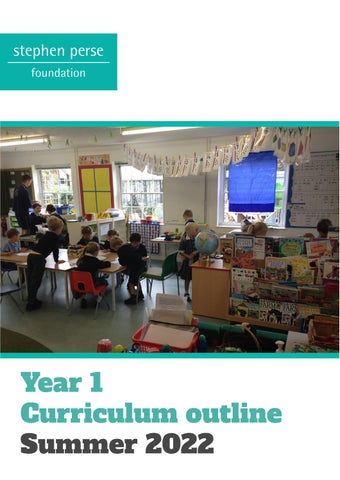
Year 1 Curriculum outline Summer 2022
Year 1 Curriculum Outline Summer 2022 Magnificent Map Makers ~ Let’s Play
Humanities - Social Understanding In our Thematic lessons, our first topic will be ‘Magnificent Map Makers’ where the children will be using their imagination to think about different places, both fictional and real. They will be creating their own imaginary maps, identifying seasonal and daily weather patterns in the United Kingdom and learning more about the work of landscape artists, such as Monet and Van Gogh. In the second half of the Summer Term our topic will be ‘Let’s Play’ where we will be looking at toys played by children through the history of time. In our RS lessons the children will continue to focus on Christianity and Judaism, embedding their understanding of what it means to be “special”. Special books and stories will continue to support our understanding of the different religions around the world. We will be developing our knowledge of baby naming ceremonies and why these are important.
Language and Communication In English this term we will continue to explore various genres to develop the key features and widen our knowledge of the variety of texts available. Some of these opportunities will include exploring and producing information texts, non-chronological reports, poems and pieces of fictional reading and writing as part of the topic. Children will be encouraged to contribute their own choices and learning through these topics in order to encompass an active and creative approach to experiencing these different genres fully. The learning process will evolve to develop with the pupils' voice. Through various activities including drama, reading as a reader, reading as a writer, planning, drafting, editing and publishing, children will become more confident with identifying, understanding and creating these different texts. Children will have lessons which include developing their reading, writing, spelling, grammar and punctuation skills. Through our thematic approach we will include cross-curricular links and areas of our thinking toolkit. During the term children will continue to work through the Read Write Inc programme at their own pace. Additionally, we will work on progressing with their cursive handwriting and will continue to learn the different joins with a view to joining letters independently in their creative writing. As always in Modern Languages, the emphasis will be on confidence in speaking and listening with stories, songs, rhymes and language learning games. Pupils can use the elementary section of Linguascope or languagesonline if they wish to practise vocabulary at home. In Spanish, pupils will read among other stories “Dear zoo” and use this as an opportunity to learn key vocabulary and adjectives regarding animals. Culturally, they will familiarise themselves with the festivity of Sant Jordi ‘a book and a rose’, they will make a rose with tissue paper and they will read the legend of Saint George and the dragon.
In French, the story of Little Red Riding Hood will be the starting point to explore basic fruits and snacks as well as family members and colours. Pupils will then explore a cultural element with the gargoyles of Notre-Dame linking in with the theme of Magnificent Map Makers.
Mathematical Understanding The first topic of Maths this term is number, and we will start with multiplication, division and fractions. When the focus is multiplication and division, pupils will solve one step problems by calculating the answer using concrete objects, pictorial representations and arrays, with the support of the teacher. Fractions will involve pupils being asked to: recognise, find and name a half and a quarter as equal parts of an object, shape or quantity; compare, describe and solve practical problems for: lengths and heights, mass/weight, capacity and volume. Taking a break from number, pupils will spend a week focusing on geometry: they will be asked to describe position, direction and movement, including whole, half, quarter and three quarter turns The next topic is place value: counting to and across 100, forwards and backwards, beginning with 0 or 1, or from any given number; counting, reading and writing numbers to 100 in numerals; identifying one more and one less; identifying and representing numbers using objects and pictorial representations including the number line; and, using the language of: equal to, more than, less than, most, least. The last topic of the term is measurement and we will start with money before finishing the term reinforcing our knowledge of time. The money topic will involve pupils being able to recognise and know the value of different denominations of coins and notes. The time topic will consolidate months and years telling the time to the hour and half past the hour and drawing the hands on a clock face to show these times. Finally, pupils will compare, describe and solve practical problems for time and measure and begin to record time in hours, minutes, seconds.
Physical Education and Well-being In PE children are taught how exercise affects their bodies. We encourage them to see the importance of regular exercise and the importance of a healthy lifestyle. Pupils are encouraged to develop schema patterns for running, jumping, and throwing during lessons. Pupils will focus on developing key skills for striking and fielding activities including tennis and cricket. Athletics is also a focus, where a variety of modified track and field events are participated in as preparation for Sports Day. We use a range of equipment and look at control, speed and movement patterns. Please encourage a healthy and active lifestyle at home. If your child expresses an interest in any sport or physical activity at home, please do take them along to the numerous local sports clubs that we are fortunate to have around us.
PSHEE includes two main topics this term. Our first will be our ‘Sex and Relationships Education’ unit where children will understand how their bodies grow over time. They will understand how babies develop into children and then into adults and their own physical development. In this unit children will develop familiarity with the names of the main external parts of the body and become more confident in describing them. They will consider the amazing nature of their bodies, with a view to developing respect for their bodies and develop an understanding of how important it is to look after their body. Children will also consider simple hygiene practices and their levels of responsibility for these. The main themes of this unit are ‘body knowledge’, ‘body functions’, ‘body awareness/image’, ‘personal hygiene’ and ‘prevention of illness and disease’. We will then look at ‘Drugs Education’ where children will learn to understand safety around medicines and household substances. Children will focus on the positive uses of medicines and the important role that carers and health professionals have in helping us to use medicines safely. We will consider alternatives to medicine use and will touch on emotional well-being as well as physical. This unit also aims to broaden children’s understanding of risky situations, so that they are better able to keep themselves, and possibly others, safe. Forest School is a superb way for our pupils to learn holistically through play and exploration, following their own curiosity. Pupils learn to connect with their environment, manage risks and use their initiative to solve problems and cooperate with others whilst developing their resilience, creativity, confidence, and independence skills. This term they will be making 3D models of nature and animals using wood and various tools. As the season changes the pupils will think about bird and tree identification. The pupils will also look at identifying hazards and how to risk assess the environment. Pupils will continue to build on their existing knowledge of tool’s, while also learning how to use the fire striker. Fitzwilliam pupils will be continuing at their new Forest School area at Clare Wood while Dame Bradbury’s will continue to use Rowley Hill.
Creative and Performing Arts For our Create Design Engineering skills taught through our Thematic lessons we will be focusing on mixing primary and secondary colours to then paint landscapes based upon famous artists such as Monet and Van Gogh. To develop our design skills pupils will have an opportunity to look at how teddy bears and mobiles are made and research the materials used. They will then use the skills they have learned to make their own. In Plan Learn Do Review pupils have the opportunity to lead and direct their own learning. Over a four week cycle the pupils will Plan what they want to do through pictures, words and labels. The pupils then spend a session to Learn about something that will contribute to the successful DO session. perhaps colour mixing, cutting cardboard, threading a needle, or finding out what a real rocket looks like. In the third week, it is DO day; on this day the pupils execute their plan. Then it is the final session which is the pupils’ Review, this is where they reflect on how their project went, this may be a discussion, a video or a written statement. This helps inform the pupils next DO based on what they may want to learn next. In Music, we will be singing familiar songs and identifying the high and low notes. We will start to label these ‘so’ and ‘mi’. We will continue to work on the difference between pulse and rhythm
and find ways to notate these using graphic scores. We will use the patterns we find in these songs to make music on percussion instruments. We will also tell stories through music. Children will work on composition skills to create their own music to show different moods. Most of all, pupils will enjoy putting together their songs and pieces for the Year 1 and 2 Concert.
Scientific Understanding Our Science focus will be delivered through our thematic learning. Pupils will use first-hand experience and simple information sources to answer questions and say what the results show. They will learn how to draw conclusions from results and begin to use scientific knowledge to suggest explanations for them. The children will explore materials through our topic on ‘Let’s Play’, using scientific enquiry to reflect on why certain materials are used for particular toys.
Digital
The Inner Wheel With the Google apps at the heart of digital curation our pupils use Google Classroom to complete work digitally and hand in work that is produced in a variety of ways. We have identified 7 main apps, our EverGreen apps, that help to showcase our pupils’ learning. An animation, movie or annotated piece of work provides richer feedback for the teacher and ultimately helps to make greater progress. Explain Everything www.explaineverything.com Green Screen www.doink.com Stop Motion www.cateater.com Strip Design www.vividapps.com/Strip_Designer/ Notability www.gingerlabs.com Book Creator www.bookcreator.com Puppet Pals www.polishedplay.com
The Outer Wheel We have a number of apps that we use consistently throughout our curriculum that lend themselves to our creative approach. We avoid apps that are specific to a particular outcome, preferring content free apps that can help to enhance our pupils work and understanding. Some examples are: Minecraft, iMovie, KeyNote, Pages and Padlet.
Coding Another aspect of our digital curriculum is the coding/programming skills that are embedded in all subjects or taught discretely in Years 5 and 6. We have identified a progression of apps that help to develop our pupils ability to code. The apps provide variety and challenge and help to develop the computation skills that are crucial learning in our digital work. We combine the coding experiences with physical output. Using Spheros, BBC Micro:Bits and Ozobots provides visual outcomes that bring our code to life. As our pupils develop further they transition on to written code.
Thinking Toolkit Alongside and underpinning our curriculum we ensure that our pupils are developing as active learners and active thinkers. Throughout each subject area pupils are encouraged to use their range of thinking tools and reflect on when and how they are using them. Pupils are encouraged to reflect on how their thinking tools underpin all aspects of their learning and not just in the more obvious ways. How are they creative in maths? How do they enquire in English? How are they critical in Music? How do they think computationally in PE?
Inclusion This curriculum map outlines the core curriculum for each year group each term but at the heart of our wheel is the individual learner. Each subject area has a progression of skills which enables staff to stretch or support individuals as and when they need a little help, a bit of a push or a just a different way in. Within our classrooms through planning, teacher knowledge and interactions work is differentiated to suit the needs of each individual.