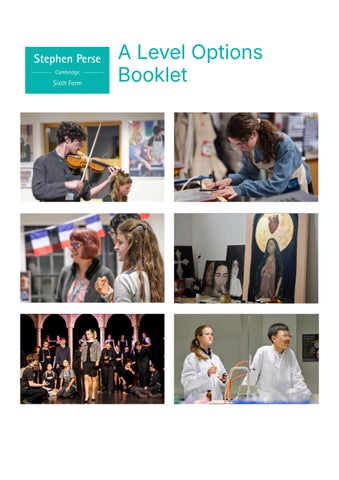
A Level Options Booklet
CONTENTS Art & Design
3
Biology
5
Business
7
Chemistry
8
Classical Civilisation
10
Classical Languages: Latin/Greek
12
Computer Science
14
Design & Technology: Product Design
16
Drama & Theatre
19
Economics
23
English Literature
26
Film Studies
28
Further Mathematics
30
Geography
32
History
34
Mathematics
36
Modern Languages
38
Music
46
Philosophy
48
Physical Education
49
Physics
51
Politics
53
Psychology
55
Religious Education
57
Sociology
59
ART & DESIGN
Work in a mature and focused environment –and develop your own viewpoints, perspectives and original voice. You'll have the freedom to produce your own images and artefacts using a wide range of techniques, along with your own, specialist art vocabulary. Find inspiration In our Art Department, you'll find expertise in painting, photography, drawing, printing, graphics, ceramics, sculpture, textiles, fashion, three-dimensional design and alternative media, so there are plenty of areas to explore. Skills-based workshops are provided weekly, led by specialist art practitioners and visiting artists. Work in a dynamic setting Our Visual Arts Centre is a state-of-the-art facility with its own Year 12 study area and Year 13 studio. It feels more like an art college than a school – and is a space which allows you to work outside scheduled lessons, as well as promoting an interdisciplinary approach to art. You'll also have access to our specialist print room, textiles studio, fine art studio, an ICT media suite, sculpture room, two kilns and a small art library. We also have our own exhibition space, which can be used for life drawing classes. We use the Pearson Edexcel Art and Design A Level course with specialisms in Textiles and Fine Art
Edexcel A level Art and Design 2015 | Pearson qualifications, offering the possibility of studying two Art and Design subjects. Component 1 (Coursework) is worth 60% and Component 2 (Exam) is worth 40%. This is a practical based course and offers opportunities for students who prefer to work week to week, rather than relying on tests and end of course examinations. Create your future Many of our students apply successfully to world famous art colleges and academic institutions, such as Cambridge University for Architecture, Central St Martins for Foundation and Fine Art Degree, the Courtauld Institute for History of Art and Goldsmiths for Fine Art [Painting]. Degree courses embarked on vary from Architecture, Fine Art and Art history to fashion/costume design, engineering, illustration and Business in the Creative Industries. We can provide full support throughout the application process via the sixth form University Preparation sessions. Open studio sessions after school, trips and evening classes will also help you develop your studies.
BIOLOGY
Have you ever wondered how your heart beats over 100,000 times each day? Or how your body makes more than one million red blood cells a second? What causes disease and how does a pathogen spread? Do you think about how humans are affecting ecosystems and the populations of organisms that live within them? If you do, then Biology might be the subject for you! AQA Biology (7402) If you would like to study the physiology and cell structure of living organisms, anatomy, inheritance and much more, then A Level Biology is for you. A world-changing subject Biology is at the forefront of current scientific research and is a very fast-changing subject with key discoveries made every year. Developments in molecular biology, bioinformatics and medicine allow these breakthroughs to happen and rely on a thorough understanding of Biology. Future ambitions Biology is not exclusively for scientists and may be successfully combined with languages, humanities and creative arts. A Level Biology contains a strong mathematical and chemical element and these subjects will provide you with an advantage in your studies. A Level will be an advantage for anyone seeking a career in medicine, veterinary science, dentistry, psychology, physiotherapy or nursing as well as
in biological subjects such as biochemistry, microbiology, genetics, food science, agriculture, environmental science and other sciences. Beyond the classroom As part of the course fieldwork is carried out locally at our own nature reserve. We also provide the opportunity for students to extend their studies by participating in the Intermediate and British Biology Olympiads. Wherever possible we draw upon our unique connections in Cambridge to organise talks by eminent speakers and trips to local institutions. Course Content Biological molecules Cells Organisms exchange substances with their environment Genetic information, variation and relationships between organisms Energy transfers in and between organisms Organisms respond to changes in their internal and external environments Genetics, populations, evolution and ecosystems The control of gene expression Assessment Three written papers Paper 1: 2 hours; 91 marks; 35% of the overall grade Short answer, long answer and extended response questions covering topics 1- 4 (including relevant practical skills) Paper 2: 2 hours; 91 marks; 35% of the overall grade Short answer, long answer and extended response questions covering topics 5 - 8 (including relevant practical skills) Paper 3: 2 hours; 78 marks; 30% of the overall grade Structured questions, critical analysis of experimental data and one essay from a choice of two covering topics 1-8 (including relevant practical skills) Practical endorsement Performance in this component is reported as either a pass or ungraded. It is based on teacher observations, practical planning and the analysis of results generated.
BUSINESS A study of business helps your understanding of how all types of business operate and examines what it takes to make a business successful. You will also find out about the key theories and strategies that are used to make a business work. The subject is taught through problem solving and the skills learned are applicable to national and multinational environments. AQA 7138 This course will appeal if you wish to: Start your own business at some point in the future. Understand more about new types of business careers where you could become a business consultant. Be aware of how a business functions if you intend working in a business environment.
Business is a dynamic subject so it's important that you enjoy new ideas and what’s happening around you. To help with this, the course uses real life examples and current business news as case studies to aid your learning.
The course will answer questions such as these: How can you generate a profit? Will marketing improve your competitive advantage? How do you manage people? Which types of strategy should you use to change your business? How can you manage risk?
If you intend studying business at degree level, a wide number of courses offer choices that combine business with other subjects. The variety of business degrees is also wide with many offering options that count towards professional exemptions in areas such as accountancy or human resource management.
Course content The course is divided into three units taught over two years: 3.1 Unit: What is business? Managing marketing and finance. 3.2 Unit: Managing people and operations.
3.3 Unit: Business and society, business and the external environment, and business strategy. Assessment There are three papers (2 Hours each, 33.3% each), one on each unit. Each paper has two case studies, followed by five compulsory questions.
CHEMISTRY
It's hard to think of any manufactured product that did not need the creative talents of a chemist at some stage in its development. Find out how chemistry contributes to our quality of life by enabling us to make new substances ranging from detergents and plastics to anti-cancer drugs and by helping us to monitor the environment, detect crime and much more.
OCR Chemistry A Chemistry is an exciting and relevant science that provides answers to everyday questions through a practical and problem-solving approach. If you study chemistry in the Sixth Form you will meet intellectually challenging ideas and consider numbers infinitely large and particles infinitesimally small. You will gain an understanding of the molecular complexity of the world around us and an insight into how and why chemical reactions happen. Yet your study of chemistry will not be simply an encounter with fundamental ideas and concepts but the development of a wide range of transferable skills that will last a lifetime. Beyond the classroom During the course you will have many opportunities to extend your studies, including the chance to compete in events such as the Cambridge C3L6 competition, the International Chemistry Olympiad and The RSC Schools’ Analyst Competition. Scientific work experience opportunities also arise through the Nuffield Bursary Scheme and our local Cambridge connections. Course content Module 1 – Development of practical skills in Chemistry: skills of planning, implementing, analysis and evaluation. Module 2 – Foundations in Chemistry: atoms, compounds, molecules and equations; Amount of substance; Acid–base and redox reactions; Electrons, bonding and structure. Module 3 – Periodic table and energy: the periodic table and periodicity; Group 2 and the halogens; Qualitative analysis; Enthalpy changes; Reaction rates and equilibrium (qualitative). Module 4 – Core organic Chemistry: basic concepts; Hydrocarbons; Alcohols and haloalkanes; Organic synthesis; Analytical techniques (IR and MS). Module 5 – Physical Chemistry and transition elements: reaction rates and equilibrium (quantitative); pH and buffers; Enthalpy, entropy and free energy; Redox and electrode potentials; Transition elements. Module 6 – Organic Chemistry and analysis: aromatic compounds; Carbonyl compounds; Carboxylic acids and esters; Nitrogen compounds; Polymers; Organic synthesis; Chromatography and spectroscopy (NMR).
Assessment Three written papers Paper 1: 2hr 15 minutes, 100 marks Periodic table, elements and physical Chemistry on content from modules 1, 2, 3
and 5 Paper 2: 2hr 15 minutes, 100 marks Synthesis and analytical techniques on content from modules 1, 2, 4 and 6 Paper 3: 1 hr 30 minutes, 70 marks Unified Chemistry on content from all modules
Practical work Your knowledge and understanding of practical work will be assessed as part of the written exam papers. The A Level will include at least 15% of the written papers covering knowledge and understanding of practical. At A Level your practical work will also be endorsed on your examination certificate (pass/fail).
CLASSICAL CIVILISATION A Level Classical Civilisation is a fascinating course with incredible breadth, encompassing the history, art, and literature of ancient Greece and Rome. Through this course you will gain access to these two civilisations - ones which continue to influence and inspire the modern world. All texts are studied in translation and so no knowledge of the original languages is needed. You will develop your ability to analyse visual and written sources, and learn how to write clearly and concisely about them. Class discussion is a core part of every lesson, and pupils will learn to present their ideas effectively in different ways (e.g. short answer analysis questions on particular details, overview essay questions, class presentations / seminar contributions).
Beyond the classroom The Classics department will support your study of Classical Civilisation with a stimulating programme of academic enrichment, including weekly extension sessions, essay competitions, and trips to galleries, museums and theatre productions. The department also runs trips abroad to sites of interest in Greece and Rome.
The course requires no knowledge of Latin or Greek, and is open to all regardless of GCSE subjects studied.
Course content You will study three different topics: The study of the epic poems of Virgil and Homer is compulsory - but for the other two there is a choice from topics such as Greek theatre, Greek art, Roman politics, Greek religion and so on. We aim to choose topics which appeal to the interests of our students.
The current modules offered are: World of the Hero - You will have the opportunity to engage fully with two foundational works of literature - Homer’s Odyssey and Virgil's Aeneid. Both tell of heroic journeys but each has its own concept of what it means to be “heroic”. Greek Art - You will study the development of Greek sculpture and vase painting over centuries, from the Archaic period to the Classical. You will have the opportunity to visit the Museum of Classical Archaeology in Cambridge to see casts of many of the statues which you study. Politics of the Late Republic - Through the eyes of Cicero you will study one of the most chaotic, significant and interesting periods of Roman history. You will explore the rise and fall of Julius Caesar, the attempted revolution of Catiline, the villainy of Verres, the vendettas of Clodius and more. Crucially, you will see how all of these individuals played a role in the total collapse of Rome’s system of government.
Assessment In the final exams, the compulsory epic module forms 40% of the final assessment; the other two topics each carry 30%. Each paper involves written responses to stimulus material: this material will include short extracts / images taken from the material studied during the course and structured essay questions.
CLASSICAL LANGUAGES: LATIN/GREEK
Latin and Greek are fascinating languages: both are constructed in a way that makes linguistic structures clear (such as the structure of a complex sentence, the relationship between different sorts of clauses, the different viewpoints created by different forms of the verb). Studying either language (or both!) will therefore improve your understanding of language in general, and especially your understanding of English.
You will learn to process information and to apply rules accurately, to be alert to fine details and to be sensitive to nuances of meaning. In addition you will get to read original and inspiring texts, and you will develop your appreciation of cultural relativity through the differences in the ideas and values of the Ancient Greek / Roman worlds and our own.
You will also develop your skills of literary analysis and you will learn how to write clearly, concisely and analytically.
Beyond the classroom Alongside lessons, we organise and take part in a variety of exciting co-curricular opportunities, which includes Sixth Form seminars with other schools, hosting a Stephen Perse Evening of Classics, Study Days hosted by the University of Cambridge, visits to galleries/theatres, and residential trips abroad to various classical locations (usually Italy or Greece).
Course content Both the Latin and Greek courses follow the same structure: Language work (50%) - you will expand your knowledge of grammar and vocabulary, and practise translating from Latin/Greek into English, and from English into Latin/ Greek. Literature work (50%) - you will start with a general reading course designed to help you understand the literary contexts within which key texts were written. You will then move on to the examination texts: one will be a prose author (such as Tacitus or Livy), and the other a poet (such as Virgil, Catullus or Horace).
Assessment The final exams are structured as follows: Unseen Translation (33%): you will translate a piece of original (or lightly adapted) prose and a piece of original poetry into English. Comprehension or Prose Composition (17%): you will answer questions on a piece of unseen Latin prose, or translate a short paragraph of English into Latin/Greek. Prose Literature (25%): you will answer questions on the text you have studied; these questions will include literary analysis and an essay question. Verse Literature (25%): this paper follows the same model as the prose literature paper.
COMPUTER SCIENCE
Ready to build the next-generation of tech? A Level Computer Science is your launchpad into a world of extraordinary possibilities, offering the skills to shape the digital future, from creating immersive video games to pioneering advancements in Artificial Intelligence and Big Data. Why Study Computer Science? Be a Creator: This is a creative, practical subject where you learn to invent and think critically. It’s for logical minds who thrive on solving complex puzzles and problems. A World of Opportunity: The demand for talented programmers and digital thinkers has never been higher. You'll gain a globally recognised skill-set, opening doors to careers across the globe in fields like: The Gaming Industry: Dive into a culture more akin to digital media, designing story-rich, imaginative, and beautifully crafted games. Big Data & AI: Be at the forefront of analysing social media trends, creating intelligent systems, and developing cross-platform software. Traditional Tech Roles: Excel in areas like data mining, business information systems, and cybersecurity.
Course components Computer Systems: Delve into the inner workings of hardware and software, understanding the fundamental concepts that underpin all modern technology. Assessed via a written paper (40%). Algorithms and Programming: Develop the powerful problem-solving skills needed to create logical and highly effective solutions using industry-recognised programming languages. Assessed via an electronic paper, so no writing programs on paper like in GCSE! (worth 40% of your overall marks). Non-exam Assessment (NEA): Programming Project: This is your chance to shine! Choose a computing problem that genuinely challenges you, build your programming experience, and follow a typical industry design and development process: Analysis of the problem Design of the solution Developing the solution Evaluation of the solution (20%)
Beyond the classroom: elevate your profile Our course extends far beyond the curriculum, immersing you in a thriving culture of digital excellence and competition through talks, competitions, enrichment and university prep sessions and more. Challenge yourself and gain a competitive edge for university applications and future careers through: Olympiads: Test your problem-solving limits in prestigious national and international competitions: British Informatics Olympiad (BIO): Join our legacy - we’ve had a student represent the UK internationally. British AI Olympiad: Explore the cutting edge of artificial intelligence. Coding Competitions: Put your programming skills to the test against other top students in regional and national coding challenges. Inspirational Talks: Gain real-world perspective from industry leaders and professionals. Past speakers have included the Counter Terrorism Police Force, discussing topics like Fighting Terror with Tech, and many more experts in areas like cybersecurity, ethical hacking, and digital innovation.
Join us and start building the future today!
DESIGN & TECHNOLOGY: PRODUCT DESIGN
This creative and thought-provoking qualification gives students the practical skills, theoretical knowledge and confidence to succeed in a number of careers, especially those in the creative and STEM industries.
For the A level qualification, students will: Investigate historical, social, cultural, environmental and economic influences on design and technology, whilst enjoying opportunities to put their learning into practice by producing prototypes of their choice. Acquire a greater depth of understanding of scientific and technological principles, develop skills in design and engineering to a high level. Have opportunities to show an aptitude for project management and to develop skills in cutting edge technologies. Have opportunities to work with a wide range of materials including hardwood, softwood, manufactured boards, plastics, metals, textiles and electronic components. They will gain experience in the workshop developing skills in a wide range of processes including metal and wood turning, brazing, joinery, routing, casting, laser cutting and 3D printing.
The students can also enjoy working in the department during our enrichment time exploring their own projects, or working in teams to solve real life practical problems.
Studying a D&T course sets students up for a huge variety of careers. Many of our students have moved into successful careers in product and industrial design, engineering and architecture. The range of learning available to the student supports practically all the STEM vocations.
Design Engineering Studios and Workshop Design engineering centres around a well-developed workshop with a huge range of tools and equipment to allow students to tackle the most challenging and advanced projects. As well as a large range of hand tools there are metal and wood lathes, laser cutters, 3D printers and CNC mill, sanders, power fret saws, drilling machines, a vacuum former and plastics oven, line benders and a brazing hearth/forge. There are three design workshops which are fully equipped with desktop computers and drawing equipment and a workshop space along with a quieter space to design and model ideas.
Course content Content for paper 1: Materials and their applications Classification of materials Methods for investigating and testing materials Performance characteristics of materials Enhancement of materials Forming, redistribution and addition processes The use of adhesives and fixings Finishes Modern industrial and commercial practice Efficient use of materials Digital design and manufacture The requirements for product design and development Health and safety Protecting designs and IP Design for manufacture, repair and disposal Feasibility studies Enterprise and marketing Design communication
Content for paper 2: Design methods and processes Design theory Impact of cultural changes Product life cycle Design process Critical analysis and evaluation Selecting appropriate tools and equipment Accuracy in design and manufacture Responsible design Design for manufacture and project management National and international standards in design
Assessment This qualification is linear so students will sit all their exams and submit all their nonexam assessment at the end of the course. There are two papers and a non-examined element.
Paper 1. Technical principles: written exam 2½ hours 30% A level. Short answer and extended response.
Paper 2. Designing and making principles: written exam, 1½ hours, 20% of A level. Short answer and extended response. Section A: Product Analysis: 30 marks Up to 6 short answer questions based on visual stimulus of product(s). Section B: Commercial manufacture: 50 marks Mixture of short and extended response questions
Non examined element: Practical application of technical, designing and making principles. Students will need to produce a substantial design and make a project which solves a real life problem and create a commercially viable product. 50% of A Level Submitted as an electronic portfolio with photographic evidence of the final prototype (suggested 45 A3 pages)
DRAMA AND THEATRE
Do you have a love of theatre and performance? Do you enjoy working collaboratively and creatively as part of a team? Taking Drama and Theatre A level will allow you to build on your performance skills and give you the opportunity to explore drama as a practical art form in which ideas and meaning are communicated to an audience. Through practical experience and exploration you will gain confidence as both performer and theatre maker.
AQA Drama and Theatre (7262)
A level Drama and Theatre combines a very practical approach with theoretical study and you will explore a wide range of theatrical styles and contexts.
This is a linear qualification and the course is divided into three components - Drama and theatre, Creating original drama and Making theatre.
Drama and theatre is the written component and for this you will undertake an in depth study of two play texts from a prescribed list. Through a combination of discussion and
practical exploration you will consider how to interpret and bring the texts to life for an audience from the perspectives of performer, designer and director. You will also learn how to discuss, analyse and evaluate the contribution of directors, designers and performers to live theatre performances seen during the course. This component is assessed through a written exam.
For the Creating original drama component you will work in groups to create your own original piece of devised performance work. You will record the process in a document called the Working Notebook.
For the final component, Making theatre, you will explore three different extracts of plays from a practical perspective as a theatre maker. You will choose one of these to develop into a polished piece of performance for assessment in a formal exam setting. You will record and evaluate the process in a written document called the Reflective Report.
For each of these practical components you will also study the work of an influential theatre practitioner and you will use your knowledge and understanding of this practitioner to inform your own rehearsal and performance work.
Throughout the course you will have the opportunity to take part in a wide range of theatre visits and workshops to further enrich your learning.
Whatever career you ultimately hope to pursue, Drama and Theatre A Level will equip you with a valuable toolkit of transferable skills and help you to develop confidence as a communicator and collaborator.
Course content Component 1: Drama and theatre (written paper) Component 2: Creating original drama (coursework) Component 3: Making theatre (coursework)
Assessment Component 1: Drama and theatre What's assessed:
Knowledge and understanding of drama and theatre Study of two set plays Analysis and evaluation of the work of live theatre makers
How it's assessed: Written exam: 3 hours Open book 80 marks 40% of A-level
Questions: Section A: one question (from a choice) on one of the set plays (25 marks) Section B: one three part question on a given extract from one of the set plays (30 marks) Section C: one question (from a choice) on the work of theatre makers in a single live theatre production (25 marks)
Component 2: Creating original drama (coursework) What's assessed: Process of creating devised drama Performance of devised drama (students may contribute as performer or designer)
Devised pieces must be influenced by the work and methodologies of one prescribed practitioner.
How it's assessed: Working notebook (40 marks) Devised performance (20 marks) 60 marks in total 30% of A-level
This component is marked by teachers and moderated by AQA. Component 3: Making theatre (coursework) What's assessed:
Practical exploration and interpretation of three extracts (Extract 1, 2 and 3) each taken from a different play Reflective report analysing and evaluating theatrical interpretation of all three extracts
Methodology of a prescribed practitioner must be applied to Extract 3. Extract 3 is to be performed to a visiting examiner as a final assessed piece.
How it's assessed: Performance of Extract 3 (40 marks) Reflective report (20 marks) 60 marks in total 30% of A-level
This component is marked by AQA.
ECONOMICS
A study of Economics enables you to gain a better understanding of the world in which we live on both a local, national and global scale. It is a highly topical subject and analyses issues that grab the news headlines.
AQA 7136
What has been the impact of BREXIT? Should we worry about oil prices? How will an economic slow down in China affect the rest of the world? What impact will immigration have on the UK economy? How will tariffs affect international trade?
At the centre of the subject is the question of how we divide up our scarce resources and how those decisions affect us all – who gets what and why?
Not only will A Level Economics increase your knowledge and understanding of a wide range of current issues but it will also equip you with the tools to analyse data, think critically about issues and make informed decisions. It will help you to build upon your quantitative skills and appreciate that, when evaluating arguments both qualitative and quantitative evidence are important.
This course will appeal if you wish to: pursue a career as an economist or in a business/management related profession enjoy studying a subject that affects your everyday life want to keep your options open, as the subject can be combined with the sciences, social sciences and humanities.
If you intend to study at degree level, a number of courses require A Level Mathematics. However, a large number of universities offer a less mathematical approach to the subject with no mathematical requirement and often economics is combined with other social sciences such as politics and languages.
Course content Unit 1 – Individuals, Firms, Markets and Market Failure This unit provides an introduction to the nature of Economics and examines how the price mechanism allocates resources in markets. It analyses the nature of market failure, its causes and possible policy remedies. We learn to apply supply and demand analysis to real-world situations and understand why markets might not allocate resources efficiently. We will analyse the pricing and production decisions of firms in different competitive contexts, and evaluate the role of Government intervention aimed at the promotion of competitive markets. Unit 2 – The National and International Economy This unit introduces the key measures of economic performance and the main objectives and instruments of economic policy. We will study the effectiveness of Government demand-side and supply-side policies to achieve economic objectives. These concepts are studied in relation to the UK and the global economy. In addition a wide range of issues relating to the international economy and trade are studied including: exchange rates; protectionism; the factors contributing to globalisation; sources of possible conflict between trading blocs and the role of the WTO; European Monetary Union; inward foreign investment by multi-national corporations and external shocks to the global economy.
Assessment Paper 1: Markets and Market Failure (33.3%) Time: 2 hours Question Type: One data response question and one essay.
Paper 2: National and International Economy (33.3%) Time: 2 hours Question Type: One data response question and one essay.
Paper 3: Economic Principles and Issues (33.3%) Time: 2 hours Question Type: Multiple choice questions and a data response question responding to stimulus material.
ENGLISH LITERATURE
Studying English Literature at A level is a fascinating and intellectually stimulating experience, allowing you to immerse yourself in a world of compelling, imaginative and inspiring stories. The skills you will develop as you progress through the course - critical thinking, negotiating and evaluating points of view, oral communication, essay-writing, research, and working independently and as part of a team - are all valued by universities and employers. So, if you love reading, and want to explore seminal works of literature that explore what it means to be human and the experience of being alive, English Literature is for you.
OCR A Level English Literature H472
Studying English Literature at A Level will allow you to explore challenging and thoughtprovoking texts and you will be encouraged to read widely in different genres (poetry, short stories, the novel, drama) and from different periods (for example, medieval to the present day). You will also learn how to evaluate the importance of a text’s intellectual and historical context.
The course places emphasis on developing critical skills, both orally and on paper, and on defending one’s views against those of other critics as well as other students. We
encourage students to develop their own opinions and interpretations and to share them with others.
Recent changes to the syllabus have meant that a greater proportion of texts are modern and there are more opportunities for independent reading. The coursework assignment has the potential to produce sophisticated, sustained academic writing and to allow intellectually lively students with argumentative and analytical flair the chance to shine.
Beyond the classroom We attend study days on set texts and enjoy theatre trips whenever possible. We also make use of our local Cambridge connections, including the resources at the Fitzwilliam Museum.
Course content Component 1: Shakespeare and Drama & Poetry pre-1900. The focus of Section 1 is the study of one Shakespeare text, for example Hamlet. The focus of Section 2 is the comparative study of one drama text and one poetry text, for example Webster’s The Duchess of Malfi and Milton’s Paradise Lost. Component 2: Comparative and Contextual Study. This component is split into the following topic areas: American Literature (1880-1940); The Gothic; Dystopia; Women in Literature and The Immigrant Experience. You will study one topic (this year we are doing the American synoptic) and study two whole texts. In addition to the set texts, you will be expected to read widely and independently in the chosen topic area to help you prepare for the unseen question. Component 3: (Non examined assessment). This is an internally assessed component, the coursework element, designed to encourage individual study, and its emphasis is on modern literature. You will study three literary texts, one of which must have been first published or performed in 2000 or later (including one prose, one poetry and one drama text). Assessment Component 1: Shakespeare and Poetry & Drama pre-1900, 2 hours 30 minutes, closed text, 40% of final exam. Component 2: Comparative and Contextual Study, 2 hours 30 minutes, closed text, 40% of total exam. Component 3: Coursework, 3000-word folder, 20% of total exam. You will produce two pieces of work: one a 1000-word close reading of a portion of one text (or a recreative writing piece with commentary), the other a 2000-word comparative essay based on two texts.
FILM STUDIES There is so much more to Film Studies than simply watching films. Studying films will not only challenge you to think about how directors create meaning and emotion, for example, through lighting, or costume, or camera angles but it will also encourage you to explore political issues such as representation of race or gender. Film Studies has been an academic discipline within universities for over 50 years. Oxford and Cambridge are now offering Masters and PHD courses in Film Studies and Screen Arts. And the Russell Group universities accept Film Studies as an appropriate A level qualification when prospective students apply to study a humanities or arts related discipline. So, if you love watching films and want to find out more about how moving images can engage your humanity and intelligence, Film Studies might well be for you.
OCR A Level Film Studies H410
Course content You will study a range of films, from silent films through French surrealism and German expressionism to modern British, Hollywood and foreign language independent films. As you progress through the course, you will become familiar with the visual language of film, and learn to interrogate how concepts such as narrative, genre, representation, spectatorship and aesthetics are used to create meaning by deconstructing and creating film. You will also develop an understanding of the contexts in which films are made.
There are three components to the Film Studies syllabus: Component 1: Film History Paper One - Film History - 2 hour paper - 35% of total A Level The Silent Period 1930-1960 1961-1990 Experimental Film (European surrealist film) and either German expressionism or French new wave.
Component 2: Comparative and Contextual Study Paper Two - Critical Approaches to Film - 2 hour paper - 35% of total A Level
Learners must study at least one set film from each of the categories below: Contemporary British Contemporary US Documentary Non-European non-English Language English language (non-US) US Independent
Component 3: Non Exam Assessment/Making Short Film Making Short Film (Nonexamined Assessment) - 30% of total A Level Learners must study one compilation of short British fiction films Production of a five minute short film or a ten minute screenplay for a short film( incorporating a digitally photographed storyboard) Evaluative analysis of the production in relation to professionally produced set short films
Beyond the classroom We are keen to make use of the Cambridge Arts Picturehouse and its excellent range of films. The BFI in London is an amazing facility and we aim to make use of the wide range of activities and screenings it has on offer.
‘’We're face-to-face with images all the time in a way that we never have been before. Young people need to understand that not all images are out there to be consumed like, you know, fast food and then forgotten. We need to educate them to understand the difference between moving images that engage their humanity and their intelligence, and moving images that are just selling them something." Martin Scorsese.
FURTHER MATHEMATICS
If you are aiming to study a highly quantitative degree at a top university, or if you just love the beauty and elegance of mathematics and want to study lots of different aspects of it, then the Mathematics/Further Mathematics ‘double’ is the course for you. You will be doing a lot of maths over these two years and be challenged intellectually throughout. Whereas the pace may be a striking difference to your previous experiences in the first year, the algebraic complexity steps up a gear in the second year.
If you are tenacious, accurate and enjoy algebraic puzzles, with very secure mathematical foundations, you will probably enjoy this course.
With a core of students often studying many of the same subjects, you will be in a group of like-minded peers, keen to pursue maths for its own sake.
Course content The Further Mathematics course includes all of the topics from the Mathematics course, but goes further into each of the topic areas: The Pure Mathematics topics extend the use of calculus further and introduce new concepts such as matrices and complex numbers.
The Statistics topics explore a wider range of probability distributions and statistical tests. The Mechanics topics develop the theory to model more complex situations.
A calculator that is more powerful than the standard scientific ones is required for A Level Mathematics. A graphical display calculator can give you a distinct advantage on some A Level exam questions. As such we strongly recommend purchasing a graphical display calculator and can offer guidance with this.
Assessment Students will follow the linear OCR Further Mathematics course. All assessments will be at the end of the two year course. As well as the three (single) A Level papers, students will take four further papers, each of 90 minutes in length. These are: Two mandatory further pure maths papers; Two options from a choice of three areas: additional pure, statistics or mechanics.
GEOGRAPHY If you're curious about the world around you – and who isn't – you'll enjoy studying Geography. It is an up-to-date subject about contemporary issues, such as the challenge of relating the way you live now to the possible global environmental change of the future. It'll also help you to develop a wide variety of personal study skills, preparing you for life beyond Sixth Form.
The Government and the media frequently make us aware of challenges such as earthquakes, urban changes, climate change and the superpowers of the world. By studying this subject you have an opportunity to explore these problems and to understand the different types of solutions and management schemes that could be used.
Geographers are always in great demand for employment because of their ability to analyse data, write reports and generally be part of a team. Geography gives you many transferable skills and an understanding of the world around you.
This integrated specification provides all of this and complements many other subjects, especially Biology, Chemistry, Economics, History, Mathematics and Physics. Links with these subjects help you to understand how the natural world evolves and how human communities have developed and function today.
Fieldwork is an integral part of the course and you will attend a residential trip where you will learn the requisite skills and collect information for your independent investigation.
EdExcel 9GEO
Course content Topics for Paper 1 - Focuses on the physical world and the impacts that it has on us. Tectonic Hazards Coastal landscapes The Water Cycle and Water Insecurity Energy Insecurity/Climate Change Futures
Topics for Paper 2 - Focuses on socio-economic aspects at the global, national and local scales. Globalisation Superpowers Shaping Places Health, Human Rights and Intervention
Assessment Paper 1 (2 hours 15 minutes, 30%) Paper 2 (2 hours 15 minutes, 30%) Paper 3 (2 hours 15 minutes, 20%) - A Synoptic Paper which looks at an issue taken from two or more of the topics covered in the previous two papers. The focus will be on the stakeholders, the issues involved and the possible solutions. Independent Investigation, 20% - A piece of coursework where you come up with the title, plan the investigation and collect the data. This is written up as a 30004000 word report.
HISTORY History is a people-centred subject. You study how people behaved in the past, discuss how far their actions resulted from their moral or religious beliefs and see what the pursuit of power did to nations and individuals.
OCR H505
We discuss how far people’s actions resulted from moral or religious beliefs and question what the pursuit of power has done to nations and individuals. This enables us to question whether people’s lives were shaped more through the actions of their leaders than the wider forces of social and economic change. Through the study of history, you will gain an understanding of problems afflicting the modern world such as aggressive nationalism and religious conflict, as well as understand more about how we come to be who we are today.
As well as encouraging you to think about both the past and the present, studying A Level History helps develop valuable skills, including the ability to absorb a large amount of information, to present it with clarity and discrimination, to write with fluency, to have critical powers of analysis and to work in a self-disciplined manner.
Beyond the classroom We offer the opportunity to participate in a range of trips to develop your knowledge and understanding of the past. Recent trips have included overseas visits to Berlin as well as attendance at study days in London and History seminars in Cambridge. Our weekly History Society discusses a variety of aspects of history, and also enables students to take the lead in running sessions on different topics of interest.
Course content British unit – England 1547-1603 - An enquiry based unit exploring the Mid-Tudor Crises 1547-1558. Non-British unit - Democracy and Dictatorships in Germany 1919–1963. Thematic unit - Russia and its Rulers 1855-1964. Exploring the reigns of Tsars and communist leaders of Russia and their impact. Independent investigation - A coursework unit, where students independently research and produce a coursework essay with supervision.
Assessment British Unit – 90 mins (25%) Non British Unit – 60 min (15%) Thematic Unit – 150min (40%) Coursework – 3,000 - 4,000 word essay (20%)
MATHEMATICS When learning mathematics, you are always building on the knowledge and skills you have already acquired. This continues to be true in the Sixth Form and, in addition, you will need to be able to apply standard techniques to new situations and to select the correct method to solve a particular problem. The feeling of achievement that comes from finally solving what at first seems to be an intractable problem is unique to the subject. A Level Mathematics can be studied in combination with any other subject and is a particularly good complement to the sciences, economics or geography. However, wherever your main interest may lie, if you are good at and enjoy mathematics, it is worth considering pursuing the subject in the Sixth Form. The analytical and problemsolving techniques which are developed at this level are valued in many disciplines and are highly regarded by employers.
Course content Pure Mathematics, which extends the algebra and trigonometry met at IGCSE/GCSE (or equivalent) and introduces topics such as calculus. Mechanics, in which the motion of objects and how they respond to forces acting upon them are modelled mathematically. Statistics, which extends the handling data topics and probability from IGCSE/GCSE to include the use of statistics when testing hypotheses. A calculator that is more powerful than the standard scientific ones is required for A Level Mathematics. A graphical display calculator can give you a distinct advantage on some A Level exam questions. As such we strongly recommend purchasing a graphical display calculator and can offer guidance with this. Assessment Students follow the Linear A Level course. We follow OCR specification A. Assessment will be by three examinations, all taken at the end of the two year course. The papers will be of equal weighting (100 marks each), and will last two hours each. The content will be as follows: Paper 1 - Pure Maths Paper 2 - Pure Maths and Statistics Paper 3 - Pure Maths and Mechanics
MODERN LANGUAGES Learning a language is about communication between people of different cultures and societies. When studying a language, you will be studying its culture as well as reflecting on your experiences in relation to your own first language.
"If I am selling to you, I speak your language. If I am buying, dann müssen Sie Deutsch sprechen." Willy Brandt, the former West German chancellor.
Subjects French (Pearson) German (AQA) Spanish (AQA) Mandarin (Pearson) Early entry for Japanese and Russian is possible
Languages and the future You may already be considering a career where modern languages will be a necessity: in banking, publishing, diplomacy, commerce or the European civil service. Languages can form useful combinations with most subjects, which you may want to continue at university.
A modern language combined with a Law, Science, Engineering or Business Management course, for example, will prove an attractive combination to employers both in the UK and in Europe, or indeed in a global employment context.
Now, and increasingly in the future, career mobility will demand excellent language skills from a multilingual, flexible workforce. Beyond these practical considerations, you may want to find out about new cultures and seek opportunities to share experiences and thoughts with others of a different linguistic and cultural background. This will be in itself a worthwhile journey of discovery and will continue to bring you joy in years to come.
Languages at A Level Communication is at the core of your language course, both in the spoken and written form. The A Level language courses are designed to develop all the linguistic skills you have already been practising at GCSE but using increasingly sophisticated vocabulary and structures. They constitute an integrated study with a focus on language, culture and society.
At the end of the course, you will feel confident enough to consider a career where your knowledge of foreign languages will open up exciting new prospects in a very competitive, global job market. It fosters a range of transferable skills including communication, critical thinking, research skills and creativity, which are valuable to the individual and to society.
Course content Content is based on themes addressing a range of social issues and trends, as well as aspects of the political and artistic cultures of the countries and communities where the language studied is spoken.
Oral, aural, reading and writing skills are practised within these themes and this provides a balanced framework for progression.
Our approach As a language student, you will be encouraged to express yourself clearly on a wide range of contemporary social and political issues, developing your own thoughts and opinions in discussions and essays. Indeed, sharing and developing ideas can be one of the many rewarding aspects of language learning. Your teachers will conduct classes in the target language in groups deliberately kept small to enable everyone to participate actively and with confidence. You will often be encouraged to work independently.
Beyond the classroom You are encouraged to take part in the broad range of visits and exchanges available or to arrange your own stay abroad independently. These trips are a congenial way to develop language skills and to gain insight into the societies and cultures in which the language is spoken. We offer study trips to China, France and Spain. We participate in a scholarship programme to Keio, Japan. There is an opportunity to take part in a work experience programme with our partner school in Munich, Germany. Closer to home, we offer regular trips to cultural events at theatres, cinemas and galleries.
Closer to home trips French Trip to the Marie Antoinette Exhibition at the V&A in London.
Japanese Japanese is offered as an extra-curricular club for beginners. Interested in a dream trip to Japan? Two Year 12 and two Year 10 students are invited by Keio High School to visit Japan during the February half term, with partner students from Keio spending two weeks in Cambridge. Highlights include an overnight trip to an onsen spa, visiting the Emperor’s tea garden and temples in Tokyo, calligraphy and origami lessons, and trying on kimonos. Keio school itself shares the Fujisawa campus of the world famous Keio university, and our time in school exploring clubs, classes and culture, as well as time with exchange families, offers a unique and fascinating insight into daily Japanese life.
To participate in the Keio scholarship exchange, students must contact mgb@stephenperse.com BEFORE starting Year 12, as interviews are held in June to learn more about the trip and about how to apply.
Course content Content is based on themes addressing a range of social issues and trends, as well as aspects of the political and artistic cultures of the countries and communities where the language studied is spoken.
Oral, aural, reading and writing skills are practised within these themes and this provides a balanced framework for progression. Reading - You will learn to read, understand and respond to a variety of written texts in the target language, taken from authentic sources covering different contexts, registers, styles and genres. Listening - You will listen to contemporary recordings from a range of sources such as online news items, announcements, interviews and discussions. Speaking and Writing - You will be taught how to write essays and how to converse and discuss in the target language, adapting it appropriately for different situations and purposes. You will be able to express facts and ideas in the target language presenting explanations, opinions and information both as speech and writing. Grammatical accuracy will be rewarded and will enable you to present information and organise your arguments effectively. Literature - You will be studying literary texts and films. You will analyse them in the target language and gain a deeper understanding and appreciation of these works. You will be considering key concepts and issues as well as consider the social context, as appropriate to the works studied.
Assessment Paper 1 - Listening, reading and translation, 2hrs, 40% (AQA 2hrs 30mins, 50%). Questions based on several authentic recordings; questions based on several written texts; an unseen passage to be translated from target language to English.
Paper 2 - Written response to works and translation, 2hrs 40 mins, 30% (AQA 2hrs, 20%). Translation from English into target language. Two extended written responses on either two literary texts or one literary text and one film.
Paper 3 - Speaking, 22 mins approx, 30% (AQA 30%).
Task 1: The student discusses one theme from the specification based on a stimulus containing two different statements.
Task 2: The student presents a summary of the key findings of the written sources he/she has used for his/her research and answers questions on this. This is followed by a wider discussion on their research. Mandarin A Level (Pearson Set Texts)
《一只叫凤的鸽子》(作者 曹文轩), 2014 (short story) 《城南旧事》〈惠安馆〉〈爸爸的花儿落了〉 (作者 林海音), 1960 (autobiographical novel) 《故乡》(作者 鲁迅), 1921 (novel) French PEARSON A level Examples of topics we will be studying. Social issues and trends: Changing family structures Education The world of work Immigration The French multicultural society
Political/intellectual/artistic culture: Music Media Festivals and traditions The Occupation and Resistance
Literary texts we might be studying: Guy de Maupassant: Boule de Suif (Un Duel, Deux Amis, La Mère Sauvage) Molière: Le Tartuffe Albert Camus: L’Étranger Joseph Joffo: Un sac de billes
Literary films we might be studying: Louis Malle: Au Revoir les Enfants Mathieu Kassovitz: La Haine François Truffaut: Les 400 Coups François Truffaut: Le Dernier métro
German AQA A level Examples of topics we will be studying. Social issues and trends: Aspects of German-speaking society the changing state of the family (Familie im Wandel) Multiculturalism in German-speaking society Immigration (Einwanderung)
Political/intellectual/artistic culture: Artistic culture in the German-speaking world Cultural life in Berlin, past and present (Das Berliner Kulturleben damals und heute) Aspects of political life in the German-speaking world German re-unification and its consequences (Die Wiedervereinigung und ihre Folgen)
Literary texts we might be studying: Brecht Mutter Courage und ihre Kinder Dürrenmatt Der Besuch der alten Dame Frisch Andorra
Literary films we might be studying: Goodbye, Lenin! / Das Leben der Anderen / Almanya – Willkommen in Deutschland IB German - Film - Die Welle, Text - Der Besuch der alten Dame
Spanish - AQA A Level Examples of topics we will be studying. Aspects of Hispanic society: Modern and traditional values Cyberspace Equal rights
Multiculturalism in Hispanic society: Immigration Racism Integration
Artistic culture in the Hispanic world: Modern day idols Spanish regional identity Cultural heritage
Aspects of political life in the Hispanic world: Today's youth, tomorrow's citizens Monarchies and dictatorships Popular movements
Literary texts we might be studying: Federico García Lorca La casa de Bernarda Alba Ramón J. Sender Réquiem por un campesino español Laura Esquivel Como agua para chocolate
Literary films we might be studying: El Laberinto del Fauno Volver
MUSIC If you are thinking about studying music in the Sixth Form, the chances are that you already play an instrument or sing to a high standard, and enjoy performing a wide range of solo and ensemble music.
Eduqas Music (A660)
A Level Music has a strong practical and creative element, so you can gain recognition for your performing abilities whilst gaining further experience in the areas of composing and historical study.
The course develops a broad range of skills, and promotes independent learning and critical thinking. It complements Science, Arts or Humanities specialisms, so it is an ideal subject to consider in the Sixth Form. If you wish to study music at university or college, A Level Music is essential preparation.
Most students opting for A Level Music have studied music to GCSE level, but if you are a very strong performer with a good knowledge of music theory, it may be possible to take this course without - please ask if this applies to you.
Course content Performing - You will perform a short recital; at least one piece will be as a soloist, but you can also perform as a member of a small ensemble. Composing - You will complete two compositions; one written to a brief set by the board, and one free composition. If you opt to specialise in composing you will write a third free composition. Listening and appraising - you will learn about a wide variety of repertoire through exploring three Areas of Study: The Western Classical Tradition, Rock and Pop/Musical Theatre, and Into the Twentieth Century.
Assessment You can choose to specialise in either performing or composing. Paper 1: Performing 25 or 35%, live performance
Paper 2: Composing 25 or 35%, two or three coursework compositions
Paper 3: Listening and appraising 40%, a written exam, including listening extracts, of 2 hours 15 minutes
PHILOSOPHY A Level Philosophy is an intellectually demanding and highly rewarding course for students who enjoy asking deep questions, challenging assumptions, and thinking carefully about ideas that shape how we understand the world. From ‘What can we really know?’ and ‘What is the mind?’ to ‘What makes an action right or wrong?’, students are encouraged to engage seriously with some of the most important questions human beings have ever asked.
The course introduces students to the ideas of key thinkers in the Western philosophical tradition and develops the core skills of philosophical thinking: careful reading, logical reasoning, critical analysis, and clear, precise argument. Through discussion, debate, and close engagement with philosophical texts, students learn how to evaluate arguments rigorously and how to construct and defend their own well-reasoned viewpoints. These skills are highly valued by universities and employers alike, making Philosophy excellent preparation for a wide range of degree courses and careers.
AQA 7172
Course content The course is structured around four main areas of philosophy. Epistemology: This area explores the nature of knowledge. Students consider what it means to know something, how knowledge differs from belief or opinion, and whether sceptical challenges mean that genuine knowledge is possible at all. Moral Philosophy: Students examine influential moral theories developed by thinkers such as Aristotle, Kant, and Bentham, asking what makes actions right or wrong. These theories are then applied to real-world ethical issues, including stealing, simulated killing, and eating animals, alongside deeper questions about the meaning and status of moral language itself. Metaphysics of God: This theme investigates philosophical questions arising from belief in God, including the nature of religious language and the strengths and weaknesses of traditional arguments for and against God’s existence. Philosophy of Mind: Here students explore what the mind is and how it relates to the body. Key questions include whether the mind is purely physical, whether mental states can be reduced to brain states, and what this means for personal identity and human experience.
Assessment The course is assessed through two written examinations at the end of Year 13: Paper 1: Epistemology and Moral Philosophy (3 hours) Paper 2: Metaphysics of God and Philosophy of Mind (3 hours) There is no coursework.
PHYSICAL EDUCATION Do you have a passion for sport and exercise? Are you fascinated by the human body? Do you want to influence the diet and exercise habits of the nation? Would you like to be the best sports performer that you can be? Have you ever pondered the following questions...Why do some people run faster than others? How does your personality affect your sporting performance? Why do people take drugs in sport? If the answer is yes, then A Level Physical Education could be the subject for you.
Studying A Level Physical Education will give you a fascinating insight into the world of sports performance. Not only will you have the chance to perform or coach a sport, you will also develop a wide ranging-knowledge into the how and why of physical activity and sport. The combination of physical performance and academic challenge provides an exciting opportunity for students. You will be able to perform and then through academic study improve your performance or coaching using the application of theoretical concepts. You will be equipped with both a depth and breadth of knowledge, understanding and skills related to scientific, socio-cultural and practical aspects of Physical Education. You will also develop the transferable skills of: decision making, psychological understanding of people, independent thinking, problem solving, analytical skills as well as being able to think and act under pressure.
Course content Component 1: Scientific Principles of Physical Education - This encompasses the topic of applied anatomy and physiology and the topic of exercise physiology and applied movement analysis. Component 2: Psychological and Social Principles of Physical Education - In this section you study the acquisition of skill, sports psychology and the role of sport in society.
Component 3: Practical Performance - Sporting skills are performed in one physical activity as a player/performer or coach. Component 4: Performance Analysis and Performance Development Programme - In the role of player/performer or coach you analyse two components of physical activity (one physiological component and either a tactical or technical component), then complete a 10 week training programme to improve your performance in your chosen sport.
Assessment Component 1: Scientific Principles of Physical Education - This is a written examination of 2 hours and 30 minutes and is 40% of the qualification. Component 2: Psychological and Social Principles of Physical Education - This is a written examination of 2 hours and is 30% of the qualification. Component 3: Practical Performance - This is a non-examined assessment: internally assessed and externally moderated. It is 15% of the qualification. Component 4: Performance Analysis and Performance Development Programme This is a non-examined assessment: internally assessed and externally moderated. It is 15% of the qualification.
PHYSICS Physics explains what goes on in the universe: from subatomic particles, to galaxies containing billions of stars. As physicists, we ask the questions "why?" and "how?", using theory and experiment to explore the fundamental laws which underpin all natural phenomena. Through studying Physics, you'll learn about the science behind advances at the forefront of modern technology and develop your ability to solve problems.
Maths skills Confidence in Maths is key to success in A Level Physics so you need to be confident in your Maths skills, including algebra and geometry. While you do not need to study A Level Maths in order to take Physics, it is beneficial if you do. You should also be aware that to study Physics or a related subject at university you would need A Level Maths.
Outside the classroom You'll have the opportunity to test your problem solving skills in the weekly Physics or Engineering extension clubs, where we discuss problems and attempt difficult questions together from the Isaac Science website. Our students also enjoy success in the British Physics Olympiad, attend external lectures and we run trips to the University of Cambridge such as their Cambridge Physics Experience.
Course content Foundations of Physics - Physical quantities and units; Making measurements and analysing data; Nature of quantities. Forces and Motion - Motion; Forces in action; Work, energy and power; Materials; Newton’s laws of motion and momentum. Electrons, Waves and Photons - Charge and current; Energy, power and resistance; Electrical circuits; Waves, Quantum physics. Newtonian World and Astrophysics - Thermal physics; Circular motion; Oscillations; Gravitational fields; Astrophysics and cosmology. Particles and Medical Physics - Capacitors; Electric fields; Electromagnetism; Nuclear and particle physics; Medical imaging.
Assessment We study the OCR H556A course: Two 2 hour 15 minute written papers worth 100 marks; one 1 hour 30 minute written
paper worth 70 marks. Modelling Physics: multiple choice questions; structured questions including problem solving, calculations, questions on practical work and extended response questions. Exploring Physics: multiple choice questions; structured questions including problem solving, calculations, questions on practical work and extended response questions. Unified Physics: structured questions including problem solving, calculations, questions on practical work and extended response questions.
Practical Endorsement Reported separately from A Level performance as Pass or Ungraded. Minimum of 12 assessed practicals, which are key learning activities throughout the course. Teacher assessed and externally moderated.
POLITICS Studying Politics at A Level allows you to examine contemporary politics and develop a strong understanding of the British and American systems. You will also gain insight into some of the great political ideas that have shaped the world we live in. This subject helps in the development of discussion and debating skills and encourages you to think beyond the constraints of a textbook.
Course content UK Politics and Government - You will explore topics such as: Are our rights really protected in the UK? What do Parliament and the Prime Minister do? Where does power really lie in the UK?
Political Ideas - You will explore political ideas including Liberalism, Conservatism, Socialism and Anarchism, and the ideas of thinkers such as John Locke, Karl Marx, Ayn Rand and Peter Kropotkin.
Comparative Politics (US Option) - You will explore topics such as: What are the powers of the President? How influential is the US Supreme Court? Why is the US Constitution so significant?
Component details (Edexcel) Component 1: UK Politics and Core Political Ideas - UK Politics: Democracy and Participation; Political Parties; Electoral Systems; Voting behaviour and Core Political Ideas: Conservatism, Liberalism and Socialism. Component 2: UK Government and Non-Core Political Ideas - UK Government: the Constitution; Parliament; Prime Minister and Executive; Relationships between the Branches of Government and Non-Core Political Ideas: Nationalism and/or Anarchism. Component 3: Comparative Politics (USA) - The US Constitution and Federalism; US Congress; US Presidency; US Supreme Court and Civil Rights; Democracy and Participation; Comparative Theories.
Assessment Paper 1: UK Political and Core Political Ideas – 2 hours, 33.3% 1 x Essay on UK Politics (30 marks) 1 x Source Question on UK Politics (30 Marks) 1 x Essay on Political Ideas (24 Marks)
Paper 2: UK Government and Non-Core Political Ideas – 2 hours, 33.3% 1 x Essay on UK Government (30 marks) 1 x Source Question on UK Government (30 Marks) 1 x Essay on Political Ideas (24 Marks)
Paper 3: Comparative Politics (USA) – 2 hours, 33.3% 2 x Short Questions on comparison between UK and US Politics (12 marks each)
Trips You will visit the Houses of Parliament during the first year, giving you a fascinating insight into one of the most famous buildings in the world.
PSYCHOLOGY Psychology is the study of human behaviour; what makes us unique and similar, what might drive, influence or cause our behaviours. It offers both a scientific and a nonscientific approach to studying human beings and is generally defined as the study of mind, brain and behaviour. Psychology combines well with science subjects and also with a more essay based subject profile.
AQA 7182
Psychology is the ideal bridging subject between arts and science subjects. Psychology trains humanities students to think scientifically and helps science students to communicate arguments within essays. It teaches a range of valuable skills, provides a good combination with almost any other subject but more importantly, is a credible and interesting discipline in itself.
You will cover aspects of some of the main topics within psychology; developmental, cognitive and social psychology along with psychopathology. Within these you will also develop an understanding of the research methods behind psychology and critically analyse psychological knowledge and understanding. Human behaviour is not straightforward and the complex debates within understanding it are also considered.
Students have enjoyed combining psychology with subjects as diverse as music, English literature, physics, economics and history.
Previous students have gone on to study medicine, natural sciences, philosophy, sociology and more broad-based social science courses. Others have opted for pure psychology degrees. Career paths in psychology include clinical psychology, forensic psychology, health psychology, educational psychology and academic research.
Course content Paper 1: Social Influence, Memory, Attachment, Psychopathology. Paper 2: Approaches in Psychology, Biopsychology, Research Methods. Paper 3: Issues and Debates in Psychology, plus one option from Relationships, Gender or Cognition and Development, one option from Schizophrenia, Eating Behaviour and Stress, plus one option from Aggression, Forensic Psychology and Addiction.
Assessment Paper 1: 2 hours, 33.3%. Introductory Topics in Psychology. Written exam, multiple choice, short answer and extended writing questions.
Paper 2: 2 hours, 33.3%. Psychology in Context. Written exam, multiple choice, short answer and extended writing questions. Paper 3: 2 hours 33.3%. Issues and Options in Psychology. Written exam, multiple choice, short answer and extended writing questions.
RELIGIOUS EDUCATION A Level Religious Studies is a rigorous and stimulating course for students who enjoy exploring profound questions about meaning, belief, morality, and human nature. It is an excellent choice for those who want to engage thoughtfully and critically with the ideas and beliefs which have shaped Western culture and thinking. In doing so, students consider questions such as, ‘Do humans have souls?’, ‘Can the existence of God be proved?’, ‘Is our conscience created by society?’, ‘Is euthanasia morally acceptable?’, ‘Is human nature inherently selfish?’ and ‘Is Christianity sexist?’.
Through the close study of influential thinkers and traditions, students develop a deeper understanding of complex ideas while also learning how to articulate and defend their own views with clarity, precision, and confidence. Religious Studies is not about accepting a particular viewpoint, but about learning how to think critically, argue well, and engage thoughtfully with challenging questions.
The course is structured around three interlinked disciplines: Philosophy of Religion, Ethics, and Theology, each of which builds students’ analytical, evaluative, and essaywriting skills.
Course content Philosophy of Religion: This strand explores the philosophy of Plato and Aristotle, examines the nature of the mind and its relationship with the body, studies arguments for and against the existence of God, and considers whether religious language can meaningfully describe a transcendent reality. Religion and Ethics: This area examines how moral decisions are made and how ethical theories, such as utilitarianism, natural Law and Kantian ethics, attempt to explain what makes actions right or wrong. Students apply these theories to issues including euthanasia and sexual relationships, as well as exploring the nature of conscience. This strand also considers meta-ethical questions about the ultimate nature and meaning of ethical claims. Developments in Christian Thought: This component involves a systematic study of significant elements of Christianity theology, including Augustine’s understanding of the human condition and different interpretations of the nature of the afterlife. Students explore questions about the person of Jesus Christ and whether, if Christ is the ‘truth’, there can be any other means of salvation. The course also examines feminist theology and the relationship between Christianity and Marxist theory.
Assessment The course is assessed through three written examinations at the end of Year 13: Paper 1: Philosophy of Religion 2 hours – students write 3 essays from a choice of 4 Paper 2: Religion and Ethics 2 hours – students write 3 essays from a choice of 4 Paper 3: Developments in Religious Thought 2 hours – students write 3 essays from a choice of 4 There is no coursework.
SOCIOLOGY Sociology is the study of society and of people and their behaviour. Sociologists create theories to explain human behaviour and the ways in which society works. Sociology is a subject for those interested in the world around them, in the relationships between people and society, and in discussing issues that affect all of our lives.
AQA 7192
The course focuses on a number of key areas of sociological study, including Families and Households, Education, Religion and Beliefs, and Crime and Deviance. You will also study Research Methods and gain insight into the theories of key figures in Sociology such as Karl Marx, Emile Durkheim and Max Weber. Questions you will explore include: ‘Are men and women truly equal in today’s society?’, ‘Why do some pupils do better than others at school?’, ‘Is science a ‘religion’?’, and ‘What is a crime? And who decides?’
Course content Education - This component includes topics such as: The role and functions of the education system. Differential educational achievement of social groups by social class, gender and ethnicity.
Families and Households - This component includes such topics as: Gender roles, domestic labour and power relationships within the family. The nature of childhood, and changes in the status of children in the family and society.
Beliefs in Society - This component includes such topics as: Religious organisations, including cults, sects, denominations, churches and New Age movements. The significance of religion and religiosity in the contemporary world.
Crime and Deviance - This component includes such topics as: The social distribution of crime and deviance by age, ethnicity, gender, locality and
social class. Globalisation and crime in contemporary society; the mass media and crime; green crime, human rights and state crimes.
Theory and Methods - This component includes such topics as: The methods used by sociologists to conduct research studies; evaluation of the effectiveness of methods such as questionnaires, interviews and participant observation. Key sociological perspectives such as Functionalism, Marxism and Feminism.
Assessment Paper 1: Education with Theory and Methods – 2 hours, 33.3%. Mix of 4, 6 and 10 mark short answer questions and 20 and 30 mark essay questions. Paper 2: Families and Households and Religion and Beliefs – 2 hours, 33.3%. Mix of 10 mark short answer questions and 20 mark essay questions. Paper 3: Crime and Deviance with Theory and Methods – 2 hours, 33.3%. Mix of 4, 6 and 10 mark short answer questions and 20 and 30 mark essay questions.
Independent thinking, exceptional outcomes
Stephen Perse Cambridge Sixth Form Bateman Street Cambridge CB2 1NA +44(0)1223 454762 admissions@stephenperse.com stephenperse.com
stephenpersecambridge stephenpersecambridge