GARMENT INHERITANCE A Prosthetic Lure System
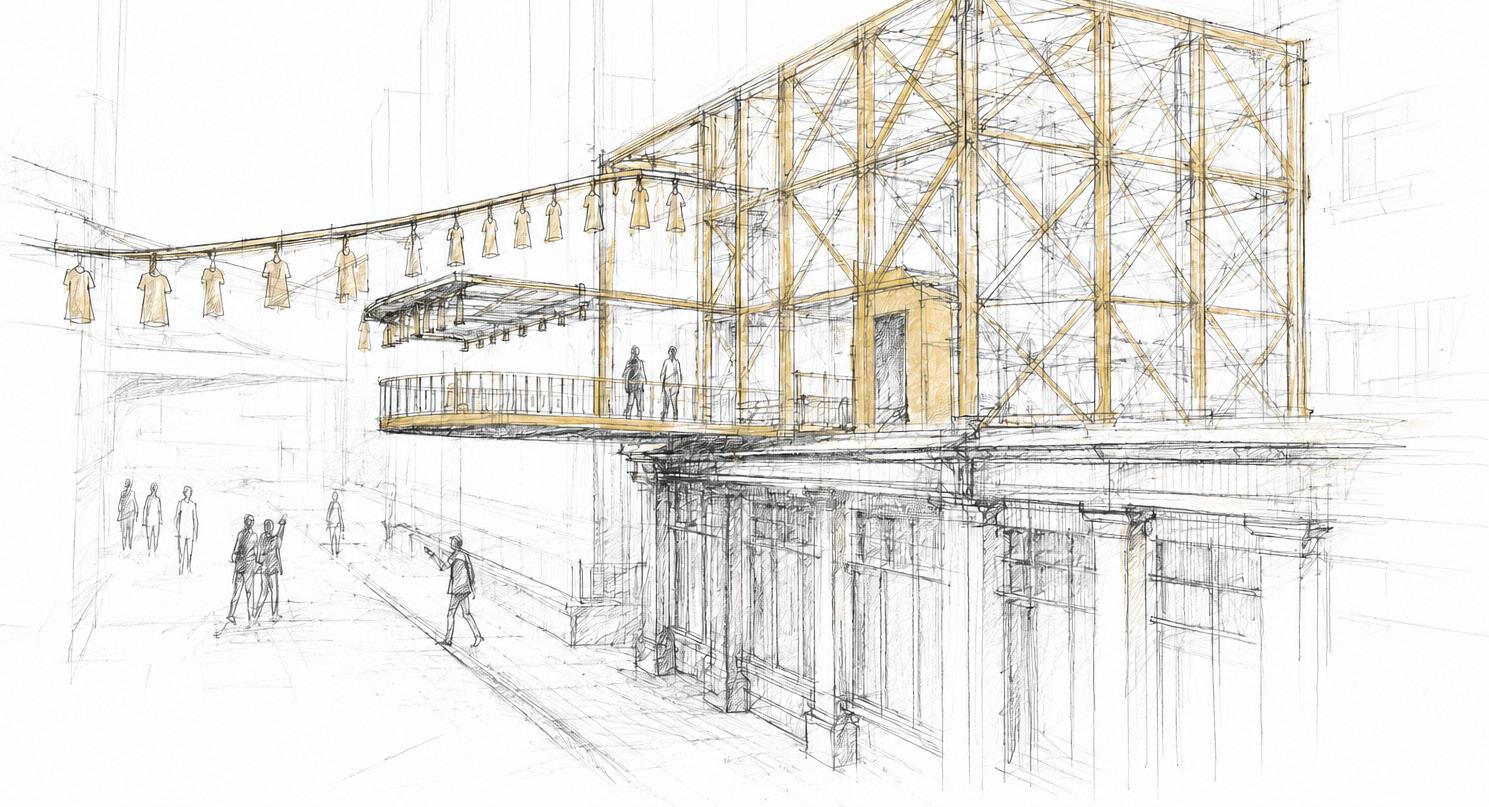
Spencer Giuliano
Fall 2025 - Spring 2026
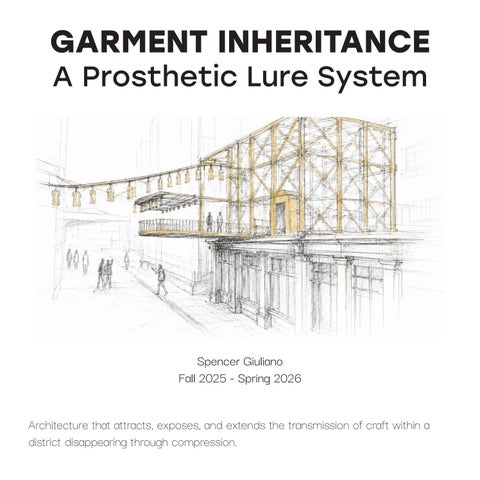
Architecture that attracts, exposes, and extends the transmission of craft within a district disappearing through compression.
Spencer Giuliano
Fall 2025 - Spring 2026
Architecture that attracts, exposes, and extends the transmission of craft within a district disappearing through compression.
Spencer Giuliano, with Ash Bartaria
Section Faculty: Adam Elstein and Frank Gesauldi
HMS Faculty: Monica Datta
Architecture and Magic Fall 2025 - Spring 26
There is a soul in that flower... there is history, there is craftsmanship, there are people behind it.
Adam
Brand of M&S Schamlberg Flowers 2026
These terms operate as instruments. They name the pressures acting on the district while also directing how architecture can attract attention, expose labor, and support the transmission of craft.
Compression: The tightening of labor, material, and production into smaller, less visible spaces.
Visibility: Making hidden systems of labor, craft, and exchange perceptible to the public.
Illegibility: A condition where production remains active but can no longer be easily read.
Threshold: The moment where hidden labor becomes visible through proximity, movement, or access.
Lure: A spatial device that attracts attention before revealing what it is connected to.
Decoy: A visible surface or event that redirects attention toward a deeper system.
Misdirection: Using spectacle to shift focus from finished product to process, labor, and making.
Attention: The first point of contact between the public body and hidden systems of production.
Prosthesis: An added architectural system that amplifies an existing condition rather than replacing it.
Attachment: A connection to existing buildings, infrastructures, and labor networks.
Graft: An addition that depends on its host while changing how the host performs.
Seam: A joint where separate systems meet: old and new, public and hidden, garment and building.
Transmission: The movement of knowledge through observation, repetition, correction, and proximity.
Care: Spatial support that sustains bodies, tools, materials, labor, and knowledge over time.
Inheritance: The continuation of craft through practice, participation, and shared responsibility.
Fragility: The vulnerability of systems that depend on proximity, skill, memory, and continuous labor
Maintenance: The ongoing work required to keep craft, tools, spaces, and relationships alive.
Proximity: The closeness needed for craft to be observed, corrected, absorbed, and practiced.
Exchange: The overlap between making, buying, teaching, viewing, and transferring value.
Throughput: The visible movement of material through production, sorting, reuse, and redistribution.
Reserve: A stored bank of material or knowledge that can be reactivated instead of discarded.
Accumulation: The gradual thickening of material, participation, memory, and evidence over time.
Collective Authorship: A shared condition where many bodies contribute to one surface, archive, or system.
Phantom Labor: Work that remains active but appears only through traces, routes, scraps, and habits.
Anachronic: The coexistence of past craft, present labor, and future disappearance in one place.
When I went back there... all those stores, you see a page of time flipping.
Lourdes Kalkin, Garment District Interview, 2026
TheGarmentDistrictisnotpreservedasafixedimage.Itisreadasabodyof changingrelationships,wherelabor,memory,material,andcraftcontinuetoshift throughtime.Architectureentersthisconditionnottofreezeit,buttomakeits remainingknowledgevisibleandtransferable.
What can architecture do in the narrow interval before a system disappears, not through sudden demolition, but through gradual spatial compression?
Across West 36th to West 38th Streets, garment production persists within aging loft buildings, operating vertically above the street while remaining largely invisible to public life. Zoning relaxations, office conversions, rising land values, and speculative redevelopment hollow out production floors, fragment labor networks, and weaken the informal systems through which knowledge is transmitted. What is at risk is not only space, but the conditions that allow making, learning, exchange, and craft inheritance to continue.
Rather than proposing a singular preservation object, Garment Inheritance introduces a distributed matrix of architectural lures embedded within the existing urban fabric. These interventions operate as prosthetic attachments to the district’s body, amplifying weakened functions already present within it: visibility, exchange, education, waste circulation, and craft transmission. Through suspended paths, exposed freight movement, collective material fields, garment relay systems, and spaces of direct observation, the lures bring visitors into proximity with labor that usually remains concealed.
As these interventions accumulate, a larger prosthetic spine emerges. It is not a singular architectural object, but a byproduct of attachment, formed through bridges, frames, membranes, platforms, and vertical circulation systems that reconnect the street to the upper-floor factories above it. What first appears as spectacle becomes access. What begins as viewing becomes learning.
The project does not preserve the Garment District as a fixed image of the past. It works within a shrinking temporal window, asking how architecture might extend the life, visibility, and transmission of labor before the spatial conditions that sustain it vanish. Preservation, here, is not freezing the district in time, but carrying its knowledge, relationships, and cultures of making into future generations.
The city does not disappear quietly. It compresses. It fragments. It erodes over time.
In the Garment District, production still functions, but it has moved upward, inward, and out of view. Workshops persist behind walls. Labor remains active, but increasingly unreadable from the street.
These are not sudden losses. They are spatial pressures produced by zoning shifts, rising rents, office conversions, and redevelopment. What is at risk is not only space, but the conditions that allow making, learning, exchange, and craft inheritance to continue.
This project begins within that compression.
It does not restore the district to a previous moment or preserve it as static heritage. Instead, it works with what remains through targeted prosthetic lures embedded across West 36th, 37th, and 38th Streets.
Each lure attracts and redirects attention toward hidden systems of production. Performance, exchange, material reuse, waste circulation, care, and knowledge transmission become interdependent systems for making labor visible and transferable.
As these lures attach to buildings, rooftops, air shafts, basements, and voids, a larger prosthetic spine begins to emerge. Not as a singular object, but as the residue of repeated connections.
The architecture does not resolve the district’s transformation. It reveals the systems still operating within it and extends them while it can.
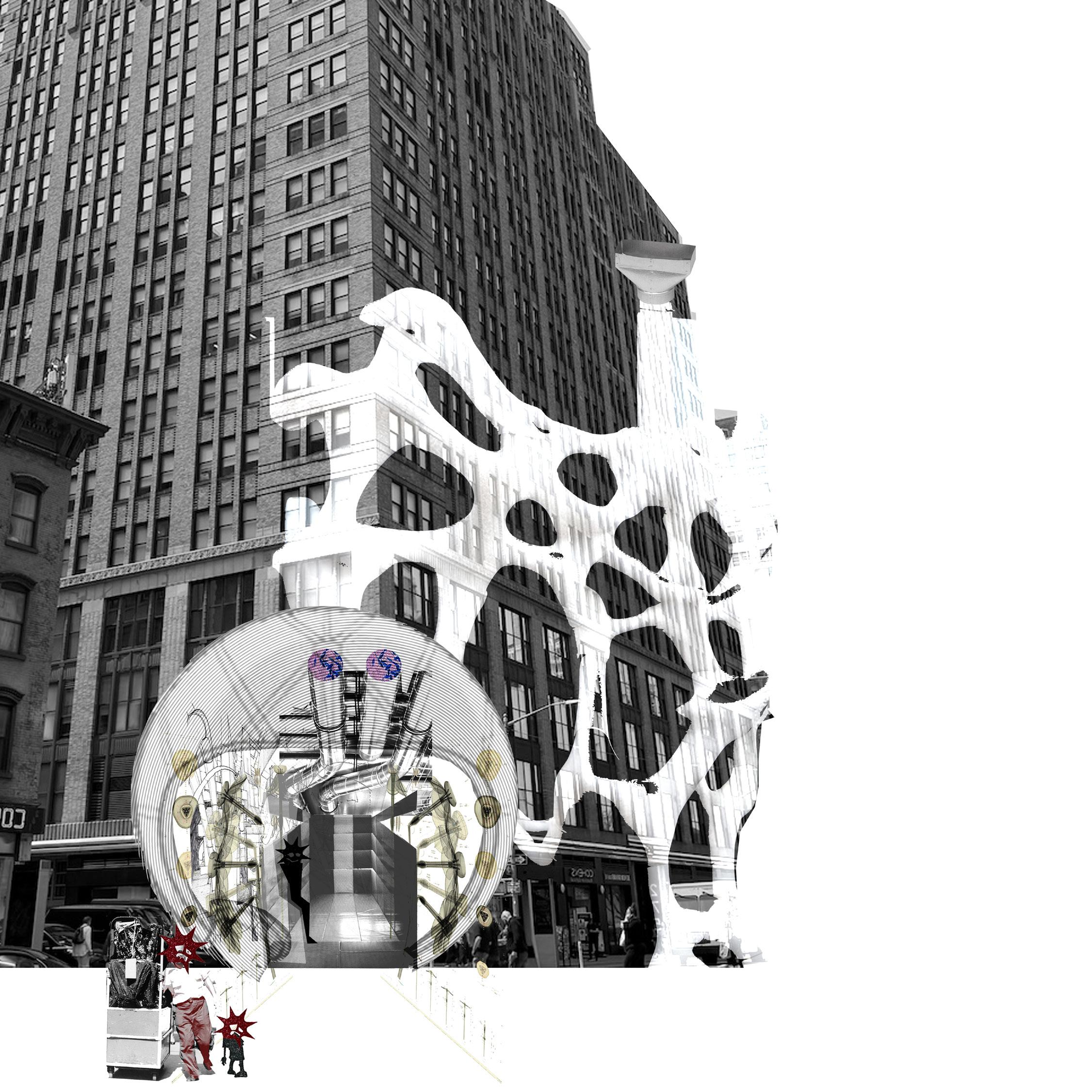
The factories, for some reason, were all there — next to each other. Different garments, different makers, different everything.
Lourdes Kalkin, Garment District Interview, 2026
The Garment District once operated through proximity: factories, fabric stores, makers, and suppliers compressed into a walkable field of exchange. What remains is not absence, but disconnection. Production still persists, but the spatial relationships that once made it visible, accessible, and collectively functional have thinned.
A
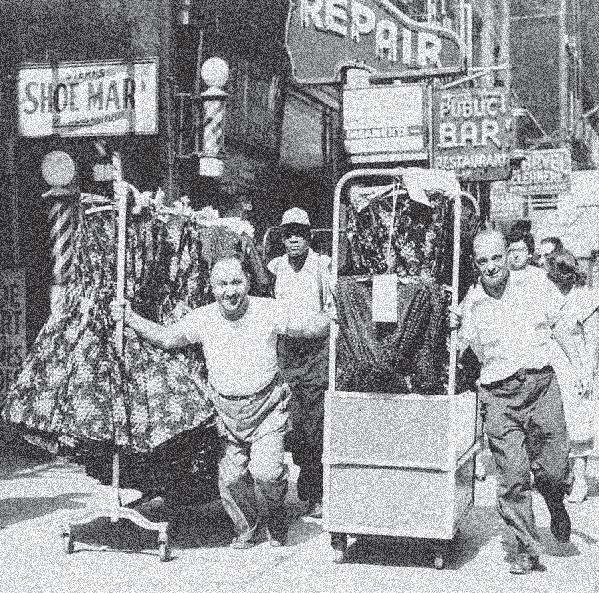
Staff wheel racks of garments and fabric through the street, revealing how production spills directly into the public realm, collapsing boundaries between workspace and circulation.
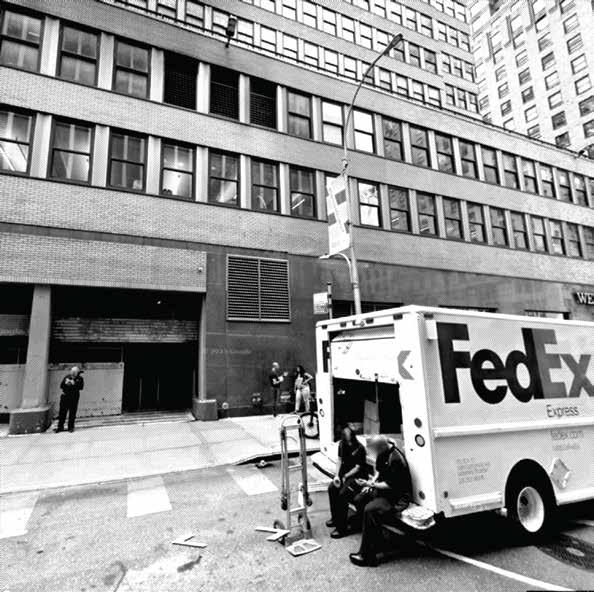
Workers rest on the backs of delivery trucks between loads, revealing a lack of designated break infrastructure within an intense logistics ecosystem.
a
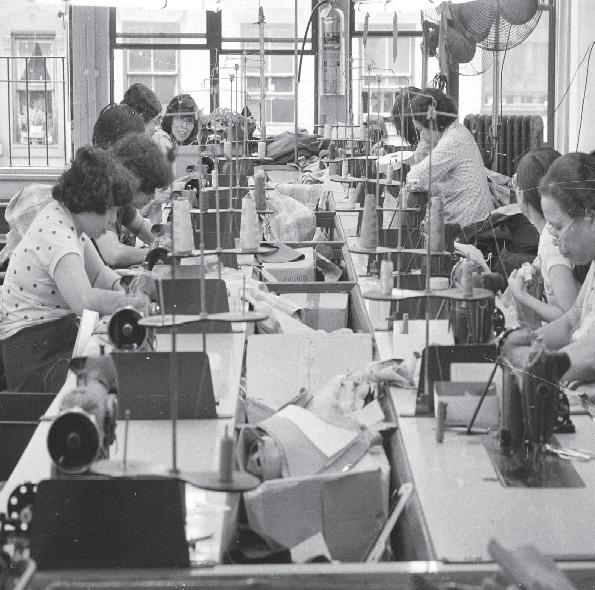
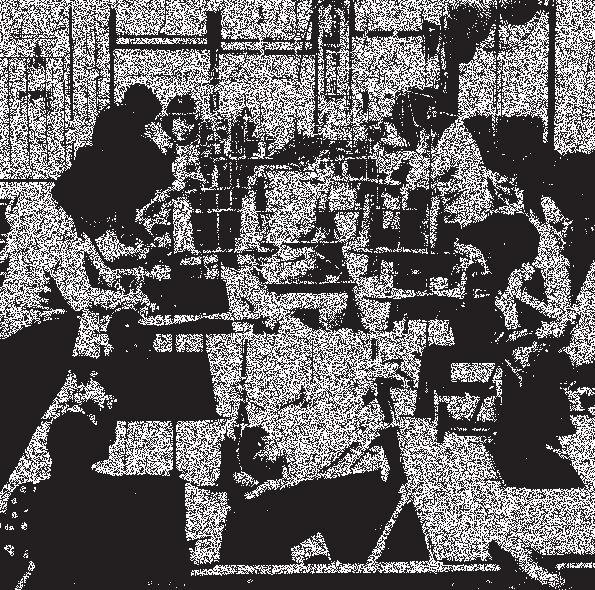
Seamstresses work shoulder-to-shoulder in cramped interiors, exposing the district’s reliance on dense, high-pressure manual labor environments.
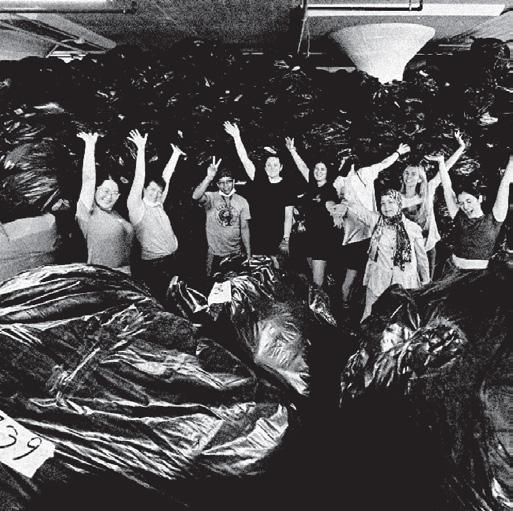
People navigate mounds of discarded textiles, exposing the district’s cyclical overflow of material excess and its environmental + spatial consequences.
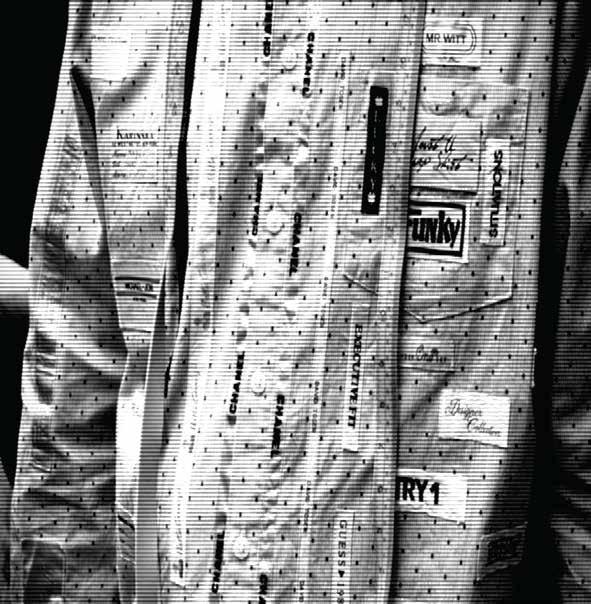
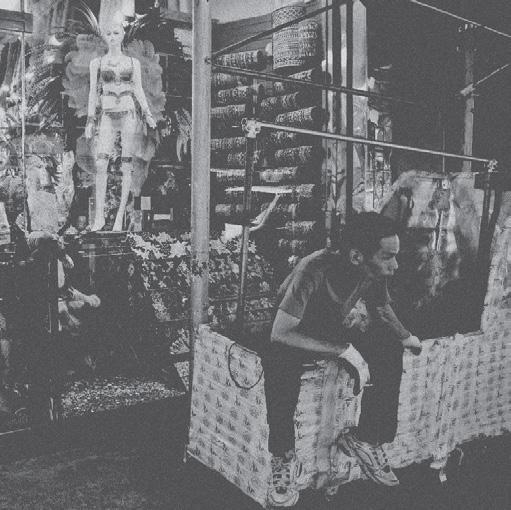
A fashion project occupies sidewalk or studio edges, showing how creative work emerges amid tight spatial constraints and constant circulation.
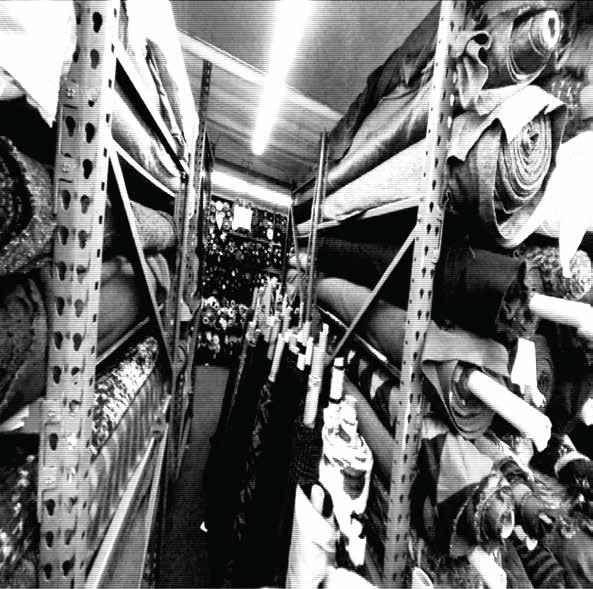
Tight fabric-packed corridors reduce movement to single-file pathways, turning shopping into a negotiation of bodily compression and sensory overload.
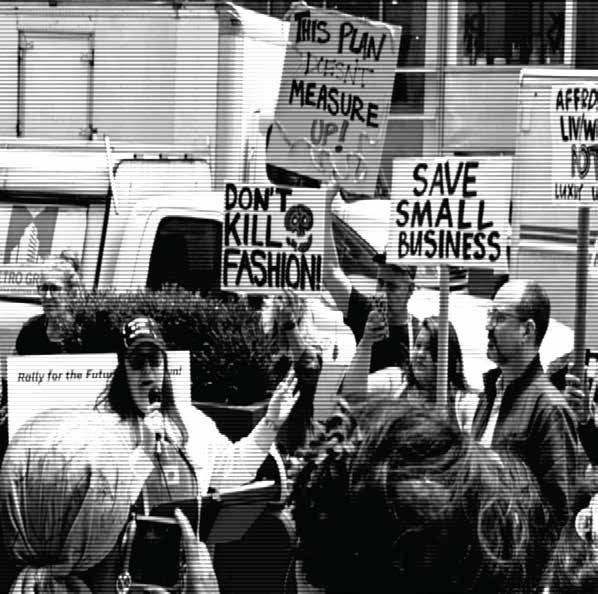
Garment workers gather in protest to protect local manufacturing, highlighting economic fragility and a district fighting against erasure.
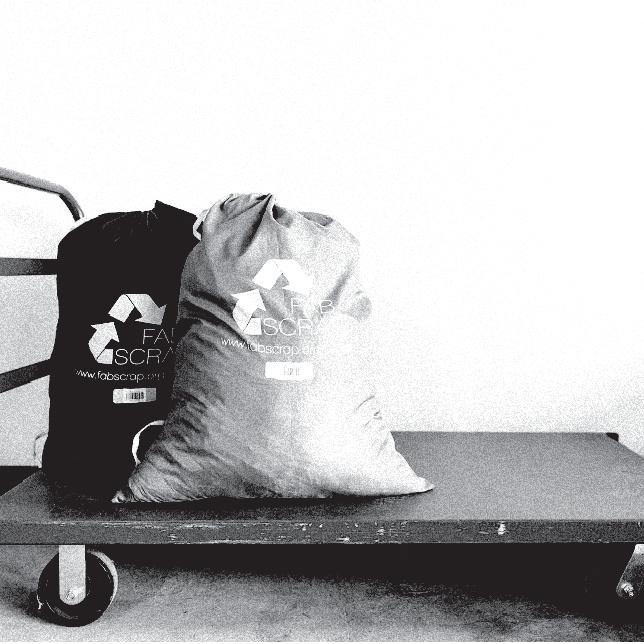
Bags of fabric scraps pile up for removal, tracing an unseen waste-to-recycling flow that shapes the district’s rhythms and atmospheric density.
Garment District Photo Matrix
Assembled by Spencer Giuliano + Ash Bartaria
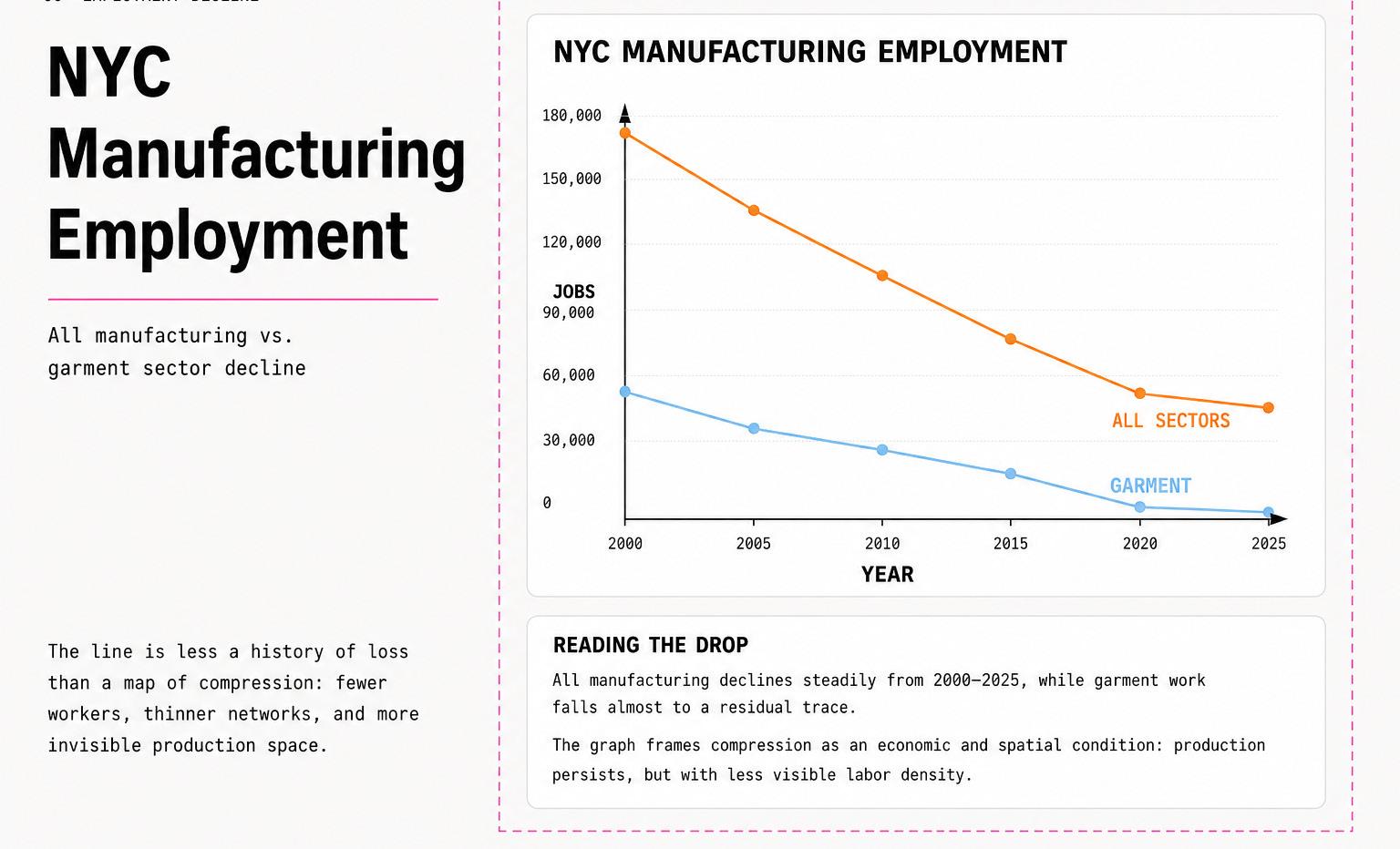
NYC Manufacturing Employment Chart
Giuliano + Ash Bartaria
Manufacturing decline is not only economic. It is spatial.
As garment employment decreases, the district loses more than workers; it loses the networks of proximity that allow production to function. Factories, finishers, suppliers, cutters, pleaters, and delivery systems depend on being near one another.
The line does not simply describe job loss. It registers the thinning of an urban infrastructure built around making.
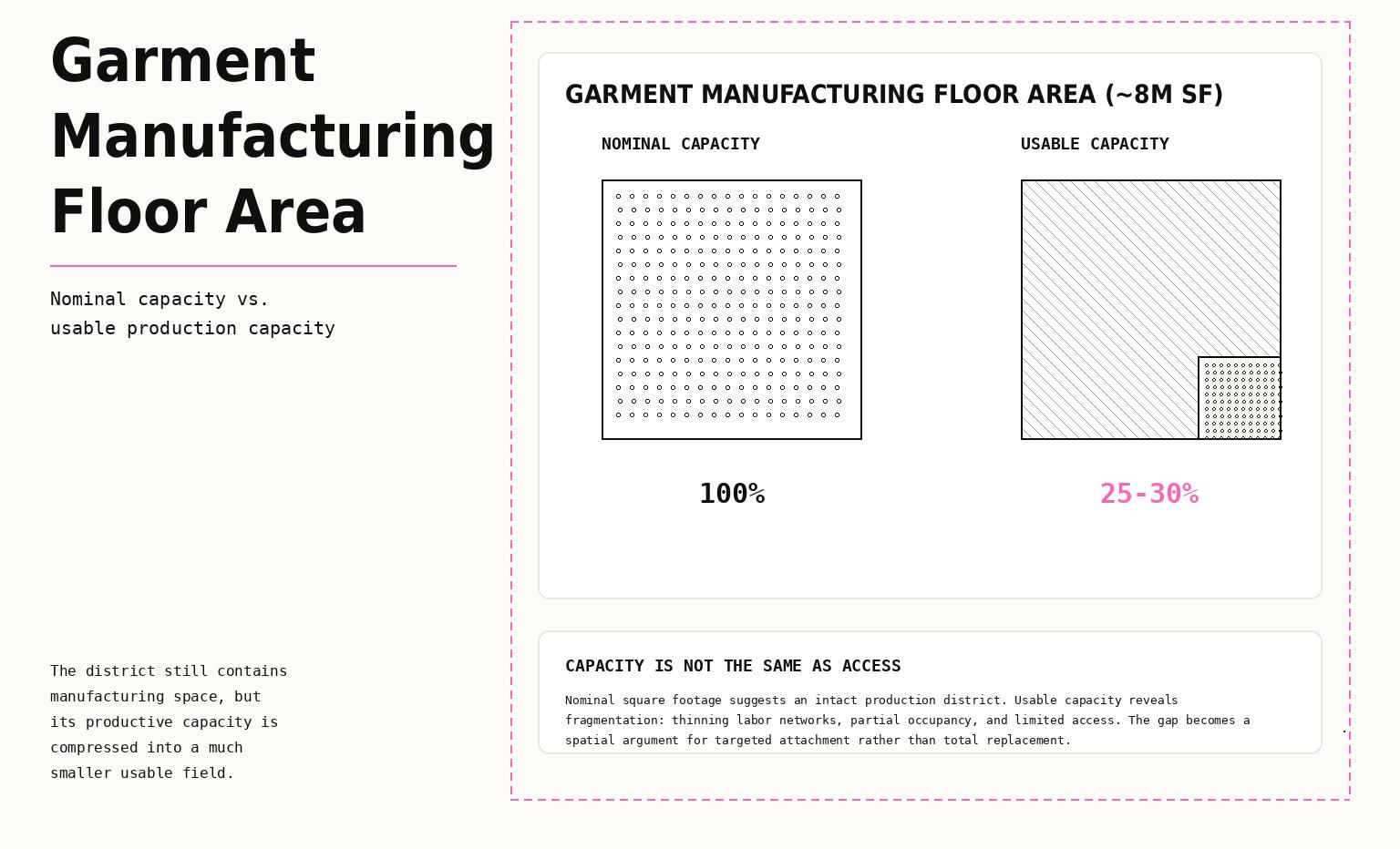
Remaining floor area does not equal remaining capacity.
Manufacturing space may still exist within the district, but much of it has been subdivided, converted, compressed, or made difficult to access. Production survives in fragments, occupying partial floors, leftover rooms, and upper-level interiors that no longer operate as a continuous industrial field.
Capacity persists on paper long after it becomes difficult to use.
Freight is a huge thing. Whenever I receive machinery, it’s measuring 5,000 times to see if it’ll actually fit in the freight elevator.
George Kaljian, Tom’s Sons International Pleating Interview, 2026
TheGarmentDistrictisnotonlyafieldofstorefrontsandshowrooms,butavertical systemofmovement.Material,machinery,garments,waste,andtoolsdependon freightelevators,servicecorridors,loadingzones,andupper-floorroutesthatremain mostlyinvisiblefromthestreet. Thiscontextrevealsthedistrictasanactivelogisticalbody.Productionpersists throughnarrowpointsofaccess,wherelaborisshapedbywhatcanmove,whatcan fit,andwhatcanstillreachthefloorsabove.

Garment District Analysis
Spencer Giuliano + Ash Bartaria
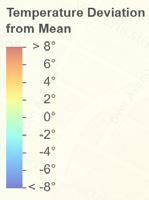
Thermal mapping shows the district as a field of pressure rather than a fixed boundary. Heat, density, traffic, production, and public movement overlap unevenly across the blocks. The district is not defined only by storefronts or zoning lines, but by the hidden intensities of labor, material movement, and vertical occupation.
The map begins to locate where those pressures collect. Congestion, loading, pedestrian flow, and production access form a spatial atmosphere that reveals where intervention can amplify what already exists.
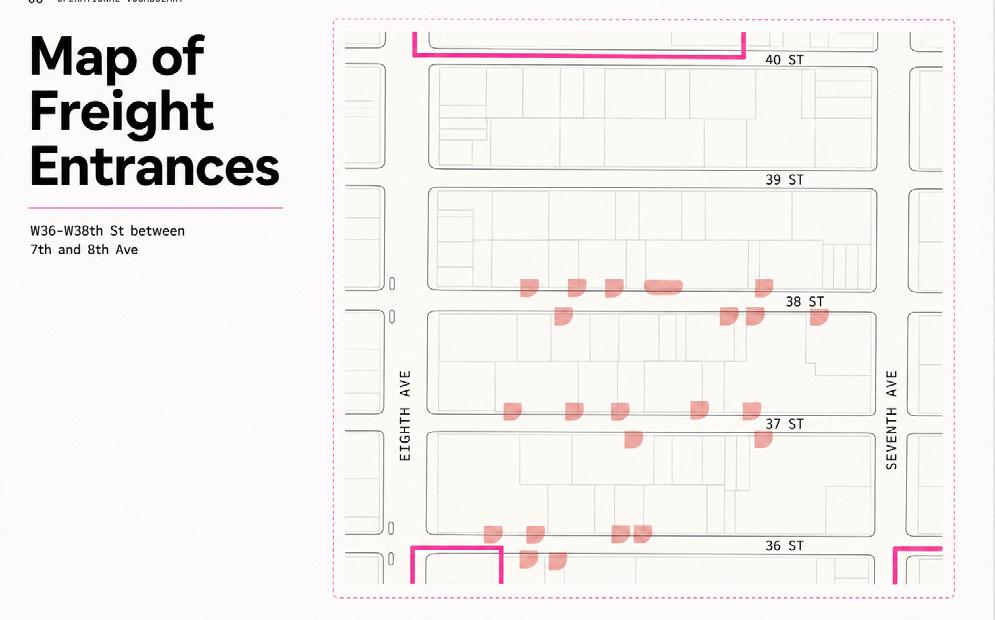
Garment District Freight Entrance Map
Spencer Giuliano + Ash Bartaria
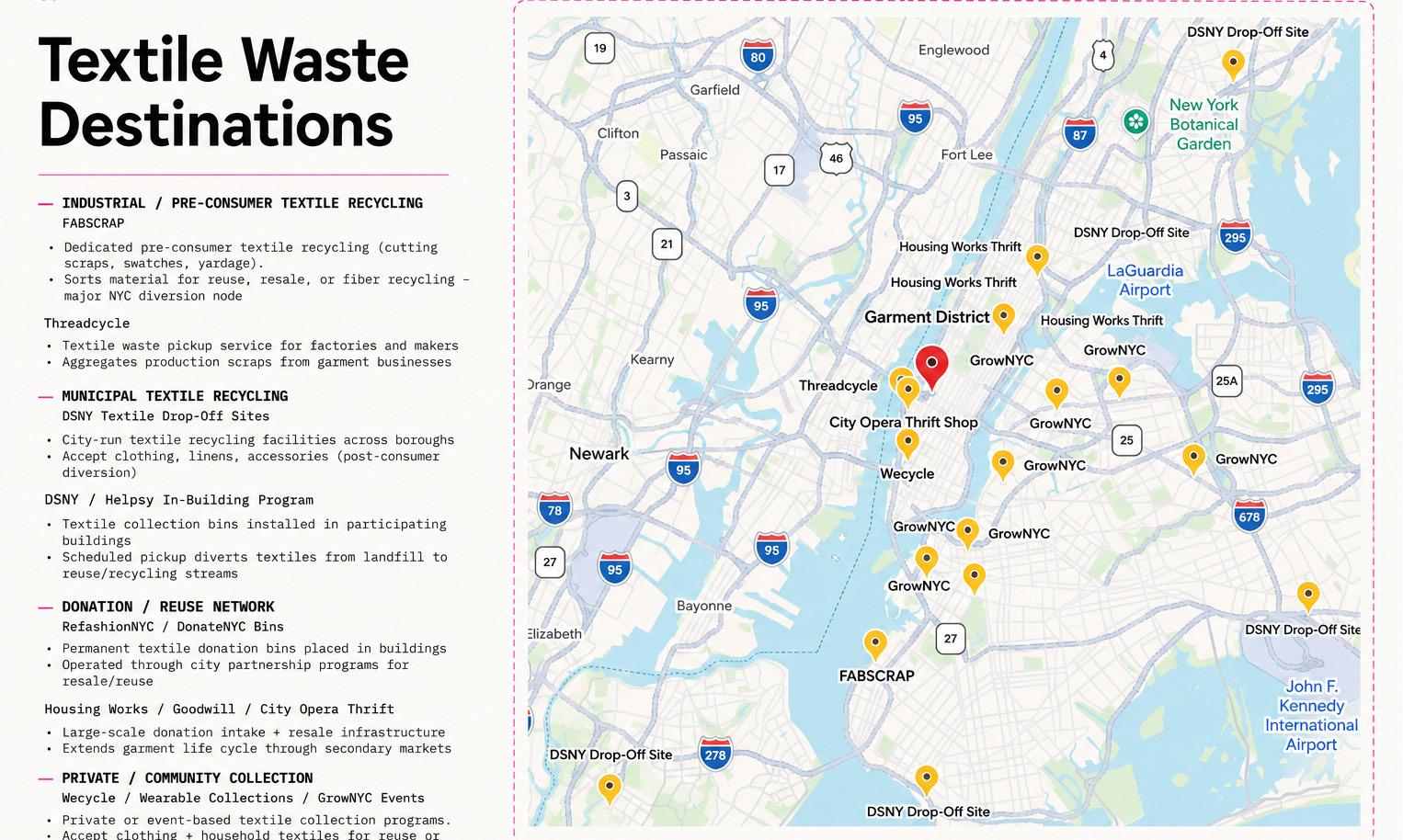
New York City Textile Waste Map
Spencer Giuliano + Ash Bartaria
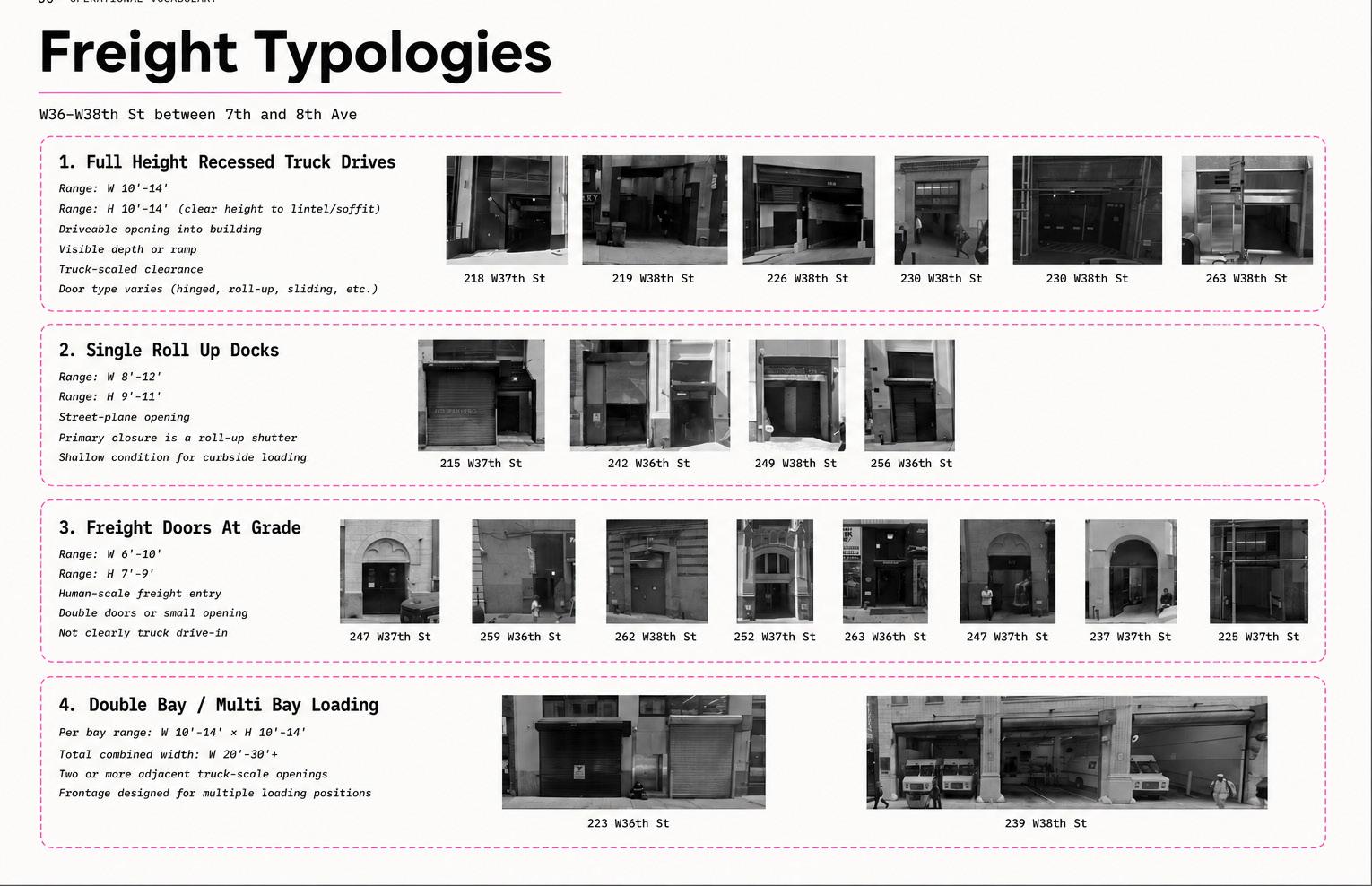
Freight Typologies Diagram
Spencer Giuliano + Ash Bartaria
Freight is one of the district’s most visible invisible systems.
Loading doors, recessed truck drives, roll-up docks, and service entries organize the movement of garments, fabric, waste, equipment, and finished goods. These openings are small moments where the vertical interior of production touches the street.
Each freight typology reveals a different scale of access. Some entries are truck-scaled and infrastructural. Others are human-scaled and improvised. Together, they show how production depends on ordinary thresholds that are often overlooked.
Textile waste leaves the district through a fragmented network of collection, resale, sorting, and recycling.
Fabric scraps, samples, damaged garments, and excess material move outward through nonprofit, municipal, and private systems. These routes extend the life of material, but they also separate waste from the places where it was produced.
The map reframes waste as circulation.
Discarded material is not an endpoint; it is a secondary network of value, labor, and reuse. By making this system visible, waste becomes part of the district’s productive ecology rather than something pushed out of sight.
Once this knowledge is gone, you cannot replace it.
George
Kaljian, Tom’s Sons International Pleating Interview, 2026
TheGarmentDistrictcanbereadasabodyunderpressure.Itslossesarenot alwaysvisibleasvacancyorruin,butasthegradualthinningoflabor,skill,and proximity.Whatonceoperatedthroughdensenetworksofspecializedworkersnow persistsinfragments,withfewerspaces,fewerpeople,andfeweropportunitiesfor knowledgetopassbetweengenerations. Diagnosis,then,isnotonlyaboutidentifyingdisappearance.Itisaboutrecognizing theunderlyingspatialconditionsproducingit:compression,invisibility,isolation,and theweakeningofthesharedenvironmentsthatoncesustainedmaking.
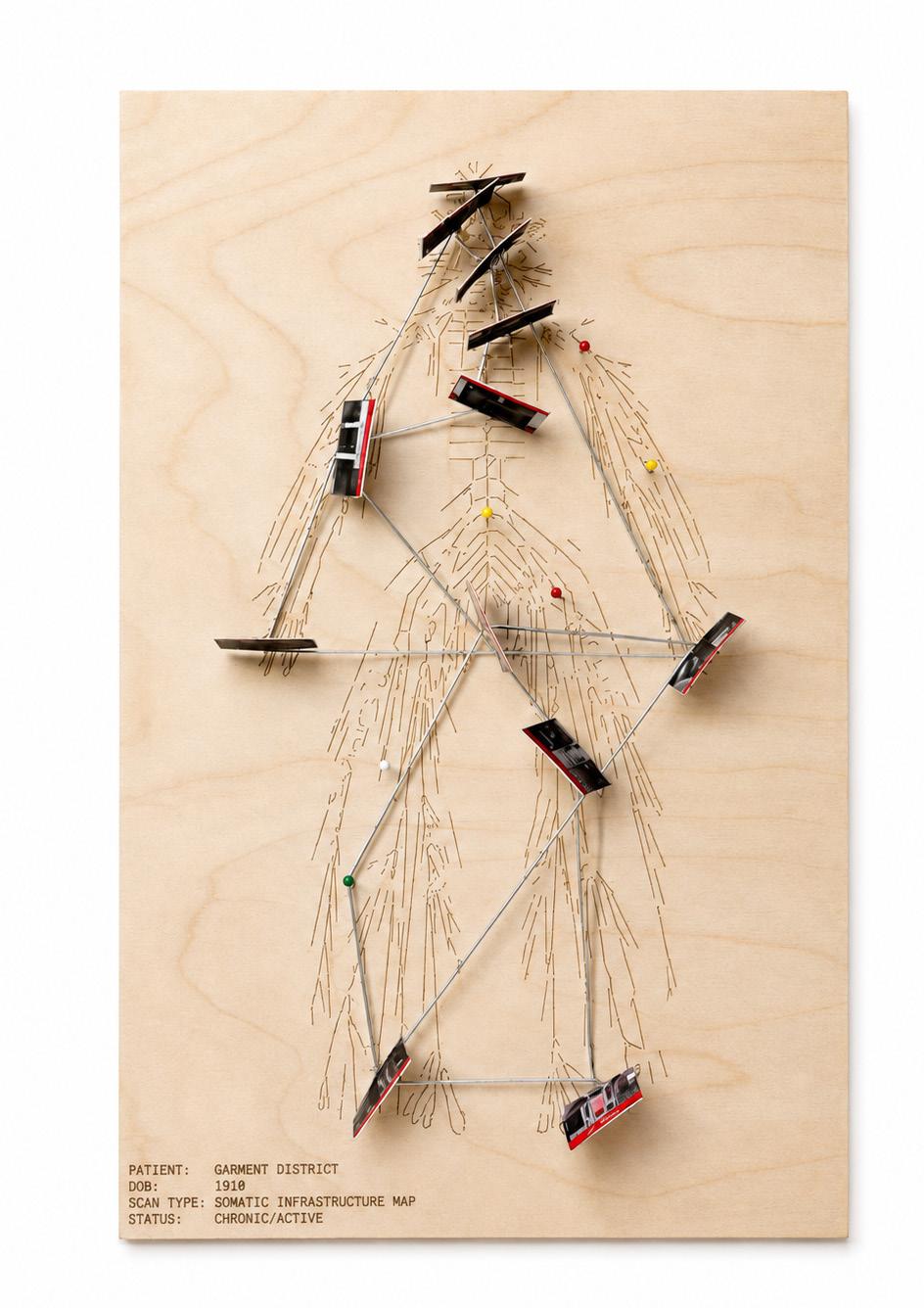
Garment District Body Mapping
The Garment District’s buildings were built to support dense production: deep loft floors, repetitive bays, freight cores, columns, stairs, shafts, and service routes. These systems once allowed bodies, machines, garments, and materials to move through the same architectural body.
Today, that anatomy is still present, but weakened. Production survives inside the same structural framework, yet the connections between labor, access, visibility, and exchange have become compressed and fragmented.
These diagrams diagnose the existing body of the district. The typical bay shows where production can still fit. The structural kit identifies the parts that still carry movement, storage, loading, and work. Rather than treating the district as empty or obsolete, the diagnosis begins by locating what remains active, what has been blocked, and where prosthetic attachment might reanimate existing systems.
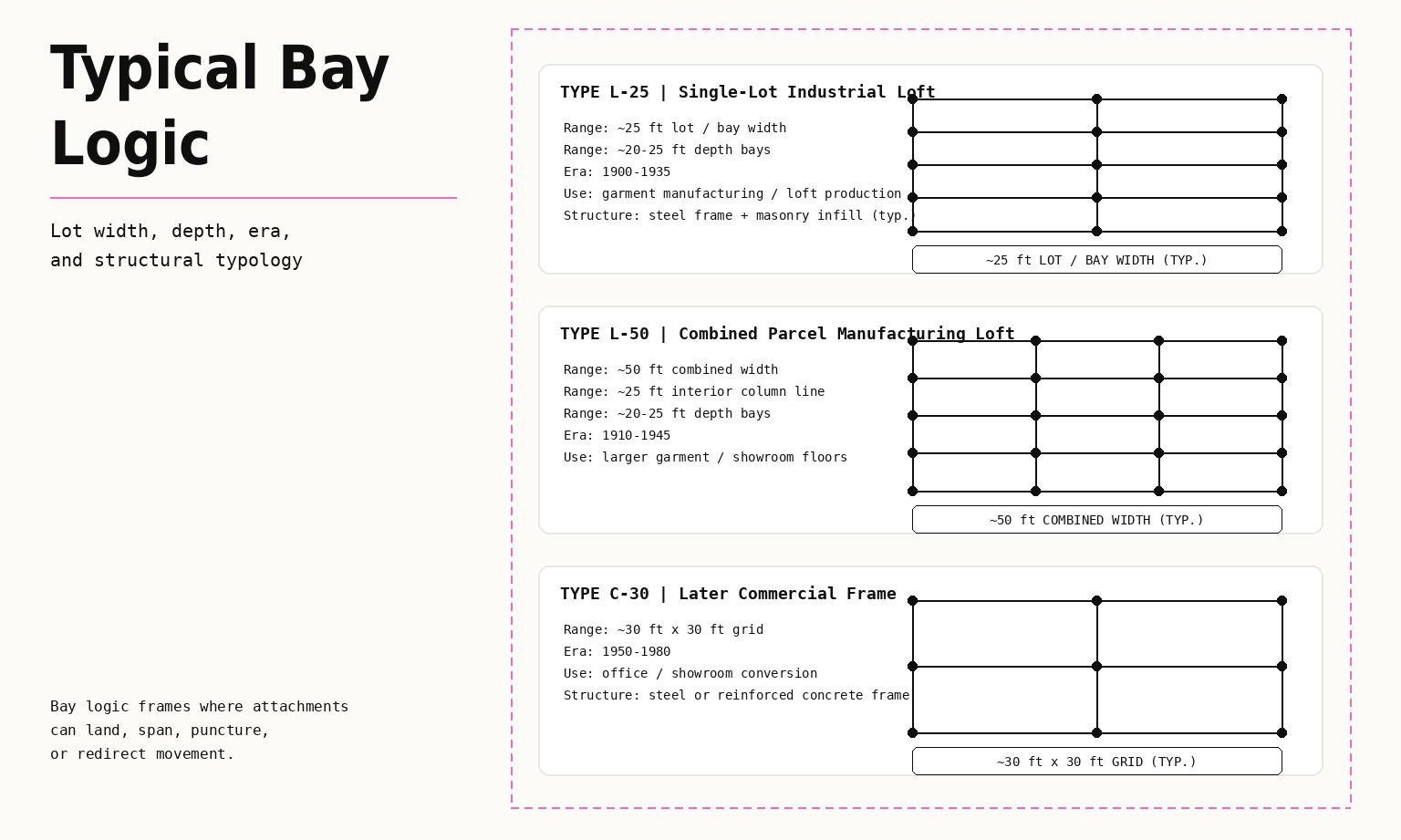
Garment District Typical Bay Logic Diagram
Spencer Giuliano + Ash Bartaria
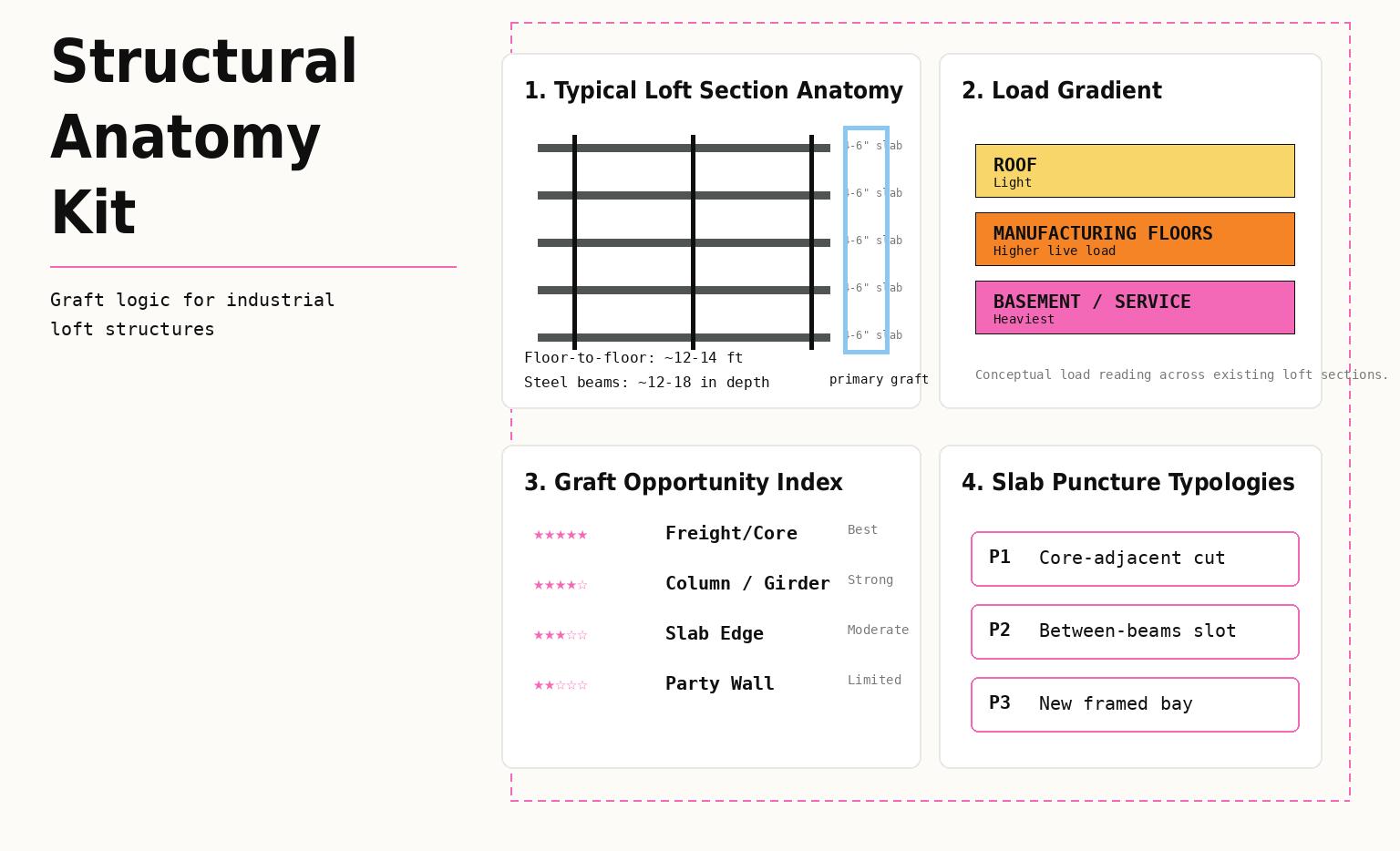
Garment District Structural Anatomy Kit
Spencer Giuliano + Ash Bartaria
You can’t really pass it down... it has to be taken.
Craft is not transferred through instruction, but through proximity, repetition, and observation.
Craft is not taught. It is absorbed.
Knowledge moves through proximity— across tables, between bodies, through repetition. It is learned by watching.
By standing close.
By doing the same motion again and again. There are no manuals.
No formal systems of instruction.
Transmission happens in space.
This system depends on closeness.
Workers share space.
Knowledge transfers through contact.
But the space that allows this is disappearing.
Floors are divided.
Workshops are pushed upward.
Production becomes isolated.
What was once continuous is now fragmented. The network stretches.
Fewer people remain within it.
What is lost is not only labor but the ability for that labor to be passed on.
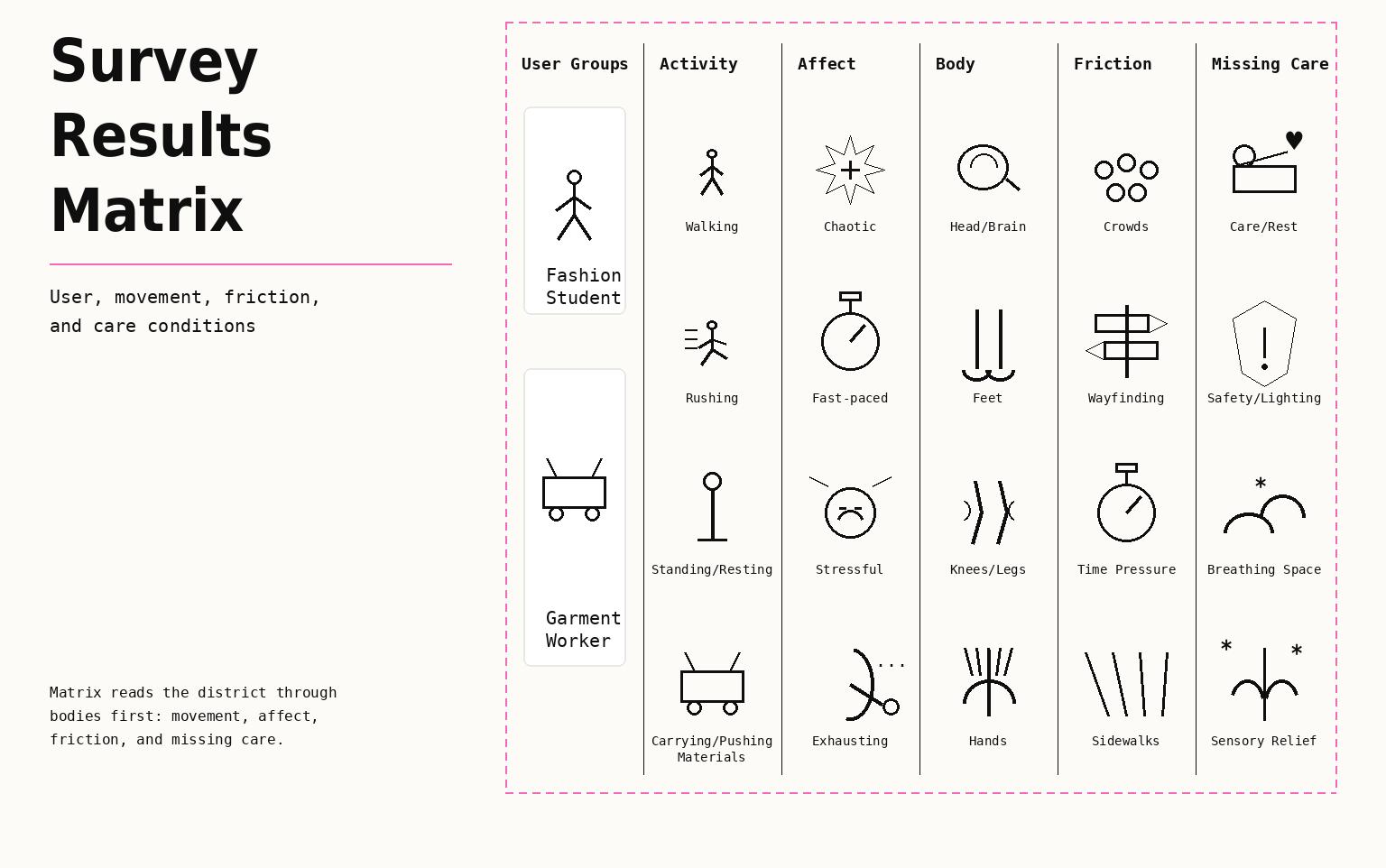
Garment District Survey Matrix
Spencer Giuliano + Ash Bartaria
Manufacturing Upstairs: Three Generations in the Garment District
Led By Spencer Giuliano + Ash Bartaria

Millions of people walk by, but they have no idea who’s upstairs.
Knowledge remains in the building, but not in public view.
What is hidden is not only space, but the systems that operate within it.
Production continues above the street.
Knowledge circulates between bodies, but remains invisible to those outside it. If transmission depends on proximity, then visibility becomes critical. Architecture cannot force entry. It must draw people in.
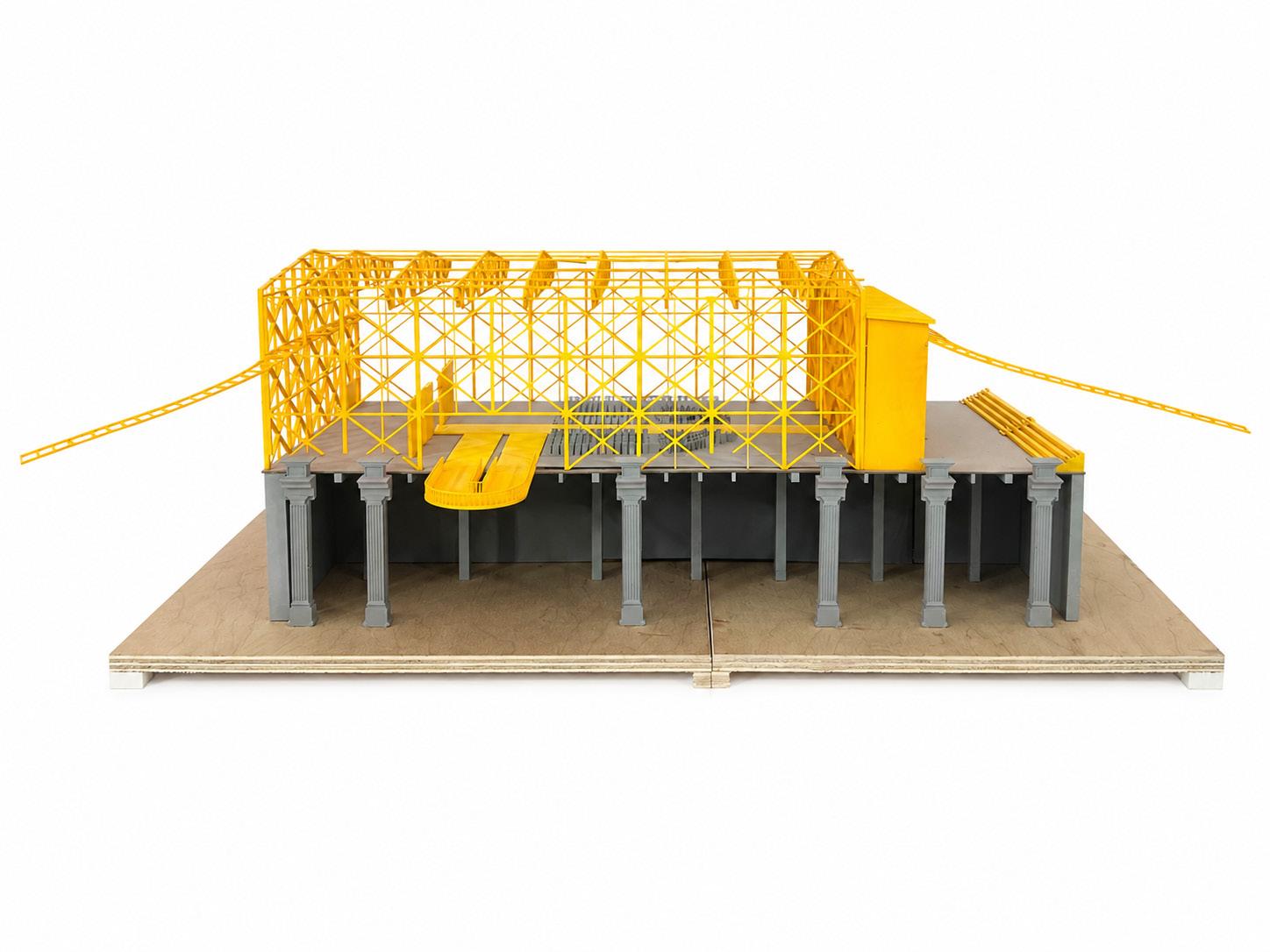
Prosthetic Study Model
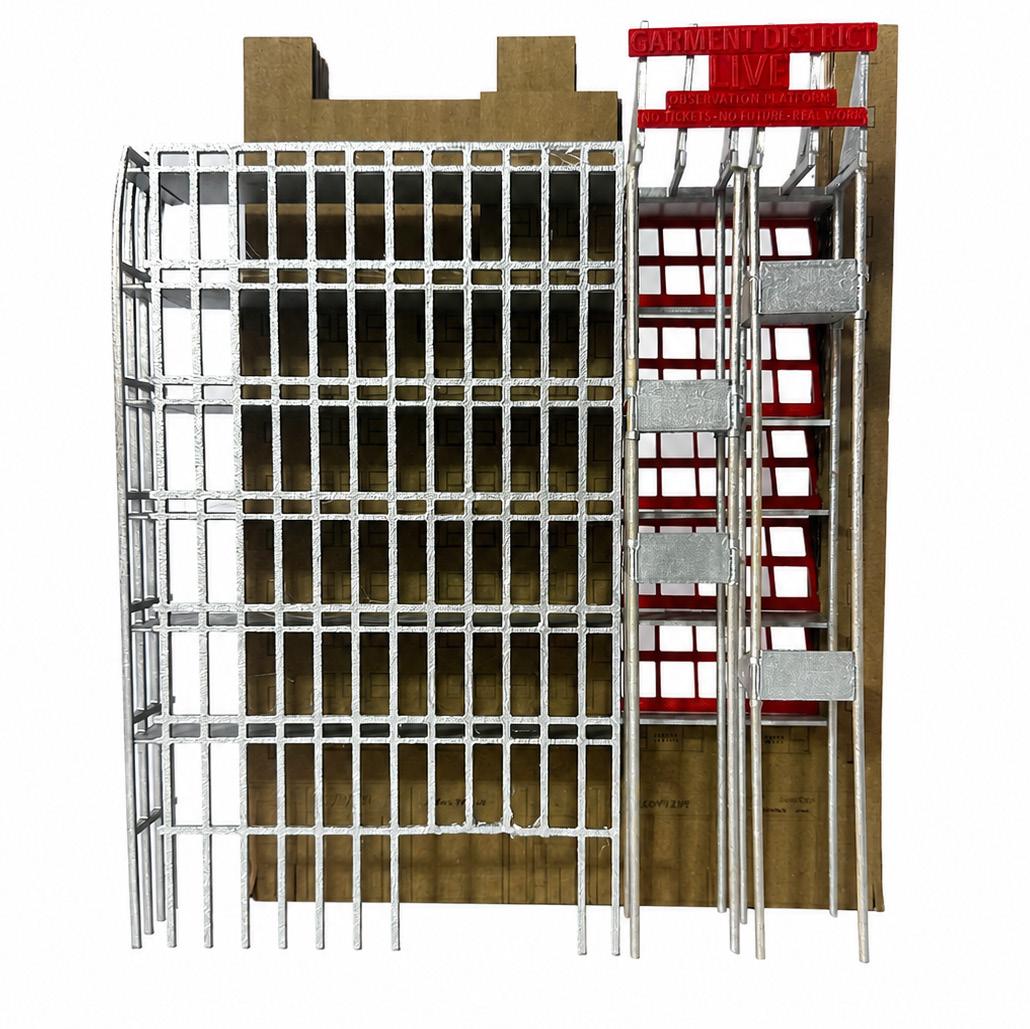
SPENCER GIULIANO
It does not begin with a building. It begins with attraction.
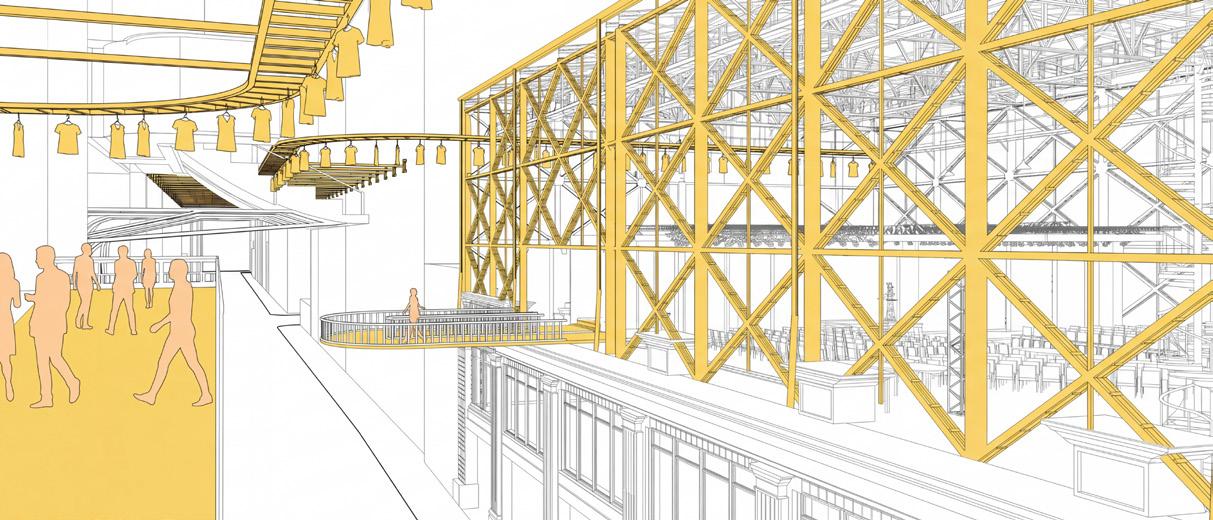
A continuous garment relay system loops above the street between runway spaces, changing rooms, and market areas. Visitors first notice the motion overhead before realizing they are watching garments circulate through an active system of production and exchange. The moving conveyor becomes visible from both the sidewalk and elevated walkways, pulling the body upward through the building.
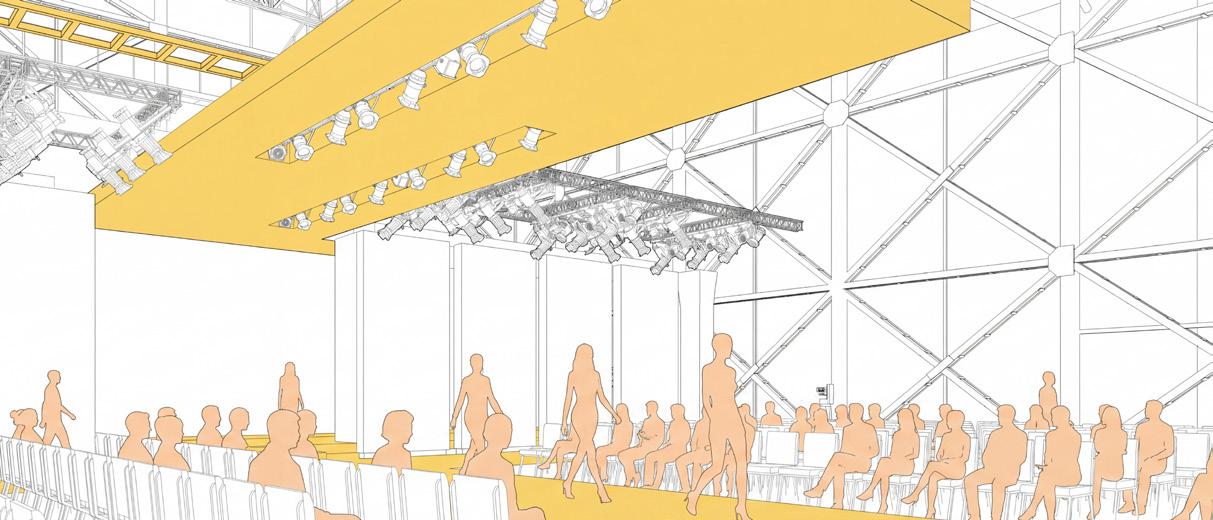
Performance acts as the initial lure. Garments cycle from market to runway to changing room and back again, staging repetition, circulation, and display as a public relay. The body is drawn in through movement and spectacle.
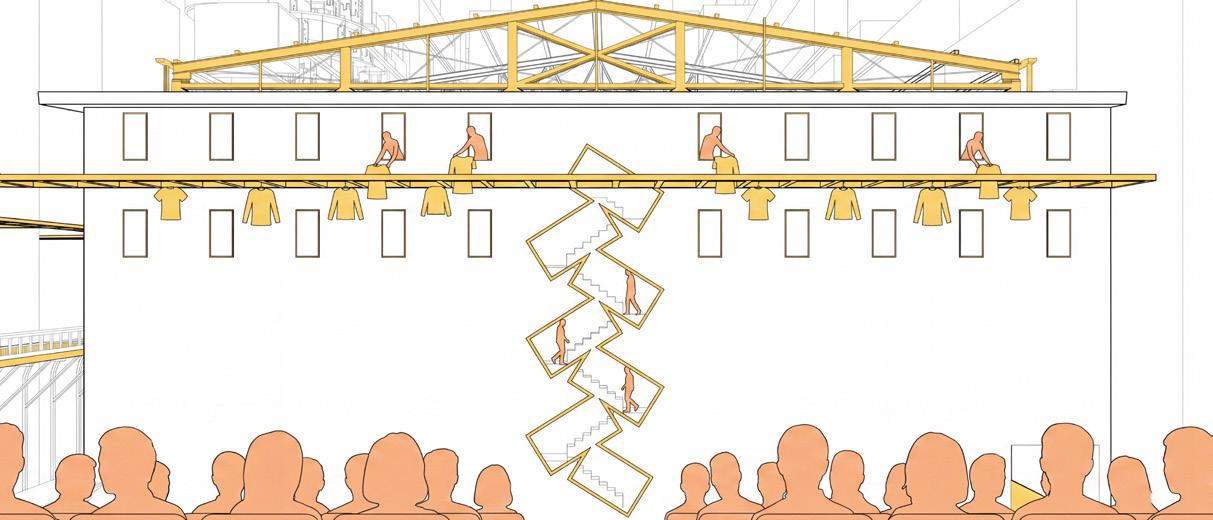
Afterimage Vignette Drawings
Overhead movement of circulating garments draws attention from street level upward. The body registers motion before it registers meaning.
Visitors follow the relay into market and runway spaces, reading garments as evidence of making rather than objects of consumption.
The logic of circulation, production to display to return, becomes legible as labor, not spectacle. Making and selling are no longer separable.
Fabric samples, pleats, dyes, and garment details hang within a layered vertical display system visible from the sidewalk below, while openings and glazing expose fabrication spaces beyond it. As visitors move upward through the circulation paths, the body shifts from looking at the garment as a finished product to understanding the processes, textures, and techniques embedded within its construction.
The logic of performance transitions into the logic of visibility and selection. What was invisible, the labor beneath the surface, begins to be legible through the materiality of the display itself.
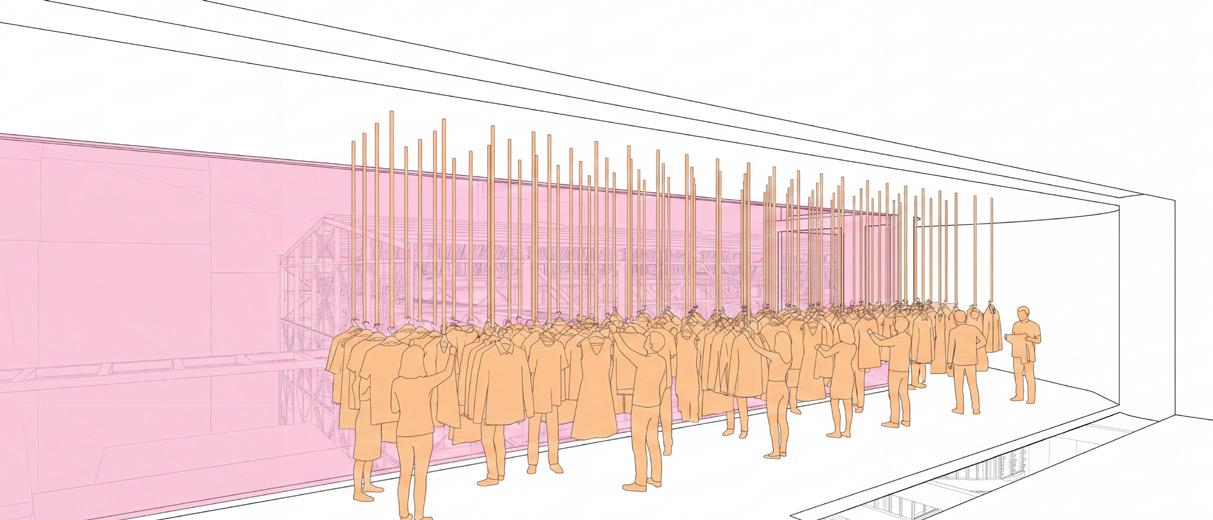
A vertical surface of suspended samples acts as a legible catalog visible from the sidewalk; detail at the scale of the street.
Moving through the display system, visitors encounter material and process rather than finished product. Fabric is not commodity but evidence.
Material knowledge, fiber type, dye behavior, pleat structure, seam construction, is absorbed through proximity and touch. TRANSFER
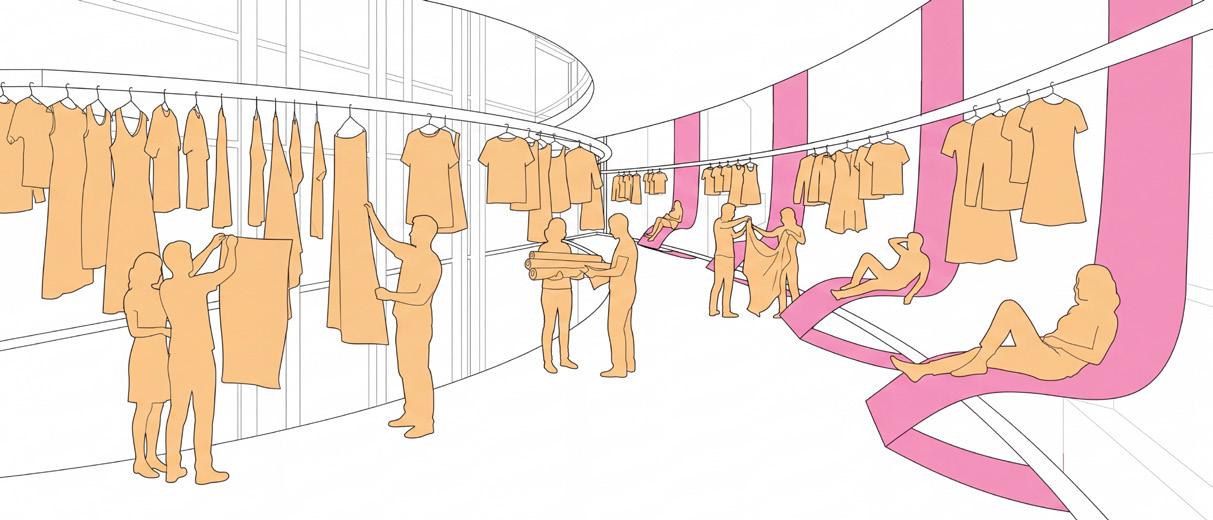
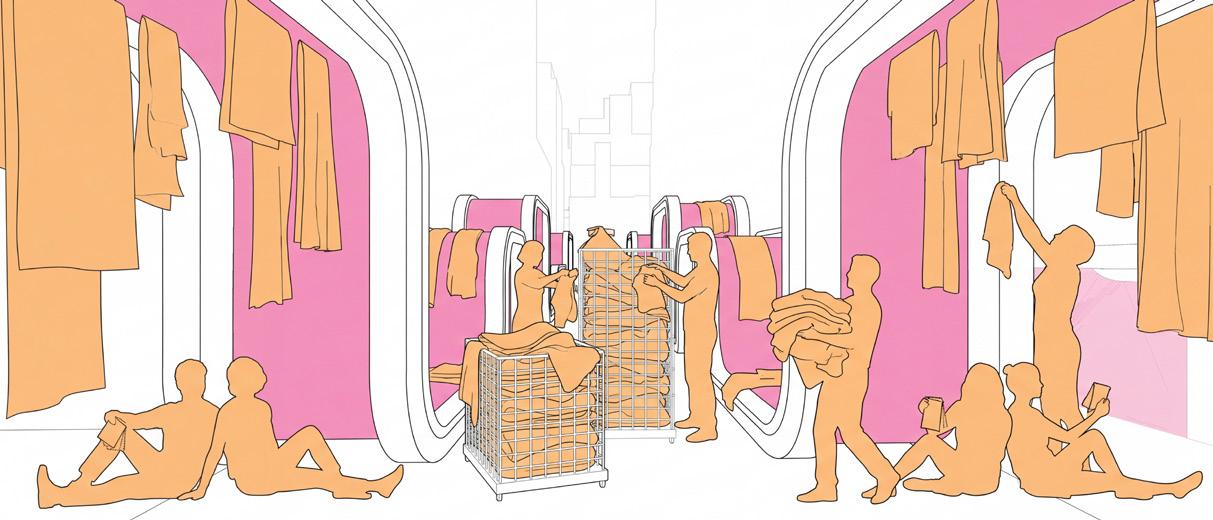
Garment racks move between fitting areas, fabrication spaces, and public circulation paths so visitors are no longer separated from the systems of labor supporting consumption. Transaction occurs within the same visible field as making. Consumption becomes immediate and active, grounding the system in economic reality while exposing the labor behind it.
Exchange collapses retail and production into the same visible field. Garments move between bodies, racks, and hands. Individual ownership dissolves into collective fabric.
SPENCER GIULIANO
Racks of garments visible in motion between fabrication and sale collapse the perceived distance between making and buying.
Visitors browse and transact within the production environment, dissolving the boundary between spectator and participant.
The economic relationship between maker and buyer becomes a form of knowledge, craft has a cost, and a person behind it.
A suspended collective fabric field stretched vertically through the building. Visitors contribute stitched garments and fabric directly onto the hanging surface over time, allowing the architecture itself to accumulate evidence of participation and collective authorship. Individual ownership dissolves into collective fabric.
A hanging aggregation of garments moves through a jacquard-like framework, allowing visitors to insert their own materials into a shared public surface. The architecture becomes a record of everyone who has passed through it.
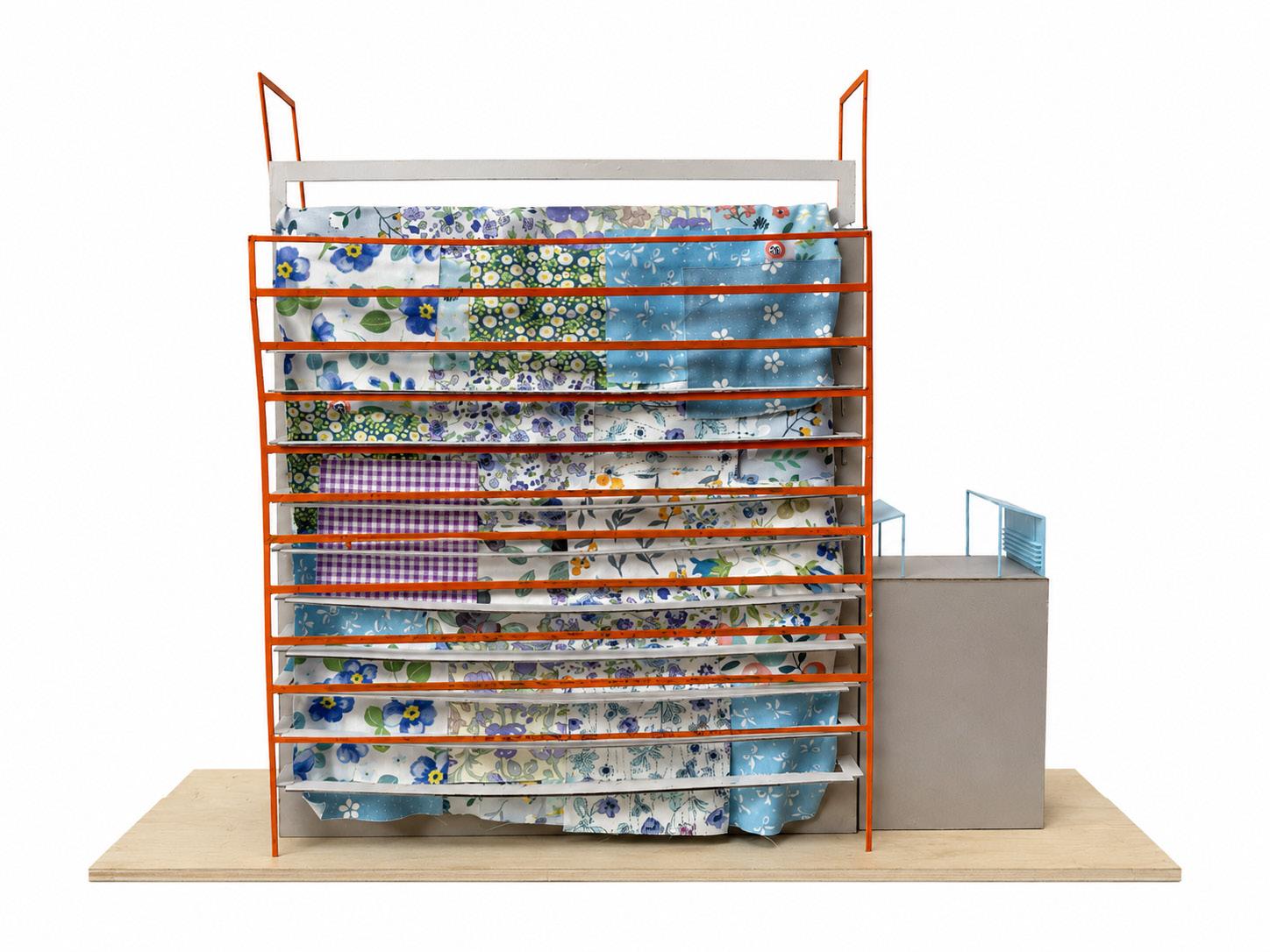
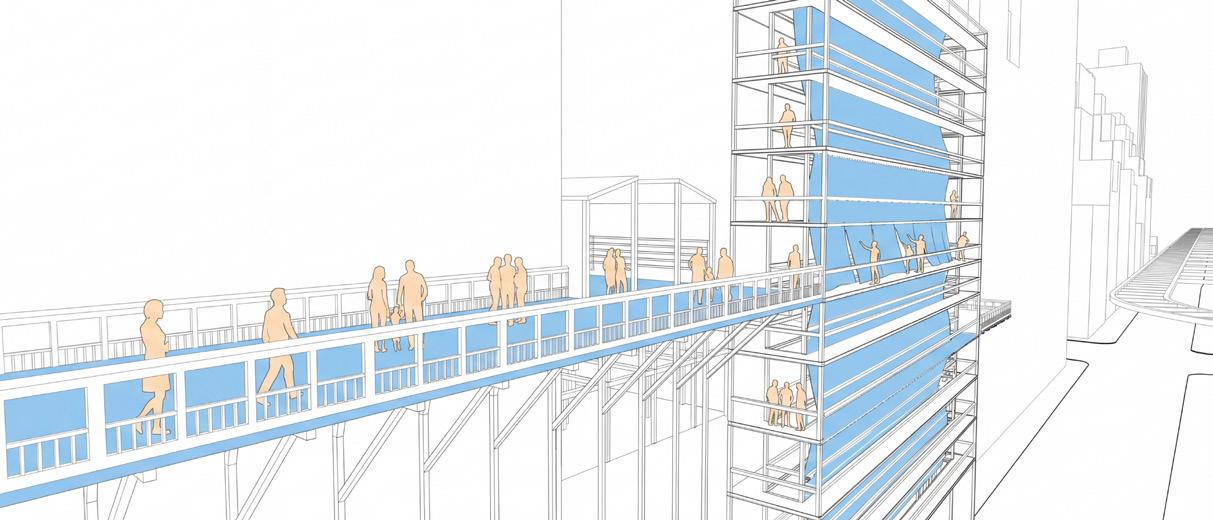
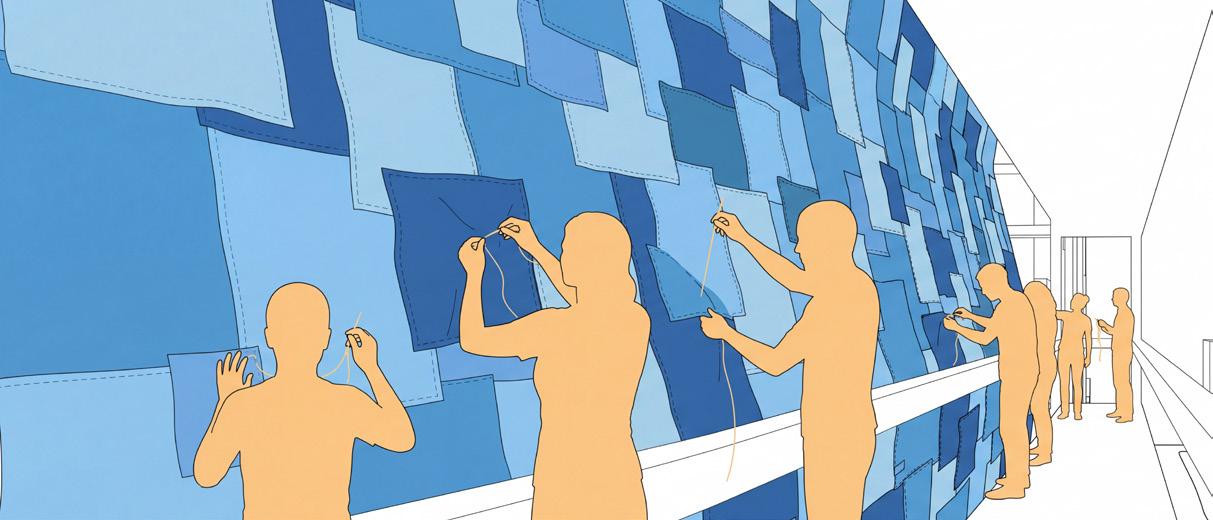
A hanging aggregation of garments forms a collective surface visible across the block, scale produced by accumulation, not singular gesture.
Visitors are invited to contribute their own materials to the shared field, entering into authorship of a public surface.
The act of releasing individual ownership into the collective -- of making something public, becomes itself the form of inheritance.
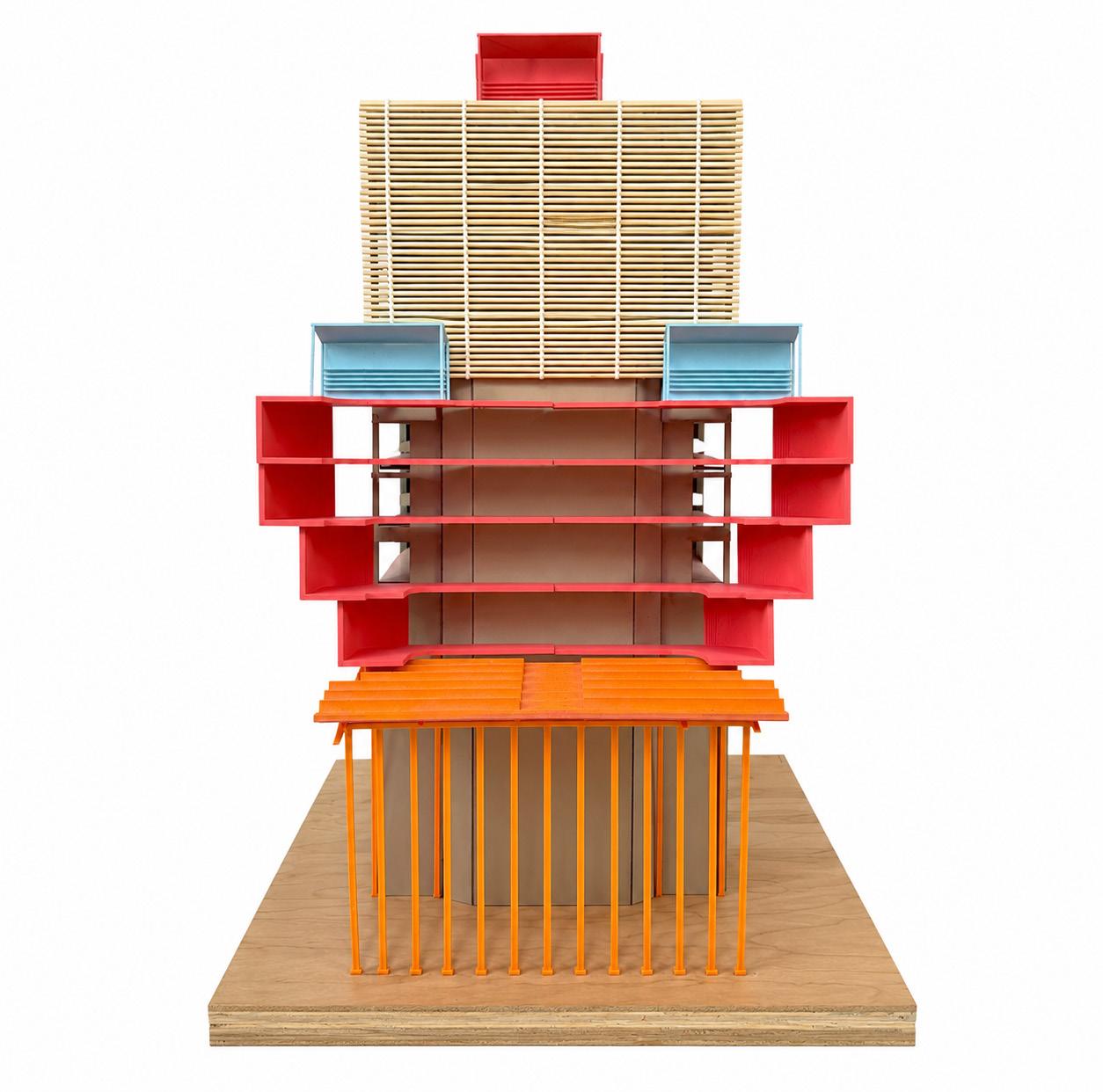
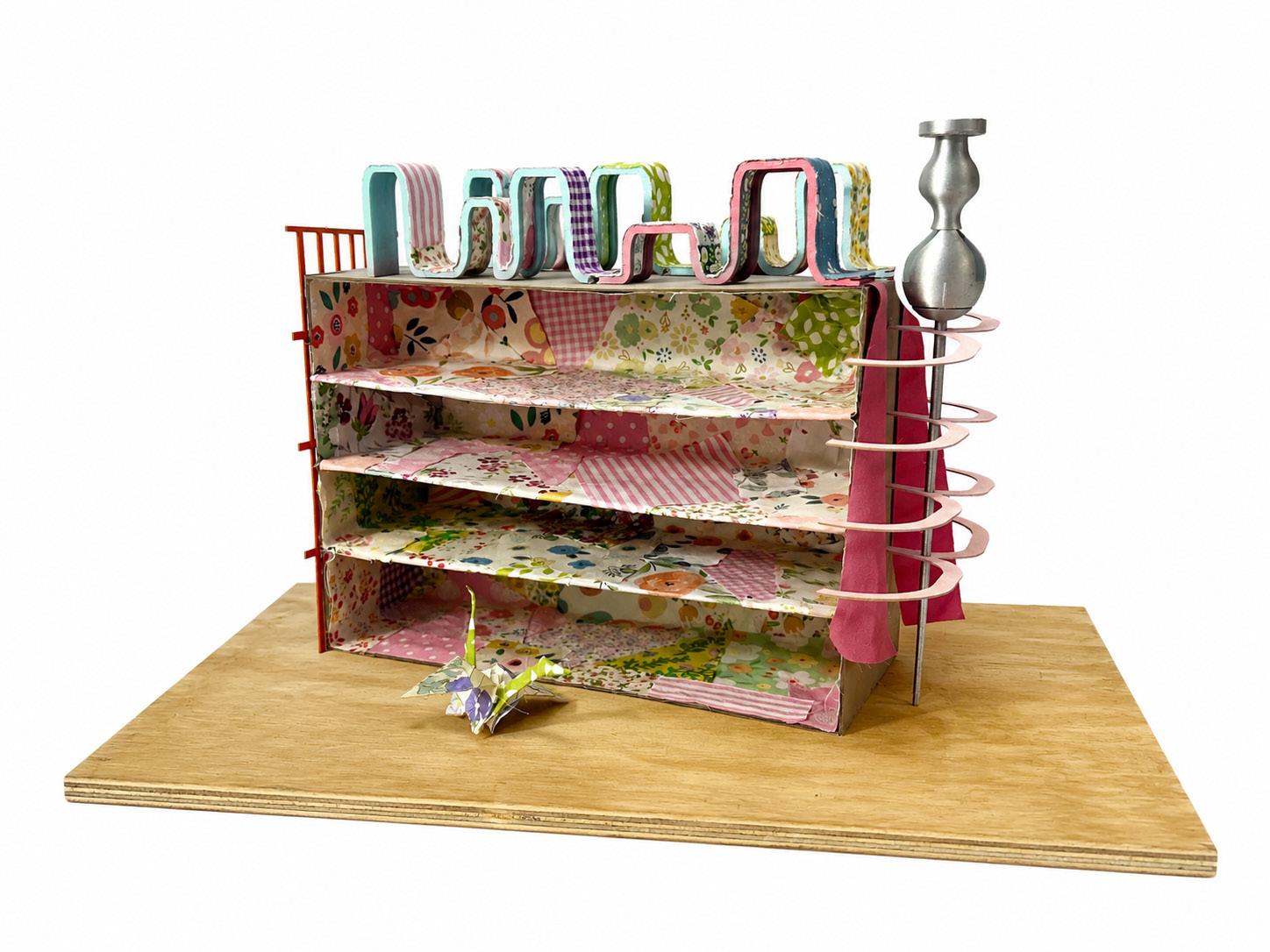
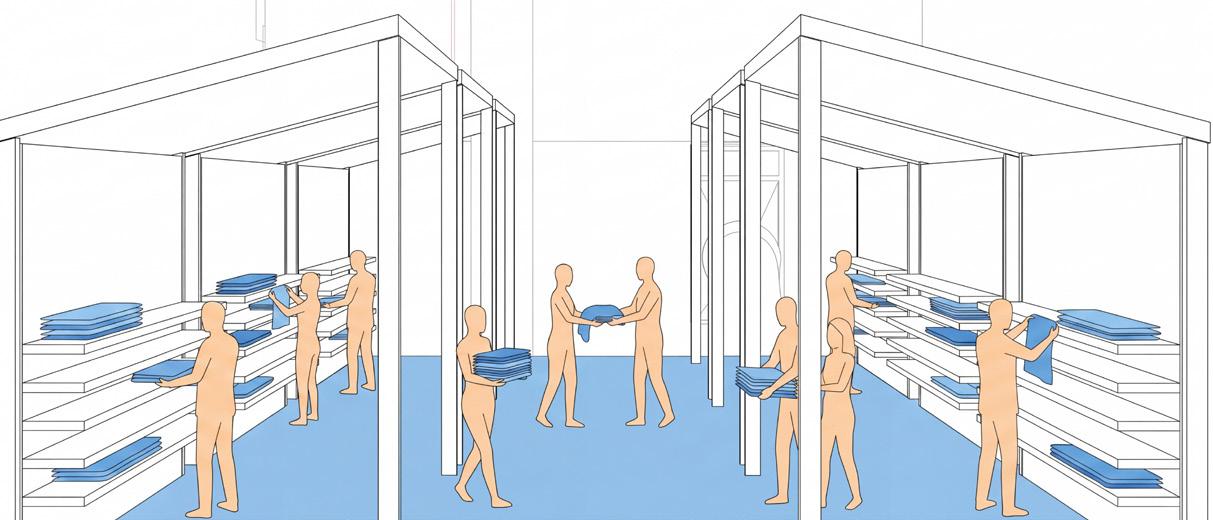
Reserve reframes discarded material as shared resource. Recovered fabric is sorted into stepped storage walls and suspended material bins that visitors move through physically, transforming waste into an inhabitable archive of reusable material. Material is no longer discarded, but reintroduced as a shared resource.
Throughput exposes logistics as architecture. Large Archimedean screw systems stage the movement of garments and waste as visible urban flow. One operates theatrically toward the street, while the other feeds stepped material and sample spaces, making production legible as process rather than product.
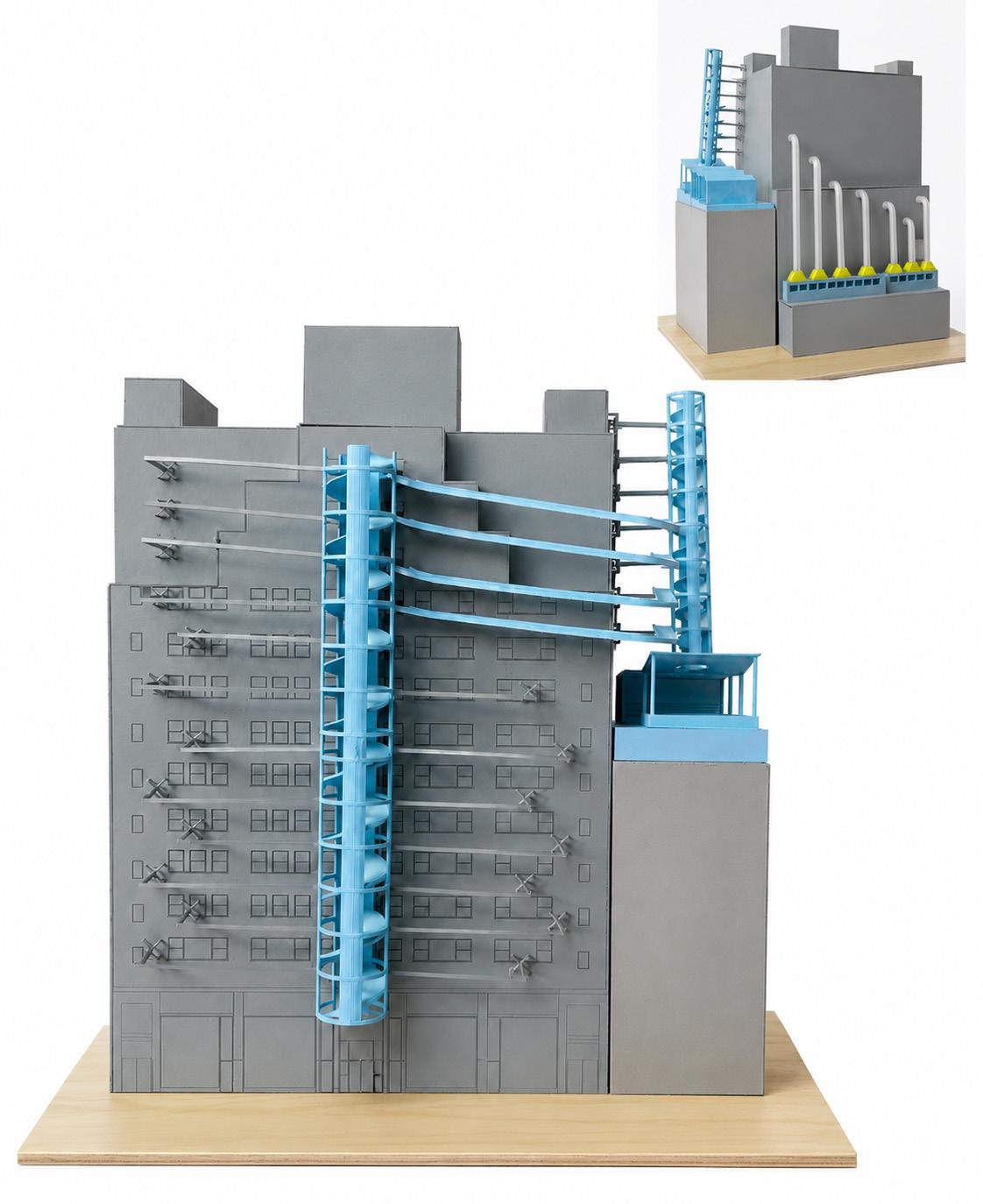
Throughput + Reserve Final Model
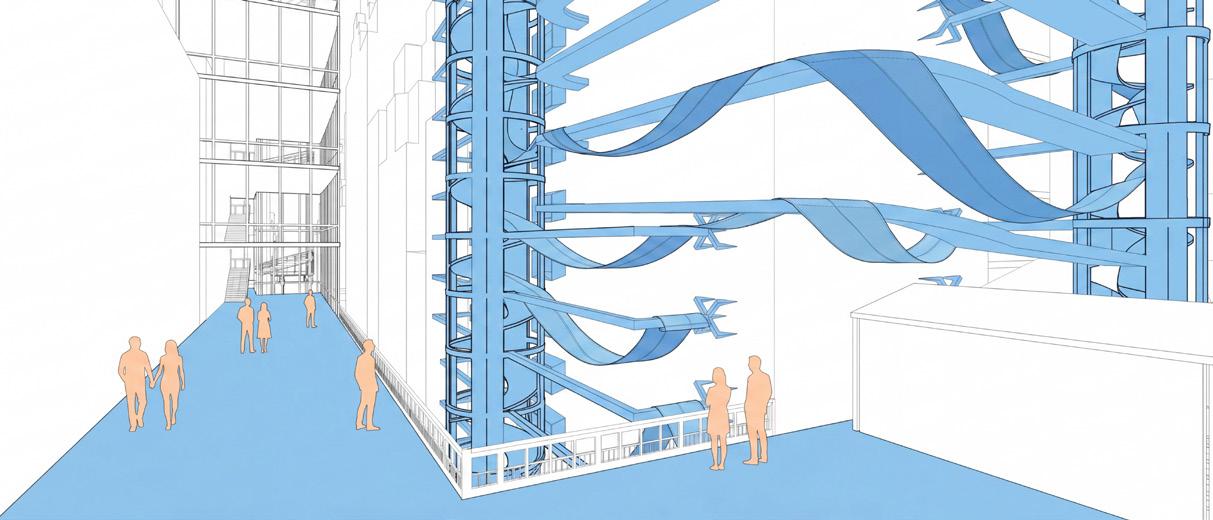
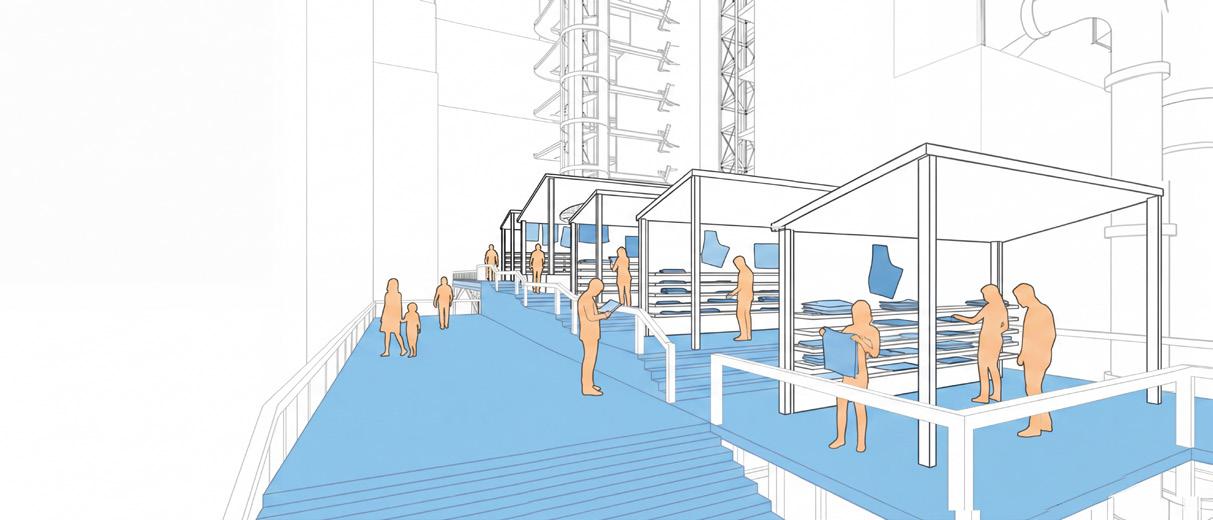
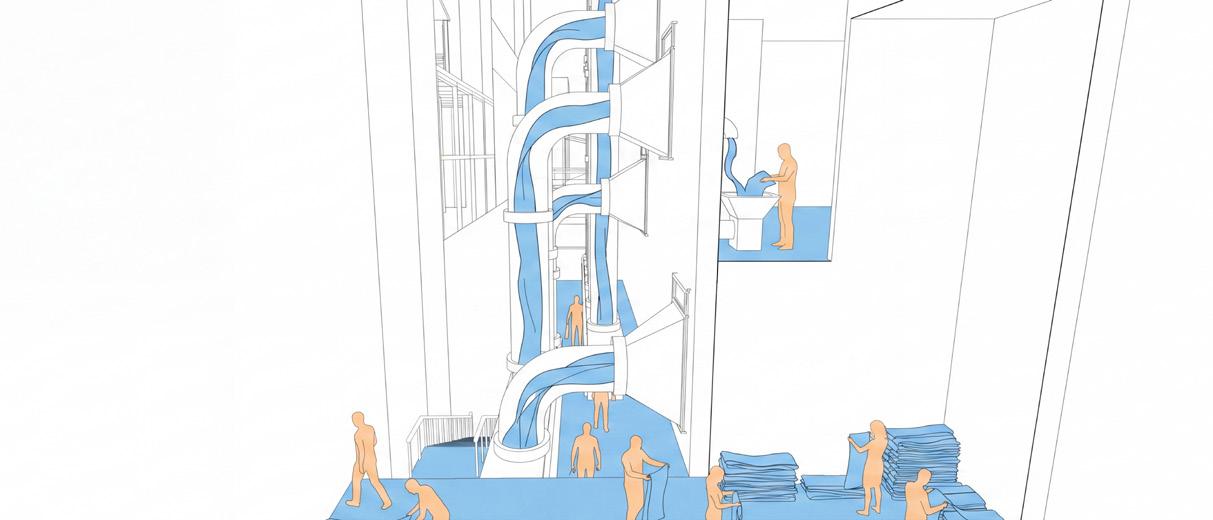
Throughput + Reserve Vignette Drawings
The movement of material through the building, scraps, bolts, remnants, and waste, is staged as architecture rather than concealed as logistics.
Visitors physically navigate the material reserve, pulling and sorting fabric from the shared archive. The body becomes part of the sorting system.
Waste becomes resource. The material cycle of the district, input, production, remnant, and redistribution, is felt as a system with stakes. TRANSFER
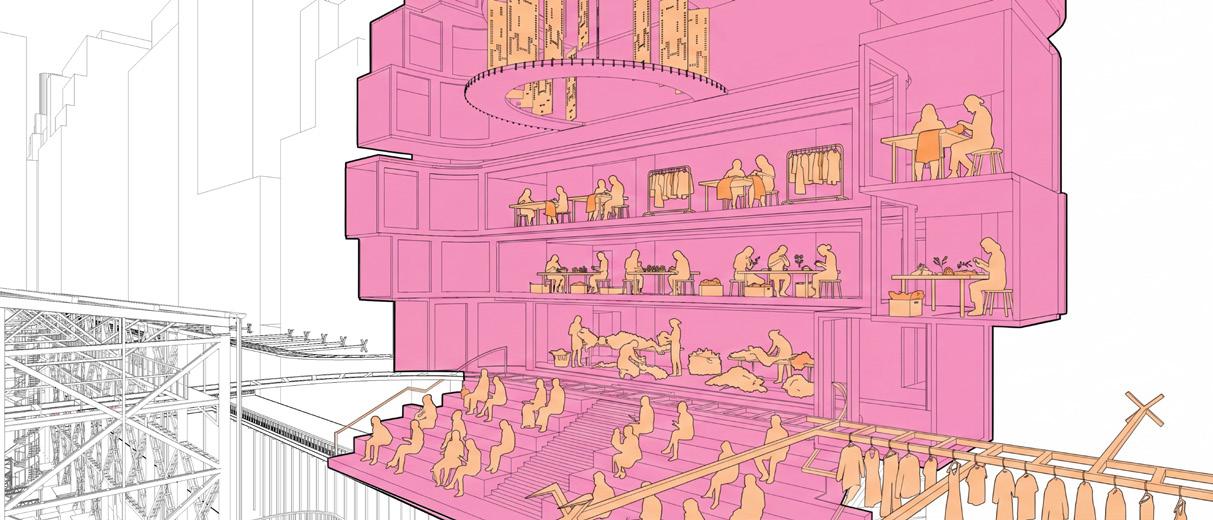
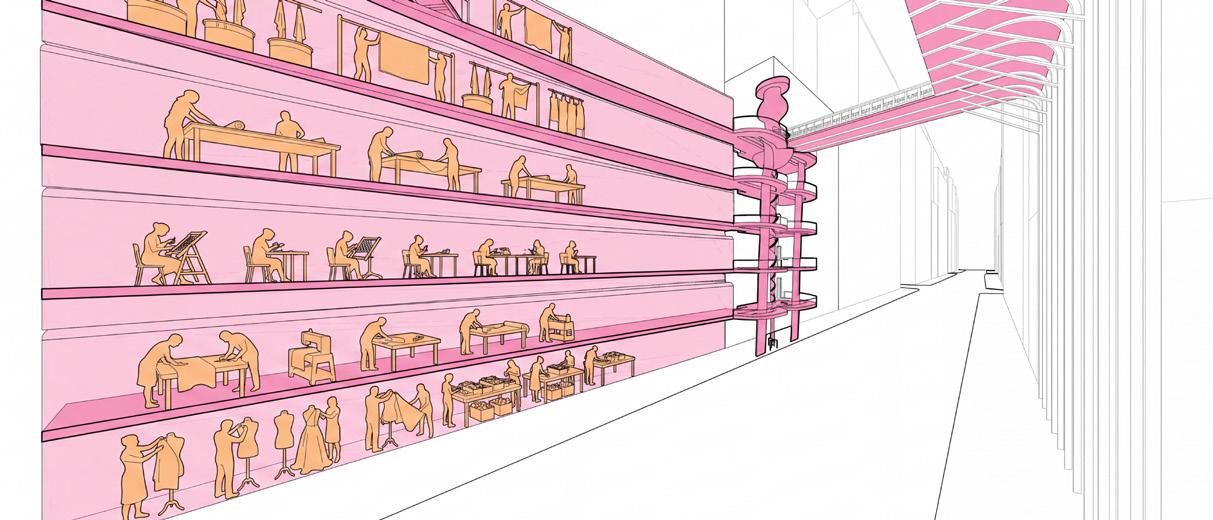
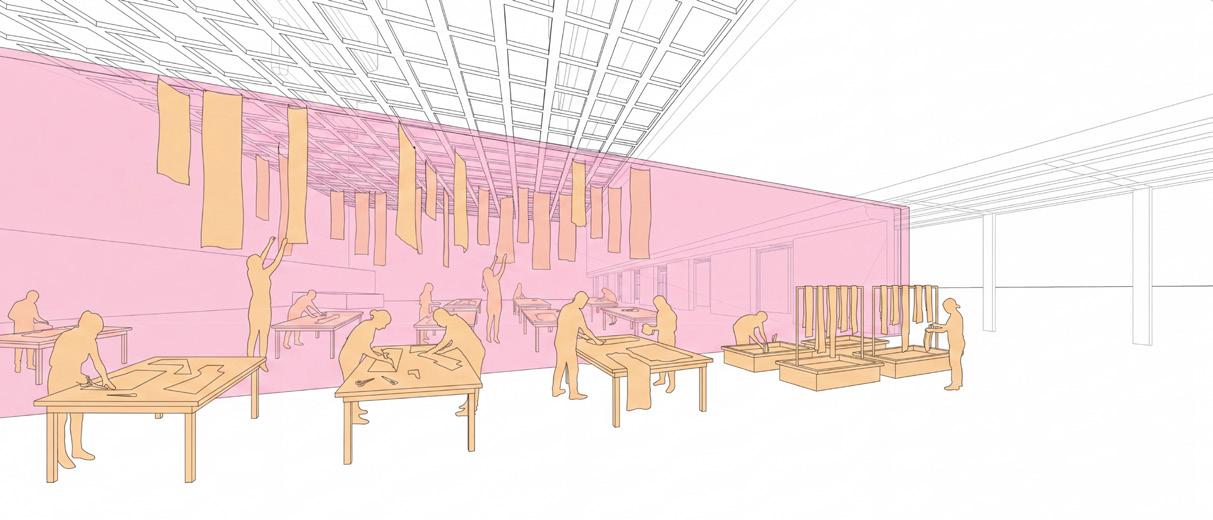
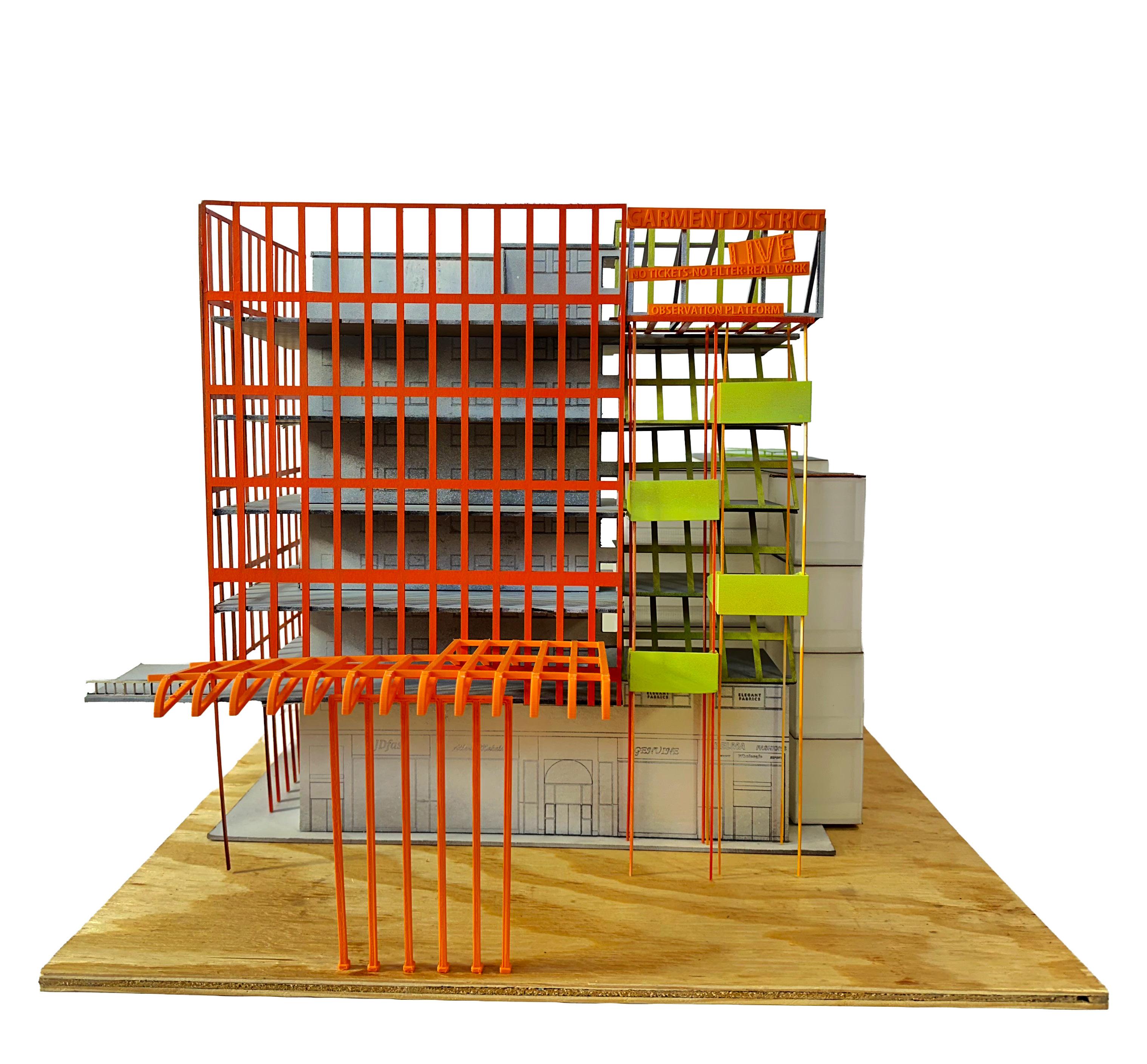
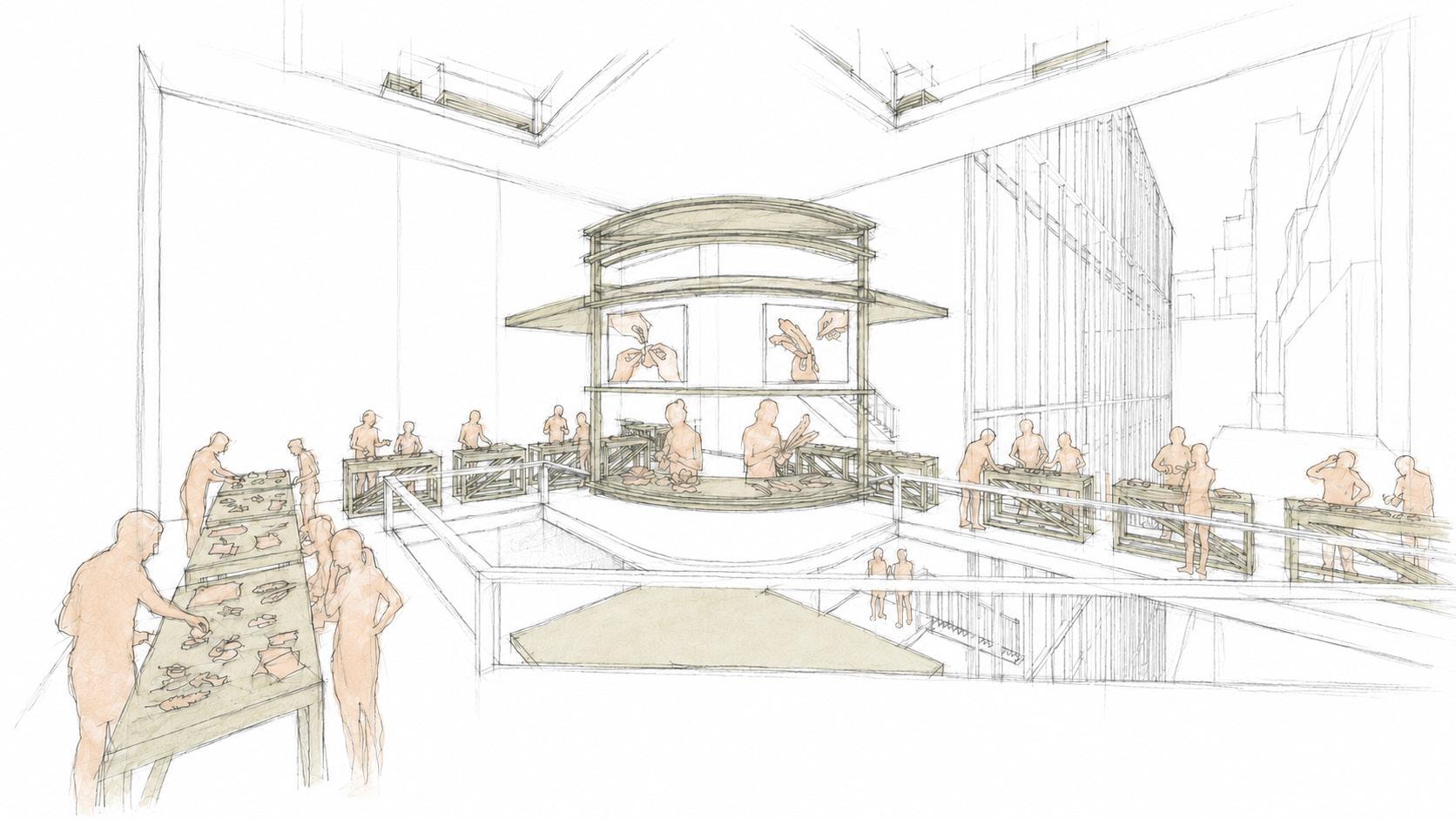
Grandstands look into spaces of making. Floor plates extend into the void, forming immersive environments of master tables, apprenticeships, and workshops. Here, observation transitions into learning. Spectatorship becomes participation in craft. Nothing here is consumed quickly. The architecture asks visitors to stay, observe, and slowly absorb forms of knowledge through time spent near the work itself.
As the sequence progresses, density decreases. What begins as spectacle becomes increasingly specific. What begins as passive viewing becomes active learning. Those who continue encounter deeper forms of knowledge.
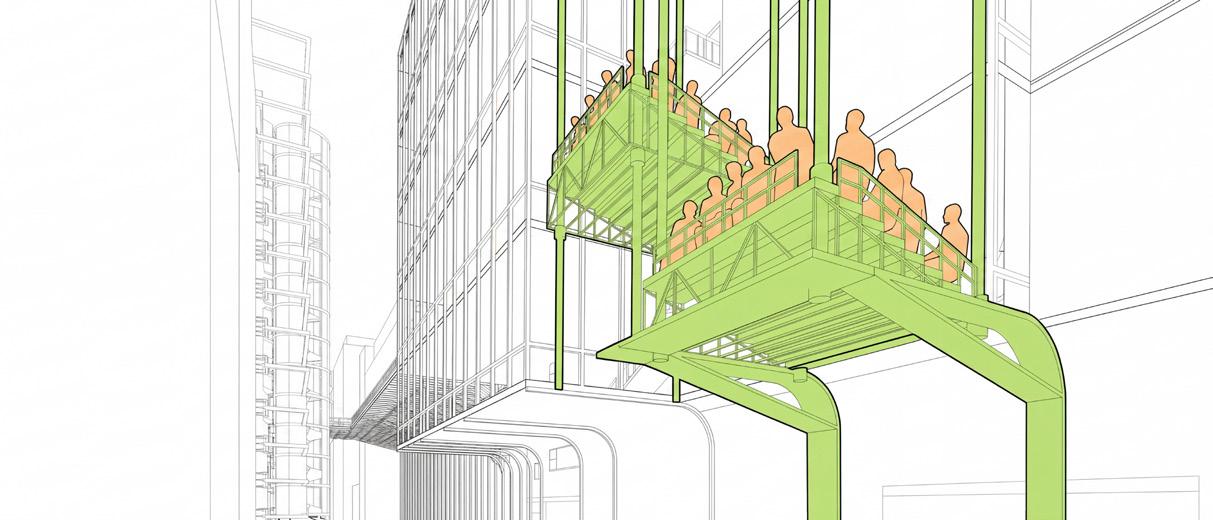
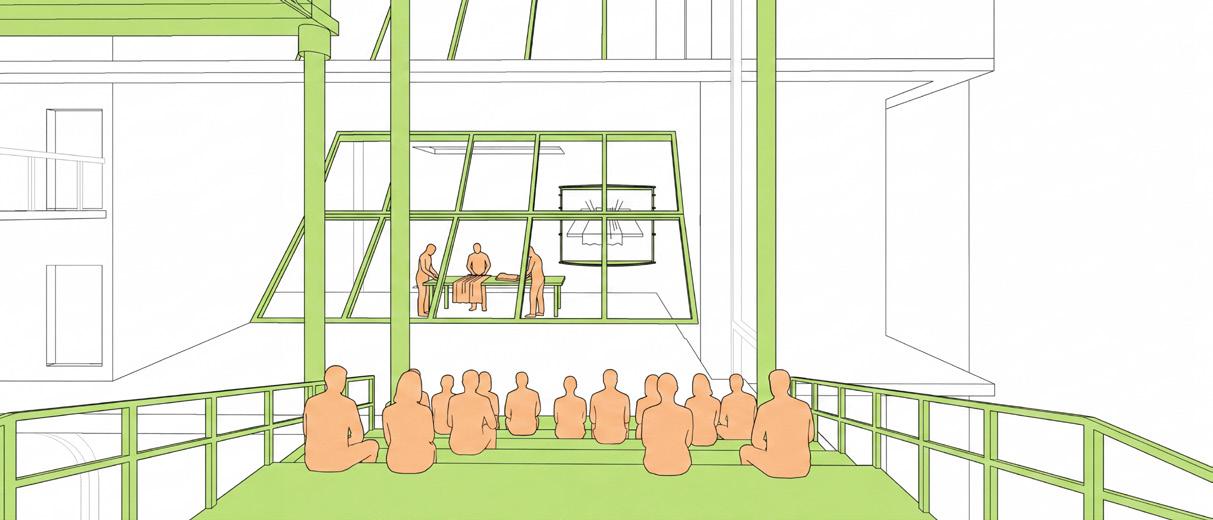
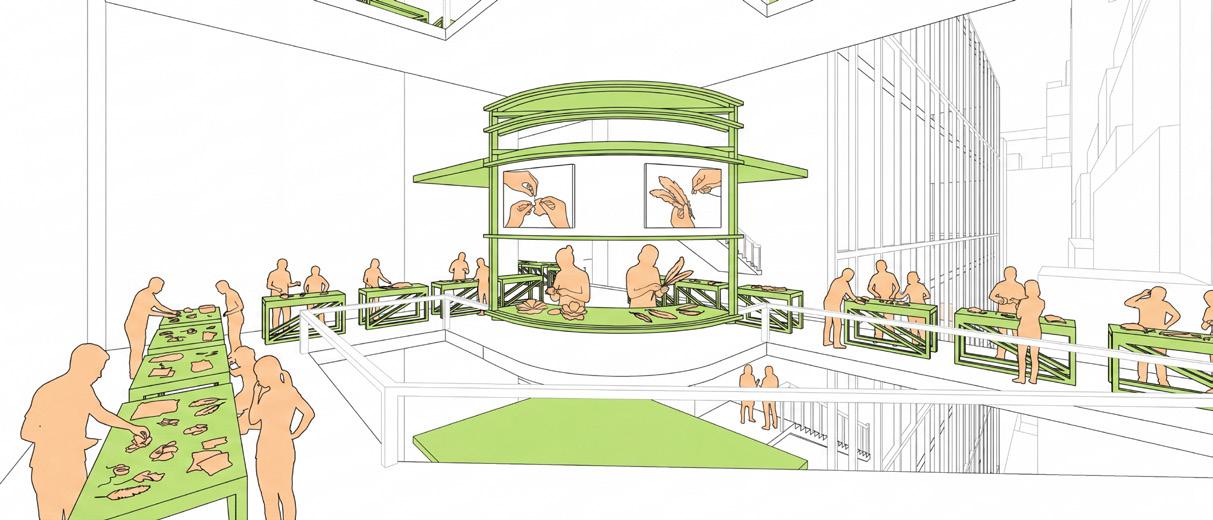
Bleacher seating and elevated walkways place the public in sustained proximity to active fabrication, observation made architectural.
Visitors linger beside pattern makers, sewing operations, dye workshops, and fabrication studios. Observation becomes inhabitation.
Knowledge is not handed over directly. It is taken through time, repetition, and proximity to those who hold it. This is the deepest level of inheritance.
It redirects attention.
It creates entry where none existed.
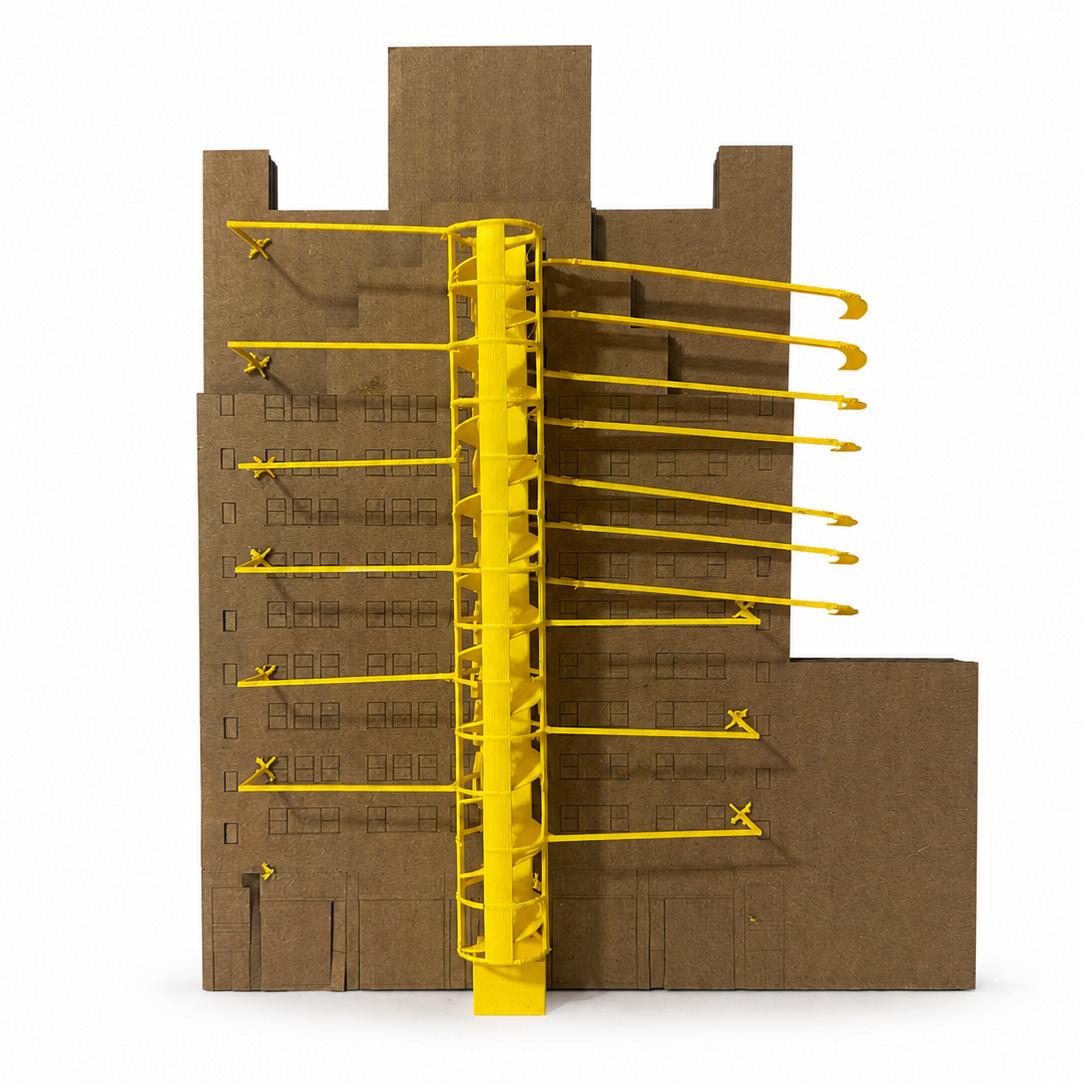
Prosthetic Study Model
But then I realized that what I was really passionate about was this industry, and this industry, you can only do it here.
George
Kaljian
The spine is a route through specificity. It does not treat the district as a generic container for production, but as a place where craft depends on proximity, repeated contact, and the accumulated knowledge of who, what, and where.
As visitors move through the gauntlet, the district is no longer read only from the sidewalk.
The body is pulled upward, inward, and across, passing through workrooms, freight cores, rooftops, voids, and material exchanges. The spine turns movement into recognition: a way of understanding why this work depends on place.
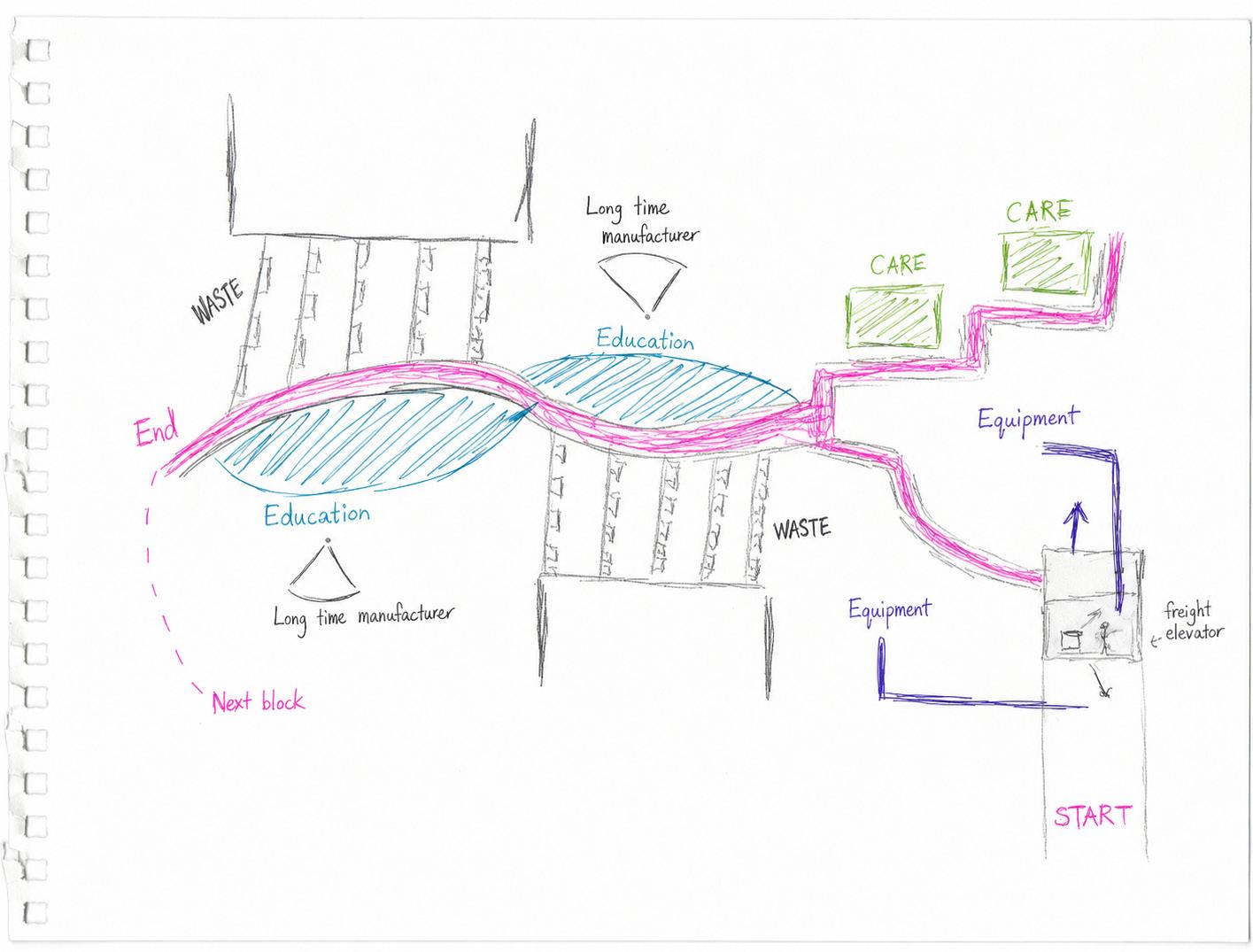
Early Spine Sketch
Spencer Giuliano
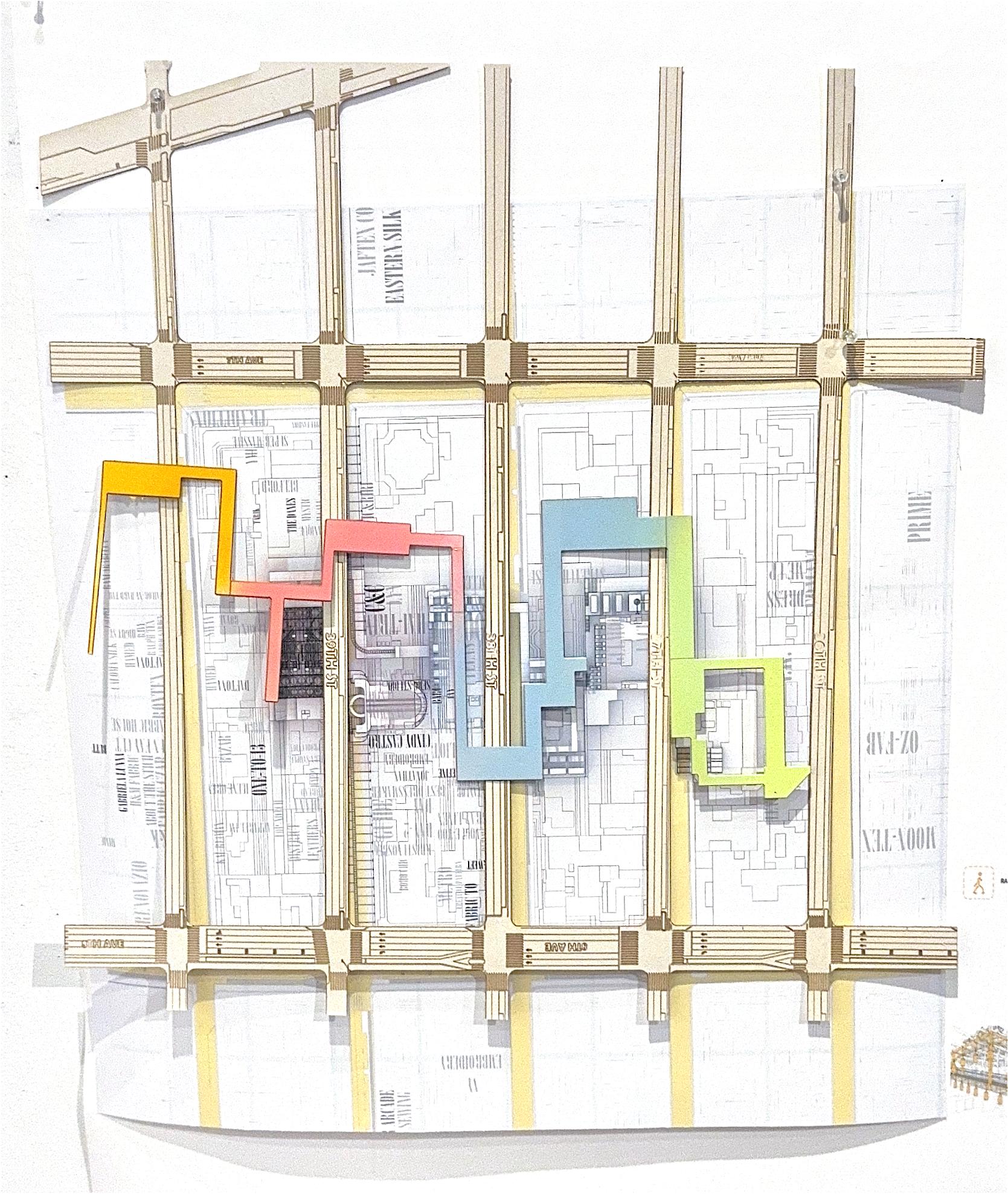
Site Plan with Inserted Spine
Spencer Giuliano + Ash Bartaria
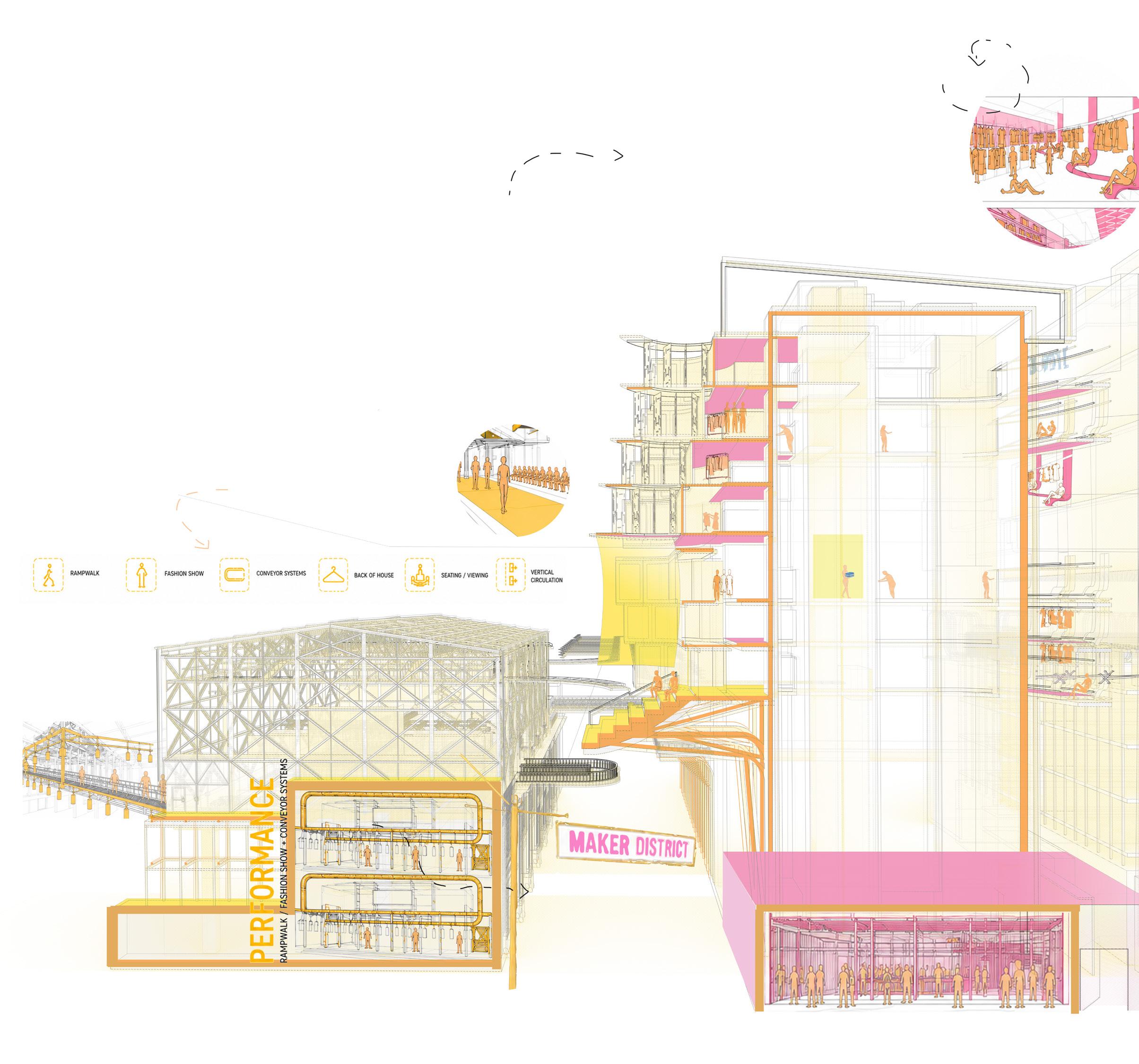
Unrolled Project Section Drawing
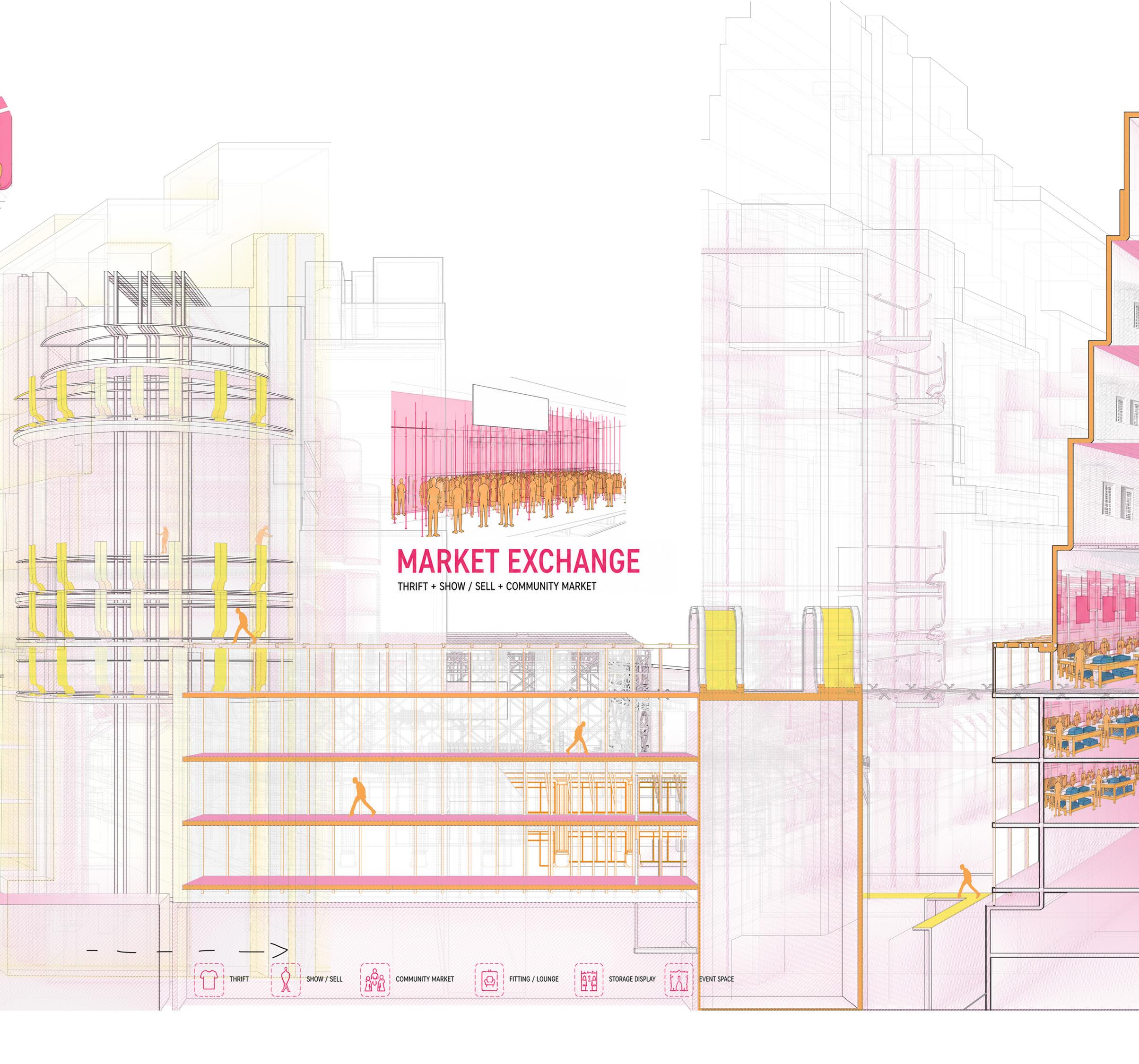
Unrolled Project Section Drawing
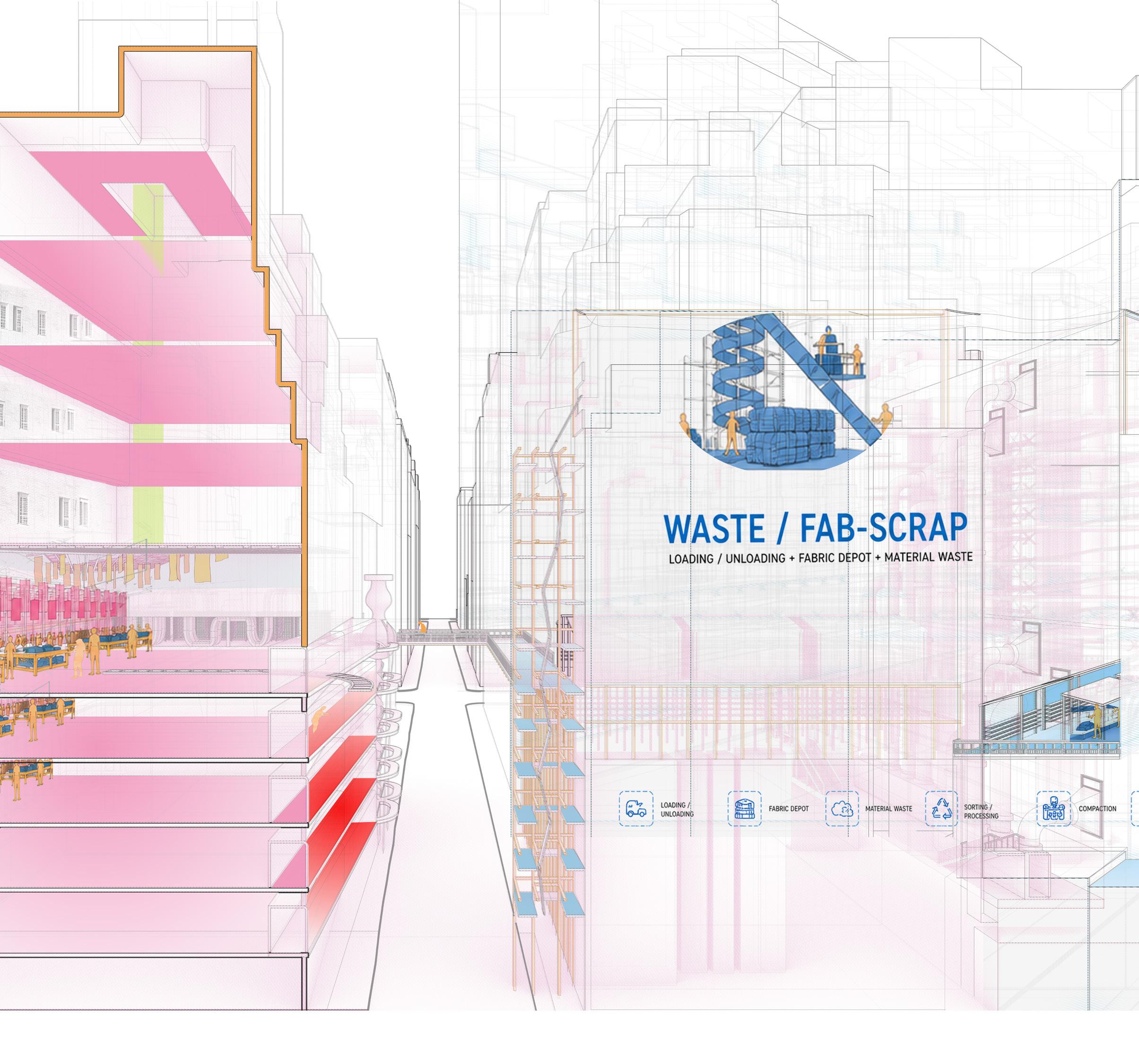
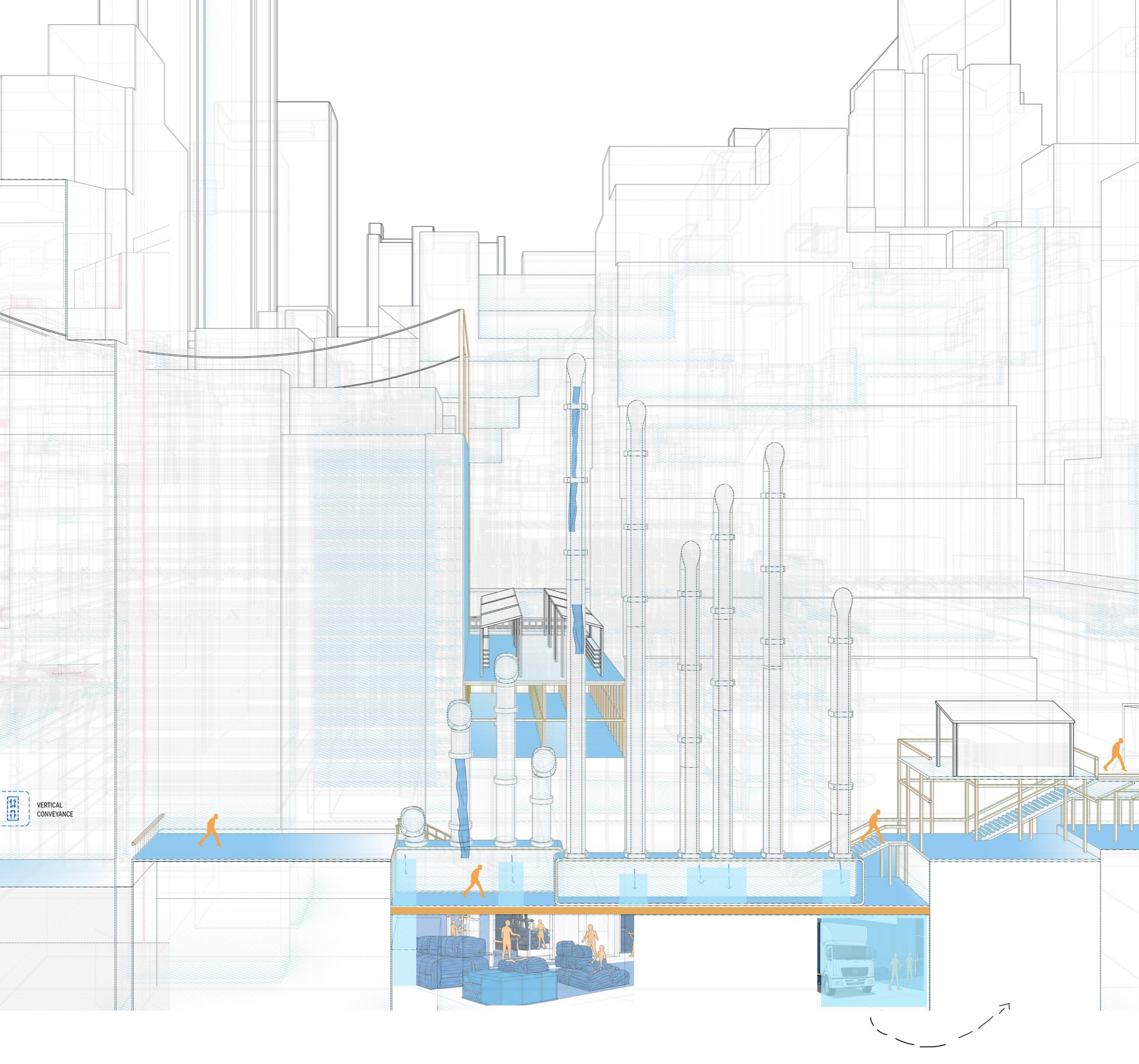
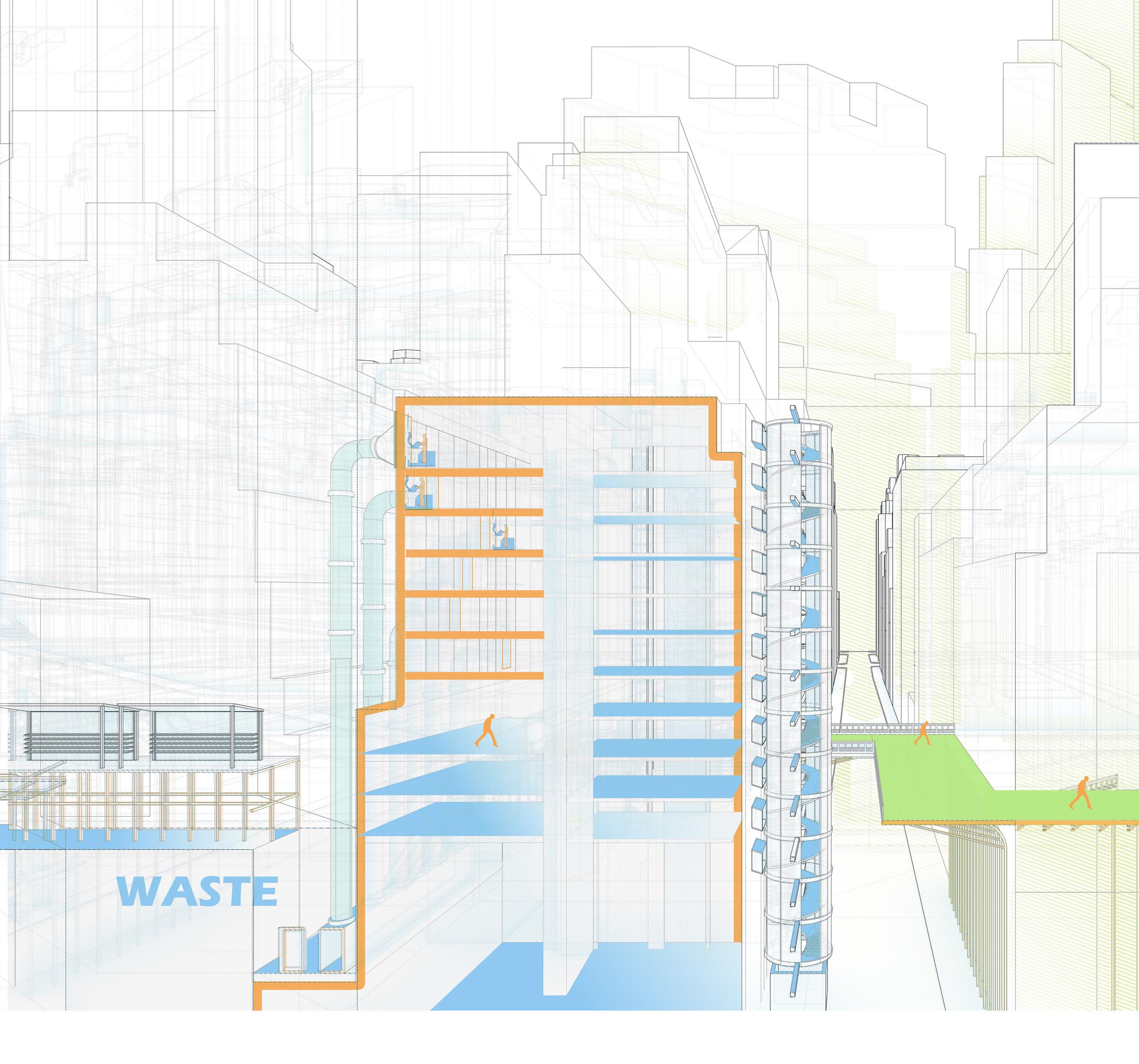
Unrolled Project Section Drawing
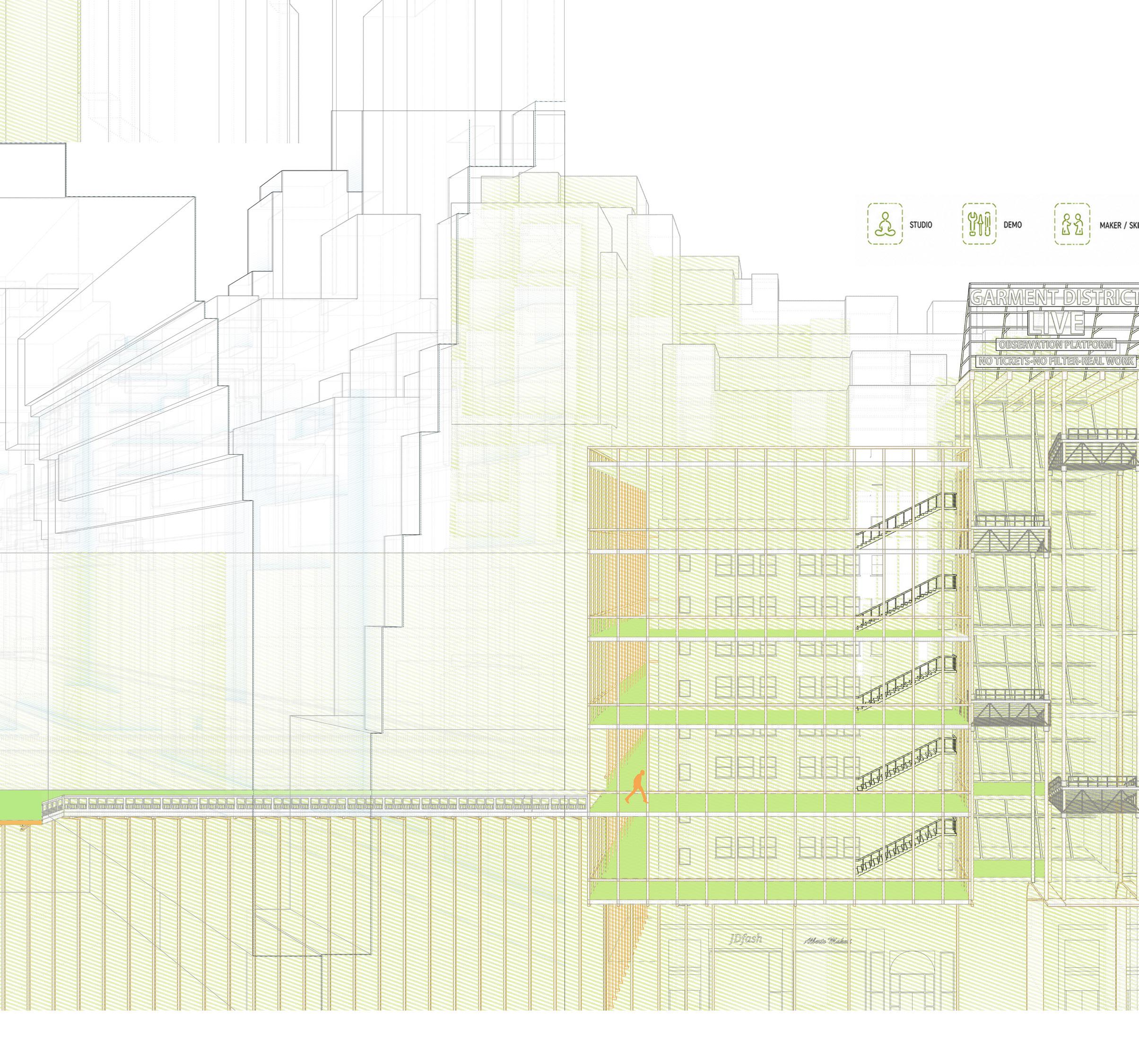
Unrolled Project Section Drawing
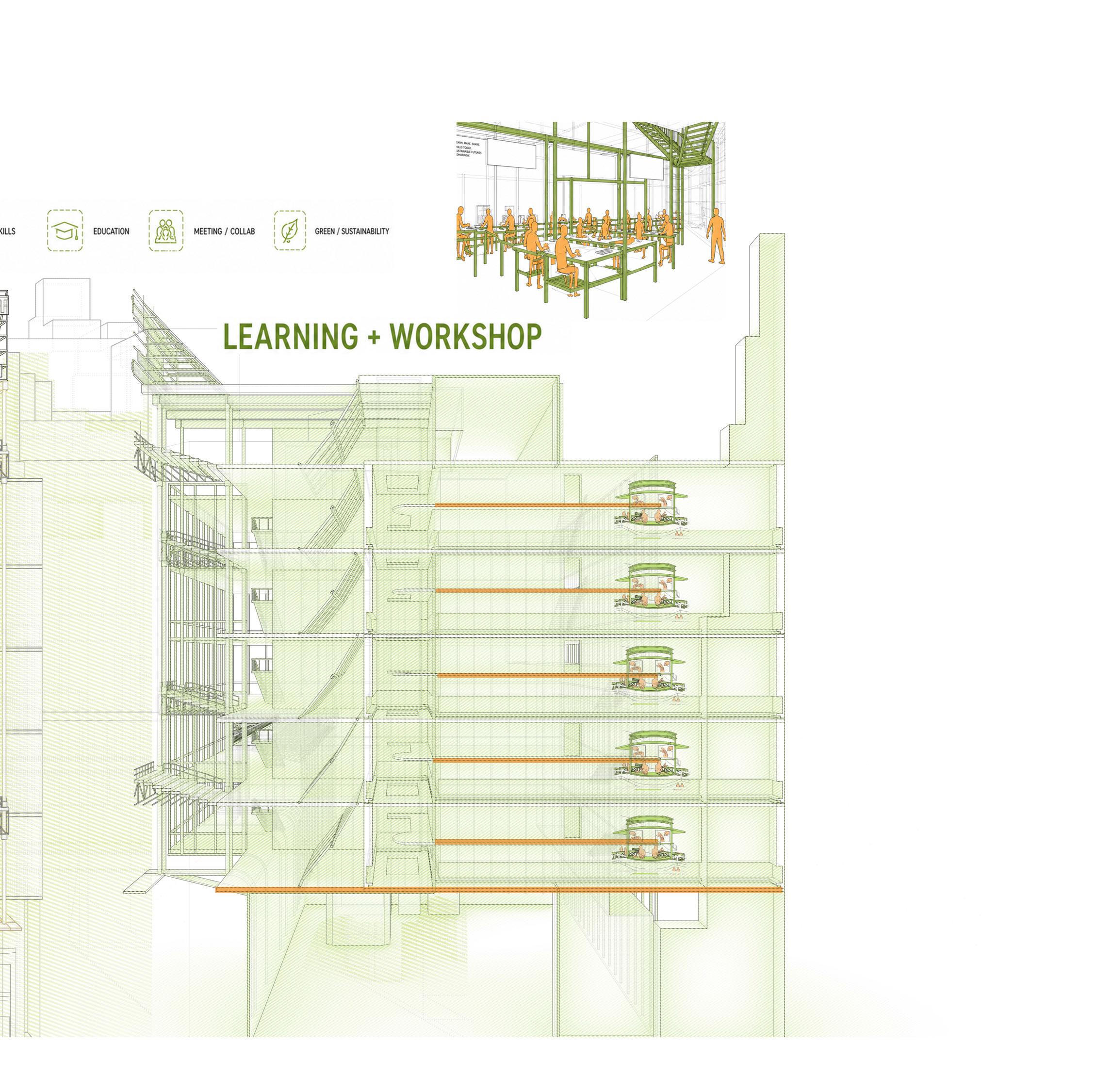
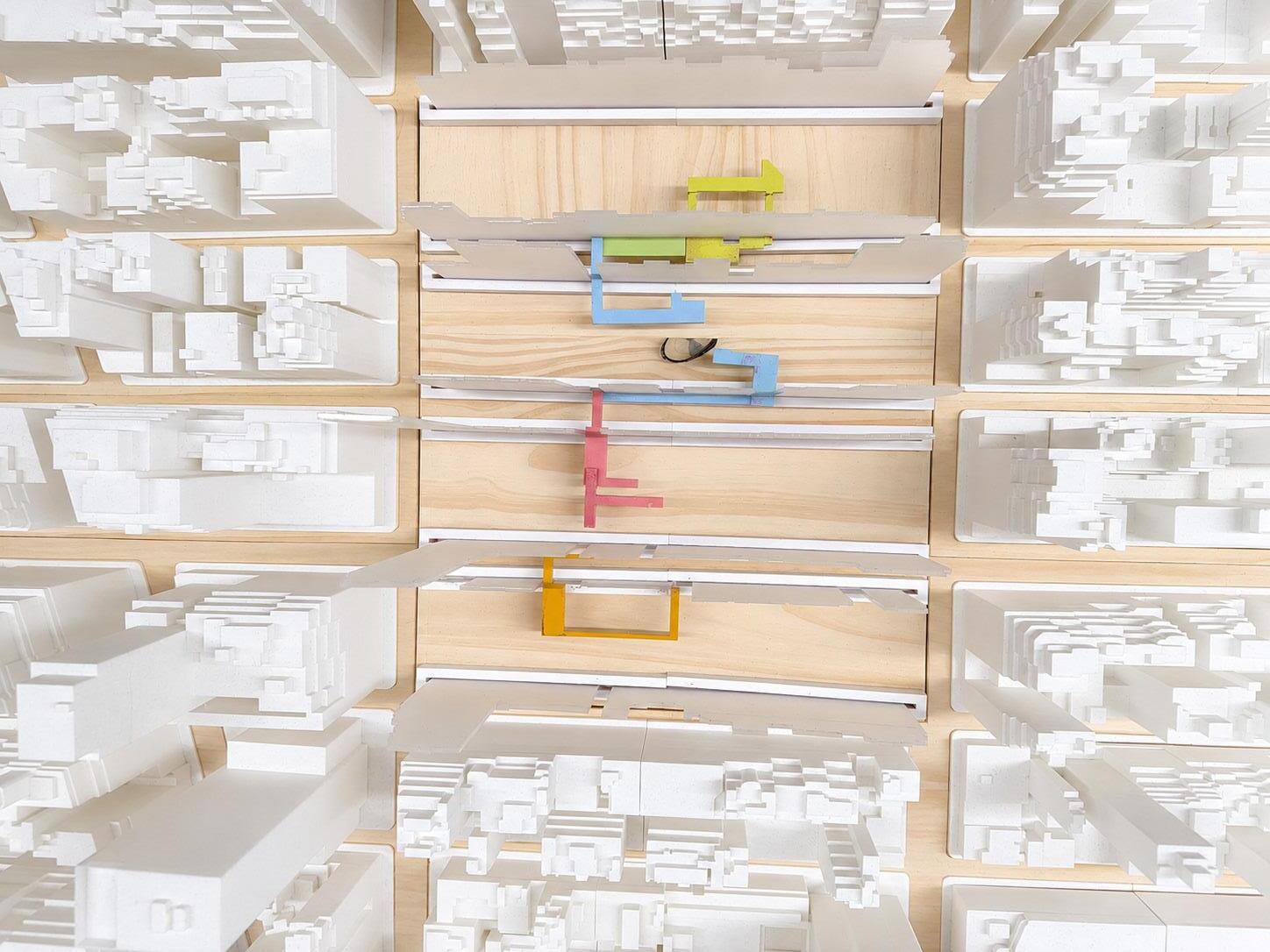
Garment District Site Model with Inserted Spine
Spencer Giuliano + Ash Bartaria
The spine does not demand a single complete journey. It is a sequence of possible encounters, where each point offers a different degree of access into the district’s hidden systems.
Some visitors may only see the colored fragments from the street. Others may enter a market, pause at a display, follow a bridge, or reach the spaces of care, equipment, and learning deeper within the block. The value of the spine is not that everyone reaches the end, but that each encounter exposes another layer of production.
By the end of the route, the district is no longer understood as a series of storefronts or isolated buildings. It becomes a connected field of labor, material, memory, and exchange. The gauntlet turns movement into recognition, allowing knowledge to be encountered gradually, through proximity rather than instruction.
In the old Garment District, there were lots of people that did this. If you needed somebody to do a specific task, there were people that did it.
The Garment District is not a neighborhood. It is a metabolism.
Its value has never resided in individual buildings or branded identity but in the compression of trades, scales, and forms of labor into a spatial system capable of moving an idea from fabric bolt to finished garment within a few city blocks. Cutting rooms, pleating shops, sample rooms, flower makers, fabric suppliers, repair practices, showrooms, rolling racks, freight elevators, loading docks, and informal networks of technical knowledge: these are not amenities or relics but organs of a body still, in part, alive. What the district offers is not fashion. It is a form of urban intelligence the capacity to move from concept to material to prototype to alteration to display through proximity, and to do so in ways that are not replicable by shipping containers or global supply chains.
The architecture that organized this capacity was not incidental. Loft buildings with wide floor plates, freight elevators capable of moving bolted fabric and rolling racks, side streets scaled for hand trucks and delivery, vertically stacked production floors accessible by stair and shaft these spatial conditions were not neutral containers but active instruments of production. The city organized the district. Its sidewalks, freight entries, elevators, fire stairs, and work floors formed a circulatory system through which material and knowledge moved. To understand what is at risk in the Garment District is, first, to understand that this spatial metabolism was always the point.
That metabolism has been systematically pressured. Real estate speculation, zoning shifts, office conversions, and the economics of global outsourcing have each operated on the district’s productive tissue. The Special Garment Center District, established in 1987, attempted to restrict millions of square feet of space to manufacturing uses in response to mounting pressure from office conversion. The Design Trust for Public Space has documented this history as an effort to preserve production space under conditions of intensifying real estate competition. But zoning is not ecology. It can protect space without preserving the knowledge, relationships, and material culture that give that space meaning. Manufacturing did not depart all at once. It thinned, retreated, became harder to read.
This is the condition that Alexander Nagel and Christopher Wood’s Anachronic Renaissance helps to name. Their argument challenges the foundational assumption that artifacts belong to a single, stable
Strange Objects
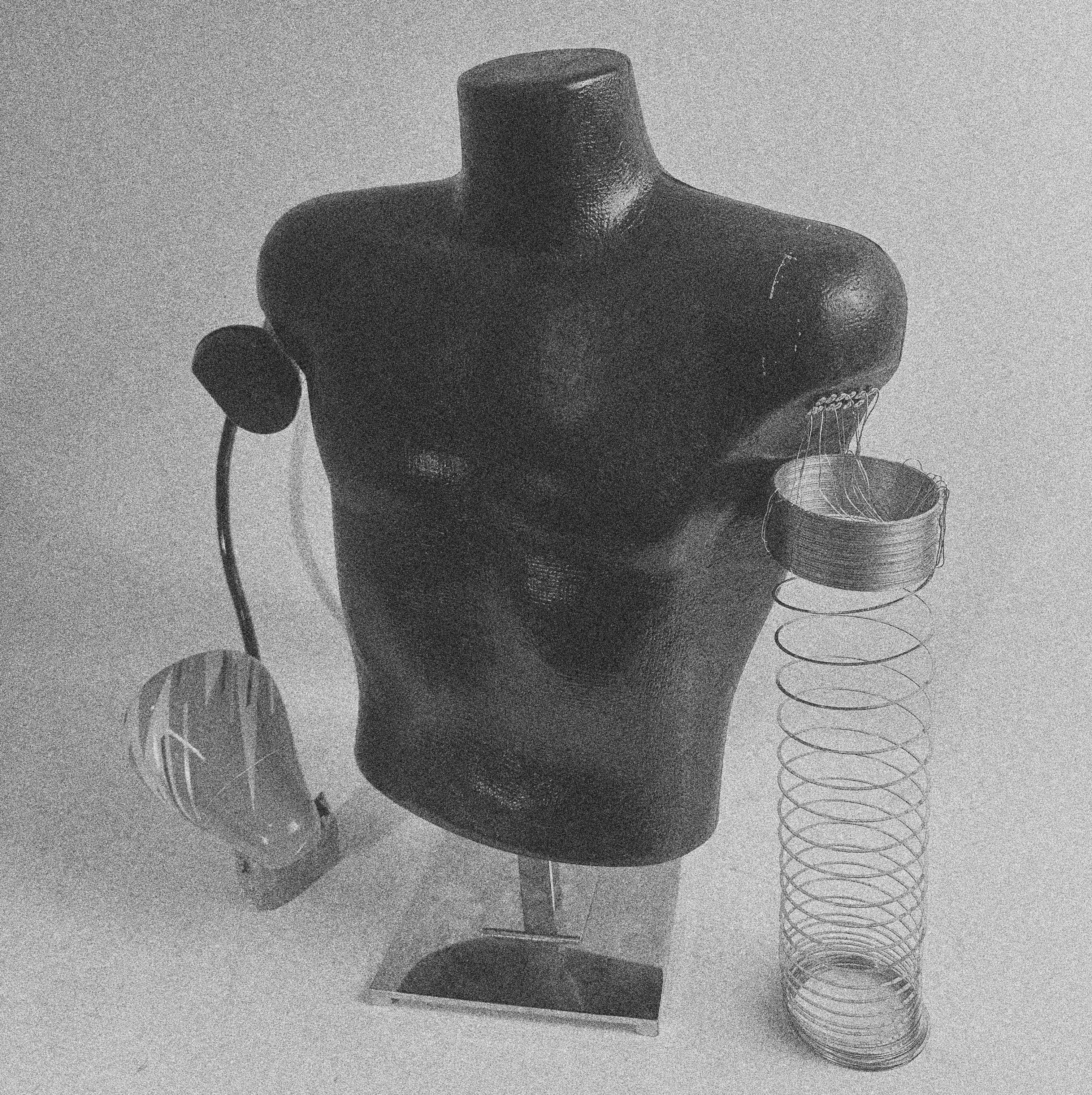
SPENCER GIULIANO
historical moment. Working against the art-historical convention of period attribution, they propose that objects operate across multiple temporal registers simultaneously carrying histories, absorbing repetitions, performing substitutions, making claims of origin. An altarpiece is not simply of the fifteenth century; it is entangled with the time of its commission, the time of the prototype it revises, the time of its later restorations, and the present in which it is encountered. Time, in this account, is not a container but a material condition of the object.
The Garment District operates within an equivalent temporal complexity. It is not simply old or new, industrial or post-industrial, active or obsolete. It contains several times at once: the history of immigrant garment labor; the modernist loft infrastructure built for production; the present-day survival of specialized craft practices that exist nowhere else in the region; the speculative future projected by developers onto its building stock; and the accelerated temporality of fashion cycles that consume objects faster than the labor required to produce them can be sustained. These temporal registers do not resolve into a single narrative. They coexist, contradict, and press against one another.
To call the district anachronic is to refuse nostalgia. Nostalgia would freeze the Garment District as an image a heritage asset, a branding resource, a memory palace for an industrial past. Anachronic thinking allows it to be understood as a living contradiction: a place where past systems remain operational within present pressures, and where the loss being anticipated is already actively restructuring the labor that still exists. The city is not waiting to lose the Garment District. It is already losing the capacity to perceive it while it remains.
The crisis of the Garment District is not invisibility. It is illegibility.
These are different conditions. Invisibility means something cannot be seen. Illegibility means something may be physically present available to the eye but cannot be parsed as part of a system. The public moves through the Garment District and encounters rolling racks, fabric stores, mannequins, freight doors, garment bags, and signage. These fragments are visible. But they rarely communicate the productive relationships that make them meaningful. The finished garment remains legible as commodity and image. The network that produced it becomes phantom.
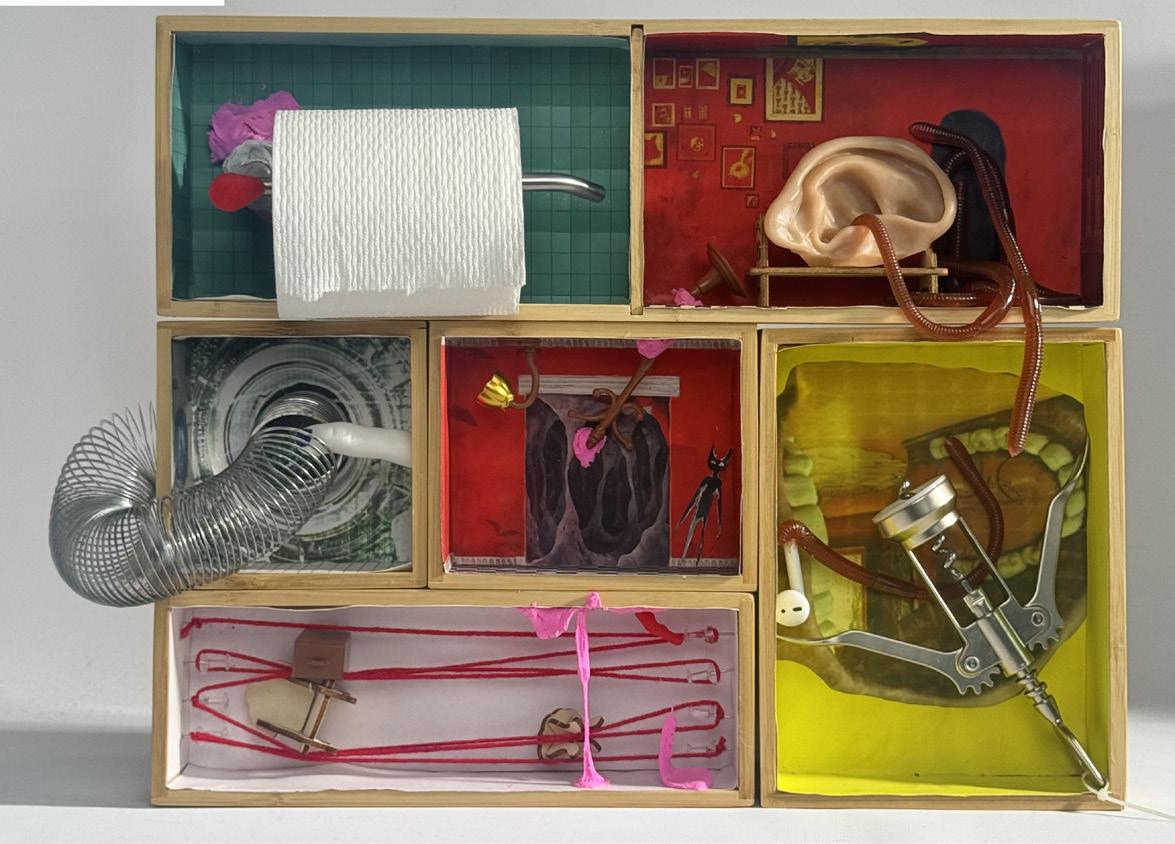
Caroline A. Jones’s work on embodied perception in Sensorium offers a framework for this condition. Jones’s project distributes perception across bodies, technologies, and environments rather than centering it in the individual subject. Perception, in this account, is always mediated not the transparent registration of reality but a function of how attention is organized by the tools, architectures, and semiotic systems through which bodies encounter the world. Applied to the Garment District, this means that the phantom quality of its productive life is not a failure of information. It is a failure of perceptual organization. The labor is there. The systems are partially there. But nothing in the district’s current spatial arrangement teaches the public how to read them together.
Phantom labor operates as Jones might describe a phantom limb: absent from conscious perception but still registering through traces. A rolling rack is the phantom sign of a cutting room. A freight elevator is a hidden nerve connecting production floors to street-level commerce. A fabric store is the visible surface of a much deeper material system of suppliers, wholesalers, pattern makers, and designers whose relationships are spatial and tactile rather than digital or contractual. The trace is real. The body that produced it has become difficult to recognize.
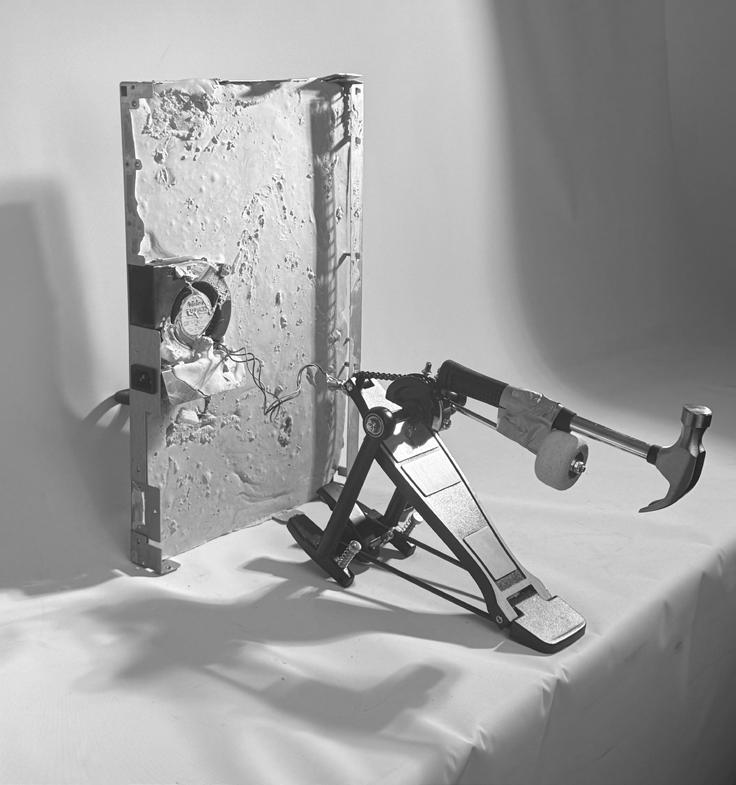
Hito Steyerl’s The Wretched of the Screen refuses the assumption that visibility is equivalent to clarity or that making something visible constitutes a political act. Steyerl develops a politics of the image in which images circulate, degrade, accelerate, and become entangled with structures of power. Images do not
simply represent; they participate in economies of value and attention that can obscure as much as they reveal. Fashion circulates as image with enormous force: the garment appears in windows, campaigns, runways, feeds, and retail environments. But the labor behind the garment does not circulate with equivalent intensity. The image of fashion becomes detached from the conditions of fashion’s production.
The result is a perceptual split that is not accidental. The product must appear effortless. The seam should be hidden or decorative. Labor should not interrupt desire. The commodity becomes cleaner as its process becomes more concealed. Contemporary consumption depends on this suppression. The finished object promises freedom from the time, error, and physical exertion that produced it. And the architecture of retail, display, and brand amplifies this promise by creating environments organized entirely around the experience of the thing, never around the conditions of its making.
Simple exposure cannot solve this. To make labor visible without restructuring attention risks turning it into another image among images a spectacle of authenticity layered over the same logic of consumption it claims to critique. The district is already saturated with visual material. Signage, advertising, scaffolding, traffic, commuters, and digital screens compete for attention at every scale. Visibility is too weak a tool. What is required is a system that changes how attention is organized that produces a different sequence of perception, a different relationship between body and space, a different understanding of what the district contains.
Architecture is precisely such a system. Not atmosphere, not decoration, not symbol, but a perceptual instrument: capable of making hidden labor readable through movement, proximity, threshold, and sequence. The question is whether architecture can be made to operate this way with enough specificity and conviction to matter.
Prosthesis is misread as compensation, as a device that returns the body toward wholeness and substitutes for what was lost. But that reading assumes the body was ever complete. Prosthesis doesn’t restore. It amplifies. It enables sensation that wasn’t there before. The more useful reading of prosthesis is relational rather than restorative. A prosthesis reveals that the body was never autonomous. It depends on tools, extensions, supports, and systems that lie outside itself.
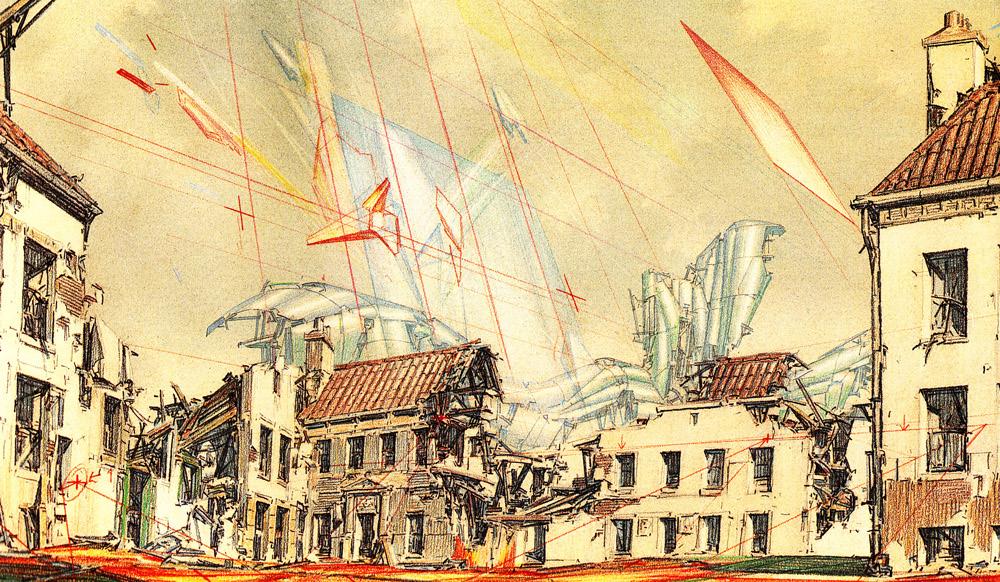
RadicalReconstruction;WarandArchitecture
Lebbeus Woods
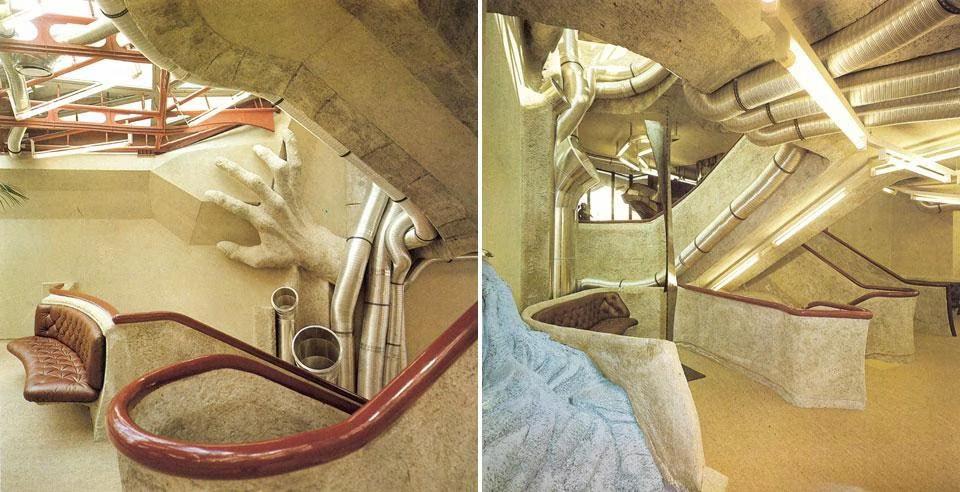
Z-Bank
Günther Domenig
Hal Foster’s Prosthetic Gods develops this reading through modernism, psychoanalysis, and the avantgarde, working through Freud’s image of the human as a prosthetic god a being whose powers are extended through artificial organs. The prosthesis, in Foster’s analysis, is never innocent. It simultaneously empowers and exposes. It extends the body while making visible the lacks and dependencies the body has always carried. The magnificent and the troubled are not opposites; they are the same thing from different angles. To attach a prosthesis is to acknowledge that what it attaches to was never complete.
Mark Wigley’s “Prosthetic Theory” carries this argument into architecture directly. Wigley argues that architecture has always been prosthetic: it does not simply shelter the body but disciplines, extends, positions, and regulates it. Stairs train movement. Doors control access. Plans abstract the body into measurements. Tables organize posture. Windows mediate sight. Architecture denies this prosthetic condition by presenting itself as neutral, autonomous, and stable as background rather than apparatus. But this denial is itself a performance, and the authority architecture claims depends on the hidden fact of its continuous bodily extension and control.
A prosthetic architecture for the Garment District cannot operate as a replacement, but instead as an attachment and graft. It must latch onto what exists and grow into it, becoming an epiphytic structure that makes its dependence on the host legible. The district’s existing systems should be treated as a body onto which new spatial operations attach, not remnants to be cleared or celebrated. The rolling rack is not a picturesque artifact of an industrial past; it is mobile infrastructure whose logics of movement, storage, and display can be extended into public space. The freight elevator is not merely a functional necessity; it is a vertical circulation of labor whose presence beneath street-level activity can be made to surface. The fabric bolt is not only merchandise; it is stored possibility, a material library whose relationship to pattern and cut can be made spatially legible. The sample room is not simply a production space; it is a pedagogical space where judgment about material, form, and fit is practiced and transmitted.
Prosthesis, used precisely, also resists the tabula rasa logic of redevelopment. Redevelopment requires that the existing condition be legible as either inadequate or inert as dead matter waiting to be replaced by something more valuable. The prosthetic framework refuses this reading. It insists that the district’s body retains latent capacities that can be extended, even where they have been partially suppressed. The prosthesis does not hide the wound. It makes the wound operational.
Prosthesis also serves as an ethical framework. The questions are directional. Does this attachment support the body on its own terms? Does it normalize the body for the convenience of someone else? Does it extend existing practices? Does it aestheticize disappearance? Does it make labor legible as knowledge or merely reduce it to spectacle? These questions cannot be seen as rhetorical, but demand answers in the decisions made in this architectural intervention.
The history of prosthetics makes clear that prosthesis is never only technical. It is social, political, and symbolic. The mass disability produced by the American Civil War transformed prosthetic production and public expectations in ways that illuminate the contradictions latent in any prosthetic framework. What the antebellum period addressed through basic hooks and pegs, the scale of wartime injury forced into a domain of public attention, national obligation, and technological invention. Artificial limbs became a site of political meaning: they were not only devices for use but devices through which society attempted to make wounded bodies acceptable, productive, and recognizable again.
The prosthesis, in this historical context, was simultaneously a technology of care and a technology of normalization. To provide an artificial limb to a disabled veteran was to support a body. But the support was conditional. The limb was intended to restore the appearance of labor capacity, masculine legibility, and civic function. The body was supported only to the extent that it could be made useful and presentable within dominant norms of able-bodiedness. Care and discipline overlapped. The wound was addressed; the wound was also managed, aestheticized, and pressured to become invisible.
A similar structural tension can be seen in the Garment District. Urban policy and preservation efforts often claim to care for the district while simultaneously demanding it become more legible to contemporary real estate capital. The district is celebrated as heritage, creative identity, and cultural brand, but the actual production spaces that generate that identity are being pressured to conform to higher-value uses. The industry is honored while the conditions that make it possible are rendered uninhabitable.
A prosthetic framework must be able to hold this tension in view. The danger is not the absence of care, but the wrong kind. Care that attaches to the district only to manage its transformation into something more
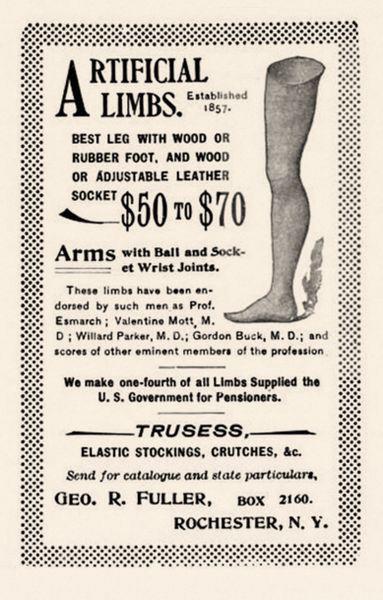
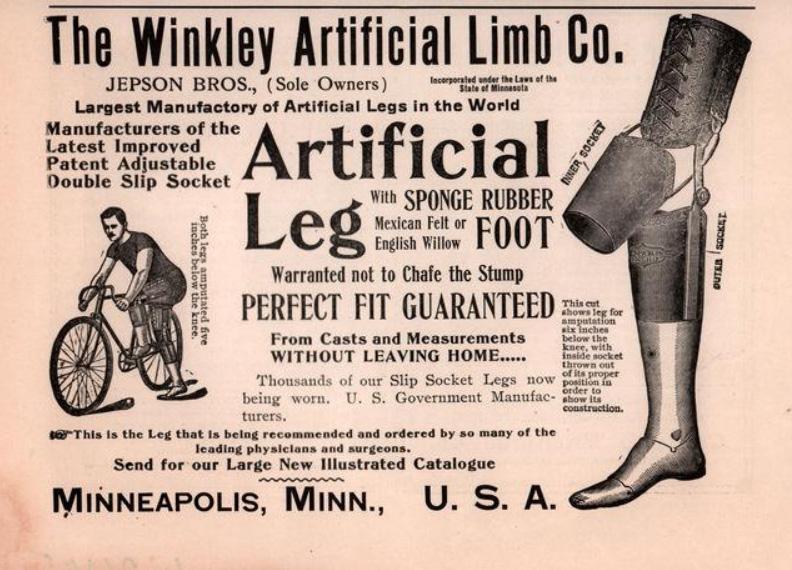
palatable to investment, tourism, or cultural branding serves no one but capital. The architecture must not simply look like support while functioning as aestheticization. It cannot be a decorative cast placed over a damaged body. It must metabolize straight into the scar and amplify that damage while amplifying its function.
The Civil War precedent prevents prosthetic architecture from becoming too clean or celebratory. It insists that any apparatus of attachment is bound to questions of memory, trauma, power, and whose interests are served by normalization. Prosthetic architecture must remain accountable to the body it attaches to not the imagined body of what the district could become for developers, tourists, or cultural capital, but the actual, partial, pressured body of what it still is.
To understand misdirection only as deception is to miss its more fundamental character as the organization of perception. Misdirection does not simply deceive; it structures attention. It tells the viewer where to 19th-20th Century Prosthetic Limb Advirtisements and Medical Catalogs
look and, more precisely, where not to look. In fashion, misdirection operates continuously and at every scale: a runway transforms labor into image; a display window turns a garment into desire; a seam hides construction; a lining conceals structure; a finished surface suppresses the time, error, judgment, and physical effort embedded in its production.
Christopher Nolan’s The Prestige centers its entire argument on the hidden apparatus of spectacle. The film tracks the logic of the stage illusion to its conclusion: the trick depends on the audience seeing the effect while missing the system that produces it. And crucially, that system must be maintained, repeated, and at some cost a cost that is never shown. What makes the illusion powerful is not that nothing happens behind it. It is that everything necessary to produce it is precisely what the audience is organized not to see. The effect appears spontaneous, effortless, singular. The apparatus is repetitive, material, and concealed.
The Garment District has been absorbed into a version of this structure. The public sees the effect of fashion the finished garment, the branded window, the curated retail environment, the runway image circulating across digital platforms but not the method. Not the cutting, the stitching, the pleating, the fitting, the steaming, the transport, the storage, the repair. The architecture of consumption hides the architecture of production. The loft building’s ground floor retail becomes a surface concealing the production floors above. The garment appears as a self-generating object, detached from the spatial system that produced it.
Jon M. Chu’s Wicked participates in a longer cultural lineage of theatrical world-making in which the shimmering surface of spectacle is inseparable from questions of machinery, control, and who determines the story being told. The curtain, the platform, the projected image, and the public performance are not incidental to power but constitutive of it. The spectacular surface is where authority is produced and
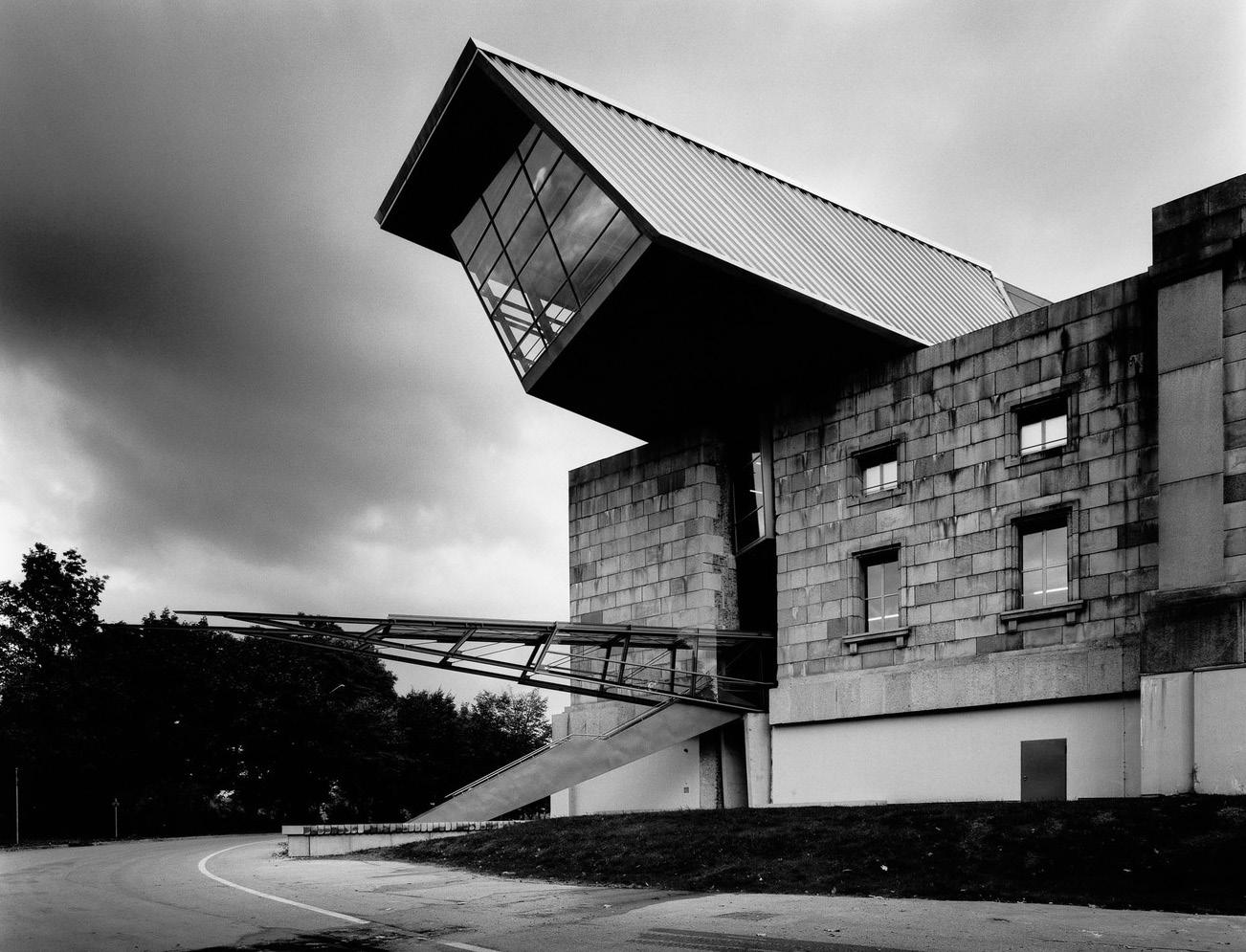
maintained which is also why the moment the apparatus becomes visible, the authority it generates begins to fail. Spectacle depends on its own concealment.
Coralie Fargeat’s The Substance drives this logic into body horror. The film’s premise a drug that generates a younger version of the protagonist’s body, with increasingly violent and destructive consequences functions as an anatomy of image culture’s demands on the body. The critical consensus that emerged around the film treated it as a satire of beauty standards, ageism, and the violence that the production of a perfect surface requires. The connection to the Garment District is not metaphorical decoration. It clarifies something structural: the polished image of the commodity depends on a damaged body somewhere behind it. The effortless surface is produced through extraction, splitting, and concealment.
These films hold a theory of image culture that can be directly used architecturally. Spectacle is not inherently problematic. The problem is that spectacle hides its apparatus, producing a surface experience that suppresses the inner systems that sustain it. Architecture should not eliminate spectacle but instead reframe it as a lure. The lure redirects toward the mechanisms beneath it. This attraction leads to recognition. It uses the visual force of fashion to draw one into the invisibility of fashion’s production.
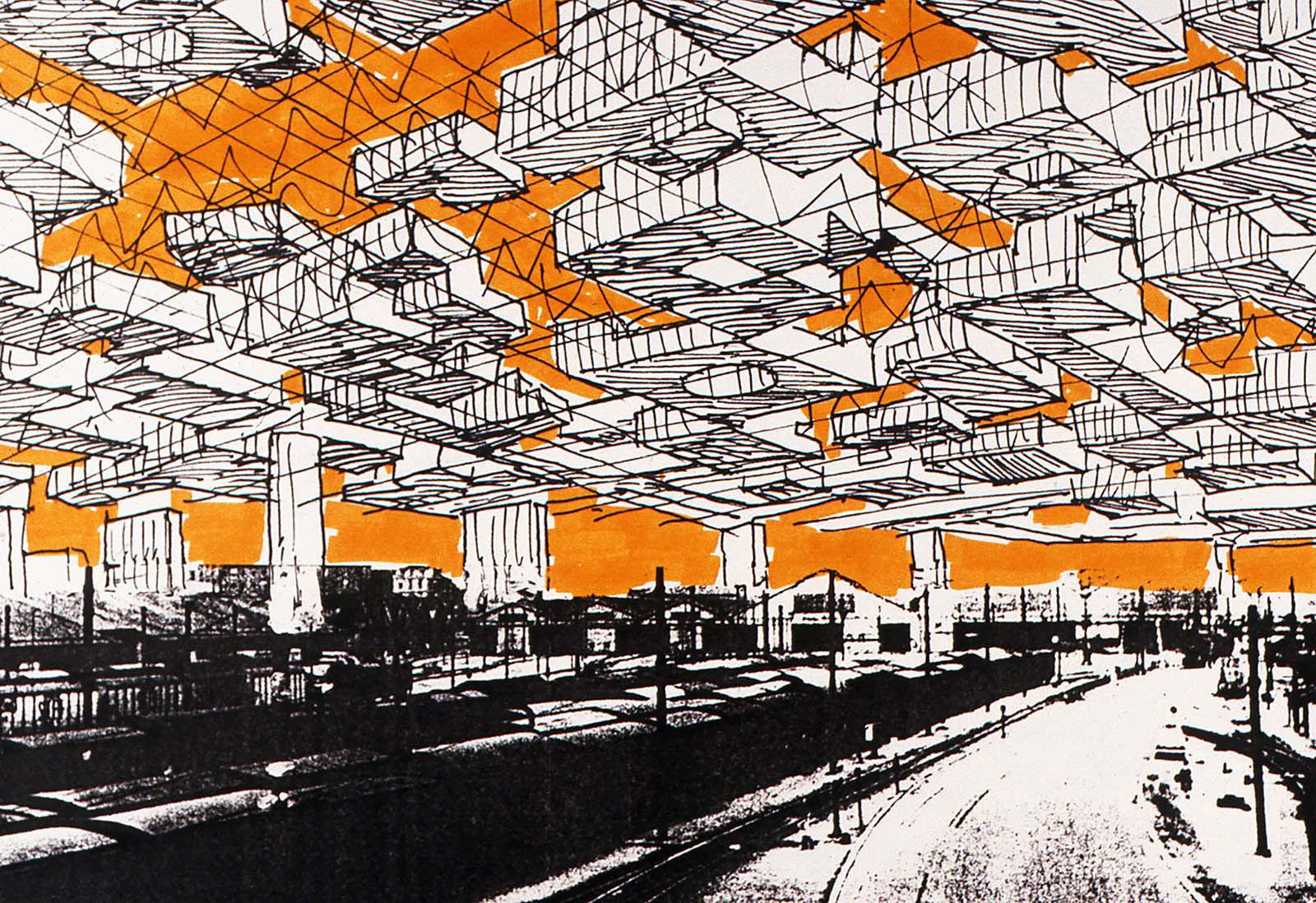
One cannot confuse a lure with a sign. A sign names something at a distance and reduces uncertainty between viewer and object. A lure operates differently. It attracts and produces a desire to approach, follow, touch, or investigate without yet explaining what it is directing the body toward. In a district where productive life has become illegible, the lure becomes a more precise tool than a label. It creates a sequence of attention rather than a single moment of information transfer. Information alone cannot change what a body notices, but movement, curiosity, partial recognition, and discovery can.
Lewis.Tsurumaki.Lewis’s Pamphlet Architecture 21: Situation Normal provides an architectural method for this. The project dissects common architectural forms and programs chairs, doors, walls, cinemas, health clubs, skyscrapers and reconfigures them into proposals that oscillate between the legible and the disorienting. The familiar is made strange enough to be seen again. This oscillation is the formal technique the Garment District requires, because the district’s material culture is already saturated with recognizable objects: racks, hangers, bolts of fabric, cutting tables, rolls, bins, mannequins, carts, awnings, freight doors, stairs, and shelves. These objects are so ordinary so legible as functional equipment that they disappear. They stop being noticed precisely because they are too familiar.
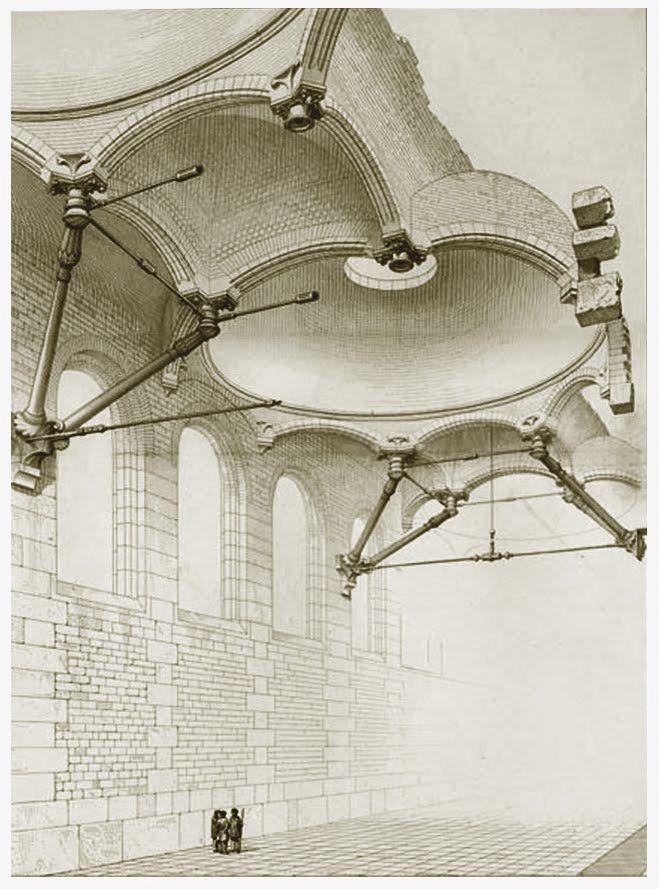
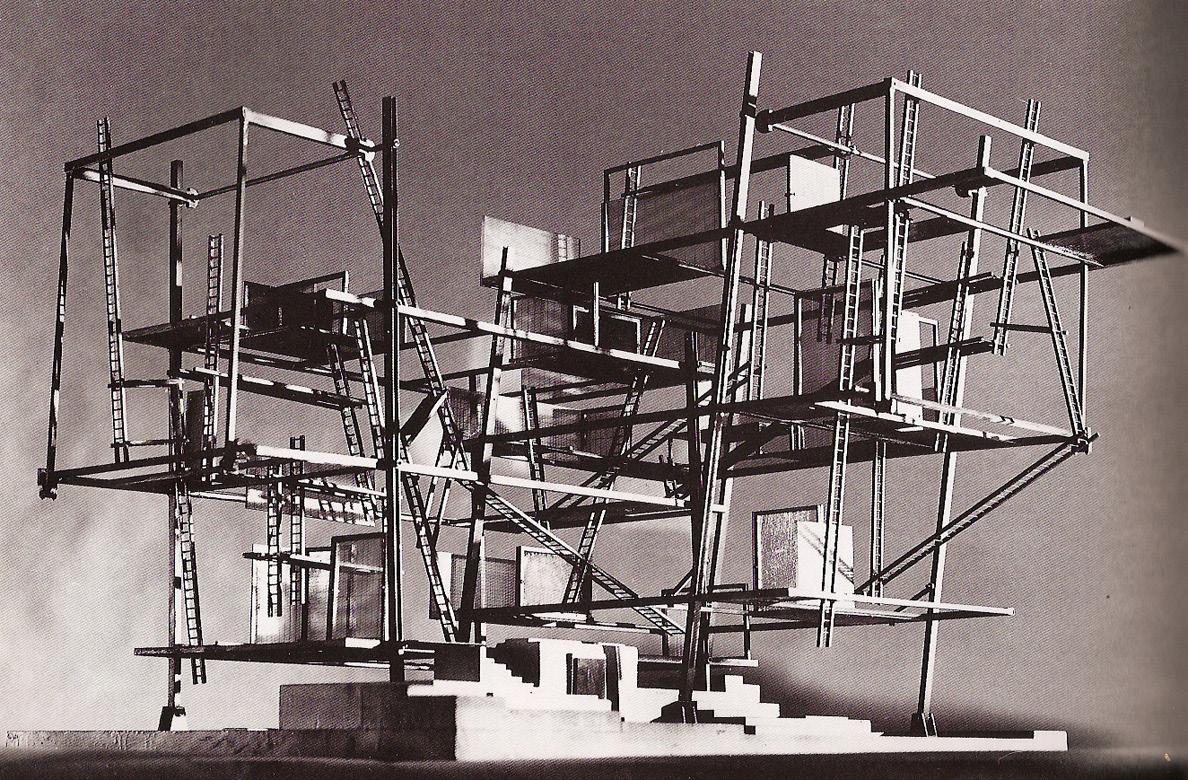
Project for an Ideal Structural System
Eugène-Emmanuel Viollet-le-Duc
The lure operates by altering scale, placement, movement, or public role until an object begins to generate new relationships. A rack is no longer only storage; it becomes circulation. A hanger is no longer only support; it becomes a joint between body, fabric, and space. A fabric surface is no longer only display; it becomes a public record of material time and labor. A conveyor is no longer only logistics; it becomes spectacle legible enough to invite the question of where it leads. A cutting table is no longer only furniture; it
becomes a site of transmission the place where knowledge passes from a skilled body to a material that will carry the trace of that judgment long after the hands have moved on.
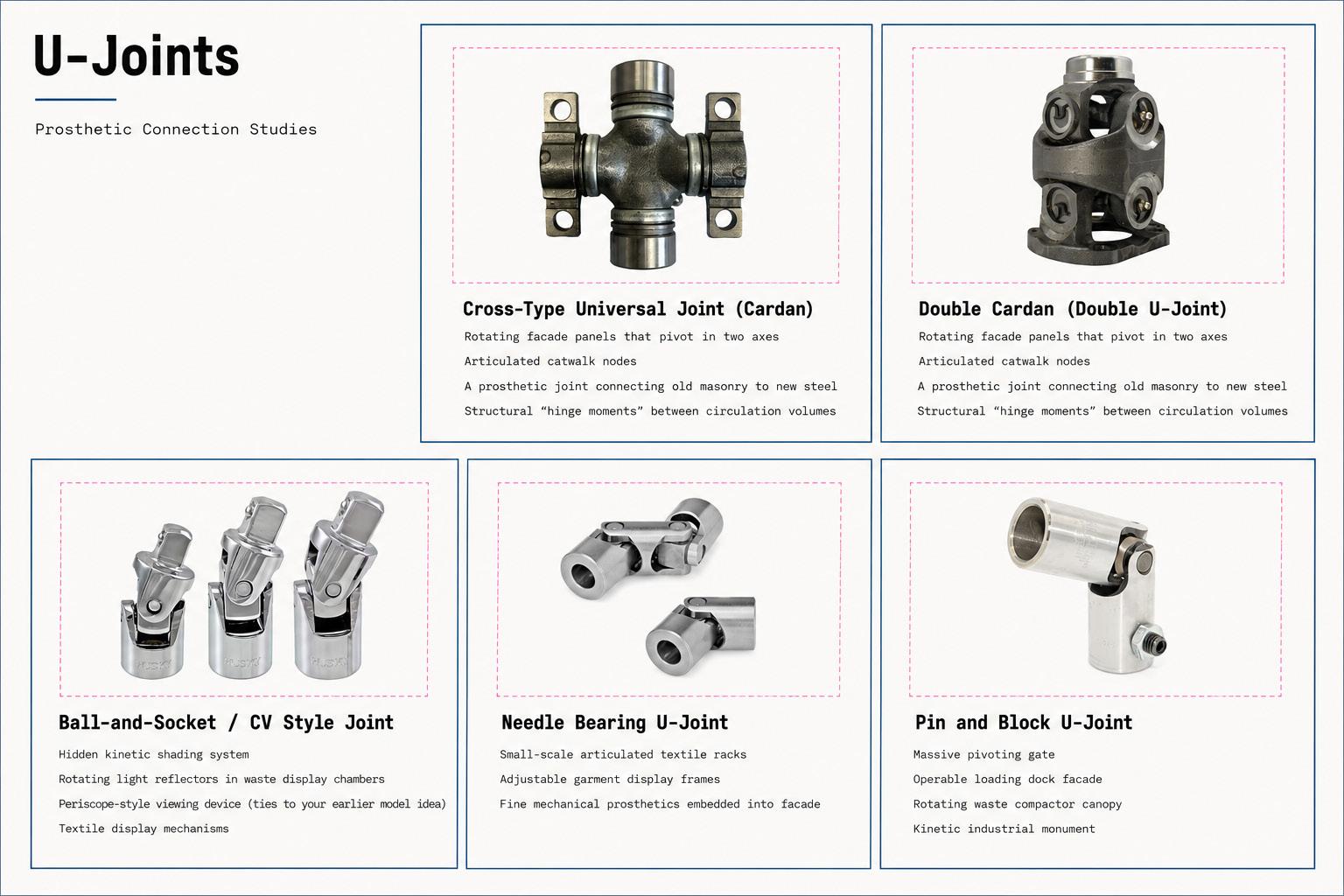
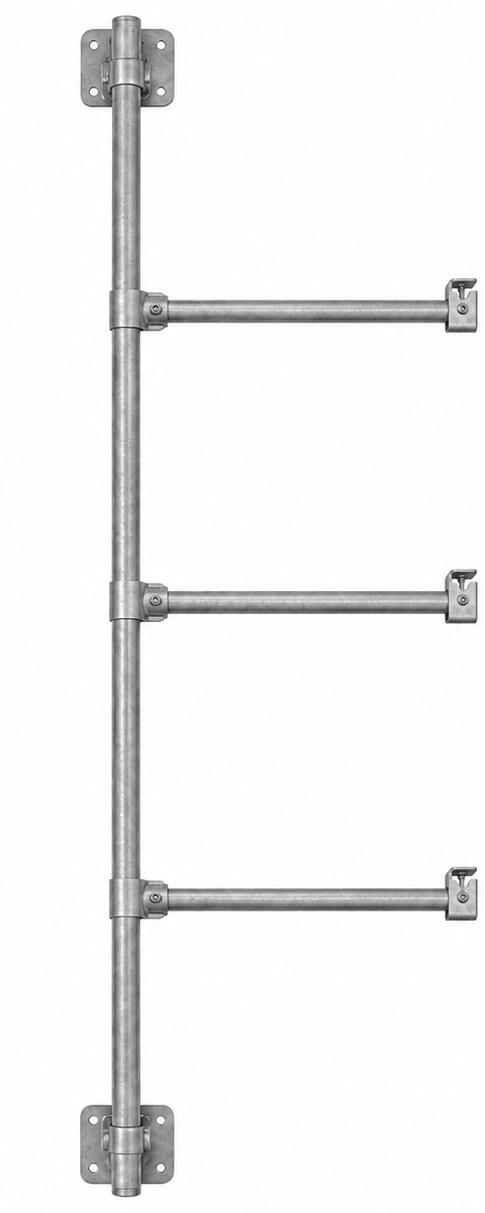
Assembled Matrix of U-Joints
The lure must operate between two architectural failures. Pure abstraction severs intervention from the actual culture of garment production, replacing it with a reference so removed that it teaches nothing. Literal representation converts the district into a stage set or museum display, freezing the living into commemoration. The lure must render objects recognizable enough to be approached and strange enough to be reconsidered. It uses what is already there the specific visual vocabulary of garment production as the material from which a new perceptual structure is built.
Images assembeled by Spencer Giuliano from U-Joints: A Taxonomy of Connections
This is the point at which misdirection becomes productive rather than merely critical. The lure first attracts through what is already familiar: color, fabric, motion, display, fashion’s own visual rhetoric of desire. But the attraction is not the destination. It is the threshold. Once the body has been drawn in, the lure redirects attention toward what lies beneath the familiar surface: labor, storage, exchange, teaching, material care, and the waste and residue that reveal the actual complexity of making. Fashion’s image culture is used against fashion’s concealment of production.
A prosthesis cannot exist without a joint. The joint is where the prosthesis meets the body where force
is transferred, difference is negotiated, and a relationship between two conditions is made to hold. This makes the joint not a technical detail but the conceptual center of prosthetic architecture. What the joint does, how it works, and what it reveals about the systems it connects are architectural problems of the first order.
Andrea Caputo and Anniina Koivu’s U-Joints: A Taxonomy of Connections elevates the joint from concealed necessity to cultural evidence, organizing its argument through categories of connection that range across basic fasteners, mechanical joints, wood-on-wood joinery, knots and knits, adhesives and sealants, and welded or fused assemblies. The premise is that the joint is where human history is most legible where the intelligence, constraints, and values of a material culture are compressed into a detail. Joints do not just hold things together. They record the logic of the assemblies they serve.
The Garment District is, at every scale, a system of joints. At the scale of clothing: seams, hems, pleats, buttons, hooks, zippers, snaps, stitches, linings, and repairs join fragments of fabric into garments. At the scale of architecture: stairs, elevators, columns, brackets, beams, frames, windows, and loading docks join bodies to buildings and buildings to the networks of production that flow through them. At the scale of the district: suppliers, workers, designers, manufacturers, retailers, and clients form social and economic joints connections maintained not by contract alone but by proximity, habit, reputation, and repeated physical encounter.

The seam is the most precise version of the joint that the district produces. A seam is not simply a line of attachment. It is a relationship under tension. It can hold, gather, hide, reveal, reinforce, decorate, or fail. The seam is where material difference is negotiated by technique, where two pieces of fabric that were separate
become a garment. It is also where labor becomes most legible in the finished object the seam that is concealed takes the most skill to hide, and the seam that is expressed requires the most judgment to place. In architecture, the seam can become a way of thinking about intervention: not smoothing over difference but making the condition of connection visible.
The idea of the graft extends this logic. A graft is not fully independent nor fully original. It is an epiphytic structure that depends on its host. It changes the host and creates a two way system of reliance for survival. It is in a way a spatial representation of inheritance not a clean replacement, but a continuation through attachment that develops on its own. In an urban setting, the graft is an alternative to tabula rasa. It does not clear the site nor does it pretend that the existing condition is a neutral, obsolete remainder. It attaches to existing structures, histories, and capacities, accepting that the district’s value lies in what is already there the vertical floor plates, the freight systems, the party walls, the leftover voids, the rooftops, the signs, the routines, the tools, the habits, and the embodied knowledge accumulated through decades of use.
From an ethical standpoint, the graft resists the fantasy that a new architectural object is able to resolve the contradictions of a complex urban ecology. When operating as a graft, architecture works at the seam between existing and new forms of public engagement. It makes connection visible and negotiates difference in order to create relationships where there were once only adjacencies.
Operation Theatre Drawing
Origin Unknown
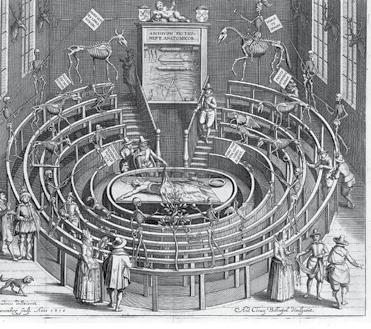
Memory is often treated as storage, as a bank that can be deposited into and withdrawn from. This is an underestimation of its true function. From this view one can produce memory through photography, interviews, and archival. These acts matter, but they do not truly address how craft knowledge can be preserved. Craft knowledge is embodied and exists in timing, pressure, judgment, adjustment, repetition, and correction. It cannot be separated from the body that performs it, which means it cannot simply be saved by transferring information to another medium. This knowledge can only be transmitted
through practice, and practice is unequivocally temporal.
Jean-François Lyotard’s The Inhuman frames time as a problem of human experience under conditions that exceed human memory and control. The concept of anamnesis that runs through Lyotard’s reflections is not simple recall not the retrieval of stored content but a working-through of what was not fully grasped in its first occurrence. Memory, in this account, returns through fragments, delays, distortions, and repetitions. It is active and imperfect rather than passive and complete.
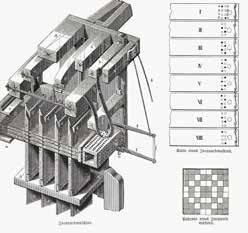
Mechanized Textile Loom with Jacquardlike Patterning Logic
Jonathan Impett’s work on anamnesis and prosthetic imagination extends this into the territory of creative misrecognition the productive error that occurs when memory technologies, computational systems, and human bodies interact. The value of this thinking is that it allows error, compression, and misalignment to become generative rather than merely marking a failure of fidelity. Any medium that represents experience drawing, model, scan, interview, simulation misremembers. It compresses something into another form. But that compression is not only loss. It can produce invention, can force a reconsideration of what was assumed to be known.
Craft inheritance operates at this same level. When a technique is transferred, it is never a perfect copy. It is demonstrated, attempted, corrected, adapted, and repeated. There is always something lost in transmission, and something new that is produced. The apprentice does not become the master but mutates into something different through the techniques that they learn and make their own. No cut is the same, no seam holds an equal tension, no pleat folds on an exact axis. The master must correct what they can and that must be consciously learned. This is not a failure of transmission, but how craft remains alive.
Benedict Andrews’s Together (2025) described as a body-horror study of a couple whose relationship and bodies become literally entangled enters the theoretical framework here as a way of thinking about attachment as anxiety rather than harmony. To be attached is not always comforting. It can be unstable, mutually transforming, even frightening. Prosthetic attachment, craft inheritance, and urban grafting all
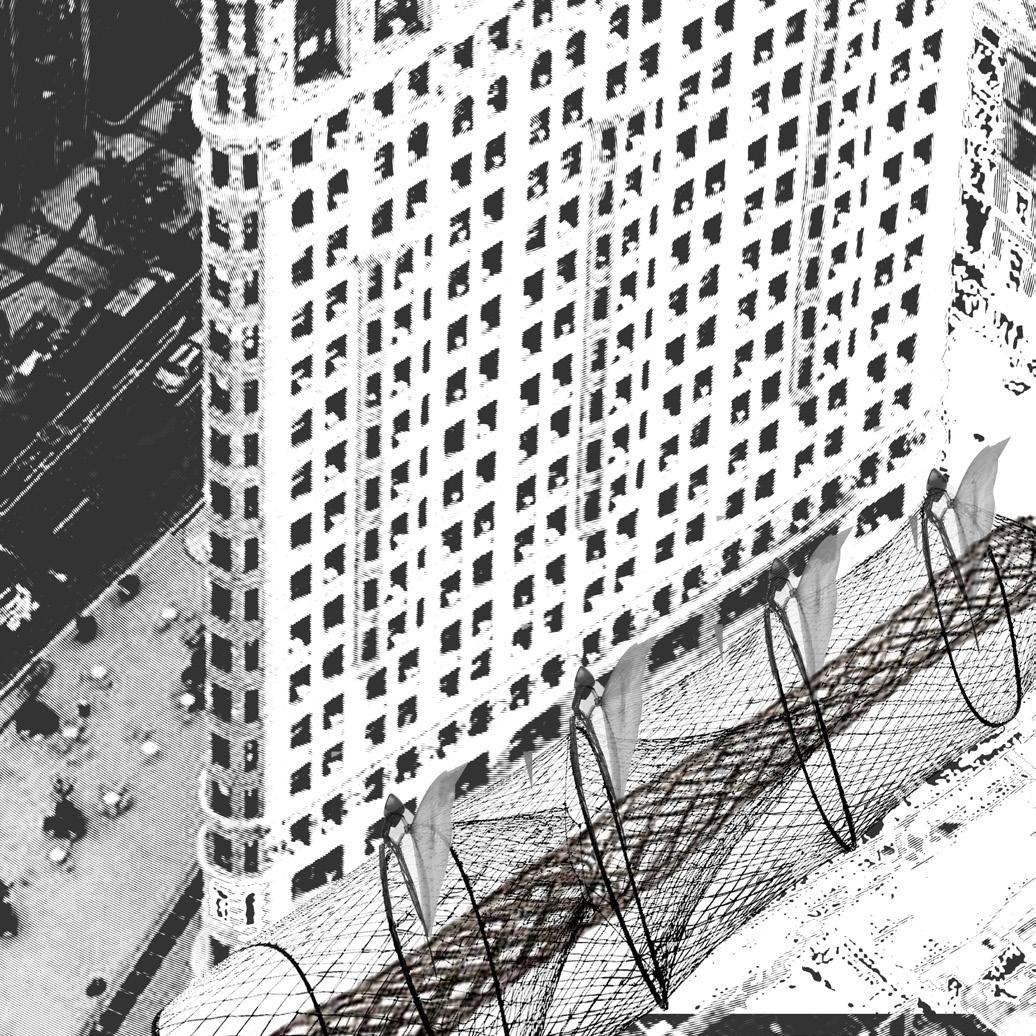
involve a version of this risk: two bodies, systems, or times begin to affect one another in ways that cannot be fully controlled or predicted by either party. The attachment changes both.
The temporal condition of the Garment District is not one of clean preservation and clean loss. It is an unstable continuation. Knowledge survives through imperfect learning. Practice persists through adaptation. Buildings that were once designed for a specific metabolism are now occupied by another world without losing the spatial logic that originally shaped them. Architecture cannot respond by aiming to freeze craft in place how does one freeze dynamic ideas? To keep these ideas authentic, they must remain productive. Fragments must be reactivated, and contact must be initiated with the body, where it can learn through partial systems and imperfect transmissions.
Care cannot be confused with comfort. Architecture frames care as atmospheric: warmth, shelter, legibility, and emotional relief. These are not negligible ideas, but they only describe the most private and interior versions of care. Care is in itself infrastructural. It includes labor, maintenance, and the organization of interdependence. Care creates systems in which communities and bodies can continue and function.
Architectures of Care, edited by Brittany Utting, extends this understanding across scales, from the body to planetary commons, treating spaces of care as productive of affective, material, and social forms simultaneously. Care, in this framework, is not the opposite of production. It is what makes production possible over time. Care is the maintenance of tools, materials, spaces of making, routes of exchange, forms of teaching, and economies of repair and reuse. It is the condition of continuation.
For the Garment District, this reframing is materially specific. Care means maintaining the systems through which craft survives: the spatial relationships between suppliers, makers, and designers; the availability of materials in the quantities and varieties that small-scale production requires; the persistence of technical knowledge in bodies that can teach it; the accessibility of production spaces at rents that craftspeople can sustain. Care is not separate from these conditions. It is what allows them to continue.
This reframes waste as a form of care’s evidence. In a consumer economy, waste is what disappears after use what is removed from view to maintain the cleanliness of the commodity. In a craft ecology, waste is knowledge. Scraps record the cuts made. Offcuts show the relationship between a pattern and the fabric from which it was taken. Failed samples document decision-making the choices that did not work and the adjustments that followed. Damaged garments show use and the passage of time. Excess material shows the gap between design intent and material reality. To care for waste is not simply to recycle it. It is to keep material knowledge available to maintain the residue of process so that what was learned in making can be learned again.
In this same fashion, publicness requires its own precision. To make craft legible to the public is not simply to produce craft as spectacle consumed by observers. The laboring body cannot become exhibit. This creates the risk that labor becomes a performance of authenticity an experience consumed by a visitor economy organized around the very surface effects that craft production is meant to complicate. Care requires a more careful structure of attention: proximity without extraction, recognition without voyeurism, participation without the flattening of expertise into entertainment.
The ethical question this raises which the Civil War prosthetics precedent already posed is whether architecture can produce care without repair, support without normalization. Care without repair is a direct refusal of the claim that architecture has the ability to
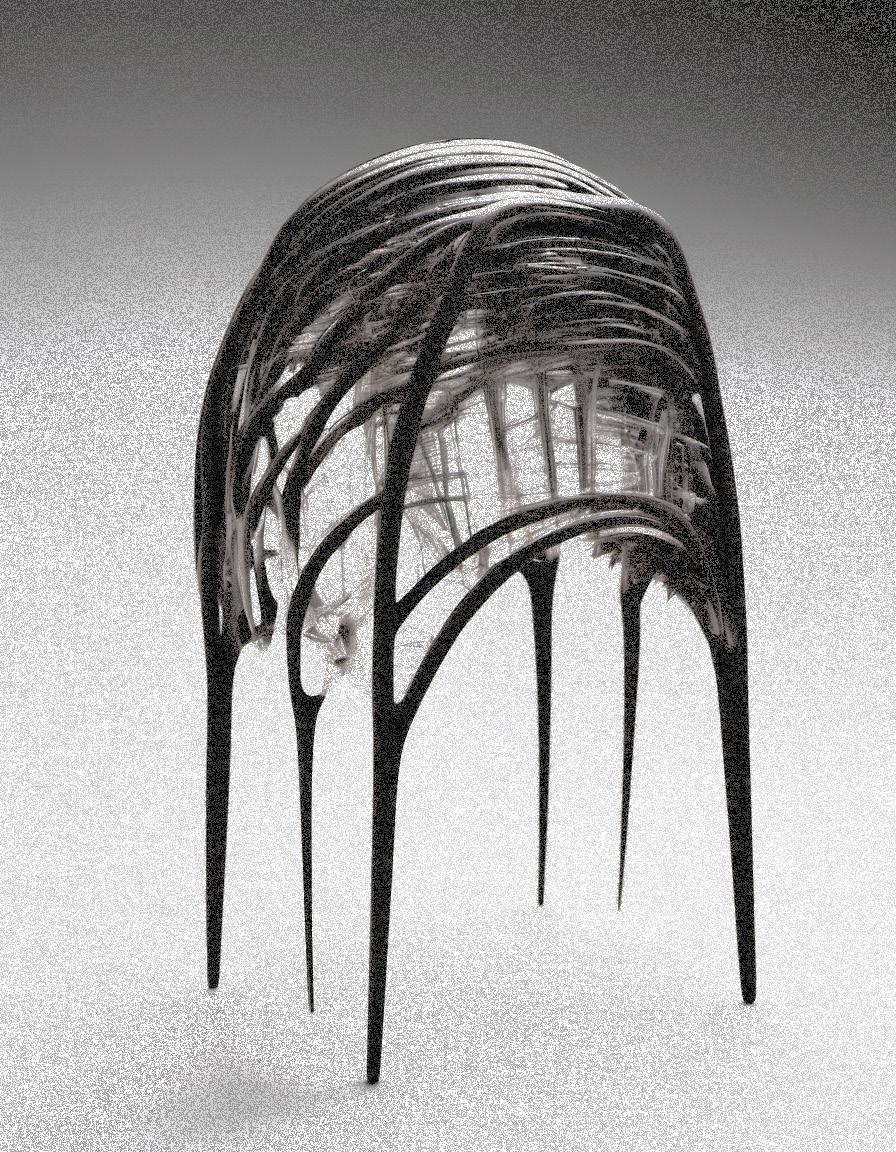
Generative Prosthetic Spencer Giuliano + Ash Bartaria
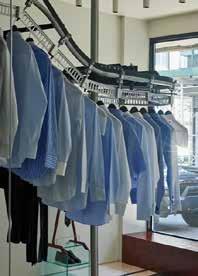
restore the Garment District to wholeness, reverse the pressures that have thinned its productive ecology, or substitute for the economic and political conditions that craft requires in order to survive. Instead, architecture can support partial continuations: material reuse, skill transfer, and public attention organized into teaching rather than consumption. It has the ability to form ways of collective maintenance that keep the conditions of craft accessible through a city that is continuously changing.
The seamless image is a central antagonist of craft visibility, and fashion is one of its most sophisticated producers. A finished garment appears whole, clean, complete, and desirable. The seams are either hidden by skilled labor or aestheticized as design choices. All the work that goes behind it the cutting decisions, the pattern iterations, the fitting adjustments, the material waste, the physical exertion, and the time becomes suppressed. This is not a condition unique to fashion, but a general condition of commodification. Objects appear as natural things rather than social ones, and this leads to the relations of their production being erased from their surface.
Steyerl’s politics of the image clarifies why this matters architecturally. Images are not passive representations. They participate in economies of value and attention that have material consequences for what gets seen and what gets suppressed. In fashion, the image of the garment frequently becomes more powerful than the garment itself. The garment becomes content. Its production becomes background noise at best, invisible at worst. The laboring body is not present in the image; it has been edited out of the commodity’s appearance.
The Prestige shows that spectacle depends on concealed repetition and concealed cost. Wicked shows that public fantasy depends on machinery, staging, and the management of what appears behind the curtain. The Substance shows that the polished image of the body can be produced through violence to the body. Together shows that attachment can reorganize boundaries until dependence becomes horror.
These are not random cultural references assembled for theoretical density. They form a coherent theory of the relationship between surface and apparatus: in each case, the effect is visible, the mechanism is hidden, and some body absorbs the cost of maintaining the performance.
In the Garment District, the seamless image of fashion is sustained by a hidden apparatus of labor. The architectural response to this must resist seamlessness not as an aesthetic preference for roughness or exposure, but as a structural commitment to making process legible. Seams, joints, attachments, supports, traces, and unfinishedness are not failures of craft. They are its evidence. Architecture that values them against the pressure for smooth, branded, photogenic surfaces is making an argument: that the made thing is not separate from the conditions of its making, and that the city benefits from being able to read that relationship.
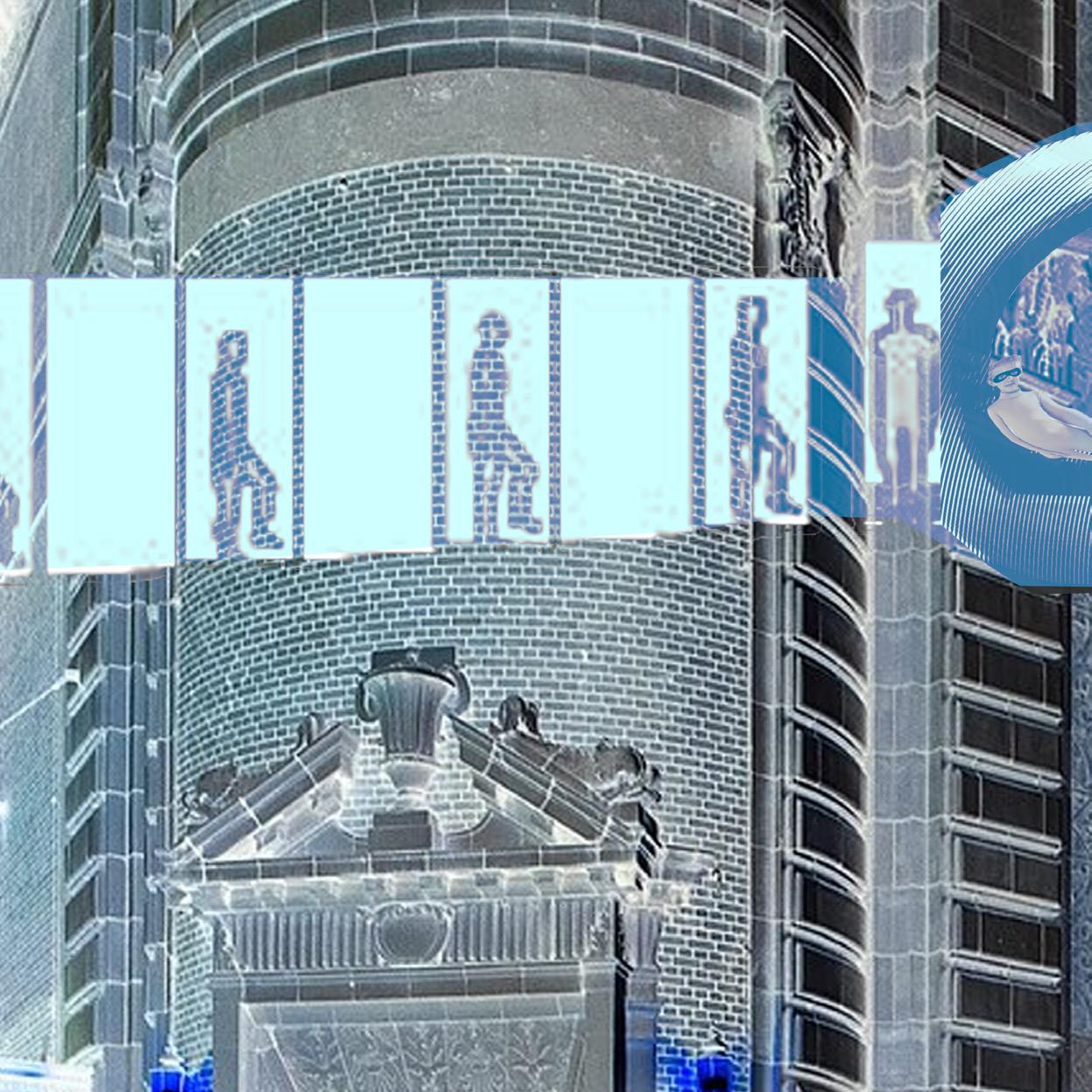
The exposure of labor is not a form of moralistic display. Spatial conditions must be created in a way that the sequence from raw material to finished object can be partially followed. The knowledge required to make decisions about material and form must become perceptible to the body. The body must be able to recognize its embedding into a garment. The goal is not guilt, but comprehension. Comprehension that leads to a new relationship between those who make and those who use.
The position assembled across these arguments is not a style. It is a framework for action a set of linked conceptual commitments that produce specific architectural consequences.
Foster and Wigley establish that prosthesis names dependency and extension rather than repair: the body was never autonomous, and the systems attached to it reveal this rather than compensating for it. The history of Civil War prosthetics reveals the political danger of care that operates as normalization support offered conditionally, on the terms of whoever controls the norms. Jones and Steyerl establish perception as distributed, mediated, and vulnerable: it can be organized by spatial conditions, and those spatial conditions are never neutral. Nagel and Wood make it possible to understand the Garment District not as a relic of a finished past but as an anachronic body a site in which multiple temporal registers are active simultaneously, and in which loss is not an event but a process already underway. Lyotard and Impett make memory active, fragmentary, and generative: craft knowledge is not stored but transmitted, and transmission always involves error, which is also the condition of its continuation. LTL’s Situation
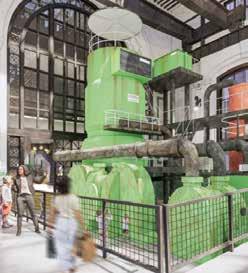
S9Architecture
Normal offers a formal method for making familiar objects strange enough to be perceived again. U-Joints elevates attachment from technical necessity to cultural evidence. Architectures of Care reframes care as maintenance, interdependence, and the material organization of continuation.
Together, these arguments produce an architectural position that can be organized around five linked terms.
Prosthesis is the condition of attachment. The Garment District is not an autonomous body, but one being held together by tools, bodies, buildings, machines, materials, and routes of exchange. Architecture operates prosthetically when it makes these attachments visible rather than concealing them, and when it extends them rather than replacing them with something cleaner. Lure is the organization of attention. Before architecture is able to teach, it must first attract. Attraction must work through the body’s curiosity and desire rather than through explanatory labels. The lure takes advantage of what is familiar in the district’s material culture to create a new entry point, and redirects the body toward what lies beneath the surface of the familiar. Joints are the sites of dependency. The seam, the hinge, the stitch, the bracket, the freight door threshold these are the places where separate systems meet and where the
intelligence required to make that meeting work becomes legible. Architecture has the job of revealing these joints rather than concealing them, because the joint is where production becomes readable. Care is the ethical orientation of the entire system. It is not comfort, nor repair, nor the aestheticization of loss. It is the maintenance of conditions where craft is able to continue the support of tools, materials, routes, skills, and relationships that enable knowledge to persist in bodies and spaces over time. Inheritance is our temporal responsibility. The fragility of the Garment District does not sit in its visual identity or its heritage status. It sits in its knowledge infrastructure the embodied, distributed, time-sensitive systems of relationships between people, materials, tools, and spaces. These cannot be archived or preserved through commemoration. They need to be transmitted and enhanced. When these relationships break, knowledge does not move elsewhere. It thins and disappears.
The goal is not to fix the district through architecture. It is to make continuation possible through attachment, not repair. Not display, but lure. Not preservation through frozen image, but inheritance as active and imperfect transmission. Not seamlessness, but the visible seam. Not a spectacle that conceals its apparatus, but a spectacle that leads the body toward the apparatus. The body must be led toward the freight elevator, toward the cutting table, toward the pleating machine, toward the sample room, toward the scrap bin, and toward the hands that know what to do with all of it. Through this lens, the Garment District is not a relic awaiting salvation or demolition. It is an anachronic body still capable of acting within the pressures that surround it. The production systems that remain may be fragile, but they are not dead. A prosthetic architecture does not look to replace that body, but to give it another way to reach outward. It looks to amplify what has become difficult to perceive and to redirect attention toward what has become hidden. It creates the possibility that craft will not only be remembered, but passed down. This is what inheritance means when it is alive. Not the preservation of a past condition, but the extension of a capacity through contact into a future that cannot yet be seen.
Bibliography
The garment center is a location
where,
for one century, knowledge was exchanged, and that knowledge was cultivated to create more and more technique.
Sources operate like the district itself: accumulated, exchanged, adapted, and reworked into new technique.
Caputo,Andrea,andAnniinaKoivu,eds.U-Joints:ATaxonomyofConnections.Milan:SyncSync,2023.
Foster,Hal.ProstheticGods.Cambridge,MA:MITPress,2004.
Jones,CarolineA.“PhantomLimbs.”InSensorium:EmbodiedExperience,Technology,andContemporary Art,editedbyCarolineA.Jones,276–289.Cambridge,MA:MITPress,2006.
Lewis,Paul,MarcTsurumaki,andDavidJ.Lewis.SituationNormal.PamphletArchitecture21.NewYork: PrincetonArchitecturalPress,1998.
Lyotard,Jean-François.TheInhuman:ReflectionsonTime.TranslatedbyGeoffreyBenningtonandRachel Bowlby.Stanford,CA:StanfordUniversityPress,1991.
Nagel,Alexander,andChristopherS.Wood.AnachronicRenaissance.NewYork:ZoneBooks,2010.
Steyerl,Hito.TheWretchedoftheScreen.Berlin:SternbergPress,2012.
Utting,Brittany,ed.ArchitecturesofCare:FromtheIntimatetotheCommon.London:Routledge,2023.
Wigley,Mark.“ProstheticTheory:TheDiscipliningofArchitecture.”Assemblage15,August1991,6–29.
GarmentDistrictResearch+UrbanContext
DesignTrustforPublicSpace.MadeinMidtown.NewYork:DesignTrustforPublicSpace,2010.
DesignTrustforPublicSpace.MakingMidtown:ANewVisionfora21stCenturyGarmentDistrictinNew YorkCity.NewYork:DesignTrustforPublicSpace,2012.
GarmentDistrictAlliance.Publicdistrictmaps,businessdirectories,andhistoricalresources.Accessed 2025–2026.
NewYorkCityDepartmentofCityPlanning.GarmentCenterzoningandSpecialGarmentCenterDistrict materials.Accessed2025–2026.
NewYorkCityDepartmentofSanitation.Textilerecyclinganddonationprogramresources.Accessed 2025–2026.
Brand,Adam.M&SSchmalbergFlowers.GarmentDistrictinterviewbySpencerGiulianoandAshBartaria, 2026.
Coles,Jon.DershFeather.GarmentDistrictinterviewbySpencerGiulianoandAshBartaria,2026.
Dershowitz,Jay.DershFeather.GarmentDistrictinterviewbySpencerGiulianoandAshBartaria,2026.
Kalkin,Lourdes.GarmentDistrictoralhistoryinterview,2026.
Kaljian,George.Tom’sSonsInternationalPleating.GarmentDistrictinterviewbySpencerGiulianoandAsh Bartaria,2026.
Impett,Jonathan.“AnamnesisandProstheticImagination.”InterviewbyMarekPoliksandRobertoAlonso Trillo.AnamnesisPodcast,September16,2024.
EmergingAmerica.“CivilWarVeterans:ProstheticsandMemory.”AccessedAugust2024.
WellcomeCollection.Asurgeonisabouttoimplantmechanicalintestinesonapatientinanoperating theatreinfrontofacrowdofonlookers.Colourlithograph,ca.1910.
ConstantNieuwenhuys.NewBabylonmodelsanddrawings,1956–1974.
Domenig,Günther.Z-Bank,Vienna,1974–1979.
Domenig,Günther.DocumentationCenterNaziPartyRallyGrounds,Nuremberg,1998–2001.
Friedman,Yona.VilleSpatiale/SpatialCity,1950s–1970s.
Viollet-le-Duc,Eugène-Emmanuel.ProjectforanIdealStructuralSystem,nineteenthcentury.
Woods,Lebbeus.RadicalReconstruction.NewYork:PrincetonArchitecturalPress,1997.
Woods,Lebbeus.WarandArchitecture.NewYork:PrincetonArchitecturalPress,1993.
Andrews,Benedict,dir.Together.2025.
Chu,JonM.,dir.Wicked.2024. Fargeat,Coralie,dir.TheSubstance.2024.
Nolan,Christopher,dir.ThePrestige.2006.
Spencer Giuliano
Fall 2025 - Spring 2026