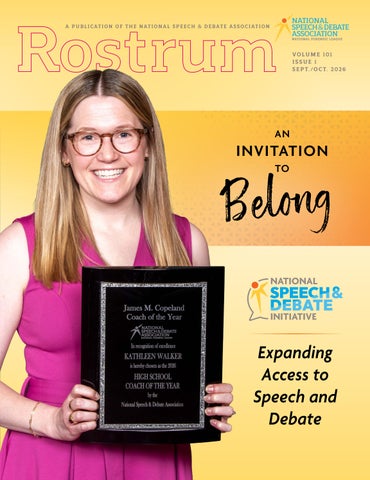
A PUBLICATION OF THE NATIONAL SPEECH & DEBATE ASSOCIATION
VOLUME 101 ISSUE 1 SE P T. /O C T. 2026
AN
g n o l e B INVITATION TO
Expanding Access to Speech and Debate
with the NSDA STORE
SHOP NOW
Letter from the Publisher Speech and debate is a place where students discover their voices, learn to think critically, find belonging, and begin to see possibilities for their futures. But those opportunities only matter if students can access them. That is why the National Speech & Debate Initiative is so important. Our goal is ambitious: to double the number of schools offering speech and debate by 2030. Reaching that goal will require more than the work of the NSDA alone. This issue of Rostrum offers many examples of what that work means in practice. From this year’s equity focus areas and new flat-fee membership model to stories of coaches, students, and organizations creating spaces where more people can belong, these pages reflect the many ways our community is strengthening and expanding the activity. Expanding access does not mean changing what makes speech and debate special. It means ensuring more students can experience it. Every new program gives students a place to develop confidence, curiosity, resilience, and the ability to engage thoughtfully with ideas and one another. The future of speech and debate will be shaped by the choices we make today. As you read this issue, I hope you’ll find inspiration and practical examples of how we can continue building a more accessible and sustainable activity. There has never been a more important time to grow speech and debate. Let’s build what comes next, together. Sincerely,
Have you renewed your NSDA membership? J. Scott Wunn Executive Director
Visit www.speechanddebate.org/signup by the end of October to ensure you receive the next issue of Rostrum and all the resources and recognition that NSDA membership provides!
Rostrum A PUBLICATION OF THE NATIONAL SPEECH & DEBATE ASSOCIATION 6600 Westown Parkway, Suite 270, West Des Moines, IA 50266 | Phone (920) 748-6206 J. Scott Wunn, Publisher Amy Seidelman, Editor Vicki Joss, Managing Editor Annie Reisener, Associate Editor Emily Bratton, Visual Design and Brand Specialist
Newsstand Price $9.99 per issue Member Subscription Price $24.99 for one year (5 issues) Non-Member Subscription Price $34.99 for one year (5 issues)
Rostrum (ISSN 1073-5526), Copyright © 2026 by the National Speech & Debate Association (NSDA), is published five times per year (Sept., Nov., Feb., Apr., and Aug.) by the NSDA, 6600 Westown Parkway, Suite 270, West Des Moines, IA 50266. Business and Editorial Offices: NSDA, 6600 Westown Parkway, Suite 270, West Des Moines, IA 50266. Accounting and Circulation Offices: 6600 Westown Parkway, Suite 270, West Des Moines, IA 50266. Call (920) 748-6206 to subscribe. Periodicals postage is paid at Des Moines, IA 50318, and additional mailing offices. POSTMASTER: Please send address changes to Rostrum, c/o NSDA, 6600 Westown Parkway, Suite 270, West Des Moines, IA 50266. Rostrum provides a forum for the speech and debate community. The opinions expressed by contributors are their own and not necessarily the opinions of the NSDA, its officers, or its members. The National Speech & Debate Association does not guarantee advertised products and services unless sold directly by the NSDA.
2
ROSTRUM | SEPTEMBER/OCTOBER 2026
Board of Directors James W. Rye III President Alabama Jamelle M. Brown Vice President Missouri Byron R. Arthur President Emeritus Louisiana David Coale Texas Marc Ehrhardt Louisiana Meg Howell-Haymaker Arizona Erez Kalir California Michael Ledford Virginia Wendy Orthman Tennessee Esther Oyetunji Florida Steven Schappaugh Administrative Representative Iowa Josh Swartsel Washington, D.C. Aaron W. Timmons Texas Rachel K. Wilczewski Hawaii Holly Williams Secretary Arizona
To learn more about the Board, visit www.speechanddebate.org/ meet-the-team. You may also contact the Board by emailing board@speechanddebate.org.
In this Issue : VOLUME 101 : ISSUE 1 : SEPTEMBER/OCTOBER 2026
From the Cover
Inside
28
2
Letter from the Publisher
6
Topics
13
News + Notes
18
Resource Roundup
22
Middle School Focus
24
Tabroom.com Tip
56
Advocacy Letter
Kathleen Walker: An Invitation to Belong
Governance and Leadership 10
From Your Board President
Community 14
Membership Minute – More Included with NSDA Membership
16
2026-2027 Equity Focus Areas
32
Partners in Belonging and Inclusion: Reflections on the Ballot Review Committee and Belonging and Inclusion Station at the 2026 National Tournament
34
OPINION – To Rank or to Rate? Festivals and Speech Tournaments by Adam J. Jacobi
by Spencer Chaisanguanthum
36
Coach Profile – Randy Pierce: A Lifetime of Investing in Students
38
Student Spotlight – Mary Ann Jensen: Beyond the Page
40
Champions Corner – George Matthew Gutierrez: Reflections of a Four-Time Finalist by Reagan Hall
42
Team USA – When the Motion Drops: Preparing for Impromptu World Schools Debate by Aayush Appan and Ishaan Quazi
44
Meet the New Board Members
Access this issue online! www.speechanddebate.org/rostrum
Like us on Facebook www.facebook.com/ speechanddebate Share with us on Instagram @speechanddebate Follow us on X @speechanddebate
Recognition 47
Faces in the Crowd
48
Activating Equity Award: Washington Urban Debate League
50
Who Will Be the Next Hall of Fame Class?
52
Keith West Memorial Fund School Grants
54
New Charter Chapters
Follow us on LinkedIn www.linkedin.com/company/nationalspeech-and-debate-association Follow us on TikTok @nsda.speechanddebate
OUR MISSION Rostrum shares best practices, resources, and opportunities that connect, support, and inspire a diverse community of educators committed to empowering students through speech and debate.
4
ROSTRUM | SEPTEMBER/OCTOBER 2026
HARVARD
Debate Council Summer Workshops
hdcsw.org
Congress We teach sound analysis, information literacy, exposure to current issues, ethical leadership, and authentic presence to foster well-rounded debaters who learn to distinguish themselves.
Lincoln-Douglas
Balancing complex concepts with practical tools, we tailor instruction to students’ needs through diverse approaches, ethical practices, and a variety of philosophical literature.
Policy Debate We teach foundational (two-week) and intermediate/advanced (four-week) theories and strategies to guide students in researching, analyzing, and crafting arguments/responses.
Public Forum Skill-building with plenty of opportunities to practice debating, our program molds successful debaters who can apply their learning to changing topics each season.
info@hdcsw.org • (617) 495-4822 • www.hdcsw.org Harvard Debate Council is a 501(c)(3) nonprofit organization.
Session 1: June 27–July 9, 2027 Session 2: July 11–23, 2027
Public Speaking We help students explore topics and themes of interest and build their confidence as they learn to compellingly communicate through foundational or competitive speaking.
World Schools USA Debate coaches and debaters teach approaches, strategies, and skills necessary to succeed in this dynamic format of debate, ahead of the WSDC World Championship.
Coach Workshop
Whether you are new to speech and debate, have an existing program, or want to develop professionally, we will tailor curriculum to accomplish your goals.
Come to historic Harvard University or learn online.
Official summer training host for USA Debate.
DEBATE
Topics
Current topics, voting links, and resources available at:
www.speechanddebate.org/topics Member students and one chapter advisor per school are eligible to vote!
Topic Release Information Public Forum Topic Release Dates The PF Wording Committee creates a topic area with two resolutions for each topic cycle. All potential topics for the year are released in June. One week prior to the topic being released for that topic cycle, member students and one chapter advisor per active school will vote on which of the two topics they prefer. The topic that receives the most votes will be the topic for that cycle. The goal of this process is to increase transparency about topic selection and introduce new possibilities for coaches who teach debate in the classroom.
October 1 December 1 January 1 February 1 March 1 May 1 June 22 July 25-31 August 1
November/December PF Topic Announced January PF Topic Announced February PF Topic Announced March PF Topic Announced April PF Topic Announced National Tournament PF Topic Announced List of Potential PF Topic Areas Announced for 2027-2028 Voting for the 2027 September/October PF Topic Occurs 2027 September/October PF Topic Announced
Lincoln-Douglas Topic Release Dates The LD Wording Committee assigns a set of two topics to each bi-monthly topic cycle. All potential topics for the year are released in June. One week prior to the topic being released for that topic cycle, member students and one chapter advisor per active school will vote on which of the two topics they prefer. The topic that receives the most votes will be the topic for that cycle. The goal of this process is to increase transparency about topic selection and introduce new possibilities for coaches who teach debate in the classroom.
October 1 December 1 February 1 May 1 June 22 July 25-31 August 1
November/December LD Topic Announced January/February LD Topic Announced March/April LD Topic Announced National Tournament LD Topic Announced List of Potential LD Topics Announced for 2027-2028 Voting for the 2027 September/October LD Topic Occurs 2027 September/October LD Topic Announced
SEPTEMBER/OCTOBER 2026
Public Forum Debate Resolved: The United States federal government should enact a moratorium on hyperscale data center construction.
SEPTEMBER/OCTOBER 2026
Lincoln-Douglas Debate Resolved: Outer space colonization is a moral imperative.
NOVICE LINCOLN-DOUGLAS TOPIC The NSDA also offers an optional resolution that may be used during the first two months of a novice LD season— Resolved: In the United States, national service ought to be mandatory. Coaches are encouraged to check with tournament hosts in their area before exclusively prepping for one topic over another.
2026–2027
Big Questions Debate Resolved: Technological progress has surpassed humanity’s ability to use it ethically.
2027–2028 Policy Debate Topic Voting The National Federation of State High School Associations (NFHS) handles selection of the annual topic. Each state organization, the National Speech & Debate Association (NSDA), the National Catholic Forensic League (NCFL), and the National Debate Coaches Association (NDCA) all have voting privileges.
• • • •
6
Topic synopsis released at www.speechanddebate.org/topics in September Preliminary voting on five topics occurs online in September and October Final voting on two topics occurs online in November and December Topic for 2027-2028 released by the NFHS in January 2027
ROSTRUM | SEPTEMBER/OCTOBER 2026
2026–2027
Policy Debate Resolved: The United States federal government should establish national health insurance in the United States.
Join a Wording Committee Your voice matters in shaping NSDA events. All coaches and former competitors are invited to apply to join a Wording Committee for PF, LD, BQ, or 2027 National Tournament topics (World Schools, Extemp Debate, and Extemp Speaking). Committees research, draft, and refine topic options, directly impacting tournaments. Virtual meetings run March through April. Learn more and apply by February 1, 2027, at www.speechanddebate.org/topiccreation-hub.
Policy Debate Topic Fellowships
Get Involved Topic Creation Hub Frequently Asked Questions We’ve created a central hub to answer your questions about how topics are generated throughout the school year—and ways you can get involved in the process! Visit www.speechanddebate.org/topic-creation-hub to learn more, including: How do I suggest a debate topic/resolution for consideration by a wording committee? How are potential topics, prompts, and legislation written? Who selects the topics, prompts, and legislation used in competition?
Share Your Topic Suggestions We invite you and your students to send us your debate topic ideas for Lincoln-Douglas, Public Forum, and Big Questions as well as potential motions for consideration in World Schools Debate. Visit www.speechanddebate.org/ topic-creation-hub to access the online submission forms.
The NSDA has partnered with the National Federation of State High School Associations (NFHS) to offer two Policy Debate topic fellowships with a goal of increased representation in the topic selection process. High school Policy Debate coaches who are interested in writing a topic paper and attending the annual topic meeting to support the mission of choosing timely, accessible, and student-centered topics are encouraged to learn more and apply online by April 1, 2027. More details will be posted at www.speechanddebate.org/ policy-topic-fellowship by October 1, 2026.
Congress Legislation: Seeking Student Voices Any high school or middle school NSDA member student, regardless of their national qualification status, may submit legislation to be considered for the 2027 National Tournament Docket. Encourage your students to debate the topics they are passionate about—if they wrote it, they can submit it! Students may submit multiple pieces of legislation for consideration. If their legislation is selected to be part of the Nationals Docket, they will be recognized in Rostrum, receive a trophy after the tournament, and be awarded a $100 scholarship. This is a great way to boost students’ resumes and be recognized for their research and writing skills! Complete the online form by February 5, 2027, at www.speechanddebate.org/congress-submission.
Topic Rubric The NSDA conducts an intentional and ongoing evaluation of the topics we encourage students to explore. Review the Topic Rubric Questions on the next page or download a copy online at www.speechanddebate.org/topic-rubric. ROSTRUM | SEPTEMBER/OCTOBER 2026
7
N AT I O N A L S P E E C H & D E B AT E A S S O C I AT I O N
Topic Rubric Questions
EMPOWERING VOICES FOR TOMORROW. In 2021, the NSDA published its Topic Rubric Questions to guide intentional, ongoing evaluation of the issues students debate and discuss. Our goal remains the same: to empower students to use their voices responsibly, courageously, and with humility in pursuit of a better world. By regularly assessing the topics we introduce, we ensure students engage with meaningful, relevant issues that help them manage conflict, envision solutions, and create positive change in their schools, communities, and beyond.
Topic Rubric Questions Language: Does the topic use current
Relevance: Does the topic encourage
and precise language while avoiding cultural idioms or figurative expressions (e.g., “a dime a dozen”) that may disadvantage students unfamiliar with them?
students to critically analyze timely topics?
Openness: Does the topic challenge
Constructive Dialogue: Does the
students to think critically through diverse experiences, viewpoints, perspectives, and ideologies?
topic avoid relying on research or arguments that stigmatize, discriminate, or exclude?
National Speech & Debate Association: Topic Rubric Questions • updated September 11, 2025
1
GOVERNANCE
From Your Board President THE POWER OF OPPORTUNITY Speech and debate has the power to change lives, but only if students have access to it. In his first letter as NSDA Board President, Jay reflects on why expanding opportunities for students is essential to the future of our activity and our nation.
W
hen I began my involvement with speech and debate in the fall of 1985, communities across Alabama and the country—urban, suburban, and rural alike—were home to a plethora of programs. We would travel not only to major cities like Boston and Atlanta, but also to the cities of Troy in Alabama and New Augusta in Mississippi. These rural areas of the country were home to amazing programs, competitors, and coaches. I reflect particularly upon the success of coach Barbara Swisher at Charles Henderson High School and her husband Rhae Swisher, who coached at the local university. They built a powerful program that competed against the top teams in the country, but more importantly, provided opportunities to their students to see the world beyond
10
ROSTRUM | SEPTEMBER/OCTOBER 2026
Troy, Alabama. They would get in their van and drive from tournament to tournament, returning to Troy with trophies representing tangible proof of their success. The team received great local community backing both in terms of moral and financial support. Many of their students went on to find amazing success in the legal, culinary, political, and educational professions. A similar story played out in New Augusta, Mississippi, where Michael Marks was coaching at Perry County Central High School. Michael provided his students a place of belonging in a rural setting and an opportunity of discovery beyond the city limits. His speech competitors were fierce, frequently being offered college scholarships to continue their speech and debate journey and, more importantly, providing them a way to afford college.
Speech and debate changed the trajectory of these students’ lives. Today, in 2026, neither Charles Henderson High School nor Perry County Central High School has a speech and debate program. Students attending these schools are no longer being afforded the same opportunities the alumni of these schools had when they attended. Gone is the option to develop research skills, critical thinking, and creativity through speech and debate. Some claim it is due to the retirement of awesome coaches, reduction of school budgets at the state and local levels, or a shift in priorities within schools. The truth is, the stories of Troy and New Augusta are not unique. They reflect a challenge facing communities across our nation. The need for speech and debate programs is not confined to rural areas of the country. I recently spoke with a counselor at an urban school, discussing college opportunities for her students. She told me current students view their only avenues to a two- or four-year college as being a recruited athlete or joining ROTC. What saddened me as I heard the frustration in her voice was the fact that, from the 1940s through the 1970s, her school ran a large and successful speech and debate program. Gone was a third route her students could utilize, a route that builds skills beneficial both to graduating and
80% of high schools to flourishing beyond high school—a route that existed for my father and grandfather, both graduates of this same school.
The NSDA must do what it can to ensure all students have every opportunity to discover and develop their full potential.
For this reason, I completely support the National Speech & Debate Initiative of the NSDA. The goal is simple: to double the number of schools providing speech and debate opportunities by 2030. This initiative is ambitious but necessary because so many students in every state don’t have access to this valuable activity.
I ask for those who are reading this letter to consider doing the following: • BUILD strong relationships with school administrators and invite them to see the team in action so they can understand (and invest in) the impact. • PROVIDE coaching assistance to local schools who currently don’t have programs and/or help establish a program so the students in the school building down the street have the same opportunity your students currently have.
in the United States do not have a speech and debate program. • EXPAND recruitment within your own school: the shy student, the gifted student, the student who seems “lost.” Give them a chance to shine. • TALK to local school boards and city offcials and ask—dare I say demand—not only a speech and debate program for all schools but programs that have the moral and financial backing given to sports teams, to bands, to robotics— whatever is the current bragging point for the school or the school system. • CONTACT the NSDA and find out how you can help with school outreach—and how we can help you in these endeavors. If we are able to double the current number of participating schools, we are not only helping countless students shape their futures; we are teaching the skills of how to engage with one another, so that, as a nation, we can rediscover the “civil” in civil discourse. You are never done with speech and debate!
James W. Rye III NSDA Board President board@speechanddebate.org
OUR GOAL. OUR VISION.
Imagine a world where every school empowers youth voices. Through the National Speech & Debate Initiative, we are doubling our nationwide impact to make that vision a reality.
OUR PLAN. 2025
2030
4,000 SCHOOLS
8,000 SCHOOLS
100,000 STUDENTS
200,000 STUDENTS
LONG TERM SPEECH AND DEBATE IN EVERY SCHOOL
LEARN MORE ABOUT THE INITIATIVE. www.speechanddebate.org/NSDI ROSTRUM | SEPTEMBER/OCTOBER 2026
11
COMMUNITY
Is your school’s speech and debate team striving for growth and inclusivity? In order to ensure more students have access to speech and debate, the Keith West Memorial Fund will provide one $5,000 grant, two $2,500 grants, and five $1,000 grants to schools who show strong potential, but a significant lack of financial resources. To learn more or get started, visit www.speechanddebate. org/keith-west-memorial-fund. Applications are due October 1, 2026, so apply today!
Recent Minutes Stay up to date on recent rules changes and other decisions impacting your NSDA membership. Find minutes from past Board of Directors’ and Competition and Rules Leadership Committee (CRLC) meetings online at www.speechanddebate.org/minutes-archive.
Degre ofPremier Distinction
1 9 2F5OREN SIC AL ON Degre
opportunities
NATI ON
NAT I
AUTHOR. ACTO POLITICIAN. DOCTORR. • National ENTREPRENEUR. . JO URNALIST. CE • College ACTIVIST. TEACHEOR. • Community SUPREME COURT . COMPETE LOCALLY AND NATIONALLY JUSTICE NOBEL PRIZE W.IN NE BROADWAY R. PERFORM DIRECTOR. ECONEROM. CHANGE-MAKER. IST. LEARN THE SK ILLS Earning points in the Honor Society empowers studen ts to expand their knowledge, advanc e their skill set, and reflect on their progress.. The skills learned in speech and debate greatly benefit students in the college application process and prepare them for life after high school.
that lasts
FORENSIC L AL
Superior Distinction
e tion
of Distinc
GUE EA
Apply for a Keith West Memorial Fund School Grant
N FORE SIC L AL e
AGUE LE
A new season means new recruits! As you consider how to bring in new students, use our guide as a jumping off point. We’ve compiled an array of tools and ideas to help you build your team. Download student posters, social graphics, videos, and more to support your efforts at www.speechanddebate.org/team-recruitment-strategies.
NATIO N
Where SPEECH & DEBATE can take YOU competition
Recruit New Members for Your Team
GNITION GUE EA
NEWS + NOTES
STUDENT RECO The National Speech & Debate Association recognizes middle and high school studen ts for their participation in speech and debate activities. Students earn distinction and points through compe tition, community service, public speakin g, and leadership. Students must earn 25 points (Degree of Merit) to acquire membe rship in the Honor Society. The more points you earn, the more degrees you obtain.
1925
1925
How to Earn Point
s:
Winning a round of Policy Debate Giving a speech to more than 25 people Acting in a high school play
EXAM PLES OF STUD
ENT RECO GNIT
6 points
5 points
5 points
ION:
• Academic All Ameri can Award • All American Award Attending Nationals is•anStude eye- nt of the Year Award opening opportunity. •Being Speaking and Servic e Award surrounded by other students • Graduation Honor Cords
across the country with the same love, talent, and passion for speech and debate fosters a sense of belongingThe in our community. Natio nal Speech
& Debate Association
Hono
SocietyCLASS — BRIANNAr ZHANG, gaveOF me2026 a chance to be a part of Portage Central High School, MI a comm unity
✅
of like-minded peopl e who were driven to make a difference in the world . BUILD CONFIDENCE
Elena Cecil, 2018round through every NSDA
FOR WHAT'S NEX
JOIN SPEECH T. THEY DID. AND DEBATE . Student of the Year
✅ CONNECT with students who share your interests
✅ CHALLENGE yourself and celebrate your progress
✅ GAIN recognition and national rankings N AT I
ONAL
SPEE
CH &
D E B AT
E ASS
O C I AT
ION
Free On-Demand Courses NSDA Learn is an ever-growing set of self-paced online professional development courses. Courses are open to all member coaches, regardless of whether the school is a member. Upon successful completion of each course, coaches will be able to download a professional development certificate. Course content includes introductions to coaching new events, engaging and mentoring diverse groups of students, team management and culture building, and more. Get started at www.speechanddebate.org/learn.
Vote for the 2027-2028 Policy Topic Member students and one chapter advisor per school are eligible to vote. Voting ends Thursday, October 8 at 4:00 p.m. CT. To vote for topics, log in to your Account page (www.speechanddebate.org/ account) and select “NSDA Voting” from the left side menu. Rank the topic areas 1 (best) through 5. The two areas receiving the lowest totals will be placed on the second ballot to select the 2027-2028 debate topic. Read a synoposis of the five proposed problem areas at www.speechanddebate.org/topics.
Questions? We’re here to help! Email info@speechanddebate.org or call (920) 748-6206. ROSTRUM | SEPTEMBER/OCTOBER 2026
13
MEMBERSHIP MINUTE
Use All the Resources
MORE INCLUDED WITH NSDA MEMBERSHIP The 2026-2027 membership year is underway, and the NSDA’s new all-inclusive membership model is officially in action. For one annual fee of $349, member schools can add unlimited students and coaches and give everyone on their roster access to NSDA resources. Here are a few of the biggest ways schools can take advantage of what’s new.
Add Everyone to Your Roster There’s no longer a need to decide which students to make NSDA members or wait until a student reaches a certain level of participation. Add them all. Your $349 school membership includes unlimited student and coach memberships, so growing your program doesn’t grow your membership bill. As of August 31, 2026, the number of new students on NSDA rosters able to earn points and access resources was up 2,000% over the same time last year. Once students are on your roster, they can begin earning Honor Society points and degrees. As they advance, schools can download high-quality, full-color certificates from their NSDA Account at no additional cost and print them locally whenever recognition is earned. Programs that want something extra have options. Schools can purchase seals to add to printable certificates or order NSDAprinted certificates with seals, and students and families can choose to purchase physical recognition items themselves. Seals ship throughout the year, while NSDA-printed certificate orders will be fulfilled in November, February, and April.
14
ROSTRUM | SEPTEMBER/OCTOBER 2026
All NSDA resources are now included with school membership—no separate resource package required. That means rostered coaches and students can take advantage of competitive and curricular materials, professional development, monthly topic and practice resources, and the full collection of National Tournament final round videos. Whether you’re introducing speech and debate in a classroom, helping a new student choose an event, or preparing experienced competitors for their next tournament, the resources are already part of your membership and available to anyone with an account.
More Support for Schools that Need It Making membership more inclusive also means helping ensure the $349 fee itself isn’t a barrier. This year, the NSDA doubled the funding available for membership support. Schools facing financial barriers are encouraged to request assistance, including new programs, small teams, rural programs, under-resourced schools, and Title I-eligible schools. If cost is standing between your school and NSDA membership, we want to hear from you. Schools can learn more and submit a request through the NSDA Membership Support Request form: www.speechanddebate.org/membershipsupport-request.
Put Your Membership to Work The all-inclusive model is designed to remove barriers between students and everything NSDA membership has to offer. Add everyone, explore the resources, record participation, and recognize progress. And if your school needs financial support to participate, ask for it. The goal is simple: make it easier for more schools, coaches, and students to experience everything that comes with being part of the speech and debate community.
Crafted By Coaches, For Coaches QUESTIONS? Reach out to the NSDA at info@speechanddebate.org.
Reminder: District Changes Also In Effect District levels determine the number of qualifiers a district can send to the National Tournament in main events. In an effort to simplify structures, beginning this school year, district levels are based ONLY on the number of NSDA member schools in a district. There are no participation limits based on the size of the school. All active member schools may enter up to four entries per event, as well as two in the Senate and 10 in the House.
Coach Support Specialists
Lauren McCool
Travis Rother
Sometimes, the most useful resource is another person. Every new advisor is automatically paired with an NSDA Coach Support Specialist who is a former speech and debate coach and classroom teacher who’s been in their shoes. They help coaches identify what they’re trying to build, work through challenges, and find a path forward that fits their program and circumstances.
Whether you’re starting a new program, navigating a new challenge, or looking for ways to strengthen an established team, our goal is to help you build the confidence, knowledge, and connections to take the next step. Because every conversation helps us learn what coaches need, your experience also helps us strengthen support for coaches across the speech and debate community. Other coaches may opt in to the support system, regardless of experience level. Email us at info@speechanddebate.org to join.
Check out these resources developed to help new coaches understand the basics of team administration and instructing students. All materials are included with your school’s NSDA membership.
• Intro to Coaching Speech and Debate* – This course introduces typical coaching responsibilities, team structures, and examples of what a typical day, weekend, and year looks like for coaches.
• Setting and Achieving Your Coaching Goals* – This course describes how to set priorities and achievable goals and where to find the resources to help you succeed.
• Writing a Team Handbook – This resource takes you through the components of a comprehensive team handbook and provides an editable template to use to make your own. Get started at www.speechanddebate.org/ writing-a-team-handbook.
• Choosing Competition Events – This resource guides students and coaches in choosing their preferred competition events. It describes each of the NSDA’s 24 unique events and their approach to topics, preparation, and performance, and provides recommendations. It provides a broad overview of speech and debate events. Learn more on page 18 or access the guide at www.speechanddebate.org/ choosing-competition-events.
• Running Practices* – This course teaches coaches how to run effective and purposeful practices, including how to choose a suitable practice space, how to create a practice schedule that works for your team, and common practice activities and formats.
• Intro to Tournaments* – This course explains what to expect at a speech and debate tournament. It introduces online invitations and registrations, schedules, identifying where students will compete, and more.
• Building a Healthy Team Culture* – This course explores how to identify and articulate your team’s values and techniques you can use to sustain a healthy culture.
• Managing a Team Budget* – This course covers how speech and debate team budgets typically work and what coaches should understand before building a budget for their program. It describes how to identify financial and non-financial resources, estimate a season’s budget, request additional funding, and maintain a sustainable budget.
*Find these and more courses online using NSDA Learn! www.speechanddebate.org/learn ROSTRUM | SEPTEMBER/OCTOBER 2026
15
COMMUNITY
EQUITY FOCUS AREAS by Dr. Paul Porter
Our commitment to equity is grounded in the belief that every member of our community deserves a speech and debate environment that reflects our mission. All participants are entitled to a caring, welcoming space—one that promotes fairness and inclusion, encourages participation, and safeguards
2025-2026 Year in Review COMMUNITY ENGAGEMENT • Revised the NSDA’s definition of equity and Equity Statement. • 85% of districts committed to providing a tournament resource focused on interpersonal support and/or addressing harassment, discrimination, or inappropriate conduct, such as a Belonging and Inclusion Station (BIS) or an Equity Office.
• Our students deserve meaningful, constructive feedback that encourages their growth and inspires them to continue participating in speech and debate.
• The Belonging and Inclusion Station (BIS) was used at the 2026 National Forensic Association (NFA) National Tournament, the 2026 NSDA National Tournament, and multiple state championship tournaments. It was also used for the first time at the 2026 National Association of Urban Debate League (NAUDL) Urban Debate National Championship.
• Our coaches and judges deserve opportunities to strengthen their programs and develop their craft.
• Released an updated version of the Belonging and Inclusion Station Development and Implementation Guide.
against harassment and discrimination. • We each share responsibility for being good stewards of this activity.
• Every member of our community deserves to feel supported and understood. Since 2017, the NSDA’s annual equity focus areas have outlined intentional steps to reinforce and expand our core value of equity. Through these focus areas, we commit to purposeful work today so that every voice can thrive in speech and debate tomorrow.
• The Ballot Review Committee (BRC) collaborated with the BIS for a third consecutive year to support participants and address concerns at the National Tournament. The BRC reviewed 69 intakes related to problematic ballots and judging concerns, while the BIS received a record 53 intakes and provided support related to participant concerns and the NSDA’s Harassment and Discrimination Policy. Read more reflections from the tournament on page 32. • Awarded $109,600 through the Road to Nationals Fund, Keith West Memorial Fund, Activating Equity Award, and National Tournament Judge Grant. • Invited independent, rural, and small school coaches to connect via the Coaches’ Network.
16
ROSTRUM | SEPTEMBER/OCTOBER 2026
• Presented the fourth annual Activating Equity Award to the Washington Urban Debate League (WUDL), which received $5,000 to further its mission of creating equitable opportunities in speech and debate. WUDL will use the award to sponsor an entire debate team at a Title I school for the academic year and debate season. Read more on page 48.
2026-2027 Focus Areas WELLNESS: The well-being of participants
WELLNESS • The Wellness Committee introduced the Wellness resource page, featuring tools, insights, and support to promote wellness in speech and debate communities. • The Wellness Committee created resources on Judge Recruitment, Building Better Tournament Days, and Alternative Tournament Options, as well as a Tournament Emergency Checklist and an Emergency Preparedness Coach/Team Checklist. • The Wellness Committee hosted its first large group warm-ups at the National Tournament.
remains essential to the success and sustainability of our activity. We take a holistic approach to wellness, recognizing that spiritual, emotional, social, mental, environmental, and physical dimensions of well-being all contribute to our collective success.
COMMUNITY ENGAGEMENT: Speech and debate should nurture growth, creativity, reflection, and joy. Meaningful engagement with students and coaches helps ensure that the activity continues to flourish and that participants feel connected to their communities.
COACH DEVELOPMENT • Created a more interactive version of the Community Learning Series modules, which aims to equip speech and debate coaches with practical interpersonal communication skills to strengthen relationships, navigate conflict, and communicate more effectively with students and colleagues. • Created the Writing Better Ballots document in collaboration with the National Tournament Ballot Review Committee (BRC), with plans to develop an online resource page for ballot writing resources.
COACH DEVELOPMENT: This year’s focus includes improving ballot feedback to help students grow and supporting coaches as they develop their skills and guide students toward their best work.
Dr. Paul Porter serves as Director of Belonging and Inclusion at the NSDA.
Find more information on our website! www.speechanddebate.org/ equity-focus-areas
ROSTRUM | SEPTEMBER/OCTOBER 2026
17
RESOURCE ROUNDUP
CHOOSING COMPETITION EVENTS Speech and debate has something for everyone! Speech and debate offers an incredibly diverse competitive landscape. While this means that anyone can flourish in the activity, deciding where to plant yourself and your team can be overwhelming. The NSDA’s Choosing Competition Events guide is a free resource that offers a wealth of information to help you decide which competition events are right for you and your team. You can read the entire guide for a comprehensive understanding of all of the NSDA’s speech and debate events or browse the sections that you believe will be the most helpful. Check out the following overview and learn more at www.speechanddebate.org/ choosing-competition-events.
About the Guide Speech and Debate Overview The online guide includes an overview of “speech” and “debate” and brief descriptions of each of the NSDA’s 24 unique events. Each event is classified as a High School Main Event, High School Supplemental Event, or Middle School Event.
Topics Learn how each event approaches topics, including the types of topics, subject matter, if the topic is set or competitors’ choice, and when topics are chosen or set.
Preparation Explore the most relevant preparation techniques for each event, whether that includes research, writing, or cutting scripts.
Performance Examine which performance styles are dominant in each event, such as impromptu, extemporaneous, or memorized delivery.
Compare and Contrast An interactive chart allows you to find similarities and differences between events based on their event category, approach to topics, preparation methods, performance styles, if they are individual or team-based, and if they are research, writing, or rehearsing-intensive.
Recommendations To make choosing an event simple, students can use a flowchart or take a quiz to identify possible event matches. They can also browse a series of articles that provide a student’s perspective on competing in each main event. Coaches can receive recommendations for the best events to start with based on features such as ease of onboarding and budget considerations. They can also browse a series of articles that provide a coach’s perspective on coaching each main event.
18
ROSTRUM | SEPTEMBER/OCTOBER 2026
Activity Ideas
TAKE THE QUIZ!
Use the following activity ideas to help students choose their events, recruit other students, or discover new competition events.
www.speechanddebate.org/ choosing-competition-events
Inspire Exploration Assist students in choosing a competition event to start the season. Before using this activity, students should have a basic understanding of speech and debate and know which events your team competes in.
• A storyteller – diving into the narratives that connect us and expand our perspectives.
Ask students to take the Choosing Competition Events Quiz. Explain that the quiz is not scientific or binding; it is merely meant to be a conversation starter. The quiz includes 25 multiple choice questions and sorts students into basic NSDA event groupings. Students discover if they are:
• A creative – turning raw material into substantial and compelling pieces.
EVENTS: Dramatic Interpretation, Duo Interpretation, Humorous Interpretation, Storytelling
1
EVENTS: Program Oral Interpretation, Prose, Poetry, Declamation
2
• A changemaker – remaking the world by raising awareness and motivating action.
• What was your initial reaction to the quiz results? Why?
EVENTS: Informative Speaking, Original Oratory, Expository Speaking, Original Spoken Word Poetry
• In the list of recommended events, which one or two events are the most appealing to you? Why?
• An enthusiast – finding all topics fascinating and worth exploring.
• Which one or two events are the least appealing to you? Why?
EVENTS: Extemporaneous Speaking, Impromptu, Commentary
• A skeptic – analyzing topics from all angles and putting ideas to the test. EVENTS: Congressional Debate, Policy Debate, Public Forum Debate, Extemporaneous Debate
• A deep thinker – seeking to unpack assumptions and understand the complexities of the world. EVENTS: Lincoln-Douglas Debate, World Schools Debate, Big Questions Debate, Extemporaneous Debate
Give students time to reflect on results. Ask questions like:
• What do you already know about these events? • What are you most excited about? Ask students to choose a competition event from the quiz results to explore. They can read about their chosen event in the “Speech and Debate Events” section of the guide, visit the Competition Events page to read a description and watch an excerpt, or talk to advanced team members in their chosen event. Students gain a stronger understanding of the slate of competition events and begin thinking about their ideal placement.
3
ROSTRUM | SEPTEMBER/OCTOBER 2026
19
EVENT ABBREVIATIONS (bold = high school main event)
BQ CX COM CON DI DUO DEC EXT EXP HI IMP INF LD OO OSW
In addition to taking a quiz, students can use a flowchart found in the online Choosing Competition Events guide to help identify possible event matches.
PF POE POI PRO STO XDB WS
Big Questions Debate Policy Debate Commentary Congressional Debate Dramatic Interp Duo Interp Declamation Extemp Speaking Expository Humorous Interp Impromptu Informative Speaking Lincoln-Douglas Debate Original Oratory Original Spoken Word Poetry Public Forum Debate Poetry Program Oral Interp Prose Storytelling Extemp Debate World Schools Debate
Build Enthusiasm Encourage advanced students to deepen their appreciation of their events while helping beginner students choose their events. Create groups of advanced students based on their competition event. For example, subdivide students into Speech, Interpretation, and Debate categories, or subdivide further into specific events, depending on the size of your team. Groups of three to five students are ideal.
1
Task the advanced students with making a pitch for their primary event (or event category). The pitch should make the case that their event is the most fun, challenging, interesting, impactful, or some other metric.
2
For example, if the prompt is about the most impactful event, students in Dramatic Interpretation could argue that their event is the most impactful because it uses strong emotions to help people connect to important issues. Students in Extemporaneous Speaking could argue that their event makes even the most complicated issues easy to understand. Students in Public Forum could argue that weighing pros and cons means only the best ideas will be acted upon.
20
ROSTRUM | SEPTEMBER/OCTOBER 2026
Because the audience will be beginner students, the pitch should include a description of the event, common topics, preparation methods, and performance styles. Encourage your advanced students to collaborate and be creative! Have the student groups share their pitches in front of an audience of beginner students. Allow the audience members to pose questions to each group. Afterwards, the beginner students should discuss which pitches were the most persuasive and why. The coach can facilitate this discussion to focus on quality of argument, strength of examples, and other essential speaking skills.
3
Ask the beginner students to choose a competition event based on what they found persuasive in the pitches. After they’ve chosen, they can join the advanced student group to ask questions and/or watch the advanced students practice.
4
Advanced students get to share their excitement about their event (students love to argue that their event is better than the rest!) while collaborating with others and getting additional speaking practice. Beginner students similarly gain enthusiasm for speech and debate events, as well as experience in “judging” speeches.
Encourage Experimentation Use this activity to encourage advanced students to try out a new event. Create groups of advanced students based on their competition event. For example, subdivide students into speech, interpretation, and debate categories, or subdivide further into specific events, depending on the size of your team. Groups of three to five students are ideal.
1
Ask students to brainstorm a list of skills they’ve gained or improved upon by competing in their primary events. This could include things like eye contact, research, or critical thinking. Have each group share a list of skills on the board. Then, discuss the skill lists. Ask questions like:
2
• If someone only competed in their primary event, what would they miss out on (from the other lists)?
• Identify the event they believe to be the most intimidating.
• Which skills appear across all events?
• Take the Choosing Competition Events Quiz for recommendations.
• Which skills from other events would help you in your primary event?
3
Ask students to individually choose a secondary event, using one of these methods: • Identify the event they believe will help them develop an important skill needed for their primary event. • Identify the event they believe to be the most different from their primary event.
• Browse the list of events and choose one they find interesting.
4
Have students compare their primary event and the secondary event they chose. Ask questions like: • Which aspects, features, or skills do the events share? How will your current skills help you succeed in the secondary event? • Which aspects, features, or skills are different? • How would competing in the secondary event improve your skills for your primary event? • What questions or concerns do you have about competing in the secondary event?
5
Use one or two practices to allow students to try out their secondary event.
The Choosing Competition Events guide includes Venn diagrams to help students understand the nuances of various speech and debate events, including types of preparation techniques and performance styles.
ROSTRUM | SEPTEMBER/OCTOBER 2026
21
MIDDLE SCHOOL FOCUS
Introducing students to new speech and debate events can be challenging. Our Start Here series provides a roadmap to teaching students with grab and go lesson plans easily adapted for after-school.
LET’S GET STARTED!
www.speechanddebate.org/start-here A resource created by the National Speech & Debate Association We’ve consulted expert coaches to create the Start Here teaching series to act as your guide while navigating a new event or refreshing your instruction. These easy to follow lesson plans are backed up with ready-to-use resources and materials. Lessons, videos, and textbooks are included with NSDA school membership. Explore each middle school collection to preview what students will learn.
22
ROSTRUM | SEPTEMBER/OCTOBER 2026
Students will be able to: • WRITE a persuasive speech that features complete arguments with a claim, data, warrant, and impact. • PRESENT information, findings, and supporting evidence clearly, concisely, and logically such that listeners can follow the line of reasoning. • FIND, cut, cite, and organize evidence that supports their claims. • EVALUATE a speaker’s point of view, reasoning, and use of evidence and rhetoric, identifying any fallacious reasoning or exaggerated or distorted evidence. • LISTEN effectively and respond to attacks against their arguments with limited prep using logic and/or evidence. • MODEL the legislative process using knowledge of the scope of the branch’s powers. • COMPLETE a full Congressional Debate round.
Students will be able to: • DETERMINE a theme or central idea of a text, analyze its development over the course of the text, and use this information to cut a piece. • DESCRIBE how a story or drama’s plot unfolds in a series of episodes as well as how the characters respond or change as the plot moves toward a resolution. • BRING a character to life by analyzing their spoken and unspoken motivations. • PRESENT claims and findings, sequencing ideas logically and using pertinent descriptions, facts, and details to accentuate main ideas or themes; use appropriate eye contact, movement, adequate volume, and clear pronunciation. • CUT, block, memorize, perform, and revise a complete Interp.
Students will be able to: • WRITE a speech that features complete arguments with a claim, data, warrant, and impact. • PRESENT information, findings, and supporting evidence clearly, concisely, and logically such that listeners can follow the line of reasoning. • ADAPT speech to a variety of contexts and tasks by utilizing nonverbal communication, vocabulary, and the tone, rate, volume, and pitch of their voice. • INTERGRATE multiple sources of information presented in diverse media or formats, evaluating the credibility and accuracy of each source. • EVALUATE a speaker’s point of view, reasoning, and use of evidence and rhetoric, identifying any fallacious reasoning or exaggerated or distorted evidence. • RESEARCH, write, memorize, deliver, and revise an original speech (Informative Speaking or Original Oratory).
Students will be able to: • PRESENT information, findings, and supporting evidence clearly, concisely, and logically such that listeners can follow the line of reasoning. • ADAPT speech by utilizing nonverbal communication, vocabulary, and the tone, rate, volume, and pitch of their voice. • INTERGRATE multiple sources of information presented in diverse media or formats, evaluating the credibility and accuracy of each source. • DETERMINE a theme or central idea of a text, analyze its development over the course of the text, and use this information to identify commonalities between pieces of literature. • DESCRIBE how a story or drama’s plot unfolds in a series of episodes as well as how the characters respond or change as the plot moves toward a resolution. • BRING character to life by analyzing their spoken and unspoken motivations. • RESEARCH, write, cut, block, memorize, deliver, and revise a POI around a central argument.
Students will be able to: • WRITE a persuasive speech that features complete arguments with a claim, data, warrant, and impact. • PRESENT information, findings, and supporting evidence clearly, concisely, and logically such that listeners can follow the line of reasoning. • FIND, cut, cite, and organize evidence that supports their claims. • EVALUATE a speaker’s point of view, reasoning, and use of evidence and rhetoric, identifying any fallacious reasoning or exaggerated or distorted evidence. • LISTEN effectively and respond to attacks against their arguments with limited prep using logic and/or evidence. • COMPLETE a full Public Forum round.
ROSTRUM | SEPTEMBER/OCTOBER 2026
23
COMMUNITY
AN INTRODUCTION TO TABROOM FOR NEW(ER) COACHES figure 1
TABROOM.COM TIP
by Shunta- Jordan
figure 2
W
elcome to the start of another school year! As you prepare for competition, we hope this article will serve as a resource for new coaches who may be unfamiliar with the platform or for those who may need a quick refresher. Tabroom.com is the preeminent tournament management system used by speech and debate programs around the world. The system enables schools and other institutions to manage student and judge rosters, create and run tournaments, and keep track of tournament results. In this article, we highlight some of the key components to tackle if you’re just starting out.
CREATING YOUR ACCOUNT As a new coach, the first thing to do is to create a Tabroom.com account. This step is instrumental in being able to efficiently use the platform and to begin creating the blueprint for your institutional use. Creating an account on Tabroom.com is pretty simple. Visit the website (www.tabroom.com) and locate the ‘Sign Up’ button in the upper right corner of the page (figure 1). Once you’ve selected the ‘Sign Up’ button, the next screen will allow you to enter all
24
ROSTRUM | SEPTEMBER/OCTOBER 2026
necessary information to finalize your account (figure 2). If you are a brand new coach, you will complete the form to create your account. If you are
an NSDA member, you can also create an account using the same user ID and password that you used on the NSDA member site.
figure 3
LINKING YOUR INSTITUTION
figure 4
figure 5
The next step is to create your institution or link your current institution. Once you select the ‘Create Account’ button (bottom of figure 2), the system will take you to the ‘Welcome’ page (figure 3). From there, you can either select the appropriate blue button in the middle of the page, or you can select the appropriate yellow button to the right, since both sections do the same thing. Your goal is to link your Tabroom account to a school, so you will select ‘Create Institution’ (blue button) or ‘Create a New School/Team’ (yellow button). Once you select ‘Save School Info’ (figure 4), you will be taken to the next screen. If your school is new and has never had a Tabroom.com account, you will confirm it is a new school and complete the process. However, if you get the “That institution already exists’ message (figure 5), please check the school name and the names of any chapter advisors listed. Do not create another school in this instance. Reach out to the chapter advisor(s) or the NSDA for assistance with being added to the school as an advisor.
ROSTRUM | SEPTEMBER/OCTOBER 2026
25
ADDING COMPETITORS The next task is to add competitors to your school. Select your institution from the dropdown on the right (figure 6). Once you’ve chosen the school, select the ‘Competitors’ tab to add students (figure 7). You can add students individually by selecting the ‘Add a new student’ blue button in the menu on the right. You can also add every student on your NSDA roster to your Tabroom roster by selecting the light blue ‘Import NSDA Roster’ button also in the menu on the right. Please
be mindful that each student needs a Tabroom.com account as well.
CONNECTING COMPETITORS The final step is connecting your students in Tabroom.com to their NSDA membership. This will allow students to receive points from tournaments that autopost them at the conclusion of competition. While still in the ‘Competitors’ tab, you will select the light blue ‘Connect Competitors to NSDA Membership’ button in the right menu (figure 8). On the next screen, there
figure 6
figure 7
figure 8
26
ROSTRUM | SEPTEMBER/OCTOBER 2026
could be one of two sections: ‘Match Unlinked Tabroom Competitors’ or ‘Competitors Already Linked’ (figure 9). Any unmatched student will appear in the dropdown menu. You should confirm that each student listed is the correct person that you intend to link. Select the box next to ‘Confirm,’ then select the “Link Students” button. This links the students from the NSDA side to Tabroom. com. Once your students are on your Tabroom roster and linked to their NSDA membership, you will also
LEARN MORE!
Read about additional Tabroom.com features on our website:
docs.tabroom.com be able to sync NSDA points and degrees in Tabroom. To do so, simply select the light blue ‘Sync NSDA Points’ button in the right menu (figure 10), which will correct or confirm any missing points for students.
figure 9
figure 10
figure 11
TOURNAMENT CALENDAR The last Tabroom.com resource that might be helpful is the Tournament Calendar. The calendar can be found by going to the Tabroom.com home page. There, you will see a list of
‘Upcoming Tournaments’ (figure 11). If you want a more tailored view, you can use the menu on the right to choose the ‘Circuit’ you are interested in, and filter by school year, state, province or country. While filters aren’t necessary, they
will allow a more specific view of the full calendar. Starting a new school year, as a new coach, can often seem overwhelming. We hope getting set up on Tabroom.com will make things a bit easier. If you have any questions about
these processes, feel free to email the NSDA at info@ speechanddebate.com or reach out to experienced coaches in your area. Have a great school year! Shunta- Jordan serves as Tournament Services Manager at the NSDA.
ROSTRUM | SEPTEMBER/OCTOBER 2026
27
COVER STORY
AN
g n o l e B INVITATION TO
2026 NSDA High School Coach of the Year Kathleen Walker has expanded Fairmont Junior/Senior High School speech by opening doors for students, coaches, and an entire rural community. — by Travis Rother —
Seventh and eighth grade members of the Fairmont Junior High School speech team celebrate after a successful tournament.
K
athleen Walker can still picture the moment speech first found her. She was an eighth grader and a new student in Redwood Falls, Minnesota, when a group of high school students visited her English class. “They seemed nice. They seemed inclusive,” Kathleen recalls. “Speech was a place where you could just perform and have fun and make friends. And that’s what I was looking for.” So, she joined.
Nearly two decades later, that invitation still guides Kathleen, Fairmont’s head speech coach and the 2026 recipient of the National Speech & Debate Association’s James M. Copeland Coach of the Year Award. Her
work rests on the belief that speech and debate communities grow when people deliberately invite others in, then help them find a reason to stay. The students who recruited Kathleen focused less on winning and more on finding her voice and a place
Coach Kathleen Walker (left) and Assistant Coach Erik Walker (right) congratulate Belinda Lutterman (middle) on being named the 2026 Southern Minnesota District Student of the Year.
28
ROSTRUM | SEPTEMBER/OCTOBER 2026
to belong. That message, she says, has become her moral compass.
A Series of Open Doors Kathleen participated in speech from eighth grade through her senior year, competing in interpretation events and qualifying twice for the Minnesota state tournament. Growing up in a small community, however, she knew little about speech beyond her local region. Another invitation widened that view. While visiting Concordia College in Moorhead, Kathleen learned the school had a speech and debate team. Her future college roommate planned to join and suggested they do it together. Kathleen competed for two years, qualified for the American Forensics Association National Speech Tournament in 2013, experienced peer coaching, and met her future husband, Erik. “The theme continues,” Kathleen says. “A friend or someone I meet pulls me into this activity.” Speech found her again in 2015 when she applied for an English teaching position at Fairmont. The school was also searching for someone
to succeed its longtime speech coach. Kathleen remembered Fairmont as the intimidating, exciting tournament from her own high school years. The rural program was already strong and took speech seriously. She agreed to lead the team. As a first-year teacher and coach, Kathleen leaned on five experienced incoming seniors to help her understand the program, preserve its traditions, and recognize what younger students needed. She has followed that model ever since. Every Fairmont senior is now considered a team captain, whether that student has competed for six years or joined for the first time as a senior. “I see you as leaders,” Kathleen tells them. “There will be a place for you to lead.” That leadership has practical consequences.
Older students peer coach younger teammates, shape team traditions, and help create a place where seventh and eighth graders feel welcome. Every senior on the team is tasked with a goal: “Leave a Legacy!” Rising senior Allison Streit experienced the impact of peer coaching when four Fairmont
students reached a novice Prose final at a local invitational. “The joy of that moment is indescribable,” Allison says. Mentoring younger competitors, she adds, made her a better competitor and gave her speech career “a whole new meaning.” For 2026 graduate Belinda Lutterman, that responsibility brought the team’s slogan, “Leave a Legacy,” to life. “Coach Walker empowered me to see that my legacy goes beyond competitive success,” Belinda says. “Because of her trust in me as a leader, I left a legacy through helping younger speakers achieve their goals, realize their potential, and feel a sense of belonging.”
Building Beyond the Rural Bubble From Fairmont in south central Minnesota, reaching major tournaments often means that students are awake by 4:00 a.m. and on the road by 5:00 a.m. During the busiest part of the season, that can happen nearly every Saturday. Tournament travel became even more complicated as Kathleen and her husband, Erik, who also coaches the team, navigated the season as new parents. Their mothers made frequent trips to
Fairmont to help, and Kathleen’s mother cared for their daughter while they attended the National Tournament in Richmond. That support did not erase the difficulty of leaving her newborn, including a week away during Nationals. However, Kathleen says the understanding shown by her students, their parents, and the larger speech community made those sacrifices feel worthwhile. “Being a mom is the best thing I’ve ever done, but I also love speech so much and can’t imagine doing it any other way,” she says. Sustaining both parts of her life requires flexibility and a willingness to accept help.
Distance creates other challenges rural coaches know well: long travel days, limited coaching capacity, fundraising needs, and fewer nearby opportunities. Kathleen has coached teams with about 60 entries with help from one or two assistants. It would be easy to narrow the schedule and remain within a familiar circuit. Kathleen sees value in both staying connected locally and reaching farther. Nearby tournaments allow Fairmont to compete alongside smaller rural programs and give Kathleen a chance to introduce herself to new
ROSTRUM | SEPTEMBER/OCTOBER 2026
29
coaches. Trips to the Twin Cities and the National Tournament expose students to new competitors, perspectives, and possibilities.
Making those opportunities possible requires community support. Kathleen publicizes tournament results, celebrates student accomplishments, and helps students explain to local organizations why speech matters. Team members have waited tables, visited service clubs, and asked businesses to support their travel. That visibility has helped turn Fairmont Speech into a community project.
“Talk about your program like it’s your kid, like it’s just the most important thing in your life, so that you can give kids all of the opportunities,” Kathleen says. For Kathleen, leaving the rural “bubble” is ultimately about connection. “I just tell them about the education, the resources, and the people they will find when they go to those places.” Leon Yang, a member of the class of 2027, experienced that wider world as a 2025 Humorous Interpretation finalist and the 2026 champion in
30
(left to right) Leon Yang, Erik Walker, Kathleen Walker, Allison Streit, and Belinda Lutterman pose outside the Altria Theater in Richmond, Virginia.
the event. He says the National Tournament introduced him to different performers and approaches from across the country, giving him new ideas for his own work. “Being at the National Tournament proved to me that putting in the work really does pay dividends,” Leon says. “Even though I’m not that naturally talented, I come from a small rural town, and I’m competing against some of the biggest schools in the country, I was still able to compete and find success due to how much work and focus I put into my speech.”
ROSTRUM | SEPTEMBER/OCTOBER 2026
Coaching the Whole Student Kathleen regularly asks students what they want from speech. For one seventh grader, the answer was simply, “I want to make friends.” Other students have wanted to speak without becoming physically ill or find a reason to leave home and experience something different. “From kids who just want to make a friend in speech, all the way up to kids who want to be a national champion, the care for their mental health is the same,” Kathleen says. Hailey McConnell joined speech in Kathleen’s eighthgrade English class. Although
she found little competitive success that first season, the team environment gave her a reason to return.
“She has never measured my worth by my performance,” Hailey says of Coach Walker. “She has always made me feel valued simply for being myself. I knew I belonged, regardless of where I placed on a podium.” During Hailey’s ninth-grade year, personal challenges forced her to move to Le Sueur and leave the Fairmont team. She continued seeing Coach Walker and her former teammates at tournaments, and Kathleen’s support continued after the transfer. “She cared about me as a
person, and that made all the difference during one of the hardest times in my life,” Hailey says. That care does not mean trying to become everything for every student. Kathleen is clear that a coach must be a trusted adult while maintaining healthy boundaries. She teaches every eighth grader in Fairmont and coaches about 50 students. “I cannot be a parent to 180 people,” she says, “but I can be a check-in point to help them find what they need.” Kathleen considers parents and guardians essential partners when students explore difficult subjects through their performances. She encourages families to ask what their children watched, what moved them, and what confused them. When a student addresses a deeply personal topic, Kathleen makes sure they have trusted support beyond the speech room. Her team’s routines reinforce the same focus. At the end of a tournament, students may share a low from the day, but everyone shares a high, and the conversation always ends there. The weekly Golden Cardinal award recognizes character rather than competitive results. A donated “suit sale” helps students find competition
clothing, with Kathleen and the parent group filling gaps when donations do not meet a student’s needs.
Kathleen’s goal is for students to feel safe, confident, and seen before they are asked to stand in front of a room and be vulnerable.
Returning the Welcome When Kathleen began coaching, experienced coaches answered questions, shared resources, and invited her into spaces where she could learn. At her first NSDA district tournament, coaches from an established program asked the new Fairmont coach to visit their
tab room because they wanted to meet her. “These people want to see small schools succeed,” Kathleen remembers thinking. Now, when Kathleen notices a new coach, she introduces herself and asks what support they need. She helps coaches understand rules, find resources, host tournaments, and discover NSDA opportunities. She also represents Region 2A in Minnesota State High School League speech matters, has served two terms on the state rules committee, and is preparing to lead the Minnesota Speech Coaches Association. The urgency is especially real in rural communities,
where coaching turnover can quickly become the loss of an entire program. “I always want to help them, because that’s what I got,” Kathleen says. The 2026 NSDA Coach of the Year award bears Kathleen Walker’s name, but she sees a larger community behind it: the students who taught her how to lead Fairmont, the peers who answered her questions, the families who trusted her, and the coaches who kept opening doors. Her response has been to hold those doors open for whoever comes next. Travis Rother serves as Coach Support Specialist at the NSDA.
NEW TO COACHING?
ASK
KATHLEEN!
We’ve invited Kathleen Walker to pen a new column geared toward first-time coaches. Submit your questions at www.speechanddebate.org/ask-kathleen and yours may be featured in an upcoming issue!
ROSTRUM | SEPTEMBER/OCTOBER 2026
31
COMMUNITY
Partners in Belonging and Inclusion:
Reflections on the Ballot Review Committee and Belonging and Inclusion Station at the 2026 National Tournament by Angelique Ronald and Dr. Paul Porter The 2026 National Tournament continued the NSDA’s work to create a competitive environment grounded in fairness, respect, education, and belonging. For the third consecutive year, the Ballot Review Committee (BRC) and the Belonging & Inclusion Station (BIS) worked together to address concerns through education, dialogue, and restorative problem-solving. Together, these resources reflect an approach centered on communication, understanding, and opportunities for growth, while ensuring concerns are addressed thoughtfully and meaningfully.
figure 1 – Primary Classification of Concerns: Ballot Review Committee (BRC) Number of Cases
Percent of Cases
Educational Sufficiency
17
24.6%
Bias / Identity-Based Language
15
21.7%
Harsh / Unprofessional Language
14
20.3%
Boundary / Contact Information
10
14.5%
Appearance-Based Comments
7
10.1%
Content-Based Concerns
2
2.9%
Other
4
5.8%
Total
69
100%
Primary Concern
32
ROSTRUM | SEPTEMBER/OCTOBER 2026
Ballot Review Committee (BRC) The BRC was established in 2024 as an educational quality assurance resource at the National Tournament that reviews ballots flagged as problematic. The committee reviews ballots referred by tournament tab staff, Belonging and Inclusion personnel, and other tournament officials, as well as conducting proactive audits throughout the tournament. The BRC works to identify concerns with judging and provide appropriate educational follow-up when needed. The BRC completed its third year of tournamentwide implementation. Eight volunteer reviewers addressed 69 cases requiring intervention, providing insight into the quality of feedback students receive and how judging practices continue to evolve (figure 1). Educational sufficiency was the committee’s largest category, accounting for 17 cases (24.6%). These included blank or minimally completed ballots, vague comments, oralonly rationales for decisions, and feedback that provided little meaningful guidance to
students. The committee’s work is increasingly focused not only on preventing harmful comments but also on helping judges make feedback more constructive, specific, and educational. Bias and identity-based language accounted for 21.7% of cases, while harsh or unprofessional language represented 20.3%. Boundary and contact information concerns made up 14.5%, and appearance-based comments accounted for 10.1%. Many cases did not involve intentional misconduct but instead created opportunities to discuss the impact of language, professionalism, boundaries, and unconscious bias. Judges responded positively to BRC outreach, often voluntarily revising their ballots after discussing concerns with committee members. Very few interactions required escalation, and the overwhelming majority of concerns were resolved collaboratively, reinforcing the committee’s belief that education—not discipline—is the most effective way to strengthen ballot writing practices.
Belonging and Inclusion Station (BIS) The BIS was established in 2023 as a support space at the National Tournament staffed by Belonging and Inclusion Advocates. Advocates listen to participant concerns and provide support to individuals who are upset or have experienced inappropriate conduct. They work with participants to address situations and, when appropriate, resolve them through education and dialogue. The BIS also serves as a resource for addressing concerns related to the NSDA’s Harassment and Discrimination Policy. The BIS received 53 intakes in 2026 (figure 2), an all-time high and an increase from 42 in 2025. Of those, 43 involved potential concerns related to the Harassment & Discrimination Policy, while 10 involved participant support needs, including emotional distress, feelings of exclusion, or requests for interpersonal assistance. The types of concerns remained similar to previous years. Judge conduct, professionalism, and perceived bias accounted for 18 intakes, followed by competitor conduct and sportsmanship (11), language, identity, and potentially harmful content (8), tournament environment, access, and procedural concerns (7),
and interpersonal support and emotional well-being (6). For the third consecutive year, no BIS intakes required formal corrective action. Instead, concerns were addressed through restorative conversations, clarification of expectations, and individualized support.
Looking Ahead Together, the BIS and BRC reinforce the same goal: a
tournament where competition and education strengthen one another. Whether helping a judge write feedback that is more helpful than potentially harmful or supporting a student through a difficult experience, both resources emphasize communication, learning, and resolution. As they mature, the BIS and BRC are helping establish stronger expectations for professionalism, constructive feedback, respectful
communication, and participant support across the National Tournament. A stronger competitive environment is built not simply by responding to problems, but by creating systems that encourage people to listen, learn, and improve.
Angelique Ronald is the Chair of the NSDA Ballot Review Committee from California. Dr. Paul Porter is the Director of Belonging and Inclusion at the NSDA.
figure 2 – Primary Classification of Concerns: Belonging and Inclusion Station (BIS) Theme
Judge conduct, professionalism, and perceived bias
Competitor conduct and sportsmanship
Language, identity, and potentially harmful content
Number of Intakes
18
11
8
Percent of Intakes
Examples
34%
Disrespectful or dismissive behavior, visible reactions, sleeping, inappropriate comments, concerns about bias, poor engagement, or judging practices
21%
Harassment, mocking, disruptive behavior, disrespectful reactions, inappropriate comments, or conduct that made others feel targeted or uncomfortable
15%
Concerns involving slurs, disability, religion, gender identity, race/ethnicity, marginalized groups, or potentially harmful framing of arguments
Tournament environment, access, and procedural concerns
7
13%
Disruptions, spectators, room access, recording, time signals, prep issues, rules questions, and other logistical or procedural concerns
Interpersonal support and emotional well-being
6
11%
Students feeling overwhelmed, excluded, distressed, or needing support navigating a difficult situation Communication or interpersonal misunderstandings, questions about process or expectations, general support/ navigation needs
Other / miscellaneous
3
6%
Total
53
100%
ROSTRUM | SEPTEMBER/OCTOBER 2026
33
COMMUNITY OPINION
To Rank or to Rate? Speech Tournaments and Festivals by Adam J. Jacobi
O
ver my past 30 years as a coach, adjudicator, and administrator of interscholastic speech activities, I have encountered a wide array of contest events and rules. These contests provide multiinstitutional assessment of skills in communication and expression (Kelly, 2010). There are two contrasting speech contest formats: comparative ranking tournaments and meritbased rating festivals. The latter is limited to certain states and areas, such as Wisconsin, where I personally grew up participating in and coaching both formats. Since 2014, I have had the privilege of administering the Wisconsin Interscholastic Speech & Dramatic Arts Association (WISDAA), which
34
ROSTRUM | SEPTEMBER/OCTOBER 2026
As we strive to reach students, how critical a lens have we taken to our own procedures and approaches?
runs speech festivals. It was not always this way. From its founding in 1895 and for 35 years, WISDAA ran competitive tournaments. When the Wisconsin School Music Association was founded in 1930, WISDAA took a cue from their meritbased solo and ensemble festivals and changed course. Speech entries today are evaluated on four criteria, with a five-point, standards and proficiencybased rubric. Students earn certain scores to advance from various contest levels, culminating
with earning various awards based on ratings earned. While every student earns an award, this is not a “participation trophy” structure, because they must work hard to strive for the top tier: a gold medal or blue ribbon. This means that instead of one champion in an event, there are multiple students who can achieve a certain benchmark. WISDAA applies this approach to one-act play theatre contests, film contests, and even debate. Using a combination of point values, and in binary
(win/loss) debate events, a total number of wins and/or points determines advancement and/or awards earned. If there are multiple entries who are undefeated, they all earn gold. The National Speech & Debate Association (NSDA) holds Springboard and district-national tournament series using comparative ranking in speech events. For every champion, there are countless entries who are eliminated from competition. I have personally coached national champions, and I know those students were driven, ambitious, and brilliant. But what about students who simply want to improve communication skills, build confidence, and find a safe space to express themselves?
This begs several questions. Do we emphasize winning too much? What are educational and motivational benefits of ranked-championship structures? What are psychological impacts of pushing students to outperform their peers? What are impacts to students who do not advance to elimination rounds? How many students get discouraged and abandon our activity because they do not feel validated—in either format? As we strive to reach students, how critical a lens have we taken to our own procedures and approaches? Over the years, I have noticed a variety of logistical benefits to meritbased festivals: • Rounds do not need to be concurrent, because we do not directly compare entries. • If some students must be evaluated virtually, there is time to do that outside the timeframe of in-person contests to give entries an opportunity to advance and earn awards. • Accessibility requests to accommodate needs do not impact fairness with others, because all are evaluated on their own
merits, rather than being compared. • Without a need for elimination rounds, festivals are shorter than tournaments, often completed in a matter of hours on a weeknight, allowing students more flexibility in their schedules and with other commitments. • Shorter tournaments also help coaches achieve a greater work-life balance as they are not constantly traveling with grueling schedules. • The economic impact is less resource-intensive, as there is less cost for travel entailing lodging and fewer hours for school-provided adjudicators. • Finally, much of the toxicity and protesting associated with competition doesn’t happen, because one student’s success does
not come at the price of another student being eliminated or placing lower. One of the perpetual concerns I have heard from tournament adjudicators is how to compare “apples to oranges” when ranking. Students often take on substantive, emotional issues in speech and literary performance topics, and creatively approach these in different ways. Is artistic expression inherently competitive? Are different approaches to drafting and delivering speeches better than others? That is not to say there are not disadvantages to merit-based festivals. WISDAA takes proper training and evaluation by adjudicators seriously, because when adjudicators do not apply rules and evaluation standards correctly, that adversely impacts contestants. There
is a lack of a frame of reference or experience with festivals, which can be limiting for those less familiar. However, when I suggest festivals as an alternative means of engaging students, I often encounter a narrative against something deemed “less than,” when it is simply different. When we are used to comparing and ranking, it is easy to pass judgment instead of appraising something on its own merits. As I explore scholarship, there is a considerable knowledge gap when it comes to merit-based speech contests, particularly because they are rare. I am excited to investigate this niche area to determine what value might exist in exploring new and innovative ways to reach young people.
Reference Kelly, B. B. (2010). Founding practice: Examining intercollegiate competition as assessment. In D. Cronn Mills, & L. Schnoor (Eds.) Conference Proceedings: National Developmental Conference on Individual Events 2010 (pp. 130–133). Minnesota State University, Mankato. https://cornerstone.lib.mnsu.edu/ndcieproceedings/vol5/iss1/29/
Adam J. Jacobi, three-diamond coach and member of the NSDA Hall of Fame, is Executive Director of the Wisconsin Interscholastic Speech & Dramatic Arts Association and Congressional Debate Coordinator for the Harvard Debate Council. He served on the NSDA Board of Directors from 2018-2026.
ROSTRUM | SEPTEMBER/OCTOBER 2026
35
COACH PROFILE
RANDY PIERCE T E N - D I A M O N D COAC H
A Lifetime of Investing in Students
F
or five decades, Randy Pierce has believed in the transformative power of speech and debate. Throughout a career spanning classrooms, competitions, state committees, and national organizations, he has built programs, mentored coaches, and, most importantly, helped thousands of students discover that their voices matter. Mr. Pierce began his teaching and coaching career in 1974 at Pattonville High School in Missouri, where he built one of the state’s most respected programs. After retiring from Pattonville in 2012, he quickly returned to coaching, first assisting his successor and later serving as as interim and then head
36
debate coach at Francis Howell North High School, where he still coaches today. Even after 50 years in the activity, Randy’s knowledge and passion continue to inspire the next generation. “He taught me more than he realizes,” says Joe Brown, Pattonville graduate, class of 1984. “I still use his teachings in the work I do today. He taught me confidence, structure, organization, and the ability to speak in front of large groups without fear. I cannot thank this man enough.” Randy’s coaching philosophy is simple: “Expose as many students as possible, of all ability levels, to the benefits of speech and debate.” He welcomes students who arrive with confidence and those who had little faith in themselves. He challenges them to reach
ROSTRUM | SEPTEMBER/OCTOBER 2026
higher and refuses to give up on them. “I loved debate and Mr. Pierce!” recalls former student Amy Hoerchler Davidson. “I remember being terrified on my first debate trip, and he was kind and helped me through the first round. His coaching was so helpful I ended up going on multiple trips afterward. I really enjoyed his class and learned a lot.” He also extended that same generosity to students who were not his own. Randy became known for helping competitors from other schools and offering opposing coaches advice and strategy. His investment in the activity was bigger than any individual team or competitive result. That spirit of service shaped his work beyond Pattonville High School as
by Vicki Joss
well. Randy served as debate coordinator for the Greater St. Louis Speech Association for more than three decades, helped lead the St. Louis Urban Debate League, and spent 34 years on the NSDA Eastern Missouri District Committee. At the state level, Randy served for more than two decades on the Missouri State High School Activities Association Speech/ Debate/Theatre Advisory Committee, including as chair, and helped coordinate judging panels for the state debate tournament. He also presented at the Speech and Theatre Association of Missouri convention for more than 25 years and advocated for speech and debate before the Missouri House of Representatives and Senate. His influence reached the national level, too. Randy
served for 21 years on the National Federation of State High School Associations Debate Topic Selection Committee, including its Wording Committee, helping shape the annual Policy Debate topic used by high school debaters across the country. In 1998, Randy and his wife, Rebecca—a fourdiamond coach from Parkway South High School—joined other Eastern Missouri coaches in hosting the St. Louis Nationals. The tournament brought together competitors from across the country for an event that required extraordinary planning and coordination. With his meticulous attention to detail and commitment to hospitality, the tournament became a memorable gathering for the speech and debate community. Recognition followed Randy throughout his career. In 1996, both he and his wife were honored by their respective school districts as Teacher of the Year. Randy was inducted into the NSDA Hall of Fame in 2002 and the NFHS National High School Hall of Fame in 2014. Over the years, he coached multiple state champions and qualified more than 125 students to the NSDA National Tournament. His teams also earned a Senator Karl E. Mundt Sweepstakes
Trophy in Congressional Debate and a third-place finish in Public Forum Debate. But Randy never measured success solely in trophies. It was about giving students the opportunity to use their voices and carry that confidence with them long after the final round. Then came a milestone few coaches in the history of the activity have reached. In 2026, Randy earned his tenth Diamond Award,
recognizing 50 years of coaching and an extraordinary record of service and achievement— becoming only the fifth NSDA coach to earn the distinction. The honor was presented by Dr. Matt Huber, 1998 Pattonville alum and longtime National Tournament official and stage manager. “What [Randy] taught us in debate seems so relevant to our situation now,”
Watch the video of Randy Pierce receiving his tenth Diamond Award during the 2026 National Speech & Debate Tournament Legacy and Impact Honors Program.
Randy Pierce with Dr. Matt Huber
Matt says. “The ability to hear another person’s viewpoint and respond to it intelligently with an opposing viewpoint is missing in our government and elsewhere.” That moment offered perhaps the most fitting measure of Randy’s career. The coach who has spent decades investing in students was being recognized by one of those students, now an accomplished professional who has returned to the activity himself. Today, Randy’s influence can still be seen at Pattonville. The school’s annual Randy Pierce Winter Classic bears his name, continuing the tradition of bringing students together for competition and community. Thousands of current and former students carry the lessons from their time on his teams into their own careers, classrooms, families, and communities. The impact he has had on students, colleagues, and the speech and debate community is impossible to measure. It lives on in every former competitor who learned to believe in themselves because Randy Pierce took the time to invest in them. Vicki Joss serves as Content and Publications Manager at the NSDA.
ROSTRUM | SEPTEMBER/OCTOBER 2026
37
STUDENT SPOTLIGHT
Mary Ann Jensen
Beyond the Page — A Story Worth Telling — by Annie Reisener
I
n May of 2026, 18-yearold Mary Ann Jensen published her seventh book. Rebound is the latest in her Sundance Springs Series of chapter books for elementary and middle grade readers. Mary Ann writes and illustrates the stories, which explore reallife challenges and the magic of friendship. Rebound is more than another addition to her growing collection. It is a reflection of the way speech and debate helped her discover the power of finding and using her voice.
Early Authorship Mary Ann wrote her first book in fifth grade and gave
38
ROSTRUM | SEPTEMBER/OCTOBER 2026
handmade copies to friends, family, and teachers for Christmas. Buoyed by the positive reaction, Mary Ann set her sights on a bigger goal. “I remember saying to my parents, ‘I want a real book, with a spine and a barcode and my face on it,’” Mary Ann recalls. Many years (and books) later, the thrill hasn’t worn off. “There is a special feeling when I get my book in the mail, and I’m able to hold it for the first time and see my hard work in the flesh.” But what Mary Ann loves most of all is the work itself—the process
of crafting a story and bringing its pieces together. This skill is one she honed during her experience in speech and debate. Much like the vehicle in her Original Oratory speeches, her books feature a central theme or idea that connects the pieces and brings the story full circle.
Shared Experiences In Rebound, star basketball player protagonist Sabrina breaks her leg and is sidelined from competition. Sabrina grapples with who she is without this pillar of
her identity. Encouraged by a friend, she joins her school’s speech and debate team and eventually gives an informative speech about the trial of her broken leg and the importance of finding support through your team. As captain of her own speech and debate team at Brighton High School in Utah and an assistant coach for Albion Middle School, Mary Ann drew from personal experience and a deep love for speech and debate in crafting the story. “Through giving Sabrina the speech and
debate organization, I was able to find her voice, and writing this book also helped me to find my voice,” she says. Sabrina uses the Wizard of Oz as the “vehicle” for her speech—an example Mary Ann herself once used in an Oratory about punctuation. Mary Ann believes stories are both mirrors and windows. A book can act as a mirror, allowing readers (or writers) to recognize pieces of themselves in a character, while also serving as a window into experiences and perspectives they may not otherwise encounter. The impact of Rebound has already extended beyond its pages. Mary Ann was recently contacted by a young fan who decided to enroll in her school’s speech and debate class after reading the book. “That melted my heart,” Mary Ann says, “to know this book is creating the next generation of speech and debate students.” Mary Ann had written Rebound to explore how Sabrina might find a new
identity and a new voice after losing the activity that once defined her. Now, another young girl was looking through that window into Sabrina’s world and seeing a path for herself.
A Familiar Stage Mary Ann has put her speech and debate skills to work beyond the written word. Encouraged by the reigning Miss Utah 2024, Mary Ann entered the pageant world. While she had no practical experience, she quickly discovered that one part of competition felt familiar: the interview. The 10-minute private interview requires contestants to discuss themselves, current issues, and causes they care about. For Mary Ann, it felt remarkably similar to a speech and debate round.
“I knew how to get up into a room and stand there for 10 minutes and talk in front of seven judges,” she says. At her first pageant, Miss Utah’s Teen 2025, Mary Ann earned the Top Interview Award. This year, at Miss Utah, she was named Miss Congeniality. Recently, Mary Ann was crowned Miss Rocky Mountain and will return to the Miss Utah stage in 2027. Mary Ann views pageants as another way to use her advocacy skills. Her community service initiative, the Next Chapter Project, focuses on helping young people develop self-esteem and recognize their self-worth. “Finding your voice is sharing who you are authentically and not being afraid about what other people think,” she says. Through writing, speech and debate, and advocacy, Mary Ann has harnessed the power of words to educate, entertain, and inspire. You can follow Mary Ann on Instagram at @BooksByMaryAnn and @TheNextChapterProject.UT, and you can find her books at www.booksbymaryann.com.
Annie Reisener serves as Senior Director of Membership at the NSDA.
ROSTRUM | SEPTEMBER/OCTOBER 2026
39
CHAMPIONS CORNER
developed his dynamic range. He emphasizes the importance of his time in theater as “the foundation” of his artistry. Despite his deep appreciation for theater arts, one missing component troubled him: awareness. While theater has notes of worldly awareness, he admits, “it wasn’t as prominent as in speech and debate. In speech, you have a whole intro describing why you’re doing what you’re doing.”
George Matthew Gutierrez
REFLECTIONS OF A FOUR-TIME FINALIST The 2026 Program Oral Interp champion from Harlingen High School South in Texas is no stranger to the final round stage.
by Reagan Hall
W
hat does it take to be a four-time NSDA national finalist? For George Matthew Gutierrez, the recipe was simple: a stopwatch and an impressionable fourth-grade brain. Spending the weekends of his youth at high school speech and debate tournaments was never the plan. But after his older sister’s short experience with speech, George’s mother remained involved in the judging community. Her 10-year-old son soon turned
40
out to be a helpful addition in the competition room. “I was this little fourth grade spectator and timekeeper,” he laughs. Speech soon became a fixture in his life.
Finding the Stage Interpretation was never a foreign concept to George. While most kids gained their “pretend” skills on the preschool playground, he learned on stage. He recalls, “I’ve been in theater my entire life. I started when I was three years old.” Whether it was Hans in Frozen or The Baker from Into the Woods, George
ROSTRUM | SEPTEMBER/OCTOBER 2026
Awareness to Action Through interpretation, George discovered the unique ability to reflect his own identity—even while in character. His winning Humorous Interpretation highlighted the often forgotten story of Richard Montañez—the former FritoLay employee long associated with the Flamin’ Hot Cheetos origin story—which became a symbol of Latino ambition and representation. The next year, his Duo Interpretation, Bocón!, centered on the experiences of Latino immigrants and the realities of immigration policy. Speech is known for its critique of current societal issues, something George embraces wholeheartedly. However, he warns performers to not only speak, but also inspire. “In my POI and HI, I ended the piece saying, regardless of all of the adversity I’ve experienced, I’m going to still continue. Not everybody can
say that they’re Latino, but most people can relate to moving past adversity.” For George, awareness is only the beginning. “It’s so easy to point the finger, but what are you going to do after you point the finger?” The solution? Hope. He encourages performers to answer questions: How do we move past this? What does the future look like? George finds hope to be the most universal theme of all.
Through the Lens Friday night pizza, trophies, and new suits are all undeniably loved in the speech community. However, George found his team to be the best part. “I love my team so so so much—so much that, last year, I took my digital camera and recorded our entire season,” he recounts fondly. What started as a short Instagram compilation of his time competing alongside Karla Rivera, his Duo partner, quickly evolved into something bigger. “With all of that compiled footage, I realized there’s a lot of not just me and Karla, but the entire team. And I was like, I should probably do something with this footage.” Thus, his documentary South Spoken was born. When George released the film to YouTube, it quickly gained attention from the speech community. The film gained traction, but it also brought inspiration. “Recently, someone from another state said she’s going to do
From fourth-grade spectator to fourtime national finalist, George’s story is a necessary reminder that every voice begins with someone willing to listen. something similar for her team,” he says. “That brings joy to my heart, because it shows the same feeling that I felt for my team, other people feel for theirs. They can reciprocate that through so many different forms of artistry.”
Practice Makes... Natural? Some competitors spend hours in front of mirrors rehearsing lines; others fill pages with letters memorizing their speech. As a firm believer in incorporating practice into everyday life, George speaks to the objects around his home, taking “talking to walls” to a whole new level. “I would take a segment of my POI and just say those lines while feeding the cats, washing the dishes, and
doing the laundry.” Beyond its obvious practicality, he insists the method helps with delivery. “We always want things to sound natural, so what better place than when you, as yourself, are doing your daily tasks?” he explains. Another key factor of his rehearsal process is his method of approaching judge feedback. George warns competitors of the downside to internalizing every word of critique. Ballots can offer helpful advice, but he views them as something that risks being misleading and distracting. He encourages performers to “never forget their original intentions with a piece.” Is there blocking you love? A line that makes you laugh? A character you are proud of? He advises competitors to avoid erasing their intentions after one negative comment, insisting, “If you’re going to do that, you’re missing out on the point of the event. It’s your interpretation of the event— not the judge’s interpretation.” Instead of impulsive changes, he encourages taking a step back and making little adjustments instead.
Keep Pushing It’s easy to feel discouraged in speech and debate, and it is just as easy to believe your goals are unrealistic after one failure. Participants often are encouraged to pick one event and specialize—a goal of reaching near perfection in one field. But there’s something to be learned from every event. When George missed his Duo qualification to Nationals by one place his freshman year, it felt like the end of the world. He recalls his coach later approaching him with an offer to take a supplemental spot. That was when George was first introduced to Storytelling. With a month until his first National Tournament, he anxiously crafted his performance. He spent hours researching rules and watching past performances. He admits frequently feeling lost: “Storytelling is not even an event we have in Texas.” Despite the detour from Duo, he shocked himself by ending the season on the national stage. “I started freshman year not knowing about it, and I ended it with a second place trophy in an event I had never done.” He leaves performers with one last piece of advice: “There’s always moments where factors interfere with your plan. But just always keep pushing—always.”
His new confidence in adaptability led him to explore a variety of events in the years following—but not without doubts. “There was always this voice telling me that I had reached my pinnacle and couldn’t surpass it.” Regardless, George persevered. So what helped? With variety through blocking, piece framework, and binder movement, he told distinctly different stories each year. Each new event allowed him a chance to tell a completely new narrative, a factor that pushed him beyond the “pinnacle” he believed had blocked his path to continued success. By the end of his high school career, George had finaled nationally in Storytelling, Humorous Interp, Duo Interp, and Program Oral Interp. From fourth-grade spectator to four-time national finalist, George’s story is a necessary reminder that every voice begins with someone willing to listen. Before performers can inspire others, they must first be inspired themselves. Whether it starts with timing a speech from the back of a competition room or simply observing someone speak with passion, a single moment of connection can inspire a lifetime of storytelling.
Reagan Hall is a member of the NSDA Student Leadership Council from Bentonville West High School in Arkansas.
ROSTRUM | SEPTEMBER/OCTOBER 2026
41
COMMUNITY
TEAM USA WHEN THE MOTION DROPS: Preparing for Impromptu World Schools Debate by Aayush Appan and Ishaan Quazi
DEBATE
T
he USA Debate team consists of some of the best debaters in the country to represent the United States in international competition. This past July, Team USA competed at the World Schools Debating Championships in Nairobi, Kenya. They earned fifth place overall, and all five members earned speaker awards: Aayush Appan (1st), Anthony Babu (2nd), Aaron Tian (11th), Divya Beeram (14th), Ishaan Quazi (16th). This is the second year in a row that the tournament’s top speaker is from the United States. Behind these results is the WSDC’s unique format: the impromptu round, where debaters receive a motion with just one hour without access to the internet to write a case before speaking. In the double-octafinal round against Team Italy,
42
ROSTRUM | SEPTEMBER/OCTOBER 2026
Team USA debated on the proposition in favor of the following motion: This House supports the decline of traditional retail in favour of e-commerce. Students prepared for this motion both inside and outside the prep room.
PART #1:
Preparation Before the Motion Drop Even before students know what the impromptu motion is, they have spent several hours researching various topic areas, including those adjacent to the topic of the motion (economics). This happens in three ways. First, students write “matter files” in which they research about a given topic area and its relevant subtopic—e.g. the “big box stores” section under the “economy” matter file. This gives students background knowledge of the general
arguments and examples that each side of the motion is most likely to argue. For instance, arguments about cheaper goods or benefiting the consumer are common to the proposition side of the motion, whereas arguments about labor or producers are common to the opposition side of the motion. Second, students often watch several rounds in preparation for the tournament, both in WSDC format and also college parliamentary format. These rounds allow students to see how analysis is deployed real-time by advanced debaters to win rounds. The 2026 e-commerce motion, for example, happened to feature a similar topic area to a 2017 WSDC round. Finally, students schedule practice impromptu rounds in which they debate a range of topics, including
those similar to the motion. Students thus gain experience synthesizing their knowledge from the aforementioned informationgathering stages into debate experience in a lower-stakes setting. Students then take feedback from coaches and other mentors and implement them in the actual debate.
PART #2:
Preparation After the Motion Drop Once students know the impromptu motion and the 60-minute timer starts, students first ask for any clarification on the words in the motion. For example, if a student did not fully know what “e-commerce” meant, they would ask other students on the team to fill them in. This ensures that everyone is on the same page about the meaning of the motion.
(opposite page, left to right) Five members of the USA Debate team competed in Nairobi, Kenya, this past July: Ishaan Quazi, Anthony Babu, Divya Beeram, Aaron Tian, and Aayush Appan.
Team USA prepares to debate an impromptu motion during the 2026 World Schools Debating Championships.
After that, students spend five to 10 minutes doing “silent prep.” Silent prep is when students do not talk with each other and individually brainstorm what the motion really means, important characterizations or assumptions of the debate, and arguments for both sides. The purpose of silent prep is not to come up with complete arguments, but to better understand what the central conflict of the motion is and the overall strategy of the case. Students then share the ideas they came up with after silent prep ends. For example, one team member may talk about how labor will be a common argument from the opposition, and how to preemptively address it in the case by saying that many jobs transfer between traditional retail and e-commerce. Another student may talk about an argument on the quality of goods, citing the ability to review products to give other consumers
a better idea of what products are best. After discussing the ideas from silent prep (around the 15- or 20-minute mark), students then come up with a first draft of the case outline. This includes framing and two substantive arguments with basic ideas and mechanization for each. This is not a final outline, but a first iteration of the ideas that will eventually become the case. After this is reached, students talk in-depth about the opposite side of the motion, asking what the likeliest and best arguments from the opposition will be. On this particular motion, students identified that arguments about small businesses being hurt by e-commerce, as well as laborers being lost to closures of retail stores, would be the biggest opposition arguments. Students then implement mechanisms in the case that directly interact with these arguments—for example,
why e-commerce levels the playing field for small businesses, because they no longer need to secure deals with big box stores or open up their own brick-andmortar store to compete. Once this is implemented, students will have reached the iterated, final version of the case outline at around 25 or 30 minutes into prep. In this debate, the first argument was about accessibility of goods, and the second argument was about the quality of goods. Once this outline is reached, students split up into separate groups. The second speaker and one of the team members not debating focuses on prewriting refutation to the likely arguments from the opponents. Other team members may focus on the strategic vision of the round. The first speaker and another team member writes the full case from the outline. In this debate, Ishaan and Divya helped write the case, Aaron and Anthony did refutation, and Aayush thought about strategic vision. Even as students are in different groups, they coordinate and check in at five-minute benchmarks to
make sure that all team members are on the same page. The team finishes the case around 50-55 minutes into prep. The final minutes of prep are spent talking about strategic vision for the round. Students discuss the big picture of what arguments will be focused on in the back-half and the key weighing metrics used to beat arguments from the opposition. Once arguments are all finalized, the case and team are ready to debate!
PART #3:
From Preparation to Performance To better understand how all of this preparation played out, check out a recorded speech from Ishaan Quazi, who gave the first proposition speech in this debate: www.tinyurl.com/ 4m3w3uw4. Note: This recording does not include a Point of Information (POI) because it is intended to inform case construction. However, it is customary to take at least one POI during a constructive speech.
Aayush Appan (’26) is a member of the USA Debate team from Plano West Senior High School in Texas.
Ishaan Quazi (’26) is a member of the USA Debate team from Seven Lakes High School in Texas.
ROSTRUM | SEPTEMBER/OCTOBER 2026
43
COMMUNITY
Meet the New Board Members The NSDA appointed seven new Board members who began three-year terms on August 1, 2026. In addition to telling us a little bit about themselves, we asked them to share their favorite speech and debate events. experience in appellate law, having handled cases before all 15 Texas courts of appeals and regularly appearing before the Texas Supreme Court.
IN HIS WORDS »
DAVID COALE Texas David is a Dallas attorney and accomplished former Policy debater who won Texas state championships in high school and the National Debate Tournament while at Harvard. After a 30-year absence, he returned to competitive debate to coach his son, Camden, to two UIL state championships and 10 Tournament of Champions bids, making them the first father-son pair to win Texas state championships in the history of the activity. David also brings extensive
Policy Debate is my event because it has been a part of my life, in one way or another, for decades.
cades.
MARC EHRHARDT Louisiana Marc is a strategic communications and public relations leader with more than 30 years
of experience helping organizations navigate complex issues, build trust, and communicate effectively during periods of uncertainty and change. As president and owner of The Ehrhardt Group, he advises corporations, public institutions, community leaders, and organizations across the Gulf South, while also serving as co-creator of the Gulf South Index™, a research initiative examining public attitudes and decision-making across the region. His work combines behavioral science, public opinion research, and strategic communications to help leaders better understand and engage the communities they serve.
IN HIS WORDS » Policy Debate [is my favorite event] by a mile! It’s the event I competed in, and where I found what interested me in the world, because it was about the world. Ultimately, Policy Debate was the beginning of my career and what I’m most interested in studying and being around. Today, I work on many of the issues related to the topics my partner and I debated so many years ago—things like energy and innovation, international politics and
business in the United States, and how people are cared for. These are all issues I talked about in Policy Debate.
MEG HOWELLHAYMAKER Mountain View High School, Arizona Meg is is a six-diamond coach and NSDA Hall of Fame member whose career has included seven state championships, 18 NSDA district trophies, 115 individual state champions, and more than 200 students qualified to the National Speech & Debate Tournament. A longtime leader in Arizona and New Mexico, she has served as district chair and state association president while continuing to share her expertise through the Institute for Speech and Debate. At the heart of her coaching philosophy is a commitment to helping every student find their voice, grow in confidence, and make a difference.
ABOUT THE BOARD The Board of Directors is the legal governing entity of the NSDA and is responsible for the ultimate direction of the management of the affairs of the organization, including serving as primary policymakers and overseeing the Executive Director. The NSDA Board is composed of at least four active member coaches, at least one administrator, and other leaders with diverse education and/or nonprofit expertise. Board members are selected and appointed by the existing Board of Directors.
44
ROSTRUM | SEPTEMBER/OCTOBER 2026
Returning Board Members IN HER WORDS » My favorite event as a competitor was always Original Oratory because I got the opportunity to speak about something important to me and I believed it was important to share. As a coach I have coached every event, but the category of events I most enjoy coaching is Interp. I find such joy in teaching students to live the life of the characters truthfully.
MICHAEL LEDFORD Virginia Michael is a D.C.-based strategist and advocate who serves as president of Lewis-Burke Associates LLC, advising organizations across the science, technology, education, and health sectors on federal policy and public affairs. A former speech and debate competitor, assistant coach, and summer instructor, he continues to support young people and communities through nonprofit board service, coaching, mentoring,
and other civic engagement. His career combines policy expertise with a longstanding commitment to education, service, and youth development.
IN HIS WORDS » My favorite event is Lincoln-Douglas. While I am steeped in government policy and participated in other forms of speech and debate, including Duo Interpretation, Extemp, and Congressional Debate, I have always appreciated that Lincoln-Douglas Debate challenges students to think about the core foundations—ethics, values, and principles— that undergird the basis on which government policies and social norms ought to be based. It is this scaffolding that can give well-reasoned adults a horizon or lighthouse toward which to point, even during tumultuous eras or specific conundrums. At the same time, like many forms of speech and debate, it requires the competitors to see arguments from both sides and clearly and artfully articulate points of view to third parties—a skill very much needed in this world.
JAMES W. RYE III
JAMELLE M. BROWN
PRESIDENT The Montgomery Academy, Alabama
VICE PRESIDENT The Pembroke School, Missouri
BYRON R . ARTHUR
EREZ KALIR
PRESIDENT EMERITUS Saint Augustine High School, Louisiana
California
WENDY ORTHMAN
ESTHER OYETUNJI
Tennessee
Florida
JOSH SWARTSEL
HOLLY WILLIAMS
Washington, D.C.
SECRETARY Arizona
BOARD APPOINTMENT: IMPORTANT DEADLINES Board Member Interest Forms are due February 15, 2027. Anyone selected as a finalist by the Board nominating committee will be invited to interview in February through April of 2027. Final appointments will be made by May 1, 2027, for terms beginning in the 2027-2028 school year. Read more about nominating criteria on the next page, or visit our website to learn more and access the Board Member Interest Form: www.speechanddebate.org/board-appointment.
ROSTRUM | SEPTEMBER/OCTOBER 2026
45
IN HIS WORDS »
STEVEN SCHAPPAUGH
I see value in every event the organization supports. Original Oratory is my favorite event to watch because there is broad appeal with student agency and personality shining through.
ADMINISTRATIVE REPRESENTATIVE Iowa Steven is a former speech and debate student, classroom teacher, and coach whose students earned multiple state championships and advanced to late elimination rounds at the Tournament of Champions, NCFL Grand Nationals, and the NSDA National Speech & Debate Tournament, including a national championship. An NSDA Hall of Fame inductee, Steve now serves as Executive Director of Secondary Education for West Des Moines Community Schools.
Harvard Debate Council, he has coached national champions across multiple debate events, helped lead the U.S. team at the 2023 World Schools Debating Championships, and trained educators and students around the world. His career reflects a commitment to excellence, cultural awareness, civic engagement, and expanding access to highquality debate education.
IN HIS WORDS »
AARON W. TIMMONS Greenhill School, Texas Aaron is a six-diamond coach and NSDA Hall of Fame member who has spent more than four decades developing nationally recognized speech and debate programs and preparing students to become thoughtful communicators and leaders. As Director of Debate at Greenhill School and Assistant Director of the
Regardless of the event, forensics is rooted in telling a story, so choosing a favorite is next to impossible! If I HAD to choose one, it would be Program Oral Interpretation. It combines building an argument with using diverse sources to frame and substantiate a claim. Truth be told, I also have a personal connection to the event (our son Joshua championed in POI at multiple state and national high school and collegiate tournaments), making it hard NOT to name it my favorite!
BOARD MEMBER INTEREST FORM: NOMINATING CRITERIA Self-nominations, as well as nominations made with the approval of the nominee, are accepted on an ongoing basis. In 2027, nominations submitted by February 15 will be considered by the nominating committee of the Board of Directors based on the following criteria: • mission alignment and commitment; • availability and commitment to meetings and work; • geographic and community representation, reach, and location; • nonprofit or board service experience; • experience in or willingness to support fundraising efforts; • prior experience and affinity with speech and debate; • audience expansion to new constituencies and supporters; and • any current needs in a target or strategy area for the organization.
46
ROSTRUM | SEPTEMBER/OCTOBER 2026
RACHEL K. WILCZEWSKI Parker School, Hawaii Rachel brings more than three decades of experience as a classroom teacher, coach, and statewide leader to her service on the NSDA Board of Directors. She built Oregon’s Sam Barlow High School program into a state
powerhouse before directing the nationally recognized program at Parker School in Hawaii, while also serving in leadership roles with the Oregon High School Speech League and supporting the broader speech and debate community. On the NSDA Board, Rachel draws on her experience across diverse state circuits to advocate for sustainable program growth, equitable access, and support for educators.
IN HER WORDS » Each event offers a unique path to student growth, making it impossible to pick just one. In debate, the traditionalist in me—rooted in my own high school experience—will always have a soft spot for Policy Debate because of its high-level technical skill and deep topic analysis. At the same time, I deeply appreciate the valueand-criterion framework of Lincoln-Douglas, the concise accessibility of Public Forum, and the engaging, open nature of Big Questions Debate topics. In speech, I am constantly amazed by the versatility of our events: the precision of well-choreographed blocking in Duo Interpretation; the creative use of innovative visual aids in Informative Speaking; the witty, braintickling language of a great Original Oratory; the slick execution of a perfectly timed, well-sourced Extemporaneous speech; and the sheer artistry of a woven tapestry of literature delivering a moving message in Program Oral Interpretation.
RECOGNITION
Faces in the crowd www.speechanddebate.org/ faces-in-the-crowd We’re thrilled to highlight individuals whose everyday actions embody the NSDA’s core value of equity and help make speech and debate a more inclusive and supportive activity. Their stories remind us that even in competition, our community is rich with kindness and care. Do you know someone whose actions make a difference in our community? Nominate them today!
ROSTRUM | SEPTEMBER/OCTOBER 2026
47
RECOGNITION
WINNER
Activating Equity AWARD 2026
The Washington Urban Debate League (WUDL) has spent more than a decade working to expand access to debate for students across the D.C., Maryland, and Virginia (DMV) region. Today, its work reaches more than 100 public schools, creating opportunities for students to develop their skills, build relationships, and find a community through debate. We spoke with Summerly Sherlock, External Affairs Manager for WUDL, about their approach to creating pathways to participation, the barriers it works to address, and what comes next for the organization as the recipient of the 2026 Activating Equity Award. — as told to Dr. Paul Porter What does winning the Activating Equity Award mean to your organization? WUDL started in 2014 when former debaters saw that debate was mostly available to students at elite private schools in the D.C. area and wanted to make a difference. Today, WUDL runs debate programs in more than 100 public schools across D.C., Maryland, and Virginia, reaching students at Title I and other schools in our
region and making debate accessible from the beginning. This award shows that WUDL puts equity at the heart of its programs, breaking down barriers and creating opportunities for everyone.
What barriers to participation have you seen in your local area, and how has your organization worked to address those barriers? Access and geography: In the DMV region, debate was once mostly available at
elite private and suburban schools, so many public school students, especially those in Title I schools, missed out. Each year, WUDL staff reviews the debate programs in our service areas and identifies established, new, and potential schools. Then, we evangelize and start as many new programs as we can afford to support (and usually a few more). Cost: WUDL prevents barriers of participation by offering free programs for public school students and hosting tournaments without charging entry fees, judge fees, and provides free breakfast and lunch for all participants (and it’s better than cold pizza; we cater local restaurants each weekend). Coach and teacher capacity: Since many public schools do not have trained debate coaches, WUDL offers expertise, professional development, and ongoing
support to teacher-coaches. Volunteerism: WUDL has built strong pipelines for volunteer judges and coaches. Our staff connects with people across the DMV region and builds long-term relationships with 250+ volunteers. Competitive infrastructure: We host all of the local tournaments available for students in D.C. and nearby Maryland. All the best coaching would go to waste if students didn’t have places to showcase their skills!
How will your organization use the $5,000 award to expand or strengthen its work? WUDL plans to utilize the $5,000 award to recruit and start two new debate programs at Title I schools for the 2026-2027 school year. After this school year, WUDL will absorb the cost of these two debate programs, allowing the expansion to continue.
The Activating Equity Award recognizes a group committed to increasing participation and creating conditions of fairness in speech and debate. The recipient receives a $5,000 award, along with national recognition at the National Speech & Debate Tournament in June. Learn more about the award and nomination process at www.speechanddebate.org/activating-equity-award.
48
ROSTRUM | SEPTEMBER/OCTOBER 2026
What have you learned from the students and communities you serve about what they need to feel supported and included? Our former students share that public debate skills directly impact every aspect of their lives. They love the lifelong relationships built, the conversations in and out of the classroom, and the skills honed in each round of a tournament. Often, our students share how much support they have from the relationships built with coaches, fellow debaters from other schools/leagues, and WUDL staff.
Can you share a moment that reminded you why this work matters to your organization? This summer, the Matthew Harris Ornstein Washington Summer Debate Institute welcomed over 296
students, with more than 245 attending each day for three weeks. This is our biggest expansion so far and shows the impact we are making. Students, instructors, staff, and the Matthew Harris Ornstein Memorial Foundation all worked together, showing our shared commitment. The institute does more than build skills before the season; it helps create a lasting debate
community for everyone involved.
What advice would you give to other organizations that want to create pathways to participation in speech and debate? There is no secret sauce for creating the perfect pathway to participation in speech and debate. WUDL believes in human relationships. Various approaches can help establish a new program with active student participation at tournaments and an engaged coach who feels supported. Have your organization start small with a pilot opportunity that helps build strong relationships with coaches involved in building a new program. Be available to support, answer questions, and provide debate programming resources throughout the whole school year and beyond.
Additionally, we hold workshops for students in the fall and spring to help them improve the skills they need for tournaments. These workshops give students a chance to build relationships, ask questions, and practice with support from WUDL coaches and volunteers, who offer helpful feedback before tournament season kicks off. WUDL also has an active alumni network. Many alumni stay connected long after graduation, through college, and into their careers. WUDL works to find ways for them to get involved again, whether as judges, mentors, or guest speakers, so their involvement feels genuine and valued. Most organizations don’t have this kind of long-term, selfsustaining connection, and it’s worth thinking about how to build it from the start.
Dr. Paul Porter is the Director of Belonging and Inclusion at the NSDA.
ROSTRUM | SEPTEMBER/OCTOBER 2026
49
RECOGNITION
WHO WILL BE THE NEXT Hall of Fame CLASS? The highest honor for any high school speech and debate coach is election to the National Speech & Debate Association Hall of Fame. Each year, NSDA Hall of Fame nominations are sought from member coaches. In the month of March, current Hall of Fame members and coaches with at least three diamonds vote to determine which nominees will be elected members of this most distinguished body. In addition, any coach, student, alum, or speech and debate supporter may nominate an individual for consideration as an NSDA Hall of Fame Legend—a coach or non-coach adult who has made a lasting impact on the speech and debate community.
James (Jim) Fedje
Truman Humbert
Joniel (Jo) Russell
Matthew (Matt) Good
David Matley
Russell (Russ) Tidwell
Barbara Miller
David L. Watkins
Nominations are due February 16, 2027. Learn more about the Hall of Fame and nominate a deserving individual today! www.speechanddebate.org/hall-of-fame
2026 NSDA Hall of Fame inductees
50
ROSTRUM | SEPTEMBER/OCTOBER 2026
We joined the 1925 Society to help ensure that our living legacy continues on for our son well into the future.” Zachary and Tova Prax
photo credit: Jenna Paulson Photography
The National Speech & Debate Association is grateful to acknowledge the following 1925 Society members for pledging a generous planned gift contribution. Joojin Abaoag Susan Anderson Anonymous Byron Arthur Phyllis Flory Barton Jane Boyd James Copeland Don and Ann Crabtree Rob Dekoven Dr. Mike Edmonds A. C. Eley Vickie and Joe Fellers Aaron Hardy Jan Heiteen Bill and Charlotte Hicks David and Judy Huston Jennifer Jerome Harold Keller Kandi King Cherian and Betsy Koshy Paige Lalicker Crawford Leavoy and Clayton Alfonso Dr. Tommie Lindsey, Jr. Aarzu Maknojia Pam and Ray McComas H. B. Mitchell Athena Murray Lanny and B. J. Naegelin Khang Minh Ngo
Albert Odom, Jr. Randi Oleson J. W. Patterson Dr. Randy Patterson Capt. Joseph L. and Jan Pizzo Zachary and Tova Prax Brian Presnall David Price Dr. Polly and Bruce Reikowski Donus and Lovila Roberts James Rye, III Steve and Anna Schappaugh David Seikel Michael Shapiro Sandra Silvers Yatesh Singh and Liz Vieira Thadeus Hagan Smith Richard Sodikow Bob and Salli Stockton William Woods Tate, Jr. Joseph de Oliveira Tyler Scott and Chan Waldrop Nicole and Darrel Wanzer-Serrano Cheryl Watkins Dr. Sue Wenzlaff Abigail Wichlacz Chase Williams J. Scott and Megan Wunn Joe and Pam Wycoff David and Tatiana Yastremski
THE
1925 SOCIET Y Leaving your legacy with the NSDA can be done in three easy steps: 1. Add a simple paragraph to your will stating the NSDA as a beneficiary. You can revise your gift at any time.
2. Notify Nicole Wanzer-Serrano that the NSDA has been added to your will.
nicole@speechanddebate.org 3. Celebrate knowing that you
will impact future generations by joining The 1925 Society!
Contact Nicole for more information: nicole@speechanddebate.org
RECOGNITION
— APPLY BY OCTOBER 1 —
KEITH WEST MEMORIAL FUND
SCHOOL GRANTS Keith West lived with compassion and care as cornerstone characteristics of his personality and dedicated his life to coaching and teaching youth in the ways of argumentation and debate. To honor his life and legacy, Keith’s family and friends have established the Keith West Memorial Fund. In 2025, the fund provided one $5,000 grant, two $2,500 grants, and five $1,000 grants to member schools that show strong potential but demonstrate a significant lack of financial resources. Learn more at www.speechanddebate.org/ keith-west-memorial-fund.
2025 GRANT RECIPIENTS $5,000 GRANT RECIPIENT Dardanelle High School, AR Coached by Eric Gamble
Hendersonville High School, TN Coached by James Bingaman
Lake Nona High School, FL Coached by Donald D’Orto
North High School, IN
$2,500 GRANT RECIPIENTS
Coached by Lauren McDaniel
Frederick A. Douglass High School, LA
Vista Del Lago High School, CA
Coached by Ahlias Jones
52
$1,000 GRANT RECIPIENTS
Coached by Ananth Gopalakrishnan
Roosevelt High School, OR
Westchester Academy for International Studies, TX
Coached by Shawn Swanson
Coached by Crystal Nguyen
ROSTRUM | SEPTEMBER/OCTOBER 2026
THE # 1 CHOICE FOR SPEECH AND DEBATE TOURNAMENTS A new speech and debate season is here, and I’m excited to help make your tournament, banquet, or special event memorable.
17
$
6
$
9
$
ST
15
$
TI N G
2
$
AT
AR
TI N G
AT
AR
ST
ST
TI N G
AT
AR
25
$
25
$
50
$
A
RT I N G
AT
119
$
ST
ST
TI N G
AT
AR
25
$
One of my favorite parts of running the NSDA Trophy Shop is working directly with coaches and tournament hosts to create awards that feel like your event. Whether you already have a vision or just know you want something different, send me your ideas. We can personalize trophies, medals, plaques, and other awards to fit your event, your students, and your budget. Our on-site engraving gives us lots of flexibility, including custom and small-quantity orders. And when the awards arrive, send us a photo! We love seeing the students, teams, and communities behind every order. Here’s to a great year of competition and recognition.
Chad Wagner NSDA Trophy Shop Manager
LET’S GET STARTED! www.speechanddebate.org/trophy-shop
RECOGNITION
2025-2026 NEW CHARTER CHAPTERS Congratulations to the following schools that were granted charter chapter status in 2025-2026! Becoming a charter chapter is the highest honor for high schools in the NSDA. A chapter is automatically chartered if, after at least one year at member status, it has earned at least 50 degrees within a three-year period. Small schools with a grade 9-12 enrollment of fewer than 500 students must earn at least 25 degrees within a three-year period. For more details, visit www.speechanddebate.org/school-recognition. Schools are listed in alphabetical order by state/country.
NSDA United Arab Emirates Alaska Middle College Seawolf Debate Juneau-Douglas High School Alabama School of Cyber Technology & Engineering St. Luke’s Episcopal School Mesa High School Pusch Ridge Christian Academy ABLE Charter High School Bakersfield Christian High School Bishop Amat Memorial High School Carlmont High School Clovis East High School Culver City High School Delta Charter High School Emery High School Gregori High School Holy Innocents School for High School KIPP King Collegiate High School Los Altos High School Middle College High Millennium Charter North Hollywood High School Oakwood School Orange County School of the Arts Pomona Catholic High School Ripon High School USC Hybrid High College Prep Valencia High School Van Nuys High School Centennial High School Eagle Ridge Academy Fountain Fort Carson High School Roosevelt High School Stem High School Vista Ridge High School School Without Walls High School Charles W. Flanagan High School Creekside High School Eastside High School FLVS Flex High School Gulf Breeze High School IPreparatory Academy Miami Country Day School Miami Palmetto Senior High School Pace High School Palm Harbor University High School Pensacola High School Sheridan Technical High School
54
ROSTRUM | SEPTEMBER/OCTOBER 2026
AE AK AK AL AL AZ AZ CA CA CA CA CA CA CA CA CA CA CA CA CA CA CA CA CA CA CA CA CA CA CO CO CO CO CO CO DC FL FL FL FL FL FL FL FL FL FL FL FL
South Plantation High School The Greene School High School True North Classical Academy Savannah Country Day School Father Duenas Memorial School Hampton Dumont High School Nampa Sr. High School Harrisburg High School Ida Crown Jewish Academy Illinois Mathematics and Science Academy Vienna High School Brownsburg High School Campus High School El Dorado High School Gardner Edgerton High School Remington High School Salina High Central Winchester High School Arundel High School Loyola Blakefield Sumner Memorial High School Cass Lake Bena High School Hawley Public Schools Hermantown High School Lake Crystal Wellcome Memorial Secondary Park Rapids Area High School Perham High School Kirksville Sr. High Mary Institute & St. Louis Country Day School Mountain Grove High School Ozark High School West Plains High School Saipan International School Ballantyne Ridge High School Weddington High School Minot North High School Buena Vista High School Morristown Beard School Ranney School Weehawken High School Galena High School Archbishop Molloy High School Horace Greeley High School Success Academy High School of Liberal Arts - Harlem The Brearley School Maumee High School Olentangy Berlin High School Olentangy Orange High School
FL FL FL GA GU IA ID IL IL IL IL IN KS KS KS KS KS MA MD MD ME MN MN MN MN MN MN MO MO MO MO MO MP NC NC ND NE NJ NJ NJ NV NY NY NY NY OH OH OH
2025-2026 NEW CHARTER CHAPTERS (continued) Toledo Islamic Academy Cherokee High School Comanche High School Crossings Christian School Piedmont High School Porter Consolidated Schools Will Rogers High School Ashland High School Leodis V. McDaniel High School Roosevelt High School Sprague High School Garnet Valley High School Mt. Lebanon High School Notre Dame High School William Tennent High School Greenville Technical Charter High School Briarcrest Christian School Hendersonville High School Rossview High School Anthony High School Ascension Academy Brownsboro High School College Station High School Community High School Connally High School Conroe High School Corsicana High School Cypress Springs High School Eastlake High School Edna High School Emerson High School
LEARN MORE
OH OK OK OK OK OK OK OR OR OR OR PA PA PA PA SC TN TN TN TX TX TX TX TX TX TX TX TX TX TX TX
Episcopal High School - Bellaire Frenship High School Hill Country College Preparatory High School Hillcrest High School John B. Alexander High School Klein Oak High School Lake Dallas High School Loretto Academy Magnolia West High School North Lake Early College Plains High School Post High School Richland High School School of Science and Engineering at Townview Center Veritas Academy William B. Travis High School Wylie East High School Gunnison Valley High School Appomattox Regional Governor’s School for the Arts and Technology Floyd County High School George C. Marshall High School Thomas Jefferson High School Science & Tech Issaquah High School Lake Washington High School Lincoln High School Ridgefield High School Toppenish High School Divine Savior Holy Angels High Poder Academy Secondary School
TX TX TX TX TX TX TX TX TX TX TX TX TX TX TX TX TX UT VA VA VA VA WA WA WA WA WA WI WY
www.speechanddebate.org/big-questions ROSTRUM | SEPTEMBER/OCTOBER 2026
55
COMMUNITY
Dear Administrators, In middle school, I was often described as the quiet kid in class, encouraged to share my voice more often with classmates. Admittedly, I was hesitant to raise my hand. Fortunately, a serendipitous trial debate class in fourth grade proved transformative, fundamentally reshaping my identity as a student, a learner, and a global citizen.
Speech and debate provided a structured and safe environment where I could dive deep into the topics that mattered to me and proffer my opinion for minutes on end—as judges, fellow competitors, and adults listened attentively to what I had to say. Through daily drills and weekly tournaments, I learned the mechanics of rhetoric, too: how to eliminate filler words, how to adapt tone and pacing for different audiences, and how to use pauses and emphasis effectively. Over time, I moved past my fear: I gained an innate comfort when sharing, listening, and advocating for different perspectives. Today, public speaking energizes me, whether leading school assemblies, performing in a crowded room, or facilitating peer discussions. My first deep engagement with national politics came during the 2020 election. I watched the presidential debates, tracked the ever-changing polls, and kept my nose in CNN and The New York Times, all while preparing for tournaments on the NSDA’s September/October Public Forum topic, Medicare for All. I vividly remember my excitement upon discovering how my countless prep files mirrored what I watched on TV. Even before high school, I was learning how to analyze policy, interpret historical data and trends, and consider economic, legal, and ethical frameworks. Likewise, debate introduced me to the North Atlantic Treaty Organization, the Supreme Court, and the United Nations, as I decoded what these respective institutions are and the purposes they serve. In short, debate sparked a lasting interest in civics.
Most importantly, speech and debate builds habits of mind: clarity, empathy, and rigor. Our world is increasingly shaped by artificial intelligence, shrinking attention spans, political polarization, and yes, misinformation. Yet, debate is an antidote. It slows us down enough to ask, What exactly is the claim? Where is the evidence? Are these two concepts connected by correlation or causation? In doing so, students learn how to think critically, disagree curiously and respectfully, and rely on and lead with evidence—instead of rushing to an answer or ad hominem. Ultimately, the skills of productive civil discourse are essential to cultivating collaborative, open-minded cultures, which lend themselves to healthier schools, workplaces, and communities. Public speaking and argument construction are already an underlying element of our education system. By formalizing
speech and debate as a discrete class or after-school opportunity, we ensure every student has the opportunity to be heard, to engage meaningfully in the world around them, and above all, to reach their fullest potential. Sincerely,
Spencer Chaisanguanthum Spencer Chaisanguanthum NSDA Student Leadership Council The Dalton School, NY – Class of 2027
FIND MORE RESOURCES ONLINE! 56
ROSTRUM | SEPTEMBER/OCTOBER 2026
www.speechanddebate.org/advocacy
Access the schedule and learn more:
free events presented by The Julia Burke Foundation Your team is invited to join fellow speech and debate students across the nation for a variety of FREE, after-school, synchronous and asynchronous online practice sessions through our Springboard Series!
• NON-MEMBERS WELCOME – NSDA membership is not required!
Fall 2026 Springboard Series Event Dates: SEPTEMBER
NEW TO
New to coaching or looking for guidance? Watch our webinars or speechanddebate.org/ sign-up for a personalized springboard-series session with our staff!
Springboard?
Thursday, September 24
ASYNC SCRIMMAGE
O C TO B E R
Thursday, October 8
LIVE SCRIMMAGE
Tuesday, October 13
ASYNC SCRIMMAGE
Thursday, October 15
LIVE SCRIMMAGE
Tuesday, October 27
ASYNC SCRIMMAGE
NOVEMBER
Thursday, November 5
ASYNC SCRIMMAGE
Tuesday, November 10
LIVE SCRIMMAGE
Thursday, November 17
ASYNC SCRIMMAGE
Tuesday, November 19
LIVE SCRIMMAGE
SPRINGBOARD CAPSTONE TOURNAMENT – Saturday, December 5
speechanddebate.org/springboard-series
www.speechanddebate.org
Speech and debate empowers students to view speaking not as something to fear, but as a privilege. IZAYAH CHRISTOPHER Battle High School, MO 2026 National Student of the Year
WE ARE SPEECH AND DEBATE