A PUBLICATION OF THE NATIONAL SPEECH & DEBATE ASSOCIATION
VOLUME 101 ISSUE 2 N O V. / D E C . 2 0 2 6
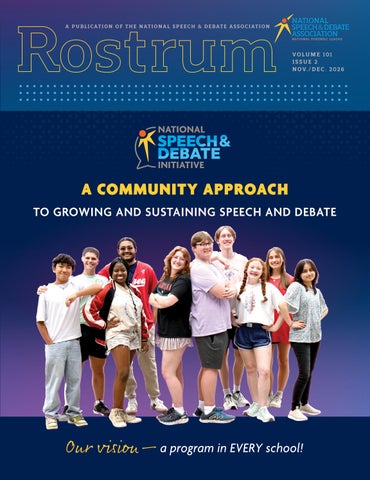
A COMMUNITY APPROACH TO GROWING AND SUSTAINING SPEECH AND DEBATE
Our visiou— a program in EVERY school!
with the NSDA STORE
SHOP NOW
Letter from the Publisher Speech and debate has always been about preparing students for the future. As the world changes, so must we. New technologies, evolving educational needs, and the challenges facing schools create opportunities to think differently about how we grow and sustain our activity. But growth takes more than opening new programs. It requires thoughtful planning, strong partnerships, and the resources to help students and coaches succeed. It also means recognizing that some of our greatest opportunities may come from unexpected places. This issue of Rostrum explores what that work can look like. From considering how artificial intelligence may shape the future of speech and debate to highlighting state partnerships bringing new funding and opportunities to schools, these stories demonstrate the importance of adapting, collaborating, and investing in our future. Each example reinforces an important point: sustainable growth is a shared responsibility. It takes coaches willing to build something new, leaders willing to invest in students, and partners willing to make opportunities possible. As you read this issue, I hope you’ll find inspiration in the people and ideas moving our activity forward. Together, we can create stronger programs, remove barriers to participation, and ensure more students have the opportunity to discover everything speech and debate can offer. Our future is something we build together.
Board of Directors James W. Rye III President Alabama Jamelle M. Brown Vice President Missouri Byron R. Arthur President Emeritus Louisiana David Coale Texas Marc Ehrhardt Louisiana Meg Howell-Haymaker Arizona Erez Kalir California Michael Ledford Virginia
Sincerely,
Wendy Orthman Tennessee J. Scott Wunn Executive Director
Esther Oyetunji Florida
Rostrum A PUBLICATION OF THE NATIONAL SPEECH & DEBATE ASSOCIATION 6600 Westown Parkway, Suite 270, West Des Moines, IA 50266 | Phone (920) 748-6206 J. Scott Wunn, Publisher Amy Seidelman, Editor Vicki (Joss) Walker, Managing Editor Annie Reisener, Associate Editor Emily Bratton, Visual Design and Brand Specialist
Newsstand Price $9.99 per issue Member Subscription Price $24.99 for one year (5 issues) Non-Member Subscription Price $34.99 for one year (5 issues)
Rostrum (ISSN 1073-5526), Copyright © 2026 by the National Speech & Debate Association (NSDA), is published five times per year (Sept., Nov., Feb., Apr., and Aug.) by the NSDA, 6600 Westown Parkway, Suite 270, West Des Moines, IA 50266. Business and Editorial Offices: NSDA, 6600 Westown Parkway, Suite 270, West Des Moines, IA 50266. Accounting and Circulation Offices: 6600 Westown Parkway, Suite 270, West Des Moines, IA 50266. Call (920) 748-6206 to subscribe. Periodicals postage is paid at Des Moines, IA 50318, and additional mailing offices. POSTMASTER: Please send address changes to Rostrum, c/o NSDA, 6600 Westown Parkway, Suite 270, West Des Moines, IA 50266. Rostrum provides a forum for the speech and debate community. The opinions expressed by contributors are their own and not necessarily the opinions of the NSDA, its officers, or its members. The National Speech & Debate Association does not guarantee advertised products and services unless sold directly by the NSDA.
2
ROSTRUM | NOVEMBER/DECEMBER 2026
Steven Schappaugh Administrative Representative Iowa Josh Swartsel Washington, D.C. Aaron W. Timmons Texas Rachel K. Wilczewski Hawaii Holly Williams Secretary Arizona
To learn more about the Board, visit www.speechanddebate.org/ meet-the-team. You may also contact the Board by emailing board@speechanddebate.org.
NATIONAL SPEECH & DEBATE TOURNAMENT
LAST-CHANCE QUALIFIER APRIL 29– MAY 1, 2027 • ONLINE
N O E N T RY F E E
R E G I STE R O N TAB ROO M .CO M Presented by The Julia Burke Foundation
The NSDA Last-Chance Qualifier is an opportunity for students who did not qualify through their district tournament to have a chance to attend the 2027 National Tournament in their main event. EVENTS OFFERED
NOTE: All events will be held live, online using NSDA Campus with Observers.
Debate: Policy, Public Forum, LincolnDouglas, Big Questions, and World Schools Congress: Senate and House
Speech: Dramatic Interp, Humorous Interp, Duo Interp (Same Room Only), Program Oral Interp, Original Oratory, Informative Speaking, International Extemp, and United States Extemp
DEADLINE TO REGISTE R IS APRIL 16, 2027 D E TA I L S AT:
speechanddebate.org/nsdaqualifier
In this Issue : VOLUME 101 : ISSUE 2 : NOVEMBER/DECEMBER 2026
From the Cover
Inside
20
A Community Approach to Growing and
2
Letter from the Publisher
Sustaining Speech and Debate
6
Topics
11
News + Notes
14
Resource Roundup
18
Membership Minute
56
Advocacy Letter
Governance and Leadership 8
From Your Board President
Community
by Helen Fang
12
Milestone Moment: Tabroom.com Reaches One Million Users
16
No Quiet Voices Here: Libraries (and Librarians) as Partners in Speech and Debate
24
Bring SPEAK. to Your Community
26
Ask Kathleen: Advice for New(er) Coaches by Kathleen Walker
28
Middle School Focus – Heather Huffman
30
Student Spotlight – Matthew Collins
32
Team Profile – Eastlake High School, Texas by Bratati Chakraborty
34
NSDA Trophy Shop: Failure Is Not An Option
Recognition 37
Top 100 Schools
39
Faces in the Crowd
Access this issue online! www.speechanddebate.org/rostrum
Like us on Facebook www.facebook.com/ speechanddebate Share with us on Instagram @speechanddebate Follow us on X @speechanddebate Follow us on LinkedIn www.linkedin.com/company/nationalspeech-and-debate-association Follow us on TikTok @nsda.speechanddebate
OUR MISSION Rostrum shares best practices, resources, and opportunities that connect, support, and inspire a diverse community of educators committed to empowering students through speech and debate.
4
ROSTRUM | NOVEMBER/DECEMBER 2026
HARVARD
Debate Council Summer Workshops
hdcsw.org
Congress We teach sound analysis, information literacy, exposure to current issues, ethical leadership, and authentic presence to foster well-rounded debaters who learn to distinguish themselves.
Lincoln-Douglas
Balancing complex concepts with practical tools, we tailor instruction to students’ needs through diverse approaches, ethical practices, and a variety of philosophical literature.
Policy Debate We teach foundational (two-week) and intermediate/advanced (four-week) theories and strategies to guide students in researching, analyzing, and crafting arguments/responses.
Public Forum Skill-building with plenty of opportunities to practice debating, our program molds successful debaters who can apply their learning to changing topics each season.
info@hdcsw.org • (617) 495-4822 • www.hdcsw.org Harvard Debate Council is a 501(c)(3) nonprofit organization.
Session 1: June 27–July 9, 2027 Session 2: July 11–23, 2027
Public Speaking We help students explore topics and themes of interest and build their confidence as they learn to compellingly communicate through foundational or competitive speaking.
World Schools USA Debate coaches and debaters teach approaches, strategies, and skills necessary to succeed in this dynamic format of debate, ahead of the WSDC World Championship.
Coach Workshop
Whether you are new to speech and debate, have an existing program, or want to develop professionally, we will tailor curriculum to accomplish your goals.
Come to historic Harvard University or learn online.
Official summer training host for USA Debate.
DEBATE
Topics
Current topics, voting links, and resources available at:
www.speechanddebate.org/topics Member students and one chapter advisor per school are eligible to vote!
Share Your Topic Suggestions We invite you and your students to send us your debate topic ideas for Public Forum, Lincoln-Douglas, and Big Questions as well as potential motions for consideration in World Schools. Learn more about how topics are generated throughout the school year and access the online submission forms at www.speechanddebate.org/ topic-creation-hub.
NOVEMBER/DECEMBER 2026
Public Forum Debate Resolved: European members of the North Atlantic Treaty Organization should ratify the Treaty on the Prohibition of Nuclear Weapons.
Join a Wording Committee Your voice matters in shaping NSDA events. All coaches and former competitors are invited to apply to join a wording committee for PF, LD, BQ, or 2027 National Tournament topics (World Schools, Extemp Debate, and Extemp Speaking). Committees research, draft, and refine topic options, directly impacting tournaments. Virtual meetings run March through April. Learn more and apply by February 1, 2027, at www.speechanddebate.org/topic-creation-hub.
Policy Debate Topic Fellowships The NSDA has partnered with the National Federation of State High School Associations (NFHS) to offer two Policy Debate topic fellowships with a goal of increased representation in the topic selection process. High school Policy Debate coaches who are interested in writing a topic paper and attending the annual topic meeting to support the mission of choosing timely, accessible, and studentcentered topics are encouraged to learn more and apply online by April 1, 2027, at www.speechanddebate.org/policy-topic-fellowship.
Congress Legislation: Seeking Student Voices Any high school or middle school NSDA member student, regardless of their national qualification status, may submit legislation to be considered for the 2027 National Tournament Docket. If their legislation is selected, they will be recognized in Rostrum, receive a trophy after the tournament, and be awarded a $100 scholarship. Encourage your students to complete the form by February 5, 2027, at www.speechanddebate.org/congress-submission.
Topic Rubric The NSDA conducts an intentional and ongoing evaluation of the topics we encourage students to explore. Download a copy of the Topic Rubric Questions at www.speechanddebate.org/topic-rubric.
6
ROSTRUM | NOVEMBER/DECEMBER 2026
NOVEMBER/DECEMBER 2026
Lincoln-Douglas Debate Resolved: De-extinction is unethical.
NOVICE LINCOLN-DOUGLAS TOPIC The NSDA also offers an optional resolution that may be used during the first two months of a novice LD season—Resolved: In the United States, national service ought to be mandatory. Coaches are encouraged to check with tournament hosts in their area before exclusively prepping for one topic over another.
2026–2027
Big Questions Debate Resolved: Technological progress has surpassed humanity’s ability to use it ethically.
2026–2027
Policy Debate Resolved: The United States federal government should establish national health insurance in the United States.
GOVERNANCE
From Your Board President THE AGE OF ARTIFICIAL INTELLIGENCE
Artificial intelligence (AI) is reshaping education and competition, raising important questions about how speech and debate should adapt.
I
magine being alive in 1900 as the Industrial Revolution was in full bloom. You would have witnessed the beginning of the airplane, the evolution from horse and buggy to the automobile within cities, and indoor plumbing transitioning from existing only for the elite to being commonplace in businesses and homes. It had to have been exciting and confusing at the same time. You would have had no clue what was coming next.
8
ROSTRUM | NOVEMBER/DECEMBER 2026
In May of 2026, during the NSDA Spring Board Meeting, author and debate coach Stefan Bauschard led a discussion about the impact of artificial intelligence on our society and how this could shape the world of speech and debate. One of the things he theorized was the impact of the AI Revolution would be greater than the impact of the Industrial Revolution, not only on our nation but on the world.
In the months since, politicians, business leaders, and the debate community have been engaged in theorizing the good, the bad, and the ugly of AI. Is AI going to be a positive for society by curing cancer and other diseases plaguing our planet, or will it dominate, if not eliminate, the human species? For the speech and debate community, will it become a tool to enhance the research, creative, and critical thinking skills found within our activity, or will it be a tool destroying education, and by extension, humanity itself? While visiting France in September of 2026, speech and debate alum Pope Leo XIV provided a hopeful yet cautionary thought about AI. When asked if he fears AI, the Pope responded by saying, “Am I in panic mode? I am not. I sleep at night.” He went on to say he “remains relatively optimistic that people can keep AI from reaching a point where it could...remove humanity from the conversation.” For its part, the NSDA seeks primarily to find a balance between accepting some of the technological advances occurring in our society and preserving student thinking, critical analysis, and human judgment. With this in mind, this fall, the Board of Directors launched an AI Working Committee that will examine the threats and opportunities of AI, establish
Experience the
SPEECH & DEBATE
guidelines and best practices, and explore positions the NSDA may want to adopt to establish itself as a thought leader in AI’s role in speech and debate education. At the same time, the Competition and Rules Leadership Committee (CRLC) will review existing competition rules,
Experience theADVANTAGE
SPEECH & DEBATE ADVANTAGE
to write rules to clamp down on this behavior.” Or, some might wax poetic aboutAsthe goodticold an athle director, I’ve seen spee ch and debate days of tubs, paper, or actual cards become a cornerstone and how we should reject of our extrathe -curruse icular prog ramming.the Our studentof all technology, especially athletes who competed in both sports is, andthe computer. The truth genie speec h and debate developed stronger leadership, is out of the bottle computer common unica tion, confidence unde r press and teamwork. usage, and Barbara Eden*ure, is not These skills made them better going back. competitors, captains, and
Does your child’s school have a
identify areas that may require clarification, and consider whether changes to event rules or tournament standards are warranted.
representatives of our schoo
SPEECH & DEBATE PROGRAM?
l. Former Secretary of State — AARON OSTERB EAL former Athletic Director at Regis Groff, CO Condoleezza Rice asked earlier this year, “Are we the Benetraining fits • ENHAN CE sports programs • INCRE ASE parent engagement population for the jobs of the Participation in red • REDUC ED COST compa with the academic advantages by involving parents as Speech and debate is competitive speaking, to adding a new sport— of speech and debate . tournament judges. future as opposed to the jobs of We need to navigate speechrequire and debate s only a coach, NSDA • BUILD stronger, academicallyacting, and debating. • SUPPO RT student eligibility membership ($349 covers the present?” We as educators oriente d athletes. this change, not run from concerns through the all studen ts at your school), helpstourna students: INTEGR ATE academic competition ment entry fees, and a duty, if• not calling, to best academic benefits gained by it. We need to help equip Speech and debatehave teaches essential life skills alongsiade sports compethat transportation. tition. allowdual-activity students. prepare our teenagers forcomplex the world coaches with tools to incorporate young people to effectively communicate Build their confidence The Peer-Reviewed Academic Benefits ✅ Trans form Lives in which they will reside as adults. ethical use of this evolving ideas in order to advocate for themselves, their local 80 % with other ✅ Connect .66 POINTwas seen 25% 300 % technology into the classroom, 1900, the refrigerator MORE LIKELY INCREA SE MORE LIKELY INCREA SE IN communities, and theInworld. TO GRADU ATE IN GPA students who share TO GRADU ATE TEST SCORES COLLEG E HIGH SCHOO L should they desire to, and grapple as a luxury, but today, we see it as their interests with the role of AI within a a necessity. In 2000, the laptop in Participating in speech debate ✅ Challenge themselves competition setting. We should a debate round wasand a luxury item, Get started at spe echcelebrate anddebate.org and was so much than acknowledge that administrator but more today, we view just it as anfinding essential their progress approaches may vary when my voice. It tool. By 2100, it will myself be both exciting was finding and the responding to the AI Revolution. and mind-boggling to imagine person I want to be. ✅ Gain recognition and Therefore, we should provide which of today’s luxuries will have national rankings — MICHAEL BOLE, ALUM guidance—and, more importantly, become tomorrow’s necessities. Dreyfoos School of the Arts, Florida ✅ Join a nationally proof—on how speech and You are never done with speech recognized Honor debate is the best opportunity and debate! Society for schools to preserve critical ✅ Demonstrate rigor National Speech & Debate Association (NSDA) is the largest thinking skills, creativity,The and beyond the classroom speech and debate organization in the United States, supporting research skills for our students.
tournaments, schools, coaches, and students since I am confident someinterscholastic are 1925. Students compete in over different public speaking and reading this and thinking, “The James W. 10 Rye III acting events and five debate events across the country. usage of AI in debate and speech NSDA Board President rounds is rampant, so we need board@speechanddebate.org
* Barbara Eden is an American actress known for starring as the title character in the sitcom I Dream of Jeannie.
enhance your child’s Learning Experiences
✅ Show critical thinking, communication, and leadership
L E AR N M OR E www.speechanddebate.org ROSTRUM | NOVEMBER/DECEMBER 2026
9
WE HOPE YOU HAVE AN AWESOME YEAR!
IS YOUR
BARK
! ? E T I B
AS STRONG AS YOUR
We’re excited for the 2026-2027 academic school year! We hope you are prepared to show off your BARK as well as your BITE! The Truman State Forensics Team would like to remind students competing to: GO AT YOUR OWN PACE KEEP ASKING QUESTIONS GET HELP FROM A FRIEND OR COACH BRANCH OUT OF YOUR COMFORT ZONE SUPPORT YOUR TEAMMATES HAVE FUN!
-TRUMAN FORENSICS
WE’R HEREE !
KIRKSVILLE, MO
GRADUATING THIS SPRING? We’re accepting applications! Truman offers 50 majors and over 70 minor degree programs, such as Communication & Theatre Arts, Political Science & International Relations, Accounting, Chemistry, Data Science, Music, AND MORE! Truman also offers a 5-YEAR M.A.E. PROGRAM, where you can get your Bachelors degree, Masters in Education, and certification to teach high school speech and theatre in MO through an accelerated academic program. Find more information at truman.edu/majors-programs
NO. 1 PUBLIC UNIVERSITY IN THE MIDWEST NCAA DIV.II ATHLETICS 3,600+ STUDENTS 16:1 STUDENT-FACULTY RATIO 200+ STUDENT ORGS.
TUITION & FEES APPROX. $10K IN-STATE APPROX. $18.5K OUT-OF-STATE
99% OF STUDENTS RECEIVE SCHOLARSHIPS “While at Truman, I have been encouraged to explore new paths of education, think critically on diverse material, and expand my educational horizons. I have also grown my leadership skills through our many student organizations. Truman prepares students to go out and make a difference in their communities with the tools they cultivate here.” - Alex Peterson (’26) Student Gov. President, Forensics Team Member
TO SCAN NOW! APPLY
COMMUNITY
NEWS + NOTES Recent Minutes Participate in the Spring 2027 Election: Competition and Rules Leadership Committee The CRLC is a standing NSDA committee focused on competition rules and interscholastic programming. An election for candidates from the California, East/Northeast, Northern Midwest, and Northwest/Northwest Central regions will be held in April 2027. Candidacy applications and nominations are due January 22, 2027. Online balloting will occur April 1-22, 2027. One advisor per active NSDA school in these regions will be eligible to vote. Election results will be announced April 30, 2027. Learn more, then apply or nominate, by visiting www.speechanddebate.org/ competition-rules-leadership-committee.
NSDA Honor Society Recognition 2025-2026 Speaking and Service Awards Speech and debate is about more than competition. The Honor Society also celebrates students using their skills to better the world around them. The Speaking and Service Award annually recognizes students who go above and beyond in their service to their teams, schools, and communities. Students receive this award when they earn 200 service points in a given year, the maximum number possible in a school year in our Honor Society. The deadline for points entry was July 31. Congratulations to the 2025-2026 recipients! Find the complete list at www.speechanddebate.org/studentrecognition.
2025-2026 All Americans Each year, the top student point earners in the NSDA are named All Americans. The All American award is based on a combination of competitive and service points, of which no more than 25% of the point total can include service. In order to qualify, a student must have competed once at Nationals. Join us in congratulating the 2025-2026 All Americans! Learn more at www.speechanddebate.org/student-recognition.
Stay up to date on recent rules changes and other decisions impacting your NSDA membership. Find minutes from past Board of Directors’ and Competition and Rules Leadership Committee (CRLC) meetings online at www.speechanddebate.org/minutes-archive.
Coaches’ Network Meetings The NSDA Coaches’ Network fosters connection, mentorship, and support through online and in-person networking opportunities. Caucuses and advisory group meetings are open to all coaches and judges. Check out the complete fall schedule and register to attend upcoming virtual meetings at www.speechanddebate.org/ coaches-network. Each group will meet again virtually in the spring as well in person at the National Tournament in June. • November 3, 2026: Asian American/Pacific Islander Coaches’ Caucus • November 9, 2026: Hispanic/Latine Coaches’ Caucus • November 16, 2026: Indigenous Persons Coaches’ Caucus • November 18, 2026: LGBTQIA+ Coaches’ Caucus • November 30, 2026: School and Community Context Advisory Group (consisting of the Independent, Rural, and Small School Coaches’ Interest Groups)
• December 1, 2026: Women’s Coaches’ Caucus • December 2, 2026: Black/African American Coaches’ Caucus
Postage Report The NSDA submits an annual postage report for Rostrum as required by the U.S. Postal Service. Visit www.speechanddebate.org/ 2026-postage-report for details.
Questions? We’re here to help! Email info@speechanddebate.org or call (920) 748-6206. ROSTRUM | NOVEMBER/DECEMBER 2026
11
COMMUNITY
Milestone Momen t
TABROOM.COM REACHES ONE MILLION USERS
T
his fall, Tabroom.com, the online tournament management system, reached a record one million users! More than just a tech milestone, this historic moment is a reflection on how deeply the platform has become embedded in the speech and debate community.
LOWERING BARRIERS “The goal of Tabroom.com was always to make tournaments run more smoothly,” explains Chris Palmer, creator of Tabroom.com and NSDA Lead Developer. “When I started out, tournaments had a lot of rote work and downtime. My goal has been to find ways of removing busywork from tournaments, so everyone can focus more on the activity itself.” What began as a college project in 1999 eventually grew through the help of grant funding. When the grant ended in 2014, the NSDA approached Palmer to take on the project and help manage and grow the program. Palmer remains grateful to the NSDA for sharing his vision and supporting the platform in that critical moment. Today, the NSDA programming team includes three full-time staff members. A team of seven employees rotate to offer weekend support throughout the school year, and 10 “superusers” provide on-the-ground technical support in their regions. “Making tournaments easier to attend, judge, and participate in can help us
12
ROSTRUM | NOVEMBER/DECEMBER 2026
transform even more lives through speech and debate,” Palmer says.
EXPANDING ACCESS For many new programs, entry into the world of speech and debate can now happen entirely online. The Springboard Series provides free online speech and debate practice scrimmages and tournaments for middle and high school students. Everything from tournament registration to the virtual competition platform is offered exclusively through Tabroom.com and NSDA Campus. The NSDA Last-Chance Qualifier is another free online tournament available through Tabroom.com that gives NSDA member students an opportunity to qualify for the annual National Speech & Debate Tournament. Combined, nearly 5,500 students from across the globe participated in these online competitions last year.
STAYING INFORMED The NSDA tech team continues to modernize the system and add updates based on feedback from NSDA members and non-members alike. Sign up for the Tabroom.com Newsletter to receive future highlights and helpful tips on using the platform by visiting tinyurl.com/yc5cc8fu.
Early in my career, I got the chance to walk among tech demigods. Perhaps within the speech and debate world I CH R I S PA LM ER deserve that label, Lead Developer but in the broader world of computing, It’s been kind I’m forever a small fry. of fun to become The true giants wrote this bizarro-world operating systems, minor celebrity. It devised cryptography, and implemented always cracks me the first network up how kids are protocols. Their like, ‘Whoa, you quiet miracles sit wrote Tabroom?’ underneath the goofy And my standard little pages I make to response is, ‘Well, run your speech and someone had to.’” debate tournament. Back then, I attended tech conferences to learn from these folks. I never quite fit in, lacking a formal computing degree, but speech and debate helped me stand out. Most tech folks don’t enjoy speaking in front of others, so I became a conference staple simply by being willing to present. It may surprise people that I don’t always feel like I belong in speech and debate, either. I don’t enjoy the thrill of competition or the spectacle of awards. Yet, I do value this activity. I’ve coached far more talented students than I ever was, and I’ve seen what speech and debate can do for young people. I choose to stick around to help make that possible. This past May marked 30 years since I competed at the National Catholic Forensic League tournament as a student. The gawky nerd who didn’t even clear in Extemp is still here, decades later, helping run tournaments. A lot of us never feel like we truly fit in, even in the places where we fit best. There may not be a place I belong more, after all.
Learn more about Tabroom.com features at compiled by Shelby Young, Content Specialist at the NSDA
docs.tabroom.com
Tabroom AT A GLANCE
As the NSDA strives to start 4,000 new speech and debate programs nationwide by 2030, Tabroom.com will continue to evolve and meet the needs of a growing and increasingly diverse community.
(under 50 entries)
Read more about the evolution of Tabroom.com in the 2025 February/March Rostrum.
ROSTRUM | NOVEMBER/DECEMBER 2026
13
RESOURCE ROUNDUP
W
hen students and coaches discuss what a successful tournament looks like, these conversations typically begin and end with wins and losses, trophies, or bids to national championships. While competitive outcomes shape rankings, qualify students for championships, and signal progress in the season, they are not the only important outcomes coaches and students should strive for. Success can also include skill development, competitive maturity, and team culture.
Take this course to learn how to:
Set Goals for Success
SUCCEEDING AT TOURNAMENTS Our new course, Succeeding at Tournaments, explores how to define success, setting and achieving goals, and techniques to maximize your team’s chances for success, however you define it. Read on to learn more! You can access the complete course online:
Learn about the structure for goal setting as well as appropriate and achievable goals for the competitive season. Set yourself up for success by prioritizing process goals. Process goals are goals related to specific behaviors that students and coaches can practice. They include things like rehearsing multiple times per week, improving research skills, and learning about new arguments. Outcome goals are goals related to the anticipated results of those behaviors, like winning more debates or earning a speaker award. When process goals guide preparation and performance, competitive or outcome-based goals tend to follow. — Examples of Speech Goals —
www.speechanddebate.org/learn/ courses/succeeding-at-tournaments
— Examples of Debate Goals —
14
ROSTRUM | NOVEMBER/DECEMBER 2026
Promote Competitive Success and Skill Development There are several techniques that you can practice before, immediately after, and between rounds in order to promote competitive success and skill development. This course describes several useful techniques, such as reviewing judge paradigms, gathering intel about anticipated arguments, and building strategies. It also describes how competitors can use downtime between rounds to maximize their preparedness.
INSIGHT Dealing with Tough Rounds Debriefing with students after rounds can help them process the round and maintain professional behavior. The core coaching strategy should follow this pattern.
There are also a variety of techniques that you can use after the tournament to build on your experiences and drive improvement. Learn how to debrief after the tournament, review ballots, and conduct speech and debate redos at practice. The NSDA Honor Society recognizes the importance of skill development by awarding merit points for tournament participation. For example, a student who earns a #1 rank (the best) in a speech round earns six points, but a student who ranks fifth or higher still earns three points. A student who wins a debate round earns six points, but a student who loses a debate round still earns three points. This recognizes that participating in the activity enriches a student’s educational experience, regardless of competitive outcomes.
Promote Competitive Maturity Dealing with tough rounds can be one of the biggest challenges for students and coaches. Yet, handling rounds with maturity is one of the most important drivers of growth. The course provides advice about setting appropriate behavioral expectations as well as sample scripts to help students process tough rounds (sidebar). You can teach students to move beyond disappointment and instead use their experiences to drive improvement.
Improve Team Culture Tournaments are an ideal situation to build team culture. The course offers a variety of ideas to make your team stronger through shared activities and traditions.
ROSTRUM | NOVEMBER/DECEMBER 2026
15
COMMUNITY
NO QUIET VOICES HERE: LIBRARIES (AND LIBRARIANS) AS PARTNERS IN SPEECH AND DEBATE — by Megan West —
W
hen I think about my high school speech and debate experience, I don’t just picture classrooms, tournaments, or trophies. I picture our high school library. My high school librarian, Phyllis Tucker, provided a safe space for our team to practice and eventually became one of our coaches. Unsurprisingly, she seemed to know an infinite amount about the world and how to research or find anything she didn’t. She is also one of the best storytellers and listeners I know—a winning combination for any speech and debate coach. I recently caught up with Ms. Tucker and asked her what led her to us. “As I was working toward my school librarian endorsement, I attended the Tejas Storytelling Festival and fell in love with the art of performance,” she shares. Ms. Tucker learned from the team’s
16
Libraries may have a reputation for being quiet, but they have always been places where ideas are discovered, questions are encouraged, and stories are preserved.
coach that students performed better when they chose their own literature. “The rest
was history. I fell in love with speech and debate and developed a passion for helping students tell their story through other stories.” While Ms. Tucker is retired now, she still actively coaches and judges across the state of Texas. Around the country, other librarians are helping speech and debate students research more deeply, discover literature, evaluate sources, and, perhaps most fittingly, find their voices in spaces
ROSTRUM | NOVEMBER/DECEMBER 2026
too often stereotyped as quiet. Two years ago, the debate program at Jackson High School in Washington existed mostly on paper, struggling for momentum and lacking a leader. Its revival began when students turned to their school librarian, Emily Moore. Ms. Moore had never coached debate before, but the students’ determination convinced her to try. “I said ‘yes’ because the students wanted it so badly,” she explains. “They were organized. They were motivated. They made it clear this mattered to them.”
Another librarian who answered the call is Jessica Schneider of Everglades Elementary School in Florida. A highly decorated elementary school coach, Ms. Schneider believes more schools should stop by their libraries for speech and debate support. “Speech and debate and school libraries are a natural partnership,” she shares. “Both empower students to ask thoughtful questions, seek credible information, evaluate evidence, communicate effectively, and participate in civic life. By supporting speech and debate, school librarians help students develop skills that extend far beyond competition and prepare them for success in school, careers, and their communities.” Ms. Schneider also highlights the unique advantage librarians have to really know their students: “School librarians work with every grade level across a school and
THE LIBRARY IS CALLING!
get to know students’ strengths, interests, and learning styles. Our daily experiences helping students choose their next book can also help students select topics for speech and debate. Connection to students in this way guides them toward developing their voice and confidence as speakers.” Middle school and high school librarian/coach Ross Eichele supports multiple schools in Minnesota and explains how librarians are a perfect fit: “I would tell any librarian considering supporting speech and debate that you have spent a lot of time honing skills you will immediately use as a coach.” Ashley Sine from Robert C. Byrd High School in West Virginia echoes these sentiments. “Coaching a team is a lot of hard work, but a very rewarding experience! The students will surprise you, but you might also surprise yourself with what you are all able to accomplish together,” she explains. “My first year as a school librarian, I felt very isolated and distant from the rest of the teachers and the school, as nobody else in the building could really relate to me and my job. However, starting my team has helped me feel more involved as an educator.
I know I am making an impact on our school culture.” Of course, your librarian doesn’t have to become a speech and debate coach to be one of your program’s greatest resources. Whether
you have a strong school library, a nearby public library, or both, librarians can help students go deeper than a Google search, and coaches might be surprised by just how much is available simply by asking. In a world where we are asking AI to do so much, there are librarians in libraries across the country waiting to be asked, too. According to the Institute of Museum and Library Services 1, there are approximately 9,000 public library systems and more than 17,000 individual public library outlets across the United States and its territories. And those libraries offer far more than books. Depending on the location, students have access to research databases, newspapers and archives, computers, meeting and study rooms, technology, programming, and, perhaps most
importantly, librarians who know how to help them find what they are looking for. The American Library Association 2 adds, “Libraries are no longer [just] a warehouse for books. Libraries provide space and opportunities for hands-on learning and engagement beyond education or entertainment. In recognition of this shift in a library’s role and value, programming and creation spaces have grown exponentially.” For speech and debate teams, this creates all kinds of possibilities: • ASK a librarian to show students how to access databases they may not know exist. • CHECK whether your public library offers newspaper archives or interlibrary loan for hard-to-find books, plays, poetry, or literature. • FIND out if there is a meeting room where students can practice. • INVITE a librarian to talk with your team about evaluating sources or conducting more effective research. And when a student insists they have searched
1
Institute of Museum and Library Services: www.imls.gov/sites/default/ files/2026-06/PublicLibrariesSurvey_FiscalYear2024_DataDocumentation andUsersGuide.pdf
2
American Library Association: www.ala.org/advocacy/intfreedom/spaces
Get students exploring with Lesson 2 of our middle school and high school Teaching Interpretation collections. Learn more at www.speechanddebate.org/ start-here.
everywhere for the perfect piece, source, or story, send them to someone whose actual job is knowing where else to look. If the stars align, you may even be able to sign them up to coach or judge. Libraries may have a reputation for being quiet, but they have always been places where ideas are discovered, questions are encouraged, and stories are preserved. For speech and debate students, they can also be places where voices are strengthened. So, the next time your team needs a source, a story, a space, or simply a little help figuring out where to begin, stop by the library. If your school has one, great. If not, take a look around your community. There may be more waiting there than you think. And there are certainly no quiet voices required. Megan West serves as Campaign Director at the NSDA.
ROSTRUM | NOVEMBER/DECEMBER 2026
17
MEMBERSHIP MINUTE
Time to Start Thinking About Summer...Camp! by Robin Eskin-Fieler
F
or many speech and debate programs, summer is the season between seasons—the trophies are packed away, the final ballots have been entered, and the team has a few months to breathe before the next competition year begins. But summer can also be one of the most valuable opportunities a program has to grow.
Hosting a summer speech and debate camp at your school can strengthen your team, develop younger students, build community, and create momentum that lasts throughout the entire competitive season. You do not need a huge budget, a nationally recognized coaching staff, or a campus full of state champions to make it work. You need a plan, a place, and a willingness to invest in students.
18
ROSTRUM | NOVEMBER/DECEMBER 2026
Why Host a Camp? The most important reason to host a summer camp is simple: students get better when they have time to practice. During the school year, speech and debate students are balancing classes, activities, homework, tournaments, jobs, and everything else that comes with being a scholar. Practices can easily become focused on immediate tournament preparation. Summer removes some of those pressures and gives students room to experiment. A summer camp can introduce novices to the activity before their first tournament.
It can help returning competitors develop more advanced skills. It can give experienced students opportunities to mentor younger teammates. Most importantly, it creates a shared experience that helps turn a collection of competitors into a team. Summer camp is also an excellent recruiting tool. Students who might not sign up for a yearlong speech or debate class may be willing to try a weeklong camp with their friends. A well-designed camp can show students that speech and debate is not simply about standing behind a podium or arguing across a table. It is about storytelling, research, creativity, confidence, critical thinking, and finding your voice.
Keep the Structure Simple Your first camp does not need to be elaborate. For speech events, students might spend time learning interpretation techniques, developing original speeches, practicing delivery, or experimenting with limited-preparation events. Debate students can work on argument construction, research, flowing, questioning, refutation, and practice rounds. The key is variety. Students should not spend six hours listening to lectures. Teach a concept, let students try it, give feedback, and then let them try again. You can also use your own students as camp leaders. Experienced
competitors can demonstrate speeches, judge practice rounds, run drills, and mentor novices. This gives younger students relatable role models while helping veteran students develop leadership skills. Check out a sample three-day schedule: tinyurl. com/ycpkh8cj
Make It Accessible One of the biggest advantages of a schoolbased summer camp is accessibility. Students do not need to travel across the country or pay hundreds or thousands of dollars to benefit from intensive speech and debate instruction. A local camp can reduce transportation and lodging barriers and make participation possible for students who might otherwise be excluded. Classrooms are free. Your team probably already owns much of the basic equipment you need. Students can bring lunches, or you can reach out to see if you can get meals or snacks donated from a local organization. Coaches and alumni can volunteer. Your first goal should be building a strong experience, not creating a perfect one.
Invite the Community In! A school-hosted camp can benefit more than your existing team. Invite students from neighboring schools. Open some sessions to middle school students. Consider a novice track for students who have never competed and an advanced track for experienced competitors. If your region has multiple programs, invite coaches and students from those schools to participate. This can create something bigger than a single team’s summer activity: a local speech and debate community. Guest speakers can also add variety. Alumni, local attorneys, journalists, educators, college competitors, and former debaters can share their experiences or teach specialized skills. You do not need famous names. Sometimes the most effective guest is a former team member who can tell current students, “I was sitting where you are a few years ago.”
final day. Invite families and school administrators. Let students perform the speeches they developed during the week or compete in exhibition rounds. This final event gives students a goal throughout the camp and provides an opportunity to demonstrate what they learned. It also gives parents and administrators a visible reminder of the value your program provides.
Most importantly, leave students excited. A successful summer camp does not have to produce championship-level competitors in five days. It should produce students who are curious, confident, connected, and ready to keep learning.
Build for the Fall The real payoff of summer camp comes after camp ends. Use the final day to introduce students to your upcoming season. Give them information about practice schedules, registration, tournaments, fundraising, and ways to stay involved. Create a group communication channel or email list, with appropriate school and family permissions, so students know how to stay connected.
Your school already has the most important ingredients: students, classrooms, coaches, and a community. This summer, put them to work. The next great speaker or debater on your team may simply need a place to begin. Robin Eskin-Fieler serves as Membership Coordinator at the NSDA.
Finish by Celebrating Success Every camp should have a culminating experience. Hold a showcase, minitournament, public debate, or awards ceremony on the
ROSTRUM | NOVEMBER/DECEMBER 2026
19
COVER STORY
A COMMUNITY APPROACH TO GROWING AND SUSTAINING SPEECH AND DEBATE Members of the Massachusetts Speech and Debate League (MSDL) Board
by Shelby Young
Expanding access to speech and debate requires more than a shared vision— it takes advocates who are willing to listen, build relationships, and work together to turn that vision into action. State Funding to Build New Programs While the greater Boston area is home to many thriving speech and debate programs, opportunities to participate are more limited outside of the city. “Instinctively, all of us want to expand access to
MASSACHUSET TS
The Massachusetts legislature recently earmarked $100,000 to help grow speech and debate programs across the state.
20
speech and debate in our communities, but we didn’t have a clear path to do it,” explains Tammie Ruda, Massachusetts Speech and Debate League (MSDL) Board President. This year, the NSDA, the MSDL, and local leaders have partnered to determine the best way to increase access to speech and debate across Massachusetts, including a goal of branching into more rural areas in the future.
ROSTRUM | NOVEMBER/DECEMBER 2026
One way to access funding for teams is by requesting an earmark in the state budget. With the help of Representative Ted Philips (D-Sharon) and Senator Paul Feeney (D-Foxborough), the Massachusetts legislature recently approved $100,000 for speech and debate programs across the state. “I believe words are among the most powerful tools we have to bring about change and create opportunity,” Sen. Feeney says. “I am grateful
for the opportunity to work to secure funding this legislative session to expand access to speech and debate programs across the Commonwealth to help students cultivate confidence in their voices and ideas.” Rep. Philips echoes those sentiments. “In the legislature, we see firsthand how important it is to listen to different perspectives and engage in thoughtful, respectful discussions, even when we
disagree,” he says. “That’s why I am proud to have advocated for funding for speech and debate programs in Massachusetts public schools, ensuring that more students have access to these meaningful educational opportunities.” With initial funding in place, the MSDL is playing a key role in developing a local recruitment strategy. Addressing the unique challenges to their region, the group is focused on building local leagues that make speech and debate more accessible and sustainable for new and established programs. “We hear repeatedly that transportation is a barrier to access,” says Elisha Roberts, NSDA Director of School Recruitment. “Local tournaments mean decreased costs, more accessible entry points for new students, and fewer demands on already busy teachers.” Ruda is pleased that the MSDL Board is able to combine its experience with the NSDA’s broader resources to shape this effort. “Having people on the ground is a huge advantage in determining the best opportunities to expand,” she says. Together, the team is working to identify local
schools that may be interested in starting a middle school or high school program. From direct mailers to recruitment videos highlighting the benefits of the activity, they plan to reach out to principals, superintendents, and key decision-makers at around 500 schools across Massachusetts. “The key to sustained growth is repetition, repetition, repetition,” Ruda says. “We are dedicated to the mission and are ready to support new schools with mentoring, judge support, and everything they need to thrive.” More than just starting new programs, expanding access to speech and debate takes a community committed to helping those programs succeed. By working together to identify schools, build local competition opportunities, provide mentorship, and
connect new programs with the resources they need, the speech and debate community in Massachusetts is working to create a model for sustainable growth.
Connecting Leaders to Create Opportunity After nearly two years of collaboration, schools across North Carolina had a unique opportunity to apply for speech and debate funding. The 2026-2027 Competitive Speech and Debate Grant Program, funded by the North Carolina General Assembly, was created to help state
public schools develop, maintain, or expand high school speech and debate programs. This year’s $250,000 in funding will support 35 programs across 16 school districts in North Carolina, stretching from Haywood and Ashe counties in the mountains to Dare and Hyde counties on the coast. Stakeholders across the state—from local coaches and NSDA district leaders to the Tarheel Forensic League (TFL) and the North Carolina Department of Public Instruction—worked together to establish the grant program. “The Tarheel Forensic League is deeply grateful
NORTH C AROLINA
North Carolina state grant funds in the amount of $250,000 will support 35 speech and debate programs across 16 school districts.
At a time when thoughtful civic engagement matters deeply, equipping young people with the skills to listen carefully, reason critically, advocate effectively, and participate meaningfully in public life is vital to the health of our republic.” — Crawford Leavoy
ROSTRUM | NOVEMBER/DECEMBER 2026
21
Rep. David Willis addresses the Awards Ceremony of the 50th Tarheel Forensic League State Tournament after receiving the TFL Free Speech Award for his efforts in expanding access to speech and debate.
for this opportunity to expand access to an activity that can be truly transformative for students,” says Crawford Leavoy, Chair of the TFL. “This investment will help schools build sustainable programs that give students opportunities to discover their voices, challenge themselves, and connect with peers from communities across North Carolina.”
Leavoy and State Representative David Willis (R-District 68) first met in 2024 at a tournament where Rep. Willis’ son was competing. Having experienced firsthand the benefits of speech and debate, Rep.
Willis was eager to learn more about the TFL and how the state could help. Leavoy and Rep. Willis discussed the need for additional support and funding. The idea of creating a statewide grant program was born. Over the course of the next two years, Leavoy and Rep. Willis met with other legislators, district leaders, state education agencies, and the state speech and debate league. After facing many hurdles, the grant program funding was passed for the 2026-2027 school year.
The goal in North Carolina is to establish a competitive speech and debate league that rivals athletics. Securing recurring funding will be critical to ensure every public high school across the state has the opportunity to participate. Based on the overwhelming demand of the initial program, Leavoy, the TFL, and Rep. Willis are already collaborating with other lawmakers to identify and secure additional funding.
Shelby Young serves as Content Specialist at the NSDA.
Our visiou A SPEECH AND DEBATE PROGRAM IN EVERY SCHOOL! Through the National Speech & Debate Initiative, the NSDA aims to start 4,000 new speech and debate programs nationwide by 2030. Across the country, local coaches, district leaders, state speech and debate leagues, and other supporters are helping drive this effort, working to expand access and bring the transformative benefits of speech and debate to more students and communities. Learn more at www.speechanddebate.org/nsdi. 22
ROSTRUM | NOVEMBER/DECEMBER 2026
WHO WILL BE THE NEXT Hall of Fame CLASS? The highest honor for any high school speech and debate coach is election to the National Speech & Debate Association Hall of Fame. Each year, NSDA Hall of Fame nominations are sought from member coaches. In the month of March, current Hall of Fame members and coaches with at least three diamonds vote to determine which nominees will be elected members of this most distinguished body. In addition, any coach, student, alum, or speech and debate supporter may nominate an individual for consideration as an NSDA Hall of Fame Legend—a coach or non-coach adult who has made a lasting impact on the speech and debate community.
LEARN MORE
Nominations are due February 16, 2027. Learn more about the Hall of Fame and nominate a deserving individual today! www.speechanddebate.org/hall-of-fame
www.speechanddebate.org/big-questions
COMMUNITY
BRING SPEAK. TO YOUR COMMUNITY The Sundance documentary about five Original Oratory competitors is now streaming!
SPEAK., which premiered on opening night of the 2025 Sundance Film Festival, is now streaming exclusively on Documentary+ and available to rent or buy on Apple TV, Amazon Prime Video, and Google Play. The film follows five teenagers from around the country as they chase their dreams of winning the National Speech & Debate Association (NSDA) National Tournament—the Super Bowl of public speaking. Noor, a west Texan with a younger brother struggling with Lennox-Gastaut Disorder, speaks up for disability rights. Noah, a sharp-witted outsider from San Antonio, turns personal tragedy into a plea for mental health awareness. Sam, a proudly queer Minnesotan, calls out American politics’ obsession with nostalgia. Mfaz, a Sudanborn TikTok star with more than three million followers, takes on cultural shaming. And Esther, the reigning two-time national champion in Original Oratory, is chasing a recordbreaking three-peat that would dethrone the current record holder, Josh Gad, the film’s executive producer. Against the backdrop of the 2024 elections and a divided nation, SPEAK. follows its cast of students and coaches fighting to keep speech programs alive amid budget cuts, book bans, and censorship. The film arrives less than three weeks before the November midterm elections. The skills at the heart of SPEAK. are the ones speech and debate has always built: original thinking, creative reasoning, listening with empathy, and persuading a live audience in one’s own words.
Speech and debate doesn’t teach students what to think. It teaches them how to think.
FUNDR AISING GUIDE
How to Host a Documentary Viewing Fundraiser A STEP-BY-STEP GUIDE FOR HIGH SCHOOL SPEECH AND DEBATE PROGRAMS
ONE NIGHT OF SPEAK. COULD FUND YOUR NEXT TOURNAMENT TRIP! SPEAK. has built a devoted following in the speech and debate community, and teams across the country are already hosting screenings to raise money and build support at home. Visit www.speechanddebate.org/ fundraising to download the NSDA’s stepby-step guide, “How to Host a SPEAK. Documentary Viewing Fundraiser,” which walks you through planning, timelines, and add-on fundraising. You’ll also find the “SPEAK. Documentary Viewing Guide” for classroom discussion. Watch the documentary with your team, then share it with parents, administrators, and school board members who need to understand what speech and debate does for schools and communities. Public screening rights are available through ROCO Films: rocofilms. com/films/speak.
24
ROSTRUM | NOVEMBER/DECEMBER 2026
COMMUNITY
ADVICE FOR NEW(ER) COACHES K ATHLEEN WA L K ER , the 2026 NSDA High School Coach of the Year, answers your recent coaching questions.
I’m struggling to balance it all. What systems have saved you the most time as a coach? Every year, I try to delegate as many tasks as possible to experienced upperclassmen, and I frontload that process heavily. When I turn the corner into August, I sit down with my assistant coaches to identify the leadership potential we have coming up. We then meet with those students, either as a group or one-on-one. I ask each leader to talk about their organizational strengths and the areas in which they’d like to lead the upcoming speech team. Once I have that information, I know what I can realistically delegate for that season. Some go-to responsibilities that
26
make the list every year are: designing team T-shirts and managing the ordering process, writing and initiating communication with local businesses for fundraising, and planning and executing team bonding events. I also try to match responsibilities to students’ specific interests. For example, one year, an upperclassman said she wanted to post tournament results. She became responsible for typing up and sharing results everywhere—social media, the newspaper, the school hallway bulletin board, etc. Before she graduated, I asked her to pass that responsibility on to the next leader. Another year, an upperclassman was interested in helping younger students find scripts for interpretation
ROSTRUM | NOVEMBER/DECEMBER 2026
events in speech. She not only helped those students find appropriate scripts, but also created a catalog of age-appropriate interpretation materials for students who were just starting out in speech. Now, as I begin each new speech season, I have a vetted catalog of relevant materials ready to go. I also try to build systems around our uniquely busy weeks rather than handling everything myself. For example, when we host our invitational, I have a pre-arranged parent representative who coordinates concessions by recruiting parents to provide food and work concessions during the tournament. The night before the invitational, students set up the
building so I can focus on hosting the tournament. District and state tournaments require another layer of preparation. Students are responsible for getting their script documentation to me. Because the NSDA requires significant preparation and documentation for speech events, I use students who have been through the process before to support those who haven’t. While students help one another navigate their script preparations, I can focus on the aspects that need my attention as the coach—hotel arrangements, transportation, schedules, and communication. For me, the biggest time-saving system has been creating a culture where students don’t just
FA ST FACTS A B OU T K ATHL E E N • She leads a large rural team and seeks to provide opportunities for her students beyond their town. • She’s created a positive culture and helps get great press for her team. • She excels in connecting with the community so that students have more opportunities without additional costs. • She coached the 2026 Humorous Interp champion! • She is a mom with a young family, balancing family and coaching alongside her co-coach and husband Erik.
complete tasks for me; they develop ownership of parts of the program and teach the next group of students how to take over. That creates a cycle of student leadership that makes the program more sustainable each year.
I am controlling. I don’t feel like my team leaders are detail oriented enough. What responsibilities can I safely hand over to experienced students without creating more work for me in the long run? If you haven’t already, make a checklist of everything that needs to happen within the bounds of your season. I might even break it into categories: pre-season, in-season, weekly recurring tasks, sections/regionals, districts, Nationals, and end-of-season. For example, with weekly recurring tasks, it may be realistic to assign yourself tasks like weekly parent emails, tournament registration, and transportation logistics. But there are also tasks where students can offer their time and creativity—suit swap
events, social media, or designing that season’s team merchandise. Students really do want to do this work! The key is to front-load the expectations. Before handing over a task, decide what the non-negotiables are and where students have creative freedom. Be specific about what success looks like without dictating how they get there. For example, a non-negotiable expectation might be: By Monday end of day, all results are posted to social media, submitted to the newspaper, and displayed in the hallway. The creative freedom might be: The pictures, layout, and designs are up to the student leaders. Once you’ve invested the time to teach that process once or twice, you can have experienced students pass that knowledge on to the next leader. Does that require extra work from you on the front end? Yes. But I’ve come to view that as proactive and preventative rather than creating more work for myself later. Over the years, I’ve prioritized delegating tasks where I genuinely don’t mind what
the final product looks like, as long as the expectations are met. That has made it much easier for me to let go of control. But what happens when the very essence of your job—the coaching—is suddenly out of your control? Last season, I found myself in exactly that situation. I knew I wouldn’t be able to coach from December through February while on maternity leave, and I couldn’t reasonably ask my two assistants (two full-time teachers) to absorb another 10 to 15 students. So, for the first time, I completely handed my students over to upperclassmen. I already had a peer coaching structure in place, but this was different. I wasn’t going to be there. I had to let go of control. That forced me to separate what was essential from what was simply my preference. I provided the rooms, asked students to create a weekly sign-up schedule, and established a few basic expectations for boundaries and what a 30-minute peer coaching session should look like. Then I stepped back, because I literally had to.
What surprised me was how little I actually needed to prepare the peer coaches for the nuances of the categoryspecific teaching. They already knew how to share resources, explain the writing, cutting, delivery, and blocking process, and work with younger students on these things because they had already experienced it themselves. And the students they coached were thriving. What’s more, after a tournament on the bus ride home, I used to have to figure out how fast I’d have to go to meet with every single student about their reflections from the tournament and goals for the next week. I felt like I was skimming the surface and rushing. Now? The three to six peer coaches on the bus handle the deeper conversations. That leaves time for me to check in with only a few students who need extra attention and support; we all get to go deeper.
Kathleen Walker is the 2026 NSDA High School Coach of the Year from Fairmont Junior/ Senior High School in Minnesota.
Have a specific question for her or about coaching in general? Ask Kathleen! www.speechanddebate.org/ask-kathleen
ROSTRUM | NOVEMBER/DECEMBER 2026
27
MIDDLE SCHOOL FOCUS
Making Room for Every Voice HE ATHER HU F F MA N 2026 NSDA Middle School Coach of the Year
K
nowing how to make a point is one thing. Knowing how to listen when someone disagrees with you is another. Across the country, middle school speech and debate programs are helping students develop both skills. As they practice public speaking, construct arguments, and explore important issues, students learn to consider perspectives beyond their own. Heather Huffman, 2026 NSDA Middle School Coach of the Year, believes the ability to listen and respond respectfully is especially important when conversations become difficult.
28
“If we are ever going to move beyond the kind of divisive, myteam-against-yours politics that we have in the world,” Heather explains, “then we’ve got to figure out how to listen to other points of view.” The fledgling speech and debate team at The Village School consisted of just a handful of students in 1997. Since then, the program has grown to include more than 150 members across the middle and high school divisions. The Village School is a pre-K through 12 private school with a rigorous
ROSTRUM | NOVEMBER/DECEMBER 2026
STEAM-focused curriculum. By incorporating the arts alongside science, technology, engineering, and mathematics, the school creates even more opportunities for students to develop both analytical and creative skills. That emphasis helps reinforce the value of speech and debate, both in and out of the classroom. Now a two-diamond coach, Heather has led the middle school program for nearly 30 years, and she remains passionate about the activity. She finds great joy in watching that same enthusiasm take root in young people. “I believe students thrive when they are encouraged to take risks, step into the
unknown, and discover just how powerful their voices can be,” she says. “In my classroom and on my team, I emphasize confidence over perfection, compassion over competition, and community over individual accolades.” Heather’s students describe her as a mentor, motivator, and life-changer. Through her teaching and coaching, they gain not only communication skills, but also confidence, resilience, and character. For Samika Sadasivan, who has been part of Heather’s
Students from The Village School in Texas honor Heather Huffman for being named the 2026 NSDA Middle School Coach of the Year.
middle school team for the past three years, speech and debate has changed the way she thinks about persuasion. “At first, I thought that speech was mainly about being really passionate [and] appealing to emotions a lot,” Samika says. “But I realized you need to express your passion the right way.” Making a compelling case requires more than simply believing in an issue, she explains. Speakers must support their positions with sound reasoning and evidence, using emotion to strengthen their message rather than replace the facts. Samika experienced this firsthand when a student from another school openly shared a political affiliation different from her own during a round. She initially assumed she would disagree with everything
he had to say. Instead, she found herself persuaded by several of his arguments. For Samika, the experience showed the power of combining passion and reason. In recent years, Heather has increased her role in leading the high school team as former coaches have left the program. This experience has given her an even greater appreciation for how the foundation students develop in middle school translates into advanced performance and leadership. Fellow speech and debate coach Rob Gale says Heather is dedicated to helping every student succeed, regardless of their starting point. “She will put the hours, love, and discipline into making that happen,” he says. “Her
philosophy of acceptance and commitment is what makes our program so special.” That support extends beyond celebrating students’ successes. Heather is just as intentional about helping them navigate setbacks. “While a student coming out of a round in tears may intimidate some coaches,” Rob says, “she is able to meet each child with exactly as much grace, support, and encouragement as they need in that moment.” Bill Delbrugge, former Head of School, shares that assessment. “Mrs. Huffman is an inspiring teacher, a transformative coach, and a leader who leaves a lasting impression on all who know her. She has a unique gift of identifying strengths in students that they may not
yet see in themselves and guiding them to realize their full potential.” Through Heather’s example, students learn that finding their voices also means making room for the voices of others. Vicki (Joss) Walker serves as Content and Publications Manager at the NSDA.
ROSTRUM | NOVEMBER/DECEMBER 2026
29
STUDENT SPOTLIGHT
Beyond the Round Speech and Debate Skills at Work by Annie Reisener
MAT THEW COLLINS spent the summer after his senior year working in a campaign office for a Congressional candidate. His primary work was analyzing voter data to help the campaign target their outreach. He’d sit in on strategy meetings and then slice the data to reach the determined audiences. Matthew assessed past voter turnout, support for similar candidates, and other logged information to find areas with low turnout to help focus campaign activities. He was a long way
from his Congressional Debate rounds, but he felt right at home.
Presentation and Persuasion Campaign leadership quickly realized Matthew was good at more than just finding the audience: he could persuade them. They began putting him in situations to represent the candidate. First, it was staffing the front desk, answering the phone, and serving as the first contact for volunteers or
30
media. Soon, he was being assigned to fundraisers and speaking directly with donors. And, of course, like any campaign, there was phone banking. That’s where he was really able to use his skills and view them in a new way.
“When you’re in a round, you’re trying to persuade the judge,” he says. But on the campaign? “Unless
ROSTRUM | NOVEMBER/DECEMBER 2026
you’re the candidate on an actual debate stage, you’re trying to persuade the person you’re talking to. The tone is completely different.” Matthew embraced a slower pace of conversation but used the same skills: reading the decision maker, assessing claims, and responding to questions with facts. He also had to learn to set his feelings aside: a voter disagreeing with him was not a personal attack. “I had to remember that I was representing someone else,” he explains. “Being mindful of that helped me steer conversations to a more positive light. Even if people seemed like they were disagreeing with us, I could turn it into a better conversation.”
Debate and Leadership Joining the speech and debate team was a means to an end: Matthew needed a communications credit. However, he soon discovered that he loved the competitive atmosphere, the team environment, and the opportunity to travel. He primarily competed in Congressional Debate at Episcopal Collegiate School in Arkansas. Episcopal Collegiate is a small school, so about 20 new and advanced debate students shared a class period taught by their coach, Martene Campbell. This meant Matthew got to be in class with seniors he knew from theater and had
opportunities to learn from them as a freshman. In his junior year, Matthew enrolled in the class again to use the time to prep for tournaments. The structure of the class also meant he had a chance to teach. He gave lectures, created activities, led drills, and gave feedback on practice rounds. That process benefited his development.
“[Teaching] made me adopt the mindset of a judge,” Matthew says. “It helped me think about the things that I do, how they impact a judge, and the types of things that keep judges engaged when you’re giving a speech.” He applied those same lessons as he worked to give more intentional feedback to other students. “It kind of forces you to put into words and think a lot more deeply about all of the things you’ve internalized, which you don’t think about day to day,” he explains. Matthew views the peer-coaching structure as beneficial for teams. “Coach burnout is a huge thing. They don’t have the time to give everyone on the team personalized one-on-one coaching all the time,” he says. “Something we would do is split up our practices,
so students would practice in front of me or another one of our older teammates, and then in front of our coach.” This was helpful for students of all experience levels, Matthew argues. “Students pick things up competing that coaches don’t. It’s good to have that different perspective.”
Visibility and Recruitment Coach Campbell credits Matthew with helping to expand team participation significantly, particularly in building connections with middle school students to strengthen the pipeline into the high school team. His strategy? Never shut up about the team. “It’s like guerrilla marketing, where you really just have to be all in on whatever you’re promoting,” he laughs. “You have to be talking about the team nonstop.” When Matthew joined the team, that wasn’t the culture. He made it a point to get in front of his peers and talk about the team during assemblies or announcements. They’d show off their trophies, talk about where they were traveling, and let
the school know what speech and debate was all about. “I’ve had a lot of students tell me they joined the team because of those announcements, because it seemed like fun, and because it looked like we were doing well.” Middle school recruitment was similar. They focused on making things fun and getting students to show up. The high school team offered open practices, and they’d invite middle schoolers to come and watch. Matthew wasn’t afraid of bribery to get people in the door, either—bringing candy or pizza to practices. Awareness, fun, and getting to a practice were a successful combination for recruitment. “It’s almost like a pyramid scheme,” Matthew jokes. If everyone brings a friend, and their friend brings a friend, suddenly there’s a team. He just needed to get them to give it a try. As soon as they started making friends on the team and having fun, they’d be hooked, just like he was. Annie Reisener serves as Senior Director of Membership at the NSDA.
From Matthew’s Coaching Playbook:
PLEDGE OF ALLEGIANCE DRILL HOW IT WORKS: Choose one emotion and have students read the Pledge of Allegiance (or another familiar text that feels unnatural when read with certain emotions). Then, have students experiment with different emotions, switching every few sentences at the direction of a teammate or coach.
WHAT IT DOES: This drill helps students think on their feet as they explore how different emotions may resonate with judges. After completing the drill, students can apply these skills in rounds as they deliver their own speeches. PRO TIP: I like to offer lots of specific emotions to introduce students to a wide range of possibilities, but it’s also helpful to discuss how certain emotions, such as hope, outrage, and fear, can be applied in Congress.
FIND MORE DRILLS LIKE THIS! www.speechanddebate.org/ congress-practice-drills
ROSTRUM | NOVEMBER/DECEMBER 2026
31
TEAM PROFILE
Grilled to Perfection by Bratati Chakraborty
Mandy Porras is the speech and debate coach at Eastlake High School in Texas.
T
he smell of melting cheese and warm buttered bread reaches the hallway before you reach the door. Inside, couches and chairs crowd the room, and students are rehearsing speeches before a tournament. Thursday lunch at Eastlake High School in El Paso, Texas, looks nothing like a typical school break.
It started with three students and a few sandwiches. Soon, it was ten, and speech and debate coach Mandy Porras was bringing five loaves of bread. Grilled Cheese Thursdays is a big reason a small team of three to six now has more than 30 members. Porras focused on creating a familylike environment where students could feel safe and supported.
32
ROSTRUM | NOVEMBER/DECEMBER 2026
An accidental coach and a weekly lunch turned a team of three into a growing West Texas program.
An Accidental Coach Mandy Porras arrived at Eastlake in the fall of 2023 and asked about coaching opportunities in Texas’ University Interscholastic League (UIL). In mid-to-late October, an assistant principal asked whether she’d consider speech and debate. That was a Wednesday. On Thursday, another AP told her to arrange a sub for Friday, because she had a tournament. Porras had coached volleyball, cheer, and some middle school UIL events. Her debate experience was one sophomore-year Policy Debate tournament.
The previous coach had stepped away from the program, opening the door for Porras. Before she took over, the team had only competed in Congress and Lincoln-Douglas. “It was literally from the ground up,” Porras says. “I threw myself into learning everything: watching videos, going and spectating, asking coaches as well.” Three underclassmen— Alex Barrio, Elina Cadena, and Rocco Rivera—who called themselves “the Big Three” made it their mission to get to know Porras. “We saw how
much she cared about the club and how much she wanted to improve it,” Cadena
says. As the program grew, more students joined, including Adria Dominguez, who would later become one of four Eastlake alumni to attend the University of Texas at Austin.
The Heart of It Porras opened her classroom at lunch, and friends brought friends. “The environment that I created, food and all, it compounded everything,” she says. Asked what changed most by graduation, Rivera gives one answer: “Definitely our spirit.
We became more than a team. We became a family.” Traditions followed: Valentine’s Day and Debatesgiving, a
Thanksgiving-Christmas hybrid held at a member’s house. Porras kept a calendar of birthdays, and every member got a small squishy on theirs. “I still have mine in my room,” Rivera says. “A little frog.” The payoff came at the last Invitational Qualifying Tournament (IQT) of Barrio’s junior year, a tournament that ran until 11:00 p.m. “I turn around and there’s Coach Porras holding our firstever trophy,” Barrio says. “We just went crazy. It was second place, but it showed that this program had become a genuine contender within our district.”
Far West, No Funding El Paso sits at the far western tip of Texas, next to New Mexico, while the state’s big debate circuit is on the east side. “It’s a very stark contrast on how people debate over there versus here,” Porras says. When she took the second group in Eastlake history to the Texas Forensic Association (TFA) state tournament, her students felt they couldn’t compete. “I was like, okay, we’ve got to change that,”
she says. The answer was to travel farther and fundraise for exposure. Her district doesn’t fund speech and debate. “A lot of it was at my own expense,” Porras says. Fundraising covered transportation and meals, but the team still had to stretch every dollar. “I was the treasurer my junior and senior year, and we struggled a lot with funding,” Rivera says. “The officers sold three or four boxes of candy, when we were only supposed to sell one, to make up for the slack.” Travel meant vans instead of buses. “It was like sardines in a can,” Rivera says, “and Mrs. Porras had to drive herself all the way there.” The gap felt widest at UIL Congress state awards, where Porras overheard a parent mention a $4,500 summer camp. She wished she could send even one student to a camp and have them bring back what they learned. She couldn’t. “The kids were like, well, then we’ve got to grow ourselves.”
How She Built It Porras fostered Eastlake’s growth by borrowing, watching, and adapting.
She asked local coaches what they valued and how they taught. One coach, who had taken students to the Harvard tournament for years, showed Porras what Eastlake could aspire to become. They made the Harvard tournament a team goal, and last year, Porras took 15 students to the tournament. “Yes, our kids compete against each other, but we’re a family, too,” she says. When an event isn’t her strength, she asks another coach to review her students’ work. Her students say she pushes them to try new things, but she doesn’t leave them to figure it out alone. “Mrs. Porras pushed me to join Domestic and International Extemp, and then she got me to do Informative,” says Dominguez. After some low placements, Porras told the student, “You’re just going to keep trying. It just takes practice.” When Cadena wanted to try Duo Interp senior year, Porras worked with her during lunch and after school. “She gave us enough confidence that we were able to qualify for the TFA state tournament.”
ROSTRUM | NOVEMBER/DECEMBER 2026
33
What It Gave Them
them. Rivera jokes, “The easiest way to spot a speech and debate kid is when they do a monologue, they have three points.” For Dominguez, the biggest takeaway was confidence, “putting on a mindset of, ‘I own this room, I’m going to do well,’ even though that probably wasn’t something I believed in the moment.” But when asked what they wanted Porras to know, the alumni return to something bigger than competition.
The four alumni now attend UT Austin, but the habits they developed at Eastlake have followed
“I don’t think this program would still exist if Coach Porras hadn’t taken
Her biggest early mistake, Porras says, was being overprotective. “I have my hands in it, controlling. But with all the different personalities, I realized I can’t do that.” When students pulled back, she set boundaries and expectations, then trusted them. That trust shows in what last year’s seniors left behind: a catalog of events along with a howto guide explaining what works and where to find free resources. “That’s our way of keeping the legacy going,” Porras says.
A FAMILY AFFAIR – son Adan (left) and husband Sergio (right) assist Coach Porras with judging and chaperoning the Eastlake team
the mantle,” Barrio says. “Her care for this program is unmatched.”
Still Growing Eastlake hosts its own tournament this fall, and Porras hopes to draw teams from Las Cruces, New Mexico, about 40 miles away. Asked whether she’d do anything differently, she says no. “The way we’ve clawed our way up, I’d do
it again.” Her husband Sergio serves as the team’s male chaperone, and her son Adan is a “self-proclaimed professional Congress judge.” The long hours, she says, are “worth it, 100%.” The hardest part, Porras says, is letting go of graduating students. “But it’s also the most wonderful.” Five hundred miles from El Paso, the four alumni still find their way back to Thursdays. Recently, they crowded into a UT dorm room with bread, butter, and cheese. The room has changed, but the family hasn’t.
Bratati Chakraborty is a member of the NSDA Student Leadership Council from Fountain Inn High School in South Carolina.
34
ROSTRUM | NOVEMBER/DECEMBER 2026
RECOGNITION
Faces in the crowd We’re thrilled to highlight individuals whose everyday actions embody the NSDA’s core value of equity and help make speech and debate a more inclusive and supportive activity. Through the actions, attitudes, and leadership shown, these stories are a gentle reminder that even in competition, our community is rich with kindness and care. The individuals in this piece were nominated by either their students, teammates, coaches, or members of the speech and debate community. Join us in celebrating these faces in the crowd!
MATTHEW (MATT) MEDINA-MANNING Sunrise Mountain High School, Nevada Matt is a Belonging and Inclusion Advocate for the NSDA Golden Desert District in southern Nevada. Matt joined the NSDA as a coach in 2024, having no experience in speech and debate but a big heart for students. He has shown up to every tournament since, even when his school isn’t competing, in his trademark bright suits to assist. From his station in the cafeteria space, he helps students find their rooms, settles minor disputes, escalates major ones, and generally keeps the vibe positive. — Nominated by Julie Roos
MELSIE WAMBUA St. John Catholic School, Washington As speech team co-captain, Melsie leads with compassion, confidence, and a strong commitment to service. Whether leading morning announcements, altar serving at Mass, reading with younger students after school, or welcoming new classmates, she looks for ways to strengthen her community. Melsie helps others feel valued and heard, encourages her peers to recognize their gifts, and uses her voice to foster inclusion, uplift others, and inspire positive change. Her leadership makes a lasting impact. — Nominated by Susan Pierce
SAID DIBINGA CHOTA New Designs Charter School-University Park, California Mr. Dibinga Chota is an African educator from the Democratic Republic of the Congo and New Designs’ first NSDA Diamond Award recipient. He has expanded access to debate for underserved students, including founding New Designs’ annual Spanish-language debate. He coached the first Los Angeles Metropolitan Debate League (LAMDL) team to compete at Harvard and the first LAMDL junior varsity team to break at Jack Howe. Through USC Gould and Loyola Law School’s Young Lawyers Program, he has connected students to legal education, advocacy, and professional opportunities, creating pathways into spaces where they have historically been underrepresented. — Nominated by Macah Dahma
MIYA ZHU RACHEL PTASHINSKY Sumner Memorial High School, Maine Ms. Ptashinsky is one of the busiest teachers at our school, and yet she somehow finds so much time for speech and debate! Her volunteerism as chaperone, judge, sounding board, etc., was invaluable to enabling the team to survive and thrive in our debut season last year. She passionately cares about our kids and wants to make sure none of them face any barriers in accessing speech and debate. You’re changing lives, Ms. Ptashinsky! — Nominated by John Russell
Valencia High School, California Miya founded BrightU Education, a student-led nonprofit dedicated to making speech and debate more accessible to younger students. Since 2024, she has logged over 200 hours coaching and mentoring, produced educational videos on YouTube to make public speaking skills freely available to anyone, and raised over $1,000 in donations for her school’s speech and debate team. For Miya, speech and debate has always been as much about lifting others up as it is about competing. — Nominated by Wei Wang
Do you know someone who makes speech and debate a more inclusive space? Nominate them today! www.speechanddebate.org /faces-in-the-crowd ROSTRUM | NOVEMBER/DECEMBER 2026
35
COMMUNITY
“FAILURE IS NOT AN OPTION” C HA D
AM ANDA
BECKY
The NSDA Trophy Shop has been a part of your award-winning moments for years. Now, it’s time to get to know the folks behind the trophies!
The NSDA Trophy Shop produces more than 40,000 awards annually, delivering more than 3,000 awards for the National Tournament alone and serving countless district, invitational, and collegiate tournaments nationwide. All of our awards are made with care by our dedicated staff near the original home of the NSDA in Ripon, Wisconsin. Chad and his team love to help make your next tournament, special event, or banquet memorable! Check out www.speechanddebate.org/trophyshop-example-awards for a glimpse of what they make possible.
36
ROSTRUM | NOVEMBER/DECEMBER 2026
A
nyone who knows Chad Wagner will tell you he is super competitive. “I don’t like losing,” he admits. Whether it’s figuring out how to repair his own furnace or pulling off the perfect prank, he says, “If someone else can do it, I can do it.” That mentality is what first brought “Trophy Chad” to the doorstep of the NSDA—and what has kept him around for more than 15 years. Chad was engraving custom awards in a tiny storefront in Ripon, Wisconsin, when he first met Scott Wunn, Executive Director of the NSDA. Despite knowing next to nothing about speech and debate, Chad saw an opportunity for partnering with the growing nonprofit. Chad attended his first National Tournament in 2008, volunteering to work long hours behind the scenes to learn more about the event. No surprise, the challenge didn’t scare him away. Soon, Chad was visiting the office weekly, bringing in donuts and Scotcheroos for the office staff to enjoy. He also began sourcing new trophy toppers, columns, and bases in hopes of replicating the NSDA’s awards at a higher quality at a lower cost for the organization. It took time, but eventually, his persistence paid off. Chad officially joined the NSDA staff in 2011 as Trophy Shop Manager. “Chad takes so much pride in what he does, and how he does it, but he does it without an ego,” Scott says. “It’s one of the greatest compliments I can give somebody.” Today, that work ethic is still very much on display. There is very little downtime as the Trophy Shop works to create, assemble, pack, and ship close to 40,000 awards every year, and not just for the NSDA National Tournament. Much of the team’s time is actually spent producing everything from other district tournament and invitiational awards to custom awards for prestigious collegiate speech and debate tournaments across the country. As the Trophy Shop has expanded, so has the physical space it occupies, now operating two high-tech laser engravers seemingly nonstop. And Chad didn’t have to look very far for help when it came time to hire more staff. His mom Becky and wife Amanda have stepped up to
assist, taking on many of the day-to-day responsibilities, including traveling to Nationals every summer. “A lot of people say, ‘Do not work with family’—and I don’t disagree when it comes to certain things,” Chad explains. “But I think the dynamic that we all bring is, we have each other’s backs, like only family does. No one here is going to let the other person fail, ever. Failure is not an option.” The team works diligently to find creative solutions in order to meet the unique needs of every school or tournament that approaches them. Just like that initial final round trophy, if Chad doesn’t already make something, he will do everything in his power to find or recreate it. Asked what he enjoys most, Chad smiles. “I love that final round stage,” he says fondly. “That is my proudest moment of the year, to step back and look at what we’ve done. It’s awesome. That gives me the energy I need to make it another year.” Vicki (Joss) Walker serves as Content and Publications Manager at the NSDA.
I N O T H E R S ’ W O R D S : TEST I M O N I AL S
We love ordering from the NSDA Trophy Shop. Chad’s knowledge about awards and what a tournament needs is superior.” — IAN ETHERIDGE, East Texas District Chair
Working with Chad and his team is an absolute dream. You can tell they take a lot of pride in their work, and it shows in the quality of every single trophy.” — KELSEY JOHNSON, Tournament of Champions Associate Director of Tournament Administration
Chad has been so available and open to communication. He’s really come through in a big time of need for our trophies and tournament needs.” — ISABELLA DROGINSKE, West Virginia District Chair
As an urban debate league that hosts over seven tournaments a year, we have large, and often complicated, orders. The NSDA Trophy Shop exceeds expectations every time.” — CHRIS COOK, Tulsa Debate League Program Director
Chad and his team do beautiful work and are always willing to go the extra mile to help when the inevitable snafu happens. I am deeply appreciative of the work they do and will continue using their services for years to come!” — JESSICA FERGUSON, Pi Kappa Delta Tournament Director
Check out our website to learn more! www.speechanddebate.org/trophy-shop
ROSTRUM | NOVEMBER/DECEMBER 2026
37
THE # 1 CHOICE FOR SPEECH AND DEBATE TOURNAMENTS As the speech and debate season ramps up, I’m excited to help make your tournament, banquet, or special event memorable.
17
$
6
$
9
$
ST
15
$
TI N G
2
$
AT
AR
TI N G
AT
AR
ST
ST
TI N G
AT
AR
25
$
25
$
50
$
AR
TI N G
AT
119
$
ST
ST
TI N G
AT
AR
25
$
One of my favorite parts of running the NSDA Trophy Shop is working directly with coaches and tournament hosts to create awards that feel like your event. Whether you already have a vision or just know you want something different, send me your ideas. We can personalize trophies, medals, plaques, and other awards to fit your event, your students, and your budget. Our on-site engraving gives us lots of flexibility, including custom and small-quantity orders. And when the awards arrive, send us a photo! We love seeing the students, teams, and communities behind every order. Here’s to a great year of competition and recognition.
Chad Wagner NSDA Trophy Shop Manager
LET’S GET STARTED! www.speechanddebate.org/trophy-shop
RECOGNITION
2025-2026 TOP 100 SCHOOLS We’re proud to announce the Top 100 Schools for the 2025-2026 school year! (Please note ties.) Each year, the 100 chapters with the largest number of new degrees in the National Forensic League Honor Society receive the Top 100 Schools designation. Visit www.speechanddebate.org/school-recognition for details.
35. Pembroke Hill School, MO
68. Solon High School, OH
2. Millard North High School, NE
36. Bozeman High School, MT
69. Monta Vista High School, CA
3. Regis High School, NY
37. Blue Springs High School, MO
70. Hinsdale Central High School, IL
4. George Washington High School, CO
38. American Heritage Schools,
71. Bolivar High School, MO
1.
The Bronx High School Of Science, NY
5. Bellarmine College Prep, CA
Palm Beach Campus, FL
72. Downers Grove South High School, IL
6. Eagan High School, MN
39. Lawrence Free State High School, KS
72. Willard High School, MO
7.
40. Arizona College Prep High School, AZ
74. Claremont High School, CA
8. Lexington High School, MA
41. Riverside High School, SC
75. Blackfoot High School, ID
9. Gabrielino High School, CA
42. Jefferson City High School, MO
76. The Quarry Lane School, CA
10. Leland High School, CA
43. Liberty North High School, MO
77. Durham Academy, NC
11. Shawnee Mission East High School, KS
44. Lee’s Summit North, MO
77. Syosset High School, NY
12. Archbishop Mitty High School, CA
45. BASIS Peoria, AZ
79. Jordan High School, TX
12. Westwood High School, TX
46. CR North High School, PA
80. Blue Valley Northwest High School, KS
14. North Allegheny High School, PA
47. Cary Academy, NC
81. Glacier High School, MT
15. Ransom Everglades School, FL
48. Greenhill School, TX
82. Flintridge Preparatory School, CA
16. Aberdeen Central High School, SD
49. East Ridge High School, MN
83. Perry High School, OH
17. Cherry Creek High School, CO
49. Plano East Senior High School, TX
84. Penn High School, IN
18. Palo Alto High School, CA
51. Shrewsbury High School, MA
85. Central High School, MO
18. American Heritage School - Broward, FL
52. Interlake High School, WA
86. Stephen F. Austin High School, TX
20. Denver East High School, CO
53. Upper St. Clair High School, PA
87. Carmel High School, IN
21. Eastview High School, MN
54. Lakeville North High School, MN
88. Mountain View High School, CA
21. Ridge High School, NJ
55. Blue Valley High School, KS
89. Wayzata High School, MN
23. Newton South High School, MA
55. Rock Bridge High School, MO
90. College Prep, CA
24. James Logan High School, CA
57. Cheyenne East High School, WY
91. Monte Vista High School, CA
25. Strake Jesuit College Preparatory, TX
58. The Harker School, CA
92. Bellevue High School, WA
26. Washburn Rural High School, KS
59. Munster High School, IN
92. Pittsburg High School, KS
27. Seven Lakes High School, TX
60. Apple Valley High School, MN
94. Sunset High School, OR
28. Lincoln East High School, NE
61. Lake Highland Preparatory School, FL
95. The Village High School, TX
29. Blue Springs South High School, MO
61. Highland High School, ID
96. Bentonville High School, AR
30. Jenks High School, OK
63. Ardrey Kell High School, NC
97. Alhambra High School, CA
31. Dublin Jerome High School, OH
63. Lee’s Summit West High School, MO
98. Liberty High School, MO
32. Coppell High School, TX
65. Hawken School, OH
99. Nova High School, FL
33. Edina High School, MN
66. Loyola High School, CA
99. The Potomac School, VA
34. Marist School, GA
67. Los Altos High School, CA
Flower Mound High School, TX
ROSTRUM | NOVEMBER/DECEMBER 2026
39
COMMUNITY
Dear STEM School Administrators, Coming from a school dominated by cybersecurity and Science Olympiad, I understand the challenges that prevent administrators from supporting speech and debate programs. However, the benefits of supporting these programs far outweigh the cons, as they empower students with critical thinking and communication skills they will carry for the rest of their lives. One of the main arguments against supporting speech and debate programs is that their value is harder to quantify than STEM-oriented activities. Speech and debate endows students with invaluable, intangible soft skills that are not always as apparent as “a percentage of vulnerabilities defended” or “how much load your tower can hold.” The value of speech and debate is apparent as soon as participants open their mouth, deliver an engaging class presentation, or excel in an interview. Speech and debate transforms students into holistic thinkers and changemakers engaged with the status quo and able to coherently and persuasively speak their minds.
The priceless quality of soft skills like communication is that they are not niche. The ripple effects of speech and debate can be felt beyond this one extracurricular to enhance STEM fields. Students competing in Public Forum Debate or Informative Speaking hone critical research skills applicable to any scientific field. Students competing in limited preparation events like Impromptu and Extemporaneous Speaking are challenged to deliver compelling speeches under high-pressure environments, a quality needed by any STEM major giving a sales pitch. Interpretation and platform speaking events “teach by doing,” as students learn to give effective presentations transferable to any research conference or poster presentation.
Beyond communication, speech and debate enables students to become more insightful, ethical, and impactful scientists, engineers, and medical researchers. The whole point of technological and scientific advancement is for the betterment of humanity. It is not enough in the 21st century to be only versed in the technical aspects of STEM without being connected to the human aspects that speech and debate can help develop. Through the inherent format of speech and debate events, students are constantly challenged to see the bigger picture—to ask, “Why should this policy be changed?” and “What are the implications of this new technology?” Students who do speech and debate are forever imprinted with this value system of questioning ethical implications and long-term impacts. Ultimately, speech and debate is more than just another extracurricular your school can offer. Speech and debate
endows the next generation with vital communication and critical thinking skills that make us effective project teammates, engaged citizens, and more effective STEM students. Sincerely,
Helen Fang
Helen Fang NSDA Student Leadership Council Alum Troy High School, California – Class of 2026
FIND MORE RESOURCES ONLINE! 40
ROSTRUM | NOVEMBER/DECEMBER 2026
www.speechanddebate.org/advocacy
JOIN US: Register for Spring 2027
Springboard Scrimmages!
Your team is invited to join fellow speech and debate students across the nation for a variety of FREE, after-school, synchronous and asynchronous online practice sessions through our Springboard Series! Access the schedule and learn more:
• NON-MEMBERS WELCOME • NSDA membership is not required! The Julia Burke Foundation was established in memory of Julia Burke, a young woman of substance with a passion for debate. We are proud to partner with The Julia Burke Foundation to offer these opportunities in Julia’s memory.
www.speechanddebate.org/springboard-series
www.speechanddebate.org
“We can’t solve our problems if we can’t have a debate.”
SPENCER COX Utah Governor 2026 NSDA Communicator of the Year
WE ARE SPEECH AND DEBATE