Community provides more Midtown Block input ahead of EDG
Next design review set for Dec. 19; Central Area board to weigh in on 23rd and Union megablock project
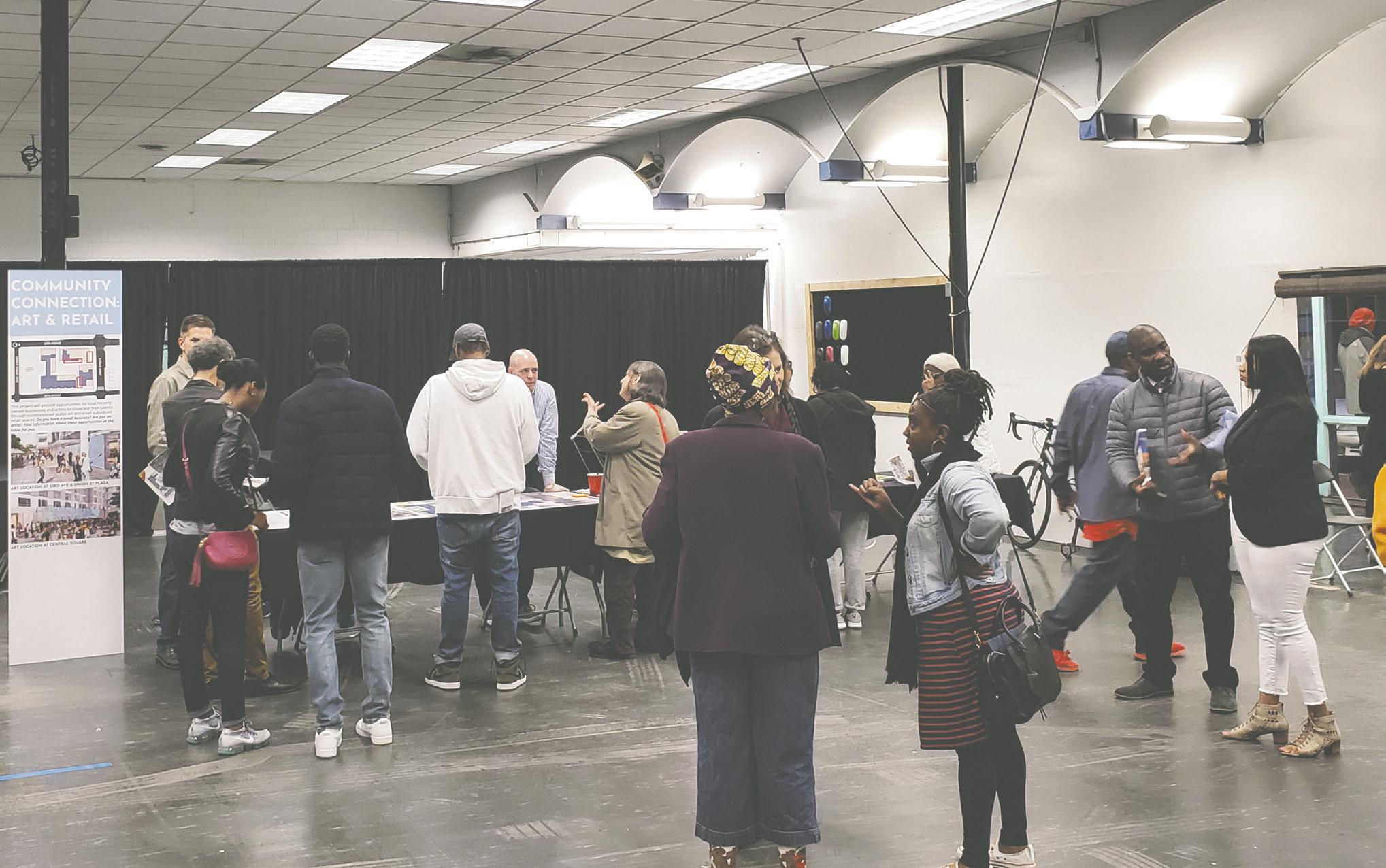
Lake Union Partners representatives were on hand at Midtown Center on Oct. 24 to gather additional community feedback about how the superblock redevelopment can feel more inviting and representative of the Central District.
The massing of the seven-story, 437,000-square-foot mixed-use development hasn’t changed since a July 18 East Design Review Board meeting, but LUP is taking direction from the board to better incorporate the desires of the community into an updated design. LUP and lead architecture firm Weinstein A+U will be back before the EDRB for another Early Design Guidance meeting 6:30 p.m.
Wednesday, Dec. 19.
“It’s more patterns and colors, for sure,” said LUP principal Patrick Foley of the Oct. 24 community design open house. “We’re trying to get a sense for what people see and what they like in the design.”
Another community open house was held 11 a.m. to 3 p.m. Saturday, Oct. 27, also at Carpapapa at Midtown Center, 1110 23rd Ave.
Following the EDRB meeting, the DLR Group was brought on to work with LUP and the Africatown Plaza LLLP, a shared entity of Africatown Community Land Trust and Capitol Hill Housing developing 20 percent of the superblock on
the south end, to engage the community and provide a vision for the project that reflects its desires.
“What I understand is what the early process, up through the beginning of the year, I think there was a fair back and forth with community engagement,” said Rico Quirindongo, DLR Group lead civic design architect. The process being carried out now is meant to determine what Midtown Block can offer residents in the community that would make them feel like they belong there and what would make them want to
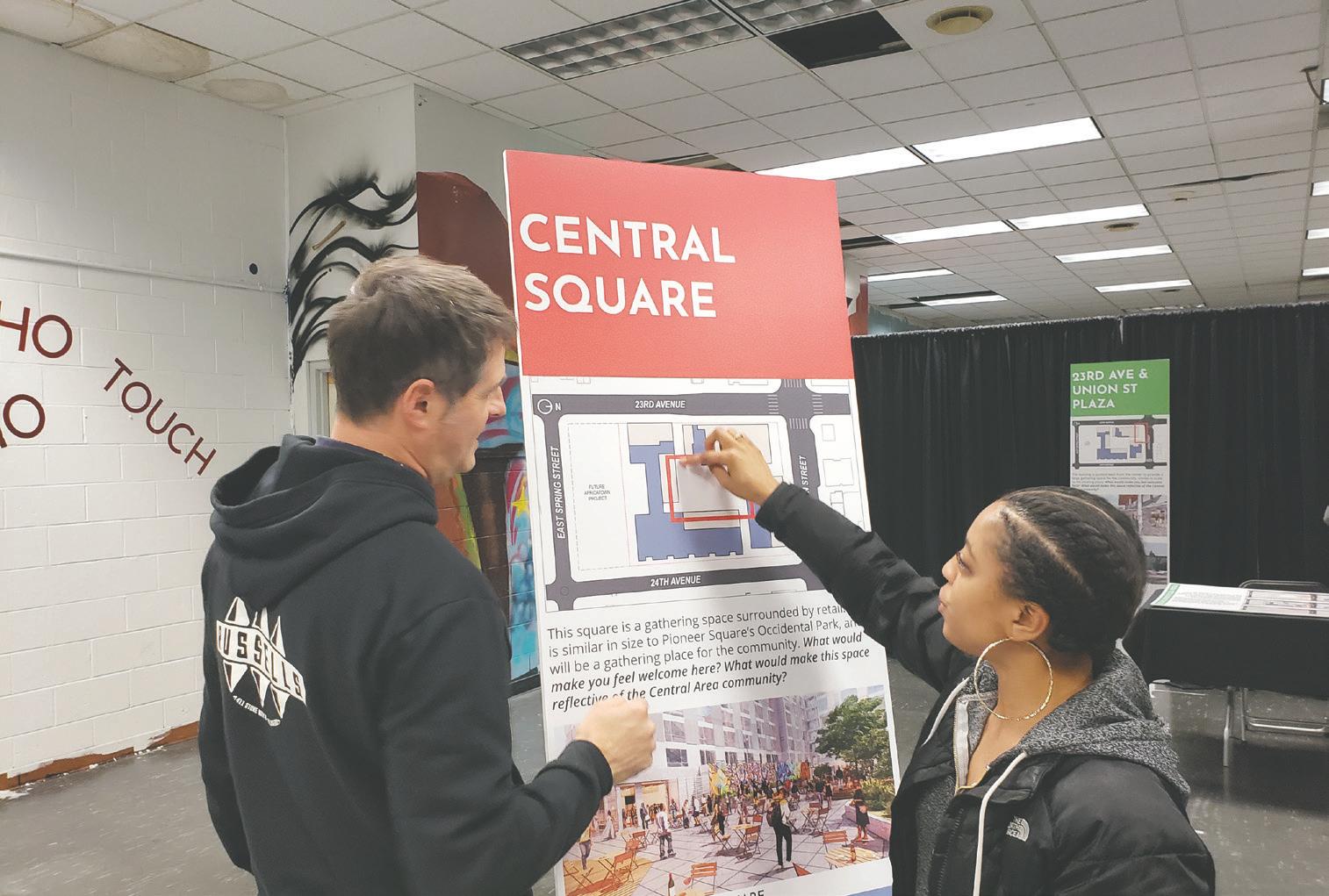
Photo by Brandon Macz Lake Union Partners principal Patrick Foley talks about the Midtown Block’s central square during a community design conversation on Wednesday, Oct. 24.
Jane Powers
MIDTOWN, from Page 1
be there, Quirindongo said.
Thirty percent of the 429 housing units at Midtown Block will be affordable housing, while Africatown Plaza will be all affordable housing units. Design work for that part of the megablock is farther behind Midtown Block, and still needs more funding and additional consultants, Quirindongo said.
Poster boards were set up around the open house, showing what corners of the Midtown Block and pedestrian entryways leading to retail and a central square will look like, as well as diagrams on tables where community members could place comments or requests for amenities like wifi, a farmers market, bike parking and additional seating.
Central District residents living around the Midtown Block at 23rd Avenue and East Union told the EDRB they wanted the design to better reflect the neighborhood’s African diaspora. They also said members of the EDRB — mostly white architects from Capitol Hill — didn’t represent them the way a newly formed Central Area Design Review Board does.
Foley confirmed during the open house that the Central Area Design Review Board will join the EDRB in assessing the Midtown Block project during the Dec. 19 meeting.
“I just want to see they’ve responded to concerns about making the interior court open to all, and I think that’s the primary element that’s in their charge,” said Jeff Floor, who serves on the Central Area Design Review Board and Central Area Land Use Review Committee.
The central square is 16,000 square feet, and will be surrounded by retail spaces, as well as seating, landscape and an art mural on one wall, which is expected to double as a space for projecting movies. A program manager will be in charge of activating the central square, which will be open to the public 24/7, Foley said.
The design team found opportunities for additional artwork in the public realm of Midtown Block, and will put out a request for proposals for artists on Nov. 1. Artists
will be selected by a panel of jurors comprised of community members, the architect, the developer, other artists and a representative of the James and Janie Washington Foundation. James Washington’s Fountain of Triumph will return to the block after construction; the James and Janie Washington Plaza will be at the corner of 24th and Union. Interested artists wanting to know more, or residents wanting to be jurors, can send an email to MidtownArtProjects@gmail.com.
A 12,000-square-foot drug store on the corner of 23rd and Union is expected to allow LUP to offer lower rates to smaller, black-owned businesses in the Midtown Block. Residents asked LUP to bring back the post office after the Midtown Center site is redeveloped, which is now happening, Foley said.
T“I’m trying to help find them a temporary location, because they’re going to need to leave at the end of the year here,” he said.
Earl’s Cuts and Styles in Midtown Center is relocating to the Liberty Bank building, the first CHH/Africatown partner development, which broke ground at 24th and Union in June 2017.
Quirindongo said the feedback from the two October open houses will be assessed, and Lake Union Partners will share an update on how it was incorporated into its latest plans for Midtown Block during a community design conversation 11 a.m. Saturday, Nov. 17. People who didn’t make the open houses can still weigh in on the project by taking a new survey at survature.com/ s/23andUnion2018.
he Madison Park neighborhood is rich in community, and it is a place I am proud and grateful to call my home. I am delighted that I will be continuing my journey here as a founding member of the Realogics Sotheby’s International Realty office in Madison Park. I have been honored to work with this company for the past few years, and am amazed at their gold standard commitment to elevating local real estate to a global level. The Park House is an opportune location at the perfect time that further connects hopeful buyers with exceptional homes, and I could not be happier to play an integral role.
Managing Broker | Senior Global Real Estate Advisor Founding Member | 206.399.5842 Laura.Halliday@rsir.com
For more information I invite you to visit www.LauraHalliday.com
PROVEN RESULTS
RSIR ranks amongst the largest, most productive and fastestgrowing real estate companies in Washington with access to 22,000 brokers in 72 countries that generate US sales of $80 billion+ annually.
WHAT MY CLIENTS ARE SAYING A CONTINUED LEGACY
Over the past three months, Laura has worked with us on a challenging contingent purchase within Seattle’s most competitive market. Laura navigated the extreme highs and lows of this stressful landscape with an ease, grace, cool and elegance that is unique to her. She is passionate about her work and is a true advocate for her clients. We are thrilled and thankful that we had Laura on our side. - ALI & ELLIE
Sotheby’s Presents Finest & Rarest Wines at Auction this Fall.
Photo by Brandon Macz
Lake Union Partners and lead architecture firm Weinstein A+U will be back before the EDRB for another Early Design Guidance meeting 6:30 p.m. Wednesday, Dec. 19.
8 questions to ask before going solar at home
(StatePoint) With a growing number of homeowners looking to save money on power bills and help the environment, rooftops across America are taking on a new look, as more homes are dotted with solar panels. But it’s important to ask the right questions before installing them on your home.
“While there are tremendous benefits to solar energy, consumers should be sure they are working with a qualified provider, getting a quality product that’s customizable and right for their home and situation,” says Doug Robinson, CEO of LGCY Power, a solar provider. “There are great resources out there such as SolarProviders.org that will walk you through the process of determining what solar is right for you.”
To help make the right decision, Robinson suggests asking your energy consultant the following questions:
• What are your credentials? Learn whether you’re working with a company with expertise in the field -- how long has it been in business and how many solar installations has the company performed to-date? You should also do your research about the company’s track record in satisfying customers.
• Do you have a national presence? Local operations don’t necessarily have the resources or partnerships with solar panel manufacturers to be successful long-term. Sticking with national companies can be a safer bet.
• What financing options are available? One size does not fit all so there should always be multiple options when it comes to financing. In some cases, you can even get solar systems for free. The key is researching options to find what’s best for you and your situation. If there aren’t financing options,
that is a sign that you should walk away and find another solar provider.
• How long will it take to begin realizing savings on my energy bill? It depends on your market and the size and type of system you get. Some consumers see an immediate savings and some see more long-term savings. On average people can save about 30 percent on their energy bill. There are ways to customize a system that will accommodate the individual needs of most consumers and in some cases, you can even get a solar system installed at no cost to you.
• Are there tax incentives available? Your energy consultant can help you identify what federal and state tax incentives are available to you. Taking advantage of tax breaks can help make the upfront cost of solar installation more manageable.
• Which manufacturers do you use? Ensure the equipment manufacturer will be around long enough to honor its warranties. Find out what brand of panels, inverter and batteries you’ll receive and if there are third-party reviews or tests of them to verify their quality.
• How does maintenance work? Find out how often your system requires maintenance and if it is covered by a warranty.
• What are the next steps? What is the process from signing the agreement to installation? How long does this take?
To learn more about going solar at home, visit lgcypower.com or call 844-439-2717.
Solar energy is not only a smart move for the planet, it’s a smart move for your wallet, with the potential to save your household considerable money over the long run. But making an informed decision is crucial. Ask the right questions for the greatest benefits.
SPU estimates 39th Avenue sewer pipeline repair costs at more than $1 million
Contractor to pay back department for emergency response
By Brandon Macz Madison Park Times editor
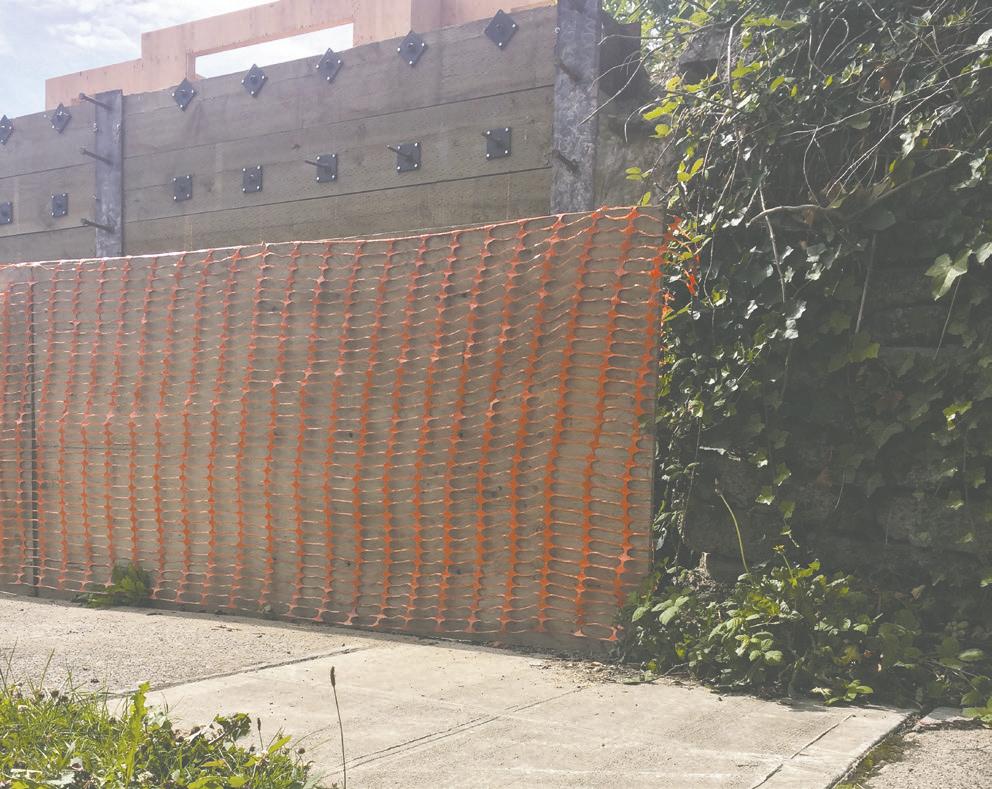
Seattle Public Utilities estimates the cost to remove and replace a sewer line impacted by a significant amount of cement entering the system in Madison Park will be more than $1 million by the time the issue is fixed.
SPU spokesperson Mary Kelley declined to provide any substantive information regarding how this issue arose, directing the Madison Park Times to submit a public records request.
Those records show that the issue arose at the site of a single-family residence at 3820 E. Howe St., where the owner was having a single-family residence torn down to make way for a new two-story home. Eric Jones received demolition and construction permits on March 21.
A private contractor notified SPU’s Operations Response Center of a sewer backup in a pipe running north and south in the western part of 39th Avenue East on Aug. 15. The pipe was checked with a camera, and cement slurry was found in the line. An SPU State Environmental Protection Act Emergency Repair memo issued on Aug. 21 states the mainline was 20-40 percent filled with slurry, and attempts to clear the line were unsuccessful. That meant putting in a bypass pump to avoid any sanitary sewer overflows.
“The sewer mainline runs approximately north/south impacting 250 feet of pipe between East Blaine and East Newton Street,” according to the document. “…The proposed work is considered an emergency (SMC 25.05.880) because it needs to be undertaken quickly to prevent an imminent threat of serious environmental degradation, due to possible failure of the sewer main and the associated risks to public health and safety and public and private property.”
While SPU tells the Madison Park Times it is still attempting to find the responsible party, a letter from SPU claims and litigation advisor Eric Duncan was sent to March-MacDonald, Inc. on Oct. 1. The contractor had been working at the construction site since July, according to city records.
“Once repairs are complete SPU will invoice you for costs that will include response and repair of the damage,” the claim notification letter states, adding MarchMacDonald should identify subcontractors who handled
shoring work at 3820 E. Howe St.
SPU had to skip the normal bidding process due to the imminent threat of system failures and sewer backups, and issued a $381,300 Red Packaged Emergency Contract to Titan Construction for bypass pumping, traffic control and trenchless obstruction removal.
Efforts to remove the grout using an inpipe robotic method were stalled because it had filled the brick maintenance hole (MH).
“Titan has stated they could try removal of the grout in the MH and restore the flow channel by using an impact hammer, or they can excavate and replace the MH in kind using Seattle standard specifications and standard plans,”
(Left) Cement slurry discovered in a sewer pipe back in mid-August became so bad that a contractor now has to excavate and replace the damaged line.
SPU believes shoring work conducted at 3820 E. Howe St. is what caused the cement to enter the system.
reads a Sept. 19 SPU Construction Management Division field memo. “SPU is directing Titan to attempt the removal of the grout from the brick MH with the full understanding that the removal technique may cause damage to the MH causing to need to be replaced.”
The grout was thought to have ended 55 feet south of the maintenance hole, but crews found it actually went 128 feet, according to an Oct. 8 email from Jade Sullivan, manager of small projects and emergency contracting for SPU’s Construction Management Division, to SPU Rehab Program manager Caroline Barlow.
“In addition, the grout was not easily removed and about 20 feet of pipe north of the manhole sustained damage to the host pipe,” the email reads. “It was found that the liner had bonded to the liner and grout removal by robotic method was no longer possible without destroying the existing liner.”
Titan had reached $448,000 in its Red Package rates by the time it was decided that excavation and restoration would be needed, which required a $395,000 change order. Added to the estimates for restoration were $206,000 in soft costs and $40,000 in contingency costs, according to the email, for a total budget projection of $1,093,000.
Kelley told MPT in early October that the excavation and replacement work was expected to last up to six weeks.
“There is temporary loss of some on-street parking and lane closures on 39th Avenue E., although local access will be maintained,” Kelley wrote to MPT.
Madison Valley Community Council to receive emergency preparedness tips
A representative from the Seattle Office of Emergency Management will be at the November meeting of the Madison Valley Community Council.
Residents will learn how they can individually prepare for a disaster event.
Meanwhile, the MVCC is discussing with surrounding community organizations how to work together during a major disaster.
MVCC secretary Diane Zahn said the organization is looking for someone who can lead those efforts, adding they do not have to serve on the board to do so. She can be reached at zahndsea@msn.com.
The meeting starts 7 p.m. Tuesday, Nov. 13, at the MLK FAME Community Center, 3201 E. Republican St.
(Left)
Images courtesy of Seattle Public Utilities
Holding pattern for stardom
Consider the list of little-known actors who were suddenly seen in a minor role, then zoomed to stardom: Lana Turner, Ava Gardner, Brad Pitt, Ben Affleck and Matt Damon, Julia Roberts — the list is long.
Sourwood (Oxydendrum arboreum) has been playing bit parts for years. The time for it to enjoy the starring garden role that it deserves is long, long overdue.
This lovable, beautiful, undemanding American native is the perfect garden-scale tree, the perfect four-season focal point for any small-city garden, the perfect showstopper for autumn color, winter interest,spring bloom, and unfurling foliage and summer leaves. In a word — Perfect! So where’s its Academy Award? I nominate it here and now.
Delicately scaled, Sourwood grows slowly and steadily to a height of 15 to 30 feet. There are examples of this long-lived tree in its native southeastern United States that have grown to 50 feet. It has a gentle, rounded crown due to evenly spaced and slightly pendulous branches. In winter the defoliated silhouette is striking. The leaves are narrow, 5 to 8-inches long, tinted bronze in
early spring when its tassel-like blooms appear. Come summer the leaves turn a rich green. In fall the foliage explodes in color: orange, scarlet, blackish-purple. All colors can be seen on the same tree at the same time, hanging on over a long period. Few trees have a more splendid autumn show.
At home in our loose, acidic soil, happiest when our winters give it a prolonged cold snap and a perpetual supply of rain water, this tree is a natural for the tiny urban gardens of Madison Park.
Look for Oxydendrum arboreum in full seasonal color this month in nurseries. Get it in the ground soon after purchase. Water it well. Like Japanese Maples, do not plant anything under it that requires cultivation, and keep the area under the tree, out to the drip line, grass and weed free.
A gentle sprinkling of a complete granular fertilizer (12-12-12 or the like) will assure steady growth and robust leaf color and flower production. I always recommend feeding lightly by the holidays: Valentine’s Day, April Fools Day, Memorial Day and The Fourth of July. Wet the soil under the tree. Scatter the plant food sparingly and water it in. Better too little than too much. Snip back the occasional errant branch.
Beyond that, there’s only one thing left to do. Enjoy this tree for a lifetime. And, with or without an Oscar, you’ll know very well that you are living with a star.
Steve Lorton Tree Talk
Photo by Mary Henry Tree Talk columnist Steve Lorton shines a light on the overlooked Sourwood tree.
New normal in the real estate market
WChris Sudore Property Views
herever I go, everyone has an opinion on the Seattle real estate market. There are those who think it’s been way too good and the crash is coming and are frightened into inaction. Then you find the ones who think it’s still okay, but we’ve moved into a slower time for sellers. Then there are others — usually transplants from other areas of the country — who can’t believe how active and profitable this real estate environment is,
They’re right, and they’re wrong.
The devil’s in the details, as no doubt you’ve heard. We’ve got to burrow into the data.
Not so simple
While those who say the market is down do have a point — it’s only in relation to a relatively recent look back. The numbers are down from the spring, but the early part of the year was insane. It was unsustainable, and buyers grew tired of it.
Sellers who price their homes according to what was being bought almost sight-unseen earlier in the year are either getting bad advice or are refusing to listen to better advice. Putting your home on the market with an unrealistic price will simply cause it not to sell. So they’re right that their home is not selling. They’re wrong in thinking they can get multiple offers, above asking price, with no contingencies, in days.
All the stories you are hearing about prices coming down in Seattle are due
to sellers pricing their homes from sales back in March and April. The market has shifted, and to sell, we need to shift with it.
In truth, we’re still looking at a strong real estate market in the greater Seattle area, and in the Madison Park area in particular. As I write this article, there are 83 active listings in our area, with 29 under contract. The absorption rate (months of inventory) is effectively 2.8 months. Still, that’s a difference from earlier this year, and people have a hard time calibrating change. You have to stop thinking in the past and pay attention to new norms.
Where we are now
While prices have adjusted, we’re still, on average, getting 100 percent of a home’s asking price. Homes are spending, on average, only 17 days on market. In one instance this month, one of my brokers had a buyer who made an offer on a home that was one of five. If a home is priced right, you’ll probably still see competition. And this is in October, not traditionally the hottest time of year for selling a home.
Another important data point for our new normal is what constitutes a neutral market, and we’re still on the positive side of that. Analysts use four to six months’ worth of housing inventory as an indicator of a balanced or neutral market. Our market is well below that point, at 2.8 months of inventory; we’re not even close to a balanced market.
While other large U.S. cities, and their metro areas, are certainly seeing a cooling market, we’re not, according to the data.
The pace of development is still fast, which indicates continued market strength here in Seattle — look at all the cranes working downtown. And our biggest advantage over the rest of the country is the number of major employers and the
SDOT responds to Madison Park feedback
Chief traffic engineer puts in work order after July meeting with pedestrian advocates
By Brandon Macz
Madison Park Times editor
Seattle’s chief traffic engineer Dongho Chang says pedestrian improvements are on the way for Madison Park after neighborhood advocates Ken Myrabo and Reg Newbeck gave him a walking tour of trouble spots back in July.
“It hopefully should be done in the next month or so,” Chang told MPT on Oct. 9. Much of the spot improvements will be made around the East Madison Street and McGilvra Boulevard East intersection, which SDOT added curb bulbs to this summer.
Newbeck said SDOT should have placed a marked crosswalk on the north end of McGilvra Boulevard, west of Starbucks, which Chang said will now become a reality. A double-center line will also be added, he said, so people don’t attempt to drive around vehicles stopped for crossing pedestrians. Newbeck said he’d like to see a
crosswalk on the south side, as well.
The floppy posts between the crosswalk on East Madison Street, between Wells Fargo and Starbucks, are often struck by turning vehicles — they notify drivers that it is a school crossing.
Chang said SDOT will put in “Tuff Curbs,” which are plastic curbs with reflective surfaces that provide a bump for drivers, “and then it’s easier for us to maintain that post when it does get damaged.”
This will also be provided at East Madison and East Garfield streets, and crews were getting that ready as of Oct. 11.
“It’s not too obtrusive, but it will be visible,” Chang said, “and it’s pretty low cost for us to make that improvement.”
SDOT crews have already replaced faded stop signs and pedestrian-crossing signs along East Madison Street in Madison Park, Chang said.
Newbeck reports there is a new sign on 43rd Avenue indicating where drivers can go.
jobs they create. People are moving here. They need to find places to live. We’re far from a crash.
What to do
The only thing we can control is how we react to these changes. If you’re selling, price your home realistically for right now, not six months ago. Get current comparable pricing on similar homes in the neighborhood. And get yourself an experienced broker. The experienced, datadriven broker can tell you whether you’re pricing too high or just right, based on the most current comparable home sales. If you’re buying, those comps will tell your broker whether you can come in
and negotiate with a heavy hand or if you need to be more reasonable. Look for a broker who has good, long-standing relationships with other brokers. If I’ve done a few deals with the broker representing the seller of a home my clients are interested in, it’s more likely she or he will let me know if there have been no other showings, or if the owners are willing to negotiate the price or other terms. As the market changes, having relationships and playing the game nicely with others will work in your favor.
Chris Sudore is managing broker at Coldwell Banker Bain | Global Luxury and a Madison Park resident. He can be reached at Chris@KingCountyEstates.com.
The hanging crosswalk lights on East Madison are no longer sanctioned by the city, but will remain until their scheduled replacement, Chang said, at which point they will simply be removed.
A 20 mph speed limit sign for southbound traffic will be put in, and a 25 mph sign drivers see as they enter the business corridor will be changed to 20 mph, Chang said.
Newbeck and Myrabo showed Chang a blind curve as McGilvra Boulevard East hits East Blaine Street during their July walkabout. Chang said SDOT will make changes that clarify where parking ends on the east side of the street.
“I’m glad to hear he’s going to do something on Blaine, but I hope people follow the no parking,” Newbeck said, adding he believes there will need to be enforcement to ensure it.
All crosswalks will eventually be remarked under SDOT’s regular four-year cycle.
The work order for all of the customerrequested spot improvements is in, Chang said, and SDOT crews will make those changes when they’re in the neighborhood.
“It seems our time with him seems to be well spent,” Newbeck said. “We can get SDOT to do things.”
Photo by Brandon Macz
Madison Park resident Reg Newbeck shows SDOT chief traffic engineer Dongho Chang trouble spots for pedestrians during a July walkabout in the neighborhood.
The roof is on fire
Seattle Fire Department recruits train in vacant Madison Valley home before it’s leveled for new construction
By Brandon Macz Madison Park Times editor
The Seattle Fire Department spent the last week of October setting fires inside a vacant Madison Valley house, so firefighter recruits could train for responding to real fire scenarios.
The single-family residence at 2711 E. Roy St. was already slated for demolition, to make way for new construction. Finding such a home, and a property owner willing to let the fire department use it for training, is rare.
“We look at the demo permits — online demo permits — and we start filtering from there,” said Deputy Fire Chief Phil Jose. Then they start making calls. “‘If possible, we’d like to do some fire training in your property,’” is how that usually gets communicated, he said.
The single story Madison Valley home was near two fire hydrants, and wouldn’t require the closing of any major arterial streets, Jose said, making it an ideal candidate.
This type of training occurs twice a year, and allows firefighter recruits to learn about the nature of house fires and how to tackle them through various scenarios in a controlled setting.
The fuel source is controlled, as is the structure itself. Firefighters come in before the training and set the houses up, adding a layer of plywood and up to two layers of sheetrock on the walls.
“All the things you see burning is not actually the house itself,” Jose said. The water and electricity are disconnected, and the donor home would have any asbestos abatement completed prior to training.
Twenty-eight recruits were expected to complete about 16 scenarios between Oct. 29 and Nov. 2. Their 15-week academy training will continue just past Thanksgiving. Jose said the academy started with 34 recruits, but two had to drop out due to injuries, and four others were removed due to performance.
Once they complete the academy, the recruits will have a one-year probationary period, which includes credit for the four months they spent in training.
On top of the tests they take regarding department protocols and emergency response, recruits also need to memorize the city’s layout, knowing where to find Seattle’s emergency rooms and schools, Jose said, and then being able to write down from memory the routes they would take. Once the recruits complete their one-year probationary period, they will be assigned a district, and their knowledge of it will be tested.
The Seattle Fire Department’s average emergency response time is four minutes, Jose said.
SFD encourages people to make sure they have smoke detectors in their homes, and also to close their doors before they go to sleep. That can keep the temperature lower in the event of a fire, increasing the chance of survival, Jose said. So: “Close before you doze.”
Controlling airflow through open doors
and windows is an important step in fighting fires, as is aggressively tackling fires with hose lines, so firefighters can get inside a home and search for occupants.
The Madison Park Times observed the second burn response on Monday, Oct. 29. Firefighters went to the back of the home, where they were met with a shuttered door. They initially struggled to pry it
open.
Seattle Fire Lt. Mike Daigle said he would have advised the recruits to communicate that to command more quickly.
“The sooner they can do that, the faster command can react to that and get their Plan B,” he said, “and send their fire attack in a different direction.”
After they’d made entry into the house,
removed the dummies that served as victims, and knocked down the fire, the recruits were debriefed on how the exercise went. Everything was put back in place, and they started all over again.
Seattle Fire had considered burning the home down for its last scenario — operational defense — on Thursday, Nov. 1, but then decided that would not occur.
Photos by Brandon Macz
(Top) Seattle Fire Department recruits run training drills at a Madison Valley home on Monday, Oct. 29. (Upper left) Fire recruits gain entry to the back of the house during one of the drills they ran on Monday. (Upper right) A training officer provides guidance to two recruits. (Bottom right) The fire training drills frequently involved removing and putting back roofing material.
Epiphany celebrating 60 years in Madrona
Independent primary school strategizing
for the future; open house on Nov. 29
By Brandon Macz Madison Park Times editor
After 60 years shaping young minds in Madrona, Epiphany School is balancing celebrating its past with deciding its future.
“I think we’re poised to really think a little more broadly about where we are going because of some of the opportunities that are available to us and, frankly, some that are thrust on us,” said Jenn Elkin, who joined Epiphany as head of school in July 2017.
The independent primary school is in the middle of its long-term strategic planning with Crux Consulting firm, which includes updating Epiphany’s mission and vision, while also working with Mithun architecture firm to determine how to more effectively utilize space available on the Madrona campus.
“Our enrollment has always been really good,” said Greg Jones, director of enrollment management and admissions.
“We usually have a waiting list.”
He said the school has a great financial aid program, but is now also exploring merit-based scholarships and other financial aid options.
Epiphany School has expanded its campus several times since the mid-90s, including the opening of Reed Hall in 2006 and Madrona Hall in 2010.
Elkin said the Madrona campus is large enough to accommodate the current educational program, but there’s no space available if Epiphany wanted to add a preschool, a middle school, or additional classes at each grade level. The existing footprint is being reviewed to identify shortand medium-term opportunities for maximizing space, she said.
“I think, for the longer term, most definitely there are all kinds
of potential great ideas to consider,” Elkin said.
Many private schools have added educational facilities in other neighborhoods, she said, and that’s not outside the realm of possibility for Epiphany.
Sixty percent of Epiphany School students come from three zip codes surrounding the school, and the school would like to draw enrollment from more neighborhoods as Seattle continues to grow and diversify.
Elkin said she and Jones have been working to engage current and potentially future community stakeholders, alums, Epiphany families and those that may not be familiar with the school.
Epiphany Parish Reverend Dr. Elmer B. Christie opened the school in 1958, but the school separated from the church 10 years later. Church facilities are still available to the school to rent, but the education is secular. Epiphany was accredited by the Northwest Association of Independent Schools in 1974, and reaccredited in 2013.
“I think it’s something that we know can be confused,” Elkin said, “especially with the name.”
Epiphany students still wear school uniforms, which Elkin admits is likely another reason for the misperception. She said administration has been exploring how Epiphany’s mission statement involves innovative teaching in a caring and traditional environment, and how innovation and tradition are words that feel like “polar opposites.”
While uniforms are tradition, Elkin said, they also provide a sense of equity.
“Where we go with uniforms? TBD,” Elkin said. “I think there are a lot of aspects of our history that we want to keep.”
In terms of innovative teaching, Epiphany educators recently
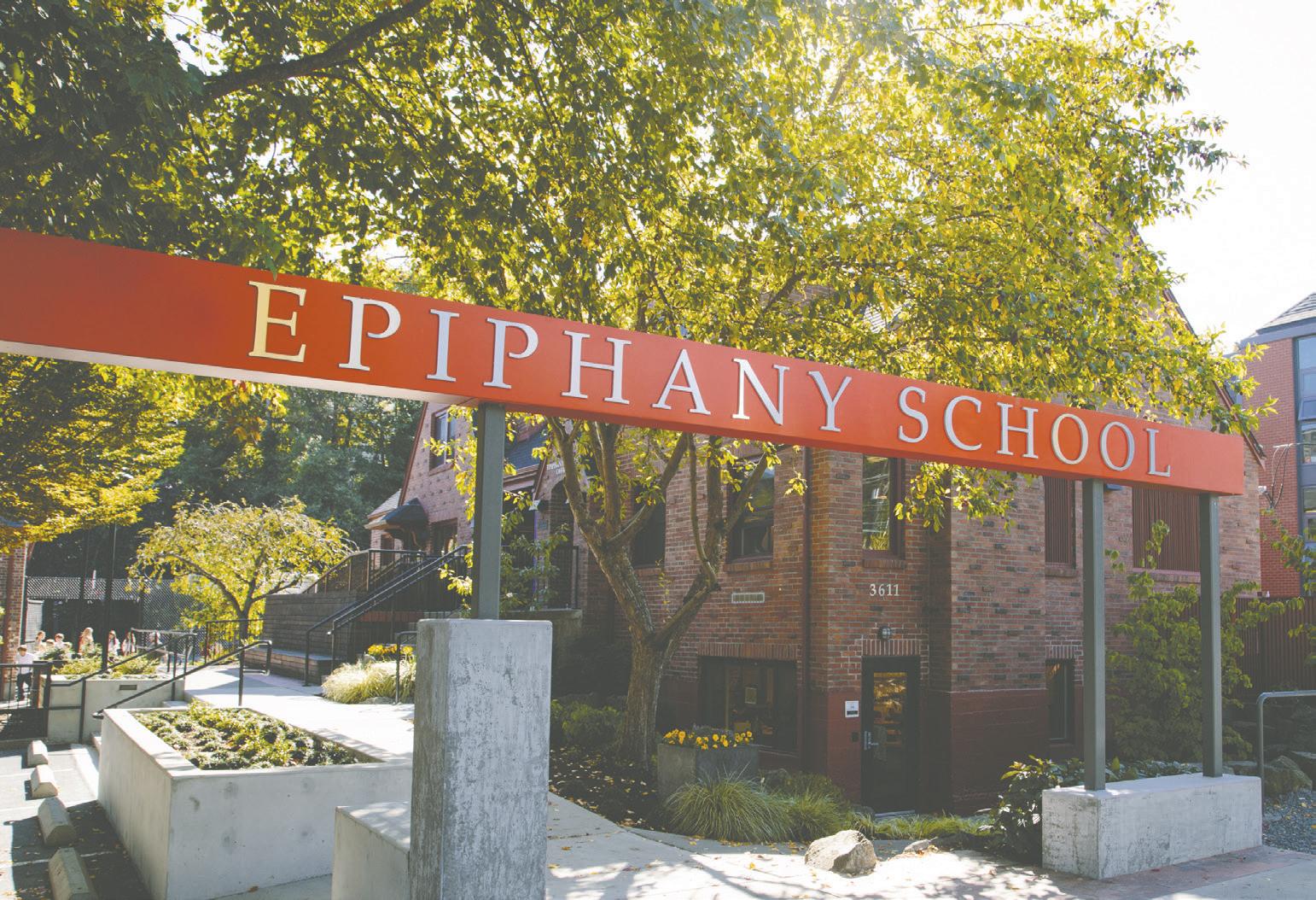
The Epiphany School in Madrona is celebrating its 60th year and looking toward the future with ongoing strategic planning this year.
received Responsive Classroom training, which is being implemented this year. The model focuses on academic success and social-emotional learning, where students are taught to understand their emotions and how best to react to them.
“Instilling confidence is a big part of what our teachers do, and what our mission aims for,” Jones said.
Seattle Public Schools teachers returned to work in early September, after their union and the district negotiated a 10.5 percent salary increase, avoiding a strike. Following a strike in 2015, teachers bargained for a 9.5 percent increase.
Elkin said teachers at Epiphany School are on the higher end of the pay scale for independent schools in Seattle, have good benefits and receive resources for professional development, which results in a healthy retention rate.
“These are all certain things that people want to know before they come on board,” she said.
While not a public school, Epiphany School does work to be a good neighbor, such as with its annual community carnival.
After Madrona Hall was completed, the campus was opened before and after school for local families to use, including Epiphany’s basketball court. That was part of the agreement reached when the school purchased four homes on the site for the $18 million project.
The Epiphany Parent Council also hosts an annual parent education lecture series that was opened up to the community for the first time last year, Elkin said. Find out more about Epiphany and its 60-year history at epiphanyschool.org.
The school will hold its annual open house for prospective families 6:45-8 p.m. Nov. 29, featuring a panel discussion with independent school consultants on “Choosing the Right School for Your Child” at 6 p.m.