
Expert Advice
Roofing

Justin Reynolds Manager
Q: I had my roof replaced 12 years ago with a 30 year shingle. It already needs to be replaced. What happened? Roofs used to last 20-25 years.
A: Asphalt is the main waterproofing ingredient in shingles giving strength and longevity. Due to improvements in the ability to refine a barrel of crude oil, less asphalt is available for roofing and road projects. And what is left for roofing lacks the quality that we received 20-25 years ago. We have found that by blending polymers with the asphalt, we can make shingles tougher and more durable. Our shingles will last 25-30 years.
For a free roof inspection, please give us a call at 269 342-0153 or visit us at worryfreeroof.com.
Sherriff-Goslin Roofing Co. Since 1906 342-0153 800-950-1906
Member Home Builders Association of Greater Kalamazoo
Health

Health Food

Q: What type of produce does Sawall’s carry?
A: Sawall’s has always carried local and certified organic produce. Its the very best quality that can be found. We receive produce orders almost every day! We also carry as much local produce that we can find seasonally. We are always looking for quality produce from local farmers. Come in soon and enjoy the areas largest selection of fresh CERTIFIED ORGANIC PRODUCE!!
Mon-Sat. 8am-9pm, Sun. 10am-6pm
Sawall Health Foods
Oakwood Plaza • 2965 Oakland Dr. at Whites Rd. • 343-3619 • www.sawallhf.com
Financial Services
Funeral Services

Q: Do I pay interest if I make payments on my prepaid funeral arrangements?
A: We offer different payment options to meet your needs. If you’re able to prepay in full, we can guarantee the cost of your funeral - locking in today’s prices and protecting you from future increases.
However, we understand that not everyone can pay in full right away. In those cases, we provide affordable monthly payment plans. Some funeral homes add significant fees to these options, but we do things differently - our goal is to keep it affordable for you and your family, without unnecessary costs. We’d love to discuss these options with you and your family.
Compassionate care, meaningful memories
Adams - Redmond Funeral Homes & Cremation Services and Adams Funeral Homes & Cremation Services
3 locations to serve you 269.343.6156 Kalamazoo 269.349.7735 Parchment 269.657.6347 Paw Paw www.adamsredmond.com www.adamspawpaw.com
Transitions


Q: What is a mini-stroke?
A: Some people may experience sudden weakness, trouble speaking or changes in vision that come and go suddenly. This is called a transient ischemic attack (TIA), sometimes referred to as a ministroke, and it’s a warning sign that a more serious stroke could happen in the future. This is why it’s important to seek emergency care right away, even if symptoms disappear. Use B.E.F.A.S.T. to recognize common stroke symptoms:
B – Balance: Sudden loss of balance or coordination
E – Eyes: Sudden vision changes
F – Face: Face drooping
A – Arms: Arm weakness
S – Speech: Speech difficulty
T – Time: Call 911 immediately
Neuroscience Center bronsonhealth.com/stroke (269) 341-7500


Henrich President & Owner
Q: Can you contribute to an IRA if you already participate with a company retirement plan?
A: Yes. You certainly can. For 2025, the maximum contribution to an IRA is $7000. If you are 50 years of age or older, you can add an additional $1000.
Something to consider is whether you will be able to deduct your IRA contributions during tax season. If you or your spouse have a company retirement plan, or your income is too high, you may not be able to deduct your IRA contributions.
Southwest Michigan
The Atriums • 4341 S. Westnedge #1201 Kalamazoo, MI 269-323-7964


Q: How much time should I allow for an appointment with a senior living community Sales Counselor?
A: Allowing up to 90 minutes for a personized appointment will give you a great start in understanding what options work best for your health age and finances as well as timing your move.
Friendship Village “Where Connections Matter” 1400 North Drake, Kalamazoo 269-381-0560 www.friendshipvillagemi.com
Mark Sawall Owner
Diana Duncan Director of Sales and Marketing
Julie Harning, PA-C, Neurology Bronson
Chuck
Kyle Kutlik
Chicken Dinner News
“Chicken Dinner News” is a term used to describe a specific type of local, small-town news, often focusing on community events, personal updates, and gossip. It is sometimes associated with regional or community newspapers rather than major mainstream news outlets.
The name comes from the idea that small town newspapers often covered mundane, local, or social community events, providing a distinct, often nostalgic flavor, compared to larger newspapers.
These little quick-reads were sometimes laughed and snickered at, but when they were gone, they were sorely missed.
Here are a few examples of “Chicken Dinner News” from old editions of small-town newspapers that I have accumulated from over the years.
September 25, 1902 edition of the Paw Paw Courier
C. A. Phillips has been quite ill but is improving at this time.
Miss Nora McFarlin spent one day last week in Lawrence.
There will be a Spiritualist meeting at Bankson Lake on Sunday, September 28 at 11am.
January 5 and 12, 1940 editions of the Vicksburg Commercial
Fred Freese has a beautiful mounted horned owl and a small hoot owl on display at the Niccum store.
Duane Rupert, local mortician, had the misfortune Tuesday evening of falling and breaking his leg in two places. He was descending the bank by the Gembis’ Oil station preparing to ice skate.
Mrs Beers has returned home from a visit with her son’s Lester and Chester
Bobby Harriman was struck on the head with a bat while playing baseball last Thursday. Fortunately he suffered no serious effects.
Ernest Harriman and Clyde Smith were thrashing beans at Eli Hutchison’s Monday.
Mr. and Mrs Alec Campbell returned from
Ontonagon County with a buck and a wolf, last Thursday.
Mr. and Mrs J. R Steiner motored to Traverse City Thursday to have dental work done.
The seniors have cancelled their play, “Look out Lizzie,” until December 5th on account of deer season.
January 7, 1926 edition of the Schoolcraft Express
Edwin Koon is out of school on account of an ulcerated tooth.
Wilma Cooper was ill with the measles during Christmas vacation.
Small-town newspapers published a hundred or more of these stories in each edition, many even made the front page. I am very curious as to where the information was gathered from. Did people send them in?
Today, Facebook is the modern day, “Chicken Dinner News.” I love reading various posts each morning, reading about grandkids’ sports accomplishments, new restaurants to check out and even asking for prayers for a relative’s upcoming surgery.



The November 29, 1934 edition of the Bellaire Record
Beers in Battle Creek.
Three friendly carhops at the Root Beer Stand.
Photo by Steve Ellis

Space is still the place
Lee A. Dean screendoor @sbcglobal.net
I hate to admit when a news story sneaks up on me. After a career in journalism and even longer time-consuming news, a big story should never take me by surprise. But the return of astronauts to the moon did just that.
The Artemis II mission should be a bigger story. The last mission to the moon took place in late 1972, when I was a senior in high school. As of this writing, the crew of Artemis II has traveled a longer distance than any humans in history. Yet the national media chose to downplay the story. After all, what’s a gigantic scientific achievement compared with the latest social media spat.
But the space program is dreaming big again, and I’m on board for all of it. As a child of the 1960s, I was spellbound by every mission of the Mercury, Gemini, and Apollo programs. Those first flights ignited a lifelong interest in astronomy and science fiction. “Lost in Space” led to “Star Trek” and then to “2001: A Space Odyssey.” In fiction, Verne begat Heinlein who begat Asimov who begat Bradbury who begat LeGuin, and so on.
Rocket launches were part of the fabric of our family’s life. All other activities came toa halt as we gathered around our TVs – first black and white, then color, and always Zeniths (the old man was a believer in brand loyalty). We took pride in aerospace firsts, such as John Glenn’s three orbits and the first space walk.
Then came Apollo, the program that would get us to the moon and win the space race with the dreaded Soviets. We stayed up late for that magical moment on Christmas Eve 1968 when the three Apollo 8 astronauts read Genesis 1:1-10 at lunar sunrise, a much-needed end to a harrowing year.
Our house was filled with four generations of family as we watched Neil Armstrong touch the lunar surface. The other first that day was the only time I ever struck a person in anger. My nephew wouldn’t sit still and be quiet, so I whacked him a good one. More triumphs followed, as did tragedy. Can you remember where you were when we lost the space shuttles? I was fast asleep in 1986, resting for a night shift at the South Haven Daily Tribune, when Wife the First called from her work and advised me to turn on the TV. I was at work in a normally loud Meijer store when Columbia broke apart on re-entry.
As the news spread, a somber quiet descended as everyone thought, “not again.”
NASA retrenched after the end of the shuttle program. One administration even floated the idea of having our crewed space program consisted of landing astronauts on an asteroid. In short, we lost our nerve.
We can all be grateful President Kennedy did not share such qualms. “We choose to go to the moon in this decade and do the other things, not because they are easy, but because they are hard,” he said.
The space program has always had its fair share of detractors. “Why do we want to waste time and resources going to the moon when we have all this trouble here on earth?” they ask. This question assumes there is no link between space exploration and earthly wellbeing.
The space program has given us cordless headphones, freeze-dried food, camera phones, scratch-resistant glasses, new types of athletic shoes, water filters, and more. Important medical research continues to take place in space. Tang was not invented by NASA, but the astronauts used it to mix orange drinks in flight. My brother and I begged Mom to buy a jar so we could drink it and be cool
dudes like the astronauts. There was no second jar -- the stuff was nasty.
Think of how the space program has enriched our vocabulary. Words like glitch, Roger, splashdown and liftoff are now parts of our everyday speech. When we are ready to start a project, we say “all systems go,” but when we encounter a difficult situation, we often proclaim, “Houston, we have a problem.”
Other benefits of space exploration are intangible. While the Cold War was at its most intense, American astronauts and cosmonauts were cooperating on the Soyuz space station. Astronauts have come from 43 nations, and today the governments of more than 70 countries have space programs.
We cannot afford to stay earthbound, just as a butterfly cannot stay in its cocoon. We need to reach out, to explore, to dare. And after years where our ambitions were severely diminished, I rejoice that we have reclaimed the vision of JFK.
In the 1960s and 1970s, we asked a lot of the astronauts and all those who supported them. They were up to the task. They had, to borrow the title of Tom Wolfe’s great book on the Mercury program, “the right stuff.”
Do we still have the right stuff? Artemis II suggests that we do. I’ll be watching and hoping I live long enough to see us get to Mars.
Butter Up Mom!
By Laura Kurella
I am very blessed to have been given not one but two very brilliant parents. I may have not known it (or ever said it) while growing up, but whenever I look back on those days, I realize just how wise they were with everything they said, and I am oh-so-grateful that I have a memory like an elephant to recall them all, too!
The wisdom they passed down really did add up through my childhood. In fact, if hard-pressed, I can nary recall a single nugget that has not, at one time or another, come to serve me in my adult life, especially those that I learned when I was in Mom’s kitchen!
Mom had a small bakery business that Dad would occasionally make attempts to help her improve, which one day triggered a heated discussion over, of all things, butter!
Dad had found a great deal on a 50-pound block of cheap butter, so he bought it, but Mom wanted nothing to do with it.
Shaking her head to indicate a “NO!” Mom also made herself verbally clear, “It’s Land O’Lakes or nothing Pa, because it’s the butter that makes my baked goods taste better than anyone else’s. If you take that out you’ll cost me all my customers!”
Fearing he would never let up, Mom decided the only way to end their butter standoff was to bake some cookies using his butter, so he could taste for himself.
“You’ll see!” Mom seethed between her teeth at him. Taking the whole thing quite seriously, Dad sat and watched Mom prepare the cookies using his butter, and I suspect half the reason he was there was to make sure she wasn’t adding in any funny business to make the cookies taste bad on purpose.

Serving Dad the cookies straight from the oven, he waited just long enough for them to cool before he began to eat them. Surprisingly, Dad didn’t even eat the whole cookie.
Mom used to say, “If you are going to go through the trouble of baking, never use anything but quality ingredients because it does indeed influence a recipe’s smell and taste. Plus, since today they add water to the cheap butter (hence the reason it’s cheap), so it can adversely affect a baked goods outcome, too!
Given that Mom loved lemon meringue pie, I thought it would be a nice tribute to her (and to Dad’s butter debacle) to serve up a recipe that tastes as good as Mom’s all-day-to-make pie in far less time. Enjoy and Happy Mother’s Day!
Laura Kurella is an award-winning home cook who loves to share recipes from her Michigan kitchen. She welcomes comments at laurakurella@yahoo.com.
Spectacular Lemon Meringue Pie Squares
Prep: 25 min.; Baking: 1 hour (18-20m crust + 25-30m
filling + 8-10m topping). Yield: 12-16 servings
CRUST
2 cups all-purpose flour
½ cup powdered sugar
¾ cup unsalted butter, cold
½ teaspoon sea salt
1 tablespoon lemon zest
FILLING
1 ½ cups granulated sugar
3 tablespoons cornstarch
4 egg yolks
3 eggs
1 cup fresh lemon juice
2 tablespoons lemon zest
TOPPING (optional)
3 egg whites
½ cup granulated sugar
¼ teaspoon cream of tartar
1 teaspoon pure vanilla extract
1. Preheat oven to 350 degrees. Line a 9x13 inch pan with parchment paper.
2. Pulse flour, powdered sugar, salt, and zest in a food processor. Add cold butter and pulse until it looks like wet sand. Press into the pan and bake for 18–20 minutes until lightly golden.
3. Whisk sugar, cornstarch, and zest. Whisk in the egg yolks and whole eggs, then slowly stir in the lemon juice.
4. Pour the filling over the hot crust. Lower oven to 325 degrees, then bake for 25–30 minutes until the center is set but still jiggles slightly.
5. Make topping, if desired, by beating egg whites with cream of tartar until foamy. Gradually add sugar and vanilla, beating until stiff, glossy peaks form. Spread over the warm lemon layer and bake for 8–10 minutes (or use a kitchen torch) until toasted.
6. Let cool completely, then refrigerate for at least 4 hours before slicing.

Hounds and Co.
By Richard Martinovich
When Franklin Roosevelt’s beloved Scottish Terrier Fala became ill from too many treats from White House staff, FDR issued a stern order -- “Not even one crumb will be fed to Fala except by the President!”
At Hounds and Co., it was digestive issues with the owners’ dogs that veterinarians were unable to diagnose that led them to make changes in diet, and understand the importance of nutrition in the health and longevity of pets. That is why the Hounds and Co. mission is to provide healthy options for dogs and cats in Portage and Kalamazoo. Everything at Hounds and Co. is focused on
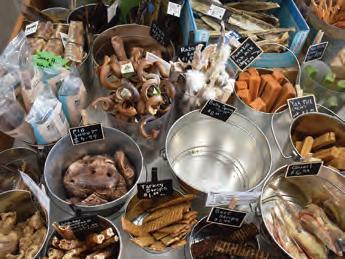

the optimal health and happiness of your pets. Customers have showered them with five-star reviews for the knowledge and friendliness of their staff!
You’ll find only high-quality food on their shelves that has been vetted by the owners, staff and customers. Organic, grain-free, human-grade, limited-ingredient -- and raw options. Though your dog may lounge on the couch, or sleep in your bed, there is still a wild animal lurking inside. Raw options like freeze-dried, frozen or dehydrated food can be a satisfying part of a balanced diet. Hounds and Co. is always keeping an eye out for new products that can provide better
health for your pet. If there is a specific food your pets love, they will either stock it, or special order.
Pet owners like their loyal companions looking their best! Hounds and Co. professional grooming services are lauded for their “fearfree” grooming. Every dog receives calm, one-on-one attention that includes a gentle bath, full brush out, nail and paw trim, ear cleaning, sanitary shave, and tidy face trim! Sign up for the Hounds and Co. loyalty pro-

gram to be alerted about special events and sales.
Hounds and Co. has a dog park on property, so Fido can romp around freely! Hounds and Co. is an independent pet store, and woman owned. Your pets are going to love it!

Photo credit: Lilana Kiszka



Book Reviews
Fagin the Thief
Allison Epstein

This is a retelling of the villain of Charles Dickens’s Oliver Twist from his point of view. We follow Fagin as he grows up in the Jewish community in East London and, despite his mother’s best efforts, gradually turns to pickpocketing as the only way of getting by. His father is already dead, but we see his desperate and unsuccessful efforts to save his sick mother, who is being ripped off by doctors. We see how he starts taking in street boys more out of altruism and loneliness than anything else. It’s a really sad tale, of the hardships of life in 19th-century London, but also occasionally comradeship and friendship.
Careless People: A Cautionary Tale of Power, Greed, and Lost Idealism
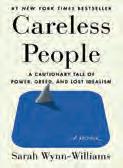
Sarah WynnWilliams
For seven years, beginning in 2011, the book’s author, Sarah Wynn-Williams, worked at Facebook (now called Meta), eventually as a director of global public policy. Now she has written an insider account of a company that she says was run by status-hungry and self-absorbed leaders. During her time at Facebook, Wynn-Williams worked closely with its chief executives Mark Zuckerberg and Sheryl Sandberg. They’re this book’s Tom and Daisy, the “careless people” in The Great Gatsby, who, as Wynn-Williams quotes the novel in her epigraph, “smashed up things and creatures” and “let other people clean up the mess they had made.” This book is darkly funny and genuinely shocking. An ugly, detailed portrait of one of the most powerful companies in the world.
This Is Not About Us

This time, Goodman trains her eye on the complicated relationships among the members of the fictional Rubinstein family and finds both humor and pathos in a modern Jewish American clan. In the first chapter, three generations congregate around the deathbed of Jeanne. The scene, in which Jeanne’s sons, daughtersin-law, and grandchildren, elder sisters Sylvia and Helen, and nieces and nephews gather to fuss and wait, might lend itself to sentimentality. Not in Goodman’s hands. By the end of the chapter, a squabble over an apple cake has blown up the relationship between Sylvia and Helen. The sisters are determined never to speak again. This novel chronicles all the events and moments that define the meaning of family. As Goodman recounts the Rubinsteins’ sibling conflicts, grievances, and grudges, their parenting triumphs and failures, and the many ways they all love and infuriate, push away, and yet crave to connect, she holds up a mirror to us all.
The Poet Empress

Shen Tao
When the ailing emperor of Tensha names Terren, his second son, as his heir, a search begins for young women to serve as concubines. Despite reports of Terren’s sadism, Yin Wei, the 16-year-old daughter of a rice farmer, presents herself as a candidate. After Terren selects Wei to be his Empressin-Waiting, he regularly subjects her to violence, including that of his magic blades. Fearing for the future of Tensha under his erratic tyranny, Wei determines to compose a heart-spirit poem, which, if used at the right moment, could kill him. She must teach herself to write poems that will strike directly to Terren’s heart.
Allegra Goodman
Book Reviews by the Portage District Library staff
Dedication of Service Makes a Big Impact - Gary Ausema
By Dale Abbott, Milestone Senior Services
Gary Ausema has lived in Kalamazoo since his family moved here from the Netherlands when he was eight. After retiring, Gary’s wife, Nancy, learned about Milestone Senior Services’ Meals on Wheels program which provides meals to older adults in the community who lack access to adequate nutrition. Gary and Nancy looked in to how they could get involved and soon became regular volunteers delivering meals in Kalamazoo. Gary says he’s been very blessed, and there is much to be thankful for. He recognizes that others are not as fortunate, and he has always had a passion for helping however he can.
Gary and his wife loved the volunteer work with Milestone from the day they began. They started with a driving route back in 2020, during COVID; but since then, they have switched to doing delivery at an apartment complex. The two of them do Crosstown Parkway Senior Apartments on Wednesday, and Gary also does delivery at Hope Woods Senior Apartments on Tuesdays and Thursdays. This means Gary is volunteering three days each week which makes an enormous impact.
Milestone’s home delivered meals program depends on the generosity of volunteers to give their time. Nearly all of the 32 delivery routes throughout Kalamazoo and Calhoun counties are handled by volunteers. Delivery happens each day, Monday through Friday, and most route utilize two volunteers, so that ends up being a lot of volunteers. People volunteer on what ever schedule suites them – some are once or twice a month, some are on-call as needed, and a few are able to volunteer weekly
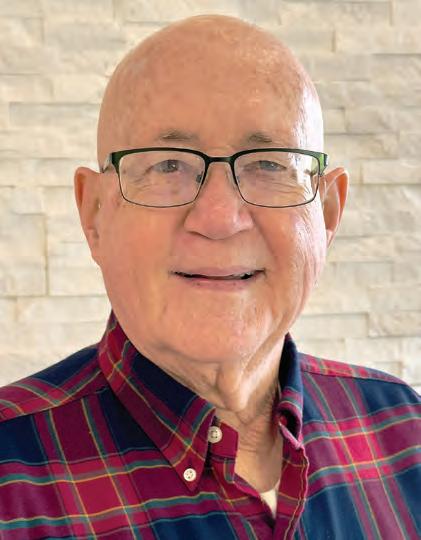
as Gary does, which is such a big help!
Each route generally has two volunteers each day – a driver (who drives the route) and a hopper (who hops out of the car and delivers the meal to the customer’s door). One advantage to having a regular schedule is that you are likely to be assigned the same route – this
is easier and faster for the driver because they get to know the route, and the hopper builds a bit of a relationship with the clients as they see the same faces and grateful smiles time after time.
Gary says he is continually reminded of how fortunate he is to be able to help – he does not take his health or ability to serve others for granted, and he’s so pleased he can do it. He feels deep gratitude from those he delivers to and realizes what he’s doing makes a difference to those he’s serving.
Gary expresses a genuine affection for the volunteers and staff he works alongside. Gary said, “The level of dedication is remarkable—not to mention the coordination and effort behind the scenes that make it all work, day after day, year after year.”
Gary is quick to point out that the rewards of being part of this kind of effort are far greater than most people expect. He’s simply grateful to play a role. Gary said that life has been a blessing for him, and he is intent on sharing those blessings with others for as long as he can.
Photo Credit: Jim Coppinger
Milestone Senior Services facilitates the AmeriCorps Seniors RSVP and Senior Companion Programs in Kalamazoo and Calhoun counties. AmeriCorps Seniors empowers people aged 55 and older to serve their communities. The RSVP program connects volunteers with opportunities throughout the community.department at 269-382-0515 or get started right away by applying on the Volunteer page of their website: www.MilestoneSeniorServies.org/Volunteer.

Systems & Technology in Music, Inc. (Systech)
If you were a musician during the 1970s, searching for your own unique sound, you might have encountered some of the nifty effects devices made by a small but vital Kalamazoobased manufacturing firm called Systems & Technology in Music, Inc., better known as Systech. The company may have been small but the products they invented and manufactured came to be used and revered by working musicians worldwide. Systech was the brainchild of Greg Hockman, a music fan and tech innovator from Pennsylvania. After college, Hockman became associated with Robert Moog, inventor of the Moog Synthesizer. He joined Moog as a sales rep in 1971 and played a significant role in the development and marketing of Moog’s groundbreaking new musical instrument, the Minimoog. As business grew, Hockman moved his family to Kalamazoo, where he could better focus on Midwest sales. But Hockman grew weary from life on the road. He left Moog in 1973 and formed Systems & Technology in Music, Inc., which became known for its innovative, yet rugged and reliable
by Keith Howard, Kalamazoo Public Library
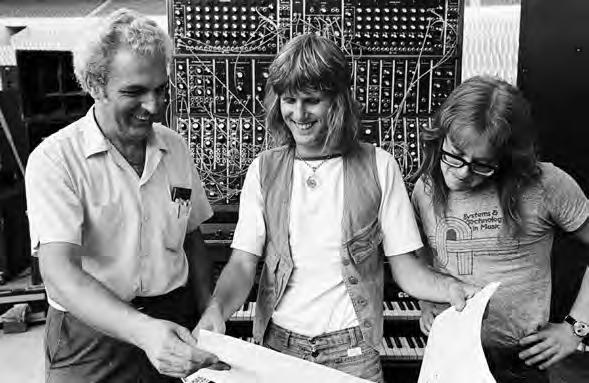
sound processing devices, including phase shifters, flangers, distortion pedals, and the like. Systech designed custom made touring gear for numerous musicians, while Hockman himself became well known within the industry as a synthesizer tech through his work with the likes of Rick Wakeman and the late Keith Emerson. The company’s inconspicuous warehouse on Kalamazoo’s southeast side would serve as a staging area for Wakeman’s keyboard setup as the band Yes

prepared for its 1977 worldwide tour. Keyboardist Eddie Jobson would later use the same space as a rehearsal hall for his upcoming tour.
Meanwhile, Systech struggled with the development of its own pro audio gear. By 1979, the company had ceased operation, and its assets were sold at auction. Greg Hockman went on to become the director of marketing and product development for music products at ElectroVoice, a world-renowned audio equipment manufacturer. Since then, he’s worked with such industry giants as Walt Disney Imagineering, Avalon Sound, and V Audio Pro. Hockman, now retired, lives in Southern California, where he remains closely connected with the pro audio industry. Systech’s effects devices, some quite rare, remain collectible among savvy musicians and vintage guitar nerds.
More at kpl.gov
Photo: Robert Moog, Keith Emerson, and Rich Walborn (of Systech), 1974. (The Bob Moog Foundation)

STULBERG INTERNATIONAL STRING COMPETITION ANNOUNCES 51ST ANNUAL COMPETITION
MAY 15–17
12 SEMIFINALISTS FROM 4 COUNTRIES TO COMPETE!

Building on the energy and celebration of its landmark 50th anniversary, the Stulberg International String Competition returns for its 51st year, welcoming 12 Semifinalists representing four countries to Kalamazoo for three days of world-class string performance. All events will take place at Dalton Recital Hall on WMU’s campus.
Selected from a pool of 226 applicants across 18 countries, all under the age of 20, this year’s Semifinalists represent the next generation of exceptional string talent on the world stage.
The Stulberg International String Competition is an internationally recognized competition that promotes excellence in string instrumental performances by gifted young artists under the age of twenty. Founded in 1975, the Stulberg Competition is based in Kalamazoo, and is committed to recognizing and nurturing emerging string talent and to enriching the cultural life of the Kalamazoo community.
Semifinals — Friday, May 15, 9 a.m. to Noon and 1 p.m - 4 p.m. (Free & Open to the Public)
Community Master Classes — Saturday, May 16, 9 a.m. to Noon (Free & Open to the Public) Finals — Saturday, May 16, 7:30 p.m.
NEW THIS YEAR — Semifinalist Masterclasses — Sunday, May 17, 9 a.m to Noon (Free & Open to the Public). For the first time, all 12 Semifinalists will have the chance to work one-onone with the competition judges in a public masterclass, offering audiences a rare behind-the-scenes look at the artistic coaching process.
For tickets to the Competition Finals or for more information please call the Stulberg office at (269) 343-2776 or visit online at stulberg.org.


I CHEER, YOU CHEER, WE ALL
CHEER FOR ROOT BEER STAND
By Dave Person david.r.person@gmail.com
Who knew a hot dog and a root beer could be a lifechanging experience?
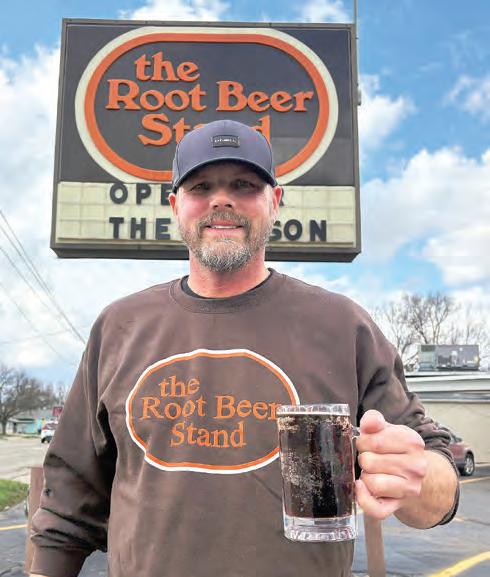
It was for Brad Block. He met his future wife, Heather, who was working at The Root Beer Stand, 4400 S. Westnedge Ave., when he took a break from his construction job to grab a bite to eat. That encounter led to romance and, ultimately, marriage in 2003.
When they married, Heather, who had worked at The Root Beer Stand since she was 15 and had used it to fund her education at Western Michigan University, was ready to start her own business.
“She said, ‘I want to put up a Root Beer Stand,’” Block says, so he obliged by buying a former Hot ’n Now in Paw Paw and converting it into a fourth Root Beer Stand location. The other three were in Kalamazoo.
Third-generation Root Beer Stand owner Rick Schmitt gave the Blocks his blessing on the enterprise, Brad Block says.
Four years later, the Blocks purchased the other three Root Beer Stands from Schmitt, closing the one that was located in downtown Kalamazoo at 4430 W. Kalamazoo Avenue and keeping the ones on Westnedge and at 3100 Portage Street, in addition to the one in Paw Paw.
Brad Block continued to work construction for two more years while Heather oversaw the restaurant

operations, but then he quit his construction job to help her. He managed the Westnedge location and she ran the one on Portage Street.
A few years later, they closed the Paw Paw drive-in, and after that sold the Westnedge location to Heather’s brother and sister-in-law, John and Abby Copp. John Copp also has a long history with the business, having started working at The Root Beer Stand at 14, joining his sister who is five years older than him. Block thinks the success of the business is due to its throwback style.
“It’s a lot of nostalgic sort of stuff,” he says of the limited menu and the car hops eager to serve customers in their vehicles.
“Society’s kind of gone away from this business model,” he says.
The Root Beer Stand even helped in the healing process in the wake of the Covid outbreak in 2020, Block says.
Before people could patronize dine-in restaurants following Covid, they were able to be served in their cars.
“Both stores were slammed,” Block says. Customers rolled down their windows and excitedly talked to each other after having been confined to their homes for so long.
“People were so happy to be out and about; it was really a beautiful thing to see,” he says.
The success of the businesses under the ownership of the Blocks and Copps is music to the ears of Dick Schmitt, Rick’s father.
Dick Schmitt, who is 95, was just a baby when his parents, Norman and Isabelle Schmitt, started an A&W Root Beer Stand on Portage and Lake streets in 1931.
“My mother and dad came from La Crosse, Wisconsin, and opened the first A&W Root Beer Stand in Michigan,” he proudly proclaims.
Over the years, locations changed and were added and subtracted — the Portage Street drive-in opened in 1934 after his parents’ lease expired at the original location and the equally successful Westnedge drive-in was added in the mid-‘60s, Schmitt says.
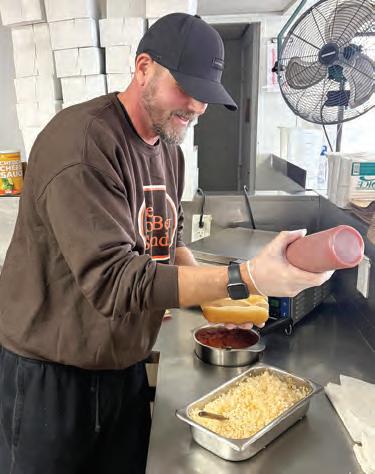

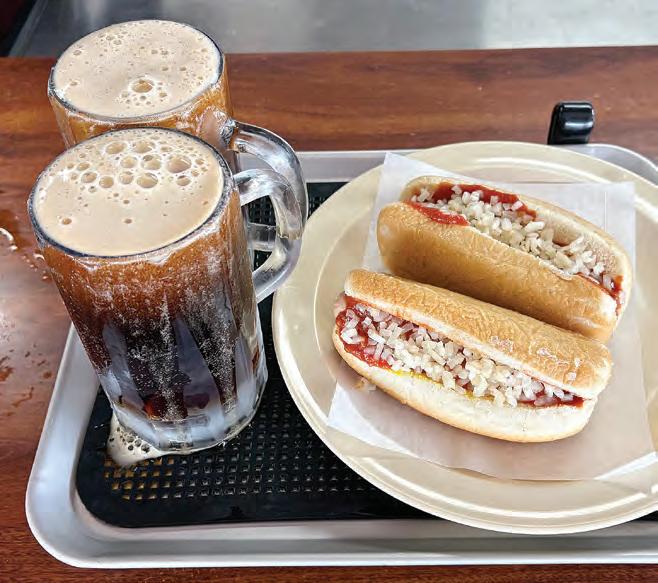
All have featured the signature offerings of hot dogs and root beer, served at your vehicles by car hops.
In 1981, after 50 years, the Schmitt-owned drive-ins dropped their affiliation with A&W, which wanted its restaurants to have inside seating, and just called itself The Root Beer Stand.
mid-February through mid-October.
“We have a lot of repeat customers, a lot of loyal customers,” Block says.
There is even one couple that shows up almost every day, and if they don’t, the staff gets concerned.
Block says the Portage Street restaurant has 12-15 employees during the peak season, many of whom are high school and college students.
“We do target those people a lot because it works out for us,” he says. Then “from mid-October to mid-February (when the restaurants are closed) it gives them time to concentrate on their studies.”
Block does the maintenance and paperwork at the Portage Street drive-in, allowing Heather, 48, to run the restaurant, he says.
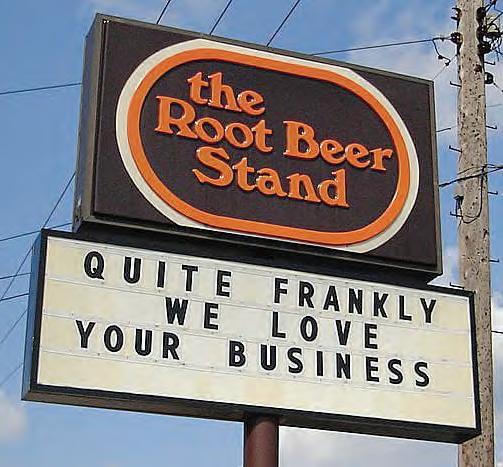
“We changed the name to what everyone called us anyway,.” Schmitt says.
It was also about that time that Dick Schmitt turned the drive-ins over to his son.
Brad Block, 50, also a WMU alum, says the restaurants have kept many of the Schmitts’ traditions alive, including the recipe for chili that Dick Schmitt says was developed by his mother.
Both of The Root Beer Stand locations also continue the tradition of opening for the season in mid-February, when there is often snow on the ground.
Their customers don’t seem to mind though.
“It’ll be 20 degrees out and we’ll have a full lot,” Block says.
The restaurants are open Monday through Saturday 11 a.m. to 7 p.m. and Sunday noon to 7 p.m. from

Dick Schmitt, who still keeps on top of what is happening at the drive-ins, is excited about the future of his family-initiated business, which is now in its 96th year.
“We’re trying to go for 100,” he says.
The Blocks’ goal is much loftier.
“I’m sure we’re going to go longer than that,” Brad Block says.







WILD ONES Caterpillar Compulsive Behavior
Taking early retirement from my work as a research chemist gave me time to pursue my interest in nature. After a couple of years of keeping notes on my nature observations it occurred to me that other people might be interested in learning about these amazing critters that I was finding. I knew how to write chemistry reports but had not written anything else since English composition as a freshman in college. For years the Kalamazoo Gazette published weekly “Nature’s Way” columns. Maybe I could write articles for that column? I dove right in, writing up observations in a factual style like a chemistry report.
This collection of essays is on butterflies and moths. But what led to my interest in them? My husband Russ and I were removing invasive honeysuckle shrubs from the property we had moved to after we retired. As I was hauling cut off branches to a brush pile, I found a monarch chrysalis attached to one of the branches. I brought it inside and a few days later the butterfly emerged, setting me on the path of looking for the critters that were eating the native plants we were planting on our property.
In choosing the essays for the monarch section, I realized how they reflected the progression from a simple interest in its life cycle, to contributing to monarch citizen science projects, to an actual research project of my own. It also reflects on

the knowledge I have gained over the years on insect life, the importance of their conservation, and what we can do—convert lawn to pollinator habitat, plant native plants to provide both larval food plants and nectar sources for the adults, and rejoice when your plants show chew marks. When you find the insects chomping away at your plants, don’t think “I must get rid of them because they are hurting my plants.” Take a photo with your phone, try to figure out what they are, report them to iNaturalist. It’s fun! It’s addictive! There is a name for it! CCB, Caterpillar Compulsive Behavior.
I hope that you, the reader, find these essays informative and fun, and that they inspire you to take your own path of adventure and explore the creepy-crawlies with whom we share the world. You don’t need to be an entomologist or travel any further than your own backyard. All you need is curiosity. With curiosity comes knowledge, leading to the desire to protect what you love. They deserve our protection, not only as fellow beings, but also for the services they provide us.
The above is excerpted from Ilse Gebhard’s introduction to Without a Net: Adventures with Butterflies and Moths, a digital book published by Kalamazoo Area Wild Ones.
The book is available for purchase on our website: https://kalamazoo.wildones.org/.

Variegated fritillary chrysalis. Courtesty Ilse Gebhard
Spotted apatelodes catepillar. Courtesty Ilse Gebhard


Engrained With Grace
I was contacted by Brenda Bowers, the very proud grandmother of Emily Worrall.
She told me that her 19 year old granddaughter lives in Portage and is a homeschooled student that accepted an opportunity to take a Wood Tech class at Portage Northern High School. She discovered she had a passion for woodworking and decided to take a second year of Wood Tech. During that time, she developed a growing business, creating custom cutting boards that she sells at various outdoor markets and businesses.
After graduation, she spent the summer working for a local custom woodworking company while continuing to fill custom orders.
Together with her dad, they have built a small shop in their garage. She is also a member of the Kzoo Makers enabling her to use their equipment. More of her great wood work and contact information can be found at her instagram page: engrainedwithgrace or at emmygrace 4507@gmail.com





Steve Brown’s Poetry Explores Link Between Humans, Work, Nature
By Tom Springer, Vice President for Development
It’s for good reason that Steve Brown’s boyhood nickname was eagle eye. In the wild, he could spot a bear, deer or hawk in the sky before anyone else did. It was a useful skill for a Boy Scout who grew up on the semiwild margins of suburbia. Now, as a poet, Brown’s peripheral vision still finds things that others discount or miss altogether.
“I learned from my Dad who was comfortable talking with anyone, whether they were a four-star general or some guy lingering outside a liquor store,” Brown said. “He had this mid-century democratic sensibility that put him at ease with people.”
Brown showcases his acute powers of observation, and affinity for the dignity of downtrodden but redeemed humans and places, in his books News of Need, (2025) and Fellowship (2026). He will read selections from both during a free public program at the Kalamazoo Nature Center from 10:30 am to 12 p.m. on Saturday, May 16. The event is sponsored by the Terry Todd International Speaker Series.
Brown’s work often delves into places where technology or economic change have made humans feel obsolete. This includes the industrial detritus of massive factories left idle and crumbling, where nature has surged into fill the void. He also numbers rural people and landscapes among those who suffer from the toll of automation.
In “Big Running Water Ditch,” Brown depicts a fallow
farm field in Arkansas. There’s no sign of human activity – unless you count “green robots named after a man to plow under the blossoms at night.” The inferred irony here is that the real John Deere never bargained for this. (Then again, as a manufacturer of “laborsaving” machines, maybe he did.) For Brown, the dire consequences for people endure either way:
“Robots are the only sound on Earth. Birds’ wings breathe too softly overhead to overhear over the drones, even in their millions. The telephone never rings late Sunday now with news of need that must be filled by men’s bodies and once seemed endless as rivers of fowl marking seasons that the 24/7 pulp paper mill cannot mark”
One can picture a displaced farmer, raised in the mutual support ethic of a rural community where neighbors pitched into harvest crops as “news of need” dictated. But who does a broken robot call? For Brown, even three young workers in “filthy Taco Bell shirts” lose out. Taco Bell has chosen their rural town for its first automated location.
Brown’s varied occupations – he calls himself a “professional imposter” – include roofer, carpenter, librarian, landscaper, cook, and commercial artist.

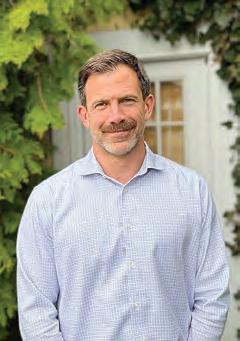
These days in Kalamazoo, apart from his poetry avocation, he is executive director of the Foundation for Excellence. Yet his upbringing in rural, suburban then urban places gave him an outsider’s ability to explore human and natural contours wherever life takes him.
“When I went to college in Detroit, it was the nadir of pre-bankruptcy,” he said. “There were pheasants flying in abandoned lots and forest animals walking the streets. You’d see buildings with a 40-foot Ailanthus tree growing through them and ferns hanging from the upper stories.” His graduate studies in Leipzig, in then East Germany, and around the defunct paper mills of Parchment echoed the same rust belt story.
With his newest book Fellowship, Brown’s work elevates people who collectively heal from the wounds of displacement and neglect. “The overall sense in Fellowship is about people who find mutual support through sobriety, faith and brotherhood. That’s what makes our lives and work meaningful, being of service. Pleasure is good, but as a motivating force it’s not strong enough to last 24 hours a day.”
Tom Springer is vice president for Development at the Kalamazoo Nature Center and the author “Looking for Hickories,” and “The Star in the Sycamore.”





DBSA Depression and Bipolar Support Alliance
Based on current regional population data and state health prevalence rates, it is estimated that approximately 180,000 to 185,000 individuals in Southwest Michigan experience some form of mental illness.
This estimate is derived from a total regional population of roughly 783,300 across the seven to eight counties typically defined as Southwest Michigan (including Kalamazoo, Berrien, Calhoun, Van Buren, Allegan, Cass, St. Joseph, and Branch) and a state prevalence rate of approximately 23.1% for adults with Any Mental Illness (AMI).
This estimate is derived from a total regional population of roughly 783,300 across the seven to eight counties typically defined as Southwest Michigan (including Kalamazoo, Berrien, Calhoun, Van Buren, Allegan, Cass, St. Joseph, and Branch) and a state prevalence rate of approximately 23.1% for adults with Any Mental Illness (AMI).
DBSA (Depression and Bipolar Support Alliance) groups provide the kind of sharing and caring that is crucial for a lifetime of Wellness.
The DBSA support group meets every Monday from 7:00 to 8:30 p.m. at Portage Chapel Hill United Methodist Church 7028 Oakland Dr. in Portage For more information, call 269.599.2782 or go to: dbsakazoo.org and DBSAlliance.org

HEALTHY LIVING
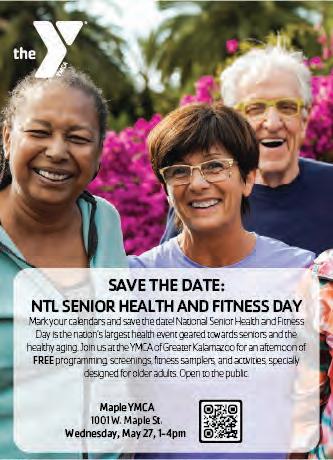
NATIONAL SENIOR HEALTH AND FITNESS DAY
Get your highlighter out and mark Wednesday, May 27th on your calendar, because it’s National Senior Health and Fitness Day! It’s the largest annual health and wellness event for seniors across the entire U.S., with over 100,000 folks participating at over 1,000 locations. And yes, the YMCA of Greater Kalamazoo is hosting a FREE special afternoon event dedicated to celebrating an important message: that health & fitness is important for seniors! (See our ad in this Spark issue for details.)
Truth is… it’s never too late to dust off those aspirations for feeling better, moving with greater ease, and connecting with others. Maybe it’s a restart – maybe it can be an opportunity to fine-tune your well-being. Imagine this: a chance to try a lively

group exercise class that gets your body moving and your spirits lifting. Perhaps you’ve been curious about the calming benefits of Tai Chi or the strengthening power of a senior-friendly fitness class. The Y at Maple will be offering opportunities to sample different activities in a relaxed and welcoming environment – no pressure, just pure exploration, learning, and pushing yourself to something new.
But the day isn’t just about getting active. The Y will also be hosting various health-centric vendors and service providers. Think of it as a convenient hub to discover local resources, ask questions in a comfortable setting,


and gather valuable insights to support your well-being journey.
And perhaps the most heartwarming aspect of all? You’ll be surrounded by
a community of individuals who are on similar paths. Whether someone is a seasoned wellness enthusiast or just taking their first steps towards a healthier lifestyle, the collective energy is truly uplifting. Being amongst like-minded people, sharing encouragement, and celebrating every achievement, big or small, is incredibly inspiring.
The beauty of embracing a healthier lifestyle is that it doesn’t demand a sudden, drastic change. It’s about making small, sustainable choices, one step at a time. It’s about recognizing that you deserve to feel vibrant and engaged, no matter where you are on your personal journey. And remember, you don’t have to navigate this alone.
Are you ready to explore the possibilities of feeling even better, stronger, and more? Come join us, bring a friend, and let’s celebrate the fact that every day is a great day to embrace a healthier, happier you.
P.S.: Bring your sneakers. And bathing suit. A towel will be good, too.
Submitted by Vicky Kettner, Association Director of Marketing, Community Relations, and Member Engagement at YMCA of Greater Kalamazoo.



If I Had Legs I’d Kick You (2025)
I feel I must admit to having a fascination with films that feel like an anxiety attack come to life. If you enjoy a bit of secondhand frustration and fits of nervous laughter, the latest dark comedy from WriterDirector Mary Bronstein might be right up your alley. Rose Byrne (Bridesmaids, Troy) is Linda, a therapist with at least a handful of patients with boundary issues, a husband who is often away at sea, and a young daughter with a severe eating disorder which requires a nightly feeding tube. Linda already seems put-upon when we meet her, but when her bedroom ceiling collapses due to a massive water leak that requires her and her daughter to relocate to a hotel, things start to spiral. Her own therapist, who works in her office (seems like a bad idea), and is played with icy indifference by Conan O’Brien in an exceedingly rare film performance, is clearly ready to fire her as a patient. Her daughter’s doctor believes Linda is not taking treatment seriously, and her absent husband’s phone calls wondering why things aren’t going well around the homestead are certainly not helping. She self-medicates with cannabis and alcohol and tries to keep a stiff upper lip, but it’s obvious that Linda is coming undone. Rose Byrne is transcendent in her unraveling, turning in a spectacular performance which netted her an Oscar nomination. Viewers beware, unless, of course, you like this kind of thing. –
Submitted by Patrick J.
Films at 50 (1976)
1976 was a bountiful year for film fans worldwide. Several of the year’s most popular releases were also immediate hits with the critics; Rocky, featuring its writer Sylvester Stallone as the titular pugilist, was the year’s number one box office draw in US theaters, while the film adaptation of Woodward and Bernstein’s Watergate exposé All the President’s Men also hit the year’s top 10. International films from established directors (Ingmar
Movie Reviews
faut’s Small Change) and rising auteurs alike (Bruno Barreto’s Dona Flor and her Two Husbands; Chantal Akerman’s News from Home) garnered accolades and filled arthouse seats, joined by master classes in documentary-making (including Barbara Kopple’s Harlan County USA and the Maysles brothers’ Grey Gardens). Having spent the better part of a decade embracing the freedom the MPAA’s rating system allowed, American filmmakers such as Martin Scorsese (Taxi Driver) and Sidney Lumet (Network) pushed the envelope with bold storytelling which continues to influence today’s film creators. Discover (or rediscover) these, and more, from this vital year in cinema by visiting Kalamazoo Public Library, in person or online (https://www.kpl.gov/ collection/films-at-50-1976-videos/). –Submitted by Karl K

Spirited Away (2001)
Arguably one of the greatest animated films ever made, Hayao Miyazaki’s Spirited Away often lands near the top of the lists of greatest films of the 21st century. Released in 2001, the elaborately layered parable, grounded in contemporary themes (environmentalism, consumerism) and Japanese folklore, follows the journey of Chihiro Ogino and her parents, who accidentally enter an abandoned resort town, become separated, with the parents transformed into pigs by a witch (Yubaba), and Chihiro desperately trying to survive an alternative world of spirits and capricious creatures. Aided in her attempts at returning to the human world with her parents by a young man named Haku, Chirhiro takes work in a giant bathhouse, where the ten-year-old girl encounters a cast of shapeshifting characters including the ominous No-Face. Deeply rooted in Miyazaki’s usage of Shinto-Buddhist concepts of the metaphysical, the wildly popular and commercially successful movie has been positively compared with Lewis Carroll’s Alice’s Adventures in Wonderland for its storytelling structure. Rich in color and imagery, Spirted Away is an enchanting fairytale that explores the ways in which modern Japanese society has been negatively impacted by its embracing of Western, consumerist values. – Submitted by Ryan G.
Reviews submitted by Ryan Gage. These great titles and others are available at the Kalamazoo Public Library.
Grieving Through Sculpture
By Carson Williams
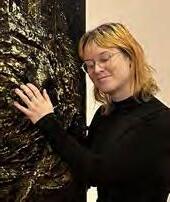
Elise Head moves through death and grief through sculpting. Her latest installation, three years in the making in their studio in the Park Trades Center in downtown Kalamazoo, is called “Collapsing Time” and refers to her process of grieving her sister’s death. “When I heard the news that my sister had passed away I went into shock,” Head’s installation description reads. “Colors were saturated, my arms and legs went numb, and my hands became fists. Time seemed to stretch out in front of me as a hallway. In my future there, I was making art and helping people.”
The installation consists of a black door in the middle of a salt circle. The side of the door that faces the installation entrance has attached a clay mold of Head’s face, what she refers to as her “death mask” with sculpted hands underneath. “The door represents transition…a threshold that can only be passed through once,” Head said. “The death mask and fists
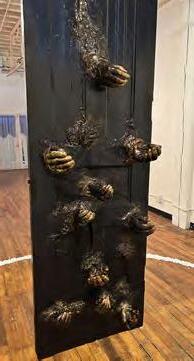
[are] in a state of hyper freeze.” The other side of the door, facing the wall, has more hands sticking out from the door with strips of black cloth laid in each palm. The cloth pieces are to be placed on the hands as offerings. Each
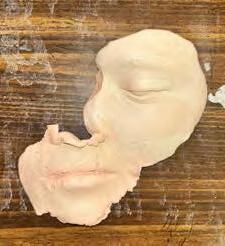
hand was created from a mold cast from classmates of Head through the Kalamazoo Institute of Art’s course titled “Befriending Death,” which helps people work through grief through memorial making.
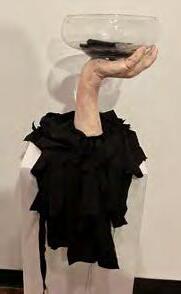
On the walls around the door are pillars with other clay pieces: a sculpted hand holds a bowl of water with ink and oil which holds the cloth offerings, a cracked bowl filled with ink and another face, and a mirror that sits above a pit-fired mask created as a self portrait. The water represents life and

nourishment, with the hand as support. The black cloth used for the offerings was first from another sculpture Head made called “Entropy.”
Originally earning degrees in French and Political Science at Western Michigan University, Head struggled to find a career post-graduation. After their sister’s passing, Head had a change of heart and mind. “I can’t coast through life anymore, I can’t ignore things that are meaningful to me,” Head said. She found that working with clay and mold casts helped silence the perfectionist voice in their head. Head interviewed for a residency with the idea of her “Collapsing Time” installation already in mind. Head doesn’t just want her audience to admire their installation: she wants people to touch and interact with it. To Head, it was important for viewers to feel the weight and textures in order to discover a deeper connection with Head herself. She urged me to pick up all of the various sculptures and molds, and I even had the opportunity to offer one of the cloth strips onto one of the hands from the main piece. This permission to physically engage with the art offered a stronger intimacy and appreciation for the pieces and the work they required.
“Collapsing Time” is a powerful collection that captures what grief looks like following death and the processes of healing, including the importance of community during grief and healing. Head is currently working on a group show about breaking down barriers. Her instagram is funny_ghost where they share their artwork.


By Steve Ellis
This past March, Jackie and I boarded an airplane in Chicago and headed to Rome. The plane was about 45 minutes late in taking off due to bad weather, so we missed our connecting flight. Our one-hour layover in Dublin, Ireland, ended up turning into 8 hours, and made the most of it. We were able to leave our suitcases at the airport and grab a bus (about a half hour ride) into downtown Dublin. We got off near the Ha’penny Bridge on The River Liffey. We spent half a day in Dublin back 2024, so we already had a feel for this great city. This year, we arrived in Dublin the day before St. Patrick’s Day - there are worse places to be stranded. In fact, airport staff told us that thousands of people fly into Dublin from all over, just for St Patrick’s Day, party all day, and then sleep on the airport floor and fly home the next morning.
We found the streets and pubs busy, but we heard it was nothing compared to the weekend before.
Dublin is divided by The River Liffey that flows through the center of town, dividing the city into the Northside and
Tales road FROM THE rome, italy
Southside. On our last visit we spent all of our time on the Northside where Trinity College, Guinness and most of the famous pubs are located.
This year we spent more of our time on the Southside with its much wider streets, large buildings and churches. Before boarding the bus back to the airport, we split a Guinness at the iconic Temple Bar, which was packed to the gills and had two great guitar players singing old Irish tunes.
After arriving at the Rome Airport, we boarded a half hour train to our room

downtown about 7:30pm. We had been up for about 24 hours straight.
Our very small (and somewhat expensive) room was on the 4th floor of an old building. It was nothing fancy, but centrally located. We fell asleep as soon as we fell into bed.
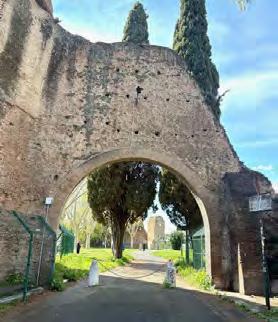
The next morning, we woke up early, grabbed a quick breakfast and could not wait to start exploring. We headed towards the Colosseum. Turning down the first narrow alley street we came to, we immediately came upon several blocks of ancient ruins, huge carved columns and massive remains of old walls. We bought two tickets to get in the Colosseum and got in line about noon. There were thousands of people everywhere, most in tour groups following a leader with a flag on a pole. At the entrance I showed the lady our tickets on my phone (paper tickets no longer exist for anything) and she said,
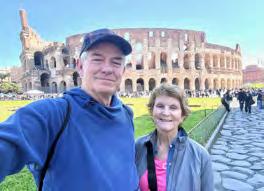
“Sir your tickets are for tomorrow.” We were disappointed but with so many things to see, we started walking. Near the Colosseum is the Arch of Constantine, erected in 315 AD. This massive three-bay monument is the largest surviving Roman arch. It was built by the Roman Senate to commemorate Emperor Constantine the Great’s victory over his rival Maxentius at the Battle of the Milvian Bridge in 312 AD.
We wandered up a hill to Santo Stefano Rotondo al Celio (St. Stephen in the Round), a very old, circular church located on the Caelian Hill near the Colosseum. It was built in the 5th century. Church members make small wooden crosses that are available for small donations. Jackie picked up two

for her grandsons, which they loved.
Our next stop was the Trevi Fountain (Fontana di Trevi), Rome’s largest Baroque fountain and one of the world’s most famous landmarks. Standing at (86 ft) high and 161.3 ft wide, it serves as the terminal point of the ancient Aqua Virgo aqueduct, which has supplied water to Rome since 19 BC. The fountain area was absolutely packed, at the end of several narrow streets. We could not imagine what it would be like in the prime tourist season.
Around the corner from the fountain, we found a cute little cafe with outdoor seating. We were too hungry to wait for the outdoor area and sat inside, where we had a great view of the large pizza oven and enjoyed our jovial waitress. We ordered our first of many Marguerita pizza’s-a thin crust, tomato sauce and cheese with a basil leaf in the middle. It was absolutely delicious - the best pizza we had ever tasted.
After lunch, we walked a mile or so, to the historic River Tiber, which flows through the heart of Rome. The walkway along the far side is lined with vendors selling books, crosses, paintings, etc. much of which portrays The Vatican, that is just up the street.

It’s hard to miss the Castel Sant’Angelo Rome, the massive, circular castle sitting upon a hill high above the river. The structure was originally built as a tomb and mausoleum for Roman Emperor Hadrian between 134 and 139 AD and converted into a fortress in 401 AD., and was once the largest building in Rome.
We walked through the center of Vatican City surrounded by large buildings and lines of people waiting everywhere. The highlight is Saint Peter’s Basilica, considered one of the Catholic Church’s holiest sites and foremost pilgrimage destinations. The Basilica marks the burial site of Saint Peter, Christ’s foremost apostle and the first ever pope. This is where Peter’s successor, the present pope, presides over religious rituals and celebrations.

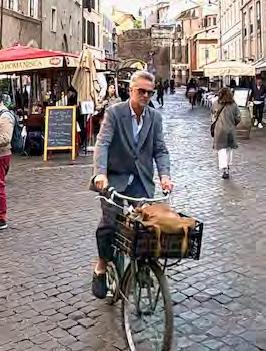
A few blocks away are the Vatican Museums. There were long lines of ticket holders everywhere. We jumped in line with other non-ticket holders and gained entrance after about an hour.
It was well worth the wait. The Museums are a connected group of large buildings and gardens that are the public museums of the Vatican City. They display works from the immense
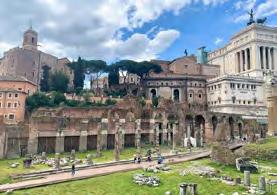
collection amassed by the Catholic Church throughout the centuries, including several of the best-known Roman sculptures and most important masterpieces of Renaissance art in the world. The museums contain roughly 70,000 works, of which 20,000 are on display.
Pope Julius II founded the museums in the early 16th century. The Sistine Chapel, with its ceiling and altar wall decorated by Michelangelo, and the Stanze di Raffaello (decorated by Raphael) are just two of the many highlights of the museums.
In 2024, the Vatican Museums were visited by 6.8 million people. They ranked second in the list of most-visited art museums and museums in the world after the Louvre.
It was almost dark when we exited and the GPS on our phone said we had a 55-minute walk. We stopped at a restaurant near our hotel for a quick salad, another marguerita pizza and a Birra Moretti, a great Italian beer we had sampled last year in Scotland. When we arrived back to our room, we fell into bed after a 26,000 step nonstop day.
The next morning after breakfast, we stumbled upon Santa Maria del Popolo known as The Church of “St. Mary of the People.” . It is hard to describe the immensity and grandeur of this
church. It’s filled to the brim with opulent Baroque-style side chapels, many of which hold dozens of works of art like Renaissance painter Caravaggio’s The Crucifixion of St. Peter and The Conversion of St. Paul.
The church also sits just inside the old city walls at a commanding position on the north side of the busy Piazza del Popolo. According to tradition, the remains of infamous Emperor Nero were said to be buried near the location of

the present-day church, and during the Middle Ages, his ghost and/or demons in the form of crows apparently perturbed the people of Rome so much that the pope had Nero’s urn emptied into the Tiber River and a demonic tree—the crows’ favorite haunt—cut down to make way for today’s church. But what Santa Maria del Popolo is made of is also quite fascinating. The white travertine marble that was used was plundered from the Colosseum when it was used as a quarry in Baroque times. Buildings such as this, are why merely a third of the original ancient stadium remains!
Next, we headed to our much-anticipated noon visit to the Colosseum.
The elliptical amphitheatre in the centre of the city of Rome is the largest ancient amphitheatre ever built, and is the largest standing in the world. Construction began under the Emperor Vespasian (69–79 AD) and was completed in AD 80 under his successor and heir, Titus. The Colosseum is built of travertine limestone, tuff (volcanic rock), and brick-faced Roman concrete. It could hold an estimated 50,000 to 80,000 spectators at various points in its history, having an average audience of some 65,000; it was used for gladiatorial contests and public spectacles

including animal hunts, executions and re-enactments of famous battles. The building ceased to be used for entertainment in the early medieval era. It was later reused for such purposes as housing, workshops, quarters for a religious order, a fortress, a quarry, and a Christian shrine.
A few days after returning home, I attended the Detroit Tiger Opening Day game at Comerica Park. As I walked through this 41,000 seat stadium, I thought back on the much larger Colosseum, built 2000 years before, with no power tools or modern machinery. What were the restrooms like and did they have $15 beers for sale at concession stands. Hah!

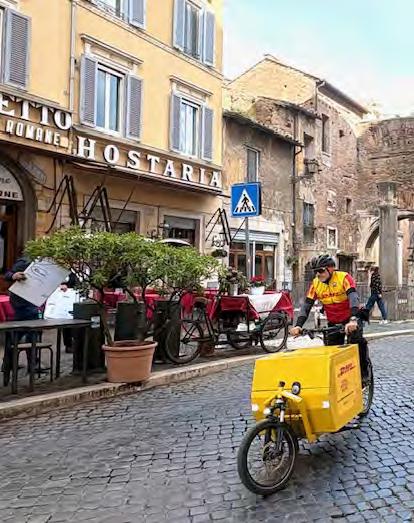
After touring the Colosseum, we walked a few miles, down alleys and old cobble stone streets, with wonderful sites everywhere.
We had lunch at the Come NA Vorta Pasta, known for its traditional Italian recipes. We enjoyed a very tasty pasta dish and noticed across the street, a rectangle shaped park full of ancient ruins and feral cats sleeping everywhere.
We were worn out so took a short nap back at our room and later found a cozy restaurant down a side alley with great pizza and a piano player.
Our two days in Rome were wonderful with perfect, 50-60-degree weather and no rain. We were up early the next morning to catch a train to Florence, which I will chronicle in the next issue.