Why Lunar Orbit Could Become One of the Most Important Destinations in the New Space Economy - SpaceOro
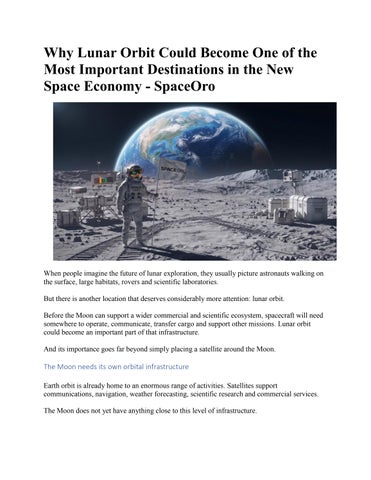
When people imagine the future of lunar exploration, they usually picture astronauts walking on the surface, large habitats, rovers and scientific laboratories. But there is another location that deserves considerably more attention: lunar orbit. Before the Moon can support a wider commercial and scientific ecosystem, spacecraft will need somewhere to operate, communicate, transfer cargo and support other missions. Lunar orbit could become an important part of that infrastructure. And its importance goes far beyond simply placing a satellite around the Moon.
The Moon needs its own orbital infrastructure Earth orbit is already home to an enormous range of activities. Satellites support communications, navigation, weather forecasting, scientific research and commercial services. The Moon does not yet have anything close to this level of infrastructure.
Every lunar mission has to account for its own transportation, communications and operational requirements. Depending on the mission, this can involve dedicated systems and complex coordination with ground stations and other service providers. As lunar activity increases, relying entirely on individual mission architectures will become increasingly difficult. A more developed lunar environment will need specialised orbital assets. These could include communications relay satellites, navigation systems, scientific platforms, cargo transportation vehicles and spacecraft capable of supporting other orbital operations. Some of these capabilities are already being developed. NASA's LunaNet framework, for example, is intended to support interoperable communications, navigation and related services around the Moon. The direction is clear: lunar missions will increasingly depend on infrastructure that serves more than one spacecraft or customer.
Why not every mission needs to land? There is a common assumption that the purpose of a lunar mission is to reach the surface. That is not necessarily true. Lunar orbit offers a useful operating environment for several types of scientific and commercial activity. A spacecraft in lunar orbit can study the Moon remotely, monitor its surface, test technologies, observe the surrounding space environment or provide services to other missions. For some experiments, landing introduces unnecessary complexity. A research team interested in studying the lunar environment may find an orbital platform more appropriate than a surface mission. There is also a practical advantage: orbital payloads can avoid some of the additional engineering challenges associated with landing, surface mobility and surviving the lunar night. This does not make lunar orbit a replacement for surface exploration. Both environments will be important, and their roles will depend on what each mission is trying to achieve.
The transportation problem is still significant One of the biggest challenges is moving payloads from Earth to the right destination.
Launch vehicles can place spacecraft into low Earth orbit, but reaching lunar orbit requires additional propulsion, navigation and mission operations. There are also different ways to approach the journey. A spacecraft might travel directly towards the Moon, use a rideshare opportunity, or be transported by another vehicle. The right solution depends on payload mass, destination orbit, mission timeline and cost. This creates an opportunity for specialised transportation services. Rather than requiring every customer to develop its own propulsion system and spacecraft, dedicated orbital transfer vehicles could eventually provide transportation as a service. For commercial operators, this could simplify mission planning and allow them to focus on the payload and the service they actually want to deliver. Of course, the economics will depend on launch costs, vehicle development, operational reliability and the frequency of available missions. Reusability alone does not guarantee lower prices, but it offers an interesting path towards improving transportation economics over time.
Building transportation capabilities for the next phase At SpaceOro, lunar orbit is an important part of how we think about the future of space infrastructure. Our RedLunar mission is being developed as a 12U lunar SmallSat platform, offering organisations an opportunity to place hosted payloads into lunar orbit without developing an entire spacecraft independently. Our longer-term transportation programme, Red1, is focused on reusable orbital transfer capabilities between low Earth orbit and lunar orbit. The two initiatives address different needs. One provides a platform for payload operations, while the other is intended to develop transportation capabilities for future cargo missions. We see these as early steps towards a broader lunar infrastructure business.
Lunar orbit could become a commercial destination in its own right The commercial space industry has already demonstrated that infrastructure can create markets that did not previously exist. Communications satellites made global connectivity possible. Navigation satellites created entire industries around positioning services. Commercial launch providers expanded access to orbit.
Lunar orbit could follow a similar path, although the technical and economic challenges are very different. As more spacecraft travel to the Moon, demand for communications, navigation, orbital operations and transportation is likely to grow. The companies that help provide these capabilities may become important participants in the lunar economy. For now, the industry is still in its early stages. But the next generation of lunar missions will need more than landers and launch vehicles. They will need an orbital ecosystem. And building that ecosystem may prove just as important as reaching the lunar surface.