DATA DON CRUNCHES THE NUMBERS
DAN LINSE’S FARMING ‘PARADISE’
NANCY K AVAZANJIAN : SOIL IS STRENGTH
I S S U E 6 | V O L 2 | WINTER 2026
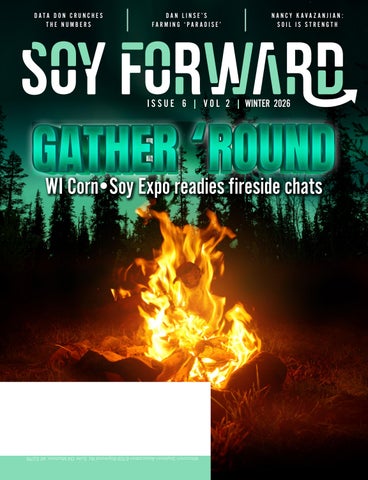
WI Corn•Soy Expo readies fireside chats
MINNESOTA SOYBEAN 1020 INNOVATION LANE, MANKATO, MN Wisconsin Soybean Association 6709 Raymond Rd. Suite 134 Madison, WI 53719
S OY F O R WA R D
1
WINTER 2026
A HOME-GROWN LEGACY
A legacy of faith. A tradition of farming. A future rooted in both.
Got plans? Now you do.
WISCONSIN CORN • SOY EXPO January 29-30, 2026 Kalahari Conference Center, Wisconsin Dells
Hosted by the Wisconsin Corn Growers Association, Wisconsin Soybean Association and Wisconsin Pork Association Register today at cornsoyexpo.org S OY F O R WA R D
3
FALL 2025
CONTENTS
TABLE OF
S OY F O R WA R D
4
WINTER 2026
0 1 2 3 4 S OY F O R WA R D
6
Meet the new WSA team
8
President’s Foreword: Spreading soy’s good word
0
A united front: With election looming, WSA focused on policy wins in 2026
4
Data Don: Lutz retires from WSA, ASA with respect of peers, legislators
8
‘Why I Farm’: Dan Linse’s legacy
2
Growing the Expo: Corn•Soy Expo returns with robust agenda
6
From farm safety to biofuels, Corn•Soy Expo breakout sessions run gamut
8
North star: Wisconsin native helps farmers navigate risk options
0
Beer and Bull Expands at Expo: UW researchers ready for another round
2
Practice makes perfect: WSA Yield Contest brings in the goods
4
Finding her path: Nancy Kavazanjian’s influence makes big impact
0
Eau Galle farmer named to USB’s Executive Committee
About the Cover The Wisconsin Corn•Soy Expo returns in January, and the Wisconsin Soybean Program and our corn and pork event partners are ready to lay out a trail that leads to stronger markets and more profitability in 2026. Warm up in booth 712 for a fireside chat, and let’s have a conversation that moves farming forward.
5
WINTER 2026
BOARD OF DIRECTORS Board members from across the state represent the voices of Wisconsin soybean growers to advocate for government policies and support research that helps improve the profitability of soybean farmers.
WSA OFFICERS
Doug Rebout
Matt Rehberg
Dave Coggins
Daniel Linse
Doug serves as president on WSA’s officer team, representing District 3. He raises soybeans, corn and wheat in Janesville alongside his brothers and nephews.
Matt serves as WSA vice president and represents District 3. A first-generation farmer, he raises soybeans, corn and wheat on his operation in Darien.
Dave is a recently retired banker with a lifetime of experience in both agricultural and commercial lending. He joined the WSA board in 2023 as an industry representative. Serving District 3, Dave was elected WSA treasurer in 2025.
Daniel represents District 1 and serves as WSA secretary. He grows a mix of soybeans and corn with his father on his farm in Mondovi. Along with crops, the Linses also raise turkeys.
WSA DIRECTORS
Dr. Shawn Conley
Danny Brisky
Katie Kaczor
Luke Goessling
Dr. Conley is a professor of agronomy and is the soybean and small grains specialist at the University of Wisconsin-Madison. Shawn is WSA’s representative on the board for the University of Wisconsin’s College of Agricultural & Life Sciences.
Danny grows soybeans and corn near Columbus with his three uncles. He completed ASA’s Young Leader Program in 2024 and is an-large WSA director. Danny also works as a crop insurance agent, is involved in Astico Perseverance 4-H club and is a soil health advocate.
Katie was elected in 2024 as an industry director for WSA. She is the district sales manager for Legacy Seeds and resides in De Pere, representing District 4.
Longtime advocate Luke Goessling is an at-large director with WSA and serves as co-chair of the Wisconsin Corn•Soy Expo. He farms soybeans and corn alongside his wife and two sons and also owns and operates a gravel trucking company.
S OY F O R WA R D
Photo courtesy of Brownfield Ag News.
6
WINTER 2026
EDITORIAL STAFF
ADVERTISING
WSA Executive Director Adam Kask akask@wisoybean.org (608) 274-7522
Art Director Alex Troska atroska@agmgmtsolutions.com
Sales Manager Erin Rossow erossow@agmgmtsolutions.com (507)-902-9191
Managing Editor Drew Lyon drew@agmgmtsolutions.com
Layout Editor Katelyn Engquist kengquist@agmgmtsolutions.com
Advertising space reservations can be made by the 15th day of the month prior to publication. In consideration of the acceptance of the advertisement, the agency and the advertiser must, in respect of the contents of the advertisement, indemnify and save the publisher harmless against any expense arising from claims or actions against the publisher because of the publication of the content of the advertisement. Advertisements within this publication contain the opinions and information of the advertisers and do not necessarily reflect the opinions or views of the Wisconsin Soybean Program or affiliated groups.
WSA DIRECTORS
Brad Sennhenn
Amber Soltvedt
Sara Stelter
Brad is a WSA at-large director and recent graduate of ASA’s Young Leader Program. He farms in Columbus on a family dairy operation. In addition to cattle, Brad raises soybeans, corn, alfalfa and sorghum.
Amber joined WSA in 2025 as the District 4 director. Amber and her husband, Zac, raise soybeans, corn and wheat in Seymour. With a lifelong passion for ag, Amber is a past ASA Young Leader and currently a NK Seeds representative working with ag retailers and growers across northern Wisconsin.
Sara is WSA’s District 2 director and served as president from 2023-25. She operates a diverse farming operation that includes soybeans, corn, peas, green beans and cattle in Wautoma.
ASA DIRECTORS
WSA STAFF
Tanner Johnson
Steve Trzebiatowski
Adam Kask
Tanner is a first-generation farmer from Prairie Farm. He is an at-large director for WSA and serves on the American Soybean Association (ASA) Executive Committee. Tanner is also a 2017 graduate of ASA’s Young Leader Program.
Steve is a past WSA president who currently represents WSA on ASA. He farms primarily soybeans and corn in central Wisconsin near Amherst.
Adam is the executive director of both WSA and the Wisconsin Soybean Marketing Board. A U.S. Army veteran, Adam has years of experience working in farm policy, market development and agronomy.
S OY F O R WA R D
7
WINTER 2026
President’s Foreword
Doug Rebout S OY F O R WA R D
Communication is key to success in any aspect of our lives. For a good marriage, you need to talk and figure out parenting, scheduling and daily household tasks. On our family farm, if I am not communicating with my brothers and nephews, chaos might ensue. It could mean discussions around getting trucks to their right places, or how many bushels should we sell and at what price. Having constructive conversations is critical to a family farm’s success. Here at the Wisconsin Soybean Association, we also know that communication is very important to sharing our priorities with farmers, policymakers and media outlets. We need to know what is happening on the over 16,000 soybean farms across Wisconsin and the policies and programs affecting our members and supporters. We have a very good board spread out across the state; leaders who are good at letting us know what is happening in their areas. As you’ll read in this issue, one of those farmers, Don Lutz, has put his decades of industry experience to use through delivering our concerns and priorities to leaders in Washington, D.C., through his role on the American Soybean Association. We are grateful for the years Don has committed to making our rural communities stronger. It’s farmers like Don and the rest of board who ensure, whether we’re at the nation’s capital or at the Wisconsin Corn•Soy Expo, that we’re speaking up for our soy farmers. Communication, of course, is a two-way street. We have great communications people working on your behalf to share how WSA promotes and defends our industry. This magazine you are reading is one of the best ag magazines out there – and the industry is starting to notice: Soy Forward has been nominated this year for a National Agri-Marketing Association Award! This publication, WSA’s official magazine, lets you know the many ways that WSA is working for our members, along with how checkoff investments by the Wisconsin Soybean Marketing Board are driving demand for soy. With the calendar turning to 2026, Corn•Soy Expo is just around the bend. In this issue, you’ll learn more about this year’s agenda and the tweaks our planning committee have made to make this year’s event at the Kalahari Conference Center another can’t-miss gathering. Our communications team continues finding new ways to reach our audience, placing more emphasis into spotlighting Wisconsin Soybean Program leaders in media interviews, press releases, farm tours and legislative meetings. Please visit wisoybean.org and our social media pages to stay informed. I have talked about the ways we are trying to communicate to you, but now my request is that I want you to talk to us. We are hoping to see you at the Corn•Soy Expo, and I encourage you to search out myself and any of our directors or staff and tell us your story. We want to hear the good, bad and the ugly. If we don’t hear it from you, we don’t know what else we need to be doing for you. I look forward to having these conversations with you so we can continue to be your organization in 2026 and beyond! Doug Rebout President, Wisconsin Soybean Association
8
WINTER 2026
wisoybean.org/wsa 608-274-7522 admin@wisoybean.org
WSA’S MISSION From the Dairyland to D.C., Wisconsin Soybean Association (WSA) farmer directors work on behalf of 1,200 members to ensure sound ag policies for Wisconsin’s nearly 17,000 soybean farmers.
WSA’S HISTORY Founded in 1973, WSA is a grassroots advocacy organization. We rely on volunteer members to help fund our advocacy efforts.
WSA’S LEADERS WSA is farmer led, which means the men and women fighting on your behalf understand the issues important to the districts and farmers they serve. SO SY O YF O FR OW RW A RADR D
Your Team Your voice in Madison. Grassroots advocacy is at the core of WSA’s mission. Our volunteer farmer leaders serve as the voice of soybean farmers in Madison and Washington, D.C. WSA’s advocacy efforts are directed by farmer leaders and driven by membership dollars, lobbying support and collaborating with the American Soybean Association on federal policy issues.
Why WSA? Profitability – by working to adopt usage of biodiesel, fighting to keep valuable farm inputs and more. Ideas That Work – we push for plans that bring value back to farmers, such as biodiesel adoption. Growing Markets – we work for state investments in infrastructure by land or water to get your crops to market.
SAVE TIME JOIN ONLINE TODAY!
A UNITED FRONT WSA focused on policy wins ahead of 2026 election By Drew Lyon
focused on utilizing agricultural feedstocks to address the problem, and soybean farmers are crucial partners in these efforts. On Nov. 18, the Wisconsin State Senate passed SB 474, legislation that would allow soy-based fire suppression to qualify for municipal fire protection grants through the Wisconsin Department of Natural Resources. The Assembly companion bill, AB 488, is awaiting a public hearing before the Assembly Committee on Environment, which is expected to be held early in the 2026 legislative calendar. Offering grants to Wisconsin fire departments could be a gamechanger to expanding use of soy-based firefighting foam, Rebout told lawmakers. “Fire departments need to save money everywhere they can,” Rebout said. “I’ve talked to many firefighters, and they’ve said they’d love to use SoyFoam, but you have to be fiscally responsible.” SoyFoam is also projected to increase demand for U.S. soy by using protein from 12 million bushels of U.S. soybeans. While that might be a relatively small number — Wisconsin harvested nearly 102 million bushels of soybeans in 2024 — growing domestic demand for soy is critical to stabilizing and diversifying the farm economy, along with attracting an in-state soybean crushing facility. “Every time we use soy as a product, it’s helping our farmers and economy,” Rebout said. “We need to keep more and more products that are using soy so we’re not so reliant on international markets.” The Wisconsin Soybean Program’s multiyear efforts in promoting soy-based products like SoyFoam were successful in alerting state leaders. “They were all familiar and supportive of it,” Rebout said. “The senators seemed very receptive to it.”
A dynamic, agile advocacy team is required to unite both parties. The Wisconsin Soybean Association is leading from the front and rising to the challenge. After strong advocacy from WSA, soy-based firefighting foam is earning bipartisan support among legislators and is closer to becoming more readily available in 2026 to fire departments across Wisconsin. In early November 2025, WSA President Doug Rebout testified before the Wisconsin Senate Committee on Agriculture and Revenue in support of soy-based firefighting foams that contain zero intentionally added PFAS, aka “forever chemicals.” One of those products, SoyFoam, was developed in Wisconsin through soy checkoff investments from the Wisconsin Soybean Marketing Board over several years. “It works on so many levels. It’s another use for our soybeans and our soymeal that’s used to make the SoyFoam,” Rebout said. “It’s good for the environment, it’s good for the bottom lines of Wisconsin farmers, and it’s good for our firefighters.” SoyFoam is compatible with existing foam inductors and aerating nozzles and is comparable in cost to traditional firefighting foam. SoyFoam has a shelf life of 10 years, can be frozen, heated and thawed and will remain fully functional. Cancer is the No. 1 cause of death among firefighters. Cross Plains Solutions’ Dave Garlie, who helped develop SoyFoam, also testified in support of the bill, describing SoyFoam’s myriad safety benefits. “We’re in a national crisis right now because of PFAS and the risks it poses to firefighters,” said Garlie, who’s based in Wisconsin. “We’re the only ones that are really S OY F O R WA R D
10
WINTER 2026
WSA NEWS
WSA directors listen during a policy update from Wisconsin Secretary of State Sarah Godlewski at WSA’s December 2025 meeting in Janesville.
UP IN THE SKIES
In addition to SoyFoam, WSA continues promoting several priorities in Madison, following last summer’s budget passage. In November 2025, the Assembly Committee on Transportation and the Senate Committee on Agriculture and Revenue both recommended AB 222 and SB 284, respectively, for passage by unanimous votes. The bills, which support development of sustainable aviation fuel (SAF) made from feedstocks including soybeans, now are available for consideration by the full Senate and Assembly when legislators meet again on the floor in early 2026. The vote came in the wake of WSA Vice President Matt Rehberg testifying in support of the legislation, which would provide tax credits for SAF produced in Wisconsin. While state lawmakers have little influence in developing trade policies, there are many levers to pull to improve farmer profitability, Rehberg said. “What we can control is making sure Wisconsin is competitive when it comes to capturing the next generation of biofuel investment,” Rehberg said. “If we don’t act, other states will, and we’ll be left behind.”
Congressional District, likely commands the most name recognition in the field. “Wisconsin having its gubernatorial election not in a presidential year does change who turns out. It affects the electorate,” WSA lobbyist Jordan Lamb said. “Right now, we’re just focused on the end of the state legislative session.” Rebout, who hosted legislators at his farm in fall 2025, is eager to host more candidates this year to show them how family farms are enduring despite a down ag economy. “We need to continue to tell the story of Wisconsin farmers and push for policies that help us, not hurt us, on our farms,” said Rebout, who also is entering his final year on the Wisconsin Board of Agriculture, Trade and Consumer Protection, which he currently chairs. Grower leaders are also planning to participate in the Ag Coalition’s Day at the Capitol on Jan. 21. The following week, WSA will gather at the 2026 Wisconsin Corn•Soy Expo Jan. 29 for its annual meeting to hold elections and finalize policy resolutions.
2026 WISCONSIN SOYBEAN ASSOCIATION PRIORITIES
THE TASK AT HAND
Lawmakers will debate and vote on legislation until March, when the session is expected to adjourn to make way for what’s expected to be a pivotal election season. In November, all 99 members of the Assembly and the 17 odd-numbered seats in Wisconsin Senate will be on the ballot, in addition to candidates vying to replace Gov. Tony Evers. The primary isn’t until August, and a clear frontrunner has yet to emerge, though GOP Rep. Tom Tiffany, who represents Wisconsin’s Seventh S OY F O R WA R D
• • • • • •
11
Sustainable Aviation Fuel (SAF) tax credits Promoting soy-based products Opening new markets Building domestic demand Transportation infrastructure Protecting animal agriculture WINTER 2026
WSA NEWS
PLAYING TO WIN WSA executing its legislative game plan
By Doug Monson
to press for predictable federal policy, including strong Renewable Fuel Standard volumes and limiting smallrefiner exemptions that dilute biofuel demand. During meetings with policy leaders — including Reps. Mark Pocan, Gwen Moore and Derrick Van Orden, along with Sens. Tammy Baldwin and Ron Johnson — grower leaders also stressed the importance of ensuring domestic biofuels and maritime fuel incentives, which are crucial for the Great Lakes region, remain priorities in 2026 and beyond.
Wisconsin loves the Green Bay Packers. They’re excited when the team shows up and disappointed when the defense or offense fails to show up. While not the Packers, the Wisconsin Soybean Association has been showing up lately with a steady mix of good offense and defense, all to support Wisconsin’s over 16,000 soybean farmers. A look across the field shows WSA starring at home, in Madison and in Washington, D.C., while also promoting the necessity of scoring policy wins away from home.
LEGISLATORS ON THE FARM
WSA President Doug Rebout recently hosted a bipartisan group of Wisconsin legislators and staff at his Janesville farm, using the visit to connect policymakers with on-the-ground realities of soybean production. Attendees, including Secretary of State Sarah Godlewski, toured operations, discussed soil conservation and heard how issues like biofuels, trade, transportation infrastructure, input costs and water quality programs intersect with farm competitiveness.
RULES-BASED TRADE
In October, soybean growers gathered near Westby for a listening session with Farmers for Free Trade, spotlighting how unpredictable tariffs and logistical challenges undercut export reliability. Producers and trade experts called for stronger, rules-based trade agreements and dependable enforcement to sustain market access and price stability. WSA Director and Past President Sara Stelter attended the event to highlight how Wisconsin soybean farmers export more than 50% of their crop each year and the ways that tariffs can ripple throughout the farm economy.
DICAMBA REGISTRATION PUSH
With the 2026 growing season approaching, WSA joined the American Soybean Association and other state groups to urge the EPA to finalize a new federal registration for over-the-top dicamba use on tolerant soybeans before year’s end. In a letter to EPA Administrator Lee Zeldin, they emphasized dicamba’s role as a critical weed-management tool and warned that delays could hinder farmers’ seed and crop protection decisions.
BIODIESEL ON THE HILL
In late November 2025, WSA leaders joined the Clean Fuels Alliance America in Washington, D.C., to promote soy-based biodiesel and renewable diesel. The delegation of WSA Director Shawn Conley, Executive Director Adam Kask and Wisconsin farmer Jonathan Gibbs met with Wisconsin’s congressional delegation S OY F O R WA R D
12
WINTER 2026
WSA NEWS
Beating the policy drum WI farmer elected American Soybean Association treasurer By Drew Lyon
A year after being elected to the American Soybean Association’s Executive Committee, Tanner Johnson is still energized and ready to meet the moment. OK, he conceded, 2025 was a tumultuous year throughout the farm economy. But in the world of farm advocacy in the 2020s, it’s best practice to stay nimble and on top of the news cycle and keep one’s head on a swivel. Better days are ahead. “My hair is already white, but I think it got whiter after this year,” Johnson said, laughing. “It definitely had its up and downs, but it kept me busy and I’m hopeful going into 2026.” Johnson, a former ASA Young Leader, was a stalwart advocate for both ASA and the Wisconsin Soybean Association in 2025, representing the organizations in engagements with legislators and media while warning of the vast impact tariffs have on the farm economy and rural America. Johnson’s policy plate figures to be full again in 2026, after he was elected ASA treasurer during ASA’s December board meeting in St. Charles, Mo. ASA is fit to address numerous farm-related challenges and opportunities, including the farm economy, biofuels, inputs, trade, markets and other critical policy issues for U.S. soybean farmers. “That’s the current drum we’re beating, just trying to help farmers get through to next growing season and, moving to a new marketing year, hopefully with a good trade deal with China,” said Johnson, who farms in Barron County. “I’m cautiously optimistic that’s going to be fulfilled, and then hopefully their purchases are even greater than what’s been agreed to. And, of course, hopefully we can keep working on bringing input prices down.”
‘GUNG-HO’
WSA Director Steve Trzebiatowski began his first term on ASA during the December meeting. Trzebiatowski encouraged Johnson to seek the ASA spot in 2022 and said his colleague has earned the regard of national peers. “Tanner is just gung-ho and he’s very meticulous and detailed,” Trzebiatowski said. “It’s just good for us in Wisconsin for us to have someone representing us at the national level.” In addition to Johnson, Ohio farmer Scott Metzger will serve as ASA president. Kentucky farmer Caleb Ragland, who served as ASA’s 2025 president, moves to chairman. The ASA board elected Iowa farmer Dave Walton as ASA vice president, a role that puts him in position to serve as the association’s president in 2027. Johnson was also appointed to chair ASA’s Finance Committee and will sit on the Audit and Regulatory committees. He will join WSA and national advocates for ASA’s board meetings and Hill Visits March 9-11 in Washington, D.C.
DID YOU KNOW? To date, G.M. Briggs of Madison (192223) was the first and only Wisconsinite to serve as ASA president.
S OY F O R WA R D
13
WINTER 2026
Lutz retires from WSA, ASA with legacy fulfilled
From the Moroccan Embassy to Madison, Don Lutz (far right) spoke up for Wisconsin soybean growers. S OY F O R WA R D
14
WINTER 2026
A D V O C AT E P R O F I L E
By Drew Lyon
Don Lutz gathered his share of policy and economic wisdom across three decades with the USDA and another 13 years advocating for farmers in his role on the Wisconsin Soybean Association. He’s eager to share insights from the trenches. For starters: Sometimes, the best offense is a good defense. “I guess I’ve been involved enough around government to know that if you want something done, you’re going to end up having to speak up for yourself,” Lutz said. “A lot of times it’s not what they do for you; it can be what they do to you.” Lutz invested that knowledge across nine impactful years representing Wisconsin on the American Soybean Association (ASA), promoting farmers’ conservation efforts and myriad farmrelated policies, including the Farm Bill, biofuels policy, trade, technology, rural health care, transportation infrastructure and value-added uses for soy. “I’m a big advocate for developing new products that use our soybeans,” he said. “I’d love to see biodegradable plastics and things like that that could be fashioned out of soybeans, and the soy-based firefighting foam.” The soft-spoken Lutz might not have ever been the loudest person in any room when a policy discussion was taking place. But, through his combination of farming experience and data intelligence, Lutz might well have been the smartest person in the room. His farmer pupils took notes from the teacher. “I’ve never met anybody as thorough as Don about getting the details correct about statistics and figures,” said ASA Treasurer Tanner Johnson, who served alongside Lutz on ASA from 2022-2025. “The way he studies numbers and can remember numbers has just always wowed me. I’ve always looked up to him and his service, and he has a very keen eye for accurate data, which I’ve always really appreciated.” December 2025 marked the end of an era for Lutz and the Wisconsin Soybean Program. During ASA’s board meeting in St. Louis, grower leaders and ASA staff recognized Lutz for nearly a decade of leadership representing Wisconsin’s soybean farmers in Washington, D.C. “Don has been one of the most involved and thoughtful members of the ASA board,” ASA CEO Steve Censky said. “He represented Wisconsin soybean growers earnestly, always taking part in important policy discussions and bringing good perspectives. Additionally, his insights on USDA and ag data collection from his career at the National Agricultural Statistics Service were invaluable. Don’s service to his fellow soybean farmers has made a positive and lasting impact for our industry.”
Don Lutz squeezes in a teaching session prior to a visit to Capitol Hill.
Don Lutz says WSA is in steady policy hands with his successor, Steve Trzebiatowski (right).
Continued on page 16 S OY F O R WA R D
15
WINTER 2026
CHASING PROFIT, NOT YIELDS
was involved in helping USDA automate and computerize its crop estimates and improve the consistency of NASS reports. “I wanted farmers to have trust in USDA reports,” Lutz said. He also learned a few tips about navigating traffic in the nation’s capital, tools that would serve him well decades later during ASA’s board meetings and rides to Capitol Hill. “I don’t miss the traffic at all. I used to get up at quarter after three in the morning, catch my carpool and I’d be at work by six o’clock in the morning,” he said. “I don’t miss that life at all.” During Uber rides and discussions in hotel lobbies and legislative offices, Lutz also shared a few theories on ag economics and production tools with his colleagues, pearls of wisdom that carried through the years. “He’s the farmer who has always taught me that chasing yields is not what keeps you in business over the hard years, and chasing profit and finding margins in the thin years is the most important thing,” Johnson said. “I keep that mindset as we advocate to legislators in the state and in Washington, D.C., that prices may be good, but if inputs are really high, or vice versa, doesn’t mean farmers are doing well.” While working in D.C., Lutz first became connected with the Wisconsin Soybean Program via Director Andy Bensend, tagging along with Bensend on Hill Visits to the Capitol. In 2012, a year after retiring from USDA, Lutz was appointed to represent District 4 on WSA. Lutz felt that WSA’s priorities matched his dedication to soil health,
Lutz was born and raised in Amherst in Wisconsin’s Central Sands on a farm just across town from where he farms today on irrigated land in Scandinavia, Wis., with his brother, Dale, and nephew, Miles, on a fifth-generation farm. In the 1970s, Lutz attended University of WisconsinRiver Falls, graduating with a bachelor’s degree in ag education and animal science, and a master’s degree in ag economics. In 1976, Lutz began a 35-year career with USDA’s National Agricultural Statistics Service (NASS). He was placed in South Dakota for 18 months before being relocated in 1978 to Illinois. By the early 1980s, Lutz noticed the increase of soybean acreage across Illinois and took the initiative in becoming one of the first operations in the Central Sands to plant soybeans. “I thought, well, why couldn’t we raise some of those soybeans and help spread our workload out a bit?” said Lutz, who rotates soybeans and corn and also raised four children with his wife, Charlotte. “Soybeans had potential, I could see that. We were beginning to see in the late ‘70s, early ‘80s, some of the struggles that dairy was having and that there would be some opportunities to do some new things and that soybeans would be one of those opportunities.” After eight years in Illinois, Lutz was transferred to USDA’s D.C. headquarters, where he worked for the next quarter-century — using, he’s proud to note, a paltry 12 hours of sick time in the entirety of his USDA career. He
“ASA should just rename the Audit Committee the Don Lutz Committee, in my opinion,” Tanner Johnson (left) says of his mentor, Don Lutz.
S OY F O R WA R D
16
WINTER 2026
building markets and improving the farm economy. “There was a sense of professionalism about the meeting structures and the organization,” he said. “It seemed they had a mission, a purpose. So, I embraced those things and have always been passionate about our respect for the use of water.” Lutz later served on WSA’s officer team as secretary and vice president. He also recruited multiple directors onto WSA, including Treasurer Dave Coggins and past President Steve Trzebiatowski. In 2016, he was appointed to serve on ASA. “It should be part of our legacy, to make an effort to recruit somebody who’s better than we were,” Lutz said. “I’ve worked hard on that, and I think both Dave and Steve have been very respectable directors.” Fittingly, WSA appointed Trzebiatowski to fill Lutz’s spot on ASA. “I’m hoping to continue pushing forward on Don’s conservation efforts. Conservation is very important to me,” Trzebiatowski said. “Don has become a very good friend. We talk quite a bit, and I’m proud to step into his role on ASA.”
‘THE BIGGEST CHEERLEADER’
Lutz served on several ASA committees, including auditing – a “thankless job,” Johnson said. He also made connections on both sides of the political aisles during his nine years on ASA and went down memory lane recently when he joined WSA colleagues on a return to USDA NASS’ headquarters. For Lutz, meeting with legislators,
their aides and governmental leaders has meant finding a common understanding. “It’s not always what you accomplish, but sometimes it is just being able to make the world settle down a little bit about what you’re doing,” he said. “It isn’t like you always have to change what you’re doing. Sometimes you just have to justify it in a way that becomes a little more understandable.” Johnson, one of ASA’s youngest directors in its history, also credited Lutz with encouraging him in 2024 to seek a position on ASA’s executive committee. “Don was my biggest cheerleader and biggest advocate for that. And I attribute a lot of the things that I’ve been able to accomplish on the ASA board to Don’s advice.” Johnson said. “I really just can’t say enough good things about him. He’s always been a really good friend and picks up the phone at 7 a.m. or 7 p.m. We’re going to miss him.” After terming off ASA, Lutz also retired from WSA to give the next generation a platform. With Trzebiatowski moving into Lutz’s position, Whitewater farmer Luke Goessling, a former director with the Wisconsin Corn Growers Association, is joining WSA as an at-large director. Lutz, who was WSA’s longest-serving director, plans to stay involved as an advocate and supporter of Wisconsin Soybean Program priorities, sharing seeds of knowledge along the way. “I want to create opportunities for those young people to come along and lead,” Lutz said. “I enjoy the people, I enjoy the challenges and I think I’ve still got a mind and ability to negotiate on solutions.”
DON’S EARLY LIGHT Don Lutz will be honored for his commitment to agriculture during the opening remarks at Wisconsin Corn•Soy Expo on Thursday, Jan. 29 in Africa West. “Don has been a huge supporter of Corn•Soy Expo and we’re excited to see him recognized by his peers this year,” WSA Executive Director Adam Kask said. “He’s certainly earned a moment in the spotlight.” S OY F O R WA R D
17
WINTER 2026
THE LINSE LEGACY
S OY F O R WA R D
18
WINTER 2026
A D V O C AT E P R O F I L E
By Kelsey Barchenger
Sometimes all it takes is a small childhood bribe to spark a lifelong passion. For Dan Linse, a Wisconsin Soybean Association director and Buffalo County farmer, that moment came with a handful of candy and a long night in the turkey barns. “We raised turkeys, and once they were ready for market, we’d have to chase them into corrals and load them into trucks,” Linse says. “I remember my parents giving me candy to stand in the back and keep the birds from running too far. It was late, and I got to stay up way past bedtime. That’s the first memory I have of farming.” Despite those early memories, Linse was convinced he’d never end up on the family farm. “When I was in my teens, I said I’d never do this. I said I’d never farm and I’d never teach,” he says. “I went to college, got a chemistry degree from the University of Wisconsin, and worked for a pharmaceutical and chemical company near Milwaukee. I enjoyed the work, but not the big city.” When his first son was born, the pull of home grew stronger. Linse and his family moved back to the farm — though he still wasn’t ready to commit to farming full time. “I looked for jobs a chemist could do, and my old high school had an opening for a chemistry teacher,” he says. “There weren’t many applicants, so I got an emergency license and ended up teaching for nine years. It was a great experience, but the more time I spent helping on the farm, the more I realized that’s where I wanted to be. The year my dad turned 70 was the year I became a full-time farmer.” And while some might say the rest is history, Linse is still writing his story — one season, one crop, one generation at a time. “It’s rewarding to be outside, to work with family and friends, and to produce something the world needs,” he says. That family support is a cornerstone of his operation. “I have three sons. My oldest helped plant the crop for the first time last year, and he plans to do it again next year. My 17-year-old does a lot of the hay cutting and handles the mowing on both our properties,” he says. Linse credits the steady presence of his wife, Melissa, for grounding him. “She’s a reading specialist at the school and reminds me of my teaching days. It gives me a break from thinking only about farming,” he says. “She helps keep me focused on the positives during challenging times — like when we’re dealing with unpredictable weather.” For Linse, home is everything — a place that may lack the bright lights of Milwaukee, but offers something richer. “We’re here in Buffalo County, and to me this is paradise,” he says. “If there were mountains, this would be heaven. I guess that’s why God kept the hills a little short.”
See Linse’s version of “paradise,” aka Buffalo County, for yourself in this YouTube clip produced by the Wisconsin Soybean Marketing Board. S OY F O R WA R D
19
WINTER 2026
S OY F O R WA R D
20
WINTER 2026
S OY F O R WA R D
21
WINTER 2026
Growing the Expo Robust Corn•Soy Expo set to return
By Doug Monson
While winter grips the Midwest, agriculture will be heating up the Kalahari with the return of the Wisconsin Corn•Soy Expo, the premier indoor agricultural event in the state. Slated for Jan. 29-30 at the Kalahari Resort & Convention Center in Wisconsin Dells, this two-day gathering brings together more than 1,200 corn and soybean growers and pork producers from across the country. “We’re excited to have Mike North and Steve Fredlund headline our show this year,” said Doug Rebout, Wisconsin Soybean Association president and co-chairperson of the Wisconsin Corn•Soy Expo committee. “We worked hard to build out a robust agenda with something for everyone.” North is Thursday’s keynote speaker, with Fredlund delivering the Friday lunch presentation. Following the introduction, an economist panel with leaders from the American Soybean Association, National Corn Growers Association and Ever.Ag, will offer insights on global markets, input costs and what 2026 may hold for growers. After the opening sessions, the new-look trade show opens at 10 a.m. “We changed up the floor plan this year to make sure we are giving all of our exhibitors and sponsors the best exposure possible at the show,” said WSA Director Luke Goessling, co-chairperson of the Wisconsin Corn•Soy Expo. In past years, the trade show was solely in Africa East, with Africa West reserved for the general sessions, lunch speaker and opening panel discussions. This year, the show is encroaching into Africa West, with the dividing wall removed. “We historically sell out of the trade show and have a waiting list,” Rebout said. “The committee thought it made sense to look at growing the show while opening up the flow of traffic to ensure our exhibitors were getting the most of their investment in the show.” New this year, the show’s three hosts, along with the checkoff partners, are teaming up for a one-stop Camp Crops & Chops booth with an “UpNorth” theme. “I think it is important to show the unity of the show,” said Adam Kask, WSA executive director. “Soybeans, corn and pork are so interconnected. We’re excited to showcase our organizations in a fun and comfortable environment.” Visit the Camp Crops & Chops at booth 712 to learn more about how soy, corn and pork investments are working on behalf of Wisconsin farmers. S OY F O R WA R D
Don’t forget to give Mr. Pig a “thumbs up” on Jan. 29 at 5:30 p.m. during Porkapalooza!
22
WINTER 2026
C H E C KO F F E V E N T S
Corn•Soy Expo keynote speaker Steve Fredlund will discuss how doing the “unright” thing can put farmers on the right path.
DATCP Secretary Randy Romanski (right) is one of the many policy leaders invited to the 2026 Corn•Soy Expo.
S OY F O R WA R D
23
WINTER 2026
WISCONSIN CORN • SOY EXPO 2026 AGENDA
Wednesday, January 28, 2026 12:00 p.m. Private Pesticide License Training - Africa 90 The UW Pesticide Applicator Training (PAT) Program is hosting a private pesticide applicator training. The training is for the 100 Private General Farming category and concludes with the certification test. For questions, please contact Jordan Kampa at Jordan.kampa@wisc.edu or (414) 399-0373. 7:00 p.m. Welcome Reception - Atrium Brought to you by Nutrien Ag Solutions
Thursday, January 29, 2026 See a detailed 7:30 a.m. Registration Opens agenda online. 8:00 a.m. to 8:45 a.m. Grand Opening Keynote Speaker - Africa West Mike North, President, Producer Division, Ever.Ag WI 8:45 a.m. to 9:00 a.m. Corn·Soy Expo Introductions - Africa West 9:15 a.m. to 10:00 a.m. General Session Speaker: Economist’s Panel - Africa West Dr. Lee Schulz, Ever.Ag Scott Gerlt American Soybean Association Gretchen Kuck, National Corn Growers Association 10:00 a.m. to 6:00 p.m. Corn·Soy Expo Trade Show Opens - Africa East Brought to you by Wyffels Hybrids 10:30 a.m. to 11:00 a.m. Wisconsin Soybean Association Annual Meeting - Tamrind/Guava 10:30 a.m. to noon. Wisconsin Pork Association Annual Meeting - Kalahari H 11:30 a.m. to 12:30 p.m. Wisconsin Corn Association Annual Meeting — Africa 20 11:30 a.m. 1:00 p.m. Lunch – Africa West Brought you by Syngenta 1:00 p.m. to 3:00 p.m. Young Leaders Program - Tamarind/Guava Register: https://wppa.org/youth/young-leaders-program/ 1:30 p.m. to 2:30 p.m. Unlocking Growth: How Drones and Data Empower Modern Growers – Africa 10 Brought to you by Renk Seed 1:30 p.m. to 2:30 p.m. Corn New Uses - Africa 20 1:30 p.m. to 2:30 p.m. Soy New Uses - Africa 30 United Soybean Board strategist Brian Pierce Wisconsin farmer-USB director Tony Mellenthin S OY F O R WA R D
24
WINTER 2026
1:30 p.m. to 2:30 p.m. Mental Health - Africa 40 1:30 p.m. to 2:30 p.m. Soybean Meal Research & Nutritional Benefits - Kalahari H Dr. Leah Kellesvig, Vita Plus Corporation Dr. Chloe Novak, Vita Plus Corporation 3:00 p.m. to 4:00 p.m. Biofuel Breakout Session - Africa 10 Kurt Korvarik, Vice President, Federal Affairs, Clean Fuels Alliance America Jan tenBensel, director National Corn Growers Association and Nebraska Ethanol Board 3:00 p.m. to 4:00 p.m. The Role of Neonicotinoid Seed Treatments in Midwestern Agriculture: An Industry Perspective – Africa 20 Brought to you by BASF 3:00 p.m. to 4:00 p.m. Rodrigo Werle/Damon Smith - Africa 30 Rodrigo Werle, Cropping Systems Weed Scientist, UW Extension Damon Smith, Plant Panthologist, UW Extension 3:00 p.m. to 4:00 p.m. DOT Standards General Farm Safety - Tamrind/Guava Dave Anderson, Founder of Anderson 360 Solutions 3:00 p.m. to 4:00 p.m. “Taste What Pork Can Do™” Cooking Show Dr. Brock Decker, Culinary Instructor & Chef, Northcentral Technical College 4:30 p.m. to 5:30 p.m. Beer & Bull - Kalahari A & H Dr. Shawn Conley, State Soybean and Small Grain Specialist, UW Extension Rodrigo Werle, Cropping Systems Weed Scientist, UW Extension Damon Smith, Plant Panthologist, UW Extension 5:30 p.m. Porkapalooza — Africa West 6:00 p.m. Corn·Soy Expo Trade Show Closes Brought to you by Wyffels Hybrids
Friday, January 30, 2026 7:30 a.m. to 1:00 p.m. Corn·Soy Expo Trade Show Opens Brought to you by Wyffels Hybrids 8:00 a.m. to 9:00 a.m. Early Riser Session Presidents Panel - Africa West Scott Metzger, American Soybean Association Jed Bower, National Corn Growers Association Duane Stateler, National Pork Producers Council 9:00 a.m. to 11:00 a.m. Bacon & Brainstorming - Africa 10 Dr. Lucas Ferreira, DVM, University of Minnesota Kurt Grajkowski, Emergency Services Coordinator, Division of Animal Health DATCP 10:00 a.m. to 11:00 a.m. Beck's Breakout with Matt Bennett - Africa West Brought to you by Beck’s Hybrids 10:00 a.m. to 11:00 a.m. Forecasts & Farm Roots: Alex Harrington’s Growing Season Outlook - Africa 20 Alex Harrington, Chief Meteorologist, Channel 3 10:00 a.m. to 11:00 a.m. Food grade soybeans: Market demand and production profitability - Africa 30 Brought to you by SB&B 12:30 p.m. to 1:30 p.m. Lunch Speaker Steve Fredlund - Africa West 1:00 p.m. Corn·Soy Expo Trade Show closes
S OY F O R WA R D
25
WINTER 2026
IN SESSION Corn•Soy Expo breakout sessions run the gamut
By Doug Monson When it comes to the breakout sessions at the Wisconsin Corn•Soy Expo, farmer leaders wanted to build out a schedule befitting of a farmer: practical, forward-thinking and innovative. Thursday’s and Friday’s breakout sessions offer just that — a blend of practical information, a dash of entertainment and plenty of innovation.
Thursday, Jan. 29
Data drones Precision ag takes center stage as Renk Seed experts share how drones and on-farm data are improving scouting, input decisions and yield outcomes. Attendees will gain real-world insights into using aerial imagery and analytics to sharpen management decisions. New uses Concurrent soy and corn new-uses sessions explore how checkoff investments are driving demand through biofuels, industrial products and emerging markets. Learn how innovation beyond the field is creating added value for every acre and every bushel. Wisconsin farmer Tony Mellenthin, who serves on the United Soybean Board, will join USB colleague Brian Pierce will lead the conversation on how to grow the soy-based marketplace.
Mental health This candid discussion focuses on stress, resilience and well-being in agriculture. The session blends personal experience and professional perspective to encourage open dialogue and practical approaches to mental health on the farm. WSA President Doug Rebout will headline this panel alongside Jeffrey Ditzenberger, a Navy veteran and founder of Tuggs. Soy nutrition Research updates highlight the evolving role of soybean meal in livestock diets. Attendees will hear how nutrition science continues to position soy as a high-value, versatile feed ingredient across animal agriculture.
WSA President Doug Rebout is a proud mental health advocate.
S OY F O R WA R D
26
WINTER 2026
WI CORN•SOY EXPO PREVIEW
Thursday, Jan. 29 cont.
Biofuels outlook Industry leaders break down the latest developments in ethanol, biodiesel and sustainable aviation fuel. This session provides timely insight into policy, markets and opportunities impacting farm profitability and renewable energy growth. Seed treatments Explore the agronomic benefits of treated seed, including early-season protection and stand establishment. The session offers practical considerations for integrating seed treatments into overall crop management strategies.
Friday, Jan. 30
Hybrid insights Beck’s agronomist Matt Bennett discusses hybrid performance trends, management considerations and yield potential heading into the next growing season.
Farm safety A DOT standards session addresses general farm safety and compliance, offering guidance to help operations reduce risk and improve workplace safety across equipment, transport and daily tasks. Smart investing Financial experts share strategic investment considerations tailored to farm businesses. Learn how to evaluate opportunities, manage risk and make informed decisions in a changing economic environment.
IP crops This session explores identity-preserved crop opportunities, market expectations and production considerations for growers looking to diversify and capture added value.
Weather roots Meteorologist Alex Harrington connects long-range forecasts with practical farm planning, offering outlooks growers can apply to planting, input timing and risk management.
Grain Marketing Analyst Matt Bennett returns to Corn Soy•Expo in his new role with Beck’s.
S OY F O R WA R D
27
WINTER 2026
Uncomplicated complex North helps farmers navigate risk options By Kelsey Barchenger
When the Wisconsin Corn•Soy Expo opens its doors Jan. 29-30 at the Kalahari Resort and Convention Center in Wisconsin Dells, the conference and trade show will welcome an array of voices from across agriculture. Among them is Wisconsin native Mike North, whose history with the event stretches back to its earliest days. “Like I tell everybody, I'm just a farm kid,” North said. “I grew up in southeast Wisconsin with a love of agriculture.” Now a respected commodity risk expert with Ever.Ag with a lifelong connection to farming, and a reputation for making complex risk strategies approachable, North is set to deliver insights that will help growers navigate the unpredictable world of crop markets in the coming year. “During some of my college training, I really found that I had fallen in love with the markets,” he said. “And here 31 years later, I'm still doing it. I still love it. More importantly, I love the people involved in it.”
DAIRY FARM ROOTS
North’s story begins on a small family dairy farm in southeastern Wisconsin, where he learned the value of hard work, attention to detail and resilience in the face of uncertainty. It was on that farm that he first witnessed the ups and downs of agricultural markets and the challenges of running a family farm. These early experiences would shape his approach to risk management and commodity marketing for years to come. “I’ve served in a lot of different capacities on different boards for different organizations inside of agriculture, but I am most known for my work in markets,” North said. North’s formal education began at the University of Wisconsin– Platteville, where he earned a B.S. in Agribusiness with a minor in
C H E C KO F F E V E N T S
Dairy Science. During college, he also served as a state officer for the Wisconsin FFA, gaining early leadership experience that would inform his career in both business and education.
LAUNCHING A CAREER
In 1995, North began an internship in the futures industry, immersing himself in commodity markets and developing a keen sense of how global and local factors influence pricing. Over the years, he became a recognized expert in managing risk through innovative market strategies. Farmers, processors and agribusinesses relied on his insights to hedge against price volatility and protect their operations from the swings inherent in commodity markets. North’s expertise eventually led him to launch the Commodity Risk Management Group (CRMG) in 2014, offering practical, farm-friendly tools to manage market risk. In 2019, CRMG merged with Rice Dairy to become Ever. Ag, a leading provider of marketing, risk management, insurance, advisory and technology solutions for agricultural producers and supply chain partners. Today, North serves as a senior leader at Ever.Ag, guiding clients through complex markets and helping them make strategic decisions that balance risk and opportunity. “We work with different producers and others inside of the agricultural supply chain to manage risk,” North said. “We try to take some of the noise out of their day and make better decisions about the revenue and cost side of their operation.”
For Mike North, returning to Corn•Soy Expo means coming home.
When North steps on stage at this year’s Corn•Soy Expo, he won’t be a newcomer trying to get the lay of the land — he’ll be returning to a place that has shaped much of his professional life. North has been attending the event since long before it even carried its current name. “I literally have been going to Corn Soy Expo since before it was Corn•Soy Expo, when it was being held at the Alliance Center in Madison,” he recalled. That early era, he says, feels like a different world compared to what the Expo has become today.
The shift to the Kalahari Resort in Wisconsin Dells marked a turning point he remembers vividly. “I will say that the move to the Kalahari was a magical one,” North said. “The degree of growth in participation and the quality of offerings — content and interaction — exploded as we moved into that new facility.” The Expo not only expanded in size but transformed in energy, drawing larger and more diverse crowds while deepening the agricultural conversations that happen in every corner of the venue. For North, the event’s evolution has been both personal and professional. “I love what it’s become,” he said. “I’m an old-timer when it comes to being at Corn•Soy Expo.” Despite a schedule that often has him traveling the country to speak for other organizations, he estimates he has missed only a couple of Expos over the years, and he says he’s looking forward to bringing his commodity market expertise to this year’s show. “ We are going to take a very objective view of what is taking place in the market, and we're going to spend some time talking about how to think about the year ahead, what to look at and how to coach yourself in these markets so as to not get caught in another market cycle that seemingly takes you by surprise,” he said. One of North’s greatest strengths is his ability to simplify complex concepts. While commodity markets can be intimidating, his teaching style breaks down intricate topics into understandable, actionable steps. Farmers appreciate his no-nonsense explanations, real-world examples and emphasis on making decisions that make sense for their unique operations. “The conference isn't the conference without the people, and I love the interactions,” North said. “I love how it brings the industry together, not just across corn and soybean, but across livestock as well as the pork producers and even cattlemen and dairymen show up for the event.”
S OY F O R WA R D
29
MAKING THE COMPLEX ACCESSIBLE
With the agricultural landscape in 2026 being characterized by volatility and rapid change, planning will no doubt be a challenge for corn and soybean producers, North’s decades of experience allow him to provide practical, actionable strategies that growers can implement immediately. “It starts with the person. There's no way to understand risk until you understand the person, their operation, their family dynamics, their dreams, their hopes, their ideas, their plans,” he said. “Once you can get to that, the risk kind of takes care of itself. You have to look at the market with a very objective view to understand what is possible, to maybe try to calculate what is probable, but really to identify where the opportunities and the risk as defined by that person's situation lives in a marketplace.”
LOOKING AHEAD
WINTER 2026
UW researchers ready for another round
By Doug Monson At the heart of the chilly Wisconsin winter, there’s a gathering that warms more than just hands; it rekindles ag dialogue, ideas and camaraderie. Back by popular demand, the “Beer & Bull Session” will return with a bit more room to accommodate the soybean, corn and pork producers who attend the annual WI Corn•Soy Expo. “I love the Beer & Bull session,” said Dr. Shawn Conley, state soybean and small grains specialist, who joins his University of Wisconsin Extension team to deliver the “Bull” each year. “You have questions. We have answers. And we have beer to help you digest all the information.” This year’s session, set for 4:30 p.m. Thursday, Jan. 29, moves to Kalahari A and H, which,
S OY F O R WA R D
30
WINTER 2026
C H E C KO F F E V E N T S
SESSION DETAILS • Thursday, Jan. 29 • 4:30-5:30 p.m. • Kalahari A & H • Beer provided. Questions needed.
responding to demand, will allow for more attendees to take in the session. “We’re trying to avoid people having to listen from the overflow that has occurred the last two years,” said Adam Kask, Wisconsin Soybean Association executive director. “I think that says everything you need to know about the session. People love to talk with their state’s ag researchers.” Joining Conley is UW’s Rodrigo Werle, weed scientist for cropping systems and Damon L. Smith, field-crops pathologist. “No slide decks here. Just straight talk,” Conley said. “Once the tap opens, the questions start rolling. And we have answers we’re excited to share.”
S OY F O R WA R D
31
WINTER 2026
PRACTICE MAKES PERFECT WSA reveals winners of Yield Contest; top growers to be honored at Corn•Soy Expo
By Sydney Harris
Board and soybean checkoff dollars, the yield contest marked 15 years of commemorating Wisconsin soybean management practices this year. “It’s a good community learning event,” Conley said. Though the government shutdown impeded the National Agricultural Statistics Service results, Conley had no doubt that the 2025 growing season was an excellent one. “I don’t need the government to tell me if it’s a record year,” Conley said. “I knew based on my own yields and the Yield Contest samples that this was going to be a good year for Wisconsin soybean farmers.” That it was. With three farmers earning a spot in the elusive WI 100 Bushel Soybean Club — which no Yield Contest participants reached in 2024 — the contest shines a light on Wisconsin soybean farmers’ sound agronomic practices. “Farmers did a good job managing weeds and diseases this year,” Conley said. “We had rainfall when we needed it and didn’t end up in a drought. So, it was kind of a perfect season for most Wisconsin farmers.” The Wisconsin Soybean Marketing Board will discuss during its January meeting at Corn•Soy Expo if it will direct checkoff resources toward supporting the 2026 Yield Contest. If approved, information on the 2026 Wisconsin Soybean Yield Contest will be forthcoming this spring. This year’s WSA Soybean Yield Contest winners will be recognized Jan. 29 during the Beer & Bull Session at the Wisconsin Corn•Soy Expo at the Kalahari Resort in Wisconsin Dells.
Some may say that in 2025, Wisconsin soybean growers sweet-talked their soybeans into growing big and strong. But it was all skill. That skill was showcased in the 2025 Wisconsin Soybean Association (WSA) Soybean Yield Contest. Organized to encourage the development of innovative management practices in Wisconsin soybean production systems, the contest had over 100 entries this year, close to the record number of entries set in 2024. “WSA’s Soybean Yield Contest is a chance for Wisconsin soybean farmers to showcase the efforts they put into growing environmentally and economically sustainable crops,” said WSA Director Shawn Conley, who oversees the contest. Experimenting with new inputs or management practices can be daunting, but implementing changes on a smallscale, trial basis is less daunting. The Yield Contest is the perfect platform for growers to dip their toes in. “It also gives them the opportunity to work with their input suppliers and try new inputs to really see how they did in the field,” said Conley, a professor and the state soybean and small grain specialist at the University of Wisconsin-Madison. “Then, they can see if those management changes can be adopted profitably across their entire farming network.”
IDEAL CONDITIONS
Supported by the Wisconsin Soybean Marketing
S OY F O R WA R D
32
WINTER 2026
C H E C KO F F S P O N S O R S H I P
UW Researcher and WSA Director Shawn Conley hopes to continue overseeing WSA’s popular Yield Contest in 2026.
AND THE WINNERS ARE... Division 1:
bu/a with Stine 22EG02)
1st – Dalton Flansburgh, Crawford County (82.51 bu/a with Beck’s 2950E3) 2nd – Pat and Karen Van Lanen, Outagamie County (76.84 bu/a with NK 15-G9E3S)
The UW Bean Team is made up of Dr. Conley’s graduate students and postdocs, who make all agronomic decisions for their entry. While they aren’t eligible for official prizes, their efforts are still recognized unofficially.
Division 2:
Division 4:
1st – John Webb, Sauk County (90.00 bu/a with CROPLAN CP2230E)
1st – Don and Doug Midthun, Dane County (107.20 bu/a with Asgrow AG24XF1)
2nd – Adam Kolb, Manitowoc County (76.62 bu/a with Dairyland DSR-1505E)
2nd – Ron Digman, Grant County (101.08 bu/a with Pioneer P28Z30E)
Division 3:
New Contestant Award:
1st – Kevin Klahn, Rock County (115.54 bu/a with Pioneer P28Z30E) *Inducted into WI 100 Bushel Soybean Club
Tanner Evenstad, Lafayette County (95.82 bu/a with Dyna-Gro S20EN84)
2nd – Joey Heneghan, Jefferson County (79.89 bu/a with Beck’s 2050E3) • UW Bean Team, Columbia County (91.63 S OY F O R WA R D
Planting Green Award: Pat and Karen Van Lanen, Outagamie County (76.49 bu/a with NK 15-G9E3S)
33
WINTER 2026
Nancy Kavazanjian’s influence stretches far beyond the bean fields S OY F O R WA R D
34
WINTER 2026
By Macy Quartier
C H E C KO F F L E A D E R
Nancy Kavazanjian never expected to become one of the most trusted leaders in soybean advocacy. Growing up, she pictured herself working with animals, not crops. “I began in animal science at Colorado State, driven by a love of animals, but it became clear I wasn’t good enough to be a vet,” she said. “My dean pointed me toward agricultural journalism, and that’s where I ultimately found my path.” That unexpected redirection eventually brought her to Wisconsin, marriage to a lifelong farmer, and a future defined by more than 15 years of service, leadership and innovation on the United Soybean Board. In December 2025, Kavazanjian stepped off USB. Kavazanjian found her way into soybeans in the late 1980s, shortly after she and her husband, Charles Hammer, settled into life on their Wisconsin farm. Charles was already deeply committed to the corn industry, and she wanted to make her own contribution. “My husband was doing a good thing on the Wisconsin Corn Growers board, but I did not want to be involved in the same board,” she said. “To make my own impact, I got involved in the Wisconsin Soybean Association Board.” That decision proved pivotal. Her background in journalism, along with her instinct to ask questions and keep learning, quickly made her stand out. What started as a way to stay connected to agriculture grew into a long-term commitment to Wisconsin’s grower community. By the mid-1990s, she had become a trusted presence in both the corn and soybean sectors. When tensions arose
between the state’s commodity groups, Kavazanjian was one of the people who helped ease those divides. Her steady and collaborative approach eventually led her to help run the Wisconsin Corn•Soy Expo. Service became more than an interest. It became her philosophy. “This is my industry. I should give back,” she often told colleagues.
DEDICATED TO VOLUNTEERING
Kavazanjian’s leadership continued to expand beyond state lines. Over the years, she held numerous roles across national organizations. She spent nine years as chair of the U.S. Farmers & Ranchers Alliance and later became the United Soybean Board’s first sustainability chair. This was an important milestone at a time when sustainability was becoming central to global agriculture. Adam Kask, executive director of Wisconsin Soybean Program, said her impact has been profound. “Her dedication and willingness to volunteer have made a large impact on the organization,” he said. “She is a great role model of how selfless service can apply to an organization.” She developed strong relationships with farmers, scientists and industry partners, and she became known for bringing people together and keeping discussions focused on solutions. Most recently, Kavazanjian spent four years on the Innovation and Technology Committee. She especially
Continued on page 36
Nancy Kavazanjian and her husband, Charlie Hammer (right), were awarded the American Soybean Association’s 2020 Conservation Legacy Award. Their farm’s motto is “Our Soil, Our Strength.”
S OY F O R WA R D
35
WINTER 2026
enjoyed learning about emerging technologies, including advancements in seed genetics and new opportunities for farmers to incorporate drones into their operations. To many people, Kavazanjian is not only a leader but also a mentor. Longtime friend and colleague Sara Stelter credits her with shifting how she thinks about leadership. “She has taught me to not accept the status quo,” Stelter said. “She sees how things work, asks the right questions and encourages others to get involved. I have heard from so many growers who say she has influenced them too.” Her influence reaches far beyond committee work. Kavazanjian has guided countless growers, young professionals and women in agriculture, offering encouragement, insight and support whenever needed. When asked what stands out most after all these years, she answers without hesitation: “The people I have met, including farmers, scientists and industry people. You make lifelong friends with all of them.” She is quick to add: “I am not done yet!” Her commitment to helping others shows up clearly in her community work. Each year, she and her husband donate a portion of their farm to the local FFA chapter. Students plant and harvest sweet corn there, which is delivered to food pantries in Milwaukee. The couple also purchases goods from nearby Amish communities to support those same pantries. For Kavazanjian, she says these projects are both acts of service and opportunities to teach young people about agriculture. Looking ahead, she is excited to focus more of her energy close to home while staying connected to the work she loves. Kavazanjian plans to remain active on her county board and contribute to the International Year of Farm Women Initiative through Wisconsin AgriWomen. Her official roles may shift, but her drive to serve will not. Kavazanjian may be stepping away from the United Soybean Board, but her story is not done yet. S OY F O R WA R D
Nancy Kavazanjian delivers her final annual USB update during WSA’s annual meeting at the 2025 WI Corn•Soy Expo.
36
WINTER 2026
OTTO’S
ADVENTURES A report from Wagenson Farms I sit. I’m not excited at the moment. I just sit. Soon, the big yellow thing roars up. I sit. And then I see them, Lia and Jack. That makes me stand and my tail waggle. It’s the darndest of things. Sometimes I chase my tail and try to bite it to get it to stop. But it waggles on. The kids used to spend a lot more time with me during the day. That was when it was warmer. Now, Dad takes me to work after they climb inside the big yellow thing’s tummy and disappear for a while. I like time with Dad. He lets me explore the farm. It’s an all-day adventure with my tiny legs. Somedays, Dad leaves me with the pesky cats. They’re weird. Always chasing mice. I mean, the chase is fun, but then they let it go and do it again. I’m easily bored with them. I like to help dad with chores. Sometimes I fetch corn for him. Sometimes I supervise the work he is doing. And we go for “rides.” A lot. Sometimes I dream about riding with Lia and Jack in the big yellow thing’s tummy. Sometimes with Dad, we take “rides” with an even bigger, roaring machine, and he makes a special place for me. When they first brought me home, I remember the family barking about my name. I could have had many names. Otto Lord Wigglebury, Otto Von Dapplefluff, Otto Reginald Pawsworth III, Otto Von Exploresalot or maybe Otto Von Snuggles. But when I saw them, I knew I only wanted one name: Otto Wagenson.
S OY F O R WA R D
Otto’s human, Matt Wagenson, vice president of the Wisconsin Soybean Marketing Board, recently named his “Top 5 MustHaves on the Farm.” While he didn’t specifically mention Otto, the little fella surely falls under Matt’s No. 4 must-have, “Family/ Support System.”
37
WATCH HERE
WINTER 2026
Thank you, Wisconsin soybean farmers! Your checkoff support of U.S. Identity Preserved Alliance activities adds value across the IP value chain – from fork to farm.
INTERNATIONAL SUMMIT
Join us in Vietnam!
TM
March 22-24, 2026 Ho Chi Minh City Register by March 15 at www.usipsummit.com
We build markets so you can bet on stability. Find us at the Wisconsin Corn & Soy Expo for exclusive food-grade contract opportunities.
S OY F O R WA R D
38
WINTER 2026
Seed oils are often misunderstood, but they play an important role in a healthy diet.
Here’s why they deserve a spot in your kitchen:
Seed oils like soybean, canola, safflower, and grapeseed are predominantly composed of essential fatty acids like omega-6 (linoleic acid) and omega-3 1 (alpha-linolenic acid).
Swapping out saturated fats (like butter or coconut oil) for seed oils can help lower "bad" LDL cholesterol and reduce your risk of heart disease.4 The U.S. FDA recognizes soybean, canola, corn, and olive oils for their heart-protective benefits.5 Randomized controlled trials that replaced saturated fat with polyunsaturated vegetable oil reduced the risk of coronary heart disease by nearly
Your body can’t make these on its own, so you need to get them from food. These fats may help support everything from brain function2 to skin health.3
That’s a big deal for long-term heart health. Seed oils may also help with blood sugar management. Studies suggest that people who replace saturated fats with polyunsaturated fats tend to have better insulin sensitivity and a lower risk of 7-14 developing type 2 diabetes.7-14
6
Linoleic acid lowers cholesterol levels and is associated with a decreased risk of heart disease, diabetes, cancer15, and all-cause mortality.16
THE BOTTOM LINE: Seed oils aren’t just cooking ingredients—they’re important sources of nutrients your body needs to stay healthy. When consumed as part of a balanced diet, they can play a key role in protecting your heart, managing blood sugar, and supporting overall wellness. 1 https://www.ahajournals.org/doi/10.1161/circulationaha.108.191627.
10 https://pubmed.ncbi.nlm.nih.gov/10889798/.
2 https://pmc.ncbi.nlm.nih.gov/articles/PMC4350958/#B5 .
11 https://pubmed.ncbi.nlm.nih.gov/7926311/.
3 https://lpi.oregonstate.edu/mic/health-disease/skin-health/essential -fatty-acids#:~:text=Skin%20sensitivity,-A%20few%20intervention&text =In%20one%20placebo%2Dcontrolled%20trial,)%20(62%2C%2064).
12 https://pubmed.ncbi.nlm.nih.gov/16132958/.
4 https://iris.who.int/handle/10665/375034.
14 https://pubmed.ncbi.nlm.nih.gov/31182488/.
5 https://www.ecfr.gov/current/title-21/chapter-I/subchapter-B/ part-101/subpart-E/section-101.83 6 https://www.ahajournals.org/doi/10.1161/cir.0000000000000510. 7 https://pubmed.ncbi.nlm.nih.gov/6783415/. 8 https://pubmed.ncbi.nlm.nih.gov/20127308/. 9 https://pubmed.ncbi.nlm.nih.gov/18042359/.
S OY F O R WA R D
39
13 https://pubmed.ncbi.nlm.nih.gov/16895896/. 15 Zhang Y, Chadaideh KS, Li Y, et al. Butter and plant-based oils intake and mortality. JAMA internal medicine 2025 doi: 10.1001/jamainternmed.2025.0205 [published Online First: 2025/03/06]. 16 Zhao B, Gan L, Graubard BI, et al. Plant and Animal Fat Intake and Overall and Cardiovascular Disease Mortality. JAMA Intern Med. 2024;184(10):1234–1245. doi:10.1001 /jamainternmed.2024.3799.
WINTER 2026
Tony Mellenthin is taking on a greater role on the United Soybean Board in 2026.
Eau Galle farmer elected to USB Executive Committee Wisconsin soybean farmer Tony Mellenthin was elected to the United Soybean Board’s Executive Committee during the organization’s December 2025 meeting. Mellenthin said serving on the committee is both an honor and a responsibility to represent the best interests of 500,000 U.S. soybean farmers. He said his election shows leadership opportunities exist for farmers from all soybean-producing states, regardless of production size. “Being nominated and elected by my peers to serve on the executive committee at the United Soybean Board is an honor I am blessed to have,” said Mellenthin, who farms with his father near Eau Galle. As a member of the executive committee, Mellenthin will help guide FY26 Soy Checkoff investments across food, feed, fuel, industrial uses, exports and sustainable production. These investments are designed to grow demand for U.S. soy, strengthen on-farm resilience and keep farmers competitive in a global marketplace. He’s also leading USB’s Infrastructure & Connectivity Committee. Kentucky farmer Brent Gatton was elected chair and will lead the board’s work for the upcoming fiscal year. The United Soybean Board is made up of 77 volunteer farmer-leaders who oversee Soy Checkoff investments on behalf of the nearly half-million U.S. soybean farmers. USB is expected to announce its newest directors in early 2026, including a Wisconsin farmer to replace Nancy Kavazanjian.
S OY F O R WA R D
40
WINTER 2026
WISCONSIN SOYBEAN PROGRAM NEWS
Transportation Go! readies 2026 conference Wisconsin farmers are encouraged to save the date for Transportation Go! April 8-9, 2026, in Chicago at the InterContinental Hotel Magnificent Mile, where supply chain stakeholders will convene to go on a conversational “hunt,” seeking solutions and opportunities to industry challenges. Hosted by the Specialty Soya and Grains Alliance (SSGA), the business alliance of identity preserved agriculture, Transportation Go! is the premier conference representing identity preserved, value-added agriculture supply chain stakeholders. “We are so excited to host this year’s Transportation Go! conference in Chicago, an integral transportation hub in our industry,” said Bryan Severs, SSGA chair and Illinois farmer. “Every year, this conference sparks valuable conversations that make an impact. If you have a stake in the agriculture supply chain, make sure you mark your calendars for this event.” Co-sponsored by the Wisconsin Soybean Marketing Board, Transportation Go! registration is now available at transportationgo.com. In addition to the conference, SSGA’s annual meeting will be held at the same location on April 7, during which board of director elections will take place, and the annual SSGA Alliance Honors will be presented. WSMB Director Andy Bensend previously served on SSGA.
WI soy growers score checkoff touchdowns in new video The NFL playoffs are upon us, and the all-pros at the Wisconsin Soybean Marketing Board are taking the field. Visit the Wisconsin Soybean Program’s YouTube page at youtube.com/@WisconsinSoybeanProgram to meet the directors in a game-day–inspired introduction and hear what a soy checkoff touchdown means to them — supporting farmers, driving innovation, and moving Wisconsin soy forward. WSMB’s game plan for 2026: teamwork, leadership, checkoff stewardship and big wins for Wisconsin agriculture. Follow our playbook by visiting wisoybean. org and our social media pages.
Soy Growers: New financial program a positive development In December, the White House and USDA announced the new Farmer Bridge Assistance (FBA) program to provide a financial assistance package to farmers. The FBA program will make $11 billion available to row crop farmers across several commodities, including soybeans. 2025 farm losses total over $40 billion, and while the FBA program is a good first step, the American Soybean Association believes that more support is needed to ensure farmers can make it to the next planting season given the market losses they have suffered. Farmers who qualify for the FBA Program can expect payments to be released by Feb. 28. To submit questions, justification for USDA farmer bridge aid, or to request a meeting on farmer bridge aid, producers can reach out to farmerbridge@usda.gov. ASA and the Wisconsin Soybean Association will continue to advocate for strong domestic and international markets while also working with Congress to ensure U.S. soybean farmers have the resources needed to make it to the 2026 planting season. S OY F O R WA R D
41
WINTER 2026
See how far your soybeans can go. At CHS, we don’t just believe in taking what grows in your fields and connecting it to markets around the world. We deliver. Contact CHS or your local grain originator to explore delivery options for your grain. Learn more at chsag.com/soybeans.
© 2025 CHS Inc.
THE BEST LIBERTY YET Liberty ULTRA® herbicide is the next generation of weed control for the next generation of American farmers.
Liberty ULTRA herbicide provides 20% better weed control than generics,1 a new max use rate of 34 fl oz/A and is backed by the best. BASF offers the most experience manufacturing glufosinate, the highest R&D investment and support from the industry’s top-rated sales team by farmers.2
Get more out of your herbicide at Liberty-ULTRA.us. 1 2
BASF sponsored field research trials 2022-2023, 52 trials, nationwide. Stratus Farmer Survey 2021-2023.
Always read and follow label directions. Liberty ULTRA is not registered for use in all states. Liberty is a registered trademark of BASF. ©2026 BASF Agricultural Solutions US LLC. All Rights Reserved.
BETTER TOGETHER
Join the Wisconsin Soybean Association, Wisconsin Corn Growers Association and Wisconsin Pork Association at Camp Crops & Chops, where ag knowledge crackles like a fire. Pull up a seat and get ready for fireside stories about how these organizations fuel our farm community. Follow the trail to booth 712.