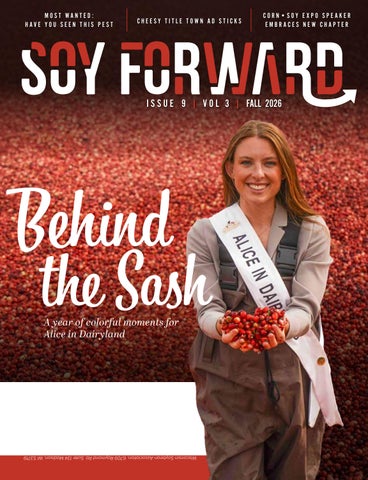
MOST WANTED : HAVE YOU SEEN THIS PEST
CHEESY TITLE TOWN AD STICKS
CORN•SOY EXPO SPEAKER EMBRACES NEW CHAPTER
I S S U E 9 | V O L 3 | FALL 2026
Behind
the Sash A year of colorful moments for Alice in Dairyland
MINNESOTA SOYBEAN 1020 INNOVATION LANE, MANKATO, MN Wisconsin Soybean Association, 6709 Raymond Rd. Suite 134 Madison, WI 53719
SeedIQ
™
THE NEXT ERA OF YIELD STARTS NOW. We’ve all seen it. Two farmers across the road plant the same hybrid, in the same soil, on the same day, yet their results are drastically different. Why? Because performance isn’t determined by genetics alone. It’s influenced by how that hybrid is managed throughout the season, including population, fertility, stress management, and fungicide timing.
Don’t Just Manage Your Fields. Master Your Product Management.
S OY F O R WA R D
2
FALL 2026
“WE CHOOSE U.S. SOY BECAUSE IT IS CULTIVATED TO MEET TRUE SUSTAINABLE STANDARDS.” Nhu Ngo of Vietnam-based Janbee Joit Stock Company on a tour of a U.S. Soy farm.
YOU GROW THE WORLD’S MOST SUSTAINABLE SOY. WE GROW DEMAND FOR IT. USSEC builds preference for U.S. Soy by bringing international buyers directly to American farms, where they can meet growers firsthand and see the care, consistency, and sustainable practices behind every harvest.
SCAN TO SEE HOW USSEC SHARES U.S. SOY’S SUSTAINABILITY WITH CUSTOMERS AROUND THE WORLD.
06 08 09
11
Pest Criminal Complaint
Board of Directors
President’s Foreword: WSA’s Next Chapter Checkoff Check-in
12
Dave Coggins book
Love helps bring late father’s words to life.
10
Pest Prison
Inside the case files of soybean’s biggest field offenders.
TABLE OF
16
Hill Visits
18
Farm Kid Energy
Three brothers, one family farm in Stoughton, and a legacy 114 years in the making.
20 23
CONTENTS
Alice in Dairyland
Title Town
24
29 32
Parker Velte Joins Soy Program
WISHH
35
Expo Preview
Perseverance and passion will take center stage at the Wisconsin Corn•Soy Expo.
26 28
Between the Rows
WSA Directors stay committed to advocacy at home.
Top 5 Must-Haves
WSA Golf Recap
34
Tails From the Farm:
Meet Buster: the high-energy farm pup from Hingham who believes every neighbor’s yard is part of his territory.
About the Cover Alice in Dairyland continues strong tradition. Photo courtesy of DATCP. Read on page 20.
BOARD OF DIRECTORS Board members from across the state represent the voices of Wisconsin soybean growers to advocate for government policies and support research that helps improve the profitability of soybean farmers.
WSA OFFICERS
Doug Rebout
Matt Rehberg
Dave Coggins
Daniel Linse
Doug serves as president on WSA’s officer team, representing District 3. He raises soybeans, corn and wheat in Janesville alongside his brothers and nephews.
Matt serves as WSA vice president and represents District 3. A first-generation farmer, he raises soybeans, corn and wheat on his operation in Darien.
Dave is a recently retired banker with a lifetime of experience in both agricultural and commercial lending. He joined the WSA board in 2023 as an industry representative. Serving District 3, Dave was reelected WSA treasurer in 2026.
Daniel represents District 1 and serves as WSA secretary. He grows a mix of soybeans and corn with his father on his farm in Mondovi. Along with crops, the Linses also raise turkeys.
ASA YOUNG LEADER
WSA DIRECTORS
Danny Brisky
Katie Kaczor
Luke Goessling
Eric Wuthrich
Danny grows soybeans and corn near Columbus with his three uncles. He completed ASA’s Young Leader Program in 2024. Danny also works as a crop insurance agent, is involved in Astico Perseverance 4-H club and is a soil health advocate.
Katie was elected in 2024 as an industry director for WSA. She is the district sales manager for Legacy Seeds and resides in De Pere, representing District 4.
Longtime advocate Luke Goessling is an at-large director with WSA and serves as co-chair of the Wisconsin Corn•Soy Expo. He farms soybeans and corn in Whitewater alongside his wife and two sons and also owns and operates a gravel trucking company.
Eric Wuthrich farms in Monroe with his wife, Jaclyn, raising soybeans, corn and chickens. A fifth-generation farmer, Eric is WSA’s current ASA Corteva Young Leader.
S OY F O R WA R D
6
FALL 2026
EDITORIAL STAFF
ADVERTISING
WSA Executive Director Adam Kask akask@wisoybean.org (608) 274-7522
Art Director Wendy Betters wendy@forwardmindedmedia.com (507) 351-8151
Managing Editor Kelsey Barchenger kelsey@forwardmindedmedia.com (507) 461-1832
Sales Manager Doug Monson doug@forwardmindedmedia.com (507) 995-7534
Advertising space reservations can be made by the 15th day of the month prior to publication. In consideration of the acceptance of the advertisement, the agency and the advertiser must, in respect of the contents of the advertisement, indemnify and save the publisher harmless against any expense arising from claims or actions against the publisher because of the publication of the content of the advertisement. Advertisements within this publication contain the opinions and information of the advertisers and do not necessarily reflect the opinions or views of the Wisconsin Soybean Program or affiliated groups. Soy Forward is published quarterly on behalf of the Wisconsin Soybean Association. Circulation comments and suggestions can be submitted to Managing Editor Kelsey Barchenger at kelsey@forwardmindedmedia.com.
WSA DIRECTORS
Brad Sennhenn
Amber Soltvedt
Sara Stelter
Dr. Shawn Conley
Brad is a WSA Young Leader at-large after graduating in 2025 from the American Soybean Association’s (ASA) Young Leader Program. He farms in Columbus on a family dairy operation. In addition to cattle, Brad raises soybeans, corn, alfalfa and sorghum.
Amber joined WSA in 2025 as the District 4 director. Amber and her husband, Zac, raise soybeans, corn and wheat in Seymour. With a lifelong passion for ag, Amber is a past ASA Young Leader and currently a NK Seeds representative working with ag retailers and growers across northern Wisconsin.
Sara is WSA’s District 2 director and served as president from 2023-25. She operates a diverse farming operation that includes soybeans, corn, peas, green beans and cattle in Wautoma.
Dr. Conley is a professor of agronomy and is the soybean and small grains specialist at the University of Wisconsin-Madison. Shawn is WSA’s representative on the board for the University of Wisconsin’s College of Agricultural & Life Sciences.
ASA DIRECTORS
WSA STAFF
Tanner Johnson
Steve Trzebiatowski
Adam Kask
Parker Velte
Tanner is a first-generation farmer from Prairie Farm. He is an at-large director for WSA and serves as ASA treasurer. Tanner is also a 2017 graduate of ASA’s Young Leader Program.
Steve is a past WSA president who currently represents WSA on ASA. He farms primarily soybeans and corn in central Wisconsin near Amherst.
Adam is the executive director of both WSA and the Wisconsin Soybean Marketing Board. A U.S. Army veteran, Adam has years of experience working in farm policy, market development and agronomy.
Parker is the program manager for both WSA and the Wisconsin Soybean Marketing Board. He is a graduate of Ripon College where he earned a degree in Politics and Government. He spent more than two years working for the State Assembly.
S OY F O R WA R D
7
FALL 2026
PRESIDENT’S Any of these things can change your day in a hurry. It is how we respond to those things that define us. Typically, you have two choices: You can have a negative reaction, or you can be the person that stays positive and decides that even with the bad news, you’re still going to have a good day. You control what person you want to be. At WSA, we are constantly getting different reports on everything from the markets to federal regulations that can be seen as negative impacts on our farming communities. We have worked hard as a board and staff to see and talk about the positives that are going on. We have heard a lot of negative things about our exports lately. I want to share a few of the positives. In the first half of 2026, our U.S. soybean exports are up 33% with our top market still being China, even though they are not buying as much as previous years. Our Wisconsin soybean exports are up 70% in the first half of the year with our top market being Mexico. As we seek those perfect days, but hear negative things, it’s a good reminder that there is always something positive going on, and your WSA board and staff are working hard to make more positive things happen. I hope you all come to the 2027 Wisconsin Corn•Soy Expo to hear about all the positive things happening with WSA.
Turning the negative into a positive
Life is full of unexpected twists and turns. We all have our own definition of the perfect day. For some, that’s a meal on the table each night with family time after a good day’s work. For others, it’s just making it through a day without a catastrophe. On the farm, my version of the perfect day is closer to the latter idea. As long as there are no catastrophes and I get the majority of my planned work done, it is a successful day. As we all know, there are so many things that can alter a perfect day. It could be anything from a breakdown during harvest to a medical diagnosis that is totally unexpected.
Doug Rebout President, WSA
S OY F O R WA R D
8
FALL 2026
Checkoff Check-in Taking biodiesel education on the road By Doug Monson
Water in the fuel filter. Blame biodiesel. Won’t start. Blame biodiesel. Got a flat tire on the side of the road. Well heck, blame biodiesel. Biodiesel information in Wisconsin is about as stale as a three-day old bagel. For many diesel users, perceptions of biodiesel remain rooted in experiences or stories from decades ago. Through a partnership with the Wisconsin Soybean Marketing Board, MEG Corp is working to replace those misconceptions with practical information. “We conduct outreach to fuel suppliers, retailers, fleets, mechanics, farmers and other diesel users,” said Kelly Marczak, director of consulting services for MEG Corp. “Anyone in the fuel distribution chain through the end user is part of our target audience.” MEG Corp’s boots-on-the-ground outreach increases awareness of biodiesel and renewable diesel, explains their benefits and gives users confidence in biodiesel’s performance. Adam Kask, executive director of WSMB, said growing biodiesel use remains important because it adds more than $1 in value to a bushel of soybeans, even though Wisconsin does not have a biodiesel plant. “Soy plays a big role in biodiesel and renewable diesel,” he said. “And as the push for more sustainable aviation fuel grows, soy will play a role there, too.” MEG Corp exhibits at industry events, including the Wisconsin Fuel and Retail Association annual conference and meetings for county highway superintendents, fleet leaders and farmers. The team also contacts fuel suppliers and offers educational workshops. The work is particularly important in Wisconsin, where familiarity with biodiesel can lag neighboring states with blending requirements or incentives. S OY F O R WA R D
C H E C KO F F I N V E S T M E N T
“In Wisconsin, we are often starting with the basics,” Marczak said. “Some people haven’t heard of it or don’t have an idea of what biodiesel is yet, so it is very much Biodiesel 101 when we get started.” Those conversations address fuel quality, microbial contamination and cold-weather performance. Marczak said some perceptions trace back 20 years or stem from the transition to ultra-low sulfur diesel. “We talk about the improvements that have been made and how testing shows biodiesel consistently meets or exceeds fuel quality standards,” she said. MEG Corp also educates Wisconsin’s next generation of diesel technicians. For approximately four years, it has trained students in diesel technology programs. Sessions cover fuel characteristics, storage and handling and biodiesel’s role in improving fuel performance. “MEG Corp has done similar projects in neighboring states with great success,” Kask said. “We’ve appreciated the efforts they have made here in Wisconsin the past few years.” The company also operates the Regional Diesel Helpline, giving Wisconsin farmers and other users access to technical guidance. Biodiesel can help fleets reduce greenhouse gas emissions or petroleum use without purchasing new vehicles or fueling infrastructure. Blends up to B20 can be used in existing diesel equipment while maintaining performance. “You get to keep that same power,” Marczak said. “That is one of the benefits that really catches the attention of fleets.”
9
FALL 2026
PEST P R IS O N Ryegrass
Charges:
Aliases: Italian Ryegrass, Annual Ryegrass
Escaping fall burndown operations Illegal germination after harvest Trespassing in no-till soybean fields Stealing moisture and nutrients from next year’s crop Conspiracy to develop herbicide resistance Resisting arrest by surviving spring applications
Sentence
Immediate fall herbicide application recommended
Horseweed
Aliases: The Escape Artist
Sentence
Apprehend in the fall before it becomes a spring fugitive.
Red Crown Rot
Aliases: The Silent Saboteur
Sentence
No parole. Long-term crop rotation and prevention required
Charges:
Charges:
Illegal fall establishment Evading spring herbicide enforcement Resisting multiple herbicide modes of action Occupying soybean fields without permission Dispersing thousands of airborne accomplices (seed) Repeat offender in no-till systems
Secretly infiltrating soybean roots Causing premature plant decline Hiding evidence until late season Yield theft Organized underground activity Remaining at large in infected fields for multiple seasons
C H E C KO F F I N V E S T M E N T
STATE OF WISCONSIN SOYBEAN COUNTY Case No.: 2026-FALL-001
DEFENDANT
Waterhemp (Amaranthus tuberculatus)
STATUS
MOST WANTED — AT LARGE
CHARGES
Felony Yield Theft Conspiracy to Establish an Illegal Seedbank Multiple Counts of Herbicide Resistance Unlawful Occupation of Soybean Fields Distribution of Hundreds of Thousands of Criminal Accomplices (Seeds) Evading Law Enforcement Through Extended Emergence
COMPLAINING OFFICER
Repeat Offender
I, Dr. Shawn Conley, Professor and Soybean & Small Grain Extension Specialist, University of Wisconsin– Madison, being first duly sworn, state that I have probable cause to believe the above-named defendant has committed the following offenses against Wisconsin soybean producers:
LAST KNOWN WHEREABOUTS • • • •
STATEMENT OF PROBABLE CAUSE
Escaping combine crews at harvest Hiding along field edges and waterways Standing above the soybean canopy Anywhere seed production has been allowed to continue
Based upon field investigations and grower reports across the State of Wisconsin, the defendant, known as Waterhemp, has repeatedly entered soybean fields without permission and deprived producers of valuable sunlight, water, nutrients and yield.
OFFICER SAFETY WARNING:
Evidence indicates the suspect is capable of producing hundreds of thousands of seeds per plant, ensuring future criminal activity for years to come. The defendant has also demonstrated resistance to multiple herbicide sites of action, making apprehension increasingly difficult.
Failure to apprehend this suspect may result in additional generations of offenders for years to come.
DO NOT ALLOW THIS FUGITIVE TO GO TO SEED.
Signed,
Investigators believe the suspect frequently escapes prosecution by emerging over an extended period throughout the growing season and replenishing the soil seedbank before harvest. Unless apprehended before seed production, authorities expect continued criminal activity in future crop years. S OY F O R WA R D
Dr. Shawn Conley Lead Investigating Officer University of Wisconsin–Madison Pest Patrol Division
11
FALL 2026
By The
BOOK
WSA treasurer publishes father’s memoir By Drew Lyon
Upon retirement, some folks take up a new hobby or simply kick up their heels, enjoy the fruits of one’s labor. After he retired following more than 40 years as an agricultural banker, Dave, his wife, Laura, and their extended family helped Dave’s late father, Bryce Coggins, become a posthumous author by gathering S OY F O R WA R D
essays and poems he wrote from World War II through the 2010s. “We’re pleased that we were able to stick to it and get it done, because it’s one of those projects that could easily sit on the shelf a long time,” said Dave Coggins, treasurer of the Wisconsin Soybean Association. “From the Farmer’s Pen: A Collection of Stories and Poems” is a nearly 450-page paperback
12
featuring homespun narratives about the life of a Rusk County dairy farmer. Its final entry, “The Derby Day,” is a poem Bryce wrote as a high school senior in 1944. Bryce didn’t catch the writing bug as a kid, despite earning an A+ for the poem. Bryce was born in 1926 in Grow, Wis., which didn’t have widespread electricity until the early 1930s. He started his dairy operation in 1950 FALL 2026
Dave and Laura Coggins, along with help from Dave’s family, brought to life stories Dave’s late father wrote about life on the farm, among other topics.
and lived in the same farmhouse for more than 50 years, raising six children with his wife, Patricia. “Farming and writing aren’t often compatible,” Dave Coggins said. “He’d get done with chores and read the newspaper, watch a little TV and go to bed, and then start it all over again.” Dave remembers his dad reciting poetry while milking cows. Bryce’s interest in storytelling grew decades later when he wrote about his mother receiving a blood transfusion following a miscarriage. The essay later ran in The Country Today. “The people that he knew read it and said, ‘You ought to do more of that,’” Dave Coggins said. S OY F O R WA R D
Back in the day
Bryce was diagnosed with melanoma in the early 1990s and stepped back from the farm. He joined a local writers club, which sparked Bryce to write dozens of essays reflecting a bygone era: the Great Depression; World War II; encounters with outlaws like John Dillinger; attending the 1965 Major League All-Star Game; scarlet fever; woodfire cooking; trains; logging camps; listening to the radio; the parcel service; one-room schoolhouses; and farming with horses. “The things we have that were hard to come by are appreciated more than the things that come
13
easy,” Bryce wrote in the essay “My Dad’s Car.” Bryce also recounted his family’s long history in Rusk County and across the Upper Midwest. He’s possibly the only writer who used a DeKalb salesman as poetic inspiration. “There was romanticism in his mind about those days,” Dave Coggins said. “Doing logging and building things with the logs that you took out of your own — he got a kick out of that stuff.” While Bryce loved farming, the child of the Great Depression wasn’t on the cutting edge of agricultural technology.
FALL 2026
“He lived his life worried that he was going to lose the last nickel,” Dave said. “A lot of farmers moved on past that era and evolved and spent money on new technology and genetics. Dad was not assertive in that regard. He was more likely to say, ‘We better fix that up,’ instead of getting a new one. … He was slow to adapt but did eventually.” Bryce remained optimistic about his farm and family. “(Farmers) were always hoping the price of milk would stay as good as it was or get better,” he wrote. “That’s what farmers lived on: hope that things would get better or at least stay as good as they were.”
Soybean is one crop that doesn’t merit a mention in “From the Farmer’s Pen.”
Soybean is one crop “(My that doesn’t grandfather) a few times meritsowed a mention in the soybeans in amongst a more nutritious “Fromcorn theto create Farmer’s Pen.” crop,” Dave Coggins said, “but there were virtually no soybeans grown in Rusk when I “(My grandfather) a few County times sowed a kid.” the corn to create soybeans was in amongst a more nutritious crop,” Dave Coggins Rusk virtually County soybean said, “butToday, there were no farmers produce over soybeans grown in Rusk County600,000 when bushels of soybeans annually. I was a kid.”
Type B
Bryce wrote longhand rather than on a laptop or typewriter. Patricia typed his articles before she died in 2012. Dave’s brother, Jay, and sister, Rachel, later published about half of the stories as family Christmas presents. Much remained unpublished after Bryce died in 2019. In stepped Laura Coggins. “She’s a very fast typist and loved to do it, so she was the driving force behind saying, ‘We’ve got to get
Today, Rusk County soybean farmers produce over 600,000 bushels of soybeans annually.
S OY F O R WA R D
14
FALL 2026
this published.’” Dave said. “She probably had more to do with pushing it forward than I did. She had to do the heavy lifting and do all the typing.” Completing “From the Farmer’s Pen” became a family affair. The Coggins family published the paperback through 48-Hour Books in fall 2024. Jay Coggins, an economist at the University of Minnesota, wrote the foreword, while Dave’s son Jeff helped copy-edit it. The first edition was mostly given to friends and family. After correcting minor errors, the family published a second edition. One of Dave’s farming colleagues said the book should be required reading in Wisconsin high schools. “It’s not flying off the shelf,” he said, “but people hear about it and find it intriguing. When you tell ’em about it, they say, ‘I got to have one of those.’ Some of Dave’s WSA colleagues have also expressed interest. WSA Secretary Daniel Linse is about halfway through his copy. “I’ll say this: Us newer generation farmers have it a lot easier,” Linse said. “It gives me a better sense of that area in Wisconsin and how farming used to be.” Copies are available at fromthefarmerspen.com. Dave also plans to bring copies to the 2027 Wisconsin Corn•Soy Expo. “We’ve gotten a lot of joy over the years of reading his stories and having them all in one place like this to refer to is a lot of fun,” Dave said. “Dad would have been proud to have enlightened people and brought joy to people about those times.”
S OY F O R WA R D
ASA_2026_Wisconsion_2:3 Page_Print_.indd 1
15
21/07/26 2:34 p.m.
FALL 2026
Showing Up Matters:
WSA takes Wisconsin farmers’ voices to Washington By Doug Monson
American Soybean Association Board of Directors meeting added perspective from soybean farmers and industry leaders across the country. WSA Program Manager Parker Velte joined the cohort for his first ASA-WSA experience. In his time as a legislative assistant in Madison, he heard many people come in and tell passionate stories for their cause. This time, he had a new perspective. “My past life and experiences working in a legislative office were helpful because it gave me a better understanding of what the farmer-leaders would be walking into,” he said. “Being on the other side of the table helped me understand that a successful visit isn’t necessarily about getting an immediate commitment to supporting our issue or changing a legislator’s mind. Rather, it’s about building relationships and sharing reallife, personal stories about how these decisions impact their constituents.” Biofuels and trade emerged as two issues where policy decisions can have a direct impact on farmers’ bottom lines.
A trip to Washington, D.C., can look like a string of snowflakes in an elementary classroom — no two meetings are the same but together they add mass to a calendar. For members of the Wisconsin Soybean Association, the real value comes from what happens across the table: building relationships, finding common ground and making sure policymakers understand how decisions in Washington reach all the way back to a Wisconsin farm. “We really take in a lot of information and also share a lot of information when talking to our legislators,” said WSA director Katie Kaczor. WSA members traveled to the nation’s capital July 12-16, beginning their week by meeting with agricultural organizations including the National Oilseed Processors Association, National Pork Producers Council and National Milk Producers Federation. They also met with representatives from the Mexican Embassy. Those conversations helped WSA members sharpen their message before taking it to Capitol Hill. Tuesday’s
From left to right: Katie Kaczor, Steve Trzebiatowski, Adam Kask, and Dave Coggins were part of the Wisconsin delegation to visit with legislators, such as Congressman Derrick Van Orden.
S OY F O R WA R D
16
FALL 2026
A D V O C AC Y U P DAT E
“We explained how important policies that support biofuels benefit both Wisconsin and U.S. farmers alike,” Kaczor said. “If we can provide a domestic market for U.S. soybeans then maybe we would not have to rely so heavily on exports.” Expanding biofuels creates another domestic market for U.S. soybeans. WSA supports investments that increase soybean processing capacity, helping build demand closer to home and reducing some of the industry’s dependence on export markets. At the same time, strong export relationships remain critical. The U.S.-Mexico-Canada Agreement was a major focus following its first six-year joint review July 1, which did not result in a new 16-year extension. According to the Office of the United States Trade Representative, the agreement remains in force, with its current term running through July 1, 2036. For farmers, trade policy is about more than selling soybeans. Canada is also a critical supplier of potash used in fertilizer. Maintaining reliable North American trade can support markets for U.S. crops while helping keep important farm inputs accessible.
WSA members carried those messages into meetings with members of Wisconsin’s congressional delegation and their staffs. Conversations covered USMCA, biofuels, the Farm Bill and the state of the farm economy. For Kaczor, seeing those conversations firsthand reinforced why showing up matters. “It was eye-opening to see the meaningful relationships that WSA has built with the representatives from our state,” Kaczor said. Joining Kaczor and Velte in D.C. were WSA Executive Director Adam Kask, President Doug Rebout, Vice President Matt Rehberg, Treasurer Dave Coggins, director Luke Goessling and ASA treasurer Tanner Johnson and director Steve Trzebiatowski.
The biodiesel and renewable diesel industry supports more than $42.4B in economic impact and 100,000+ jobs in the U.S.
Materials supported by United Soybean Board, soybean farmers and their checkoffs.
S OY F O R WA R D
17
FALL 2026
SIX GENERATIONS OF FARMING, LEARNING & GROWING IN STOUGHTON
By Kelsey Barchenger
For Luke (6), Levi (4), and Link (2) Sime, farming isn’t something they watch from the sidelines, or the headlands, if you will. These three brothers have already dug their roots into their family farm in Stoughton, Wis. “It’s been in the family for quite a while,” their mom, Courtney shared. “It’s actually my husband’s family. It’s been 114 years, and these guys would be the sixth generation.” But if Luke was writing this, he’d be taking out the ‘would’ in that statement. When asked what he wants to be when he grows up, he didn’t skip a beat.
Whether it’s riding along with Dad, helping around the farm, mowing the lawn, or even getting behind the wheel of the combine, the boys are learning what it means to be part of something bigger than the makeshift gravel pit they’ve made for their toy trucks in the farm driveway. For now, what’s big is what they get to see on a daily basis. “I drive the combine,” Luke said proudly. The farm is a busy place, growing soybeans, corn, and wheat while also raising cattle. But beyond the crops and livestock, the family is focused on caring for the land that has supported them for more than a century, and that comes with a lesson in working together for the youngest of the family.
“A farmer,” he said with a confident grin.
“We work together,” the boys said.
And he and his brothers are already getting plenty of practice.
For Luke, Levi, and Link, the farm is the heart of where they learn, contribute and dream about the future, and if their enthusiasm is any indication, the next generation of farmers is already growing strong.
S OY F O R WA R D
18
FALL 2026
C H E C KO F F I N V E S T M E N T
Link (left), Luke (center) and Levi are the perfect trio of future farmers.
WATCH A DAY IN THE LIFE HERE:
S OY F O R WA R D
19
FALL 2026
Alice in Dairyland By Sarah Hagenow, 78th Alice in Dairyland
agriculture industry. Last year, my experience as a Top Candidate for “Alice” at the 78th Alice in Dairyland Finals felt similar to that excitement before entering the show ring. I was so honored and grateful to be selected for this role. Before I knew it, July had arrived and I started to make my first turn about the ring as Alice. How surreal it was to be wearing the sash and tiara and sharing the message of Wisconsin agriculture with all those I met!
Showing cattle has been a core part of who I am and formed my foundation in agriculture. During this past year serving as the 78th Alice in Dairyland, I’ve had constant reminders of those moments experienced in the show ring. I have enjoyed the chance to relive some of those deep-rooted passions as our state’s agriculture ambassador, and to share the stories of the part we all play in serving Wisconsin’s $116.3 billion S OY F O R WA R D
20
FALL 2026
C H E C KO F F I N V E S T M E N T
I truly began to understand just how special communities across the state are. Some highlights include promoting National Ice Cream Month all throughout July and traveling to many different local fairs. I was flooded with memories of preparing my own projects for these events, as well as the Wisconsin State Fair, which was the best 11 days of my summer. Between milking demos and daily presentations that allowed me to connect with fairgoers, celebrating youth and agriculture with the Fairest of the Fair, and eating more grilled cheese than I needed, it was an experience I will cherish forever. In the fall, my agricultural adventures took their turn into the first lineup and held some champion moments that I will never forget. I loved visiting fourth-grade classrooms to educate on Wisconsin agriculture, engage with agricultural destinations and experiences through agricultural tourism, and witness my first cranberry harvest. I lived out my childhood dream of being Alice at World Dairy Expo and felt blessed to travel internationally to promote Wisconsin agriculture in China at two major international trade events. I had a blast “savoring the season” with our Something Special from Wisconsin™ members during our holiday campaign, cutting down the first official Wisconsin-grown Christmas tree of the season, and attending many producer conventions and meetings that showcased the diversity of Wisconsin agriculture, including the Wisconsin Corn•Soy Expo. The final lineup of my year serving as Alice in Dairyland also had some key moments. Attending the World Cheese Championship Contest and auction, visiting the Center for Dairy Research, celebrating maple syrup at several festivals and events, traveling to the Lipari Food Show in Michigan, preparing for a Virtual Beef Tour and so much more! I was extremely excited to finish out my year as Alice in Dairyland at the top of the class by coming back to my roots and celebrating our state’s dairy heritage during National Dairy Month. It was an honor to celebrate our hardworking dairy farming families that provide delicious and nutritious products while caring for our land and our communities. Throughout the steps, turns and promenades of this show ring, some of my favorite moments were those where I was able to have personal conversations and interactions with people from all walks of life. Listening to a farmer or business owner share about S OY F O R WA R D
the legacy they hope to leave, seeing a young girl’s eyes light up with her project calf and big ribbon, having an “aha” moment with a student in class or a community member curious about agriculture, hearing about the numerous special connections that folks have had to “Alice”— moments like these embody the enthusiasm and magic of Wisconsin agriculture that just can’t be captured in a number or a talking point. Just as it takes many people to make a cattle show run — the judges, the announcers, the prep area wranglers, the experienced ring people — it takes an amazing village of people to support the Alice in Dairyland program. Farmers, processors and agriculturists, thank you for being the foundation of our society and providing our world with such abundance. It has been an honor to visit your farms, learn about your communities, be a steward of your story and represent your industry. Your work, day in and day out, matters well beyond measure, and you are the reason for the existence of the Alice in Dairyland role. It’s now the end of this show and as I head towards ringside, I can’t wait to relish all the memories and steps we encountered together while showing off the beauty of Wisconsin agriculture. I can confidently say it has been a banner year. With sincere fulfillment, gratitude and love, this has been Sarah Hagenow, Wisconsin’s 78th Alice in Dairyland. Thank you! Sarah Hagenow served as Wisconsin’s 78th Alice in Dairyland (2025-26) through the Wisconsin Department of Agriculture, Trade and Consumer Protection (DATCP). Alice in Dairyland is a professional agricultural communicator and public relations specialist.
21
FALL 2026
Meet the 79th Alice in Dairyland
Anastasia Poull is spending her year traveling Wisconsin and sharing the story of the people, products and passion behind the state’s $116.3 billion agriculture industry. A Port Washington native, Poull’s love for agriculture started on her grandparents’ dairy farm. She went on to earn three bachelor’s degrees and a master’s degree from South Dakota State University, preparing her for a career centered on agriculture and communications. As Alice, she’ll travel more than 40,000 miles, meeting with farmers, consumers, students and media to help tell Wisconsin’s agriculture story.
Want Alice at your next event? Visit aliceindairyland.com/invite-alice
Follow along:
Instagram: @alicedairyland Facebook: @DATCPAliceInDairyland YouTube: @AliceInDairyland
LONG-LASTING
GRAIN HAULING VALUE What’s the definition of quality when it comes to grain wagons? Try ours: Unverferth high-capacity grain wagons will still be making trips to town when the others aren’t good for much except temporary storage. Only Unverferth grain wagons are designed and built with the innovative design and quality manufacturing characteristics of durability, performance and convenience. Unverferth grain wagons are specifically designed to be pulled in tandem, even when fully loaded, and feature easy connections for convenient linking of units.
MODEL 530
550 BUSHELS
MODEL 730
750 BUSHELS
HAUL YOUR GRAIN WITH LASTING DURABILITY UMequip.com or see your › Visit nearest dealer today.
S OY F O R WA R D
MODEL 630
625 BUSHELS
GRAIN WAGONS UNVERFERTH MFG. CO., INC. P.O. BOX 357, KALIDA, OH 45853 UNVERFERTH.COM • 419.532.3121
22
FALL 2026
Title Town: C H E C KO F F I N V E S T M E N T
A Cheesy Curd Mu-Soy-Cal
By Kelsey Barchenger and Doug Monson
Just like your parents always told you to stop and smell the roses as a kid, it never hurts to stop and smell those game-day cheese curds as they hit your adult lips. That’s what listeners of Wisconsin Public Radio’s Title Town are sure to do when they hear the latest Wisconsin Soybean radio ad. We’ll admit, it’s cheesy, but it’s a musical recipe that tells a much bigger story: How Wisconsin soybeans help craft that perfect squeak. Dairy cows eat soy as part of a balanced ration, helping create the milk behind every bite of Wisconsin cheese. And that golden fry? Soy oil helps make it crispy, craveable and impossible to ignore. Next time your craving leads to a cheese curd tasting, give credit where it’s due and don’t forget what’s behind the bite. This will be the third year that the Wisconsin Soybean Marketing Board has been the title sponsor of Title Town. The title spot includes 10- and 60-second commercials. Here’s a closer look at the impact the sponsorship had last season.
63: The number of local radio stations airing Title Town. 18,900: The number of messages aired between Aug. 19, 2024, through Jan. 4, 2025. In practical terms, Wisconsin soybean farmers were part of the conversation day after day for nearly five months. 693,900: The approximate number of different listeners who heard at least one message. 15.7: The number of times the average listener heard the message. One ad can be missed or forgotten. Hearing it nearly 16 times gives people a much better chance to remember what soybean farmers contribute to Wisconsin. 10.9 million: The number of impressions generated. An impression is one opportunity for one person to hear a message. It is not 10.9 million different people.
By The Numbers: 63
Stations Airing Title Town
Scan the QR code to give your ears the cheesy sound they’re craving after reading this.
18,900
15.7
693,900
10.9 million
Messages Aired
Different Listeners S OY F O R WA R D
Times Heard
Impressions Generated 23
FALL 2026
A New Chapter WI CORN•SOY EXPO
‘This Week in Agribusiness’ host learning to heal By Doug Monson
NEW DIRECTION
For Mike Pearson, the path from farmer to television host was anything but straight. In order to understand his journey, you must first go down a few winding roads. Pearson’s early days as host of “Market to Market” on public television helped springboard him into the speaking world, where he talked about, well, markets. During that time, he and his now ex-wife purchased a farm. “Every penny I made from all those talks went toward buying cows and assets,” he said. “That was my retirement. The expectation was that it would pay off in 10 or 15 years. When all of that went away, it really messed with my head for quite a while.”
In 2019, Pearson moved to Chicago to work closer to the studio and the team, and in 2020, the world changed. Armstrong was living in North Carolina and Orion Samuelson was spending the winter in Scottsdale. “When COVID hit, they both got locked down and couldn’t fly,” Pearson said. “Max called and asked, ‘Could you get out to the studio and host the show for the next two weeks until this COVID thing blows over?’ Two weeks turned into a month, which turned into two or three months.” When Armstrong and Samuelson sold their show to Farm Progress, Pearson was brought on as broadcast director. Yet that move is a little too far ahead in the timeline. First, he had to slide a bit further before he could find himself.
END OF AN ERA
Mike Pearson followed in his father’s footsteps. Mark Pearson hosted “Market to Market,” from 1991 until his unexpected death at 54 from a heart attack in 2012, the year Mike bought the farm. Mike Pearson joked that the people who remember his father from the show have dwindled over the years. They often know the younger Pearson though. “I’ve been in Wisconsin enough that I guarantee there will be people saying, ‘I remember him on “Market to Market.” What happened?’ I might as well give people the answer,” he said. “There’s nothing secretive about it.” What Pearson is referring to is a DWI, not his first, that led to his resignation as “Market to Market” host and the start of an alcohol-inspired downward spiral. But before he really could understand how far he eventually would fall, he got help from an old friend, Max Armstrong, who asked him to occasionally guest host “This Week in Agribusiness.”
S OY F O R WA R D
THE ULTIMATUM
“For most of my year in Chicago, it was Rumspringa,” he said. “I didn’t want to deal with it. I didn’t want to grapple with the failures, so I took advantage of all Chicago had to offer for those who wanted to go out, drink and have fun.” And somewhere in the chaos of avoiding his life, Pearson’s partner, Kelly Clancy, gave him an ultimatum, her or alcohol. “The problem with my allergy to alcohol is that it’s the kind that makes you break out in handcuffs,” he said. “That is a real tough allergy to get over.” To start the process of healing, Pearson quit drinking and is sober today, though even that road is difficult to navigate. There’s time on long walks with his dog, Baxter, to reflect on the good, the bad and the ugly. A new job. Divorce. The loss of the farm. “It wasn’t like a meteorite hit it,” he said. “It was my fault. There was a lack of communication, drinking and all those things. I had to face the fact that I had ended it.”
24
FALL 2026
“
The problem with my allergy to alcohol is that it’s the kind that makes you break out in handcuffs
“
BORN TO TELL STORIES
For people fortunate to have met Pearson, they likely walked away with a story worth remembering. Like his first truck, a 1988 Chevy 2500 he bought for his growing beef operation, and how he broke through the rusted flatbed while working at the farm. Or how he sold it after telling that story. “I said, ‘Dude, you heard that talk. You heard that story. Do you really want to buy this truck?’ He gave me $1,000,” Pearson said. “Maybe he wanted the story. I don’t know, but he came and got it, and I sent it on down the road.” Pearson said he continues to weave in the personal with the professional during his presentations. Like during COVID when he was so thankful that South Dakota hadn’t shut down, which led to him speaking at a South Dakota Farm Bureau event in Rapid City. “I had almost no money, but I got there and gave the talk,” he said. “They were great people, and I will always be grateful to South Dakota Farm Bureau for keeping food on my plate.”
S OY F O R WA R D
Pearson said he is optimistic for corn and soybean farmers, despite some difficult times in the trade markets and the disruption in the fertilizer market. He said recent policy announcements and strong crush margins are reason for that optimism. “We have equity. We have income, even if it isn’t awesome, and we have a lot of government support during the next two years,” he said. “If farmers are looking for a time to start shaking up their operations, I think this is it.”
SEE MIKE IN PERSON Wisconsin Corn•Soy Expo
Friday, January 22, 2027 at 10 a.m. Africa West
25
FALL 2026
TOP 5
MUST-HAVES ON THE FARM Pat Mullooly’s must-haves!
By Kelsey Barchenger When it comes to life on the farm, Wisconsin Soybean Marketing Board Director Pat Mullooly, who farms near Clinton, has the perfect mix of equipment and tech that he keeps at arm’s length.
1. The Electric Impact Wrench Maybe it’s the power, or maybe the impact. The electric impact wrench is Mullooly’s go-to tool for repairs and maintenance, replacing many of the air-powered tools and hand ratchets that were once standard in the farm shop.
2. Laptop He’s grown to love technology, using his laptop daily for managing budgets, field records, mapping tools and more.
S OY F O R WA R D
26
FALL 2026
C H E C KO F F I N V E S T M E N T
3. Skid Loader Another indispensable piece of equipment is the skid loader. From feeding cattle to clearing snow and tackling countless daily chores, Mullooly says the machine is one of the most versatile tools on the farm.
4. Insulated Coveralls Wisconsin winters also earned insulated coveralls a spot on the list. Whether working outdoors in cold temperatures or handling chores during harsh weather, staying warm is a necessity.
SCAN THE QR CODE BELOW TO SEE ALL 5 IN ACTION, INCLUDING A BONUS MUST-HAVE!
5. Smartphone Rounding out the top five is the smartphone. Mullooly relies on it throughout the day to check markets, access information, communicate and manage farm operations from virtually anywhere.
S OY F O R WA R D
27
FALL 2026
Wisconsin Soybean Classic The heat was on … so was the support
speaks for itself. A record 84 golfers teed up to take part in the event to support Wisconsin Soybean Association’s advocacy and policy efforts at the state and federal level. And that support also came from 30 sponsor organizations, marking the most sponsors the event has ever seen in its history.
With a heat index climbing over 100, even the golf clubs were sweating at the Evansville Golf Club July 27, but the golfers who showed up for the Wisconsin Soybean Classic didn’t let Mother Nature mess with their “A’’ game. In fact, the attendance for the fundraiser’s third year
WS A
THANK YOU TO OUR
Rebout & Sons Far m oger
s
R
SPONSORS
Janesville, WI
S OY F O R WA R D
28
FALL 2026
A D V O C AC Y U P DAT E
EMBRACING GROWTH Wisconsin Soybean adds program manager to roster By Kelsey Barchenger
You don’t always have to be fully engrossed in farming for it to leave a lasting impact on your life. For Wisconsin Soybean Program’s newest program manager Parker Velte, it was the small moments, like growing up in the farming community of Montfort in southwestern Wisconsin, seeing the tractors in the field right by his school and spending time at his friends’ farms. “Being at my friends’ family farms, I noticed it just had a different kind of dynamic that I enjoyed,” he said. “It’s quiet out there and there was always work to be done.” It was those moments he attributes to how he’s been eager to connect with the farming community today. While his past experiences haven’t been directly in the agriculture industry, Velte believes meaningful relationships are the foundation of any industry. “In my previous role, I worked directly with state legislators, serving as a legislative assistant with the Wisconsin State Assembly for more than two years,” he said. “It really taught me about the value of building relationships.”
He’s an addition to the team that Wisconsin Soybean Program Executive Director Adam Kask says he’s proud of. “Parker has already proven to be a great addition to the Wisconsin Soybean Program,” Kask said. “He understands the values of both our Wisconsin Soybean Marketing Board and Wisconsin Soybean Association, and we look forward to seeing how he uses his past experiences to help keep our industry moving forward.” As Velte continues writing this new chapter, he has some big goals in mind. “I just started working with the Wisconsin Soybean Program, but I already have made invaluable connections in the industry,” Velte said. “I plan to continue doing everything I can to build meaningful relationships with our farmer-leaders and the entire soybean community across Wisconsin.
Parker Velte (right) leaned on his past experience at the State Assembly and learned from ASA director Steve Trzebiatowski (left) while talking with leaders such as Sen. Tammy Baldwin.
S OY F O R WA R D
29
FALL 2026
Celebrating 35 years of the national Soy Checkoff Soon after, farmer leaders on the American Soybean Association voted overwhelmingly to For U.S. soybean farmers, the decision to come pursue one, making investments available for international and domestic marketing as well as together 35 years ago and form the national Soy SM dedicated research into new uses. USB Secretary Checkoff was a defining moment that would and Minnesota soybean farmer Tom Frisch reshape American agriculture for generations. believes the opportunity for every soybean Through collective investments into food, farmer in the country to pool their resources feed, fuel, industrial, exports and sustainable production, U.S. soybean production has grown and make a collective impact remains just as from 1.8 billion bushels in 1990 to over 4 billion important 35 years later. “We need to continue to work together as U.S. soybean farmers and not today. Because of what farmers have built isolate ourselves. We, as U.S. soybean farmers, together over 35 years, we’ve been able to create need to champion our industry every day, every entirely new markets from the ground up like month, every year,” says Frisch. biodiesel, expand exports around Qualified State Soybean the world to 90 countries and Boards (QSSBs) have been there develop tools that protect yield on every step of the way, serving as the farm. the connective tissue between The partnership between national strategy and on-thefarmers and the Soy Checkoff ground reality. “When I view traces back to a pivotal moment QSSBs, they are at the grassroots in American agriculture. For level navigating concerns and many soybean farmers, the opportunities with their farmers drought of 1988 exposed the across the state. They are in touch need for a national checkoff. Dear U.S. soybean community,
USB Past Chairs gather for a photo in the Soy Checkoff booth at Commodity Classic 2026 in Austin, Texas.
USB Past Chair Sandy Ludeman participates in a Soy Checkoff town hall in 1992.
USB is formed from the publication of the Soybean Promotion and Research Order under the 1990 Farm Bill.
with their local agriculture community about what’s happening in their backyard,” says USB Past Chair and Mississippi soybean farmer Philip Good. As the Soy Checkoff thinks about the next 35 years, every investment made aims to grow demand, improve resiliency of the soybean crop and bring additional revenue back to the farm. “The Soy Checkoff isn’t just about dollars invested from the half-million U.S. soybean farmers — it’s about giving them the power to shape their own future and deliver lasting impact,” says Indiana farmer and USB Treasurer Don Wyss. One example of how powerful this partnership has proven to be is the advancement of high oleic soybean research and farmer adoption. We’ve seen over a million acres of high oleic across states like Indiana, Ohio, Missouri and the Delmarva region with QSSBs helping promote premiums of $0.75 to $1.25 per bushel. And there’s potential to reach 5-7 million acres a decade from now. High oleic soybeans have returned nearly $400 million in premium payments to farmers — a direct return on the $130 million checkoff investment through 2025. Another great example of partnership is the lower Mississippi River dredging project which added an additional $461 million in revenue to U.S. soybean farmers. Through checkoff investment in research, analysis and
design, which kickstarted deepening the lower Mississippi River from 45 to 50 feet allowed for an increase of 500,000 bushels per ocean vessel and saves 13 cents per bushel of freight. This investment spanned collaboration with USB, the Soy Transportation Coalition, U.S. Soybean Export Council, the American Soybean Association and multiple QSSBs. “Investing in the research and engineering side of that project was a new venture for us, but it encouraged strategic thinking of how we can use checkoff funds in unique ways to improve all soybean farmers’ bottom line,” says Good. As the United Soybean Board celebrates its 35th Anniversary we are proud of the work we’ve accomplished for every single U.S. soybean farmer. With our continued partnerships with the QSSBs we look forward to what this next chapter brings for the U.S. soybean industry. Together we can continue to deliver sustainable soy solutions to every life, every day. Here’s to the next 35 years of the U.S. soybean industry!
Brent Gatton USB Chair Kentucky
BEYOND THE FARM
How WISHH is building new markets for Wisconsin Soy By Celia Bjerke
For Wisconsin soybean farmers, establishing global markets isn’t like navigating a trip over the river and through the woods. But the work being done today through the World Initiative for Soy in Human Health can help make that path feel a little more like a trip to grandma’s house. WISHH, a program of the American Soybean Association, focuses on developing long-term trade relationships in emerging markets, creating demand for U.S. soy in markets around the world. The organization works across more than 30 countries, supporting opportunities in animal agriculture, aquaculture and human food. And the Wisconsin Soybean Marketing Board’s investment in the program is the fuel to help drive those connections. “Wisconsin has provided general funding to WISHH, which is incredibly important, because that general funding allows for the leverage with Department of Agriculture funds,” said Gena Perry, executive director of WISHH. Soy checkoff funding can be leveraged with U.S. Department of Agriculture funding, allowing the state’s investment to support projects on a much larger scale. “WISHH brings a lot of value to U.S. soybean farmers by getting into these new emerging markets and showing the value of U.S. soy in fish diets, because we need these emerging markets,” said Nancy Kavazanjian, a Wisconsin soybean farmer who traveled to Nigeria with WISHH to see aquaculture work firsthand. Kavazanjian, a former United Soybean Board director, has been involved in many trade teams over the years. She said the work WISHH does is important not only for
Wisconsin soybean farmers, but U.S. farmers. “The work they do is invaluable,” she said. Perry said each emerging market is a bit different, and that’s where WISHH can have an impact.
“
The work they do is invaluable.” - NANCY KAVAZANJIAN, WISCONSIN SOYBEAN FARMER
“Every mouthful matters,” Perry said, explaining that dairy cattle in Cambodia face heat that can limit how much they eat. High-quality protein like soy becomes especially important when producers need to maximize the nutrition in every bite. But WISHH’s work is about more than finding buyers. “If we aren’t making those early-stage investments in growing emerging, developing markets, then somebody else will,” said Emma Brockmann, Proposal Development Manager for WISHH, who previously worked for Illinois Soy. “Sometimes that means it takes a little bit longer, but we’re looking ahead.” That long-term approach is especially important as WISHH develops relationships in places such as Ghana, Kazakhstan and Uzbekistan. WSMB has already been part of that effort. WISHH has connected international business partners with Wisconsin’s DeLong Company, bringing companies from Sri Lanka and Central America to tour its facilities and learn about potential U.S. soy supply chains. The goal is to establish those connections before demand reaches its full potential. For farmers, that means thinking beyond this year’s crop. “Trade is just so critical,” Perry said.
Former USB director Nancy Kavazanjian is no stranger to international trade missions, such as the one she attended with WISHH in Nigeria.
S OY F O R WA R D
32
FALL 2026
C H E C KO F F I N V E S T M E N T
S OY F O R WA R D
33
FALL 2026
By Doug Monson
Here’s the trick: Once they scratch my ears, I turn my back and butt into their legs and really lean into ’em. I figure they either fall over or give me a good ol’ scratch. Preferably on the butt. The only things I like more than running and meeting hooomans are cow dogs. They smell funny. And I think they say moooman, but that’s a cow dog thing. Sometimes I help Devon with his chores. Mostly I just greet the cow dogs while he feeds ’em. Every now and then, there aren’t enough hoomans around, so I have to go find them. Our neighbors are nice, and they help me get home sometimes. The hardest thing about being a farm dog was when I couldn’t use my leg all that well. I spent a lot of time in the barn with the cow dogs. But like I said, they smell funny. Now that I can move around more, I’m exploring every inch of the farm like it’s my first time. Cow dog poop. Check. Cow dog milk. Check. A piece of cheese Devon gives me. Check. A mud puddle. Check! A hooman?! Check! Check! Check! But my favorite hooman is Devon, cuz he could have chosen any dog, but he chose Buster.
Nobody puts Buster in the corner. At least that is what I thought until I woke up one day at the vet and they put this mud-like stuff on my leg and I couldn’t move it. I like hooomans. They scratch me on my ears and butt. The thing on my leg made it hard to get to more hooomans. But whenever I get the chance, I greet every one of them who comes to the yard.
Tails from the Farm
Tails from the Farm Scan to see
Buster! S OY F O R WA R D
34
FALL 2026
C H E C KO F F I N V E S T M E N T
WSA advocacy turns into win for farmers
Wisconsin soybean farmers helped turn advocacy into results. WSA joined soybean groups nationwide in warning that proposed glyphosate trade restrictions would raise costs and create uncertainty. After farmers communicated directly with Bayer and Ruveon leaders, the petitions were withdrawn, preserving access to affordable crop protection tools.
WSA directors keep busy with farm visits
In August, WSA President Doug Rebout hosted Wisconsin gubernatorial candidate Joel Brennan, who heard directly from farmers about the state of agriculture, the role of advancing technology and the need to create opportunities for young people and others without a farm background to enter the industry. WSA Director Luke Goessling hosted representatives from the Canadian Consulate in Chicago at his farm near Whitewater. Their conversation focused on agricultural trade between the United States and Canada and the importance of the United StatesMexico-Canada Agreement. WSA Vice President Matt Rehberg hosted Caroline Frauman of office of U.S. Rep. Gwen Moore, D-Wis., office,, and Rep Bryan Steil, R-Wis., in separate visits. Frauman also toured the DeLong Agriculture Maritime Export Facility in Milwaukee with Rehberg and DeLong’s Brandon Bickham.
Harvest forms due in early December
Farmers and seed dealers who submitted entries into the Wisconsin Soybean Yield Contest must turn in harvest forms by Dec. 1. Harvest forms can be found at wisoybean.org/wsa/yield-contest/. Forms received after Dec. 1 will be ineligible for the 2026 contest. Winners will be announced during Dr. Shawn Conley’s Beer & Bull from 4:30 to 5:30, Jan. 21, 2027 at the Wisconsin Corn•Soy Expo at the Kalahari Convention Center in the Wisconsin Dells. S OY F O R WA R D
35
FALL 2026
SUPPORT FOR EVERY PART OF FARMING BUILT BY SOYBEAN FARMERS. BACKED BY THE SOY CHECKOFF. READY WHEN YOU NEED IT.
Visit the Soy Farmer Support Hub to find resources for your fields, your operation, and you.
SCAN HERE TO CHECK IT OUT