Oct. 30, 2026
Vol. 63, No. 2
PHOTO BY AMIR ALKHAFAJI
1111 S. Dee Road • Park Ridge, Illinois 60068
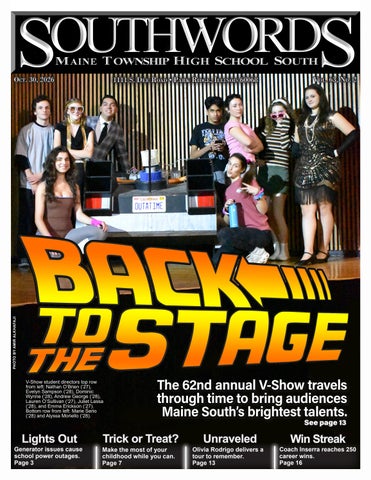
V-Show student directors top row from left: Nathan O’Brien (‘27), Evelyn Sampson (‘28), Dominic Wynne (‘28), Andrew George (‘28), Lauren O’Sullivan (‘27), Juliet Lassa (‘28), and Emma Erickson (‘27). Bottom row from left: Marie Serio (‘28) and Alyssa Moriello (‘28).
Lights Out
Generator issues cause school power outages. Page 3
The 62nd annual V-Show travels through time to bring audiences Maine South’s brightest talents.
Trick or Treat?
Make the most of your childhood while you can. Page 7
See page 13
Unraveled
Olivia Rodrigo delivers a tour to remember. Page 13
Win Streak
Coach Inserra reaches 250 career wins. Page 16
NEWS | Oct. 30, 2026
Riyad Abukhalaf becomes Illinois DECA state president
Rebecca Tellez
PHOTO COURTESY RIYAD ABUKHALAF
News Writer aine South senior Riyad Abukhalaf recently became the Illinois DECA State President for the 2026-27 school year after multiple rounds of interviews, letters of recommendation, and applications. Riyad has been part of DECA for four years, previously serving as a DECA State Vice President and qualifying for international competition. “It’s very difficult [to achieve this],” DECA advisor Ms. Beth Terpstra said. “They had to pass a test that has pretty deep knowledge about DECA Illinois. Then, they go through a round of interviews and give a speech at the leadership conference, narrowing it down to five people. The five become officers, and whoever gets the most votes PRESIDENTIAL DUTIES President Riyad after that becomes president. So, it was definitely Abukhalaf is being inducted into his leadership position at the state level. His induction occurred on Sept. 29. a lot of layers.” Abukhalaf has also made history by being “As President, I will have the opportunity to the first Maine South student to hold the Illinois lead Illinois DECA’s largest membership in hisDECA presidency. tory with more than 6,500 members statewide,”
M
Abukhalaf said. “Some of my responsibilities will include managing and working alongside the four State Vice Presidents, leading the development of DECA’s Program Work, and helping plan and lead the Illinois Career Development Conference.” His achievement was celebrated not only by Abukhalaf, but by the Maine South community. “We are all very excited that Riyad got this role,” Ms. Terpstra said. “It is a pretty big accomplishment, so that was pretty neat. Riyad continues to grow and progress by adding a little more each year, which is what has overall helped him gain so many opportunities.” For Abukhalaf, the focus remains on serving the DECA community and its organization members. “My mindset was centered on positivity and knowing I am running to make more opportunities for business education students across the state,” Abukhalaf said. “My goal, no matter what career, is to make a positive impact on the world, leaving it better wherever I go.”
South implements food fun- Bell schedule survey leads to Morning announcement draiser limitations block retention adjustment frees class time Samantha Baynes & Mia Teresi
Benja Argumendo
Julia Pertsak
A
S
I
News Editors
News Writer
t the start of the school year, the district imince 2021, Maine South has been operating plemented new policies in regards to clubs' under the current block schedule, with alterability to host food-based fundraisers. They an- nating odd and even four-block school days. In nounced that under their Quest partnership, clubs the years since its implementation, discussion would no longer be able to do unlimited amounts about whether this schedule is best for students of food-based fundraisers. has emerged at the district level. The fundraiser limit was implemented after a “The discussion began about three years ago district meeting with Quest faculty. after teachers gave feedback about our current “The school district has a contract with Quest bell schedule,” Principal Dr. Antwan Babakhani stating that they are the sole providers of food said. “We wanted to explore whether a different from 8:30 in the morning until 3 in the afternoon,” schedule could give teachers more instructional Student Activities Coordinator Mr. Michael Bi- time, increase how often classes meet, and better ondo said. “The past two years, there were some- support learning while considering the needs of times multiple fundraisers happening at once everyone.” — sometimes up to 10 a month. Quest thought To get the feedback necessary for the best deit went against their contract, so the higher-ups cision possible, surveys were sent out across the at Quest had a meeting with the school board to district. narrow the fundraisers down to two a month, and “The surveys were completed by teachers one food truck a quarter” and other staff members across District 207,” Dr. Ms. Connie Rogers, the sponsor for color- Babakhani said. “We wanted to give newer staff guard, has recently had to deal with this sudden members an opportunity to provide input before shift after their ability to sell Nothing Bundt Cakes a final recommendation was made. Throughout at school has been limited. the process, we gathered feedback through ad“We used to make a couple of hundred dollars ditional surveys, focus groups, and opportunities a month that went towards equipment, uniforms, for staff to share their thoughts.” and flags,” Ms. Rogers said. “Now we’re going to After feedback, it was found that the current have to look for other opportunities like chocolate block schedule was preferred by the majority of sales and Snap to raise money.” the respondents. Many of the clubs at South rely on food-based “The final survey showed that 54% of responfundraisers because of student interest and avail- dents preferred keeping our current schedule, ability during the school day. 31% preferred the proposed 1-4 schedule [where To compensate for the loss of funds, South each week would have one eight-period day] launched a program to aid all student activities. and 15% had no preference,” Dr. Babakhani said. “Clubs and activities are being offered mini- “From this feedback, the committee decided not grants to assist in implementing projects that ben- to recommend a change to the Board of Educaefit our students, regardless of if they were consid- tion, meaning our current bell schedule will reering food fundraisers,” Mr. Biondo said. main in place.”
2 SouthwordS
News Writer n response to recent feedback from staff and students, changes were made to the PA announcements, limiting the school-wide morning announcements to about a minute. “It’s perfectly understandable that there are concerns about loss of instructional time, especially during spirit week when the announcements do continue for a long time,” Student Activities Coordinator Mr. Michael Biondo said. When selecting the announcements that are read out loud, several crucial factors are considered. “The announcements that get read out loud have building-wide significance, impact on all students, school-wide initiatives, and things that we want to point everybody’s attention to,” Mr. Biondo said. Information can be shared through other means around the school. “We have TV screens mounted around the school, and I have access to put content on the TV screens for all the students to see,” Mr. Biondo said. “I think we can use those screens more effectively than we’re doing even right now to get information out.” The changes were implemented recently, so their success is still being evaluated. “We’re always open to feedback,” Mr. Biondo said. “We always want to know what students want, and what’s going to serve them, activities, and sports best. The same goes for recognizing students and their achievements.” Some students believe that the recent announcement changes are for the better. “The new announcements are a very good way of communicating, and I like that they are short and simple,” said sophomore Ella Rubin.
Oct. 30, 2026 | NEWS
Power losses leave classes in the dark Milan Bejatovic
News Writer n recent weeks, Maine South has seen numerous power outages throughout the school which have disrupted classes. The lack of Wi-Fi has caused teachers to shift assignments and sometimes even end their lessons 40-50 minutes early. Part of the reason for these disruptions is the age of the generators that Maine South uses. “From what we understand, the power outages were related to an issue with the main electrical service supplied by ComEd,” principal Dr. Antwan Babakhani said. “One of the challenges is that our generator system dates back to 1992. Unlike newer systems that can automatically transfer to backup power, our current system requires manual intervention to make that transition.” The maintenance team has to physically turn the power back on, which can take long since the school is large. The uncertainty of the outages caused high anticipation among students for the school day to end early. However, certain requirements must be met for school to be dismissed, and it is a last resort. “Losing power does not automatically mean that we need to dismiss school early,” Dr. Babakhani said. “One of the biggest considerations is our ability to provide meals. If an outage occurred during the school day and we
PHOTO BY LIZ PALMER
I
WATTS UP? A ComEd substation that sits directly to the east of the drive next to the visitors’ bleachers of Wilson Field is the
primary source of power for the school. In the event of a power outage, a transfer switch flips the school’s power source to the generator housed in the CoGen building (the brick building behind the south end zone).
could not restore essential cafeteria operations in time for lunch periods, that could become a significant concern.” Alongside meals, other safety concerns are evaluated. If everything seems to be going smoothly, the school day can remain as planned. Though having a back-up generator can allow the school remain open, the maintenance personnel must continue to manually transition to backup power in times of outages, which is both tedious and time-consuming. “At this point, we have what appears to be a temporary solution that allows us to continue operating,” Dr. Babakhani said. “While we are working toward a more permanent solution, I would not characterize the
situation as fully resolved at this time.” The power outages affected each class period differently. As Wi-Fi was inaccessible during the outages, Chromebooks were unable to be used for the time being. The uncertainty of the situation confused teachers and staff members as much as students. Junior Cameron Ranalli, who was in Financial Literacy in C6, saw a disruption of learning time because of the power outage, and the fact the windowless classroom had no natural light. “The class went dark, and there was no emergency light in the room,” Ranalli said. “Class stopped and we stayed on our phones for the rest of class.”
Other classes experienced similar outcomes. “During the power outage, I was in AP Gov,” junior Charlotte Looby said. “We were reviewing for a test when the power went off. We had to stop reviewing for the rest of class. The summative next class was extremely difficult to finish.” Whether the issue is fully resolved or not, the maintenance staff is working hard to fix it as best as possible. “It is important to recognize the work our maintenance staff has put into responding to these situations,” Dr. Babakhani said. “Their efforts have been essential in allowing us to continue operating the school while a longer-term solution is being pursued.”
ACT prep classes to be offered free for D207 students Ally Lobo News Editor
T
his year, District 207 will be offering a free ACT prep program. The program is an opportunity for students to receive academic support and preparation for the ACT without any financial cost to their families. Students will work with teachers to strengthen their skills, become familiar with the test, and build confidence. The idea for the program came from the district’s new strategic plan, whose main focus is providing access and opportunity for all students. District leaders, building administrators, and teachers from Maine South, Maine East, and Maine West came to the conclusion that a student’s access to academic support shouldn’t depend on their guardians’ financial situation. “We currently have two sessions planned: Jan. 25 through Feb. 19 and Mar. 1 through Apr. 1, with programming scheduled during the Mondaythrough-Thursday window from 3:30 to 5:30 p.m.,” principal Dr. Antwan Babakhani said. “We’re also exploring an optional full-length practice ACT on Saturday, April 3, to give students an opportunity
to experience the testing format before the official assessment.” The district is currently finalizing staffing details. The tutoring will be provided by teachers who have received instructional resources and guidance to best educate students with necessary support. The goal is for the educators to prepare students for what to expect and raise ACT scores. “I’m optimistic that it will [improve ACT scores],” Dr. Babakhani said. “At the same time, I think it’s important to recognize that success isn’t just about a number; it’s also about students developing stronger skills, feeling more confident, and having greater opportunities after high school.” Information will be shared about the program in November through school announcements, emails, staff, and other communication channels. Student registration is currently planned for Dec. 7–11 and its main focus is primarily on juniors. “I think that it’s a great thing,” junior Abby Seurynck said. “It’ll be very useful and helpful for people to study, especially if they don’t have access to resources. I’m excited to see how it’ll turn out.” Many hope that these classes will encourage more students to prepare for high-stakes testing.
“I actually appreciate that a lot,” junior Gabbye Petersen said. “It makes it more easily accessible to a lot of students who don’t feel like doing ACT prep or can’t afford it now that it’s here at school. It seems like it’ll be well used.” Students aren’t the only ones excited about these new opportunities. Educators are also excited about the impact this development could have on students’ lives. “We’re genuinely excited because this represents exactly the kind of work we want to see coming out of our strategic plan: taking a commitment we’ve made to students and turning it into something tangible,” Dr. Babakhani said. “I think it’s especially meaningful that we’re removing the financial barrier and creating an opportunity for more students to access preparation and support that can influence their future opportunities.” The district hopes to establish a sustainable program that will continue benefiting students for years to come. To ensure its long-term success, administrators plan to evaluate student participation, feedback, and assessment results to identify what is working well and determine how the program can be improved in the future.
SouthwordS 3
NEWS | Oct. 30, 2026
Students attend Northwestern Medill Journalism Day Ally Lobo
News Editor n Oct. 2, Northwestern hosted its annual Medill High School Journalism Day, giving students from Maine South, Maine East, and Maine West a chance to explore careers in journalism and media. A total of 20 students across District 207 attended the event, accompanied by three building career coordinators who served as chaperones. The program was organized by Northwestern University’s Medill School of Journalism, Media, Integrated Marketing Communications. The event introduced high school students to careers in journalism while allowing them to connect with current Northwestern students, faculty, staff members, and experienced media professionals. The day started out with a complimentary breakfast, followed by opening remarks from the dean of Medill, Dr. Charles Whitaker. He then introduced the keynote speaker, Sheinelle Jones, a Northwestern alumna and co-host of NBC’s “Today” show. Jones spoke about her journey in the media industry and the challenges and opportunities that came with a career in journalism, as well as live news. “Ms. Jones graciously spoke to students about her own career and educational experiences in media,”
O
Building Career Coordinator, Ms. Ifegenia Loukas, said. “I feel students really resonated with her honesty and vulnerability.” Following the keynote speech, students had the chance to participate in two industry workshops, each lasting around an hour. These workshops allowed students to explore different aspects of journalism and learn more about the skills needed to succeed in the field. Students additionally had the chance to make professional connections with anyone in attendance, allowing them to make meaningful relationships. “I attended the ‘How to Become Your Favorite News Anchor’ seminar, where we heard from news anchor Tanya Babich about how she prepares to host the morning news and how to change your tone and inflection based on what you’re reporting on,” senior Maisie Ortiz said. “It was such an interesting experience and it was super inspiring to hear from an actual news anchor and get feedback.” “I attended the ‘How to Interview Someone’ seminar, where we got tips on modern-day news and conducting interviews,” sophomore Sophie Chen said. “She had a slideshow and each slide had different tips about how to get really deep questions about a person during an interview. There were also simple questions and open-
PHOTO BY ALLY LOBO
LET’S TALK JOURNALISM ”Today” show host Sheinelle Jones visits
her alma mater and is interviewed by a current journalism student. She provided insight about her pathway to her career and advice for aspiring journalists.
ended question tips.” District 207 hopes to continue participating in future Medill High School Journalism Day events as long as Northwestern continues to host them. It provides students with a way to explore their interests, develop professional connections, and consider potential careers. Through the College and Career Resource Center (CCRC), students can discover other career tracks that can introduce them to other industries and future pathways. “It was really informative for me,” Chen said. “I didn’t know much about journalism or Northwestern, so it was
nice to see. I enjoyed how we were also able to visit and look around the campus and the other wings of the building.” The event also left students with a better understanding of their own interests and how they could pursue them in the future. “This experience was awesome,” Ortiz said. “It was great to hear from several people who work in the journalism field, talking with Medill students, and getting to hear from someone who hosts the Today show. This affirmed what I want to do in college and it gave me more ideas on how to make it happen.”
South hosts Key Club Fall Leadership Rally
Rose Hassman
News Editor n Oct. 4, Maine South hosted the Northeastern Key Club Fall Leadership Rally for the Illinois-Eastern Iowa district. The rally was an event available to all Key Club members to learn about the various opportunities available at the local, regional, and national level. “The Fall Leadership Rally is a regional Key Club event open to all Key Club members that provides workshop opportunities, an ability to connect with other members & district members, and a chance to learn about all the aspects of Key Club,” Isla Naples, Lieutenant Governor of Maine South Key Club, said. Naples serves as a leader in the Maine South Key Club District, including monitoring other nearby Key Club chapters and running an event for the Fall Leadership Rally. “I serve as the Lieutenant Governor for Division 8, which means I oversee six Key Clubs in the surrounding area,” Naples said. “At the rally, I worked to organize and present a workshop with one other Lieutenant Governor about Key Club 101 in front of a variety of Key Club members from the
O
4 SouthwordS
northeast regional area.” Statistical Secretary Jill Etchason also serves as a foundational leader in Maine South’s Key Club district, monitoring and providing input on the service of other high schools in the district. “I’m a statistical secretary for Key Club,” Etchason said. “I grade the monthly report forms from other high schools, and I give them feedback on how their district can improve their service, as well as the quantity of their service.” The Rally had many activities available to attendees, including training workshops introducing the various leadership positions that Key Club has to offer. “To start the day, there was an opening that I led, and we had different workshops throughout the day,” Etchason said. “I specifically led a secretary training workshop where the district secretary and I talked about what our roles entail, and how to make future secretaries in the northeast region strong.” Maine South hosting this year’s Fall Leadership Rally holds a special significance in the district. “The Key Club Fall Leadership Rally was significant because South has never hosted it in the
past, and it shows that we have strong leadership in the district,” Etchason said. “There were a bunch of other high schools with Key Club chapters that attended, like McHenry, Elgin, and others.” Some members’ biggest takeaway from the rally was community bonding with the other Key Club attendees. “The most memorable part of the experience was presenting at the Key Club 101 workshop and leading the icebreakers at the end of it,” Naples said. “I had a lot of fun teaching other Key Club members about the organization, and the icebreakers turned a room of people I had just met into a group that was laughing and talking together.” Etchason hopes the attendees walked away from the experience with new inspiration and confidence to uplift their own Key Club chapters. “I really hope that the Fall Leadership Rally attendees felt supported and confident in their service at the end,” Etchason said. “I also hope that the people who attended my secretary workshop left with a better understanding of my role, as well as my partner’s secretary role. I hope everyone walked away from the Rally being excited about service and Key Club.”
Oct. 30, 2026 | COMMENTARY
Maine South High School 1111 South Dee Road Park Ridge, IL 60068 http://www.southwords.org
Scan this QR code to e-mail Southwords
EDITORIAL CARTOON BY ELLA TAIT
STAFF EDITORIAL
Change in announcements leaves students confused
F
or years, the daily announcements have greeted staff and students at the beginning of the second period of the day. These announcements served not only as an opportunity to center ourselves for the day, but they shared important information about the happenings of Maine South, including announcements about meetings for clubs, upcoming opportunities, and celebrations of student achievements. In recent weeks, however, the tradition has changed. Rather than reading the scripts that each club has written, extracurriculars with messages to share are simply listed on the announcements. Hawks are then directed to check a Google Doc with all of the information that used to be spoken in years prior. This change was put into place because the morning announcements have been taking a significant amount of time from class, leaving teachers during third and fourth periods scrambling to finish lessons. In theory, this new method seems to solve all problems regarding the announcements. It ensures that the daily messages don’t take up too much time while still sharing the information that Hawks need to stay active and involved. However, making information available is not the same as ensuring students receive it. Many students are unsure about where the document is located, while others don’t even know that the document exists. Most students on our editorial board had never even opened
the document once. Communication about the change occurred in one email and no follow-up was provided. Relying on a single email to retrain the school on a primary mode of communication assumes that every student will see, read, and remember it. That is not a realistic expectation for high school students. Beyond the initial confusion, this change creates a larger issue: the very opportunities the school wants to encourage become easy to overlook. Students already juggle countless responsibilities and the new system makes extracurricular opportunities harder to access. This change may be especially significant for younger students, who are still discovering the opportunities that our school has to offer. Hearing a club’s announcement can introduce students to activities they may never have considered joining. The longer descriptions of meetings and events can catch their attention and encourage involvement. When these announcements are reduced to a list of clubs and moved to a specific document, students lose that direct, constant introduction to the opportunities available to them. Preserving class time is important because it ensures that students are getting the most out of their time in school. But this specific change is doing more harm to the student body than good. Instead of limiting announcements to just a list of names, it would be better to create a time limit for how
long the announcements can be and therefore limit how long each activity’s script can be or how many clubs can be announced each day. This suggestion makes sure that announcements do not take up excessive amounts of class time while still allowing for students to hear the details about each club. On top of that, this would remove the wordiness of club messages and result in direct and “to-the-point” announcements. Perhaps an even better solution, though, would be to create a built-in announcement time within the school day. To do this, the school day could end at 3:00 instead of 2:56 and use those extra four minutes for an announcement period. The time can be added onto third and fourth period, maintaining the length of every class while dedicating time in the day for announcements. Morning announcements should connect students to school opportunities and celebrate the wonderful things happening in our community. Saving class time is important, but so is ensuring that every student has a chance to discover their interests and get involved. Extracurricular activities increase student engagement, creating a more positive school community. Ultimately, this issue involves not only communication but also making sure students have access to the opportunities available to them. The ideal solution balances protecting class time with sharing the necessary information without unnecessary repetition.
Southwords is a student-run publication designed as a public forum for student opinion and balanced reporting on topics relevant to the Maine South community. Unsigned staff editorials represent the consensus opinion of the Southwords Editorial Board. Personal commentaries represent the opinion of the author alone and do not represent the opinions of the publication nor District 207. Student participation in the newspaper, whether through readership, submitting articles, or voicing comments or concerns, is encouraged. Signed letters to the editor can be given to a member of the editorial staff or e-mailed to southwords@maine207.org. Southwords reserves the right to edit material for clarity and brevity and to reject obscene/libelous submissions. Editors-in-Chief
James Biagi Joseph Calderón Lola Cosma
News Editors Samantha Baynes Rose Hassman Ally Lobo Mia Teresi Commentary Editors Claire Magad Lucas Runtz Ivana Zezelj Features Editors Bart Dabkowski Alisa Durkee Samantha Schelovitzky Entertainment Editors Karin Flensborg Andrew George Gabi Shaw Sports Editors Maggie Bublitz Shannon Ottow Riley Story Production Editors Amir Alkhafaji Sonia Loizos Liz Palmer Ella Tait Adviser
Mr. Stathakis
SouthwordS 5
COMMENTARY | Oct. 30, 2026
Trick-or-Treating is more than just candy Lucas Runtz
Commentary Editor
H
igh schoolers and trick-ortreating rarely mix. While some students may still choose to go trickor-treating, most have moved on to other Halloween festivities, such as social gatherings and spending time with friends or family. However, when society labels trick-or-treating as “childish” or “immature,” it highlights a broader issue: high schoolers are losing touch with their childhood from a pressure to grow up too quickly. High school is a time to explore interests, find a sense of belonging in social groups, and grow into a mature adult. It is also a time of academic stress, social pressure to conform to the standards of others, and uncertainty
6 SouthwordS
about the future driven by college and career aspirations. As former Cubs Manager Joe Maddon once said, “Never let the pressure exceed the pleasure.” When the former becomes a main focus, we can lose touch with what brings us joy and makes life meaningful. Life as a high schooler is a duality — one foot in the door of childhood, while the other steps into the unknown of adult responsibility. Teens may feel pressured to “grow up” faster by peers, adults, and mentors. But when life is reduced to a relentless schedule of resumebuilding and academic pressure, activities teens used to enjoy for pure fun are sidelined for “essential” responsibilities. However, unstructured, childlike activities are essential for mental well-being. A 2023 study published by Edutopia points to a persistent rise in teenage mental health struggles — including loneliness, depression, and anxiety — as a direct result of an ongoing decline in opportunities
for teens to play, roam, and explore independently of adult supervision. Independent, self-directed activity helps adolescents build feelings of autonomy and competence, which set up teens for success in adult life, when responsibilities only compound. For many students, this freedom is increasingly out of reach. Free time is filled with other obligations, leaving no room for this healthy activity. One reason for the lack of trick-ortreating (and play in general) is social media. Societal expectations spread through online platforms encourage teenagers to curate a polished, mature online persona. Trick-or-treating is often branded as “cringe” or “childish,” while Halloween is re branded as an aesthetic competition focused on outfits, parties, and digital validation. Furthermore, local laws have increasingly ruled out forms of teenage play. Many towns across the country have instituted age limits for trick-or-treating, with some banning anyone over the age of 12 or 14.
When communities explicitly prevent teenagers from participating in childhood traditions, it reinforces the idea that they must abandon childhood joy long before they are ready to step into adulthood. Reclaiming the balance between joy and responsibility doesn’t necessarily mean high schoolers need to go trick-or-treating forever. Nobody wants to see a 30-year-old with a beard standing on a porch in a tootight Spider man suit. However, it does mean recognizing that play, joy, and eccentricity are not hobbies to be outgrown, but necessary components of a resilient and healthy mindset. Whether it is an evening spent trick-or-treating without judgment, an art class attended on a whim, or a new book that you’ve been meaning to read, high schoolers deserve space to experience positive feelings outside of achievements and social validation. If we truly want to prepare for adulthood, we must first allow ourselves the grace to stop rushing through our youth.
CARTOON BY SONIA LOIZOS
Oct. 30, 2026 | COMMENTARY
AI can help (and harm) with college apps James Biagi
Editor-in-Chief
A
I is a tool that should be used in the college application process. But before you scour the rest of this article for AI characteristics, I don’t advocate using AI to compose college essays. Nevertheless, it is an extremely useful tool for planning and research that you should take advantage of. In many classes, AI is seen as this horrible thing that spits out the same trash for everyone who enters a prompt; however, if you use AI as a tool, it becomes a resource and not a ghostwriter. While writing my supplemental essays for college applications, I have found AI very helpful. College guidance websites, such as College Vine and College Confidential Forums, recommend spending one to three hours researching each college you are applying to before writing an essay. In a world where guidance counselors advise you to apply to 10+ colleges, this is an unmanageable expectation. Instead of wasting my time, Claude AI helped with this. I found a professor or class that interested
me, then I asked Claude to find similar programs in the other colleges on my list. This substantially cut research time for each college, so I could focus on my essays. Not only has AI helped me with the research aspect of my writing, but it’s also been useful for grammar and conciseness. I have put sentences, paragraphs, and even entire essays into AI for feedback. This has helped me catch numerous mistakes I missed after being too familiar with my work. This isn’t to say that AI should be your primary editor; it has notable limitations. While AI was able to catch surface-level grammar errors, it was unable to provide useful feedback on the content of my writing that other readers provided. I initially used a suggestion from Claude to shorten one of my paragraphs, but after a teacher read my essay, they pointed out how much it deemphasized a key point. In a situation like this, AI can not replace a human brain. Learn from my mistakes; be judicious about how you implement AI suggestions. Decide for yourself whether it has merit and clarifies your own writing before implementing any changes. Another problem of AI use is that people take everything as fact. Claude has a warning at the bottom of every chat that says, “Claude is AI and
FACT OR FICTION Claude AI explains its own limitations. Always check AI’s work for “hallucinations”; you don’t want fake info to be the reason you get rejected.
can make mistakes. Please double check responses.” They say this because of “AI hallucination” — when AI gives false information and presents it as truth. If students don’t check Claude’s research and write about a program or professor that is made up, they are likely not getting into that college. Yes, you could take the easy route and Ctrl+C and Ctrl+V your way to a completed essay — but that doesn’t prove to a college that you deserve a spot. Only you and real people in your life know who you are and how you write, so don’t let AI remove you from your own essay. AI will never know you as well as a teacher or parent does, but it does know a lot about everything else, so put it to work intentionally and liberate your creativity.
Teachers shouldn’t fear sharing their political views Ivana Zezelj
Commentary Editor
I
n a world full of followers, be the independent thinker. No student should fear expressing disagreement with their superiors. Maine South students graduate with countless abilities necessary for adult life, yet the majority of these graduates lack one essential quality: the ability to debate. Many students enter the world with a hostile attitude towards political debate, creating tension, and potentially dangerous situations. Yes, many high school students are comfortable debating with their peers, but in the real world, you’ll often find yourself debating your superiors. What happens then? Do you shy away? Do you fear consequences? Do you even know how to debate without getting aggressive? Students are taught from a young age to respect authority figures, yet respect shouldn’t mean blind agreement.
If teachers welcome disagreement and present opposing viewpoints, sharing their opinions can encourage healthy debate rather than create a polarized classroom environment. By learning how to listen and debate political topics with your teachers, you are gaining practice respectfully challenging authority figures, a skill that is needed with employers, professors, and other leaders. These debates rarely happen, though, because teachers themselves fear this debate. The current District 207 policy does not explicitly prohibit teachers from sharing personal political opinions, yet it strongly encourages them to maintain neutrality. It specifically states “Teachers are advised to be careful about asserting their own opinions within the classroom setting… Present the matter in a neutral way that invites student discussion and conversation.” This recommendation creates unnecessary hesitation amongst teachers, limiting opportunities for students to practice respectfully challenging authority. Illinois state law recognizes the importance of discussing controversial issues in civics education, yet District
207 discourages teachers from sharing their own perspectives during these discussions. This portion of the Illinois state law should be reflected more clearly in the district guidance. After speaking with several administrators, I have come to learn that even with the current district policy, there is some wiggle room; it is more strong advice than a rule. This ambiguity, though, has instilled a fear amongst Maine South teachers. If teachers decide to take that risk and attempt to express their views, they feel like they would face repercussions. Expressing a political opinion is not indoctrination in all contexts, esp e ci a l ly w hen students are encouraged to challenge it. Another benefit of teachers sharing their political opinions based on their interpretation of evidence, is that it encourages students to develop their own political beliefs. Right now, there is major societal political apathy, and that may be because political passion is never modeled for students. It is important that in high school, students start to think about politics and form their stances and opinions,
so that when they go into the real world, they have strong opinions for intelligent conversations and debates. Nevertheless, it is important that teachers do not impose their political views on students. Promoting thinking through debate doesn’t equate to telling students what to think. Maintaining a safe and non-hostile environment in the classroom is essential. In addition, to ensure that these debates are relevant, they shouldn’t be happening in every single class. Instead, it should be a part of classes such as Civics and Government, AP Government, Constitution Team, and Journalism. This ensures that every student gets this experience, without making it excessive and inappropriate. Ultimately, without students learning healthy debate with their superiors, they would be graduating with a disadvantage. District 207 shouldn’t discourage teachers from sharing the perspectives that help students become independent thinkers. After all, if schools are meant to prepare students for a world full of differing opinions, students should first learn how to respectfully handle disagreements with the very people teaching them.
SouthwordS 7
COMMENTARY | Oct. 30, 2026
Claire Magad
Commentary Editor
ILLUSTRATION BY REBECCA TELLEZ
The MAP test shouldn’t map your future
started their freshman year in Math 3 Compression, while other students were two years behind. It’s certainly not easy to do math two years ahead of standard students. A large majority of those in higher classes have a natural talent for mathematics, a strong work ethic, and have worked their whole lives diligently to remain in those classes. However, the opportunities that these students received when they were seven to nine years old provided them with a straightforward path to get there, while the students who
scored lower on the MAP test didn’t receive those same opportunities. Unfortunately, students in lower classes also tend to score worse on later standardized tests like the SAT and ACT. Part of this can be attributed to the classes students take, rather than innate ability. It’s much more likely that a junior who is taking AP Calculus BC will score higher on a standardized test than a junior still learning Math 3. The ACT covers pre-calculus topics, which puts students in lower math classes (who haven’t experienced
these topics) at an unfair disadvantage compared to their peers. This can subsequently determine the colleges students get into and how well a student can handle the rigorous classes for their major, especially for STEM-heavy majors like engineering. This could even affect your future career success— all because of a test you took in second grade. Perhaps elementary schools could rely more heavily on factors beyond a test to determine class placement. Interest, initiative, and learning potential are not accurately measured through a standardized test. For hard data, repeated, smaller assessment data could help, like adaptive learning analytics. A daily educational software could automatically track a student’s problem-solving speed, complexity level, and persistence. This could recognize advanced abilities during normal class work, rather than relying on less frequent testing. While more testing could be more accurate in the end, ultimately, though, testing students at such a young age seems to close doors, rather than open them.
Per Virginia Tech News, until last fall, each of the four short-answer essays applicants submitted was read and scored by two people. Now, a second human reader only steps in if the AI and human disagree by more than two points on the 12-point scoring scale. The creation of this tool took three years and was the collaborative effort of admissions staff and faculty members from the Department of Psychology and the College of Engineering. One reason for this change is the sheer volume of applications coming in. Virginia Tech saw a massive increase in the number of applications after becoming testoptional following the pandemic. Artificial intelligence takes only 1.8 seconds to scan an essay and can complete 250,000 of them in under an hour, as opposed to an admissions officer, who takes an average of two minutes to read an essay. The speed of this technology sounds enticing for overwhelmed admissions officers. But personal statements are supposed to be a place where an applicant can show more
than just their statistics. Can an AI program trained to grade off past scores recognize unusual, daring pieces of writing that don’t exactly fit the standards? Or will it grade according to predictable patterns and formulas easily replicable and seen thousands of times? Bias is another concern. AI learns from the data it is given; if there’s a mistake, it could repeat it faster than any human, unnoticed. Applicants also have no way of checking on AI assessment, since most colleges do not explain how an essay was scored or why a student was rejected. According to industry surveys, roughly 50% of higher education admissions officers now use AI in their application review. However, some schools are not as transparent as others and have faced backlash. The University of North Carolina-Chapel Hill was exposed by its independent-run newspaper, the Daily Tar Heel, to use AI to autoscore applicants for grammar and writing style. Documents obtained by the newspaper revealed UNC had
quietly been using AI essay-grading technology since 2019. In response, university officials defended the practice as a necessary measure to manage the overwhelming volume of applications, and claimed it served only as a screening tool. Still, the lack of disclosure sparked a national debate over the boundary between efficiency and human empathy in admissions. The solution to this is not banning AI from the admissions process; it is setting rules and clear guidelines. Colleges should have the obligation to clearly state on the application whether AI reads essays and what it scores. The final call should always be made by a human, and the machines have to be tested, managed, and developed constantly, with public reports regarding their abilities and limitations. Students have a role too. If there’s the possibility of only one human reading your essay, the best strategy is to write an essay true to yourself, full of specific details and a human voice that makes it real. Algorithms may be easy to follow, but a genuine story is hard to fake.
A
t the beginning of second grade, District 64 students were loaned a computer to take a test — one that would shape our future educational opportunities. While this test was supposed to open doors to opportunities, for some, it closed them. Your class placement for the next school year heavily depended on the score you received on the MAP or CogAT test the year prior. There is a perception that some students are “geniuses” for being in advanced classes and learning double the material that others learn. In elementary school, these students who moved to advanced classes were looked upon in high regard, which led others, like me, to feel inferior. The students who took Channels of Challenge classes all through elementar y and middle school
AI could be evaluating your college applications Daria Kasperek
Commentary Writer
F
or years, college essays have had one audience: admissions officers — the same admissions officers who work through thousands of applications one page at a time. However, times have changed, and so have application evaluation strategies, as some universities have implemented modern AI machines to help with this process. For example, at Virginia Tech, artificial intelligence has begun working alongside a human college admissions officer to help evaluate applications. AI in admissions is not as bad as a student might fear, because a human is still involved in the process. Still, colleges need clear boundaries over how they use it. If schools are allowing software to grade the most personal part of an application, they owe students transparency on how this system works.
8 SouthwordS
Oct. 30, 2026 | FEATURES
A balancing act: AI in college applications
Bart Dabkowski
Features Editor s artificial intelligence (AI) spreads to many areas of Maine South’s academics, it is also beginning to affect the college admissions process for seniors. There has been an increase in students using AI to strengthen their applications. Ms. Robyn Moreth, the postsecondary counselor at the school’s Career & College Resource Center, has seen students use AI in a variety of ways. “Most notably, I would say they’re using it for the school search piece,” Ms. Moreth said. “They’re putting into the AI preference what they’re looking for in a college in order to build a college list.” Although this may seem like an acceptable use of AI, students should still be careful with the information they receive. “I always recommend that they do look back to the websites, Schoolinks, or some other resource in order to fact-check if that list is relevant,” Ms. Moreth said. “One piece that AI sometimes doesn’t do [right] is the rigor of the academic profile that is necessary and the financial piece. Sometimes that financial piece gets a little bit lost in translation.” Students are increasingly using AI for the essay portion of college applications. “Some kids are using it to help brainstorm the essay — hopefully not more than that,” Ms. Moreth said. “There are some colleges who put out their own AI parameters, and they say that brainstorming is fine. Some colleges don’t have a statement on AI.” Some colleges allow students to use
A
AI to help their applications, while others ban it entirely. Georgia Tech is more open to AI use, but it still considers copying AI word-for-word plagiarism. “In the same way you would not copy directly from any other source you may incorporate into the writing process, you should not copy and paste directly out of any AI platform or submit work that you did not originally create,” the statement reads. “Instead, approach and consider any interaction with an AI tool as a learning experience that may help you generate ideas, provide alternative phrasing options, and organize your thoughts.” Northwestern University has also released a statement that emphasizes the importance of submitting your own work. “Just as you wouldn’t ask another person to write your essays for you, we expect you won’t ask AI to do that work on your behalf,” Northwestern’s statement says. “The expectation on Northwestern’s campus is to produce original work, and, as such, we expect your portion of the application will reflect your own work.” According to a survey of 50 seniors, 79.3% of those who use AI for help with essays used it for brainstorming. Only 13.8% used it to create a draft of at least a part of their essay, while 58.6% used it to revise an alreadywritten essay. According to Ms. Moreth, one risk of using AI for revisions is losing your authenticity in an essay. “I’m seeing a lot of what I would call ‘trying too hard’ with some of the facets of the application, and part of it is AI being used to be more descrip-
In your opinion, is it ethical to use AI to write college essays?
How worried are you about getting flagged for AI use on a college application (even if you didn’t use AI)? Very worried
Yes 16%
Neutral 28%
Worried
6% 10% Not worried 34%
Somewhat Worried 50%
No 56%
*Based on the results of a voluntary email survey of 50 seniors tive on it,” Ms. Moreth said. “My point working in tandem with an AI, that being it doesn’t really sound like them could be a way to rewrite it.” anymore. It doesn’t sound like a 17- or Renaldi believes that AI can be 18-year-old; it sounds manufactured, used as a tool to improve your writing, it sounds robotic, instead of their au- but that students should still be careful. thentic voice.” “It really depends on the kind of One student who is wary of using the mindset you’re coming into it with, AI for college applications is senior and from an outside observer, there’s Ellie Reuhs. She believes that AI usage no way to really tell what that line is,” can be a slippery slope. Renaldi said. “I think using AI in college applicaDespite not using any AI in any tions can very quickly become some- part of her application, Reuhs is thing that does more harm than good,” somewhat worried about being falsely Reuhs said. “Using it for research is not flagged for AI use. that bad, but once you start generating “I am a little worried because I have text and words and having AI write a very wordy writing style,” Reuhs said. your essays or your supplementals for “I use a lot of em-dashes and semicoyou, that will hurt your chances.” lons, and sometimes that is a hallmark Senior Ethan Renaldi has used AI of AI writing.” for researching colleges, especially for Some colleges do use their own AI finding colleges that have opportuni- software to check if a student used AI ties that interest him. in their writing, but even if an essay is “I used it for a lot of my schools to falsely flagged, it is possible it will not research, because when you’re going lead to consequences. through the college process, I found “I would say they might be flagged, that AI was super helpful to help look but it’s not necessarily that the student out for different specific opportunities,” might be aware of it,” Ms. Moreth said. Renaldi said. “For me, if you’re writing “The essay is one portion of the whole your core ideas, and then you’re also puzzle. It can be an important piece, and they’re definitely reading those. But quite frankly, I don’t know that there’s the manpower in order to do 50 seniors shared their opinions on AI in the college application process in a voluntary email survey. anything if something is even flagged. But the advice to the students is honesty is the best policy.” per sonal Reuhs ultimately believes that stufinding statement dents should take advantage of more scholarships non-AI resources when getting help on college applications. “AI is a good resource, but there are a lot of resources that are not AI,” supplementals Reuhs said. “There are people who will researching help you with your essays and activities colleges none lists. You have people at Maine South extracurricular and people outside of Maine South descriptions who will help you with those tasks, and you don’t need to rely solely on AI to do your entire application for you.” GRAPHICS BY SONIA LOIZOS AND ELLA TAIT
Have you used AI on college applications? For what parts of the application process 32% have you used AI?
64%
40%
38%
22%
26%
SouthwordS 9
FEATURES | Oct. 30, 2026
Astronomy club: exploring the universe
Samantha Schelovitzky Features Editor
F
o r s t u d e nt s i nt e r e s t e d i n learning about planets and stars, Astronomy Club offers the opportunity to explore their interests and connect with others. The club is led by co-founding seniors Ray Bunge and Vaughn Henderson and sponsor Mr. Thomas Egan, a physics and space science teacher at Maine South. Astronomy Club hosts both outdoor viewings of the sky and demonstrations of astronomical concepts. “I feel like a lot of people see a cool space video on their phone and are super interested in it for maybe a minute or so, and then kind of lose interest,” Bunge said. “I wanted to form a community at Maine South where people could come together and talk about this topic.” The outdoor viewings hosted by Astronomy Club allow students to experience what they’ve seen on a screen in real life. Bunge and Henderson ensure that the outdoor viewings are accessible for anyone to attend and participate in at Woodland Park.
“We also provide the equipment that needs to be used, like the telescopes,” Bunge said. Students are welcome to drop by and use the telescope for as long as they want during these outside viewings. “It’s just really cool to see people who have never shown up before, and they see the rings on Saturn or colors on Jupiter or something for the first time,” Henderson said. “My favorite thing is seeing the joy or the amazement on people’s faces,” Bunge said. “When they look through the telescope for the first time and see the planets, I think for some people, it’s a really cool moment.” In addition to viewing planets and stars, members also use telescopes to take photos of the sky. “A few of our members have been working in astrophotography,” Mr. Egan said. “Some of our members have taken what I consider to be professional-level pictures, and I never get tired of seeing incredible pictures of astronomical phenomena.” The photos taken are posted for all to see. “We have a club Instagram page
PHOTO BY RAY BUNGE
NIGHT WATCH Astronomy Club members observe the sky on a clear night at Woodland Park. For many, it is their first time observing space through the telescope.
where I’ll post the photos I get,” Bunge said. “And then if people want to learn how to do that, they come to me and I can teach them.” Astronomy Club uses demonstrations to visualize complicated concepts in a way that is easy to understand. “Another thing we’re planning on doing represents what happens when a star explodes or collapses,” Bunge said. “You’ll have a spinning ball hanging from the ceiling, and you pull on a string, and it’ll collapse in — it’ll start spinning faster. It shows
the physics behind it without it being super complicated.” In the future, Astronomy Club hopes to have guest speakers, specifically a Maine South graduate currently working in astrophysics. Bunge and Henderson hope to continue expanding the club and make astronomy more accessible to all. “[Astronomy is] something really cool that I feel a lot of people don’t have the resources to see,” Henderson said.
The underappreciated assistants of Maine South Alisa Durkee
Features Editor rom helping students navigate assignments to building skills for life beyond the classroom, special education teaching assistants play an important role in supporting students at Maine South. Their responsibilities vary by class, with some working one-on-one with students while others help students participate in general education classrooms and learn to advocate for themselves. Ms. Angela Margaris previously worked with the Department of Children and Family Services and individuals with developmental delays. After retiring, she wanted to continue helping students. “I was in the business world for 30 years, and I retired, and then I realized I still wanted to work,” Ms. Margaris said. Ms. Margaris helps students understand assignments and participate in general education classes. She doesn’t just help out special education students — she works to create a better classroom environment for all students. Some students may hesitate to ask questions when they think their classmates already understand the material. In those situations, Ms. Margaris helps students communicate their needs without drawing attention to themselves. “A lot of times, what I’m there for is their voice,” Ms. Margaris said. “Kids that are nervous to advocate for themselves: We help them advocate
PHOTO BY LIZ PALMER
F
10 SouthwordS
SUPPORT FOR ALL Ms. Margaris helps
students in an Earth and Environmental Science class understand the instructions on a worksheet. Special education teacher assistants not only help students, but also work alongside teachers to create a supportive and inclusive learning environment for all students.
or we do the advocating for them.” Beyond helping students speak up, Ms. Margaris adapts her teaching approach to meet their individual needs. She uses drawings, gestures, and step-by-step explanations to make difficult concepts easier to understand. For her, seeing students grasp a challenging concept is one of the most rewarding parts of the job. “My favorite part is when the kids get it, that ‘aha’ moment,” Ms. Margaris said.
Mr. Eric Santiaguillo is a teaching assistant who has worked at Maine South for nine years. He supports students one-on-one and in classes such as adapted physical education, theater, broadcasting, and life skills. He finds Career Work Training (CWT) especially rewarding because it allows students to develop skills they can use in future jobs. “I feel like I thrive more when I’m in a class where we can be hands-on, like in CWT, where we do a lot of working skills, and we teach the skills so that they can take it to work,” Mr. Santiaguillo said. In CW T, students practice workplace responsibilities and everyday tasks, such as cleaning tables. Through these hands-on activities, students develop practical skills that can help them become more independent and prepare them for future employment. In addition to classroom learning and workplace skills, Maine South has many opportunities to connect with their peers. Mr. Santiaguillo highlighted Maine South’s Hawk Pals program and Special Olympics as examples of activities that encourage students to build friendships and interact with their classmates. “I feel like this school does a better job of including our students,” Mr. Santiaguillo said. “I think Hawk Pals and Special Olympics do a nice job of including anybody who wants to come in and join and have friends and have our kids mingle with general ed peers.”
Oct. 30, 2026 | FEATURES
Student-led financial literacy Emma Brown & Emma Militaru Features Writers
M
oney Makes Cents is a nonprofit organization founded by two Maine South students focused on improving students’ financial skills from a young age. C o - fou n d e r s e n i or s R iy a d Abukhalaf and Alex Davidov are passionate about teaching financial literacy. “Our goal is to give teens and kids the tools to build confident, informed, and financially smart futures,” Abukhalaf said. “The objective is how we can take the curriculum the students are learning and make it relevant for them.” Abukhalaf and Davidov started Money Makes Cents in May of 2025 at the end of their sophomore year. They started the organization after hearing about what other Maine South students thought about financial literacy. “When we got to the high school level, we often found that, particularly through our DECA experience and taking so many business education courses, many students were uneducated on money,” Abukhalaf said. Although Financial Literacy is currently a graduation requirement, students tend to not retain the information they learn. “Yes, teachers have the curriculum, and they have the experience, but it’s hard to convince someone who is not your own age to do it,” Abukhalaf said. “We have similar goals to the students we are teaching.” Both Abukhalaf and Davidov were exposed to finance early in life. “I have run my own business since
eighth grade,” Davidov said. “I’ve had to learn how to manage money there. I’ve also been investing since around 12 or 13.” Similarly, Abukhalaf started learning about finance at a young age through his family’s conversations about money. The pair work together as a team but have taken on specific roles within the organization. Abukhalaf directs curriculum and partnerships, while Davidov directs digital content and strategy. “My main focus is looking at the content based on grade level, looking at curricula and standards around it, and working in the community to find places in which we can host those meetings,” Abukhalaf said. Davidov works on the organization’s website and produces videos for their social media pages. Money Makes Cents has done many presentations, activities, and collaborations with other businesses and groups. “We go around and do workshops,” Davidov said. “We’ve done over a dozen workshops... partnering with a lot of schools.” Their work goes beyond helping Maine South students. “Some of the things that we have done include Lunch and Learn,” Abukhalaf said. “We were sponsored by Lakeside Bank [in Park Ridge], and they paid for a Raising Cane’s lunch for us. We work with Maine Township, District 64, and some Chicago public schools.” Both Abukhalaf and Davidov’s families are from outside the U.S., and because of this, they look to collaborate PHOTO COURTESY RIYAD ABUKHALAF
MONEY WORKSHOP A group of Maine South students pose after a
presentation by Money Makes Cents titled “Building Your Financial Future.” The event was sponsored by Lakeside Bank in Park Ridge.
PHOTO COURTESY RIYAD ABUKHALAF
MIDDLE SCHOOL FINANCE Abukhalaf and Davidov give a presentation to a class at Lincoln Middle School. Lessons like this focus on creating financial goals.
with communities that do not have the same access to financial resources as they did. “Another partner that we are super proud of is actually through Alex called The Little Bulgarian Center in Little Bulgaria School,” Abukhalaf said. “It’s a lot of children whose parents are from Eastern Europe, particularly Bulgaria, who haven’t really been exposed to this topic because it is not really brought up at their age.” Addit iona l ly, D av idov and Abukhalaf have partnered with Maine South to give presentations to financial literacy classes. In August of 2025, they gave a presentation to Mr. Andrew Schneider’s class. “It was a really good presentation appropriate for financial literacy students,” Mr. Schneider said. “The part that I thought was well thought out was that they thought about their audience — the age and level of knowledge. I think they should continue on with what they’ve started already.” Abukhalaf and Davidov enjoy the behind-the-scenes work that goes into Money Makes Cents as well. “One of the underrated things is actually planning for the workshops,” Davidov said. “It’s a lot of fun to get together, brainstorm different ideas, and make our presentations.” Abukhalaf and Davidov have found their work with kids to be extremely rewarding. “My favorite part is just getting to see the kids excited about a topic that’s just not so fun at this age,” Abukhalaf said. “It’s really interesting to see what you can do when you work with the
kids in a way that works for them. You can just see, whether it’s through their eyes or through their smiles, the transformation you get to make on them in each and every workshop.” To those thinking about starting a business, Abukhalaf and Davidov offer similar advice to take a leap of faith and begin, even if the minor details are not figured out. “Don’t worry about starting small — you’ve just got to start somewhere,” Davidov said. Abukhalaf relates their advice to a popular marketing slogan. “Nike said it best: just do it,” Abukhalaf said. This school year, Davidov and Abukhalaf will be graduating. Money Makes Cents, which is mostly operates during the school year, will face changes. The pair are still discussing the future of the organization but are passionate about continuing the mission. “Maybe when we come home from college in the summertime, this could be something that we do,” Abukhalaf said. “But then again, it’s difficult to find kids in the summertime. Alex and I have also talked about maybe at some point if there’s a kid from DECA that we believe would do a good job with it... They could help continue the mission.” For Abukhalaf, the value of Money Makes Cents goes beyond the organization itself. The memories and meaning attached to it make saying goodbye that much harder. “It’s going to be very hard to let it go,” Abukhalaf said.
SouthwordS 11
ENTERTAINMENT | Oct. 30, 2026
Mac ‘n’ Cheese Potbelly
mania
As the fall season advances and the weather gets chillier, Mac and Cheese becomes a more popular comfort food for many. Southwords tries three different establishments that serve unique Mac and Cheese to find which is the most mac-nificent!
Karin Flensborg, Andrew George, & Gabi Shaw Entertainment Editors
PHOTOS BY KARIN FLENSBORG
Chili Mac ($6.49) 107 S. Northwest Hwy., Park Ridge, IL 60068 Potbelly’s Chili Mac is a three-cheese mac and cheese topped with a hearty beef chili with beans and peppers. The mac and cheese itself has more of a creamy texture; however, the mac still has plenty of rich, cheesy flavor. With the mac and cheese providing a creamy and rich counterpart to the slightly spicy, savory chili, it brought a perfect balance of flavor with both complementing each other. While it is a great combo, the mac and cheese would still be delicious to eat on its own. The one small caveat to this dish is that there was a little too much chili, but, overall, the dish has wonderful components that pair perfectly together.
KFC
Dave’s Hot Chicken
KFC’s Mac and Cheese Bowl includes mac and cheese and chicken nuggets, topped with a three-cheese blend. The chicken nuggets are both crispy and juicy, and filled with lots of flavor. They are the highlight of the dish, as the mac and cheese itself isn’t that amazing. It tasted pretty plain and almost artificial — the same as store-bought mac and cheese. However, the mac and cheese was pretty creamy. This, along with the garnish of the three-cheese blend, made the taste of the mac and cheese itself seem better. Overall, without the chicken, this bowl would be nowhere near as good.
Dave’s Hot Chicken offers a Loaded Spicy Buffalo Mac and Cheese combination paired with fries and chicken bites. The fries are nice and crispy, holding up surprisingly well without getting soggy from the sauce. The mac and cheese itself is a hit, featuring a rich cheese flavor rather than a cheap, yellow, artificial taste. The added kick of spice really elevates the dish and makes it delicious. While the sauce and cheese flavors are great, the order only came with three pieces of chicken, which definitely feels like too little for a full meal. Overall, despite the small chicken portion, the impressive spicy flavor makes the dish well worth ordering.
Mac and Cheese Bowl ($5.00) 1195 E. Oakton St., Des Plaines, IL 60016
Loaded Spicy Buffalo Mac and Cheese ($6.99) 5530 W. Touhy Ave., Skokie, IL 60714
Disney’s worlds collided for a night of fun and nostalgia Karin Flensborg & Andrew George Entertainment Editors
Disney’s “Disney Worlds Collide” Tour - United Center - Oct. 19
S
tars of Disney’s newest “requels” took the stage at the United Center during the “Disney Descendants ZOMBIES Camp Rock Worlds Collide Concert Tour,” and put on a remarkable show. Liamani Segura, Dara Reneé, Kiara Romero, and Alexandro Byrd starred in the “Descendants” franchise. Malachi Barton, Swayam Bhatia, and Mekonnen Knife represented the ZOMBIES franchise. Segura and Barton also starred in the Camp Rock franchise, alongside Hudson Stone. Although they had no openers, the concert was three hours long, including a 20-minute intermission. The show was split into two acts. The performers sang and danced while also playing instruments, most notably Bhatia on drums to open the show and Stone on electric guitar
12 SouthwordS
throughout many songs. Because many cast members are also independent artists, they showcased their own music during the show. To close act one, Reneé performed her song “Never Waste a Heartbreak,” and Barton sang his debut single “Stay for the Credits.” Stone opened act two with his new single “Talk,” and Segura followed with her new single “Things I’ve Learned (So Far).” A highlight of the show was the mashups, which combined songs from multiple franchises. The campfire medley was a mashup of seven slower songs, but they all flowed together well. Another mashup that excelled was the one between “Flesh & Bone” and “It’s Goin’ Down.” This was the best use of the mashups, and really showed how complementary the mix of franchises could be. The songs didn’t just lead into one another, but both songs were mixed simultaneously. However, the fantastical nature of Descendants and ZOMBIES made Camp Rock’s grounded elements stand out. The cast was singing about magical cupcakes and villains while
PHOTO BY KARIN FLENSBORG
SWEET SONGS The full cast performs “Life is Sweeter.” Even in big group songs, each cast member got a little solo and their time to shine.
in denim, where something brighter and with vibrant colors probably would’ve fit better. The emotional core of the concert came during the individual spotlight segments, where personal video and picture slideshows introduced each star’s childhood memories. Romero’s segment stood out as particularly touching since she spoke about the importance of family. The moment peaked in a video message from her younger brother, who expressed his love and declared “BAMM” from the first “ZOMBIES” film as his favorite
song. This created an ideal transition as the entire cast launched into an explosive live version of the song. From a production standpoint, the concert succeeded with vivid lighting cues, vibrant color palettes, and sharp choreography that kept the arena buzzing. Ultimately, the “Worlds Collide” tour proves that Disney’s next generation of talent possesses genuine, multi-instrumental skill that’s able to command an arena. With a blend of fun and nostalgia, the night was an unforgettable one.
Oct. 30, 2026 | ENTERTAINMENT
Annual V-Show travels through time
CJ Hutchinson
PHOTO BY AIDAN MOISE
Entertainment Writer
M
aine South’s long-standing Variety Show returns this November, bringing students together for two nights of performances that celebrate decades of music, entertainment, and school history. The Variety Show, commonly known as V-Show, has been a staple of Maine South since the school opened in 1964. While the production continues to change and evolve each year, some traditions have remained for more than 60 years. One of those traditions is the finale song, “Gonna Build a Mountain,” by Sammy Davis, Jr., which connects this generation of students to the first cast. “Three years ago, a group of alumni from one of the first graduating classes came through the building,” V-show director Mr. Joseph Fitzpatrick said. “They asked if we still do the song, ‘Gonna Build a Mountain’ at the end of the show. So, this really has been going on a long time.” Even though some aspects remain the same, the show differs in other ways annually. Each year, a different theme is
WITTY WHEELBARROWS Junior Stephen Marinis, senior Colin Meade
(top, left to right), and juniors Marie Serio and Emily Compton (bottom, front to back) practice a Trunk sketch. They have been rehearsing since the beginning of September.
chosen for the V-Show. Although acts do not have to be based on the theme, some groups take inspiration from it, such as Trunk, who commonly writes their sketches based off of it. “Trunk is a sketch comedy group,” senior Trunk head Lauren O’Sullivan said. “We perform in-between the V-Show acts, kind of like SNL.” This year, that theme is “Back to the V-Show,” inspired by the “Back to the Future” movie series. “We tried to incorporate acts that go along with different decades and different time periods, so that we
could really show not only a variety of types of acts, but also a variety of time periods in our acts,” student act director junior Juliet Lassa said. Not only are students performing this year, but some staff members will also take part in the show. “Staff members, who were also Maine South alumni, are also having an act,” O’Sullivan said. “They are going to do a big group number and it’s going to be lots of fun.” The broad theme allows for students to make their own creative choices in terms of what they perform
and their stagecraft. “A lot of acts are doing costumes and music that are going to go with different ages, and the Footlighters’ opening number is going through different decades,” O’Sullivan said. Maine South’s Stage Crew makes sure there is a set, lights, and sound to make a complete show behind the scenes. Collaboration on the play even extends all the way to the classroom. “The Music Theory and AP Music Theory classes get the songs for vocal acts and then they write out parts for all the instruments in stage bands,” Stage Band student director senior Emma Erickson said. “Different people will write different parts for the different songs, and then the music will go to Mr. Park, so that stage band can rehearse with it. Music theory also writes and transcribes music for the show, which is really cool.” The teamwork between performers, stage crew, student directors, and staff highlights the school-wide effort required to produce the annual show. “Back to the V-Show” will be performed on Nov. 20 and 21 at 7:00 in the Maine South auditorium. Tickets are $10 for students and $12 for adults.
Rodrigo masterfully tells a story about love and heartbreak Julia Coyle
Entertainment Writer
Olivia Rodrigo “Unraveled” Tour- United Center - Oct. 12
O
livia Rodrigo’s “Unraveled” tour is projected to generate a gross total of 250 million dollars, and she earns every penny. Rodrigo performs for two hours and plays about 24 songs per show. Six acts, including the encore, each represent different seasons, with spring and summer getting repeated. Rodrigo uses her discography, videos, and set to show the changes. As the seasons change, there is a video projected on the moon-shaped screen that depicts a landscape with a specific weather to illustrate the transition. The stage began filled with a field of flowers, but as the seasons changed, flowers started to disappear as they do with time. The audience was not only able to see the transitions, but feel them as the atmosphere in the arena shifted. Rodrigo did a phenomenal job at selecting her music in a way that not only told a story, but kept the audience engaged in it. Rodrigo explained before performing the song, “Begged” that her album, “You Seem Pretty Sad for a Girl So in Love” follows the stages of a relationship, which is a narrative that is told through the concert
PHOTO BY JULIA COYLE
PRETTY IN PINK Rodrigo performs the final song off of her new album, “cigarette smoke.” This is the longest song in her discography, at 5 minutes 40 seconds.
as her songs describe the deterioration of love. Olivia Rodrigo is a three-time Grammy winner, and the first-ever artist to have the lead single on their first three studio albums launch at number one on the Billboard Hot 100. Her success is clear as the “Unraveled” tour is completely sold out from primary ticket vendors across over 80 arenas globally.
Rodrigo was meticulous with her set, as every song has a specific purpose in terms of the story. For example, the song “less” portrayed the end of a relationship. It conveyed a poignant message of emotional growth to her fans. However, with incredible storytelling, it seemed like sometimes the stage presence wasn’t as important. Rodrigo had no backup dancers, only backup singers and a band. Her performance consisted of her running and jumping around and playing a variety of instruments as she sang. That’s not to say that Rodrigo didn’t have notable moments on the stage. At one point of her show, as Rodrigo performed “the cure,” she was standing under pouring rain as her dress dissolved, revealing a red mini dress. Just like the lyrics, Rodrigo was literally “unraveling,” which is where the title of the tour comes from. It is one of those things that has its appeal because of the environment and the emotions that are intertwined within it. Although people’s perceptions of the stage performance may vary, Rodrigo’s live vocals demonstrated stunning vocal control and range. As a result of her vocals and interesting lyrics, thousands of people are able to feel deeply connected. Ultimately, that is the purpose of music: to make strangers feel emotionally connected over words that mean something different to each person.
SouthwordS 13
SPORTS | Oct. 30, 2026
Doubles team of Militaru & Nikolova win third at state
ON THE RUN Seniors Ellie Schnei-
PHOTO BY CURT CONWAY
der and Avery Jacobs pull a flag from junior Hania Filipek. The seniors defeated the juniors 13-6 on Sept. 22.
Nandin Munkhtulga Sports Writer
A
fter winning their tennis sectional by defeating the New Trier doubles team of Lily Herman and Olivia Orlando, senior Emma Militaru and junior Kristina Nikolova defeated them once again at State to earn third place overall. “It obviously felt really good to make it to state,” Militaru. “Kristina and I performed really well at state this year and placed third, which is the best a [Maine South] doubles team has done since 2001, so being on this team was amazing.” The doubles team of senior Megi Stoyanova and sophomore Maya Vezentan also earned a state appearance after finishing fourth at Sectionals. Their strong teamwork led them to the elite eight of the consolation bracket. “Making it to State was surreal,” said Stoyanova. “It was my first year going to State. Every year prior I’ve gotten really close, so it was a big relief to be able to place.” Since she is a senior, making it to state was bittersweet. “It’s sad that this is my last season,” said Stoyanova. “I really love these people.” The girls’ tennis team as a whole had a strong season leading up to the playoffs, winning 21 of 26 regular-season matches. The girls remained humble, despite having the best record they’ve had in the last five years. “We’ve won over 21 matches this year, which is more than we have in the last five years,” Coach Jerry Smith said. This year, the team faced tougher competition in a high-level conference. The girls focused on bringing their best effort during matches to win. “There is not one bad team in our conference,” sophomore Theodora Coines said. “When competing, we need to give it our all to stay focused to win.” Another contribution to their success is the bond the girls have developed. “Something unique about this season is how close I’ve gotten with the girls,” Militaru said. “This has definitely been my favorite season because of the friendships and memories I have made.” The team has also taught them important lessons about themselves. “Since starting tennis, I’m a lot more confident than I used to be,” said Stoyanova. “I think that the atmosphere and the people there really brought up that side of me.” Even in the face of challenges, the girls kept a positive attitude while cheering each other on throughout every match. “Learning from those losses and trying to take the positives out of them is what we try to do here at Maine South,” Coach Smith said. “These girls are very supportive of one another and make sure to cheer on their teammates in all circumstances.”
14 SouthwordS
Seniors win powderpuff back to back John Dobrinska Sports Writer
T
he annual homecoming powderpuff game on Sept. 22 featured a high-stakes showdown as the Class of 2027 attempted to repeat last year’s victory over the Class of 2026. “We had two practices scheduled that week to learn the playbook,” senior Bo Brania said. “I had to call out the number play from the sideline, so making sure everyone was on the same page was important.” Along with prepping for the game, the seniors had the challenge of creating bonds with new teammates. “Having mostly all played together last year minus a couple new players, we were able to build off last year and connect right away,” senior Hayden Fahy said. “Being upperclassmen, it was much less intimidating and we know what we were going into as well.” The 2027 class players and coaches stayed focused on the task at hand: winning for the second time in a row.
“It started off rocky, but it was a good, competitive game, and we finished with the win, which was exciting,” senior Phoebe Welsh said. “Last year, we did a lot more throw plays, which helped us get past the defense,” Fahy said. “This year, we did a bunch of run plays and utilized our speed to score in the second half.” After raising the trophy as a team, the class of 2027 celebrated winning the powderpuff game two years in a row. “[I will always remember] after the game huddling around the trophy,” Welsh said. “It was so fun just getting loud and obnoxious.” With the score being separated by only one possession, every play counted. The close finish showed that the game goes beyond the scoreboard: it was about team morale, class pride, and the overall homecoming atmosphere. “It is such a fun environment to play in with the hype around homecoming,” Fahy said. “Being able to celebrate all throughout the week and earning bragging rights as upperclassmen is probably the best party.”
Boys’ golf reaches Sectionals
Riley Story Sports Editor
F
or the first time in five years, boys’ golf team went to Sectionals as a team. The Hawks finished third at the IHSA regional at Winnetka Golf Club, earning a spot in the sectional. Seniors Joey Jankovic, Bailey Purcell, and James Biagi all finished in the top 15 scores. Alongside them were juniors Billy Currey and Tyler Fannon and sophomore Dane Welke, a mix that sets them apart from other teams. “The time we spent in the post-season during practice really brought the six of us together,” Purcell said. The chemistry the team built throughout the post-season showed up at Regionals. “No matter what was going on in our days or
what happened last match, we were all able to flip the switch and block out all the noise to lock in,” Jankovic said. With three seniors in the lineup, the younger players could trust that someone around them would always be steady, which took the pressure off the group. “Knowing your teammates are playing well takes the pressure off of you and allows you to focus on playing your best golf,” Fannon said. Purcell’s top-10 finish was a fitting end to his four-year career at Maine South, and also earned him All-Conference honors. “I was extremely proud of how the team handled the pressure at Regionals,” Purcell said. “We had been building each other up all year for preparing for moments like that, and it paid off.”
Oct. 30, 2026 | SPORTS
Girls’ volleyball making every swing count
Ellie Wasielewski
Sports Editor irls’ volleyball has started their season off strong, with a 17-10 record at press time. “We’re part of a really tough conference, and we have beaten everyone within the conference at least in a set or in a match,” assistant coach Sona Torosian said, speaking on the girls’ perseverance against challenging opponents. Teamwork and getting along within the team is one of the most important factors in a team’s success, and it is helping the girls work towards their goals. “Together, they’re a great group of players,” Coach Torosian said. “We have a very talented group, and they get along very well.” With the team always looking forward to their next opponent, practices are always important and a place to show their effort. “The head coach usually has a plan in mind for practice and we try to push them and make everything game-like and prepare for who our next opponents are,” Coach Torosian said. With warm-ups playing such a big part in performance during games, varsity outside hitter senior Safia Orucevic appreciates the traditions that the team has before every game. “There is a song on Spotify called ‘Calabria’, and it’s a dancing circle game where we all have one move,” Orucevic said. “So we take a speaker into the caf and dance, and it’s a really good warm-up.” These specific rituals before every game are what
G
PHOTO BY AINSLEY MCCULLAH
ABOVE THE NET Senior Safia Orucevic jumps
up to serve against Loyola Academy on Sept. 24. Orucevic is leading the Central Suburban League with 234 kills.
gets the team pumped up and ready to compete. “‘Calabria’ is always a fun thing to do with the team,” junior Chloe Keuter said. “It gets my blood flowing and ready for the game.” With it being the back end of the regular season, the team is focused. “Winning our next conference games is really important because there isn’t one dominant team in our conference,” Orucevic said. “Winning a regional championship is also my goal because we haven’t won a regional championship since my freshman year.” “We have eight games left, but hopefully we win our eighth game so we can continue in Regionals and go to State,” Keuter said. The team assessed how they could improve their game in preparation for the post-season. “We’re doing a really good job at competing, but I think we could do better towards the end of games,” Orucevic said. “The third set is obviously important for both teams, since it’s the closest match of the game. Finishing when it matters is a big thing.” With the regular season nearing its end, the team hopes to build on its progress and carry its teamwork into the postseason as the team competes for a regional championship. “Regionals will be really good since we’re probably playing New Trier,” Keuter said. “They have a great program, and they’re also in our conference, so it’s always a good game.”
Girls’ swim’s deep roster brings them success Margaret Filatov & Riley Story individual events, driving one another Sports Writer & Editor he girls’ swim team has put together a dominant season, stacking up wins in dual meets with a record of 6-2 at press time. Most recently, they’ve maintained their winning record after defeating Glenbrook South in the dual meet on Friday, Oct. 23. This season, a large number of underclassman joined the varsity roster. “We have a very young and new team with so much potential,” sophomore Erin Przekota said. “It’s very different from last year, and the dynamic is very diverse, which makes us so strong.” The seniors look to end on a high note and set the bar high for the underclassmen. “It’s my senior year, the last time for all these meets, so it makes it more special,” senior Sophia Wandel said. “As a group of seniors, we want to go all out and leave nothing behind.” Together they have competed with a variety of ages in relays and
T
towards their mission. “Our goal as a team is to get as many people at state as we can and be successful at the end of the season,” Przekota said. “Continuously staying invested in ways to uplift and cheer each other on is helping us hopefully get far.” A highlight of being on the team is the relationships built between the girls. “Everyone is just so supportive and so funny and nice and there for you when you need it,” senior Claire Keyworth said. The tight-knit environment of genuine support extends far beyond the pool deck. Constant encouragement from teammates turns this individual sport into a team of shared success. “People have really hard days, and it’s hard to stay consistent, but being able to come every day with a good attitude and show up for each other is the best,” senior Hannah Drone said. The new season has also brought an extra layer of support for the swimmers with a new assistant coach.
“This year we also have a new and at meets,” Wandel said. assistant coach, and she has helped With lots of veteran experience and boost team morale and create a good new ambition, the Hawks are showing environment,” Przekota said. how much they can achieve. By ensuring every athlete “All of this has been translating feels seen and valued, into the meets,” Drone said. assistant coach Selma “We’ve seen the collective Jukic pushes the team outcome after winning another past their perceived dual meet against Niles West.” limits. As the season continues “ I ’m g o i n g towards conference, the Hawks into practice with plan to lean on the support that has a better attitude and carried them this far. leaving feeling more “We’re going to keep showaccomplished than ing up for each other and I did going into it,” keep the win streak Wandel said. going,” WanWith this new del said. development TAKE and strong team YOUR bond, the girls MARK are revealing new Sophomore Claire mental toughness and Ellefson prepares to dive seeing even better in off the block during a meet results. against Vernon “Being positively Hills on Sept. 18. pushed by the entire The varsity Hawks won the meet 115-70. team and coaches has made PHOTO BY JILLIAN FLYKE such a difference in practice
SouthwordS 15
BOYS’GOLF | FLAG FOOTBALL | FOOTBALL | BOYS’SOCCER | GIRLS’ SWIM & DIVE | GIRLS’TENNIS | GIRLS’VOLLEYBALL
Boys’ soccer continues to work hard and play hard
Melina Cesur & Shannon Ottow
Sports Writer & Sports Editor he boys’ varsity soccer team’s strong defense and sportsmanship have kept the team moving forward and staying successful. “I think one of our strengths has been our defense; they’ve kept us in a lot of tough games and always do a solid job, like when we held Glenbrook South to a 0-0 tie in our first conference game,” senior midfielder Michael Plaza said. “Our defense has been solid this year, and all of us are aggressive and passionate,” junior defender Matthew Becker said. Without the team’s strong defense, it would be impossible to block shots from the opposing team and cause mid fielders and goalkeepers to be overwhelmed. “We have a strong defense with our outside backs helping the attack on the wing, and that’s how we get most of our goals by crossing it in,” senior defender Ivan Serafimov said. Currently, the team has a record of 8-7-3. Much of the team’s success can be attributed to their practice habits as well as their interactions with one another during practice. “We support each other a lot and push each other to get better every day,” Serafimov said. “We just have
T
to keep on working hard in practice. We ended the regular season with another win, and we’re going to use that momentum into the playoffs.” The beginning of the season brought a couple of losses, but the Hawks didn’t let that stop them. “Our biggest challenge was bouncing back from the beginning of the season, when we didn’t play as well,” senior center back Sean Lynch said. “But recently, the Hawks have been heating up, scoring plenty of goals against good opponents.” Between team hangouts and creating long-lasting friendships, they have created a tight bond. “I think a big component is that this year we have a lot of team outings outside of just soccer, like team bonding on the weekends, which makes us a lot closer as a team,” Plaza said. “As the season progressed, we became closer to each other, and now we are a family,” senior midfielder and defender Max Lagis said. With the season ending soon, the team is continuing the mind set of “work hard, play hard” until the very last game. “Our goal is to make a deep playoff run,” Lynch said. “We have been increasing intensity at practice and carrying that intensity into game day.” The team dynamic was crucial for their success. “Being on the team means sacrificing not just for
PHOTO BY HANNAH HENNINGSEN
KICKIN’ IT Senior Michael Plaza kicks the ball to his teammate against in a game against Von Steuben on Oct. 19. The Hawks won 3-0.
me but for the whole team and working towards our success as a whole, not just individually,” Plaza said. “It’s a gift to be able to be on this team with this talented group for one more year.”
Football celebrates Inserra’s 250th career win Scarlett Shembeda
Sports Writer fter a successive season, the football team has much to celebrate. However, the great record and upcoming playoff appearance is not the only thing the team is proud of. Coach David Inserra has coached for 26 years and his teams have won four state championships. To add to his already impressive resume, this year, he has reached his 250th win. “I have shown up every day and given my 100%,” Coach Inserra said. “There has not been one day I have not stepped on the field.” Each year, Inserra looks forward to seeing how the team evolves from the beginning of the season to the end, but this year he believes that the team has a sense of maturity and leadership that helped make coaching easier. “It was a group that didn’t have quite as much leadership in the beginning, and that’s the thing I tried to really push and draw out of them,” Coach Inserra said. “Now as the season has gone on, the leaders have stepped up, and that makes a huge difference.” Coach Inserra’s drive for success has helped the team achieve its goals each year. “Coach Inserra is a huge part of what Maine South football is, and it feels great being a part of it,” junior
PHOTO COURTESY REBECCA GREENHILL
A
250 WINS After celebrating their 54-14 win against
Warren on Aug. 28, they continued the celebration for Coach David Inserra’s 250th win.
wide receiver Keaton Vitel said. Looking ahead to the next games, Inserra and the athletes hope to continue their winning streak in the playoffs. “It doesn’t matter how you win; it could be by one point, could be by 20 points, but if you don’t win, you don’t move forward,” Coach Inserra said. The football team had an impressive regular season with an eight-game winning streak and an overall record of 8-1.
The team also went 3-0 in the CSL conference, putting them at the very top. This successful team faced a large challenge at the beginning of the year as they needed to replace last year’s senior leadership. “We had a whole new defense after having a mainly senior defense last season, but we had guys step up, and we figured it out,” Vitel said. The incoming seniors had to take on new leadership roles, and each team member stepped up to create even greater dynamics and skills for the team that led to success. “I believe that the biggest reason for our successful start this year is how hard everyone worked in the offseason and how close we got as a team,” senior center Forrest Greenhill said. Players thought that the toughest game this season was against Glenbrook South, but they were still able to achieve a win. “We battled the whole game, stayed together, and pulled out with a 41-34 win, which showed a lot about our team and how we handle adversity,” senior wide receiver Nick McCarthy said. The resilience extended beyond their performance. “I’ve watched this team really become a family, on and off the field,” McCarthy said. “Nobody is worried about their own personal glory.”