South West Coast Path Association Magazine | Autumn 2026 | No. 114
Trailblazing
Path
Explore
Enhancing the Coastal Corridor p6-7 On the Edge: Protecting the SWCP p14-15
Park Head Access Walk p20-21 Coast to Castle p28-29
Registered charity number: 1163422
Guest Features National Trust: Widening the Coastal Wildbelt p21 Making Space for Sand p24-25 The Brit Valley Project: Jurassic Coast p23
People Walking in extreme weather p36-37 Completer Stories p39
Make a Difference Step Up Appeal p30 Fundraisers on the Path p31 Gifts in Wills p32
Share your Love of the Coast Path Help grow our community and support our work to protect, improve and champion the South West Coast Path for everyone, now and for generations to come.
Limited Offer
Saunton, NorthDevon. Photographer Shaun Selley
FREE South West Coast Path Log Book (rrp £6.50) for every Gift Membership purchased before 31 December 2026
Buy a gift membership for a friend or family member from just £31.00 and help them start their own adventure on the South West Coast Path. Find out more at southwestcoastpath.org.uk/join To find out more call us on 01752 896237 or email us at hello@southwestcoastpath.org.uk
Change
Welcome The coast has always been shaped by change, but we’re seeing that change happen faster than ever. In this edition of Trailblazing, we explore how the charity and Trail Partnership are rising to the challenge. As we look at ways to strengthen the South West Coast Path for the future, we’re also discovering new opportunities to think differently about the coastal corridor, improving access and helping more people connect with nature.
Adapt
We’re also delighted to share our latest Impact Report, highlighting how we’re caring for the trail, delivering our Natural Health Service, connecting people with nature, inspiring adventures, and supporting the local visitor economy.
Protect Wild Sunset at Porlock Marsh by Jen Rogers
The South West Coast Path Association is a registered charity and volunteer-led organisation governed by our Trustees.
Trustees Ruth Adams, Katie Ash, Chair: Hilary Dinsdale, Hannah-Kentish-Game, Zoe Kibbey, Rachel Smith, Vice Chair: Philip Spencer, Giles Taylor, Julie Weston Treasurer: Kevin Thomas The Trustees delegate responsibility for operational matters to the team led by our Director, Julian Gray. We work to ensure the Business Plan is delivered and our volunteers are supported in their endeavours to ensure the South West Coast Path remains one of the world’s great trails. Issues directly concerning the South West Coast Path are co-ordinated through the Path Committee, comprising 12 Area Reps, three Trustees, National Trail Officer, SWCPA Director and chaired by Tino Savvas. The Area Reps work with over 50 Local Reps who together walk their section of the Path regularly, survey and report on the state of the National Trail and ensure our funds raised for path improvements are used where most needed. A map showing all our volunteers can be found on pages 34 and 35.
Looking ahead, the South West Coast Path will celebrate 50 years as a National Trail in 2028. It’s a chance to reflect on everything that’s been achieved and, more importantly, to make sure this world-class route continues to inspire, welcome and connect people with the coast for the next 50 years and beyond.
Staff Membership Engagement Debbie Bakewell debbie@southwestcoastpath.org.uk Community Engagement – Torbay Paul Chapman paul@southwestcoastpath.org.uk Community Engagement – North Devon Huw Davies huw@southwestcoastpath.org.uk Community Engagement – Plymouth Gemma Dunn gemma@southwestcoastpath.org.uk Director Julian Gray julian@southwestcoastpath.org.uk Community Engagement – Cornwall Jack Greaves jack@southwestcoastpath.org.uk Finance Manager Wayne Mackney wayne@southwestcoastpath.org.uk Community Engagement – Dorset Catherine Mason catherine@southwestcoastpath.org.uk Head of Comms Aletha Mays aletha@southwestcoastpath.org.uk Head of Fundraising Emma Parkman emma@southwestcoastpath.org.uk
National Trail Officer Lorna Sherriff lorna@southwestcoastpath.org.uk Project Manager Alex Turner alex@southwestcoastpath.org.uk
Contact us South West Coast Path Association Coast Path Centre Unit G13b Melville Building Royal William Yard, Plymouth, PL1 3GW hello@southwestcoastpath.org.uk 01752 896237 Disclaimer: Opinions expressed by authors and contributors to this magazine are not specifically endorsed by the Association. Although every care is taken to avoid mistakes, the Association does not accept liability for clerical or printing errors. This magazine has been printed using ink made from vegetable oil as a substitute for petroleum. These inks significantly reduce the amount of toxic metals and Volatile Organic Compounds released into the air during printing. Design by: Ingrid Kendall Printed by: Deltor Communications Ltd
Follow us
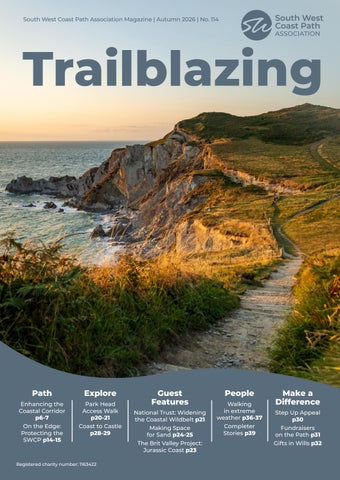
Front cover image: Mortehoe by Shaun Selley
southwestcoastpath.org.uk
3
Contents
6-7
Enhancing the Coastal Corridor
36-37
Community Walks
News 5 Chair’s Message
12 Safety Advice in response to climate change
6-7 Director’s Message: Enhancing the Coastal Corridor
13 Cornwall National Landscapes: Heart of Natural Beauty
8 Impact Report 2025
Path
9 SW Coast Path Centre opens
14-15 On the Edge: Protecting the South West Coast Path for the Future
9 SWCPA AGM 10 Photographer of the Year Exhibition at Paddington 11 Arthritis Action partnership 11 50 Years of the SWCP National Trail 1978-2028
16-18 Path Improvements
Inspired by the Coast 19 Highlighting three artists from our creative series
Photo by Norbert Schlingmann
24-25
Making Space For Sand
Explore
Make a Difference
20 Access Walk at Park Head, North Cornwall
30 Step Up Appeal
28-29 Coast to Castle: English Heritage partnership
32 Gifts in Wills
Guest Features 21 National Trust: Widening the Coastal Wildbelt 22 Saving Bude Storm Tower 23 The Brit Valley Project 24-25 Making Space for Sand: Dune conservation
31 Fundraisers on the Path 33 The Malcolm Whales Foundation
People 34-35 Volunteer Map 36-37 Managing a walking programme in extreme weather 38 Volunteer Focus: Katie Ash, Trustee 39-49 Completer Stories
Shop 50 Shop and show your support this festive season
4
Autumn 2026 | No. 114
Chair’s Message
Chair’s message
Autumn 2026
Meteorologists are warning that we are to expect a “super El Nino” this year, with the strongest oceanic warming event in modern history.”
Welcome to this Autumn’s edition of Trailblazing. It’s difficult to believe that just six months ago we were discussing the effects on the Path of a winter of unrelenting rain and storms.
T
his summer we have seen weeks of drought with the landscape becoming parched and brown, and parallels drawn to the infamous summer of 1976. At the time of writing, there has been a little respite, with some days of heavy rainfall, and although the green is returning to the Path, there is also an increased risk of coastal erosion. I was particularly saddened to hear about the massive landslip at Holywell Bay, one of my childhood haunts. Geologists have assessed that 20-30 thousand tons of rocks have come down and obscured the entrance to the “holy well” cave and it’s not known whether the cave itself has also collapsed. We have come to expect landslips along the south Devon and Dorset coastline, but the hot dry summer, followed by heavy rainfall, has created a perfect situation for existing faults in the typical slate and granite of north Cornwall’s cliffs to fracture, causing collapse. Care is urged when walking in this area. The erosion at Holywell is unlikely to be an isolated incident and there’s no doubt that we will need to adapt to this changing landscape of long wet winters, and long hot summers. Meteorologists are warning that we are to expect a “super El Nino” this year, with the strongest oceanic warming event in modern history, and a Government Minister has just suggested households should keep an emergency supply of food in case of food supply disruption due to climate changes. Without wishing to dismiss the very real problems that a warming climate will bring to many, there are a few positives to embrace. For example, there are an increasing number of vineyards in the South West, many not far off the Coast Path, producing some excellent wines. I’ve yet to pay a visit, but I believe the new vineyard at Bantham is actually pretty much on the Path! English sparkling wines have been a match for many champagnes in recent years, but these vineyards are now experiencing the kind of summers found in central France 20 years ago, which is leading to a greater variety of wine styles, including Pinot Noir. Good news indeed!
southwestcoastpath.org.uk
Finally, it was a pleasure to welcome Members to the AGM in Royal William Yard in Plymouth in June, and to update Members on some of the projects and Path improvements that the Team have worked on over the last year. Members also had a chance to see the new offices in the Melville Building and have a taster of how the Coast Path Centre might look like in the near future. Thank you so much for your continued support of the Association; it matters more now than ever, as the Path is facing unprecedented weather related pressures. With best wishes for happy and mindful walking.
Hilary Dinsdale
5
Director’s Message
The dynamic nature of the coast is one of the unique qualities of walking the South West Coast Path. However, the pace of change is accelerating, driven by the impact of climate change and increasing land use pressures around the coast.
T
he challenge for the charity and South West Coast Path Trail Partnership is to ensure that the quality of the walking experience is not unduly affected by the rapid pace of change. The South West is well known for its natural beauty - an incredible 70% of the Coast Path traverses five National Landscapes and a National Park. In contrast, only 30% of the 2,700 miles of the England Coast Path lies within Protected Landscapes. Sadly, however, over 50% of England’s natural biodiversity has been lost. The impacts of climate change are putting pressure on the habitats and species around the coast.
Enhancing the Coastal Corridor Julian Gray, Director, South West Coast Path Association
In addition to hotter summers, we are seeing increasing intensity in winter storms with more energy trapped in the atmosphere by the greenhouse effect. This is creating more significant rainfall events and increasing erosion from surface run-off with impacts on the path and the surrounding farmland. The combination of climate change impacts and rising sea levels are also accelerating coastal erosion across the South West – starkly demonstrated by the destruction of the road at Torcross during Storm Ingrid in January 2026. The South West
already has transport infrastructure challenges with weak points in our rail and road networks. Extreme weather events are putting more pressure on these systems. Almost 50,000 properties in the South West are in areas at high risk of flooding from rivers and the sea, with a further 86,000 in areas at high risk of surface water flooding. The Environment Agency estimates that these numbers will increase by 70% over the next 40 years. This needs to be viewed in the
This summer we saw an unprecedented number of heatwaves in the South West – resulting from rising global temperatures. Beyond the observable impacts of depleted reservoirs, water restrictions and ‘wild’ fires, heatwaves have impacted the Coast Path experience creating more challenging walking conditions from heat and reduced air quality. Both the UK Health Security Office and the Met Office issued red heat alerts in 2026 flagging the significant impact on human health of exposure to higher temperatures over sustained periods.
6
Slapton Ley by Edward Temperley Autumn 2026 | No. 114
Director’s Message
Waterfall at Carvannel Downs by Ian Lewis
context of the current government’s growth agenda with pressure to build 40,000 houses a year in the South West, equivalent to 600,000 new homes by 2040. With coastal erosion squeezing the National Trail from one side and development pressures from the other we are already seeing parts of the Coast Path being pushed behind development resulting in the suburbanisation of sections of the route. The recently updated National Planning Policy Framework refers to the King Charles III England Coast Path (KCIIIECP), advising that… development proposals should maintain the character of undeveloped areas of coast, including land designated for its landscape, habitat or heritage value, while improving public access to it where appropriate. They should not hinder the completion and maintenance of a continuous signed and managed route around the coast.” This offers a framework that will enable the charity to champion the importance of protecting the Coast Path.
southwestcoastpath.org.uk
In addition to transport infrastructure and coastal properties, the unique coastal species and habitats that make the South West special are also under pressure from accelerated coastal change. Habitats have been fragmented by changes in land management and coastal development. Farmers are having to respond to changing climate by adapting farming practices and systems. The flood-drought cycle is brutally quick in the UK with some farmland underwater for months, while within the same year other crops fail from lack of rainfall. As climate change accelerates farming systems will need to adapt further, impacting on the landscapes we know and love. A food-water-energy nexus accelerates the impact of climate change. As we electrify our energy grid to move towards net zero, the pressure to use land for biofuels and renewables increases, further impacting food security. Around 80% of electricity generation in the UK relies on water for cooling. With increasing summer temperatures our water supplies are placed under pressure while electricity demand is rising.
The negative feedback loop between all these systems is creating a polycrisis. However, there is a significant and growing movement of positive action around the South West working to build resilience to climate change impacts and improve biodiversity. A wide range of policy frameworks and programmes have been put in place, including Local Nature Recovery Strategies and Landscape and Nature Recovery Schemes. Our Coastal Wildbelt project is part of the mix of solutions, leveraging the brand of the Coast Path to drive positive action for nature and people around the coast.
Habitats have been fragmented by changes in land management and coastal development. 7
Association News Impact Report 2025 The charity has championed, protected and improved the Coast Path for over 50 years. Last year we published our first Impact Report. We have committed to update the Impact Report annually to help communicate the public benefits of the National Trail and its corridor. We are grateful for our many partners who help and support the charity in looking after and caring for this world-class trail.
Developing and improving the South West Coast Path £1.6 million spent on maintaining the National Trail and connecting people with nature
The impact of the Coast Path was measured across six strategic priorities; listed are some highlights:
Our Natural Health Service £75 million saved by public health services by people walking the Coast Path
Connecting people with nature IUCN International recognition of trail corridors delivering 30x30 biodiversity targets
Celebrating the Coast Path 180 million people reached across international media
View the full Impact Report
Powering the South West Economy 9 million visitors, contributing £530 million to the local economy Making a Difference Doubling the charity’s income over 5 years and 5% growth in membership of the charity in 2025 Impact Repo
rt
75 years of the Countryside Code 2026 marks 75 years since the Countryside Code was introduced in 1951. The Code has three main messages, to protect, respect and enjoy the outdoors: protecting the environment, respecting other people living, working and visiting the outdoors while enjoying the experience safely. Interested in the history of the Countryside Code? Head to the National Trails site for more information: nationaltrail.co.uk/en_ GB/countryside-code-history-of-the-code
West Cornwall by Tashya Page
8
Autumn 2026 | No. 114
Association News
SW Coast Path Centre Opens On 13 May, we were delighted to welcome stakeholders, partners, supporters, neighbours, and volunteers to the new Coast Path Centre at Royal William Yard in Plymouth. When we first moved the charity’s HQ to RWY in 2019, our idea was to create a purpose-built, accessible space for the Coast Path – which has now become a reality. The newly opened Coast Path Centre includes a workspace for the team, a meeting area, and a hub for our Plymouth Coast Path Connectors and other volunteers.
This marks phase one of the project, made possible by the support from Natural England. In the coming months, we’ll be working on phase two, which will develop a public exhibition space to share the story of the South West Coast Path, highlighting the challenges and opportunities it brings for people, nature, and local communities.
Celebrating Success and Looking Ahead at Our AGM This year’s Annual General Meeting took place in the historic surroundings of the Melville Building at Royal William Yard, Plymouth, bringing together members, supporters and staff for a day of reflection, celebration and inspiration. Before the formal proceedings began, attendees enjoyed a guided walk around Royal William Yard and Devil’s Point, taking in recent improvements to two important sections of the Coast Path: the Stairway to Devon and Admiral’s Boardwalk. The walk offered an opportunity to see firsthand how investment and partnership working continue to enhance the experience of those using the trail. Back at the Melville Building, Julian Gray shared an engaging presentation exploring the impact of both the South West Coast Path and the charity’s work, highlighting the difference that supporters, volunteers and members make in helping to protect and improve this remarkable national trail. Members also heard from Hilary Dinsdale and Kevin Thomas, who presented a review of the charity’s activities and southwestcoastpath.org.uk
finances during 2025, celebrating achievements from the past year while outlining priorities for the future. One of the most memorable moments of the day was the Completer’s Ceremony, hosted by Philip Spencer and Ruth Adams. The ceremony recognised those who have completed the entire South West Coast Path, celebrating the determination, resilience and countless unforgettable experiences that come with walking England’s original coastal trail.
AGM Walk at Royal William Yard
The day concluded with a showcase of the new Coast Path Centre, including the charity’s headquarters and a viewing of last year’s stunning Photographer of the Year exhibition. Together, they provided an inspiring reminder of the people, places and landscapes that make the South West Coast Path so special. More than just a formal meeting, the AGM offered a chance to celebrate achievements, connect with fellow supporters and share a collective passion for protecting and championing the South West Coast Path for generations to come.
Admiral’s Boardwalk
9
Association News
South West Coast Path Comes to Paddington All photographs by Dom Moore
For commuters passing through London’s Paddington Station in July, a journey to England’s spectacular south-west coastline began before they even boarded a train.
T
he South West Coast Path Photographer of the Year Exhibition returned to Paddington for its third year, transforming platforms 8&9 at one of the UK’s busiest railway stations into a gallery celebrating the country’s original coastal National Trail. Made possible through the continued support of Great Western Railway (GWR), the free exhibition showcased 23 large-format photographs capturing the beauty, wildlife and unique character of the 630-mile South West Coast Path. While dramatic seascapes and intimate wildlife encounters feature prominently, the exhibition also shines a spotlight on the challenges facing the trail. Several photographs explore the visible effects of climate change on the coastline, reinforcing the importance of conservation efforts and the work of the charity responsible for helping protect the route.
Among the photographers celebrated this year is Arthur Allan, winner of the Young Photographer of the Year award. Attending the exhibition opening in London, he said he was “overjoyed” to have his work recognised and displayed alongside fellow winners. Julian Gray, Director of the South West Coast Path Association, praised the creativity of the entrants, noting that the images capture the extraordinary variety of landscapes and experiences found along the trail. For GWR, the exhibition reflects its commitment to connecting people with the region’s most treasured destinations while inspiring a new generation of visitors to discover the South West Coast Path for themselves.
Neil Barnes, South West Coast Path Photographer of the Year
Arthur Allan, Young Photographer of the Year
If you missed the exhibition at Paddington, there is another opportunity to see the images at Royal William Yard in October, when they will be on display as part of Artober. Artober, 23 October – 1st November | Royal William Yard, Plymouth. More info at royalwilliamyard.com/artober Entries for the 2026 competition will open in November. southwestcoastpath.org.uk/photographer-of-the-year
10
Autumn 2026 | No. 114
Association News
Developing new health walks As part of our Coast Path Connectors community engagement walking programmes, we regularly partner with community health organisations We find that participants often value being part of a group where others have similar health experiences, creating a supportive and understanding environment in which to enjoy the health and wellbeing benefits of walking on the Coast Path.
In 2026, we’re working with Arthritis Action, a charity offering self-management support for those with arthritis. Following some online training for SWCPA staff and volunteers in September 2026, we will be delivering a series of walks in Devon and Cornwall this autumn, including walks delivered in collaboration with Cornwall Arthritis Trust. The training will help us to better understand the experiences and needs of people living with arthritis and how we can make our walks as welcoming and accessible as possible.
Rapparee Cove
Eleanor Dorrans, Engagement & Events Co-ordinator, Arthritis Action (Devon & Cornwall) says:
I love the coast path and live very close to it in Torbay. Arthritis can be very isolating, so I’m looking forward to creating more opportunities to get people out, ‘selfmanaging’ their own condition, and exploring what I think is the most impressive coastline in the UK.”
Wellbeing Westward Ho!
Share Your Coast Path Story – Help Celebrate 50 Years of the South West Coast Path In 2028, the South West Coast Path National Trail will celebrate a remarkable milestone: 50 years since the designation of this iconic 630-mile route. As we plan a year of celebrations to mark this golden anniversary, we’d love for our members to be part of the story. Has the Coast Path played a special role in your life? Perhaps it has been the setting for a memorable adventure, helped you through a challenging time, introduced you to lifelong friends, or simply provided moments of peace and inspiration. Whatever your connection, we’d love to hear about it.
Jurassic Coast by Chris Meaker southwestcoastpath.org.uk
These personal stories are at the heart of what makes the Path so special and remind us why protecting, improving and promoting its health and wellbeing benefits matters so much. As we look back on 50 years of the South West Coast Path, help us celebrate by sharing your memories, experiences and reflections. Your story could inspire others and become part of this landmark anniversary. Contact aletha@ southwestcoastpath. org.uk with your story.
The South West Coast Path is so much more than a walking trail. It brings people closer to nature, to their communities, and to one another.
11
Association News
Parliamentary Reception In July, some of the SWCP team attended a special parliamentary and stakeholder reception at Westminster to celebrate the King Charles III England Coast Path (KCIII ECP). The event recognised the national significance of the KCIII ECP, the partnerships that have made its delivery possible, and the important
role of the South West Coast Path as the original coast path and catalyst for improving coastal access. It was a great afternoon, allowing us to speak with councillors and MPs about our ongoing work and commitment to protecting and championing a coast for all.
Parliamentary Reception, Lorna Sherriff with Ian Roome MP
Staying Safe on the Coast Path: New Advice for a Changing Climate The South West Coast Path has always been a place of adventure, wellbeing and connection with nature. But as our climate changes and extreme weather becomes more common, the challenges faced by those enjoying the trail are changing too. This year, we’ve updated our Safety Advice to help walkers stay safe and informed while protecting the landscapes we all love. From record-breaking heat to increased wildfire risk and a rise in ticks across the South West, here are some of the key issues we’ve been highlighting.
Walking in Hot Weather Summer 2026 was unlike anything many of us have experienced before. Temperatures soared well into the 30s for more than 40 days, making it the hottest summer on record and creating conditions that can be dangerous for walkers. While a day on the Coast Path can seem the perfect way to enjoy the sunshine, high temperatures can quickly lead to dehydration, heat exhaustion and other health risks. Our advice is simple: avoid walking during red heat alerts, plan routes carefully and steer clear of the hottest part of the day, typically between 11am and 3pm. Taking regular breaks, carrying plenty of water and seeking shade wherever By taking possible can simple make all the
precautions difference. and following safety advice, we can all help ensure that the Path remains a safe and welcoming place for everyone while safeguarding the wildlife and landscapes that make it so special. 12
Be Tick Aware Alongside the sunshine came an increase in tick activity across the region. Ticks are a natural part of the countryside, but some can carry Lyme disease, making awareness particularly important for anyone spending time outdoors. Working with Devon and Cornwall Public Health, we helped spread the message to #BeTickAware, encouraging walkers to check themselves, children and pets after spending time in long grass, heathland or woodland. Understanding what to look for and how to remove ticks safely can help people continue enjoying the outdoors with confidence.
Wildfires: Protecting Precious Landscapes By late summer, much of the South West had entered drought conditions. The landscape became exceptionally dry, dramatically increasing the risk of wildfires. Sadly, several fires affected Coast Path environments this year, damaging habitats, destroying wildlife and leaving lasting scars on the landscape. While some fires occur naturally, many are caused by preventable human actions, including disposable barbecues, unattended campfires, discarded cigarettes and even broken glass left in the countryside.
That’s why we encouraged visitors to swap the barbecue for a picnic and leave no trace of their visit. A temporary ban on disposable barbecues was introduced in many areas during the highest-risk periods, helping to reduce the threat. We hope to see longer-term measures that will continue to protect these precious coastal landscapes for future generations.
Enjoying the Path Responsibly The South West Coast Path offers unforgettable experiences in every season, but changing environmental conditions mean it’s more important than ever to plan ahead and stay informed. By taking simple precautions and following safety advice, we can all help ensure that the Path remains a safe and welcoming place for everyone while safeguarding the wildlife and landscapes that make it so special.
Check out our Safety Advice southwestcoastpath. org.uk/safety-advice
Autumn 2026 | No. 114
Association News
Heart of Natural Beauty funding Cornwall National Landscape will receive more than £1million in development funding from The National Lottery Heritage Fund, through its ambitious Landscape Connections initiative to revive and connect the UK’s most treasured landscapes.
Meadow Match project Credit Grace Twiston Davies
Goonown Growers – Community Market Garden The development stage of the project (2026-28) will work across 4 sections: Hartland (Marsland to Menachurch Point), a remote and sparsely populated historic landscape of dramatic landforms and ancient woodlands; Pentire Point to Widemouth, home to significant coastal heathland, wind-shaped woodlands and important grey seal breeding habitat; The Lizard, a diverse landscape of headlands, beaches, productive farmland, rare geological features and subtropical gardens; and Bodmin Moor, with its rugged tors, blanket bogs, wetlands and deeply wooded river valleys.
The Rumps Cliff Castle Credit CNL
The development stage will inform a further application to the Landscape Connections fund, to deliver an 8 year-programme starting in 2028.
The Rumps Cliff Castle Cornwall National Landscape is uniquely spread across twelve separate geographical areas across the county. Its Landscape Connections Cornwall: The Heart of Natural Beauty project will focus on four of these sections, selected for their distinctive landscapes, ecological importance and potential for landscape-scale impact. Delivered in partnership with the National Trust, and collaboratively with local communities and stakeholders, this ambitious initiative will address ongoing environmental pressures and demonstrate the benefits of coordinated action to develop solutions at scale. From fragmented habitats and degraded peatlands to visitor pressure and changing market forces, the challenges facing Cornwall’s landscapes are significant. The project will reverse decline through a coordinated programme that restores natural processes, reconnects culture and ecology, and equips people, particularly young people, to become stewards of change.
Community Market Garden Credit Goonown Growers
Find out more about the Heart of Natural Beauty project and Cornwall National Landscape visit cornwall-landscape.org
southwestcoastpath.org.uk
13
Path
On the Edge:
Protecting the South West Coast Path for the Future
The South West Coast Path is more than just a trail, it is a living line between land and sea, connecting communities, supporting local economies, protecting access to nature and telling the story of a coastline that is constantly changing.
T
he path runs along cliffs, estuaries, dunes, beaches and working coastal landscapes, many of which are now facing faster erosion, heavier rainfall, hotter summers, more intense storms and rising seas. These diverse qualities and habitats which make the SWCP so extraordinary also makes it vulnerable!
An Ever Changing Coastline The coast has always moved and in many locations it will continue to do so. Resilience means accepting that change is inevitable while ensuring that people can continue to enjoy safe, inspiring and sustainable access. It means planning ahead rather than simply responding after the next cliff fall, landslip, flood or wildfire.
The pressures are already visible Climate change is increasing the frequency and severity of extreme weather contributing to wildfires, flooding, damaged steps, washed-out surfaces, uprooted trees and accelerated coastal erosion. The path must be resilient to continue to offer people a valuable place to connect with nature, support their health and wellbeing, and contribute to the local economy.
An informed resilient approach Regular condition surveys, local reports from volunteers and walkers, coastal monitoring, landowner knowledge and local authority expertise all help identify where the path is most at risk. This information makes it possible to prioritise interventions before extensive damage occurs. In some places, that may mean improving drainage to prevent water scouring the trail. In others, it may mean replacing failing steps, repairing surfaces, moving fencing, improving signage or creating safer roll-back routes away from unstable cliff edges.
Jurassic Coast by Jackson Taylor
14
Sustainable materials are an important part of this resilient approach. Where timber is needed for steps, gates, fencing or revetments, durable responsibly sourced hardwood can offer a long service life in exposed coastal conditions, reducing the need for frequent replacement. In other locations locally sourced stone, natural surfacing and simple drainage materials may be more appropriate because they can withstand heavy use, resist rot and weathering, and reduce annual maintenance needs. The choice of materials will always be guided by the character of the landscape, the sensitivity of nearby habitats, the expected level of footfall and the long-term carbon and maintenance costs of each option. Autumn 2026 | No. 114
Path
Porlock Marsh by Shaun Davey
Working with nature to future proof Healthy coastal grasslands, dunes, wetlands and woodlands can help slow run-off, support biodiversity and make landscapes more robust. Sensitive grazing, habitat restoration and careful path design can reduce trampling and erosion while helping wildlife thrive. The path and surrounding coastal margin acts as a corridor linking fragmented habitats, maintaining it well benefits both people and nature. We therefore define resilience not simply by whether the path remains open, but also by the health of the surrounding landscape that supports it.
Adaptation requires flexibility Roll-back routes, negotiated with landowners and designed to retain coastal views wherever possible, can keep the path open when erosion makes the existing line unsafe. These realignments are a needed and practical response to a dynamic coast. The best realignments balance public access, land management, conservation, heritage, landscape character and visitor experience. They also try to avoid making walkers use roads or unsuitable inland paths where the sense of coastal connection may be lost.
Partnership is essential No single organisation can future-proof a 630-mile trail alone. The South West Coast Path Association, local authorities, National Trust, Natural England, National Parks, National Landscapes, landowners, southwestcoastpath.org.uk
businesses, parish councils, volunteers, event providers and community groups all have a role to play. Volunteers are especially important; local path reps, walkers and community supporters act as eyes and ears on the ground, reporting problems and helping maintain the relationship between the path and the people who use it.
Funding must match the scale of the challenge The path is vital to communities, nature, culture and local economies and needs long-term care and investment. The cost of maintaining the route is rising with the annual maintenance costs of caring for the trail now exceeding £1 million per year. Emergency repairs are often unavoidable, but resilience work if planned in advance can usually be cheaper, safer and more effective but the path does need ongoing long term funding support.
Guardianship Building resilience into the South West Coast Path is ultimately about guardianship. It asks us to look beyond the next storm and make decisions that will endure for decades. By combining monitoring, practical engineering, nature recovery, community involvement and sustained investment, the path will remain open, safe and inspiring for future generations. Lorna Sherriff National Trails Officer South West Coast Path
Top: South Devon by Mark Murton Bottom: Godrevy by Andreas Reichert
The coastline will continue to change; the challenge is to ensure that our commitment to access, nature and place evolves with it. 15
Path Improvements During the last financial year, Access grant funding from DEFRA and Natural England enabled us to deliver a wide range of projects that have made the path easier to use, more resilient and more accessible throughout the year. Unfortunately, National Trails have not been offered Access funding for this financial year, despite National Parks and National Landscapes receiving grant allocation. The following projects show how valuable this funding has been in improving access to and along the path and these are just a snap shot of the projects that were completed. We will
Path Surfacing Improvement, Portland, Dorset Around 3,000 metres of new surfacing has improved access along the South West Coast Path on Portland. The route was previously muddy and rutted in wet weather, making it difficult to use all year round. The new two-metre-wide path surfaced with Portland stone, provides a usable year-round route, while also offering far-reaching views of the Dorset coastline.
Trail Partners: Dorset Council Project Cost: £62,500, including £55,000 from the Access grant.
Portland Path Surfacing. Credit Dorset Council
16
continue to champion for National Trails to receive this vital support, recognising that National Trails are also part of the Protected Landscapes Partnership. Please note that overall project costs exclude in-kind contributions, such as staff time, so the total value would be higher.
Path Improvements, Yealm Alternative Route, Hollacombe, South Devon This section of path provides an alternative route around the River Yealm when the seasonal ferry is not operating. The project upgraded around 60 steps that were broken or uneven, changed two stiles for gates, and improved drainage. Together, these works have made this steep path safer and easier to use throughout the year.
Trail Partners: Devon County Council Project Cost: £6,544
Stile changed to Gate on Yealm alternative path. Credit Devon County Council
Autumn 2026 | No. 114
Path
Beach Access, Kennack Sands, Cornwall At Kennack Sands, access funding supported surveys and improvements to make the beach and Coast Path more accessible. Following audits and consultation with wheelchair users and local disability groups, the project explored options for widening and resurfacing the path, creating a turning area and seating, and confirming through survey work that a more
accessible route would be feasible if further funding can be secured. The project also provided roll-out beach matting and three types of beach wheelchair, helping more people enjoy the beach and coastline.
Trail Partners: Natural England Project Cost: £32,316
Path Surfacing Improvements, Broadsands, Torbay
Changing 2 Stiles to Gateways, nr Seatown, Dorset
At Broadsands, three areas of drainage and path surfacing were improved on a section of path which runs alongside the heritage railway line. Previously muddy and difficult to use in winter, this section is now more accessible and usable all year round.
Two stiles on well-used footpaths near Seatown, including the busy route from Golden Cap Holiday Park to the South West Coast Path, have been replaced with gateways. This improvement makes the path easier to use and should encourage more local community and visitors to enjoy this stretch of coast.
Trail Partners: SWIScO and Torbay Council Project Cost: £19,142
Trail Partners: National Trust Project Cost: £2,673
Accessible Toilet Facility, Wembury Beach, Devon At Wembury beach, visitors using mobility aids such as Trampers could reach the green behind the beach via the path through Mill Meadow, but accessible toilet facilities were limited by stepped access and unsuitable cubicles. Thanks to this project, the existing public toilet block has been reconfigured to create a new, separate accessible toilet. A new ramped path has also been installed across the green behind the beach, providing an alternative to the steps and greatly improving the visitor experience.
Trail Partners: National Trust Project Cost: £54,136 with £20,500 provided through the Access grant
southwestcoastpath.org.uk
17
Path
Path Surface Improvement, Land’s End, Cornwall At Land’s End, heavy rain and storms had badly damaged the newly aligned section of the South West Coast Path, causing severe gullying and forcing a closure. The project delivered an improved better-drained and surfaced path suited to this highly visited location and designed to cope with more frequent heavy rainfall.
Trail Partners: Cornwall Council Project Cost: £67,014, including £39,529 from the Access grant
Interpretation Benches, Across South Devon Five interpretation benches have been installed on National Trust land along the South Devon section of the South West Coast Path. Featuring images of local wildlife, farming and views from each location, the benches offer visitors a place to rest, learn more about their surroundings and enjoy the coastline. Designed with backs for additional support, they improve accessibility for a wider range of people, with some positioned beside accessible paths and others providing welcome stopping points in more remote sections of the trail.
Trail Partners: National Trust
Planned Project Wembury Bridge installation The 1.3-mile section of Coast Path between Wembury Beach and Wembury Point was upgraded last year to improve yearround access. The next stage is to install a 10-metre footbridge to replace a steep stepped dip in the path. This will remove a significant access barrier and create a flatter, more inclusive route for pushchairs, mobility vehicles and other users. The project is expected to be completed by the end of March 2027.
Trail Partners: Devon County Council Project Cost: £75,000, with £55,000 in grant funding
Project Cost: £16,980
18
Autumn 2026 | No. 114
Inspired by the Coast
Discover some of the creative people that we have featured recently in our popular artist series.
Maggie Cochrane
Sam Godfrey
Discover the creative world of Cornish-based artist Maggie, whose stunning paintings are inspired by daily walks along the dramatic Cornish coastline. Maggie shares how the changing light, shifting tides, wild coastal landscapes and powerful emotions she experiences by the sea shape her distinctive work in oil and cold wax.
Sam Godfrey is a multidisciplinary artist, writer and curator currently studying for a PhD in Art History and Visual Culture by Practice at the University of Exeter. They work with textiles, sound and digital mediums to make large-scale installations that encourage touch, interaction and rest. As part of a new project, a poem and soundscape created by Sam has been installed as a QR code at the Ronald Duncan Writing Hut, which is located on the Coast Path as it passes from Marsland Mouth to Welcombe Mouth.
Read the blog at blog.southwestcoastpath.org.uk/2026/08/03/inspired-bythe-coast-maggie-cochran @maggiecochraneartist
Read the blog at blog.southwestcoastpath.org. uk/2026/08/04/inspired-by-the-coast-sam-godfrey @s_k_godfrey
Jo Payne Based in North Devon, Jo finds endless inspiration in the coast, transforming striking skies, changing light and rugged seascapes into expressive, elemental artworks. Using acrylics, handmade collage papers and precious metal leaf, her work reflects a deep connection to the landscape, nurtured through daily walks along the South West Coast Path. Read the blog at blog.southwestcoastpath.org. uk/2026/08/18/inspired-by-the-coast-jo-payne @seapainter_ jo
Our Inspired by the Coast series celebrates different perspectives on what the Coast Path means to people and demonstrates how it creatively inspires and supports people in such different ways. If you are an artist and would like to be featured, or would like to suggest someone to be featured, please email aletha@southwestcoastpath.org.uk southwestcoastpath.org.uk
19
Explore
Accessible Walks: Discovering Park Head on the North Cornwall Coast Welcome to the first in our series of accessible walk features, sharing practical route information, helpful access details and a little inspiration for getting outdoors. Access advocate and Wheelie Fun Accessible Adventurer Sharon Thomas takes us to Park Head, a peaceful stretch of coast path near Porthcothan in North Cornwall. Starting from the small National Trust car park at Park Head, the route leads across open grassland towards wide clifftop views over Bedruthan Steps, Newquay and, on a clear day, you can see the coastline stretching towards Padstow. It is a walk that offers big skies, sea air and a real sense of space, while the route remains mostly level.
Nature is one of the highlights of this route, with plenty of birdlife and the chance of spotting one of Cornwall’s famous choughs. Listening to the waves and birdsong along this flat coastal route is all part of the joy.
What to know before you go Park Head is exposed to the elements. As a coastal walk, it can be very windy, and there is no shelter from strong sun or rain, so it is worth dressing for the weather and taking anything you may need with you.
The route follows grass paths with a short section of dirt track. There are three gates along the route, each with dual hinges so they can open both ways, and all are wide enough for a mobility vehicle. After heavy rain, there are a couple of areas which can become muddy, so this is a route best enjoyed after a dry spell.
For public transport, buses run between Mawgan Porth and Padstow, with services passing close to the area. Please check current timetables before travelling. If you would like to extend your visit, Mawgan Porth offers a beach wheelchair in season, while Padstow is a starting point for the Camel Trail with bike hire available. There is also a short accessible route at Carnewas at Bedruthan, where you can enjoy a takeaway, sit on one of the benches and start planning your next adventure.
There are no toilets or refreshments on the route itself. The nearest facilities are at Carnewas at Bedruthan, around a Thank three-minute drive away, where you to access volunteer there is a café with indoor and Sharon Thomas, who will be outdoor seating. Accessible working with the team to improve and toilets are available there develop a selection of access walks for during café opening the SWCP website over the next times.
There is something very special about finding a peaceful, tucked-away stretch of coast path that offers such an open, mostly level route into nature. The wide views, fresh air and sound of the sea make this a memorable walk, especially on a clear day.” Sharon For more information and route directions please go to southwestcoastpath.org.uk/ walksdb/853
few months.
20
Autumn 2026 | No. 114
Guest Feature
Widening the Coastal Wildbelt: A Bolder Future for Our Coast
Taking a rest to enjoy the views at Pentire, North Cornwall
The South West Coast Path is more than a trail. It is a vital corridor where the power of the sea meets the rich heritage of our working landscape, and home to some of our most endangered wildlife.
A
s custodians of nearly a third of this spectacular coastline, the National Trust is embarking on a forward-thinking strategy with partners to ensure this landscape thrives for generations to come. Our vision is simple yet ambitious: to widen our coastal wildbelt for people and for nature. For too long, coastal habitats have been squeezed into a narrow strip between the cliff edge and agricultural fields. We are working closely with partners, tenant farmers and neighbouring landowners to shift these boundaries and to adapt land management and farming practices to create more space for nature and people. By creating dynamic buffer zones, we are allowing coastal heathland, scrub, and wild grasslands to reclaim their space. This mosaic of habitats allows wildlife to move freely, creating a resilient landscape more capable of facing a changing climate.
When you walk the path this season, look beyond the dirt beneath your boots. Notice the buzzing maritime grasslands, the more accessible gates, and the space where nature is reclaiming its breath. southwestcoastpath.org.uk
Crucially, this corridor also holds our rich coastal history. Hidden within this coastal Wildbelt are thousands of years of human story, from Iron Age hillforts and industrial mining remains to World War II radar stations and lookouts. Through researching, conserving, interpreting and opening these fascinating sites and by adapting our land management approaches, we record and safeguard these vulnerable archaeological sites, giving access to our shared past. Of course, restoring nature goes handin-hand with welcoming people. We are actively auditing our stretches to improve public access. This means investing in better facilities, from accessible toilets and paths to clearer signage. Crucially, it also means removing physical barriers where
reconfiguring fencing to open up the landscape. We know the transformative and wellbeing impacts that access to a nature rich coastline can bring and our goal is to provide opportunities for everyone, regardless of their agility to be able to access this experience. When you walk the path this season, look beyond the dirt beneath your boots. Notice the buzzing maritime grasslands, the more accessible gates, and the space where nature is reclaiming its breath. This transformation is only possible because of your support. Together with our members, local communities, farmers, volunteers, and partners, we are together building a coast that is wilder, more connected, and open to all. Rebecca Burton Regional Director for the South West
possible. We are replacing restrictive stiles with accessible gates and
Visitors walking along the clifftop at Old Harry Rocks, Dorset
21
Guest Feature
Moving with the Coast: How Bude Saved its Storm Tower Standing above the South West Coast Path at Compass Point, Bude’s distinctive Storm Tower has watched over the Atlantic for almost 200 years. But despite its solid appearance, its survival has depended on something perhaps unexpected: being prepared to move.
T
he Grade II listed tower was designed by architect George Wightwick for Sir Thomas Acland in 1835. Inspired by the Temple of the Winds in Athens, it became a familiar landmark on Bude’s coastline.
History repeats itself The Storm Tower has faced the threat of coastal erosion for much of its history. In 1881, as the cliff edge moved closer, the tower was dismantled and rebuilt further inland. More than 140 years later, history began to repeat itself. By 2023, erosion had left the Storm Tower just six metres from the cliff edge. Rather than wait until the structure was in immediate danger, Bude-Stratton Town Council embarked on an ambitious project to move it once again.
Moving a landmark The community response showed just how much the landmark meant to people. An initial crowdfunding target of £20,000 grew into £60,000 raised in just 56 days, with donations coming from Bude and further afield. This support helped pave the way for further funding, including around £300,000 from National Lottery Heritage Fund and £50,000 from Cornwall Council.
Sometimes, adapting to a changing coast means being prepared to move with it. 22
Moving a Grade II listed building was no simple task. Specialist conservation contractors carefully dismantled the tower stone by stone, recording and labelling key elements so they could be returned to the correct positions. Around 100 metres inland, the Storm Tower was painstakingly reconstructed, retaining its historic orientation. The exposed location brought challenges, with poor weather causing delays, while Portland cement used during previous work made dismantling more difficult than expected. In March 2024, the restored tower reopened, with around 500 people gathering at Compass Point to celebrate its return.
A lesson in adaptation
Storm Tower Landscape Move Completed
As coastal communities consider how to adapt to erosion and the effects of a changing climate, the Storm Tower offers a simple but powerful example of resilience. Protecting the places and landmarks we value does not always mean keeping them exactly where they are.
Reassembly New and Old Blocks
The project preserved an important part of Bude’s heritage, but its story also has wider relevance for coastal communities. The Storm Tower could not be protected by stopping the coastline around it from changing. Instead, its future depended on recognising the risk, planning ahead and taking action before that risk became an emergency. Remarkably, communities more than 140 years apart arrived at much the same solution.
Stones marked and laid out in sequence
Storm Tower position Autumn 2026 | No. 114
Explore
The Brit Valley Project: Nature recovery behind the Jurassic Coast West Bay cliffs first light
Walkers dropping down into West Bay along the South West Coast Path know the moment well – the golden cliffs, the harbour, the River Brit slipping quietly into the sea – but do they wonder about the source of that water? Perhaps they will soon as the Brit Valley is now the proposed setting for one of the most ambitious farmer-led nature recovery projects in the South West.
T
he Brit Valley Project brings together 50+ land managers across more than 4,300 hectares of West Dorset countryside, linked together by the Brit, Simene and Asker Rivers and the Mangerton Brook. They are a very mixed group of dairy, sheep and beef farmers, cider makers, smallholders, estates, a wildlife charity, even a frisbee golf course, and are united by the simple conviction that farming and nature can thrive together, and that the people who know the land best should lead its recovery. If the project receives the go-ahead for funding from Defra, over the 25 years from 2027 the area will be transformed positively for nature. Species-rich grasslands will spread across the slopes, woodlands will be managed effectively and become havens for wildlife, and nearly 1,000 hectares of wood pasture will emerge, where trees, scrub and grazing animals coexist. Leaky dams, reconnected floodplains and probably also beavers in the headwaters will slow the rivers’ notoriously flashy flows, easing flooding in its villages and towns,
Mapperton Wildlands
southwestcoastpath.org.uk
creating wetlands and sending cleaner water to the sea. This is good news not just for the river biodiversity but also for the marine life off the World Heritage coast. Deer and squirrels will be managed more effectively, and Pine martens and Water voles will be reintroduced were possible. Crucially, this is no retreat from farming with more than 1,000 hectares of the project land looking towards a more ‘regenerative’ future for food production, in which the land is farmed more sustainably for biodiversity, carbon and water management. For those who walk the paths of Dorset, the most exciting news may be access. Around 30 kilometres of new permissive paths, all-ability routes and tramper trails will complement existing rights of way, with invited access onto more than 20 working farms. A proposed new wetland reserve at West Bay - boardwalks, hides and interpretation - will sit within steps of the Coast Path, while a planned circular bus service will help those without cars reach the countryside in
Brit Valley Poorton the summer holidays. Schools visits, volunteering, citizen science, arts events and a range of other engagement activities will bring people to the area and help them better understand the role nature and farming plays for all of our lives. What makes the Brit Valley special is not any single intervention but the spirit behind it: neighbours making decisions together, one member one vote, guided by the principle that no one knows the land better than the land manager. It is a working landscape choosing its own future - and a glimpse of what the countryside behind our coast could become.
Written by Sam Rose Brit Valley Project. All images © Sam Rose 23
Guest Feature
Making Space for Sand: Cornwall Helping Coastal Communities Prepare for Coastal Change
Crantock Dune Restoration
Cornwall’s rugged coastline is world renowned for its breath-taking beauty, towering cliffs, sandy beaches and coves and picturesque fishing villages and coastal towns.
H
owever, as our changing climate continues to drive sea level rise and the increased frequency of extreme weather events, Cornwall’s coastline faces growing pressure from erosion and flooding. The Making Space for Sand project is funded by Defra as part of the £200 million Flood and Coastal Innovation Programmes which are managed by the Environment Agency. The programmes are driving innovation in flood and coastal resilience and adaptation to a changing climate. The project is all about encouraging sustainable development along the coastal fringe, improving understanding of how rising seas and storms affect coastlines, restoring biodiverse and healthy dune systems and helping communities become more informed and better prepared for future change. We have considered 40 locations across Cornwall’s north and south coasts. However, our resources are being targeted where there is the greatest opportunity for learning and where communities and landowners are most willing to support adaptation measures.
In order to support the aims of the project the project team, who are delivering the project through Cornwall Council, are working in collaboration with the University of Plymouth, South West Coastal Monitoring, Cornwall Wildlife Trust and Cornwall Community Flood Forum. Our project partners are undertaking research to understand how predicted coastal change may affect the future of our coastline. We are also working with coastal communities to help them adopt a more ecosystem approach to beach and dune management and to think about how they can adapt to reduce their vulnerability to some of the devastating impacts of these changes. Sand dunes and beaches act as natural coastal defences. Although engineered structures can provide defence against large swells and storm events, they can have a negative impact on the environment and restrict how sand moves and are expensive to build and maintain. Whereas dune systems can move and reshape themselves in response to changing conditions, absorbing wave energy and helping reduce flood and erosion risks. However, this natural resilience depends on a healthy supply of sand.
Constantine Bay
24
Autumn 2026 | No. 114
Historically, human intervention and the building of roads, housing and other infrastructure in some places have resulted in dunes being marginalised squeezing them into smaller spaces and limiting their potential to store sand and to be effective coastal defences. Project partner Cornwall Wildlife Trust is undertaking environmental assessments of the health and condition of the dunes, developing dune management plans to ensure that the dunes are allowed to grow and thrive, supporting the work being undertaken by volunteer dunes groups. With the help of these wonderful volunteers, great progress is being made with removing invasive plants which are clogging up the dunes and replacing them with native dune plants allowing the sand to move more freely and enable the dunes to build. This approach to coastal management can support both environmental recovery and community resilience. Allowing dune systems to roll back and migrate inland where possible, can reduce future flood and erosion risks while buying valuable time for communities to adapt. Researchers working with University of Plymouth and South West Coastal Monitoring, are examining how the coastline has changed in the past and compare this with what it looks like now to better predict what may happen in the future. Innovative scientific techniques are being used to collect and analyse data about coastal processes, while advanced computer modelling is helping experts visualise how beaches and dunes may respond to rising sea levels and extreme weather in the years ahead. South West Coastal Monitoring have also installed CoastSnap cradles around the coast to enable the public to contribute to this research. CoastSnap is a global community science project which encourages the public to capture the changing nature of our coastlines through repeat photographs. Community engagement is at the heart of the project, and we are working with coastal communities, volunteer groups and landowners helping to ensure that adaptation measures
CoastSnap Holywell Bay
are developed with those communities most affected by coastal change. This collaborative approach is encouraging communities to take ownership of local resilience planning and build confidence in adapting to future challenges. Information gathered through monitoring and research is being shared at community events, led by another of our project partners Cornwall Community Flood Forum, giving local communities a clearer understanding of the changes likely to occur along their coastline. The findings of this research are helping to support the development of adaptation and resilience plans tailored to individual locations. Some of these plans have identified where adaptation measures can be taken and work is already underway. In Widemouth we have relocated a car park, allowing the closure of parking on the beach which will enable the sand to migrate and build up the dune system. In Crantock and Porthtowan we are supporting the relocation of the Surf Life Saving Clubs to make them more resilient to sea level rise and flooding. In Mawgan Porth we are involved in redesign of the flood barrier to prevent storm surges from flooding the community from both land and sea. The benefits of this adaptation will extend beyond coastal protection. Healthy beaches and dunes support wildlife, boost tourism, provide opportunities for recreation and contribute to local economies. Preserving these natural assets is therefore seen as essential not only for the environment but also for the social and economic wellbeing of coastal communities. Written by Jo Smith, Project Support Coordinator, Making Space for Sand (Ow kul spas rag tewes) There is a wealth of information on our website about how Cornwall’s coastline is changing, to find out more please go to: makingspaceforsand.co.uk
Researching Coastal Processes
southwestcoastpath.org.uk
With sea levels expected to continue rising in the coming decades, the need for proactive coastal management has never been greater. For Cornwall’s beaches, dunes and coastal communities, adopting a natural approach to coastal defence may ultimately be one of the most effective ways of securing a safer and more resilient future. 25
The View
Cliff fall near Sidmouth by James Loveridge
26
Autumn 2026 | No. 114
Explore
southwestcoastpath.org.uk
27
Way Makers
From Coast to Castle We’re delighted to welcome English Heritage to our Way Maker programme. With five spectacular castle venues located along the South West Coast Path, this new partnership brings together breathtaking coastal scenery and some of the region’s most treasured historic landmarks. Each castle has also become a Coast Path Passport Stamping Point, adding to our growing list of places to get your passport stamped. Following are some historic walks that pass each castle so you can combine coast path and castle for a legendary day out! Pendennis Castle, Falmouth, Cornwall Built by Henry VIII to defend Cornwall’s shores, this mighty fortress has weathered sieges, two world wars and centuries of coastal drama. Today, you can explore its ramparts and enjoy breathtaking sea views. Pendennis Castle Walk Easy 3.9 miles southwestcoastpath.org.uk/walksdb/540 A visit to Pendennis Point, where there have been fortifications defending Falmouth’s waterways for over two millennia. A gentle stroll with plenty of interest along the way (as well as some fine beaches), it is a very good walk for children, who will love the castle.
St Mawes Castle Set in the charming fishing village of St Mawes, this elegant castle is one of Cornwall’s most picturesque historic landmarks. Wander its remarkably well-preserved defences and soak up spectacular harbour views. St Just in Roseland Moderate 5 miles southwestcoastpath.org.uk/ walksdb/489 This walk links two of Cornwall’s most picturesque locations, the coastal village of St Mawes and the beautiful exotic churchyard of St Just in Roseland. The outward leg skirts the water’s edge of the estuary of the River Fal while the return leg, parallel but on the ridge above, gives some stunning panoramic views over land, estuary and sea.
28
Autumn 2026 | No. 114
Way Makers Portland Castle Overlooking the sparkling waters of Portland Harbour, this historic coastal stronghold offers fascinating stories, a contemporary garden and magnificent sea views. A perfect place to pause and enjoy the Dorset coast. Portland Castle Moderate 3.6 miles southwestcoastpath.org.uk/walksdb/55 A short walk around Portland’s north east corner, where the remnants of the quarries’ transport systems have been turned into nature reserves and the dramatic cliffs give far-ranging views over Chesil Bank and Lyme Bay. In Tout Quarry, just off the Coast Path, some of the world’s top artists have contributed to a fascinating sculpture trail that meanders through the old quarry workings; while down at sea level on the island’s northerly shoreline, Portland Castle has defended the harbour since Tudor times.
Dartmouth Castle Perched at the mouth of the River Dart, Dartmouth Castle is one of England’s most spectacular coastal fortresses. Take in sweeping estuary views and uncover tales of privateers, pirates and maritime adventure.
Tintagel Castle The legendary clifftop castle linked to King Arthur, where dramatic sea views and centuries of history await.
Moderate 3.4 miles southwestcoastpath.org.uk/walksdb/198 A walk around Tintagel, made a romantic destination for Victorian tourists by poets such as Tennyson, whose ‘Idyll of the Kings’ set the tale of King Arthur in what is still one of Britain’s most visited resorts. A brilliant walk for children, who will love the atmospheric ruins of ‘King Arthur’s castle’ on Tintagel Island. A great walk in springtime, when the sea is blue in the bright sunshine and there are primroses and new scrolls of bracken under the gorse and the blossoming thorn bushes. In autumn it’s at its best on a windy day, when flocks of fulmars and kittiwakes stream by on their way south, and gannets can be seen offshore.
Coast Path Passport
.org.uk coastpath southwest
Get your Coast Path Passport and make it your castle mission to get a stamp from each one! Scan the QR Code to Buy
southwestcoastpath.org.uk
Moderate 3.3 miles southwestcoastpath.org.uk/ walksdb/670
Tintagel King Arthur Walk
Coast Path Passport
Dartmouth Castle and Gallants Bower
A stroll along the River Dart to Dartmouth Castle, one of the many fortifications built over the centuries to defend one of England’s most important waterways. Beyond is Bayard’s Cove, where Richard the Lionheart’s fleet embarked for the Third Crusade in the twelfth century and the Pilgrim Fathers paused on their way to the New World in the seventeenth. There are breathtaking views over the River Dart as you climb to Gallants Bower, scene of a siege in the English Civil War.
Visit English Heritage for opening times and entry prices – go to english-heritage.org.uk/visit/region/southwest
29
Make a Difference
Step Up and Support our Appeal How valuable is a journey on the South West Coast Path?
Sunset at Carvannel Downs by Ian Lewis
Priceless Whilst we may not put a price tag on the journey; to keep the South West Coast Path open and accessible for the 9 million people who use it each year, does cost. As a charity we are committed to raising the £1 million required each year to maintain and improve the trail, to make each journey possible. Our Step Up Appeal focusses on the maintenance and replacement of the 30,000 steps across the Trail. On average
it costs £25 per step, but there are cost variations depending on materials being used, and the location of the steps. If we were tasked with replacing all steps on the Coast Path at once, we would be looking at £750,000! Thankfully, we are confident that we will never need to do this, but the importance of keeping the steps well maintained is crucial for both the safety and the enjoyment of people walking the trail.
If you’d like to support our
Step Up Appeal,
please donate via the QR code
Investing in Quality Steps The rangers and wardens who help us replace the steps on the Coast Path work in some of the most difficult places to access along the coast. Every set of steps requires hard work, taking many hours to move materials to site, prepare the ground and install each one securely. We want to make sure that we provide the best materials we can when our partners carry out this work. By supplying locally sourced, environmentally sensitive materials such as oak, chestnut, and granite, it means the steps won’t need to be replaced so often. This will also improve the quality and overall access of the Path and cut down on time and resources too. We are grateful for corporate supporters such as Macs Adventure, who support path maintenance and improvements, donating over £6.4k in 2025. Macs said of their support,
We’ve loved seeing the work the South West Coast Path Association has done over the years to look after and improve this incredible trail. It’s a route that is hugely important to us and our customers, and we’re really proud to support the Association and to have played a part in its journey over the last 3 years.” 30
The St Aldhem’s ‘ladder’ in Dorset on the Jurassic Coast has a total of 218 steps on one side and 168 on the other, meaning a step ascent and descent whichever direction you approach them. Next time you scale this incredible set of steps, please appreciate the £9,650 cost, and if you’d like to say thank you – please donate. St Aldhelm Steps by Joe Issa
Autumn 2026 | No. 114
Make a Difference
Fundraisers on the Path Every year we have amazing people taking on incredible fundraising efforts on the Coast Path. As one of the most popular National Trails, used by 9 million visitors each year, it’s no wonder it’s a natural drawcard for people looking for the ultimate fundraising challenge. At 630 miles it is equal to just over 24 full marathons in distance – and we’ve seen people run a marathon a day to complete it – what a feat on the feet! This year, we’ve had four fundraisers who have been walking the Path and raising funds for the South West Coast Path Association. Here are their stories.
Kathy Parker Kathy walked the Path and raised funds for the Association and the National Coastwatch Institution (NCI), raising a total of £1,200. Tackled as a personal challenge in path sequence, she made several visits each year starting in August 2022 and finishing on her 78th birthday, 10 April 2026, with a total of 78 walking days. Kathy enjoyed stopping at the 24 NCI stations along the route and getting her Coast Path Passport stamped and chatting to the brilliant volunteers at each station.
Kim and Gary MacDonald
Shelley Edwards Shelley’s South West Coast Path journey has been one of determination, growth and giving back. What began as a personal challenge to walk the Path in stages evolved into running her first trail marathon, the demanding Tsunami Marathon from Clovelly to Bude. Battling fierce winds and tough terrain, Shelley completed the challenge while raising more than £570 for the South West Coast Path Association. Despite a foot injury, she remains focused on completing the remaining miles of the 630-mile route and continues to raise money.
Kim and Gary are currently on a thru-hike of the South West Coast Path in memory of Kim’s Mum, Rosemary, who was lost last year to dementia. Their journey is one of healing. As part of their journey, they are aiming to raise £630 for the charity. You can follow their travels on Polar Steps polarsteps.com/ SWCP26/26501247-a-newadventure justgiving.com/page/kim-garyswcp-2026
justgiving.com/page/shelley-edwards-marathon We are grateful to all our fundraisers for their valuable support and their commitment to the charity. Every penny raised goes directly back to the Path – thank you.
southwestcoastpath.org.uk
We just want to get up, get out there, get fit and be grateful for each day and everyone we meet along the way! Health is Wealth!”. 31
Make a Difference
Leaving a Lasting Footprint on the South West Coast Path For many people, the South West Coast Path is far more than a walking trail.
I
t is where families spend time together, where lifelong memories are made, and where moments of peace, adventure and reflection unfold against some of Britain’s most spectacular coastal scenery. Stretching 630 miles through breathtaking landscapes, the Path has inspired generations of walkers and created countless personal connections with the natural world. By remembering the South West Coast Path Association in your Will, you can help ensure that these experiences continue long into the future. The Path faces increasing challenges. Coastal erosion, severe weather and the impacts of climate change are placing growing pressure on this muchloved National Trail. Protecting and maintaining the route requires long-term planning, investment and care to ensure that future generations can continue to enjoy its beauty and benefits. This is where Gifts in Wills make such a remarkable difference. After taking care of family and friends, many supporters choose to leave a Gift in their Will because they want to protect something that has enriched their lives. Whether it is a percentage of an estate, a fixed sum, or a residual gift, every legacy helps the charity champion and safeguard this unique route for years to come. Legacy gifts are already helping to shape the future of the Coast Path. Thanks to the generosity of supporters, the Association has been able to unlock hundreds of thousands of pounds in
32
North Cornwall by Sandie Turnbull additional funding, multiplying the impact of every gift received. These funds support essential infrastructure projects, conservation work and community engagement initiatives along the trail.
Above all, it ensures that the South West Coast Path remains a place of discovery, inspiration and connection, leaving a legacy that will be enjoyed for years to come.
The impact of a legacy gift can be surprisingly far-reaching. A gift of £1,000 could enable four youth groups to take part in a day of activities on the Coast Path. £5,000 could help improve connecting footpaths, reducing erosion and protecting fragile habitats. £10,000 could help replace around 60 fingerposts in remote sections of the trail, while £20,000 could support vital research into how the Path can adapt to future environmental challenges.
Find Out More: southwestcoastpath.org.uk/legacy
Even larger gifts can have an extraordinary effect, helping to unlock significant match funding from partners and funders, creating lasting improvements across the entire route. A Gift in your Will is more than a donation. It is an enduring expression of your values and a way of giving something back to a place that may have given you so much. It helps protect wild coastlines, precious habitats and unforgettable experiences for generations of walkers still to come.
Photo by Charisse Wold
Autumn 2026 | No. 114
Make a Difference
The Malcolm Whales Foundation Celebrates 18th Dorset Walk and Continued Support for the South West Coast Path
The Malcolm Whales Foundation (TMWF – a cancer charity that supports children and families impacted by cancer ) has once again taken to the South West Coast Path, completing its 18th Dorset Walk in July 2026 (in the midst of a heatwave!) and raising funds for the Foundation’s charitable work, alongside supporting a range of good causes, including the South West Coast Path Association.
T
he annual challenge has become a much-loved tradition, bringing together participants to tackle the spectacular stretch of coastline between Weymouth and Studland. Over the years, hundreds of walkers have experienced the beauty, challenge and inspiration of the Dorset coast while helping to raise funds for worthy causes. This year’s event marks another milestone in a long-standing relationship with the South West Coast Path. Remarkably, TMWF participants have now walked the Weymouth to Studland route 17 times. The only exception came during the Covid-19 pandemic, when restrictions led to a virtual event in which supporters walked wherever they were across the country. Despite the challenges of the time, that event alone raised an incredible £30,000. The Foundation has been making donations to the South West Coast Path Association for nine consecutive years, beginning in 2018 and including the Covid year. Following this year’s contribution, total donations to the charity have now exceeded £3,000.
We are incredibly grateful to everyone who helps care for this remarkable coastline. Thank you to those who lend us their piece of the coast, and to the staff and volunteers who maintain the Path year after year. Over nearly two decades of walks, participants have witnessed first-hand how the coastline continues to evolve. Over the past 18 years the route has changed considerably as the sea continues to reshape this dynamic coastline. We have enormous appreciation for the volunteers and the South West Coast Path Association, whose hard work enables hundreds of children and families to enjoy such an incredible experience year after year.” TMWF’s support of the SWCPA through the Coast Path Friendly scheme is an important expression of gratitude. The Malcolm Whales Foundation has gained so much from Dorset and the South West Coast Path over the years. Our donations are simply a small token of appreciation for a place that has given so much to so many.”
Looking ahead, TMWF is already preparing for another landmark occasion. In 2028, the Foundation will celebrate its 20th Dorset Walk, a testament to two decades of fundraising, friendship and unforgettable coastal adventures.
As the Foundation looks towards its 20th Dorset Walk in 2028, its enduring support demonstrates how Coast Path-friendly events can help protect, celebrate and sustain one of Britain’s most treasured walking routes for future generations.
Reflecting on the relationship between the Foundation and the Coast Path, TMWF said:
The TMWF Dorset Walk 2026
Walking the South West Coast Path has delivered so much to so many people. For us, the Dorset stretch offers some of the finest walking anywhere in the country. It brings both pleasure in its beauty and pain in its climbs, but the spectacular scenery and the challenge are what make it so special. southwestcoastpath.org.uk
•
£180,000 was raised
•
500 secondary students from schools in Cambridgeshire participating
•
Find out more about the walk: tmwf.co.uk/dorset-26
Find Out More about Coast Path Friendly southwestcoastpath. org.uk/support-us/business-support/friendly-events
33
Volunteer Map
Lundy
A huge thank you to all our volunteers who give their valuable time and commitment to the charity, we simply couldn’t do what we do without you. THANK YOU.
Ma
Path Representatives Minehead to Bideford
Porthleven to Portloe
Geoff Garfield Paul Rabbeth Bob Fisher, Jane & David Julie Larter, John Elsey, Rattue, Paul & Sandra Berry, Tessa Farthing Chris Burley, Isabelle Maggs
Bideford to Bude Chris Lucas Stephen Mills, John Byrne, Mark Whitehead, Charlie Sullivan
Bude to Rock Carol Sellars Andy Salmon, Martin Berry
Padstow to Hayle Richard Maunder Jo Shorthouse, Greg Dolan, Cate Pawluk, Adam Carter, Helen Dovey, Alison Westward
Hayle to Porthleven
Portloe to Cremyll Sue Williams Greg Philp, Lucy Daniel, John & Linda Barnes, Nick and Sally Beach
Erme to Dartmouth Chris Leigh Ken Carter, Bill Lawrence, Jo Watt Anderson
Boscastle Padstow
Newquay
CORNWALL
Cornwall National Landscape
L Mevagissey
Truro
St Ives
BODMIN MOOR
Rock
Hayle
Portloe
Penzance Falmouth Porthleven Land’s End The Lizard
Kingswear to Starcross
Pete Marshall Tino Savvas Steve Church, Richard Cocking, Bridget Armstrong, Haydn Mudford, Mike Homer, Simon Wood Heather Williams, Tessa Goodchild, Paul Miller, Jane Grey, Jamie Palton Exmouth to
Abbotsbury
Aidan Winder Carole Gibbs & Roger Dyer, Martin Smith, Peter Staddon, Helen Bruno, Terry Sweeney, Gary Holpin, David Witham
34
Bryn Gittins Tara Hansford, Martyn Buxton-Hoare & Sue Cooper, Jeremy Saul, Alastair & Julia Hoare, Robert Mott, Charley Scragg
Plymouth to Mothecombe Tracy Lindsay Kevin Richards, Sharon Hosgood, Carol Robinson
Bude
Abbotsbury to South Haven Point
Report a Problem To help our Area and Local Reps look after the Coast Path, you can report any problems via the website, under EXPLORE and Report a Problem.
Autumn 2026 | No. 114
Lynton Ilfracombe
Minehead
Combe Martin North Devon National Landscape
Barnstaple Bideford
EXMOOR NATIONAL PARK
Quantock Hills National Landscape
SOMERSET
arsland Blackdown Hills National Landscape
DEVON
DORSET
East Devon National Landscape
Exeter
DARTMOOR NATIONAL PARK
Starcross
N
Lyme Regis Exmouth
Weymouth
South Haven Point Swanage
Isle of Portland
South Devon Plymouth National Landscape
Dartmouth
Cremyll
Poole
Abbotsbury
Tamar Valley National Landscape
Looe
Dorset National Landscape
Torquay Kingswear Map not to scale, for illustrative purposes only.
Erme Salcombe
Coast Path Connectors Plymouth
Helen Marshall, James Buckley, Caroline Hanlan, Louise Gage, Ian Banfield, Maureen Viney, Cherie Davies, Alex Lakin, Corrine Farrell
These volunteers support our programme of community walks in our five hub areas. Their community engagement roles include: walk leaders, walk buddies, local area expert, and photography.
Cornwall
Sue White, Paul Miller, Sharon Whale, Julie Mayhew, Liz Tipper, Jane Leigh, Helen Ryan, Zara Miners, Brendan Fryer, Mandy Somers, Julia Swann, Trish Quinn
Torbay
Dorset
Jon Regler, Graham Marshallsay, Richard Andrews, Bryn Gittins, Jenny Savage, Amanda Foxell, Roger Rodemark, Gina Marshall, Austin Fisher
North Devon
Richard Wilson, Nick Tinkler, Gary Slevin, Jeanie Blackall, Abi Williams, Chris Wright, Martin Berry, Hazel Millard, Tracey Upton, Martin Dowding, Richard Bence, Richard Evans
Communications Sally Robins, Sharon Thomas (Access)
Planning Steve Church – Cornwall, Jane Beech – North Devon and East Devon, Malcolm Elliot – South Devon, Torbay and Plymouth Terry Sweeney – Dorset
Katherine Flood, Trevor Pugh, Muriel Benjamin, Robin Causley, Anthony Dixon, Chris Price
Get Involved If you are interested in becoming a volunteer with us go to southwestcoastpath.org.uk/volunteer and find out more about how you can join our volunteer team.
35
People
Managing a walking programme in extreme weather 2026 so far has been particularly challenging when planning walks for our community groups. In January 2026 Storm Goretti with winds over 100mph hit. The coast is our first line of defence and took the brunt of the storm.
Brendan and Jack Photo by Jane Leigh
36
St Petrocs walk at Perranporth, Cornwall
W
e use the Met Office to advise our planning and if there are Amber or Red weather warnings, our walks will immediately be cancelled in those areas. Similarly, the heat waves in the summer have also caused issues in terms of ensuring that we are keeping participants safe in the heat. Here the Community Engagement team reflect on this year’s weather challenges.
Winter months Catherine, Dorset Community Engagement lead explains the considerations needed for winter walks: Last winter was one of the longest periods of sustained rainfall that I can remember, with over 40 consecutive rainy days across January and February. Whenever possible, we try to avoid cancelling walks due to the weather conditions, and it is often possible to offer an alternative route instead. This is especially true of our walks in towns where significant sections of the path are paved. However, some of our walks in rural areas of Dorset are more affected by heavy rainfall, and this winter we had to make the decision to cancel some of these walks. It is not only the condition of the path itself that we need to consider, but the journey our participants need to make to get to the walks. The severe flooding in some areas this winter made travel more difficult and hazardous, and affected bus routes that participants use to reach our
walks. This meant that in some cases, the most sensible option was to cancel a walk, knowing that we would have other opportunities to walk the route in more favourable conditions later in the year. Jack, our Cornwall Community Engagement lead explains how he adapts walks for winter stormy months: The SWCP goes along plenty of seafronts and through towns which offer great winter walks and so avoiding possible muddy or problematic sections. Here in Cornwall some of the best locations are Newquay, Penzance (Mousehole to Marazion), Falmouth and Looe. Beaches and sand dunes tend to hold up better during the winter conditions. Some of our favourites to walk during the wetter months are Perranporth, Gwithian and Hayle. One thing we have learnt is to allow for extra time. Last winter, it was incredibly wet and this meant that paths were muddy and slow going. One perk of winter walks is that some car parks are free, however, it’s worth checking beforehand if toilets and cafes are open.
Flooded footpath in Dorset Autumn 2026 | No. 114
People
Summer months Huw, North Devon Community Engagement gives some examples of adaptions he’s made in the summer months: More CPC North Devon walks have been cancelled this summer than the total number of cancellations for the previous three years. All apart from one, because of heat warnings. Accessible short walks on the North Devon Coast tend to be in more exposed locations and are susceptible in poor weather or excessive heat – basically, there’s nowhere to hide! Alternative walks tend to be inland, so this summer alternative walks have been planned in wooded, and shady locations such as walking from the Puffing Billy near Great Torrington along the Tarka Trail, following the Torridge River along the routes of the former train line and canal. Fortunately, one participant was a founder member of the Rolle Canal Society and was able to give a great insight on the history of the canal and its significance to the local economy in the eighteenth century. It’s also an incredible feat of engineering. Another walk which has been great is the Ladies Mile walk, through Parsonage Wood which has few visitors thanks to its busier neighbour Heddon Valley. The walk is less than a mile from the South West Coast Path. The valley is a must for woodland birds in spring and it’s surprising how few walkers have visited. Paul, Torbay Community Engagement explains the process for cancelling a walk due to the heat: This summer, due to the extreme heat we’ve had to cancel walks a couple of times. We only do this after considering any weather warnings and local temperatures. As lots of our walks are on the coast it’s often cooler, but sometimes there isn’t a lot of shade. As many of our walkers are older or vulnerable, we need to strike the right balance between keeping going and cancelling. Every time a walk has been cancelled, we gave 24 hours’ notice and still sent a volunteer to the start point in case anyone did not get the memo. If a walk is cancelled, we always reschedule the walk for later in the year so the preparation is not wasted, and participants can still do it when things cool down a bit.
Healing Steps walk in North Devon
Whatever the weather: walking together Gemma, Plymouth Community Engagement lead reflects on enjoying the Coast Path, whatever the weather: One thing on our walks which has remained constant and that is how much our participants enjoy getting together to admire the beauty, landscapes and each other’s company. Over the winter, we had some walks where we only made it as far as the nearest cafes due to the extremely heavy rain, but this gave us the opportunity to admire the stormy conditions with a warm coffee in hand. And then in the summer, we’ve spent a lot of time gazing at the sparkling sea from a shady bench under the trees rather than walking along side it. However, we know that bringing people together can be just as important for their wellbeing as a walk.
Mustard Tree, Plymouth southwestcoastpath.org.uk
37
People
Volunteer Focus Katie Ash, Trustee Katie is a Director of Public Health and senior leader working across local government and the health system. She says, “We know how powerful nature can be for our health and wellbeing, and I’m passionate about helping more people, from all walks of life, to enjoy the Path.” What inspired you to become a Trustee for the SWCP Association? I grew up in a house right next to the Path in Cornwall, so from a very young age it was part of my daily life. We walked the dog on it, and I used it to get to the beach with my friends. It wasn’t until I was in my late 30s that I realised my childhood playground was actually part of a 630-mile trail. Since then, I’ve walked quite a few sections and fallen in love with more and more of it. It feels important to me that we protect this very special place for future generations – both as part of people’s everyday lives and as a 630-mile adventure. Through my professional qualification, I specialise in improving and protecting health, so I was also keen to help the Association think about the health and wellbeing benefits of the Path.
What have you learnt since becoming a Trustee? I’ve learned just how much work goes into keeping the Path accessible and enjoyable for everyone. That work is becoming even more important as our climate changes and coastal erosion creates new challenges.
What does the SWCP mean to you personally? Some of my happiest memories are on the Path: walking with my mum before she passed away, and setting out with my children and my dad to spot seals. The picture I have shared was taken on my 40th birthday, when some of my
Katie Ash
best friends walked through Storm Brian to share my love of the Path with me. Saying we got wet would be an understatement, but we also saw a pair of choughs – the first time I had ever seen them in Cornwall. I now enjoy spotting them on many of my Coast Path walks. We also shared some of Cornwall’s incredible hospitality, which helped us dry out and warm up afterwards!
What challenges do you foresee for the SWCP? Climate adaptation is going to become an even bigger challenge. It affects how the Path is maintained, especially with coastal erosion and storm damage, but it will also affect how all of us plan and enjoy our walks – from stormier winters to hotter summers.
What do you value most about being part of the Trustee team? I really value the chance to learn from people with very different experiences from my own. It is also a privilege to feel part of looking after such a special place.
What’s been the most rewarding part of the experience? I really enjoyed the 50th birthday celebrations for the charity. The Trustees each took a section, and I had Exmoor, which I had not walked before. I had the pleasure of walking with an Exmoor Ranger, who was able to tell me so much about the local area. It was a wonderful reminder that there is always something new to discover, even on a Path many of us feel we know well.
How would you describe the volunteer community in three words? Loyal, motivated and active.
We know how powerful nature can be for our health and wellbeing, and I’m passionate about helping more people, from all walks of life, to enjoy the Path.” 38
Final question – what’s your favourite section of the SWCP? Isn’t that like naming a favourite child? I don’t think I can choose one, especially as I haven’t walked all of it yet! The section that surprised me most was Sennen to Porthcurno. Growing up, I had lots of family days out driving to Land’s End and the Minack Theatre, but walking that stretch showed me the coastline in a completely different way. It felt wilder, and I felt much more connected to it.
Autumn 2026 | No. 114
Completers Every month we receive stories from our members about their path adventures, and it’s always wonderful to share them here as a source of inspiration for others who are looking to embark upon their own journey or who are maybe part-way through the 630 mile Trail. Congratulations to our recent completers!
Des Relf, Maidstone It is not just a path. It is unforgettable beauty, a passion, friend maker, a purpose in life. But when we started seven years ago, we did not know that. That first climb out of Minehead was just a starter and for all of its 630 miles, it kept throwing up harder challenges and experiences. The sharp lung-bursting steep steps followed immediately by rapid descent. he open cliff tops rolling T sharply towards the sea with the wind buffeting every step. The beautiful carpets of flowers, the call of sea birds. When we started, we never dreamt it would take seven years to complete. It became a life ambition; covid came and meant three years delay to the two-week sections. But the names involved kept in touch, became friends and on that final long walk along the sands of Studland,
the mounting excitement of a lifetime ambition complete, flooding memories of cliff tops, steep green valleys, narrow paths, verdant undercliffs and the
adventures along that journey. A sort of emptiness that it was complete but talk of new challenges, new adventures, with friends made.
Gina Harrison, Bristol I left England to live in Switzerland 40 years ago. It’s a beautiful place but I’ve always been drawn back to Devon & Cornwall because of the wonderful coastline. I first discovered the Path when my mother moved to Kingsbridge in the 1980s and I’d run Bantham to Salcombe for daily exercise. When I see a path ahead I’m always intrigued to see what comes next, so when my brother told me the trail went all the way around the coastline, I knew I had to complete it one day.
I’m quite fit and often hike but wasn’t sure how walking for so many days continuously would feel. After the first week I started to doubt myself, thinking I was crazy or selfish, so took a few days off, but shortly after returning to normality, regretted my decision and couldn’t wait to get back! After that, however tough the days were, I was determined to carry on and really loved it all. I had a few more planned breaks but finished in 57 days on 13 October. Now I’m looking forward to going back and doing it all again!
After retiring in 2023, I finally had my chance and set off from Minehead on 12 May 2025. southwestcoastpath.org.uk
39
Completers
Brian Farncombe, Winchester As a seasoned walker in my late seventies, having completed many high European walking routes across mountains, and most sections of the SWCP, I realised during COVID that I needed a new challenge. And I’d not walked the SWCP in its entirety! I decided to walk the other way around starting on a lovely sunny day in January 2022. What followed was 11 trips over 4 years, mostly in off-season months. The weather wasn’t always great, but when it was, it was glorious. My wonderful wife Penny acted as chauffeur, dropping me off and collecting me (I suspect she had a far harder time than me, driving down narrow lanes to remote spots near the path whereas all I did was continue walking). Memories are many, especially a 6-day January 2024 trip when I walked St Ives to Newquay on bright clear sunny days, with the sea the most beautiful blue colour. or anyone thinking of undertaking the path I would thoroughly F recommend walking in the winter months, accommodation is quieter, easier to obtain, and people seem to have more time to talk. One of the best ideas I had was to walk in reverse, as I met so many people with whom you can share knowledge and experiences.
Ros & Richard Scott, Exmouth
Mike Berriman, Bruanton
“There’s only one way to eat an elephant” announced my husband Richard, “slice by slice!” This became our catchphrase as we persevered on the Coast Path, a little at a time, never hurrying walking each memorable stretch.
On retiring in 2024 as a Project Manager, it was very important to have a new ‘Project’ lined up to fill my time. I have long wanted to walk the entire length of the South West Coast Path in one continuous direction.
Living in Devon, we’d always had the Path on our doorstep, but in 2019 we decided to ‘join the dots’. Over the next few years we had wonderful long day-walks/short breaks. We didn’t approach it in any particular order so our ‘system’ was very much our own and definitely not for the purists! Reluctant to use taxis more than absolutely necessary, we relied on buses, did round or ‘there and back’ walks. We saved one of the most challenging sections until the end and over two days in March, we walked from Clovelly to Morwenstow. It was totally aweinspiring and a fantastic stretch to finish on. We had mixed feelings, a great sense of achievement but also a sense of loss.
I’m originally from Carbis Bay, St Ives, and often visited beaches, fishing villages, and coastal National Trust sites in Devon and Cornwall as a child. One of the most satisfying parts of completing the trail was seeing, for the first time, the coastline between places I already knew. It felt like joining the dots on a very large map. Walking the South West Coast Path has been the most enjoyable and rewarding ‘project’ I have undertaken.
A few short paragraphs aren’t enough to convey the wonder of this experience - the physical challenge, extraordinary landscape and rich rewards for body, mind and soul of walking On Shell Beach Bay, near South Haven Point. this amazing path. Our grateful thanks to the Association and volunteers. 40
I t perfectly illustrates the saying that ‘the journey is more important than the destination’. In summary, I started the trail in May 2024 and completed on 9th October 2025, covering the full route in 49 daily walks. I recorded each walk on my iPhone with photos and videos of memorable views and places, which led to a new hobby: creating a series of nine YouTube videos titled ‘Walking the South West Coast Path’.
Near Dancing Ledge in Dorset (Richard and Ros Scott, Lympstone, Devon)
Autumn 2026 | No. 114
Completers
Paul Vagg, Epsom Some say I did it the wrong way round, starting from Poole in 2010 with my brother who felt we needed a coastal walking challenge. I suggested the SWCP, his original challenge - the whole UK coastline! Beginning at Poole seemed logical and was easy to get to. The wrong way turned out to have a big advantage as we met many SWCP walkers walking the “right way”. Although only fleeting conversations, they revealed the huge diversity of people on the path and the many, varied motivations for their walk. Much respect for those undertaking the path in one go - a massive achievement. In the following years I spent a week a year walking the path with brother Andrew, son John, cousin Linda and friends; Martin, Sue, Kris, Suzy, Andrew & Rob. With their help, motivation and the wonderful work of the SWCPA, I successfully completed the path in May 2026 at Minehead where Rob, Andrew and I were met on the last few steps by my family. We were also greeted on the Minehead promenade with a shower of hailstones like we had never seen before, so we escaped quickly to the Ship Aground for a celebratory drink. The next challenge? – there’s always the rest of the English Coast Path I suppose!
Mike Dixon, Crewkerne
Max & Reingard, Austria
Inspired by Mark Wallington’s book ‘500 Mile Walkies’ I started walking the ‘South West Way’ in October 1995, from South Haven Point. However, apart from brief opportunities in 1996 and 2005-6, family and work priorities intervened until 2022 when I set off from Minehead and during 2023-5, walked to Hartland Quay; and on the South coast, to Brixham.
We spent countless holidays in Southern England over the past 20 years and have always been fascinated by its rugged coastal scenery. After a three-day hike at the southern tip of Cornwall, we were completely hooked. Our plan was to explore the South West Coast Path in eight weeks spread over the next eight years.
In September 2025, I resolved to finish my quest by backpacking from Hartland Quay to Brixham. Steady progress was made for 15 days until one sunny morning, focused on the splendid sea view instead of the path, I tripped and dislocated my shoulder, just West of Penberth Cove. Top tip: always tread carefully! In April this year, I returned and 17 days later, on the 23rd. April 2026, I reached Brixham to finally complete my ‘Walkies’, which had evolved into the epic South West Coast Path of 630 miles - some 31 years later!
We travelled every year from Austria to the finishing point from the previous year and continue the SWCP for one week. In June 2016, we started this long-term project and, after a three-year COVID break, finally reached South Haven Point on 14 May 2026.
The stunning majesty of this unique coastal route captivated me to rise to the personal challenge of completion. Facilitated and occasionally accompanied, by family and good friends, I’ve met numerous, engaging fellow trekkers of many nationalities, swopped stories and found a personal serenity each step of the way.
e are now 63 and 73 years old and have also W got married during this journey. We enjoyed every single day and are delighted that we achieved our goal. At the same time, we feel a little sad that it has come to an end. It has been a journey filled with unforgettable impressions, experiences, challenges, and many pleasant encounters that we would not want to have missed. We can wholeheartedly recommend the South West Coast Path to anyone who would like to enjoy this unique experience.
southwestcoastpath.org.uk
41
Completers
Mark Stanton, Weston Super Mare I have always loved the outdoors and after recovering from throat cancer treatment, I needed something to focus on to get fit again, and what better way than the SWCP. The challenge I set myself was to complete this within one year by travelling down when I could and daisy chaining each section as I went. Unfortunately, an injury stopped me from completing this in the year so I carried on the following year. Life is life and things come up that are out of our control, and I went into the next year too. Eventually after four and a half years I did the final section on my birthday. On reaching the end, I felt the accomplishment and also remembered all the wonderful sights, places and views I’d seen, all the planning it took and the many great people I met along the way. There’s also something words cannot describe but will only be understood if you have experienced this yourself. I will end with this, life is short and will end before we know it, so go out and do something incredible that you will remember for the rest of it.
Peter & Lynn Murnaghan, Looe
Kathy Parker, Gosport
We walked the SWCP as day outings from home initially, but our ventures grew with overnight stays to cover more distant sections.
On an HF holiday in Ireland most of my fellow walkers had walked this wonderful Path. Born in Plymouth, with a family history in the South West, it was time I tackled a long-held ambition.
With a map on the kitchen wall to keep track of our progress, we depended on bus timetables and occasional shared cars. Delights along the way included seeing Cornish choughs near Sennen, seals and dolphins at Godrevy, kestrels, peregrine falcons and even a red kite near Worth Matravers. Other highlights were interesting old mine workings, ferry boat rides across the southern estuaries, cosy pubs, fossil spotting on the Jurassic Coast, little wayside churches and of course, breathtaking views across every point of the compass. As we walked all year round we encountered all sorts of weather, including snow at the Wheal Trewavas mines near Porthleven. When winds and heavy rain drove us to find shelter at Countisbury, the parish church appeared just at the right moment. On another occasion, finding a cooling stream for our tired feet in North Devon after a particularly hot section was bliss.
It took me 78 days between August 2022 to the finish on my 78th birthday 10 April 2026. Once started, I relished the challenge of planning walks at my pace; on my own; enjoying the company of others; and 2 HF holiday groups. When alone, I loved the chance encounters with people of all ages and nationalities. The Path is really tough, but I have been delighted by the stunningly, beautiful landscapes. I am left with the wonderful realisation that I walked every inch around the outskirts of my homeland. I particularly loved South Devon as I visited my childhood beaches, but it is hard to pick any favourite sections. The geography and geology are so varied that the character of the landscape evolves and changes. Luggage transfer provided a brilliant service and local buses in some locations were helpful. I raised a few pounds as thanks to SWCP Association and NCI for their support and vital work to keep this fantastic Path accessible.
We took over 10 years to complete our walk, rather than hurrying to reach the end. It was a very enjoyable venture, and South Haven Point was finally reached in May.
42
Autumn 2026 | No. 114
Completers
Theresa Ormiston & Eric Wolff, Royston It took a long time and, in retrospect, our progress looks random, but we completed the path in June 2026. It took us a while to realise that we wanted to walk the whole path. We had done a few beautiful walks in Cornwall and decided to complete the Cornwall sections. Of course, that left us with two ends to fill in. Our mode of operation has been to stay in a nice hotel or B&B with good food inhouse or nearby and then use it as a base for several bus (or when necessary, taxi) walks. Doing typically 4 or 5 days of walking each year, it has, we realised, taken us 18 years! And because of the way we did it, we sometimes went clockwise, sometimes anti-clockwise, even within individual weeks. We had sections to complete that we had originally missed, due to weather or injury, so when we finally finished the walk it was not at either end but at Lynton! Still, hugely satisfying, and we can’t wait to return to all the sections we loved.
Andreas & Julia Krone, Germany Inspired by the book The Salt Path, we fell in love with the idea to walk the Coast Path. So we started in 2024 in Minehead and walked to Newquay. We liked the landscape, the old little towns and villages so much that we decided to go on. In 2025 we walked from Newquay to Plymouth and then this year we started in Plymouth with a visit of the new Coast Path Centre, and completed 9th June, the day of our 36th wedding anniversary.
Barry Sexton, Farnborough In the 1970s, my walking buddy (Vasco De Gamma) and I (Phileas Fogg) were in Scouts together and use to walk various parts of the Coast Path (Jurassic Coast) for our Hiking Badge. We used the North Cornish Coast section as part of our JOGLE walk. Next it just had to be the whole of the SWCP.
After 630 miles of tracks and hundreds of steps we really appreciate the work of the SWCP Association, and want to thank all the volunteers and staff for keeping the path so well.
We walked it in reverse from South Haven to Minehead. It has taken us a while, initially carrying everything with us and walking to a different place to stay each day. We then moved on to staying in the same place all week and carrying out a two-car shuffle. At the end of the day, it’s all about thoroughly planning your route and for me, that means I can relax and enjoy the walking. There is no doubt that the SWCP is indeed a challenging path to walk, no two views are ever the same. For me though it was the peace and quiet in the remote Combes/inlets but then I thoroughly enjoyed walking into a Cove and being greeted by a lovely café with nice cakes and somewhere to rest up for a while and enjoy the view.
It took us 52 days of walking and we collected 75 stamps in our Coast Path Passport. southwestcoastpath.org.uk
43
Completers
Mathieu Vanbussel & Carine Belien Our inspiration came from “The Salt Path” movie, when we saw the beauty of the south west. We started on May 3 and finished on June 23, 2026. The trail is incredibly well signposted and we enjoyed the beautiful nature from day one. The beautiful blue ocean always on our right and on the left the cliffs so rough and pure. Don’t underestimate it (age 68 and 64) because there are many height meters and stairs to process. The encounters along the way also remain etched in our memories. The hospitality of the English is unprecedented. Organizing a place to sleep was sometimes quite
a job, because we didn’t camp and usually slept in B&B, hotels or farm. Every day we were amazed by the path, it’s certainly not a simple trail. We laughed, sneered and also cursed. And when we lay in our bed in the evening we were super proud of what we’d achieved.
Dave & Teresa Lovett, Eastleigh After 4.5 years we completed the South West Coast Path, arriving at South Haven Point on Friday 3 July. We started in December 2021 on a weekend that saw a named storm, but the experience gave us the confidence that with the right kit, we didn’t always need it to be a nice dry day, although it helps! We mostly completed walk sections over long weekends, basing ourselves in small hotels and B&Bs near public transport hubs, usually driving to the end of a walk to then take a bus back to the beginning and so walk to our car. We’ve made some great memories, challenged ourselves, got fitter and discovered we could walk more than 8 miles in a day (managing up to 14 that included the ‘severe’ Lulworth Ranges section). Our Highlights were The Lizard and Roseland Peninsulas.
When we arrived at South Haven and realised “now it’s over” you start thinking of what has passed you by and you get a huge sense of pride. If someone wants to do a special trail, then the SWCP is the place to be.
Jacqui Rix, Verwood On 12th March 2025, I lost my gorgeous husband to prostate cancer after a yearlong battle. As a young widow, I was very lost and broken. I went into the loft to start sorting through George’s bits and pieces, and found his journal from when he completed the path in 2009. His journal inspired me to take on the path myself, and the idea of ‘Rix Big Ramble’ took shape. I started in Minehead on 12 March 2026, to complete the whole path in 8 weeks and 2 days. The path gave me exactly what I needed. The rhythm of walking, the quiet, and the breathtaking beauty of the coastline became a space for genuine healing. It allowed my mind to clear and reminded me of my own strength. But the true magic of the path was the people. To every stranger who became a friend, every walker who shared a mile, and everyone who extended a hand of kindness and camaraderie when I needed it most: you made me feel so much less alone in the world. I walked in George’s footsteps, found my way back to myself, and was carried by the beautiful community of this coast. Path completed – and a new chapter begun.
44
Autumn 2026 | No. 114
Completers
Sarah Glover & Paul Wyeth, Leeds In June 2026, we finally completed the South West Coast Path. It started as a six-day backpacking trip along the path from Paul’s parent’s house in Weymouth and ended as a nine year adventure of various walking holidays. Coming from Yorkshire I thought it would be hard to top ‘Gods Own Country’ but we truly had a fantastic trip and discovered places we’d love to return to. As the adventure evolved, we mostly base camped at one site a week and used public transport and car to travel to the start and end points. We used a taxi once, before banning them as an acceptable travel option. I also became an expert on the Devon and Cornwall bus timetables. We’d highly recommend this way of completing the path and we certainly met lots of amazing people through travel as well as walking the path.
Bob & Jackie Goldsmith, Bournemouth We are convinced this global warming thing is causing the Coast Path to expand – we measured it at over 650 miles! Mind you, that did include all the ferry crossings, diversions, dropping down to secluded coves for lunch or simply going the wrong way!
The whole coast path was an amazing adventure, on which we made lots of great memories. We are now considering if we want to complete the path again anticlockwise or continue with the King Charles III England Coast Path – that’s after Wainwright’s Coast to Coast which is next on the list!
But whatever the distance, this is a quite remarkable & stunning walk. It took us 78 days, over 4.5 years (mostly Spring & Autumn), averaging 8.5 miles a day. We had specific tap-start & tap-out points each day, so we know we’ve walked every inch! For 450 miles, we were accompanied by Tilly, our lovely Beagle who we lost last year, so Tilly – we made it! This is such a life-reaffirming walk – for health and mental well-being, a path to be embraced, enjoyed and remembered. For those currently walking it – keep going and for those who have yet to start – what are you waiting for? Thank you to the SWCPA and Path Reps who make our wonderful coastline so accessible. Tips – plan ahead, make use of GWR & local buses & the next time you are on the path, remember to tap every Acorn Waymarker for good luck and don’t forget the jelly babies!
John Marsh, Thatcham My mate Paul and I started our journey in September 2024, committing to walking one weekend a month, completing the path in 41 days in June 2026, raising £6,000 for ManUp? a mental health charity. The memories of our journey have been ones that will stick with us forever. Plenty of early dawn starts, enjoying a decent breakfast, the spectacular North Cornwall coast, lots of boulders, relentless hills & stunning views looking back where you had just walked. To southwestcoastpath.org.uk
spotting plenty of seals, a whale at Watergate Bay, and to inadvertently becoming horse & cow whisperers. We also had plenty of comical moments too, from getting stuck in the mud crossing the Gillan Creek, getting zapped on an electric fence and taking the wrong route to paddle across the river Erme for the water to reach our waists! We are both missing the path after finishing it. Would we walk it again – In a heartbeat!
45
Completers
Amy Kingsnorth, Chelmsford
Walking the entire 630-mile South West Coast Path in one go has been one of the greatest achievements of my life. When I set off from Minehead, I felt a mixture of excitement and nerves, wondering if I would make it to the finish. I kept reminding myself to take it one step at a time. Having completed other multi-day hikes, including the West Highland Way, I wanted to challenge myself with something even bigger. In just under eight weeks, I carried everything I needed on my back, staying at campsites for most of the journey, with the occasional night in accommodation. Along the way, I even celebrated my 22nd birthday on the trail, making this adventure even more memorable. The journey involved steep climbs, unpredictable weather, and long days on the path, but every step was worth it, especially the views and wildlife. My oversized backpack also became a great conversation starter, leading to many memorable chats with people I met along the way. One thing I’ll definitely miss is the number of delicious cream teas I enjoyed! Crossing the end of the path filled me with immense pride and is an experience I will never forget.
Mark & Wendy Pettitt, Porlock
Michael Day, Bracknell
June 2018 – June 2026
I was initially “Volunteered” to take part in a charity hike by friends. I thoroughly enjoyed the training, and sense of achievement upon completion. I was bitten by the bug and wanted more. Already aware of the South West Coast Path, and following further research, I decided that I needed to do it.
On holiday to Porlock in 2018, we got the bus to Minehead with our border collie Jack, and walked back to our holiday cottage. We didn’t realise at the time we’d embarked on the journey of a lifetime. We moved to Porlock and continued our adventure. Planning each section is the start of the fun. Days to walk, accommodation, luggage transfers or self-catering, bus, ferry and tide times – wading required! Wendy’s supply of homecooked flapjack and brownies kept us going. A treat to look forward to at a convenient bench, plus thoughts of what our accommodation and local pub would be like. The Path was brilliant. Looking back at where we’d walked, where we were going even and seeing endless flights of steps. We often said: “We really love steps” or “We’ve missed not climbing steps for a while”! The sound of the sea washing pebbles up the beach or sometimes a howling gale and rain. It was all lovely.
I initially set off intending to complete the path in one go, alas, I became injured and had to take time off. In all it took me fifty-one walking days over three years. An everlasting memory would be all of the wonderful people that I have met along the way. As an ex-sailor, I was particularly moved looking out to sea from Rame Head. We were always pleased to sight it; it meant that we were nearly home. Generations of sailors have passed this point ready to do their duty, many have never returned, some were my contemporaries. I thought of them all. I am very proud to have completed, who knows, I may do it in one go next time! Top tip.....”Expect the unexpected”
Don’t let aches and pains stand in your way. Ibuprofen helps, but more so was the distraction of beautiful scenery and thoughts of pie, chips and beer. The best bit of the walk was always the part we’d just walked! 46
Autumn 2026 | No. 114
Completers
Andy & Julie Corbin, Uplyme On 18 May 2026, two retirees from Dorset decided to embark on their first ever backpacking adventure by walking the entire 630 miles of the South West Coast Path, carrying all their camping equipment. Mad or what! The trip started in rain, but quickly went to the hottest ever May bank holiday, the heat and hard surfaces quickly led to blisters and bruised feet.Undeterred we carried on excited by the stunning scenery of high cliffs and rolling seas, with seal colonies along the way. It was tough but idyllic. The first week of June brought wind and gales. During the night of 6th June their tent was blown away by 30mph winds, never to be seen again.This meant a 5am, ten mile walk in pouring rain to Newquay to find accommodation which meant they could book three nights air B & B so we could keep walking and contact Taunton Leisure to buy a new tent, which was sent by courier down to their last air B & B. Continuing with our journey we reached the Lizard and were met by three days of fog and mist which meant we had no visibility, but we kept walking. On reaching the southern coast the weather improved and the challenge of walking became combined with the logistics of river crossings and catching fifteen different ferries along the walk. Everything was blissful, fun and exciting. Then on the 20th June the heatwave ramped up and temperatures forced us to have 6am starts to beat the midday heat, this became our normal routine, but was our favourite part of the day as we were alone with nature and the true wonders of the path. On Wednesday 15th July 2026 after 59 days we reached the end at South Haven Beach. A fantastic adventure on a fantastic path, creating memories we will never forget! Who knows maybe one day we will do it again, in reverse? We collected for the South West Coast Path and our Just Giving page is under Wrinkly Warriors
Richard & Rachel Burdett, Sidmouth The SWCP began as a project ‘for our 50s’ – surely 12 years would be plenty of time? It took 14. ‘It’s not a race’ became our mantra! We took a haphazard approach, beginning at Port Isaac and finishing at Marazion. In between, we pieced sections together jigsaw-style, depending on where we were staying, how energetic we felt and how much time we had available. We’d find a base for a few days and do both linear and circular walks. This allowed some inland exploring, and we now have a list of places to revisit and get to know better. ‘Which was your favourite part?’ is an impossible question to answer; there was so much to enjoy in every section. Even on those rare occasions where the scenery wasn’t beautiful, it was always interesting. Magic moments include: •
Botallack Head and the mining buildings in early morning light
•
storms and wild waves at Hartland
•
swimming at Lamorna Cove in a heatwave
•
spring flowers near Padstow and autumnal colours near Coombe Martin
Our many photographs certainly prompt memories, but we wish we’d written a more detailed journal. Whatever the walking project ‘for our 60s’ turns out to be, we’ll be keeping better notes!
southwestcoastpath.org.uk
47
Completers
Lesley & Steven Fellows, Sutton Coldfield My husband and I completed the SWCP on 12/7/2027. We’d previously completed two other long-distance walks so were up for the iconic SWCP, in one go over 47 days, supported by the team at Walk the Trail. Lucky, or unlucky, with the weather we braved heatwaves, 50 mph winds round Hartland Quay, ups and downs, rain, fog, millions of steps, three falls and some really questionable beds! We ate more scones and cake than anyone has any right to do and a fair amount of fish and chips, mainlined ibuprofen and heavy applications of Biofreeze (because at 60+ not everything heals that quickly) Our fitness improved exponentially after the first week and it became common to say ‘only 14 miles today and 900m elevation’. The scenery, if you know you know, but it was utterly breathtaking, mile after mile of more beautiful views than any country has a right to have. Many days I was just too emotional to speak as we walked round yet another amazing headland. People we met were yet another bonus. Finally, Poole, a few naked people on a beach and we were done, exhausted, exhilarated, proud! SWCP? Completed it mate!!
Jackie Counter & Graham Green, Wimborne Is the South West Coast Path The 8th Wonder of the World As its beauty and diversity Are gradually unfurled We’re inspired to write this poem To celebrate the path And also our achievement At completing it at last S SANDBANKS was our start line O ON to Minehead we did aim U UP hills and cliffs then down once more T TWELVE years was our timeframe H HIKING in both directions W WEST to East then the other way E EATING in local restaurants S STAYING in hotels and cottages every day T TRANSPORT was our main issue C O A S T
CARS, buses, taxis and the train OUR weather was quite changeable ALTERNATING sun and rain The STEEPNESS of the path at times Was TRYING to say the least
P A T H
But trekking POLES did save us AND blister plasters on our feet A final THANKS is needed To HELPERS, volunteers and all
W For the WORK they do to maintain the path A AND ensure that we don’t fall L Our LIVES will now be different K KEEN for other walks instead E EXCEPT they won’t be quite as special R As Sandbanks RIGHT to Minehead
48
Autumn 2026 | No. 114
Completers
Neal & June Wilkinson, Watford In 2009, spotting a continuous line around the South West coast on an AA map piqued my curiosity. I suggested to my husband, Neal, that we walk the South West Coast Path to celebrate our upcoming 25th wedding anniversary, giving ourselves until our 40th to finish. We started from Minehead the next February, woefully unprepared – I naively thought it would be a flat promenade! Despite juggling the distance from Hertfordshire, work, and caring for our son with severe learning difficulties, we kept going. We loved the planning, the quirky Devon ferries, and even the relentless “ups and downs.” We reached 500 miles before COVID-19 hit, and in 2022, Neal was diagnosed with a malignant brain tumour. Though we couldn’t hike, we visited the South Haven finish line together for photos. Neal passed away in 2024. In his memory, I picked up the trail again in 2025 – the year of our 40th anniversary. Walking alone or with loved ones, I finally completed the path this May. There were tears of both deep sadness and immense joy of having completed such a wonderful trail.
Roy Jones & Kim Given, Broxton (still speaking after 53 days!) On holiday 2 years ago, we had a conversation with an Australian lady walking the path in sections each year whilst visiting her son. At that point we had no idea this would result in us walking the entire path in 2026 in just 53 days. Leaving Minehead on May 12th was exciting and scary as we had only a faint idea of what was ahead. Without giving our ages away, we are definitely “the back 9”, as golfers put it. However, we’re fit, healthy and love a challenge. We faced everything nature conjured up and found we were constantly talking weather, like true Brits. We had 40mph head winds, hail and rain, followed by blistering temperatures up to 36c. We navigated every terrain - grass, tarmac, boulders, pebbles, sand, shingle - and waded through rivers. All for fun! We met some of the loveliest fellow walkers who soon became firm friends. Our whole experience was challenging, meditative, nourishing and a once-in-a-lifetime achievement. Our emotions on reaching the end of this 630 mile, wonderfully scenic and dramatic coast filled with fauna & wildlife, was a moment we shall never forget.
Congratulations to the following Completers! Christine Morton Bristol Richard Bence & Teddy Bideford Angus Heward Alcester Andy & Carolyn Carter Andover Suzy Greenwood Frogmore Marie & Gavin Lightfoot Epsom
Rachel & Richard Lockwood Watlington Martin Toseland & Liz Varlow East Dulwich Emma Goodman Penryn Julian Crane Tring Charlie Sullivan & Helen Alexander Westward Ho! Roy Gatley Cheadle
Gillian Catchpole Bournemouth
Paul Evans Bishop Stortford
Fiona Pollard Exmouth
Jacqui & Ginny Leaton Wareham
Sarah Heard Bideford Colin I’Anson Ottery St Mary
Peter Murnaghan Looe
southwestcoastpath.org.uk
Rachel Burris South Brent
Gordon & Jane Tait London
Mike Collins Exeter
Kevin Hopkins St Columb
Mike Morris & Chris Monckton Hampton
Darren Griffiths & Louisa Wass Griffiths Derby
Venetia Stent Twickenham Barry & Kirstie Nicholls Little Bookham Allan & Grace Tuffin Sherborne Richard Wilson Fremington Yvonne Hoffman Austria Laura Horton Plymouth Jerry Gambs Farnham Max & Reingard Sturm Austria
Emma Duncombe Cambridge Michael & Paula Wright Mansfield Paul & Heather Evans Bishops Stortford Corinne Waterfield Crediton Maria & Lee Gray Westward Ho! Chris McKenna Blandford Forum Paul Curtis Royal Wootton Bassett
Max Cavrot Plymouth Anthony & Mary Bishop Dursley Madeleine Prestle Germany Jane Peel Bridgwater Jeremy & Pamela Ollis Malmesbury Mel Swannick & Charly Fox Buckley
49
Shop Our online Shop provides a selection of Guides, Maps, Clothing & Gifts for you to purchase and show your support of our beautiful Coast Path. Visit shop.southwestcoastpath.org.uk or call us on 01752 896237 to place your order. FREE POSTAGE ON ORDERS OVER £50. Proceeds from shop sales go directly to supporting our work promoting and improving the Path.
Calendar £7.50 Our Official South West Coast Path Calendar contains 12 spectacular images of the Path through the seasons, all photos submitted to our Photographer of the Year Competition. Each month depicts significant walking dates, with room to mark your own important dates. Complete with Envelope – making it a perfect gift.
Beanie Hat £15.00 This modern style pull-on beanie hat has a double layer knit for extra warmth – suitable for whenever, whatever the weather! Embroidered with the South West Coast Path logo, available in our brand colours. One size only.
Various Coast Path Publications
Prices start from £6.50
My Coast Path Journey Log Book rrp £6.50 – 50% OFF Our pocket-sized journal is perfect to note your journey along the Coast Path. Each section of the 630 miles of the Path is depicted in 71 suggested walks, with room for the date, weather and additional notes. Enter code LOG50 at the Checkout
Remember, it costs as little as £31.00 per year to become a member of the Association and you will receive the latest edition of the Complete Guide to the South West Coast Path absolutely FREE. Or why not give the gift of Membership to a loved one. Visit southwestcoastpath.org.uk/become-a-member or contact us on hello@southwestcoastpath.org.uk or 01752 896237 for more information.
50
Whether you’re planning your first walk, returning to explore more of the trail, or simply enjoying a day out with friends/ family, our range of publications are here to help you get the most from your South West Coast Path adventure, every step of the way.
EVERY MILE
MATTERS It costs on average £1,700 per mile, per year to maintain and improve the Path. Over 9 million people use the Trail every year. Less than 1% of people who use the Path give back to it regularly.
The South West Coast Path is more than a Trail, it moves people in many ways. We as a charity have worked with some fantastic fundraisers who have taken on the journey of a lifetime on the path. Each journey as unique as the people who take them, some celebrating, working through difficult times, or perhaps remembering loved ones. Our charity’s work benefits the physical and mental well-being of hundreds of thousands of path users every year and you could join our fantastic fundraisers who have chosen to give bath to the path. If you are planning a fundraiser on the Path, DONATE 10% FOR THE PATH to give back to our amazing trail. Em-J a retained firefighter raised £3,798 walking the entire path and split this amount between three great causes – The South West Coast Path, The Firefighters Charity and The Veterans Foundation.
Join our Every Mile Matters Challenge and get dedicated support to raise funds and help secure the Path’s future. Find out More About 10% for the Path southwestcoastpath.org.uk/support-us/ support-an-appeal/10-for-the-path
You can make a difference and give back to the Trail. For more information go to southwestcoastpath.org.uk/fundraise
Help protect the Path
If undelivered, return to: South West Coast Path Association Coast Path Centre, G13b Melville Building, Royal William Yard, Plymouth, PL1 3GW
Storm Amy, North Devon by Andrew Wheatley
Support our Storm Damage Appeal
The 2026/27 Storm Season has started Donate to our Storm Damage Appeal so that we can help make the path more resilient to the impact of extreme weather events and the effects of climate change on the trail. southwestcoastpath.org.uk/storm-damage-appeal