The South Side Weekly is an independent nonprofit newsprint magazine and radio show produced for and about neighborhoods on the South Side of Chicago. We publish in-depth coverage of the arts and issues of public interest alongside oral histories, poetry, fiction, interviews, and artwork from local photographers and illustrators. The South Side Weekly is dedicated to supporting cultural and civic engagement on the South Side and to providing educational opportunities for developing journalists, writers, and artists.
Volume 5, Issue 18
Editor-in-Chief Hafsa Razi
Managing Editors Julia Aizuss, Andrew Koski
Directors of Staff Support Baci Weiler
Community Outreach Jasmin Liang
Senior Editors Christian Belanger, Mari Cohen, Sam Stecklow, Olivia Stovicek
Politics Editor Adia Robinson
Education Editor Rachel Kim
Stage & Screen Editor Nicole Bond
Visual Arts Editor Rod Sawyer
Food & Land Editor Emeline Posner
Music Editor Christopher Good
Contributing Editors Maddie Anderson, Elaine Chen, Mira Chauhan, Bridget Newsham, Adam Przybyl, Rachel Schastok, Michael Wasney, Yunhan Wen
Data Editor Jasmine Mithani
Radio Editor Erisa Apantaku
Radio Hosts Andrew Koski, Olivia Obineme, Sam Larsen
Social Media Editors Bridget Newsham, Sam Stecklow
Fact Checkers: Abigail Bazin, Sam Joyce, Bridget Newsham, Adam Przybyl, Hafsa Razi, Sam Stecklow, Tiffany Wang
Staff Photographers: Denise Naim, Jason Schumer, Luke Sironski-White
Staff Illustrators: Natalie Gonzalez, Courtney Kendrick, Turtel Onli, Raziel Puma
Webmaster Pat Sier
Publisher Harry Backlund
Operations Manager Jason Schumer
The Weekly is produced by an all-volunteer editorial staff and seeks contributions from across the city. We distribute the paper each Wednesday in the fall, winter, and spring. Over the summer we publish every other week.
Send submissions, story ideas, comments, or questions to editor@southsideweekly.com or mail to:
South Side Weekly
6100 S. Blackstone Ave.
Chicago, IL 60637
For advertising inquiries, contact: (773) 234-5388 or advertising@southsideweekly.com
Cover photograph by milo bosh
IN CHICAGO IN THIS ISSUE
A week’s worth of developing stories, odd events, and signs of the times, culled from the desks, inboxes, and wandering eyes of the editors
One Week Later, Konkol Got Konked
It takes a big publication to admit when you’re wrong, and we are nothing if not a big publication. So: we were wrong about Mark Konkol. Last week, in this space, we sadly predicted that we would be dealing with Konkol’s new executive editorship of the Reader, the city’s other, larger alt-weekly, for some time to come. Alas, it was not to be; after unceremoniously firing the editor-in-chief as he returned from his honeymoon, reportedly bullying and intimidating the hardworking and underpaid staff, pairing a young Black writer’s column with cover art mocking Black political leaders that the writer (and everyone else) found to be exploitative, and attempting to institute the word “Konkol” as a verb, he was unceremoniously fired by his boss, the former North Side alderman Edwin Eisendrath. Hey, there’s an idea—maybe that’s what “to Konkol” should mean.
Thicker than Water
U.S. Steel just can’t get it right. Last April, a plant in Portage, Indiana (about twenty-five miles across the border with Chicago) spilled more than 346 pounds of soupy, carcinogenic hexavalent chromium into Lake Michigan. Apologies were made, wrists were slapped––and then, in October, the hapless steelworks managed to spill more toxic waste into one of America’s largest freshwater reservoirs. So, what do you do after being fooled twice? In January, the advocacy group the Surfrider Foundation filed a lawsuit against U.S. Steel. One week later, the City of Chicago piled on with another lawsuit. It’s exciting to think that conditions on the waterfront might improve: surfers have complained about health issues and rashes for years, and beaches near the Portage plant can “[smell] worse than an ashtray,” Surfrider’s lawsuit states. But even if U.S. Steel gets fined, the toll on Lake Michigan remains. Controversial Taiwanese tech firm Foxconn, for instance, intends to “draw seven million gallons of water a day out of Lake Michigan” once it opens a branch in Racine, the Sun-Times reports.
Ed Burke Lands in Hot (Dog) Water
If the saying goes that dog is man’s best friend, then in Chicago, naturally, hot dog is alderman’s best friend. This is the case, at least, for two major South Side institutions: Vienna Beef and 14th Ward Alderman Ed Burke. Just nine months after Burke lobbied for Vienna Beef to receive a $4.97 million dollar tax deal after the company moved into an abandoned Bridgeport factory in 2013, Burke’s law firm gained a new client. Guess who? A Sun-Times investigation found that Burke’s firm saved its new client Vienna Beef $308,460 in property taxes between 2015 and 2016, while the Bridgeport factory was not yet “fully occupied.” Burke, on the other hand, reported that Vienna paid his firm between $5,000 and $24,999 each year. Since then, Vienna has given $6,000 in donations to Burke’s campaign fund. Sounds fishy—but if we’re being frank, Burke has been dogged by accusations that he’s violated city conflict-of-interest rules for years now, and this likely won’t be the last time city watchdogs have beef with Burke. As politicians say, “If you like laws and sausages, you should never watch either one being made,” but in this case, maybe we should actually watch the tax deals and hot dogs being made.
Line ’Em Up!
the battle against money bonds
“People’s assumption is that jail is free. It’s not. ”
“I think [about] both the intimate, even granular, levels of people’s lives and the big sweep epic stuff—to me, that’s the history.”
erisa apantaku & adam przybyl...10
at the mayor’s door
“We don’t have failing schools, Mr. Mayor. We have been failed.”
olivia obineme................................12
ON OUR WEBSITE
SOUTHSIDEWEEKLY.COM
SSW Radio
soundcloud.com/south-side-weekly-radio WHPK 88.5 FM Tuesdays, 3pm–4pm
Email Edition
southsideweekly.com/email
Support the Weekly southsideweekly.com/donate
City officials are once again on the hot seat for withholding documents in order to obscure police officers’ misconduct. This is part of the city’s longstanding commitment to serve and protect...themselves—when they might do well to do so for Chicago residents themselves. Federal judges have sanctioned the city’s Law Department no less than nine times since Mayor Rahm Emanuel, pledging government transparency, took office. Last December, a family sued the Law Department for withholding the disciplinary history during the indictment of an ex-officer who killed two people while driving drunk; it was revealed earlier this month that the Law Department had similarly withheld the disciplinary documents for two officers involved in another misconduct case, in which a woman contested the legality of their search warrant. Now, the city’s penchant for protecting its police over its people is coming to bear: U.S. District Judge Matthew Kennelly has said he’ll “start lining [Chicago Officials] up” to get to the bottom of the Law Department’s worrisome habit. Join the Weekly southsideweekly.com/contribute
The Battle Against Money Bonds
How recent organizing movements bring Cook County closer to a world without cash bail
THE SECOND IN A SERIES ON PRETRIAL DETENTION
BY KIRAN MISRA
Lavette Mayes, a mother from the Southeast Side detained pretrial for her inability to pay bail, spent fourteen months in jail before being bailed out. Along the way she received two bail reductions. At the second, the judge assessed Mayes’s bail at $95,000, meaning she would have to pay $9,500 to be released. Though this would have been an affordable bond when Mayes was first arrested, she was no longer able to pay this amount, as much of that money had since disappeared in attorney’s fees and other incarceration-related expenses.
“People’s assumption is that jail is free,” said Mayes. “It’s not. When you’re in jail, there are so many different things you have to pay for, like phone calls, which are extremely expensive. It put a lot of strain on and took a toll on my family.”
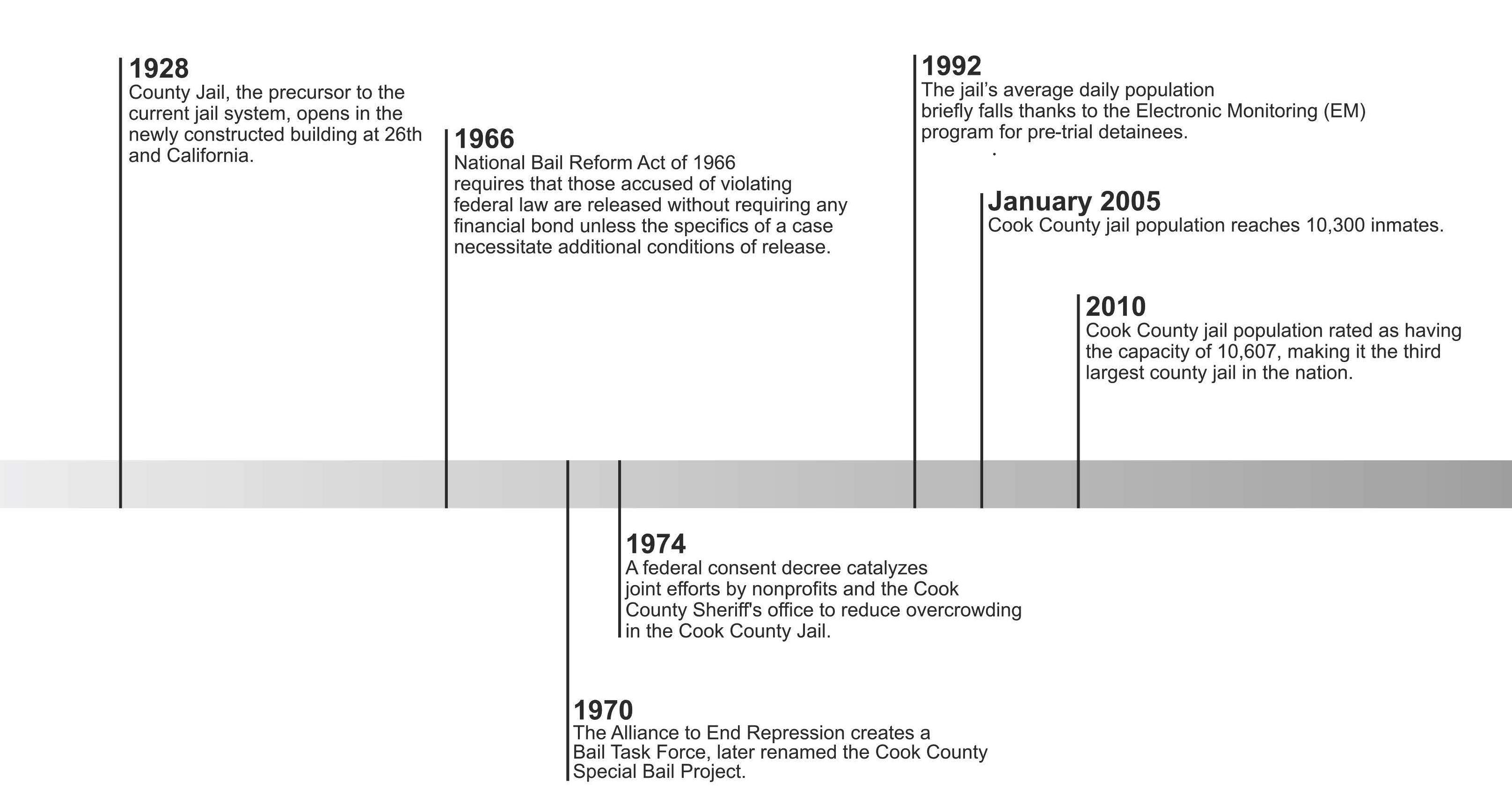
In the last few years, a seismic change has occurred in Cook County’s bail system. This change follows organizing efforts from the Alliance to End Repression in the 1960s and 1970s. Thanks to the continued and relentless work of activists, Cook County comes closer to ending the practice of monetary bail every day.
Previously, the Weekly looked at the history of bail and reform movements in Cook County. We now turn our attention to the more recent past regarding both the grassroots organizing efforts to reform the bail system and more formal legal action.
After nearly a year in jail, Mayes received a visitor who gave her information on a community organization that helped post people’s bond in Cook County. “At first, I didn’t believe it, because my family had tried to call several places about help posting bond. They didn’t have any luck, they were spinning their wheels basically,” Mayes said. As she soon found out, the organization that the visitor mentioned to her was the Chicago Community Bail Fund, a nonprofit group
that helped people facing pretrial detention in Chicago post bails that they could not pay.
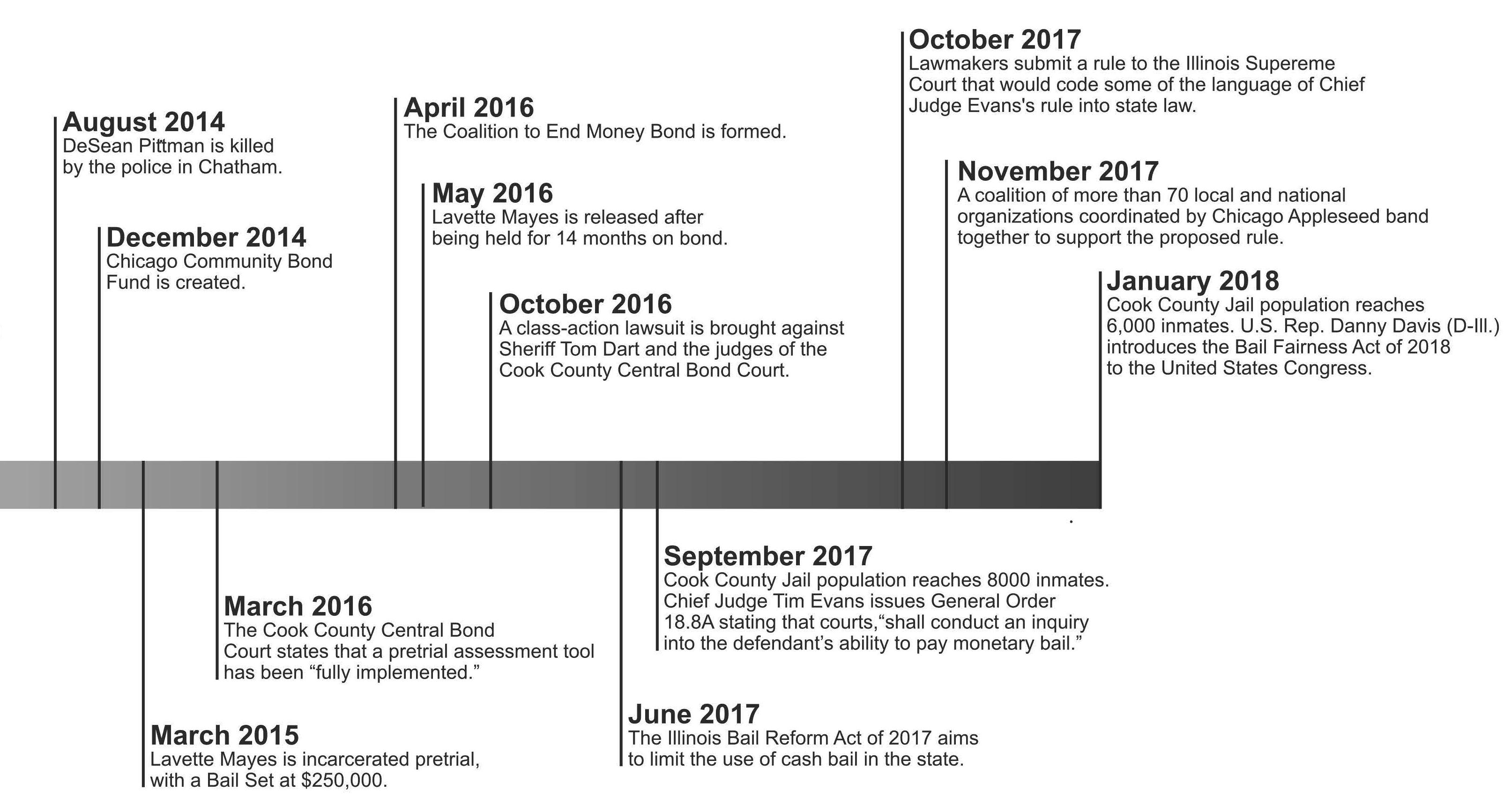
On the evening of August 24, 2014, DeSean Pittman was killed by police in Chatham. Three days later, as Pittman’s family and friends held a vigil to honor the seventeen-year-old, police showed up and began kicking over memorial candles, ripping down memorial posters, and taunting the crowd that was gathered to mourn Pittman. The police ended up arresting eight people at the vigil, five of whom were detained with felony charges of mob action and aggravated assault.
One of them was Pittman’s mother, thirty-four year-old Natasha Haul, who was held on $75,000 bail, an amount well above her ability to pay and would have prevented her from attending her son’s funeral. In all, it would cost Pittman’s family and friends $30,000 to get all the people arrested and detained after the vigil out of jail pretrial.
Max Suchan, a law student working with the National Lawyers’ Guild at the time, read about the police ambush of Pittman’s family and friends at his memorial and reached out to the family to see if they needed support in light of the arrests. He also sent a letter to nineteen-year-old LaKendra Lottie, who was arrested at the vigil and was being held in the Cook County Jail on a $100,000 detainer, requiring her to pay $10,000 to be released.
Lottie hadn’t even been at the vigil when she was arrested. She drove her siblings, who knew Pittman from school, to the memorial and was waiting to drive them home when police approached her and allegedly started beating on her car, breaking the back window and shouting, “move on, move on.” As she was driving away, LaKendra tapped one of the officers with the vehicle. The police immediately charged her with attempted murder and took her to the Cook County Jail.
“When we found out her bond, we [knew
we] just didn’t have that type of funds,” said Elzora Threets-Lottie, LaKendra Lottie’s mother. Lottie mailed the letter Suchan had sent her to her parents, who invited Max and Jeanette Wince, the mother of twenty-sixyear-old Derrick Wince, who had also been arrested at the vigil, over to their house to talk about getting Haul, Wince, Lottie, and eighteen-year-old Davontae Ruth released from jail.
Wince, Threets-Lottie, Suchan, and other organizers started raising money through methods ranging from online fundraisers to raffles and fish fries. The organizers raced against the clock, and eventually Haul was bailed out the day before her son’s funeral. “It took us a really long time, it took us three months to get LaKendra out,” Suchan said.
The last person to be bonded out of jail was Wince, nearly four months after the vigil. By that time, irreparable, unnecessary harm had already been done to Wince, Haul, Lottie, and Ruth’s lives. Ruth had to repeat his senior year of high school, Lottie lost her job, and Haul struggled to maintain childcare for her two young children while losing her job and nearly missing her own son’s funeral. While Suchan was focused on the immediate aftermath of Pittman’s death, Jeanette Wince and Threets-Lottie were already thinking about how to prevent this type of harm in the future.
“It was really heartbreaking to see our daughter like that because none of them should have been in jail in the first place just because they went to pay their respects to their friend,” said Threets-Lottie. “When they locked her up, it was like they locked me up at the same time. We wanted to start something so people who were in the situation we were in would have help to support their children.”
“The Fund would not exist without Elzora and Jeanette,” Suchan agreed. “They really pushed us to dream and think bigger
than anything we thought was possible.”
What began as a successful campaign to bond Haul out of jail in time to attend her son’s funeral and to get the others released pretrial soon turned into the creation of the Chicago Community Bond Fund (CCBF). A few weeks after posting Derrick’s bond in December 2014, the Bond Fund had its first official organizing meeting with about a dozen attendees.
“The initial conversations…were all around whether or not the Fund would be just a general fund for anyone who needed help with bail or whether it would be a more of an activist bail fund for people facing politically motivated charges,” said Sharlyn Grace, an activist who helped organize the bail fund and a Senior Criminal Justice Policy Analyst at Chicago Appleseed Fund for Justice. The organizers ultimately decided that it would serve both functions. At the time, only four or five other bond funds existed in the United States. Now, almost thirty funds exist in states across the country.
The Bond Fund uses a set of eleven interactive criteria to determine whether to pay bond for someone who asks for assistance. These criteria detailed in their 2017 report include factors such as “anticipated impact of detention on applicant’s employment, housing, educational attainment, and/ or custodial rights” and “position in relation to structural violence, community disinvestment, systemic racism, survival, and resistance.”
To date, CCBF has posted 121 bonds engaged with broader criminal justice reform efforts and advocated for individuals who have not been treated fairly by the justice system like Paris Knox, a Black woman who was jailed for ten years for defending herself against an abusive ex-partner. Due in part to the work of organizers with the Fund and activists from dozens of organizations around the country, Knox was released from prison a few days ago.
With about seventy volunteers and three paid employees, the Bond Fund’s true goal is to put themselves out of business. “We were really clear from the first meeting that we didn’t want to exist,” Suchan said. “The idea was not to create a fund forever to post these bonds, the idea is that no one should be in jail pretrial in the first place.”
There is no typical volunteer experience within the Bond Fund. Volunteers post bonds, organize events to fundraise for the fund, write grant applications, meet with key policymakers, create bond-related educational materials, plan public events to raise awareness around the issue of bail reform, run intake appointments, and much more.
“I think it’s really important for people to know that we’re not a guilt or innocencebased bail fund,” said Grace. “We don’t ask for any information on anyone’s case. Everyone is presumed innocent, we don’t worry about charges. We’ve posted for people charged with misdemeanors that are really petty
things and we’ve posted bond for multiple people accused of murder.”
In the spring of 2016, the Chicago Community Bond Fund joined a monthly convening of advocates interested in reforming the use of monetary bond in Cook County coordinated by The Chicago Appleseed Fund for Justice, an organization that has been working on bail reform for over a decade.
“Though it’s called the Coalition to End Money Bond, we work within the framework of criminal justice reform here in Cook County to more broadly end the disproportionate effects that our policies have on poor people and people of color,” said Chirag Badlani, a partner at the law firm Hughes Socol Piers Resnick & Dym, a member of the Coalition. “We think broadly around the way that our system of pretrial detention, pretrial services, and monitoring people in and out of custody affects these communities.”
The Coalition to End Money Bond, which drafted and organizes around a set of principles for bail reform in Cook County, also includes other organizations such as A Just Harvest, the Illinois Justice Project, Justice and Witness Ministry of the Chicago Metropolitan Association Illinois Conference United Church of Christ, Nehemiah Trinity Rising, The Next Movement, The Sargent Shriver National Center on Poverty Law, Southside Organized for Unity and Liberation (SOUL), and The People’s Lobby.
“We have folks that can organize community members, we have folks that are versed in law and policy, we have folks that can write a bill,” said Ted Miin, an organizer with the coalition as a part of A Just Harvest. “One of the things that the Coalition to End Money Bond does so well is having a balance of policy and legal folks as well as community organizations at the table. It’s comprehensive and holistic.”
Its diverse set of members brings a
variety of organizing strategies and targets to end the practice of money bond in Illinois for once and for all. “We’re working on moving the judges, the governor, the Illinois Supreme Court, everyone, asking [ourselves], ‘What can have the quickest and biggest impact? What can have the most lasting impact?’” Miin said.
The Coalition connects community members who have been impacted by money bond to legislators and policymakers who have the power to change the bond system. It has also collaborated on legislation that would help end the use of monetary bond in the city and state and organized demonstrations to put pressure on public officials and raise widespread awareness about the unconstitutional use of monetary bond in Chicago. Its efforts also include coordinating teach-ins and courtwatching trainings around the city, collecting and analyzing data on improper use of bond in Cook County, and organizing around the upcoming elections for judges and governor
TIMELINE BY JULIE WU
in Illinois.
Organizers with the coalition believe that grassroots movement building goes hand in hand with formal legislation. “If we’re not doing that movement-building, we spent a year making a lot of Springfield trips, we get a bill out, we get a cosponsor list,” Miin said. “Then [Illinois Department of Corrections] or someone with a backdoor relationship with someone on the committee does something outside of our control. The bill never makes it out of committee, and suddenly we’ve spent a year doing this work and there’s almost nothing to show for it.”
To this end, the Coalition has worked to bring the issue of bail reform to the attention of more Chicago residents and outlets like the Tribune, which recently published a piece on the bail reform efforts in Cook County.
“Bail is an issue that can feel ‘out of sight, out of mind,’” Miin said. “Through our courtwatching initiative, we had a hundre-plus volunteers who learned about mass incarceration and how money bond
contributes to it...Having more awareness around the issue means it’s less work to start that conversation with public officials and the community members they serve.”
Through it all, the Coalition’s top priorities are centering those impacted by the criminal justice system and excessive bail in their efforts and organizing so that people who are directly impacted by bond implementation can have an avenue to be self-advocates.
“We don’t want to use people,” Miin said. “[A Just Harvest’s] engagement with this coalition was something that was highlighted by our community as, ‘this is something that is affecting us every single day.’”
“Reformers sometimes think about these things from a very academic or research perspective, but we have to remind ourselves that these principles and the way we use them in our courts has an impact on individuals and families and communities,” added Badlani.
For Miin, Badlani, and other members of the Coalition, one of the biggest signs of its efficacy is the sheer reduction in the amount of pretrial detainees in Cook County Jail since the Coalition started pressuring influential criminal justice stakeholders to take action. “Cook County Jail is at about 6,000 people right now. Five months ago, it was at 8,000. We’re down 25% for people who should never have been in jail in the first place,” Miin said. “That’s why I do it, that’s the biggest win. That would not have happened without the public pressure and work of the End Money Bond Coalition.”
By the spring of 2017, in part due to organizing efforts like those from the Coalition to End Money Bond, bail reform had become a hot topic nationally and locally, with many excited to amend a system that had seen little change in decades. Many bills were proposed in Springfield that would change the cash bail system in the state in ways big and small. Criminal justice
reform and other progressive policy groups led by the People’s Lobby came together to work with State Representative Christian Mitchell in writing one of these proposed bills.
“We thought that was really the most progressive bill out there,” explained Sharone Mitchell, a former public defender and Deputy Director of the Illinois Justice Project. Though many of the proposed bills recommended limiting cash bail to amounts that people could afford, Mitchell’s bill uniquely proposed ending the use of cash bond altogether with provisions for data collection and monitoring.
In all, the state was inundated with nearly twenty bills covering bail reform, spanning small tweaks to big changes that affected the entire criminal justice system. Eventually, elements from State Rep. Mitchell’s bill were combined with principles from the seventeen or eighteen other proposed bills and recommendations, resulting in the Illinois Bail Reform Act of
2017. The Illinois bail statute now requires that pretrial conditions should be,“the least restrictive necessary” to assure attendance in court and protect the integrity of judicial proceedings.
However, the Bail Reform Act lacked a lot of reforms many saw as priorities for improving the Illinois bail system. “The Act was much more symbolic in its strength, it kind of was a restatement of the current law,” said Mitchell of the Illinois Justice Project. “It was a small step forward, but it wasn’t a transformational piece...we still consider it a victory because at one point, it seemed like there was potential for moving bail reform backwards through this legislative process.”
While State Rep. Mitchell’s bill met significant resistance from some state legislators whose jurisdictions more heavily relied on the fees collected from cash bail to help fund their criminal justice systems, the proposal found a supporter in Cook County Sheriff Tom Dart, a vocal critic of money bond. In November 2016, Dart made a public announcement in support of the abolition of cash bail. A year later, with significant reform efforts underway, Dart echoed this sentiment in an address to students at the Harris School of Public Policy, stating that the most crucial change necessary in the Cook County criminal justice system is the end to the practice of having money as a factor in pretrial detention.
Other public officials have also stated their commitment to ending cash bail and reforming the Cook County criminal justice system. State’s Attorney Kim Foxx announced in March that her office would stop opposing the release of some detainees because they could not afford small amounts of bail, stating, “There is often no clear relationship between the posting of a cash bond and securing the safety of the community or the appearance of a defendant.” Though this change would only impact a few dozen of the thousands of detainees in Cook County, it is a step in the right direction from the State’s Attorney’s office. Commitments like these, along with the vocal support of bail reform from Cook County Public Defender Amy Campanelli and Cook County Board President Toni Preckwinkle, have helped drive the momentum for abolishing cash bail.
At the state level, Illinois Supreme Court Chief Justice Rita B. Garman, State Representative Carol Ammons, and Administrative Office of Illinois Courts Director Mike Tardy demonstrated their commitment to improving pretrial justice
on October 26, 2016 by joining Three Days Count, a national campaign led by the Pretrial Justice Institute to end money bail and restrict detention across the country.
“The name really explains the campaign,” said Grace. “After three days in custody, the negative effects really start to accumulate”, since incarceration can put people’s jobs, housing situations, and relationships in jeopardy. These negative effects are apparent
court judges and Sheriff Tom Dart are violating the constitution by illegally setting bond that poor people cannot pay and then holding them in jail while they await trial,” infringing upon arrestees’ right to pretrial liberty.
“Bail can be both reasonable and unreachable. It doesn’t matter how ‘low’ your bond is if it is still above your ability to pay,” said Alexa Van Brunt, a lawyer working on
“The most heartwrenching part was feeling like my kids were being hurt by their mother being locked up. When you’re incarcerated, the whole family is incarcerated. You’re not there as a parent. I missed their graduations, first days of school, being there for my kids.”
– Lavette Mayes, a mother from the Southeast Side held in pretrial detention for fourteen months
in Lavette Mayes’ case. Due to the fourteen months she spent in jail and the resulting loss of income, Mayes lost her home and the vehicles she owned in her transportation company. Additionally, Mayes almost lost custody of her children due to her pretrial incarceration.
“The most heartwrenching part was feeling like my kids were being hurt by their mother being locked up,” she said. “When you’re incarcerated, the whole family is incarcerated. You’re not there as a parent. I missed their graduations, first days of school, being there for my kids.”
Despite his recent pro-bail reform rhetoric, in October 2016, Dart found himself on the receiving end of a Illinois State Court class-action lawsuit along with the judges of the Cook County Central Bond Court. Filed by Hughes Socol Piers Resnick & Dym, the Roderick and Solange MacArthur Justice Center, and Civil Rights Corps, the lawsuit Robinson et al. v. Martin et al. contends that “the Cook County circuit
with the Coalition to try to attack the money bail system from a new angle.
One of the named defendants in the 2016 lawsuit, Zachary Robinson, waited in the Cook County jail for nearly a year while legally innocent and awaiting his trial. He and Michael Lewis represent 4,000 people in the Cook County Jail who are behind bars solely due to the fact that they were assigned a bail they could not afford.
Van Brunt and the other lawyers seek a declaratory judgment from the Chancery Division of the Circuit Court of Cook County declaring the current monetary bond practices unlawful rather than seeking a particular remedy. “When you seek damages, all you’re entitled to is money for past suffering, you don’t have the right to change the system going forward,” she said. In this lawsuit, Van Brunt and other litigators want to change the system for everybody in Cook County.
Dart’s office was eventually dropped from the lawsuit by the plaintiffs in an effort to focus on the bond court judges, who have the greatest power in the setting and administration of bail. Nationally, similar lawsuits have resulted in the abolition of cash bail in seven cities across the country.
the case through the MacArthur Justice Center.
The litigants are no strangers to bond reform. More than a decade ago, Locke Bowman, the impetus behind the case, and another lawyer with the MacArthur Justice Center brought a lawsuit challenging the use of video conference proceedings in bond hearings.
This lawsuit was eventually settled, resulting in video bond hearings being replaced with in-person hearings, but Bowman’s interest in bond reform remained. Upon analyzing data on pretrial detainees in the Cook County Jail, Bowman discovered that African Americans were more likely to be locked up pretrial for the inability to pay bond than white defendants. Due to their increased likelihood of being detained pretrial, black defendants were more likely to plead guilty or to be convicted than their white counterparts and were more likely to get harsher sentences. As a result, Bowman started looking again into litigation to reform the criminal justice system, working
According to Van Brunt, litigation is just one of many forms of activism the Coalition has pursued in order to cement the cultural shift around money bail in a lasting and enforceable law. “There might be some changes now, but if we make it discretionary or a recommendation, which is currently what the law is in Illinois, history shows that judges will not follow those recommendations,” she said.
According to the Tribune, Judge Celia Gamrath “took the case under advisement” and plans to rule later as to whether or not the suit will go to trial. “We’ve been in a bit of a holding pattern,” Van Brunt said, laughing. “The judicial defendants...moved to dismiss the case on various grounds,” arguing that recent developments, including General Order 18.8A from Circuit Court Chief Judge Tim Evans, which tries to reduce using monetary bonds, make the potential decision unnecessary.
But results of the Order are mixed. While the number of unaffordable bonds has decreased, thousands are still in Cook County Jail solely for their inability to pay bail. ¬
Judge Evans’s Order and the continuing problems of the bail system in Chicago are the focus of the final installment of this series on bail reform.
The Shepherd
A short documentary celebrates the music and contributions of a trailblazing pastor
BY LATOYA CROSS
Last Thursday, a jubilant audience filled the Cindy Pritzker Auditorium at the Harold Washington Library Center in the Loop for a screening of It is No Secret: The Life and Inspiration of Rev. Clay Evans. The short documentary follows the life and activism of Evans, cofounder of the Fellowship Baptist Church in Fuller Park.
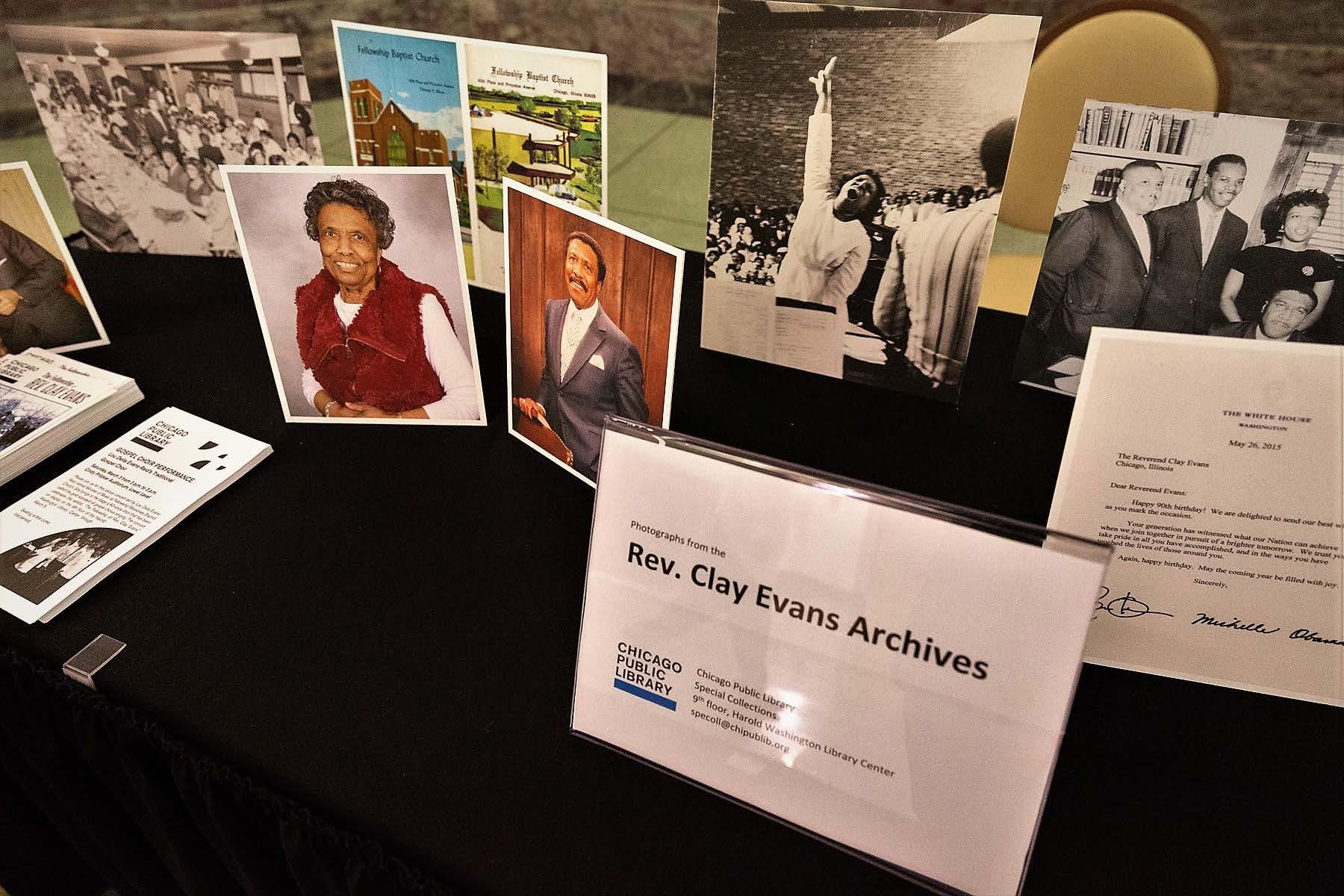
The documentary, filmed over a fiveyear span, is part of a larger exhibit titled “The Fellowship of Rev. Clay Evans,” currently on display on the library’s ninth floor. The exhibition, sourced from the library’s recently opened Rev. Clay Evans Archive, invites the knowing and the curious to rediscover and study the extensive influence and history of Rev. Evans.
Upon arriving at the theater, glowing smiles could be seen throughout the space, greeting one another as audience members took their seats. Though the reverend was ill and unable to attend the screening, it was clear early on that this night was going to be special. The event was a celebration and a fine example of celebrating a person’s legacy while they are still around to enjoy it. The energy of the evening mirrored Evans’s charismatic personality.
Born in Brownsville, Tennessee in 1925, Evans left the Jim Crow South and traveled to Chicago in 1945. By 1950, he was ordained as a Baptist minister and in 1952, cofounded the Fellowship Baptist Church.
Showcasing conversations with Chicago public figures including Nation of Islam Minister Louis Farrakhan and former mayor Richard M. Daley, the documentary illustrates the impact of a man who is known for fighting for social justice and equality outside the walls of the church, pioneering
broadcast ministries, and leading the Fellowship Choir to international acclaim.
“Rev. Evans, the shepherd, stood in the gap when parents were not there for children and people went to prison because the system was so oppressive,” Patty NolanFitzgerald, the film’s producer, said in an interview with the Weekly. “He was there with Mother [Consuella] York ministering to the incarcerated [at Cook County Jail]. He got [ostracized from] the Baptist Conference for doing that. Yet, he kept going.”
As a civil rights activist, Evans was no stranger to being punished for his actions. When he opened the doors of his church to Dr. Martin Luther King Jr. in the 1960s, then-mayor Richard J. Daley punished him by hampering his work to expand the church. Evans reflected on his life’s work in the documentary: “When you know you’re standing for something right, you don’t mind being attacked.”
A natural leader and fearless in the face of adversity, Evans’s advocacy for social justice shifted the mindsets of the AfricanAmerican congregation by encouraging parishioners to deviate from their concerns of personal salvation and motivating them to become active agents of change in their communities. His alliance with Richard M. Daley reshaped the way white Chicago politicians viewed the Black church by bridging the gap between City Hall and clergy, encouraging both parties to find ways to work together.
“He’s such a trailblazer in many aspects,” It Is No Secret director Ines Sommer said in an interview. “Between the civil rights-era stories and broadcast ministries, there was tension, people really had to fight and risk their lives and a lot of things. I had no idea
what the repercussions were for standing up to power. It’s incredibly impressive.”
Following the screening, local clergy members—including Dr. Della EvansReid, Evans’s sister and Fellowship Baptist’s former Minister of Music; Father Michael Pfleger of the Faith Community of Saint Sabina in Auburn Gresham; and pastor and gospel star Elder DeAndre Patterson—took part in a lively panel discussion.
Pfleger passionately praised Evans’s dedication to always doing what God called him to do. “He was always a pastor— whether he was meeting with politicians, other ministers, people of the church—he had a pastor’s heart. He was going to do the right thing, no matter what people thought. And that doing the right thing broke him out of the traditional stereotypes of what [ministry] ought to be.”
Touching on his musical impact, Patterson emphasized, “Before there was praise and worship, there was devotion. Praise and worship ministered to the Lord; Rev. Evans and Fellowship [Baptist] ministered to the people. The people need to know that God can work it out. And that’s what I think Evans, [Evans-Reid], and the music ministry of Fellowship gave, not just Chicago, but all over. [He] loved the hymn so much, he’d always put a little spin on it to make sure it stayed applicable to the church.”
An energetic and fiery Evans-Reid added, “His voice was his voice. Scratchy. Passable. It’s what you got in the voice, and what you can produce that makes the songs. People are drawn to good singing and good preaching.”
The panelists’ love, respect, and admiration of Evans shows the lasting impact of his ministry.
“It’s the honor of my life to do this work,” said Nolan-Fitzgerald. “Reverend [Evans] has been very clear about this from the beginning: His story for God’s glory. He stared down the hopelessness of the Jim Crow South and became an internationally known evangelist, pastor, incredible singer, musician, and producer. We want to shine a light on his story. Young people should know that story and hopefully, it will give them hope.”
Fittingly, the event concluded with prayer and a rendition of Evans’s mantra and one of his biggest hits, “It’s No Secret What God Can Do.” ¬
An edited version of It Is No Secret will air on WTTW this spring. “The Fellowship of Rev. Clay Evans” exhibit will run at the Harold Washington Library Center through March 5; the archives the exhibit is sourced from are available to the public at the library’s special collections by appointment.
MILO BOSH
Beyond the Levels
Public forum questions how well CPS’s current rating system serves students and communities
BY KATIE GRUBER
On Monday, February 12, over eighty people braved the cold to attend a public forum about school ratings in Chicago, titled “What Makes a School Great?” at Kenwood Academy High School. The event was the last of three forums about assessment put on by the coalition Parents and Teachers Driving Testing Policy; the first two focused on special education students and early childhood education, respectively. This forum was sponsored by seven local and national education advocacy groups. The audience included teachers, administrators, afterschool program providers, local school council members, and public education advocates.
A school’s rating is an important factor for many families in deciding where to send their children to school. Here in Chicago, where enrollment drives school funding, a low rating can even set into motion a chain of events leading to a school’s closure. The goal of this forum was to increase the public’s awareness of the way in which ratings are determined as well as how a school’s rating leaves out information that is important to parents and students.
The event began with an exercise led by Katie Osgood, a teacher at Langston Hughes Elementary in Roseland, aiming to show participants that an individual’s perception of a school may not match the broader community’s perception of that school.
Cassie Creswell of Raise Your Hand (RYH), a parent advocacy group and member of the coalition, then presented an overview of the school rating system used by CPS. CPS uses a rating system with five levels: 1+, 1, 2+, 2, and 3. Creswell noted that the state of Illinois does not require this particular ranking system and that there are many other entities that rank schools using their own systems. These rating systems all use students’ test scores in their calculation of a school’s rating. In fact, for CPS elementary
schools, test scores account for sixty-five percent of a school’s rating. For CPS high schools, test scores account for twenty-five percent of a school’s rating.
In 2013, CPS changed its rating system to recognize growth by rewarding schools for improving students’ performance on tests and not just for having high test scores. However, research broadly shows that students from higher socioeconomic levels tend to score higher on standardized tests. This raises the question of what the tests actually measure and how well they help schools target instruction to meet the needs of individual students.
Creswell described how a school’s rating operates within a virtuous or vicious cycle: a good rating leads to more good outcomes. For example, a Level 1+ school will likely have a better reputation and see greater enrollment. Increased enrollment can then lead to more resources for a school, which may also see higher property values around it as families seek to buy homes near a highrated school. High property values attract better-resourced parents, whose students are likely to do better in school, which can lead to higher test scores, and a higher rating. Or this can all work in the reverse: a low rating leads to more problems. As school ratings lower, causing a decrease in enrollment, funding, and property values, the effects of segregation and inequity across Chicago neighborhoods are exacerbated.
The forum then switched gears to the experiences of people currently involved with a variety of CPS schools, starting with a parent-student panel moderated by Brenda Delgado of RYH.
Eric Reyes, a parent at Telpochcalli Elementary in Little Village, and Jennifer Nava, a sophomore honor student at Kelly High School in Brighton Park, spoke about the qualities of a school that mattered to them but were not captured by the current rating system.
Reyes said that in 2012 his daughter received offers to several high-rated elementary schools. After visiting the schools and being underwhelmed, he and his wife decided to look at their neighborhood school, Telpochcalli, which had the low Level 3 rating. At Telpochcalli, Reyes found a committed principal, a ninety-percent teacher retention rate, and a fine arts and dual language program. (Since that time, Telpochcalli has gone from a Level 3 rating to between Level 2+ and Level 1.) For Reyes, Telpochcalli’s rating did not tell the full story of the school, capturing none of the components that were important to Reyes and his wife.
Nava shared that while Kelly has a Level 2+ rating, she would give it ten out of ten points. If she were able to design a rating system, she said she would measure how supported and comfortable students feel at the school. Nava said that she knew that Kelly would be a good fit for her because she had been going to Kelly for a social justice club since seventh grade. She knew the teachers and they knew her. On the other hand, Nava described the anxiety that gripped her classmates as they navigated the process of choosing a high school—those who didn’t have firsthand experience with a high school were highly influenced by a school’s rating.
Panel members Jeanette Taylor, a parent and grandparent to children at Mollison
Elementary in Bronzeville, and Felicia Williams, a parent of four CPS students and a teacher at Langston Hughes Elementary, spoke about other elements of good schools that are not reflected in a school’s rating. For example, Taylor pointed out that it is a great strength to have a clerk in the main office who knows everyone in the building. Williams also said that the rating of a school “won’t tell you about the grants that the school recently won for a robotics program” and it won’t tell you in which schools “the teachers come early and stay late.”
Taylor said that she views school ratings as “a way to punish students and families for not meeting expectations.” Moreover, she pointed to the current controversy over CPS’s proposal to close the Level 1+-rated National Teachers Elementary Academy and turn it into a high school, saying that CPS’s plan to close a top-rated school “shows that the rating system is a sham.”
Delgado then asked panel members if their respective schools fret when it comes to standardized testing. Taylor and Williams said that testing is stressful at their respective schools. According to Williams, “test prep is the bane of our existence.” Both said that standardized testing and test preparation takes away time from meaningful learning. Williams said that in some schools there are rallies before standardized tests, which creates more pressure on students to perform.
KAMARI ROBERTSON
Moreover, Williams said, for the “5Essentials” school climate survey, whose result makes up a small portion of a CPS school’s rating, (five percent for high schools and ten percent for elementary schools), some teachers and parents do not answer the survey questions honestly because they do not want to put their school in a bad light.
Lastly, Williams pointed out the unfairness of forcing students who are diverse learners (i.e. special education students) to take standardized tests without proper accommodations. She said that Langston Hughes Elementary School has thirty percent diverse learners and provides supports for those students. As a result, she said, the neighboring schools send their diverse learners to Langston Hughes. But when it comes time for standardized testing, Williams said Langston Hughes’s scores may be low because their students were not given the accommodations that are necessary for them to do well.
Jack Schneider, a professor and member of the Massachusetts Consortium for Innovative Education Assessment, was the last speaker at the forum. He pointed out that schools are not uniformly good or bad. He said that the problem of aggregating the data that we have about a school into one single rating score is that that score doesn’t tell us “where a school is knocking it out of the park and where it needs more support.” Even if school data is “true,” it can still misrepresent reality. For example, he said, what if most schools are “pretty good” but the rating system breaks them into four quartiles? That would put a “pretty good” school in the bottom twenty-five percent of all schools.
Schneider identified five criteria which a rating system could use to give a more nuanced picture of a school: teachers and environment, school culture, resources, non-test-driven academic learning, and citizenship and well-being. These five criteria hgave some overlap with the 5Esessential survey’s five criteria: “Effective Leaders, Collaborative Teachers, Involved Families, Supportive Environment, and Ambitious Instruction.” However, the 5Essential’s survey is only given to teachers and parents, not administrators, and, as noted above, its
results make up only a small part of a school’s rating. Schneider’s proposal of using these criteria to rate schools holistically presented a vision in which all schools are embraced, because “theoretically, all schools could be good.”
After the event, Joy Clendenning, managing director of RYH, said that while the organization has been questioning the school rating system for years, educating the public about the current system is especially important now because of the potential for implementing new policies statewide and in Chicago. The recent passage of the federal government’s Every Student Succeeds Act means that as legislators in Springfield grapple with its implementation, there is an opportunity to pressure them in the area of school ratings. Similarly, Clendenning said, with a new Chief Executive Officer in CPS, Janice Jackson, there is potential to pressure Jackson and the district to make its rating system more comprehensive and less punitive.
Clendenning attended the recent CPS hearings in Englewood regarding the future of Englewood high schools, and was struck by hearing so many people talk about the positive qualities that were not taken into account in the ratings that led to the schools being viewed as not worth saving. A better rating system would recognize the strengths in schools and identify the places where they need support, she said, and to help the community envision such a system is an important step in that direction. ¬
Katie Gruber has volunteered for RYH in the past.
It’s time to register for Spring programs with the Chicago Park District!
Activities start the week of April 2nd for most programs.
Online registration begins:
Monday, February 26 at 9AM for parks WEST of California Ave. (2800 W.)
Tuesday, February 27 at 9AM for parks EAST of California Ave. (2800 W.)
In-Person registration begins: Saturday, March 3 for most parks. Some parks begin Monday, March 5
Please note: registration dates vary for gymnastics centers as well as Morgan Park Sports Center & McFetridge Sports Center.
STAY CONNECTED.
MAYOR RAHM EMANUEL Chicago Park District Board of Commissioners Michael P. Kelly, General Superintendent & CEO