The South Side Weekly is an independent nonprofit newsprint magazine written for and about neighborhoods on the South Side of Chicago. We publish in-depth coverage of the arts and issues of public interest alongside oral histories, poetry, fiction, interviews, and artwork from local photographers and illustrators. The South Side Weekly is dedicated to supporting cultural and civic engagement on the South Side and to providing educational opportunities for developing journalists, writers, and artists.
Volume 5, Issue 10
Editor-in-Chief Hafsa Razi
Managing Editors Julia Aizuss, Andrew Koski
Directors of Staff Support Baci Weiler
Community Outreach Jasmin Liang
Senior Editor Olivia Stovicek
Politics Editor Adia Robinson
Education Editor Rachel Kim
Stage & Screen Editor Nicole Bond
Visual Arts Editor Rod Sawyer
Food & Land Editor Emeline Posner
Editors-at-Large Christian Belanger, Mari Cohen
Contributing Editors Maddie Anderson, Mira Chauhan, Bridget Newsham, Adam Przybyl, Sam Stecklow, Margaret Tazioli, Yunhan Wen
Data Editor Jasmine Mithani
Radio Editor Erisa Apantaku
Radio Hosts Andrew Koski
Olivia Obineme
Social Media Editors Bridget Newsham, Sam Stecklow
Visuals Editor Ellen Hao
Deputy Visuals Editor Lizzie Smith
Photography Editor Jason Schumer
Layout Editor Baci Weiler
Staff Writers: Elaine Chen, Ashvini Kartik-Narayan, Michael Wasney
Fact Checkers: Abigail Bazin, Sam Joyce, Bridget Newsham, Adam Przybyl, Hafsa Razi, Sam Stecklow, Rebecca Stoner, Tiffany Wang
Staff Photographers: Denise Naim, Jason Schumer, Luke Sironski-White
The paper is produced by an all-volunteer editorial staff and seeks contributions from across the city. We distribute each Wednesday in the fall, winter, and spring. Over the summer we publish every other week.
Send submissions, story ideas, comments, or questions to editor@southsideweekly.com or mail to:
South Side Weekly
6100 S. Blackstone Ave. Chicago, IL 60637
For advertising inquiries, contact: (773) 234-5388 or advertising@southsideweekly.com
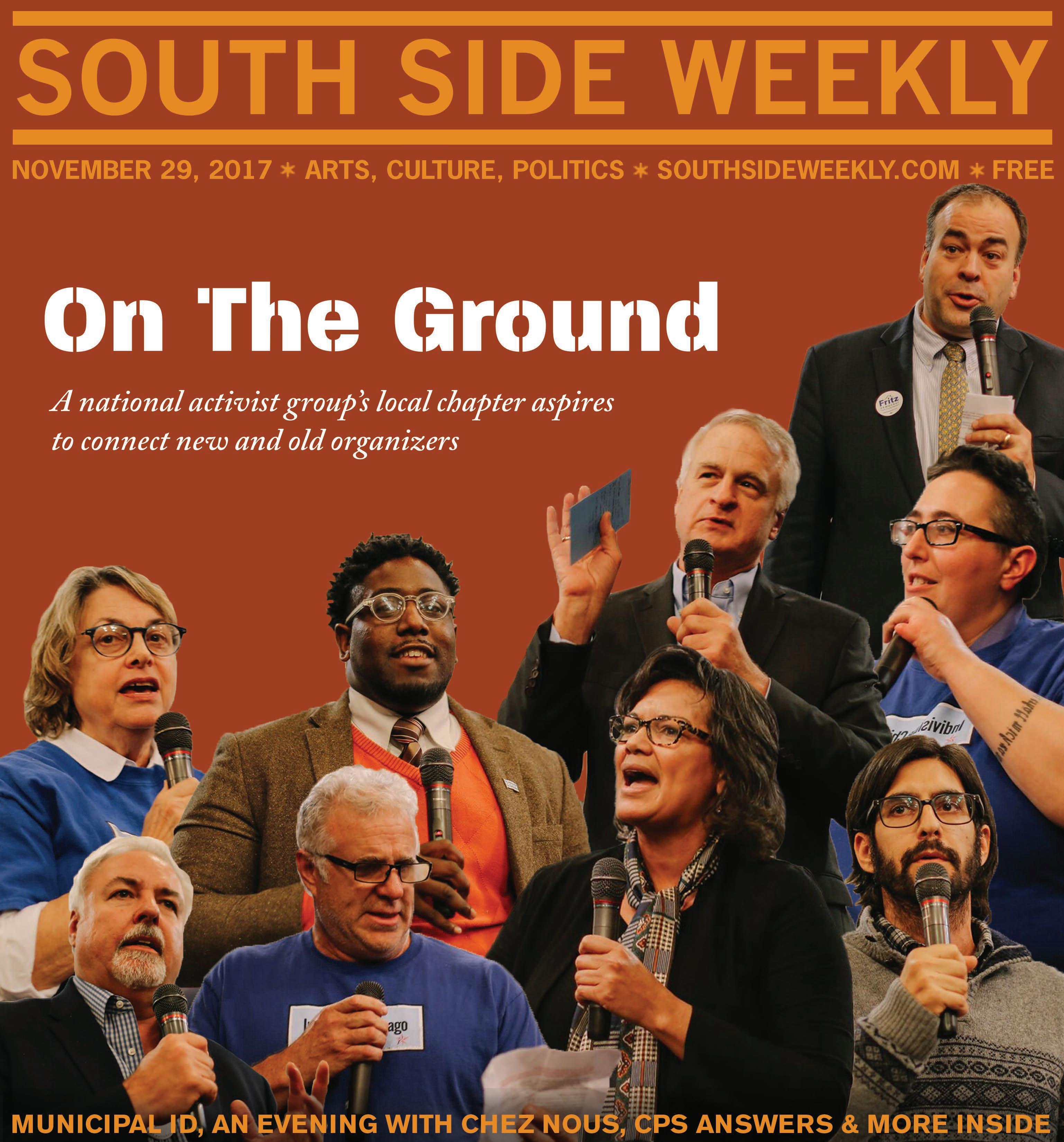
Cover photos by Kiran Misra, collage by Lizzie Smith
IN CHICAGO IN THIS ISSUE
A week’s worth of developing stories, odd events, and signs of the times, culled from the desks, inboxes, and wandering eyes of the editors
Can the Feds Offer a New Channel for Bottom-Up Activism?
If a site is listed on the National Register of Historic Places and there is a construction plan in the pipeline for this historic site, it is a routine procedure for the federal government to jump in and evaluate the construction plan to minimize adverse impacts on both historic preservation and local environment. Jackson Park, the selected site for the Obama Presidential Center (OPC) and of the proposed Tiger Woods golf course, is on the register, and the federal review just started last Friday. The federal review necessitates additional scrutiny on the city’s side, for which the city’s planning and development departments have already invited many experts to offer consultancy. The question here is whether this “routine” procedure can offer openings for non-routine inputs from grassroots activists, as a new force joins this long drawn-out battle between the OPC and community organizations. Margaret Schmid, co-founder of Jackson Park Watch, told the Sun-Times that the federal review offers much-needed “new eyes,” but will those eyes be looking in the same direction as the city, or its critics?
Spill Supervisors Spill Staff
Leaks are nothing new in Chicago’s southern waterways. This year, U.S. Steel twice spilled hexavalent chromium into a tributary of Lake Michigan. One month ago, a stillunidentified source spilled hundreds of gallons of oil into Bubbly Creek. Now, though, the institution responsible for preventing, investigating, and cleaning up these spills is facing a spill of its own. WTTW Chicago reports that the EPA’s Chicago offices have lost sixtyone employees this year as the region prepares for the heavy budget cuts promised by the Trump administration. Less than half of the sixty-one took buyouts or early retirements rather than work under the direction of Pruitt, who is intent on running the agency into the ground. But many employees left because they didn’t know whether the programs they were running—such as a small-business-oriented Pollution Prevention program—would exist come January, when the new, starved budget is to be implemented. Short on support staff, the office is straining under increased responsibilities, which include remediation at the lead-contaminated Superfund site in East Chicago and hurricane response efforts across the country. As corporations continue to release pollutants into the air, ground, and waterways, it’s likely that the EPA will have to investigate fewer claims, and more slowly. All leaks are worrisome. But the one at Chicago’s EPA offices especially so, because it only promises more down the road.
A Football Fantasy
In 2015, Wendell Phillips Academy in Bronzeville became the first Chicago public high school to win the state football 4A championship. Again undefeated this season, they’ve earned a second chance at the title—this time in division 5A, where they’ll face Dunlap High School this Saturday at 10am at Northern Illinois University in Dekalb. It’s easy to worry about what Phillips doesn’t have compared to the more affluent schools they’ve faced all season, but the Phillips football team has been infallible, practicing every day— including Thanksgiving—and receiving well-wishes from Bronzeville residents everywhere they go. J’Bore Gibbs, the captain and quarterback of Phillips with a full-ride football scholarship to South Dakota State University, where he plans to study engineering, told WBEZ that his final game for Phillips will be emotional, and that he “almost cried the other day thinking it’s going to be our last night practice, and it’s just practice...I’m very connected to these guys and the coaches and everything we stand for.” To J’Bore and all on the Wendell Phillips Academy football team—we’re proud of your hard work, camaraderie, and unflinching courage. We’ll be cheering for you!
on the ground
“It made putting leaflets on doorsteps of people who weren’t home worth it.” kiran misra........................................3
who will benefit from the chicago municipal id?
“There is no use in dividing our own city.” elaine chen.......................................5
the queen of bronzeville “[I]...led the way for all of you.” michael wasney................................7
opinion: cps’s unsettling answers CPS is providing the public with cloudy responses over reasonable questions. gina caneva.......................................9
ON OUR WEBSITE SOUTHSIDEWEEKLY.COM
SSW Radio
soundcloud.com/south-side-weekly-radio
WHPK 88.5 FM Tuesdays, 3pm–4pm
Email Edition southsideweekly.com/email
Support the Weekly southsideweekly.com/donate
On the Ground
A national activist group’s local chapter aspires to connect new and old organizers
BY KIRAN MISRA
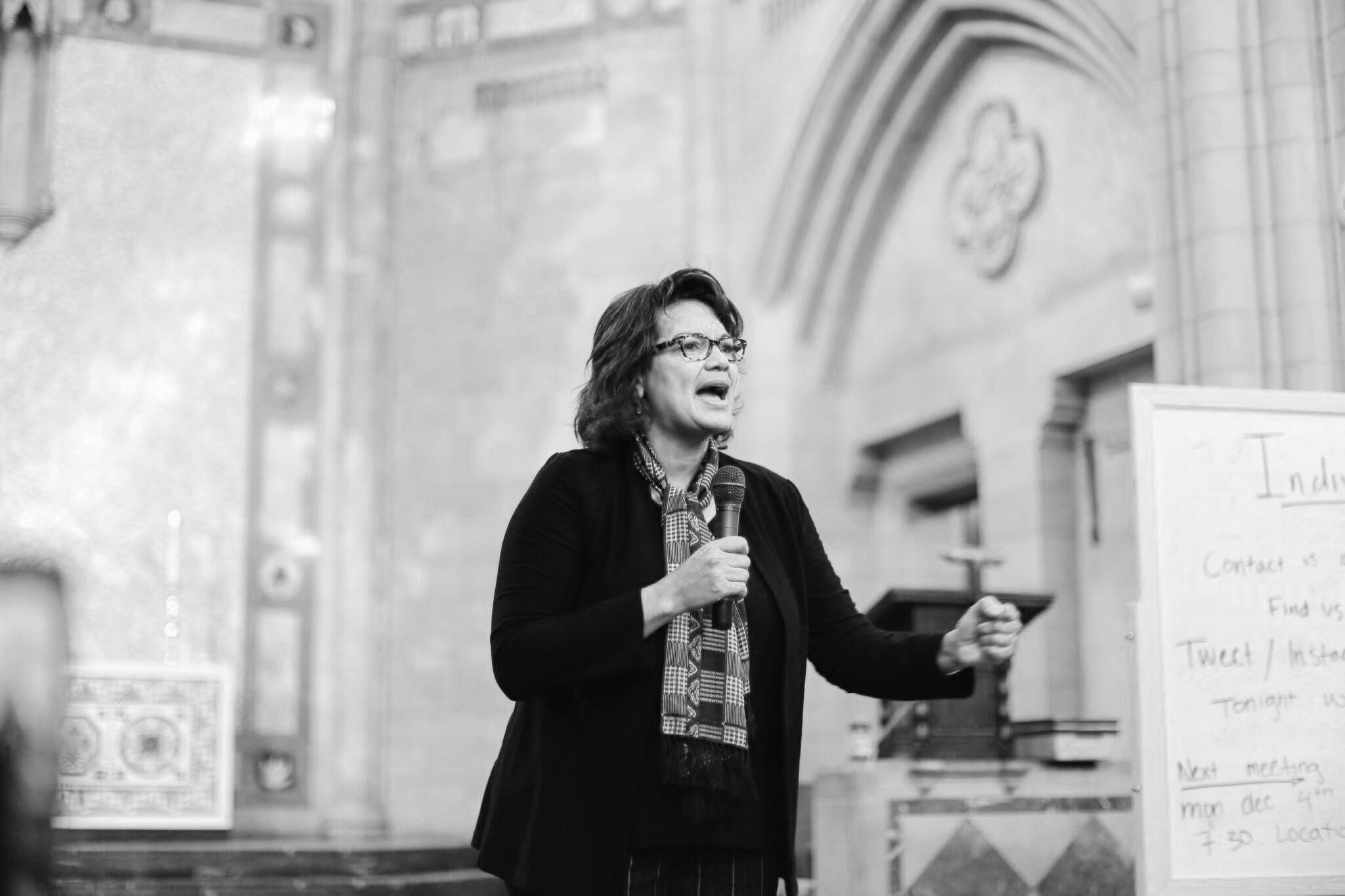
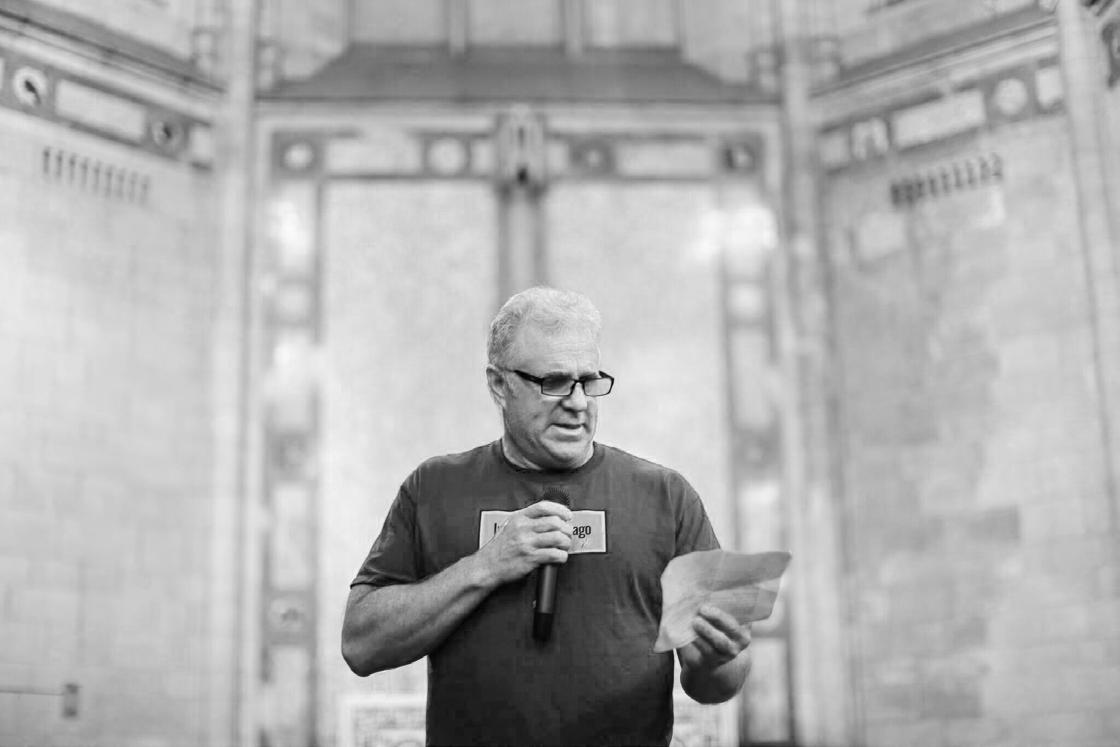
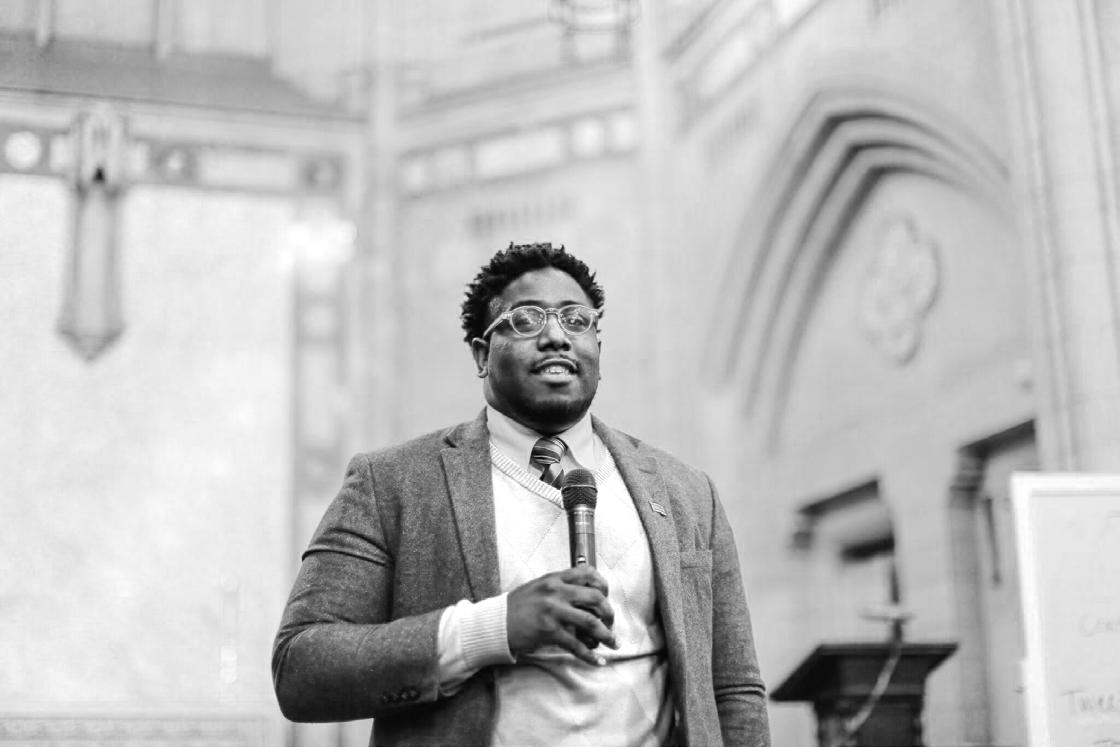
“When we fight, we win. So, let’s go and fight!” said Doug Bishop, opening an October meeting of Indivisible South Side at the First Unitarian Church of Chicago. He was followed by a presentation by Southside Together Organizing for Power (STOP) on the Community Benefits Agreement (CBA) for the Obama Presidential Center, reports from Indivisible’s working groups, and pitches by four candidates running for office: Rich Eichols, for U.S. Congress in the 8th district of Michigan; Joshua Grey, for Cook County Commissioner in the 3rd District; Fritz Kaegi, for Cook County Assessor; and Sharon Fairley, for Illinois Attorney General.
As candidates spoke about their connections to the Hyde Park community and their plans for defending progressive values once elected, strains of Nutcracker music emanating from a dance rehearsal elsewhere in the church filtered into the room, drowning out some of the speakers’ remarks. More than one candidate ventured over to the rehearsal to try their hand at negotiating with the dance group to turn the music down, a fitting display for those seeking to work with community members and leaders to compromise on much higherstakes issues. “This is the price of activism, I guess,” said Bishop, joking about the space’s double-booking.
It’s no coincidence that the South Side chapter of Indivisible’s Chicago branch meets at a church. The group’s coordinators want you to make activism a part of your week, a ritual, like attending a Sunday morning service is for so many Hyde Park residents.
The Indivisible Project was created in the aftermath of Donald Trump’s election
by former congressional staffers Leah Greenberg and Ezra Levin. In the weeks after the election, Greenberg and Levin noticed an outpouring of energy and desire to get involved in political action, but a lack of direction and organization. Drawing upon the success of the Tea Party in opposing Barack Obama and the Democratic congressional supermajority, Greenberg and Levin created an online guide that “laid out specifics regarding actions for best practices for making Congress listen.” The guide drew nationwide attention: local Indivisible chapters, which aim to use Greenberg and Levin’s strategies to advance progressive values, began popping up across the country. Indivisible cites its ever-growing number of chapters as the organization’s greatest strength, with at least two chapters in every congressional district. There are 5,800 chapters nationwide, with twelve chapters in Chicago and dozens more in the greater Chicagoland area.
Like many across the country, chapter co-coordinators Wendy Posner, Doug Bishop, and Esther Peters were wondering what to do after the election. Bishop, a professor of biology at the University of Chicago, explained, “I’d worked on a campaign or two, but never any kind of activism of this sort, and like many many many people in this country who have suddenly found themselves in activism, after the last election, I sort of felt it was time.”
Cara Adler, a Hyde Park resident and editor for the New England Journal of Medicine who leads the voting rights working group for the chapter, added, “At the time, the Indivisible Mission just fit how we were feeling.” Prior to joining Indivisible, Adler had mostly engaged with her community through volunteering instead
of formal political action. Peters agreed with Adler, saying that she also hadn’t been engaged with policy work and electoral politics, “until last November, when I was like, ‘that has to change and that’s where we all came from.’”
Bishop set off to register a South Side chapter with the national Indivisible Project and soon realized that someone living across the street from him had already filed to create a chapter. The two got together and were soon connected with three others who tried to file for a South Side chapter a few days later and discovered one had already been chartered.
“There was very limited advertising for that first meeting, mostly word of mouth,” Bishop explained. “We were figuring if we had twenty to twenty-five people, that would be pretty good.”
The chapter’s work officially started on January 26, 2017 at 7pm. “We met in a bar and we had a small room in the Woodlawn Tap, which is sort of Chicago’s beer hall,” Posner explained. “We had called the meeting for seven and by a quarter to seven, the room was packed. We had over 200 people that night.” Bishop added, “There were people who couldn’t get into the bar, it was so full.” Since then, the group has swelled to include one hundred regularly involved members as well as a mailing list of 600.
At meetings, the chapter presents a diverse assortment of opportunities to get involved in local efforts and national campaigns. The list of ‘upcoming actions’ at the October meeting’s agenda included a local ward meeting with Alderman Leslie Hairston, a protest against tax cuts for the wealthy at a Republican
fundraiser in the Chicago suburbs, and opportunities to get involved with voter registration at local high schools and jails, as well as a phone banking meeting for the recent governor’s race in Virginia. During the elections’ working group report, the group’s leader, Michael Glotzer, also mentioned opportunities to get involved with the upcoming Alabama Senate special election through long-distance phonebanking and text-banking efforts.
Using their dedicated and energized Chicago membership to affect politics across the country isn’t a new strategy for the chapter, which organized against repeals of the ACA by calling voters in states with Republican senators undecided on the various repeal bills and encouraging them to contact their representatives. Peters, who also works at the Center for East European and Eurasian Studies at the UofC, remembers calling voters in Maine during the most recent ACA repeal attempt, when in the middle of the phone-banking session, Maine Senator Susan Collins released a statement against the bill. “We just kept making calls to voters to have them call and thank her for her decision,” she said.
Though Indivisible Chicago–South Side gets some direction from the national Indivisible Project, most of their activities are independently directed by the chapter coordinators. “We have very little to do with the national group at this point,” Bishop said. “We pay more close attention to the city group because they make a decision for all the city chapters on what to emphasize and they also organize citywide marches and demonstrations.” Generally, individual Indivisible chapters enjoy a great deal of autonomy, having different sets of working groups and different tactics and approaches
to organizing for change across chapters.
As far as agendas go, the national Indivisible Project has a decidedly antiTrump focus, with a mission “to cultivate and lift up a grassroots movement of local groups to defeat the Trump agenda, elect progressive leaders, and realize bold progressive policies.” The South Side chapter reflects similar politics, with most members and leaders at the meeting mentioning the need to resist the destructive and divisive policies of the current American president, even though their mission, “to unite South Siders to fight for progressive values by exerting grassroots influence on our elected officials,” doesn’t mention the president by name.
Posner pointed to the multifaceted attacks on ideals of social justice as a foundational part of Indivisible Chicago–South Side’s approach to defining their priorities. “One of the thing that’s a hallmark of what we’re doing is that we don’t know from week to week what’s going to happen,” she said. “Sometimes things just drop on us. Sometimes they are local, sometimes they are national, sometimes they’re even international.” Betsy Rubin, the Twitter manager for the chapter, added, “We’re in a defensive position right now.”
However, the coordinators have recognized that just working against Donald Trump, a manifestation of many problems in the United States, wasn’t enough to build a progressive movement. “When Trump talks about deporting all Muslims and building a wall, that is an extreme manifestation,” Bishop said, “but in this country, there has always been anti-immigrant sentiment, conservative politics trying to promote the story to working class people that the reason they don’t have a job is because jobs are being stolen away from them by immigrants.”
Rubin said that she believed “all of [Trump’s] supporters, the entire Republican party is the outcome of many years of Republican organizing.” Peters added, “Trump is not the illness, he is a symptom of a larger illness, and so when you want to resist Trump, you have to think what are the forces in the state that are supporting Trump that we can fight against.”
To this end, the group places a strong emphasis on organizing around the issue of voting rights and voter suppression, “a longterm goal that isn’t dependent on things that are happening at the moment,” as Bishop put it, adding “we’re very concerned about
things like fighting against gerrymandering, fighting against voter suppression, trying to get everyone who is eligible to vote registered.” Many Indivisible Chicago–South Side members are Deputy Voter Registrars who, in conjunction with other voter’s rights groups, recently registered 261 voters and are working to expand voter registration efforts in Cook County high schools.
Bishop also mentioned that the previous Tuesday, the Illinois Board of Elections met partially in response to the work of Indivisible members around withdrawing Operation Crosscheck, a voter suppression initiative. During the meeting, four representatives presented research conducted by Indivisible Chicago members utilizing FOIA requests to mobilize against the initiative, a priority issue for the citywide
Indivisible chapter.
“Our chapter is involved at a slightly lower level than the group downtown,” Bishop said. “We’re providing assistance to them and doing research to gather information about how elections work in different states that participate in Crosscheck, gathering information against what we view to be a voter suppression program.”
Though the chapter calls itself
Indivisible Chicago–South Side, its coordinators agree that there’s more work to be done for it to be representative of the South Side. The members in attendance at the October meeting skewed whiter and older, reflecting Hyde Park demographics, and the chapter’s coordinators agreed this was a problem they were eager to tackle. “We’re looking to be helpers to find ways to draw people to organizing efforts that are Black-led,” Peters said. “If we can do that on a consistent basis, we can prove ourselves to be good partners.”
Bishop explained that he chose the name because he thought it might lead to various South Side communities getting involved. “It was an aspirational name,” he said, adding that maybe one reason the chapter hasn’t been representative is because there are many people on the South Side “who have been involved with activism for a long time, so there is no reason to [join] a new activist group.”
In a city that has been home to the proverbial founder of community organizing (Saul Alinsky) and one of the most famous community organizers of all time (Barack Obama), Indivisible Chicago–South Side hopes to complement existing organizing efforts with a broad and inclusive mission, low barrier to entry, interesting and wellknown speakers, and the backing of a well-known and well-organized national nonprofit. “We’re trying to be a wheelhouse and plug people in to each other,” Posner said.
Some of the chapter’s members have worked with the Coalition for A Better Illinois 6th District’s to unseat Congressman Peter Roskam, the Republic incumbent. “The 6th district…is one of the closest districts to where we reside that has a GOP member of Congress…[so] Roskam’s an obvious target to try to flip,” said Bishop. Their strategy, developed by the Coalition, was to get out the vote by educating progressive voters in that district, mostly via door-to-door canvassing. Indivisible members knocked on some 450 doors this past summer as part of that effort.
The chapter has also joined the fray surrounding the Obama Presidential Library. Following the October meeting, twenty members from both Indivisible and STOP showed up to Alderman Leslie Hairston’s ward meeting about the
library and asked about her position on a CBA. Though Hairston rebuffed the CBA coalition’s questions at the meeting, citing a lack of written proposal from the CBA coalition among other issues, the chapter’s leadership sees any opportunity to collaborate with other activist groups and connect with young activists of color on the South Side as a success. So far they’ve collaborated with the League of Women Voters, Chicago Votes, and the Sargent Shriver Center for Poverty Law on voter registration drives, to name a few.
Finding a way to collaborate with other groups while organizing one hundred to 600 new activists with different ideologies and goals is no easy job, one that Peters cited as one of the biggest challenges of being a coordinator for the group. “The hardest parts are probably balancing my job with Indivisible and realizing that different people approach activism in different ways and look to get different things out of activism,” she said.
To meet the evolving demands of running an activist organization, Bishop mentioned that creating a system of democratically elected and expanded leadership is in the chapter’s future. “That is one way for people to feel ownership of the group also, if they feel they can have a say in who the leaders are,” said Bishop. The group has no immediate plans to engage in chapter fundraising or instate a system of membership dues, an effort to keep membership accessible to South Siders with varying financial resources.
In the meantime, the group’s members are keeping up their enthusiasm by noting the difference their work is making, even at an individual level. Bishop recounted a moment during a recent canvassing effort, at the end of a three-hour shift. “I ring a doorbell and a man comes up to the door… He says, ‘I know Peter Roskam, he’s my business associate.’ I tell him that Roskam voted against Obamacare, against DACA, and he says, ‘No, I know him, I’m sure he wouldn’t have done that.’ I tell him, ‘Well, yes, he did. Would you be willing to call his offices and let him know how you feel about those votes?’ and he said he would.”
“It made putting leaflets on doorsteps of people who weren’t home worth it,” Bishop said. “The one connection made going out worth it.” ¬
Who Will Benefit from the Chicago Municipal ID?
The city prepares to roll out a threein-one identification card program
BY ELAINE CHEN
In early 2007, New Haven was the first city in the United States to issue municipal ID cards as part of an attempt to make its immigrant residents safer. Among many functions, the IDs allowed immigrants to open bank accounts and stop carrying cash, which was the target of many street robberies and home invasions. The IDs also encouraged immigrants who were crime victims to come forward, because immigrants knew they would be taken more seriously once they possessed official identification.
San Francisco followed suit two years later, and then so did several other major cities—Washington, D.C. in 2014 and New York City in 2015 are among them.
Chicago now joins this national trend. The City Clerk will soon roll out municipal IDs that will be uniquely threein-one—the IDs will triple as Chicago Public Library cards and Ventra cards. Talks about the municipal ID program began in 2015, and $1 million of the city budget was set aside to develop the program in the fall of 2016, with the Office of the City Clerk in charge of solidifying the program.
Kate LeFurgy, Chief External Relations Officer of the Office of the City Clerk, said that Chicago has not been late to issue IDs. Out of the top five largest cities by population, Chicago is the second city to issue municipal IDs, after New York. Moreover, she counted not being among the first to issue IDs as an “advantage”—instead, Chicago can learn
from other cities that have already issued them. Chicago is “still on the cutting edge while still able to take best practices,” she said.
Unlike the New Haven IDs that were originally designed with immigrants in mind, Chicago’s IDs will not be catered just for undocumented immigrants, said LeFurgy, nor just for other vulnerable populations that also face identification difficulties. Chicago’s IDs will be, she said, “for all Chicagoans.”
Security
Information security has been one of the biggest concerns for the municipal ID program, especially because the program serves undocumented immigrants who fear that their information will fall into the hands of the federal government. According to LeFurgy, the City Clerk considered the mistakes that New York City made regarding information security when designing the Chicago IDs. New York retained the addresses and social security numbers of its municipal ID holders. After Trump’s election, the city wanted to delete this information, but two state lawmakers sued to stop the city from doing so.
In response, Chicago will not keep any records of personal information. According to LeFurgy, when a resident applies for a card, city officials will not ask for immigrant status and will personally validate the resident’s documents. (The
Office of the City Clerk has yet to announce an official list of required documents, but the list will be modelled off other cities’ list, which use a point system to confirm proof of identity and residency.) The officials will then hand back all documents and print the ID on the spot, with the address printed on the ID. The city will not keep any record of the address, and will retain only the resident’s birth date and a unique identifier, all in compliance with the Illinois Records Law, LeFurgy said.
Yet Chicago’s decision to integrate the IDs with Ventra cards also raises possible concerns about information security. Chicago will be the first city to allow all residents to use their IDs for public transportation. (The closest city to do so is Washington, D.C., which allows only students to use their IDs for public transportation.) However, including this additional feature means including another party—the private Cubic Transportation Systems that operates Ventra—that will possibly have access to data about the municipal IDs.
According to LeFurgy, the inclusion of Ventra will not affect information security. The City Clerk will buy blank Ventra cards from Cubic, so Cubic will not know which Ventra cards also serve as municipal IDs. Additionally, LeFurgy said, the Ventra feature is optional. If residents choose to not use their IDs for public transportation, they do not have to register for Ventra accounts, and the Ventra feature will not be activated.
Inclusion of different vulnerable groups
Chicago has also considered vulnerable populations other than undocumented immigrants when designing its ID program. The two cities at the forefront of the municipal ID program, New Haven and San Francisco, initially designed their IDs with undocumented immigrants in mind, a feature the City Clerk took note of. Since the program’s inception, the office talked to numerous community organizations that represent different vulnerable populations.
Not unexpectedly, the City Clerk has worked in depth with the Illinois Coalition for Immigrant and Refugee Rights (ICIRR), Illinois’ largest multi-ethnic immigrant advocacy organization, while developing the program. But the ICIRR is just one of the many organizations that the City Clerk collaborated with. As Fred Tsao, Senior Policy Counsel at ICIRR, acknowledged,
Chicago’s municipal ID is “not just meant to be a card for immigrants.”
One such organization supporting a different vulnerable group is Access Living, a center that provides legal support and advocacy for people with disabilities. People with disabilities, especially those in nursing homes, face difficulties regarding identification, explains Michelle Garcia, Latino Community Organizer at Access Living. When people enter a nursing home, the home takes away all of their documentation (IDs, birth certificate, etc.), and then often loses these documents. They are then no longer able to seek medical or housing services outside the nursing home, Garcia said—they are “basically stripped of [their] identity.”
Access Living has brought up this specific difficulty in talks with the City Clerk, according to Garcia. Now, Access Living is helping to develop a mechanism that ensures that individuals cannot be stripped of their municipal ID when entering nursing homes.
The City Clerk has also worked with the Transformative Justice Law Project of Illinois (TJLP), a collective organization of legal and social workers that provides free legal support to transgender and gendernonconforming people. According to Tanvi Sheth, Project Attorney and Board Member at TJLP, this support includes a free namechange clinic to help change names on IDs. TJLP, therefore, “knows firsthand how something as simple as an ID can’t be taken for granted,” said Sheth. If people want to change the gender marker on their Illinois state ID, they have to provide a letter from a healthcare professional, which many people do not have access to due to financial reasons. Such requirements for changing the gender marker, Sheth said, “basically erases us [the transgender community].”
TJLP has worked with the City Clerk to ensure that residents will be able to change their gender marker on the municipal ID, and that the ID will offer the option of a third gender marker.
These organizations have found working with the City Clerk on the municipal ID program to be a positive experience. Garcia said that the City Clerk “has been really responsive, really open” to Access Living’s input. The City Clerk “asked us for different [pharmaceutical and medical equipment] vendors to be on board with the card,” said Garcia, so the vendors can provide discounts to ID holders. By asking Access Living, which is locally based, about vendors, the
City Clerk ensures that ID holders will benefit from the card at the local level.
Discussions with the City Clerk have sparked ideas for the Access Living staff as well. “When she [the City Clerk] talked about attaching Ventra, our [Access Living’s] light came on about including Para transit and accessible cabs,” Garcia said.
Sheth of TJLP similarly said that the City Clerk has “just been responsive to the needs of the community.” TJLP conducted an extensive survey across different communities to ask what kinds of documents transgender people have access to. The City Clerk’s office then used the survey results to help build the list of required documents. Sheth said he could not specify what particular documents the City Clerk added after considering the survey, because the final list has not been announced. His overall opinion was firm, however: “It has been a very inclusive and two-sided process.”
Benefits for all Chicagoans
In addition to helping vulnerable populations acquire proper identification, the card aims to benefit all Chicago residents. According to LeFurgy, Chicago has looked at how Detroit partnered with small businesses and how New York partnered with cultural institutions to provide discounts to ID holders. Chicago is in the process of including both types of benefits.
“I can’t stress this enough,” said LeFurgy, “that the municipal ID program is
for all Chicagoans.... We don’t want it to be a stigma card.”
The community organizations that worked with the City Clerk agree. “The card is meant to meet the needs to these communities, but also to appeal more broadly,” Tsao from ICIRR said.
Garcia from Access Living conveyed a similar sentiment. During an earlier budget hearing, some aldermen argued against allocating money to the ID program because they claimed the IDs would only aid undocumented immigrants. Garcia testified on behalf of the program: “This is a program for everybody, not just for one particular community.”
“[It would be] short-sighted to consider that this municipal ID program is meant to benefit some one particular community,” Sheth said. “The ultimate goal is: people who live in the city are able to just engage in public life.”
“There is no use in dividing our own city,” he added.
Until more detailed announcements about the program come, there’s little to do to evaluate the program as it currently stands other than to heed the experiences of the program’s collaborating organizations. The City Clerk will announce the official vendor of the IDs in the coming weeks, LeFurgy said, and also aims to pilot the ID program before the end of the year. With just a month to go until that hopeful deadline, whether a municipal ID program can and should securely serve all the city’s residents—especially its most vulnerable— remains to be seen. ¬
ELLEN HAO
The Queen of Bronzeville
An evening with Marlow La Fantastique
BY MICHAEL WASNEY
Before An Evening at the Chez Nous had even begun, Bronzeville native Marlow La Fantastique—whose career the event was celebrating—was already in her element. She worked her way about the room, doling out hellos and bisous with the grace of someone very familiar with the spotlight. That, of course, is an understatement. For decades, her relationship to spotlights was like a fish’s to the sea: she basically lived in them, performing not only in the States, but all over the world. Hers was truly a starstudded career, one with too many high points to easily identify any single apogee. But if forced to, one might point to La Fantastique’s time performing at the Cabaret Chez Nous, the famous West Berlin nightclub known for featuring drag queens and trans women performers as well as its celebrity patronage.
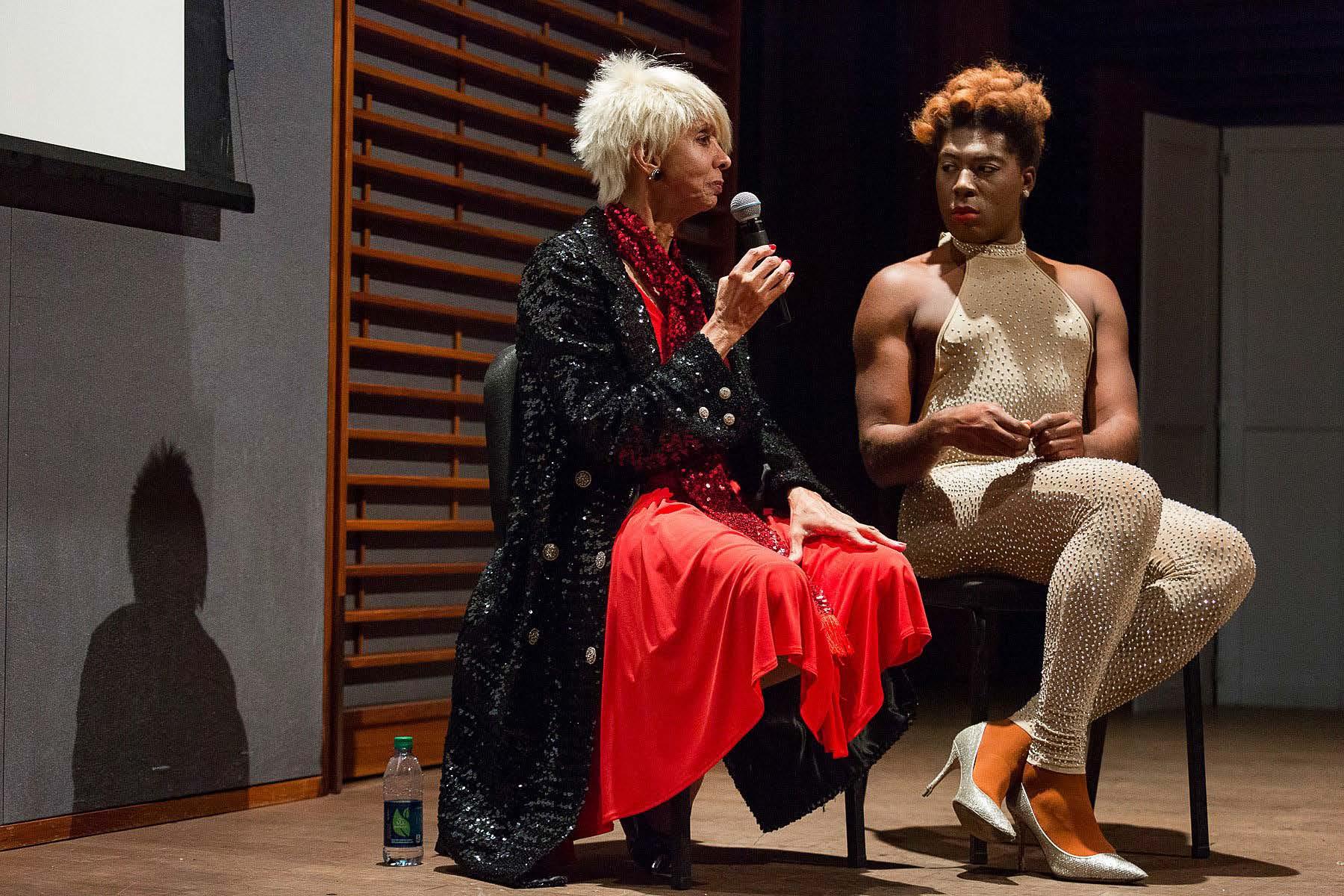
The University of Chicago’s Film Studies Center co-hosted An Evening at the Chez Nous in the Logan Center for the Arts on November 18 to celebrate the legendary queer cabaret and the native Chicagoan’s involvement with the place. But it became clear that La Fantastique’s significance goes way beyond her nights at the Chez Nous. She’s a queer icon whose performance career began in Chicago more than a decade before she even set foot on European shores—a time when being queer in America could have fatal consequences. “[I]...led the way for all of you,” she reminds the audience. Chase Joynt, emcee for the night, ran the night accordingly, reminding observers that the event wasn’t only about getting a glimpse into the “magic of Berlin’s past” but also into the “incredible life and legacy” of Marlow La Fantastique
herself.
Although Joynt had met La Fantastique before, he shared a similar sense of excitement with the crowd. “Working with Marlow, no story lands the same way twice. And it’s further elaborated the more we talk. So it’s kind of this incredible moment for me too,” Joynt confided in the audience. The gift of dynamic and varied storytelling is a charming quality that I also noticed in La Fantastique when we spoke one-on-one. One thing stayed constant, however: how positively she spoke of Bronzeville—both the Bronzeville of her childhood and the Bronzeville that she has returned to many years later.
“[Bronzeville] was a jumping neighborhood,” she told Joynt. She listed off a handful of joints that she frequented as an adolescent, many of which have risen to
historic significance since. “We had beautiful cabarets, we had the Club DeLisa, and the one called Rhumboogie. In fact, people came from the suburbs and the North Side just to enjoy a night out in Bronzeville.”
That was in the 1950s. At the time, Chicago was heavily segregated and few African-Americans living on the South Side dared to venture north. Police presence made that a dangerous gambit. “I was one of the few that strayed from north to south,” La Fantastique told me. With or without police, life wasn’t always the safest for her in Bronzeville either. “We had trouble with gangs. Because we walked the streets, and being queer, you were definitely going to get chased, and of course, you’d get beaten. And therefore, we just started hanging up north.” She and a couple of her girlfriends—a
girl named Freddy, and another girl named Sheila—would head up to the Gold Coast around Clark and Division. “That was the hangout spot, near Oak Street Beach...It was jumping up there. So we thought it was a difference to go there and have more fun and to meet different people.” However, the North Side was more of the same; to the gangs from the white neighborhoods, La Fantastique and her friends seemed like “pie and ice cream all together,” as she put it. They were not only queer but errant Black folk as well. And being Black attracted attention from the authorities. “The harassment from the police was unbearable,” she recalls tersely. “Every time we saw the police, we hid behind the columns of the building so they wouldn’t arrest us.”
There weren’t many spaces for “travesti”—a term La Fantastique uses to describe herself—in 1950s Chicago. So she moved east to the glitzy, alluring, and nascent New York ballroom scene. To a degree, things were different there, If “Chicago was kind of like a hicktown,” then New York had “that Big City flare,” La Fantastique told me. And while queer liberation was by no means at hand, she felt that “it was friendlier.” It was there that she made a name for herself, performing at the likes of the Apollo Theater, the 82 Club, and the Manhattan Center. It was at the latter that she first showed New York her infamous mirror dress—a design she created in 1965 for a show at the Coliseum in Chicago but redesigned for the eastern stage. “I looked like a ballroom,” she told Joynt. “All the girls complimented me.” To the audience, she added, “It’s in excellent condition, and I have it for sale.”
its members. Upon her return to New York, people began to suggest that she try her hand in Europe.
A number of ephemera from her time in New York had been unearthed in time for An Evening at the Chez Nous. Among them was a clip of her performing in her iconic mirror dress and a clip taken from The Queen, a 1968 documentary about the Miss AllAmerica Camp Beauty Pageant—a daring film that featured drag performers at a time when female impersonation laws had yet to be abolished. La Fantastique and her friend and fellow drag legend Crystal LaBeija won fourth and third in the contest, respectively. The pageant was the first—and not the last—instance that La Fantastique’s beauty was likened to that of a young Josephine Baker. The Queen offered not only a glimpse into New York’s queer subculture but also, unfortunately, the racism that haunted it. In a clip from the documentary (not shown at the Logan event), LaBeija contends that she received third place—as opposed to first or second—because she didn’t do anything to lighten her “color.”
Although New York was a more progressive city than Chicago, the atmosphere was still confining for La Fantastique. It was here that she joined the legendary Jewel Box Revue, a traveling performance troupe that was constituted mostly of drag queens, and as La Fantastique put it, “the first organized gay community” in America. Still, work was hard to come by in New York and otherwise. “Who wanted to hire a show with twenty-five men and a girl—a female impersonator show? Normal clubs and theaters all around America didn’t want to hire them,” La Fantastique said. In the middle of a cross country tour, she and several others were cut from the act because attendance was too low to pay all of
That seemed like the best idea given the scarcity of work and the police harassment that queer folks experienced in New York at the time. The latter would reach a head with the Stonewall Riots of 1969. But La Fantastique had already departed by then, arriving in Berlin in August 1968. Within hours of landing, she had already secured a job at the Cabaret Chez Nous, whose repute had reached her during her stint in New York. “I drove up in a taxi, told him to take me to the Cabaret Chez Nous. He took me right there, the taxi driver. And there was the boss. I introduced myself, and he looked at me, and then just in a few minutes...he told the owner Michelle I looked like Josephine Baker, and he told me to come back the next night.” And just like that, she became a member of one of the world’s most iconic queer clubs of the twentieth century.
In Berlin, La Fantastique found her element. “When we got to Germany, everything was allowed...And they loved travestis. They would come out and ask: ‘You’re travesti’ and they liked it.” La Fantastique actually found work at queer and straight clubs alike. She would book the latter as a cisgender woman. “But if they found out,” she told me, “it didn’t matter. As long as you made money for the club.” And that she did. “Always when I’d work in clubs, they’d put it in the newspaper because it attracted a lot of people.” Most of all, people came for her famous fan dance, an act that is unfailingly mentioned in any of the literature one can find on La Fantastique.
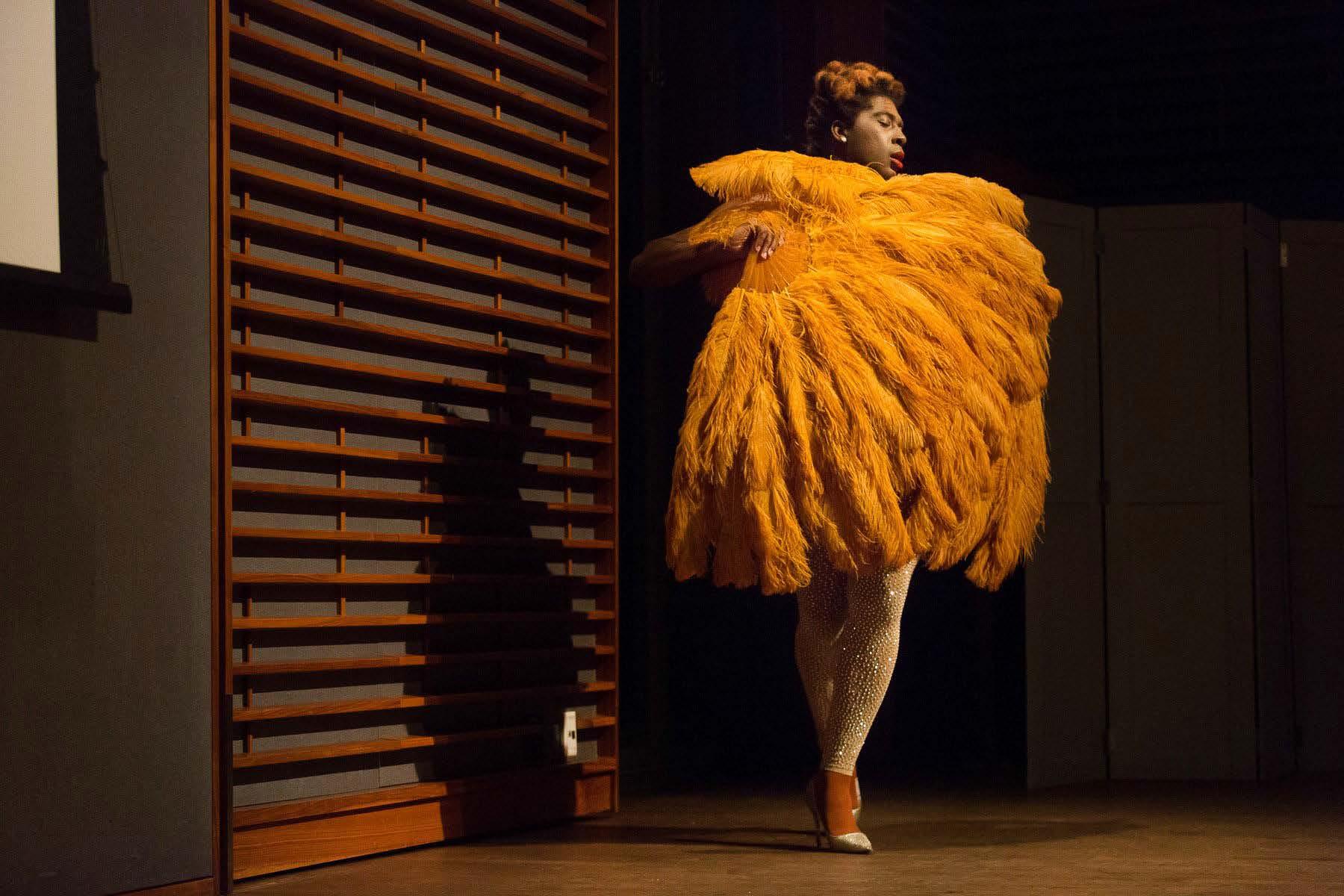
Audience members at An Evening at the Chez Nous got to experience her signature fan dance in person, this time reenacted by Chicago native, dancer, and artist Darling Shear. What began as a video clip of La Fantastique herself, decked out in a bodacious outfit of red dyed (and as La Fantistique told the audience, expensive) ostrich feathers, transitioned into a live version of the dance performed by Shear. It culminated in an amazing move that Shear would later compare to the opening of “a clam.” Apparently, Shear and La Fantastique worked together closely prior to the Logan event to help Shear perfect the move.
The strength of the event was the explicit connection it made between La Fantastique’s role in the queer movements of the midcentury and its legacy in the drag culture we see proliferating in the world today. Shear, then, was perhaps the perfect person to perform La
Fantastique’s most famous act—much of her artistic practice involves the repositioning of choreography ranging from the twenties to the seventies into a contemporary context. In conversation with Joynt and La Fantastique, Shear employs a musical metaphor to explain her method: “In a lot of urban music, they’re often sampling songs from yesteryear...and so I was like, ‘how can I make this into a career?’ ”
The crowd—like the programming of the event itself—was diverse in age. There were those who probably remembered hearing about La Fantastique in her heyday (and maybe even saw her perform) and there were those who had come to learn about a figure who took center-stage in some of the movements that made their own liberation possible today. “I feel incredibly warmed and inspired by the kind of intergenerational connection and conversation that we’ve continued to have in the making of this event, and also in the context of this work,” Joynt said nearing the end of the evening. “I just think it’s so incredibly dynamic.”
Although La Fantastique is no longer performing, one could feel the immensity of her presence—both in the room in Logan that night and beyond, amongst the pantheon of important queer figures of the latter century. She and her husband, German actor Gunter Willim (who she refers affectionately to as “Curly”), have returned to Bronzeville in their retirement. I met them in their apartment, which was covered from wall to wall with memorabilia and photographs from all corners of the globe.
Still, the fight for queer and Black rights in Chicago is by no means at an end; according to the Illinois Human Rights Commission, she and her husband filed a complaint with the State of Illinois Department of Human Rights in 2008 about an instance of housing discrimination that they faced as a result of La Fantastique’s sexual orientation and race. But without a doubt, much of the ill-will she faced in the fifties and sixties because of her race and sexual identity has waned since her return. Despite her worldliness, her Chicago pride remains undiminished and she still speaks of Bronzeville glowingly. “This is a heaven now,” she tells me with the elegant smile of a queen. I wasn’t the only one attuned to her regality; at her event’s end, she received an ovation fit for queen. And for “The Queen Bee,” the “Duchess Monique from Germany” herself, nothing less was deserved. ¬
MILO BOSH
Opinion: CPS’s Unsettling Answers
The district’s inability to address enrollment, special education, and more is a cause for grave concern for its future
BY GINA CANEVA
As a high school English teacher, I know that one of the biggest challenges for my students at the beginning of the school year is being sure about an answer to a question. Sometimes students meander and then finally get to an answer; at other times, they only answer one part of the question. Lately, in reviewing my district’s answers to clear-cut questions about how our schools function, I realize that my students are not alone in struggling to come up with good answers.
And yes, the questions seem to be answerable—here are a few examples that I believe an effective school district should be able to handle. How come my child’s name is not on the preschool roster when I made sure I signed her up? How many librarians are left in my district? Why did the numbers of schools with top quality ratings decrease? Why isn’t my child receiving the same special education services that she received last year? Why has there been a continual decline in enrollment in the district every year for the last fifteen years?
Separately, the answers that Chicago Public Schools (CPS) provides to each question may raise an eyebrow or two, but put together, the inaccuracies paint a portrait of flawed decision-making, faulty blame, and half-truths that further diminish the trust that parents, teachers, and the public at large have in CPS. This decrease in trust has even led many in our city to question numbers recently released by researchers indicating that CPS students’ test scores grew the equivalent of six years in a span of five years of school.
As the school year began and CPS touted improvements to its online preschool enrollment system, many parents of new pre-K students walked their children to their first CPS elementary school only to find out that their child was not on any teacher’s roster. According to WBEZ, some schools had attendance rosters with the wrong names on them and they were
turning away parents. A representative from the city’s Department of Family and Support Services, which coordinates with CPS to run the preschool program, blamed a switch in technology vendors and the usage of a less-than-finalized version of the technology system. This means there was no school-based back-up plan and local schools had their hands tied because of a faulty centralized system.
At the beginning of the school year, the Tribune reported that seventy-five percent of CPS students wouldn’t have access to a school librarian—CPS budgeted for only 139 school librarians for 646 schools this year. CPS explained that this number was “conservative,” as it doesn’t include other staff at schools who may monitor the library. The Chicago Teachers Union, in contrast, stated that the number was faulty because many school librarians also teach core classes or have the role in name only and teach a full slate of classes. So what is the actual number? It shouldn’t be difficult to calculate; yet even for this simple question— how many full-time librarians are in your district?—CPS has an unclear answer.
Last month, as reported in the SunTimes, CPS revealed that the number of schools with top ratings from last year declined by five percent. When media outlets pressed as to why, CPS officials said that many events during the last school year caused attendance declines that lowered their ratings. “The presidential election, the Day Without an Immigrant movement, labor strike uncertainty, and Cubs playoffs” were the culprits. If this is true, what does it say about a school rating system that these types of events and/or absences can drop a school’s rating? In addition, several small elementary schools’ ratings decreased, and a slower growth rate in standardized test scores was to blame. But CPS did not lead with this information and implied that a few absences can tip the rating scales from the highest ranking to one ranking below.
NATALIE GONZALEZ
Perhaps the most controversial story originally reported by WBEZ is whether or not CPS changed a set of guidelines for special education students which in turn decreased their services. CPS CEO Forrest Claypool rejected the claim in his own letter to WBEZ. He called the information “erroneous” and conclusions “false.” As the story is currently unfolding, WBEZ stands by their anecdotes, facts, and numbers. But after the accumulated mistrust of CPS, it is difficult to disregard a reputable news organization like WBEZ and the scores of parents of CPS special education students who spoke on record about how the decreased services fully exist and are harmful to their children and other children’s education.
The final question on my list—why CPS’s enrollment is consistently declining— garnered a factual response, but one without any self-analysis. According to the Tribune, CPS attributes the loss of nearly 70,000 students in fifteen years to “falling birthrates, plus slower immigration patterns and the well-documented exodus of residents from the city’s South and West sides.” Although the census data may prove these numbers to be true, it doesn’t capture families’ attitudes or experiences with CPS that may be, in
fact, a major factor in the exodus.
Take the Austin neighborhood whose schools’ student populations are nearly all Black. Austin’s CPS enrollment declined by nearly 800 students in several schools in the area. Longtime Austin resident Dwayne Truss told the Austin Weekly News that the 2013 school closures left “an environment of chaos” in Austin.
“We just have been spiraling downwards because again, there's no stability when it comes to our schools,” Truss said. But CPS never mentioned the impacts of school closings that created this lack of stability in neighborhoods like Austin on the West Side and Englewood and West Englewood on the South Side.
By the end of the school year, my students are masters at answering questions. They provide fully fleshed out responses with clear statements, logical evidence, and convincing analysis. We deserve the same thoughtful responses from our district leaders. As teachers, we are asked often to reflect on our practices—it’s even a part of our evaluation. By consistently providing the public with cloudy responses, CPS gives all of us grave concern over its future directions. How many more families will choose to move away in order to not participate in the politics behind a CPS education? Only time will tell. But right now, it’s time for our district to reflect on its practices—both effective and harmful—in order to provide the best education for all children in Chicago, and to provide Chicago citizens with answers and decisions that we can trust.
Gina Caneva is a fourteen-year Chicago Public Schools veteran who works as a teacherlibrarian and Writing Center Director at Lindblom Math and Science Academy. She is a National Board Certified teacher and Teach Plus Teaching Policy Fellowship alum.