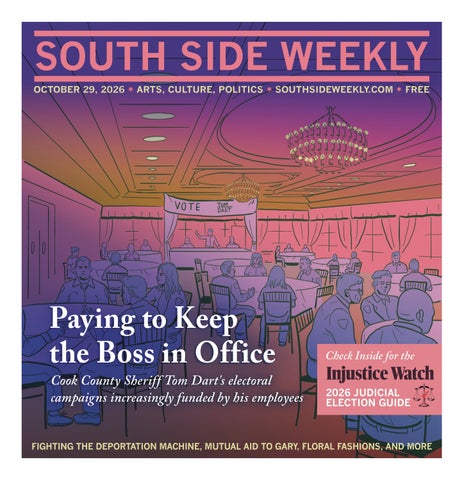
SOUTH SIDE WEEKLY The South Side Weekly is an independent non-profit newspaper by and for the South Side of Chicago. We provide high-quality, critical arts and public interest coverage, and equip and develop journalists, artists, photographers, and mediamakers of all backgrounds. Volume 13, Issue 19 Editor-in-Chief
Jill Petty
Deputy Editor
Adam Przybyl
Art Director and Layout Editor
Mel Dempsey
Assistant Managing Editor
Ellie Gilbert-Bair
Engagement Editor
Alycia Kamil Moaton
Senior Editors
Martha Bayne Christopher Good Olivia Stovicek Jocelyn MartinezRosales
Fact Checkers
Evgenia Anastasakos Emma Chosy Kate Gallagher Kateleen Quiles Sebastiana Smith Amy Wong
Office Manager
Mary Leonard
Advertising Manager
Susan Malone
Interim Publisher
Jianan Shi
Editor Emeritus
Jacqueline Serrato
The Weekly publishes online weekly and in print every other Thursday. We seek contributions from all over the city. Send submissions, story ideas, comments, or questions to editor@southsideweekly.com or mail to: South Side Weekly 6100 S. Blackstone Ave. Chicago, IL 60637 For advertising inquiries, please contact: Susan Malone (773) 358-3129 or email: malone@southsideweekly.com
FROM THE EDITORS IN THIS ISSUE More than anything else, we hope this election and politics-oriented issue of South Side Weekly is, as Chicagoans Raeghn Draper or Tatyana Najee might say, of use to our readers.
ask an expert: how should i vote? Raeghn Draper and Tatyana Najee break down what they’re tracking in the upcoming midterm elections.
Draper and Najee, featured in this issue’s “Ask an Expert,” are West Side community organizers, known for their conversational, well-researched, and practical resources for voters, including election guides Girl, I Guess and Girl, We Know.
chicago school board election 2026: the citywide race for president Chicago’s school board president will be directly elected for the first time as more than 30 years of mayoral control ends.
In speaking of the latter, Najee said, “We wanted to make something that would really reflect our day-to-day lives—being Black women dealing with this political climate.” And in spite of this climate, Najee observes that she tries her best to ground herself in “what we call hopecore,” a digital aesthetic that celebrates life and inspires optimism, counteracting doomscrolling. Draper discusses the challenge of making the electoral process compelling and accessible. “I don’t like politicians,” they said. “I am a community organizer. I really believe and invest a lot of time in the power of local communities ... but my belief in community power and in people organizing does lean into local electoral politics. I think we have a lot of power and opportunity there.” Positivity and community power—embodied by rapid responders confronting ICE on the Southwest Side, South Side mutual aid volunteers supporting people without electricity in Gary, or a gifted floral designer commemorating grief and resilience under authoritarianism—are also highlighted in this issue. This Weekly features the fruits of successful partnerships. For example, with support from Type Investigations and the Springboard Project, Weekly reporters Max Blaisdell and Harley Pomper (authors of our cover story, "Paying to Keep the Boss in Office") document how Cook County Sheriff Tom Dart has amassed nearly half a million dollars in campaign funds heading into next week’s election, and how more and more of that money is coming from his own employees. And to buttress our own election-oriented coverage—and keep you better informed—we feature reporting from Chalkbeat on historic elections for the Chicago Board of Education and the indispensable Injustice Watch judicial election guide. We hope this issue is informative and empowering.
For general inquiries, please call: (773) 643-8533
ellie gilbert-bair...................................3
mila koumpilova, chalkbeat chicago, and sarah karp, wbez.............................6 dart’s growing campaign war chest increasingly funded by his own employees Several other Cook County officials refuse to accept donations from their employees, fearing the appearance of pay-to-play politics.
max blaisdell, harley pomper..............8 fighting the deportation machine A born-and-raised Southwest Sider reflects on survival, resistance, and community during the anniversary month of Marimar Martinez’s shooting.
karina mireya........................................ 12 citywide referenda, explained Chicago and Cook County voters can make their voices heard on taxes, festival spaces, and public safety.
leigh giangreco.................................... 14 the south side’s flower dealer Odalyis Ramirez on her journey from Jewel Osco's $15 flower bundles to setting up a physical shop and creating her second look for the FLEUROTICA fashion show.
jocelyn martínez-rosales................... 16 from tiktok to chicago fashion week: a south side artist centering whimsy and choice 23-year-old Jordan Wyer specializes in bold colors and freestyle braiding, and receives client inquiries from across the country.
amaris edwards..................................... 18 south side relief reaches gary in the wake of summer storms During weeks of underreported power outages, Chicago’s Nita’s Love Train crossed state lines to deliver essential supplies.
amaris edwards..................................... 19 what’s next for the white sox? The grand ride of the 2026 Sox is over, but what a ride it was!
malachi hayes....................................... 21 todo está en llamas Reflexiones sobre lo que mantuvo nuestro ánimo en el aniversario de Operación Midway Blitz.
Cover illustration by Lana Martinez
karina mireya, traducido por gisela orozco.............. 23 the exchange The Weekly’s poetry corner is a collaborative space celebrating the literary arts.
alycia kamil, imani marie joseph....... 26 2 SOUTH SIDE WEEKLY ¬ OCTOBER 29, 2026
POLITICS
INTERVIEWS BY ELLIE GILBERT-BAIR Raeghn Draper is a queer, Black, nonbinary community organizer based on Chicago's West Side. With over 12 years of restaurant experience, they weave a working-class perspective throughout their work. Raeghn is the co-author of the Girl, I Guess voting guide, a storyteller, and a digital strategist who crafts compelling language that breathes life into powerful experiences and campaigns. They are passionate about advocating for hospitality workers and challenging toxic industry structures.
E
arly voting is underway across all of Chicago’s 50 wards for the November 3 midterm general elections. Chicago residents will not only have the chance to vote on candidates for the U.S. Senate, the U.S. House of Representatives, and the Illinois governor, but a host of statewide offices that could impact our neighborhood resources, safety, education, roads, waterways, and more. The Weekly sat down with two Chicagoans who are making it easier for progressive residents to cast informed votes about the issues that matter to them, especially on the South and West sides. Raeghn Draper is a co-author on Girl, I Guess, a “Jewish, Black, queer, trans, [and] nerdy” voter guide founded by Stephanie Skora and Ellen Mayer in 2018. The casual but incisive guide provides readers with “the dirt” on each candidate up for state and local election, encouraging them to participate in elections without sacrificing their values. Tatyana Najee is a co-creator of Girl, We Know, a Black woman-led election
guide launched this year to bring Black women’s voices into the conversation about Chicago’s political future. Created with Kiki Bryant and Crystal Gardner, the guide breaks down federal congressional races, Illinois General Assembly races, Cook Country races, Chicago Board of Education elections, and judicial elections.
Ellie Gilbert-Bair: How did you get involved in Girl, I Guess? Raeghn Draper: I was invited by Stephanie [Skora] to write for Girl, I Guess. Steph and I met on the train back from the “Muslim Ban” protests that were happening at O’Hare in 2017. She was sitting with a friend of mine, and I complimented her sign. Stephanie started the guide with a friend of hers, [Ellen Mayer], and then that friend stepped back, and Stephanie did it by herself for a while. Stephanie
Tatyana Najee, known as MermaidTM, is a Chicago-based political commentator, content creator, and community advocate dedicated to civic education, political accountability, and amplifying Black voices. Through her digital platforms, media appearances, and grassroots organizing, she breaks down complex political issues, challenges systemic inequities, and empowers communities to become more informed and engaged in the decisions that shape their lives.
knew that I was a writer, and asked, about two years ago now, if I wanted to co-write the guide with her. Hesitantly, I said yes. At first, I was like, “I don’t know, not really my thing.” But here I am. Why the hesitation? I don’t like politicians. I don’t care for electoral politics. I am a community organizer. I really believe and invest a lot of time in the power of local communities—small interconnected ecosystems of folks supporting one another—and I think it was a little bit of my [inner] anarchist coming out. Like, “Oh, this all needs to be burned down.” I do believe in local politics. I do believe, especially in local electoral politics, so some of that has shifted. I still do strongly dislike politicians, but my belief in community power and in people organizing does lean into local electoral politics. I think we have a lot of power and opportunity there.
How do you see the relationship between community organizing and local electoral politics? I really love community organizing because it helps people understand that they are powerful and they are capable. Sometimes, we look at activists and organizers as these superheroes that are trained up in a special way, who have these superpowers that the average person can’t tap into. That is the farthest thing from the truth. The average person is incredibly skilled and capable of changing their surrounding circumstances, especially when working in partnership with their neighbors, with their neighborhood group. I really see [organizing] as helping people understand that they are powerful, especially when they’re working together, and to have more of a vested interest in the wellbeing of themselves and the people around them. I think local politics is one of the quickest ways that you can demonstrate to people that they’re powerful. In local
OCTOBER 29, 2026 ¬ SOUTH SIDE WEEKLY 3
POLITICS
campaigns, you can really see how a couple of votes can turn an entire area, ideally in the way you want it to go. Since being on the guide, I’ve really been able to witness the power of our words in shaping certain races, and in folks’ enthusiasm—of, “Oh wow, when we do this together as a collective, we can actually change things.” So that has definitely shifted my view on local electoral politics, but I see them as one of the tools that communities have to flex their power. The 2026 midterm general election guide is almost 100 pages! Fill us in on the labor that goes into making it. It’s a real labor of love. [Steph and I are] two really stubborn Earth signs who love a project! Usually, we wait until ballots are finalized, and from there, we’ll create an outline of everyone who is on the ballot— not just our ballot, but across Cook County and the surrounding suburbs. Then, we’ll go in and pick our races. I personally have a vested interested in covering races of areas that I live in, or of folks with shared identity with me— so I’m usually taking the areas that are predominantly Black, or that intersect with my other interests. Stephanie does cover the judges on her own; bless her heart and her fast typin’ fingers. It is a lot of computer time, a lot of scouring the internet, going over websites, social media platforms, deep Google searches of these people, looking through relations—Facebook or social media. Then we present a draft, and we provide each other edits. If there are points where we need support or we don’t agree, we talk about it. But for the most part, when we take a section, we allow that person to lead how they want to talk about it. There’s been a couple of times that Stephanie and I disagree, but even if we do, there’s a trust in each other and each other’s values. The guide has a unique, playful voice. Tell us about how you see the role of fun in keeping folks engaged in politics.
I would not be able to do it if it wasn’t fun. It’s a lot, like you said—100 pages. I feel, sometimes, like I’m in school again when we have to write it. But I get to poke fun of some of these politicians and their gossip, and their mess, and their controversy. I get to poke fun at their badly designed websites and their really horrible headshots. That keeps me entertained and energized to keep going. As a community organizer, I engage a lot in play and games to get involved. Community power is very serious—these are our lives. These policies, these elected positions—they affect our taxes, our ability to pay our bills, our ability to get to and from work. So, this isn’t to take any of that lightly. But I feel like this push for everything to be over-professionalized creates a barrier between folks who understand this world and the average person. And I am really invested in tearing that wall down and making sure that the average person not only can understand but wants to engage. Some of us don’t want to read a boring research paper. We want to read something that sounds like chatting with my girls and spilling the tea. As political writers, it’s also our job to keep the reader engaged, and keep our community wanting to get involved. It’s only strategic to get creative with those solutions. I get really excited about voting time, because, having written the guide for a couple years, I am now getting more familiar with the lore, with the gossip of some of these people. I have politicians that I really don’t like, and have had to write about them for years because they’ve stayed in their positions. So the petty Taurus in me is like, “I can't wait to vote against you.” So I’m bringing a little bit of that energy not only into this, but also into our municipal [elections] that are coming up in February. You identify as a “progressive” voter guide. What makes up that identity— what are some of the non-negotiables, and what are some of the things that you’re more flexible about?
4 SOUTH SIDE WEEKLY ¬ OCTOBER 29, 2026
As progressives, we care about climate justice, gender justice, racial justice, and connections to community organizing. As a labor babe myself, I care a lot about workers’ rights, so I’m often looking for connections to labor or union groups in my research of a candidate. Stephanie brings the background of being an anti-Zionist Jew and also a transgender woman, so she is definitely scouring around LGBTQ issues, specifically around trans rights, as well as Jewish people. But as an anti-Zionist, she’s also looking for people’s stance on Palestine. Where we have hit a bit of a push and pull with some of our audience is our stance on Palestine. We don’t cover federal races as much, because it’s a different kind of cesspool. But our stance when it comes to federal politics is that folks take a stand for Palestine—call it what it is, a genocide—and support a right to return for Palestinians. That is rare and far between for a lot of our federal races. Locally, it’s a little different. There aren’t as many opportunities for our local politicians to do something in their role as elected officials that will affect the people of Palestine. So for us, our litmus test is involvement with the local police department. So statements like “Blue Lives Matter” or receiving funding from the Fraternal Order of Police—those are things that are red flags for us, as well as funding from AIPAC-aligned folks, [the American Israel Public Affairs Committee], or funding from Republican groups. Even if a person is looking like they align with us and the values, if the money is coming from suspicious places, we’ll give a side-eye in our evaluation. How do you follow the money? For elections taking place in the state of Illinois, we use IllinoisSunshine.org. There, you can look up any individual that’s running for elected office in the state and see where their money is coming from. It tracks [the name and employer
of anyone giving more than $150], so smaller donations aren’t [itemized]. But you can follow these people. If I show up as a donor for one of these politicians, you could then click on my name and then see who else I donate to. That’s a way that we can sometimes find these Republican trails or police-supporting trails. All elected officials have to report their fundraising and campaign dollars quarterly. So, the Illinois State Board of Elections is another place you can go. That one moves a little bit slower. Who is the guide for? The guide is for folks who want to understand how their local politics are working, folks who want the way that they vote to be aligned with their values and progressiveness, and folks who want a more comprehensive picture of who their [elected officials] are outside of just being a Republican or Democrat. We include descriptions on what every elected position does—like the Metropolitan Water District—and invite the reader without any jargon to understand how [these officials] impact their lives. I think, for a lot of us, this kind of education is missing from most of our schooling. There are a lot of awesome voter guides out there, and I would encourage people to reference multiple sources before they make the decision. But Stephanie, especially, holds such a wealth of historical knowledge when it comes to Chicago’s political system, and how the machine and political relationships feed into why people are voting a certain way, and why these people get their seats. It’s a little bit of gossip, a little bit of spilling the tea, and I think it can make it really fun and accessible to other people. Are there any races you’re keeping an eye out for this election? There are a couple. The school board race is a mess! But I think that’s a place where our vote has a lot of impact. I
POLITICS
think, especially in districts that have a lot of folks who don’t show up to vote, that’s where the opposition is going to be sneaking in their candidates. It’s really, really important to be talking to our neighbors, talking to our friends and our cousins, folks who live in some of these areas, to encourage them to vote. We have so much power when it comes to the judges, because nobody votes for judges. You know, who was ever taught to vote for judges, and what do they even do? But it’s a fantastic opportunity to get some really corrupt, morally obtuse people out of one of the most powerful positions over our everyday lives—how people are being sentenced, and how they are fined, and how they are criminalized. So I would definitely encourage people to vote for their judges.
Ellie Gilbert-Bair: On your social media pages, you’ve covered all things Chicago politics—city council meetings, voter registration information, even a series on Chicago’s “alderman problem.” How do you choose what to cover? Tatyana Najee: I like to cover the things that I know are going to directly affect our communities and our neighborhoods. I think voting in this midterm election and the municipal elections that are going to be coming up [in February] is very important, so I want people to understand how to register to vote, how to know where your polling location is, things like that. I like to focus on both a federal level and a local level—I think both are required to make the changes that we wish to see in this country. On a federal level, I do a lot of work speaking to elected officials. I try to bridge the gap between the people and the politics. As far as Chicago’s local politics, I wasn’t paying much attention until I saw what happened last year in the budget meeting, with the fight about the corporate head tax.
Editor’s Note: The corporate head tax, officially the “Equitable Employer Tax,” was a failed 2026 proposal by Mayor Brandon Johnson to tax large corporations a monthly fee per employee that works in the city, with an offset credit for employees in disinvested areas. Johnson revived it this year in his “Fair Share Budget” spending plan. I went to the original budget meeting [in 2025] to see the mayor’s proposal—it is something that I align with because I align with progressive policies that are going to actually help out our communities. So to see it be shot down by the City Council made me think, “oh wait, what’s going on here?” I did a little bit of research. I made a rant about how I felt about the fact that that was shot down ... so that’s where things kind of popped off. We’re about to be smack dab in the middle of budget season, which means the reason why I started my series is coming back up again. So I’m hyper-focused on seeing how everyone is moving and what they are deciding to do, and if they are voting against their constituents. What do you see as the role of social media in engaging voters? There’s actually been studies that have been done recently that shows that [a majority of adults in the U.S.] are getting more of their news, and just basic information, from social media than they are from traditional media or legacy media. I’m just a regular person. I mean, I’m from Queens, New York. I am a regular girl, but I know how to have a conversation. And so when I make my videos, I try to make them informative, but also not give people anxiety. I try to keep them at like a minute and 30 seconds so that you can actually sit there, watch it for a second, and then you can scroll. And within that minute and 30 seconds, maybe two minutes, you got packed with information but didn’t feel like you were packed with information.
Our generation—Generation Z— faces a lot of anxiety over the state of the world, and a lot of informational fatigue. Does that resonate with you, personally? Oh yeah, it absolutely does. I’m gonna just tell you—every day, it’s something. Especially with this administration, every single day you wake up, it’s something new that’s happening. I try my best to ground myself in—I guess we call it “hopecore” [a digital aesthetic that celebrates life and inspires optimism, counteracting doomscrolling]. I try to look for the positives in things and hope for the best as much as I can. But also, I know that because [we get fed] so much information, sometimes we have to filter out what is just fluff and get to the nitty gritty, so that we are able to make the decisions that we do. I actually feel like our generation is more solution-oriented than other generations. I don’t want to fight anybody, but I think that our generation really looks for solutions. When I give out information, I try to give it out as “Hey, this is the problem. This is how we fix it.” That’s where the “Chicago doesn’t have a mayor problem. Chicago has an alderman problem.” series came from. When I am giving out this information, I try my best to make it as simple as possible for people to understand. ... I feel like if we are able to get the information in a way that’s easily understandable, then it makes people want to make more educated decisions moving forward. You just launched the Girl, We Know Black Chicago election guide with Kiki Bryant and Crystal Gardner. What did you prioritize when making this guide? We wanted to make something that would really reflect our day-to-day lives—being Black women dealing with this political climate. [We focused] on the South and West Sides, because these are historically
disinvested neighborhoods. There are a lot of times where policy and legislation that [isn’t spoken about in mainstream media] affects our neighborhoods the most. So, by focusing on the South and West Sides, and Black and Brown communities and minority-led communities, we will hopefully be able to open up other people’s eyes to seeing what happens in these communities as well. Chicago is a very segregated city. Some of the issues that people may face on the North Side are not the same issues that people may face on the West Side or South Side. I think there’s space in this political climate for both issues to be addressed. What is one thing you want folks to really understand this midterm season? I think the main thing that I want people to see is political influence, following the money. There have been allegations about me saying that I am being paid to do this work [by political candidates], when in actuality I am not. When you watch how people start to move when education is being given [to constituents], and how monetary value is involved, I think that’s the most important thing. You have to watch how people move. ¬ Ellie Gilbert-Bair is the Weekly’s assistant managing editor.
Do you have a topic you would like to ask an expert about? Email us at elliegilbertbair@ southsideweekly.com
OCTOBER 29, 2026 ¬ SOUTH SIDE WEEKLY 5
POLITICS
Chicago School Board Election 2026: The Citywide Race for President
Chicago’s school board president will be directly elected for the first time as more than 30 years of mayoral control ends. BY MILA KOUMPILOVA, CHALKBEAT CHICAGO, AND SARAH KARP, WBEZ This story was originally published by Chalkbeat. Sign up for their newsletters at ckbe.at/newsletters This story was reported and published in collaboration with WBEZ, the Chicago Sun-Times, and Block Club Chicago, a nonprofit newsroom covering Chicago’s diverse neighborhoods. Stay informed with Chalkbeat Chicago’s newsletter, WBEZ and the SunTimes’ education newsletter, and Block Club Chicago’s newsletters.
C
hicago’s first-ever citywide race for school board president has all the makings of a political drama: millions in campaign contributions, special-interest group endorsements, and two candidates bowing out midstream. Voters across the city will finalize their pick among three candidates to lead the Chicago Board of Education on November 3. Chicago’s school board president will be directly elected for the first time as more than 30 years of mayoral control ends. The person in this powerful, but unpaid position represents the board publicly, runs board meetings, and helps set the agenda. They will work with 20 other members to set a vision and goals for CPS for the next four years. Former Chicago Teachers Union deputy political director Hilario Dominguez, who is on leave from the union and his job as a Chicago Public Schools special education teacher, is a graduate of CPS. He is running on a progressive platform that includes expanding preschool to all 3-year-olds and demanding more
Three candidates are competing to be Chicago's first elected school board president. From left: Hilario Dominguez, Jessica Biggs and Victor Henderson. Photos by Akilah Townsend for Chalkbeat and Victor Hilitski for the Chicago Sun-Times
education money from the state, rather than cutting. The CTU is fueling Dominguez’s candidacy financially as it tries to hold on to control of the school board, which it seized after former union organizer Brandon Johnson became Chicago mayor in 2023. Jessica Biggs, a former CPS principal and current school board member, wants to prioritize financial stability and highquality education for every student. She’s backed by the progressive Service Employees International Union Local 73, which represents mostly low-wage Black and Latino CPS workers and is in a bitter dispute with the CTU. She’s also solidified support from the business community and former government officials who worked under former mayor Rahm Emanuel,
6 SOUTH SIDE WEEKLY ¬ OCTOBER 29, 2026
including former CPS CEO Janice Jackson and former deputy mayor for education Beth Swanson. Attorney Victor Henderson, who serves on the board of Urban Prep Charter Academy, is centering his campaign on advancing student achievement and fiscal responsibility. He broke open contribution caps when he lent his campaign $500,000 and has secured support from two Black congress people, prominent lawyers and pastors of large Black South and West Side churches, including Michael Pfleger of St. Sabina and Byron Brazier of Apostolic Church of God. Leadership consultant Sendhil Revuluri, who served on the school board under former mayor Lori Lightfoot, dropped out of the race on September 30.
His platform promised a focus on student learning and community engagement and advocated for a board that’s independent of the CTU, the powerful union that represents roughly 30,000 teachers and CPS staff and is known for its strong focus on social justice issues. A fifth candidate, Jennifer Custer, a former educator now serving on the board, dropped out in late August. All the candidates say they are running because they want CPS to better serve students and families. But they differ broadly in their approaches—Biggs wants to focus on a better-functioning board, Henderson on offering an outsider perspective to issues like the budget crisis and charter fundings, and Dominguez is proposing big initiatives, such as increasing access to youth jobs. Only Dominguez is ruling out closing schools amid the district’s steady enrollment losses, though the others say they would work with communities and move with deliberate care in weighing campus mergers. Henderson would consider opening more privately run charter schools and wants to see them better supported, while the others would further scrutinize existing charters. The hall leading into Henderson’s downtown office is covered in framed newspaper articles about clients he has represented as a well-known defense attorney: actor Jussie Smollett, who was accused of allegedly faking a racist attack; Ald. William Beavers, who was convicted of tax evasion; the Jackie Robinson West Little League, which was stripped of its
POLITICS U.S. World Series championship title; and a CPS principal who sued after being ousted by her Local School Council. Henderson is the only candidate in the race who doesn’t have experience as an educator. But the 65-year-old’s four grown children all attended CPS elementary schools in Beverly and selective enrollment high schools. Henderson is not only a lawyer, but also a former certified public accountant. He says he can read contracts, understand budgets, and take on powerful interests. “On that board, you need the right combination of people,” he said. “You have to have parents. You have to have principals. You have to have community members, but you also need to have lawyers and maybe doctors.” Henderson became motivated to run for school board president after he got pulled onto what he calls the recovery board of Urban Prep Academies. At the time, in 2023, the school board was trying to close the charter school network after CPS’ inspector general found “dismal” financial practices, including unaccountedfor spending, taking high-interest loans, and needing cash advances. The founder and former CEO of Urban Prep was recently charged with embezzling more than $100,000 from the organization. Henderson chalks up Urban Prep’s problems to a bad administration, but says the attempt to shut down the charter network, which serves almost exclusively Black male students, was wrongheaded. Urban Prep officials say they produce better academic outcomes than districtrun schools for Black male students, who historically have lagged behind other student groups. “You don’t have those students and their families suffer.” Henderson was part of a group of Black men who rallied on behalf of Urban Prep. The charter organization sued CPS and was allowed to keep two schools open. Henderson says CPS needs to better support charter schools. He is sympathetic to the argument that charter school operators should receive a funding boost from CPS. Henderson said he would commission a forensic audit. If it turns out that CPS needs additional revenue, he said he has the skill set to go to Springfield and make the case. He said he wants to serve because he cares deeply about education. “Men who are educated are more likely to get married, have families. You feel better about yourself,” he said. “The
data shows that the more education you have, as a general rule, the more you make. Education is just transformational.” School board member Jessica Biggs says her experience leading last year’s search for the district’s leader motivated her to run for president. Biggs says she successfully secured buy-in from all board members on the job description for the superintendent after what she calls an “authentic” process of gathering community feedback. “So that just showed me what was possible if there was leadership,” she said.
B
ut the process fell apart after the candidates’ names became public and one dropped out. Biggs said she believes what happened was driven by political divisions on the board, leaving her demoralized to such an extent that she decided she didn’t want to run again as a board member. “There were times when I very much wanted things to move forward, or be brought for a public vote, and was not able to do that,” Biggs said. To have the impact she was seeking, Biggs realized, she needed to take a lead in setting the board agenda. The way to do that was to run for board president, Biggs said. “If I was going to continue to spend my time on this board,” Biggs said, “it was important to me to be able to have that authority.” Biggs grew up in Wheaton, now lives in Douglas, and has one daughter, who attends a fine arts magnet school. Biggs was one of three members elected in 2024 without the backing of powerful interest groups, including the Chicago Teachers Union and the Illinois Network of Charter Schools. She won her race with about 45% of the vote despite being massively outspent. On election night, she said she felt like people wanted independent board members. “I feel really loved,” she said. She works for the Southwest Organizing Project, a community organization on the Southwest Side on an initiative that connects school communities with a range of services. Biggs was fired as principal of a South Side elementary school in 2018 after an inspector general report found that she instructed staff to mark students as tardy even if they missed much of the school day and had them pick children up in their cars without getting written permission from their parents.
She was put on CPS’ “Do Not Hire” list. But she was removed last year, after previous attempts to get off the list were denied. Biggs has contended that her firing was political.
I
n her two years on the board, she opposed some of the biggest measures pushed by mayor-appointed and CTU-aligned members. She held firm last year against the push to take a loan to avoid cuts. This summer, she voted against an amendment that reversed layoffs by assuming the state would provide more money for CPS. Since she ran two years ago, she’s gone from a “no” on school closings to leaving the question blank on our CPS School Board questionnaire. She says she doesn’t think there is a yes-or-no answer. “I think this is a false dichotomy,” Biggs said. “There are spaces in this district where kids’ needs are being met by small schools, and there are spaces in this district where kids’ needs are not being met by what we are offering in a school.” After months of speculation about the candidate the CTU might champion for the board’s top job, the union settled on one of its own when it endorsed Dominguez, who left his job at the union before launching his campaign. Dominguez says he’s unapologetic about his yearslong role as a union stalwart. The only presidential contender who worked as a full-time CPS teacher, he is also the husband of an assistant principal in the district. Dominguez says his education advocacy goes back to his time as a student at Whitney Young Magnet High School, when he organized a walkout to protest budget cuts in 2010. A native of the Pilsen neighborhood, he worked as a special education teacher on the Southwest Side. He took two years off to focus on political campaigns, including his own failed City Council bid. He later helped organize an 11-day teacher strike in 2019, when he was arrested with other union members holding a sit-in protest at the offices of the failed Lincoln Yards megaproject. Trespassing charges against him and the others were later dropped. After going to work for the CTU full-time in 2022, Dominguez also worked on Johnson’s breakout campaign and on the candidacies of CTU-backed school board members in 2024. The union handily outspent well-resourced pro-school-choice groups in those races. It helped secure wins
in three of nine contested races. Dominguez said he has made more than 100 lobbying trips to Springfield over the years, “more than all my opponents put together.” So far, though, the push to secure an influx of additional state revenue for schools has fallen flat. Dominguez says that as president, he would work to engage more families in lobbying and rally districts statewide. He is proposing offering free, full-day preschool to all city 3-year-olds through a partnership with private childcare centers and home-based daycares. He says the shift would drive economic development, boost the district’s enrollment, and “do right by families” by easing childcare costs. Dominguez’s other priorities are also closely aligned with the union’s. He said he will push for better cafeteria food and the continued expansion of the Sustainable Community Schools program. He staunchly opposes any school closures, arguing that the district and city should instead use vacant space in “supposed underutilized schools” to expand services such as healthcare clinics and library branches. “When we talk about underenrolled schools, we should be clear that we’re talking primarily about Black and brown students in Black and brown neighborhoods that deserve more investment and not punishment,” he said. In 2021, Dominguez faced a complaint from a fellow teacher who claimed Dominguez made a Nazi salute, called him Hitler in front of students, and questioned that teacher’s sexual orientation. The complaint was later withdrawn. Dominguez called the complaint “baseless” and said he was standing up to a racist colleague who had disrespected a student. ¬ Editor’s note: This story was updated after school board president candidate Sendhil Revuluri dropped out on September 30. You can still read his full questionnaire. Mila Koumpilova is Chalkbeat Chicago’s senior reporter covering Chicago Public Schools. Contact Mila at mkoumpilova@ chalkbeat.org. Sarah Karp covers education for WBEZ. Contact Sarah at skarp@wbez.org. Chalkbeat (chalkbeat.org) is a nonprofit news organization covering public education.
OCTOBER 29, 2026 ¬ SOUTH SIDE WEEKLY 7
POLITICS
Dart’s Growing Campaign War Chest Increasingly Funded by His Own Employees
Several other Cook County officials refuse to accept donations from their employees, fearing the appearance of pay-to-play politics. BY MAX BLAISDELL, HARLEY POMPER This story was produced in partnership with the Springboard Project at Type Investigations.
C
ook County Sheriff Tom Dart raked in tens of thousands of dollars in campaign cash from more than 100 of his own employees despite facing little competition in his reelection campaign, according to an analysis by South Side Weekly and Type Investigations. Almost all of that money came from a select, although not small, cadre of at-will political employees. Dart, 64, is seeking a record sixth term in office as head of one of the largest and most powerful agencies in Illinois. With more than 5,000 employees, the Cook County Sheriff ’s Office (CCSO) has a broad remit: operating one of the country’s largest single-site jails on Chicago’s West Side, serving orders of protection, carrying out evictions and policing many of the small, unincorporated villages and towns in the county. It’s legal for Cook County elected officials to collect campaign donations from their employees so long as donations are not solicited during work hours and there are no strings attached—and Dart has long done so. Yet the dollar amount the sheriff has collected this time around from his employees is more than he raised from them in the previous two election cycles combined. That’s despite the fact that his campaign expenses are relatively modest, as he is running against one third-party
Illustration by Lana Martinez
candidate in November—Libertarian Brad Sandefur. In 2022, Dart defeated Sandefur and Republican Lupe Aguirre in the general election. He ran unopposed in the general election and in the Democratic primary in 2018. Dart’s campaign committee, Friends of Dart, has raised more than $315,000 during the current campaign cycle, and as of September 30 had more than $445,000 in cash on hand. Though the sheriff is expected to cruise to reelection, the accumulation of funds may speak to his long-rumored political ambitions for a different office—possibly Cook County Board President in 2030 or Chicago mayor
8 SOUTH SIDE WEEKLY ¬ OCTOBER 29, 2026
in 2031. Historically, candidates have raised upward of $600,000 in competitive bids for those offices. In all, 119 employees contributed more than $71,000 to Dart’s campaign fund from November 2022 to June 2026, nearly a third of his total dollars collected from individuals. The share of donations from the sheriff ’s employees have markedly increased over the last three election cycles, rising from about 11% of individual contributions in the 2014 cycle to roughly 30% this election. The analysis is based on publicly available state campaign contribution and county payroll records, as well as sheriff ’s
office records the Weekly and Type obtained via Freedom of Information Act requests. “All individuals, including Sheriff ’s Office Employees, have the First Amendment right to contribute to political campaigns of their choosing,” said CCSO spokesperson Matt Walberg in a written statement. Burt Odelson, the lawyer for Friends of Dart, said he couldn’t explain the increase in employee donations during this uncompetitive election cycle. “The committee has no insight as to why individuals choose to exercise their first amendment right to contribute or not contribute,” he wrote in a statement. “The Sheriff has made it very clear to all employees that any choice they make to contribute money or attend events is totally voluntary and in accordance with their constitutional rights to participate or not.” But accepting employee donations— which some Cook County elected officials voluntarily foreswear—has long been a controversial practice, most famously in the case of former Cook County Clerk Dorothy Brown, who was dogged by corruption allegations during her two decades in office from 2000 to 2020. It is also reminiscent of infamous Chicago-style patronage politics, rooted in the late-19th and 20th centuries, in which municipal jobs were handed out in exchange for campaign work for the elected bosses. Good government advocates say accepting employee donations creates the possibility of pay-to-play politics and, in
POLITICS the case of employees who can be hired and fired at will, the practice makes it impossible to discern merit-based career advancement from political patronage. “Even a public official who’s honest and straightforward is still likely to be influenced to some degree by the fact that somebody made contributions to his campaign,” said Michael Shakman, a lawyer and activist whose 1969 lawsuit kicked off decades of federal court oversight of state, county and municipal offices to root out patronage practices. Alisa Kaplan, the executive director of Reform Illinois, an organization that tracks candidates’ political donations and spending across the state, put it more bluntly. “As long as this is legal, you’re never going to really know how voluntary these donations are,” she said. “There’s always the risk of pressure, and that’s not right.” The Cook County Board of Commissioners, helmed by President Toni Preckwinkle, could amend the county’s ethics ordinance to prohibit the practice. Some officials are hesitant to restrict employees’ ability to voluntarily participate in the political process, though one of the county’s 17 commissioners told the Weekly and Type that they would support a ban. Dart has faced accusations of campaign improprieties in the past. A 2023 lawsuit alleged that senior level officials in the sheriff ’s office were coerced into working for Dart’s 2022 reelection campaign. A joint FBI-CCSO task force reportedly investigated those allegations as part of a wide-ranging probe that yielded no criminal charges, according to a separate lawsuit. Dart’s office and his campaign fund denied the allegations. Both lawsuits settled out of court. The Cook County Independent Inspector General’s Office and Board of Ethics, which oversee compliance with the county’s campaign finance rules, declined to comment, citing confidentiality rules.
The Rise of Employee Giving
Dart’s campaign fundraising has steadily grown since he first ran for office in 2006. And in that time, contributions from sheriff ’s office employees and those who appear to be their family members have also been on the rise, peaking this election cycle, the analysis shows. Our analysis
not specify that they are employed by the sheriff ’s office.
• Apparent family members of employees upped their giving in recent years, roughly doubling from around $5,100 and $4,400 in the 2018 and 2022 cycles respectively, to over $10,000 this cycle.
• Altogether, more than 190 employees and their family members have contributed roughly $174,000 to Dart’s campaign fund since November 2010, representing 22% of all the money he’s raised from individuals during that period.
runs through June 30 of this year, and is limited to contributions from individual donors; we excluded contributions from businesses, as well as transfers in and inkind contributions from other campaign committees. We defined family members as people who share a surname and home address with a CCSO employee. In the run-up to the 2014 election, 41 employees gave Dart over $21,000 out of nearly $197,000 raised from individual contributors. That stayed fairly consistent in the next campaign cycle, when 51 employees contributed just over $20,000. Dart won the Democratic primaries handily in both years and was uncontested in the November general elections. But CCSO employees started contributing a larger share to Dart’s campaign chest after the 2018 campaign. In his run for a fifth term in office in 2022, Dart raised just over $38,000 from 62 employees, accounting for about 22% of his total individual contributions. This time around, employees make up about 41% of his individual contributors and account for nearly a third of his roughly $234,000 raised from individuals. In each of those cycles, a large majority of the cash and donors came not from the ranks of the office’s unionized sheriff ’s deputies or correctional officers, but from at-will employees whose positions are exempt from the federal court orders that
came out of Shakman’s landmark lawsuit concerning political patronage. That means they can be hired or fired for their political affiliations. About a quarter of these socalled Shakman-exempt employees—who often have higher annual salaries, hold supervisory or policy roles, and are charged with major decision-making within the office—have donated to Dart’s campaign during the current cycle. Among the Weekly and Type’s other findings: • Illinois election law requires anyone who donates more than $500 to a campaign fund to disclose who their employer is. We found two apparent violations by sheriff ’s office employees: then-Merit Board member Brian J. Riordan made a $900 donation in 2016 without disclosing his affiliation, as did current Merit Board member Wade Ingram, who made a $1,032 donation in 2025 while listing himself as retired. Riordan and Ingram did not respond to requests for comment. Odelson, of Friends of Dart, said that even when disclosure is required, the campaign committee “would not always know if individuals were employees of the Sheriff ’s Office or not.” • Across several campaign cycles, another eight employees disclosed that they work for the county but did
The increase in campaign donations by Dart’s employees and their families is “disturbing” and “undesirable,” said Dick Simpson, an emeritus professor of political science at the University of Illinois, Chicago and a former city alderman. “They don’t appear to be a violation of Illinois law,” he said, “and that’s partly because Illinois law is really weak.” While Illinois, like many states, only prohibits direct quid pro quos—say, a pay increase in explicit response to a campaign contribution—federal law governing congressional offices bars employees from contributing to their bosses’ campaigns. As of July, Dart had barely used any of his campaign cash in the run-up to this November election. Instead of spending it on campaign staff or activities, such as mailers, rallies, or speaking events, Dart mostly dipped into it for donations to his preferred charities, including to his old high school, Mt. Carmel; the Chicago Police Department’s memorial fund; and a foundation dedicated to a West suburban girl who was killed in 2011 during a burglary. Simpson said that while Dart may be building up his campaign fund to run for a different office, he could also be doing so defensively—to protect his current position. “Political candidates, particularly when they’re [running for] higher offices, like Congress or county offices, want to raise money so that people won’t run against them,” he said. “As an incumbent, he also has name recognition and a record to run on, all of which makes it more difficult to challenge him.” Dart did not face a Democratic challenger in the March primary, widely viewed as the electoral pivotal contest in a county that votes overwhelmingly blue.
OCTOBER 29, 2026 ¬ SOUTH SIDE WEEKLY 9
POLITICS The only candidate who will appear on the ballot against Dart is Sandefur, the Libertarian candidate whom Dart defeated by more than 1 million votes in 2022. Dart’s primary campaign that year was run by a longtime sheriff ’s office employee, David Feller, who took a leave of absence from the office to helm the reelection effort. The race was poised to be competitive until Feller successfully challenged the candidacy of Dart’s top Democratic primary opponent using a controversial provision of the state’s landmark criminal justice reform that created stringent eligibility requirements to run for sheriff. Feller first joined the sheriff ’s office in 1995, and he made small consistent donations to his boss’s campaign since Dart was first elected in 2006. By the time he was tapped to run the 2022 campaign, he had contributed $775 over three election cycles. He also held many roles in the sheriff ’s office, from legislative affairs coordinator in 2011 to deputy inspector in court services in 2014 and superintendent of the Fugitive Apprehension Unit in 2021. Feller returned on the county payroll in July 2022, well before the general election that November. He is now employed at the sheriff ’s office as a senior advisor in the public policy division. With a salary of roughly $140,000 a year, he is the division’s highest paid employee earning at least $15,000 more than both its director and deputy director. Feller did not respond to requests for comment.
A Politicized Workplace
Dart’s last campaign drew scrutiny for possible irregularities. Drake Carpenter and Aracelis Gotay, two former high ranking Cook County jail officials who had been placed on administrative leave, alleged in a retaliation lawsuit that they and dozens of coworkers were pressured by their supervisor David Chiko to do unpaid campaign work for Dart’s 2022 reelection bid, including checking nominating petitions and canvassing. Carpenter and Gotay were subsequently fired. Chiko had allegedly told them that “the boss” needed their assistance. “We were volunTOLD to challenge the signatures for [Dart’s] challengers (especially Carmen Gercone),” Carpenter
did not end up taking action in response to the complaint, according to Wolfe, who said he no longer has access to those records. The sheriff ’s office confirmed Wolfe made a formal complaint in 2011 but said it could not provide a copy because “these records are no longer in existence.” The Weekly and Type were thus unable to verify its contents. Odelson said it is “flat out wrong” for employees to expect workplace benefits in return for contributing or participating in Dart’s political campaigns. “We cannot be responsible for the mistaken beliefs of a few employees,” he wrote.
Cook County Sheriff Thomas J. Dart speaks with supporters during a campaign event at Reilly's Daughter, a tavern located in the Ranch Manor Shopping Center, 4010 W 111th St, Oak Lawn, IL 60453, October 13, 2026. Photo by Marc C. Monaghan
told the Weekly and Type. “We had to use our own time off and worked on that instead.” At least 30 sheriff ’s office employees participated in helping Friends of Dart with petition challenges in 2022, the Chicago Sun-Times reported. Chiko later allegedly expressed “the boss[’s]” gratitude for their work. The case was settled in 2025. Carpenter and Gotay each received $35,000 from the county and $1,500 from Dart’s campaign. The Sheriff ’s Office and Friends of Dart did not admit liability and denied all the allegations contained in the lawsuit. Odelson, the campaign committee’s lawyer, wrote in a statement that the lawsuit was resolved for “nuisance value.” In interviews, other former Shakmanexempt employees described an office culture that is highly politicized. “Once you get to a certain rank, you are strongly encouraged—because they know that they cannot force you—but they strongly encourage you to support either a fundraiser that he has or some kind of special event,” said Robin Baker, who worked as a lieutenant in the Markham courthouse in the south suburbs from 1994 until 2018. “That was normal.” Baker said the practice predated Dart. She said she was approached by supervisors while at work, starting about a year before the elections in 2006, 2010, and 2014, and asked if she wanted to buy a ticket. Gotay said she was also pressured to buy tickets online to Dart fundraisers at the Oak Park Country Club and Connie’s Pizza in 2021 and early 2022 by high-
10 SOUTH SIDE WEEKLY ¬ OCTOBER 29, 2026
ranking sheriff ’s office officials. “It was something you really couldn’t say no to,” she said. Cook County ordinance prohibits employees from soliciting donations or campaigning on county property or while on the clock. Walberg, the CCSO spokesperson, and Odelson, of Friends of Dart, denied that any employees have ever been pressured to donate to Dart’s political campaigns. “Any employee who feels they have been pressured or encouraged to donate to the Sheriff 's campaign should file a complaint with the Director of Compliance, as the Sheriff 's Office policy dictates,” wrote Walberg. Mark Wolfe, a former lieutenant in the electronic monitoring division who retired in 2024, said that when he and his colleagues purchased tickets to a fundraiser, they did so expecting “to get something in return.” “Everything about the department is political, whether they want to admit it or not,” he said. Wolfe said he bought a ticket for at least $100 to a fundraiser in 2009, hoping it would help smooth the way for his promotion to sergeant. Following the 2010 election, several other sheriff ’s deputies who made donations and were up for promotion received theirs, while he didn’t, Wolfe said. Upset, he filed a complaint with the Office of Professional Review (OPR), the sheriff ’s internal affairs department, alleging that the sheriff ’s office unfairly took into account campaign contributions when it came to promotion decisions. OPR
Possibilities for Reform
Infamous for a culture of rampant political corruption, patronage is nothing new in Illinois. But reformers have sought to stamp it out by various means, including legislation establishing independent inspectors general and lawsuits that led to court-ordered, merit-based employment plans. While the Shakman lawsuit, for one, helped put in place protections that would “minimize the likelihood of a return to wholesale patronage practices,” Michael Shakman said he never expected that “we could absolutely eliminate all vestiges of a system that had been in place since the 19th century.” Dart’s office came under Shakman oversight in 2008 and, in December 2010, was the first office a federal judge deemed compliant. Decree oversight was lifted. As part of that process, the sheriff ’s office was forced to adopt an employment plan and other procedures whose primary purpose is to prohibit unlawful political discrimination and political contacts. “[Dart] met those requirements,” Shakman said. “But of course, once the court orders no longer applied to him and he was free to go about his business, I have no idea of what he’s done and don’t have any current information.” The following year, Dart hired his office’s court-appointed Shakman monitor, Helen Burke, as probationary director of administration. Since then, records show, she’s made donations to Dart’s campaign fund totaling more than $1,900 and her annual salary has climbed from $120,000 in 2013 to roughly $200,000 as chief legal officer today, putting her among the highest paid individuals in the office.
POLITICS Burke did not respond to requests for comment. Also since the end of Shakman oversight, Dart has almost doubled the ranks of his office’s Shakman-exempt employees, whom he can hire and fire at will, from 172 employees in 2011 to 339 this year. These are the employees who are increasingly fueling his campaigns. Ethics oversight in Cook County primarily falls to the Office of the Independent Inspector General and the Board of Ethics. Both agencies typically act in response to complaints from the public and have the power to assess fines or take other action if they find wrongdoing. Neither appears to have previously investigated Dart or his campaign committee, according to a review of publicly available reports. The Board of Ethics also hosts a voluntary annual ethics training, which the sheriff ’s office attended this year, as well as in 2022 and 2025. In the early 2000s, former Gov. George Ryan, who was ultimately convicted on federal corruption charges, proposed a law
banning employees of statewide offices from contributing to their boss’ campaigns, but it never passed. Several Cook County elected officials have nevertheless voluntarily pledged in recent years not to accept employee contributions. That includes Preckwinkle, Cook County Commissioners Scott Britton (14th) and Bridget Degnen (12th), outgoing Assessor Fritz Kaegi, and former State’s Attorney Kim Foxx, who served in that role from 2016 to 2024. “I didn’t want anybody who worked for me to feel that anything that they had achieved by way of promotion was because they had contributed to my campaign,” Foxx said. “Nor did I want people who did not contribute to look around and say, ‘Aha, that’s why it happened.’” Kaplan, of Reform Illinois, said banning the practice would be better for government functioning. “It’s not in the public interest for public offices to be staffed by people who are there because they pony up the right amount of money and toe the party line,” she said. “We want people who are there because of their
merit and their ability, not because they curry favor with the bosses.” ¬ Editor’s note: One of the authors of this article, Harley Pomper, filed a First Amendment lawsuit against the Cook County Sheriff ’s Office in 2024. The case was settled in 2025. This article was supported in part by a grant from the Fund for Investigative Journalism. Max Blaisdell is a fellow with the Invisible Institute, a staff writer for the Hyde Park Herald, and an investigative reporter for South Side Weekly. Harley Pomper is a PhD student in social work at the University of Chicago. They organize across jail walls to report on carceral injustices and political repression. Ethan Corey contributed data analysis to this investigation. A note on methodology: The Weekly and Type matched contributions reported by Dart’s campaign to the Illinois
State Board of Elections with Cook County payroll data to identify political donations made by CCSO employees. We also cross-referenced annual rosters of Shakman-exempt employees dating back to 2010 that we obtained using Freedom of Information Act requests to identify political contributions made by exempt employees. A fuzzy matching algorithm accounted for minor variations in name spellings, such as the presence or absence of middle initials and the use of common nicknames, such as “Ricky” for “Richard” or “Bill” for “William.” Though we manually reviewed matches to identify false positives, it is not possible to confirm any individual match with 100% accuracy. Total contribution amounts and counts are best estimates, not exact figures. We identified contributions made by family members of CCSO employees by matching individuals who shared both surnames and home addresses with CCSO employees; this means that we may not have identified all family-member contributions.
You could buy a home with no down payment! Zero down payment options and down payment assistance loans could help you reach your dream of homeownership sooner than you thought!
Reach out to start your home buying journey! Giovanni Lopez
Mortgage Loan Originator
[M] 937.716.3663
glopez@usa-mortgage.com glopez.usa-mortgage.com
8075 Washington Village Dr. Dayton, OH 45458 NMLS: 2085998 | Co. NMLS: 227262 Not an offer to lend. Subject to credit approval and additional terms apply. DAS Acquisition Company, LLC dba USA Mortgage NMLS #227262. OH #RM.850291.000. Headquarters: 12140 Woodcrest Executive Drive, Suite 150, St. Louis, Missouri 63141, Toll Free: (888) 250-6522. For licensing information, go to: www.nmlsconsumeraccess.org. Licensed by the Department of Financial Protection and Innovation under the California Residential Mortgage Lending Act Interest rates and products are subject to change without notice and may or may not be available at the time of commitment or lock-in. DAS Acquisition Company, LLC is not affiliated with or endorsed by any government entity or agency, including USDA, HUD or VA.
OCTOBER 29, 2026 ¬ SOUTH SIDE WEEKLY 11
COMMUNITY ORGANIZING
Fighting the Deportation Machine
A born-and-raised Southwest Sider reflects on survival, resistance, and community during the anniversary month of Marimar Martinez’s shooting. BY KARINA MIREYA
W
ords have always held incredible power and meaning for me. As a child, books were entryways into narrative building; my family will tell you that my first true love in this world was reading. For me, nothing compared to being invited into different worlds, exploring different cities, conjuring every new super power, and using texts to imagine the unimaginable. Since Trump’s second inauguration—and more so during Operation Midway Blitz—I’ve been battling how stories are told about immigrants, and at odds with the dominant storytellers of this time. Along with other neighborhoods—on the city’s Northwest and Southeast Sides, South Shore, and the West Suburbs—we have been among the most targeted and directly impacted. But for much of the past 21 months, stories have been told about immigration enforcement in Chicago, largely without the critical perspectives of Southwest Siders. Just as federal agents occupied the city last fall, news reporters from every which way came and “took over.” For much of the fall, Chicago was at the center of a lot of national and local media coverage, frequently receiving breathless, shallow attention. Oftentimes, it felt like the mainstream press was looking for pity stories, narratives that emphasized heartache, despair, and tragedy to frame the fight against ICE.
Protesting against ICE and for immigrant rights at a march in downtown Chicago, on June 10, 2025. Photo by Paul Goyette
Those are not the stories I seek to tell. I look at my community and I see strength. I see resilience in many forms. I see joy. I see people power. I see love. I see care. Operation Midway Blitz took many things from us—they will not take our stories. From the beginning of this escalation, initiated as Trump returned for a second term, his administration has labeled our people as “the worst of the worst,” to prompt and justify terror in our communities. They’ve maintained this fiction ever since, even though we know none of it is true. For example, data compiled by the Transactional Records Access Clearinghouse (TRAC) reveals that
12 SOUTH SIDE WEEKLY ¬ OCTOBER 29, 2026
approximately 70% of people currently held in U.S. Immigration and Customs Enforcement (ICE) detention facilities have no criminal convictions. And according to November 2025 reporting on NPR, Department of Justice (DOJ) records revealed that only 16 out of 614 individuals (2.6%) detained during immigration sweeps in the Chicago area—primarily under Operation Midway Blitz—had recorded criminal histories. In these times, even the term “criminal record” is deceiving; it can mean something as benign as a “traffic offense.” Silverio Villegas González is an example. On September 12, 2025, Villegas González dropped off his sons at
school—an everyday occurrence for this father, and many parents—when he was pulled over by federal immigration agents in suburban Franklin Park, Illinois, 15 miles northwest of Chicago. When he attempted to pull away from this traffic stop, agents senselessly shot and killed him. One year later, no information about this shooting, or its supposed investigation, has been released by the government. No one has been held responsible for his death. This is a story we’ve become all too familiar with. Silverio Villegas González. Renee Good. Alex Pretti. Keith Porter Jr. These people were killed by federal agents on the streets of Chicago, Minneapolis, and Los Angeles. And the more than 30 deaths of those in,or within 30 days of being released from, detention in 2026. All at the hands of an agency operating within the Department of Homeland Security. Before the escalation by ICE and the Department of Homeland Security had begun in Chicago, I recall watching the news of the federal military being deployed in Los Angeles in June 2025. My phone was overwhelmed by videos from car wash workers taken at their employment sites, protests at federal buildings, and a community that became militarized, over the span of two months, by thousands of National Guard soldiers. I wondered, what will we do if Trump launches armed forces at our city next? Are we prepared? Within weeks, these questions in
COMMUNITY ORGANIZING my mind became the realities on the ground. The Illinois National Guard was not unleashed onto Chicago, but the installation of hundreds of ICE and Customs and Border Patrol officers mirrored everything—the violence, assaults, and abductions—we’d all seen earlier, in Los Angeles. October marks one year since the shooting of Marimar Martinez in Brighton Park—my home. On October 4, the anniversary, I was especially emotional; I was filled with anxiety and stress. My thoughts flashed back to being in a crowd of protestors that day, with many assault rifles pointed at or near us. I remember agents recklessly driving cars, speeding through groups of people on Kedzie Ave. I can see agents with hands on tear gas canisters. Clouds of smoke filling in the air. Large flags waving. And I can feel, again, overwhelming fear for my friends, family, myself and my neighbors. By October 4, 2025, we had already endured weeks of kidnappings. Those days felt heavy, and they continue to feel heavy. As I begin to process what has happened this past year, many questions remain in my head. But one stands out: what is our threshold for grief? How much we can hold as individuals, as a community, and as a society? We feel grief for the senseless deaths of individuals, for all intentional harm, but also for the loss of autonomy. For
things that were once ours. I sit in my room staring at artwork by Olly Costello on my wall; it reads: “grief and love are sisters.” It’s a portion of a quote by Francis Weller, a retired psychotherapist and author, from his book The Wild Edge of Sorrow: Rituals of Renewal and the Sacred Work of Grief. In full, it reads, “Grief and love are sisters, woven together from the beginning. Their kinship reminds us that there is no love that does not contain loss and no loss that is not a reminder of the love we carry for what we once held close.” Operation Midway Blitz claimed more than people’s lives. It claimed a sense of safety, of community, of home. On some days, my home no longer looks like my home. How can it, when my corner stores, shops, parks, became abduction site after abduction site after abduction site? When I think of grief, I think of families—members across generations— now worried about setting foot outside their doors. What horrific consequences might that bring? What does it mean to lose your ability to travel? I think of the parks where children, like my seven-year-old nieces, love to play. Last year, when Customs and Border Patrol drove around in large caravans, many soccer leagues at Marquette Park, Gage Park, and other locations cancelled their games. What did it mean to them to no longer have that space?
After Marimar Martnez, a U.S. citizen and Montessori school teaching assistant, was shot five times in her vehicle by a U.S. Border Patrol agent on October 4, 2025 in Brighton Park, community members gathered to protest. Photo by Paul Goyette
Protesters at a march against ICE and for immigrant rights in downtown Chicago, on June 10, 2025. Photo by Paul Goyette
After Marimar Martnez, a U.S. citizen and Montessori school teaching assistant, was shot five times in her vehicle by a U.S. Border Patrol agent on October 4, 2025 in Brighton Park, community members gathered to protest. Photo by Paul Goyette
The Southwest Rapid Response Team, who I volunteer with, works diligently to follow up with families and loved ones post-abduction. There are some people we have not been able to reach. I wonder where every person who was taken has ended up—have they returned to Chicago? Were they deported to other countries? Did they sign their self-deportations? What about their families? Were they uprooted, yet again? For many Latino families, October 27th through November 2nd marks a celebration known as Día de los Muertos. Families decorate altars in their homes with cempasúchil, salt, water, pan de muerto, papel picado, and photographs of their loved ones. It’s a time of honor and remember those who are no longer with us. I think of every family putting
up new and old photos and the favorite foods of their people. According to tradition and to belief, their spirits make their way back and visit. A small moment of tranquility in a world that has felt so harsh. While I sit with grief, as Francis Weller shares, I also sit with love. I sit in a community constantly fighting back. A community that refuses to be minimized or forgotten. ¬ Karina Mireya is a proud born-and-raised Southwest Sider, a White Sox fan to her core, and a current Brighton Park resident. They build narratives around strong communities and manage social media at Brighton Park Neighborhood Council. Karina is also a member of the Southwest Rapid Response Team.
OCTOBER 29, 2026 ¬ SOUTH SIDE WEEKLY 13
POLITICS
Citywide Referenda, Explained Chicago and Cook County voters can make their voices heard on taxes, festival spaces, and public safety. BY LEIGH GIANGRECO
I
n addition to voting in Congressional races, for a new Illinois Senator, and determining which judges to retain, Cook County residents—including Chicagoans—will find a number of nonbinding referenda on their November ballot. While a non-binding referendum question will not directly lead to a new law, voters can make their voices heard on state income taxes, school district revenue, and gunshot detection systems. “Should Chicago develop a permanent festival and outdoor event space for large-scale events?” In July, City Council advanced Alderperson Nicole Lee’s (11th) nonbinding ballot measure asking whether Chicago should develop a permanent large-scale event space. Chicagoans have complained for years about large festivals taking over community parks. In 2015, angry protests from Humboldt Park neighbors pushed Riot Fest from their neighborhood to Douglass Park. There, nearby residents complained about the festival interrupting soccer leagues, displacing street vendors, and rendering the park unusable for weeks at a time. In 2024, the weekend-long punk concert announced it would decamp for the suburbs at SeatGeek Stadium in Bridgeview, but Riot Fest changed its plans at the last minute, returning to Douglass Park that year under a new arrangement that would dedicate 10% of the festival’s revenue toward park maintenance. This year, a rainy festival weekend turned much of the park into a muddy pit. Even a month later, parts of the park have yet to be restored. Similar grievances have arisen over the muddy, post-festival state of Grant Park following Lollapalooza. According to the city’s contract, Lollapalooza promoter C3 Presents is responsible for cleanup and reseeding the park’s lawn.
Illustration by Julia O'Brien
“Shall Illinois adopt the Millionaire Amendment for Property Tax Relief and Education, which would enact a 3% income tax surcharge only on millionaires and use 50% of this new revenue to provide property tax relief for residential and commercial taxpayers and 50% to improve state funding for public education?” Illinois levies a flat income tax on its residents and voters across the state must approve a constitutional amendment in order to change the income tax structure. This non-binding referendum would assess how Cook County residents feel about assessing an additional tax on millionaires, which might inform future legislation. The last time Illinois voters were asked that question was in 2020 when Governor J.B. Pritzker backed an amendment on the November ballot known as the “Fair Tax,” which would have imposed higher tax rates relative to a person’s income bracket. The amendment needed either 60% of voters to say yes or a simple majority of all ballots cast to pass. It failed with just over 46% of voters in favor. If enacted, a millionaires’ tax would hit approximately 41,000 Illinois taxpayers, or around 0.6% of all tax filers, according to an April report from the Illinois Economic Policy Institute. The same report estimated that the tax’s revenue could provide $1,500 rebates to 3 million homeowners and cut property tax bills by 20%, as well as fully fund schools under the Evidence-Based Funding model. Earlier this year, lawmakers in Springfield failed to round up enough votes to place a similar millionaire tax question on the November ballot for all of Illinois. Supporters argue that a 3% income surcharge on earnings above $1 million shifts the fiscal burden to fund critical public infrastructure away from workingclass residents; proponents include Mayor
14 SOUTH SIDE WEEKLY ¬ OCTOBER 29, 2026
Brandon Johnson, the Chicago Teachers Union, the Chicago Board of Education, and the Cook County Board of Commissioners. The Chicago Tribune Editorial Board and fiscally conservative organizations like the Illinois Policy Institute and the Tax Foundation oppose this measure, citing concerns about potential negative impacts on small businesses and economic flight or retrenchment. “Shall the City of Chicago pursue all lawful means to recover financial compensation from the federal government for the costs and economic harm caused by the Donald Trump administration’s violent, militarized ICE operations, including the Midway Blitz operation led by Greg Bovino, to recover lost tax revenue, public safety response costs, and services provided to residents and families affected by those operations?” Mayor Brandon Johnson posed this non-binding referendum earlier this summer, citing “millions of dollars in economic losses to local communities and governments” as a result of the increased immigration raids carried out by U.S. Immigration and Customs Enforcement and Customs and Border Patrol. Operation Midway Blitz cost Cook County an estimated $1.26 billion in lost retail and restaurant revenue, according to a September report from the University of Illinois Chicago’s Great Cities Institute. Researchers estimated that the heightened immigration enforcement wiped out $107 million in local sales tax revenue. It’s unlikely that President Donald Trump’s administration and congressional Republicans would reimburse Chicago for those losses. Instead, referendum questions like this are often posed as a way to drum up voter support rather than take concrete action on issues.
“Should the City of Chicago restart the use of gunshot detection technology that informs first responders when gunshots are detected?” When Brandon Johnson ran for mayor in 2023, he made eliminating the acoustic gunshot-technology ShotSpotter a key part of his progressive platform. Left-leaning activists argued that the Chicago Police Department’s use of Shotspotter, which has since rebranded to SoundThinking, led to over-policing in Black and Brown communities. At the same time, some of SoundThinking’s most vociferous supporters in City Council, such as Alderperson David Moore (17th), came from the South and West Sides. A Weekly analysis showed ShotSpotter sensors were concentrated on the South Side, particularly in the 8th and 9th wards. The technology also found critics within city government, including Chicago’s Inspector General. In 2021, the Office of Inspector General found that ShotSpotter’s alerts rarely lead to evidence of a gun-related crime. A monthslong investigation published by the Weekly in 2024 discovered that CPD reported hundreds of missed shootings to ShotSpotter. Johnson extended SoundThinking’s contract beyond its original sunset date in order to cover the Democratic National Convention, and Chicago police stopped using the technology by September 2024. But even when the Johnson administration announced they would end SoundThinking’s contract, city officials didn’t rule out the possibility of contracting a new vendor to provide similar technology. In July, City Council advanced Alderperson Marty Quinn’s (13th) nonbinding ballot measure that would
POLITICS ask Chicagoans whether the city should restart a gunshot technology contract. This October, Johnson revealed that he would launch a gunshot detection technology pilot program throughout half a dozen police districts on the South and West sides. Since that technology will be administered under a pilot program, the vendors were not required to go through a competitive bidding process, the Chicago Tribune reported. A majority of Chicago City Council members—including many representing South and West Side wards—support this measure, as do Chicago Police Superintendent Larry Snelling and the Chicago Tribune Editorial Board. They maintain that gunshot detection technology offers critical, life-saving tools to better ensure rapid emergency responses, even when no one calls 911. Opponents—including Mayor Brandon Johnson, some progressive Aldermen, and grassroots activists and civil rights groups—argue that the technology is unreliable, expensive, and contributes to the harmful over-policing of Black and Latino neighborhoods.
“Should the City of Chicago require owners of long-term vacant or undeveloped commercial or investment properties to pay an additional annual charge that would support Chicago Public Schools?” Chicago’s school board voted in August to place this nonbinding referendum on the ballot, though not without debate. In an effort to find funding for the beleaguered school district’s coffers, Chicago School Board member Cydney Wallace introduced the vacant property question. But other board members argued the measure could punish lot owners who plan to eventually develop the properties. The Civic Federation, a nonpartisan, Chicago-based government research organization, warned that the plan would not address the immediate financial challenges facing CPS, adding that the potential tax depends on units of government outside of the Board of Education’s authority. “The priority for the Board of Education right now should instead be identifying concrete, actionable measures within the
District’s control that can strengthen CPS’s financial position in the near term,” the Civic Federation stated in a tweet. The main supporters of this measure include the Chicago Teacher’s Union, some members of the Chicago Board of Education, and various community and safety advocates. They view the measure as a critical tool to generate new revenue streams for CPS, which has been deficitplagued. Some also see the potential for property owners to be motivated to develop their lots, perhaps spurring safety and economic improvements in neighborhoods where schools were closed. Opponents include some Board of Education members, commercial real estate holders, and business groups. They voiced concerns about how penalties would be structured and enforced; some oppose targeted property penalties, arguing they can negatively affect the business climate and complicate property development. “To the Voters of Chicago Public Schools District 299: Shall Illinois use revenue from a surcharge on millionaires to increase funding to public schools?”
After Chicago School Board members rejected a balanced budget, instead anticipating state funding to fill the gaps, members voted to place this nonbinding referendum question on the ballot. The revenue from a millionaire’s tax would fund public schools across the state. Proponents—including the Chicago Board of Education, progressive city leaders, and the CTU—argue that the revenue is vital to address severe budget deficits facing CPS. They advocate for shifting more financial responsibility to wealthier residents. Opponents see passage of the referendum as a tool to build momentum for broader progressive tax hikes, and argue that it could worsen the state's economy and make it harder to retain residents. They include some dissenting school board members and fiscally conservative groups like the Illinois Policy Institute. ¬ Leigh Giangreco is a freelance reporter based in Chicago. You can follow her work on Twitter/X @LeighGiangreco and at leighgiangreco.com.
Age Well Together FREE PROGRAMS
EXPLORE YOUR
POSSIBILITIES
ARTS & WELLNESS PROGRAMS FOR ADULTS 55+ MATHER AT SAN MIGUEL
San Miguel Community Center | 1936 W. 48th Street November 17* | 12:00 p.m–2:00 p.m. *Program in Spanish
GOLDEN STAR CLUB
Lindblom Park | 6054 S. Damen Avenue November 18 | 10:30 a.m.–12:00 p.m.
FEED YOUR MIND, BODY & SOUL
AKARAMA Foundation | 6220 S. Ingleside Avenue November 19 | 9:30–11:30 a.m. Register today! Anyone 55+ is welcome to join for our free programs.
VISIT MATHER.COM/IN-PERSON OR CALL/TEXT (888) 600.2560 TO REGISTER
102326 KN SSW
OCTOBER 29, 2026 ¬ SOUTH SIDE WEEKLY 15
ART
The South Side’s Flower Dealer Odalyis Ramirez on her journey from Jewel Osco's $15 flower bundles to setting up a physical shop and creating her second look for the FLEUROTICA fashion show. BY JOCELYN MARTÍNEZ-ROSALES
O
n a rainy Thursday night in mid-October, the kind of rain flowers love, guests wearing their favorite florals shuffled into the Garfield Park Conservatory for the fifteenth iteration of FLEUROTICA, a fashion show benefiting the Garfield Park Conservatory Alliance, and the park’s education and outreach efforts in particular. With champagne in one hand and edible flower appetizers in the other, people oohed and aahed as models dressed in head-to-toe natural blooms strutted down Horticulture Hall. For years, FLEUROTICA has showcased some of the most talented floral designers in the city. It has become one of the most highly coveted events during Chicago Fashion Week, with this year’s tickets selling out in under two minutes. Tickets for the livestream were sold at $225. And many conversations in the crowd revolved around how many years its guests took to finally attend FLEUROTICA, a runway show that has grown its reputation to be rich in artistry, invention, and story-telling. Dancers from Ruth Page Center for the Arts began the evening, pirouetting across the greenhouse’s concrete floor. After a live fundraising auction for the Conservatory, the lights dimmed and the music commenced. FLEUROTICA’s co-chairs Erika Summers and Dr. Pamela Blackman emphasized that while attendees would be watching a fashion show, the looks to follow had been created by incredibly creative florists. Starting at 10 that morning, 18 floral designers from across Chicago gathered in the West Side’s not-sohidden sparkling jewel, the Conservatory. They had until 7 that evening, call time,
A close up of florist Odalys Ramirez’s hands as she works with orange flowers at SRVD Floral Lounge in Chicago’s Midway area on Oct. 10, 2026, while preparing designs for the Fleurotica 2026 floral fashion show. Photo by Gabriel Valerio
Florist Odalys Ramirez places a leaf on a mannequin at SRVD Floral Lounge in Chicago’s Midway area on Oct. 10, 2026, while developing floral designs for the Fleurotica 2026 fashion show. Photo by Gabriel Valerio
to put together their looks from natural flowers. Preparation had begun months earlier—interested designers applied for a limited number of spots. Once selected, they sketched their designs and built structural foundations capable of holding pounds of flowers and greenery. One of the looks that night featured cempasúchil, known as Mexican marigolds, which cascaded from the right hip of a sculptural two-piece bodycon look made of dark green foliage. The marigold-orange flowers swayed against the forest green silhouette as the model moved down the runway. On the opposite side, a floral handbag crafted from the same cempasúchil balanced the look’s botanical drama, while dangling earrings completed the ensemble. More than a fashion ode to el Día de los Muertos—Day of the Dead, which takes
16 SOUTH SIDE WEEKLY ¬ OCTOBER 29, 2026
place late October early November—the cempasúchil look celebrated the cultural roots and community of its creator, Odalys Ramirez. For Ramírez, this was her second year competing. “I would have never imagined I could be in this place,” the 29-year-old floral designer said. “They called me back for a reason.” The South Sider built on the look she created the previous year: a corn husk dress adorned with details tied to her Mexican identity, including dahlias— Mexico’s national flower. The meanings behind Ramirez’s work often extend beyond cultural celebration. During last year’s show, her heart was with her community as Operation Midway Blitz brought intensified immigration enforcement to Midway and Latine communities across the city. Last year’s
look revolved around a corn husk layered structured midi dress. Across the bodice laid a sash with bouncy greenery, pink dahlias, and red roses. The same red were the chiles serrano that dangled from the model’s earlobe. Before walking down, the model took the rosary made out of raw pinto beans, interlaced it around her hand, and made the sign of the cross. This year, she returned with another look shaped by that reality by using marigolds, a prominent flower utilized during Día de los Muertos to create ofrendas, offerings of food and flowers placed on altars to commemorate loved ones who died. The smell and vibrancy of the marigolds guide our deceased home, and in a way Ramirez was guiding the dead home too. During this administration alone, there have been more than 60 deaths in ICE custody. “I was doing it more with a little sadness in my heart,” Ramirez said. Her inspiration began where the soil meets the sun, in Zacatecas, Mexico, among the maize.
ART
FLEUROTICA model wearing Ramirez’s 2026 design featuring marigolds at the Garfield Park Conservatory on Oct. 15, 2026. Photo courtesy of Odalys Ramirez
“I do remember going every year to Mexico and being in the milpas, and that’s where they grow corn, beans, squash, other chiles, and then I was like, ‘oh, maybe I can start with tamal leaves,’” Ramirez said. In the corn fields, Ramirez flashed back to news reports of ICE raids in agricultural fields, and thought there was no better stage than FLEUROTICA for making a statement through her artistry. Looking back, she says her love for floral design began with Jewel Osco’s three flower bundles for $15. After returning to Chicago from living in California, Ramirez found her way to flowers, drawing inspiration from her inheritance. She began arranging flowers for her mother and sister, single mothers whose determination deeply motivated Ramirez to the point of creation. They became a source of inspiration for Ramirez, shaping the way she not only approached her work, but also what she wanted her flowers to say. “The wrapping, the presentation that comes with it. I just wanted to touch someone,” Ramirez said. Working out of her attic, Ramirez began turning bundles of flowers into arrangements and bouquets. The women in her life, including her sister, pushed
her to take her work beyond the walls of home and offer her services to the public. This would be the start of “The Flower Dealer,” Ramirez’s professional alias and Instagram handle. “I went through the holidays. I noticed that I outgrew my space. I needed actual space to work from, whether it was a studio or a location,” Ramirez said. Ramirez kept noticing a vacant storefront on her drive to Home Depot, her other place of employment. “It was empty for so long, and it was making me [question] why is this place vacant?” she recalled. When she told her sister, Anakaren (AK) Ramirez, there was no hesitation. They called up their realtor and took a look at the storefront situated on 55th Street and Kenneth Avenue, formerly a COVID testing site. Together the sisters opened SRVD (pronounced served) Floral Lounge in 2024. “I just love working with her,” Ramirez said, referring to her sister AK. For the past two years, AK has been by her side during FLEUROTICA: stringing marigolds, taking behind the scenes pictures, and organizing a livestream viewing party the day of the runway show at SRVD. Submitting her first application to
Ramirez walking down the 2025 FLUEROTICA runway holding a rosary made of raw pinto beans on Oct. 16, 2025, in the Garfield Park Conservatory. Photo courtesy of Odalys Ramirez
FLEUROTICA just felt right. Ramirez grew up watching the reality TV competition show Project Runway, so when multiple people began to send her the application, she took the leap. Since SRVD’s opening, the space has been host to a variety of events, coffee shop residency pop-ups, photo shoots and AK’s own cannabis friendly book club and run club meetings. The brickand-motor space functions as more than Ramirez’s work studio and storefront; the split design allows the two to welcome the community constantly. In the past two years, Ramirez has seen neighbors slowly trickle in, curious about what’s inside. “They were thinking it was maybe a dispensary,” Ramirez said with a smile. Ramirez confirms that the alias and lounge name is rooted in love for the plant, which she shares with AK, a prominent cannabis advocate in Chicago. “We are consumers of cannabis, and when we’re consuming, we’re just creating,” Ramirez said. “It was like
serving flower, but people think it’s other flower, and it’s just beautiful flowers.” The interior of SRVD was designed by Ramirez drawing from her job at Home Depot. Her work desk and table are built on cylinder blocks, and there is a concrete peg board DIY’d by Ramirez that holds shelving for pots and vases. “I wanted to create a space where it’s muted a little bit, and then let the flowers be the colors,” Ramirez said. At SRVD, as on the runway, Ramirez creates the setting for flowers to tell their story. For the last walk of the runway, Ramirez took her model’s hand and the other held the cempasúchi purse. With a smile and a hint of timidness, Ramirez strutted down FLEUROTICA with her creation by her side.¬ Jocelyn Martinez-Rosales is a Mexican American independent journalist from Belmont Cragin covering music and culture. She is also a senior editor at the Weekly.
OCTOBER 29, 2026 ¬ SOUTH SIDE WEEKLY 17
CULTURE
From TikTok to Chicago Fashion Week: A South Side Artist Centering Whimsy and Choice
23-year-old Jordan Wyer specializes in bold colors and freestyle braiding, and receives client inquiries from across the country. BY AMARIS EDWARDS
F
or 23-year-old licensed cosmetologist Jordan Wyer, hair styling is more than routine maintenance; it is an art form rooted in self-expression, identity and personal anatomy. Operating as a “whimsical color and freestyle specialist,” the South Sider has carved out a distinct domain, specializing in bold colors, intricate ombrés, raccoon tails, and freestyle braiding. Now based in the Gage Park neighborhood, Wyer saw their clientele explode this summer, after a viral TikTok video tapped into a huge, underserved demand: Black clients actively searching for alternative hairstyles, and a stylist who truly understands how to execute them. Wyer’s path to the chair was born out of personal necessity. They grew up without much control over their hairstyle choices, and after a traumatic experience at a salon left their scalp injured, Wyer turned to online tutorials. “I decided to go to YouTube University, and I started doing my own hair,” Wyer said. Practicing first on themselves, then family, and eventually classmates, what began as a self-preservation skill quickly expanded into a calling. At 19, as Wyer contemplated life after high school, they began exploring the idea of formal cosmetology training.
Pursuing formal licensure brought its own set of challenges for Wyer. They initially enrolled at a cosmetology school in Normal, IL, in 2022, but found the environment and curriculum restrictive. The institution heavily prioritized blonding techniques geared primarily toward straight hair textures, offering little instruction on textured hair, braid-downs, or sew-ins. “I feel like if you can’t do all hair, you can’t do hair,” Wyer said. “If a white woman walked into the salon and said, ‘Hey, can you retouch my color and give me a trim and a blowout?’ I could do that. But if a Black person walked into a white salon, they probably would not be able to do that for them,” Wyer said. Seeking a curriculum that
18 SOUTH SIDE WEEKLY ¬ OCTOBER 29, 2026
better reflected diverse hair types and their own goals, Wyer transferred to Paul Mitchell The School Chicago. There, Wyer said the training embraced structured specialty coursework in loc maintenance, braiding, and color theory.
Under the mentorship of instructors like Ashley Rochelle, who taught advanced color techniques while running her own educational initiatives and skincare brand, Wyer developed the technical grounding needed to bridge alternative style trends with textured hair care. After transferring to Paul Mitchell, Wyer completed their program in 2025, earning their cosmetology license and solidifying their expertise in both high-fashion color and textured hair care. “That school helped me become more confident in what I really wanted to do,” Wyer said. Building a career as a queer, Black, alternative, plus-size stylist in Chicago was not without internal and external friction. Early in their career, Wyer struggled with visibility and the anxiety of stepping outside conventional styling norms, particularly while residing on Chicago’s South Side. “As a queer Black alternative plussize individual, it has been very difficult for me to feel like ... people see me,” Wyer said. “I felt like I had to step out of the box because I’m like, ‘Okay, you see me now, right?’” Navigating shop environments presented additional hurdles. After encountering incompatible shop cultures and dismissive remarks at earlier locations,
Jordan Wyer working on a client from the Gage Park salon they are based in.
Photo by Elizabeth Rosales
COMMUNITY ORGANIZING Wyer prioritized finding environments aligned with their values while learning the operational realities of running an independent business. They overhauled their booking system, moving away from informal deposit tracking to structured scheduling, clear cancellation policies, and complete service packages that include washes, blow-outs, and trims. By embracing their identity and leaning fully into their niche, Wyer overcame their fear of judgment and discovered a thriving community eager for their unique artistic vision. “I was scared to do it [lean into a niche] because I don’t really like being perceived,” Wyer said. “There was a lot of anxiety surrounding doing what I wanted to do and branding myself.” “[I felt] like I was going to lose clients if I stepped out of the box, but really I didn’t lose anything; I gained a lot more,” they said. Wyer’s career trajectory shifted dramatically after an August 2026 video showcasing their recent work— most notably a set of French curl braids featuring custom wolf-cut styling and mini-bangs—went viral on TikTok, racking up more than 32,000 views. The viral video quickly established Wyer as a go-to for Chicago’s alternative hair scene, inspiring passionate comments ranging from “OMGG FINALLY SOMEONE THAT DOES ALT HAIRSTYLES IN CHICAGO” to “Chicago is only a 6-hour drive, HERE I COME!” The exposure brought a sudden surge of clientele seeking alternative styling that had previously been difficult to find on the South Side. “Ever since I went viral, those French curl braids ... they’ve been booking my socks off,” Wyer said. “Every time I ask new clients how they found me, they’re like, ‘I’ve been looking for an alternative stylist for years.’” The influx of interest expanded Wyer’s local footprint beyond the South Side, drawing clients from across Chicago and attracting inquiries from as far as Atlanta, Texas, London, and Europe. Wyer is also part of this year’s official Chicago Fashion Week calendar as a hairstylist for the
AMBIENCE runway show. Today, Wyer maintains a steady rotation of regular clients comprising a diverse community of artists, DJs, models, and local professionals. To support the demands of full-time styling, Wyer actively focuses on personal wellness and boundary-setting. Resisting people-pleasing tendencies, they restructured their work week to include set off-days for personal rest and creative outlets. Reframing how they protect their time and energy has been central to sustaining their career. Outside the salon, Wyer practices pole dancing, a discipline they have pursued independently for nearly two years to build physical strength, body positivity, and personal confidence. Navigating a self-taught physical practice allowed Wyer to dismantle external expectations and build self-assurance that carries directly into their work. “I used to always want to work out; I just didn’t like it ... once I figured out a lot of people sexualize pole dancing ... Then I was like, why do I care?” Wyer said. For Wyer, pole dancing gave them a new kind of strength, physically showing themselves and instilling a mindset that they’re capable of doing things they never imagined they could do. Looking ahead, Wyer plans to expand into a traveling stylist model, launch a line of custom-colored and cut wigs, and eventually open salons. Ultimately, their vision centers on representation, community connection, and creative freedom. “I want to help other people feel like they could live and be in all hair they dream... I just want to be different, and I want people to see me,” Wyer said. To keep up with their latest transformations, custom color creations, and styling availability, you can follow Wyer on Instagram and TikTok. ¬ Amaris Edwards is a Chicago-based freelance journalist and storyteller dedicated to covering the narratives of South and West Side communities. A former City Bureau Civic Reporting Fellow, her work spans staff reporting and multimedia production with outlets like The Columbia Chronicle, True Star, and Block Club Chicago.
South Side Relief Reaches Gary in the Wake of Summer Storms
During weeks of punishing, underreported power outages, Chicago’s Nita’s Love Train crossed state lines to deliver essential supplies to Gary residents. BY AMARIS EDWARDS
W
hen catastrophic and destructive storms slammed Northwest Indiana on August 11, with wind gusts reaching up to 99 mph, they left behind a devastating trail of structural destruction, extensive power grid failures, and prolonged, suffocating blackouts. For weeks following the August 11 disaster, thousands of residents, particularly in the city of Gary, Indiana, found themselves enduring grueling, dangerous conditions without electricity, air conditioning, or reliable access to basic necessities, like water and food. Considering Gary is predominantly Black, with African Americans comprising roughly 75% of the local population, the storm and its aftermath exposed widespread institutional gaps that deeply tested the daily lives, safety, and resilience of community members. Gary is also predominantly working-class or poor; 33% percent of the population lives at or below the poverty rate, and the annual median household income is $38,731—about $33,000 less than the state median income ($71,967). This environmental disaster was devastating for the city and many of its
residents, who were already economically precarious. And their challenges were compounded by the limits of the Federal Emergency Management Agency (FEMA) to help disaster victims, in part due to the loss of thousands of experienced staff to resignations, departures and internal reassignments since the start of Trump’s second presidency. Just a few days before the storm, on August 5, the Trump Administration formally shifted FEMA’s resources away from natural disasters to immigration enforcement, tasking disaster relief workers with supporting deportation raids and the management of migrant detention centers. These turnovers and reassignments gutted the agency’s ability to respond, leaving it severely under-resourced as Gary’s residents needed immediate relief. Families navigating the aftermath ran into exhausting bureaucratic delays, confusing application hoops, and rigid qualification barriers that felt entirely out of touch with the scale of the disaster. Even today, many Gary residents still report frequent, unannounced power disruptions and intermittent blackouts. In some neighborhoods, debris removal, tree clearing, and structural repairs are
OCTOBER 29, 2026 ¬ SOUTH SIDE WEEKLY 19
COMMUNITY ORGANIZING still needed, following the damage caused by the storm’s powerful winds. Hru Khunaten, a 73-year resident of Gary, weathered the disaster from home, facing a challenging 15-day blackout in the Wildwood neighborhood of Gary where downed trees completely blocked streetways and restricted mobility. As a self-described survivalist, Khunaten already had essential gear and basic resources on hand to navigate the outage. For weeks, he managed the crisis by hunkering down, reading books, and resting when the sun went down. "Having to still pay bills and try to survive, that was just the number one problem," Khunaten said. Moreover, despite the harsh and broad implications of these systemic failures, the story was largely underreported in regional and national press—reflecting historical patterns of systemic neglect. Beyond the immediate darkness and spoiled food, Khunaten faced the compounding frustration of feeling completely erased by national and local media. Khunaten said, "Our local station ... xthey talked about Munster [Indiana], they talked about Whiting [Indiana], they talked about all the [other Indiana] cities, except for Gary." Residents across affected communities reported receiving full monthly utility statements from Northern Indiana Public Service Company (NIPSCO) for periods during which they had no functional power. As the region’s primary utility provider, NIPSCO serves over 1.4 million electric and gas customers across 30 counties. Despite their extensive corporate reach and monopoly status across northern Indiana, the utility’s automated billing systems continued to operate without interruption while residential services lay completely dark. Even as families sat in the dark for weeks, tossing out hundreds of dollars in ruined food, utility bills arrived like clockwork, forcing residents to pay for power they did not have while scrambling to keep food on the table. Khunaten said that basic municipal upkeep, such as trimming hazardous trees or maintaining aging utility poles, had been severely neglected long before the storm hit.
Illustration by Kailey Ryan
As Federal Help Fell Short, South Siders Stepped In
Other residents faced similar isolation and hardship, prompting South Side Chicago-based mutual aid organizer Nita Tennyson to take matters into her own hands and travel directly to Gary to deliver critical relief. Through her mutual aid organization, Nita’s Love Train, Tennyson launched an initiative in mid-2020 providing donated baby essentials, hygiene products, household supplies, and more through pop-ups and contactless "love deliveries" to Black and Brown parents and families around Chicago. Bringing that same spirit of grassroots care across state lines, Tennyson said she saw a social media status update online where people desperately needed support in Gary. “I'm like, let me just go out there and see if there’s something I could do,” Tennyson said. She set up distribution spots in overlooked neighborhoods that major aid agencies had completely ignored, delivering hot meals, diapers, hygiene items, and daily essentials straight to families. As these grassroots relief efforts rolled out, long-time Gary resident Carrie Jennings stepped in a later into the process to help volunteer and assist with the distribution.
20 SOUTH SIDE WEEKLY ¬ OCTOBER 29, 2026
Learning about the initiative through social media friends, Jennings shared, “I volunteered to help her out on top of getting a little help for myself.” Jennings noted how valuable these community-led efforts were because local families, especially those with young infants and toddlers, could not simply endure in the punishing heat without support. While community help filled in the gaps, it could not make up for all of the major obstacles residents faced when seeking relief from federal agencies like FEMA. Before applications could even be submitted, the federal government had to approve a formal major disaster declaration; in Gary, families were left in limbo for weeks while local damage was tallied. Those who did apply were often turned away because of strict paperwork requirements; they lacked formal deeds for inherited family land, or accepted minor insurance payouts that instantly froze federal funds, or inspectors had quickly declared their homes “safe to live in,” despite lingering toxic mold or structural damage. Many residents pointed out that emergency payouts—such as limited stipends meant to cover minor groceries— fell painfully short of addressing major disaster-related damages, including severe structural roof compromises, mold remediation in basements, and destroyed appliances. With a short 60-day deadline to appeal denials, displaced residents
without steady internet or mail access were often locked out of the help they desperately needed. “We shouldn’t even be going through half the stuff we went through with FEMA,” Jennings said. “Everyone in Gary was affected by that storm, so we automatically should get something.” Jennings emphasized that while church groups and mutual aid organizers provided wonderful short-term relief like food and diapers, families were left to face the daunting long-term reality of property damage without adequate financial safety nets. “In my honest opinion, other things need to be done besides giving back body products, diapers, wipes, all of that,” Jennings said. “We need stuff that really is going to benefit us long-term. I got mold growing in my basement right now due to the flooding... In a couple of months, I can’t stay in my home, because that mold is going to start growing out of control.” Ultimately,the storm and its aftermath revealed the stark contrast between community-led care and institutional abandonment. These lessons are made more grim, because the frequency of severe storms will continue to rise; climate change has accelerated and intensified extreme weather events, including the violent derecho (a widespread, durable windstorm) that brought hurricane-force winds and heavy rains to Gary in August. Residents and local leaders continue to pressure NIPSCO for repair, as they contend with high electricity bills and lingering damage. While organizers like Nita Tennyson and residents like Jennings and Khunaten continue to champion mutual aid and demand true accountability, the crisis in Gary stands as a stark reminder of how Black communities are too often left to fend for themselves in weather disasters without federal support. ¬ Amaris Edwards is a Chicago-based freelance journalist and storyteller dedicated to covering the narratives of South and West Side communities. A former City Bureau Civic Reporting Fellow, her work spans staff reporting and multimedia production with outlets like The Columbia Chronicle, True Star, and Block Club Chicago.
SPORTS
What’s Next for the White Sox? The grand ride of the 2026 Sox is over, but what a ride it was! BY MALACHI HAYES
W
ith the most exhilarating and successful postseason in two decades in the books, it’s time to take a look back at the White Sox’s 2026 campaign—and more importantly, what’s next for the team.
players that made the 2026 season feel more joyous than your typical 84win Wild Card run. It also made the September loss of the AL Central title more heartbreaking. Entering this offseason, talent and team harmony has given Sox fans more reason for hope than they have had in recent memory.
Looking Back at 2026
Ultimately, this record-breaker of a season was a tale with three parts. The 6-13 start had fans preparing for an unprecedented fourth consecutive 100-loss season. Fans sighed “here we go again” as progress for the Sox remained an unlikely aspiration. Then there was the turnaround. Unheralded depth starter Davis Martin, drafted by the Sox back in 2018, pitched like an ace, his stellar ERA near the top of the league for two months. MLB rookie Munetaka Murakami smashed expectations through the roof, ending the season with 35 homers in just 127 games, one shy of José Abreu's team rookie record. Not even two years out from considering retirement, infielder Miguel Vargas also emerged as a superstar, leading the team in RBI, walks, steals, and WAR. By mid-May, two five-game winning streaks in the span of two weeks brought them above .500, for the first time since 2022. By midseason, they had taken over first place. Finally, even as Cleveland caught them for the division title, they made it to the playoffs. As unsustainably hot starts from Martin and Murakami faded, unlikely heroes emerged to take their places. 26-year-old rookie Tristan Peters opened the year as roster filler, perhaps best known for one-month stint with
Expectations for the Offseason
Illustration by Bella Spagnuolo
the Savannah Bananas. After an All-Star Game appearance and 156 games played (the second-highest on the team), he earned the moniker “Banana Bonds” for his clutch play and unconventional route to the majors. As the Sox held on to a playoff spot for dear life throughout the second half of the season, team-wide contributions continued. A stretch of dominance, between June and August, from secondyear starter Sean Burke firmly cemented him as the team’s ace. When starting shortstop Colson Montgomery struggled badly on offense during the second half of the season, his infield-mate Chase Meidroth picked up the hitting slack, also measuring as a top-five second baseman in the league by key measures. In addition to being a solid player, rookie Sam Antonacci endeared himself to
South Side fans for his chippy, hard-nosed play and borderline-comical predilection for getting hit. (In the regular season, Antonacci broke White Sox single-season record, with 29 hit-by-pitches. He led the minor leagues with 35 in 2025.) In a highly unusual move for a pitcher recovering from a significant arm injury, pitcher Mike Vasil’s public embrace of his status as hype man and cheerleader kept him in the spotlight all season, culminating in a well-attended promotion night at Rate Field, playing on his persona as “the Wizard.” The team also developed a ritual dugout dance routine this year, a blend reminiscent of a Haka and a pre-game football huddle. Their quirks seemed endless, and their performance largely backed their charm up. It was the chemistry between these unheralded
Though the Sox coaching staff caught plenty of flack for some of their decisionmaking down the stretch, General Manager Chris Getz has already confirmed that the entire coaching crew will be back for the 2027 season. Secondyear manager Will Venable successfully shepherded the South Siders out of the darkness, but it remains to be seen whether he can take them all the way. Recently named AL Manager of the Year by The Sporting News, Venable is also a frontrunner for the Baseball Writers Association award for best AL manager, announced after the World Series. The White Sox feature one of the youngest lineups (the average age for batters is 25.8 years old; for pitchers, 28.8 years old) in baseball, and nearly each of their 2026 starters will return in 2027. Their top eight hitters, in terms of at-bats taken, are under contract for next year, and six of these players are signed for at least three more seasons. At the top of GM Chris Getz’s todo list is surely working out an extended agreement with Murakami, who’s only under contract through the end of 2027. Both sides have reiterated their desire for
OCTOBER 29, 2026 ¬ SOUTH SIDE WEEKLY 21
SPORTS
a long-term partnership, and while there’s no set consensus on the kind of deal he’ll command, it’s sure to smash team records. Of all the 2026’s regular offensive contributors, only veteran outfielder Randal Grichuk is set for free agency. A 35-year-old who is projected to earn what will likely be his final significant contract, he is expected to sign elsewhere over the winter. Several other role players will likely move on this offseason. Utilityman Luisangel Acuña, acquired for Luis Robert Jr. last winter, underperformed this season, and can’t be sent to the minors without being placed on waivers; he faces an uphill battle to make next year’s team. Late-season stopgap Tommy Pham will also likely be elsewhere. Of the five catchers the Sox employed in 2026—Kyle Teel, Edgar Quero, Drew Romo, Jake Rogers, and Joey Bart—in my opinion, Teel is the only lock for next spring’s roster. Trade deadline acquisition Brenton Doyle is the only bench bat on track to return in 2027.
Montgomery showed plenty of promise, he’s still evolving as a defensive player. If the Sox add an impact hitter this offseason, it will almost certainly be in the outfield. Three top-tier free agent outfielders are available, including two players many Sox fans are familiar with. Former Cub Seiya Suzuki is the hands-down top right fielder available, followed by fellow North Sider Ian Happ and 2021 AL Rookie of the Year Randy Arozarena in left field. They swing similarly formidable sticks. Still, making room for one of those bats will require out-of-character generosity by the Sox front office. They would need to offer a free agent a ninefigure contract, something they’ve never come close to handing out. They’d likely have to cut bait on Andrew Benintendi, who slumped badly in the postseason, but is still owed about $15 million in 2027. Or they’d have to deal a hitter from their young offensive core, a move that seems equally unlikely.
All predictions fall under the shadow of an early 2027 lockout, now considered a fait accompli.
Because the roster is so full, it’s tricky to find the right spot for lineup improvements—a good, if unusual, challenge for the Sox of late. The Sox infield is jam-packed; the up-the-middle combination of second baseman Meidroth and shortstop Montgomery is one of the league’s best defensive pairings. At the corners, Vargas and Murakami are likely to receive long-term extensions this winter. The outfield is less settled. Grichuk is likely to depart. Antonacci, their primary left fielder this season, is a natural infielder and played poorly in the outfield. Tristan Peters and Brenton Doyle are an excellent defensive bulwark in center field, but can’t be counted on to regularly produce at the plate. And though rookie right fielder Braden
To cap it off, top prospect Caleb Bonemer has been pummeling the ball in the Arizona Fall League while playing outfield positions this month. Shortstop Roch Cholowsky, the top overall pick in last July’s draft, isn’t far behind him on the minor league ladder. There’s always speculation, but don’t expect much movement from the front office to improve the hitting side this offseason. Pitching is a different story. Injuries and inconsistent performances leave Sean Burke as the only virtual lock for a rotation spot next spring. Busted deadline acquisition Luis Castillo (8.42 ERA in nine appearances with the Sox) and first-half hero Davis Martin (9-8, 3.95 ERA) may have rotation spots if healthy, but their reliability remains an open
22 SOUTH SIDE WEEKLY ¬ OCTOBER 29, 2026
question. Second on the team in innings this season, veteran Anthony Kay (109, 4.44 ERA) could be dealt, or moved to the bullpen. And there are top Sox pitching prospects who might play major roles next year, including lefthander Noah Schultz, fireballer David Sandlin, and changeup artist Drew Thorpe. Budding stars Grant Taylor and Hagen Smith were phenomenal out of the bullpen for the Pale Hose in 2026, but the team will need to decide whether they will continue serving as relievers or if they will attempt conversions to high-impact starters. While this transition risks injury and performance reduction, if either or both can move into the rotation, the Sox could go from good to great in 2027. The Sox need to add stability and experience to the pitching staff, and these decisions may impact how much additional pitching talent will be needed. The Sox won’t be in the bidding to sign top free agent Tarik Skubal, most recently with the Dodgers, who finished with a sub-3 ERA for the fourth straight season. He is projected to command a contract above $200 million. Veterans Michael King (San Diego Padres) and Sonny Gray (Boston Red Sox) could also be solid fits. But they'll likely seek salaries well-above the front office’s typical comfort level. Nonetheless, the Sox might seek short-term deals with veteran starters like Robbie Ray, Kevin Gausman (Chicago Cubs), Casey Mize (San Diego Padres), Brady Singer (Cincinnati Reds), or Shane Bieber (Toronto Blue Jays). But all predictions fall under the shadow of an early 2027 lockout, now considered a fait accompli. The Collective Bargaining Agreement between MLB owners and the Players Association will expire on December 1, and both sides are bracing for what may be the lengthiest work stoppage since the infamous 1994 strike that led to the cancellation of that year’s World Series. This round of negotiations is expected to be particularly contentious, as team owners will make an all-out push for salary cap implementation, which MLB players have long resisted. League representatives claim the cap is necessary for parity within the sport, as a minority
of ultra-wealthy ownership groups routinely outspend smaller teams at rates of two, three, four, and even five-to-one. The players’ union argues these measures are unnecessary, and that competitive balance is a non-issue. For example, the 2025 Dodgers—who currently have the second highest payroll in the game, at $338 million—were the first team in 25 years to repeat as champions. During this same time period, several NBA, NFL, and NHL teams won back-to-back titles. Proponents of the cap system claim that linking a salary cap to league-wide revenue ensures that players receive a fairer cut of their value. Critics note that the proposal doesn’t fully capture other baseball-related revenue streams for the owners, and that player earning power will be severely curbed while team earnings remain unchecked. These tensions date back to contentious negotiations around 2020’s COVID-19-shortened campaign, disagreements which only deepened during an owner-imposed lockout after the 2021 season. That standoff lasted 99 days, ending with an agreement that salvaged the full season, but that did not address economic inequities—setting the stage for this current dispute. The tea leaves say the 2027 season will not start on time. Several players, interviewed anonymously last month by ESPN, said they were prepared to miss games. Reportedly, as of March 2026, the players’ union had accumulated a “war chest” nearly three times greater than the lockout fund at the end of the 2022 season. Hopes for the 2027 season will likely take longer to unfold than most of us would like. Substantial transactions will likely be stalled until there’s more certainty about salary and payroll structures going forward. Trades and signings will happen in the weeks leading up to the CBA’s expiration on December 1, but the future of the game writ large will be the more urgent topic at hand throughout the winter. ¬ Malachi Hayes is a Bridgeport-based writer and South Side native.
ORGANIZACIÓN COMUNITARIA
Todo está en llamas Reflexiones sobre lo que mantuvo nuestro ánimo en el aniversario de Operación Midway Blitz. POR KARINA MIREYA
TRADUCIDO POR GISELA OROZCO
Todo está en llamas, pero todos los que amo están haciendo cosas hermosas y tratando de hacer que la vida valga la pena, y sé que no tengo que creer en todo, pero creo en eso. — Nikita Gill
E
sas son las palabras que me repetí una y otra vez durante la mayor parte de 2025. Las repetía cada día que los agentes de ICE entraban en el suroeste, cada día que veía a mis vecinos ser secuestrados por hombres enmascarados, cada día que los videos de los secuestros inundaban nuestras pantallas. En medio de todo el caos, eso era lo que me daba esperanzas de un mañana mejor, fuera cuando fuera. Creo en eso. Creo en un mundo donde los vecinos se apoyan mutuamente, comparten los alimentos de sus jardines y cocinan juntos, se llevan en auto a sus citas y llevan a los niños a la escuela. Llámenme ingenua: creo en un mundo más allá de lo que se nos ha mostrado. Lo creo porque lo he visto. El día en que el presidente Trump asumió el cargo por segunda vez, supe que Chicago daría la batalla. Esta ciudad no es ajena a la organización comunitaria sólida. Es tanto parte de nuestro legado como la música house, los políticos corruptos y, sí, incluso el hot dog estilo Chicago. De hecho, gran parte del año 2025 habría sido muy diferente de no haber sido por las décadas de organización que
Ilustración de Atlan Arceo-Witzl
precedieron a este momento. En 2010, más de una década antes del Operativo Midway Blitz, la Liga de Justicia para Jóvenes Inmigrantes (IYJL) organizó la primera marcha “Coming Out of the Shadows” (“salir de las sombras”) hacia Federal Plaza, donde se declararon orgullosamente indocumentados, sin miedo y sin pedir disculpas por ello. Este movimiento marcó un cambio, ya que miles de personas compartieron lo que significa vivir sin papeles. La ciudad, el condado y el
estado aprobaron amplias medidas de protección para los inmigrantes gracias a la labor de defensa de grupos como la Coalición de Illinois pro Derechos de Inmigrantes y Refugiados (ICIRR), Organized Communities Against Deportations, Erase the Database, el Brighton Park Neighborhood Council y otras coaliciones que han denunciado prácticas perjudiciales y han luchado para que todas las personas tengan derecho a la seguridad, independientemente de su estatus migratorio.
En 2017, el Servicio de Inmigración y Control de Aduanas (ICE) puso en la mira a Wilmer Catalán Ramírez, de 31 años, y realizó una redada en su domicilio en el vecindario de Back of the Yards, basándose en su supuesta afiliación a pandillas, registrada en una base de datos de la ciudad de Chicago. En dicha base de datos se habían incluido los nombres de más de 150,000 personas, la mayoría por motivos que no demostraban una afiliación real a pandillas, tales como tener tatuajes,
OCTOBER 29, 2026 ¬ SOUTH SIDE WEEKLY 23
ORGANIZACIÓN COMUNITARIA haberlo admitido verbalmente, caminar por territorio de pandillas o vestir determinados colores. Sin embargo, figurar en la base de datos tenía graves consecuencias. Tal como ocurrió en el caso de Wilmer, agencias como ICE la utilizaban en investigaciones para justificar deportaciones, incluso cuando la información estaba incompleta o era inexacta. Los organizadores de Chicago trabajaron arduamente para crear un movimiento destinado a eliminar la base de datos tanto a nivel municipal como del condado, así como a modificar la Ordenanza de Ciudad Acogedora (“Welcoming City Ordinance”), ley local que prohíbe la colaboración de la ciudad con los funcionarios federales de inmigración.
A
nivel estatal, grupos como la Coalición de Illinois por los Derechos de los Inmigrantes y Refugiados encabezaron la aprobación de la Ley TRUST y la Ley “IL Way Forward”. La ley de 2017, aprobada durante el mandato del gobernador Bruce Rauner, prohibió a la policía arrestar o detener a personas a petición de ICE y vetó el acceso de agentes federales a las cárceles locales con fines migratorios. La Ley “Way Forward”, aprobada en 2021 bajo el mandato del gobernador J.B. Pritzker, reforzó estas protecciones al prohibir a la policía preguntar a las personas sobre su estatus migratorio y al vetar los centros de detención privados en Illinois. La construcción de una ciudad y de un estado santuario marcó el inicio de la resistencia de nuestras vibrantes comunidades frente a la injusticia. Mucho antes del Operativo Midway Blitz, ya era evidente que nosotros mismos garantizábamos nuestra seguridad. Los primeros secuestros se intensificaron rápidamente tras la toma de posesión de Trump en enero de 2025, quien puso en marcha su violenta agenda tal como había prometido. En respuesta, surgió el Equipo de Respuesta Rápida del Suroeste (“Southwest Rapid Response Team”). Amanda Varela, colíder del equipo, comentó: “La gente realmente se unió en un momento de crisis. Fue muy alentador ver cómo las
Ilustración de Atlan Arceo-Witzl
personas —y nuestro grupo de respuesta rápida en particular— se unieron”. En un plazo de 18 meses, un grupo muy unido creció hasta superar los 170 miembros. “Sabes quién estuvo ahí cuando la situación se puso grave. Hay muchas personas a las que tal vez no conozca tan bien, pero con las que mantengo una relación de confianza tras haber vivido esa experiencia juntos”, agregó Varela. En el punto álgido del Operativo Midway Blitz, más de veinte personas eran secuestradas sistemáticamente cada día. Las familias quedaban sumidas en la incertidumbre, preguntándose dónde acabarían sus seres queridos, si tendrían acceso a sus medicamentos o si sus hijos volverían a verlos. Esas personas eran padres, madres y rostros conocidos de la comunidad. Quizás yo no los conocía, pero formaban parte de la comunidad de alguien y, por tanto, también de la mía. El secuestro de nuestros vecinos desestabilizó no solo a las familias nucleares y extensas, sino también a la comunidad en su conjunto. Informar a los seres queridos de alguien que el Equipo de Respuesta Rápida del Suroeste ha confirmado el secuestro de su cónyuge, hijo, padre o hermano no es algo que se tome a la ligera; es un momento que cambia la vida. Acompañamos a las familias en medio de la incomodidad, el miedo, la angustia y la ira. Para muchos, la pregunta inmediata era: “¿Dónde está mi familiar?”. Aunque el ICE publica información a través de su sitio web de localización, a menudo transcurren 48 horas desde que una persona es detenida y llega al Centro de
24 SOUTH SIDE WEEKLY ¬ OCTOBER 29, 2026
Procesamiento de Broadview hasta que aparece en el sitio web. Pasan 48 horas sin saber dónde está su ser querido. El sistema de inmigración está diseñado intencionalmente para que las personas se pierdan en el proceso. Don Federico, un vendedor local de tamales, fue detenido en diciembre de 2025 mientras vendía en su puesto habitual en las calles 47 y Hermitage. Mayra López Zúñiga, su vecina, vivió el caos en carne propia. “Durante todo el proceso, tuvimos dificultades para conseguir sus medicamentos y los recursos legales adecuados. Antes de que firmara su orden de deportación o su liberación, queríamos que hablara con un abogado para ver si podía luchar contra el caso. Realmente no pudimos hacerlo porque era difícil localizarlo en el sistema”, contó López Zúñiga. “Estaba en Indiana. Luego lo trasladaron a Ohio. Lo llevaron a algún lugar del sur y terminó en Kentucky. Luisiana. Lo trasladaron de vuelta a Indiana antes de ser deportado”. Tras su detención, López Zúñiga y el Equipo de Respuesta Rápida del Suroeste iniciaron una campaña en GoFundMe para apoyar a Don Federico. “Parte de esos fondos se utilizó durante sus traslados, para su cuenta en la comisaría o para cubrir cosas que necesitaba resolver antes de irse. Pudo conseguir vivienda [en México]. Me asombra nuestra gente. Él vendía tamales aquí en invierno, ya con casi 80 años”, comentó López Zúñiga. “Regresó a México y decidió que quería seguir siendo vendedor, así que vendía productos secos en el mercado, como flor de jamaica y semillas”. Don Federico es una de las miles de personas en toda la ciudad que fueron secuestradas. Miles de personas fueron separadas de sus seres queridos. Miles de personas vivieron meses en condiciones inimaginables, bajo detención y trasladadas a ciudades y estados muy alejados de sus hogares. Miles fueron deportadas a países que tal vez ni siquiera recordaban o con los que no tenían ningún vínculo.
L
a brutalidad de sistemas como ICE trasciende los muros de los centros de detención y se
extiende a nuestras comunidades. Se registraron numerosos casos de agentes que apuntaban sus armas a personas, lanzaban gases lacrimógenos cerca de niños, conducían de forma temeraria provocando choques, rompían las ventanillas de los automóviles y seguían a la gente hasta sus casas; actuaban sin el menor respeto por la dignidad humana, pero contando con la aprobación pública y rotunda del comandante Greg Bovino y con el claro respaldo de sus superiores. Varela reflexionó sobre los vínculos entre los distintos movimientos. “[El Operativo Midway Blitz] realmente me hizo pensar en el genocidio en Palestina. Me hizo pensar en cómo estamos bajo un ataque constante e incesante. Me llevó a reflexionar sobre las tácticas del opresor: ellos disponen de más recursos, dinero, equipamiento y material para seguir atacándote e intentar, verdaderamente, quebrantar tu espíritu”, afirmó. “Nuestra gente siguió uniéndose, trazando estrategias y dejando de lado lo que fuera necesario para, al menos, dar la batalla, hacerlos enojar y resistir lo suficiente como para saber que habíamos logrado influir en sus planes”. Incluso en los momentos más oscuros del Operativo Midway Blitz, la comunidad respondió de todas las formas posibles. La Casa Playroom se encuentra en la esquina sureste de Archer Road y Kedzie Avenue, en Brighton Park, a media milla del lugar donde Marimar Martínez recibió cinco disparos de agentes federales. Para su propietaria, Angie Wright, el 4 de octubre comenzó como una típica mañana de sábado: estaba organizando una excursión virtual a Guatemala para un grupo numeroso de niños y padres; aprendían sobre platos tradicionales con la chef Mary-Beth y leían el libro infantil “Emilia’s Corte”. De repente, empezaron a sonar silbatos a lo largo de Kedzie Avenue. Para muchos de nosotros, ese momento reveló una cruda realidad: el ICE recurriría a todos los medios a su alcance para hacer daño a nuestra gente. Ese día, un enfrentamiento de varias horas entre el ICE y miembros de la comunidad se apoderó del cruce de 39th Street y Kedzie Avenue. Varios agentes acudieron a Brighton Park aquel día.
ORGANIZACIÓN COMUNITARIA Vehículo tras vehículo irrumpía a toda velocidad entre el grupo de vecinos, que no dejaba de crecer. Nunca imaginé que vería un día en el que mi vecindario estuviera bajo asedio de fuerzas federales violentas. Nunca imaginé que vería decenas de rifles de asalto apuntando a una multitud de madres, padres e hijos. Todavía siento el ardor de las bolas de gas pimienta quemándome la garganta. Con el tiempo, las bolas de gas pimienta dieron paso a las granadas de gas lacrimógeno. Los agentes se pusieron máscaras antigás. Lanzaban los cartuchos hacia callejones y calles sin importarles quién estuviera allí. Incluso en los peores momentos, fueron los vecinos quienes colocaron mangueras de jardín en sus cercas para permitir que los demás se enjuagaran los ojos, la boca y la piel y así eliminar los químicos. “Tuve que terminar el evento antes de tiempo y ayudar a la gente a marcharse; fue entonces cuando salí corriendo a la calle para ayudar a las
personas a evitar al ICE”. Ese día marcó un punto de inflexión para Angie: “Me di cuenta de que necesitaba hacer más por la comunidad”. El Operativo Midway Blitz nos planteó a todos una pregunta: ¿qué harás cuando los agentes invadan tu comunidad? Cada persona encontró su manera de ayudar, ya fuera imprimiendo silbatos en 3D, ofreciendo transporte a la escuela o a citas médicas, acompañando a personas a los tribunales o haciendo la compra de alimentos. Poco después del tiroteo contra Marimar Martínez, en octubre de 2025, La Casa Playroom se convirtió en algo más que un simple espacio para niños: pasó a ser un centro de acopio de alimentos, pañales, juguetes, libros y ropa. “Lo que más me impactó fue la forma tan orgánica en que se construyó, cultivó y fomentó la comunidad. Nunca había visto nada igual. Personas que no conocía de nada me trataban como a su mejor amiga. Todos nos unimos. Todos nos entendíamos. Nunca había sentido
algo así. Nunca había visto algo así”. A medida que avanzaba el Operativo Midway Blitz, a las familias les resultaba difícil tener acceso a las necesidades más básicas. Muchas se vieron obligadas a faltar a sus citas médicas. En un caso, una madre y su hija adolescente fueron detenidas y puestas bajo custodia mientras se dirigían a un supermercado en Brighton Park. Incluso salir a comprar alimentos suponía un riesgo y exigía una decisión calculada. “Mi familia y yo entregábamos ayuda personalmente a entre 10 y 20 familias por semana. A veces, a 3 o 4 al día”, comentó Angie. Al preguntarle qué la motivaba a realizar esta labor, Angie reflexiona: “Es mi deber. Como miembro de la comunidad y propietaria de un negocio, soy parte de nuestra comunidad. Para mí es importante asegurarme de que mi comunidad esté segura”.
E
l primer aniversario del Operativo Midway Blitz, el 7 de septiembre de 2026, ya ha pasado. Recorro el
suroeste. Recuerdo cada esquina donde alguien fue detenido. Recuerdo conducir la camioneta Ford Transit de mi padre y bajar la visera para encontrar una copia de su pasaporte estadounidense. Mi padre, un inmigrante mexicano naturalizado ciudadano estadounidense, temía que algún día el ICE también fuera a por él. Cada vez que conduzco por las avenidas Kedzie, 47th o Western, veo con claridad a todas las familias que siguen luchando por su libertad. Queda un largo camino por recorrer para empezar a sanar. Tenemos trabajo por delante. A ti, que lees esto: encuentra tu lugar en el movimiento. Te necesitamos en esta lucha. Lo lograremos. Juntos. ¬ Karina Mireya es una organizadora digital y fotógrafa independiente que entrelaza historias de la comunidad dentro de los movimientos sociales. Criada en el suroeste de Chicago, Karina cree en el empoderamiento de las comunidades locales mediante la formación de líderes y la difusión de historias de gran impacto para impulsar el cambio.
EL ARTE DE FLUIR MOVIMIENTO EN EL CENTRO COMUNITARIO
PROGRAMA GRATUITO PARA ADULTOS MAYORES DE 55 AÑOS Miércoles, de 9:00 a 10:00 a.m. 1936 W. 48th Street Chicago, IL 60609
PROGRAMA PRESENTADO EN ESPAÑOL.
PARA RESERVAR SU PLAZA
773-241-6044 • @61market • 61market.org A program of Experimental Station, with the support of:
Venga al Centro Comunitario San Miguel (ubicado en 1936 W. 48th St.) o llame al (773) 890-8330.
WOODLAWN DISTRIBUTION TRUST
1026 CB SM
JR_2026_Winter_Ad.indd 1
10/3/26 7:50 PM
OCTOBER 29, 2026 ¬ SOUTH SIDE WEEKLY 25
LIT
A collaborative space celebrating the literary arts
T
What’s Happening at Third Thursdays?
he Exchange is the Weekly’s poetry corner that celebrates the power of the literary arts and the bridge it creates between those of all walks of life. Third Thursdays, a collaboration between the Weekly and Build Coffee and Books, is where you can see our poetry corner manifest into reality. Every third Thursday of the month, Build Coffee and Books opens its doors to those who crave community and respect the power of a pen. From spoken-word poets, fiction writers, musicians, and storytellers, the mic is blessed from many directions. Before the open mic commences, the first hour exists as a writing workshop crafted to tend to anyone’s literary skill set. Between enriching conversations, and engaging with the transformative work of others, attendees always leave with something jotted on their paper. Our monthly feature then graces the stage at the end of the writing session! For this issue of The Exchange, here’s a sneak peak at what goes on after 6pm at Build Coffee and Books, including documentation of the evening, the workshop prompt, and original works from our October feature.
Join us on November 19, 2026 for our next Third Thursday. Our November feature is the lovely McKenzie Chinn. Alycia Kamil is the engagement editor for the Weekly. Imani Marie Joseph is a cultural worker from the Southside of Chicago. She is a writer, curator, and educator. As a researcher she focuses on American history & the African diaspora, prioritizing political philosophy and oral testimonies.
26 SOUTH SIDE WEEKLY ¬ OCTOBER 29, 2026
Illustration by David Alvarado
LIT
A collaborative space celebrating the literary arts Abolish Sonnets n.7 by imani marie joseph
Let’s fight for our right to negotiate The price. After removing the laugh track We must acclimate to machine like screams. Choreograph a stabbing in the back, Destroy relationships by newsletter, Or harass an imploding superstar. A kid making a sweater overseas Will surpass whoever on Chat GB. Schools can grow poison full trees. Food and bombs. This is how far successfulness can go— A pack of mules drinking from a black hole. Is this winning or being a cash cow? When inflation has never gone down How do we people protect people now!
NEXT MONTH'S THIRD THURSDAY WORKSHOP MATERIALS POEMS:
INITIAL WRITING PROMPTS:
1. 2. 3.
1.
Ego Trippin by Nikki Giovanni Homage to my Hips by Lucille Clifton Hair by Elizabeth Acevedo
2. 3.
What are some of your talents that you don’t give yourself enough credit for? What are aspects of your culture that you’re proud of? What parts of yourself have people tried to shame that you’re now reclaiming?
WRITING PROMPTS AFTER READING THE TEXTS:
Similar to the style of Nikki Giovanni, write your ego-boosting poem. Start with the phrase “I am...” to begin each line. Like Elizabeth Acevedo’s poem, write about something you’re reclaiming when it comes to your identity. Write a poem appreciating your culture. Let us into the world you're proud of being as descriptive as possible. Feel free to start with the phrase “I come from...” Submissions can be new or something previously written. Submissions can be sent to bit.ly/ssw-exchange or via email to alycia@southsideweekly.com.
Illustration by David Alvarado
OCTOBER 29, 2026 ¬ SOUTH SIDE WEEKLY 27
CLASSIFIED SERVICE DIRECTORY Section To place your ad, call: 1-773-358-3129 or email: malone@southsideweekly.com Ad copy deadline: 1:00 p.m. Friday before Thursday publication date
Wanted Help Help Wanted
Application Eng. Lvl II, Chicago Design, develop, implement apps, integrations. Improve software, perform R&D. Bachelor’s in CS or IT + 1yr exp as software/app eng/ developer. Start at $76,731 w/ health/ dental/vision/life, 403(b), tuition remission, PTO. Telecommute may be permitted, must reside IL or IN. Send resume, cover letter to Chris Provost, Illinois Institute of Technology, 10 W 35th St., Galvin Tower, IT 8F4-2, Chicago, IL 60616.
Help Wanted Cleaning 001 Service Best Maids 708-599-7000 House Cleaning Services Family owned since 1999 www.bestmaids.com
Construction JO & RUTH REMODELING We Specialize in Vintage Homes and Restorations! Painting, Power Washing, Deck Sealing, Brick Repair, Tuckpointing, Carpentry, Porch/Deck, Kitchen & Bath Remodeling. 10% Discount For All Seniors Thru Oct 15, 2026 10% OFF For 1st-Time Homebuyers *Since 1982* 773-575-7220
Advertise in the South Side Weekly Today!!
Plumbing
001
The Plumbing Department Available for all of your residential plumbing needs. Lic. & insured. Serving Chicago & Suburbs. Senior Discounts. Call Jeff at 773-617-3686
Let Us Help Build Your Business! To Place your ad, call: 773-358-3129 or email: malone@south sideweekly.com
BUSINESS & SERVICE SHOWCASE:
JO & RUTH REMODELING General Contractors
- Family Owned Since 1982 -
Complete Remodeling Services Specialists in: • Vintage Homes Restorations • Kitchens & Baths • Basements • Electric & Plumbing • Wall & Floor Tile • Painting & Carpentry
10% Discount For All Seniors Thru Oct 15, 2026
10% OFF For 1st-Time Homebuyers
We Work With You To Meet Your Needs
773-575-7220
Residential Plumbing Service SERVICES INCLUDE:
Plumbing • Drain Cleaning • Sewer Camera/Locate Water Heater Installation/Repair Service • Tankless Water Heater Installation/Repair Service Toilet Repair • Faucet/Fixture Repair Vintage Faucet/Fixture Repair • Ejector/Sump Pump • Garbage Disposals • Battery Back-up Systems
Licensed & Insured • Serving Chicago & Suburbs
10% OFF Senior Citizen Discount License #: Call 773-617-3686 058-197062
Advertise in the South Side Weekly’s Business & Service Directory today!! email: malone@southsideweekly.com
CLEANING -
CONSTRUCTION -
JO & RUTH 708-599-7000 REMODELING House Cleaning Services
General Contractors Residential Plumbing Service
- Family Owned Since 1982 -
Complete Remodeling Services www.bestmaids.com Specialists in: Family owned since 1999
Build Your Business! Place your ad in the Business & Service Directory!
28 SOUTH SIDE WEEKLY ¬ OCTOBER 29, 2026
PLUMBING -
SERVICES INCLUDE:
Plumbing • Drain Cleaning • Sewer Camera/Locate Water Heater Installation/Repair Service • Tankless Water Heater Installation/Repair Service Toilet Repair • Faucet/Fixture Repair Vintage Faucet/Fixture Repair • Ejector/Sump Pump • Garbage Disposals • Battery Back-up Systems
Build Your Business!
Place your ad in the Build Your Business Business! 10% Discount 10% OFF For For All Seniors 1st-Time & Service Place your ad in Homebuyers the Business & Directory! We Work With You To Meet Your Needs Service Directory! 773-575-7220
• Vintage Homes Restorations • Kitchens & Baths • Basements • Electric & Plumbing • Wall & Floor Tile • Painting & Carpentry
Thru Oct 15, 2026
Licensed & Insured • Serving Chicago & Suburbs
10% OFF Senior Citizen Discount License #: Call 773-617-3686 058-197062
2026 Midterm General Election Sample Ballot
Please use this sample ballot as a reference to review candidates and referenda for the 2026 Midterm General Election. Visit chicagoelections.gov to look up your voter information and see the sample ballot for your specific Ward and Precinct in the City of Chicago. Official General Election Ballot
Judge's Initials
Chicago, Illinois Tuesday, November 3, 2026 Boleta Oficial de la Elección General Chicago, Illinois Martes, 3 de noviembre de 2026
Ballot Style:
Instructions / Instrucciones
A
For Official Use Only / Sólo para uso oficial
To vote, fill in the oval. Vote for only one candidate per office, unless otherwise indicated. If you make a mistake, ask for a new ballot. Para votar, rellene el óvalo. Vote sólo por un candidato por cargo, a menos que se indique lo contrario. Si se equivoca, pida una boleta nueva.
U.S. Representative, 5th District
Representante de los EE. UU., Distrito 5 Vote for One / Vote por Uno (22) Mike Quigley Democratic
Senador de los Estados Unidos Vote for One / Vote por Uno (1) Don Tracy Republican
State Senator, 17th District Senador Estatal, Distrito 17 Vote for One / Vote por Uno
Representante de los EE. UU., Distrito 6 Vote for One / Vote por Uno Republican
Democratic
U.S. Representative, 7th District
Representante de los EE. UU., Distrito 7 Vote for One / Vote por Uno Republican
(31) Christine McGovern
Republican
Republican
Secretary of State
State Representative, 23rd District
Senador Estatal, Distrito 20 Vote for One / Vote por Uno Democratic
Secretario del Estado Vote for One / Vote por Uno Republican
Democratic
Comptroller
write-in (Voto) por escrito
Contralor Vote for One / Vote por Uno
Democratic
Treasurer
Tesorero Vote for One / Vote por Uno Republican
Democratic
Senador Estatal, Distrito 5 Vote for One / Vote por Uno
Representante de los EE. UU., Distrito 1 Vote for One / Vote por Uno
(42) Shantel Franklin Democratic
State Representative, 9th District
(32) Sara Feigenholtz
Representante Estatal, Distrito 9 Vote for One / Vote por Uno
State Senator, 8th District
(42) Yolonda Morris
Democratic
Democratic
Democratic
write-in (Voto) por escrito
State Representative, 10th District
Republican
U.S. Representative, 1st District
Democratic
Representante Estatal, Distrito 8 Vote for One / Vote por Uno
Representante Estatal, Distrito 10 Vote for One / Vote por Uno
(32) Ram Villivalam write-in (Voto) por escrito
Democratic
State Representative, 8th District
(31) Vince Romano
(14) Michael W. Frerichs
(42) Kimberly Neely DuBuclet
(42) Sonya Marie Harper
Senador Estatal, Distrito 8 Vote for One / Vote por Uno
(13) Max Solomon
Democratic
Representante Estatal, Distrito 6 Vote for One / Vote por Uno
Democratic
Democratic
write-in (Voto) por escrito
Democratic
(32) Mattie Hunter
Senador Estatal, Distrito 6 Vote for One / Vote por Uno
(12) Margaret Croke
(42) Eva-Dina Delgado
State Senator, 5th District
State Senator, 6th District
Republican
Representante Estatal, Distrito 3 Vote for One / Vote por Uno
State Representative, 6th District
(32) Lakesia Collins
(11) Bryan Drew
Representante Estatal, Distrito 1 Vote for One / Vote por Uno
Representante Estatal, Distrito 5 Vote for One / Vote por Uno
Senador Estatal, Distrito 3 Vote for One / Vote por Uno
(10) Alexi Giannoulias
Democratic
State Representative, 5th District
State Senator, 3rd District
(9) Diane M. Harris
write-in (Voto) por escrito
State Senator, 9th District Senador Estatal, Distrito 9 Vote for One / Vote por Uno
(42) Jawaharial "Omar" Williams Democratic
State Representative, 11th District Representante Estatal, Distrito 11 Vote for One / Vote por Uno
(21) Christian Maxwell
(31) Tom Lally
(42) Ann M. Williams
(22) Jonathan L. Jackson
(32) Patrick Hanley
State Representative, 12th District
U.S. Representative, 2nd District
State Senator, 11th District
Republican
Republican
Democratic
Representante de los EE. UU., Distrito 2 Vote for One / Vote por Uno
Democratic
Democratic
Senador Estatal, Distrito 11 Vote for One / Vote por Uno
State Senator, 12th District
Democratic
U.S. Representative, 3rd District
Representante de los EE. UU., Distrito 3 Vote for One / Vote por Uno (21) Angel Oakley Republican
Senador Estatal, Distrito 12 Vote for One / Vote por Uno
Democratic
U.S. Representative, 4th District
Representante de los EE. UU., Distrito 4 Vote for One / Vote por Uno
write-in (Voto) por escrito
Senador Estatal, Distrito 14 Vote for One / Vote por Uno Republican
Democratic
Republican
(22) Patty Garcia Democratic
(23) Ed Hershey
Senador Estatal, Distrito 15 Vote for One / Vote por Uno
(24) Chris Getty
write-in (Voto) por escrito
(32) Napoleon B. Harris III Democratic
Democratic Democratic
Metropolitan Water Reclamation District Commissioners
Democratic
Junta de Revisión, Distrito 2 Vote for One / Vote por Uno
(82) Elizabeth "Liz" Nicholson
President of County Board
Presidente de la Junta del Condado Vote for One / Vote por Uno
(Vacancy of Hoffman) Juez de la Corte de Apelaciones (Vacante de Hoffman) Vote for One / Vote por Uno
(42) Theresa Mah
(62) Toni Preckwinkle
(102) Judith C. Rice
State Representative, 25th District
(63) Michael Murphy
Circuit Court Tribunal de Circuito
Representante Estatal, Distrito 25 Vote for One / Vote por Uno
Democratic
Libertarian
County Clerk
Secretario del Condado Vote for One / Vote por Uno
(42) Curtis J. Tarver II
(64) Monica Gordon
Republican
Democratic
write-in (Voto) por escrito
State Representative, 26th District Representante Estatal, Distrito 26 Vote for One / Vote por Uno
Democratic
Alguacil del Condado Vote for One / Vote por Uno
(42) Kam Buckner
(65) Thomas J. Dart
State Representative, 27th District
(66) Brad Sandefur
Democratic
Representante Estatal, Distrito 27 Vote for One / Vote por Uno
Democratic Libertarian
County Treasurer
(42) Justin Q. Slaughter
Tesorero del Condado Vote for One / Vote por Uno
State Representative, 28th District
(67) Maria Pappas
Democratic
Judge of the Circuit Court write-in (Voto) por escrito
County Sheriff
Judge of the Appellate Court
Democratic
Democratic
(41) Antoinette Jewel Simmons
Democratic
Appellate Court Tribunal de Apelación
(Vacancy of Burke) Juez de la Corte de Circuito (Vacante de Burke) Vote for One / Vote por Uno (103) Steven Q. McKenzie Democratic
Judge of the Circuit Court (Vacancy of Cobbs) Juez de la Corte de Circuito (Vacante de Cobbs) Vote for One / Vote por Uno (104) Luz Maria Toledo Democratic
Judge of the Circuit Court
County Assessor
(42) Robert "Bob" Rita
Asesor del Condado Vote for One / Vote por Uno
(Vacancy of Coghlan) Juez de la Corte de Circuito (Vacante de Coghlan) Vote for One / Vote por Uno
State Representative, 29th District
(68) Pat Hynes
Judge of the Circuit Court
Representante Estatal, Distrito 28 Vote for One / Vote por Uno Democratic
Representante Estatal, Distrito 29 Vote for One / Vote por Uno (42) Thaddeus Jones Democratic
write-in (Voto) por escrito
State Representative, 31st District Representante Estatal, Distrito 31 Vote for One / Vote por Uno (42) Michael "Mike" Crawford Democratic
State Representative, 32nd District Representante Estatal, Distrito 32 Vote for One / Vote por Uno (42) Lisa J. Davis Democratic
State Representative, 33rd District Representante Estatal, Distrito 33 Vote for One / Vote por Uno (42) Marcus C. Evans, Jr. Democratic
Democratic
Democratic
(105) Ashonta C. Rice Democratic
County Commissioner, 1st District
(Vacancy of Hooks) Juez de la Corte de Circuito (Vacante de Hooks) Vote for One / Vote por Uno
(72) Tara Stamps
Judge of the Circuit Court
(69) Nico Tsatsoulis Libertarian
Comisionado del Condado, Distrito 1 Vote for One / Vote por Uno Democratic
County Commissioner, 2nd District Comisionado del Condado, Distrito 2 Vote for One / Vote por Uno
(106) Ava George Stewart Democratic
(Vacancy of Karkula) Juez de la Corte de Circuito (Vacante de Karkula) Vote for One / Vote por Uno
(72) Michael Scott, Jr.
(107) D'Anthony "Tony" Thedford
County Commissioner, 3rd District
Judge, 1st Subcircuit
Democratic
Comisionado del Condado, Distrito 3 Vote for One / Vote por Uno (72) Bill Lowry Democratic
County Commissioner, 4th District Comisionado del Condado, Distrito 4 Vote for One / Vote por Uno
Democratic
(Vacancy of Balanoff) Juez, Subcircuito 1 (Vacante de Balanoff) Vote for One / Vote por Uno (112) Radiance Ward Democratic
Judge, 1st Subcircuit
County Commissioner, 5th District
(42) Cleopatra "Cleo" Cowley
Comisionado del Condado, Distrito 5 Vote for One / Vote por Uno
(Vacancy of Walker) Juez, Subcircuito 1 (Vacante de Walker) Vote for One / Vote por Uno
State Representative, 35th District
(71) Richard Nolan
Judge, 3rd Subcircuit
(41) David A. Dewar
County Commissioner, 7th District
(42) Mary Gill
Comisionado del Condado, Distrito 7 Vote for One / Vote por Uno
(Vacancy of Murphy) Juez, Subcircuito 3 (Vacante de Murphy) Vote for One / Vote por Uno
State Representative, 36th District
(72) Alma E. Anaya
Judge, 3rd Subcircuit
State Representative, 34th District Representante Estatal, Distrito 34 Vote for One / Vote por Uno Democratic
Republican
Democratic
Representante Estatal, Distrito 36 Vote for One / Vote por Uno
(72) Stanley S. Moore Democratic
Republican
(72) Kisha E. McCaskill Democratic
Democratic
County Commissioner, 8th District
(114) Ashley Greer Shambley Democratic
(112) John Carroll Democratic
(Vacancy of Sherlock) Juez, Subcircuito 3 (Vacante de Sherlock) Vote for One / Vote por Uno
Republican
(41) David Sheppard
Comisionado del Condado, Distrito 8 Vote for One / Vote por Uno
Democratic
(42) Rick Ryan
(71) Ramona Bonilla-Anaiel
(114) Rachel Marrello
State Representative, 39th District
(72) Jessica Vasquez
Judge, 5th Subcircuit
(42) Demerike "Demi" Palecek write-in (Voto) por escrito
Representante Estatal, Distrito 14 Vote for One / Vote por Uno write-in (Voto) por escrito
State Senator, 15th District
Working Class Party
(41) Terry Nguyen Le
State Representative, 14th District
(31) Brian Skala (32) Emil Jones, III
(21) Lupe Castillo
write-in (Voto) por escrito
Representante Estatal, Distrito 13 Vote for One / Vote por Uno
(32) Celina Villanueva Democratic
Democratic
State Representative, 13th District
State Senator, 14th District
(22) Delia Ramirez
Independent
(42) Paul Kendrick
Democratic
Junta de Revisión, Distrito 1 Vote for One / Vote por Uno
(42) Edgar Gonzalez, Jr. Representante Estatal, Distrito 24 Vote for One / Vote por Uno
Representante Estatal, Distrito 35 Vote for One / Vote por Uno
Republican
(32) Mike Porfirio
(22) Donna Miller
Republican
Representante Estatal, Distrito 12 Vote for One / Vote por Uno (41) Justin J. Kumar
(21) Michael Scott Noack
Democratic
Republican
State Representative, 24th District
Representante Estatal, Distrito 23 Vote for One / Vote por Uno
Democratic
(32) Don Harmon
(42) Lilian Jimenez
Democratic
Republican
Unexpired 2-Year Term Comisionados del Distrito Metropolitano de Reclamación de Aguas Período no vencido de 2 años Vote for One / Vote por Uno (57) Cameron "Cam" Davis
Democratic
(32) Graciela Guzman
Representante Estatal, Distrito 4 Vote for One / Vote por Uno
(32) Omar Aquino
Republican
Democratic
Democratic
Democratic
(22) Daniel Biss Senador Estatal, Distrito 2 Vote for One / Vote por Uno
Democratic
Board of Review, 1st District
Democratic
State Senator, 2nd District
Democratic
(72) Miranda E. Hernandez
(53) Jill B. Shestokas
(42) Angie Guerrero-Cuellar
State Representative, 4th District
(21) John Elleson
(52) Timothy E. Rueckert
Republican
State Representative, 3rd District
Democratic
(51) Michelle Pennington
Republican
Representante Estatal, Distrito 22 Vote for One / Vote por Uno
Democratic
Representante de los EE. UU., Distrito 9 Vote for One / Vote por Uno
(41) Brad Stephens
(82) George A. Cardenas
(42) Aaron M. Ortiz
U.S. Representative, 9th District
Democratic
Comisionado del Condado, Distrito 16 Vote for One / Vote por Uno
Board of Review, 2nd District
(21) Jennifer Davis (22) Melissa L. Bean
Republican
(72) Josina Morita
County Commissioner, 16th District
(56) Beth McElroy Kirkwood
(Collin Corbett & (6) (Carolyn Schofield
Republican
(71) Aasi Siddique
State Representative, 22nd District
Senador Estatal, Distrito 18 Vote for One / Vote por Uno
State Representative, 1st District
Representante de los EE. UU., Distrito 8 Vote for One / Vote por Uno
Democratic
Comisionado del Condado, Distrito 13 Vote for One / Vote por Uno
(55) Eira Lizeth Corral Sepúlveda
Senador Estatal, Distrito 39 Vote for One / Vote por Uno write-in (Voto) por escrito
Full 6-Year Term Comisionados del Distrito Metropolitano de Reclamación de Aguas Período completo de 6 años Vote for not more than Three Vote por no más de Tres
Republican
State Representative, 21st District
Republican
U.S. Representative, 8th District
(8) Kwame Raoul
County Commissioner, 13th District
Democratic
(42) Abdelnasser Rashid
(JB Pritzker & (5) (Christian Mitchell
(7) Robert W. Fioretti
Metropolitan Water Reclamation District Commissioners
Republican
Democratic
Comisionado del Condado, Distrito 12 Vote for One / Vote por Uno
Democratic
State Senator, 18th District
State Senator, 39th District
(21) Chad Koppie Democratic
Fiscal General Vote for One / Vote por Uno
(72) Elizabeth Granato
Republican
Democratic
(54) Precious Brady-Davis
(22) La Shawn K. Ford
Attorney General
(71) Xiaoli "Alice" Hu
(42) Camille Lilly
Republican
Comisionado del Condado, Distrito 11 Vote for One / Vote por Uno
(41) Eric Su
(32) Elgie R. Sims, Jr. write-in (Voto) por escrito
U.S. Representative, 6th District
Republican
write-in (Voto) por escrito
(41) Julian-Jahleel Randolph Jemison
Representante Estatal, Distrito 55 Vote for One / Vote por Uno
Republican
(Darren Bailey & (4) (Aaron B. Del Mar
Independent
(42) Robyn Gabel
State Representative, 19th District
Representante Estatal, Distrito 21 Vote for One / Vote por Uno
State Senator, 20th District
Democratic
County Commissioner, 12th District
(41) Pete Donaghue
Representante Estatal, Distrito 78 Vote for One / Vote por Uno
State Representative, 20th District
(22) Sean Casten
Gobernador y Vicegobernador Vote for One / Vote por Uno
State Representative, 78th District
Democratic
(3) Whitfield Harrington Jr write-in (Voto) por escrito
(72) John P. Daley
Representante Estatal, Distrito 18 Vote for One / Vote por Uno
Republican
(32) Frances Ann Hurley
American Center Party
(42) Justin Cochran
Democratic
(42) Lindsey LaPointe
(21) Niki Conforti
Governor & Lieutenant Governor
(71) Charles Spizzirri
State Representative, 18th District
(41) John "JZ" Zimmers
(2) Juliana Stratton Democratic
(41) Joseph Johnson
Representante Estatal, Distrito 19 Vote for One / Vote por Uno
(31) Frederick L. Walls
Republican
United States Senator
(42) Kevin John Olickal
Representante Estatal, Distrito 20 Vote for One / Vote por Uno
(21) Tommy Hanson
Candidates Candidatos
County Commissioner, 11th District
Democratic
Do not make any other marks on the ballot. No haga ninguna otra marca en la boleta.
Comience a votar aquí
State Representative, 55th District
Representante Estatal, Distrito 16 Vote for One / Vote por Uno
Republican
You may write in a candidate only where there is a write-in blank. Print the name in the blank and then fill in the oval. Do not write in a candidate whose name is printed on the ballot. Sólo puede escribir a un candidato cuando haya un espacio en blanco para escribir. Escriba el nombre en el espacio en blanco y luego rellene el óvalo. No escriba a un candidato cuyo nombre esté impreso en la boleta.
Begin Voting Here
State Representative, 16th District
(42) Kelly M. Cassidy Democratic
State Representative, 15th District Representante Estatal, Distrito 15 Vote for One / Vote por Uno (42) Michael J. Kelly Democratic
Republican
Democratic
Representante Estatal, Distrito 39 Vote for One / Vote por Uno
Republican
Democratic
County Commissioner, 9th District
Democratic
(Vacancy of Ross) Juez, Subcircuito 5 (Vacante de Ross) Vote for One / Vote por Uno
(41) Cesar A. Guillen
Comisionado del Condado, Distrito 9 Vote for One / Vote por Uno
(42) Will Guzzardi
(71) Jon Luers
(112) Stephanie S. Kelly
State Representative, 40th District
(72) Maggie Trevor
Judge, 8th Subcircuit
Republican
Democratic
Representante Estatal, Distrito 40 Vote for One / Vote por Uno (42) Miguel Alvelo-Rivera Democratic
Democratic
Republican
Democratic
Comisionado del Condado, Distrito 10 Vote for One / Vote por Uno
(Vacancy of Gamrath) Juez, Subcircuito 8 (Vacante de Gamrath) Vote for One / Vote por Uno
(72) Drake Warren
(112) Kathleen Cunniff Ori
County Commissioner, 10th District
Democratic
Democratic
OCTOBER 29, 2026 ¬ SOUTH SIDE WEEKLY 29
2026 Midterm General Election Sample Ballot
Please use this sample ballot as a reference to review candidates and referenda for the 2026 Midterm General Election. Visit chicagoelections.gov to look up your voter information and see the sample ballot for your specific Ward and Precinct in the City of Chicago. Judge, 8th Subcircuit
Member of the Chicago Board of Education, Subdistrict 2B
(Vacancy of Mikva) Juez, Subcircuito 8 (Vacante de Mikva) Vote for One / Vote por Uno (114) Lester Finkle
Miembro de la Junta de Educación de Chicago, Subdistrito 2B Vote for One / Vote por Uno (131) Deborah "Debby" Pope
Judge, 11th Subcircuit
(132) Kyna Lenhof
Democratic
(Vacancy of McLean Meyerson) Juez, Subcircuito 11 (Vacante de McLean Meyerson) Vote for One / Vote por Uno (112) Jarrett Knox
Judge, 11th Subcircuit
(Vacancy of Roberts) Juez, Subcircuito 11 (Vacante de Roberts) Vote for One / Vote por Uno
Member of the Chicago Board of Education, Subdistrict 3A
(132) Peter Gonzales
(114) Kim Przekota
write-in (Voto) por escrito
Democratic
Judge, 16th Subcircuit
(Converted from Associate Judgeship of Baird) Juez, Subcircuito 16 (Convertido de Juez Asociado de Baird) Vote for One / Vote por Uno
Member of the Chicago Board of Education, Subdistrict 3B
(112) Julian Sanchez Crozier
Miembro de la Junta de Educación de Chicago, Subdistrito 3B Vote for One / Vote por Uno (131) Jason Dónes
Judge, 16th Subcircuit
(132) Carlos A. Rivas Jr.
Democratic
(Converted from Associate Judgeship of Mendoza) Juez, Subcircuito 16 (Convertido de Juez Asociado de Mendoza) Vote for One / Vote por Uno (114) Jessica Karina Velez Democratic
Judge, 17th Subcircuit
write-in (Voto) por escrito
Member of the Chicago Board of Education, Subdistrict 4A
Miembro de la Junta de Educación de Chicago, Subdistrito 4A Vote for One / Vote por Uno (131) Ellen Sherratt
(Converted from Associate Judgeship of Brooks) (132) Karen Zaccor Juez, Subcircuito 17 (Convertido de Juez Asociado de Brooks) (133) Angel Alvarez Vote for One / Vote por Uno Democratic
Miembro de la Junta de Educación de Chicago, (Converted from Associate Judgeship of Carroll) Subdistrito 4B Juez, Subcircuito 17 Vote for One / Vote por Uno (Convertido de Juez Asociado de Carroll) (131) Ellen Rosenfeld Vote for One / Vote por Uno
Member of the Chicago Board of Education, Subdistrict 5A
(114) Bianca B. Brown Democratic
Judge, 19th Subcircuit
(Converted from Associate Judgeship of Fairman) Juez, Subcircuito 19 (Convertido de Juez Asociado de Fairman) Vote for One / Vote por Uno
Miembro de la Junta de Educación de Chicago, Subdistrito 5A Vote for One / Vote por Uno (131) LaPamela Williams (132) Aaron "Jitu" Brown
(112) Sara McGann
write-in (Voto) por escrito
Democratic
Judge, 19th Subcircuit
(Converted from Associate Judgeship of Kane) Juez, Subcircuito 19 (Convertido de Juez Asociado de Kane) Vote for One / Vote por Uno
Member of the Chicago Board of Education, Subdistrict 5B
(114) Monica Somerville
Miembro de la Junta de Educación de Chicago, Subdistrito 5B Vote for One / Vote por Uno (131) Michilla "Kyla" Blaise
Judge, 20th Subcircuit
(132) Anthony Hargrove
Democratic
(Converted from Associate Judgeship of Haracz) write-in Juez, Subcircuito 20 (Voto) por escrito (Convertido de Juez Asociado de Haracz) Member of the Chicago Board of Vote for One / Vote por Uno
Education, Subdistrict 6A
(112) Michael J. Zink Democratic
Judge, 20th Subcircuit
(Converted from Associate Judgeship of Miller) Juez, Subcircuito 20 (Convertido de Juez Asociado de Miller) Vote for One / Vote por Uno (114) Jon Stromsta
Miembro de la Junta de Educación de Chicago, Subdistrito 6A Vote for One / Vote por Uno (131) Anusha Thotakura (132) Isaiah White (133) Brenda Lee Anderson
Democratic
write-in (Voto) por escrito
Board of Education Consejo de Educación President of the Chicago Board of Education
Presidente de la Junta de Educación de Chicago Vote for One / Vote por Uno
Member of the Chicago Board of Education, Subdistrict 6B
Miembro de la Junta de Educación de Chicago, Subdistrito 6B Vote for One / Vote por Uno (131) Michael L. Neal
(121) Victor P. Henderson
(132) Brittany B. Kimble
(122) Jessica Biggs
Member of the Chicago Board of Education, Subdistrict 7A
(123) Sendhil Revuluri (124) Hilario Dominguez write-in (Voto) por escrito
Member of the Chicago Board of Education, Subdistrict 1A
Miembro de la Junta de Educación de Chicago, Subdistrito 1A Vote for One / Vote por Uno (131) Ed Bannon (132) Margie B. Luczak write-in (Voto) por escrito
Member of the Chicago Board of Education, Subdistrict 1B
Miembro de la Junta de Educación de Chicago, Subdistrito 1B Vote for One / Vote por Uno (131) Claudia Peralta (132) Michelle N. Pierre write-in (Voto) por escrito
Member of the Chicago Board of Education, Subdistrict 2A
Miembro de la Junta de Educación de Chicago, Subdistrito 2A Vote for One / Vote por Uno (131) Ebony DeBerry
Member of the Chicago Board of Education, Subdistrict 9B
Miembro de la Junta de Educación de Chicago, Subdistrito 9B Vote for One / Vote por Uno (131) Therese Boyle (132) Katherine S. Dunneback
Member of the Chicago Board of Education, Subdistrict 10A
Miembro de la Junta de Educación de Chicago, Subdistrito 10A Vote for One / Vote por Uno (131) Che "Rhymefest" Smith write-in (Voto) por escrito
Member of the Chicago Board of Education, Subdistrict 10B
(132) Jesus Ayala Jr.
Member of the Chicago Board of Education, Subdistrict 7B
Miembro de la Junta de Educación de Chicago, Subdistrito 7B Vote for One / Vote por Uno (131) Yesenia Lopez (132) Erika E. Diaz-Chavez write-in (Voto) por escrito
Member of the Chicago Board of Education, Subdistrict 8A
Recuperación de costos de Chicago por la Operación Blitz de Midway
Yes / Sí No / No
write-in (Voto) por escrito
Public Questions Cuestiones de Política Pública
Official General Election Ballot
A los votantes del Condado de Cook:
The Cook County Millionaire Amendment for Property Tax Relief and Education
La Enmienda del Millonario del Condado de Cook para el Alivio del Impuesto sobre la Propiedad y la Educación "Shall Illinois adopt the Millionaire Amendment for Property Tax Relief and Education, which would enact a 3% income tax surcharge only on millionaires and use 50% of this new revenue to provide property tax relief for residential and commercial taxpayers and 50% to improve state funding for public education?" "¿Deberá Illinois adoptar la Enmienda del Millonario para el Alivio del Impuesto sobre la Propiedad y la Educación, que establecería un recargo del 3 % sobre el impuesto sobre la renta únicamente para los millonarios y utilizaría el 50 % de estos nuevos ingresos para proporcionar alivio del impuesto sobre la propiedad a los contribuyentes residenciales y comerciales, y el otro 50 % para mejorar el financiamiento estatal de la educación pública?". Yes / Sí No / No
To the Voters of the City of Chicago: A los votantes de la Ciudad de Chicago:
Restart Chicago Gunshot Detection
Reactivar la detección de disparos en Chicago "Should the City of Chicago restart the use of gunshot detection technology that informs first responders when gunshots are detected?" "¿Debería la Ciudad de Chicago reanudar el uso de tecnología de detección de disparos que notifica a los servicios de primera respuesta cuando se detectan disparos?". Yes / Sí
Permanent Chicago Festival Space
Espacio permanente para festivales de Chicago "Should Chicago develop a permanent festival and outdoor event space for large-scale events?" "¿Debería Chicago establecer un espacio permanente para festivales y eventos al aire libre destinado a la realización de eventos de gran escala?". Yes / Sí
B
For Official Use Only / Sólo para uso oficial
To vote, fill in the oval. If you make a mistake, ask for a new ballot. Para votar, rellene el óvalo. Si se equivoca, pida una boleta nueva.
Do not make any other marks on the ballot. No haga ninguna otra marca en la boleta.
Begin Voting Here Comience a votar aquí
Ballot for Judicial candidates seeking retention in office. Boleta para candidatos judiciales que aspiran a la retención del cargo. "Vote on the Proposition with respect to all or any of the Judges listed on this ballot. No Judge listed is running against any other Judge. The sole question is whether each Judge shall be retained in his or her present office." "Vote sobre la Propuesta con respecto a todos o cualquiera de los Jueces enumerados en esta boleta. Ningún juez de la lista compite con otro juez. La única pregunta es si cada Juez deberá ser retenido en su cargo actual."
Judicial Retention Appellate Court Retención Judicial Corte de Apelaciones "Shall each of the persons listed be retained in office as Judge of the Appellate Court, First Judicial District?" "¿Deberá cada una de las personas enumeradas permanecer en su cargo como Juez de la Corte de Apelaciones, Primer Distrito Judicial?"
Bertina E. Lampkin
(201) Yes / Sí (202) No / No
Judicial Retention Circuit Court Retención Judicial Corte de Circuito "Shall each of the persons listed be retained in office as Judge of the Circuit Court, Cook County Judicial Circuit?" "¿Deberá mantenerse a cada una de las personas enumeradas en el cargo de Juez del Tribunal de Circuito, Circuito Judicial del Condado de Cook?"
Lewis Nixon
No / No
Kerry M. Kennedy Joan E. Powell
Edward A. Arce
30 SOUTH SIDE WEEKLY ¬ OCTOBER 29, 2026
Ballot Style:
Instructions / Instrucciones
Member of the Chicago Board of Education, Subdistrict 8B
(132) Hector Morales
Judge's Initials
Chicago, Illinois Tuesday, November 3, 2026 Boleta Oficial de la Elección General Chicago, Illinois Martes, 3 de noviembre de 2026
Maureen Ward Kirby
write-in (Voto) por escrito
A los votantes del Distrito 299 de las Escuelas Públicas de Chicago:
ADVISORY QUESTION REGARDING CHICAGO LAND OWNERS
PREGUNTA CONSULTIVA SOBRE LOS DUEÑOS DE TERRENOS EN CHICAGO "Shall the City of Chicago pursue all lawful means to recover financial compensation from “Should the City of Chicago require owners of ADVISORY QUESTION REGARDING the federal government for the costs and long-term vacant or undeveloped commercial or MILLIONAIRES SURCHARGE economic harm caused by the Donald Trump PREGUNTA CONSULTIVA SOBRE EL RECARGO investment properties to pay an additional administration's violent, militarized ICE annual charge that would support Chicago operations, including the Midway Blitz operation A LOS MILLONARIOS Public Schools?” led by Greg Bovino, to recover lost tax revenue, “Shall Illinois use revenue from a surcharge on "¿Debería la Ciudad de Chicago exigir a los dueños public safety response costs, and services de propiedades comerciales o de inversión que millionaires to increase funding to public provided to residents and families affected by estén desocupadas o sin desarrollar durante un schools?” those operations?" "¿Deberá Illinois utilizar los ingresos de un recargo período prolongado que paguen un cargo anual "¿Deberá la Ciudad de Chicago utilizar todos los a los millonarios para aumentar el financiamiento de adicional para apoyar a las Escuelas Públicas de medios legales disponibles para recuperar del Chicago?". gobierno federal una compensación económica por las escuelas públicas?". los costos y perjuicios económicos ocasionados por las operaciones violentas y militarizadas del Yes / Sí Yes / Sí Servicio de Inmigración y Control de Aduanas (ICE, No / No No / No por sus siglas en inglés) durante la administración de Donald Trump, incluida la operación Midway Blitz dirigida por Greg Bovino, a fin de recuperar la pérdida de ingresos tributarios, los costos de respuesta en materia de seguridad pública y los servicios prestados a los residentes y las familias afectados por esas operaciones?".
Miembro de la Junta de Educación de Chicago, Subdistrito 8A Vote for One / Vote por Uno (131) Angel Gutierrez
Miembro de la Junta de Educación de Chicago, Subdistrito 8B Vote for One / Vote por Uno (131) Juan Ignacio Gonzalez
To the Voters of Chicago Public Schools District 299:
(132) Patrick C. Watson
No / No
Miembro de la Junta de Educación de Chicago, Subdistrito 7A Vote for One / Vote por Uno (131) Emma Lozano
Chicago Cost Recovery from Midway Blitz
Miembro de la Junta de Educación de Chicago, Subdistrito 10B Vote for One / Vote por Uno (131) Connie Anderson
To the Voters of Cook County:
Member of the Chicago Board of Education, Subdistrict 4B
(112) Natalia Moore
Judge, 17th Subcircuit
Miembro de la Junta de Educación de Chicago, Subdistrito 9A Vote for One / Vote por Uno (131) Brittany R. Bailey Preston write-in (Voto) por escrito
(133) Daniel Basco
Miembro de la Junta de Educación de Chicago, Subdistrito 3A Vote for One / Vote por Uno (131) Norma Rios Sierra
Democratic
Member of the Chicago Board of Education, Subdistrict 9A
Thomas J. Byrne Diana L. Kenworthy
(203) Yes / Sí (204) No / No (205) Yes / Sí (206) No / No (207) Yes / Sí (208) No / No (209) Yes / Sí (210) No / No (211) Yes / Sí (212) No / No (213) Yes / Sí (214) No / No (215) Yes / Sí (216) No / No
Kristyna Colleen Ryan Ursula Walowski
(217) Yes / Sí (218) No / No (219) Yes / Sí (220) No / No
Anthony C. "Tony" Kyriakopoulos
(221) Yes / Sí
Caroline Kate Moreland
(223) Yes / Sí
Thomas J. Carroll Andrea M. Buford John Michael Allegretti Kristal R. Rivers Steven G. Watkins Abbey Fishman Romanek Judith C. Rice
(222) No / No
(224) No / No (225) Yes / Sí (226) No / No (227) Yes / Sí (228) No / No (229) Yes / Sí (230) No / No (231) Yes / Sí (232) No / No (233) Yes / Sí (234) No / No (235) Yes / Sí (236) No / No (237) Yes / Sí (238) No / No
Patrick Kevin Coughlin
(239) Yes / Sí
Megan Elizabeth Goldish
(241) Yes / Sí
Anjana M.J. Hansen Robert D. Kuzas Maritza Martinez Terrence J. McGuire Bridget Anne Mitchell James P. Pieczonka Patricia O'Brien Sheahan
(240) No / No
(242) No / No (243) Yes / Sí (244) No / No (245) Yes / Sí (246) No / No (249) Yes / Sí (250) No / No (251) Yes / Sí (252) No / No (253) Yes / Sí (254) No / No (255) Yes / Sí (256) No / No (257) Yes / Sí (258) No / No
Michael A. Forti Nichole C. Patton Sondra N. Denmark Gerardo Tristan, Jr. Lynn Weaver Boyle Daniel Edward Maloney Thomas M. Cushing John G. Mulroe Tyria B. Walton
(259) Yes / Sí (260) No / No (261) Yes / Sí (262) No / No (263) Yes / Sí (264) No / No (265) Yes / Sí (266) No / No (267) Yes / Sí (268) No / No (269) Yes / Sí (270) No / No (271) Yes / Sí (272) No / No (273) Yes / Sí (274) No / No (275) Yes / Sí (276) No / No
Erin Haggerty Antonietti
(277) Yes / Sí
Teresa Molina-Gonzalez
(279) Yes / Sí
Patricia Maria Fallon Sheree D. Henry Celestia L. Mays Levander Smith, Jr. Julie Bess Aimen Laura Ayala-Gonzalez Krista D. Butler Marie Aileen Dempsey Jamie Guerra Dickler
(278) No / No
(280) No / No (281) Yes / Sí (282) No / No (283) Yes / Sí (284) No / No (285) Yes / Sí (286) No / No (287) Yes / Sí (288) No / No (289) Yes / Sí (290) No / No (291) Yes / Sí (292) No / No (293) Yes / Sí (294) No / No (295) Yes / Sí (296) No / No (297) Yes / Sí (298) No / No
2026 Midterm General Election Sample Ballot
Please use this sample ballot as a reference to review candidates and referenda for the 2026 Midterm General Election. Visit chicagoelections.gov to look up your voter information and see the sample ballot for your specific Ward and Precinct in the City of Chicago. Jonathan Clark Green
(299) Yes / Sí
Mary Catherine Marubio
(301) Yes / Sí
Regina A. Mescall
(300) No / No
(302) No / No (303) Yes / Sí (304) No / No
Lorraine Mary Murphy
(305) Yes / Sí
Eileen Marie O'Connor
(307) Yes / Sí
Jill Rose Quinn Pamela Reaves-Harris Tiesha L. Smith Chris Stacey Perla Tirado
(306) No / No
(308) No / No (309) Yes / Sí (310) No / No (311) Yes / Sí (312) No / No (313) Yes / Sí (314) No / No (315) Yes / Sí (316) No / No (317) Yes / Sí (318) No / No
Elizabeth Anne Walsh
(319) Yes / Sí
Maura McMahon Zeller
(321) Yes / Sí
(320) No / No
(322) No / No
Public Questions Cuestiones de Política Pública To the Voters of the proposed Mid-Northside Expanded Mental Health Services Program Area:
To the Voters of the proposed Far Southwest Side Expanded Mental Health Services Program Area:
A los votantes del área propuesta para el Programa Ampliado de Servicios de Salud Mental de Far Southwest (Extremo Suroeste):
To the Voters of the 26th Ward: A los votantes del Distrito 26:
Shared Housing Limits in 26th Ward
Límites a las viviendas compartidas en el Distrito 26
Far Southwest Side Expanded Mental Health Services
"Shall new shared housing units be limited in the 26th Ward to help address Chicago’s severe Ampliación de los servicios de salud mental en Far rental housing shortage?" "¿Deberá limitarse el establecimiento de nuevas Southwest Side (Extremo Suroeste) unidades de vivienda compartida en el Distrito 26 "Shall there be established, to serve the territory para ayudar a enfrentar la grave escasez de commonly described on this ballot or notice of viviendas de alquiler en Chicago?". this question, an Far Southwest Side Expanded Mental Health Services Program, to provide Yes / Sí direct free mental health services for any resident of the territory who needs assistance in No / No overcoming or coping with mental or emotional disorders, where such program will be funded To the Voters of the 13th Precinct of the through an increase of not more than .025% of 7th Ward: the equalized assessed valuation of all A los votantes del Precinto 13 del Distrito 7: properties within the boundaries of the Chicago Lakefront National Park territory?" Parque Nacional frente al lago en Chicago "¿Deberá establecerse, para prestar servicios en el territorio comúnmente descrito en esta boleta o en "Shall the City of Chicago support the el aviso de esta pregunta, un Programa Ampliado nomination of a Chicago Lakefront National de Servicios de Salud Mental de Mid-Northside Park, consisting of all of Chicago's park and (Lado Norte Central), que proporcione servicios public lands adjacent to Lake Michigan directos y gratuitos de salud mental a cualquier including their harbors, lagoons, and inlets?" residente del territorio que necesite asistencia para "¿Deberá la Ciudad de Chicago apoyar la superar o afrontar trastornos mentales o propuesta de designar un Parque Nacional del emocionales, cuyo programa será financiado Frente del Lago de Chicago, que incluya todos los mediante un aumento de no más del 0.025 % del parques y terrenos públicos de Chicago adyacentes valor tasado igualado de todas las propiedades al lago Michigan, incluidos sus puertos, lagunas y ubicadas dentro de los límites del territorio?". ensenadas?". Yes / Sí No / No
2027 Property Tax Extension - Far Southwest Side Expanded Mental Health Services
Extensión del impuesto sobre la propiedad 2027 Ampliación de los servicios de salud mental en Far Southwest Side (Extremo Suroeste)
Yes / Sí No / No
To the Voters of the 14th Precinct of the 7th Ward: A los votantes del Precinto 14 del Distrito 7:
Ensure Remediation of Former South Works Site
"Under the Property Tax Extension Limitation Garantizar el saneamiento del antiguo sitio de Law, may an aggregate extension not to exceed South Works A los votantes del área propuesta para el $900,000 be made for the Far Southwest Side Programa Ampliado de Servicios de Salud Mental Expanded Mental Health Services Program for "Shall governmental bodies in Illinois ensure the de Mid-Northside (Lado Norte Central): the 2027 levy year?" complete and transparent remediation of the "¿De conformidad con la Ley de Limitación de la Mid-Northside Expanded Mental Health former South Works site?" Extensión de Impuestos sobre la Propiedad, ¿podrá Services "¿Deberán las entidades gubernamentales de realizarse una extensión total de impuestos de Ampliación de los servicios de salud mental en Illinois garantizar el saneamiento completo y hasta $900,000 para el Programa Ampliado de Mid-Northside (Lado Norte Central) transparente del antiguo sitio de South Works?". Servicios de Salud Mental de Far Southwest Side (Lado Suroeste Lejano) correspondiente al año de "Shall there be established, to serve the territory Yes / Sí commonly described on this ballot or notice of recaudación 2027?". No / No this question, a Mid-Northside Expanded Mental Health Services Program, to provide direct free Government support for Quantum Facility Yes / Sí mental health services for any resident of the
territory who needs assistance in overcoming or No / No coping with mental or emotional disorders, where such program will be funded through an To the Voters of the 4th Ward: increase of not more than .025% of the A los votantes del Distrito 4: equalized assessed valuation of all properties within the boundaries of the territory?" Jesse Jackson Monument Statue "¿Deberá establecerse, para prestar servicios en el Monumento a Jesse Jackson territorio comúnmente descrito en esta boleta o en el aviso de esta pregunta, un Programa Ampliado "through referendum that to become a city de Servicios de Salud Mental del Lado Norte ordinance supported by the city do hereby Central, que proporcione servicios directos y gratuitos de salud mental a cualquier residente del petition that the question, should at least a life-size statue of the likeness of Jesse Lewis territorio que necesite asistencia para superar o Jackson Sr. sitting on a monument to be placed afrontar trastornos mentales o emocionales, cuyo programa será financiado mediante un aumento de in the median at approximately 4946 South Drexel, Chicago Illinois be a public policy to no más del 0.025 % del valor tasado igualado de place on the ballot and submitted to the voters todas las propiedades ubicadas dentro de los of the fourth (4th) ward for their approval or límites del territorio?". disapproval by referendum at the General Election to be held on November 3rd 2026. This Yes / Sí initiative is to become realized by November 2027. No / No
and Data Center at Former South Works Site
Apoyo gubernamental para una instalación de computación cuántica y un centro de datos en el antiguo sitio de South Works "Shall governmental bodies in Illinois spend an estimated $1 billion of taxpayer money to support a quantum facility and data center on the former South Works site?" "¿Deberán las entidades gubernamentales de Illinois gastar un monto estimado de mil millones de dólares provenientes de los impuestos de los contribuyentes para apoyar una instalación de computación cuántica y un centro de datos en el antiguo sitio de South Works?". Yes / Sí No / No
To the Voters of the 2nd Precinct of the 10th Ward:
A los votantes del Precinto 2 del Distrito 10: This proposal should give homage to a great Ensure Remediation of Former South American Patriot and a token symbol of Works Site America's appreciation." Garantizar el saneamiento del antiguo sitio de "Por medio de un referendo para que se convierta South Works Extensión del impuesto sobre la propiedad 2027 en una ordenanza municipal, se solicita por la Ampliación de los servicios de salud mental en presente que la siguiente pregunta: ¿debería una "Shall governmental bodies in Illinois ensure the Mid-Northside (Lado Norte Central) estatua, de al menos tamaño natural, con la imagen complete and transparent remediation of the "Under the Property Tax Extension Limitation de Jesse Lewis Jackson Sr. sentado sobre un former South Works site?" Law, may an aggregate extension not to exceed monumento, colocarse en el separador central "¿Deberán las entidades gubernamentales de $1,300,000 be made for the Mid-Northside aproximadamente a la altura de 4946 South Drexel, Illinois garantizar el saneamiento completo y Expanded Mental Health Services Program for Chicago, Illinois, como política pública, incluirse en transparente del antiguo sitio de South Works?". the 2027 levy year?" la boleta electoral y presentarse a los votantes del "De conformidad con la Ley de Limitación de la Distrito 4 para su aprobación o rechazo mediante Yes / Sí Extensión de Impuestos sobre la Propiedad, ¿podrá referendo en la Elección General que se llevará a realizarse una extensión total de impuestos de cabo el 3 de noviembre de 2026? Esta iniciativa No / No hasta $1,300,000 para el Programa Ampliado de deberá hacerse realidad para noviembre de 2027. Government support for Quantum Facility Servicios de Salud Mental de Mid-Northside (Lado Esta propuesta busca rendir homenaje a un gran and Data Center at Former South Works Norte Central) correspondiente al año de patriota estadounidense y servir como símbolo del Site recaudación 2027?". reconocimiento de Estados Unidos". Apoyo gubernamental para una instalación de computación cuántica y un centro de datos en el antiguo sitio de South Works Yes / Sí Yes / Sí
2027 Property Tax Extension Mid-Northside Expanded Mental Health Services
No / No
No / No
"Shall governmental bodies in Illinois spend an estimated $1 billion of taxpayer money to support a quantum facility and data center on the former South Works site?" "¿Deberán las entidades gubernamentales de Illinois gastar un monto estimado de mil millones de dólares provenientes de los impuestos de los contribuyentes para apoyar una instalación de computación cuántica y un centro de datos en el antiguo sitio de South Works?". Yes / Sí No / No
To the Voters of the 4th Precinct of the 10th Ward:
To the Voters of the 26th Precinct of the 8th Ward:
To the Voters of the 6th Precinct of the 24th Ward:
Ensure Remediation of Former South Works Site
500+ employee Corporate Tax for Youth Jobs and Social Services
500+ employee Corporate Tax for Youth Jobs and Social Services
A los votantes del Precinto 4 del Distrito 10:
Garantizar el saneamiento del antiguo sitio de South Works
A los votantes del Precinto 26 del Distrito 8:
Impuesto a las empresas con 500 empleados o más para financiar empleos para jóvenes y servicios sociales
"Shall governmental bodies in Illinois ensure the complete and transparent remediation of the "Shall our Alderperson vote to pass a tax on big former South Works site?" corporations that have 500 or more employees "¿Deberán las entidades gubernamentales de (would not apply to grocery stores or non Illinois garantizar el saneamiento completo y profits), in order to fund youth jobs, public transparente del antiguo sitio de South Works?". mental healthcare, and violence prevention services." Yes / Sí "¿Deberá nuestro concejal votar a favor de aprobar un impuesto a las grandes corporaciones que No / No tengan 500 empleados o más (no se aplicaría a las Government support for Quantum Facility tiendas de comestibles ni a las organizaciones sin and Data Center at Former South Works fines de lucro), con el fin de financiar empleos para jóvenes, servicios públicos de salud mental y Site servicios de prevención de la violencia?". Apoyo gubernamental para una instalación de computación cuántica y un centro de datos en el antiguo sitio de South Works Yes / Sí "Shall governmental bodies in Illinois spend an estimated $1 billion of taxpayer money to support a quantum facility and data center on the former South Works site?" "¿Deberán las entidades gubernamentales de Illinois gastar un monto estimado de mil millones de dólares provenientes de los impuestos de los contribuyentes para apoyar una instalación de computación cuántica y un centro de datos en el antiguo sitio de South Works?". Yes / Sí
No / No
A los votantes del Precinto 6 del Distrito 24:
Impuesto a las empresas con 500 empleados o más para financiar empleos para jóvenes y servicios sociales
"Shall our Alderperson vote to pass a tax on big corporations that have 500 or more employees (would not apply to grocery stores or non profits), in order to fund youth jobs, public mental healthcare, and violence prevention services." "¿Deberá nuestro concejal votar a favor de aprobar un impuesto a las grandes corporaciones que tengan 500 empleados o más (no se aplicaría a las tiendas de comestibles ni a las organizaciones sin fines de lucro), con el fin de financiar empleos para jóvenes, servicios públicos de salud mental y servicios de prevención de la violencia?". Yes / Sí No / No
To the Voters of the 27th Precinct of the 8th Ward:
To the Voters of the 12th Precinct of the 24th Ward:
500+ employee Corporate Tax for Youth Jobs and Social Services
500+ employee Corporate Tax for Youth Jobs and Social Services
A los votantes del Precinto 27 del Distrito 8:
Impuesto a las empresas con 500 empleados o más para financiar empleos para jóvenes y servicios sociales
A los votantes del Precinto 12 del Distrito 24:
Impuesto a las empresas con 500 empleados o más para financiar empleos para jóvenes y servicios sociales
"Shall our Alderperson vote to pass a tax on big corporations that have 500 or more employees (would not apply to grocery stores or non profits), in order to fund youth jobs, public A los votantes del Precinto 1 del Distrito 5: mental healthcare, and violence prevention services." 500+ employee Corporate Tax for Youth "¿Deberá nuestro concejal votar a favor de aprobar Jobs and Social Services un impuesto a las grandes corporaciones que Impuesto a las empresas con 500 empleados o tengan 500 empleados o más (no se aplicaría a las más para financiar empleos para jóvenes y tiendas de comestibles ni a las organizaciones sin servicios sociales fines de lucro), con el fin de financiar empleos para jóvenes, servicios públicos de salud mental y "Shall our Alderperson vote to pass a tax on big servicios de prevención de la violencia?". corporations that have 500 or more employees Yes / Sí (would not apply to grocery stores or non profits), in order to fund youth jobs, public No / No mental healthcare, and violence prevention services." To the Voters of the 25th Precinct of the "¿Deberá nuestro concejal votar a favor de aprobar 21st Ward: un impuesto a las grandes corporaciones que A los votantes del Precinto 25 del Distrito 21: tengan 500 empleados o más (no se aplicaría a las tiendas de comestibles ni a las organizaciones sin 500+ employee Corporate Tax for Youth fines de lucro), con el fin de financiar empleos para Jobs and Social Services Impuesto a las empresas con 500 empleados o jóvenes, servicios públicos de salud mental y más para financiar empleos para jóvenes y servicios de prevención de la violencia?". servicios sociales Yes / Sí
"Shall our Alderperson vote to pass a tax on big corporations that have 500 or more employees (would not apply to grocery stores or non profits), in order to fund youth jobs, public mental healthcare, and violence prevention services." "¿Deberá nuestro concejal votar a favor de aprobar un impuesto a las grandes corporaciones que tengan 500 empleados o más (no se aplicaría a las tiendas de comestibles ni a las organizaciones sin fines de lucro), con el fin de financiar empleos para jóvenes, servicios públicos de salud mental y servicios de prevención de la violencia?".
"Shall our Alderperson vote to pass a tax on big corporations that have 500 or more employees (would not apply to grocery stores or non profits), in order to fund youth jobs, public A los votantes del Precinto 14 del Distrito 5: mental healthcare, and violence prevention services." 500+ employee Corporate Tax for Youth "¿Deberá nuestro concejal votar a favor de aprobar Jobs and Social Services un impuesto a las grandes corporaciones que Impuesto a las empresas con 500 empleados o tengan 500 empleados o más (no se aplicaría a las más para financiar empleos para jóvenes y tiendas de comestibles ni a las organizaciones sin servicios sociales fines de lucro), con el fin de financiar empleos para jóvenes, servicios públicos de salud mental y "Shall our Alderperson vote to pass a tax on big servicios de prevención de la violencia?". corporations that have 500 or more employees Yes / Sí (would not apply to grocery stores or non profits), in order to fund youth jobs, public No / No mental healthcare, and violence prevention
"Shall the prohibition of the sale at retail of alcoholic liquor be continued in the 10th Precinct of the 21st Ward of the City of Chicago (as such precinct existed as of the last general election)?" "¿Deberá continuar la prohibición de la venta al por menor de bebidas alcohólicas en el Precinto 10 del Distrito 21 de la Ciudad de Chicago (tal como existía dicho precinto en las últimas elecciones generales)?"
No / No
To the Voters of the 1st Precinct of the 5th Ward:
No / No
To the Voters of the 14th Precinct of the 5th Ward:
services." "¿Deberá nuestro concejal votar a favor de aprobar un impuesto a las grandes corporaciones que tengan 500 empleados o más (no se aplicaría a las tiendas de comestibles ni a las organizaciones sin fines de lucro), con el fin de financiar empleos para jóvenes, servicios públicos de salud mental y servicios de prevención de la violencia?". Yes / Sí
Yes / Sí No / No
To the Voters of the 10th Precinct of the 21st Ward: A los votantes del Precinto 10 del Distrito 21:
Continue to prohibit Status of retail alcohol sales in Ward 21 Precinct 10 Continuar prohibiendo la venta de bebidas alcohólicas al por menor en el Distrito 21 del Precinto 10
Yes / Sí No / No
To the Voters of the 5th Precinct of the 24th Ward: A los votantes del Precinto 5 del Distrito 24:
500+ employee Corporate Tax for Youth Jobs and Social Services Impuesto a las empresas con 500 empleados o más para financiar empleos para jóvenes y servicios sociales
"Shall our Alderperson vote to pass a tax on big corporations that have 500 or more employees (would not apply to grocery stores or non profits), in order to fund youth jobs, public A los votantes del Precinto 23 del Distrito 8: mental healthcare, and violence prevention services." 500+ employee Corporate Tax for Youth "¿Deberá nuestro concejal votar a favor de aprobar Jobs and Social Services un impuesto a las grandes corporaciones que Impuesto a las empresas con 500 empleados o tengan 500 empleados o más (no se aplicaría a las más para financiar empleos para jóvenes y tiendas de comestibles ni a las organizaciones sin servicios sociales fines de lucro), con el fin de financiar empleos para jóvenes, servicios públicos de salud mental y "Shall our Alderperson vote to pass a tax on big servicios de prevención de la violencia?". corporations that have 500 or more employees Yes / Sí (would not apply to grocery stores or non profits), in order to fund youth jobs, public No / No mental healthcare, and violence prevention services." "¿Deberá nuestro concejal votar a favor de aprobar un impuesto a las grandes corporaciones que tengan 500 empleados o más (no se aplicaría a las tiendas de comestibles ni a las organizaciones sin fines de lucro), con el fin de financiar empleos para jóvenes, servicios públicos de salud mental y servicios de prevención de la violencia?". No / No
To the Voters of the 23rd Precinct of the 8th Ward:
Yes / Sí No / No
OCTOBER 29, 2026 ¬ SOUTH SIDE WEEKLY 31
Join the Nation of Lifesavers
LEARN HANDS-ONLY CPR
heart.org/nation
1
2
Call 911
Push Hard & Fast in the Center of the Chest
© Copyright 2026 American Heart Association, Inc., a 501(c)(3) not-for-profit. All rights reserved. Unauthorized use prohibited. 32 SOUTH SIDE WEEKLY ¬ OCTOBER 29, 2026 CHI_KPMG_South_Side_Weekly_Ads_9.65x10.indd 2
9/4/2026 11:53:52 AM