The South Side Weekly is an independent nonprofit newsprint magazine written for and about neighborhoods on the South Side of Chicago. We publish in-depth coverage of the arts and issues of public interest alongside oral histories, poetry, fiction, interviews, and artwork from local photographers and illustrators. The South Side Weekly is dedicated to supporting cultural and civic engagement on the South Side and to providing educational opportunities for developing journalists, writers, and artists.
Volume 5, Issue 14
Editor-in-Chief Hafsa Razi
Managing Editors Julia Aizuss, Andrew Koski
Directors of Staff Support Baci Weiler
Community Outreach Jasmin Liang
Senior Editors Christian Belanger, Mari Cohen, Olivia Stovicek
Politics Editor Adia Robinson
Education Editor Rachel Kim
Stage & Screen Editor Nicole Bond
Visual Arts Editor Rod Sawyer
Food & Land Editor Emeline Posner
Music Editor Christopher Good
Contributing Editors Maddie Anderson, Elaine Chen, Mira Chauhan, Bridget Newsham, Adam Przybyl, Rachel Schastok, Sam Stecklow, Michael Wasney, Yunhan Wen
Data Editor Jasmine Mithani
Radio Editor Erisa Apantaku
Radio Hosts Andrew Koski
Olivia Obineme
Sam Larsen
Social Media Editors Bridget Newsham, Sam Stecklow
Visuals Editor Ellen Hao
Deputy Visuals Editor Lizzie Smith
Photography Editor Jason Schumer
Layout Editor Baci Weiler
Staff Writers: Elaine Chen, Ashvini Kartik-Narayan, Michael Wasney
Fact Checkers: Abigail Bazin, Sam Joyce, Bridget Newsham, Adam Przybyl, Hafsa Razi, Sam Stecklow, Rebecca Stoner, Tiffany Wang
Staff Photographers: Denise Naim, Jason Schumer, Luke Sironski-White
The paper is produced by an all-volunteer editorial staff and seeks contributions from across the city. We distribute each Wednesday in the fall, winter, and spring. Over the summer we publish every other week.
Send submissions, story ideas, comments, or questions to editor@southsideweekly.com or mail to:
South Side Weekly
6100 S. Blackstone Ave. Chicago, IL 60637
For advertising inquiries, contact: (773) 234-5388 or advertising@southsideweekly.com
Cover illustration by Kahari Black
IN CHICAGO IN THIS ISSUE
A week’s worth of developing stories, odd events, and signs of the times, culled from the desks, inboxes, and wandering eyes of the editors
The Land Versus the Library
While there may be some who consider the Obama Presidential Center (OPC) a boon to the South Side, it’s more than clear by now that many Chicagoans have considered the OPC a source of ire since Jackson Park was selected to be its home. There are those who’ve been calling for a Community Benefits Agreement—a legally binding document that would ensure the economic benefits of the OPC’s construction and establishment really are funneled into the South Side—since the Obama Foundation first broke onto the scene. Others bemoan the blemish such a project would make on Frederick Law Olmsted’s (considered by some to be the father of American landscape architecture) greatest Chicago park. And still more worry about the ecological impacts brought by the OPC’s construction. Now the OPC, along with its public and private allies in the city of Chicago, faces a new obstacle: a lawsuit being brought against the Chicago Parks District by the Coalition to Save Jackson Park for withholding files they requested using the Freedom of Information Act. We’ll see if this latest development does anything to slow down the OPC’s planning and construction process—a process that, judging by the Foundation’s recent selection of a construction manager, has certainly not been delayed.
Unjust Deserts
We’ve heard about food deserts. But the South Side of Chicago also faces a scarcity issue of a different nature: “pharmacy deserts.” Although this issue gets less attention than its food-related cousin, pharmacy deserts are nonetheless common in communities of color around the country. Chicago’s own lack of drugstores—a lack found overwhelmingly on the South and West Sides—is only getting worse. CVS shuttered eleven of its locations in the last year; Walgreens has shuttered four. Their disappearance has an amplified effect in communities of color because they are also the areas most underserved by public transportation. More and more South and West Side residents are now located more than a mile away from the nearest pharmacy. That mile (or more)—when paired with scant CTA routes, no access to other means of transportation, and bitter winter temperatures— becomes an unbridgeable gap. But bridging is a matter of life and death for those who rely on their prescriptions. A story recently published in the Tribune is helpful for visualizing the problem: the digital version of their article includes two interactive maps, one identifying census tracts in 2015 where there wasn’t a pharmacy at least one mile away (newsflash: these were all on the South, Far South, Southwest, and Southeast Sides of Chicago), and another identifying where there were active pharmacies in 2017 (take a guess where these were concentrated).
RIP Fredo
For many, he’ll be remembered just as he looked on “Trappin’ Ain’t Dead”: leering at his audience, ink cross between his eyes, middle fingers raised high. He collaborated widely, stole Drake’s girl in a music video, and bludgeoned drill into the mainstream by sheer force of will. But above all, as he spit on “Been Savage,” Fredo Santana was the rare rapper that “don’t need a rap deal [to] show you how the trap feel.” His death only feels more tragic for the peace he finally seemed to be finding—he had started a family and been fighting his addiction to lean in 2017. But, an all-caps presence even in death, Fredo continues to cast a long shadow on the tracks he graced. (Chief Keef has three verses to Fredo’s one on “Beetle Juice,” but Keef’s all open with “Fredo in the cut”). On “Ring Bells,” he told us his name would ring bells––and it was already clear he’d ring the bell of anyone who crossed him. It’s devastating to hear a funeral toll.
sensing the city
“Data is power. Who is going to take responsibility for what is there?” david unger.......................................4
city-run englewood clinic abruptly shuttered
“The city has this incessant reliance on private services to address public needs.” bea malsky.........................................8
who’s here and who’s not “What does it mean to be owned?” erisa apantaku................................10
lorraine’s legacy
“It seems like she was a deeply feeling person even as a child. I feel like she was a trained activist.”
soundcloud.com/south-side-weekly-radio WHPK 88.5 FM Tuesdays, 3pm–4pm Email Edition
southsideweekly.com/email
Support the Weekly southsideweekly.com/donate
Sensing the City
With the Array of Things program, environmental inequity meets urban technology
IBY DAVID UNGER
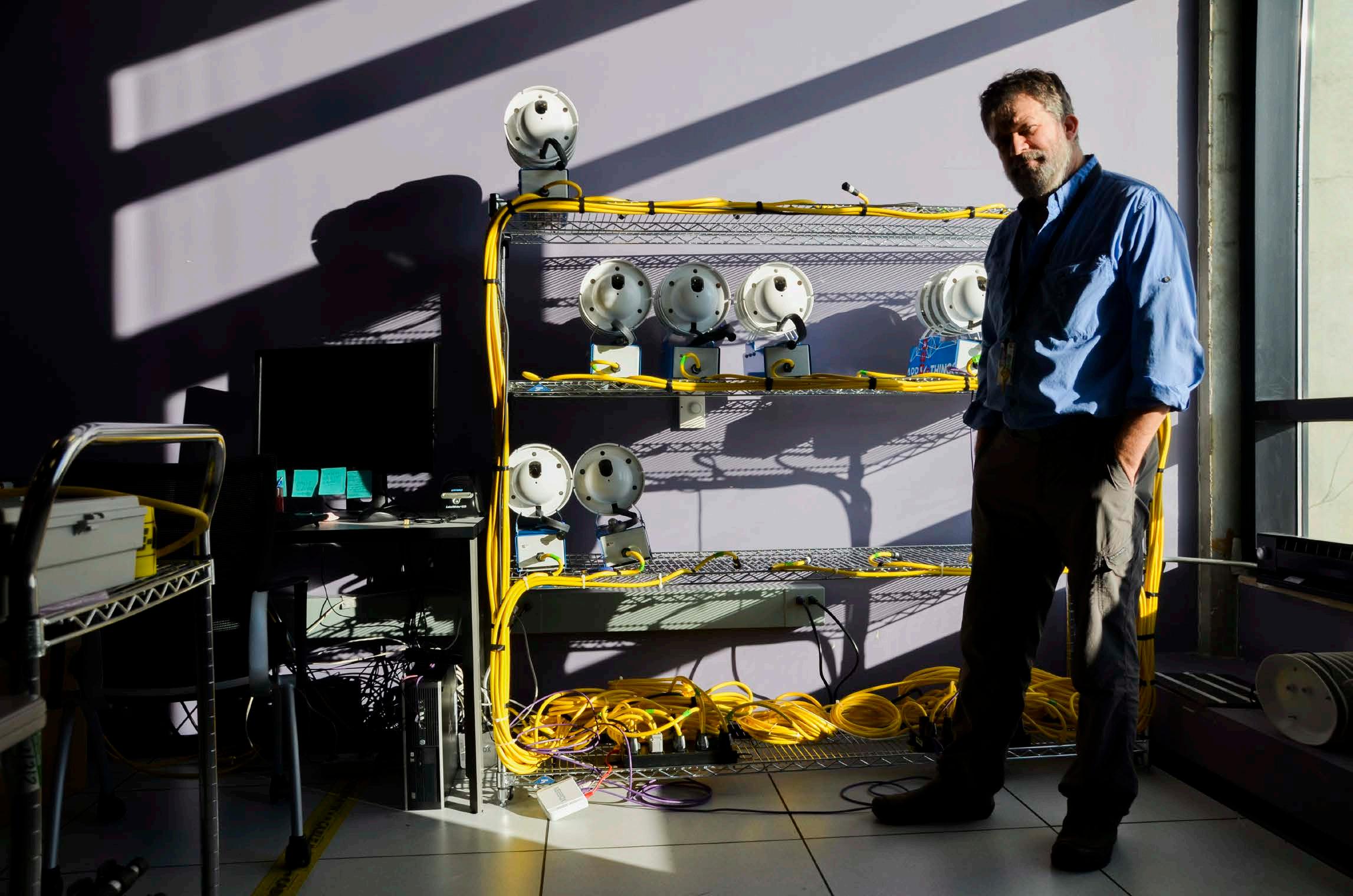
t’s called “the nursery.” A half-dozen white-domed machines lie on racks in a high-ceilinged room at Argonne National Laboratory, about half an hour west of the city. With the low, winter afternoon sun hitting them just right, it’s not a stretch to imagine them as eggs warming in an incubator.
These little plastic nodes are packed with sensors and backed by millions in federal funding. Eventually, the microwave-sized devices will make their way out to lampposts in Chicago or Detroit or Denver or beyond to quietly measure the world around them. They’ll look for traffic patterns, and they’ll measure sound. They’ll count particles in the air and note the amount of carbon monoxide, sulfur dioxide, and other pollutants present. They’ll measure vibration, magnetic fields, and light. And if all goes according to plan, they’ll send this information back to a database where scientists, city officials, hacktivists, and residents will be able to access and analyze the streams of hyperlocal data.
This is the vision of the Array of Things (AoT), a joint initiative between Argonne, a U.S. Department of Energy laboratory operated by a subsidiary of the University of Chicago, the University of Chicago, the City of Chicago, and various technology firms. The project expects to start publishing data from its preliminary nodes to the city’s open-data portal earlier this year, at which point they hope to have a hundred of them up around the city quietly quantifying the traffic, noise, and emissions that make city living unpleasant at least, and environmentally unjust at worst.
AoT is the brainchild of Charlie Catlett, the project lead and a senior computer scientist at Argonne. About six years ago, Catlett began exploring how computer science might help address the challenges of mass urbanization. He looked at geographic variation in life-expectancy data and other metrics, and became alarmed by how much a person’s address dictated their chances of suffering asthma or lead poisoning.
“Depending on what neighborhood you’re in, your experience living in the city is dramatically different than a neighborhood that’s a mile away,” Catlett said. “This sort of bothered me.” He wanted to help “cities move in the direction of ‘better’—however you want to define ‘better’—that could mean less congestion, better air quality, equitable services and opportunities, etc.”
In June 2012, Catlett began several years of conversations with scientists and city officials about what a functional citywide sensor network might look like— what it should measure, and how it might be deployed. In 2015, the National Science Foundation awarded the University of Chicago a $3.1 million grant to support AoT’s development. The effort adopted the name “Array of Things”—a sort of portmanteau of “array telescope” and the “internet of things”—to suggest a distributed but unified, discrete but interconnected, collection of measuring instruments aimed at understanding life in the city.
AoT is an early foray into an urban design revolution based on the principle that massive amounts of new data can help identify and repair urban woes. It places Chicago at the epicenter of a global “SmartCity” revolution. Metropolises across the globe seek to adopt AoT or technology like it, hoping that a smarter, more connected, and more analyzed city means a cleaner, safer, and less-congested one.
Cities are entering “a fourth stage of modern transformational change,” according to a February 2016 White House report on urban technology. The first came about with the steam engine, the second with the power grid, and the third was made possible by reliable mass transit. Now, the report says, “new physical and digital technologies” offer innovative solutions to twenty-first-century problems.
“Information and communication technologies, the proliferation of sensors through the Internet of Things, and
converging data standards are...combining to provide new possibilities for the physical management and the socioeconomic development of cities,” the report reads. “Local governments are looking to data and analytics technologies for insight and are creating pilot projects to test ways to improve their services.”
There’s a lot of chatter around the idea of the smart city, but it can sometimes feel reductive, as if to suggest that something as complex as urban poverty can be understood as a sequence of ones and zeroes. Chicago has a long history of failed utopian schemes, from the City Beautiful movement of the 1890s to 1920s to the high-rise publichousing projects of the mid-twentieth century. On its face, AoT stirs up some of the same old urban-design tensions––while introducing the uniquely twenty-firstcentury concerns of data security and digital privacy.
It might explain why Catlett is a little wary of the “smart city” label.
“Our idea of a ‘smart city’ was more: let’s see if we can equip people who are making decisions and operating the city to do it better,” Catlett said. “When I think about the Array of Things and ‘smart cities,’ I don’t think about the overall design of a smart city so much as: we can just pick off one problem at a time and, at the end, we’re going to be improving the city. If we never become ‘smart,’ at least we’ll be smarter than we are now.”
In other words, the smart city is not a silver bullet, even if it’s sometimes billed as one. But if AoT works out as Catlett hopes it will, then it will open the door for other opportunities: a developer might use the data to build an app to warn asthma sufferers of nearby irritants; local activists might use air-particle levels to make the case for restrictions on diesel traffic. Or the city—armed with reams of new data— might better understand how a bus route change downtown affects traffic flow.
“Once you have a number of these deployed across the city, you begin to measure it in a way it hasn’t been measured before,” Catlett said.
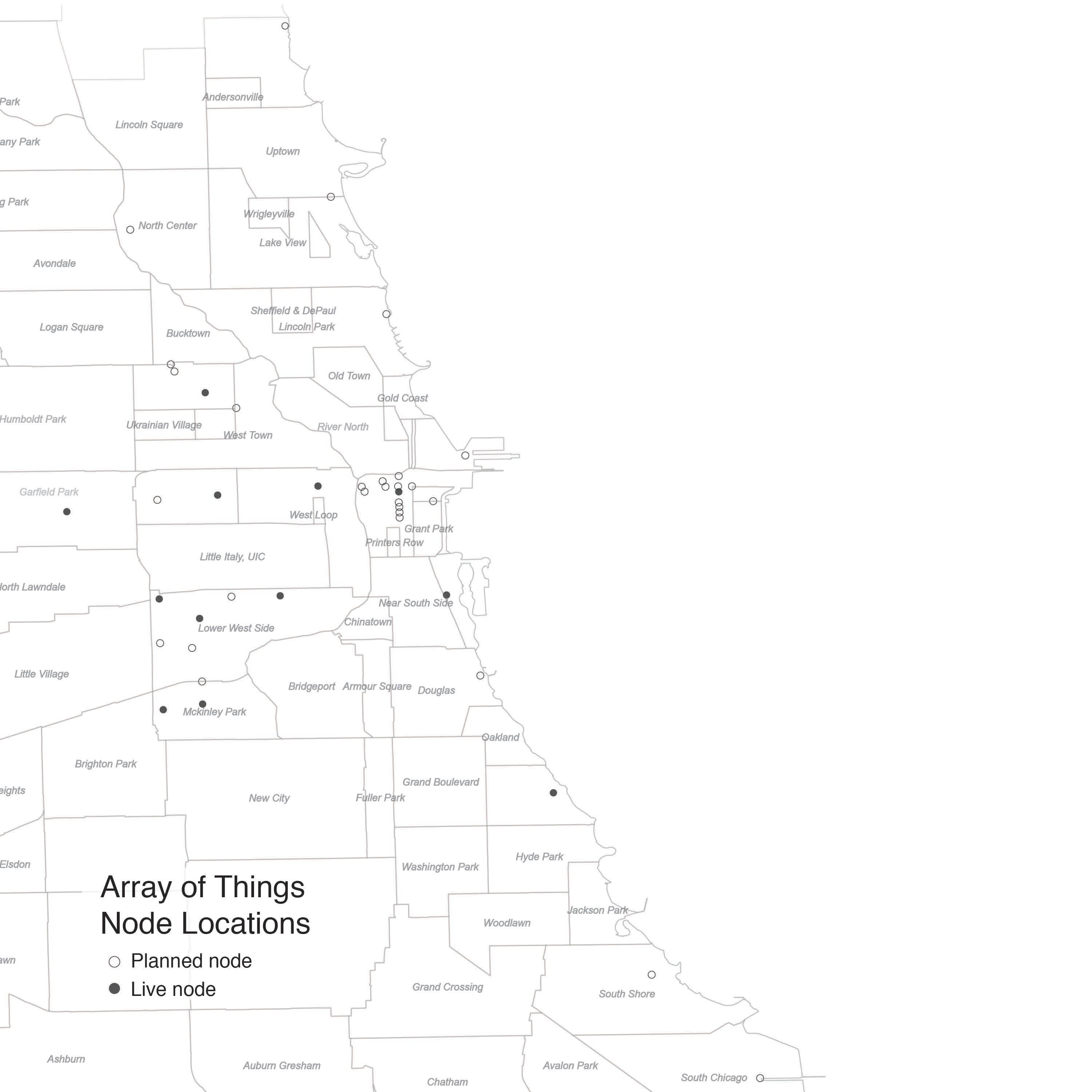
If you stand on the corner of Damen Avenue and Cermak Road and squint up at the lamppost above the gas station, you can make out one of the twelve AoT nodes already deployed across Chicago. The
Damen/Cermak node is part of a subset of nodes focused on “Urban Air Quality and Health Education,” and it’s pointed at an area that has a history of fighting for a cleaner environment.
Pilsen and Little Village have long been undergoing the slow process of deindustrialization. With it come the pains of job loss and a long-overdue reckoning with industry’s toxic legacy. The blocks surrounding the Damen/Cermak node, in other words, are an excellent place to test one of AoT’s core theses—namely, that when citizens and officials better understand their environment, they are better able to improve it.
In 2012, the nearby Fisk and Crawford coal power plants closed down after years of protests and community organizing by the Little Village Environmental Justice Organization (LVEJO), the Pilsen Environmental Rights and Reform Organization (PERRO), Pilsen Alliance, and others. The closings may have had as much to do with broader market forces and federal environmental regulations as they did with local activism, but they were considered an enormous environmental win nonetheless. Organizers leaned heavily on a 2002 Harvard School of Public Health study that literally put a number on how many deaths, emergency-room visits, and asthma attacks the two plants caused each year.
“We inherently knew something was wrong... but we couldn’t prove anything,” said Kim Wasserman-Nieto, LVEJO’s executive director. “It was finally getting those numbers that we were able to tell the story of how we were being impacted, outside of: ‘My kid has asthma.’ And it was those numbers that moved people to want to take action. There’s nothing like having forty body bags in the hallway of City Hall to really accentuate how we were being impacted.”
The AoT nodes themselves won’t go as far as to draw a link between poor air quality and asthma attacks or fatalities. In these early stages, the project-runners are mostly concerned with making sure the citywide sensor network—potentially the first of its kind—really works. But the data they produce could empower more scientists and activists to make those kinds of analyses. If successful, AoT might multiply exponentially that quantitative awareness,
giving neighborhoods access to all kinds of data that could confirm or deny suspicions about the air they breathe. Instead of just a dozen or so air monitors scattered sporadically across the city, a projected 500 AoT nodes will be logging air-quality data in neighborhoods that have historically suffered from high levels of asthma but have lacked the mechanisms for connecting it to specific environmental factors.
“Data is power,” Wasserman-Nieto said. “When you are putting out things like the Array of Things you are crossing into very unknown territory because what’s going to happen when those results come out? Who is going to take responsibility for what is there?”
Wasserman-Nieto and LVEJO—along with other community groups on the South Side—have already taken the matter into their own hands. LVEJO is part of Shared Air, Shared Action, a 2016 grant from the Federal Environmental Protection Agency to explore how community groups and local residents might use increasingly affordable sensor technology to do their own air monitoring. For LVEJO, the current concern is diesel pollution, with high truck traffic in the area and proposals for new diesel-heavy industrial facilities.
Shared Air, Shared Action volunteers walk predetermined routes in their neighborhoods with boxy plastic air monitors strapped to their chests. They look for and note anything that might add context to a sudden aberration in data—the passing of a smog-belching truck, say, or a particularly odorous barbecue nearby. They send their observations and the data back to a centralized database for scientists at the University of Illinois at Chicago and Kansas State University to analyze. It’s all a bit like traditional, shoe-leather neighborhood canvassing, except that instead of drumming up votes, these engaged pedestrians are painting a portrait of their neighborhood’s environmental health.
For Wasserman-Nieto, getting community members directly involved like this creates a bottom-up approach to air monitoring in which those with the greatest human stake in the results are present in formulating and performing the experiment at hand. It’s also, Wasserman-Nieto notes, an opportunity to introduce questions of science, technology, and engineering to communities that have traditionally lacked access to STEM education.
“A lot of times universities will make assumptions about the problem—and a
lot of times they’re right—but [they] will dictate how to solve that problem,” she said. “If you want true partnership with community, then the community leads the request. The community leads the process. The community is the principal investigator.”
If the implicit benefit of cheap sensors and big data is greater knowledge, then the new technology’s inherent risk is to information security and personal privacy. Every day reams of information about our lives are beamed across networks in exchange for access or convenience. Not a month goes by without some new security breach or hack that briefly makes us reconsider our faith in the gospel of the Cloud.
It’s no wonder, then, that AoT has raised the eyebrows of privacy critics. After all, its aim, in the superficial sense, is to install hundreds of artificial ears, eyes and noses throughout public spaces. Initially, AoT had planned to include in the node a mechanism for counting nearby Bluetooth devices as a way to track pedestrian flow. When the Tribune published an article on it in 2014, it prompted concern over exactly what data was being collected and who would control it. The feature was ultimately dropped, and AoT eventually published an Operating Policies document outlining their approach to privacy, but the genie was already out of the bottle. Chicagoans had gotten a whiff of Big Brother, and it amplified a skepticism many already hold toward city government.
The final node design moved forward instead with a camera to count pedestrians and cars, and to detect street flooding. To guard against privacy intrusions, AoT relies on edge computing, in which images are processed and analyzed right at the point of collection. In other words, according to AoT, the node extracts whatever quantitative information it needs, destroys the image, and just sends the information (e.g. number of cars) back to Argonne’s database. For calibration purposes, less than one percent of images will randomly be stored. AoT insists they will not contain personally identifiable information, but they will be controlled and protected as if they do.
It begs a uniquely digital thought experiment: if a camera records a person in the city, but only a computer sees the image, is it a violation of personal privacy? Should Chicagoans have the ability to opt out of such collection, even if it is ultimately anonymous and limited to public spaces?
The scrutiny over AoT’s camera is perhaps ironic given that there are already
literally thousands of public and private cameras throughout Chicago recording and storing our everyday acts—and doing so with far less oversight or scrutiny than is afforded AoT.
In the early Internet, programmers were almost fanatically devoted to transparency, decentralized power, and informationsharing. Much of that original culture has been lost in today’s increasingly monopolized and centralized web. But Catlett enjoyed a front-row seat to the Internet’s halcyon days, serving as chief technology officer at the National Center for Supercomputing Applications (NCSA) in the years following the release of Mosaic, the World Wide Web’s first major graphical browser.
Catlett stresses that the nodes are built and run on open-source hardware and software. The algorithm that decides what goes in your Facebook feed is a black box to which you will never have access. In contrast, the algorithm that determines how the Damen/Cermak node measures carbonmonoxide levels is freely available online for anyone to inspect. Of course, for most of us, this will still be an indecipherable morass of computer code, but Catlett says there’s an active community of programmer activists who would be eager to inspect it and flag anything of concern.
In a 2013 pamphlet called “Against the Smart City,” urbanist Adam Greenfield makes a philosophical case against the digitization of our urban environments:
“[T]he wholesale surrender of municipal management to an algorithmic toolset... would seem to repose an undue amount of trust in the party responsible for authoring the algorithm...Inconvenient results may be suppressed, arbitrarily overridden by more heavily-weighted decision factors or simply ignored.”
In other words, writing algorithms for civic technology is a political act. What do we lose when we outsource quality-of-life assessments to machines and the people who program them?
All the more reason, then, for smart-city proponents to embrace the limited scope and open-source ethos that AoT purports to embrace. A good technologist is the first to admit that technology can only do so much.
“There’s no substitute for individuals and people coming together and advocating for things,” says Derek Eder, founder of Chi Hack Night, a popular forum for hacktivists and concerned citizens. “Anybody who is trying to sell you the idea that civic
technology is the big thing that will save the world...don’t listen to that person. That person is just trying to hype something or sell something.”
AoT’s success or failure, then, relies on the degree to which it harnesses (or fails to harness) the messy human factor behind the computer’s clean logic. To what degree does it get not just the tacit approval of everyday denizens, but also their active participation and engagement? To that end, AoT has partnered with the Smart Chicago Collaborative to do public outreach. To date, they have hosted three public meetings, all of which have been thoroughly documented online. An educational component dubbed the ‘“Lane of Things’” has given students at Lane Tech High School a chance to try their hand in developing their own sensor packages. An engagement report posted online details the rest of AoT’s outreach efforts.
More connections to communities and the public may pop up once AoT begins actually publishing data, but, for now, meaningful, direct contributions to the core design of the system appear largely limited to scientists and city officials. The public meeting I attended in Humboldt Park in October was well-organized and informative, but didn’t seem reflective of the kind of deep, sustained community connection one might hope to see in an initiative of this scale. Many of the attendees appeared to be somehow affiliated with AoT, the city, or the Smart Chicago Collaborative. After a series of presentations, the first question out of the gate was from Daniel Kaberon, an interested Evanstonian who works in the IT sector, who asked why the AoT website wasn’t being updated more frequently and why various goalposts set by the project had seemingly been delayed or abandoned.
“Is there a pulse? Is this dead?” Kaberon wondered aloud to me after the meeting. “I really want this thing to roll out—I really want this all to happen. I’m not negative about it, but, c’mon, tell us what’s going on!”
At the time of writing, the Array of Things blog consists of just one entry, dated July 19.
In Catlett’s defense, he and his team are computer scientists, not community organizers. When I asked him about these criticisms he acknowledged their validity, chalked them up to a lack of resources, and genuinely seemed to wish he could hire staff to directly work with community groups. It made me wonder why he even decided to stick his neck out and put AoT in the
public spotlight in the way that he, Argonne, and the city have. After all, he likely could have approached this urban sensing project quietly, making it strictly an experiment by and for the scientific community alone.
“I don’t want people to ever feel like we’re sneaking up on them,” he told me. “I would rather that people say to me, ‘I don’t like what you’re doing’ than say, ‘I don’t like what you did, and I don’t like that you hid it from me.’”
How Chicagoans respond to AoT when it finally launches will have wide implications for the future of technology––not just in Pilsen or Little Village, or even the Chicagoland area, but at large. Over a hundred cities across the globe have inquired about adopting AoT, hoping, as Catlett hopes, that sexy sensing technology can help the powers that be better address the very unsexy problems that have long plagued urban life.
Algorithms and data are playing a larger and larger role in all aspects of our lives— how we work, whom we love, and for whom we vote. Technology has always informed
how cities are built, but in coming years, interconnected technology will quantify and digitize urban life in ways that feel strange and opaque to lay city-dwellers.
In the end, the fundamental tension of AoT is the same. Byron Sigcho, director of the Pilsen Alliance, put it to me like this:
“Research is only as good as it addresses the needs of the community. If it doesn’t, we have to ask, well, whom is that research for?” ¬
Reporting for this story was made possible by a fellowship from Northwestern University’s Social Justice News Nexus.
Charlie Catlett, Array of Things project lead and a senior computer scientist at Argonne National Laboratory.
DAVID UNGER
City-Run Englewood Clinic Abruptly Shuttered
IFederal funding gets cut, yet HIV rates remain high in vulnerable communities
BY BEA MALSKY
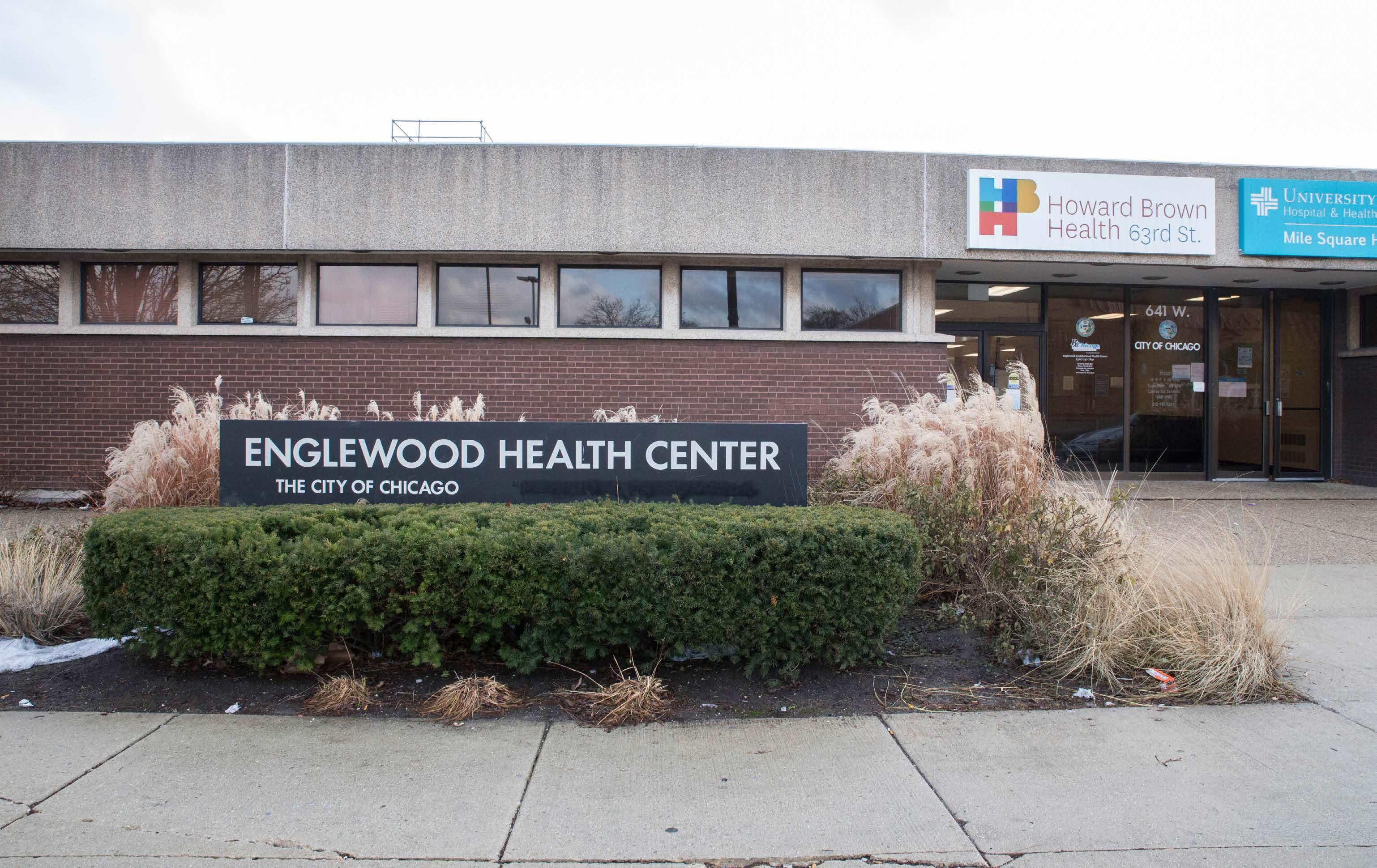
n early December, the Teamwork Englewood office received an anonymous call from an affiliate of the Chicago Department of Public Health alerting them that the Englewood STI Specialty Clinic—one of four city-run clinics offering free testing and treatment for sexually transmitted infections—would be shutting down.
On December 11, Nicole Johnson sent out an email to the neighborhood’s Health & Wellness Task Force, of which she is a member, outlining her concerns: that Englewood residents without health insurance would be left without reproductive healthcare; that walk-in treatment and testing for HIV and other STIs would cease to be available in the neighborhood; and that this marks a continuing trend of public disinvestment from Englewood.
“The city has this incessant reliance on private services to address public needs,” she wrote.
The city clinic, housed in the basement of 641 West 63rd Street in the same building as a University of Illinois-Chicago Mile Square Health Center and a Howard Brown Health Clinic, ceased operations on January 12.
According to a CDPH spokesperson, federal funding cuts prompted the clinic’s closure. These cuts, paradoxically, resulted from Chicago’s recent success in HIV prevention and treatment.
“This past year, the number of new HIV infections hit an all-time low for Chicago and we remain committed to completely eliminating HIV infections within the next ten years. [...] Because of the progress we have made in achieving historic lows in new HIV infections, Chicago will receive less federal grant money in 2018,” the CDPH said in a statement.
It’s true that new HIV diagnoses are at
a record low in Chicago—just last month, Rahm Emanuel’s office announced that diagnoses are down fifty-five percent from 2001, and that eighty percent of those newly diagnosed are linked to medical care within a month. As the city released this data, Emanuel also announced Chicago’s participation in the international Fast-Track Cities initiative, becoming the fifteenth city in the United States working to hit the United Nations’ HIV eradication targets by 2020.
However, these encouraging numbers are not distributed evenly throughout Chicago, which the city’s 2017 HIV/STI Surveillance Report notes. “There are health disparities when it comes to STI infections. Specifically, infections are concentrated in high hardship, low childhood opportunity community areas and among specific populations,” CDPH Commissioner Julie Morita wrote in the report’s introduction.
“Black women accounted for nearly 27 percent of all chlamydia cases in 2016, and Black men nearly 22 percent of all gonorrhea cases in 2016, while they only account for 17 and 14 percent of Chicago’s adult population respectively.”
The mayor’s press release around the report acknowledges and addresses this disparity specifically regarding HIV: “While Chicago has seen declines across all ethnic groups over the past several years, African American men between 20-29 years of age continue to face disproportionately high rates of infection. As such, CDPH and its partners will continue to focus resources specifically toward closing this disparity.”
Englewood would be an ideal locale for the mayor to bring his commitment to young Black men into practice.
“We have high numbers of HIV incidence,” said Michelle Rashad, a chair of the Englewood Health & Wellness Task
JASON SCHUMER
Force. She cites numbers from the Chicago Health Atlas: Englewood’s rate of HIV incidence (that is, the number of new cases identified in a year) is 50.7 per 100,000 in comparison to the Chicago average of 34.2 per 100,000.
“So we know HIV is an issue. The fact that funding is being cut from it is shocking. It’s shocking especially because there’s always a need, but someone makes the decision that that need isn’t a priority and cuts the funding. That’s just very disheartening,” said Rashad.
“This follows a larger trend of CDPH putting off direct provision of care into the hands of not-for-profit providers,” said MJ Johnson, a community health worker from Englewood and Community Engagement Specialist at the University of Chicago’s Center for Interdisciplinary Inquiry & Innovation in Sexual & Reproductive Health (Ci3). “This is the continuation of that trend, even given the funding concerns and the oddity of the timing. It is part of a pattern that’s been established.”
HIV—human immunodeficiency virus—has always been a disease of the marginalized in this country, a slow-building illness stigmatized and rendered invisible by interlocking prejudices surrounding queerness, poverty, and Blackness. Left untreated, HIV develops into AIDS: acquired immunodeficiency syndrome. AIDS prompts a failure of the human immune system, and, until recently, was a death sentence.
With recent advancements in antiretroviral therapy and preventative care, AIDS is now a condition many people live with. The Center for Disease Control estimates that there are roughly 1.2 million people in the United States living with HIV. However, testing is critical: it must be treated early in order to be managed, and the CDC estimates that one-eighth of those 1.2 million are not aware that they are infected.
To have HIV/AIDS is to become individually vulnerable to opportunistic infections, and to live in a community without adequate healthcare resources is to become collectively vulnerable. Two driving forces behind the dropping HIV rates in Chicago are both under threat by the current federal administration: the availability of a preventative pill called PrEP, which must be taken daily to maintain its effectiveness, and the Affordable Care Act.
Since being signed into law in 2010, the ACA has allowed an estimated 12,000 Illinois residents living with HIV to access
regular and affordable care. Without insurance, typical medical costs for yearly treatment range from $20,000 to $30,000.
“Life happens, and people say, do I pay the rent, or do I pick up my medications?
People start making choices,” David Ernesto Munar, president and CEO of Howard Brown, told the Chicago Tribune late last year. The Chicago Health Atlas estimates that twenty-two percent of Englewood residents are uninsured.
There are two clinics remaining in the building on 63rd Street: Howard Brown and UIC Mile Square. The city says that these two will pick up the slack left by the closure of the city clinic, and Maya Green, site medical director of Howard Brown’s 63rd Street location, reports that they started providing walk-in
services this month.
“Approximately twenty to twenty-five walk-in patients a day were estimated by the city and we expect that we will absorb those in collaboration with our other partners in the building,” she said. “We anticipate being able to serve Englewood’s sexual health needs through our walk-in clinic, as we have an excellent history in Chicago of providing these services at our other North Side locations.” Both remaining clinics provide treatment on a sliding payment scale for uninsured visitors.
With the threat of dwindling public resources, the Englewood Health & Wellness Task Force is working on next steps, including a Health Navigators program that would help residents locate and use existing resources in the neighborhood. They continue to advocate for ample, affordable,
and accessible care.
Though Chicago HIV rates are at an all-time low, geographic disparities persist.
“How are we actually improving people’s livelihoods so that they can be healthy and have consistent access to healthcare outside of a crisis?” Johnson asked. “I’m thinking about communities like Englewood or Austin or Roseland, which are sitting at intersections that are hypervulnerable to infectious diseases. More than just increasing funding for HIV care, we need social services in the area, and a commitment from public institutions. And that’s not happening.” ¬
Bea Malsky works at Ci3, a public health research and policy lab with a focus on adolescent sexual and reproductive health.
AIDSVU (WWW.AIDSVU.ORG). EMORY UNIVERSITY, ROLLINS SCHOOL OF PUBLIC HEALTH. [JANUARY 18TH, 2018.]
Who’s Here and Who’s Not
Sol Patches unpacks their new album “Garden City”
BY ERISA APANTAKU
Sol Patches is a gender abolitionist artist from the South and North Sides who makes music influenced by poetry, theater, and black and brown queer and femme. Their new album Garden City includes a host of local collaborators including Hora English, Plus Sign, and Mykele Deville. The Weekly spoke with Sol Patches and Chaski, one of their collaborators, about the album. Listen to the full interview at southsideweekly.com/category/radio and watch Sol Patches perform some verses from Garden City at southsideweekly.com/ssw-video-sol-patches.
So where did the album title come from? What inspirations did you draw from?
Sol Patches: Hora made the title of the album. We were working on a song one night in Chicago at my friend’s, Alé, who’s also on this project. I made this instrumental composed of rain and certain keys. And Hora was just slowly writing and then was finally like “Okay, I got something.”
I was just like “That’s it. That’s it.” When I heard the words “garden city,” I thought a lot about growing up with my auntie and my momma and seeing how they were to each other, taking care of each other. Like us kids, we would go off into the neighborhood, into the hood. We would just play with anything
altered what I think about—well, what does it mean to be owned? And what does it mean that there’s no grocery store. And there’s only corner stores around the corner. How does that play [a] part? Those things were a very huge inspiration. I also think [about] gentrification and gentrification through art, and certain people renovating parts of Chicago, and it becoming a site of tourism. A site of the white consciousness and unconsciousness consolidating with each other under the disguise of Black liberation.
In a similar vein, what sort of influences were in this album? I know one of the tracks “Sims” has Philip Glass in it, as a sample. Another track, “Magic Isn’t Real,” has the dialogue sample at the end. I’m wondering if you could share some of those influences and other things that maybe listeners wouldn’t hear automatically that are in this.
Chaski: The research that goes into this piece is very inspired by a lot of the work that we’re doing also at school, at NYU, and different readings we’re interacting with. And realizing how those can be transformed into a piece like this. That’s been amazing. ‘Cause it’s like, you can’t really do that in high school.
What sorts of readings have you encountered?
Chaski: Well, Patches was in a class called Reinventions of Love and reading a lot of song lyrics, a lot of plays...
Sol Patches: ...A lot of James Baldwin, Federico Lorca, Frida Kahlo’s diary, and this is a bit more––but you specifically brought in a lot of Fred Moten.
that we could, play hide and seek [in] these abandoned buildings. We would see old records in these old houses. We would try and play those records. We would break those records. When I think about garden city, I think about: “Wow, there’s so much potential here.” There’s so much potential in my family, and there’s so much potential in what this neighborhood could do to us and what this neighborhood could grow out of us. And also seeing all these signs in the city—all these signs on these abandoned buildings, saying “state property” or “property of,” something relating to the state government. Seeing things like that really
Chaski: He’s an Afro-pessimist, but not in the same rigorous way as people like [Frank B.] Wilderson [III]. He believes a lot of things, but one thing he believes in this piece called “The Undercommons” is that the only relationship a student can have with a university space is criminal. Like, that realization, and then just realizing, whoa, there’s a lot to exploit here...because you know, this place is exploiting us and so many other people in so many ways.
Who was sampled in “Magic Isn’t Real,” at the end?
Sol Patches: Nina Simone is sampled at the end of “Magic Isn’t Real.” My advisor, Karen, took me to this panel with this person
ELLIE MEJÍA
The Staples Letters
Inspired by C.S. Lewis’ The Screwtape Letters, the Staples Letters are a new series of essays in the South Side Weekly written in the form of letters from a veteran teacher, Staples, giving advice to a young teacher, Ms. T. All events in the Staples Letters are drawn directly from real-life experiences in Chicago Public Schools, and names and identifying details have been removed in the interest of privacy. Though fictional in form, the letters are used to address a variety of issues in education, from quotidian classroom considerations to national policy.
Hey Ms. T!
I completely understand why you’d feel the need to start off the year as tough as possible—you know, give millions of detentions, scowl, that whole routine. That was certainly the plan for my first year. I thought it’d get the students to respect me and impress the principal. What’s the cliche—don’t smile till Christmas? Ugh. Who came up with that horrible advice? Someone who hated kids, probably. There’s a surprising number of adults like that running around schools.
No, the main thing to remember is you’re allowed to have fun in class. Or maybe fun isn’t quite the right word. Fun is too limiting. Fun ends. Joy, on the other hand, is the sort of background hum that sustains a classroom. You can lend a student a pen joyfully, you know? I would say if at the end of your first year, you can at least say your room is a joyful place, it’s a success. The problem is your department chair isn’t going to mandate joy. There aren’t any Common Core standards that deal with joy. There aren’t any metrics that measure it.
And your principal is going to be actively hostile to the idea, though of course they’ll never say it out loud. They will express this preference by requiring any good idea—any idea that encourages community, happiness, relaxation, or joy—to have all sorts of paperwork, endless meetings, permission slips. Whereas any idea that will increase the amount of student discomfort, pain, or suffering will be fast-tracked and incorporated by end of day. Suffering reads to them as rigor, like if the students are really unhappy it must mean they’re learning a lot. It’s nuts.
The admins at your school, I’m sure, are mostly interested in order and control. They distrust noise, fun, desks arranged into a circle. They’re a little like the Grinch in that respect. The Grinch didn’t really hate Christmas, right? He just thought the Whos were too annoying about it. Which, I mean... fair enough.
Anyway, nobody ever felt any joy doing the same seven worksheets over and over again. Nobody ever felt anything but drudgery doing that, especially when it’s eight degrees outside. I sometimes think that’s what’s meant by students being “careerready.” It means to prepare them to obey orders even when they’re really bored, really beaten down, really tired, depressed. Those are
twenty-first century job skills, right? For most of us? Well, what do you expect when the bosses get control of the schools? What does Bill Gates know, or care, about teaching joy?
So you don’t have to do that. I really hope you won’t. It’ll feel right to do it their way ‘cause that’s what your principal will praise you for doing. But just because it feels right doesn’t mean it is right.
In my school now, there aren’t any music classes or art classes or gym classes or photography classes—except in horrible online versions. That’s right, they literally take P.E. online and answer multiple choice questions about tennis and yoga. One kid, an English Language Learner who was working quietly at his computer the other day, asked me what a “cleat” is. I had the hardest time answering him! “It’s like a shoe...with, uh, nails in the bottom...that helps you grip the ground…” Seriously, is there any way to learn what cleats are except by putting them on and running around? But if you check his transcript, it will say he passed P.E. even though he never once left the computer lab.
A woman from the charter came to my room earlier this year. She patiently explained to me that our kids are just too far behind, that we just don’t have the time to do things any other way. Welcome to “skills-based” education. Forget assemblies, Christmas parties, dances, student newspaper, yearbooks. Hello, online P.E.
So you will have to provide these things, because in all likelihood they have been taken. Do not ask for permission. Do not see it as extra or as part of a standalone “fun” day. Embed joy into the DNA of your class. Play music constantly—and let students make the playlist. Decorate your room with art and posters, not test score data and rules. Ditch the phony competitiveness that infects every inch of childhood. Death to worksheets, death to test prep, death to Scantrons.
You must instead focus your students and inspire in them a feeling of solidarity with one another and with you. It’s impossible to achieve this by teaching in the manner your administration will be comfortable with because the isolating nature of worksheets and standardized tests is completely antithetical to the joyful community of learners a true educator strives to create. Your own classroom should exist as a microcosm of the world you’d like to live in; by creating this, you and your students are, each day, bringing one infinitesimally small piece of that world into being.
The fact is, everything that might happen in your classroom will be useless, boring, ridiculous if it is not obvious at every moment you’re all working cooperatively in the service of justice.
So for goodness’ sake—smile!
Your Affectionate Cousin, Staples
BULLETIN
Now What Professional Workshop
Dyett High School for the Arts, 555 E. 51st St. January 24, 5:30pm–7pm. Free. RSVP at bit.ly/ProfeshBioWorkshop
Donda’s House is hosting a professional workshop series for those who want to learn specific skills in marketing, branding, and artistic expression. Workshop presenter Adrienne Samuels Gibbs is a Pulitzernominated arts and culture journalist. Listen to stories from her and other professionals to learn about best practices, receive feedback on how to write a professional bio, and walk away with a new skill set. (Maple Joy)
UMEDICS 2018 Winter Orientation
South Shore Library, 2505 E. 73rd St. Saturday, January 27, 2pm-4pm. Register at bit.ly/umedics2018. Free. umedics.org
In Swahili, ujimaa means collective work and responsibility. With this principle guiding them, Ujimaa Medics welcomes you to their Winter 2018 orientation, where you can learn about their Black health collective and learn the basics of medical care for gunshot wounds and asthma attacks. All ages are welcome and childcare is provided, with priority given to Black participants. (Adia Robinson)
Come and Create Your Financial Vision Board
BopBiz Center, 644 E. 79th St. Saturday, January 27, 3pm–5pm. $15. 17+. bit.ly/CWEGVisionBoard
Do you have financial goals? What does your financial future look like? If you’ve been asking yourself these questions, the Chicago Women Empowerment Group has a Financial Vision Board Workshop for you. Turn your dreams into a reality and learn the necessary techniques to have successful financial goals. Materials and lunch will be provided. (Maple Joy)