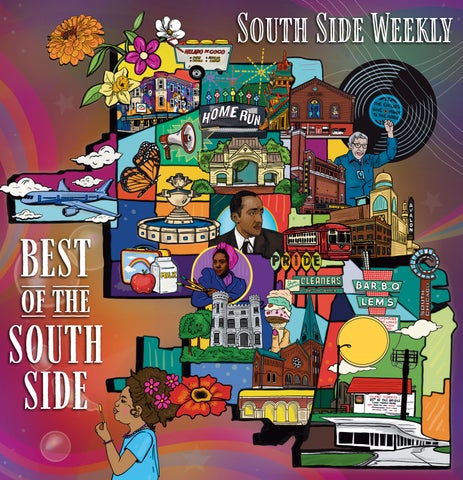
SEPTEMBER 24, 2026 ¬ SOUTH SIDE WEEKLY 1
WELCOME TO THE
S
BEST OF THE SOUTH SIDE 2026
ince last year’s Best of the South Side (BoSS), a new engagement editor, art director, editor-in-chief, and interim publisher have joined South Side Weekly. So, we appreciate your patience and grace, dear readers. Because this year, more than most, BoSS is brought to you by newbies. Ironically, we newbies have heard—from the hardbitten, dedicated vets—that BoSS has been made in wildly different ways, year to year. These shifts have occurred for a range of reasons, including moving from a nearly-all volunteer base to a freelancer model and accommodating staff transitions. Nevertheless, we all know the assignment, every September—we aim to engage, illuminate and celebrate the South Side, neighborhood by neighborhood. This year, we hope features and longer neighborhood profiles will prompt deep thinking about this place we call home. How are we doing, collectively? What patterns are static in the region, and what things are changing? How are our communities evolving, over time? Included are reporting on how the Southwest Side has been confronting ICE since the beginning of last year’s Midway Blitz, and an exploration of why African Americans are leaving Chicago. Writing through a historical lens meant placing a beloved Bridgeport bar in
the context of its place in the former Lithuanian downtown, showing how religious spaces in Roseland and Woodlawn have adapted to accommodate new congregations and uses, and how community centers in Chinatown and Pilsen have weathered shifts in immigration, crime, and local politics. Our staff has been energized by our work with many new writers, reporters, photographers, and illustrators to complete this issue, the largest BoSS since 2022. And we’ve learned more than we ever anticipated about the 20 neighborhoods—from Brighton Park to Roseland—covered here. About 1 million people live on Chicago’s South Side. We know how fortunate we are to work to honor your stories every day. We also hope you’ll reach out—on social or by email—to let us know what you want to see more in the next BoSS, as well as upcoming issues. Final announcements: You can pick up copies of the Weekly in every public library on the South Side, and we’re in new locations in every South Side neighborhood! Check out our new distribution at bit.ly/ssw-distro-2026. And for the remainder of the year, the Weekly will publish three print issues: on October 29 (our election issue), November 19, and December 10.
SOUTH SIDE WEEKLY The South Side Weekly is an independent non-profit newspaper by and for the South Side of Chicago. We provide high-quality, critical arts and public interest coverage, and equip and develop journalists, artists, photographers, and mediamakers of all backgrounds. Volume 13, Issue 18 Editor-in-Chief
Jill Petty
Deputy Editor
Adam Przybyl
Art Director and Layout Editor
Mel Dempsey
Assistant Managing Editor
Ellie Gilbert-Bair
Engagement Editor
Alycia Kamil Moaton
Senior Editors
Martha Bayne Christopher Good Olivia Stovicek Jocelyn MartinezRosales
Fact Checkers
Evgenia Anastasakos Sydni Baluch Kayla Britton-Dockery Emma Chosy Patrick Edwards Kate Gallagher Jo Harris Cordell Longstreath Jana Simović Sebastiana Smith Amy Wong
Office Manager
Mary Leonard
Advertising Manager
Susan Malone
Interim Publisher
Jianan Shi
Editor Emeritus
Jacqueline Serrato
The Weekly publishes online weekly and in print every other Thursday. We seek contributions from all over the city. Send submissions, story ideas, comments, or questions to editor@southsideweekly.com or mail to: South Side Weekly 6100 S. Blackstone Ave. Chicago, IL 60637 For advertising inquiries, please contact: Susan Malone (773) 358-3129 or email: malone@southsideweekly.com For general inquiries, please call: (773) 643-8533
2 SOUTH SIDE WEEKLY ¬ SEPTEMBER 24, 2026
Cover art by Jaz Rodriguez
IN THIS ISSUE the black on black love garden Auburn Gresham
4
black august ancestral bike ride Back of the Yards
7
bernice’s tavern Bridgeport
10
fourtunehouse art center Bronzeville
13
robichaux home Chatham
16
pui tak center Chinatown
18
vaqueros run club & hegewisch nutrition East Side
20
42
from 17th to 21st streets Pilsen
arts village sculpture park Englewood
22
44
we sow we grow West Pullman
hyde park used book sale Hyde Park
24
45
block house gallery Pullman
orion meadows
e’mon lauren
malachi hayes
jocelyn martinez rosales cristen brown
yonggang xiao
ermina veljačić
dionne victoria
dierdre robinson
mateo zapata
jermaine nolen jermaine nolen
26
the powhatan Kenwood
48
greater tabernacle cathedral Roseland
28
how is the south side changing? South Side
50
da book joint South Shore
30
little village environmental justice organization Little Village
52
a slow and steady disaster South Side
32
everything is on fire South Side
56
king drive between 51st and 55th Washington Park
35
chicago community jail support Cook County
59
narrow bridge arts club Woodlawn
38
street corners through time South Side
62
the exchange South Side
40
theatre y North Lawndale
63
cover art quiz South Side
interview with lee bey jill petty
sydney richardson karina martinez jo sabath
jill petty & mel dempsey milo bosh
cristen brown jill petty
eve l. ewing
marc c. monaghan jasmine barnes carl sandburg jaz rodriguez
SEPTEMBER 24, 2026 ¬ SOUTH SIDE WEEKLY 3
Auburn Gresham
BEST MULTI-GENERATIONAL GARDEN
The Black on Black Love Community Garden
BY ORION MEADOWS
T
he Auburn Gresham neighborhood has a documented history spanning back to the nineteenth century, when Dutch and Germans first farmed the swampy land. In 1872, thirty-five years after Chicago’s incorporation as a city, the Auburn neighborhood was officially plotted around 76th and Wallace Avenue. What is now known as Gresham was a post-Civil War settlement called “The Grove.” Both areas were annexed into Chicago by 1890. Since then, Auburn Gresham has transformed multiple times and developed a reputation of producing
notable figures (such as baseball player Kirby Puckett, comedian Marsha Warfield, and policymaker
“
in the last couple of decades, this has accelerated disinvestment and contributed to some of its degradation.
I was very happy with this event, and I think it will be bigger next year. Bringing in the different generations to ... share information and perspectives ... where poetry, music, and food were shared made it successful. – Valerie Goodloe
Minyon Moore). Like some other communities on the South Side, it has gained a reputation for crime;
4 SOUTH SIDE WEEKLY ¬ SEPTEMBER 24, 2026
”
Nonetheless this community is experiencing a renaissance, and amidst it all is The Black On Black Love
Valerie Goodloe and husband LeMonde Goodloe pose in front of Black on Black Love Community Garden in Chicago, IL on Saturday, September 5th, 2026. They were preparing for the Senior/ Teen Black-on-Black Love Community Garden block party all week leading up to Saturday’s event. Photo by Ally Almore
Community Garden. This resplendent site is the handiwork of many green thumbs in Auburn Gresham, but most especially South Side transplant Valerie Goodloe, a documentarian, community advocate, and educator. About 10 years ago, Valerie relocated with her husband from California to Chicago. (An earlier film produced by Goodloe, Gang Girl, was released in 2011, and drew on her daughter’s life in Los Angeles.) In her new home, she began to document the impact of gang activity in Chicago, focusing on behaviors that have earned Chicago a name inextricably intertwined with loss and suffering—Chiraq.
Top: Senior community members reflect on their favorite childhood summertime memories in Chicago, IL on Saturday, September 5th, 2026 at the Black on Black Love Community Garden BLock Party. Community members young and old gathered in a circle to reflect on different and shared childhood memories. Middle: Elder community members dance in a soul train line alongside younger community members in Chicago, IL on Saturday, September 5th, 2026 at the Black on Black Love Community Garden Block Party. The event aimed to have a Senior/Teen Takeover with different activities. Photos by Ally Almore
Community members celebrate winning Best Dance Moves for Younger Generation and Older Generation while Valerie smiles and watches in Chicago, IL on Saturday, September 5th, 2026 at the Black on Black Love Community Garden Block Party. Photo by Ally Almore
Love Is Not Enough, Valerie’s 2023 community-focused docuseries, takes the audience on a journey through Auburn Gresham and other South Side neighborhoods that are weathering and fraying. The films also explore potential routes to prevention, restoration and healing. Valerie’s lens on worlds of pain, trauma, and recovery also turned hyperlocal, eventually trained on her very block. She and her partner had observed a decaying, garbagestrewn lot across the street from their home. It was on 86th and Carpenter, and one of several eyesores in the community. The couple wanted to beautify the area, and to create a space for residents to congregate, relax, and experience joy. They saw the Black on Black Love Community Garden as an antidote to the dark clouds of anger and despair lingering over the neighborhood for many years. Now, when events are hosted at the garden, food and resources are provided to the people who come to share in a celebration of “Black Love.” Why is this so important? Because it counters the Black on Black crime narrative that floods our media continuously. In September 2026, the Garden hosted a Senior/Teen Takeover, welcoming multiple generations of community members to enjoy music, poetry, dance, and dialogue. The hope was to bridge gaps of communication and understanding, in person and
SEPTEMBER 24, 2026 ¬ SOUTH SIDE WEEKLY 5
in real time, and to build stronger, healthier relationships within the community. At the Takeover, hope was embodied in the Soul Train line, where residents showed their fancy moves. It was also in the group circle, where people talked about poignant and meaningful summer memories. Hope also materialized in the form of Mahogany, better known as Mysfit, who gave a stellar hiphop performance. It was present in the tradition of the elder griot, Mama Kemba; she made spoken word offerings, rich in African-American historical knowledge. Community violence intervention organizations also showed up in support of the Senior/Teen Takeover event. In Valerie’s words, love may not be enough, but it is essential for progress and joy. In the name of love, residents of Auburn Gresham are deeply grateful for this transplant from the West Coast who dared to
sow the seeds of umoja (unity) in her new home. She arrived as a stranger, but is now a respected matriarch, gardener, and peacemaker. ¬ Orion Meadows is a 2024 National Spoken Word Award winner and The 2024 Carruthers Center for Inner City Studies Slam Champion from Chicago. He uses his poetry to generate awareness about poverty, mass incarceration and violence that has become prevalent and normalized in our society. Ally Almore is a documentary photographer specializing in capturing community narratives and environmental portraits through a local lens. She documents the authentic spirit of the city to preserve its diverse and evolving history. Black on Black Love Community Garden, 8616 S Carpenter St. windoworganization.org
Chicago artist "Mahogany The Mysfit" performs in the garden in Chicago, IL on Saturday, September 5th, 2026 at the Black on Black Love Community Garden Block Party. This performance was one of several activations for the day, other activities included art making, a spoken word performance and a dance party. Photo by Ally Almore
NOW THRU NOV 1
Written by Suzan-Lori Parks Directed by Kenny Leon
GET TICKETS NOW 6 SOUTH SIDE WEEKLY ¬ SEPTEMBER 24, 2026
Featuring ensemble members Glenn Davis and Namir Smallwood
steppenwolf.org 312-335-1650
Back of the Yards
BEST BLESSED BIKE RIDE
Black August Ancestral Bike Ride
Kristiana Rae Colón, cofounder of the #LetUsBreathe Collective and Malik Alim’s life partner, pulls up to Sistas in the Village urban farm as drummers welcome cyclists to the farm after the first leg of their ride on August 21, 2026. Photo by Caeli Kean
BY E’MON LAUREN
T
hey took flight like jays, herons, and hyacinth macaws. A fleet of wings, hunched under helmets, their backs bursting with blue as they turned the corner of Laflin and 50th. I watched them fly, as I was the last to leave. On August 21, Back of the Yards’ very own #LetUsBreathe, a collective of artists and activists who create a world without prisons and police, held their inaugural six-mile Black August Ancestral Bike Ride, part of their fifth annual Ascension programming to honor beloved comrade, partner, and friend Malik Alim. A neighborhood changes by what gets built and who moves in. It also changes by who it loses. Back of the
Yards has been answering this change with the kind of party the ancestors turn up at. Since 2021, the year of Malik’s death, Ascension has meant drums, African food, art making, and
“After five years of Ascension, I knew it was time for our collective grief and healing programming to evolve,” said Kristiana Rae Colón, #LetUsBreathe cofounder,
Once all was blessed, we biked, 30 to 45 people deep. No balloons, no procession, just bodies on bikes. a bonfire on the campus he helped build. This year, it also included a bike ride between Liberation Landing garden and farm, Sistas in the Village urban farm, and Promontory Point.
playwright, and partner to Malik. “I wanted to bridge our two gardens. At first I thought about a second line to Sistas in the Village. But one-anda-half miles is a long walk. Then I
thought, ‘but it’s a short ride.’” Malik was an organizer who poured his love, energy, and hands into the collective’s #BreathingRoom space, an arts and organizing hub. After George Floyd’s murder, he joined his love of biking to his spirit of resistance, leading direct actions on bikes and training as a marshal. “Part of how Malik and I fell in love was riding our bikes together. ... Malik was a very joyful person, and riding his bike was a place of joy and freedom. I loved seeing his locs blowing in the wind,” Kristiana said. At Liberation Landing, entering from Laflin Street, Malik’s altar sits to the left, his bicycle angelically placed against it. We
SEPTEMBER 24, 2026 ¬ SOUTH SIDE WEEKLY 7
Malik Alim’s bike, adorned with flowers, sits at his altar at Liberation Landing garden and farm on August 21, 2026.
Top: Jennifer Karaya Pagán, a bike marshal for the Black August Ancestral Ride and #LetUsBreathe Collective cofounder, participates in a libation ritual at Sistas in the Village urban farm on August 21, 2026. Middle: From left to right: Kamari, Jenna Anast, Orí (Kristiana and Malik’s child), Kristiana Rae Colón, and a community member participate in a libation ritual at Sistas in the Village urban farm on August 21, 2026.
Photo by Caeli Kean
Photos by Caeli Kean
were welcomed with warm smiles and wide hugs, not just for coverage, but to commemorate together. I have been in the community here since #FreedomSquare in 2016, an occupation and block party that opposed Homan Square, the Chicago Police Department black site where thousands of Chicagoans have been illegally detained and tortured. Two years ago, #LetUsBreathe celebrated a decade of work. Among the poets and performers at the celebration was the griot and organizer, well-loved Venus Ayalani. We lost Venus in June of this year. The last time I saw Venus, they did a poem about their aunt retelling them a story
about their grandfather, the devil and salt. I have memories of Venus saying my name in full. E’mon Lauren. They would say, “I love you E’mon Lauren.” The ride commemorated every ancestor we have lost across these seasons. “How can we honor Venus during this programming?” Kristiana asked. As most ideas come from soap bubbles, I replied, “Venus would always perform sitting down.” Soon a chair, sunflowers, and yellow roses, presented by #LetUsBreathe cofounder and healing practitioner Jennifer Karaya Pagán, sat beside Malik’s bike for flowering and finery. So, we sat, knees-first in soil, thumbs against thorns, dressing
8 SOUTH SIDE WEEKLY ¬ SEPTEMBER 24, 2026
these extensions of our love. Kristiana, Malik’s bike. Me, Venus’s chair. I sat with words I could never say to Venus again. The chair stayed at the altar. For me, grief has felt like a selective yet selfish thing: days of sulking and returning to work, leaving one sore and resentful. I have not only fallen prey to that setup, I have perpetuated it. Even in this community, one that upholds care and love as a tool of support, I have made the grave mistake of pushing through mourning. “Capitalism and Western culture pressures us to grieve quickly and quietly, and get back to work,” Kristiana said. “We aren’t meant to hold such
massive grief alone. Being on our bikes is a way of being in our bodies together, literally moving the grief through us.” Mounted, intentions set, we made our way to Sistas in the Village. Welcomed by African drumming, we pulled up with chants, calls, and confidence. Libations were poured to the land by Sistah Shamon. Under the lavender and lilac ribbon, we said our names to the wind and earth, and called out our ancestors, Venus Ayalani among them, and Mecca Bey, cofounder of Sistas in the Village. Aside from holding communal gardens, we were holding communal grief. Once all was blessed, we biked, 30 to 45 people deep. No balloons, no
Above: Orí and Kamari ride a tandem bike down Garfield Boulevard as part of the Black August Ancestral Ride on August 21, 2026. Below: A cyclist rides down Garfield Boulevard with #LetUsBreathe Collective for the Black August Ancestral Bike Ride on August 21, 2026. Photos by Caeli Kean
procession, just bodies on bikes. Bike marshals kept us in lane. At Promontory Point, greeted by brass bells and charbroiled okra, we watched the healthy fires be blessed. We toasted wine, hotdog buns, and sore bottoms. We talked about our friends, homies, and loved ones, and how we’re all here. How they never really left us. And maybe, even, will join us for another ride next year. I remember, some years ago in New Orleans, Kristiana’s son Orí told me a fact about pigeons, after I had been joking about my distaste for them. With tears in his eyes and running down his face, he said that pigeons find their way back home. ¬
of poems, COMMANDO, was published by Haymarket Books in 2016.
E’mon Lauren was named Chicago’s first Youth Poet Laureate. Her work unpacks her coined philosophy of “hood-womanism.” Her first chapbook
Sistas in the Village, 5800 S. Ada St. Volunteers of all ages welcome; visit website for opportunities. www.sistasinthevillage.com
Caeli Kean (she/they) is a Nairobi-raised, South Shore-based photojournalist and anti-imperialist organiser, with roots in ecological restoration. Find more of their work at caelikean.com or on Instagram @caelikeanphotography. The #BreathingRoom, 1434 W. 51st St. Temporarily closed. Contact letusbreathe2015@gmail. com, visit letusbreathecollective. com, or view their Instagram page @letusbreathe773 for information on programming and opportunities for involvement.
Music Teachers of Hyde Park Serving Chicago’s Hyde Park, Kenwood, South Shore, and Woodlawn neighborhoods!
Our membership of teachers is as diverse as the music they teach and perform. The students of our MTHP teachers take advantage of various learning and performing opportunities provided by our organization, such as student recitals, contemporary and harpsichord music workshops, chamber music and concerto day.
We feature our MTHP teaching artists on the Artist Series, a free concert series open to the public and held at the Blackstone Library on the third Sunday of each month at 2 PM.
Artist Series 2026-2027 October 18 Phyllis Calderon, violin November 15 Anokyewaa Oppong Wadie, violin
December 20 Anya Brumfield, violin January 17 Audra Wilson, piano February 21 Una Stroda, piano
March 21 Fackenthal Piano Duo, Donna Lee Fackenthal and James Fackenthal, pianists April 18 Martine Benmann, cello May 16 Dhilanthi Fernando, piano
June 20 Randall Jamrok, tabla drum
For MTHP info/ brochure, call:
708.920.7646 or visit: mthp.org
SEPTEMBER 24, 2026 ¬ SOUTH SIDE WEEKLY 9
Bridgeport
BEST PLACE FOR A SIP OF LITTLE LITHUANIA
Bernice’s Tavern
Bridgeport’s Bernice’s Tavern on Friday, September 11, 2026. Bernice’s has been in the Badauskas family since 1965.
here’s been a tavern of some sort at 3238 South Halsted for nearly a century, but the version of Bernice’s that Bridgeporters and South Siders from all over have come to know and love dates back to 1965. That’s when an establishment called Adam’s Tavern was taken over by an employee named John Badauskas and his wife, Bernice. A half-century and a generation later, their operation remains alive and well in the hands of their son Steve, who took over the business after John passed away in 1998. In an interview with the Weekly, Steve recounted growing up in the multi-ethnic neighborhood: there was an Italian grocery store across the street and Greek diners farther down. And of course, “There were a lot of Lithuanians in here!” Bernice’s is a holdover from a
offers three varieties of Lithuanian beer: Ekstra, a lager; Baltas, a wheat beer; and Gintarinis, a classic pilsner. And on a late weekend night there several years ago I was introduced to “trejos devynerios,” (“triple nines” in English), a delightful aperitif that has surely served as a reminder of the homeland for countless LithuanianChicagoans. Steve doesn’t count many Lithuanians among his regulars anymore, but the historical connection is not entirely forgotten. Both his typical karaoke emcee and the leader of a ska band who play there regularly are of Lithuanian heritage. And earlier this month, he found himself welcoming a visiting couple who had learned of the bar on a Lithuanian television broadcast. As Bridgeport’s core European, blue-collar demographic has shifted
Photo by Eddie Quiñones
BY MALACHI HAYES
T
time when almost all businesses were local and to be local in Chicago often meant having some ethnic or racial affiliation. Bernice’s sits in the former “Lithuanian Downtown,” a stretch of Halsted between West 31st and 35th streets that was once the nucleus of the world’s largest Lithuanian exclave. Steve remembers “two Lithuanian
now centered in suburban Lemont. Steve can’t recall many nearby staples of his childhood that remain today. One of the few exceptions, he said, is George’s Gyros, which opened in 1975 and still operates on Halsted just north of 35th Street. Even as Bridgeport’s Lithuanian population has dwindled, at Bernice’s,
Earlier this month, Steve found himself welcoming a visiting couple who had learned of the bar on a Lithuanian television broadcast. restaurants, a Lithuanian delicatessen, a Lithuanian butcher” were all within a stone’s throw of the bar. People and businesses come and go, and the Lithuanian diaspora is
10 SOUTH SIDE WEEKLY ¬ SEPTEMBER 24, 2026
the neighborhood’s connection to the tiny northern European country of under three million people remains strong. A Lithuanian flag hangs over the center of the back bar. Steve
Bernice’s Tavern patrons from left, Yesenia Ruiz, Erick Rendon, Adam Orellana, James Ortiz, Al Rendon, and Jetta Shelton on Friday, September 11, 2026. Photo by Eddie Quiñones
with the arrival of young people and families seeking cheap rent and immigrants from East Asia and other parts of the world, Bernice’s has remained a neighborhood melting pot. At any given moment, you might find yourself amid groups of neighborhood old-timers, baroquely dressed artists and hipsters, jerseyclad White Sox fans, and musicians of many genres. Steve himself is a visual artist and musician, and his work can frequently be found adorning the walls of the customer’s side of the bar. Last year, he held his first art show at the bar, an effort he’d love to repeat. In a market saturated with high-end cocktails and craft beer with double-hyphenated modifiers, Bernice’s keeps things simple. It doesn’t have a beer tap, serving cans and bottles out of a stand-up cooler and liquor from a selection of bottles straddling a vintage cash register— still functional and in use. In addition to bar standards like karaoke, open mics, and weekly performances from a semi-resident ska band, the bar hosts a monthly “dyke night” and is routinely packed
Top Right: Owner Steve Badauskas of Bernice’s Tavern poses for a portrait on Friday, September 11, 2026. Bottom Right: The Lloyd Brodnax King Trio plays at Bernice’s Tavern while bar owner Steve Badauskas watches on Friday, September 11, 2026. Photos by Eddie Quiñones
SEPTEMBER 24, 2026 ¬ SOUTH SIDE WEEKLY 11
Part of the wall behind the bar filled with various decorations at Bernice’s Tavern on Friday, September 11, 2026. Photo by Eddie Quiñones
to the gills on Wednesday nights for “Stingo,” a long-running game night that might be best described as bingo meets Calvin and Hobbes. On Stingo nights, regular bingo goes out the window. Some rounds, Steve might require an X pattern on the board, or a specific row of numbers. There’s call-and-response, with certain numbers pulled drawing laughs or jeers from the crowd (it seems that the number 69 remains humorous to all ages). At times, Steve will pull out a guitar and punctuate a break with song. Winners have their pick of a table full of irreverent, mostly donated prizes ranging from house plants to a tub of cheese balls to the one-foot-tall nutcracker currently displayed in my living room window. Steve is aware of at least 19 instances of Stingo-themed tattoos commissioned by particularly dedicated regulars.
It’s a phenomenon that could only come from the mind of someone like Steve Badauskas—and could only exist at a place like Bernice’s. ¬ Malachi Hayes is a Bridgeport-based writer and South Side native. Eddie Quiñones is a freelance photographer based in Chicago and Northwest Indiana. He trained in photojournalism at the University of Missouri, where he learned to focus on honest storytelling. Whether shooting portraits or covering events, Eddie uses that documentary mindset to capture real, meaningful moments just as they happen. Bernice’s Tavern, 3238 S. Halsted St. Mondays and Wednesdays– Fridays, 5pm-2am; Saturdays and Sundays, 12pm-2am. (312) 9615516
5850 South Woodlawn Avenue Chicago, IL 60637 rockefeller.uchicago.edu
For very nearly 100 years, Rockefeller Chapel has been the ceremonial center of the University of Chicago. Open to all, our soaring vaults elevate the practice and study of spiritual life across traditions and time, and echo to the sounds of voices, bells, and pipes.
Buy & Sell in Hyde Park with Confidence 35+ YEARS OF MARKET KNOWLEDGE
As a longtime Hyde Park real estate broker with hundreds of repeat clients, I’m here to be of assistance every step of the way.
JEANNE SPURLOCK
Whether you are buying or selling, let my local expertise go to work for you. Contact me today to discuss your real estate goals!
Licensed Real Estate Broker jeanne@mggroupchicago.com 773.339.6667
Compass is a licensed real estate broker in Colorado and abides by Equal Housing Opportunity laws. All material presented herein is intended for informational purposes only. Information is compiled from sources deemed reliable but is subject to errors, omissions, changes in price, condition, sale, or withdrawal without notice. No statement is made as to accuracy of any description. All measurements and square footages are approximate. This is not intended to solicit property already listed. Nothing herein shall be construed as legal, accounting or other professional advice outside the realm of real estate brokerage.
12 SOUTH SIDE WEEKLY ¬ SEPTEMBER 24, 2026
Hear our choir during our Sunday services or in one of their many upcoming evening events. There are weekly organ recitals, plus regular and seasonal carillon bell concerts. Or simply enjoy a moment of calm in our serene space. Photos: Matt Frankel / Justin Kern / Jason Smith
Bronzeville
BEST RESURGENCE OF THE BLACK METROPOLIS
Fourtunehouse Art Center
Kierra Wooden’s “Transfigurations” was on display at Fourtunehouse and will be submitted to upcoming film festivals according to Wooden. Photo courtesy of Fourtunehouse
BY JOCELYN MARTINEZ-ROSALES
“T
his could have easily been a credit union or some Starbucks or some bullshit. But it’s not.” Sitting outside Fourtunehouse Art Center with a joint in hand, founding director Makafui Searcy looked around Cottage Grove while people entered and exited the center, setting up the next exhibit. Once known as the Black Metropolis, Bronzeville is one of Chicago’s oldest neighborhoods, which generations of Black families made a flourishing epicenter of culture, music, art, and community in the twentieth century. Decades later, a new generation of residents is reminding the city of the cultural powerhouse that it is, not was. “[Being from the South Side] is an emblem that we wear with pride.
And also a responsibility to contribute towards building the culture and ecosystem that we all have envisioned through our experiences and dreaming about what the South Side could and should be,” Searcy said. Before establishing the brickand-mortar arts space in June 2022, Searcy felt like he always had to leave the South Side for artistic opportunities. That only pushed the then-22-year-old further into the direction of developing his own concept in the neighborhood where he grew up and went to high school. Since it opened four years ago, Fourtunehouse has hosted hundreds of artists, with a focus on hyperlocal talent looking to showcase their work in an independent art space. Among them recently was multidisciplinary
South Side artist Kierra Wooden. Wooden’s exhibit, “Transfigurations,” a successor of her first exhibit, “God Complex,” included a short film of the same name that she wrote, directed, and animated, as well as a zine featuring her poetry and thoughts. “Who do you want to be now that you know what you are?” That is the question that Wooden asked herself as she thought not only about the central theme of her second exhibition, but also what it meant for her to be living the last year of her twenties. Having put on her first exhibit at Fourtunehouse, Searcy would be instrumental in pushing Wooden to continue her artistic journey and showcase her evolving art practice at Fourtunehouse. “This
exhibition was kind of me revealing my true nature,” Wooden said. “At the core level our mission is to support the advancement of artists and change makers and what that looks like is being a launchpad at times,” Searcy said. Wooden’s film, which was scored by Kemond Collins, with Paul Araki Elliott as director of photography, is beautiful, almost surrealist, cutting back and forth between Wooden’s animation and high-contrast monochrome snapshots of herself. Standing on a platform in a T-pose with her eyes shut, Wooden is awakened and begins to move her body with the flick of her long white fingernails. It’s an intimate black-and-white ode to the Saturn return we come
SEPTEMBER 24, 2026 ¬ SOUTH SIDE WEEKLY 13
face to face with when transitioning into adulthood—imperfect and freeing simultaneously. For Wooden it only felt right to host her art at Fourtunehouse. “I just wanted to keep it close to home, and contribute to the good causes that the people in my community are doing for Chicagoans, but also most importantly the Chicago art scene,” Wooden said. Searcy said Fourtunehouse is booked through the end of the year with art exhibitions and private events, a sign of the success and community support that’s continued through the four years since the art gallery’s inception. Fourtunehouse is also busy with collaborations with other organizations like the Virgil Abloh Foundation and Black Lunch Table, who recently worked together to produce Future Archive, a multidisciplinary exhibition curated by Houefa Agassounon and Frenchie Ford as “an exploration of what we choose to remember, preserve, and carry forward.” The space is not without economic burdens—an air conditioning replacement this summer was costly— but Searcy is optimistic about future grant applications. He also plans on expanding Fourtunehouse’s reach by
developing a fall catalog to further platform the artists that have made the space what it is. “It is us building our artist ecosystem and just showing a bit more of the community that we built here. We’re also gonna be rolling out a conversation series,” Searcy said. “We’re trying to do more artist spotlights, showing more work, doing more editorial work with artists.” Fourtunehouse is in its first years, and the blueprint is still being developed. But there is no question about the impact and influence it has reignited in Bronzeville and the greater South Side. “It’s been a blessing, and it’s really cool to be able to have built something in my neighborhood,” Searcy said. ¬ Jocelyn Martinez-Rosales is a Mexican American independent journalist from Belmont Cragin covering music and culture. She is also a senior editor at the Weekly. Fourtunehouse Art Center, 4410 S. Cottage Grove Ave. Check exhibition days and hours at fourtunehouse.com. 872-2256495.
14 SOUTH SIDE WEEKLY ¬ SEPTEMBER 24, 2026
Top Left: “Transfigurations” combines the grit and grain of analog film with high-contrast, monochromatic images. Top Right: A still image from Wooden’s experimental film “Transfigurations.”The director of photography for “Transfigurations” is Paul Araki Elliot, who in the past has contributed photography to the Weekly. Middle: Still image of Wooden from her short film “Transfigurations.” Bottom: Wooden’s opening night for her second solo exhibition at Fourtunehouse on August 14, 2026, in Bronzeville. Photos courtesy of Fourtunehouse
LOIS | Resident Since 2019 >
Your Place in the heart of Hyde Park.
At Montgomery Place, residents share stunning views of Lake Michigan and historic Hyde Park while enjoying vibrant city living, engaging programs, fine dining, wellness, and easy access to the renowned University of Chicago Medical Center. In addition, Montgomery Place offers Life Care at Home providing trusted, personalized support wherever you live. We help you stay safe, independent, and dignified, matching you with a caregiver who fits your needs. Here for you, in the Place you call home.
Help shape the future of aging in Hyde Park. Share your thoughts in our 5-minute survey.
Independent Living | Assisted Living with Memory Care | Short-Term Rehab | Nursing Care 5550 S. Shore Drive | Chicago, Illinois 60637 | MontgomeryPlace.org | 773.753.4582 SEPTEMBER 24, 2026 ¬ SOUTH SIDE WEEKLY 15
Chatham
BEST HISTORICAL HOME FOR COMMUNITY EMPOWERMENT
Robichaux Home
Greenery sculpted into rounded shapes highlights the sharp angles of the home’s design. Photo by Cristen Brown
BY CRISTEN BROWN
T
he neighborhood of Chatham boasts a gorgeous array of architecture, showcasing the creative exuberance of generations of proud South Siders. Yet it’s not just the buildings that deserve our attention, but the stories of the people who made this community their home. In 1948, as the legal frameworks supporting residential segregation started disintegrating, Black Chicagoans began to move from the “Black Belt” to neighborhoods that had previously been off limits. In response, unscrupulous real estate agents known as blockbusters stoked racial fears and encouraged white flight, snapping up homes from white families for cheap and reselling them to Black people for multiples of
the original purchase price, robbing Black families of the chance to create equity and generational wealth. In Chatham, however, something rare was taking place. Though the neighborhood did quickly transition—its population flipped from nearly 99% white in 1950 to 98% Black in 1970—contract buying and blockbusting did not occur. Furthermore, it was not unusual for Chatham’s new Black residents to work with architects to build their own homes, or to upgrade those they bought. Remarkably, the Historic Preservation Division of Chicago’s Department of Planning and Development reports that “property values in Chatham increased after the racial transition as the new residents had resources to maintain and improve
16 SOUTH SIDE WEEKLY ¬ SEPTEMBER 24, 2026
the housing stock.” Two of those residents were Jolyn and Joseph Robichaux, who were living in Chatham by the 1960s. Joseph was an executive at Wanzer Dairy, and had deep connections in Chicago Democratic politics. Jolyn, an excellent self-mythologizer with an ear for a great story, later liked to describe herself as a “stereotypical housewife,” but the record doesn’t quite support this. A 1959 Chicago Defender profile documents her work to “improve interracial relations” locally and a 1956 trip to West Africa on behalf of the U.S. State Department. She was the first Black person employed by Betty Crocker, where she did product demonstrations. In 1967 the Robichauxs were asked to purchase Baldwin Ice Cream
by its ailing owner. At Baldwin, a South Side institution founded by seven Black postal workers in the 1920s, Jolyn took on a new role as a secretary. But she wouldn’t stay in this role for very long. In 1971, Joseph died suddenly, and Jolyn found herself a widow with two young children and a decision to make. “Two weeks after my husband died, I was out visiting our key accounts to tell them I was going to run the company,” she said in a 1979 Chicago Tribune interview. “They all said, ‘Oh, but you must have a man!’ So I decided I would show them.” Jolyn worked to get her ice cream into more grocery stores across the city, following her customer base out of the “Black Belt,” and then expanded to airport concessions and
The mid-century style home sprawls across its corner lot.
Top: Unique geometric patterns decorate open metalwork gates set into a wall of breeze block. Middle: The handles fastening the home’s gates are engraved with abstracted florals.
Photo by Cristen Brown
Photos by Cristen Brown
national grocery stores. By 1985, she’d taken a company with annual sales of $300,000 and built an empire with annual sales above $5 million. Until she retired in the early 1990s, she did this while living in her gorgeous 1958 home in Chatham. Architect Milton A. Schwartz’s design is deceptively simple: a breeze block–bracketed gateway guarded by two open metalwork gates fastened with engraved handles opens to a recessed entrance. Flanking the onestory entrance are the main living spaces, each clad in black vertical wood siding and sitting on a base of cream brick. This is a home built for socializing, one of the mainstays of mid-century design, but also one of particular importance to the Robichauxs and their neighbors, who used their homes for organizing and community building. When Reverend Dr. William Lott Sr. and Christine McAllister Lott purchased the property directly
from Jolyn in the 1990s, they had not been looking to invest in real estate. Their investments had always been in people, and in keeping themselves and their ministry centered around the needs and hopes of the Black community. In Jolyn, however, they found a kindred spirit whose legacy of service to the community was immediately obvious. “[The Robichaux Home] had been a gathering place for the community. It was always used to build up this community area,” Christine recalled in a phone interview with the Weekly. When Jolyn sold the home to the Lotts, she also passed them a critical document—contact info for the many local artisans, craftsmen, and businesses she patronized—to keep her dollars circulating through Chatham. Christine is another trailblazer who has dedicated her life to the
support and empowerment of women and families. One of only three Black women in her graduating class at Roosevelt University, she is particularly emphatic about the importance of building and maintaining community. Speaking on the generation of Chatham residents Jolyn belonged to, Christine said, “I distinctly remember them saying, ‘We stuck together. And when we spoke, we spoke as a community.’” For Jolyn, this meant serving on the board of directors for South Central Community Services, a Chatham-based social service agency founded in 1970 by members of the community to address gaps in services themselves. It meant cochairing a small business economic development task force, and using this position to advocate for startup
funds from the federal government to aid newly launched minority-owned businesses. Having keenly felt her outsider status when she took over Baldwin, she sought ways to install women in executive positions in her company and eventually expanded this work outside of the organization. The Lotts are determined to share and celebrate the rich strain of Black history that flows through Chatham by “pouring into our people,” as Christine put it. “The knowledge and the wisdom, as it relates to what we are capable of doing for ourselves, and what the history of this area represents—we have got to pass that on.” ¬ Born and raised on the far South Side, Cristen is an educator, local history enthusiast and architecture obsessive. She is deeply invested in discovering the many ways the built environment informs our understanding of Chicago’s past, present and future.
SEPTEMBER 24, 2026 ¬ SOUTH SIDE WEEKLY 17
Chinatown
BEST CENTURY-OLD COMMUNITY HUB The exterior of the Pui Tak Center building.
Pui Tak Center
Photo by Yonggang Xiao
BY YONGGANG XIAO
T
he Pui Tak Center building is easily one of the most recognizable landmarks in Chinatown. Standing under the neighborhood’s famous gateway, which displays the words “ ” (The world belongs to the people), the structure is crowned with pagoda-style towers and features vibrant terra-cotta relief and clay tile roofs that blend Eastern motifs with Western design. “It’s probably the most photographed building in Chinatown,” said Pui Tak Center executive director David Wu. To passing tourists, the building remains a majestic, mysterious fixture of the neighborhood. But for newly arrived immigrants, stepping through its doors feels like coming home. For decades, the building has served as
a cornerstone of immigrant life in Chinatown. Every Monday through Thursday, 46-year-old Angel Huang arrives at Pui Tak Center for her morning English class. An experienced massage therapist who
“
welcoming, just like family,” Huang said. Beyond learning the language, she found community—classmates visit each other to exchange gardening tips and attend church together on Sundays.
We still see ourselves as trying to care for the newest of the immigrants and helping them in their journey, their long journey, to be reestablished here in Chicago. – David Wu
moved to Chicago three years ago, she signed up as soon as she received her work authorization. “The teachers are warm and
18 SOUTH SIDE WEEKLY ¬ SEPTEMBER 24, 2026
”
Last year, Pui Tak’s adult ESL program served roughly 800 immigrant students. The classes are built around the
rhythms of immigrant life. Morning sessions run from 8am to 10am for workers commuting to restaurant jobs in distant suburbs, while evening classes remain online so working mothers can study while caring for their children. Beyond language classes, new arrivals turn to Pui Tak Center to apply for public benefits, receive mental health counseling, access resources for families of children with disabilities, attend community meetings, and connect with job opportunities. Wu noted that Pui Tak Center assisted more than 3,000 clients over the past year. For nearly a century, the Pui Tak Center building’s history has mirrored that of the community itself. In the 1910s, facing discriminatory evictions and displacement downtown,Chicago’s
Left: On September 2, a community information session regarding Amtrak’s new construction project was held on the third floor of the Pui Tak Center building. Right: An English class taking place on the second floor of the Pui Tak Center building. Photographed in September 2024. Photos by Yonggang Xiao
Chinese community relocated south from Clark and Van Buren streets to Wentworth Avenue. In 1928, the On Leong Merchants Association built this grand headquarters to anchor the new enclave. Designed by two NorwegianAmerican architects using a German monograph on Chinese architecture, it became an architectural marvel. According to the Commission on Chicago Landmarks, the building innovatively integrated a typical Chicago union hall with Chinese stylistic traditions, using unique terra-cotta details that articulated “an uncommon architectural vocabulary.” Early on, it housed language classrooms and even an informal community court on the third floor, earning the moniker “Chinatown’s City Hall.” By the 1970s, however, as modern nonprofit service agencies such as the Chinese American Service League emerged, the association’s civic functions faded, and the premises were gradually overtaken by illicit
gambling. The building was raided by federal authorities in 1988 and sat vacant for several years. In 1993, the Chinese Christian Union Church purchased the site, and it established the Pui Tak Center nonprofit in 1994 and reopened the building in 1995, restoring the building’s original mission of community service. For ESL transition coordinator Jonathan Meter, who previously taught English at a Chinese university, working here offers daily meaning. “It feels like working in a castle,” Meter said. He connects clients with job opportunities, helps them prepare for the state’s Chineselanguage nail technician exam, and tracks their placement progress. The moments of gratitude make the work rewarding. One student hired by the Hyatt returned to thank him with a handcrafted gift, and another sent a heartfelt note to share her new job offer as a special education classroom assistant, adding that his support “made a world of
difference.” Meter keeps the printed email on his desk. Looking across the broader neighborhood, Chinatown has transformed dramatically over the last thirty years. According to Wu, when he first began directing the center in the 1990s, the local Chinese population was around 12,000. By the 2020 census, it had expanded to nearly 35,000, sprawling outward through Bridgeport and all the way into Brighton Park. Yet, as Wu noted, the mission remains constant: “We still see ourselves as trying to care for the newest of the immigrants and helping them in their journey, their long journey, to be reestablished here in Chicago.” To preserve the aging landmark, Pui Tak Center has raised hundreds of thousands of dollars for terracotta restoration and masonry repairs. In September 2025, the building was officially listed on the National Register of Historic Places, becoming Chinatown’s first nationally
designated historic site, in a testament to both its architectural significance and its central role in the history of Chinese immigration in Chicago. On October 17 this year, the center will participate in Open House Chicago for the first time since 2022, once again opening its doors to the public. ¬ Yonggang Xiao is a community organizer with the Coalition for a Better Chinese American Community. He founded a Chinese community newspaper called Chinatown Spotlight. Before joining CBCAC, he worked as a journalist and editor in China. Pui Tak Center, 2216 S. Wentworth Ave. Monday– Friday, 8am–7pm; Saturday, 9:30am–12:30pm. (312) 3281188. puitak.org
SEPTEMBER 24, 2026 ¬ SOUTH SIDE WEEKLY 19
East Side
BEST EVOLUTION OF COMMUNITY WELLNESS
Vaqueros Run Club & Hegewisch Nutrition
Vaqueros Run Club at Colibrí Coffee on August 13, 2026, 3639 E. 106th St. Photo by Ermina Veljacic
BY ERMINA VELJACIC
G
rowing up on the Southeast Side, opening windows on warm days often meant petcoke blowing in, a thick black dust from local oil refining. It wasn’t until I was in my late 20s that I learned the Southeast Side was once one of the Midwest’s largest steel producers. But by the 1990s, following major plant closures, the community had been ravaged, economically by the loss of jobs and environmentally by industrial pollution. Metal scrapyards and landfills released more waste, chemicals, and toxic emissions as years went on, while countless studies found that community members suffered increased asthma attacks, respiratory illnesses, and high cancer
rates as a result. Over the intervening years, several mayoral administrations have tried to make the area the city’s dumping ground, approving industrial permits with little to no community input and showing an ongoing disregard for community health, like in 2020 when the city initially approved permits for Reserve Management Group, a metal-shredding facility, to relocate from Lincoln Park to the Southeast Side. But grassroots organizations like the Southeast Environmental Task Force (SETF), Alliance of the Southeast (ASE), Chicago South East Side Coalition to Ban Petcoke, People for Community Recovery
20 SOUTH SIDE WEEKLY ¬ SEPTEMBER 24, 2026
(PCR), and Southside Together have been mobilizing for decades to fight against environmental injustice. It was their persistent organizing that resulted in petcoke storage piles shutting down, the Illinois Environmental Protection Agency revamping its permitting process in residential areas, and most recently, efforts to stop a planned data center at the Illinois Quantum and Microelectronics Park. The $9 billion, 440-acre quantum computing campus broke ground last year near the Calumet River on the former U.S. Steel South Works site. While the data center is currently excluded from the development, activists have noted there’s no guarantee one
won’t be included in the future as the Quantum Shore campus expands. However small the wins, they’re still wins, and a testament to the collective power of rallying for your community. As environmental justice activism remains steadfast, run clubs, gyms, and other spaces prioritizing health and wellness are emerging as the next phase of the movement to build a healthier East Side. A flag with the words “No Fear. No Rules. Stay Vaquero. Run Wild.” waves at a social run kicking off at Colibrí Coffee, 3639 East 106th Street. It shows a horse running through fire, the Vaqueros Run Club logo. Music blasts as founder Aurelio Hernandez guides a large group
Owner Jesse Diaz at Hegewisch Nutrition on August 8, 2026, 13320 S. Baltimore Ave. Photo by Ermina Veljacic
of participants of all ages through a warm-up, including mobility exercises, stretches, and words of encouragement for making it out on a rainy, weekday evening. “‘Vaqueros’ is a strong word that represents roots, family, and coming together to move our bodies and support one another,” said Hernandez. “Everybody will have different backgrounds, different
as walkers, building up to jogging and then to then running. One member who lives with asthma issues said she no longer depends on her inhaler as much as she had prior to joining the club. Runs take place across the Southeast Side with pre-run meetups held at various locations such as 83rd and Commercial, Eggers Grove Forest Preserve, and small businesses like coffee and nutrition shops.
On the Southeast Side, activists have had to assert their community’s right to clean air through long marches, hunger strikes, and other tactics that can take a grueling toll on the body. Wellness spaces can help activists strengthen their physical stamina and support mental and emotional endurance. races. [But] everybody’s welcome. They like the vibe and they stay.” What began with only Hernandez and one other participant has grown into regular weekly community run sessions, now supported by a team of four cofounders, saving folks from traditional long commutes across the city to get to other run clubs. Vaqueros Run Club welcomes all fitness levels and encourages folks to run two, three, or five miles, or walk if they prefer that pace, even with strollers in tow, living up to their motto: “No Runner Left Behind.” The club has seen folks join
“I don’t think I would be running without the Vaqueros,” said Debbie Faria, who ran for the first time this past spring. “The founders and the community that they’ve built is absolutely beautiful ... I know a lot of other people in the group share the same sentiments.” Vaqueros Run Club cofounder Luis Muñoz, a special education teacher and former collegiate crosscountry runner, also appreciates the club for countering the stereotype that the neighborhood is unsafe. “You’ve seen us as a group. You see us
Pilates class led by instructor David Martinez at Hegewisch Nutrition on October 26, 2025, 13320 S. Baltimore Ave. Photo courtesy of Hegewisch Nutrition
represent. We’re improving ourselves and our neighborhood,” said Muñoz. One neighborhood over, Hegewisch Nutrition is a health food store that has been operating since 2021. It serves fruit smoothies, proteinbacked drinks and snacks, fruit bowls, and teas; offers nutrition coaching; and is making exercise modalities like pilates, yoga, and barre more affordable and accessible in a neighborhood that didn’t have many studios before. The 3,000-square-foot studio partners with local instructors and includes specialized programming such as Silver Sneakers, a free fitness class for senior citizens to encourage body movement and help combat loneliness, and mental health workshops. The health shop’s ultimate goal is ensuring that every customer leaves feeling better than when they arrived. “It gives me a lot of purpose,” said shop owner Jesse Diaz, reflecting on the nutrition and mental health resources now available. “This didn’t exist. So it’s been gratifying to see both the nutrition part and the mental health part.” Hegewisch Nutrition and Vaqueros Run Club aren’t buying into weight loss gimmicks or encouraging quick fixes for physical appearance. They were birthed to invest in their community, particularly a community
resisting environmental injustice. On the Southeast Side, activists have had to assert their community’s right to clean air through long marches, hunger strikes, and other tactics that can take a grueling toll on the body. Wellness spaces can help people strengthen their physical stamina and support mental and emotional endurance. As writer and civil rights activist Audre Lorde once said, “Caring for myself is not self-indulgence, it is self-preservation, and that is an act of political warfare.” So, rather than considering wellness a luxury or a vanity pursuit, the Southeast Side community is embracing the principle and growing healthier and stronger together. ¬ Ermina Veljačić is a Bosnian-born writer, improviser, and actor raised on Chicago’s South Side. As a firstgeneration-everything person, she has a degree in marketing. She is usually very busy collecting copious amounts of snuggles from her doodle. Vaqueros Run Club, various locations in East Side, Hegewisch, and Hammond, IN. @vaqueros.rc Hegewisch Nutrition, 13320 S. Baltimore Ave. hegewischnutrition.com
SEPTEMBER 24, 2026 ¬ SOUTH SIDE WEEKLY 21
Englewood
BEST DISPLAY OF ARTISTS IN COMMUNITY LEADERSHIP Englewood Art Collective’s collection of "rising star" sculptures—painted by Cujodah, JustFlo, Pugs Atomz, Stef Skills, Bianca Pastel, JoVonna Jackson, and Janell Nelson—originally commissioned by the Magnificent Mile Association with CNL Projects, are gathered in the center of the lot that would become the Arts Village Sculpture Park on July 19, 2026.
Arts Village Sculpture Park
Photo courtesy of Englewood Arts Collective
BY DIONNE VICTORIA
V
acant lots in Englewood have too often been treated as symbols of what the neighborhood lacks. But at 63rd and May, Englewood Arts Collective (EAC) is asking residents and visitors to see those lots differently. Since 1960, Englewood has experienced decades of population loss. This loss wasn’t simply the result of residents choosing to leave. Disinvestment, a decline in industrial jobs, the construction of the Dan Ryan Expressway, foreclosures, and the demolition of deteriorating housing all contributed to the landscape of vacant properties. Tanya Ward, cofounder of
EAC, contends that these spaces are not vacant. They are unused. That distinction is at the heart of
“
private owner, into a multi-year public arts destination. On August 2, the collective hosted a soft opening,
It’s important for people to be able to experience public art and find beauty within their own neighborhoods. We shouldn’t have to leave to feel that. – Tanya Ward
EAC’s new Arts Village Sculpture Park, a “long-form pop-up” that is transforming three underutilized lots, with permission from their
22 SOUTH SIDE WEEKLY ¬ SEPTEMBER 24, 2026
”
featuring a performance by Meagan McNeal and a live band. On August 12, they activated the sculpture park in a collaboration with the
Englewood Music Fest, which took place next door at 63rd and Halsted. Visitors can enter the garden through gates on May Street, which open to a winding path speckled with star sculptures originally commissioned by the Magnificent Mile Association with CNL Projects. On the far end of the garden is a vibrant mural spelling out “Englewood” bold and clear, painted by EAC members and affiliate artists. Finally, a larger-than-life collection of African drums, titled “The Stories of Us,” stands in front of the wall—a national touring exhibition visiting Chicago for the first time. Founded in 2017, EAC is a creative “placemaking” collective of artists who
Sculpture Park launch partner Rogelio Cardena; artists Ryan Tova Katz and Hector Gonzalez; and Englewood Arts Collective cofounders Glenn Willoughby, Tonika Lewis Johnson, Rob Smooth, Janell Nelson, and Jovonna Jackson are joined by Ald. Stephanie Coleman, who cuts the ribbon at the sculpture park soft opening on August 2, 2026. Photo By Marcus Davis
grew up in Greater Englewood. The collective uses art and collaboration to transform spaces, celebrate local talent, and create new possibilities in historically disinvested neighborhoods. The collective operates within the Folded Map Project, founded by EAC cofounder Tonika Lewis Johnson. The project connects Chicagoans from mirroring addresses on the South and North sides—encouraging people to understand how Chicago’s neighborhoods are structured, question the systems that created these divisions, and imagine how we can create change. The collective has used public art, cultural activations, mutual aid, and community-centered programming to challenge harmful narratives about Englewood and drive economic empowerment. The Arts Village Sculpture Park is EAC’s newest endeavor, aiming to create positive foot traffic that can benefit neighboring businesses along the 63rd Street corridor, create economic opportunities for artists, and serve as an incubator for public art projects that can live throughout Greater Englewood, and eventually be purchased by private collectors abroad. “It’s important for people to be able to experience public art
and find beauty within their own neighborhoods. We shouldn’t have to leave to feel that,” said Ward. According to EAC, the beauty artists are creating cannot be reduced to pretty spaces. They are helping communities imagine, communicate, and build the future they want. “We hope the Sculpture Park becomes an incubator for public art and collaborative revitalization models that reverberates throughout Greater Englewood, sparking ideas, inspiration, and action,” said EAC Director Janell Nelson. Nelson was recently named a 2026 Leader for a New Chicago, an initiative of the Field Foundation and MacArthur Foundation. The recognition affirms what EAC has been demonstrating for years: when artists are trusted to lead, art can become a tool for economic development, storytelling, community pride, and neighborhood transformation. For Nelson, that means artists cannot be invited into community development only after the major decisions have already been made. “Artists should help shape investment, not simply decorate it after impactful decisions have been made. We are community
Englewood Arts Collective cofounders Jerrold “JustFlo” Anderson and Joe “Cujodah” Nelson paint the Arts Village Sculpture Park’s main mural, which spells out “Englewood,” in July 2026. Photo courtesy of Englewood Arts Collective
stakeholders, too,” said Nelson. Nelson understands that meaningful neighborhood transformation cannot happen in isolation. Throughout the corridor, EAC has partnered with organizations like Englewood Branded, Go Green Community Fresh Market, and Alderperson Stephanie Coleman’s office. Ward sees the current moment as an even bigger opportunity for artists to influence the future of Englewood. “The thing that I am mostly hopeful for is the possibility for local artists to make a cultural impact on projects like the coming Englewood Nature Trail. We hope this adds to the rich history that artists have always brought to Englewood, with the community reaping those benefits,” said Ward. The Nature Trail—a communitydriven plan to turn an abandoned railroad corridor in Greater Englewood into a roughly 1.8-mile greenway for walking, biking, nature, and community activity—represents another major investment in the neighborhood. What is taking shape at the corner of 63rd and May is a declaration that Englewood is not
empty, forgotten, or waiting to be saved. It is a community filled with artists, culture, ideas, and people who are actively creating a different future. “At the heart of this work, we keep asking ourselves: What if? Why not? And now, together, we are figuring out the how,” said Nelson. Because public art isn’t just about aesthetics. It is about belonging and leadership—what becomes possible when the people who know a place best are given the opportunity to design its future. ¬ Dionne Victoria is a journalist, writer, artist, and educator whose work centers Black culture, community, creativity, healing, and the stories often overlooked by mainstream media. Arts Village Sculpture Park, 6300 S. May St. 10am–4pm most days, subject to change. An audio tour is available on Bandcamp, and a brochure is available at Alderperson Stephanie Coleman’s office, 1137 W. 63 St., Unit C. englewoodartscollective.org
SEPTEMBER 24, 2026 ¬ SOUTH SIDE WEEKLY 23
Hyde Park
BEST DECADES-OLD LITERARY TRADITION
Hyde Park Used Book Sale
BY DIERDRE ROBINSON
I
f your idea of the perfect weekend involves combing through boxes of used books in search of your next favorite read, then you’ll want to mark your calendar for the second weekend of October when the Hyde Park Used Book Sale returns to Kimbark Plaza. For more than seven decades, the annual sale has been a Hyde Park tradition, dating back to when the Hyde Park Co-op first organized it in 1954 to raise funds for Korean refugees. When the Co-op closed in 2007, the Hyde Park-Kenwood Community Conference took ownership, and it has remained the organization’s flagship event ever since. Despite changes in ownership and location over the years, the Hyde Park Used Book Sale has remained a neighborhood staple and one of the South Side’s most enduring traditions.
Its staying power rests on the dedicated volunteers who sort through piles of donated treasures, the community members who keep the tables filled with their donated offerings, and the readers themselves, who turn out in record support of the event that gives the community access to affordable books and ensures they remain in circulation. Pulling it all together takes a dedicated team of staff and volunteers. “We have about 25 to 30 hardworking, full-time [book sale] volunteers,” said Louise McCurry, who has been involved with the sale since the 1980s and serves as chair. “It takes a lot of people and takes folks being responsible for the job being done.” Book sale volunteers include people of every age and background, from high schoolers to members of women’s and senior groups. Many
24 SOUTH SIDE WEEKLY ¬ SEPTEMBER 24, 2026
have volunteered for years, and new volunteers continue to join each year. Each receives on-site training to prepare for their specific duties during the three-day sale, which may include tasks such as presale setup, organizing, or running errands. McCurry said that the oldest current volunteer is 86 years old. After countless hours of effort, the payoff comes when the crowds begin to gather, and the first book leaves the shelf. “We start out the first day with people lined up around the block and down 53rd Street,” McCurry said. “We usually get, you know, 10,000 to 12,000 [people] ... 3,000 to 5,000 per day, depending on the day.” Over the years, the crowds have become as varied as they are large. The sale attracts visitors from neighboring communities, children,
On a beautiful earlyautumn Sunday morning in October 2010, Glenn Iwahashi looks through a book in the Hyde Park Shopping Center courtyard during the annual Hyde Park Used Book Sale. Photo by Marc C. Monaghan, Hyde Park Herald
“The Hyde Park Co-op Annual Book Sale” newspaper clipping from Wednesday, July 14, 1971, published in the Hyde Park Herald. Photo courtesy of the Hyde Park Herald Archives
longtime residents, university professors, and seniors who mingle among scores of book selections that have also evolved over the years. McCurry noted that science books have become most prevalent. She said the section now includes topics on evolution, the preservation of bees, and ecology, subjects not widely discussed in years past. Curious bibliophiles, bargain hunters, and casual readers alike will be able to browse through hundreds of titles spanning a wide range of subjects, including fictional works, classics, mysteries, biographies, academic and historical works, children’s books, and other donated finds. Among this year’s unique offerings are more than 50 recordings featuring opera legend Maria Callas, foreign language titles, children’s books, sheet music, and even a collection of books written in Braille. Those willing to wait until the final day of the event can take advantage of an additional bargain: Monday shoppers can fill a bag for $5. Book lovers concerned about the plight of remaining books need not worry. McCurry stressed that no books will be added to any landfills. All remaining books will be made available to nonprofit organizations for free that Monday, October 12, from 12pm to 2pm. Donations will be accepted through October 3 and can be dropped off at the Hyde Park Bank Building in bins located near the first-floor elevators. ¬ Dierdre Robinson is an accounting professional and Chicago-based journalist who covers arts, culture, and entertainment. She has a BA in Journalism from Michigan State University. Hyde Park Used Book Sale, Kimbark Plaza at E. 53rd St. and S. Kimbark Ave. October 10–12. Saturday–Sunday, 9am–6pm; Monday, 9am–2pm. hydepark. org/hyde-park-used-book-sale
Top: Shoppers peruse thousands of titles at the Hyde Park Used Book Sale, East 53rd Street and South Kimbark Avenue, on October 12, 2024. Middle: Louise McCurry sorts through donations for the Hyde Park Used Book Sale in the basement of the Hyde Park Bank Building, 1531 E. 53rd St., on Friday, August 22, 2025, in advance of the October event. Bottom: Devra Helgert and her son Dhane Johnson look through some potential purchases during the Hyde Park Used Book Sale in the Hyde Park Shopping Center plaza, 5500 S. Lake Park Ave., Saturday morning, October 12, 2013. Top and middle photos by Spencer Bibbs, Hyde Park Herald; bottom photo by Marc C. Monaghan, Hyde Park Herald
SEPTEMBER 24, 2026 ¬ SOUTH SIDE WEEKLY 25
Kenwood
BEST CALLBACK TO THE JAZZ AGE The Powhatan Apartments, 4950 S. Chicago Beach Drive, in Chicago’s Kenwood neighborhood on Sept. 10, 2026. Photo by Gabriel Valerio
The Powhatan
SOUTH SIDE WEEKLY INTERVIEWS LEE BEY
F
or Best of the South Side, South Side Weekly interviewed author and Chicago Sun-Times architecture critic Lee Bey about some of his favorite buildings in Kenwood. Ultimately, the discussion focused on The Powhatan, a distinctive high-rise built in the late 1920s. Designated as a Chicago landmark in 1993, The Powhatan “reflects Eliel Saarinen’s influential, streamlined design for the Tribune Tower competition of 1922,” according to the city’s website. It was named for Powhatan, “the paramount chief of Tsenacomoco, a political alliance of Virginia Indians whose core six groups all settled along the James, Mattaponi, and Pamunkey rivers .... By 1607, he was paramount chief of Tsenacomoco, having expanded it, through a combination of force and diplomacy, to between
twenty-eight and thirty-two tribes and petty chiefdoms.” The Powhatan Confederacy included an estimated 10,000 to 15,000 people. Several nearby residential buildings built in the same era were also named after Native American tribes—including the Algonquin, the Chippewa, and the Narragansett— hence an unofficial nickname for the east Kenwood neighborhood, “Indian Village.” South Side Weekly: What makes The Powhatan beautiful? Lee Bey: Well, it’s certainly one of the most elegant high-rise buildings in Chicago. It was built in the late 1920s, Art Deco style, with its verticality clearly and fully expressed. At twenty-two stories
26 SOUTH SIDE WEEKLY ¬ SEPTEMBER 24, 2026
with terracotta detailing and Native American themes—expressed through objects like feathers—the building works beautifully. It really looks like a jazz age building; it really typifies the elegance, class and style of that era. It’s similar to the other buildings in that cluster of Indian Village; some have Native American names, and incorporate similar design details. But this one is a standout. It’s closest to the lake. And even the units that are not directly in front of the building—the ones on the north and south sides— still overlook Lake Michigan. The Art Deco detailing is visible from Lake Shore Drive. It really pops! Is there a challenge in maintaining that kind of detailing
when near water? Or when exposed to bright sunlight? Yes, the position of that building makes it that much more amazing that it still looks the way it does! I think the exterior was last restored maybe 12 or 15 years ago, but it is a challenge. Editor’s note: The last two restorations were in 2005 and 2017. Water and wind—those things tend not to be friends of buildings. And in this case, there’s no obstruction to protect it. It faces the lake; the sun comes up in the morning and heats the building up, and then it cools throughout the day. So there’s a kind of thermal expansion always happening that’s never good. It’s clear building management has kept up with maintenance and care.
Top: Entrance to The Powhatan Apartments, built in the late 1920s, and renowned for it’s art deco architectural style. Bottom: Terra cotta detailing above lobby doors at The Powhatan Apartments, 4950 S.Chicago Beach drive. The 1920s-era apartment building is part of the southeast Kenwood area commonly known as “Indian Village.”
Colorful tile work under windows at The Powhatan Apartments, just off of Lake Shore Drive and 49th Street.
Photos by Gabriel Valerio
This edition of Best of the South Side incorporates a focus on neighborhood history and change. Is there something about this building that’s representative of Kenwood? I think of Hyde Park and Kenwood as twin cities, you know? Small twin cities. Kenwood was always kind of the upper, the slightly upper crust one, right? Kenwood was called the Lake Forest of the South Side, from the late 1800s. Even after it was annexed by Chicago in the late nineteenth century, Kenwood retained its suburban character. At the turn of the century, residents included wealthy businessmen Martin Ryerson [lumber], Gustavus Swift [meatpacking], and Julius
Rosenwald [department store, Sears Roebuck]. Kenwood’s spacious lots and large single-family residences were exceptional in Chicago. Architecturally, it has always sought to be a cut above. Some of these single-family homes are just to the west of the Powhatan. Back in the day, a closer neighbor was a large luxury hotel called the Chicago Beach Hotel, built around the time of the World’s Fair, again taking advantage of the lakeside location. The hotel closed right before the Second World War; in 1942, it was commandeered by the military, reopening as a hospital. After the war the building served as the 5th Army Headquarters until the building was demolished in the 1970s, when the Regents Park apartments were built on the site.
Photo by Gabriel Valerio
“
These are things that were done, allegedly, out of respect for Native American nations and tribes. But the best way to do that would have been not to run them off.
We’ve talked a little about the other buildings named for Native American tribes, in the area near the Powhatan. Can you speak to how successful the incorporation of indigenous elements and themes in these buildings? These are things that were done, allegedly, out of respect for Native American nations and tribes. But the best way to do that would have been not to run them off. The best way would have been for these communities to have continued to live on their own land. So naming is a
”
tricky thing. I understand why it’s read as insulting. When cultural elements are used solely for ornamentation, it’s appropriation. I think that’s the thing—these buildings were not designed for Native Americans to live in. They were not designed with Native American residents in mind. It’s beautiful architecture, but we can’t lose sight of the fact of what these choices really mean beneath the skin. For example, contrast the Powhatan with a new building being designed for the Native American community on the Northwest Side. It’s designed
SEPTEMBER 24, 2026 ¬ SOUTH SIDE WEEKLY 27
How Is the South Side Changing?
‘There are many South Sides, not just one.’ BY JILL PETTY
From left to right, Regents Park Apartments (on the site of the old Chicago Beach Hotel, built in the 1890s for the World’s Fair); The Narragansett (built in 1928); and The Powhatan (built in 1927-28, opened in 1929). Photo by Gabriel Valerio
with Native Americans in mind, it’s in conversation with Native American people. It’s a completely different thing. Editor’s Note: The development, called ‘Jigzibik’ for the Potawatomi word for ‘at the river’s edge,’ is located in Irving Park and will contain 45 dwelling units and space for Native American nonprofit organizations. When researching information about Indian Village in Kenwood, we came across a campaign led by Indigenous people living in Lake and Cook County, for affordable housing and better social services. From 1970 to 1972, Mike Chosa, an Uptown-based community leader, was a key leader. Several encampments were established throughout Chicagoland, including in Wrigleyville and Belmont Harbor. The goal was to raise awareness, pressure government agencies, and to remedy poor living conditions for Native Americans
in the Chicago area. It was called the Chicago Indian Village. An incredible counterpoint. A while ago I was kind of the emcee at a big meeting held by the American Institute of Architects in Chicago. There were a few thousand architects from all over the country. We opened with something like a land acknowledgment. Native American artists and storytellers performed, and at the end of the performance the gentleman said, “we’re still here.” ¬ This interview has been edited for length and clarity. Lee Bey is an architectural critic, photographer, author, and editorial writer for the Chicago Sun-Times. The Powhatan, 4950 S Chicago Beach Dr.
28 SOUTH SIDE WEEKLY ¬ SEPTEMBER 24, 2026
S
ince 2013, South Side Weekly’s Best of the South Side (BoSS) has celebrated the people, places and events that make the South Side an indelible vibe, a cherished destination, and most importantly, home sweet home. Of Chicago’s 77 community areas, we count 45 as being on the South Side. Those areas contain more than 100 distinct neighborhoods, depending on who you ask. As of 2023, the Chicago Metropolitan Agency for Planning estimates that just over 1 million people live in these communities. In this year’s BoSS, we’re also engaging change and evolution in the region, as well as its history. Recent reports from the Institute for Research on Race and Public Policy (IRRPP)—a University of Illinois Chicago collaborative that promotes and coordinates research on racial and ethnic justice in the U.S.—provide critical information about how the South Side is changing, particularly in comparison to the rest of the city. The charts below are from their MacArthur Foundation-sponsored report, “Shifting Population Trends in Chicago and the Chicago Metro Area” (2022), which aggregates data going back decades to document the region’s demographic trajectory since the early
20th century. Along with distinct periods of population growth and decline, the report addresses systemic challenges, such as disinvestment from the city’s South and West Sides and the emergence of new residential racial segregation patterns. In “Shifting Population Trends,” IRRPP researchers share: “Few cities have seen such tremendous population changes as Chicago over the past century. By 1920, Chicago was the fastest growing city in the history of the U.S. As a central railway link, agricultural trading post, and manufacturing hub, Chicago attracted waves of European immigrants during the early 1900s who were shortly followed by Black migrants from the U.S. South. In 1950, the Chicago Metropolitan Area was the eighth largest in the world, with a larger population than Beijing, Mexico City, and Rio de Janeiro. Half a century later, population trends have changed dramatically. From 2000 to 2010, Chicago was the only U.S. city among the ten largest to lose population. Since 2010, Chicago’s population has grown slightly, but at rates lower than all other major U.S. cities. In the aggregate, Chicago’s population history is one of boom and bust. Yet, a closer look at population trends
WHITE
LATINX
BLACK
Source: IPUMS USA, American Community Survey, 2019 5-Year Sample
across residents’ race and social class PERCENT OF CHICAGO HOUSEHOLDS WHOSE reveal a more complicated picture. RENT IS 30% OR MORE OF THEIR HOUSEHOLD INCOME BY RACE, 2015 - 2019 Whereas the population of white residents in the city peaked in 1950 before a rapid and steady decline, the population of Black residents continued to grow through 60% 1980. Since then, Chicago’s overall 52% population has fallen at the same time 37% that the region’s Latinx population has nearly doubled. Factors driving population changes in the Chicago White Black Latinx region are experienced differently across race.” Source: IPUMS USA, American Community Survey, 2019 5-Year Sample The data below, drawn from theSource: IPUMS USA, American Community Survey, 2019 5-Year Sample IRRPP report, reveal meaningful POPULATION CHANGE IN KENWOOD AND social and economic trends in the POPULATION CHANGE IN KENWOOD AND GRAND BOULEVARD, 1990 THROUGH 2020 GRAND BOULEVARD, 1990 THROUGH 2020 city at large, and the South Side more 60,000 specifically. ¬
5-YEAR ESTIMATES OF MEDIAN HOUSEHOLD PROPERTY VALUES IN CHICAGO, 2015 - 2019
$150,000 BLACK
Source: IPUMS American Source: IPUMS USA, AmericanUSA, Community Survey, 2019Community 5-Year Sample Survey, 2019 5-Year Sample
POPULATION CHANGE IN ASHBURN AND AUBURN GRESHAM, 2020 POPULATION CHANGE IN ASHBURN AND1990 AUBURNTHROUGH GRESHAM, 1990 THROUGH 2020 60,000
40,000
40,000
20,000
20,000
Population 0
Population 0
Jill Petty is editor-in-chief of South Side Weekly.
1990
2000 2010 Kenwood
2020
White
1990 Black
2000 2010 2020 Grand Boulevard
60% 1990 37% 2000 2010 Ashburn
2020
White
Latinx
Source: Data are from the 1990 & 2020 U.S. Census obtained from the National Historical Information System et Geographic al. 2021). Source: Data are Geographic from the 1990 and 2020 U.S. Census obtained from the (Manson National Historical Information System (Manson et al. 2021).
CHICAGO BLACK, LATINX, AND WHITE DEMOGRAPHIC TRENDS, 1920 - 2020
Population Total
$320,000 WHITE
$200,000 LATINX
52% 1990 Black
2000 2010 2020 Auburn Gresham Latinx
White Black Latinx Source: Data are from the 1990 & 2020 U.S. Census obtained from the National Source: Data are from the 1990 and 2020 U.S. Census obtained from the National Historical Geographic Information System (Manson Historical Geographic Information System (Manson et al. 2021). et al. 2021).
Source: IPUMS USA, American Community Survey, 2019 5-Year Sample
BLACK, LATINX, AND WHITE POPULATION CHANGE IN CHICAGO BY SIDES, 1990 - 2020
150,000
2,692,350 3,375,570 3,396,808 3,626,659 3,562,974 3,381,557 3,005,072 2,783,726 2,896,016 2,695,598 2,746,388
100,000
3 Million
50,000
2 Million
Population 0 -50,000
1 Million
-100,000
1920 1930 1940 1950 1960 1970 1980 1990 2000 2010 2020 White
Black
Latinx
Source: Data are from the decennial U.S. Census. Latinx population estimates are only available from 1980
Source: DataPrior are from the decennial U.S.white, Census.and Latinx population estimates are only available 1980 onward. Prior tofor 1980, onward. to 1980, Black, other population estimates includefrom Latinxs. To account changes Black, white, and other population estimates includecensus Latinxs. To account for changes in Chicago citycontemporary boundaries, we matched census in Chicago city boundaries, we matched tracts within or intersecting city boundaries to ensure changes over time reflect accurate population changes and not the increasing geographic size of Chicago as city limits grew. As a result, population estimates reported here may differ slightly fron estimates that do that not do aggregate from census estimates not aggregate from censustracts. tracts.
-150,000 -200,000
Downtown
North White
South
Southwest
Black
Latinx
West
Source: DataData are from 1990 &the 2020 1990 U.S. Census from the Nationalobtained Historical Geographic Information System (Manson et Geographic al. 2021). Source: arethefrom & obtained 2020 U.S. Census from the National Historical Information System (Manson et al. 2021).
SEPTEMBER 24, 2026 ¬ SOUTH SIDE WEEKLY 29
Little Village
BEST DEFENSE AGAINST DIRTY INDUSTRY
Little Village Environmental Justice Organization (LVEJO)
“Toxic Tours,” led by LVEJO community organizers, are community history lessons, environmental justice discussions, and firsthand looks at conditions residents live alongside every day. Photo courtesy of LVEJO
BY SYDNEY RICHARDSON
F
or 32 years, the Little Village Environmental Justice Organization (LVEJO) has advocated for residents affected by rapid industrial development on Chicago’s Southwest Side. While the neighborhood is no longer subjected to the coal emissions that once permeated the air, industrialization continues and one of LVEJO’s core goals remains the same: investment in developments that will be a “good neighbor.”
LVEJO was founded in 1994 as the Gary School Environmental Justice Project, an effort by parents to change plans for renovations to a local elementary school that could expose children to dangerous particles. When the project succeeded, the organization evolved to address other environmental concerns in the neighborhood, including a yearslong campaign to close the city’s two coal-burning power plants. Little Village’s Crawford Station and
30 SOUTH SIDE WEEKLY ¬ SEPTEMBER 24, 2026
Pilsen’s Fisk Station were both shut down permanently in 2012. In the following years, LVEJO succeeded in the push for more green space like Las Semillas de Justicia community garden and La Villita Park. The organization also pushed to expand bus service in the neighborhood. Decades after its inception, the organization continues its push for environmental justice. The coal plants may be gone, but as warehouses move
in, air quality from truck emissions is still a concern. “There’s definitely been a move of people realizing and noticing how the pollution has shifted from coal ash to diesel,” said Edith Tovar, LVEJO’s community organizing manager. Little Village is home to one of Chicago’s 26 industrial corridors— planned areas surrounding railways, waterways, and highways that are primarily zoned for manufacturing
and industrial uses. The corridors were established in 1992, but the city’s planned industrial areas date back to the Union Stock Yards, which opened in 1865. Little Village’s industrial corridor, located north of the Chicago Sanitary and Ship Canal and the Stevenson Expressway, is one of the city’s largest. Its occupants include a 1.3 million square foot Target Distribution center, which opened in 2021 at the site of the former Crawford Station. The Target warehouse has been steeped in controversy from the beginning, after Hilco Redevelopment’s demolition of the former coal plant led to a botched smokestack implosion that covered the neighborhood in dust and debris in April 2020. Tovar, a lifelong resident of Little Village, said the implosion caused a “reawakening” of interest in their work, but that the organization and neighborhood residents have concerns that reach far beyond the environment, like immigrant justice. Predominantly MexicanAmerican Little Village is a residential and economic hub for immigrants. “We’ve seen ICE target workers that work in industries,” Tovar said. “They’ve definitely targeted factories in the suburbs and people [are] being abducted, even waiting by the bus stop.” “These instances [are] where we use moments like that and highlight how our struggles are intersectional and how they connect to environmental justice and the need of having more people,” Tovar said. One way LVEJO educates on intersectional environmental and social issues is through “Toxic Tours” led by community organizers. Since 2000, the tours have taken groups on an immersive walk through the neighborhood’s built environment,
Illustration by Lilly Sundsbak
from the greenery of La Villita Park to the stagnant canal water near Collateral Channel. The tours are free for students and LVEJO often works with educators to tailor the tours to specific topics. The tours help to demonstrate the staggering differences between many of the neighborhood developments, Tovar said. “For a minute, it’s quiet, you’re in La Villita Park, but you see how massive Cook County Jail is.” Tovar also said that the tours create opportunities to discuss Chicago history and social issues. She said tour guests who are not as familiar with Little Village often mistake the jail for an academic institution, which gives organizers an opening to educate on the schoolto-prison pipeline and how the jail houses a large population needing mental health care. As longtime issues like poor air quality and a lack of green space remain, new environmental concerns
continue to emerge. Tovar said organizers are trying to learn about and prepare for the potential effects of AI data centers and, further to the southeast, the 128-acre quantum computing campus being built on the former U.S. Steel South Works site. “To me, it’s also like an opportunity for a huge land grab and the type of investment that residents have been asking [for] is not that type of facility,” Tovar said. Tovar said LVEJO is also grappling with disaster preparedness after Little Village was afflicted by flooding during the summer. She also said residents have expressed concerns over utility hikes and their ability to cool their homes during future heatwaves. “I know that those are conversations that we’re having in our neighborhood,” Tovar said. “I’m hoping our city is somewhat prepared or preparing.” ¬
Sydney Richardson is a writer and audio storyteller living in Bridgeport. Richardson’s previous reporting has covered higher education, labor organizing, and arts and culture. Lilly Sundsbak is a Chicago and Minneapolis-based illustrator and designer specializing in atmospheric, textured storytelling. Grounded in digitally hand-cut aesthetics and warm, nostalgic palettes, she creates environments you want to step into. She is currently studying Illustration at Columbia College Chicago in Chicago, Illinois, and will graduate in Spring 2027. Little Village Environmental Justice Organization, 2727 S. Troy St. (708) 320-3349. lvejo.org
SEPTEMBER 24, 2026 ¬ SOUTH SIDE WEEKLY 31
South Side
Everything is On Fire
Reflections on what kept us going on the anniversary of Midway Blitz. BY KARINA MARTINEZ Everything is on fire, but everyone I love is doing beautiful things, and trying to make life worth living, and I know I don’t have to believe in everything, but I believe in that. — Nikita Gill
T
hose are the words I repeated to myself over and over again for most of 2025. I repeated it every day ICE agents and Customs & Border Patrol officers entered the Southwest Side, every day I saw my neighbors get kidnapped by masked men, every day videos of abductions took over our screens. In the midst of all the chaos, it’s what kept giving me hope for a better tomorrow, whenever that may be. I believe in that. I believe in a world where neighbors show up for each other, where they share food from their gardens and cook meals with one another, where they drive each other to appointments and give their kids rides to school. Call me naive—I believe in a world beyond what has been shown to us. I believe it because I’ve seen it. The day President Trump was sworn into office a second time, I knew Chicago would put up a fight. This city is no stranger to strong community organizing. It’s as much our legacy as house music, corrupt politicians, and yes, even the Chicago dog. In fact, much of 2025 would’ve looked very different had it not been for the decades of organizing that preceded
Illustration by Atlan Arceo-Witzl
this moment. In 2010, more than a decade before Operation Midway Blitz, the Immigrant Youth Justice League (IYJL) organized the first Coming Out of the Shadows march to Federal Plaza where they proudly declared themselves undocumented, unafraid and unapologetic. This movement marked a shift as thousands shared what it means to live without papers. The city, county, and state passed sweeping protections for immigrants as a result of advocacy from groups like the Illinois Coalition for Immigrant and Refugee Rights (ICIRR), Organized
32 SOUTH SIDE WEEKLY ¬ SEPTEMBER 24, 2026
Communities Against Deportations, #Erase the Database, the Brighton Park Neighborhood Council, and other coalitions that have called out harmful practices and fought for all people to have a right to safety, regardless of status. In 2017, Immigration and Customs Enforcement (ICE) targeted 31-yearold Wilmer Catalan-Ramirez, raiding his Back of the Yards home based on his alleged gang affiliation in a Chicago gang database. The names of more than 150,000 people were entered into the gang database, most for reasons that did not prove gang affiliation—including
having tattoos, self-admission, walking in gang territory, and wearing certain colors. But inclusion in the database had major consequences. As in Wilmer’s case, agencies like ICE used it in investigations to justify deportation, even when the information was incomplete or inaccurate. Chicago’s organizers diligently built a movement to terminate the database at the city and county levels, and to amend the Welcoming City Ordinance, a local law that prohibits city collaboration with federal immigration officials.
A
Illustration by Atlan Arceo-Witzl
t the state level, groups like ICIRR spearheaded the passage of the TRUST Act and IL Way Forward Act. Passed during Governor Bruce Rauner’s term, the 2017 law prohibited police from arresting or detaining an individual for ICE, barred federal agents from local jails for immigration purposes. The Way Forward Act, passed in 2021 under Governor J.B. Pritzker, built on these protections by prohibiting police from asking individuals about immigration status and by banning private detention centers in Illinois. Building a sanctuary city and state painted the beginning of the resistance from our vibrant communities against injustice. It was evident long before Operation Midway Blitz that we keep us safe. The first kidnappings accelerated quickly after Trump was inaugurated in January 2025, asserting his violent agenda as promised. The Southwest Rapid Response Team was born in response. Amanda Varela, team co-lead, said “people really came together in a time of crisis. It was really heartening just how people—our rapid response group in particular—came together.” In 18 months, a tight-knit crew grew to more than 170 members. “You know who showed up when shit hit the fan. There’s a lot of people that I may not know that well, but I have a trusting relationship with them just having gone through that experience together.” At the height of Operation Midway Blitz, more than 20 people in our community were routinely abducted each
day. Families were left wondering where their loved ones would end up, whether they had access to their medication, whether their children would see them again. Those people were fathers, mothers, recognized faces in the community. I may not have known them, but they were part of someone’s village, and this made them part of mine, too. The kidnapping of our neighbors destabilized not only individual and extended families, but the community as a whole. Telling someone’s loved one that the Southwest Rapid Response Team has confirmed the abduction of their spouse, child, parent, or sibling is not taken lightly; it is a life-altering moment. We sit with families in the discomfort, the fear, the anguish, the anger. For many, the automatic question was, “Where is my family member?” While ICE publishes information through the ICE locator website, there is often a 48-hour delay from the moment a person is taken and arrives at Broadview Processing Center to when they show up on the website. 48 hours go by without them knowing where their loved one is. The immigration system is intentionally made to lose people. Local tamale vendor Don Federico was taken in December 2025 while selling from his regular location on 47th and Hermitage. Mayra LopezZuniga, his neighbor, experienced the chaos firsthand. “Throughout the whole process, we had challenges getting him his medication and the proper legal resources. Before getting him to sign his deportation order or his release, we wanted to get him to talk to a lawyer to see if he could fight the case. We weren’t really able to do that because it was hard to find him in the system,” she said. “He was in Indiana. Then he was transferred to Ohio. He was transferred down south somewhere and then ended up in Kentucky. Louisiana. He got transferred back to Indiana, before he was deported.” After his abduction, Lopez-Zuniga and the Southwest Rapid Response Team launched a GoFundMe to support Don Federico, “Some of that [money] was used when he was going back and
forth, his commissary, or [support] things he needed to resolve before leaving. He was able to get housing [in Mexico]. I’m amazed at our people. He was selling tamales here in the winter in his late 70s,” said Lopez-Zuniga. “He went back to Mexico and decided he wanted to continue to be a vendor so he was selling dried goods at the mercado, like jamaica, semillas.” Don Federico is one of thousands across the city who were kidnapped. Thousands of people were separated from their loved ones. Thousands experienced months in unimaginable conditions, in detention, removed to cities and states far away from their homes. Thousands were deported to countries they may not have memory of or connection to.
T
Varela reflected on the connections across movements. “[Operation Midway Blitz] really made me think of the genocide in Palestine. It made me think about how they’re under constant, constant attack. It made me reflect on the tactics of the oppressor, in terms of ‘they have more resources, money, equipment, material’ to keep coming at you and really try to grind your spirit down,” she said. “Our people kept coming together, kept strategizing, kept dropping what they had to drop to at least put up a fight, piss them off, push back enough that we know we had an impact on what they wanted to do.” Even in the darkest moments of Operation Midway Blitz, community showed up in any and all ways possible. La Casa Playroom sits at the southeast corner
Illustration by Atlan Arceo-Witzl
he brutality of systems like ICE expand far beyond the walls of detention centers, spilling over into our communities. During Operation Midway Blitz, agents were frequently documented pointing their weapons at individuals, throwing tear gas near children, driving recklessly and causing collisions, shattering car windows, following people to their homes— acting with no care for humanity yet with emphatic, public approval from Border Patrol Commander-at-Large Greg Bovino, and clear support from those he reported to.
of Archer and Kedzie in Brighton Park, half a mile away from where Marimar Martinez was shot five times by federal agents. For owner Angie Wright, October 4 started like a typical Saturday morning; she was hosting a virtual field trip to Guatemala to a packed room of children and parents, and they were learning about traditional foods from Chef Mary-Beth and reading from the children’ s book Emilia’s Corte. Then whistles began to blow down Kedzie Ave. For many of us, this moment revealed a grim reality: ICE would use all tools at their disposal to harm our people. That
SEPTEMBER 24, 2026 ¬ SOUTH SIDE WEEKLY 33
day, an hours-long standoff between ICE and community members took over the intersection of 39th and Kedzie. Countless agents made their way to Brighton Park that day. Car after car stormed through the growing group of neighbors. I never imagined I would see a day where my neighborhood would be under siege by violent federal forces. I never imagined a day I would see dozens of assault rifles pointed into a crowd of moms, dads, and kids. I can feel the stinging of pepper balls burning my throat. Pepper balls were eventually traded for tear gas canisters. Agents donned respirators. Canisters thrown into alleys and streets without a care for who was there. Even in the worst of moments, it was neighbors who placed garden hoses on their fences to let others rinse their eyes, mouth, and skin from the chemicals. “I had to shut down the event early, help people leave, and then that’s when I ran into the street and was helping people avoid ICE.” This day was when it shifted for Wright, “I realized I need
to do more for the community.” Operation Midway Blitz asked us all one question: what will you do when agents swarm your community? Everyone found their place, whether 3D printing whistles, offering rides to school or medical appointments, court accompaniment, or grocery shopping. Quickly after the shooting of Marimar Martinez, La Casa Playroom became more than just a space for children. It became a collection center for groceries, diapers, toys, books, and clothing. “What struck me the most was how organically community was built, cultivated, and fostered. I’ve never seen anything like it. People who I had never met before were treating me like their best friend. We all came together. We all understood each other. I’ve never felt that before. I’ve never seen that before.” As Operation Midway Blitz continued, the most basic necessities were difficult for families to access. Many were forced to skip medical appointments. In one instance, a mother and teenage daughter on their way to a grocery store in Brighton
T
Illustration by Atlan Arceo-Witzl
Park were apprehended and placed in detention. Even going out for groceries was a risk and a calculated decision. “My family and I were hand delivering to 10-20 families per week. Sometimes three to four a day,” said Wright. When asked why she was motivated to do this work, Wright reflects on, “Es my deber [duty]. As a community member, as a business owner, I am part of our community. It’s important to me to make sure my community is safe”.
he one-year anniversary of Operation Midway Blitz, September 7, 2026, has come and gone. I walk up and down the Southwest Side. I remember every corner where someone was taken. I remember driving my dad’s Ford Transit van, pulling down the visor to find a copy of his U.S. passport. My dad, a Mexican immigrant turned naturalized citizen, afraid that one day ICE would get him too. Every time I drive on Kedzie or 47th or Western, I can vividly see every family still fighting for freedom. There’s a long day to go to begin to heal. We’ve got work to do. To the person reading this, find your place in the movement. We need you to join us in this fight. We’re going to get there— together. ¬ Karina Mireya (they/she) is a digital organizer and freelance photographer intertwining storytelling and narrative building in movements. Raised on the southwest side of Chicago, Karina believes in building strong communities through community lead empowerment.
Senior Services Need Help with Medicare? We’ve got you Covered! Medicare Open Enrollment is October 15th - December 7th. Turning 65 and need to learn more about enrolling in Medicare? Want help choosing the right prescription drug coverage? Monthly Medicare or prescription drug costs increasing?
We are here to help!
Call Senior Services’ Information & Assistance Helpline
312-744-4016 or email aging@cityofchicago.org Ask for a Senior Health Insurance Program (SHIP) Counselor Appointment. Free language interpretation services available.
Learn More About Low-Income Supports Extra Help (Social Security Low Income Subsidy - LIS) helps pay for prescription drug costs.
Medicare Savings Program (MSP) helps pay for Medicare premiums, deductibles and coinsurance.
Take Care of Your Health Medicare offers all beneficiaries free or low cost Prevention and Wellness Benefits 773-241-6044 • 6100 Blackstone Ave. • @61market • 61market.org A program of Experimental Station, with the support of: WOODLAWN DISTRIBUTION TRUST
34 SOUTH SIDE WEEKLY ¬ SEPTEMBER 24, 2026
• Wellness Visit Physical • Yearly Wellness Visit • Screenings, Vaccinations & much more
Scan Here for Senior Benefits Help 8/26
Cook County
BEST RESPITE AFTER A NIGHT IN JAIL
Chicago Community Jail Support
A Chicago Community Jail Support volunteer opens the collective’s van to begin unloading supplies at 27th and California on September 9, 2026. Photo by Caeli Kean
BY JO SABATH
A
s the sun sets over Cook County Jail, on most nights, a spray-painted purple van pulls up and parks across the street. Moments later, several people get out of their cars, taking out a smattering of tables, chairs, clothing, snacks, water, Gatorade, and a fire pit, which they set up on the gravel outside the main entrance to the jail. These people are part of Chicago Community Jail Support (CCJS), a “daily, on the ground, grassroots mutual aid project run completely by volunteers.” Many people leaving jail find themselves recovering from a traumatic experience without their phones, wallets, or other personal
belongings, and often they do not even have a ride home late at night, when most releases occur. CCJS’s mission is to assist anyone being freed from Cook County Jail, their loved ones, and the surrounding
“
needs of those being released. This includes phone calls, warm clothing, snacks, drinks, safe transportation home, and emergency housing. CCJS began during the George Floyd uprisings of 2020, when arrested
This work makes a life or death difference for some of the people getting out, especially in the winter. – CCJS Volunteer
community. The volunteer organization focuses on providing direct aid that meets the immediate
”
activists found themselves coming out of jail in bad shape and in need of support. Organizers set up 24-hour
shifts to help people at each holding facility in Chicago. These tactics drew on a long history of jail support for protestors, with prominent campaigns for Martin Luther King Jr., Angela Davis, and Huey P. Newton, among others, galvanizing people to wait outside jails and police stations after wrongful arrests. Over time, CCJS volunteers saw the need to extend that support not only to protesters, but to all affected by the carceral system. Shift times adjusted to focus on when most people got out, 6pm–12am, and focused on the main jail at 27th and California, where everyone held more than 24 hours ended up.
SEPTEMBER 24, 2026 ¬ SOUTH SIDE WEEKLY 35
Top: A volunteer unloads materials from the Chicago Community Jail Support van on September 9, 2026. Left: A father and child wait on the corner of 27th and California, at the Chicago Community Jail Support table, for the baby’s mother to be released on September 9, 2026. Right: Shelves inside the Chicago Community Jail Support van are stocked with resources and labeled “safe injection,” on September 9, 2026. Photos by Caeli Kean
36 SOUTH SIDE WEEKLY ¬ SEPTEMBER 24, 2026
In some ways, the organization’s work mirrors that of the Kolbe House Jail Ministry in Chicago, founded by “hippie-like” priest Lawrence Craig in 1983, according to Mark McCombs, Kolbe House’s current executive director. During its tenure, Kolbe House has served people in and out of the jail through programming on the inside and reentry services, and by providing material support like clothing. While both kinds of work are important, CCJS differs from Kolbe House in its explicitly abolitionist orientation. And in contrast to historical efforts of supporting jailed protesters, CCJS shows up outside the jail to help anybody and everybody being released late at night get home safe and start reintegrating. Of course, for most people, family members and loved ones provide the lion’s share of support, as has long been the case. But the times at which people are actually released from jail are unpredictable. Sometimes people don’t get out until 5am the morning after their scheduled releases, limiting what support families can reasonably provide. To respond to these late-night releases, CCJS started to run a late night “third shift” in the winter of 2026, with some volunteers showing up at midnight and staying until 5am to 6 am the next day. “This work makes a life or death difference for some of the people getting out, especially in the winter,” said one frequent third shift volunteer. People getting out wait by a fire on frigid nights, with firewood crowdsourced and crowdfunded. Volunteers offer rides to get people home, and when there aren’t enough drivers, donor funds pay for rideshares and, when needed, overnight hotel stays. It makes a difference—often people getting out say that seeing the people congregated around the tent provides hope for what’s on the other side.
Top: A Chicago Community Jail Support volunteer rolls a cigarette to hand out to folks coming by their table on September 9, 2026. Bottom: A man sits by a fire in a metal firepit with the words “Free them All” carved out of it in front of the Criminal Court Building at 27th and California on September 9, 2026.
Jonathan ‘Jo’ Sabath has been a volunteer with Chicago Community Jail Support since 2023. Outside of his work with CCJS, he works and volunteers to steward Nature Preserves throughout Northeast Illinois.
Photos by Caeli Kean
Funding the later nights has been a challenge, but volunteers are determined to keep showing up for their neighbors. Another anonymous volunteer reflected: “After years of working with CCJS, it becomes clear: we’re all one bad day or one argument with a neighbor away from ending up in this system. We want to make sure no one ends up in that situation alone— but we also want to get the word out, because this system isn’t working. Why let people out so late? How is that a good use of public resources?” ¬
Caeli Kean (she/they) is a Nairobi-raised, South Shore-based photojournalist and anti-imperialist organiser, with roots in ecological restoration. Find more of their work at caelikean.com or on Instagram @ caelikeanphotography. Chicago Community Jail Support, donate or get involved at chicago-community-jail-support. webnode.page. A group of CCJS volunteers is building a campaign to end late-night releases. Email Chicommunityjailsup@gmail. com to find out how to support this effort.
You could buy a home with no down payment! Zero down payment options and down payment assistance loans could help you reach your dream of homeownership sooner than you thought!
Reach out to start your home buying journey! Giovanni Lopez
Mortgage Loan Originator
[M] 937.716.3663
glopez@usa-mortgage.com glopez.usa-mortgage.com
8075 Washington Village Dr. Dayton, OH 45458 NMLS: 2085998 | Co. NMLS: 227262 Not an offer to lend. Subject to credit approval and additional terms apply. DAS Acquisition Company, LLC dba USA Mortgage NMLS #227262. OH #RM.850291.000. Headquarters: 12140 Woodcrest Executive Drive, Suite 150, St. Louis, Missouri 63141, Toll Free: (888) 250-6522. For licensing information, go to: www.nmlsconsumeraccess.org. Licensed by the Department of Financial Protection and Innovation under the California Residential Mortgage Lending Act Interest rates and products are subject to change without notice and may or may not be available at the time of commitment or lock-in. DAS Acquisition Company, LLC is not affiliated with or endorsed by any government entity or agency, including USDA, HUD or VA.
SEPTEMBER 24, 2026 ¬ SOUTH SIDE WEEKLY 37
South Side
Street Corners Through Time The work of street photographers and illustrators can be a revelation. BY JILL PETTY & MEL DEMSPEY
H
ow much change can be discerned from looking at one spot, over time? And what do these small changes add up to? With shout outs to gifted local street photographers and illustrators we frequently publish—including Paul Goyette, Paul Hoeck, Marc Monaghan, and now Jaz Rodriguez—“street corner photos” can serve as timestamps, as art, as harbingers. They can provide answers, if you look closely enough. One intrepid photographer, Camilo José Vergara, has set the standard for patient, engaged watching and documentation, over time. Vergara is a Chilean-born, New York-based writer, photographer, and documentarian, who’s applied techniques of “rephotography” to a series of American cities, including Chicago. His signal intervention has been to photograph the same buildings and neighborhoods from the same vantage points at regular intervals over many years. He is especially interested in built environments, including ruins, housing projects, prison and drug treatment facilities, transportation and industrial corridors, and areas undergoing gentrification. He intends his work to be interconnected, rather than viewed as singular separate images. “My work asks basic questions: what was this place in the past, who uses it now, and what are its current prospects? I uncover patterns shaping the nation’s poorest
ILLUSTRATIONS BY JAZMIN RODRIGUEZ and most segregated postindustrial cities,” Vergara said. Vergara wrote in a personal statement on the Library of Congress website: “Along the way I became a historically conscious documentarian, an archivist of decline, a photographer of walls, buildings and city blocks. “Bricks, signs, trees and sidewalks have spoken to me the most truthfully and eloquently about urban reality. For me, a people’s past, including their accomplishments, aspirations and failures, are reflected less in the faces, postures and clothing of those who live in these neighborhoods than in the material, built environment in which they move and that they modify over time.”
W. 63RD ST. & S. RACINE AVE.IN THE 1990s
W. 63RD ST. & S. RACINE AVE.IN THE 2020s
D
ecades of disinvestment by the city, withdrawal of resources (including the closure of the 63rd Street Station in 1994), school closures, and redlining continue to shape living conditions for Englewood residents. This corner, at 63rd and Racine, has suffered from vacancy, damage, and disinvestment for many years. Starting in 2020, the Go Green on Racine Initiative—a collaboration between the Inner-City Muslim Action Network (IMAN), Teamwork Englewood, Resident Association
38 SOUTH SIDE WEEKLY ¬ SEPTEMBER 24, 2026
of Greater Englewood (RAGE), and E.G. Woode, a development firm supporting South Side entrepreneurs—began renovating the corner. Their activism has yielded some real benefits. In 2022, they
opened the Go Green Community Fresh Market, and in 2024, they opened a connected public art/event space called Go Green Griot Plaza, all within the shade of the still closed CTA station.
W. 26TH ST. & S. LAWNDALE AVE. IN THE 1950s
C
ommunity advocacy made the difference at this corner in Little Village, the site of El Milagro, the beloved tortilla factory headquarters and taqueria founded by Raul Lopez in 1950. In 2021, tortilla factory workers went public with their grievances and organized for improved working conditions, better wages, PPE and reported various labor violations to the NRLB. By 2023, they reached a settlement with the company. “The organizing of the workers led to somewhere around $2.2 million in wage increases; some other violations of the law were corrected,” Arise Chicago strategic organizer Jorge Mújic said at the time. “The workers now feel a lot more encouraged to fight against those adverse working conditions.” Nuevo Leon Restaurant is also located on 26th Street, along with many local businesses. Opened in 1962 on 18th Street, this location burned down in a 2015 fire. The new restaurant, housed in a former Rexall Drugs Store building from the 1950s, is a community institution, and the oldest family restaurant in Little Village. The stunning Day of the Dead mural by Elizabeth Reyes was added in 2019. ¬
W. 26TH ST. & S. LAWNDALE AVE.IN THE 2020s
Jill Petty is editor-in-chief of South Side Weekly. Mel Dempsey is art director and layout editor of South Side Weekly. Jaz Rodriguez is a Chicago-based artist who creates vibrant mixed-media works and illustrations. She is known for her nostalgic and colorful love letters to the city’s landmarks and pop culture. SEPTEMBER 24, 2026 ¬ SOUTH SIDE WEEKLY 39
North Lawndale
BEST LISTENING SESSION
Marvin Tate at Theatre Y
Marvin Tate, Ben Lamar Gay, and LeRoy Bach at Theatre Y on August 29, 2026. Photo by milo bosh
BY MILO BOSH
A
s patrons entered Theatre Y on a late summer evening, the sweet, gentle smell of incense met them at the door, a calm counter to the hushed rush of street traffic outside. The space was arranged like a small cabaret lounge, its tables decorated with white, flameless tealights facing a semicircular stage surrounded by black curtains. The stage was lit, but the seating area remained dim, like the shaded side of a building after the sun had moved around it. Founded in 2006, Theatre Y operated in Lincoln Square before moving to North Lawndale in 2022, where the group transformed a 1927 storage facility (now a designated Chicago landmark) into a community-rooted, free-admission
performance hub. Driven by a mission to stage revolutionary plays and performances, the ensemble pushes the boundaries of stage presentation, radical collaboration, and civic engagement.
“
I’ve listened to every song on this album probably 50 times, at least. – LeRoy Bach
At the end of August, Theatre Y held a two-day release party for Controlled Burn, the new record by Marvin Tate. Calling Tate simply a poet and performer narrows the scale of what the Lawndale-raised artist does. Now in his 60s, he’s performed
40 SOUTH SIDE WEEKLY ¬ SEPTEMBER 24, 2026
and recorded for years as bandleader for Marvin Tate’s D-Settlement; collaborated with visual artist Theaster Gates and singer Corinne Bailey Rae; shown his visual art at Chicago’s Intuit Art Museum; and
”
most recently, served as artist in residence at Theatre Y, where he’s led community programming. On Friday, August 28, after an introduction from Amalgam Music founder Bill Harris, Tate took the stage alongside two frequent
creative partners: LeRoy Bach, his collaborator on Controlled Burn, and Chicago music mainstay Ben LaMar Gay, who facilitated the evening’s conversation. The format was simple: we listened to the record on vinyl, one side at a time. After each side played, Gay guided Tate and Bach through the tracks, asking about how the recordings came together. It was an unusual way to hear a record. The music came first, followed by the stories behind it, and we listened alongside the people who made it. Bach stated, “I’ve listened to every song on this album probably 50 times, at least.” Yet there he was, listening again. In the grooves of Controlled Burn, you can hear an ancestral line
Left: Tate, Gay, and Bach discuss the process behind Controlled Burn. Right: Tate and Bach perform on August 29, 2026. Photos by milo bosh
running from Muddy Waters to Saul Williams. My immediate impulse was to imagine Waters as Tate’s father and Williams as his son—an absurd timeline, given Tate was barely thirteen when Williams was born, but one that fits the distorted, largerthan-life geography of his music. Tate occupies the middle space of that impossible household, bridging the slow-burn gravity of the blues with the sharp kinetic electricity of contemporary poetry. Tate’s voice is plainspoken throughout—direct, no hedging, a quality that traces back to the Chicago poetry slam scene he came up in during the ’90s. On “Up at 6,” he calls out a list of names over a backing as solemn as a going home service in a Baptist church. On “Robin,” a woman sings in unison with him from beginning to end, almost a cappella, over something grave and unhurried. Underneath, barely audible, runs the faint sound of something like a film projector. A third voice filters in for a line or two, heavy with bass— and something in Tate’s voice turns hopeful before settling back.
Bach’s instrumentation works like an organ under a sermon—there, listening, responding to what Tate says rather than simply backing it, never loud enough to compete with the words, but never quite neutral, either. Depending on the song, that response turns ominous, or ambient, or something closer to a hymn. When the first side ended, Gay opened with, “When’s the first time you guys experienced or witnessed fire?” Tate answered with a story about playing in his mother’s closet with his twin brother Melvin. He lit a firestick. “That’s when I first ever saw fire, and I started it,” he said. When asked about the title Controlled Burn, Tate shared the story of the time he and his wife were walking in a South Side forest preserve and came upon a cloud of blue smoke. He described the scene as dreamy, with patches of smoke moving “like spirits.” His wife, whom Tate said “has a deep vocabulary with nature,” identified it as a “controlled burn.” “I was like, ‘That’s a great fucking title!’”
He liked the title for its metaphor and for what it stood for— what it “engulfed,” an entire vibe, a state of mind. Bach took the idea further. He recalled that one of Tate’s potential album titles years ago had been Things to Do, a reference to Tate’s habit of making lists. For Bach, Controlled Burn also described what Tate does with his words, expressions, and experiences: he has to burn the stuff off, get it out, let it do its thing and move on so that something new can rise up. Check everything off the list, Bach suggested, so you can make a new one. Controlled Burn carries Tate’s name alone, but it is hardly a solitary endeavor. The album was made with Bach, whose musical relationship with Tate stretches back more than thirty years. More broadly, the record reflects Tate’s relationship with the world around him. Family, friends, and lovers enter the work, sometimes directly and sometimes as impressions or traces. On Saturday, August 29, poet Kenyatta Rogers opened the program before Tate and Bach returned to the
stage. Tate performed selections from Controlled Burn alongside readings from his book 4th Shift, published by Agita Publishing. Tate foraged through sheets of paper placed on a music stand in front of him. Later, he held a copy of 4th Shift in his hands and recited from it, bending and folding the book as if he were wringing the words from it. Tate’s stool sat on the same floor as the audience, while Bach played from the low wooden semicircular platform about a foot above us. The incense had dissipated. The record had been played, discussed, and played again in another form. ¬ milo bosh is a Chicago-based photographer and writer whose work considers Black visual and performance culture, portraiture, and the experience of looking. He is a recipient of the 2026 Threewalls RaDLOW 3.0 fellowship and unrestricted award. Theatre Y, 3611 W Cermak Rd. www.theatre-y.com
SEPTEMBER 24, 2026 ¬ SOUTH SIDE WEEKLY 41
Pilsen
BEST NEIGHBORHOOD WALK, WITH FEELS
From 17th to 21st Streets
BY MATEO ZAPATA
A
s a Colombian and Chilean immigrant kid growing up in Pilsen, I remember how inclusive it felt when I saw a mural near 18th Street and Western Avenue that explicitly denounced U.S. military intervention in South America. Across the wall, huge, bold letters read, “U.S. out of Colombia.” Even then, the backdrop of murals in Pilsen streets read as testimonials of survival and a way to preserve memories in a community founded on resistance. It’s a neighborhood that helps light the way so you see parts of yourself you didn’t know existed. During the 1970s, you could walk down 18th Street and listen to Grammy-winning Joan Sebastian, known for his jaripeo-style concerts while performing on his horse,
serenading local residents. Before writing “The House on Mango Street,” her classic, a Chicagobased coming of age story, Sandra Cisneros worked as a teacher in the neighborhood at Latino Youth Alternative High School. Pilsen is also the birthplace of one of the world’s most renowned graffiti crews, MUL, founded by C3PO & TEEL. MUL’s impact in the game is real enough to even have the legendary Queens rapper Nas shout them out on his last album, “Light-Years,” with DJ Premier on the song titled, “Writers,” an ode to the graffiti world. Currently, the neighborhood is strongly represented by writers like KOAL, MATR, SMORE & DONT on a global scale. American journalist, James Foley (1973-2014), who covered
42 SOUTH SIDE WEEKLY ¬ SEPTEMBER 24, 2026
international conflicts and was killed during the Syrian Civil War, also spent time in the neighborhood, and has his own memorial that sits across the street from Jumping Bean Café, which opened in Pilsen in 1994. The now staple cafe was founded by Eleazar Delgado at the corner of 18th and Bishop, in a space that was previously a barbershop. I live down the the way from Casa Michoacán on Blue Island Avenue where the Coalición 10 de Marzo would rally organizers across the city, helping spark a national movement for immigrant civil rights in 2006, after former Wisconsin Congressman Sensenbrenner introduced a bill that would have made being undocumented a felony. At the same time, Pilsen is also a neighborhood that’s home to six rival
Colombian musician Yeison Landero performing at the 18th Street Casa de Cultura’s Mercadito concert series on July 22, 2026. Photo by Mateo Zapata
gangs in less than a two-mile stretch. When I was growing up, we didn’t flinch when we heard gunshots, we tried to guess what caliber the firearm was by the sound it made echoing down the block. We were outside so much that we were on a first name basis with the beat cops that would constantly patrol the neighborhood. There was a radio station and arts center at the intersection of 18th Street, Loomis and Blue Island. Back then, RadioArte 90.5 was housed in the same building at Yollocali Arts Reach and future journalists, reporters, artists, DJs and even elected officials emerged from this youth-focused community space. It offered healthy ways to take a break from everything outside, and offered constructive outlets to make something positive from our teen angst. I hosted open
Cafe Jon is buzzing on a Friday afternoon in Pilsen, on September 18, 2026. Leading up to its opening, a series of pop-ups were hosted to get as much community feedback as possible. Photo by Mateo Zapata
mics, shows and put together sets that were broadcasted across the city. I learned that as a creative, I could earn the same respect as any other hustler from the neighborhood because it takes courage to believe that your craft has power. Similar to the courage all of us summoned just to walk home from school every day, go to the corner store, or to play at the park. It’s a blessing that I learned these lessons in Pilsen; it has always been a cultural capital of the arts, resistance, and community organizing. 18th Street Casa de Cultura embodies a spirit that reminds me of Casa Aztlán: creating a safe space for youth arts education while curating cultural experiences rooted in and responsive to the side of the neighborhood that isn’t always made visible by social media trends. They honor and cultivate the legacy of artistic expression with a focus on families, children, youth, and educators. This past summer, 18th Street Casa de Cultura also hosted Mercadito, an outdoor weekly concert series featuring local vendors and musical guests ranging from DJ Illanoiz to Colombian musician Yeison Landero. The community center is located at 2057 West 18th Street and includes a tiendita containing a variety of books, accessories, clothing, and games for all ages; a reference library, makerspace, and instrument zone for exploration; as well as a
gallery space for multipurpose events. Casa de Cultura also facilitates Casa Ilumina down the block, which has programming aimed at addressing the structural harm in our communities by actively engaging in holistic healing and wellness practices grounded in ancestral transformative wisdom. Some of the activities here include yoga, meditation, healing circles, and herbalism workshops. Recently Brooklyn Of recommended bars to visit in Pilsen and didn’t mention a single Mexicanowned establishment. Instead of being convinced that proximity to whiteness in a Mexican neighborhood is going to make you cooler, go to Caminos on a Friday night, buy steak tacos from Carniceria Maribel and get a cup of fresh cut fruit from Harrison Park’s street vendors. Back in the 2010s, Gino’s East prematurely tried opening up across the street from the La Providencia corner store on 21st Street and ended up closing down shortly after because of the neighborhood’s loyalty to Benny’s Pizza and Pizza Nova. It’s vital we remember the importance of supporting local businesses that employ local residents and centralize commerce around tradition instead of associating progress with ethnic displacement. Musicians, artists, writers, and creatives have gravitated towards
Patrons in front of a wall of vinyls at Cafe Jon, a coffee house and gallery space for convenings and co-working in Pilsen, on September 18, 2026. Photo by Mateo Zapata
Pilsen for decades. Some arrive out of a genuine interest in wanting to find an enclave that encourages growth while giving themselves the opportunity to rediscover and reinforce their identities. I love hearing a cumbia bassline rattle the trunk of a Chevy Caprice driving down the street and seeing street vendors every morning. It still hurts when I see candles and flowers next to a memorial on a sidewalk. I don’t like seeing everyone’s rent get higher and higher every year because developers don’t stop building dead, tech, post-modern greyscale condos. We had an incredibly corrupt alderman for over two decades, and the current alderman is drowning in his own scandals. The neighborhood deserves better political leadership. Historically, the cultural workers in Pilsen have always done what the politicians were never capable of accomplishing—actually building community. Pilsen does that by building bridges that bring different communities together. A Mexican
artist teaming up with a Black and Palestinian-owned tequila brand to open up a cafe is the kind of partnership I like seeing in the neighborhood. Cafe Jon represents a Black and Brown-built space that Chicago needs to recognize and support, as an example of unity. Felton Kizer, beverage director and co-founder of North Lawndalebased Monday coffee, also roasted an exclusive profile for Cafe Jon, located at 2002 W. 18th Street. Pilsen will always be a part of my roots. I fell in love on 17th; was shot at on Cullerton way too many times; learned to play spades on 19th; took some of the best photos ever on Cermak; and I still think about people I’ve lost along the way when I pass by 21st. My hope is for everyone here to give back to the neighborhood, in their own ways, to maintain its heart. When people ask where I’m from, I tell them 18th Street. ¬ Mateo Zapata is a Chicago-based photojournalist and storyteller.
SEPTEMBER 24, 2026 ¬ SOUTH SIDE WEEKLY 43
West Pullman
BEST PLACE TO PUT DOWN ROOTS
We Sow We Grow
Natasha Nicholes and Shomari Nicholes at We Sow We Grow. Photo courtesy of We Sow We Grow
BY JERMAINE NOLEN
Amid the rapid redevelopment of Chicago’s Far South Side, We Sow We Grow, a family-run urban farm in West Pullman, and Block House Gallery, an arts space nestled inside a restored block house in Pullman, are making different types of investments in their community, but getting similar returns.
A
bout a decade ago, Natasha Nicholes moved with her family from East Garfield Park to West Pullman, where they settled across the street from a vacant lot filled with litter. “I grew up in a time where you could really get shamed for littering, and now it seemed people didn’t care, so I wanted to transform that [vacant lot] into something people could really care about,” she said. Nicholes and her husband
started a community garden in their backyard and then expanded to the vacant lot. “We wanted to get to know our neighbors, have people saying hello and interacting with one another, and make sure our neighborhood was growing stronger through connection,” Nicholes said. “That was supposed to be, if you pardon the pun, an organic thing, without forcing people. And so far we have done that.” Over the years, We Sow We Grow has grown into a full-fledged urban farm. It is incorporated as a nonprofit, and a new expansion will bring it to five lots, making room for an educational farm, a production farm, a community gathering space, a fruit orchard, and a Zen garden. (“My husband will say that he just wanted to grow tomatoes and cucumbers, but
44 SOUTH SIDE WEEKLY ¬ SEPTEMBER 24, 2026
he’s married to an extreme person,” Nicholes joked.) We Sow We Grow sells seasonal produce on site every Saturday and hosts various events. But Nicholes, now executive director of the nonprofit, also thinks of it as a dining table for the West Pullman community. “That is where you aired your grievances and worked things out, at the dinner table, you know. That’s where the Civil Rights Movement started—at the dinner table,” she said. “It didn’t have to be super public at all, and it didn’t have to be super expensive or super elaborate. You got into a restaurant, you talked business while having a good meal, and stuff happened. The elders gathered, stuff happened. And that’s essentially what we wanted.” But if We Sow We Grow is
a place where people can go to be with community, it’s also a place where they go to just be, Nicholes said. “We wanted some place in the neighborhood and on the Far South Side of Chicago that had greenery because we deserve it.” ¬ Jermaine Nolen is a multidisciplinary artist born and raised on Chicago’s South Side. His work—spanning visual art, writing, and design—is grounded in a deep connection to his community and the legacy of his ancestors. We Sow We Grow, 11958 S. Union Ave. Farmstand Saturdays, 9am–1pm. (312) 522-5159. wesowwegrow.org @wesowegrow
Pullman
BEST MEETING PLACE FOR FAR SOUTH SIDE ARTISTS The opening reception for Hollie Davis’s "Authentic" at Block House Gallery, August 2026.
Block House Gallery
Photo courtesy of Block House Gallery
BY JERMAINE NOLEN
I
n 2013 a group of Pullman artists and neighbors—who for years had been hosting informal arts events in their community— came together in order to create a Far South Side arts space where artists of all ages and mediums could showcase their talent. That group, PullmanArts, developed a plan to build affordable housing, studio space, and exhibition space in Pullman. It took time to realize, said board president Soren Spicknall:“We’re in a landmark neighborhood—people really care about that history, they really care about the architecture ... so we went through a bunch of rounds of community feedback before settling on a design for that new building that referenced many facets of the
neighborhood’s past, but wasn’t just trying to recreate it.” The Pullman Artspace Lofts and Block House Gallery opened
“
no matter their medium or interest. There’s been a painter reckoning with the neighborhood’s history (Shane-Jani Jackson’s “Pullman
What kids are really trying to do is build community in a landscape that not only doesn’t make it easy for them, but in many cases actively discourages and polices it. – Cristen Brown
in 2021 on Langley and 112th, a quiet residential street. Since then, the volunteer-run gallery space has become a meeting point for artists from throughout the Far South Side,
”
Porters & Maids: Invisible Labor, Visible Legacies”), a readymade salvage sculptor (Robert Anderson’s “Resource + Result”), a tribute to comic books, and a group show of
quilters from across the South Side. Block House Gallery also proudly hosts an annual youth vendor market near the end of the school year where neighborhood children in kindergarten through 12th grade are able to show their art, talk about their art with members of the community, and connect with one another. “This year specifically, [it] was really important to us that we involve as many teens as possible because coverage of teens in the city, especially our Black and Brown teens, has been incredibly negative and biased,” said PullmanArts board member and Roseland native Cristen Brown. “What kids are really trying to do is build community in a landscape that not only doesn’t make it easy for them, but in many cases
SEPTEMBER 24, 2026 ¬ SOUTH SIDE WEEKLY 45
Visitors take in Hollie Davis’s solo show. Photo courtesy of
Block House Gallery
A packed "Something for Everyone" Art Market at Block House Gallery. Photo courtesy of Block House Gallery
actively discourages and polices it,” she added. Like urban farm We Sow We Grow, another space investing in community on the Far South Side, Block House Gallery relies heavily on volunteer support.. They each welcome direct action in the form of art purchases and volunteers to ensure their work can continue and they can continue to be gathering spaces for the community. Block House Gallery’s most recent show, “Authentic,” featured painter Hollie Davis and opened August 8. The exhibition brought together two bodies of work: “Icon,” a vibrant collection of portraits of well-known women like bell hooks, Angela Davis, and others who have impacted the artist’s life; and “Where she from?” a collection of paintings
inspired by Elizabeth Catlett’s midcentury artworks and the diversity of womanhood within the Black diaspora. Their next exhibition will feature multimedia works from artist Rukiya Dykes that draw from Afrofuturist themes of resilience and reimagination, with a free opening public reception on October 16. ¬ Jermaine Nolen is a multidisciplinary artist born and raised on Chicago’s South Side. His work—spanning visual art, writing, and design—is grounded in a deep connection to his community and the legacy of his ancestors. Block House Gallery, 11137 S. Langley Ave. Thursdays, 5–7pm; Saturdays, 12–2pm. pullmanarts.org
46 SOUTH SIDE WEEKLY ¬ SEPTEMBER 24, 2026
CLASSIFIED SERVICE DIRECTORY Section To place your ad, call: 1-773-358-3129 or email: malone@southsideweekly.com Ad copy deadline: 1:00 p.m. Friday before Thursday publication date
Help Wanted
Help Wanted
001
Help Wanted
The University of Chicago seeks Sr. Software in Test for Chicago, IL location. Bachelor’s in Computer Science/IT/related field +2yrs exp. Required skills: 2yrs w/each: sw developer or engineer in test; Python programming; design & evaluate tests for web apps, APIs, & backend; unit & automated regression testing; test case development; Pytest; UX/UI testing & browser test automation w/Selenium; performance & load testing w/LoadRunner; Unix/Linux programming; version control exp; JIRA; Jenkins; Cloud platforms (AWS/GCP/Openstack/Oracle); CI/CD; Agile SDLC. Background check incl review of conviction history required. Some telecommuting permitted. $80,000/yr - $120,000/yr + Benefits: https://mybenefits.nfp.com/UChicago/benefits-guide. Apply online: https://www.uchicago.edu/jobs Job ID: JR34854 The University of Chicago is an Affirmative Action/Equal Opportunity/Disabled/Veterans Employer and does not discriminate on the basis of race, color, religion, sex, sexual orientation, gender identity, national or ethnic origin, age, status as an individual with a disability, protected veteran status, genetic information, or other protected classes under the law. For additional information please see the University’s Notice of Nondiscrimination at https://www.uchicago.edu/non_discrimination_statement/. Job seekers in need of a reasonable accommodation to complete the application process should call 773-702-5800 or submit a request via equalopportunity@uchicago.edu.
Super Sale SUBTERRANEAN SUPER SALE! Sat., SEPT 26: 9 am – 4 pm Sun., SEPT 27: 10 am – 4 pm 5221 S. Kenwood Ave. ALL PROCEEDS FOR BREAST CANCER TREATMENT/CURE
Advertise in the South Side Weekly Today!!
Apartments for Rent-Chicago 51 & Greenwood Sunny & Spacious 4BD, 2BA. Laundry in building. On-site mgmt. 773-251-1200
Cleaning Service Best Maids 708-599-7000 House Cleaning Services Family owned since 1999 www.bestmaids.com
Construction 001 JO & RUTH REMODELING
BUSINESS & SERVICE SHOWCASE:
JO & RUTH REMODELING
We Specialize in Vintage Homes and Restorations! Painting, Power Washing, Deck Sealing, Brick Repair, Tuckpointing, Carpentry, Porch/Deck, Kitchen & Bath Remodeling. 10% Discount For All Seniors Thru Oct 15, 2026 10% OFF For 1st-Time Homebuyers *Since 1982* 773-575-7220
Masonry Accurate Exterior and Masonry Masonry, tuckpointing, brickwork, chimneys, lintels, parapet walls, city violations, caulking, roofing. We are licensed, bonded and insured. Rated A on Angie’s List Free Estimates 773-592-4535
Plumbing The Plumbing Department Available for all of your residential plumbing needs. Lic. & insured. Serving Chicago & Suburbs. Senior Discounts. Call Jeff at 773-617-3686
General Contractors
- Family Owned Since 1982 -
708-599-7000 House Cleaning Services
Family owned since 1999
Complete Remodeling Services Specialists in: • Vintage Homes Restorations • Kitchens & Baths • Basements • Electric & Plumbing • Wall & Floor Tile • Painting & Carpentry
10% Discount For All Seniors Thru Oct 15, 2026
10% OFF For 1st-Time Homebuyers
www.bestmaids.com 773-575-7220
We Work With You To Meet Your Needs
Advertise in the South Side Weekly’s Business & Service Directory today!! email: malone@southsideweekly.com
CLEANING -
CONSTRUCTION -
JO & RUTH REMODELING 708-599-7000
MASONRY -
PLUMBING -
MASONRY, TUCKPOINTING, BRICKWORK, CHIMNEY, LINTELS, PARAPET WALLS, CITY VIOLATIONS, CAULKING, ROOFING.
Licensed, Bonded, Insured. Rated A on Angie’s List. FREE Estimates
General Contractors Accurate
Residential Plumbing Service Exterior & Masonry Family owned since 1999 Complete Remodeling Services www.bestmaids.com 773-592-4535 Specialists in:
House Cleaning Services
Build Your Business! Place your ad in the Business & Service Directory!
- Family Owned Since 1982 -
• Vintage Homes Restorations • Kitchens & Baths • Basements • Electric & Plumbing • Wall & Floor Tile • Painting & Carpentry
10% Discount 10% OFF For For All Seniors 1st-Time Thru Oct 15, 2026 Homebuyers
We Work With You To Meet Your Needs
773-575-7220
SERVICES INCLUDE:
Plumbing • Drain Cleaning • Sewer Camera/Locate Water Heater Installation/Repair Service • Tankless Water Heater Installation/Repair Service Toilet Repair • Faucet/Fixture Repair Vintage Faucet/Fixture Repair • Ejector/Sump Pump • Garbage Disposals • Battery Back-up Systems
Build Your Business! Place your ad in the Business & Service Directory!
Licensed & Insured • Serving Chicago & Suburbs
10% OFF Senior Citizen Discount License #: Call 773-617-3686 058-197062
Build Your Business!
Place your ad in the Business & Service Directory!
SEPTEMBER 24, 2026 ¬ SOUTH SIDE WEEKLY 47
Roseland
BEST BEACON OF COMMUNITY STRENGTH
Greater Tabernacle Cathedral
Several sets of arched windows illuminate the interior of the church. Photo by Cristen Brown
BY CRISTEN BROWN
F
or nearly 140 years, a church has dominated the corner of 113th and King Drive. The origins of that red brick masterpiece, now known as the Greater Tabernacle Cathedral, lie in the days when Pullman and Roseland were both young. Roseland is the older neighborhood, founded on what was originally Potawatomi land, and where Dutch farmers and abolitionists settled as early as the 1840s. The model town George Pullman founded to house his factory workers would come in the 1880s, carved out of Roseland’s southeastern flank. Pullman’s curious blend of
paternalistic capitalism extended into even the religious lives of his employees. In 1882, Pullman’s gorgeous Greenstone Church was completed, designed—like the rest of the neighborhood—by architect Solon Beman, and clad in serpentine limestone quarried at great expense in Pennsylvania. Determined to see a return on this investment, Pullman came up with a three-step solution to a costly problem: 1. Refuse to sell land to religious groups. 2. Rent out Greenstone for an annual sum of $3,600 (about $132,000 in today’s money). 3. Profit. No one could pay such an exorbitant price, and the church
48 SOUTH SIDE WEEKLY ¬ SEPTEMBER 24, 2026
sat empty for years while religious groups met elsewhere, including the fledgling Catholic parish of Holy Rosary. After outgrowing several spaces, the parish, led by Father John Waldron, decided to build a permanent home. The southwest corner of 113th and South Park (now King Drive) looked perfect, but was owned by George Pullman. Surprisingly, Pullman entered into a verbal agreement for the land after first extracting a promise that the new church also be designed by Beman and built of red brick to match Pullman. Construction was underway when Pullman reneged on the
deal and work halted. Waldron was incendiary in the pulpit, and was quoted in the Chicago Daily News torching the industrialist as a “capitalistic czar; a man who ruled, crushed and oppressed by the force of money.” Work restarted, but not before more scandalous ink was spilled in the papers and Waldron resigned, perhaps not voluntarily. Still, by 1890 construction was finally complete. Holy Rosary was spectacular. A Romanesque Revival beauty sitting on a heavy base of rough-hewn limestone, the upper reaches of the massive structure clad in red face brick, just as Pullman demanded.
Light streams into a wood-paneled stairwell, highlighting two small but intricately crafted stained glass windows. Photo by Cristen Brown
Boasting an enormous bell tower with a cross-topped spire, its soaring majesty was further emphasized by the flatness of Palmer Park directly across the street. Presiding over a neighborhood of smaller buildings, it is deliberately imposing. The architecture itself meant to invoke a feeling of a vast and immutable power. In the neighborhood of Pullman, George Pullman’s great experiment was drawing to a close. The following years would bring the infamous strikes, the death of Pullman himself, and an order from the Illinois Supreme Court that the Pullman Palace Car Company sell all of its residential properties. Roseland, however, was thriving. Spacious new homes were built and stores sprang up along Michigan Avenue, which was establishing itself as a major shopping destination. But not everyone was welcome. In reaction to the Great Migration, neighborhoods across Chicago began to implement racially restrictive covenants barring Black people from living within their boundaries and confining them to the “Black Belt.” According to the Encyclopedia of Chicago, Roseland, a “community that was once a stop on
the Underground Railroad, added whiteness to its list of advantages.” Directly across the street from Holy Rosary, a racially restrictive covenant was signed by 24 neighbors in 1929, intending to keep Black folks out until at least 1950, according to the Chicago Covenants Project. In 1948, however, covenants were ruled unenforceable by the Supreme Court, and Black people around Chicago began to push against the boundaries that had held them in place for decades, eventually moving to neighborhoods as far south as Roseland. These new families were rarely embraced. Though Holy Rosary was itself integrated, many of its white congregants began to leave the community in droves. Racial demographics inverted, and the Archdiocese reports that by the mid1960s the parish’s school was almost entirely Black. Holy Rosary, however, stayed, absorbing demographic shifts and adapting to the evolving needs of the community despite its shrinking congregation. In the 1980s, they offered office space in their underutilized rectory to the fledgling Developing Communities Project (DCP), a faith-based nonprofit working to bring change to
This massive red brick church has anchored the intersection of 113th and King Drive since 1890. Photo by Cristen Brown
South Side neighborhoods through grassroots organizing. Working from this office for several years before enrolling in Harvard Law School, the DCP’s first Executive Director, Barack Obama, refers to these years spent at Holy Rosary as “the best education” he ever had. After a remarkable 126 years of serving Roseland, Holy Rosary closed its doors in 2008, when its congregation became too small to justify keeping the enormous campus open. The church complex was leased to New Day Ministries International for several years, and then sold to Greater Tabernacle Cathedral, a Pentecostal congregation with a long history of community support stretching back to its founding in the 1950s. Grand Tabernacle lovingly stewards the building today, celebrating its long history of service to Roseland, and extending it. During their tenure in the building, they worked to have the church added to the National Registry of Historic Places and saw it become
a Chicago Landmark, honoring the fact that, as they say on their website, “for generations, this sacred space has stood as a beacon of faith, worship, and community strength on the South Side of Chicago.” The church’s own mission of “strengthening families, empowering communities and transforming lives” ensures that this building will continue to stand as a beacon in Roseland. ¬ Born and raised on the far South Side, Cristen is an educator, local history enthusiast and architecture obsessive. She is deeply invested in discovering the many ways the built environment informs our understanding of Chicago’s past, present and future. Greater Tabernacle Cathedral, 11300 South Dr. Martin Luther King, Jr. Drive. Sunday School at 9:30am on Sundays, and morning worship at 11am on Sundays. (773) 264-9000. gtccogic.org
SEPTEMBER 24, 2026 ¬ SOUTH SIDE WEEKLY 49
South Shore
BEST MOTHER-DAUGHTER BUSINESS PARTNERSHIP Fans observe and listen to Vanessa Miller answer questions about her latest book The Ladies Hall at Da Book Joint bookstore in Chicago, IL, Saturday September 12, 2026.
Da Book Joint
BY JILL PETTY
F
or many people—especially those of us who love to read— it might seem that Verlean Singletary and Courtney Woods are living the dream. Together, this mother-daughter team has successfully navigated the hurly-burly business of bookselling on Chicago’s South Side for many years. The most recent version of Verlean’s and Courtney’s partnership is Da Book Joint, which opened at the corner of 69th and Stony Island in South Shore in 2024. But Verlean opened the first version of their store at 95th and Jeffrey in the late aughts. Together, they ran an online shop during the pandemic. Then, from 2021 to 2024, they were back in a somewhat uncomfortable, cramped storefront in Bronzeville.
“I was so glad to come back to South Shore,” Verlean said. “We needed to be somewhere where we could flourish, and where we could meet community needs. We always knew we wanted to be where there are no bookstores. Hyde Park is just up the way, but South Shore has remained a book desert.” Just down the block from the South Side YMCA and around the corner from a Jewel-Osco, Da Book Joint is busy, bright, well organized, and well stocked serving readers who would otherwise have to travel outside of South Shore to peruse new titles for adults and for kids. Perhaps because of pent-up demand, and perhaps because “there are readers everywhere,” as Verlean says, local interest in books and literary activities
50 SOUTH SIDE WEEKLY ¬ SEPTEMBER 24, 2026
Photo by Sterling Hightower
is sustaining their enterprise. These days, whether you’re attending a Sunday afternoon creative writing workshop (“Lynn with the Pen” is a favorite teacher); a Wednesday evening book signing (Colin Kaepernick on October 30, for example); or a Saturday morning meet up for families, you will likely find attentive, pleased crowds at 69th and Stony. When they decided to rejoin the brick-and-mortar world, Verlean said they knew they wanted to serve as a “community hub,” not just a bookstore. “It’s important for us to make people feel welcome, and to feel like they can find what they need, beyond books,” she said. Courtney recalled, with fondness, the weekly open mics at her mother’s
store on 95th and Jeffrey. “My mom was so great at bringing folks together,” she said. “I was in eighth grade in 2007, when that store opened, and I still remember being there, in that packed store with people who wanted to read.” For some years, while she was in high school, Courtney said she admired her mom’s hustle and her convening skills. To hear Verlean tell it, however, her daughter brings the charm offensive. “Courtney, she just brings the energy,” said Verlean. “Even if a situation is dreary or hard in some way, Courtney will figure out a way to bring some sunshine to brighten it and make it pop.” Courtney loves her mother’s ability “to keep things running.” “All of the operations and administration
Patrons browse the shelves at Da Book Joint bookstore in Chicago, IL, Saturday September 12, 2026.
Top: Vanessa Miller poses with her new book The Ladies Hall at Da Book Joint bookstore in Chicago, IL, Saturday September 12, 2026. Middle: Vanessa Miller sits down with Catherine Adel West to discuss her latest book The Ladies Hall at Da Book Joint bookstore in Chicago, IL, Saturday September 12, 2026.
Photo by Sterling Hightower
Photos by Sterling Hightower
stuff—makng sure we’re applying for grants, paying the bills,” she said. “She’s very analytical and logical, and she’s very good at that work.” It would seem that even in families, opposites can attract. Verlean and Courtney describe themselves as having “complementary” personalities and skills, and credit their differences for keeping their winning formula intact. “We get to be ourselves,” said Courtney. “And being able to share the work, as an entrepreneur, takes a LOT of the pressure off.” As at their earlier stores, Da Book Joint specializes in books by African American and Africandescended authors. Their Stony Island store has a robust and carefully
provide their kids with books, from the beginning.” ¬ curated children’s section, stickers and buttons included, too. Verlean’s latest book of choice is Tisha Campbell’s The A Word, about her son’s autism diagnosis and “the challenges and triumphs that come with raising a child on the spectrum.” Campbell, known forever to many as Gina from Martin, read from The A Word at Da Book Joint earlier this month. Courtney has seen a strong return to the classics, of late, with readers interested in books by Toni Morrison, James Baldwin, Nella Larsen, and Sam Greenlee. “I think it’s because of current issues, like banning books, the rewriting of history, the extinction
of physical media,” she said. “We’re living in very uncertain times. It can be reassuring to talk to your grandmother at times like this, because you want to know how the greats who came before dealt with these issues. Books can do this for you.” Verlean said they have specific hopes for the nonprofit arm of their store, Options for Literacy, which they opened with the move to 69th and Stony. “We know how important it is for everyone to have books, especially young children. We want to start working with hospitals on the South Side, working intentionally with new mothers and fathers, to
Jill Petty is editor-in-chief of South Side Weekly. Sterling Hightower is a Milwaukeeborn and Chicago-raised photographer with a passion for creatively capturing concerts. He has over four years of experience shooting music events and festivals across both cities. Da Book Joint, 6900 S. Stony Island Ave. Tuesdays, Wednesdays, Saturdays, 11– 7pm; first and third Sundays, 12–7pm. (877) 726-6556. dabookjoint.com
SEPTEMBER 24, 2026 ¬ SOUTH SIDE WEEKLY 51
South Side
“People,” photographed by Rose Blouin in Washington Park in 1987.
A Slow and Steady Disaster
Photo courtesy of Rose Blouin
As Chicago’s Black population has steadily declined, the South Side of our parents’ generation is shifting beneath our feet. BY EVE L. EWING
I
gasped out loud the first time I saw one of Rose Blouin’s photos. In the summer of 1987, Blouin, a local photographer, set out to Washington Park almost every day to photograph the beautiful and the mundane. Picnics, festivals, baseball games, couples cuddling in the grass. The photos are astounding. My poet brain loves them as portraits of the human experience. My Chicagoan brain loves them as historical artifacts of one of my favorite places in the city. But when my sociologist brain sees them, I can’t help but think ... dang, when was the last time you saw that many people in Washington Park? According to 2026 data from
the Chicago Metropolitan Agency for Planning, Chicago is home to about 740,000 Black residents. In 2000, that number was over a million. Among other American cities that historically had substantial Black populations, guess what were the only other two to see similar declines over that same period? New Orleans is one. Detroit is the other. Which provokes a startling question: what disaster has befallen Black people in Chicago that’s comparable in scope to the devastating impacts of Hurricane Katrina or the collapse of the Detroit automotive industry? We usually think of a “disaster” as something that happens acutely,
52 SOUTH SIDE WEEKLY ¬ SEPTEMBER 24, 2026
a single event that you can pinpoint in time like a tornado or a flood. But some scholars have come up with the concept of a “slow-motion disaster,” and that’s a pretty good descriptor of what’s happened to Black Chicago. Cumulative attacks from every direction, little pinpricks that become bigger strikes. The world weathers away at home and community and family, eroding the shore little by little until you find yourself drowning and you didn’t even know you were standing in the water.
R
esearchers and reporters have been putting forth theories for years to explain where
over a quarter of a million Black folks have gone. Some have argued that we’re seeing a “reverse Great Migration,” with people going back to the places in the South that our parents or grandparents left behind. But data suggests that most Black folks who leave Chicago stay close by. Slightly more than half stay in Illinois or Indiana. The next most popular destination is Georgia (where about 5% of people go) and Mississippi (2%). So while there are indeed a few people catching that midnight train, going back to a simpler place and time, that’s not the most common story. For Black folks who leave the
Left: “Baseball,” photographed by Rose Blouin in Washington Park in 1987. Right: “People,” photographed by Rose Blouin in Washington Park in 1987. Photos courtesy of Rose Blouin
city for the surrounding suburbs, they might be chasing the stability, safety, and amenities that we traditionally think of when we think “suburbia.” But the suburban dream isn’t what it once was. In 2010, the scale officially tipped, and the population of lowincome people living in the suburbs in the United States surpassed the number living in cities. In Chicago, Black folks who move to the suburbs move, on average, to counties that have lower educational attainment, lower median wages, lower levels of school funding, and lower income than Chicago does. In other words, movin’ on out may not always mean movin’ on up. Why have so many Black folks left? How do people navigate the tricky decision of whether to stay or go? For those of us who remain, how do we make meaning of the city changing around us? To better understand, throughout 2020 my research team and I led conversations with 80 Black Chicagoans. To participate, the people we spoke to had to have lived in Chicago for most or all of their lives (sorry, transplants!) and either considered leaving or had close friends and loved ones who have left. Everyone hosting the conversations was themselves a born-and-raised Black Chicagoan
... with the exception of one person from Mississippi who we claim hard. (Mississippi being the South South South Side and all.) We started with a simple question: “What factors have made you think about moving away?” In response, we heard complex and overlapping feelings, but four topics came up over and over again: education, employment and financial stability, public safety, and retail goods and services.
disappointment at her neighborhood high school, Fenger, seeing a steep drop in enrollment. Fenger was home to over 1,100 students at the start of
We usually think of a “disaster” as something that happens acutely, a single event that you can pinpoint in time like a tornado or a flood. But some scholars have come up with the concept of a “slow-motion disaster,” and that’s a pretty good descriptor of what’s happened to Black Chicago. Despite gains made by Chicago Public Schools in recent years, some people we spoke with felt that historically Black neighborhood schools are struggling. Keanna (a pseudonym, as are all the participant names I’ll include here) lives in Morgan Park. She described her
the 2005 school year and has 167 students as of this writing. “It’s a culmination of a lot of things that ended up messing with the enrollment,” Keanna told us, “but it’s not promoted in a way that helps bring the kids back, bring people back to the neighborhood.”
For people like Keanna, questions about school quality were not just about the needs of their individual families. They felt that even if school choice worked out for them individually, the fact of having to choose felt unfair. Requiring the special knowledge to navigate the system rather than being able to count on an equitable district with high-quality schools for all was seen as an indictment against the idea that the city itself was a sustainable choice for Black people long-term. Inequality in employment opportunities arose as another issue. Black unemployment in Chicago is over four times the White unemployment rate. Some participants in our study felt like they could only get a chance at a job opportunity if someone knew them personally. “Chicago is a really prejudiced city,” said Laura. “So it’s hard to stay. Chicago, it’s almost like you got to know somebody. You got to let one of
SEPTEMBER 24, 2026 ¬ SOUTH SIDE WEEKLY 53
“Landscape,” photographed by Rose Blouin in Washington Park in 1987. Photo courtesy of Rose Blouin
For Black folks who leave the city for the surrounding suburbs, they might be chasing the stability, safety, and amenities that we traditionally think of when we think “suburbia.” But the suburban dream isn’t what it once was.
us get in and, hopefully, that person remembers the next, and we move forward like that.” For others, prior involvement in the criminal-legal system limited their eligibility for desirable jobs. Chrystelle, who lives in Morgan Park, told us she felt a deep sadness at her mother and all of her siblings moving to Wisconsin. “The reason why they left is because all of them have backgrounds,” she explained. “I don’t have a background so it’s not hard for me to get a job, whereas, for them, it’s very hard for them to get a job. And of course, it affects them financially with housing and just daily living situations.” In 2021, Illinois passed the Employee Background Fairness Act, which largely prohibits Illinois employers from disqualifying job applicants with conviction records. But as sociologist Reuben Miller— himself a child of the South Side— points out, the accumulated social stigma still faced by formerly incarcerated people means that “we’ve inaugurated an alternate form of citizenship for people with criminal records ... prison follows people, like a ghost.” The idea that Chicago is an unsafe city due to high rates of violent crime is a well-trafficked national narrative. Rhetoric aside,
54 SOUTH SIDE WEEKLY ¬ SEPTEMBER 24, 2026
Black communities in Chicago are disproportionately impacted by violence. In 2025, 416 Chicagoans died by homicide; 75% of them were Black. The severity of this crisis was reflected in our conversations with participants, many of whom listed safety as a significant factor that made Chicago potentially unlivable. Shevaun, who lives in Douglas, described losing a community member who had been part of her everyday life. While working as a nonprofit partner at a local school, she became close to “a favorite lunch lady” with whom she felt a sense of connection and camaraderie. “We used to take the same bus together,” she told us. “I got off work a little later than she did this particular day, so she was gone before I was. I get to work the next day and my coworkers tell me she got shot and killed at the gas station up the street.” Shevaun struggled to process the loss. “Like, she was somebody’s wife, she was a mom, her kid was like 14 years old . . . and I literally had saw her the day before.”These are the intangible ripple effects of gun violence. Shevaun is one of countless mourners, beyond the nuclear family, who may grapple with the wake of each loss. “I just don’t think that the constant police presence helps anything,” said another participant, Tony, who lives
in Bronzeville. “If anything, I think it just makes us more, like, wary of them ... I don’t get how come they don’t operate more like a fire station, where it’s like you call when you need them as opposed to this constant roaming. Because I feel like so many of these situations happen from cops just roaming around to stop somebody, and then that situation can turn violent.” In contrast to violence prevention efforts that focus on individual choice—like the repeated urging to “put the guns down”— several of our participants offered a structural critique of violence in Chicago, suggesting that the shootings were actually a symptom of broader long-term disinvestment in Black communities. Randell cited the Plan for Transformation as a factor that created displacement and brought together rival gangs, wantonly inciting violence. The Plan, enacted by the federal government in 1999, ceded mayoral control of the Chicago Housing Authority to then-mayor Richard M. Daley under an agreement that the city would demolish nearly 22,000 units of public housing. “What are you creating, you know what I’m saying? That is purposely creating war. That is purposely creating Chiraq. This is engineered . . . they’re so slick with it that they will just make it like it’s a natural part of what Black people are. Black people are savages. Black people are going to kill each other just because it’s in them. And it’s like, no, no, no.” The final theme that emerged in our conversations was the frustration with inconsistent access to retail and service amenities—like groceries, pharmacies, and health care—that are necessary for everyday life. John, a 68-year-old living in Avalon Park, saw the situation as worsening. “We used to have more bigger stores, like Jewel, and Osco, and Food For Less, and CVS, and Walgreens,” he told us, “and just
big stores where you can go and you could buy everything at that one store.” As there have continued to be high-profile grocery chains closing on the South Side, city officials have considered possible solutions, such as municipally-owned grocery stores. In the meantime, South Side residents who saw millions of dollars of tax incentives benefit Whole Foods, Walmart, and Target have seen their locations shut down permanently. Aside from access to these essentials, our participants also expressed a longing for services and amenities tied to leisure. Irvin, a 46-year-old from Roseland, shared a story of going to the North Side to celebrate a friend’s birthday. “We go to some fancy crab restaurant up North,” he recounted. “Every block that we passed going up North, a ton of businesses thriving. Bookstores and comic book stores, all kind of stuff. Bars on every corner. Then I come back when we’re done eating dinner ... then I’m right back into my reality, which looks a lot different.” Some observers argue that the city’s Tax Increment Financing (TIF) program, which is supposed to encourage development in disinvested areas, has actually worsened the kinds of inequalities Irvin observed. In 2019, the Office of the Inspector General found that the city had largely failed to enact TIF reforms called for in the prior decade, including clear milestones, publicly accessible and transparent TIF data, and mechanisms for oversight of how TIF funds are used. Stacey Sutton, an urban planning expert at the University of Illinois Chicago, has written that the TIF program “extracts valuable resources from underfunded public entities.” “While residents leaving Chicago may not blame TIFs, explicitly,” Sutton says, “they are keenly aware of its indirect effects, namely, underfunded public
“People,” photographed by Rose Blouin in Washington Park in 1987. Photo courtesy of Rose Blouin
schools, neighborhood libraries with bankers’ hours, the dearth of accessible neighborhood retail amenities, and promises of jobs that never materialize.”
I
n conducting this research, our team ended all of our conversations with the same hard question: “What’s the future of Black Chicago?” Participants were often startled by the straightforward question, sighing heavily, looking away, or laughing nervously. “I think in the future Chicago won’t really reach the Black people,” said Tiffany, a 28-year-old from Douglas. “I think that in the future the suburbs will be where Black people will remain and the city will be for the people who can actually afford to live [in] it.” For 49-year-old Terry, this outlook was driven by the reality of the city’s deep-rooted financial inequalities. “I think that we’re slowly getting priced out. And there’s nothing to keep us from being pushed out of the city financially as the city gets more and more expensive. So I don’t know what the future holds for Blacks in Chicago. I don’t think we’ll be in Chicago.” Ashlie, a 22-year-old raised between Hyde Park and South Shore, put it even more directly: “I would say there probably is no future for Black people in Chicago, and that’s really sad to say.”
“Basketball,” photographed by Rose Blouin in Washington Park in 1987. Photo courtesy of Rose Blouin
Everyone who has ever called Chicago’s South Side home can joyfully recite the things that has made our region a vital, durable cultural tour-de-force. We relish our bragging rights over musical legends from blues to house music. We drag our visiting fam to our favorite place to get rib tips, and look on with pride as dancers in the Bud go viral. Black Chicagoans on the South Side proudly claim the intellectual heritage of Richard Wright, Ida B. Wells, Lorraine Hansberry, and Gwendolyn Brooks. But culture needs people, and people need resources. Slow-motion disaster is ... well, slow. But the effects are cascading. Someone feels disenchanted by limited schooling options, and moves on to find her babies something better. Their neighbor, bidding them farewell, feels a little bit more isolated, a little bit more lonely, and moves to where they have stronger family ties. The small business owner down the street, who relied on their patronage, closes up shop. The young person who was looking for a job opportunity sees all their local businesses boarded up, and goes to a state with more employment opportunities. The elderly homeowner on the corner who was a stalwart for decades sees all the vacancies and no longer feels safe holding court on the front porch, watching the world come and go.
And just like that—in a tempest that moves inch by inch down the block—the communities we’ve counted on for generations flit away just beyond the grasp of our memory. ¬ Eve L. Ewing is the award-winning author of several books, including 1919 and Ghosts in the Schoolyard: Racism and School Closings on Chicago's South Side. She is a professor at the University of Chicago and a co-owner of Build Coffee & Books. Rose Blouin creates documentary and fine art photography. Her work has shown in solo, invitational and juried exhibitions since 1980. Included images are from her book, To Washington Park, With Love, (2024), available at Haymarket Books. Explore more images at RoseBlouinPhotography.com. This essay is drawn from research published in the article “‘No Future for Black People in Chicago’: Out-Migration as Slow-Motion Disaster” by Eve L. Ewing, Samhitha Krishnan, and Brianna Lawrence in the journal Socius, volume 10 (2024). You can read the paper without a paywall here: https:// journals.sagepub.com/doi/full/ 10.1177/23780231241266511
SEPTEMBER 24, 2026 ¬ SOUTH SIDE WEEKLY 55
Washington Park
BEST ‘LIBERATORY CORRIDOR OF JUSTICE’
King Drive from East 55th Place to East 51st Street
A view to the southwest through Washington Park of Dyett High School for the Arts, August 11, 2026. Photo by Marc C. Monaghan
BY MARC C. MONAGHAN
W
alk the half-mile stretch along South Martin Luther King Drive connecting East 55th Place and East 51st Street, and you will be walking through a section of the South Side that activist Damon Williams recently dubbed a “liberatory corridor of justice.” At the southern end of this stretch lies the site of the future Chicago Torture Justice Memorial, currently an empty lot. At its northern end rises “Other Washingtons,” a new installation by Bronzeville artist Amanda Williams. Both projects are part of The Chicago Monuments Project, which asks two central questions about Chicago’s monuments: “Who is
missing from our public memory?” and “How can we tell a fuller, more truthful story?”
“
under his command stretches back to 2011, when a group of artists, activists, academics, survivors, and
When no one would believe us for a long time, the memorial is the city’s way of admitting what happened to us. – Anthony Holmes
The effort to establish a public memory of the more than 120 people (predominantly Black men, with a smaller number of Black women and Latine survivors) who were tortured between 1972 and 1991 by Chicago police Cmdr. Jon Burge and detectives
56 SOUTH SIDE WEEKLY ¬ SEPTEMBER 24, 2026
”
attorneys formed Chicago Torture Justice Memorials (Project). In May 2015, the Chicago City Council unanimously enacted the Reparations for Burge Torture Victims Ordinance and an accompanying resolution that mandated construction of “a permanent
memorial to the Burge victims.” In early July this year, city officials joined more than a dozen survivors of Chicago police torture and family members for the memorial’s groundbreaking. Anthony Holmes, who was electrocuted and suffocated by Burge in 1973 and served more than 30 years in prison before being freed, spoke at the groundbreaking. “Memorial means everything to me, because it is about truth,” Holmes said, according to reporting from the Hyde Park Herald. “When no one would believe us for a long time, the memorial is the city’s way of admitting what happened to us.” Looking to the east of the
Ronald “Ronnieman” Johnson’s grandmother Dorothy Johnson and mother Dorothy Holmes listen as 20th Ward Alder. Jeanette Taylor speaks during dedication ceremonies for Ronald “Ronnieman” Johnson Playground, August 15, 2026. Photo by Marc C. Monaghan
memorial site, across King Drive, lies Washington Park. As you cross the street and walk north through Washington Park, near the intersection of King Drive and 53rd, and a hundred yards into the park, sits Ronald “Ronnieman” Johnson Playground. The playground is named after Ronald Johnson III, who was 25 when he was fatally shot in the back by Chicago police officer George Hernandez near the same intersection. Johnson was killed on October 12, 2014, just eight days before Chicago police officer Jason Van Dyke fatally shot 17-year-old Laquan McDonald on October 20. Following McDonald’s killing, widespread protests intensified calls for reform of the Chicago Police Department. This August, 12 years after her son Johnson was killed and two years after his family settled a wrongful death lawsuit with the city for $2 million, Dorothy Holmes spoke at the ceremony unveiling the playground’s new name. “It took me seven years, seven years to get a playground renamed,” Holmes
Top Right: Mayor Brandon Johnson pushes children on a swing in Washington Park’s Ronald “Ronnieman” Johnson Playground, August 15, 2026. Bottom Right: A member of GoodKids MadCity looks at photos attached to the fence of Ronald “Ronnieman” Johnson Playground as dedication ceremonies for the play area in Washington Park start, August 15, 2026. Photos by Marc C. Monaghan
said. “I’m not done yet,” she continued. “I need August 15th, Ronnieman Day.” Mayor Brandon Johnson was at the ceremony. He listened and responded. On the spot he declared August 15, 2026, Ronnieman Day.
ROCKEFELLER MEMORIAL CHAPEL 5850 S. Woodlawn Ave. Chicago, IL 60637
RO C K EFELLER C HAPEL C H O I R
CHORAL EVENSONG
THURSDAY OCTOBER 8 7:30 pm | Free
SEPTEMBER 24, 2026 ¬ SOUTH SIDE WEEKLY 57
As you step out of Ronnieman Playground, looking northeast through an open woodland, you can see Walter H. Dyett High School for the Arts. Dyett could have been just another vacant building. Named after an American violinist and music educator who served in public schools in Bronzeville—his students included Nat King Cole and Dinah Washington—the school was slated to close in 2015. But in 2015, a group of parents, community leaders, and activists from the Kenwood–Oakland Community Organization (KOCO) initiated a hunger strike to prevent the closure, calling for it to be reopened with a curriculum focused on leadership and green technology. The planned closure, which followed Chicago’s mass closure of 50 public schools in 2013, was broadly criticized as part of a pattern of disinvestment in Chicago’s poor and Black communities. After 18 days, the city agreed to reopen the school as an open-enrollment, arts-focused neighborhood high school but not with the curriculum requested nor with the investment and community partnership demanded by the strikers. In response, strikers announced that the action would continue. After 34 days, the strike was terminated due to concerns over the health of some of the strikers. Though not all of the strikers’ demands were met, they changed the course of the neighborhood’s history. This past August, the school welcomed its 10th class since reopening after the hunger strike. The final stop on the walk is Amanda Williams’s new art installation “Other Washingtons.” About 40 flagpoles rise above the western median of King Drive just north of 51st Street. Bearing flags and vertical banners carrying the names and personal stories of Black Americans with “Washington” in their names, they surround a statue of George Washington riding a horse
that was installed in 1904. The installation invites those passing by to consider dozens of Black Washingtons who’ve made an impact, whether personal or historic, alongside the nation’s first president. On one banner, Anise Harkey writes about her grandfather, George Washington Sims, who was a teacher drafted for service in 1918 and three months later died in the global influenza epidemic. During a 2023 panel discussion, Williams explained her interest in using monuments to create spaces for conversations. When there is a “recognition of something that is absent from a collective narrative,” Williams said, there is a “rupture of the silence.” At the 2026 opening of “Other Washingtons,” Williams added, “It’s not just about monumentalizing people or things, but also about creating space for those kinds of conversations.” During the Ronnieman Playground unveiling, Damon Williams noted that the playground was in a larger context of such spaces. “Right here is Dyett High School,” he said, gesturing toward the north. “And right down the street, we’re gonna have the new Torture Justice Memorial.” “This is a space where we heal. This is a space where we repair.” And then he dubbed the half-mile stretch along King Drive “a liberatory corridor of justice.” ¬
58 SOUTH SIDE WEEKLY ¬ SEPTEMBER 24, 2026
Marc C. Monaghan is a journalist based in Chicago. He focuses on the people of Chicago’s south side, the work they do, the rituals they perform, the struggles and celebrations they have, and the ways they gather together and function as a community. He is a regular contributor to Hyde Park Herald. Future Chicago Torture Justice Memorial site, 5526 S. King Dr. ctjmfoundation.org/ about-ctjmf/the-memorial Ronald “Ronnieman” Johnson Playground, north of 53rd St. and east of S. King Dr. chicagoparkdistrict.com/parksfacilities/ronald-ronniemanjohnson-playground-nw
Top: Amanda Williams’s “Other Washingtons” on the west median of King Drive just north of 51st Street, September 8, 2026. Bottom: A youth farm operated by Windy City Harvest located on the east side of Dyett High School. During the growing season, After School Matters hosts 25 students from neighborhood high schools on the farm and uses office space and cooler space for produce in the school. Photos by Marc C. Monaghan
Walter H. Dyett High School for the Arts, 555 E. 51st St. newdyett.org Other Washingtons, E. 51st St. and S. King Dr. otherwashingtons.com
Woodlawn
BEST SACRED ARTS SPACE
Narrow Bridge Arts Club
BY JASMINE BARNES
O
n a one-way street in Woodlawn, just a few steps from Washington Park, a building with colorful stained glass windows stands tall. A passerby might mistake the century-old structure for a church—one of its previous uses—before noticing the art flanking its front doors, or reading the little green sign on the building’s steps, spelling out “Narrow Bridge Arts Club” in white chalk. In 2020,Chicago-based artist and educator Amber Ginsburg purchased 6028 South Champlain with her husband Tom Ginsburg. She was initially looking for a space to house Project Fielding, a woodworking collective centering women and
gender variant individuals, but the abandoned historic house of worship seemed capable of bringing much more to life. The space was originally a synagogue called Congregation B’Nai Bezalel. After the congregation relocated to South Shore in 1955, a time of white flight in Woodlawn, the building became home to a series of Christian congregations. Now the building is transforming again, reflecting both the changing demographics of the neighborhood, the declining participation in organized religion, and the growing desire for community spaces. Ginsburg had the building renovated using a carbon positive
design including geothermal wells, solar panels, on-site rainwater collection, and recycled materials. The former church is now a sustainable multipurpose space with shared artist studios, an upstairs events space, a small
Artist and Narrow Bridge Arts Club member Arthur Wright stands with his 2026 piece titled “Stepping Into the Light (Light Henry Huff) with the Evolution Ensemble” on September 2, 2026. Photo by Tonal Simmons
garden, and a public exhibition space. Narrow Bridge aims to provide a creative home for artists who might not have sufficient space to create. “The South Side has had so many kitchen tables that have produced so
The large wooden doors that open up into the woodshop still have the words “Junior Church” and “Church School” painted on them. They serve as a reminder that sacred things happened here, and that they are still happening.
SEPTEMBER 24, 2026 ¬ SOUTH SIDE WEEKLY 59
Left: The front of Narrow Bridge Arts Club featuring Isissia Drake’s work on September 2, 2026. Top Right: A green box featuring stained glass removed during the building’s renovation sits in the wood shop on September 2, 2026. It is a test for how the glass will be repurposed in the club’s upstairs event space. Bottom Right: Amber Ginsburg, civic director at Narrow Bridge Arts Club, stands at a workstation holding up newly made paper from recycled scraps in a mold to dry on September 2, 2026. Photos by Tonal Simmons
much incredible art,” said Ginsburg. Still, she explained that many artists lack access to the professional equipment, focused working areas, and exhibition opportunities that can advance their practice. Narrow Bridge offers a shared space to bolster and harness the area’s vibrant arts community. All studio materials are recycled or donated and free for members to use. Narrow Bridge regularly exhibits local artists’ work on the building’s exterior, alternating between established and novice artists. Featured artists have included Rose Blouin, Alexy Irving, and Candace Hunter. Currently, Isissia Drake’s work is on display. Her carved and painted wood pieces display individuals sewing, painting, and drilling—a reflection of what happens inside the building’s four walls.
Members range from professional exhibiting and teaching artists to hobbyists seeking to gain more confidence with equipment like woodworking tools and sewing machines. Instead of traditional topdown workshops or classes, most of the skill shares happen in “circles.” These are member-led sessions where folks offer their expertise freely and exchange knowledge. “There’s a real mixture of folks who are craft makers and learning things, and full-time professional artists,” said Ginsburg. “[I love] being in that environment, where there’s also intergenerational learning in terms of skills.” Stephan, a Narrow Bridge member with a background in architecture and sustainability, uses the space to experiment with new projects that are functional and
60 SOUTH SIDE WEEKLY ¬ SEPTEMBER 24, 2026
beautiful. He’s currently working on a series of solar shades. “What I’m looking at is how sustainability and art merge into residential or living spaces,” said Stephan. Martin, another member at Narrow Bridge, finds the space’s amenities, which include daily 9am-9pm access, reliable internet connection, a communal kitchen, and coworking areas supportive of the many hats he wears as a working creative. “I am using the space a lot to co-work and to make. Being able to do that within the same time block,
I’m finding to be new and very interesting,” said Martin. Members were originally invited directly by the organization’s board members, but after almost two years of operation, Narrow Bridge has started to widen its membership pool. Interested folks are asked to attend a potluck, dessert-luck, or tea time listed on their events calendar. A monthly membership costs $65, and members are also asked to complete three service hours to sustain the space. The building is entirely volunteerrun, with the organization’s board, especially Ginsburg, carrying many of its administrative responsibilities.
Amber Ginsburg pushes a multicolored wooden table across the Narrow Bridge Arts Club studio on September 2, 2026. She intends to use it for her artist circle wood shop class on designing and staining a table. Photo by Tonal Simmons
Service is based on an honor system. A list of tasks are written on a blackboard in the entranceway, each labeled with the value they embody and a check box to mark completion: “Kindness: organize wood by size (by the loading dock door)” or “Awe: weed garden.” “This is very much a training space for the future—a collective future that is abundant,” said Ginsburg. “Part of that abundance is recognizing how much there is available already, right now.” The large wooden doors that open up into the woodshop still have the words “Junior Church” and “Church School” painted on them. They serve as a reminder that sacred things happened here, and that they are still happening. The artists who use those doors to share space, knowledge, and care keep open a threshold between the building’s communal legacy and the creative possibilities for its future. ¬
Right: Amber Ginsburg and a club member unpack new donations and purchases for the sewing corner at Narrow Bridge Arts Club on September 2, 2026. Bottom: Amber Ginsburg and club member B.A. Kupollee prepare a pair of his favorite sweatpants for a new elastic band at Narrow Bridge Arts Club on September 2, 2026. Photos by Tonal Simmons
Jasmine Barnes (she/her) is a multidisciplinary writer, facilitator, and community builder who calls the South Side of Chicago home. Her writing explores culture and identity from a place of intentional witnessing and curiosity. Tonal Simmons (they/them) is a documentary photographer based in Chicago, Illinois. Their work creates visual narratives that celebrate personhood and seeks to explore the relationship between belonging and environment. Narrow Bridge Arts Club, 6028 S. Champlain Ave. $65 monthly membership. Email narrowbridgeproject@ gmail.com with inquiries. narrowbridgeartsclub.net SEPTEMBER 24, 2026 ¬ SOUTH SIDE WEEKLY 61
Best of the South Side Edition
C
arl Sandburg (1878–1967) once described his perhaps most-famous, most-anthologized poem as “a chant of defiance by Chicago ... its defiance of New York, Boston, Philadelphia, London, Paris, Berlin and Rome. The poem sort of says ‘maybe we ain’t got culture, but we’re eatin’ regular.’”
Sandburg was born in Galesburg, IL, and moved to Chicago in 1913. He first worked as a reporter for the Chicago Day Book from 1912 to 1917, then moved to the Chicago Daily News in 1917. His early writings tackled social justice, human dignity, and labor rights. He covered the 1919 race riots for the Daily News with such “delicacy and prescience” that he was honored by the NAACP for his reporting. Sandburg’s “Chicago,” an ode to Chicago’s working-class—and by extension, Chicago’s South Side—was first published in Poetry in 1914.
Chicago
by carl sandburg Hog Butcher for the World,
Tool Maker, Stacker of Wheat,
Player with Railroads and the Nation’s Freight Handler; Stormy, husky, brawling,
City of the Big Shoulders:
They tell me you are wicked and I believe them, for I have seen your painted women under the gas lamps luring the farm boys. And they tell me you are crooked and I answer: Yes, it is true I have seen the gunman kill and go free to kill again.
And they tell me you are brutal and my reply is: On the faces of women and children I have seen the marks of wanton hunger. And having answered so I turn once more to those who sneer at this my city, and I give them back the sneer and say to them: Come and show me another city with lifted head singing so proud to be alive and coarse and strong and cunning. Flinging magnetic curses amid the toil of piling job on job, here is a tall bold slugger set vivid against the little soft cities;
62 SOUTH SIDE WEEKLY ¬ SEPTEMBER 24, 2026
Fierce as a dog with tongue lapping for action, cunning as a savage pitted against the wilderness, Bareheaded, Shoveling,
Wrecking, Planning,
Building, breaking, rebuilding,
Under the smoke, dust all over his mouth, laughing with white teeth, Under the terrible burden of destiny laughing as a young man laughs,
Laughing even as an ignorant fighter laughs who has never lost a battle, Bragging and laughing that under his wrist is the pulse, and under his ribs the heart of the people, Laughing!
Laughing the stormy, husky, brawling laughter of Youth, half-naked, sweating, proud to be Hog Butcher, Tool Maker, Stacker of Wheat, Player with Railroads and Freight Handler to the Nation.
Illustration by David Alvarado
Do You Know the South Side?
Our cover, created by Jaz Rodriguez, contains references to 22 specific people and places on the South Side.
Can you match the answer key to each reference on the cover? To see if you got it right, tag us on Instagram (@southsideweekly) with a picture of this page filled out, or take it out of the paper and send it to our office (address below).
The first three people we see correctly identify each cover reference will win some South Side Weekly goodies! Altgeld Gardens Housing Center and Commercial Center Avalon Theater Bea Lumpkin Calumet Fisheries The Chi-Lites Commercial Ave. Sign The Forum Gage Park Fountain Givins Beverly Castle/ Beverly Unitarian Church Greater Tabernacle Cathedral Harper Theater Lem’s Bar-B-Q Dr. Margaret Taylor Burroughs Midway Airport Nuevo Leon Restaurant Original Rainbow Cone Pride Cleaners Pui Tak Center Pullman Market Hall Union Stock Yard Gate White Sox Rate Field Willard Motley
Jaz Rodriguez is a Chicago-based artist who creates vibrant mixed-media works and illustrations. She is known for her nostalgic and colorful love letters to the city’s landmarks and pop culture.
Mail to: South Side Weekly Experimental Station 6100 S. Blackstone Ave. Chicago, IL 60637
SEPTEMBER 24, 2026 ¬ SOUTH SIDE WEEKLY 63
FREE PROGRAMS
EXPLORE YOUR
POSSIBILITIES
FREE ARTS & WELLNESS PROGRAMS FOR ADULTS 55+ IN CHATHAM
JOIN OUR GARDEN CLUB
LEARN NEW RECIPES
Help the communal garden thrive as a place for everyone to gather, learn, and grow together.
Enjoy cooking demonstrations, nutrition education, and shared culinary experiences.
Join Mather at The Cov to experience a variety of wellness programming from line dancing to yoga to garden herbalism. Programs are available Mondays through Thursdays from 9:30 a.m. to 2:00 p.m. Mather is an 80+-year-old nonprofit, and we’re working toward an equitable society in which all older adults find wellness opportunities and resources to thrive within their communities.
NEW COVENANT MISSIONARY BAPTIST CHURCH 754 E. 77th Street, Chicago
REGISTER AT WWW.MATHER.COM/THECOV OR CALL (888) 600.2560 0926 CB BOSS
64 SOUTH SIDE WEEKLY ¬ SEPTEMBER 24, 2026