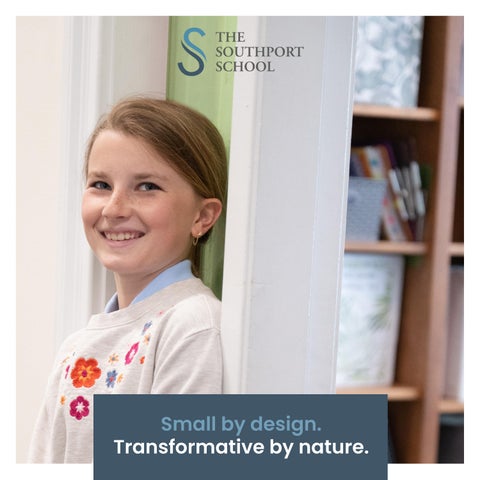
Small by design. Transformative by nature.
Individualized attention. Expansive expertise.
“At The Southport School, the personal attention of a small school and access to world-class expertise exist together. Our students’ education is informed by current learning science, exceptional professional expertise, and connections to a much larger community of researchers, educators, and ideas. Our academic program is built around what we know about literacy, language, executive function, and how children learn. Continually refined in our classrooms, our approach is highly individualized and intellectually rigorous, supporting academic growth alongside confidence, self-understanding, independence, and a sense of belonging. For me, that is the promise of TSS – small by design, expansive in expertise, and always focused on giving each child what they need to move forward.”
Rooted in what matters. Ready for what’s next.
“For more than two decades at The Southport School, I have seen the difference it makes when a school is intentionally small enough for every student to be known. Our teachers understand how each child learns, and who they are – their strengths, interests, challenges, and experiences. That depth of relationship is at the heart of the TSS experience.
Dr. Benjamin N. Powers Executive Director
Julie Papp
Head of School
2
As Head of School, I am committed to stewarding what makes this community special: exceptional teachers, individualized attention, close relationships, high expectations, and genuine care. TSS has a proud history and traditions that connect generations of students, families, faculty, and staff. Our future is about building thoughtfully on those strengths while continuing to provide students with the strongest possible educational experience.”
The Southport School Difference Small by design. Transformative by nature. Welcome to The Southport School, an intentionally small community for students in grades 2-8 with dyslexia, other language-based learning differences, and ADHD. Here, students belong, develop a deeper understanding of how they learn, and prepare for what comes next.
What makes TSS different is how every part of the school day works together to support each student. Small classes allow faculty to know students deeply and respond to how each learns best. Our program, grounded in the Science of Reading, goes beyond it, integrating current research in literacy, language, executive function, and the broader science of learning into the curriculum and throughout the day. Highly trained faculty work within a consistent schoolwide model and stay connected to current learning science through The Southport CoLAB. From day one, students build the skills, self-awareness, confidence, and independence they need to be successful.
Belonging changes what’s possible.
When students feel understood as learners, they can begin seeing themselves differently. Our approach honors the whole child, building on their strengths while providing targeted support for areas of challenge. Guided by faculty with expertise in dyslexia, other language-based learning differences, and ADHD, and a strong belief in every child’s potential, students are supported, challenged, and celebrated every step of the way.
3
Community designed for every learner. At The Southport School, students do not leave the learning community to receive support. The learning community is the support.
In small classes, students learn alongside peers who share similar learning pathways. Specialized instruction is part of the everyday experience, not isolated. Every student is known, included, and expected to participate. This sense of connection is especially important for students with learning differences and ADHD who may have felt misunderstood, overlooked, or alone in previous school settings. When students feel safe and understood, they can participate more, build relationships, take academic risks, and stay engaged when learning feels difficult. They can focus less on whether they fit in and more on learning, growing, and recognizing their full potential.
Advisors help guide the way.
Every student is paired with an advisor who serves as a mentor and advocate. Advisors are
4
compassionate, highly trained, tenured faculty members who help students build self-awareness and develop self-advocacy skills. Advisors also serve as a consistent point of connection and support for families throughout their child’s time at TSS.
Support for the whole family.
Families often come to The Southport School after seeing their child struggle. We understand that journey, and know how powerful it is when a student enters a community designed around how they learn. Parents bring essential knowledge about their children and are active partners throughout The Southport School experience. Through regular communication, shared insight, and a consistent schoolwide approach, families gain a clearer understanding of their child’s strengths, challenges, progress, and needs. As students begin to recognize their capabilities, participate more confidently, and rediscover academic competence, families can see what’s possible for their child.
No pull-outs. No exceptions.
Specialized instruction is built into every student’s school day at The Southport School. Highly trained faculty provide individualized, appropriately challenging instruction through a consistent schoolwide approach. Shared language, strategies, and evidence-based practices across academic and non-academic settings help students apply what they learn with increasing independence.
The power of daily, specialized instruction.
The cumulative impact of this direct instruction across the curriculum amounts to:
54
additional school days of specialized instruction each year1
163
Literacy and language are at the core of our academic program, grounded in the Science of Reading. Through more than 90 minutes of daily, intensive Structured Literacy instruction and more than 120 minutes of specialized language-based instruction, students develop foundational skills in phonological awareness, phonics, fluency, comprehension, spelling, and vocabulary. This explicit, systematic, diagnostic-prescriptive approach extends across the curriculum. Daily writing instruction develops clear, coherent expression. Multisensory, language-supported mathematics builds conceptual understanding and problem-solving confidence. Content-area instruction builds knowledge while reinforcing executive function, study, and critical-thinking strategies.
additional school days over 3 years, our average enrollment1 The majority of students arrive at TSS behind in reading comprehension; 9 out of 10 leave TSS at grade level, and 1 out of 3 leave above grade level2
Based on a sample IEP Service Plan, 35-week school year, 7-hour school day. 2 Based on yearly transition group sample. 1
A structured study period allows time for homework, reteaching, and guided practice. With specialized instruction delivered throughout the day, the need for separate academic tutoring is typically eliminated, leaving students more time after school to be kids.
5
6
Small by design.
Being a small school goes beyond the number of students who attend. At The Southport School, it means every student is known and understood as an individual. Faculty members understand each student’s learning profile, strengths, challenges, interests, and motivations. They collaborate closely across disciplines, allowing academic, executive function, and socialemotional needs to be recognized and addressed early. Students have frequent opportunities to participate, contribute, and lead. Classrooms, common spaces, and community life are closely connected, helping create an environment that feels calm, personal, and manageable for students who may have felt overwhelmed or overlooked elsewhere.
4:1
student to teacher ratio
125
maximum student enrollment
7
Expert faculty. One connected approach.
The Southport School’s faculty brings an uncommon depth of expertise in teaching students with dyslexia and other language-based learning differences, and ADHD. Just as important, they work together as part of a shared schoolwide approach.
Photo Credit: Courtesy / Dan Passapera / Sacred Heart University
Faculty members receive specialized training and use common instructional language and strategies across grades and subjects. They collaborate closely around each student and continually strengthen their practice through professional learning.
8
This consistency gives students continuity from classroom to classroom while allowing faculty to tailor instruction to each student’s learning profile and needs.
Faculty are trained in evidence-based approaches, including: • Orton-Gillingham Approach • The Southport CoLAB® Executive Function Blueprint • The Writing Revolution® • Lindamood Bell’s Visualizing and Verbalizing®
Research in practice every day.
At The Southport School, learning science is part of what faculty and students do every day. The Southport CoLAB, embedded within The Southport School, connects faculty directly to current research in literacy, oral and written language, executive function, and learning, often before it is widely available elsewhere. Practices are implemented, observed, and refined in classrooms, where their value can be understood in terms of individual students and everyday learning.
Through our partnership with The Southport CoLAB, emerging science is translated into practical classroom strategies, classroom insights help shape the future of learning, and
research turns into practice,
continually strengthening our academic program. Dr. Benjamin N. Powers
Executive Director, The Southport School Founder and Executive Director, The Southport CoLAB
9
Learning How To Learn
Instructional technology with purpose.
At The Southport School, technology is selected to support each student’s learning needs and instructional goals. Instructional technologies, including text-to-speech, speech-to-text, adaptive platforms, and organizational supports, remove barriers so students can focus on thinking, communicating, and demonstrating what they know. Technology is balanced with handwriting, printed text, discussion, collaboration, note-taking, and paper-and-pencil work. It never replaces explicit instruction in literacy, language, writing, or executive function. Students may use AI for research while learning to identify key information in printed text. They may use word-processing tools after developing handwritten notes and outlines. The use of personal devices is limited. TSS, informed by science, was an early adopter of a no cell phone policy during the school day. Over time, students learn when technology can help, when another approach may be more effective, and how to advocate for the tools they need to learn thoughtfully and independently.
10
At The Southport School, executive function provides a schoolwide framework for learning, relationships, and everyday responsibilities. Students develop shared language and practical strategies for managing attention and emotions, initiating work, organizing materials and ideas, planning complex tasks, shifting strategies when an approach is not working, monitoring understanding and progress, and communicating and advocating for what they need. These skills are explicitly taught and reinforced throughout the day.
Building belonging through regulation and connection.
Social-emotional learning is embedded throughout the school, helping students understand themselves, build positive relationships, and contribute to the community. Guided by the Building Blocks for Learning research model and the Social Justice Standards, instruction addresses identity, empathy, diversity, justice, independence, healthy development, and school readiness. Students learn to manage behavior in ways that support relationships, engagement, and belonging while developing a stronger understanding of themselves and their role in the world. As students become more secure, reflective, and connected, they are better prepared to stay engaged when learning feels difficult and take an active role in their classroom and community.
The Buddy System.
A longstanding part of The Southport School experience, the Buddy System intentionally pairs each Lower School student with an Upper School buddy who becomes a familiar and supportive presence throughout the school year. For Upper School students, it offers authentic opportunities to develop leadership, empathy, and responsibility as mentors and role models. For Lower School students, it provides a trusted friend and guide. Together, these bonds strengthen the school community and create lasting connections.
11
A well-rounded school day.
Co-curricular programs give students opportunities to explore new interests, express themselves, stay active, and connect with their peers. Through art, students experiment with different media and develop their own creative voices. Music instruction, grounded in the Orff Schulwerk method, invites students to learn through singing, movement, and instruments while reinforcing connections to literacy and executive function. Physical education and interscholastic cross-country and basketball give students of all skill levels opportunities to be active, learn new skills, and experience the camaraderie of team sports.
Traditions build belonging.
For more than 40 years, celebrations have been woven into the school year, uniting students, families, alumni, and faculty. Fall Festival and Field Day bring friendly competition and school spirit. The Ice Skating Party combines community service through TSS Cares before the December break. Beach Day brings students and faculty together for swimming and games along Long Island Sound as the school year draws to a close. Year-end celebrations and Eighth-Grade Graduation honor student growth and achievement. On the last day of school, the Parting Parade sends students off with cheers and waves as decorated cars circle campus.
TSS Cares is the School’s community service
initiative, giving students age-appropriate opportunities to make a difference in the local community. Students participate in service projects that address the needs of children and families, with a focus on
12
literacy, learning, and educational access. Through these experiences, students see how their time, effort, and actions can impact others and contribute to a more caring, equitable, and inclusive world.
Transition Begins Day One. The next chapter is part of the plan from the beginning.
Students come to The Southport School to develop the skills and strategies they need to excel in their next educational setting. With an average enrollment of three years, preparing for that next step begins well before it is time to leave. Throughout their time at The Southport School, students build academic skills alongside executive function, self-understanding, and self-advocacy. Faculty help students recognize the strategies that work for them, communicate what they need, and apply what they have learned with greater independence. Families are partners in the process, with guidance and support as they consider the next educational environment where their child can continue to grow. When students move on from TSS, they take with them the skills, strategies, and self-understanding they have developed here, ready to apply them in the classroom and beyond.
Students leave TSS
knowing more about how they learn and what they need to succeed.
13
Once a Sea Dog, always a Sea Dog!
The relationships built at The Southport School are an important part of the experience, and they do not end when a student leaves campus. Our alumni community gives former students and their families opportunities to stay connected to TSS and to one another through transition guidance, resources, mentorship, student support, and events. As alumni move through new schools, colleges, careers, and adulthood, those connections continue to evolve. Students and families can learn from one another, share experiences, build new relationships, and remain part of the community grounded in the same sense of belonging they found at TSS. Leaving TSS marks the beginning of a new chapter, not the end of the relationship.
TSS taught me that being ready for what comes next means knowing yourself as a learner, carrying your strategies with you, and having the confidence to ask for what you
need. Those skills have stayed with me—and I still have people from TSS supporting me along the way. Isabel A.
The Southport School, Class of 2018
14
Exceptional minds belong here.
The Southport School serves bright, creative students with untapped potential who have diagnosed language-based learning differences, such as dyslexia, dyscalculia, dysgraphia, auditory processing, or language and reading comprehension challenges. The program is designed for students who can benefit from an academically rigorous, language-based learning environment and whose primary needs are educational rather than social or emotional.
See what is possible.
Finding the right educational environment begins with understanding how your child learns. Contact us to explore whether The Southport School may be the right fit. We will listen, speak openly about your child’s learning pathway and experiences, and help determine whether our specialized, immersive program can provide the support and challenge they need to move forward. Our campus is open to visitors by appointment. Parents or guardians are encouraged to attend an Open House or schedule a visit by completing the online inquiry form or contacting the Admissions Office at 203.254.2044
Admissions Process
1.
Submit an inquiry online or by phone
in a 2. Participate parent/guardian visit a completed 3. Submit application neuropsychological 4. Provide testing (evaluations from private and public schools accepted)
an in-person 5. Schedule interview and classroom visit an admissions 6. Receive decision, generally within
two weeks of the final visit
accepted, submit a tuition 7. Ifdeposit to secure placement
Visit southportschool.org for information about admissions and financial aid, or contact the Admission Office at 203.254.2044 or Admissions@SouthportSchool.org.
15 13
Small by design. Transformative by nature.
The Southport School provides a highly individualized research-connected learning experience where students with dyslexia, language-based learning differences, and ADHD belong, learn how to learn, and prepare for what comes next.
Closer than you think.
The nearest school is not always the right school. Our Southport location is within a manageable daily commute for families across southwestern Connecticut, southeastern New York, and surrounding communities.
The Village is our campus.
Located in the heart of historic Southport Village, TSS offers a welcoming, personal alternative to larger or more institutional school settings. Walking access to Pequot Library, Wakeman Boys & Girls Club, outdoor spaces, and the village center extends learning beyond the classroom.
Non-Discrimination Policy The Southport School admits students of any race, color, sex, sexual orientation, gender identity or expression, and national and ethnic origin to all the rights, privileges, programs, and activities generally accorded or made available to students at the school. It abides by applicable federal and state laws. It does not discriminate in any of its policies or educational programs based on race, color, religion, sexual orientation, gender identity or expression, national origin, ancestry, ethnicity, disability, or any other category protected by law. The Southport School is not affiliated with, certified, endorsed, licensed, monitored, or sponsored by Lindamood-Bell, Nanci Bell, Phyllis Lindamood, or Pat Lindamood, nor is it a Lindamood-Bell Learning Processes program. Lindamood-Bell does not endorse or monitor the services provided by The Southport School.
214 Main Street (Main Campus) 411 Pequot Avenue (Administrative Offices) Southport, CT 06890 • 203.254.2044 SouthportSchool.org