Neighbors caring for neighbors. Expansive services. Compassionate care. All right here. We’re raising the standard of great care right here in eastern North Carolina. We’re expanding our services and our team to ensure that you and your family have access to the care you deserve—whenever you need it. From advanced specialties to everyday wellness, we are committed to serving our region with compassion and expertise. Because our purpose always remains the same—we help people live their healthiest lives.
ECUHealth.org
They’re not the only growing things in Eastern North Carolina. Businesses thrive here, too. These magnificent loblolly pines are a fitting symbol of a regional environment that encourages growth—in nature and in human enterprise. It’s why Brooks Pierce, with over 125 years supporting businesses in the state, maintains an office here. We love the habitat—both natural and economic. Wilmington | Charlotte | Greensboro | Raleigh
BrooksPierce.com
Eastern North Carolina: Strong Roots. Endless Opportunities Work Hard. Live Easy. Eastern North Carolina.
From paddling quiet coastal waters to biking sunset trails, Eastern North Carolina offers more than just stunning views, it offers space to breathe, room to grow, and a way of life that inspires. Here, business success and quality of life go hand in hand. Whether you’re expanding, relocating, or launching something new, Eastern NC is ready to welcome you with open skies and open opportunity.
nceast.org
Picture perfect.
Freedom 345
Atlantic Marine 910-256-9911 atlanticmarine.com
Uniquely Grady-White. gradywhite.com
Manteo Marine 252-473-2197 manteomarine.com
Park Boat Company 252-946-3248 parkboat.com
Radio Island Marina 252-247-7580 radioislandmarina.com
We help people who live Down East tackle their most important legal issues, each and every day. Our law firm “grew up” in small towns across eastern North Carolina, serving family-owned and locally managed businesses. Today, we’ve grown to seven offices in two states, with over 115 attorneys advising businesses, individuals, families, municipalities, and non-profits to resolve the questions that keep them awake at night.
NC: Asheville | Beaufort | Greenville | New Bern | Raleigh | Wilmington SC: Columbia 1001 College Court, New Bern, NC 28562
wardandsmith.com | 800.998.1102
Winter 2025/2026 D E PA R T M E N T S 13
FROM FALL LINE TO SHORELINE
by Bland Simpson
14
WORTH THE DRIVE by Jason Frye
17
OMNIVOROUS READER by Anne Blythe
21
BOOKSHELF by Kimberly Daniels Taws
26
SPORTING LIFE by Jim Dodson
33
BIRDWATCH by Susan Campbell
78
ANGLING FOR SUCCESS
84
ARTS CALENDAR
88
EASTWORDS by Celia Rivenbark
44
F E AT U R E S 35
POEM: TART'S FISHING WORMS SOLD BEHIND THE COUNTER by Shelby Stephenson
36
A VISIONARY REVIVAL
44
FROM TIDE TO TABLE
52
NO DAY AT THE BEACH
56
STITCH BY STITCH
62
A CASE OF THE DROPS
66
KEEPING COOLMORE
by Harris Vaughan When the overlooked becomes essential by John Wolfe Harvesting in the wild with Äna Shellem by Warren L. Bingham George Washington’s 1791 Tour
56
by Liza Roberts George Snyder III preserves an early American art form by Emmie Brooks Celebrating New Year's Eve in style by Samuel B. Dixon A grand architectural masterpiece
Cover Photograph by Meridith Loughlin
6 EastBound Magazine
78 The Art & Soul of the Coastal Plain
INTRODUCING NC’S NC ON POINT AND NORTH STATE OUTFITTERS
Come shop. Come hunt. Come find your peace in the outdoors! Offering upland, duck, deer, bear, and turkey hunts. Call Shay Asby at 252-945-4675 to book your hunt today! www.northstateoutfitters.com
YOUR CAREER,
campbell.edu
CALLING.
Campbell University invests in each student. We prepare each one to make a life, to make a living and to make a difference. Our students are welcomed into an inclusive community of family, and mentored to become leaders who will impact the world. Inspired by our faith and belief in the power of education, we encourage each student to grow academically, spiritually and socially through the world of opportunities that surround them. Beyond education, transformation.
Grounded in Tradition. Ready for What’s Next. As the year winds down, we’re reminded that growth starts close to home. Southern Bank has helped generations of families across eastern North Carolina build strong foundations — and brighter futures. Whether you’re saving for what’s next or simply celebrating how far you’ve come, we’re here with personal guidance and local care every step of the way. Discover what’s possible with Southern Bank.
GET STARTED
EastBound
DICKINSON AVENUE
First Friday
A R T WA L K
MAGAZINE
The art and soul of the Coastal Plain
Volume 1, No. 2 EB David Woronoff, President david@thepilot.com Ben Kinney, Publisher bkinney@businessnc.com Jim Moriarty, Editor jjmpinestraw@gmail.com
Andie Stuart Rose, Art Director Keith Borshak, Senior Designer
Families shop here
Tourists visit here
Alyssa Kennedy, Digital Art Director
Students learn here
CONTRIBUTING WRITERS Joseph Bathanti, Anne Blythe, Emmie Brooks, Susan Campbell, Samuel B. Dixon, Jim Dodson, Jason Frye, Tom Maxwell, Mary Novitsky, Todd Pusser,
Learn more by visiting our website:
www.downtowngreenville.com
Celia Rivenbark, Liza Roberts, Teri Saylor, Scott Sheffield, Bland Simpson, Kimberly Daniels Taws, Harris Vaughan, John Wolfe
CONTRIBUTING PHOTOGRAPHERS John Gessner, Todd Pusser
IS YOUR BUSINESS READY TO TAKE OFF?
We have your launchpad.
ADVERTISING SALES
Melanie Weaver Lynch, Sales Manager 919.696.6838 mweaver@businessnc.com Erika Leap, 910.693.2514 erika@thepilot.com Julie Nickens, 919.622.5720 julie@waltermagazine.com
It’s the CCX Carolina Connector Intermodal, located near the state’s top shovel-ready megasite at the Kingsboro Business Park. Reaching 5 million people living within a 120-mile radius, the CCX is located just 5 miles from I-95. And it’s only a few hours by rail or truck from the NC, VA, SC & GA ports. Close by are development sites for your business, within 10 hours of nearly half the American buying-public.
ADVERTISING GRAPHIC DESIGN Carolina Connector Intermodal Site
10 EastBound Magazine
EB Henry Hogan, Finance Director 910.693.2497 OWNERS
Kingsboro Megasite
Jack Andrews, Frank Daniels III, David Woronoff In memoriam Frank Daniels Jr.
eastboundmag.com 1230 West Morehead St., Suite 308 Charlotte, NC 28208
For more information, go to econdev.org or call 252-442-0114.
CGP 36779 EastBound Magazine Ad (5.25x4.625) 1
Miranda Glyder, Scott Yancey
©Copyright 2025/2026 Reproduction in whole or in part without written permission is prohibited. EastBound Magazine is published by Old North State Magazines LLC 7/31/25 4:17 PM
The Art & Soul of the Coastal Plain
BUILDING THE FUTURE, ONE CLASSROOM AT A TIME Across North Carolina, only a select group of schools earn the title STEM School of Distinction, schools that are changing the way students learn and think about the world around them. Of the 50 schools recognized statewide, 28% are right here in Eastern North Carolina, showing the incredible progress happening in our region. That success is fueled by STEM East, an initiative of the NC East Alliance, which connects classrooms to real-world careers through partnerships with local industries, colleges, and community leaders. With 31 partnering school districts, STEM East helps teachers bring learning to life by linking what’s taught in the classroom to the skills our employers need most. Being named a STEM School of Distinction means more than a certificate on the wall. It means students are designing, building, and testing their ideas, learning through hands-on projects that make lessons stick. Whether it’s robotics, agriculture, or engineering challenges, these experiences prepare students to solve problems, think creatively, and collaborate, the same skills that drive success in a technologydriven world.
MAKE EVERYDAY SATURDAY M O D E R N I PA
RNDBREWING .COM HANDCR AF TED IN R ALEIGH, NC . ©2020 R&D BREWING CO. PLE ASE ENJOY RESPONSIBLY.
F RO M FA L L L I N E TO S H O R E L I N E
A Sign at Stedman
PHOTOGRAPH CONTRIBUTED BY THE ATLANTIC COAST LINE & SEABOARD AIR LINE RAILROADS HISTORICAL SOCIETY COLLECTION
By Bland Simpson
Y
ears ago, back in the late 1970s and early ’80s, I made many a trip to Sunset Beach, the broad sandy strand that is one of North Carolina’s few accreting beaches, beyond the mile-wide marshes of Fox Creek, but first over the Waterway (at that time) on Mannon Gore’s homemade pontoon bridge, which rose and fell with the tides. One of the two ways I loved to go there from southwest Orange County involved bypassing Fayetteville with a curving route to its east: Benson to Godwin, passing the old Averasboro Civil War battlefield, then Wade to Stedman to Cedar Creek and then on down along the north side of the Cape Fear River on N.C. 53, past the Spanish-mossy trees of White Oak and south over the big river at Elizabethtown to N.C. 87, which at last rolls through Maco (site of the ghost light of 1867 trainwreck victim Joe Baldwin, out looking for his head) and the great Green Swamp to Sunset Beach! The second or third time I made this trek, when going through Stedman and crossing the railroad tracks there, at a glance I noticed a dark-blue sign with white lettering that read: “Property of the Atlantic Coast Line Railroad” and, as my heart leapt, I could not quite believe my eyes. There had been no Atlantic Coast Line for over 10 years, not since its merger with the Seaboard Air Line Railway, which formed the Seaboard Coast Line. But it was fully alive in my heart and mind because with friends I had been singing for years the rocking song that had been a late ’60s-early ’70s hit for both Hank Snow and Charley Pride, the great country singer who wrote this wonderful song about the freedom and joys of riding the rails. One chorus sang out: Hear that lonesome whistle whine Alabama and Caroline, Florida, Georgia, Tennessee This hobo’s life is the life for me Ridin’ the Atlantic Coastal Line Ridin’ the Atlantic Coastal Line! So the next time I traveled this way, I anticipated and looked for that sign and saw it and was overjoyed anew: at least in song and in this one single real-world spot, the Atlantic Coast Line Railroad lived and lived on. The ACL’s purple locomotives with yellow piping might not be rolling up and down these tracks anymore, but a small sign in a small eastern Carolina town reified it, made it so, at least in my memory and imagination. And so I hatched a plan — I must have the sign. I would have it. A quick stop at dusk and a stout set of channel-lock pliers, a flat-head screwdriver and a small hammer, and The Art & Soul of the Coastal Plain
I could prise that out-of-date sign right off its old post and take it home and put it on my wall. Yet channel-locks and hammers are way down the list when one is packing for the beach, and each time I would go past the now-magical sign in Stedman, and my heart would leap at its simple declaration and its constancy, I would only then remember that I had forgotten the tools. And as this kept happening, a new and deeper thought started to emerge and form up — I was not following through on my artistic larceny for a very good reason, and that was: I did not really need the Atlantic Coast Line sign hidden away at my home back in Chapel Hill, for my eyes only. What I really did need was that small emblem staying in place, right where it was and had long been, right beside those railroad tracks in Stedman, North Carolina, where I had found it and where its appearance in real context was what uplifted my heart. Perhaps someone else felt the same way about it too, perhaps many did, and if I had taken it away, well, I would have made off with something precious out of their living past. This realization was a bit of great joy, a touchstone, and though that train line, and even the particular leftover tracks themselves, are now long gone, like the Atlantic Coast Line itself, that pretty, little, rusty sign — representing a great railroad that once moved people and produce from Richmond to Florida and back, and all over eastern North Carolina, to boot — lives on in my heart, and still as an icon, an image, and a bright uptempo song with a glorious chorus, brings me joy. EB Bland Simpson is a Kenan Distinguished Professor of English and Creative Writing at the University of North Carolina at Chapel Hill and a regular contributor to EastBound Magazine. He is also the longtime pianist for the string band The Red Clay Ramblers. His most recent book is Clover Garden: A Carolinian’s Piedmont Memoir. EastBound Magazine
13
WORTH THE DRIVE
By Jason Frye
W
Historic Halifax
e live in a state of firsts. First in flight thanks to the Wright brothers and that relentless Outer Banks breeze. A 17-pound “yellow rock” fished from a Piedmont stream marked America’s first gold rush. And we’re first in freedom — yes, it’s more than a license plate slogan — thanks to Halifax, a tiny town on the banks of the Roanoke River that gave rise to the United States. Sounds like quite the boast on the eve of our nation’s 250th birthday, but it’s true. On April 12, 1776, the Fourth Provincial Congress of North Carolina met in a Halifax tavern to ratify the Halifax Resolves, the first document calling for the Colonies to separate from British rule. With the ink still fresh on their signatures, delegates headed north to Philadelphia, where their fervor for freedom and the bold claims in the Resolves paved the way for the Declaration of Independence three months later. How’s that for a first? If all goes according to plan — and if the temperature and humidity in a special chamber in the brand-new Historic Halifax Visitor Center check out — the town will celebrate another first in 2026 when the Halifax Resolves come home for the first time since 1776. It’s one hell of an item to borrow from the Library of Congress. As someone who has put a couple of hundred thousand miles on his car traipsing across North Carolina, the Halifax Resolves alone aren’t enough to fill a weekend there, but you can put together a fine getaway if you look beyond the town and venture into Halifax County. Make no mistake, though, you’ve got to start where the idea of the USA was born: Historic Halifax. The visitor center gives you a glimpse into life in Colonial Halifax and the troubling times that led to the Resolves: no
14 EastBound Magazine
gold or silver currency, only IOUs for tobacco and naval stores shipped to England, and rising tensions between Colonists and King George III’s tax collectors, soldiers and sailors. Across the visitor center garden, the yellow-slatted Eagle Tavern offers a deeper, humanizing look into the past through relics — like a silver sugar bowl used to serve the Marquis de Lafayette at a banquet, and gaming pieces common in Colonial taverns — and writeups on enslavement, tavern culture and the Resolves. Though Eagle Tavern (built in 1790) and the jail (1838) aren’t the tavern where the Resolves were written or the jail where Patriots served their penance, they give the place gravity, help anchor it in time for contemporary visitors. If you want to feel like you’ve stepped from the 21st century into the 18th, head to Halifax on April 12, when a small army of Colonial re-enactors — costumed patriots and redcoats alike — occupy the site. These living historians show up a couple of times a year, but 2026 is a big one for Colonial buffs, so keep an eye on the historic site’s calendar to see when they’ll be back. You can also step across Saint David Street to the Bradford Denton House. This Colonial home — brought to you by the Historic Halifax Restoration Association — is a restored wonder, the outbuildings are period-accurate reproductions, and you’ll find costumed interpreters and history enthusiasts here quite often. You might run into Jeff Dickens, peanut farmer, history buff and storyteller extraordinaire, if you’re lucky. Dickens has an incredible collection of Colonial-era relics on display (including the home itself, which he discovered beneath a mountain of viny growth in a farm field). His stories, and the tales told by his fellow HHRA members, expand the Halifax saga. The Roanoke River flows past Halifax, and from Colonial days through the Civil War it was a critical trade route. Rocky The Art & Soul of the Coastal Plain
outcroppings upstream form impassible rapids and gave the town of Roanoke Rapids its name. In the early 1800s, a canal provided a way around the rapids and eventually became North Carolina’s longest museum and a riverside walking path. Seriously, the Roanoke Canal Museum and Trail stretches from Roanoke Rapids to Weldon some 7 miles, giving the museum its odd superlative. You can catch a glimpse of the rapids at the Weldon end of the museum near one of the state’s best booze bottlers, Weldon Mills Distillery, and if you’re ready for a riverside ramble, park by Riverside Mill, a nearby antiques superstore, and make your way west on the gravel trail. Weldon Mills Distillery has a monstrous lineup of 30 spirits. At the tasting bar, you can work your way through their bourbon, whiskey, rum, gin and tequila catalog. Each spirit comes in a flavor-infused variety (like a radioactive-green cinnamon vodka), but the straight versions let the spirits shine. You may find spirits of another sort at Riverside Mill, where doubtless there’s a haunted item or two hidden among the antiques and tchotchkes inside. Just down the road in the town of Scotland Neck, you’ll find antiquarian objects of a different sort: rocks. The Rock Museum, part passion project, part mineral wonderland, is packed with some of the wildest rocks you’ll ever see — spiked and finned and oddly shaped, fluorescing under blacklight to reveal hidden colors. Goggle at these wonders and grab a pendant, ring or clutch of polished stones before heading down the road to Sylvan Heights Bird Park. This east-of-95 road trip has a lot of ties to our collective past, including a look back in time at Sylvan Heights, where several species of birds remind us that these feathered friends (like the huge Abyssinian ground hornbills and a rhea tall enough to look you in the eye, outfitted with talons like a film-famous velociraptor) are among the closest relatives to dinosaurs on the planet. Other birds — turacos, the green-naped pheasant pigeon, and the big-as-a-Thanksgiving-turkey blue-crowned pigeon with its lacy cap of delicate feathers — shine with an opalescent radiance and surprise you with their range of calls and songs. No road trip is complete without a good meal. In Scotland Neck, La Casetta serves up homey Italian and A&B Bar-Be-Que & Chicken sticks to Eastern N.C. traditions, but if you want to go real traditional and you’ve got a hankering for barbecue, you need Ralph’s in Weldon. Ralph’s has served up Eastern N.C. ’cue for more than seven decades, and the recipes and style of service — a small but mighty buffet — haven’t changed much in that time. Brunswick stew and banana pudding should bookend your meal, but in between you’ll have a hard time picking between the barbecue, the fried chicken and the fried vegetable sides. So, it’s time to pack a bag, unfold your roadmap, and hit the highway. Halifax is calling. Jason Frye is a travel writer living in Wilmington. He’s the author of Moon North Carolina, Moon North Carolina Coast, and guidebooks to the Smoky Mountains, Blue Ridge Parkway, and hiking in our national parks. Follow his adventures in eastern North Carolina and beyond on Instagram @BeardedWriter.
The Art & Soul of the Coastal Plain
Lawyers who provide practical solutions.
Business • Government • Utilities • Land
Cauley Pridgen is dedicated to serving Eastern North Carolina. Wilson • Raleigh • Kinston www.cauleypridgen.com
EastBound Magazine
15
An Innovative Introduction to Entrepreneurship During the Miller School of Entrepreneurship’s Summer Innovation Academy, high school students do more than dream. They launch. From real-world pitches to one-on-one mentorship with industry experts during the weeklong camp, tomorrow’s leaders learn future-focused ways of starting and running a business. Along the way, participants experience firsthand how ECU cultivates the spirit of turning ideas into reality.
College of Business | East Carolina University
®
business.ecu.edu/msoe
C.S. 26-0325
16 EastBound Magazine
The Art & Soul of the Coastal Plain
OMNIVOROUS READER
Getting Semi-Real Jason Mott’s People Like Us
By A nne Blythe
J
ason Mott gets one thing out of the way right off the bat in People Like Us — his latest novel is semi-fictional. Or at least that’s what the National Book Award-winning author of Hell of a Book wants you to believe. “Whole fistfuls of this actually happened, sister!” he tells us in the forward. “So, to keep the lawyers cooling their heels instead of kicking down the front door with those high-priced Italian loafers of theirs, some names and places have been given the three-card monte treatment and this whole damned thing has been fitted with a fictional overcoat.” People Like Us is the story of two Black authors — one on tour in the wintry climes of Minnesota after a school shooting, and the other being chauffeured around Europe, or “Euroland,” as he calls it, as the guest of a super-wealthy benefactor we know only as “Frenchie.” They’re both exploring the idea of the American dream and whether such a notion is truly attainable within the confines of their lives. One is pondering that question from inside U.S. borders, the other from the outside. Readers likely will notice many parallels between the real life of the acclaimed Columbus County resident and UNC Wilmington professor who’s a five-time author now. Mott started writing People Like Us as a memoir that delved into his relationship with America. But along the way a couple of his Hell of a Book characters — Soot and The Kid — kept dropping into his story. So it evolved
The Art & Soul of the Coastal Plain
into this description-defying, pseudomemoir/novel that will make you laugh out loud at its devilishly delicious humor, then sink into the grave realization that Mott is deftly addressing some serious social commentary. Because both protagonists feel compelled to travel with concealed weapons, the gun culture in America and abroad is one such theme. So is the precarious state of the nation. Mott is not preachy about these topics. He is subtle and inviting as he gets readers to think about American identity, and the complexities that Black Americans confront in a land where racial “othering” still exists. One of the beauties of his writing is he can turn a phrase that will stop you dead in your tracks and force you to linger for a minute or two to admire his imagination, wit and way with words. Mott describes a scene about a seismic shift on a par with the protests that followed the murder of George Floyd this way: “It was like watching Sisyphus — a man who never skips leg day — finally get that super-size rock of his farther up the hill than he ever did before. And, just for a second, you can believe that, hell, maybe he’ll finally get it over the top.” Mott’s prose will take you on a madcap adventure or somber journey with a cast of intriguing characters. We reconnect with Soot, the character in Hell of a Book who becomes invisible or one of “The Unseen” after witnessing his father shot by police while out on a jog. He’s an author now, in Minnesota reckoning with the suicide death of his daughter Mia amid the aftermath of a school shooting. Then there’s The Kid, who is older than he was in Hell of EastBound Magazine
17
OMNIVOROUS READER
a Book, mysteriously seizure-prone now, living in France and going by the name Dylan — or at least the author living it up bourgeois-style in Europe believes the two are one and the same despite being told otherwise. We get to know The Goon, the giant Black Scottish bodyguard and driver employed by the eccentric Frenchie to squire around the nameless author in a Citroën so decrepit and aged it seems like it’s “about to pull a hamstring.” Dylan is with them as they go from book event to book event in Italy and France. Along the way, the author who sometimes pretends to be the better-known Colson Whitehead or Ta-Nehisi Coates runs into Kelly, a funeral director and former girlfriend from the States. She hops in with the trio as the four of them seek a “Brown Man’s Paradise.” Just as the gun used in an accidental shooting toward the end of the book hangs suspended in air “like a steel question mark,” so too does the notion of whether leaving America, as Mott
poses, “just might be the new American dream.” Dylan, who fled to “Euroland,” sheds light on that idea in deep conversation with the author who is debating himself whether a comfortable home can really be had outside the homeland for people like him. “There’s a hierarchy here, just like everywhere,” Dylan told him. “You’re either French-born White or Italian-born White or English-born White or Whatever-born Whatever . . . or you’re an Other. Well, where do the Others go? What do you do when your home doesn’t love you and all the other homes you tried to make a life in don’t love you either?” That question lingers as Mott wraps People Like Us, fodder for one more semi-fictional book. EB
Mott’s prose will take you on a madcap adventure or somber journey with a cast of intriguing characters.
TIME TO TRANSITION YOUR BUSINESS? Transworld Business Advisors of Eastern NC Tony Khoury, MBA, CBI, M&AMI M&A Advisor | Managing Director tkhoury@tworld.com 252-347-9606 www.transworldeast.com
18 EastBound Magazine
Anne Blythe has been a reporter in North Carolina for more than three decades covering city halls, higher education, the courts, crime, hurricanes, ice storms, droughts, floods, college sports, health care and many wonderful characters who make this state such an interesting place.
Our Business is Selling Your Business • Want to understand what your business is worth? • Interested in learning more about the process of selling your business? • Need a regional firm with global reach to help maximize your exit?
Call or email for a confidential conversation to learn more.
The Art & Soul of the Coastal Plain
225 E New Bern Rd
1021 Cedar Point Blvd
Kinston, NC 252-527-5058
Cedar Point, NC 252-393-1599
Hwy 70 East
1 Mile from the EI Bridge
NeuseSportShop.com
A Century of Building with Purpose
Chances are, you’ve entered a building, crossed a bridge, or used infrastructure we built.
Learn more about our impact at www.taloving.com
The Art & Soul of the Coastal Plain
EastBound Magazine
19
Serving the Carolina Coast since 1954
(910) 256-5333 www.JamesEMoore.com
house-autry.com 20 EastBound Magazine
The Art & Soul of the Coastal Plain
BOOKCASE
New on the Shelf
FICTION Heart the Lover, by Lily King Jordan’s greatest love story is the one she lived, the one that never followed the simple rules. In the fall of her senior year of college, she meets two star students, Sam and Yash, from her 17th Century Lit class. The boys invite her into their intoxicating world of academic fervor, rapid-fire banter and raucous card games. They nickname her Jordan, and she quickly discovers the pleasures of friendship, love and her own intellectual ambition. But youthful passion is unpredictable, and soon she finds herself at the center of a charged and intricate triangle. As graduation comes and goes, choices made will alter these three lives forever. Decades later, the vulnerable days of Jordan’s youth seem comfortably behind her. When a surprise visit and unexpected news bring the past crashing into the present, she returns to a world she left behind, and must confront the decisions and deceptions of her youth. Party Stories, by Ella Carr Momentous parties have long provided dramatic scenes in fiction, from Natasha’s first ball in War and Peace to Darcy snubbing Lizzy in Pride and Prejudice to J. Edgar Hoover and Truman Capote rubbing shoulders in Don DeLillo’s “The Black-andWhite Ball.” Revelry can be revealing of character, as in Gatsby’s extravagant bash in F. Scott Fitzgerald’s The Great Gatsby and the decadent partying of the jaded expats in Ernest Hemingway’s The Sun Also Rises. More decorous affairs can also reveal profound depths, as in Katherine Mansfield’s “The Garden Party” and the parties at the center of those two modernist masterpieces, Virginia Woolf’s Mrs. Dalloway and James Joyce’s “The Dead.” There is room on this dance floor for humor, as well, in Evelyn Waugh’s “Bella Fleace Gave a Party,” Dorothy Parker’s “Arrangement in Black & White,” and Saki’s “The Boar-Pig.” All
The Art & Soul of the Coastal Plain
sorts of literary greats mingle in this festive gathering, a perfectly entertaining gift for readers and partygoers alike. Cursed Daughters, by Oyinkan Braithwaite When Ebun gives birth to her daughter, Eniiyi, on the day they bury her cousin Monife, there is no denying the startling resemblance between the child and the dead woman. So begins the belief, fostered and fanned by the entire family, that Eniiyi is the reincarnation of Monife, fated to follow in her footsteps in all ways, including that tragic end. There is also the matter of the family curse handed down from generation to generation — No man will call your house his home. And if they try, they will not have peace. When Eniiyi falls in love with the handsome boy she saves from drowning, she can no longer run from her family’s history. As several women in her family have done before, she ill-advisedly seeks answers in older, darker spiritual corners of Lagos. Is she destined to live out the habitual story of love and heartbreak? Or can she break the pattern, avoiding the spiral that led Monife to her lonely death and liberating herself from all the family secrets and unspoken traumas? The White Octopus Hotel, by Alexandra Bell London, 2015: When reclusive art appraiser Eve Shaw shakes the hand of a silver-haired gentleman in her office, the warmth of his palm sends a spark through her. His name is Max Everly — curiously, the same name as Eve’s favorite composer, born 116 years prior. And she has the sudden feeling that she’s held his hand before . . . but where, and when? The White Octopus Hotel, 1935: In this belle époque building high in the snowy mountains, Eve and a young Max wander the winding halls, lost in time. Each of them has been through the trenches — Eve through a family accident and Max on the battlefields of the Great War — but for an impossible moment, love and healing are just a room away . . . if only they have the courage to step through the door.
EastBound Magazine
21
BOOKSHELF
POETRY
NOTABLE CORPORATE GIFTS
anytime of the year!
Our corporate gift selections include: small combo
starting at $31.95
Aunt Ruby’s Peanuts providing the best quality Virginia-style nuts to peanut lovers for more than 40 years. We are family-owned and operated company located in historic Halifax County. We offer nut varieties, sweet treats and create-your-own combinations. North Carolina’s finest peanuts make great gifts.
fabulous five
starting at $69.95
peanut quad
triple treeat
starting at $55.95
starting at $39.95
All These Ghosts, by Silas House Silas House is known throughout the South as a quintessential person of letters — a novelist, music journalist, environmental activist, columnist and the former poet laureate of Kentucky. This full-length collection of poetry blends his Appalachian upbringing with his ongoing relation to the natural world. Poems of praise for community and the collective appear alongside others tinged with nostalgia and grief when House keenly observes the loss of rural America as he once knew it. Returning to his touchstone subjects, he recalls wild places, echoes stories from a lingering and living past, and explores an abiding connection to family, friends and fellow artists. NONFICTION
A&B Milling Company | Enfield, NC
Go online to AuntRubysPeanuts.com for our full collection. You can even customize your order by calling 1-800-PEANUTS
SERVING GREENVILLE & PITT COUNTY, NC
Connecting LOCAL for a stronger tomorrow. The Greater Greenville Chamber connects local businesses, leaders, and community partners to create opportunities for growth and propserity.
22 EastBound Magazine
JOIN US greenvillenc.org
Wings: The Story of a Band on the Run, by Paul McCartney Drawn from over 500,000 words of interviews with McCartney, family, band members and other key participants, Wings recounts — now with a half-century’s perspective — the musical odyssey taken by a man searching for his identity in the aftermath of The Beatles’ breakup. Soon joined by his wife — American photographer Linda McCartney — on keyboard and vocals, drummer Denny Seiwell, and guitarist Denny Laine, McCartney sowed the seeds for a new band that would later provide the soundtrack of the decade. The narrative begins when a 27-year-old superstar fled with his new wife to a remote sheep farm in Scotland amid a sea of legal and personal rows. The setting gave McCartney time to create, and it was there where this new band emerged. Wings follows the group as they play unannounced shows at university halls, tour in a sheared-off double-decker bus with their children, survive a robbery on the streets of Nigeria, and eventually perform blockbuster stadium shows on their world tour, all while producing some of the most enduring music of the time. Introduced with a personal, heartfelt foreword by McCartney, the volume contains 150 black-and-white
The Art & Soul of the Coastal Plain
EASE IS THE RESULT OF tt hh oo uu gg hh tt ff uu ll DESIGN
5815 OLEANDER DRIVE STE. 135 910.793.3992 INFO@BIGSKYDESIGNONLINE.COM
www.risecapco.com
The Art & Soul of the Coastal Plain
The Rise Companies (Rise) invests in mature and growing companies in the manufacturing and industrial industries.
SPACES DESIGNED TO FUNCTION AS beautifully T E FLOW. F O beautifully AS THEY RESIDENTIAL + COMMERCIAL DESIGN
252-432-0815 2 5 2 -7 1 7 - 9 0 1 4
EastBound Magazine
23
BOOKSHELF
and color photographs, many previously unseen, as well as timelines, a gigography and a full discography.
The NC RURAL CENTER develops and promotes economic strategies to improve the quality of life of rural North Carolinians. We serve the state’s rural counties—including the 36 rural Eastern North Carolina counties—with a special focus on people with low to moderate incomes and communities with limited resources. WHAT WE PROVIDE: • Small business loans in partnership with local banks and CDFIs • Leadership development • Faith community partnerships • Broadband expansion support • Advocacy • Research and data If you're interested in working with us or just learning more, visit us at ncruralcenter.org.
Visit the Step inside the ASOM & experience the legacy of America’s elite warriors through immersive exhibits & powerful stories.
FREE ADMISSION
Before you leave, stop by the Museum Store, or shop online, for unique gifts that give back. Every purchase supports exhibits, education, & preservation.
CONVIENTLY LOCATED DOWNTOWN FAYETTEVILLE
24 EastBound Magazine
FREE PARKING
Shop Now
Troublemaker: The Fierce, Unruly Life of Jessica Mitford, by Carla Kaplan Who could predict that a British aristocrat would so energize American antifascist and civil rights struggles that Time magazine would crown her “Queen of the Muckrakers”? Jessica Mitford, known as Decca, was brought up by an eccentric English family to marry well and reproduce her wealth and privilege, not to advocate for the rights of others. Her beautiful sisters have been subjects of books and movies dedicated to their naughty, glamorous lives. Decca broke the Mitford mold, running away to America to forge a rebel’s life. She fought fascism in the Spanish Civil War, became an American communist and pioneered witty, hugely popular journalism, including her 1963 blockbuster The American Way of Death. An immensely effective ally, she injected laughter into all her political work, annoying some activists with her relentless antics but encouraging others to find joy in the struggle. From famed baby doctor Benjamin Spock to best friend Maya Angelou, her anti-authoritarian irreverence had a profound impact on American culture. Rules for Living to 100, by Dick Van Dyke Dick Van Dyke danced his way into our hearts with iconic roles in Mary Poppins, Chitty Chitty Bang Bang and as the eponymous star of The Dick Van Dyke Show. Now, as he’s about to turn 100 years old, Van Dyke is still approaching life with the twinkle in his eye that we’ve come to know and love. Through pivotal stories of his childhood, moments on film sets, his expansive family, and finding love late in life, Van Dyke reflects on the joyful times and the challenges that shaped him. His indefatigable spirit and positive attitude will surely inspire readers to count the blessings in their own lives, persevere through the hard times, and appreciate the beauty and complexity of being human. EB Compiled by Kimberly Daniels Taws.
The Art & Soul of the Coastal Plain
Your North Carolina Partner in Building Excellence Celebrating 25 years of building improved communities that influence the way Eastern North Carolinians learn, live, and thrive. Rooted in Eastern NC, Metcon offers a comprehensive suite of construction services that consistently produce high-quality results for our clients.
ADV ANCE YOUR EDUCATION AND YOUR CAREER Expand Opportunities With a Business Graduate Certificate
Columbus County School East View PK-8 School
Gain a competitive edge — online and on your time — through the AACSB-accredited College of Business at East Carolina University®. Our Arthur Graduate School of Business offers nine graduate certificate programs, including the following: M Business Analytics and AI Applications M Cybersecurity Management M Project Management Get hands-on experience. Expand your professional network. Open the potential for a higher salary.
UNC Pembroke Health Sciences Building
Learn More: go.ecu.edu/gradprograms
Robeson Career & Technical Education Center, Planetarium, & Science Center
The Art & Soul of the Coastal Plain
C.S. 26-0187
EastBound Magazine
25
SPORTING LIFE
Chasing Harvie
By James Dodson
O
n a cool autumn morning not long ago, I set off for the small town of Tarboro in eastern North Carolina, the birthplace of Edward Harvie Ward, one of America’s great amateur golfers who scaled the heights of sporting glory only to fall from grace in a scandal that changed golf in America. As I rambled east on old U.S. 70 — the way I once traveled to school at East Carolina University before the coming of faster interstates — I thought about the last time I saw Harvie on a lovely winter morning in 2003 when I dropped by the handsome home that he and wife, Joanne, shared on Blue Road in Pinehurst. Harvie was dying of liver cancer. I was there to say goodbye — and offer an apology. Owing to his advanced condition and my five years of work on Ben Hogan’s authorized biography that took longer than planned, we’d run out of time to properly research and write Harvie’s own tale of triumph, tragedy and rebirth. The book we envisioned was to be called The Last Amateur — Harvie Ward and the Scandal That Changed the Future of Golf in America.
26 EastBound Magazine
I felt bad about that and told him so. Harvie simply smiled. “Well, old sport, I guess our timing is just off a bit. Maybe someday.” Almost two decades after that final conversation, I was headed to Tarboro in hopes of finding whatever details of his early life that might help jump-start greater public interest in this largely forgotten hero of American golf. In December 2025 Harvie would have turned 100, a milestone that warrants keeping his incredible story alive. During the early 1950s, just as Ben Hogan’s star began to fade, Edward Harvie Ward rose out of the deep green fastness of eastern North Carolina to become the most admired and thrilling player in the game of golf. His springboard to overnight fame reads like a movie script. During the spring of 1948, cheered on by his Zeta Psi fraternity brothers and a rowdy crowd 1,000 strong composed of fellow students from UNC-Chapel Hill, wielding a wooden-shafted putter he’d found as a kid on a bench in the locker room of his father’s nine-hole golf club in Tarboro, Ward came out of nowhere to win the coveted North and South Amateur Championship on The Art & Soul of the Coastal Plain
PHOTOGRAOHS FROM THE TUFTS ARCHIVES
Honoring a debt to an old friend and golf legend
SPORTING LIFE
Pinehurst No. 2 in a 36-hole final with Frank Stranahan, the top amateur in the world at that moment. Stranahan, scion of the Champion spark plug fortune, was reportedly so confident of beating the genial, smooth-talking college boy, he’d booked the Carolina Hotel’s dining room in advance for a victory dinner with dozens of his friends. At the turn of their match, Harvie heard Stranahan grumble to his caddie that if his opponent couldn’t putt, “he’d be just another good-looking college kid.” Indeed, Harvie faced 18 “must make” putts — and holed them all with his beloved boyhood putter, closing out the world’s topranked amateur on the final hole. His ecstatic friends — many of whom had never set foot on a golf course before — lofted Harvie to their shoulders in celebration. After college, while working as a stockbroker in Atlanta, Harvie captured the 1952 British Amateur Championship at Prestwick (beating Stranahan again, this time 6 and 5) and subsequently played on the first of three successful U.S. Walker Cups teams in 1953, 1955 and 1959, winning all six of his matches. After adding the Canadian Open title to his resume in 1954, he beat out a host of supremely talented amateurs in 1955 to win the U.S. Amateur Championship in a dominating 9 and 8 performance over Bill Hyndman Jr. at the Country Club of Virgina in Richmond. One year later, he defended his crown by dispatching gifted Chuck Kocsis 5 and 4 at the Knollwood Club in Lake Forest, Illinois — sparking talk of a new Bobby Jones on the rise. With his movie star good looks, frat boy charisma and a playing temperament that never lost its cool, Ward quickly became the darling of the national sports media and the toast of American golf. Wherever he went, sportswriters exhausted themselves finding superlatives to describe his playing abilities, while adoring college girls trailed dreamily in his wake. Herbert Warren Wind hailed Harvie as the most talented American player of the 1950s, and no less a golf legend than Byron Nelson proclaimed Harvie to be the “next Ben Hogan.” Keen observers of the game believed the affable son of a smalltown pharmacist was on track to claim a record third consecutive National Amateur title when unimaginable disaster struck. Not long after Ward and his friend and fellow amateur Ken Venturi played an arranged private four-ball match against Byron Nelson and Ben Hogan at Cyress Point Golf Club that became the stuff of legend and a 1996 bestselling book called The Match, a surprise ruling by the United States Golf Association stripped Harvie of his amateur status for allegedly accepting expense money from sponsors to play in tournaments.
The Art & Soul of the Coastal Plain
At the time, both Ward and Venturi made good money selling cars and auto leases for flamboyant Eddie Lowery in San Francisco, owner of the largest Lincoln-Mercury dealership in the country and a longtime member of the powerful USGA Executive Committee. The golf world remembered Lowery as the diminutive bucket-hatted tyke who caddied for Francis Ouimet at the U.S. Open in 1913, which Ouimet won in an 18hole playoff with Harry Vardon and his traveling mate Ted Ray. As Harvie saw it, while most tour pros of their generation were barely scraping by week to week, being paid a generous salary by Lowery to sell fleets of cars to potential corporate customers during the off-hours of important golf tournaments was a win-win situation. His amateur success even netted him 11 invitations to the Masters, finishing in the top 10 twice. In the process, Ward developed a close friendship with Augusta founder Bob Jones, who was widely known to fancy an eventual successor who would embody the ideals of amateur golf. Up to the moment the scandal broke, Harvie was considered a prime candidate. The USGA, however, didn’t share Ward’s view of his sweetheart arrangement with Lowery, which they contended violated the spirit of amateurism, specifically a rule that prohibited any amateur from accepting financial help from anyone outside a player’s own family. When the state of California investigated his boss for tax evasion, the USGA zeroed in on Lowery’s tax returns that seemed to suggest a cozy arrangement in which he wrote off the expense money paid to Harvie as “business travel” that coincided with Ward’s tournament play. There were a few other “irregularities” as well, but it appeared to the blue coats that Lowery was simply paying his protégé Harvie to play golf, including his jaunt over the pond to capture the British Amateur in ’52. On June 7, 1957, Harvie faced a three-man tribunal in Chicago that included his longtime friend and mentor Richard Tufts (scion of Pinehurst’s founder James Walker Tufts and author of the respected Code of the Amateur), along with future PGA Tour honcho Joe Dey and a former U.S. Amateur champion named John Fischer. The hearing took all day. Harvie politely spurned an offer by a celebrated legal eagle to represent him before the board, opting to face the music alone. “I went in there to tell them the truth and apologize for any mistake I might have unintentionally made,” he explained to me several decades later. “I was led to believe Richard Tufts was sympathetic to my situation. The last thing I expected was to have my amateur status yanked. I walked out of that place completely numb, with a burr up my tail. I decided I’d go back to
EastBound Magazine
27
SPORTING LIFE
Martin Community College
TOP 200
Aspen Institute nominee Learn more at
martincc.edu
28 EastBound Magazine
San Francisco and play tennis and say the hell with golf.” As he said this, he gave me a rueful smile, “Of course that was completely impossible. Golf was my whole life.” The ruling — a one-year suspension from competition and Walker Cup participation — devastated Harvie’s life and career. As my colleague Bill Case pointed out in a brilliantly detailed piece in PineStraw magazine a few years back, the investigation against Lowery was eventually dropped, and Harvie’s amateur status was reinstated in 1958. But the damage was done. “He clearly was not the same player,” Case wrote. “Though he managed to present his usual blithe front, his zest for the game had waned. The stigma of the suspension had clearly taken a toll.” In 1958, Ward played poorly at the Masters and got knocked out of the U.S. Amateur in the third round. A year later he did manage to make the U.S. Walker Cup team, which included a young phenom named Jackie Nicklaus. “Competing over the Honorable Company of Edinburgh Golfers’ majestic Muirfield links,” notes Case. “Ward prevailed in both his matches against the home team. Those wins were the 33-yearold’s last hurrah on the big stage.”
*
In every human tragedy there is an inevitable backstory. In Harvie’s case, many wise heads in the world of golf were convinced that he’d been made a sacrificial lamb for recent well-publicized failures by golf’s governing body in America to properly control amateur play and handicap policies at clubs across the country. The most egregious example coincidentally took place at posh Deepdale Golf Club on Long Island (President Dwight Eisenhower was a member) the same summer — 1955 — Harvie won his first U.S. Amateur title at the Country Club of Virginia. Somehow, still a mystery to this day, a pair of single-digit sandbaggers from Massachusetts managed to get into Deepdale’s annual high-flying Calcutta, claiming fraudulent handicaps of 17 and 18, respectively. The pair reportedly The Art & Soul of the Coastal Plain
SPORTING LIFE
walked away with four grand apiece. The national press had a field day when the scandal broke in early 1956. With mud on the face of America’s guardian of golf’s rules, the USGA launched a major crackdown on both how handicaps were governed and the manner in which Calcutta tournaments were staged and operated. Many clubs ended them. Others continued with stricter oversight. But the impact of the Deepdale scandal was sweeping and lasted for years, prompting a cautionary tale to be sent to the wider world of amateur golf. Many believed Ward’s fate became that message. With his golf dreams in ruins, as he described it to me in 2003, Harvie climbed into a bottle and pretty much stayed there for the next 30 years, bitterly drinking away the most promising game since Bobby Jones. After four failed marriages and a short-lived attempt to jumpstart a late-in-life professional career in the early 1970s, followed by several years teaching the game at Grand Cypress in Florida (where he coached a cocky young player named Payne Stewart to his first U.S. Open victory at Hazeltine National Golf Club in 1991), Harvie met and married Joanne Dillon, a strong woman who steered him to sobriety and proposed moving “home” to Pinehurst, where Harvie first found his groove. There, working for the family of Peggy Kirk Bell, he mentored many promising young players at Pine Needles Lodge and Golf Club and Mid Pines Inn and Golf Club, including a local youngster (and future U.S. Open winner) named Webb Simpson.
The Art & Soul of the Coastal Plain
When Payne Stewart returned to Pinehurst for the U.S. Open in 1999, his old teacher approached him on the practice tee before the start of play. “Payne ditched me after a few years of working together,” Harvie remembered. “But that was all in the past. It was a very emotional reunion. We hugged and I told him I was certain that he would win the Open that year.” His prediction came true — making Stewart a golf immortal in the process. “Looking back, coming to Pinehurst was the smartest decision I ever made — we made,” he told me as I prepared to say goodbye at his Carolina blue front door. He even gave me one of his old putters to give to my son Jack, who was just starting to learn the game. “Without Joanne, none of this would ever have happened,” he insisted as he shook my hand and smiled. “Ol’ Harv is home. Sometimes in life, there is a happy ending.” Ward passed away on September 4, 2004. During the three years I worked with Arnold Palmer on his memoir, we had many conversations about his old friend and rival Harvie Ward, including how in the aftermath of Harvie’s fall from grace a generation of top amateurs jumped into professional golf to avoid his fate. “What happened to Harvie changed golf,” he told me. “I think that’s when the professional game began to seriously overtake the amateurs in the public eye. In some ways, Harvie really was one of the last great amateurs who loved the purity of the game.”
EastBound Magazine
29
SPORTING LIFE
The perfect place for your event.
3275 Faulkner Road • Kinston, NC stoningtonfarmsvenue.com 30 EastBound Magazine
Something else Arnold said stayed with me. “We were both smalltown fellows. Harvie loved that little town where he grew up the way I love Latrobe. He left Tarboro, but Tarboro never left him.”
*
Which explains why, two decades after our final conversation, I rolled into Tarboro eager to see what — if any — traces of Harvie Ward’s beginnings might remain. The town itself was a pleasant surprise. Snuggled into a sweeping bend of the Tar River at the fault line of the western Coastal Plain, this handsome burg of 11,000 souls dates from 1760 and boasts the second oldest town common in America after Boston. Its spectacular 54-block historic district features more than 300 structures, evidence of its prosperous roots as a major river port before America was officially a nation. Not surprisingly, George Washington really did stop and sleep there during his famous Southern Tour in 1791. The town fired its only cannon to welcome the new president. A local Renaissance man named Dave Sharpe, a retired banker of 35 years who runs tourism and development for Edgecombe County, gave me a driving tour of Tarboro’s flourishing downtown, river park and stately historic district, providing a rapid-fire summary of the town’s many annual festivals, historic churches and the largest common I’d ever seen — where the N.C. Symphony appeared in June and other events take place through summer and fall. Our final stop was to be the golf course where Harvie first played the game. “History means a lot here,” Sharpe said. “The river’s access to the inner banks brought big-time wealth here early. But today we’re just a small Southern town where sports have always been big, especially 2-A high school football in the fall and the Tarboro River Bandits (wooden bat league) in the summer. I’m not sure if Harvie played baseball or football.” I explained that Harvie did not play either sport owing to a prolonged inner ear condition called mastoiditis that denied him contact sports. For this reason, he gravitated to his father’s golf club early in life, first caddying for his dad, Harvie Sr., the town’s druggist, and later playing — reportedly barefoot at the start — at tiny Hilma Golf Club on the outskirts of downtown, a nine-hole layout with oiled sand greens that claimed to be the second oldest golf course in the state. “While other contemporaries slid into the seasons as most boys do, football, basketball, baseball, et al., Harvie kept occupied by pounding golf balls,” Dick Taylor of Golf World wrote in a profile of Ward following his return to Pinehurst in 1976. Harvie’s struggles to adjust to his mastoiditis prompted his parents to place him under the “expert eye of Palmer Maples, pro at nearby Rocky Mount. He developed a superstar. Eight hours of daily practice,” Taylor wrote, “will do that.” As a student at Virginia Episcopal School in Lynchburg, Harvie burst onto the scene by winning the Carolinas Junior Championship in 1941. Two years later, he enrolled at UNCChapel Hill. With a World War happening, following a stint in the U.S. Army, he returned to Chapel Hill planning to become a doctor, but finally settled on a business major that allowed him
The Art & Soul of the Coastal Plain
SPORTING LIFE
more freedom to play golf. “Despite winning regional events,” Taylor noted with understated wit, “he was a relatively unknown quantity until the spring of 1948.” I asked Sharpe if folks in Tarboro remember Harvie Ward. “Oh, I think they do, especially the older ones. I’ve often thought that we ought to put up a historic marker for him downtown. He’s a big part of this town’s history and people are proud of that. You still hear folks mention him from time to time. He was a hero to Tarboro folks.” His words reminded me of a conversation I had with Rusty Holderness, who along with his younger sister, Zelle, grew up in a house next door to Harvie’s on St. David Street. “My parents and Harvie’s folks were good friends, part of a crowd that hung out at the golf club,” he told me the day I arrived. “Hilma Country Club was the center of the town’s social life. The clubhouse was a big wooden house with large porches where everybody in town socialized before or after golf. It burned down many years ago. But Tarboro is still the kind of place where, when you get married, everyone comes. And when you die, they also come.” Zelle remembered her mother saying that local teenage girls hung around the Ward house hoping to catch glimpses of Harvie whenever he came back to town. “He always came back to his hometown, no matter what, even when he became so famous and all that other business took place,” Curtis Edmondson, who married Harvie’s sister’s daughter, Emily Ward Habens, told me. “I can remember when he came out of Carolina and was the best amateur in the world like it was yesterday. For many years Harvie came back to play with me in the annual Edgecombe County Foundation Golf Tournament at Hilma Country Club. He loved that thing and raised a lot of money for it.” Harvie once shot 55 for 18 holes, he added. “He loved that little course because he grew up there. People here loved him like a son. You never seen such a beautiful swing. I just wish he could have gone further in golf. No tellin’ what he could have done.” Edmondson attended Harvie’s memorial at the Pinehurst Member’s Club in September 2004. “I still have the program from it. Dean Smith, you know, also attended the service. Lots of people from the golf world were there. A packed house.” My tour of stately Tarboro with Dave Sharpe ended at what remains of the Hilma Country Club, which shut down several years ago and today is the site of attractive public rental housing. If you knew what you were looking at, though, you could see the bones of a once-loved golf course. “Over there was the third fairway, and there’s the second clubhouse.” He pointed to a blue cinderblock structure that is now a private home. “Hilma kind of went downhill when other golf courses opened around here. But it was the place for Tarboro people forever.” “Maybe you should put up a historic marker to remember it by,” I suggested. “And its most famous member.” “That’s a fine idea,” he said. EB New York Times bestselling author Jim Dodson has twice won the USGA’s prestigious Herbert Warren Wind International Book Award. His 17th book, The Road That Made America: A Modern Pilgrim Travels the Great Wagon Road, was published in 2025. The Art & Soul of the Coastal Plain
Conveniently located just beyond compare.
Just a few miles away, but worlds apart. The Outer Banks is a place of timeless charm, where coastal adventure and a true sense of community come together. Our local travel experts are here to help you plan. Give us a call or visit online.
See what the locals say about the islands.
ClassicOuterBanks.com 877-629-4386
EastBound Magazine
31
Scan to book a Free Inspection!
A HEALTHY HOME STARTS FROM THE
Ground Up!
Free Inspections
Structural Repairs
Moisture Remediation
Solutions not Systems!
Buy a 2-night stay gift certificate & receive one night free. Mention EASTBOUND when you call or email to complete your certificate purchase.
1 0 4 0 N MAR K E T STRE E T, WAS HI NGTON, NC 27889 i n f o @ t h e e l l h o t e l . c o m | (252) 254-2864 | w w w . t h e e l l h o t e l . c o m
32 EastBound Magazine
The Art & Soul of the Coastal Plain
B I R D W AT C H
A Majestic Sight Return of the American white pelican
By Susan Campbell
I
f you’ve spent much time in wet areas in the Coastal Plain during the cooler months, you have no doubt noticed plenty of big white birds. Great egrets, about the size of great blue herons, wade in shallow water that is either fresh or salty, stabbing at fish with their long dagger-like bills. Snowy egrets — as well as the white form of the little blue heron and the reddish egret — do the same but, given their smaller stature, tend to forage for frogs, crabs and other more diminutive prey. Flocks of white ibis, invariably with gray-plumaged youngsters, seem to prefer wet, grassy areas, probing for worms with their long, reddish, curved bills. And there are large, light-colored waterfowl like tundra swans and snow geese that graze on aquatic vegetation. There is, however, another big white bird that’s becoming more numerous each year and can be seen from the sounds to the larger, coastal lakes like Mattamuskeet: the American white pelican. We are all, no doubt, familiar with the lumbering brown pelican, which can be seen soaring just above the waves in small groups all along the coast during the warmer months. Most of our browns head farther south when the mercury drops, spending the colder months in Florida and elsewhere in the Gulf states. White pelicans, by comparison, are bigger and heavier birds that are primarily observed here in the winter. They breed in wetlands far inland in the western United States but nowadays show up in eastern North Carolina. Two decades ago, it was a thrill to glimpse a few of these majestic birds. Seeing them in a couple of dozen places, or more, this time of year is now almost expected. White pelicans are unmistakable in flight with their massive wingspan and black wing tips. One of the largest birds in North America, these amazing pelicans are expert soarers, flying long The Art & Soul of the Coastal Plain
distances on mostly outstretched wings, in classic V-formation. Their huge, orange bills as well as orange legs and webbed feet are distinctive. The highly specialized pouch in their lower mandible allows them to capture and swallow large mouthfuls of their favorite food: small bait fish like menhaden. They’re also opportunistic feeders, taking a variety of abundant aquatic prey depending on the season and water depth. Unlike their brown cousins, white pelicans do not dive but dip and grab food items with their large mouths. Several individuals may group together to herd schools of fish into shallows, where they are trapped and easily scooped up by the line of birds. In addition to active fishing, these birds are known to steal prey from each other as well as from other seabirds, such as doublecrested cormorants, a frequent associate. Though they are typically visual predators, white pelicans may also feed at night. This is more likely on the breeding grounds when nocturnal fishing can yield the larger fish they require to support growing families. These birds also routinely move tens of miles in a day, going from place to place plying the water for their next meal. White pelican populations have rebounded significantly over the last half-century. Their numbers are now way up from the days when they were persecuted for perceived competition with fishermen. Habitat loss and human disturbance are still issues facing them — especially on the breeding grounds — but for those of us in eastern North Carolina, it’s a winter treat to see these majestic birds in our skies and on our waters. EB Susan Campbell would love to receive your wildlife sightings and photos. She can be contacted by email at susan@ncaves.com. EastBound Magazine
33
A FARMING, FISHING, AND CRABBING COMMUNITY SURROUNDED BY NATURAL BEAUTY AND SMALL-TOWN CHARM.
Explore the Pocosin National Wildlife Refuge, stroll historic downtown Columbia, and enjoy the scenic Scuppernong River. Visit Pocosin Arts, shop local boutiques, and relax at our local restaurants and coffee shops. WWW.TYRRELLCOUNTYCHAMBER.COM.
Boaters are welcome! We are a stop for the Albemarle Loop Come paddle our waterways, charter a fishing trip, enjoy duck or black bear hunting, or spend the day bird watching amid our beautiful coastal landscape.
SPONSORED BY TYRRELL COUNTY CHAMBER OF COMMERCE
BY JOHN JESSO In searching for a new place to live starting our next chapter we chose to be a part of a growing city offering a great combination of affordability with opportunity: Beaufort County and the Greater Washington Region offer a wonderful place to live, work, and play. The recent influx of individuals/ families to the region from across the country shows: the grass might not always be greener outside of the Old North State. We chose to move to Washington, dubbed an All-America city, as it becomes a vibrant place bustling with life, where historic landmarks and bustling energy meet creating a unique urban experience. The city is recognized as a diverse, artistic community, has casual eateries, bars, upscale fine-dining establishments, including a James Beard Award Chef, and everything in between offering a wide range of flavors and cuisines. You can find anything from classic Southern food to modern interpretations of international cuisine. Not to mention, its cultural institutions, great music scene, live events, festivals, beautiful parks, and diverse outdoorsy activities all along the holy grail of river life “The Pamlico” making it a perfect place to move to or start a new life and call home. Whether you’re looking to spend time outdoors, or stroll the streets of the historic downtown, want to enjoy the flavors of one of the unique restaurants or take in a show at the Turnage, explore the world’s first Estuarium, or relish in the comforts of a local B&B, Washington is a place with an extraordinary waterfront, and the sunsets wondrous. Where the beautiful tide of the Pamlico River meets swaying spartina of the salt marsh, cattail adorned swamp pours into pine forests filled with cedar, sassafras, and cypress trees leading into rich, fertile farmlands. It is a nature and history lover’s paradise worthy of anglers, sailors, and explorers. Hidden away from the hustle and bustle of urban life, filled with gorgeous sunsets from the North end to the South end of the county. The real magic of this place though is the warmth and welcoming hospitality of its people.
JOHN R. JESSO MANAGING BROKER
Come sit on the pier. Enjoy the river breeze. Beaufort County is a treasure to behold. 252.382.4306 • john@sumnerbaird.com SumnerBaird.com
124 S Market Street, Washington, NC 27889
34 EastBound Magazine
The Art & Soul of the Coastal Plain
WINTER 2025/2026
Tart’s Fishing Worms Sold Behind The Grocery I told Lettie we was just raising worms for Weaver, she and the younguns counting them things — why, it was a full-time job and I bought them little boxes with the fishes on the sides, ten cents a piece I paid and I told Lettie oyster boxes would do just as good — paid a dollar for that whole case over there next to that gas pump. Weaver didn’t like that, wanted that fish picture on every box — and we was selling them to him for sixty-five cents a box and he was selling them to the poor fishermen for $1.50. We was busy counting worms for Weaver. Then they got small and he said why you’re selling all your breeders so I cut down from all these beds, just got one now, sell worms to my friends, must be 300 here for a dollar — I just scoop’m in and it don’t dawn on me no more that I’m just working for Weaver and his big sporting goods store.
— Shelby Stephenson
Shelby Stephenson was born and raised in Benson, North Carolina. He was North Carolina’s poet laureate from 2014-2016. This poem appeared in his first collection of poetry, Middle Creek Poems, published in 1979 by Blue Coot Press.
The Art & Soul of the Coastal Plain
EastBound Magazine
35
R E V I VA L 36 EastBound Magazine
The Art & Soul of the Coastal Plain
When the overlooked becomes essential
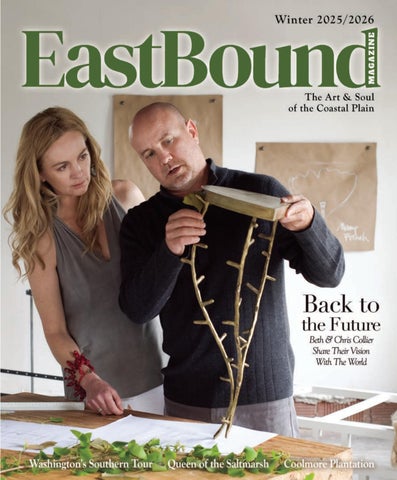
By Harris Vaughan • Photographs by Meridith Loughlin
The Art & Soul of the Coastal Plain
EastBound Magazine
37
38 EastBound Magazine
The Art & Soul of the Coastal Plain
T
he windows were still boarded when Chris and Beth Collier first entered the old Tayloe Hospital with flashlights. In the darkness, their beams caught glimpses of what others saw as a list of demolition items. Drop ceilings sagging. Asbestos warnings posted. Old patient rooms abandoned with no sign of life. But where Washington residents saw a teardown, the Colliers saw potential. “Thank God we were young enough and crazy enough to just leap first without thinking it through completely,” Beth says now, sitting in what was once the second-floor recovery ward of the 1900s hospital. Sunlight streams through windows that haven’t been boarded for years, illuminating a space that feels like a New York City loft yet deeply, unmistakably Southern. This is where vanCollier creates furniture that ships all over the world from a building where Beth’s grandmother died and Chris’ grandfather threw surgical scalpels at interrupting colleagues — where half the town was either born or broken and mended. The Colliers haven’t just renovated a building, they’ve
The Art & Soul of the Coastal Plain
EastBound Magazine
39
resurrected a community touchstone, transforming it into something entirely unexpected: a laboratory for the living where the past resets the present and simplicity sets trends. The transformation reads like a meditation on seeing things differently. Where others might sanitize history, the Colliers embraced it. The third floor, once an operating theater, now serves as their studio — no HVAC, just windows thrown open to let in the sounds of the neighborhood. Dogs barking. People chatting. The rhythm of a small eastern North Carolina town going about its business. Paint fumes mix with sawdust. Their son Beck, who is autistic and non-verbal, primes frames with careful precision. This is not a sterile surgical theater; it’s a working design studio where beauty emerges from function and limitations become inspiration. “Living in this building has inspired us as far as how we can draw a chair or make a chair and think about how it’s going to fit in your space,” Chris says. Every material choice matters when it comes to their aesthetic: clean lines, multiple uses, timeless forms that work as well in a California mansion as they do in their own converted hospital apartment. The story of one of their most successful pieces captures this chemistry of material and vision. Chris sketched it in seconds — a demilune table called the Hulot, so simple it barely seemed worth
40 EastBound Magazine
noting. But Beth, with her art history eye, saw what others might miss: elegance in simplicity, versatility in restraint. “Interior designers are buying it and saying, ‘Oh my God, I can put it anywhere,’” Beth says. The table can wear wood, stone or glass on top. It can grow taller or shorter, wider or narrower. In a world of overwrought design, the understated Hulot table refuses to shout. The Colliers’ gift is transforming the overlooked into the essential. Where generations of farmers saw tobacco sticks as nothing more than workhorse pieces of wood, the Colliers saw frames. Those same sticks that once cured tobacco in a grandfather’s warehouse before finding their way to the burn pile ship to Turkish lighting designers, to Brooklyn lofts, to anywhere people hunger for authentic materials with stories that, in some cases, even carry the scent of authenticity. “Just to think about looking at those tobacco sticks aging in an old warehouse and then now we’re shipping them to a Turkish guy — it’s just mind-boggling,” Chris says. “I do think we have the capability to see beyond what’s in front of us a lot of times.” The building itself tells this story of transformation. Local visitors arrive with memories. Births. Surgeries. Final visits with grandparents. “I was born in that room over there,” one elderly man told them. “This is where your grandfather removed my ton-
The Art & Soul of the Coastal Plain
sils,” said another. Rather than feeling burdened by this history, the Colliers see themselves as stewards of collective memory, honoring the past while creating a new present. Their approach to business mirrors their approach to renovation — patient, organic, trusted. When a woman from the Bahamas called to say she was standing in their living room while they were away at market, they weren’t alarmed but amused. This is how community works in small towns — on openness and the radical idea that good things are often just discovered. “I was worried that in a lot of small towns, people don’t like change,” Beth says of the early days. Instead, they found support, curiosity and, eventually, pride. By saving the building everyone expected them to demolish, by creating opportunities for local craftsmen, by proving that world-class design can emerge from a town most people call “Little” Washington, they’ve become more than furniture makers. They’re proof that you can create a global business without losing your local soul. Evidence of their impact is obvious. House & Garden UK discovered their pagoda lantern and called it “a sketch in the sky.”
The Art & Soul of the Coastal Plain
Architectural Digest followed, stunned that such sophistication could emerge from rural North Carolina. High Point furniture makers drive hours to see their studio, trying to understand their “ways.” But the Colliers’ way isn’t complicated — it’s just countercultural in its patience, specificity and locality. “You can make it work if you want to, wherever you live,” Beth says. “You just have to push through. You have to have faith in what you’re doing, too.” Faith seems the right word for what happens in the old Tayloe Hospital. Faith that beauty can emerge from any material, any place, any circumstance. Faith that what others discard might be exactly what someone else wants. Faith that two people with sketchbooks and shared vision can transform not just a building or a business, but the very idea of what’s possible in a small eastern North Carolina town. Beck makes his way to the third-floor studio, ready for another day of work in the place his parents created — a place where his limitations don’t define him, where he has purpose and belonging. The morning sun catches the stack from yesterday’s work, the proof of progress. Somewhere in New York, a designer
EastBound Magazine
41
42 EastBound Magazine
The Art & Soul of the Coastal Plain
unwraps a new Hulot table, running her fingers over its simple curves, probably never imagining it was conceived in seconds and built in a former operating room by people who see treasures where others see teardowns. The Colliers work on, surrounded by their antiques and prototypes, their sketches and dreams. Outside, Washington goes about its business, a quiet and distinctly Southern river town overlooked by most of the world. Inside, in their laboratory of living, Chris and Beth continue their experiment in transformation — turning discarded materials into coveted furniture and proving that the best design often comes from the most unexpected places. “We feel very blessed that we live and work, play, eat, sleep, drink here,” Chris says, surveying their domain. In the old hospital, once destined for the scrap heap, they’ve created more than furniture. They’ve created a way of living that honors the past and builds the future, salvaged one piece at a time. EB To visit vanCollier, head to historic downtown Washington, North Carolina. Their studio occupies the former Tayloe Hospital on Second Street. Harris Vaughan is a strategic communications executive in Raleigh, certified whole hog barbecue judge, and Edenton native who has raised three children with his wife Ashley. When not judging barbecue competitions, you’ll find him exploring the Outer Banks and Cape Fear region.
The Art & Soul of the Coastal Plain
EastBound Magazine
43
I
t’s wintertime in the marshes of Masonboro, a still-wild barrier island just south of Wrightsville Beach. Cold, clear water flows out to the sea through winding tidal creeks, exposing the umber-colored roots of the saltmarsh cordgrass. The air is crisp, tinged with the briny-sweet smell of marsh mud. There is no sound but the dull roar of waves on the distant beach and the cascading call of the willet — not silence, but the absence of noise. The sun hides behind clouds whose rippled textures mirror the surface of the water on a windless morning. This is the office of Äna Shellem, owner and operator of Shell’em Seafood, commercial fisherwoman and badass queen of the salt marsh. She sells seashells not just by the seashore, but to top restaurants across the Coastal Plain and Piedmont of North Carolina — including Brodeto and St. Roch Fine Oysters + Bar in Raleigh, Basnight’s Lone Cedar Café in Nags Head, The Hackney in Little Washington, and Olivero and Seabird in Wilmington. On this day, Shellem, photographer Mallory Cash and I pull our boat up to the edge of the marsh and step out, nearly losing
46 EastBound Magazine
our shoes in the squelching mud. The three-toed tracks of herons far outnumber our bootprints. Scanning the horizon, I don’t see another person anywhere. Shellem, 35, learned to navigate these waters shortly after moving to the area 14 years ago. Raised in Tennessee and Kentucky, she started working in professional theater at the age of 8. As a teen the young actress spent summers in New York City and moved to Harlem after graduating high school. It was from there, at age 21, that she came to Wilmington for the first time. “I hadn’t experienced the ocean like this, ever in my life,” Shellem says. “I felt drawn to it — like a need to be here.” She got a job as a bartender in Wrightsville Beach, where she met her husband, Jon, who lived aboard a sailboat at the time. In boots, waders and braids, she forges fearlessly into the tall Spartina grass, taking in textures and subtle differences in soil color and composition to help her find what she seeks. Her mind is completely focused on the here and now. But this act of foraging is ancient, bubbling up from some part of the brain
The Art & Soul of the Coastal Plain
The Art & Soul of the Coastal Plain
EastBound Magazine
47
O
most of us don’t use anymore. In this strange postmodern age of AI and TikTok, she’s guided by the wisdom of generations of hunter-gatherers. Today Shellem is gathering mussels, destined to become paella tonight at a local restaurant. Once called “the oysters of the poor,” many fishermen have difficulty selling these often overlooked shellfish, as the general public usually doesn’t cook them at home. Äna figured out how to get around this problem — she sells directly to chefs — and essentially made the market for them in North Carolina. Now, they’re a staple harvest for her. She zeros in on a cluster, nestled deep in the grass. A single well-practiced thrust with her hori-hori knife, and she rises up, a wide grin on her mud-flecked face, her gloved hand full of mussels. They are beautiful, glistening splinters of obsidian. She lays them delicately in her bucket and is off in search of more. The sun comes out and lights up the world.
48 EastBound Magazine
n the day of our excursion, the work went easily. But there are days when the marsh hides her face, when the northeast wind blows strong, and the tide doesn’t drop. There are frosty mornings when her gloves are frozen solid and sultry evenings when no-seeums feast on exposed flesh. There are long days with big orders to fill when her body aches from bending, from lugging heavy buckets of shellfish through the sucking mud back and forth to her trusty gray skiff. And there are duck hunters with loaded shotguns and poor eyesight. There was the weird stillness of the COVID-19 pandemic, when her 31 restaurant customers dropped to a mere handful as they struggled to stay open themselves. Her web shrank, but the connections deepened as everyone navigated their new reality together. Some chefs continued to buy her product for new dishes that could be sold as takeaway fare. “It was a lot of casseroles,” she says later, laughing in the salon of her and Jon’s houseboat. “Shellfish aren’t a to-go food, really. But we all had each other’s backs.” She found other sources of income — working on an oyster farm or going crabbing — but none of them called to her like wild harvest. “I’m beyond obsessed with shellfish,” she admits. She was relieved, as we all were, when the pandemic abated and normalcy slowly crept back into life. Today, the biggest problem she faces sends its insidious tentacles stretching from one rotten source like Capt. Nemo’s killer squid: anthropogenic climate change. In the summer of 2025, the heat was insane. The air hung thick as a velvet curtain, and the blistering noon invariably conjured anvil clouds, flashing lightning teeth and roaring grumbles of thunder. Friends of Shellem’s who run another commercial fishing boat were struck by lightning that year, disabling their boat for weeks. You don’t want to be the tallest thing on the water in an electrical storm. Summertime also brings more visitors to these fragile beaches, their cars belching carbon dioxide into the atmosphere as they search for parking spots that don’t exist. Armadas of boats with sleek lupine engines howl through the channels — another side effect of COVID was more boats on the water. Their wakes are full of beer cans and cigarette butts, slick two-stroke sheens and the dissipating sounds of Kenny Chesney. Weekends were nothing short of a bacchanal, the water festering with the detritus of partying passengers. Finfish can flee to cleaner waters offshore, but the oysters are trapped in their beds. “It’s disgusting,” says Shellem, who stops harvesting in the summertime. “I don’t want to swim in that water, let alone eat out of it. I don’t eat shellfish that time of year, but I’m also not trying to eat a tomato sandwich in January. I always say, eat in season — it’s good for a reason. You can taste the difference.” Oysters may remain on the menu in summer months, especially in restaurants catering to the transient tourist crowd. Shellem explains that those oysters, if local, are farmed. If they are wild-caught, they’re brought down from up North, where the water remains cold. Many restaurants buy their seafood from The Art & Soul of the Coastal Plain
(and many fishermen sell their catches to) large seafood distributors. The scale and logistical complexity of these operations sometimes means an oyster has to be driven by refrigerated truck to Georgia to do time in a warehouse before ending up on a plate in Raleigh or Charlotte. Shellem is unwilling to do this. She personally delivers each order to her clients, often within 24 hours. “The demand is there for the fishing I do. I could do more, but I choose to stay small because that’s what sustainability is to me. (Going with a big distributor) changes the way the food makes it to the plate, and I want to keep that intimacy. It means a lot to me. It’s not how I want to treat my product. It’s not how I want to treat Mother Nature. People know fresh.” Of course, heat in the Carolina summertime is nothing new. The old saw about only eating oysters in months with “r” in them (October, December, February, etc.) is old for a reason. However, it is demonstrably getting worse. The summer heat in 2024 was the warmest since recordkeeping began in 1850 with 2025 not far behind. Shellem has noticed a difference. Her season, which traditionally runs from Oct. 15 through March 31, is getting shorter, delayed by hurricanes and rainfall in autumn and
50 EastBound Magazine
cut short by rising temperatures in the spring. Her job is being made more difficult by a slimy green algae that covers the beds, which usually doesn’t appear until late spring but showed up in February in 2025. She’s also seen an abundance of stone crabs, a species famous on Floridian plates, that are migrating north as waters warm. Clam populations, once so abundant here that Native Americans used beads fashioned from their purple shells as currency, still haven’t recovered after the last major hurricane. In 2018 Hurricane Florence sent millions of gallons of untreated hog waste from factory farms in eastern Carolina rushing down river to the coast, where the sea turned black from the pollution. That storm almost destroyed what Shellem had worked so hard to build. She couldn’t harvest for six months afterward. We can expect more frequent and intense hurricanes as carbon dioxide levels continue to rise in the atmosphere. “I see a lot of problems going on,” Shellem says. The onewoman nature of her business makes her problems different than bigger fishing operations, but some things are universal. “Regulation, mismanagement, politics. People not believing in science and data. And then stubbornness, of wanting to stick
The Art & Soul of the Coastal Plain
with what generations have done and being uncomfortable with change and afraid of change when it just has to happen, because that’s the way the world works. You have to find new ways of doing things, especially with the Earth suffering so much. She’s literally screaming at us. And if we don’t listen, we’re going to lose a lot more than we already have.”
J
ames Brown sang that this is a man’s world, and in commercial fishing at least, that’s largely still true. But after nearly a decade in business, the other fishermen — predominately male — take Shellem seriously. They’ve learned that she’s not going anywhere. Her harvest, however, is — and fast. That speed makes a difference, according to restaurateur Sunny Gerhart, owner and chef at St. Roch in Raleigh and Olivero in Wilmington, who has been buying Shellem’s harvest since the beginning. “The cool thing about Äna is she’s not trying to sell 10,000 bags of oysters,” Gerhart says. “She works with the folks she works with. If I say I want three bags, she’s going to harvest me three bags and that’s it. We’re getting it the same day — she’s harvesting in the morning, and then she’s on the road. It’s hard to get any fresher than that.” With oysters so fresh, Gerhart says, it’s best to serve them raw, on the half shell, perhaps with a little mignonette. Even when he experiments with smoking and preserving the clams and mussels she brings him, echoing the culinary tradition of the Basque coast of Spain, he tries to do things simply to highlight the flavor of the product and the hard work that goes into it. “It’s a beautiful product on its own, but it’s really taken care of by Äna,” Gerhart says. “She’s a steward of the coast. We’re just trying to showcase what she’s doing, what the coast is doing. I don’t need to show off my culinary skills. She’s the one doing the hard work, so let that shine.” Lauren Krall Ivey, co-executive chef at Olivero, echoes Gerhart’s sensibilities. “I haven’t seen anyone else wild-harvesting mussels around here,” Ivey says. “Having them is amazing and unique. They’re larger in size and different from the Canadian mussels you see around, and look great on the plate.” Ivey’s favorite presentation using Shellem’s product is an escabeche with pickled mussels and shrimp served with a Calabrian chile aioli and potato chips. Shellem’s shellfish end up in places other than restaurants, too. Charlotte’s Free Range Brewing has brewed one of their most popular beers, Sea of Companions, with her oysters since 2018. “Äna’s oysters are the star ingredient,” says Jason Alexander, co-owner of Free Range. “They’re the saltiest we’ve ever encountered.” Combined with a malty backbone of roasted oats and wheat, 96 percent of which is sourced locally, and a touch of hops to add balance and bitterness, the result is a rich wintertime porter with notes of salted chocolate. Each 200-gallon batch includes over 600 oysters, boiled in the wort like a stew during the last stage before fermenting. “As the beer is in the kettle, we recirculate it through a separate vessel with the oysters in it,” Alexander explains. The oysters cook, releasing their liquid inside. “That breaks down the meat, adding proteins that
The Art & Soul of the Coastal Plain
contribute to the body of the beer, and it allows us to strip some of the minerals from the shells, which enhances the flavor.” Art and chemistry combine to create a truly crafted brew, and it seems the city agrees: Another Free Range offering using her mussels, named Shellem’s Mussel Beach, was nominated in 2024 by independent weekly publication Queen City Nerve as Best Kölsch in the city.
W
herever her harvest ends up, it always points back to the marsh, to one hardworking woman and a dream. Despite heat and hurricanes, Shellem will be back out there tomorrow, and the next day, and the next. The pull of the moon on the tide pulls her, too. Even on days she doesn’t have orders, she often finds herself on a busman’s holiday in the marsh, exploring new spots or just pausing to appreciate the beauty around her. “I didn’t start fishing for the money,” Shellem says. “I started because it made me happy.” Out there, in the grass and the mud, above the water and beneath the sky, it’s easy to see why. EB John Wolfe enjoys life as a writer and mariner on the North Carolina coast. More of his work can be found online at www.thewriterjohnwolfe.com
EastBound Magazine
51
George Washington’s 1791 Southern Tour By Warren L. Bingham s the hero of the American Revolution and a man of action, George Washington knew his presence mattered. Shortly after becoming president, he planned to visit all 13 states, “to see and be seen” while promoting the new Constitution and the federal government. By 1791 Washington had made trips to the Middle and Northern states. That spring he would conduct the Southern Tour, traveling to Virginia, the Carolinas and Georgia. Except for brief visits in the 1760s as a landowner in North Carolina’s Great Dismal Swamp, Washington had never been south of Yorktown. The Southern Tour was the most challenging of Washington’s journeys. The president would leave from the nation’s temporary capital, Philadelphia, and be away over three months to reach the farthest points in South Carolina and Georgia. Roads were bad. Crossing water was often an adventure. Inns were few and far between, and the standard unreliable. Horses required proper provisions. Bad weather, clouds of dust and even highway robbery loomed as threats — though one supposes the prospect of holding up Washington and his traveling party would have required an extraordinarily witless band of criminals. Nonetheless, the 59-year-old Washington and eight traveling companions embarked on the Southern Tour on the first day of spring of 1791. Cabinet members Thomas Jefferson and Henry Knox escorted the entourage from Philadelphia to Delaware. Washington left a detailed itinerary with Vice President Adams and his cabinet members if they sought to get mail or messages to him. Washington was paid a whopper of a salary as the first president, $25,000, but he covered his own expenses for his residence, office and presidential duties, including travel. He paid his household staff and secretaries from his earnings. The presidential entourage included seven servants from his Philadelphia home, two of them enslaved men on loan from Mount Vernon. William Jackson, a longtime secretary of Washington’s, served as top aide on the trip. Jackson, an officer during the Revolution and a Charlestonian, was young and single, making him ideal to take along on the journey. The trip was considered too arduous for a lady, so first lady Martha
52 EastBound Magazine
Washington remained at home, even though she was a veteran of some wartime camps. Transportation included the president’s own cream-colored coach and four, a baggage wagon pulled by two horses, and a few extra saddle horses. Washington’s personal mount, Prescott, a tall white parade horse, made the trip. Quite aware of looking presidential, Washington, who stood 6 feet, 2 inches tall, made a dashing impression riding high in Prescott’s saddle. Folklore suggests that a greyhound named Cornwallis accompanied the travelers, but alas, the presence of the hound is likely a myth. Washington was a planner, and he immersed himself in the journey’s details. He consulted with his secretaries and gentlemen travelers to understand the roads and inns of the South. The president decided to go south along the fall line and the Coastal Plain and to make the return north through the Piedmont, the higher land between the Lowcountry and the mountains. He charted a route that gave him a good feel for the region, though he specifically wanted to visit Charleston, South Carolina, then the fourth-largest city in the country and a place of influence and affluence. Georgia’s two notable places were Savannah and Augusta, so he was going no farther south than those towns. Atlanta didn’t yet exist. The trip from Philadelphia to North Carolina was a memorable one. The travelers endured near-calamities while crossing both the Chesapeake Bay near Annapolis and the Occoquan River in Virginia. Stops in Fredericksburg, Richmond and Petersburg went well, however, and represented Washington’s typical reception. The president was feted by dinners, dances and cannon salutes. Upon his arrival, parades ensued, church bells rang and choirs sang. Eighteenth century drinking was impressive and many toasts were offered — usually 13 (one for each state, of course) with a few more thrown in for good measure. Hosts dressed up in their finest clothes, and women wore sashes adorned with words of tribute such as “Long Live Washington!” Some towns were lit up with torches, candles and bonfires, a prospect that would have alarmed any self-respecting fire marshal, had such public safety civil servants existed then. Elected officials, Masons, ministers and veterans of the The Art & Soul of the Coastal Plain
ing Philadelphia, wind, rain and lightning filled the air as the president and his party made their way into North Carolina. Washington wrote: The uncomfortableness of it, for Men and Horses, would have induced me to put up; but the only inn short of Hallifax having no stables in wch. the horses could be comfortable & no rooms or beds which appeared tolerable, & every thing else having a dirty appearance, I was compelled to keep on to Hallifax. At the end of this stormy day, Washington crossed the
N.C. Wyeth, “Reception to Washington on April 21, 1789, at Trenton on his way to New York to Assume the Duties of the Presidency of the United States,” Oil on canvas, 518 cm x 366 cm (17 feet by 12 feet)
PHOTOGRAPH BY ERIN GRUGAN, THOMAS EDISON STATE UNIVERSITY
Revolution were received by the president. He sometimes attended church services and occasionally had the luxury of riding Prescott around town simply to see who he might see. Traveling between the larger towns wasn’t easy. Local militias often escorted the president, stirring up a choking dust. The inns along the road were often “indifferent,” a term Washington used to politely describe barely acceptable accommodations for man and beast. On Saturday, April 16, 1791, nearly four weeks after leav-
While N.C. Wyeth's depiction of George Washington shown here is not from the president's Southern Tour of 1791, the reception was typical of those he experienced on his journey.
Roanoke River, arriving in Halifax around six in the evening for his first true taste of North Carolina. Any visit Washington had previously made to the Great Dismal Swamp hardly counts — it’s like saying you’ve been to Dallas after changing planes at DFW. It’s not certain where Washington lodged during his twonight visit to Halifax, but it was probably Eagle Tavern. As much as practicable, he refused private lodging during his presidential journeys, either paying his way or agreeing to stay in community-provided accommodation. At times during the Southern Tour, however, there simply wasn’t a suitable public place available. Of course, the horses had to be properly cared
54 EastBound Magazine
for and fed — and some public houses weren’t even reliable enough for that. Halifax was home to several notable North Carolinians, among them, Congressman John Baptist Ashe, future Gov. William R. Davie, and Willie Jones, who had led North Carolina’s opposition to the Constitution and was no fan of the federal government. Indeed, Jones suggested he would receive Washington as a great man — but not as president of the United States. Though Washington was greeted politely and treated respectably in Halifax, there’s no doubt that the presence of Jones tempered the enthusiasm. After all, Washington was in town for only two days, but the locals had to live with Jones long after the president was gone. Samuel Johnston, an Edenton lawyer and the squire of Hayes Plantation, wrote in a late-May letter to James Iredell that “the reception of the president in Halifax was not such that we could wish tho in every other part of the country he was treated with proper attention.” In 2011 — with the specter of Jones long dead and buried — Halifax commemorated the Southern Tour on Historic Halifax Day. When he reached Tarboro, Washington was impressed by the bridge — a rarity in 1791 — over the Tar River. Apparently, the number of cannon in Tarboro was in agreement with the number of bridges. Washington wrote, “We were received at this place by as good a salute as could be given with one piece of artillery.” Reading Blount, a veteran of the Revolution and a member of the state’s prominent Blount family, led the president’s entertainment. Washington made his way from Tarboro to Greenville along roads that no longer exist, but his route probably tracked near today’s Route 33. In Greenville, the president, ever a farmer, was pleased to learn about local crops, including tobacco, and was intrigued by tar-making and its commercial value. Nonetheless, Washington wrote that Greenville was a trifling place. Greenvillians shouldn’t fret; the president would say the same thing about Charlotte. After a night near present-day Ayden, during which Washington worried about the horses going uncovered without stables, the travelers passed near Fort Barnwell en route to New Bern. Likely edging out Wilmington as the largest town in North Carolina in 1791, New Bern turned out smartly for Washington. Mounted militia and town leaders met the president’s party several miles outside town to act as escort. The city provided a new but never occupied home for the president’s stay, the John Wright Stanly home, which still stands and is part of today’s Tryon Palace complex. On his second night in town, Washington was entertained at a gala at Tryon Palace, and his dance card was full. In recent years, a yellow gown worn that evening by Mrs. Ferebe Guion was shown The Art & Soul of the Coastal Plain
and evaluated on PBS’ “Antiques Roadshow.” The dress, value unknown, remains in the hands of Guion descendants. In an age of slow and unreliable mail, Isaac Guion, Ferebe’s husband, took advantage of the presidential traveling party and their Southern passage to send a letter to a friend in Georgia via the president. Imagine the conversation. “Uh, Mr. President, as long as you’re going . . .” I suspect William Jackson, the secretary, handled it, but indeed the letter was carried to Georgia and ultimately delivered. In the 1940s, A.B. Andrews Jr., a Raleigh lawyer and history buff, came across the letter, acquired it, and presented it to the town of New Bern. It’s kept in the archives in the Kellenberger Room, a wonderful collection of local, regional and state history and genealogy at the New Bern-Craven County Public Library. With all these ties to the Southern Tour, New Bern held major commemorations of Washington’s visit in 1891 and again in 2015. A cannon salute roared as Washington left New Bern, and the presidential party traveled through Jones County, a namesake of Halifax’s Willie Jones. Longtime Pollocksville mayor and avocational historian Jay Bender wonders why Washington stayed so far inland as he went south from New Bern. The old King’s Highway, the post road that went from Boston to Charleston, came through New Bern and tracked more directly to Wilmington. The reason might have been lodging and services for man and horse, since Shine’s Tavern in Jones County, where Washington put up for the night, enjoyed a good reputation. The travelers arrived at the coast, a few miles from Topsail Beach, on Saturday, April 23. By late afternoon they linked up with present-day Holly Ridge and the King’s Highway, today’s U.S. 17. Washington lodged at Sage’s Inn, one of the establishments he labeled as “indifferent,” though another traveler of the era described the proprietor, Robert Sage, as a “fine jolly Englishman.” On Easter Sunday, the presidential party followed the King’s Highway toward Wilmington, resting in Hampstead. Some claim that Hampstead takes its name from Washington requesting ham instead of oysters for his breakfast that morning. There is a large live oak hard by U.S. 17 in Hampstead that supposedly is where the travelers rested. A local DAR chapter has kept the tree marked as the Washington Oak for a century or more. At some point on Easter, Washington wrote a long diary entry in which he observed that the land between New Bern and Wilmington was the most barren country he ever beheld. The travelers had gone through a vast longleaf pine savanna, and Washington had never seen anything like it. While Washington attended church services several times during the Southern Tour, he made no mention of Easter or attending a service in Wilmington. The Port City’s streets were lined with people to catch sight of America’s hero as Washington was led to his lodgings, a home on Front Street provided by the widow Quince, who gave up her home for the president while she stayed with family elsewhere in town. Historian Chris Fonvielle, an emeritus professor at UNC Wilmington, says that Wilmington entertained Washington lavishly, and that it was evident that the president “enjoyed the attention from the ladies and drinking with the gentlemen.”
The Art & Soul of the Coastal Plain
Indeed, Washington’s diary indicates there were 62 ladies at the ball. Fonvielle confirms that Washington spent time at two taverns, Dorsey’s and Jocelyn’s. Tavern keeper Lawrence Dorsey famously told the president, “Don’t drink the water!” Washington’s party continued south on Tuesday the 26th with several stops in Brunswick County. The president met with Benjamin Smith of Belvidere Plantation. Smith was prominent in many ways, a future governor and large landholder, and an officer under Washington’s watch at some point during the Revolution. Southport was originally named Smithville in Benjamin Smith’s honor as he donated the land for the town. Bald Head Island is still known to some as Smith Island, as its original owner was Benjamin Smith’s grandfather, Thomas Smith. After a night at Russ’ Tavern, about 25 miles south of Wilmington, the travelers stopped at William Gause’s Tavern on the mainland side of what’s now Ocean Isle Beach. Local lore says that the group took breakfast there and went for a swim in the swash, waters that are now the Intracoastal Waterway. The story goes that the president hung his clothes to dry in a large live oak by Gause’s that still stands. Washington crossed into South Carolina early on the afternoon of April 27. The president continued his travels through South Carolina and Georgia and returned north to North Carolina in late May with stops in Charlotte, present-day Concord, Salisbury, Old Salem and Guilford Courthouse. Washington moved fast on the northbound return. His departures were often at four and five a.m. after one-night stays. His last stop in North Carolina was an overnight stay with Dudley Gatewood in Caswell County, just south of the Virginia line. Gatewood’s home was disassembled and moved to Hillsborough during the 1970s, where it was reassembled and served many years as a Mexican restaurant. Sadly, the home gradually fell into disrepair and was torn down in 2024. The travelers continued north through Virginia, spending time at Mount Vernon and in Georgetown, Maryland, where the president met with area residents to make plans and arrangements to create the new federal capital on the Potomac. Washington celebrated July 4 in Lancaster, Pennsylvania, and the travelers arrived back in Philadelphia on July 6. Church bells pealed to honor his return. The odometer had turned nearly 1,900 miles and Washington noted that he had gained flesh while the horses had lost it. America’s first president never again went south of Virginia, but his visit to North Carolina and the South in 1791 was a great success. The Stanly House in New Bern and Salem Tavern in Old Salem are the only extant places where the first president slept, but the legacy is alive and well. The journey was a remarkable physical feat, and politically, Washington’s presence among the citizens and leaders of the nascent United States created considerable good will and acceptance of the new federal government, helping to cement the legacy of 1776. EB Warren L. Bingham is a writer and speaker and the author of George Washington’s 1791 Southern Tour.
EastBound Magazine
55
George Snyder III preserves an early American art form By Liza Roberts • Photographs by Trey Thomas
The Art & Soul of the Coastal Plain
EastBound Magazine
57
ast August, when the quilt artist George Snyder III and his wife, Jill, drove 16 hours straight from their home in Ayden, North Carolina, to the New Hampshire home of the filmmaker Ken Burns, it was a dream come true, and not just because they’re fans of his documentaries. The couple went because Burns is also one of America’s great quilt collectors, and he wanted one of George’s rare, hand-sewn quilts for his historic collection. “It was such an honor,” Snyder recalls. “He was so excited and enthusiastic about receiving the quilt, and said there was no male quilter represented in his collection. He had never met a male quilter.” Most people have never met a male quilter. But Snyder’s more important distinction is that he sews his quilts — pieces them together, appliques them and quilts them — entirely by hand, the way they were made hundreds of years ago. Stitch by tiny, meticulous stitch, he replicates early American quilts in exactly the way they were made to begin with. It’s a painstaking, nearly extinct process. Which is exactly why he does it. “My main focus is on preserving the history and the tradition of hand quilting,” Snyder says. “Even the machine quilters recognize that a hand-quilted quilt feels and looks different. It tells so much about a community and a person.” The eastern North Carolina quilting community agrees. Snyder’s one-man show at Greenville’s Emerge Gallery in 2024 was hugely successful, and the Greenville Museum of Art plans to honor him with its Nancy Monroe Artist of the Year award in February 2026. “His work is so beautiful,” says Trista Reis Porter, the museum’s director, who is committed to celebrating traditional art forms including textiles. “You don’t find a lot of quilters making quilts by hand, and he’s so tuned into the history of quilts and quilt patterns.” Snyder feels the way Burns does about the art form: “As a collector,” Burns told the International Quilt Museum when they mounted a major exhibition of his quilts in
58 EastBound Magazine
The Art & Soul of the Coastal Plain
2018, “I’m looking for something that reflects my country back at me. Quilts rearrange my molecules when I look at them. There’s an enormous satisfaction in having them close by. I’m not a materialist. There are too many things in the world, and we know that the best things in life aren’t things. Yet there are a few things that remind me of the bigger picture. We live in a rational world. One and one always equals two. That’s OK, but we actually want — in our faith, in our families, in our friendships, in our love, in our art — for one and one to equal three. And quilts do that for me.” The Snyder quilt Burns chose for his collection is blue cotton in a pattern called Flocks of Geese, hand-quilted in a Double Baptist Fan pattern. It is 8 feet long and almost 5½ feet wide. As the Snyders presented the quilt and toured Burns’ house and the barn where he works in the town of Walpole, they were awed by the company Snyder’s quilt would keep. Fine antique quilts covered every inch: the walls, the beds, the sofas and cupboards. They hung off ladders and were displayed as art. While this was all undeniably impressive, it also felt like home to the Snyders, whose 1929 brick Colonial in downtown Ayden is also full of quilts, also steeped in history, and also situated in a small, historic, close-knit town. The Art & Soul of the Coastal Plain
Clifton Ash is the name of the antiques-filled house where Snyder sews quilts at his long dining room table as classical music plays. Oil painted portraits of his forebears, and of Jill’s, oversee his work as he makes quilts that replicate hundreds-year-old patterns, techniques and styles. Historic quilts from the American South, in particular those from North Carolina, South Carolina, and Georgia in the 1800s, inspire him most. The patterns and styles they showcase give his speech a lyrical flourish: “Churn Dash,” he says offhandedly, or “Monkey Wrench.” There’s “Cotton Boll,” and there’s “Fence Rails.” There’s “Welsh Strip” and “Pinwheel and Spikes.” Some seem obvious to him, like “Your Regular Nine Patch.” Others evoke simple images and pleasures: “Sugarloaf,” “Orange Peel,” “Butterflies,” “Oak Leaf,” or the more expansive “Grandmother’s Flower Garden.” Examples of these can be found upstairs and down at Clifton Ash. Some are historic, some are made by Snyder. All capture the spirit of a slower, pre-industrial age. Until the sewing machine was patented by Isaac Singer in 1851, and became common in middle class homes in the 1860s, there was no other way. Working in, and respecting, the old ways is something George and Jill Snyder met doing and have always done. The art studio EastBound Magazine
59
beside their house — where George still paints murals, furniture and home decor — is where you’ll find a beautiful old horse carriage, a reminder of the work that brought them together more than 30 years ago in the Belgium workshop of a top European horse harness maker, one whose techniques hadn’t changed in hundreds of years. The past is present in their conversation as well. George’s family’s American history begins in pre-Civil War Virginia; his North Carolina history traces back to his great-grandfather, J. Luther Snyder, who moved to the state in 1904, becoming its first and leading Coca-Cola bottler. His Blowing Rock home, Chetola, was the site of family summers until the 1980s, and eventually became the famed Blowing Rock resort. Jill, who was born in the British Midlands and grew up in Gloucestershire, had a long career as a horsewoman that also brought her in touch with living history. Her work teaching carriage driving at the Sandringham Estate introduced her to HRH Prince Philip, with whom she developed a friendship that continued even after she moved to the United States. Their regular correspondence lasted decades, and she keeps more than 70 letters she received from Philip over the years in a special album.
So maybe it’s not such a surprise that George was so quickly drawn to this old, demanding, unchanged form of art. He fell in love with hand quilting while recovering from back surgery in 2018 and “needed something to do with my hands.” Jill unearthed a partial quilt he’d begun 30 years earlier with the help of a nanny — he loved needlework as a child and younger man but had left it behind — and she put it in front of him. “Here,” Jill said. “Finish this.” “So,” he says, “I finished it. Then I entered it into a quilt show in Greenville and won Best in Show.” That surprised him, because the style of the quilt, known as “Cathedral Window” (a three-dimensional compilation of small, folded fabric squares that resemble stained glass), was so unusual. The experience ignited something in him. It wasn’t long before Snyder signed up for a beginner’s quilting class at the church across the street from his house, and a quick 10 weeks later, “I’d made my first quilt from start to finish, a little nine-patch.” “Once I learned that,” he says, “I just took off.” The next one he made was a replica of an 1841 Mississippi quilt in a “Pomegranate” pattern. Soon, he was quilting full time: studying historic quilts, collecting them, repairing them, replicating them.
The Ayden community has clearly rallied around Snyder and his work, as a walk around town on a sunny weekday morning makes clear. A few blocks from his house is the Town of Ayden Museum, where his first “little nine-patch” is on display. Andrea Norris, the president of the Ayden Historical and Arts Society, and Phil Barth, its artistic director, greet him effusively, eager to talk about his work. Barth, an accomplished artist in his own right, painted the remarkable mural on the museum’s exterior depicting the historic Ayden train depot in 1890. A few blocks farther, Snyder can’t order a chicken salad sandwich at Gwendy’s Cafe & Bakery without people stopping him to ask about his quilts. Back at home, Snyder is working on a replica of an 1800s quilt from Caswell County that he saw at the North Carolina Museum of History, a red and green applique quilt he realized had been owned by a family he knew. “This will be my personal cherry on top,” he says. He’s also got a major community quilt project underway, an
The Art & Soul of the Coastal Plain
18th century-style, all white, “whole cloth quilt” he’s making with a group of seven women every Thursday and Saturday at the church across the street. It’s 7 feet square, stretched out on a frame, and together they hand sew pieces that will be stuffed with wool to form two-dimensional relief designs. Their goal is to complete it by July 4, 2026, to honor America’s 250th birthday. After that, he’ll donate it to the Town of Ayden Museum. “I’m really trying to promote the art and craft of hand quilting with this one,” he says. “And it’s a way to pull the community together.” It’s also a way to share an art form he loves dearly, one he describes as a passion. “A quilt that’s hand-quilted feels different,” he says. “It presents an aura. The person who made it is thinking of (its meaning) with every stitch. So that quilt is saturated with positive thoughts, love, tenderness, whatever you want to call it. That quilt is just saturated. You can feel it just by touching it.” EB Liza Roberts is the author of Art of the State: Celebrating the Visual Art of North Carolina, published by UNC Press in 2022.
EastBound Magazine
61
A Case of the Drops Celebrating New Year’s Eve in style By Emmie Brooks Illustrations by Harry Blair
T
he countdowns are quirky, the crowds are proud, and the traditions are unmistakably eastern North Carolina. Who needs Times Square on New Year’s Eve when you can drop what you know best, from pickles to pigs, bears to berries, crabs to croakers? Burgaw celebrates its blueberry heritage when a large, glowing blueberry drops into downtown as the jams, jellies, muffins,
62 EastBound Magazine
pancakes and pies of the old year make way for the new. “There are lots of towns that do drops, and our community wanted something similar,” says Jayna Augst, Town of Burgaw recreation supervisor. The annual tradition began eight years ago, adopting its theme from the long-running Burgaw Blueberry Festival and the area’s many blueberry farms. Festivities begin at 5 p.m., giving families time to enjoy food, music and dancing — Fremont Street and the downtown are closed to traffic to accommodate the crowds — all leading up to the Blueberry Drop at 7 p.m. It’s an opportunity for local nonprofits to raise funds, and organizations like the Burgaw Lions Club, the Rotary Club of Burgaw and the Parks Foundation to support new town projects. “It helps solidify our identity. We’re here to support the town, what it came from and what it still is,” Augst says. “A lot of people are surprised how fun Burgaw can be.” Morehead City’s Crab Pot Drop began in 2015 when a local business owner partnered with Downtown Morehead City Inc. and city leaders to create this uniquely coastal celebration. “Morehead City is known for its great fishing and water recreation, and the crab pot pays homage to that,” says Anna Smith, Morehead City public information officer. The celebration has become a way for the town to highlight the Crystal Coast’s culture and charm, growing steadily since its inaugural launch, er, plunge. Held along the waterfront with charter fishing boats nearby, festivities include face painting, music and local food, all leading up to the drop. At 8:59 p.m., the crowd counts down as the crab pot descends. When it hits the ground at precisely 9 p.m., fireworks burst over Sugarloaf Island. Crowds typically exceed 1,000 with a mix of locals and tourists, many watching from nearby restaurants, bars and homes. “Locals and visitors alike love coming to the Crystal Coast for great seafood, fishing and views,” Smith says. “This is a nod to that.” In Mount Olive, New Year’s Eve isn’t about counting down to midnight — it’s about counting down a larger-than-life, glow-
The Art & Soul of the Coastal Plain
100th anniversary, and organizers promise new and exciting additions. Downtown, guests can stop by the new Mount Olive Pickle Parlor (part gift shop, part museum), which will be open ahead of the event and stocked with special edition Pickle Drop merch. “We are absolutely dill-lighted to be able to host this fun event, and we relish the opportunity to see everyone,” Kilpatrick says with a laugh. Now in its 25th year, the event remains a beloved eastern North Carolina tradition — one as tangy and proud as the pickle itself. Meanwhile, they grin and bear it in New Bern by dropping their namesake and cultural symbol. The bear drop is a reflection of the town’s heritage, “bern” meaning “bear” in German, and the streets are dotted with more than 100 fiberglass bear sculptures for the occasion. The city’s New Year’s Eve block party kicks off at 5 p.m. and runs until midnight, featuring live music, vendors, food trucks, street performers and games for the kiddos. The midnight Bear Drop features a grizzly-sized, transparent, glowing bear that descends from the top of New Bern City Hall to a lit pedestal,
ing pickle. The Pickle Drop started in 1999 as a small, in-house celebration for the Mount Olive Pickle Company. “Just to mark Mount Olive as the official pickle and pepper of the millennium,” says Melissa Kilpatrick, Mount Olive Company Consumer and Community Relations supervisor. By 2001, the public was invited to the celebration, and about 250 people gathered at the corner of Cucumber and Vine streets to watch a lighted pickle descend from a company truck ladder. The event quickly outgrew the plant parking lot. It now takes place at the University of Mount Olive in front of Kornegay Arena, where thousands gather for food trucks, live music and free pickles. Celebrations begin around 5 p.m., with the pickle dropping at 7 p.m. sharp, timed to midnight Greenwich Mean Time. “It allows us to get home and spend time with our families,” Kilpatrick says. “If you make it until midnight, that’s great, but we’ve already celebrated here in Mount Olive.” Visitors who donate canned goods or funds to the Food Bank of Central and Eastern North Carolina are entered into door prize drawings — including the grand prize: a replica of the jumbo pickle. “It’s just a fun and festive atmosphere,” Kilpatrick says. “Pickles tend to bring out the best in people.” This year marks the kickoff for Mount Olive Pickle Company’s
The Art & Soul of the Coastal Plain
EastBound Magazine
63
while a smaller bear cub drops from a crane to the ground at 9 p.m., giving kids a close-up, petting zoo experience. “I think the bear theme is growing. We all think of the teddy bear we had when we were little, so that whole nostalgia of being a kid and identifying with a bear is really taking off,” says Colleen Roberts, City of New Bern public information officer and brand manager. “Events around the holidays have a Norman Rockwell feel. Candelabras light the downtown streets, trees and poles are wrapped in lights, and the festive atmosphere makes the city feel like a winter wonderland.” On New Year’s Eve in Newport, a glowing pink pig descends to mark the occasion. The tradition began in 2017, when welding students at Carteret Community College built the metal pig as a class project. Newport’s Public Works Department finished the job, painting it pink and stringing it with lights. “The pig ties directly to who we are, from our pig cooking contests to our community traditions,” Newport Mayor Dennis Barber says. The event pays tribute to the town’s long-running Newport Pig Cookin’ Contest, a barbecue festival that’s been drawing crowds for nearly 50 years. The pig drops at 6 p.m. to keep things family-friendly and to honor an early quirk of timing — in the year of the inaugural pig drop, Mayor Barber’s daughter was in Paris on New Year’s Eve, where it was midnight at 6 p.m. Eastern Standard Time. “Six o’clock means families, seniors and kids can all be there together,” Mayor Barber says. “And it’s midnight somewhere — in this case, Paris.” In 2004 Oriental locals, drawing inspiration from New York’s Ball and Raleigh’s Acorn, decided their town would
64 EastBound Magazine
The Art & Soul of the Coastal Plain
celebrate with a croaker — a fitting fish for their waterfront community. Knowing a real croaker likely wouldn’t appreciate the experience, volunteers crafted the initial 18-inch fish from plywood, modeled after the symbol used in the town’s long-running Croaker Festival. Progress (and fish) marches forward, however, and by 2008 the croaker had grown bigger, brighter and battery-powered with three dozen AA cells duct-taped to its back. Oriental’s New Year’s Eve croaker drop is the finale of a larger celebration that includes the town’s dragon run, a 40-year-old tradition that features a massive dragon winding through the streets while drummers and revelers bang pots and pans to chase away “evil spirits.” “It’s such a wonderful chance for the community to come together. It’s something really special for this little village,” says Marsha Paplham, Oriental Tourism Board chairman. The dragon run happens twice on New Year’s Eve. At 8 p.m., the dragon wanders down Hodges Street to the town dock and back, a quieter preview before the 11 p.m. full gallop. The drop closes out the evening at midnight, sending the dragon to its lair until the following December. “It’s a big ruckus affair,” Paplham says. Between New Year’s celebrations, the dragon rests quietly in its nest, carefully tended by a group of local volunteers who call themselves the Dragon Protection Society. Its keepers make sure it stays in perfect condition all year, and the dragon is not to be disturbed except during the New Year’s festivities. For the villagers of Oriental, it’s a cherished guardian, in hibernation most of the year but full of energy when it comes time to welcome in a new one. Fantastical, offbeat, fun and funny, eastern North Carolina’s New Year’s Eve is a patchwork of downright lovable traditions. Let the countdowns begin. EB Emmie Brooks is a Greenville native and East Carolina University graduate working in editorial marketing. She’s happiest with a good story — or a view of the Pamlico River.
The Art & Soul of the Coastal Plain
EastBound Magazine
65
66 EastBound Magazine
The Art & Soul of the Coastal Plain
Keeping Coolmor e A grand architectural masterpiece
By Samuel B. Dixon Photographs by Trey Thomas
A
bout four miles northwest of Tarboro, the land begins to rise gently as you travel along old Highway 64. Small roadside houses soon give way to wide fields of soybeans and cotton, and suddenly — set back in a 5-acre grove of magnolia and deciduous trees — Coolmore appears, its impressive, sturdy form barely visible from the road. Turning into the broad U-shaped drive, an American version of an ancient Italian villa comes fully into view. This is Coolmore, an architectural masterpiece designed by Baltimore architect E.G. Lind in 1859. The house and its outbuildings were completed on the eve of the Civil War for Dr. Joseph W. Powell, a prominent Edgecombe County physician. Tragically, Dr. Powell died in 1861, shortly after construction was finished. Coolmore was among the most technologically advanced homes of its time and one of the first in eastern North Carolina to feature indoor plumbing and gas piping. The original plantation encompassed nearly 3,000 acres of farmland. About 1,500 acres remain today, providing the home with a generous buffer from the modern world and preserving its 19th century character. Entering the Coolmore front hall, visitors are immediately engulfed in an explosion of design and color. The elaborate plasterwork and decorative painting evoke the grandeur of an English country house where no expense was spared. Every surface
The Art & Soul of the Coastal Plain
EastBound Magazine
67
— walls, ceilings and floors — was crafted and designed to impress and astonish. The hand-painted finishes have perfectly and gently aged over the past 160 years, with no major restoration campaigns to detract from the patina of time. Vibrant blues and yellows, carefully marbleized by talented hands of long ago, still cling to the plaster. The extraordinary trompe l’oeil interior is believed to be the work of Ernst Dreyer, a Russian-born artist whose craftsmanship endures as one of the finest examples of interior decorative painting in North Carolina. The compact stair hall draws the eye upward to a graceful, elliptical staircase that spirals toward a cupola four stories above. From the cupola, sunlight filters through colored glass, scattering a prism of light across the richly adorned walls. Reid Thomas, restoration specialist with
68 EastBound Magazine
The Art & Soul of the Coastal Plain
The Art & Soul of the Coastal Plain
EastBound Magazine
69
the N.C. State Historic Preservation Office, describes Coolmore as a sensory overload and jaw-dropping experience. “It was stepping into the breathtaking stair hall during my first visit that remains etched in my mind,” says Reid. The formal dining room is grand in scale yet warm in feeling. Original floor-toceiling china cabinets accented with redpatterned glass flank the fireplace. At the center of the room stands an enormous dining table and chairs stamped “J.P.” for Dr. Powell. The size and elegance of this space rival the great chamber at Downton Abbey, where a dozen beautiful place settings welcomed people to dine in the glow of candlelight. Much of the furniture Dr. Powell and his wife, Martha, selected for their new home is still in its original location. Many pieces retain their 19th century upholstery, and the paintings and portraits hang where the Powells placed them more than 160 years ago. Curtains, lavishly made in the 1860s, still protect the fragile interiors from the sunlight of Edgecombe County summers. The house has changed The Art & Soul of the Coastal Plain
EastBound Magazine
71
72 EastBound Magazine
The Art & Soul of the Coastal Plain
very little since it was constructed by Dr. Powell. Receipts for building supplies, invoices for finishes, furnishings and fabrics are still carefully preserved inside. Beyond the house, Coolmore’s historic grounds remain remarkably intact. The original enslaved servants’ quarters, gas house, smokehouse and carriage house all survive, each topped with a cupola that echoes the architecture of the main house. Collectively, they form one of the most complete antebellum farm complexes in North Carolina. For McCutchen Jones, the fifth generation of the Powell family to live at Coolmore, the house is not just a historic site but a calling. Raised on the property in the sizable original kitchen structure that was moved to another part of the farm and expanded, McCutchen remembers childhood adventures exploring Coolmore’s grand rooms, attic and barns. He has vivid memories of time spent with his uncles and aunts at family gatherings around the dining table. “Coolmore is like a piece of art,” McCutchen says. “No matter which room you go into, you see original trompe l’oeil paintings and exquisite moldings. If you open any drawer or cabinet in any room, you’ll find items dating back to the 18th and 19th centuries. You might discover letters, newspapers, magazines, clothing or receipts for The Art & Soul of the Coastal Plain
EastBound Magazine
73
74 EastBound Magazine
The Art & Soul of the Coastal Plain
everyday necessities. It’s an amazing treasure trove and a door into the past.” Over the years, the Powell family has worked closely with Preservation North Carolina to ensure Coolmore’s protection for future generations. Ownership of the property once transferred to PNC, but McCutchen purchased it back about five years ago. PNC still holds protective covenants on the house and outbuildings and remains an active partner in Coolmore’s ongoing restoration. This partnership has helped maintain both the architectural integrity and historical authenticity of the estate. McCutchen and his partner, writer Lisa Couturier, live at Coolmore, devoting their lives to its preservation. These days, the couple’s time revolves around preserving and restoring Coolmore — painting one side of the house each year in its signature hue, Monticello Rose, and tending to the historic outbuildings that continually need care. McCutchen inherited his stewardship from his uncle, Major Joe Spiers, who lived at Coolmore for decades and was instrumental in its preservation. Coolmore is listed on the National Register of Historic Places and is designated a National Historic Landmark.
The Art & Soul of the Coastal Plain
EastBound Magazine
75
This rare dual distinction underscores its architectural and cultural significance to both North Carolina and the nation. McCutchen occasionally opens the historic landmark by appointment to groups and scholars interested in architecture, history and conservation. On Thanksgiving, the extended Powell family returned to Coolmore to celebrate not only their lineage, but the enduring spirit of a place that has stood for centuries. As McCutchen looks toward the future, he speaks with the same reverence as those before him, ever mindful of who in the next generation will someday become the keeper of Coolmore. EB Samuel B. Dixon is a graduate of the University of North Carolina at Chapel Hill and the Wake Forest School of Law. He lives in Edenton, N.C., where he’s a practicing criminal attorney. He’s involved with historic preservation on a local, state and national level and is a member of the Board of the National Trust for Historic Places in Washington, D.C.
76 EastBound Magazine
The Art & Soul of the Coastal Plain
The Art & Soul of the Coastal Plain
EastBound Magazine
77
L i v
v i n g t h e D R
E
A
M
Capt. Rom Whitaker has been fishing for hire on Hatteras Island since 1986. On the first day of the 2024 Big Rock Blue Marlin Tournament in Morehead City, he and angler Kirk Pugh hauled in a blue marlin weighing 504 pounds, ultimately winning over $2.2 million in that year’s competition. Whitaker, who began coming to Hatteras Island in 1970, and his sons, Rom IV and Cameron, run fishing charters out of Hatteras Harbor in their 53-foot Bobby Sullivan, Release. “You get out on that ocean and you feel like you’re living a dream,” says Whitaker. “There’s not many people that are as excited every morning when they wake up to go to work as I am.”
The Art & Soul of the Coastal Plain
EastBound Magazine
79
Growing up on Hatteras, you come up living a really cool lifestyle. I grew up in a hunting and fishing household. My dad basically showed me how to love living on Hatteras and how to make what you love your job. -Cameron Whitaker
80 EastBound Magazine
The Art & Soul of the Coastal Plain
Dad was working in the corporate world and was traveling here every weekend to go fishing because he loved to do it. Now he’s been charter fishing almost 40 years here. His desire to catch fish and his passion is what’s made him so successful. Something I really admire is to be that passionate for that long, every day about catching fish. It’s truly what he loves. -Cameron Whitaker
The Art & Soul of the Coastal Plain
EastBound Magazine
81
When I lived out in the city there was plenty of work to be had but what was always on my mind was the adventure here in Hatteras. I realized the material things were not that important to me. It was more a sense of family. Everything I have is here. Unless the water runs us out I plan to live my entire life here. — Rom Whitaker IV
82 EastBound Magazine
The Art & Soul of the Coastal Plain
Fly Fishing Season Starts Here. We’ve got a lineup of events to inspire and prepare you for your next fly-fishing adventure. Join us! • Fly Fishing Film Tour • Fly fishing classes • Fly tying classes & socials
Scan the QR code to see the full lineup and sign up!
Check out our events GreatOutdoorProvision.com/events
EastBound calendar Although conscientious effort is made to provide accurate and up-to-date information, all events are subject to change and errors can occur! Please call to verify times, costs, status and location before planning or attending any events.
DECEMBER WEDNESDAY, DECEMBER 17
WRIGHT BROTHERS DAY. 9 a.m. The First Flight Society and the National Park Service host the 121st annual celebration of the Wright brothers’ first flight with keynote speakers, the annual wreath presentation, a flyover and more. This is a free event. Wright Brothers National Memorial, 1000 N. Croatan Highway, Kill Devil Hills, NC 27948. Info: wrightbrothersday.org. NATURE WALK & TALK. 10 a.m. Join the Bird Island Reserve for guided nature walks held every third Wednesday from October through May. Starting from a marsh overlook near 40th Street in Sunset Beach, participants will enjoy a scenic 2.8-mile round trip. 40th St., Sunset Beach, NC 28468. Info: www.ncbrunswick.com. THURSDAY, DECEMBER 18
OPEN HOUSE. 10 a.m. - 3 p.m. Celebrate the season at the CSS Neuse Civil War Museum’s Christmas Open House. Attendees can enjoy Victorian parlor games, a puppet show by the New Bern Puppets and a photo opportunity with Father Christmas. CSS Neuse Museum, 100 N. Queen St., Kinston, NC 28501. Info: (252) 526-9600 ext. 222 or www.dncr.nc.gov. FRIDAY, DECEMBER 19
THE EMBERS. 7:30 - 10 p.m. Kick off the holidays Carolina-style with The Embers featuring Craig Woodlard at the Historic Turnage Theatre. North Carolina’s beach music legends bring their signature blend of rhythm, soul and festive cheer to a Christmas concert that always gets the crowd singing along. Turnage Theatre, 150 W. Main St., Washington, NC 27889. Info: www.artsofthepamlico.org. SATURDAY, DECEMBER 20
HOLIDAY CHEER AT HISTORIC BATH. 4 - 7 p.m. Enjoy 20-minute tours of the elegant Bonner House, decked in Victorian finery, the cozy Carrow Cottage, showcasing a
84 EastBound Magazine
fisherman family’s simpler but joyful holiday traditions. Gather under the marquee tent at Bonner Point for wassail, hot cider, ginger cookies, festive live music and a visit from Santa himself. This is a free event. Bonner Point, 100 South Harding St., Bath, NC 27808. Info: (252) 741-6030 or historicsites. nc.gov/all-sites/historic-bath. MONDAY, DECEMBER 22
To add a spring event, email us at calendar@eastboundmag.com.
Plunge Inc., a 501(c)(3) nonprofit, organizes the event each year. Registration closes Dec. 26. Circle Regional Beach Access, 201 West Atlantic Boulevard, Atlantic Beach, NC 28512. Info: penguinplunge2004@gmail.com or www.penguinplungeab.org. SATURDAY, JANUARY 3
CHOWDER AND CHILL(I). 12 - 3 p.m. Warm up this winter at Sanctuary Vineyards with a Chowder and Chill event. Enjoy hot bowls of chill(i), chowder, soup and cornbread paired with wine and live music for a cozy afternoon. Sanctuary Vineyards, 7005 Caratoke Highway, Jarvisburg, NC 27947. Info: (252) 491-2387 or www.sanctuaryvineyards.com. THURSDAY, JANUARY 8
THE TAMS. 7 p.m. Catch The Tams live at Pioneer Theater for an evening of classic soul, R&B and beach music. Known for hits like “Be Young, Be Foolish, Be Happy” and “What Kind of Fool (Do You Think I Am),” experience the charm of one of the Southeast’s most beloved vocal groups. Pioneer Theater, 109 Budleigh St., Manteo, NC 27954. Info: (252) 305-8578 or thepioneertheater.com. SATURDAY, DECEMBER 27
HOLIDAY OYSTER ROAST. 12:30 p.m. Enjoy all-you-can-eat fresh oysters, steamed shrimp and clam chowder in a festive coastal setting. Ocracoke Seafood Company, 416 Irvin Garrish Highway, Ocracoke, NC 27960. Info: www.visitocracokenc.com. WEDNESDAY, DECEMBER 31
NEW YEAR’S EVE DROPS. See page 62 for a rundown of New Year’s Eve Drops happening across eastern North Carolina.
JANUARY THURSDAY, JANUARY 1
PENGUIN PLUNGE. 1 p.m. Take the plunge for a good cause at the 23rd annual Penguin Plunge in Atlantic Beach. This chilly New Year’s tradition raises funds for Carteret County charities, with participants dashing into the water on New Year’s Day. Penguin
CRAFT NIGHT. 6:30 - 8 p.m. Prepare for Valentine’s Day with a fun, hands-on craft night making needle-felted heart garlands. No experience needed — just bring your creativity and enjoy a relaxing evening at the Farmville Public Library. This is a free event, but registration is required. Farmville Public Library, 4276 West Church St., Farmville, NC 27828. Info: (252) 753-3355 or farmvillelibrary. libguides.com/home. FRIDAY, JANUARY 9
DIRT KARTING. Catch the high-speed action at the Annual Indoor Dirt Karting Championships. This two-day event fills the arena with nonstop racing, loud engines and plenty of dirt track excitement. General admission and day passes are available at the door, and times vary. Senator Bob Martin Eastern Agricultural Center, 2900 N.C. 125, Williamston, NC 27892. Info: (252) 207-1754 or exploremartincounty.com. MUSIC SERIES. 7 p.m. This installment of the African American Music Trails Series, celebrating the heritage of African American musicians with ties to eastern North Carolina, highlights Quincy Jones and friends, featuring artistic director Carroll Dashiell, Jr., a house band and a special guest artist. Emerge Gallery, 404 Evans St., Greenville, NC 27858. Info: (252) 551-6947 or www.emergegallery.com. SATURDAY, JANUARY 10
GEOCACHING. 1 - 3 p.m. Head out to River Park North for an afternoon of geo-
The Art & Soul of the Coastal Plain
WINTER CALENDAR caching adventure. Learn how to use a GPS, follow clues and search the park for hidden caches alongside staff who’ll guide you every step of the way. This is a hands-on, kid-friendly way to explore nature, solve puzzles and see the park with fresh eyes. Perfect for curious explorers ages 7 and up (with an adult). River Park North, 1000 Mumford Road, Greenville, NC 27834. Info: (252) 329-4560 or www.visitgreenvillenc.com. SUNDAY, JANUARY 11
ACROSTRUM. 4:30 p.m. Experience the award-winning violin-guitar duo AcroStrum. Violinist Strauss Shi and guitarist TY Zhang bring a dynamic blend of classical favorites, Chinese-Western fusion and modern progressive rock. Ticket prices begin at $45. River Dunes Harbor Club, 465 Harborside Drive, Oriental, NC 28571. Info: www.pamlicomusic.org. SATURDAY, JANUARY 17
OYSTER ROAST. 6 - 9 p.m. Celebrate North Carolina’s oyster season at Sylvan Heights Bird Park’s annual oyster roast, featuring all-you-can-eat oysters and shrimp. Proceeds support bird conservation efforts, with shells recycled to benefit the park’s breeding birds. Sylvan Heights Bird Park, 500 Sylvan Heights Park Way, Scotland Neck, NC 27874. Info: (252) 826-3186 or www.shwpark.com.
726-3775 or www.ncparks.gov/state-parks/ fort-macon-state-park. SATURDAY, JANUARY 24
BATTLE OF THE BANDS. 7 - 9 p.m. Experience the Battle of the Bands where local and regional artists compete for the top spot. Enjoy a night of live music in the heart of Elizabeth City’s arts scene. Arts of the Albemarle, 516 East Main St., Elizabeth City, NC 27909. Info: (252) 777-2787 or www. visitelizabethcity.com.
MONDAY, JANUARY 19
SCAVENGER HUNT. 10 - 11 a.m. Join a park ranger at Fort Macon State Park for a beach scavenger hunt. Discover drift beans, sea glass, seashells and other beach treasures while exploring the shoreline. Fort Macon State Park, 2303 East Fort Macon Road, Atlantic Beach, NC 28512. Info: (252)
The Art & Soul of the Coastal Plain
FEBRUARY
TUESDAY, JANUARY 27
CRYSTAL COAST RESTAURANT WEEK. Revisit a favorite spot or sample new flavors exploring the dining scene during Crystal Coast Restaurant Week. Participating restaurants roll out special prix-fixe menus with multiple courses, making it the perfect time of year to try something new. The event ends Feb. 3. Meal prices vary depending on the restaurant. Multiple locations, Carteret County, NC 28516. Info: www.crystalcoastrestaurantweek.com. WEDNESDAY, JANUARY 28
COMEDY SHOW. 7:30 p.m. Get ready to laugh with Whose Live Anyway? — a 90-minute improv show featuring cast members from the Emmy-nominated TV hit. Every scene is made up on the spot with audience suggestions, creating a hilarious, one-of-a-kind experience. The Dunn Center, 3400 North Wesleyan Boulevard, Rocky Mount, NC 27804. Info: (252) 985-5197 or ncwu.edu/ dunn-center-performing-arts/. FRIDAY, JANUARY 30
BLUEGRASS. 7:30 p.m. Enjoy an evening of bluegrass and Americana as the Steep Canyon Rangers take the stage with Hank, Pattie & the Current. Experience awardwinning musicians blending tradition with soulful, modern sounds. Wright Auditorium, 100 Wright Circle, Greenville, NC 27858. Info: (252) 328-4788 or artscomm.ecu.edu/ alexander-series/steepcanyonranges/.
Center, 303 SW Greenville Boulevard, Greenville, NC 27834. Info: www.mid-atlanticexpo.com.
COUNTRY MUSIC. 7 - 11 p.m. The Carolina Civic Center Historic Theater presents Hit Men of Country, featuring top musicians who have performed with some of country music’s biggest stars. Prepare for a night of chart-topping hits and behind-thescenes stories. Tickets for this event range between $15 and $30. Carolina Civic Center, 315 North Chestnut St., Lumberton, NC 28358. Info: (910) 738-4339 or www.carolinaciviccenter.com. SATURDAY, JANUARY 31
HUNTING & FISHING EXPO. The MidAtlantic Hunting & Fishing Expo brings together top-quality gear, expert seminars and interactive outdoor activities. The event is designed to foster education and camaraderie, led by a knowledgeable team passionate about the outdoors. This event runs through Feb. 1, and times vary. Greenville Convention
THURSDAY, FEBRUARY 5
JAZZ FESTIVAL. 7:30 p.m. Experience the 46th Annual North Carolina Jazz Festival, where evenings come alive with performances by world-class jazz musicians. From the dynamic chemistry of Noel Freidline and Maria Howell to the soulful improvisations of the Benny Hill Quartet, each night is filled with vibrant music, witty banter and unforgettable solos. This event runs through Feb. 7. Hotel Ballast Ballroom, 301 North Water St., Wilmington, NC 28401. Info: (910) 399-6536 or ncjazzfestival.org. FRIDAY, FEBRUARY 6
THE STRING REVOLUTION. 7:30 p.m. Catch Grammy-winning guitar trio The String Revolution at The Old Theater in Oriental, NC. Known for their electrifying performances and genre-blending style, the group fuses classical, rock, jazz and world music into a sound all their own. Ticket prices begin at $34. The Old Theater, 609 Broad St., Oriental, NC 28571. Info: www.pamlicomusic.org. SATURDAY, FEBRUARY 7
HISTORICAL MARKER UNVEILING. 1 p.m. Murfreesboro is hosting the unveiling of two new historical markers honoring Hannah Crafts and George Reynolds. The first marker, placed on Main Street by the NC Department of Transportation in conjunction with the NC Department of Natural and Cultural Resources, will commemorate Craft’s life and legacy. A second marker on Broad Street will recognize Reynolds, Murfreesboro’s first African American postmaster. A short program and reception will follow at the Murfree Center. Corner of Main and 4th St., Murfreesboro, NC 27855. Info: townofmurfreesboro.com. SHUCK & SHAG. 6:30 - 10:30 p.m. The annual Shuck & Shag, a beloved 30-plus year
EastBound Magazine
85
WINTER CALENDAR
SUNDAY, FEBRUARY 8
CLEAN-UP DAY. 1 - 3 p.m. Join a community clean-up of Court Street and the surrounding Sturgeon City trails. Bring gloves, a reusable water bottle and optional grabbers or buckets. Lend a hand and make a positive impact on your local environment. Sturgeon City Environmental Education Center, 50 Court St., Building 100, Jacksonville, NC 28540. Info: (910) 750-5876 or sturgeoncity.org.
WEDNESDAY, FEBRUARY 11
U.S. AIR FORCE BRASS ENSEMBLE. 7 - 10 p.m. Experience the power of U.S. Air Force Heritage Brass as they bring symphonic brass, percussion and vocals to the stage. This is a free event intended to inspire patriotism and honor the nation’s veterans. Carolina Civic Center, 315 North Chestnut St., Lumberton, NC 28358. Info: (910) 738-4339 or www.carolinaciviccenter.com. WOMEN IN STEM. 6 - 8 p.m. She Innovates: A Women in STEM event will be held at Sturgeon City, celebrating the achievements of women in science, technology, engineering and math. Attendees can explore hands-on activities led by Sturgeon City educators and connect with women STEM professionals. Open to all ages, the event is designed to inspire middle school, high school and college students through interactive learning and mentorship. Sturgeon City Environmental Education Center, 50 Court St., Building 100, Jacksonville, NC 28540. Info: (910) 750-5876 or sturgeoncity.org.
Fletcher Recital Hall, 102 A.J. Fletcher Music Center, Greenville, NC 27858. Info: (252) 328-6019 or fourseasons.ecu.edu.
Battlefield, 40 Patriots Hall Drive, Currie, NC 28435. Info: (910) 283-5591 or www. ncfirstinfreedomfestival.com.
RODEO. The Old Ford Fire Department Survivor Series Rodeo returns to Williamston for two days of rodeo action. This family-friendly event is a Southern Rodeo Association-sanctioned competition featuring bull riding, roping events, barrel racing, bronc riding and more. The rodeo ends Feb. 14, and times vary. Senator Bob Martin Eastern Agricultural Center, 2900 NC-125, Williamston, NC 27892. Info: (252) 975-3128 or oldfordfiredept.com/rodeo/.
SUNDAY, FEBRUARY 22
SATURDAY, FEBRUARY 14
VALENTINE’S DAY 5K. 9 a.m. - 1 p.m. Join in the fun for the ninth annual Love on the Run 5K and Sweetheart Mile. Participants can expect a scenic run (or walk) through the vineyard trails of Sanctuary Vineyards and along the sound. Enjoy post-race wine, cheese and chocolate tastings, along with souvenir swag and finisher gifts. Sanctuary Vineyards, 7005 Caratoke Highway, Jarvisburg, NC 27947. Info: (252) 489-8239 or www.theobxrunningcompany.com. TUESDAY, FEBRUARY 17
LANDSCAPE CONFERENCE & TRADE SHOW. 7:30 a.m. - 5:30 p.m. Attend Nash County Community College’s 28th annual Landscape Conference & Trade Show. Guests can explore the latest in landscaping, turf management and native plant practices through expert-led presentations and demonstrations. Brown Auditorium, 454 North Old Carriage Road, Rocky Mount, NC 27804. Info: (252) 459-9810 or nash.ces.ncsu.edu. THURSDAY, FEBRUARY 19
TO KILL A MOCKINGBIRD. 7:30 p.m. Opera House Theatre presents To Kill a Mockingbird. This stage adaptation of Harper Lee’s classic novel brings the story of Scout, Atticus and the struggles of justice and morality in 1930s Alabama to life with powerful performances and compelling storytelling. Performances begin at 2 p.m. and 7:30 p.m. from Feb. 19 to March 1. Thalian Hall, 310 Chestnut St., Wilmington, NC 28401. Info: (910) 632-2285 or www.thalianhall.org.
FRIDAY, FEBRUARY 13
SATURDAY, FEBRUARY 21
MUSICAL ECHOES. The Cooperstown Quartet joins forces with pianist Robert McDonald in an evening of musical echoes. Hear the haunting lyricism of Schubert’s String Quartet No. 13 in A Minor alongside the passionate intensity of Franck’s Piano Quartet in F Minor. Ticket prices start at $40. A. J.
FIRST IN FREEDOM FESTIVAL. 10 a.m. - 4 p.m. The inaugural First in Freedom Festival at Moores Creek National Battlefield will celebrate more than 250 years of the nation’s story and culture through North Carolina’s history and arts. This event runs through Feb. 28. Moores Creek National
86 EastBound Magazine
JURASSIC BARK. 2 p.m. Jurassic Bark brings talented canine performers to the stage for a dino-sized show packed with tricks, comedy and excitement, perfect for families, kids and dog lovers alike. Ticket prices begin at $20. Weldon Mills Theatre, 500 Carolina Crossroads Parkway, Roanoke Rapids, NC 27870. Info: (252) 536-0672 or weldonmillstheatre.com.
THURSDAY, FEBRUARY 26
VIENNA BOYS CHOIR. 7:30 p.m. The world-renowned Vienna Boys Choir, with a history dating back over 500 years, continues to captivate audiences worldwide. Experience their celebrated choral performance at East Carolina University’s Wright Auditorium, 100 Wright Circle, Greenville, NC 27858. Info: (252) 328-4788 or artscomm.ecu.edu/ alexander-series/viennaboyschoir/. FRIDAY, FEBRUARY 27
FORENSICS NIGHT LAB. 6:30 - 8:30 p.m. Step behind the yellow tape and dive into the thrilling world of crime scene investigation at Forensics Lab Night. This is an age 21 and older event that allows guests to explore interactive forensic stations while enjoying themed cocktails and appetizers. Registration is $25 per person. Sturgeon City Environmental Education Center, 50 Court St., Building 100, Jacksonville, NC 28540. Info: (910) 7505876 or sturgeoncity.org. SATURDAY, FEBRUARY 28
MARATHON. Run from the beach to the boardwalk in the Wilmington Marathon — one of the fastest, flattest courses on the East Coast. The scenic point-to-point race takes runners from Wrightsville Beach to downtown Wilmington, with options throughout the weekend for every pace, including a full and half marathon, 5K, and a free 1-mile kids’ glow run. Dates, times and starting points vary by event. Wrightsville Beach, NC 28480. Info: wilmingtonncmarathon.com. EB
The Art & Soul of the Coastal Plain
AIR FORCE BAND PHOTO: COURTESY CAROLINA CIVIC CENTER HISTORIC THEATER AND JERRY ANDREWS PHOTOGRAPHY
tradition featuring shag dancing to great music and delicious food, brings the community together for an evening of music and camaraderie. Sunny Side Oyster Bar, 1102 Washington St., Williamston, NC 27892. Info: exploremartincounty.com.
EastBound Seen Roanoke Island Oyster Shellabration & BBQ
Gail Turcotte, Kristin Brooks, Ramona Joyce
The Roanoke Island Historical Association November 2, 2025 Photographs by Frank Daniels IV
Harvey & Shelia A. Godwin Jr, Cody Eagle Horse Godwin, Journey Godwin, Gianna & Quinn West Godwin
Dustin & Macie Faulkner, Ann-Cabell Baum, Leigh Lawrence
Kim & Mark DeSocio, Judy Carraway
Sara & Tommy Twiddy, Harry & Angela Moss
The Art & Soul of the Coastal Plain
Ryan Howard, Olivia Ragland, Jharixa & Seth Pugh
Performers: Desmond Bluehorse, Drake Rodgers, Ethan Oxendine, Kaya Littleturtle, Cameron Bryant, Chloe Greene, Zena Clark, Journey Godwin
Bill Mears, Molly Urquhart, Gwyn & Gary Pearce
Emily, Chelsea & Bruce Langevin
Alice Ward, Mary Hannagan, Barbara Burd
Stephanie Benson, Logan Gentry
Erin Moore, Lucy Power, Nancy Stanford
Marc & Lisa Aronin
EastBound Magazine
87
EASTWORDS
The Back Page . . . Welcome to my world By Celia Rivenbark
88 EastBound Magazine
or a rear parking lot so your nosey-ass neighbors couldn’t see your car there. Some particularly repressed towns had so much shame, they had a wall AND a rear lot. My, oh, my, how things have changed. Today there’s a brewery in Burgaw just 500 feet from the nearest church and nobody much cares. The shame has disappeared like deviled eggs at a family reunion and I think that’s probably a good thing, sanctimony being such a useless emotion no matter where you live. To be East “bound” is to be biologically and philosophically incapable of passing a farmstand with an honor-system cash box. To be East “bound” means there’s a better than even chance you’ll have to pull the car over to quietly admire the rainbow prism in the water spraying from an irrigation gun in a bean field. To be East “bound” is to personally be related to a selftaught fiddler (or guitar picker or banjo player or piano pounder) who brags he can play “Cat Shit and Honey” so good you’ll have to open a window when he’s done. (‘Nother words, there’s a lot of homegrown musical talent here.) Our language is lush and speckled with humor. It’s an eastern North Carolina thing that many have tried to imitate. Pity. This is my homeland. Like Jesus, I’ve never lived more than 35 miles from the place I was born. You wouldn’t either if you’d ever eaten a whole fried chicken turned with a pitchfork. What could ever be better than that? Yeah. That’s what I thought. Celia Rivenbark is a New York Times bestselling author. She has been nominated for the James Thurber Prize three times and wouldn’t think of living anywhere but Down East.
The Art & Soul of the Coastal Plain
ILLUSTRATION BY HARRY BLAIR
T
he back-page column of any publication is prime real estate. It’s a showcase, a “Shazam!” and a “Hot damn!” of a location. So how did I get this gig? I suspect it was all because of my eastern North Carolina “bona frieds.” After all, I was born in a doctor’s office a hundred yards from “The World’s Largest Frying Pan” in Rose Hill, Duplin County. My mama pushed me out on a sunny Sunday’s child September afternoon and was rewarded with a Swanson’s Ham with Raisin Sauce TV dinner delivered by a nurse shortly after. Talk about the good life. Although I’m mostly a humor writer these days, I’m dead serious when it comes to my abundant love for the quirky eastern third of our state. Down East, we tend to feel perpetually underappreciated. Sometimes that fries our collective tater, causing us to almost reflexively complain about being overlooked. The exception is our beaches, which no manner of whitewater mess in the mountains or waterparks in the Triad or lakes in the Triangle can compare. It’s downright amusing to watch them try. (This reminds me of my friend’s confession that his humility is the quality of which he is most proud.) But seriously! Wide beaches that only diet when smacked by a northeaster. (Please do not say “nor’easter” on account of we don’t live in Bawston.) I’m talking beaches for miles and miles, the less crowded ones proudly unburdened by tackiness and paid parking which, come to think of it, are one and the same. I love the name of this magazine, EastBound, because when written like that it’s less a destination than a state of mind, which I suspect was the whole point. I’m bound to eastern North Carolina in a way that is almost holy. It’s a fertile land populated by hardworking folk whose communion of choice would be a hushpuppy snapped in half and dipped in vinegary barbecue sauce. Talk about a religious experience. (I’m not saying dipping that puppy in the awful tomatoey stuff favored by the rest of the state will send you to hell but I’m not NOT saying it either.) Growing up Down East, most of my friends worked in tobacco to earn money for school clothes. Me? I preferred slinging hash at a country restaurant where a significant number of the regulars were missing limbs after too many gallons of teeth-meltingly sweet tea (and yet . . . ). Other sources of income included a brief stint buying likker for my friend in her 50s who was terrified the clerk would tattle on her to her 80-year-old daddy. Back in the day, every ABC store in every small town in eastern North Carolina had either a wall constructed around it
1
1
HH MM A R K O EEEE W RK INEN EW W M A RR FF JJJEJEEJEW EEEE LLELR Y ®YY® T TTTHHHHEEEEBBBBEEEENNNNCCCCH H H M M A AA RK KKO O OO FFFFF FFIFIIN IN N W LRLR RYRY
™ bracelets Exquisite Pavé Diamond Bracelet and Earrings Magnificent XPANDABLE of Haydon & & Company Presents design…No Atrevolutionary Haydon Company… ofClasp! course!
The Pinnacle of Watchmaking The Platinum Minute Repeater by Patek Philippe
Each Each piece piece is is carefully carefully curated curated for for authenticity authenticity and and excellence, excellence, offering offering collectors collectors an an opportunity opportunity to to own own the the finest finest in in Swiss Swiss watchmaking. watchmaking. Simply Stunning! IfIf you you are are considering considering buying buying or or selling selling aa Patek Patek Philippe Philippe watch, watch, we we invite invite you you to to contact contact us. us. 18 karat white gold, exhibiting over 51 carats of brilliance in the cuff bracelet Availability Availability is is limited. limited. All All watches watches are are subject subject to to prior prior sale. sale.
and over 12 carats in the earrings. ™ 18 karat gold jeweled bracelets featuring diamonds with mother of pearl, all diamonds, and diamonds with blue sapphires
Haydon & Company Haydon Haydon&&Company Company
®
1803 Oberlin Road • Raleigh, NC 27608 • 919.781.1293 • Toll® Free: 866.429.3667 ® ® www.haydonco.com • the American Gem Society 1803 1803 Oberlin Oberlin Road Road •• Raleigh, Raleigh, NC NCMember 27608 27608 •• of 919.781.1293 919.781.1293 •• Toll Toll Free: Free: 866.429.3667 866.429.3667 1803 Oberlin www.haydonco.com Road • Raleigh, NC 27608 • 919.781.1293 • Toll Free: 866.429.3667 www.haydonco.com Member Member of of or the theby American American Gem Gem Society Society Hours: Mon-Fri:••10am-5pm appointment www.haydonco.com • Member ofor the Gem Society Hours: Hours: Mon-Fri: Mon-Fri: 10am-5pm 10am-5pm or By ByAmerican Appointment Appointment Hours: Mon-Fri: 10am-5pm or by appointment
The Audi Q5 Our best, made better.
3001 Evans Street, Greenville, NC 27858 (252) 756-1135 | audigreenvillenc.com