Neighbors caring for neighbors. Expansive services. Compassionate care. All right here. We’re raising the standard of great care right here in eastern North Carolina. We’re expanding our services and our team to ensure that you and your family have access to the care you deserve—whenever you need it. From advanced specialties to everyday wellness, we are committed to serving our region with compassion and expertise. Because our purpose always remains the same—we help people live their healthiest lives.
ECUHealth.org
Spend summer — and forever — on the water
Nestled along the banks of the Pamlico River, Moss Landing is a charmingly inviting waterfront neighborhood and marina just steps from historic downtown Washington, NC. Thoughtfully crafted waterfront homes and cottages are fresh interpretations of classic coastal architecture—and designed for modern living, entertaining, and relaxing. The neighborhood marina is the perfect launchpad for water-based and water-adjacent adventures. Whether you’re catching sunset from the riverfront boardwalk, strolling through the Harbor District’s shops and restaurants, or catching up with friends on your own front porch, you’ll find there’s so much to love about life here, now and always.
Waterfront homes and boat slips are move-in ready now. Summer starts here.
SCAN HERE TO EXPERIENCE EASTERN NORTH CAROLINA.
Inspiring Stories of Eastern North Carolinians living their best lives right here. Deeply Rooted in place, people, and possibility, Eastern North Carolina is defined by the stories of those who call it home. More than a logo or tagline, this identity celebrates the communities, culture, and industries that shape out region while amplifying authentic voices. From chefs and fishing guides to artists, writers, and small business leaders whose lives and work are deeply connected to Eastern NC. Designed to strengthen the price, build connection, and elevate rural voices, this brand showcases Eastern North Carolina as a place to live, work, and stay, and build what’s next.
Deeply rooted is brought to you by the NC East Alliance, the organization leading the way to a robust, revitalized Eastern North Carolina.
are built here.
Canyon 386
Atlantic Marine 910-256-9911 atlanticmarine.com
Manteo Marine 252-473-2197 manteomarine.com
Park Boat Company 252-946-3248 parkboat.com
Radio Island Marina 252-247-7580 radioislandmarina.com
Grady-White boats have been proudly designed and built in Greenville, NC since 1959.
Serving Others. Enriching Lives.®
It’s your vision...your dream. And we’re your bankers. It’s a caring approach. The best local bankers. Empowered to make the right local decisions. Working alongside you to make life better.
TowneBank.com | Member FDIC
Summer 2026 D E PA R T M E N T S 13
FROM FALL LINE TO SHORELINE
17
OMNIVOROUS READER by Kristi Southern
21
BOOKSHELF by Kimberly Daniels Taws
22
STATE OF MIND By Tommy Tomlinson
25
DISSECTING A COCKTAIL By Tony Cross
27
WORTH THE DRIVE by Jason Frye
31
BIRDWATCH by Susan Campbell
80
THE ART OF JUSTIN CAMPBELL
83
ARTS CALENDAR
88
EASTWORDS by Celia Rivenbark
by Bland Simpson
34
F E AT U R E S 33
RELEASE
34
TREASUE ON CAPE LOOKOUT
42
THE BIG UGLY
46
IT WAS A LONG, BUMPY RIDE
50
GROWING THROUGH IT
56
THE SPIRIT OF ’76
60
OPEN HOUSE
64
WHERE HISTORY IS ALL ABOARD
70
GENERAL ELEGANCE
Poem by A. R. Ammons by Jesma Reynolds Reigniting wonder with a historic restoration by Todd Pusser Ocean sunfish are the oddest of oddballs by Tom Maxwell Getting from Parmele to Parmalee
50
by Lora Plauche Fig farming on the coast
by Warren L. Bingham Hooper, Hewes and Penn by Jim Moriarty A Crystal Coast Hall of Famer by Emmie Brooks A rich archive gets a historic home by Samuel B. Dixon The uniquely notable Hermitage
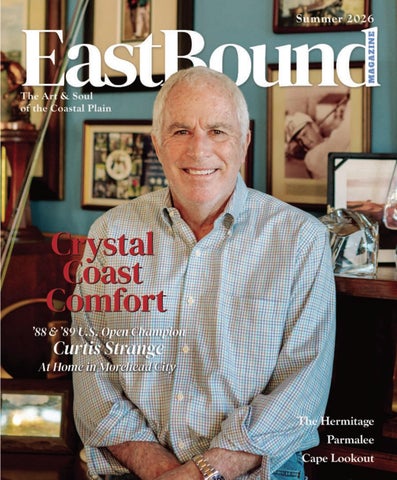
70 Cover Photograph by Jaclyn Morgan
6 EastBound Magazine
The Art & Soul of the Coastal Plain
FAITH GUIDED. PURPOSE DRIVEN. Campbell University invests in each student. We prepare each one to make a life, to make a living and to make a difference. Our students are welcomed into an inclusive community of family, and mentored to become leaders who will impact the world. Inspired by our Christian faith and belief in the power of education, we encourage each student to grow academically, spiritually
campbell.edu
and socially through the world of opportunities that surround them.
A master class in elevated living. A limited collection of residences in Raleigh’s historic Hayes Barton.
BIR NEYPAR K.COM
History is a great teacher. Which is why Birney Park draws inspiration from celebrated neighborhoods in London and Boston, creating a vibrant new community filled with classic style and sophisticated charm. Learn what truly sets Birney Park apart.
A BEACON STREET NEIGHBORHOOD
Rooted Here.
Growing With You. At Southern Bank, we’ve spent 125 years building something simple: a better way to bank. One rooted in real relationships, local understanding, and the kind of support that moves with you through every stage of life. Because when your bank knows you, everything works a little smoother. PERSONAL
|
BUSINESS
|
SCAN TO EXPERIENCE BANKING THAT FEELS DIFFERENT.
M O RTGAG E
EastBound MAGAZINE
The art and soul of the Coastal Plain
COMMUNITIES Strengthened We build more than projects, we strengthen the communities where we live, work, and serve.
Volume 1, No. 4 EB David Woronoff, President david@thepilot.com Ben Kinney, Publisher bkinney@businessnc.com Jim Moriarty, Editor jjmpinestraw@gmail.com Andie Stuart Rose, Art Director Keith Borshak, Senior Designer Alyssa Kennedy, Digital Art Director
CONTRIBUTING WRITERS Joseph Bathanti, Harry Blair, Emmie Brooks, Susan Campbell, Samuel B. Dixon, Jim Dodson, Jason Frye, William Irvine, Tom Maxwell, Mary Novitsky, Todd Pusser, Celia Rivenbark, Liza Roberts, Teri Saylor, Scott Sheffield, Bland Simpson, Kristi Southern,Kimberly Daniels Taws, Harris Vaughan, John Wolfe Brunswick Community College Workforce Development Building
CONTRIBUTING PHOTOGRAPHERS Jacklyn Morgan, Andrew Sherman, Trey Thomas
ADVERTISING SALES Melanie Weaver Lynch, Sales Manager 919.696.6838 mweaver@businessnc.com Erika Leap, 910.693.2514 erika@thepilot.com Julie Nickens, 919.622.5720 julie@waltermagazine.com
ADVERTISING GRAPHIC DESIGN Old Main Stream Academy
Miranda Glyder, Scott Yancey
EB Henry Hogan, Finance Director 910.693.2497
OWNERS Jack Andrews, Frank Daniels III, David Woronoff In memoriam Frank Daniels Jr.
eastboundmag.com 1230 West Morehead St., Suite 308 Charlotte, NC 28208 ©Copyright 2026 Reproduction in whole or in part without written permission is prohibited. EastBound Magazine is published by Old North State Magazines LLC
Hoke County High School
10 EastBound Magazine
The Art & Soul of the Coastal Plain
1
1 11
INN EE W RKKOOO I EN EW TTTHHHEEEBBBEEENNNCCCHHHMMMAAA RRK FF FFFIF JJEEJW EELLERRLYYR®Y
Red, White, or Blue… Take Your Pick ™ bracelets Exquisite Pavé Diamond Bracelet and Earrings Magnificent XPANDABLE of design…NoofClasp! Atrevolutionary Haydon & Company… course!
Expandable Bracelets in 18 Karat Gold Simply Stunning! Featuring Diamonds, Blue Sapphires, and Rubies.
18 karat white gold, exhibiting over 51 carats of brilliance in the cuff bracelet and over 12 carats in the earrings. ™ 18 karat gold jeweled bracelets featuring diamonds with mother of pearl, all diamonds, and diamonds with blue sapphires
Haydon Haydon&&Company Company Haydon & Company
® ®
1803 Oberlin Road • •Raleigh, TollFree: Free:866.429.3667 866.429.3667 1803 Oberlin Road Raleigh,NC NC27608 27608•• 919.781.1293 919.781.1293 • • Toll ® www.haydonco.com www.haydonco.com• •Member Memberofofthe theAmerican AmericanGem GemSociety Society 1803 Oberlin Road • Raleigh, NC 27608 • 919.781.1293 • Toll Free: 866.429.3667 Hours: Hours:Mon-Fri: Mon-Fri:10am-5pm 10am-5pmor orby byappointment appointment www.haydonco.com • Member of the American Gem Society Hours: Mon-Fri: 10am-5pm or by appointment
Whe re the Fa i rwa y s
M e et the Wate rwa y s Just a short drive from the Research Triangle, Occano is a golf lover’s dream. With an award-winning Arnold Palmer Signature golf experience, featuring 11 holes with views of the Albemarle Sound, Occano is your go-to destination to play, stay, and embrace the Inner Banks lifestyle.
RANKED #3 PUBLIC COURSE IN THE U.S.
D A I LY F E E
I
MEMBERSHIPS
I
S TAY & P L AY
Equal Housing Opportunity. Information not verified or guaranteed. All imagery is representational and does not depict specific buildings, views, or future architectural, community, or amenity details. All services, pricing, square footage, bed/bath counts, finishes, floor plans, and renderings are subject to change without notice and at the sole discretion of the seller. Occano Land & Development LLC, is the owner and developer of the project. Obtain the property report or its equivalent, required by Federal and State law and read it before signing anything. No Federal or State agency has judged the merits or value, if any, of this property. © 2025 Occano All Rights Reserved.
CUSTOM BUILDS FROM $450,000 HOMESITES FROM $50,000
OCCANO.COM
F RO M FA L L L I N E TO S H O R E L I N E
Playing the Attic Night of the Legion
By Bland Simpson
I
n the late spring of 1974, our country-rock band, the Southern States Fidelity Choir of Chapel Hill, got an urgent call from The Attic, a well-known upstairs rock-androll beer hall in Greenville. Club founder and manager Tom Haines was saying, Please bring the Southern States down here, because we have word that 40,000 American Legionnaires are heading to Pitt County for Memorial Day weekend — they’ll pack in here at the Attic on Saturday night, and so-and-so has just canceled on us, and we need an act! Our great friend and musical legend Don Dixon, of Arrogance, had gotten the same call earlier, and he had recommended us. The Attic, on East Fifth Street, Greenville, was one of the most coveted showcase venues in Eastern North Carolina, with an official capacity of 400, though as many as 700 could pack in there when the fire marshal was not looking. And our year-old band had never played the celebrated Attic before. We had never played for masses of Legionnaires, either. The deal was a low guarantee against a high percentage of the gross and, however odd the evening might turn out to be, we could not lose, so we took the date in a heartbeat. The Southern States was a quintet: six- and 12-string guitars (Jim “Bud” Wann and John “Jackson” Foley), bass (Jan “Doctor D” Davidson), drums (Michael “Cap’n” Sheehan), and piano (myself). In great spirit, we drove east down U.S. 64 and 264 caravan-style in two cars on that Saturday afternoon. I felt like a king behind the wheel of my ’64 Ford Country Squire wagon, and our longtime friend Scott Bradley led the way in his hardtop, dull green and white International Harvester. Upon our arrival we saw a fellow on a ladder switching out the second half of our name on the marquee to simply “Band.” A management decision: Apparently they thought “Choir” on a country-rock club marquee could be bad for business. When showtime at the big black Attic hall rolled around, 9 The Art & Soul of the Coastal Plain
o’clock that night, we were all wired and fired up, ready to crank it, to step it up and go. Ready to rock the joint. So were the half-dozen audience members, the last few ECU students who were staying over in town that holiday weekend. Since they outnumbered us rather than the other way around, we laid into our first set and made music, eyeing each other and wondering: Where were all those free-spending Legionnaires who, we had been promised, were going to pack the place and give us the windfall paycheck of early summer? On we played, the crowd growing to about a dozen as our first set went along. At the set break, right as we left the stage, the Attic’s manager came from behind the bar and approached us, grim-faced. He had been phoning around, he said, investigating while we performed, and now he laid down the facts of the matter. There were no 40,000 Legionnaires currently in Greenville. Maybe there were 4,000, or possibly just 400, he said. However many there were, they had all come to their celebration site in camper vans, and they were all at an RV park in a former cotton field a few miles outside of town. Apparently they were happily grilling and drinking beer in place, hunkered down on site, and they were most certainly not leaving their safe haven and heading into Greenville’s downtown, daring the state troopers to roadblock them, ready to give them DUIs coming or going, if not both. The manager was sorry things had not worked out as well as EastBound Magazine
13
F RO M FA L L L I N E TO S H O R E L I N E
Lawyers who provide practical solutions.
Business • Government • Utilities • Land
Cauley Pridgen is dedicated to serving Eastern North Carolina. Wilson • Raleigh • Kinston www.cauleypridgen.com 14 EastBound Magazine
he had so earnestly predicted when he first called us. He gave us our $150 cash guarantee and said we could go on and wind it up whenever we wanted to. But the dozen young folks, 10 men and a couple of women, really liked our songs and sound and were loosened up and wanted more, so we all said, what the hell? And the band played on. We played a hot second set, songs of the Colorado trail, dance-hall girls in Baltimore, and juke-joint nights in the South, as if 700 folks were there instead of a mere dozen — for, as Don Dixon has always counseled: “Them that comes gets the show, and them that don’t, don’t!” Soon we were winding up with Van Morrison’s “Brown Eyed Girl,” and our modest crowd all bellowed Sha-la-la-la-la-la right along with us, and then, still Sha-la-la’ing, they helped us load out (which would have gone more quickly had they not), packing our two cars, and, as I recall, they all stood out in the middle of 5th Street joyfully waving and cheering us boisterously as we pulled away, heading west. Coming into tobacco-town Wilson, slowing for a stop on U.S. 264 near the Purina Feed Mill, we saw a two-story house across a field ablaze with lights, all windows wide open, scores of people around it, loud strains of R&B reaching us through the country night. Bass-player Jan swore the half a dozen male and female partiers he had seen wobbling along down the side of the highway were all naked from the waist up. And guitarist Jim swore that the party house itself was visibly rocking from side to side. On the edge of Raleigh, a city patrolman pulled our caravan over out of apparent boredom, and, after brief interviews with the drivers (it was now close to 2 a.m.), he wished us well and sent us on our way. Only a few months later, all of us would be playing Off Broadway in New York City, selling out nightly with Diamond Studs, The Life of Jesse James, our first “musician’s theatre” show and a powerful hit, suddenly the toast of the town. Yet on this particular desultory eastern Carolina Saturday night, in no way could any of us have foreseen that triumphant, almost-upon-us, life-changing time. In the Memorial Day weekend moment, we six keenly discouraged 25-year-olds rolled the last few miles on back to Chapel Hill, never having seen even the first American Legionnaire on this outing. At least everyone had some new, ironic bragging rights about our really big show at Greenville’s Attic, and, after paying for round-trip gas, each of us had a whole $20 and change to show for our notes and our noise. EB Bland Simpson is a Kenan Distinguished Professor of English and Creative Writing Emeritus at the University of North Carolina at Chapel Hill and a regular contributor to EastBound Magazine. He is also the longtime pianist for the string band The Red Clay Ramblers. His most recent book is Clover Garden: A Carolinian’s Piedmont Memoir.
The Art & Soul of the Coastal Plain
ECONOMIC DEVELOPMENT ENGINEERING SERVICES
Y O UR GO - T O
ENGINEERING CONSULTING PARTNER ECS Southeast, LLC (ECS) is a leader in geotechnical, construction materials, environmental, and facilities consulting services. We proudly support the Eastern Coastal Plains of North Carolina. RAUL J. PERALTA, SR. VP | 336.209.5923 | RPERALTA@ECSLIMITED.COM | ECSLIMITED.COM
The Art & Soul of the Coastal Plain
EastBound Magazine
15
Gene T. Aman Pirate Challenge ™
$250,000+ in prizes awarded annually
business.ecu.edu/msoe
Miller School Ad_EastBound_2026.indd 1
4/28/26 7:16 PM
Commercial Lines
Employee Benefits
Crop
Individual Benefits
Personal Lines
Protecting and managing the risks of companies
Protecting and providing coverage for the employees of a company
Protecting and managing farmers’ crop risk
Protecting and providing coverage for individuals without employer coverage
Protecting the personal assets of individuals
YOUR WHOLE WORLD, COVERED www.flatlandsgroup.com 252-495-8956
OMNIVOROUS READER
Adorable, Humble and Humorous When you come to A Spork in the Road, take it
By Kristi Southern
I
think Emily Carter and I should be best friends. It’s a no brainer, really. We have all-the-things in common, which I quickly learned from reading her 2025 refreshingly honest, adorably humble and relatably humorous collection of essays, A Spork in the Road. She is a goal tracker and list maker, a grudge holder who values forgiveness, a constant mover and morning person, a lover of animals, a devoted cousin, daughter and wife, a traveler, a wordsmith, a proud eastern North Carolinian, and a possessor of other positive attributes I can only hope we have in common. Reading her essays feels like sitting on the porch in her company sipping something slightly bubbly and slowly intoxicating — just the right mix of celebratory and comforting familiarity. What is she celebrating? Life. Sometimes it’s the bigger things, like inclusion and justice and birth and death. But, just as importantly, she celebrates the small gifts we often miss: the delicate blanket of fog, the feel of certain words in our mouths and minds, simple acts of kindness, the sweet seat on the airplane, or cool and carefully tucked sheets. Emily — I feel that she would prefer this familiarity — shares 81 short essays, each lasting only a few pages. They are brief enough to read “just one more” and entertaining enough to read just one more again, followed by . . . OK, maybe five more minutes. You get the idea. She is magically able to remain lighthearted and casual even when she explores significant ideas and the graver parts of her life. These reflections are introduced with time frame subheadings, in no particular order, of Way Back, Back, Not Long Ago, and Now. Way Backs may include episodes from her parents’ childhoods, such as “Red Reappraised,” when her father, as a boy, went postal on his brother’s red wool hat, but many of the Way Backs are reflections on her own childhood connected to who she has become today. One such narrative is “Mop Day,” which begins with her mother’s secret Wednesday ritual of shooing the kids outdoors while the floor takes all day to dry. “I was resting,” The Art & Soul of the Coastal Plain
her mother says when asked what she could possibly be doing in the house all day alone. She reminisces about childhood Halloweens, including a $3.99 Bozo costume and her unprepared, candy-less mother in “Zesta.” And in “School Bus #5” she provides us with a list of “everything (she) ever needed to know,” all learned on the ride to Carthage Elementary: avoid bullies, be on time, “save a seat for your friends,” know the difference between good and bad power, and hang on because there’s no seatbelt for life’s bumpy ride. Essays from Back might tell of her daughters’ childhoods, both when they found her cool and when they thought the opposite. In “Jets, Castles, and Monsters,” we are graced with snippets from daughter Ryann’s 8-year-old autobiography, dedicated to her mother. Authentically written, we learn about Ryann’s likes (golf), dislikes (homework), fears (monsters and being alone), and aspirations (becoming a waitress or a doctor), reminiscent of some of her mother’s own essays and unjustly earning a B grade. We also catch a glimpse of young Riley in “Knock on Woody,” when T-shirt innuendo involving familiar old-school “woody” station wagons is awkwardly navigated with an admittedly candid mother. “Please, Mom, do not write about this,” Riley pleads. Also under the heading of Back is “Carpe Alaska,” when Emily makes a spontaneous trip with her mother to Alaska to attend her niece’s wedding. Her mother is failing, although I am hesitant to use that word about the “force of (their) family,” and is clearly where the daughter gets her energy, compassion and her own love of adventure. We can all benefit from what Emily takes from this excursion: “Stop fretting the how and focus on the what and the why.” Those selections under the Not Long Ago time frame may be some of my favorites. In “String of Pearls” Emily finds joy in the checkout line at Walmart, which most of us can agree is not a place often associated with this emotion. She observes and then engages with Pearl, the elderly cashier, whose old-fashioned customer service proves to be nonverbal kindness that “eclipses the need for translation.” Just as relatable is one of Emily’s COVID Chronicles that we enEastBound Magazine
17
OMNIVOROUS READER
IS YOUR BUSINESS READY TO TAKE OFF?
We have your launchpad. It’s the CCX Carolina Connector Intermodal, located near the state’s top shovel-ready megasite at the Kingsboro Business Park. Reaching 5 million people living within a 120-mile radius, the CCX is located just 5 miles from I-95. And it’s only a few hours by rail or truck from the NC, VA, SC & GA ports. Close by are development sites for your business, within 10 hours of nearly half the American buying-public.
Carolina Connector Intermodal Site
Kingsboro Megasite
For more information, go to econdev.org or call 252-442-0114.
CGP 36779 EastBound Magazine Ad (5.25x4.625) 1
7/31/25 4:17 PM
DICKINSON AVENUE
First Friday
A R T WA L K
Families shop here
Tourists visit here
Students learn here
Learn more by visiting our website:
www.downtowngreenville.com
18 EastBound Magazine
counter several times in the Not Long Agos. “Pura Vida (COVID Chronicles)” situates us on a drive with her, listening to an interview with a scientist on NPR. “What if COVID was meant to be our teacher?” she posits. An insightful thought soon followed by a list of COVID inconveniences, small things taken for granted. Emily’s wordplay is evident in “By the Seat of My Skirt” as she contemplates her first first-class seat on an airplane in relation to the many seats she has occupied throughout her life. They range from the hand-me-down highchair to multiple waiting room seats to the seats by her parents’ sides as they passed to rocking chairs with babies to seats “asking for mercy” and “demanding justice” to seats in cars, on porches, by fires, and on balconies. Included in the Now selections, Emily contemplates the scars she has collected throughout her life in “Living While Impaired,” the work put into befriending an elderly neighbor in “Connect For,” and an encounter she witnesses between a teenage store clerk and a questionable patron in “Season & Purpose.” This particular section is decorated with an unfair nut allergy, the offensive sound of someone eating, simultaneously running the car AC and the seat warmer (don’t we all?), the sound of her husband’s voice, her love of cousins and a number of other notions that are, yet again, both ordinary and relatable. As I read over my Spork notes, I see all the juicy parts I left out — but I’ll let you find those diamonds yourself. Meanwhile, I will keep my eyes open as I stroll the Beaufort farmers market or the Fort Macon trails of Atlantic Beach as Emily and I currently share the same stomping ground in Eastern North Carolina. “Be someone others want to know” was a lesson she learned on Bus #5. I think she aced that one and has reminded me to try to do the same. EB Kristi Southern has a master’s degree in multicultural literature and an MBA from East Carolina University. She currently serves as book review editor for the North Carolina Literary Review. An eastern Carolinian for the past 30 years, she lives in Atlantic Beach. The Art & Soul of the Coastal Plain
Scan to book a Free Inspection!
A HEALTHY HOME STARTS FROM THE
Ground Up!
Free Inspections
Structural Repairs
Moisture Remediation
Solutions not Systems!
225 E New Bern Rd
1021 Cedar Point Blvd
Kinston, NC 252-527-5058
Cedar Point, NC 252-393-1599
Hwy 70 East
The Art & Soul of the Coastal Plain
1 Mile from the EI Bridge
NeuseSportShop.com
EastBound Magazine
19
AL FRESCOL L ii vv ii nn gg
5815 OLEANDER DRIVE STE. 135
Refresh YOUR SPACE FOR THE Refresh SEASON AHEAD.
910.793.3992 INFO@BIGSKYDESIGNONLINE.COM
RESIDENTIAL + COMMERCIAL DESIGN
Serving the Carolina Coast since 1954
(910) 256-5333 www.JamesEMoore.com 20 EastBound Magazine
The Art & Soul of the Coastal Plain
BOOKCASE
Summer Reads
FICTION Villa Coco, by Andrew Sean Greer An aspiring archivist determined to begin a “serious” life after an undistinguished undergraduate career takes up residence in the Italian countryside. He becomes the all-purpose assistant to the baronessa, known to her friends as Coco, a defiantly youthful and naturally flamboyant woman of 92. Amid a chaotic and colorful milieu of gin-swilling princesses, incomprehensible handymen, roaming boar hunters, nuns and other local wildlife, our young man does his best to catalog the villa’s extensive collection of art and antiques — although he notices that things seem to go missing from right under his nose. Despite himself, he tumbles into an affair with a married man, complicating his future plans considerably. And when the baronessa loses someone close to her, he becomes an unwitting accomplice in the acceleration of Coco’s great and final plan: to locate the love of her life and be reunited before it’s too late. A Year of Marvellous Ways, by Sarah Winman Marvellous Ways has lived alone alongside a winding creek near the rugged Cornwall coast for nearly all her life and has recently taken to spending her days sitting on the steps of her caravan with a telescope. She is waiting for something, but she’s not sure what. She will know it when she sees it, and that is good enough for her. Francis Drake, a young soldier adrift after the death of a fellow comrade, is grateful for the mission that guides his days. He has agreed to fulfil his friend’s last wish: to hand-deliver a letter to his father in Cornwall. But Francis’ journey doesn’t go as planned. After a brief, sweet and serendipitous reunion with a woman from his past, Francis washes up in Marvellous’ creek, broken both in body and spirit. The Art & Soul of the Coastal Plain
Marvellous will come to his aid, and an unlikely friendship will grow between these two solitary souls. Marvellous has lived a long life, with many loves and countless stories to tell, and Francis needs a reason to keep going — even just the hope that life still has more to offer. Tata, by Valérie Perrin, translated by Hildegarde Serle When Agnes hears from the local police that her Aunt Colette has died, she can’t believe her ears. Her father’s sister Colette, her Tata, died three years ago and has been resting in peace in the cemetery of Gueugnon. Agnes is called to identify the body and there’s no doubt, it’s Aunt Colette. Who, then, rests under the stone engraved with Colette’s name? And why did she fake her own death? So begins an investigation back in time, as Agnes pieces together the multitude of stories that lie behind her aunt’s second death. NONFICTION Every Moment Was You: Notes on Loving and Parting, by Ha Tae-wan, translated by Shanna Tan Every Moment Was You is a tender collection of short essays and poems on the universal experiences of love, loss and selfdiscovery. At once intimate and universal, it’s a companion for anyone learning to love, grieve and begin again. Ha Tae-wan writes with quiet insight and gentle honesty, reminding us that even pain can be proof of connection, and that every experience — joyful or sorrowful — helps shape who we become. These poetic reflections offer warmth and wisdom for anyone looking to heal, forgive and navigate the complexities of the heart. EB Compiled by Kimberly Daniels Taws. EastBound Magazine
21
S TAT E O F M I N D
Batter Up!
By Tommy Tomlinson
M
y wife and I had our first date at a Hickory Crawdads game. Well, OK, I already need to backtrack. Alix says to this day that it was not a date. At the time I didn’t think it was a date, either. But somewhere between the first inning and the ninth, I started to feel that tug of attraction. A little more than a year after that night, we got married. Nearly 28 years of marriage later, we’re still together. The point here is not to settle the question of whether it was or was not a date. The point is to make our way, eventually, to Brad Pitt’s question from Moneyball: “How can you not be romantic about baseball?” North Carolina gives baseball romantics so many places to fall in love. Best I can tell, there are 22 professional baseball teams playing in North Carolina this summer. Nine are farm clubs of Major League Baseball teams. Eleven teams play in summer leagues for college players — they use wooden bats instead of the aluminum bats in college games. Two more teams play in the independent Atlantic League. You could drive around the state and see a different game in a different park every night for three weeks straight, with a game left over. Minor league team names are sports poetry. Here in North Carolina we have the Gastonia Ghost Peppers and the Edenton Steamers, the Greensboro Grasshoppers and the Holly Springs Salamanders, the Forest City Owls and the Fayetteville Woodpeckers, the Boone Bigfoots and the Greenville Yard Gnomes. (Should it be the Boone Bigfeet? Sounds like a discussion for the ballpark, between innings.) Some teams choose names with a local angle. The Kannapolis Cannon Ballers name-check the Cannon Mills textile com-
22 EastBound Magazine
pany that basically built the town. (The Cannon Ballers’ logo also features a mustachioed figure who looks suspiciously like Kannapolis-born Dale Earnhardt.) Asheboro has the North Carolina Zoo, so their team is the Zookeepers. My favorite, along these lines, is the Winston-Salem Dash. I’ll let you figure that one out — although if you’re strict about grammar, you might not like the answer. Alix and I have been to minor league games all over the state. Every park has its own quirks and charms. A few years ago, as part of a baseball vacation, we went to see an Asheville Tourists game. I hadn’t been feeling great that week. We had to park at the bottom of a hill, and the stadium was at the top. I was dreading that climb. But then a guy rolled up in an extra-long golf cart. It turns out the Tourists will give fans a lift up to the stadium if they need one. That day, I needed one. I felt like a VIP as the cart zoomed us to the gate. By the way, if you ever take a book to the ballpark — lots of people do! — my suggestion is Ryan McGee’s Welcome to the Circus of Baseball. It’s about the summer he spent as an intern with the Tourists, and it is jam-packed with stories. I will never forget his tale of the mountain man the team sent into the woods behind the outfield fence to retrieve batting practice homers. He always returned with a bagful of balls — and another bag full of squirrels and such for his supper. Speaking of supper, the range of what qualifies as ballpark food is so much wider than it used to be. The Durham Bulls, for example, offer pretzels with hummus, gourmet popcorn, Impossible Foods veggie dogs and a ton of local brews. Even the smallest parks often have fancy burgers and IPAs. They still have the classics, too. Nothing says the eighth inning at a minor league park like ice cream in a little batting helmet. In Greensboro, we cheered one of the team’s bat dogs who The Art & Soul of the Coastal Plain
ILLUSTRATION BY GARY PALMER
It’s our game, the American game
S TAT E O F M I N D
retrieve bats tossed aside when players get a hit. In High Point, we spotted former World Series MVP Frank Viola serving as pitching coach for the Rockers. In Wilson, years ago, we happened to show up on Pint Glass Night and brought home a Wilson Tobs glass we use to this day. The Tobs (a nod to Eastern North Carolina’s tobacco roots) have moved to Smithfield, where they’ll start playing in 2027. Wilson’s team is now the Warbirds — they’re a farm team for the Milwaukee Brewers. They replaced the Carolina Mudcats. The old Mudcats’ stadium in Zebulon is now home to the Zebulon Devil Dogz, which will feature Australian players. As they say in baseball, it’s hard to keep track without a scorecard. The truth is, it doesn’t matter what the teams are called or who’s playing. I’ve been to dozens — hundreds? — of minor league games over the years. The only surefire star I remember watching is Jim Thome, who mashed baseballs for the Charlotte Knights and went on to hit 612 home runs in the majors. I’m sure there have been other all-stars somewhere in all those games, mixed in with the guys who made it to the bigs for a bit, and the ones who never made it at all. But I don’t remember the players. What I remember are the warm nights and the cold beer and the good company. I still have my ticket stub from that Hickory Crawdads game back in 1997. I have no idea who won that game. I just remember the fireworks that almost set the woods on fire beyond the outfield fence, and the slow dawning, as I talked to my seatmate, that this might not be just another night at the ballpark. We still don’t count that night as our first date. But we’ve spent a lot of nights at baseball games since then. And you can bet every one of those counts. EB Tommy Tomlinson is the author of two books, The Elephant in the Room and Dogland. He was a longtime columnist for the Charlotte Observer and has written for Esquire, The Atlantic, ESPN the Magazine and many other publications. His online newsletter is called The Writing Shed. He lives in Charlotte with his wife, Alix Felsing. The Art & Soul of the Coastal Plain
The NC RURAL CENTER develops and promotes economic strategies to improve the quality of life of rural North Carolinians. We serve the state’s rural counties—including the 36 rural Eastern North Carolina counties—with a special focus on people with low to moderate incomes and communities with limited resources. WHAT WE PROVIDE: • Small business loans in partnership with local banks and CDFIs • Leadership development • Faith community partnerships • Broadband expansion support • Advocacy • Research and data If you're interested in working with us or just learning more, visit us at ncruralcenter.org.
P L A N
Y O U R
V I S I T
T O
T H E
A S O M !
FREE PARKING & ADMISSION
DISCOVER THE STORIES OF AIRBORNE & SPECIAL OPERATIONS SOLDIERS AT ONE OF FAYETTEVILLE’S TOP CULTURAL DESTINATIONS—CONVENIENTLY LOCATED IN THE HEART OF DOWNTOWN.
PLAN YOUR VISIT
SCAN THE QR CODE TO EXPLORE EXHIBITS, HOURS AND MUSEUM EVENTS
EastBound Magazine
23
TIME TO TRANSITION YOUR BUSINESS? Transworld Business Advisors of Eastern NC Tony Khoury, MBA, CBI, M&AMI M&A Advisor | Managing Director tkhoury@tworld.com 252-347-9606 www.transworldeast.com
Our Business is Selling Your Business • Want to understand what your business is worth? • Interested in learning more about the process of selling your business? • Need a regional firm with global reach to help maximize your exit?
Call or email for a confidential conversation to learn more.
A Century of Building with Purpose
Chances are, you’ve entered a building, crossed a bridge, or used infrastructure we built.
Learn more about our impact at www.taloving.com
24 EastBound Magazine
The Art & Soul of the Coastal Plain
D I S S E C T I N G A C O C K TA I L
The Southside Story and Photograph by Tony Cross
L
ike many classic cocktails, The Southside’s origins are a bit murky. Some say the drink was created on Chicago’s South Side and was a favorite of mobster Al Capone — the “bathtub gin” his mob smuggled in was harsh, so the addition of mint, sugar and lemon juice made the alcohol more palatable. Others claim it was created at the 21 Club in New York. Yet another says its invention was at the Southside Sportsmen’s Club on Long Island. Cocktail historian David Wondrich found what he believed to be its earliest recipe in Life magazine in 1913. Dubbed the “Gordon’s South Side” (as in Gordon’s Gin), the drink was more like a frappe and included a picture that resembles a mojito. Now comes the other mystery of the cocktail — the ingredients. Yes, there is gin, mint, sugar and citrus, but many recipes include the addition of soda water. A splash or served in a highball? And what about the citrus? Some recipes have lemon while another has lemon and lime. When I was behind the bar, I used lemon juice and a splash of sparkling water in a coupe glass. As time has gone by, I prefer a little more sparkling water, served over ice. I’ve even gone as far as making Reverie’s version as a carbonated cocktail soda (pictured). The recipe below is how I’d whip these up when I was behind the stick. EB Tony Cross owns and operates Reverie Cocktails.
The Art & Soul of the Coastal Plain
Specifications 2 ounces Sutler’s Spirit Co. gin 3/4 ounce lemon juice 1/4 ounce rich simple syrup 5 mint leaves 1 ounce soda or sparkling water Thinly sliced lemon wheel
Execution
In a cocktail shaker, combine all ingredients, sans soda water, and add ice. Shake hard for 10 seconds. Add soda water inside shaker and double strain into a chilled coupe glass. Garnish with lemon wheel.
EastBound Magazine
25
house-autry.com
PITT COMMUNITY COLLEGE
Visit pittcc.edu and get started today!
26 EastBound Magazine
The Art & Soul of the Coastal Plain
WORTH THE DRIVE
Creative Kinston
By Jason Frye
T
he first I heard of Kinston, North Carolina, was in the early 1990s when a friend was drafted by the Cleveland Indians and sent to a small town in vaguely coastal North Carolina instead of a big city on the shores of Lake Erie. He went from Little League pitcher in our little town to a major university, then back to a small town, where he pitched again, this time in the Major League’s minors. It suited him just fine, and after his first season in the pros, he reported back that Kinston had the small-town charm our coalfield hometown lacked, and that he’d discovered a love for whole-hog barbecue. I’m happy to report that whole-hog barbecue is alive and well across the Coastal Plain, that Kinston is still rich with smalltown charm, and a weekend there is worth the drive whether you’re hunting for a kitschy, retro road trip vibe or a boutique stay in a bank-turned-boarding house. And that doesn’t even get into the beer and the baseball. Transplants to North Carolina (I’m one), may know Kinston The Art & Soul of the Coastal Plain
from chef Vivian Howard’s cookbook, Deep Run Roots, or her PBS show, A Chef’s Life. Born-and-bred Tarheels may recall Kinston and the CSS Neuse — a Confederate ironclad that sailed all of 100 yards before getting stuck in the river — from their state history classes. Barbecue buffs know King’s Restaurant and nearby Skylight Inn, a legendary barbecue joint in Ayden. But did you know Kinston has a throwback motel, a mighty brewery, and good grub around every corner? No? Good. Pack a bag and let’s explore. Plant yourself at Mother Earth Motor Lodge for the weekend and lean into the yesteryear stylings and the mood this place exudes. With Miami-chic bright décor and linens, mid-century furnishings and the classic motel-rooms-surround-the-poolcourtyard setup, you can’t help but feel hip when you stay there. The pool is open year-round for soaking, aided by a couple of beers from Mother Earth Brewing to make your round of mini golf a little more interesting. When you’re ready you can rent a bike and pedal to dinner. With a little planning — read: baseball home games or a downtown fair — you can park the car and rely on your own two feet or a borrowed bike for the entire weekend. EastBound Magazine
27
WORTH THE DRIVE
With these gas prices, what’s not to like about that? Kinston offers another prime spot to plant yourself for a few days: The O’Neil Hotel. Housed in the former Farmers & Merchants Bank, the exterior, lobby and each of the seven rooms in this boutique hotel preserve the building’s history. Exquisite plasterwork on the lobby ceiling draws the eye away from the massive vault door at one end of the room. Communal lounging areas occupy former teller stations, giving you a peek at the emergency alarm buttons. Slip into the vault for a coffee, snack or a beer from Mother Earth Brewing. (Sensing a theme here?) Mother Earth and her owners have committed themselves to preserving and celebrating Kinston landmarks and to producing crushable quaffs like their kölsch. When you’re ready, take the little elevator to your room and settle in; the converted offices are surprisingly spacious, sumptuously appointed and full of upscale charm. Local art hangs in both The O’Neil and Mother Earth Motor Lodge, and it’s no surprise when you consider the impact the
28 EastBound Magazine
Community Council for the Arts and the Art 105 studios have on the town. The council keeps four galleries filled with original pieces, two with items from the permanent collection, two full of rotating exhibits. Art 105, a collective of working studios where everything is for sale, has works that span the medium spectrum (as long as they start with “p”) — photography, prints, pottery, paintings — from 18 artists. Both galleries offer classes, workshops and ways to plug into the town’s art scene. Eastern North Carolina is known for its barbecue, and you’ll get your fill at King’s Restaurant in Kinston or after a short drive north to Skylight Inn. I say, why not try both and battle it out for your personal best-barbecue championship belt (you might want to let that belt out or wear some stretchy pants if this is the plan). King’s Restaurant dishes up chopped barbecue along with ribs, fried chicken, pork chops, fried fish and banana pudding so good you’ll want to bring some back to your room. Skylight Inn’s cornbread is controversial (let’s say it’s an acquired taste), but the chopped pork is out of this
The Art & Soul of the Coastal Plain
WORTH THE DRIVE
an array of beers and ciders from Czech-style pilsners to New world good. When you come to Kinston, bring a cooler so you England IPAs (with catchy Phish lyric names), porters, sours and can carry a few quarts of ’cue home with you. a killer kölsch. Barbecue’s not the only game in town. Chef Vivian Howard’s While my friend hung ’em up long ago, baseball’s still thriving restaurant, Chef and The Farmer, continues to evolve, and the in Kinston, though the locals root for the Down East Bird Dawgs current iteration is a knockout. Belly up to The Kitchen Bar for nowadays. Their stadium sits on the edge of downtown, a quick a seven-course tasting menu prepared right in front of your eyes. walk from Mother Earth Brewery or the It’s pricey, but after the second course, Motor Lodge. Settle in for a Frontier you’ll forget about the cash and focus on . . . a weekend there is League game, then explore what else what culinary magic chef Howard will Kinston’s got in store — disc golf; a planperform next. Don’t have the time for worth the drive whether etarium; a small-but-mighty water park; a seven-course feast? Thursday through the CSS Neuse museum and a replica, the Sunday, Howard and her team serve a you’re hunting for CSS Neuse II. Or you can just reconnect super prix-fixe menu with a French-meetsa kitschy, retro road with a slower pace of life without sacrificthe-Carolinas flair. ing comfort or great food. Sit back and let Lovick’s Café is the place for breakfast. trip vibe or a boutique the place charm you. EB They’ve been baking biscuits and flipping stay in a bank-turnedflapjacks since 1941, earning a dining room Jason Frye is a travel writer living in filled with loyal locals and hungry visitors boarding house. Wilmington. He’s the author of Moon alike. I’m partial to the country ham or North Carolina, Moon North Carolina smoked sausage biscuit, and the sausage Coast, and guidebooks to the Smoky Mountains, Blue Ridge Parkway, gravy and biscuits, though friends swear by a stack of hotcakes. and hiking in our national parks. Follow his adventures in eastern No trip to Kinston is complete without a stop by Mother North Carolina and beyond on Instagram @BeardedWriter. Earth Brewing. Their solar-powered taproom makes for a cool hangout spot. They pour from 24 taps, giving you a taste of
A Refined Approach to Real Estate
Local expertise powered by an elevated lifestyle platform. Real estate shapes the way people live, work, and invest. We believe it deserves real care and real local insight. SumnerBaird has recently partnered with Sea Glass, bringing together two firms that share a simple belief: real estate should serve people, not the other way around. Sea Glass adds the reach, tools, and support of a modern coastal platform. SumnerBaird brings deep community roots, civic involvement, and relationships that have been built over decades. Together, we combine strong local leadership with the resources to compete at a higher level while staying grounded in the communities we serve.
Sumner Baird
We believe in listening carefully, communicating honestly, and building relationships that last well beyond a closing. Our goal is simple. We want to help our clients make smart decisions that create lasting impact.
SumnerBaird | Sea Glass
The Art & Soul of the Coastal Plain
•
124 Market St, Washington NC
JOHN R. JESSO
Managing Broker
Our work includes commercial brokerage, development, historic restoration, and investment advisory. We are not focused on doing more deals just to increase volume. We focus on the right projects, the right partnerships, and long term value that strengthens both our clients and our communities.
•
252.382.4306
•
john@sumnerbaird.com
EastBound Magazine
29
– STONINGTON FARMS –
MUSIC
FESTIVAL
ADV ANCE YOUR EDUCATION AND YOUR CAREER Expand Opportunities With a Business Graduate Certificate Gain a competitive edge — online and on your time — through the AACSB-accredited College of Business at East Carolina University®. Our Arthur Graduate School of Business offers nine graduate certificate programs, including the following:
GATES AT 11:00 AM | SHOW AT 12:00
M Business Analytics and AI Applications M Cybersecurity Management M Project Management Get hands-on experience. Expand your professional network. Open the potential for a higher salary.
Learn More: go.ecu.edu/gradprograms
3275 FAULKNER ROAD, KINSTON, NC 252.604.1337 | STONINGTONFARMSVENUE.COM
30 EastBound Magazine
C.S. 26-0187
The Art & Soul of the Coastal Plain
B I R D W AT C H
Hovering Fish Hawk The signature flight of the osprey
By Susan Campbell
V
ery large birds flying high in the sky tend to get people’s attention — even if they’re not birdwatchers. Here in Eastern North Carolina, we have several species that can be readily seen soaring high in the sky, whether along our beaches or farther inland over marshlands or farm fields. One of the biggest is the “fish hawk,” or as it is known officially, the osprey. Although ospreys can sometimes be confused with eagles, their appearance is really not that similar. Indeed, both large species can be found in wet habitat, but that is where the similarity ends. Even at a great distance, their flight profiles are very different. Eagles have large, broad wings that are held flat while soaring. Ospreys have long, more narrow wings that will always be crooked at the wrist and, as a result of lower wing loading, must flap more often than eagles. While ospreys do have a degree of pale feathering on their heads, they have a dark eye line, and their head and bill are nowhere as massive as that of an eagle. Furthermore, they have a dark tail and pale under-wing linings, which are quite obvious when viewed from below. As you may have already guessed, these birds eat live fish: either saltwater or freshwater species. A meal can be literally anything the bird can carry. Ospreys will either watch for prey from a high perch or fly slowly looking for fish close to the water’s surface. They can also hover for short periods as they zero in on a potential meal. Only two other birds, the hummingbird and the kingfisher, are capable of this specialized behavior. Osprey actually dive into the water to grab the fish they are after. And yes, their flight style was the inspiration for the famous (infamous?) Marine Corps aircraft of the same name. Not only are these birds conspicuous in flight, but their nests are likely to get your attention as well. They are huge, stickconstructed affairs built on a vertical surface of some kind in the
The Art & Soul of the Coastal Plain
open and over water. Man-made platforms can be erected for ospreys, but there are plenty of structures they will use in coastal areas, such as channel markers, pilings or communication towers. Of course, they will also take advantage of large dead or dying trees, setting up housekeeping in the topmost branches. Females will return to the same nest year after year if they successfully fledge young in that location. Each season they will add more material, creating a woven mass of large sticks, several feet across. And given the fact that ospreys live decades, their nests can become massive affairs. There are a number of osprey nests readily visible from main roads as you travel around the region. Just east of Columbia (Tyrell County) there is a large nest in an old pine snag along U.S. Highway 264. Farther along, look for the nest platform on the edge of the Pamlico Sound as you cross over the Alligator River Bridge. In Wilmington, there has long been a nest at the end of Wrightsville Avenue in Wrightsville Beach, high on the cell tower there. These creations are what look to be a huge pile of sticks, often with an adult osprey or two on top. If you get lucky at this time of the year, you may glimpse a fuzzy white chick peering over the edge. Both adults will be busy raising their family for the next few months. Before too much longer they will wander south, separately, to Central or South America for the winter. Although there are a few ospreys along our southernmost coastline during the cooler months, they are likely migrants from farther north. The eastern third of our state is a terrific location for fish eaters of all kinds. If a large powerful bird with M-shaped wings catches your eye or you hear a loud chirping from on high, it may well be an osprey. EB Susan Campbell would love to receive your wildlife sightings and photos. She can be contacted at susan@ncaves.com. EastBound Magazine
31
CONNECTION
MEMORIES
EXPLORATION
SMILES WONDER
For 50 years, the North Carolina Aquariums have connected people to the life, science, and stories of the waters around us – inspiring wonder across generations. Celebrate that wonder with us all year long. Visit, attendFor an 50 years, the North Carolina Aquariums have connected people anniversary event, and experience the to the wonders of aquatic life. Celebrate that wonder with us all year long. Visit, attend an anniversary event, and experience the Aquariums in a whole new way. Aquariums in a whole new way. ncaquariums50.com ncaquariums50.com
SINCE 1976
32 EastBound Magazine
The Art & Soul of the Coastal Plain
SUMMER 2026 Release After a long muggy hanging day the raindrops started so sparse the bumblebee flew between them home — A. R. Ammons A member of the North Carolina Literary Hall of Fame, Archie Randolph Ammons was born on his family’s farm near Whiteville. His life on the tobacco and cotton farm provided the setting for some of his most memorable work. He began writing poetry while stationed on a Navy destroyer in the South Pacific during World War II. A professor at Cornell University until his death in 2001, his many honors include a National Book Award, twice, and the Wallace Stevens Award from the Academy of American Poets.
The Art & Soul of the Coastal Plain
EastBound Magazine
33
Reigniting wonder with a historic restoration By Jesma Reynolds • Photographs By Maddy Gray
34 EastBound Magazine
The Art & Soul of the Coastal Plain
A
bird’s-eye view of Cape Lookout National Seashore shows a hook-shaped sandbank island that runs northeast to southwest along North Carolina’s coastline. In the elbow of the hook lies a naturally protected harbor that has sheltered boats and ships for centuries. What’s noticeably missing from this barrier island — and what sets it apart from the rest of the Outer Banks and from most barrier islands in the world — is the lack of any real human development. That’s because this 56 miles of remote wilderness has remained untouched, most recently due to its protected status established by Congress in 1966. Today it remains accessible only by private boat or ferry. Getting there is part of the adventure. The best way for visitors — known as “dit dots” by the locals due to their inability to understand the hoi toider (Ocracoke brogue) dialect — to travel is aboard the Island Ferry Express from Harkers Island. The 25-minute trip across Back Sound evokes the clear turquoise waters of the Caribbean, but the sight of the iconic “Diamond Lady” lighthouse rising 163 feet above the island quickly dispels any confusion about one’s current location. Two miles south from the lighthouse is the Cape Lookout Coast Guard station. Completed in 1917, the classic clapboard structure and adjacent galley once housed guardsmen who watched for ships navigating Cape Point, known by sailors as Promontorium Tremendum (Horrible Headland). Shallow shoals that extend up to 16 miles offshore often snared unsuspecting vessels, leading to dangerous search and rescues, and earning high respect for the guardsmen who braved the treacherous waters. Their unofficial motto, “You have to go out; you don’t have to come back,” hints at the stakes. Many of the guardsmen hailed from the local fishing communities Harkers Island and Beaufort, passing their knowledge of the shoals and pride in service to younger generations. The station also served as a vital outpost for anti-submarine patrols and merchant ship rescues during World War II. Consolidation within the National Park Service led to the station’s closure in 1982, and for the past 44 years, it has remained vacant. That is until now, as work is underway to breathe new life into the historic site through a long-term lease secured by the Cape Lookout Foundation with the goal of restoring it as an educational and recreational hub for day trips
The Art & Soul of the Coastal Plain
EastBound Magazine
35
“
The rest of us would have given up. I’m just so thankful for Bud.
”
James H. “Bud” Doughton and Garry Brown
36 EastBound Magazine
The Art & Soul of the Coastal Plain
and overnights. The project is 20 years in the making and a result of friends coming together whose shared enthusiasm for this place has grown into a mission to help steward it for future generations. For Mason Williams and James H. “Bud” Doughton, of Raleigh, trips to the Cape were part of their upbringing. They remember free-range summers surfing, fishing, camping and, as Williams recounts, “messing around in small boats.” So wedded was Doughton to the Cape that from 1974 to 1977 he crewed for his cousin Capt. Josiah Bailey on the Diamond City, the only two-masted sailing passenger ferry in the country. Fellow foundation board member Tom Coxe also worked on board the ferry. During that time, the two got to know the local guardsmen stationed on the Cape. “A lot of the guys came from Down East. They were real seamen who understood how to rescue,” says Doughton. He and Coxe would stop by the station house to shoot pool, play basketball and swap stories. Coxe laughingly recalls the first time he and Bud went up in the watchtower where the guardsmen kept a giant pair of binoculars. “They were supposed to be oriented on the shoals looking for people in trouble out there in boats. Well, they had it turned around looking at the hook of the Cape with all the girls out there on boats.” Although it had been a national park since 1966, there were still summer shacks inhabited by locals that led to a vibrant seasonal community — square dances at the Coca-Cola House, and trading of goods and fish tales at Les and Sally’s infamous island store. But as the cottages were slowly shuttered and village life came to an end, a new era of undevelopment ushered in. In 1982, search and rescues ceased, and the Coast Guard station was transferred to Cape Lookout National Seashore. Seven years later, it was listed on the National Register of Historic Places. Keith Rittmaster — multihyphenated marine biologistconservationist-dolphin expert, founder and executive director of the Bonehenge Whale Center, and natural science curator for the North Carolina Maritime Museum — saw an opportunity in the late 1980s to use the vacant Coast Guard house as a research and education field station, powering it with solar to help teach about sustainable energy. Collaborating with the maritime museum in Beaufort and in partnership with NPS, his immersive programs, typically 30 days, allowed college and post-grad researchers to study sea turtles, dolphins and other marine life in an unadulterated environment. “It took no effort to blow people’s minds,” Rittmaster says. During that time, the Doughton and Williams families participated in an experiential overnight on the island. “Keith made science come alive,” Doughton says. Through dolphin sightings, stargazing, observing bioluminescence and listening through a hydrophone placed underwater to the multitude of marine life sounds, the two families left the experience assured of what they already knew: This barrier island wasn’t barren. It was a natural treasure.
The Art & Soul of the Coastal Plain
After Rittmaster’s program on the island shuttered in 2008, Doughton began trying to lease and reactivate the Coast Guard station to share it with a larger audience. It was a lengthy — two decades long — process. “Pretty much everybody on the (foundation) board knew from the beginning what we were trying to do.” Coxe’s wife, Nan, credits Doughton’s persistence in seeing it through. “The rest of us would have given up. I’m just so thankful for Bud.” Cape Lookout’s Park Superintendent Jeff West, who was appointed in 2017, recognized that the group was serious. “Jeff had been around the block and knew how to get things done,” says Doughton. West helped them navigate the intricacies of the federal government and stressed the importance of pulling their weight financially from the start. He had seen too many groups and their well-intentioned projects fail because they were counting on future revenue.
EastBound Magazine
37
38 EastBound Magazine
The Art & Soul of the Coastal Plain
In July 2024, the foundation’s dream to share this natural treasure with the wider world was approved when the NPS granted a 20-year lease, recognizing their model as financially sound, with the programming expertise to succeed. Williams chairs the nine-member foundation board, all who have personally donated to the cause. Still in their private phase, they are well over halfway to reaching their $1.8 million goal. They’ve brought on Garry Brown as executive director. The former activities and facilities director at camps Sea Gull and Seafarer in Arapahoe has the credentials and network to partner with a wide array of experts and groups to deliver a multitude of programs. Brown says this new role is a personal dream realized. A major programming focus will be introducing the Cape to local youth who have never had outdoor or nature experiences. The foundation plans to support the Boys and Girls Club in Morehead City and the after-school program The Bridge Down East on Harker’s Island, where one-third of their participants
The Art & Soul of the Coastal Plain
have an incarcerated parent. They’ll also partner with the Park Service, which already hosts school groups from as far away as Greensboro — almost 100 kids a day — during the summer months. In addition to learning about the ecological wonders, there are plans for maritime history lessons, fishing, boatbuilding workshops and stargazing. Certified as an International Dark Sky Park, Cape Lookout boasts some of the darkest night skies on the East coast. Williams and Doughton are also spearheading the station renovation, overseeing the tricky logistics of bringing the 2,000-square-foot structure and adjacent galley up to code and supplying power — a mix of off-grid solar and a gas generator for a very 21st century necessity, air conditioning. Every single material that goes into rebuilding has to make the journey over by ferry. By the time supplies reach the station, they’ve had eight to 10 touches, according to Harkers Island resident Patrick Hallet, who is lending his carpentry skills to the project. And as
EastBound Magazine
39
40 EastBound Magazine
The Art & Soul of the Coastal Plain
Doughton notes, anyone who works on the project has to want to be in a place that is offline in every sense of the word. There are no snack runs or trips to the hardware store for a forgotten item. Local support has been strong. Rittmaster stands ready to advise and teach about marine life. Carteret Community College is installing fish tanks in the refurbished basement for the study and rehabilitation of marine mammals and fish species. The local Lowe’s Home Improvement has provided building materials at cost. Board member Coxe, whose family business is sawmilling, has donated all the lumber. When a Newport deputy sheriff learned from Williams’ nephew, Ware Smith, that the group needed help removing construction waste, he organized friends and family to volunteer their Saturdays hauling trash bags of debris back to the mainland, loaded by hand onto a flattop ferry provided by one of the local captains. All told, 30,000 pounds were removed. Then there’s the ferry captain/part-time minister who volunteers at The Bridge and knows which families’ children might benefit from getting involved on the Cape. Judging by the pace of progress, Williams expects pilot programs to commence later this summer. He and the rest of the
The Art & Soul of the Coastal Plain
board are eager for others to experience what he calls “a truly remarkable place.” Had it not been designated as part of the Cape Lookout National Seashore 60 years ago, things might be different. Instead, Williams says it is one of the few places you can go to experience true solitude and natural wonder. And he should know. He circumnavigated the globe with his family for three years on a sailboat. “We saw a lot of places with very nice beaches and water,” he says. “At the end of our trip, we decided to spend our last night on the boat at the Cape before going back to shore. We all agreed then and there that it is the prettiest spot in the world.” EB For more information on the Cape Lookout Foundation, visit capelookoutfoundation.org. Jesma Reynolds is a freelance writer, designer and the former creative director of Walter magazine. She grew up in Eastern North Carolina and has lived in Raleigh for the past 30 years.
EastBound Magazine
41
Ugly the
BIG
Ocean sunfish are the oddest of oddballs
Story and PhotograPhS by todd PuSSer
42 EastBound Magazine
The Art & Soul of the Coastal Plain
A beachcomber, out for an early morning stroll in the Outer Banks town of Nags Head, encountered the great fish floundering about in the surf at sunrise. Unsure of what to do, he notified the local authorities. Word eventually reached me, and by the time I got to the beach just before noon, the ocean giant had died and was stranded high and dry on the sand, well above the receding tide. Wanting to properly document this rarely seen ocean denizen, I immediately began taking photographs from every conceivable angle. I was so engrossed with my picture taking that I failed to notice the white Ford pickup that pulled up behind me until I practically bumped into it. A half dozen fishing rods hung from the truck’s grill. Inside the cab sat a man wearing an OBX ballcap and a camouflage jacket. He was staring at the fish with a confused look on his face. Rolling down his window, he leaned out and asked with a deep drawl, “What the hell is that?” “It’s a sharp-tailed sunfish,” I responded. The remark was met with silence and a blank stare. It’s easy to understand the man’s confusion. The sharp-tailed sunfish is one of five recognized species within the ocean sunfish family Molidae, more commonly known as molas — all of which look nothing like any other fish on the planet. Each possesses disproportionately large heads, eyes the size of grapefruits, and frisbee-shaped bodies that appear to have been cut in half. Ocean sunfish look more like hubcaps off an old 1950s Chevy pickup than actual fish. Germans refer to them as “schwimmender kopf,” which literally translates to “swimming head.” In Taiwan, where ocean sunfish are considered culinary delicacies, they are known as “the fish that looks like a toppled car.” The late North Carolina naturalist David Lee once commented, “Ocean sunfish look more like something created by a committee and tossed into the sea.”
The Art & Soul of the Coastal Plain
EastBound Magazine
43
Ocean sunfish are so bizarre that they command attention whenever and wherever they are encountered. One need look no further than YouTube to gauge the public’s fascination with these pelagic oddballs. There are dozens of videos posted with such titles as “the ugliest fish in the world” or “why is this fish not extinct?” and “the pancake of the sea.” One video in particular titled “Boston fisherman freaks out over fish” became an internet sensation and instantly went viral, racking up millions of views. To this day, it remains the most hilarious fishing video of all time. Trust me on this. If you do decide to watch it, consider yourself warned. There is profanity. A lot of profanity. Do not watch at work with the volume turned up. Certainly do not watch it in front of the kids or Grandma. Filmed in 2015, the video shows a couple of average Joes enjoying a sunny afternoon on the water in Boston Harbor when they stumble upon an ocean sunfish flapping about the surface. Absolute hilarity ensues as the pair try to rationalize, with stereotypically strong Boston accents, what their eyes are seeing. First, they think it is a sea turtle, then they think it is a flounder, then they think it’s a baby whale, then a tuna (“a toon-ah”), then they are back to calling it a baby whale. Eventually one of them states the obvious, with a tip of the Red Sox cap to Three Dog Night and Momma Told Me (Not to Come), “We are seeing some shit we ain’t never seen before.” Back on the beach at Nags Head, the man asks, “What fish did you say that was again?” “It’s a sharp-tailed sunfish,” I repeat. Always happy to chat about these ocean weirdos, I tell the man that ocean sunfish are the heaviest bony fish in the world. One species, the giant ocean sunfish, also known as the bumphead sunfish (for its prominent chin), was recently retrieved from the deep waters off the Azores. It had been struck and killed by a ship. Once ashore, the fish was measured at 10 feet, 7 inches in length. Its weight, captured on certified scales, was an astonishing 6,049 pounds, officially making it the heaviest bony fish ever recorded. All species of ocean sunfish have the same basic rotund body plan, complete with a tall dorsal fin and a long anal fin. They
44 EastBound Magazine
lack a discernable tail. Instead, sunfish possess a rounded clavus that functions more or less like a rudder on a boat. The sharptailed sunfish, however, has a bit of a tip that extends out from the middle of the clavus between its two vertically oriented fins, hence the name. The synchronous beating of their two fins propel sunfish through the water, sometimes at surprising speeds. On more than one occasion, I have seen sunfish launch themselves completely out of the water, flipping end over end, before crashing back into the sea — a seemingly impossible feat for such an oddly shaped fish. “That is pretty cool,” continues the fisherman. “I’ve never seen anything like it.” He takes out his phone, snaps a few photos, then rolls up his window and drives away, leaving me alone with the giant. Putting away my camera, I retrieve a tape measure and make note of the sharptailed’s length, which comes in at exactly 8 feet. The fish is huge. Sharptailed sunfish are one of three species of ocean sunfish found in North Carolina waters. The other two are the common ocean sunfish and the slender ocean sunfish. Slender sunfish are rarely seen in the state and, as their name suggests, are less robust and more oblong than other sunfish. Reaching lengths of just 3 feet, slender sunfish are the smallest member of the family. The common ocean sunfish, also known as Mola mola, is the most frequently encountered in North Carolina waters. Due to their propensity for basking at the surface — hence the name sunfish — fishermen regularly see them offshore throughout the year. When prevailing winds and currents push shoals of cannonball jellyfish, a favorite food item, close to shore, common ocean sunfish can be seen from the fishing piers that dot the Carolina coast. If you want a guaranteed sighting of one, just visit the second floor of the North Carolina Museum of Natural Sciences in downtown Raleigh. There, you can find a plaster cast of an immense common ocean sunfish that was found in 1926 stranded in Bogue Inlet, near Swansboro. The museum’s first director, Herbert Brimley, had a particular fondness for ocean creatures
The Art & Soul of the Coastal Plain
and immediately journeyed several hours from Raleigh to the coast to retrieve the incredible fish. His cast of the sunfish, which measured over 7 feet long and weighed an estimated 1,200 pounds, is remarkably detailed and has remained a centerpiece of the Nature Explorer’s Hall for nearly a century. Despite their enormous size and charisma, relatively little is known about the behavior and natural history of any species of sunfish, especially the sharp-tailed. Much of what is known about them comes from animals that occasionally wash ashore. Along North Carolina beaches, sharp-taileds tend to show up during winter months. Why they beach themselves is not entirely known. One sharp-tailed that washed ashore recently on Topsail Island was found to be heavily infested with internal parasites. Closely examining the sharp-tailed at my feet, I immediately see why it has come ashore. Telltale white scars around its fins and on its side suggest that the giant fish had become entangled in fishing gear prior to stranding. Like sharks, sunfish skin is covered in rough, dermal denticles. Reaching down, I touch the side of the sharp-tailed, near the white scars. The sensation is like running my hand over 80-grit sandpaper. It’s not a pleasant experience. I am reminded of the time my friend and colleague Robert Pitman a retired marine ecologist affiliated with Oregon State University, was tasked with collecting a common ocean sunfish off California. “We encountered a 5-footer that I thought I would just yank into the Zodiac,” explained Pitman. “It was lying placidly at the surface and I just grabbed the dorsal fin.” Turns out that was a mistake. “The fin snapped so powerfully, it nearly broke my wrist and almost dragged me out of the boat as it shot off,” Pitman said. “It also erased my fingerprints for a couple of weeks.” So secretive are sharp-tailed sunfish that I have never encountered one in the open ocean despite working at sea for over 30 years. My only encounters have been with beach cast specimens. On the other hand, I have seen hundreds of their close cousins, the common ocean sunfish, over that time. One memorable encounter took place off the coast of Los Angeles. On a warm September day, our research vessel left the harbor of that densely populated city and headed out to the Channel Islands to look for blue whales. The ocean was glassy calm. Just a few miles out, we encountered school after school (some containing over 50 individuals) of dinner plate-sized ocean sunfish swimming just below the surface. I had never seen so many in one spot. Considering that common ocean sunfish produce more eggs than any other fish — one small female examined by scientists contained an estimated 300 million eggs — it is not all that surprising that we encountered so many along that small patch of Southern California coastline. All of my ocean sunfish encounters were made from the vantage point of a ship, high above the waves. Swimming with one, up close and personal, had always been on my bucket list of things to do before I washed ashore myself. A couple summers ago, I finally realized that dream. I joined a friend on his sportfishing boat for
The Art & Soul of the Coastal Plain
a two-day trip out to the deep submarine canyons 150 miles off Cape Cod. On our first morning out, we found a huge common ocean sunfish at the surface, lying motionless on its side, just as the sun was peaking over the horizon. Putting on a mask, snorkel and fins, I slipped quietly into the sea with my underwater camera in hand and carefully approached the fish. Though countless online memes mock their appearance, I find ocean sunfish endearing. With their wide eyes and pursed mouths, they always seem to be in a perpetual state of surprise. As we drifted in waters several thousand feet deep, the sunfish did not react to my presence. In fact, it seemed curious. Telemetry studies have shown that ocean sunfish regularly dive to depths of over 1,000 meters, where they feed on jellyfish and other gelatinous prey. In those dark recesses of the sea, temperatures hover just above freezing. After those deep dives, sunfish return to the surface and bask, soaking up the rays of the sun to warm up their core body temperature. The fish next to me likely had just returned from one of those foraging dives. I spent the next half hour taking photos of the sunfish before heading back to the boat. It was a magical experience. Due to their unique appearance, sunfish are popular attractions at aquariums around the world. By observing sunfish in captivity, scientists have discovered some surprising details about their biology, including the fact that they are among the fastest growing vertebrates. A sunfish at the Monterey Bay Aquarium gained an astonishing 800 pounds in just 14 months, quickly outgrowing its 1 million gallon tank. It took a helicopter to lift the fish from its exhibit and transfer it back to the sea. Last summer in Japan, I had the privilege of introducing my 6-year-old daughter to the wonders of ocean sunfish at the Osaka Aquarium. Among a vast array of charismatic megafauna, including whale sharks, manta rays and guitarfish, swam a large common ocean sunfish. We spent the better part of an afternoon following the sunfish around its immense tank, dodging the crowds of selfie-taking tourists lined up along the glass. That evening, riding the bullet train back to Tokyo, I asked my daughter what she thought of the sunfish. Her reply was short and to the point. “Dad, that fish is weird.” Wrapping up my beach examination of the sharp-tailed sunfish, I pack up my gear. By now, the ocean waves are inching closer to the fish. The currents that had pushed the fish ashore earlier in the day would likely reclaim it with the next high tide. Glancing up the beach, I notice a couple walking in my direction. As they approach, their eyes widen with the sight of the sunfish. I know what’s coming next. Stepping up next to me, one of them asks, “What is that thing?” EB Naturalist and photographer Todd Pusser, a native North Carolinian, works to document the extraordinary diversity of life both near and far. His images can be found at www.ToddPusser.com.
EastBound Magazine
45
It Was a Long, Bumpy Ride
46 EastBound Magazine
The Art & Soul of the Coastal Plain
Getting from Parmele
to Parmalee By Tom Maxwell
B
y late afternoon, Farmville had become a walking community. Parked cars lined the streets of the Greenville suburb as swarms of people — old, young, Black and white — walked steadily toward the middle of town where the 71st Dogwood Bash was already in progress. It was a sunny late April day, but the rain was going to roll in around sundown. Victor Hudson, playing the second stage, mentioned the headliners: Parmalee. “I’ve known these boys since they were teenagers,” he said with pride. This wasn’t typical backstage banter. It didn’t take long to understand that this event didn’t feel like any old music festival. It felt like it had purpose. Behind the main stage, an RV parked parallel to a long black tour bus created a kind of patio space, with a tent and lawn chairs. Sharon Thomas Corey was there to see her sons perform as she had done since their very first gig. She doesn’t typically do interviews and admitted to being nervous. Turns out she’s a natural. “They were easy to raise,” she says. “If you want any bad stories, there’s not any.” Inside the RV, the four members of Parmalee — brothers Matt and Scott Thomas, cousin Barry Knox, and Josh McSwain — assembled in the front lounge. If you didn’t know their status as a country music juggernaut (1.6 billion streams, six No. 1 country hits, a string of platinum singles), you’d be excused for thinking they were just a bunch of nice boys who’d done all right. The band was happy to be back in their stomping grounds. “As soon as it starts getting flat land, you can feel it when you’re home,” Matt says. “A lot of these people that you see here are ones that backed us all the way from the very beginning. Whether it be people that have sold merch for us out there, helped give us jobs, let us sleep on their floor, or set up stages for us. So, when we get home and we see everybody . . . I mean, it’s like a family reunion, honestly.”
The Art & Soul of the Coastal Plain
EastBound Magazine
47
What was it like coming up in a band Down East? “Tough,” Matt says without hesitation. Thomas Wolfe’s final novel, published posthumously, is titled You Can’t Go Home Again. The famous Asheville author made a powerful case. But there’s at least one exception — Parmele, North Carolina, population 274 souls. That’s where a fledgling band (named after the town, with an “a” and an extra “e” to help people say it right) rented a tin-roofed barn on Tuesdays and Thursdays to make a racket, always stopping by 11 so as not to bother the neighbors. On those nights, Sharon would make food and carry it to the practice space. Matt and Scott’s father is the late Jerry Thomas. He played the blues. According to Sharon, Jerry sang just like Gregg Allman. “If you didn’t look, you wouldn’t know the difference,” she says. “He could have been as big as anyone in the ’70s, but his thing was, he loved music. He didn’t care if he was sitting on somebody’s back porch or in somebody’s backyard.” As kids, Matt and Scott rode around in Jerry’s truck, listening to the Allman Brothers, Lynyrd Skynyrd and Travis Tritt. Soon, they were members of Jerry Thomas and the Thomas Brothers Band, slipping underage into clubs like Wrong Way Corrigan’s because they were in the band. “Dad played in the bars, downtown Greenville, when it was a cool place,” Matt remembers. “They supported music as hard as anywhere. Then it seemed like that kind of fizzled out.” The boys’ music came much earlier than that. Sharon remembers Scott at 3 or 4, having been given baby’s first drum kit, keeping time like a metronome. Neighborhood kids in the trailer park in Robertsville where they lived would come over to hear him play drums. She recalls Matt at 14, in his bedroom with a guitar and a Stevie Ray Vaughan tape teaching himself how to play. “I’d walk by and he would just be playing that tape, and then he’d stop and I’d see him finding that music,” she says. Even though it feels like fame and fortune are a foregone conclusion, anyone who pays attention knows that it takes 10 years to become an overnight success. “About fifteen,” corrects Scott. “I never — not one time — told them that they could not make it in the music business,” Sharon says. “All I said to them was, ‘Get a good education.’ I said, ‘If that is your dream, I want you to dream it big, and I want you to do everything you can to succeed at it, and I will do everything I can to help you.’ This is the honest truth. I never thought that they wouldn’t do it. It never entered my mind.” So, Parmalee, small town boys from Down East, got diplomas (Matt graduated from ECU and Scott graduated from Wayne Community College), and then jobs. Then the real grind began. “It was just tough,” Matt says. “We didn’t know anybody in the real music business industry. But there were enough places where we could play, so we figured it out. I mean, there were always menu-venues that would have you in.”
48 EastBound Magazine
Being ‘in’ and staying ‘in’ were not necessarily the same thing. “We had day jobs and credit card debt out the ass,” Scott says. “We would do Wilmington, Greenville, Greensboro, and Greenville and Spartanburg, in South Carolina. We worked our day jobs and put all our money in recordings. We would work with studios and try to write songs and put out CDs. And one thing would happen and then nothing would happen. We put out three independent CDs.” They also had a powerful sales force. “Any little CD they came out with, if it didn’t have but one song on it, I went around town,” Sharon said. “I sold the CDs to all my friends. I worked at Greenville Utilities when they first were headed out to Nashville. In two days, I sold 100 CDs. Well, you’re talking back then $10 a CD. That was a lot of money for them to get what they needed — to travel or whatever. I put out fliers at the post office and called all my friends.” Things began to break. “We played a place called Pantana Bob’s,” Scott says. “When we put about 400 people in there, we knew we were ready.” Ready for what? The nationwide grind. “We went to New York and recorded an album with David Bendeth, the rock producer, who did Riot! by Paramore,” Matt says. “This was on our own dime. Then we went to California on our own dime and did some recording. Then we went to Atlanta on our own dime and did some recording. This person would say, ‘Work with this guy,’ because we couldn’t get a record deal in New York. OK. So, New York passed. We went to L.A. L.A. passed. Somebody said, ‘You need to be in Nashville.’ In Nashville they said, ‘Work in Atlanta.’” Things were hard, and about to get worse. Late one night, on Sept. 21, 2010, after Parmalee finished its gig at The Money in downtown Rock Hill, South Carolina, Matt and Scott were in the RV. Two men burst in and demanded money. One had a handgun. What happened next is a matter of court record: Scott, who held a concealed carry permit, fired back. Demario Burris, 22, was pronounced dead at the scene. Dytavis Hinton, 22, was found wounded on the ground a hundred yards away. He would later plead guilty to attempted murder, armed robbery, burglary and criminal conspiracy, and be sentenced to 20 years without parole. Scott was shot three times, in the leg, stomach and chest. He was airlifted to Carolina Medical Center in Charlotte. Sharon’s phone rang. “That’s the worst phone call a mother or any parent could ever receive,” she said. “I got the phone call and they said Scott had been shot and you need to get to Charlotte ASAP. We get to the hospital and the doctor just looks at me and he said, ‘I don’t have any good news for you. He’s got less than a 5 percent chance of living. His femoral artery is severed, and it’s a miracle that he even made it to the hospital.’ People do not survive that type of injury.”
The Art & Soul of the Coastal Plain
Scott had multiple surgeries. He was in a coma for 10 days. “I started calling people and saying, ‘We need to pray. Scott’s getting a fever; we need to pray for the fever to go down.’ He was on dialysis. He was at his last day. ‘If he doesn’t come off dialysis, he may be on it the rest of his life.’ What we prayed for happened.” Scott pulled through. He was in the hospital for over a month. Friends and family held a fundraiser to help pay for his healing and recovery. At a gig in February five months later, Barry and Matt each took one of Scott’s arms and walked him to the drum kit. He played six songs as hard as he could. Broken Bow Records founder Benny Brown was in the room. The band was together again, and this time with a record deal. “It was a long ride,” Matt says. “But to be honest with you, it was all about the song.” “It all starts with a song,” Scott adds. Parmalee — the band that named itself after the town it was born in — named its breakout song after the state they grew up in. “We had ‘Carolina’ kind of written, but not finished,” Matt said, “and we took that to Rick Beato. We wanted to work with him. We asked him, ‘You want to finish it?’ He said, ‘Yeah.’ So we finished it in the studio. When he sent that demo back, that’s when we knew. We were like, ‘OK, this is what we’ve been looking for the past five or six years.’ It was 2007 when we wrote it. We’d been working since 2001 as Parmalee.” There was a small — well, not so small — snag. “I guess you’ve heard the story,” Sharon says. “They would go to all these auditions and I know they were getting frustrated, but I would always say, ‘Just keep on going, keep on going,’ and they never gave up. They met up with a songwriter and he helped them finish ‘Carolina.’ And they had to pay him for it. It was like $11,000. A friend gave him a check. Long story short, the check bounced.” So, who do you call? Mom, of course. “Matt calls he said, ‘Mama, we’re in a bind and we really need some help.’ And I said, ‘What do you need?’ And he said, ‘A check bounced. We need $11,000.’ Well, I had just started a new job. I had two more children at home. I went and took out a second mortgage. They said, ‘We’re gonna pay you back,’ and I just said, ‘Pay me back when you can.’” ‘Carolina’ was released on Feb. 4, 2013. It begins, “Home is where my heart’s still beating.” I don’t know when I’ll see her again I hate to see her cry when I’m leaving But now I’m a thousand miles away again And she feels like Carolina Looks like California Shining like those New York lights on Broadway
The Art & Soul of the Coastal Plain
And when she looks back, I’m behind her I’ll always be there for her She makes me feel like home’s not so far away She feels like Carolina Critical reception was uneven (“They sound as if they’re holding back,” one writer said, “which holds the song back.”) but that didn’t matter: By December, ‘Carolina’ had topped the Country singles chart. “I was just driving local around here — maybe in Pitt County or Greenville or something,” Sharon says, “and I hear a song on the radio and think, ‘Wait a minute, that sounds like Parmalee’s ‘Carolina’ a little bit!’ I stopped and literally squeezed the steering wheel. I was by myself and I screamed, ‘That’s my boys! That’s Parmalee! That is Carolina!’ They were on the radio and I was screaming and the tears were just rolling down my face. That was around Christmas. It was the best Christmas present.” Parmalee paid Sharon back, and more. They paid off her mortgage “and bought their momma a car,” says Sharon. “A prayer had been answered. I had prayed, ‘Just one hit,’ and — I will say this — every time they release a song, my prayer is, ‘I know it’s in your time, God,’ because it might take six or eight months before it hits Number One, but it eventually hits Number One.” After ‘Carolina’ topped the chart, Parmalee flew Sharon to Memphis for a gig. Matt told the band’s story from the stage — the trailer park, the second mortgage, the dream. “I had one parent come up to me afterward,” Sharon says, “and he said, ‘My daughter wants to try music, and I’ve been 100 percent against her. When I go home, we’re going to talk, and I’m going to do things a little different.’ The thing is, you have to know your children. Music was not a whim with them. It was in their soul and in their blood. They stayed focused. They didn’t get off track. They did it the right way.” Back in Farmville in April, the wind was picking up. On the mainstage, the tarp covering a green vintage Ludwig drum kit rustled. Parmalee leaves the RV to go to a “friends and family” meet and greet, which for them consists of 130 people — the ones who let the young band sleep on their floor, or open for them, or set up the stage, or donate their hard-earned money for Scott’s recovery. In so many ways, it’s true that you can’t go home again — you’ll be different, and home will be too. But there’s nothing stopping you from taking home with you. EB Tom Maxwell is an author and musician. A member of Squirrel Nut Zippers in the late 1990s, he wrote their Top 20 hit “Hell.” His most recent book, A Really Strange and Wonderful Time: The Chapel Hill Music Scene 1989-1999, was published in 2024.
EastBound Magazine
49
Mallory, Ty and Clover Jacobus
50 EastBound Magazine
The Art & Soul of the Coastal Plain
Fig farming on the coast By Lora Plauche Photographs by Andrew Sherman
Through It F
igs are one of the oldest cultivated fruits in the world, grown for more than 11,000 years across the Mediterranean, the Middle East and parts of Asia. They have fed civilizations, appeared in religious texts, and threaded their way through art and folklore as symbols of abundance, enlightenment and quiet resilience. Today, that same ancient fruit is thriving in an unexpected corner of coastal North Carolina where heat, humidity and sandy soil come together to create a landscape that feels, in its own way, surprisingly aligned with the fig’s long legacy. At Honeybird Organic Farm in Castle Hayne, rows of fig trees rise from mineral-rich earth, their broad leaves stretching outward and upward, catching the coastal air and filtering sunlight into shifting patches of shade. In late summer, the fruit arrives in waves. It hangs soft and heavy, skin taut and almost shimmering with ripeness. Each fig carries its own subtle shift in flavor. One leans honeyed and floral, another turns berry-bright, while others deepen into something faintly caramelized depending on variety, weather and the precise moment they are picked. “There is absolutely a mythic quality to figs. It is amazing to
The Art & Soul of the Coastal Plain
think about people enjoying their sweetness as far back as 9400 B.C.,” says Mallory Jacobus, co-owner along with her husband, Ty Jacobus, of Honeybird Organic Farm. Her observation lands less like nostalgia and more like continuity. What grows here is not just a crop, but the continuation of a story that predates even the pine fencing that lines the farm. Part of what draws growers to figs is their refusal to behave like modern agriculture expects crops to behave. Once established, fig trees do not demand constant intervention. They settle in. They adapt. They persist. That apparent ease, however, is deceptive. The difference between an average fig and an unforgettable one is not defined by effort alone, but by timing. And at Honeybird, timing is everything. Figs do not ripen after harvest in the way many fruits do. They must be picked at their peak, often within a narrow window that can shift by the hour depending on temperature and humidity. Harvesting too early results in a fruit that lacks depth and sweetness. Waiting too long invites splitting, insects or rapid spoilage. “There is a rhythm to it,” says Ty. “Once established, fig
EastBound Magazine
51
trees require relatively little maintenance, which makes them a practical and rewarding choice for long-term cultivation. But knowing when to step in and when to leave them alone is what really matters.” That balance between abundance and restraint has become part of the farm’s guiding philosophy. It is not about controlling the environment as much as it is about understanding it. Visitors to the farm often arrive with a kind of inherited idea of figs. For many, the fruit exists more as a memory than a lived experience. It is something they remember not as fruit, but as filling, tucked inside a familiar packaged cookie pulled from a childhood lunchbox or eaten as an afternoon snack. What they encounter instead is immediate and surprising. “Folks tend to get a little nostalgic,” Mallory says. “Recalling a fig tree in their grandparents’ backyard growing up or admitting they’ve only had them in Fig Newton form and never experienced them fresh.”
52 EastBound Magazine
That first bite becomes a kind of recalibration. The texture alone challenges expectations. A ripe fig is soft, with an interior layered with small seeds that create a slight contrast to the jamlike flesh. The sweetness is complex rather than one-dimensional, shifting across the palate in a way that feels closer to a berry in both flavor and structure. “The goal is to highlight the importance of texture, ripeness and freshness in every fig,” Ty says. “Careful coordination of harvest timing with delivery ensures the fruit maintains its quality from tree to table.” In that moment, the fruit moves from abstraction to experience. It becomes something tangible and immediate, rooted not in memory but in place. The orchard at Honeybird is intentionally diverse. Brown Turkey, Celeste, LSU Purple, Italian Honey and Jerusalem figs each occupy their own space within the landscape, selected not only for flavor but for their ability to respond to the demands of coastal North Carolina’s climate. The Art & Soul of the Coastal Plain
Brown Turkey and Celeste have proven especially reliable. They produce consistently and tolerate humidity with a resilience that makes them well-suited to the region. LSU Purple offers a deeper, richer flavor profile, while Italian Honey leans lighter and more delicate. Jerusalem figs bring their own unique balance of sweetness and structure. Over time, something subtle but significant begins to happen. The trees start to reflect their environment through the fruit they produce. As they mature, yields stabilize. Sweetness deepens. Size becomes more consistent. The fruit begins to express not just the variety, but its location. “It has been rewarding to see how time and environment work together to improve both the quality and character of the fruit,” Mallory says. In this way, the orchard becomes more than a collection of trees. It becomes a conversation between plant and place. The early years at Honeybird were shaped less by certainty The Art & Soul of the Coastal Plain
and more by experimentation. Like many small farms, knowledge was built through direct experience, often in response to challenges that could not be fully anticipated. During early cold snaps, young trees were wrapped in old bedsheets in an effort to protect them from damage. It was a practical solution, improvised and hopeful. After the cold passed, the coverings were removed, and something unexpected was revealed. A small section of one tree that had been left uncovered showed no damage at all. That moment prompted a shift in perspective. Protection gave way to observation. Instead of assuming what the trees needed, the focus began to move toward understanding how they responded on their own. Pruning brought its own lessons. Borer beetles left behind fine trails of sawdust in exposed limbs, signaling vulnerability within the tree. The response was not aggressive chemical treatment, but adjustment. Cuts were sealed with 100 percent pine tar, valued for its natural antifungal and antiseptic properties. What emerges from these experiences is a pattern that continues to define the farm. Trial leads to error. Error leads to response. Response leads to patience. “Like most growing, it continues to be a hands-on learning experience shaped by trial, error and time,” Ty says. If figs have been the lesson above ground, water has been the lesson below it. “Our access to clean water has truly been a roller coaster,” Ty says. In 2022, polyfluoroalkyl substances (PFAS) were discovered in local well water, disrupting one of the most essential systems on the farm. Greenhouse propagation slowed dramatically as filtration systems were tested, replaced and tested again. What had once been a straightforward process became uncertain and complex. For nearly three years, expansion stalled, not because of soil or climate, but because of infrastructure. EastBound Magazine
53
Established trees, including figs and pecans, were largely unaffected. Their deeper root systems and reliance on rainfall allowed them to remain stable. The greenhouse, however, told a different story. Young plants proved far more sensitive, and without consistent access to clean water, growth slowed significantly. Eventually, a more reliable filtration system was installed, with softened water available as a backup. Plans are now in place for a 1,200-gallon rain cistern, designed to capture and store rainfall for future use. The solution is not just technical; it represents a return to a more direct relationship with the environment. At Honeybird, the concept of organic farming is approached as an ongoing practice rather than a final label. It is embedded in daily decisions, from soil management to pest control to packaging.
54 EastBound Magazine
“Organic fig farming begins with the soil and carries through every stage of the tree’s growth,” Mallory says. No synthetic pesticides or insecticides are used. Instead, solutions are selected for their effectiveness and their compatibility with the surrounding ecosystem. Orange oil is used for ant control. Pine tar seals pruning cuts. U.S. Department of Agricultureapproved fertilizers are applied when necessary, always with attention to long-term soil health. Even packaging reflects this approach. Recycled materials are prioritized whenever possible, reducing waste while maintaining quality. Irrigation practices follow the same logic. Rainwater is the preferred source, with systems designed to conserve rather than extract. The goal is not simply to grow crops, but to do so in a way that aligns with the natural cycles already present on the land. Spend enough time among fig trees and it becomes difficult to separate agriculture from inspiration. There is an inherent symbolism in the way figs grow. The fruit forms deep within the branches, often hidden beneath large leaves, ripening slowly under alternating conditions of warmth and shade. They feel less like something cultivated and more like something discovered. “There is a sense of continuity in realizing how simple and instinctive the process really is — and how those before us understood it in much the same way,” Mallory says. “Working with figs feels like a connection to a much simpler time, where growth, patience and harvest followed the same natural rhythm they always have.” Technology has reshaped nearly every aspect of modern The Art & Soul of the Coastal Plain
agriculture, introducing efficiency, scale and control. Figs, somehow, have not fully agreed to that rewriting. In that way, they serve as a reminder that not all progress comes from acceleration. Some of it comes from staying close to the pace of the natural world. In a region shaped by heat, humidity and environmental uncertainty, figs offer something unexpectedly steady. They demonstrate that success does not always come from overcoming a place, but from working within it. The hope is that figs will come to represent a different kind of agriculture in coastal North Carolina — one that values observation over intervention, patience over speed and respect for nature’s rhythm. “More than anything, it is about showing that meaningful food production doesn’t have to be complicated,” Ty says. “It just has to be thoughtful, consistent and connected to the place it comes from.” In the end, figs seem to resist over-explanation. They do not ask to be interpreted so much as experienced. When they are at their peak, warm from the tree and soft in the hand, they collapse into sweetness at the first bite. And in that moment, something ancient and immediate meets. EB Lora Plauche is a food writer and private chef based in Wilmington, North Carolina. She creates meaningful food experiences through private dinners, cooking classes and community-based culinary events. She can be reached at Lorap@privatechefLP.com. Honeybird Organic Farm is owned and operated by Mallory and Ty Jacobus. For inquiries, orders or collaboration opportunities, they can be reached at Ty@honeybird.farm.
The Art & Soul of the Coastal Plain
EastBound Magazine
55
56 EastBound Magazine
The Art & Soul of the Coastal Plain
THE SPIRIT
I
By Warren L. Bingham
t’s 2026 which means it’s time to celebrate America’s semiquincentennial. Since semiquincentennial sounds like a dreaded medical procedure, the celebration’s formal organizers just call it America 250. For this special anniversary, we should do more than the customary overindulgence in hot dogs, ice cream and fireworks on the Fourth of July. We should remember. Sometime before the last Roman candle brightens the sky, you should consider paying tribute to three important Founding Fathers whom you’ve likely never heard of: William Hooper, Joseph Hewes and John Penn, the trio from North Carolina who signed the Declaration of Independence, which is, after all, the reason for all this merrymaking and bottlerocketing. The Fourth is about the Declaration. The three North Carolinians were among a total of 56 signers of the Declaration. Great Britain considered all of them to be traitors, for which they risked their lives. The last line of the Declaration summarizes the gravity of the signers’ commitment: We mutually pledge to each other our lives, fortunes, and our sacred honor. Had the American rebellion failed, the signers would have likely been executed in the public square. Or as Benjamin Franklin, the oldest signer of the Declaration at the age of 70, observed, “We must all hang together or assuredly we shall hang separately.” In July 1776, the Continental Congress, composed of delegates from the 13 British colonies lining the Atlantic Coast from
The Art & Soul of the Coastal Plain
EastBound Magazine
57
New Hampshire to Georgia, had been in session in Philadelphia for over a year. Hooper, Hewes and Penn, selected by their peers in North Carolina’s Provincial Congress, represented North Carolina. The primary topic was governance and whether the Colonies should seek independence from Great Britain. The Colonies had recently ousted royal governors, and now Colonial assemblies were trying to figure out how to best govern themselves — but the people were still subjects of King George III, and a good number of Americans liked it that way. Many felt it was beneficial to remain with Great Britain, and numerous English, Scots and Scots-Irish settlers had known only loyalty to the king. Some historians describe the Revolutionary War as America’s first civil war. News of deadly skirmishes in New England perpetrated by British troops against local militia, combined with King George III’s uncompromising efforts to tax and regulate the Colonists, increasingly drove Americans to question their loyalty to the Mother Country. The women of eastern Carolina were notably engaged in their own protest of the crown and the British Parliament. Fifty-one women, led by Penelope Barker of Edenton, lent their names in the fight against tyranny when they staged the Edenton Tea Party in 1774. Parliament had passed several taxes on imported British goods, and the ladies of Edenton called for a boycott of British imports. As debates about independence crept along in Philadelphia, delegates would come and go, tending to matters at home. Among the dozens of delegates from the 13 Colonies, rarely was everyone present at the same time. Travel was hard — the trip by horse from North Carolina to Philadelphia took two to three weeks. In North Carolina, momentum for self-governance was growing. In May 1775, Mecklenburg County leaders met in Charlotte and publicly resolved their desire for independence. Then, in April 1776, the North Carolina Provincial Congress put forth the Halifax Resolves in which North Carolina became the first Colony to call for independence from Great Britain. From that action in Halifax comes a significant claim: North Carolina — First in Freedom. In January 1776, Thomas Paine, a theretofore little-known writer and thinker, released his pamphlet, Common Sense, which strongly advocated for American independence from Great Britain. Written for the masses, Paine called monarchies absurd and implored Americans to unite, proclaim independence, and create a democratic government. Paine’s words resonated. Common Sense was a bestseller. As the season
turned from spring to summer, throughout the Colonies, the call for independence was as hot as the weather. The delegates in Philadelphia got the message. On July 4, 1776, the Continental Congress set forth the Declaration of Independence, which spelled out grievances with Great Britain and specifically with King George III. The collective body declared the “united” States of America to be free and independent states, absolved from all allegiance to the British Crown. The Declaration was the seed of the future, but the lower case “u” in united, as printed in the Declaration, meant that each state was sovereign. For the time being, the states within their new independence would move forward in a loose alliance. That alliance took on the British military, and after eight years of battles and skirmishes from New Hampshire to Georgia and all the land in between, independence was secured in 1783. Despite their noble role in representing North Carolina in Philadelphia, Hooper, Hewes and Penn are relatively unknown today. They all died in their late 40s, and though they made continued contributions to the fledgling state of North Carolina after July 4, 1776, they never became widely heralded. Though each man is recognized by historical markers and tributes at their graves, there are no places in North Carolina named in their honor. There are, however, places around our state for some of the big founding names. The town of Washington is on the Pamlico River, and the town of Jefferson is in the Blue Ridge. Franklin County is named for Ben, as is Franklin Street in Chapel Hill. Fayetteville is named for Lafayette, the young French officer who served under Washington. Thanks to a modern Broadway play, practically everyone now knows Alexander Hamilton. Hip-hop has proven to be a Revolutionary educator. Even though he wasn’t from North Carolina, Gen. Nathanael Greene has several namesakes here, enough to make other Revolutionary leaders green with envy: Greensboro, Greenville and Greene County are all named in honor of the general. Additionally, a Greensboro brewer produces Natty Greene beer. Cheers! Beyond its signers of the Declaration, North Carolina produced its share of founding heroes. Some of them are honored with county namesakes: Nash, Harnett, Moore, Jones, Lenoir and Sampson were all North Carolinians and founding leaders, but there are no counties named for Hooper, Hewes or Penn. None of our signatories were originally from North
Great Britain considered all of them to be traitors, for which they risked their lives.
58 EastBound Magazine
The Art & Soul of the Coastal Plain
Carolina, but that was not unusual in their day. In the 1770s, it’s thought that over half the residents of North Carolina had come from somewhere else. It was a time of significant population growth and resettlement, and newcomers were plentiful in the state. People came from other states and abroad seeking land and opportunity, bringing new talents and skills, and new ways of thinking. In 1776, William Hooper was a Wilmington lawyer, but he had previously lived in Campbelltown (present-day Fayetteville) and at one time served in Royal Gov. William Tryon’s legal department. Hooper had been a Royalist, a reminder that everyone in the Colonies was a subject of the king. His wife was the former Anne Clark, daughter of a New Hanover sheriff. Born to a prominent Boston family in 1742, Hooper’s father was the second rector of Trinity Church. His son graduated from Boston Latin for his prep education, then earned both a bachelor’s and a master’s degree at Harvard University. Trinity Church, Boston Latin and Harvard are all still up and running. In addition to his formal training, Hooper studied law in Boston in the early 1760s under Boston lawyer James Otis, who was known for his strong advocacy of Colonial rights. At the time of the Declaration, Joseph Hewes was a wellestablished Edenton merchant who had served in Colonial assemblies for 20 years. Hewes was in import-export trading and was a shipbuilder. Born on his family’s large farm in Kingston, New Jersey, in 1730, Hewes completed his formal studies at Kingston Friends School and was apparently bound for college at Princeton but — in today’s vernacular — turned pro instead. Strong-willed and ambitious, Hewes was drawn to commerce and in lieu of college, sought practical training as an apprentice to a Philadelphia merchant. After five years of dock work and learning the trading business from the cargo hold up, Hewes struck out on his own, at first in Philadelphia. But by 1755, he was making a life and career for himself in Edenton. Hewes was engaged to marry the well-connected Isabella Johnston of Edenton, sister of Samuel Johnston, a future North Carolina governor. The Johnstons’ uncle was former Royal Gov. Gabriel Johnston. Sadly, Isabella Johnston died after a short illness before her marriage to Hewes could take place, and Hewes never married. By 1776, John Penn was a known advocate for independence. A Virginia native who grew up on a small farm near the Rappahannock River in Caroline County, Penn was born in 1741 to a hard-working farm family. Though he received little formal education in his late teens, after the death of his father, he could afford to take time to study the law. John Adams famously said, “All Virginia geese are swans.” Yet, despite his Virginia birth and rearing, Penn was more goose than swan — but an ambitious, hard-working, smart goose. Unlike Hooper and Hewes, he was not of the Eastern North Carolina elite. He lived in Granville County, in the northern
The Art & Soul of the Coastal Plain
Piedmont, where he farmed and maintained a successful law practice. His wife, the former Susannah Lyme, was a native of Granville County, and their marriage is what brought Penn there. He was more typical of back country settlers who lived simpler lives and distrusted both the Crown and the Eastern North Carolina elite. Though Penn was ready sooner than most to move on from Great Britain, Hooper and Hewes were not early rabble-rousers for independence. In fact, in 1775, Hewes was among the leaders in the Continental Congress that offered the Olive Branch Petition to King George, an offer for a reset in relations between the Americans and British through peaceful means. The offer was rebuffed by George III. Frustrated by repeated British affronts, heavy taxes and regulations, enforced at times by corrupt officials, the North Carolina signers grew to accept that independence was the inescapable course. Hooper, Hewes and Penn were amiable colleagues, but not close friends. Their bond was a shared belief in the principles of self-governance, democracy and individual freedom — the spirit of ’76. The North Carolina trio had challenges during the ensuing war. Hooper’s home, Finian, was situated on 100-plus acres on Masonboro Sound south of Wilmington. The British bombed and burned Finian, and Hooper and his entire family were forced to flee to Hillsborough, where they lived out their lives. Leaving his family, farm and law practice for long periods, Penn attended more days of the Continental Congress than any other North Carolinian. Over the years, he was a member of 15 or more Congressional committees. Back home, Penn was involved in equipping and supplying both the North Carolina militia and soldiers of the Continental Army. During the war, Hewes was in Philadelphia more than in Edenton, often using his knowledge and skill in trade and shipbuilding to help the American cause. He was in effect the first secretary of the Navy. As the war raged, his health worsened and he grew increasingly weak, probably from malaria. He died in his Philadelphia rooming house in 1779 and was laid to rest nearby in Christ Church Burial Ground, just a few hundred yards from where he signed the Declaration of Independence. If not the authors, the three Carolinians — Hooper, Hewes and Penn — were witnesses and signatories to what historian Walter Isaacson has characterized as The Greatest Sentence Ever Written. “We hold these truths to be self-evident, that all men are created equal, that they are endowed by their Creator with certain unalienable rights, that among these are Life, Liberty and pursuit of Happiness.” That’s not nothing. EB Warren L. Bingham is a speaker, writer and author of George Washington’s 1791 Southern Tour.
EastBound Magazine
59
By Jim Moriarty P hotographs by Jaclyn Morgan
60 EastBound Magazine
The Art & Soul of the Coastal Plain
hen I pulled into the driveway of Sarah and Curtis Strange’s home in Morehead City, the two-time U.S. Open champion was hunched over in the front yard, removing an offending weed from his carefully sodded lawn. It looked for all the world like he was manicuring his grass with a pair of cuticle scissors. But you don’t win our national Open — for my money the most demanding test in golf — in back-to-back summers without being the kind of person who tends to the little details.
I’ve known Curtis Strange for going on 52 years, known him in the way sportswriters know the athletes they cover. And, to be honest, I’m fond of him. If he could be salty and hard-edged on the golf course (and he could), he could be quick-witted and thoughtful off it, though he would recoil in horror at the notion of being called charming. Strange is high on my list of people I enjoy having a cold beer with. I first saw him play when he won the prestigious Western Amateur Championship, beating his dear friend and Wake Forest University teammate, Jay Haas, in the finals. He was 19 years old, a power hitter coming off a freshman year highlighted by a 1-iron to 12 feet to make eagle on the final hole on his way to winning the NCAA individual title and leading the Demon Deacons to the team championship. It was a crown they would successfully defend the following year, a harbinger of back-to-back success to come. After an opening round of 80, Strange still nearly won the 1985 Masters but for water balls on the 13th and 15th holes on Sunday, shots he was mercilessly secondguessed for by the press. I can still picture him straddling the creek in front of 13 green, staring down at his golf ball, hoping it was playable. And I was right behind him when he got up and down from a greenside bunker on the 72nd hole of the U.S. Open at The Country Club and then beat Nick Faldo in an 18 hole playoff the next day, 71 to 75, with 11 one-putt greens. That was the day Strange accepted the trophy, saying “This is for my dad, and that’s all I can say. I’ve been waiting a long time for this.” The U.S. Open typically concludes on Father’s Day and Strange’s father, Tom, who played
The Art & Soul of the Coastal Plain
EastBound Magazine
61
in seven U.S. Opens himself, passed away 19 Junes earlier from lung cancer at the age of 38. He doesn’t talk about it, but Strange wouldn’t allow himself to be inducted into the Virginia Sports Hall of Fame until his dad, who won the Virginia State Open five times, was. I was on the 18th green at Oak Hill Country Club when Strange became the first player to win back-to-back U.S. Opens since Ben Hogan did it in 1950-51. Fist-pumping his Sarah and way up the steep grade to the Curtis Strange 18th green in 1989, he later said, “Move over, Ben,” to the media, giving the press another chance to have a go at him. I was at that same green when he was nearly inconsolable after losing a decisive singles match to Faldo in the ’95 Ryder Cup, two stars past their prime spewing oil on the way to the house and a European victory. And I was there when he captained the Americans at The Belfry in England seven years later after 9/11 forced the postponement of the Ryder Cup matches the previous year. If Strange is not the greatest player I ever covered — after all, Jack Nicklaus and Tiger Woods were hanging around, too — he might have been the toughest. He was stubborn and determined. He could run hot. Sometimes the hotter he ran, the better he played. He ran hot enough to be considered the best American player in the world in the 1980s, a decade dominated by Europeans like Faldo, Seve Ballesteros and Bernhard Langer. When Strange was inducted into the World Golf Hall of Fame in 2007, he said, “I’m the first one to admit, you’re not going to confuse my record with the other ones that are in this Hall of Fame. I know that,” he said, invoking the Nicklauses and Hogans and such. “But I’m under the same roof and that’s good enough for me.” And no one ever worked harder to get there. At the HOF induction, Strange was introduced by his twin brother, Allan, a highly successful financial adviser, who recalled their father speaking to them when they were 12 or 13 riding home from Bow Creek Golf Course in Virginia Beach, where Dad was the head pro. He asked his sons if they had any idea what they
62 EastBound Magazine
wanted to be when they grew up. The twins said, “No, sir.” “That’s OK because I want you to make me a promise,” Tom Strange said. “I want you to promise whatever you do in life, you’ll strive to be the best. And you’ll do it every day.” They didn’t let him down. At Medinah CC outside Chicago in 1990, when Strange was trying to win three U.S. Opens in a row, he knew he didn’t have his best stuff but still managed to find it within himself to claw his way into contention with a 68 on Saturday, leaving him two off the lead. He shot 75 on Sunday, six shots behind Hale Irwin and Mike Donald. (Irwin would win his third U.S. Open in a playoff the next day.) For whatever reason, Strange didn’t play very well after Medinah. He had two more top 10s in the Masters and another top five in a U.S. Open and struggled with back issues, but the truth was, some of the air had gone out of the balloon. By 1997, 18 years after winning his first tournament on the PGA Tour, he was in a television booth sitting next to Mike Tirico and happy to be there. If a tournament golfer is an island, live sports broadcasts are the ultimate team game. “The TV thing has been terrific, and I’ve enjoyed every part of it,” says Strange, who now sees limited on-air duty at the Masters and PGA Championship with ESPN. He remains close with a lot of the personalities he shared airtime with, including Tirico. “They’re brilliant, all of them,” he says ticking off names like Jim McKay, Jack Whitiker, Bob Rosburg, Judy Rankin, Terry Gannon, Dick Enberg, even a few quick hits with Brent Musburger, Jim Nantz and Vin Scully. He admired all of them and became close friends with most of them. “It’s been a lot of fun to learn from them and get to know them. They have to be brilliant. They’re sponges. They just remember everything. Mike (Tirico) still writes all his own stuff. Every golf tournament he went to he had a book. A couple of years ago he was talking to somebody at Augusta who was getting ready to start calling some football. Mike says, ‘I know it takes time, but do all your research yourself and put it in the book because you’ll remember all of it. Don’t let some other guy
The Art & Soul of the Coastal Plain
do it.’ He’s right. It’s like schoolwork.” Strange studied harder at ABC than he ever did at Wake Forest — of course, the exams were different. The single tensest moment of Strange’s broadcast career was undoubtedly calling the collapse of Jean van de Velde in the 1999 Open Championship at the Carnoustie Golf Links. It was a 72nd hole meltdown so dramatic it has become the collapse against which all others in the sport are measured. “I still feel for him, honestly,” says Strange. “One of the hardest things I had to do was call it. Tirico told me early on, at the Open Championship, he says, on the weekend, just be ready. Be ready for that moment. It’s all BS until the shit hits the fan, till it gets down to crunch time. Van de Velde was the time.” Van de Velde’s club choices have been criticized and analyzed ad nauseum. Driver off the tee. (First mistake.) But it misses the Barry Burn. Then a 2-iron. (Second mistake.) He could have laid up, taken the easy bogey and gone home with the claret jug. Instead, his shot caromed off the grandstands, bounced off the top of the burn and into tall, hosel-snatching grass. He dumped his third into the burn, contemplated playing it from the water, then chose otherwise. That’s when Strange summarized the entire escapade as “one of the most stupid things I’ve ever seen in my life.” He didn’t, as he some suggested at the time, call Van de Velde stupid. The criticism was of the Frenchman’s course management, not his IQ. Van de Velde had been enveloped by the brain fog of pressure. He no longer knew where he was. A dozen or so years later, Tirico and Strange sat down together in Tucson to roll back the tape. “We went for 45 minutes on the last two holes,” says Strange. “It was emotional for both of us.” If Van de Velde was the pinnacle of melodrama, being on the ground to report on Brooks Koepka joining the back-toback U.S. Open club in 2018 at Shinnecock Hills Golf Club (the site of this year’s U.S. Open) was satisfying in an entirely different way. Strange, 29 years removed from doing it himself, gave Koepka a quick embrace as he was coming off the 18th green. “Hell of a job, bud,” he told him, smiling broadly. Strange characterized that day as “one of the thrills of my life.” For his part, Koepka hadn’t processed what winning back-to-back U.S. Opens — doing something that so many of the game’s immortals couldn’t — would mean. “That special feeling comes 30 years down the road,” says Strange. Blessed with success, Curtis and Sarah Strange can afford to live anywhere they want, and for the last 21 years that’s been Morehead City, scattering in a few months every winter on the Gulf Coast of Florida. Sarah grew up roughly 40 miles from Morehead in New Bern. As a kid she dressed in period costume, a prop for the tours of Tryon Palace, where her mother was a volunteer hostess. Sarah and Curtis met at Wake Forest, and after his junior year, their golf odyssey began — two kids, 21 and 20, off to Japan, Bali, Australia, then the PGA Tour, broke most of the time. “We could only afford hotels under $20 a night,” Strange
The Art & Soul of the Coastal Plain
said at his HOF induction. “One really nice hotel we stayed in, I won’t tell you the town, had an hourly rate. One morning the maid asked Sarah if her mother knew where she was.” Next year they’ll celebrate 50 years of marriage. They settled in Williamsburg, where they raised their two sons, Tom and David. Of course, there were trips to New Bern to see family, and that led to beach houses at Atlantic Beach for a couple of weeks every summer. After 28 years in Williamsburg, and as Sarah’s parents aged, the move to Morehead City made all the sense in the world. “It’s great down here,” says Strange. “Beautiful beaches. Great restaurants. Nice people. Morehead City Country Club is a great little golf course, beautiful practice facility. We’ve always liked small towns — Williamsburg was small in the day.” When they began looking for houses, they searched inland, off the beach, and found a piece of property, a hurricane hole, that was still on the water — Strange could park his boat in the backyard — but protected from storm surges. “The highest it ever got was 10 feet in the grass. It never reached the house.” After Hurricane Florence hit in 2018, Strange launched his own emergency response. “You want to help because you have power, you have a house, a roof above your head and so many don’t,” he said. He went on X (Twitter in those days) and told any of his followers who wanted to help to ship care packages directly to his house and he’d make sure they got in the right hands. The response was overwhelming. Cleaning supplies, toiletries, paper towels, rubber gloves and non-perishables began showing up. The Stranges, in turn, took them down to First Methodist Church to be distributed. Sarah became the driving force and one of the original members of the board of directors of the Crystal Coast Hospice House. Strange has spent time on the board of directors of the prestigious Big Rock Blue Marlin Fishing Tournament, using his interest in fishing as a fundraising outlet. “In 1978, Bruce Lietzke and Bill Rogers and I were in the parking lot at 9 o’clock at night at the Holiday Inn in Fort Lauderdale at the old Jackie Gleason Inverrary Classic, and they’re teaching me how to cast a bait caster — and it’s cost me a lot of money since then,” he says with a laugh. “We go 45 miles or so to the Gulf Stream. I used to do it a lot. I’ve been twice this year. It’s hard on the body.” If the fishing adventures are winding down, so is the TV gig. And that’s OK. Strange doesn’t do shrines to the past. He has replicas of his Open trophies and one of the Ryder Cup given to him by the team he captained. There’s a copy of the scorecard when he shot 61 on the Old Course at St. Andrews, a record that stood for almost two decades. His locker at the new World Golf Hall of Fame in Pinehurst, where Allan lives, is understated. Mostly now his biggest job is being a grandfather and, in that, he’s still following his father’s advice, trying to be the best. EB Jim Moriarty is the editor of EastBound Magazine.
EastBound Magazine
63
64 EastBound Magazine
The Art & Soul of the Coastal Plain
The Art & Soul of the Coastal Plain
EastBound Magazine
65
Stephen Farrell
T
he last train left Little Washington decades ago, but the Atlantic Coast Line depot is stirring again, not with passengers or freight, but with something older. This summer, as America celebrates the 250th anniversary of the Declaration of Independence, history is arriving here, too, pulling into a station that once tethered Washington to the world. Inside the depot, curator Stephen Farrell walks through the space as if it exists in two timelines at once. He points to the pushbutton light fixtures, the period furniture, the details chosen carefully enough to make visitors feel less like they’re observing history and more like they’ve stepped into it. “Every detail . . . the design, the colors, the placement, is intentional. What we lack in size, we make up for in the experience,” Farrell says. “I want visitors to feel like they’re stepping back in time, not just learning history, but standing in it.” Light filters across brass hardware as the space opens into a research room lined with antebellum portraits. Nothing feels overly staged; the building holds on to its character. Once a threshold of constant movement, it’s now becoming something more permanent. This summer, Farrell and a network of local donors and preservationists will open the building as Washington’s Museum of the Pamlico, filling it with artifacts that stretch back to the Colonial era. The timing is intentional. With America’s 250th anniversary coinciding with city of Washington’s 250th, the museum positions the town, one of the first named for Gen. George Washington, within a much larger story. “It has good bones. It’s a beautiful structure that was built in
The Art & Soul of the Coastal Plain
1904,” Farrell says. “It just fit in terms of the character we were looking for.” The building itself is a rarity. According to Farrell’s research, only two structures like it are known to exist: one in Dothan, Alabama, and the one in Washington. Built in 1904 as part of the Atlantic Coast Line, the depot served as Washington’s rail connection to the outside world, handling passengers and freight as the town shifted from trade up and down the Tar and Pamlico rivers to rail transport. It was later renovated in 1976 as a bicentennial project for the Beaufort County Arts Council, then spent years in quieter use as a tourism office, its original structure largely intact but slowly fading into the background of downtown life. Much of the work inside the depot has been shaped through a close collaboration with Dawson Tyler of Downeast Preservation, a nonprofit preservationist based in Edenton. Together, Farrell and Tyler have worked through the details that don’t always register at first glance — the materials, the finishes, the period-accurate furnishings — trying to rebuild not just a museum, but a sense of time. “Dawson and I have worked very closely on this. I’ve bounced ideas off him; he’s bounced ideas off me. He and I worked very well together with our concepts for this building,” Farrell says. That collaboration has extended into nearly every corner of the restoration, from sourcing period furniture to recreating the look and feel of a space meant to reflect the early 20th century without losing the weight of the centuries it now interprets. For Farrell, part of that work is about helping visitors understand just how close the past still is.
EastBound Magazine
67
68 EastBound Magazine
The Art & Soul of the Coastal Plain
“It’s about stepping back in time. If you think about the era of this building, 1904, there were still Civil War veterans around who were 60-70 years old,” he says. “That’s incredible to think about.” The goal, he adds, is not just interpretation, but immersion. “We want people to be in a time machine,” he says, “hearkening back to the era that you’re learning about.” That sense of immersion extends beyond the architecture and into what the museum is steadily gathering: objects that continue to surface from across Beaufort County, many of them never before displayed outside private homes or previously hidden away in storage boxes. Farrell says donations have begun to arrive that reach back into the 1700s, carried in by families or uncovered in land that still holds traces of early settlement. “We’ve taken in artifacts from the Colonial period, things that have been found here, kept here, passed down here,” he says. “Everything will have been donated, found or ground-dug here in the Washington or Beaufort County area — buttons, ceramics, firearms, powder horns — pieces of everyday life that were very much part of this place.” Some of the most striking finds are not necessarily the rarest, but the most personal. Among them is a reconstructed Colonialera teacup, reassembled after being uncovered at the original home site of the family of the town’s founder. “They dug the pieces up out of the home site, then pieced it back together to complete a teacup that the founder of the town very well could have sipped from in 1776,” Farrell says. “That’s the kind of incredible history that we have and are trying to show off.” Beyond the teacups and fragments, the museum is positioning itself as a place where familiar history can be re-examined. Farrell says the goal is not only to preserve what is already known about Washington, but to keep uncovering what has been hidden in plain sight, reshaping how the town understands its own origins. “There’s a lot that will surprise visitors,” he says. “Modern technology has allowed us to uncover new and exciting stories over the past several years. We’ve proven that this town was created out of a murder . . . the founder of our town murdered his next-door neighbor.” Farrell says the museum is designed to stay in motion, not remain fixed. Rotating display cases will allow new artifacts and themes to cycle through the space throughout the year, shifting with donations, seasonal programming and visiting collections from across the region. All of 2026, he adds, will be themed around America’s 250th anniversary. One month might focus on Colonial life in Beaufort County; another could highlight local family archives or traveling exhibits from partner institutions. The idea, he says, is to keep the story active, so that no two visits feel exactly the same. “I want this to be part of the community and have their
The Art & Soul of the Coastal Plain
involvement because that’s what this history is, it’s the community’s ethos,” he says. “For them to continue to be part of it through volunteering and through our collection management, I think we’ll have something really special.” Keeping that kind of rotation in motion, Farrell says, will depend on more than artifacts alone. With a staff of one, the museum is built on a much wider network of support — volunteers, local historians and community members who help shape how the collection is cared for and displayed. That involvement is already beginning to take shape through local organizations and preservation efforts that have helped make the project possible, including the Historic Port of Washington Project, the George H. & Laura E. Brown Library and Downeast Preservation, alongside support from private donors and other city partners. The hope, Farrell says, is that the museum becomes more than a destination for visitors; it becomes part of a broader effort to draw people into Washington itself. As heritage tourism continues to grow across Eastern North Carolina, leaders see the museum as one anchor in a larger corridor of history linking Washington with nearby towns like Edenton and New Bern. Farrell points to the museum’s place within a broader downtown landscape that is increasingly defined by connected historic sites. Along Gladden Street, the Underground Railroad Museum anchors one end of the corridor, while the Pamlico River waterfront leads toward the North Carolina Estuarium at the other, forming what he describes as a kind of heritage loop through the city’s core. “The more visitors and patrons come through, the more that flows into the community, the restaurants, shops, places to stay,” Farrell says. “Even though the museum is free, it’s an investment in the town. Every time you come to Washington, we hope you not only visit, but visit often, and stay a while.” He envisions walking tours that move through those points as a single narrative, beginning at one site and ending at another, whether that’s along the river or through downtown streets lined with local businesses that remain part of the town’s everyday life. The museum isn’t meant to stand alone, but to function as part of a larger journey through the region’s past and present, one that connects Washington to neighboring towns, placing its history on a wider map. In that sense, Farrell says, the old depot is doing what it has always done: receiving people, sending them forward and holding the stories they carry with them long after they’ve left the platform. It is, once again, a place of arrival and departure. EB Emmie Brooks is a Greenville native and East Carolina University graduate working in editorial marketing. She’s happiest with a good story — or a view of the Pamlico River.
EastBound Magazine
69
The uniquely notable Hermitage By Samuel B. Dixon Photographs by Trey Thomas
L
ocated in rural Halifax County, the community of Tillery feels suspended in time. While many rural landscapes across North Carolina are facing unprecedented growth and development, much of Halifax County — and especially Tillery — remains significantly unchanged. This reverence for preserving the past is precisely what makes The Hermitage, a Federal-style house built in 1793 by Whitmell Hill, a colonel in the Revolutionary War and a delegate to the Second Continental Congress, uniquely notable. Col. Hill, who was reported to have one of the largest fortunes
The Art & Soul of the Coastal Plain
EastBound Magazine
71
72 EastBound Magazine
The Art & Soul of the Coastal Plain
The Art & Soul of the Coastal Plain
EastBound Magazine
73
74 EastBound Magazine
The Art & Soul of the Coastal Plain
in Colonial North Carolina, built The Hermitage for his son, Thomas Blount Hill. The house and farm were purchased in 1842 by John Tillery, a wealthy cotton planter, and it has remained in the Tillery family for multiple generations since. Today, The Hermitage is the home of Charles and Mary Tillery and has been for nearly 50 years. It is listed in the National Register of Historic Places as The Hermitage, but the Tillery family refers to the property as Glen Burnie, meaning secluded valley, in honor of their Scottish heritage. Charles Tillery is deeply connected to the house and land where he grew up visiting his grandparents. He fondly remembers his grandfather, Junius Tillery, riding his horse and buggy throughout the plantation. In 1976, the nation’s bicentennial year, Charles purchased the house and the surrounding acreage from his cousins and set about a major restoration. He is the fifth generation of his family to live at The Hermitage. He and his wife, Mary, raised their two children there, and today their grandchildren represent the seventh generation of Tillery descendants to enjoy The Hermitage. The children spend their weekends just as their parents did, exploring the woods and ponds and playing in the collection of outbuildings. Over the years, Charles and Mary have steadily acquired adjoining parcels of land, continually expanding and protecting the acreage surrounding The Hermitage and preserving its remarkable sense of complete isolation. At The Hermitage, architecture, stewardship, and personal hospitality converge with rare authenticity. Charles Tillery speaks with an accent, softened by echoes of Southside Virginia, a vernacular that was once prevalent in Halifax County. Mary Tillery, a multitalented interior and garden designer, The Art & Soul of the Coastal Plain
EastBound Magazine
75
has used her sense of design to create gardens that mirror the beauty and spirit of the house itself. Her plantings seem to emerge naturally from the landscape, adding softness and mystery to the entire property. Her gardens beautifully complement the structures and the family cemetery, evoking the feeling that in this place, one is stepping back in time. Charles and Mary have carried out their restoration with research, restraint and care. The house retains the feel and the atmosphere of age while accommodating modern comforts that are barely noticeable. The heart pine floors are perfectly patinaed from two centuries of use, and the first floor has soaring 13-foot ceilings, giving the principal rooms a gracious feeling. The sophistication of lavish and rare architectural carvings makes one expect to see Thomas Jefferson himself emerge from an adjoining room.
76 EastBound Magazine
Architecturally, the house may be the finest surviving example of a tripartite house in North Carolina. The tripartite style, radical for its time, divided the home into three connected sections, with a large rear wing forming a T-shaped floor plan. Inside the home, exuberant and hauntingly beautiful mantels, woodwork, moldings and wainscoting elevate the rooms and lend them an almost theatrical quality. The elegant house, though not immense in scale, achieves a near-perfect balance of proportion and form, making it seem larger than it really is. The Hermitage is distinguished further by its extraordinary collection of outbuildings. A kitchen, smokehouse and dairy remain in place where they were built, carefully aligned with almost military precision, and all covered with board-and-batten siding. The dairy, with its plaster-covered cornice and artistically designed vertical louvers, survives as if it was built yesterday.
The Art & Soul of the Coastal Plain
The Art & Soul of the Coastal Plain
EastBound Magazine
77
78 EastBound Magazine
The Art & Soul of the Coastal Plain
Other outbuildings built in 1842 include an office, a schoolhouse and washhouse. Charles and Mary Tillery have made the preservation of The Hermitage their life’s work. The property endures not because it has been frozen in time, but because it has been loved, cared for, and understood by those who have called it home. It isn’t only an architectural treasure, it is the rarest of places, one that holds both a place in history and a place in the hearts of a family, hopefully for centuries to come. EB Samuel Bobbitt Dixon is a graduate of the University of North Carolina at Chapel Hill and the Wake Forest School of Law. He lives in Edenton, where he is a practicing criminal attorney. He is involved with historic preservation on a local, state and national level, and is a member of the Board of the National Trust for Historic Places in Washington, D.C.
The Art & Soul of the Coastal Plain
EastBound Magazine
79
80 EastBound Magazine
The Art & Soul of the Coastal Plain
“I’m a sculptor here in Eastern North Carolina. If I was going to describe my artwork I would say that it is a mix of realism with just a bit of exaggeration. I see a natural beauty and I want to tweak it just a little bit more. I like to take raw materials, turn them into organic forms like the wildlife we have in our area. The vast majority of the things I do are things I’ve experienced while being underwater with octopus or squid or giant sharks.
The Art & Soul of the Coastal Plain
EastBound Magazine
81
“Real art is a collection of imperfections. It’s not about making the most beautiful thing. It’s about the mistakes you find along the way that make something real. “Sculpture is special because you can walk all the way around it. You can reach out a touch it. There’s this interaction that is not just psychological but also physical. “Metal is the primary material that I’m using even though I’m blending it with glass or wood. The reason I like it so much is because it’s one of the strongest things that man has kind of conquered. I would like for my pieces to have some level of immortality. I want my pieces to live on for hopefully centuries after I’m no longer here. “I did a road trip around the country right after college. I was searching for a place near a lot of different ecosystems. I found some really amazing spots around the country but in the end I couldn’t find anything that checked all the boxes like they have in Eastern North Carolina. We have a balance of culture, wilderness, ocean, surfing, diving, amazing food. I feel kind of grateful to be in an area where I’m free to do what I want and I don’t need to impress people along the way. “If you want to get good at anything you’ve got to learn how to fail really hard, a lot. Something might look good in a photograph or on a sketch pad but will not work in reality. Failure is probably one of the most essential things to becoming a strong human being. “An art piece doesn’t necessarily have to look good but it does have to give you something of a curiosity along the way. We live in a world where value is only given to things that we are curious about. I like to expand my own curiosity to try to understand the world I live in better. I want my pieces to likewise inspire people to go out and have greater respect for nature in some shape or form. You know the rabbit doesn’t cross the road, the road crosses the forest. So, if you’re all of a sudden curious about one of my art pieces that has to do with rabbits and you slow down the next time you see one, well I’m happy. EB
Scan to hear the story of Justin Campbell in the Eastern NC video series produced by NC East Alliance
82 EastBound Magazine
The Art & Soul of the Coastal Plain
To add a fall event, email us at calendar@eastboundmag.com.
Endless Yard Sale June 19-20
Although conscientious effort is made to provide accurate and upto-date information, all events are subject to change and errors can occur! Please call to verify times, costs, status and location before planning or attending any events.
JUNE FRIDAY, JUNE 12
SUMMER FESTIVAL. The Washington Summer Festival returns through June 13, bringing two days of sun, live music, food vendors and family-friendly activities to downtown Washington. Organized by the Washington-Beaufort County Chamber, the event highlights local businesses alongside regional sponsors and community partners. This event is free to attend, and times vary over the two days. Downtown Washington, 142 W. Main St., Washington, NC 27889. Info: www.wbcchamber.com. TUESDAY, JUNE 16
BLUE PLATE SPECIAL. 5 p.m. or 7:30 p.m. Chef Luke Owens of Native Fine Diner and Julep Contemporary Kitchen in Greenville hosts his Blue Plate Special series. Each part of the series will feature a limited-seating, multicourse tasting menu created in collaboration with that month’s guest chef. This evening’s chef is Luis Zouain of LaGana in Raleigh, who brings a refined, ingredient-driven approach shaped by his Caribbean and Latin influences. Tickets are $125 plus tax. Native Fine Diner, 907 Dickinson Ave., Greenville, NC 27834. Info: www.eatatnative.com. FRIDAY, JUNE 19
NC BLUEBERRY FESTIVAL. Celebrate the North Carolina Blueberry Festival, where downtown Burgaw transforms into a lively celebration of local flavor, music and community pride. Explore live entertainment, a Fleetwood Mac tribute concert, classic The Art & Soul of the Coastal Plain
cars, farm tours, family-friendly activities and all things blueberry. This event runs through June 20. Downtown Burgaw, 106 E. Wilmington St., Burgaw, NC 28425. Info: info@ncblueberryfestival.com or www.ncblueberryfestival.com. ENDLESS YARD SALE. 7 a.m. - 5 p.m. Hunt for hidden treasures along more than 100 miles of Highway 301 during this massive two-day yard sale adventure packed with antiques, collectibles, vintage finds, handmade goods and other unexpected gems. Browse booths and roadside stops across small North Carolina towns, where every mile offers the thrill of discovering something quirky, nostalgic or perfectly one-of-a-kind. This yard sale runs from Dunn to Weldon and lasts until June 20. NC Highway 301. Info: www. johnstoncountync.org/301-endless-yard-sale/. SUNDAY, JUNE 21
JEFF LITTLE TRIO. 3 - 5 p.m. Experience an afternoon of lively Appalachian-inspired music as the Jeff Little Trio blends mountain traditions with an energetic, modern edge. Their internationally acclaimed sound showcases remarkable musicianship, toe-tapping rhythms, and the kind of intimate performance that feels both timeless and fresh. General admission costs $32. The Old Theater, 609 Broad St., Oriental, NC 28571. Info: (252) 249-0477 or www.oldtheater.org.
WEDNESDAY, JUNE 24
WILBUR & ORVILLE. 7 p.m. Step into an immersive theatrical experience that brings the story of the Wright brothers to life through stunning lights, sound and projection. This one-man performance offers a fresh, deeply human look at the dreamers behind the first flight, blending history, innovation and live theater in an unforgettable way. Admission is free for this performance. The Pioneer Theater, 109 Budleigh St., Manteo, NC 27954. Info: (252) 305-8578 or thepioneertheater.com. THURSDAY, JUNE 25
GIG IN THE PARK WITH BAND OF OZ. 6 - 9 p.m. Enjoy beach music favorites at a free outdoor concert series in downtown Wilson. Bring a chair or blanket and enjoy an evening of live music, with food trucks, and beer and wine available for purchase. Vollis Simpson Whirligig Park, 301 Goldsboro St. S. Wilson, NC 27893. Info: www.wilsonwhirligigpark.org. FRIDAY, JUNE 26
AMERICA 250: THE ERAS TOUR. 7:30 p.m. Take a toe-tapping journey through the sounds of American music in this lively world premiere performance packed with vintage flair, humor and high-energy entertainment. The show blends nostalgic tunes, clever storytelling and playful comedy into an unforgettable experience inspired by everything EastBound Magazine
83
SUMMER CALENDAR from Postmodern Jukebox to late-night sketch shows. The show will run through June 28, with varying times. Tickets begin at $19. New Bern Civic Theatre, 414 Pollock St., New Bern, NC. Info: (252) 634-9057 or newberncivictheatre.org. SATURDAY, JUNE 27
BEER AND WINE FESTIVAL. 4 - 9 p.m. Savor an evening of craft beverages and live music at the Cape Fear Botanical Garden’s Wine & Beer Festival, where guests can wander through beautiful gardens while sampling North Carolina wines, beers and meads. Enjoy food truck favorites, vendors and a vibrant atmosphere. General admission tickets cost $40. Cape Fear Botanical Garden, 536 North Eastern Boulevard, Fayetteville, NC, 28301. Info: (910) 486-0221 or capefearbg.org. FAMILY MODEL BOAT CLASS. 9 a.m. - 2 p.m. Build and decorate your own model boat in a hands-on workshop that brings maritime history to life through creativity, teamwork and guided instruction from experienced boat builders. This is a familyfriendly event, where attendees will assemble a detailed wooden model while learning about traditional watercraft and the craftsmanship behind them. North Carolina Maritime Museum, 315 Front St., Beaufort, NC 28516. Info: (252) 504-7740 or ncmaritimemuseumbeaufort.com. THE ART OF COLLAGE. 10 a.m. - 2 p.m. Create a relaxing, hands-on collage artwork experience guided by paper collage artist Janice Maves, where participants layer color, shape and texture to build a detailed owl illustration from magazine cutouts. Leave with a finished, matted piece ready to display or gift, all crafted in a setting that welcomes beginners and seasoned makers alike. This event is $34. Sylvan Heights Bird Park, 500 Sylvan Heights Park Way, Scotland Neck, NC 27874. Info: (252) 826-3186 or www.shwpark.com. NC POLYNESIAN FESTIVAL. 12 - 8 p.m. Experience the vibrant spirit of the Pacific Islands through high-energy Polynesian dance, live drumming and storytelling brought to life by award-winning cultural performers. The celebration unfolds with artisan vendors, traditional crafts and immersive performances that highlight heritage while creating a lively, familyfriendly atmosphere. The Rustic Barn at Half Moon, 135 Batting Cage Trail, Jacksonville, NC 28540. Info: ncpolyfest@gmail.com or ncpolynesianfest.com.
84 EastBound Magazine
JULY FRIDAY, JULY 3
AMERICA’S BIRTHDAY BASH. 6 11 p.m. St. Pauls Possible, a community volunteer organization, hosts an America 250 Birthday Bash celebrating the nation’s semiquincentennial with dinner, drinks and live music from The Swingin’ Richards in the Carolina Ballroom at the historic Carolina Civic Center. Tickets for this event are $100 per individual. Carolina Civic Center, 315 North Chestnut Street, Lumberton, NC 28358. Info: stpaulspossible.org. CHARLES ESTEN. 8 p.m. Experience an evening of country music and storytellAtlantic Beach Fireworks ing as Charles Esten July 4 brings his acclaimed singer-songwriter career to the stage, blending event shifts toward its finale — fireworks lightheartfelt originals with the charm of a ing up the riverfront skyline. Riverfront Park, seasoned performer known for both screen 10 Cowan St., Wilmington, NC 28401. Info: and live performance. The show highlights kayla.perkins@wilmingtonnc.gov or www. his acclaimed album Love Ain’t Pretty, along america250.nc.gov. with the warm, engaging presence that has made him a favorite at iconic venues like GLORIOUS 4TH. 9 a.m. - 12 p.m. Mark the Grand Ole Opry. Ticket prices begin at the 250th anniversary of American indepen$55. The Pioneer Theater, 109 Budleigh St., dence with a ceremonial day at Tryon Palace Manteo, NC 27954. Info: (252) 305-8578 or featuring historic readings, fife and drum thepioneertheater.com. performances and guided experiences across the gardens and grounds. The celebration SATURDAY, JULY 4 connects visitors to early RevolutionaryThere are countless events celebrating America era traditions through music, storytelling 250 all across Eastern North Carolina on the and living history set in one of New Bern’s Fourth of July, from the coast to inland towns, most iconic historic sites. Attendance to the ranging from local festivals and live music to Gardens is free until noon, with tours availcommunity markets and seasonal celebrations. able for purchase. Tryon Palace, 529 South The EastBound Magazine Calendar highlights Front St., New Bern, NC 28562. Info: www. just a small selection of what’s going on, offering a tryonpalace.org. curated snapshot of events. GOLF CART PARADE. 10 a.m. Join The Old FOURTH OF JULY CELEBRATION. 5 - 9 Baldy Foundation on Bald Head Island with p.m. The City of Wilmington’s Fourth of a festive golf cart parade that transforms the July Celebration returns with a free evening island into a rolling display of creativity and of live music, family activities, food vendors coastal charm. The celebration brings decoratand fireworks over the Cape Fear River. The ed carts, community spirit and playful compeWilmington Symphony Orchestra leads the tition to the streets in a beloved tradition. The entertainment lineup, setting the tone for a lineup for the parade begins at Marina Park. full night of performances and community Marina Park, 111 Keelson Row, Southport, programming. As the sun goes down, the NC 28461. Info: www.baldheadisland.com.
The Art & Soul of the Coastal Plain
SUMMER CALENDAR
Bubble Fest July 12
5 p.m. or 7:30 p.m. Chef Luke Owens of Native Fine Diner and Julep Contemporary Kitchen in Greenville hosts his Blue Plate Special series. Each part of the series will feature a limited-seating, multi-course tasting menu created in collaboration with that month’s guest chef. This evening will host Oscar Diaz, a two-time James Beard semifinalist and Top Chef contestant from Little Bull in Durham. Tickets are $125 plus tax. Native Fine Diner, 907 Dickinson Ave., Greenville, NC 27834. Info: www.eatatnative.com. FRIDAY, JULY 24
JULY 4TH FIREWORKS. 7 - 9 p.m. Kick off Independence Day at Atlantic Beach Circle with live music and a coastal atmosphere that builds into a dazzling fireworks display over the water. The evening brings together beachside celebration and community energy, with music setting the tone before the sky lights up in a vibrant summer finale. Atlantic Beach Circle, 115 Atlantic Blvd., Atlantic Beach, NC 28512. Info: atlanticbeach-nc.com. SUNDAY, JULY 5
PATRIOTS AT SEA. 10 a.m. - 4 p.m. Step back to the eve of the American Revolutionary War in Bath, and experience life in a busy Colonial seaport preparing for war. Enjoy costumed interpreters, naval demonstrations, guided tours of St. Thomas Church, children’s games, a book signing and food trucks. Historic Bath, State Historic Site, 100 S. Harding St., Bath, NC 27808. Info: (252) 7416030 or events.dncr.nc.gov/historic-bath. SUNDAY, JULY 12
BUBBLE FEST. 12 - 4 p.m. Experience a day of giant bubbles, foam zones, music and hands-on activities at Wilmington’s beloved Bubble Fest, designed for kids and grownups alike. Families can explore interactive bubble stations, browse local vendors, and enjoy a lively atmosphere filled with photo-worthy moments and summertime fun. The Bend, 7227 Market St., Wilmington, NC 28411. Info: www.thebubblefestival.com. THURSDAY, JULY 16
SENSATIONAL SHARKS. 12 - 1 p.m. Dive into the fascinating world of North Carolina’s coastal waters during a lively
The Art & Soul of the Coastal Plain
maritime lecture exploring shark history, conservation efforts and the role these apex predators play in local ecosystems. The program blends science and storytelling to reveal insights about sharks and efforts to protect these misunderstood ocean species. This is a free event, and if individuals are unable to attend in person, there is a virtual option. North Carolina Maritime Museum, 315 Front St., Beaufort, NC 28516. Info: (252) 504-7740 or ncmaritimemuseumbeaufort.com. FRIDAY, JULY 17
WRIGHT KITE FESTIVAL. 9 a.m. - 5 p.m. Watch kites soar over one of the most iconic landscapes in aviation history at the Wright Kite Festival, where they fill the sky above the grounds where flight first began. Visitors can take part in kite flying, watch expert demonstrations and enjoy a lively, familyfriendly celebration of wind, history and coastal adventure. Individuals can enjoy Wright Kite Festival activities with park admission, which is $10. Wright Brothers National Memorial, 1000 N. Croatan Highway, Kill Devil Hills, NC 27948. Info: www.kittyhawk. com. TUESDAY, JULY 21
BLUE PLATE SPECIAL.
BETSY’S FLAG. Experience a dramatic retelling of the American Revolution through the story of Betsy Ross and John Claypoole, where personal devotion unfolds alongside the sweeping events of war and independence. The production weaves together intimate character moments and historical turning points. Show days for this production are July 24 through 26, and Aug 1 and 2. Times for performances vary by date. Orringer Auditorium, Craven Community College, 800 College Court, New Bern, NC, 28562. Info: www.nchistorytheater.org. WEDNESDAY, JULY 29
MURFREESBORO WATERMELON FESTIVAL. The Murfreesboro Watermelon Festival runs to Aug. 1 and brings the town to life with rides, live music, contests and vendor booths all weekend long. Crowds gather for signature events like the parade, watermeloneating contest and nightly concerts that keep the energy going from afternoon into late
Murfreesboro Watermelon Festival July 29
EastBound Magazine
85
SUMMER CALENDAR evening. This event is free July 29 through 30 and until 4 p.m. on July 31 and Aug. 1; $5 after 4 p.m. on July 31 and Aug. 1. 110 Sycamore St., Murfreesboro, NC 27855. Info: ncwatermelonfest.com.
THURSDAY, AUGUST 6
OBX WATERMELON FESTIVAL. 10 a.m. - 4 p.m. At the Outer Banks Watermelon Festival, guests get to dive into a playful day of seed-spitting contests, watermelon eating competitions, games, crafts and family-friendly activities. Other highlights from the festival include face painting, a rock climbing wall, food trucks and more. Admission to this event is free. Kitty Hawk Kites, 3933 S. Croatan Highway, Nags Head, NC 27959. Info: www.kittyhawk.com. FRIDAY, AUGUST 7
RUN FOR THE LIGHT. Lace up for a scenic island run celebrating National Lighthouse Day, winding through dunes and maritime forest before finishing near the iconic Old Baldy Lighthouse. The celebration continues afterward with Christie Lenée music, food and activities that September 11 honor the island’s history and support lighthouse preservation efforts. Race options include a AUGUST 10K, 5K, or 1-mile run, with entry priced at $55. Old Baldy Lighthouse, 101 Lighthouse SATURDAY, AUGUST 1 Wynd, Bald Head Island, NC 28461. Info: OBX ALL AMERICAN WING FLING. 3 - 9 runsignup.com/Race/NC/BaldHeadIsland/ p.m. This event blends food competition and OldBaldyRunfortheLight. community fun into an energetic gathering filled with tastings and entertainment. Guests will sample a wide variety of creative wing flavors while enjoying live music, local vendors and a festive Outer Banks atmosphere. Tickets range from $20 to $30. Roanoke Island Festival Park, 1 Festival Park, Manteo, NC 27954. Info: info@livefromobx.com or www.roanokeisland.com.
SATURDAY, AUGUST 8
NATIONAL LIGHTHOUSE DAY. 10 a.m. Celebrate National Lighthouse Day at Historic Edenton with a family-friendly open house filled with hands-on activities and opportunities to explore coastal maritime history. Visitors can connect with local
heritage through interactive experiences centered around lighthouses and life along North Carolina’s waterways. Roanoke River Lighthouse, 7 Dock St., Edenton, NC 27932. Info: edenton@ncdcr.gov or visitedenton.com. THURSDAY, AUGUST 13
WEST SIDE STORY. The Opera House Theatre Company brings West Side Story to Thalian Hall’s Historic Main Stage until Aug. 23. Leonard Bernstein’s iconic score and Stephen Sondheim’s lyrics drive a story that blends romance, conflict and movement. Show times vary based on the selected date. Tickets cost around $40 per guest. Thalian Hall Center for the Performing Arts, 310 Chestnut St., Wilmington, NC 28401. Info: (910) 632-2285 or www.thalianhall.org. TUESDAY, AUGUST 18
BLUE PLATE SPECIAL. 5 p.m. or 7:30 p.m. Chef Luke Owens of Native Fine Diner and Julep Contemporary Kitchen in Greenville hosts his Blue Plate Special series. Each part of the series will feature a limited-seating, multicourse tasting menu created in collaboration with that month’s guest chef. For this event, Matt Register of Southern Smoke BBQ in Garland brings his deeply North Carolina–centered talents, grounded in barbecue tradition and rural diner culture. Tickets are $125 plus tax. Native Fine Diner, 907 Dickinson Ave., Greenville, NC 27834. Info: www.eatatnative. com. THURSDAY, AUGUST 27
WINTERVILLE WATERMELON FESTIVAL. Celebrate one of Eastern North Carolina’s summer traditions at the Winterville Watermelon Festival, where carnival rides, live music, parades and classic fair food create a high-energy community celebra-
Run for the Light August 7
86 EastBound Magazine
The Art & Soul of the Coastal Plain
SUMMER CALENDAR tion. The festival brings together everything from watermeloneating contests to craft vendors and headline concerts, filling the town with lively entertainment and summer spirit. This event runs through Aug. 30. Winterville Recreation Park, 324 Sylvania St., Winterville, NC 28590. Info: www.watermelonfest.com.
SEPTEMBER SATURDAY, SEPTEMBER 5
Living History Day September 5
LIVING HISTORY DAY. 8 a.m. - 4 p.m. Step into a full day of Civil War-era living history at New Bern Battlefield Park, where reenactors bring a military camp to life through drills, demonstrations and immersive storytelling. The event builds toward powerful moments like artillery firings and a staged military trial, offering a vivid look at soldiering life and 19th-century battlefield routines. This is a free event. New Bern Battlefield Park, 300 Battlefield Trail, New Bern, NC 28560. Info: newbernhistorical.org. SUNDAY, SEPTEMBER 6
FLATLAND CAVALRY. 6:30 p.m. Flatland Cavalry brings its signature country sound to an open-air stage at Roanoke Island Festival Park, set against a coastal Outer Banks backdrop. The performance moves through heartfelt, high-energy songs that carry a warm, easygoing summer feel. Tickets cost $50. Roanoke Island Festival Park, 1 Festival Park, Manteo, NC 27954. Info: info@livefromobx. com or www.roanokeisland.com. FRIDAY, SEPTEMBER 11
CHRISTIE LENÉE. 7:30 - 9:30 p.m. Christie Lenée brings her emotionally rich fingerstyle guitar performance to The Old Theater, blending transcendental folk-pop with intricate, expressive instrumentals. The performance creates a quiet, immersive atmosphere that highlights both technical skill and emotional depth. General admission to this event is $30. The Old Theater, 609 Broad St., Oriental, NC 28571. Info: (252) 249-0477 or www.oldtheater.org. INDIAN SUMMER FESTIVAL. Head to historic downtown Hertford for the Indian Summer Festival, where live music, local vendors, food trucks and family-friendly activities bring the streets to life. The weekend will showcase community favorites such as dancing and outdoor fun that highlight the best of local culture and connection. This event
The Art & Soul of the Coastal Plain
runs through Sept. 12, and times vary by day. Downtown Hertford, 128 N. Church St., Hertford, NC 27944. Info: (252) 380-6832 or www.downtownhertford.com. COLLARD FESTIVAL. Celebrate a beloved Eastern North Carolina tradition at the Ayden Collard Festival, where live music, parades, contests, carnival rides and local vendors create a lively atmosphere. The weekend blends a collard eating contest, pageants, artisan booths and performances that keep the energy going well into the evening. The festival runs through Sept. 12, and times vary by day. Main Stage Ayden, 4144 West Ave., Ayden, NC 28513. Info: (252) 375-8095 or aydencollardfestival.com. SATURDAY, SEPTEMBER 12
BATH MARITIME HERITAGE. 10 a.m. - 3 p.m. Celebrate the establishment of the Colonial Navy by the Continental Congress on Sept. 13, 1775, with demonstrations of all things naval: ropemaking, signal flags, maps, working tar kiln, spinning and weaving. Learn about Bath and its role in the naval life of the Colony. Historic Bath, State Historic Site, 100 S. Harding Street, Bath, NC 27808. Info: (252) 741-6030 or events.dncr.nc.gov/ historic-bath.
EXPLORE THE ART & SOUL OF THE COASTAL PLAINS
TUESDAY, SEPTEMBER 15
BLUE PLATE SPECIAL. 5 p.m. or 7:30 p.m. Chef Luke Owens of Native Fine Diner and Julep Contemporary Kitchen in Greenville hosts his Blue Plate Special series. Each part of the series will feature a limited-seating, multi-course tasting menu created in collaboration with that month’s guest chef. Preeti Waas of Cheeni in Durham will close the series with a perspective shaped by Indian home cooking and storytelling through food. Tickets are $125 plus tax. Native Fine Diner, 907 Dickinson Ave., Greenville, NC 27834. Info: www.eatatnative.com. EB
Learn more at EASTBOUNDMAG.COM
EastBound Magazine
87
EASTWORDS
The Hordes of Summer Tourists just wanna have fun (Is that so awful?) By Celia Rivenbark
88 EastBound Magazine
with broad smiles and abundant good cheer. They won’t be here forever, and we can talk bad about them once they leave, bless their hearts. In the meantime, we will go to OUR beaches very early in the morning while the tourists are still sleepin’ off frozen daiquiris from a spinning gizmo that probably hasn’t been cleaned since the Clinton administration. Me? I like to go to the beach in the early evening when the tourists have moved on to Skee-Ball and the hotel’s indoor pool. I can practically hear the sand itself sigh deeply, savoring the sudden quiet. Where did they go, I imagine the sand asking. And why did they dig these awful ankle-breaking holes? WHY?????? For the next few months, we’ll prevent road rage by leaving a few minutes early for our entirely average appointments with the dog groomer, the eye doctor, the lunch with friends . . . You forget it’s tourist season at your own peril. Just don’t. If a favorite local restaurant takes reservations, we know to make one and we also know, even with that, we’ll wait 45 minutes. That’s OK. It’s summer! You grab a silly hot pink cocktail and lay claim to the last available 8 inches of space in the corner of the bar where beach music, which you honestly hate, is playing way too loud. No matter. You’re in Eastern N.C. Zen Mode. If nothing else, tourist season coaches us to chill out, man. When the HIGGENBOTTOMS, PARTY OF EIGHT finally exit the bar, you thank the tourism gods and find an actual unoccupied stool, a mini-vacay in itself! This is what’s known as “leaning in” to a situation, and it’s really the only way to survive tourist season in Eastern North Carolina. Well. That, and a couple of those frozen daiquiris from the spinny thing. EB Celia Rivenbark is a New York Times bestselling author who wouldn’t think of living anywhere but Downeast. The Art & Soul of the Coastal Plain
ILLUSTRATION BY HARRY BLAIR
O
h, goody. It’s tourist season. Here in Eastern North Carolina, life is “fixin’ to” get a little more interesting as the annual Great Migration from Ohio, among other sad, oceandeprived states, begins in earnest. Their schools have shuttered for summer, and the Honda Odyssey is stuffed with all manner of beach paraphernalia as they steer toward our beaches with the determination of the great homesteaders bouncing across the country in their covered wagons. For the next week to 10 days, these scary-pale visitors will find themselves succumbing, joyfully, to all-U-can-eat shrimp, completely avoidable sunburn and $5 beach towels with a thread count of 25. Good times. Of course, we are thrilled they’re coming! OK, maybe not thrilled. We’re not dumb Charleston, always winning “Best Mannered” awards and the like. Suck-ups. We’re not rude but, TBH, we’re also not completely happy. Because from now until mid-October (Oh, tourist season, when did you get so loooonnnnngggg?) everything becomes a little bit more difficult for us locals. Driving. Parking. Going out to eat. Going out to ANYTHING. We must allow extra time and cultivate a quality I’ve mostly just read about in books: patience. Ugh. As the tourists arrive, their energy akin to a Jack Russell terrier on bath salts, we are momentarily amused. They just want to have a good time. We are all tourists somewhere at some time. (Did I not scream a heartfelt “Dayum! It’s so purty!!” while atop Seattle’s Space Needle? Yes. Yes, I did.) We need to put our noses back into joint and appreciate the cash infusion, too. Practically speaking, all these tourists boost our local coffers considerably. Here in Wilmington, we may huff a little as gaggles of tourists simply stop, inexplicably, in the middle of the sidewalk, but it’s a small price to pay for what they bring to our economy. For Eastern North Carolina, this is our time to shine. Sure, some of the tourists plant themselves in the mountains for their week of vacation, but I’m assuming this is because their cars broke down and they couldn’t make the six-hour drive across the state to a “real” vacation. Pity. Honestly, if your vacation didn’t include a Britt’s doughnut or four, devoured with cold milk on the Carolina Beach boardwalk, did you even have one? Survey says . . . “No.” So, yeah. We need to breathe deep and welcome the tourists
NC East Alliance connects industry, education, and talent to build career pathways across Eastern North Carolina. www.nceast.org
The all-new Audi Q3 Audi Greenville, Eastern North Carolina’s Standard of Luxury
When you purchase your new Audi from Audi Greenville, we offer a seamless pickup and delivery experience for your convenience covering up to 100-miles. From scheduling to return, every detail is managed with exceptional attention, ensuring your Audi receives the expert care it deserves. Audi Greenville, a proud member of the Pecheles Automotive family of dealerships.
3001 Evans Street, Greenville, NC 27858 (252) 756-1135 | audigreenvillenc.com