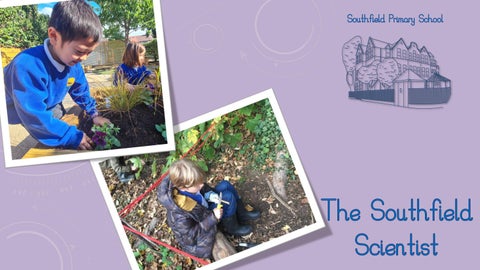
CURRICULUM STATEMENT Our science curriculum aims to equip children with the foundations for understanding the world through a scientific lens. The story of science through scientists and famous inventions punctuates the entire curriculum. Pupils will be taught units of work that cover and go beyond the requirements of the National Curriculum in the specific disciplines of biology, chemistry and physics. Pupils will encounter people who have made significant contributions to the field of science over time, understanding that science has been a quest for understanding for many years, and will continue to be so in the future. Pupils will build a body of key foundational science knowledge as they work through the curriculum, asking questions and developing a sense of curiosity about the world around us. Alongside our science curriculum is our commitment to primary science and the natural world which exploits curiosity for nature and wildlife. Children have the opportunity to visit our pond, weather station, bug huts and flowers and plants to engage with a curiosity for nature.
Science is highly regarded as a subject and we aim to achieve the Primary School Science Quality Mark which reflects outstanding work and practice.
CURRICULUM COVERAGE
WHAT DOES SCIENCE LOOK LIKE AT SOUTHFIELD? Our science curriculum will give children an introduction to fascinating content such as the inner workings of the human body, animals and the environments they live in, plants and their features, forces in nature, what lies beyond the visible and what lies beyond the planet we live on. Over time their knowledge will deepen moving from recognising and naming parts of the human body to understanding how our muscles work, how our blood moves around our body and how our nervous system helps us to interact with the world.
Pupils will be encouraged to use the knowledge they learn in Science and apply it to investigations that test a theory or set out to answer a question. Importantly, substantive scientific knowledge is taught first, before pupils are asked to undertake enquiry. This helps them to fully understand the elements of the enquiry first, and to make informed observations about the processes they see. Gathering information, recording data, graphing data and interpreting findings are all essential skills that pupils will apply to new contexts as they work through the curriculum. Enquiries include observing over time, pattern seeking, identifying, classifying and grouping, comparative and fair testing and researching using secondary sources.
Scientific enquiries provide children with a wealth of opportunities, but first and foremost they will help to deepen understanding of the nature, processes and methods of science as a discipline and how it differs from other subjects they are studying. Pupils will gain an understanding of the purpose and uses of science both today and in the future.
Throughout the science curriculum, children are taught that scientific discoveries have been made since time began around the world. The children learn about the work of scientists such as Lewis Howard Latimer, who invented the carbon filament that allowed Edison’s lightbulb to light up the world. In Year 5 children learn about Jabir ibn Hayyan who is thought to have invented a crucial tool for the distillation process: the alembic. In Year 1 children learn about their senses and reflect upon the challenges faced by Helen Keller who achieved a university degree despite being blind and deaf from her early childhood. Importantly in Science, over time, children learn about scientists and their search for the truth. They learn that the people who have contributed to science, from Ancient Baghdad to Ancient Rome and beyond, are diverse and many voices make up the story of science.
Our science curriculum builds knowledge incrementally. Pupils have multiple opportunities to secure and build on their knowledge and understanding as subject content is revisited at points throughout the curriculum. This helps children to master the knowledge and concepts whilst building up an extended specialist vocabulary. This incremental approach helps teachers to identify knowledge gaps and look back at previous content if they need to close gaps in knowledge or understanding. Our curriculum enables children to understand the important role that science plays in the sustainability of life on earth. We want children following to be equipped to go forth into their secondary education with curiosity, passion and a desire for discovery.
HOW OUR 4 CURRICULUM PRINCIPLES ARE REALISED AT SOUTHFIELD Story Centred Each scientific unit begins with a story to place the knowledge in context and may be linked to a famous scientist or invention. As we believe that story is both a powerful conduit to transmit knowledge memorably and a way of making meaning. This both acts as a way of transmitting knowledge and to contextualise understanding.
Abstract scientific knowledge is conveyed through engagement through story.
Knowledge Rich Pupils will be encouraged to use the knowledge they learn in Science and apply it to investigations that test a theory or set out to answer a question. Importantly, substantive scientific knowledge is taught first, before pupils are asked to undertake enquiry. This helps them to fully understand the elements of the enquiry first, and to make informed observations about the processes they see. Throughout the science curriculum, children are taught that scientific discoveries have been made since time began around the world. The children learn about the work of scientists such as Lewis Howard Latimer, who invented the carbon filament that allowed Edison’s lightbulb to light up the world. Over time their knowledge will deepen moving from recognising and naming parts of the human body to understanding how our muscles work, how our blood moves around our body and how our nervous system helps us to interact with the world. This incremental approach helps teachers to identify knowledge gaps and look back at previous content if they need to close gaps in knowledge or understanding. Our curriculum enables children to understand the important role that science plays in the sustainability of life on earth High quality outcomes and understanding is a pre-requite for each session. Pupil books will display a high-quality account of understanding through extended narratives, diagrams, presentation of sources and knowledge quizzes.
HOW OUR 4 CURRICULUM PRINCIPLES ARE REALISED AT SOUTHFIELD Contextualised: Children contextualise science through termly visits to our forest school and wildlife area. Our Science in the natural world curriculum which oscillates with the NC science support children to understand science in action.
Rich visits to the Natural Science Museum, Greenwich Observatory and a plethora of visitors to the school support children to place science in context.
Science week each year involves scientists speaking to children in school, many practical experiments and an exciting science dome.
Personal Growth: The curriculum allows children to bring their own understanding and curiosity to science and to develop a personal love of the subject.
Children’s cultural capital will be enhanced through rigorous engagement with influential sources of scientific content and thinkers.
Class assemblies are often linked to scientific inventors and characters and children internalise and reflect on the science.
A personal sense of discovery for science will be encouraged and nurtured.
Extended Research projects are carried out by Year 3-6 and allows children to deepen their curiosity of an area they are studying enhancing their ability to contextualise and bring science to life.
ASSESSMENT • Children are assessed throughout the topic using talk tasks, written outcomes and prior learning discussions in every lesson.
• At the end of each topic the children complete a multiple choice assessment and a written assessment task which is then assessed against the national curriculum objectives for Key Stage 1 and Key Stage 2.
‘Ex Corde Vita’
Email: admin@southfield.ealing.sch.uk Southfield Primary School Southfield Road Bedford Park London W4 1BD
Tel 020 8994 6173