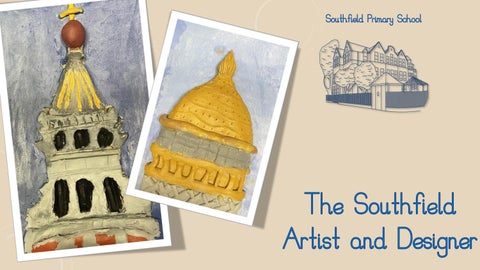
‘Art and design is not just a subject to learn, but an activity that you can practise; with your hands, your eyes, your whole personality’ Quentin Blake- Children’s Laureate
CURRICULUM STATEMENT This art curriculum is a knowledge rich curriculum. Knowledge, in the realm of art means knowledge not only of artists, designers, architects and their work, but of the artistic concepts that relate to their work shown in different types and styles of art, how these relate to each other in a historical context and how this affects the children’s own use of materials and development of skills. The curriculum is designed to enable children to learn by making connections between the work of artists, architects and designers (which they study critically) and their own work, which they evaluate and relate back to the works they have studied. The curriculum aims to inspire a love of art and architecture as a discipline and to hone their skills as Southfield artists.
CURRICULUM COVERAGE
WHAT DOES ART AND DESIGN LOOK LIKE AT SOUTHFIELD? The curriculum fulfils the requirements of the National Curriculum for England and, as such, has as its focus the art of the Western world. This course of study seeks to show how art shapes our history and contributes to our national culture. It looks at key movements and historical periods in the history of Western art, studying art from ancient Greece and Rome, Anglo Saxon England, the middle ages, the Italian renaissance, Victorian art and architecture, French impressionism and modernism of the 20th century.
Some of our curricula units look at a period in history which is studied and covered in our history curriculum, the art unit is taught after the history unit. This allows the children to approach their study of art with a degree of confidence and ‘expertise’ and to consolidate their knowledge by creating connections between the different disciplines.
Each Unit of work begins with a story about a painter, period in history or artistic movement in the curriculum. Units focus on the different concepts in art and different types of art. In this context concepts in art means the different elements of art (line, shape, colour, tone, form, space, visual texture and tone), how an artist combines these elements and produces art in different styles, for example realistic or abstract art. Different types of art means the different media used to make art (e.g. sculpture, architecture or painting), different subject matter (e.g. portraits, landscapes or history painting) and different artistic movements, historical periods or geographical cultures (e.g. impressionism, Anglo-Saxon art and Chinese painting).
The overall Art and Design curriculum provides for gradual . progression in terms of skills (split into painting, drawing, 3D form, collage, textiles, printmaking and mixed media), introducing the children to as diverse a range of materials as possible. It also provides for progression in terms of knowledge of different concepts and types of art (for example Style in Art and Narrative Painting are studied in year 1, and then revisited in year 3 in History Painting and in year 5 in Style in Art). The structure of the planning also provides for progression in terms of process in art, both in terms of critical analysis of others’ art and the necessary observation, exploration and evaluation needed for the children to create their own art.
Activities children are directed to undertake in lessons are designed with an eye to the importance of learning and practising process. These activities include verbal and written observations and observational, analytical and imaginative drawing activities in key stage 1, leading to the process of independent investigation, observation, annotation, sketching, design and planning (allowing the children to experiment and invent) by the end of key stage 2. Independent and investigative study and the understanding of process is particularly provided for in the units which conclude the year for years 5 and 6.
HOW OUR 4 CURRICULUM PRINCIPLES ARE REALISED AT SOUTHFIELD Story Centred Children begin each art unit with a story about an artist, an artistic movement or historical figure in art.
A picture or artefact may also be used to tell a story and let the imagination flourish
Units are linked to historical units of study such as the Victorians, Baghdad, Egyptians and Romans allowing children to analyse historical stories.
Knowledge Rich The curriculum is rich in both knowledge and aspiration. Children learn about artists, designers, architects and their work, but also the artistic concepts that relate to their work shown in different types and styles of art, how these relate to each other in a historical context and how this affects the children’s own use of materials and development of skills. The curriculum is designed to enable children to learn by making connections between the work of artists, architects and designers (which they study critically) and their own work, which they evaluate and relate back to the works they have studied. This process is cyclical. Units of work in the curriculum focus on the different concepts in art and different types of art. In this context concepts in art means the different elements of art (line, shape, colour, tone, form, space, visual texture and tone), how an artist combines these elements and produces art in different styles, for example realistic or abstract art. Different types of art means the different media used to make art (e.g. sculpture, architecture or painting), different subject matter (e.g. portraits, landscapes or history painting) and different artistic movements, historical periods or geographical cultures (e.g. impressionism, Anglo-Saxon art and Chinese painting). The overall scheme of the curriculum provides for gradual progression in terms of skills (split into painting, drawing, 3D form, collage, textiles, printmaking and mixed media), introducing the children to as diverse a range of materials as possible. It also provides for progression in terms of knowledge of different concepts and types of art (for example Style in Art and Narrative Painting are studied in year 1, and then revisited in year 3 in History Painting and in year 5 in Style in Art). The structure of the planning also provides for progression in terms of process in art, both in terms of critical analysis of others’ art and the necessary observation, exploration and evaluation needed for the children to create their own art. Activities children are directed to undertake in lessons are designed with an eye to the importance of learning and practising process. These activities include verbal and written observations and observational, analytical and imaginative drawing activities in key stage 1, leading to the process of independent investigation, observation, annotation, sketching, design and planning (allowing the children to experiment and invent) by the end of key stage 2.
HOW OUR 4 CURRICULUM PRINCIPLES ARE REALISED AT SOUTHFIELD Contextualised: Children visit art galleries to view pictures in real life and to understand why art is valued
Year 5 take part in the Take One Picture at the national Gallery each summer and complete an extended project on the picture of the year.
Through links with history and from story children understand how art is linked to culture and everyday life and how it is relevant to them as young artists.
Personal Growth: Meaningful opportunities for self-expression and individual response are woven through the curriculum, giving children space to learn who they are as an artist.
Children’s individual cultural capital is enhanced and depend by visits to art galleries and to develop art that is personal and important to them. Individual projects and self-study in Year 5 and 6 offer pupils to understand how they bring themselves to art.
Each year an art gallery is held at school where all children contribute and see their art work professionally mounted and exhibited and where parents and the whole school see it on display.
ESSENTIAL CHARACTERISTICS OF ART COVERED IN OUR ART AND DESIGN CURRICULUM Children produce creative work, exploring their ideas and recording their experiences Pupils to become proficient in drawing, painting, sculpture and other art, craft and design techniques
Learn about the work of a range of artists, craft makers and designers, describing the differences and similarities between difference practices and disciplines, and making links to their own work
Develop their techniques, including their control and their use of Evaluate and analyse creative works using the language of art, craft materials, with creativity and experimentation and design Know about great artists, craft makers and designers and understand the historical and cultural development of their art forms Use a range of materials creatively to design and make products Use drawing, painting and sculpture to develop and share their ideas, experiences and imagination Develop a wide range of art and design techniques in using colour, pattern, texture, line, shape, form and space
Develop an increasing awareness of different kinds of art, craft and design Create sketch books to record their observations and use them to review and revisit ideas improve their mastery of art and design techniques, including drawing, painting and sculpture with a range of materials for example, pencil, charcoal, paint, clay
Learn about great artists, architects and designers in history
.
‘Ex Corde Vita’
Email: admin@southfield.ealing.sch.uk Southfield Primary School Southfield Road Bedford Park London W4 1BD
Tel 020 8994 6173