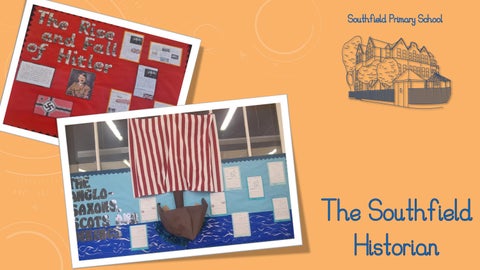
CURRICULUM STATEMENT We aim to inspire our pupils to become discerning Southfield historians. To equip children with knowledge and understanding of historical periods both at a local and international level. To construct meaning from sources especially through story and to develop a personal narrative of the past from a range of sources to debate the future.
WHAT DOES HISTORY LOOK LIKE AT SOUTHFIELD PRIMARY SCHOOL? Children follow a rigorous knowledge-based curriculum investigating the history of the British isles and internationally through high quality lessons and aspirational expectations in outcomes.
Through engaging with challenging topics children develop a curiosity for historical enquiry through key questions around topics which are explored with teachers in each session.
English lessons support history teaching both in fiction writing such as Year 4 Street Child offering children a fictional perspective on the Victorians and similarly in Year 6 with Goodnight Mr Tom and the experiences of evacuees during World War II. Half termly nonfiction units develop the use of a plethora of historical sources to engage and inspire writing linked to the topic.
A story linked to the historical period or famous historical figure acts as a ‘narrative gateway’ so children can understand abstract terms, develop historiography and make connections to the modern world through synthesising a disparate range of evidence. Lessons include documentary, books, artefacts and museum and historical visits.
HOW OUR 4 CURRICULUM PRINCIPLES ARE REALISED AT SOUTHFIELD Story Centred Story is used deliberately at the beginning of each historical unit. As we believe that story is both a powerful conduit to transmit knowledge memorably and a way of making meaning.
A fictional or factual story is read to children to deepen and prepare them for the historical period being studied.
Knowledge Rich Children are exposed to a rich history curriculum providing them with opportunities to engage critically with historical concepts throughout a unit. Knowledge is synthesised and broken down conceptually through each session in a unit through a question or title unit. Each unit of historical knowledge leads to core understanding which is sequenced and explored in subsequent units or year groups. Knowledge organisers support teachers and children with the breadth of the unit. Deliberate and aspirational high levels of material are used from a range of historical materials to engage and debate on historical events and concepts. Children are equipped with topic specific historical vocabulary to understand and engage at a high level and gain understanding of the period.
The story will then be revisited at the end of a unit to further enrich and deepen reflection, meaning and understanding. Children may produce an extended narrative story to articulate their understanding of a historical concept.
High quality outcomes and understanding is a pre-requite for each session. Pupil books will display a high-quality account of understanding through extended narratives, diagrams, presentation of sources and knowledge quizzes. Children’s cultural capital will be enhanced through rigorous engagement with influential sources of historical content and thinkers. Allow children to oscillate between factual evidence and fiction and stories written about the past.
HOW OUR 4 CURRICULUM PRINCIPLES ARE REALISED AT SOUTHFIELD Contextualised Our history curriculum is contextualised through many visits to places of historical significance so that pupils can make tangible links and connections between the past and present. Year 1: Buckingham Place
Personal Growth We value the understanding and historical experiences children bring to historical teaching. This can be through sharing experiences of lived memories of family and through carefully sequenced building of concepts through end of unit and year group expectations.
Year 2: Hampton Court Place
Year 6: Houses of Parliament, Imperial War Museum
Children are encouraged through story to empathise and understand the past and identify historical characters and their contribution to the modern world. Children through history and English sessions engage in extended and personal narratives to construct meaning and develop as people.
History Days are an important part of each topic – children dress up in historical costumes, participate in a drama activity linked to the period and designs and constructs an artefact or prepares food from the period to infuse their theoretical historical knowledge in a practical context they can understand.
Class assemblies are often linked to historical periods and characters and children internalise and reflect on the characters of the past.
Year 3/4: Butser Park Year 5:
History Exhibitions – each year create a museum exhibition to showcase their work to parents and the school. This further allows children to reflect on their work and discuss contextually. Extended Research projects are carried out by Year 3-6 and allows children to deepen their curiosity of an area they are studying enhancing their ability to contextualise and bring history to life.
Significant events are linked to whole school assemblies and year 6 lead our annual Remembrance assembly linked to their to WW I study allowing them to reflect on the material studied.
Autumn Term
Spring Term
Summer Term
Year 1
Discovering History
Kings, Queens and Leaders
Prime Ministers and Parliament
Year 2
Romans in Britain
The Tudors
Powerful Voices
Year 3
Stone Age to Iron Age
Ancient Egypt Anglo Saxons and Vikings
Law and Power The War of the Roses
Year 4
Ancient Greece
Life in Ancient Rome The Rise and Fall of Rome,
The Stuarts
Year 5
Baghdad 900 British Empire
The French Revolution The Transatlantic Slave Trade
The Industrial Revolution The Victorian Age
Year 6
World War I The Suffragettes
The Rise and Fall of Hitler World War II and The Holocaust
The Cold War The History of Human Rights
CURRICULUM COVERAGE
ASSESSMENT Children are assessed throughout the topic using talk tasks, written outcomes and prior learning discussions in every lesson.
At the end of each topic the children complete a multiple choice assessment and a written assessment task which is then assessed against the national curriculum objectives for Key Stage 1 and Key Stage 2.
‘Ex Corde Vita’
Email: admin@southfield.ealing.sch.uk Southfield Primary School Southfield Road Bedford Park London W4 1BD
Tel 020 8994 6173